To be given to the Outer Rail in
Curves ranging from 6 to 200 Chains Radius.
Offset
(Length of
Cord 66 ft.)
|
Radius
of
Curve.
|
Minimum “Cant.”
|
Maximum “Cant.”
|
|
|
Outer rail
to be raised.
|
For a
maximum
speed of
|
Outer rail to
be raised.
|
For a
maximum
speed of
|
Inches.
|
Chains.
|
Inches.
|
miles per hr.
|
Inches.
|
miles per hr.
|
16½
|
6
|
3¾
|
20
|
6
|
25
|
10
|
10
|
3½
|
25
|
5⅛
|
30
|
6⅝
|
15
|
3⅜
|
30
|
4⅝
|
35
|
5
|
20
|
3½
|
35
|
5¾
|
45
|
4
|
25
|
2¾
|
35
|
4⅝
|
45
|
3¼
|
30
|
3
|
40
|
4¾
|
50
|
2¾
|
35
|
2⅝
|
40
|
4
|
50
|
2½
|
40
|
2¼
|
40
|
5⅛
|
60
|
2¼
|
45
|
2½
|
45
|
4½
|
60
|
2
|
50
|
2¼
|
45
|
5⅝
|
70
|
1⅝
|
60
|
1⅞
|
45
|
4⅝
|
70
|
1⅜
|
70
|
1⅝
|
45
|
4
|
70
|
1¼
|
80
|
1¾
|
50
|
3½
|
70
|
1⅛
|
90
|
1½
|
50
|
3⅛
|
70
|
1
|
100
|
1⅜
|
50
|
2¾
|
70
|
⅞
|
120
|
1⅛
|
50
|
2⅜
|
70
|
¾
|
140
|
1
|
50
|
2
|
70
|
⅝
|
160
|
⅞
|
50
|
1¾
|
70
|
½
|
200
|
¾
|
50
|
1⅜
|
70
|
The amount of “cant” to be given to a curve is
governed by the speed at which trains run over it, and in no case
must the raising of the outer rail in Running Lines be less than
is given in the column headed “Minimum Cant,” except
where necessary to meet special cases, as at switches, crossings
and junctions. In curves on falling gradients where high
speeds are run, the outer rail must be kept well up, while on
rising gradients a lesser “cant,” but within the
limits of the latter, must be given. On gradients on single
lines the outer rail of curves must, as a rule, be raised to suit
the speed of descending trains.
The superelevation must be gradually attained at the rate of 1
inch in each 66 feet length as the curve is approached,
maintained uniformly over the whole length of the curve, and run
out after passing the curve in the same way.
On reverse curves, or curves with very short pieces of
straight between them, the “cant” must be made
gradually on the curves commencing at the middle of the short
piece of straight in the latter case.
Stretch a cord measuring exactly a chain (66 feet) across the
inner side of the curve, and measure the distance (C D) between
the inner edge of the rail and the cord, as shewn in sketch
below.
Look for this measurement in the column headed
“Offset,” opposite to which, in the column headed
“Radius of Curve,” will be found the radius of the
curve in chains; and in the columns headed “Minimum
Cant” or “Maximum Cant” will be found how much
the outer rail is to be raised above the inner one, according to
the speed of trains.
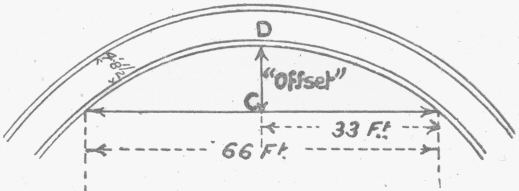
Suppose the distance between the inner edge of the rail and
the cord at C D is found to be 2½ inches, the column
headed “Radius of Curve,” shews it to have a curve of
40 chains radius; and those headed “Minimum Cant” or
“Maximum Cant” will shew that the outer rail must be
raised 2¼ inches higher than the inner one for a speed of
40 miles an hour, or 5⅛ inches for a speed of 60 miles an
hour.
