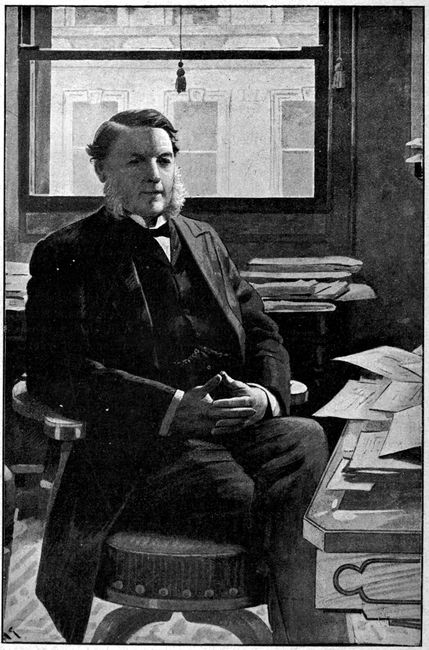
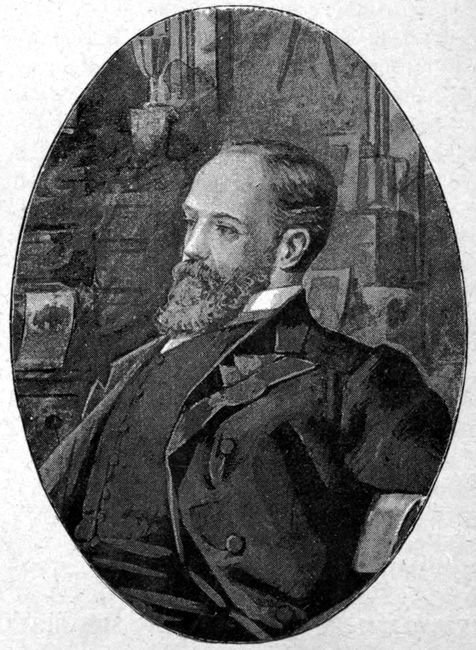
FULL ACCOUNT OF THE MURDEROUS ASSAULT; CRITICAL CONDITION OF THE WOUNDED PRINCE.
(By Telegraph from our Own Correspondent, Mr. Francis Scudamore.)
Constantinople, Sunday, April 3 (viâ Varna).
Noon.
A report has been current here since a late hour last evening,
to the effect that an attempt has been made to assassinate Prince
Ferdinand of Bulgaria, at a mining town named Samakoff, about
forty miles south of Sofia. It is said that the Prince, who had
been shooting in the Balabancha Balkans, was driving into
Samakoff towards evening yesterday, when his carriage was
stopped, and he was attacked by a number of men armed with
knives and pistols. The Prince’s attendants succeeded in saving
their master’s life and in beating off some and capturing others
2of his assailants, but not before His Highness had been severely
wounded.
Prince Ferdinand was carried into the house of an American
missionary resident in Samakoff, where he now lies. His Highness’s
condition is serious, and is rendered the more critical from
the fact that there is no very adequate surgical aid obtainable in
Samakoff, and it was necessary to telegraph for doctors to Sofia
and Philippopolis.
The greatest excitement reigns in Constantinople since the
receipt of this intelligence, and very grave anxiety is expressed
in diplomatic circles as to the possible consequences of this terrible
misfortune.
It is impossible to overrate the grave significance of this
attempted assassination at Samakoff, which in the light of our
Correspondent’s telegrams would seem to be the prelude to very
serious complications in the East. It is, of course, too early to
estimate its influence upon general European politics, but we are
quite within reason in saying that the dramatic incident may
prove to have endangered the peace of Europe. We have long
familiarised ourselves with the thought that the Great War of
which the world has been in constant dread for some years back,
and which is to re-adjust the balance of the Continent, is much
more likely to break out in the region of the Danube than on the
banks of the Rhine, and the incident at Samakoff may well precipitate
the catastrophe. The situation is most perilous, and it
is to be hoped that strenuous endeavours will be made by the
Powers to chain up the ‘dogs of war,’ and spare this dying
century, at least, the spectacle of their release. Since the Treaty
of Berlin patched up the last serious disturbance in Europe,
there has been peace; peace, it is true; but a peace subject to
perpetual menace, and weighty matter for the consideration of
statesmen. Europe has lived, as it were, in armed camps, neutral
3and watchful; and all the time the nations have prepared against
war as though war were at their doors. The dastardly outrage
at Samakoff comes at a sorry time.
For we repeat our firm conviction, based on long and close
attention to the political motives at work among the nations, that
it is on the Danube and not on the Rhine that the torch of war
will first be kindled. To a pessimist, indeed, if not to an unbiassed
observer, we may well seem of late to have been drawing nearer
and nearer to a general war. The world has never been afflicted
with more persistent rumours of war. No single day has passed
without bringing us its perturbing crop of tremors and apprehensions
about the stability of the European peace. From week to week
the Jewish speculators on all the Bourses of Christendom have
been robbed of their sleep, and, worse still, of their dividends, by
telegrams as to the secret massing of troops on this or that frontier,
and of ruinous uprisings in various subject and down-trodden
countries. Now it is the Black Sea Treaty that is going to be
forcibly robbed of its entire Dardanelles clauses, and again the
Bargain of Berlin is about to be perforated, for the sixth time, by
the sword-point of the Czar. Then the Roumanians wake up to find
the Russians beginning to hem them in on three sides; while, again,
newspaper readers are horrified by a revelation of the rapacious
passions which some dignify by the title of ‘principle of nationality,’
and others denounce as criminal ‘lust of land,’ that are on the
verge of outbreak at Athens and Sofia, at St. Petersburg, at
Belgrade, at Vienna, at Paris, and even at Rome.
Where is the wisdom of highly-placed men like the German
Emperor and his new Chancellor assuring the world, in addresses
from the throne and after-dinner speeches, that the peace of Europe
was never more assured than at present, and that the political
horizon is without a cloud even of the size of Elijah’s ominous and
initial speck of vapour? What is the truth or the wisdom of such
assurances, when the thorn of Alsace-Lorraine is still sticking in
the flesh of the unforgiving and revengeful French; when Italy
still has some territory ‘unredeemed;’ when Denmark still harbours
4a deep grudge against her truculent despoiler; when even the peaceful
Swedes, who are still animated by the spirit of the Great Gustavus,
long to free their former subjects, the Finns, from the tyrannical
mastery of the Russians; when the Spaniards would gladly profit by
a European complication—even if they shrank from the thought of
an audacious coup de main—to repossess themselves of Gibraltar;
when the Portuguese, following suit, would never hesitate to kick
their British rival in Africa, if they deemed him to be down; when
the Cretans, egged on by the Greeks, are firmly resolved to throw
off the galling yoke of the Turks; when ex-ministers like M.
Tricoupis stump about the Balkan Peninsula, openly preaching
Pan-hellenism and Balkan Federation against the advocates of
disunited nationalities; when the Servians secretly vow to settle
up old scores with their Bulgarian vanquishers, and when these
Bulgarian victors themselves, with their Prime Minister more than
their Prince at their head, are sternly determined to be free and
independent alike of Sultan and of Czar; when Austria continues
to cast longing eyes in the direction of Salonika; and when, above
all things, the Colossus of the North, with his head pillowed on
snow, and his feet swathed in flowers of the sunny South, has
sworn by the soul of his assassinated and sainted father that he
will ever remain true to the intention of his sire in exacting a
solid equivalent of power, prestige, and territorial foothold on the
Balkan Peninsula for all the blood and treasure spent by Russia in
the task of ‘liberating’ the Bulgarians; when all these things, all
these slumbering passions and meditated schemes of aggression
and revenge are duly considered, how is it possible for any one, be
he sovereign or subject, to lull the world asleep by false assurances
of peace which is sooner or later doomed to be broken?
The Triple Alliance will no more succeed in terrorising the
souls of all these secret plotters and designers, and in giving them
pause, than three inter-locked mountain oaks or firs could stay the
downward course of an extended series of separate avalanches, which
rend away with them pines, and oaks, and all, in their resistless
rush. But has the avalanche, which we thus dread, really and truly
5at last begun to move? We sincerely trust not, but for the present
at least, the omens in the East have an exceedingly ugly and
alarming look, and we shall await the arrival of further telegrams
with the greatest anxiety. The Triple Alliance is not an embankment
that can bar the advancing flood of war, but rather a detached
fortress which must itself soon incur the danger of being surrounded
and even submerged by the rushing, whirling waters of
European strife. Though the parties to this three-cornered pact
have agreed to place their fire-engines, so to speak, at each other’s
disposal in the event of external danger from fire to their respective
domiciles, it is beyond the reach of these Powers to prevent the
outbreak of a conflagration, from accident or arson, among the
rickety, wind-swept, and thatch-roofed mansions of their neighbours;
nor is there any fact better established in connection with
fires than that they are used by thieves and anarchists for the
purpose of sudden plunder and disorder, at once upon the persons
and property of the victims and beholders of such catastrophes.
Let us suppose, for example, that as a consequence of this most
alarming incident at Samakoff, hostilities should ensue between
Russia and Austria, the former being the aggressor. In that case
Germany—in virtue of her published Treaty with the Hapsburg
Monarchy—would almost immediately have to take the field.
Now, in such a contingency, is there not a grave danger that
France, seizing the golden opportunity for which she has so long
been waiting, would at once mobilise her army, and march the
greater part of it towards the Rhine? And is it not certain that
the immediate result of such a revengeful step on her part would
be that Italy, true likewise to her Treaty engagement with
Germany, would make haste to spring upon the flank of the
Republic?
It is not well to forecast evils, but at the same time it is well
to look clearly ahead. We know surely enough the real nature of
the feelings with which the Bulgarians are regarded by their
‘Liberators,’ just as we are equally cognisant of the true character
of those who profess to be the Sultan’s ‘friends,’ and who, with the
6privilege of most intimate amity, have repeatedly helped themselves
to disintegrating slices of his dominions. We need not remind our
readers of that bitterness which still rankles in the breasts of the
Roumanians at the memory of the manner in which they were
‘rewarded’ for services rendered at the Gravitza Redoubt and
elsewhere during the war against the Turks; a bitterness which was
only equalled by the rage of the Russians when they recognised
the supreme folly of their conduct in forcing Roumania to accept
the Dobrudja in exchange for Bessarabia, and thus depriving themselves
of a pied à terre and strategical base of operations south of
the Danube, in the direction of the grand goal of their ultimate
ambition—the Golden Horn. It is as much the desire of Russia
to undo this unfortunate bargain as it is to shake herself free from
the intolerable shackles that restrain her liberty of action in the
Black Sea, and seal up the outlets thereof against her ships of war.
Russia is only awaiting a proper opportunity for accomplishing
these two other stages in what she deems to be her destiny (and
does not everything come to him who can wait?) just as she continues
to pursue her anti-English policy in Central Asia with steady,
disdainful, unresisted strides, ever lessening the distance between
her own frontiers and those of India, and thus paving the way for
the execution of her policy of preventing the forces of England
from being thrown into the balance should any complication arise
in the East of Europe. ‘And ever,’ as Tennyson sang, ‘upon the
topmost roof the banner of England blew;’ but that proud banner
has now, at last, been blown away by Cossack colonels from the
topmost roof of all—the ‘Roof of the World’ itself, thus enabling
Russia to overpeer our very Indian plains, and thence despatch her
Calebs and her Joshuas to spy out this other land of promise.
It may be quite true—and, indeed, from all we know of the
character of the Czar, we think it is quite true—that Alexander III.
has a holy horror of war, into which he is determined not to plunge
his people; and we have been assured by the greatest master of
modern war, the late Count Moltke, that the period of dynastic
conflicts, or struggles resulting from the personal passions and
7petulance of rulers, has come to an end, and been succeeded by
wars between peoples and nations. This is also quite true; but it
is precisely herein that the greatest danger lurks. For a ruler—as
witness the case of the present Czar’s own father—may prove
too weak to restrain or deflect the set of the popular tide, and he
plunged into a war against his own will. It is also conceivable
that the French Government might find it impossible to resist the
clamours of the Chamber to embrace the first opportunity—and
what could be a better one than a general European conflagration?
for ousting the English from Egypt—an object which all good
Frenchmen deeply have at heart. But it is on the Balkan
Peninsula, where there are no rulers or restraining influences to
speak of, that popular passions and aspirations must enjoy most
unbridled sway; and therefore it is that we look with anxiety for
the further development of this tragic event at Samakoff, which
has already thrown the Balkan countries into a state of wild
excitement, and all Europe into a fit of ever-increasing alarm.
(By Telegraph from our Special Correspondent, Mr. Francis Scudamore.)
(Sunday Night.) I date this message from Philippopolis,
whence indeed it will be despatched on our arrival there to-morrow;
but, as a matter of fact, it is written in the sleeping car of
a special train by which I am travelling to Ichtiman en route for
Samakoff, in company with Drs. Patterson, Stekoulis, and Lelongt,
who have been invited by telegraph to meet their Bulgarian colleagues
in consultation at the bedside of the wounded Prince.
It is to these gentlemen’s courtesy that I owe the privilege of my
passage.
I am enabled, by the kindness of my friends at the United
States Legation, which, as is natural in the circumstances, has
received minute information as to the occurrence, to give you a
fuller and more authentic account of the Samakoff tragedy of
yesterday by which Prince Ferdinand of Bulgaria so nearly lost
his life, than is likely to have been transmitted as yet, and of
8which no doubt garbled first reports have already thrown consternation
into every European capital. I have already stated that it
is in the house of an American missionary that Prince Ferdinand
is at present lying. I must now explain that Samakoff, which is
nestled in the heart of a picturesque valley formed by the rough
triangle of the Kilo Dagh, the Kadir Tèré, and the De mir Kapou
Dagh at the head of the Balabancha range of Balkans, is not only
one of the wealthiest towns in the principality,—thanks to the iron
mines by which it is surrounded,—but is also famous and dear to
Bulgarians by reason of the presence there of the American
Mission School, whose principals rendered such devoted and signal
service to the oppressed Christians throughout the terrible time
of the massacres of 1876 and the war of 1877. At that time, when,
as will be remembered, to be a Bulgarian was all-sufficient reason
for being summarily hanged (if a man), or foully outraged (if a
woman), the principal of the school and his courageous wife
snatched many victims from the gallows, and rescued from a
terrible fate, by harbouring in the mission-house, numerous young
girls and children, fugitives from the devastated villages of the
Balkan slopes. And when brighter days dawned for Bulgaria,
and it became a principality, the services of the American Mission
at Samakoff were not forgotten. It became a custom, inaugurated
by Prince Alexander and studiously maintained by his successor,
for the Ruler of Bulgaria to visit Samakoff in an informal manner
once or twice a year, for the purpose of inspecting the mission
school and complimenting its directors.
The snows which have held Samakoff isolated from the rest of
the world throughout the past four months, are now just melted,
and thus it chanced that Prince Ferdinand, who for a week past had
been shooting in the hills around Philippopolis, decided to pay his
first visit of the year to the missionaries of Samakoff, and had, unfortunately
as it turns out, announced his intention of so doing.
The Prince, with this purpose in view, left Philippopolis on
Friday evening, passing the night in his sleeping-car, and yesterday
morning started in a calèche from Ichtiman-i-Vakarel, formerly
9the boundary between Bulgaria and the province of Eastern
Roumelia, to drive to the little township in the mountains.
His Highness has usually been accompanied on these visits by
one or other of the ministers, but on this occasion, owing partly,
no doubt, to his hurriedly-formed plans, he had with him only one
of the aides-de-camp who had been of the shooting-party. The
Prince’s carriage was preceded by half-a-dozen mounted guards,
and followed by a like number, as an escort. This is a precaution
which Prince Ferdinand’s advisers have prevailed with him, much
against his will, to adopt of late, in view of the renewed activity
of Russian agents and sedition-mongers throughout the Principality
and the neighbouring States, where, indeed, a great anti-Bulgarian
and anti-Turkish propaganda has been actively carried on for the
past year; and in view also of the growing apprehension of his
advisers that the recent success in this city of assassins in Russian
pay, coupled with the immunity from punishment which the
Czar’s representatives have shown their ability and readiness to
secure for them, would prompt the conspirators, soon or late, to
fly at higher game than either M. Stambuloff or the late Dr.
Vulkovitch. That his Highness’s advisers were in the right has
been proved by the attempt of yesterday. The event, however,
may be said to offer encouragement at once to would-be regicides
and to their intended victims, inasmuch as it has been shown yet
once again to the former, how useless as a protection against
assassins is the presence of an armed escort, and to the latter, how
apt is a well-matured plot to be frustrated by a commonplace
accident.
The Prince’s carriage was expected to reach Samakoff about
noon, and shortly before that hour a considerable number of
persons had collected in the main street, while small crowds had
gathered round the gates of the Prefecture and about the door of
the American Mission-house, which is situated in a side street
leading off the high road, and where the usual modest preparations
had been made for the princely visit.
His Highness, on arrival, after halting for a moment or two at
10the gate of the Prefecture where he did not alight, drove on
through the town towards the Mission-house. At the moment
when the carriage turned the corner into the narrower street, a
man wearing the long black gown and brimless stovepipe hat of a
priest of the orthodox church stood forward from the crowd, in
which were several other persons dressed as he was, and, raising a
revolver, took deliberate aim at his Highness. And then occurred
the accident to which, in all probability, Prince Ferdinand owes
his life. The cartridge did not explode. The sham priest lowered
his weapon slightly, raised it once more, and again pulled the
trigger; but as he did so the pistol barrel was struck up—the ball
burying itself in the wall of a house across the street—and the
assassin was seized and firmly held by many willing hands.
The whole occurrence had taken but a moment. The Prince,
when he saw the pistol levelled at him, had leapt to his feet, with
the evident intention of throwing himself upon his murderer.
As it was, his Highness’s intervention seemed very necessary on
behalf of the baffled assassin, who stood in no small danger of
being lynched incontinently by his furious captors.
The carriage had stopped; the escort was hastily dismounting,
and the Prince, shouting orders to the people to spare their
prisoner’s life, had alighted, and turning, was in the act of throwing
his heavy pelisse to his companion, when sudden as thought a
second ruffian sprang from amid the vociferating mob, hurled
himself upon the Prince, and thrusting a great, broad-bladed Circassian
khanga into his bosom, was away and out of sight almost
before any of the bystanders had recovered from this second shock
of horror and surprise.
His Highness, who had sunk to the ground under the blow,
though he did not lose consciousness, was at once carried into the
Mission-house, distant a few yards only, and very speedily all the
best medical advice obtainable in Samakoff was at hand, while
telegrams for further assistance were at once despatched to Sofia
and to Philippopolis, the latter place being perhaps more rapidly
accessible than the capital. The first examination of the wound
11showed that the broad knife had turned on the point of a rib—very
fortunately—and had therefore missed, by a hair’s-breadth
the envelope of the heart. It was not till to-day that a persistent
recurrence of internal hæmorrhage aroused the gravest fears of the
Prince’s surgeons, and prompted them to appeal to Constantinople
for further advice.
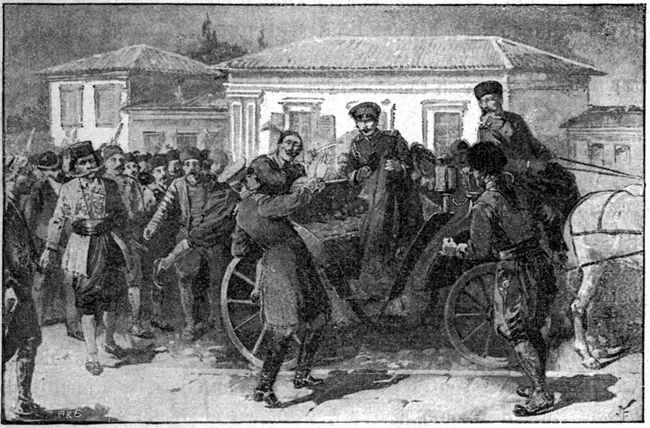
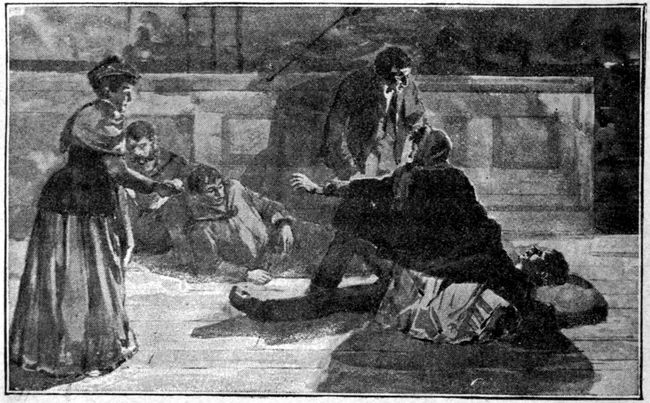
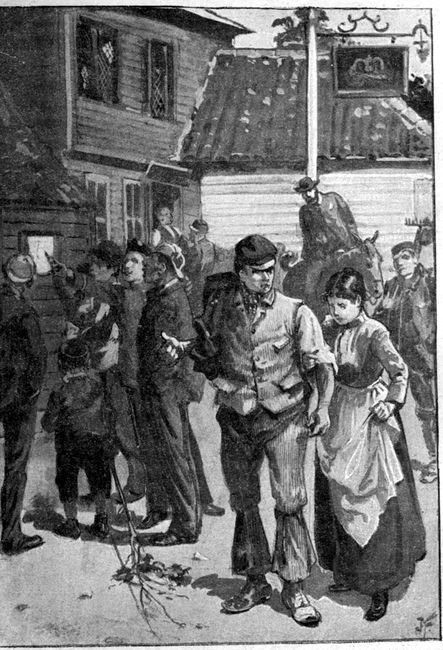
THE ATTEMPTED ASSASSINATION OF PRINCE FERDINAND OF BULGARIA.
The pretended priest, when searched, was found to be costumed
beneath his robes in the ordinary dress of the petty trader of the
towns here. His long flowing locks proved a wig, and his thick
unkempt beard was also false. Upon him, among other papers
said to be of great importance, but as to which I know nothing,
was found a passport issued by the Russian Consulate at Odessa
no less recently than last month, and bearing the visé of the
Russian Chancellor at Sofia. The passport is made out in the
name of Ivan Bendukdjieff, and belongs, the fellow avows, to a
man, a stranger to him, who left it with him by mistake a week
ago. But the authorities entertain few doubts as to the scoundrel’s
12identity with one of the men implicated with Shishmanoff in the
recent murder of Dr. Vulkovitch.
I have said that the news of this dastardly attempt on Prince
Ferdinand’s life caused the greatest excitement in Constantinople.
There is indeed no doubt that both the Palace and the Porte are
very seriously alarmed, as, in view of the Sultan’s disgraceful action
in the Vulkovitch affair, it is only just they should be. It is
significant of his Majesty’s state of mind that, when early this
(Sunday) morning, first the French and then the Russian Ambassador
drove to the residence of the Grand Vizier, they were unable
to see him, orders having been sent from Yildiz ordering the
Pasha not to receive them. Sir Clare Ford, on the other hand, had
a long interview with the Sultan this morning.
When the train steamed into the station here, I learned in the
restaurant, where every one was eagerly discussing the events of the
past two days, that the second assassin was captured yesterday
afternoon at Banja, as the result of an order widely circulated by
both telegraph and horse messengers throughout the country,
calling upon all Tchorbadjis, or headmen of villages, to detain any
stranger found within their jurisdiction, and at once communicate
with the nearest central authority. The man has been identified
as one Nicholi Nāoum, a very well-known character who, besides
being suspected of participation in the murder, last spring, of M.
Beltcheff, is known to have been acting for the past six months as
a revolutionary agent on the Macedonian frontier. Nāoum, who,
as leader of a gang of border brigands, has gained a bloody
notoriety in connection with various dastardly outrages against
society, is believed to have been recently engaged in distributing
arms and ammunition among Macedonian villages, and in inciting
the Macedonians to molest the Bulgarians dwelling among them.
Nāoum, when arrested, was found to be provided, like his accomplice,
with a Russian passport executed in regular form. He was immediately
carried back to Samakoff and confronted with Bendukdjieff,
13against whom he at once began to rail as a bungler, making no
attempt to exonerate himself, or to deny his share in the tragedy.
In this course, perhaps, he was guided by the knowledge that his
life was already forfeited for many atrocious crimes before he set
his hand against Prince Ferdinand. As a consequence of his last
admission of guilt, a very brief trial was necessary, and the two
wretches were hanged this morning outside the house in which
they had lodged on Friday night in Samakoff.
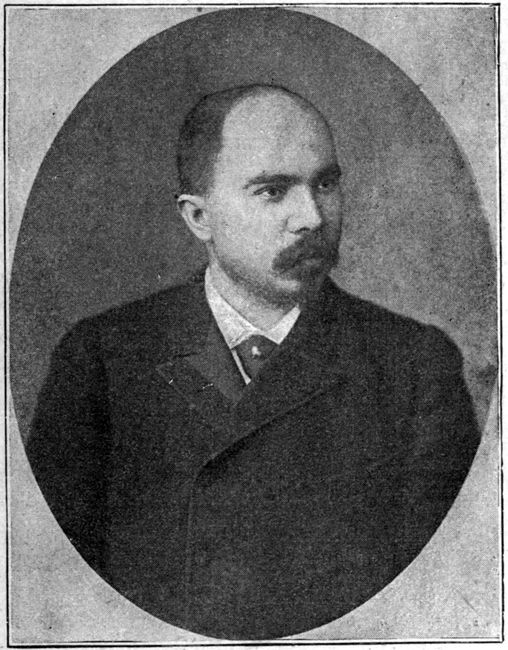
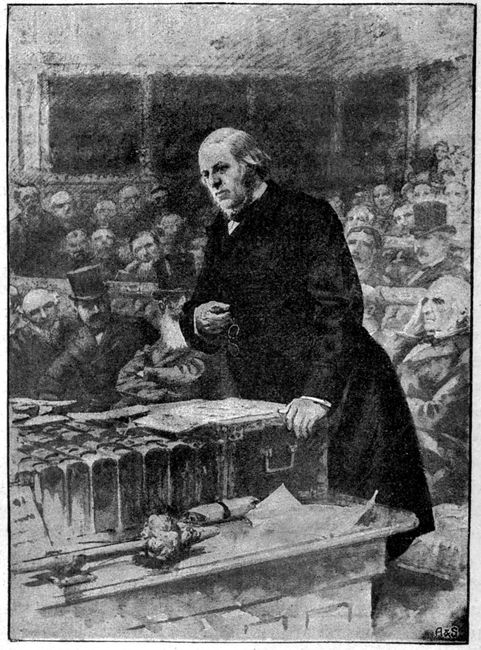
M. STAMBULOFF
Prime Minister of Bulgaria, appointed Regent after the attempted assassination of Prince Ferdinand.
The Prince is apparently doing well. M. Stambuloff, who,
on receipt of news of the disaster, hurried to his master’s bedside,
remained but one hour in Samakoff, during which time, despite
14the doctors, the Prince insisted on seeing him, and returned direct
to Sofia. Late on Saturday night, at a meeting attended by most
of the Ministers, hurriedly convened, he was declared Regent
during the serious illness of the Prince, and for such time as might
be necessary, and the formal proclamation in accordance with this
decision was issued yesterday morning.
Instead of accompanying Dr. Patterson and his colleagues on a,
to me, fruitless expedition to Samakoff, I bid them good-bye at
Ichtiman, where they left the train, and came on here. As might
be expected, I have found this city boiling with tumultuous
emotions, and not only—though that were sufficient cause—on
account of the outrageous attempt on Prince Ferdinand’s life.
It appears that the Cabinet has received news of the greatest
importance from the Macedonian frontier. The assiduous efforts
of Russian agents, who have been actively engaged for the past six
months or more not only in the provinces itself, but also in the
Greek and Montenegrin borders, in fomenting an anti-Bulgarian
rising, are now on the eve of being crowned with success. Already
reports have reached the capital of disturbances, caused apparently
by raids made across the border at Petrovich and Melnik. That
there is a great shifting of troops at present in progress as a result
of this intelligence, is not denied. It is said, indeed, though I
cannot as yet tell with what truth, that a half division has been
ordered to Petrovich, and another like force to Strumnitza. The
latest rumour here is to the effect that the movement in Macedonia
is as much anti-Turkish as anti-Bulgarian, and that Turkey is also
despatching a large military force to Salonika. If this report be
true, it is surely an instance of the irony of fate. In this country
it is a matter of common talk that any anti-Bulgarian movement
in Macedonia is mainly due to the attitude of Zuknir Pasha, the
Vali of Salonika, towards the large Bulgarian element of the population
of the province under his control. This functionary’s
persistent ill-treatment of Bulgarians has been very frequently represented
to the Porte in notes from this capital as being contrary at
once to the interests of Turkey and of Bulgaria. The Principality, it
has been said, has consistently refused to take side with those who
seek the dismemberment of Turkey, and has claimed a right to expect
that the development of the Bulgarian element in Macedonia would
not be crushed by Pashas who, by their arbitrary actions, paralyse
the intentions of the central government, and prepare the way for
events which had better, in the common interest, be avoided. It
is needless to say these sensible warnings have been altogether
disregarded by the Porte, with the present inevitable result.
15
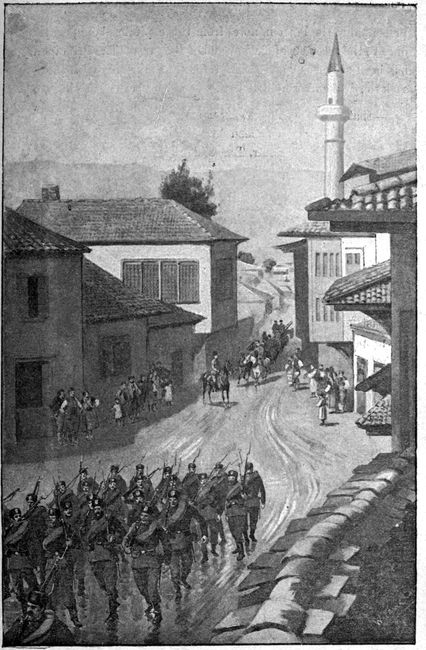
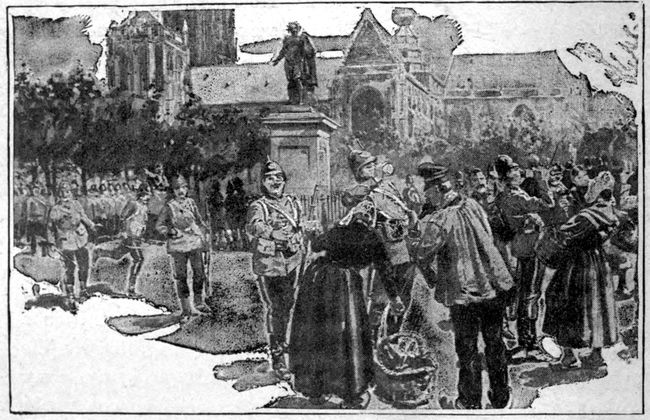
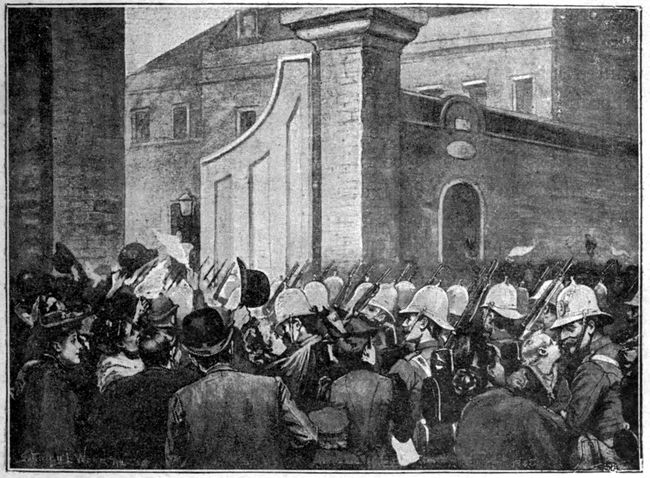
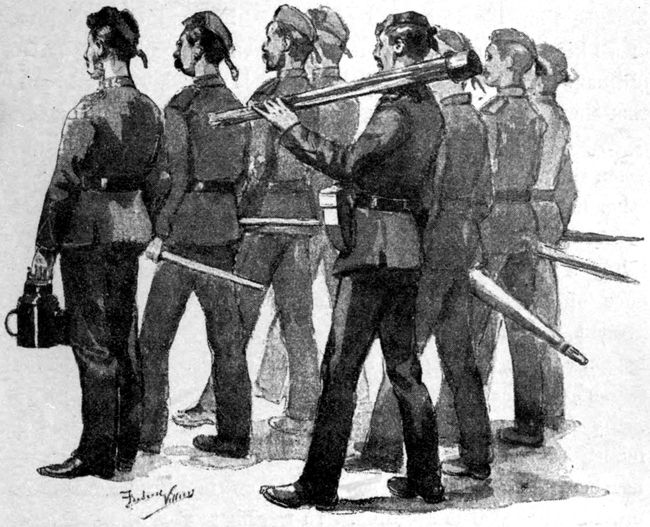
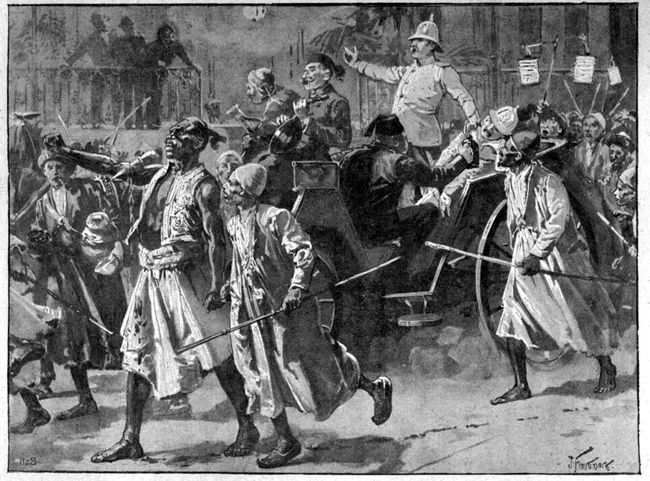
THE BULGARIAN MOBILISATION—TROOPS MARCHING THROUGH THE STREETS OF PHILIPPOPOLIS.
16It is further rumoured here—for the place is full of suspicion—that
in view of certain movements of Servian troops, a large
Bulgarian force has been hurriedly thrown forward to strengthen
the troops at Radomir, Trn, and Zaribrod.
The latest reports as to Prince Ferdinand are more favourable
than could have been hoped for. The dangerous symptoms have
subsided. Internal hæmorrhage has been checked. The Prince
sleeps and takes nourishment, and his pulse and temperature are
satisfactory. Hopes are held out that in a week’s time His
Highness may be moved from Samakoff. Meanwhile, during the
past few days, events have marched so rapidly that people here are
prepared for almost any eventuality. There is no longer any
attempt to conceal the movements of Servian troops. Great
numbers of men are already massed at Nisch and Vranja, and at
points on the line of railway between Nisch and Pirot. The main
body of the Servian army has its headquarters at Knuzevatz.
From Belgrade, we learn of the steady despatch of war material
and siege-train to Negotin on the frontier against Widdin, and a
telegram from the same source announces the arrival at Nisch of a
train of the Red Cross Society, consisting of eighteen carriages
furnished with all the necessary equipment for active service.
News from Constantinople is to the effect that the Porte,
alarmed at the aspect of affairs in Macedonia, has, in addition to
17the calling out of the last class of rediffs, decided on the formation
of five new Army Corps. Fresh levies are to be made in order to
form a strong reserve. The transport of rediffs, mainly from Smyrna,
Skanderoun, and the Tripolitaine, is being carried on on a large
scale. Over 27,000 reservists have already passed through Smyrna.
Many of the Austrian Lloyd vessels being engaged in the transport
of troops to Salonika to guard the frontier line and to
reinforce the Bitolia garrison, the Seraskierate is negotiating with
some English shipping companies for additional transport. More
than fifty thousand troops are to be employed on the Macedonian
border in a line stretching from Mitrovitza on the north, all
round to Raslok on the south-east. Their chief stations will be
Palanka, with Uskub as base, and Djuma and Neurokoy with
Strumdja as base. No further disturbances are reported from the
frontier.
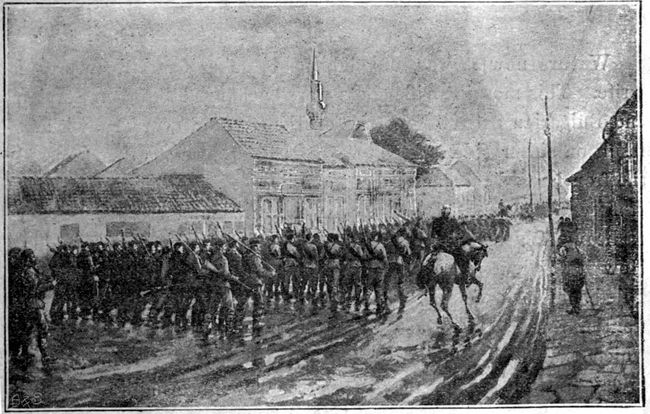
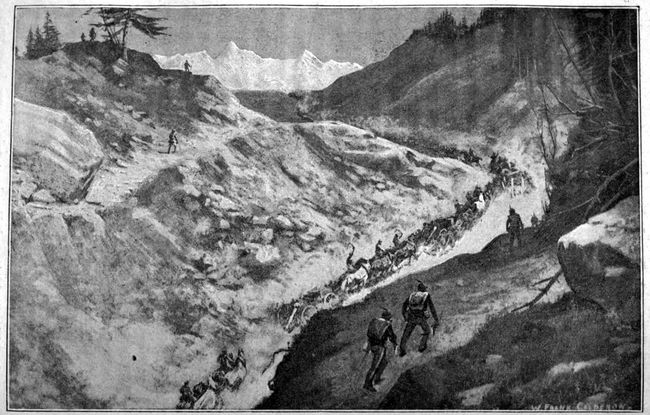
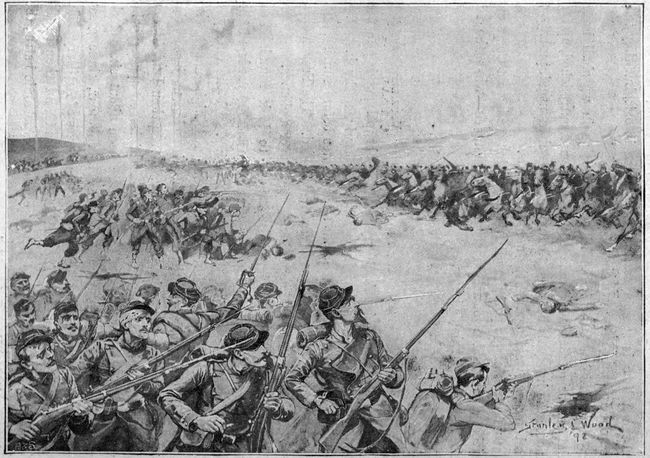
THE SERVO-BULGARIAN CAMPAIGN—THROUGH PIROT TO THE FRONT.
M. Stambuloff left here last night to inspect the troops on
the frontier. I am, of course, unable to give any information as
18to their numbers or disposition, but it may be said that Bulgaria
is well prepared to resist any attack. It is infringing no rule to
say that the Prince’s army possesses no fewer than 400 pieces of
ordnance of all calibres. The report that his appointment as
Regent has met with disapprobation among a large section of the
community here is absolutely without foundation.
A trusted agent of the Government has also left here for
Berlin, for the purpose, it is understood, of raising a loan in that
capital.
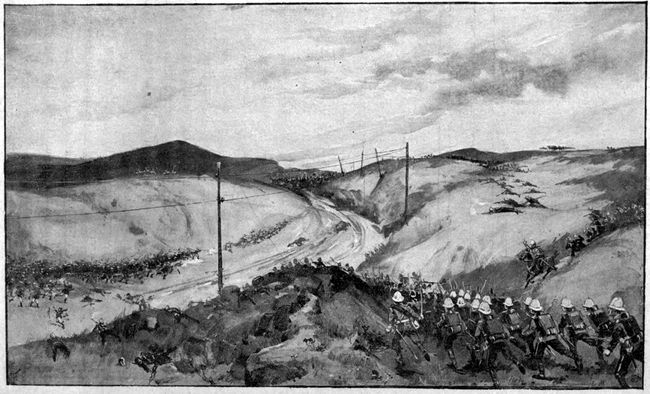
We are now at war, and fighting is going forward even as I
write. This morning rifle-shots were exchanged between Servian
and Bulgarian patrolling parties on the frontier, near Trn, without
result on either side. A body of some 300 Servians then crossed
the frontier and advanced about a mile, seeking to cut off a party
of fifty Bulgarians, who, however, retreated and escaped. Later
on heavy fighting was reported in the neighbourhood of Vlassina.
How it originated is immaterial. The Bulgarians lost 17 men
killed and 54 wounded. This set fire to the torch all along the
frontier line. Some time before the official declaration of war,
which, though it announced that hostilities would begin at noon
to-day, did not reach the Minister for Foreign Affairs here until
nine o’clock this evening, reports had been posted up in the cafés
announcing fighting in the vicinity of Planinitza, Beuskedol,
Miloslawtzi, Zelene, and Gard, in the Trn district. The Servian
Minister, who had twice telegraphed to his Government for
instructions during the afternoon, demanded a special train as
soon as he had presented the declaration of war, and left half an
hour later, under escort, for the frontier.
A solemn Te Deum was sung this evening in the Cathedral,
M. Stambuloff and the Ministers being present. The streets are
crowded—no one shows any intention of going to bed; the popular
enthusiasm and confidence are immense, and there is apparently a
general sensation of relief at the relaxation of the strain of the
19past few days, and a feeling of satisfaction that the dastardly
attack on the Prince will be promptly avenged. I am, by the
way, authorised to state that, by order of Prince Ferdinand’s
physicians, all news of these exciting events is rigidly withheld
from his Highness.
Fresh troops are hourly leaving Sofia and Philippopolis for
the front.
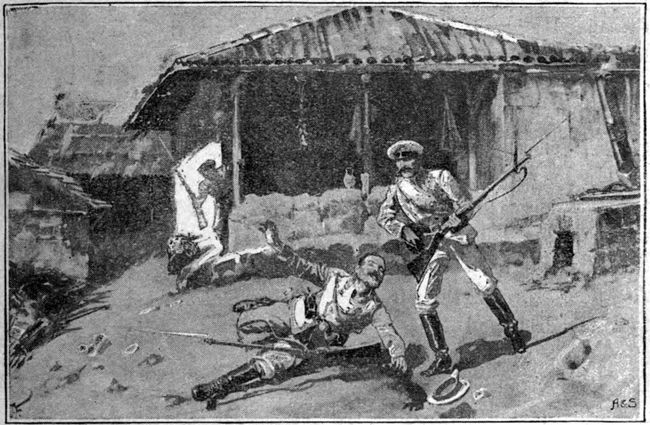
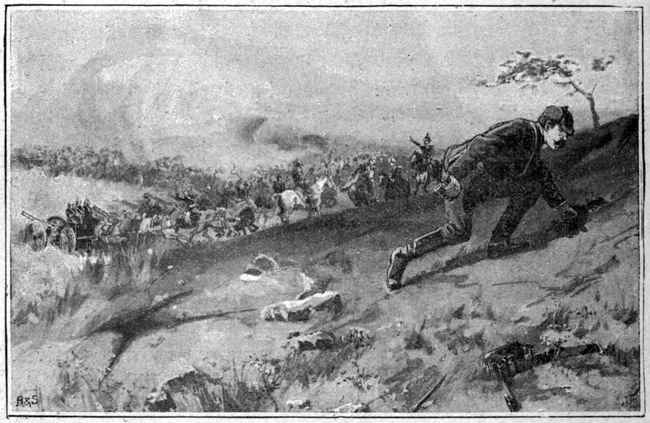
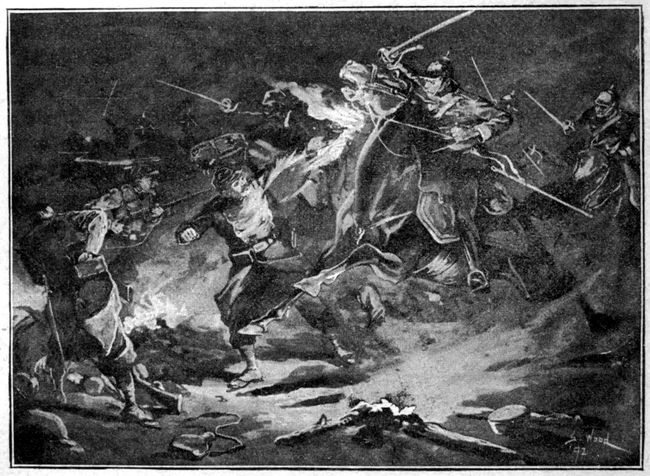
AN AFFAIR OF OUTPOSTS—THE FIRST SHOT IN THE SERVO-BULGARIAN CAMPAIGN.
At the moment of closing this despatch, news comes of an
important action near Dragoman, with reported defeat of the
Servians with heavy losses.
There is to be no more fighting. The brilliant and most
sanguinary engagement at Dragoman, which I reported in progress
last night, in the course of which the Bulgarians, who were completely
successful, drove the enemy back from all their positions
on the heights above the pass: an incessant artillery duel, maintained
20ever since the commencement of hostilities between the
heavy Servian batteries before Negotin and the Bulgarian forces
garrisoning Widelin, and a very successful unopposed advance
along the Vranja road as far as the Morava river by a Bulgarian
force, composed of three brigades from Sofia, from Trn, and from
Radomir, make up all there is to report of the campaign. For
when hostilities were about to be opened this morning near
Kumareno, which was evidently held by a large Servian force, an
officer bearing a white towel, with a pink fringe, tied to a hedge
stake, as a flag of truce, rode out from the Servian lines and
demanded a pourparler. It then transpired that the Servians
found themselves in a terrible quandary, and were at their wits’
end what to do.
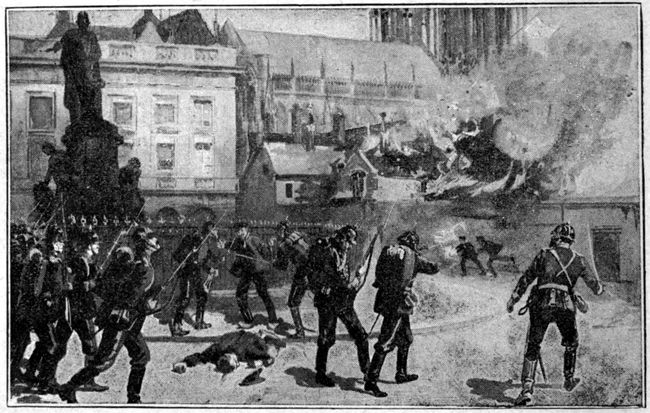
Late last night a large Austrian force had, without warning,
crossed the Save into Belgrade, which city they had taken so completely
by surprise that it was not until the morning that the
populace was made aware of the presence of the strangers in their
midst by the sight of the troops bivouacking in the squares, and
the officers quietly breakfasting outside the principal cafés. An
Austrian force, said the parlementaire, had also crossed the Danube
to Semendria, and there were rumours that another force had
crossed the same river at Orsova. In these circumstances, with
their capital cut off from them, and their young king and government
in a manner locked up, the Servian generals considered they
had no alternative but to demand a suspension of hostilities, at
least for forty-eight hours. An armistice was therefore granted,
much to the Bulgarian leaders’ annoyance and disgust.
We learn that Austria has notified the Powers that she has
occupied Semendria and Belgrade as a precautionary measure, in
view of the wanton aggression of Servia.
It is here considered unlikely that Bulgaria will have any
more trouble from this quarter. On the other hand, however,
grave rumours reach us from Constantinople, where apparently
there is very great anxiety as to certain mysterious and as yet
undefined threats by Russia. The Turkish capital is, as matters
stand at present, likely to be the chief centre of interest for some
time to come, and I shall therefore return there to-morrow morning.
21
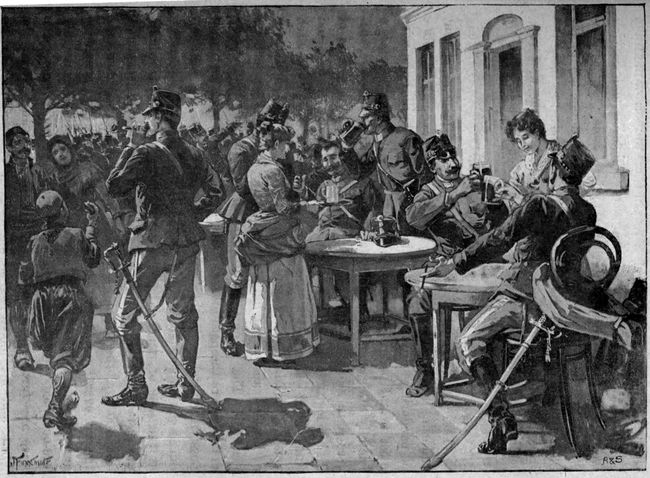
THE OCCUPATION OF BELGRADE—‘HERE AT LAST!’
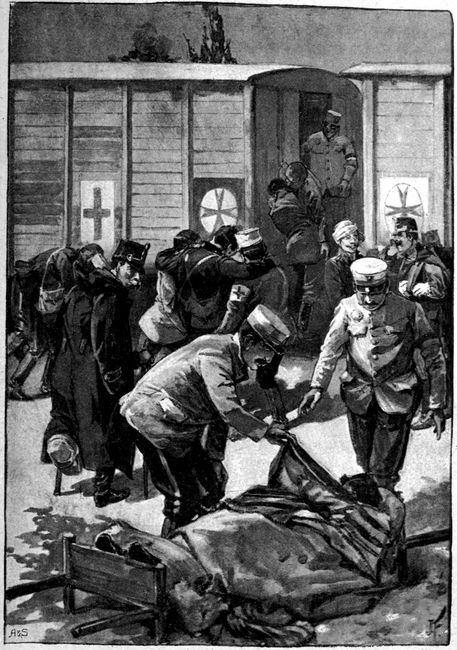
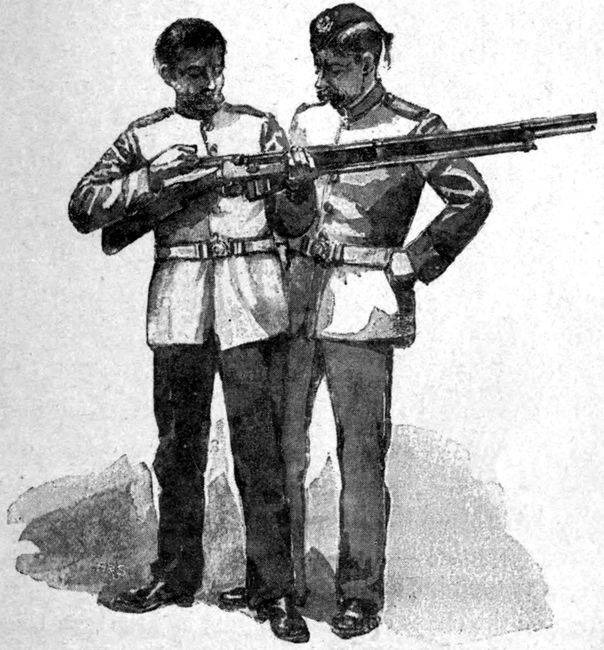
22All through the day long trains of Bulgarian and Servian
wounded have crept one after another into Sofia. It is noteworthy
that a considerable percentage of the sufferers are bright
and lively and make light of their injuries. These are men who
have been struck by the small nickel bullets of the new rifle,
which has been used in pretty equal proportions on both sides.
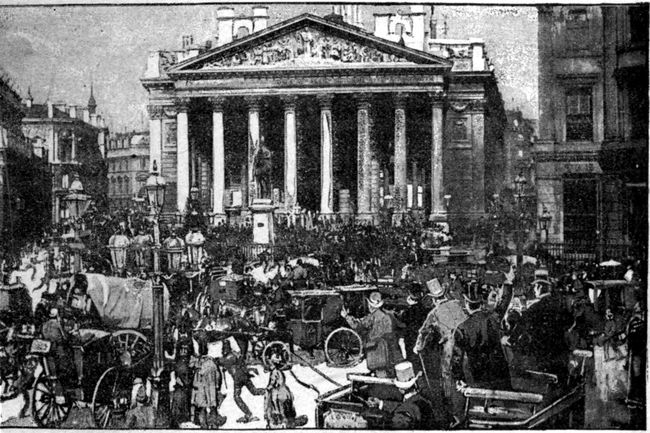
Constantinople, April 15.
There is no doubt good cause for the grave fears at present
agitating Porte and Palace. By his foolishly near-sighted policy
of pandering to the wishes of whatsoever Power bullies him with
most brutal persistency, at the risk though it be of injuring a
friendly State, the Sultan has, as he is beginning to realise, succeeded
in alienating, for the moment at least, the sympathies of
all his legitimate friends. By his attitude—wilfully perverse and
undignified—throughout the varying phases of the Vulkovitch
episode, his Majesty has aroused throughout Bulgaria deep distrust
of himself, and fierce indignation against his ministers and his
methods. The inane and futile strivings of the Porte to throw
difficulties in the path of the young Khedive, and to cheat him, if
possible, of rights clearly accorded and amply paid for, have produced
similar sentiments in Egypt and in England. And having,
at the cost of much labour and intrigue, achieved this wholly
unsatisfactory position of being an object of contempt, suspicion,
and obloquy, the Sultan finds himself suddenly but decidedly
thrown over by the very Powers with whom he had sought to
curry favour. The Russian Ambassador is now too thoroughly
pre-occupied with the immediate policy of his own Government to
have any further care to wear gloves in his dealings with the
Porte, and his mood has so affected M. Cambon, the French
Ambassador, that that astute personage, unable to find those sweet
professions and gracious persuasion—half unmeaning promise,
half veiled threat with which he has been wont to dorloter the
23Ministers at Bab Aali—come readily to his tongue, has ceased for
a fortnight past to hold any other than mere chancellerie communication
with the Turkish Government.
Let it be said at once that, despite very natural indignation,
Bulgaria shows every disposition to behave well towards the
Suzerain Power. Officially, indeed, her attitude has been in every
way admirable. When the Servians opened hostilities, when they
declared war, when they asked for an armistice—in every phase,
in short, of the quarrel, M. Stambuloff apprised, and asked
counsel and aid of, the Sultan. To be sure he got nothing for his
pains, but it must have been a satisfaction to the Sultan to receive
proof that, in one quarter at any rate, he is not regarded as a
European Power of merely sentimental importance.
Constantinople, April 16.
Fresh alarm was caused here this morning by the discovery
that our telegraphic communication has been interrupted at once
with Odessa and with Batoum. All inquiries as to the cause of
the rupture made by other routes failed to elicit any explanation.
Later in the day a vessel of the Cunard line arrived in the Bosphorus,
and her captain has stated that the Russian harbour-master
at Odessa is detaining all ships, of whatever nationality, in
that port. His own vessel, he says, was the last to leave Odessa,
and only got away by a chance, the order having reached him
when he had already got under way. He states that there were
several Russian ironclads, and quite a fleet of torpedo boats at
Odessa, all with steam up, and says that when he was on shore
there the day before yesterday the town was full of soldiers, and
the approaches to the dockyards crowded with a constantly-increasing
mass of guns, horses, ammunition, and other war material.
Constantinople, April 18.
I have received a telegram from my correspondent in Sofia,
who tells me that the Bulgarian Government understands that the
Russians are preparing an expedition for sea at Odessa, and intend
24to occupy some portion of Bulgarian territory. The Princely Government
has reason to expect the attack will be directed against Varna,
and has called upon the Sultan to aid Bulgarian arms by sending
his fleet to guard the Varna roads. The Sultan has as yet made
no reply to this request, says my correspondent, but it is not
difficult to guess what His Majesty’s action will be, inasmuch as
Turkey has no single ship of war in condition to be got to sea
under a month at the least, and it is more than questionable whether
even then any of the ironclads could be completely manned or
provided with serviceable ammunition. There are, indeed, some
torpedo boats—unprovided, I understand, with torpedoes—and a
couple of the monitors that did some service in the Danube in
the last war. If the Admiralty should elect to place these vessels
at the service of the Bulgarian Government, they might be of some
use as scouts. But that is about all that Turkey can hope to do
for her vassal.
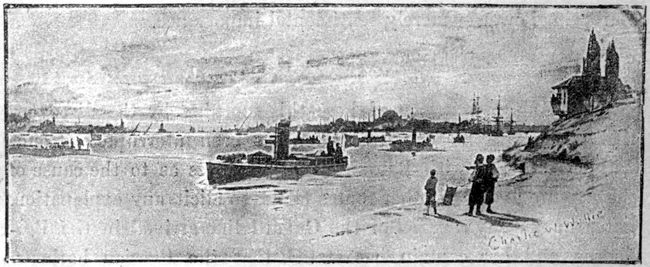
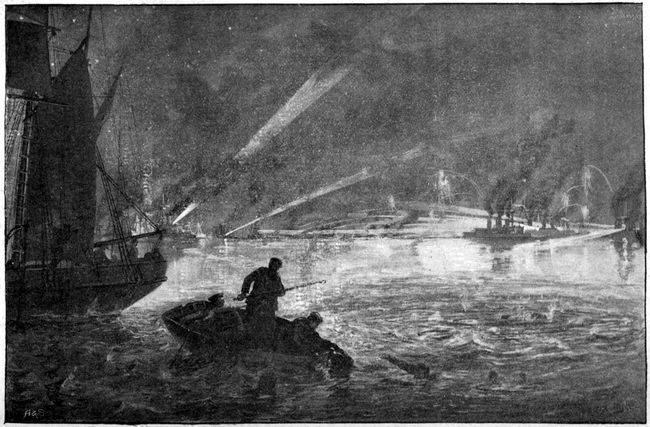
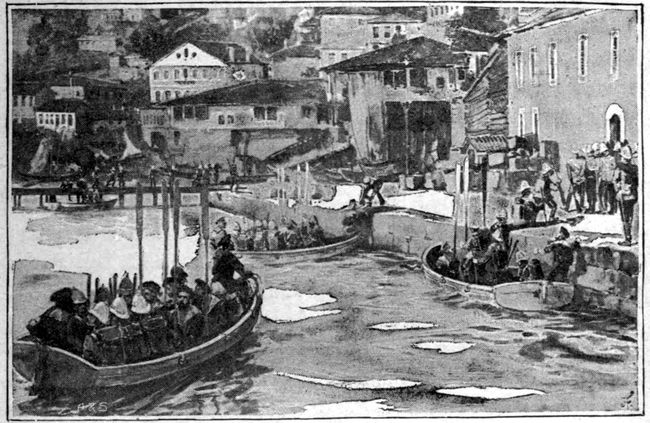
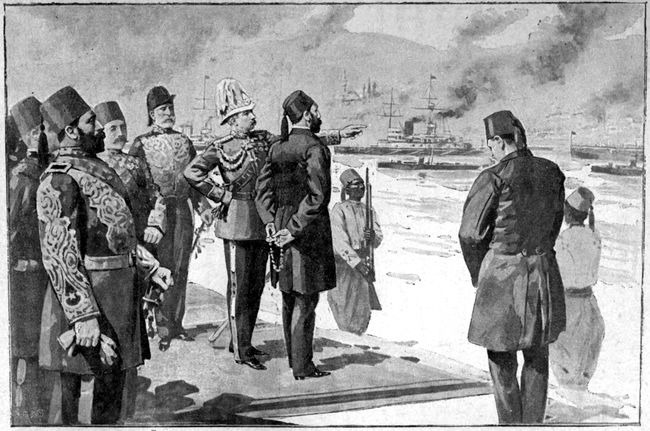
WITH THE TURKS: ADMIRAL WOODS PACHA’S FLEET OF TORPEDO BOATS STEAMING THROUGH THE BOSPHORUS.
Here there is terrible anxiety lest the Russian expedition be
directed, not against Varna or Bourgas, but against the Kavaks,
and the Seraskierate is busily taking precautions to meet such a
contingency with all the forces available.
Despite the recent draining of the Stamboul camp by the
despatch of a large force to Salonika, there are still some 45,000
25men in and around the capital. These, with the exception of the
Sultan’s guard of about 15,000 men, have been distributed along
the chain of forts extending from Roumelie Kavak to the Golden
Horn. The telegraph is kept busily at work summoning troops
from all parts of the Empire. 15,000 men from the Adrianople
garrison are expected to arrive here to-night.
The Russian Ambassador is said to be ill. He has not left the
Embassy in the Grand Rue de Pera for now almost a week, and
refuses to receive any one. Even his French colleague found the
door closed to him yesterday.
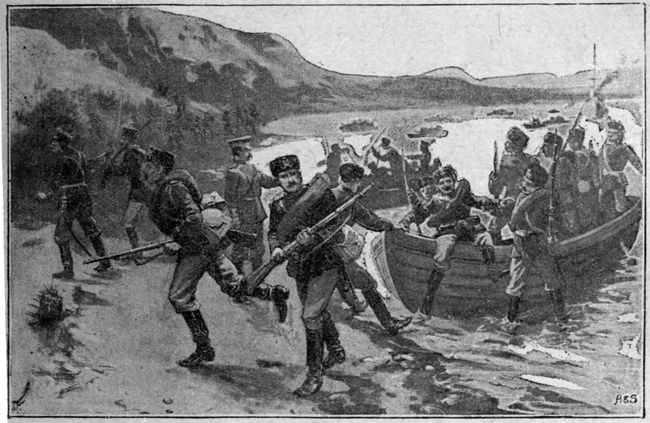
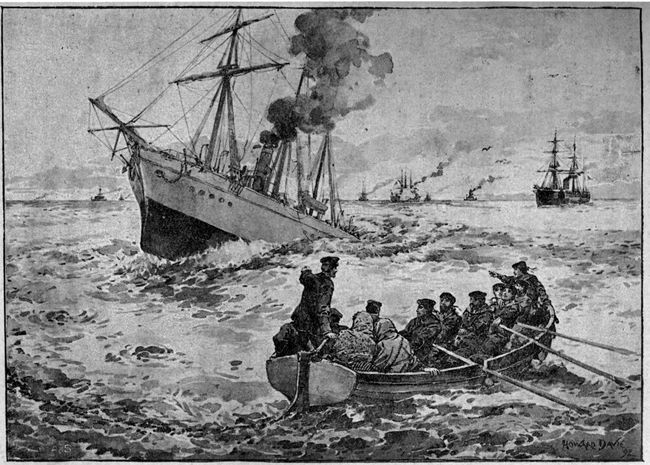
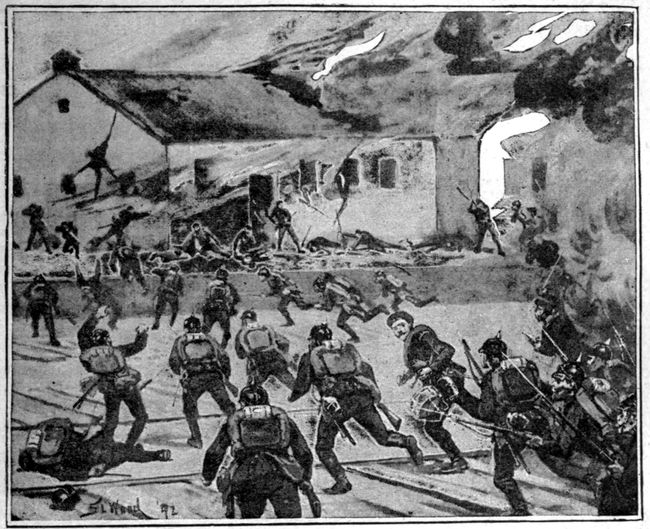
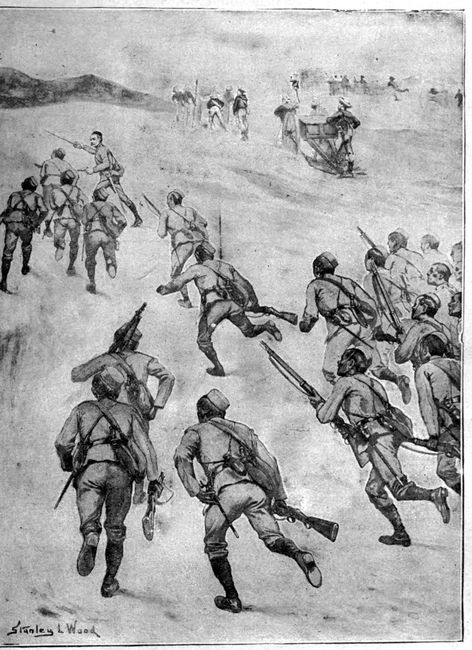
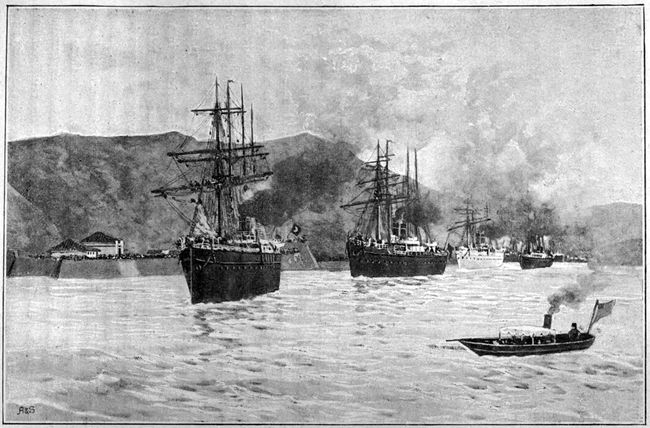
RUSSIAN INFANTRY LANDING AT VARNA.
Constantinople, April 19.
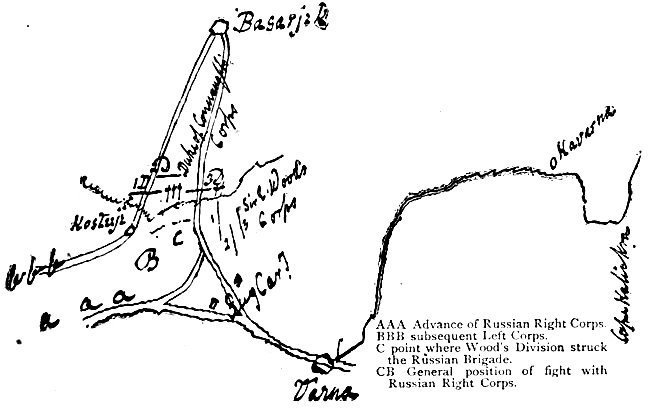
A Russian force, variously computed at from 50,000 to 70,000
men, occupied Varna this morning. There was some smart resistance,
but the comparatively small Bulgarian force was powerless
against the heavy metal of the Russian fleet, and after an hour’s
fighting was compelled to abandon the position.
Coincident with the receipt of this news is the delivery of a
26note by the Russian Ambassador—suddenly restored to health—to
the Minister for Foreign Affairs, setting forth that, as a result
of the extraordinary and uncalled-for position taken up by Austria,
the Czar’s Government feels the necessity of acquiring a material
guarantee for the maintenance of peace, and will therefore effect
a peaceful occupation of Bourgas and Varna with that end in view.