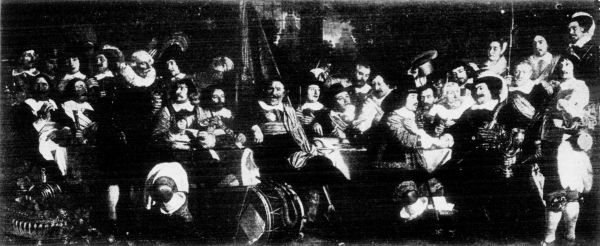
We know how the Night Watch is hung. It faces
the Banquet of Arquebusiers by Van der Helst, and,
no matter what has been said, the two pictures do not hurt
each other. They oppose each other like day and night,
like the transfiguration of things and their literal imitation,
slightly vulgar and clever. Admit that they are as perfect
as they are celebrated and you will have before your eyes a
unique antithesis, what La Bruyère calls "opposition truths
that illuminate one another."
I shall not astonish anyone in saying that the Night
Watch possesses no charm, and the fact is without example
among the fine works of pictorial art. It is amazing, it is
disconcerting, it is imposing, but it absolutely lacks that
insinuating quality that convinces us, and it almost always
fails to please us at first. In the first place, it shocks our
logical sense and that habitual visual rectitude that loves
clear forms, lucid ideas, and clearly formulated boldness;
something warns us that our imagination as well as our
reason will be only half satisfied and that even the mind
that is most easily won over will not submit till the last and
will not surrender without dispute. This is due to various
causes that do not all arise from the picture,—the light is
detestable; the frame of dark wood in which the painting
is drowned spoils its middle values, and its bronze scale of
colour, and its force, and makes it look much more smoked
than it is; and, lastly and above all, the exigencies of the
place prevent the picture from being hung at the proper
height, and, against all the laws of the most elementary
perspective, oblige you to look at it from the same level.
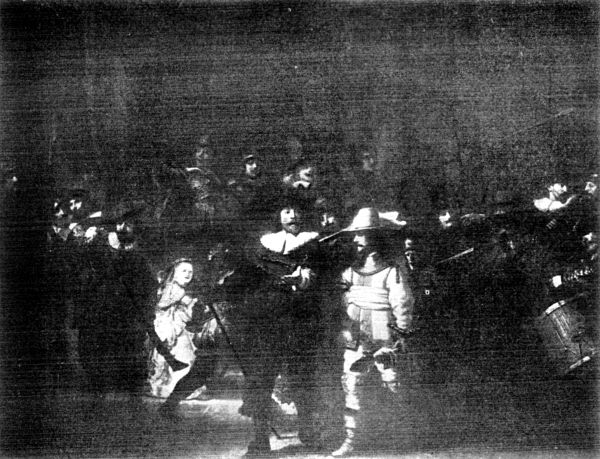
The Night Watch.
Rembrandt.
You are aware that the Night Watch, rightly or wrongly,
passes for an almost incomprehensible work, and that constitutes
its chief prestige. Perhaps it would have made far
less noise in the world, if for two centuries people had not
kept up the habit of trying to find out its meaning instead
of examining its merits, and persisted in the mania of
regarding it as a picture enigmatical above all.
Taking it literally, what we know of the subject seems
to me sufficient. In the first place, we know the names
and quality of the personages, thanks to the care with
which the painter has inscribed them on a plate at the
bottom of the picture; which proves that if the painter's
fancy has transfigured many things, the chief idea at least
deals with the customs of local life. It is true that we
cannot tell for what purpose these men are going out
armed, whether they are going to practise shooting, or on
parade, or what; but, as there is no matter here for the
deeper mysteries, I am persuaded that if Rembrandt has
failed to be more explicit it is because either he did not
wish or he did not know how to be, and there is a whole
series of hypotheses that might be very simply explained by
some such matter as inability or intentional reticence. As
for the time of day (the most vexed question of all and the
only one, moreover, that could have been settled when first
it arose), for fixing that we have no need to discover that
the Captain's outstretched arm casts a shadow upon the
skirt of his coat. It suffices to remember that Rembrandt
never treated light otherwise; that nocturnal obscurity is
his habit; that shadow is the ordinary form of his poetic
feeling and his usual means of dramatic expression; and
that in his portraits, in his interiors, in his legends, in his
anecdotes, in his landscapes, and in his etchings, as in his
paintings, it is generally with night that he makes day.
It is agreed that the composition does not constitute
the principal merit of the picture. The subject had not
been selected by the painter, and the manner in which
he intended to treat it did not allow of its first sketch
being very spontaneous, nor very lucid. Therefore the
scene is indecisive, the action almost null, and, consequently,
the interest is greatly divided. From the very beginning is
betrayed an inherent vice in the first idea, and a kind of
irresolution in the manner of conceiving, distributing, and
placing it. Some men marching, others standing still, one
priming his musket, another loading his, another firing, a
drummer who poses for the head while beating his instrument,
a somewhat theatrical standard-bearer, and, finally, a
crowd of figures fixed in the requisite immobility of portraits,—so
far as action is concerned, these, if I am not mistaken,
are the sole picturesque features of the painting.
Is this indeed sufficient to give it the facial, anecdotal,
and local feeling that we expect from Rembrandt when he
paints the places, things, and men of his time? If Van der
Helst instead of seating his arquebusiers had made them
move in any manner whatever, do not doubt that he would
have given us the truest if not the finest indications of their
ways. And as for Frans Hals, you may imagine with
what clearness and order, and how naturally he would have
disposed the scene; how piquant, lively, ingenious, abundant,
and magnificent he would have been. The idea conceived
by Rembrandt then is one of the most ordinary, and
I would venture to say that the majority of his contemporaries
considered it poor in resources; some because its
abstract line is uncertain, scanty, symmetrical, meagre, and
singularly incoherent; others, the colourists, because this
composition, so full of gaps and ill-occupied spaces, did not
lend itself to that broad and generous employment of
colours which is usual with able palettes....
Thus there is no truth and very little pictorial invention
in the general disposition. Is there more in the individual
figures?
What immediately strikes us is that they are unreasonably
disproportioned and that many of them have
shortcomings and so to speak an embarrassment of
characterization that nothing can justify. The captain is
too big and the lieutenant too small, not only by the side
of Captain Kock, whose stature crushes him, but also
beside accessory figures whose height or breadth gives this
somewhat plain young man the air of a youth who has
grown a moustache too soon. Regarding the two as portraits,
they are scarcely successful ones of doubtful likeness
and thankless physiognomy, which is surprising in a
portrait-painter who had made his mark in 1642, and which
affords some excuse for Captain Kock's having a little later
applied to the infallible Van der Helst. Is the guard loading
his musket rendered any better? Moreover, what do
you think of his right-hand neighbour, and of the drummer?
One might say that all these portraits lack hands, so
vaguely are they sketched and so insignificant is their
action. It follows that what they hold is also ill rendered:
muskets, halberds, drum-sticks, canes, lances, and flag-pole;
and that the gesture of an arm is impotent when the hand
that ought to act does not do so clearly, quickly, or with
energy, precision, or intelligence. I will not speak of the
feet, which, in most cases, are lost in shadow. Such in
reality are the necessities of the system of envelopment
adopted by Rembrandt, and such is the imperious foregone
conclusion of his method, that one general dark cloud invades
the base of the picture and that the forms float in it
to the great detriment of their points of support.
Must we add that the clothes are very similar to the
likenesses, sometimes uncouth and unnatural, sometimes
rigid and rebellious to the lines of the body? One would
say that they are not worn properly. The helmets are
stupidly put on, the hats are outlandish and ungracefully
worn. The scarfs are in their place and yet they are
awkwardly tied. Here is none of that unique ease of
carriage, that natural elegance, that négligé dress, caught
and rendered to the life in which Frans Hals knows how
to attire every age, every stature, every stage of corpulence,
and, certainly also, every rank. We are not reassured on
this point more than on many others. We ask ourselves
whether there is not here a laborious fantasy, like an attempt
to be strange, which is not at all pleasing or striking.
Some of the heads are very handsome, I have mentioned
those that are not. The best, the only ones in which the
hand of the master and the feeling of a master are to be
recognized, are those which, from the depths of the canvas,
shoot their vague eyes and the fine spark of their mobile
glances at you; do not severely examine their construction,
nor their plan, nor their bony structure; accustom yourself
to the greyish pallor of their complexion, question them
from afar as they also look at you from a distance, and if
you want to know how they live, look at them as Rembrandt
wants us to look at his human effigies, attentively
and long, at their lips and eyes.
There remains an episodical figure which has hitherto
baffled all conjectures, because it seems by its traits, its
carriage, its odd splendour, and its inappropriateness, to
personify the magic, the romantic feeling, or, if you prefer,
the misrepresentation of the picture; I mean that little
witch-like personage, child-like and crone-like at the same
time, with her hair streaming and adorned with pearls,
gliding among the guards for no apparent reason, and who,
a not less inexplicable detail, has a white cock, that at need
might be taken for a purse, hanging from her girdle.
Whatever right she has to join the troop, this little
figure seems to have nothing human about her. She is
colourless and almost shapeless. Her figure is that of a
doll and her gait is automatic. She has the air of a beggar,
something like diamonds covers her whole body, and an
accoutrement resembling rays. You would say that she
came from some jewry, or old clothes market, or Bohemia,
and that, awaking from a dream, she had attired herself in
the most singular of all worlds. She has the light, the
uncertainty, and the wavering of a pale fire. The more
we examine her, the less we can grasp the subtle lineaments
that serve as envelope for her uncorporeal existence.
We end by seeing in her nothing but a kind of extraordinarily
strange phosphorescence which is not the ordinary
light of things, nor yet the ordinary brilliance of a well-regulated
palette, and this adds more sorcery to the peculiarities
of her countenance. Notice that in the place she
occupies, one of the dark corners of the canvas, rather low
in the middle distance, between a man in deep red and the
captain dressed in black, this eccentric light has much greater
force than the most sudden contrast with a neighbouring
tint, and without extreme care this explosion of accidental
light would have sufficed to disorganize the whole picture.
What is the meaning of this little imaginary or real
being, who, however, is only a supernumerary while yet
holding, so to speak, the chief rôle? I shall not attempt
to tell you. Abler people than I have allowed themselves
to inquire what it was and what it was doing there, without
coming to any satisfactory conclusion.
But if to all these somewhat vain questions Rembrandt
replied: "This child is a caprice no less strange than and
quite as plausible as many others in my engraving or painting.
I have placed it as a narrow ray amid great masses
of shadow because its exiguity rendered it more vibrating
and it suited me to awaken with a ray one of the dark
corners of my picture. It also wears the usual costume of
my female figures, great or small, young or old, and in it
you will find the type frequently occurring in my works. I
love what glitters, and that is why I have clothed her in
brilliant materials. As for those phosphorescent gleams
that astonish you here, whilst elsewhere they pass unnoticed,
it is only the light in its colourless splendour and
supernatural quality that I habitually give to my figures
when I illuminate them at all strongly."—Do you not
think that such a reply ought to satisfy the most difficult,
and that finally, the rights of the stage-setter being reserved,
he need only render account of one point: the manner in
which he has treated the picture?
We know what to think of the effect produced by the
Night Watch when it appeared in 1642. This memorable
attempt was neither understood nor relished. It added noise
to Rembrandt's glory, increased it in the eyes of his faithful
admirers, and compromised it in the eyes of those who had
only followed him with some effort and attended him to
this decisive point. It made him a painter more peculiar
and a master less sure. It heated and divided men of taste
according to the heat of their blood, or the stiffness of their
reason. In short, it was regarded as an absolutely new
but dangerous adventure which brought him applause and
some blame, and which at heart did not convince anybody.
If you know the judgment expressed on this subject by
Rembrandt's contemporaries, his friends and his pupils, you
know that opinion has not sensibly varied for two centuries,
and that we repeat almost the same thing that this great
daring man might have heard during his lifetime....
Save one or two frank colours, two reds and a deep
violet, except one or two flashes of blue, you cannot perceive
anything in this colourless and violent canvas to
recall the palette and ordinary method of any of the known
colourists. The heads have the appearance rather than the
colouring proper to life. They are red, purple, or pale,
without for all that having the true paleness Velasquez
gives to his faces, or those sanguine, yellowish, greyish, or
purplish shades that Frans Hals renders with such skill
when he desires to specify the temperaments of his personages.
In the clothes and hair and various parts of the
accoutrements, the colour is no more exact nor expressive
than is, as I have said, the form itself. When a red appears,
it is not of a delicate nature and it indistinctly expresses
silk, cloth, or satin. The guard loading his musket is
clothed in red from head to foot, from his hat to his boots.
Do you perceive that Rembrandt has occupied himself for
a moment with the varied physiognomy of this red, its
nature or substance, as a true colourist would not have
failed to do?...
I defy any one to tell me how the lieutenant is dressed
and in what colour. Is it white tinged with yellow? Is
it yellow faded to white? The truth is that this personage
having to express the central light of the picture,
Rembrandt has clothed him with light, very ably with
regard to brilliance and very negligently with regard to
colour.
Now, and it is here that Rembrandt begins to show himself,
for a colourist there is no light in the abstract. Light
of itself is nothing: it is the result of colours diversely
illumined and diversely radiating in accordance with the
nature of the ray that they transmit or absorb. One very
deep tint may be extraordinarily luminous; another very
light one on the contrary may not be at all luminous.
There is not a student in the schools who does not know
that. With the colourists, then, the light depends exclusively
upon the choice of the colours employed to render it and is
so intimately connected with the tone that we may truthfully
say that with them light and colour are one. In the
Night Watch there is nothing of the kind. Tone disappears
in light as it does in shade. The shade is blackish,
the light whitish. Everything is brilliant or dull, radiant
or obscure, by an alternative effacement of the colouring
principle. Here we have different values rather than contrasted
tones. And this is so true that a fine engraving,
a good drawing, a Mouilleron lithograph, or a photograph
will give an exact idea of the picture in its important
effects, and a copy simply in gradations from light to dark
would destroy none of its arabesque.
What is his execution in the picture before us? Does
he treat a stuff well? No. Does he express it ingeniously,
or with liveliness, with its seams, folds, breaks, and tissue.
Assuredly not. When he places a feather at the brim of a
hat, does he give it the lightness and floating grace that we
see in Van Dyck, or Hals, or Velasquez? Does he indicate
by a little gloss on a dead ground, in their form, or
feeling of the body, the human physiognomy of a well
adjusted coat, rubbed by a movement or worn with use?
Can he, with a few masterly touches and taking no more
trouble than things are worth, indicate lace-work, or suggest
jewellery, or rich embroidery?
In the Night Watch we have swords, muskets, partisans,
polished casques, damascened cuirasses, high boots, tied
shoes, a halberd with its fluttering blue silk, a drum, and
lances. Imagine with what ease, with what carelessness,
and with what a nimble way of making us believe in things
without insisting upon them, Rubens, Veronese, Van Dyck,
Titian himself, and lastly Frans Hals, that matchless workman,
would have summarily indicated and superbly carried
off all these accessories. Do you maintain in good faith
that Rembrandt in the Night Watch excels in treating
them thus? I pray you, look at the halberd that the little
lieutenant Ruijtenberg holds at the end of his stiff arm;
look at the foreshortened steel, look especially at the floating
silk, and tell me if an artist of that value has ever
allowed himself more pitifully to express an object that
ought to spring forth beneath his brush without his being
aware of it. Look at the slashed sleeves that have been
so highly praised, the ruffles, the gloves; examine the
hands! Consider well how in their affected or unaffected
negligence their form is accentuated and their foreshortening
is expressed. The touch is thick, embarrassed, awkward,
and blundering. We might truly say that it goes
astray, and that applied crosswise when it should be
applied lengthwise, made flat when any other than he would
have rounded it, it confuses instead of determining the
form....
At length I come to the incontestable interest of the
picture, to Rembrandt's great effort in a new field: I am
going to speak of the application on a large scale of that
way of looking at things which is proper to him and which
is called chiaroscuro.
No mistake is possible here. What people attribute to
Rembrandt is really his. Without any doubt chiaroscuro
is the native and necessary form of his impressions and
ideas. Others have made use of it; but nobody has
employed it so constantly and ingeniously as he. It is the
supremely mysterious form, the most enveloped, the most
elliptic, and the richest in hidden meanings and surprises
that exists in the pictorial language of the painter. In this
sense it is more than any other the form of intimate feelings
or ideas. It is light, vaporous, veiled, discreet; it
lends its charm to hidden things, invites curiosity, adds an
attraction to moral beauties, and gives a grace to the speculations
of conscience. In short, it partakes of sentiment,
emotion, uncertainty, indefiniteness, and infinity; of dreams
and of the ideal. And this is why it is, as it ought to be,
the poetic and natural atmosphere in which Rembrandt's
genius never ceased to dwell.
In very ordinary language and in its action common to
all schools, chiaroscuro is the art of rendering the atmosphere
visible, and painting an object enveloped with air. Its
aim is to render all the picturesque accidents of shadow, of
half-tints, of light, of relief, and of distance; and to give
in consequence more variety, more unity of effect, more
caprice and more relative truth either to forms or to
colours. The contrary is a more ingenuous and more
abstract acceptation, by virtue of which objects are shown
as they are, viewed close at hand, the atmosphere being
suppressed, and consequently without any other than linear
perspective, which results from the diminishing of objects
and from their relation to the horizon. When we speak of
aërial perspective, we already presuppose a little chiaroscuro.
Any other than Rembrandt, in the Dutch school, might
sometimes make us forget that he was obeying the fixed
laws of chiaroscuro; with him this forgetfulness is impossible:
he has so to speak framed, co-ordinated and promulgated
its code, and if we might believe him a doctrinaire
at this moment of his career, when instinct swayed him
much more than reflection, the Night Watch would have a
redoubled interest, for it would assume the character and the
authority of a manifesto.
To envelop and immerse everything in a bath of shadow;
to plunge light itself into it only to withdraw it afterwards
to make it appear more distant and radiant; to make dark
waves revolve around illuminated centres, grading them,
sounding them, thickening them; to make the obscurity
nevertheless transparent, the half gloom easy to pierce,
and finally to give a kind of permeability to the strongest
colours that prevents their becoming blackness,—this is
the prime condition, and these also are the difficulties of
this very special art. It goes without saying, that if anyone
ever excelled in this, it was Rembrandt. He did not invent,
he perfected everything; and the method that he used
oftener and better than anyone else bears his name.
When explained according to this tendency of the painter
to express a subject only by the brilliance and obscurity of
objects, the Night Watch has, so to speak, no more secrets
for us. Everything that might have made us hesitate is
made clear. Its qualities have their raison d'être; and we
even come to comprehend its errors. The embarrassment
of the practitioner as he executes, of the designer as he
constructs, of the painter as he colours, of the costumer as
he attires, the inconsistency of the tone, the amphibology of
the effect, the uncertainty of the time of day, the strangeness
of the figures, their flashing apparition in deep shadow,—all
this results here by chance from an effect conceived
contrary to probability, and pursued in spite of all logic, not
at all necessary, and with the following purpose: to illuminate
a real scene with unreal light, that is to say, to clothe
a fact with the ideal character of a vision. Do not seek for
anything beyond this audacious project that mocked the
painter's aims, clashed with received ideas, set up a system
in opposition to customs, and boldness of spirit in opposition
to manual dexterity; and the temerity of which certainly
did not cease to spur him on until the day when I believe
insurmountable difficulties revealed themselves, for, if
Rembrandt resolved some of them, there are many that he
could not resolve.
Maîtres d'Autrefois (Paris, 1876).