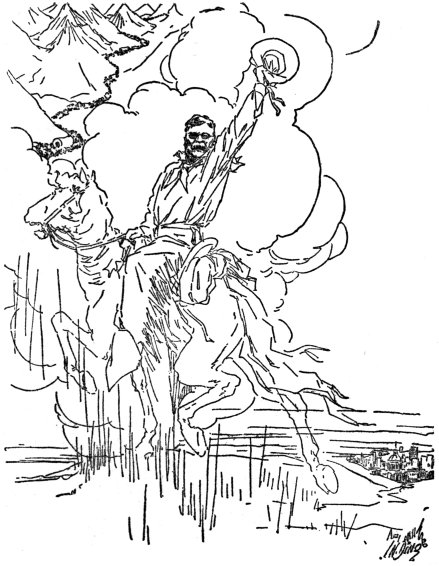
The Rough Riders, as they left their Texas
encampment for Tampa, Fla., their point
of embarkation for Cuba, humorously changed
their nickname to “Wood’s Weary Walkers,”
a title that, through their long marches in the
jungles of Cuba, came to have more truth than
humor in it.
Viewing the Spanish campaign in the light of
the world war, it will be seen that there is a striking
similarity between this regiment and the
French Foreign Legion. This parallel is true not
only of the personnel of the contingent, which
included adventurous spirits from all sections of
the country, but also of the fighting spirit of the
men.
How to reach the fighting field was the biggest
question that confronted the Rough Riders. They
were among the very last to receive permission
to go, and if it had not been for Roosevelt’s
dogged determination they would probably have
been left behind. Even when orders came to entrain
for Tampa, transportation was refused.
Roosevelt, however, was equal to the emergency.
He jumped aboard the engine of a coal train and
demanded of its crew that they transport his men.
The crew obeyed orders. The regiment reached
Tampa covered with coal dust.
At Tampa the Rough Riders found themselves
without an official assignment to a transport.
Nothing daunted, Roosevelt moved his men immediately
on board the nearest vessel.
When the landing place in Cuba was reached
the Colonel got his men ashore among the first
and soon after landing began his march to the
front.
While Roosevelt’s picturesque personality led
to his figuring largely in the newspaper accounts
of the war, yet in all of these movements he was
in close association with Colonel Wood. The two
worked together as one man. While the men had
been intimate before, it was in this campaign that
the friendship was welded that was to last and
deepen until death ended it.
Later in the campaign Colonel Wood was
promoted to the rank of general and Lieutenant-Colonel
Roosevelt become colonel.
The corps to which the Rough Riders were
attached was under the command of Major-General
Shafter. Major-General Wheeler, a veteran
of the Civil War and a dashing cavalry leader,
commanded the cavalry. Under the latter, as
commander of the 2d Brigade, was Brigadier-General
Young. Young’s brigade was composed
of the 1st and 10th regiments of cavalry. The
10th regiment was composed of negroes and the
1st Regiment of the Rough Riders.
General Wheeler was anxious to strike the first
blow with his cavalry and while Brigadier-General
Lawton, who commanded the infantry, was
protecting the landing from the enemy, General
Wheeler ordered General Young to advance
early in the morning from the little village of
Siboney toward Santiago and to attack the enemy
wherever he was found. The Rough Riders
were included in this advance.
Two roads about a mile apart, lead from
Siboney to Santiago. General Young advanced
on the eastern road and directed Wood and
Roosevelt to take the western road, which led
over the mountains. The two roads drew together
near the village of Las Guasimas. Here the two
commands were to meet.
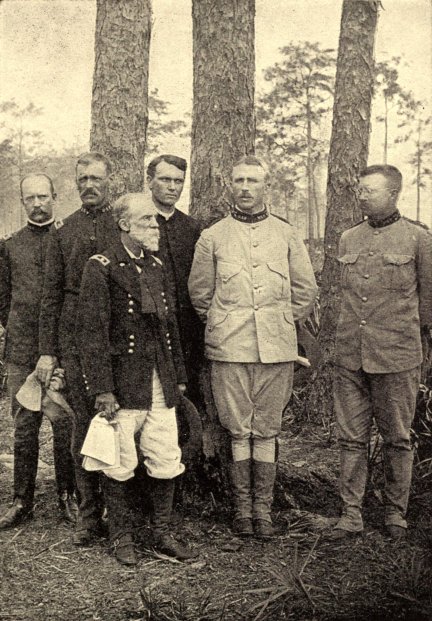
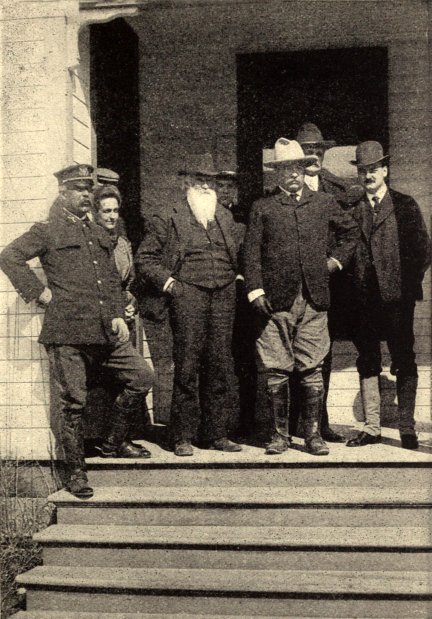
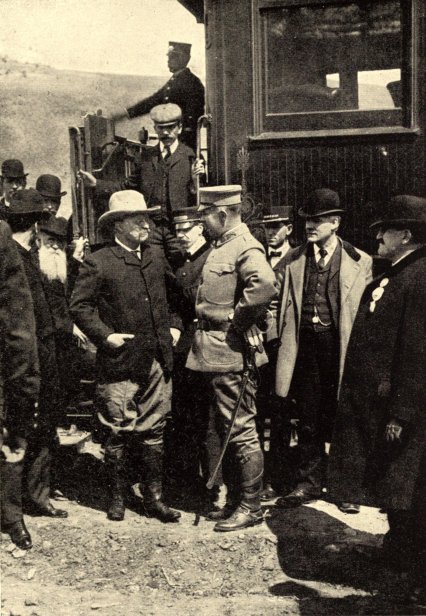
COPYRIGHT, UNDERWOOD & UNDERWOOD
BEFORE THE BATTLE OF SAN JUAN. ROOSEVELT ON THE
EXTREME RIGHT, COLONEL WOOD IN CENTER. TO THE
LEFT: MAJOR DUNN, COLONEL BRODIE AND
CHAPLAIN BROWN, WITH GENERAL WHEELER
IN THE FOREGROUND
On the march from the landing place inland
the troops traveled over rugged hills, covered for
the most part by dense jungles. They camped
on a dusty, brush-covered flat, with jungle on
one side and a disease-breeding pool, fringed with
palm trees, on the other side. The baggage had
not yet come ashore, and the soldiers had only
what food they carried with them. Roosevelt’s
equipment consisted of a raincoat and a tooth-brush.
They met hundreds of Cuban insurgents—tattered
crews armed with all sorts of weapons,
all of which were in poor condition.
When the Rough Riders reached the scene of
action they had first to climb a very steep hill.
They went into action with less than five hundred
men.
Captain Capron’s troop was in the lead, followed
by Colonel Wood. Roosevelt rode close
behind them at the head of the other three troops
of his squadron. The trail was so narrow that at
many places the men had to march in single file.
At other times they had to force their way
through dense, tangled jungles. After marching
for over an hour they came to a halt, but Colonel
Wood announced that the advance guard had
come upon a Spanish outpost.
A minute later Wood gave Roosevelt orders
to deploy three troops to the right of the trail and
advance. A roar in front of them soon announced
that the fight was on.
Roosevelt and his officers were searching for
the place from which the smokeless powder of
the Spaniards was pouring Mauser bullets upon
his men.
It was the famous war correspondent, Richard
Harding Davis, who first showed Roosevelt’s men
where to direct their fire. He had accompanied
the Rough Riders and had taken a place at the
extreme front of the line, from which place he
spotted with his glasses the exact location of the
Spaniards.
“There they are, Colonel!” he suddenly cried.
“Look! Over there! I can see their heads near
that glade!”
Roosevelt looked across the valley where Davis
was pointing. He, too, discovered the heads of
the Spanish soldiers and directed his sharp-shooters
to fire on them.
The Spaniards sprang out of the cover and
ran to another spot. The shots of the Americans
had told. The Spaniards continued to retreat.
The Rough Riders and the other troops pursued.
They were forced to leave the wounded in the
jungle where they fell.
Harry Hefner of G Troop, fell mortally
wounded in the hip. Two of his companions
dragged him behind a tree. He propped himself
up and asked for his canteen and his rifle. He
then resumed shooting, and continued firing until
he died.
Roland, a New Mexican cow-puncher, fought
beside Roosevelt. The Colonel noticed blood issuing
from his side and ordered the trooper to go to
the rear. Roland grumbled, but went back. Fifteen
minutes later he was on the firing line again.
He told the Colonel that he could not find the
hospital. Roosevelt doubted it, but let him stay
until the end of the fight, when it was discovered
that a bullet had broken one of his ribs.
When the scrimmage began some of the men
began to curse. “Don’t swear—shoot!” Wood
growled at them.
Toward the end of the engagement Roosevelt
was falsely informed that Wood had been killed.
The command of the regiment for the time being
devolved upon the Colonel. He started to lead
his men toward the main body, but met Wood
himself, who told him that the fight was over and
that the Spaniards had retreated.
In this first scrimmage the Rough Riders lost
eight men killed and thirty-four wounded. They
had taken a Spanish fort, defended by more than
twelve hundred men, and had won from them
complete possession of the entire Spanish
position.
Next came the historic battle of San Juan.
When news of the battle reached General Shafter
he was told that the Americans had been cut to
pieces. It was also said that the regiment had
passed the advanced outpost without orders.
Shafter exploded.
“I will send that damned cowboy regiment,”
he said, “so far to the rear that it will not get
another chance.”
Later, however, came the news that the cowboys
had been victorious, so Shafter wrote a flattering
letter to Roosevelt, in command, congratulating
him on the success of his attack.
There followed a period of inaction. Then the
Rough Riders received orders to proceed against
Santiago.
The regiment struck camp and marched to the
front behind the 1st and 10th Cavalry. Every
man carried three days’ rations.
Roosevelt’s command joined General Wood
at El Paso Hill and camped for the night.
The next morning it was announced that the
main fighting against Santiago was to be done
by Lawton’s infantry division, which was ordered
to take El Caney, while the Rough Riders were
ordered simply to make a diversion with artillery.
When the firing began shrapnel shells exploded
over Roosevelt’s head. One of the shrapnel bullets
struck his wrist. The same shell wounded
four men of his regiment. He at once led his
men from their exposed position into the underbrush.
General Wood then ordered Roosevelt to follow
behind the 1st Brigade, and the Rough
Riders began a march toward the ford of the
San Juan River. They reached the ford and
crossed it. In front of them was a rise of ground,
afterward called Kettle Hill. Roosevelt found
the 1st Brigade engaged in a hot battle, so he
halted his men and sent back word for orders.
On top of Kettle Hill were large haciendas,
or ranch buildings. The Spaniards, from their
stations on the hills, poured a heavy fire on the
American troops, who were hidden in sheltered
lanes and along the edge of the San Juan River,
or in patches of jungle grass. Roosevelt, lying
with his troops under this severe fire, sent messenger
after messenger to General Sumner or
General Wood to secure permission to advance.
He had about determined to go ahead when Lieutenant-Colonel
Dorst rode up with the command
to “move forward and support the regulars in
the assault on the hills in front.” The impatient
Roosevelt leaped upon his horse. He had intended
to go into action on foot, but he saw that he would
be unable to run up and down the line and superintend
matters if he were on foot. His men went
eagerly to the attack. The Colonel started in the
rear of his men, as was the custom for a Colonel,
but his ardor soon bore him to the head of the
regiment.
As he rode down the line he saw a slacker hidden
behind a little bush. To urge the soldier forward
he called:
“Are you afraid to stand up while I am on
horseback?”
While Roosevelt was speaking, a bullet, evidently
aimed at him, struck and killed the man
who was hiding.
There has been much discussion as whether
Roosevelt exceeded his authority in the capture
of Kettle Hill. In reviewing the matter it is best
to take the Colonel’s own account of what happened.
In his book “The Rough Riders” he thus
describes the charge:
“By the time I had come to the head of the
regiment we ran into the left wing of the 9th
Regulars, and some of the 1st Regulars, who
were lying down while the officers were walking
to and fro. The officers of the white and colored
regiments alike took the greatest pride in seeing
that the men more than did their duty; and the
mortality among them was great.
“I spoke to the captain in command of the rear
platoons, saying that I had been ordered to support
the regulars in the attack upon the hills, and
that in my judgment we could not take these hills
by firing at them, and that we must rush them.
He answered that his orders were to keep his
men lying where they were, and that he could not
charge without order. I asked where the colonel
was, and, as he was not in sight, said: ‘Then I
am the ranking officer here and I give the order
to charge,’ for I did not want to keep the men
longer in the open suffering under a fire which
they could not effectively return.
“Naturally, the captain hesitated to obey this
order when no word had been received from his
own colonel. So I said: ‘Then let my men
through, sir,’ and rode on through the lines, followed
by the grinning Rough Riders, whose
attention had been completely taken off the Spanish
bullets, partly by my dialogue with the regulars
and partly by the language I had been using
to themselves as I got the lines forward, for I
had been joking with some and swearing at
others, as the exigencies of the case seemed to
demand.
“When I got to where the head of the left
wing of the 9th was lying, through the courtesy
of Lieutenant Hartwick, two of whose colored
troopers threw down the fence, I was enabled to
get back into the lane, at the same time waving my
hat and giving the order to charge the hill on our
right front. Out of my sight, over on the right,
Captains McBlain and Taylor, of the 9th, made
up their minds independently to charge at just
about this time; and at almost the same moment
Colonels Carroll and Hamilton, who were off, I
believe, to my left, where we could see neither
them nor their men, gave the order to advance.
But of all this I knew nothing at the time. The
whole line, tired of waiting and eager to close
with the enemy, was straining to go forward;
and it seems that different parts slipped
the leash at almost the same moment. The 1st
Cavalry came up the hill just behind, and partly
mixed with my regiment and the 9th. As already
said, portions of the 3d, 6th and 10th followed,
while the rest of the members of these three regiments
kept more in touch with the infantry on
our left.”
Roosevelt, at the head of his cheering, firing
men, galloped toward the hill. Forty yards from
the top he ran into a wire fence and was forced
to dismount from his horse, Little Texas, and
turn it loose.
The Spaniards fled from the ranch buildings
as the Americans approached, and soon the hill
was covered with Rough Riders and the colored
troopers of the 9th, with some men from the 1st.
On the top of the hill was a huge iron kettle, used
probably for sugar refining. From this big pot
the battle derived its name of Kettle Hill.
Having aided materially in the capture of
Kettle Hill, Roosevelt and his men looked toward
their left, to where the Spaniards were fighting
in the trenches under the San Juan blockhouse.
General Hawkins’ brigade was storming this
blockhouse and soon captured it. When the
blockhouse fell the Colonel ordered a charge to
a line of hills still further on.
Only four men started with him. Three of
these were shot. Roosevelt gave one of the
wounded his canteen of water and ran back to
find out why the other soldiers had not followed.
He found that nobody had heard his orders.
By this time General Sumner had come up and
Roosevelt asked of him permission to lead the
charge. Sumner gave his consent and the Rough
Riders stormed the Spanish entrenchment. There
was close fighting, which resulted in the taking of
a few prisoners, and what was more important
to the men, the capture of Spanish provisions.
Later in the day the Spaniards counter-attacked.
The Rough Riders were glad of the
chance to fight in the open, and drove back the
Spaniards with laughter and cheers. During this
fight Roosevelt was the highest officer in command
at his part of the front.
A rumor went around that the men were to
be ordered to fall back. That evening after the
fight, General Wheeler visited the front and told
Roosevelt to keep himself in readiness to fall
back if necessary. Roosevelt answered:
“Well, general, I really don’t know whether
we would obey an order to fall back. We can take
that city by a rush and if we have to move out of
here at all I should be inclined to make the rush
in the right direction.”
General Wheeler thought for a moment, then
he expressed his hearty agreement with the Colonel’s
sentiments and promised that there would
be no falling back. Wheeler had been ill for a
couple of days, but like the old gamecock he was,
he had managed to take a strong part in the fight.
It was the opinion of the Rough Riders that
if there had been one in high command to press
the attack that afternoon the Americans would
have gone right into Santiago.
The next day the battle became a siege and
most of the fighting was done from trench works.
The flag of truce was sent to demand the surrender
of the city. Each day thereafter the soldiers
expected to see Santiago surrendered, and whatever
fighting was done was of a minor nature.
During the truce certain military attachés and
foreign officers came out to visit the Rough
Riders. Interesting, in view of the warm relations
between Britain and America during the world
war, was the incident that happened when Prince
X, a Russian, visited Roosevelt. The Colonel
introduced him to one of the regular army officers,
a splendid fellow, who yet viewed foreign
relations from a strictly mid-Western viewpoint.
Roosevelt overheard him remark to the Russian,
whom he called “Prince” as familiarly as a Kentuckian
called his neighbor “Colonel”:
“You see, Prince, the great result of this war
is that it has united the two branches of the
Anglo-Saxon people; and now that they are together
they can whip the world, Prince! They
can whip the world!”
Other army officers, who had not received the
training in diplomacy and international relationship
that our American officers have received in
the late conflict, had the habit of grouping all of
these foreign attachés under the title of “Dutchmen.”
When this same Russian was making his farewell
round, a general shook hands with him
heartily, with this parting remark:
“Well, goodby; sorry you are going. Which
are you anyhow—a German or a Russian?”
On the 17th of July, Santiago formally surrendered,
and the Rough Riders with the rest of
the army were drawn up beside their trenches.
The American flag was hoisted, the trumpets
sounded and the men cheered. Their fighting was
over.
After the siege, the army officers in Washington
proposed to keep the army stationed around
Santiago. General Shafter tried his best to have
the army ordered home. The health of the troops
was becoming very bad. Yellow fever and malarial
fever had attacked them. If the soldiers
remained it is possible that at least one-half of
them would have died or have become invalided.
General Shafter’s attempts failed and at last
he called a council of his commanders and general
medical officers and consulted them in the matter.
Roosevelt, while he had command of a brigade,
was only a colonel and did not mean to attend the
conference, but General Shafter sent word to him
that he was wanted particularly, and he went.
The general explained to his officers that he
could not get the War Department to appreciate
their situation and that the public itself was ignorant
of the ravages disease was making upon their
ranks. He felt that there should be some
announcement issued which would make the War
Department take action before most of the men
were down with sickness.
At this point General Shafter sought Roosevelt’s
assistance. He explained to him that as he
was a volunteer officer, about to return immediately
to civil life, he could afford to take risks
which regular army men could not afford to take.
Therefore, he suggested that the Colonel write
a letter or make a statement appealing for a withdrawal
of the army from the fever holes of Cuba.
Roosevelt left the meeting with the understanding
that he would give an interview on the
subject to the press. General Wood, however,
hinted to him that it would be better to put his
statement in the form of a letter to General
Shafter. This Roosevelt did. Then he presented
the letter to General Shafter, who waved it away
and said:
“I don’t want to take it; do what you wish
with it!”
The Colonel, however, persisted in handing it
to him. At the same time a “Round Robin”
was in course of preparation by the commanding
officers. This also was addressed to General
Shafter.
This document, at the request of the commanding
officers, was written by General Wood,
who being a surgeon, keenly realized the need
of removing the men from their pestilential
quarters, and was signed by Generals Kent,
Bates, Chaffee, Sumner, Ludlow, Ames and
Wood.
The Associated Press representative was anxious
to secure a copy of this “Round Robin,” but
Wood told him it was impossible for him to have
it or see it.
Wood then went to General Shafter, handed
him the paper and said:
“The matter is now in your hands.”
Shafter said: “I don’t care whether this gentleman
has it or not,” referring to The Associated
Press correspondent.
The Associated Press representative then
secured a copy of the dispatch and thus the affair
became public. The result of this publicity
became immediately felt. Within three days the
army received orders to prepare to sail for home.
On August 7 the Rough Riders embarked on
the transport Miamee. At last the transport
sighted the Long Island coast, and late on the
afternoon of the 14th it entered the waters of
the Sound and cast anchor at Montauk Point.
The Rough Riders stood by their Colonel to
the man. In the United States disparaging
remarks had been made about the Colonel and
his regiment. Some of the officials in Washington,
angered at his criticisms of the canned beef
and the short supplies sent to the men, took occasion
to sneer at his campaign.
In the jungles of Cuba, however, the Rough
Riders saw Roosevelt in his true light. He looked
after their comfort and well-being. He sympathized
with them in their predicaments. He
understood them and helped them out of many
difficulties. When they broke rules he was as
merciful to them as it was possible to be, and
whatever attitude he assumed toward them was
felt by them to be for their own good.
These were times when battles were won, not
by the side that had the greatest amount of shells
and shock troops, but by those who displayed a
personal bravery, and Roosevelt fought in such
a gallant manner that those who had accused him
of enlisting for personal motives soon grew
ashamed of their spitefulness.
Roosevelt was not given to profanity, but
when there came times when a soldier could only
be handled by the use of language he knew, the
Colonel did not balk at using that language. It
is said of him that he once confessed to another
officer in a repentant manner: “I swore today.”
Then he made this explanation:
“A captain riding off in cool disregard of
orders is enough to make the sweetest-tempered
archangel use ‘language.’ What I said, or rather
bellowed was: ‘What in —— are you doing?
Good ——, wheel into line!’ What I might have
said was: ‘Really, my dear sir, do you not observe
that you are acting in direct opposition to my
instructions? I beg that you will not march your
troop into Kamchatka.’ Well, one always thinks
afterward of what one might have said.”
COPYRIGHT, UNDERWOOD & UNDERWOOD
It is interesting to note that the original idea
for a regiment such as the Rough Riders was
suggested to Roosevelt several years before the
Spanish War by no other man than Baron von
Sternburg of the German Embassy. The baron,
when only seventeen, had served in the Franco-Prussian
War as a hussar. There was no war
with Germany on the American horizon in those
days and the baron spent a week in camp at
Montauk with the Rough Riders upon their
return.
On the Sunday before the regiment disbanded
at Montauk, there came an occasion of genuine
surprise to the Colonel. He was asked out of his
tent by Lieutenant-Colonel Brodie and found
the whole regiment formed in a hollow square.
When he entered the square one of the men
stepped forward and presented him with a splendid
bronze of Remington’s “The Bronco Buster.”
Roosevelt was deeply touched and deeply appreciative
of this very appropriate gift. After the
presentation the men filed past and Roosevelt
shook hands with each and bade him farewell.
The next morning the men scattered to their
homes. Some went North and South. Some
went to the great cities of the East. Some turned
to the plains, the mountains and the deserts.
The straight-from-the-shoulder sermon the
Colonel preached to his Rough Riders as they
went out to resume their citizen occupations was
one that made a permanent impression upon their
lives.
“Get action; do things; be sane,” he said to
them, “don’t flitter away your time; create; act;
take a place wherever you are and be somebody!”
Through the remainder of his historic career
the Colonel never reached too great a place to be
out of touch with his Rough Riders, no matter
what humble positions they held. No member of
the regiment ever came to the White House to
see his former chief without Roosevelt breaking
all engagements to shake his hand and talk over
with him the stirring events in Cuba.
It is said that when Senator Shelby M. Cullom,
of Illinois, went to call on President
Roosevelt and was forced to wait before he could
get in to see him he asked of the doorkeeper:
“Who is in there?”
“A former Rough Rider,” was the reply.
“Then,” queried Cullom, “what chance have I,
merely a Senator?”
He turned away, promising to return at a time
when he would not have to compete with such
an attraction.
Roosevelt’s experience during the Cuban campaign
made him deeply sympathetic with the lot
of the soldier. This was in evidence when, while
he was President, our army was engaged in combating
the guerilla warfare in the Philippines. An
order was then issued by the War Department
that while the names of officers killed should be
reported by cable, only the numbers of privates
fallen should be sent.
The press of the country announced that a
certain regiment had been engaged in battle.
The War Department was besieged by the
parents of the soldiers for information, but no
news as to who were killed or wounded came
until the lists arrived by mail.
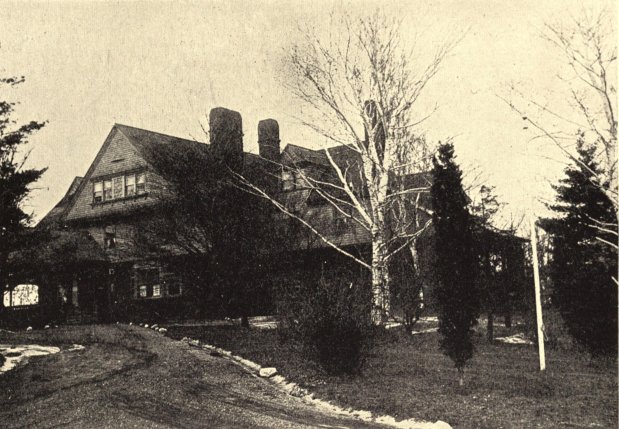
President Roosevelt was at Sagamore Hill
when the facts were reported to him. General
Corbin was present. He asked the general what
the order meant. The general told him that it
had been issued for the purpose of economy, that
each officer had a symbol in the cable code, but
that to transmit the name and regiment of each
private would cost $25 or more for each man.
When this explanation had been made Roosevelt
said:
“Corbin, can you telegraph from here to the
Philippines?”
The general said that he could and suggested
that he be allowed to do so when he returned from
Washington.
“No,” said Roosevelt, “we cannot wait. Send
the order to have the names telegraphed at once.
Those mothers gave the best they had to their
country. We will not have them breaking their
hearts for $25 or $50.”
Now that the world war is over and the question
of whether the United States is to depend
on volunteer military organization or on regular
armies has been definitely settled in favor of the
latter view, it is well to admit that the decision
is a wise one. A regiment like the Rough Riders
was exceptional among volunteers. Roosevelt
himself, in his book “The Rough Riders,” makes
this comparison between the volunteer regiment
and the regular regiment:
“The regiment was a wholly exceptional volunteer
organization, and its career cannot be taken
as in any way a justification for the belief that
the average volunteer regiment approaches the
average regular regiment in point of efficiency
until it has had many months of active service.
In the first place, though the regular regiments
may differ markedly among themselves, yet the
range of variation among them is nothing like
so wide as that among volunteer regiments, where
at first there is no common standard at all; the
very best being, perhaps, up to the level of the
regulars while the very worst are no better than
mobs, and the great bulk come in between. The
average regular regiment is superior to the average
volunteer regiment in the physique of the
enlisted men, who have been very carefully
selected, who have been trained to life in the
open, and who know how to cook and take care
of themselves generally.”