No application of science has so completely realized
the visions of fancy as the Electric Telegraph.
So closely, indeed, does the real of the present day
approach to the ideal of ages past, that it might be
supposed the narratives in the tales of faëry land
were true records of the inventions of former times,
and that the combined efforts of inventive genius
during the last half century were but imitations and
reproductions of what had been successfully accomplished
"once upon a time." There is also an intermediate
period—between the indefinite of faëry tales
and the positive of scientific history—in which sympathetic
tablets and magical loadstones, scarcely less
mythical, are stated to have been invented; and the
individuals are named who thus paved the way for
instantaneous communication between all parts of the
world.
The Jesuits of the sixteenth and seventeenth centuries
took the place of the magicians of the Middle
Ages. In the seclusion of their monasteries, they
speculated on the mysterious powers of Nature, then
partially revealed to them, and shadowed forth
images of their possible applications. It is to a
vague speculation of this kind that we may attribute
the notice given by Strada, in his "Prolusiones Academicæ,"
of the sympathetic magnetic needles, by
which two friends at a distance were able to communicate;
though the then fanciful idea has been
literally realized. A still more extraordinary foreshadowing
of one of the most recent improvements
of the Electric Telegraph was the transference of written
letters from one place to another by electric
agency. This is said to have been accomplished by
Kircher, who, in his "Prolusiones Magneticæ," describes,
though very vaguely, the mode of operation.
But even admitting that there were substantial foundations
for these imaginary phantasms, that would not
in the least detract from the merit of those who, following
closely the footsteps of scientific discovery,
have successfully applied the principles unfolded
by the investigations of others, and by their own assiduous
researches. Thus, whilst steam navigation
was facilitating the means of intercourse over rivers
and seas, and whilst railways and locomotive engines
served to bring distant cities within a few hours'
journey of each other, another source of power, infinitely
more rapid in its action than steam, has been
made to transmit intelligence from place to place, and
from one country to another, with the speed of
lightning.
The plan of making communications by signals
has been in operation from time immemorial; the
beacon lights on hills having served in ancient as
well as in modern times to give warning of danger, or
to announce tidings of joy. Such simple signals were
not capable of much variety of expression; but even
beacon lights might be made to indicate different
kinds of intelligence, by multiplying the number of
the fires, and by altering their relative positions. It
was not, however, till the invention of telegraphs that
anything approaching to the means of holding regular
communication by signals was attained. The semaphore
of the brothers Chappe, of France, invented by
them in 1794, was the most perfect instrument of the
kind, and was generally employed for telegraphic
purposes, until it was supplanted by the Electric
Telegraph.
The semaphore consisted of an upright post, having
arms on each side, that could be readily extended,
at any given angle. The extension of these arms on
one side or the other, either separately or together,
and at different angles, constituted a variety of signals
sufficient for the purposes of communication. The
semaphores, erected on elevated points, so as to be
visible through telescopes, signalled intelligence
slowly from one station to another, till it reached its
ultimate destination; and thus—daylight and clear
weather permitting—brief orders could be sent from
the Admiralty to Portsmouth in the course of a few
minutes. But the communication was liable to be
interrupted by fogs, as well as by nightfall.
A remarkable instance of the imperfection of sight
telegraphs occurred during the Peninsular War. A
telegraphic despatch, received at the Admiralty from
Portsmouth, announced—"Lord Wellington defeated;"—and
then the communication was interrupted
by a fog. This telegraphic message caused great consternation,
and the utmost anxiety was experienced to
learn the extent of the supposed disaster. When,
however, the fog dispersed, the remainder of the message
gave a completely opposite character to the
news, which in its completed form ran thus: "Lord
Wellington defeated the French," &c.
Some better means of transmitting important intelligence
was evidently wanted; for not only was
the semaphore liable to frequent interruptions by the
weather, but its action was very slow, and the frequent
repetitions from station to station increased the
risk of blunders.
The instantaneous transmission of an electric shock
suggested the means of communicating with greatly
increased rapidity; and when it was ascertained, by
experiments made by Dr. Watson at Shooter's Hill, in
1747, that the charge of a Leyden jar could be sent
through a circuit of four miles, with velocity too
great to be appreciable, the practicability of applying
electricity for conveying intelligence became at once
apparent.
Of the many means by which this object was
attempted to be accomplished, it will be only possible,
in this general survey, to notice those that mark
the first steps of the invention, and the most important
of those that have accompanied its progress to the
present time.
The first method that suggested itself was to transmit
signals by means of pith-ball electrometers.
When, for instance, two pith-balls are suspended from
a wire that is made to form part of an electric circuit,
the electricity communicated to the balls causes them
to diverge, and when the electricity in the wire is
discharged, they immediately collapse. This action
of pith-balls, when electrified, was the simplest mode
known of making telegraphic signals, and it was accordingly
adopted by several of the early inventors of
Electric Telegraphs. The first person who proposed
to apply it for that purpose was M. Lesage, of Geneva,
in 1774. His plan was to form 24 electric circuits
by as many separate wires, insulated from each
other in glass tubes; and to place in the circuit, at
each communicating station, an equal number of pith-ball
electrometers. Each electrometer was to represent
a letter of the alphabet, and they were to be
brought into action by an excited glass rod. When a
communication was to be made, the wires connected
with the separate galvanometers were to be charged
alternately with electricity by the excited rod of
glass; and the person at the receiving station, by
noticing which of the electrometers were successively
put into action, could spell the words intended to be
communicated.
By the means thus proposed, correspondence could
have taken place at only short distances, for the
charge of an excited glass rod would have been too
feeble to produce any sensible effect on the electrometers
had the length of the circuit been considerable.
This difficulty might have been overcome by
substituting the charge of a Leyden jar for the excited
glass; but the more serious obstacle to the use of
such a telegraph would have been the cost, and the
difficulty of insulating the 24 wires required to work
it.
Most of the early telegraphic inventors encumbered
their inventions with the same obstacle, as they
seemed to consider it necessary to have a separate
circuit for each letter of the alphabet. It was not so
however, with all; for M. Lomond, a Frenchman, who
ranks second in the list of telegraphic inventors,
modified the principle of M. Lesage, so as to enable
him to work with only two wires and one electrometer
at each station. With the experience since gained in
the application of the needle telegraph, such an
arrangement seems very simple, and we are inclined
to wonder that it was not generally adopted, especially
after M. Lomond had shown the way.
To produce all the requisite signals with a single
pith-ball electrometer, it was necessary to vary the
durations of each divergence, and to combine several
to form a single symbol. Thus, suppose that a single
divergence of the pith-balls for a second was understood
to signify the letter A; one divergence, followed
by an immediate collapse, by discharging the electricity,
might signify B; two prolonged divergences
might signify C, and two short ones D; and by thus
increasing the number and varying the divergences
of the two pith-balls, all the letters of the alphabet
might be indicated.
A still more direct method of representing the
letters of the alphabet was proposed by M. Reizen in
1794, by the application of the means frequently
adopted for exhibiting the light of the electric spark.
The charge of a Leyden jar was sent through strips of
tin foil, pasted on to a flat piece of glass, so as to form
several lines, joined at the ends alternately into a continuous
circuit. Interruptions were made in the foil
by cutting small portions away, at which points
brilliant sparks appeared when the jar was discharged.
As the interruptions were so contrived as to form
letters, and the strips of tin foil were all arranged
separately on a long pane of glass, any letter required
could be distinctly made visible by discharging the
jar through that particular circuit. To produce all
the letters of the alphabet in this manner, a separate
circuit was required for each.
Another plan, far less feasible, and scarcely deserving
of notice, excepting for its peculiarity, was
proposed in the following year by M. Cavallo, who
suggested the setting fire to combustibles, or the explosion
of detonating substances, as the means of
signalling intelligence. About the same time several
attempts were made by electricians in Spain to transmit
signals by electricity, but their plans were not
more practicable than those already mentioned, and
depended for their effects on the discharge of Leyden
jars.
The discovery of voltaic electricity at the beginning
of the present century was an important step in the
progress of the Electric Telegraph, though several
years elapsed before the applicability of the discovery
for that purpose became known; and it was not fully
appreciated till within the last twenty years.
The electricity generated by the voltaic battery is
far greater in quantity than the most powerful electrical
machine can excite, whilst its intensity is so feeble
that it cannot pass in a spark through the smallest
interval of air. It presents, therefore, much less
difficulty in the insulation of the wires than frictional
electricity, whilst the rapidity of its transmission is for
practical purposes equally efficient. The electricity
generated by the voltaic battery being great in quantity
and feeble in intensity, it is capable also of
effecting chemical decomposition and of imparting
magnetism, both of which properties have proved
eminently useful in perfecting the Electric Telegraph.
The first application of voltaic electricity to telegraphic
purposes was made by Mr. Soemmering in
1809. The signals of his telegraph consisted of the
bubbles of gas arising from the decomposition of water,
during the action of the electric current. His apparatus
consisted of a small glass trough, filled with
acidulated water, through the bottom part of which
were introduced several gold wires corresponding to
the letters of the alphabet. The instant that an electric
current was sent through any two of the wires, by
making connection with a voltaic battery at the transmitting
instrument, bubbles of hydrogen gas rose
from one of the gold wires, and bubbles of oxygen gas
from another; and as the volume of hydrogen gas,
liberated during the decomposition of water, exceeds
by sixteen times that of the oxygen, it was easy to
distinguish them. In this manner all the letters of the
alphabet could be indicated by using 24 wires. The
object of having gold wires in the decomposing trough
was to prevent the oxidation of the metal; for had
copper, or any other metal that combines with oxygen,
been employed, the points of the wires would soon
have become corroded.
This telegraph of Soemmering's, though not adapted
for practical application in the form he presented
it, on account of the number of wires required for the
purpose, was nevertheless superior to any that had
previously been invented; and by a little modification
it might have been made a perfect instrument, capable
of transmitting messages by means of only two
wires. Such a modification of the instrument was
proposed by M. Schweigger, twenty years afterwards;
the only thing required being the adoption of a code
of symbols, by means of which all the letters might
be indicated by combinations of the four primary signals
that are obtainable by two wires, as is at present
done by the needle telegraph in common use. At
that time, however, the discovery of the magnetic
properties of the electric current, and other improvements
in the means of communicating, superseded for
some years the use of signals made by electro-chemical
decomposition.
The next important step in the progress of telegraphic
invention, after that of Mr. Soemmering, was
made by Mr. Ronalds, who in 1816 succeeded in
making a perfect apparatus, that transmitted every
requisite signal with the use of only a single circuit.
In the agent employed, however, there was a retrogression
to frictional electricity and the pith-ball
electrometer, for at that time the property which a
voltaic current possesses of deflecting a magnetic
needle had not been discovered.
Mr. Ronalds's plan was to have, at each communicating
station, a good clock with a light paper disc
fixed on to the seconds wheel, on which were marked
all the letters of the alphabet, and the ten numerals.
Only so much of this disc was exposed to view as to
show a single letter at a time, through a small aperture,
as the seconds wheel revolved. The clocks at
the corresponding stations were set exactly together,
so that the same letter was exposed to view at each
instrument at the same instant. A pith-ball electrometer,
connected in a single circuit with the transmitting
station, was kept distended during the transmission
of a message by charging the wire from an electrical
machine; and when the letter required to be indicated
appeared at the aperture of both instruments,
the operator at the transmitting instrument instantly
discharged the electricity of the wire by touching it,
and thus caused the pith-balls to collapse. In this
manner the person at the receiving station, by attentively
watching the pith-balls, and noticing the letter
that appeared at the instant of collapse, could read
the messages signalled.
Mr. Ronalds so far perfected his invention, that it
worked accurately, though slowly, through eight miles
of wire insulated in glass tubes. Having thus succeeded
in putting into action his single wire telegraph,
Mr. Ronalds sought the patronage of Government for
its practical adoption, such a notion as that of establishing
a telegraph for commercial purposes not being
at that time entertained. For a length of time his
application received no attention, and when at length
the Lords of the Admiralty condescended to answer,
they sent Mr. Ronalds, as the reward for his ingenuity,
and as compensation for the time and money bestowed
in perfecting the invention, the expression of their
opinion—that "telegraphs are of no use in time of
peace, and that during war the semaphore answered
all required purposes"! This reply, so characteristic
of the manner in which Government employés generally
regard anything new to which their attention is solicited,
completely disheartened Mr. Ronalds. He
abandoned the Electric Telegraph to its fate; and
having gone abroad, he returned some years later to
find that, notwithstanding the dictum of the Lords of
the Admiralty, telegraphs are of great use in time of
peace as well as of war, and that the old semaphore
had been entirely superseded by the means of transmission
he had indicated twenty years before. Mr.
Ronalds has since received a small pension, not however
as a reward for his ingenious telegraph invention,
but for his services in other departments of science.
The discovery of the magnetic property of an
electric current by Professor Œrsted, in 1818, was
most important in the subsequent progress of telegraphic
invention, though it was not applied in a practical
manner till nearly twenty years afterwards. In 1820,
indeed, M. Ampère submitted to the Academy of
Sciences at Paris a telegraphic instrument for the
transmission of signals by the deflection of needles,
but he adopted the impracticable plan of the earliest
inventors, of having a separate wire for each letter of
the alphabet. A much more important contribution
to telegraphic invention by M. Ampère was the discovery
of electro-magnets, which act an important
part in many recent electric telegraphs.
As the magnetic properties of a voltaic current
are extensively applied in electric telegraphs, it is desirable
briefly to explain the nature of the action of
voltaic batteries before proceeding farther with the
history of the invention.
To excite a current of voltaic electricity, it is usual
to employ a series of zinc and copper plates, arranged
alternately in separate jars; or, what is now most
common, in cells of gutta percha, separated from each
other in a gutta percha trough. The cells are nearly
filled with diluted sulphuric acid, and a wire is attached
to each end of the trough; one being connected
with the last zinc plate, and the other with the last
copper plate of the opposite ends of the trough.
When these wires are brought into contact, electricity
is instantly generated by the action of the acid on the
zinc plates. The electricity excited by the action on
the zinc in one cell is carried on to the next, and that
again excites and transfers an additional quantity to
the third cell, thus increasing in intensity to the last
pair of plates in the series. The electric current, as it
is called, passes along the wire, and whether the wire
be one yard, or whether it be a hundred miles long,
the generation of electricity takes place the instant
that the circuit is completed, and ends the instant that
the circuit is broken. There is this difference, however,
in the transmission of electricity through a long
and through a short circuit, that in the former case the
increased resistance offered by the length of the wire
greatly diminishes the quantity of electricity transmitted
though it does not perceptibly retard the
velocity.
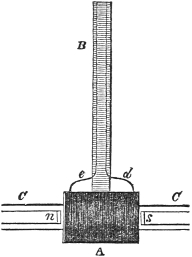
When a balanced magnetic needle is held above a
short thick copper wire whilst it is transmitting an
electric current, the needle is deflected from its natural
position, and inclines either to the right or to the left,
according to the direction in which the current passes.
If, for instance, the north pole of the needle be pointed
towards the copper pole of the battery, it will be deflected
towards the east, but if the direction of the
battery current be reversed, the deflection will be
towards the west. The effect instantly ceases when
the current is interrupted by breaking connection
with either pole of the battery. The copper wire,
though under ordinary circumstances incapable of
being rendered magnetic, thus becomes endowed with
strong magnetic properties when it is transmitting an
electric current, and acts on the magnetic needle in
the same manner as if there were an immense number
of small magnets placed along the wire across its
diameter.
The magnetic property of an electric current, first
discovered by Œrsted, was applied by M. Ampère
to impart magnetism to iron, by coiling a length of
copper wire round a bar of iron, taking care to cover
the wire with an insulating substance, so that when an
electric current was transmitted the electricity might
not pass through the iron. Coils of copper wire,
covered with cotton or silk, can thus impart most
powerful magnetism to a piece of soft iron; but it
loses its magnetic power the instant that the electric
current is interrupted.
The effect of a coil of insulated wire in increasing
the magnetic power of an electric current, was applied
by M. Schweigger in 1832 to increase the sensitiveness
of a suspended magnetic needle. By surrounding
a compass needle with several convolutions of
covered wire, it was found that the deflections of the
needle were much greater and more active; and he
thus showed the way to the construction of those delicate
galvanometers, which indicate by their deflections
the slightest disturbance of electrical equilibrium.
Schweigger may, therefore, be considered the
original inventor of the Needle Telegraph; and as he
pointed out a method of impressing symbols on paper
mechanically, by means of electro-magnets, he may
be considered also as the original inventor of Recording
Electric Telegraphs.
The first near approach to the needle telegraph,
now used in this country, was made by Baron de
Schilling, who, in 1832, constructed at St. Petersburg
an electric telegraph consisting of five magnetic
needles. This may be considered as the precursor of
the five-needle telegraph, first patented by Professor
Wheatstone in 1837. By the separate deflection of
those needles to the right hand or to the left, by reversing
the connections with the poles of the batteries,
ten primary signals could be obtained; and by
bringing two into action at the same time, many
more signals might be made than were required for
indicating the letters of the alphabet, and they could
be appropriated to express several words. For the
action of this very efficient telegraph only five wires
were required, and the signals being all primary ones,
the messages might have been transmitted very
quickly.6 In a subsequent modification of the telegraph,
he contrived to make all the signals with one
magnetic needle alone, by repeating the deflections
to the right and to the left, as done in the needle telegraph
now generally used in England.
Another step made by Baron de Schilling was the
invention of an alarum to call attention when a message
was about to be sent. Some contrivance of this
kind was considered essential in the early days of the
practical application of the Electric Telegraph, as no
one then contemplated that telegraphic communications
would be so frequent as to require a person to
be always near the instrument, waiting for the receipt
of messages.
Baron de Schilling's alarum was very simple.
One of the magnetic needles acted as a detent which
held a weight suspended, and when the needle was
deflected, the weight fell upon a bell. The alarums
subsequently invented were constructed on the same
principle, but instead of employing one of the magnetic
needles as a detent, an electro-magnet was used
for the purpose, and clock mechanism was introduced
to sound a bell continuously, as soon as it was set in
action by the withdrawal of the detent. At the
present time alarums are not used in the regular stations
of the electric telegraph companies; the sound
of the needles, as they strike against the ivory rests
on each side, being sufficient to call the attention of
the clerks, who are in constant attendance.
We have hitherto been enabled to trace, step by
step, the advances made at intervals—years asunder—in
bringing the Electric Telegraph into practical
use; but we are now approaching a time when it becomes
difficult to enumerate, and impossible to describe
within reasonable compass, the numerous inventions
that were patented and otherwise made
known for giving greater efficiency to that means of
communication.
In the early part of the year 1837, the electric
telegraphs of Mr. Alexander, of Edinburgh, and of
Mr. Davy, were publicly exhibited in London, and
excited much attention; though, at that time it was
not supposed that it would be possible to make use of
that means of communication for general purposes.
Mr. Alexander's telegraph was the same in principle
as those of M. Ampère and of Baron de Schilling,
though in some respects not so efficient as either, for
its action was slow, and it required a separate wire for
each letter of the alphabet. It was considered a great
advantage of this telegraph at the time, that it exhibited
actual letters of the alphabet, instead of
symbols. This was effected by having the twenty-six
letters painted on a board, and concealed from
view by a number of small paper screens, which
were attached to magnetic needles. When any of
the needles was deflected by sending an electric
current through the surrounding coil, the screen
was withdrawn and exposed the letter behind.
Twenty-six keys, resembling those of a pianoforte,
were ranged in connection, one with each wire, and
on pressing down any one of the keys, contact was
made between the battery and the wire connected
with its associated magnetic needle; and in this
manner, messages might easily be transmitted and
read. The objections to this telegraph, in the form
in which it was exhibited, were not only the impracticability
of laying down and insulating so
many wires, but the paper screens attached to the
needles impeded their action, and rendered the
transmission a very slow process. It is questionable,
indeed, whether that telegraph could have been
worked at all through a circuit of many miles.
Mr. Davy's telegraph was similar to that of Mr.
Alexander's, though much more compact and better
arranged. The letters were painted on ground glass,
lighted behind, so that when the screens were withdrawn
the letters were seen in transparency.
Professor Wheatstone, who had for some previous
years been endeavouring to perfect a practical electric
telegraph, took out his first patent in 1837. It
closely resembled in general features the telegraph
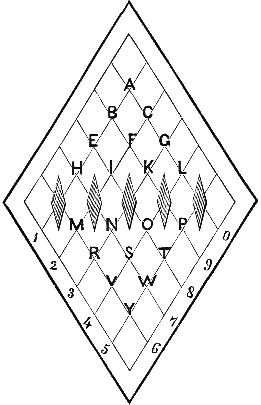
of Baron de Schilling. It consisted of five magnetic
needles, ranged side by side on a horizontal line that
formed the diameter of a rhomb. The needles were
suspended perpendicularly, being kept in that position
by having the lower ends made slightly heavier
than the upper. The rhomb was divided into thirty-six
equal parts by ten cross lines, and the needles
were placed at the points where the lines intersected,
as shown in the diagram.
At each intersection, and along the boundary
lines of the rhomb, letters were marked, any one of
which might be pointed at by the combined action of
two of the needles. Thus, if the two extreme needles
were deflected inwards, one towards the left and the
other towards the right, they would point to the
letter A at the top of the rhomb. If the extreme
needle on the left and the fourth one were similarly
deflected, they would point to the letter B; and thus
all the letters marked on the intersections of the lines
could be pointed to. A telegraph that could be
worked with five circuits came within the range of
practicability, and it was put into operation on the
Great Western Railway as far as Slough, a distance
of 18 miles.
When the work of actually making communication
by insulated wires between places far apart
came to be done, much difficulty arose as to the best
and cheapest mode of doing it. The plan first attempted
was to surround the wires with pitch, and to
bury them in a trench in the ground. But this was
found to be attended with great inconvenience, for
the pitch cracked, and electric communication was
established between the adjacent wires. The method
of suspending the wires on posts was, we understand,
suggested by Mr. Brunel, who had seen wires so suspended
for other purposes on the Continent, and he
recommended it to Mr. Cooke for the Electric Telegraph.
The plan was tried with success, and was
generally adopted by the Electric Telegraph Company
in extending their lines over the country. We
shall have occasion to revert to this practical part
of the subject, when describing more particularly the
means of making communication from one place to
another.
In continuing the history of the invention, as regards
the different modes by which communications
are transmitted along the insulated wires, the next
telegraphs that deserve notice are those of Dr. Steinheil,
which became known also in 1837. One of his
telegraphs made the signals by sounds, produced by
magnetic needles striking, when deflected, against
bells of different tones. By another telegraph of his
invention the symbols where marked upon paper by
small tubes holding ink, fixed to the needles. In this
manner the letters of the alphabet were indicated by
dots upon a strip of paper, kept slowly moving by
clock mechanism. This telegraph could be worked
by a single circuit; and it appears that Dr. Steinheil
was the first who discovered, or at least who practically
applied, the conducting power of the earth for
the return current. Each circuit, therefore, consisted
of only a single wire; the wire that had been previously
used to complete the circuit being superseded
by burying in the earth, at each terminus, a small
copper plate. Dr. Steinheil also introduced the use
of galvanized iron wire. An electric telegraph of
this construction was put into operation at Munich,
through a distance of 12 miles.
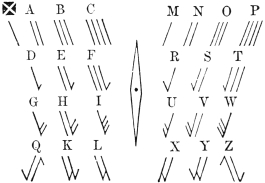
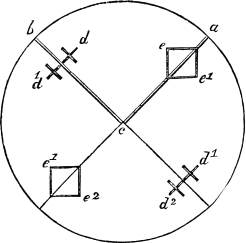
In the following year Messrs. Cooke and Wheatstone
so far simplified the arrangements of their
needle telegraph as to make all the requisite signals
with two needles. With a single combined battery
and two wires six primary signals are thus obtained;
and by repeating the deflections and combining the
action of the two needles, all the letters can be readily
and quickly indicated. A single needle instrument
was invented by Messrs. Cooke and Wheatstone, but
as there are only two primary signals, one to the right
and one to the left, the deflections are necessarily repeated
more frequently, and the transmission is consequently
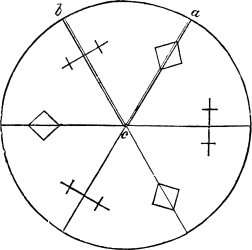
more slow. The accompanying diagram
represents the alphabet of the single needle instrument.
The deflections for each letter commence in the direction
of the short marks, and end with the long
ones. Thus, to indicate the letter R, the needle is first
deflected once to the left and then once to the right;
and the letter D has the deflections reversed, beginning
with one to the right and ending with one to the
left. In no instance does it require more than four
deflections to indicate a single letter, yet the transmission
with the double needle is found so much
quicker that the single needle instrument is only
rarely used.
At the end of each word, it is customary for the
clerk at the receiving station to indicate, by a deflection
of the needle to the right, that he understands,
or by a deflection to the left, that he does not understand,
and in the latter case the word is repeated.
In the early days of the Electric Telegraph, the
transmission of 40 letters a minute with the double
needle instrument was considered quick work; but
the practised clerks will now transmit one hundred
letters in that time, which is as fast as any person can
write with pen and ink.
Since the invention of the double and single
needle telegraphs there have been many modifications
in the instruments, to make them work more promptly
and with less vibration; but in all essential parts the
telegraphs of Messrs. Cooke and Wheatstone remain
unaltered, and continue to be generally used in this
country.
Of the numerous other telegraph instruments that
have been invented since 1837, that of Mr. Morse is
in most general use, especially on the Continent and
in America. Mr. Morse, indeed, claims to be the
first inventor of a practical Electric Telegraph; for,
according to his statement, he, in 1832, invented a
telegraph, which was in principle the same as the one
now in use. It was not, however, till September,
1838, that he made his instrument known in Europe,
by sending a description of it with a model to the
Academy of Sciences at Paris. Mr. Jackson, an
American, disputed with Mr. Morse for the honour
of the invention, and when the latter asserted that he
had described his telegraph in 1832, to some passengers
on board a packet-boat, Mr. Jackson affirmed
that it was he who described it on that occasion, and
that Mr. Morse, being present, got the idea from him.
It is painful and difficult to decide when we find two
claimants thus directly in opposition to each other,
and mutually preferring charges of falsehood and
fraud. The only safe guide in such cases is to refer
to the earliest published and authentic descriptions of
the inventions; and, following that guidance, the invention
of what is called Morse's telegraph must be
attributed to him whose name it bears; but we must,
according to the same rule, date it several years later
than 1832.
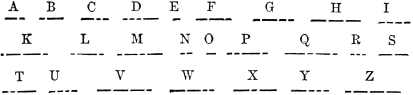
Mr. Morse's telegraph is a recording instrument,
that embosses the symbols upon paper, with a point
pressed down upon it by an electro-magnet. The
symbols that form the alphabet consist of combinations
of short and long strokes, which by their repetitions
and variations, are made to stand for different
letters. Thus a stroke followed by a dot signifies the
letter A; a stroke preceded by a dot, the letter B; a
single dot, the letter E; and in this manner the
whole alphabet is indicated, the number of repetitions
in no case exceeding four for each letter. The letters
and words are distinguished from one another by a
longer space being left between them than between
each mark that forms only a part of a letter or of a
word. The annexed diagram represents the symbols
for the whole alphabet.
The mechanism of this telegraph instrument is
very simple. The transmitter is merely a spring key,
like that of a musical instrument, which, on being
pressed down, makes contact with the voltaic battery,
and sends an electric current to the receiving station.
The operator at the transmitting station, by thus
making contact, brings into action an electro-magnet
at the station he communicates with, and that pulls
down a point fixed to the soft iron lever upon a strip
of paper that is kept moving by clockwork slowly
under it. The duration of the pressure on the key,
whether instantaneous or prolonged for a moment, occasions
the difference in the lengths of the lines indented
on the paper. A single circuit is sufficient for this
telegraph, and a boy who is practised in the use of
the instrument will transmit nearly as many words in
a minute as can be sent by the double needle telegraph
with two wires.
The working of Mr. Morse's telegraph, it will be
observed, depends altogether upon bringing into
action at the receiving station an electro-magnet of
sufficient force to mechanically indent paper. Now
the resistance to the passage of electricity along the
wires diminishes the quantity transmitted so greatly,
that at long distances it would be almost impossible
to obtain sufficient power for the purpose, if it acted
directly. To overcome that difficulty, an auxiliary
electro-magnet is employed. The electro-magnet
which is directly in connection with the telegraph
wire is a small one, surrounded by about 500 yards
of very fine wire, for the purpose of multiplying as
much as possible the effect of the feeble current that
is transmitted. The soft iron keeper, which is attracted
by that magnet, is also very light, so that it
may be the more readily attracted. This highly sensitive
instrument serves to make and break contact
with a local battery, which brings into action a large
electro-magnet, and as the local battery and the magnet
are close to the place where the work is to be
done, any required force may be easily obtained. By
this means the marks may be impressed on the paper
at distances of 400 miles or more apart.
This is a very efficient and remarkably simple
telegraph, and as it operates with a single wire, it has
completely supplanted the needle telegraph on the
Continent; though the liability to error, common to
all manipulated telegraphs, is considerably increased
by this mode of transmission, nor can unintelligible
signals be indicated and corrected so readily as by
the needle instrument.
There have been several modifications of Mr.
Morse's telegraph, for the purpose of increasing the
rapidity of its action and the distinctness of the marks.
The most important of these was made by Mr. Bain,
who in 1847 applied for this purpose the method of
impressing the symbols on paper by electro-chemical
decomposition. Mr. Davy had, in 1843, taken out a
patent for the application of electro-chemical marks to
telegraphic purposes, but his method was not sufficiently
practical to be brought into use. Mr. Bain
adopted an alphabet of short and long strokes, similar
to that of Mr. Morse; but instead of making and
breaking contact by a key pressed down by the finger,
he punched holes in a strip of paper, corresponding
in lengths and positions to the marks intended to
be transmitted. A small metal spring, connected
with the voltaic battery, pressed upon a metal cylinder
attached to the telegraph wire, and when the
spring and cylinder touched, an electric current was
transmitted. The strip of punched paper was placed
upon the cylinder so as to interrupt the circuit, excepting
in the parts where the apertures allowed the
spring to make contact; therefore when the strip of
paper was moved along, an electric current was
transmitted through the apertures, and it was stopped
when the paper intervened. At the receiving station,
paper well moistened with a solution of prussiate
of potass and nitric acid was placed upon a corresponding
cylinder to receive the message, and a piece
of steel wire was kept steadily pressed upon it as it
moved along. The action of the electric current at
the parts where it was transmitted caused the acid to
enter into combination with the steel, and the consequent
deposition of iron on the paper was instantly
converted by the prussiate of potass into Prussian
blue. On the parts where the electric current was
interrupted no action took place, and thus numbers
of short and long marks were made on the paper, corresponding
to the lengths of the apertures on the prepared
message. A representation of the punched
paper for transmitting the word "Bain" is shown in
this diagram.

As electro-chemical action takes effect much more
rapidly than the mechanical movement of an indenting
point, Mr. Bain's telegraph could work much faster
than Mr. Morse's. We have been informed that as
many as 1,000 letters per minute have occasionally
been transmitted by this means from Manchester to
London. The disadvantage attending that mode of
transmission arises from the tedious process of punching
the message preparatory to transmission; and though
circumstances may arise in which it would be of great
importance to adopt this rapid system of transmission
with a single wire, it has been yet but little used in
this country by the Electric Telegraph Company, who
purchased Mr. Bain's patent for £10,000.
Another modification of Mr. Morse's telegraph,
which has been more extensively adopted in England,
consists in merely substituting marks made on paper
by electro-chemical decomposition for those indented
by pressure. It has been found desirable in practice,
however, to introduce an auxiliary electro-magnet,
called a "picker," for making and breaking contact,
by which arrangement the dotted marks can be made
by a local battery, and any required amount of electric
power be obtained. The marks produced in this
manner are more distinct, and are more quickly made,
than by mechanical pressure. By a more recent application
of Mr. Morse's system, the marks are made
on paper with ink flowing through a glass pen, in the
same manner as in the telegraph of M. Schweigger,
already noticed. As the strip of paper is moved
along, a continuous line is thus drawn on the paper.
When no signals are being transmitted the line is
straight, but when an electric current is sent through
the wire, it brings into action an electro-magnet,
which attracts the penholder on one side, and alters
the direction of the mark. The transmission is effected
by making and breaking contact with a key, and the
continuance of the divergence of the mark from its
normal direction is regulated by the duration of pressure
on the key. The symbols are thus made by deviations
from the straight line, of different lengths
and of varied combinations. Practical application
alone can determine whether this mode of making
the marks possesses any advantage over Mr. Morse's
original plan. The patent for this telegraph was
granted to Mr. Wilkins in 1854, but a similar instrument,
applied to the notation of astronomical observations,
was shown in the American department of the
Great Exhibition of 1851.
The recording telegraph instruments hitherto noticed
impress on the paper only hieroglyphical symbols,
which require long practice to decipher readily.
It has, from the first practical application of the invention,
been considered highly desirable that the
letters of the alphabet should be indicated and printed
in their proper forms, so that the momentary transmission
of an electric current should leave behind a
durable impression that could be read without difficulty.
Professor Wheatstone and Mr. Bain separately
attempted to accomplish this desired object by the
invention of Printing Telegraphs, which print messages
from types. It is a question in dispute which of them
was the first to design a telegraph of this kind. In
1845, Mr. Bain had a printing telegraph in operation
experimentally on the South-Western Railway, for a
distance of seven miles, and we are not aware that
Professor Wheatstone ever succeeded in working his
printing instruments when separated at a distance
from each other. In principle, both inventions were
similar. A wheel, into the periphery of which were
inserted types of the twenty-six letters, was made to
rotate in close proximity to a piece of paper, over
which was placed a blackened surface that would
leave a mark on the paper when pressed upon.
When the required letter came opposite the paper,
the type-wheel was stopped and forced against it, so
that the letter was impressed, and the black from the
interposed surface marked the form of the type. The
paper was then moved forward to leave space for the
next letter, and thus a continuous message could be
printed. The objection to these instruments was the
uncertainty of stopping the type-wheel at the proper
point, so as to avoid printing wrong letters; and when
the instruments became thus irregular, they continued
so till they were again adjusted. This difficulty
has since been overcome; and by the combined
efforts of Mr. House in America, and of Messrs.
Brett in this country, the printing telegraph has attained
a high degree of perfection. The mechanical
arrangements of the instrument, though very complex,
consist essentially, like those of Mr. Bain and
Professor Wheatstone, in having a type-wheel, which,
by the action of the operator at the transmitting instrument
in making and breaking contact, moves or stops
at the required point, and the letters are printed by
forcing the paper against the type by an electro-magnet.
The movements of the type-wheel are regulated
by an electro-magnet, and one great improvement introduced
by Mr. Brett prevents the continuance of
error, should any be made during transmission, by
bringing the type-wheel to its first position after printing
each letter, so that if a wrong letter be printed,
the subsequent letters will not continue erroneous.
This printing telegraph works with a single wire, but
its operation is rather slow.
The last recording telegraph we shall notice is the
one invented by the author, which transmits copies
of the handwriting of correspondents. The communication
to be transmitted is written upon tin foil, thinly
coated with varnish, with a pen dipped in an ink composed
of caustic soda and colouring matter. The
alkali detaches the varnish, and when the surface is
washed over with a wet sponge, the metal is exposed
on those parts written upon, the writing appearing
metallic on a dark ground. The message is then
placed round a metal cylinder that is connected with
the line wire from the receiving station. A brass
point, in connection with the voltaic battery, lightly
presses on the message as the cylinder rotates, so that
the electric circuit is made and broken through the
message as it passes under the connecting point, the
coating of varnish on the foil being sufficient to interrupt
the electric current in those parts where the
point is resting upon it. On a corresponding cylinder
in the electric circuit, at the receiving station, paper
moistened with a solution of prussiate of potass and
nitrate of soda is placed to receive the message; and
it is pressed upon by the point of a steel wire, in
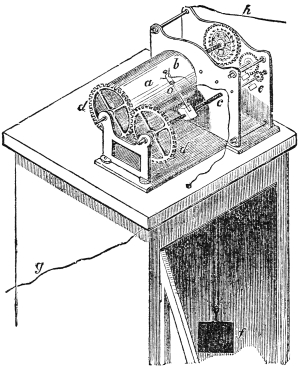
connection with the communicating wire. The accompanying
diagram will assist in explaining the arrangement.
The cylinder of the instrument is shown at a; b
is the metal style connected by the wire g with one
of the poles of the voltaic battery; o is the arm which
holds the style and serves to insulate it from the rest
of the apparatus; c is a fine screw on which that arm
traverses as the cylinder revolves; d d are cog-wheels
to turn the screw. The speed of the instrument is
regulated by the fan e; f is the impelling weight,
and h the wire connected with the distant instrument.
The receiving and the transmitting instruments are
alike, the only difference between them being that
the style of the copying instrument is steel instead of
brass wire.
As the cylinder a is connected by the wire h with
the distant instrument, and through it with one of
the poles of the voltaic battery, the electric circuit is
completed by passing from g through the tin foil
message, or through the paper placed on the cylinder.
This will be the case whenever the style of the transmitting
instrument is pressing on the metallic writing;
and at those times the electro-chemical action of the
voltaic current will produce a blue mark on the paper
of the receiving instrument, by the deposition of iron
and its combination with the prussiate of potass. The
circuit will in like manner be interrupted whenever
the point b presses on those parts of the message where
the varnish is not removed; and thus, as the two cylinders
revolve, there will be a succession of small blue
marks on the parts where the writing allows the
electric current to pass. As the arms that carry the
points traverse on screws, they are drawn along as
the cylinders rotate, so as to press on fresh parts of
the message and of the paper at each revolution. The
steel point would therefore draw a series of spiral lines
on the paper, if the electric current were not interrupted;
but the interposition of the varnish breaks
those lines, and as the point passes over different portions
of the letters at each revolution of the cylinder,
the marks and the interruptions on the paper correspond
exactly with the forms of the letters, and thus
produce a copy of the writing placed upon the receiving
cylinder, in blue characters on a yellowish
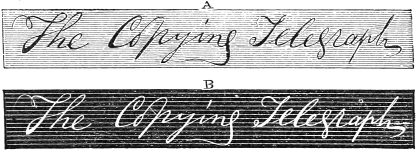
ground. Or the message may be written on unprepared
tin foil with a pen dipped in varnish; in which
case the writing will be copied in white characters on
a ground of dark lines, as in the accompanying specimen,
A being the writing on tin foil, and B the message
received.
It is essential to the perfect working of the copying
telegraph that the corresponding instruments should
rotate exactly together. This is effected by an electromagnetic
regulator, which being put in action by one
instrument, governs the movements of the distant instrument
with the greatest exactness, as proved at a
distance of 300 miles.
It might be supposed, as the points must traverse
several times over the same line of writing to copy
it, that the process is a slow one; but in consequence
of the rapidity with which the cylinders revolve, this
is not the case. The ordinary speed is one rotation
in two seconds, and at that rate three lines of writing,
containing sixty words, would be copied in one minute,
which is three times as fast as an expeditious
penman can write.
The advantages proposed to be gained by the copying
telegraph, in addition to its increased rapidity of
transmission, are the authentication of telegraphic
correspondence by the signatures of the writers, freedom
from the errors of transmission, and the maintenance
of secrecy. As a special means of obtaining
secrecy, the messages may be received on paper moistened
with a solution of nitrate of soda alone, in which
case they would be invisible until brushed over with
a solution of prussiate of potass, to be applied by the
person to whom the communication is addressed.
Professor Wheatstone has recently contrived an
improvement in his index telegraph, which was
described by Professor Faraday in a lecture at the
Royal Institution in June last. Its chief merit, however,
consists in the beauty of the mechanism, for
it is essentially the same as the index telegraphs he
and others have previously invented, with the substitution
of magneto-electricity for the moving force.
Having now traced the history of the invention of
the instruments by means of which messages may be
transmitted, it becomes necessary to describe the
methods employed for making the electrical connection
from one place to another. This part of the
electric telegraph system is, after all, the most essential
to its efficient working, and bears the same relation
to the transmitting instruments that the structure
of a railroad does to locomotive engines in the system
of railway conveyance.
The fact that an electric current might be sent
through a long circuit had been established by Dr.
Watson, in conjunction with other Fellows of the
Royal Society, in 1747, when they sent the charge of
a Leyden jar through two miles of wire, supported
upon short sticks driven into the ground; the wire at
each terminus being connected with the earth for the
return current. This method of insulation and conduction
fully answered the purpose, and served to determine
the great velocity with which electricity is
transmitted, for no perceptible interval occurred between
the discharge of the Leyden jar at one end of
the circuit, and its effect at the other extremity.
Mr. Ronalds made the next experiment on an extensive
scale, by insulating eight miles of wire in glass
tubes, the wire being carried backwards and forwards
for that distance on his lawn at Hammersmith. That
mode of insulation was found very efficient. It was,
indeed, too perfect, for the difficulty arose of discharging
the electricity from the wire after the charge had
passed through it.
The length of telegraphic communication established
at Munich, in 1837, by Dr. Steinheil, was an
important practical advance in the system of extending
and insulating the wires, and deserves consideration,
not only from the extent to which it was carried
into practical operation, but from the circumstance
that the earth was employed to form the return circuit.
The wires appear to have been carried through
the city by extending them from the church towers
and other elevated buildings. That plan, indeed, presents
so many facilities for passing telegraph wires
through towns, that it is not improbable it may be
ultimately adopted in this country.
Though the conducting power of the earth was
thus early made use of for one-half of the circuit, the
fact seems to have been unknown in England at the
time of laying down the telegraph wires to Slough in
1845, for a separate wire was then used for the return
current. Some years afterwards, indeed, Mr. Bain
laid claim to the discovery; but the fact that the conducting
power of the earth had been previously
applied to the purpose by Dr. Steinheil has been incontestably
proved.
In the early stages of the practical application of
electric telegraphs in this country, Mr. Cook took an
active part in overcoming the numerous difficulties
attending the proper protection and insulation of the
wires. In the first instance, the plan of burying the
wires in trenches was
tried, but with very indifferent
success, as the asphaltum
and other resinous
substances with which
it was attempted to insulate
them were inadequate
for the purpose, and allowed
the electricity to escape
from wire to wire. The
method of supporting the
wires on tall posts was then
adopted by Mr. Cooke, the
wires being insulated from the posts at the points of
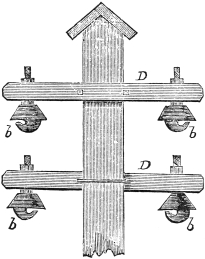
suspension, by passing them through quills. Various
improvements have since been made in the insulators,
and the plan most in favour at present is to pass the
wires through globular earthenware or glass insulators,
attached to the posts, as shown in the annexed
diagram. The wires themselves are about one-sixth
of an inch in diameter; they are made of iron coated
with zinc, or galvanized, as it is termed, to protect
them from rust.
Notwithstanding the great care taken to insulate
the wires at the posts, a large quantity of the electricity
escapes in wet weather, and returns to the battery
without having reached the most distant stations,
and thus not unfrequently the communications are
interrupted. The author is of opinion that the loss of
electricity in wet weather is occasioned rather by
communication from one wire to another through the
moist atmosphere, than by defective insulation at the
posts. In confirmation of this opinion it may be
stated, that he has experimentally determined that a
working electric current might be transmitted from
London to Liverpool, if all the points of attachment
were connected by water with the surface of the
ground, provided that the rest of the wire were insulated.7
The use of gutta percha as an insulating covering
for wire has given rise to a new era in telegraphic
communication. Gutta percha is an excellent insulator,
and wire covered with two coatings of that
material, about one-sixteenth of an inch each, is so far
protected, that 100 miles of it immersed in water
transmits an electric current from a powerful voltaic
battery with very trifling loss. This perfection in insulation
has greatly facilitated the establishment of
telegraphic communication between England and the
Continent. The first attempt to establish a submarine
circuit between Dover and Calais took place on the
28th of August, 1850. A single copper wire, about
the thickness of a common bell wire, coated thickly
with gutta percha, was laid across the English Channel
experimentally, without any protection. It proved
sufficient for the transmission of an electric current,
and several messages were sent through it between
Dover and Calais; but it was far too feeble to resist
the action of the waves, and the following day it was
cut through by friction against the rocks, and the
communication was stopped.
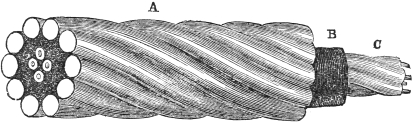
The plan afterwards adopted for a permanent submarine
line was to enclose five similar wires in a
hollow iron wire cable. The wires were first slightly
twisted, to prevent them from being broken when
stretched. They were then covered with hempen
yarn, to protect the gutta percha from attrition, and
they were thus introduced into the hollow cable, of
which they formed the core. The accompanying
woodcut represents this structure of the cable; the
five twisted wires are shown at C; B represents the
same covered with hemp yarn; and A a portion of
the completed cable, constructed of thick iron wire
galvanized. This cable has now been laid down for
seven years, and with perfect success. Its strength
has often been severely tested, as it has been sometime
drawn up by ships' anchors, and considerably
strained; but it has not been broken, and the insulation
is almost perfect. The success of this submarine
cable has induced the extension of that means of communicating
with the Continent, and similar submarine
telegraph cables have been laid down from Dover
to Ostend, from Harwich to the Hague, from Scotland
to Ireland, and across the Mediterranean Sea as far
as Malta. The weight and the cost of those cables
present a serious obstacle to their adoption in forming
a telegraphic communication with America; and
when it was determined to attempt to establish electrical
connection with the New World, a different
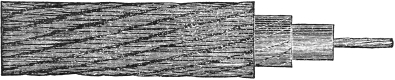
form of cable was adopted. The conductor of the
electric current in the Atlantic cable is
composed of seven strands of fine copper
wire twisted together, the aggregate thickness
of which is not greater than the single
copper wire of other submarine cables. This fine
copper cord is covered carefully with gutta percha;
it is then coated with tarred hemp, and is protected
externally by an iron wire rope, composed of numerous
strands of fine wire. The form and exact size of
the cable are shown in the accompanying drawing
and section. The central dots in the section are the
conducting wires round which are the gutta percha
and hemp, and the outer rim represents the iron wire
casing.

The successful laying down of so frail a cable, after
many failures, affords good ground for hoping that,
with the experience already gained, subsequent efforts
will prove more satisfactory and much less expensive
than this first attempt to establish telegraphic communication
with America. The most questionable
part of the problem has, indeed, been already solved;
for the transmission of electric signals, through that
length of submerged wire, was at one time doubted;
and though the communication through the present
cable has ceased, it has sufficiently established the
fact, that telegraphic communication with America is
a practicable undertaking.
The excellent insulation obtained by means of
gutta percha covered wires has caused a return to the
original plan of burying the wires in trenches in the
ground. The British and Submarine Telegraph Company
make all their communications by that means;
the number of coated wires required being enclosed in
iron tubes, and laid in the ground along the common
roads. That plan is, however, attended with considerable
disadvantages. In the first place, the cost of the
coated copper wire is more than quadruple that of
galvanized iron wire; and though copper, compared
with iron, offers only one-seventh part the resistance
to the transmission of electricity, yet the thin wire
employed is scarcely equal in conducting power to the
galvanized iron wire usually supported on posts. The
quantity of electricity transmitted is therefore less, and
the comparative intensity of it is greater.
Another difficulty attending the use of insulated
wires buried in the ground arises from a very peculiar
condition of electrical conduction, that could scarcely
have been anticipated. The wire, coated with gutta
percha, and surrounded externally with water or with
moist earth, becomes an elongated Leyden jar; the
gutta percha representing the glass, the wire the inside
coating, and the water the conducting surface
outside. Thus, when electricity is transmitted through
such a medium, a portion of the charge is retained
after connection with the battery has been broken.
This effect increases with the length of the wire and
the intensity of the current; and it materially interferes
with the working of many telegraph instruments.
In some experiments with the copying telegraph at
the Gutta Percha Works in the City Road, it was
found that through a circuit of 50 miles of wire immersed
in water, the mark made by electro-chemical
decomposition on paper had a tendency to become
continuous; so that instead of ceasing to mark, when
the varnish interrupted the current, a line was drawn
continuously on the paper, though the stronger marks
where the current passed were sufficient to make the
writing legible. The retention of the charge was also
shown still more remarkably by the explosion of gunpowder
by the electricity retained in the wire half a
minute after connection with the battery had been
broken. It is owing to the retention of the electricity
by the wire that the slowness with which the messages
through the Atlantic cable were transmitted is
to be attributed, and not to the length of the cable.
The rate of one word a minute was the average speed
of transmission when the first messages were sent
through the wire. The effect of the retardation of the
electric current is comparatively insignificant and were
it not for the peculiar action of the surrounding water,
the messages might have been transmitted twelve
times faster than they were.
The cost of constructing a telegraphic line has
greatly diminished with the increased facilities of insulating
the wires, and since the expiration of patents,
which conferred a monopoly on certain plans of doing
so. The cost to the Great Western Railway Company
for a line of six wires to Slough, was £150 per mile,
with comparatively low and slender posts and very
imperfect insulation. The cost of the same number
of wires at the present day would not be one-half that
sum, with thicker wires and better insulation.
It is customary in England to restrict the suspension
of telegraphic wires to railways, from the notion
that the protection of railways is necessary to prevent
wilful damage to the wires; and as the Electric Telegraph
Company have made exclusive arrangements
with all the railway companies out of London, the
competing telegraph companies have preferred to lay
their wires underground rather than incur the supposed
risk of damage to the wires if suspended from
posts on common roads, though by this means the cost
of construction is at least quadrupled. The protection
which railways afford is, however, more imaginary
than real, for any one inclined to interrupt the communication
could easily do so; and if on common
roads proper precautions were taken in fixing the posts,
and a heavy penalty were imposed on wilful offenders,
the common roads and open fields would, there can
be little doubt, offer as safe a course for the telegraphic
wires as railways.
The conducting power of the earth is now employed
by all electric telegraph companies for one-half
of every circuit. Thus, whether a communication be
sent from London to Liverpool, to Edinburgh, Paris,
or Brussels, the moist earth serves to complete one-half
of the communication. In the telegraphic circuit between
London and Liverpool, for example, the insulated
wire is connected at each end with the earth
by being soldered to a copper plate, which is buried
a few feet underground, so as to insure its being
always surrounded with moisture. To improve the
connection of this plate with the earth, it is customary
to bury with it a quantity of sulphate of copper, the
solution of which surrounds the earth-plate with a
better conducting liquid than water, and thus extends
the connecting surface. The gas pipes or water pipes
are sometimes employed for the attachment of the
wires instead of an earth-plate, but the latter is generally
preferred.
In arranging a telegraphic circuit, the voltaic
batteries and the instruments are introduced at breaks
in the telegraph wire. The course of the electric current
is from the copper end of the battery through the
transmitting instrument, then along the wire to the
receiving instrument; from that it passes to the earth
and is thus returned to the transmitting station, where
it completes the circuit by being conducted from the
earth-plate to the zinc end of the voltaic battery. The
arrangement for completing the circuit will be more
clearly understood by reference to the accompanying
diagram.
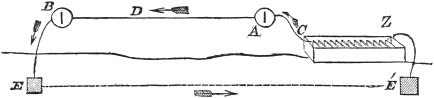
The wire from C, which is the copper pole of the
voltaic battery, is connected with the instrument A;
the electric current is then transmitted along the wire
D to the receiving instrument B; thence it is transferred
to the earth-plate E, passes through the earth to
the corresponding plate E´, which is connected with
Z, the zinc pole of the battery. When a communication
is returned from B to A, a similar arrangement
is made; the wires connected with the instruments
being so arranged as to bring into action a voltaic
battery at B, and to throw out of circuit the one at
A; for the connection with the battery is only made
when the transmitting instrument is worked.
Since all the electric telegraphs in different parts
of the world are connected with the earth, as one portion
of the circuit, it might be supposed that the
various currents would mingle, and occasion a confusion
of messages; but it must be borne in mind that
no electric current is formed until a communication be
made from one pole of a voltaic battery to the other,
and as such communication can only be completed
through the insulated wire, the earth-currents cannot
mingle, but each one passes to the proper terminus of
its respective battery. The accompanying diagram
and explanation may serve to remove the difficulty of
understanding why the two circuits are maintained
quite distinct.
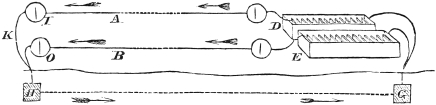
The letters A B represent the wires making communications
between the batteries D and E, and the
telegraph instruments I O at the receiving station.
The electricity from the copper end of the battery D
would be conducted along A through the instrument
I, and by the wire K to the earth-plate H. It would
be then transmitted through the earth on its return to
the battery, in the direction of the arrows, to the other
earth-plate G, and thence it would find its way to the
zinc pole of the battery D, and complete the circuit.
In the same manner, the electric current from the
copper end of the battery E would be transmitted
through the wire B, and would complete its current
also by means of the earth-plates G H, and would
traverse the course indicated by the arrows, and return
to the zinc end of E. Though both electric
currents traverse the same wire from the instruments
I O to the earth-plate H, and are thence transmitted
through the earth to a single plate, G, at the transmitting
station, there is no mingling of currents, the
electric current of each battery being kept as distinct
as if separate wires were used both for the transmitted
and the return current. It would, indeed, be as impossible
for the separate currents transmitted from the
two batteries to be mingled together, as it would be
for the written contents of two letters enclosed in the
same mail-bag to intermix.8
The length of telegraph lines at present laid down
by the several telegraph companies in Great Britain,
exceeds 10,000 miles. To complete those lines required
40,000 miles of wire, and there are 3,000 persons
engaged in the transmission of telegraphic
intelligence.
In North America there is a direct communication
from New York to New Orleans, a distance of 2,000
miles, through the whole length of which wires
messages can be transmitted without any break.
Wires have also been suspended on lofty posts across
the Indian Peninsula, where no railways have been
yet laid down. Lines of insulated wire, partly submerged
in the sea, partly buried underground, and
partly suspended on posts in the air, place London
and Vienna in direct communication; and other telegraph
lines are in the course of construction, which
will unite London with Africa: and a complete net-work
of telegraph wires is spreading over the face of
Europe.
It will not be long before this system of communication
is connected with a similar one in America.
The failure of the cable already laid down has confirmed
the opinion of the author, expressed in papers
read at meetings of the British Association for the
Advancement of Science, and in his work on Electricity,
that the conducting wire should be sufficiently
strong to be self-protective, without requiring an external
coating of iron wire rope. A conducting copper
wire, a quarter of an inch in diameter, covered
with gutta percha and tarred hemp, would be more
flexible and stronger than the combined cable; and
it being a much better conductor of electricity, the
rapidity of transmission would be greatly increased.
The effect of the establishment of competing telegraph
companies in England has been to diminish the
charge for transmitting messages, in some instances
to one-fifth of the rate formerly demanded; and
when further experience in the construction of telegraphic
lines, and the adoption of more rapidly transmitting
instruments, have facilitated and improved
the means of communication, we may anticipate that
correspondence by Electric Telegraph will in a great
measure supersede the transmission of letters by post.