THE CAPITAL CITY
Washington, the capital city of our nation, is the
center of interest for the whole country. Every citizen
of the United States thinks of the city of Washington
as a place in which he has a personal pride.
Here one may see in operation the work of governing
a great nation. The representatives whom the people
have chosen meet in the splendid Capitol to make laws
for the whole country. The home of the president is
here, and here are located the headquarters of the great
departments of our government.
The capital city is a city of splendid trees, of wide,
well-paved streets and handsome avenues. At the intersection
of many of the streets and avenues are beautiful
parks and circles, ornamented by statues of the great
men of the nation.
“How,” we are asked, “did it happen that the capital
of a great nation was built almost on its eastern boundary?”
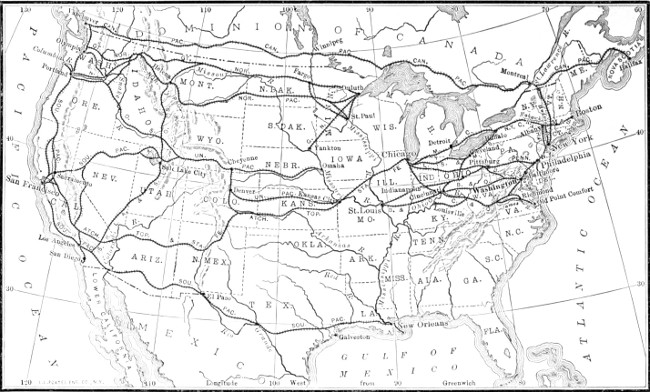
The distance from Washington to San Francisco
is 3205 miles. In other words, Washington is almost as
near to London as to San Francisco. The answer is simple.
The site was chosen when the settled part of our country
lay between the Allegheny Mountains and the Atlantic
Ocean. At that time most of the land west of the
Alleghenies was looked upon as a wilderness whose
settlement was uncertain, while no one dreamed that
the infant nation would extend its boundaries to the
Pacific Ocean.
“And why was it decided to build a new city as the
nation's capital, on a site where there was not even a
settlement? Why was not some city already established
chosen to be the chief city of the nation?” The story
is interesting.
Before the Revolutionary War the colonies were much
like thirteen independent nations, having little to do with
one another, but during the war a common peril held
them together in a loose union. With the danger passed
and independence won, this union threatened to dissolve,
but thanks to the influence of the wisest and best men
in the country the thirteen states finally became one
nation and adopted the Constitution which governs the
United States to-day. Then discussion arose as to the
site of the new nation's capital. Several states clamored
for the honor of having one of their cities chosen as the
government city. The men who framed the Constitution
were wise enough, however, to foresee difficulty if this
were done, and insisted that the seat of government
should be in no state but in a small territory which
should be controlled entirely by the national government.
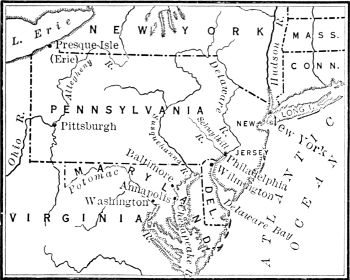
After much debate the present location was chosen,
and the two states of Maryland and Virginia each gave
to the federal government entire control over a small
territory on the Potomac River. The two pieces of land
formed a square, ten miles on each side. The territory was
named the District of Columbia, and the city to be built
was called Washington in honor of our first president,
whose home, Mount Vernon, was but a few miles away.
Later, in 1846, the Virginia part of the District was given
back, so now all the District is on the Maryland side of
the Potomac and is no longer in the shape of a square.
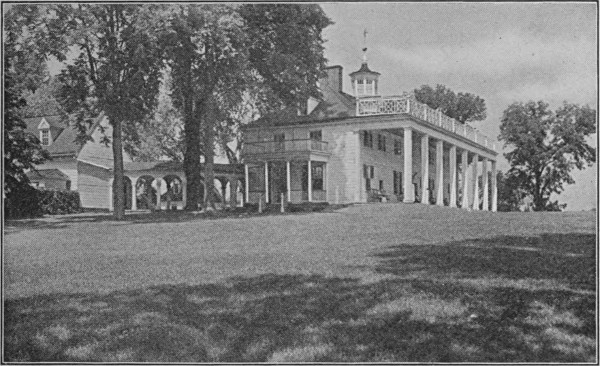
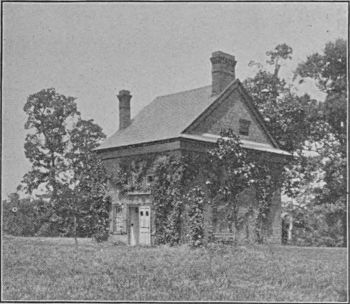
MOUNT VERNON
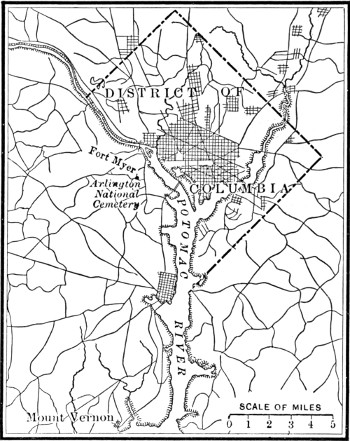
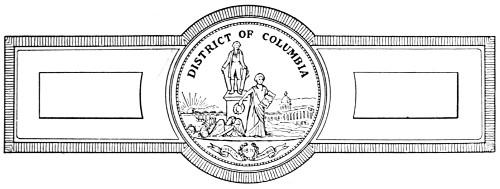
THE DISTRICT OF COLUMBIA
A firm belief in the future of Washington led to the
making of very elaborate and extensive plans for laying
out the city. But as the public buildings began to rise,
with great stretches of unimproved country between them,
many thought the plans much too elaborate and feared
that the attempt to build a new city would end in failure.
It was in the fall of 1800 when the government moved
to Washington. Then, in 1814, when things had taken
a start, a dreadful misfortune happened; just a few
months before the close of the war of 1812, the British
attacked the city and burned both the Capitol and the
White House. In spite of these early discouragements
and years of ridicule, the capital has fully justified the
plans and hopes of the far-seeing men who built not
for their own day but
for the years to come.
Perhaps one gets the
best idea of the city to-day
from the height of
the Capitol's beautiful
dome that rises over
three hundred feet above
the pavement. There is
a gallery around the outside
of the dome, just
below the lantern which
lights its summit, and
from here one can see
for miles in any direction.
Our view of the city from this height shows us that
most of the streets are straight and run either north and
south or east and west. The east and west streets are lettered;
those running north and south are numbered. One
might easily imagine four great checkerboards placed
together, with the Capitol standing at the point where the
four boards meet. I say four checkerboards, because from
the Capitol three great streets go to the north, the south,
and the east, while a broad park runs away to the west,
thus dividing the city into four sections. Running across
the regularly planned streets of these checkerboards are
broad avenues, many of which seem to come like spokes
of wheels from parks placed in different sections of the
city. These avenues are named for different states.
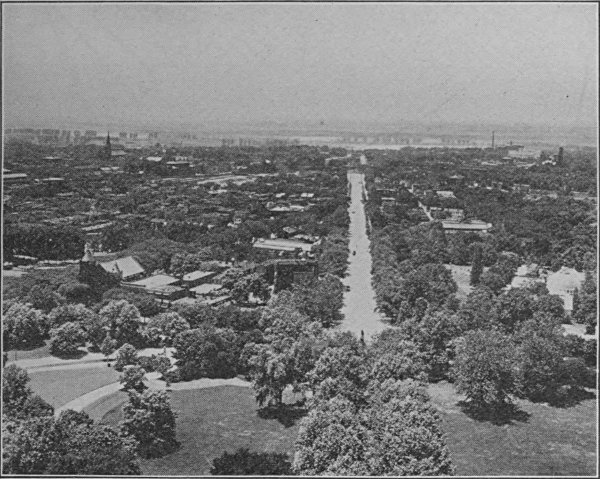
LOOKING WEST FROM THE DOME OF THE CAPITOL
Close about us is a splendid group of majestic buildings.
The Capitol, upon the brow of the hill overlooking
the western part of the city, is the center of the group.
To the north and south of the Capitol rise the beautiful
marble buildings for the use of the committees of the
Senate and the House of Representatives. To the east is
the Library of Congress, the most beautiful building of its
kind in the world.
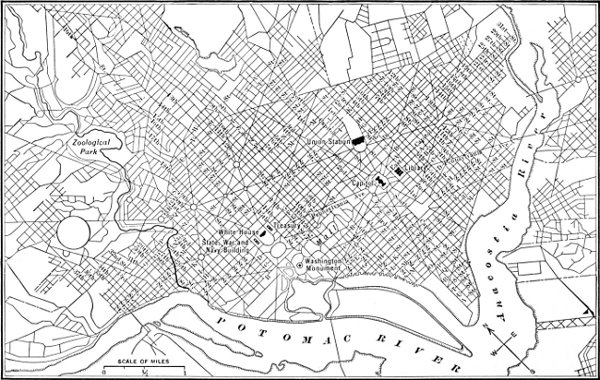
THE CITY OF WASHINGTON
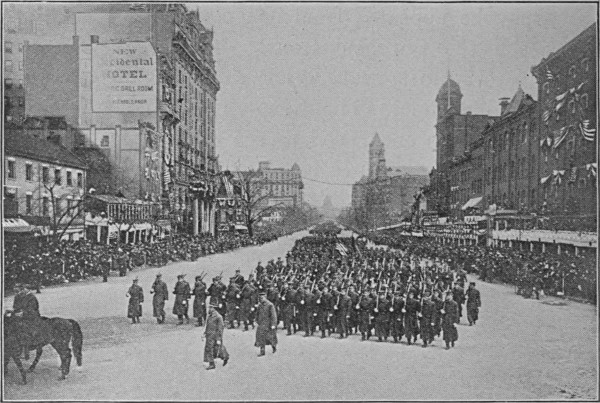
Toward the northwest and southeast runs Pennsylvania
Avenue, one hundred sixty feet wide, the most famous
street in the city. About a mile and a half up Pennsylvania
Avenue from the Capitol is another imposing group
of public buildings. Here are the Treasury Department,
the Executive Mansion,—the home of the president,—and
the State, War, and Navy Building. Pennsylvania
Avenue leads past the fronts of these buildings and on for
more than two miles to the far-western part of the city.
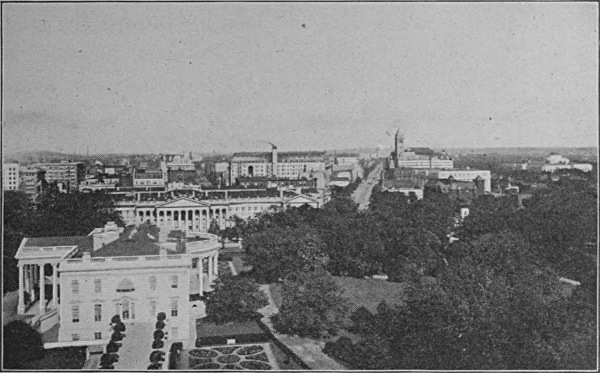
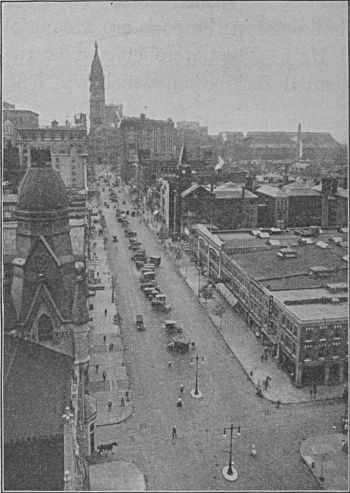
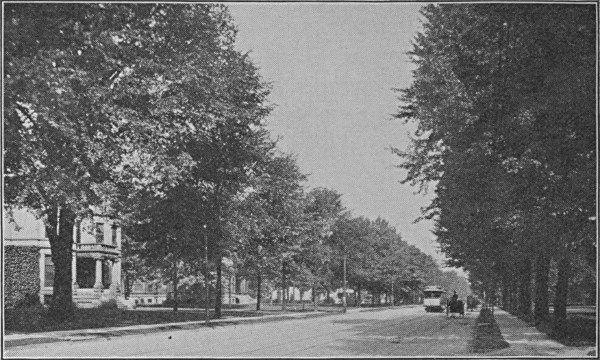
A VIEW OF PENNSYLVANIA AVENUE
Directly west from the Capitol we look along the fine
parkways which divide the city in that direction just as
do the main streets which run from the Capitol to the
north, east, and south. This handsome series of parks is
called the Mall. In the Mall are a number of public
buildings placed in an irregular line stretching west
from the Capitol, with sufficient distance between them
to allow spacious grounds for each building. Here we
find the home of the Bureau of Fisheries, the Army
Medical Museum, the National Museum, the Smithsonian
Institution, the Department of Agriculture, the Bureau of
Engraving and Printing, and the Washington Monument.
As we walk around the gallery of the Capitol dome,
we see that almost every street and avenue is lined on
either side with beautiful shade trees which give the city
a gardenlike appearance. And looking toward the south
we see the eastern branch of the Potomac meeting the
main stream and flowing away in a majestic river, over a
mile in width. On all sides of the city the land rises
in beautiful green hills, guarding the nation's capital as it
lies nestled between the river's protecting arms.
Having this picture of the general plan of Washington,
let us visit some of the buildings; first of all the Capitol,
for it is the most imposing as well as the most important
building in the city. For a good view of the building,
walk out upon the spacious esplanade which extends
across the eastern front. Even here it is hard to appreciate
that the Capitol is over 751 feet long, 350 feet wide,
and covers more than 3½ acres of ground. The eastern
front shows the building to have three divisions, a central
building and a northern and a southern wing. Each division
has a splendid portico with stately Corinthian columns
and a broad flight of steps leading to the portico from
the eastern esplanade.
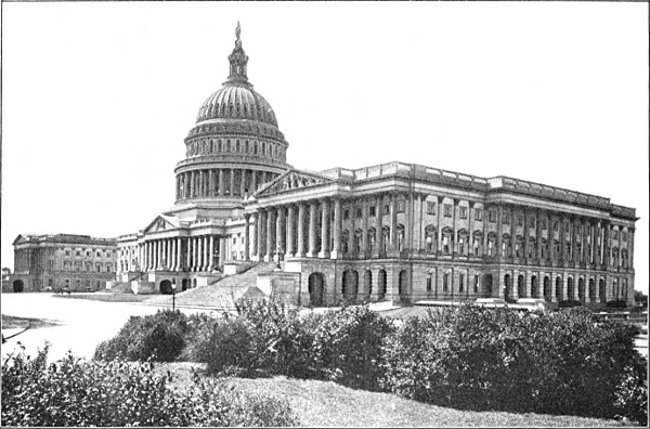
THE UNITED STATES CAPITOL
Every four years a new president of the United States
is elected, and March 4 is the day on which he takes
office. On this day a great stand is put up over the steps
leading to the central portico of the Capitol, and upon
this platform a most imposing ceremony takes place. Here
the new president, in the presence of all the members of
Congress, the representatives of foreign nations, many distinguished
guests, and an immense throng of people, takes
upon himself the obligations of his high office. The Chief
Justice of the Supreme Court holds a Bible before the
president, who places his hand upon it and repeats these
words: “I do solemnly swear that I will faithfully execute
the office of President of the United States, and will,
to the best of my ability, preserve, protect and defend the
Constitution of the United States.” After the president
has delivered his inaugural address, a splendid procession
escorts him to his new home, the Executive Mansion.
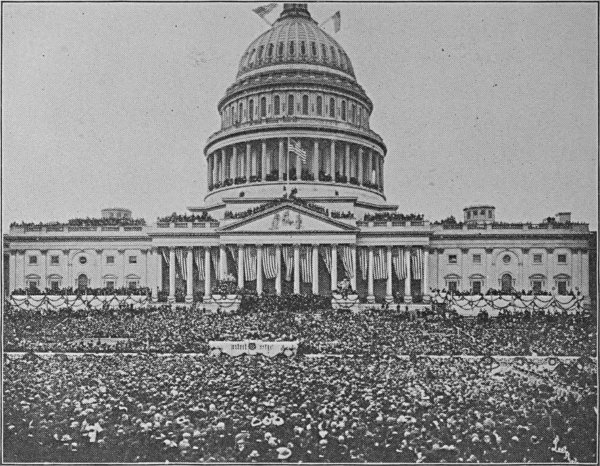
WHEN PRESIDENT WILSON WAS INAUGURATED
Above the central division of the Capitol building,
which for many years served as the entire Capitol, rises
the imposing dome from which we have just come. It is
crowned with a lantern upon the top of which is placed
the statue of Freedom.
Across the western front of the Capitol is a marble
terrace overlooking the lower part of the city. Though
the western front is ornamented with colonnades of Corinthian
columns, it lacks the splendid approaches of the
eastern side.
This immense building, representing the dignity and
greatness of our nation, is given over almost entirely to
the work of lawmaking. In the central part is the large
rotunda beneath the lofty dome. The northern wing is
occupied by the Senate of the United States, while the
southern wing is the home of the House of Representatives.
We enter the rotunda by the broad stairs leading
from the eastern esplanade and find ourselves in a great
circular hall, almost a hundred feet in diameter, whose
walls curve upward one hundred and eighty feet. At the
top a beautiful canopy shows the Father of his Country
in the company of figures representing the thirteen original
states. About these are other figures, personifying
commerce, freedom, mechanics, agriculture, dominion over
the sea, and the arts and sciences. Encircling the upper
part of the walls, but many feet below the canopy, is a
frieze of scenes from the history of the United States.
Around the lower part of the walls are eight great
paintings. Four of them are the work of one of Washington's
officers, Colonel John Trumbull of Connecticut,
and are of great interest because the figures are actual
portraits of the people represented. These paintings show
the signing of the Declaration of Independence, the
surrender of Burgoyne at Saratoga, the surrender of
Cornwallis at Yorktown, and the resignation of General
Washington at the close of the Revolution.
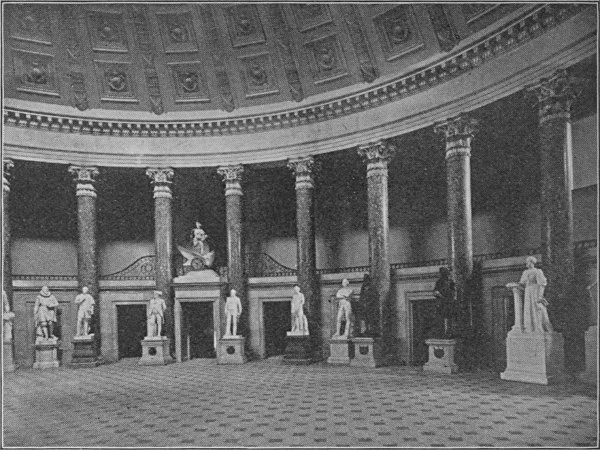
STATUARY HALL, IN THE CAPITOL
From the rotunda, broad corridors lead north to the
Senate Chamber and south to the House of Representatives.
Following the corridor to the south, we come to
a large semicircular room. When the central division of
the building was all there was to the Capitol, this room
was occupied by the House of Representatives, and here
were heard the speeches of Adams, Webster, Clay, Calhoun,
and many other famous statesmen. It is now set
apart as a national statuary hall, where each state may
place two statues of her chosen sons. As many of the
states have been glad to honor their great men in this
way, a splendid array of national heroes is gathered in
the hall. Among the Revolutionary heroes we find Washington,
Ethan Allen, and Nathaniel Green. A statue of
Fulton, sent by New York, shows him seated, looking at a
model of his steamship. Of all these marble figures, perhaps
none attracts more attention than that of Frances
Elizabeth Willard, the great apostle of temperance, and
to the state of Illinois belongs the distinction of having
placed the only statue of a woman in this great collection.
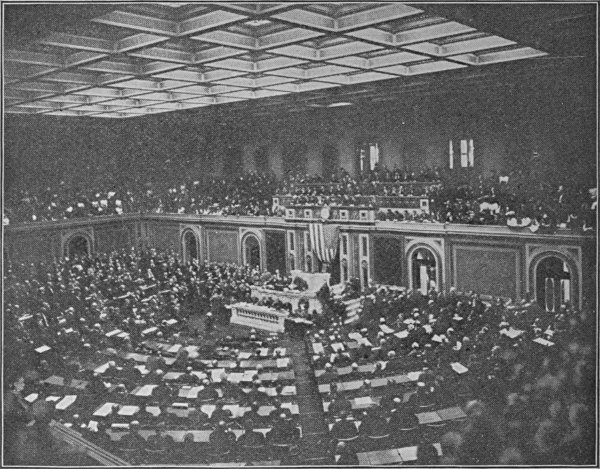
Leaving Statuary Hall, we go south to the Hall of
Representatives. Here representatives from all the states
gather to frame laws for the entire nation. Seated in
the gallery it seems almost as if we were in a huge
schoolroom, for the representatives occupy seats which
are arranged in semicircles, facing a white marble desk
upon a high platform reached by marble steps. This is
the desk of the Speaker of the House. The Speaker's
duty is to preserve order and to see that the business of
this branch of Congress is carried on as it should be.
Before delivering a speech, a representative must have
the Speaker's permission. The Speaker is a most important
person, for all business is transacted under his direction.
The representatives come from every state in the
Union, and even far-off Hawaii, Alaska, and the Philippines
are allowed to send delegates to this assembly to
represent them in making laws. Think what a serious
matter it would have been to the people of the far West
to have the capital of their nation in the extreme Eastern
section of the country if the development of the railroads,
the telegraph, and the telephone had not made travel
and communication so easy that great distances are no
longer obstacles.
THE OPENING OF CONGRESS
But we can pay only a brief visit to the House of
Representatives, for there is another body of lawmakers
in the northern end of the Capitol which we wish to see.
Back to the rotunda we go and then walk along a corridor
leading to the northern, or Senate, end of the Capitol.
Each day, for a number of months in the year, an interesting
ceremony takes place in this corridor promptly
at noon. Nine dignified men, clad in long black silk
robes, march in solemn procession across the corridor
and enter a stately chamber which, though smaller, resembles
Statuary Hall in shape. These men make up
the Supreme Court of the United States, the highest
court of justice in the land.
Often in cases at law a person does not feel that the
decision of one court has been just. He may then have
his case examined and passed upon by a higher court.
This is called “appealing,” and some cases, for good
cause, may be appealed from one court to another until
they reach the Supreme Court. Beyond the Supreme
Court there is no appeal. What this court decides must
be accepted as final. The room in which the Supreme
Court meets was once used as the Senate Chamber, and
many of the great debates heard in the Senate before our
Civil War were held in this room.
The Senate Chamber of to-day is further down the
north corridor. This room is not unlike the Hall of
Representatives in plan and arrangement, though it is
somewhat smaller. Instead of having a chairman of their
own choosing, as is the case in the House, the Senate
is presided over by the vice president of the United
States. This high official, seated upon a raised platform,
directs the proceedings of the Senate just as the Speaker
directs those of the House of Representatives. There
seems to be an air of greater solemnity and dignity in
this small group of lawmakers than in the House of Representatives.
It is smaller because each state is entitled to
send but two senators to the Senate, whereas the number
of representatives is governed by the number of inhabitants
in the state. The populous state of New York has
thirty-seven representatives and but two senators, the
same number as the little state of Rhode Island whose
population entitles it to only two representatives.
The purpose of having two lawmaking bodies is to provide
a safeguard against hasty and unwise legislation. In
the House of Representatives the most populous states
have the greatest influence, while in the Senate all states
are equally represented, and each state has two votes
regardless of its size and population. Since every proposed
law must be agreed to in both the Senate and the
House before it is taken to the president for his approval,
each body acts as a check on the other in lawmaking.
INAUGURAL PARADE ON PENNSYLVANIA AVENUE
Just to the east of the Capitol grounds stands the
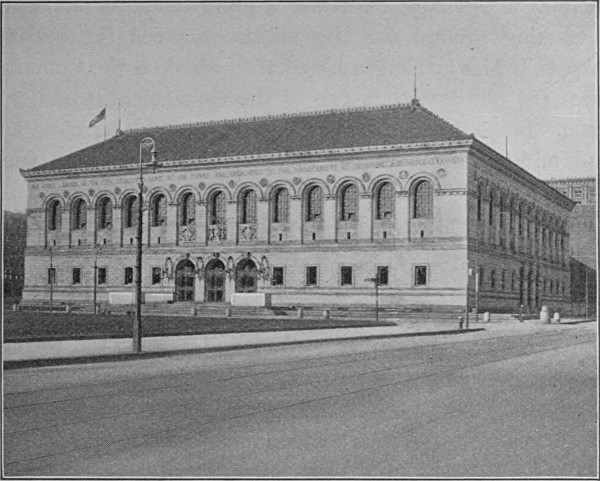
magnificent Library of Congress. This wonderful storehouse
of books is a marvelous palace. It covers almost
an entire city block, and its towering gilded dome is visible
from almost every part of the city. Once inside, we could
easily believe ourselves in fairyland, so beautiful are the
halls and the staircases of carved marble, so wonderful the
paintings and the decorations. Every available space upon
the walls and ceilings is adorned with pictures, with the
names of the great men of the world, and with beautiful
quotations from the poets and scholars who seem to live
again in this magnificent building which is dedicated to
the things they loved.
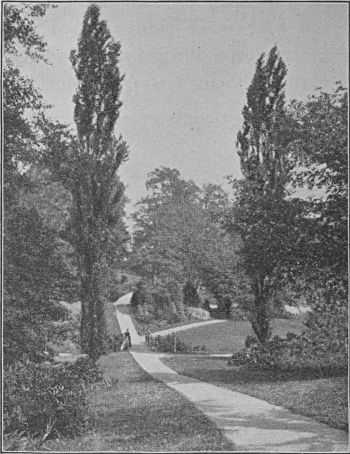
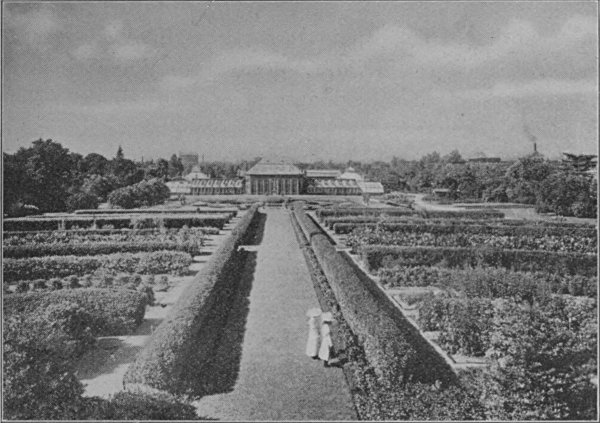
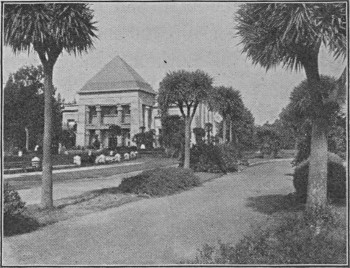
BOTANICAL GARDENS
In the center of the building, just beneath the gilded
dome, is a rotunda slightly wider than the rotunda of the
Capitol, though not so high. Here are desks for the use
of those who wish to consult any volume of the immense
collection of books.
The books are kept in great structures called stacks,
9 stories high and containing bookshelves which would
stretch nearly 44 miles if placed in one line. Any one
of the great collection of 1,300,000 volumes can be sent
by machinery from the stacks to the reading room or to
the Capitol. When a member of Congress wants a book
which is in the Library, he need not leave the Capitol,
for there is a tunnel connecting the two buildings through
which runs a little car to carry books.
The Librarian of Congress has charge of the enforcement
of the copyright law. By means of this law an
author may secure the exclusive right to publish a book,
paper, or picture for twenty-eight years. One of the requirements
of the copyright law is that the author must
place in the Library of Congress two copies of whatever
he has copyrighted. Hence, on the shelves of this great
library may be found almost every book or paper published
in the United States.
Leaving the Library we once more find ourselves upon
the great esplanade east of the Capitol. In the majestic
white-marble buildings to the north and south,—known
as the Senate and House office buildings,—committees
of each House of Congress meet to discuss proposed laws.
Having seen the lawmakers at work in the Capitol,
let us visit the officials whose duty it is to enforce the
laws made by Congress.
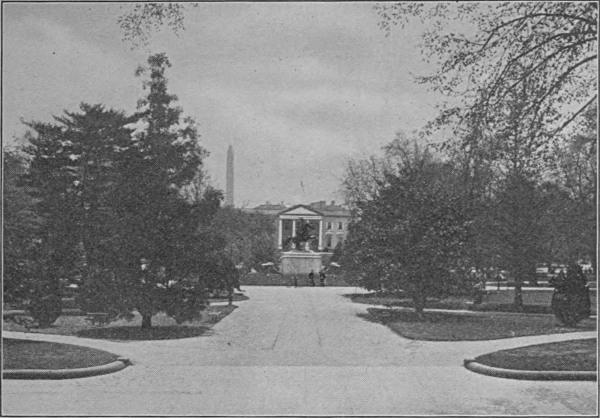
Chief among these is the president of the United States.
His house is officially known as the Executive Mansion,
but nearly everybody speaks of it as the White House.
The first public building erected in Washington was the
White House. It is said that Washington himself chose
the site. He lived to see it built but not occupied, for
the capital was not moved to the District of Columbia
until 1800, a year after Washington's death.
THE WHITE HOUSE FROM THE NORTH
This simple, stately building is a fitting home for the
head of a great republic. In the main building are the
living apartments of the president and his family, and
the great rooms used for state receptions; the largest
and handsomest of these is the famous East Room. Other
rooms used on public occasions are known, from the color
of the furnishings and hangings, as the Blue Room, the
Green Room, and the Red Room. There is also the great
State Dining Room, where the president entertains at
dinner the important government officials and foreign
representatives.
In the Annex, adjoining the White House on the west,
are the offices of the president and those who assist him
in his work. In this part of the building is the cabinet
room, where the president meets the heads of the various
departments to consult with them concerning questions
of national importance.
Across the street from the president's office is the immense
granite building occupied by the three departments
of State, War, and Navy. The secretaries in charge of
these departments have their offices here, together with
a small army of clerks.
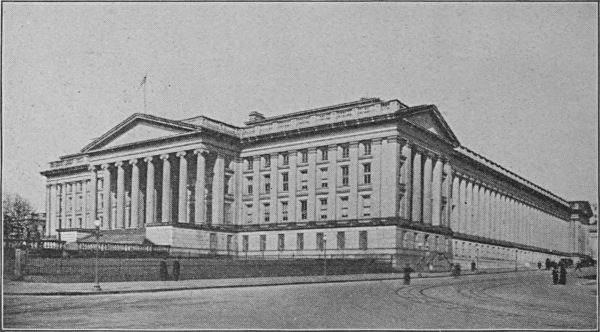
THE UNITED STATES TREASURY
On the opposite side of the White House from the
State, War, and Navy Building is the National Treasury.
The Treasury Building is one of the finest in the city.
To see the splendid colonnade on the east is alone worth a
journey to Washington. From this building all the money
affairs of the United States government are directed.
In the Treasury Building and in the Bureau of Engraving
and Printing one may see the entire process of manufacturing
and issuing paper money. In the Treasury we
see new bills exchanged for old, worn-out bills, which are
ground to pieces to destroy forever their value as money.
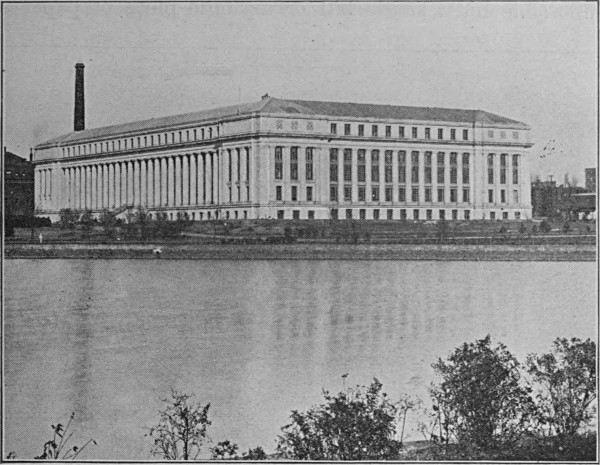
BUREAU OF ENGRAVING AND PRINTING, “UNCLE SAM'S MONEY FACTORY”
But to understand the story of a dollar bill or a bill
of any other value we must visit the Bureau of Engraving
and Printing. This building, which is some distance from
the Treasury Building, reminds us of a large printing
office, and that is just what it is. Here we are shown
from room to room where many men and women are at
work, some engraving the plates from which bills are to
be printed and others printing the bills. The paper used
is manufactured by a secret process for United States
money, and every sheet is most carefully counted at
every stage of the printing. Altogether the sheets are
counted fifty-two times. Many clerks are employed to
keep a careful account of these sheets, and it is almost
impossible for a single bill or a single piece of paper to
be lost or stolen. After the money is printed it is put
into bundles, sealed, and sent in a closely guarded steel
wagon to the Treasury Building, where it is stored in
great vaults until it is issued.
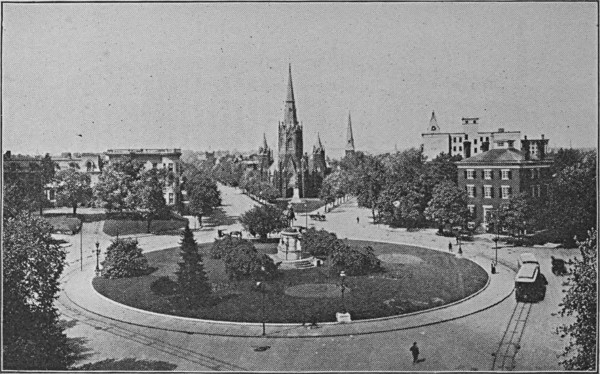
A CIRCLE AND ITS RADIATING AVENUES
At the Treasury we find the officials sending out these
crisp new bills in payment of the debts of the United
States or in exchange for bills which are so tattered and
torn that they are no longer useful. This exchanging of
new money for old is a large part of the business of the
Treasury and calls for the greatest care in counting and
keeping records, in order that no mistakes may be made.
After the old bills are counted they are cut in half
and the halves counted separately, to make sure that
the first count was correct. When the exact amount of
money has been determined, new bills are sent out to the
owners of the old bills, and the old bills are destroyed.
When we have seen enough of the counting of old
money, our guide takes us down into the cellar of this
great building, where we walk along a narrow passageway
with millions of dollars in gold and silver on either
hand. All is carefully secured by massive doors and
locks, and none but trusted officials may enter the vaults
themselves. These gold and silver coins are made in the
United States mints in Philadelphia, Denver, New Orleans,
and San Francisco.
You see the paper bill is not real money but a sort
of receipt representing gold and silver money which you
can get at any time from the Treasury. As we peep
through the barred doors of the vaults and see great
piles of canvas sacks, it is interesting to know that some
of the silver and gold coins they hold are ours, waiting
here while we carry in our pockets the paper bills which
represent them.
In addition to issuing money, the Treasury Department
has charge of collecting all the taxes and duties which
furnish the money for the payment of the expenses of
the government.
Washington is a government city. Of its population
of over 330,000, about 36,000 are directly engaged in the
various departments of the government, while most of the
other lines of business thrive by supplying the needs of
the government's employees and their families. Very little
manufacturing is done in the District of Columbia, and
such articles as are manufactured are chiefly for local use.
People from almost every country in the world may
be seen on the streets, for almost all civilized nations
have ministers or ambassadors at Washington to represent
them in official dealings with the United States. These
foreign representatives occupy fine homes, and during the
winter season many brilliant receptions are given by them
as well as by our own high officials.
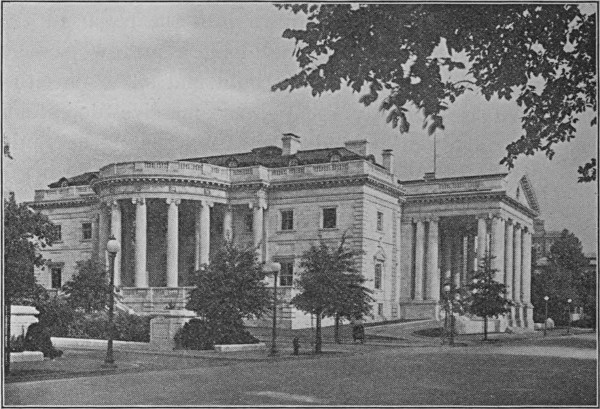
CONTINENTAL MEMORIAL HALL
The people of Washington have built fine churches and
many handsome schools, to which all, from the president
to the humblest citizen, send their children. In or near
the city are the five universities of George Washington,
Georgetown, Howard University for colored people, the
Catholic University, and the American University, where
graduates from other colleges take advanced work.
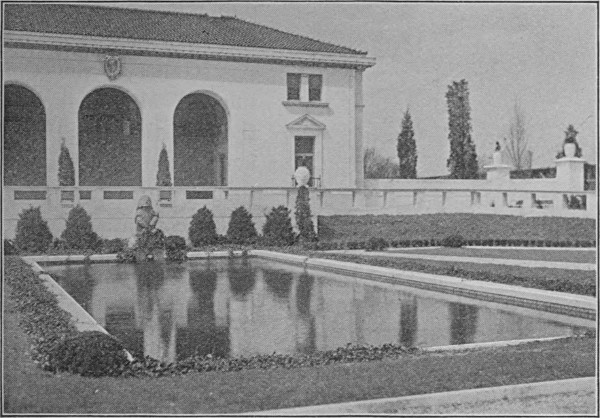
ANNEX AND GARDEN OF THE PAN-AMERICAN UNION
The citizens of the District of Columbia do not vote
nor do they make their own laws, as it was feared there
might be a disagreement between Congress and the city
government if people voted on local matters. All laws
for the District of Columbia are made by the Congress
of the United States and are carried out by three
commissioners appointed by the president with the consent
of the Senate. Many inhabitants of the District are
citizens of the states and go to their homes at election
time to cast their votes. Isn't it strange that there is a
place in the United States where the citizens cannot vote?
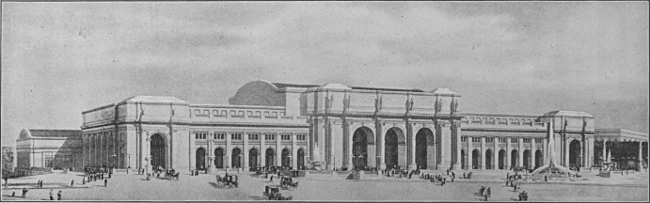
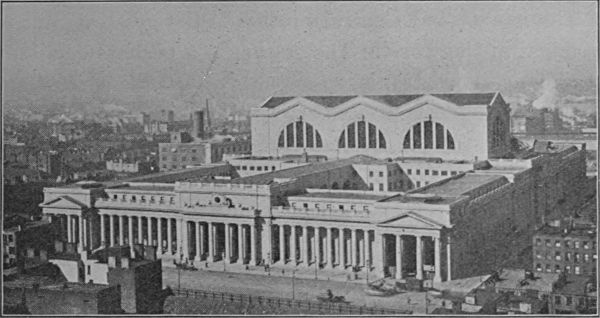
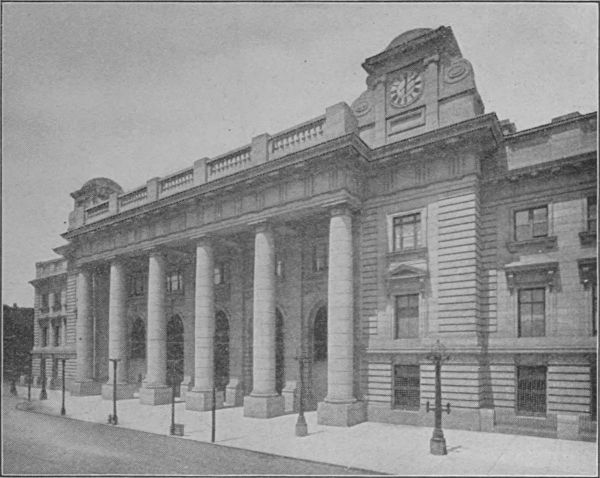
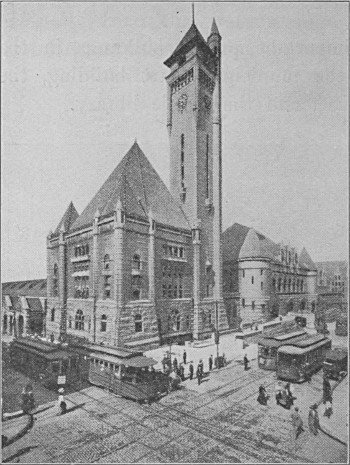
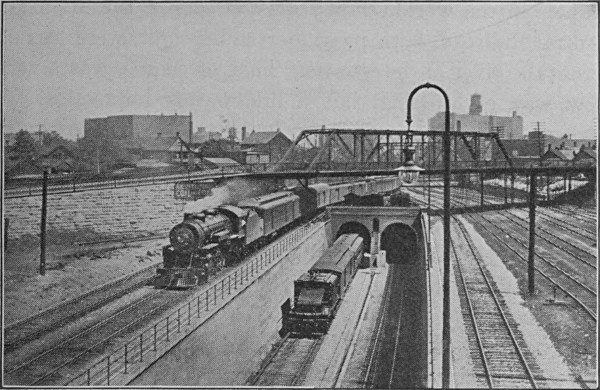
UNION STATION
You are, no doubt,
beginning to think that
the places of interest in
Washington must be very
numerous. This is true,
for few cities in the world
have so many interesting
public buildings. Among
these are the Corcoran
Art Gallery; the Continental
Memorial Hall,
the majestic marble building
of the Daughters of
the American Revolution;
and the palatial home of
the Pan-American Union,
a place where representatives
of all the American
republics may meet.
Then there is the Patent
Office, for recording and
filing old patents and
granting new ones; the
Pension Office, from
which our war veterans
receive a certain sum each
year; the Government
Printing Office, whose reports
require over a million
dollars' worth of paper
each year; Ford's Theater,
where President Lincoln was shot; the naval-gun factory,
for making the fourteen-inch long-range guns used on our
battleships; and the Union Railroad Station, whose east wing
is reserved for the
use of the president.
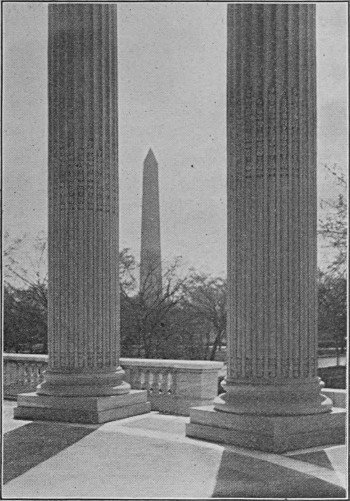
WASHINGTON MONUMENT FROM
CONTINENTAL MEMORIAL HALL
There is one almost
sacred spot,
upon which the nation
has erected a
splendid memorial
to our greatest hero,
George Washington.
The Washington
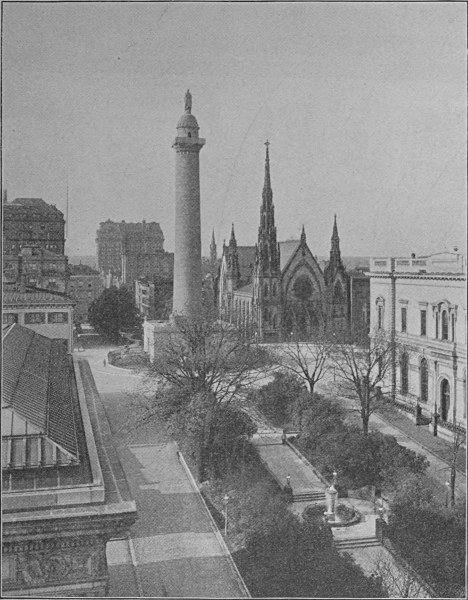
Monument is a simple
obelisk of white
marble, that towers
555 feet above the
beautiful park in
the midst of which
it stands. Those
openings near the
top which seem so
small are 504 feet
above us and are
actually large windows.
On entering the door at the base of the monument,
we pass through the wall, which is 15 feet thick, and find
an elevator ready to carry us to the top. If we prefer to
walk, there is an interior stairway of 900 steps leading to
the top landing. At the end of our upward journey we
find ourselves in a large room with two great windows on
each of the four sides. From here we get another view of
the hill-surrounded city, and the scene which lies before
us is inspiring.
The Washington Monument is near the western end of
the Mall, that series of parks extending from the Capitol
to the Potomac River. Near by are the buildings of the
Department of Agriculture, which has been of the greatest
help to the farmers of our land by sending out important
information concerning almost everything connected
with farm life. Through the Bureau of Chemistry this
department did much to bring about the passage of the
Pure Food Law, which protects the people by forbidding
the sale of food and drugs that are not pure.
In the spacious park adjoining the grounds of the
Department of Agriculture is a building which looks like
an ancient castle. This is the Smithsonian Institution,
which carries on scientific work under government control.
The National Museum, which is under the control of
the Smithsonian Institution, has a fine building of its own.
This museum is a perfect treasure house of interesting
exhibits of all kinds. Here may be seen relics of Washington,
of General Grant, and of other famous Americans;
and here are exhibits showing the history of the telegraph,
the telephone, the sewing machine, the automobile, and
the flying machine. Stuffed animals of all kinds are arranged
to look just as if they were alive. So numerous are
the exhibits that it would require a large book simply to
mention them. Many of the boys and girls of Washington
spend their Saturday afternoons examining the wonderful
things which have been brought to this museum from all
parts of the world.
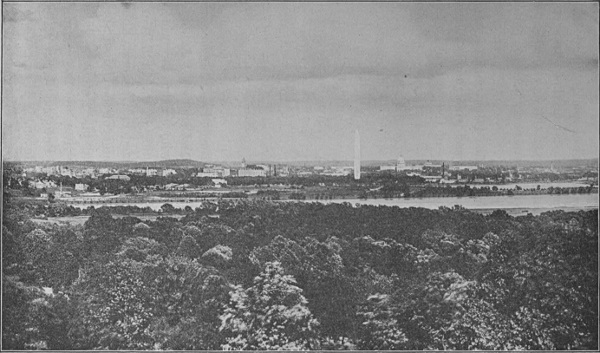
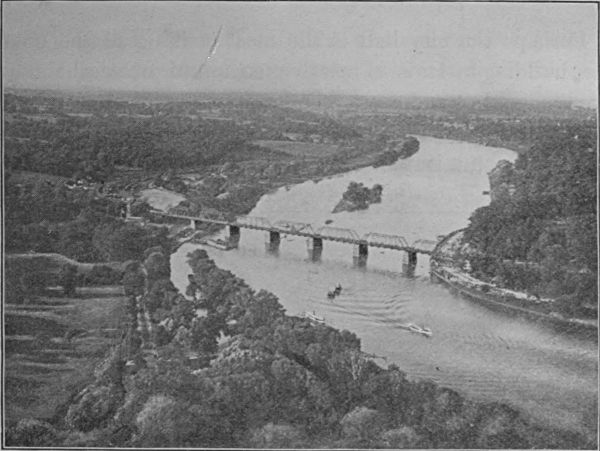
THE CITY FROM ARLINGTON HEIGHTS
Washington has also a zoölogical park where there
are animals from everywhere. It is on the banks of a
beautiful stream on the outskirts of the city and is part
of a great public park which covers many acres of picturesque
wooded country.
We must not omit the Post Office Department, for that
is the part of the federal government which comes nearest
to our homes. Here are the offices of the postmaster general
and his many assistants. To tell of the wonders of
our postal system would be a long story in itself. If all
the people employed by the Post Office Department lived
in Washington, they would fill all of the houses and leave
no room for anyone else. Of course this great army of
employees are not all in any one city, for the work of the
post office extends to every part of the United States, and,
through arrangement with other nations, to every part of
the civilized world.
In the country surrounding the city of Washington are
several important and interesting places. Just across the
river, in the state of Virginia, are Fort Myer, an army post,
and the famous Arlington National Cemetery. Arlington
was the home of Martha Custis, who became the bride of
George Washington. At the opening of the Civil War it
was the home of the famous Confederate general, Robert
E. Lee. Then it passed into the hands of the United States
government and is now the burial place of over sixteen
thousand soldiers who gave their lives for their country.
On the Virginia shore of the Potomac River, sixteen
miles south of the city of Washington, is Mount Vernon,
the home and burial place of George Washington. The
spacious old mansion in the midst of fine trees and shady
lawns looks out over the wide peaceful river which Washington
loved. To this home Washington came to live
shortly after his marriage. He spent his time in farming
on this estate until he was called to take command of the
American army. After our independence was won he
returned to his home and his farm. Once more he was
called upon to leave this quiet country life to become the
first president of the new nation. When he had served his
country two terms he gladly retired to Mount Vernon,
where he lived until his death in 1799.
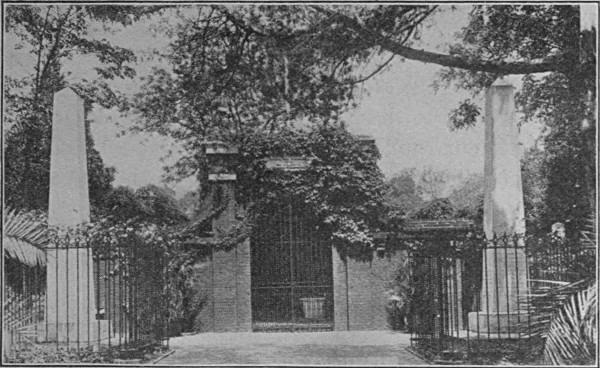
WASHINGTON'S TOMB
To-day the house and grounds are preserved with loving
care. The rooms of the house are furnished with fine
old mahogany furniture, many pieces of which belonged
to Washington. In the grounds, not far from the stately
mansion, is the simple brick tomb where rest the bodies
of Washington and his wife. During the years which
have passed since his death, thousands of his countrymen
have come to this tomb to do honor to his memory.
As we sail up the Potomac toward the city after our
visit to the home of the great man whose name it bears,
the Washington Monument, the White House, the State,
War, and Navy Building, the Capitol, the Library, and
the post office tower above the surrounding buildings
and, shining in the golden light of sunset, make a picture
never to be forgotten.
This city of parks, of broad avenues, of beautiful buildings,
belongs to the Americans who live in the far-distant
states as well as to those who live and work in the capital
itself. It is our capital and we may justly be proud of it,
for it is one of the most beautiful cities in all the world.
WASHINGTON
FACTS TO REMEMBER
The capital of the nation.
Population (1910), nearly 350,000 (331,069).
Sixteenth city in rank, according to population.
Center of the federal government of the United States.
Governed entirely by Congress under provision of the
Constitution.
Chief offices of every department of the federal government
located here.
Splendid streets, avenues, parks, and monuments.
Many magnificent public buildings.
Very few manufacturing industries.
A city of homes of government employees.
One of the most interesting and beautiful cities in the
world.
QUESTIONS FOR REVIEW AND STUDY
1. Give some reasons why every citizen of the United
States should be interested in Washington.
2. What interesting buildings are located here, and for
what are they used?
3. What were some of the reasons for selecting the location
of the capital city?
4. After whom was the city named?
5. In what year did Washington become the capital city,
and what disaster visited it a few years later?
6. Describe the plan of the city, and name one of its
famous streets.
7. Name three interesting groups of buildings: one on
Capitol Hill, one on Pennsylvania Avenue, and one in
the Mall.
8. What are some of the natural beauties of the city?
9. Give some idea of the size and beauty of the Capitol
and of the imposing ceremony which takes place there every
four years.
10. Describe briefly the House of Representatives when
in session and the duties of its members.
11. Where does the Supreme Court of the country sit, and
why is it called the Supreme Court?
12. How does the Senate differ from the House of Representatives?
What are the duties of senators? How many
come from each state?
13. Why do we have two lawmaking bodies?
14. Name some of the attractions of the Library of Congress.
Tell how its books are stacked and how they are sent
to the Capitol, and give some facts about the copyright law.
15. Tell what you know of the White House.
16. What two fine buildings are on either side of the
White House, and for what is each used?
17. Describe the making of paper money.
18. What are the duties of the Treasury Department, and
what may be seen in the Treasury vaults?
19. Tell something about the people of Washington, their
chief occupation, and why so many foreign diplomats have
their homes here.
20. How are the city of Washington and the District of
Columbia governed?
21. Name some places of interest in Washington not
already mentioned.
22. Describe the splendid monument by which our greatest
hero is honored.
23. Tell why you would like to visit the Smithsonian
Institution, the National Museum, and the Zoölogical Park.
24. Why are Fort Myer, Arlington, and Mount Vernon
very interesting to all citizens of the United States?
25. To whom does the beautiful city of Washington really
belong, and why should we be proud of it?