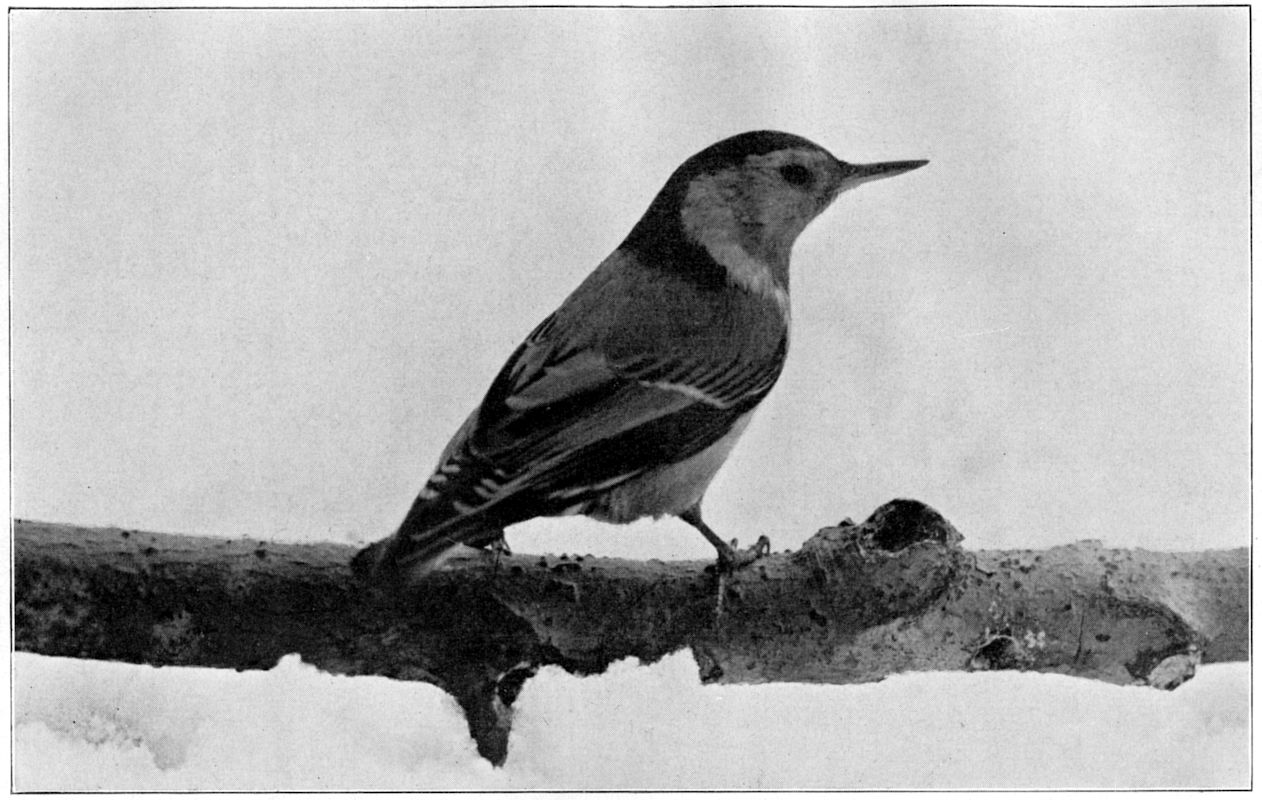
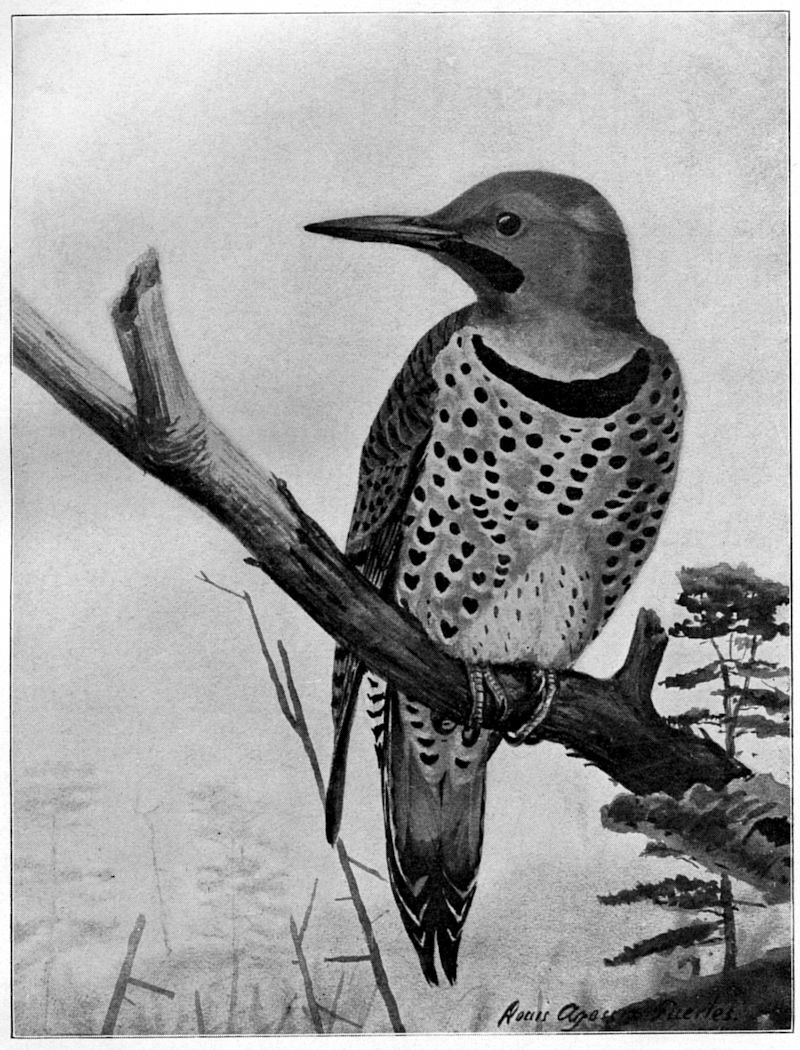
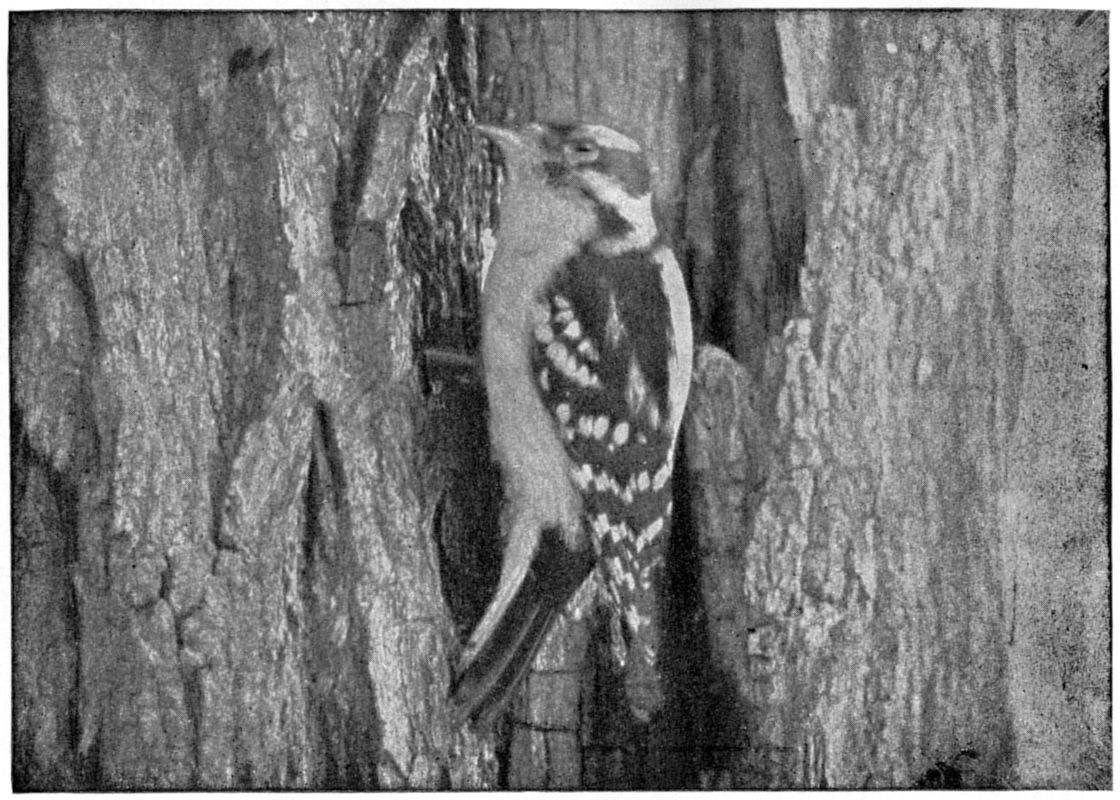
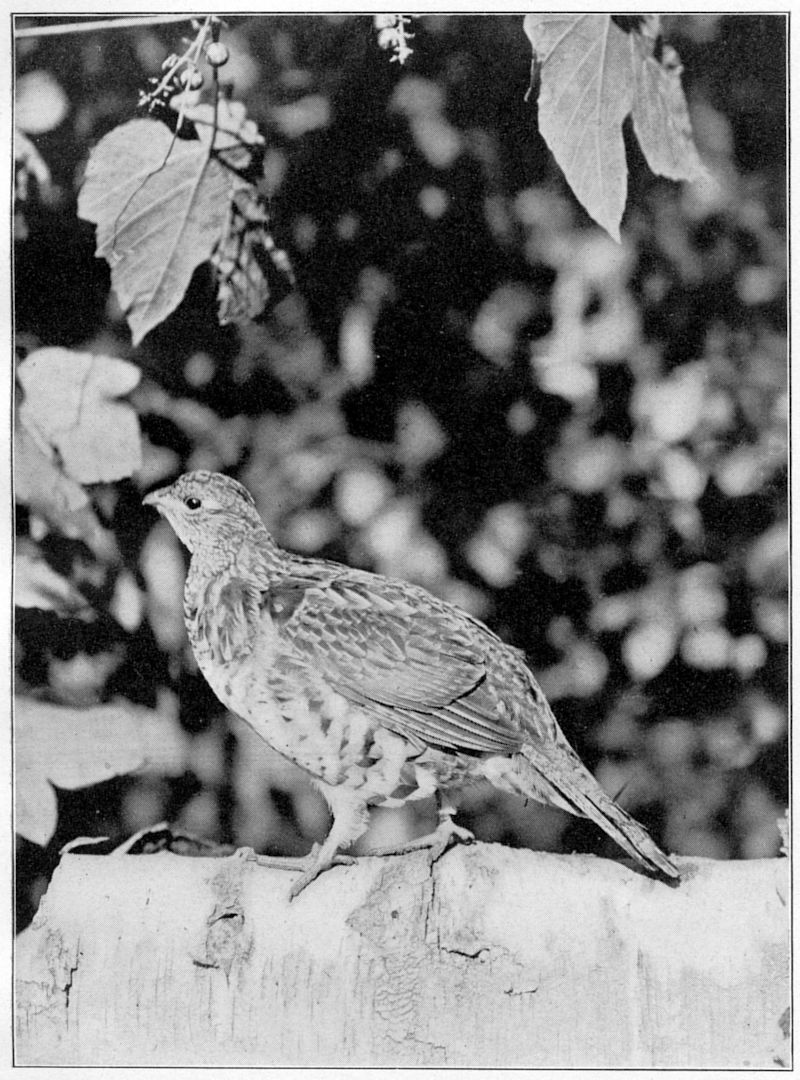
The autumn had been clear and fine, and the hillside
farmers of Fair Meadows township had their out-of-door
work well in hand by Thanksgiving. The fall-sown rye
was well up, and the fields that were to lie fallow and be
sweetened by the frost were ploughed and in good shape.
Ice-cutting, on the chain of large ponds that lay in the
valley between the hills north of the river woods, was an
important industry of the region, so that every one was
anxious to have the ice form clear and firm before snowfall.
As yet, however, there had been no signs of either, except
the thin ice with which Black Frost always covers the roof,
gutters, water-pails, and shallow pools when he prowls
round in the early morning, as if merely to let the good
folks know of his presence, and to prepare them for his
gentler mediating brother, Snow.
The day after Thanksgiving the wind began to blow,
not in mere passing gusts, but steadily and systematically.
Then, too, it came from a strange quarter for that season—the
extreme southeast. This was the wind to drive
the sea into the bay and force the water high on
shore. Such winds, at this season, piled the elastic brown
seaweed in long lines high above tide-water, and many a
farmer, and market-gardener, as he ate his supper, laid
plans to drive down to the beach next morning, with a
double team, and secure a full load of the weed for covering
his strawberry or asparagus beds.
Before morning, however, a driving rain set in that
lasted for two days and kept everybody house-bound.
The roadways ran water like rivers, and, by the time the
storm lessened at sunset Sunday evening, there was barely
a leaf left on the apple trees of the Birdland orchard, and
Goldilocks was well-nigh heartbroken over the state of
the lunch-counter, for, in spite of the protecting roof, the
broken biscuits turned to paste, the suet hung in rags,
and as for the kernels of cracked corn and the buckwheat,
they had swelled as if they thought it was a spring
rain and it was their duty to grow. So that Goldilocks
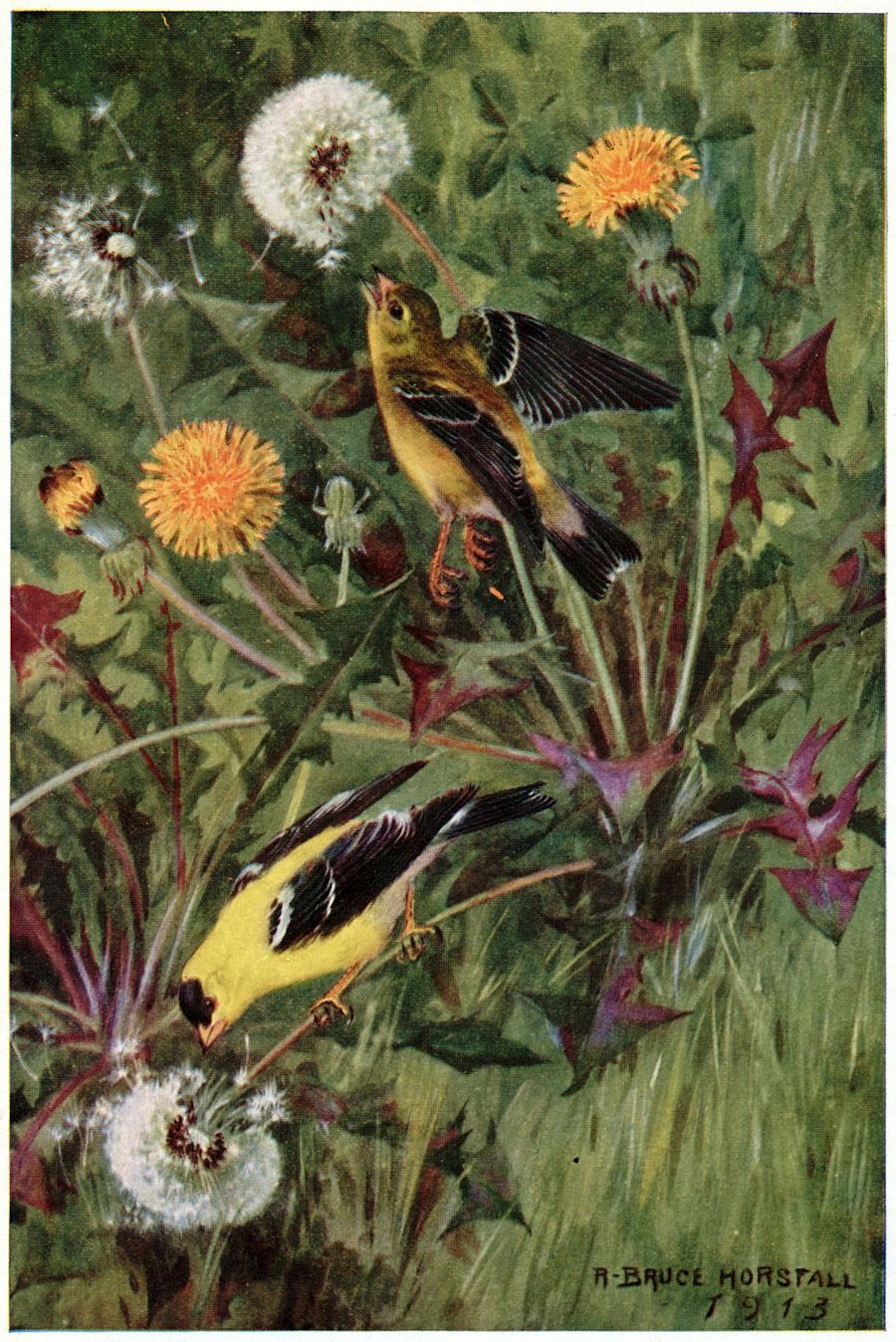
was worried lest some Juncos and Goldfinches that made
a hearty meal upon the grains, in spite of the rain, should
suffer from a fit of indigestion.
Early Monday morning, when he returned to milk, the
hired man at Tommy Todd’s, who had been spending the
night with his brother at one of the little huts four miles
below on the shore road, brought word that the great
storm had, as he expressed it, “heaved” the deep-water
oyster-beds that extended out through the bay and that
in addition to the seaweed, the beach was completely
covered with fine large oysters, bushels and bushels of
them.
How the news spread, nobody knew, but by half-past
eight every available team within a mile of Foxes Corners
school was “hooked up” and entire families were hurrying
toward the beach in every sort of vehicle, to gather up
this unexpected treasure-trove of the sea.
The parents seemed to have entirely forgotten that
school began at nine, and it was not to be expected that the
children should remind them. And, truth be told, when
Jared Barnes gathered his flock, grandma included, into
the hay wagon, Sarah and Ruth, conscientious as they
usually were about their lessons, entirely forgot the day of
the week, so eager were they for the fray; for the prospect,
not only of oysters to roast and stew, but of oysters to pickle
and keep, was too great a temptation to resist.
Miss Wilde, who arrived at the schoolhouse rather
earlier than usual, found the door locked, and no fire in
the stove. It was Dave’s week to tend the fire, and, as
Miss Wilde stood in the open doorway pondering on the
matter, one of the most exacting of the school committee
men came bumping along in a lumber cart. Pulling up his
horses so suddenly that a neighbour who was with him
tipped backward off the seat, he called to the astonished
teacher: “You had best close up and go home; you won’t
have any pupils to-day. Or else come down, and hold
school on the shore! The rest of the committee will
probably meet together in a few minutes, and we’ll vote
to extend Thanksgiving holidays over to-day.” So
saying, he cracked his whip and rattled downhill, leaving
Miss Wilde to wonder if he was losing his mind, or the
world was turning topsyturvy, or if she was still asleep,
for it was beginning to be hard to wake up as the mornings
shortened.
Miss Wilde locked the door and started to walk toward
Eliza Clausen’s house, that being the nearest place where
she could possibly find out what was happening. As she
reached the cross-road that met the turnpike a little above
the school, she heard the sharp trot of hoofs, and, turning
in that direction, saw Jacob Hughes driving the depot
rockaway, Goldilocks being beside him and Gray Lady
seated behind. Goldilocks waved her hand on seeing Miss
Wilde, and in another minute “teacher” was seated beside
Gray Lady, and not only knew of the avalanche of oysters,
but was herself on the way to the shore with her friends,
who were going, not for the sake of the oysters, but to
enjoy what was sure to be a picturesque scene, with the
shell-strewn beach, the sharp bluff on the left, and the
long sand-bar, with its lighthouse on the right, for a setting.
Nor were they disappointed.
For once tell-tale news did not exaggerate, and, though
there were many cut and scratched fingers from the sharp
shells, before noon there was no one who had not gathered
all the oysters he could carry. The more thrifty among
the men also began to gather the seaweed into heaps safe
from the incoming tide, so that they might be sure of finding
it the next day, while the women and children gathered
driftwood and, making fireplaces of a few stones, heated
the coffee they had brought. For, though the sun was
now shining clear, and the wind had dropped to a little
breeze that scarcely moved the surface of the tide pools,
there was a growing keenness in the air that named the
month “December,” and promised the wind would be in
the northwest by night.
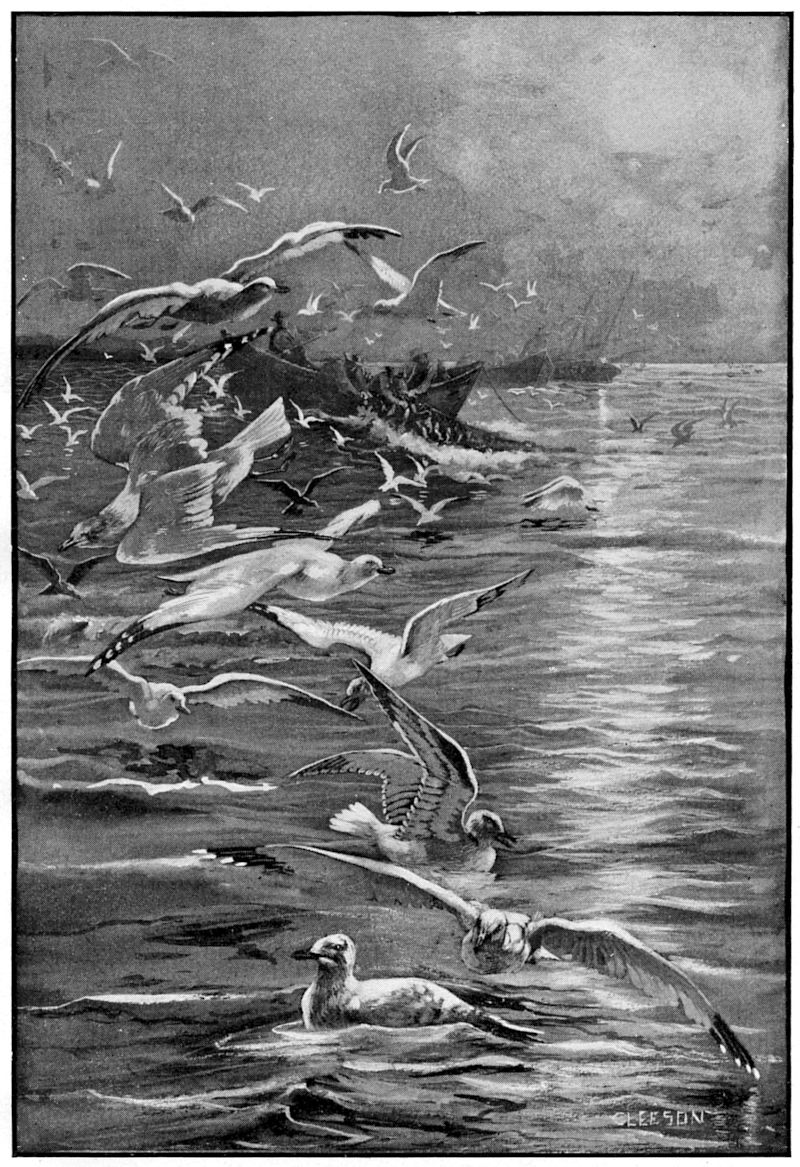
HERRING GULLS
In spite of the unusual human picture before them,
that which interested Gray Lady, Miss Wilde, and Goldilocks
the most were the Gulls that covered the bare sand-bar,
waded in the shallow pools, and clambered among the
stones in search of food, which they picked out with their
stout, hooked bills, then flew swiftly overhead toward the
creek, across the salt meadows, with a shrill cry, such as
the creaking windlass of a well gives when the rope plays
out quickly and the bucket drops—“quake-wake-wake.”
Further out, in the arm of the bar, where there was no
current, and the water was deep and smooth, many Gulls
were resting motionless as white skiffs at anchor, or
flying and diving for food in the wake of some boats that
were evidently grappling to discover the extent of the
damage to the oyster-beds.
“How many kinds of Gulls are there?” asked Goldilocks.
“Three, I should think, unless the males and the females
were different.”
“The Gulls here are all Herring, or, as the Wise Men
now wish them called, ‘Harbour Gulls.’ The old birds have
the pure white breasts and pearly gray, or what is sometimes
called ‘Gull-blue,’ upper parts and the black-and-white
wing-markings. The mixed and streaked ash,
buff, and brown birds are the young of the year, while the
black-and-white patched birds are not Gulls, but Old
Squaw Ducks. These have spent the winter about the bay
and bar ever since I can remember, and, strangely enough,
both Gulls and Ducks seem to be no less in number than
they were twenty years ago. That is probably because
the Gulls are protected, and the Ducks’ flesh is so tough
that even a hungry dog could hardly tear it apart. I hope
your children are noticing these birds while they are
gathering driftwood for the fires,” Gray Lady said to Miss
Wilde. “It is very seldom that they come to the shore as
late as this, or see the Gulls in such numbers. It seems
to-day as though the storm must have driven all that
belong to many miles of coast to take shelter in this bay.”
“Yes, they are looking,” said Goldilocks, “for Sarah
and Tommy and Dave and Clary, who are all together
by the nearest fire, are watching and pointing to the Gulls
that are over by the boats, and I think that Bobby has
found a dead Gull tangled in seaweed and he is showing
it to the others.”
“Then I foresee that the Harbour Gull will be the bird
of next Friday afternoon,” said Gray Lady, as they turned
homeward, taking Miss Wilde with them for lunch, so
that Gray Lady might talk over a new plan concerning
the old farm-house in the corner of the orchard, with its
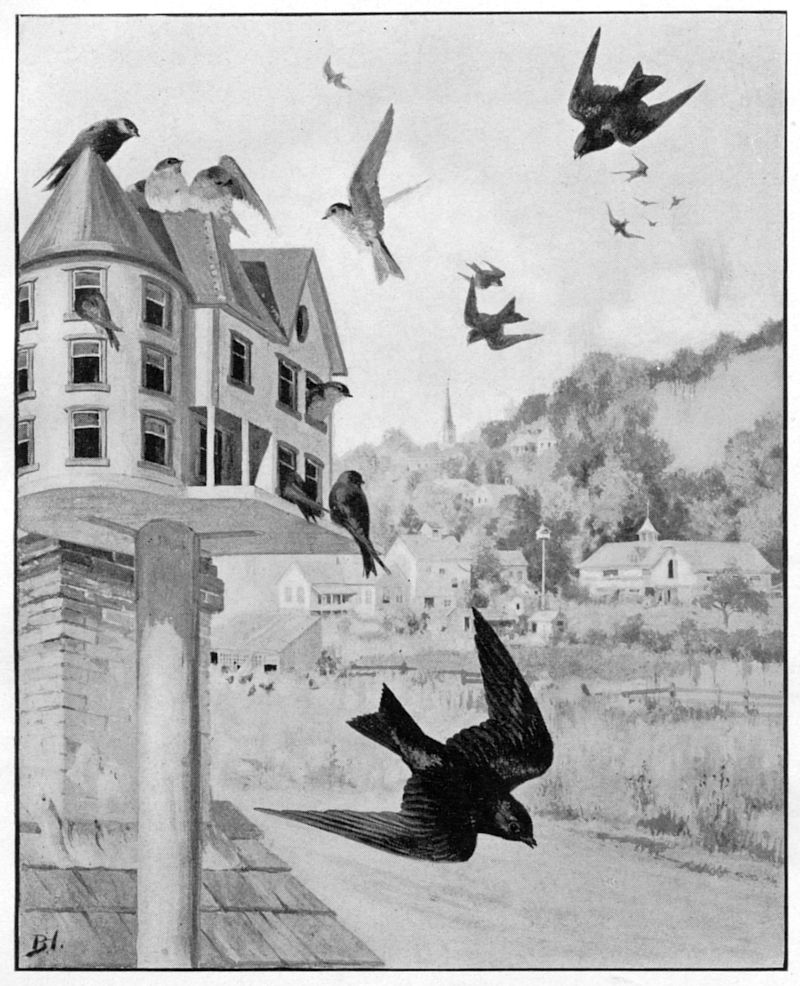
great stone chimney where the Swifts loved to build.
As Gray Lady had expected, the next Friday afternoon,
when she went to Foxes Corners schoolhouse, she was
greeted by many enthusiastic accounts of the stolen holiday
at the shore, but a perfect chorus of questions arose
about the “big birds that fly and swim and yet aren’t
quite like Ducks”; while Bobby proudly produced his
treasured Gull, wrapped in a newspaper, at the same time
assuring Gray Lady, as became a member of the Kind
Hearts’ Club, that he hadn’t thrown a stone at it, or anything,
and that it was “drowned dead in the seaweed.”
All of which she already knew to be true.
“Why aren’t the Gulls there in the summer when we go
down camping and clamming?” asked Tommy.
“Because,” said Gray Lady, “they do not like very
warm weather, and nowadays at least, though they live
all through North America, they do not nest on the Atlantic
coast south of Maine. For this reason, we seldom see
them between May and October, and that is the very time
that you children and people in general visit the shore.”
“It must take a pretty big tree to hold a Gull’s nest,”
said Dave, picking up the bird and weighing it in his hand;
“it’s lots bigger than a Crow.”
“Yes; a Gull measures two feet in length (that is, from
the tip of its beak over its back to the tail, which is the
way the length of a bird is reckoned), and is quite three
feet across the spread of its open wings, while the body
of the Crow is five inches shorter and the wings only
spread a little over two feet.
“You probably noticed, the other day, what very long,
pointed wings the Gulls have. But though these Gulls
do sometimes nest in fairly high trees and in bushes, it is
not common, and their favourite place is on the gray
shingle, and among the stones of rocky beaches well above
tide-water, or else between tussocks of beach grass or
sheltering pieces of driftwood.
“As a Gull’s chief food is gleaned from the sea, it must
nest as close as possible to its source of supply. You
can easily see that so large a bird could never be free from
annoyance on our bathing beaches or offshore islands that
are used as summer resorts; so, as people flocked to the
shore, more and more, the places where Gulls might nest
in comfort grew fewer and fewer, and they were driven to
the remote islands like those off the Maine coast, Great
Duck Island, No Man’s Land, and others, and it is at
Great Duck Island that is to be found the largest colony
of Gulls within the United States.
“But even here and on many lesser islands, with only
lighthouses and their keepers for company, where there
were no summer cottages or pleasure-seekers, until a few
years ago, the Gulls were not safe, for they, like the White
Herons of the South, were bonnet martyrs.”
“Bonnet martyrs!” exclaimed Eliza Clausen, jumping
as if some one had stuck a pin in her. “I don’t think they
would look one bit nice on hats; why, they are so big that
there wouldn’t be any hat, but all bird.”
“You are quite right,” said Gray Lady, “but the whole
Gull was not used. These beautiful white breast-feathers
were made into turbans. Perhaps, on one side of
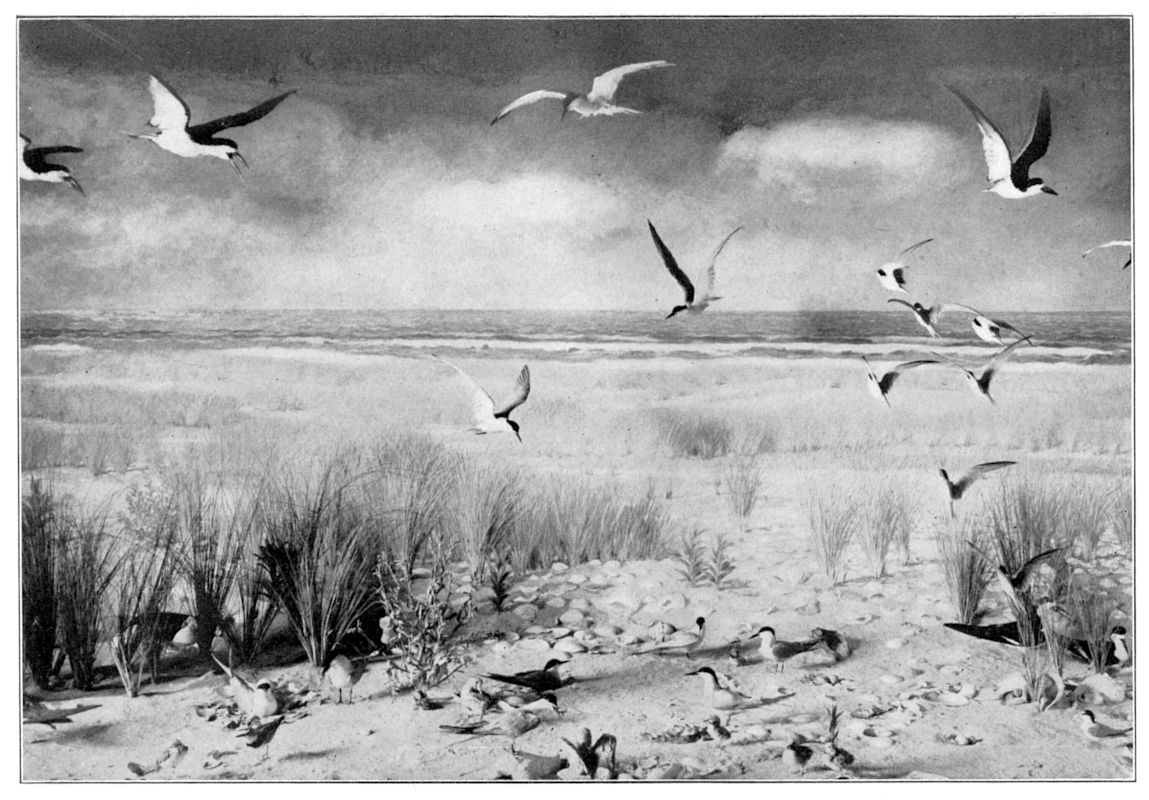
these, a smaller cousin of the Gull, the Tern, or Sea
Swallow, with its coral-red beak, would be perched by
way of finish. Or else, soft bands made of the breast,
and some of the handsomest wing quills were used for
trimming.
“Not only were these feathers sold wholesale to the
plume merchants and milliners, but people who went to
the coast resorts would buy them of the sailors simply
because they were pretty, without giving a thought to
the lives they cost, or of how desolate and lonely the
shores would be when there were no more Gulls.
“There are comparatively few people, I earnestly believe,
who would wear feathers for ornament if they realized
the waste of life that the habit causes. It is largely
because people do not stop to think, and they do not
associate the happy living bird with the lifeless feathers
in the milliner’s window. But now that the Wise Men—yes,
and wise women, too—have explained the matter, the
protection of these beautiful sea-birds is an established fact.
“This bird was called ‘Herring Gull,’ because by hovering
over the schools of Herring where they swam, and
diving to get them for food, they told the fishermen, who
spend their lives upon the ocean on the lookout, where
the fish were to be found. Now, though the Gulls still do
this, they do better work, also, for they spend the time
that they are away from their nesting-homes about the
harbours of the large cities, making daily trips up the
rivers and cleansing the water of refuse, upon which they
feed. For this reason, ‘Harbour Gull’ seems to be a
better name for them.
“They are very sociable birds at all times of the year,
keeping in colonies even in the breeding season, a time
when song- and other land-birds pair, and prefer to be alone.
The nests, when on the ground or upon flat rocks, are built
of grass, mosses, seaweed, and bits of soft driftwood
formed into a shallow bowl. If the edges of this crumble
or flatten while the birds are sitting, they use bunches of
fresh grass or seaweed to keep it in repair, with the result
that the nest is not only a very tasteful object, but it
blends perfectly with its surroundings.
“The eggs are very interesting because no two seem to
be of the same colour, being of every shade of blue and
gray, from the colour of summer sky and sand to the tint
of the many-coloured, water-soaked rocks themselves.
The markings vary also in shape and size, and are in
every shade of brown, through lilac and purple, to black.
The parents are very devoted to their nests, and take
turns in sitting, though the eggs are often left to the care
of the sun on days when it is sufficiently warm. When
the young are first hatched, though covered with down,
they are very weak in the neck and helpless; but in the
course of a few hours the little Gulls are strong enough to
walk, and the instinct to hide at the approach of anything
strange comes to them very suddenly, so that a Gull
only three or four hours old will slip out of the nest and
either hide beneath a few grass blades or flatten itself in
the sand, where, owing to its spotted, colour-protective
down, it is almost invisible, so well does Nature care for
her children—provided that man does not interfere.
When a Gull nests in a tree, however, the little birds, not
feeling the same necessity for hiding, do not try to leave
the nest until the growth of their wings will let them fly.
“On the sea beaches squids and marine refuse are fed
to the young Gulls, but where they have nested near fresh,
instead of salt, water many insects gleaned from the fields
are eaten.
“It was in the Gulls’ nesting season that the plunderers
chose to go to their island haunts, steal the eggs, and kill
the parent birds, whose devotion, like that of the White
Heron, left the birds at the mercy of the plume hunters.
“At the end of summer the young, wearing their
speckled suits, are able to join the old in flocks, and it is
then that they scatter along the coast, some going from
the northern borders down to the Great Lakes. In and
about New York City they are one of the features of the
winter scenery; they fly to and fro under the arches of the
great bridge, and follow the ships the entire length of the
harbour and out to sea. At night they bed down so close
together that in places they make a continuous coverlid of
feathers on the waters of the reservoirs and in the sheltered
coves of the Hudson. From the banks of Riverside Park,
any autumn or winter afternoon, so long as the channel is
free from ice, they may be seen flying about as fearless
as a flock of domestic Pigeons.”
“Here on our beach they are scary enough,” said
Tommy. “Why, the other day I tried every way to creep
up close to some of them, but I never could; they were
always up and off, sometimes without saying a word, and
sometimes screeching, ‘Yuka-yuka-yuka,’ enough to
frighten any one. Pop says that, way back when he was
a boy, and there weren’t any laws to prevent shooting
anything except the game-birds out of season, that these
birds were just as scary, so that the best shots used to
go down on the bar and try to hit a Gull, not to eat, but
for the sake of being called a good shot, because Gulls
were harder to get than old leader Crows.”
“That is the very reason why Gulls alongshore are
afraid now. For so many years they have served as
targets for Duck hunters, and people who did not realize
what they were destroying, that fear has become an instinct.
Now in the nesting-haunts, where they are protected,
they are gradually becoming more and more
tame. About the harbours of cities and parks, where
shooting has never been allowed for other reasons than
bird protection, they fly about unconcernedly and exhibit
little alarm.”
“Are Gulls any real use, except that they are nice to
look at and watch fly?” asked Dave, presently, as Bobbie’s
bird was being passed from desk to desk.
“Yes, the Harbour Gulls are useful in many ways, and
would be more so if man would protect them fully everywhere,
as they do in some countries and in some of the
western parts of our own country; but, in general, they have
been so persistently hunted that they shun the land-bound
fresh water, where they would help the farmers by feeding
on large insects, and prefer the freedom of the open water.”
“The true Gull of the sea, the spirit of the salt, is a sort
of feathered bell-buoy, and thus is of use to the sailors,
as there is ample testimony to prove.
“In summer, in thick weather, the appearance of Gulls
and Terns in numbers, or the sound of their clamorous
voices, gives warning to the mariner that he is near the
rocks on which they breed. Shore fishermen, enshrouded
in fog, can tell the direction of the islands on which the
birds live by watching their undeviating flight homeward
with food for their young. The keen senses of sea-birds
enable them to head direct for their nests, even in dense
mist.
“Navigators approaching their home ports during the
seasons of bird migration welcome the appearance of
familiar birds from the land. . . .
“Sea-birds must be reckoned among the chief agencies
which have made many rocky or sandy islands fit for human
habitation. The service performed by birds in fertilizing,
soil-building, and seed-sowing on many barren
islands entitles our feathered friends to the gratitude of
many a shipwrecked sailor, who must else have lost his
life on barren, storm-beaten shores.”
—E. H. Forbush.
“Is mine a good grown-up Gull?” asked Bobbie, who
had been waiting anxiously for its safe return to his
hands, “because grandpa says if it is, he’ll take it over
to town, and get it stuffed, and fixed up on a perch, to
remember Oyster Day by; but I’ll bury it if you’d rather
I would.”
“It is a fully grown bird, Bobbie,” said Gray Lady,
“and it is wearing its winter dress. In summer the head
and neck that are now streaked with gray would be a
dazzling white, and as accident killed it, and wind and
tide gave it to you, there is no reason why you may not
keep it with a clear conscience.”
Preparation
The Christmas sale was over. It had been held in the
play and work rooms the Saturday before Christmas, and
was a great success. The dressed dolls, iron-holders,
aprons, bird-houses, wooden spoons, racks for clothes,
and little knickknacks had been ranged on the work-table
and carpenter’s bench, and all the people of the
neighbouring towns, as well as from Fair Meadows village
itself, had been asked to come and see. When they came
and saw, they stayed to buy.
The bird-houses proved the greatest novelty, and
Tommy Todd and Dave, their cheeks red with excitement,
were kept busy taking orders for more, to be finished
by May or June, one customer said. She, however,
was very much amused when Tommy told her that if she
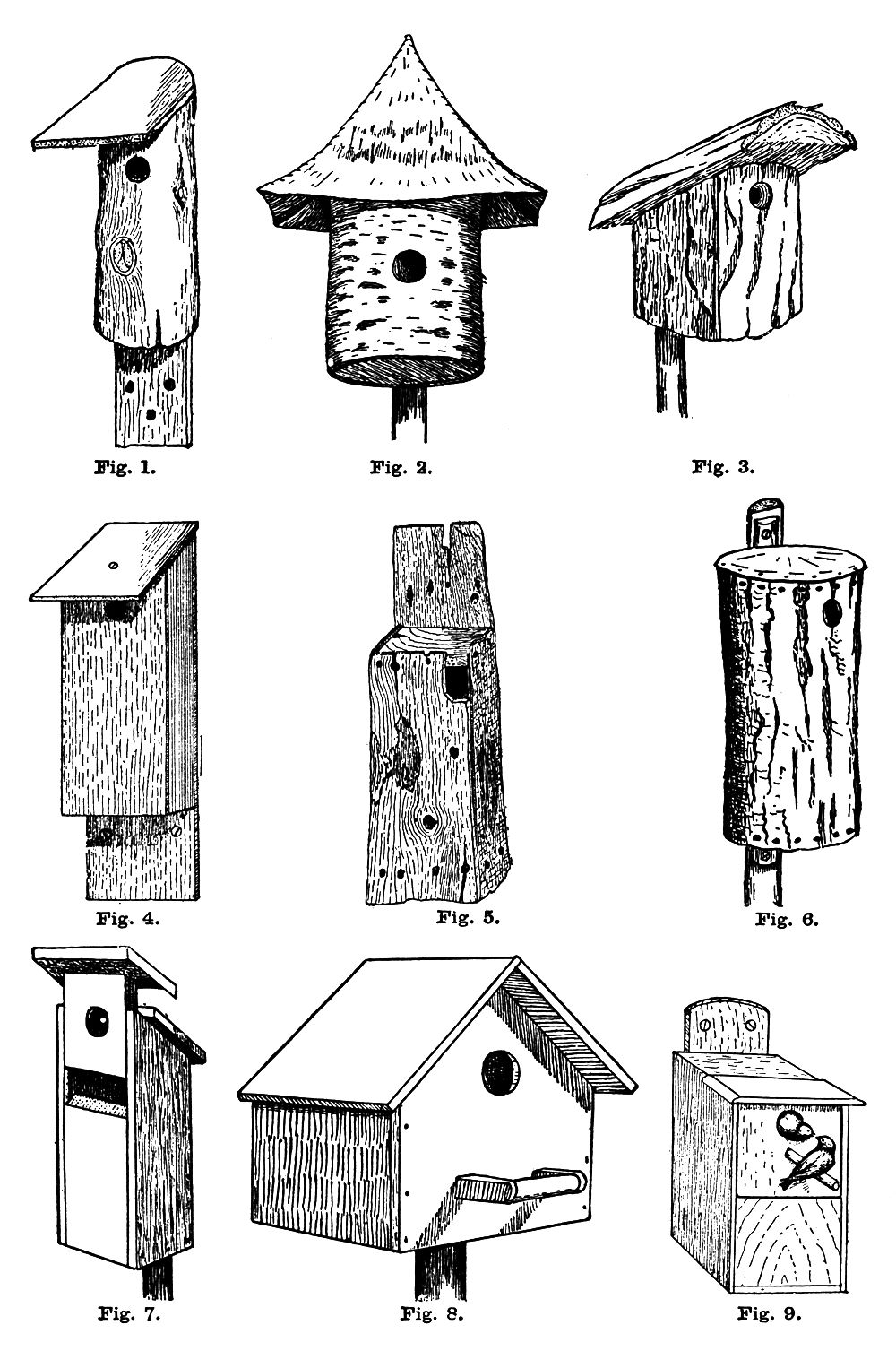
expected to have birds in the house (it was a box for Tree Swallows)
the first season, she must have the house in
place before April, so that it might “be weathered a little,
and the birds find it when they first came, and not think
it was a trap put up to catch them.”
Gray Lady donated some delicious cake of Ann’s
make, and hot chocolate, and while the visitors enjoyed it,
they asked many questions about the bird class, the school
at Foxes Corners, and the motives of the Kind Hearts’
Club itself; for this name had been printed on the posters
advertising the sale.
The result that concerned the public good was that other
men and women resolved, even if they could not do it as
thoroughly as Gray Lady, to supply the teachers in their
various districts with charts and books, and before night
settled down, Sarah Barnes, the treasurer of the Club, was
hugging tight in her arms a small iron box, with a lock
and key, wherein were fifty precious dollars, while
orders that meant an equal sum before the close of the
school year were being copied from a rather mussy paper
into a blank-book, by Tommy Todd, the secretary, whose
usually clear upright letters were made crooked by his
excitement.
The next question was, How should the money be spent?
Each child was asked to write his or her idea on a slip of
paper and bring it to the birds’ Christmas festival that
was to be held, as seemed fitting, in Birdland, the afternoon
before Christmas, from two o’clock until four.
“Supposin’ it’s cold and snowy?—that’s a long time to
be outdoors,” said Eliza Clausen, as she walked home
between Sarah and Ruth Barnes.
“It may not be out-of-doors,” said Sarah, looking very
wise.
“Then it can’t be in Birdland, as Gray Lady said,”
persisted Eliza, who, though she was less critical since
she had come under the older woman’s influence, could
not resist once in a while, “hoping for the worst,” as Gray
Lady called borrowing trouble.
“Yes; the party can be indoors, and yet in Birdland,”
answered Sarah.
“Oh, you’re trying to catch me with a riddle or something.”
“If I am, I’ll tell you the answer at the birds’ Christmas
tree next Tuesday,” called Sarah, as she turned in at her
own gate.
A two-inch fall of soft, clinging snow fell during the
night before Christmas eve, so that the next morning
“everything looked as pretty as the pictures on a calendar,”
as Sarah Barnes said, when she arrived at Gray
Lady’s door, bright and early, to help decorate the birds’
tree.
Sarah did not enter the door, however, for she was
joined on the porch by Goldilocks and Ann, and together
they walked through the garden to Birdland.
Jacob Hughes had swept paths from the house in and
out among the trees through the garden. In Birdland
he had used the single-horse snow-plough to scrape a
track running from the bird lunch-counter, about the
edge of the orchard, and then through the centre down to
the old farm-house of the Swallow Chimney, that stood in
the lower corner facing on what had been a cross-road, but
was now a pretty grass-grown lane, with the snow wreathing
the bushes of black alder, with its red, glistening
berries, giving out a real Christmas feeling.
What had happened to the old house of the Swallow
Chimney, where the General’s father had lived, but which
had now remained closed for so many years, merely a
storage-place for old furniture?
Smoke was coming from the great stone chimney, new
shingles stained to look old replaced the broken ones,
new paint glistened on the window-sashes, and the quaint
old panes of glass, bearing the rainbow tints of years,
shone like mirrors. The front door was painted dark
green, and the spread-eagle knocker of brass was as bright
as polishing could make it; while around the deep front
porch was a little fence of cedar bushes in boxes, all garlanded
with vines of coral, bittersweet berries.
Goldilocks and Sarah went to the front door of the old
house, while Ann disappeared in the woodshed that
joined the side porch and well-house.
The girls had not touched the knocker when the door
flew open, and who should stand there but Miss Rose Wilde,
while beyond her, sitting by the blazing log-fire in the
long, low living-room, that had once been the kitchen, was
her mother, looking better and younger than she had for
at least ten years!
This was the secret. Gray Lady had repaired the old
house and established the faithful little teacher and her
mother in it, so that instead of mother and daughter only
meeting once a week, or less often in winter, and each
having a good bit of heartache between, they had a real
home once more. What was also a bit of good luck, Mrs.
Wilde’s furniture, that had been stored away, was of the
kind that seemed as if it had been made for the old homestead
and had never been anywhere else.
Once inside, Rose Wilde led them into the kitchen, where
everything was as neat as wax, and there, spread upon
tables and half-covering the floor, were the decorations for
the birds’ Christmas tree.
Where was the tree itself? Where trees are the best
and healthiest, out-of-doors back of the house, a stout,
young spruce, some twenty odd feet high, growing in the
orchard corner where no one had planted it, the child of
one of the spruces near the great house,—a half-wild tree,
sprung from the seed of a cone dropped by a Crossbill,
perhaps, or left by a squirrel who was making a winter
store-house in the attic of the farm-house.
The dainties for the tree were selected to suit all the
various needs and appetites of the winter birds likely to
come to the orchard.
Gray Lady, Goldilocks, Rose Wilde, and Ann had
strung quantities of popcorn upon the chance of the Jays
and Crows liking it. They had used strong thread, but
had only strung the corn by the very edge, so that it would
detach easily. There were lumps of suet, and marrow-bones,
securely bound with wire, ears of red and yellow
corn, bunches of unthreshed rye, wheat, and oats, little
open boxes filled with beechnuts, and various wild berries.
Last of all, something that Goldilocks had suggested, the
heads of a couple of dozen sunflowers, filled with the ripe,
nutritious seeds, for she had noticed that all the autumn
the Goldfinches and various Sparrows had stayed about
the beds where the composite flowers like asters, marigolds,
cornflowers, zinnias, and sunflowers grew, and that
also the wild sunflowers and black-eyed Susans of waste
fields were always surrounded by birds.
Jacob Hughes had his ladders all ready, but it was no
small task to keep him supplied with material, and there
were many mishaps before all the articles were in place,
but to Goldilocks’ great joy, before Jacob had fairly finished
and taken the ladder away, a Chickadee and a
Goldfinch were both clinging to the same sunflower head,
and a little Downy Woodpecker had discovered one of
the bones fastened to a branch and was revelling, “up to
his neck,” as Sarah expressed it, in the marrow.
Underneath the tree a place had been cleared for the
gifts Gray Lady had in store for what she called “the
featherless two-legged birds of the Kind Hearts’ Club.”
After they had rested a few minutes, and were thoroughly
warmed, Gray Lady, Rose Wilde, Goldilocks, and Sarah
Barnes set out for a stroll through the orchard, and the
lane that ran back of it, up to the farm-barns, to see what
feathered guests were in the neighbourhood, the walk
taking them past a great pile of unhewn wood and a tent-shaped
brush-heap at the end of the lane.
Gray Lady used her opera-glasses, but the others trusted
to their eyes alone. These are the birds they saw and named
easily: A flock of Goldfinches in their dull winter coats
feeding on weed seeds in the lane; their old friends the
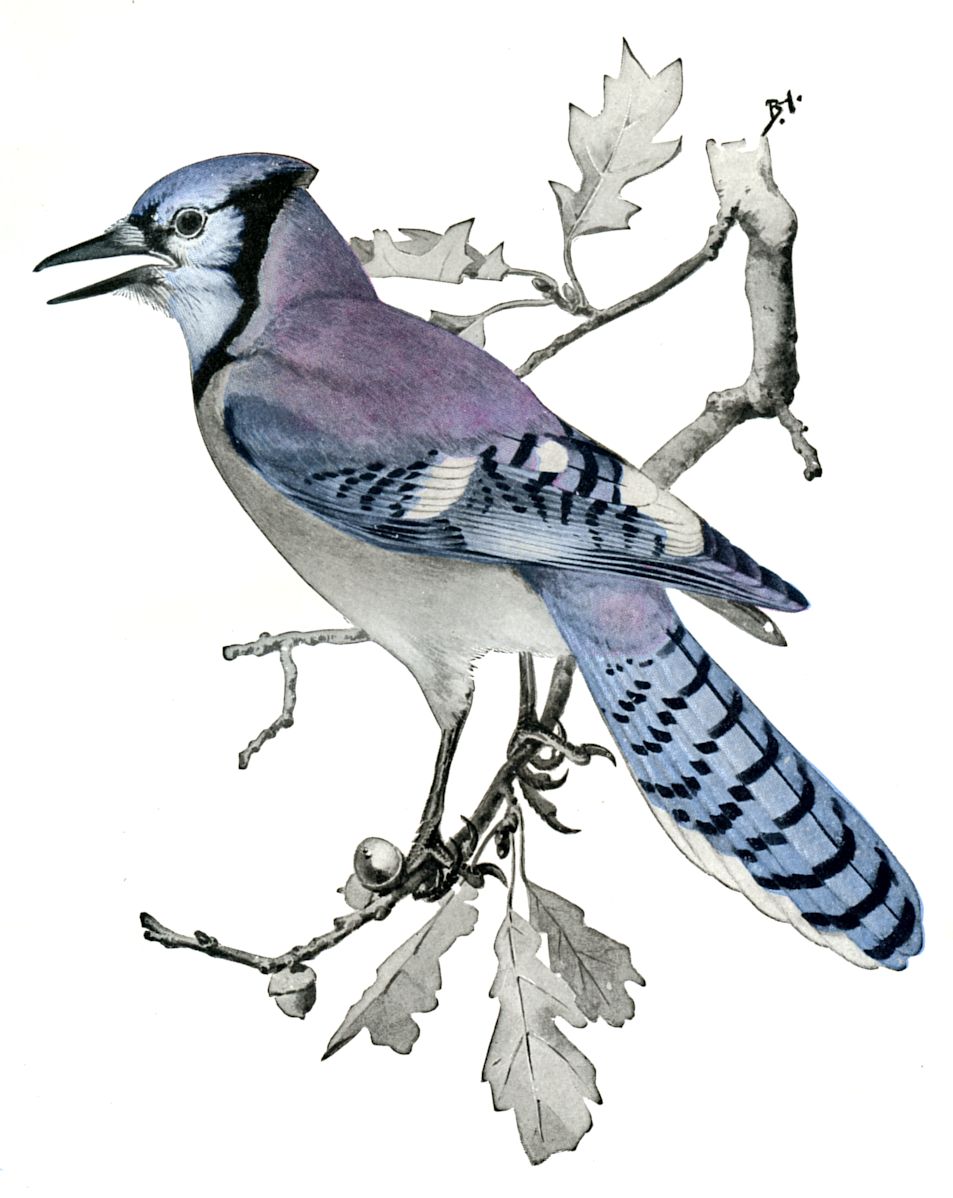
Chickadees, three Blue Jays, two Flickers, and several
Downy Woodpeckers; Gray Lady thought possibly from
their markings, a whole Downy family,—Mr., Mrs., and four
children.
As they neared the woodpile Goldilocks stopped, her
hand on Gray Lady’s sleeve and a finger raised in caution.
“I do believe there is a Jenny Wren that has not gone
away or is lost, it is such a little bit of a thing.”
As they stood looking, the little, neat, brown bird, about
four inches long, ran up and down among the logs like a
mouse, then flew with a little short flapping of the wings
to the bush, where it clung to a spray, bobbing to and fro,
its comical bit of a tail pointing as close to its head as
possible. Then it appeared to pick something very
deliberately from the twigs and flew back again to the
woodpile with a sharp, warning note.
“That is not a belated House Wren,” said Gray Lady,
“but the Winter Wren, his cousin, who nests from the
northern boundaries of the states northward, but comes
down in winter to visit us in southern New England and
travels as far south as Florida. A brave little fellow he
is to weather storms and cold here, and one of our three
smallest birds, the Golden-crowned Kinglet and the
Humming-bird being the other two. In his nesting-haunts
he has a beautiful song; I have never heard it, but one of
his admirers who has says that it is ‘full of trills, runs,
and grace notes, a tinkling, rippling roundelay.’ ”
A few minutes later it was Sarah’s turn to exclaim, as
she pointed to a small, sparrow-like bird, perched on a
giant stalk of seeded ragweed at the side of the lane.
“It’s a Chippy or else a Song Sparrow,” she said, hesitatingly.
“It’s bigger than a Chippy, and it’s got a spot on
its breast like the Song Sparrow, only it isn’t as big. O
dear me! I don’t think that I shall ever be sure of telling
Sparrows apart,” she sighed.
“To be sure a bird is a Sparrow is a step in the right
direction,” said Gray Lady. “I have known some one
older than you call me to see a big Sparrow which turned
out to be a Wood Thrush. If you will remember one thing,
it will help you in placing the smaller birds. Look at a
bird’s beak; if it is thick, short, and cone-shaped, the
bird is most likely to be a Sparrow, for this family are all
seed-eaters except in the nesting season, while insect-eating
birds, of all families, have longer and more slender bills.
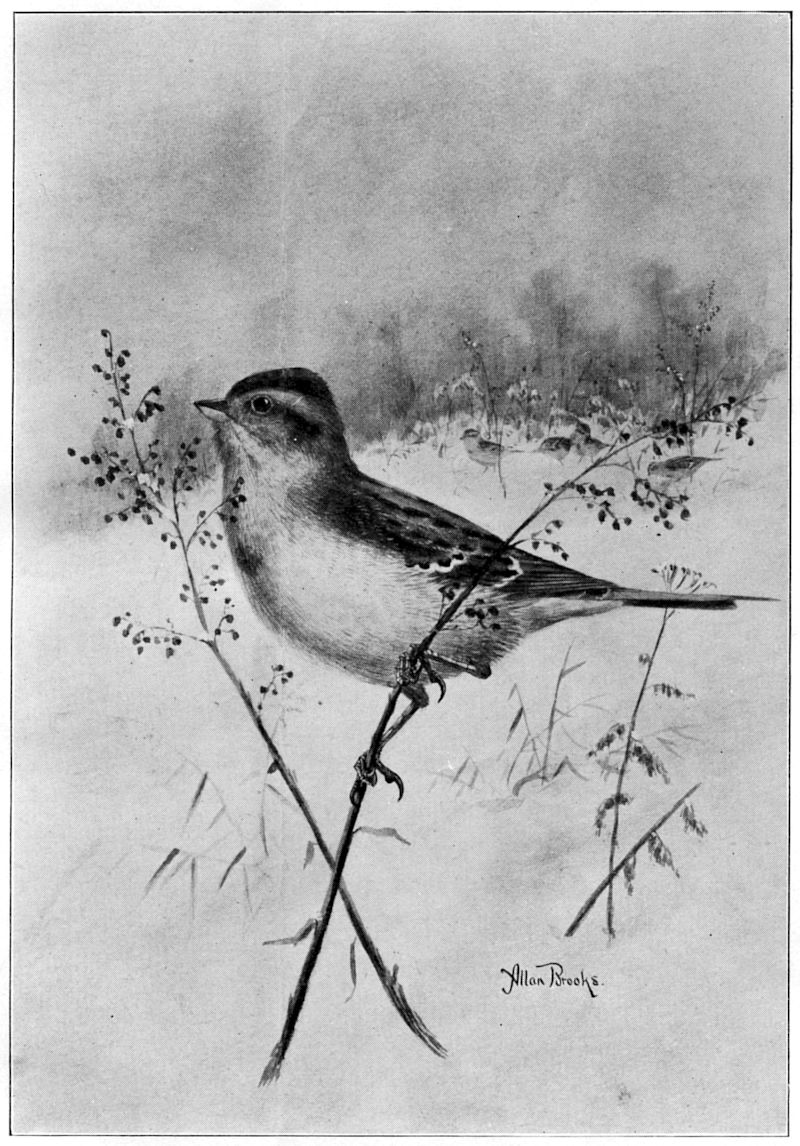
TREE-SPARROW
“As for this little fellow, it is another of our winter
visitors, the Tree-sparrow or Winter Chippy, and there is
probably quite a flock of his kin at this moment distributed
over the wild fields below, doing the work of seed-destroying
that the farmers have neglected; for, aside from
the cheerful companionship of all these winter birds, the
Sparrow tribe is working for us all winter as Weed Warriors,[3]
just as the tree-trunk birds are Tree Trappers, the
birds who take insects while on the wing, Sky Sweepers,
and the silent birds of prey, who sit in wait for the field-mice
and other vermin, Wise Watchers.
“Ah, it is my turn now to make discoveries,” said
Gray Lady, as they turned into the orchard at the end
opposite the lunch-counter tree. “Keep very quiet, and
look at the mossy branch of that half-dead tree to which
some frozen apples still hang; what do you see, Goldilocks?
Take my glasses and look carefully before you
answer.”
“Where?” said Goldilocks; “yes; I see. One is a little,
fluffy, greenish gray bird with a dirty white breast. Oh!
he has a red stripe edged with yellow on top of his head!
He moves so quickly that I can’t seem to see the whole
of him with one look, though he is small. The other bird
is a little bigger, and not so fat; he has a yellow spot on
his head, and a brighter one over the tail, and a yellow
spot on each side; he is striped gray and black all over,
except some white on his wings and underneath. How
he flits about, just like that bird that looked like a red-and-black
butterfly that we saw last summer that you
said was a Redstart.”
“You have very sharp eyes,” said her mother, “for you
saw at once the identifying marks of two birds that were
new to you. The merry fellow of the flaming crown is
the Golden-crowned Kinglet, another sturdy winter visitor,
who breeds in the North, and finds our climate quite
warm enough for him if the food holds out; for he is a tree
trapper, giving his attention, like the Chickadee, to the
smaller branches and twigs too slender to bear the weight
of the heavier tree-trunk birds.
“His companion is the Myrtle or Yellow-rumped
Warbler, a hardy cousin of the Redstart and Summer
Yellowbird that Sarah, perhaps, does not yet know by
name, though she has doubtless seen them. When you
have once seen the male bird, you will never forget him,
because of the four yellow spots. These warblers are great
insect eaters, but lacking these, they will eat berries, the
bayberries being their favourite, and I believe that we
have to thank the bayberry bushes, in the rocky hill
pastures hereabouts, for the numbers of the Myrtle
Warblers that stay all winter, myrtle being a common
title for the bay, giving them their name.”
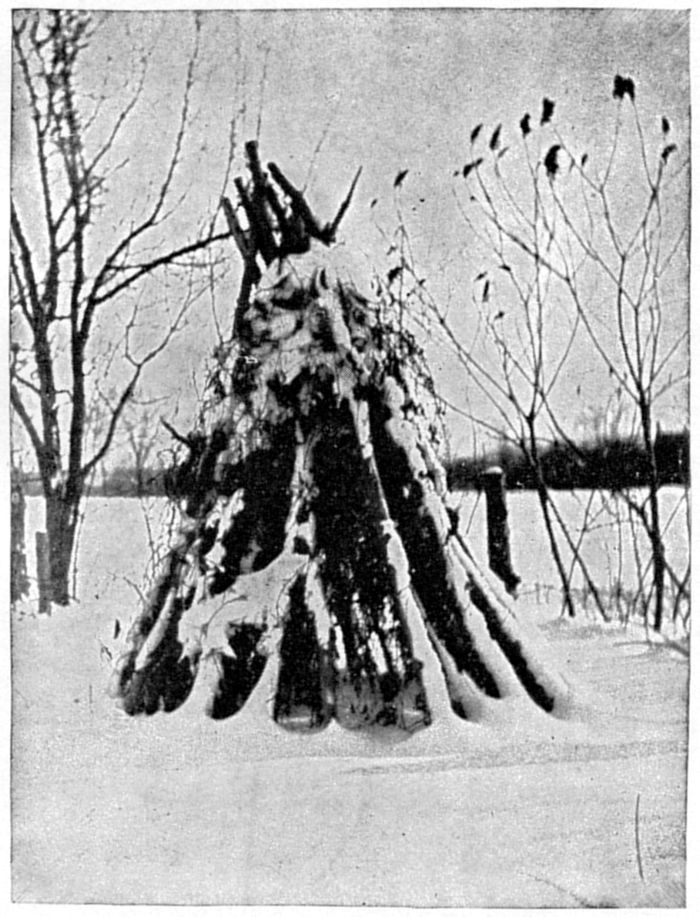
F. M. Chapman, Photo.
SHELTER FOR BIRD FOOD
At the garden end of Birdland, just inside the rustic
gate, a flock of Juncoes or Gray Snowbirds were feeding,
plump, cheerful, and contented, and giving vent to their
satisfaction in their pleasant “tchip, tchip, tchip” call.
Those who only know one winter bird know the Junco,
for he belongs to city parks, village yards, and remote
farms alike, anywhere that a frugal meal of grain or weed
seeds may be found, with a piazza vine or brush-heap or
haystack to creep into for shelter. His flesh-pink bill,
slate-coloured coat, and neat white vest, together with the
two conspicuous white tail-feathers, tell his name to any one
who wishes to know it.
The Junco is an autumn and winter visitor only, being
away from May until late September, as he nests northward
from New York and Connecticut. When the flocks
first return, you will be puzzled by many birds of the shape
and build of Juncoes, but who are wearing more or less
striped clothes; these are the young of the year.
“Five new birds in one morning! I wish Tommy had
been here,” said Sarah; “but perhaps he knows them
already; Tommy knows a lot you can’t see because it’s
down so deep.”
“You must find us a new bird, too, before we go in to
lunch, Miss Wilde,” said Goldilocks.
“I have been looking at, not one, but a dozen, while you
have been watching the Kinglet and Myrtle Warbler.
Look over the gate-arch across toward the house. Do
you see something moving among the bunches of ripe
spruce cones?”
“I see birds moving, but I want to go nearer.” So the
party managed, by walking quietly, to reach the trees where
the birds were feeding without disturbing them in the
least.
“There are two kinds of birds up there,” said Sarah,
presently, for it was her turn to use the opera-glasses.
“They are both rather red. One is darker than the other
and has no white on him. The other is lighter red and
has some white on the wings and tail. Why, Gray Lady!
their beaks are out of joint at the end and don’t shut tight.
I wonder what can have happened to the poor things.
I thought at first they might be wild parrots.”
Gray Lady and Miss Wilde both laughed, Sarah’s concern
for the birds was so real.
“You are right about the bills not closing at the tip,
but it is not owing to an accident. Nature developed this
bill so that the bird, who is a lover of evergreen forests,
might be able to wrench open the cones, the only winter
food that is oftentimes to be found.
“The bird belongs to the Finch and Sparrow family,
though you would never guess it, and is called the ‘Crossbill.’
The plain red one is the Red-winged Crossbill, and
the lighter-coloured one, with white markings, the White-winged
Crossbill. Both birds nest north of New England,
but travel about the country in little flocks, sometimes
going as far south as Virginia and the Gulf States.”
“Listen, I think I can hear the crackling as they tear
the scales from the cones,” said Goldilocks.
“Yes, and you can see those that they have dropped
lying on the fresh snow under the trees,” added Sarah.
At that moment an old-fashioned dinner-bell sounded
from the direction of the farm-house in the orchard. It
was Mrs. Wilde letting them know that luncheon was
ready, for Gray Lady, Goldilocks, and Sarah were to
lunch at “Swallow Chimney,” as Goldilocks had christened
the restored home, by way of a house-warming.
As they left, the Crossbills, who had been climbing up
and down, with all the adroitness of the Chickadees or the
Upside-down birds themselves, suddenly took to wing,
giving short, metallic-sounding cries, flew rapidly over the
orchard, to alight—where do you suppose? On the birds’
Christmas tree. Here, after some inspection, they began
to tear at the popcorn, their twisted beaks doing the work
so well that they seemed fashioned for that purpose
alone.
“Well,” said Goldilocks, her hands clasped in amazement,
as they reached the farm-house, and saw what had
happened, “I never knew anything quite so quick to
happen outside of a story-book!”
At two o’clock a procession of the pupils of Foxes
Corners school filed through the hall at “the General’s,”
wondering what new surprise was in store. The big boys,
who would not begin school until the mid-winter term, had
come under the strong persuasion of Tommy and Dave.
They looked rather uneasy, however, as if they were not
quite sure whether the performances that the younger
boys considered “bully” might not be undignified for men
of their age.
As the children went through the garden, Jim Crow
lurched out of a bush and walked along after them with
an air of great importance, as if he were the master of
ceremonies. Larry, the Starling, was not particularly
fond of cold weather, and kept inside the shelter of the
south porch, making little excursions here and there,
prompted by curiosity, and the desire to use his wings,
which were now quite strong, as food was to be had from
the dish that he and Jim shared, merely for the eating.
The lunch-counter was well patronized that afternoon,
for, in addition to the birds that had been in the vicinity
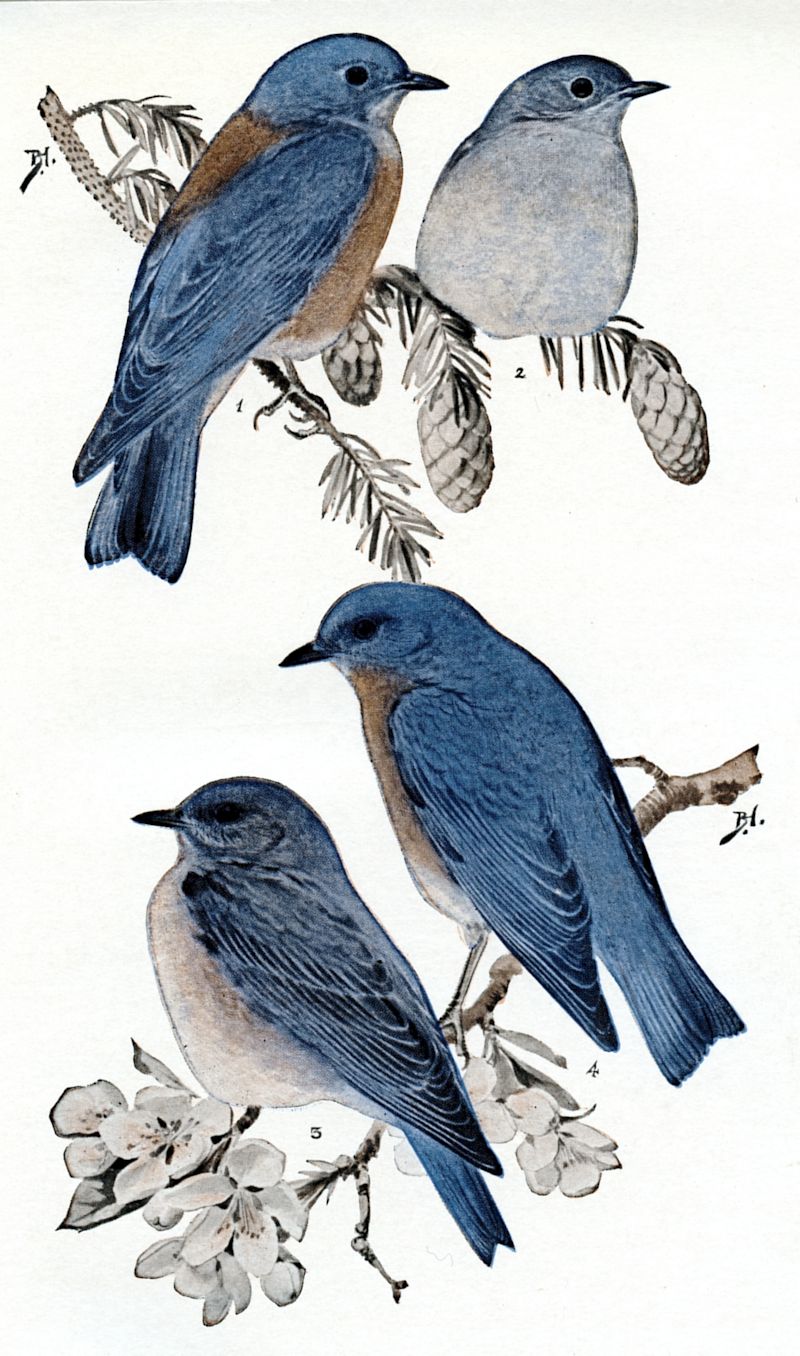
during the morning, several Bluebirds came, together
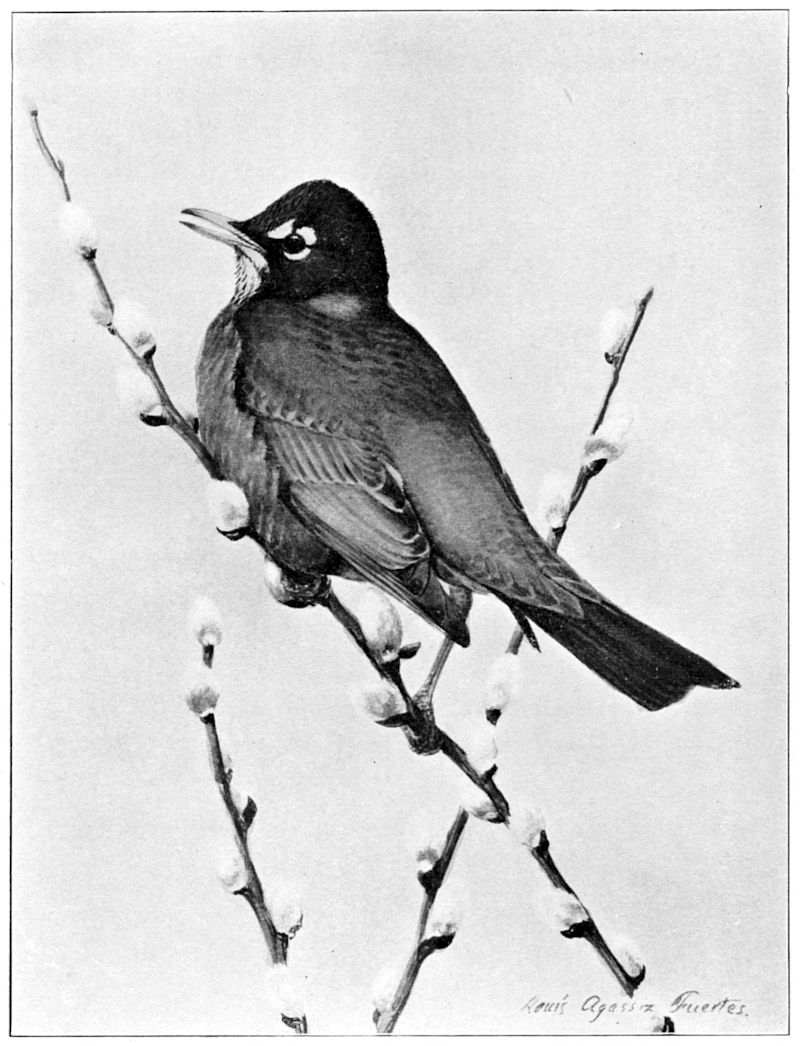
with three Robins, who simply gorged themselves upon
some dried currants that Goldilocks had put out as an
extra dainty. Gray Lady was trying experiments with
all sorts of odds and ends at the lunch-counter, that she
might see exactly what sort of food was the most acceptable,
and she was very much surprised to find that though
wild birds, like human beings, can adapt themselves to
circumstances, a great number have such a craving for
animal food that it explained why Crows, Jays, and some
others become nest-robbers in the midst of summer plenty.
After they had called upon Miss Wilde at Swallow
Chimney, where Eliza Clausen discovered the meaning of
Sarah Barnes’ mysterious remarks about the party being
held in the orchard, and yet being indoors, they went to
see the birds’ Christmas tree.
Since morning many things had been added to it that
were not intended for birds. Bundles, strange of shape,
wrapped in green tissue-paper tied up with red ribbon
and little sprigs of southern holly, hung to the lower
branches, while Jacob, dressed as Father Christmas, stood
by armed with a hooked stick, with which he loosened the
bundles and dropped them into the waiting hands.
As it was impossible to tell from the shape of the
parcels what they contained, there was a good deal of
pinching and squeezing done, but beyond the feeling of
sharp corners that might belong to either books or boxes,
nothing could be discovered.
“It is too cold for you to stand out here to open your
parcels,” said Gray Lady. “Suppose you take them in
the living-room at the cottage, and while the girls open
theirs you boys come for a little walk with me, for I have
some work planned particularly for the boys of the Kind
Hearts’ Club.
“Oh, do not look worried, I shall not keep you more
than half an hour,” she said, as she saw the boys were
quite as curious about untying their parcels as the girls.
So, following her lead, they trudged off up the lane, past
the barn and woodpile, to where the brush on either side
narrowed it to a mere path. Then, where another lane
crossed it, the way grew broader again, and while one
side was screened by woods, from the other you could
look out upon a stretch of waste meadows and fallow
fields.
There was only enough snow to crunch underfoot, and
as Gray Lady walked ahead, a sprig of holly fastened at
the neck of her gray chinchilla collar, and another in the
close fitting hat of the same fur, her arms buried to the
elbows in a great muff, her eyes sparkling with pleasure,
and a rosy spot on each cheek made by the keen air, the
boys cast many glances of genuine admiration at her.
The big boys, especially, felt that she understood the situation
exactly, by taking them to walk without the girls,
giving them her confidence, and planning something for
them to do that would be different from girls’ work, or,
at least, apart from it.
“Perhaps some of the others have told you,” Gray Lady
said to the big boys as they walked, “that I am very
anxious not only to feed the small tree birds, that they
may stay with us in winter, but to try and help the Grouse
and Quail, so that, instead of those that have escaped the
dangers of the hunting season being driven out by hunger
and cold, they shall live on and increase, and become
again the friends to the farmers that they were in the old
days.
“You big boys all know how much complaint there is of
all kinds of new bugs and worms and blights that discourage
the farmers and leave but little profit in their
crops? As you learn to watch wild birds and their habits,
and realize the way in which they work for their living the
year round, you will see that it is largely the lack of these
old residents, these birds who were here before man came,
that allows all the new-fangled bugs to gain such headway.
“Now, while it is quite easy for all of us to have some
sort of a lunch-counter, either on a window-ledge, tree-trunk,
or shed roof,—anywhere, in short, where cats will
not venture,—feeding the larger game-birds is not such
a simple matter, for until they thoroughly understand our
motives, they will not come to us; we must take food to
them.
“Birds that are hunted everywhere, for at least two
months in a year, cannot be expected the day after the
season closes to come boldly to our houses for food, as if
they could consult a calendar, and say to one another,
‘To-day is December first, we may go and take a walk in
the open road in safety.’
“Neither would they be safe, for there are always,
I am sorry to say, cowards in every township who will
set snares, and get by stealth what they dare not take
openly. And, of the two, I think the snare a greater
danger to the poor birds than the gun.”
“The trouble with feeding game-birds away from
houses would be that, even if you knew their runs, and
I think I know some pretty well, the feed would most
likely blow away or be snowed under unless they ate it
right away,” said Jack Todd, Tommy’s second eldest
brother.
“Yes, that is one of the difficulties, but I think an
idea that I have borrowed, and am trying now for myself,
may partly solve the trouble. Look ahead of you, close
to the rail fence. What do you see? No; don’t rush to
the fence and trample the snow; keep on the lane side.”
“It’s some sort of a tent,” said Tommy; “I thought
at first it was just a corn-stack with snow on it.”
“No; it isn’t a tent,” said Everett Judd, going closer;
“it’s only bean poles stacked with the vines left hanging,
two rows of them, so’s the snow won’t all drift in at one
spot.”
“And what else?” asked Gray Lady. “Don’t you see
cracked corn and mill sweepings scattered in between
the poles? This is a feeding-station for our friends,
the game-birds, if we can only make them understand
that it is not a form of trap and does not hold a snare
in disguise.”
Jack Todd, who had gone close to the tepee on one
side, stepping on stones that he might avoid tracking
the snow, and was examining the ground intently, suddenly
cried out, “There have been mill sweepings here,
because I can see some dust, but the grain is all gone,
and I guess—no; I’m sure—there have been Grouse
about, and they have fed here since snow fell, for there
are tracks coming out from under the fence and going
back the same way!”
“But how can you tell that they belong to Grouse?”
asked Gray Lady, coming close to look at the prints and
thinking in her excitement they might have been made
by chickens.
“No, they are real Grouse tracks, for they’ve got their
spiked snow-shoes on, and here’s the marks of the
prickers!” And Jack pointed to the footprints of the
brushed claws in triumph.
“This proves two points,” said Gray Lady, “that
there are Grouse in the neighbourhood, and that they
will take food if it is offered to them in the right way.
I should like to put up a dozen of these feeding-stations,
if you boys will help; you know the woods and brush-lots
better than I do now, and you can select the places
that will be suitable for these shelters and find what
material there is close at hand of which they can be
built.
“When this is done, I shall again have to depend upon
you for keeping them supplied with food. If we find
that the grain is eaten, I think that it should be renewed
three times a week, so if six of you boys will volunteer
for the service, two can go together, and it will only make
one trip a week for each pair. If the snow is deep, you
might possibly arrange to fit some boxes to your sleds
to hold food, or, if the shelters are in rough ground,
a bag fastened to the shoulders like a pedler’s pack
might work well; for, in doing this work on a large scale,
merely a pocketful of food will not suffice.”
“I will help,” said Jack Todd, after thinking a moment.
“Me, too,” said Everett, and Irving Todd, together; then
of course the others followed, Dave and Tommy anxious
lest they should be left out, while Bobby and little Jared
Hill, though too small to undertake to care for a
station alone, were acceptable as companions for the big
boys.
“We have the rest of this week, and all of next for
a holiday,” said Jack Todd, “so suppose we take a
tramp about the hill country on each side of the river
valley to Centreville, that’s about five miles, and fetch
axes with us. I know most of the people on the way,
and, if we put the shelters somewhere near houses, we
could distribute the food along, and they would let us
keep it in one of the outbuildings, so that it would be
handy in stormy weather. I’m pretty sure we can
collect stuff enough as we go for the shelters. My uncle,
who lives at Hilltop Farm, would give me corn-stacks
for three or four. There’s a heap of slab-sides (the
outside strip, with the bark, when a log is to be sawn into
boards) left to go to pieces up by where the sawmill
was last year; they will make fine wigwams, and there
are plenty of cedars and birches, with brushy tops, for
the rest. Then perhaps the folks along the line might
be interested and rig a few up on their own account.”
“Thank you, Jack,” said Gray Lady, warmly; “you
have caught the spirit of the idea and improved it already,
for if we are to do the game-birds any real good, and
establish the feeding plan permanently, the people all
‘along the line,’ as you call it, must be interested until
not only Fair Meadows township, and the county, but all
the counties in the state, are linked together in the work
of restoration.
“Meanwhile, though, of course, everything that is done
regularly is work, I really envy you boys some of the
fun you will have in your winter tramps; sometimes you
will be able to skate nearly all the way upon the river,
and sometimes, if the snow is as deep as people are predicting,
you may be able to go on snow-shoes.”
“Only I don’t think any of the fellows hereabouts own
a pair of snow-shoes,” said Everett.
“Then they are the very things for Jacob to help you
make if you come to any of our Saturday meetings,”
said Gray Lady. “Jacob was born in Canada, and
worked with fur trappers for several years, and though,
perhaps, he may not be able to make them as well as
when he was a young man, they would surely be better
than nothing, and who knows but what one of the many
things that the Kind Hearts will organize may be a Snow-shoe
Club.”
Thus the big boys of Foxes Corner school found themselves
interested and pledged in Gray Lady’s work without
a suspicion of the “playing baby” of which they
had such dread.
By the time Gray Lady and the boys returned to
Swallow Chimney, the girls had opened their bundles,
and besides little work-boxes, each with a silver thimble
of the right size for the owner, and a pair of scissors that
would “cut clean and not haggle,” as Eliza Clausen expressed
it, there were books for all. Some were about
birds, and others about flowers, trees, butterflies, and
the real life out-of-doors that is more wonderful than
any fairy-tale. Having disposed of their own presents,
with many little shrieks of delight, the girls stood by,
waiting for the boys to open their bundles. These were
all long and flat, with a bunch in the centre, as if two
objects of different shapes were fastened together.
Tommy succeeded in untying his first, skeining up the
string so that he might have it for the re-wrapping.
A strong, well-made knife, with two blades fell out, and
under it was a hammer, a chisel, a half-inch auger, and
a medium-sized cross-cut saw. Seeing Tommy’s gifts
made the others pull open their packages hastily, with
less regard for string and paper, to find that they also
had the coveted tools.
“Now,” said Gray Lady, “you boys will be independent
of your fathers’ tools when you take a bird-house
home to finish, or wish to do a little bit of work for yourselves,
as the girls will also be independent of their
mothers’ work-boxes and thimbles; because, if the grown-up
people are always having their tools borrowed or
mislaid, they are apt to have a sort of grudge against
both the work and the workers.”
Some of the boys looked at each other rather sheepishly,
and wondered how Gray Lady knew that their fathers
had said that “since the boys took to carpentering there
hadn’t been a hammer or nail to be found nor a saw with
the sign of an edge left on it.”
“By and by,” continued Gray Lady, “if you have
the desire, you will all have a chance to earn other tools,
and also make boxes in which to keep them.
“You may wonder why the Christmas tree bore no
candy by way of fruit; that was because part of the fun for
this afternoon will be making candy,—caramels, chocolate
creams, nut taffy, and old-fashioned pulled molasses rope-candy,—so
that, besides the making and tasting, you
will all have something that you have made yourselves
to give the people at home to-morrow, or put in their
stockings if they are hung up. See! here are the boxes
that Goldilocks has made to hold the candy!” There
upon a tray were two dozen square boxes covered with
green-and-white paper, and a row of red-paper hearts
pasted across the top of each, with the words, “The Kind
Hearts wish you a Merry Christmas,” printed in red.
“Did you make all those boxes yourself, Goldilocks?”
asked Sarah Barnes, in amazement; “I don’t see how
you could turn the corners so nice.”
“Not the boxes; you can buy them for very little at
the factory. I covered them and put the hearts on,
but Mother did the printing. It is easy enough if you
take time. You see the two years that my feet wouldn’t
go, I learned to make my fingers work for both.”
“The fire and pans, sugar, molasses, and nuts are all
ready, but, before we become Miss Wilde’s guests and
begin, for the candy-making and supper belong to her
party, we must hold a short business meeting of the
Kind Hearts’ Club, that we may decide how the Christmas
money is to be spent.”
Gray Lady then sat down at the end of the room with
Mrs. Wilde, while Goldilocks, the president, took her
place at the head of the long table, with the vice-president,
Miss Wilde, close at hand to prompt. Sarah, the treasurer,
and Tommy, the secretary, were on opposite sides of the
table facing each other, and all the others sat up very
straight, wearing various expressions of importance that
were quite amusing.
Goldilocks rapped on the table with her pencil, and
said in a rather shaky voice, blushing rosy red as she
spoke, “The meeting will please come to order and
listen to the reading of the minutes of the last meeting.”
There had been but one previous meeting, that to arrange
for the Christmas sale, and it had been informal,
so that this was really the president’s first appearance
in the chair, and, as she spoke, she kept her eyes fastened
to the paper upon which Miss Wilde had written the
order to be followed.
“Secretary will please read the minutes of the last
meeting,” she said, after a pause.
The secretary looked around in a hunted sort of way,
as if to find an open door through which he could escape,
and, seeing none, got rather unsteadily upon his feet,
opened the square blank-book that Gray Lady had
given him for his records, fumbled with the pages, and
then said, rather than read,—“We were all there. We
all agreed to sell the things we’ve been making so as to
get some money to feed birds, and buy things; and Gray
Lady said we could do it in her house; the Saturday before
Christmas was duly appointed, and Dave was to get the
bills, to tell folks it was going to be printed down at the
Chronicle Office, because it is his uncle runs it, and Gray
Lady promised to give cakes and chocolate, in case folks
were hungry.
“Respectfully submitted,
“Thomas Todd, Jr., Secretary, Amen!”
Gray Lady did not dare look at Miss Wilde during
the reading of this report, but the children took it in
perfect earnestness, and Goldilocks, having put the
report to vote, as she had been told, proceeded to the
next item before her and called, “Report of the secretary.”
Again Tommy fumbled, and, after looking in every
page of the book but the ones that were written upon,
suddenly burst forth,—“We had it, and we sold everything,
besides some things we haven’t made yet. The
people ate all there was, and took the other things home.
It was a big cinch! Sarah Barnes has got the money
in a box, and her father’s put it in the clock-case, except
some of it that’s in dimes and nickels, and they’re in a bag
in the dresser with the rye meal so’s no one’ll know.
Gray Lady said that to-day we must each bring a paper,
with written on it the way we wanted the money spent.
We have. It was hard to write because some things
we would like to have wouldn’t be nice to everybody
all around, and that’s what it means to have a Kind
Heart, grandma says.
“Yours truly,
“T. Todd.”
Action having been taken upon this, and the report
accepted without a dissenting voice, the treasurer was
called upon, and Sarah arose.
“The result of the sale of the Kind Hearts’ Club, which
was held in the spacious residence of Mrs. Gray Lady
Wentworth on Saturday, December 18th, was very gratifying
to all concerned, and the proceeds, fifty dollars, are
now in the hands of the treasurer awaiting the orders
of this august body.
“Respectfully reported by
“Sarah Barnes.”
“How did you get yours together so slick and short,
and full of nice words?” whispered Tommy to Sarah,
across the table, his usual admiration for her now tinged
with new respect.
“I didn’t,” she signalled back, not speaking audibly,
but making the words with her lips. “I just told
grandma how much money we had, and she worded it;
they always talked reports that way at the missionary
meetings and sewing societies when she was a girl, and
she thinks folks are getting to be real slack talkers now.”
“A dis—cussion is now in order as to the spending
of the money. Will Mr. Todd collect the papers and
the vice-president kindly read them?” said Goldilocks,
after looking at her paper again. And as Tommy passed
a little box for the slips, Gray Lady came from the
corner, so eager was she to hear what the children had
in view.
Rose Wilde opened the papers, and the ideas on the
first few, though good, presented nothing original: food
for birds; books for the school; bird charts for the
Bridgeton Hospital. Sarah’s paper suggested sleigh-rides
and charts for the children in the Bridgeton Orphan
Asylum, “because they don’t know any birds but English
Sparrows.”
Tommy’s paper read:—“To fix the spring that used
to come down Sugar Loaf Hill into a trough, before Bill
Evans got mad with the Selectmen, and blocked it from
coming through his pasture. There’s no water for drivers
along the road above the Centre until you get to Beaver
Brook, and that’s four miles, unless they get it from our
well, which isn’t handy. My father could fix a big
stone trough, ’cause he’s a mason, and birds and dogs
and horses could drink. Birds need water to mix mud
for their nests, too, especially Robins and Wood Thrushes.
What is wanting, is to pipe the spring across Evans’
field,—his widow’d be pleased to have us; it’s her land.
It’s two hundred feet, father says.”
“That is a very good, practical idea, Tommy,” said
Gray Lady, earnestly; “we must consider this.”
Rose Wilde had now come to the last paper without
discovering anything else of special novelty; this was
written in little Clary’s stiff letters, and filled a whole
sheet of paper.
“It isn’t for birds, it’s a blanket for Joel Hanks, the
mail-man’s horse. It’s blind in one eye, and it’s a kind
horse, and knows where all the boxes are. It’s got a
cough now. Mr. Hanks was going to buy a new one (a
blanket), and get shingles on that end of the barn
where the horse stands, so’s the snow won’t drift in,
but his wife got sick last summer, and had doctors and
nurses, and that costs more money than a new horse, and
a whole barn, my mother says. Mother says it isn’t
Joel’s fault he’s poor; he isn’t slack, only some folks
are marked for trouble. Last summer, lightning struck
his haystack, and burned it and only his cornstalks
were left. His horse is thin, too. Cornstalks aren’t
filling for uphill work, my father says, and the mail-route
is all either up or down, and in winter downhill
is slippery, and just as bad. A horse is a lovely animal,
and useful; I would like us to help this horse.
He isn’t a bird, to be sure, but birds have feathers,
and don’t have to drag a wagon uphill, against the wind,
with bent axles. It will take three bundles of shingles
for that barn-end and three lights of window-glass.”
There was silence for a moment, and Miss Wilde, looking
at Gray Lady, while she waited for her to speak, saw
tears in her eyes.
“Tommy’s idea about the fountain is excellent, and
I think we can build it before spring, but the blind old
horse and his patient master cannot wait, and they both
serve us, each and all, in fair weather and foul.
“How is it, children? Shall we set aside ten dollars for
the bird food for the winter, and then buy Mr. Hanks
a ton of good hay, a horse-blanket, the three bundles
of shingles, and the window-glass? And do you think
that you big boys could put on the shingles if Jacob
Hughes helped you?”
“You can just bet we will!” cried Jack Todd, and
the others nodded approval.
This matter also was put to vote, and then a committee
appointed, consisting of Miss Wilde and Jack Todd, to
purchase blanket, hay, etc., while to Clary fell the inexpressible
bliss of stopping at Mr. Hanks’ on her way home,
telling him the news, and taking a blanket, warm but
not new, that Gray Lady loaned until the new one could
be had.
“Now for the candy!” shouted Tommy, whose spirits
could keep in no longer.
“The meeting isn’t adjourned, yet,” said Goldilocks,
reprovingly, clutching her paper and pounding on the
table. “A motion is in order.”
“I move that we adjourn,” said Miss Wilde.
“Now somebody say, ‘I second it,’ ” insisted Goldilocks.
“I second it,” came a chorus. And any further remarks
were lost in a shout that arose at the sight of Jim Crow,
climbing along a shelf of the kitchen dresser, with one of
the new pairs of scissors in his beak, that he had managed
to take unobserved from nobody-knew-whose work-basket.
Mockingbird, Cardinal, Indigo-bird, and Nonpareil
One gray Saturday in January, when the wind rushed
through the trees, making the frozen branches clash
with the sound of metal rather than wood, and it was
too cold to snow, Tommy Todd came to the kitchen
door at “the General’s” carrying a large and unwieldy
bundle carefully wrapt in an old quilt.
The door was opened by Matilda, the old coloured
woman, who had been “the General’s” cook in her youth,
staying on as caretaker during the years when the house
had been closed. “What you got dere, sonny? Sumpin’
live, ’cause I kin hear hit scratchin’. Don’t say yer
bringin’ in a trap o’ rats, ’cause if dere’s anythink I mislike
’ticular, it is dem.”
“No, mammy; it isn’t rats, it’s a bird,” said Tommy,
beginning to unwind the quilt which covered a long cage
made of wood and stout wires. When he had succeeded
in freeing it from the cover, which, being ragged, caught
on the wires, he lifted the cage to the kitchen table,
where the light came full upon it. There, hopping nervously
to and fro between the perches, was a gray bird
about the size of a Robin. Its wings and tail had a
browner wash than the rest of its back, while some of
its tail-feathers and its underparts were white, though
now soiled and rather ragged from chafing against the
bars. As it moved about, it whisked its tail to and fro,
in very much the same way as our Catbirds and Brown
Thrashers.
Matilda adjusted her big spectacles, grumbling as she
did so, “Doan you know, chile, dat Missy doan like birds
to be shet up in cages, and be prisoners, and sole away
from home no mor’n de General would ’low folks to be
shet from liberty an’ traded away? I ’spect she’ll be
powerful mad when she sees dis yere. Whar yeh done
git hit?” Then, as she drew near the cage and saw the
bird plainly, which for a moment stopped its fluttering,
she cried, “For de love ob Heaven, honey! it’s a Mocker,
and my ole eyes ain’t seen one since de ole cabin hit burn
down, and we was all scattered out’en, and left Lou’siana
for to git Norf!
“My! but what birds dem Mockers were. I kin just
year ’em now.” And Matilda seated herself by the table,
pushed back her glasses, and closed her eyes.
“Winter wa’n’t well ober ’fore dey began to sing up,
and come peepin’ around de cabins and in de road bushes
lookin’ fer a nest-place. Sometimes dey put it in de thick
bush ober top de swamp, but more times dey put it close
in de rose vines, like as if dey t’ought snakes wouldn’t
likely git ’em dere, ’cause snakes is as set to git Mockers
as de ole one in de garden ob Eden was bound ter git Ebe.
“Dat nest, hit was kinder throwed together ob sticks,
but de beddin’ in hit was good an soft, for de Mockers
knew mighty well whar ter find ole cotton fluff to make
a linin’. An’, while all this was doin’, how dey did sing!
Day wasn’t long ’nough fer him, ’cause ’long towards
noon his froat hit git dry and he’d go way down de orange
grove an’ rest him jest a li’l bit, and den come out again
an’ git nearer and nearer to de cabin, an’ when de sun
hit role away to bed an’ de moon-up come, he’d git from
de rose vine to de roof, an’ den up to de chimley edge
an’ sing straight down at yer. Laws, honey, yer couldn’t
never tell in daylight what birds was singin’, de real
ones or him a-mockin’ ob dem. De Red Bird with de
topknot, de Blue Jay, de li’l Wren wif de sassy tail,
de Hangnest (Oriole), or de Blue Sparrow might all
be singin’, for all I know’d, or hit might be only he
a-mockin’ of ’em better than dey knew how demselves.
“But when hit come night, and eb’ry one was home
at de quarters, an’ some was singin’, an’ some playin’ de
banjo, an’ de smell from de orange groves risin’ up powerful
on de wind, and sun-down t’ree four hours gone, den
when we heard all dem birds a-singin’, we knew it was de
Mocker, an’ sometimes he wouldn’t stop all the night
until de light hit slip right from silber to gold, an’ den
copper, an’ ’twas sun-up again; an’ in dose days most
eb’ry one had a Mocker in a cage. But here I be runnin’
on ’bout de times when de Lord he let folks an’ wild
birds both be bought an’ sold. Tell me, honey, whar
ye done git him? Shore he neber was flyin’ round about
up yere in de cold an’ snow—him what lubs de sun-up
’way down Lou’siana way.”
“I didn’t put him in a cage, Aunt Tilda,” said Tommy,
earnestly; “it is this way. He belonged to old Ned that
works of summers for my Uncle Eph over at Bridgeton,
and then goes home every year down South at Christmas,
to spend the cold weather. This year he has hurt his leg,
and is sick and can’t go, and has to stay in Bridgeton
Hospital. So, as he used to know ‘the General,’ and
he’s heard that Gray Lady loves birds, he told me to
bring his Mocker over here, and ask her if she’d keep it
safe and feed it until real warm spring weather, and
then hang the cage outside, and open the door, and let
it fly away if it would. ’Cause he thinks somehow it
would find the way home if it wants to.
“He fed it well, and cared for it, and never thought about
its being unhappy in a cage until he had to go to the
hospital, and be shut in, and couldn’t go home South,
perhaps, any more. Then I guess he knew how his
Mocker might feel, too. I think Gray Lady will keep
him, even though it says on the Bird Law posters that
you mustn’t keep a wild bird dead or alive or have its nest
or eggs. Because if Sheriff Blake arrested her, he knows
old Ned and Gray Lady could explain it all so’s she
wouldn’t be fined.”
“What is it that Gray Lady can explain so that she
need not be fined?” said a voice from the store-room on
the other side of the entry way, and “sheself” walked in;
“sheself” being Matilda’s name for her mistress when
she wished to use a term that she considered more dignified
than the homely one of “Missy.”
Then Tommy repeated his explanation, while Matilda
stood looking at the Mockingbird and muttering to
herself of the many happenings of her slave days, happy
as well as sad, that the sight of him recalled.
“Of course I will keep the Mockingbird until spring,”
said Gray Lady, “and then I will hang the cage in the
porch, open the door, but still keep it well supplied with
food, so that he may come and go, and if his heart leads
him back towards his southern birthplace, be sure that
he will join the flock of some of his northern kindred
and in their company reach home.”
“Do we have any kind of Mockingbird up here?”
asked Tommy, his eyes opening in wonder.
“Not real brothers of the Mockingbird, though he has
half a dozen in the southwestern part of the country,
but two first cousins, and half a dozen second cousins.
Let us take the Mocker up to the playroom and hang
his cage in the warm window by the chimney, where
the sun will shine on him whenever the clouds let it peep
through. Then I will tell you all who his cousins are,
and about three other American birds that for many
years were caught and kept prisoners in cages and sold
out of their native land.”
The children were all gathered upstairs by the time
Gray Lady arrived, followed by Tommy, carrying the
cage.
“I had a Robin in a cage, once, and a Catbird, and
grandma and Aunt Mary always have Canaries. Why
is it against the law to keep wild birds in cages? That
Mockingbird doesn’t seem to mind it a bit; now that
he’s smoothed down his feathers, and has begun to eat,
he acts real happy,” said Eliza Clausen, after they had
looked at the newcomer and heard the story of his being
sent to Gray Lady.
“There are two reasons why wild birds should never
be kept in cages except for really scientific study, or
to help them when they are exposed to cold, or are ill
and maimed in some way. The first reason is that when
Nature placed birds in certain localities provided with
the best sorts of beaks, feet, etc., to make them able to
earn their living, it was done because there was work
there for them to do that they could perform better
than anything else. They were a part of the Great Plan
for preventing insect life (which also has its uses) from
increasing too much and doing damage. This is the
practical way of considering birds for what the Wise
Men call their ‘economic value.’ These birds may be
able to hold their own against the birds of prey, that in
the beginning were doubtless made to keep the smaller
birds from becoming too numerous and upsetting the
balance of the Plan, but when man came in, and not only
destroyed them for some fancied damage to his crops,
but took the young from the nest, or trapped the old
birds, and sold them into captivity where they could no
longer follow the creative law, to ‘increase and multiply,’
the danger became grave.
“The second reason, however, is one that our own kind
hearts can understand the best, and that is the misery
of the bird born wild when he feels himself a captive.
If he outlives the first misery, and seems to become
resigned, he may become content in a way, but he can
never forget the liberty he has lost, nor can we, in any
way, make up to him, by mere food and creature-comforts,
the ecstasy of the wild life. The very fact that
the healthful joy of flight and choice in mating is denied
him is enough.
“I did not realize this when I was a girl, and I also
kept cage birds like every one else; it was not because
I was cruel, simply that I had never thought of the
matter any more than my friends, until one day, being
ill and shut in my room, like poor old Ned in the hospital,
I watched the fluttering of a Painted Bunting or Nonpareil
that my father had bought me.
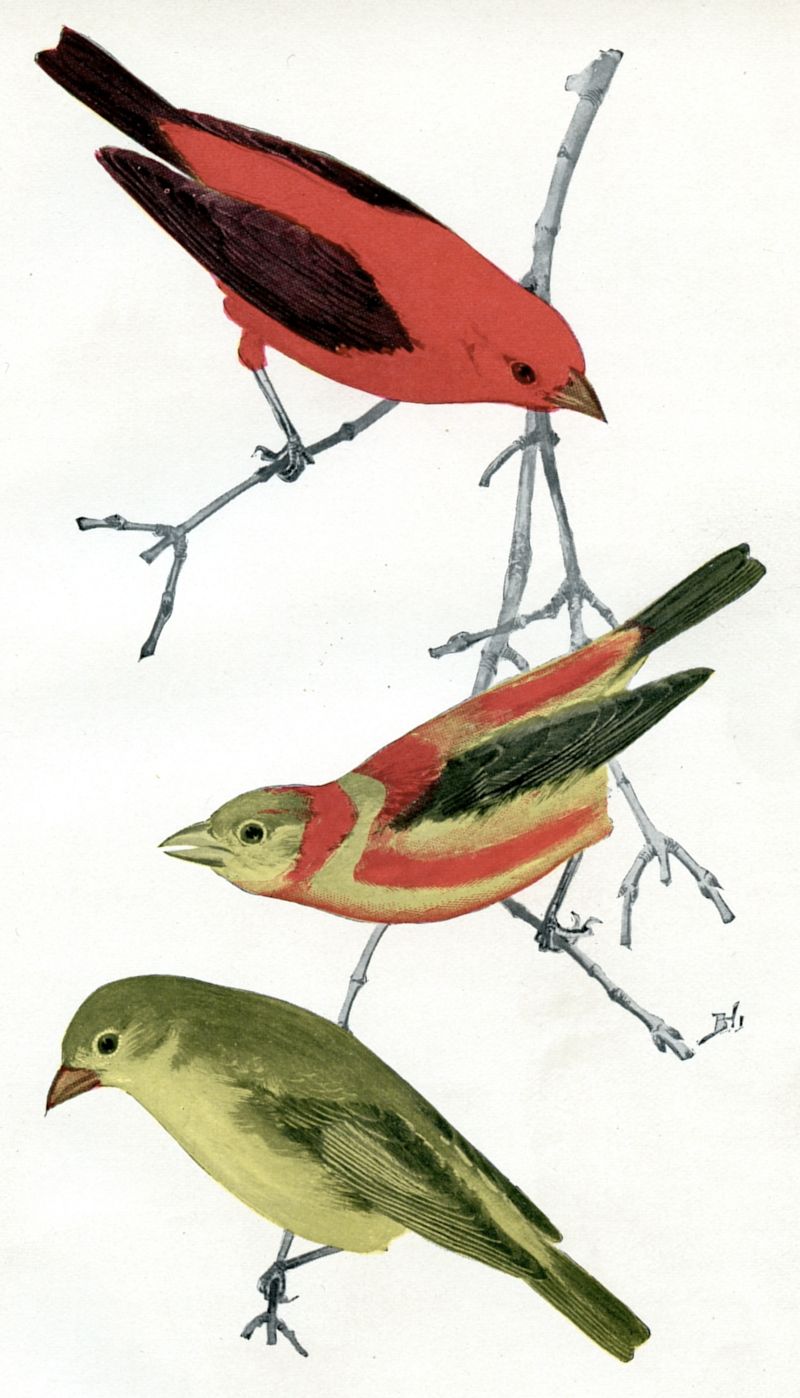
“This bird is one of the southern Sparrows, in size no
larger than a Chippy. Its plumage is tropical in its
beauty, deep blue head and neck, red underparts, glistening
green back, green-and-red wings, with a reddish
tail; in short, a glittering opal copied in feathers. Its
cage was roomy, and it had the best of food, and fresh
water for bathing and drinking, while the shelf in the
window, on which it stood, was filled with flowering plants,
up through the branches of which it could look. But,
oh, the expression of that bird’s body! I watched its
every motion; the head thrown backward, searching in
vain for a loophole of escape between the bars, the
quivering of its wings as the impulse for freedom, and
the company of its kind, swept over it! Sometimes,
late in the night, when I awoke and looked toward it,
I could see that it was awake and its wings trembling
with the thought of dawn that it could not fly to meet.
Then I knew, even if it became cowed, and forgot its
natural instincts so far as to be dumbly content as a
prisoner, that the real life of the bird would be as dead
as if a bullet had ended it, and though it was late winter,
February, I felt that I must give it liberty.
“I told my father, and he sympathized with me as usual,
listened to my story, and then, packing the cage safely,
had it sent by special express to a family friend, who was
wintering in Florida, with the request that she liberate
the prisoner. For, as we could not get it to its winter
haunt in the tropics, this seemed next best, and it would
soon meet the flocks of its kin on the return trip.
“So the bird was freed, and once more felt the joy of
being lifted on his wings whither he would go, and whatever
loneliness he may have suffered after that, he had
gained liberty, which is the right of the least of God’s
creatures.
“Of the four American birds that were most commonly
caged, the Mockingbird and Cardinal have always
been the most popular, and this is what some of the
writers have said about taking them into captivity.
Painted Bunting or Nonpareil
“This splendid, gay, and docile bird, known to Americans as
the Nonpareil (the unequalled), and to the French Louisianans as
le pape, inhabits the woods of the low countries of the Southern
states.
“For the sake of their song as well as beauty of plumage they
are commonly domesticated in the houses of the French inhabitants
of New Orleans and its vicinity. . . .
“They are commonly caught in trap-cages, to which they are
sometimes allured by a stuffed bird, which they descend to attack;
and they have been known to live in captivity for upwards
of ten years.”—Thomas Nuttall.
“The Mockingbird, as you see, has sombre gray
plumage like his cousin, the Catbird, that we all know so
well that I think he should drop a name that belies
his wonderful musical ability, and be called the ‘Northern
Mockingbird.’ Even though the Mocker is caged, you
can see the resemblance, in the way in which he twitches
his tail, and first throws back his beak and then looks
sideways, to our merry singer of the garden who often
makes us think that half a dozen birds are perching in
the drying-yard when he sits upon the top of a clothes-pole
and lets his imagination float away with his voice.
“The Brown Thrasher, too, with the long, curved beak,
brown back, and speckled breast, is also a first cousin
and has the Mockingbird habit of mounting high up
when he sings and looking straight up at the sky; while
the Wrens, one and all, belong to this famous family group
and come in, we may say, as second cousins, and like
the Mockingbird, aside from the beauty of song, are
very valuable insect eaters. The other three birds have
the conical beak that stamps them as members of the
family of Finches and Sparrows.
“Rich colour is the chief attribute that sets the Indigo
Bunting apart from its kin of the tribe of
Sparrows and Finches.
“Blue that is decided in tone, and not a bluish gray,
is one of the rarest hues among the birds of temperate
zones; for one may count the really blue birds of the
eastern United States upon the fingers of one hand.
“This Bunting belongs to the tree-loving and tree-nesting
part of his tribe, in company with the Grosbeaks,
and the brilliant yellow American Goldfinch,
whose black cap, wings, and tail-feathers only enhance
his beauty. The Sparrows, of sober stripes, nest on or
near the ground, and their plumage blends with brown
grass, twigs, and the general earth-colouring, illustrating
very directly the theory of colour protection, while
the birds of brilliant plumage invariably keep more
closely to the trees.
“In size the Indigo Bunting ranks with the small Sparrows,
coming in grade between the Field- and the Song Sparrows,
and being only slightly larger than the Chippy.
The female wears a modification of the Sparrow garb,
the upper parts being ashy brown without stripes, the
underparts grayish white, washed and very faintly
streaked with dull brown, the wings and tail-feathers having
some darker edges and markings.
“When it comes to painting the plumage of the male in
words, the task becomes difficult; for to use simply the
term indigo-blue is as inadequate as to say that a bit of
water that looks blue while in shadow, is of the same colour
when it ripples out into full sunlight and catches a dozen
reflections from foliage and sky. A merely technical
description would read: Front of head and chin rich
indigo-blue, growing lighter and greener on back and underparts;
wings dusky brown, with blue edges to coverts;
tail-feathers also blue edged; bill and feet dark; general
shape rounded and canary-like, resembling the Goldfinch.
“The last of May one of these Buntings came to a low
bush, outside my window, and, after resting awhile, for
the night before had been stormy, dropped to the closely
cut turf to feed upon the crumbs left where the hounds
had been munching their biscuits. I have never seen a
more beautiful specimen, and the contrast with the vivid
grass seemed to develop the colour of malachite that ran
along one edge of the feathers, shifting as the bird moved
like the sheen of changeable silk.
“The nest, in no wise typical, is a loose and rather careless
structure of grass, twigs, horsehairs, roots, or bits
of bark placed in a low, scrubby tree or bush at no great
distance from the ground, and the eggs are a very pale
blue or bluish white, and only three or four in number.
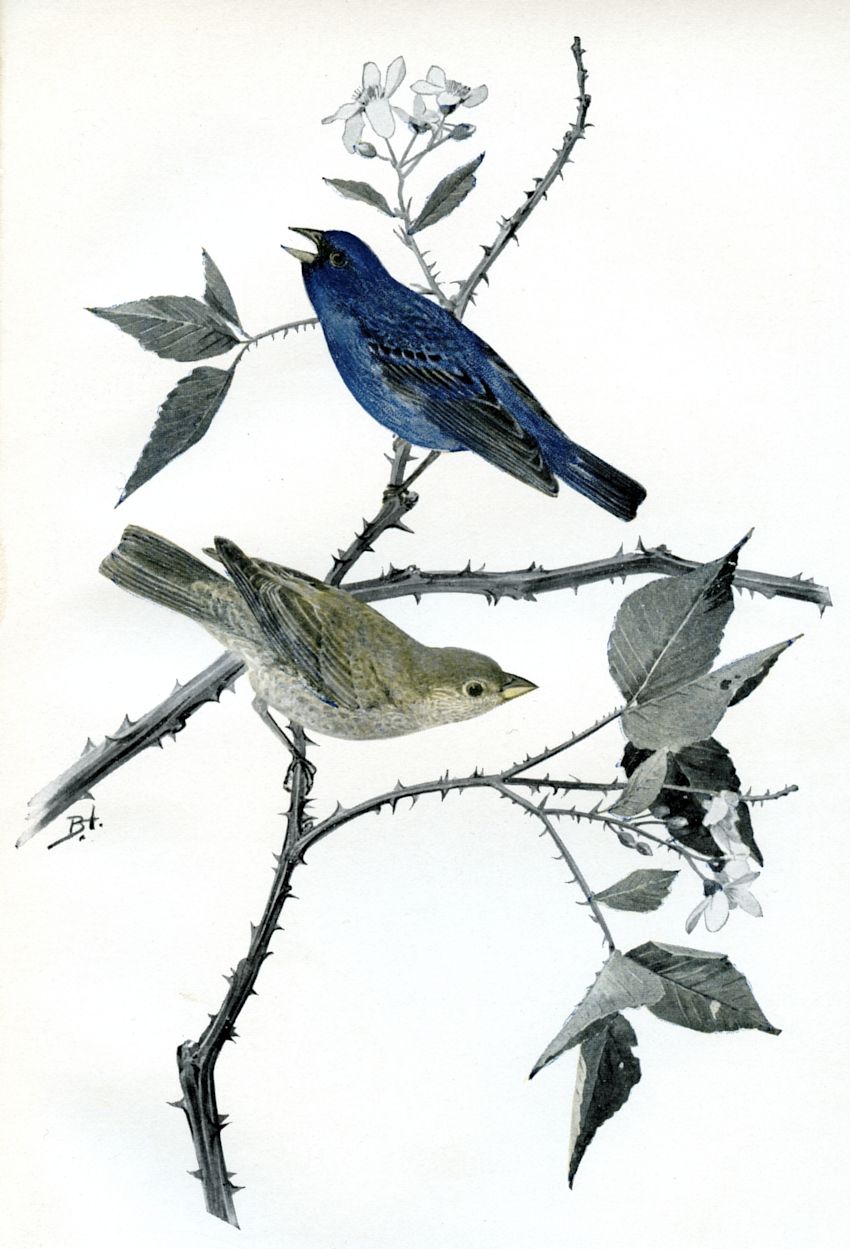
National Association of Audubon Societies
INDIGO BUNTING
(Upper figure, Male; Lower figure, Female)
Order—Passeres Family—Fringillidæ
Genus—Passerina Species—Cyanea
“Being a seed-eater, it is undoubtedly this Bunting’s
love of warmth that gives him so short a season with us:
for he does not come to the New England states until the
first week in May, and, after the August moult, when he
dons the sober clothing of his mate, he begins to work
southward by the middle of September,—those from the
most northerly portions of the breeding range, which
extends northward to Minnesota and Nova Scotia, having
passed by the tenth of October. He winters in Central
America and southward.
“Although of the insect-eating fraternity of the conical
beak, the Indigo Bunting consumes many noxious insects
in the nesting season, when the rapid growth of the
young demands animal food, no matter to what race
they belong. Being an inhabitant of the overgrown
edges of old pastures, or the brushy fences of clearings
and pent roads, he is in a position where he can do a
great deal of good. Mr. Forbush, in his valuable book on
Useful Birds and Their Protection, credits the Indigo
Bunting with being a consumer of the larvæ of the mischievous
brown-tail moth; but whatever service it may do
as an insect destroyer, its service the year through as
a consumer of weed seeds, in common with the rest of its
tribe, is beyond dispute.
“The voice of the Indigo Bunting is pretty rather than
impressive, and varies much in individuals. It consists
of a series of hurried, canary-like notes repeated constantly
and rising in key, but, to my mind, never reaching the
dignity of being called impressive song.
“Nuttall, one of the early American Wise Men, writes
that, though usually shy, the Indigo-bird, during the season,
is more frequently seen near habitations than in remote
thickets: ‘Their favourite resort is the garden, where,
from the topmost branch of some tall tree that commands
the whole wide landscape, the male regularly pours out
his lively chant and continues it for a considerable length
of time. Nor is this song confined to the cool and animating
dawn of morning, but it is renewed, and still more
vigorous, during the noonday heat of summer. This
lively strain is composed of a repetition of short notes,
which, commencing loud and rapid, and then slowly
falling, descend almost to a whisper, succeeded by a silence
of almost half a minute, when the song is again continued
as before.
“ ‘In the village of Cambridge (Massachusetts), I have
seen one of these azure, almost celestial musicians, regularly
chant to the inmates of a tall dwelling-house from
the summit of the chimney or the tall fork of the lightning-rod.
I have also heard a Canary repeat and imitate
the low lisping trill of the Indigo-bird, whose warble,
indeed, often resembles that of this species.’
“This combination of musical ability, lovely plumage,
and its seed-eating qualities long since has made the
Indigo Bunting in danger of extermination, through the
fact of its being universally, throughout the South, captured
and sold as a cage-bird, both for home use and for
export. In that section the bird is called the ‘blue pop,’
a corruption of ‘bleu pape,’ or ‘pope,’ of the French.
“The Cardinal, called ‘Grosbeak’ from the thickness and
size of its bill, is of course a very conspicuous bird wherever
seen, and therefore has always been a mark for
the ‘arrow of death,’ as Mr. Allen, who knows
this bird in its native haunts, and its every mood, puts it.
Some day when you are older you will read his story of it
as it lives in the deep recesses of the evergreen woods,
called The Kentucky Cardinal. For though this bird is
found nesting as far north as Central Park, New York,
and it has once or twice come to my garden here, and
gone into Massachusetts even, in the fall roving-time, we
must always associate him with a long outdoor season
and sunny skies, as we do the Mockingbird.
“If the Mocker suffered for his voice, the Cardinal was
made a prisoner for his song and gorgeous colour combined,
and though, as is bird law in such cases, the female is dull
in colour, she has a very attractive song also, even in confinement.
But I hope that these prison days are over.
Whoever now confines the Cardinal is a law-breaker as
well as a heart-breaker, and yet, but ten years ago, every
bird-store window was aglow with the colour of the Cardinal’s
mantle. I have here in the scrap-book a charming
story that you will like to hear, of a Cardinal in Boston,
made a temporary captive for its own preservation, and of
its release when the right time came.”
THE CARDINAL AT THE HUB
His range being southern, Cardinal Grosbeak seldom
travels through New England; and, to my knowledge, has
never established a home and reared a family north of
Connecticut until in the instance here recorded. Kentuckians
claim him, and with some show of right, since
James Lane Allen built his monument in imperishable
prose. But, soon or late, all notables come to Boston,
and among them may now be registered the “Kentucky
Cardinal.”
Shy by nature, conspicuous in plumage, he shuns publicity;
and avoiding the main lines of travel, he puts up
at a quiet country house in a Boston suburb—Brookline.
Here, one October day in 1897, among the migrants
stopping at this halfway house, appeared a distinguished
guest, clad in red, with a black mask, a light red bill, and
a striking crest; with him a bird so like him that they
might have been called the two Dromios. After a few
days the double passed on, and left our hero the only red-coat
in the field. A White-throated Sparrow now arrived
from the mountains, and a Damon-and-Pythias friendship
sprang up between the birds. Having decided to winter
at the North, they took lodgings in a spruce tree, and
came regularly to the table d’hôte on the porch. My lord
Cardinal, being the more distinguished guest, met with
particular favour, and soon became welcome at the homes
of the neighbourhood. With truly catholic taste, he
refused creature-comforts from none, but showed preference
for his first abode.
It was March 5, 1898, when we kept our first appointment
with the Cardinal. A light snow had fallen during
the night, and the air was keen, without premonition of
spring. It was a day for home-keeping birds, the earth
larder being closed. The most delicate tact was required
in presenting strangers. A loud, clear summons—the
Cardinal’s own whistle echoed by human lips—soon
brought a response. Into the syringa bush near the porch
flew, with a whir and a sharp tsip, a bird. How gorgeous
he looked in the snow-laden shrub! For an instant the
syringa blossoms loaded the air with fragrance as a dream
of summer floated by. Then a call to the porch was met
by several sallies and quick retreats, while the wary bird
studied the newcomers. Reassuring tones from his gentle
hostess, accompanied by the rattle of nuts and seeds,
at last prevailed, and the Cardinal flew to the railing, and
looked us over with keen, inquiring eye. Convinced that
no hostilities were intended, he gave a long, trustful look
into the face of his benefactress and flew to her feet.
A gray squirrel, frisking by, stopped at the lunch-counter
and seized an “Educator” cracker.
The novel sensation of an uncaged bird within touch,
where one might notice the lovely shading of his plumage
as one notes a flower, was memorable; but a sweeter
surprise was in store. As we left the house, having made
obeisance to his eminence, the Cardinal, the bird flew into
a spruce tree and saluted us with a melodious “Mizpah.”
Then, as if reading the longing of our hearts, he opened
his bright bill, and a song came forth such as never before
enraptured the air of a New England March,—a song so
copious, so free, so full of heavenly hope, that it seemed
as if forever obliterated were the “tragic memories of his
race.”
As March advanced, several changes in the Cardinal were
noted by his ever-watchful friends. He made longer trips
abroad, returning tired and hungry. The restlessness of
the unsatisfied heart was plainly his. His long, sweet,
interpolating whistle, variously rendering “Peace . . .
peace . . . peace!” “Three cheers, three cheers,” etc.,
to these sympathetic northern ears became “Louise,
Louise, Louise!” Thenceforth he was Louis, the Cardinal,
calling for his mate.
On March 26, a kind friend took pity on the lonely
bachelor, and a caged bird, “Louise,” was introduced to
him. In the lovely dove-coloured bird, with faint washings
of red, and the family mask and crest, the Cardinal at
once recognized his kind. His joy was unbounded, and
the acquaintance progressed rapidly, a mutual understanding
being plainly reached during the seventeen days
of cage courtship. Louis brought food to Louise, and
they had all things in common, except liberty.
April 12, in the early morning, the cage was taken out-of-doors,
and Louise was set free. She was quick to embrace
her chance, and flew into the neighbouring shrubbery.
For six days she revelled in her new-found freedom,
Louis, meanwhile, coming and going as of old, and often
carrying away seeds from the house to share with his
mate.
April 16, he lured her into the house, and after that
they came often for food, flying fearlessly in at the window,
and delighting their friends with their songs and
charming ways. Louis invariably gave the choicest
morsels to his mate, and the course of true love seemed to
cross the adage; but, alas! Death was already adjusting
an arrow for that shining mark.
April 25, Louise stayed in the house all day, going out
at nightfall. Again the following day she remained indoors,
Louis feeding her; but her excellent appetite disarmed
suspicion, and it was thought that she had taken
refuge from the cold and rain, especially as she spent the
night within. The third morning, April 27, she died. An
examination of her body showed three dreadful wounds.
Louis came twittering to the window, but was not let
in until a day or two later, when a new bird, “Louisa,”
had been put in the cage. When he saw the familiar
form, he evidently thought his lost love restored, for he
burst into glorious song; but, soon discovering his mistake,
he stopped short in his hallelujahs, and walked
around the cage inspecting the occupant.
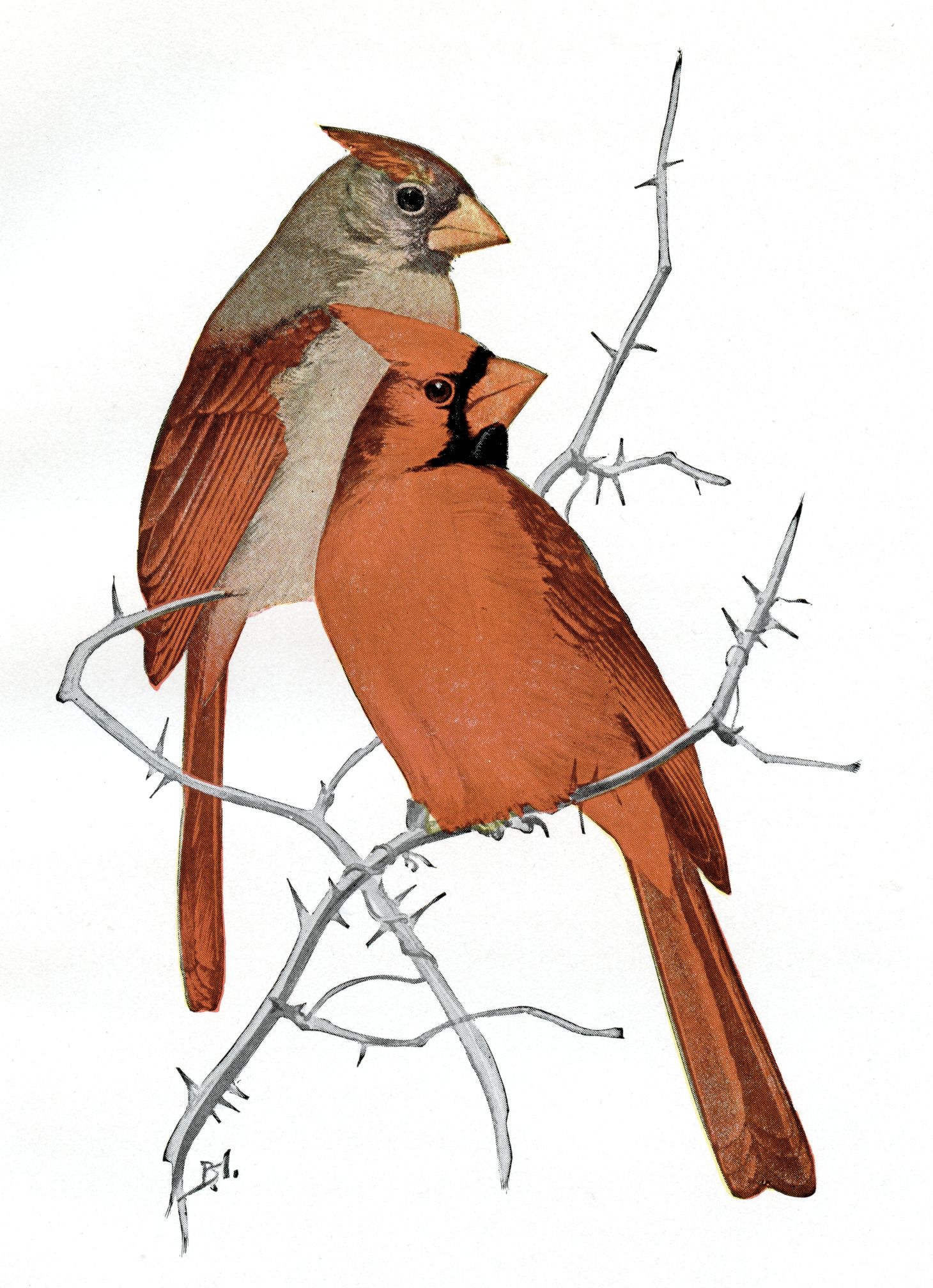
National Association of Audubon Societies
CARDINAL
Upper Figure, Female; Lower Figure, Male.
Louisa’s admiration for the Cardinal was marked; but
for some days he took little notice of her, and his friends
began to fear that their second attempt at match-making
would prove a failure. April 30, however, some responsive
interest was shown, and the next day Louis brought
to the cage a brown bug, half an inch long, and gave Louisa
his first meat-offering.
The second wooing progressed rapidly, and May 7, when
Louisa was set free, the pair flew away together with unrestrained
delight. After three days of liberty, Louisa
flew back to the house with her mate, and thenceforth was
a frequent visitor.
May 21, Louisa was seen carrying straws, and on June 6
her nest was discovered low down in a dense evergreen
thorn. Four speckled eggs lay in the nest. These were
hatched June 9, the parent birds, meantime and afterward,
going regularly to market, and keeping up social relations
with their friends.
In nine days after their exit from the shell, the little
Cardinals left the nest and faced life’s sterner realities.
A black cat was their worst foe, and more than once,
during their youth, Louis flew to his devoted commissary
and made known his anxiety. Each time, on following
him to the nest, she found the black prowler, or one of his
kind, watching for prey. On June 28, the black cat outwitted
the allied forces, Señor Cardinal and his friends,
and a little one was slain. The other three grew up, and
enjoyed all the privileges of their parents, flying in at
the window, and frequenting the bountiful porch.
July 25, Louisa disappeared from the scene, presumably
on a southern trip, leaving the Cardinal sole protector,
provider, and peacemaker for their lively and quarrelsome
triplet. A fight is apparently as needful for the
development of a young Cardinal as of an English schoolboy,
possibly due in both cases to a meat diet.
Overfeeding was but temporary with our birds. On
the 8th of August the migratory instinct prevailed over
ease, indulgence, friendship, and the Cardinal with his
brood left the house, where he had been so well entertained,
to return no more. No more? Who shall say of
any novel that it can have no sequel? Massachusetts may
yet become the permanent home of the Kentucky Cardinal,
the descendant to the third and fourth generation of Louis
and his mate.
—Ella Gilbert Ives, in Bird-Lore.
As Gray Lady read the story of the Cardinal, the children,
between listening to it and being intent on their
work, forgot the Mockingbird in the window, upon whom
the rays of the sun, that had gradually managed to pierce
the clouds, were resting.
As her mother finished and paused, Goldilocks, with a
very slight gesture, directed their glance toward the window,
where the Mockingbird, having completed his toilet and
meal, perched, wings slightly raised and quivering, with
half-closed eyes, murmuring a few broken snatches of song,
half to himself and half as if in a dream, his head thrown
back and, oh, such a human expression of longing in his
attitude, that Gray Lady, without speaking, turned the
leaves of her scrap-book slowly until she came to a place
where the long line of prose shortened to verse, and then
in a low but distinct voice she read:—