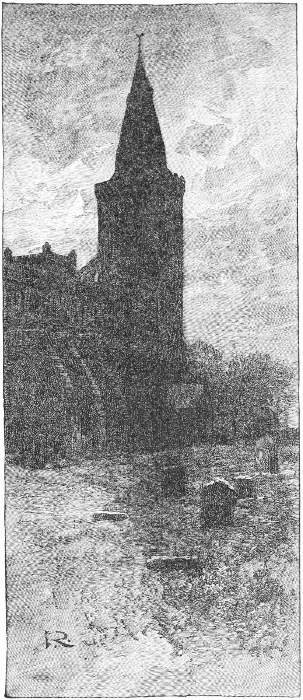
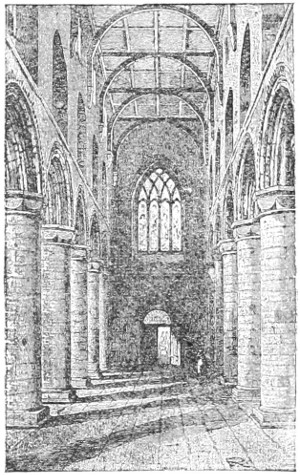
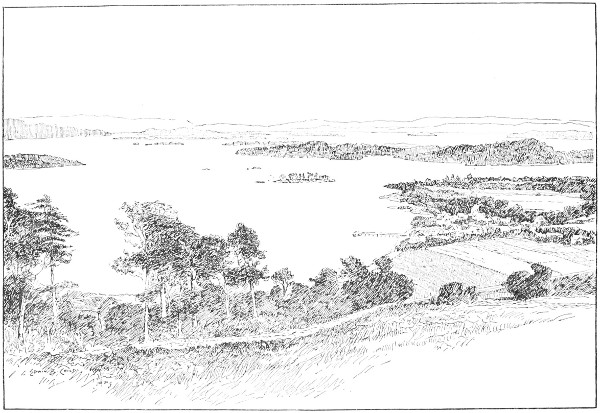
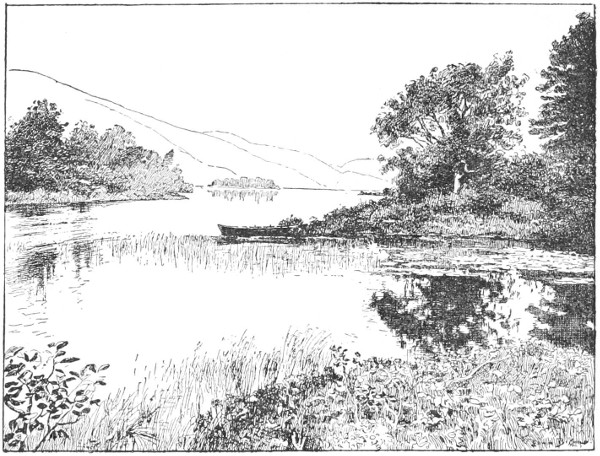
PREFACE TO THE ILLUSTRATED EDITION OF GRAY DAYS AND GOLD
This book, containing description of my Gray Days in
England and Scotland, has, in a miniature form, passed
through several editions, and it has been received by the
public with exceptional sympathy and abundant practical
favour. Its publishers are, therefore, encouraged to present
it in a more opulent style, and with the embellishment
of pictorial illustrations. Its success,—and indeed
the success which has attended all my books,—is deeply
gratifying to me, the more so that I did not expect it.
My sketches of travel were the unpremeditated creations
of genial impulse, and I did not suppose that they would
endure beyond the hour. If I had anticipated the remarkably
cordial approbation which has been accorded to my
humble studies of British scenery and life, I should have
tried to make them better, and, especially, I should have
taken scrupulous care to verify every date and every historic
statement set forth in my text. That precaution, at
first, I did not invariably take, but as my mood was that
of contemplation and reverie, so my method was that of the
dreamer, who drifts carelessly from one beautiful thing to
another, uttering simply whatever comes into his thoughts.
In preparing the text for this edition of Gray Days, however,
and also in preparing the text of Shakespeare's
England for the pictorial edition, I have carefully revised
my sketches, and have made a studious and conscientious
endeavour to correct every mistake and to remove every
defect. The chapters on Clopton and Devizes have been
considerably augmented, and the record of Shakespearean
affairs at Stratford-upon-Avon has been continued to the
present time. A heedless error in my chapter on Worcester,
respecting the Shakespeare marriage bond, has been
rectified, and in various ways the narrative has been
made more authentic, the historical embellishment more
complete, and, perhaps, the style more flexible and more
concise.
Eight of the papers in this volume relate to Scotland.
My first visit to that romantic country was made in
1888, and was limited to the lowlands, but since that
time I have had the privilege of making several highland
rambles, and, in particular, of passing thoughtful days in
the lovely island of Iona,—one of the most interesting
places in Europe,—and those readers who may care to
keep me company beyond the limits of this work will
find memorials of those wanderings and that experience
in my later books, called Old Shrines and Ivy and
Brown Heath and Blue Bells.
W. W.
July 15, 1896.
PREFACE
This book, a companion to Shakespeare's England,
relates to the gray days of an American wanderer in the
British islands, and to the gold of thought and fancy
that can be found there. In Shakespeare's England
an attempt was made to depict, in an unconventional
manner, those lovely scenes that are intertwined with the
name and the memory of Shakespeare, and also to reflect
the spirit of that English scenery in general which, to an
imaginative mind, must always be venerable with historic
antiquity and tenderly hallowed with poetic and romantic
association. The present book continues the same treatment
of kindred themes, referring not only to the land
of Shakespeare, but to the land of Burns and Scott.
After so much had been done, and superbly done, by
Washington Irving and by other authors, to celebrate the
beauties of our ancestral home, it was perhaps an act of
presumption on the part of the present writer to touch
those subjects. He can only plead, in extenuation of his
boldness, an irresistible impulse of reverence and affection
for them. His presentment of them can give no offence,
and perhaps it may be found sufficiently sympathetic and
diversified to awaken and sustain at least a momentary
interest in the minds of those readers who love to muse
and dream over the relics of a storied past. If by happy
fortune it should do more than that,—if it should help
to impress his countrymen, so many of whom annually
travel in Great Britain, with the superlative importance
of adorning the physical aspect and of refining the material
civilisation of America by a reproduction within its
borders of whatever is valuable in the long experience
and whatever is noble and beautiful in the domestic and
religious spirit of the British islands,—his labour will
not have been in vain. The supreme need of this age in
America is a practical conviction that progress does not
consist in material prosperity but in spiritual advancement.
Utility has long been exclusively worshipped.
The welfare of the future lies in the worship of beauty.
To that worship these pages are devoted, with all that it
implies of sympathy with the higher instincts and faith
in the divine destiny of the human race.
Many of the sketches here assembled were originally
printed in the New York Tribune, with which journal
their author has been continuously associated, as dramatic
reviewer and as an editorial contributor, since August,
1865. They have been revised for publication in this
form. Part of the paper on Sir Walter Scott first
appeared in Harper's Weekly, for which periodical the
author has occasionally written. The paper on the
Wordsworth country was contributed to the New York
Mirror. The alluring field of Scottish antiquity and
romance, which the author has ventured but slightly to
touch, may perhaps be explored hereafter, for treasures
of contemplation that earlier seekers have left ungathered.
[This implied promise has since been fulfilled, in Brown
Heath and Blue Bells, 1895.]
The fact is recorded that an important recent book,
1890, called Shakespeare's True Life, written by James
Walter, incorporates into its text, without credit, several
passages of original description and reflection taken from
the present writer's sketches of the Shakespeare country,
published in Shakespeare's England, and also quotes, as
his work, an elaborate narrative of a nocturnal visit to
Anne Hathaway's cottage, which he never wrote and
never claimed to have written. This statement is made
as a safeguard against future injustice.
Transcriber's Note: Page numbers link
to the top of the page and show the illustrated header.
Chapter names link to the chapter heading, below the header.
"Whatever withdraws us from the power of our senses, whatever
makes the past, the distant, or the future predominate over the present,
advances us in the dignity of thinking beings.... All travel has
its advantages. If the passenger visits better countries he may learn
to improve his own, and if fortune carries him to worse he may
learn to enjoy it."
DR. JOHNSON.
"There is given,
Unto the things of earth which time hath bent,
A spirit's feeling; and where he hath leant
His hand, but broke his scythe, there is a power
And magic in the ruined battlement,
For which the palace of the present hour
Must yield its pomp, and wait till ages are its dower."
BYRON.
"The charming, friendly English landscape! Is there any in
the world like it? To a traveller returning home it looks so kind,—it
seems to shake hands with you as you pass through it."
London, June 29, 1888.—The poet Emerson's
injunction, "Set not thy foot on
graves," is wise and right; and being in
merry England in the month of June it
certainly is your own fault if you do not
fulfil the rest of the philosophical commandment and
"Hear what wine and roses say." Yet the history of
England is largely written in her ancient churches and
crumbling ruins, and the pilgrim to historic and literary
shrines in this country will find it difficult to avoid setting
his foot on graves. It is possible here, as elsewhere,
to live entirely in the present; but to certain
temperaments and in certain moods the temptation is
irresistible to live mostly in the past. I write these
words in a house which, according to local tradition,
was once occupied by Nell Gwynn, and as I glance into
the garden I see a venerable acacia that was planted by
her fair hands, in the far-off time of the Merry Monarch.
Within a few days I have stood in the dungeon
of Guy Fawkes, in the Tower, and sat at luncheon in
a manor-house of Warwickshire wherein were once convened
the conspirators of the Gunpowder Plot. The
newspapers of this morning announce that a monument
will be dedicated on July 19 to commemorate the defeat
of the Spanish Armada, three hundred years ago. It is
not unnatural that the wanderer should live in the past,
and often should find himself musing over its legacies.
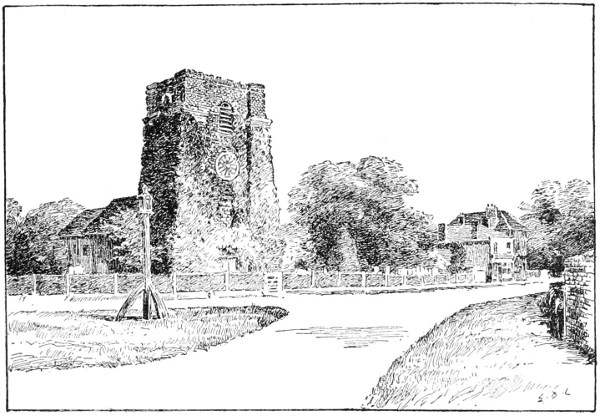
Stoke-Pogis Churchyard.
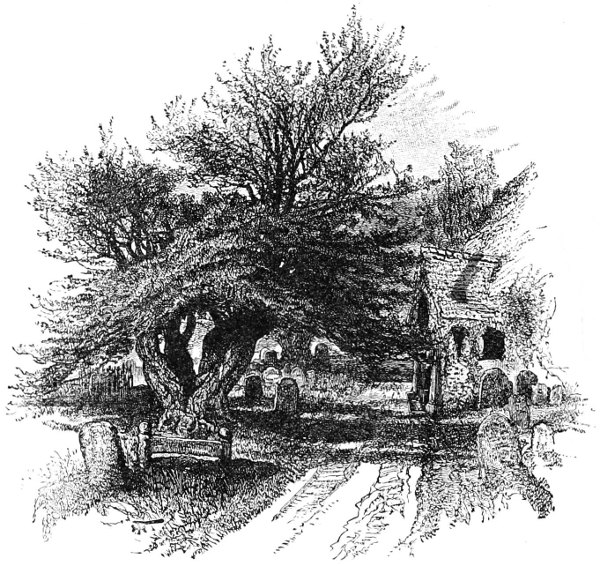
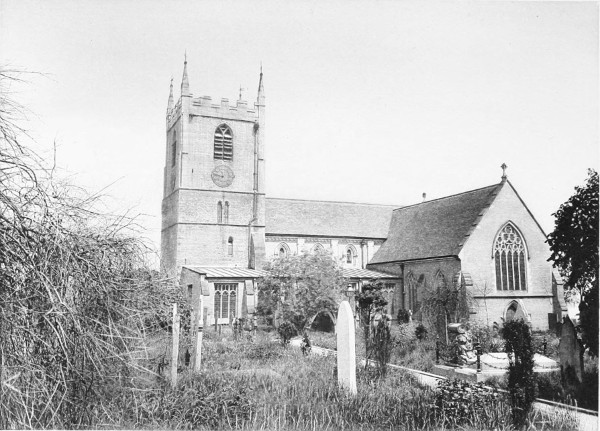
One of the most sacred spots in England is the
churchyard of Stoke-Pogis. I revisited that place on
June 13 and once again rambled and meditated in
that hallowed haunt. Not many months ago it seemed
likely that Stoke Park would pass into the possession
of a sporting club, and be turned into a race-course
and kennel. A track had already been laid there.
Fate was kind, however, and averted the final disaster.
Only a few changes are to be noted in that
part of the park which to the reverent pilgrim must
always be dear. The churchyard has been extended
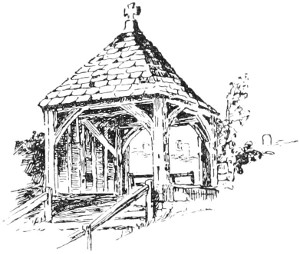
in front, and a solid wall of flint, pierced with a lych-gate,
richly carved, has replaced the plain fence, with
its simple turnstile, that formerly enclosed that rural
cemetery. The additional land was given by the new
proprietor of Stoke Park, who wished that his tomb
might be made in it; and this has been built, beneath
a large tree not far from the entrance. The avenue
from the gate to the church has been widened, and it
is now fringed with thin lines of twisted stone; and
where once stood only two or three rose-trees there
are now sixty-two,—set in lines on either side of the
path. But the older part of the graveyard remains
unchanged. The yew-trees cast their dense shade, as
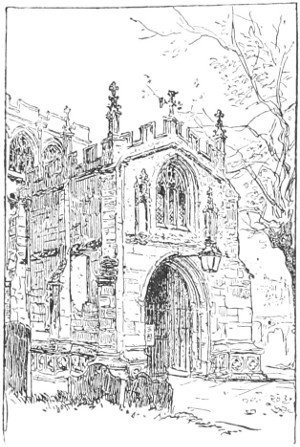
of old. The quaint porch of the sacred building has
not suffered under the hand of restoration. The
ancient wooden memorials of the dead continue to
moulder above their ashes. And still the abundant
ivy gleams and trembles in the sunshine and in the
summer wind that plays so sweetly over the spired
tower and dusky walls of this lovely temple—
"All green and wildly fresh without,
but worn and gray beneath."
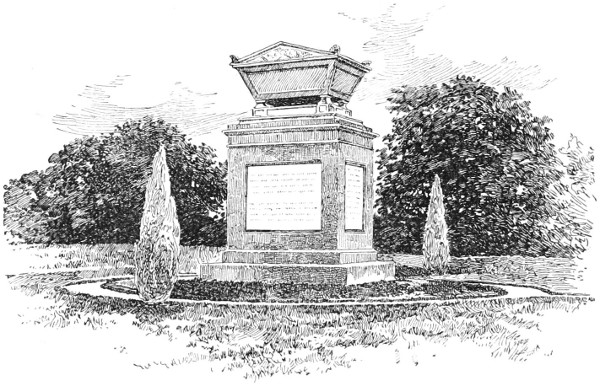
Gray's Monument.
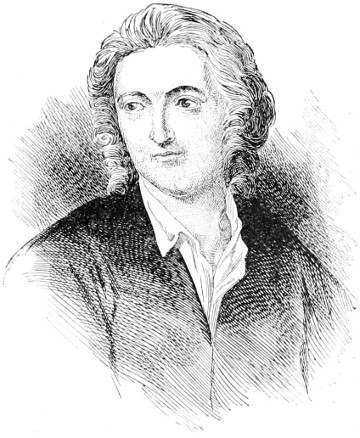
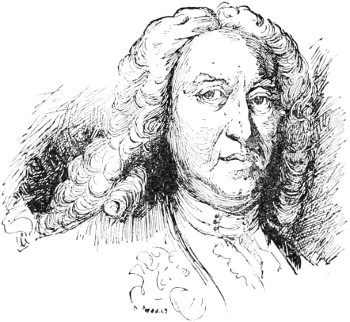
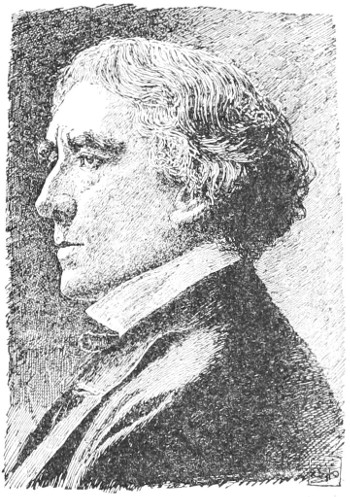
Thomas Gray.
It would still be a lovely church, even if it were not
associated with the immortal Elegy. I stood for a long
time beside the tomb of the noble and tender poet and
looked with deep emotion on the surrounding scene of
pensive, dream-like beauty,—the great elms, so dense
of foliage, so stately and graceful; the fields of deep,
waving grass, golden with buttercups and white with
daisies; the many unmarked mounds; the many mouldering
tombstones; the rooks sailing and cawing around
the tree-tops; and over all the blue sky flecked with
floating fleece. Within the church nothing has been
changed. The memorial window to Gray, for which
contributions have been taken during several years,
has not yet been placed. As I cast a farewell look
at Gray's tomb, on turning to leave the churchyard, it
rejoiced my heart to see that two American girls, who
had then just come in, were placing fresh flowers over
the poet's dust. He has been buried more than a hundred
years,—but his memory is as bright and green as
the ivy on the tower within whose shadow he sleeps,
and as fragrant as the roses that bloom at its base.
Many Americans visit Stoke-Pogis churchyard, and no
visitor to the old world, who knows how to value what
is best in its treasures, will omit that act of reverence.
The journey is easy. A brief run by railway from Paddington
takes you to Slough, which is near to Windsor,
and thence it is a
charming drive, or
a still more charming
walk, mostly
through green, embowered
lanes, to
the "ivy-mantled
tower," the "yew-trees'
shade," and
the simple tomb of
Gray. What a gap
there would be in
the poetry of our
language if the
Elegy in a Country
Churchyard were absent
from it! By
that sublime and tender reverie upon the most important
of all subjects that can engage the attention of the
human mind Thomas Gray became one of the chief benefactors
of his race. Those lines have been murmured by
the lips of sorrowing affection beside many a shrine of
buried love and hope, in many a churchyard, all round
the world. The sick have remembered them with comfort.
The great soldier, going into battle, has said them
for his solace and cheer. The dying statesman, closing
his weary eyes upon this empty world, has spoken them
with his last faltering accents, and fallen asleep with
their heavenly music in his heart. Well may we pause
and ponder at the grave of that divine poet! Every
noble mind is made nobler, every good heart is made
better, for the experience of such a pilgrimage. In
such places as these pride is rebuked, vanity is dispelled,
and the revolt of the passionate human heart is
humbled into meekness and submission.
All Saints' Church, Laleham.
There is a place kindred with Stoke-Pogis churchyard,
a place destined to become, after a few years, as
famous and as dear to the heart of the reverent pilgrim
in the footsteps of genius and pure renown. On Sunday
afternoon, June 17, I sat for a long time beside the
grave of Matthew Arnold. It is in a little churchyard
at Laleham, in Surrey, where he was born. The day
was chill, sombre, and, except for an occasional low
twitter of birds and the melancholy cawing of distant
rooks, soundless and sadly calm. So dark a sky might
mean November rather than June; but it fitted well
with the scene and with the pensive thoughts and feelings
of the hour. Laleham is a village on the south
bank of the Thames, about thirty miles from London
and nearly midway between Staines and Chertsey. It
consists of a few devious lanes and a cluster of houses,
shaded with large trees and everywhere made beautiful
with flowers, and it is one of those fortunate and happy
places to which access cannot be obtained by railway.
There is a manor-house in the centre of it, secluded in
a walled garden, fronting the square immediately opposite
to the village church. The rest of the houses
are mostly cottages, made of red brick and roofed with
red tiles. Ivy flourishes, and many of the cottages are
overrun with climbing roses. Roman relics are found
in the neighbourhood,—a camp near the ford, and other
indications of the military activity of Cæsar. The
church, All Saints', is of great antiquity. It has been
in part restored, but its venerable aspect is not impaired.
The large low tower is of brick, and this and the church
walls are thickly covered with glistening ivy. A double-peaked
roof of red tiles, sunken here and there, contributes
to the picturesque beauty of this building, and its
charm is further heightened by the contiguity of trees,
in which the old church seems to nestle. Within there
are low, massive pillars and plain, symmetrical arches,—the
remains of Norman architecture. Great rafters
of dark oak augment, in this quaint structure, the air of
solidity and of an age at once venerable and romantic,
while a bold, spirited, beautiful painting of Christ and
Peter upon the sea imparts to it an additional sentiment
of sanctity and solemn pomp. That remarkable work
is by George Henry Harlow, and it is placed back of
the altar, where once there would have been, in the
Gothic days, a stained window. The explorer does not
often come upon such a gem of a church, even in
England,—so rich in remains of the old Catholic zeal
and devotion; remains now mostly converted to the use
of Protestant worship.
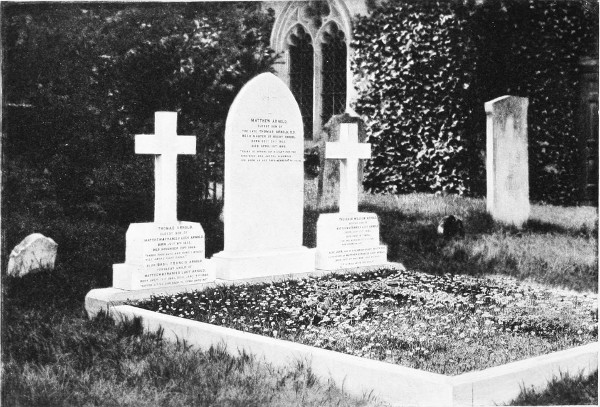
ARNOLD'S GRAVE
The churchyard of All Saints' is worthy of the
church,—a little enclosure, irregular in shape, surface,
shrubbery, and tombstones, bordered on two sides by
the village square and on one by a farmyard, and
shaded by many trees, some of them yews, and some of
great size and age. Almost every house that is visible
near by is bowered with trees and adorned with flowers.
No person was anywhere to be seen, and it was only
after inquiry at various dwellings that the sexton's abode
could be discovered and access to the church obtained.
The poet's grave is not within the church, but in a
secluded spot at the side of it, a little removed from the
highway, and screened from immediate view by an
ancient, dusky yew-tree. I readily found it, perceiving
a large wreath of roses and a bunch of white flowers
that were lying upon it,—recent offerings of tender
remembrance and sorrowing love, but already beginning
to wither. A small square of turf, bordered with
white marble, covers the vaulted tomb of the poet and of
three of his children.[2] At the head are three crosses of
white marble, alike in shape and equal in size, except
that the first is set upon a pedestal a little lower than
those of the others. On the first cross is written:
"Basil Francis Arnold, youngest child of Matthew and
Frances Lucy Arnold. Born August 19, 1866. Died
January 4, 1868. Suffer little children to come unto
me." On the second: "Thomas Arnold, eldest child
of Matthew and Frances Lucy Arnold. Born July 6,
1852. Died November 23, 1868. Awake, thou, Lute
and Harp! I will awake right early." On the third:
"Trevenen William Arnold, second child of Matthew
and Frances Lucy Arnold. Born October 15, 1853.
Died February 16, 1872. In the morning it is green
and groweth up." Near by are other tombstones, bearing
the name of Arnold,—the dates inscribed on them
referring to about the beginning of this century. These
mark the resting-place of some of the poet's kindred.
His father, the famous Dr. Arnold of Rugby, rests in
Rugby chapel,—that
noble father, that true
friend and servant of
humanity, of whom the
son wrote those words
of imperishable nobility
and meaning, "Thou,
my father, wouldst not
be saved alone." Matthew
Arnold is buried
in the same grave with
his eldest son and side
by side with his little
children. He who was
himself as a little child,
in his innocence, goodness,
and truth,—where
else and how else could he so fitly rest? "Awake, thou,
Lute and Harp! I will awake right early."
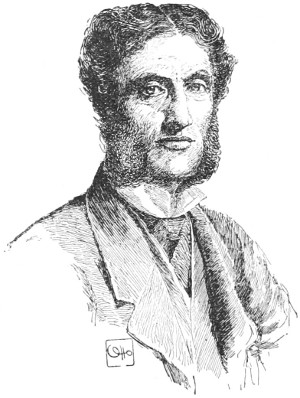
Matthew Arnold.
Every man will have his own thoughts in such a place
as this; will reflect upon his own afflictions, and from
knowledge of the manner and spirit in which kindred
griefs have been borne by the great heart of intellect
and genius will seek to gather strength and patience to
endure them well. Matthew Arnold taught many lessons
of great value to those who are able to think. He
did not believe that happiness is the destiny of the
human race on earth, or that there is a visible ground
for assuming that happiness in this mortal condition is
one of the inherent rights of humanity. He did not
think that this world is made an abode of delight by the
mere jocular affirmation that everything in it is well and
lovely. He knew better than that. But his message,
delivered in poetic strains that will endure as long as
our language exists, is the message, not of gloom and
despair, but of spiritual purity and sweet and gentle
patience. The man who heeds Matthew Arnold's
teaching will put no trust in creeds and superstitions,
will place no reliance upon the transient structures of
theology, will take no guidance from the animal and
unthinking multitude; but he will "keep the whiteness
of his soul"; he will be simple, unselfish, and sweet;
he will live for the spirit; and in that spirit, pure, tender,
fearless, strong to bear and patient to suffer, he
will find composure to meet the inevitable disasters of
life and the awful mystery of death. Such was the
burden of my thought, sitting there, in the gloaming,
beside the lifeless dust of him whose hand had once,
with kindly greeting, been clasped in mine. And such
will be the thought of many and many a pilgrim who
will stand in that sacred place, on many a summer evening
of the long future—
"While the stars come out and the night wind
Brings, up the stream,
Murmurs and scents of the infinite sea."
CHAPTER II HAUNTED GLENS AND HOUSES
Warwick, July 6, 1888.—One night,
many years ago[3] a brutal murder was
done, at a lonely place on the highroad
between Charlecote Park and
Stratford-upon-Avon. The next morning
the murdered man was found lying
by the roadside, his mangled head resting in a small
hole. The assassins were shortly afterward discovered,
and they were hanged at Warwick. From that day to
this the hole wherein the dead man's head reposed
remains unchanged. No matter how often it may be
filled, whether by the wash of heavy rains or by stones
and leaves that wayfarers may happen to cast into it as
they pass, it is soon found to be again empty. No one
takes care of it. No one knows whether or by whom
it is guarded. Fill it at nightfall and you will find it
empty in the morning. That is the local belief and
affirmation. This spot is two miles and a half north of
Stratford and three-quarters of a mile from the gates of
Charlecote Park. I looked at this hole one bright day
in June and saw that it was empty. Nature, it is
thought by the poets, abhors complicity with the concealment
of crime, and brands with her curse the places
that are linked with the shedding of blood. Hence the
strong lines in Hood's poem of Eugene Aram:
"And a mighty wind had swept the leaves,
And still the corse was bare."
Hampton Lucy.
There are many haunted spots in Warwickshire.
The benighted peasant never lingers on Ganerslie
Heath,—for there, at midnight, dismal bells have been
heard to toll, from Blacklow Hill, the place where Sir
Piers Gaveston, the corrupt, handsome, foreign favourite
of King Edward the Second, was beheaded, by order
of the grim barons whom he had insulted and opposed.
The Earl of Warwick led them, whom Gaveston had
called the Black Dog of Arden. This was long ago.
Everybody knows the historic incident, but no one can
so completely realise it as when standing on the place.
The scene of the execution is marked by a cross, erected
by Mr. Bertie Greathead, bearing this inscription: "In
the hollow of this rock was beheaded, on the first day
of July 1312, by Barons lawless as himself, Piers Gaveston,
Earl of Cornwall. In life and death a memorable
instance of misrule." [Hollinshed says that the execution
occurred on Tuesday, June 20.] No doubt the
birds were singing and the green branches of the trees
were waving in the summer wind, on that fatal day,
just as they are at this moment. Gaveston was a man
of much personal beauty and some talent, and only
twenty-nine years old. It was a melancholy sacrifice
and horrible in the circumstances that attended it. No
wonder that doleful thoughts and blood-curdling sounds
should come to such as walk on Ganerslie Heath in the
lonely hours of the night.
Another haunted place is Clopton—haunted certainly
with memories if not with ghosts. In the reign of Henry
the Seventh this was the manor of Sir Hugh Clopton,
Lord Mayor of London, in 1492, he who built the bridge
over the Avon,—across which, many a time, William
Shakespeare must have ridden, on his way to Oxford
and the capital. The dust of Sir Hugh rests in Stratford
church and his mansion has passed through many
hands. In our time, it is the residence of Sir Arthur
Hodgson,[4] by whom it was purchased in July, 1873. It
was my privilege to see Clopton under the guidance of
its lord, and a charming and impressive old house it is,—full
of quaint objects and fraught with singular associations.
They show to you there, among many interesting
paintings, the portrait of a lady, with thin figure,
delicate features, long light hair, and sensitive countenance,
said to be that of Lady Margaret Clopton, who, in
the Stuart time,
drowned herself,
in a dismal well,
behind the mansion,—being
crazed with grief
at the death of
her lover, killed
in the Civil War.
And they show
to you the portrait
of still another
Clopton
girl, Lady Charlotte,
who is
thought to have
been accidentally
buried alive,—because
when
it chanced that
the family tomb
was opened, a
few days after
her interment, the corse was found to be turned over
in its coffin and to present indications that the wretched
victim of premature burial had, in her agonized frenzy,
gnawed her flesh. Her death was attributed to the
plague, and it occurred on the eve of her prospective
marriage.
Old Porch of Clopton.
It is the blood-stained corridor of Clopton, however,
that most impresses imagination. This is at the top of
the house, and access to it is gained by a winding stair
of oak boards, uncarpeted, solid, simple, and consonant
with the times and manners that it represents. Many
years ago a squire of Clopton murdered his butler, in a
little bedroom near the top of that staircase, and dragged
the body along the corridor, to secrete it. A thin dark
stain, seemingly a streak of blood, runs from the door
of that bedroom, in the direction of the stairhead, and
this is so deeply imprinted in the wood that it cannot be
removed. Opening from this corridor, opposite to the
room of the murder, is an angular apartment, which in
the remote days of Catholic occupancy was used as an
oratory.[5] In the early part of the reign of Henry the
Sixth, John Carpenter obtained from the Bishop of
Worcester permission to establish a chapel at Clopton.
In 1885 the walls of that attic chamber were committed
to the tender mercies of a paper-hanger, who presently
discovered on them several inscriptions, in black letter,
but who fortunately mentioned his discoveries before
they were obliterated. Richard Savage, the antiquary,
was called to examine them, and by him they were restored.
The effect of those little patches of letters,—isles
of significance in a barren sea of wall-paper,—is
that of extreme singularity. Most of them are sentences
from the Bible. All of them are devout. One imparts
the solemn injunction: "Whether you rise yearlye or
goe to bed late, Remember Christ Jesus who died for
your sake." [This may be found in John Weever's
Funeral Monuments: 1631.] Clopton has a long and
various history. One of the most significant facts in
its record is that, for about three months, in the year
1605, it was occupied by Ambrose Rokewood, of Coldham
Hall, Suffolk, a breeder of race-horses, whom
Robert Catesby brought into the ghastly Gunpowder
Plot, which so startled the reign of James the First.
Hither came Sir Everard Digby, and Thomas and
Robert Winter, and the specious Jesuit, Father Garnet,
chief hatcher of the conspiracy, with his vile train of
sentimental fanatics, on that pilgrimage of sanctification
with which he formally prepared for an act of such
hideous treachery and wholesale murder as only a religious
zealot could ever have conceived. That may have
been a time when the little oratory of Clopton was in
active use. Things belonging to Rokewood, who was
captured at Hewel Grange, and was executed on January
31, 1606, were found in that room, and were seized
by the government. Mr. Fisher Tomes, resident proprietor
of Clopton from 1825 to 1830, well remembered
the inscriptions in the oratory, which in his time were
still uncovered. Not many years since it was a bedroom;
but one of Sir Arthur Hodgson's guests, who
undertook to sleep in it, was, it is said, afterward heard
to declare that he wished not ever again to experience
the hospitality of that chamber, because the sounds that
he had heard, all around the place, throughout that night,
were of a most startling description. A house containing
many rooms and staircases, a house full of long
corridors and winding ways, a house so large that you
may get lost in it,—such is Clopton; and it stands in
its own large park, removed from other buildings and
bowered in trees. To sit in the great hall of that mansion,
on a winter midnight, when the snow-laden wind
is howling around it, and then to think of the bleak,
sinister oratory, and the stealthy, gliding shapes upstairs,
invisible to mortal eye, but felt, with a shuddering
sense of some unseen presence watching in the
dark,—this would be to have quite a sufficient experience
of a haunted house. Sir Arthur Hodgson talked
of the legends of Clopton with that merry twinkle of
the eye which suits well with kindly incredulity. All
the same, I thought of Milton's lines—
"Millions of spiritual creatures walk the earth
Unseen, both when we wake and when we sleep."
The manor of Clopton was granted to John de
Clopton by Peter de Montfort, in 1236, while Henry
the Third was king, and the family of Clopton dwelt
there for more than five hundred years. The Cloptons
of Warwickshire and those of Suffolk are of the same
family, and at Long Melford, in Suffolk, may be found
many memorials of it. The famous Sir Hugh,—who
built New Place in 1490, restored the Guild chapel,
glazed the chancel of Stratford church, reared much of
Clopton House, where he was visited by Henry the
Seventh, and placed the bridge across the Avon at
Stratford, where it still stands,—died in London, in
1496, and was buried at St. Margaret's, Lothbury.
Joyce, or Jocasa, Clopton, born in 1558, became a
lady-in-waiting to Queen Elizabeth, and afterwards to
Queen Anne, wife of James the First, and ultimately
married George Carew, created Earl of Totnes and
Baron of Clopton. Carew, born in 1557, was the son
of a Dean of Exeter, and he became the English commander-in-chief
in Ireland, in the time of Elizabeth.
King James ennobled him, with the title of Baron Clopton,
in 1605, and Charles the First made him Earl of
Totnes, in 1625. The Earl and his Countess are buried
in Stratford church, where their marble effigies, recumbent
in the Clopton pew, are among the finest monuments
of that hallowed place. The Countess died in
1636, leaving no children, and the Earl thereupon
caused all the estates that he had acquired by marriage
with her to be restored to the Clopton family. Sir
John Clopton, born in 1638, married the daughter and
co-heiress of Sir Edward Walker, owner of Clopton in
the time of Charles the Second, and it is interesting to
remember that by him was built the well-known house
at Stratford, formerly called the Shoulder of Mutton,[6]
but more recently designated the Swan's Nest. Mention
is made of a Sir John Clopton by whom the well
in which Lady Margaret drowned herself was enclosed;
it is still called Lady Margaret's Well; a stone, at
the back of it, is inscribed "S. J. C. 1686." Sir John
died in 1692, leaving a son, Sir Hugh, who died in 1751,
aged eighty. The last Clopton in the direct line was
Frances, born in 1718, who married Mr. Parthenwicke,
and died in 1792.
CLOPTON HOUSE
Clopton House is of much antiquity, but it has undergone
many changes. The north and west sides of the
present edifice were built in the time of Henry the
Seventh. The building was originally surrounded with
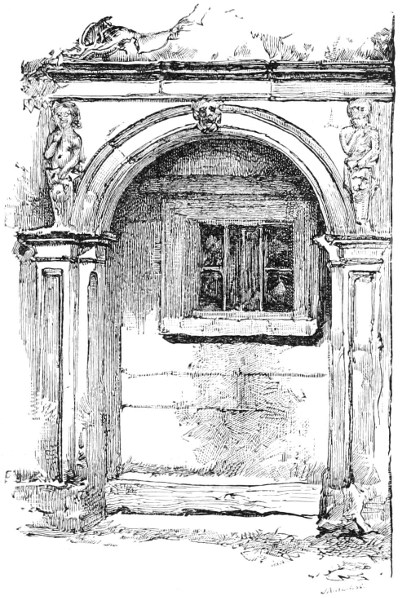
a moat.[7] A part of the original structure remains at
the back,—a porchway entrance, once accessible across
the moat, and an oriel window at the right of that entrance.
Over the front window are displayed the arms
of Clopton,—an eagle, perched upon a tun, bearing
a shield; and in the gable appear the arms of Walker,
with the motto, Loyauté mon honneur. Sir Edward
Walker was Lord of Clopton soon after the Restoration,
and by him the entrance to the house, which used to
be where the dining-room now is, was transferred to its
present position. It was Walker who carried to Charles
the Second, in Holland, in 1649, the news of the execution
of his father. A portrait of the knight, by Dobson,
hangs on the staircase wall at Clopton, where he died
in 1677, aged sixty-five. He was Garter-king-at-arms.
His remains are buried in Stratford church, with an
epitaph over them by Dugdale. Mr. Ward owned the
estate about 1840, and under his direction many changes
were made in the old building,—sixty workmen having
been employed upon it for six months. The present
drawing-room and conservatory were built by Mr. Ward,
and by him the whole structure was "modernised."
There are wild stories that autographs and other relics
of Shakespeare once existed at Clopton, and were consumed
there, in a bon-fire. A stone in the grounds
marks the grave of a silver eagle, that was starved to
death, through the negligence of a gamekeeper, November
25, 1795. There are twenty-six notable portraits in
the main hall of Clopton, one of them being that of
Oliver Cromwell's mother, and another probably that
of the unfortunate and unhappy Arabella Stuart,—only
child of the fifth Earl of Lennox,—who died, at the
Tower of London, in 1615.
Warwickshire swarmed with conspirators while the
Gunpowder Plot was in progress. The Lion Inn at
Dunchurch was the chief tryst of the captains who were
to lead their forces and capture the Princess Elizabeth
and seize the throne and the country, after the expected
explosion,—which never came. And when the game
was up and Fawkes in captivity, it was through Warwickshire
that the "racing and chasing" were fleetest
and wildest, till the desperate scramble for life and
safety went down in blood at Hewel Grange. Various
houses associated with that plot are still extant in this
neighbourhood, and when the scene shifts to London
and to Garnet's Tyburn gallows, it is easily possible for
the patient antiquarian to tread in almost every footprint
of that great conspiracy.
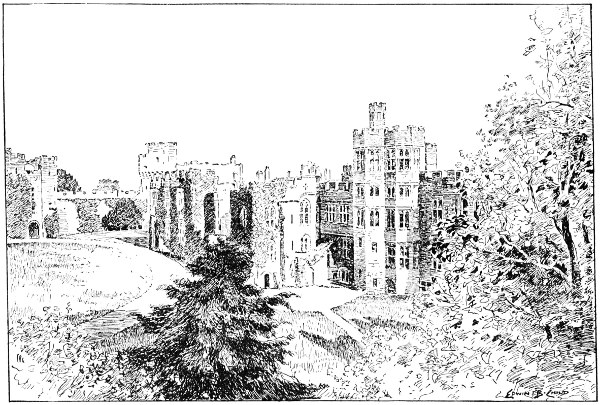
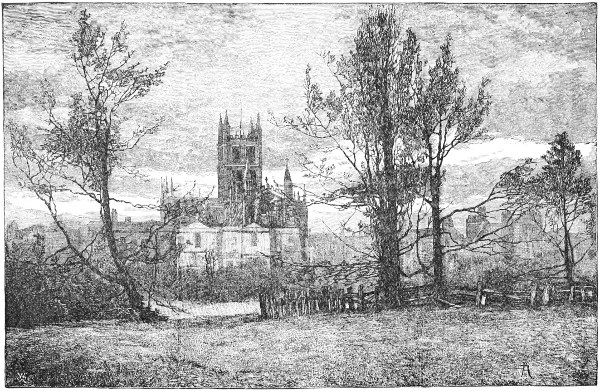
Warwick Castle, from the Mound.
Since Irish ruffians began to toss dynamite about in
public buildings it has been deemed essential to take
especial precaution against the danger of explosion in
such places as the Houses of Parliament, Westminster
Abbey, and the Tower of London. Much more damage[46]
than the newspapers recorded was done by the
explosions that occurred some time ago in the Tower
and the Palace. At present you cannot enter even into
Palace Yard unless connected with the public business
or authorised by an order; and if you visit the Tower
without a special permit you will be restricted to a few
sights and places. I was fortunately the bearer of the
card of the Lord Chamberlain, on a recent prowl
through the Tower, and therefore was favoured by the
beef-eaters who pervade that structure. Those damp
and gloomy dungeons were displayed wherein so many
Jews perished miserably in the reign of Edward the
First; and Little Ease was shown,—the cell in which
for several months Guy Fawkes was incarcerated, during
Cecil's wily investigation of the Gunpowder Plot.
A part of the rear wall has been removed, affording access
to the adjacent dungeon; but originally the cell
did not give room for a man to lie down in it, and
scarce gave room for him to stand upright. The massive
door, of ribbed and iron-bound oak, still solid,
though worn, would make an impressive picture. A
poor, stealthy cat was crawling about in those subterranean
dens of darkness and horror, and was left locked
in there when we emerged. In St. Peter's, on the green,—that
little cemetery so eloquently described by Macaulay,—they
came, some time ago, upon the coffins of
Lovat, Kilmarnock, and Balmerino, the Scotch lords who
perished upon the block for their complicity with the
rising for the Pretender, in 1745-47. The coffins were
much decayed. The plates were removed, and these
may now be viewed, in a glass case on the church wall,
over against the spot where those unfortunate gentlemen
were buried.[8] One is of lead and is in the form of
a large open scroll. The other two are oval in shape,
large, and made of pewter. Much royal and noble dust
is heaped together beneath the stones of the chancel,—Anne
Boleyn, Catherine Howard, Lady Jane Grey, Margaret,
Duchess of Salisbury, the Duke of Monmouth,
the Earl of Northumberland, Essex, Overbury, Thomas
Cromwell, and many more. The body of the infamous
and execrable Jeffreys was once buried there, but it has
been removed.
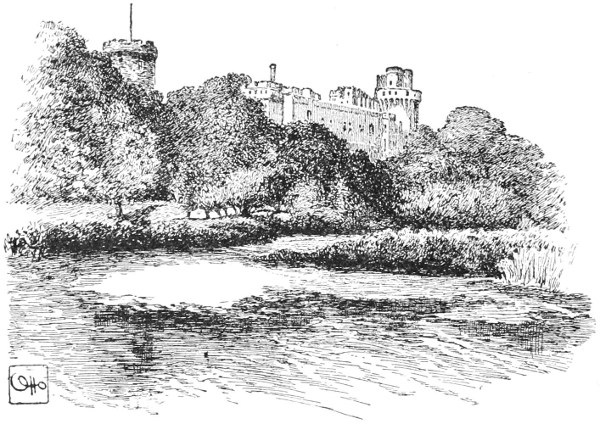
Warwick Castle, from the River.
St. Mary's church at Warwick has been restored since
1885, and now it is made a show place. The pilgrim
may see the Beauchamp chapel, in which are entombed
Thomas Beauchamp, Earl of Warwick, the founder of
the church; Robert Dudley, Earl of Leicester, in whose
Latin epitaph it is stated that "his sorrowful wife, Lætitia,
daughter of Francis Knolles, through a sense of
conjugal love and fidelity, hath put up this monument
to the best and dearest of husbands";[9] Ambrose Dudley,
elder brother to Elizabeth's favourite, and known as
the Good Earl [he relinquished his title and possessions
to Robert]; and that Fulke Greville, Lord Brooke, who
lives in fame as "the friend of Sir Philip Sidney."
There are other notable sleepers in that chapel, but
these perhaps are the most famous and considerable.
One odd epitaph records of William Viner, steward to
Lord Brooke, that "he was a man entirely of ancient
manners, and to whom you will scarcely find an equal,
particularly in point of liberality.... He was added
to the number of the heavenly inhabitants maturely for
himself, but prematurely for his friends, in his 70th
year, on the 28th of April, A.D. 1639." Another,
placed for himself by Thomas Hewett during his lifetime,
modestly describes him as "a most miserable sinner."
Sin is always miserable when it knows itself.
Still another, and this in good verse, by Gervas Clifton,
gives a tender tribute to Lætitia, "the excellent and
pious Lady Lettice," Countess of Leicester, who died
on Christmas morning, 1634:
"She that in her younger years
Matched with two great English peers;
She that did supply the wars
With thunder, and the Court with stars;
She that in her youth had been
Darling to the maiden Queene,
Till she was content to quit
Her favour for her favourite....
While she lived she livéd thus,
Till that God, displeased with us,
Suffered her at last to fall,
Not from Him but from us all."
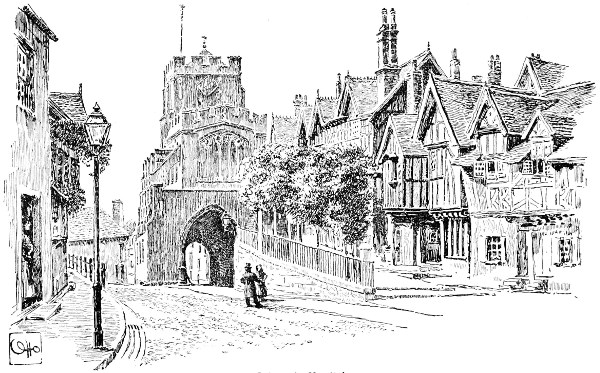
Leicester's Hospital.
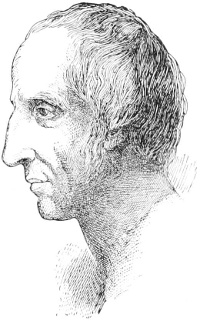
A noble bust of that fine thinker and exquisite poet
Walter Savage Landor has been placed on the west wall
of St. Mary's church. He was a native of Warwick and
he is fitly commemorated in that place. The bust is of
alabaster and is set in an alabaster arch with carved environment,
and with the family arms displayed above.
The head of Landor shows great intellectual power,
rugged yet gentle. Coming suddenly upon the bust,
in this church, the pilgrim is forcibly and pleasantly
reminded of the attribute of sweet and gentle reverence
in the English character, which so invariably expresses
itself, all over this land, in honourable memorials to the
honourable dead. No rambler in Warwick omits to
explore Leicester's hospital, or to see as much as he can
of the Castle. That glorious old place has long been[51]
kept closed, for fear of the dynamite fiend; but now it
is once more accessible. I walked again beneath the
stately cedars[10] and along the bloom-bordered avenues
where once Joseph Addison used to wander and meditate,
and traversed again those opulent state apartments
wherein so many royal, noble, and beautiful faces look
forth from the radiant canvas of Holbein and Vandyke.
There is a wonderful picture, in one of those rooms, of
Thomas Wentworth, Earl of Strafford, when a young
man,—a face prophetic of stormy life, baleful struggles,
and a hard and miserable fate. You may see the helmet
that was worn by Oliver Cromwell, and also a striking
death-mask of his face; and some of the finest
portraits of Charles the First that exist in this kingdom
are shown at Warwick Castle.
From the Warwick Shield.
CHAPTER III OLD YORK
York, August 12, 1888.—All summer
long the sorrowful skies have been weeping
over England, and my first prospect
of this ancient city was a prospect through
drizzle and mist. Yet even so it was impressive.
York is one of the quaintest
cities in the kingdom. Many of the streets are narrow
and crooked. Most of the buildings are of low stature,
built of brick, and roofed with red tiles. Here and
there you find a house of Queen Elizabeth's time, picturesque
with overhanging timber-crossed fronts and
peaked gables. One such house, in Stonegate, is conspicuously
marked with its date, 1574. Another, in
College street, enclosing a quadrangular court and
lovely with old timber and carved gateway, was built
by the Neville family in 1460. There is a wide area
in the centre of the town called Parliament street,
where the market is opened, by torchlight, on certain
evenings of every week. It was market-time last evening,
and, wandering through the motley and merry
crowd that filled the square, about nine o'clock, I
bought, at a flower-stall, the white rose of York and the
red rose of Lancaster,—twining them together as an
emblem of the settled peace that here broods so sweetly
over the venerable relics of a wild and stormy past.
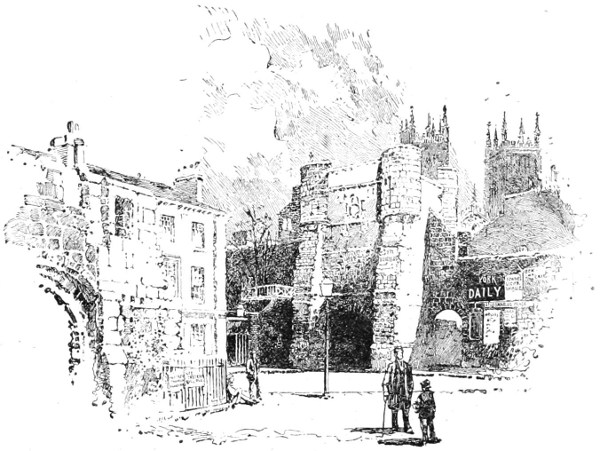
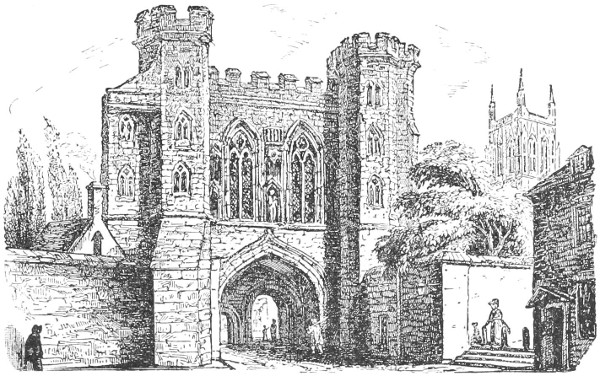
Bootham Bar.
Four sections of the old wall of York are still extant
and the observer is amused to perceive the ingenuity
with which those gray and mouldering remnants of the
feudal age are blended into the structures of the democratic
present. From Bootham to Monk Gate,—so
named in honour of General Monk, at the Restoration,—a
distance of about half a mile, the wall is absorbed
by the adjacent buildings. But you may walk upon it
from Monk Gate to Jewbury, about a quarter of a mile,
and afterward, crossing the Foss, you may find it
again on the southeast of the city, and walk upon it
from Red Tower to old Fishergate, descending near
York Castle. There are houses both within the walls
and without. The walk is about eight feet wide, protected
on one hand by a fretted battlement and on the
other by an occasional bit of iron fence. The base of
the wall, for a considerable part of its extent, is fringed
with market gardens or with grassy banks. In one of
its towers there is a gate-house, still occupied as a
dwelling; and a comfortable dwelling no doubt it is.
In another, of which nothing now remains but the
walls, four large trees are rooted; and, as they are
already tall enough to wave their leafy tops above the
battlement, they must have been growing there for at
least twenty years. At one point the Great Northern
Railway enters through an arch in the ancient wall,
and as you look down from the battlements your gaze
rests upon long lines of rail and a spacious station,
together with its adjacent hotel,—objects which consort
but strangely with what your fancy knows of York;
a city of donjons and barbicans, the moat, the draw-bridge,
the portcullis, the citadel, the man-at-arms, and
the knight in armour, with the banners of William the
Norman flowing over all.
The river Ouse divides the city of York, which lies
mostly upon its east bank, and in order to reach the
longest and most attractive portion of the wall that is
now available to the pedestrian you must cross the
Ouse, either at Skeldergate or Lendal, paying a half-penny
as toll, both when you go and when you return.
The walk here is three-quarters of a mile long, and
from an angle of this wall, just above the railway arch,
may be obtained the best view of the mighty cathedral,—one
of the most stupendous and sublime works that
ever were erected by the inspired brain and loving
labour of man. While I walked there last night, and
mused upon the story of the Wars of the Roses, and
strove to conjure up the pageants and the horrors that
must have been presented, all about this region, in that
remote and turbulent past, the glorious bells of the
minster were chiming from its towers, while the fresh
evening breeze, sweet with the fragrance of wet flowers
and foliage, seemed to flood this ancient, venerable city
with the golden music of a celestial benediction.
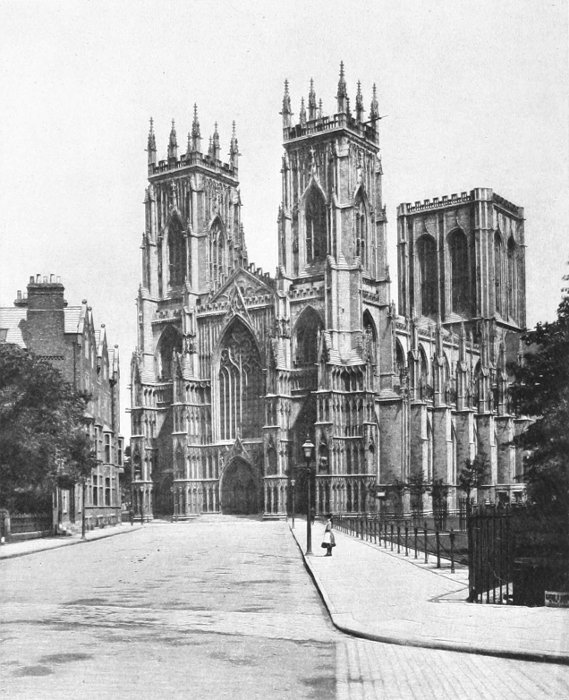
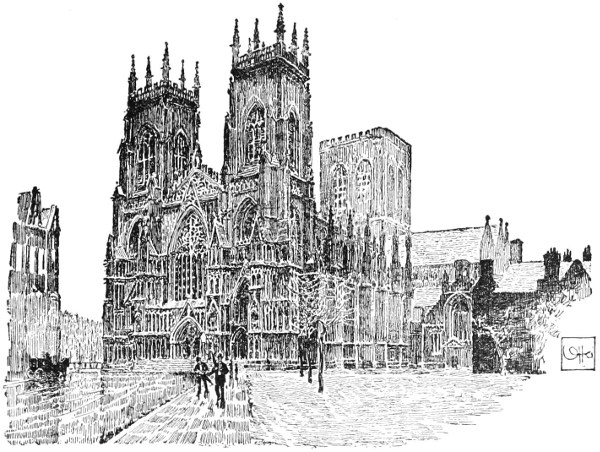
York Cathedral—West Front.
The pilgrim to York stands in the centre of the
largest shire in England and is surrounded with castles
and monasteries, now mostly in ruins but teeming with
those associations of history and literature that are the
glory of this delightful land. From the summit of the
great central tower of the cathedral, which is reached
by two hundred and thirty-seven steps, I gazed out
over the vale of York and beheld one of the loveliest
spectacles that ever blessed the eyes of man. The
wind was fierce, the sun brilliant, and the vanquished
storm-clouds were streaming away before the northern
blast. Far beneath lay the red-roofed city, its devious
lanes and its many gray churches,—crumbling relics of
ancient ecclesiastical power,—distinctly visible. Through
the plain, and far away toward the south and east, ran
the silver thread of the Ouse, while all around, as far
as the eye could reach, stretched forth a smiling landscape
of emerald meadow and cultivated field; here a
patch of woodland, and there a silver gleam of wave;
here a manor-house nestled amid stately trees, and
there an ivy-covered fragment of ruined masonry; and
everywhere the green lines of the flowering hedge.
The prospect is even finer here than it is from the
splendid summit of Strasburg cathedral; and indeed,
when all is said that can be said about natural scenery
and architectural sublimities, it seems amazing that any
lover of the beautiful should deem it necessary to quit
the infinite variety of the British islands. Earth cannot
show you anything more softly fair than the lakes
and mountains of Cumberland and Westmoreland. No
city can excel Edinburgh in stately solidity of character,
or tranquil grandeur, or magnificence of position.
The most exquisitely beautiful of churches is Roslin
chapel. And though you search the wide world through
you will never find such cathedrals,—so fraught with
majesty, sublimity, the loveliness of human art, and the
ecstatic sense of a divine element in human destiny,—as
those of York, Canterbury, Gloucester, and Lincoln.
While thus I lingered in wondering meditation upon
the crag-like summit of York minster, the muffled
thunder of its vast, sonorous organ rose, rolling and
throbbing, from the mysterious depth below, and seemed
to shake the great tower as with a mighty blast of jubilation
and worship. At such moments, if ever, when
the tones of human adoration are floating up to heaven,
a man is lifted out of himself and made to forget his
puny mortal existence and all the petty nothings that
weary his spirit, darken his vision, and weigh him
down to the level of the sordid, trivial world. Well
did they know this,—those old monks who built the
abbeys of Britain, laying their foundations not alone
deeply in the earth but deeply in the human soul!
All the ground that you survey from the top of York
minster is classic ground,—at least to those persons
whose imaginations are kindled by associations with the
stately and storied past. In the city that lies at your
feet once stood the potent Constantine, to be proclaimed
emperor [A.D. 306] and to be vested with the imperial
purple of Rome. In the original York minster,—for
the present is the fourth church that has been erected
upon this site,—was buried that valiant soldier "old
Siward," whom "gracious England" lent to the Scottish
cause, under Malcolm and Macduff, when time at
length was ripe for the ruin of Glamis and Cawdor.
Close by is the field of Stamford, where Harold defeated
the Norwegians, with terrible slaughter, only nine
days before he was himself defeated and slain at Hastings.
Southward, following the line of the Ouse, you
look down upon the ruins of Clifford's Tower, built by
William the Conqueror, in 1068, and destroyed by the
explosion of its powder magazine in 1684. Not far
away is the battlefield of Towton, where the great Warwick
slew his horse, that he might fight on foot and possess
no advantage over the common soldiers of his force.
Henry the Sixth and Margaret were waiting in York
for news of the event of that fatal battle,—which,
in its effect, made them exiles and bore to an assured
supremacy the rightful standard of the White Rose.
In this church Edward the Fourth was crowned [1464],
and Richard the Third was proclaimed king and had
his second coronation. Southward you may see the
open space called the Pavement, connecting with Parliament
street, and the red brick church of St. Crux.
In the Pavement the Earl of Northumberland was beheaded,
for treason against Queen Elizabeth, in 1572,
and in St. Crux [one of Wren's churches] his remains
lie buried, beneath a dark blue slab, still shown to visitors.
A few miles away, but easily within reach of
your vision, is the field of Marston Moor, where the impetuous
Prince Rupert imperilled and well-nigh lost the
cause of Charles the First, in 1644; and as you look
toward that fatal spot you can almost hear, in the chamber
of your fancy, the pæans of thanksgiving for the victory
that were uttered in the church beneath. Cromwell,
then a subordinate officer in the Parliamentary army,
was one of the worshippers. Charles also has knelt at
this altar. Indeed, of the fifteen kings, from William
of Normandy to Henry of Windsor, whose sculptured
effigies appear upon the chancel screen in York minster,
there is scarcely one who has not worshipped in this
cathedral.
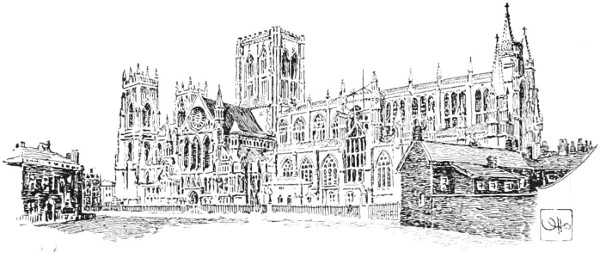
York Cathedral—South Side.
York minster has often been described, but no description
can convey an adequate impression of its
grandeur. Canterbury is the lovelier cathedral of the
two, though not the grander, and Canterbury possesses
the inestimable advantage of a spacious close. It must
be said also, for the city of Canterbury, that the presence
and influence of a great church are more distinctly
and delightfully felt in that place than they are in York.
There is a more spiritual tone at Canterbury, a tone of
superior delicacy and refinement, a certain aristocratic
coldness and repose. In York you perceive the coarse
spirit of a democratic era. The walls, that ought to be
cherished with scrupulous care, are found in many
places to be ill-used. At intervals along the walks
upon the banks of the Ouse you behold placards requesting
the co-operation of the public in protecting
from harm the swans that navigate the river. Even in
the cathedral itself there is displayed a printed notice
that the Dean and Chapter are amazed at disturbances
which occur in the nave while divine service is proceeding
in the choir. These things imply a rough element
in the population, and in such a place as York such an
element is exceptionally offensive and deplorable.
It was said by the wise Lord Beaconsfield that progress
in the nineteenth century is found to consist chiefly in
a return to ancient ideas. There may be places to which
the characteristic spirit of the present day contributes
an element of beauty; but if so I have not seen them.
Wherever there is beauty there is the living force of
tradition to account for it. The most that a conservative
force in society can accomplish, for the preservation
of an instinct in favour of whatever is beautiful and
impressive, is to protect what remains from the past.
Modern Edinburgh, for example, has contributed no
building that is comparable with its glorious old castle,
or with Roslin, or with what we know to have been
Melrose or Dryburgh; but its castle and its chapels are
protected and preserved. York, in the present day,
erects a commodious railway-station and a sumptuous
hotel, and spans its ample river with two splendid
bridges; but its modern architecture is puerile beside
that of its ancient minster; and so its best work, after
all, is the preservation of its cathedral. The observer
finds it difficult to understand how anybody, however
lowly born or poorly endowed or meanly nurtured, can
live within the presence of that heavenly building, and
not be purified and exalted by the contemplation of so
much majesty, and by its constantly irradiative force of
religious sentiment and power. But the spirit which in
the past created objects of beauty and adorned common
life with visible manifestations of the celestial aspiration
in human nature had constantly to struggle against insensibility
or violence; and just so the few who have
inherited that spirit in the present day are compelled
steadily to combat the hard materialism and gross animal
proclivities of the new age.
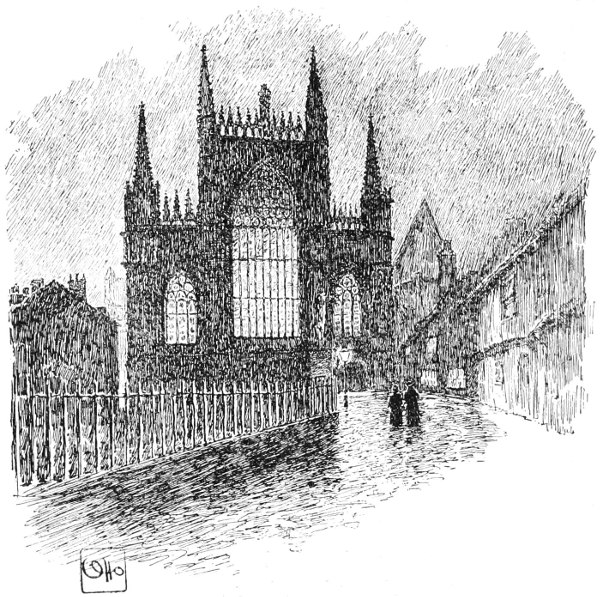
York Cathedral—East Front.
What a comfort their souls must find in such an
edifice as York minster! What a solace and what an
inspiration! There it stands, dark and lonely to-night,
but symbolising, as no other object upon earth can ever
do, except one of its own great kindred, God's promise
of immortal life to man, and man's unquenchable faith
in the promise of God. Dark and lonely now, but
during many hours of its daily and nightly life sentient,
eloquent, vital, participating in all the thought, conduct,
and experience of those who dwell around it. The
beautiful peal of its bells that I heard last night was for
Canon Baillie, one of the oldest and most beloved and
venerated of its clergy. This morning, sitting in its
choir, I heard the tender, thoughtful eulogy so simply
and sweetly spoken by the aged Dean, and once again
learned the essential lesson that an old age of grace,
patience, and benignity means a pure heart, an unselfish
spirit, and a good life passed in the service of
others. This afternoon I had a place among the worshippers
that thronged the nave to hear the special
anthem chanted for the deceased Canon; and, as the
organ pealed forth its mellow thunder, and the rich
tones of the choristers swelled and rose and broke in
golden waves of melody upon the groined arches and
vaulted roof, my soul seemed borne away to a peace
and rest that are not of this world. To-night the rising
moon as she gleams through drifting clouds, will pour
her silver rays upon that great east window,—at once
the largest and the most beautiful in existence,—and all
the Bible stories told there in such exquisite hues and
forms will glow with heavenly lustre on the dark vista
of chancel and nave. And when the morning comes
the first beams of the rising sun will stream through
the great casement and illumine the figures of saints
and archbishops, and gild the old tattered battle-flags
in the chancel aisle, and touch with blessing the marble
effigies of the dead; and we who walk there, refreshed
and comforted, shall feel that the vast cathedral is
indeed the gateway to heaven.
York minster is the loftiest of all the English cathedrals,
and the third in length,[11]—both St. Albans and Winchester
being longer. The present structure is six hundred
years old, and more than two hundred years were occupied
in the building of it. They show you, in the crypt,
some fine remains of the Norman church that preceded
it upon the same site, together with traces of the still
older Saxon church that preceded the Norman. The
first one was of wood and was totally destroyed. The
Saxon remains are a fragment of stone staircase and
a piece of wall built in the ancient herring-bone fashion.
The Norman remains are four clustered columns, embellished
in the zigzag style. There is not much of
commemorative statuary at York minster, and what
there is of it was placed chiefly in the chancel. Archbishop
Richard Scrope, who figures in Shakespeare's
historical play of Henry the Fourth, and who was beheaded
for treason in 1405, was buried in the lady
chapel. Laurence Sterne's grandfather, who was
chaplain to Laud, is represented there, in his ecclesiastical
dress, reclining upon a couch and supporting
his mitred head upon his hand,—a squat figure uncomfortably
posed, but sculptured with delicate skill. Many
historic names occur in the inscriptions,—Wentworth,
Finch, Fenwick, Carlisle, and Heneage,—and in the
north aisle of the chancel is the tomb of William of
Hatfield, second son of Edward the Third, who died in
1343-44, in the eighth year of his age. An alabaster
statue of the royal boy reclines upon his tomb. In the
cathedral library, which contains eight thousand volumes
and is kept at the Deanery, is the Princess Elizabeth's
prayer-book, containing her autograph. In one of the
chapels is the original throne-chair of Edward the Third.
In St. Leonard's Place still stands the York theatre,
erected by Tate Wilkinson in 1765. In York Castle
Eugene Aram was imprisoned and suffered death.
The poet and bishop Beilby Porteus, the sculptor
Flaxman, the grammarian Lindley Murray, and the
fanatic Guy Fawkes were natives of York, and have
often walked its streets. Standing on Skeldergate
bridge, few readers of English fiction could fail to recall
that exquisite description of the place, in the novel of
No Name. In his artistic use of weather, atmosphere,
and colour Wilkie Collins is always remarkable equally
for his fidelity to nature and fact, and for the felicity
and beauty of his language. His portrayal of York
seems more than ever a gem of literary art, when you
have seen the veritable spot of poor Magdalen's meeting
with Captain Wragge. The name of Wragge is on
one of the signboards in the city. The river, on which
I did not omit to take a boat, was picturesque, with its
many quaint barges, bearing masts and sails and embellished
with touches of green and crimson and blue.
There is no end to the associations and suggestions of
the storied city. But lest my readers weary of them,
let me respect the admonition of the midnight bell, and
seek repose beneath the hospitable wing of the old
Black Swan in Coney street, whence I send this humble
memorial of ancient York.
CHAPTER IV THE HAUNTS OF MOORE
Devizes, Wiltshire, August 20, 1888.—The
scarlet discs of the poppies and
the red and white blooms of the clover,
together with wild-flowers of many hues,
bespangle now the emerald sod of England,
while the air is rich with fragrance of lime-trees
and of new-mown hay. The busy and sagacious rooks,
fat and bold, wing their way in great clusters, bent on
forage and mischief. There is almost a frosty chill in
the autumnal air, and the brimming rivers, dark and
deep and smoothly flowing through the opulent, cultivated,
and park-like region of Wiltshire, look cold and
bright. In many fields the hay is cut and stacked. In
others the men, and often the women, armed with rakes,
are tossing it to dry in the reluctant, intermittent, bleak
sunshine of this rigorous August. Overhead the sky
is now as blue as the deep sea and now grim and ominous
with great drifting masses of slate-coloured cloud.
There are moments of beautiful sunshine by day, and
in some hours of the night the moon shines forth in all
her pensive and melancholy glory. It is a time of exquisite
loveliness, and it has seemed a fitting time for
a visit to the last English home and the last resting-place
of the poet of loveliness and love, the great Irish
poet Thomas Moore.
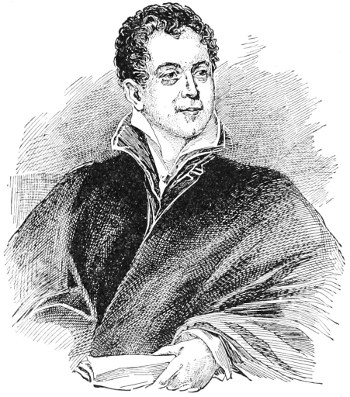
Thomas Moore.
When Moore first went up to London, a young author
seeking to launch
his earliest writings
upon the
stream of contemporary
literature,
he crossed from
Dublin to Bristol
and then travelled
to the capital by
way of Bath and
Devizes; and as
he crossed several
times he must soon
have gained familiarity
with this part
of the country. He
did not, however,
settle in Wiltshire
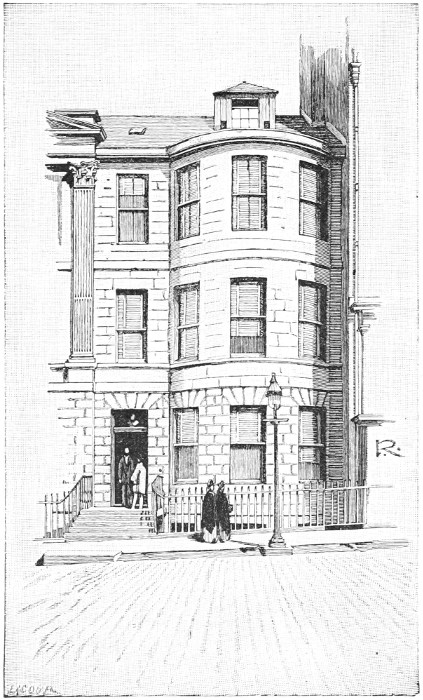
until some years afterward. His first lodging in London
was a front room, up two pair of stairs, at No. 44 George
street, Portman square. He subsequently lived at No.
46 Wigmore street, Cavendish square, and at No. 27
Bury street, St. James's. This was in 1805. In 1810
he resided for a time at No. 22 Molesworth street,
Dublin, but he soon returned to England. One of
his homes, shortly after his marriage with Elizabeth
Dyke ["Bessie," the sister of the great actress Mary
Duff, 1794-1857] was in Brompton. In the spring of
1812 he settled at Kegworth, but a year later he is
found at Mayfield Cottage, near Ashbourne, Derbyshire.
"I am now as you wished," he wrote to Mr. Power, the
music-publisher, July 1, 1813, "within twenty-four hours'
drive of town." In 1817 he occupied a cottage near the
foot of Muswell Hill, at Hornsey, Middlesex, but after
he lost his daughter Barbara, who died there, the place
became distressful to him and he left it. In the latter
part of September that year, the time of their affliction,
Moore and his Bessie were the guests of Lady
Donegal, at No. 56 Davies street, Berkeley square,
London. Then [November 19, 1817] they removed to
Sloperton Cottage, at Bromham, near Devizes, and
their permanent residence was established in that place.
Lord Landsdowne, one of the poet's earliest and best
friends, was the owner of that estate, and doubtless he
was the impulse of Moore's resort to it. The present
Lord Landsdowne still owns Bowood Park, about four
miles away.
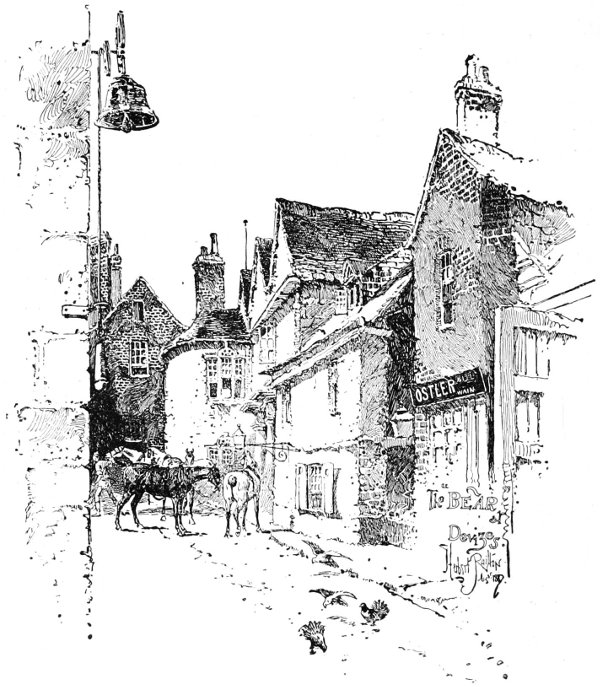
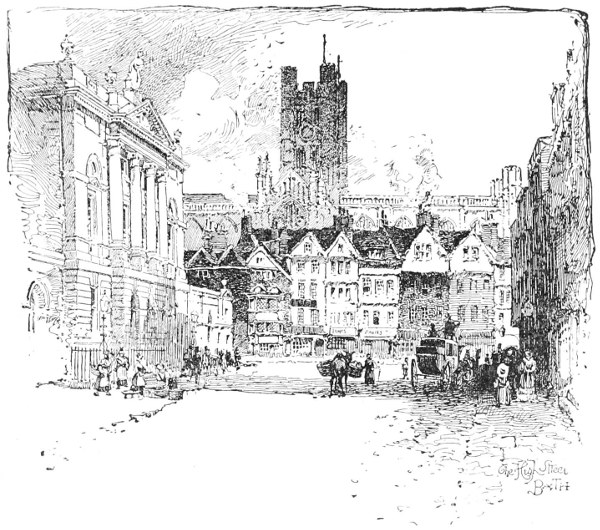
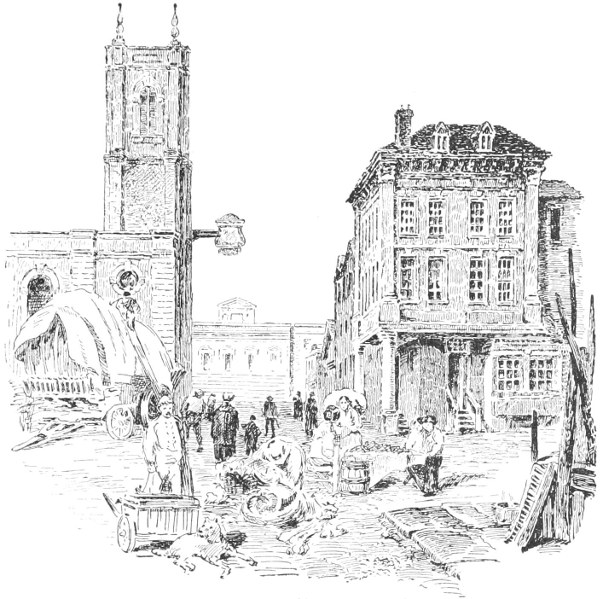
The Bear—Devizes.
Devizes impresses a stranger with a singular and
pleasant sense of suspended animation,—as of beauty
fallen asleep,—the sense of something about to happen,
which never occurs. More peaceful it could not be,
unless it were dead,—and that is its most alluring
charm. Two of its many streets are remarkably wide
and spacious, while the others are narrow and often
crooked. Most of its habitations are low houses, built
of brick, and only a few of them, such as the old Town
Hall and the Corn Exchange, are pretentious as architecture.
The principal street runs nearly northwest
and southeast. There is a north gate at one end of it,
and a south gate at the other, but no remnant of the
ancient town gates is left. The Kennet and Avon
Canal, built in 1794-1805, skirts the northern side
of the town, and thereafter descends the western slope,
passing through twenty-seven magnificent locks, within
a distance of about two miles,—one of the longest consecutive
ranges of locks in England. The stateliest
building in Devizes is its noble Castle, which, reared
upon a massive hill, at once dominates the surrounding
landscape and dignifies it. That splendid edifice, built
about 1830, stands upon the site of the ancient Castle
of Devizes, which was built by Roger, Bishop of Salisbury,
in the reign of Henry the First, and it resembles
that famous original,—long esteemed one of the most
complete and admirable works of its kind in Europe.
The old Castle was included in the dowry settled upon
successive queens of England. Queen Margaret possessed
it in the reign of Henry the Sixth, and Queen
Katharine in that of Henry the Eighth. It figured in
the Civil Wars, and it was deemed the strongest citadel
in England. The poet-soldier, Edmund Waller, when in
the service of the Parliament, bombarded it, in 1643,
and finally it was destroyed by order of the Roundheads.
Toward the close of the eighteenth century its
ruins were, it is said, surmounted with a couple of snuff-mills.
No part of the ancient fortress now survives,
except the moat; but in its pleasant grounds fragmentary
remnants may still be seen of its foundations
and of the dungeons of a remote age. During the rebuilding
of the Castle many relics were unearthed,—such
as human bones and implements of war,—the
significant tokens of dark days and fatal doings long
since past and gone. In the centre of the town is a
commodious public square, known as the Market-place,—a
wide domain of repose, as I saw it, uninvaded by
either vehicle or human being, but on each Thursday the
scene of the weekly market for cattle and corn, and of
the loquacious industry of the cheap-jack and the quack.
On one side of it is the old Bear Hotel, an exceptionally
comfortable house, memorable as the birthplace of Sir
Thomas Lawrence, the famous artist [1769-1830]. In
the centre are two works of art,—one a fountain, the
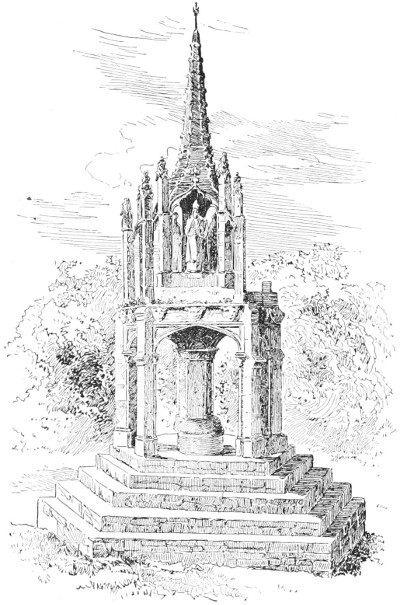
other a cross. The latter, a fine fabric of Gothic architecture,
is embellished with thirteen pinnacles, which
rise above an arched canopy, the covering of a statue.
One face of the cross bears this legend: "This Market
Cross was erected by Henry Viscount Sidmouth, as a
memorial of his grateful attachment to the Borough of
Devizes, of which he has been Recorder thirty years,
and of which he was six times unanimously chosen a
representative in Parliament. Anno Domini 1814."
Upon the other face appears a record more significant,—being
indicative equally of credulity and a frugal
mind, and being freighted with tragic import unmatched
since the Bible narrative of Ananias and
Sapphira. It reads thus:
"The Mayor and Corporation of Devizes avail themselves of the
stability of this building to transmit to future times the record of
an awful event which occurred in this market-place in the year 1753,
hoping that such a record may serve as a salutary warning against the
danger of impiously invoking the Divine vengeance, or of calling on
the holy name of God to conceal the devices of falsehood and fraud.
"On Thursday, the 25th January 1753, Ruth Pierce, of Potterne, in this
county, agreed, with three other women, to buy a sack of wheat in the
market, each paying her due proportion toward the same.
"One of these women, in collecting the several quotas of money,
discovered a deficiency, and demanded of Ruth Pierce the sum which was
wanted to make good the amount.
"Ruth Pierce protested that she had paid her share, and said,
'She wished she might drop down dead if she had not.'
"She rashly repeated this awful wish, when, to the consternation
of the surrounding multitude, she instantly fell down and expired,
having the money concealed in her hand."
That is not the only grim incident in the history of
the Market-place of Devizes; for in 1533 a poor tailor,
named John Bent, of the neighbouring village of Urchfont
was burnt at the stake, in that square, for his
avowed disbelief of the doctrine of transubstantiation.
An important and deeply interesting institution of
Devizes is the Wilts County Museum, in Long street,
devoted to the natural history and the archæology of
Wiltshire. The library contains a priceless collection
of Wiltshire books, and the museum is rich in geological
specimens,—richer even than the excellent museum
of Salisbury; for, in addition to other treasures, it includes
the famous Stourhead collection, made by Sir
Richard Colt Hoare,—being relics from the ancient
British and Saxon barrows on the Wiltshire downs.
The Stourhead collection is described by Sir Richard,
in his book on "Antient Wilts." Its cinerary and culinary
urns are fine and numerous. The Wilts County
Museum is fortunate in its curator, B. Howard Cunnington,
Esq., of Rowde—an indefatigable student,
devoted to Wiltshire, and a thorough antiquarian.
St. John's Church—Devizes.
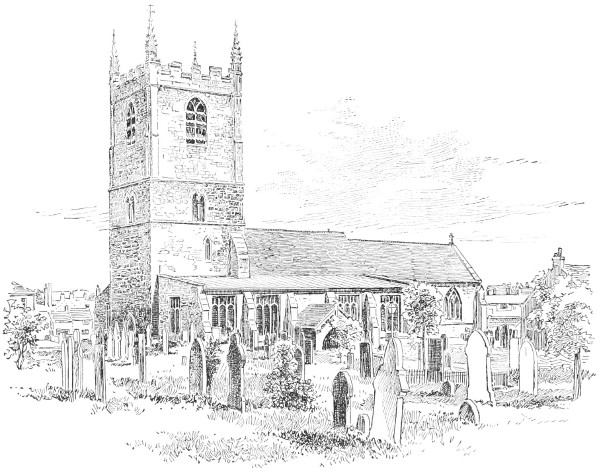
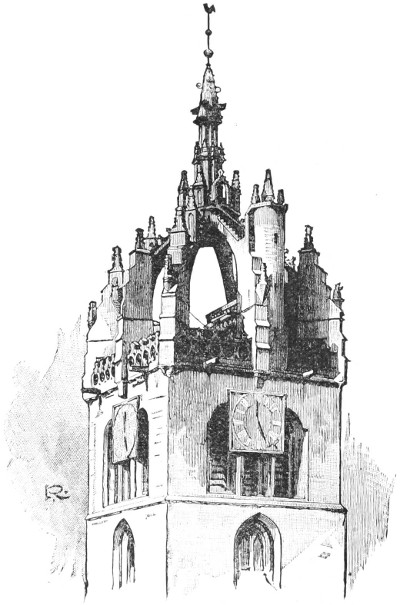
An interesting church in Devizes is that of St. John,
the Norman tower of which is a relic of the days of
Henry the Second, a vast, grim structure with a
circular turret on one corner of it. Eastward of this
church is a long and lovely avenue of trees, and around
it lies a large burial-place, remarkable for the excellence
of the sod and for the number visible of those
heavy, gray, oblong masses of tombstone which appear
to have obtained great public favour about the time of
Cromwell. In the centre of the churchyard stands a
monolith, inscribed with these words:
"Remember the Sabbath-day to keep it holy.—This monument,
as a solemn monitor to Young People to remember their
Creator in the days of their youth, was erected by subscription.—In
memory of the sudden and awful end of Robert Merrit and his
wife, Eliz. Tiley, her sister, Martha Carter, and Josiah Denham,
who were drowned, in the flower of their youth, in a pond, near this
town, called Drews, on Sunday evening, the 30th of June, 1751,
and are together underneath entombed."
In one corner of the churchyard I came upon a cross,
bearing a simple legend far more solemn, touching, and
admonitory: "In Memoriam—Robert Samuel Thornley.
Died August 5, 1871. Aged 48 years. For
fourteen years surgeon to the poor of Devizes. There
shall be no more pain." And over still another sleeper
was written, upon a flat stone, low in the ground—
"Loving, beloved, in all relations true,
Exposed to follies, but subdued by few:
Reader, reflect, and copy if you can
The simple virtues of this honest man."
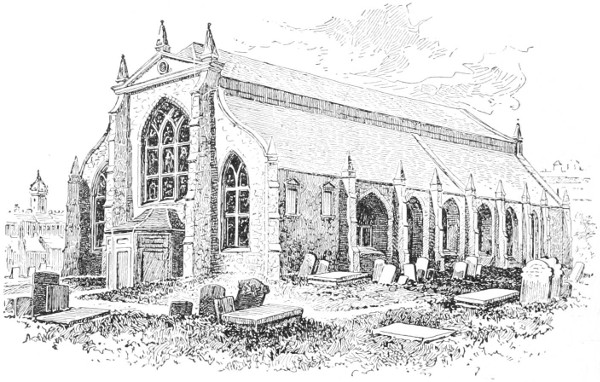
Hungerford Chapel—Devizes.
Nobody is in haste in Devizes, and the pilgrim who
seeks for peace could not do better than to tarry here.
The city bell which officially strikes the hours is subdued
and pensive, and although reinforced with chimes,
it seems ever to speak under its breath. The church-bell,
however, rings long and vigorously and with much
melodious clangour,—as though the local sinners were
more than commonly hard of hearing. Near to the
church of St. John, are some quaint almshouses, but not
much seems to be known of their history. One of
them was founded as a hospital for lepers, before A.D.
1207, and it is thought that one of them was built of
stone which remained after the erection of the church.
Those almshouses are now governed by the Mayor and
Corporation of Devizes, but perhaps formerly they were
under the direct control of the Crown. [See Tanner's
Nolitia.] There are seven endowments, one dating
back to 1641, and the houses are to this day occupied
by widows, recommended by the churchwardens of
St. Mary's and St. John's. An old inhabitant of
Devizes, named Bancroft, left a sum of money to insure
for himself a singular memorial service,—that the
bells of St. John's church should be solemnly tolled
on the day of his birth, and rung merrily on that of his
death; and that service is duly performed every year.
Devizes is a fit place for the survival of ancient customs,
and these serve very pleasantly to mark its peculiar
and interesting character. The Town Crier, who is
a member of the Corporation, walks abroad arrayed
in a helmet and a uniform of brilliant scarlet,—glories
that are worn by no other Crier in the kingdom, excepting
that of York.
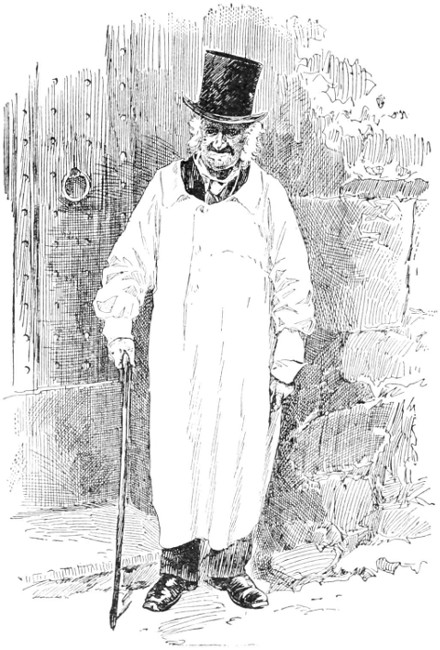
As I was gazing at the old church, surrounded with
many ponderous tombstones and gray and cheerless in
the gloaming, an old man approached me and civilly began
a conversation about the antiquity of the building
and the eloquence of its rector. When I told him that
I had walked to Bromham to attend the service there,
and to see the cottage and grave of Moore, he presently
furnished to me that little touch of personal testimony
which is always so interesting and significant in such
circumstances. "I remember Tom Moore," he said;
"I saw him when he was alive. I worked for him once
in his house, and I did some work once on his tomb.
He was a little man. He spoke to us very pleasantly.
I don't think he was a preacher. He never preached
that I heard tell of. He was a poet, I believe. He was
very much liked here. I never heard a word against
him. I am seventy-nine years old the thirteenth of
December, and that'll soon be here. I've had three
wives in my time, and my third is still living. It's a
fine old church, and there's figures in it of bishops, and
kings, and queens."
Most observers have remarked the odd way, garrulous,
and sometimes unconsciously humorous, in which senile
persons prattle their incongruous and sporadic recollections.
But—"How pregnant sometimes his replies
are!" Another resident of Devizes, with whom I conversed,
likewise remembered the poet, and spoke of him
with affectionate respect. "My sister, when she was a
child," he said, "was often at Moore's house, and he
was fond of her. Yes, his name is widely remembered
and honoured here. But I think that many of the
people hereabout, the farmers, admired him chiefly because
they thought that he wrote Moore's Almanac.
They used to say to him: 'Mister Moore, please tell us
what the weather's going to be.'"
From Devizes to the village of Bromham, a distance
of about four miles, the walk is delightful. Much of
the path is between green hedges and is embowered by
elms. The exit from the town is by Northgate and
along the Chippenham road—which, like all the roads
in this neighbourhood, is smooth, hard, and white. A
little way out of Devizes, going northwest, this road
makes a deep cut in the chalk-stone and so winds downhill
into the level plain. At intervals you come upon
sweetly pretty specimens of the English thatch-roof
cottage. Hay-fields, pastures, and market-gardens extend
on every hand. Eastward, far off, are visible
the hills of Westbury, upon which, here and there, the
copses are lovely, and upon one of which, cut in the
turf, is the figure of a colossal white horse, said to
have been put there by the Saxons, to commemorate
a victory by King Alfred.[12] Soon the road winds over a
hill and you pass through the little red village of
Rowde, with its gray church tower. The walk may be
shortened by a cut across the fields, and this indeed is
found the prettiest part of the journey,—for now the
path lies through gardens, and through the centre or
along the margin of the wheat, which waves in the
strong wind and sparkles in the bright sunshine and is
everywhere tenderly touched with the scarlet of the
poppy and with hues of other wild-flowers, making you
think of Shakespeare's
"Crowned with rank fumiter and furrow weeds,
With hemlock, harlock, nettles, cuckoo-flowers,
Darnel, and all the idle weeds that grow
In our sustaining corn."
There is one field through which I passed, just as the
spire of Bromham church came into view, in which
a surface more than three hundred yards square was
blazing with wild-flowers, white and gold and crimson
and purple and blue, upon a plain of vivid green, so that
to look upon it was almost to be dazzled, while the air
that floated over it was scented as if with honeysuckle.
You may see the delicate spire and the low gray tower
of Moore's church some time before you come to it, and
in some respects the prospect is not unlike that of
Shakespeare's church at Stratford. A sweeter spot for
a poet's sepulchre it would be hard to find. No spot
could be more harmonious than this one is with the
gentle, romantic spirit of Moore's poetry, and with the
purity, refinement, and serenity of his life. Bromham village
consists of a few red brick buildings, scattered along
a few irregular little lanes, on a ridge overlooking a
valley. Amid those humble homes stands the gray
church, like a shepherd keeping his flock. A part of it
is very old, and all of it, richly weather-stained and delicately
browned with fading moss, is beautiful. Upon
the tower and along the south side the fantastic gargoyles
are much decayed. The building is a cross.
The chancel window faces eastward, and the window at
the end of the nave looks toward the west,—the latter
being a memorial to Moore. At the southeast corner
of the building is the lady chapel, belonging to the
Bayntun family, in which are suspended various fragments
of old armour, and in the centre of which, recumbent
on a great dark tomb, is a grim-visaged knight,
clad from top to toe in his mail, beautifully sculptured
in marble that looks like yellow ivory. Vandal visitors
have disgracefully marred this superb work, by cutting
and scratching their names upon it. Other tombs are
adjacent, with inscriptions that implicate the names of
Sir Edward Bayntun, 1679, and Lady Anne Wilmot,
elder daughter and co-heiress of John, Earl of Rochester,
who successively was the wife of Henry Bayntun
and Francis Greville, and who died in 1703. The window
at the end of the nave is a simple but striking composition,
in stained glass, richer and nobler than is
commonly seen in a country church. It consists of
twenty-one lights, of which five are lancet shafts, side
by side, these being surmounted with smaller lancets,
forming a cluster at the top of the arch. In the centre
is the figure of Jesus and around Him are the Apostles.
The colouring is soft, true, and beautiful. Across the
base of the window appear the words, in the glass:
"This window is placed in this church by the combined
subscriptions of two hundred persons who honour the
memory of the poet of all circles and the idol of his own,
Thomas Moore." It was beneath this window, in a
little pew in the corner of the church, that the present
writer joined in the service, and meditated, throughout
a long sermon, on the lovely life and character and the
gentle, noble, and abiding influence of the poet whose
hallowed grave and beloved memory make this place a
perpetual shrine.
Moore was buried in the churchyard. An iron fence
encloses his tomb, which is at the base of the church
tower, in an angle formed by the tower and the chancel,
on the north side of the building. Not more than twenty
tombs are visible on this side of the church, and these
appear upon a level lawn, as green and sparkling as
an emerald and as soft as velvet. On three sides the
churchyard is enclosed by a low wall, and on the fourth
by a dense hedge of glistening holly. Great trees are
all around the church, but not too near. A massive
yew stands darkly at one corner. Chestnuts and elms
blend their branches in fraternal embrace. Close by
the poet's grave a vast beech uprears its dome of
fruited boughs and rustling foliage. The sky was
blue, except for a few straggling masses of fleecy,
slate-coloured cloud. Not a human creature was anywhere
to be seen while I stood in this sacred spot, and
no sound disturbed the Sabbath stillness, save the faint
whisper of the wind in the lofty tree-tops and the low
twitter of birds in their hidden nests. I thought of his
long life, unblemished by personal fault or public error;
of his sweet devotion to parents and wife and children;
of his pure patriotism, which scorned equally the blatant
fustian of the demagogue and the frenzy of the
revolutionist; of his unsurpassed fidelity in friendship;
of his simplicity and purity in a corrupt time and amid
many temptations; of his meekness in affliction; of the
devout spirit that prompted his earnest exhortation to
his wife, "Lean upon God, Bessie"; of the many beautiful
songs that he added to our literature,—every one
of which is the melodious and final expression of one
or another of the elemental feelings of human nature;
and of the obligation of endless gratitude that the world
owes to his fine, high, and beneficent genius. And thus
it seemed good to be in this place and to lay with reverent
hands the white roses of honour and affection
upon his tomb.
On the long, low, flat stone that covers the poet's
dust are inscribed the following words: "Anastatia
Mary Moore. Born March 16, 1813. Died March 8,
1829. Also her brother, John Russell Moore, who died
November 23, 1842, aged 19 years. Also their father,
Thomas Moore, tenderly beloved by all who knew the
goodness of his heart. The Poet and Patriot of his
Country, Ireland. Born May 28, 1779. Sank to rest
February 26, 1852. Aged 72. God is Love. Also
his wife, Bessie Moore, who died 4th September 1865.
And to the memory of their dear son, Thomas Lansdowne
Parr Moore. Born 24th October 1818. Died in
Africa, January 1846." Moore's daughter, Barbara, is
buried at Hornsey, near London, in the same churchyard
where rests the poet Samuel Rogers. On the stone
that marks that spot is written, "Anne Jane Barbara
Moore. Born January the 4th, 1812. Died September
the 18th, 1817."
Northwest from Bromham church[13] and about one mile
away stands Sloperton Cottage,[14] the last home of the
poet and the house in which he died. A deep valley
intervenes between the church and the cottage, but, as
each is built upon a ridge, you may readily see the one
from the other. There is a road across the valley, but
the more pleasant walk is along a pathway through the
meadows and over several stiles, ending almost in front
of the storied house. It is an ideal home for a poet.
The building is made of brick, but it is so completely
enwrapped in ivy that scarcely a particle of its surface
can be seen. It is a low building, with three gables on
its main front and with a wing; it stands in the middle
of a garden enclosed by walls and by hedges of ivy;
and it is embowered by great trees, yet not so closely
embowered as to be shorn of the prospect from its
windows. Flowers and flowering vines were blooming
around it. The hard, white road, flowing past its gateway,
looked like a thread of silver between the green
hedgerows which here for many miles are rooted in
high, grassy banks, and at intervals are diversified with
large trees. Sloperton Cottage is almost alone, but
there are a few neighbours, and there is the little
rustic village of Westbrook, about half a mile westward.
Westward was the poet's favourite prospect.
He loved the sunset, and from a terrace in his garden
he habitually watched the pageant of the dying day.
Here, for thirty-five years, was his peaceful and happy
home. Here he meditated many of those gems of
lyrical poetry that will live in the hearts of men as
long as anything lives that ever was written by mortal
hand. And here he "sank to rest," worn out at
last by incessant labour and by many sorrows,—the
bitter fruit of domestic bereavement and of disappointment.
The sun was sinking as I turned away from this
hallowed haunt of genius and virtue, and, through green
pastures and flower-spangled fields of waving grain, set
forth upon my homeward walk. Soon there was a
lovely peal of chimes from Bromham church tower,
answered far off by the bells of Rowde, and while I
descended into the darkening valley, Moore's tender
words came singing through my thought:
"And so 'twill be when I am gone—
That tuneful peal will still ring on,
While other bards shall walk these dells
And sing your praise, sweet evening bells!"
CHAPTER V THE BEAUTIFUL CITY OF BATH
The Avon and Bridge—Bath.
August 21, 1888.—From Devizes the
traveller naturally turns toward Bath,
which is only a few miles distant. A
beautiful city, marred somewhat by the
feverish, disturbing spirit of the present
day, this old place [so old that in it
the Saxon King Edgar was crowned, A.D. 973] nevertheless
retains many interesting characteristics of
its former glory. More than a century has passed
since the wigged, powdered, and jewelled days of Beau
Nash. The Avon,—for there is another Avon here,
distinct from that of Warwickshire and also from that
of Yorkshire,—is spanned by bridges that Smollett
never dreamt of and Sheridan never saw. The town
has crept upward, along both the valley slopes, nearer
and nearer to the hill-tops that used to look down upon
it. Along the margins of the river many gray, stone
structures are mouldering in neglect and decay; but
a tramcar rattles through the principal street; the boot-black
and the newsvender are active and vociferous;
the causeways are crowded with a bustling throng,[85]
and carts and carriages dash and scramble over the
pavement, while, where of old the horn used to sound
a gay flourish and the coach to come spinning in from
London, now is heard the shriek and clangour of the
steam-engine dashing down the vale, with morning
papers and with passengers, three hours from the town.
This, indeed, is not "the season" and of late it has
rained with zealous persistence, so that Bath is not in
her splendour. Much however can be seen, and the
essential fact that
she is no longer
the Gainsborough
belle that she used
to be is distinctly
evident. You must
yield your mind to
fancy if you would
conjure up, while
walking in these
modern streets,
the gay and quaint
things described in
Humphrey Clinker
or indicated in The Rivals. The Bath chairs, sometimes
pulled by donkeys, and sometimes trundled by men, are
among the most representative relics now to be seen.
Next to the theatre [where it was my privilege to enjoy
and admire Mr. John L. Toole's quaint and richly humorous
performance of The Don], stands a building, at
the foot of Gascoigne place, before which the traveller
pauses with interest, because upon its front he may
read the legend, neatly engraved on a white marble
slab, that "In this house lived the celebrated Beau
Nash, and here he died, February 1761." It is an odd
structure, consisting of two stories and an attic, the
front being of the monotonous stucco that came in with
the Regent. Earlier no doubt the building was timbered.
There are eleven windows in the front, four of them being
painted on the wall. The house is used now by an auctioneer.
In the historic Pump Room, dating back to
1797, raised aloft in an alcove at the east end, still
stands the effigy of the Beau, even as it stood in the
days when he set the fashions, regulated the customs,
and gave the laws, and was the King of Bath; but the
busts of Newton and Pope that formerly stood on either
side of this statue stand there no more, save in the
fancy of those who recall the epigram which was suggested
by that singular group:
"This statue placed these busts between
Gives satire all its strength;
Wisdom and Wit are little seen,
But Folly at full length."
Beau Nash.
Folly, though, is a word that carries a different meaning
to different ears. Douglas Jerrold made a play on
the subject of Beau Nash, an ingenious, effective, brilliantly
written play, in which he is depicted as anything
but foolish. Much always depends on the point of
view.
Bath Abbey.
Quin [1693-1766] was buried in Bath Abbey, and
Bath is the scene of The Rivals. It would be pleasant
to fancy the trim figure of the elegant Sir Lucius
O'Trigger strolling along the parade; or bluff and choleric
Sir Anthony Absolute gazing with imperious condescension[88]
upon the galaxy of the Pump Room; Acres
in his absurd finery; Lydia with her sentimental novels;
and Mrs. Malaprop, rigid with decorum, in her Bath
chair. The Abbey, begun in 1405 and completed in
1606, has a noble west front and a magnificent door of
carved oak, and certainly it is a superb church; but the
eyes that have rested upon such cathedrals as those
of Lincoln, Durham, Edinburgh, and Glasgow, such a
heavenly jewel as Roslin, and such an astounding and
overwhelming edifice as York minster, can dwell calmly
on Bath Abbey. A surprising feature in it is its mural
record of the dead that are entombed beneath or around
it. Sir Lucius might well declare that "There is snug
lying in the Abbey." Almost every foot of the walls
is covered with monumental slabs, and like Captain
Cuttle, after the wedding of Mr. Dombey and Edith
Granger, I "pervaded the body of the church" and read
the epitaphs,—solicitous to discover that of the renowned
actor James Quin. His tablet was formerly to
be found in the chancel, but now it is obscurely placed
in a porch, on the north corner of the building, on what
may be termed the outer wall of the sanctuary. It presents
the face of the famous comedian, carved in white
marble and set against a black slab. Beneath is the
date of his death, "Ob. MDCCLXVI. Ætat. LXXIII.," and
his epitaph, written by David Garrick. At the base
are dramatic emblems,—the mask and the dagger. As a
portrait this medallion of Quin gives convincing evidence
of scrupulous fidelity to nature, and certainly it is a fine
work of art. The head is dressed as it was in life, with
the full wig of the period. The features are delicately
cut and are indicative of austere beauty of countenance,
impressive if not attractive. The mouth is especially
handsome, the upper lip being a perfect Cupid's bow.
The face is serious, expressive, and fraught with intellect
and power. This was the last great declaimer of
the old school of acting, discomfited and almost obliterated
by Garrick; and here are the words that Garrick
wrote upon his tomb:
"That tongue which set the table on a roar
And charmed the public ear is heard no more;
Closed are those eyes, the harbingers of wit,
Which spoke, before the tongue, what Shakespeare writ;
Cold is that hand which, living, was stretched forth,
At friendship's call, to succour modest worth.
Here lies JAMES QUIN. Deign, reader, to be taught
Whate'er thy strength of body, force of thought,
In nature's happiest mould however cast,
To this complexion thou must come at last."
High Street—Bath.
A printed reminder of mortality is superfluous in Bath,
for you almost continually behold afflicted and deformed
persons who have come here to "take the waters." For
rheumatic sufferers this place is a paradise,—as, indeed,
it is for all wealthy persons who love luxury. Walter
Savage Landor said that the only two cities of Europe
in which he could live were Bath and Florence; but that
was long ago. When you have walked in Milsom street
and Lansdowne Crescent, sailed upon the Avon, observed
the Abbey, without and within,—for its dusky,
weather-stained walls are extremely picturesque,—attended
the theatre, climbed the hills for the view of the
city and the Avon valley, and taken the baths, you will
have had a satisfying experience of Bath. The greatest
luxury in the place is a swimming-tank of mineral water,
about forty feet long, by twenty broad, and five feet
deep,—a tepid pool of most refreshing potency. And
the chief curiosity is the ruin of a Roman bath which
was discovered and laid bare in 1885. This is built in
the form of a rectangular basin of stone, with steps
around it, and originally it was environed with stone
chambers that were used as dressing-rooms. The basin
is nearly perfect. The work of restoration of this
ancient bath is in progress, but the relic will be preserved
only as an emblem of the past.
A Fragment from an Old Roman Bath.
Thomas Haynes Bayly, the song-writer, 1797-1839,
was born in Bath, and there he melodiously recorded
that "She wore a wreath of roses," and there he
dreamed of dwelling "in marble halls." But Bath
is not nearly as rich in literary associations as its
neighbour city of Bristol. Chatterton, Southey, Hannah
More, and Mary Robinson,—the actress, the
lovely and unfortunate "Perdita,"—were born in Bristol.
Richard Savage, the poet, died there [1743], and
so did John Hippesley, the comedian, manager, and
farce-writer [1748]. St. Mary Redclyffe church, built
in 1292, is still standing there, of which Chatterton's
father was the sexton, and in the tower of which "the
marvellous boy" discovered, according to his ingenious
plan of literary imposture, the original Canynge and
Rowley manuscripts. The ancient chests, which once
were filled with black-letter parchments, remain in a loft
in the church tower, but they are empty now. That
famous preacher, the Rev. Robert Hall [1764-1831],
had a church in Bristol. Southey and Coleridge married
sisters, of the name of Fricker, who resided there,
and a house called Myrtle Cottage, once occupied by
Coleridge is still extant, in the contiguous village of
Clevedon,—one of the loveliest places on the English
coast. Jane Porter and Anna Maria Porter lived in
Bristol, and Maria died at Montpelier, near by. These
references indicate but a tithe of what may be seen,
studied, and enjoyed in and about Bristol,—the city to
which Chatterton left his curse; the region hallowed by
the dust of Arthur Hallam,—inspiration of Tennyson's
In Memoriam, the loftiest poem that has been created in
the English language since the pen that wrote Childe
Harold fell from the magical hand of Byron.
Remains of The Old Roman Bath.
CHAPTER VI THE LAND OF WORDSWORTH
A good way by which to enter the Lake
District of England is to travel to Penrith
and thence to drive along the shore of
Ullswater, or sail upon its crystal bosom,
to the blooming solitude of Patterdale.
Penrith lies at the eastern slope of the mountains of
Westmoreland, and you may see the ruins of Penrith
Castle, once the property and the abode of Richard,
Duke of Gloucester, before he became King of England.
Penrith Castle was one of the estates that were forfeited
by the great Earl of Warwick, and King Edward the
Fourth gave it to his brother Richard, in 1471. It is
recorded that Richard had lived there for five years,
from 1452 to 1457, when he was Sheriff of Cumberland.
Not much remains of that ancient structure, and the
remnant is now occupied by a florist. I saw it, as I
saw almost everything else in Great Britain during the
summer of 1888, under a tempest of rain; for it rained
there, with a continuity almost ruinous, from the time
of the lilac and apple-blossom till when the clematis[95]
began to show the splendour of its purple shield and the
acacia to drop its milky blossoms on the autumnal grass.
But travellers must not heed the weather. If there are
dark days there are also bright ones,—and one bright
day in such a paradise as the English Lakes atones for
the dreariness of a month of rain. Besides, even the
darkest days may be brightened by gentle companionship.
Henry Irving[15] and Ernest Bendall, two of the
most intellectual and genial men in England, were my
associates, in that expedition. We went from London
into Westmoreland on a mild, sweet day in July, and
we rambled for several days in that enchanted region.
It was a delicious experience, and I often close my eyes
and dream of it—as I am dreaming now.
PENRITH CASTLE
Ullswater.
In the drive between Penrith and Patterdale you see
many things that are worthy of regard. Among these
are the parish church of Penrith, a building made of
red stone, remarkable for a massive square tower of
great age and formidable aspect. In the adjacent
churchyard are The Giant's Grave and The Giant's
Thumb, relics of a distant past that strongly and
strangely affect the imagination. The grave is said to
be that of Ewain Cæsarius,[16] a gigantic individual who
reigned over Cumberland in remote Saxon times. The
Thumb is a rough stone, about seven feet high, presenting
a clumsy cross, and doubtless commemorative of
another mighty warrior. Sir Walter Scott, who traversed
Penrith on his journeys between Edinburgh and
London, seldom omitted to pause for a view of those
singular memorials, and Scott, like Wordsworth, has
left upon this region the abiding impress of his splendid
genius. Ulfo's Lake is Scott's name for Ullswater, and
thereabout is laid the scene of his poem of The Bridal
of Triermain. In Scott's day the traveller went by
coach or on horseback, but now, "By lonely Threlkeld's
waste and wood," at the foot of craggy Blencathara,
you pause at a railway station having Threlkeld in
large letters on its official signboard. Another strange
thing that is passed on the road between Penrith and
Patterdale is "Arthur's Round Table,"—a circular terrace
of turf slightly raised above the surrounding level,
and certainly remarkable, whatever may be its historic
or antiquarian merit, for fine texture, symmetrical form,
and lovely, luxuriant colour. Scholars think it was
used for tournaments in the days of chivalry, but no
one rightly knows anything about it, save that it is old.
Not far from this bit of mysterious antiquity the road
winds through a quaint village called Tirril, where, in
the Quaker burial-ground, is the grave of an unfortunate
young man, Charles Gough, who lost his life by
falling from the Striding Edge of Helvellyn in 1805,
and whose memory is hallowed by Wordsworth and
Scott, in poems that almost every schoolboy has read,
and could never forget,—associated as they are with
the story of the faithful dog, for three months in that
lonesome wilderness vigilant beside the dead body of
his master,
"A lofty precipice in front,
A silent tarn below."
Patterdale possesses this advantage over certain other
towns and hamlets of the lake region, that it is not
much frequented by tourists. The coach does indeed
roll through it at intervals, laden with those miscellaneous,
desultory visitors whose pleasure it is to rush wildly
over the land. And those objects serve to remind you
that now, even as in Wordsworth's time, and in a double
sense, "the world is too much with us." But an old-fashioned
inn, Kidd's Hotel, still exists, at the head of
Ullswater, to which fashion has not resorted and where
kindness presides over the traveller's comfort. Close
by also is a cosy nook called Glenridding, where, if you
are a lover of solitude and peace, you may find an ideal
abode. One house wherein lodging may be obtained
was literally embowered in roses on that summer evening
when first I strolled by the fragrant hay-fields on
the Patterdale shore of Ullswater. The rose flourishes
in wonderful luxuriance and profusion throughout Westmoreland
and Cumberland. As you drive along the
lonely roads your way will sometimes be, for many
miles, between hedges that are bespangled with wild
roses and with the silver globes of the laurel blossom,
while around you the lonely mountains, bare of foliage
save for matted grass and a dense growth of low ferns,
tower to meet the clouds. It is a wild place, and yet
there is a pervading spirit of refinement over it all,—as
if Nature had here wrought her wonders in the mood
of the finest art. And at the same time it is a place
of infinite variety. The whole territory occupied by
the lakes and mountains of this famous district is
scarcely more than thirty miles square; yet within this
limit, comparatively narrow, are comprised all possible
beauties of land and water that the most passionate
worshipper of natural loveliness could desire.
My first night in Patterdale was one of such tempest
as sometimes rages in America about the time of the
fall equinox. The wind shook the building. It was
long after midnight when I went to rest, and the storm
seemed to increase in fury as the night wore on. Torrents
of rain were dashed against the windows. Great
trees near by creaked and groaned beneath the strength
of the gale. The cold was so severe that blankets
were welcome. It was my first night in Wordsworth's
country, and I thought of Wordsworth's lines:
"There was a roaring in the wind all night;
The rain came heavily and fell in floods."
The next morning was sweet with sunshine and gay
with birds and flowers, and all semblance of storm and
trouble seemed banished forever.
"But now the sun is shining calm and bright,
And birds are singing in the distant woods."
Wordsworth's poetry expresses the inmost soul of
those lovely lakes and mighty hills, and no writer can
hope to tread, save remotely and with reverent humility,
in the footsteps of that magician. You understand
Wordsworth better, however, and you love him more
dearly, for having rambled over his consecrated ground.
There was not a day when I did not, in some shape
or another, meet with his presence. Whenever I was
alone his influence came upon me as something unspeakably
majestic and solemn. Once, on a Sunday, I climbed
to the top of Place Fell[17] [which is 2154 feet above the
sea-level, while Scawfell Pike is 3210, and Helvellyn is
3118], and there, in the short space of two hours, I was
thrice cut off by rainstorms from all view of the world
beneath. Not a tree could I find on that mountain-top,
nor any place of shelter from the blast and the rain,
except when crouching beside the mound of rock at its
summit, which in that country they call a "man." Not
a living creature was visible, save now and then a lonely
sheep, who stared at me for a moment and then scurried
away. But when the skies cleared and the cloudy
squadrons of the storm went careering over Helvellyn,
I looked down into no less than fifteen valleys beautifully
coloured by the foliage and the patches of cultivated
land, each vale being sparsely fringed with little gray
stone dwellings that seemed no more than card-houses,
in those appalling depths. You think of Wordsworth,
in such a place as that,—if you know his poetry. You
cannot choose but think of him.
"Who comes not hither ne'er shall know
How beautiful the world below."
Yet somehow it happened that whenever friends
joined in those rambles the great poet was sure to dawn
upon us in a comic way. When we were resting on the
bridge at the foot of Brothers Water, which is a little
lake, scarcely more than a mountain tarn, lying between
Ullswater and the Kirkstone Pass, some one recalled that
Wordsworth had once rested there and written a poem
about it. We were not all as devout admirers of the
bard as I am, and certainly it is not every one of the
great author's compositions that a lover of his genius
would wish to hear quoted, under such circumstances.
The Brothers Water poem is the one that begins "The
cock is crowing, the stream is flowing," and I do not
think that its insipidity is much relieved by its famous
picture of the grazing cattle, "forty feeding like one."
Henry Irving, not much given to enthusiasm about
Wordsworth, heard those lines with undisguised merriment,
and made a capital travesty of them on the spot.
It is significant to remember, with reference to the inequality
of Wordsworth, that on the day before he wrote
"The cock is crowing," and at a place but a short distance
from the Brothers Water bridge, he had written
that peerless lyric about the daffodils,—"I wandered
lonely as a cloud." Gowbarrow Park is the scene of
that poem,—a place of ferns and hawthorns, notable for
containing Lyulph's Tower, a romantic, ivy-clad lodge
owned by the Duke of Norfolk, and Aira Force, a
waterfall much finer than Lodore. Upon the lake shore
in Gowbarrow Park you may still see the daffodils as
Wordsworth saw them, a golden host, "glittering and
dancing in the breeze." No one but a true poet could
have made that perfect lyric, with its delicious close:
"For oft, when on my couch I lie
In vacant or in pensive mood,
They flash upon that inward eye
Which is the bliss of solitude:
And then my heart with pleasure fills,
And dances with the daffodils."
Lyulph's Tower—Ullswater.
The third and fourth lines were written by the poet's
wife, and they show that she was not a poet's wife in
vain. It must have been in his "vacant mood"
that he rested and wrote, on the bridge at Brothers
Water. "I saw Wordsworth often when I was a child,"
said Frank Marshall[18] [who had joined us at Penrith];
"he used to come to my father's house, Patterdale Hall,
and once I was sent to the garden by Mrs. Wordsworth
to call him to supper. He was musing there, I suppose.
He had a long, horse-like face. I don't think I liked
him. I said, 'Your wife wants you.' He looked down
at me and he answered, 'My boy, you should say Mrs.
Wordsworth, and not "your wife."' I looked up at
him and I replied, 'She is your wife, isn't she?'
Whereupon he said no more. I don't think he liked
me either." We were going up Kirkstone Pass when
Marshall told this story,—which seemed to bring the
pensive and homely poet plainly before us. An hour
later, at the top of the pass, while waiting in the old inn
called the Traveller's Rest, which incorrectly proclaims
itself the highest inhabited house in England,[19] I spoke
with an ancient, weather-beaten
hostler, not wholly unfamiliar with
the medicinal virtue of ardent
spirits, and asked for his opinion
of the great lake poet. "Well,"
he said, "people are always talking
about Wordsworth, but I don't
see much in it. I've read it, but
I don't care for it. It's dry stuff—it
don't chime." Truly there
are all sorts of views, just as there
are all sorts of people.
William Wordsworth.
Mementos of Wordsworth are
frequently encountered by the
traveller among these lakes and fells. One of them,
situated at the foot of Place Fell, is a rustic cottage
that the poet once selected for his residence: it
was purchased for him by Lord Lonsdale, as a partial
indemnity for losses caused by an ancestor of his to
Wordsworth's father. The poet liked the place, but he
never lived there. The house somewhat resembles the
Shakespeare cottage at Stratford,—the living-room
being floored with stone slabs, irregular in size and
shape and mostly broken by hard use. In a corner of
the kitchen stands a fine carved oak cupboard, dark
with age, inscribed with the date of the Merry Monarch,
1660.
Approach to Ambleside.
What were the sights of those sweet days that linger
still, and will always linger, in my remembrance? A
ramble in the park of Patterdale Hall [the old name
of the estate is Halsteads], which is full of American
trees; a golden morning in Dovedale, with Irving, much
like Jaques, reclined upon a shaded rock, half-way up
the mountain, musing and moralising in his sweet, kind
way, beside the brawling stream; the first prospect
of Windermere, from above Ambleside,—a vision of
heaven upon earth; the drive by Rydal Water, which
has all the loveliness of celestial pictures seen in
dreams; the glimpse of stately Rydal Hall and of the
sequestered Rydal Mount, where Wordsworth so long
lived and where he died; the Wishing Gate, where one
of us, I know, wished in his heart that he could be
young again and be wiser than to waste his youth in
self-willed folly; the restful hours of observation and
thought at delicious Grasmere, where we stood in silence
at Wordsworth's grave and heard the murmur of Rotha
singing at his feet; the lovely drive past Matterdale,
across the moorlands, with only clouds and rooks for
our chance companions, and mountains for sentinels
along our way; the ramble through Keswick, all golden
and glowing in the afternoon sun, till we stood by
Crosthwaite church and read the words of commemoration
that grace the tomb of Robert Southey; the
divine circuit of Derwent,—surely the loveliest sheet of[106]
water in England; the descent into the vale of Keswick,
with sunset on the rippling crystal of the lake and the
perfume of countless wild roses on the evening wind.
These things, and the midnight talk about these things,—Irving,
so tranquil, so gentle, so full of keen and
sweet appreciation of them,—Bendall, so bright and
thoughtful,—Marshall, so quaint and jolly, and so full
of knowledge equally of nature and of books!—can
never be forgotten. In one heart they are cherished
forever.
Grasmere Church.
Wordsworth is buried in Grasmere churchyard, close
by the wall, on the bank of the little river Rotha.
"Sing him thy best," said Matthew Arnold, in his
lovely dirge for the great poet—
"Sing him thy best! for few or none
Hears thy voice right, now he is gone."
In the same grave with Wordsworth sleeps his devoted
wife. Beside them rest the poet's no less devoted
sister Dorothy, who died at Rydal Mount in 1855, aged
83, and his daughter, Dora, together with her husband
Edward Quillinan, of whom Arnold wrote so tenderly:
"Alive, we would have changed his lot,
We would not change it now."
On the low gravestone that marks the sepulchre
of Wordsworth are written these words: "William
Wordsworth, 1850. Mary Wordsworth, 1859." In
the neighbouring church a mural tablet presents this
inscription:
"To the memory of William Wordsworth. A true poet and
philosopher, who by the special gift and calling of Almighty God,
whether he discoursed on man or nature, failed not to lift up the
heart to holy things, tired not of maintaining the cause of the poor
and simple, and so in perilous times was raised up to be a chief
minister, not only of noblest poetry, but of high and sacred truth.
The memorial is raised here by his friends and neighbours, in testimony
of respect, affection, and gratitude. Anno MDCCCLI."
Rydal Mount—Wordsworth's Seat.
A few steps from that memorable group will bring
you to the marble cross that marks the resting-place of
Hartley Coleridge, son of the great author of The Ancient
Mariner, himself a poet of exquisite genius; and
close by is a touching memorial to the gifted man who
inspired Matthew Arnold's poems of The Scholar-Gipsy
and Thyrsis. This is a slab laid upon his mother's
grave, at the foot of her tombstone, inscribed with
these words:
"In memory of Arthur Hugh Clough, some time Fellow of Oriel
College, Oxford, the beloved son of James Butler and Anne Clough.
This remembrance in his own country is placed on his mother's
grave by those to whom life was made happy by his presence and
his love. He is buried in the Swiss cemetery at Florence, where
he died, November 13, 1861, aged 42.
"'So, dearest, now thy brows are cold
I see thee what thou art, and know
Thy likeness to the wise below,
Thy kindred with the great of old.'"
Southey rests in Crosthwaite churchyard, about half
a mile north of Keswick, where he died. They show
you Greta Hall, a fine mansion, on a little hill, enclosed
in tall trees, which for forty years, ending in 1843, was
the poet's home. In the church is a marble figure of
Southey, recumbent on a large stone sarcophagus. His
grave is in the ground, a little way from the church,
marked by a low flat tomb, on the end of which appears
an inscription commemorative of a servant who had
lived fifty years in his family and is buried near him.
There was a pretty scene at this grave. When I came
to it Irving was already there, and was speaking to a
little girl who had guided him to the spot. "If any
one were to give you a shilling, my dear," he said,
"what would you do with it?" The child was confused
and she murmured softly, "I don't know, sir."
"Well," he continued, "if any one were to give you two
shillings, what would you do?" She said she would
save it. "But what if it were three shillings?" he
asked, and each time he spoke he dropped a silver coin
into her hand, till he must have given her more than a
dozen of them. "Four—five—six—seven—what
would you do with the money?" "I would give it to
my mother, sir," she answered at last, her little face all
smiles, gazing up at the stately, sombre stranger, whose
noble countenance never looked more radiant than it
did then, with gentle kindness and pleasure. It is a
trifle to mention, but it was touching in its simplicity;
and that amused group, around the grave of Southey,
in the blaze of the golden sun of a July afternoon, with
Skiddaw looming vast and majestic over all, will linger
with me as long as anything lovely and of good report
is treasured in my memory. Long after we had left
the place I chanced to speak of its peculiar interest.
"The most interesting thing I saw there," said Irving,
"was that sweet child." I do not think the great actor
was ever much impressed with the beauties of the lake
poets.
Another picture glimmers across my dream,—a picture
of peace and happiness which may close this rambling
reminiscence of gentle days. We had driven up
the pass between Glencoin and Gowbarrow, and had
reached Matterdale, on our way toward Troutbeck station,—not
the beautiful Windermere Troutbeck, but the
less famous one. The road is lonely, but at Matterdale
the traveller sees a few houses, and there our gaze was
attracted by a gray church nestled in a hollow of the
hillside. It stands sequestered in its place of graves,
with bright greensward around it and a few trees. A
faint sound of organ music floated from this sacred
building and seemed to deepen the hush of the summer
wind and shed a holier calm upon the lovely solitude.
We dismounted and silently entered the church. A youth
and a maiden, apparently lovers, were sitting at the organ,—the
youth playing and the girl listening, and looking
with tender trust and innocent affection into his face.
He recognised our presence with a kindly nod, but went
on with the music. I do not think she saw us at all. The
place was full of soft, warm light streaming through the
stained glass of Gothic windows and fragrant with perfume
floating from the hay-fields and the dew-drenched
roses of many a neighbouring hedge. Not a word was
spoken, and after a few moments we departed, as silently
as we had come. Those lovers will never know what eyes
looked upon them that day, what hearts were comforted
with the sight of their happiness, or how a careworn man,
three thousand miles away, fanning upon his hearthstone
the dying embers of hope, now thinks of them with tender
sympathy, and murmurs a blessing on the gracious
scene which their presence so much endeared.
An Old Lich Gate.
CHAPTER VII SHAKESPEARE RELICS AT WORCESTER
Worcester, July 23, 1889.—The present
wanderer came lately to The
Faithful City, and these words are
written in a midnight hour at the
Unicorn Hotel. This place is redolent
of the wars of the Stuarts, and the
moment you enter it your mind is filled with the
presence of Charles the Martyr, Charles the Merry,
Prince Rupert, and Oliver Cromwell. From the top of
Red Hill and the margin of Perry wood,—now sleeping
in the starlight or momentarily vocal with the rustle
of leaves and the note of half-awakened birds,—Cromwell
looked down over the ancient walled city which he
had beleaguered. Upon the summit of the great tower
of Worcester Cathedral Charles and Rupert held their
last council of war. Here was lost, September 3, 1651,
the battle that made the Merry Monarch a hunted fugitive
and an exile. With a stranger's interest I have rambled
on those heights; traversed the battlefield; walked
in every part of the cathedral; attended divine service[113]
there; revelled in the antiquities of the Edgar Tower;
roamed through most of the city streets; traced all
that can be traced of the old wall [there is little remaining
of it now, and no part that can be walked
upon]; explored the royal porcelain works, for which
Worcester is rightly famous; viewed several of its old
churches and its one theatre, in Angel street; entered
its Guildhall, where they preserve a fine piece of artillery
and nine suits of black armour that were left by
Charles the Second when he fled from Worcester; paced
the dusty and empty Trinity Hall, now abandoned and
condemned to demolition, where once Queen Elizabeth
was feasted; and visited the old Commandery,—a rare
piece of antiquity, remaining from the tenth century,—wherein
the Duke of Hamilton died, of his wounds,
after Cromwell's "crowning mercy," and beneath the
floor of which he was laid in a temporary grave. The
Commandery is now owned and occupied by a printer
of directories and guide-books, the genial and hospitable
Mr. Littlebury, and there, as everywhere else in storied
Worcester, the arts of peace prevail over all the scenes
and all the traces of
"Old, unhappy, far-off things
And battles long ago."
Worcester Cathedral, from the Edgar Tower.
In the Edgar Tower at Worcester they keep the
original of the marriage-bond that was given by Fulk
Sandells and John Richardson, of Shottery, as a preliminary
to the marriage of William Shakespeare
and Anne Hathaway. It is a long, narrow strip of
parchment, and it has been glazed and framed. Two
seals of light-coloured wax were originally attached to
it, dependent by strings, but these have been removed,—apparently
for the convenience of the mechanic who
put the relic into its present frame. The handwriting
is crabbéd and obscure. There are but few persons
who can read the handwriting in old documents of this
kind, and thousands of such documents exist in the
church-archives, and elsewhere, in England, that have
never been examined. The bond is for £40, and is
a guarantee that there was no impediment to the marriage
of William Shakespeare and Anne Hathaway. It
is dated November 28, 1582; its text authorises the
wedding after only once calling the banns in church;
and it is supposed that the marriage took place immediately,
since the first child of it, Susanna Shakespeare,
was baptized in the Church of the Holy Trinity at
Stratford on May 26, 1583. No registration of the marriage
has been found, but that is no proof that it does
not exist. The law is said to have prescribed that three
parishes, within the residential diocese, should be designated,
in any one of which the marriage might be made;
but custom permitted the contracting parties, when they
had complied with this requirement, to be married in
whatever parish, within the diocese, they might prefer.
The three parishes supposed to have been named are
Stratford, Bishopton, and Luddington. The registers
of two of them have been searched, and searched in
vain. The register of the third,—that of Luddington,
which is near Shottery, and about three miles southwest
of Stratford,—was destroyed, long ago, in a fire that
burnt down Luddington church; and conjecture assumes
that Shakespeare was married at Luddington.
It may be so, but until every old church register in the
ancient diocese of Worcester has been examined, the
quest of the registration of his marriage ought not to
be abandoned. Richard Savage, the learned and diligent
librarian of the Shakespeare Birthplace, has long
been occupied with this inquiry, and has transcribed
several of the old church registers in the vicinity of
Stratford. The Rev. Thomas Procter Wadley,[20] another
local antiquary, of great learning and incessant industry,
has also taken part in this labour. The long-desired
entry of the marriage of William and Anne remains undiscovered,
but one gratifying and valuable result of
these investigations is the disclosure that many of the
names used in Shakespeare's works are the names of
persons who were residents of Warwickshire in his
time. It has pleased various crazy sensation-mongers
to ascribe the authorship of Shakespeare's writings to
Francis Bacon. This could only be done by ignoring
positive evidence,—the evidence, namely, of Ben Jonson,
who knew Shakespeare personally, and who has left
a written description of the manner in which Shakespeare
composed his plays. Effrontery was to be expected
from the advocates of the preposterous Bacon
theory; but when they have ignored the positive evidence,
and the internal evidence, and the circumstantial
evidence, and every other sort of evidence, they have
still a serious obstacle to surmount,—an obstacle that
the researches of such patient scholars as Mr. Savage
and Mr. Wadley are strengthening day by day. The
man who wrote Shakespeare's plays knew Warwickshire
as it could only be known to a native of it; and there is
no proof that Francis Bacon knew it or ever was
in it.[21]
The Edgar Tower.
With reference to the Shakespeare marriage-bond,
and the other records that are kept in the Edgar Tower
at Worcester, it may perhaps justly be said that they are
not protected with the scrupulous care to which such
treasures are entitled. The Tower,—a gray and venerable
relic, an ancient gate of the monastery, dating
back to the time of King John,—affords an appropriate
receptacle for those documents; but it would not withstand
fire, and it does not contain either a fire-proof
chamber or a safe. The Shakespeare marriage-bond,—which
would be appropriately housed in the Shakespeare
Birthplace, at Stratford,—was taken from the floor of
a closet, where it had been lying, together with a number
of dusty books, and I was kindly permitted to hold
it in my hands and to examine it. The frame provided
for this priceless relic is such as may be seen on an
ordinary school slate. From another dusty closet an
attendant extricated a manuscript diary kept by William
Lloyd, Bishop of Worcester [1627-1717], and by his
man-servant, for several years, about the beginning of
the reign of Queen Anne; and in this are many quaint
and humorous entries, valuable to the student of history
and manners. In still another closet, having the
appearance of a rubbish-bin, I saw heaps of old parchment
and paper writings,—a mass of antique registry
that it would need the labour of five or six years to
examine, decipher, and classify. Worcester is especially
rich in old records, and it is not impossible that the
missing clew to Shakespeare's marriage may yet be
found in that old cathedral city.
Worcester is rich also in a superb library, which, by
the kindness of Mr. Hooper, the custodian, I was allowed
to explore, high up beneath the roof of the lovely cathedral.
That collection of books, numbering about five
thousand, consists mostly of folios, many of which were
printed in France. They keep it in a long, low, oak-timbered
room, the triforium of the south aisle of the
nave. The approach is by a circular stone staircase.
In an anteroom to the library I saw a part of the ancient
north door of this church,—a fragment dating
back to the time of Bishop Wakefield, 1386,—to which
is still affixed a piece of the skin of a human being.
The tradition is that a Dane committed sacrilege, by
stealing the sanctus bell from the high altar, and was
thereupon flayed alive for his crime, and the skin of
him was fastened to the cathedral door. In the library
are magnificent editions of Aristotle and other classics;
the works of the fathers of the church; a beautiful
illuminated manuscript of Wickliffe's New Testament,
written on vellum in 1381; and several books, in splendid
preservation, from the press of Caxton and that of
Wynken de Worde. The world moves, but printing is
not better done now than it was then. This library,
which is for the use of the clergy of the diocese of
Worcester, was founded by Bishop Carpenter, in 1461,
and originally it was stored in the chapel of the charnel-house.
Reverting to the subject of old documents, a useful
word may perhaps be said here about the registers in
Trinity church at Stratford,—documents which, in a
spirit of disparagement, have sometimes been designated
as "copies." That sort of levity in the discussion of
Shakespearean subjects is not unnatural in days when
"cranks" are allowed freely to besmirch the memory
of Shakespeare, in their wildly foolish advocacy of what
they call "the Bacon theory" of the authorship of
Shakespeare's works. The present writer has often
held the Stratford Registers in his hands and explored
their quaint pages. Those records are contained in
twenty-two volumes. They begin with the first year of
Queen Elizabeth, 1558, and they end, as to the old
parchment form, in 1812. From 1558 to 1600 the
entries were made in a paper book, of the quarto form,
still occasionally to be found in ancient parish churches
of England. In 1599 an order-in-council was made,
commanding that those entries should be copied into
parchment volumes, for their better preservation. This
was done. The parchment volumes,—which were
freely shown to me by William Butcher,[22] the parish
clerk of Stratford,—date back to 1600. The handwriting
of the copied portion, covering the period from 1558
to 1600, is careful and uniform. Each page is certified,
as to its accuracy, by the vicar and the churchwardens.
After 1600 the handwritings vary. In the register of
marriage a new handwriting appears on September 17
that year, and in the registers of Baptism and Burial
it appears on September 20. The sequence of marriages
is complete until 1756; that of baptisms and
burials until 1812; when, in each case, a book of
printed forms comes into use, and the expeditious
march of the new age begins. The entry of Shakespeare's
baptism, April 26, 1564, from which it is inferred
that he was born on April 23, is extant as a
certified copy from the earlier paper book. The entry
of Shakespeare's burial is the original entry, made in
the original register.
Some time ago an American writer suggested that
Shakespeare's widow,—seven years his senior at the
start, and therefore fifty-nine years old when he died,—subsequently
contracted another marriage. Mrs.
Shakespeare survived her husband seven years, dying
on August 6, 1623, at the age of sixty-seven. The
entry in the Stratford register of burial contains, against
the date of August 8, 1623, the names of "Mrs. Shakespeare"
and "Anna uxor Richard James." Those two
names, written one above the other, are connected by
a bracket on the left side; and this is supposed to be
evidence that Shakespeare's widow married again. The
use of the bracket could not possibly mislead anybody
possessing the faculty of clear vision. When two or
more persons were either baptized or buried on the
same day, the parish clerk, in making the requisite
entry in the register, connected their names with a
bracket. Three instances of this practice occur upon
a single page of the register, in the same handwriting,
close to the page that records the burial, on the same
day, of Mrs. Shakespeare, widow, and Anna the wife
of Richard James. But folly needs only a slender hook
on which to hang itself.
John Baskerville, the famous printer [1706-1775],
was born in Worcester, and his remains, the burial-place
of which was long unknown, have lately been discovered
there. Incledon, the famous singer, died there.
Prince Arthur [1486-1502], eldest son of King Henry
the Seventh, was buried in Worcester Cathedral, where
a beautiful chantry was built over his remains in 1504.
Bishop John Gauden [1605-1662], who wrote the Eikon
Basiliké, long generally attributed to Charles the First,
rests there. The Duke of Hamilton, who died of his
wounds, after a Worcester fight, was transferred to that
place, from his temporary grave in the Commandery.
And in the centre of the sacrarium stands the tomb of
that tyrant King John, who died on October 19, 1216,
at Newark, and whose remains, when the tomb was
opened,[23] July 17, 1797, presented a ghastly spectacle.
CHAPTER VIII BYRON AND HUCKNALL-TORKARD CHURCH — Note on the Missing Register of Hucknall-Torkard Church
January 22, 1888.—On a night in 1785,
when Mrs. Siddons was acting at Edinburgh,
the play being The Fatal Marriage
and the character Isabella, a young lady
of Aberdeenshire, Miss Catherine Gordon,
of Gight, was among the audience. There
is a point in that tragedy at which Isabella recognises her
first husband, whom she had supposed to be dead, and in
whose absence she had been married to another, and her
consternation, grief, and rapture are sudden and excessive.
Mrs. Siddons, at that point, always made a great effect.
The words are, "O my Biron, my Biron!" On this
night, at the moment when the wonderful actress sent
forth her wailing, heart-piercing cry, as she uttered
those words, Miss Gordon gave a frantic scream, fell
into violent hysterics, and was borne out of the theatre,
repeating "O my Biron, my Biron!" At the time of
that incident she had not met the man by whom she
was afterward wedded,—the Hon. John Byron, whose
wife she became, about a year later. Their first-born
and only child was George Gordon, afterward Lord
Byron, the poet; and among the many aspects of his
life which impress the thoughtful reader of its strange
and melancholy story none is more striking than the
dramatic aspect of it,—so strangely prefigured in this
event.
Lord Byron.
Censure of Byron, whether as a man or as a writer,
may be considered to have spent its force. It is a
hundred years
since he was born,
and almost as
many since he
died.[24] Everybody
who wished to say
a word against
him has had ample
opportunity
for saying it, and
there is evidence
that this opportunity
has not been
neglected. The
record was long
ago made up.
Everybody knows
that Byron's conduct
was sometimes
deformed with frenzy and stained with vice. Everybody
knows that Byron's writings are occasionally marred
with profanity and licentiousness, and that they contain
a quantity of crude verse. If he had never been married,
or if, being married, his domestic life had not ended in
disaster and scandal, his personal reputation would stand
higher than it does at present, in the esteem of virtuous
society. If about one-third of what he wrote had never
been published, his reputation as a man of letters would
stand higher than it now does in the esteem of stern
judges of literary art. After an exhaustive discussion
of the subject in every aspect of it, after every variety of
hostile assault, and after praise sounded in every key of
enthusiasm and in every language of the world, these
truths remain. It is a pity that Byron was not a virtuous
man and a good husband. It is a pity that he was
not invariably a scrupulous literary artist, that he wrote
so much, and that almost everything he wrote was published.
But, when all this has been said, it remains a
solid and immovable truth that Byron was a great poet
and that he continues to be a great power in the literature
and life of the world. Nobody who pretends to
read anything omits to read Childe Harold.
To touch this complex and delicate subject in only a
superficial manner it may not be amiss to say that the
world is under obligation to Byron, if for nothing else,
for the spectacle of a romantic, impressive, and instructive
life. His agency in that spectacle no doubt was
involuntary, but all the same he presented it. He was
a great poet; a man of genius; his faculty of expression
was colossal, and his conduct was absolutely
genuine. No man in literature ever lived who lived
himself more fully. His assumptions of disguise only
made him more obvious and transparent. He kept
nothing back. His heart was laid absolutely bare. We
know even more about him than we know about Dr.
Johnson,—and still his personality endures the test of
our knowledge and remains unique, romantic, fascinating,
prolific of moral admonition, and infinitely pathetic.
Byron in poetry, like Edmund Kean in acting, is a figure
that completely fills the imagination, profoundly stirs
the heart, and never ceases to impress and charm, even
while it afflicts, the sensitive mind. This consideration
alone, viewed apart from the obligation that the world
owes to the better part of his writings, is vastly significant
of the great personal force that is inherent in the
name and memory of Byron.
It has been considered necessary to account for the
sadness and gloom of Byron's poetry by representing
him to have been a criminal afflicted with remorse for
his many and hideous crimes. His widow, apparently a
monomaniac, after long brooding over the remembrance
of a calamitous married life,—brief, unhappy, and
terminated in separation,—whispered against him,
and against his half-sister, a vile and hideous charge;
and this, to the disgrace of American literature, was
subsequently brought forward by a distinguished female
writer of America, much noted for her works of fiction
and especially memorable for that one. The explanation
of the mental distress exhibited in the poet's writings
was thought to be effectually provided in that disclosure.
But, as this revolting and inhuman story,—desecrating
graves, insulting a wonderful genius, and casting infamy
upon the name of an affectionate, faithful, virtuous
woman,—fell to pieces the moment it was examined,
the student of Byron's grief-stricken nature remained
no wiser than before this figment of a diseased imagination
had been divulged. Surely, however, it ought
not to be considered mysterious that Byron's poetry is
often sad. The best poetry of the best poets is touched
with sadness. Hamlet has never been mistaken for a
merry production. Macbeth and King Lear do not commonly
produce laughter. Shelley and Keats sing as
near to heaven's gate as anybody, and both of them
are essentially sad. Scott was as brave, hopeful, and
cheerful as any poet that ever lived, and Scott's poetry
is at its best in his dirges and in his ballads of love and
loss. The Elegy and The Ancient Mariner certainly are
great poems, but neither of them is festive. Byron
often wrote sadly because he was a man of melancholy
temperament, and because he deeply felt the pathos of
mortal life, the awful mystery with which it is surrounded,
the pain with which it is usually attended, the
tragedy with which it commonly is accompanied, the
frail tenure with which its loves and hopes are held,
and the inexorable death with which it is continually
environed and at last extinguished. And Byron was
an unhappy man for the reason that, possessing every
elemental natural quality in excess, his goodness was
constantly tortured by his evil. The tempest, the
clangour, and the agony of his writings are denotements
of the struggle between good and evil that was
perpetually afflicting his soul. Had he been the wicked
man depicted by his detractors, he would have lived a
life of comfortable depravity and never would have
written at all. Monsters do not suffer.
The true appreciation of Byron is not that of youth
but that of manhood. Youth is captured by his pictorial
and sentimental attributes. Youth beholds him as
a nautical Adonis, standing lonely upon a barren cliff
and gazing at a stormy sunset over the Ægean sea.
Everybody knows that familiar picture,—with the wide
and open collar, the great eyes, the wild hair, and the
ample neckcloth flowing in the breeze. It is pretty but
it is not like the real man. If ever at any time he was
that sentimental image he speedily outgrew that condition,
just as those observers of him who truly understand
Byron have long outgrown their juvenile sympathy with
that frail and puny ideal of a great poet. Manhood
perceives a different individual and is captured by a
different attraction. It is only when the first extravagant
and effusive enthusiasm has run its course, and perhaps
ended in revulsion, that we come to know Byron
for what he actually is, and to feel the tremendous
power of his genius. Sentimental folly has commemorated
him, in the margin of Hyde Park, as in the fancy
of many a callow youth and green girl, with the statue
of a sailor-lad waiting for a spark from heaven, while a
Newfoundland dog dozes at his feet. It is a caricature.
Byron was a man, and terribly in earnest; and it is only
by earnest persons that his mind and works are understood.
At this distance of time the scandals of a corrupt
age, equally with the frailties of its most brilliant
and most illustrious poetical genius, may well be left to
rest in the oblivion of the grave. The generation that
is living at the close of the nineteenth century will remember
of Byron only that he was the uncompromising
friend of liberty; that he did much to emancipate the
human mind from every form of bigotry and tyranny;
that he augmented, as no man had done since Dryden,
the power and flexibility of the noble English tongue;
and that he enriched literature with passages of poetry
which, for sublimity, beauty, tenderness, and eloquence,
have seldom been equalled and have never been excelled.
HUCKNALL-TORKARD CHURCH
It was near the close of a fragrant, golden summer
day [August 8, 1884], when, having driven out from
Nottingham, I alighted in the market-place of the little
town of Hucknall-Torkard, on a pilgrimage to the grave
of Byron. The town is modern and commonplace in
appearance,—a straggling collection of low brick dwellings,
mostly occupied by colliers. On that day it appeared
at its worst; for the widest part of its main
street was filled with stalls, benches, wagons, and canvas-covered
structures for the display of vegetables and
other commodities, which were thus offered for sale;
and it was thronged with rough, noisy, and dirty persons,
intent on barter and traffic, and not indisposed to
boisterous pranks and mirth, as they pushed and jostled
each other, among the crowded booths. This main
street ends at the wall of the graveyard in which stands
the little gray church where Byron was buried. There
is an iron gate in the centre of the wall, and in order
to reach this it was necessary to thread the mazes of
the market-place, and to push aside the canvas flaps of
a peddler's stall which had been placed close against it.
Next to the churchyard wall is a little cottage,[25] with its
bit of garden, devoted in this instance to potatoes; and
there, while waiting for the sexton, I talked with an
aged man, who said that he remembered, as an eye-witness,
the funeral of Byron. "The oldest man he
seemed that ever wore gray hairs." He stated that he
was eighty-two and that his name was William Callandyne.
Pointing to the church, he indicated the place of
the Byron vault. "I was the last man," he said, "that
went down into it, before he was buried there. I was a
young fellow then, and curious to see what was going
on. The place was full of skulls and bones. I wish
you could see my son; he's a clever lad, only he ought
to have more of the suaviter in modo." Thus, with
the garrulity of wandering age, he prattled on; but his
mind was clear and his memory tenacious and positive.
There is a good prospect from the region of Hucknall-Torkard
church, and pointing into the distance, when
his mind had been brought back to the subject of Byron,
my venerable acquaintance now described, with minute
specification of road and lane,—seeming to assume
that the names and the turnings were familiar to his
auditor,—the course of the funeral train from Nottingham
to the church. "There were eleven carriages," he
said. "They didn't go to the Abbey" (meaning Newstead),
"but came directly here. There were many people
to look at them. I remember all about it, and I'm
an old man—eighty-two. You're an Italian, I should
say," he added. By this time the sexton had come and
unlocked the gate, and parting from Mr. Callandyne we
presently made our way into the church of St. James,
locking the churchyard gate behind us, to exclude rough
and possibly mischievous followers. A strange and sad
contrast, I thought, between this coarse and turbulent
place, by a malign destiny ordained for the grave of
Byron, and that peaceful, lovely, majestic church and
precinct, at Stratford-upon-Avon, which enshrine the
dust of Shakespeare!
Hucknall-Torkard Church.
The sexton of the church of St. James and the parish
clerk of Hucknall-Torkard was Mr. John Brown, and a
man of sympathetic intelligence, kind heart, and interesting
character I found him to be,—large, dark,
stalwart, but gentle alike in manner and feeling, and
considerate of his visitor. The pilgrim to the literary
shrines of England does not always find the neighbouring
inhabitants either sympathetic with his reverence or
conscious of especial sanctity or interest appertaining to
the relics which they possess; but honest and manly
John Brown of Hucknall-Torkard understood both the
hallowing charm of the place and the sentiment, not to
say the profound emotion, of the traveller who now beheld
for the first time the tomb of Byron. This church
has been restored and altered since Byron was buried
in it, in 1824, yet it retains its fundamental structure
and its ancient peculiarities. The tower, a fine specimen
of Norman architecture, strongly built, dark and
grim, gives indication of great age. It is of a kind
often met with in ancient English towns: you may see
its brothers at York, Shrewsbury, Canterbury, Worcester,
Warwick, and in many places sprinkled over the
northern heights of London: but amid its tame surroundings
in this little colliery settlement it looms with
a peculiar frowning majesty, a certain bleak loneliness,
both unique and impressive. The church is of the customary
crucial form,—a low stone structure, peak-roofed
outside, but arched within, the roof being supported
by four great pillars on either side of the centre
aisle, and the ceiling being fashioned of heavy timbers[131]
forming almost a true arch above the nave. There are
four large windows on each side of the church, and two
on each side of the chancel, which is beneath a roof
somewhat lower than that of the main building. Under
the pavement of the chancel and back of the altar rail,—at
which it was my privilege to kneel, while gazing
upon this sacred spot,—is the grave of Byron.[26] Nothing
is written on the stone that covers his sepulchre
except the name of BYRON, with the dates of his
birth and death, in brass letters, surrounded by a
wreath of leaves, in brass, the gift of the King of
Greece; and never did a name seem more stately or a
place more hallowed. The dust of the poet reposes
between that of his mother, on his right hand, and that
of his Ada,—"sole daughter of my house and heart,"—on
his left. The mother died on August 1, 1811;
the daughter, who had by marriage become the Countess
of Lovelace, in 1852. "I buried her with my own
hands," said the sexton, John Brown, when, after a little
time, he rejoined me at the altar rail. "I told them
exactly where he was laid, when they wanted to put
that brass on the stone; I remembered it well, for I
lowered the coffin of the Countess of Lovelace into this
vault, and laid her by her father's side." And when
presently we went into a little vestry he produced the
Register of Burials and displayed the record of that
interment, in the following words: "1852. Died at 69
Cumberland Place, London. Buried December 3. Aged
thirty-six.—Curtis Jackson." The Byrons were a short-lived
race. The poet himself had just turned thirty-six;
his mother was only forty-six when she passed away.
This name of Curtis Jackson in the register was that of
the rector or curate then incumbent but now departed.
The register is a long narrow book made of parchment
and full of various crabbéd handwritings,—a record
similar to those which are so carefully treasured at the
church of the Holy Trinity at Stratford; but it is more
dilapidated.
Another relic shown by John Brown was a bit of embroidery,
presenting the arms of the Byron family. It
had been used at Byron's funeral, and thereafter was
long kept in the church, though latterly with but little
care. When the Rev. Curtis Jackson came there he
beheld this frail memorial with pious disapprobation.
"He told me," said the sexton, "to take it home and
burn it. I did take it home, but I didn't burn it; and
when the new rector came he heard of it and asked me
to bring it back, and a lady gave the frame to put it in."
Framed it is, and likely now to be always preserved in
this interesting church; and earnestly do I wish that I
could remember, in order that I might speak it with
honour, the name of the clergyman who could thus
rebuke bigotry, and welcome and treasure in his church
that shred of silk which once rested on the coffin of
Byron. Still another relic preserved by John Brown
is a large piece of cardboard bearing the inscription
which is upon the coffin of the poet's mother, and which
bore some part in the obsequies of that singular woman,—a
creature full of faults, but the parent of a mighty
genius, and capable of inspiring deep love. On the
night after Byron arrived at Newstead, whither he repaired
from London, on receiving news of her illness,
only to find her dead, he was found sitting in the dark
and sobbing beside the corse. "I had but one friend
in the world," he said, "and she is gone." He was
soon to publish Childe Harold, and to gain hosts of
friends and have the world at his feet; but he spoke
what he felt, and he spoke the truth, in that dark room
on that desolate night. Thoughts of these things, and
of many other strange passages and incidents in his
brief, checkered, glorious, lamentable life, thronged
into my mind as I stood there, in presence of those
relics and so near his dust, while the church grew dark
and the silence seemed to deepen in the dusk of the
gathering night.
Hucknall-Torkard Church—Interior.
They have for many years kept a book at the church
of Hucknall-Torkard [the first one, an album given by
Sir John Bowring, containing the record of visitations
from 1825 to 1834, disappeared[27] in the latter
year, or soon after], in which the visitors write their
names; but the catalogue of pilgrims during the last
fifty years is not a long one. The votaries of Byron
are far less numerous than those of Shakespeare. Custom
has made the visit to Stratford "a property of easiness,"
and Shakespeare is a safe no less than a rightful
object of worship. The visit to Hucknall-Torkard is
neither so easy nor so agreeable, and it requires some
courage to be a votary of Byron,—and to own it. No
day passes without bringing its visitor to the Shakespeare
cottage and the Shakespeare tomb; many days
pass without bringing a stranger to the church of St.
James. On the capital of a column near Byron's tomb
I saw two mouldering wreaths of laurel, which had hung
there for several years; one brought by the Bishop of
Norwich, the other by the American poet Joaquin Miller.
It was good to see them, and especially to see them
close by the tablet of white marble which was placed on
that church wall to commemorate the poet, and to be
her witness in death, by his loving and beloved sister
Augusta Mary Leigh,—a name that is the synonym of
noble fidelity, a name that in our day cruel detraction
and hideous calumny have done their worst to tarnish.
That tablet names him "The Author of Childe Harold's
Pilgrimage"; and if the conviction of thoughtful men
and women throughout the world can be accepted as
an authority, no name in the long annals of English
literature is more certain of immortality than the name
of Byron. People mention the poetry of Spenser and
Cowley and Dryden and Cowper, but the poetry of
Byron they read. His reputation can afford the absence
of all memorial to him in Westminster Abbey, and
it can endure the neglect and censure of the precinct
of Nottingham. That city rejoices in a stately castle
throned upon a rock, and persons who admire the
Stuarts may exult in the recollection that there the
standard of Charles the First was unfurled, in his fatal
war with the Parliament of England; but all that really
hallows it for the stranger of to-day and for posterity is
its association with the name of Byron. The stranger
will look in vain, however, for any adequate sign of his former
association with that place. It is difficult even to find
prints or photographs of the Byron shrines, in the shops
of Nottingham. One dealer, from whom I bought all
the Byron pictures that he possessed, was kind enough
to explain the situation, in one expressive sentence:
"Much more ought to be done here as to Lord Byron's
memory, that is the truth; but the fact is, the first families
of the county don't approve of him."
When we came again into the churchyard, with its
many scattered graves and its quaint stones and crosses
leaning every way, and huddled in a strange kind of orderly
confusion, the great dark tower stood out bold and
solitary in the gloaming, and a chill wind of evening had
begun to moan around its pinnacles, and through its mysterious
belfry windows, and in the few trees near by,
which gave forth a mournful whisper. It was hard to
leave the place, and for a long time I stood near the
chapel, just above the outer wall of the Byron vault.
And there the sexton told me the story of the White
Lady,—pointing, as he spoke, to a cottage abutting on
the churchyard, one window in which commands a clear
view of the place of Byron's grave. [That house has
since been removed.] "There she lived," he said, "and
there she died, and there," pointing to an unmarked
grave near the pathway, about thirty feet from the
Byron vault, "I buried her." It is impossible to give his
words or to indicate his earnest manner. In brief, this
lady, whose past no one knew, had taken up her residence
in this cottage long subsequent to the burial of
Byron, and had remained there until she died. She
was pale, thin, handsome, and she wore white garments.
Her face was often to be seen at that window, whether
by night or day, and she seemed to be watching the
tomb. Once, when masons were repairing the church
wall, she was enabled to descend into that vault, and
therefrom she obtained a skull, which she declared to
be Byron's, and which she scraped, polished, and made
perfectly white, and kept always beneath her pillow.
It was her request, often made to the sexton, that she
might be buried in the churchyard, close to the wall of
the poet's tomb. "When at last she died," said John
Brown, "they brought that skull to me, and I buried it
there in the ground. It was one of the loose skulls
from the old vault. She thought it was Byron's, and it
pleased her to think so. I might have laid her close to
this wall. I don't know why I didn't."
In those words the sexton's story ended. It was only
one more of the myriad hints of that romance which the
life and poetry of Byron have so widely created and
diffused. I glanced around for some relic of the place
that might properly be taken away: there was neither
an ivy leaf shining upon the wall nor a flower growing
in all that ground; but into a crevice of the rock, just
above his tomb, the wind had at some time blown a
little earth, and in this a few blades of grass were thinly
rooted. These I gathered, and still possess, as a memento
of an evening at Byron's grave.
The Album that was given to Hucknall-Torkard
church, in 1825, by Sir John Bowring, to be used as a
register of the names of visitors to Byron's tomb, disappeared
from that church in the year 1834, or soon after,
and it is supposed to have been stolen. In 1834 its
contents were printed,—from a manuscript copy of it,
which had been obtained from the sexton,—in a book
of selections from Byron's prose, edited by "J. M. L."
Those initials stand for the name of Joseph Munt Langford,
who died in 1884. The dedication of the register
is in the following words: "To the immortal and illustrious
fame of Lord Byron, the first poet of the age in
which he lived, these tributes, weak and unworthy of
him, but in themselves sincere, are inscribed with the
deepest reverence.—July 1825." At that time no
memorial of any kind had been placed in the church to
mark the poet's sepulchre: a fact which prompted Sir
John Bowring to begin his Album with twenty-eight
lines of verse, of which these are the best:
"A still, resistless influence,
Unseen but felt, binds up the sense ...
And though the master hand is cold,
And though the lyre it once controlled
Rests mute in death, yet from the gloom
Which dwells about this holy tomb
Silence breathes out more eloquent
Than epitaph or monument."
This register was used from 1825 till 1834. It contains
eight hundred and fifteen names, with which are
intertwined twenty-eight inscriptions in verse and thirty-six
in prose. The first name is that of Count Pietro
Gamba, who visited his friend's grave on January 31,
1825: but this must have been a reminiscent memorandum,
as the book was not opened till the following July.
The next entry was made by Byron's old servant, the
date being September 23, 1825: "William Fletcher
visited his ever-to-be-lamented lord and master's tomb."
On September 21, 1828, the following singular record
was written: "Joseph Carr, engraver, Hound's Gate,
Nottingham, visited this place for the first time to witness
the funeral of Lady Byron [mother of the much
lamented late Lord Byron], August 9th, 1811, whose
coffin-plate I engraved, and now I once more revisit the
spot to drop a tear as a tribute of unfeigned respect to
the mortal remains of that noble British bard. 'Tho'
lost to sight, to memory dear.'" The next notable
entry is that of September 3, 1829: "Lord Byron's
sister, the Honourable Augusta Mary Leigh, visited
this church." Under the date of January 8, 1832, are
found the names of "M. Van Buren, Minister Plenipotentiary
from the United States; Washington Irving;
John Van Buren, New York, U.S.A., and J. Wildman."
The latter was Colonel Wildman, the proprietor of
Newstead Abbey, Byron's old home, now owned by
Colonel Webb. On August 5, 1832, "Mr. Bunn, manager
of Drury Lane theatre, honoured by the acquaintance
of the illustrious poet, visited Lord Byron's tomb,
with a party." Edward F. Flower and Selina Flower,
of Stratford-upon-Avon, record their presence, on September
15, 1832,—the parents of Charles Edward
Flower and Edgar Flower, of Stratford, the former
being the founder of the Shakespeare Memorial. There
are several eccentric tributes in the register, but the
most of them are feeble. One of the better kind is
this:
"Not in that palace where the dead repose
In splendid holiness, where Time has spread
His sombre shadows, and a halo glows
Around the ashes of the mighty dead,
Life's weary pilgrim rests his aching head.
This is his resting-place, and save his own
No light, no glory round his grave is shed:
But memory journeys to his shrine alone
To mark how sound he sleeps, beneath yon simple stone.
"Ah, say, art thou ambitious? thy young breast—
Oh, does it pant for honours? dost thou chase
The phantom Fame, in fairy colours drest,
Expecting all the while to win the race?
Oh, does the flush of youth adorn thy face
And dost thou deem it lasting? dost thou crave
The hero's wreath, the poet's meed of praise?
Learn that of this, these, all, not one can save
From the chill hand of death. Behold Childe Harold's grave!"
CHAPTER IX HISTORIC NOOKS OF WARWICKSHIRE
Stratford-upon-Avon, August 20,
1889.—The traveller who hurries through
Warwickshire,—and American travellers
mostly do hurry through it,—appreciates
but little the things that he sees, and does
not understand how much he loses. The customary
course is to lodge at the Red Horse, which is one of the
most comfortable houses in England, and thus to enjoy
the associations that are connected with the visits of
Washington Irving. His parlour, his bedroom (number
15), his arm-chair, his poker, and the sexton's
clock, mentioned by him in the Sketch Book, are all to
be seen, if your lightning-express conductor will give
you time enough to see them. From the Red Horse
you are taken in a carriage, when you ought to be allowed
to proceed on foot, and the usual round includes
the Shakespeare Birthplace; the Grammar School and
Guild chapel; the remains of New Place; Trinity
church and the Shakespeare graves in its chancel;
Anne Hathaway's cottage at Shottery; and, perhaps,
the Shakespeare Memorial library and theatre. These
are impressive sights to the lover of Shakespeare; but
when you have seen all these you have only begun to
see the riches of Stratford-upon-Avon. It is only by
living in the town, by making yourself familiar with it
in all its moods, by viewing it in storm as well as in
sunshine, by roaming through its quaint, deserted streets
in the lonely hours of the night, by sailing up and down
the beautiful Avon, by driving and walking in the
green lanes that twine about it for many miles in every
direction, by becoming, in fact, a part of its actual
being, that you obtain a genuine knowledge of that
delightful place. Familiarity, in this case, does not
breed contempt. The worst you will ever learn of
Stratford is that gossip thrives in it; that its intellect
is, with due exception, narrow and sleepy; and
that it is heavily ridden by the ecclesiastical establishment.
You will never find anything that can detract
from the impression of beauty and repose made upon
your mind by the sweet retirement of its situation, by
the majesty of its venerable monuments, and by the
opulent, diversified splendours of its natural and historical
environment. On the contrary, the more you
know of those charms the more you will love the town,
and the greater will be the benefit of high thought and
spiritual exaltation that you will derive from your
knowledge of it; and hence it is important that the
American traveller should be counselled for his own
sake to live a little while in Stratford instead of treating
it as an incident of his journey.
The Red Horse Hotel.
The occasion of a garden party at the rectory of a
clerical friend at Butler's Marston gave opportunity to
see one of the many picturesque and happy homes
with which this region abounds. The lawns there are
ample and sumptuous. The dwelling and the church,
which are close to each other, are bowered in great
trees. From the terraces a lovely view may be obtained
of the richly coloured and finely cultivated fields,
stretching away toward Edgehill, which lies southeast
from Stratford-upon-Avon about sixteen miles away, and
marks the beginning of the Vale of the Red Horse. In
the churchyard are the gray, lichen-covered remains of
one of those ancient crosses from the steps of which
the monks preached, in the early days of the church.
Relics of this class are deeply interesting for what they
suggest of the people and the life of earlier times. A
fine specimen of the ancient cross may be seen at
Henley-in-Arden, a few miles northwest of Stratford,
where it stands, in mouldering majesty in the centre
of the village,—strangely inharmonious with the petty
shops and numerous inns of which that long and
straggling but characteristic and attractive settlement
is composed. The tower of the church at Butler's
Marston, a gray, grim structure, "four-square to opposition,"
was built in the eleventh century,—a period
of much ecclesiastical activity in the British islands.
Within it I found a noble pulpit, of carved oak, dark
with age, of the time of James the First. There are
many commemorative stones in the church, on one of
which appears this lovely couplet, addressed to the
shade of a young girl:
"Sleep, gentle soul, and wait thy Maker's will!
Then rise unchanged, and be an angel still."
The present village of Butler's Marston,—a little
group of cottages clustered upon the margin of a tiny
stream and almost hidden in a wooded dell,—is comparatively
new; for it has arisen since the time of the
Puritan civil war. The old village was swept away by
the Roundheads, when Essex and Hampden came down
to fight King Charles at Edgehill, in 1642. That fierce
strife raged all along the country-side, and you may still
perceive there, in the inequalities of the land, the sites on
which houses formerly stood. It is a sweet and peaceful
place now, smiling with flowers and musical with
the rustle of the leaves of giant elms. The clergyman
farms his own glebe, and he has expended more than
a thousand pounds in the renovation of his manse.
The church "living" is not worth much more than a
hundred pounds a year, and when he leaves the dwelling,
if he should ever leave it, he loses the value of all
the improvements that he has made. This he mentioned
with a contented smile. The place, in fact, is
a little paradise, and as I looked across the green and
golden fields, and saw the herds at rest and the wheat
waving in sun and shadow, and thought of the simple
life of the handful of people congregated here, the
words of Gray came murmuring into my mind:
"Far from the madding crowd's ignoble strife
Their sober wishes never learned to stray;
Along the cool, sequestered vale of life
They kept the noiseless tenor of their way."
The Grammar School, Stratford.
"Unregarded age, in corners thrown." Was that
fine line suggested to Shakespeare by the spectacle
of the almshouses of the Guild, which stood in his
time, just as they stand now, close to the spot where he
lived and died? New Place, Shakespeare's home, stood
on the northeast corner of Chapel street and Chapel
lane. The Guild chapel stands on the southeast corner
of those streets, immediately opposite to what was
once the poet's home. Southward from the chapel, and
adjoining to it, extends the long, low, sombre building
that contains the Free Grammar School, founded by
Thomas Jolyffe in 1482, and refounded in 1553 by King
Edward the Sixth. In that grammar school, there is
reason to believe, Shakespeare was educated; at first
by Walter Roche, afterward by Simon Hunt,—who
doubtless birched the little boys then, even as the
head-master does now; it being a cardinal principle[146]
with the British educator that learning, like other
goods, should be delivered in the rear. In those almshouses
doubtless there were many forlorn inmates, even
as there are at present,—and Shakespeare must often
have seen them. On visiting one of the bedesmen I
found him moving slowly, with that mild, aimless, inert
manner and that bleak aspect peculiar to such remnants
of vanishing life, among the vegetable vines and the
profuse, rambling flowers in the sunny garden behind
the house; and presently I went into his humble room
and sat by his fireside. The scene was the perfect fulfilment
of Shakespeare's line. A stone floor. A low
ceiling crossed with dusky beams. Walls that had been
whitewashed long ago. A small iron kettle, with water
in it, simmering over a few smouldering coals. A rough
bed, in a corner. A little table, on which were three
conch-shells ranged in a row. An old arm-chair, on
which were a few coarse wads of horsehair, as a cushion.
A bench, whereon lay a torn, tattered, soiled copy
of the prayer book of the church of England, beginning
at the epiphany. This sumptuous place was lighted by
a lattice of small leaded panes. And upon one of the
walls hung a framed placard of worsted work, bearing
the inscription, "Blessed be the Lord for His Unspeakable
Gift." The aged, infirm pensioner doddered about
the room, and when he was asked what had become of
his wife his dull eyes filled with tears and he said simply
that she was dead. "So runs the world away."
The summons surely cannot be unwelcome that calls
such an old and lonely pilgrim as that to his rest in
yonder churchyard and to his lost wife who is waiting
for him.
Interior of the Grammar School.
Warwickshire is hallowed by shining names of persons
illustrious in the annals of art. Drayton, Greene,
and Heminge, who belong to the Shakespeare period,
were born there. Walter Savage Landor was a native
of Warwick,—in which quaint and charming town you
may see the house of his birth, duly marked. Croft,
the composer, was born near Ettington, hard by Stratford:
there is a tiny monument, commemorative of him,
in the ruins of Ettington church, near the manor-house
of Shirley. And in our own day Warwickshire has
enriched the world with "George Eliot" and with
that matchless actress,—the one Ophelia and the one
Beatrice of our age—Ellen Terry. But it is a chief
characteristic of England that whichever way you
turn in it your footsteps fall on haunted ground.
Everyday life here is continually impressed by incidents
of historic association. In an old church at
Greenwich I asked that I might be directed to the
tomb of General Wolfe. "He is buried just beneath
where you are now standing," the custodian said. It
was an elderly woman who showed the place, and she
presently stated that when a girl she once entered the
vault beneath that church and stood beside the coffin
of General Wolfe and took a piece of laurel from it, and
also took a piece of the red velvet pall from the coffin
of the old Duchess of Bolton, close by. That Duchess
was Lavinia Fenton, the first representative of Polly
Peachem, in The Beggars' Opera, who died in 1760, aged
fifty-two.[28] "Lord Clive," the dame added, "is buried
in the same vault with Wolfe." An impressive thought,
that the ashes of the man who established Britain's
power in America should at last mingle with the ashes
of the man who gave India to England!
CHAPTER X SHAKESPEARE'S TOWN
To traverse Stratford-upon-Avon is to return
upon old tracks, but no matter how
often you visit that delightful place you
will always see new sights in it and find
new incidents. After repeated visits to
Shakespeare's town the traveller begins
to take more notice than perhaps at first he did of its
everyday life. In former days the observer had no eyes
except for the Shakespeare shrines. The addition of a
new wing to the ancient, storied, home-like Red Horse,
the new gardens around the Memorial theatre, the completed
chime of Trinity bells,—these, and matters like to
these, attract attention now. And now, too, I have rambled,
in the gloaming, through scented fields to Clifford
church; and strolled through many a green lane to beautiful
Preston; and climbed Borden hill; and stood by the
maypole on Welford common; and journeyed along the
battle-haunted crest of Edgehill; and rested at venerable
Compton-Wynyate;[29] and climbed the hills of Welcombe
to peer into the darkening valleys of the Avon
and hear the cuckoo-note echoed and re-echoed from
rhododendron groves, and from the great, mysterious
elms that embower this country-side for miles and miles
around. This is the life of Stratford to-day,—the fertile
farms, the garnished meadows, the avenues of white
and coral hawthorn, masses of milky snow-ball, honeysuckle
and syringa loading the soft air with fragrance,
chestnuts dropping blooms of pink and white, and laburnums
swinging their golden censers in the breeze.
Trinity Church—Stratford-upon-Avon.
The building that forms the southeast corner of High
street and Bridge street in Stratford was once occupied
by Thomas Quiney, a wine-dealer, who married the
poet's youngest daughter, Judith, and an inscription appears
upon it, stating that Judith lived in it for thirty-six
years. Richard Savage, that competent, patient,
diligent student of the church registers and other documentary
treasures of Warwickshire, furnished the proof
of this fact, from investigation of the town records—which
is but one of many services that he has rendered
to the old home of Shakespeare. The Quiney premises
are now occupied by Edward Fox, a journalist, a printer,
and a dealer in souvenirs of Shakespeare and of Stratford.
That house, in old times, was officially styled The
Cage, because it had been used as a prison. Standing
in the cellar of it you perceive that its walls are four
feet thick. There likewise are seen traces of the
grooves down which the wine-casks were rolled, in the
days of Shakespeare's son-in-law, Thomas Quiney. The
business now carried on by Edward Fox has been established
in Stratford more than a hundred years, and, as
this tenant has a long lease of the building and is of[152]
an energetic spirit in his pursuits, it bids fair to last as
much longer. An indication of Mr. Fox's sagacity was
revealed to me in the cellar, where was heaped a quantity
of old oak, taken, in 1887, from the belfry of Trinity
church, in which Shakespeare is buried. This oak,
which was there when Shakespeare lived, and which had
to be removed because a stronger structure was required
for sustaining an augmented chime of heavy bells, will
be converted into various carved relics, such as must find
favour with Shakespeare worshippers,—of whom more
than sixteen thousand visited Stratford in 1887, at least
one-fourth of that number [4482] being Americans. A
cross made of the belfry wood is a pleasing souvenir of
the hallowed Shakespeare church. When the poet saw
that church the tower was surmounted, not as now with
a graceful stone spire, but with a spire of timber, covered
with lead. This was removed, and was replaced
by the stone spire, in 1763. The oak frame to support
the bells, however, had been in the tower more than
three hundred years.
The Shakespeare Memorial Theatre.
The two sculptured groups, emblematic of Comedy
and Tragedy, which have been placed upon the front
of the Shakespeare Memorial theatre, are the gain of
a benefit performance, given in that building on August
29, 1885, by Miss Mary Anderson,[30] who then, for the
first time in her life, impersonated Shakespeare's Rosalind.
That actress, after her first visit to Stratford,—a
private visit made in 1883,—manifested a deep interest
in the town, and because of her services to the
Shakespeare Memorial she is now one of its life-governors.
Those services completed the exterior decorations
of the building. The emblem of History had already
been put in its place,—the scene in King John in which
Prince Arthur melts the cruel purpose of Hubert to burn
out his eyes. Tragedy is represented by Hamlet and the
Gravedigger, in their colloquy over Yorick's skull. In
the emblem of Comedy the figure of Rosalind is that of
Miss Mary Anderson, in a boy's dress,—a figure that
may be deemed inadequate to the original, but one that
certainly is expressive of the ingenuous demeanour and
artless grace of that gentle lady. The grounds south of
the Memorial are diversified and adorned with lawns,
trees, flowers, and commodious pathways, and that
lovely, park-like enclosure,—thus beautified through
the liberality of Charles Edward Flower [obiit, May
3, 1892], the original promoter of the Memorial,—is
now free to the people, "to walk abroad and recreate
themselves" beside the Avon. The picture gallery of
the Memorial lacks many things that are needed. The
library continues to grow, but the American department
of it needs accessions. Every American edition
of Shakespeare ought to be there, and every book of
American origin, on a Shakespeare subject. It was at
one time purposed to set up a special case, surmounted
with the American ensign, for the reception of contributions
from Americans. The library contained, in
March, 1890, five thousand seven hundred and ninety
volumes, in various languages. [Now, in 1896, it comprises
about eight thousand volumes.] Of English
editions of the complete works of Shakespeare it contains
two hundred and nine. A Russian translation of
Shakespeare, in nine volumes, appears in the collection,
together with three complete editions in Dutch. An
elaborate and beautiful catalogue of those treasures,
made by Mr. Frederic Hawley, records them in an imperishable
form. Mr. Hawley, long the librarian of the
Memorial, died at Stratford on March 13, 1889, aged
sixty-two, and was buried at Kensal Green, in London,
his wish being that his ashes should rest in that place.
Mr. Hawley had been an actor, under the name of Haywell,
and he was the author of more than one tragedy, in
blank verse. Mr. A. H. Wall, who succeeded him as
librarian,[31] is a learned antiquary and an admired writer.
To him the readers of the Stratford-upon-Avon Herald
are indebted for instructive articles,—notably for those
giving an account of the original Shakespeare quartos
acquired for the Memorial library at the sale of the
literary property of J. O. Halliwell-Phillipps. Those
quartos are the Merchant of Venice, the Merry Wives
of Windsor, and a first edition of Pericles. A copy of
Roger of Faversham was also bought, together with two
of the plays of Aphra Behn. Charles Edward Flower
purchased, at that sale, a copy of the first folio of
Shakespeare, and the four Shakespeare Folios, 1623,
1632, 1663, 1685, stand side by side in his private
library at Avonbank. Mr. Flower intimated the intention
of giving them to the Memorial library. [His
death did not defeat that purpose. Those precious
books are now in the Memorial collection.]
A large collection of old writings was found in a room
of the Grammar School, adjacent to the Guild chapel, in
1887. About five thousand separate papers were discovered,
the old commingled with the new; many of
them indentures of apprenticeship; many of them receipts
for money; no one of them especially important,
as bearing on the Shakespeare story. Several of them
are in Latin. The earliest date is 1560,—four years
before the poet was born. One document is a memorandum
"presenting" a couple of the wives of Stratford
for slander of certain other women, and quoting their
bad language with startling fidelity. Another is a letter
from a citizen of London, named Smart, establishing and
endowing a free school in Stratford for teaching English,—the
writer quaintly remarking that schools for
the teaching of Latin are numerous, while no school for
teaching English exists, that he can discover. Those
papers have been classified and arranged by Richard
Savage, but nothing directly pertinent to Shakespeare
has been found in them. I saw a deed that bore the
"mark" of Joan, sister of Mary Arden, Shakespeare's
mother, but this may not be a recent discovery. All
those papers are written in that "cramped penmanship"
which baffled Tony Lumpkin, and which baffles wiser
people than he was. Richard Savage, however, is skilful
in reading this crooked and queer calligraphy; and
the materials and the duty of exploring them are in
the right hands. When the researches and conclusions
of that scholar are published they will augment the
mass of evidence already extant,—much of it well presented
by J. O. Halliwell-Phillipps,—that the writer of
Shakespeare's plays was a man familiar with the neighbourhood,
the names, and the everyday life of Stratford-upon-Avon;
a fact which is not without its admonitory
suggestiveness to those credulous persons who incline
to heed the ignorant and idle theories and conjectures
of Mr. Ignatius Donnelly. That mistaken and somewhat
mischievous writer visited Shakespeare's town in
the summer of 1888, and surveyed the scenes that are
usually viewed. "He did not address himself to me,"
said Miss Chattaway, who was then at the Birthplace,
as its custodian; "had he done so I should have informed
him that, in Stratford, Bacon is all gammon."
She was right. So it is. And not alone in Stratford,
but wherever men and women have eyes to see and
brains to understand.
An Old Stratford Character: George Robbins. Died September 17, 1889,
aged 78.
The spot on which Shakespeare died ought surely to
be deemed as sacred as the spot on which he was born:
yet New Place is not as much visited as the Birthplace,—perhaps
because so little of it remains. Only five
hundred and thirty-seven visitors went there during the
year ending April 13, 1888.[32] In repairing the custodian's
house at New Place the crossed timbers in the
one remaining fragment of the north wall of the original
structure were found, beneath plaster. Those have
been left uncovered and their dark lines add to the
picturesque effect of the place. The aspect of the
old house prior to 1742 is known but vaguely, if at all.
Shakespeare bought it in 1597, when he was thirty-three
years old, and he kept it till his death, nineteen years
later. The street, Chapel lane, that separates it from
the Guild chapel was narrower than it is now, and the
house stood in a grassy enclosure, encompassed by a
wall, the entrance to the garden being at some distance
eastward in the lane, toward the river. The chief rooms
in New Place were lined with square, sunken panels of
oak, which covered the walls from floor to roof and probably
formed the ceilings. Some of those panels,—obtained
when the Rev. Francis Gastrell tore down that
house in 1759,—may be seen in a parlour of the Falcon
hotel, at the corner of Scholar's lane and Chapel street.
There is nothing left of New Place but the old well in
the cellar, the fragments of the foundation, the lintel,
the armorial stone, and the fragment of wall that forms
part of the custodian's house. That custodian, Mr.
Bower Bulmer, a pleasant, appreciative, and genial man,
died on January 17, 1888, and his widow succeeded him
in office.[33] Another conspicuous and interesting Stratford
figure, well known and for a long time, was John
Marshall, the antiquary, who died on June 26, 1887.
Mr. Marshall occupied the building next but one to the
original New Place, on the north side,—the house once
tenanted by Julius Shaw, one of the five witnesses to
Shakespeare's will. Mr. Marshall sold Shakespeare
souvenirs and quaint furniture. He had remarkable
skill in carving, and his mind was full of knowledge of
Shakespeare antiquities and the traditional lore of Stratford.
His kindness, his eccentric ways, his elaborate
forms of speech, and his love and faculty for art commended
him to the respect and sympathy of all who
knew him. He was a character,—and in such a place
as Stratford such quaint beings are appropriate and uncommonly
delightful. He will long be kindly remembered,
long missed from his accustomed round. He
rests now, in an unmarked grave, in Trinity churchyard,
close to the bank of the Avon,—just east of the stone
that marks the sepulchre of Mary Pickering; by which
token the future pilgrim may know the spot. Marshall
was well known to me, and we had many a talk about
the antiquities of the town. Among my relics there was
for some time [until at last I gave it to Edwin Booth],
a precious piece of wood, bearing this inscription, written
by him: "Old Oak from Shakespeare's Birth-place,
taken out of the building when it was Restored in 1858
by Mr. William Holtom, the contractor for the restoration,
who supplied it to John Marshall, carver, Stratford-on-Avon,
and presented by him to W. Winter, August
27th, 1885, J. M." Another valued souvenir of this
quaint person, given by his widow to Richard Savage,
of the Birthplace,—a fine carved goblet, made from
the wood of the renowned mulberry-tree planted by the
poet in the garden of New Place, and cut down by the
Rev. Francis Gastrell in 1756,—came into my possession,
as a birthday gift from Mr. Savage, on July 15,
1891.
At the Shakespeare Birthplace you will no longer
meet with those gentle ladies,—so quaint, so characteristic,
so harmonious with the place,—Miss Maria
Chattaway and Miss Caroline Chattaway. The former
was the official custodian of the cottage, and the latter
assisted her in the work of its exposition. They retired
from office in June, 1889, after seventeen years of
service, the former aged seventy-six, the latter seventy-eight;
and now,—being infirm, and incapable of the
active, incessant labour that was required of them by
the multitude of visitors,—they dwell in a little house
in the Warwick Road, where their friends are welcomed,
and where venerable and honoured age may haunt the
chimney-corner, and "keep the flame from wasting, by
repose."[34] The new guardian of the Shakespeare cottage
is Joseph Skipsey,[35] of Newcastle, the miner poet:
for Mr. Skipsey was trained in the mines of Northumberland,
was long a labourer in them, and his muse sings
in the simple accents of nature. He is the author of an
essay on Burns, and of various other essays and miscellaneous
writings. An edition of his poems, under the
title of Carols, Songs, and Ballads has been published in
London, by Walter Scott, and that book will be found
interesting by those who enjoy the study of original
character and of a rhythmical expression that does not
savour of any poetical school. Mr. Skipsey is an elderly
man, with grizzled hair, a benevolent countenance, and
a simple, cordial manner. He spoke to me, with much
animation, about American poets, and especially about
Richard Henry Stoddard, in whose rare and fine genius
he manifested a deep, thoughtful, and gratifying interest.
The visitor no longer hears that earnest, formal,
characteristic recital, descriptive of the house, that was
given daily and repeatedly, for so many years, by Miss
Caroline Chattaway,—that delightful allusion to "the
mighty dome" that was the "fit place for the mighty
brain." The Birthplace acquires new treasures from
year to year,—mainly in its library, which is kept in
perfect order by Richard Savage, that ideal antiquarian,
who even collects and retains the bits of the stone floor
of the Shakespeare room that become detached by age.
In that library is preserved the original manuscript of
Wheler's History of Stratford, together with his annotated
and interleaved copy of the printed book, which is
thus enriched with much new material relative to the
antiquities of the storied town.
In the Washington Irving parlour of the Red Horse
the American traveller will find objects that are specially
calculated to please his fancy and to deepen his interest
in the place. Among them are the chair in which
Irving sat; the sexton's clock to which he refers in
the Sketch Book; an autograph letter by him; another
by Longfellow; a view of Irving's house of Sunnyside;
and pictures of Junius Booth, Edwin Booth, the elder
and the present Jefferson, Miss Mary Anderson, Miss
Ada Rehan, Elliston, Farren, Salvini, Henry Irving,
and Miss Ellen Terry. To invest that valued room
with an atmosphere at once literary and dramatic was
the intention of its decorator, and this object has been
attained. When Washington Irving visited Stratford
and lodged at the Red Horse the "pretty chambermaid,"
to whom he alludes, in his gentle and genial
account of that experience, was Sally Garner,—then,
in fact, a middle-aged woman and plain rather than
pretty. The head waiter was William Webb. Both
those persons lived to an advanced age. Sally Garner
was retired, on a pension, by Mr. Gardner, former proprietor
of the Red Horse, and she died at Tanworth
(not Tamworth, which is another place) and was buried
there. Webb died at Stratford. He had been a waiter
at the Red Horse for sixty years, and he was esteemed
by all who knew him. His grave, in Stratford churchyard,
remained unmarked, and it is one among the
many that, unfortunately, were levelled and obliterated
in 1888, under the rule of the present vicar. A few of
the older residents of the town might perhaps be able
to indicate its situation; but, practically, that relic of
the past is gone,—and with it has vanished an element
of valuable interest to the annual multitude of Shakespeare
pilgrims upon whom the prosperity of Stratford
is largely dependent, and for whom, if not for the inhabitants,
every relic of its past should be perpetuated.[36]
This sentiment is not without its practical influence.
Among other good results of it is the restoration of
the ancient timber front and the quaint gables of the
Shakespeare hotel, which, already hallowed by its association
with Garrick and the Jubilee of September 7,
1769, has now become one of the most picturesque,
attractive, and representative buildings in Stratford.
There is a resolute disposition among Stratford people
to save and perpetuate everything that is associated,
however remotely, with the name of Shakespeare. Mr.
Charles Frederick Loggin,[37] a chemist in the High street,
possesses a lock and key that were affixed to one of the
doors in New Place, and also a sundial that reposed
upon a pedestal in New Place garden, presumably in
Shakespeare's time. The lock is made of brass; the
key of iron, with an ornamented handle, of graceful
design, but broken. On the lock appears an inscription
stating that it was "taken from New Place in the
year 1759, and preserved by John Lord, Esq." The
sundial is made of copper, and upon its surface are
Roman numerals distributed around the outer edge of
the circle that encloses its rays. The corners of the
plate are broken, and one side of it is bent. This injury
was done to it by thieves, who wrenched it from
its setting, on a night in 1759, and were just making
away with it when they were captured and deprived of
their plunder. The sundial also bears an inscription,
certifying that it was preserved by Mr. Lord. New
Place garden was at one time owned by one of Mr.
Loggin's relatives, and from that former owner those
Shakespeare relics were derived. Shakespeare's hand
may have touched that lock, and Shakespeare's eyes
may have looked upon that dial,—perhaps on the day
when he made Jaques draw the immortal picture of
Touchstone in the forest, moralising on the flight of
time and the evanescence of earthly things. [As You
Like It was written in 1599-1600.]
Anne Hathaway's Cottage.
Another remote relic of Shakespeare is the shape
of the foundation of Bishopton church, which remains
traced, by ridges of the velvet sod, in a green field a
little to the northwest of Stratford, in the direction of
Wilmcote,—the birthplace of Shakespeare's mother,
Mary Arden. The parish of Bishopton adjoins that
of Shottery, and Bishopton is one of three places that
have commonly been mentioned in association with
Shakespeare's marriage with Anne Hathaway. Many
scholars, indeed, incline to think that the wedding occurred
there. The church was destroyed about eighty
years ago. The house in Wilmcote, in which, as tradition
declares, Mary Arden was born, is seen at the entrance
to the village, and is conspicuous for its quaint
dormer windows and for its mellow colours and impressive
antiquity. Wilmcote is rougher in aspect than
most of the villages of Warwickshire, and the country
immediately around it is wild and bleak; but the hedges
are full of wildflowers and are haunted by many birds;
and the wide, green, lonesome fields, especially when you
see them in the gloaming, possess that air of melancholy
solitude,—vague, dream-like, and poetic rather
than sad,—which always strongly sways the imaginative
mind. Inside the Mary Arden cottage I saw nothing
remarkable, except the massive old timbers. That
house as well as the Anne Hathaway cottage at Shottery,
will be purchased and added to the other several
Trusts, of Shakespeare's Birthplace, the Museum, and
New Place.[38] The Anne Hathaway cottage needs care,
and as an authentic relic of Shakespeare and a charming
bit of rustic antiquity its preservation is important,
as well to lovers of the poet, all the world over, as to
the town of Stratford, which thrives by his renown.
The beautiful Guild chapel also needs care. The hand
of restoration should, indeed, touch it lightly and reverently;
but restored it must be, at no distant day, for
every autumn storm shakes down fragments of its fretted
masonry and despoils the venerable grandeur of that
gray tower on which Shakespeare so often gazed from
the windows of his hallowed home. Whatever is done
there, fortunately for the Shakespearean world, will be
done under the direction of a man of noble spirit, rare
ability, sound scholarship, and fine taste,—the Rev.
R. S. DeCourcy Laffan, head-master of the Grammar
School and therefore pastor of the Guild.[39] Liberal in
thought, manly in character, simple, sincere, and full
of sensibility and goodness, that preacher strongly impresses
all who approach him, and is one of the most
imposing figures in the pulpit of his time. And he is
a reverent Shakespearean.
A modern feature of Stratford, interesting to the
Shakespeare pilgrim, is Lord Ronald Gower's statue of
the poet, erected in October, 1888, in the Memorial garden.
That work is infelicitous in its site and not fortunate
in all of its details, but in some particulars it is
fine. Upon a huge pedestal appears the full-length
bronze figure of Shakespeare, seated in a chair, while
at the four corners of the base are bronze effigies of
Hamlet, Lady Macbeth, Henry the Fifth, and Falstaff.
Hamlet is the expression of a noble ideal. The
face and figure are wasted with misery, yet full of
thought and strength. The type of man thus embodied
will at once be recognised,—an imperial,
powerful, tender, gracious, but darkly introspective
nature, broken and subjugated by hopeless grief and
by vain brooding over the mystery of life and death.
Lady Macbeth is depicted in her sleep-walking, and,
although the figure is treated in a conventional manner,
it conveys the idea of remorse and of physical emaciation
from suffering, and likewise the sense of being
haunted and accursed. Prince Henry is represented as
he may have appeared when putting on his dying
father's kingly crown. The figure is lithe, graceful,
and spirited; the pose is true and the action is natural;
but the personality is deficient of identity and of royal
distinction. Falstaff appears as a fat man who is a
type of gross, chuckling humour; so that this image
might stand for Gambrinus. The intellect and the
predominant character of Falstaff are not indicated.
The figures are dwarfed, furthermore, by the size of
the stone that they surround,—a huge pillar, upon
which appropriate lines from Shakespeare have been
inscribed. The statue of Shakespeare shows a man
of solid self-concentration and adamantine will; an observer,
of universal view, and incessant vigilance. The
chief feature of it is the piercing look of the eyes.
This is a man who sees, ponders, and records. Imagination
and sensibility, on the other hand, are not
suggested. The face lacks modelling: it is as smooth
as the face of a child; there is not one characteristic
curve or wrinkle in all its placid expanse. Perhaps it
was designed to express an idea of eternal youth. The
man who had gained Shakespeare's obvious experience
must have risen to a composure not to be ruffled by
anything that this world can do, to bless or to ban a
human life. But the record of his struggle must have
been written in his face. This may be a fine statue of
a practical thinker, but it is not the image of a poet
and it is not an adequate presentment of Shakespeare.
The structure stands on the south side of the Memorial
building and within a few feet of it, so that it is almost
swallowed up by what was intended for its background.
It would show to better advantage if it were placed further
to the south, looking down the long reach of the
Avon toward Shakespeare's church. The form of the
poet could then be seen from the spot on which he died,
while his face would still look, as it does now, toward
his tomb.
THE GOWER STATUE
A constant stream of American visitors pours annually
through the Red Horse. Within three days of July,
1889, more than a hundred American names appeared
in the register. The spirit of Washington Irving is
mighty yet. Looking through a few of the old registers
of this house, I read many familiar names of distinguished
Americans. Bayard Taylor came here on July
23, 1856; James E. Murdoch, the famous Hamlet and
Mirabel of other days, on August 31, 1856; Rev.
Francis Vinton on June 10, 1857; Henry Ward Beecher
on June 22, 1862; Elihu Burritt, "the learned blacksmith,"
on September 19, 1865; George Ripley on May
12, 1866. Poor Artemas Ward arrived on September
18, 1866,—only a little while before his death, which
occurred in March, 1867, at Southampton. The Rev.
Charles T. Brooks, translator of Faust, registered his
name here on September 20, 1866. Charles Dudley
Warner came on May 6, 1868; Mr. and Mrs. W. J.
Florence on May 29, 1868; and S. R. Gifford and
Jervis M'Entee on the same day. The poet Longfellow,
accompanied by Thomas Appleton, arrived on
June 23, 1868. Those Red Horse registers contain a
unique and remarkable collection of autographs. Within
a few pages, I observed the curiously contrasted signatures
of Cardinal Wiseman, Sam Cowell, the Duc
d'Aumale, Tom Thumb, Miss Burdett-Coutts (1861),
Blanchard Jerrold, Edmund Yates, Charles Fechter,
Andrew Carnegie, David Gray (of Buffalo), the Duchess
of Coburg, Moses H. Grinnell, Lord Leigh, of Stoneleigh
Abbey, J. M. Bellew, Samuel Longfellow, Charles
and Henry Webb (the Dromios), Edna Dean Proctor,
Gerald Massey, Clarence A. Seward, Frederick Maccabe,
M. D. Conway, the Prince of Condé, and John L.
Toole. That this repository of autographs is appreciated
may be inferred from the fact that special vigilance
has to be exercised to prevent the hotel registers from
being carried off or mutilated. The volume containing
the signature of Washington Irving was stolen years
ago and it has been vaguely heard of as being in
America.
There is a collection of autographs of visitors to the
Shakespeare Birthplace that was gathered many years
since by Mary Hornby, custodian of that cottage [it
was she who whitewashed the walls, in order to obliterate
the writings upon them, when she was removed
from her office, in 1820], and this is now in the possession
of her granddaughter, Mrs. Smith,[40] a resident of
Stratford; but many valuable names have been taken
from it,—among others that of Lord Byron. The
mania for obtaining relics of Stratford antiquity is
remarkable. Mention is made of an unknown lady
who came to the birth-room of Shakespeare, and after
begging in vain for a piece of the woodwork or of the
stone, presently knelt and wiped the floor with her
glove, which then she carefully rolled up and secreted,
declaring that she would, at least, possess some of the
dust of that sacred chamber. It is a creditable sentiment,
though not altogether a rational one, that impels
devotional persons to such conduct as that; but the
entire Shakespeare cottage would soon disappear if
such a passion for relics were practically gratified. The
elemental feeling is one of reverence, and this is perhaps
indicated in the following lines with which the
present writer began a new volume of the Red Horse
register, on July 21, 1889:—
Shakespeare.
While evening waits and hearkens,
While yet the song-bird calls,—
Before the last light darkens,
Before the last leaf falls,—
Once more with reverent feeling
This sacred shrine I seek,
By silent awe revealing
The love I cannot speak.
CHAPTER XI UP AND DOWN THE AVON
Evesham.
Stratford-upon-Avon, August 22,
1889.—The river life of Stratford is one
of the chief delights of this delightful
town. The Avon, according to law, is
navigable from its mouth, at Tewkesbury,
where it empties into the Severn, as far upward as Warwick;
but according to fact it is passable only to the
resolute navigator who can surmount obstacles. From
Tewkesbury up to Evesham there is plain sailing.
Above Evesham there are occasional barriers. At
Stratford there is an abrupt pause at Lucy's mill, and
your boat must be taken ashore, dragged a little way
over the meadow, and launched again. Lucy's mill is
just south of the Shakespeare church, and from this
point up to Clopton's bridge the river is broad. Here
the boat-races are rowed, almost every year. Here the
stream ripples against the pleasure-ground called the
Bancroft, skirts the gardens of the Shakespeare Memorial,
glides past the lovely lawns of Avonbank,—once
the home of that noble public benefactor and fine Shakespearean
scholar, Charles Edward Flower,—and breaks
upon the retaining wall of the churchyard, crowned[173]
with the high and thick-leaved elms that nod and
whisper over Shakespeare's dust. The town lies on
the left or west bank of the Avon, as you ascend the
river looking northward. On the right or east bank
there is a wide stretch of meadow. To float along here
in the gloaming, when the bats are winging their "cloistered
flight," when great flocks of starlings are flying
rapidly over, when "the crow makes wing to the rooky
wood," when the water is as smooth as a mirror of
burnished steel, and equally the grasses and flowers
upon the banks and the stately trees and the gray,
solemn, and beautiful church are reflected deep in the
lucid stream, is an experience of thoughtful pleasure
that sinks deep into the heart and will never be forgotten.
You do not know Stratford till you know the
Avon.
Clopton Bridge.
From Clopton's bridge upward the river winds capriciously
between banks that are sometimes fringed with
willows and sometimes bordered with grassy meadows
or patches of woodland or cultivated lawns, enclosing
villas that seem the chosen homes of all this world can
give of loveliness and peace. The course is now entirely
clear for several miles. Not till you pass the foot of
Alveston village does any obstacle present itself; but
there, as well as a little further on, by Hatton Rock, the
stream runs shallow and the current becomes very swift,
dashing over sandy banks and great masses of tangled
grass and weeds. These are "the rapids," and through
these the mariner must make his way by adroit steering
and a vigorous and expert use of oars and boat-hooks.
The Avon now is bowered by tall trees, and upon the
height that it skirts you see the house of Ryon Hill,—celebrated
in the novel of Asphodel, by Miss Braddon.
This part of the river, closed in from the world and presenting
in each direction twinkling vistas of sun and
shadow, is especially lovely. Here, in a quiet hour, the
creatures that live along these shores will freely show
themselves and their busy ways. The water-rat comes
out of his hole and nibbles at the reeds or swims sturdily
across the stream. The moor-hen flutters out of
her nest, among the long, green rushes, and skims from
bank to bank. The nimble little wagtail flashes through
the foliage. The squirrel leaps among the boughs, and
the rabbit scampers into the thicket. Sometimes a
kingfisher, with his shining azure shield, pauses for a[176]
moment among the gnarled roots upon the brink. Sometimes
a heron, disturbed in her nest, rises suddenly upon
her great wings and soars grandly away. Once, rowing
down this river at nearly midnight, I surprised an
otter and heard the splash of his precipitate retreat.
The ghost of an old gypsy, who died by suicide upon
this wooded shore, is said to haunt the neighbouring
crag; but this, like all other ghosts that ever I came
near, eluded equally my vision and my desire. But it
is a weird spot at night.
Charlecote, from the Terrace.
Near Alveston mill you must drag your boat over a
narrow strip of land and launch her again for Charlecote.
Now once more this delicious water-way is broad
and fine. As it sweeps past a stately, secluded home,
once that of the ancient family of Peers, toward the
Wellesbourne Road, a great bed of cultivated white
water-lilies [hitherto they have all been yellow] adorns
it, and soon there are glimpses of the deer that browse
or prance or slumber beneath the magnificent oaks and
elms and limes and chestnuts of Charlecote Park. No
view of Charlecote can compare with the view of it that
is obtained from the river; and if its proprietor values
its reputation for beauty he ought to be glad that lovers
of the beautiful sometimes have an opportunity to see
it from this point. The older wing, with its oriel window
and quaint belfry, is of a peculiar, mellow red, relieved
against bright green ivy, to which only the brush
of a painter could do justice. Nothing more delicious,
in its way, is to be found; at least, the only piece of
architecture in this region that excels it in beauty of
colour is the ancient house of Compton-Wynyate; but
that is a marvel of loveliness, the gem of Warwickshire,
and, in romantic quaintness, it surpasses all its fellows.
The towers of the main building of Charlecote are octagon,
and a happy alternation of thin and slender with
thick, truncated turrets much enhances the effect of
quaintness in this grave and opulent edifice. A walled
terrace, margined with urns and blazing with flowers of
gold and crimson, extends from the river front to the
waterside, and terminates in a broad flight of stone
steps, at the foot of which are moored the barges of the
house of Lucy. No spectacle could suggest more of
aristocratic state and austere magnificence than this
sequestered edifice does, standing there, silent, antique,
venerable, gorgeous, surrounded by its vast, thick-wooded
park, and musing, as it has done for hundreds
of years, on the silver Avon that murmurs at its base.
Close by there is a lovely waterfall, over which some
little tributary of the river descends in a fivefold wave
of shimmering crystal, wafting a music that is heard in
every chamber of the house and in all the fields and
woodlands round about. It needs the sun to bring out
the rich colours of Charlecote, but once when I saw it
from the river a storm was coming on, and vast masses
of black and smoke-coloured cloud were driving over it,
in shapeless blocks and jagged streamers, while countless
frightened birds were whirling above it; and presently,
when the fierce lightning flashed across the
heavens and a deluge of rain descended and beat upon
it, a more romantic sight was never seen.
The Abbey Mills, Tewkesbury.
Above Charlecote the Avon grows narrow for a
space, and after you pass under Hampton Lucy bridge
your boat is much entangled in river grass and much
impeded by whirls and eddies of the shallowing stream.
There is another mill at Hampton Lucy, and a little
way beyond the village your further progress upward is
stopped by a waterfall,—beyond which, however, and
accessible by the usual expedient of dragging the boat
over the land, a noble reach of the river is disclosed,
stretching away toward Warwick, where the wonderful
Castle, and sweet St. Mary's tower, and Leicester's hospital,
and the cosy Warwick Arms await your coming,—with
mouldering Kenilworth and majestic Stoneleigh
Abbey reserved to lure you still further afield. But the
scene around Hampton Lucy is not one to be quickly
left. There the meadows are rich and green and fragrant.
There the large trees give grateful shade and
make sweet music in the summer wind. There, from
the ruddy village, thin spires of blue smoke curl upward
through the leaves and seem to tell of comfort and content
beneath. At a little distance the gray tower of the
noble church,—an edifice of peculiar and distinctive
majesty, and one well worthy of the exceptional beauty
enshrined within it,—rears itself among the elms. Close
by the sleek and indolent cattle are couched upon the
cool sod, looking at you with large, soft, lustrous, indifferent
eyes. The waterfall sings on, with its low melancholy
plaint, while sometimes the silver foam of it is
caught up and whirled away by the breeze. The waves
sparkle on the running stream, and the wildflowers, in
gay myriads, glance and glimmer on the velvet shore.
And so, as the sun is setting and the rooks begin to fly
homeward, you breathe the fragrant air from Scarbank
and look upon a veritable place that Shakespeare may
have had in mind when he wrote his line of endless
melody—
Stratford-upon-Avon, August 27,
1889.—Among the many charming rambles
that may be enjoyed in the vicinity of
Stratford, the ramble to Wootton-Wawen
and Henley-in-Arden is not least delightful.
Both those places are on the Birmingham
road; the former six miles, the latter eight miles, from
Stratford. When you stand upon the bridge at Wootton
you are only one hundred miles from London, but
you might be in a wilderness a thousand miles from any
city, for in all the slumberous scene around you there
is no hint of anything but solitude and peace. Close
by a cataract tumbles over the rocks and fills the air
with music. Not far distant rises the stately front of
Wootton Hall, an old manor-house, surrounded with
green lawns and bowered by majestic elms, which has
always been a Roman Catholic abode, and which is
never leased to any but Roman Catholic tenants. A
cosy, gabled house, standing among trees and shrubs a
little way from the roadside, is the residence of the
priest of this hamlet,—an antiquarian and a scholar,
of ample acquirements and fine talent. Across the
meadows, in one direction, peers forth a fine specimen
of the timbered cottage of ancient times,—the black
beams conspicuous upon a white surface of plaster.
Among the trees, in another direction, appears the
great gray tower of Wootton-Wawen church, a venerable
pile and one in which, by means of the varying
orders of its architecture, you may, perhaps, trace the
whole ecclesiastical history of England. The approach
to that church is through a green lane and a wicket-gate,
and when you come near to it you find that it is
surrounded with many graves, some marked and some
unmarked, on all of which the long grass waves in rank
luxuriance and whispers softly in the summer breeze.
The place seems deserted. Not a human creature is
anywhere visible, and the only sound that breaks the
stillness of this August afternoon is the cawing of a
few rooks in the lofty tops of the neighbouring elms.
The actual life of all places, when you come to know it
well, proves to be, for the most part, conventional, commonplace,
and petty. Human beings, with here and
there an exception, are dull and tedious, each resembling
the other, and each needlessly laborious to increase
that resemblance. In this respect all parts of
the world are alike,—and therefore the happiest
traveller is he who keeps mostly alone, and uses his
eyes, and communes with his own thoughts. The
actual life of Wootton is, doubtless, much like that of
other hamlets,—a "noiseless tenor" of church squabbles,
village gossip, and discontented grumbling, diversified
with feeding and drinking, lawn tennis, matrimony,
birth, and death. But as I looked around upon this
group of nestling cottages, these broad meadows, green
and cool in the shadow of the densely mantled trees,
and this ancient church, gray and faded with antiquity,
slowly crumbling to pieces amid the fresh and everlasting
vitality of nature, I felt that surely here might at
last be discovered a permanent haven of refuge from
the incessant platitude and triviality of ordinary experience
and the strife and din of the world.
WOOTTON-WAWEN CHURCH
Wootton-Wawen church is one of the numerous
Roman Catholic buildings of about the eleventh century
that still survive in this realm, devoted now to
Protestant worship. It has been partly restored, but
most of it is in a state of decay, and if this be not
soon arrested the building will become a ruin. Its
present vicar, the Rev. Francis T. Bramston, is making
vigorous efforts to interest the public in the preservation
of this ancient monument, and those efforts ought to
succeed. A more valuable ecclesiastical relic it would
be difficult to find, even in this rich region of antique
treasures, the heart of England. Its sequestered situation
and its sweetly rural surroundings invest it with
peculiar beauty. It is associated, furthermore, with
names that are stately in English history and honoured
in English literature,—with Henry St. John, Viscount
Bolingbroke, whose sister reposes in its ancient vaults,
and with William Somerville [1692-1742], the poet
who wrote The Chase. It was not until I actually stood
upon his tombstone that my attention was directed to
the name of that old author, and to the presence of his
relics in this remote and lonely place. Somerville lived
and died at Edston Hall, near Wootton-Wawen, and was
famous in his day as a Warwickshire squire and huntsman.
His grave is in the chancel of the church, the
following excellent epitaph, written by himself, being
inscribed upon the plain blue stone that covers it:—
H. S. E.
OBIIT 17. JULY. 1742.
GULIELMUS SOMERVILE. ARM.
SI QUID IN ME BONI COMPERTUM HABEAS,
IMITATE.
SI QUID MALI, TOTIS VIRIBUS EVITA.
CHRISTO CONFIDE,
ET SCIAS TE QUOQUE FRAGILEM ESSE
ET MORTALEM.
Such words have a meaning that sinks deep into the
heart when they are read upon the gravestone that covers
the poet's dust. They came to me like a message from
an old friend who had long been waiting for the opportunity
of this solemn greeting and wise counsel. Another
epitaph written by Somerville,—and one that shows
equally the kindness of his heart and the quaintness of
his character,—appears upon a little, low, lichen-covered
stone in Wootton-Wawen churchyard, where it commemorates
his huntsman and butler, Jacob Bocter, who was
hurt in the hunting-field, and died of this accident:—
H. S. E.
JACOBUS BOCTER.
GULIELMO SOMERVILE ARMIGRO
PROMUS ET CANIBUS VENATICIS
PRAEPOSITOR
DOMI. FORISQUE FIDELIS
EQUO INTER VENANDUM CORUENTE
ET INTESTINIS GRAVITER COLLISIS
POST TRIDUUM DEPLORANDUS.
OBIIT
28 DIE JAN.,
ANNO DNI 1719.
AETAT 38.
Beaudesert Cross.
The pilgrim who rambles as far as Wootton-Wawen
will surely stroll onward to Henley-in-Arden. The whole
of that region was originally covered by the Forest of
Arden[42]—the woods that Shakespeare had in mind
when he was writing As You Like It, a comedy whereof
the atmosphere, foliage, flowers, scenery, and spirit are
purely those of his native Warwickshire. Henley, if
the observer may judge by the numerous inns that
fringe its long, straggling, picturesque street, must once
have been a favourite halting-place for the coaches that
plied between London and Birmingham. They are
mostly disused now, and the little town sleeps in the
sun and seems forgotten.[43] There is a beautiful specimen
of the ancient market-cross in its centre,—gray
and sombre and much frayed by the tooth of time.
Close beside Henley, and accessible in a walk of a few
minutes, is the church of Beaudesert, which is one of
the most precious of the ecclesiastic gems of England.
Here you will see architecture of mingled Saxon and
Norman,—the solid Norman buttress, the castellated
tower, the Saxon arch moulded in zigzag, which is
more ancient than the dog-tooth, and the round, compact
columns of the early English order. Above the
church rises a noble mound, upon which, in the middle
ages, stood a castle,—probably that of Peter de Montfort,—and
from which a comprehensive and superb view
may be obtained, over many miles of verdant meadow
and bosky dell, interspersed with red-roofed villages from
which the smoke of the cottage chimneys curls up in thin
blue spirals under the gray and golden sunset sky. An
old graveyard encircles the church, and by its orderly
disorder,—the quaint, graceful work of capricious time,—enhances
the charm of its venerable and storied age.
There are only one hundred
and forty-six persons in the
parish of Beaudesert. I was
privileged to speak with the
aged rector, the
Rev. John Anthony
Pearson
Linskill, and to
view the church
under his kindly
guidance. In
the ordinary
course of nature
it is unlikely
that we
shall ever meet
again, but his
goodness, his
benevolent
mind, and the
charm of his
artless talk will
not be forgotten.[44]
My walk
that night took me miles away,—to Claverdon, and home
by Bearley; and all the time it was my thought that the
best moments of our lives are those in which we are
touched, chastened, and ennobled by parting and by
regret. Nothing is said so often as good-by. But, in
the lovely words of Cowper,
"The path of sorrow, and that path alone,
Leads to the land where sorrow is unknown."
CHAPTER XIII THE STRATFORD FOUNTAIN
American interest in Stratford-upon-Avon
springs out of a love for the
works of Shakespeare as profound and
passionate as that of the most sensitive
and reverent of the poet's countrymen.
It was the father of American literature,
Washington Irving, who in modern times made
the first pilgrimage to that holy land, and set the
good example, which since has been followed by thousands,
of worship at the shrine of Shakespeare. It
was an American, the alert and expeditious P. T. Barnum,
who by suddenly proposing to buy the Shakespeare
cottage and transfer it to America startled the
English into buying it for the nation. It is, in part, to
Americans that Stratford owes the Shakespeare Memorial;
for while the land on which it stands was given by
that public-spirited citizen of Stratford, Charles Edward
Flower,—a sound and reverent Shakespeare scholar,
as his acting edition of the plays may testify,—and
while money to pay for the building of it was freely contributed
by wealthy residents of Warwickshire, and by
men of all ranks throughout the kingdom, the gifts and
labours of Americans were not lacking to that good
cause. Edwin Booth was one of the earliest contributors
to the Memorial fund, and the names of Mr. Herman
Vezin, Mr. M. D. Conway, Mr. W. H. Reynolds,
Mrs. Bateman, and Mrs. Louise Chandler Moulton
appear in the first list of its subscribers. Miss Kate
Field worked for its advancement, with remarkable
energy and practical success. Miss Mary Anderson
acted for its benefit, on August 29, 1885. In the church
of the Holy Trinity, where Shakespeare's dust is buried,
a beautiful stained window, illustrative, scripturally, of
that solemn epitome of human life which the poet makes
in the speech of Jaques on the seven ages of man,
evinces the practical devotion of the American pilgrim;
and many a heart has been thrilled with reverent joy to
see the soft light that streams through its pictured panes
fall gently on the poet's grave.
Wherever in Stratford you come upon anything associated,
even remotely, with the name and fame of
Shakespeare, there you will find the gracious tokens of
American homage. The libraries of the Birthplace and
of the Memorial alike contain gifts of American books.
New Place and Anne Hathaway's cottage are never
omitted from the American traveller's round of visitations
and duty of practical tribute. The Falcon, with
its store of relics; the romantic Shakespeare Hotel,
with its rambling passages, its quaint rooms named
after Shakespeare's characters, its antique bar parlour,
and the rich collection of autographs and pictures that
has been made by Mrs. Justins; the Grammar School,
in which no doubt the poet, "with shining morning
face" of boyhood, was once a pupil; John Marshall's
antiquarian workshop, from which so many of the best
souvenirs of Stratford have proceeded,—a warm remembrance
of his own quaintness, kindness, and originality
being perhaps the most precious of them; the
Town Hall, adorned with Gainsborough's eloquent portrait
of Garrick, to which no engraving does justice; the
Guild chapel; the Clopton bridge; Lucy's mill; the
footpath across fields and roads to Shottery, bosomed in
great elms; and the ancient picturesque building, four
miles away, at Wilmcote, which was the home of Mary
Arden, Shakespeare's mother,—each and every one of
those storied places receives, in turn, the tribute of the
wandering American, and each repays him a hundredfold
in charming suggestiveness of association, in high
thought, and in the lasting impulse of sweet and soothing
poetic reverie. At the Red Horse, where Mr.
William Gardner Colbourne maintains the traditions of
old-fashioned English hospitality, he finds his home;
well pleased to muse and dream in Washington Irving's
parlour, while the night deepens and the clock in the
distant tower murmurs drowsily in its sleep. Those
who will may mock at his enthusiasm. He would not
feel it but for the spell that Shakespeare's genius has
cast upon the world. He ought to be glad and grateful
that he can feel that spell; and, since he does feel
it, nothing could be more natural than his desire to
signify that he too, though born far away from the old
home of his race, and separated from it by three thousand
miles of stormy ocean, has still his part in the
divine legacy of Shakespeare, the treasure and the
glory of the English tongue.
Henry Irving. 1888.
A noble token of this American sentiment, and a
permanent object of interest to the pilgrim in Stratford,
is supplied by the Jubilee gift of a drinking-fountain
made to that city by George W. Childs of
Philadelphia. It never is a surprise to hear of some
new instance of that good man's constant activity and
splendid generosity in
good works; it is only
an accustomed pleasure.[45]
With fine-art testimonials
in the old world
as well as at home his
name will always be honourably
associated. A
few years ago he presented
a superb window
of stained glass to Westminster
Abbey, to commemorate,
in Poets' Corner,
George Herbert and
William Cowper. He
has since given to St.
Margaret's church,
Westminster, where John Skelton and Sir James Harrington
[1611-1677] were entombed, and where was
buried the headless body of Sir Walter Raleigh, a pictorial
window commemorative of John Milton. His
fountain at Stratford was dedicated on October 17, 1887,
with appropriate ceremonies conducted by Sir Arthur
Hodgson, of Clopton, then mayor, and amid general
rejoicing. Henry Irving, the leader of the English
stage and the most illustrious of English actors since
the age of Garrick, delivered an address of singular
felicity and eloquence, and also read a poem by Oliver
Wendell Holmes. The countrymen of Mr. Childs are
not less interested in this structure than the community
that it was intended to honour and benefit. They observe
with satisfaction and pride that he has made this
beneficent, beautiful, and opulent offering to a town
which, for all of them, is hallowed by exalted associations,
and for many of them is endeared by delightful
memories. They sympathise also with the motive and
feeling that prompted him to offer his gift as one
among many memorials of the fiftieth year of the
reign of Queen Victoria. It is not every man who
knows how to give with grace, and the good deed is
"done double" that is done at the right time. Stratford
had long been in need of such a fountain as Mr.
Childs has given, and therefore it satisfies a public
want, at the same time that it serves a purpose of
ornamentation and bespeaks and strengthens a bond
of international sympathy. Rother street, in which
the structure stands, is the most considerable open
place in Stratford, and is situated near the centre of
the town, on the west side. There, as also at the intersection
of High and Bridge streets, which are the
principal thoroughfares of the city, the farmers, at
stated intervals, range their beasts and wagons and
hold a market. It is easy to foresee that Rother, embellished
with this monument, which combines a convenient
clock tower, a place of rest and refreshment for
man, and commodious drinking-troughs for horses, cattle,
dogs, and sheep, will soon become the agricultural
centre of the region.
THE STRATFORD FOUNTAIN
The base of the monument is made of Peterhead
granite; the superstructure is of gray stone, from
Bolton, Yorkshire. The height of the tower is fifty
feet. On the north side a stream of water, flowing
constantly from a bronze spout, falls into a polished
granite basin. On the south side a door opens into
the interior. The decorations include sculptures of
the arms of Great Britain alternated with the eagle
and stripes of the American republic. In the second
story of the tower, lighted by glazed arches, is placed a
clock, and on the outward faces of the third story appear
four dials. There are four turrets surrounding
a central spire, each surmounted with a gilded vane.
The inscriptions on the base were devised by Sir
Arthur Hodgson, and are these:
I
The gift of an American citizen, George W. Childs, of Philadelphia,
to the town of Shakespeare, in the Jubilee year
of Queen Victoria.
II
In her days every man shall eat, in safety
Under his own vine, what he plants; and sing
The merry songs of peace to all his neighbours.
God shall be truly known: and those about her
From her shall read the perfect ways of honour,
And by those claim their greatness, not by blood.
Henry VIII., Act v. Scene 4.
III
Honest water, which ne'er left man i' the mire.
Timon of Athens, Act i. Scene 2.
IV
Ten thousand honours and blessings on the bard who has thus
gilded the dull realities of life with innocent illusions.—Washington
Irving's Stratford-on-Avon.
Stratford-upon-Avon, fortunate in many things, is
especially fortunate in being situated at a considerable
distance from the main line of any railway. Two railroads
skirt the town, but both are branches, and travel
upon them has not yet become too frequent. Stratford,
therefore, still retains a measure of its ancient isolation,
and consequently a flavour of quaintness. Antique customs
are still prevalent there, and odd characters may
still be encountered. The current of village gossip flows
with incessant vigour, and nothing happens in the place
that is not thoroughly discussed by its inhabitants. An
event so important as the establishment of the American
Fountain would excite great interest throughout
Warwickshire. It would be pleasant to hear the talk
of those old cronies who drift into the bar parlour of
the Red Horse on a Saturday evening, as they comment
on the liberal American who has thus enriched
and beautified their town. The Red Horse circle is
but one of many in which the name of Childs is
spoken with esteem and cherished with affection. The
present writer has made many visits to Stratford and has
passed much time there, and he has observed on many
occasions the admiration and gratitude of the Warwickshire
people for the American philanthropist. In the library
of Charles Edward Flower, at Avonbank; in the
opulent mansion of Edgar Flower, at the Hill; in the
lovely home of Alderman Bird; at the hospitable table
of Sir Arthur Hodgson, in Clopton; and in many other
representative places he has heard that name spoken,
and always with delight and honour. Time will only
deepen and widen the loving respect with which it is
hallowed. In England, more than anywhere else on
earth, the record of good deeds is made permanent, not
alone with imperishable symbols, but in the hearts of
the people. The inhabitants of Warwickshire, guarding
and maintaining their Stratford Fountain, will not
forget by whom it was given. Wherever you go, in the
British islands, you find memorials of the past and of
individuals who have done good deeds in their time, and
you also find that those memorials are respected and
preserved. Warwickshire abounds with them. Many
such emblems might be indicated. Each one of them
takes its place in the regard and gradually becomes entwined
with the experience of the whole community.
So it will be with the Childs Fountain at Stratford.
The children trooping home from school will drink of
it and sport in its shadow, and, reading upon its base
the name of its founder, will think with pleasure of a
good man's gift. It stands in the track of travel between
Banbury, Shipston, Stratford, and Birmingham,
and many weary men and horses will pause beside it
every day, for a moment of refreshment and rest. On
festival days it will be hung with garlands, while around
it the air is glad with music. And often in the long,
sweet gloaming of the summertimes to come the rower
on the limpid Avon, that murmurs by the ancient town
of Shakespeare, will pause with suspended oar to hear
its silver chimes. If the founder of that fountain had
been capable of a selfish thought he could have taken
no way better or more certain than this for the perpetuation
of his name in the affectionate esteem of
one of the loveliest places and one of the most sedate
communities in the world.
Mary Arden's Cottage.
Autumn in England—and all the country ways of
lovely Warwickshire are strewn with fallen leaves.
But the cool winds are sweet and bracing, the dark
waters of the Avon, shimmering in mellow sunlight
and frequent shadow, flow softly past the hallowed
church, and the reaped and gleaned and empty meadows
invite to many a healthful ramble, far and wide
over the country of Shakespeare. It is a good time
to be there. Now will the robust pedestrian make his
jaunt to Charlecote Park and Hampton Lucy, to Stoneleigh
Abbey, to Warwick and Kenilworth, to Guy's
Cliff, with its weird avenue of semi-blasted trees, to the
Blacklow Hill,—where sometimes at still midnight the
shuddering peasant hears the ghostly funeral bell of
Sir Piers Gaveston sounding ruefully from out the
black and gloomy woods,—and to many another historic
haunt and high poetic shrine. All the country-side
is full of storied resorts and cosey nooks and comfortable
inns. But neither now nor hereafter will it
be otherwise than grateful and touching to such an
explorer of haunted Warwickshire to see, among the
emblems of poetry and romance which are its chief
glory, this new token of American sentiment and friendship,
the Fountain of Stratford.
CHAPTER XIV BOSWORTH FIELD
Warwick, August 29, 1889.—It has long
been the conviction of the present writer
that the character of King Richard the
Third has been distorted and maligned
by the old historians from whose authority
the accepted view of it is derived. He
was, it is certain, a superb soldier, a wise statesman, a
judicious legislator, a natural ruler of men, and a prince
most accomplished in music and the fine arts and in
the graces of social life. Some of the best laws that
ever were enacted in England were enacted during his
reign. His title to the throne of England was absolutely
clear, as against the Earl of Richmond, and but
for the treachery of some among his followers he would
have prevailed in the contest upon Bosworth Field, and
would have vindicated and maintained that title over all
opposition. He lost the battle, and he was too great
a man to survive the ruin of his fortunes. He threw
away his life in the last mad charge upon Richmond
that day, and when once the grave had closed over
him, and his usurping cousin had seized the English
crown, it naturally must have become the easy as well
as the politic business of history to blacken his character.
England was never ruled by a more severe
monarch than the austere, crafty, avaricious Henry the
Seventh, and it is certain that no word in praise of his
predecessor could have been publicly said in England
during Henry's reign: neither would it have been
wholly safe for anybody to speak for Richard and the
House of York, in the time of Henry the Eighth, the
cruel Mary, or the illustrious Elizabeth. The drift, in
fact, was all the other way. The Life of Richard the
Third, by Sir Thomas More, is the fountain-head of the
other narratives of his career, and there can be no
doubt that More, who as a youth had lived at Canterbury,
in the palace of Archbishop Morton, derived his
views of Richard from that prelate,—to whose hand
indeed, the essential part of the Life has been attributed.
"Morton is fled to Richmond." He was Bishop
of Ely when he deserted the king, and Henry the
Seventh rewarded him by making him Archbishop of
Canterbury. No man of the time was so little likely
as Morton to take an unprejudiced view of Richard the
Third. It is the Morton view that has become history.
The world still looks at Richard through the eyes of
his victorious foe. Moreover, the Morton view has
been stamped indelibly upon the imagination and the
credulity of mankind by the overwhelming and irresistible
genius of Shakespeare, who wrote Richard the
Third in the reign of the granddaughter of Henry the
Seventh, and who, aside from the safeguard of discretion,
saw dramatic possibilities in the man of dark
passions and deeds that he could not have seen in a
more human and a more virtuous monarch. Goodness
is generally monotonous. "The low sun makes the
colour." It is not to be supposed that Richard was a
model man; but there are good reasons for thinking
that he was not so black as his enemies painted him;
and, good or bad, he is one of the most fascinating
personalities that history and literature have made
immortal. It was with no common emotion, therefore,
that I stood upon the summit of Ambien Hill and
looked downward over the plain where Richard fought
his last fight and went gloriously to his death.
BOSWORTH FIELD
The battle of Bosworth Field was fought on August
22, 1485. More than four hundred years have passed
since then: yet except for the incursions of a canal and
a railway the aspect of that plain is but little changed
from what it was when Richard surveyed it, on that
gray and sombre morning when he beheld the forces of
Richmond advancing past the marsh and knew that the
crisis of his life had come. The earl was pressing forward
that day from Tamworth and Atherstone, which
are in the northern part of Warwickshire,—the latter
being close upon the Leicestershire border. His course
was a little to the southeast, and Richard's forces, facing
northwesterly, confronted their enemies from the summit
of a long and gently sloping hill that extends for several
miles, about east and west, from Market Bosworth on
the right, to the vicinity of Dadlington on the left. The
king's position had been chosen with an excellent judgment
that has more than once, in modern times, elicited
the admiration of accomplished soldiers. His right
wing, commanded by Lord Stanley, rested on Bosworth.
His left was protected by a marsh, impassable to the
foe. Sir William Stanley commanded the left and had
his headquarters in Dadlington. Richard rode in the
centre. Far to the right he saw the clustered houses
and the graceful spire of Bosworth, and far to the left
his glance rested on the little church of Dadlington. Below
and in front of him all was open field, and all across
that field waved the banners and sounded the trumpets
of rebellion and defiance. It is easy to imagine the
glowing emotions,—the implacable resentment, the
passionate fury, and the deadly purpose of slaughter
and vengeance,—with which the imperious and terrible
monarch gazed on his approaching foes. They show,
in a meadow, a little way over the crest of the hill, where
it is marked and partly covered now by a pyramidal structure
of gray stones, suitably inscribed with a few commemorative
lines in Latin, a spring of water at which
Richard paused to quench his thirst, before he made
that last desperate charge on Radmore heath, when at
length he knew himself betrayed and abandoned, and
felt that his only hope lay in killing the Earl of Richmond
with his own hand. The fight at Bosworth was
not a long one. Both the Stanleys deserted the king's
standard early in the day. It was easy for them, posted
as they were, to wheel their forces into the rear of the
rebel army, at the right and at the left. Nothing then
remained for Richard but to rush down upon the centre,
where he saw the banner of Richmond,—borne, at that
moment, by Sir John Cheyney,—and to crush the treason
at its head. It must have been a charge of tremendous
impetuosity. It bore the fiery king a long way forward
on the level plain. He struck down Cheyney, a man of
almost gigantic stature. He killed Sir William Brandon.
He plainly saw the Earl of Richmond, and came almost
near enough to encounter him, when a score of swords
were buried in his body, and, hacked almost into pieces,
he fell beneath heaps of the slain. The place of his
death is now the junction of three country roads, one
leading northwest to Shenton, one southwest to Dadlington,
and one bearing away easterly toward Bosworth.
A little brook, called Sandy Ford, flows underneath the
road, and there is a considerable coppice in the field at
the junction. Upon the peaceful sign-board appear the
names of Dadlington and Hinckley. Not more than five
hundred feet distant, to the eastward, rises the embankment
of a branch of the Midland Railway, from Nuneaton
to Leicester, while at about the same distance to the
westward rises the similar embankment of a canal. No
monument has been erected to mark the spot where
Richard the Third was slain. They took up his mangled
body, threw it across a horse, and carried it into the town
of Leicester, and there it was buried, in the church of the
Gray Friars,—also the sepulchre of Cardinal Wolsey,—now
a ruin. The only commemorative mark upon the
battlefield is the pyramid at the well, and that stands
at a long distance from the place of the king's fall. I
tried to picture the scene of his final charge and his
frightful death, as I stood there upon the hillside. Many
little slate-coloured clouds were drifting across a pale
blue sky. A cool summer breeze was sighing in the
branches of the neighbouring trees. The bright green
sod was all alive with the sparkling yellow of the colt's-foot
and the soft red of the clover. Birds were whistling
from the coppice near by, and overhead the air was
flecked with innumerable black pinions of fugitive rooks
and starlings. It did not seem possible that a sound of
war or a deed of violence could ever have intruded to
break the Sabbath stillness of that scene of peace.
The water of King Richard's Well is a shallow pool,
choked now with moss and weeds. The inscription,
which was written by Dr. Samuel Parr, of Hatton, reads
as follows:
AQVA. EX. HOC. PVTEO. HAVSTA
SITIM. SEDAVIT.
RICHARDVS. TERTIVS. REX. ANGLIAE
CVM HENRICO. COMITE DE RICHMONDIA
ACERRIME. ATQVE. INGENTISSIME. PRAELIANS
ET. VITA. PARITER. AC. SCEPTRO
ANTE NOCTEM. CARITVRUS
II KAL. SEP. A.D. M.C.C.C.C.LXXXV.
There are five churches in the immediate neighbourhood
of Bosworth Field, all of which were in one way
or another associated with that memorable battle. Ratcliffe
Culey church has a low square tower and a short
stone spire, and there is herbage growing upon its tower
and its roof. It is a building of the fourteenth century,
one mark of this period being its perpendicular stone
font, an octagon in shape, and much frayed by time.
In three arches of its chancel, on the south side, the
sculpture shows tri-foliated forms, of exceptional beauty.
In the east window there are fragments of old glass,
rich in colour and quaint and singular. The churchyard
is full of odd gravestones, various in shape and
irregular in position. An ugly slate-stone is much used
in Leicestershire for monuments to the dead. Most of
those stones record modern burials, the older graves
being unmarked. The grass grows thick and dense all
over the churchyard. Upon the church walls are several
fine specimens of those mysterious ray and circle
marks which have long been a puzzle to the archæological
explorer. Such marks are usually found in the
last bay but one, on the south side of the nave, toward
the west end of the church. On Ratcliffe Culey church
they consist of central points with radial lines, like a
star, but these are not enclosed, as often happens, with
circle lines. Various theories have been advanced by
antiquarians to account for these designs. Probably
those marks were cut upon the churches, by the pious
monks of old, as emblems of eternity and of the Sun
of Righteousness.
Shenton Hall (1629), long and still the seat of the
Woollastons, stood directly in the path of the combatants
at Bosworth Field, and the fury of the battle must
have raged all around it. The Hall has been recased,
and, except for its old gatehouse and semi-octagon bays,
which are of the Tudor style, it presents a modern aspect.
Its windows open toward Radmore heath and
Ambien Hill, the scene of the conflict between the Red
Rose and the White. The church has been entirely rebuilt,—a
handsome edifice, of crucial form, containing
costly pews of old oak, together with interesting brasses
and busts, taken from the old church which it has replaced.
The brasses commemorate Richard Coate and
Joyce his wife, and Richard Everard and his wife, and
are dated 1556, 1597, and 1616. The busts are of white
marble, dated 1666, and are commemorative of William
Woollaston and his wife, once lord and lady of the manor
of Shenton. It was the rule, in building churches, that
one end should face to the east and the other to the
west, but you frequently find an old church that is set
at a slightly different angle,—that, namely, at which
the sun arose on the birthday of the saint to whom the
church was dedicated. The style of large east and west
windows, with trefoil or other ornamentation in the heads
of the arches, came into vogue about the time of Edward
the First.
Dadlington was Richard's extreme left on the day of
the battle, and Bosworth was his extreme right. These
positions were intrusted to the Stanleys, both of whom
betrayed their king. Sir William Stanley's headquarters
were at Dadlington, and traces of the earthworks then
thrown up there, by Richard's command, are still visible.
Dadlington church has almost crumbled to pieces, and
it is to be restored. It is a diminutive structure, with a
wooden tower, stuccoed walls, and a tiled roof, and it
stands in a graveyard full of scattered mounds and
slate-stone monuments. It was built in Norman times,
and although still used it has long been little better
than a ruin. One of the bells in its tower is marked
"Thomas Arnold fecit, 1763,"—but this is comparatively
a modern touch. The church contains two pointed
arches, and across its roof are five massive oak beams,
almost black with age. The plaster ceiling has fallen,
in several places, so that patches of laths are visible in
the roof. The pews are square, box-like structures,
made of oak and very old. The altar is a plain oak
table, supported on carved legs, covered with a cloth.
On the west wall appears a tablet, inscribed "Thomas
Eames, church-warden, 1773." Many human skeletons,
arranged in regular tiers, were found in Dadlington
churchyard, when a much-beloved clergyman, the Rev.
Mr. Bourne, was buried, in 1881; and it is believed that
those are remains of men who fell at Bosworth Field.
The only inn at this lonely place bears the quaint name
of The Dog and Hedgehog.
The following queer epitaph appears upon a gravestone
in Dadlington churchyard. It is Thomas Bolland,
1765, who thus expresses his mind, in mortuary reminiscence:
"I lov'd my Honour'd Parents dear,
I lov'd my Wife's and Children dear,
And hope in Heaven to meet them there.
I lov'd my Brothers & Sisters too,
And hope I shall them in Heaven view.
I lov'd my Vncle's, Aunt's, & Cousin's too
And I pray God to give my children grace the same to do."
Stoke Golding church was built in the fourteenth
century. It stands now, a gray and melancholy relic
of other days, strange and forlorn yet august and
stately, in a little brick village, the streets of which
are paved, like those of a city, with blocks of stone.
It is regarded as one of the best specimens extant of
the decorative style of early English ecclesiastical
architecture. It has a fine tower and spire, and it consists
of nave, chantry, and south aisle. There is a
perforated parapet on one side, but not on the other.
The walls of the nave and the chancel are continuous.
The pinnacles, though decayed, show that they must
have been beautifully carved. One of the decorative
pieces upon one of them is a rabbit with his ears laid
back. Lichen and grass are growing on the tower and
on the walls. The roof is of oak, the mouldings of the
arches are exceptionally graceful, and the capitals of the
five main columns present, in marked diversity, carvings
of faces, flowers, and leaves. The tomb of the founder is
on the north side, and the stone pavement is everywhere
lettered with inscriptions of burial. There is a fine
mural brass, bearing the name of Brokesley, 1633, and
a superb "stocke chest," 1636; and there is a sculptured
font, of exquisite symmetry. Some of the carving upon
the oak roof is more grotesque than decorative,—but
this is true of most other carving to be found in ancient
churches; such, for example, as you may see under
the miserere seats in the chancel of Trinity at Stratford-upon-Avon.
There was formerly some beautiful
old stained glass in the east window of Stoke Golding
church, but this has disappeared. A picturesque stone
slab, set upon the church wall outside, arrests attention
by its pleasing shape, its venerable aspect, and its decayed
lettering; the date is 1684. Many persons slain
at Bosworth Field were buried in Stoke Golding churchyard,
and over their nameless graves the long grass is
waving, in indolent luxuriance and golden light. So
Nature hides waste and forgets pain. Near to this
village is Crown Hill, where the crown of England
was taken from a hawthorn bush, whereon it had been
cast, in the frenzied confusion of defeat, after the battle
of Bosworth was over and the star of King Richard had
been quenched in death. Crown Hill is a green meadow
now, without distinguishing feature, except that two
large trees, each having a double trunk, are growing in
the middle of it. Not distant from this historic spot
stands Higham-on-the-Hill, where there is a fine church,
remarkable for its Norman tower. From this village
the view is magnificent,—embracing all that section of
Leicestershire which is thus haunted with memories of
King Richard and of the carnage that marked the final
conflict of the white and red roses.
Higham-on-the-Hill.
CHAPTER XV THE HOME OF DR. JOHNSON
Lichfield, Staffordshire, July 31, 1890.—To
a man of letters there is no name in
the long annals of English literature more
interesting and significant than the name
of Samuel Johnson. It has been truly
said that no other man was ever subjected to such a
light as Boswell threw upon Johnson, and that few other
men could have endured it so well. He was in many
ways noble, but of all men of letters he is especially
noble as the champion of literature. He vindicated the
profession of letters. He lived by his pen, and he
taught the great world, once for all, that it is honourable
so to live. That lesson was needed in the England
of his period; and from that period onward the literary
vocation has steadily been held in higher esteem than it
enjoyed up to that time. The reader will not be surprised
that one of the humblest of his followers should
linger for a while in the ancient town that is glorified by
association with his illustrious name, or should write a
word of fealty and homage in the birthplace of Dr.
Johnson.
Dr. Johnson.
Lichfield is a cluster of rather dingy streets and of
red-brick and stucco buildings, lying in a vale, a little
northward from
Birmingham, diversified
by a couple
of artificial lakes
and glorified by
one of the loveliest
churches in
Europe. Without
its church the town
would be nothing.
Lichfield cathedral, although
an ancient structure,—dating
back, indeed, to the early part
of the twelfth century,—has
been so sorely battered, and
so considerably "restored," that
it presents the aspect of a building
almost modern. The denotements
of antiquity, however,
are not entirely absent
from it, and it is not less
venerable than majestic.
No one of the cathedrals
of England presents a
more beautiful front. The
multitudinous statues of
saints and kings that are
upon it create an impression of royal opulence. The
carving upon the recesses of the great doorways
on the north and west is of astonishing variety and
loveliness. The massive doors of dark oak, fretted with
ironwork of rare delicacy, are impressive and are exceptionally
suitable for such an edifice. Seven of the large
gothic windows in the chancel are filled with genuine
old glass,—not, indeed, the glass they originally contained,
for that was smashed by the Puritan fanatics, but
a great quantity [no less than at least
three hundred and forty pieces, each
about twenty-two inches square], made in Germany, in
the early part of the sixteenth century, when the art
of staining glass was at its summit of skill. This
treasure was given to the cathedral by a liberal friend,
Sir Brooke Boothby, who had obtained it by purchase,
in 1802, from the dissolved Abbey of Herckenrode.
No such colour as that old glass presents can be seen
in the glass that is manufactured now. It is imitated
indeed, but it does not last. The subjects portrayed
in those sumptuous windows are mostly scriptural, but
the centre window on the north side of the chancel
is devoted to portraits of noblemen, one of them being
Errard de la Marck, who was enthroned Bishop of Liège
in 1505, and who, toward the end of his stormy life,
adopted the old Roman motto, comprehensive and
final, which, a little garbled, appears in the glass beneath
his heraldic arms:
"Decipimus votis; et tempore fallimur;
Et Mors deridet curas; anxia vita nihil."
Lichfield Cathedral—West Front.
The father of the illustrious Joseph Addison was
Dean of Lichfield from 1688 to 1703, and his remains
are buried in the ground, near the west door of the
church. The stately Latin epitaph was written by his
son. This and several other epitaphs here attract the interested
attention of literary students. A tablet on the
north wall, in the porch, commemorates the courage and
sagacity of Lady Mary Wortley Montagu, who introduced
into England the practice of inoculation for the
small-pox. Anna Seward, the poet, who died in 1809,
aged sixty-six, and who was one of the friends of Dr.
Johnson, was buried and is commemorated here, and
the fact that she placed a tablet here, in memory of her
father, is celebrated in sixteen eloquent and felicitous
lines by Sir Walter Scott. The father was a canon of
Lichfield, and died in 1790. The reader of Boswell
will not fail to remark the epitaph on Gilbert Walmesley,
once registrar of the ecclesiastical court of Lichfield,
and one of Dr. Johnson's especial friends. Of Chappel
Woodhouse it is significantly said, upon his memorial
stone, that he was "lamented most by those who knew
him best." Here the pilgrim sees two of the best
works of Sir Francis Chantrey,—one called The Sleeping
Children, erected
in 1817, in memory of
two young daughters
of the Rev. William
Robinson; the other
a kneeling figure of
Bishop Ryder, who
died in 1836. The former
was one of the
earliest triumphs of
Chantrey,—an exquisite
semblance of innocence
and heavenly
purity,[46]—and the latter
was his last. Near
by is placed one of the
most sumptuous monuments
in England, a
recumbent statue, done
by the master-hand of
Watts, the painter, representing Bishop Lonsdale, who
died in 1867. This figure, in which the modelling is very
beautiful and expressive, rests upon a bed of marble and
alabaster. In Chantrey's statue of Bishop Ryder, which
seems no effigy but indeed the living man, there is
marvellous perfection of drapery,—the marble having
the effect of flowing silk. Here also, in the south
transept, is the urn of the Gastrells, formerly of Stratford-upon-Avon,
to whom was due the destruction
[1759] of the house of New Place in which Shakespeare
died. No mention of the Rev. Gastrell occurs
in the epitaph, but copious eulogium is lavished on
his widow, both in verse and prose, and she must indeed
have been a good woman, if the line is true which
describes her as "A friend to want when each false
friend withdrew." Her chief title to remembrance,
however, like that of her husband, is an unhallowed
association with one of the most sacred of literary
shrines. In 1776 Johnson, accompanied by Boswell,
visited Lichfield, and Boswell records that they dined
with Mrs. Gastrell and her sister Mrs. Aston. The
Rev. Gastrell was then dead. "I was not informed
till afterward," says Boswell, "that Mrs. Gastrell's
husband was the clergyman who, while he lived
at Stratford-upon-Avon, with Gothic barbarity cut down
Shakespeare's mulberry-tree, and as Dr. Johnson told
me, did it to vex his neighbours. His lady, I have
reason to believe, on the same authority, participated
in the guilt of what the enthusiasts of our immortal
bard deem almost a species of sacrilege." The destruction
of the house followed close upon that of the
tree, and to both their deaths the lady was doubtless
accessory.
Lichfield Cathedral—West Front, Central
Doorway.
Upon the ledge of a casement on the east side of the
chancel, separated by the central lancet of a threefold
window, stand the marble busts of Samuel Johnson and
David Garrick. Side by side they went through life;
side by side their ashes repose in the great abbey at
Westminster; and side by side they are commemorated
here. Both the busts were made by Westmacott, and
obviously each is a portrait. The head of Johnson
appears without his customary wig. The colossal individuality
of the man plainly declares itself, in form and
pose, in every line of the eloquent face, and in the
superb dignity of the figure and the action. This work
was based on a cast taken after death, and this undoubtedly
is Johnson's self. The head is massive yet graceful,
denoting a compact brain and great natural
refinement of intellect. The brow is indicative of
uncommon sweetness. The eyes are finely shaped.
The nose is prominent, long, and slightly aquiline, with
wide and sensitive nostrils. The mouth is large, and
the lips are slightly parted, as if in speech. Prodigious
perceptive faculties are shown in the sculpture of the
forehead,—a feature that is characteristic, in even a
greater degree, of the bust of Garrick. The total
expression of the countenance is benignant, yet troubled
and rueful. It is a thoughtful and venerable face, and
yet it is the passionate face of a man who has passed
through many storms of self-conflict and been much
ravaged by spiritual pain. The face of Garrick, on the
contrary, is eager, animated, triumphant, happy, showing
a nature of absolute simplicity, a sanguine temperament,
and a mind that tempests may have ruffled but
never convulsed. Garrick kept his "storm and stress"
for his tragic performances; there was no particle of it
in his personal experience. It was good to see those
old friends thus associated in the beautiful church that
they knew and loved in the sweet days when their
friendship had just begun and their labours and their
honours were all before them. I placed myself where,
during the service, I could look upon both the busts at
once; and presently, in the deathlike silence, after the
last response of evensong had died away, I could well
believe that those familiar figures were kneeling beside
me, as so often they must have knelt beneath this glorious
and venerable roof: and for one worshipper the
beams of the westering sun, that made a solemn splendour
through the church, illumined visions no mortal
eyes could see.
Beneath the bust of Johnson, upon a stone slab
affixed to the wall, appears this inscription:
The friends of SAMUEL JOHNSON, LL.D., a native of Lichfield, erected
this monument as a tribute of respect to the memory of a man of
extensive learning, a distinguished moral writer and a sincere
Christian. He died the 13th of December, 1784, aged 75 years.
A similar stone beneath the bust of Garrick is inscribed
as follows:
Eva Maria, relict of DAVID GARRICK, Esq., caused this monument
to be erected to the memory of her beloved husband, who
died the 20th of January 1779, aged 63 years. He had not only the
amiable qualities of private life, but such astonishing dramatick
talents as too well verified the observation of his friend: "His
death eclipsed the gayety of nations and impoverished the publick
stock of harmless pleasure."
This "observation" is the well-known eulogium of
Johnson, who, however much he may have growled
about Garrick, always loved him and deeply mourned
for him. These memorials of an author and an actor
are not rendered the more impressive by being surmounted,
as at present they are, in Lichfield cathedral,
with old battle-flags,—commemorative souvenirs of the
80th Regiment, Staffordshire volunteers,—honourable
and interesting relics in their
place, but inappropriate to the effigies
of Johnson and Garrick.
House in which Johnson was born.
The house in which Johnson was born stands at the
corner of Market street and Breadmarket street, facing
the little market-place of Lichfield. It is an antiquated
building, three stories in height, having a long, peaked
roof. The lower story is recessed, so that the entrance
is sheltered by a pent. Its two doors,—for the structure
now consists of two tenements,—are approached
by low stone steps, guarded by an iron rail. There are
ten windows, five in each row, in the front of the upper
stories. The pent-roof is supported by three sturdy
pillars. The house has a front of stucco. A bill in one
of the lower windows certifies that now [1890], this
house is "To Let." Here old Michael Johnson kept
his bookshop, in the days of good Queen Anne, and
from this door young Samuel Johnson went forth to
his school and his play. The whole various, pathetic,
impressive story of his long, laborious, sturdy, beneficent
life drifts through your mind as you stand at that
threshold and conjure up the pictures of the past.
Opposite to the house, and facing it, is the statue of
Johnson, presented to Lichfield in 1838 by James
Thomas Law, then Chancellor of the diocese. On the
sides of its massive pedestal are sculptures, showing
first the boy, borne on his father's shoulders, listening
to the preaching of Dr. Sacheverell; then the youth,
victorious in school, carried aloft in triumph by his
admiring comrades; and, finally, the renowned scholar
and author, in the meridian of his greatness, standing
bareheaded in the market-place of Uttoxeter, doing penance
for his undutiful refusal, when a lad, to relieve his
weary, infirm father, in the work of tending the bookstall
at that place. Every one knows that touching
story, and no one who thinks of it when standing here
will gaze with any feeling but that of reverence, commingled
with the wish to lead a true and simple life,
upon the noble, thoughtful face and figure of the great
moralist, who now seems to look down with benediction
upon the scenes of his innocent and happy youth. The
statue, which is in striking contrast with the humble
birthplace, points the expressive moral of a splendid
career. No tablet has yet been placed on the house in
which Johnson was born. Perhaps it is not needed.
Yet surely this place, if any place on earth, ought to be
preserved and protected as a literary shrine.[47] Johnson
was not a great creative poet; neither a Shakespeare, a
Dryden, a Byron, nor a Tennyson; but he was one of
the most massive and majestic characters in English
literature. A superb example of self-conquest and
moral supremacy, a mine of extensive and diversified
learning, an intellect remarkable for deep penetration
and broad and generally sure grasp of the greatest subjects,
he exerted, as few men have ever exerted, the
original, elemental force of genius; and his immortal
legacy to his fellow-men was an abiding influence for
good. The world is better and happier because of him,
and because of the many earnest characters and honest
lives that his example has inspired; and this cradle of
greatness ought to be saved and marked for every succeeding
generation as long as time endures.
The Spires of Lichfield.
One of the interesting features of Lichfield is an
inscription that vividly recalls the ancient strife of
Roundhead and Cavalier, two centuries and a half ago.
This is found upon a stone scutcheon, set in the wall
over the door of the house that is No. 24 Dam street,
and these are its words: "March 2d, 1643, Lord
Brooke, a General of the Parliament Forces preparing
to Besiege the Close of Lichfield, then garrisoned For[220]
King Charles the First, Received his deathwound on
the spot Beneath this Inscription, By a shot in the
forehead from Mr. Dyott, a gentleman who had placed
himself on the Battlements of the great steeple, to
annoy the Besiegers." One of them he must have
"annoyed" seriously. It was "a long shot, Sir Lucius,"
for, standing on the place of that catastrophe
and looking up to "the battlements of the great
steeple," it seemed to have covered a distance of nearly
four hundred feet. Other relics of those Roundhead
wars were shown in the cathedral, in an ancient room
now used for the bishop's consistory court,—these
being two cannon-balls (fourteen-pounders), and the
ragged and dusty fragments of a shell, that were dug
out of the ground near the church a few years ago.
Many of these practical tokens of Puritan zeal have
been discovered. Lichfield cathedral close, in the time
of Bishop Walter de Langton, who died in 1321, was
surrounded with a wall and fosse, and thereafter, whenever
the wars came, it was used as a fortification. In
the Stuart times it was often besieged. Sir John Gell
succeeded Lord Brooke, when the latter had been shot
by Mr. Dyott,—who is said to have been "deaf and
dumb," but who certainly was not blind. The close
was surrendered on March 5, 1643, and thereupon the
Parliamentary victors, according to their ruthless and
brutal custom, straightway ravaged the church, tearing
the brasses from the tombs, breaking the effigies, and
utterly despoiling beauty which it had taken generations
of pious zeal and loving devotion to create. The
great spire was battered down by those vandals, and
in falling it wrecked the chapter-house. The noble
church, indeed, was made a ruin, and so it remained till
1661, when its munificent benefactor, Bishop Hackett,
began its restoration, now happily almost complete.
Prince Rupert captured Lichfield close, for the king, in
April, 1643, and General Lothian recovered it for the
Parliament, in the summer of 1646, after which time
it was completely dismantled. Charles the First came
to this place after the fatal battle of Naseby, and sad
enough that picturesque, vacillating, shortsighted, beatific
aristocrat must have been, gazing over the green
fields of Lichfield, to know,—as surely even he must
then have known,—that his cause was doomed, if not
entirely lost.
It will not take you long to traverse Lichfield, and
you may ramble all around it through little green lanes
between hedgerows. This you will do if you are wise,
for the walk, especially at evening, is peaceful and
lovely. The wanderer never gets far away from the
cathedral. Those three superb spires steadily dominate
the scene, and each new view of them seems fairer than
the last. All around this little city the fields are
richly green, and many trees diversify the prospect.
Pausing to rest awhile in the mouldering graveyard of
old St. Chad's, I saw the rooks flocking homeward to
the great tree-tops not far away, and heard their many
querulous, sagacious, humorous croakings, while over
the distance, borne upon the mild and fragrant evening
breeze, floated the solemn note of a warning bell from
the minster tower, as the shadows deepened and the
night came down. Scenes like this sink deep into the
heart, and memory keeps them forever.
CHAPTER XVI FROM LONDON TO EDINBURGH
Edinburgh, September 9, 1889.—Scotland
again, and never more beautiful
than now! The harvest moon is shining
upon the grim old castle, and the bagpipes
are playing under my windows
to-night. It has been a lovely day. The train rolled
out of King's Cross, London, at ten this morning, and
it rolled into Waverley, Edinburgh, about seven to-night.
The trip by the Great Northern railway is one of the
most interesting journeys that can be made in England.
At first indeed the scenery is not striking; but even at
first you are whirled past spots of exceptional historic
and literary interest,—among them the battlefield of
Barnet, the ancient and glorious abbey of St. Albans,
and the old church and graveyard of Hornsey where
Thomas Moore buried his little daughter Barbara, and
where the venerable poet Samuel Rogers sleeps the
last sleep. Soon these are gone, and presently, dashing
through a flat country, you get a clear view of
Peterborough cathedral, massive, dark, and splendid,
with its graceful cone-shaped pinnacles, its vast square
central tower, and the three great pointed and recessed
arches that adorn its west front. That church contains
the dust of Queen Catherine, the Spanish wife of Henry
the Eighth, who died at Kimbolton Castle, Huntingdonshire,
in 1535; and there, in 1587, the remains of Mary
Stuart were first buried,—resting there a long time before
her son, James the First, conveyed them to Westminster
Abbey. Both those queens were buried by the
same gravedigger,—that famous sexton, old Scarlett,
whose portrait is in the cathedral, and who died July 2,
1591, aged ninety-eight.
PETERBOROUGH CATHEDRAL
The country is so level that the receding tower of
Peterborough remains for a long time in sight, but soon,—as
the train speeds through pastures of clover and
through fields of green and red and yellow herbage,
divided by glimmering hedges and diversified with red-roofed
villages and gray church towers,—the land grows
hilly, and long white roads are visible, stretching away
like bands of silver over the lonely hill-tops. Figures
of gleaners are seen, now and then, scattered through
fields whence the harvest has lately been gathered.
Sheep are feeding in the pastures, and cattle are couched
under fringes of wood. The bright emerald of the sod
sparkles with the golden yellow of the colt's-foot, and
sometimes the scarlet waves of the poppy come tumbling
into the plain, like a cataract of fire. Windmills
spread their whirling sails upon the summits round
about, and over the nestling ivy-clad cottages and over
the stately trees there are great flights of rooks. A
gray sky broods above, faintly suffused with sunshine,
but there is no glare and no heat, and often the wind
is laden with a fragrance of wildflowers and of hay.
It is noon at Grantham, where there is just time
enough to see that this is a flourishing city of red-brick
houses and fine spacious streets, with a lofty,
spired church, and far away eastward a high line of
hills. Historic Newark is presently reached and passed,—a
busy, contented town, smiling through the sunshine
and mist, and as it fades in the distance I remember
that we are leaving Lincoln, with its glorious cathedral,
to the southeast, and to the west Newstead Abbey,
Annesley, Southwell, and Hucknall-Torkard,—places
memorably associated with the poet Byron and dear
to the heart of every lover of poetic literature. At
Markham the country is exceedingly pretty, with woods
and hills over which multitudes of rooks and starlings
are in full career, dark, rapid, and garrulous. About
Bawtry the land is flat, and flat it continues to be until
we have sped a considerable way beyond York. But
in the meantime we flash through opulent Doncaster,
famed for manufactories and for horse-races, rosy and
active amid the bright green fields. There are not
many trees in this region, and as we draw near Selby,—a
large red-brick city, upon the banks of a broad
river,—its massive old church tower looms conspicuous
under smoky skies. In the outskirts of this town
there are cosy houses clad with ivy, in which the pilgrim
might well be pleased to linger. But there is no pause,
and in a little while magnificent York bursts upon the
view, stately and glorious, under a black sky that is full
of driving clouds. The minster stands out like a mountain,
and the giant towers rear themselves in solemn
majesty,—the grandest piece of church architecture in
England! The brimming Ouse shines as if it were a
stream of liquid ebony. The meadows around the city
glow like living emeralds, while the harvest-fields are
stored and teeming with stacks of golden grain. Great
flights of startled doves people the air,—as white as
snow under the sable fleeces of the driving storm. I
had seen York under different guises, but never before
under a sky at once so sombre and so romantic.
We bear toward Thirsk now, leaving behind us,
westward of our track, old Ripon, in the distance,
memorable for many associations,—especially the
contiguity of that loveliest of ecclesiastical ruins, Fountains
Abbey,—and cherished in theatrical annals as
the place of the death and burial of the distinguished
founder of the Jefferson family of actors.[48] Bleak
Haworth is not far distant, and remembrance of it
prompts many sympathetic thoughts of the strange
genius of Charlotte Brontë. Darlington is the next
important place, a town of manufacture, conspicuous for
its tall, smoking chimneys and evidently prosperous.
This is the land of stone walls and stone cottages,—the
grim precinct of Durham. The country is cultivated,
but rougher than the Midlands, and the essentially
diversified character of this small island is once
again impressed upon your mind. All through this
region there are little white-walled houses with red
roofs. At Ferry Hill the scenery changes again and
becomes American,—a mass of rocky gorges and
densely wooded ravines. All trace of storm has vanished
by this time, and when, after a brief interval
of eager expectation, the noble towers of Durham
cathedral sweep into the prospect, that superb monument
of ancient devotion, together with all the dark
gray shapes of that pictorial city,—so magnificently
placed, in an abrupt precipitous gorge, on both sides
of the brimming Weir,—are seen under a sky of
the softest Italian blue, dappled with white clouds of
drifting fleece. Durham is all too quickly passed,—fading
away in a landscape sweetly mellowed by a
faint blue mist. Then stately rural mansions appear,
half hidden among great trees. Wreaths of smoke curl
upward from scattered dwellings all around the circle
of the hills. Each distant summit is seen to be crowned
with a tower or a town. A fine castle springs into view
just before Birtley glances by, and we see that this is a
place of woodlands, piquant with a little of the roughness
of unsophisticated nature. But the scene changes
suddenly, as in a theatre, and almost in a moment the
broad and teeming Tyne blazes beneath the scorching
summer sun, and the gray houses of Gateshead and
Newcastle fill the picture with life and motion. The
waves glance and sparkle,—a wide plain of shimmering
silver. The stream is alive with shipping. There
is movement everywhere, and smoke and industry and
traffic,—and doubtless noise, though we are on a height
and cannot hear it. A busier scene could not be found
in all this land, nor one more strikingly representative
of the industrial character and interests of England.
Berwick Castle.
After leaving Newcastle we glide past a gentle, winding
ravine, thickly wooded on both its sides, with a bright
stream glancing in its depth. The meadows all around
are green, fresh, and smiling, and soon our road skirts
beautiful Morpeth, bestriding a dark and lovely river
and crouched in a bosky dell. At Widdrington the land
shelves downward, the trees become sparse, and you
catch a faint glimpse of the sea,—the broad blue wilderness
of the Northern Ocean. From this point
onward the panorama is one of perfect and unbroken
loveliness. Around you are spacious meadows of fern,
diversified with clumps of fir-trees, and the sweet wind
that blows upon your face seems glad and buoyant with
its exultant vitality. At Warkworth Castle, once the
home of the noble Hotspur, the ocean view is especially
magnificent,—the brown and red sails of the ships and
various craft descried at sea contributing to the prospect
a lovely element of picturesque character. Alnwick,
with its storied associations of "the Percy out of Northumberland,"
is left to the westward, while on the east
the romantic village of Alnmouth woos the traveller
with an irresistible charm. No one who has once seen
that exquisite place can ever be content without seeing
it again,—and yet there is no greater wisdom in the
conduct of life than to avoid forever a second sight of
any spot where you have once been happy. This village,
with its little lighthouse and graceful steeple, is
built upon a promontory in the sea, and is approached
over the sands by a long, isolated road across a bridge
of four fine arches. All the country-side in this region
is rich. At Long Houghton a grand church uprears
its vast square tower, lonely and solemn in its place of
graves. Royal Berwick comes next, stately and serene
upon its ocean crag, with the white-crested waves curling
on its beach and the glad waters of the Tweed kissing
the fringes of its sovereign mantle, as they rush into
the sea. The sun is sinking now, and over the many-coloured
meadows, red and brown and golden and green,
the long, thin shadows of the trees slope eastward and
softly hint the death of day. The sweet breeze of evening
stirs the long grasses, and on many a gray stone
house shakes the late pink and yellow roses and makes
the ivy tremble. It is Scotland now, and as we pass
through the storied Border we keep the ocean almost
constantly in view,—losing it for a little while at Dunbar,
but finding it again at Drem,—till, past the battlefield
of Prestonpans, and past the quaint villages of
Cockenzie and Musselburgh and the villas of Portobello,
we come slowly to a pause in the shadow of Arthur's
Seat, where the great lion crouches over the glorious
city of Edinburgh.
CHAPTER XVII INTO THE HIGHLANDS
Loch Awe, September 14, 1889.—Under
a soft gray sky and through fields that still
are slumbering in the early morning mist,
the train rolls out of Edinburgh, bound for
the north. The wind blows gently; the
air is cool; strips of thin, fleecy cloud are driving over
the distant hill-tops, and the birds are flying low. The
track is by Queensferry, and in that region many little
low stone cottages are seen, surrounded with simple gardens
of flowers. For a long time the train runs through
a deep ravine, with rocky banks on either hand, but
presently it emerges into pastures where the sheep are
grazing, and into fields in which the late harvest stands
garnered in many graceful sheaves. Tall chimneys,
vigorously smoking, are visible here and there in the
distant landscape. The fat, black rooks are taking their
morning flight, clamouring as they go. Stone houses
with red roofs glide into the picture, and a graceful
church-spire rises on a remote hill-top. In all directions
there are trees, but they seem of recent growth, for no
one of them is large. Soon the old cattle-market town
of Falkirk springs up in the prospect, girt with fine hills
and crested with masses of white and black smoke that is
poured upward from the many tall chimneys of its busy
ironworks. The houses here are made of gray stone
and of red brick, and many of them are large, square
buildings, seemingly commodious and opulent. A huge
cemetery, hemmed in with trees and shrubs, is seen to
skirt the city. Carron River, with its tiny but sounding
cataract, is presently passed, and at Larbert your glance
rests lovingly upon "the little gray church on the windy
hill." North of this place, beyond the Forth, the country
in the distance is mountainous, while all the intermediate
region is rich with harvest-fields. Kinnaird lies
to the eastward, while northward a little way is the famous
field of Bannockburn. Two miles more and the
train pauses in "gray Stirling," glorious with associations
of historic splendour and ancient romance. The
Castle of Stirling is not as ruggedly grand as that of
Edinburgh, but it is a noble architectural pile, and it is
nobly placed on a great crag fronting the vast mountains
and the gloomy heavens of the north. The best
view of it is obtained looking at it southward, and as I
gazed upon it, under a cold and frowning sky, the air
was populous with many birds that circled around its
cone-shaped turrets, and hovered over the plain below,
while across the distant mountain-tops, east, west, and
north, dark and ragged masses of mist were driven, in
wild, tempestuous flight. Speeding onward now, along
the southern bank of the Forth, the traveller takes a
westerly course, past Gargunnock and Kippen, seeing
little villages of gray stone cottages nestled in the
hill-gaps, distant mountain-sides, clad with furze, dark
patches of woodland, and moors of purple heather
commingled with meadows of brilliant green. The sun
breaks out, for a few moments, and the sombre hue of
the gray sky is lightened with streaks of gold. At
Bucklyvie there is a second pause, and then the course
is northwest, through banks and braes of heather, to
peaceful Aberfoyle and the mountains of Menteith.
Stirling Castle.
The characteristic glory of the Scottish hills is the
infinite variety and beauty of their shapes and the
loveliness of their colour. The English mountains and
lakes in Westmoreland and Cumberland possess a
sweeter and softer grace, and are more calmly and wooingly
beautiful; but the Scottish mountains and lakes
excel them in grandeur, majesty, and romance. It
would be presumption to undertake to describe the
solemn austerity, the lofty and lonely magnificence, the
bleak, weird, haunted isolation, and the fairy-like fantasy
of this poetic realm; but a lover of it may declare
his passion and speak his sense of its enthralling and
bewitching charm. Sir Walter Scott's spirited and
trenchant lines on the emotion of the patriot sang
themselves over and over in my thought, and were
wholly and grandly ratified, as the coach rolled up the
mountain road, ever climbing height after height, while
new and ever new prospects continually unrolled themselves
before delighted eyes, on the familiar but always
novel journey from Aberfoyle to the Trosachs. That
mountain road, on its upward course, and during most
part of the way, winds through treeless pastureland, and
in every direction, as your vision ranges, you behold
other mountains equally bleak, save for the bracken and
the heather, among which the sheep wander, and the
grouse nestle in concealment or whir away on frightened
wings. Ben Lomond, wrapt in straggling mists,
was dimly visible far to the west; Ben A'an towered
conspicuous in the foreground; and further north Ben
Ledi heaved its broad mass and rugged sides to heaven.
Loch Vennacher, seen for a few moments, shone like a
diamond set in emeralds, and as we gazed we seemed to
see the bannered barges of Roderick Dhu and to hear
the martial echoes of "Hail to the Chief." Loch Achray
glimmered forth for an instant under the gray sky,
as when "the small birds would not sing aloud" and the
wrath equally of tempest and of war hung silently above
it, in one awful moment of suspense. There was a sudden
and dazzling vision of Loch Katrine, and then all
prospect was broken, and, rolling down among the
thickly wooded dwarf hills that give the name of
Trosachs to this place, we were lost in the masses of
fragrant foliage that girdle and adorn, in perennial
verdure the hallowed scene of The Lady of the Lake.
Loch Achray.
Loch Katrine.
Loch Katrine is another Lake Horicon, with a grander
environment, and this, like all the Scottish lakes, has the
advantage of a more evenly sharp and vigorous air and
of leaden and frowning skies [in which, nevertheless,
there is a peculiar, penetrating light,] that darken their
waters and impart to them a dangerous aspect that yet
is strangely beautiful. As we swept past Ellen's island
and Fitz-James's silver strand I was grateful to see them
in the mystery of this gray light and not in the garish
sunshine. All around this sweet lake are the sentinel
mountains,—Ben Venue rising in the south, Ben A'an
in the east, and all the castellated ramparts that girdle
Glen Finglas in the north. The eye dwells enraptured
upon the circle of the hills; but by this time the imagination
is so acutely stimulated, and the mind is so filled
with glorious sights and exciting and ennobling reflections,
that the sense of awe is tempered with a pensive
sadness, and you feel yourself rebuked and humbled by
the final and effectual lesson of man's insignificance that
is taught by the implacable vitality of these eternal mountains.
It is a relief to be brought back for a little to
common life, and this relief you find in the landing at
Stronachlachar and the ensuing drive,—across the narrow
strip of the shire of Stirling that intervenes between
Loch Katrine and Loch Lomond,—to the port of Inversnaid.
That drive is through a wild and picturesque
country, but after the mountain road from Aberfoyle to
the Trosachs it could not well seem otherwise than calm,—at
least till the final descent into the vale of Inversnaid.
From Inversnaid there is a short sail upon the
northern waters of Loch Lomond,—forever haunted by
the shaggy presence of Rob Roy and the fierce and terrible
image of Helen Macgregor,—and then, landing at
Ardlui, you drive past Inverarnan and hold a northern
course to Crianlarich, traversing the vale of the Falloch
and skirting along the western slope of the grim and
gloomy Grampians, on which for miles and miles no
human habitation is seen, nor any living creature save
the vacant, abject sheep. The mountains are everywhere
now, brown with bracken and purple with heather,
stony, rugged, endless, desolate, and still with a stillness
that is awful in its pitiless sense of inhumanity and
utter isolation. At Crianlarich the railway is found
again, and thence you whirl onward through lands of
Breadalbane and Argyle to the proud mountains of
Glen Orchy and the foot of that loveliest of all the
lovely waters of Scotland,—the ebony crystal of Loch
Awe. The night is deepening over it as I write these
words. The dark and solemn mountains that guard it
stretch away into the mysterious distance and are lost
in the shuddering gloom. The gray clouds have drifted
by, and the cold, clear stars of autumnal heaven are
reflected in its crystal depth, unmarred by even the
faintest ripple upon its surface. A few small boats,
moored to anchored buoys, float motionless upon it, a
little way from shore. There, on its lonely island,
dimly visible in the fading light, stands the gray ruin
of Kilchurn. A faint whisper comes from the black
woods that fringe the mountain base, and floating from
far across this lonely, haunted water there is a drowsy
bird-note that calls to silence and to sleep.
CHAPTER XVIII HIGHLAND BEAUTIES
Oban, September 17, 1889.—Seen in the
twilight, as I first saw it, Oban is a pretty
and picturesque seaside village, gay with
glancing lights and busy with the movements
of rapid vehicles and expeditious
travellers. It is called the capital of the Western Highlands,
and no doubt it deserves the name, for it is the
common centre of all the trade and enterprise of this
region, and all the threads of travel radiate from it.
Built in a semicircle, along the margin of a lovely sheltered
bay, it looks forth upon the wild waters of the
Firth of Lorn, visible, southwesterly, through the sable
sound of Kerrera, while behind and around it rises a
bold range of rocky and sparsely wooded hills. On
these are placed a few villas, and on a point toward the
north stand the venerable, ivy-clad ruins of Dunolly
Castle, in the ancestral domain of the ancient Highland
family of Macdougall. The houses of Oban are built
of gray stone and are mostly modern. There are many
hotels fronting upon the Parade, which extends for a
long distance upon the verge of the sea. The opposite
shore is Kerrera, an island about a mile distant, and
beyond that island, and beyond Lorn water, extends the
beautiful island of Mull, confronting iron-ribbed Morven.
In many ways Oban is suggestive of an American
seaport upon the New England coast. Various
characteristics mark it that may be seen at Gloucester,
Massachusetts [although that once romantic place has
been spoiled by the Irish peasantry], and at Mount
Desert in Maine. The surroundings, indeed, are different;
for the Scottish hills have a delicious colour and
a wildness all their own; while the skies, unlike those
of blue and brilliant America, lower, gloom, threaten,
and tinge the whole world beneath them,—the moors,
the mountains, the clustered gray villages, the lonely
ruins, and the tumbling plains of the desolate sea,—with
a melancholy, romantic, shadowy darkness, the
perfect twilight of poetic vision. No place could be
more practical than Oban is, in its everyday life, nor
any place more sweet and dreamlike to the pensive
mood of contemplation and the roving gaze of fancy.
Viewed, as I viewed it, under the starlight and the
drifting cloud, between two and three o'clock this morning,
it was a picture of beauty, never to be forgotten.
A few lights were twinkling here and there among the
dwellings, or momentarily flaring on the deserted Parade.
No sound was heard but the moaning of the
night-wind and the plash of waters softly surging on the
beach. Now and then a belated passenger came wandering
along the pavement and disappeared in a turn of
the road. The air was sweet with the mingled fragrance
of the heathery hills and the salt odours of the
sea. Upon the glassy bosom of the bay, dark, clear,[240]
and gently undulating with the pressure of the ocean
tide, more than seventy small boats, each moored at a
buoy and all veered in one direction, swung careless on
the water; and mingled with them were upward of
twenty schooners and little steamboats, all idle and all
at peace. Many an hour of toil and sorrow is yet to
come, before the long, strange journey of life is ended;
but the memory of that wonderful midnight moment,
alone with the majesty of Nature, will be a solace in the
darkest of them.
Oban.
The Highland journey, from first to last, is an experience
altogether novel and precious, and it is remembered
with gratitude and delight. Before coming to
Oban I gave two nights and days to Loch Awe,—a
place so beautiful and so fraught with the means of
happiness that time stands still in it, and even "the
ceaseless vulture" of care and regret ceases for a while
to vex the spirit with remembrance of anything that is
sad. Looking down from the summit of one of the
great mountains that are the rich and rugged setting of
this jewel, I saw the crumbling ruin of Kilchurn upon
its little island, gray relic first of the Macgregors and
then of the Campbells, who dispossessed them and
occupied their realm. It must have been an imperial
residence once. Its situation,—cut off from the mainland
and commanding a clear view, up the lake and
down the valleys, southward and northward,—is superb.
No enemy could approach it unawares, and
doubtless the followers of the Macgregor occupied every
adjacent pass and were ambushed in every thicket on
the heights. Seen from the neighbouring mountain-side
the waters of Loch Awe are of such crystal clearness
that near some parts of the shore the white sands
are visible in perfect outline beneath them, while all the
glorious engirdling hills are reflected in their still and
shining depth. Sometimes the sun flashed out and
changed the waters to liquid silver, lighting up the gray
ruin and flooding the mountain slopes with gold; but
more often the skies kept their sombre hue, darkening
all beneath them with a lovely gloom. All around were
the beautiful hills of Glen Orchy, and far to the eastward
great waves of white and leaden mist, slowly
drifting in the upper ether, now hid and now disclosed
the Olympian head of Ben Lui and the tangled hills of
Glen Shirra and Glen Fyne. Close by, in its sweet
vale of Sabbath stillness, was couched the little town
of Dalmally, sole reminder of the presence of man in
these remote solitudes, where Nature keeps the temple
of her worship, and where words are needless to utter
her glory and her praise. All day long the peaceful
lake slumbered in placid beauty under the solemn sky,—a
few tiny boats and two little steamers swinging at
anchor on its bosom. All day long the shadows of the
clouds, commingled with flecks of sunshine, went drifting
over the mountain. At nightfall two great flocks of
sheep, each attended by the pensive shepherd in his
plaid, and each guided and managed by those wonderfully
intelligent collies that are a never-failing delight
in these mountain lands, came slowly along the vale
and presently vanished in Glen Strae. Nothing then
broke the stillness but the sharp cry of the shepherd's
dog and the sound of many cataracts, some hidden and
some seen, that lapse in music and fall in many a mass
of shattered silver and flying spray, through deep, rocky
rifts down the mountain-side. After sunset a cold wind
came on to blow, and soon the heavens were clear and
"all the number of the stars" were mirrored in beautiful
Loch Awe.
They speak of the southwestern extremity of this lake
as the head of it. Loch Awe station, accordingly, is at
its foot, near Kilchurn. Nevertheless, "where Macgregor
sits is the head of the table," for the foot of the
loch is lovelier than its head. And yet its head also is
lovely, although in a less positive way. From Loch
Awe station to Ford, a distance of twenty-six miles, you
sail in a toy steamboat, sitting either on the open deck
or in a cabin of glass and gazing at the panorama of
the hills on either hand, some wooded and some bare,
and all magnificent. A little after passing the mouth
of the river Awe, which flows through the black Pass
of Brander and unites with Loch Etive, I saw the
double crest of great Ben Cruachan towering into the
clouds and visible at intervals above them,—the higher
peak magnificently bold. It is a wild country all about
this region, but here and there you see a little hamlet
or a lone farm-house, and among the moorlands the
occasional figure of a sportsman, with his dog and gun.
As the boat sped onward into the moorland district the
mountains became great shapes of snowy crystal, under
the sullen sky, and presently resolved into vast cloud-shadows,
dimly outlined against the northern heavens,
and seemingly based upon a sea of rolling vapour. The
sail is past Inisdrynich, the island of the Druids, past
Inishail and Inisfraoch, and presently past the lovely
ruin of Inischonnel Castle, called also Ardchonnel, facing
southward, at the end of an island promontory, and
covered thick with ivy. The landing is at Ford Pier,
and about one mile from that point you may see a little
inn, a few cottages crumbling in picturesque decay, and
a diminutive kirk, that constitute the village of Ford.
My purpose here was to view an estate close by this
village, now owned by Henry Bruce, Esq., but many
years ago the domain of Alexander Campbell, Esq., an
ancestor of my children, being their mother's grandsire;
and not in all Scotland could be found a more romantic
spot than the glen by the lochside that shelters the
melancholy, decaying, haunted fabric of the old house
of Ederline. Such a poet as Edgar Poe would have
revelled in that place,—and well he might! There is
a new and grand mansion, on higher ground, in the
park; but the ancient house, almost abandoned now, is
a thousand times more characteristic and interesting
than the new one. Both are approached through a
long, winding avenue, overhung with great trees that
interlace their branches above it and make a cathedral
aisle; but soon the pathway to the older house turns
aside into a grove of chestnuts, birches, and yews,—winding
under vast dark boughs that bend like serpents
completely to the earth and then ascend once more,—and
so goes onward, through sombre glades and through
groves of rhododendron, to the levels of Loch Ederline
and the front of the mansion, now desolate and half in
ruins. It was an old house a hundred years ago. It is
covered with ivy and buried among the trees, and on
its surface and on the tree-trunks around it the lichen
and the yellow moss have gathered, in rank luxuriance.
The waters of the lake ripple upon a rocky landing
almost at its door. Here once lived as proud a Campbell
as ever breathed in Scotland, and here his haughty
spirit wrought out for itself the doom of a lonely age
and a broken heart. His grave is on a little island in
the lake,—a family burying-ground,[49] such as may often
be found on ancient, sequestered estates in the Highlands,—where
the tall trees wave above it and the
weeds are growing thick upon its surface, while over it
the rooks caw and clamour and the idle winds career,
in heedless indifference that is sadder even than neglect.
So destiny vindicates its inexorable edict and the
great law of retribution is fulfilled. A stranger sits in
his seat and rules in his hall, and of all the followers
that once waited on his lightest word there remains but
a single one,—aged, infirm, and nearing the end of the
long journey,—to scrape the moss from his forgotten
gravestone and to think sometimes of his ancient greatness
and splendour, forever passed away. We rowed
around Loch Ederline and looked down into its black
waters, that in some parts have never been sounded,
and are fabled to reach through to the other side of the
world, and, as our oars dipped and plashed, the timid
moor-fowl scurried into the bushes and the white swans
sailed away in haughty wrath, while, warned by gathering
storm-clouds, multitudes of old rooks, that long have
haunted the place, came flying overhead, with many a
querulous croak, toward their nests in Ederline grove.
LOCH AWE
Back to Loch Awe station, and presently onward
past the Falls of Cruachan and through the grim Pass
of Brander,—down which the waters of the Awe rush
in a sable flood between jagged and precipitous cliffs
for miles and miles,—and soon we see the bright waves
of Loch Etive smiling under a sunset sky, and the
many bleak, brown hills that fringe Glen Lonan and
range along to Oban and the verge of the sea. There
will be an hour for rest and thought. It seems wild
and idle to write about these things. Life in Scotland
is deeper, richer, stronger, and sweeter than any words
could possibly be that any man could possibly expend
upon it. The place is the natural home of imagination,
romance, and poetry. Thought is grander here,
and passion is wilder and more exuberant than on the
velvet plains and among the chaste and stately elms of
the South. The blood flows in a stormier torrent and
the mind takes on something of the gloomy and savage
majesty of those gaunt, barren, lonely hills. Even Sir
Walter Scott, speaking of his own great works,—which
are precious beyond words, and must always be loved
and cherished by readers who know what beauty is,—said
that all he had ever done was to polish the brasses
that already were made. This is the soul of excellence
in British literature, and this, likewise, is the basis of
stability in British civilisation,—that the country is
lovelier than the loveliest poetry that ever was written
about it, or ever could be written about it, and that the
land and the life possess an inherent fascination for the
inhabitants, that nothing else could supply, and that no
influence can ever destroy or even seriously disturb.
Democracy is rife all over the world, but it will as soon
impede the eternal courses of the stars as it will change
the constitution or shake the social fabric of this realm.
"Once more upon the waters—yet once more!" Soon
upon the stormy billows of Lorn I shall see these lovely
shores fade in the distance. Soon, merged again in the
strife and tumult of the commonplace world, I shall
murmur, with as deep a sorrow as the sad strain itself
expresses, the tender words of Scott:
"Glenorchy's proud mountains,
Kilchurn and her towers,
Glenstrae and Glenlyon
No longer are ours."
Corbel from "St. Giles."
CHAPTER XIX THE HEART OF SCOTLAND
"The Heart of Scotland, Britain's other eye."—Ben Jonson
Edinburgh, August 24, 1890.—A bright
blue sky, across which many masses of
thin white cloud are borne swiftly on the
cool western wind, bends over the stately
city, and all her miles of gray mansions
and spacious, cleanly streets sparkle beneath it in a flood
of summer sunshine. It is the Lord's Day, and most of
the highways are deserted and quiet. From the top
of the Calton Hill you look down upon hundreds of
blue smoke-wreaths curling upward from the chimneys
of the resting and restful town, and in every direction
the prospect is one of opulence and peace. A thousand
years of history are here crystallised within the
circuit of a single glance, and while you gaze upon
one of the grandest emblems that the world contains
of a storied and romantic past, you behold likewise a
living and resplendent pageant of the beauty of to-day.
Nowhere else are the Past and the Present so lovingly
blended. There, in the centre, towers the great crown
of St. Giles. Hard by are the quaint slopes of the
Canongate,—teeming with illustrious, or picturesque,
or terrible figures of Long Ago. Yonder the glorious
Castle Crag looks steadfastly westward,—its manifold,
wonderful colours continuously changing in the changeful
daylight. Down in the valley Holyrood,
haunted by a myriad of memories and by one
resplendent face and entrancing presence,
nestles at the foot of the giant Salisbury
Crag; while the dark, rivened peak of Arthur's
Seat rears itself supremely over the
whole stupendous scene. Southward
and westward, in the
distance, extends the bleak
range of the Pentland Hills;
eastward the cone
of Berwick Law
and the desolate
Bass Rock seem
to cleave the sea;
and northward,
beyond the glistening
crystal of
the Forth,—with
the white lines of
embattled Inchkeith
like a diamond
on its bosom,—the
lovely
Lomonds, the virginal mountain breasts of Fife, are
bared to the kiss of heaven. It is such a picture as
words can but faintly suggest; but when you look upon
it you readily comprehend the pride and the passion
with which a Scotsman loves his native land.
The Crown of St. Giles's.
Dr. Johnson named Edinburgh as "a city too well
known to admit description." That judgment was proclaimed
more than a hundred years ago,—before yet
Caledonia had bewitched the world's heart as the
haunted land of Robert Burns and Walter Scott,—and
if it were true then it is all the more true now.
But while the reverent pilgrim along the ancient highways
of history may not wisely attempt description,
which would be superfluous, he perhaps may usefully
indulge in brief chronicle and impression,—for these
sometimes prove suggestive to minds that are kindred
with his own. Hundreds of travellers visit Edinburgh,
but it is one thing to visit and another thing to see;
and every suggestion, surely, is of value that helps to
clarify our vision. This capital is not learned by driving
about in a cab; for Edinburgh to be truly seen and
comprehended must be seen and comprehended as an
exponent of the colossal individuality of the Scottish
character; and therefore it must be observed with
thought. Here is no echo and no imitation. Many
another provincial city of Britain is a miniature copy
of London; but the quality of Edinburgh is her own.
Portions of her architecture do indeed denote a reverence
for ancient Italian models, while certain other
portions reveal the influence of the semi-classical taste
that prevailed in the time of the Regent, afterwards
George the Fourth. The democratic tendency of this
period,—expressing itself here precisely as it does
everywhere else, in button-making pettiness and vulgar
commonplace,—is likewise sufficiently obvious.
Nevertheless, in every important detail of Edinburgh
and of its life, the reticent, resolute, formidable, impetuous,
passionate character of the Scottish race is
conspicuous and predominant. Much has been said
against the Scottish spirit,—the tide of cavil purling
on from Dr. Johnson to Sydney Smith. Dignity has
been denied to it, and so has magnanimity, and so has
humour; but there is no audience more quick than the
Scottish audience to respond either to pathos or to
mirth; there is no literature in the world so musically,
tenderly, and weirdly poetical as the Scottish literature;
there is no place on earth where the imaginative
instinct of the national mind has resisted, as it
has resisted in Scotland, the encroachment of utility
upon the domain of romance; there is no people whose
history has excelled that of Scotland in the display of
heroic, intellectual, and moral purpose, combined with
passionate sensibility; and no city could surpass the
physical fact of Edinburgh as a manifestation of broad
ideas, unstinted opulence, and grim and rugged grandeur.
Whichever way you turn, and whatever object
you behold, that consciousness is always present to
your thought,—the consciousness of a race of beings
intensely original, individual, passionate, authoritative,
and magnificent.
Scott's House in Edinburgh.
The capital of Scotland is not only beautiful but eloquent.
The present writer does not assume to describe
it, or to instruct the reader concerning it, but only to
declare that at every step the sensitive mind is impressed
with the splendid intellect, the individual force,
and the romantic charm of the Scottish character, as it[252]
is commemorated and displayed in this delightful place.
What a wealth of significance it possesses may be indicated
by even the most meagre record and the most
superficial commentary upon the passing events of a
traveller's ordinary day. The greatest name in the
literature of Scotland is Walter Scott. He lived and
laboured for twenty-four years in the modest three-story,
gray stone house which is No. 39 Castle street.
It has been my privilege to enter that house, and to
stand in the room in which Scott began the novel of
Waverley. Many years roll backward under the spell
of such an experience, and the gray-haired man is a
boy again, with all the delights of the Waverley Novels
before him, health shining in his eyes, and joy beating
in his heart, as he looks onward through vistas of
golden light into a paradise of fadeless flowers and of
happy dreams. The room that was Scott's study is a
small one, on the first floor, at the back, and is lighted
by one large window, opening eastward, through which
you look upon the rear walls of sombre, gray buildings,
and upon a small slope of green lawn, in which is the
unmarked grave of one of Sir Walter's dogs. "The
misery of keeping a dog," he once wrote, "is his dying
so soon; but, to be sure, if he lived for fifty years
and then died, what would become of me?" My
attention was called to a peculiar fastening on the
window of the study,—invented and placed there by
Scott himself,—so arranged that the sash can be
safely kept locked when raised a few inches from the
sill. On the south side of the room is the fireplace,
facing which he would sit as he wrote, and into which,
of an evening, he has often gazed, hearing meanwhile
the moan of the winter wind, and conjuring up, in the
blazing brands, those figures of brave knights and gentle
ladies that were to live forever in the amber of his
magical art. Next to the study, on the same floor, is
the larger apartment that was his dining-room, where
his portrait of Claverhouse, now at Abbotsford, once
hung above the mantel, and where so many of the
famous people of the past enjoyed his hospitality and
his talk. On the south wall of this room now hang
two priceless autograph letters, one of them in the
handwriting of Scott, the other in that of Burns.
Both rooms are used for business offices now,—the
house being tenanted by the agency of the New Zealand
Mortgage Company,—and both are furnished
with large presses, for the custody of deeds and family
archives. Nevertheless these rooms remain much as
they were when Scott lived in them, and his spirit
seems to haunt the place. I was brought very near
to him that day, for in the same hour was placed in
my hands the original manuscript of his Journal, and
I saw, in his handwriting, the last words that ever
fell from his pen. That Journal is in two quarto
volumes. One of them is filled with writing; the
other half filled; and the lines in both are of a fine,
small character, crowded closely together. Toward the
last the writing manifests only too well the growing
infirmity of the broken Minstrel,—the forecast of the
hallowed deathbed of Abbotsford and the venerable
and glorious tomb of Dryburgh. These are his last
words: "We slept reasonably, but on the next morning"—and
so the Journal abruptly ends. I can in
no way express the emotion with which I looked upon
those feebly scrawled syllables,—the last effort of the
nerveless hand that once had been strong enough to
thrill the heart of all the world. The Journal has been
lovingly and carefully edited by David Douglas, whose
fine taste and great gentleness of nature, together with
his ample knowledge of Scottish literature and society,
eminently qualify him for the performance of this sacred
duty; and the world will possess this treasure and
feel the charm of its beauty and pathos,—which is the
charm of a great nature expressed in its perfect simplicity;
but the spell that is cast upon the heart and
the imagination by a prospect of the actual handwriting
of Sir Walter Scott, in the last words that he wrote,
cannot be conveyed in print.
The Maiden.
From the house in Castle street I went to the rooms
of the Royal Society, where there is a portrait of Scott,
by John Graham Gilbert,
more lifelike,—being representative
of his soul as
well as his face and person,—than
any other that is
known. It hangs there, in
company with other paintings
of former presidents of
this institution,—notably
one of Sir David Brewster
and one of James Watt,—in
the hall in which Sir
Walter often sat, presiding
over the deliberations and
literary exercises of his comrades in scholarship and art.
In another hall I saw a pulpit in which John Knox used to
preach, in the old days of what Dr. Johnson expressively
called "The ruffians of Reformation," and hard by was
"The Maiden," the terrible Scottish guillotine, with its
great square knife, set in a thick weight of lead, by
which the grim Regent Morton was slain, in 1581, the
Marquis of Argyle, in 1661, and the gallant, magnanimous,
devoted Earl of Argyle, in 1685,—one more
sacrifice to the insatiate House of Stuart. This monster
has drunk the blood of many a noble gentleman,
and there is a weird, sinister suggestion of gratified
ferocity and furtive malignity in its rude, grisly, uncanny
fabric of blackened timbers. You may see, in
the quaint little panelled chapel of St. Mary Magdalene,
in the Cowgate, not distant from the present abode of
the sanguinary Maiden,—brooding over her hideous
consummation of slaughter and misery,—the place[257]
where the mangled body of the heroic Argyle was
laid, in secret sanctuary, for several nights after that
scene of piteous sacrifice at the old Market Cross; and
when you walk in the solemn enclosure of the Grayfriars
church,—so fitly styled, by Sir Walter, The
Westminster Abbey of Scotland,—your glance will
fall upon a sunken pillar, low down upon the northern
slope of that haunted, lamentable ground, which bears
the letters "I. M.," and which marks the grave of the
baleful Morton, whom the Maiden decapitated, for his
share in the murder of Rizzio. In these old cities there
is no keeping away from sepulchres. "The paths of
glory," in every sense, "lead but to the grave." George
Buchanan and Allan Ramsay, poets whom no literary
pilgrim will neglect, rest in this churchyard, though
the exact places of their interment are not positively
denoted, and here, likewise, rest the elegant historian
Robertson, and "the Addison of Scotland,"
Henry Mackenzie. The building in the High street
in which Allan Ramsay once had his abode and his
bookshop, and in which he wrote his pastoral of The
Gentle Shepherd, is occupied now by a barber; but,
since he is one that scorns not to proclaim over his door,
in mighty letters, the poetic lineage of his dwelling, it
seems not amiss that this haunt of the Muses should
have fallen into such lowly hands. Of such a character,
hallowed with associations that pique the fancy and touch
the heart, are the places and the names that an itinerant
continually encounters in his rambles in Edinburgh.
Grayfriars Church.
High Street—Allan Ramsay's Shop.
The pilgrim could muse for many an hour over the
little Venetian mirror[50] that hangs in the bedroom of
Mary Stuart, in Holyrood Palace. What faces and
what scenes it must have reflected! How often her
own beautiful countenance and person,—the dazzling
eyes, the snowy brow, the red gold hair, the alabaster
bosom,—may have blazed in its crystal depths, now
tarnished and dim, like the record of her own calamitous
and wretched days! Did those lovely eyes look into
this mirror, and was their glance scared and tremulous,
or fixed and terrible, on that dismal February night, so
many years ago, when the fatal explosion in the Kirk
o' Field resounded with an echo that has never died
away? Who can tell? This glass saw the gaunt and
livid face of Ruthven, when he led his comrades of
murder into that royal chamber, and it beheld Rizzio,
screaming in mortal terror, as he was torn from the
skirts of his mistress and savagely slain before her eyes.
Perhaps, also, when that hideous episode was over and
done with, it saw Queen Mary and her despicable husband
the next time they met, and were alone together,
in that ghastly room. "It shall be dear blood to some
of you," the queen had said, while the murder of
Rizzio was doing. Surely, having so injured a woman,
any man with eyes to see might have divined his fate,
in the perfect calm of her heavenly face and the smooth
tones of her gentle voice, at such a moment as that.
"At the fireside tragedies are acted,"—and tragic
enough must have been the scene of that meeting,
apart from human gaze, in the chamber of crime and
death. No other relic of Mary Stuart stirs the imagination
as that mirror does,—unless, perhaps, it be
the little ebony crucifix, once owned and reverenced
by Sir Walter Scott and now piously treasured at[260]
Abbotsford, which she held in her hands when she
went to her death, in the hall of Fotheringay Castle.
The Canongate.
Holyrood Palace, in Mary Stuart's time, was not of
its present shape. The tower containing her rooms
was standing, and from that tower the building extended
eastward to the abbey, and then it veered to the
south. Much of the building was destroyed by fire in
1544, and again in Cromwell's time, but both church
and palace were rebuilt. The entire south side, with
its tower that looks directly towards the crag, was
added in the later period of Charles the Second. The
furniture in Mary Stuart's room is partly spurious, but
the rooms are genuine. Musing thus, and much striving
to reconstruct those strange scenes of the past, in
which that beautiful, dangerous woman bore so great a
part, the pilgrim strolls away into the Canongate,—once
clean and elegant, now squalid and noisome,—and
still the storied figures of history walk by his side
or come to meet him at every close and wynd. John
Knox, Robert Burns, Tobias Smollett, David Hume,
Dugald Stuart, John Wilson, Hugh Miller, Gay, led
onward by the blithe and gracious Duchess of Queensberry,
and Dr. Johnson, escorted by the affectionate
and faithful James Boswell, the best biographer that
ever lived,—these and many more, the lettered worthies
of long ago, throng into this haunted street and glorify
it with the rekindled splendours of other days. You
cannot be lonely here. This it is that makes the place
so eloquent and so precious. For what did those
men live and labour? To what were their shining
talents and wonderful forces devoted? To the dissemination
of learning; to the emancipation of the
human mind from the bondage of error; to the ministry
of the beautiful,—and thus to the advancement of the
human race in material comfort, in gentleness of thought,
in charity of conduct, in refinement of manners, and in
that spiritual exaltation by which, and only by which,
the true progress of mankind is at once accomplished
and proclaimed.
HOLYROOD CASTLE
AND
ARTHUR'S SEAT
But the dark has come, and this Edinburgh ramble
shall end with the picture that closed its own magnificent
day. You are standing on the rocky summit of
Arthur's Seat. From that superb mountain peak your
gaze takes in the whole capital, together with the country
in every direction for many miles around. The evening
is uncommonly clear. Only in the west dense masses of
black cloud are thickly piled upon each other, through
which the sun is sinking, red and sullen with menace
of the storm. Elsewhere and overhead the sky is
crystal, and of a pale, delicate blue. A cold wind blows
briskly from the east and sweeps a million streamers of
white smoke in turbulent panic over the darkening roofs
of the city, far below. In the north the lovely Lomond
Hills are distinctly visible across the dusky level of the
Forth, which stretches away toward the ocean, one
broad sheet of glimmering steel,—its margin indented
with many a graceful bay, and the little islands that
adorn it shining like stones of amethyst set in polished
flint. A few brown sails are visible, dotting the waters,
and far to the east appears the graceful outline of the
Isle of May,—which was the shrine of the martyred
St. Adrian,—and the lonely, wave-beaten Bass Rock,
with its millions of seagulls and solan-geese. Busy
Leith and picturesque Newhaven and every little village[263]
on the coast is sharply defined in the frosty light. At
your feet is St. Leonards, with the tiny cottage of
Jeanie Deans. Yonder, in the south, are the gray ruins
of Craigmillar Castle, once the favourite summer home
of the Queen of Scots, now open to sun and rain, moss-grown
and desolate, and swept by every wind that blows.
More eastward the eye lingers upon Carberry Hill,
where Mary surrendered herself to her nobles, just
before the romantic episode of Loch Leven Castle;
and far beyond that height the sombre fields, intersected
by green hawthorn hedges and many-coloured with the
various hues of pasture and harvest, stretch away to
the hills of Lammermoor and the valleys of Tweed and
Esk. Darker and darker grow the gathering shadows
of the gloaming. The lights begin to twinkle in the
city streets. The echoes of the rifles die away in the
Hunter's Bog. A piper far off is playing the plaintive
music of The Blue Bells of Scotland. And as your
steps descend the crag, the rising moon, now nearly
at the full, shines through the gauzy mist and hangs
above the mountain like a shield of gold upon the
towered citadel of night.
St. Giles's, from the Lawn Market.
CHAPTER XX SIR WALTER SCOTT
More than a century has passed since
Walter Scott was born—a poet destined
to exercise a profound, far-reaching, permanent
influence upon the feelings of the
human race, and thus to act a conspicuous
part in its moral and spiritual development and guidance.
To the greatness of his mind, the nobility of his spirit,
and the beauty of his life there is abundant testimony
in his voluminous and diversified writings, and in his
ample and honest biography. Everybody who reads
has read something from the pen of Scott, or something
commemorative of him, and in every mind to
which his name is known it is known as the synonym
of great faculties and wonderful achievement. There
must have been enormous vitality of spirit, prodigious
power of intellect, irresistible charm of personality, and
lovable purity of moral nature in the man whom thousands
that never saw him living,—men and women of a
later age and different countries,—know and remember
and love as Sir Walter Scott. Others have written
greatly. Milton, Dryden, Addison, Pope, Cowper,
Johnson, Byron, Shelley, Wordsworth, Coleridge, Landor,—these
are only a few of the imperial names that cannot
die. But these names live in the world's respect.
The name of Scott lives also in its affection. What
other name of the past in English literature,—unless
it be that of Shakespeare,—arouses such a deep and
sweet feeling of affectionate interest, gentle pleasure,
gratitude, and
reverential love?
Sir Walter Scott.
The causes of
Sir Walter Scott's
ascendency are
to be found in
the goodness of
his heart; the
integrity of his
conduct; the romantic
and picturesque
accessories and
atmosphere of his
life; the fertile
brilliancy of his
literary execution;
the charm
that he exercises,
both as man and
artist, over the imagination; the serene, tranquillising
spirit of his works; and, above all, the buoyancy, the
happy freedom, of his genius. He was not simply an
intellectual power; he was also a human and gentle
comforter. He wielded an immense mental force, but
he always wielded it for good, and always with tenderness.
It is impossible to conceive of his ever having
done a wrong act, or of any contact with his influence
that would not inspire the wish to be virtuous and
noble. The scope of his sympathy was as broad as the
weakness and the need are of the human race. He
understood the hardship, the dilemma, in the moral condition
of mankind: he wished people to be patient and
cheerful, and he tried to make them so. His writings
are full of sweetness and cheer, and they contain nothing
that is morbid,—nothing that tends toward surrender
and misery. He did not sequester himself in mental
pride, but simply and sturdily, through years of conscientious
toil, he employed the faculties of a strong, tender,
gracious genius for the good of his fellow-creatures.
The world loves him because he is worthy to be loved,
and because he has lightened the burden of its care
and augmented the sum of its happiness.
Certain differences and confusions of opinion have
arisen from the consideration of his well-known views
as to the literary art, together with his equally well-known
ambition to take and to maintain the rank and
estate of a country squire. As an artist he had ideals
that he was never able to fulfil. As a man, and one who
was influenced by imagination, taste, patriotism, family
pride, and a profound belief in established monarchical
institutions, it was natural that he should wish to found
a grand and beautiful home for himself and his posterity.
A poet is not the less a poet because he thinks modestly
of his writings and practically knows and admits that
there is something else in the world beside literature;
or because he happens to want his dinner and a roof to
cover him. In trying to comprehend a great man, a
good method is to look at his life as a whole, and not to
deduce petty inferences from the distorted interpretation
of petty details. Sir Walter Scott's conduct of life,
like the character out of which it sprang, was simple
and natural. In all that he did you may perceive the
influence of imagination acting upon the finest reason;
the involuntary consciousness of reserve power; habitual
deference to the voice of duty; an aspiring and picturesque
plan of artistic achievement and personal distinction;
and deep knowledge of the world. If ever there
was a man who lived to be and not to seem, that man
was Sir Walter Scott. He made no pretensions. He
claimed nothing, but he simply and earnestly earned all.
His means were the oldest and the best; self-respect,
hard work, and fidelity to duty. The development of
his nature was slow, but it was thorough and it was
salutary. He was not hampered by precocity and he
was not spoiled by conceit. He acted according to himself,
honouring his individuality and obeying the inward
monitor of his genius. But, combined with the delicate
instinct of a gentleman, he had the wise insight, foresight,
and patience of a philosopher; and therefore he
respected the individuality of others, the established
facts of life, and the settled conventions of society. His
mind was neither embittered by revolt nor sickened by
delusion. Having had the good fortune to be born in a
country in which a right plan of government prevails,—the
idea of the family, the idea of the strong central
power at the head, with all other powers subordinated
to it,—he felt no impulse toward revolution, no desire
to regulate all things anew; and he did not suffer perturbation
from the feverish sense of being surrounded
with uncertainty and endangered by exposure to popular
caprice. During the period of immaturity, and notwithstanding
physical weakness and pain, his spirit was kept
equable and cheerful, not less by the calm environment
of a permanent civilisation than by the clearness of his
perceptions and the sweetness of his temperament. In
childhood and youth he endeared himself to all who
came near him, winning affection by inherent goodness
and charm. In riper years that sweetness was reinforced
by great sagacity, which took broad views of individual
and social life; so that both by knowledge and
by impulse he was a serene and happy man.
The quality that first impresses the student of the
character and the writings of Sir Walter Scott is truthfulness.
He was genuine. Although a poet, he suffered
no torment from vague aspirations. Although
once, and miserably, a disappointed lover, he permitted
no morbid repining. Although the most successful
author of his time, he displayed no egotism. To the
end of his days he was frank and simple,—not indeed
sacrificing the reticence of a dignified, self-reliant nature,
but suffering no blight from success, and wearing
illustrious honours with spontaneous, unconscious grace.
This truthfulness, the consequence and the sign of
integrity and of great breadth of intellectual vision,
moulded Sir Walter Scott's ambition and stamped the
practical results of his career. A striking illustration
of this is seen in his first adventure in literature. The
poems originally sprang from the spontaneous action of
the poetic impulse and faculty; but they were put forth
modestly, in order that the author might guide himself
according to the response of the public mind. He
knew that he might fail as an author, but for failure of
that sort, although he was intensely ambitious, he had
no dread. There would always remain to him the career
of private duty and the life of a gentleman. This view
of him gives the key to his character and explains his
conduct. Neither amid the experimental vicissitudes of
his youth, nor amid the labours, achievements, and
splendid honours of his manhood, did he ever place the
imagination above the conscience, or brilliant writing
above virtuous living, or art and fame above morality
and religion. "I have been, perhaps, the most voluminous
author of the day," he said, toward the close of his
life; "and it is a comfort to me to think that I have
tried to unsettle no man's faith, to corrupt no man's
principles, and that I have written nothing which, on
my deathbed, I should wish blotted." When at last he
lay upon that deathbed the same thought animated and
sustained him. "My dear," he said, to Lockhart, "be
a good man, be virtuous, be religious—be a good man.
Nothing else will give you any comfort when you come
to lie here." The mind which thus habitually dwelt
upon goodness as the proper object of human ambition
and the chief merit of human life was not likely to
vaunt itself on its labours or to indulge any save a
modest and chastened pride in its achievements.
Edinburgh Castle.
And this view of him explains the affectionate reverence
with which the memory of Sir Walter Scott is
cherished. He was pre-eminently a type of the greatness
that is associated with virtue. But his virtue was
not decorum and it was not goodyism. He does not, with
Addison, represent elegant austerity; and he does not,
with Montgomery, represent amiable tameness. His[271]
goodness was not insipid. It does not humiliate; it
gladdens. It is ardent with heart and passion. It is
brilliant with imagination. It is fragrant with taste and
grace. It is alert, active, and triumphant with splendid
mental achievements and practical good deeds. And it
is the goodness of a great poet,—the poet of natural
beauty, of romantic legend, of adventure, of chivalry, of
life in its heyday of action and its golden glow of
pageantry and pleasure. It found expression, and it
wields invincible and immortal power, through an art
whereof the charm is the magic of sunrise and sunset,
the sombre, holy silence of mountains, the pensive
solitude of dusky woods, the pathos of ancient, ivy-mantled
ruins, and ocean's solemn, everlasting chant.
Great powers have arisen in English literature; but no
romance has hushed the voice of the author of Waverley,
and no harp has drowned the music of the Minstrel of
the North.
The publication of a new book by Sir Walter Scott is
a literary event of great importance. The time has
been when the announcement of such a novelty would
have roused the reading public as with the sound of a
trumpet. That sensation, familiar in the early part of
the present century, is possible no more. Yet there
are thousands of persons all over the world through
whose hearts the thought of it sends a thrill of joy.
The illustrious author of Marmion and of Waverley
passed away in 1832: and now (1890), at the distance of
fifty-eight years, his private Journal is made a public
possession. It is the bestowal of a great privilege and
benefit. It is like hearing the voice of a deeply-loved
and long-lamented friend, suddenly speaking from beyond
the grave.
In literary history the position of Scott is unique. A
few other authors, indeed, might be named toward
whom the general feeling was once exceedingly cordial,
but in no other case has the feeling entirely lasted. In
the case of Scott it endures in undiminished fervour.
There are, of course, persons to whom his works are not
interesting and to whom his personality is not significant.
Those persons are the votaries of the photograph,
who wish to see upon the printed page the same
sights that greet their vision in the streets and in the
houses to which they are accustomed. But those prosy
persons constitute only a single class of the public.
People in general are impressible through the romantic
instinct that is a part of human nature. To that instinct
Scott's writings were addressed, and also to the
heart that commonly goes with it. The spirit that responds
to his genius is universal and perennial. Caprices
of taste will reveal themselves and will vanish; fashions
will rise and will fall; but these mutations touch nothing
that is elemental and they will no more displace Scott
than they will displace Shakespeare.
The Journal of Sir Walter Scott, valuable for its copious
variety of thought, humour, anecdote, and chronicle,
is precious, most of all, for the confirmatory light that
it casts upon the character of its writer. It has long
been known that Scott's nature was exceptionally noble,
that his patience was beautiful, that his endurance was
heroic. These pages disclose to his votaries that he
surpassed even the highest ideal of him that their
affectionate partiality has formed. The period that it
covers was that of his adversity and decline. He began
it on November 20, 1825, in his town house, No. 39
Castle street, Edinburgh, and he continued it, with
almost daily entries,—except for various sadly significant
breaks, after July 1830,—until April 16, 1832.
Five months later, on September 21, he was dead. He
opened it with the expression of a regret that he had
not kept a regular journal during the whole of his life.
He had just seen some chapters of Byron's vigorous,
breezy, off-hand memoranda, and the perusal of those
inspiriting pages had revived in his mind the long-cherished,
often-deferred plan of keeping a diary. "I
have myself lost recollection," he says, "of much that
was interesting, and I have deprived my family and the
public of some curious information by not carrying this
resolution into effect." Having once begun the work he
steadily persevered in it, and evidently he found a comfort
in its companionship. He wrote directly, and therefore
fluently, setting down exactly what was in his
mind, from day to day; but, as he had a well-stored
and well-ordered mind, he wrote with reason and taste,
seldom about petty matters, and never in the strain of
insipid babble that egotistical scribblers mistake for the
spontaneous flow of nature. The facts that he recorded
were mostly material facts, and the reflections that he
added, whether serious or humorous, were important.
Sometimes a bit of history would glide into the current
of the chronicle; sometimes a fragment of a ballad;
sometimes an analytic sketch of character, subtle, terse,
clear, and obviously true; sometimes a memory of the
past; sometimes a portraiture of incidents in the present;
sometimes a glimpse of political life, a word about
painting, a reference to music or the stage, an anecdote,
a tale of travel, a trait of social manners, a precept upon
conduct, or a thought upon religion and the destiny of
mankind. There was no pretence of order and there
was no consciousness of an audience; yet the Journal
unconsciously assumed a symmetrical form; and largely
because of the spontaneous operation of its author's fine
literary instinct it became a composition worthy of the
best readers. It is one of the saddest and one of the
strongest books ever written.
The original manuscript of this remarkable work is
contained in two volumes, bound in vellum, each volume
being furnished with a steel clasp that can be fastened.
The covers are slightly tarnished by time. The paper
is yellow with age. The handwriting is fine, cramped,
and often obscure. "This hand of mine," writes Scott
(vol. i. page 386), "gets to be like a kitten's scratch, and
will require much deciphering, or, what may be as well
for the writer, cannot be deciphered at all. I am sure
I cannot read it myself." The first volume is full of
writing; the second about half full. Toward the end
the record is almost illegible. Scott was then at Rome,
on that melancholy, mistaken journey whereby it had
been hoped, but hoped in vain, that he would recover
his health. The last entry that he made is this unfinished
sentence: "We slept reasonably, but on the next
morning——." It is not known that he ever wrote a
word after that time. Lockhart, who had access to his
papers, made some use of the Journal, in his Life of
Scott, which is one of the best biographies in our language;
but the greater part of it was withheld from
publication till a more auspicious time for its perfect
candour of speech. To hold those volumes and to look
upon their pages,—so eloquent of the great author's industry,
so significant of his character, so expressive of
his inmost soul,—was almost to touch the hand of the
Minstrel himself, to see his smile, and to hear his voice.
Now that they have fulfilled their purpose, and imparted
their inestimable treasure to the world, they are restored
to the ebony cabinet at Abbotsford, there to be
treasured among the most precious relics of the past.
"It is the saddest house in Scotland," their editor,
David Douglas, said to me, when we were walking
together upon the Braid Hills, "for to my fancy every
stone in it is cemented with tears." Sad or glad, it is a
shrine to which reverent pilgrims find their way from
every quarter of the earth, and it will be honoured and
cherished forever.
The Canongate Tolbooth.
The great fame of Scott had been acquired by the
time he began to write his Journal, and it rested upon a
broad foundation of solid achievement. He was fifty-four
years old, having been born August 15, 1771, the
same year in which Smollett died. He had been an
author for about thirty years,—his first publication, a
translation of Bürger's Lenore, having appeared in 1796,
the same year that was darkened by the death of Robert
Burns. His social eminence also had been established.
He had been sheriff of Selkirk for twenty-five years.
He had been for twenty years a clerk of the Court of
Session. He had been for five years a baronet, having
received that rank from King George the Fourth, who
always loved and admired him, in 1820. He had been
for fourteen years the owner of Abbotsford, which he
bought in 1811, occupied in 1812, and completed in
1824. He was yet to write Woodstock, the six tales
called The Chronicles of the Canongate, The Fair Maid[277]
of Perth, Anne of Geierstein, Count Robert of Paris,
Castle Dangerous, the Life of Napoleon, and the lovely
Stories from the History of Scotland. All those works,
together with many essays and reviews, were produced
by him between 1825 and 1832, while also he was maintaining
a considerable correspondence, doing his official
duties, writing his Journal, and carrying a suddenly
imposed load of debt,—which finally his herculean
labours paid,—amounting to £130,000. But between
1805 and 1817 he had written The Lay of the Last Minstrel,
Ballads and Lyrical Pieces, Marmion, The Lady of
the Lake, The Vision of Don Roderick, Rokeby, The Lord
of the Isles, The Field of Waterloo, and Harold the Dauntless,—thus
creating a great and diversified body of
poetry, then in a new school and a new style, in which,
although he has often been imitated, he never has been
equalled. Between 1814 and 1825 he had likewise produced
Waverley, Guy Mannering, The Antiquary, Old
Mortality, The Black Dwarf, Rob Roy, The Heart of
Midlothian, A Legend of Montrose, The Bride of Lammermoor,
Ivanhoe, The Monastery, The Abbot, Kenilworth,
The Pirate, The Fortunes of Nigel, Peveril of the
Peak, Quentin Durward, St. Ronan's Well, Redgauntlet,
The Betrothed, and The Talisman. This vast body of
fiction was also a new creation in literature, for the
English novel prior to Scott's time was the novel of
manners, as chiefly represented by the works of Richardson,
Fielding, and Smollett. That admirable author,
Miss Jane Porter, had, indeed, written the Scottish
Chiefs (1809), in which the note of imagination, as applied
to the treatment of historical fact and character,
rings true and clear; and probably that excellent book
should be remembered as the beginning of English historical
romance. Scott himself said that it was the
parent, in his mind, of the Waverley Novels. But he
surpassed it. Another and perhaps a deeper impulse
to the composition of those novels was the consciousness,
when Lord Byron, by the publication of Childe
Harold (the first and second cantos, in 1812), suddenly
checked or eclipsed his immediate popularity as a poet,
that it would be necessary for him to strike out a new
path. He had begun Waverley in 1805 and thrown the
fragment aside. He took it up again in 1814, wrought
upon it for three weeks and finished it, and so began
the career of "the Great Unknown." The history of
literature presents scarce a comparable example of such
splendid industry sustained upon such a high level of
endeavour, animated by such glorious genius, and resultant
in such a noble and beneficent fruition. The
life of Balzac, whom his example inspired, and who may
be accounted the greatest of French writers since Voltaire,
is perhaps the only life that drifts suggestively
into the scholar's memory, as he thinks of the prodigious
labours of Sir Walter Scott.
During the days of his prosperity Scott maintained
his manor at Abbotsford and his town-house in Edinburgh,
and he frequently migrated from one to the
other, dispensing a liberal hospitality at both. He was
not one of those authors who think that there is nothing
in the world but pen and ink. He esteemed living
to be more important than writing about it, and the
development of the soul to be a grander result than
the production of a book. "I hate an author that's
all author," said Byron; and in this virtuous sentiment
Scott participated. His character and conduct, his unaffected
modesty as to his own works, his desire to
found a great house and to maintain a stately rank
among the land-owners of his country, and as a son of
chivalry, have, for this reason, been greatly misunderstood
by dull people. They never, indeed, would have
found the least fault with him if he had not become a
bankrupt; for the mouth of every dunce is stopped by
practical success. When he got into debt, though, it
was discovered that he ought to have had a higher
ambition than the wish to maintain a place among the
landed gentry of Scotland; and even though he ultimately
paid his debts,—literally working himself to
death to do it,—he was not forgiven by that class of
censors; and to some extent their chatter of paltry disparagement
still survives. While he was rich, however,
his halls were thronged with fashion, rank, and renown.
Edinburgh, still the stateliest city on which the sun
looks down, must have been, in the last days of George
the Third, a place of peculiar beauty, opulence, and
social brilliancy. Scott, whose father was a Writer to
the Signet, and who derived his descent from a good
old Border family, the Scotts of Harden, had, from his
youth, been accustomed to refined society and elegant
surroundings. He was born and reared a gentleman,
and a gentleman he never ceased to be. His father's
house was No. 25 George Square, then an aristocratic
quarter, now somewhat fallen into the sere and yellow.
In that house, as a boy, he saw some of the most distinguished
men of the age. In after years, when his
fortunes were ripe and his fame as a poet had been
established, he drew around himself a kindred class of
associates. The record of his life blazes with splendid
names. As a lad of fifteen, in 1786, he saw Burns,
then twenty-seven, and in the heyday of fame; and he
also saw Dugald Stewart, seventeen years his senior.
Lord Jeffrey was his contemporary and friend, only two
years younger than himself. With Henry Mackenzie,
"the Addison of Scotland,"—born in the first year
of the last Jacobite rebellion, and therefore twenty-six
years his senior,—he lived on terms of cordial friendship.
David Hume, who died when Scott was but five
years old, was one of the great celebrities of his early
days; and doubtless Scott saw the Calton Hill when it
was, as Jane Porter remembered it, "a vast green slope,
with no other buildings breaking the line of its smooth
and magnificent brow but Hume's monument on one
part and the astronomical observatory on the other."
He knew John Home, the author of Douglas, who was
his senior by forty-seven years; and among his miscellaneous
prose writings there is an effective review of
Home's works, which was written for the Quarterly,
in March 1827. Among the actors his especial friends
were John Philip Kemble, Mrs. Siddons, the elder
Charles Mathews, John Bannister, and Daniel Terry.
He knew Yates also, and he saw Miss Foote, Fanny
Kemble, and the Mathews of our day as "a clever,
rather forward lad." Goethe was his correspondent.
Byron was his friend and fervent admirer. Wordsworth
and Moore were among his visitors and especial
favourites. The aged Dr. Adam Ferguson was
one of his intimates. Hogg, when in trouble, always
sought him, and always was helped and comforted. He
was the literary sponsor for Thomas Campbell. He
met Madame D'Arblay, who was nineteen years his
senior, when she was seventy-eight years old; and the
author of Evelina talked with him, in the presence of
old Samuel Rogers, then sixty-three, about her father,
Dr. Burney, and the days of Dr. Johnson. He was
honoured with the cordial regard of the great Duke of
Wellington, a contemporary, being only two years his
senior. He knew Croker, Haydon, Chantrey, Landseer,
Sydney Smith, and Theodore Hook. He read
Vivian Grey as a new publication and saw Disraeli
as a beginner. Coleridge he met and marvelled at.
Mrs. Coutts, who had been Harriet Mellon, the singer,
and who became the Duchess of St. Albans, was a
favourite with him. He knew and liked that caustic
critic William Gifford. His relations with Sir Humphry
Davy, seven years his senior, were those of kindness.
He had a great regard for Lord Castlereagh
and Lord Melville. He liked Robert Southey, and
he cherished a deep affection for the poet Crabbe,
who was twenty-three years older than himself, and
who died in the same year. Of Sir George Beaumont,
the fond friend and wise patron of Wordsworth, who
died in February 1827, Scott wrote that he was "by
far the most sensible and pleasing man I ever knew."
Amid a society such as is indicated by those names
Scott passed his life. The brilliant days of the Canongate
indeed were gone, when all those wynds and
closes that fringe the historic avenue from the Castle
to Holyrood were as clean as wax, and when the loveliest
ladies of Scotland dwelt amongst them, and were
borne in their chairs from one house of festivity to
another. But New street, once the home of Lord
Kames, still retained some touch of its ancient finery.
St. John street, where once lived Lord Monboddo and
his beautiful daughter, Miss Burnet (immortalised by
Burns), and where (at No. 10) Ballantyne often convoked
admirers of the unknown author of Waverley, was
still a cleanly place. Alison Square, George Square,
Buccleuch Place, and kindred quarters were still tenanted
by the polished classes of the stately, old-time
society of Edinburgh. The movement northward had
begun, but as yet it was inconsiderable. In those old
drawing-rooms Scott was an habitual visitor, as also
he was in many of the contiguous county manors,—in
Seton House, Pinkie House, Blackford, Ravelstone,
Craigcrook, and Caroline Park, and wherever else the
intellect, beauty, rank, and fashion of the Scottish capital
assembled; and it is certain that after his marriage,
in December 1797, with Miss Charlotte Margaret Carpenter,
the scenes of hospitality and of elegant festival
were numerous and gay, and were peopled with all that
was brightest in the ancient city, at first beneath his
roof-tree in Castle street and later beneath his turrets
of Abbotsford.
There came a time, however, when the fabric of
Scott's fortunes was to be shattered and his imperial
genius bowed into the dust. He had long been a business
associate with Constable, his publisher, and also
with Ballantyne, his printer. The publishing business
failed and they were ruined together. It has long been
customary to place the blame for that catastrophe on
Constable alone. Mr. Douglas, who has edited the
Journal with characteristic discretion and taste, records
his opinion that "the three parties, printer, publisher,
and author, were equal sharers in the imprudences that
led to the disaster;" and he directs attention to the
fact that the charge that Constable ruined Scott was
not made during the lifetime of either. It matters
little now in what way the ruin was induced. Mismanagement
caused it, and not misdeed. There was a
blunder, but there was no fraud. The honour of all the
men concerned stands vindicated before the world.
Moreover, the loss was retrieved and the debt was paid,—Scott's
share of it in full: the other shares in part.
It is to the period of this ordeal that Scott's Journal
mainly relates. Great though he had been in prosperity,
he was to show himself greater amid the storms of disaster
and affliction. The earlier pages of the diary are
cheerful, vigorous, and confident. The mind of the
writer is in no alarm. Presently the sky changes and
the tempest breaks; and from that time onward the
reader beholds a spectacle, of indomitable will, calm
resolution, inflexible purpose, patient endurance, steadfast
industry, and productive genius, that is sublime.
Many facts of living interest and many gems of subtle
thought and happy phrase are found in his daily record.
The observations on immortality are in a fine strain.
The remarks on music, on dramatic poetry, on the operation
of the mental faculties, on painting, and on national
characteristics, are freighted with suggestive
thought. But the noble presence of the man overshadows
even his best words. He lost his fortune in
December 1825. His wife died in May 1826. On the
pages that immediately follow his note of this bereavement
Scott has written occasional words that no one
can read unmoved, and that no one who has suffered
can read without a pang that is deeper than tears.
But his spirit was slow to break. "Duty to God and
to my children," he said, "must teach me patience."
Once he speaks of "the loneliness of these watches of
the night." Not until his debts were paid and his
duties fulfilled would that great soul yield. "I may
be bringing on some serious disease," he remarks, "by
working thus hard; if I had once justice done to other
folks, I do not much care, only I would not like to suffer
long pain." A little later the old spirit shows itself:
"I do not like to have it thought that there is any way
in which I can be beaten.... Let us use the time
and faculties which God has left us, and trust futurity
to His guidance.... I want to finish my task,
and then good-night. I will never relax my labour in
these affairs either for fear of pain or love of life. I will
die a free man, if hard working will do it.... My
spirits are neither low nor high—grave, I think, and
quiet—a complete twilight of the mind.... God
help—but rather God bless—man must help himself....
The best is, the long halt will arrive at last and
cure all.... It is my dogged humour to yield
little to external circumstances.... I shall never
see the three-score and ten, and shall be summed up at
a discount. No help for it, and no matter either." In
the mood of mingled submission and resolve denoted by
these sentences (which occur at long intervals in the
story), he wrought at his task until it was finished.
By Woodstock he earned £8000; by the Life of Napoleon
£18,000; by other writings still other sums.
The details of his toil appear day by day in these simple
pages, tragic through all their simplicity. He was a
heart-broken man from the hour when his wife died, but
he sustained himself by force of will and sense of honour,
and he endured and worked till the last, without a murmur;
and when he had done his task he laid down his
pen and so ended.
The lesson of Scott's Journal is the most important
lesson that experience can teach. It is taught in two
words: honour and duty. Nothing is more obvious, from
the nature and environment and the consequent condition
of the human race, than the fact that this world is
not, and was not intended to be, a place of settled happiness.
All human beings have troubles, and as the
years pass away those troubles become more numerous,
more heavy, and more hard to bear. The ordeal through
which humanity is passing is an ordeal of discipline for
spiritual development. To live in honour, to labour with
steadfast industry, and to endure with cheerful patience
is to be victorious. Whatever in literature will illustrate
this doctrine, and whatever in human example will
commend and enforce it, is of transcendent value; and
that value is inherent in the example of Sir Walter
Scott.
CHAPTER XXI ELEGIAC MEMORIALS IN EDINBURGH
One denotement, among many, of a genial
change, a relaxation of the old ecclesiastical
austerity long prevalent in Scotland,
is perceptible in the lighter character of
her modern sepulchral monuments. In
the old churchyard of St. Michael, at Dumfries, the
burial-place of Burns, there is a hideous, dismal mass of
misshapen, weather-beaten masonry, the mere aspect of
which, before any of its gruesome inscriptions are read,
is a rebuke to hope and an alarm to despair. Thus the
religionists of old tried to make death terrible. Much of
this same order of abhorrent architecture, the ponderous
exponent of immitigable woe, may be found in the old
Grayfriars churchyard in Edinburgh, and in that of the
Canongate. But the pilgrim to the Dean cemetery and
the Warriston, both comparatively modern, and beautifully
situated at different points on the north side of the
Water of Leith, finds them adorned with every grace
that can hallow the repose of the dead, or soothe the
grief, or mitigate the fear, or soften the bitter resentment
of the living. Hope, and not despair, is the spirit of the
new epoch in religion, and it is hope not merely for a
sect but for all mankind.
The mere physical loveliness of those cemeteries may
well tempt you to explore them, but no one will neglect
them who cares for the storied associations of the past.
Walking in the Dean, on an afternoon half-cloudy and
half-bright, when the large trees that guard its western
limit and all the masses of foliage in the dark ravine of
the Leith were softly rustling in the balmy summer
wind, while overhead and far around the solemn cawing
of the rooks mingled sleepily with the twitter of the
sparrows, I thought, as I paced the sunlit aisles, that
Nature could nowhere show a scene of sweeter peace.
In this gentle solitude has been laid to its everlasting
rest all that could die of some of the greatest
leaders of thought in modern Scotland. It was no
common experience to muse beside the tomb of Francis
Jeffrey, the once formidable Lord Jeffrey of The Edinburgh
Review. He lies buried near the great wall on
the west side of the Dean cemetery, with his wife beside
him. A flat, oblong stone tomb, imposed upon a large
stone pedestal and overshadowed with tall trees, marks
the place, on one side of which is written that once-famous
and dreaded name, now spoken with indifference
or not spoken at all: "Francis Jeffrey. Born Oct. 23,
1773. Died Jan. 25, 1850." On the end of the tomb
is a medallion portrait of Jeffrey, in bronze. It is a
profile, and it shows a symmetrical head, a handsome
face, severe, refined, frigid, and altogether it is the denotement
of a personality remarkable for the faculty of
taste and the instinct of decorum, though not for creative
power. Close by Lord Jeffrey, a little to the south, are
buried Sir Archibald Alison, the historian of Europe,
and Henry Cockburn, the great jurist. Combe, the
philosopher, rests near the south front of the wall that
bisects this cemetery from east to west. Not far from
the memorials of these famous persons is a shaft of
honour to Lieutenant John Irving, who was one of the
companions of Sir John Franklin, and who perished
amid the Polar ice in King William's Land, in 1848-49.
In another part of the ground a tall cross commemorates
David Scott, the painter [1806-1849], presenting
a superb effigy of his head, in one of the most animated
pieces of bronze that have copied human life. Against
the eastern wall, on the terrace overlooking the ravine
and the rapid Water of Leith, stands the tombstone of
John Blackwood, "Editor of Blackwood's Magazine for
thirty-three years: Died at Strathtyrum, 29th Oct.
1879. Age 60." This inscription, cut upon a broad
white marble, with scroll-work at the base, and set
against the wall, is surmounted with a coat of arms, in
gray stone, bearing the motto, "Per vias rectas." Many
other eminent names may be read in this garden of
death; but most interesting of all, and those that most
of all I sought, are the names of Wilson and Aytoun.
Those worthies were buried close together, almost in
the centre of the cemetery. The grave of the great
"Christopher North" is marked by a simple shaft
of Aberdeen granite, beneath a tree, and it bears only
this inscription: "John Wilson, Professor of Moral
Philosophy. Born 18th of May, 1785. Died 3d April,
1854." Far more elaborate is the white marble monument,—a
square tomb, with carvings of recessed Gothic
windows on its sides, supporting a tall cross,—erected
to the memory of Aytoun and of his wife, who was
Wilson's daughter. The inscriptions tell their sufficient
story: "Jane Emily Wilson, beloved wife of William
Edmonstoune Aytoun. Obiit 15 April, 1859." "Here
is laid to rest William Edmonstoune Aytoun, D.C.L.,
Oxon., Professor of Rhetoric and English Literature in
the University of Edinburgh. Sheriff of Orkney and
Zetland. Born at Edinburgh, 21st June, 1813. Died
at Blackhills, Elgin, 4th August, 1865. 'Waiting for
the coming of our Lord Jesus Christ.' 1 Cor. i. 7." So
they sleep, the poets, wits, and scholars that were once
so bright in genius, so gay in spirit, so splendid in
achievement, so vigorous in affluent and brilliant life!
It is the old story, and it teaches the old moral.
Warriston, not more beautiful than Dean, is perhaps
more beautiful in situation; certainly it commands a
more beautiful prospect. The traveller will visit Warriston
for the sake of Alexander Smith,—remembering
the Life Drama, the City Poems, Edwin of Deira, Alfred
Hagart's Household, and A Summer in Skye. The
poet lies in the northeast corner of the ground, at the
foot of a large Iona cross, which is bowered by a
chestnut-tree. Above him the green sod is like a carpet
of satin. The cross is thickly carved with laurel, thistle,
and holly, and it bears upon its front the face of the
poet, in bronze, and the harp that betokens his art. It
is a bearded face, having small, refined features, a
slightly pouted, sensitive mouth, and being indicative
more of nervous sensibility than of rugged strength.
The inscription gives simply his name and dates:
"Alexander Smith, Poet and Essayist. Born at Kilmarnock,
31st December, 1829. Died at Wardie, 5th January,
1867. Erected by some of his personal Friends."
Standing by his grave, at the foot of this cross, you can
gaze straight away southward to Arthur's Seat, and behold
the whole line of imperial Edinburgh at a glance,
from the Calton Hill to the Castle. It is such a spot as
he would have chosen for his sepulchre,—face to face
with the city that he dearly loved. Near him on the
east wall appears a large slab of Aberdeen granite,
to mark the grave of still another Scottish worthy,
"James Ballantine, Poet. Born 11th June, 1808. Died
18th Dec., 1877." And midway along the slope of the
northern terrace, a little eastward of the chapel, under
a freestone monument bearing the butterfly that is
Nature's symbol of immortality, you will see the grave
of "Sir James Young Simpson, Bart., M.D., D.C.L.
Born 1811. Died 1870." And if you are weary of
thinking about the evanescence of the poets, you can reflect
that there was no exemption from the common lot
even for one of the greatest physical benefactors of the
human race.
Grayfriars Churchyard.
The oldest and the most venerable and mysterious of
the cemeteries of Edinburgh is that of the Grayfriars.
Irregular in shape and uneven in surface, it encircles its
famous old church, in the haunted neighbourhood of the
West Bow, and is itself hemmed in with many buildings.
More than four centuries ago this was the garden
of the Monastery of the Grayfriars, founded by James
the First, of Scotland, and thus it gets its name. The
monastery disappeared long ago: the garden was turned
into a graveyard in the time of Queen Mary Stuart, and
by her order. The building, called the Old Church,
dates back to 1612, but it was burnt in 1845 and subsequently[292]
restored. Here the National Covenant was
subscribed, 1638, by the lords and by the people, and in
this doubly consecrated ground are laid the remains of
many of those heroic Covenanters who subsequently
suffered death for conscience and their creed. There
is a large book of The Epitaphs and Monumental Inscriptions
in Grayfriars Churchyard, made by James Brown,
keeper of the grounds, and published in 1867. That
record does not pretend to be complete, and yet it
mentions no less than two thousand two hundred and
seventy-one persons who are sepulchred in this place.
Among those sleepers are Duncan Forbes, of Culloden;
Robert Mylne, who built a part of Holyrood Palace;
Sir George Mackenzie, the persecutor of the Covenanters;
Carstairs, the adviser of King William the Third;
Sir Adam Ferguson; Henry Mackenzie; Robertson and
Tytler, the historians; Sir Walter Scott's father; and
several of the relatives of Mrs. Siddons. Captain John
Porteous, who was hanged in the Grass-market, by
riotous citizens of Edinburgh, on the night of September
7, 1736, and whose story is so vividly told in
The Heart of Midlothian, was buried in the Grayfriars
churchyard, "three dble. pace from the S. corner Chalmers'
tomb"—1736. James Brown's record of the
churchyard contains various particulars, quoted from
the old church register. Of William Robertson, minister
of the parish, who died in 1745, we read that he
"lies near the tree next Blackwood's ground." "Mr.
Allan Ramsay," says the same quaint chronicle, "lies 5
dble. paces southwest the blew stone: A poet: old age:
Buried 9th January 1758." Christian Ross, his wife,
who preceded the aged bard by fifteen years, lies in the
same grave. Sir Walter Scott's father was laid there
on April 18, 1799, and his daughter Anne was placed
beside him in 1801. In a letter addressed to his brother
Thomas, in 1819, Sir Walter wrote: "When poor Jack
was buried in the Grayfriars churchyard, where my
father and Anne lie, I thought their graves more encroached
upon than I liked to witness." The remains
of the Regent Morton were, it is said, wrapped in a cloak
and secretly buried there, at night,—June 2, 1581, immediately
after his execution, on that day,—low down
toward the northern wall. The supposed grave of the
scholar, historian, teacher, and superb Latin poet George
Buchanan ["the elegant Buchanan," Dr. Johnson calls
him], is not distant from this spot; and in the old church
may be seen a beautiful window, a triple lancet, in the
south aisle, placed there to commemorate that illustrious
author.
Hugh Miller and Dr. Chalmers were laid in the
Grange cemetery, which is in the southern part of the
city, near Morningside. Adam Smith is commemorated
by a heavy piece of masonry, over his dust, at the south
end of the Canongate churchyard, and Dugald Stewart
by a ponderous tomb at the north end of it, where he
was buried, as also by the monument on the Calton
Hill. It is to see Ferguson's gravestone, however, that
the pilgrim explores the Canongate churchyard,—and
a dreary place it is for the last rest of a poet. Robert
Burns placed the stone, and on the back of it is inscribed:
"By special grant of the managers to Robert
Burns, who erected this stone, this burial-place is to
remain for ever sacred to Robert Ferguson." That
poet was born September 5, 1751, and died October 16,
1774. These lines, written by Burns, with an intentional
reminiscence of Gray, whose Elegy he fervently
admired, are his epitaph:
"No sculptured marble here, nor pompous lay,
No storied urn nor animated bust—
This simple stone directs pale Scotia's way
To pour her sorrows o'er her Poet's dust."
One of the greatest minds of Scotland, and indeed
of the world, was David Hume, who could think more
clearly and express his thoughts more precisely and
cogently upon great subjects than almost any metaphysician
of our English-speaking race. His tomb is
in the old Calton cemetery, close by the prison, a grim
Roman tower, predominant over the Waverley Vale and
visible from every part of it. This structure is open to
the sky, and within it and close around its interior edge,
nine melancholy bushes are making a forlorn effort to
grow, in the stony soil that covers the great historian's
dust. There is an urn above the door of this mausoleum
and surmounting the urn is this inscription:
"David Hume. Born April 26th, 1711. Died August
25th, 1776. Erected in memory of him in 1778." In
another part of this ground you may find the sepulchre
of Sir Walter Scott's friend and publisher, Archibald
Constable, "born 24th February 1774, died 21st July
1827." Several priests were roaming over the cemetery
when I saw it, making its dismal aspect still more
dismal by that rook-like, unctuous, furtive aspect which
oftens marks the ecclesiastic of the Roman Catholic
church.
Another great writer, Thomas de Quincey, is buried
in the old churchyard of the West church, that lies in
the valley just beneath the west front of the crag of
Edinburgh Castle. I went to that spot on a bright and
lovely autumn evening. The place was deserted, except
for the presence of a gardener, to whom I made my
request that he would guide me to the grave of De
Quincey. It is an inconspicuous place, marked by a
simple slab of dark stone, set against the wall, in an
angle of the enclosure, on a slight acclivity. As you
look upward from this spot you see the grim, magnificent
castle, frowning on its precipitous height. The
grave was covered thick with grass, and in a narrow
trench of earth, cut in the sod around it, many pansies
and marigolds were in bloom. Upon the gravestone
is written: "Sacred to the memory of Thomas de
Quincey, who was born at Greenhay, near Manchester,
August 15th, 1785, and died in Edinburgh, December
8th, 1859. And of Margaret, his wife, who died August
7, 1837." Just over the honoured head of the illustrious
sleeper were two white daisies peeping through the
green; one of which I thought it not a sin to take away,
for it is the symbol at once of peace and hope, and
therefore a sufficient embodiment of the best that
death can teach.
CHAPTER XXII SCOTTISH PICTURES
Stronachlacher, Loch Katrine,
September 1, 1890.—No one needs to be
told that the Forth bridge is a wonder.
All the world knows it, and knows that the
art of the engineer has here achieved a
masterpiece. The bridge is not beautiful, whether
viewed from afar or close at hand. The gazer can see
it, or some part of it, from every height in Edinburgh.
It is visible from the Calton Hill, from the Nelson column,
from the Scott monument, from the ramparts
of the Castle, from Salisbury Crags, from the Braid
Hills, and of course from the eminence of Arthur's
Seat. Other objects of interest there are which seek
the blissful shade, but the Forth bridge is an object of
interest that insists upon being seen. The visitor to
the shores of the Forth need not mount any height in
order to perceive it, for all along those shores, from
Dirleton to Leith and from Elie to Burntisland, it frequently
comes into the picture. While, however, it is
not beautiful, it impresses the observer with a sense of
colossal magnificence. It is a more triumphant structure[298]
even than the Eiffel tower, and it predominates over
the vision and the imagination by the same audacity of
purpose and the same consummate fulfilment which
mark that other marvel and establish it in universal admiration.
Crossing the bridge early this morning, I
deeply felt its superb potentiality, and was charmed
likewise with its pictorial effect. That effect is no
doubt due in part to its accessories. Both ways the
broad expanse of the Forth was visible for many miles.
It was a still morning, overcast and mournful. There
was a light breeze from the southeast, the air at that
elevation being as sweet as new milk. Beneath, far
down, the surface of the steel-gray water was wrinkled
like the scaly back of a fish. Midway a little island
rears its spine of rock out of the stream. Westward at
some distance rises a crag, on which is a tiny lighthouse-tower,
painted red. The long, graceful stone piers that
stretch into the Forth at this point,—breakwaters
to form a harbour,—and all the little gray houses of
Queensferry, Inverkeithing, and the adjacent villages
looked like the toy buildings which are the playthings
of children. A steamboat was making her way up the
river, while near the shores were many small boats
swinging at their moorings, for the business of the
day was not yet begun. Over this scene the scarce
risen sun, much obscured by dull clouds, cast a faint
rosy light, and even while the picture was at its best we
glided away from it into the pleasant land of Fife.
The Forth Bridge.
Dunfermline Abbey.
In former days the traveller to Stirling commonly
went by the way of Linlithgow, which is the place
where Mary Stuart was born, and he was all the more
prompted to think of that enchanting woman because
he usually caught a glimpse of the ruins of Niddry
Castle, one of the houses of her faithful Lord Seton,
at which she rested, on the romantic and memorable
occasion of her flight from Loch Leven. Now, since
the Forth bridge has been opened, the most direct
route to Stirling is by Dunfermline. And this is a
gain, for Dunfermline is one of the most interesting
places in Scotland. That Malcolm of whom we catch
a glimpse when we see a representation of Shakespeare's
tragedy of Macbeth had a royal castle there nine hundred
years ago, of which a fragment still remains; and
on a slope of the coast, a few miles west from Dunfermline,
the vigilant antiquarian has fixed the sight of Macduff's
castle, where Lady Macduff and her children were
slaughtered by the tyrant. Behind the ancient church at
Dunfermline, the church of the Holy Trinity,—devastated
at the Reformation, but since restored,—you may
see the tomb of Malcolm and of Margaret, his queen,—an
angel among women when she lived, and worthy to be
remembered now as the saint that her church has made
her. The body of Margaret, who died at Edinburgh
Castle, November 16, 1093, was secretly and hastily conveyed
to Dunfermline, and there buried,—Edinburgh
Castle, The Maiden Castle it was then called, being assailed
by her husband's brother, Donald Bane. The
remains of that noble and devoted woman, however, do
not rest in that tomb, for long afterward, at the Reformation,
they were taken away, and after various wanderings
were enshrined at the church of St. Lawrence in
the Escurial. I had often stood in the little chapel that
this good queen founded in Edinburgh Castle,—a place
which they desecrate now, by using it as a shop for the
sale of pictures and memorial trinkets,—and I was
soon to stand in the ruins of St. Oran's chapel, in far
Iona, which also was built by her; and so it was with
many reverent thoughts of an exalted soul and a beneficent
life that I saw the great dark tower of Dunfermline
church vanish in the distance. At Stirling, the
rain, which had long been lowering, came down in
floods, and after that for many hours there was genuine
Scotch weather and a copious abundance of it. This
also is an experience, and, although that superb drive
over the mountain from Aberfoyle to Loch Katrine
was marred by the wet, I was well pleased to see the
Trosach country in storm, which I had before seen in
sunshine. It is a land of infinite variety, and lovely
even in tempest. The majesty of the rocky heights;
the bleak and barren loneliness of the treeless hills;
the many thread-like waterfalls which, seen afar off,
are like rivulets of silver frozen into stillness on the
mountain-sides; the occasional apparition of precipitous
peaks, over which presently are driven the white
streamers of the mist,—all these are striking elements
of a scene which blends into the perfection of grace
the qualities of gentle beauty and wild romance. Ben
Lomond in the west and Ben Venue and Ben Ledi in
the north were indistinct, and so was Ben A'an in its
nearer cloud; but a brisk wind had swept the mists
from Loch Drunkie, and under a bleak sky the smooth
surface of "lovely Loch Achray" shone like a liquid
diamond. An occasional grouse rose from the ferns
and swiftly winged its way to cover. A few cows, wet
but indifferent, composed and contented, were now and
then visible, grazing in that desert; while high upon
the crags appeared many sure-footed sheep, the inevitable
inhabitants of those solitudes. So onward, breathing
the sweet air that here was perfumed by miles and
miles of purple heather, I descended through the dense
coppice of birch and pine that fringes Loch Katrine,
and all in a moment came out upon the levels of the
lake. It was a long sail down Loch Katrine, for a pilgrim
drenched and chilled by the steady fall of a penetrating
rain; but Ellen's isle and Fitz-James's silver[303]
strand brought pleasant memories of one of the sweetest
of stories, and all the lonesome waters seemed
haunted with a ghostly pageant of the radiant standards
of Roderick Dhu. To-night the mists are on the mountains,
and upon this little pine-clad promontory of
Stronachlacher the darkness comes down early and
seems to close it in from all the world. The waters of
Loch Katrine are black and gloomy, and no sound is
heard but the rush of the rain and the sigh of the pines.
It is a night for memory and for thought, and to them
let it be devoted.
The night-wind that sobs in the trees—
Ah, would that my spirit could tell
What an infinite meaning it breathes,
What a sorrow and longing it wakes!
Northwest Corner of Dunfermline Abbey.
The Nave—Looking West—Dunfermline
Abbey.
CHAPTER XXIII IMPERIAL RUINS
Loch Lomond.
Oban, September 4, 1890.—Going westward
from Stronachlacher, a drive of several
delicious miles, through the country
of Rob Roy, ends at Inversnaid and the
shore of Loch Lomond. The rain had
passed, but under a dusky, lowering sky
the dense white mists, driven by a fresh morning wind,
were drifting along the heath-clad hills, like a pageant
of angels trailing robes of light. Loch Arklet and the
little shieling where was born Helen, the wife of the
Macgregor, were soon passed,—a peaceful region smiling
in the vale; and presently, along the northern bank
of the Arklet, whose copious, dark, and rapid waters,
broken into foam upon their rocky bed, make music
all the way, I descended that precipitous road to Loch
Lomond which, through many a devious turning and
sudden peril in the fragrant coppice, reaches safety at
last, in one of the wildest of Highland glens. This
drive is a chief delight of Highland travel, and it appears
to be one that "the march of improvement,"—meaning
the extension of railways,—can never abolish;[306]
for, besides being solitary and beautiful, the way is difficult.
You easily divine what a sanctuary that region
must have been to the bandit chieftain, when no road
traversed it save perhaps a sheep-track or a path for
horses, and when it was darkly covered with the thick
pines of the Caledonian forest. Scarce a living creature
was anywhere visible. A few hardy sheep, indeed, were
grazing on the mountain slopes; a few cattle were here
and there couched among the tall ferns; and sometimes
a sable company of rooks flitted by, cawing drearily
overhead. Once I saw the slow-stepping, black-faced,
puissant Highland bull, with his menacing head and his
dark air of suspended hostility and inevitable predominance.
All the cataracts in those mountain glens were
at the flood, because of the continuous heavy rains of
an uncommonly wet season, and at Inversnaid the magnificent
waterfall,—sister to Lodore and Aira Force,—came
down in great floods of black and silver, and with
a long resounding roar that seemed to shake the forest.
Soon the welcome sun began to pierce the mists;
patches of soft blue sky became visible through rifts in
the gray; and a glorious rainbow, suddenly cast upon a
mountain-side of opposite Inveruglas, spanned the whole
glittering fairy realm with its great arch of incommunicable
splendour. The place of Rob Roy's cavern was
seen, as the boat glided down Loch Lomond,—a snug
nest in the wooded crag,—and, after all too brief a sail
upon those placid ebon waters, I mounted the coach
that plies between Ardlui and Crianlarich. Not much
time will now elapse before this coach is displaced,—for
they are building a railroad through Glen Falloch,
which, running southerly from Crianlarich, will skirt
the western shore of Loch Lomond and reach to Balloch
and Helensburgh, and thus will make the railway
communication complete, continuous, and direct between
Glasgow and Oban. At intervals all along the
glen were visible the railway embankments, the piles
of "sleepers," the heaps of steel rails, the sheds of the
builders, and the red flag of the dynamite blast. The
new road will be a popular line of travel. No land
"that the eye of heaven visits" is lovelier than this
one. But it may perhaps be questioned whether the
exquisite loveliness of the Scottish Highlands will not
become vulgarised by over-easiness of accessibility. Sequestration
is one of the elements of the beautiful, and
numbers of people invariably make common everything
upon which they swarm. But nothing can debase the
unconquerable majesty of those encircling mountains.
I saw "the skyish head" of Ben More, at one angle,
and of Ben Lui at another, and the lonely slopes of the
Grampian hills; and over the surrounding pasture-land,
for miles and miles of solitary waste, the thick, ripe
heather burnished the earth with brown and purple
bloom and filled the air with dewy fragrance.
Loch Lomond.
This day proved capricious, and by the time the railway
train from Crianlarich had sped a little way into
Glen Lochy the landscape was once more drenched with
wild blasts of rain. Loch-an-Beach, always gloomy,
seemed black with desolation. Vast mists hung over
the mountain-tops and partly hid them; yet down their
fern-clad and heather-mantled sides the many snowy
rivulets, seeming motionless in the impetuosity of their
motion, streamed in countless ribands of silver lace.
The mountain ash, which is in perfect bloom in September,
bearing great pendent clusters of scarlet berries,
gave a frequent touch of brilliant colour to this wild
scenery. A numerous herd of little Highland steers,
mostly brown and black, swept suddenly into the picture,
as the express flashed along Glen Lochy, and at
beautiful Dalmally the sun again came out, with sudden
transient gleams of intermittent splendour; so that gray
Kilchurn and the jewelled waters of sweet Loch Awe,
and even the cold and grim grandeur of the rugged Pass
of Brander, were momentarily clothed with tender,
golden haze. It was afternoon when I alighted in the
seaside haven of Oban; yet soon, beneath the solemn
light of the waning day, I once more stood amid the
ruins of Dunstaffnage Castle and looked upon one of
the most representative, even as it is one of the most
picturesque, relics of the feudal times of Scottish history.
You have to journey about three miles out of the
town in order to reach that place, which is upon a
promontory where Loch Etive joins Loch Linnhe. The
carriage was driven to it through a shallow water and
across some sands which soon a returning tide would
deeply submerge. The castle is so placed that, when it
was fortified, it must have been well-nigh impregnable.
It stands upon a broad, high, massive, precipitous rock,
looking seaward toward Lismore island. Nothing of
that old fortress now remains except the battlemented
walls, upon the top of which there is a walk, and portions
of its towers, of which originally there were but
three. The roof and the floors are gone. The courtyard
is turfed, and over the surface within its enclosure
the grass grows thick and green, while weeds and wild-flowers
fringe its slowly mouldering walls, upon which
indeed several small trees have rooted themselves, in
crevices stuffed with earth. One superb ivy-tree, of
great age and size, covers much of the venerable ruin,
upon its inner surface, with a wild luxuriance of brilliant
foliage. There are the usual indications in the masonry,
showing how the area of this castle was once subdivided
into rooms of various shapes and sizes, some of them
large, in which were ample fireplaces and deeply recessed
embrasures, and no doubt arched casements
opening on the inner court. Here dwelt the early kings
of Scotland. Here the national story of Scotland began.
Here for a long time was treasured the Stone of
Destiny, Lia Fail, before it was taken to Scone Abbey,
thence to be borne to London by Edward the First, in
1296, and placed where it has ever since remained, and
is visible now, in the old coronation chair in the chapel
of Edward the Confessor, at Westminster. Here
through the slow-moving centuries many a story of love,
ambition, sorrow, and death has had its course and left
its record. Here, in the stormy romantic period that
followed 1745, was imprisoned for a while the beautiful,
intrepid, constant, and noble Flora Macdonald, who had
saved the person and the life of the fugitive Pretender,
after the fatal defeat and hideous carnage of Culloden.
What pageants, what festivals, what glories, and what
horrors have those old walls beheld! Their stones seem
agonised with ghastly memories and weary with the
intolerable burden of hopeless age; and as I stood and
pondered amid their gray decrepitude and arid desolation,—while
the light grew dim and the evening wind
sighed in the ivy and shook the tremulous wall-flowers
and the rustling grass,—the ancient, worn-out pile
seemed to have a voice, and to plead for the merciful
death that should put an end to its long, consuming
misery and dumb decay. Often before, when standing
alone among ruins, have I felt this spirit of supplication,
and seen this strange, beseechful look, in the silent,
patient stones: never before had it appealed to my heart
with such eloquence and such pathos. Truly nature
passes through all the experience and all the moods of
man, even as man passes through all the experience and
all the moods of nature.
Dunstaffnage.
On the western side of the courtyard of Dunstaffnage
stands a small stone building, accessible by a low flight
of steps, which bears upon its front the sculptured date
1725, intertwined with the letters AE. C. and LC., and[312]
the words Laus Deo. This was the residence of the
ancient family of Dunstaffnage, prior to 1810. From
the battlements I had a wonderful view of adjacent
lakes and engirdling mountains,—the jewels and their
giant guardians of the lonely land of Lorn,—and saw
the red sun go down over a great inland sea of purple
heather and upon the wide waste of the desolate ocean.
These and such as these are the scenes that make this
country distinctive, and that have stamped their impress
of stately thought and romantic sentiment upon
its people. Amid such scenes the Scottish national
character has been developed, and under their influence
have naturally been created the exquisite poetry, the
enchanting music, the noble art and architecture, and
the austere civilisation of imperial Scotland.
After dark the rain again came on, and all night long,
through light and troubled slumber, I heard it beating
on the window-panes. The morning dawned in gloom
and drizzle, and there was no prophetic voice to speak
a word of cheer. One of the expeditions that may be
made from Oban comprises a visit to Fingal's Cave,
on the island of Staffa, and to the ruined cathedral
on Saint Columba's island of Iona, and, incidentally,
a voyage around the great island of Mull. It is the
most beautiful, romantic, diversified, and impressive sail
that can be made in these waters. The expeditious itinerant
in Scotland waits not upon the weather, and at an
early hour this day I was speeding out of Oban, with the
course set for Lismore Light and the Sound of Mull.[51]
CHAPTER XXIV THE LAND OF MARMION
Berwick-upon-Tweed, September
8, 1890.—It had long been my wish to
see something of royal Berwick, and our
acquaintance has at length begun. This
is a town of sombre gray houses capped
with red roofs; of elaborate, old-fashioned, disused fortifications;
of dismantled military walls; of noble stone
bridges and stalwart piers; of breezy battlement walks,
fine sea-views, spacious beaches, castellated remains,
steep streets, broad squares, narrow, winding ways,
many churches, quaint customs, and ancient memories.
The present, indeed, has marred the past in this old
town, dissipating the element of romance and putting
no adequate substitute in its place. Yet the element of
romance is here, for such observers as can look on Berwick
through the eyes of the imagination; and even
those who can imagine nothing must at least perceive
that its aspect is regal. Viewed, as I had often viewed
it, from the great Border bridge between England and
Scotland, it rises on its graceful promontory,—bathed
in sunshine and darkly bright amid the sparkling silver
of the sea,—a veritable ocean queen. To-day I have
walked upon its walls, threaded its principal streets,
crossed its ancient bridge, explored its suburbs, entered
its municipal hall, visited its parish church, and taken
long drives through the country that encircles it; and
now at midnight, sitting in a lonely chamber of the
King's Arms and musing upon the past, I hear not
simply the roll of a carriage wheel or the footfall of a
late traveller dying away in the distance, but the music
with which warriors proclaimed their victories and kings
and queens kept festival and state. This has been a pensive
day, for in its course I have said farewell to many
lovely and beloved scenes. Edinburgh was never more
beautiful than when she faded in the yellow mist of this
autumnal morning. On Preston battlefield the golden
harvest stood in sheaves, and the meadows glimmered
green in the soft sunshine, while over them the white
clouds drifted and the peaceful rooks made wing in
happy indolence and peace. Soon the ruined church of
Seton came into view, with its singular stunted tower
and its venerable gray walls couched deep in trees, and
around it the cultivated, many-coloured fields and the
breezy, emerald pastures stretching away to the verge
of the sea. A glimpse, and it is gone. But one sweet
picture no sooner vanishes than its place is filled with
another. Yonder, on the hillside, is the manor-house,
with stately battlement and tower, its antique aspect
softened by great masses of clinging ivy. Here, nestled
in the sunny valley, are the little stone cottages,
roofed with red tiles and bright with the adornment of
arbutus and hollyhock. All around are harvest-fields
and market-gardens,—the abundant dark green of
potato-patches being gorgeously lit with the intermingled
lustre of millions of wild-flowers, white and
gold, over which drift many flights of doves. Sometimes
upon the yellow level of the hayfields a sudden
wave of brilliant poppies seems to break,—dashing
itself into scarlet foam. Timid, startled sheep scurry
away into their pastures, as the swift train flashes by
them. A woman standing at her cottage door looks
at it with curious yet regardless gaze. Farms teeming
with plenty are swiftly traversed, their many circular,
cone-topped hayricks standing like towers of amber.
Tall, smoking chimneys in the factory villages flit by
and disappear. Everywhere are signs of industry and
thrift, and everywhere also are denotements of the sentiment
and taste that are spontaneous in the nature of
this people. Tantallon lies in the near distance, and
speeding toward ancient Dunbar I dream once more the
dreams of boyhood, and can hear the trumpets, and see
the pennons, and catch again the silver gleam of the
spears of Marmion. Dunbar is left behind, and with it
the sad memory of Mary Stuart, infatuated with barbaric
Bothwell, and whirled away to shipwreck and
ruin,—as so many great natures have been before
and will be again,—upon the black reefs of human
passion. The heedless train is skirting the hills of
Lammermoor now, and speeding through plains of a
fertile verdure that is brilliant and beautiful down to the
margin of the ocean. Close by Cockburnspath is the
long, lonely, melancholy beach that well may have been
in Scott's remembrance when he fashioned that weird
and tragic close of the most poetical and pathetic of his
novels, while, near at hand, on its desolate headland,
the grim ruin of Fast Castle,—which is deemed the
original of his Wolf's Crag,—frowns darkly on the
white breakers at its surge-beaten base. Edgar of
Ravenswood is no longer an image of fiction, when you
look upon that scene of gloomy grandeur and mystery.
But do not look upon it too closely nor too long,—for
of all scenes that are conceived as distinctly weird it
may truly be said that they are more impressive in the
imagination than in the actual prospect. This coast is
full of dark ravines, stretching seaward and thickly
shrouded with trees, but in them now and then a
glimpse is caught of a snugly sheltered house, overgrown
with flowers, securely protected from every
blast of storm. The rest is open land, which many
dark stone walls partition, and many hawthorn hedges,
and many little white roads, winding away toward the
shore: for this is Scottish sea-side pageantry, and the
sunlit ocean makes a silver setting for the jewelled
landscape, all the way to Berwick.
Tantallon Castle.
The profit of walking in the footsteps of the past
is that you learn the value of the privilege of life
in the present. The men and women of the past
had their opportunity and each improved it after his
kind. These are the same plains in which Wallace and
Bruce fought for the honour, and established the supremacy,
of the kingdom of Scotland. The same sun gilds
these plains to-day, the same sweet wind blows over
them, and the same sombre, majestic ocean breaks in
solemn murmurs on their shore. "Hodie mihi, cras
tibi,"—as it was written on the altar skulls in the
ancient churches. Yesterday belonged to them; to-day
belongs to us; and well will it be for us if we improve
it. In such an historic town as Berwick the lesson is
brought home to a thoughtful mind with convincing
force and significance. So much has happened here,—and
every actor in the great drama is long since dead
and gone! Hither came King John, and slaughtered
the people as if they were sheep, and burnt the city,—himself
applying the torch to the house in which he had
slept. Hither came Edward the First, and mercilessly
butchered the inhabitants, men, women, and children,
violating even the sanctuary of the churches. Here, in
his victorious days, Sir William Wallace reigned and
prospered; and here, when Menteith's treachery had
wrought his ruin, a fragment of his mutilated body was
long displayed upon the bridge. Here, in the castle, of
which only a few fragments now remain (these being
adjacent to the North British railway station), Edward
the First caused to be confined in a wooden cage that
intrepid Countess of Buchan who had crowned Robert
Bruce, at Scone. Hither came Edward the Third, after
the battle of Halidon Hill, which lies close by this place,
had finally established the English power in Scotland.
All the princes that fought in the wars of the Roses
have been in Berwick and have wrangled over the possession
of it. Richard the Third doomed it to isolation.
Henry the Seventh declared it a neutral state. By
Elizabeth it was fortified,—in that wise sovereign's
resolute and vigorous resistance to the schemes of the
Roman Catholic church for the dominance of her kingdom.
John Knox preached here, in a church on Hide
Hill, before he went to Edinburgh to shake the throne
with his tremendous eloquence. The picturesque, unhappy
James the Fourth went from this place to Ford
Castle and Lady Heron, and thence to his death, at
Flodden Field. Here it was that Sir John Cope first
paused in his fugitive ride from the fatal field of Preston,
and here he was greeted as affording the only
instance in which the first news of a defeat had been
brought by the vanquished General himself. And within
sight of Berwick ramparts are those perilous Farne
islands, where, at the wreck of the steamer Forfarshire,
in 1838, the heroism of a woman wrote upon the historic
page of her country, in letters of imperishable glory, the
name of Grace Darling. (There is a monument to
her memory, in Bamborough churchyard.) Imagination,
however, has done for this region what history could
never do. Each foot of this ground was known to Sir
Walter Scott, and for every lover of that great author
each foot of it is hallowed. It is the Border Land,—the
land of chivalry and song, the land that he has endeared
to all the world,—and you come to it mainly for
his sake.
"Day set on Norhams castled steep,
And Tweed's fair river, broad and deep,
And Cheviot's mountains lone."
Norham Castle—in the time of Marmion.
The village of Norham lies a few miles west of Berwick,
upon the south bank of the Tweed,—a group of
cottages clustered around a single long street. The
buildings are low and are mostly roofed with dark slate
or red tiles. Some of them are thatched, and grass
and flowers grow wild upon the thatch. At one end
of the main highway is a market-cross, near to which
is a little inn. Beyond that and nearer to the Tweed,
which flows close beside the place, is a church of great
antiquity, set toward the western end of a long and
ample churchyard, in which many graves are marked
with tall, thick, perpendicular slabs, many with dark,
oblong tombs, tumbling to ruin, and many with short,
stunted monuments. The church tower is low, square,
and of enormous strength. Upon the south side of the
chancel are five windows, beautifully arched,—the dog-toothed
casements being uncommonly complete specimens
of that ancient architectural device. This church
has been restored; the south aisle in 1846, by I.
Bononi; the north aisle in 1852, by E. Gray. The
western end of the churchyard is thickly masked in
great trees, and looking directly east from this point
your gaze falls upon all that is left of the stately Castle
of Norham, formerly called Ublanford,—built by Flamberg,
Bishop of Durham, in 1121, and restored by Hugh
Pudsey, another Prince of that See, in 1164. It must
once have been a place of tremendous fortitude and of
great extent. Now it is wide open to the sky, and nothing
of it remains but roofless walls and crumbling arches,
on which the grass is growing and the pendent bluebells
tremble in the breeze. Looking through the embrasures
of the east wall you see the tops of large trees that are
rooted in the vast trench below, where once were the
dark waters of the moat. All the courtyards are covered
now with sod, and quiet sheep nibble and lazy
cattle couch where once the royal banners floated and
plumed and belted knights stood round their king. It
was a day of uncommon beauty,—golden with sunshine
and fresh with a perfumed air; and nothing was wanting
to the perfection of solitude. Near at hand a thin
stream of pale blue smoke curled upward from a cottage
chimney. At some distance the sweet voices of playing
children mingled with the chirp of small birds and the
occasional cawing of the rook. The long grasses that
grow upon the ruin moved faintly, but made no sound.
A few doves were seen, gliding in and out of crevices
in the mouldering turret. And over all, and calmly and
coldly speaking the survival of nature when the grandest
works of man are dust, sounded the rustle of many
branches in the heedless wind.
The day was setting over Norham as I drove away,—the
red sun slowly obscured in a great bank of slate-coloured
cloud,—but to the last I bent my gaze upon
it, and that picture of ruined magnificence can never
fade out of my mind. The road eastward toward Berwick
is a green lane, running between harvest-fields,
which now were thickly piled with golden sheaves, while
over them swept great flocks of sable rooks. There are
but few trees in that landscape,—scattered groups of
the ash and the plane,—to break the prospect. For
a long time the stately ruin remained in view,—its
huge bulk and serrated outline, relieved against the red
and gold of sunset, taking on the perfect semblance of
a colossal cathedral, like that of Iona, with vast square
tower, and chancel, and nave: only, because of its jagged
lines, it seems in this prospect as if shaken by a
convulsion of nature and tottering to its momentary fall.
Never was illusion more perfect. Yet as the vision
faded I could remember only the illusion that will never
fade,—the illusion that a magical poetic genius has
cast over those crumbling battlements, rebuilding the
shattered towers, and pouring through their ancient
halls the glowing tide of life and love, of power and
pageant, of beauty, light, and song.
"In thy mind thou conjoinest life's practical knowledge,
And a temper unmoved by the changes of fortune,
Whatsoever her smile or her frown,
Neither bowed nor elate,—but erect"
LORD LYTTON'S TRANSLATION
[2]
Since these words were written a plain headstone of white marble
has been placed on this spot, bearing the following inscription:—
"Matthew Arnold, eldest son of the late Thomas Arnold, D.D., Head
Master of Rugby School. Born December 24, 1822. Died April 15, 1888.
There is sprung up a light for the righteous, and joyful gladness for such
as are true-hearted."
The Letters of Matthew Arnold, published in 1895, contain touching
allusions to Laleham Churchyard. At Harrow, February 27, 1869, the
poet wrote: "It is a wonderfully clear, bright day, with a cold wind, so I
went to a field on the top of the hill, whence I can see the clump of Botleys
and the misty line of the Thames, where Tommy lies at the foot of
them. I often go for this view on a clear day." At London, August 2,
1869, he wrote: "On Saturday Flu and I went together to Laleham. It
was exactly a year since we had driven there with darling Tommy and the
other two boys, to see Basil's grave; he enjoyed the drive, and Laleham,
and the river, and Matt Buckland's garden, and often talked of them
afterwards. And now we went to see his grave, poor darling. The two
graves are a perfect garden, and are evidently the sight of the churchyard,
where there is nothing else like them; a path has been trodden over the
grass to them by people coming and going. It was a soft, mild air, and
we sat a long time by the graves."
[3]
The crime was committed on November 4, 1820. The victim was a
farmer, named William Hirons. The assassins, four in number, named
Quiney, Sidney, Hawtrey, and Adams, were hanged, at Warwick, in
April, 1821.
[4]
Arthur Hodgson, born in 1818, was educated at Eton and at Cambridge.
He went to Australia in 1839, and made a fortune as a sheep-farmer.
He served the State in various public offices, and was knighted by
Queen Victoria. He has been five times Mayor of Stratford-upon-Avon.
[5]
An entry in the Diocesan Register of Worcester states that in 1374
"John Clopton of Stretforde obtained letters dimissory to the order of
priest."—In 1477 Pope Sixtus the Fourth authorized John Clopton to
perform divine service in Clopton manor-house.—Mrs. Gaskell, then Miss
Byerley, saw the attic chapel at Clopton, in 1820, and wrote a description
of it at that time.
[6]
The original sign of the Shoulder of Mutton, which once hung before
that house, was painted by Grubb, who also painted the remarkable portrait
of the Corporation Cook, which now hangs in the town hall of Stratford,—given
to the borough by the late Henry Graves, of London.
[7]
When the moat was disused three "jack bottles" were found in its
bed, made of coarse glass, and bearing on the shoulder of each bottle the
crest of John-a-Combe. These relics are in the collection of Sir Arthur
Hodgson.
[8]
It is said that the remains of Lord Lovat were, soon after his execution,
secretly removed, and buried at his home near Inverness, and that the
head was sewed to the body.
[9]
Robert Dudley [1532-1588] seems not to have been an admirable
man, but certain facts of his life appear to have been considerably misrepresented.
He married Amy Robsart, daughter of Sir John Robsart, of
Siderstern, Norfolk, on June 4, 1550, publicly, and in presence of King
Edward the Sixth. Amy Robsart never became Countess of Leicester,
but died, in 1560, four years before Dudley became Earl of Leicester, by
a "mischance,"—namely, an accidental fall downstairs,—at Cumnor Hall,
near Abingdon. She was not at Kenilworth, as represented in Scott's
novel, at the time of the great festival in honour of Queen Elizabeth, in
1575, because at that time she had been dead fifteen years. Dudley
secretly married Douglas Howard, Lady Sheffield, in 1572-73, but would
never acknowledge her. His third wife was the Lætitia whose affection
deplores him, in the Beauchamp chapel.
[10]
Those cedars are ranked with the most superb trees in the British
Islands. Two of the group were torn up by the roots during a terrific gale,
which swept across England, leaving ruin in its track, on Sunday, March
24, 1895.
[12]
The White Horse upon the side of the hill at Westbury was made by
removing the turf in such a way as to show the white chalk beneath, in
the shape of a horse. The tradition is that this was done by command
of Alfred, in Easter week, A.D. 878, to signalise his victory over the Danes,
at Oetlandune, or Eddington, at the foot of the hill. Upon the top of
that hill there is the outline of an ancient Roman camp.
[13]
The curfew bell is rung at Bromham church, at eight o'clock in the
evening, on week days, from Michaelmas to Lady Day, and at the same
hour on every Sunday throughout the year; and on Shrove Tuesday the
bell is rung at one o'clock in the day.
[14]
Sloperton Cottage is now, 1896, the property of H. H. Ludlow Burgess,
of Seend.
[15]
The famous actor was knighted, by Queen Victoria, in 1895, and
became Sir Henry Irving.
[16]
"In our stage to Penrith I introduced Anne to the ancient Petreia,
called Old Penrith, and also to the grave of Sir Ewain Cæsarius, that knight
with the puzzling name, which has got more indistinct."—Journal of Sir
Walter Scott, Vol. II., p. 151.
[17]
The poet Gray, who visited these mountains in 1769, wrote, in his
Journal, October 1: "Place Fell, one of the bravest among them, pushes
its bold broad breast into the midst of the lake, and forces it to alter its
course, forming first a large bay to the left and then bending to the right."
[18]
F. A. Marshall, editor of The Henry Irving Edition of Shakespeare
and author of A Study of Hamlet, the comedy of False Shame, and many
other works, died in London, December, 1889, much lamented. His
widow,—the once distinguished actress, Miss Ada Cavendish,—died, at
34 Thurloe square, London, October 6, 1895.
[19]
The Traveller's Rest is 1481 feet above the sea-level, whereas the inn
called The Cat and Fiddle,—a corruption of Caton le Fidèle, governor of
Calais,—on Axe Edge, near Buxton, is 1700 feet above the level of
the sea.
[20]
Mr. Wadley died at Pershore, April 4, 1895, and was buried in Bidford
churchyard on April 10.
[21]
See in the London Athenæum, February 9, 1889, a valuable article,
by Mr. John Taylor, on "Local Shakesperean Names" based upon, and incorporative
of, some of the researches of Mr. Wadley.
[22]
William Butcher died on February 20, 1895, aged sixty-six, and was
buried in the Stratford Cemetery.
[23]
See An Account of the Discovery of the Body of King John, in the
Cathedral Church of Worcester. By Valentine Green, F.S.A., 1797.
[24]
Byron was born on January 22, 1788, and he died on April 19, 1824.
[25]
Since this paper was written the buildings that flanked the church
wall have been removed, the street in front of it has been widened, and
the church has been "restored" and considerably altered.
[26]
Revisiting this place on September 10, 1890, I found that the chancel
has been lengthened, that the altar and the mural tablets have been moved
back from the Byron vault, and that his gravestone is now outside of the
rail.
[27]
It is now, 1896, said to be in the possession of a resident of one of
our Southern cities, who says that he obtained it from one of his relatives,
to whom it was given by the parish clerk, in 1834.
[28]
Dr. Joseph Wharton, in a letter to the poet Gay, described Lavinia
Fenton as follows: "She was a very accomplished and most agreeable
companion; had much wit, good strong sense, and a just taste in polite
literature. Her person was agreeable and well made; though I think she
could never be called a beauty. I have had the pleasure of being at table
with her when her conversation was much admired by the first characters
of the age, particularly old Lord Bathurst and Lord Granville."
General James Wolfe, killed in battle, at the famous storming of
Quebec, was born in 1726, and he died in 1759.
Robert Clive, the famous soldier and the first Lord Clive, was born in
1725, and he died, a suicide,—haunted, it was superstitiously said, by
ghosts of slaughtered East Indians,—in 1774.
[29]
The romantic house of Compton Wynyate was built of material taken
from a ruined castle at Fulbrooke, by Sir William Compton, in the reign
of Henry the Eighth. Wynyate signifies a vineyard.
[30]
Miss Mary Anderson, the distinguished American actress, was married,
on June 17, 1890, at Hampstead, to Mr. Antonio De Navarro. Her
Autobiography, called A Few Memories of My Life, was published, in
London, in March, 1896.
[31]
Mr. Wall retired from the office of librarian of the Shakespeare
Memorial in June, 1895, and was succeeded by Mr. William Salt Brassington.
[32]
In 1894 the number of visitors to New Place was 809; in 1895 it
was 716, while 13,028 visited the Memorial.
[33]
Mrs. Bulmer served as custodian of New Place until her death, on
March 14, 1896. The office was then assigned to Richard Savage, in
addition to his other offices.
[34]
Miss Maria Chattaway died on January 31, 1891. Miss Caroline
Chattaway removed from Stratford on October 7, 1895, to Haslor.
[35]
Mr. Skipsey resigned his office, in October, 1891, and returned to
Newcastle.
[36]
The grave of Charles Frederick Green, author of an account of
Shakespeare and the Crab Tree,—an idle tradition set afloat by Samuel
Ireland,—was made in the angle near the west door of Trinity church,
but it has been covered, tombstone and all, with gravel.
[37]
Mr. Loggin was Mayor of Stratford in 1866 and 1867, and under his
administration, in the latter year, was built the Mill Bridge, across the
Avon, near Lucy's Mill, to replace an old and dilapidated structure. Mr.
Loggin died on February 3, 1885, aged sixty-nine, and was buried at
Long Marston.
[38]
The Anne Hathaway cottage was purchased for the nation, in April,
1892.
[39]
Mr. Laffan resigned his office in June, 1895, and became President
of Cheltenham College. Rev. E. J. W. Houghton is now head-master.
[40]
Mrs. Eliza Smith died at No. 56 Ely street, Stratford, on February 24,
1893, aged 68, and the relics that she possessed passed to a relative, at
Northampton. They were sold, in London, in June, 1896.
[41]
Modern editions, following Pope's alteration, say "whereon" instead
of "where"; but "where" is the reading in the Folio of 1623. Mr.
Savage contends that the bank that Shakespeare had in mind is Borden
Hill, near Shottery, where the wild thyme is still abundant.
[42]
That learned antiquarian W. G. Fretton, Esq., of Coventry, has shown
that the Forest of Arden covered a large tract of land extending many
miles west and north of the bank of the Avon, around Stratford.
[43]
It has been awakened. A railway to Henley was opened in 1894.
[44]
The venerable Mr. Linskill died in the rectory of Beaudesert in February,
1890, and was buried within the shadow of the church that he loved.
That picturesque rectory of Beaudesert was the birthplace of Richard Jago
[1715-1781], the poet who wrote Edgehill.
[45]
Like many other pleasures it has now become only a memory. Mr.
Childs died, in Philadelphia, February 3, 1894.
[46]
Chantrey had seen the beautiful sculpture of little Penelope Boothby,
in Ashbourne church, Derbyshire, made by Thomas Banks, and he may
have been inspired by that spectacle.
[47]
1896. The building is, if possible, to be made a museum of relics of
Johnson. It is now a lodging-house. Its exterior has recently been repaired.
Johnson is the name of its present owner.
[48]
Thomas Jefferson, 1728-1807, was a contemporary and friend of Garrick,
and a member of his company, at various times, at Drury Lane. He
was the great-grandfather of Joseph Jefferson, famous in Rip Van Winkle.
[49]
On the stone that marks this sepulchre are inscriptions, which may
suitably be preserved in this chronicle:
"Alexander Campbell Esquire, of Ederline. Died 2d October, 1841.
In his 76th year.
Matilda Campbell. Second daughter of William Campbell Esq., of
Ederline. Died on the 21st Novr 1842. In her 6th year.
William Campbell Esq., of Ederline. Died 15th January 1855, in his
42nd year.
Lachlan Aderson Campbell. His son. Died January 27th, 1859. In
his 5th year."
[John Campbell, the eldest son of Alexander, died February 26,
1855, aged 45, and was buried in the Necropolis, at Toronto, Canada. His
widow, Janet Tulloch Campbell, a native of Wick, Caithness, died at
Toronto, August 24, 1878, aged 65, and was buried beside him.]
[50]
It is a small oval glass, of which the rim is fashioned with crescents,
twenty-two of them on each side.
[51]
Chapters on Iona, Staffa, Glencoe, and other beauties of Scotland
may be found in my books, which are companions to this one, called Old
Shrines and Ivy and Brown Heath and Blue Bells.
Transcriber's Notes
The cover image was created by the transcriber using elements
from the original publication and is placed in the public domain.
Inconsistencies in spelling and hyphenation have been retained.
"Corse" is an archaic form of "corpse". "Oftens" is an archaic adverb.
Page 121, added "a" (after a Worcester fight) Page 311, changed "along" to "alone" (standing alone among ruins)