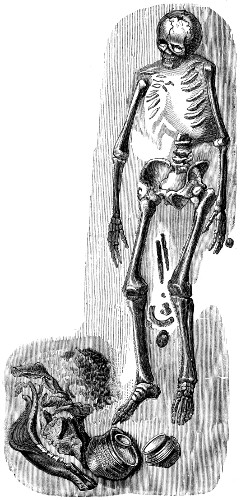
Ancient British, or Celtic, Period—General characteristics of the Barrows—Modes
of construction—Interments by inhumation and by cremation—Positions
of the body—Hitter Hill Barrow—Elliptical Barrow
at Swinscoe—Burial in contracted position—In sitting and kneeling
positions—Double interments.
The barrows of the Celtic, or ancient British, period
vary in their form and size as much as they do in their
modes of construction, and in their contents. Sometimes
they are simply mounds of earth raised over the interment;
sometimes heaps of stones piled up over the body;
and sometimes again a combination of cist and earth and
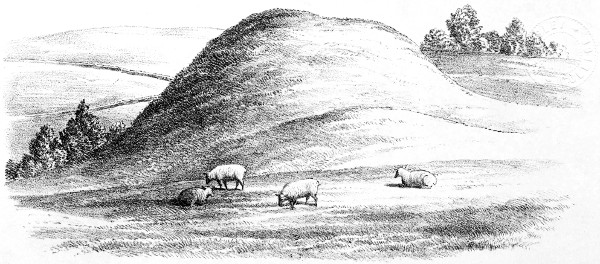
stone. Generally speaking the mounds are circular, rising
gradually and gently from the level of the ground towards
the centre, but in some instances the rise is somewhat
acute. Now and then they are oval in form. Where
elliptical barrows occur (generally known as “long barrows”),
they are, I have reason to believe, not matters of
original design, but of accident, through additional interments;
and I much doubt the propriety of archæologists
at the present day continuing the very questionable nomenclature
adopted by Sir R. C. Hoare and others. In some
cases, however, as in the instances of chambered or walled
tumuli, the elliptical form of the barrow can be easily
understood. An examination of a very large number of
barrows leads me to the opinion that the original form of
all was circular, and that no deviation from that form, and
no difference in section, can be taken as indicative of
period or of race.
The other appellation occasionally used, of “twin barrows,”
is further evidence of this—two interments having
been made within a short distance of each other, and the
mounds raised over them running into and joining each
other. It may, however, for purposes of description, and
for this alone, be well to retain the names, while discarding
much of the theory and of the system which has been attempted
to be established regarding them.
The mounds of earth alluded to, present occasionally
highly interesting and curious features, and show that, like
those of a different construction, they have frequently been
used for successive interments. The section of one of
these is shown on the next page. It is one of a group of
six barrows on Lord’s Down, in the parish of Dewlish, in
Dorsetshire. It was eighty-two feet in diameter, and
fourteen feet in height in the centre. The primary interment,
an urn, was placed in a cist cut in the chalk sub-soil.
Over the urn was raised a small cairn of flints, and the
cist was then filled in, and raised a little above the surface
with chalk rubble. Over this was a layer of earth, upon
which an interment had taken place, and in its turn
covered with a thick layer of chalk rubble, in the centre
of which, in a cist, another interment had again been
made. Above this rose another layer of earth, another of
chalk, and then a final one of earth, on each of which interments
had at different periods been made. Thus the
tumulus, which was formed of alternate layers of chalk and
earth, exhibited no less than six successive sepulchral
deposits.2 The interments were both by inhumation and
cremation.
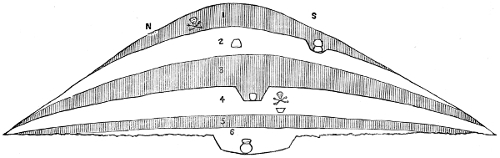
Fig.2.
1. Earth to the depth of three feet.
2. Chalk, two feet in depth.
3. Earth to the depth of three feet.
4. Loose rubble chalk, three feet in depth.
5. Earth, one foot in depth.
6. Chalk rubble, six inches in depth.
Cist, filled with chalk rubble and flints, two feet in depth.
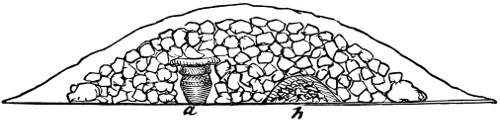
Another example of a barrow of this period is shown in
section on the fig. 3. There had originally been four
small mounds, or barrows, formed in a group, on the
natural surface of the ground (see the two dotted lines in
the engraving). They were composed of tempered earth,
approaching in tenacity almost to clay, and on these the
general mound was raised to a height of about eighteen
feet, and was composed of earth, intermixed with loose
rubbly limestones. Nearly at the top, in the centre, a stone
cist, enclosing an interment, was discovered. It was in
form a perfect, though miniature, example of what are
commonly called cromlechs.
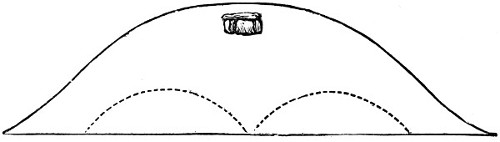
Fig. 3.
It is not an unfrequent occurrence in barrows to find
that interments have been made at different periods and by
different races, as will be hereafter shown.
The two examples of mounds of earth already given will
show the successive layers which have occurred in their
formation. The simpler, and intact, mounds of earth,
which are very common, require no illustration. They
are simply immense circular heaps of earth raised over
the interment, whether in cist or not.
Barrows, or mounds, of stone are of frequent occurrence.
They are of very simple construction. The interment,
whether by cremation or otherwise, having been made in a
natural or artificial cist, or simply laid upon the natural
surface of the ground, rough stones were placed in a large
circle around it, and an immense quantity of stones were
then piled up to a height of several feet. Some of these
cairns are of very great size, and cover a large area of
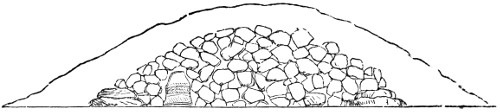
ground. Sections of two tumuli of this description are
given in figs. 4 and 5. The cairn of stone was, as will be
seen, covered to some depth with earth; perhaps in some
instances this might be a part of the original design, but in
most cases the soil which now covers these stone barrows
may be traced to the ordinary process of decay of vegetation
in successive ages.
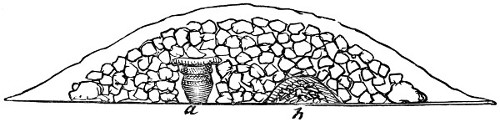
Fig. 4.
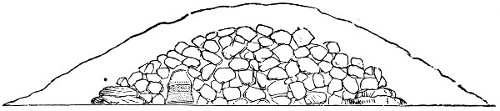
Fig. 5.
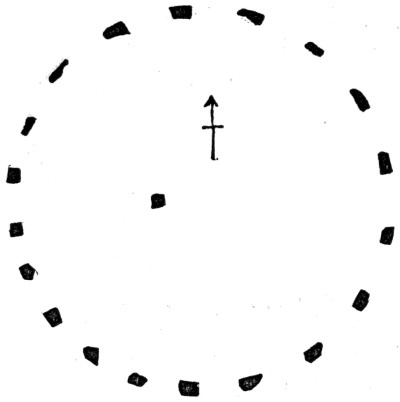
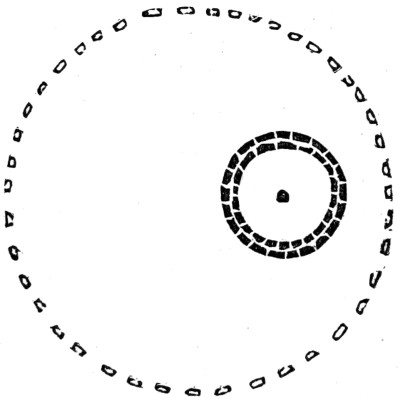
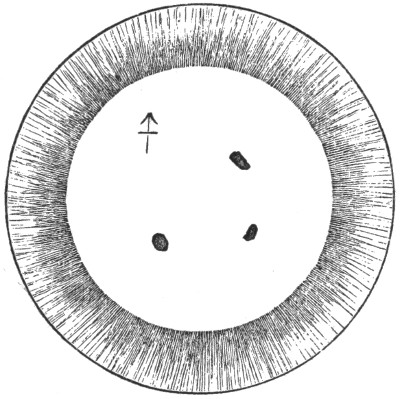
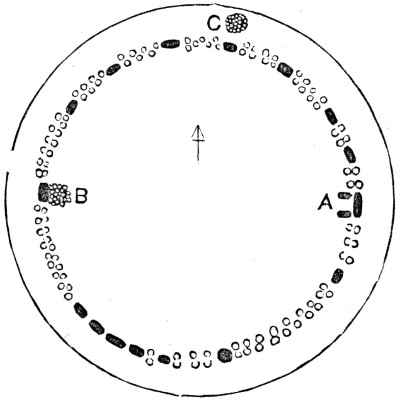
Barrows were not unfrequently surrounded by a circle of
stones, set upright in the ground. These circles, in many
instances, remain to the present day in different parts of the
kingdom, and, the barrow itself having disappeared, are
commonly called by the general appellation of “Druidical
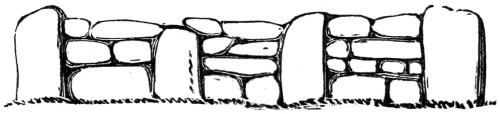
circles.” But of these, later on. The construction of the
stone circles varied considerably. In some instances the
upright stones were pretty close together; in others, wide
apart; and in others, again, the spaces between the uprights
were filled in with a rude loose rubble masonry, which thus
formed a continuous wall.
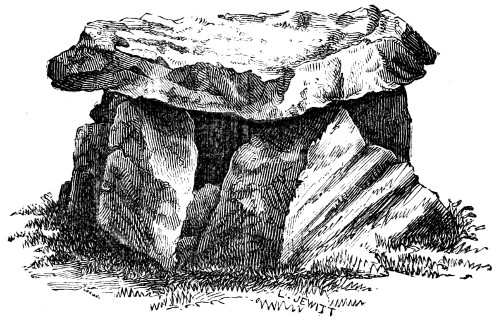
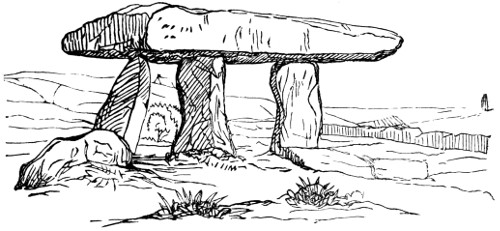
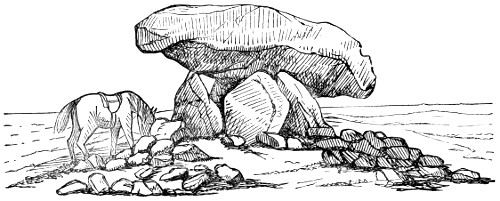
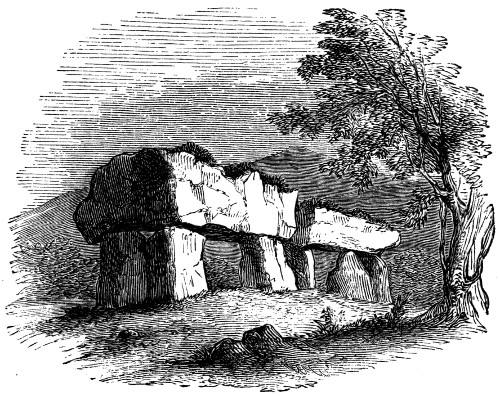
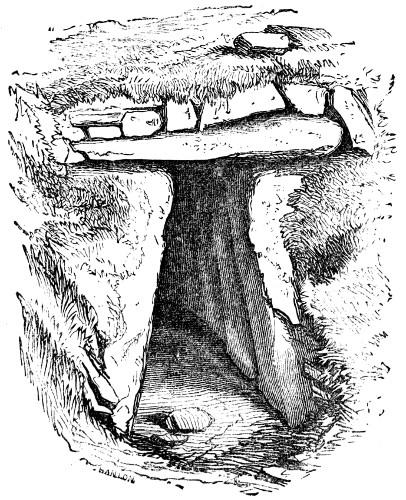
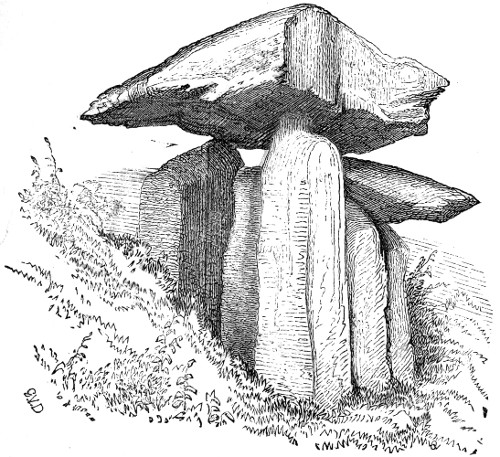
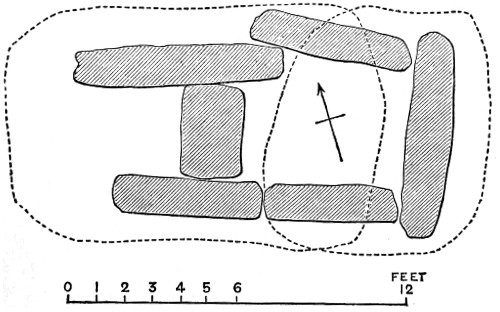
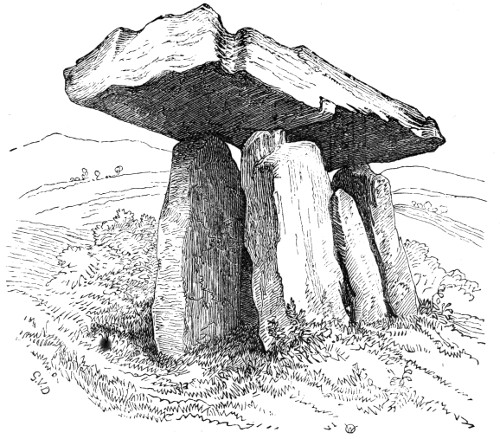
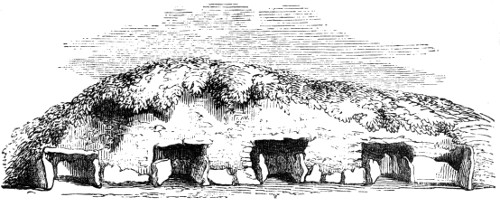
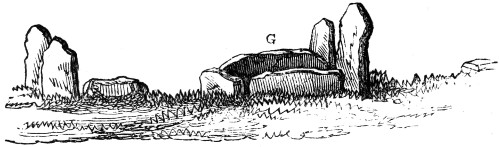
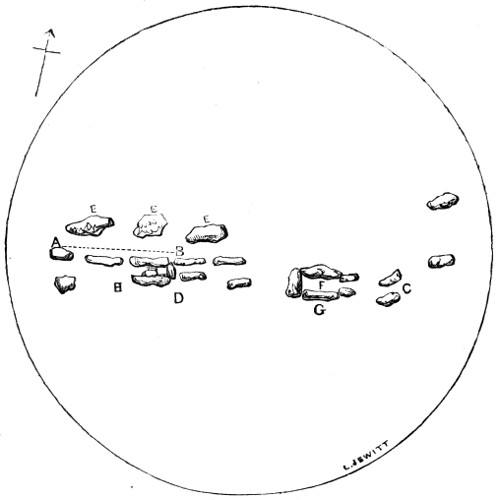
Some tumuli contained stone chambers and passages,
formed of massive upright slabs, and covered with immense
blocks of stone. Over these chambers, etc., the
mounds of earth, or of stone, or of both combined, were
raised, as will be hereafter shown.
Interments in the Celtic grave-mounds were both by inhumation
and cremation, and the modes of interment, in
both these divisions, was very varied.
Where inhumation obtained, the body was sometimes
laid on its side, in a contracted position; at others, extended
full length on its back or side; and in other
instances, again, was placed in an upright sitting or kneeling
posture. Occasionally, too, where more than one body
has been buried at the same time, they have been laid face
to face, with their arms encircling each other; at other
times an infant has been placed in its mother’s arms.
When cremation has been practised, the remains have
either been gathered together in a small heap on the
surface of the ground—sometimes enclosed in a small
cist, at others left uncovered, and at others covered with
a small slab of stone—or wrapped in a cloth or skin (the
bone or bronze pin which has fastened the napkin being
occasionally found), or enclosed in cinerary urns, inverted
or otherwise. In some instances, even when placed in
urns, they were first enclosed in a cloth.
These are the general characteristics of the interments
of the Celtic period, and they will be best understood by
the following examples.
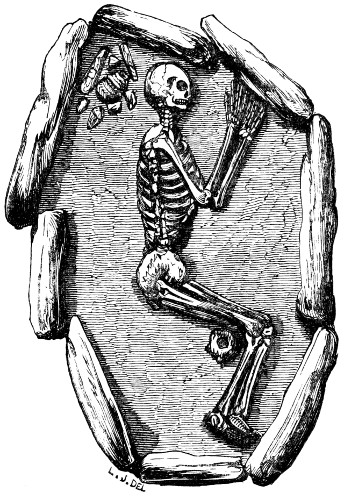
When the body has been buried in a contracted position,
it is found lying on its side; the left side being the most
usual. The head generally inclines a little forward; the
knees are drawn up near to the chest, and the heels to the
thighs; the elbows are brought near to the knees,—frequently,
indeed, one of them will be found beneath, and
the other on, the knees, which have thus been held between
them; and the hands are frequently brought up to the
front of the face. This position, which is after all, perhaps,
the most easy and natural one to choose, will be best
understood by the following engraving (fig. 6), which
shows an interment found in a barrow on Smerril Moor,
opened by my much lamented friend the late Mr. Thomas
Bateman. In this case the body had been laid on its left
side in an irregularly formed cavity on the surface of the
natural rock, on a bed of clay, over which, as usual, the
mound was formed of loose stones and mould. Behind
the skeleton, as will be seen in the engraving, was found a
remarkably fine “drinking cup,” along with a bone meshing
rule or modelling tool, twelve inches long, made from
the rib of a horse or cow; a flint dagger; an arrow-head;
and some other implements, also of flint, all of which had
been burned. The femur of this skeleton measured nineteen
and a half inches, and the tibia sixteen inches.
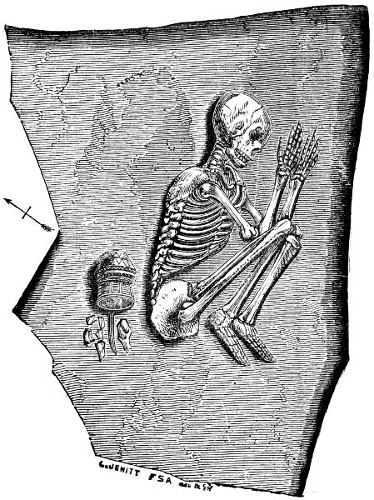
Fig. 6.
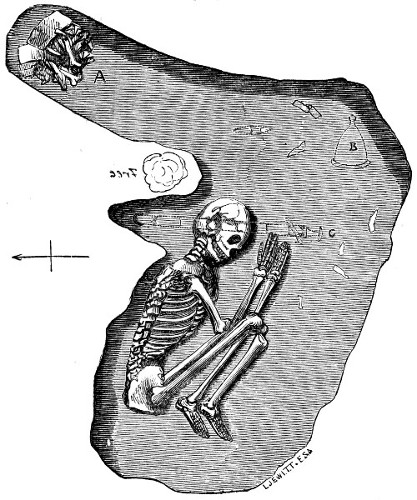
Fig. 7.
The next example (fig. 7), from Tissington, will be
seen to have been laid in very much the same position.
It lies on its left side, the knees drawn up, and the
feet, elbows, and hands in the position I have already
described. This barrow possessed considerable interest,
from the fact that a later interment—of the Anglo-Saxon
period—had been made immediately above the figure here
subjoined. To this I shall refer under the head of Anglo-Saxon.
In the same barrow, shown at A on the engraving,
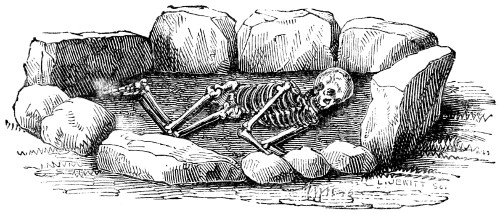
was a deposit of burnt bones. Fig. 8, again, shows an interment
in the contracted position, the head, in this instance,
resting upon the left hand. The skeleton lay in an oblong
oval cist, five feet long by two and a half feet wide, smoothly
hollowed out of the chalk, and over this the mound was raised.
Along with it were found a bronze dagger, a barbed
arrow-head of flint, a beautiful drinking cup and other
objects. This example is from Roundway Hill, in North
Wiltshire.3 Another excellent example, from Hitter Hill,
Derbyshire, is given in the next engraving (fig. 9), which
shows successive interments, each being on the left side,
in the usual contracted position.
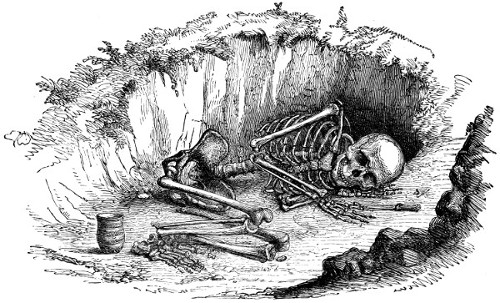
Fig. 8.
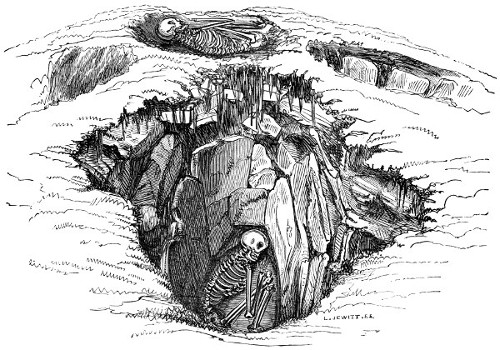
Fig. 9.
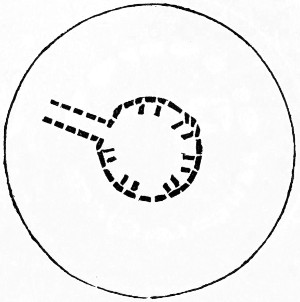
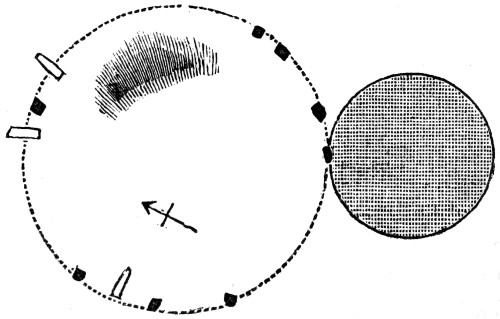
Of this barrow, the opening of which presented peculiarly
interesting features, a tolerably detailed account will be
advisable. It was opened by myself and Mr. Lucas in
1862. The mound, which was about twenty-two feet in
diameter, was composed of rough stone and earth intermixed.
It was only about three feet in height, its centre
being somewhat sunk. The first opening was made at the
part marked A on the accompanying ground-plan (fig. 10),
where, from the outside, we cut a trench, four feet in width,
in a north-easterly direction, towards the centre of the barrow,
and soon came upon an interment of burnt and unburnt human
bones. Along with these were an immense quantity of
rats’ bones4 and snail-shells. After proceeding to a distance
of seven feet, we came upon the side, or what may
almost be called the entrance, of a cist formed partly of the
natural rock, and partly of stones set up edgewise. The
dimensions of this cist were about forty inches by twenty-six
inches, and it was two feet in depth, the floor being
three feet six inches below the surface. The cist was
formed between two portions of natural rock, and protected
at its entrance by a large flat stone set up edgwise, and
other stones filled up the interstices at the sides. It was
also covered with a large flat stone. On clearing away the
surrounding earth, after removing the covering stone, we
were rewarded by finding that the cist contained the fragmentary
remains of a young person, which had lain on its
right side, in the usual position, with the knees drawn up.
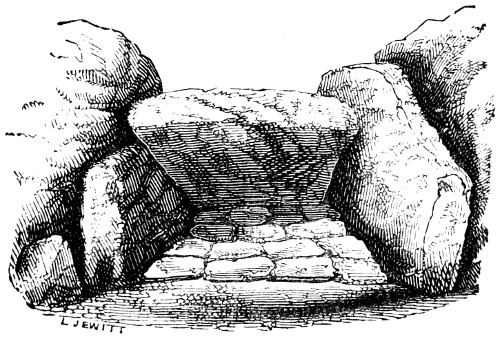
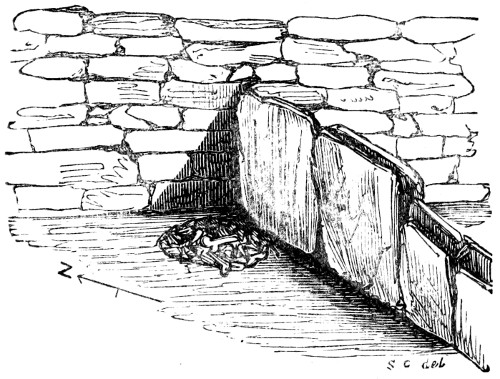
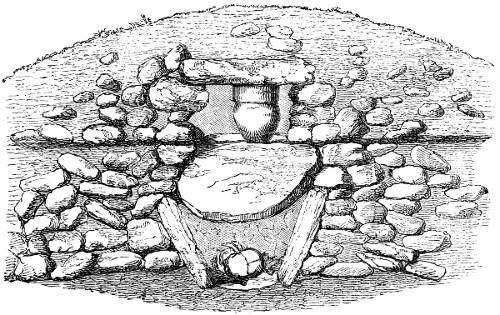
The accompanying engraving (fig. 11) will show the opened
cist, with the stone across its entrance, and the interment
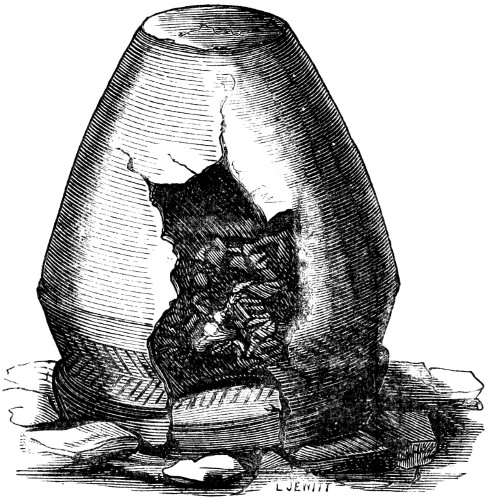
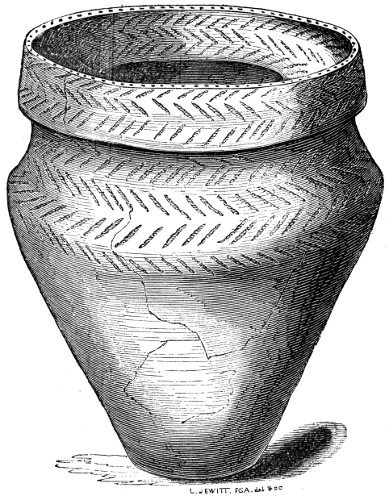
in situ. In front of the skeleton, and close to its hands,
was a remarkably good and perfect food vessel, which was
richly ornamented with the diagonal and herring-bone lines,
formed by twisted thongs impressed into the soft clay.
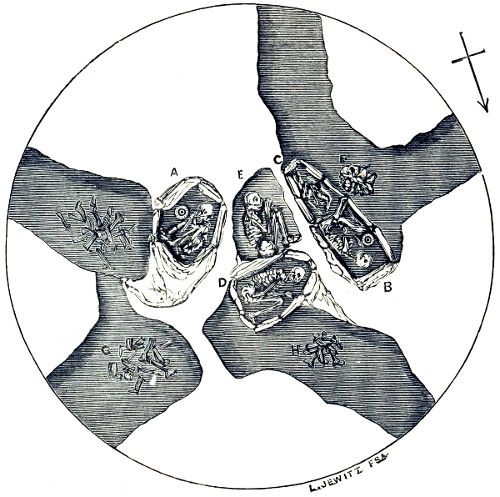
Fig. 10.
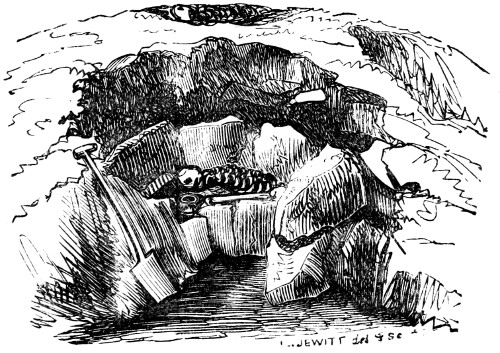
Fig. 11.
The next morning we dug a trench four feet wide, on the
west side towards the centre, as shown at B on the plan
(fig. 10), and the day’s labours had an equally satisfactory
result. At about the same distance as on the previous day
we came to the side of a cist, immediately in front of which,
at F on the plan, lay a heap of burnt bones, and a few
flakes of burnt flint. Having cleared away the surrounding
stones and earth, and removed the large flat covering stones,
which showed above the surface of the mound, we found
the cist to be composed on one side by the natural rock, and
on the other by flat stones set up on edge. Its dimensions
were about one foot ten inches by four feet, and it contained
a large quantity of rats’ bones and snails’ shells. In this
cist was an interment of an adult, much crushed by one of
the large covering stones having fallen upon it. Thanks to
this circumstance, however, a food vessel, which we discovered,
owed its preservation. The body lay in the usual
contracted position, on its right side, as shown on the ground-plan
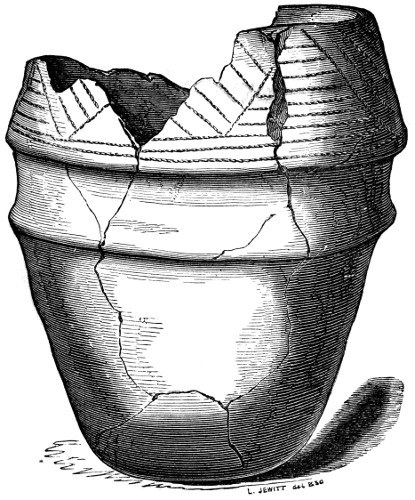
at B, and in front and close to the hands was the food
vessel, which, like the other, was taken out entire. It is
five and a quarter inches in height, and six and a quarter
inches in diameter at the top, and is richly ornamented.
Continuing the excavations to the south, we found that
another cist C adjoined the one just described, and was, like
it, formed of flat stones set up edgewise; in fact, it was like
one long cist divided across the middle. In this second
cist, besides the usual accompaniment of rats’ bones, was
the remains of an interment, sufficiently in situ to show
that the skeleton had, like the others, been deposited in a
contracted position. A small fragment of pottery was also
found, but owing to the cist being so near the surface the
stones had been partially crushed in, and thus both the deposit
and the urn had become destroyed. A portion of a
stone hammer was also found.
The two cists are here shown (fig. 12), which also shows
the central interment at a higher level, to be hereafter
described.
On the following Monday we resumed our operations by
making an opening on the north-west side, as shown at D on
the plan. Here, again, at a few feet from the outer edge, we
came upon an interment H, without a cist, accompanied by
an unusual quantity of rats’ bones. Continuing the excavation,
we were again rewarded by the discovery of a fine cist,
but at a greater depth than those before described. Above
this cist we found some large bones of the ox, and on the
covering stone was a deposit of burnt bones and ashes, with
innumerable quantities of rats’ bones.
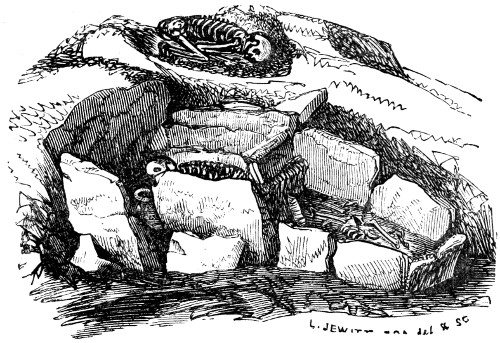
Fig. 12.
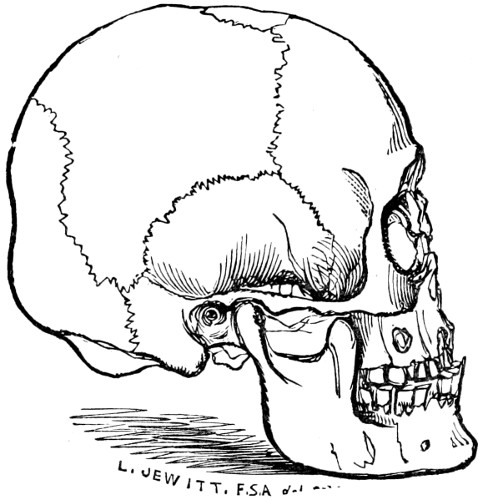
Fig. 13.
The cist, which was covered with one extremely large
flat stone, we found to be formed partly of the natural rock,
and partly—like the others—of flat stones set up edgewise;
and it was, without exception, the most compact and neatly
formed of any which have come under our observation. Its
form will be seen on the plan at D, and its appearance, when
the interior soil was removed, is shown on fig. 9. The dimensions
of the cist were as follows:—Width at the foot,
twenty-four inches; extreme length, forty inches; general
depth, twenty inches. The floor was composed of the
natural surface of the rock, with some small flat stones laid
to make it level, and at the narrow end a raised edge of
stone, rudely hollowed in the centre, formed a pillow on
which the head rested. The sides of the cist were square
on the one side to the length of twenty-eight, and on the
other of twenty-one, inches, and it then gradually became
narrower until at the head its width was only ten inches.
When the cist was cleared of its accumulation of soil and
rats’ bones—of which scores of jaw-bones were present,
thus showing the large number of these ravaging animals
which had taken up their abode there—it presented one of
the most beautiful and interesting examples of primeval
architecture ever exhumed. It contained the skeleton of
an adult, laid on his left side, in the usual contracted position,
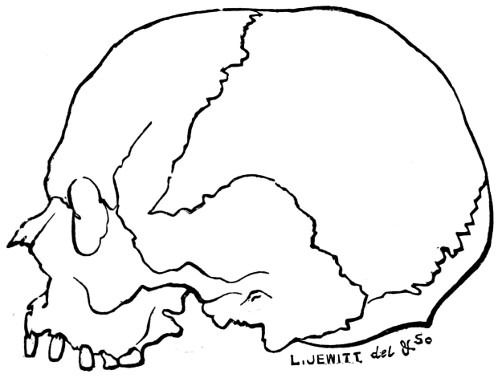
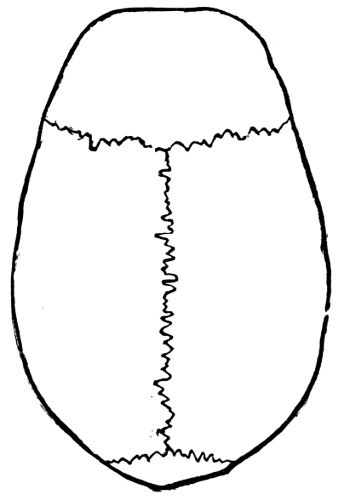
but without any pottery or flint. The skull, of which
an outline engraving is given on fig. 13, is a most interesting
and characteristic example of the cranium of an
ancient Coritanian Briton. It is brachy-cephalic, and is the
subject of deformity from nursing on the cradle-board in
infancy.5 It is the skull of a middle-aged man, and is
remarkably well formed. The bones, with the exception
of some of the small ones, were all remaining, and
formed a skeleton of considerable ethnological interest.
The small bones were gnawed away by the rats, and it is
curious to see to what distances, in some interments, these
active little animals have dragged even large bones from
their original resting-places. It may not be without interest
to note, that within the skull of this skeleton the bones of a
rat, head and all, were found imbedded in the soil, along with
some small stones, which he doubtless had dragged in with
him on his last excursion. We continued our excavations
in a north-easterly direction, as shown at G on the plan, and
found another interment, but without a cist or any other
notable remains; and next day we commenced opening that
portion of the centre of the barrow between the cists already
described, and soon came upon an interment of an adult
person, as shown on the plan at E. The bones were very
much disturbed, but sufficient remained to show that the
deceased had been placed on his left side, in the same contracted
position as the others in this mound. The body was
not more than twelve inches below the surface, and was
much disturbed, but it is more than probable the top of the
barrow had at some distant time been taken off, most likely
for the sake of the stone. The position of this interment
will be seen on reference to the plan, and it is also shown
on figs. 9, 11, and 12.
In addition to these illustrations, it will be sufficient to
give the annexed engraving (fig. 14), which shows the position
of a number of interments uncovered by Mr. Bateman
in the centre of an elliptical barrow6 at Swinscoe. The
interments were as follows:—1. A young adult, lying in a
contracted position, on its right side, in a shallow grave cut
about six inches deep in the chert rock, with a stone placed
on edge at the head, and another at the feet. 2. A young adult,
lying on its right side, an upright stone at its head. 3. A
middle-aged person, lying with the face upwards, and guarded
by a large stone at its side. 4. The bones of a young hog,
enclosed in a stone cist. 5. Remains of a cinerary urn and
burnt bones. 6. Skeleton of an aged man, lying in a contracted
position, on its left side, upon a thin layer of charred
wood. 7. A deposit of burnt bones. 8. Skeleton, very fragmentary.
9. A double interment, consisting of two skeletons,
with a flat stone on edge by their side. These were an
adult, and a child of a few months old only. 10. Skeleton of
an aged man, lying in the usual position, on his left side,
enclosed in a circle of stones. Behind him lay a handsome
drinking-cup. 12. Portions of a skeleton in a pentagonal
cist. 13. Skeleton of a young person, placed close up to an
upright flat stone. 14. Skull and portions of a skeleton.
Several flints and other remains were found with these
various interments.
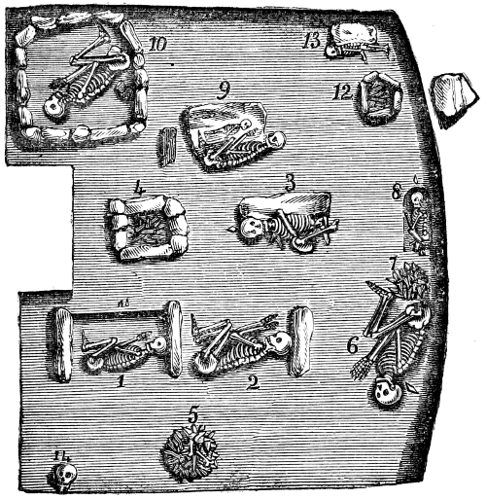
Fig. 14.
Interments where the body has lain extended are of much
rarer occurrence, in this period, than those just described.
Some few instances have been brought to light in Derbyshire,
and in other counties, but they are indeed “few and
far between,” and are the very rare exceptions to a general
rule. One of the most interesting of these instances is the
one called “Shuttlestone Low,” opened a few years ago by
Mr. Bateman, and thus described by him: “It consisted
of a compact mass of tempered earth down to the natural
surface of the land, below which point, in the centre of the
barrow, there appeared a large collection of immense limestones,
the two uppermost being placed on edge, and all below
being laid flat, though without any other order or design
than was sufficient to prevent the lowest course resting upon
the floor of the grave inside which they were piled up, and
which was cut out to the depth of at least eight feet below the
natural surface; thus rendering the total depth, from the top
of the mound to the floor of the grave, not less than twelve
feet. Underneath the large stones lay the skeleton of a
man, in the prime of life, and of fine proportions, apparently
the sole occupant of the mound; who had been interred
while enveloped in a skin of dark-red colour, the hairy surface
of which had left many traces both upon the surrounding
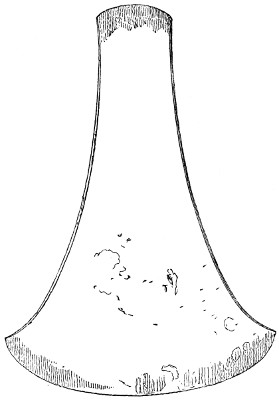
earth and upon the verdigris, or patina, coating; a bronze
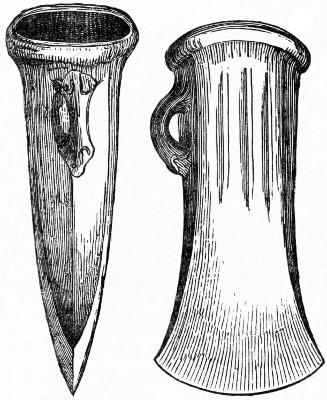
axe-shaped celt and dagger deposited with the skeleton. On
the former weapon there are also beautifully distinct impressions
of fern leaves, handfuls of which, in a compressed
and half-decayed state, surrounded the bones from head to
foot. From these leaves being discernible on one side of
the celt only, whilst the other side presents traces of leather
alone, it is certain that the leaves were placed first as a
couch for the reception of the corpse, with its accompaniments,
and after these had been deposited, were then further
added in quantity sufficient to protect the body from the
earth. The position of the weapons with respect to the
body is well ascertained, and is further evidenced by the
bronze having imparted a vivid tinge of green to the bones
where in contact with them. Close to the head were one
small black bead of jet and a circular flint; in contact with
the left upper arm lay a bronze dagger with a very sharp
edge, having two rivets for the attachment of the handle,
which was of horn, the impression of the grain of that substance
being quite distinct around the studs. About the
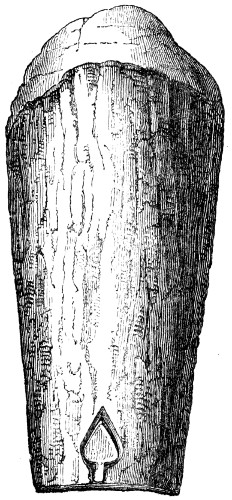
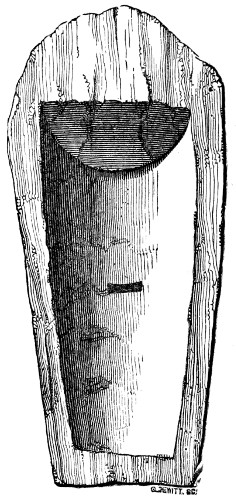
middle of the left thigh-bone was placed the bronze celt
which is of the plainest axe-shaped type. The cutting edge
was turned towards the upper part of the person, and the
instrument itself has been inserted vertically into a wooden
handle, by being driven in for about two inches at the narrow
end—at least the grain of the wood runs in the same
direction as the longest dimension of the celt,—a fact not
unworthy of the notice of any inclined to explain the precise
manner of mounting these curious implements. The
skull—which is decayed on the left side, from the body having
lain with that side down—is of the platy-cephalic form, with
prominent parietal tubers—the femur measures 18½ inches.”
Another good instance is from Yorkshire, where two
skeletons were found side by side, extended, with their heads
respectively east and west, lying in a bed of charcoal.
Occasionally, as has been stated on a previous page, interments
have been made in an upright sitting position.
Instances of this kind are rare and very curious. Our engraving
(fig. 15) shows an interment of this kind, which
occurred in a barrow at Parcelly Hay. The body had been
placed in a sitting posture, leaning back against the side of
the cist, which was only three feet in height, and not more
than that in its greatest width. The cist was roughly covered
in with large slabs of limestone. The skull, which was a
remarkably fine one, has been engraved in “Crania Britannica.”7
On the covering-stones lay another skeleton, among
the loose stones of which the barrow itself was composed.
This secondary interment was accompanied by a fine axe-head
of stone and a bronze dagger. Of course the seated
skeleton must have been of an earlier date still.
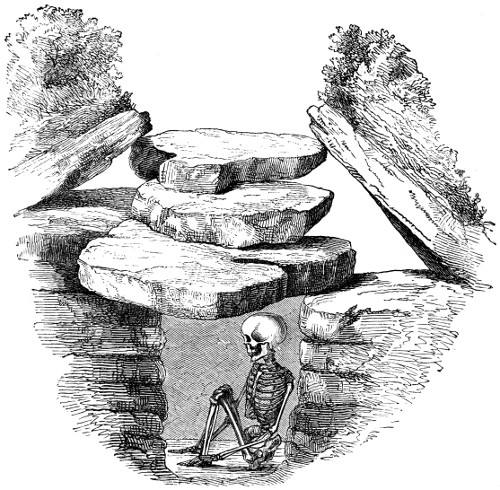
Fig. 15.
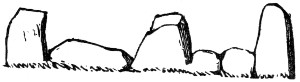
Another remarkable instance of this kind of interment—but
this time in a kneeling position—was discovered in
the Cromlech De Tus, or De Hus, in Guernsey, by
Mr. F. C. Lukis.8 This interesting relic is situated near
Paradis, in the parish of Vale, and is a chambered tumulus
of simple but excellent construction. The mound
is surrounded by a circle of stones, about twenty yards in
diameter. In the centre is the principal chamber, covered
with large flat stones, and from it to the extremity of the
mound, on the east, was a passage formed by upright
stones, and covered here and there with cap-stones dividing
it into chambers. On the north side of this passage was
a chamber formed by upright stones, on which rested the
large flat covering stone; and close to this was another
similar but smaller chamber. In the first were discovered
“vases, bone instruments, celts, and human remains.” In
the latter, on removing the soil at the top, “the upper part
of two human skulls were exposed to view. One was
facing the north, and the other the south, but both disposed
in a line from east to west,”—in other words, side by side,
and shoulder to shoulder, but facing opposite ways. They
were skeletons of adult males, and, on clearing away the
soil, they were found to have been buried at the same time.
“The perfect regular position of a person kneeling on the
floor, in an upright posture, with the arms following the
direction of the column, pelvis, and thigh-bones, and gradually
surrounded by the earth, in like manner as may be
conceived would be done were the persons buried alive,
will give an exact representation of this singular discovery.”
Another excellent example of this very unusual mode of
interment—this time in a sitting posture—was discovered
by some tufa-getters, and examined by Mr. Bateman, in
Monsal Dale, and is shown on the accompanying engraving,
fig. 16, which exhibits a section of the rock,
etc.; and shows the position of the skeleton, and the manner
in which the cavity containing the body had been filled
up with the river sand. The body in this case, as in the
last, had been placed in the cavity, in a sitting position, and
must have been so placed from an opening in front. The
cavity was ten or twelve feet above the bed of the river
Wye, and above it were some five feet in thickness of solid
tufa rock, while, from the face of the rock, the cavity was
about twelve feet. The body may therefore be said to have
been entombed in the middle of the solid rock. The roof
of the cavity when found was beautifully covered with stalactites.
The skeleton was that of a young person, and
near it were found a flint and some other matters. The
cavity was filled to part way up the skull with sand.
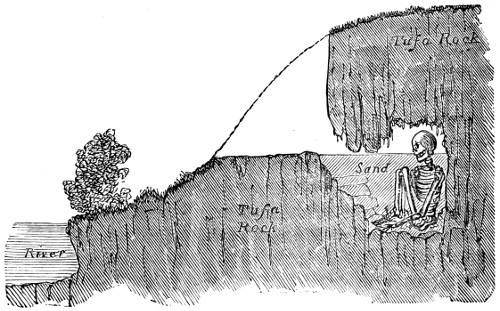
Fig. 16.
Another example of interment in a sitting posture was
discovered some years ago, at Kells in Ireland. These
will be sufficient to show the curious character of this mode
of interment.
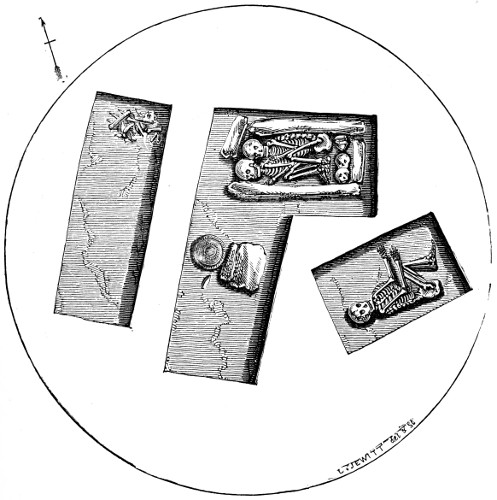
Fig. 17.
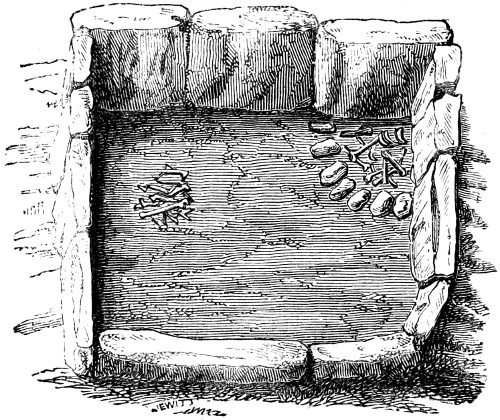
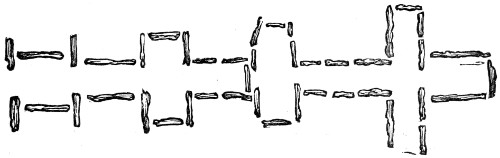
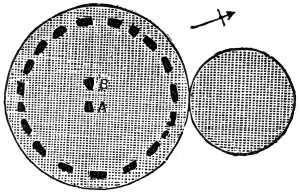
Several examples of double interments, besides those
described above, have been discovered in different localities.
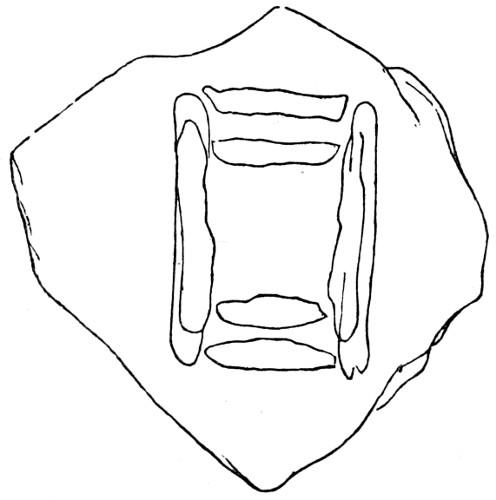
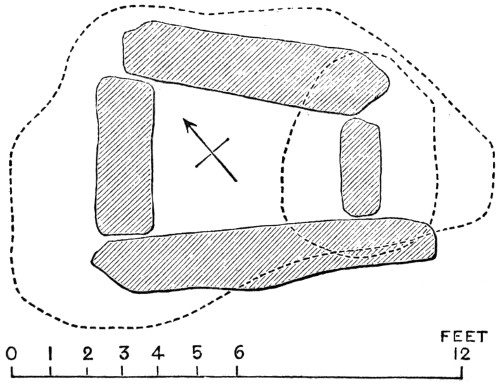
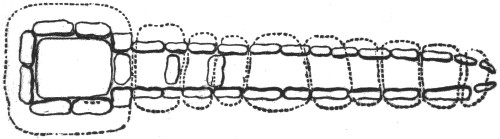
One of the most curious is the one in the largest cist,
in fig. 17. In this cist, which is composed of four upright
slabs of stone,9 were the skeletons of a man and woman,
and the remains of two children; the family having probably
been immolated at the death of its head, and all
buried together. A small urn was found in the same cist;
and in the same barrow, in other portions which were excavated,
as shown in the plan, were other interments, both
by cremation and by inhumation.
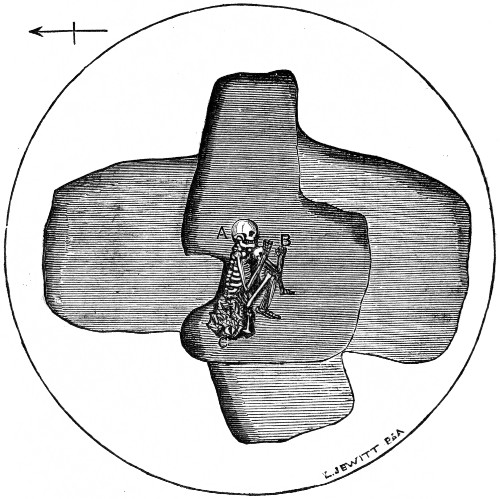
Fig. 18.
In No. 9, on fig. 14, an interment of a mother and her
child together is shown. Another instance is shown on
the next engraving, fig. 18. In this instance the woman
was laid in the usual contracted position, on her left side,
with her head to the east. Close in front of the breast, lying
in the arms in the same contracted position, lay the
infant. Some flints and a fragment of pottery were found
along with this touching interment.