I. “Seed" rounded (Millet-seed12 type). Caryopsis
ovoid or sub-globose, devoid of distinct groove,
and distending the awnless paleæ, or falling
out free.
A. Glumes cuspidate, “fruit" yellowish.
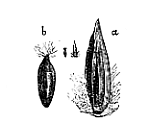
Phleum pratense.
The student should familiarise himself with the “seed"
of Phleum pratense, as a type, and an important grass
easily obtained pure, but sometimes with minute round
seeds of weeds intermixed.
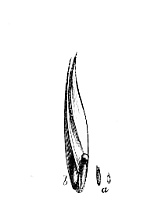
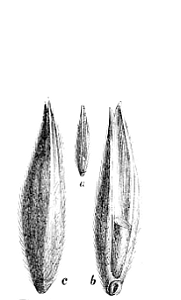
Phleum pratense, L. (Fig. 45).
Palea 2·3 mm. long, five-ribbed, with a short point,
delicate but hard, smooth, with a silvery lustre. Inner
pale two-nerved. Closely investing the yellow-brown
caryopsis, which easily falls out and is ovoid-acute, about
2 mm. long by 1 broad, and finely punctate.
The much rarer P. arenarium and the very rare P. Bœhmeri and
P. asperum also come here.
Phleum is not easily confounded with any other of our grasses,
and Briza and Glyceria are almost the only other common grasses of
about the same size of which the caryopsis often falls free from the
palea ("naked fruits"). Glyceria is longer and corn-shaped, and
Briza usually larger. Anthoxanthum and Phalaris are easily distinguished.
Agrostis is smaller and “corn-shaped." Certain species
of Panicum present resemblances, but the enveloping paleæ, &c. are
very different. Melica also occurs as “naked fruits,” but is rarely
seen, and its colour and brilliant lustre distinguish it.
B. Glumes not cuspidate. “Fruit" not yellow.
(a) “Fruit" white, owing to the closely investing
palea.
Milium effusum.
A common grass, but not often met with in “seed" grasses. It
is eagerly eaten by birds.
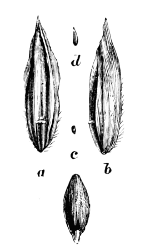
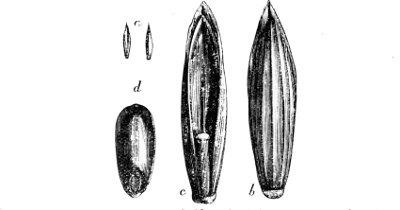
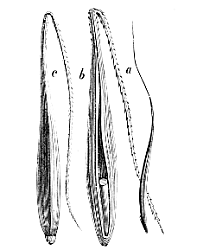
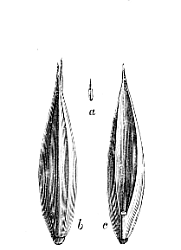
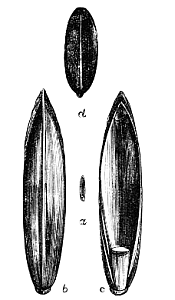
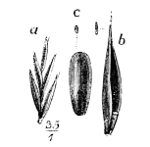
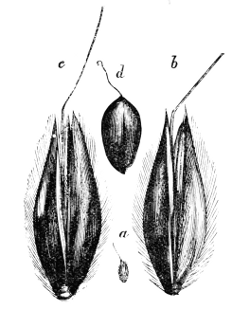
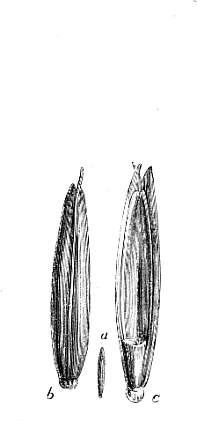
Milium effusum, L. (Fig. 52).
Palea about 3 mm. long, with
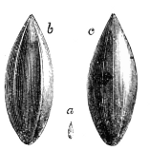 Fig. 52. Milium effusum.
"Seed," a,
nat. size; b and c,
× 7. Nobbe.
few nerves, closely investing the
caryopsis: the seed is ellipsoid-acute,
slightly compressed, and 2·2-2·7
mm. long. The inner pale becomes
hard and shines like porcelain.
Fig. 52. Milium effusum.
"Seed," a,
nat. size; b and c,
× 7. Nobbe.
few nerves, closely investing the
caryopsis: the seed is ellipsoid-acute,
slightly compressed, and 2·2-2·7
mm. long. The inner pale becomes
hard and shines like porcelain.
(b) “Fruit" dark-brown shining;
slightly flattened and
grooved.
Melica.
Melica is rarely met with as “seed." When it is, it has to be
distinguished from the other “Millet-seed" types which readily fall
as naked fruits—see Phleum, Milium, &c. Agrostis, Glyceria and
other corn-shaped “seeds" are easily distinguished.
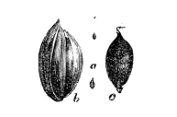
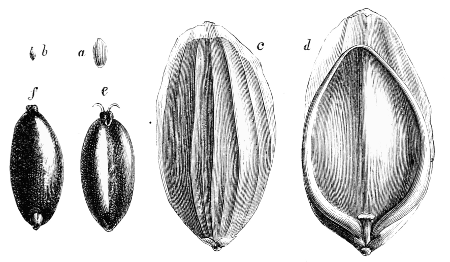
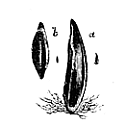
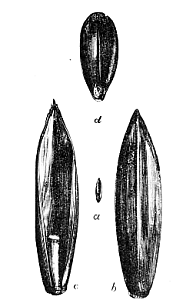
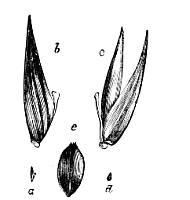
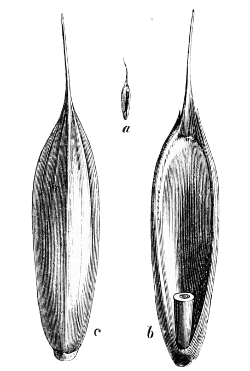
Melica nutans, L. (Fig. 53).
"Seed" coracle-shaped. Palea broad, parchment-like,
elliptic convex, 5-6 mm. long, 5-7 nerved and
keeled, awnless, loose, purplish. Caryopsis ellipsoid-acute,
2-3 mm. long, and easily separating, wrinkled, dark
shining brown as if lacquered.
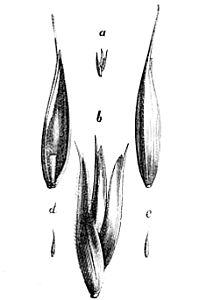
Fig. 53. Coracle-shaped “seed" of Melica nutans, showing the broad,
ribbed and keeled palea (c), and small rachilla (d). a, the “seed,"
nat. size; c and d, ditto, × 8; b, the caryopsis, nat. size; e and f,
ditto, × 10. Nobbe.
M. uniflora, Retz. is commoner and very similar, but neither is
often met with in “seed" grass, except as impurities among Fescues.
The rare Panicum Crus-galli and allies, and the rice-like Leersia
oryzoides as well as Cynodon Dactylon, come here.
Panicums may occur in grass “seed" from America: Burchard
describes them in detail.
II. “Seed" long (Corn and Barley type). Caryopsis
oblong or flattened, usually trapped between the
boat-shaped paleæ: if otherwise, with an awn.
A. “Seed" awnless. There may be a short sharp point
to the palea (mucronate), but no prominent hair-or
bristle-awn exceeding half the length of the palea.
(a) A “web" or tuft of hairs at the base or on
the rachilla.
(1) Hairs of basal tuft silky and erect.
✲ Pencil of hairs as long as palea or longer.
Calamagrostis lanceolata, Roth.
Palea 3 mm. long, thin, two-toothed and with a short
bristle at the apex.
Other species of Calamagrostis are awned. None occurs as an
ordinary impurity in “seed."
Arundo Phragmites, L.
Palea narrow and long, 10-11 mm., delicate, entire,
tapering to an acuminate point, violet, three-nerved,
smooth. Caryopsis about 2 mm. A pencil of long silky
hairs on the rachilla.
The long acuminate point is almost an awn.
Calamagrostis also has long basal hairs: both are useless grasses
agriculturally. For Glyceria see note, p. 146. Avena, Aira and
Psamma are easily distinguished.
✲✲ Pencil of hairs short.
† Palea mucronate, 11-12 mm. long: caryopsis
4·5 mm.
Psamma arenaria.
Digraphis differs in the stout caryopsis, smaller size, double hair-tuft.
Arundo has a long pointed palea and long silky basal hairs
and is larger.
Psamma arenaria, Beauv.
Palea 11·5 mm. ovate-lanceolate, papery, 4-5 nerved,
as rolled round the fruit about 1·3 mm. diameter, yellow,
and with a small tuft of stiff fine hairs at the base. Mere
trace of awn, sub-terminal. Fruit 4-5 mm. long, obovate,
pale-brown.
A shore-grass, not often seen as “seed": more valuable as a
sand-binder than as fodder, though the young shoots are grazed.
†† Palea acuminate, and only about 4 mm. long:
caryopsis 1·4 mm.
Digraphis arundinacea.
A Fen-grass, but coarse and not in use except the young growth,
and for thatching.
Digraphis arundinacea, Trin.
Paleæ ovate-lanceolate, nerveless and awnless, but silky
with double basal hair-tuft, and polished at the base;
smooth, hard and shining, and closely investing the
caryopsis which has no groove. Dark grey in colour. The
glumes are without awns or wings, and are left behind.
The allied Phalaris canariensis has wing-like keels to the glumes.
Triodia also comes into this group, with short basal hairs; but
its broad ciliate palea, 6 mm. long, has a short mucronate point
between two teeth (Fig. 40).
(2) Hairs at the base forming a fluffy “web."
Paleæ thin, 2-3 mm. long.
Poa pratensis.
P. trivialis.
P. compressa.
P. nemoralis.
|
The “seeds" of Poa proper are nearly all small—not more than
3-4 mm., more or less lanceolate, with tough, keeled glumes, and
when “webbed" tend to adhere together as if stuck with cobweb.
The keeled glumes give them an angular appearance—triangular
in section—and make them tend to lie on the side. Rachilla
evident. Nerves of paleæ distinct.
Poa pratensis, L. (Fig. 55).
"Seed “ 2-3 mm. long, brownish: caryopsis about
1-1·5 mm. Outer palea acute, indistinctly 3-5 nerved,
edges and keel, silky; margins overlapping the hyaline
inner palea.
The “web" looks like hyphæ of a mould.
Caryopsis ellipsoid-acute, with traces of the stigma.
It falls easily. No distinct groove, section somewhat
triangular. Rachilla truncate.
|
|
|
|
Fig. 54. Poa nemoralis.
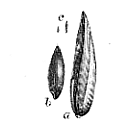
c, the minute “seed"
(to the right) and
caryopsis (to the left)
nat. size. a, the
"seed," × 8; b, the
caryopsis, × 8. Traces
of a basal “web," not
shown here, occasionally
occur. Nobbe.
|
Fig. 55. Poa pratensis.
Type of a “webbed
seed." a, “seed,"
× about 7; b, caryopsis
(inverted), × 7.
Between are the same,
nat. size. Note the
nerves on the palea
and the conspicuous
"web" at the base a.
Nobbe.
|
Fig. 56. Poa trivialis.
a, “seed," nat. size
and × 8; b, caryopsis,
nat. size and
× 7. Note the conspicuous
"web."
Nobbe. Cf. Fig. 43.
|
Poa compressa, L.
Palea obtuse, nearly glabrous and nerveless, or faintly
3-5 nerved and with a faint web. It is close to
P. pratensis.
Poa trivialis, L. (Fig. 56).
"Seed" 2-2·5 mm., and with a bluish or bronzed
cast. Caryopsis 1-1·5 mm.
Palea acute, distinctly five-ribbed, glabrous, the margin
scarcely overlapping. Caryopsis grooved, blunt and more
tightly held in the palea.
P. trivialis differs from P. pratensis chiefly in the distinct ribs
and smoother palea, grooved caryopsis, and bluer hue.
P. nemoralis, L., hardly differs from P. trivialis, but
the paleæ are sub-acute, nerves obsolete, and scarcely
hyaline at the margins. The “seed" is shorter and more
acute, and the colour less pronounced, and with hardly a
trace of hairs (Fig. 54).
When the basal hairs are absent this should go with
P. annua, &c. (see p. 146).
It is practically impossible to distinguish these species by the
"seed." Care is necessary to distinguish Kœleria, which is somewhat
larger in size, keeled, compressed and nerved similarly, but is more
pointed and curved and paler yellowish white in colour. Hard and
devoid of web or hairs. Aira is distinguished by the awn: Agrostis
by the very different paleæ and caryopsis.
The other Poas are devoid of web, though they may have hairs
below, and require very careful examination. The whole group is
excessively difficult to deal with in “seed," and a special study of it
is needed, since several species are important, and it forms a type.
(b) No web or pencil of hairs below the “seed."
(1) Apex of palea rounded, blunt, notched, or at
most bluntly pointed, but with no trace of
awn-or bristle-tip.
✲ Palea inflated, round-backed and somewhat
winged, membranous.
Briza media, L.
Paleæ blunt, 2·5-3 mm., without lateral projections,
markedly convex—almost conduplicate; nerves several.
Caryopsis ovoid, 1·5-2·5 mm., dark brown.
Sometimes called a good grass, but meagre and only found in
poor meadows in this country.
It should perhaps go with the “Millet-seed" type and should be
compared with Phleum, Melica, Panicum, &c. “Seed" seldom met
with.
B. minor is smaller.
✲✲ Paleæ not inflated or winged.
† Paleæ broad, flat and truncate, prominently three-ribbed.
Caryopsis 2 mm. long.
Catabrosa aquatica, Beauv.
Cattle like it, but it only grows in ditches &c. in water-meadows:
distinction from Glyceria aquatica easy if the paleæ are examined.
†† Paleæ acute or sub-acute, boat-shaped.
⊙ Paleæ and “seed" at least 6-8 mm. long.
≡ Rachilla flattened or angular, and tapering
below.
Lolium perenne.
Occasionally awned, and then less easily distinguished from
L. temulentum. One of our most valuable grasses. It forms a
distinct type of boat-shaped “seeds."
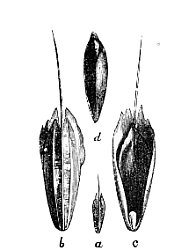
Lolium perenne, L. (Fig. 57).
Palea distinctly five-ribbed, glabrous, oblong-lanceolate,
obtuse or sub-acute, awnless, about 7 mm. long. Margins
membranous. Inner palea nearly as long, delicate,
ciliate.
Rachilla short, flattened and angular, tapering below
(see Festuca elatior).
Caryopsis about 3·5 mm. long, obovate, yellowish
brown.
|
|
|
|
Fig. 57. Lolium perenne with typical
boat-shaped “seed." a, natural
size; b and c, × about 8. d, caryopsis,
× 8. The rachilla, in c, is
broader upwards and flatter than
in Fig. 58. Nobbe.
|
Fig. 58. Festuca elatior, var.
pratensis. Lettering and sizes
as in Fig. 57: compare the
more cylindrical and slender
rachilla. Nobbe.
|
Although Bromus mollis, Holcus lanatus, &c. occur as impurities,
they are easily distinguished: the real difficulties are with Festuca
elatior and F. pratensis.
≡ ≡ Rachilla cylindrical.
Festuca elatior.
This is an important grass, and should be thoroughly mastered
as a type of the boat-shaped “seed."
This, with Lolium, Agropyrum, other Fescues, and even some
Bromes and Poas, will give trouble until the student thoroughly
masters the importance of the minute characters of size, nervature,
of the rachilla, awn, palea, &c.
Festuca elatior, L. (var. pratensis) (Fig. 58).
Palea ovate-lanceolate, five-nerved, slightly scabrid,
with a slight membranous margin and cilia, rounded
back, and no awn. 6-7·5 mm. long.
Caryopsis oblong-obovate, somewhat flattened, hardly
grooved and adhering to the paleæ, about 3-3·5 mm.
long.
Rachilla cylindrical, smooth.
The other varieties of F. elatior cannot be distinguished by the
"seed" alone: in my samples F. elatior proper is longer than
F. pratensis, and both have occasionally a trace of awn. Var. arundinacea
has a more acuminate, stiff point. Festuca pratensis has
its palea as a rule somewhat more acute than Lolium perenne, and
the flatter tapering rachilla of the latter is more closely appressed to
the palea. The caryopsis of Festuca also tends to adhere to the
paleæ.
⊙⊙ Paleæ and “seed" at most 3-3·5 mm. long.
≡ Palea devoid of hairs or keel, notched or
blunt, and with no trace of awn.
Δ Palea hyaline, nerves indistinct. Tips
notched or blunt.
Agrostis alba.
There is occasionally a very short basal hair (awn).
Agrostis and Aira will present difficulties to the beginner, not
only on account of their small sizes, but also from the variability as
regards awns, basal hair-tuft, &c. None are of value, and most of
them are weeds.
Agrostis alba, L. (var. stolonifera).
Palea enclosing the fruit 1·8-2 mm. long, white,
delicate, membranous, with a blunt notched apex and
three (or five) nerves: occasionally there is a fine kneed
basal awn, not projecting.
The glumes may remain attached: the outer has a
serrulate keel, and often a violet hue. No awn. About
2-3 mm.
Caryopsis about 1·1 mm. long, oblong, yellow, corn-shaped,
furrowed, shining through.
A. vulgaris, L., is a variety with slightly smaller
fruits, no awn, and usually three nerves to the palea,
but they cannot be distinguished with certainty by the
"seed." Rachilla obsolete.
The colour of the glumes may vary considerably and is sometimes
yellow.
The absence of awn, rachilla, and basal hairs distinguishes
Agrostis from Aira.
ΔΔ Palea membranous, ribbed, tips scarious.
Glyceria aquatica.
G. fluitans.
Glyceria aquatica, Sm.
Palea strongly 5-7 ribbed, obtuse and scarious, about
4 mm. long. Green with a purple cast. Caryopsis dark-brown,
about 2 mm. long.
Inner palea punctate. Rachilla slender and cylindrical.
Glyceria fluitans, Br., is very similar, but longer
(6 mm.) and more slender; the palea scabrid with
truncate or ragged tips, and the inner palea not punctate.
Yellow. (Fig. 46.)
Glyceria aquatica and G. fluitans are sweet grasses of value in
water-meadows only. The “seed" is not often met with.
Not only with the Poas, but also with Catabrosa are there
difficulties in determination. Molinia and Kœleria also present
difficulties with Glyceria: the former has fewer and feebler nerves.
Digraphis and Arundo are easily distinguished by the basal hairs.
≡ ≡ Palea acute and somewhat compressed and
keeled, and with hairs on the ribs. Tips
nerved.
Poa annua.
P. maritima.
P. distans.
P. rigida.
P. loliacea.
P. bulbosa.
P. alpina. |
Their “seeds" are all small, about 2-3·5 mm. only, and angular,
brown, and present many difficulties (see note, p. 141).
Poa annua, L. (Fig. 43).
Palea 3·5 and caryopsis 2 mm. long, so that the “seed"
is much larger than P. trivialis, and there is no web.
Minutely silky-hairy on the keel, and the ribs are strong
for a Poa.
Poa alpina, L., has the palea five-ribbed with stiffish
hairs below, but no web. Bronzy green-violet. “Seed"
3-3·5 mm. long. Caryopsis 1·5-2 mm., and slightly
grooved. It is rare in England, and is interesting as
it becomes viviparous in Alpine situations.
(2) Apex of palea distinctly pointed, acuminate
or mucronate, but not giving rise to a true,
long, bristle-like awn.
✲ Palea acuminate—i.e. taper pointed.
† Not compressed or obviously keeled.
Festuca ovina.
F. sylvatica.
Cynosurus cristatus. |
It is doubtful whether these should not be regarded as awned:
if so they come near Nardus—see p. 130.
Festuca ovina, L. (Fig. 59).
Palea rounded on the back, narrow, terete-lanceolate
and five-nerved, tip scaberulous and drawn out to a stiff
scabrid point half as long as the palea, or less. About
3-4 mm. long without the tip-point, 4-5·5 mm. with it.
Rachilla obliquely truncate and concave at its apex.
Fig. 59. Festuca ovina. a, spikelet, × about 3-1/2. b, “seed,"
nat. size and × about 7. c, caryopsis, nat. size and × 7.
Caryopsis oblong, somewhat flattened, dark-brown.
The numerous varieties of F. ovina cannot be distinguished by
the “seed": the allied varieties F. rubra, F. duriuscula, and F. heterophylla,
&c. are sometimes more distinctly awned (see p. 172). But
difficulties will be found with the whole group, which needs revision.
This group comprises the grasses so valued on downs and dry hill-pastures
for sheep-feeding.
Festuca sylvatica, Vill., not a common plant, is also with
difficulty separable (Fig. 51).
Cynosurus cristatus, L. (Fig. 60).
Palea canary yellow to light-brown, lanceolate with
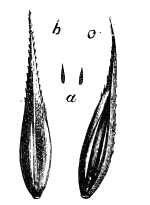 Fig. 60. Cynosurus
cristatus. a, “seed"
and caryopsis, nat.
size; b and c, “seed"
× about 8. Note the
scabrid and slightly
curved awn-point.
Nobbe. Cf. Fig. 64.
rounded back and the mid-rib prominent
as a slight keel and margins infolded,
about 4 mm. long (varies from
3-4·5 × 0·5 to 1 mm. broad), scabrid
above, dotted below and acute to
acuminate with a scabrid awn-point,
often curved. Caryopsis 2-2·3 mm.,
somewhat flattened. Rachilla short
and smooth, dilated above.
Fig. 60. Cynosurus
cristatus. a, “seed"
and caryopsis, nat.
size; b and c, “seed"
× about 8. Note the
scabrid and slightly
curved awn-point.
Nobbe. Cf. Fig. 64.
rounded back and the mid-rib prominent
as a slight keel and margins infolded,
about 4 mm. long (varies from
3-4·5 × 0·5 to 1 mm. broad), scabrid
above, dotted below and acute to
acuminate with a scabrid awn-point,
often curved. Caryopsis 2-2·3 mm.,
somewhat flattened. Rachilla short
and smooth, dilated above.
A valuable and easily recognised grass.
Molinia, Holcus and similar impurities are
easily detected: some Fescues are much
more like it; e.g. F. tenuifolia (see p. 46) in
which the apex tapers suddenly to a point.
Dactylis should also be compared.
†† Paleæ compressed or distinctly keeled.
Molinia cærulea.
Kœleria cristata. |
Unimportant, except as impurities among other grass “seeds."
Molinia is said to occur as such in samples of Cynosurus, Dactylis,
Poa trivialis, Fescues, &c., but it should give little difficulty except
in comparison with Glyceria (see p. 146).
Molinia cærulea (Mœnch.) (Fig. 61).
"Seed" 3-4 mm. or more, leather coloured or with a
bluish tinge. Paleæ divaricating, the lower keeled and
compressed, and tapering to a sharp point. Rachilla long,
oblique and prominent. Smooth tapering, palea 5·5, fruit
2 mm. long.
Kœleria cristata, Pers. (Fig. 62).
Palea 6 mm., keeled, entire, no awn but stiffly tapering,
ribbed, no hairs. Rachilla large. Fruit 4·5 mm.
|
|
|
|
Fig. 61. Molinia cærulea. a,
"seed," nat. size; b and c,
ditto, × about 8; d, the caryopsis,
nat. size; e, ditto, × about
7. Note the compressed, keeled
and glabrous palea, and the
long slender bone-shaped rachilla.
Nobbe.
|
Fig. 62. Kœleria cristata. a,
the “seed" (to the left) and
caryopsis (to the right), nat.
size; b, “seed," × about 7.
The palea is compressed and
keeled, and, like the large
rachilla, glabrous. Nobbe. |
✲✲ Palea not taper pointed, but mucronate, or two-toothed,
with a sub-terminal point or spine.
Elymus arenarius.
Agropyrum repens.
Dactylis glomerata.
Sesleria cærulea. |
Elymus arenarius, L. (Fig. 63).
Fruiting palea lanceolate, 13-15 × 3 mm., tough and
stiffly hairy or velvety: 5-7 ribs. Rachilla stout, hairy.
Fruit hairy above, 5-11 mm. × 2·5 × 1·2, somewhat grooved.
No keel. Apex of inner palea bifid, outer mucronate.
Fruit shelled.
Easily distinguished from Digraphis arundinacea, which has
a basal hair-tuft and very different caryopsis; less easily from
Agropyrum and Lolium, except in the velvety surface.
|
|
|
|
Fig. 63. Elymus arenarius.
a, “seed,"
nat. size; b and c,
the same, × 3. Note
the stiff, velvety, bifid
and mucronate outer
palea, and the large
hairy rachilla. Nobbe.
|
Fig. 64. Dactylis glomerata. a, spikelet
with glumes removed, nat. size; b,
ditto, × about 6; c and d, “seed," nat.
size (below) and × about 6. The stiff
and slightly curved awn-point is sub-terminal
and arises from between two
teeth. Rachilla dilated above. Nobbe.
Cf. Fig. 60. |
Agropyrum repens may have a mucronate awn-point
or not. The small palea 10-12, the caryopsis 5-6 mm.
(see p. 169 for description).
This troublesome weed (Couch-grass) presents similar difficulties
with Lolium perenne that Agropyrum caninum does with Lolium
temulentum—see p. 168. It is moreover extremely variable.
Dactylis glomerata, L. (Fig. 64).
Stiff awn-point just below the two teeth of apex of
pale. Rachilla dilated above. Paleæ 5-6 mm. long
exclusive of point, compressed and inflated, ribbed and
ciliate-bristly on keel, the tip incurved. Caryopsis yellow-brown,
ellipsoid, 2 mm.
An important grass, said to be adulterated with Lolium, Fescues,
Holcus, Molinia, Bromus, &c., most of which should be readily
detected. The curved tip is an important distinctive character.
Cynosurus and Festuca arundinacea, F. ovina and F. rubra present
resemblances. The seed is larger than that of Poa.
F. ovina and F. rubra are smaller, rounded dorsally, and have no
keel or cilia: the nerves are less prominent and the rachilla smaller.
Sesleria cærulea, Ard.
Palea distinctly toothed at the apex, making it almost
three-lobed and very characteristic; with awn-point; five
ribs, serrulate. Fruit grey-yellow, obovate.
It is a mountain-and moor-grass of little value.
B. “Seed" awned—i.e. the investing palea bears, or
tapers into, a distinct bristle or hair at least as
long as itself or nearly so.
(a) Awn not terminal.
(1) Awn stout, either obviously twisted and bent
or “kneed."
(i) “Seed" consisting of the glumes as well as paleæ
investing the caryopsis13.
⊙ Awn bent but not twisted; glumes free below,
ribbed, and with stiff short hairs on the keel.
≡ Awn sub-terminal, shorter than the palea,
hooked.
Holcus lanatus.
"Yorkshire Fog," of little use or importance, except that it is
frequently found as an impurity of other hairy grasses—e.g. Alopecurus.
It cannot easily be confounded with any other grass: Anthoxanthum
and Alopecurus, Arrhenatherum, &c. present superficial
resemblances only.
These glumed hairy “seeds" are uncommon and form an easily
recognised type.
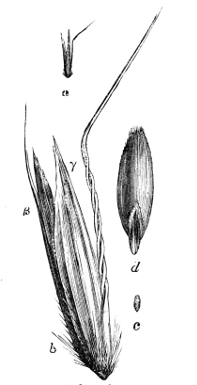
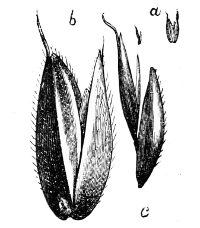
Fig. 65. Holcus lanatus. a, “seed"—i.e. complete spikelet—and ditto
devoid of glumes, nat. size; b, spikelet, and c the same devoid of
glumes, × 7. The “seed" is here composed of the keeled glumes
enclosing two pairs of paleæ and their flowers (c): the upper of
these is barren and has a hooked sub-terminal awn to its outer palea.
The lower awnless one is fertile. Nobbe.
Holcus lanatus, L. (Fig. 65).
The “seed" consists of the complete spikelet, separated
below the compressed and acute, keeled glumes; these
have hairs on the keel, and completely enclose the two
flowers and their paleæ. Palea ribless, white to grey,
shining, obtuse, that of the upper (male) flower with a
sub-terminal short hook-like awn. Total length about
4-5 mm. Caryopsis oblong-ovate, grooved. In its
palea about 2-3 mm. long and with a few hairs at the
base.
≡ ≡ Awn dorsal, kneed, longer than the palea.
Holcus mollis, L. (Fig. 66).
Palea 2·5 mm., fruit 3·1 mm. long; glumes with stiff
hairs or serrulæ on keel.
The seeds of Holcus often fall from the glumes, but
may bring them away.
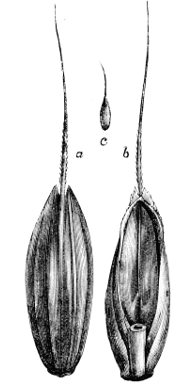
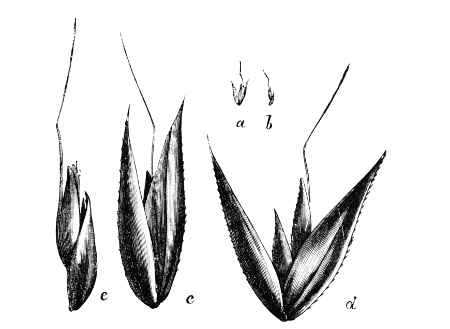
Fig. 66. Holcus mollis. Type of “double seed,” which really consists
of the entire spikelet (a, nat. size; c and d, × 8) comprised of the
two glumes enclosing two pairs of paleæ and their enclosures
(b, nat. size; e, × about 8). The lower pair of paleæ are devoid
of awns and enclose the caryopsis: the upper pair have stamens
only, and the outer palea has a dorsal kneed awn, not twisted or
hooked. Nobbe.
Holcus is of little use. The two-flowered spikelets and peculiar
awns sufficiently distinguish it among the smaller forms. It is said
to occur as an adulterant in “seed" of Alopecurus.
⊙⊙ Awn bent and twisted, basal or nearly so;
glumes very hairy.
Δ Glumes golden brown: one awn straight,
one “kneed."
Anthoxanthum odoratum.
The grass which gives the scent to new-mown hay. The “seed"
is often impure, containing a continental species A. Puelii and other
hairy forms.
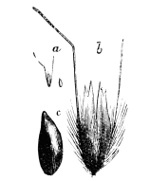
Fig. 67. Anthoxanthum odoratum. a, “seed" and caryopsis, nat. size;
b, the “seed," and c, caryopsis, × about 7. The “seed" consists
of the inner hairy glumes, each with a dorsal awn—one kneed—enclosing
the paleæ and caryopsis. The outer pair of unawned
glumes has been removed. Nobbe.
Anthoxanthum odoratum, L. (Fig. 67).
The one-flowered spikelet has four hairy glumes, the
outer pair of which are unequal and awnless: the “seed"
consists of the inner pair of golden-brown hairy and
dorsally awned glumes, covering the thin, membranous,
shining, smooth, blunt paleæ and the caryopsis, to which
the inner palea adheres. Total length, without awns,
about 3-4 mm. Palea 1·6 mm. Caryopsis 1·5 mm., brown,
shiny, and easily separating. One awn is short, stiff
and straight and inserted above the middle of its glume;
the other longer and sharply bent, inserted about the
middle.
Hierochloe, a rare northern grass, also comes here.
ΔΔ Glumes connate below, hairy on the keels.
Alopecurus pratensis.
A. geniculatus.
A. agrestis. |
Alopecurus is very characteristic, and should be carefully
examined as a type. A. pratensis is a valuable grass and said
to be often adulterated with the undesirable A. agrestis, Holcus, &c.
Arrhenatherum and Avena are easily distinguished by the basal
hairs, rachilla, &c.
Fig. 68. Alopecurus pratensis. a, “seed," nat. size, and b, c, ditto, × 8;
d, caryopsis, × 7. The “seed" here consists of the two glumes,
connate below and hairy on the keel and ribs, including the
caryopsis enveloped in a single palea with a dorsal awn. Note
remains of stigma in d. Nobbe.
Alopecurus pratensis, L. (Fig. 68).
Inner palea absent. Outer palea 5 mm., caryopsis
3 mm. long, often with remains of the stigma.
The greyish-brown spikelet of Alopecurus easily falls
as a whole, included in the glumes; the palea is loose and
delicate.
Glumes connate below, silky-hairy on keel and ribs all
the way up. The palea has a bent dorsal awn, about 5 mm.
long.
Alopecurus geniculatus, L.
Palea 2 mm., fruit 1·3 mm. long.
The glumes hairy on ribs and keel as in A. pratensis:
glumes more obtuse.
Alopecurus agrestis, L.
Palea 6 mm., fruit 3 mm. long.
Glumes only ciliate, on ribs and keel, except at the
base where the hairs are longer.
Keel slightly winged.
Best distinguished from A. pratensis by the glumes, which are
smoother, broader above the middle, harder and with a few basal
hairs.
The species A. fulvus, A. bulbosus, and A. alpinus are rare.
(ii) “Seed" consisting of the paleæ investing the
caryopsis, freed from the glumes.
✲ Palea at least 14 or 15 mm. long: caryopsis
5-7 mm. [Oat type.]
Avena fatua.
A. pratensis. |
Avena fatua, L.
Palea parchment-like, lanceolate-terete, acuminate and
bifid at the apex, rounded on the back and with yellow
hairs on the lower part. 15 × 3 mm. Awn brown,
twisted and bent, arising from the middle, about 30 mm.
long. Caryopsis 7 mm. long, hairy at the top and
distinctly grooved. Rachilla with fine bristles.
Avena pratensis, L.
Palea very similar to A. fatua, apex 2-4-toothed or
bifid, rachilla with stiffer hairs. Caryopsis about 5 mm.
long.
Avena pubescens, Huds. is a variety of A. pratensis
found on dry calcareous soils. The caryopsis is very
narrow, and the rachilla long and feathered with hairs.
"Seed" shorter than A. pratensis, 10-13 mm., and
darker in colour.
A. fatua is an excellent type of the grasses with dorsal twisted
and bent awns, and easily examined on account of its size. The
student will find difficulties with other species of Avena and
Arrhenatherum.
Harz says the stiff hairs of Avena bring about the formation of
intestinal concretions (phytobezoars) and are therefore dangerous to
domestic animals.
✲✲ Palea not more than 7-10 mm. long.
† Caryopsis 4-5 mm. long.
Arrhenatherum avenaceum, Beauv. (Fig. 47).
Paleæ papery, ribbed. Awn 13-15 mm., twisted below;
paleæ, with a tuft of hairs below and a ciliate keel, investing
the fruit: the whole being cylindrical, 8-10 mm. × 1·5.
Caryopsis 4-5 mm. × 1·2, fusiform, pubescent. Rachilla
hairy.
The distinctive difference between Avena and Arrhenatherum is
in the spikelets as a whole. The latter has the lower flower of each
spikelet male only. Samples contain the “double seeds,” and the
awn of the upper fertile portion is short (see Fig. 69).
†† Caryopsis not more than 3 mm. long. A tuft
of hairs on rachilla and base.
Avena flavescens.
Aira flexuosa, distinguished by its nearly basal awn, harder
texture and darker colour of paleæ, and Dactylis—awnless and with
curved long drawn-out apex—are found as impurities in foreign
"seed."
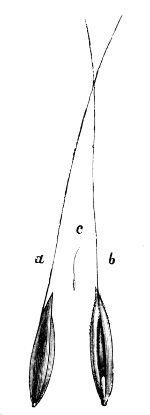
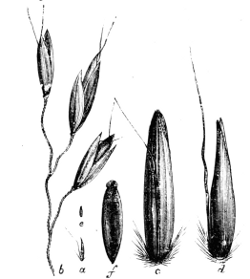
Fig. 69. Avena flavescens. c, “seed," nat. size; a and b, ditto, × about
7. The dorsal twisted and kneed awn is very characteristic. Note
also the hairy rachilla. The palea is bifid above—not visible in the
lateral view. Nobbe.
Avena flavescens, L. (Fig. 69).
Yellow. Palea about 5 mm. long, five-ribbed, bifid
at the apex into two long slender teeth, closely investing
the brownish caryopsis, and with a sub-dorsal awn 10 mm.
long with little or no twist, and hairy at the base.
Rachilla flattened and with white hairs. Caryopsis not 159
much grooved, fusiform, 2-3 mm. long, glumes unequal,
somewhat keeled and rough.
(2) Awn dorsal or basal, fine and hair-like, and
little or not at all twisted or kneed. “Seed"
small.
✲ A pencil of silky hairs on base or rachilla. Palea
bifid at the tip.
† Basal hairs longer than palea, and obscuring the
awn.
Calamagrostis Epigeios.
Of little importance. Digraphis has no awn.
Calamagrostis Epigeios, Roth.
Palea about 3 mm. long with toothed apex and very
thin caryopsis 1 mm. A conspicuous tuft of fine silky
hairs, longer than the palea at the base and on the
rachilla.
Awn slender, dorsal, about as long as the palea.
C. stricta, Nutt. and C. strigosa, Hartm. are rare.
†† Basal hairs shorter than palea.
⊙ Awn brown, bearded in the middle, thickened
and white above.
Aira canescens.
The student will find considerable difficulties in the various
species of Aira and Agrostis, owing to their small size and variability
as regards awn and basal hair-tufts. All these are weeds, but some
occur as adulterants.
Aira canescens, L.
"Seed" (apart from the awn, it is very like Agrostis)
1·5-2 mm., with a very thin, smooth, keeled, two-nerved
palea, bifid at its apex, through which the yellow caryopsis
shines.
Awn slender, basal, dark-brown, with oblique colourless
hairs above the middle and with a slight swelling above.
The palea has a few hairs on its mid-rib below.
Caryopsis about 1 mm. long.
This grass is somewhat rare in England. The jointed basal awn,
with a minute hair-tuft above the middle, is unique, and readily
distinguishes it when mixed with Agrostis.
⊙⊙ Awn not bearded or thickened.
≡ Palea bifid at apex.
Aira caryophyllea.
A. præcox. |
Aira caryophyllea, L.
"Seed" 1·4-1·6 mm., comma-shaped and dark-brown.
Palea acute, nerveless, inrolled at edges and with a
dorsal, kneed, very fine, dark twisted awn twice as long as
the palea: the latter with two-toothed apex and a basal
hair-tuft.
A common impurity in commercial seed.
Aira præcox, L. is very similar, and cannot be distinguished
with certainty by the “seed," but has a shorter awn and no basal
hairs. Apex of palea two-toothed.
≡ ≡ Palea jagged or toothed, but not bifid.
Aira flexuosa.
A. cæspitosa. |
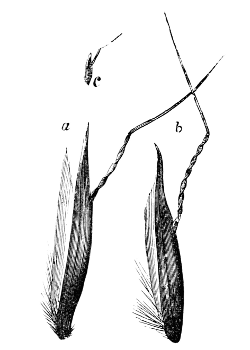
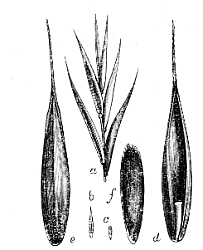
Aira flexuosa, L. (Fig. 70).
Palea 5 mm. long, four-toothed at the apex, and
caryopsis 2·6 mm. The fine basal awn waved or kneed,
about twice as long as the palea. Fruit with a groove.
Rachilla hairy. Whole “seed" browner than Avena
flavescens (see p. 158).
Fig. 70. Aira flexuosa. a, “seed," nat. size; c and d, the same,
× about 7; b, portion of fruiting panicle, showing the flexuous
rachis; e, the caryopsis, nat. size; f, ditto, × about 7. Note the
basal hairs and twisted awn. Nobbe. Cf. Fig. 44.
An almost worthless grass, on sandy soils, but important as an
impurity in Avena flavescens (see note, p. 158).
Aira cæspitosa, L. (Fig. 44).
The palea, about 2·5 mm. long, toothed above, has a
fine straight hair-like basal awn not longer than itself.
Caryopsis 1·3 mm., grooved. Rachilla distinctly hairy.
Easily distinguished when mixed with Poa nemoralis, &c.—e.g.
by the awn, hairs on rachilla, &c. It requires scrutiny in regard to
Agrostis, which also has no awn or basal hairs.
✲✲ No basal tuft, or merely a few short microscopic
hairs below. Paleæ not bifid above.
Agrostis canina.
A. Spica-venti.
A. setacea. |
Agrostis canina, L., is somewhat larger than A. alba.
Palea (only one present, sometimes minute) punctate,
2 mm., with a fine dorsal awn a little longer than the
palea. Caryopsis 1·2 mm. Rachilla obsolete.
The awn is usually absent from A. alba and its varieties; and
when present is so small as to be almost negligible.
A. canina is easily distinguished from Poa by the rachilla in the
latter, and absence of awn. Aira has basal hairs, &c.
Agrostis setacea, Curt., has the awn basal and just
projecting beyond the pointed glumes, and the palea
very minute, with a few silky hairs below.
Agrostis Spica-venti, L. (Fig. 49).
Palea 2·4 mm. long, with infolded edges and punctate;
a minute rachilla at its base, and a slender awn, 8-9 mm.
or more long, inserted below the bifid tip. Caryopsis
1·5 mm. A few silky hairs at the base of the palea.
(b) Awn terminal or slightly sub-terminal, and
straight, or at least not twisted or “kneed."
(1) Paleæ so closely adherent to the fruit that
the terminal awn appears to come from
the latter [Barley type]. The three florets
generally coherent.
✲ Awn at least twice the length of the grain.
Hordeum sylvaticum.
H. murinum.
Hordeum sylvaticum, Huds.
Palea scabrid, ribbed above, awn at least twice as long
as the very narrow grain.
Hordeum murinum, L.
Lower palea 9-10 mm. long, five-ribbed, lanceolate
and wrapped round and adhering to the fruit (grain),
upper palea also ribbed. The grain about 7-8 mm.
× 2 × 1·2, hardly grooved. Awn about 30 mm. long,
serrulate. Rachilla slightly serrulate.
✲✲ Awn not twice the length of the grain.
Hordeum pratense.
H. maritimum. |
Hordeum pratense, Huds.
Spikelet with a reddish tinge; awn almost smooth,
less than 20 mm. long: not twice the length of the
smooth and obscurely nerved grain.
Hordeum maritimum, With., similar to H. pratense,
but softer and the awn somewhat longer.
The principal features of the Hordeum-grain are the closely
adherent paleæ and angular fruit, the stiff awn appearing to come
off from it as in Barley. The rachilla remains.
They are all weeds of no use in agriculture, though H. pratense
is not uncommon in good pastures.
(2) Palea investing the caryopsis, often closely,
but not fused with it, and its tip and awn
quite free.
✲ Awn not strictly terminal but sub-terminal,
or arising from between two teeth or in a
sinus at the apex of the palea.
† Caryopsis thin, flattened and usually 6-10 mm.
long, and the paleæ hairy.
≡ Palea inrolled, terete-lanceolate-acuminate, or
linear-lanceolate (barge-shaped). Apical teeth
minute and pointed.
Δ Palea scaberulous or hairy, awn from half to
about its own length.
Bromus erectus.
B. asper. |
|
|
|
|
Fig. 71. Bromus asper, a barge-shaped
"seed" with terminal
awn, nat. size and × about 5.
Cf. Fig. 50. Stebler.
|
Fig. 72. Brachypodium sylvaticum,
a barge-shaped “seed"
with terminal awn, natural
size and × about 5. Cf. Fig.
77. Stebler. |
Bromus erectus, Huds.
Palea with 5-7 scaberulous ribs, but not hairy, flat
above, incurved below, so that the inner palea is clearly
visible. About 10-14 mm. long and narrowing somewhat
suddenly into the smooth stiff awn, shorter than itself.
Indications of a tooth at each side of the base of the awn.
Caryopsis somewhat flattened, thin and long, barge-shaped,
8-10 × 1·5-2 mm., pointed at both ends, brown, hairy
at the tip with the remains of the stigma. “Seed" often
purplish. Rachilla long and slender.
Must be carefully distinguished from Brachypodium, which has
the palea less inrolled and a stouter rachilla.
Bromus giganteus has a shorter and flatter “seed" and longer
awn.
Bromus asper, Murr. (Fig. 71).
Palea often reddish, 5-7 ribbed and usually roughly
hairy, mid-rib scaberulous, about 15 mm. long, linear-lanceolate
(barge-shaped), the tip more distinctly two-toothed
and tapering more gradually into the smooth
awn, about its own length. Rachilla distinct. Otherwise
resembling B. erectus.
B. giganteus has a shorter “seed" and longer awn.
ΔΔ Palea scarcely hairy: awn up to twice its
length.
Bromus sterilis.
B. giganteus. |
Bromus sterilis, L. (Fig. 50).
Palea nearly smooth, somewhat inrolled, terete-lanceolate-acuminate,
tough, red-brown, 12-15 mm. long, seven-ribbed,
with a long serrulate awn (20-30 mm. or more)
practically terminal. Ribs serrate. Caryopsis 9-10 mm.
long, flattened, thin. Rachilla distinct, smooth, much
wrapped in, widens upwards and is somewhat flattened.
The very slender and long “seed" and caryopsis distinguish this
from all but B. erectus, which has a shorter awn. Perhaps the awn
is truly terminal: if so it should go with Festuca Myurus, &c. (see
p. 171). The length varies greatly.
Bromus giganteus, L.
Palea 7 mm. long and inrolled, the base and rachilla
bristly, indistinctly 5-7 nerved, the tip bifid: sub-terminal
awn serrulate, 12-15 mm. long.
Caryopsis 4·5 mm. long, flattened, thin, glabrous.
The caryopsis is shorter and more ovoid than in other Bromes.
≡ ≡ Palea expanded above (coracle-shaped), awn
from sinus between two blunt or triangular
teeth.
Bromus arvensis.
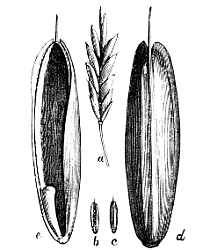
Bromus arvensis, var. mollis, L. (Fig. 73).
Palea oblong or obovate, somewhat flattened above
(coracle-shaped), distinctly 5-7 ribbed, 8-9 mm. long,
not hairy, though the ribs may be ciliate. Awn smooth,
arising from the depression between two teeth or rounded
projections. Caryopsis flattened and thin, 6 × 1·5 mm.;
apt to fall loose from the paleæ.
In the variety B. secalinus the awn is usually shorter than the
elliptical palea, and originates in the sinus of a notch (Fig. 74): in
B. mollis from between two teeth, and is as long as the obovate palea.
Bromus maximus and B. madritensis are both rare.
The broader nerved paleæ of B. mollis and shorter, fatter
caryopsis, as well as the longer awn distinguish it from B. secalinus
and B. arvensis. In the other Bromes the palea is more inrolled and
the “seed" more slender as a rule. The rachilla is usually bent
above into a slight kink.
The Bromes are an extremely difficult group. The awn is
inserted between the two teeth of the palea or just below. The
palea smooth or ciliate on the nerves or roughly hairy. The fruit is
flattened in the antero-posterior plane, and usually shines through
the closely investing palea. A rachilla is visible. In Brachypodium
the caryopsis is less flattened, and the apex tapers into the awn
without teeth. In Lolium and Agropyrum the caryopsis is still
more wheat-like and grooved.
|
|
|
|
Fig. 73. Bromus arvensis, var.
mollis. a, “seed," nat. size;
b and c, the same, × 3. d,
caryopsis, × about 3. The awn
originates between two teeth
of the strongly ribbed palea.
Coracle-shaped type. Nobbe.
|
Fig. 74. Bromus arvensis, var.
secalinus. a, spikelet, b and
c, “seed," nat. size; d and e,
the same, × 6. Nobbe. Cf.
Fig. 73. |
All our Bromes are weeds, but some of them are important
adulterants, requiring careful examination.
B. inermis is cultivated, and is a valuable grass. Awn short or
wanting. Paleæ strongly 5-7 ribbed, inner with a marked central
rib, closely adhering to caryopsis.
B. Schraderi is also said to be valuable.
†† Caryopsis not thin and flattened, corn-like,
3·5-5 mm. Palea smooth, inflated, boat-like.
Lolium temulentum.
A weed of cultivation, said to be poisonous to cattle, a possible
explanation of which may be found in a fungus recently discovered
as a very constant inhabitant of the tissues under the seed coats.
Lolium temulentum, L. (Fig. 48).
Palea ovate, 6-7·5 × 2·5 mm., papyraceous, inflated,
smooth, the tip dry and emarginate with a slender
sub-terminal awn its own length or longer. It tends to
adhere to the fruit. Fruit 3·5-5 mm. × 2·5 × 1·5, somewhat
depressed. Rachilla large, cylindrical and smooth.
L. perenne has no awn, or the merest trace of one. “Seed"
10-12 mm. long. Boat-shaped. Palea yellow, three-nerved,
margins papery. Rachilla flat, see p. 143.
✲✲ Awn terminal, and with no evident teeth at
its base.
≡ Palea not much inrolled, ovate-lanceolate to
linear-lanceolate, and therefore boat-or barge-shaped.
Δ Very hairy.
Brachypodium sylvaticum, Beauv. (Fig. 72).
Palea ribbed and hirsute much like that of Bromus
asper, but straw-coloured, shorter (10-12 mm.), linear-lanceolate,
more boat-shaped, and tapering without teeth
into the longer (10-13 mm.) hairy awn. Caryopsis
7-8 mm., less flattened than in Bromus, with a shallow
groove. Rachilla smooth.
B. pinnatum (p. 171) has a much shorter awn, and is nearly
glabrous.
These grasses are weeds, but are said to occur frequently as
adulterants.
ΔΔ Glabrous or nearly so.
++ Palea five-nerved, pubescent.
Agropyrum caninum.
Agropyrum repens is also often awned and may be described here
(see also p. 150).
|
|
|
|
Fig. 75. Agropyrum caninum.
Type of boat-shaped “seed"
with sub-terminal awn. a, nat.
size; b, × about 9, but with
awn cut short. Rachilla thicker
above and hairy; palea not
toothed. Nobbe. Cf. Fig. 48.
|
Fig. 76. Agropyrum repens.
Awned variety. The awn is
very short and sub-terminal:
the rachilla smooth. a, the
"seed," nat. size; b and c,
ditto, × about 4-1/2. Boat-shaped
"seed" with rounded back.
Nobbe. Cf. Fig. 57. |
Agropyrum repens, Beauv. (Fig. 76).
Palea tough, 10-12 mm. long, ovate-lanceolate, 3-5
ribbed and smooth; with a short (2-3 mm.) or long
(8 mm.) terminal awn or a mere tooth. Rounded back.
Fruit grey-brown, ciliate above, 5-6 × 1·4 × 0·7-0·9 mm.,
depressed, hardly grooved, adhering to the palea. Rachilla
smooth or not, and narrowed below.
A noxious weed (see p. 150) and hence should be carefully
excluded from “seeds."
A. caninum, Beauv., has a longer (10 mm. or more)
and rougher awn, and is smaller (about 8 mm.), but
otherwise very similar. Palea smooth except at the
five-nerved apex. Rachilla thickened above, and hairy
(Fig. 75).
Elymus differs from Agropyrum in its harder velvety palea, no
awn, and its club-like velvety rachilla. It is also larger altogether,
as a rule.
Fig. 77. Brachypodium pinnatum. Type of boat-shaped “seed" with
awn. a, nat. size; b and c, × 7. Nobbe. Cf. Fig. 72.
++++ Palea seven-ribbed, smooth.
Brachypodium pinnatum.
Brachypodium pinnatum, L., is similar, but the palea
more open and boat-like and narrows more suddenly
above into the smooth awn which is shorter than itself
(Fig. 77). Length 8-9 mm. The caryopsis is, however,
much more slender than in Agropyrum.
For distinction from B. sylvaticum, see above. The inner palea
is ciliate and more delicate than in Agropyrum.
≡ ≡ Paleæ rolled round the “seed" which is terete
and tapering gradually into a stiff awn.
Δ Awn longer than the palea.
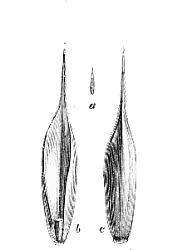
Festuca Myurus.
See also Festuca ovina, Cynosurus, &c., p. 147, and Arundo.
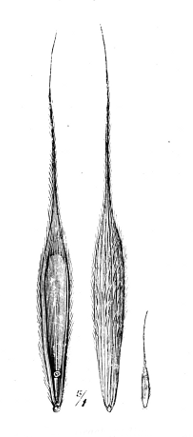
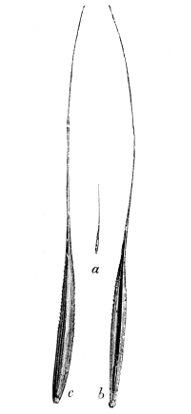
Festuca Myurus, L. (Fig. 80).
"Seed" 5-7 mm. without the long (10 mm.) awn,
tapering and slender (like Nardus), grey or brown. Finely
mamillate upwards. Rachilla small.
ΔΔ Awn shorter than palea.
Festuca ovina (var. rubra).
Nardus stricta.
Aira flexuosa, Molinia and other moor-grasses occur with these
narrow-leafed Fescues, but are easily distinguished: Molinia by
having no awn and being shorter and stouter, and Aira flexuosa by
the dorsal awn and basal hairs.
Festuca rubra, L. (Fig. 78).
"Seed" pale brown with rosy tinge, 3-5 mm. long
without the awn, smooth, or slightly hairy upwards.
Caryopsis 2-3·5 mm., compressed, with a shallow broad
flat furrow on the ventral face and a median long “hilum."
Rachilla cylindrical, smooth, dilated above.
|
|
|
|
Fig. 78. Festuca ovina, var.
rubra. a, “seed," nat. size;
b and c, ditto, × about 7.
Nobbe. Cf. Fig. 59.
|
Fig. 79. Festuca ovina, var.
heterophylla. a, spikelet,
× about 3-1/2; b, “seed," and
c, caryopsis, nat. size; d and
e, “seed," and f, caryopsis,
× 7. Nobbe. |
The variety F. heterophylla has narrower and longer
"seeds," and a hispid rachilla. Palea 5-6 mm.: caryopsis
3·5-4·5 mm. (Fig. 79).
Perhaps Bromus sterilis should also come here (see
p. 165).
With regard to these Fescues the student may note that F. ovina,
var. tenuifolia, has the smallest (4-5 mm.) and most ovoid “seeds,"
usually golden brown in colour. F. rubra is darker and larger
(5-6 mm.), as is also F. duriuscula (6-7 mm.): the latter is also
narrower, with toothed palea, tapering suddenly at the base and
more awned. F. heterophylla is much like F. duriuscula, but the
palea less toothed, and it tapers gradually at the base. The whole
group is very difficult, and needs attention.
|
|
|
|
Fig. 80. Festuca Myurus. a,
"seed," nat. size; b and c,
ditto, × about 6. Compare
Fig. 50. Nobbe.
|
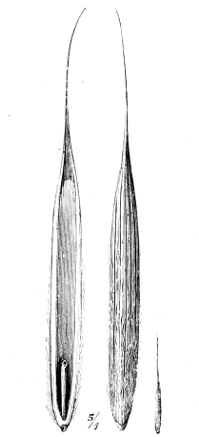
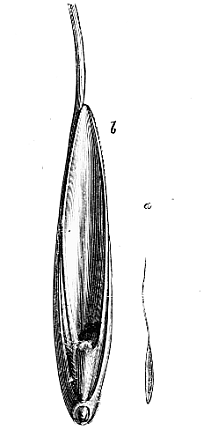
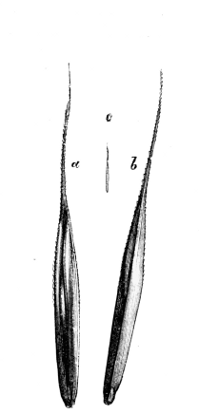
Fig. 81. Nardus stricta. Type
of cylindrical “seed" with
a terminal stiff awn, here
serrulate; c, “seed," nat. size;
a and b, ditto, × 8. Compare
Fig. 50. Nobbe. |
Nardus stricta, L. (Fig. 81).
Outer palea tough and fused, 10-12 mm. long, narrow,
lanceolate and tapering gradually into the stiff, serrulate,
terminal awn shorter than itself. Inner palea minutely
toothed at the apex and without awn, loosely enclosing
the red-brownish yellow to bluish grey fruit which has no
groove. “Seed" 4-6 mm. × 0·6 × 0·5 (without the awn),
more or less triangular in section and serrulate on angles
above.