GRAMMAR-LAND OR, Grammar in Fun for the Children of Schoolroom-shire — PREFACE TO THE THIRD EDITION. — CONTENTS.
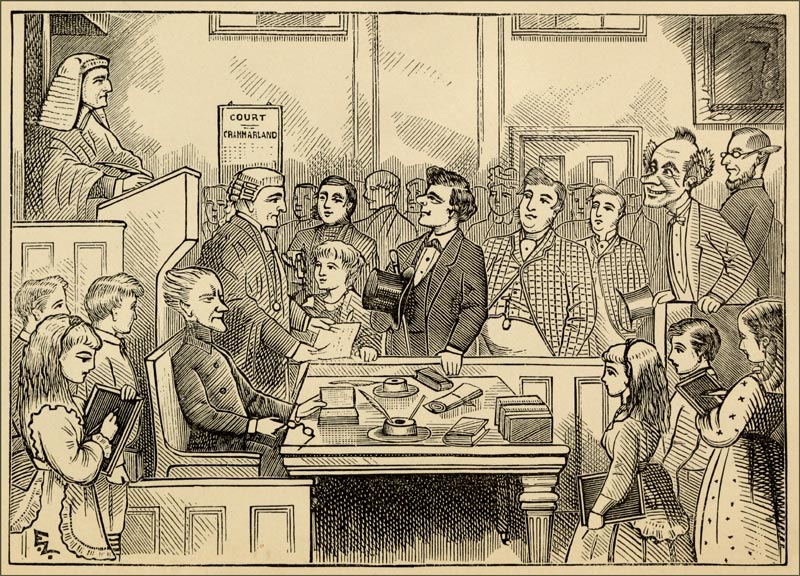
COURT GRAMMARLAND
GRAMMAR-LAND OR, Grammar in Fun for the Children of
Schoolroom-shire
BY
M. L. NESBITT
With Frontispiece and Initials byF. Waddy.
NEW YORK
HENRY HOLT AND COMPANY
1885.
TO ALL LITTLE CHILDREN
WHO THINK GRAMMAR HARD AND DRY, This Book is Dedicated,
BY ONE WHO LOVES TO SEE
SUNSHINE IN SCHOOLROOM-SHIRE.
The favourable reception that the former Editions of
this little book have met with, calls for a word of
acknowledgment. It seems that not only the little
folks for whom it was intended, but children of a
larger growth have read it with interest; and students,
who spend days and nights “with weary
eyesight poring over miserable books,” have condescended
to turn over these pages, and laughingly
admit that the imagination may sow even the
dustiest of book-shelves with flowers.
Teachers of the younger classes in schools have
found this little volume extremely useful; and it is
suggested, that though children will often read it
with pleasure by themselves, they will derive much
more profit from it when it is made the text-book
for a lesson. The simple exercises appended to each
chapter will then be found both useful and entertaining.
WHAT is Grammar-land? Where
is Grammar-land? Have you
ever been to Grammar-land?
Wait a minute and you shall
hear. You will not find Grammar-land
marked on the globe,
and I never saw a map of it;
but then, who ever saw a map
of Fairy-land? and yet you
have all heard of that, and
know a great deal about it, of
course. Well, Grammar-land
is a place every bit as real as
Fairy-land, and much more important. The Fairy Queen
is all very well, and a very great little queen in her way;
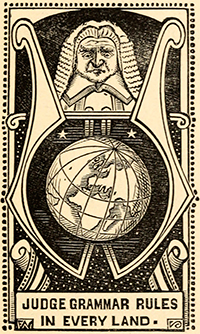
but Judge Grammar! great, stern, old Judge Grammar, is
far mightier than any Fairy Queen, for he rules over real
kings and queens down here in Matter-of-fact-land. Our
kings and queens, and emperors too, have all to obey
Judge Grammar’s laws, or else they would talk what is
called bad grammar; and then, even their own subjects
would laugh at them, and would say: “Poor things! When
they were children, and lived in Schoolroom-shire, they can
never have been taken to Grammar-land! How shocking!”
And Judge Grammar himself—well, I cannot say what he
would do, as I suppose such a thing never really happened;
for who could imagine a king or queen saying, “I is,” or
“you was,” or “it wasn’t me.” No one speaks in that way
except people who have never heard of Judge Grammar.
Ah! I wish you could see him—this great Judge—sitting
on his throne in his court, and giving orders about his
precious words, which are the riches of Grammar-land. For
Judge Grammar says that all the words that you can say
belong really to him, and he can do what he likes with
them; he is, in fact, King as well as Judge over Grammar-land.
Now, you know that when William the Conqueror
conquered England he divided the land among his nobles,
and they had it for their own so long as they obeyed the
king and helped him in his wars. It was just the same
with Judge Grammar when he took possession of Grammar-land;
he gave all the words to his nine followers, to take
for their very own as long as they obeyed him. These
nine followers he called the nine Parts-of-Speech, and to
one or other of them every word in Grammar-land was
given.
They are funny fellows, these nine Parts-of-Speech. You
will find out by-and-by which you like best amongst them
all. There is rich Mr. Noun, and his useful friend Pronoun;
little ragged Article, and talkative Adjective; busy
Dr. Verb, and Adverb; perky Preposition, convenient Conjunction,
and that tiresome Interjection, the oddest of
them all.
Now, as some of these Parts-of-Speech are richer, that is,
have more words than others, and as they all like to have
as many as they can get, it follows, I am sorry to say, that
they are rather given to quarrelling; and so it fell out that
one day, when my story begins, they made so much noise,
wrangling and jangling in the court, that they woke Judge
Grammar up from a long and very comfortable nap.
“What is all this about?” he growled out, angrily.
“Brother Parsing! Dr. Syntax! here!”
In an instant the Judge’s two learned counsellors were by
his side.
Serjeant Parsing (Brother Parsing, the Judge calls him)
has a sharp nose, bright eyes, a little round wig with a tail
to it, and an eye-glass. He is very quick and cunning in
finding out who people are and what they mean, and making
them tell “the truth, the whole truth, and nothing but the
truth.” It is of no use to say “I don’t know” to Serjeant
Parsing. He will question you, and question you, till
somehow or other he makes you know, and finds out all
about you. When I say he will question you, of course I
mean he will question the Parts-of-Speech, for that is his
business, and that is why Judge Grammar summoned him.
For whenever there is a fuss in Grammar-land, Serjeant
Parsing has to find out all about it, and Dr. Syntax has to
say what is right or wrong, according to the law.
“Brother Parsing,” said the Judge, “this racket must be
stopped. What are they fighting about? I divided the
words clearly enough once amongst the nine Parts-of-Speech.
Why cannot they keep the peace?”
“My lord,” answered Serjeant Parsing, “the fact is that
it is a long time since you portioned out the words, and the
Parts-of-Speech since then have been left to do pretty much
as they like. Some of them are greedy, and have stolen
their neighbours’ words. Some of them have got hold of
new words, which the others say they had no right to make;
and some of them are even inclined to think that Dr.
Syntax is old-fashioned, and need not be obeyed. In fact,
unless your lordship takes the matter in hand at once, I am
afraid the good old laws of Grammar-land will all go to
wreck and ruin.”
“That must never be,” said the Judge, solemnly shaking
his wig: “that must never be. We must stop it at once.
Go and summon all my court before me.”
“Certainly, my lord,” answered Serjeant Parsing; “but
may I ask if there is any Part-of-Speech you wish for in
particular?”
“I wish for them all, sir, every one,” replied the Judge.
“They shall all come before me, and you shall question
them in turn, and make them say what right they have to
the titles and the words which they claim; and then if there
is any disagreement between them, I will settle the matter
once for all.”
“Quite so, my lord,” said Serjeant Parsing; “and shall
I invite our friends in Schoolroom-shire?”
“Our friends in Schoolroom-shire? By all means let
them come,” replied the Judge. “If we wish to have peace
among the Parts-of-Speech it is most important that the
people of Matter-of-fact-land should know how to use them
well. And as the people of Matter-of-fact-land generally
spend at least a part of their lives in Schoolroom-shire, we
cannot do better than send our invitation there. Go,
Brother Parsing, and request them to come, and to bring
their slates and pencils with them, that they may keep an
account of what we do, and let our Parts-of-Speech prepare
to come before us at once.”
Away went Serjeant Parsing, as quick as thought, and
soon the whole court was assembled. There was Judge
Grammar on his throne, with a long flowing wig and gorgeous
robes. At the table below him sat his two counsellors,
Serjeant Parsing and Dr. Syntax. Dr. Syntax is
very tall and thin and dark. He has a long thin neck
covered up with a stiff black tie, which looks as though it
nearly choked him. When he speaks he stands up, looks
straight through his spectacles, sticks out his chin, and says
his say in a gruff and melancholy voice, as if he were repeating
a lesson. He is the terror of all little boys, for he
never smiles, and he is so very, very old, that people say he
never was young like other folks; that when he was a baby
he always cried in Greek, and that his first attempt at talking
was in Latin. However that may be, there he sat, side
by side with Serjeant Parsing, while the company from
Schoolroom-shire, armed with slates and pencils, prepared
to listen to the examination that was to take place, and the
Parts-of-Speech crowded together at the end of the court,
waiting for their names to be called.
CHAPTER I. MR. NOUN.
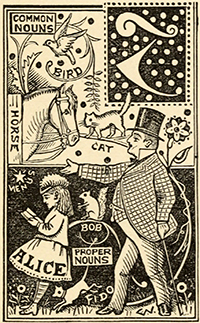
COMMON NOUNS
BIRD
HORSE
CAT PROPER NOUNS
VENUS
ALICE
BOB
FIDO
THE first Part-of-Speech that was
called was Mr. Noun. He is
a stout big fellow, very well
dressed, for he does not mind
showing that he is very rich.
As Mr. Noun came forward,
Serjeant Parsing rose, put his
pen behind his ear, arranged
his papers on the table before
him, and looking at Mr. Noun
through his eye-glass, asked:
“What is your name?”
“Name,” answered Mr. Noun.
“Yes, your name?” repeated Serjeant Parsing.
“Name,” again answered Mr. Noun.
“Do not trifle, sir,” said the Judge, sternly; “what is
your name? Answer at once, and truly.”
“I have answered truly,” replied Mr. Noun. “My
name is Name, for noun means name. The name of everything
belongs to me, so I am called Mr. Name, or Mr.
Noun, which means the same thing, and all my words are
called nouns.”
“The name of everything belongs to you?” asked Serjeant
Parsing, in surprise.
“Yes,” answered Mr. Noun, “the name of everything.”
“What? Do you mean to say that the name of everything
I can see round me now is one of your words, and is
called a noun?”
“I do indeed,” said Mr. Noun. “The name of everything
you can see, or touch, or taste, or smell, or hear, belongs
to me.”
“What,” said Serjeant Parsing, “is this desk yours then,
and the ink and the pen and the window?”
“The words that name them are all mine,” said Mr.
Noun. “Of course I have nothing to do with the things.
No gentleman in Grammar-land has anything to do with
things, only with words; and I assure you, you cannot
name anything that you can see, or touch, or taste, or
smell, or hear, without using one of my words. Desk, pen,
ink, window, water, wine, fire, smoke, light, lightning, thunder,
a taste, a smell, a noise, all these words belong to me,
and are called nouns.”
“I see,” said Serjeant Parsing; “you can hear thunder,
and smell smoke, and taste wine. And I suppose dinner
and tea are yours also?”
“Certainly, the words breakfast, dinner, and tea, are
mine,” replied Mr. Noun. “The things are what the
people live upon in Schoolroom-shire, but they could not
name what they eat without using my words. The servant
would have to make signs to let people know that dinner
was ready; she could not say so unless I allowed her to
use my noun dinner.”
“Well,” said Serjeant Parsing, “if you have the name of
everything we can see, touch, taste, smell, or hear, all I can
say is, I hope you are satisfied, and do not claim any more
words besides.”
“Indeed,” replied Mr. Noun, drawing himself proudly
up, “I have not mentioned nearly all my words. I told
you at first that I have the name of everything, and there
are plenty of things that you know about, although you
cannot see, or touch, or taste, or smell, or hear them. For
instance, love, or anger, or happiness. You can feel them
in your heart, and know they are there, although you
cannot touch them with your fingers, or taste them
with your tongue, or find them out by any of your five
senses.”
“Do you mean to say, then,” asked Serjeant Parsing,
“that when a child feels naughty in its heart——?”
“Naughtiness is mine,” said Mr. Noun; “the word
naughtiness, for it is the name of the something bad that
the child feels.”
“And when it is kind?”
“Kindness is mine, because it is the name of the something
kind and nice it feels there. I have a good many
more words that end in ness, and that are the names of
things you can find out about, and talk about, though you
cannot tell what shape or colour or smell or taste they
have; like cleverness, silliness, idleness, ugliness, quickness.”
“I see,” said Serjeant Parsing. “You cannot tell what
shape or colour cleverness is, but you can soon find out
whether a boy has any of it by the way in which he does
his lessons.”
“Yes,” said Mr. Noun; “and the names of his lessons
are mine too, for the lessons are things that you can learn
about; geography, history, writing, arithmetic, all these
names belong to me.”
“Really Mr. Noun,” said Serjeant Parsing, “you do
claim a big share of words. You will be making out that
the names of persons belong to you next.”
“So they do,” replied Mr. Noun; “no matter who the
persons are, their names belong to me. I have the name
of every person in the world from good Queen Victoria on
her throne to the raggedest beggar-boy in the street. There
is not a child in Schoolroom-shire whose name is not a
noun. And I have not the names of people only, but of all
pet dogs, cats, birds, horses, or rabbits: Fido, Tabby,
Bright-eye, Tiny, Shag, and any other pet names you can
think of. Indeed, I am very particular about such names.
I call them proper nouns, and expect them always to be
written with a capital letter.”
“Proper nouns?” repeated Serjeant Parsing. “Then
what are the other nouns called?”
“They are only common nouns,” answered Mr. Noun,
carelessly.
“Then all names are common nouns, except the names
of persons or animals, are they?” asked Serjeant Parsing.
“No, no, no,” said Mr. Noun, quite crossly: “the name
of an animal is not a proper noun unless it is the own
special name of one animal, that marks it from other
animals of the same kind. Dog is the name given to all
dogs, they have the name in common between them; but
Fido is the name of one particular dog, his own proper
name by which his master calls him. So dog is a common
noun, Fido is a proper noun.”
“Oh, I see,” said Serjeant Parsing. “Then the particular
name of any person or animal is a proper noun, and all
other names are common nouns.”
“I never said that,” exclaimed Mr. Noun. “How very
stup—— I mean, you do not understand me, my dear sir.
I never said that the particular name of a place or thing
was not a proper noun too. Every particular and special
name, whether of a person, an animal, a place, or a thing,
is a proper noun. Every place has its own proper name,
or should have. Every country and mountain and river
and town in Europe is named with a proper noun. Why,
you would not call England a common noun, I should
hope? There are plenty of countries in the world, but
there is only one country that is called by the proper
name of dear old England. Country is a common noun, all
countries have it in common, but when you want to speak
of any particular country you use the proper nouns, England,
Scotland, Ireland, France,
etc., etc.”
“Well, I think we can understand that the particular
names of places are proper nouns,” said Serjeant Parsing;
“but you spoke about things also. Surely things have
no proper names? You do not give names to chairs
and tables, and call them Mr. Leanback or Squire Mahogany?”
“Not exactly,” answered Mr. Noun; “we do not name
chairs and tables with proper names, but what do you say
to houses? They are things, are they not? And you may
have heard of such names as Marlborough House, Springfield
Cottage, Ivy Lodge.”
“Well, no other things besides houses have proper
names, have they?” said Serjeant Parsing.
“Books are things,” said Mr. Noun, “and they all have
proper names. So have ships and boats, Warrior, Seafoam,
Fairy, or something of that sort. I have heard of
a cannon which was called Roarer, and you ought to know
that King Arthur’s sword was named Excalibur. Indeed,
you can give a proper name to anything you like that you
want to distinguish from other things of the same sort.”
“And all such proper names, or proper nouns, as you
call them, must be written with a capital letter, must they?
Whether they are the names of persons, animals, places,
or things, little or big?”
“Sir,” answered Mr. Noun, “littleness or bigness makes
no difference. If you had a pet fly, and called it Silver-wing,
Silver-wing must be written with a capital S, because
it is a proper noun.”
“Well, Mr. Noun,” said Serjeant Parsing, “your ideas
of what is proper seem to me rather peculiar, but I suppose
Dr. Syntax has no objection, so I will say nothing.”
Dr. Syntax silently bowed his head.
The Judge then spoke. “Mr. Noun, you have claimed
a great many words, and it remains to be seen whether all
the other Parts-of-Speech agree to these words being yours.
In order to find out whether they do or no, I will ask our
friends from Schoolroom-shire to write out, each of them,
a list of twenty names, the names of anything they can see,
hear, touch, taste, smell, or think about, or the proper names
of any persons, animals, places, or things they know; and
when next we meet I will read out what they have written,
and we shall hear whether any one has any good reason to
give why they should not be called nouns.”
The Judge then rose from his seat, and every one left the
court.
CHAPTER II. LITTLE ARTICLE.
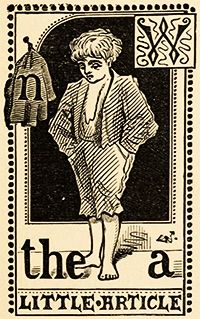
the a LITTLE·ARTICLE
WHEN Judge Grammar next took
his seat in court, a number of
papers covered with words were
handed up to him by Serjeant
Parsing.
“They are the lists of names,
my lord,” he said, “which you
asked the people of Schoolroom-shire
to write for you.”
“Very good,” said the Judge.
“I will read some of the words
aloud, and if any one thinks
that they are not nouns, let
him come forward and say so. And he began to read:
the garden, the house, the sky, a book, a bird,
a fly,” when
suddenly he was interrupted by a sound of bitter sobbing
and crying.
“What is the matter?” he asked. “Who dares to interrupt
the court?”
“It is this tiresome little Article, your lordship,” said
Serjeant Parsing, pushing forward a ragged little fellow,
who was rubbing both fists into his eyes and crying
bitterly. “He says he is being cheated, my lord; that
he has only two words of his own in all Grammar-land,
and that they are being used on these lists as if they
belonged to Mr. Noun.”
“Bring him up before me,” said the Judge. “What is
your name, sir?”
“My name is Article, or Little-joint,” replied the little
fellow. “I have only two words in all Grammar-land, a and
the. I lend them to Mr. Noun whenever he asks for them
fairly; but, your lordship, it is very hard,” and here he
began to cry again, “that they should be read as your
lordship was reading them just now, as if they belonged to
Mr. Noun, when he is so rich, and I am so very, very
poor.”
“Is it true, Brother Parsing,” asked the Judge, “that
little Article is always ready to wait upon Mr. Noun?”
“Quite true, my lord,” answered Serjeant Parsing.
“Indeed, I have often been able to discover Mr. Noun
by catching sight of little Article running before him, for
whenever you see an a or a the, you may be sure that Mr.
Noun will have a word of his own in somewhere near. The
chief use of little Article is to point out that a noun is
coming, for you may be sure that if you can put an a or a
the before a word, that word is a noun, as a bird, the sky.”
“And do you use him as much before your pet proper
nouns, sir?” asked Judge Grammar of Mr. Noun.
“No, your lordship,” replied Mr. Noun, “that I do not.
Indeed, I cannot see that little Article is of much use to
me at any time; but he has an old habit of coming with
me wherever I go, and when I have no one else I do not
mind having him.”
“Well,” said Judge Grammar, “if you do have him, take
care that you use him well; and pray, Brother Parsing, tell
the Schoolroom-shire children to give him a separate mark
for himself, and not to put his words with Mr. Noun’s.”
“Certainly, my lord,” said Serjeant Parsing, “but I
have one question to ask first. This little Article said that
he had only two words in all Grammar-land, a and the. I
wish to ask him what he says to an, as you say an egg, an
apple? Surely an belongs to him also.”
Article was just beginning to answer when he suddenly
stopped, turned pale, trembled, and looked as if he would
have tumbled to pieces in terror, for he saw Dr. Syntax
rise.
Dr. Syntax stood upright, looking very tall and thin and
black: he spoke in very stern voice, but all he said was,
“An is only used before a vowel or an h mute.” Then he
sat down again.
“Ah!” said Serjeant Parsing, drawing a long breath,
“thank you. Now, little Article, say what you have to say.”
“I have only to say,” remarked Article, recovering his
courage, “that a and an are really one and the same word;
a is only an with his coat off. I like to use it best as a
without its coat, but before a vowel or an h mute I am
obliged,” and here Article gave a frightened look at Dr.
Syntax, “I am obliged to keep its coat on and call it an.”
“And do you know what you mean by a vowel or an h
mute?” asked Judge Grammar.
“O yes, my lord: there are five vowels, a, e, i, o, u,”
answered Article.
“And what is an h mute?” asked the Judge.
“An h that is not sounded, as in an hour, an honour,”
answered Article, rather impatiently, for he was getting very
tired of being questioned.
“And you are to use an before any word that begins
with a vowel, a, e, i, o, or u, or an h mute, are you?” asked
the Judge.
“Yes, my lord,” said Article, “I told you so before.”
“Give us some examples of words beginning with each
of these,” said the Judge, “and show us how you use an
before them.”
Article held up one hand, with the thumb and four
fingers stretched out, and pointing to each one in turn,
beginning with the thumb, he answered: “An apple, an
eagle, an idol, an ox, and an ugly, uncomfortable, unkind
old Judge, to keep me here so long answering questions.”
Saying which, little ragged Article turned and scampered
off as fast as his legs could carry him.
Serjeant Parsing then said that as Article had behaved
so badly, he hoped the Judge would give him a severe
punishment, by allowing the children of Schoolroom-shire
to use his words as often as they liked in their new lists.
“Certainly,” said Judge Grammar. “I request that each
of you will write six new nouns, and will use an article
before every one of them.”
The court then rose, after Serjeant Parsing had handed
the Schoolroom-shire children the following verse, begging
them to find out all the nouns and articles in it:—
Once there was a little boy,
With curly hair and pleasant eye;
A boy who always spoke the truth,
And never, never told a lie.
CHAPTER III. MR. PRONOUN.
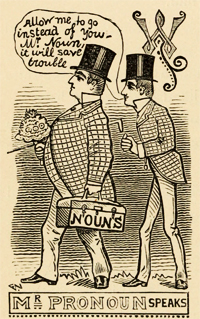
Allow me to go
instead of you—Mr.
Noun,
it will save trouble
NOUNS
MR. PRONOUN SPEAKS
WHEN the court next assembled,
the Judge read aloud all the
nouns and articles on the lists,
casting a stern glance at little
Article at each a, an, or the that
he came to, in order to show
that they were put in as a punishment
for Article’s impudent
behaviour the day before. Poor
little Article said nothing, and
no one having objected to any
of the words, the Judge said:
“Mr. Noun and Article, since
no one finds fault with the words that you claim, I declare
them to be lawfully yours. Now, stand aside, and let Mr.
Pronoun come forward.”
At these words Mr. Pronoun stood before the Judge.
He is something like Mr. Noun, only he is thinner, and
looks as if he worked harder.
“Mr. Pronoun?” said Serjeant Parsing, standing up to
begin his questioning.
Mr. Pronoun bowed.
“Why are you called Pronoun, sir, and what words do
you possess?”
“I am called Pronoun, because I often do the work for
my rich neighbour, Mr. Noun. Pro means instead of, so
pronoun means instead of noun, and my words are called
pronouns because they stand instead of nouns. Mr. Noun,
though he is so rich, does not like to have his words used
over and over again—he says it wears them out; so to save
trouble I put in my little words, which do just as well.”
“And you are not afraid of your words being worn out?”
asked the Judge.
“O dear no! my lord,” answered Pronoun. “I
think my words are like the iron rails on the railway—the
more they are used the brighter they look; it is only the
idle ones that get rusty and spoilt. And it is not many
of my words that get rusty, I can tell you, my lord.
Serjeant Parsing knows how he was one day trying to
make sense of Dr. Faustus without me, and what a muddle
he made of it. If he will kindly repeat it now, I will show
you.”
So Serjeant Parsing said:—
Dr. Faustus was a good man;
Dr. Faustus whipped Dr. Faustus’s scholars now and then
When Dr. Faustus whipped the scholars Dr. Faustus made the scholars dance
Out of England into France.
“There!” said Pronoun. “Let any one try to sing that,
and he will find how awkward it is. Now, if you will use
my little he or his, instead of saying Dr. Faustus so often,
and put them instead of scholars, it will sound much better.
Just listen. Please, Mr. Parsing, say it again, and I will
come in when I am wanted.”
So Serjeant Parsing said: “Dr. Faustus was a good
man.”
“He whipped his,” shouted Pronoun.
“He whipped his scholars now and then. When——”
“He whipped them,” shouted Pronoun.
“When he whipped them,” continued Serjeant Parsing.
“He made them dance,” cried Pronoun.
“When he whipped them he made them dance,” repeated
Serjeant Parsing, “out of England into France.”
“Ah,” said the Judge, “yes! It is certainly better so.
Mr. Noun’s words are not used so often, and all parties are
pleased. Then he, his, and them, are pronouns, as they
stand instead of nouns. Now tell us what other words you
have, Mr. Pronoun.”
“First of all, my lord, I have words which are used
instead of the names of people when they are talking of
themselves, such as I or me, we or us. When a person is
speaking of himself he does not name his own name, but
says instead, I or me. Except, indeed, very little children,
who say, ‘Baby wants more,’ or, ‘Give baby milk.’ Reasonable
persons say, ‘I want more,’ ‘Give me some
milk.’”
“The Queen says we in speaking of herself,” remarked
the Judge.
“Yes, my lord,” said Pronoun, “the Queen is of course
allowed to use we or us when she means only herself; but
other people do not use we or us unless they mean more
than one person.”
“Then I or me, we or us, are the pronouns used instead
of the names of people speaking of themselves, are they,
Mr. Pronoun?” inquired Serjeant Parsing.
“Certainly,” replied Pronoun: “and the words used
instead of the names of persons you are speaking to
are thou, or thee, and you. When I am speaking to you,
Mr. Parsing, I say, I tell you; I do not say, I tell Serjeant
Parsing.”
“Quite so,” answered Serjeant Parsing; “but why do
you not say, I tell thee.”
“Why, the fact is,” replied Mr. Pronoun, “that thou and
thee really stand for one person only, and you stands for
more than one. But long ago people took it into their
heads to fancy that it would be very polite to talk to one
person as if he were at least as good as two. It is a very
vulgar thing to be only one person, but to be two people
rolled into one would be very grand indeed. So when a
man was talking to a grand neighbour he called him you
instead of thou, and the grand neighbour was so much
pleased that it came to be the fashion to say you to every
one, and my poor little thou and thee were quite set
aside.”
“And are they never used now?” said Serjeant Parsing.
“O yes, they are used,” said Mr. Pronoun; “but as
people neglected them in former days, I won’t have them
used in common now. You is quite good enough for everyday
talk.”
“Well,” said Serjeant Parsing, “you have shown that I
or me, we or us, thou or thee, and you, are all your words.
Have you any others?”
“Plenty more,” answered Pronoun. “I have he, she,
it, and they, to stand instead of persons or things you are
talking about.
Tom took Maria on the ice;
It broke, and she fell in;
He got a rope, and in a trice
He pulled her out again.
If they had both been drowned, you know,
Folks would have said, “I told you so.”
“There it stands for ice, and she for Maria, and he for
Tom, and they for Tom and Maria together. So you see
clearly that he, she, it, and they are pronouns.”
“I do not think any one could deny it,” said Serjeant
Parsing. “Have you any other words?”
“O yes, there are plenty more words that stand instead
of nouns. My, thy, his, our, your, their, which are used to
show that something belongs to the person these words stand
instead of. Just as instead of saying Dr. Faustus’s scholars,
we said his scholars; and as in speaking to you, my lord,
I should not say Judge Grammar’s wig, but your wig.”
“You need not say anything about my wig,” said the
Judge, rather testily. “Mind your own words, sir, and tell
us what others you have.”
“I have who and which,” replied Pronoun. “Instead of
saying, ‘I met a man, the man had no eyes,’ you say, ‘I
met a man who had no eyes;’ so my little who saves Mr.
Noun’s man. Instead of saying, ‘I will tell you a tale, a
tale was told to me,’ you can say, ‘I will tell you a tale
which was told to me;’ so which stands instead of tale.”
“We understand,” said the Judge. “No more of your
tales now, if you please. You have no more words, I suppose?”
“Indeed I have, my lord. This and that, these and
those, are pronouns. For when you say, ‘Look at this,’ you
mean a picture, or a sum, or anything else that this may
happen to stand for; and when you say, ‘Take that,’ that
stands for a halfpenny, or a kick, or anything else you
may be giving at the time. And if you sing to a child—if
your lordship ever does sing—which does not seem very
likely——”
“Mind your words, sir,” said the Judge, again. “If we
sing what?”
“If you sing ‘This is the way the lady goes,’ then this
stands for the jogging up and down of my knee, the
way the lady goes.”
“Really, Mr. Pronoun,” said the Judge, “you are very
childish. The Schoolroom-shire people are quite ashamed
of you. We shall ask for no more of your words to-day,
for I suppose, after all, they are easy enough to find
out.”
“All words that stand instead of nouns belong to me,”
said Pronoun; “but they are not quite so easy to find
out as you suppose. Those that stand instead of persons,
like I, thou, he, we, you, they, any one can find out. I have
told you about a good many others, and if Serjeant Parsing
wishes to discover the rest for himself——”
“He does, sir,” said the Judge, who was getting very
tired and hungry. “You may go. I will only ask you to
assist our Schoolroom-shire friends in making the following
verses right. They read very queerly at present; but if
you can set them right, I think we shall agree that what you
have been saying of your words is true.”
The Judge then wished them all good-morning, and went
to lunch off a few pages of dictionary.
Here are the verses.
There was a man, the man had no eyes,
And the man went out to view the skies;
The man saw a tree with apples on,
The man took no apples off, and left no apples on.
Little Bo-peep has lost Bo-peep’s sheep,
And does not know where to find the sheep;
Leave the sheep alone till the sheep come home,
And bring the sheep’s tails behind the sheep.
Matilda dashed the spectacles away
To wipe Matilda’s tingling eyes;
And as in twenty bits the spectacles lay,
Matilda’s grandmamma Matilda spies.
CHAPTER IV. SERJEANT PARSING’S VISIT.
SERGEANT
PARSING
SERJEANT PARSING paid a
visit to Schoolroom-shire.
“My young friends,” he said,
in his most amiable voice, “may
I trouble you with a little piece
of business for Judge Grammar
to-day. I have here a story,
and the Judge requests that you
will kindly find out how many
of the words in it belong to Mr.
Noun, how many to Mr. Pronoun,
and how often little ragged
Article comes in. The best
way to do this is to get your slates, and mark off a
piece for Mr. Noun, another for Mr. Pronoun, and a
corner somewhere for little Article. Write their names in
each. Now I will read the story, and whenever I come
to a noun, give Mr. Noun a mark; whenever I read a
pronoun, give a mark to Mr. Pronoun; and if I read an
a, an, or the, put down a mark to little Article. When
it is finished we will count up and see who has the most
marks.”
Serjeant Parsing then read the following story:—
“Some sailors belonging to a ship of war had a monkey
on board. The monkey had often watched the men firing
off a cannon, so one day when they were all at dinner he
thought he should like to fire it too. So he took a match,
as he had seen the men do, struck it, put it to the touch-hole,
and looked into the mouth of the cannon, to see the
ball come out. The ball did come out, and alas! alas! the
poor little monkey fell down dead.”
CHAPTER V. MR. ADJECTIVE.
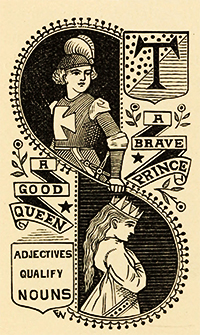
A BRAVE PRINCE
A GOOD QUEEN
ADJECTIVES
QUALIFY
NOUNS
THE next Part-of-Speech called
up before Judge Grammar was
Mr. Adjective.
“My young friends in Schoolroom-shire,”
said Serjeant Parsing,
“must know Mr. Adjective
well. He is the greatest chatterbox
and the veriest gossip that
ever lived. You never in all your
life, my lord, knew any one who
could say so much about one thing
as Mr. Adjective. Mr. Noun cannot
mention a word, but Mr. Adjective
is ready to tell all about it, whether it is little or big,
blue or green, good or bad, and mischief enough he does in
Schoolroom-shire. For instance, if Noun mentions Willy’s
pen—‘Nasty, spluttering, cross-nibbed thing,’ whispers Adjective,
and Willy thinks that is why he wrote such a bad
copy, and did not dot his i’s. If Mr. Noun points out
pussy, who is coming into the room, purring and rubbing her
head against the leg of each chair as she passes, Adjective
whispers that she is a ‘dear, sweet, soft, warm, little pet,’ so
Milly leaves off her sums to pick her up and play with her.
Ann, the housemaid, finds dirty boot-marks on her nice
clean stairs, and as soon as she sees Tom she tells him he
is a ‘tiresome, untidy, disobedient, and naughty boy,’ not
knowing that Mr. Adjective was whispering all those words
in her ear. Indeed, Mr. Adjective causes more quarrels in
Schoolroom-shire, and other places too, than any one can
tell. Only yesterday Jane and Lucy had a quarrel, I hear,
because Jane pulled the arm off Lucy’s doll. If Adjective
had not put into Lucy’s head to call Jane naughty and
unkind, Jane would not have answered that Lucy was
cross and disagreeable. She would most likely have said,
‘I beg your pardon, I did not mean to do it,’ and they
would have been friends again directly. See how much
mischief is caused by talkative, gossiping Mr. Adjective.”
“Really, Mr. Parsing,” remarked Adjective, now putting
in his word for the first time, “you have made a long
speech to show how mischievous I am. Pray, have you
nothing to say about the good that my kind, loving words
do?”
“Oh, certainly, my dear sir,” said Serjeant Parsing,
suddenly changing his tone. “When you like any one you
are a very good-natured fellow, and can say all sorts of
sweet things. I heard you in Schoolroom-shire telling Mary
that her mamma is her owndearest, kindest, sweetest mother—that
baby is a bright, bonnylittle darling—that Fido is a
good, faithfulold doggie—and that home is the happiest
place in the whole wide world. Oh, yes,” continued Serjeant
Parsing, “you can call people good names as well
as bad.”
“I do not call people names,” said Adjective, indignantly.
“I qualify them. I could qualify you, Mr. Parsing, and
say you are an impertinent, rude——”
“That will do, Mr. Adjective,” interrupted the Judge.
“We understand what you mean by qualifying. But tell
us, are your words always placed before nouns?”
“Oh, no, my lord,” answered Adjective. “They can,
almost all of them, be used before a noun, but they are
often used after it, in this way:—
The sky is blue,
The sun is bright,
My words are true,
The snow is white.
“You could also say, blue sky, bright sun, true words,
white snow, but it does not sound so well, I think. And
when a pronoun stands instead of a noun, and my words
qualify it——”
“Oh, you qualify pronouns as well as nouns, do you?”
asked Serjeant Parsing.
“I am obliged to do so sometimes,” said Mr. Adjective,
rather sulkily. “I will not have my words used before a
pronoun, as they are before a noun. You can say:—
I am right,
And you are wrong;
It is late,
And we are strong.
But you must not say: right I, wrong you, late it, or strong we.”
“I should think not,” said Serjeant Parsing, laughing.
“Then we are to understand that adjectives are used to
qualify nouns and pronouns, and that they may be used
before a noun or after it, but not before a pronoun.”
“Quite right, so far,” said Mr. Adjective; “but I can do
other things besides qualifying nouns.”
“What can you do?”
“I can tell how many there are of the thing the noun
names, one, two, three, four, and so on. And whether the
thing is the first, second, third, or fourth, and so on. And
whether there are some things, many things, few things,
more things, no things.”
“And all these words are adjectives, are they?”
“Yes,” answered Adjective. “All words that can be put
before thing or things are adjectives.”
“A thing, the thing,” remarked little Article, looking up
with a cunning smile at Adjective. “A and the are both
articles.”
“A and the don’t count, of course,” said Adjective, impatiently.
“Besides, they were adjectives once, people
say, only they got so worn out, that I let my ragged little
cousin Article have them. But except a and the, there is
no word that you can put before thing or things that is not
an adjective. A beautiful thing, an ugly thing, bad things,
good things, green things, yellow things, large things, little
things; and so you can say, one thing, two things, some
things, any things; and also, this thing, that thing, these
things, those things.”
“That seems a very easy way of finding out an adjective,”
remarked the Judge. “I hope it is a correct way.”
“Indeed it is, my lord,” said Adjective, earnestly.
“See, I can give you many more examples.
A lovely, graceful, beautiful thing,
A useful, homely, dutiful thing;
Foolish, childish, useless things;
Handsome, rich, and priceless things.”
“My lord,” said Mr. Noun, coming forward and speaking
in a solemn voice, “I accuse Mr. Adjective of stealing,
and wish him to be sent to prison.”
“Indeed!” said the Judge; “but he must be tried first,
and you must prove him guilty before I have him punished.
What do you say he has stolen?”
“My lord, he is constantly stealing my words, and only
just now he used these without my leave, in open court:
love, grace, beauty, use, home, duty.”
“Enough,” said the Judge. “I certainly heard him use
some such words only just now. Critics,” he called to the
policemen, for that is the name they have in Grammar-land,
“seize Mr. Adjective, and keep him safe until the court
meets again, when he shall be tried for stealing.” Then
turning to the people of Schoolroom-shire, the Judge continued,
“My friends, I shall be much obliged if you
will look over the following story, and strike out of
it all the words belonging to Mr. Adjective. I cannot
allow them to remain side by side with other words, until
it is proved that Mr. Adjective is not guilty of stealing
them.”
The Judge then rose, and poor Mr. Adjective was led out
of the court, with his hands bound.
The following is the story which the Judge sent to the
people of Schoolroom-shire.
THE MAIDEN PRINCE.
A long, long time ago, there lived in a grey old castle,
a widowed queen, who had one only child, a beautiful
bright boy. “My good husband was killed in the terrible
war,” said the timid queen, “and if my dear son grows up
to be a strong man, I fear that he will go to the cruel wars,
too, and be killed. So he shall learn nothing about rough
war, but shall be brought up like a simple maiden.” So she
taught him all maidenly duties, to spin, and to weave, and
to sew, and she thought he was too simple and quiet to wish
to go to war; but one day there came to the great castle
gate a noble knight riding a gallant charger. “Come,” he
cried to the young prince, “come, follow me. I ride to fight
with the wicked and strong who are oppressing the weak
and the poor.” Up sprang, in a moment, the fair young
boy, flung aside his girlish work, seized his father’s battered
sword, and leaped into the saddle behind the noble knight.
“Farewell, dear mother,” he cried, “no more girlish work
for me. I must be a brave man, as my father was, and
conquer or die in the rightful cause.” Then the foolish
queen saw that it was useless to try to make a daring boy
into a timid maiden.
CHAPTER VI. MR. ADJECTIVE TRIED FOR STEALING.
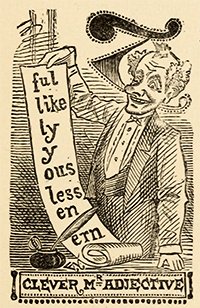
ful
like
ly
y
ous
less
en
ern
CLEVER MR. ADJECTIVE
THERE was great excitement
in the court the next day;
and when every one was assembled,
except Adjective,
the Judge called out: “Bring
the prisoner in;” and poor
Adjective was led in between
two Critics, with his hands
tied behind him, and placed
before the Judge.
Serjeant Parsing rose, and
began to question him.
“Is your name Adjective?”
he said. “It is,” answered Adjective.
“And you possess all the adjectives in Grammar-land?”
“I do.”
“What is an adjective?”
“A word used to qualify a noun.”
“What is a noun?”
“Please, my lord, need I answer that?” asked Adjective.
“Certainly,” replied the Judge.
“It is not fair,” said Adjective; “nouns are not my
words.”
“But you must know what a noun is, in order that you
may use your adjectives properly.”
“Of course I know what a noun is—it is a name, the
name of anything.”
“Then do you know the difference between a noun and
an adjective?” asked Serjeant Parsing.
“Certainly. A noun is the name of a thing. An adjective
tells you something about the thing the noun has
named; whether it is large or small, or what colour it is,
or how much there is of it, or whether there are few
things or many, or something of that sort.”
“Quite so; but can you find out at once, without much
thinking, whether a word is a noun or an adjective?”
“If you can put an article before a word, then it is a
noun,” answered Adjective; “as, a man, the dog.”
“Then when I say, ‘Pity the poor,’ of course poor is a
noun, is it?”
“No,” said Adjective, quickly; “poor is my word, I know,
for you can say poor child, a poor thing. ‘Pity the poor’
really means, ‘Pity the poor people;’ but Mr. Noun is so
stingy, that when he thinks the sentence will be understood
without his word, he just leaves it out, and then people say
the noun is understood.”
“Exactly so; but your way of finding out a noun does
not answer, you see, for the first time I try it, you tell me
the word I have found is an adjective.”
“It always answers unless there happens to be a word
understood,” replied Adjective, “and then it answers if you
use your reason; for any one would know that you are
not asked to pity a thing called a poor, but to pity poor
people. But it is not fair, my lord,” continued Adjective,
turning to the Judge. “Here am I, a poor prisoner, unjustly
accused of stealing, and Mr. Parsing is trying to puzzle me
as much as he can.”
“Not at all,” replied Serjeant Parsing. “I only want
you to be sure that you know clearly the difference between
a noun and an adjective.”
“I do,” answered Adjective, “quite clearly.”
“Well, then, answer this question. What is the word
beauty?”
“Beauty?” repeated Adjective, getting rather red;
“beauty is a noun.”
“Yes,” said Serjeant Parsing; “and grace, and home, and
duty?”
“They are all nouns,” answered Adjective, looking uncomfortable.
“Yes; now another question. What is beautiful?”
“Beautiful?” repeated Adjective, looking very red now;
“beautiful is an adjective.”
“Very well. Now, Mr. Adjective,” said Serjeant Parsing,
“kindly tell me how you got the adjective beautiful?”
“I made it,” answered Adjective, with his eyes on the
ground.
“How did you make it?”
“I stuck ful on to beauty. When I want to say a thing
is full of beauty I call it beautiful.”
“And how did you get beauty, since it belongs to Mr.
Noun?” asked Serjeant Parsing.
“I took it,” replied Adjective, still looking down.
“Which means to say that you stole it. It is quite clear
that you stole it, and that you did the same to grace, home,
duty, and others, to make graceful, homely, dutiful, and the
rest. My lord, I think I need say nothing more: the prisoner
himself owns that he took these words; it only remains
for you to give him his punishment.”
The Judge looked very grave, and was beginning to
say, “Mr. Adjective, I am very sorry——” when Serjeant
Parsing interrupted him, and said:—
“Please, my lord, I am going to take the other side
now. Will you order Mr. Noun to come forward to be
questioned?”
“Certainly,” said the Judge; and Mr. Noun approached.
“Mr. Noun?” said Serjeant Parsing.
“The same, sir,” said Mr. Noun; “all nouns belong to
me.”
“You know a noun when you see it?”
“Of course I know my own words.”
“And you know an adjective?”
“Yes; an adjective is a word that tells something about
one of my nouns.”
“Very good. Now can you tell me whether happy is
a noun?”
“Certainly not. It is an adjective. You can say a
happy boy, a happy thing.”
“Exactly so. Now will you tell me what happiness is?”
“Happiness,” repeated Mr. Noun, getting suddenly very
red, for he saw what was coming; “happiness is a noun,
it is mine.”
“Oh!” said Serjeant Parsing; “how did you get it?”
“I made it.”
“How?”
“I joined happy and ness together.”
“H’m!” said Serjeant Parsing. “I will not ask you
where you found such a silly word as ness, but happy you
said just now belongs to Mr. Adjective, so of course you
took it from him.”
Mr. Noun did not answer, but looked down, exceedingly
red and uncomfortable.
“My lord,” said Serjeant Parsing to the Judge, “need
I say any more. This Mr. Noun, who would have Adjective
put in prison for stealing, has been doing the very
same thing himself. Happiness, prettiness, silliness, cleverness,
and almost all the words that end in ness, are nouns
made from adjectives. If Mr. Noun would give them all
up, I have no doubt Mr. Adjective would then give up his
beautiful, useful, graceful, and other adjectives that are made
from nouns.”
“No, no,” said the Judge; “I will have no giving up.
When a word is once made it is made for good, and instead
of blaming those who take their neighbour’s words
to make new ones for themselves, I consider that they are
very much to be praised. Critics, untie Mr. Adjective’s
hands. Mr. Adjective, I am glad to hear you are so clever
in making new words, and I give you full permission to
make as many more as you can, by borrowing either from
Mr. Noun or from any other Part-of-Speech. Have you any
other ending to put on besides ful?”
“My lord,” said Adjective, whose hands were now untied,
and who was standing free and upright before the
Judge, “my lord, I have a whole string of tails which I
keep ready to make adjectives with. Here are some of
them: ful, like, ly, y, ous, less, en, and ern; and this is the
way I stick them on: beautiful, ladylike, manly, dirty, poisonous,
careless, golden, western, and with your lordship’s
kind permission, I will make such words as often as I
can.”
“Do so,” replied the Judge. “And you, Mr. Noun, remember,
that you are to allow Adjective to take your words
whenever he requires them, for you ought to know that
words in Grammar-land are not like pennies in Matter-of-fact-land.
There, if some one steals a penny from you, he
has it and you have not; but here, in Grammar-land, when
any one takes your words to make new ones, it makes him
richer, but you are none the poorer for it. You have beauty
still, although Mr. Adjective has made beautiful; and you
have lady, and man, and gold, although Mr. Adjective
has made ladylike, and manly, and golden. You ought to
have known this, Mr. Noun, and not to have accused Mr.
Adjective of stealing. Therefore, as a punishment, I require
you to send into Schoolroom-shire a list of nouns that may
be made into adjectives by the addition of some of Mr.
Adjective’s tails.”
The Judge then left the court, and this is the list that
Mr. Noun sent into Schoolroom-shire.
Nouns to be made into Adjectives.
Truth
Faith
Hope
Lady
Man
Love
Child
Baby
Fool
Dirt
Wood
Fire
Care
Sleep
Sense
Gold
Wood
Silk
North
East
West
Poison
Danger
Virtue
Adjective endings that may be added to Nouns.
ful
less
like or ly
en
ish
ern
y
ous (meaning full of)
CHAPTER VII. THE QUARREL BETWEEN MR. ADJECTIVE AND MR. PRONOUN AND LITTLE INTERJECTION.
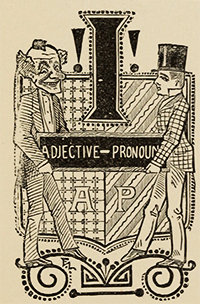
ADJECTIVE-PRONOUN
A | P
IT is sad to tell that nearly the
first thing Mr. Adjective did
when he was set free was to
have a quarrel with Pronoun.
When the Judge came into
court the next day he found
them both much excited.
“It is mine, I know it is,”
said Pronoun.
“And I know it is mine,”
cried Adjective. “I’ll ask the
Judge if it is not.”
“I’ll ask him, too,” said
Pronoun. “My lord,” he continued, coming forward,
“her is mine, and Adjective wants to take it from me. But
when I claimed it in court before, he said nothing
about it.”
“I thought the more,” returned Adjective, “but I supposed
that you would give it up quietly without all this fuss
in court.”
“I would willingly give it up if it were yours,” said Pronoun;
“but it is not.”
“It is,” cried Adjective, angrily; “I tell you it is.”
“Silence!” said the Judge, sternly. “Brother Parsing,
be kind enough to question both Adjective and Pronoun,
that we may know the cause of this quarrel, and hear what
each has to say for himself.”
“Certainly, my lord,” answered Serjeant Parsing. “Adjective,
what words do you claim?”
“Well, Mr. Pronoun, tell us how you make them out to
be yours.”
“Nothing is easier,” answered Pronoun. “These words
stand instead of nouns, and therefore they must be pronouns.
When you say ‘my thumb,’ my lord, you mean
Judge Grammar’s thumb, so my stands instead of the noun
Judge Grammar. And when you say, ‘Little Bo-peep has
lost her sheep,’ you mean little Bo-peep’s sheep, therefore
her stands instead of little Bo-peep. So my and her are
clearly pronouns; and thy, his, its, our, your, their, are used
in just the same way, and therefore must be pronouns
too.”
“It would seem so,” said the Judge. “What has Mr.
Adjective to say to that?”
“I will soon tell you, my lord,” replied Adjective.
“You will, of course, allow that an adjective is a word that
may be used before a noun, to tell something about the
thing that the noun names. It has been said that if you
can put thing or things after a word, that word (not counting
a or the, of course) is sure to be an adjective; as, a
good thing, a bad thing, large things, little things, and so
on. Well, I am sure you can say my thing, thy thing, his
thing, her thing, its thing, our thing, your thing, and their
thing. Therefore, my, thy, his, her, its, our, your, and
their, must be adjectives.”
“H’m! It is all very well to say must,” remarked the
Judge, “but then Pronoun says they must be pronouns.
Are there any more of your words, Mr. Pronoun, that Adjective
claims in the same way?”
“My lord,” answered Pronoun, “he claims all the words
of mine that may be used before a noun. This, that, these,
and those, for instance.”
“Of course I do,” said Adjective; “for when you say
this bird, that horse, these rabbits, those people; this, that,
these, and those are clearly used with a noun, but do not
stand instead of one.”
“Ah!” said Pronoun, “but when you say ‘look at this,’
‘take that,’ ‘may I have these?’ ‘burn those;’ this, that, these,
and those are not used with a noun, but clearly stand instead
of one, and therefore they are pronouns.”
“It seems to me,” said the Judge, half to himself, “that
sometimes they are adjectives, and sometimes they are
pronouns.”
“That is just what I say, my lord,” cried Adjective,
“and if you will allow it, I think I know of a way that will
make peace between us directly. Let us call them Adjective-Pronouns,
and have them between us. When they are used,
not with a noun, but instead of one, then Pronoun may have
them all to himself; but when they are used like adjectives,
before a noun, then we will have them between us, and call
them Adjective-Pronouns.”
“That seems very fair,” replied the Judge, “and I certainly
allow it. Mr. Pronoun, be kind enough to give us a
list of your words, and Mr. Adjective will point out any that
may be used as Adjective-Pronouns.”
“Those last eight are between us,” said Adjective, “for
they can all be used before a noun.”
“Myself, thyself, himself, herself, itself, ourselves, yourselves,
or yourself, themselves,” said Pronoun, with a little toss
of his head, “those, at least, are all mine, Mr. Adjective.”
“Continue repeating your words, sir,” said the Judge,
sternly; “do not stop to talk.”
“This, that, these, those,” continued Pronoun.
“Adjective-pronouns, all four of them,” remarked Mr.
Adjective; “we have shown that already.”
“Each, either, neither, one, other,” continued Pronoun.
“Stop,” said the Judge; “we have not had these words
before. You must give us some sentences to show that they
are pronouns.”
Pronoun replied:—
Two sparrows had a fight to-day,
Each wished to take a worm away;
One pulled at it, so did the other,
Neither would yield it to his brother.
Had either given up at least,
His brother would have had the feast;
But while they fought a thrush came by,
And with the worm away did fly.
“There, my lord,” continued Pronoun, “all the words,
each, one, other, neither, either, stand for sparrow in those
lines, and as sparrow is a noun, they must be pronouns.”
“They are adjective-pronouns sometimes,” remarked Mr.
Adjective, “for you can say, ‘each boy,’ ‘the other day,’
‘on either side.’”
“Certainly,” said the Judge. “Have you any more, Mr.
Pronoun?”
“Who, which, what,” continued Pronoun.
“You must show that they are pronouns,” said the Judge.
“‘Here is the man who shot the tiger,’” said Pronoun.
“‘Here are two apples; which do you choose?’ ‘I know
what I want.’ Who stands instead of the man, because you
could say, ‘Here is the man; the man shot the tiger.’
Which stands instead of one of the apples, and what stands
instead of the thing that I want, whatever it may be.”
“Yes,” said Serjeant Parsing. “But if who and what
are used to ask questions, as, ‘who is there?’ ‘what is that?’
then what do who and what stand instead of?”
“If you will answer the questions, and tell me who was
really there, and what that really was, then I will tell you
what nouns who and what stand instead of; but if you do
not know any answer to your own questions, then of course
I cannot tell you what noun my little pronouns stand for;
I can only tell you they stand instead of something, and
therefore are pronouns.”
“Which and what are used before nouns sometimes,”
cried Adjective: “‘which way are you going?’ ‘what bell
is that?’ therefore they are adjective-pronouns too.”
“At any rate,” said Pronoun, haughtily, “who is altogether
mine, for you cannot say, ‘who way,’ ‘who book,’
‘who man,’ or anything of that sort.”
“Hoo! hoo! hoo! ha! ha! ha! he! he! he!” cried a
voice among the crowd. “Old Adjective beaten! hurrah!
bravo!”
Every one in the court looked round to see where such
strange sounds came from.
“It is Interjection,” said Serjeant Parsing, angrily,
making a dive at the crowd behind him, to try and catch
hold of some one in
it.
“Critics,” cried the Judge, “seize that fellow, and bring
him here.”
But that was more easily said than done, for little Interjection
was as quick and active as any street boy in London.
He dodged in and out amongst the other Parts-of-Speech,
and was here, there, and everywhere, till at last he tumbled
up against Serjeant Parsing, who held him fast till the
Critics came up. He is such an odd little creature, that
you could hardly tell what he is like. One moment he
is crying bitterly, and the next he is in fits of laughter;
when you look at him again he is perhaps shrieking for
fear, and in another minute he is standing on his head for
joy. He is so fond of standing on his head, that people
say he had his portrait taken so once (!), and that is why
they put a note of exclamation (!) after his words; but that
is all nonsense, of course.
“Interjection!” said the Judge, sternly, “you are the
last of all the Parts-of-Speech, and have no business to interrupt
the court now. Let me not hear you again until
your turn comes.”
“Alas! alas!” cried Interjection, wringing his hands.
“Mr. Parsing says I am only a poor little fellow thrown in
(that is what my name interjection means, thrown in), to
express surprise or fear, joy or sorrow. When folks do
not know what to say next, one of my little words pops
in, and poor Mr. Parsing is at his wit’s end to know what
to do with it, ah! ah! Off! off!” he cried, changing his
tone, and suddenly jerking himself out of the policeman’s
hold. “Away! away!” he shouted, springing to the door;
and before they could catch him he was indeed away, and
they heard his “ha! ha! ha!” die away in the distance.
Serjeant Parsing then turned to the Schoolroom-shire
folks, and asked them to mark off on their slates places
for Mr. Noun, Pronoun, Adjective, and little Article, and a
corner somewhere for tiresome Interjection; and while he
read to them, to put down a stroke in the right place for
each word that they knew. “And when you come to an
adjective-pronoun used with a noun,” continued Serjeant
Parsing, “put a stroke on the line that divides Adjective’s
ground from Pronoun’s. That will be like a little man
sitting astride on the wall, with one leg for Pronoun to
pull and one for Adjective. Of course if it is used instead of
a noun, and not with one, then Mr. Pronoun must have the
stroke all to himself. Whichever Part-of-Speech gets the
most strokes gains the game.”
This is what Serjeant Parsing read.
“Alas! alas! that naughty boy,” said Harry’s mother,
as she waited for him to come back from school. “He
must have gone to play with the other boys at the big pond,
and he will certainly fall in, for the boys are sure to try the
ice, and it is too thin to bear them yet. Oh! my poor, dear
boy! what shall I do? If he falls into the black, cold
water, he will certainly be drowned. My darling Harry!
ah! why does he not come home? If I had any one to
send.... Why, there he is, I declare, with his hands
full of oranges. Oh! the naughty boy! I will give him a
great scolding. To give me a fright, and keep me waiting
while he was buying oranges! Harry, you are a naughty,
careless, tiresome—— What! kissing me, you little
rogue, to stop my mouth. There! there! do not pull
down my hair, and never give your poor mother such a
fright again; and now come in and see the lovely Christmas-box
I have for you.”
CHAPTER VIII. DR. VERB.
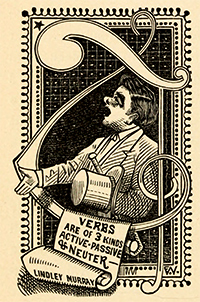
VERBS
ARE OF 3 KINDS
ACTIVE·PASSIVE
& NEUTER—
LINDLEY MURRAY
THE next Part-of-Speech called
up before Judge Grammar, to
give an account of himself,
was Dr. Verb.
He came bustling up with
an air of great importance.
“My lord, my name is
Verb. I am called Verb because
verb means word, and
the verb is the most important
word, the word, in fact, in
every sentence.”
“The most important word!”
cried Mr. Noun, interrupting him. “My lord, he says
the verb is the most important word in every sentence!
Why, Dr. Verb, you know that you cannot give the name of
a single thing, for all names are nouns, and belong to me.
The verb the most important word, indeed, when I have
the name of everything!”
“I know that,” answered Dr. Verb, “I know very well
that when people want to name a thing they must use a
noun. But do you suppose that when they have simply
named a thing they have made a sentence? Not a bit of
it. To make a sentence you must tell something about the
thing that you have named; you must say whether it is or
has or does anything, as: ‘Ice is cold,’ ‘Puss has a tail,’
‘Blackbirds sing.’ Is, has, sing, are verbs, and so are all
words that speak of being, having, or doing, and without
some such word you cannot make a sentence.”
“You think so, Dr. Verb,” said the Judge, “but I should
like it to be proved. Brother Parsing, just call some of the
other Parts-of-Speech forward, and let them try to make a
sentence without Dr. Verb.”
“I will, my lord,” answered Serjeant Parsing. “Noun,
Adjective, and Article, be kind enough to step forward, and
each of you give me a word.”
“Sun,” said Mr. Noun.
“Bright,” said Adjective.
“The,” said little Article.
“Very good,” said Serjeant Parsing, “now I will put
them together; ‘sun bright the;’ ‘the bright sun;’ ‘the
sun bright.’ They do not seem to make quite a proper
sentence, my lord, any way.”
“Of course not,” said Dr. Verb, interrupting; “for when
you say ‘the bright sun,’ which sounds the best of the three
ways, you still have not made a sentence, for you have not
said whether the bright sun is shining, or is not shining,
or whether you can see it, or what it does. ‘The sun
bright’ of course is nonsense; but say the sun is bright,
and then you tell a fact about the sun, and you have made
a sentence fit to set before the king.”
“You had better try Mr. Noun again, Brother Parsing,”
said Judge Grammar. “Perhaps he can give you a more
convenient word.”
Serjeant Parsing turned again to Mr. Noun, and asked
for another word.
“Hippopotamus,” answered Mr. Noun. Mr. Adjective
gave fat.
“Now, little Article, give me a,” said Serjeant Parsing,
“and I will put them together. ‘Hippopotamus fat a;’
‘a fat hippopotamus;’ ‘a hippopotamus fat.’ H’m! it
sounds odd.”
“‘A fat hippopotamus’ does not sound wrong,” put in
Mr. Noun.
“Not wrong, of course,” answered Dr. Verb. “You
may mention a fat hippopotamus, if you like, or any other
animal, but unless you tell something about it you have not
made a sentence. Say that it is, or has, or did something,
if you want to make a sentence; like ‘a fat hippopotamus
is here;’ or ‘a hippopotamus has a fat body;’ or, ‘a hippopotamus
ate me up,’ or, ‘swam away,’ or something of that
sort. Then you will have some famous sentences, but you
will have had to use verbs to make them, for is, has, ate,
swam, are all verbs, for they are all words that speak of
being, having, or doing.”
“How can we always find out if a word is a verb?”
asked Serjeant Parsing.
“It is sure to be a verb if you can put a little to before
it,” answered Dr. Verb; “to be, to have, to do, to eat, to
drink, to swim, to fly, to speak, to think, to run, to dance, to
play, to sing, to sleep, to wake, to laugh, to cry, to call, to
fall;” and Dr. Verb stopped, quite out of breath.
“That sounds very easy,” said Serjeant Parsing. “Let
me try it with the words that you said were verbs; to is, to
has, to ate, to swam.”
“Stop, stop,” cried Dr. Verb; “not like that. You
must not put to before any part of the verb you like.
Is is part of the verb to be, has is part of the verb to
have.”
“Is, part of the verb to be?” said Serjeant Parsing.
“What do you mean? why, the two words have not a
single letter alike.”
“True; but still they mean the same sort of thing.
When a countryman says ‘he be a brave lad,’ he means the
same thing as ‘he is a brave lad;’ or when he says, ‘I be
too tired,’ he means, ‘I am too tired.’ Is and am ought
to be used according to the laws of Grammar-land instead
of be, but as they both express something about being they
are said to be parts of the verb to be. In the same way
has is part of the verb to have, ate is part of the verb to eat,
and swam is part of the verb
to swim.”
“That is very learned, I daresay,” said Serjeant Parsing,
“but will you kindly tell us, Dr. Verb, how we are to
guess that am, or any other word that has neither a b nor
an e in it, is part of the verb to be?”
“You cannot guess, of course,” retorted Dr. Verb,
sharply. “I never said you were to guess. You must
use your reason, to find out whether they have the same
sort of meaning. Or if you like it better, learn the song
that Mr. Pronoun and I have made up, to bring in all the
different parts of the verb.”
“A song?” said Judge Grammar, in surprise. “I did
not know that you could sing, Dr. Verb; but let us hear
your song, by all means.”
“If you will not interrupt me, my lord, I will give you
three verses of it,” answered Dr. Verb.
“No, we will not interrupt,” said the Judge.
So Dr. Verb began:—
THE SONG OF THE VERB “TO BE.”
Present Tense.
I am
Thou art
He is
We are
You are
They are
Past Tense.
I was
Thou wast
He was
We were
You were
They were
Future Tense.
I shall be
Thou wilt be
He will be
We shall be
You will be
They will be
When he had finished, every one burst out laughing.
“And you call that singing, do you, Dr. Verb?” said
the Judge.
“Dr. Syntax, there, calls it conjugating, I believe,” said
Dr. Verb; “but I think singing is a prettier and easier
name for it.”
“But it is not a song at all,” said the Judge, nearly
laughing again; “there is no tune in it, and no rhyme.”
“It is the best that Pronoun and I could make alone,”
said Dr. Verb, angrily. “But it can be easily made to
rhyme if the other Parts-of-Speech will help. Listen.
PRESENT TENSE.
I am an Englishman merry and bold,
Thou art a foreigner out in the cold,
He is a beggar-man hungry and old;
We are not happy to see you out there,
You are too snug and warm ever to care,
They are at home with us now, I declare.”
“That will do,” interrupted the Judge; “we do not
want to hear any more to-day. Another day I shall want
to know what you mean by calling the verses Present Tense,
Past Tense, and Future Tense—why you have just six of
your words in each tense,—and whether other verbs can be
conjugated in the same way.”
“I can answer at once that they can, my lord,” said
Dr. Verb. “Indeed, very few verbs change as much as
the verb to be, so that they are all easier to conjugate; as,
I have, thou hast, he has; we have, you have, they have.
I live, thou livest, he lives; we live, you live, they live.”
“Enough for to-day, Dr. Verb,” interrupted the Judge
once more; “we will hear about them next time. Meanwhile,
as we shall have further examination of this verb to
be, I should like my friends in Schoolroom-shire to make
a copy of it, to bring with them. I shall also request them
to find out all the verbs in the following verses:—
“Sit to your task,” a father said,
“Nor play nor trifle, laugh nor talk,
And when your lesson well is read,
You all shall have a pleasant walk.”
He left the room, the boys sat still,
Each gravely bent upon his task,
But soon the youngest, little Will,
Of fun and nonsense chose to ask.
“My ball is lost,” the prattler cried,
“Have either of you seen my ball?”
“Pray mind your book,” young Charles replied.
“Your noisy words disturb us all.”
The court then rose.
CHAPTER IX. DR. VERB’S THREE TENSES AND NUMBER AND PERSON.
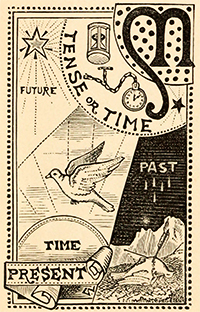
TENSE OR TIME
TIME
FUTURE
PAST
PRESENT
“NOW, Dr. Verb,” said Judge
Grammar, the next day, “we
have well examined this that
you call your ‘Song of the
verb To be.’”
“Conjugation, my lord, if
you like,” said Dr. Verb, bowing.
“I do like, certainly,” replied
the Judge. “Conjugation
is a much better word
than song—longer and more
respectable, and in every way
more suited to Grammar-land. Con-ju-ga-tion—this conjugation
of the verb ‘to be.’ We require you to explain it.”
“With pleasure, my lord. You see, it is divided into
three verses.”
“Verses!” exclaimed Serjeant Parsing. “You know it
is not to be called a song, Dr. Verb.”
“Quite so, quite so,” said Dr. Verb, bowing again.
“Well, Tenses, then. It is divided into three tenses, the
Present Tense, the Past Tense, and the Future Tense, which
mean the present time, the past time, and the future time;
and your lordship knows that all time must be either present
time, or past time, or future time. Just as when you
are reading a book. There is the part you have read, that
is the past; the part you are going to read, that is the future;
and the part you are reading now, that is the present.”
“We understand,” said Judge Grammar; “but pray explain
why you divide your verbs into these three parts.”
“To show how my verbs change when they have to
mark the present, past, or future time. You see, the verb
‘to be’ takes am for the present, was for the past, and
adds on will or shall for the future. I am in the present
time talking to your lordship. I was in the past time
talking to your lordship. I shall be in the future time
talking to your lordship.”
“Indeed, I hope not,” cried the Judge, putting his
hands to his ears. “Pray do not go on forever talking
to me. I have heard quite enough of your voice already.
Step back, and allow Mr. Pronoun to take your place, and
explain the rest of the conjugation to us.”
“Allow me to say one thing more,” said Dr. Verb.
“Please, Mr. Parsing, whenever you see a will or shall, or
any other little verb put in to show the time, will you
remember that it is only a little helping verb, used to
make up the tense of some other verb, and therefore to be
counted in with that, and not taken alone.”
“Just give an example of what you mean,” said Serjeant
Parsing; “I do not quite understand.”
“I mean to say that when you see ‘he will go,’ you must
take will go as part of the verb to go; and when you see
am coming, was dancing, has eaten, had fought, you must
take them as parts of the verbs to come, to dance, to
eat, to fight. The first words, am, was, has, had, are very
good and respectable words by themselves, of course; but
when they are used with another verb, they are never offended
if you just take them as part of that other verb.”
“Thank you. I will remember,” said Serjeant Parsing,
laughing. “Now please to stand back, and allow Mr. Pronoun
to answer.—Mr. Pronoun, pray why do you use these
particular six words, I, thou, he, we, you, and they, to make
up Dr. Verb’s tenses?”
“I use I and we,” answered Pronoun, “to stand for the
first person; thou and you to stand for the second person;
and he and they to stand for the third person.”
“What do you mean by the first person?” asked Serjeant
Parsing.
“My lord,” answered Mr. Pronoun, turning to Judge
Grammar, “may I ask you who is the first person in Grammar-land?”
“I am, of course,” answered the Judge.
“That is what I find all my friends answer,” said Pronoun.
“When I ask them who is the most important, the
first person in the world to them, they say I am; so my
little I stands for the person who is speaking about himself,
and I call it the first person.”
“Then who is the second person?” asked the Judge.
“You are, my lord,” answered Pronoun, bowing politely.
“You said just now that I was the first person,” said the
Judge.
“Yes, my lord,” replied Mr. Pronoun, putting his hand
on his breast; “I first, and you second.”
“But it ought to be I first, and you second,” said the
Judge, angrily.
“That is exactly what I said, my lord,” repeated Pronoun.
“I first, and you second.”
The Judge was getting so angry, that Pronoun’s friends
began to tremble for his head, when suddenly Dr. Syntax
rose and said: “The first person is always the person
speaking, and the second is the person spoken to. Let
every one in the court say, ‘I am the first,’ and we shall
all be right, and all satisfied.”
“I first, we first,” they all shouted; “and you, you, you,
only the second.”
The noise was tremendous, and the Judge, finding
himself only one against a number, thought he had better
turn the subject; and clapping his hands loudly, to call
for silence, he called out:
“But if we are all firsts and seconds, pray where is the
third person to go?”
“Oh, the third person,” said Pronoun, contemptuously,
“is only the one we are talking about. He may not be
here, so it cannot matter if we call him only the third person.”
“And what is the use of your having pronouns to stand
for all these three persons in Dr. Verb’s tenses?” asked
Serjeant Parsing.
“Dr. Verb and I agree together to alter our words according
to the person they represent,” said Mr. Pronoun.
“When my pronoun is in the first person, Dr. Verb has to
make his verb in the first person too. He has to say am
when I have put I, and are when I have put we. I is, or
we art, would make Dr. Syntax there very angry.”
“And he would be rightly angry,” replied the Judge.
“You know that very well.”
“Oh, I am not complaining, my lord,” answered Pronoun;
“I was merely stating a fact. Of course I am rather
pleased than otherwise that Dr. Verb should have to alter
his words to make them agree with mine. My pronouns
show the person (that is why, you know, they are called
personal pronouns), and then Dr. Verb has to make his
words agree with them.”
“Very fine!” remarked Serjeant Parsing, “But tell us,
Mr. Pronoun, why, when there are only three different
persons, you should have six different pronouns in each
tense?”
“Three of them are for the singular number, standing for
only one—I, thou, he,” replied Pronoun; “and the other
three are for the plural number, standing for as many as
you like—we, you, and they.”
“Singular number only one, I, thou, he; plural number
more than one, we, you, they;—that is it, is it not, Mr. Pronoun?”
asked Serjeant Parsing.
“Yes, sir,” replied Pronoun, “that is it exactly; I could
not have explained it better myself. And whatever number
the pronoun is, that the verb must be also.”
“You mean that when the pronoun only stands for one
thing or person, then both it and the verb that comes after
it are said to be in the singular number: is it not so?” said
Serjeant Parsing.
“Quite so, Mr. Parsing,” said Pronoun, delighted; “the
verb has to agree with the pronoun in number, just as it has
to do in person. If my pronoun stands for only one, then it
and the verb are called singular number; but if my pronoun
stands for more than one thing, then it and the verb are said
to be in the plural number. You quite understand me, I
see, my dear Mr. Parsing, and I am sure you will take care
to see that the verb always agrees with me in number and
person.”
“Whenever it is proper that it should,” replied Serjeant
Parsing, gravely.
“But it ought always to agree with my words when we
are conjugating a verb together,” said Pronoun, eagerly;
“that is the very reason why it is useful to conjugate verbs.
In every tense you have the first person, second person, and
third person in the singular number; and the first person,
second person, and third person in the plural number; and
then you see how the verb alters each time to agree with
the pronoun.”
“It does not alter every time,” put in Dr. Verb; “in
some tenses it hardly alters at all. Just listen,—‘I had,
thou hadst, he had, we had, you had, they had; I lived,
thou livedst, he lived, we lived, you lived, they lived; I
sang, thou sangest, he sang, we sang, you sang, they sang;
I rang, thou rangest, he rang, we rang, you rang, they
rang.’”
“That will do, that will do, Dr. Verb,” cried the Judge.
“We have had your talking in the past tense, we do not
want it in the present tense, and if we should happen to
require it in the future tense, we will let you know another
time. Instead of talking here, you had much better go to
Schoolroom-shire, and help the people there to write out the
present, past, and future tenses of the verbs you have mentioned—to
have, to live, to sing, to ring; and show them
how the words alter, not only to mark the different times,
but to agree with Mr. Pronoun’s words in number and
person.”
“I shall be most happy, my lord,” said Dr. Verb; “but
Mr. Pronoun must come too, to help me.”
“With great pleasure, my dear Doctor,” said Mr. Pronoun,
gaily: “there is no one in Grammar-land I can
work with so easily as you, because you agree with me so
beautifully.”
Then, bowing to the Judge, he and Dr. Verb walked out
of the court, arm-in-arm, humming the present tense of the
verb to be, and the Schoolroom-shire people, with their help,
easily wrote out the four verbs mentioned,—to have, to live,
to sing, and to ring.
CHAPTER X. SERJEANT PARSING IN SCHOOLROOM-SHIRE AGAIN.
A · GOOD ♥
IS · BETTER
THAN · RICHES
Before the court met again,
Serjeant Parsing paid another
visit to Schoolroom-shire.
“MY dear young friends,”
he said, “will you kindly get
your slates, and divide them
into four parts, writing at the
top of each part, the name
of Mr. Noun, Mr. Pronoun,
Mr. Adjective, and Dr. Verb.
Then cut off two corners
somewhere, for little ragged
Article and Interjection.
Then listen to the following story, and when any word that
you know is read out, give a mark to the Part-of-Speech to
whom it belongs. If you come to an adjective-pronoun,
of course you must put a little man astride between Mr.
Pronoun’s ground and Mr. Adjective’s; and whenever
you come to a verb, please to say whether it is in the
present, past, or future tense. When you have done, we
will count up, and see which Part-of-Speech has gained
the most marks.
“This is the story:—
“THE TWO NEIGHBOURS.
“A man lived by his labour; and as he had strong arms
and a brave heart, he supported, easily, his wife, his little
children, and himself.
“But a famine came upon the land, and work failed.
“The man spent all the money which he had saved,
until he had not a penny to buy food for his children.
“Then he went to a rich neighbour, and said: ‘My little
children are crying for food, and I have no bread to give
them. Help me.’
“And the rich man said:—
“‘I am a just man; I always pay my debts; but I owe
you no money. Go! I cannot give you charity.’
“Then the poor man went to another neighbour, almost
as poor as himself.
“‘Give me food for my little children,’ he said.
“‘Brother,’ said the poorer neighbour, ‘we have not much
ourselves, but you shall share with us as long as a crust of
bread remains.’
“Then they divided between them the little food that
was left, and that food lasted until the hard times had
passed.”
CHAPTER XI. THE NOMINATIVE CASE.
THE
NOMINATIVE
CASE
THE·STAG·RUNS
THE next day, Dr. Verb came
bustling into the court, looking
very cross, and calling out
loudly for justice.
“What is the matter?”
asked the Judge; “state your
case quietly.”
“It is not my case, it is
Pronoun’s case, that is the
matter,” answered Dr. Verb;
“though I do not say it is his
fault. We should get on very
well if people would only mind their own business.”
“If you will not tell me the state of the case clearly, I
cannot help you,” said the Judge.
“Well, my lord, if you will listen for a minute, I will try
to explain it, so that every one can understand. As you
know very well, I am constantly agreeing with Mr. Pronoun.
I showed you how I alter to suit his number and
person, and it is only fair that he should alter sometimes to
suit me. I only agree with him when he is in the ‘Nominative
Case.’”
At the words “Nominative Case” there was a real cry
of horror from nearly every one in court. You might have
thought they had all turned into interjections, they made
such a fuss.
“Nominative Case!” cried Noun; “shame, shame!”
“Shameful! awful! shocking!” cried Adjective.
“Fie! fie! fie!” cried Interjection, and turned three
times over head and heels.
“Pray do not use such words, Dr. Verb,” said Judge
Grammar, “but tell us what you mean.”
“Really, my lord,” said Dr. Verb, “I did not mean any
harm. Nominative is not such a very long word, that people
should make such a fuss about it. I am sure the ladies and
gentlemen of the jury will not be angry at my using it.”
“That depends on how you explain it,” said the Judge;
“What does it mean?”
“It means the person or thing that is or does whatever
my verb says about him. The cat purrs. It is the cat
that does what the verb mentions. You have only to put
‘who’ before the verb in any sentence, and the answer
will give you the Nominative. ‘Who purrs?’ The answer
is the cat, so cat is the nominative to the verb purrs. That
is the way that I find out whom I am to make my verb
agree with.”
“Is that your way, Brother Parsing?” asked the
Judge.
“Yes, my lord,” answered Serjeant Parsing, “that is
my way, and therefore, of course, it is the best way. My
way is always the best way. Now there is a sentence
all ready for you: My way is always the best way. I’ll
find the nominative before you can dot an i. ‘What is
always the best way?’ Answer, my way is always the best
way;—so my way is the Nominative.”
“But you asked ‘what?’ not ‘who?’ there, Brother
Parsing,” remarked the Judge.
“Because way is a thing, not a person, my lord. When
we are talking of a thing, then we ask ‘what?’ instead of
‘who?’ If you said ‘the pudding is boiling in the pot,’ I
should say ‘what is boiling?’ not ‘who is boiling?’ for I
should hope you would not be boiling a person in a pot,
unless you were the giant in Jack and the Beanstalk.”
“Fi! fo! fum!” said Interjection, standing on his head,
and clapping his heels together.
“Silence, sir!” cried the Judge. “Brother Parsing,
please not to talk about giants till we have done with the
Nominative Case. Has any gentleman anything more to
explain about it?”
“Please, my lord,” said Pronoun, “Dr. Verb complains
that he has to agree with me when I am in the Nominative
Case. But he has to agree with Mr. Noun just as much.
It is no matter what part of speech stands as the Nominative
in a sentence, Dr. Verb must agree with it; so he need
not grumble at me more than at any one else.”
“I am not grumbling at you——,” Dr. Verb began.
“Wait a minute, Dr. Verb,” interrupted the Judge; “let
us first fully understand this case. You say there is a verb
in every sentence?”
“Certainly, my lord,” said Verb.
“And there is a Nominative in every sentence?”
“Exactly so, my lord,” answered Serjeant Parsing.
“And this Nominative may be a noun or a pronoun?”
continued the Judge.
“It may, my lord,” chimed in both Mr. Noun and Mr.
Pronoun.
“And this verb must agree with this Nominative, whether
it likes or not?” asked the Judge.
At that question Dr. Syntax suddenly started up like a
jack-in-the-box, and standing bolt upright, said, “A verb
must agree with its Nominative case in number and person.
A verb must agree with its Nominative case in number and
person;” and then sank down again.
“Ah!” said the Judge. “Very good. So you see, Dr.
Verb, when you have a sentence like ‘ducks swim in ponds,’
you are first to find your own word swim, then to put who
or what before it—‘who swim?’ or ‘what swim?’ The answer
will be ducks, the Nominative. Then you are to be sure
that the verb agrees with it. You must say ‘ducks swim,’
not ‘ducks swims;’ and as ducks is the third person and
plural number, swim will be third person and plural number
too.”
“Please, my lord,” said Pronoun, “when I am Nominative
you need very seldom take the trouble to ask any question
to find out the Nominative, for most of my words show at
once what they are in. I, thou, he, she, we, and they will
never allow themselves to be used except as Nominatives.
They were born Nominatives, they say, and will not degrade
themselves by being anything else. They are rather angry
with you for letting people use him in any way they like, but
he is a good-natured little fellow, and does not mind any
more about the case than he does about being called singular
when he is really plural. But I, thou, he, she, we, and
they, are exceedingly particular, and always are and will be
Nominatives, so you need not ask any question when you
see one of them in a sentence.”
“You may just as well make it a rule to ask ‘who?’ or
‘what?’ in every sentence, to find the Nominative,” said
Serjeant Parsing. “It is such an easy way of finding the
case that a baby in arms could understand it.”
“Tut! tut! tut! tut!” laughed Interjection again.
“Oh! be quiet, do!” said Serjeant Parsing; “and, my
lord, if the ladies and gentlemen of Schoolroom-shire like to
find out the Nominatives in these verses——”
“Yes,” said the Judge; “hand them up, brother. No,
do not begin again, Dr. Verb; no more complaints to-day.
And remember, friends, that in these lines every verb must
have a Nominative, unless there is a little to before the
verb. Then it has none—it does not agree with anything.
And remember, too, that every noun or pronoun that is
in the Nominative case is to get an extra mark on your
slates. I wish you good-morning, gentlemen.”
So saying, the Judge rose. The verses were handed to
the people of Schoolroom-shire, and the court was cleared.
SERJEANT PARSING’S VERSES.
The hen guards well her little chicks,
The useful cow is meek;
The beaver builds with mud and sticks,
The lapwing loves to squeak.
In Germany they hunt the boar,
The bee brings honey home;
The ant lays up a winter store,
The bear loves honeycomb.
I lost my poor little doll, dears,
As I played on the heath one day;
And I cried for her more than a week, dears,
But I never could find where she lay.
The maidens laughed, the children played,
The boys cut many capers,
While aunt was lecturing the maid,
And uncle read the papers.
CHAPTER XII. ADVERB.
LUCY READS
VERY OFTEN
ADVERB
“NOW DR. VERB,” said Judge Grammar,
next day, “I am ready
to hear what is your great
complaint against Pronoun.”
“Why, my lord, when he
is in the Objective Case——”
“I object, I object!” exclaimed
the Judge, while a
general murmur of disapproval
ran through the court. “No,
no, we have had enough with
the Nominative Case; we will
not have another case brought
in. You ought to be ashamed of yourself, sir, to keep us
listening to your nonsense about an Objective case, while
your devoted friend Adverb is waiting to be heard. Sit
down, and let Adverb speak.”
“Devoted friend!” muttered Dr. Verb, as he obeyed.
“I am sure I often wish he would leave me alone. He
sticks on to me so tight sometimes, that we look like one
instead of two, and he is a good weight to carry. Besides,
he is always teasing by asking why, and when, and how
everything is done. Friend, indeed!”
But Adverb did not hear what Dr. Verb was muttering.
He came forward, bowing politely, and rubbing his hands
together, as if he were washing them.
“Very much obliged, indeed,” he said, smoothly; “very
kind of my friend Dr. Verb to give way to me! So like
him!”
“You seem to be fonder of him than he is of you,”
remarked the Judge. “Pray, why do you follow him so
closely?”
“I like to hear what he says, and to point out to others
how exceedingly well he speaks,” answered Adverb.
“He is always exaggerating my words,” grumbled Dr.
Verb. “If I say I like anything, Adverb puts in very much
indeed or extremely well, or some such silly words; or, if he
is in a bad temper, then he flatly contradicts me, and says,
no, or not, or never. If I say will, he adds not, and makes
it will not; if I say can, he makes it cannot, even sticking
his word on to mine as if it were part of it. Sometimes
he does worse. He actually dares to alter my word after
he has stuck his tail on to it, and so he makes will not into
won’t, cannot into can’t, shall not into sha’n’t, and so on.
The wo’, and ca’, and sha’, is all he has left me, and the n’t
is his.”
“Has he always treated you in this way?” asked the Judge.
“As long as I can remember, my lord,” answered Dr.
Verb. “That is why, when we were at school together,
the boys called him Adverb, because he was always adding
his words on to mine. And he has kept the name ever
since.”
“Your lordship must remember,” remarked Adverb, in a
mild tone, still rubbing his hands very smoothly together,
“that Dr. Verb is rather out of temper this morning, and
is, perhaps, not quite just. For indeed it is a fact that I
make his words much more useful than they otherwise would
be. Besides, I treat Mr. Adjective in much the same way,
and he does not complain.”
“It is quite true,” remarked Adjective, coming forward,
delighted to get a chance of using his tongue; “it is quite
true that Adverb has his word to say about me, just as
much as about Dr. Verb. He is always putting very, quite,
more, most, and words of that sort, before my adjectives, and
exaggerating them: as, very beautiful, quite charming, more
obstinate, most provoking, and I do not complain of him for
that. But one thing I do complain of, my lord, and that
is, that Adverb will take my words, right good adjectives,
stick a ly on to them, and call them his adverbs. For
instance, he takes bright, puts ly to it, and makes it
brightly; he takes bad, and makes it badly; nice, and
makes it nicely; beautiful, and makes it beautifully.”
Judge Grammar at this held up his forefinger, and solemnly
shook his head, till he nearly shook his wig off.
“Mr. Adjective, Mr. Adjective!” he said, “I am surprised
at you. You complain of Adverb for doing the very
thing that you do yourself. We all know that you keep
your pockets full of tails ready to stick on to your neighbours’
words—ful, ous, able, like, ly, and plenty more, and
you use them as often as you can with other people’s
words. But when Adverb uses his one little ly with your
words, then you are up in arms directly. And yet you
know very well that according to the laws of Grammar-land
every Part-of-Speech may make as many new words out of
old ones as he likes, and is to be praised, not blamed, for
it. Adverb may put his ly on to as many of your words
as he can, and you have no right to find fault. I wonder
at both you and Dr. Verb. You ought to agree with Adverb
better.”
“We none of us agree with him,” remarked Pronoun,
“nor he with us.”
“He certainly has no number, or person, or case,” replied
the Judge; “but he is none the worse for that. He
gives Serjeant Parsing less trouble than some of you. What
did you say about asking questions, Adverb?”
“I teach the game of how, when, and where,” replied
Adverb; “how, when, and where, are all my words, and so
are the answers to them.
How do you like it? pray you tell?
Not too much, extremely well.
When do you like it, tell me when?
To-day, to-morrow, now, and then.
Where do you like it, answer fair?
Here and there and everywhere.
All these words that answer how, when, and where, are
mine,” continued Adverb, “and so are the forfeit words
yes, no, or nay.”
“Ah! but black, white, and grey are mine,” said Adjective,
interrupting; “and please, your lordship, you were
mistaken in saying that Adverb has only one tail, ly, to put
on to other people’s words. What do you think of upwards,
downwards, homeward, forward?”
“Yes, they are certainly adverbs,” said the Judge, “and
you might say that wards and ward are the tails he has
added on to up, down, home, for; but these words are
not yours, Mr. Adjective, so you have no right to interfere.”
“Well, my lord,” replied Adjective, “at any rate I
have a right to speak about once, twice, thrice, for Adverb
has stolen them from my one, two, three.”
“Once, twice, thrice,” repeated the Judge; “is that
all?”
“He has not got a word for four times,” answered
Adjective; “once, twice, thrice, and away, is all that he can
say.”
“Then I think,” said the Judge, “that you ought to be
ashamed to grudge them to him, when you have one, two,
three, and as many more as you can count; besides first,
second, third, fourth, and all that list. I do not like
such greedy ways, and as a punishment, I order you to
hand up a list of adjectives to be turned into adverbs.
Our friends may take them to Schoolroom-shire and put
a ly to each of them; then they will be adverbs, and
will answer to one of Adverb’s questions, how, when,
or where.”
This is the list Mr. Adjective made out.
quick
bright
soft
strong
distinct
clear
neat
sharp
sudden
late
punctual
regular
sly
cunning
false
true
pretty
dainty
funny
free
happy
awful
CHAPTER XIII. PREPOSITION.
UP
A
LADDER
DOWN
THE
HILL
PREPOSITIONS·
“TO, from, of, for, over, under, on,
near, at, by, in, among, before,
behind, up, down—— Pray,
who is the owner of all these
little creatures?” said Judge
Grammar, the next day. “Mr.
Noun, are they yours?”
“No, indeed, my lord,”
answered Mr. Noun, “they
are not the names of any one
or anything that I ever heard
of.”
“Dr. Verb, are they yours?”
“I should not object to having them, my lord,”
answered Dr. Verb, “if I could do anything with them;
but they seem to me neither to be nor to do, nor to suffer
any——”
“That will do,” interrupted the Judge, afraid that Dr.
Verb was beginning one of his long speeches. “Mr. Adjective,
do you claim them?”
“They do not qualify anything, my lord,” answered
Adjective; “indeed, they seem to me poor, useless, silly,
little——”
“We do not want you to qualify them, thank you,” said
the Judge, “but to tell us if they are yours. Article, we
know, has only a or an and the, so they cannot be his.
Mr. Pronoun, do they belong to you?”
“No, my lord,” answered Pronoun. “As Mr. Noun has
nothing to say to them, neither have I. They do not stand
instead of any name.”
“Well,” said the Judge, “we know they do not belong
to that tiresome little Interjection. Are they yours,
Adverb?”
“I should be extremely glad to have them, my lord,”
answered Adverb, smoothly washing his hands, as usual.
“I have no doubt I could make them exceedingly
useful——”
“That is not what I asked,” said the Judge; “are they
yours?”
“I cannot say they are exactly mine,” said Adverb;
“but——”
“That is all we want to know,” interrupted the Judge.
Then raising his voice, he continued: “If there is any one
in this court to whom these words, ‘to, from, of, for,’
etc.,
do belong, let him come forward.”
At these words, a sharp, dapper little fellow stepped
forward, and looking around the court with a triumphant
air, exclaimed, “They belong to me.”
“And who are you?”
“Preposition, my lord. My position is just before a noun
or pronoun. My words point out to them their proper
position. I keep them in order.”
“You keep them in order?” said Judge Grammar, looking
down at him through his spectacles; “how can a little mite
like you keep Mr. Noun in order?”
“Little or big, my lord, that’s what I do,” said Preposition.
“I settle the position of every one and every thing,
and show whether they are to be on or under, to or from, up
or down.”
“Kindly forgive me for interrupting you,” said Adverb,
coming forward. “I really must remark that up and down
are my words.”
“How do you make out that?” asked the Judge.
“I will show you directly, my lord,” answered Adverb.
“By the help of my questions how, when, and where, which,
you know, I alone can answer. If you say, ‘sit up,’ I ask,
‘how am I to sit?’ The answer is, ‘up.’ ‘Lie down;’
‘how am I to lie?’ The answer is, ‘down.’ Up and down,
therefore, answer to my question how, and are mine.”
“Stop a minute,” said Preposition. “I also can answer
to your favourite questions how, when, and where. Listen:—
How do you like it? tell me true.
Made of sugar, dressed in blue.
When do you like it? answer me.
At my dinner; after tea.
Where do you like it? say, if you’re able.
On my lap or under the table?”
“Really,” said Adverb, smiling politely, “that is very
cleverly done. But allow me to make just one remark.
You have not answered one single question without the
help of some other part of speech. Mr. Noun has helped
you with ‘sugar,’ ‘dinner,’ ‘tea,’ ‘lap,’ ‘table;’ Mr. Adjective
lent you ‘blue;’ Mr. Pronoun, ‘my;’ and so on. Now
I, without any help, answer the questions quite alone.”
“You cannot expect a little fellow like me to stand quite
alone,” said Preposition; “I don’t pretend to do it. I
told you at first that my right position is before a noun
or pronoun, or some such word. All I mean is that I
help to answer the questions, and that neither Mr. Noun
nor Mr. Pronoun could answer them without me.”
“Is that true, Brother Parsing?” asked the Judge.
“Quite true, my lord,” answered the learned Serjeant.
“When I find the questions ‘how?’ ‘when?’ or ‘where?’
answered by one word alone, I put that word down to
Adverb. But when I find them answered by Mr. Noun or
Mr. Pronoun, helped by another little word, then I know
that that other little word belongs to Preposition.”
“Yes, my lord,” continued Preposition; “so if you say
‘up a ladder’ or ‘down a hill,’ up and down are mine; they
show your position on the ladder or the hill; they are the
little prepositions put before Mr. Noun’s words ladder and
hill. But, of course, if you were to ask how I am to step
up or down? then Adverb could call up and down adverbs,
because they are added on to the verb ‘step,’ and they have
nothing to do with a noun or a pronoun.”
“Precisely,” said Adverb; “my friend Preposition is perfectly
correct. I immensely admire my young friend, although
he does not move in quite so select a circle as myself.”
“Don’t I?” said Preposition, with a knowing little nod.
“I think Mr. Noun quite as good company as Dr. Verb,
any day. Besides, even grand Dr. Verb is glad enough to
have my little to to put before his verbs. When he makes
up his ‘songs,’ as he calls them, he always puts my little to
before the name at the top. He is glad enough to have
it to point out his verbs, and does not despise me at all,
though I do not stick on to him like a leech, as some
people do;” and Preposition nodded his head very fast a
great many times at Adverb.
“Dr. Verb does not agree with you, though,” remarked
Pronoun, quietly.
“No,” said Preposition, “I do not alter for him, nor he
for me. But he does not agree with Adverb either. Poor
Adverb agrees with nobody, and nobody agrees with him;
and he, poor fellow! cannot govern anybody, either. Now
I govern every noun or pronoun that I come before, for I
put them in the Objective Case.”
“I object,” cried the Judge. “I will not have that word
brought into court. I said so before, and I say so again.
Nominative Case is bad enough, but Objective Case is
enough to turn a brown wig grey in a single night. Break
up the court! Critics, clear the room!”
And Judge Grammar rose hastily from his seat, and
stalked angrily out, while all the Parts-of-Speech stood
looking speechlessly at each other till the policemen came,
bundled them all out, and locked the doors behind them.
In spite of the hurry, however, Serjeant Parsing managed
to hand up to the people of Schoolroom-shire the following
verses, begging the ladies and gentlemen there to find out
all the prepositions in them, and to count how many lines
there are in which Preposition has nothing to say.
THE FAIRY-RING.
Beside a bluebell on the heath,
Among the purple heather,
A fairy lived, and crept beneath
The leaves in windy weather.
She drank the dewdrops from the stalk,
She peeped into the flower;
And then she went to take a walk,
Or ride for half-an-hour.
She rode upon a cricket’s back,
She came before the Queen,
The fairy Queen, with all her court,
Within the forest green.
They had a dance upon the grass,
Till larks began to sing;
And where they danced, as all may know
They left a fairy-ring.
Oh, pretty fairies! why not stay,
That we at you may peep?
Why will you only dance and play
When we are fast asleep?
CHAPTER XIV. PREPOSITIONS GOVERN THE OBJECTIVE CASE.
LOOK AT ME
PREPOSITIONS GOVERN
THE OBJECTIVE CASE
“WHEN the Parts-of-Speech found
themselves so suddenly turned
out of the court, they collected
in a group before the door, and
looked at each other in astonishment.”
“Here is a pretty thing!”
said Mr. Noun, indignantly.
“Fine way to treat us, indeed!”
“And after all, I only said
what is true,” said Preposition.
“I do put every noun or pronoun
that comes after my words
in the Objective Case, do I not, Dr. Syntax?”
“Prepositions govern the Objective Case,” said Dr.
Syntax, in his usual monotonous voice; then lifting his
spectacles, he twisted his head round to look at Preposition,
and actually deigned to explain his words by saying:
“Whatever noun or pronoun a preposition is placed before
and refers to, must be in the Objective Case.”
“Speak to him,” murmured Serjeant Parsing, as if he
were talking to himself: “him, a pronoun, objective case,
governed by the preposition to.”
“Mr. Pronoun, you hear that!” exclaimed Mr. Noun.
“This little Preposition is said to govern us, you and me, in
the Objective Case. Very impertinent, on my word!”
“On my word!” again muttered Serjeant Parsing. “Word,
a noun, Objective Case, governed by the preposition on.”
“However, it does not matter to me,” continued Mr.
Noun, without taking any notice of Serjeant Parsing. “It
will make no difference to me;” and he turned away, with
his hands in his pockets, and began to whistle a tune.
“It does matter to me, though,” said Pronoun, “for I
have to alter my words according to the case they are in.
I is only in the nominative case, me in the objective; we
is nominative, us objective; he nominative, him objective,
and so on. You cannot say ‘look at I;’ you must say
‘look at me.’”
“Look at me,” echoed Serjeant Parsing, in the same
quiet tone: “me, Objective Case, governed by the preposition
at.”
“Quite so,” continued Pronoun, turning to Serjeant
Parsing. “I am objective there, I cannot help it; I must
be objective after a preposition.”
“Yes,” said Serjeant Parsing, aloud, “and it is very
convenient for me that you must. It often helps me to
find out whether a word is really a preposition or no. I
just try whether it wants I or me after it. Take when or
if, for instance. You can say, when I go, if I were; so
when and if are not prepositions. But you cannot say ‘for
I,’ or ‘from I;’ you must have the Objective Case, and
say for me, from me; so for and from are prepositions governing
the Objective Case.”
“You had better take care,” said Preposition; “you keep
on saying Objective Case, and if you say it before Judge
Grammar, you know you will get us all into trouble again.”
“Oh, never fear,” said Serjeant Parsing; “the Judge
will listen to us patiently enough, next time. Besides, he
must hear about Objective Case, whether he likes it or no,
because the prize will partly depend upon it.”
“The prize! what prize?” cried every one.
“Listen. There is to be a grand trial or examination
soon. All the Schoolroom-shire children are to be invited,
and all you Parts-of-Speech are to make up a story between
you. You will each get a mark for every word you give,
and whoever gets the most marks will get——”
“Yes, what? what will he get?” they all cried out
eagerly.
“Ah! that is a secret. What I want to tell you is, that
any word that governs another will get an extra mark. For
instance, when I say ‘Listen to me,’ the preposition to puts
me in the Objective Case, so to will get an extra mark.”
“That is splendid!” cried little Preposition, clapping
his hands and jumping about for joy. “I always govern a
noun or pronoun in the Objective Case, so I shall get two
marks every time I come in.”
“Not quite so sure,” interrupted Dr. Verb. “Sometimes
you come before a verb, to eat, to sleep, to fly, and then you
can only get one mark, for you do not govern me, my little
dear, seeing that verbs do not have a case at all.”
“Ah, but you have to agree with your Nominative Case,
Dr. Verb,” said Pronoun; “so I suppose, when I am
nominative, I shall have an extra mark, for I might be said
to govern you in a sort of way.”
“No, no,” said Serjeant Parsing, putting in his word,
“you are not said to govern Dr. Verb; he agrees with you,
that is all; but the Nominative Case, being a very honourable
one, will always get two marks.”
“Then,” said Mr. Noun, suddenly stopping his whistling
and taking an interest in the conversation, “I am of course
to get two marks for every noun in the Nominative Case?”
“Certainly,” answered Serjeant Parsing.
“And in the Objective Case also?” asked Mr. Noun.
“No, no,” said Serjeant Parsing, laughing; “that would
be too much of a good thing, since your words are
nearly always either nominative or objective. No, no; on
the contrary, the Objective Case, being governed by other
words (even such little trifles as prepositions), is not considered
at all an honourable case, and therefore will not
only give a noun or pronoun no extra marks, but will take
away one of those it already has. For instance, if I am
parsing ‘Come to me,’ and I give Mr. Pronoun a mark for
me, I must strike out that mark as soon as I find that me
is in the Objective Case, and must give it to Preposition for
his little word to, which governs me.”
Mr. Noun and Mr. Pronoun both looked very dismal
at these tidings, and then Mr. Noun said:—
“I hope no one else except Preposition can put me into
the Objective Case.”
“O yes, indeed, I can,” cried Dr. Verb, bustling up,
eagerly; but Serjeant Parsing stopped him.
“No, no, Dr. Verb,” he said, “we are not going to begin
that question. No notice will be taken of any noun or
pronoun’s being in the Objective Case, unless it is governed
by a preposition. That is the rule for this trial; another
time, perhaps, your rights will be considered.”
Serjeant Parsing then took the following lines to Schoolroom-shire,
that every Objective Case governed by a preposition
might be found out:—
Tom called for me, I went with him,
We climbed upon a rock;
There over the sea we looked for thee,
Till seven of the clock.
And then a white sail over the main,
Brought back our sailor-boy again.
Fill up the blanks with a noun or pronoun, and say
whether it will be nominative or objective.
.... went for a walk yesterday, .... walked through a
dark .... under tall ....; suddenly, when .... were in a
very lonely ...., .... heard the steps of some .... crashing
through the .... “What can it be?” .... cried ....
stopped to listen; the .... came nearer, two bright eyes
gleamed at us through the ...., and in another .... out
bounded, with a deep .... that made echoes all round us,
our own dear old ...., who had broken his chain, escaped
from the ...., and had come out to look for ....
CHAPTER XV. CONJUNCTION.
AND
BUT
SO
&c
BE GOOD AND YOU·WILL·BE·HAPPY
CONJUNCTION
“MY lord,” said Serjeant Parsing,
the next time that the court assembled,
“I must beg for your
assistance. I have here a story—a
very excellent story, as it
seems to me; but somehow or
other it will not go right—it
has what you might call a jerky
sound—as if you were riding
over a corduroy road in a cart
without springs, and were trying
to talk between the bumps.
I have asked all the Parts-of-Speech that are in court to
help me, but none of them can give me any assistance.”
“Read the story aloud,” said the Judge, “and let us
hear it.”
So Sergeant Parsing read—
“THE EAGLE ... THE RAVEN.
“An eagle pounced on a little lamb .... carried it off in
his claws. A raven saw him fly .... thought he could do
the same; .... he chose out the best .... biggest sheep of
the flock, .... pounced down upon it; .... lo! .... behold!
it was much too heavy .... it was much bigger .... himself,
.... poor Mr. Raven only got his claws entangled in the
wool .... when he tried to fly away he found it impossible
to get free .... he was struggling .... the shepherd came ....
caught him .... put him in a cage.”
“I see, I see,” said the Judge, “you want some words to
join your sentences together. Noun, Pronoun, Article, Adjective,
Verb, Adverb, Preposition, none of these will do. I
have only two other Parts-of-Speech left on my list: that tiresome
Interjection, who is, of course, no use, and Con——”
“Conjunction! Here you are, my lord,” said a bright
cheery voice at the door, and Conjunction walked into
court.
He had on a coat with brass buttons, and a cap like a
railway guard’s, with C. J. marked on the front. Under
his arm he had a bundle of iron hooks or tools—at least
what you would have thought were iron hooks or tools, if
you had seen them down in Matter-of-fact-land, and had
not known any better. They were really his words.
“You are late, sir,” said the Judge, very sternly; “where
have you been?”
“To tell you the truth, my lord,” answered Conjunction,
“I have been for a little holiday trip on the Grammar-land
Railway. The fact is, my turn was so long in coming, and
the last time I was here your lordship broke up the court
in such a temp——”
“A what, sir?” interrupted the Judge, angrily.
“A hurry, my lord,—in such a hurry, that I did not
think we should meet again for some time; and so I just
amused myself by a trip on the railway, where I am so often
at work.”
“Very improper, indeed!” replied the Judge, “as if you
were made to amuse yourself. Such a thing was never
heard of before in Grammar-land. Ask Dr. Syntax whether
conjunctions are used for amusement.”
“Conjunctions are used to connect words or sentences,”
said Dr. Syntax, in his solemn unchanging voice, standing
up to speak, and sinking down the moment he had finished.
“There!” said the Judge, “you hear what you are used
for—to connect words or sentences—that is your work, and
that is just what we have been wanting you for. You have
kept the whole court waiting, while you have been taking
a holiday, forsooth! Your very cap ought to shame you.
Pray what does C. J. stand for?”
“Well, my lord, the folks in Matter-of-fact-land say that
it stands for Clapham Junction, which is a big station down
there, where a great many railways are joined together; and
they say that I am the pointsman, who moves the rails and
makes the trains run together, or apart, as the case may
be; and I don’t know but what that’s as good a description
of my work as the folks in Matter-of-fact-land could give.
Only they ought to understand that our trains in Grammar-land
are sentences, and my tools with which I join them
together are my words—and, but, if, also, and so on. And
here they are, Mr. Parsing, and heartily at your service, sir,
if you like to make use of them;” and pulling the bundle
from under his arm, Conjunction laid them down before
Serjeant Parsing, with a bow.
“Thank you, my man,” said Serjeant Parsing, “one at a
time, if you please. I will read my story again, and do
you hand up a word that will fit, whenever I stop for it.”
So he read it again, and Conjunction put in the words as
follows:—
“THE EAGLE AND THE RAVEN.
“An eagle pounced on a little lamb and carried it off in his
claws. A raven saw him fly, and thought he could do the
same; so he chose out the best and biggest sheep of the
flock, and pounced down upon it; but lo! and behold! it
was much too heavy, for it was much bigger than himself,
so poor Mr. Raven only got his claws entangled in the
wool, and when he tried to fly away, he found it impossible
to get free; and whilst he was struggling, the shepherd
came and caught him and put him in a cage.”
“Ah,” said Judge Grammar, “yes, that is an improvement.
I see, Conjunction, you have put in and, so, but,
than, for, whilst. What other words have you?”
“I have because, my lord,” answered Conjunction. “Mr.
Adverb asks ‘why?’ but I answer ‘because,’ which is much
more useful. Any one can ask ‘why?’ but it is only a
fellow like me, that knows how things work, that can answer
‘because.’”
“You need not boast,” said the Judge; “you only join
the trains together, you know; you do not make them.
Because is only useful on account of what comes after it; it
would not tell us much if it stood alone. But what others
have you?”
“I have if, my lord; and though it is only a word of
two letters, it makes a mighty difference many a time. How
happy we should all be if we could get just what we
want.”
“Yes, yes, we know,” said the Judge; “‘if wishes were
horses, beggars would ride;’ but it is a very good thing
they are not. Now, Conjunction, if you have any more
words, let us hear them.”
“Except that I sometimes use my neighbours’ words as
conjunctions, my lord,” answered Conjunction, “I think I
have told you pretty well all. Here is a packet I put together:—
If, because, and, so, that, or,
But, although, as, also, nor.”
“One more question,” said the Judge; “do you govern
or agree with any of your neighbours?”
“Not I, my lord, I leave that for my betters. I am quite
satisfied to join them together, and then leave them alone,”
answered Conjunction.
“Then that will do for to-day. Brother Parsing, be good
enough to send the following story to Schoolroom-shire, and
tell them to give Conjunction a place on their slates among
the other Parts-of-Speech, and mark down all his words for
him. When that is done, I shall have some good news to
tell you.”
The court then rose.
A NARROW ESCAPE.
A traveller in India one day strayed away from his companions,
and went to sleep under a tree. When he awoke
he saw, to his horror, the two bright eyes of a tiger, ready
to spring upon him from a high bank. He leaped up to
run away, but fell back again directly, for a large crocodile
was coming towards him, with its great mouth open. He
shut his eyes and waited in terror, for he heard the tiger
spring. A tremendous noise followed; but he felt nothing.
He opened his eyes, and lo! the tiger had sprung into the
mouth of the crocodile; and while the two wild beasts
were struggling, the traveller sprang up and ran away.
CHAPTER XVI. ACTIVE VERBS GOVERN THE OBJECTIVE CASE.
ACTIVE·VERBS
·GOVERN·
THE·OBJECTIVE·CASE
“AND now, gentlemen,” said Judge
Grammar, when next they
were assembled. “But what
is the matter, Dr. Verb? What
is this about?” he asked, interrupting
himself, for Dr.
Verb had gone down on one
knee before the Judge, and
was holding out a paper to him.
“A petition, your lordship,”
said Dr. Verb, solemnly; “I
beg for justice. No, Preposition,
it is of no use to try to
hold me back, and to whisper that his lordship will be very
angry. You have had your rights given you, and I am
going to claim mine. My lord, I beg for the right of an
extra mark whenever any word of mine governs a noun or
pronoun in the Objective Case.”
At the words “Objective Case,” every one in the court
held his breath, expecting the Judge to burst into a rage;
and certainly a sudden flush did overspread his face, and
rise to the very roots of his wig. For a moment he sat
silent with compressed lips, then lifting his head haughtily,
he said:—
“Do not apologise, Dr. Verb; I forgive you; but on
one condition—that you show clearly and at once how to
discover an Objective Case that is governed by a verb.”
“Certainly, my lord,” said Dr. Verb, joyfully; “it is the
easiest thing in the world. Just as you have to ask the
question, ‘who?’ or ‘what?’ before the verb, to find out the
Nominative Case, so you must ask the question, ‘whom?’ or
‘what?’ after the verb, to find the Objective Case. For the
nominative tells you who did the thing, and the objective
tells you to whom the thing was done. Here is an example:—‘Harry
kicked the cat.’ You ask, ‘who kicked?’
to find the nominative, and the answer is Harry. You ask,
‘Harry kicked what?’ to find the objective, and the answer
is, the cat. Is that clear?”
“The cat would certainly object,” muttered the Judge;
“but I suppose that is not why it is called objective, because
if the verb had been fed, cat would have been objective all
the same. Well, Brother Parsing,” he continued aloud,
“did Dr. Verb explain the matter clearly? Could you find
out the objective in that way?”
“Certainly, my lord,” answered Serjeant Parsing, readily.
“I will give you an example to prove it. ‘I ate my dinner.’
I find the nominative by asking ‘who ate?’ answer: I. I
find the objective by asking ‘I ate what?’ answer: dinner;
and dinner is clearly the objective, for it was the object for
which I sat down to eat.”
“Must all verbs have an Objective Case after them?”
asked the Judge.
“They cannot all govern the objective,” Serjeant Parsing
began, when he was interrupted by a solemn voice near
him, as Dr. Syntax suddenly rose and said, “Active verbs
govern the Objective Case; active verbs govern the Objective
Case;” and then sat down again.
“I know what he means by that,” said Dr. Verb. “Active
verbs are those whose action passes on to some one or
something else, as in the sentence, ‘Harry kicked the cat,’
the action of kicking passed on to the poor cat; and in ‘I
ate my dinner,’ the action of eating passed on and consumed
the dinner; so kick and eat are both active verbs, and govern
an Objective Case.”
“Well, then,” said the Judge, “must all active verbs have
an Objective Case?”
“They should have one, my lord, if you want to make the
sentence complete. You must give them an object for their
activity. Every active boy can do something, though it may
not be Latin, and the same with every active verb. If it is
an active verb you can always put some one or something
after it; as to eat something, drink something, see something,
love somebody.”
“And if the verb is not active?” asked the Judge.
“Then it usually has a preposition between it and the
noun or pronoun after it, as, ‘I think of you.’ And the
preposition gets all the honour and glory of governing the
Objective Case, and gets an extra mark besides.”
“Well,” said the Judge, “you have explained it pretty
clearly. I suppose I must allow you an extra mark for
every verb that governs an Objective Case.”
“But, please, my lord,” said Mr. Noun, coming forward,
“I suppose that Pronoun and I are not to lose a mark for
every word of ours that is governed by a verb. That would
be very hard.”
“No, no,” said the Judge. “There is no dishonour in
being governed by an active verb; it is only when you
allow yourselves to be governed by a little mite like Preposition,
that you are to lose a mark.”
“Allow ourselves to be governed,” muttered Mr. Noun.
“As if we could help it, when Dr. Syntax has once made the
rule.”
“Brother Parsing,” said the Judge, “let us have a sentence
to ‘parse,’ as you call it, that we may see clearly how
it is done.”
“Certainly, my lord,” said Serjeant Parsing, turning over
his papers. “Here is an excellent sentence, or rather, I
should say, two sentences, for there are two verbs: ‘Jack
suddenly gave a loud cry, for lo! a tiger appeared before
him.’ Now let each Part-of-Speech claim the word as I
read it. Jack.”
“Mine,” said Mr. Noun. “Jack is a proper noun.”
“Suddenly,” said Serjeant Parsing.
“Certainly suddenly is mine,” said Adverb, smoothly.
“Gave,” said Serjeant Parsing.
“Gave is mine,” said Dr. Verb, “and it agrees with its
nominative, Jack. For ‘who gave?’ Jack gave, so Jack
is the nominative; and please, Mr. Noun, what number and
person is Jack, for gave must be the same?”
“Jack is singular number, of course,” said Mr. Noun,
“for there is only one Jack mentioned; and it is third
person, for you are talking about him, not to him, and, of
course, he is not talking of himself; my words never do that.”
“Oh,” said Dr. Verb, “then Jack is third person singular,
is he? then gave is third person singular, too; and it is an
active verb, and has an Objective Case. ‘Jack gave what?’
a cry—cry is the objective, governed by the active verb
gave; so an extra mark for me, please Serjeant Parsing.”
“All right,” said the learned Serjeant. “A is the next
word.”
“Mine,” said little Article.
“Loud,” continued Serjeant Parsing.
“Loud is mine,” said Adjective; “it qualifies cry—tells
what sort of a cry he gave.”
“Good,” said Serjeant Parsing; “now, cry.”
“Mine,” said Mr. Noun; “a common noun this time,
and Objective Case; but it does not lose a mark, as it is
governed by an active verb, not by a preposition.”
“For,” continued Serjeant Parsing.
“Mine, sir,” said Conjunction; “it joins the sentences.
‘Jack gave a loud cry,’ for ‘lo! a tiger appeared before
him.’”
“Lo! lo! lo! that is mine,” cried little Interjection,
before Serjeant Parsing had time to continue.
“A,” called out the Serjeant, without noticing him.
“An article, again,” said little Article.
“Tiger,” continued Serjeant Parsing.
“Mine,” said Mr. Noun; “a common noun, but nominative
this time to the verb appeared.”
“You should not tell my words, Mr. Noun,” said Dr.
Verb. “Please, sir, appeared is a verb, not active, because
it does not say that the tiger appeared to anybody or anything;
it appeared before somebody, and that little preposi——”
“Now you’re telling, Dr. Verb,” cried Preposition.
“Please, sir, before is mine—a preposition, showing the
position of the tiger with regard to poor Jack, and governing
him in the Objective Case; so two marks for me, please,
sir.”
“One more word,” said Serjeant Parsing; “him.”
“Him is mine,” said Pronoun, sadly; “it is a personal
pronoun, third person and singular number, standing instead
of the noun Jack; but,” he added, with tears in his eyes,
“it is of no use to give me a mark for it, as I shall lose
it again on account of the case. Him is the objective case,
governed by the preposition before;” and Pronoun turned
away with a sob.
“Well, gentlemen,” said Judge Grammar, “you see what
the learned Serjeant means by ‘parsing.’ Only let our
Schoolroom-shire friends parse a few sentences in the same
way, and they will be perfectly prepared for the great trial
that is coming on. Brother, pray hand them up a few.”
Then pulling out his watch, the Judge continued: “I find,
gentlemen, that the present time will soon be past, and we
shall be stepping into the future if we go on much longer;
therefore I must put off, until the next time we meet, the
announcement I was going to make to you to-day.”
The Judge then left the bench, and Serjeant Parsing prepared
the following sentences for parsing:—
We took a walk in the garden.
I see a bee in your bonnet.
The dragon ate a dragon-fly.
You never saw a blue rose.
Ah! I have a bone in my leg.
I will ride behind you on your horse.
Tom picked a flower for me.
Willy is riding on the rocking-horse.
A spider has eight legs.
CHAPTER XVII. THE POSSESSIVE CASE; AND WHO’S TO HAVE THE PRIZE?
‘S S’
THE QUEEN’S CROWN
TOM’S BAT
AMY’S PARASOL
THE POSSESSIVE CASE
THE court was again assembled,
and the Judge was just going
to speak, when he stopped—for
there was Mr. Noun, who
had gone plop down on one
knee before him, just as Dr.
Verb did before, and was holding
out his petition.
“Dear me,” exclaimed the
Judge, “you too! What can
you have to complain of?”
“I have lost a Case, my
lord,” said Mr. Noun, still kneeling.
“Get up, sir,” said the Judge, “and say out quickly
what you mean. Am I never to have done with these tiresome
Cases?”
“Please, my lord, it is just this,” said Mr. Noun, standing
up. “You have seen how my words can be Nominative
Case or Objective Case; but there is a case in which they
are neither of these two. For instance, in the sentence,
‘The monkey pulled the cat’s tail,’—pulled is the verb;
monkey is the nominative, for the monkey did the pulling;
tail is the objective, for ‘what did the monkey pull?’ The
tail—but then what case is cat’s? It is not nominative nor
objective.”
“Don’t ask me what case it is,” said the Judge, indignantly;
“say out at once yourself.”
“But you will be angry at the long word, my lord,” said
Mr. Noun.
“Nonsense, sir,” said the Judge, getting very red. “Speak
at once, when I order you to do so.”
“Then cat’s is said to be in the Possessive Case,” said
Mr. Noun, “because it shows who possessed the tail that
was pulled by the monkey. Any noun that shows to whom
a thing belongs—who is the possessor of it—is said to be in
the Possessive Case.”
“Oh!” said the Judge. “Then if I say, ‘This knife belongs
to Harry,’ Harry will be in the Possessive Case, will it?”
“No, my lord,” said Mr. Noun, looking a little confused,
“because there is a little preposition to before Harry, and
prepositions——”
“Prepositions govern the Objective Case,” said Dr.
Syntax, solemnly.
“Yes, yes, we know,” said Mr. Noun, impatiently; “but
I mean any noun that shows possession, without the help of
any preposition, as if you said, ‘This is Harry’s knife.’
Harry’s is in the Possessive Case, for it shows who possesses
the knife, not by the help of any preposition, but by making
it Harry’s instead of Harry. I might have said in the
other sentence, ‘The monkey pulled the tail belonging to
the cat,’ but it is much better and shorter to use a Possessive
Case, and say, ‘The monkey pulled the cat’s tail.’”
“It certainly seems a convenient case,” said the Judge.
“It is, my lord,” said Mr. Noun; “and, therefore, I
think I have a right to ask for an extra mark for it.”
“Oh! that is what you want, is it?” said the Judge.
“Well, I will grant your request, provided you can show
me an easy way of finding the Possessive Case at once.”
“You may always know it by the little apostrophe (’)
either before or after an s at the end of the word,” answered
Mr. Noun; “as, ‘Mary’s doll,’ ‘Tom’s dog,’ ‘the
baby’s milk,’ ‘the children’s toys,’ ‘the boys’ hats,’ ‘the
girls’ gardens.’ Is not that easy, my lord?”
“Yes, that is simple enough,” replied the Judge; “therefore,
although I think it rather impertinent of you to have
brought so many Cases before me, I will grant your request.
You are to have then an extra mark for every
Nominative Case and for every Possessive Case, but none
for the Objective Case; and you will lose a mark every
time you are governed by a preposition. Are you satisfied?”
Mr. Noun bowed, and took his seat.
“And now, gentlemen,” continued the Judge, addressing
the nine Parts-of-Speech, “as you have all appeared before
me, and shown clearly who and what you are——”
“And me! oh! oh! poor little me!” cried Interjection.
“I have not called you up before me,” said the Judge,
sternly, “because we have all heard quite enough about
you already. Once is quite enough to have heard such an
unruly, odd little creature as you are; and you have thrown
yourself in more than once while the people were speaking.
We all know that you neither govern nor are governed by
any one else, and that you agree with nobody. Therefore,
stand aside and be quiet.”
“Ah, well!” chuckled Interjection, as he obeyed, “if I
do not govern any one, at least I can take my
neighbours’
words, as other people can, and make them my own.
Marry! forsooth! indeed! that I can!”
“Marry is mine,” said Dr. Verb, bustling up.
“Indeed, indeed is mine,” said Adverb, blandly.
“Pray, do not quarrel with him,” said the Judge; “let
him have a few words to keep him quiet.”
“There is one thing,” said Dr. Verb, laughing, “no one
would be in a hurry to steal Interjection’s words, for they
are not worth it. Who could ever make a decent word out
of oh! or fie! or pshaw! or ugh!”
“Laugh as you like, Dr. Verb,” cried Interjection, “my
words can stand alone, and make sense all by themselves,
and mean as much as a whole string of other words. For
instance, when I say ‘Fie!’ that is as good as saying,
‘You ought to be ashamed of yourself;’ and when I say
‘Ah!’ that means, ‘I see through all your fine airs and
graces, Dr. Verb, and know all about you.’ Ha! ha! what
do you say to that?” And Interjection once more took a
turn over head and heels.
“Keep him quiet, will you,” said the Judge. “And now,
gentlemen,” he continued, for the third time, “I hope we
shall all be prepared for the great trial that is to take place
this day week. The people of Schoolroom-shire are all
invited to attend, and to bring their slates and pencils with
them. You all, my nine Parts-of-Speech, will together make
up a story which Serjeant Parsing will have in his hand.
He will then carefully examine every word, and the children
of Schoolroom-shire, who will have a place for each of you
on their slates, will put down a mark to each one who
deserves it. In the end, they will count up all the marks,
and the Part-of-Speech who has the most will get—will
get——”
Just at this moment, when every one was listening most
anxiously to hear what the prize was to be, clouds of dust
were observed arising from behind his lordship’s throne.
In fact, the Critics,
tired of doing nothing, had begun to
turn out whole piles of mouldering old books, Murray’s
Grammars, old dictionaries, and I know not what; and the
venerable dust therefrom, getting into his lordship’s eyes,
nose, and mouth, brought on such a violent fit of coughing
and choking, that it was impossible to get another word
from him. He did not then, nor has he since, informed
his loving subjects what the prize was to be. Therefore, it
is left to the children of Schoolroom-shire to decide. In
examining the following story they must be both judge and
jury, and decide not only which Part-of-Speech deserves the
most marks, but also what is a fitting reward for the happy
being who shall win the great prize of Grammar-land.
Serjeant Parsing’s Story for the Examination.
THE SAD FATE OF OUR SQUIRREL
Once, when I was walking in the garden, I found a
young squirrel on the ground at the foot of a tall tree. It
had fallen from the nest. I took the little soft warm
creature in my hand, and I carried it carefully into the
house. There we fed it with warm milk, and it quickly
revived. It soon sat up, with its pretty curly tail over its
back, and then it rubbed its nose with its paws. It seemed
to look to me as if it knew me for a friend. When night
came, I made a soft bed for it beside me, and it slept
cosily. In the morning, I took it to my cousin. “It
wants breakfast,” she said; “I will warm some milk for it in
my doll’s saucepan.” So she boiled some milk in a little
green saucepan, and we fed our pet. “Ah!” I cried, “is
it ill? It is struggling as if it were in pain.” We tried to
warm it, and we gave it another spoonful of milk; but,
alas! the poor little creature gave a pitiful moan, and we
soon saw that it was dead. The green paint on the doll’s
saucepan was poisonous, and we had killed our little squirrel
while it was lying in our arms.
Transcriber’s Note:
The following changes have been made to the original publication:
Page 16 a bird, a fly, when suddenly
changed to a bird, a fly,” when suddenly
Page 47
therefore her stands changed to
therefore her stands
Page 51
some one in it.” changed to
some one in it.
Page 58
of the verb to swim. changed to
of the verb to swim.”
Page 84
How do you like it changed to How do you like it
Page 92
See peeped into the flower; changed to She peeped into the flower;
Page 104
let us hear them. changed to
let us hear them.”
Page 117
I can take my neighbours words changed to
I can take my neighbours’ words
Page 119
In fact, the critics, tired of changed to
In fact, the Critics, tired of