Baïla felt her confidence vanish; a single revelation
from the prisoner would be a decree of death to
her, and concealing her paleness beneath the redoubled
folds of her veil, she awaited the examination
with a palpitating heart, fixing her curious gaze
upon the prisoner.
“Why did I risk my life to listen to a sermon
from this mournful preacher?” she said to herself.
“Why did they not kill him when I commanded?
Why did he not fall beneath the blow of the guard?”
Seeing him, however, with his body furrowed by
bluish stripes, his flesh swollen and bloody, standing
in that saloon as if he had never left it to be handed
over to executioners, as he did before the arrival of
the pacha, with the same air, the same timid look,
which he dared not raise toward her, she felt an
emotion of pity.
“Christian,” said the pacha, “what motive
brought thee hither?”
“Her salvation,” replied the captive, turning his
eyes for a moment to the sofa on which the odalisk
was seated, and then letting them fall on Djezzar, he
added, “and thine, perhaps.”
“What, dog, and son of a dog, as thou art, didst
thou think to make a vile Nazarene of me, and to
convert me to the sect of the accursed, by taking advantage
of my absence?”
“I have said the truth,” replied the young man,
“as true as that Jesus Christ is the redeemer of the
world.”
“Thou liest,” replied the pacha, “as true that
there is no God but God, and that Mahomet is his
prophet.”
After this outbreak he appeared to endeavor to restrain
his anger. He replaced himself more at his
ease upon the knees of his favorite, passed his hand,
as a motion of caress, through the mane of his lion,
and when he had taken two or three whiffs of his
batakie, resumed.
“See that thou art sincere, and do not aggravate
thy crime. Thou knowest well that a Mussulman
cannot become a Christian, as a Christian cannot become
a Jew. The law of Moses paved the way for
that of Jesus; that of Jesus was but the precursor to
that of Mahomet. On this ladder men never descend—they
mount upward.”
“I had hoped, at least,” said the captive, “to render
thee more favorable to my brethren.”
“Are, then, all those bands of rascals who gnaw
each other—all those races of infidels, who are forgetful
of their own law, thy brethren? Of what do
they complain? Of some I have made good Christians
by martyrdom; of others, good Musselmen by
persuasion. Besides, art thou one of their priests?
No, far from that. Thou art but one of those frivolous
Europeans, who seek to propagate their impious
usages among us. Lay aside trick and falsehood.
Thou hast heard of the beauty of this slave, (turning
his head toward Baïla,) and thou hast desired to satiate
thy eyes at the price of thy life. Is it not
so?”
The young man made a sign of negation; the pacha
heeded it not, and proceeded.
“Well, art thou satisfied? Thou shouldst be, for
thou hast seen her. Are your women of Europe so to
be disdained, that you must come among us to carry
off ours? Until now you have coveted our horses
only. How didst thou find means to correspond with
her? Who was thy guide? How did she first see
thee?”
Like a tiger, which with eye and ear watches for
the least cry, the least motion of the prey it is about
to seize, Djezzar watched for a word of avowal—a
denunciatory sign on the part of him whom he interrogated.
He obtained none from him, but he felt the
knees of Baïla tremble.
“Christian,” he resumed, “I repeat to thee, be
sincere. Tell me what hope thou hast conceived;
tell me who introduced thee into this place; name
thy accomplice, and whatever may be thy fault I
will place in the other scale thy youth and thy consular
title, although thy presence in the midst of my
harem at night gives me a right to forget it. But I
will consider what thou hast already endured, and,
like Allah, I will be merciful. Speak; I listen.”
He inhaled again the odorous smoke of his pipe,
and appeared to await a reply; but the captive remained
silent and motionless.
“Speak, Christian, speak! There is yet time. At
this price alone canst thou purchase thy life—by abjuring
thy idolatry, of course.”
At this last sentence the young man raised his
head—a noble blush mounted to his face.
“To denounce and apostatize,” said he; “is such
thy clemency, pacha? Have thy executioners forgotten
to tell thee who I am? Art thou, who hast
thyself honored me with the title of Christian, ignorant
of the duties which this title enjoins? Dost
thou think that the disciples of Christ care so much
for this mortal life, as to plunge their souls twice
into ineffaceable pollution?” and his eye sparkled,
and his whole countenance assumed an expression of
sublime beauty.
“It is said,” said Djezzar, forming, from his apparent
imperturbability, a fine contrast with the exaltation
of the young Frank. “Thou wishest to die, and
thou shalt die. But dost thou know for what an end
I reserve thee?”
“Be it what it may, I am ready,” replied the captive.
“Then thou regrettest nothing of this mortal life?”
and the pacha followed his look attentively, which
he thought he would fix on Baïla.
“Nothing,” said the young man, with his eyes
cast down, “but the not being assisted at my last
moments by a priest of my religion.”
Djezzar appeared to reflect; a slight smile then
contracted his lips.
“If thy wishes go no farther,” he said, “they
shall be gratified.”
The Mangrebian reappeared at his call. A few
moments afterward an old man, with a bald head, a
long white beard, and a severe countenance, entered.
He trembled violently at the sight of the pacha, as if
he thought his last hour was come.
He was a poor Maronite monk, sent recently by
the patriarch of Mount Libanus to replace the superior
of the convent of Perkinik, who was dead.
The pacha had, whilst passing on that day through
this Catholic village, in the environs of Shivas,
wished to make an exaction on this miserable convent,
in which a few monks, covered with rags,
lived by the labor of their hands, in the midst of a
population as miserable as themselves. Djezzar, unable
to extort the money which they had not, had
carried off their superior with him, to detain him as
a hostage until the sum demanded was paid.
“Kaffer,” he said to him, “thou hast refused to
pay the taxes of Miri and Karadj.”
“The Christians of Libanus are exempt from them
since the capitulation of the holy King Louis,” replied
the unfortunate man, whose voice betrayed a
violent emotion. “The Vice Roy Mehemet Ali regarded
us as exempt.”
“To hell with the old rascal!”
“But the sultans themselves have recognized this
law, your highness.”
“There is no law here but my will,” replied the
pacha.
“What can I do to disarm thy severity,” blubbered
out the old man, fixing his terrified look upon
the lion crouched beside Djezzar, and of which he
already considered himself the prey. “I have nothing
in the world which thou canst take from me,
but my life.”
“Which I will do if thou dost not obey me at once.”
“But, to acquit this impost—”
“By the koran, who is now speaking to thee of
imposts? Of Karadj and Miri I hold thee acquitted,
thou and thine, forever, and thou art free, and shalt
leave here carrying with thee more piastres than I
demanded of thee; but before we separate thou must
call down the curses of thy God on that dog there.”
Then, turning to his other captive, he continued:
“Yes, thou art about to die, and die accursed by a
priest of thy religion. Inch Allah, wilt thou speak
now?”
With an heroic resignation Ferdinand, as his only
reply, kneels and bows his head, devoted at once
to the sabre and anathema, when he hears the old
Cenobite of Libanus, raising his trembling hands
above his head, say to him, in a soft voice,
“If thou art a Christian, I bless thee, my son.”
These holy words were scarcely pronounced when
the old man fell, shot dead. Baïla fell backward
with a movement of horror, and the pacha, with unbounded
impassibility, replaced his pistol in his belt.
He interrupted this movement suddenly to restrain
his lion by the mane, which, animated by the sight
of blood, was about to spring with a roar on the
body of the Maronite.
“Carry off that corpse,” said Djezzar to the Mangrebian,
“and leave us.”
The dead body carried off, the Mangrebian gone,
turning to the lion, which, with open mouth and
thirsty and trembling lips, was uttering low growls
and darting his brilliant glance toward the prey
which was carried from him, Djezzar, restraining
him by voice and gesture, said:
“Be patient, Haïder; thy part shalt soon come—thou
shalt not lose by the exchange.”
He then resumed his first position, and whilst the
lion, restrained by him, continued its low roaring,
with its eyes fixed on a large spot of blood on the
carpet, and addressing Baïla, without appearing to
notice the emotions of terror by which she was agitated,
said:
“Yes, the giaour is for us three—for each a part.
For me, his head; for the lion, his body; and for
thee, my beautiful rose of Incour—my faithful, for
thee, his heart. Has he not given thee that heart?
Well, go take it.”
Baïla, undecided, troubled with horror, knew not
what meaning to attach to his words.
“Go, take it,” repeated Djezzar. “look, behold!
powerless to defend himself, does he not appear himself
to offer it to thee? Go, my soul, and if thy
dagger is not enough for the work, use mine.”
The odalisk bent toward him—“Thou art sporting
with me, Ali—is it not so?” she murmured in his
ear.
“Dost thou not hear me, or art thou unwilling to
understand me?” he replied, in a formidable tone.
“This man dies—dies at once, by thy hand, or I
shall believe thee to be his accomplice, and thy head
shall fall before his. I swear it, by Mahomet and
the four caliphs.”
Baïla, having to choose between inflicting or receiving
death, felt an icy coldness in her veins; her
forehead became lividly pale.
“Thou hesitatest!” said the pacha.
She carried a trembling hand to her dagger.
“Take mine,” he said.
The hand of Baïla fell on the shoulder of Djezzar,
and remained there as if paralyzed; her troubled
eyes were raised furtively toward the young Frank,
even on that very evening the object of her reveries of
love; toward that young martyr, who by a word
could destroy her, and who was about to die—to die
for her, for being unwilling to pronounce that word.
“Wilt thou obey?” said the executioner, with a
gesture of impatient rage.
The hand of Baïla descended from the shoulder of
Djezzar and played inquisitively among the arms
which formed an arsenal at his belt.
“Thou tremblest—thou art unwilling to do it?
Thou lovest him then!” he exclaimed at last.
“Yes, I love him,” replied the Mingrelian, and
bounding suddenly forward she sheathed the blade of
the yataghan full in the breast of the pacha. Though
mortally wounded he still made an effort to seize his
other pistol, but, at a gesture from Baïla, the lion
Haïder, excited anew by the sight of the flowing
blood, springing on his master did his part.
Whilst Ferdinand, alarmed at what was passing,
was closing his eyes, stretching out in terror his
bound arms, the Mingrelian, endowed with wonderful
presence of mind, gathered quickly into one corner
of the saloon the light furniture and stuffs which
were in it; she set them on fire, and seizing the
young Frank, who was more dead than alive, by his
bonds, led him toward a secret outlet, which conducted
them to the sleeping chamber of the Abyssinian
negress.
The palace of Kizil-Ermak, which was of Turkish
construction—that is, built of wood—was almost entirely
consumed.
On the next day the news mongers of Shivas endeavored
to define the causes of this great event.
Some said that the pacha had been strangled by his
lion, and that, in the struggle between these two
fierce beasts a torch was upset, which was the cause
of the fire. Others, reasoning from the usage of the
ancient Ottoman regime, and claiming to be better
informed, said that a man, wearing the dress of a
Frank, after having sojourned in the city long
enough to avert suspicion as to the object of his
secret mission, had introduced himself into the presence
of the pacha in the very interior of his harem;
when the latter had ordered his slaves to behead him,
the pretended Frank, who was no other than the
capidgé-bechi of the sultan, had shown his katcherif,
and that the head of Djezzar had alone fallen. The
fire had broken out in the midst of the disorder, and
the capidgé-bechi, taking advantage of the great
crowd attracted thereby, had escaped, in a new disguise.
Twenty other versions were in circulation, almost
all of which were repeated by the journals of
Europe.
Whilst in Shivas, Rocata, and other cities of the
pachalick, they were thus indulging in explanations
more or less truthful, Baïla and Ferdinand, who
had been enabled to escape in disguise from the
palace, thanks to the confusion and the crowd, concealed
themselves at first in the mountains to the
south of Shivas, where some Kurdish brigands took
them under their protection, exacting a very moderate
ransom; they then found an asylum in a convent,
then twenty others in the caverns or depths of
the woods of Avanes, always, however, continuing
their path steadily up the Red River. Having finally
entered the dominions of the Shah of Persia, they
returned to France in the train of the last embassy.
In these wanderings Ferdinand lost some of his
ardor for proselytising. He had traveled across
mountains and valleys by day and by night, carrying
temptation with him; Baïla had really become to
him the demon which he had fancied her.
With the beautiful Mingrelian, his liberator, and
the companion of his flight, walking at the same pace,
in the same pathway, sleeping under the same
shelter, cared for and watched over by her, it had
been difficult for him to prevent his heart from beating
under other inspirations than those of divine
love. Ferdinand was twenty-five years old, and
gratitude has great sway over a generous soul.
Still in the first days of their common flight he
had converted his schismatic companion, who, from
her indifference to matters of religion, was easy to
persuade; but it was said that in her turn she had
soon converted him. What is positively known
about it is, that the young man did not return to
France alone, but that when his passport was exhibited
at Marseilles, it provided for M. Ferdinand
Laperre, consular cadet, traveling with his sister.
My friend, the illustrious traveler, had already
furnished me with all the details of the history I have
recounted; but my curiosity was not yet fully satisfied.
I wished to know the fate of the lovers after
their arrival in France. I pressed him with questions
on this point, and at first uselessly. We were
breakfasting in the open air, on the lawn at the
Butard, and my botanist, in an exultation difficult to
describe, was fully occupied with a godsend he had
found beneath the table we had used. It was a
small plant with shaggy and lanceolate leaves, with
flowers of pale yellow, marked with a violet spot at
the base of their five petals.
“Cistus guttatus! Helianthemum guttatum!”
he exclaimed, with cries and gestures impossible to
describe to any one who has not the heart of a botanist.
“I thought it only existed in the mountains
of Anti-Taurus, from whence I brought away so
carefully an unique specimen. It was my finest
vegetable conquest, and lo I find it here at the Butard
at Luciennes, a suburb of Paris, beneath the table of
a tavern. How can this be? Taurus and the Butard
rivals in their productions? I am nonplussed! Do
you believe in Asia Minor?”
“But of Asia Minor?” said I, interrupting him with
tenacity, with obstinacy; “you have related to me
a story, the parties to which interest me strongly—I
beseech you tell me more of them!”
“They are perfectly well, I thank you,” he
replied.
“I do not inquire after their health, but their
fate.”
“Ah! what has become of them? Yes, I comprehend;”
then looking at me with an air of mockery,
and laughing loudly, he continued, “as they have,
like us, a habit of chatting much when eating, they
breakfast near by.”
“How! What!” I exclaimed, “those people at
the fountain of the priest?”
“Truly. You now discover that you are no
diviner. The alledged confectioner, the lemonade
seller, is no other than my friend, Ferdinand Laperre,
our Christian martyr; and his companion, by
you so lightly qualified as a chambermaid, or a
countess without prejudices, is Baïla, the ex-favorite
of Djezzar, the pacha of Shivas; Baïla, the Mingrelian,
the rose of Incour, the dove in the talons of
the hawk.”
After having inflicted this mockery upon me,
which was doubtless well merited, my friend determined
finally to finish the story.
“Having arrived in Paris, events of a more vulgar
nature than those which had signalized their sojourn
in Shivas, proved the young Frenchman and the
Mingrelian. Their money gave out. The ornaments,
presents from Djezzar, which the odalisk had
carried off in her flight, were, most of them, false.
Pachas even are no longer to be trusted. Ferdinand
must, above every thing, seek for a lucrative employment.
He entered the royal printing office as a
proof-reader of Oriental works. This resource being
insufficient for the wants of the household, Baïla
sought also to be useful. Having never handled a
needle, she could not become a seamstress or an
embroideress, or a dressing-maid, or a female companion.
She has a charming voice, and might, at a
pinch, challenge all the Italian, French, and other
singers, in warbling and trilling; but understanding
none of the European languages, she could only sing
Arabian mouals or Turkish gazels. Fortunately
she dances also; and dancing is a language spoken
and understood in all countries. She now figures in
the ballet corps of the opera, where she is remarkable
for her lightness, her mildness, and her modesty.”
As my illustrious friend finished his recital, we
saw Ferdinand Laperre and his handsome companion
walking arm-in-arm toward the Butard. Now,
better informed, I admired the rare beauty of the
Mingrelian, and the wonderful and graceful suppleness
of her figure. My eyes were directed curiously
toward the lower extremities of the ex-consular
cadet, to examine the form and dimensions of his
feet, so as to verify one of the details of this history.
I found them much as usual. He had doubtless confided
to Baïla the connection of friendship existing
between him and my companion, for when we again
met, she made him a slight wave of the hand, saying,
“Bojour mocha.”
“Salem-Alai-k,” replied my illustrious traveler.
I saluted her profoundly.
———
BY THOMAS BUCHANAN READ.
———
Ye, who follow to the measure
Where the trump of Fortune leads,
And at inns a-glow with pleasure
Rein your golden-harnessed steeds,
In your hours of lordly leisure
Have ye heard a voice of wo
On the starless wind of midnight
Come and go?
Pilgrim brothers, whose existence
Rides the higher roads of Time,
Hark, how from the troubled distance,
Voices made by wo sublime,
In their sorrow, claim assistance,
Though it come from friend or foe—
Shall they ask and find no answer?
Rise and go.
One there was, who in his sadness
Laid his staff and mantle down,
Where the demons laughed to madness
What the night-winds could not drown—
Never came a voice of gladness
Though the cups should foam and flow,
And the pilgrim thus proclaiming
Rose to go.
“All the night I hear the speaking
Of low voices round my bed,
And the dreary floor a-creaking
Under feet of stealthy tread:—
Like a very demon shrieking
Swings the black sign to and fro,
Come, arise, thou cheerless keeper,
For I go.
“On the hearth the brands are lying
In a black, unseemly show;
Through the roof the winds are sighing
And they will not cease to blow;
Through the house sad hearts replying
Send their answer deep and low—
Come, arise, thou cheerless keeper,
For I go.
“Tell me not of fires relighted
And of chambers glowing warm,
Or of travelers benighted,
Overtaken by the storm.
Urge me not; your hand is blighted
As your heart is—even so!
Come, arise, thou cheerless keeper—
For I go.
“Tell me not of goblets teeming
With the antidote of pain,
For its taste and pleasant seeming
Only hide the deadly bane;
Hear your sleepers tortured dreaming,
How they curse thee in their wo!
Come, arise, thou cheerless keeper,
For I go.
“I will leave your dreary tavern
Ere I drink its mandragore:
Like a black and hated cavern
There are reptiles on the floor;
They have overrun your tavern,
They are at your wine below!
Come, arise, thou fearful keeper,
For I go.
“There’s an hostler in your stable
Tends a steed no man may own,
And against your windy gable
How the night-birds scream and moan!
Even the bread upon your table
Is the ashy food of wo;
Come, arise, thou fearful keeper,
For I go.
“Here I will not seek for slumber,
And I will not taste your wine:
All your house the fiends encumber,
And they are no mates of mine;
Nevermore I join your number
Though the tempests rain or snow—
Here’s my staff and here’s my mantle,
And I go.”
Suffering brothers—doubly brothers—
(Pain hath made us more akin)
Trust not to the strength of others,
Trust the arm of strength within;
One good hour of courage smothers
All the ills an age can know;
Take your staff and take your mantle,
Rise and go.
SUGGESTED BY PASSAGES IN THE LIFE OF CHRISTOPHER COLUMBUS.
———
BY MISS A. D. WOODBRIDGE.
———
I.—The Era of Discovery.
The darkest storm-cloud oft upon its breast
Weareth the bow of promise. In the hour
Of deepest anguish, words of healing power
Are whispered to the spirit—“Peace!” and “Rest!”
Praise to our God! if e’en Death’s shadow lower,
Hope lightens all the gloom, with radiant crest—
Oh! Joy is, oft, in garb of sorrow drest,
And direst grief brings rapture as its dower.
Thus, on the night of ages, flashed a light
Of wondrous power and splendor, Learning came
Forth from the cloisters. Welcome to the sight,
A breath from Heaven relit religion’s flame.
’Twas then, his sail the great Discover furled,
’Twas then, was born, as ’twere, this western world.
II.—The Early Life of Columbus.
Amid a glorious city, woke to light
He who threw back a double radiance pure;
And that blue sea! ’Twas as an angel bright,
Beck’ning the child to fame and fortune sure.
How lovingly its waters kissed his feet!
How graceful yielded, as to lure away
The young enthusiast! Should he fail to meet
The ceaseless chime, forbidding him to stay.
The man, the hour were found, and from that time
His soul was girded for its task sublime:
To struggle on, through error’s endless maze;
To bear contempt, and poverty, and pain;
To wait for royal favor’s fickle rays;—
To find a world beyond the western main!
III.—Columbus at the University of Pavia.
Here was the manna for his hungry soul;
And here the fount for which he’d thirsted long.
Though yet his years were few, none might control
His mighty yearnings, or his purpose strong.
Ah! it is joy to watch the spark divine,
To feel it struck, as thought encounters thought!
What deep, exulting happiness was thine,
When to thine aid long-hidden lore was brought,
And thou, Columbus! didst believe the skies
Stooped down to nerve thee for thy high emprise!
’Twas well thou hadst the witness in thine heart,
Or thou hadst fainted in thy weary way;
Though hope “deferred,” though anguish were thy part,
Faith shed a halo round thee day by day.
IV.—Columbus arrives in Spain.
What veiléd glory, and what strange disguise,
We meet in by-ways of this wondrous earth!
How oft the “angel” to our scaléd eyes
Seems but a “stranger” guest of mortal birth!
Met with cold words, or, haply, careless mirth,
Known only when he’s passed into the skies.
Columbus asks for bread![2] None see the ties
Which link him to the future home and hearth
Of unborn millions. Thus, the glorious day
Oft dawns in clouds, while the cold, ceaseless rain
Fills up each pause in the wind’s moaning strain,
And forms of evil seem to haunt our way.
The sky seems brightest when the clouds depart!
Earth-woes make heaven still dearer to the heart.
V.—Columbus before the Council.[3]
A silver lining to on ebon cloud;[4]
A diamond flashing in Cimmerian cave;
A Lazarus, up-rising from the grave,
Bursting the cerements of the straitened shroud;
To all true men Columbus calls aloud.
He scans the past, with all its priestly lore,
But, Janus-like, beholds the future’s shore.
What glorious scenes, what teeming wonders crowd!
What though the church behold him with a frown!
What though the crosier point toward the rack,
When heresy is near, as to the track
Of precious gold the magic hazel leans?
He heedeth not the mitre, cowl, or gown;
A new creation on his spirit beams.
VI.—Columbus at Court.
The crescent wanes within Granada’s walls;
The Moorish standard bows into the dust;
The hour hath come when proud Boabdil must
Yield to Castilian prowess. In the halls
Of the Alhambra hymns of praise and trust
Ascend to Heaven. On the glad ear there falls
A mighty shout of triumph. Each one calls
“Rejoice! the Cross hath conquered—ever just!”
Who cometh ’mid the throng? One who hath learned
To hope, when hope hath died within the breast;
Fainting, to hold right on, though scoffed and spurned—
Amid that jubilation he is blest.
Man’s eyes are holden, but proud Woman’s name
From that good hour shares the Discoverer’s fame.
VII.—The Embarkation.
Oh! sweet as is the voice of one most dear,
And balmy as the welcome breath of heaven
To the sick soul, long “cabined, cribbed, confined,”
Is the blesséd wind, that on his high career
Now wafts the man to whose high trust is given
A world unknown, save to his mighty mind.
The last deep prayer is said—the mystic rite
Hath brought new strength unto his awe-struck heart,
He who long struggled with the diver’s might,
Who oft the waves of error did dispart,
And gasped for breath amid those shades of night,
Now with the aim unerring of a dart
Strikes for the pearl, bright gleaming to his eyes—
What mortal man e’er brought up such a prize!
VIII.—The Discovery.
The morning dawns, and to th’ enraptured eye
Appears a land, glorious beyond compare,
Save that the dreamer saw in vision fair,
When to the Holy City he drew nigh.
The long-drawn veil e’en now is rent in twain!
Well may he enter in, with grateful prayer,
And bathe, as ’twere in a diviner air.
Well may the tears flow down—a blesséd rain!
And Spain’s broad banner proudly rise on high.
What scenes unknown—what beings from the sky,
May wait his coming, or his glory share,
And sing his praise in a celestial strain?
Methinks his soul might now depart in peace!
Well had it been had he then found release!
IX.—The Return to Spain.
Joy! for the Victor cometh! He hath won
A prouder triumph than the great of eld;
The tempest-tossed, within whose bosom swelled
Bright hopes, that changed to fears, now sees the sun
Shine on the fair and fertile land of Spain,
Which hails his name with proud enraptured strain.
All press to gaze on th’ anointed one,
Whom the Most High within his hand has held—
While peals again the long and loud refrain;
And for “Castile and Leon’s” chosen son,
A full-orbed glory shineth in the West.
Oh! if Life’s sands e’en then had ceased to run,
Bright visions of those “islands of the blest”
Had soothed him to his last and dreamless rest.
X.—Columbus in Chains.
In chains! in chains! homeward once more he came!
Life’s sky is veiled in midnight drear and dark;—
And this is his reward! They leave no mark
Those shameless fetters on his own fair fame.
The shaft may pierce his soul, but yet no shame
Bows that proud head; he is the victor still;
He triumphs in a stern, unconquered will.
His ’scutcheon fair was dimmed by breath of blame;
The stain is washed away by woman’s tears;
His patron-queen forbids his anxious fears—
Her gracious sweetness brings him to the dust.
The pledge of royal favor now he hears.—
But, oh! too long it waited—to be just;
While care and grief led on the lingering years.
XI.—Columbus proposes a new Crusade.
The evening sky is bright with blended hues;
A soft, mild radiance, borrowed from on high,
Seems, to our view, to bring e’en heaven nigh,
And its pure essence in our souls infuse.
Thus, to that noble heart, as from the sky,
There came a presence, in life’s slow decline;
He viewed it as a holy seal and sign—
The Cross must crown the city of the Jews!
Like the pure incense-flame he soars from earth;
In fancy sees the prophet’s page unroll,
And reads therein the presage of his birth,
The mighty mission of his single soul!
Life’s pathway bears for him a healing balm,
Which cheers his heart and nerves his fainting arm.
XII.—The Death of Columbus.
He cometh to the shore of that vast sea,[5]
Whereon he never yet hath spread his sail;
His last, last voyage. Now every chart must fail,
Save that, our Father! he received of Thee!
With an unwavering trust he meets the wave,
Which bears him onward to the dread unknown;
From man’s injustice to that mighty Throne,
Supreme in power, Omnipotent to save.
Ah! ne’er from that far land shall he return!
His dust shall mingle with his mother-earth
In that fair isle to which his skill gave birth.[6]
That mighty soul! where doth it “breathe and burn?”
What worlds hath it discerned beyond the tomb,
Which to our eyes are all enwrapped in gloom?
———
BY MISS L. VIRGINIA SMITH.
———
Go forth in beauty blushing to the one I love so well—
Let this dewy fragrance gushing to his spirit softly tell
How a secret, sweet revealing from a gentle kindred heart,
Far through his bosom stealing, comes to seek its nobler part.
Oh! there’s not a spell so glowing in this lovely world of ours,
As when Feeling’s tones are flowing through the voices of the flowers,
When Affection’s thoughts are wreathing in a murmured melody
Round their dewy petals breathing forth a music-mystery.
There are angel voices given in their delicate perfume,
Which will lead us up to Heaven where the fadeless roses bloom,
They have come unto us glowing with a beauty from the skies,
They are gifts of God’s bestowing, from a blessed Paradise.
Let a bright and lovely vision from our sunny Southern bowers,
A dream of joy elysian be awakened by these flowers,
For a wealth of bliss is filling all the loveliness they wear,
And their tiny leaves are thrilling with the messages they bear.
Where the velvet bud uncloses to the morning’s golden beam
Be thy life like summer roses floating o’er a summer stream,
And amid its sunny bowers may a gentle heart be thine,
To bring thee back the flowers which thou hast thrown o’er mine.
Yes—a gentle heart to bring them—leaves from out the distant past,
O’er thy path in life to fling them—all unfading to the last,
In itself the sweetest blossom which a “God of love” has given,
To be worn within thy bosom—and to bloom for aye in Heaven.
———
BY HENRY GILES.
———
The mere capacity in man of perceiving sound,
renders the musical element a necessity in nature
and in life. Discord, as a permanent state, is as inconceivable
as a permanent state of chaos. The
combinations of sounds, therefore, in the audible
creation, if not all in detail musical, are pervaded by
the musical element: No ear is insensible to the
music of the air in the branches of a tree; to the
groaning of it in the hollow cave—to its whistle in
the grass, or to its spirit-voices in a stormy night
around the dwelling. No ear is insensible to the
trickling melody of the stream, to the deep song of
the river—to the solemn anthem of the torrent, to
the eternal harmonies of the ocean. Birds are peculiarly
the musicians of the animal world. But how
skillful and how rich their music is, we must learn,
not from the printed page, but in the sunny
grove. Though other creatures have not, as birds,
the gift of song, yet are they not unmusical, and
have their parts in the mighty orchestra of living
nature. Musical sounds are grateful to the sense—and
all beings that hear listen to them, enjoy them,
and need them. In music man has a common
medium of sympathy with his fellow animals. The
charger prances to the sounds that swell the heart
of his master—for he, too, has a heart which they
can enter and dilate. A melody can soothe the lion’s
rage. The elephant treads delighted to the measure
of the band. The dog bays gladness to the shepherd’s
flute. The cow stands in placid rapture while
the milk-maid sings. Man is scarcely ever so rude
as to be beyond the reach of music. It was a myth,
containing as much truth as beauty, that feigned
Apollo with his lyre as the early tamer of wild men.
If music is the first influence which the race feels,
it is also the first which the individual feels. The
infant opens its intelligence and love to the mother’s
song as much as to the mother’s face. The voice,
even more than the look, is the primitive awakener
of the intellect and heart. Every mother ought to
sing. A song will outlive all sermons in the memory.
Let memories that begin life have songs that last for
life.
As a mere sensation, music has power. A little
maid I have known, who would sit on her cricket
by her father’s knee until he had read the whole of
Christobel—of which she did not know the meaning
of a line. It was melodious to her ear, and merely
in its music there was fascination to her infant spirit.
The songs which primitive people sing—in which
they have their best social interchange, are frequently
poor in diction and bald in sentiment. It is
the music that gives the words a life; and this life
can transfuse energetic inspiration into the meanest
words. Early melodies are, of necessity, most
simple. They are the instincts seeking to put themselves
into measured sound—yet with little to fill the
ear, and less to reach the mind. Nevertheless, they
are good for the mind and pleasant to the ear. A
rude musical sensation is of value; of how much
more value is a refined musical sensation. But a
musical sensation is of its very nature a refined one.
It is among the purest of sensations. It may, indeed,
be associated with coarse and base emotions.
This, however, is not in itself. It is in the imagination
or the word-music simply, as music presents
nothing to the sense that is either coarse or base.
The conception is from the mind to music, not from
music to the mind. Speaking of music as a sensation,
I speak relatively—for to man there is no music
without soul. In music soul and sense both mingle—and
become one in its inspired sound.
Yet the least part of music is the mere sensation.
It is not on the ear but on the heart that its finest
spirit dwells. There are the living chords which it
puts in motion, and in whose vibration it has the
echoes of its tones. The heart, after all, is the instrument
with which the true musician has to deal. He
must understand that from its lowest note to the top
of its compass. The true test of music is the amount
of feeling it contains. The true criterion of a love
for music is the capacity to appreciate feeling in
music. Music properly is the language of emotion.
It is the language of the heart. Its grammar, its
rhetoric, its eloquence, its oratory, is of the heart.
The evidence of its power is in the calm or the
quivering pulsation. Feeling in music is a memory,
a sympathy, or an impulse. Nothing can recall with
such vividness as music can a past emotion—a departed
state of mind. Words are but the history of
a by-gone thought—music is its presence. All our
profoundest feelings are in their nature lyrical.
Whatever most deeply affects us, we do, in some
way, link to tune, or they are by tune awakened.
The feelings sing of themselves, and make an orchestra
of the brain. Persons utterly incapable of putting
the simplest combination of sounds musically together,
will make melody in their hearts of the reminiscences
that strongly move them. And these will
commonly be sad, as all is that is connected with
the Past—sad, however, with various degrees of intensity—some,
but calm regrets—others, dirges and
requiems. Therefore it is that the most affecting
melodies belong to the Past—to the past in the life
of a man—to the past in the life of a nation. Such
melodies come not from prosperity or power. They
come from those who have missed a history, or
whose history is over. Such melodies are voices
of sadness—the yearnings over what might have
been but was not—the regret for what has been but
will never be again. And thus, too, it is with the
most affecting eloquence. That which agitates the
breast with force resistless is the word which is
fraught with the passions of its sorrow. Life in
power is Action—Life in memory is elegy or eloquence.
A nation, like a man, dreams its life again—and
until life is gone or changed it soliloquizes or
sings its dreams. The music of memory lives in
every man’s experience; and the excellence of it is,
that it binds itself only to our better feelings. It is
the excellence of our nature, also, that only such
feelings have spontaneous memories. The worst
man does not willingly recall his bad feelings: and
if he did, he could not wed them to a melody. Hatred,
malice—vengeance, envy, have, to be sure,
their proper expressions in the lyric drama, but of
themselves they are not musical, and by themselves
they could not be endured. It is not so with the kind
emotions. They are in themselves a music—and
memory delights in the sweetness of their intonations.
Love, affection, friendship, patriotism, pity,
grief, courage—whatever generously swells the
heart or tenderly subdues it—or purely elevates it—are,
of themselves, of their own attuning and accordant
graciousness, of a musical inspiration. With
what enchantment will a simple strain pierce the
silence of the breast, and in every note break the
slumber of a thousand thoughts. It is a positive enchantment.
Faces long in the clay bloom as they
did in youth. An inward ear is opened through the
outward—and voices of other times are speaking—and
words which you had heard before come to
your soul, and they are pleasant in this illusive echo.
Your spirit is lost in the flight of days, and insensible
to the interval of distance; it is back in other hours,
and dwells in other scenes. Such are the mysterious
linkings by which music interlaces itself with
our feelings—and so becomes an inseparable portion
of our sympathy. But sympathy exists only when
music answers to the spirit. Give not a merry carol
to a heavy heart; although you may give a grave
strain to a light one. Music, as rightly used, is, as
some one calls it, “the medicine of an afflicted
mind.” Joy is heightened by exultant strains, but
grief is eased only by low ones. “A sweet, sad
measure” is the balm of a wounded spirit. Music
lightens toil. The sailor pulls more cheerily for his
song: and even the slave feels in singing that he is a
man. But, in other forms of labor, we miss in our
country the lyric feeling. Most of our work is done
in silence. We hear none of those songs at the
milking hour, which renders that hour in Europe so
rich in pastoral and poetical associations. We hear
no ploughman’s whistle ringing over the field with a
buoyant hilarity. We have no chorusses of reapers,
and no merry harvest-feasts. But if such things can
not be naturally, it is vain to wish for them—and it
may be even useless to mention them. Better things,
perhaps, are in their place—grave meditation and
manly thought—and I merely allude to them as elements
that accord pleasingly with certain modes of
life in countries to whose habits and history they
are native. Music in social intercourse is a fine
awakener of sympathies, and a fine uniter of them.
A violin or a piano is often not less needed to soothe
the ruffled spirit of a company, than the harp of David
was to calm down the fiend in the turbulent
breast of Saul. Music, as we see in the customs of
all nations, is used as an antidote to the sense of
danger, as well as a stimulus to the passion of combat.
And as embattled hosts move with measured
tramp to the field of death, music is the magic that
is trusted to charm away fear or to call up courage.
Largely are men indebted even to the music of
ballads and of songs. Difficult it would be to measure
the good which such music has done to mankind.
To multitudes in days of yore songs were the
only literature, and by the bards they had all their
learning. Songs were their history; their romance;
their tragedy; their comedy; their fire-side eloquence,
giving utterance and perpetuity to sacred
affections, and to noble thoughts—and keeping alive
a spirit of humanity in both the vassal and the lord.
Men have not yet ceased to need such influences, nor
have such influences lost their power. They still add
purer brightness to the joys of the young—and are a
solace to the memory of age. They are still bonds
of a generous communion. They banish strangeness
from the rich man’s hall: they add refinement to the
rich man’s banquet: they are joy in the poor man’s
holyday, they express lovingness in the poor man’s
feast. What so aids beneficent nature as such music
does, to remove barbarism and to inspire kindness?
How dear amidst all the toils of earth are the songs
which were music to our infant ears—the songs of our
hearth and of our home—the songs which were our
childhood’s spells, a blessedness upon our mother’s
lips, a rapture and delight! What solaces the exile,
while it saddens him? What is it that from the
ends of ocean turns him with wistful imagination to
the star which overhangs his father-land? What is
it that brings the tear to his eye, and the memory
of other days, and the vision in the far-off west;
that annihilates years and distance, and gives him
back his country, and gives him back his youth?
Song—inspired song—domestic song—national song—song
that carries ideal enthusiasm into rudest
places—with many a tale of marvel and magnanimity—of
heroism in the soldier, and sanctity in
the saint—of constancy in love, and of bravery in
war.
Man is a social being. Unselfish society is the
harmony of humanity: loving interchange is the
music of life; the music which lifts the attuned soul
above discordant passions and petty cares—and song
is the voice in which that music breathes. These
are the strains that have memories in them of all
that true souls deem worthy of life or death—the
purities of their homes, the sacredness of their altars,
the hopes of their posterity—all for which martyrs
suffer—all for which patriots bleed—all that give
millions a single wish and a single will—all that
make the cry of liberty as the trump of judgment,
and the swords of freemen as the bolts of heaven.
Glorious names, and glorious deeds, and honorable
feelings, are always allied to the lyric spirit. The
independence of a country may seem to be utterly
lost: the ruin of a nation may appear decided: indeed,
its external destiny may be accomplished; but
the character of a people is never absolutely degraded
until the lyric fire is dead upon the altar, and
the lyric voice is heard no longer in the temple.
Music is not exhausted in expressing feeling,
though some persons are so constituted as not beyond
this to understand or to enjoy it. But music of
more profound combination is not, on this account,
without meaning and without value. The higher
forms of music, like the higher forms of poetry,
must, of course, if tested by mere instinct, seem remote
and complicated. Music, too, is susceptible of
more multiplied combinations than poetry; and,
without the restraints of arbitrary signs and definite
ideas, can expatiate in the region of pure imagination.
In the true sense of the word, it is infinite.
Not bound to form, not bound to color, not bound
to speech, it is as unlimited as the capacity of the
soul to exist in undefinable states of emotional being.
And into these it can throw the soul with inconceivable
rapidity of change. The great master of
even a single instrument appears, indeed, a wizard.
He seems, in truth, to be the only artist to whom the
designation of wizard can with any correctness be
applied. Men of other genius may be creators, but
the musician is the wizard. His instrument is a
talisman. It is full of conjurations—out from it he
draws his witchery; he puts his spell upon all
around him; he chains them in the slavery of delight;
and he is the only despot that rules over willing
captives. No other power on the imagination
is so complete—so uncontrollable. The fiction or
the poem you can lay aside; the picture or statue
moves you but calmly; the actor is at the mercy of
an accident; the orator may fail, by reason of your
opposition to his sentiments or opposition to his person;
but the musician draws you from every thing
which can counteract his charm, and once within
his circle you have no escape from his power. Emotional
conceptions—solemn, gay, pathetic, impassioned—are
as souls in all his sounds. But in the
case of an executive musician, the art seems incarnate
in the artist. We associate the personality of
the artist with the effects of his art. We are not yet
within the limitless domain of imaginative music.
The great instrumentalist is, indeed, a wizard—a
cunning necromancer; but he is before us while he
works his spells, and though we cannot resist the
enchanter we behold him. In a great composer there
is a higher potency, and it is one that is not seen.
The action of his spirit on our spirits, though exercised
by means of intermediate agents, is yet that of
an invisible incantation. The great composer is an
imperial magician—the sovereign of genii and the
master of wizards. He is a Prospero, and Music is
his Enchanted Island. The creative musician, and
the region in which he dwells, can have no analogy
more correct than that presented to us in Shakspeare’s
extraordinary play of “The Tempest.”
There we have the loud-resounding sea; at one moment
the sun bright in the clear sky, at another
hidden by the mist or breaking through the blood-red
cloud; now the heavens are full of stars, and in
an instant they are thick with gloom; the elements
gather into masses, they clash together, and the
thunder and the waves fill up the chorus. Then the
day dawns softly, and the morning breaks into summer
songs. Caves are there and pleasant dells; solitudes
are there, dark and lonely; spots beautiful as
well as terrible; barren and blasted heaths, where
goblins hold their revels; and labyrinthian walks,
where sweet-hearts, not unwilling, lose themselves
and linger. The earth, the atmosphere, shore,
stream, grove, are filled with preternatural movements,
with sweet voices and strange sounds. There
are Ariel-melodies, there are Caliban groanings;
there are the murmurings of manly passions, and the
whisperings of maiden-love; there are Bacchanalian
jovialities, high and mysterious monologues, fanciful
and fairy-ditties, the full swellings of excited
hearts, and the choral transports of all nature, made
living and made lyrical. But the Prospero who rules
in this island, dwells in a lonely cell, and yet commands
all the voices of the universe to do his bidding.
Have I not, by this analogy, described a grand
imaginative composer? Without intending it, I have
described Beethoven. I speak, I admit, only as one
of the appreciating vulgar—as one of the impressible
ignorant; I am able only to express a sensation, not
to pronounce a judgment. In listening to Beethoven’s
music there is a delight, for which, no doubt, the
learned artist can give a reason. I know nothing of
art, and with me the listening is an untutored, a wild,
an almost savage joy or sorrow, or a mixture of emotions
that cannot be defined. The music of Beethoven,
if I can judge from the little that I have heard of it,
is unearthly; but the unearthliness of this music is
of a compound nature. Like Spenser’s, Beethoven’s
imagination is unearthly; and, like Spenser’s, it is
unearthly in the supernaturally grand and beautiful.
Like Milton’s imagination, also, Beethoven’s is unearthly;
but here it is unearthly in the mysterious
and the solemn. The union of these elements in the
wholeness of Beethoven’s genius, have given to us
that singular, that most original music, which seems
to belong to the ideal region, which eastern fancy
has peopled with genii and fairies. What a wonderful
thing is a symphony of Beethoven’s! But who
can describe it, in either its construction or its effects?
You might as well attempt to describe, by set
phrases, the raptures of St. Paul or the visions of the
Apocalypse. It always seems the utterance of a
mighty trance, of a mysterious dream, of a solemn
ecstacy. The theme, even the most simple—so simple
that a child, as it might appear, could have
fashioned it, is one, however, that genius of a marvelous
peculiarity only could have discovered—a
genius that worked and lived amidst the most ideal
analogies by which sounds are related to emotions.
And this unearthly theme is thrown at once into an
ocean of orchestral harmony, and this orchestral
harmony is as unearthly as the theme. Thrown
upon the orchestra it seems to break, to divide itself,
to scatter itself upon the waves of an enchanted sea,
in a multitude of melodies. It seems as a tune
played by a spirit-minstrel, on a summer night, in
the glade of a lonely wood, to which all the genii of
music answer, in chorusses of holy, sad, enchanting
modulation.
And of Mozart! What shall we say of him—of
Mozart, less only than Beethoven in those strains
which linger amidst remote associations, but versatile
beyond most composers in the romance and reality
of the comic and the tragic in actual life. If
ever a genius lived with which all its work was
play, that genius was the genius of Mozart. Constantly
he made the merest play of genius. At ten
years old he could astonish the most critical of musical
audiences in Paris, and before their rapture had
approached within many degrees of moderation, he
would be romping in the crowd of his companions.
Nor was it different in his maturity. He could compose
a piece, in which he was himself to take a part.
He would distribute the score, perfectly arranged for
the several performers. As they played, he would
turn page after page over along with them, always
in the spirit of the music and its harmony; but the
emperor, looking over his shoulder, could see that
not a note had he written down. Mozart seemed to
combine in his genius all the sweetness of Italy with
all the depth of Germany. But on these themes I
have no authority to speak. All I can say is, that
what I have heard of his compositions, and most of
what I have learned of his life, have led me to think
of him with admiration as a musician, and with affection
as a man.
Music, it is sometimes said, is not an intellectual
art. What does this mean? Does it mean that
music employs no intellect in the artist, and excites
none in the hearer? The assertion in both cases is
untrue. Music, as a study, must, I think, be profoundly
intellectual. In the oldest universities it has
always had a place among the abstract sciences.
But, considered as an enjoyment—considered in
relation to the hearer—we should first need to settle
what we understand by an intellectual enjoyment.
To work a problem in algebra, or to examine a question
of theology, may be each an intellectual pleasure;
but the pleasure, it is manifest, is, in each
case very different. These both, it is true, agree in
taxing the reasoning faculty; but is nothing intellectual
but that which formally taxes this faculty?
Is nothing intellectual but that which involves syllogism—but
that which implies demonstration or induction?
Prayer is not intellectual, if we identify
intellectuality with logic; and if we do this, it is
not intellectual to feel the merits of a picture, but
peculiarly so to understand the proportions of its
frame. According to such a theory, it is intellectual
to analyze with Aristotle, but it is not
so to burn and to soar with Plato. To speculate
with Jeremy Bentham is intellectual, but it is not
so to be enraptured by the divine song of Milton.
Assertions which lead to such conclusions
must be radically false. Whatever puts man’s spiritual
powers into action, is intellectual. The kind
of action engaged will, of course, be ever according
to the subject and the object. The intellectuality of
a statesman is not that of a bard; the intellectuality
which concocts an act of parliament, is not that
which composes a “Song of the Bell.” Music is
neither inductive nor raciotionative. It is an art;
that is, it is an inward law realised in outward fact.
Such is all art. In this music agrees with all arts,
for all arts are but the outward realities of inward
laws. But some of these are for utility, others for
delight. Music is of those arts which spring from
the desire for enjoyment and gratify it. It bears the
soul away into the region of the infinite, and moves
it with conceptions of exhaustless possibilities of
beauty. If ideas, feelings, imaginations, are intellectual,
then is music; if that which can excite, combine,
modify, elevate—memories, feelings, imagination—is
intellectual, then music is intellectual.
An art which, like music, is the offspring of passion
and emotion, could not but take a dramatic
form. The lyrical drama, secular and sacred, civilized
humanity could not but produce. Nothing is
more natural than that the gayety and grief of the
heart should seek the intense and emphatic expression
which music can afford. It would, indeed, be
extraordinary if a creature like man—so covetous of
excitement, so desirous of varying his sensations—did
not press into his service, wherever it could be
used, an art which has no other equal to it for excitement
and variety. The opera, both comic and
tragic, is a genuine production of this desire. The
burlesque, the odd, the merry, the absurd, and, still
more, pity, love, jealousy, vengeance, despair, have
their music in the rudest states of society; it is only
in the order of things that they should in cultivated
states of society have a cultivated music. Such
music, as a matter of course, would connect itself
with a story, a plot, with incident, character, scenery,
costume, and catastrophe. It would thus become
dramatic. Thus it has become; and as such, it has
a range as ample as that of human life, as deep as
human passions, as versatile as the human fancy and
the human will. Hence we have the opera. The
opera is that form which the drama assumed among a
people musically organized—among a people whose
love of music was, therefore, intense, constitutional
and expansive. But no art remains within the limits
of its native space, and the opera is now as extensive
as civilization; as extensive, certainly, as modern
civilization. The ballad is the first comedy
or tragedy. There are germs in the words of the
ballet for the genius of Shakspeare—there are germs
in the air of it for the genius of Rossini. Many object
to the opera. First, they say, it is expensive.
All our amusements are expensive—expensive as
they ought not to be—expensive as they would not
be with a higher and a purer social culture. Artistic
amusements are expensive, especially, by the want
of taste, which hinders the many from sharing in
them—by the want of taste, which makes expense itself
distinction. True taste coincides with true feeling;
true feeling delights in beauty, as it delights in
goodness, for its own sake; and true feeling being
wide as nature and humanity, the more widely its delight
is shared the greater its own enjoyment. Were
there among the people a diffusive taste for elevated
music, we cannot but feel that music could be cheap
as well as noble. But, secondly, many say that the
opera is unnatural. It is absurd, they quizzically aver,
that persons should sing their love-talk, their madness,
their despair, etc., and grieve or laugh, and die or be
married, in sharps or flats, in major or minor. And
yet, this is exactly what nature does. Nature sings
all its stronger emotions. The moment expression
becomes excited it has rhythm—it has cadence; and
the tune of Rossini is nearer to instinct than the
blank verse of Shakspeare. Who will say that
genuine passion is not in this wonderful blank verse?
But who is it that could impromptu speak it? So in
the tones and harmonies of music. In both nature
is carried into the region of art, out from the region
of the actual; and within the region of art the musical
utterance of nature is no more strange than the
poetical utterance of nature. The moral view of the
opera I do not here pretend to deal with. My purpose
is to speak on music as an element of social culture;
and it is not beyond the range of possibility that
beautiful truths can be united dramatically to beautiful
tones. If they cannot, then society has an immense
loss; and if a noble story cannot be told by
music—cannot be told to a moral purpose, then music
ceases to be an art, as it has always been considered
as associated with the divinest impulses of
our nature. The abuses of which the opera is susceptible,
are the abuses of which every form of art
is susceptible. The artist stands—he has ever stood—upon
a point between the human and divine. He
may carry his art into gross sensualities of the human,
or into lofty spiritualities of the divine. With
the purification of society we shall have the purification
of art and of the artist; and, therefore, I can see
no reason why the opera might not be made effective
in the best culture of social humanity. The lyrical
expression of humanity is not less human than it is
religious.
The sacred lyrical drama, or oratorio, seems to be
a remnant of the old mysteries. In those old mysteries
a scriptural subject was exhibited to the people
in a theatrical manner. The scriptural subject is all
that remains of the old mystery in the modern oratorio.
Stage, scenery, costume, have departed,
and music takes their place. Music, therefore, in
the oratorio, must, by its own power, indicate character,
sentiment, passion; it must unite grandeur
and diversity with unity of spirit; it must unite them
with unity of expression. Yet even the oratorio has
not escaped objection. But, if it has been wrongly
attacked, it has been as unwisely defended. What,
it is triumphantly asked, can inspire deeper devotion,
more fervent piety, than the sacred composition of
Handel? The mistake of the artiste on this side of
the question, has its only measure in the mistake of
the ascetic on the other. The strains, even of Handel,
may be in unison with the highest and purest aspirations
of the mind; but, in his divinest dramas, they
are not of themselves—devotion. But, if high music
confers a pleasure that harmonizes with the mind’s
best faculties; if it prepares the mind’s best faculties
for their best exercise; if by lifting the mind up into
the sphere of great emotions from that of mean ones;
if by withdrawing it from attention to selfish desires,
it carries it into lofty thought, music exercises for
the mind, even in the temple, a sacred power, though
its power should yet only be artistic. No mind,
for instance, can be in a low or degraded condition,
while it is in sympathy with the pure and delectable
genius of Haydn. No mind can have communed
with him through his oratorio of the “Creation,”
can have drunk in its liquid melodies—its gladdening
hymns of praise—its soft and heart-soothing airs—its
songs, which seem to sparkle with the light which
they celebrate—with the dew that bathed first the
flowers of Paradise—with its anthems of holy exultation,
such as the sons of God might have shouted—with
the whole breathing in every part as it does—with
the young soul of goodness and beauty—no
mind, I say, can be in such communion, and for the
time be otherwise than transported beyond all that
can belittle or defile. But Handel excites a profounder
sentiment. He is not so cheerful as Haydn.
He could not be; for this he is too massive and
austere. He does not, like Haydn, lead the mind out
to nature, he turns it in upon itself. Not loveliness,
but mysteries make the spirit of his music. We find in
Haydn the picturesqueness and the buoyancy of the
Catholic worship; in Handel, the sombre, the inquiring,
the meditative thoughtfulness of the Protestant
faith. By Haydn’s “Creation” we are
charmed and elated; by Handel’s “Messiah” we are
moved with an overcoming sense of awe and power.
Though nothing can surpass the sweetness of Handel’s
melodies, yet interspersed amidst such masses
of harmony, they seem like hymns amidst the billows
of the ocean, or songs among the valleys of
the Alps. Handel’s genius was made for a subject
that placed him in the presence of eternity and the
universe. His moods and movements are too vast
for the moods and movements of common interests
or the common heart. They require the spaces of
the worlds. They require interests coincident with
man’s destiny, and with man’s duration. Though
Handel’s airs in the “Messiah” are of sweetest and
gentlest melody, they have majesty in their sweetness
and their gentleness. We can associate them with
no event lower than that with which they are connected.
In such tones we can conceive the Saviour’s
birth celebrated in the song of angels; in such tones
we can fancy the Redeemer welcomed in hosannas
by those who ignorantly dragged him afterward to
Calvary. And then the plaintiveness of Handel in the
“Messiah,” has its true horizon only in that which
girds the immortal. It is not simply plaintive, it is
mysteriously awful. It is not a grief for earthly man, it
is a grief for him who bore the griefs of all men—for
Him who carried our sorrows—who was wounded
for our transgressions—who was bruised for our
iniquities, who was oppressed and afflicted, and who
bore the chastisement of our peace. It is not a grief
in which any common spirit dare complain. It is
fit only for Him who had sorrows to which no man’s
sorrows were like. It does not cause us to pity, but
to tremble. It does not move us to weeping, because
there lie beneath it, thoughts which are too deep for
tears. And then, in unison with this dread and
solemn pathos, is the subdued but mighty anguish
of the general harmony. When the victory is proclaimed—the
victory over the grave—the victory
over death—the victory in which mortality is swallowed
up of life—we are lost in the glory of a superhuman
chorus; our imagination breaks all local
bounds; we fancy all the elements of creation, all
glorified and risen men, all the hosts of Heaven’s
angels united in this exultant anthem. Handel truly
is the Milton of music.
The grandest office of music, however, is that in
which, no doubt, it originated—that in which, early,
it had its first culture; in which, latest, it has its
best—I mean its office in religion. In the sanctuary
it was born, and in the service of God it arose with
a sublimity with which it could never have been
inspired in the service of pleasure. More assimilated
than any other art to the spiritual nature of man, it
affords a medium of expression the most congenial
to that nature. Compared with tones that breathe
out from a profound, a spiritually musical soul, how
poor is any allegory which painting can present, or
that symbol can indicate. The soul is invisible; its
emotions admit no more than itself of shape or limitation.
The religious emotions cannot always have
even verbal utterance. They often seek an utterance
yet nearer to the infinite; and such they find in
music. You cannot delineate a feeling—at most you
can but suggest it by delineation. But in music you
can by intonation directly give the feeling. Thus
related to the unseen soul, music is a voice for faith,
which is itself the realization of things not seen.
And waiting as the soul is amidst troubles and toils,
looking upward from the earth, and onward out of
time, for a better world or a purer life, in its believing
and glad expectancy, music is the voice of its
hope. In the depression and despondency of conviction;
in the struggles of repentance; in the consolations
and rejoicing of forgiveness; in the wordless
calm of internal peace, music answers to the
mood, and soothingly breaks the dumbness of the
heart. For every charity that can sanctify and bless
humanity, music has its sacred measures; and well
does goodness merit the richest harmony of sound,
that is itself the richest harmony of heaven. Sorrow,
also, has its consecrated melody. The wounded
spirit and the broken heart are attempered and
assuaged by the murmurings of divine song. A
plaintive hymn soothes the departing soul. It mingles
with weeping in the house of death. It befits the
solemn ritual of the grave. The last supper was
closed with a hymn, and many a martyr for Him
who went from that supper to his agony, made their
torture jubilant in songs of praise.
An essay equal to the subject on the vicissitudes
and varieties of sacred music, would be one of the
most interesting passages in the history of art. In
their long wanderings to the land of promise, sacred
music was among the hosts of Israel; and in that
great temple of nature, floored by the desert, and
roofed by the sky, they chanted the song of Miriam
and of Moses. It was in their Sabbath meetings—it
resounded with the rejoicings of their feasts, and
with the gladness of their jubilees. When Solomon
built a house to the Lord, it was consecrated with
cymbals, and psalteries, and harps, with the sounds
of trumpets, and the swell of voices. As long as the
temple stood, music hallowed its services; and that
music must have been supremely grand which suited
the divine poetry of the inspired and kingly lyrist.
Israel was scattered—the temple was no more.
Silence and desolation dwelt in the place of the
sanctuary. Zion heard no longer the anthems of
her Levites. A new word that was spoken first in
Jerusalem had gone forth among the nations; and
that too had its music. At first it was a whisper
among the lowly in the dwellings of the poor.
Stealthily it afterward was murmured in the palace
of the Cæsars. In the dead night, in the depths of
the catacombs, it trembled in subdued melodies filled
with the love of Jesus. At length the grand cathedral
arose, and the stately spire; courts and arches echoed,
and pillars shook with the thunder of the majestic
organ, and choirs, sweetly attuned, joined their voices
in all the moods and measures of the religious heart,
in its most exalted, most profound, most intense experience
put into lyrical expression. I know that
piety may reject, may repel this form of expression,
still these sublime ritual harmonies cannot but give
the spirit that sympathizes with them, the sense of
a mightier being. But sacred music has power
without a ritual. In the rugged hymn, which connects
itself, not alone with immortality, but also
with the memory of brave saints, there is power.
There is power in the hymn in which our father’s
joined. Grand were those rude psalms which once
arose amidst the solitudes of the Alps. Grand were
those religious songs, sung in brave devotion by the
persecuted Scotch, in the depths of their moors and
their glens. The hundredth psalm, rising in the fullness
of three thousand voices up into the clear sky,
broken among rocks, prolonged and modulated
through valleys, softened over the surface of mountain-guarded
lakes, had a grandeur and a majesty,
contrasted with which mere art is poverty and
meanness. And while thus reflecting on sacred
music, we think with wonder on the Christian
Church—on its power and on its compass. Less
than nineteen centuries ago, its first hymn was sung
in an upper chamber of Jerusalem; and those who
sung it were quickly scattered. And now the Christian
hymn is one that never ceases—one that is heard
in every tongue; and the whisper of that upper
chamber is now a chorus that fills the world.
Music is an essential element in social life and
social culture, and our times have few better movements
than the increasing introduction of vocal
music into popular education. The higher kinds of
music might be included in all the higher kinds of
education for men as well as for women. Milton so
teaches in his great tractate; and so the Greeks
practiced, in whose training no faculty was wasted
or overlooked. The music which is now most
wanted, however, is music for the common heart.
If education will give us the taste for such music,
and give us the music, it will confer upon us a
benefit, a blessing. It is not desired that music in
the home, or in the friendly circle, should never
wander out of the sphere of the home or the friendly
circle, only let not these spheres of feeling be without
any strains peculiarly suitable to themselves. Let
the theatre have its music; let the camp have its
music; let the dance-room have its music; let the
church have its music; but let the home and the
friendly gathering also have their music.
We have for the cultivated, music of rare powers
and in great abundance; but we need a music for
the people—and no music can be music for the
people, but that which answers to simple and direct
emotion. It is a most important need. The music
of the opera, granting it were ever so pure, and had
no resistance to encounter, can be had only in cities,
and can never reach the scattered masses of the population.
The music of the oratorio must have a limitation
even still more restricted. Popular music
must be domestic, social music. We have it not;
therefore we are a silent people, and our writings
have no lyrical inspirations. The finer and deeper
elements of popular life have no true medium of exposition.
These subtle, delicate, wordless idealities
of the soul, which the rudest have, are without music;
that alone, which can take them from the confining
bosom, and give them to the vital air. Our rural life
is gladdened by no song—is the subject of no song;
and our social life is almost as silent as the rural.
National music we have none: and our political
songs are, generally, a shame to doggerel, and a libel
upon tune. Complaining on the want of social and
domestic music, will not, I am aware, supply it; and
yet it is no less a want. We want it on the summer’s
evening, when our work is done, to rest the
spirit as we rest the body; and while the eye is filled
with visible beauty, to bring the soul into harmony
with invisible goodness. We want it in the winter’s
night, by the winter fire, to cheer us while the hours
pass, and to humanize in amusing us. We want it
in our friendly re-unions, not for delight alone, but
also for charity and peace, to exclude the demon of
idle or evil speaking, and to silence the turbulence
of polemical or political discussion. We want it in
our churches. Christianity is the home-feeling and
the social-feeling made perfect. The music of it
should be the home-feeling and the social-feeling
consecrated. As it is, our Protestant churches at
least have either a drawling psalmody with the monotony
of a lullaby, or they have patches of selections
that want unity, appropriateness, or meaning.
A music is wanted in our Protestant churches such
as Christianity ought to have; a music, simple yet
grand—varied but not capricious—gladsome with
holy joy, not with irreverent levity, not sentimental,
yet tender, solemn but not depressing—not intolerant
to the beauties of art, and yet not scornful of popular
feeling. If a true and natural taste for music should
spring up and be cultivated through the country, not
in cities only, but in every village and district, it
would be an auspicious phenomenon. It would be
a most vital and a most humanizing element in social
life. It would break the dullness of our homes; it
would brighten the hour of our meetings; would enliven
our hospitality, and it would sublime our worship.
“Let who that will make the laws of a people,”
some one said, “but let me make their songs;” to
which a great and patriotic composer might add, Let
who that will supply the words of a people’s songs,
if I shall be allowed to give these words to music.
’Neath their green and cool cathedrals,
In the garden lilies bloom,
Casting on the fresh spring zephyr
Peal on peal of sweet perfume;
Often have I, pausing near them
When the sunset flushed the sky,
Seen the coral bells vibrating
With their fragrant harmony.
But within my quiet dwelling
I have now a lily fair,
Whose young spirit’s sweet spring budding
Watch I with unfailing care.
God, in placing her beside me,
Made my being most complete,
And my heart keeps time forever
With the music of her feet.
I remember not whilst gazing
In her earnest eyes of blue,
That the earth holds aught of sorrow,
Aught less innocent and true.
And the restlessness and longing
Wakened by the cares of day,
With the burden and the tumult,
In her presence fall away.
Shield my Lily, Holy Father!
Shield her from the whirlwind’s might,
But protracted sunshine temper
With a soft and starry night;
’Neath the burning sun of summer
Scorched and shrunk the spring flower lies,
Human hearts contract when strangers
Long to clouds and tearful eyes.
Give her purpose strong and holy,
Faith and self-devotion high;
These Life’s common by-ways brighten,
Every hope intensify.
Teach her all the brave endurance
That the sons of earth require;
May she with a patient labor
To the great and good aspire.
Should some mighty grief oppress her
Heavier than she can bear,
Oh! sustain her by Thy presence,
Hear and answer Thou her prayer.
And whene’er the storms of winter
Round my precious Lily reign,
To a fairer clime transplant her
There to live and bloom again.
M. G. H.
———
BY R. H. STODDARD.
———
As one who walks with eyes upon the ground,
Arrested slow beside a dusty mound,
Where swarms of ants are bustling in the sand,
As if they had a Universe on hand,
Surveys their nothings with a quiet smile,
And stops to muse and meditate a while—
Even so the sage with philosophic mind
Looks down upon the earth and all mankind!
And yet withal this little orb is grand,
With its circumference of sea and land:
The Ocean girds it with a belt immense,
Heaving in billowy magnificence
Round Continents with all their subject lands,
A thousand sceptres in their giant hands!—
And mountains loom majestical on high,
And lift their foreheads in the blank of sky,
Bathed in its brightness, while their robes of snow
Trail o’er the tallest pines, and far below,
Poured from their urns, the streams divide the plain
And bear their tributes to the sounding main.
And the round hills and verdant solitudes
That slumber in the heart of trackless woods;
The broad champain, the hollow vale and mead,
And the green pastures where the cattle feed
Deep in the daisies; and the silver brooks,
And the long winding lanes, and grassy nooks,
All, all, are clothed in loveliness and light,
The various beauty of the day and night,
While the great Earth, as when its flight begun,
Wheels like a mighty eagle round the Sun!
Yes! Earth is beautiful in every phase,
Covered with glory and perpetual bays;—
What pomps and pageants fill the glowing east,
Hung like a palace on a bridal feast,
When clouds of purple standards are unrolled,
And morning lifts its diadem of gold!
What streams of radiance flood the azure field,
When the Noon marches with his shining shield
And scales the eternal steep of Heaven alone,
And looks o’er Nature from his burning throne!
What dreamy softness in the melting west
When Evening sinks in holiness to rest,
And the young crescent moon, an argent barque,
Drifts up the starry ocean of the dark!
And how sublime the black tempestuous cloud,
Where thunders shout their prophecies aloud
With tongues of fire, that flash from sphere to sphere,
While congregated nations quake in fear!
How glorious all! how changeless and serene
Where generations vanish from the scene.
Yet what is Earth in Nature’s wondrous whole,
Which mirrors dimly its Creative Soul?
Less than ant-hill, even the smallest one,
Whose gates thrown back exclude the summer sun.
A single grain of sand from out the sea,
The deep of Chaos and Eternity,
Whose bubbles are The Ages dim and vast,
Melting into the dark abysmal Past!
A mote in the cerulean space of air,
One of the innumerous myriads floating there,
Wafted of old from God’s eternal seat,
Where stars and suns lie thick as dust around his feet!
———
BY MRS. I. W. MERCUR.
———
“Her friends had one after one departed, and in her mind continually rang the monotonous words, alone, alone!”
I am alone, oh God! alone—alone!
Yet thousands round me crowd life’s busy mart,
Whose ceaseless hum is as a deathless moan
Forever falling on my weary heart—
I am alone!
I am alone—around me press the gay,
The light of heart, they who have never known
The blight of sorrow, or the sure decay
Of every joy the spirit here has known—
I am alone!
I am alone—yet memory oft doth bring
Back the sweet visions of life’s sunny day,
Of friends unchanged, who in my early spring
With smiles of love illumed my joyous way—
I am alone!
I am alone—alas! stern death has won
Hearts that I cherished, and fond eyes of light;
Kind tones are hushed, and brows I gazed upon
In life’s full glory greet no more my sight—
I am alone!
Alone—alone!—for unto me no more
The living turn with thought or feeling’s flow.
And joy for me I feel on earth is o’er—
I never more shall love or friendship know—
I am alone!
Alone and weary, yet I strive to wear
Ever a look of calm, serene repose,
And smiling seek to hide each galling care
And burning sorrow which my spirit knows—
I am alone!
I am alone—and far, oh! far away
From where my home of happy childhood lies,
From scenes beloved where fountains murmuring play
And smile beneath my own, my native skies—
I am alone!
Alone—alone!—and my crushed heart doth bear
Cold and neglect from those for whom I pour
My full soul forth—whose images I wear
Forever shrined in memory’s sacred store—
I am alone!
I am alone, but in my fevered dreams
Friends throng around me—voices loved I hear.
Light once again upon my pathway beams,
But I awake!—no forms beloved are near—
I am alone!
Alone—alone!—no more the star I see
Of Hope which once illumed my cloudless sky.
And naught is left on this wide earth to me,
Save but to look on Nature’s face and die—
I am alone!
———
BY J. M. LEGARE.
———
(Continued from page 148.)
| Spain, and Tercera. | } |
| AD. 1583. | } |
Meanwhile, the Marquis of Santa-Cruz with a
hundred sail was steering from Lisbon to Tercera,
bent upon reaching that island before the French
fleet, and moreover settling it in his own mind to
hang the Viceroy de Torrevedros, (who was at that
moment taking wine with De Chaste to their mutual
longevity,) for sticking to the landless and luckless
King Anthony of Portugal, in preference to his own
master Philip the Second, sometimes called the Prudent,
but by the Protestants, whom he roasted and
otherwise ill-treated, the Demon of the South.
Señor Inique’s vessel was the Doblon, and our
acquaintance Don Pedro’s the Pez-de-mar, but on
the day designated, the two maîtres-de-camp dined
together in the Doblon, besides whom were at table
some half dozen cavaliers of more or less note. At
the close of the meal, Sir Pedro said—
“Gentlemen all, this is a day I never let pass
without thought of the brave man whose head fell
ten years ago this noon, at Brussels. I ask a pater
of the company here present for the rest of his soul.”
“If you mean Count Egmont,” answered one,
“there never was truer knight. I was near him at
the time of his death, and believe him to have been
as loyal as you or I.”
“A doubtful comparison,” cried another, laughing,
“since you question the king’s justice.”
“By no means,” returned the Constable of Castile.
“The king acknowledged as much himself.
I was present when the news arrived, and he said
with his usual smile, ‘These two salmon heads are
better off than three-score heads of frogs!’”
“Yes, and the French ambassador wrote to court,
‘I have seen a head fall which has twice made
France quake.’”
“Well,” said the constable, “I was but a stripling
at the time, but I well remember how the count led
his lances at St. Quentin. There was not a—hush!
what’s that?” he stopped suddenly and asked.
“What?” demanded most of his audience, who
had heard nothing but the breaking of Don Pedro’s
glass upset by his elbow. Perhaps Don Pedro, sitting
next, was the only other who heard the smothered
cry from a partition behind their host, for
Don Inique’s face was as usual inflexible as a mask,
and Padilh, turning to the constable, said—
“I interrupted you. You were saying?”
“Count Egmont rode so gallantly, there was not
a man in the army had seen the like before; it was
a ballad of the campeador acted to the life. Even
the king, when he came down from the Escurial,
praised his bravery, and afterward presented him a
sword, upon which was engraved ‘St. Quentin.’”
The constable may have repeated the last word
to satisfy a doubt in his mind, but if so he was disappointed
in his purpose, for no response came from
the partition, although a momentary silence followed
the close of the sentence. I mention this little incident
because it was the prelude to a singular conversation
between the two camp-masters, the next
morning, on board the Pez-de-mar.
“I cannot be mistaken, Padilh,” said the other, in
his starched way. “You heard the exclamation
yesterday at table, and endeavored to drown it. You
saved me, sir, a pang—for which I am grateful,” he
added, with the air of a man compelled to acknowledge
a service.
“I did my best and quickest to forestall curiosity,”
answered Sir Pedro kindly. “The Constable of
Castile is the only gentleman in the fleet who suspects
the presence of your—your—son. And that
only since yesterday; he told me as much last evening.
For your precautions in Portugal have been
effectual in keeping a knowledge of the matter even
from most of our comrades at St. Quentin.”
“A curse fall on the name,” muttered Inique
bitterly. “It is the only touchstone his memory has,
and at its utterance nothing but force can stay his
screams. God pity me: I act it all over in mind
whenever the boy cries out as he did on the field.”
Padilh knew his associate well enough to disguise
what commiseration he felt, and without noticing
the interruption continued—
“Thus, señor, your secret is safe still; for as you
may readily believe, the constable got as little information
from my tongue as by his own at table.”
“Do you think he pronounced the name with design?”
cried the maître-de-camp, his brows contracting.
“If I—”
“No,” returned honest Don Pedro decidedly,
“the constable is a man of worth, and would pry
into no one’s affairs systematically. But his chief
defect is a tendency to say or do whatever comes
into his head, and that he falls into difficulty less
often is perhaps owing more to luck than consideration
on his part. Don’t you remember hearing the
answer he made his Holiness, while a mere lad?”
“No,” absently.
“Why,” persisted the knight, regardless of the
doubtful attention of his auditor, and moved by a
good-natured wish to lead away from the painful
topic, “the brusquerie of the whole affair made it
the talk at court; where were you that you failed to
hear it? The constable was sent to congratulate his
Holiness on his accession to St. Peter’s chair, but
the Pope taking umbrage at the youth of the ambassador,
exclaimed aloud—‘What! has the King of
Spain no men in his dominions, that he sends us a
face without a beard?’ Whereupon the fiery boy,
stretching himself up and stroking with forefinger
and thumb his upper lip, where a mustache should
have been but was not, said with a frown—‘Sir, had
my royal master known your Holiness measured
wisdom by a beard, he would doubtless have sent
a he-goat to honor you!’”
After a pause Inique said—(the capernian episode
was evidently lost upon him)—
“I have no need of any mortal’s sympathy, Padilh,
and the man that pities me openly must answer
to my sword for it. You have done neither to my
knowledge, yet you were not far off when I struck
the boy,” (he dropped his voice here, as a weight
on the conscience will make people do.) “If you
choose to listen, the secret motives of a man who for
fifteen years has had no thought for his second child,
until moved to avenge her, because the first, an idiot,
intervened, may startle your ears, Pedro Padilh.”
“The recital may ease your breast,” said our
knight in some surprise.
“There is no likelihood of what you say,” answered
Don Augustino, a shade of scorn crossing
his moody face, “and I wish it otherwise. Why I
choose you, a companion in arms, for confessor, you
will learn in time; perhaps your long friendship and
yesterday’s prompt action have their influence.
These things you witnessed or know; the mad
blows, their result, the measures I have taken to be
constantly within reach of his voice? Why? have
you, has any one, hesitated to give some cloak, some
color, to so singular a course?”
Each of these interrogatories, rapidly put, Sir
Pedro answered in turn by a slight token of assent;
he was about to reply more fully to the last, when
the other stopped him with a gesture.
“Never mind. I know what is said. That I hide
away the living reminder of my crime from the world;
that I am remorseful, or doing penance, or else
crazed. Let them prate. Sir Pedro, by all the
saints, the boy I struck is not my son!”
“Poor fellow!” thought the knight, compassionately;
“his last plea is the right one.”
“Don Pedro Padilh, there was a man of good
birth and great wealth, but little or no character, or
care for character, whom I saved once from being
hanged. He was grateful, after his headlong fashion,
for the service, and in the end proposed to unite our
infant children; he had one son, and I a son and
daughter; and consolidate our joint estates. At first
my soul revolted at the suggestion; an union between
my own offspring and that of a redeemed felon, appeared
to me monstrous. But while I debated the
matter, difficulties softened. I knew better than any
one the smallness of my fortune, which extravagance
had reduced to the tatters of its former amplitude;
but of this I said nothing, and the papers were signed
in due form. That day was the last I could touch
my breast proudly, and say, ‘Here is the abode of
honor.’”
“And this is the soldier whose honor is held up to
the world as a pattern!” Padilh mused.
“Still the degradation of such connection preyed
upon my mind. I wanted the money to perpetuate
the wealth of my house; but how be rid of the bad
blood? And about this time my friend went abroad,
leaving his boy in my charge. I confronted the
temptation only to be overcome in the end; sent
away my servants, and removing to the mountains
chose others; and when these were assembled, I,
myself, took occasion to call the names of the infants
before them, that there might be no mistake—no
mistake, you understand—as names may from what
they have been. My own boy I called—”
“Speak, Sir Augustino!” ejaculated Padilh,
sharply.
“Hilo de Ladron; the other—”
“Man, man!” cried the knight, rising and standing
over against the speaker, “You have made an idiot
of and imprison my own kin—the son of my half-brother.
What reparation can you make?”
“Reparation! Look here, at these premature
seams and wrinkles, grizzled hair and beard. Has
that unsteady hand nothing to show of an iron temper
shattered by sorrow?”
“Sir, your selfish sorrow blinds you. These are
signs of retribution on you, not of reparation to the
party injured. Don Augustino, I joined this expedition
with the sole purpose of saving from ruin, if I
might, a lad whom I despise for his vices; and do
you think I will leave longer at your mercy the real
Hilo, whom, in place of condemning, I can only
pity.”
“That rests with me,” returned the maître-de-camp,
with a slight sneer. “But listen to me, Don
Pedro; you judge my case before it is stated.”
“Finish, sir,” answered Padilh, moodily, resuming
his seat; “and heaven grant your conscience proves
clearer than it seems to me likely to do.”
Inique, without comment, took up the word where
the interruption occurred.
“My reasoning took this shape. My daughter is
a puny thing—there is no probability of her surviving
to even girlhood. What does it matter if the baby
is betrothed to her brother? As for De Ladron, if
he ever returns from the new world, how is he to
recognize his boy, grown out of remembrance, if the
child does not die—he seems pining away rapidly—before
that time. Hernan Ladron I never saw
again; but his infant grew strong and healthy in our
change of climate, and this vexed me hourly. I had
felt sure the weakly thing could not live, or the exchange
would not have been made; and now, he
was growing up a quiet, mild boy—pah! it made me
sick to think he believed himself my son, as did all
the world beside. The sense of this contrast pushed
from my brain all other concern. I cursed the
grasping folly which had tempted me to barter a
gallant fellow, like my own boy, for an estate and
this whey-faced child. However, he should go to
war with me, and be cured of his girlishness. But
when, at St. Quentin, he fled before the first charge
of the French, cowering at my stirrup, I was frantic
with rage and shame. I had no love for the boy;
his very existence was a daily threat of exposure,
and I beat him, as you all saw, with my sword hilt,
to drive him a second time into the fight. What followed,
too, you all knew. But, until this day, no
mortal has learnt the yearning pity that mastered my
passions and filled my breast with remorse. I believe
my first resolution was to confess my infamy
and restore the heir his wealth and name; but I
waited until he should recover, and when I saw he
was likely to remain an idiot, I changed my mind.”
“Don Augustino, you would have been less dishonored
by confessing your dishonor,” cried our
knight, here. “You proved yourself, in the sight of
Heaven, a greater coward than your reputed son.”
“Sir,” replied the other, hotly, flushing red, “you
forget I am your equal in point of rank, if not virtue,
and wear a sword. You tax my forbearance
heavily.”
“A horse in meadow neighs louder than a horse
under saddle,” answered Padilh. “Overlook the
reproach, Don Augustino, and pass on.”
“I set some value on your friendship, and will not
consent to lose it for a hard word honestly spoken,”
Inique said, not very contentedly.
“I altered my mind, but not altogether. I resolved
not a fraction of his income should be used in the
service of me or mine, and reduced the expenses of
my household accordingly. Hilo, my real son, left
to his own guidance at home, had become a ruinous
spendthrift, and openly revolted at any curtailment
of what he considered his rights. But against his
wickedness I had, as a set off, the patience and affection
of the supposititious son; the very qualities I
had before despised now touched me most—his
mildness of face and speech, and trustfulness in my
protection—for the whole past seemed wiped out of
his remembrance, and but a single word was capable
of recalling any portion of it—the word the Constable
of Castile spoke yesterday at table. Perhaps
the cries and sounds of battle might recall my shame
and his sorrow, but my care has hitherto proved
successful in keeping such from his ears.”
“Yet there seems to me in all this, Don Augustino,
no good reason for your becoming the boy’s
jailor,” said Sir Pedro.
“Stay. If it was hard to resolve on publishing
my infamy with my own mouth, was it easy to bear
the thought that some day it must be realised in the
growing likeness of my prisoner to his true father,
Ladron? I watched this fast maturing resemblance
with the anguish of one seeing his death warrant
signed, understanding to the full how the crime
which my voluntary confession might have softened
in the eyes of the world, would grow in odium as
time elapsed. I fancied it was only needful for you,
or any one familiar with the father’s face, to catch a
glimpse of the son’s to detect my secret; and I kept
the sole evidence near my person, not because it
was the safest, but the least harassing course it was
possible to pursue.”
“The least harassing, Don Augustino,” the knight
said, “would have been to acknowledge your criminality
at first, and have made restitution openly
as you did in private. Better do so now than never.”
“What! when the son of a felon in yonder ship
must be disowned only to substitute a felon himself!
No, sir; the most I can do is what I now purpose—to
find this reckless youth and turn him from his vicious
life by every means but that you propose.
Only in the last extremity will I show him to be as
penniless in the future as now, and that the girl he
has exhausted his vileness to dishonor is his sister,
and I the wretched father of both.”
“And only in such extremity will your words have
weight with Hilo de Ladron, as I suppose, for your
sake, he must yet be called, although I grudge him
the name. But it seems to me, Don Augustino Inique,
you prate more of dishonor than a man should
who has committed felony to his own conscience
and in God’s sight; and that the honor you esteem
so highly is nothing better than the declamation of
those who surround you.”
“A truce to your sarcasms,” cried Inique, pale
with anger. “I am not here, Padilh, to listen to a
sermon or be ordered a penance. If you will help
me in this affair by your intervention, you will not
find me ungrateful; and I know enough of my own
nature, as you might, to feel assured that, left to my
own resources, I may do that in the heat of passion
which cannot be undone. What! am I so fallen in
your eyes that you cannot afford me the time and
occasion I need for amendment, or distrust my best
designs?”
“No, by St. Jago,” cried our generous don, “that
I will not, Inique. I have done you some wrong in
thought, perhaps, but I will make amends by assisting
you where I may with proper regard to my own
views and affections. But, you understand, I annex
a condition—the true Hilo must pass from your care
into mine as soon as we effect a landing. As his
nearest relative, I have a higher right to the charge
of his person than the—than yourself, Don Augustino.”
“Don Pedro,” answered Inique, slowly, after a
pause, “you have justice on your side, and I will
not oppose the transfer if you insist. But I beg you
earnestly to consider that I, from hating, have come
to love the youth better—yes, better than my own
children; and until the present adjustment succeeds
or fails, you may do worse than leave him in my
keeping, as before—only that the doors of his prison,
as you seemed but now to consider it, are open to
you from this hour. I pledge you my word, at all
hazard or pain, to restore him to you at the close of
this expedition.”
“Well, let it be so,” replied Don Pedro, surprised
and pleased at the other’s words.
And the maître-de-camp, with a breast somewhat
less burdened, betook himself to his ship again.
A couple of days later the peaked and thickly-wooded
shores of Tercera were first visible, and the
armada coasting along, to the mortal terror of the
Portuguese, who were parceled out in companies
to defend the accessible points, and miserably ignorant
where the Spaniards would make their descent,
came to anchor off St. Catherine, where about fifty
French and twice as many Portuguese were drawn
up to oppose the landing.
“It would be a pity to cross the humor of the
French gentlemen, yonder,” Santa-Cruz said, with a
grim smile. “But their allies will only embarrass their
manœuvres, and had better be routed before hand.
Don’t you think we can frighten them, Pòlvora?”
“Frighten them!” cried that cavalier; “I can see,
at this distance, the finery of some glittering in the
sunshine, as if the wearers were shaking all over.
Let us try if they are not too frightened to run.”
So the signal was given, and a general discharge
of cannon followed from the fleet, doing no special
harm. I believe the widow Jean’s son was decapitated,
and that young fool, Allain, who must needs
leave his pretty sweetheart Annette in Floillé to pick
up a little glory, that his marriage might come off
with more eclat than any in his village, lost a leg or
arm; but these were trifles nobody minds in a skirmish.
However, it was before the balls came bumping
along the sands—indeed, while they were disporting,
like great whales, in the outer surf, and casting up
jets of water at each ricochet, that the brave rear-guard
took to their heels—a piece of prudence for
which I beg the indulgence of those military young
men who are suffered by their employers to sport
moustachios in their shops and counting-houses, and
whose chief motive for advocating, in strong language,
a dissolution of the Union, is supposed to lie
in the admirable opportunity to be afforded of winning
undying laurels in civil warfare; for I would
intimate, however reprehensible cowardice may be
on any occasion, and on this in particular, that watching
the lively skipping from wave to wave of such
iron globes as a 42-pounder debouches, while chatting
with the officer of artillery, who has just sighted
the piece at a hogshead anchored in the bay, is quite
a different thing from doing the same when serving
as the hogshead yourself.
“Yonder go a brave enemy!” cried Padilh, with
a laugh, to his colleague in the next barge, the two
maîtres-de-camp heading the flotilla with the landing
party. “If any fall in your way hereafter, don’t
forget they’re women; spare their lives, as you
wear spurs, señor mine.”
To this Inique answered, standing erect in the
stern and shading his eyes with his palm, quite another
personage in voice and carriage from the penitent
of two days back:
“But the line of the French has not a gap in it—yes,
one, which they have just filled with a fresh
man. There’ll be sharp work there, Padilh, although
we are strong enough to surround and capture
the whole detachment. Lay to your oars, men!
Make prisoners of as many of the gallant fellows as
you can.”
“What’s come over the master?” grumbled a sergeant
to a crony. “Last time he marched against
the French it was nothing but ‘keep your pikes
level, my lads; the man that fails to spit his man,
deserves to be cut over the head in return.’ And
now it’s, ‘don’t hurt them, these fine fellows.’ You
see, I like a man to be one thing.”
“Why, they say Señor Inique has a cousin, or a
son-in-law, or something of the sort, who is no better
than he should be, and at this moment in the French
camp. Who knows if the señor hasn’t an idea of
turning coat some day himself? It looks like it, don’t
it, sergeant?”
“No; hang it, man, he wouldn’t do such a dirty
thing. Why, don’t you know, you unbelieving
Thomas, there ain’t a gentleman in all Spain with
such a name for honor!”
“Well, may be; but I like to be sure of a thing of
the sort. Honesty and uprightness is my motto.”
“Hey! what’s that Mig’s saying?” said a sailor
who pulled the bow oar, with a grin, to his neighbor.
“I lived near La Mécha myself, egad! and I know
there wa’n’t a lamb sure of being raised so long as
he was about. May be he’s forgot my phiz, with
the tip of my nose sliced off by that turbaned chap’s
cim’tar.”
So the gossip was kept up until a volley of twenty
or so arquebuses, as the fleet grounded in tolerable
line, turned their thoughts too busily in another channel
to leave time for such tattling; and the old campaigners
of the later Moorish wars were out and
formed in “battle” before Capt. Bourgignon poured
in his reserve fire, and fell upon the invaders with
the audacity of a hawk half as large as your hand
pouncing upon a turkey a fourth as big as your body;
only that the enemy was not in any respect like a
turkey—more like a condor, I should say, in point of
ferocity and collected action. He marched up from
the submerged beach to the sands above high-water,
with no more concern for the struggling handful in
front than you or I would for the whiff of sleet blown
in our faces on a windy day in the streets. To be
sure, the smooth tablet left by the last tide, was
written over with a heavy stylus, and dabbled with
such ink as conquerors and others who leave their
mark on the times in which they lived, employ;
moreover, there were numerous unsightly blotches
dropped about, which retained enough vitality sometimes
to scream in a manner calculated to shock our
fire-eating civilians into a wholesome distaste to
civil collision and slaying. Of course, such things are
necessities, like lightning and volcanic eruptions, despite
the efforts of Mr. Burritt to show the contrary.
The exception appears strongest when one of us
loses a brother or a husband, with a bullet in the
heart or head, as Amelia did George at Brussels, or
more than one acquaintance of mine, now wearing
premature widow’s-weeds, in the late Mexican war.
On the whole, there is something vastly fascinating
in military display and glory; and I confess,
when I call to mind the bray of trumpets, glint of
steel harness, and gallant show of surcoats, paraded
that July morning along the St. Catherine beach, I
am tempted to drag my obliging reader into the thick
of the fight, and recapitulate, with cannibal appetite,
the shouts, groans, and extorted cries of agony, by
which you could have told with shut eyes how the
work advanced, and where this or that poor devil
was left sprawling on the driftweed, with a saucer
full of blood in a sea-shell, perhaps, just under his
left side; to say nothing of those who enacted the
parts, as near as their heavy armor and different locomotive
organization allowed, of fowls recently
beheaded—a sight full of interest to even those darlings
of mamma who are brought up to feed sparrows
with crumbs, but slay mice and centipedes
without restriction. All I intend relating of this
skirmish is, that Capt. Bourgignon was killed, as
were most of his officers, and as to the fifteen men
remaining out of the fifty, not one was without a
wound. They could not have acquitted themselves
better had De Chaste himself been present, which
he was not, but on the opposite side of a high promontory
lying next La Praya, making what haste he
might to come up with the combatants, whose whereabouts
he knew by the cannonading.
Three days before this the viceroy had sent word
to the commander that the Spanish fleet could plainly
be seen from the Peak; and riding along the coast,
De Chaste heard the sentinels posted on the mountains
ringing bells and firing their arquebuses, in
token of the approach of the enemy, who were not
long in arriving within gun-shot of the shore, and
keeping the islanders in constant alarm, as before
hinted, by cannon shots and the hovering of a cluster
of galleys about every available landing. The
French general had his hands full in following these
last, encouraging his little garrisons, and endeavoring
to find bread for his troops, whose dinners the
Count de Torrevedros never troubled himself about.
Indeed, that viceregal nobleman had enough to do
to consider how best to ingratiate himself with the
Marquis of Santa-Cruz, and for the present keep out
of harm’s way. It was not only the count, however,
who cared little for the landing of the Spaniards
and ruin of the French, provided their persons
and property remained secure—a tolerably universal
wish being that their allies had gone to the
bottom before reaching Tercera and dragging them
into a siege, when all they wanted was safety and
submission.
“Senhor Commandante,” said the Portuguese
captain at La Praya, while the pair rode out, as
usual, with a company or two at their heels, “you
can now see for yourself, yonder, how little the number
of the enemy has been magnified.”
“So much the better,” answered the commander,
like the Wolf in Little Red Ridinghood; “we will
have more to make prisoners.”
“O—h!” cried the Portuguese, the idea being new
to him.
“Confound the man’s bragging,” he muttered to
himself; “he talks as if they were children or savages
he has to do with.”
Whereupon De Chaste added, with something like
a smile on his hard face:
“You see at least, senhor captain, they are not
afraid of us, if we are of them, for they pull within
reach of our batteries; and here comes a ball to measure
the distance between us.”
“St. Hubert! Are we to stand here to be shot
without chance of drawing sword?” cried Captain
Gaza, brushing the sand thrown over him from his
holyday doublet. “It is madness, sir commander,
madness; and I cannot expose my brave men to
such needless danger.”
“As you like best; you will find a half mile up the
beach out of cannon range,” indifferently rejoined
the French knight, and spurred closer to the water’s
edge, followed by his countrymen, many of whom,
in passing, saluted the Portuguese ironically, while
others, out of earshot of the conversation, wondered
at the blanched visage of the captain, and his taking
himself and company to the skirt of the wood a mile
or more back.
“Duvict,” said De Chaste, presently, to that cavalier,
whom he had called to his side, “you will ride
over to-night to Angra, and tell the viceroy we all
count it strange, that, with the enemy threatening
the coast, he is no where to be seen; perhaps, if he
is bent on shutting up himself, he will take this captain
off our hands; the fewer such cowards in our
ranks, the better chance will we have of successful
defense. At all events, I insist on the withdrawal
of this Gaza, even if his troop goes with him. Moreover,
I demand in the queen’s name, an immediate
supply of rations for our men here and elsewhere.
Lose no time on your journey.”
“I am so well pleased with the errand, that I will
set out this instant, monseigneur, if you consent.
Why wait until our return to Porta Praya?” cried
Duvict, cheerfully.
“Go, then,” answered the commander, nodding
approval; “and if he is not to be met with at Angra,
search the country till you find him.”
The viceroy was not at Angra, that city being too
exposed to bombardment to suit his present fancy;
but the Frenchman found him at his country-house
among the hills, keeping a sharp look-out over the
roads leading coastward.
“Tell the honorable commander,” replied Torrevedros,
dissembling his annoyance at the ambassador’s
blunt message, “I will surely join him as
soon as I make certain levies, calculated to do him
more service than five troop of horse. But I take
it ill, he shows so little faith in my concern for his
safety at the present extremity.”
“As for his safety,” answered Duvict, who was
not much of a courtier, “our commandant can very
well take care of that and ours. It is for your own
honor, and the putting your people in good heart,
which, by the three kings, they want mightily!
Monseigneur troubles himself with your absence,
M. le Viceroi. Meanwhile, it would not be amiss
to give our soldiers something withal to fill their
mouths, especially as we may be obliged to do most
of the fighting before the new levies arrive.”
“You will soon have abundance for all,” the
count made answer, smoothly. “Hasten down,
and inform your commandant I will delay here not
an hour beyond what is necessary, on the honor of
a knight. You said truly, sir, we must have no
cowards in our ranks, either French or Portuguese.”
“M. le Viceroi, your acquaintance with your own
countrymen is indisputable,” Duvict here said superciliously,
“but we French are taught in a different
school.”
“Let it pass,” rejoined Torrevedros, biting his
lip. “If I designed to wound your self-love, it
would not be in my own house. I will show my
willingness at least to oblige M. de Chaste, by
cashiering my captain at Porta Praya in favor of
one more reliable.”
It was this new captain, John de Castros, who
carried De Chaste a letter from the viceroy a day
later, which that loyal nobleman had received from
Santa Cruz by a Portuguese, caught off the coast, and
forced to swim ashore with the dispatch tied about
his neck—the French not suffering any boat to approach
within hail.
The commandant tore the paper to fragments as
soon as he saw the contents. “This Count of Torrevedros,”
he said, with a short laugh, to his maître-de-camp,
who was present, “is either a fool, or
doubts our honor. The Marquis of Santa Cruz
offers him here his life, and abundant rewards, besides
the freedom of his wife and children, now in
Madrid, provided he surrenders the island, which he
might well enough do as far as himself is concerned,
but he wishes to be rid of us at the same time, and
therefore risks being reckoned a traitor in hope of
inducing us to accept the marquis’s conditions.”
“A traitor he is!” cried the lieutenant, indignantly.
“And since he proves himself so in so
many ways, why not return to France as we are,
without further intermeddling between him and his
lackland master.”
“You forget,” returned De Chaste, “all who have
entered on this enterprise, are bound in honor to see
it through with what success their energy may obtain.
Still you, and other cavaliers who have joined
of your free will, and not by the queen’s direct command,
may do as you see proper, and leave us who
remain to share the greater glory which must attend
a defense against greater odds.”
“Sir commandant,” the lieutenant responded, simply
hearing him through with some little mortification
in his frank face, “you pain me by such permission,
for neither I, nor any other French gentleman
here, would leave you an instant without being
compelled by your commands; and that I am sure
you know.”
“I know it so well,” cried the commandant at
this, “that I am not sure I spoke the truth in even
hinting my distrust just now.”
And truly the lieutenant was as good as his word;
for when the French crossed the neck of the promontory
I have mentioned, and coming too late to
reinforce Bourgignon, fell upon a strong party of
the Spaniards, detailed to take possession of a spring
near by, with a determination which brought about
a general and very bloody battle; there was not one
in the tremendous uproar of voices and of arms,
smoke of arquebuses, blood spattered and welling,
screams, shrieks, groans, and huzzas!—huzzas!
ensuing—who did such execution with the sword,
as that same lieutenant; it was he that killed the
father of poor little Margueretta, who, for want of
bread, the next year became what even famine must
not excuse. And, perhaps, as he did his share of
irreparable mischief with an easy conscience, and
certainly to the best of his ability, when his corpse
lay stark as the mail encasing it, that same afternoon,
by the eminence to the left, where Hilo was
seen aiming an arquebuse at one time of the fight,
his spirit may have been regaling in Paradise with
other performers of that much abused sentiment, duty.
[To be continued.
———
BY MRS. A. M. F. ANNAN.
———
O name most blesséd, or most sorrowful, thou,
As from the Urim of Experience fall
The lights or shadows on thee; seeming now
Radiant as bliss upon an angel’s brow,
Then ghastly dim as Hope’s funereal pall!
Up to my vision thou dost ever call
Twin pictures—women—one with calm, meek eyes,
And soft form gently bent, and folded hands,
Brooding in dove-like peace o’er her sweet ties
Requited truthfully; the other stands
With sunken cheek by tears unheeded glazed,
Her wan feet bleeding, and her thin arms raised,
Knowing no help but from above the skies.
———
BY WM. ALEXANDER.
———
What sacred reminiscences dost thou
Awake within the breast, O olive-tree!
First did the silver-pinioned dove from thee
Pluck the sweet “Peace-branch”—it an olive-bough.
Fair evergreen! thoughts pure, devout, sublime,
Thou callest up, reminding us of Him,
The Man of Sorrows—Lord of Cherubim—
Who, erewhile, did, in distant Orient clime,
’Neath thy dark, solemn shade, once weep and pray
In woful agony; though now, above,
Seated on sapphire throne—the God of Love—
While round his head the covenant sign alway
Unfolds its rich and ever-living green,
Memento of Gethsemane’s affecting scene.
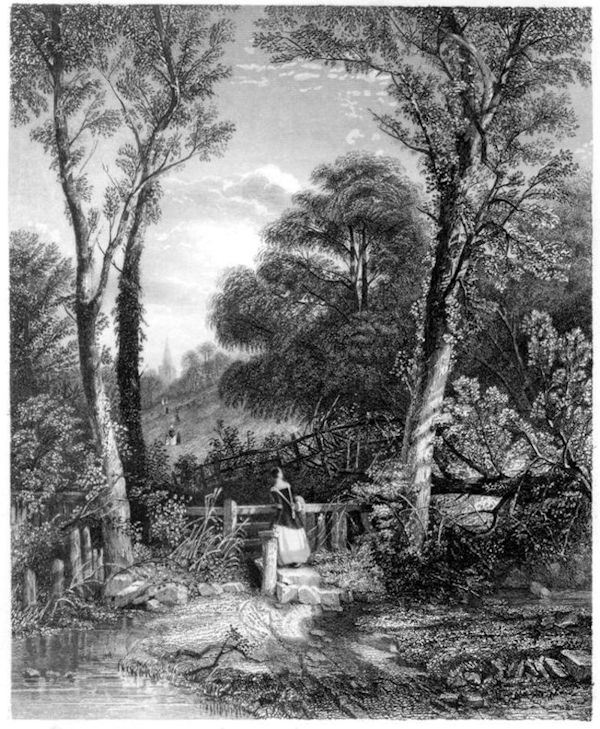
THE WAY TO CHURCH.
Engraved expressly for Graham’s Magazine by T. McGoffin
———
BY R. T. CONRAD.
———
“Sin no more, lest a worse thing come upon thee.”
Art thou young, yet hast not given
Dewy bud and bloom to Heaven?
Tarryest till life’s morn be o’er!
Pause, or ere the bolt be driven!
Sin no more!
Art thou aged? Seek’st thou power?
Rank or gold—of dust the dower!
Fame to wreathe thy wrinkles hoar?
Dotard! death hangs o’er thy hour!
Sin no more!
Art thou blest? False joys caress thee:
And the world’s embraces press thee
To its hot heart’s cankered core:
Waken! Heaven alone can bless thee.
Sin no more!
Art thou wretched? Hath each morrow
Sown its sin to reap its sorrow!
Turn to Heaven—repent—adore:
Hope new light from Faith can borrow;
Sin no more!
May a meek and rapt devotion
Fill thy heart, as waves the ocean,
Glassing Heaven from shore to shore!
Then wilt thou—calmed each emotion—
Sin no more.
———
BY JAMES T. FIELDS.
———
The grass hung wet on Rydal banks,
The golden day with pearls adorning,
When side by side with him we walked
To meet midway the summer morning.
The west wind took a softer breath,
The sun himself seemed brighter shining,
As through the porch the minstrel slept—
His eye sweet Nature’s look enshrining.
He passed along the dewy sward,
The blue-bird sang aloft “good-morrow!”
He plucked a bud, the flower awoke
And smiled without one pang of sorrow.
He spoke of all that graced the scene
In tones that fell like music round us,
We felt the charm descend, nor strove
To break the rapturous spell that bound us.
We listened with mysterious awe,
Strange feelings mingling with our pleasure;
We heard that day prophetic words,
High thoughts the heart must always treasure.
Great Nature’s Priest! thy calm career,
With that sweet morn, on earth has ended—
But who shall say thy mission died
When, winged for Heaven, thy soul ascended!
———
BY WM. P. BRANNAN.
———
What shall yield me inspiration,
What sweet spell entrance my thought,
Whilst I sing the adoration
By thy matchless beauty wrought?
Overcome with exultation
Which thy charming presence brought.
Incense-bearing breezes hover
Round my flushed and throbbing brow,
Minstrels in their shady cover
Chant divinest music now;
Nature, yield to nature’s lover
Language worthy of his vow!
Where she walks a richer splendor
Hallows all the earth and sky,
Unseen angels there attend her;
Heaven and love sleep in her eye—
Graces have no grace to lend her,
Zephyr breathes an envious sigh.
Thou thyself art inspiration!
Moving, breathing, blessing, blest;
The lily and the rose-carnation
Live upon thy cheek and breast,
Daring time and desolation,
Thrilling hearts with wild unrest!
———
BY ENNA DUVAL.
———
Learn to win a lady’s faith
Nobly, as the thing is high;
Bravely, as for life and death—
With a loyal gravity.
Lead her from the festive boards,
Point her to the starry skies,
Guard her by your truthful words,
Pure from courtship’s flatteries.
By your truth she shall be true—
Ever true as wives of yore—
And her Yes, once said to you,
Shall be Yes for evermore.
Elizabeth Barrett Browning.
It was a hot, sultry afternoon at —— ——, a
fashionable summer resort at the sea side. The
three great events of the day were accomplished—namely,
the bath, dinner, and the arrival of the boat
bringing the mail; the visiters, therefore, had nothing
to do but to get rid of the afternoon in as noisy a
manner as possible, keeping themselves as warm
and uncomfortable as they could, in order to prove
that they were enjoying themselves after the most
approved fashion. Ladies could be seen in every
direction, passing from one hotel to another, flitting
in and out of cottages, dressed in the most incongruous
style—in silks, mulls, and gauzes, fitted for a
full-dress dinner or evening party; and surmounting
this dressy costume was—the only really sensible
article to be seen in this dominion of Folly—the
prim, plain country sun-bonnet. Fashion had established
that hats at the sea-side were vulgar, and accordingly,
every belle mounted one of these useful,
but exceedingly ugly head-dresses. Carriages and
wagons of every description darted to and fro, from
the funny little Jersey sand wagon, with horses of a
Jersey match, gray and brown, or black and white,
up to the well matched, well ordered establishment
of the nouveau riche, who was willing to sacrifice
his delicate town-bred horses, in order to exhibit his
magnificence to the plebs. A fine establishment drew
up in front of the entrance of one of the principal
hotels, and the owner of it, Mr. Martin, a prosperous
merchant, with his fussy, dressy, good-natured, fat
little wife, entered it. As Mr. Martin handed his
wife in, he asked,
“Where’s Edda?”
“Oh, let her alone, my dear,” replied his wife,
“she will get over her moping after awhile. She’s
fretted herself into a sick headache, and is lying
down.”
“Confound the fellow,” muttered Mr. Martin, “I
wish she had never seen him. If I had my way she
should be divorced from him. What right has a
man to a wife when he cannot support her? Now,
as long as he lives, I suppose, our poor little darling
will be down-hearted.”
“Oh,” said the wife, settling herself back comfortably
in the luxurious carriage, after having carefully
disposed the folds of her rich, silk gown and
heavily embroidered mantle in a manner to crush
them the least, “wait until he gets fairly settled out
at the West, and the winter parties, and concerts,
and operas commence, then Edda will cheer up.”
“I hope so, with all my heart,” ejaculated Mr.
Martin, “and if money, amusements, and fine clothes
can make her what she was two years ago, I shall
be glad enough, for I hate a sad, gloomy face.”
While they were thus talking, their niece, the
subject of their conversation, was lying in her bed-room,
burying her throbbing, aching head in the
pillows of the couch, wishing that an endless sleep
would come to her, and deaden the painful sense of
grief.
Poor Edda Murray! Two short years before, a
happier, more free-from-care girl could not have been
found. Then, she had never known a trouble. Her
aunt and uncle, Mr. and Mrs. Martin, who were
childless, and possessed ample means, had taken her
at the time of her parents’ death, which had occurred
during her infancy, and from that moment up to the
present, she had been their spoiled pet and darling.
They were good-natured, indolent people, caring for
but little else than the amusements of the out-of-doors
world. As Edda grew old enough to enter society,
they took great pleasure in dressing her extravagantly,
and accompanying her to every gay place of
resort of the fashionable world. According to Mrs.
Martin’s ideas, every girl should be married early;
and when Edda was addressed by Mr. Murray, near
the close of her first winter, and seemed pleased
with his attentions, her aunt’s rapture knew no
bounds. Mr. Martin was pleased also, for Murray,
though a young man, was a rising merchant, and
was steady and industrious.
How Ralph Murray ever happened to fancy Edda
Martin, was a mystery to all those of his and her
friends, who had observed but little of this marriage
business of life. As a general rule, both men and
women, especially when young, select the very
companions that are the most unlike their ideals, and
what is still stranger, the most unsuitable for them.
Ralph Murray was a reserved, dignified young
man, rather stern for his years, with the most rigid
ideas of justice and propriety, even in trifles; exact
in every thing, and making but little allowance for
others less exact than himself. He did not require
more than he was willing to give in return, but he
had no consideration, no patience, and when disappointed,
was apt to become cold, moody, and uncompromising.
In woman he had always required,
“that monster perfection.” His mother had been a
model of feminine propriety. He had no sisters, but
a whole troop of cousins, who happened to be laughing,
hoydenish, good-natured creatures; but they
were his utter abomination, he never countenanced
them, pronouncing them silly, frivolous, and senseless;
but how they laughed and teased him, when
his engagement with Edda Martin was announced—verily
they had their revenge.
Edda was, indeed, a spoiled pet, full of caprice
and whim, beautiful and graceful as a fairy, and as
untamed and uncontrollable as an unwedded Undine.
But, poor child, marriage brought no happy spirit to
dwell in her household. How could it? For they
had married under the influence of the maddest,
wildest infatuation. Their love was beautiful while
it lasted; but soon the husband grew exacting, the
angel became a mere woman, and the darling, who
had never obeyed any will but her own, discovered
she had a lord and master, whose will was stronger
and more unbending than even her own had ever been.
Then Edda was extravagant and thriftless, and
thoughtless, a real child-wife, like poor Dora, that
English Undine creation of Dickens’s fancy, but with
more spirit and temper than “Little Blossom.”
Edda’s character had in it qualities which would have
made her a fine woman, properly and gradually developed;
but her husband placed her on the scale of
his own model of perfection, and endeavored to drag
her up to this idea of wifehood, without waiting for
Nature to assist him. It was the old, sad story told
over again—incompatibility of tempers, unreasonableness
on his part, petulance, waywardness and temper
on hers.
God sent them a little babe, but the child brought
no tenderness to the heart of either parent for each
other. Then trouble came upon Ralph Murray in
his business—unfortunate speculations, bad failures
in others he had trusted; but instead of going to his
wife, and talking affectionately, but candidly, remembering
all the while what a spoiled darling she
had been, he considered himself aggrieved by her
lavish expenditure, and told her haughtily that she
was now the wife of a young merchant, and not the
niece of a rich man, and ought to have sense enough
to observe economy. Poor Edda was offended,
bitter words passed between them, and they parted
in anger. Her aunt found her in tears—happening
to come in just as the irritated husband had left her.
Edda turned to her thoughtless, childish aunt, for
comfort, telling her the whole story of her wrongs;
and Mrs. Martin pronounced Mr. Murray a brute, to
treat her poor child so unkindly. Mr. Martin thought
always as his wife did, and in the first flush of
temper, they carried the weeping, angry wife, with
her young babe, away from her husband’s roof; the
exasperated uncle leaving for Mr. Murray an angrily
worded note, in which he said that Edda had never
ceased to be his niece, even if she had been so unfortunate
as to become the wife of a parsimonious
merchant, and an unkind husband. The following
day Ralph Murray was a bankrupt.
The news of other heavy failures of houses indebted
to him, brought his affairs to a crisis, and all
his troubles seemed piled mountain high upon him
at once. Poor Edda would have gone instantly to
her husband when she heard of his trouble—for
she had immediately repented of her hasty step—but
she did not dare; she remembered his sternness, and
dreaded a repulse which she felt she deserved.
Then a new cause of anxiety displayed itself, her boy
sickened, and, after a few hours’ illness, he died in
her arms. Her husband was sent for, but he did
not notice her; he stood beside the coffin of his child,
pale, tearless, and with a countenance as unchanging
as a statue of marble; he never looked at his sobbing
wife, who, softened by her grief, would have
willingly thrown herself into his arms, and asked
pardon for the past, and forbearance for the future;
but he coldly turned from her after the funeral, without
speaking a word.
Two months passed by, and still Ralph Murray
treated his wife with the same silent indifference.
He never sought an interview nor an explanation;
it seemed as if the death of their child, instead of
softening him, had, to his mind, broken off all connection
between them. Edda grieved incessantly,
until at last her health became seriously affected.
When the traveling season came, the physicians who
had been called in to heal the poor breaking heart, recommended
an instant departure for the sea-side.
Fine apartments were procured, every elegance,
every luxury surrounded her; but she looked more
wretched, more unhappy every day.
She knew that their beautiful house belonged to
another—every thing had been sold; that she no
longer had a home with her husband; and the consciousness
that she was a childless, lonely wife, became
daily more insupportable. Poor girl! life
seemed very dark and hopeless to her. Her trouble
had lifted her spirit on almost a life time; all the
childish, capricious waywardness of girlhood had
disappeared; sorrow had done the work of years;
and she was now a woman—but a suffering, loving
woman, ready to make any sacrifice, perform any
duty, to atone for the past. Her uncle and aunt caressed
her, and sympathized with her, while they
incessantly spoke of her husband with words of reproach
and blame; and when she would check
them, saying the greater part of the blame rested on
herself, they would think her still more lovely and
amiable, and lift their hands in surprise. How reproaching
to her conscience was their sympathy!
and she grew more and more despairing and hopeless.
At midnight she would pace her room, wringing
her little hands with remorse for the past. Her
husband’s stern face would rise before her, blended
with the beautiful, loving expression his countenance
had worn during the delicious season of courtship.
Then she would recall every noble, honorable trait
in his character, and remember her own willful conduct.
All, all was over, and henceforth she would
have to live without him. This seemed impossible;
and the poor girl would call on Heaven, agonizingly,
to take her away from life or give her back her husband.
All her friends upheld her and blamed Mr. Murray.
They called him stern, cold and heartless.
The fashionable world thought her a lucky woman
in possessing a rich old uncle to take care of her.
Her quarrel with her cross husband had taken place
in the very nick of time, they said; now she need
not suffer from his mischances; when she would
so willingly have borne the very heaviest burden
poverty could impose. But what could she do but
suffer idly?
Day after day passed by, still no message came
from her husband. Her uncle had told her that the
principal creditors had willingly and generously arranged
matters; for, as every one said, the failure
had resulted from misfortune, not from mismanagement,
and that he had heard that a friend had offered
Mr. Murray a situation in a commercial house out
in the very farthest west, with a chance of becoming
a partner in time. Then the next news that reached
her was, that he was actually leaving for his new
home. And would Ralph leave her without a word—a
line? she asked herself over and again.
At last a letter came—a cold, stern, haughty letter,
bidding her farewell, as if for ever. There were
one or two tender passages in it; but the tone of the
whole letter was so cold and unforgiving, that it
crushed her to the earth. She had received it the
day before our little sketch opens; and when her
aunt urged her to drive out and shake off her trouble,
she only buried her little head still deeper in the pillows
and prayed still more agonizingly for death.
The afternoon passed slowly enough to the poor
sufferer. Then came the evening—the noisy, gay
evening. As there was a ball in the saloon of the
hotel, her thoughtless, butterfly aunt and uncle
joined the merry crowd of triflers, after an earnest
but unsuccessful persuasion of Edda to follow their
example.
The merry music of the band sounded loudly in
Edda’s lonely bed-room; but the lively dancing melodies
seemed to her ears like the voices of taunting
demons. She restlessly rose from her bed and
walked into her little parlor, which opened on a balcony
that swept around the house. She stepped out
on this balcony, and listened to the pealing thunder
of the ocean, which rolled unceasingly before her.
Her agony increased, and a demon seemed to whisper
in her ears:
“What is life but a torment? Death is an endless,
dreamless sleep. Why suffer when you can so
easily find relief?”
Shudderingly she put her little hands to her ears,
and, closing her eyes, hastened into the room, fearing
that in another instant she might be induced, by
despair, to plunge headlong over the railings on the
cliff beneath. For a while she laid on the lounge,
as if stunned; but at last tears came to her relief, and
she felt calmer. To avoid danger she closed the
Venetian shutters of the door and window, but drew
up under them the lounge, and threw herself on it,
that the damp night air might cool her fevered, burning
head. She had not been long there when she
heard the sound of voices and laughter, but she was
too weak to arise, and remained quiet—remembering
that she could not be seen from the outside.
It was a little group of young girls, who were promenading
after the dance, and who had concluded that
the upper balcony commanded a finer view of the
ocean. As chance would have it they selected that
part of the balcony just under Edda’s window for their
gossiping lounge. One, more sentimental than the
others, pointed out the effect of the moon-beams
which made the edges of the rolling, dashing waves
shine like molten silver. But the beauty of the
scene was quickly lost, even on this moon-struck
damsel, for she, as well as the rest, were soon deeply
interested in discussing a wedding that had lately
taken place in the beau-monde.
“Oh, dear, there’s Mrs. Jones,” exclaimed one,
“she just came from town yesterday, and can tell
us all about it.”
The lady mentioned joined the group, and threw
them into a state of perfect felicity by telling them
she had actually been present at the wedding. Immediately
she was called upon by a dozen eager
voices to tell them “all about it.” Poor Edda, she
was doomed to listen to the whole senseless detail,
commencing at the bride’s India mull robe, and its
heavy, elaborate embroidery, her “exquisite and
graceful head-dress,” with the costly Honiton veil,
the “rich splendid gifts” of the relatives, and ending
with the list of bridemaids and their costume. How
the whole description brought her own gorgeous
wedding back to her thoughts! and she felt heart-sick.
“Poor things!” she murmured to herself with a
sigh, “I hope they will be happier than Ralph and I
have been.”
The conversation grew more bustling and detached;
the lady who was the reporter-general was
giving, for the fifth time, to some new comer, a description
of the bride’s costume, which she did with
a volubility so eloquent and untiring as to have reflected
credit on a French modiste—expatiating
largely on the beauty and costliness of the materials
of which it was composed, and united to her minute
details of the tucks, headed by rich rows of lace and
embroidery, could be heard exclamations of the
others, who had already listened to the description.
“Oh,” said one, in a tone of voice that told what
delicious satisfaction costly articles of dress gave
her, “it is too lovely to be married in an India robe,
with heavy embroidery and rich Valenciennes berthé
and trimming. If ever I’m married, I intend to make
ma order one of Levy’s for me; it shall be imported
especially for me.”
“Oh, yes,” said Mrs. Jones, stopping in the midst
of her harangue, à la parenthesis, “Mr. Grugan received
the order for Blanche’s wedding robe last
year, the very day Mr. Holmes offered. No one
knew it but her family, except me—I knew it, of
course.”
“I don’t believe she knew a word about it. Mrs.
Jones is always pretending she’s so intimate with
every body,” said a young lady, sotto voce; but Mrs.
Jones was too deeply engaged in the tucks, and lace
trimming, and Honiton veil, to hear the doubt and
charge. The conversation increased in animation,
and Mrs. Jones’s clear, high voice was almost
drowned.
“Ah,” exclaimed one, “it’s splendid to be married
in such style.”
“Yes,” rejoined another, “and how delightful to
go right off on a journey, and to Europe, too.”
“Oh, girls,” exclaimed one, “only think—Blanche
Forrester went to school with me, and, here, she’s
married!”
“Well,” said another, “her first bridemaid, Helen
Howell, and Aubrey Hilton, are engaged, and
Helen was in the same class with me. We all came
out last fall together—you’re no worse off than I
am.”
Some gentlemen joining the group, the conversation
became too detached and confused to be heard,
and there were so many little bursts of laughter as to
make the whole affair quite a medley. Presently the
scraping of the violins, preceded by a loud crash of
the whole united band, announced that a waltz was
about to be danced.
“Oh!” they exclaimed, simultaneously, “that delicious
Schottische,” and soon the balcony was empty—or
at least so thought Edda; but she was mistaken,
for she heard other voices. A lady and gentleman
had seated themselves under her window, and were
enjoying the sight of the waves and moonlight. She
knew their voices well. One was a Mrs. Howard,
a gentle, lady-like woman, for whom her husband
entertained the highest respect. Edda knew but
little of her; she had met her in society after her
marriage, but had always drawn back a little in awe
when she had met with her, because she constantly
heard Ralph holding her up as such a model of wifely
dignity and propriety. The other was a Mr. Morrison—a
cynical, fault-finding old bachelor—or, at
least, Edda had always regarded him as such. No
wonder the poor girl shrank still closer to the lounge—she
seemed doomed to be persecuted.
Mrs. Howard and Mr. Morrison had heard part of
the conversation about the wedding, and the first that
reached Edda’s ears were Mr. Morrison’s severe,
caustic remarks.
“Silly, senseless fools!” he exclaimed. “They
talk as if life had but two points to attain; to get
married in an India robe, in such a style as to produce
a fine theatrical effect, and to go to Europe.
What right have such idiots to get married at all?
What do they know of the realities of married life—the
holy, sacred obligations of marriage?”
“Very little, it is true,” answered his companion;
“and this ignorance is wisely ordered! for I am
afraid, Mr. Morrison, if these young, thoughtless
creatures knew the one half of life’s stern realities,
whether married or unmarried, they would sooner
lie down and die than encounter them. Youth is as
hopeless in trouble as it is thoughtless in prosperity.”
“Very true, madam, very true,” said the old gentleman;
“but it seems to me that these frivolous
creatures might be taught a little—enough to give
them some ballast. What sort of wives will they
make? Why, I declare it makes me shudder when
I see these silly, thoughtless wretches entering into
marriage as they would into a dance—not displaying
half the anxiety that a man would on entering into
a commercial engagement that can be dissolved at
will after a certain season.”
“Well,” said the lady, with a sweet, low laugh,
“from what we see on all sides, my dear sir, a great
many of those who marry at the present day seem to
regard marriage only as a mere partnership, to be
dissolved at will.”
“I would pretty soon put an end to that divorce
business, madam,” said Mr. Morrison, “if I had the
power. Every couple that could not live happily
together, and wished to be separated, should have
their request granted, but on one condition—that
both, particularly the woman, should go into some
religious asylum, and spend the rest of their days in
entire seclusion, employed constantly in the performance
of strict religious duties and works of charity.”
“Oh!” exclaimed the lady, laughing outright, “I
am very sure any husband and wife would prefer the
most inharmonious intercourse to such an alternative.”
“Well, well,” said Mr. Morrison, “they could
have their choice, and it would teach others to be
more careful how they ‘married in haste to repent
at leisure.’ This is becoming a curse to society; on
all sides we see husbands and wives disagreeing.
Now-a-days a wife must spend as much money as
she pleases, lead a dissipated life—for going to parties
and balls, and every other gay place, constantly
is dissipation—entertain admirers, and her husband
must not complain. He, poor devil—beg pardon,
madam—must not express a wish for a quiet home
and a companion, after the toil of the day and the
wear and tear of exciting, perilous business. Oh,
no! If he does madam will leave him in a huff, and
he may whistle for a wife, and life is a wreck to him
ever afterward.”
“Do these unhappy marriages always result from
the thoughtlessness and selfishness of the wives, my
dear sir?” asked Mrs. Howard. “I think there are
as many wives with domestic tastes, who have the
same complaint to make against their husbands.”
“Yes, yes,” answered Mr. Morrison, a little hesitatingly;
“I suppose there is blame to be found on
both sides; but generally speaking, with the married
people of what is called ‘society,’ especially the
young, the fault lies with the wife. Yesterday I
bade good-bye to as fine a fellow as God ever created,
whose whole happiness for life has been
wrecked by one of these silly, heartless fools. You
know him, my dear madam, and are, I believe, one
of his few friends; for the whole world unite in condemning
him and upholding his doll-baby wife in her
sinful disobedience.”
“You are speaking of Ralph Murray, I am sure,”
said Mrs. Howard, in a sad tone.
Poor Edda writhed, but she had not power to
move; she felt spell-bound, and every word of the
conversation fell on her ear with painful clearness.
“Yes, I mean Murray,” replied Mr. Morrison.
“God help him, poor fellow! His haggard face haunts
me like a ghost.”
“But,” said Mrs. Howard, “much as I love Ralph,
much as I respect his high, honorable character, I
cannot hold him blameless.”
“What!” exclaimed Mr. Morrison, in a tone of
surprise, “you cannot hold him blameless? Why,
what can you see wrong in any thing he has done?”
“He should not have married as he did,” replied
Mrs. Howard; “or if determined to gratify his fancy
at the expense of his judgment, by yielding to an infatuation,
he should have had more patience with his
wife. If he felt willing to trust his happiness in the
hands of a petted, spoiled child, he should have remembered
what she was, in the hour of trial, and
not exacted of her the ability and judgment which
are possessed only by a sensible, well-trained woman.”
“Yes, you are right,” answered Mr. Morrison,
after a short pause; “he was wrong in the first place—he
never should have married such an idiot. But,
my God, madam,” he exclaimed, impatiently, “any
woman who was lucky enough to get such a noble
husband as Ralph Murray, should have been so
proud of him as to have been willing to have made
every sacrifice of whim and caprice for his comfort.”
“That’s true man’s reasoning,” said Mrs. Howard,
good-naturedly. “But, Mr. Morrison, I think I
am not mistaken when I say that if Ralph had managed
his pretty, petted, capricious fairy of a wife
patiently and properly, their happiness would not
have been wrecked as it is.”
“Their happiness!” repeated Mr. Morrison, sneeringly.
“Little she cares, while she has aunt to caress
her and uncle’s money to spend.”
“Indeed you do her great injustice,” said Mrs.
Howard. “To be sure, I do not know Mrs. Murray
intimately, but I am certain if you were to see her
pale, wretched face and frail figure, as I do daily
in the corridor, when they bring her in, half fainting,
from the bath, you would think as I do—that, let her
husband’s sufferings be ever so great, the wife suffers
quite as much. Oh, my dear Mr. Morrison, how
I wish I were Edda Murray’s friend.”
“What would you do, my dear madam? Add another
to her host of sympathizers?” said the old gentleman.
“No,” replied Mrs. Howard, mildly; “I would
tell her to send for Ralph, to ask pardon for the past
and patience for the future, and beg him to take me
once more to his heart, and help me to be a good,
faithful wife. This she must do, or never know
peace in this life.”
“Ha, ha,” laughed Mr. Morrison; “why, my
dear Mrs. Howard, if she had sense and feeling
enough to act thus, she would never have behaved
as she has done.”
“Edda Murray has acted willfully and selfishly, I
admit,” said Mrs. Howard; “but we do not know
what provocations she may have had. Ralph is a
fine, noble fellow, but arbitrary and impatient—the
very kind of man that I should fancy it would not be
easy to make happy in domestic life, even if a judicious
woman were to undertake the task. Think,
then, how many excuses should be made for his impulsive,
wayward little wife, who never in her life
was subjected to control. I am certain this trouble
has done her good, however, for a woman’s character
is seldom properly developed in prosperity; like
precious metals, it must pass through the fiery furnace
of affliction—it must be purified in the crucible
of sorrow, until it loses all recollection of self. There
is a beautiful simile in the Bible, which compares
the purification of the soul to the smelting of silver.
Silver must be purged from all dross, until it is so
clear and mirror-like that it will reflect the countenance
of the refiner; thus the soul must be so pure,
in so high a state of godliness, as to reflect only the
will of the Creator. I cannot recall the passage exactly,
but I often apply it to my own sex, whose characters,
to be properly developed, must be purged
from all selfish dross, in order to make them think
only of the happiness of others—forgetful always of
self; then, like silver seven times refined and purified,
their spirits reflect only the countenance of the
purifier, which is the will or command of God.”
Just then Mr. Howard and some others joined
them, and after a little playful bantering about the
flirtation of two such steady old persons, a remark
or two on the fine night and the beauty of the
ocean scene, the party moved off and Edda at last
was alone.
That night, when Mr. and Mrs. Martin stopped at
Edda’s room door, on their way to bed, they found
her sitting at her desk writing. She kissed them,
bade them good night, and thanked them for their
affectionate inquiries, in a more cheerful manner
than she had shown for months, which gladdened
their silly, warm old hearts, and they went off comforting
themselves with the hope that all now would
be well.
“Yes, my dear,” said Mr. Martin, as he composed
himself to sleep, “you were right—Edda is getting
over it. She looked and talked more brightly than
she has since poor little Martin’s death.”
And Edda really felt so, but for a reason her uncle
little suspected. Mrs. Howard’s words had given
form and impulse to her thoughts; she no longer
wasted time in mere actionless grief; she saw her
duty before her, and, hard as it was to perform, she
nobly resolved to do it. A day or so afterward, as
Ralph Murray was leaving town for his new western
home—sad, lonely, and for the first time feeling that
maybe in the past he had not been entirely free from
blame, he received a letter, directed in the delicate,
lady-like, hand-writing of his wife. With trembling
hands he opened it, and thick, short sobs swelled up
in his throat and hot tears sprang to his eyes, as he
read her childish, frank, penitent appeal.
“I am your wife, Ralph,” she wrote; “you must
not leave me—you must take me with you. God
joined us, and trouble—death has bound us still
closer. Pardon my past waywardness, and take
your penitent, suffering Edda back to your heart.
Think what a reckless, thoughtless, uncontrolled
child I was when you married me, and have
patience with me. I cannot live without you,
Ralph. I shall die broken-hearted if you treat
my selfish, wayward conduct as it merits. God
forgives the penitent—will you be more just than He
is, my beloved? Come to me, and let me hear from
your lips once more, ‘dear Edda.’ Do not tell me
you are poor; I can live on any thing, submit to any
privation, if blessed with your presence, your forgiveness,
your love. You shall not find me in the future
a thoughtless, extravagant child, but, with God’s
help, a faithful good wife. Oh, Ralph, receive me
once more, I pray you, and let me be again your own
darling little wife Edda.”
The fashionable world at —— was thrown into
a state of astonishment a few weeks afterward, by
hearing that Mrs. Murray had actually gone out
west with her cruel, good-for-nothing husband, and
a thousand different stories were told about the
matter, each one as far from the truth as the other.
Poor Mr. and Mrs. Martin made loud opposition
when Edda told them her resolve, but she looked so
bright and happy, and throwing her arms around her
aunt and uncle, made them read the lover-like letter
of her husband, in which he not only freely forgave
the past, but took on himself all the blame.
“She’s right, my dear,” said Mr. Martin, to his
wife; “but we must not let them go—we must make
them as comfortable as we can with us. Thank
Providence, I have enough for us all.”
But Ralph Murray steadily refused all offers of
assistance from Mr. Martin. He knew it would be
better for them, for a little while at least, to be away
from all Edda’s old connections. Several years they
spent “out west,” and not until they had nearly
reached mid-life, did they return to their old home in
——; then, at the urgent request of Mr. and Mrs. Martin,
who had grown old, infirm, and tired of society,
and really needed Edda, they moved back. Edda was
a lovely looking matron at the time of her return—she
seemed so happy and contented. I well remember
the pleasant effect it produced upon me when I saw
her surrounded by her troop of noble boys, and leaning
on her husband, who still retained his dignity,
but blent with it was an air of loving softness that
he had gained by intercourse with his gentle, “darling
little wife.”
Her married life, even after their reconciliation,
however, was not exempt from trials. There were
times when her husband’s old moods of exaction and
impatience would come over him, and her own willful,
rebellious spirit would stand in the way, and
torment her with demands, such as “what right has
he more than I?” and the like—as if the gratification
of rights, merely for justice sake, made up the
happiness of home life, a happiness that is only
gained, only insured, by love’s sweet yieldings.
They both tried to struggle against these dark influences;
but at such times life would be very dreary
to her, and it needed all the strict discipline of her
faith—all her hope and trust in Heaven, to make her
victorious over self.
Their children, however, proved angel-blessings
to them. They softened and humanized Ralph, and
soothed and occupied Edda. Dear Edda! her spring
season had been a wild, frolicksome one, bringing
a stormy, cloudy summer; but her autumn yielded
a rich harvest of happiness, and her little, throbbing
heart thanked God hourly for his kindness and
love to her in sustaining her through all her dark
hours.
“Seven great boys, and not one daughter!”
exclaimed our old friend, Mrs. Howard, to Edda,
after her return to her old home—“what a
pity!”
“Oh, no,” replied Edda, quickly; “I am always
so thankful my children are all boys. I would not
have the charge of a daughter’s happiness on me for
a world.”
“Why!” asked Mrs. Howard with surprise.
“Because,” replied Edda, in a low tone, looking
significantly at the good old lady, “a woman’s character
seldom develops in prosperity—it requires,
like precious metals, the fiery furnace of affliction—the
crucible of sorrow.”
Mrs. Howard’s surprise was increased, for Edda’s
blushing face and lips, trembling with emotion, told
that she had a deeper meaning than the mere expression
of an opinion; but Edda soon removed her
wonder. She told her the whole history of the past—her
struggle on that eventful night at the sea-side
watering place years before, when the fearful temptation
to self-destruction had assailed her; she
caused the kind old lady’s eyes to grow dim with
tears, when she described the beneficial effect produced
by the overheard conversation between her
and Mr. Morrison; and added, with tears and smiles
of joy—
“Yes, dear Mrs. Howard, your blessed words
taught me my duty. If I have any happiness in
life, I owe it, through God, to you. But, happy
wife and blessed mother, as I am, I thank God I
have no daughter’s future resting on my heart. A
woman’s lot in life is a dangerous one, either in
prosperity or adversity, and to tread her life-path
well she seems to require almost a special helping
from God; to but few is this granted, and many
there are who wrestle darkly and blindly with sorrow
through life’s perilous journey unaided.”
“But,” replied Mrs. Howard, “does it not strike
you that you are taking but a one-sided, narrow
view of life, my dear? When you speak so sadly
of woman’s lot, it seems as if you thought this
life was all we had to expect, when I am sure you
do not think so. The perils of life belong to both
man and woman. But what matters all that we suffer
in this state of existence, when compared with
the glory of the sun-light of eternity—that sun which
has no setting, and of the rising of which this dark,
perilous life-hour is but the precursor—the hour before
the dawn.”
“You are right, my dear madam,” said Edda,
with a sweet look of meek thoughtfulness, “and I,
of all other women, should not speak so hopelessly,
for, after all my dark hours, light came at last;
and so beautiful is life to me now, that I sometimes
fancy to me is given a glimpse of Heaven’s dawning.”
ON PICTURES IN THE HUNTINGTON GALLERY.
———
BY MRS. ELIZABETH J. EAMES.
———
I.—ST. JOHN.
I stood within the glowing, graceful ring
Of pictures hung upon the gallery’s wall:—
The admiring murmur of the crowd did bring
My step to pause before a shape, in all
The thoughtful grace of artist-skill designed,
The sense of Beauty felt—but not defined.
Thou face, serene in solemn tenderness—
In the uplifting of those calm, deep eyes;
On the rapt brow of holy earnestness
The light of prophecy reflected lies.
The mystic vision of the Apocalypse
Thy pen of fire sublimely did record:
But most we love His lessons from thy lips—
John, thou beloved disciple of the Lord!
II.—MERCY’S DREAM.
Like thee to dream, by angel-wings unshaded!
The starry crown hangs o’er thy meek young head,
Flinging a glory round thee, like the braided
And brilliant tints by a rich sunset shed.
O loveliest vision of the painter’s thought—
Born in his happiest hour of inspiration,
How more than fair the exquisite creation
His genius-gifted pencil here hath wrought!
How wondrously is charmed the “Pilgrim” story
That made my childhood’s ever new delight:
Sweet Mercy! now, in tenderest grace and glory,
Thy pale, bright picture floats before my sight.
Thrice blesséd! and thrice beautiful! might we
But in our dreams some guardian-angel see!
III.—THE MARYS AT THE SEPULCHRE.
The first faint crimson of the early morning
Dawned on the tomb where the loved Master lay;
And on the Marys, who for His adorning
Came bearing spices sweet, at break of day.
In meek, mute reverence, near the sepulchre
The mourners drew, as round a sacred shrine—
And gazing down for the dear form divine—
The unsealed stone—the white-robed messenger—
Met their affrighted view! In awe they fled,
And she, the Magdalen! the tidings spread,
“Christ is arisen!” O, woman! in that hour
Well might a solemn rapture fill thy mind—
Thou, earth’s poor outcast, honored with high power
To bear such joyful tidings to mankind.
IV.—PIETY.
Meek list’ner! on whose purely virgin brow
Is set the beauty of submissive thought:
Oh! blest beyond Earth’s favored ones art thou,
Whose earnest eyes so reverently caught
The Teacher’s look, with mild, grave wisdom fraught.
How was the awakened soul within thee stirred
To suppliant or adoring tones, as fell
The quickening power of the Eternal Word,
Like the winged seed, on thy young heart; to dwell
A germ not lost! A heavenly light serene,
Unclouded, sits on thy soft, spiritual mien—
I call thee Blest, for thou hast chosen well,
Daughter of Christ! O, happy to have given
The bloom of thy unblighted years to Heaven!
V.—FOLLY.
And this is Folly! Like a flaunting flower
Her red lips part half wanton, half in scorn:
Over the wreck of many a squandered hour
This poor frail child of Pleasure well might mourn.
But with the consciousness of beauty born,
Exulting in her youth’s superior brightness—
(Not yet the rose-leaves from her garland torn)—
She moves along to scenes of festal lightness.
The aged teacher’s solemn, sacred lesson
Is a dead letter to her worldly spirit—
The Word of Life—its Promise, and its Blessing,
The world’s gay votary cares not to inherit!
No claims upon a heritage divine—
This lot, O Folly! this sad lot is thine.
———
BY ELLIS MARTYN.
———
What though my way unblissful care
To weary solitudes incline!
I feel thy beauty everywhere;
Thy spirit brightens mine.
On all the dewy leaves that crowd
The moon-lit trees, I read thy name;
From every crimson morning cloud,
It flows through all my frame.
And when the spiritual eve advances,
To bathe the weary world in rest,
Thou comest near, with loving glances,
And leanest on my breast.
In all the ages, young or olden,
Was ever life so blest as mine!
Where’er I go the clime is golden,
And all the air divine!
THE LAST SURVIVOR OF THE CREW OF “THE BONHOMME RICHARD.”
———
BY THOMAS WYATT, A. M.
———
This venerable sailor is in the 92d year of his age;
nearly sixty of which he has spent on the ocean, and thirty-five
under the stars and stripes of his adopted country.
Although almost helpless from age, his mind is clear and
his memory retentive. He remembers distinctly many
interesting incidents during his cruisings with that eccentric
but intrepid officer, John Paul Jones, and narrates
many of the daring exploits in which he was a participator
under the direction of this extraordinary man.
Thomas Johnson is a Norwegian by birth, the son of a
pilot at Mandal, a seaport on the coast of Norway, where
he was born in the year 1758. Having been engaged in
that occupation for nearly twenty years, he was consequently
accustomed to a seafaring life; and in the absence
of his father towed the first American vessel into
the harbor of Mandal. This vessel was the Ranger, from
Boston, carrying eighteen guns, under the command of
Captain Jones. The sight of a ship from a country which
was at this time struggling for independence, and of which
they knew so little, caused no little sensation among the
inhabitants of that town. After their arrival in port,
Jones sent for the young pilot, and presenting him with a
piece of gold, expressed his pleasure at his expert seamanship,
which he had minutely watched during the towing
of his ship into the harbor.
He also observed that he had made the port of Mandal,
in order to enlarge his crew, not having sufficient men for
the long cruise he was about to make; and added, that if
the father of the young pilot would permit, he would be
glad to engage him. Satisfactory arrangements were
made, and Johnson was received as a seaman on board
the Ranger. It will be remembered that Captain Jones
had been cruising the last two years as first lieutenant of
the Alfred flag ship, the first privateer fitted out by Congress
to cruise against British commerce.
In this ship he hoisted with his own hands the American
flag, the first time it was ever displayed on the ocean; its
emblems were a pine-tree, with a rattle-snake coiled at its
root, as if about to strike.
The Alfred was very successful, and had brought home
several valuable prizes. Congress, therefore, determined
on the purchase of three other ships for the same purpose,
and Captain Jones was permitted to make choice of either;
he chose the Ranger, and was invested with the command
by the following resolutions:
Resolved, “That Captain John Paul Jones be appointed
to command the ship Ranger, and that William Whipple,
Esq., member of Congress, and of the Marine Committee,
John Langdon, Esq., continental agent, and the said John
Paul Jones be authorized to appoint lieutenants and other
officers and men necessary for the said ship; and that
blank commissions and warrants be sent them to be filled
up with the names of the persons they appoint, returns
whereof to be made to the Navy Board in the eastern department.”
“Resolved, That the flag of the thirteen United States,
henceforth be thirteen stripes, alternate red and white;
and the union be thirteen stars, white in a blue field, representing
a new constellation.”
Jones immediately commissioned the Ranger, and, singular
to say, was the first to display the new flag of the
republic, as he did the original one on board the Alfred,
about two years previous. The Ranger was intended to
carry twenty-six guns; but Jones begged to exercise his
own judgment, believing that she would be more serviceable
with only eighteen, and accordingly mounted that
number, for which he had often occasion to congratulate
himself on his judicious forethought; for the ship proved
to be exceedingly crank, and with the whole number,
would have been nearly useless.
His first cruise with his new ship was to the coast of
France, and on his voyage there he chased a fleet of ten
sail, under a strong convoy, took two prizes, and carried
them safely into Nantes.
From thence he took a short cruise on the coast of Norway,
and putting into the port of Mandal, as we before
stated, engaged the services of Thomas Johnson, the subject
of this sketch.
After completing his arrangement, Jones returned to
Nantes, and from thence proceeded to Quiberon Bay,
giving convoy to some American vessels which were desirous
of joining the French fleet commanded by Admiral
La Mott Piquet, who had been ordered to keep the coast
of France clear of British cruisers. Writing to the
Marine Committee on the 22d February, 1778, he says,
“I am happy in having it in my power to congratulate
you on seeing the American flag, for the first time, recognized
in the fullest and most complete manner by the flag
of France; and as it is my greatest desire to render useful
services to the American cause, I would suggest that, as
the field of cruising being thus extended, and the British
navy, in numbers, so superior to ours, it would be well to
surprise their defenceless places, and thereby divert their
attention, and draw it from our coasts.” These suggestions
contained the plan of annoyance which was eventually
adopted in Paul Jones’s cruisings in the European
seas. It was about the middle of April, 1778, so our hero
relates, that they found themselves on the coast of Scotland,
immediately in the vicinity of the birth-place of
Jones, and in sight of the port of Whitehaven, upon which
he had determined to make his first descent.
It was near the break of day, when Jones ordered two
boats, and a plentiful supply of combustibles to be prepared,
with thirty-one men, to leave the Ranger and make
for the outer pier. Jones commanded the first boat himself,
the other was under the command of Simpson, his
first lieutenant, conveying the combustible matter, and
charged with firing the vessels, about seventy in number,
lying on the north side of the pier, while he undertook the
rest. They found two batteries at Whitehaven, which
Jones, with ten of his men, Johnson being one of the
number, scaled, taking the soldiers prisoners, and spiking
the guns. He then, with his party, started for the other
battery, about a quarter of a mile distant, which he served
in the same way.
On his return he met his lieutenant, with the remainder
of the sailors, who stated that he had not done as he had
requested him, having a reluctance to destroy the undefended
property of poor people, he had hesitated until his
candles had burned out, and then found it impossible to
execute his orders.
Jones was exceedingly angry, and vented his rage in
the most insulting language, saying at the same time,
“that if the accomplished Lord Howe would commit
deeds of burning, pillage, and slaughter, upon the persons
and property of Americans, the right of retaliation belonged
to us.” In making such hasty remarks, he forgot
that this enterprise was one of an entirely different nature;
the scheme, if it may be so called, was one of his own
forming, the American government not being apprised of
any thing of the kind, neither had he received any order
to that effect. The whole affair must be allowed to be
one of the most audacious of its kind, and will ever attach
a lasting stain upon the memory of its originator.
It was now daylight and the frightened inhabitants were
beginning to collect; still Jones was unwilling to depart
without carrying any of his intended depredations into
effect, after surmounting so many difficulties.
He posted to the nearest house and demanded a light,
which, having obtained, he deliberately kindled a fire in
the steerage of a large ship which was surrounded by
others lying dry upon the shore, pouring a barrel of tar
into the flames; during this operation, Johnson, with several
other sailors, stood sentinel against any surprise he
might receive from the inhabitants, who by this time were
attracted by the flames, and had assembled to the pier in
great numbers. On seeing them approach in such formidable
numbers, he seized his pistols, one in each hand,
and standing between them and the ship on fire, ordered
them to retire to their homes, which they did with precipitation.
At length he and his party entered their boats
and rowed quietly to their ship, where, from the deck, he
could see the panic-stricken inhabitants running in vast
numbers to their forts, which was no little amusement to
him, as he had spiked their guns.
Jones afterward ascertained, much to his chagrin, that
only the ship which he himself had fired was destroyed,
the surrounding ones were saved by the exertions of the
people. He consoled himself by saying, “that he had done
enough to show England that not all her boasted navy
could protect her own coasts, and that the scenes of distress
which she had caused the Americans to pass through,
might soon be brought home to her own doors.” On his
return to the Ranger, Jones informed his officers and men
that he had not yet done with Scotland, that he had another
project in his head, which he intended to carry into
effect; that was, to obtain possession of the person of the
Earl of Selkirk, a nobleman residing at Selkirk Abbey, on
a beautiful promontory called St. Mary’s Isle, running out
into the river Dee, and not more than two miles distant
from where they then were.
Jones conceived that if he could obtain possession of
this nobleman’s person, he could demand an exchange for
some distinguished American prisoner. He remained in
the bay of Kirkcudbright till the following morning, when
he started with two boats and about twenty men, among
whom was Johnson, who relates the particulars of this
singular adventure. Johnson was in the first boat with
Jones, who commanded it himself; the other was commanded
by Simpson, his first lieutenant. They landed on
part of the grounds, not more than two hundred yards
from the house; some laborers were at work near by, of
whom they inquired if Lord Selkirk was at home; they
were informed that he was in London, consequently, his
end was frustrated. On receiving this information they
prepared to return to their boats, when his officers, of
whom there were four, expressed a wish to repair to the
Abbey and demand the family plate, pleading as an excuse,
that it was the universal custom of the English on the
American coast. Jones, in his official report, says, after
some hesitation, he reluctantly consented, charging them
to insult no person on the premises, especially Lady Selkirk.
During this delicate embassy, Jones withdrew behind
some trees, where he could perceive what was going
on. Simpson, with ten of his sailors, went to the house.
Lady Selkirk was at breakfast when they presented themselves
at the window, and supposing them to be the crew
of a revenue cutter, sent a servant to inquire their business,
and to offer them some refreshment. Simpson entered
the room on the return of the servant, and stated his errand
to Lady Selkirk.
Her ladyship made no resistance, but sent the servant
to collect the remainder of the plate, requesting that the
teapot, which was then on the table, might be emptied and
placed with it. After being collected, it was carefully
packed in baskets, and the party, having performed their
errand, withdrew to their boats, where Paul Jones met
them. They soon regained their ship, when the prize they
had made was safely repacked, and they set sail for the
coast of France.
During their voyage from Scotland to France he fell in
with an English vessel called the Drake; a sharp conflict
ensued, which lasted more than an hour, when the
Drake surrendered, and was towed in safety into Brest,
a seaport of France. On the very day of his arrival at
Brest, Jones wrote the following eccentric epistle to Lady
Selkirk, which one of his biographers calls “the queerest
piece of epistolary correspondence extant.”
“Madam,—It cannot be too much lamented, that in the
profession of arms, the officer of fine feelings and real
sensibility, should be under the necessity of winking at
any action of persons under his command which his heart
cannot approve; but the reflection is doubly severe, when
he finds himself obliged, in appearance, to countenance
such actions by his authority. This hard case was mine,
when, on the 23d of April last, I landed on St. Mary’s
Isle.
“Knowing Lord Selkirk’s interest with his king, and
esteeming as I do his private character, I wished to make
him the happy instrument of alleviating the horrors of
hopeless captivity, when the brave are overpowered and
made prisoners of war. It was, perhaps, fortunate for
you, madam, that he was from home, for it was my intention
to have taken him on board the Ranger, and detained
him until, through his means, a general and fair exchange
of prisoners, as well in Europe as in America, had been
effected.
“When I was informed by some men whom I met at
landing, that his lordship was absent, I walked back to my
boat, determined to leave the island. By the way, however,
some officers who were with me could not forbear
expressing their discontent, observing that in America no
delicacy was shown by the English, who took away all
sorts of moveable property, setting fire not only to towns
and to the houses of the rich, without distinction, but not
even sparing the wretched hamlets and milch-cows of the
poor and helpless, at the approach of an inclement
winter.
“That party had been with me at Whitehaven; some
complaisance, therefore, was their due. I had but a moment
to think how I might gratify them, and at the same
time do your ladyship the least injury. I charged the
officers to permit none of the seamen to enter the house,
or to hurt any thing about it; to treat you, madam, with
the utmost respect; to accept of the plate which was
offered, and to come away without making a search, or
demanding any thing else. I am induced to believe that I
was punctually obeyed, since I am informed that the plate
which they brought away is far short of the quantity expressed
in the inventory which accompanied it. I have
gratified my men; and when the plate is sold, I shall become
the purchaser, and will gratify my own feelings in
restoring it, by such conveyance as you may please to
direct.
“Had the earl been on board the Ranger the following
evening, he would have seen the awful pomp and dreadful
carnage of a sea engagement; both affording ample subject
for the pencil as well as melancholy reflection for the contemplative
mind. Humanity starts back from such scenes
of horror, and cannot sufficiently execrate the vile promoters
of this detestable war;
For they, ’twas they unsheathed the ruthless blade,
And Heaven shall ask the havoc it has made.
“The British ship of war Drake, mounting twenty
guns, with more than her full complement of officers and
men, was our opponent. The ships met, and the advantage
was disputed with great fortitude on each side for an
hour and four minutes, when the gallant commander of
the Drake fell, and victory declared in favor of the Ranger.
The amiable lieutenant lay mortally wounded, besides
near forty of the inferior officers and crew killed and
wounded; a melancholy demonstration of the uncertainty
of human prospects, and of the sad reverses of fortune,
which an hour can produce. I buried them in a spacious
grave, with the honors due to the memory of the brave.
“Though I have drawn my sword in the present generous
struggle for the rights of men, yet I am not in arms
as an American, nor am I in pursuit of riches. My fortune
is liberal, having no wife nor family, and having lived
long enough to know that riches cannot secure happiness.
I profess myself a citizen of the world, totally unfettered
by the little, mean distinctions of climate or of country,
which diminish the benevolence of the heart and set
bounds to philanthropy. Before this war was begun, I had,
at an early time of life, withdrawn from sea-service in favor
of ‘calm contemplation and poetic ease.’ I have sacrificed
not only my favorite scheme of life, but the softer affections
of the heart, and my prospects of domestic happiness;
and I am ready to sacrifice my life also with cheerfulness,
if that forfeiture could restore peace among
mankind.
“As the feelings of your gentle bosom cannot but be
congenial with mine, let me entreat you, madam, to use
your persuasive art with your husband, to endeavor to
stop this cruel and destructive war, in which Britain can
never succeed. Heaven can never countenance the barbarous
and unmanly practice of Britons in America, which
savages would blush at, and which, if not discontinued,
will soon be retaliated on Britain by a justly enraged
people.
“Should you fail in this, and I am persuaded you will
attempt it, (and who can resist the power of such an advocate,)
your endeavors to effect a general exchange of
prisoners, will be an act of humanity, which will afford
you golden feelings on your death-bed.
“I hope this cruel contest will soon be closed; but should
it continue, I wage no war with the fair. I acknowledge
their force, and bend before it with submission. Let not,
therefore, the amiable Countess of Selkirk regard me as
an enemy; I am ambitious of her esteem and friendship,
and would do any thing consistent with my duty to
merit it.
“The honor of a line from your fair hand, in answer to
this, will lay me under singular obligation; and if I can
render you any acceptable service in France or elsewhere,
I hope you see into my character so far as to command me,
without the least grain of reserve. I wish to know the
exact behaviour of my people, as I am determined to
punish them if they have exceeded their liberty.”
This vain, Quixotic, and inexplicable epistle, is a perfect
illustration of the character of the writer; but with
all its egotism and chivalry, it did not produce the wished
for answer from the “fair hand of his amiable countess.”
It could not be for one moment supposed that Lady
Selkirk would condescend to answer a letter couched in
such terms of gross familiarity. The plate, after many
difficulties and delays, was finally restored, some seven
or eight years after it was taken. The French government
being at this time on the eve of embracing the
American cause, overwhelmed Jones with congratulations
upon his late achievements. He received a letter from the
French Minister, offering him the command of the Bonhomme
Richard, with permission to choose his own cruising
ground, either in the European or American seas, and
to cruise under the flag of the United States. Jones
accepted the offer, and accordingly prepared to form his
crew by enlisting raw French peasants and volunteers,
having only thirty Americans in the whole, these he transferred
from the Ranger, with Johnson, our veteran sailor.
He commenced his cruising on the coast of Norway, from
thence to the west coast of Ireland, during which he
made many valuable prizes.
He now determined to cruise around the English coasts,
to intercept the colliers bound to London, many of which
he destroyed. It was during this cruise that he was joined
by the Alliance, the Pallas, and the Vengeance, these,
with the Richard, formed the squadron of which he was
commander. On the 23d of September the squadron was
standing to the northward, toward Flamboro Head, with
a light breeze, when they discovered a fleet of forty-one
sail running down the coast, very close in with the land.
Jones soon discovered that this was the Baltic fleet which
he had been so anxious to encounter, but had never before
had the chance. This fleet was under convoy of the
Serapis, a new ship, mounting forty-four guns, and the
Countess of Scarborough, of twenty guns. Early in the
evening the Serapis was observed to haul round and place
herself between her convoy and the Richard, as if preparing
to engage her; she soon came within pistol-shot,
when the captain of the Serapis demanded, “What ship
is that?” and in reply, a shot was fired from the Richard.
This was the commencement of a battle more famous for
stubborn courage and heroic daring than perhaps the world
ever knew. The biographers of this eccentric but gallant
officer have so often described this triumphant conflict,
that we shall content ourselves with a few incidents
with which our veteran sailor was more immediately
connected. He relates that the Richard suffered severely
at the first of the battle, till Jones ordered his ship to be
laid across the hawse of the enemy; in doing so the two
ships swung broadside and broadside, the muzzles of the
guns touching each other. Jones sent one of his men to
lash the two ships together, and commenced with his own
hand in making fast the jib-stay of the Serapis to the
Richard’s mizenmast; when the sailors saw what he was
about to do, Johnson, with two others, ran to his assistance,
and soon performed the task. The firing continued
from the starboard sides of both vessels for more than an
hour, the effect of which was terrible to both ships. There
was much skirmishing with pistols and pikes through the
ports, but no effort was made from the Serapis to board the
Richard, although they must have observed her crippled
condition, she had begun to leak fast.
It was near ten o’clock when the Richard had sunk
considerably from the water she had received through
the shot-holes, which was now below the surface.
Some of the subordinate officers believing that she was
sinking, cried out lustily for “Quarter!” when Jones,
in great anger, threw a pistol at one of them, which he
had just discharged at the enemy, fractured the poor fellow’s
skull, and sent him reeling down the hatchway.
Jones ordered all the hands that could be spared to the
pumps, and shortly after the Serapis surrendered. At
this moment there was much confusion, as several of the
crew, who were Englishmen, and near their homes, took
advantage of the mêlée to desert in a small boat toward
Scarborough. Our hero well remembers seeing one of
the lieutenants of the Richard appear on the deck and
present several of the officers of the Serapis to Commodore
Jones as prisoners.
The action had now ceased, all hands were ordered to
assist in separating the two ships which had been so long
in deadly embrace, and to extinguish the flames which
were now raging in both vessels. It was daylight in the
morning when the carpenters were ordered to examine the
Richard. After a deliberate examination, they were of
opinion that she could not be kept afloat sufficiently long
to reach any port. Jones was not willing to abandon her
till the last moment, and kept a lieutenant with a party of
sailors at the pumps for twenty-four hours; Johnson says
he worked for nine successive hours, and at last, when
all hopes were extinguished, they commenced removing
the wounded and the stores to the Serapis. They had
not finished their operations more than half an hour, when
she sunk to rise no more.
The next cruise was to the Texel, and from thence to
Amsterdam, where they received great kindness from the
Dutch. Jones still continued his cruising with satisfaction
to the American government until the beginning of
the year 1781, when he was sent with the ship Ariel to
Philadelphia with stores for the army which had been
waiting in France for more than a year, no suitable conveyance
having been provided. They arrived in Philadelphia
in February, 1781, the first time Johnson had seen
the land of his adoption. Here he received his prize
money, and having disengaged himself from the Ariel, determined
to remain a short time in order to become master
of the English language, of which at that time he knew
but little.
At this time Congress was sitting in Philadelphia, and
several of the members were about removing their families
to that city. Application was made to Captain
Jones to furnish a man to take charge of a sloop to Boston,
to convey the furniture of John Adams to Philadelphia;
he accordingly appointed Johnson, and he brought the
furniture safely to that city.
This circumstance often brought Johnson in contact
with Mr. Adams, who knew that he was one of the crew
of Captain Jones, and consequently must have been in the
conflict of the Serapis and Richard, which having occurred
so recently, was a subject of general conversation.
Many of the sailors frequented the hall of Congress, and
Johnson became interested in listening and observing what
was so new to him that he was a daily visiter. When
the members found that the sailors were part of the crew
of Captain Jones, they frequently left their seats, and
came over to them to inquire the particulars of the recent
engagement. Mr. Adams particularly engaged the attention
of Johnson; to use the veteran’s own words, he says,
“a nervous sensation seemed to pervade the patriot as he
listened to the description of the battle given by the
sailors, fire flashed from his eyes, and his hair seemed
perfectly erect;” he would clasp his hands, and exclaim,
“What a scene!”
During the time they remained in Philadelphia, General
Washington arrived, and was presented to Congress;
Johnson was present and listened to the introduction by
President Hancock, and the reply by the general. Some
days after, when the sailors were in the hall, Mr. Adams
brought General Washington to them, who kindly shook
each by the hand, calling them “Our gallant tars!” and
asking them questions relative to the many successful adventures
they had recently achieved.
Johnson soon after left the navy, and engaged in the
merchant service for some years, but eventually returned
to it again, where he remained till, near the end of his life’s
voyage, age obliged him to ask repose and protection
in that asylum provided for the grateful and worn-out
mariner.
———
BY WM. ALBERT SUTLIFFE.
———
I heard a maiden by the tumid ocean—
The day had gone and night came on apace—
Chanting a hymn to the spray’s chiming motion,
Starlight and moonlight, and the sea’s dim face.
And, as the moon looked down, her song up-stealing
Fell thus upon my ear: “Hope of my hope,
Gone o’er the swelling waters, whence this feeling
That thou art dead? I give my fancy scope,
And see thee hideous, with Death’s image o’er
Those features I have loved, but know no more.
Hope of my hope, gone o’er the swelling ocean,
What cavern holds thy form—
Cast by the furious storm?
“Hope of my hope, gone o’er the swelling ocean!
I weep for thee when night is on the sea:
My bosom bursteth with its deep emotion—
My spirit stretcheth out its arms but finds not thee.
O misery! and then itself within itself retires,
And weeps away a night that has no morn;
And lights forever up fierce funeral pyres—
Dreaming of cypress wreaths, and things forlorn.
“What sea-nymph made thy bed
Beneath the briny waves?
Thetis with golden hair?
Panopea wondrous fair,
Lone virgin of the ocean’s deepest caves,
With filmy garments shred
About thy form,
Mock of the brumal storm?
Ho! mourn with me, ye nymphs, he is no more!
Go sound it, Triton, o’er the humid waters!
Go weep for him again, ye misty daughters!
Re-echo it, ye cliffs, along our shore!
And I myself will take the sad refrain
Of the elegiac strain,
And tune my lyre to a symphonious stream
Floating along with many a moony gleam,
Soft as an angel’s dream,
Over the foamy summit of each wave,
That rolleth o’er his grave.
“Well do I know the day
That bore him hence away!
I watched him from yon cliff, in joy departing:
I, with the tear-drops starting,
Wept that he thus should go.
He, hopeful of the future, saw not wo
In the dim cloud that gathered, and the spray
Leaped joyful up about his seaward way—
Leaped up the vessel’s sides with treacherous kiss;
Deceitful waves, that now in the abyss
Have whelmed my love’s proud form,
Play of the pitiless storm.
“I’ve wept until my tears
Have worn with furrows deep my pallid cheek;
Have gazed until my poor eyes, worn and weak,
Like age’s eyes, seem faded with long years.
Oh! the long, dreary nights I’ve passed alone!
Would Reason from her throne
Might flee, and bear with her this dim, dull grief—
This memory’s haunting tone!
Then might I have relief.
Receive me, ocean! lo, to thee I come!
I, too, will share thy home:
Our bridal bed shall be of pearls and diamonds,
First loved, last loved, and fondly loved forever.
No distance e’er shall sever—”
The voice was hushed; I sped me to the strand.
Only the moonlight fell; and o’er the sand
A fountain gushed, pure as our holiest dreams.
Perchance ’twas she, thus changed; how could I tell?
And gone, as Arethusa once, beneath the deep,
Had sought her lover in his quiet sleep.
For Love there’s no oblivion. I have cherished
An idol beautiful, but in this hour,
Hopes that had bloomed for years have wholly perished,
And left me but the fragrance of the flower:
But be the hopes of love like blossoms blighted,
Wherever in the temples of the heart
Hath stood an altar with their splendor lighted,
The glory will not utterly depart;
Still as we enter life’s forgetful haven,
And every form of beauty disappears,
The pictures on the memory engraven
Of early love, win our last smiles and tears;
The inspiration of the first endeavor
After the love of woman dwells forever.
GEORGE HERBERT.
———
BY JAMES W. WALL.
———
How few in our day have read the pious verses of
George Herbert, “the sweet singer of The Temple,” as his
biographer, old Walton, so loves to call him—verses overflowing
with the sensibilities of a heart consecrated to
pious uses, all aglow with love for humanity, and an
ardent desire to bring it nearer to Him who so freely gave
himself for it.
Sweet George Herbert! Who that has ever read the
rich outpourings of your warm and pious spirit, but has
felt how poor and cold in the comparison were the promptings
of his own? Who that has ever pondered over your
verse, radiant with the praises of that sanctuary in whose
hallowed courts you so loved to tread, but has felt the
full force of your own sweet words?
A verse may find him who a sermon flies,
And turn delight into a sacrifice.
George Herbert, the author of “The Temple,” a collection
of sacred poems, was of a most noble, generous, and
ancient family. His brother was the famous Edward
Lord Herbert, of Cherbury, who was himself a poet, but
attained higher distinction as a statesman and historian,
having filled, during the reign of James I., the responsible
posts of privy counselor, and ambassador to France; it
was while engaged in the duties of this embassy that he
composed his famous history of Henry the Eighth, so often
quoted and referred to by the modern English historian.
The subject of our sketch was born at Montgomery
Castle, in Wales, April 3, 1593. He was educated at
Westminster school, and being a king’s scholar, was
elected to Trinity College, Cambridge, about the year 1608.
He took both degrees in the Arts, and became a Fellow
in the college. In 1619 he was chosen orator for the University,
which post he held eight years. This office he
is said to have filled with great honor to himself and to the
University. And this was no wonder, for, to use the
quaint language of his biographer, old Izaak Walton, “he
had acquired great learning, and was blessed with a high
fancy, a civil and sharp wit, and with a natural elegance
both in his behaviour, his tongue, and his pew.” When
that royal pedant, King James, published his “Basilicon
Doron,” he sent a copy to the University of Cambridge.
Herbert, in his capacity as orator, was called upon to acknowledge
its receipt on behalf of the institution, which
he did in a most elegant manner, by a letter written in
Latin, closing with the following lines:
Quid vaticanam Bodleianamque objicis hospes!
Unicus est nobis Bibliotheca Liber.
The excellence of its Latinity, and the complimentary
allusions plentifully sprinkled through it, so pleased the
vanity of the king, that he inquired of the Earl of Pembroke
if he knew the learned scholar who penned the
epistle. His answer was, “That he knew him very well,
and that he was his kinsman; but that he loved him more
for his learning and virtue, than that he was of his name
and family.” At which answer the king smiled, and
asked the earl leave that he might love him too, for he took
him to be the jewel of that University.
The complimentary remark of the king, coming to the
ears of Herbert, no doubt first turned his thoughts toward
court preferment; for about this time we find him
applying himself to the study of the Italian, French, and
Spanish languages, in which he is said to have attained
great proficiency; and by means of the attainment of which,
to use his own language, “he hoped to secure the place
of Secretary of State, as his predecessor, Sir Francis
Nethersole had done.” This, and the love of court conversation,
with the laudable ambition to be something
more than he then was, drew him often from Cambridge
to attend his majesty, King James.
Shortly after this the king visited Cambridge in state,
and was received on behalf of the University by Herbert,
in a most elegant oration in Latin, stuffed full, as the
manner of the time then was, of most fulsome adulation.
In his progress he was attended by the great Sir Francis
Bacon, Lord Verulam, and by the learned Dr. Andrews,
Bishop of Winchester; and Herbert, by his learning and
suavity, soon captivated these distinguished men. Bacon
seems afterward to have put such value upon his judgment,
that he usually desired his approbation before he
would expose any of his books to be printed, and thought
him so worthy of his friendship, that having translated
many of the Prophet David’s Psalms into English verse,
he made George Herbert his Patron, by a public dedication
of them to him as the “best judge of divine poetry.”
In 1620, the king gave Herbert a sinecure, formerly conferred
upon Sir Philip Sydney by Queen Elizabeth, worth
some twelve hundred pounds per annum.
His ambitious views of further court preferment seem
never to have been realized. The character of his mind,
perhaps, did not fit him for the responsible duties of a
statesman, or he might have been deficient in those arts
of the courtier, so necessary, and such ready aid to court
preferment. It may be that he had too independent a
spirit, and could not “crook the pregnant hinges of the
knee, that thrift might follow fawning.” But be this as
it may, we think, in the sentiment contained in some
verses written by our poet about the period of his leaving
the court and entering holy orders, we have a readier solution
for the sudden relinquishment of his hopes of court
preferment. These verses were written upon the famous
saying of Cardinal Wolsey, uttered by that proud churchman
when his spirit was crushed, and the fruits of his
ambition had turned to ashes on his lips. “Oh, that I had
served my God with half the zeal with which I have
served my king, he would not thus, in my old age, have
placed me in the power of mine enemies.”
No doubt the wholesome reflections inspired by the
contemplation of those touching words, awakened the
sensitive mind of our poet to a full appreciation of the
vanity of all earthly ambition. He discovered in time,
that pleasures springing from honor and grandeur of condition,
are soon faded; that the mind nauseates, and soon
begins to feel their emptiness. In the words of one of
England’s most gifted divines, “Those who are so fond of
public honor while they pursue it, how little do they taste
it when they have it? Like lightning it only flashes on
the face, and it is well if it do not hurt the man.”
Without further speculating as to the reasons that induced
our poet to fly from the court circles into the quiet
retreat of the pastor’s life, most certain it is, about the
year 1629, we find him renouncing the pomp and vanities
of earthly ambition, and entering into holy orders. Previous
to his induction, we find him using the following
language in a letter to a friend: “I now look back upon
my aspiring thoughts, and think myself more happy than
if I had attained what then I so ambitiously thirsted for;
and now I can behold the court with an impartial eye, and
see plainly that it is made up of graced titles, and flattery,
and many other such empty imaginary painted pleasures—pleasures
that are so empty as not to satisfy where they
are enjoyed. But in God and his service is a fullness of
all joy and pleasure, but no satiety.” Of the fervency of
his piety we have a most beautiful exemplification in some
of his poems published about this time, especially in that
styled “The Odor,” in which he seems to rejoice in the
thought of the word “Jesus,” and say that the adding of
these words “my master,” to it “seemed to perfume his
mind, and leave an oriental fragrance in his very breath.”
Alluding, in another poem, to his “unforced choice to
serve at God’s altar,” he says,
I know the ways of Learning; both the head and pipes
That feed the press, and make it run;
What reason hath from nature borrowed,
Or of itself, like Housewife sheen.
I know the ways of Honor, what maintains
The quick returns of courtesy and wit;
The ways of favor, either party gains
And the best mode of oft retaining it.
I know the ways of pleasure, the sweet strains,
The lullings and the relishes of it;
The proposition of hot blood and brains;
What mirth and musick mean; what love and wit.
Yet through these labyrinths, not my grovelling wit,
But the silk twist let down from heaven to me,
Did both conduct and teach me, how by it
To climb to thee.
In 1630 he was admitted to the priestly office, and was
immediately inducted to the Rectory of Bemerton, near
Salisbury. And here it was, stripping from him the
gaudy trappings of a fashionable court, he clothed himself
in the better and more enduring robes of humility and
meekness. It was here, amid the quiet shades of his
peaceful parish, he prepared, for his own use and that of
his brethren, a brief manual, entitled “The Country
Parson”—the rich gatherings of his own experience, and
the exemplification of his own ardor in the performance
of the duties of the pastoral office. His sermons, delivered
while at Bemerton, are practical in doctrine, forcible in
illustration, and make directly to the heart. They are
just such sermons as we should suppose the author of The
Country Parson would preach. They are many of them
explanatory of the forms and services of the Church of England,
urging their importance and the necessity of their
being truly understood.
He usually took his text from the gospel of the day appointed
to be read, and did as consistently declare why
the Church did appoint that portion of Scripture to be that
day read; and he shortly made it appear to them (to use
his own words) “that the whole service of the Church
was a reasonable, and therefore an acceptable sacrifice to
God—as, namely, we begin with confession of ourselves
to be vile and miserable sinners; and we begin so because,
until we have confessed ourselves to be such, we are
not capable of that mercy which we so much need; but
having in the prayer of our Lord begged pardon for those
sins which we have confessed, and hoping by our public
confession and real repentance we have obtained that
pardon—then we dare and do proceed to beg of the Lord
‘to open our lips, that our mouth may show forth his
praise;’ for till then we are not able and worthy to
praise him.”
The church holydays and fasts, and the benefits to be
derived from their observance, were most beautifully
illustrated in Herbert’s discourses; and we venture to say
that in the sermons of no clergyman of the Church of
England, or the Episcopal Church of America, can there
be found so practical and so beautiful an exemplification
of the excellency of the Episcopal Church service. The
simple parishioners of Bemerton learned to love the
service of their church under the preachings of their
sainted pastor, because its practical usefulness, and its
adaptation to their every spiritual want, was brought
forcibly home to the door of their hearts. The form, they
were taught, was as nothing, save as the most fitting
vehicle of their wants and spiritual aspirations. In our
age, where the cold religion of formality is seen struggling
for the mastery over that which is ardent and spiritual;
when “the outward and visible sign” seems to be more
thought of than “the inward and spiritual grace;” when
the outward adornments of the sanctuary are held almost
in as high value, and as necessary to salvation, as the
inward adornment of the meek and pious spirit, it is refreshing
to read such sermons as those of Herbert. He
was a formalist only so far as form could be made a means
to an end; a means to bring man to a closer contemplation
of the love and the abounding mercies of his God; a means
through which he could be made to praise him in holiness
and truth. The form he looked upon as the fitting vehicle,
“the silken twist,” to lead man’s thoughts in fit expression
up to the throne of God. The summum bonum, the
all in religion, he still believed, and so most earnestly
taught, consisted in the free-will offering of the penitent
and pious spirit.
In his essay on the duties of the Country Parson, he
enjoins upon the pastor, “to be constant in every good
work, setting such an example to his flock as they may
be glad to follow; and by so doing, profit thereby to their
souls’ good.”
And most diligently (if we are to believe the testimony
of his contemporaries) did George Herbert conform himself
to the character so beautifully sketched. In the functions
of his humble office he is said to have led a most pious
and blameless life.
The priests of the Levitical ministration, put on the
humerus blazing with jewels, before they took the breastplate
of righteousness and truth; thereby signifying that
the priest must be a shining light, resplendent with good
works, before he fed them with righteousness and truth,
the legitimate milk of the word. And in the daily beauty
of his blameless life; in the gentle, dove-like spirit that
animated his every motive; in his daily charities, and his
devout ministerings at the altar, Herbert most beautifully
illustrated the doctrines that he preached. His life was
“indeed, a shining light, resplendent with good works;”
and the flock which he so faithfully tended, found through
his guidance spiritual pastures. Quaint old Jeremy
Taylor, alluding to the necessity of the Christian pastor
exemplifying in his daily life the doctrines that he preaches,
most beautifully remarks:
“Herod’s doves could never have invited so many
strangers to their dovecots if they had not been besmeared
with most fragrant ointment. As said Dydimus, make
your pigeons smell sweet, and they will allure whole
flocks. And, Christian pastor, if your life be excellent, your
virtues, ‘like precious ointment, full of fragrance,’ you will
soon invite your charges to run after your precious odors.”
Such, in all things, was the subject of our sketch; his
virtues were the precious ointment, full of fragrance,
alluring the quiet flock his Master had given him to feed.
We have said more of Herbert in his pastoral character
than we first intended, although, perhaps, we have not
dwelt upon it too long to give an illustration of the beautiful
simplicity and pious ardor of the man.
It was in the quiet village of Bemerton that Herbert
composed his little volume of poems, styled “The
Temple,” of which it was said by a contemporary,
“There was in it the picture of a divine soul in every
page, and the whole book was such a harmony of holy passions,
as would enrich the world with pleasure and piety.”
We do not pretend to claim for these songs any great
poetic merit. They abound with faults, such as were peculiar
to most of the minor poets of that age. The versification
is often rough and inharmonious, the words ill
chosen for the rhyme, while conceits far-fetched and unnatural
are most plentifully sprinkled through them.
These, however, are faults peculiar to the versification of
the time in which our poet flourished. The great merit
of these songs, most undoubtedly, consists mainly in the
pious ardor and genuine devotional feeling which characterize
them. The reader is attracted at once by the deep
and earnest piety they manifest. There seems to be a
consistent effort in the poet’s mind to give utterance to his
devotional feeling in words of earnestness and power, such
words as shall not dishonor the high and noble theme he
had chosen for his subject. It can readily be discovered
that they give utterance to the language of his heart, and
that the influence of that heart’s holiest affections was the
happiest inspiration of his verse. If there is any truth
in those sweet lines of Cowper,
The Poet’s lyre to fix his fame,
Should be the Poet’s heart;
Affection lights a brighter flame,
Than ever blazed by art.
then “sweet George Herbert” has made sure his claim
to remembrance, and left something behind him which
posterity will not willingly let die.
Wherever deep and holy love for sacred things is
esteemed, there the verses of Herbert will find many
ardent admirers. They are the pure and free-will offerings
of a heart consecrated to pious uses, and attuned to sacred
harmonies—the soft breathings of a devotional spirit, that
seems too pure for earth.
When he sings of the church where he so loved to
worship, it is with all the earnest enthusiasm, if not with
the inspiration of that noble song of Solomon, commencing,
“Behold thou art fair, my love, behold thou art fair; thou
hast dove’s eyes within thy locks, thy hair is as a flock
of goats that appear from Mount Gilead. Thy lips are
like a thread of scarlet, and thy speech is comely; thy
temples are like a piece of pomegranate within thy locks,
thou art all fair, my love, there is no spot within thee.”
And Herbert loved the church, because it was the fold
where he could gather the flock that had been given him
to tend. The church on earth was to him the emblem of
the spiritual church “eternal in the heavens.” His
gentle spirit seems all aglow with love, whenever he
sings of its quiet retreats and the rich solemnities of its
glorious worship.
The poems, styled “The Temple,” are preceded by a
long poem as a preface, called “The Church Porch,”
where he would have the reader linger before entering
the sanctuary. And in the poem the poet takes occasion
to give sage counsel and most excellent advice, the better
to fit the mind for the contemplation of the sacredness of
the sanctuary beyond the porch. He would purify the
spirit from the dross of earthly vices, he would have it
“purged of the contaminations of earth,” before entering
the temple, where the divine presence loves to dwell.
And no one who will read the advice embodied in this
introductory poem, but must rise from its perusal with
the conviction that it contains a code of morality, enforced
by most excellent precepts. Independent of its religious
tone, it may be said to contain the very best of principles,
enforced by illustrations that carry conviction to the mind
at once. In the rude measure of the time, it holds up
virtue in all its beauty to our approbation, and lays bare
all the hideousness of vice. He seeks not for harmonious
verse, as the vehicle of thought, he desires not to please,
but to persuade; not to amuse, but to instruct.
Is lust within, polluting, corrupting, and withering the
heart, his warning is,
Beware of lust; it doth pollute the soul
Whom God in baptism washed with his own blood,
It blots the lesson written in thy soul;
The holy words cannot be understood.
How dare those eyes upon a Bible look,
Much less toward God, “whose lust is all their book.”
Profanity he rebukes in lines like these:
Take not his name who made thy mouth, in vain.
It gets thee nothing, and has no excuse.
Lust and wine plead a pleasure, avarice gain;
But the cheap swearer, through his open sluice,
Lets his soul run for naught.
Remembering in whose sight “lying lips are an abomination,”
and the sacredness of whose sanctuary is polluted
by falsehood, he breaks forth with indignant tone,
Lie not, but let thy heart be true to God,
Thy mouth to it, thy actions to them both.
Cowards tell lies, and those that fear the rod.
The stormy working soul spits lies and froth;
Dare to be true—nothing can need a lie;
A fault which needs it most, grows two thereby.
Extravagance, which is the grateful mother of debt,
penury, and want; which has desolated as many homes,
withered as many hearts, and destroyed as many lives as
the sword, he thus rebukes:
Never exceed thy income, youth may make
Even with the year; but age, if it will hit,
Shoots a bow short, and lessens still his stake
As the day lessens, and his life with it.
Thy children, kindred, friends upon thee call,
Before thy journey, fairly past with all.
The dangers that wait on suretyship, and the madness
of yielding to its pressing importunities, are thus set forth:
Yet be not surety, if thou be a father;
Love is a personal debt. I cannot give
My children’s right, nor ought he take it, rather
Both friends should die, than hinder them to live.
Fathers first enter bonds to nature’s ends,
And are her sureties, ere they are friends.
The spirit in which we should enter the hallowed courts
of the sanctuary, is set forth thus:
When once thy foot enters the church, believe
God is more there than thou, for thou art there
Only by his permission. Then beware,
And make thyself all reverence and fear.
Kneeling ne’er spoiled silk stockings; quit thy state,
All equal are within the church’s gate.
Space will not permit us to make further extracts from
“The Porch.” Enough has been given to show its tone
and character. The poems called “The Temple,” thus
introduced, are a series of devotional songs upon sacred
subjects, overflowing with ardent feeling, and manifesting
the existence of a piety as fervent as it is rare.
In his verses on Prayer, we have an apt illustration of
our author’s style and devotional ardor.
Prayer, the Church’s banquet, angels age,
God’s breath in man returning to his birth.
The soul in paraphrase, heart in pilgrimage,
The Christian’s plummet sounding heaven and earth.
The quiet stillness of the Sabbath morn, and the blessings
that accompany it, call forth such verses as the following:
Oh, day most calm, most bright,
The fruit of this, the next world’s bud,
Th’ indorsement of supreme delight,
Writ by a friend, and with his blood;
The couch of time, care’s balm, and bay;
The week were dark, but for thy light,
Thy torch doth show the way.
Sundays the pillars are
On which Heaven’s palace arched lies;
The other days fill up the spare
And hollow room with vanities;
They are the fruitful beds and borders
In God’s rich garden; that is base
Which parts their ranks and orders.
The Sundays of man’s life,
Threaded together on time’s string,
Make bracelets to adorn the wife
Of the eternal glorious king;
On Sundays Heaven’s door stands ope,
Blessings are plentiful and rife—
More plentiful than hope.
In his verses styled “The Odour,” we have an exemplification
of the Poet’s love for his Divine Master, expressed
with that fervency which betokens the sincerity
of his adoration.
How sweetly doth my master sound! my master!
As ambergris leaves a rich scent
Unto the taster.
So do these words a sweet content,
An oriental fragrance—my master!
The poem entitled “Christmas,” has considerable
merit, the versification is smoother, and the measure not
so irregular as most of his poems, while at the same time
it is characterized by the same warmth of devotional feeling,
that is manifested in all.
The shepherds sing, and shall I silent be?
My God, no hymn for thee?
My soul’s a shepherd, too; a flock it feeds
Of thoughts, and words, and deeds.
The pasture is thy word, the streams thy grace,
Enriching all the place.
Shepherd and flock shall sing, and all my powers
Outsing the daylight hours.
The little poem entitled “Jesu,” although it has neither
the merit of smoothness, or any poetical beauty, is strongly
illustrative of the purely saint-like piety of its author. Dr.
Sanderson was enraptured with this little production, and
used to style it, “a gem of rare conceit.” We see nothing
in it, however, to warrant such praise; it certainly
has no poetic merit, and the conceit embodied in it, appears
to be rude and far-fetched.
JESU.
Jesu is in my heart, his sacred name
Is deeply carved there, but th’ other week,
A great affliction broke the little frame,
Ev’n all to pieces; which I went to seek;
And first I found the corner where was I,
After where es, and next where u was graved.
When I had got these parcels, instantly
I sat me down to spell them, and perceived
That to my broken heart, he was I ease you,
And to my whole is Jesu.
Space will not permit us to make further extracts from
these poems of Herbert’s. Those that we have given,
illustrate the pious ardor of the subject of our sketch,
while at the same time they give evidence of some claim
to take position with the minor poets of his day. His
prose compositions undoubtedly possess more merit than
his poetical, and clearly entitle him to rank with the best
of his contemporaries. The beautiful simplicity of the
character of our poet, has never been surpassed in any
age. His disposition was of the most sweet and engaging
nature, adorned with all the graces of a most saint-like
piety. “He lived like a saint,” says his enthusiastic
biographer, old Walton, “and like a saint did he die.”
The Sunday before his death, raising himself from his bed,
he called for his instrument, and having tuned it, played
and sung that verse from his poems, commencing,
The Sundays of man’s life
Threaded together on time’s string,
Make bracelets to adorn the wife
Of the eternal, glorious king.
Like the dying swan,
As death darkened his eye and unplumed his wings,
His sweetest song was the last he sings.
———
BY GEORGE D. PRENTICE.
———
I send thee, Mary, a sweet young rose,
That bright with the hues of the sunset glows;
Its beauty, alas! is frail and brief,
It will come to thee with a withered leaf,
But the fervent kiss that my earnest lips
Have left for thee on its crimson tips,
Will not from the fading flower depart,
But come all fresh to thy lip and heart;
For oh, ’tis a breath of the love and trust
That will live when our lips and our hearts are dust.
Mary, dear Mary, pray love this flower,
Let it have for thy heart a spell of power;
For I plucked it fresh from its lovely stalk,
On the blooming edge of that garden walk,
Where we strayed together so deeply blest,
When the sun was low in the golden west,
And murmured our loves in burning words,
With none to hear but the flowers and birds,
And lingered long on the dear, sweet spot,
While our warm hearts kissed, though our lips did not.
Mary, dear Mary, my thoughts still cleave
To each memory sweet of that blessed eve,
To each tone more dear than the sweetest lute,
To each vow we breathed when our lips were mute,
To the wild, deep thrill through each trembling frame,
From fingers warmed with a pulse of flame,
To each gentle tear, to each gentle sob,
To each sigh that told of the heart’s deep throb,
Aye, these memories dwell in this soul of mine—
Oh, Mary dear, do they live in thine?
Mary, dear Mary, I pray thee say,
Do the roses bloom where thy steps now stray?
Do they look at morn on the sky’s soft blue
Through the trembling tears of the early dew?
When I come to thee will they smile to greet
Thy lover’s steps with their perfume sweet?
Will they list at eve to our tender vows?
Will they weave their wreaths for our gentle brows?
And when at last we are doomed to part,
Will they breathe a sigh for each breaking heart?
Mary, dear Mary, I fain would know,
Do thy heart’s sweet flowers keep their fresh young glow?
Are their eyes yet turned on the skies above?
Do they glitter still with the dews of love?
Has no blighting frost, has no bitter blast
Cold, cold o’er their buds and their blossoms past?
If my name is said, are their leaves yet stirred
To the olden thrill at the cherished word?
And say, oh say, will those dear, heart flowers,
Still bloom for me in the Eden bowers?
Ballad.
WORDS BY
FITZGERALD.
MUSIC BY
BENKERT.
Published by permission of Edward L. Walker, 160 Chestnut Street.
Publisher and Importer of Music and Musical Instruments.
Ah! do not speak so coldly,
Cold words my heart will chill;
If I have lov’d too boldly,
Oh! let me worship still?
If
I have lov’d too boldly,
Oh! let me worship still?
The pure heart loves forever,
To its own likeness true;
And though fate bids us sever
I’ll love I’ll love but you,
And though fate bids us sever
I’ll love I’ll love but you.
SECOND VERSE.
The heart will throb in sorrow
If from its idol torn.
Nor elsewhere joy will borrow,
If love’s return be scorn.
Then do not speak so coldly,
Cold words my heart will chill;
E’en if I’ve lov’d too boldly,
Oh! let me worship still, &c.
———
BY HENRY WILLIAM HERBERT, AUTHOR OF FRANK FORESTER’S “FIELD SPORTS,” “FISH AND FISHING,” ETC.
———
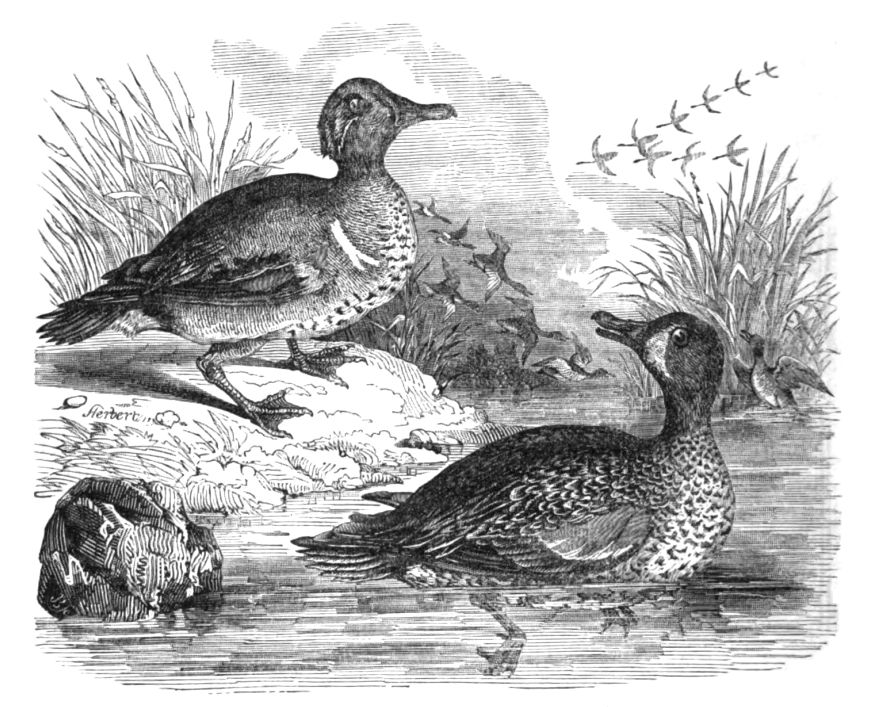
THE GREEN-WINGED TEAL. (Anas Carolinensis.)
THE BLUE-WINGED TEAL. (Anas Discors.)
In this present month, the sport of duck-shooting on the
inland streams, rivers, and lakelets, may be held to commence
in earnest, as contrasted to the pursuit of the same
tribes on the outer bays, estuaries, and surf-banks. About
the end of September, and thenceforth through this and
the next ensuing month, according to the variations of
the seasons, and the longer or shorter endurance of that
delicious time, the most delicious and most gorgeous of
the whole American year, known throughout this continent
as Indian Summer, the Mallard, and the two beautiful
species which we have placed at the head of this
article, begin to make their appearance on the little lakes
of the interior, and in the various streams and rivers
which fall into them, and thence downward to the Atlantic
seaboard.
In the vast northern solitudes of the great lakes of the
northwest, in all the streams of Upper Canada, even to
the feeders of Lake Superior, and throughout the western
country so far south as Texas, and northward to the
Columbia and the fur countries, the Blue-Winged Teal
breeds, literally by myriads. Throughout the great lakes,
it is abundant in the early autumn, becoming excessively
fat on the seed of the wild rice, with which the shallows
of all those waters are overgrown, and being deservedly
esteemed as one of the best, if not the very best, of the
duck tribe. But it is the first of its race to remove from
the wild, limpid waters, and wood-embosomed rivers of
the great west, to the seaboard tide-waters, taking the
inland water-courses on their route, rarely visiting the
actual sea-shores, and proceeding on the occurrence of the
first frosts, for they are singularly susceptible of cold, to
the Southern States, where they swarm, especially in the
inundated rice-fields of Georgia and South Carolina, during
the winter months.
The Green-Winged Teal, which is the nearest congener,
and frequently the associate of the Blue-Wing, has a far
less extensive range, so far as regards its breeding-grounds,
in as much as it never, so far as has been satisfactorily
shown, has nidificated or produced its young south of the
Great Lakes, nor even there in great numbers, its favorite
haunts, for the purposes of reproduction, being the extreme
northern swamps and wooded morasses almost up
to the verge of the arctic circles. It does not come down
on its southward migration, at nearly so early a period of
the autumn as its congener, being less susceptible of cold,
and tarrying on the Great Lakes till the frosts set in with
sufficient severity to prevent its frequenting its favorite
haunts with pleasure, or obtaining its food with facility.
It is rarely or never seen in the Middle States during the
summer, but is tolerably abundant during the autumn on
all the marshy lakes and pools, and along the shores of all
the reedy rivers from the great lakes downward to the sea-board,
though, like the last named species, it is purely a
fresh-water duck, never frequenting the sea-shores or
salt bays, finding no food thereon with which to gratify
its delicate and fastidious palate, which, eschewing fish,
the larvæ of insects, and the lesser crustaceæ, relishes
only the seeds of the various water plants and grasses,
the tender leaves of some vegetables, and more especially
the grain of the wild rice, Zizania panicula effusa, which
is its favorite article of subsistence, and one to which
may be ascribed the excellence of every bird of air or
water which feeds on it, from the Rice-Bird and the Rail,
to the Teal, the Canvas-Back, and even the large Thick-Billed
Fuligula, closely allied to the Scoter, the Velvet
Duck, and other uneatable sea-fowl of Lake Huron,
which are scarcely, if at all, inferior to the Red Heads of
Chesapeake Bay, the Gunpowder, or the Potomac. On
the Susquehanna and the Delaware, both these beautiful
little ducks were in past years excessively abundant, so
that a good gunner, paddling one of the sharp, swift skiffs
peculiar to those waters, was certain of filling his boat
with these delicious ducks within a few hours’ shooting.
Both of these species are rather tame than otherwise, the
blue-winged bird more particularly, which has a habit, on
the lower waters of the Delaware especially, of congregating
on the mud in vast flocks, sunning themselves in
the serene and golden light of a September noon, so careless
and easy of approach, that the gunner is frequently
enabled to paddle his skiff within a few yards of them, and
to rake them with close discharges of his heavy batteries.
At times, when the tide is out, and the birds are assembled
on the flats out of gunshot from the water’s edge, the
thorough-going sportsman, reckless of wet feet or muddy
breeches, will run his skiff ashore, several hundred yards
above or below the flock, and getting cautiously overboard,
will push it before him over the smooth, slippery mud-flats,
keeping himself carefully concealed under its stern until
within gunshot, which he can sometimes reduce to so little
as fifteen or twenty yards, by this murderous and stealthy
method. The Green-Winged Teal is much less apt to congregate,
especially on shore, than the other, and consequently,
affords less sport to the boat-shooter, keeping for
the most part afloat in little companies, or trips, as they are
technically called, very much on the alert, and springing
rapidly on the wing when disturbed. They, and the Blue-Wings
also, fly very rapidly, dodging occasionally on the
wing, not unlike to a wild, sharp-flying Woodcock, and
when they alight, darting downward with a short, sudden
twist among the reeds or rushy covert, exactly after the
fashion of the same bird.
The commoner and, in our opinion—where these birds
are abundant either along the courses of winding drains
or streamlets, or in large reedy marshes, with wet soil
and occasional pools or splashes—far the more exciting
way of killing them is to go carefully and warily on foot,
with a good medium-sized double-gun, say of eight to ten
pounds weight, and a thoroughly well broke and steady
spaniel, to retrieve and occasionally to flush the birds,
which will sometimes, though rarely, lie very hard. A
good sportsman will frequently, thus late in the autumn,
when the mornings are sharp and biting, and the noons
warm and hazy, but before the ice makes, pick up, on
favorable ground, his eight or nine couple in a day’s
walking, with a chance of picking up at the same time a
few Snipe, Golden Plovers, Curlew, or Godwit; and this,
in our mind, is equal to slaughtering a boat load by sneaking
up in ambush to within twenty yards of a great company,
whistling to make them lift their heads and ruffle
up their loosened plumage, so as to give easy entrance to
the shot, and then pouring into them at half point-blank
range, a half pound of heavy shot.
In the southern States they are commonly taken, says
Wilson, “in vast numbers, in traps placed on the small
dry eminences that here and there rise above the water of
the inundated rice fields. These places are strewed with
rice, and by the common contrivance called a figure four,
they are caught alive in hollow traps.” This we, of
course, merely mention as illustrative of the habits of the
bird; for, of course, no sportsman would dream of resorting
to so worse than poacher-like a proceeding. The mode
described by the eloquent pioneer of American natural history,
is probably practised, for the most part, by the negroes
for the supply of their masters’ table, and furnishing
their own pockets with a little extra change, and is not
used by the planters as a means of sport or amusement.
It must be remembered, also, that Wilson, than whom
there is no writer more to be relied on in matters which
he relates of his own knowledge, and as occurring in his
own days, must often be taken cum grano salis, as to the
numbers of birds slain in this way or that within a certain
time—things which he records, probably, on hearsay, and
on which—we are sorry to say it—even good sportsmen,
men who on any other subject would scorn to deviate one
hair’s breadth from the truth, will not hesitate to draw a
bow as long and as strong as Munchausen’s. Again, he
writes of times when sporting was but little pursued,
otherwise than as a method of procuring superior food for
the table, or for the purpose of destroying noxious vermin
and beasts of prey; when the rules of sportsmanship were
little understood and as little regarded; and, lastly, when
game abounded to a degree literally inconceivable in our
day—although we have ourselves seen, with sorrow, the
diminution, amounting in many regions around our large
cities almost to extinction, of all birds and beasts—nay,
but even fish of chase, within the last twenty years. We
must be careful therefore not to charge exaggeration on
a writer who, beyond a doubt, faithfully recorded that
which he himself saw and enjoyed in his day; which we
might see likewise and enjoy in our generation, and our
children and grand-children after us, if it were not for the
greedy, stupid, selfish, and brutal pot-hunting propensities
of our population, alike rural of the country and mechanical
of the cities, which seems resolutely and of set purpose
bent on the utter annihilation of every species of
game, whether of fur, fin or feather, which is yet found
within our boundaries.
In my opinion, the common error of all American fowlers
and duck shooters, lies, in the first place, in the overloading
the gun altogether, causing it to recoil so much
as to be exceedingly disagreeable and even painful, and in
the same degree diminishing the effect of the discharge;
for it must never be forgotten that when a gun recoils,
whatever force is expended on the retrogressive motion of
the breech, that same force is to be deducted from the
propulsion of the charge. In the second place, he erroneously
loads with extremely large and heavy shot, the result
of which is, in two respects, inferior to that of a
lighter and higher number. First, as there will be three
or four pellets of No. 4 for every one pellet of A or B in
a charge, and, consequently, as the load is thereby so
much the more regularly distributed, and so much the
more likely to strike the object, and that in several places
more, in the ratio of three or four to one, than could be
effected by A’s or B’s. Second, as the flesh will constantly
close over the wound made by a small shot, so as
to cause the bleeding to go on internally to the engorgement
of the tissues and suffocation by hemorrhage; whereas
the wound made by the large grain will relieve itself
by copious bleeding, and the bird so injured will oftentimes
recover, after having fallen even to the surface of
the water, or lain flapping, as it were, in the death-struggle
on the blood-stained sand or grassy hassocks. This
fact has been well noticed, and several examples adduced
to prove its truth, by Mr. Giraud, in his exceedingly clear
and correct, though, to our taste, far too brief volume on
the “Birds of Long Island.”
For my own use I invariably adopt for all the smaller
species of duck—as the two varieties of Teal, the Summer
Duck, the Golden Eye, and the Buffel-headed Duck, Anates,
Carolinensis, Discors, Sponsa, and Fuligulæ, Clanguid,
and Albeola—the same shot which is generally used
for the various birds known on our shores and rivers as
bay-snipe, viz: No. 4 or 5—the latter best for the Plovers,
the former for duck, whether in large or small guns. In
this relation I may observe that, on one occasion—the only
one, by the way, on which I ever saw a green-winged
teal in the summer season—I killed a couple of these beautiful
birds, right and left, while woodcock shooting, in
Orange County, New York, with No. 8 shot. They
sprang quite unexpectedly from behind a willow bush, on
the Wuwayanda creek, and I dropped them both quite
dead, some what to my own astonishment, and to the
utter astounding of Fat Tom, who witnessed it, into the
middle of the stream, respectively at twenty and twenty-five
yards distance. Until I recovered them I supposed
that they were young wood ducks, but on examination
they proved to be young green-winged teal, of that season,
in their immature plumage. This must have been in
the last week of July or the first of August—it was many
years since, and as at that time I kept no shooting diary,
I unfortunately am unable to verify the exact date. The
birds must, I conclude, have been bred in that vicinity,
by what means I cannot conjecture, unless that the parent
birds might have been wounded in the spring, and
disabled from completing their northern migration, and
that this, as is some times the case with the minor birds
of passage, might have superinduced their breeding in
that, for them, far southern region. In corroboration of
this I may add that, in the spring of 1846, a couple of these
birds haunted a small reedy island in front of my house,
on the Passaic, to so late a day in summer—the 29th, if I
do not err, of May—that I sedulously avoided disturbing
them, in the hope that they would breed there. This I
yet think would have been the case but for the constant
disturbance of that lovely river throughout the summer by
gangs of ruffianly loafers, with whom the neighboring
town of Newark abounds beyond any other town of its
size in the known world, boating upon its silvery surface
day and night, and rendering day and night equally hideous
with their howls and blasphemies.
Before proceeding to the description of these birds it
is well to observe that it will be found the better way, in
approaching them, as indeed all wild fowl, to work, if
possible, up wind to them; not that wild fowl have the
power, as some pretend, of scenting the odor of the
human enemy on the tainted gale, as is undoubtedly the
case with deer and many other quadrupeds, but that their
hearing is exceedingly acute, and that their heads are
pricked up to listen, at the occurrence of the least unusual
sound, and at the next moment—hey, presto!—they are
off.
The little cut at the head of this paper, for his spirited
and faithful execution of which the author and artist must
be permitted to return his acknowledgments to his friend,
Mr. Brightly, represents a favorite feeding ground of the
various tribes of water fowl, as is indicated by the large
gaggle of geese passing over, from right to left, and the
trip of green-wings alighting to the call of a clamorous
drake in the background. On a rocky spur of the shore,
in the right foreground, is a male Green-Winged Teal, in
the act of springing, with his legs already gathered under
him; and, still nearer to the front of the picture, on the
right, a Blue-Winged Drake, swimming on the limpid
water, soliciting his congener, with reverted neck, and
the harsh gabble—whence his name—to take wing and
greet the new-comers—it being the object of the draftsman
to give an idea not merely of the markings and form
of these two most beautiful and graceful of the duck tribe,
but of their motions, the character of their flights, and the
nature of their feeding grounds and habitations.
The head of the Green-Winged Teal is of moderate size
and compressed; the bill nearly as long as the head, deeper
than broad at the base, depressed at the tip; neck slender,
of moderate length; body full and depressed; wings rather
small, feet short and rather far back.
The plumage is short and blended; that of the hinder
head and neck elongated into a soft filamentous drooping
crest. The bill is black; iris hazel; feet light blue; head
and upper part of neck bright chestnut brown; a broad
band of shining rich bottle-green, narrowings from the eye
backward and downward to the nape, margined below
with black, anterior to which is a white line; chin dusky
brown. Upper parts and flanks white, beautifully and
closely undulated with narrow lines of deep gray. Anterior
to the wings is a broad transverse lunated white bar—this
alone distinguishing the American from the European
bird. The wing coverts, scapulars and quills gray.
The speculum bright green above, blue-black below, margined
posteriorly with pure white. Tail brownish gray,
margined with paler brown. Lower part of the neck undulated,
like the back. Breast pale rufous, spotted and
banded with black; white below. Abdomen white, barred
with gray. A black patch under the tail; the lateral tail
coverts tawny, the larger black, white-tipped and margined.
Length of male bird, 14¾.24. Female, 13¾.22½.
The description and drawing of this bird are taken, by
kind permission, which the writer gratefully acknowledges,
from a fine specimen in the Academy of Natural
Science of this city.
The Blue-Winged Teal is rather larger than the above,
the male measuring 16.31½, the female 15.24.
The shape and proportions of this bird closely resemble
those of the latter, but in plumage it widely differs from
it. The bill is blueish black; iris dark hazel; feet dull
yellow, webs dusky; upper part of the head black, a
semilunar patch of pure white, margined with black anterior
to the eye; the rest of the head and upper neck deep
purplish gray, with changeable ruddy reflections. The
lower hind neck, back, alula, and upper parts generally,
rich chocolate brown, every feather margined with paler
tints, from reddish buff to pale reddish gray, with black
central markings, changing to metallic green in the centres.
Upper wing coverts rich ultra-marine blue, with
a metallic lustre; the lower parts pale reddish orange,
shaded on the breast with purplish red, and thickly spotted
with roundish or eliptical black spots; axillary
feathers, lower wing coverts, and a patch on the side
of the rump, pure white; lower tail coverts brownish
black.
These, with the exception of the Buffel-Headed Duck,
are the two smallest; with the exception of the Summer
Duck, the two loveliest; with the exception of the Canvas-Back
the two best of the duck tribe. Well met be
they, whether on the board or in the field—shot be they
with No. 4—eaten roast, underdone, with cayenne and a
squeeze of a lemon, lubricated with red wine, quantum
suff.
Amateur Concerts—Difference between Stage Singing and
Chamber Singing—Effect produced by Stage Acting on
the Manners and Conversation in Private—Origin of the
modern florid style of singing—Conclusion.
Concerts are popular all over the Union, but in no other
town are they so successful and popular as in Philadelphia.
We have here all kinds of these entertainments, Ethiopian
Concerts—Donation Concerts—Society Concerts, such as
the Musical Fund and Philharmonic—and pre-eminent
above all others, in point of fashion, Amateur Concerts.
A small, good Opera Troupe, it is true, would be of
more service to our musical taste; for this hearing the
works of great masters by bits, as it were, is not of much
benefit; however, so that we have music in some manner
is better than not to have it at all.
The concerts of the past winter were all well attended;
but the Amateur Concerts were the favorites, and were,
indeed, very successful. The amateurs, both ladies and
gentlemen, surprised their audiences; and great praise is
due to “Maestro Perelli.” We have heard some of them
execute pieces in a manner that would have done credit
to a professional singer. But while we admired, we felt
a little disposed to remonstrate, for one or two old-fashioned
reasons.
If they are really amateurs, and are training their voices
for private singing, are they not running a risk of injuring
their style by singing in public?
In the olden times of vocal training, there was always
a marked difference made between public and private
singing. So particular were the old masters that they
divided singing into three classes—church singing, stage
singing, and chamber singing.
Church singing required a more simple manner, a more
pure and severe style, than stage singing; but the voice
like that intended for the stage, had to be strong and full,
with great volume and power, and the intonation clear
and correct. There was not much difference between
the voices of the church and stage singer; that is, it was
not thought that either style injured the voice for the
other, on the contrary, some of the finest voices the
Italian school has produced, have been trained in church
choirs, under the old chapel-masters.
But there was always a marked and decided difference
made between stage singing and chamber singing. For
the latter, it is necessary to have a plain, simple manner,
a clear, pure intonation, good articulation, and great
polish. The cadenzas and ornaments should be few, but
of the most exquisite style and finish. Strength and
volume of voice are not so much needed for the chamber
singer, as delicacy of articulation and purity of tone.
Tone, in music as in painting, is mellowed by distance,
and the singer who wishes to produce a pleasing effect in
the drawing-room, should bear this in mind. It is as absurd
to present in private a piece of music executed in the
ornamented, operatic style, as it would be to hang in a
cabinet or drawing-room, a large painting fitted for a
church, a gallery, or a theatre; or, to make another comparison,
for an orator, a public speaker, to entertain the
guests of his drawing-room, with the same loud tone,
earnest rhetorical manner, and volume of voice, that he
used in the public assembly or town-meeting.
The habit of singing in public will give to the private
singer, a manner and style which may sound very well
in the concert-room, or on the stage where they are
mellowed by distance, and softened by an orchestra, but
this same manner and style will appear in private, coarse,
violent, and theatrical. There should be a difference between
public and private singing; both styles are beautiful,
and equally effective in their way, but they should
be kept separate.
It is well known that actors and actresses, in dressing
for the stage, are apt to lose that nice, delicate eye for
color, which is required to render a private costume
pleasing; they become fond of strong contrasts, bright
colors, and ornaments which appear glaring and wanting
in harmony off the stage. Stage acting also affects the
conversation, the tone of voice, and manner of expression.
We were much amused once with the witty reply of a
clever person, when asked why he did not admire a distinguished
actress he had met with in private.
“She is too theatrical,” he said. “First she gives us
a dash of tragedy à la Lady Macbeth, then comes a touch
of genteel comedy à la Lady Teazle, which is very tiresome.
One likes such exhibitions well enough on the
stage, but they are quite out of place in one’s drawing-room.”
And thus it is with vocal music, to make it pleasing in
society, or what is better, in one’s home circle, it should
be like drawing-room, or home costume, home manner,
conversation, reading—simple, pure, with few ornaments,
and those well chosen.
Though these rules seem severe, they are not confining,
for the chamber-singer is not limited. The music of the
great masters can be produced in private, with great effect,
in the same manner as all of us have, doubtless, heard a
good reader give in private circles, scenes from Shakspeare
and other dramatic poets. If the reader should present
to us in his reading, all the starts, the loud tones and
energetic manner required on the stage to produce an
illusion, his reading would create disgust in us, and we
would listen unwillingly; but if, on the contrary, he should
read in a quiet manner, but with clear enunciation, and
good emphasis, leaving our imaginations and recollections
to make up the stage illusion, then, his reading would
prove effective and pleasing.
Every vocalist knows that the graces and ornaments of
a piece are entirely independent of the melody. The
musical student who has studied the works of the old
composers, will understand this better than the amateur
who has been confined to modern compositions.
In the olden times more stress was laid upon the simple
melody. Haydn used to say,
“Let your air be good, and your composition will be so
likewise, and will assuredly please.”
But in the present day, the air is almost forgotten in
the rich rifioramenti, and bewitching capricci of the Italian
singer, the surprising vocalization of the French, and
the graces, shakes, and turns of the English vocalist.
We do not object to these adornments; when properly
used, they produce a pleasing effect—they break up the
monotony of the melody; but any one will see how necessary
it is to have these adornments different in different
places. The graces, cadenzas, etc., which would be
added to a piece sung on the stage, should not be used in
the drawing-room or in the church, although the simple
melody itself, may from its character do very well for
either place, if sung with appropriate ornaments.
These elaborate, ornamental, vocal passages, which appear
in modern compositions, are not to be found in the
old writers. They would have considered it derogatory
to the dignity of their melodies, to have written out in
them the rifioramenti of the singer.
We remember seeing, several years ago, some Italian
copies and manuscripts of compositions by Durante, Trajetta,
Paisiello, and other old Italian masters. They belonged
to a singular, remarkable person, then living in
this country, Signor Trajetta, the son of the old Maestro
Trajetta, the master and companion of Sacchini. These
compositions were for the voice, and in looking over them,
we were struck with their bareness and severity. The
airs were, many of them, pure, and full of beautiful
melody, but we could readily imagine that it would require
a very severe taste to listen to them without finding
them monotonous, and so we said.
“Ah!” replied Trajetta’s pupil, as wild an enthusiast
as his master, “your taste has been spoiled and vitiated
by modern music.”
The present taste for florid execution was caused, it is
said, by the desire of the vocalists to rival the instrumental
passages of the Opera. During the time of Metastasio,
the musicians, especially those of the German
school, so famous for instrumentation, overpowered the
singers. The struggle of the singers for the lead, caused
Metastasio to make a remark which would apply very
well in this day—that the singers in an Opera made vocal
concertos of their passages.
Agujari turned her voice into a flute, and the capricious,
bewitching Gabrielli, the pet pupil of Porpora, astonished
every one by her wonderful capricci and delicate chromatic
passages.
A love for the wonderful displays itself constantly in
mixed audiences, and they are more likely to applaud that
which is surprising, rather than that which is strictly
good. This approbation is apt to dull the taste of the
singer who will forget or neglect good old rules, when by
outraging them, they secure applause.
The taste for vocal gracing and adornment has increased
to such a degree that it would be almost impossible to
present a composition of an old master, or even of composers
so late as Mozart, without adding to the adornments
of the original composition. Rossini, whose vocal
compositions in some places appear to consist only of connected
phrases of ornaments and gracings, so completely
is the melody hidden by the cadenzas, had two styles.
His early style was chaste and simple; his greatest opera,
Tancredi, was written in this style, and the reader, if
familiar with Rossini’s works, has only to compare this
beautiful opera with one of his last compositions, Semiramide,
to see the strong contrast between the two styles
of composition. His L’Italiani in Algeri and Il Turco
in Italia, operas which contain some of his most exquisite
melodies, belong also to this simple style; but his more
popular operas, Il Barbiere, La Cenerentola, Otello, La
Gazza Ladra, etc., are in his later style, which is florid,
not only in the vocal parts, but also in the orchestral accompaniments;
indeed, he seemed to have attained the
extreme of this florid style, but the composers of the present
time have gone far beyond him; for instance, Verdi,
whose compositions appear to be entirely made up of
rifioramenti, and while listening with amazement to the
vocal feats his singers perform, in executing his compositions,
a good old-fashioned lover of music is very apt to
wonder if a melody really exists under all these embellishments.
There is an interesting account given in Stendhal’s Life
of Rossini, relative to his adoption of the florid style in
composition. In 1814 he went to Milan, to superintend
the bringing out of his opera, L’Aureliano in Palmiro.
The principal tenore, Velluti, a very handsome man, had a
voice of great flexibility. At the first rehearsal, Velluti
sung his part in a manner that delighted the composer; at
the second rehearsal, the singer added some cadenzas,
which Rossini applauded even rapturously; at the third
rehearsal, the original melodies of some of the cavatinas
seemed lost amid the luxurious profusion of vocal ornaments;
but at the first public representation of the opera
the singer added so many fiorituri, that Rossini exclaimed,
“Non conosco più la mia musica!”[7]; however, Velluti’s
singing was well received by the audience, and every vocal
feat brought down thunders of applause. The hint was
not lost on Rossini. He observed that his opera had but
little success without Velluti, and he resolved in future
to compose in a different style. He would no longer remain
at the mercy of the singer, but write down in his
score a sufficient number of embellishments, not leaving
room for the addition of a single appogiatura by the
singer.
We have digressed from the original subject, dear
reader, in order to show that the rifioramenti of a piece
are mere additions, and also to point out to the amateur
the propriety of omitting startling and surprising stage
points, when presenting in private fine operatic passages,
and the nice, delicate taste that would be displayed in
giving more of the original melody, avoiding embellishments,
using them only where they seem absolutely necessary
to break up the monotony of a continuous strain, and
render it more effective.
We could give our other objection to this public singing
of amateurs, which objection applies more particularly to
lady amateurs; but we have chatted long enough already,
and, moreover, our objection is decidedly too old-fashioned
to be talked about in these days, “of rights of men, women
and children;” therefore, we will suffer it to pass
unmentioned, trusting to the force of the one already given
to convince you, at least good reader.
Old ’76 and Young ’48.—This is the title of a new picture
by Woodville, received from Dusseldorf for the
New York Art Union, which is to be engraved for one of
the future distributions of that association. The Mirror
describes the picture as fully justifying the high opinion
formed of the young artist’s genius, and as placing his
name in the front rank of our American artists. The picture
represents a young soldier just returned from Mexico,
travel-stained and wounded; he sits at a table relating his
adventures to his grandfather, “Old ’76,” while his father
and mother, and a group of colored servants, peeping in at
the door, are eagerly listening to the soldier’s rehearsal of
his battles. All the accessories of the picture are purely
American, and help to carry out the story; the portrait of
the old man, painted in all his rosy prime, the bust of
Washington, the ornaments on the mantle, all are in strict
keeping; but it is in the individualities of character as
delineated in the countenances and actions of the different
personages that the genius of the artist is displayed; the
old man, leaning on his crutch, shaking his head with a
mixed feeling of pride in his grandson’s achievements, and
a recollection of his own acts in the times that tried men’s
souls, is a triumph of the artist; the old fellow seems to
be just at the point of saying “O yes, my boy, all that
is very well; you fought bravely, no doubt, and General
Taylor was a good soldier; but it’s nothing to old ’76,
and General Taylor ain’t Washington.” It is a most successful
effort.
Monument to Peel.—The proposal to erect a national
monument to Sir Robert Peel, by subscriptions limited to
one penny each person, will be entirely successful.
Elementary Sketches of Moral Philosophy: Delivered at
the Royal Institution, in the years 1804, 1805 and 1806:
By the late Rev. Sidney Smith, M. A. New York:
Harper & Brothers. 1 vol. 12mo.
Sidney Smith appears, in this volume, as an ethical and
metaphysical philosopher, and certainly ethics and metaphysics
were never before made so clear and so entertaining.
Sharp, shrewd, sensible, witty, humorous, eloquent,
discriminating, the author goes on, from topic to topic,
analyzing and laughing, condensing maxims into epigrams,
embodying principles in sarcasms, eliciting jokes
from abstractions; and after making his reader laugh tears
into his eyes and pains into his sides, really leaves him in
possession of more metaphysical knowledge than he would
get from Dugald Stewart. The mind of Sidney Smith
was so beautiful and brilliant, that men have done injustice
to its depth and exactness. He was really an accomplished
belles-lettres scholar, a close reasoner, a proficient
in the philosophy of politics, morals and mind, as well as
a wit and humorist; and in one of the rarest gifts of reason,
justness and readiness in the conception of premises,
he evinced equal force and fertility. Besides all this, he
was an honest, courageous, uncanting, and disinterested
man—loving and possessing goodness and virtue, hating
and denouncing wickedness and vice. His goodness had
not the weak diffusion which characterises the quality in
the so-called “good people;” but will and intellect condensed
it into lightning, and launched it at error and evil.
It smiles sweetly, but it also smites sharply; and no man
is more worthy of contemptuous pity than the bigot,
dunce, libertine, professional rascal or knavish politician,
who comes within word-shot of Sidney’s indignation.
There is no part of the present book which will not delight
and instruct the general reader; but the most original
portions are those devoted to practical remarks on
mental diseases and to acute observations on minor topics
of the great subject. To all who know Sidney Smith’s
writings it is needless to add, that every idea in the volume
is conceived and stated clearly, and that the author’s
ignorance in the higher regions of his theme never seeks
refuge in obscure terms, but is boldly, and some times exultingly,
acknowledged. Many of the great philosophers,
and especially the idealists and skeptics, are rather fleeringly
disposed of. Common sense is Sydney’s test; but
common sense is hardly able to grapple with Aristotle and
Descartes, the greatest of metaphysicians; and they are,
therefore, praised for their power and ridiculed for its
perversion. The author’s peculiar felicity in making ludicrous
statements which operate with the force of arguments,
is displayed throughout the volume. “Bishop
Berkeley,” he says, “destroyed this world in one volume
octavo, and nothing remained after his time but mind;
which experienced a similar fate from the hand of Mr.
Hume, in 1737.” Nothing could be more felicitous than
this statement, considered as a practical argument against
the systems of the idealists and skeptics. Again he says:
“A great philosopher may sit in his study, and deny the
existence of matter; but if he take a walk into the streets
he must take care to leave his theory behind him. Pyrrho
said there was no such thing as pain; and he saw no proof
that there were such things as carts and wagons; and he
refused to get out of their way: but Pyrrho had, fortunately
for him, three or four stout slaves, who followed
their master without following his doctrine; and whenever
they saw one of these ideal machines approaching,
took him up by the arms and legs, and, without attempting
to controvert his arguments, put him down in a place
of safety.”
The passages on Aristotle are in a similar vein of pleasantry.
“Some writers,” he remarks, “say he was a
Jew; others that he got all his information from a Jew,
that he kept an apothecary’s shop, and was an Atheist;
others say, on the contrary, that he did not keep an apothecary’s
shop and that he was a Trinitarian.” Further
on he adds, that Aristotle’s philosophy “had an exclusive
monopoly granted to it by the Parliament of Paris, who
forbad the use of any other in France;” and he goes on to
compare the great Stagarite with Bacon, to the manifest
disadvantage of the former. After speaking of the triumphs
of the Baconian method, and the indebtedness of
mankind to the vast understanding of its author, he proceeds
to remark, that to “the understanding of Aristotle,
equally vast, perhaps, and equally original, we are indebted
for fifteen hundred years of quibbling and ignorance;
in which the earth fell under the tyranny of words,
and philosophers quarreled with one another, like drunken
men in dark rooms, who hate peace without knowing why
they fight, or seeing how to take aim.” Zeno, the founder
of the sect of the Stoics, is represented as a Cyprus merchant,
who had studied the writings of the most eminent
Socratic philosophers, and who, in the course of his mercantile
pursuits, “freighted a ship for Athens, with a very
valuable cargo of Phœnician purple, which he completely
lost by shipwreck, on the coast near the Piræus. A very
acute man, who found himself in a state of sudden and
complete poverty in Athens, would naturally enough
think of turning philosopher, both as by its doctrines it
inspired him with some consolation for the loss of his
Phœnician purple, and by its profits afforded him some
chance of subsistence without it.” Socrates, he says,
was the great father and inventor of common sense, “as
Ceres was of the plough and Bacchus of intoxication.”
Two thousand years ago, he adds, “common sense was
not invented. If Orpheus, or Linus, or any of those melodious
moralists, sung, in bad verses, such advice as a
grand-mamma would now give to a child of six years old,
he was thought to be inspired by the gods, and statues and
altars were erected to his memory. In Hesiod there is a
very grave exhortation to mankind to wash their faces;
and I have discovered a very strong analogy between the
precepts of Pythagoras and Mrs. Trimmer—both think
that a son ought to obey his father, and both are clear that
a good man is better than a bad one.”
Among the best lectures of the volume, both for sense
and brilliancy, are those on the “Conduct of the Understanding,”
the “Faculties of Animals and Men,” “Habit,”
and “Wit and Humor.” In these Sydney Smith exhibits
both his power of rapid analysis and his power of
clearly perceiving the essential points of the subjects he
discusses. The lecture on the “Faculties of Animals and
Men,” is a sort of humorous philosophical poem in prose,
the beauty of the humor being as striking as its laughable
quality. He commences with observing that he would do
no injustice to the poor brutes, especially as they have
“no professors to revenge their cause by lecturing on our
faculties;” and he is so perfectly satisfied with the superiority
of men to animals, that he sees no reason why he
should not give the latter full credit for what “few fragments
of soul and tatters of understanding they may really
possess.” His settled opinion is, that baboons and blue
apes will never rival mankind in understanding or imagination,
though he confesses that he has sometimes felt a
little uneasy at Exeter ’change, “from contrasting the
monkeys with the ’prentice boys who are teasing them;”
but a few pages of Locke, or a few lines of Milton, always
restored him to his tranquil belief in the superiority of
man. He then proceeds to give a humorous statement of
the various opinions held by philosophers on the physiology
of brutes, emphasising especially the theory of Père
Bougeant, a Jesuit, that each animal is animated by a separate
and distinct devil; “that not only this was the
case with respect to cats, which have long been known to
be very favorite residences of familiar spirits, but that a
particular devil swam with every turbot, grazed with
every ox, soared with every lark, dived with every duck,
and was roasted with every chicken.” Smith then goes
on to define and illustrate instinct, with an analysis as fine
as the humor is exquisite. Instinct he considers as an animal’s
unconscious use of means which are subservient to
an end, in contradistinction to reason, which is a conscious
use of those means and a perception of their relation to
the end. The examples are all stated in Smith’s peculiar
manner. It would take, he says, “a senior wrangler at
Cambridge ten hours a day, for three years together, to
know enough mathematics for the calculation of these
problems, with which not only every queen bee, but every
under-graduate grub, is acquainted the moment it is born.”
The general conclusion of Smith, with regard to insects
and animals, is the common one, that their instincts and
faculties all relate to this world, and that they have, properly
speaking, no souls to be saved. But this position he
states, illustrates and defends with more than ordinary
metaphysical acuteness. If the discussion were not so
sparklingly conducted, it would strike the reader as very
able analysis and reasoning; but the mirthful fancy with
which the whole is adorned, satisfies of itself, and seems
to claim no additional praise for the argument it illustrates.
The delicious sympathy of the humorist for all
grades of being peeps out on every page, and no insect or
animal is referred to without being lifted into the comic
ideal. Thus he remarks that nature seems on some animals
to have bestowed vast attention, “and to have
sketched out others in a moment, and turned them adrift.
The house-fly skims about, perches upon a window or a
nose, breakfasts and sups with you, lays his eggs upon
your white cotton stockings, runs into the first hole in the
wall when it is cold, and perishes with as much unconcern
as he lives.” Again, in speaking of that superiority of
man over animals which comes from his longevity, he remarks:
“I think it is Helvetius who says he is quite certain
we only owe our superiority over the ourang-outangs
to the greater length of life conceded to us; and that, if
our life had been as short as theirs, they would have totally
defeated us in the competition for nuts and ripe
blackberries. I can hardly agree to this extravagant
statement; but I think in a life of twenty years the efforts
of the human mind would have been so considerably lowered,
that we might probably have thought Helvetius a
good philosopher, and admired his skeptical absurdities
as some of the greatest efforts of the human understanding.
Sir Richard Blackmore would have been our greatest
poet, our wit would have been Dutch, our faith French,
the Hottentots would have given us the model for manners,
and the Turks for government.” He then adds that
man’s gregarious nature is another cause of his superiority
over all other animals. “A lion lies under a hole in
the rock, and if any other lion happen to pass by they
fight. Now, whoever gets a habit of lying under a hole
in a rock, and fighting with every gentleman who passes
near him, cannot possibly make any progress.”
The lecture on “Wit and Humor” is, perhaps, the most
brilliant of all; but, though the definitions are keenly
stated and the distinctions nicely drawn, we suppose that
even Sidney Smith, fine wit and humorist as he is, has not
settled the matter. It appears to us that the difficulty
consists in considering wit and humor as distinct powers,
instead of viewing them as modifications of other powers.
The mental peculiarities which distinguish wit and humor
are qualities equally of fancy and imagination. The
difference is emotional, not intellectual; in sentiment, not
in faculty. A man whose sentiment and feeling of the
ludicrous is predominant, will naturally make his intellectual
powers serve his mirthful tendencies. If he has
a lively fancy he will be a wit; if he has a creative imagination
he will be a humorist. We should say, generally,
that wit was fancy and understanding, directed by the
sentiment of mirth; and that humor was imagination and
understanding, directed by the same sentiment. It will be
found, we think, in all ingenious and creative minds, that
their peculiar direction depends altogether on sentiment.
Sometimes imagination is exercised in a department of
thought or action so far removed from the fine arts, that
we can hardly recognize the power in its direction. In
metaphysics, in mathematics, in government, war and
commerce, we often come in contact with thinkers of vast
imaginations, who still may despise poets and artists, and
be heartily despised by them. If a change in the form and
purpose of imagination thus appears, to many minds, to
change its qualities, and to demand new definitions, we
need not wonder at the popular reluctance to admit wits
and humorists into the band of poets, though fancy and
imagination be equally their characteristics.
Although our notice of this delightful volume has extended
beyond the space we can properly allow it, we
take leave of its wise and witty pages with regret,
heartily commending it to the leisure hours of every man
who can relish vivid argument and brilliant good sense.
Confessions of an English Opium Eater, and Suspiria de
Profundis. By Thomas De Quincy, Boston: Wm.
D. Ticknor & Co. 1 vol. 12mo.
Thomas de Quincy has been well known during the
last twenty years, not only as the author of “Confessions
of an English Opium Eater”, but as a prominent contributor
of able, thoughtful, and eloquent articles to Blackwood’s
Magazine, and other British periodicals. The publishers
of the present volume intend to follow it up with
others, containing the best of his many remarkable historical,
biographical, and critical papers. When completed,
the series will constitute a body of thought which no student’s
library can well be without, for the author’s learning
extends over widely separated departments of literature and
science, and in each he has proved himself capable of
throwing out those suggestive thoughts which take root
in the reader’s mind, and bear fruit. A resolute, inquisitive,
and reflective student, richly dowered with understanding
and imagination, and exercising great dominion
over the harmonies and subtilties of expression, De Quincy
has been prevented from producing little more than colossal
fragments of thought, by the mastery obtained over his
will by opium, and the contemptuousness of disposition
which that habit provokes for calm, orderly, systematic
works. He is dogmatic, negatively as well as positively.
It is natural that a man who obtains glimpses of grand
truths and magnificent systems, through artificial stimulants,
should disdain the sober realizations of consecutive
and industrious thought, wanting all that misty magnificence
which clothes things viewed in the waking dreams
of the opium eater. But egotist and dogmatist as he is, he
is still a resolute thinker, whose mind, busy with all the
problems of society and philosophy, is continually startling
us with novel thoughts and splendid rhetoric.
In the first part of the “Confessions” there is one passage,
describing a dream inspired by opium, which we
cannot resist the temptation to extract, as it is one of the
sublimest in English prose. “The dream,” he says,
“commenced with a music which now I often heard in
dreams—a music of preparation and awakening suspense;
a music like the opening of the Coronation Anthem, and
which, like that, gave the feeling of a vast march, of infinite
cavalcades filing off, and the tread of innumerable
armies. The morning was come of a mighty day—a day
of crisis and of final hope for human nature, then suffering
some mysterious eclipse, and laboring in some dread extremity.
Somewhere, I knew not where—somehow, I
knew not how—by some beings, I knew not whom—a
battle, a strife, an agony, was conducting—was evolved,
like a great drama, or piece of music; with which my
sympathy was the more insupportable from my confusion
as to its place, its cause, its nature, and its possible issue.
I, as is usual in dreams, (where we make ourselves central
to every movement,) had the power, and yet had not
the power, to decide it. I had the power, if I could raise
myself, to will it; and yet again had not the power, for the
weight of twenty Atlantics was upon me, or the oppression
of inexpiable guilt. ‘Deeper than ever plummet
sounded,’ I lay inactive. Then, like a chorus, the passion
deepened. Some greater interest was at stake; some
mightier cause than ever yet the sword had pleaded, or
trumpet had proclaimed. Then came sudden alarms;
hurryings to and fro; trepidations of innumerable fugitives.
I knew not whether from the good cause or the
bad, darkness and light, tempest and human faces, and at
last with the sense that all was lost, female forms, and
the features that were worth all the world to me, and but
a moment allowed—and clasped hands, and heart-breaking
partings, and then—everlasting farewells! and, with a
sigh such as the caves of hell sighed when the incestuous
mother uttered the abhorred name of death, the sound was
reverberated—everlasting farewells! and again, and yet
again reverberated—everlasting farewells!”
“Suspiria de Profundis,” the conclusion of the Confessions,
occupies about as much space as the original
work, and has now, for the first time, been connected with
it in the same volume. The style of the conclusion is even
more majestic, visionary and resounding than the first
portion, and is full of thrilling pictures and Macbeth
“sights.” We hope that this volume will meet with a
success so marked, as to induce the publishers to issue
the remaining volumes of De Quincey’s miscellanies in
rapid succession.
Life and Letters of Thomas Campbell, Edited by William
Beattie; M. D., one of his Executors, New York:
Harper & Brothers, 2 vols. 12mo.
Dr. Beattie’s work cannot take a high place in biographical
literature, as far as it is to be judged by his own
power of thinking and writing. He has, properly speaking,
no conception of Campbell’s character; and the passage
from one of his statements to the letter or anecdote
which he adduces in its support, will indicate this to the
least reflecting reader. Were it not for the richness of
his materials his work would not be worth reprinting;
but it has great value and interest from the number and
variety of the private letters it contains. Campbell’s correspondence,
though it evinces much nervous weakness
of mind and a sensitiveness of vanity easily elated or depressed,
has a peculiar raciness which wins and rewards
attention; and, in addition to its own excellent qualities
of wit and fancy, which delight of themselves, it furnishes
much information relating to the literary men of the last
fifty years.
Mr. Irving has written a very pleasing introduction
to these volumes, characteristic equally of his delicacy,
his good nature and his discrimination, and embodying
several new anecdotes of Campbell. He says
that Beattie’s life “lays open the springs of all his actions
and the causes of all his contrariety of conduct. We
now see the real difficulties he had to contend with in the
earlier part of his literary career; the worldly cares
which pulled his spirit to the earth whenever it would
wing its way to the skies; the domestic affections, tugging
at his heart-strings even in his hours of genial intercourse,
and converting his very smiles into spasms; the
anxious days and sleepless nights preying upon his delicate
organization, producing that morbid sensibility and
nervous irritability which at times overlaid the real
sweetness and amenity of his nature, and obscured the
unbounded generosity of his heart.” This praise, of
course, must be considered due to the “Letters” rather
than the “Life” of Campbell.
Lord Jeffrey, in a letter to Campbell, on the subject of
“Gertrude of Wyoming,” very felicitously indicates the
prominent faults of that exquisite poem, and of Campbell’s
general artistic method. “The most dangerous
faults,” he says, “are your faults of diction. There is a
good deal of obscurity in many passages—in others a
strained and unnatural expression—an appearance of labor
and hardness; you have hammered the metal in some
places till it had lost all its ductility. These are not
great faults, but they are blemishes; and as dunces will
find them out—noodles will see them when they are pointed
to. I wish you had courage to correct, or rather to avoid
them, for with you they are faults of over-finishing, and
not of negligence. I have another fault to charge you
with in private—for which I am more angry with you than
for all the rest. Your timidity, or fastidiousness, or some
other knavish quality, will not let you give your conceptions
glowing, and bold, and powerful, as they present
themselves, but you must chasten, and refine, and soften
them, forsooth, till half their nature and grandeur is chiseled
away from them.”
An interesting feature in this biography is the number
of poems it contains not included in any edition of Campbell’s
works, and the original drafts it gives of many of
Campbell’s well-known productions. The “Battle of the
Baltic” originally contained twenty-seven stanzas, and in
that shape was enclosed in a letter to Scott. We extract
a specimen of the omitted verses:
Not such a mind possessed
England’s tar;
’Twas the love of nobler game
Set his oaken heart on flame,
For to him ’twas all the same,
Sport or war.
All hands and eyes on watch
As they keep;
By their motion light as wings,
By each step that haughty springs,
You might know them for the kings
Of the deep!
’Twas the Edgar first that smote
Denmark’s line;
As her flag the foremost soared,
Murray stamped his foot on board,
And a hundred cannons roared
At the sign!
This Life of Campbell, and the Life of Southey, now in
course of publication by the same house, are the best
literary biographies we have had since The Life of Mackintosh,
edited by his Son. We wish the Harpers would
reprint the latter, as there has been no complete American
edition of it ever published. It contains more matter than
any similar work since Moore’s Life of Byron.
The National Cook Book. By a Lady of Philadelphia, a
Practical Housewife. Philada.: Robert E. Peterson.
1 vol. 12 mo.
This is, on all sides, admitted to be the very best of the
many cook books that have been issued by the press of late
years. The editor, be she whom she may, understands
the art of preparing a delicious meal, of any material, it
seems, and our taste has passed favorable judgment upon a
fruit cake of most inviting look, and of quality the best. A
lady, in whose judgment we have the most unbounded
confidence, pronounces this “the only cook book worthy
of a housekeeper’s perusal.”
Next to the intellectual feast, which is spread before the
reader of Graham each month, we suppose, will come a
snug breakfast, a glorious good dinner, or a cozy, palate-inviting
supper of birds, with mushrooms. Now, without
Peterson’s Cook Book, the meal cannot be perfection. Of
this we feel convinced.
The Gallery of Illustrious American Daguerreotypes by
Brady. Engraved by D’Avignon. Edited by C. Edwards
Lester, assisted by an Association of Literary
men. 205 Broadway, New York.
We have received the sixth number of this truly national
work—the first and second we have before this
noticed. The third, fourth and fifth numbers the publishers
have omitted to send us. As we have before
stated, this is a publication of great merit, and cannot fail
to attract a liberal encouragement both in this country
and abroad. The portraits are executed with wonderful
fidelity, and are the best specimens of the lithographic art
we have ever seen. Mr. Brady deserves much praise for
his exact and skillful daguerreotypes, from which D’Avignon
has produced these masterly “counterfeit presentments”
of our great national characters. The selection
from our living worthies have been well made. The publishers
have not confined themselves to the faces of our
elder public men long familiar in the print shops, but they
have well chosen alike from the old and the young—those
who have been long famous by past services, and those
whose genius and precocious merit have excited a keen interest
and a just pride in the heart of every American. This
number is adorned by a life-like portrait of Col. Fremont;
and the editor, Mr. Lester, has in this, as he has in those
numbers which have preceded it, and which have been
sent to us, given a brief and pointed sketch of the marvelous
youth whose adventures in the camp of science outstrips
the wildest tales of romantic daring. A work like
this must prosper.
The History of the Confessional. By John Henry Hopkins,
D. D., Bishop of the Diocese of Vermont. New
York: Harper & Brothers. 1 vol. 12mo.
Dr. Hopkins is already well known as an Episcopalian
writer of much merit and erudition, and the present work
will add considerably to his reputation. It is acute,
learned, and clear, going patiently over the whole historical
ground of the dispute between the Church of England
and the Church of Rome, and singularly candid and
dispassionate in its tone and in its substance. We rarely
see, in a controversialist, such decided opinions, in connection
with so much intellectual conscientiousness.
Doctor Johnson; His Religious Life and his Death.
New York: Harper & Brothers. 1 vol. 12mo.
This volume is evidently the production of some individual
whose ambition to write a book was far greater
than his ability to write a good one; the result is a compilation
from Boswell’s Life of Johnson, made up from
its most valueless and uninteresting portions, without the
addition of any thing of importance by the compiler. Dr.
Johnson, in his own time, had no power of communicating
any of his own intellectual or moral life to his mental
sycophants; and, judging from the present volume, we
should suppose that this power was still wanting in his
writings.
The Pillars of Hercules; or a Narrative of Travels in
Spain and Morocco, in 1848. By David Urquhart, Esq.,
M. P. New York: Harper & Brothers. 2 vols.
12mo.
Of all the volumes of travels lately issued, this appears
to us the most independent and intelligent. The author
gives a new view of the social condition of Spain, and
states some facts and opinions calculated to make us
re-examine the notions commonly held of Spanish affairs.
He is an acute observer of men, a scholar, a politician
versed in the practical details of legislation and government,
and a man who sees, feels, and thinks for himself.
To those who have read Barrow and Ford the work will
have great attractions.
Edgar A. Poe.—We have on hand several articles,
from leading writers of the country, upon the life and
character of Edgar A. Poe, which we will find room for
in the December number, in which we shall give an extra
form, for the purpose of putting before the country these
generous tributes to the dead poet and critic. The causticity
of several of them will not be particularly relished
by his immaculate defamers, who busy themselves in
raking up his ashes to expose his defects to the gaze of
the world.
A Deserved Honor.—We see that at the late commencement
of the Miami University, Ohio, the degree of
LL. D. was conferred upon Professor John S. Hart, of
the Philadelphia High School. It is a compliment very
properly bestowed, and from an Institution which renders
the honor of value.
The Last Chance.—We desire to impress upon the attention
of the subscribers to “Graham,” that if they desire
our elegant Premium Plates, they should now remit either
$3 for one year, or $5 for two years, or for two copies one
year. In either case we furnish each subscriber thus sent,
“Christ Blessing Little Children,” and “The First
Prayer”—two beautiful engravings of large size.
After the first of November, the plate will be disposed
of, and no premiums will thereafter be sent from this
office.
Our Paris Fashions.—Every mail brings us congratulations
upon the superior finish and beauty of our
Paris Fashion Plates. Our friends have opened their eyes
to the fact, that “Graham” is the only magazine in America
that incurs the expense of original designs. All others
are copies of the French plates, poorly done, and insufferably
old. We should not mention the matter, but that
efforts are made to deceive the magazine public by silly
and unfounded boasting. The expense, which is several
hundred dollars extra each month, we cheerfully incur for
the liberal subscribers to this magazine, whose cultivated
taste would soon detect the bold impositions practiced
upon others.
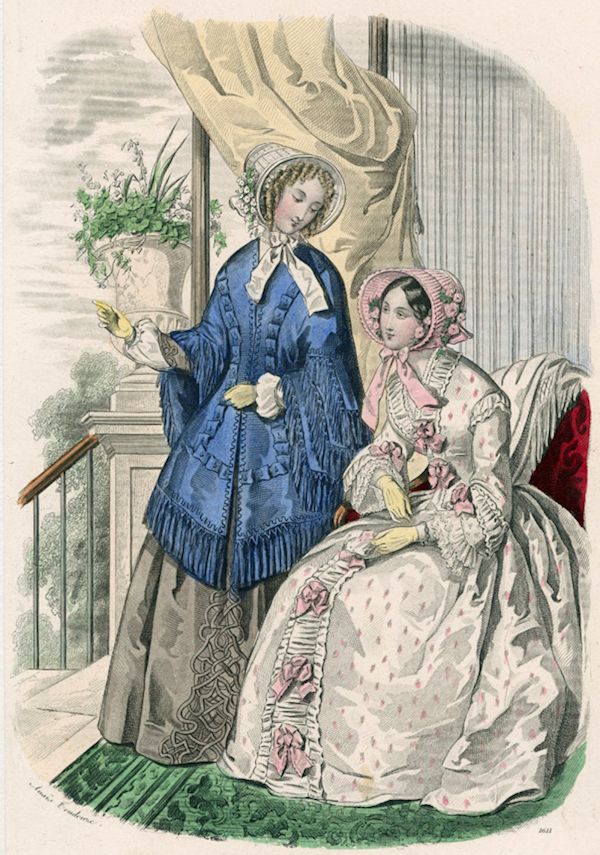
Anaïs Toudouze
LE FOLLET Paris, boult. St. Martin, 69.
Chapeaux Mlle Grafeton, r. de la Paix, 24—Fleurs de Chagot ainé, r. Richelieu, 73.
Pardessus de la maisn. St. Arnaud–Dentelles de Violard, r. Choiseul, 4.
The styles of Goods here represented can be had of Messrs. L. J. Levy & Co. Philadelphia
and at Stewart’s, New-York.
Graham’s Magazine, 134 Chestnut Street.
Transcriber’s Notes:
Archaic spellings and hyphenation have been retained as well as some spellings
peculiar to Graham’s. Punctuation has been corrected
without note. Other errors have been corrected as noted below. For
illustrations, some caption text may be missing or incomplete due to condition of
the originals used for preparation of the ebook.
page 202, and geologial descriptions ==> and geological descriptions
page 203, amidst the minosas ==> amidst the mimosas
page 204, when a bark ascending ==> when a barque ascending
page 212, conquest of of Shivas ==> conquest of Shivas
page 215, His bark stranding ==> His barque stranding
page 216, safe and and sound ==> safe and sound
page 225, there are Bachinalian ==> there are Bacchanalian
page 225, genii and faries ==> genii and fairies
page 226, within many degress ==> within many degrees
page 228, among the lowley ==> among the lowly
page 228, The hundreth psalm ==> The hundredth psalm
page 229, shame to doggrel ==> shame to doggerel
page 230, an argent bark ==> an argent barque
page 231, what commisseration he ==> what commiseration he
page 234, And now its ==> And now it’s
page 236, added: [To be continued.
page 239, laughed and teazed ==> laughed and teased
page 241, its splendid to be ==> it’s splendid to be
page 241, Blanch Forrester went ==> Blanche Forrester went
page 241, delicious Scottische ==> delicious Schottische
page 250, vaticanam Bodleianamgue ==> vaticanam Bodleianamque
page 250, Onicus est nobis ==> Unicus est nobis
page 253, As ambegris leaves ==> As ambergris leaves
page 258, fowl have the the power ==> fowl have the power
page 260, Pasiello, and other ==> Paisiello, and other
page 260, Old ’76 and Young ’47. ==> Old ’76 and Young ’48.
page 261, near the Piraus ==> near the Piræus
page 263, delight of themselvs ==> delight of themselves