To one familiar with the dense swamps that skirt
the rivers through the alluvial bottom lands of the
South, there will be no difficulty in comprehending
the fact that a fugitive may find temporary security
within half a mile of his enemy, even where his
pursuers hunt for him in numbers. Thus it happened
that, in taking to the river, our little corporal’s
guard of patriots, under the direction of Elijah Fields,
the worthy preacher, swimming their horses round
a point of land on the opposite shore, sought shelter
but a little distance below “Bear Island,” in a similar
tract of swamp and forest, and almost within rifle-shot
of their late retreat. They had no fear that
their enemy would attempt, at that late hour, and
after the long fatigue of their recent march and search,
to cross the river in pursuit of them; and had they
been wild enough to do so, it was equally easy to
hide from search, or to fly from pursuit. Dunbar
felt all this as sensibly as the fugitives; and with the
conviction of his entire failure at “Bear Castle,” he
gave up the game for the present. Meanwhile, the
little barque of Frederica Sabb made its way down the
river. She made her calculations on a just estimate
of the probabilities in the situation of Coulter’s party,
and was not deceived. As the boat swept over to
the opposite shore, after rounding the point of land
that lay between it and “Bear Castle,” it was hailed
by Fields, for whom Brough had a ready answer.
Some delay, the fruit of a proper caution, took place
before our fugitives were properly sensible of the
character of the stranger; but the result was, that
with returning consciousness, Richard Coulter found
himself once more in safety with his friends, and, a
still more precious satisfaction, attended by the woman
of his heart. It was not long before all the adventures
of Frederica were in his possession, and
his spirit became newly strengthened for conflict and
endurance by such proofs of a more than feminine
attachment which the brave young girl had shown.
Let us leave the little party for a season, while we
return with the captain of loyalists to the farmstead
of old Frederick Sabb.
Here Mat Dunbar had again taken up his quarters
as before, but with a difference. Thoroughly enraged
at his disappointment, and at the discovery that
Frederica had disappeared—a fact which produced
as much disquiet in the minds of her parents, as
vexation to her tory lover; and easily guessing at all
of the steps which she had taken, and of her object,
he no longer imposed any restraints upon his native
brutality of temper, which, while he had any hope
of winning her affections, he had been at some pains
to do. His present policy seemed to be to influence
her fears. To reach her heart, or force her inclinations,
through the dangers of her parents, was now
his object. Unfortunately, the lax discipline of the
British authority, in Carolina particularly, in behalf
of their own followers, enabled him to do much toward
this object, and without peril to himself. He
had anticipated the position in which he now found
himself, and had provided against it. He had obtained
from Col. Nesbett Balfour, the military commandant
of Charleston, a grant of the entire farmstead
of old Sabb—the non-committalism of the old Dutchman
never having enabled him to satisfy the British
authorities that he was a person deserving their protection.
Of the services and loyalty of Dunbar, on
the contrary, they were in possession of daily evidence.
It was with indescribable consternation that
old Sabb looked upon the massive parchment, sealed,
signed, and made authoritative by stately phrases
and mysterious words, of the purport of which he
could only conjecture, with which the fierce Dunbar
denounced him as a traitor to the king, and expelled
him from his own threshold.
“Oh! mein Gott!” was his exclamation. “And
did the goot King Tshorge make dat baber? And
has de goot King Tshorge take away my grants?”
The only answer to this pitiful appeal vouchsafed
him by the captain of loyalists was a brutal oath, as
he smote the document fiercely with his hand, and
forbade all further inquiry. It may have been with
some regard to the probability of his future marriage—in
spite of all—with the old Dutchman’s daughter,
that he permitted him, with his wife, to occupy an
old log-house which stood upon the estate. He
established himself within the dwelling-house, which
he occupied as a garrisoned post with all his soldiers.
Here he ruled as a sovereign. The proceeds of the
farm were yielded to him, the miserable pittance excepted
which he suffered to go to the support of the
old couple. Sabb had a few slaves, who were now
taught to recognise Dunbar as their master. They
did not serve him long. Three of them escaped to
the woods the night succeeding the tory’s usurpation,
and but two remained in his keeping, rather,
perhaps, through the vigilance of his sentinels, and
their own fears, than because of any love which they
entertained for their new custodian. Both of these
were women, and one of them no less a person than
the consort of Brough, the African. Mrs. Brough—or,
as we had better call her, she will understand us
better—Mimy, (the diminutive of Jemima,) was particularly
watched, as through her it was hoped to
get some clue to her husband, whose treachery it
was the bitter resolution of our tory captain to punish,
as soon as he had the power, with exemplary tortures.
Brough had some suspicions of this design,
which it was no part of his policy to assist; but this
did not discourage him from an adventure which
brought him again very nearly into contact with his
enemy. He determined to visit his wife by stealth,
relying upon his knowledge of the woods, his own
caution, and the thousand little arts with which his
race usually takes advantage of the carelessness, the
indifference, or the ignorance of its superior. His
wife, he well knew, conscious of his straits, would
afford him assistance in various ways. He succeeded
in seeing her just before the dawn of day one morning,
and from her discovered the whole situation of
affairs at the farmstead. This came to him with
many exaggerations, particularly when Mimy described
the treatment to which old Sabb and his wife
had been subjected. It did not lose any of its facts
or dimensions, when carried by Brough to the fugitives
in the swamp forests of Edisto. The news
was of a character to overwhelm the affectionate and
dutiful heart of Frederica Sabb. She instantly felt
the necessity before her, and prepared herself to encounter
it. Nine days and nights had she spent in
the forest retreats of her lover. Every tenderness
and forbearance had been shown her. Nothing had
taken place to outrage the delicacy of the female
heart, and pure thoughts in her mind had kept her
free from any annoying doubts about the propriety
of her situation. A leafy screen from the sun, a
sylvan bower of broad branches and thickly thatched
leaves, had been prepared for her couch at night;
and, in one contiguous, lay her wounded lover. His
situation had amply reconciled her to her own. His
wound was neither deep nor dangerous. He had
bled copiously, and swooned rather in consequence
of loss of blood than from the severity of his pains.
But the hands of Elijah Field—a rough but not wholly
inexperienced surgeon, had bound up his hurts, which
were thus permitted to heal from the first intention.
The patient was not slow to improve, though so
precious sweet had been his attendance—Frederica
herself, like the damsels of the feudal ages, assisting
to dress his wound, and tender him with sweetest
nursing, that he felt almost sorry at the improvement
which, while lessening his cares, lessened her
anxieties. Our space will not suffer us to dwell
upon the delicious scenes of peace and love which
the two enjoyed together in these few brief days of
mutual dependence. They comprised an age of immeasurable
felicity, and brought the two together in
bonds of sympathy, which, however large had been
their love before, now rendered the passion more than
ever at home and triumphant in their mutual hearts.
But with the tidings of the situation in which her
parents suffered, and the evident improvement of her
lover, the maiden found it necessary to depart from
their place of hiding—that sweet security of shade,
such as the fancy of youth always dreams of, but
which it is the lot of very few to realise. She took
her resolution promptly.
“I must leave you, Richard. I must go home to
my poor mother, now that she is homeless.”
He would, if he could, have dissuaded her from
venturing herself within the reach of one so reckless
and brutal as Mat Dunbar. But his sense of right
seconded her resolution, and though he expressed
doubts and misgivings, and betrayed his uneasiness
and anxiety, he had no arguments to offer against
her purpose. She heard him with a sweet smile,
and when he had finished, she said,
“But I will give you one security, dear Richard,
before we part, if you will suffer me. You would
have married me more than a year ago; but as I
knew my father’s situation, his preferences, and his
dangers, I refused to do so until the war was over.
It has not helped him that I refused you then. I
don’t see that it will hurt him if I marry you now;
and there is something in the life we have spent together
the last few days, that tells me we ought to
be married, Richard.”
This was spoken with the sweetest possible blush
upon her cheeks.
“Do you consent, then, dear Frederica?” demanded
the enraptured lover.
She put her hand into his own; he carried it to his
lips, then drew her down to him where he lay upon
his leafy couch, and repeated the same liberty with
hers. His shout, in another moment, summoned
Elijah Field to his side. The business in prospect
was soon explained. Our good parson readily concurred
in the propriety of the proceeding. The inhabitants
of the little camp of refuge were soon
brought together, Brough placing himself directly
behind his young mistress. The white teeth of the
old African grinned his approbation; the favoring
skies looked down upon it, soft in the dreamy twilight
of the evening sunset; and there, in the natural
temple of the forest—none surely ever prouder or
more appropriate—with columns of gigantic pine and
cypress, and a gothic luxuriance of vine, and leaf,
and flower, wrapping shaft, and cornice, capital and
shrine, our two lovers were united before God—our
excellent preacher never having a more solemn or
grateful sense of the ceremony, and never having
been more sweetly impressive in his manner of performing
it. It did not impair the validity of the
marriage that Brough honored it, as he would probably
have done his own, by dancing Juba, for a
full hour after it was over, to his own satisfaction at
least, and in the absence of all other witnesses.
Perhaps, of all his little world, there were none
whom the old negro loved quite so much, white or
black, as his young mistress and her youthful husband.
With the midnight, Frederica left the camp
of refuge under the conduct of Elijah Fields. They
departed in the boat, the preacher pulling up stream—no
easy work against a current of four knots—with
a vigorous arm, which, after a tedious space, brought
him to the landing opposite old Sabb’s farm. Here
Frederica landed, and the dawn of day found her
standing in front of the old log-house which had been
assigned her parents, and a captive in the strict
custody of the tory sentries.
[Conclusion in our next.
Written on being presented by a lady with a wild flower that grew on his grave, near Buffalo.
———
BY W. H. C. HOSMER.
———
Thanks to the Genii of the flowers
Who planted on his humble tomb,
And nursed, with sun and pleasant showers,
This herb of faded bloom!
And, lady fair, my thanks to thee
For bringing this frail gift to me,
Although it cannot match in dye
The velvet drapery of the rose,
Or the bright tulip-cup that glows
Like Summer’s evening sky.
It hath a power to wake the dead—
A spell is in its dying leaf
To summon, from his funeral bed,
The mighty forest chief.
Realms that his fathers ruled of yore—
Earth that their children own no more,
His melancholy glance beholds;
And tearless though his falcon eye,
His bosom heaves with agony
Beneath its blanket folds.
Within the council-lodge again
I hear his voice the silence breaking,
Soft as the music of the main,
When not a wind is waking;
With touching pathos in his tone
He mourns for days of glory flown,
When lay in shade both hill and glen,
Ere, panoplied and armed for slaughter,
The big canoes brought pale-browed men
Over the blue salt water;
When deer and buffalo in droves
Ranged through interminable groves,
And the Great Spirit on his race
Smiled ever with unclouded face.
Now, with a burning tale of wrong,
He wakes to rage the painted throng,
And points to violated graves,
While eloquence dilates his form,
And his lip mutters like the storm
When winds unchain the waves;
An hundred scalping-knives are bare—
An hundred hatchets swing in air,
And while the forest Cicero,
Lost power portrays, and present shame,
Old age forgets his palsied frame,
And grasps again the bow.
Thus, sweet, wild-flower of faint perfume!
Thy magic can unlock the tomb,
And forth the gifted sagamore
Call from the shroud with vocal art
To sway the pulses of the heart,
And awe the soul once more;
For on his couch of lowly earth
Thy modest loveliness had birth,
And lightly shook thy blooming head,
When midnight summoned round the place
The kingly spectres of his race
To sorrow for the dead;
And sadly waved thy stem and leaf
When Erie tuned to strains of grief
The hollow voices of the surge,
And for that monarch of the shade,
By whom his shore is classic made,
Raised a low, mournful dirge.
The pilgrim from Ausonian clime,
Rich in remains of olden time,
Brings marble relics o’er the deep—
Memorials of deathless mind,
Of hallowed ground where, grandly shrined,
Sage, bard and warrior sleep;
And precious though such wrecks of yore,
I prize thy gift, fair lady, more,
Plucked with a reverential hand;
For the old chief, above whose tomb
Its bud gave out a faint perfume,
Was son of my own forest land,
And with bright records of her fame
Is linked, immortally, his name.
———
BY J. M. LEGARE.
———
| Spain, and Tercera. | } |
| AD. 1583. | } |
It is part of the popular belief, I know, that our
ancestors, of three centuries back, lived and talked
in quite a different fashion from mankind at the present
day; but as I entertain no political designs on
that Great Caioled, the people, I may venture to
assert an opinion of my own. I cannot persuade
myself what is called human nature has undergone
much alteration in the exchange of an iron for a
broadcloth suit, and it is very certain people ate,
drank, and slept in those remote times much as we
now do, although your stilted romancers seldom recognise
the fact, and make their heroines as unlike
tangible women, “not too good for daily food,” as
their heroes are exemplars of the mendacious gifts
of their biographers. In the matter of speech, through
which we mainly receive impressions of fictitious
personages, it is extraordinary what fustian is
palmed on a credulous posterity, as the veritable
domestic talk of nobles, knights and folks of lesser
condition. There is no comedy, high or low, in the
conceptions of many of these authors; Man having
apparently assumed the distinguishing trait of a
laughing animal, or at best of an humorous one, at
some more recent epoch of modern history. Every
body struts about in buskins and speaks tragedy,
nothing less; and as to the fooleries enacted by
pages, grooms, and servitors of all kinds, there is no
end to them, nor any like nowadays, except we find
it on the boards of a country theatre.
What I say admits of easy illustration. Thus,
when the page woke Don Pedro out of his morning
nap—which, by the bye, he was taking not as the
usual impression is, in greaves and a casque—he,
the page, did not “lout low as it behooves trusty
varlets” to do, but in a manner as straight-forward
as a modern Thomas would employ, gave the
drowsy knight to understand that some one had been
sounding his horn at the gate for the last half hour.
“Very well,” returned the master, turning over
to resume his doze where he was interrupted—the
gate being the concern of the warder, of course.
“But, Sir Peter,” put in the page, by way of remonstrance,
“it is mi señora who has sent.”
“Ah ha!” cried the knight, suddenly becoming
wide awake, and leaning on both elbows in bed to
regard the speaker. “Well, what message does
she send?”
“That she wishes you to come up to the castle
as soon as your comfort allows, as she has something
special to say.”
“That I will, presently,” exclaimed Don Pedro,
getting up so promptly his gaunt figure showed to
no advantage in its scant costume. “And so tell
Gil, or whoever came, to carry back word. How
the dear lady talks of comfort to a man accustomed
to the ease of camps! Fetch me those things, Iorge,
and look behind the arras for my slashed doublet.
Stop, before you go, reach down my sword and
spurs from the hook behind the door.”
Now all this is very rational, much like what one
would say at the present date, and unless the Spanish
version of my story was never written, (which the
Muse of veracity—whatever her name—it was not
Clio, I know—forbid!) was the identical language
employed on the occasion by my hero, as true a
knight as Spain has produced since her Cid Rodrigo.
This reminds me a hero of romance cannot be passed
over as commoner folks, with a surmise as to his
inches and the color of his hair, and moreover is
expected to be an Apollo in shape, and sort of supernatural
in virtues, provided his character is not cast
in quite a different mould, and dependent for admiration
on the enormity of its crimes. But Don Pedro,
unfortunately for the interest his fortunes are destined
to excite, fell into neither extreme, was neither a
saint nor a monster of iniquity, and as far from being
handsome as from being deformed. To have designated
him in a crowd, you would have called
attention to his overtopping the rest by a full head,
or to a certain sinewy spareness of limb, or else the
simplicity of his toilet, at a time when country gentlemen
wore ribbons and gewgaws alternately with
steel harness. But closer, the irregularity of his features,
browned by the sun where the rim of the
casque had not interposed, was compensated for by
the singularly calm beauty of his eyes, which, in
their serene intelligence, would have become the
brows of any woman, and even in battle shone with
a high sort of exultation, such as one would attribute
to a victorious angel in the celestial wars. There
was nothing about Don Pedro which harmonized
with these eyes, except, perhaps, an undertone of
gentleness pervading his voice; it was an undertone
only, for nothing womanish characterized his speech,
no mincing of words or petit-maître modulations in
addressing the other sex: there was not a particle
of affectation in the man, because there was not a
particle of untruth.
I think it was these same fine eyes and gentleness
which first won the heart of the lady Hermosa, and
his sincerity that safely kept it. Of where and how
they first met, in what words our Don laid his little
keep of a castle and patrimony at her feet, (his whole
estate would not have paid her upholsterer’s bill,)
history discloses nothing. It is only known she married
him, and thereby raised a tempest of wrath and
despair in the breasts of numberless admirers, who,
however, all consented to eat of her cake on the
happy occasion. Sir Peter was in nothing changed
by the event, but lived as before in his tower, spent
not a maravedi of his wife’s income on himself, and
contented her by the frequency and tenderness of
his interviews. It was his whim to lead this style
of life, and she loved him enough to soon make it a
whim of her own, the separations not being very
remote it must be conceded, as the keep and castle
stood perched on opposing hills, in full sight of one
another. Such concession in a young wife was certainly
praiseworthy, although some were found to
be scandalized at its want of precedent. Of the husband’s
crotchet I say only, it was a quaint piece of
instinctive honor, which a few of his neighbors extolled,
and the greater part laughed at as an act of
arrant simplicity: although, to my mind, the less
said about simplicity the better, by people who lived
when dragons and giants were not yet supposed to
have retired upon ultimate Thule, and Ponce de
Leon’s search after the fountain of youth, (he was
looking for it then in Florida!) counted no great
waste of time.
The Don and his countess concerned themselves
very little about such gossip, finding abundant occupation
in a course of life which, without the bias
one unavoidably entertains for his heroes, is a source
of satisfaction to the writer hereof. It was in the
lady’s nature to be charitable, being one of those unaffected
well wishers of humanity with “abundant
means,” whose part in this life seems to be to render
everybody in reach as satisfied as themselves, and
before Sir Pedro’s discretion and mature knowledge
of the world came to her assistance, committed as
many philanthropic blunders as would have made
her eligible to an abolition chair, or seat in Exeter
Hall. Of course I must not be understood to undervalue
the good she continued to do in the dark. I
have too great a reverence for money to suppose it
capable of injury to any recipient under any circumstances,
differing in this respect from all medicines
whatever, which become poisons in quantity, and
are defective in the important item of universal application.
The truth is, I am led to this admission
by an instance I have now in mind. There was one
Don Carlo, (so he called himself: the fellow had a
dog’s name, but any dog, short of a sheep-worrier,
would have been compromised by his acquaintance.)
A free-captain, who earned his crust by such little
excesses as made the payment of black-mail an acceptable
compromise on the part of his favorites, and
even in Philip the Second’s time, brought an amount
of civil odium upon his head which would have relieved
him of that incumbrance, had he not disbanded
his company and retired to the provinces to enjoy
his honest gains. Here Captain Carlo—who was of
a playful temper and delighted in masking—made
the acquaintance of our heroine in the likeness of a
veteran of the Moorish wars, and found waylaying
her steps and asking an alms as many times a day
as she walked out unattended (in as many different
characters, of course,) so much more profitable, to
say nothing of the safety of the proceeding, than
poniarding a foot-passenger, or roasting a villager
to discover hidden treasure, that he became a pattern
of morality to the country round, and is currently
said to have refrained more than once, when sorely
tempted by the purse she carried, from cutting his
benefactress’ slender throat; in this respect showing
himself wiser than the avaricious owner of the goose
Æsop tells us of.
Captain Carlo, however, lost his golden eggs, as
did many others of scarcely less merit, when Sir
Pedro de Padilh brought, as has been hinted, his
longer head and more comprehensive benevolence to
the aid of his young wife’s virtuous designs.
The latter quickly saw her mistake when once its
results were laid bare, and fell to correcting it with
a feminine energy which constituted a strong element
of her character; Sir Peter meanwhile contenting
himself with a vigilant guardianship of her
interests and benevolent projects, and a hearty participation
in her active measures—suggestions of his
own, not unfrequently too—which it was his fancy
to conceal under an assumption of caution; although
I can’t say his wife was ever deceived by the cloak
worn on such occasions, for her tender affection
would have lent intelligence to faculties much duller
than my heroine’s.
Sir Pedro very well knew it was some such work
ahead which brought a summons to his gate so early,
and was in his saddle, breathing in the fresh, moist
air, and galloping through the fields and olive plantations
between, before Gil reached his lady’s castle.
I see the good knight now in my mind’s eye: Andalusian
steed and housings both spotless white, the
first as much over the average height of his race as
was his master above that of common men: sitting
straight, with doublet buttoned easily across the
breast, and a cap with a trailing plume, which a
branch caught off and forced him to wheel his horse,
with a gracias señor, to recover: so, picking a way
up the hill, and stooping under the portcullis, ready
open, diminishing the stature of the men around by
contrast with his figure dismounted. Up the wide
steps, and into a room where his countess met him
with her usual happy face whenever this giant of a
husband was nigh her. Perhaps I call attention too
often to Sir Peter’s seven feet of altitude, but in this
case the mention was involuntary; for I was thinking
how, when she put her arms about him, there
being no one near, she was constrained to kiss him
where she laid her cheek, on his breast, being able
to reach no higher; and he, as a pine might an ash
in windy weather, stooped and kissed her on the
forehead.
“Lady mine,” he said with a grave smile, holding
her off to look down in her face, “what is the matter?
You were scarcely more troubled when I rode
against the Moors.”
“Señor—husband”—she replied, “what I have to
tell may induce you to leave me again. It is that
troubles me.”
“Humph!” returned the knight, “a crusade
against something or somebody?”
“Yes,” answered the countess, “one full of danger.”
Don Pedro smiled as a soldier of his inches, of
course, should at the idea of the thing.
“A week ago, my cousin Vida Inique came to
me in much distress. You remember her?”
“Certainly! She is the betrothed, Heaven help
her, of that vagabond nephew of mine.”
“She stopped here, for she came from Madrid
with that purpose; partly because she needs sympathy
now, and I am her nearest relative, and partly
for the sake of society during the absence of her
father with the Marquis of Santa Cruz.”
“Santa Cruz!” repeated the Don, with the animation
of his Andalusian snuffing a whiff of cannon
smoke.
“Yes. The king has ordered an armament under
the marquis against Tercera.”
“Not a word of this reached me in the mountains.
A handful of good knights would drive every Portuguese
into the sea; I wonder the marquis sails against
such enemies, when he complained only the other
day of their ill breeding in Portugal; there was scarce
a skirmish in which their backs were not turned
upon their Spanish guests.”
“You will think differently, my señor, when I tell
you all; but let me tell it as I heard it. Doña Viola
wept so incessantly at first, whenever she attempted
to allude to Hilo—for, of course, he is the cause of her
grief—that I could understand nothing. The silly
girl loves him with her soul and heart, and pretty
and wealthy as she is, this half nephew of yours
feels the yoke of his connection intolerable, and has
adopted the most outrageous means of extorting her
consent to canceling the agreement.”
“Ha! what mischief has he been doing lately?”
“First, when his representations and contemptuous
reception of her fond prayers failed to gain his purpose,
he insulted her eyes by parading before them
on all occasions his companions, the most notorious
thieves and desperadoes of the capital, and women
of the vilest character, flaunting, not unfrequently, in
chains and baubles he had stooped to accept but
never to wear, for the boy is as proud and wicked as
Lucifer; all this done with a scornful, overbearing
air, which plainly said, ‘these, madam, are my intimate
friends; they will sit at your table and fill
your house when I am master. Beware how you
make me so!’ She is so subdued and heart-broken
already, she only wept and endeavored to hide his
insults from her father.”
“Santiago! what infatuation!”
“Then his vile nature broke forth still more insolently.
His birth, as you know, gives him access
to the company of numerous dissolute cavaliers,
although the society he usually affects is of a much
baser sort. Through their means, without other
harm to himself than what is in store for his lying
tongue, señor, he poisoned her life by spreading
through all ranks tales in which her maiden name
was coupled with that of infamy, and when this
gossip was in the mouth of everybody, flung her off
publicly with a show of horror and mental anguish,
which probably had its weight on those who knew
nothing of the man’s character.”
Sir Pedro’s brows contracted above his fine eyes,
but he remained silent.
“The scandal reached at last the ears of Don
Augustino Inique himself, in Portugal, and hastening
from the frontier to the court, he laid the
matter before the king, demanding redress. Unluckily,
this was not until he had exhausted every
source of information in tracing the flight of the young
man, who had stabbed the Count of Villenos in a
quarrel in the meanwhile, and disappeared from the
city. Don Philip loves to be called the Prudent, and
has no fancy for being second in any intrigue, and
accordingly the enraged and baffled father was dismissed
with polite promises that meant nothing.
Since then he has received secret intelligence that
Hilo has gone over to France, and either through
unnatural hatred of his countrymen, or characteristic
recklessness of every honorable purpose—for he is
capable of any degradation—enlisted under the commander,
De Chaste, who sails soon at the bidding of
the queen mother to reinforce the Tercerans.”
“Why he is more depraved than his father, and
he scrupled at little when his passions were roused!”
exclaimed Sir Pedro, baiting suddenly in a walk
which crossed the chamber at six strides. “This
man is only my half relative, as his father was, and
does not even bear my name; but I must save him
from final ruin if that be possible. What steps have
been taken by Inique?”
“He readily obtained the appointment of camp-master
under the marquis, as no one at court knew
his motive, and supposed he went abroad to find
forgetfulness in active service. A singular feature
in the affair, is his ignorance of Hilo’s relation to
yourself; and although Viola is acquainted with its
existence, the chief defect in her character, a timid
reluctance to confiding any personal matter to her
father, has prevented his learning the truth during
his brief visits to his home. Yet a more gentle nature
I have never found than hers.”
“I scarcely wonder at her shrinking from opening
her heart to Don Augustino,” answered our knight,
“and were you to see him frequently, you would
entertain a like opinion. He is a soldier, and nothing
better if nothing worse—stern, scrupulous of his
word, and jealous of his honor; although what he
calls by that name is of no wide compass; a man
whose outbreak of rage against his daughter I would
have awaited with strong apprehension, had I known
any thing of this affair before. Perhaps, however,
the purpose of swift vengeance so occupies his brain
that feebler emotions is pushed aside.”
“I think you are right, Sir Pedro,” returned his
lady, thoughtfully. “For during the short space he
remained with us, he seemed pre-occupied, as if
tracing a single idea through a maze of thought, and
spoke little of his own accord. His bearing was
frigid enough, but if any unjust anger toward his
child remained, it was well concealed under the
elaborate courtesy he shared between us.”
“Yes,” said the knight, with a half laugh. “His
old way, I recollect it well; never more labored
than when a volcano is smouldering under his doublet.
Only once have I seen him forgetful of this courtesy,
when his son, a mere stripling, and a coward by instinct,
as others are brave without will of their own,
in a skirmish with the French sheltered himself behind
his father in sight of the opposing lines. He
was his only son, but he had better have been thrust
through by a Gallic lance, than taken refuge where
he did.”
“Poor fellow! Did Sir Augustino strike him?”
“Worse. His boy was on foot, himself on horseback;
when his threats and imprecations failed to
drive him back into the melee, in a paroxysm of fury
he struck him repeatedly on the head with the pommel
of his sword, unsoftened by the fair, bleeding
face the child turned up while clutching his leg,
and begging for life. Not a gentleman in the two
armies sympathised with the father except Capt. De
Chaste, who, incapable of a like barbarity, is noted
for pushing to an extreme all questions of honor.”
“He was scarcely less cruel than Beaumanoir,
who cried, ‘Bois ton sang,’ to his fainting son,” exclaimed
Doña Hermosa, with a cheek paled by the
recital. “Did the poor lad die?”
“No. He lived by an accident, or Providence,
which you will, a miserable idiot, his brain having
been injured by the concussion, perhaps, also by the
anguish endured. Sir Augustino takes him with him,
no matter where he goes, studiously bent on concealing
his existence, much more his presence from
his companions in arms. In spite of every precaution,
however, the fact is well known; and twice
this wreck of a man has eluded his keeper, and appeared
suddenly in the midst of the knight’s guests.”
“Was his father much moved?”
“No, very little in appearance, his usual proud
composure concealing whatever pang he felt; and it
is impossible to ascertain from his manner whether
he adheres to this strange companionship from remorse,
and a resolute purpose of atonement, or a less
worthy desire to smother the reproach by a jealous
guardianship of its living witness.”
“Or else, dear señor, from a return of natural tenderness
which a false shame prevents him acknowledging
for so mean an object.”
“Why some share of good belongs to every man;
even it may be, to my next of kin, although warped
by the supremacy of his passions.”
“That is the only sane argument Viola advances
for her love.”
“Humph!” After an interval; “I would like to
see the Doña, if only to remove the impression that
she is no higher than this chair, as she was when I
saw her some years since.”
“You will find her,” rejoined the countess, smiling,
“less a child in height and style than her youth
would lead you to suppose; for a comparatively
self-dependent life in close vicinity to the court, has
already converted girlish bashfulness into a becoming
modesty enough. But stay here till I find her,”
added Doña Hermosa, going out.
“A wretched state of things,” mused our knight,
resuming his suspended strides, with hands clasped
behind. “It is evident I have but one course left;
to track that young knave down, and by dint of soft
or hard words, turn him from a career which has
already entitled him to a bench in the galleys, if nothing
worse. It is a good way, at all events, to pay
back the bitter hatred of his father, God forgive
him!” and the soldier’s moody brows relaxed at the
thought, while his eye ran down the steep road at
the foot of which the father of the man he designed
saving, had one evening shattered his carbine on the
rocks, because its hanging-fire saved Sir Pedro’s life
in passing. A quiet smile, called up, perhaps, by a
recollection of the solicitude shown by the countess
the day succeeding, still lingered about the knight’s
mouth when he turned from the window and saw
the lady herself approaching, accompanied by her
guest, a fair girl, with the light, soft hair and eyes
of an Englishwoman, which her mother was. Her
beauty appeared less imposing than that of the
thoroughly Spanish Hermosa, but much more delicate,
and so Sir Pedro seemed to think, for advancing
and taking her by both hands, he said, in a tone
much more modulated than was common with him,
“Doña Viola—I called you Viola when we last
met, and you were no taller than my sword.”
“Call me so now, señor,” put in Viola, gently. “I
cannot afford to lose even the wording of friendship.”
The knight looked attentively at the speaker,
whose eyes meeting his, swam in tears. He
paused thoughtfully, and then with his usual straight-forward
kindness, said,
“My child, I have learned your grievances through
your cousin here. You are nearly alone in the world,
let us both assist you in all we can. You see I am
old enough to be your father, think of me as such for
the present. Besides, the cavalier whose fiancée
you are, is, you know, my half nephew; and the
attempt I am about making to draw him from his
wicked courses, will be materially assisted by any
good traits I may become acquainted with; for
while I confess my ignorance of the better side of
his character, Doña Viola, I am sure one exists, or
you would not have proved so faithful as you are.”
A faint red spot in the girl’s cheek had deepened
and spread as Sir Pedro spoke, until at his last
words, her whole face was flushed, and stooping
quickly, she pressed her lips on his hand before he
could withdraw it.
“You are right,” she said, eagerly to Padilh, who
stood with something like a blush on his soldierly
features at the impulsive action. “Save him from
himself, from his temptations, for he has a virtue
mated with every vice he practices, and ready to
assume its place when the bad is uprooted. I know,”
she added, with an impetuous accent which betrayed
her Spanish blood, and was singularly impressive in
her timid manner of speaking, “he is a professed
gambler, yet I have seen him clothe and feed a company
of beggars with the lavish generosity of a
prince; I know he has repeatedly endeavored to rescind
our contract of marriage, but how should this
bind his love, since we were infants when it was
drawn in our joint name; and I have no reason,
surely, to complain that he has employed harsh means
to accomplish his end, when I shut my eyes to the
growth of his aversion. No, Sir Pedro, the fault has
been mine in tempting him on; no one can say how
different his life might have been, but for the incumbrance
I would not consent to his putting away—and
so let me suffer, not him. Save him, I earnestly
beseech you, from himself, and if need be,” she
added, dropping her voice, and becoming as suddenly
pallid as before flushed, “save him from an
encounter with my father.”
“That I will,” returned the Don, soothingly, “if
interposition of my words or body can. And one of
these days, Doña Viola, we will talk these matters
over calmly, and discuss what is best to be done.”
“The poor thing is crazed,” he said an hour after
to his countess, “to love this Hilo! It was not easy
to bring my mouth to call the scamp ‘cavalier;’ but
her innocent distress overcame the reluctance. When
this feverish excitement, which forbids all close
questioning, subsides, it will be well to learn more,
if she knows more of her betrothed. And if I set out
before that can be done—”
“What, do you really go to this war!” exclaimed
our heroine, with the admirable versatility of the
sex, “when you have resigned yourself to the gratification
of a particular request not at all to your liking
at first.
“Dear, Sir Pedro, don’t you think some better
way may be found of accomplishing our purpose?
For instance, let some trusty person find out this
young man and carry him a letter from you, as from
an uncle solicitous of doing him a benefit. Or, perhaps,
Señor Inique might be moved from his design
by your calm representations. Only don’t go!” she
urged, with a tremulous lip.
To this outbreak Don Pedro de Padilh, with the
tranquillity of one who remembers a story he is
anxious to tell and overlooks the last question, rejoined,
“Did you ever hear, Hermosa, the history of the
wonderful cat that lived in Biscay when I was of
no great size myself? There is one of the tribe
on the battlement yonder, marked as that intelligent
animal must have been, and put the story
in my head.”
“Pshaw!” said the countess, half inclined to laugh,
with tears in her eyes.
“This cat was remarkable for ugliness and cunning,
qualities which increased the umbrage the
priest naturally took to a cat who was said to use
better Latin than himself, to that degree he could
not rest at ease until the object of his jealousy was
condemned to be burned, on the rational plea of possessing
more learning than was orthodox. But so
sagacious a creature was not to be caught asleep,
and at the first rumor of the affair took occasion to
pay his respects to the most notorious gossip of the
province.
“‘Ah!’ said the cat, in the course of conversation,
“‘talking of merit, I am so delighted to find it
rewarded occasionally, that I have been in a state
of ecstasy since the news came from the capital.’
“‘Santomio!’ cried the old woman arrectis auribus;
‘what are they doing there, my dear cat?’
“‘Have you not heard about it! Our curà is to
be rewarded with a bishopric instanter; and for my
part I don’t think a better selection possible, when
his scholarship is taken into consideration, and I
have some cause to count myself a judge of such
matters.’
“‘Yes, yes, Señor Miz,’ put in the other. ‘But
this is important news to be sure; I hope you have
it from good authority.’
“‘None better. My sister’s grandkitten is attached
to the household of the cardinal resident, and has
just come down to pay me a visit. Trust to my
honor, señora most respected, you may talk of it
without fear for your veracity.’
“Of course, this was all sheer invention on the
part of the cat, but served his purpose for a time.”
“But why did not the foolish cat slip quietly away
beforehand?” asked the countess, who began to feel
an interest in his fortunes.
“Oh, because the familiars on watch were too
alert, I suppose. But hear what followed. When
the curà, who had been on a little expedition to bargain
for the faggots, returned to his house, he was
charmed to learn his approaching exaltation from a
score of friends; and at this juncture, being seized
with remorse at his precipitation, resolved to hear
from the cat’s own mouth the state of his faith.
‘For,’ said he to himself, as he tucked up his cassock
and waded through the mud to the latter’s door,
‘one should not burn a Christian beast by mistake;
and who knows what influence the grandkitten of his
very discreet sister may have in his eminence’s house.’
“‘Why,’ said the shrewd grimalkin, who saw in
a twinkling how much this last reason had to do with
the curà’s visit, ‘your reverend worship’s excellency
must perceive at a glance how this seam in
my upper lip forms a cross with the nostril above—a
sign which I need not inform your worship, is
found only on catholic quadrupeds.’
“‘Ha!’ cried the priest, struck with the idea, ‘so
it is. I beg your pardon, Señor Miz, for overlooking
it hitherto.’
“‘Not at all, the wisest sometimes err, as my
relative, the cardinal’s favorite, remarked to me
yesterday. I am glad your reverence was not
within hearing, for she was good enough to repeat
much of the praise his eminence bestows on your
worship, knowing she could not better please me.’
“In such amicable conversation time passed, until
the priest, bethinking himself that the preparations
for Autodafeïng his host, had gone too far to be
hushed up without some plausible excuse, and seeing
no way out of his dilemma, reluctantly confided his
difficulty to the party interested, for whom he began
to feel a very disinterested friendship.
“‘Make yourself easy,’ rejoined the other, scarcely
able to hide his satisfaction, ‘if that is the whole
difficulty, all your worship has to do is to fling my
san-berito (faugh! the name makes me hot and cold
all over!) into the fire, and give me a chance to
clutch your reverend legs, under your worship’s
gown.’
“‘To be sure!’ said the curà, in a tone of benignant
admiration, which one should get Judge Belton,
or the Mayor of Aiken, (who got it from the Spanish
original,) to mimic.
“Even the joint sagacity of a cat and a priest may
fall short of perfection. It was natural, certainly,
for the curà to dream all night of his expected mitre,
and allow the same agreeable subject to occupy his
brain all day to the exclusion of every other. But I
hold to it, that he should have remembered at the
right moment, (as he might easily have done, of
course, by tying a knot in his handkerchief or thread
round his finger,) to slip off the san-berito, and not
throw his unhappy friend into the fire. Why, but
for his confounded (I beg pardon, but one has their
feelings!) absence of mind, he might have seen his
victim’s tail—his head being smothered in the conical
caroza—as big as his arm, with rage and indignation.
“‘Wo is me!’ cried the wretched man, when he
saw what was done, tearing his beard in anguish of
mind, ‘I have burned a Christian cat, and lost my
mitre!’”
While saying the last words, Don Pedro, who had
been standing during the recital, took his cap and
moved to the door. But his countess intercepted
him with a wistful, half-perplexed face.
“Well?” said the knight, stopping, and looking at
her with a scarce visible smile.
“I think,” returned Hermosa, doubtingly, “you
mean I am no wiser than the curà, who, forgetting
what he was about, threw his friend into the fire,
and then fell to lamenting his loss. But who is
the cat?”
“Ah!” rejoined Sir Pedro, laughing, “the pith of
the story lies in six words,
‘La casa quemada,
Acudir con el agua.’”
A couplet I design putting into the mouth of that
scape-gallows, Hilo de Ladron, in the next number
of Graham, to serve as a thread, by closely following
which, the somewhat tangled woof of the young
gentleman’s character may in good time be unraveled.
———
BY R. PENN SMITH.
———
Scene. A Flower Garden of a Mariner’s Asylum.
Characters. An aged Sailor and a Visiter.
Sailor.All things must move in circles as earth doth.
The orbs that make space gorgeous move in circles;
E’en space itself is one eternal circle;
For were it not, its end would sure be reached.
All drag a chain still moving round and round
Until we join the two ends of the chain:
Thus man completes his circle. No escape then.
Stranger.You spoke, sir, of a voyage.
Sailor.Oh! pardon me:
I had forgot—those circles set me wild.
Where left I off? ’Tis strange, the thread is broken.
Stranger.In the South Sea.
Sailor.O, true!—’mong fruitful isles
The jocund waters leaped when morn arose,
And fringed each billow’s snow-white pinnacle
With golden tissue. Waves that wildly roared
Through night, like fiends contending for their prey,
Now smiled serenely as a lawn in spring
Spangled with herbage ’mid the wasting snow;
And as our gallant vessel glided on
The joyful waters, like some amorous dame,
Kissed the bright prow in very wantonness,
Regardless of the wound so rudely made
In the too pliant bosom.
Stranger. You liken well
The waters to a woman; beautiful
In the bright sunshine of prosperity!
But when the tempest rages, sea-tossed man
Oft finds a shoal there, where his barque may strand,
Expecting a safe haven.
Sailor. You are bitter:
But truth is not always sweet. All on board
Assembled on the deck to hail the sun
Weaving with gold God’s heaving world of green;
While lowly murmuring the gladsome waves
Sang matins to their master. Voices full
As deep-toned organ’s swell, and others shrill
As notes of linnets, mingled with the songs
The glad sea made in praising Him who made it.
Stranger.Let the great sea and all that therein is;
The earth—its fruit—and all that live thereby—
And all that live hereafter, praise his name.
Sailor.Amid our happy concourse there was seen
A father and his little family,
And the fair partner of his joys and griefs,
The mother of his children. While they gazed
Upon the wide expanse, their bosoms heaved
With admiration for His mighty works
Who rules the fearful sea. They thanked and trusted.
Stranger.All thank and trust, who know the God they trust in.
Sailor.Among them was a fair-haired rosy boy
Who hugged his father’s knee; his little hands
Clasped in devotion to the unseen God,
In ignorance adoring; for his spirit,
Unstained of earth, was redolent of heaven,
And instinct with the praises he had learnt
From angel-lips in his celestial birth-place.
Stranger.Childhood’s inheritance, which manhood squanders,
God gives us all, while we return but little.
Sailor.As the sun rose he sung a little hymn.
The words were these. I think his father made it.
In the morning of existence,
Earth smiles, as Eden smiled on Adam;
With God and angels for companions,
Man—little lower than the angels—
Receives the truth as it was given
Once—face to face, and fresh from heaven.
In the noontide of existence,
With bathed brow and stalwort limb,
Man, singing, struggles for subsistence
For those in sin begot by him,
Rejoices in those human frailties
Which make him imitate his God.
In the sunset of existence,
Alone, in thy Gethsemane,
Quaff the cup bravely and repine not—
For man, thy God is there with thee.
Meekly obey the mandate given,
It purifies thy soul for heaven.
Stranger.A strange thought that—childhood is Adam’s Eden,
Where man beholds his Maker face to face;
The close of life is his Gethsemane,
Where he must quaff the chalice to the dregs,
Without a prayer to take it from his lips.
I’ve heard that hymn before.
Sailor. Why call it strange?
The cup is sweetened though it smack of bitter,
And the most bitter drops become the sweetest.
Gethsemane was nearer heaven with him
Who bathed with tears and blood the sacred soil,
Than fresh blown Paradise appears to have been
With angel visitants. Perchance they are
The self-same garden, typed by Spring and Autumn,
Seed-time and harvest! If that thought be true,
With bathed forelock and with steadfast soul
Gather the harvest of Gethsemane,
More precious than the flowers that smiled in Eden.
The task is thine—first husbandman, then reaper.
Stranger.Talk further of the boy who sung the hymn.
Sailor.That spotless child, the rudest of the crew
Loved, for his presence made us better men.
Stranger.True, all men who love children still grow better;
And the best men are children to the last,
At least in thought and feeling.
Sailor.There’s the circle—
Extremes must meet, and we are hedged within them.
But to pursue our voyage—and the boy.
Day passed away, and as the night came on
The full-orbed moon roiled in a cloudless sky,
And the wide waters now lay hushed in sleep.
As gentle as the slumber of a child
Wearied with gambols through the live-long day.
The night-breeze from the orange-groves passed by,
Laden with odor. Heaven was chrisolite;
The sea a living mirror, in whose depths
The richly studded concave was reflected,
Making a perfect globe; and as the ship
Pursued her trackless flight, she seemed to be
Some spirit on errand supernatural,
So dark and silently she glided on
The babbling waves were scarcely audible.
Stranger.A pleasant sail which landsmen only dream of—
But never enjoy.
Sailor.All joy hath bitterness.
Stretched on the deck the sailor-boy reposed,
And lived in dreams his infant years again.
The seamen, ’mid the shrouds aloft reclining,
Told o’er their tales of wreck and lingering death,
And in the drowsy interval was heard
The rugged cadence of the helmsman’s song.
“A pleasant sail!” But pleasure has strange wings,
She comes a zephyr and departs a whirlwind.
Stranger.Kisses the flower to blooming, then destroys.
Sailor.Sudden the helmsman’s drowsy song was hushed.
A fearful cry arose—“The ship’s on fire!”
The seamen from aloft sent back the cry;
The sailor boy shook off his happy dream,
And woke to horror. All was wild dismay!
Half sleeping—half awake, the crew came forth;
Grim death, enveloped in his robes of flame,
Marched on and laughed. There was no human power
To put aside his footstep. On he moved
In awful majesty; whate’er he touched,
True to its origin, returned to dust,
And Nature’s master-work, man’s godlike frame,
Became as worthless as the spars and sails,
Each made its pile of ashes—nothing more.
Stranger.Ashes to ashes all, and dust to dust,
The self-same mandate both on earth and sea.
Sailor.The flames attained dominion. Tyrant-like,
They ruled and raged. Upon the shrouds they seized,
Kissing destruction—laughing as they kissed;
While the broad glare they spread upon the deep
Changed the sea’s nature. Water soon became
A lake of living fire. “A pleasant sail!”
Stranger.You weep. Go on.
Sailor.O that I then had perished!
I seized the boy and leaped into the waves.
Upon a fallen spar we safely rode
Until the ship went down. “A pleasant sail!”
Her knell one shriek of mortal agony.
We had no heart to weep for their sad fate—
No heart to pray for one less terrible.
I gathered fragments from the floating wreck,
And made a raft, where two immortal souls
Struggled with time to check eternity
With frail appliance. For three days we suffered;
And then a passing ship preserved our lives
For greater suffering.
Stranger.The boy—his fate?
Sailor.His parents dead—the lad became my charge.
I then was married to a worthy woman—
God’s kindest gift. We had an only child—
My wife brought up the children as if twins,
And at a proper age he sailed with me.
He grew to manhood—noble—cheerful—kind
As those who love the artless lips of children;
A very babe was he in his affections—
A very demon in his bitter passions.
The eagle and the dove oft make their nest—
The tiger and the ermin find a lair
In the same bosom.
Stranger.What became of him?
Sailor.My wife grew sick. He loved her as his mother;
He loved my daughter too. I sailed, and left him
To till my little ground and smooth their pathway.
After three years I came to port again.
Crossing my fields, which now poured forth their increase,
I saw a man resting upon his plough,
Singing right lustily.
Stranger.What did he sing?
Sailor.In the noontide of existence,
With swarthy brow and rugged limb,
Man bravely struggles for subsistence
For those in sin begot by him;
Rejoices in all frailties—sorrows,
They draw him nearer to his God.
Stranger.The hymn of early childhood still remembered.
Sailor.A bending in the chain to form the circle.
He led me to my home—and such a home!
It seemed as if the fairies had been there
Making their May-day—wife and daughter happy.
Then, from an arbor overgrown with flowers,
He placed a prattling child upon my knee,
And called him by my name. He laughed outright—
My daughter blushed. They now were man and wife.
I danced—then blubbered like a very child.
Tears are at times a truer sign of joy
Than smiles and laughter.
Stranger. ’Twas a boy, you said?
Sailor.A boy—his bud of Paradise, he called him.
Such flowers, too, often yield most bitter fruit
In man’s Gethsemane.
Stranger.Thank God! not always.
Sailor.We dwelt together for a few brief months.
He then proposed to try the sea again,
To place the beings whom we fondly loved
Beyond the cold calamities of earth.
Three years we sailed—we prospered, and returned
With means to make those happy whom we loved.
On wearied pinions, like the dove of peace
When land was found, he flew to seek the ark
Where our best feelings day and night reposed,
While struggling with the ocean. God! O God!
No ark was there—no resting-place for him!
Even Ararat was covered with the deluge.
Stranger.I understand you not.
Sailor.His wife was false.
Stranger.Impossible!
Sailor.But true. You tremble sir.
Her father curst the memory of his child;
Her mother withered, and soon died heart-broken.
You seem disturbed.
Stranger. ’Tis past. What did your son?
Sailor.He slew the slimy reptile that crawled over him;
Put his hard heel upon her glossy front,
Trampled her out in cold blood.
Stranger.God of heaven!
Sailor.And he did right.
Stranger.Your daughter!
Sailor.He did right.
She who betrays the honor of her husband,
Regardless of her parents, self, and children,
Should cease to live, though all unfit to die.
Better to rot in earth, than crawl through life,
Offending all things with her foul pollution.
I love my God; knowledge increases love.
I ask forgiveness of him, as Christ prayed.
I am his child, and yet I curse my child.
Her sin hath made the best of prayers from my lips
An invocation of a lasting curse
On her old father’s head a mockery!
Forgive as I forgive—a lie to God!
Her sin hath robbed me of my prayer of childhood—
The prayer I gathered from my mother’s lips—
The prayer that opens the celestial portals—
The prayer He taught when He appeared as mortal.
Stranger.His destiny.
Sailor.He fled and took his child;
But not as Cain fled with the brand upon him.
’Twas sacrifice to virtue, and no murder.
When I arrived my Eden was Golgotha;
I found a corpse—my wife bereft of reason.
I buried one, attended to the other
For years until she died. The fruits of lust!
I went to sea again in search of strife—
The quiet of the land near drove me mad.
The ship I sailed in scoured the southern sea,
To quell the pirates. We o’ertook a rover.
A deadly strife ensued—’twas life or death;
Their chief and I by chance met sword to sword;
I knew him not, and, strange, he knew not me.
O! grief outstrips the rapid wing of time
In marring youthful beauty! See this scar!
His cutlas gave it—but I mastered him.
Their chief subdued, the rover soon surrendered.
Stranger.His destiny?
Sailor.The yard-arm, and a halter.
I saw him pass away.
Stranger.And said he nothing?
Sailor.Naught to the crowd—but I remember this:
In the sunset of existence,
Alone in my Gethsemane,
I quaff the cup without repining,
For God, I feel thou’rt still with me.
Meekly obey the mandate given
That purifies the soul for heaven.
Stranger.His cradle-hymn still chanted to the grave.
Sailor.The circle, sir—the end and the beginning—
The two ends of the chain are linked together.
Stranger.You said he had a boy.
Sailor.I said not so.
There was a boy, whom I have searched for since;
But, like the shadows of all earthly hope,
He hath eluded me.
Stranger.I am that boy.
Sailor.Thou!—thou that boy! The wheel is still in motion!
Stranger.I stood beside the gallows when he died.
Sailor.His bird of Paradise! A cherub then!
I’ve seen you often sleeping among roses,
And he, a guardian angel, smiling o’er you.
You have not slept on roses often since,
But wept beneath your father’s gallows-tree.
And my blind deeds have shaped your destiny.
I brought your father to a shameful death,
Which your young eyes beheld. And I’ve made known
A thing, perhaps unknown to you before—
Your mother’s infamy. Alas! poor boy!
What an inheritance have we bequeathed you!
Stranger.You did your duty, sir.
Sailor.Ay, there’s the question.
Can duty lead man’s footsteps to God’s throne,
Making life death, the glad earth Tartarus?
I snatched a fellow-being, winged for heaven,
With God’s own impress on him still unblurred,
Who, but for me, would have flown chanting there
Anthems to angels. But with ruffian hands
I checked his flight, and stayed him for perdition.
Would that the ocean had received the child!
Would I had let him perish in the flames!
Would that this wound had marked me for the grave,
Ere I had saved him for an after life
Of sin and sorrow, though impelled by—duty.
Stranger.Why do you pluck those gorgeous poppy-flowers,
And cast them in the walk?
Sailor.They now are harmless;
Suffered to ripen, they are poisonous.
Let them die blooming, while they are innoxious.
Would he had perished as these simple flowers,
Ere his bloom faded, yielding deadly seed.
Stranger.I’ve sought you, sir, to solace your old age.
Sailor.God bless my child! We’re in the circle still.
Good begets evil often—evil good.
The grandsire and the grandson close the chain—
Alone—forlorn! Yet both have done their duty.
The world goes round and round, ’till hidden things
Stalk forth as spectres from the rotten grave.
All, all is plain! These circles drive me mad!
WITH FIDDLE ACCOMPANIMENT.
———
BY MRS. CAROLINE H. BUTLER.
———
Perched, like a large gray owl with folded wings,
upon the summit of the very highest hill within a
day’s journey from “our village,” but within half a
mile of the old meeting-house, stands a narrow stone
dwelling, with a narrow, pointed roof, narrow windows,
or loop-holes, as they might be more properly
termed, and one narrow door; the whole inclosed
within a narrow yard, from which two slender poplars
point their “tall columns to the skies.”
One would scarcely imagine from so unpromising
an aspect that a heart-history could be gleaned from
“lifting” that narrow roof. I must confess, too, that
there is certainly very little romance in the appearance
of the inmate whom it shelters—so gaunt and
cadaverous—nearly as tall as the poplars, and with
arms like the evolving sails of a windmill. Yet, as
by searching there is gold to be found even amid the
most rocky and unpromising defiles of California, so
is there sterling mettle hid beneath the rough exterior
of Apollos Dalrymple, and this having found I will
disclose.
When I say that Apollos is the sole tenant of this
owl-like habitation, I need not add that he belongs
to the bachelor fraternity—but in justice to him I
will say that he was not made a bachelor from any
contempt or irreverence of the fair sex, but from
“sweet love’s teen” having “loved not wisely, but
too well.”
It is now many years since Apollos thus retired
from the world. His hair is nearly silver white, and
old age sits upon his shoulders, yet still he washes
and mends his clothes, with his long, bony fingers
knits his stockings, and cooks his own food from the
little plat of vegetables behind the house—for Apollos
is a Grahamite, as well as a Gray-eremite. I
must retrace some twenty years in the life of Apollos,
for the first record of the heart-history I have
promised—I will even go still further back, and introduce
him a “puling infant in the nurse’s arms.”
It was the misfortune of Apollos to be born with
an ear—I mean an ear for music! Whether the
euphonious name by which he was christened had
any thing to do with the quaverings of his innocent
cradle-dom I cannot say, but certain it is, his infantine
warblings were loud and incessant—“prestissimo”
and “fortissimo,” seldom allowing a “rest”
either to himself or his poor worn-out mother. The
period of infancy passed, Apollos was sent to school,
where he was distinguished for the long drawn
nasal tones in which he might be said to chant his
lessons, and being moreover somewhat given to
whistling and tuning up of jews-harps, the terrible
ire of Schoolmaster Ferule vented itself in drawing
long scales upon his tender flesh, to which Apollos
composed the notes upon a high key.
As soon as he could read the tenth chapter of Nehemiah
without drawing a long breath, his father
made him ruler over countless heads of cattle, and
set him to ploughing and planting, sowing and reaping
the fertile acres which were one day to become
his own. Even into the drudgery of the farm Apollos
bore with him his musical mania, and while he
sowed the seed and planted the corn it was all done
to music, so that when the green grain burst through
the ground there was no stiff regularity about it, but
falling off into minims, crotchets, quavers and demi-semi-quavers,
it swept through the broad fields like
a living sheet of music, from which no doubt the
little ground-sparrow and the glassy-winged grasshopper,
learned many new variations.
Not “blest as the gods,” Apollos could strike no
harp but the jews-harp, for his father had no music
in his soul, though a very clever man, Shakspeare to
the contrary, and would never allow his son to spend
his earnings in cultivating so useless an art. The
singing-school he tolerated, and there, in the long
winter evenings, by the flickering light of tallow
candles did Apollos luxuriate—also at all trainings,
when “the spirit-stirring drum and ear-piercing
fife” echoed through the streets, there was the tall,
ungainly figure of Apollos to be seen, almost envying
even the little fat drummer the powers of his
rub-a-dub.
One day our musical hero purchased a cracked
flute! How trilled his heart in joyful cadence as he
held in his hand the precious bargain—with what
ecstasy did he turn it over and over, and then, as
soon as the cattle were foddered, and the shades of
evening resting over the farm, he would nightly retire
into the recesses of the forest, and there blow
and puff, like Sam Weller’s “aggrawated glass-blower,”
until his eyes almost started from their
sockets—the rocks and trees to be sure kept their
places in the firm earth, but the whip-po-wils and
the owls peeped forth to listen, and more than once
did he hear his notes re-echoed by some young,
aspiring screech-owl.
The next musical adventure of Apollos was effected
by exchanging a young and tender calf for a fiddle!
Every muscle of his long arm, became as a separate
fiddle-bow, giving forth such endless see-sawing and
tweedle-dee-ing that every good wife in the neighborhood
was tempted to complain of him as a nuisance,
for waking up all the babies and disturbing
them in their first sleep, for the strains of Apollos,
like those of “sweet Philomela,” were only
heard at night. But notwithstanding all this Apollos
was a general favorite, for the spirit of harmony
pervaded his bosom for all animate and inanimate
objects—there was to him music in all created
things. His heart was gentle—his hand ever ready
to do a kindness, and therefore he was suffered to
fiddle to his bent, little dreaming the anathemas
which the deed, not the doer, nightly originated.
Side by side stood the cottages of Leonard Davis
and Luther Howell, and side by side grew up the
two lovely children Paul and Linda.
Neither Davis nor Howell were in good circumstances,
although both owned the farms on which
they lived; yet there was a great difference in the
character of the two men, which in the end led to
very different results. Leonard Davis was a thriftless,
indolent man, who loved better to smoke his
pipe under the tavern porch, and give forth his
opinions upon the politics of the day, than to cultivate
his land or keep his fences in order. Luther
Howell, on the contrary, was a hard-working, industrious
man. He loved money although he had but
little of it—yet he resolved to have more; and upon
the strength of that determination dug and delved
away his days, almost begrudging even the Sabbath
rest.
Linda was the youngest of his five children, all of
which, to Mr. Howell’s great chagrin were daughters.
Mr. Davis had but one child, little Paul,
whose mother had died while he was but an infant,
and Mrs. Howell feeling compassion for the motherless
boy encouraged him to play with her children,
so that by degrees the little fellow became nearly
domesticated under the same roof with the five
rosy-cheeked, happy little Howells. Paul was three
years older than Linda, and was very proud of the
confidence which Mrs. Howell reposed in his superior
age and strength, by trusting to him the care of
the little toddling girl, and repaid her confidence by
deserving it. Linda soon became more fond of Paul
than any one else, and Paul would at any time leave
his play with the older girls, or throw down his bat
and ball if he but heard the sweet voice of the little
Linda calling his name. He would lead her into
the woods, and with a natural love of the beautiful
select a spot where the moss was the greenest and
freshest, and where the golden sunlight quivering
through the dense foliage danced in playful gambols
around them—here he would carefully seat the little
girl, and gather for her the pretty wild flowers
which he found hid in the thick woods, or the bright
scarlet berries peeping out from the dark, glossy
leaves of the winter-green; and when the little
Linda was old enough to go to school, Paul still
enacted himself her champion and assistant.
Linda was ten years old when Mr. Howell received
a letter from his brother, living in New York,
offering to relieve him of a share of his burdens by
adopting one of the five girls into his family. Imbued
with the same money-getting spirit as his brother,
Ansel Howell had left the village many years
previous, to seek the fortune he was resolved upon
amassing. He had been successful, and at the date
of the letter which caused so much excitement in
the humble residence of Luther, Ansel might be
considered a rich man.
The offer was gladly accepted, and the question
next arose which of the girls should go forth from
the family hive. Prudence governed their decision.
Bessie could spin her day’s work with any farmer’s
daughter for miles around—Sophie was already
capable of taking charge of the dairy, while Polly
and Margaret not only could sew nearly as well as
their mother, but could also make themselves useful
in various ways about the house. Linda was of the
least service in the domestic keep, and therefore the
choice fell upon Linda, who was thus taken from
her simple country pleasures, and from her dear
friend Paul to a new home and new friends amid
the ceaseless din of a city.
Luther Howell reaped the benefits of his industry.
His farm throve—his stock increased—the old house
was torn down, and a handsome, convenient two
story dwelling erected on its site; and in the course
of a few years Mr. Howell went as representative
to the state legislature, and was reckoned one of the
most substantial men in the village. But just in proportion
as things had prospered with Howell had
they gone adverse with his neighbor Davis, and
about the time when the new tenement of the former
was being raised amid the loud cheers of the
workmen, the sheriff seized upon both house and
land of the latter, and that being insufficient to meet
his debts, for “the want thereof they took the body”—at
that time imprisonment for debt was no uncommon
thing. If Davis had not been so perfectly
thriftless, in all humanity his townsmen would have
bailed him out, but the fact is, it was pretty generally
conceded that he might just as well smoke in
jail as elsewhere—pipes and tobacco therefore were
freely contributed, and in the course of a few months
poor Leonard Davis evaporated—his soul taking
flight in a whiff of tobacco smoke!
Before the affairs of his father became so desperate,
Paul had worked his way to New York, and
apprenticed himself in a large printing-office, trusting
with all the confidence of youth that he should
return ere many years to his native village, free his
father from the shackles of debt, and perhaps set up
an establishment of his own. Another and a brighter
vision might have mingled with these day dreams,
of which we may learn more hereafter.
Paul knew that his little friend Linda lived in the
same city with him, and after a long search he was
at length enabled to discover the dwelling which
sheltered the pet flower of his boyhood. But there
was such an atmosphere of grandeur around her
now, that poor Paul had not courage to penetrate
further, so for several weeks he contented himself
with hovering around the house in the evening and
on Sundays, hoping at least to obtain a glimpse of
the little girl.
At length one day he met Linda with her governess.
It was his own Linda—yet how changed!
What a lovely young face! what grace—what innocence!
and then how tall! Paul forgot that years
mark their flight—he looked for the child, and he
found a beautifully formed maiden of fifteen!
Ah, he dared not address her! he cast his eyes
upon the ground and stood still for Linda to pass!
and then as her little foot twinkled upon the pavement
close to him, and her robe brushed his coarse
garments, he involuntarily looked up. Linda turned
her large hazel eye upon him. She started—a rosy
blush mantled her sweet face! It seemed to the
maiden that she was strangely transported back to
the green grassy meadow and the play-grounds of
her infancy! Again she looked at Paul:
“Linda!” he softly whispered.
“Paul!” responded the heart and the lips of Linda;
and with all the innocence and gladness of a
child she threw her arms around his neck, and
pressed a kiss upon his sun-burned cheek!
Ah that kiss—happy, happy Paul!
But here Miss Lofty interposed. It was scandalous—kissing
a young man in the street—good gracious,
who ever heard of such a thing—a fellow, too, in a
green jacket—monstrous!
“Why, dear Miss Lofty, it is Paul—only Paul!”
cried Linda, earnestly; “how many times I have
told you about my dear, dear Paul!” and then turning
her back upon the horrified spinster, with her
little hand clasped tightly in his, she begged of him
again and again, to come and see her.
“Yes, you can call on Miss Howell, young man,
if you please, but you must not stand here any longer,
Miss Linda; I am really shocked at your want of
delicacy. I can hardly answer to your aunt for such
strange doings!” and so saying, Miss Lofty led off
her young charge.
As Linda disappeared sunshine and daylight faded
from the heart of poor Paul.
He felt there was now an immeasurable gulf between
him and her; and, after all, why was it that
he came to so sorrowful a conclusion? Was it because,
as Miss Lofty had said, he wore a green
jacket, and worked with his hands, while Linda sat
in her delicate robes of muslin or silk, and with
slender fingers wrought at her embroidery-frame, or
airily swept the piano. Ah, Paul, be brave! Let
not your heart fail you at mere external or worldly
distinctions.
He called to see Linda. It was shortly after this
first interview; she had become restrained, and her
aunt sat stately in the room, and without being rude,
yet was her manner so little removed from it, that
Paul never went again. For two or three years
Linda heard no more of the playmate and friend of
her early childhood. But Paul saw her when she
little dreamed what fond eyes were watching her!
He saw her graceful, beautiful, and accomplished;
and although he dared not whisper a hope that she
might one day be his, he resolved to improve his
mind by study and application, that he might at least
raise himself above her contempt; and so, by the
midnight lamp, the poor fellow went to work, and
for two years every leisure moment was spent in
study, and every penny he could save, employed in
procuring books for his thirsting mind. His perseverance
did not go unrewarded; his employer soon
took note of his talents, and Paul became assistant
editor of a popular weekly journal.
By some unforeseen calamity, Ansel Howell became
a poor man, and Linda returned to her father’s
roof.
Eight years previous her parents had gladly parted
with her, and they now as gladly welcomed her back;
her sisters were all married, and the old people
quite alone, so that her presence was as the light of
morning to their lonely fireside. Her city life had
by no means spoiled Linda for the pleasures of the
country; she felt like a bird who, after being caged
a weary time, is suddenly permitted to flit at freedom
amid its native bowers.
Linda retained a vivid impression of the early
scenes of her childhood, and as she again revisited
each nook and dell, the remembrance of her kind
friend, Paul, also came back to her, and the present
seemed incomplete without him whose tender
care and ever ready invention to amuse her waywardness,
had cast such brightness over the days of
infancy. Where was he now? Had he forgotten
her? She thought of him as she had seen him when
he so suddenly appeared before her—those deep,
tender eyes, regarding her with so much respect and
affection; and then, when admitted into the stately
dwelling of her uncle, he had come forward so modestly,
yet with so much self-respect to greet her,
and her heart reproached her, that, through fear of
her aunt’s displeasure, she had, perhaps, treated him
coldly.
“But, dear Paul, I am sure I did not mean to be
unkind!” she mentally exclaimed.
Ah, if Paul, as he sat in his office in that narrow,
confined street, bending so diligently over his desk,
in the sultry breath of the city, could have known
the thoughts of the fair girl, as she strolled through
the summer woods, what rapture would have thrilled
his bosom, and how would the dull atmosphere in
which he toiled have become irradiate in the light of
love and happiness.
Has the reader forgotten Apollos—the Apollo—the
Paganini, whose witched fiddle-bow made both
echoes and babies shriek in concert?
It chanced one evening that Apollos, out of resin,
set forth for the village to supply that dire necessity.
Whistling he went, when suddenly there were borne
to his ear strains of most ravishing sweetness, now
softly swelling on the evening breeze—now fainter
and fainter dying away until even silence seemed
musical, and then again bursting forth so free and
joyous, that the very air around him vibrated with
melody.
Spell bound stood Apollos. The doors of his great
ears swung back to welcome in the harmony, and
his mouth, too, opened as if to swallow it. Then,
led on as it were by invisible spirits, his feet followed
the bewitching sounds, and planted themselves
under the large button-ball tree which stood
near the window where Linda was thus unconsciously
drawing both soul and body of Apollos magnetically
unto her.
Conceive his perfect rapture as thus, so near the
centre of attraction, the sweet strains encompassed
him about. They ceased, and then to the window,
still warbling, the young girl came, and leaning
from the casement, stretched forth her little white
hand, and began plucking the leaves from the very
tree whose shadowing branches waved around the
head of Apollos.
A sweet face becomes almost as the face of an
angel, when seen in the calm moonlight; and as
Linda stood there, her large, brown eyes, looking out
into the holy night, her high, pure forehead clasped
in the glossy braids of her dark hair, and her light,
graceful figure folded in a snowy robe, no wonder
she seemed to Apollos too pure, too beautiful, for a
being of earth’s mould. But while he gazed and
gazed, she turned away, and with her took the heart
of Apollos. Again seating herself at the piano, Linda
ran her fingers over the keys with the lightness of a
bird upon the wing, and one of Beethoven’s exquisite
sonatas awoke to life under her touch.
Poor Apollos! No volition had he of his own—he
went whither the fates impelled him. Step by step
did he approach the open casement, and as some
poor bird is drawn, little by little, into the very
mouth of its fascinating destroyer, even so was
Apollos drawn head and shoulders into the window.
The moon beams danced around him, as if enjoying
the mischief they were about to disclose, and gleamed
coldly but steadily upon him, his elbows resting on
the sill, and his long legs, curved outward, like those
of a grasshopper. At last, rising from the instrument,
Linda closed it, and was about to approach
the window, when the strange apparition of Apollos
glared upon her. With a loud shriek she rushed
from the room; as for Apollos, he bounded away
like a madman—
“Swift on the right—swift on the left,
Sweeps every scene asunder—
Heaths, meadows, fields—how swift their flight,
And now the bridges thunder!”
That night Apollos Dalrymple was convicted of
having seen a ghost.
And now, from that eventful evening, Cupid ensconced
himself within the virgin heart of Apollos,
and there the little rascal sat perched upon a hill of
ancient ballads, delighted with the mischief he was
doing, and every now and then beating up such a
rub-a-dub as well-nigh drove poor Apollos distracted.
For here were garnered up stores of the dainty food
which the poets have appropriated exclusively to
the little god—not, to be sure, the fastidious fare of a
modern amateur, supping only on the tongues of
Italian or Swedish nightingales, but the good, substantial
fare our forefathers loved.
By the death of his father all those goodly acres
had descended to Apollos; but this year the farm
proved a losing concern, for the sheep died from
starvation—the cattle from over-feeding—the hoe
cut down both corn and weed—the grass luxuriated
in freedom from the scythe, and the grain from the
sickle, until both were over-ripe. The people all
thought Apollos bewitched, and bewitched he certainly
was. Even the fiddle was suffered to be
mute, unless when seizing it with sudden furor he
would strive to repeat some note which the voice of
Linda had fastened upon his memory, but as sure as
he did so, her image appeared at his working elbow,
and Cupid, with a jog, jumped astride the fiddle-bow.
There was a beautiful simplicity in the heart of
Apollos—an almost maidenly delicacy. He shrunk
from intruding upon the fair object of his thoughts,
never once did he speak with her, or seek to claim
her acquaintance. She was to him something too
divine to approach, and he worshiped her at a distance—a
star whose beams blended with the music
of his soul. There was no vanity hid away in his
brain; he saw himself as others saw him—a rough,
ungainly figure, without comeliness or proportion,
and the more did he strive to cultivate those inward
graces by which even his ugliness was made to be
forgotten.
How little did Linda dream, as she sometimes
passed him in her walks, what a great heart throbbed
for her, and would have poured out its life-blood
in her service.
The summer following Paul Davis revisited his
birth-place, and for the first time for many years he
and Linda met again. In form and feature both
were changed—but in both the heart remained the
same, and the same affinity which had in childhood
bound them, now by a closer and dearer tie united
them.
But Mr. Howell’s other four daughters had all
married rich men; and as Linda was the fairest and
most accomplished, he had planned for her a match
which might be considered brilliant. When, therefore,
Paul asked for her hand, it was refused with
the contempt of one who feels that riches, not affection
and kindness make up the summum bonum of
life’s happiness, and with whom the weight of the
purse out-balances the weight of both head and heart.
And then Pride, too, put in her voice—what, his
daughter marry the son of Leonard Davis, who died
in a jail! To be sure, he understood that Paul was
doing a very good business in the editorial line; but
then a mere editor—a drudge for the public—bah!
And so Paul was scornfully dismissed, and returned
to the city, yet bearing with him the sworn faith
of her he loved.
Smiles faded from the cheek of Linda, and her
voice now seldom sent its glad notes to cheer the
heart of Apollos. He saw she was pale, and that
her step was listless. He felt she was unhappy, and
now, in addition to his own grief, he bore about with
him the pain of knowing that she, too, had sorrows
which he could not heal. He would have had her
so happy. Around her path only thornless roses
should have clustered, and how gladly would he
have shielded her from all the storms of life.
Ah, poor Apollos! if it could have been; if, like
the great branches of the oak which shelter the
timid daisy from sun and rain, those great arms of
thine would have enfolded this little flower—then,
indeed, would thy big soul have leaped with gladness.
Months passed on.
Paul worked at his desk patiently, and hoping that
by some favor of fortune he might yet claim the
hand of Linda.
About this time the proprietor of the establishment
in which he was employed, desirous of making
a change in his business, offered to sell out at a price
very advantageous for the purchaser. Paul would
gladly have availed himself of this opportunity, but
his means were insufficient, and he knew of no
person of whom he could solicit the required sum.
While the sale was pending Paul again visited the
village, not with any idea of a second time subjecting
himself to the rudeness of Mr. Howell by a further
request for the hand of his daughter. He went,
therefore, as on ardent lover may be supposed to go,
impelled by a desire of seeing again the object of his
affection, and of hearing from her dear lips a renewed
assurance of her truth.
Now it chanced that the very afternoon of his
arrival, Apollos strolled forth in somewhat melancholy
mood, and took a path leading through a thick
grove bordering upon his farm. It was one of those
cold, gloomy days in March, when not a bud or a
leaf has as yet betokened the grateful advent of
spring. Little patches of ice and snow still clung
around the decaying leaves, frozen into black heaps
where the autumn winds had gathered in their many
dead; the wind rattled the naked branches of the
trees in the dull, chill atmosphere; flights of crows
flew low with their dismal croak, and the squirrel
now and then looked out timidly from the old brown
trunks, as if to note the aspect of the weather, and
feeling the biting wind upon his nose, turned nimbly
back to his hole again. It was through these gloomy
woods, therefore, that Apollos bent his way, and had
nearly cleared the grove, when his reveries were
suddenly interrupted by hearing the sound of voices
from a thick cluster of young pines, whose green,
spiral branches gave relief to the brown aspect of
the surrounding trees. He recognized at once the
accents of Linda; there was sadness in them, and
he involuntarily paused, not with any intention of
becoming a listener from curiosity, but only to drink
in her beloved tones. His next impulse was to retreat
softly; but the words which her companion
spoke arrested his attention anew, and so he stood
irresolute, anxious to learn more, and yet unwilling
to steal thus into the secrets of the young pair.
“Well, dearest Linda, we must be patient and
hopeful,” said Paul. “The assurance of your love
will inspire me with fresh ardor in this struggle with
fortune, and in the end, Linda, I am sure to come off
conqueror. I wish not to reproach your father, but
I flattered myself that wealth would not have been
so great a consideration with him, and that as he
has known me from my childhood, he would have
preferred an honest, truthful heart, and the happiness
of his child to the glitter of gold.”
“I hoped so, too, dear Paul; perhaps he will yet
alter his determination; let us hope for the best,”
answered Linda.
“A few thousand dollars would at this moment
place me in a situation to demand your hand a
second time, dear Linda,” continued Paul. “Mr.
Neeland wishes to dispose of his establishment, and
offers it at so reasonable an estimate that I would
gladly become a purchaser if I had but the means—this,
Linda, would remove the scruples of your
father, and crown our happiness!”
“True, dear Paul. Ah! would that some kind
friend might assist you. You have friends, I am
sure—are there none of whom you can ask this
favor?” said Linda.
“No—it is a kindness I do not feel authorised to
ask from any one—it would involve me at once in
obligations which I might not be able to fulfill—no,
dearest Linda, I must toil on a few more years, and
if my labors are followed with the same success
which has heretofore crowned them, I shall have
earned, even in your father’s estimation, the rich
reward I would fain this moment call my own,”
replied Paul.
Loving Linda as he did so faithfully, it was impossible
that Apollos could listen to this conversation
without a struggle between envy and the natural
kindness of his heart. It is true, he knew before
that his love was hopeless—that the young and fair
object of his adoration could be no more to him than
the distant planet shining so gloriously in the glittering
dome of the heavens—but here stood one possessing
that priceless gift, her heart, one on whom
her first pure affections were bestowed—ah, poor
Apollos—it was not in human nature to resist the
workings of jealousy and envy—great drops of
anguish stood on his pale brow, and he almost
groaned aloud! Then better and nobler feelings
stirred his bosom—he gave way to their healthful
promptings, and a load seemed lifted from his breast.
Paul parted with Linda at her father’s gate and
went home to his lodgings, where he had not been
long seated, when an ill-written, almost illegible
note was handed him. It was from Apollos Dalrymple,
requesting earnestly to see him before he
should leave the village.
“Some old debt, doubtless, of my poor father’s,
which I am required to pay,” thought Paul. “Well,
I will go and see him, and if in my power it shall
be canceled.”
As he drew near the dwelling of Apollos, the
strains of the fiddle seemed to welcome him on, and
knocking at the door it was opened by the owner
himself—his great chin holding firm to his breast the
neck of the instrument, and his hand wielding the
bow. Walking before him into a small back room,
he made signs for him to be seated, and then taking
up the air where the summons of Paul had interrupted
it, he played it deliberately through!
Paul thought this proceeding very rude, to say the
least of it—but if he could have read the heart of
Apollos, he would have seen that he was only striving
to lull into peace by the soothing powers of
melody those rebellious and evil passions which the
sight of his happier rival called forth.
At length, carefully hanging up the fiddle on a peg
at his right hand, Apollos opened a small drawer,
and taking out a pocket-book, put it into the hand
of his astonished visiter.
“I reckon there is just two thousand dollars there—it
is yours,” he said, bluntly. “I guess you’ll
make a pretty straight bargain with that man that
wants to sell out.”
Paul sat speechless with surprise at finding his
affairs thus known to the strange man before him.
Apollos arose, went to the window, and began to
whistle, then added in a husky voice,
“I reckon old Howell wont object any longer; so
you can—can marry—Linda!” and with another
vociferous whistle, he again sat down.
By this time Paul, somewhat recovered from his
first amazement, said, as he handed back the pocket-book,
“But, my dear sir, I cannot accept of your bounty
I may never be able to repay you—”
“Put up the money, I say, put it up—it is yours,”
interrupted Apollos; “I—I—overheard your talk
with Linda, this afternoon—so you see I know all
about you.”
“But why this interest for a stranger, Mr. Dalrymple—how
can I ever repay—”
“Be kind to her—to Linda—that’s all the pay I
want!” hastily interposed Apollos. “And you see,
Paul, if you want any further help to get along, I
conclude you are bound to come to me.”
Again Paul attempted to be heard.
“At least suffer me to explain my affairs to you,
that you may know better the man upon whom your
kindness has so liberally fallen.”
“I reckon I know you; you’re an honest, good
lad—and—and Linda loves you—you need not say a
word.”
And, indeed, had Paul been gifted with the eloquence
of an Adams or a Webster, Apollos would
not have listened to him, for no sooner did he see the
money safe in the pocket of the young man, than he
coolly arose, put on his hat, and taking his violin,
walked out of the house; so Paul had no alternative
than to do the same, yet leaving upon the table an
acknowledgment of his gratitude, written with a
pencil on the back of an old letter.
The next week three topics of interest were going
the rounds of the village, and arousing the curiosity
and wonder of its inhabitants.
The first was, that the son of Leonard Davis had
become the sole proprietor of one of the largest printing
offices in the city of New York—who would have
thought it!
The second item was, that Apollos Dalrymple had
offered his fine farm for sale—what could it mean?
The third and most wonderful was, that the said
Apollos commenced building the identical narrow
stone-house on the top of the hill—was the man bewitched,
or going to be married!
In the course of the summer Paul again solicited
the hand of Linda, which was no longer refused
him—
“For money has a power above
The stars, and fate, to manage love.”
But Apollos refused to be present at the happy
event which his noble kindness had so materially
assisted to bring about; and little did either of them
surmise the generous devotion which had called it
forth.
As soon as his solitary dwelling was completed,
Apollos, taking with him a few goods and chattels,
removed thereto. And there he still abides with
peace in his heart, and “good-will to all men.”
He admits no visiters—yet is his bounty never the
less; for, like some forest rill, which has its source
hidden among the rocks, yet whose presence revivifies
and fertilizes all around it, so do the streams
of his bounty, flowing silently and unobtrusively,
gladden and refresh the hearts of the weary and destitute.
He never goes out, except on the Sabbath,
upon whose sacred services he is a constant attendant,
and may always be seen in his suit of homespun
gray, standing erect near the choir, and beating
time with his long, bony hand, to the music of the
psalms.
Upon the calm summer evenings, the notes of his
violin are borne on the gentle breeze to the ears of
the villagers, and as the plough-boy hies him to his
task, with the early up-rising of the lark, he hears
the morning hymn of the forest choristers, accompanied
in their notes of praise by the music of
Apollos’ violin.
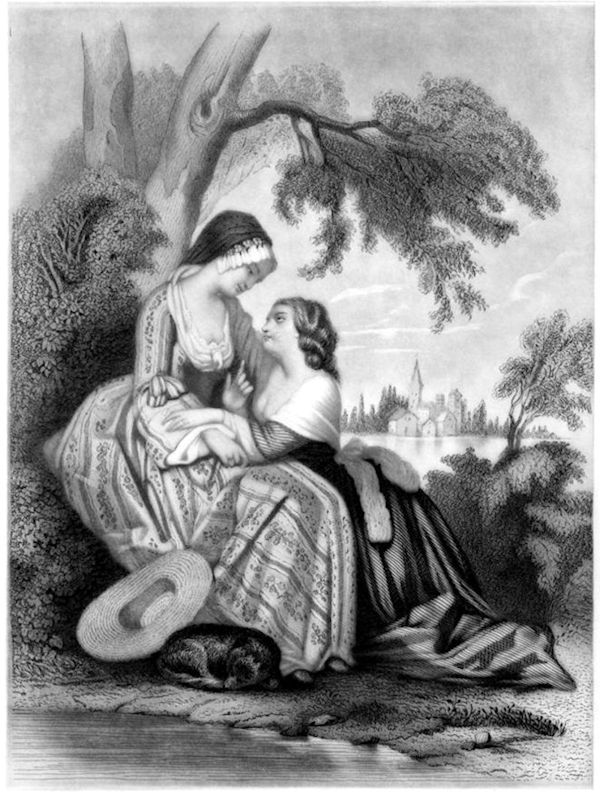
Painted by Compte Calix
THE SISTERS.
Engraved by T. B. Welch expressly for Graham’s Magazine
———
BY ALFRED B. STREET.
———
Two youths approached a torrent in their path;
One soft and fair, one eagle-eyed and strong;
Thoughtful the last, the first all mirth and song.
They saw two bridges o’er the torrent’s wrath;
One a rough tree-trunk from a rugged ledge,
Rugged to reach, uneven to the tread;
The other at their feet, all broadly spread
With flowers and mosses plumped from edge to edge.
On the green platform sprang the first like light,
Still loud in song, but in his midway flight
The green bridge broke, and down to death he fell.
The other, meanwhile, clambered painfully
The steep, and, nerving strong, crossed safe the tree.
Thus in Temptation’s hour, Impulse and Principle.
The death of this eminent poet, after an honorable
and useful life, prolonged to eighty years, will doubtless
provoke a new conflict of opinions regarding the
nature and influence of his great and peculiar mind.
The universal feeling among all lovers of what is
deep, and delicate, and genuine in poetry, must be—
“That there has passed away a glory from the earth;”
and not until literature receives an original impulse
from a nature equally profound and powerful, will it
be called upon to mourn such a departure “from
the sunshine into the Silent Land.” His death was
worthy of an earthly career consecrated by devout
and beautiful meditations to a life beyond life—his
soul, so long the serene guest of his mortal frame,
meekly withdrawing itself at the end to a world not
unfamiliar to his raised vision here.
We confess, at the outset, to an admiration for
Wordsworth’s genius bordering on veneration, but
we trust that we can speak of it without substituting
hyperbole for analysis, without burying the essential
facts of his mental constitution under a load of panegyric.
It appears to us that these facts alone convict
his depreciating critics of malice or ignorance;
that the kind of criticism to which he was originally
subjected, and which even now occasionally
reappears with something of the sting of its
old flippancy, is essentially superficial and untenable,
failing to cover the ground it pretends to occupy, and
disguising nonsense under a garb of shrewdness and
discrimination. The opinion of a man of ability on
subjects which he understands, and on objects he
really discerns, is entitled to respect, and we do not
deny that Jeffrey’s opinions on many important
matters are sound and valuable; but, in relation to
Wordsworth, whom he perversely misunderstood,
he appears presumptuously incompetent and undiscerning
throughout his much vaunted criticisms;
in every case missing the peculiarities which constituted
Wordsworth’s originality, and satirizing
himself in almost every sarcasm he launched at the
poet. The usual defense set up for such a critic is,
that he judges by the rules of common sense; but
every poet who deserves the name is to be judged
by the common sense of the creative imagination,
not by the common sense of the practical understanding;
and thus judged, thus removed from the
jurisdiction of the mere police of letters, we imagine
that Wordsworth will readily assume his place as
the greatest of English poets since Milton.
In claiming for him a position in that line of English
poets which contains no other names than those
of Chaucer, Spenser, Shakspeare, and Milton, we
imply that he is not only great as an individual
writer, but that he is the head and founder of a new
school of poets; that he is the point from which the
future historian of English letters will consider the
poetry of the age; that he introduced into English
literature new elements, whose inspiration has not
yet spent itself, but continues to influence almost
every poet of the day; that
“Thither, as to their fountain, other stars
Repairing, in their golden urns draw light.”
This fact can be chronologically proved. In the
“Lines on Revisiting Tintern Abbey,” written as
far back as 1798, and in which we have the key-note
of Wordsworth’s whole system of viewing nature
and man, we perceive not only a new element
of thought added to English poetry, but an element
which appears afterward in Shelley and Byron—modified,
of course, by their individuality—and still appears,
with decreasing force, in Tennyson and
Browning. Plato and Lord Bacon are not more decidedly
originators of new scientific methods than
Wordsworth is the originator of a new poetical
method. Even if we dislike him, and neglect his
poetry, we cannot emancipate ourselves from his
influence, as long as we are thrilled by the most
magnificent and etherial passages in Shelley and
Byron. We may be offended at the man, but we
cannot escape from his method, unless our reading
of the poets stops with Goldsmith and Cowper.
The vital poems of Wordsworth—those which
are really inspired with his spirit and life, and not
mere accretions attached to his works—form a complete
whole, pervaded by one living soul, and, amid
all their variety of subject, related to one leading
idea—the marriage of the soul of man to the external
universe, whose “spousal hymn” the poet chants.
They constitute together the spiritual body of his
mind, exhibiting it as it grew into beautiful and melodious
form through thirty years of intense contemplation.
To a person who has studied his works
with sufficient care to obtain a conception of the
author’s personality, every little lyric is alive with
his spirit, and is organically connected with the long
narrative and didactive poems. This body of verse
is, we think, a new creation in literature, differing
from others not only in degree but in kind—an organism,
having its own interior laws, growing from
one central principle, and differing from Spenser and
Milton as a swan does from an eagle, or a rose from
a lily.
We need hardly say that the central power and
principle of this organic body of verse is Wordsworth
himself. He is at its heart and circumference,
and through all its veins and arteries, as the vivifying
and organizing force—coloring every thing with his
peculiar individuality, representing man and nature
through the medium of his own original and originating
genius, and creating, as it were, a new world
of forms and beings, idealized from hints given by
the actual appearances of things. This world is
not so various as that of Shakspeare or Scott, nor
so supernatural as that of Milton, but it is still Wordsworth’s
world, a world conceived by himself, and
in which he lived and moved and had his being. A
true criticism of his works, therefore, would be a
biography of his mind, exhibiting the vital processes
of its growth, and indicating the necessary connection
between its gradual interior development and
the imaginative forms in which it was expressed.
This we cannot pretend to do, having neither the
insight nor the materials for such a task, and we shall
be content with attempting a faint outline of his
mental character, with especial reference to those
qualities which dwelt near the heart of his being,
and which seem to have been woven into the texture
of his mind at birth.
Wordsworth was born in April, 1770, of parents
sufficiently rich to give him the advantages of the
usual school and collegiate education of English
youth. He early manifested a love for study, but it
may be inferred that his studies were such as mostly
ministered to the imagination, from the fact that he
displayed, from his earliest years, a passion for
poetry, and never seems to have had a thought of
choosing a profession. At the university of Cambridge
he appears to have studied the classics with
the divining eye and assimilating mind of a poet, and
if he did not attain the first position as a classical
scholar, he certainly drank in beyond all his fellows
the spirit of the great writers of Greece and Rome.
In a mind so observing, studious, thoughtful, imaginative
and steadfast as his, whose power consisted
more in concentration of view than rapidity
of movement, the images of classical poetry must
have been firmly held and lovingly contemplated;
and to his collegiate culture we doubtless owe the
exquisite poems of Dion and Laodamia, the grand
interpretative, uplifting mythological passage in The
Excursion, and the general felicity of his classical
allusions and images throughout his works. He
probably wrote much as well as meditated deeply
at college, but very few of his juvenile pieces have
been preserved, and those which are seem little
more than exercises in expression. On leaving college
he appears to have formed the determination of
educating his poetical faculty by a communion with
the forms of nature, as others study law and theology.
He resided for some time in the west of England,
and at about the age of twenty, made the tour of
France, Italy, Switzerland and Germany, traveling,
like our friend Bayard Taylor, mostly on foot, diving
into forests, lingering by lakes, penetrating into the
cottages of Italian peasants and rude German boors,
and alternating the whole by a residence in the great
European cities. This seems to have occupied
nearly two years of his life; its immediate, but not its
only result, was the publication of his “Descriptive
Sketches in Verse,” indicating accurate observation
rather than shaping imagination, and undistinguished
by any marked peculiarities of thought or diction.
We next hear of him at Bristol, the companion
of Coleridge and Southey, and discussing
with those eager and daring spirits the essential
falsehood of current poetry as a representation of
nature. The sensible conclusion of all three was
this—that the worn-out epithets and images then in
vogue among the rhymers, were meaningless; that
poetry was to be sought in nature and man; and that
the language of poetry was not a tinsel rhetoric, but
an impassioned utterance of thoughts and emotions
awakened by a direct contact of the mind with the
objects it described. Of these propositions, the last
was one of primary importance, and in a mind so
grave, deep and contemplative as Wordsworth’s,
with an instinctive ambition to be one of “Nature’s
Privy Council,” and dive into the secrets of those
visible forms which had ever thrilled his soul with
a vague and aching rapture, the mere critical opinion
passed into a motive and an inspiration.
“The Lyrical Ballads,” published in 1798, and
to which Southey and Coleridge contributed, were
the first poems which indicated Wordsworth’s peculiar
powers and passions, and gave the first hints
of his poetical philosophy, and the first startling
shock to the tastes of the day. They were mostly
written at Allfoxden, near the Bristol Channel, in
one of the deepest solitudes in England, amid woods,
glens, streams, and hills. Here Wordsworth had
retired with his sister; and Coleridge was only five
miles distant at Stowey. Cottle relates some amusing
anecdotes of the ignorance of the country people, in
regard to them, and to poets and lovers of the picturesque
generally. Southey, Coleridge and his wife,
Lamb, and the two Wedgewoods, visited Wordsworth
in his retirement, and the whole company
used to wander about the woods, and by the sea, to
the great wonder of all the honest people they met.
As they were often out at night, it was supposed
they led a dissolute life; and it is said that there are
respectable people in Bristol who believe now that
Mrs. Coleridge and Miss Wordsworth were disreputable
women, from a remembrance of the scandalous
tattle circulating then. Cottle asserts that
Wordsworth was driven from the place by the suspicions
which his habits provoked, being refused a
continuance of his lease of the Allfoxden house by
the ignoramus who had the letting of it, on the ground
that he was a criminal in the disguise of an idler.
One of the villagers said, “that he had seen him
wander about at night and look rather strangely at
the moon! And then he roamed over the hills like
a partridge.” Another testified “he had heard him
mutter, as he walked, in some outlandish brogue,
that nobody could understand.” This last, we suppose,
is the rustic version of the poet’s own statement—
“He murmurs near the running brooks
A music sweeter than their own.”
Others, however, took a different view of his habits,
as little flattering to his morals as the other view to
his sense. One wiseacre remarked confidently, “I
know what he is. We have all met him tramping
away toward the sea. Would any man in his senses
take all that trouble to look at a parcel of water? I
think he carries on a snug business in the smuggling
line, and, in these journeys, is on the lookout for
some wet cargo.” Another, carrying out this bright
idea, added, “I know he has got a private still in his
cellar; for I once passed his house at a little better
than a hundred yards distance, and I could smell
the spirits as plain as an ashen faggot at Christmas.”
But the charge which probably had the most weight
in those times was the last. “I know,” said one,
“that he is surely a desperd French Jacobin; for he
is so silent and dark that no one ever heard him say
one word about politics.” The result of all these
various rumors and scandals was the removal of
Wordsworth from the village. It is curious that,
with such an experience of English country-people,
Wordsworth should never have looked at them
dramatically, and represented them as vulgar and
prejudiced human beings as well as immortal souls.
It proves that humor did not enter at all into the
constitution of his nature; that man interested him
more than men; and that his spiritual affections, connecting
humanity constantly with its divine origin,
shed over the simplest villager a light and atmosphere
not of earth.
While the ludicrous tattle to which we have referred
was sounding all around him, he was meditating
Peter Bell and the Lyrical Ballads, in the
depths of the Allfoxden woods, and consecrating the
rustics who were scandalizing him. The great Poet
of the Poor, who has made the peasant a grander
object of contemplation than the peer, and who saw
through vulgar externals and humble occupations to
the inmost soul of the man, had sufficient provocations
to be the satirist of those he idealized.
In these Lyrical Ballads, and in the poems written
at the same period of their publication, we perceive
both the greatness and the limitations of Wordsworth,
the vital and the mechanical elements in his poetry.
As far as his theory of poetic diction was unimaginative,
as far as its application was willful, it became
a mere matter of the understanding, productive
of little else than shocks to taste and the poetic
sense, and indicating the perversity of a powerful
intellect, pushing preconceived theories to the violation
of ideal laws, rather than the rapt inspiration
of the bard, flooding common words and objects with
new life and divine meanings. It is useless to say
that the passages to which we object would not provoke
a smile if read in the spirit of the author.
They are ludicrous in themselves, and would have
made the author himself laugh had he possessed a
moderate sense of the humorous. But the gravest
objection against them is, that they do not harmonize
with the poems in which they appear—are not
vitally connected with them, but stand as excrescences
plastered on them—and instantly suggest the
theorizer expressing his scorn of an opposite vice of
expression, by deliberately substituting for affected
elegance a simplicity just as full of affectation.
Wordsworth’s true simplicity, the simplicity which
was the natural vehicle of his grand and solemn
thoughts, the simplicity which came from writing
close to the truth of things, and making the word
rise out of the idea conceived like Venus from the
sea, cannot be too much commended; but in respect
to his false simplicity, his simplicity for the sake of
being simple, we can only say that it has given some
point to the sarcasm, “that Chaucer writes like a
child, but Wordsworth childishly.” These objectionable
passages, however, are very few; they
stand apart from his works and apart from what was
essential in him; and they are to be pardoned, as
we pardon the occasional caprices of other great
poets.
Another objection to the Lyrical Ballads, and to
Wordsworth’s poems generally, is an objection
which relates to his noblest creations. He never
appears to have thoroughly realized that other men
were not Wordsworths, and accordingly he not infrequently
violates the law of expression—which we
take to be the expression of a man to others, not the
expression of a man to himself. He speaks, as it
were, too much to his own ear, and having associated
certain words with subtle thoughts and moods peculiar
to himself, he does not seem aware that the
words may not of themselves convey his meaning
to minds differently constituted, and accustomed to
take the expressions at their lexicon value. In this
he differs from Coleridge, whose words and music
have more instantaneous power in evoking the mood
addressed, and thread with more force and certainty
all the mental labyrinths of other minds, and act
with a tingling and inevitable touch on the finest
nerves of spiritual perception. The Ancient Mariner
and Christobel almost create the moods in which
they are to be read, and surprise the reader with a
revelation of the strange and preternatural elements
lying far back in his own consciousness. Wordsworth
has much of this wondrous wizard power, but
it operates with less direct energy, and is not felt in
all its witchery until we have thought into his
mind, become enveloped in its atmosphere, and been
initiated into the “suggestive sorcery” of his language.
Then, it appears to us, he is even more
satisfying than Coleridge, moving, as he does, in the
transcendental region of thought with a calmer and
more assured step, and giving evidence of having
steadily gazed on those spiritual realities which
Coleridge seems to have casually seen by flashes of
lightning. His language consequently is more temperate,
as befits a man observing objects familiar to
his mind by frequent contemplation; but, to common
readers, it would be more effective if it had the suddenness
and startling energy coming from the first
bright vision of supernatural objects. As it is, however,
his style proves that his mind had grown up to
those heights of contemplation to which the mind of
Coleridge only occasionally darted, under the winged
impulses of imagination; and therefore Wordsworth
gives more serene and permanent delight, more
“sober certainty of waking bliss,” than Coleridge,
however much the latter may excel in instantaneousness
of effect.
The originality of the Lyrical Ballads consisted
not so much in an accurate observation of nature as
in an absolute communion with her, and interpretation
of the spirit of her forms. They combine in a
remarkable degree ecstasy with reflection, and are
marvelously refined both in their perception of the life
of nature and the subtle workings of human affections.
Those elusive emotions which flit dimly before ordinary
imaginations and then instantly disappear,
Wordsworth arrests and embodies; and the remotest
shades of feeling and thought, which play on the
vanishing edges of conception, he connects with familiar
objects, and brings home to our common contemplations.
In the sphere of the affections he is
confessedly great. The still, simple, searching pathos
of “We are Seven,” the mysterious, tragic interest
gathered around “The Thorn,” and the evanescent
touch of an elusive mood in “The Anecdote for
Fathers,” indicate a vision into the finest elements
of emotion. The poems entitled, “Expostulation
and Reply,” “The Tables Turned,” “Lines Written
in Early Spring,” “To My Sister,” and several
others, referring to this period of 1798, evince many
of the peculiar qualities of his philosophy, and combine
depth of insight with a most exquisite simplicity
of phrase. The following extracts contain hints of
his whole system of thought, expressing that belief
in the life of nature, and the mode by which that life
is communicated to the mind, which reappear,
variously modified, throughout his writings:
Nor less I deem that there are Powers
Which of themselves our minds impress;
That we can feel this mind of ours
Is a wise passiveness.
——
And hark! how blithe the throstle sings!
He, too, is no mean preacher:
Come forth into the light of things,
Let nature be your teacher.
She has a world of ready wealth,
Our minds and hearts to bless—
Spontaneous wisdom breathed by health,
Truth breathed by cheerfulness.
One impulse from a vernal wood
May teach you more of man,
Of moral evil and of good
Than all the sages can.
Sweet is the lore which Nature brings;
Our meddling intellect
Misshapes the beauteous forms of things—
We murder to dissect.
Enough of Science and of Art;
Close up those barren leaves;
Come forth and bring with you a heart
That watches and receives.
——
I heard a thousand blended notes,
While in a grove I sat reclined,
In that sweet mood when pleasant thoughts
Bring sad thoughts to the mind.
——
Through primrose tufts in that sweet bower,
The periwinkle trailed its wreaths;
And ’tis my faith that every flower
Enjoys the air it breathes.
——
There is a blessing in the air
Which seems a sense of joy to yield
To the bare trees, and mountains bare,
And grass in the green field.
——
One moment now may give us more
Than years of toiling reason:
Our minds shall drink at every pore
The spirit of the season.
Some silent laws our hearts will wake,
Which they shall long obey:
We for the year to come may take
Our temper from to-day.
But the most remarkable poem written at this
period of Wordsworth’s life, is that on Tintern
Abbey, “Lines Composed on Revisiting the Banks
of the Wye.” We have here that spiritualization of
nature, that mysterious sense of the Being pervading
the whole universe of matter and mind, that feeling
of the vital connection between all the various forms
and kinds of creation, and that marriage of the soul
of man with the visible universe, which constitute
the depth and the charm of Wordsworth’s “divine
philosophy.” After describing the landscape which
he now revisits, he proceeds to develop the influence
it has exerted on his spirit:
These beauteous forms,
Through a long absence, have not been to me,
As is a landscape to a blind man’s eye:
But oft in lonely rooms, and ’mid the din
Of towns and cities, I have owed to them,
In hours of weariness, sensations sweet,
Felt in the blood, and felt along the heart,
And passing even into my purer mind
With tranquil restoration; feelings, too,
Of unremembered pleasure; such, perhaps,
As have no slight and trivial influence
On that best portion of a good man’s life,
His little nameless, unremembered acts
Of kindness and of love. Nor less, I trust,
To them I may have owed another gift
Of aspect more sublime; that blessed mood,
In which the burthen of the mystery,
In which the heavy and the weary weight
Of all this unintelligible world,
Is lightened; that serene and blessed mood,
In which the affections gently lead us on,
Until the breath of this corporeal frame,
And even the motion of our human blood
Almost suspended, we are laid asleep
In body, and become a living soul;
While with an eye made quiet by the power
Of harmony, and the deep power of joy,
We see into the life of things.
He then proceeds to describe the passionate fascination
which nature exerted over his youth, and the
change which had come over him by a deeper and
more thoughtful communion with her spirit. When
we consider that Wordsworth, at this time, was
only twenty-eight, and that even the motions described
in the first part of our extract had no existence
in contemporary poetry, we can form some idea
of his giant leap in advance of his age, as indicated
by the unspeakable beauty and novelty of the concluding
portion. Our readers will notice that although
the style becomes almost transfigured by the intense
and brooding imagination which permeates it, the
diction is still as simple as prose:
I cannot paint
What then I was. The sounding cataract
Haunted me like a passion; the tall rock,
The mountain, and the deep and gloomy wood,
Their colors and their forms, were then to me
An appetite, a feeling, and a love,
That had no need of a remoter charm,
By thought supplied, nor any interest
Unborrowed from the eye. That time is past,
And all its aching joys are now no more,
And all its dizzy raptures. Not for this
Faint I, nor mourn, nor murmur; other gifts
Have followed; for such loss, I would believe,
Abundant recompense. For I have learned
To look on nature, not as in the hour
Of thoughtless youth; but hearing oftentimes
The still, sad music of humanity,
Nor harsh nor grating, though of ample power
To chasten and subdue. And I have felt
A presence that disturbs me with the joy
Of elevated thoughts; a sense sublime
Of something still more deeply interfused,
Whose dwelling is the light of setting suns,
And the round ocean and the living air,
And the blue sky, and in the mind of man;
A motion and a spirit, that impels
All living things, all objects of all thought,
And rolls through all things. Therefore am I still
A lover of the meadows and the woods,
And mountains; and of all that we behold
From this green earth; of all the mighty world
Of eye and ear—both what they half create
And what perceive; well pleased to recognize
In nature and the language of the sense,
The anchor of my purest thoughts, the muse,
The guide, the guardian of my heart, and soul
Of all my moral being.
It is this “sense sublime of something still more
deeply interfused,” that gives to a well-known passage
in the concluding portion of the poem its particular
significance:
Nature never did betray
The heart that loved her; ’tis her privilege,
Through all the years of this our life, to lead
From joy to joy; for she can so inform
The mind that is within us, so impress
With quietness and beauty, and so feed
With lofty thoughts, that neither evil tongues,
Rash judgments, nor the sneers of selfish men,
Nor greetings where no kindness is, nor all
The dreary intercourse of daily life,
Shall e’er prevail against us, or disturb
Our cheerful faith, that all which we behold
Is full of blessings.
In Wordsworth’s use of the word nature, it must
always be borne in mind that he means, to use his
own phrase,
The Original of human art,
Heaven-prompted Nature.
This poem enables us to understand the process
by which so peculiar a nature as Wordsworth’s
grew up into its spiritual stature. It was by placing
his mind in direct contact with natural objects,
passively receiving their impressions in the still
hours of contemplation, and bringing his own soul
into such sweet relations to the soul of nature as to
“see into the life of things;” or, as he expresses it,
in another connection, “his soul had sight” of those
spiritual realities, of which visible forms and hues are
but the embodiment and symbolical language. Nature
to him was therefore always alive, spiritually
as well as visibly existing; and he felt the correspondence
between his own life and her life, from
perceiving that one spirit penetrated both. Not only
did he perceive this, but he mastered the secret
alphabet by which man converses with nature, and
to his soul she spoke an audible language. Indeed,
his mind’s ear was even more acute than his mind’s
eye; and no poet has excelled him in the subtle
perception of the most remote relations of tone.
Often, when he is on the peaks of spiritual contemplation,
he hears voices when he cannot see shapes,
and mutters mystically of his whereabouts in words
which suggest rather than embody meaning. He
grew in spiritual strength and height by assimilating
the life of nature, as bodies grow by assimilating
her grosser elements; and this process was little disturbed
by communion with other minds, either
through books or society. He took nothing at second-hand;
and his nature is therefore not the nature of
Homer, or Dante, or Shakspeare, or Milton, or Scott,
but essentially the nature of Wordsworth, the nature
which he saw with his own eyes, and shaped with
his own imagination. His humanity sprung from
this insight, for not until he became impressed with
the spirit of nature, and divined its perfect adaptation
to nourish and elevate the human mind, did he perceive
the worth and dignity of man. Then simple
humanity assumed in his mind a mysterious grandeur,
and humble life was spiritualized by his consecrating
and affectionate imagination. He might
then say, with something of a proud content,
The moving accident is not my trade;
To freeze the blood I have no ready arts;
’Tis my delight alone in summer shade,
To pipe a simple song for thinking hearts.
The passages in which this thoughtful humanity
and far-sighted spiritual vision appear in beautiful
union, are too numerous for quotation, or even for
reference. We will give but two, and extract them
as hints of his spiritual biography and the growth of
his mind:
Love he had found in huts where poor men lie;
His daily teachers had been woods and rills,
The silence that is in the starry sky,
The sleep that is among the lonely hills.
—-
But who is He with modest looks,
And clad in homely russet brown?
He murmurs near the running brooks
A music sweeter than their own.
He is retired as noontide dew,
Or fountain in a noonday grove;
And you must love him, ’ere to you
He will seem worthy of your love.
The outward shows of sky and earth,
Of hill and valley, he had viewed;
And impulses of deeper birth
Had come to him in solitude.
In common things that round us lie
Some random truths he can impart—
The harvest of a quiet eye
That sleeps and broods on his own heart.
We shall give but one more extract; illustrative
of the moral wisdom which the poetic recluse had
drank in from Nature, and incorporated with his own
character. It was written at the age of twenty-five:
If thou be one whose heart the holy forms
Of young imagination have kept pure,
Stranger! henceforth be warned; and know that pride,
Howe’er disguised in its own majesty,
Is littleness; that he who feels contempt
For any living thing, hath faculties
Which he has never used; that thought with him
Is in its infancy. The man whose eye
Is ever on himself doth look on one,
The least of Nature’s works, one who might move
The wise man to that scorn which wisdom holds
Unlawful, ever. O be wiser, Thou!
Instructed that true knowledge leads to love;
True dignity abides with him alone
Who, in the silent hour of inward thought,
Can still suspect, and still revere himself,
In lowliness of heart.
We have dwelt thus long on Wordsworth’s first
characteristic publication, because it expresses so
well the nature of his own mind, and because it
gave an original impulse to poetical literature. These
Lyrical Ballads were published in the summer of
1798, and though they attracted no general attention
corresponding to their original merit, they exercised
great influence upon all the young minds who were
afterward to influence the age. In September, 1798,
in company with Coleridge, he visited Germany,
and on his return he settled at Grasmere, in Westmoreland;
a spot so well known to all readers of his
poetry, and where he continued to reside for fifteen
years. In 1803 he married a Miss Mary Hutchinson,
of Penrith. Neither was wealthy, their joint
income being but £100 a year. Of his wife we
know little, except that she was of small stature and
gentle manners, and was loved by her husband with
that still, deep devotion characteristic of his affections.
He refers to her, in a poem written in his old
age, as
She who dwells with me, whom I have loved
With such communion, that no place on earth
Can ever be a solitude to me.
Between 1803 and 1807, when a second volume
of Lyrical Ballads was published, he wrote many of
the most beautiful and sublime poems in his whole
works. To this period belong “The Memorials of
a Tour in Scotland,” (1803,) containing “The Solitary
Reaper,” “The Highland Girl,” “Ellen Irwin,”
“Rob Roy’s Grave,” and other exquisite and glowing
impersonations—his grand sonnets dedicated to
“National Independence and Liberty”—“The Horn
of Egremont Castle,” “Heart-Leap Well,” “Character
of a Happy Warrior,” “A Poet’s Epitaph,”
“Vandracour and Julia,” the “Ode to Duty,” and,
above all, the sublime “Ode on the Intimations of
Immortality from the Recollections of Childhood,”
which appears not to have been struck off at one
beat, but to have been composed at various periods
between the years 1803 and 1806.
There are no events, in the common acceptation
of the term, in Wordsworth’s life after the period of
his marriage, except the publication of his various
works, and the pertinacious war waged against them
by the influential critics. Though his means were
at first limited, he soon, through the friendship of
the Earl of Lonsdale, received the appointment of
Distributor of Stamps for the counties of Westmoreland
and Cumberland, a sinecure office, the duties
of which were done by clerks, but which seems to
have given him an income sufficient for his wants.
In 1809 he published a prose work on the “Convention
of Cintra,” which, though designed as a popular
appeal in favor of the oppressed Spaniards, was little
read at the time, and is now forgotten. Southey,
whose mind was on fire with sympathy for the
Spanish cause, says of this pamphlet, in a letter to
Scott—“Wordsworth’s pamphlet will fail of producing
any general effect, because the sentences are
long and involved; and his friend, De Quincey, who
corrected the press, has rendered them more obscure
by an unsound system of punctuation. This fault
will outweigh all its merits. The public never can
like any thing which they feel it difficult to understand.
. . . I impute Wordsworth’s want of perspicuity
to two causes—his admiration of Milton’s
prose, and his habit of dictating instead of writing:
if he were his own scribe his eye would tell him
where to stop.”
But the great work to which Wordsworth was
devoting the best years of his life, was his long philosophical
poem of “The Recluse,” designed to
give an account of the growth of his own mind, and
to develop all the peculiarities, poetical, ethical and
religious, of his system of thought. A large portion
of this remains unpublished, but the second part was
issued in quarto, in 1814, under the title of “The
Excursion,” and was immediately lighted upon by
all the wit-snappers and critics of the old school, and
mercilessly “probed, vexed and criticised.” Jeffrey,
who began his celebrated review of it in the Edinburgh
with the sentence, “This will never do,”
was successful in ridiculing some of its weak points,
but made the mistake of stigmatizing its sublimest
passages as “unintelligible ravings.” The choice
of a pedler as the hero of a philosophical poem,
though it was based on facts coming within the
author’s knowledge, was a violation of ideal laws,
because it had not sufficient general truth to justify
the selection. A pedler may be a poet, moralist and
metaphysician, but such examples are for biography
rather than poetry, and indicate singularity more
than originality in the poet who chooses them.
Allowing for this error, substracting some puerile
lines, and protesting against the tendency to diffusion
in the style, “The Excursion” still remains as
a noble work, rich in description, in narrative, in
sentiment, fancy and imagination, and replete with
some of the highest and rarest attributes of poetry.
To one who has been an attentive reader of it, grand
and inspiring passages crowd into the memory at
the mere mention of its title. It is, more perhaps
than any other of Wordsworth’s works, enveloped
in the atmosphere of his soul, and vital with his individual
life; and in all sympathetic minds, in all
minds formed to feel its solemn thoughts and holy
raptures, it feeds
“A calm, a beautiful, and silent fire.”
“The Excursion” was followed, in 1815, by the
“White Doe of Rylstone,” a narrative poem, which
Jeffrey said deserved the distinction of being the
worst poem ever printed in a quarto volume, and
which appears to us one of the very best. We do
not believe the “White Doe” is much read, and its
exceeding beauty, subtle grace, and profound significance,
are not perceived in a hasty perusal. It is
instinct with the most refined and ethereal imagination,
and could have risen from the depths of no
mind in which moral beauty had not been organized
into moral character. Its tenderness, tempered by
“thoughts whose sternness makes them sweet,”
pierces into the very core of the heart. The purpose
of the poem is to exhibit suffering as a purifier
of character, and the ministry of sympathies,
“Aloft ascending, and descending quite
Even unto inferior kinds,”
in allaying suffering; and this is done by a story
sufficiently interesting of itself to engage the attention,
apart from its indwelling soul of holiness. In
the representation of the Nortons we have the best
specimens of Wordsworth’s power of characterization,
a power in which he is generally deficient, but
which he here exhibits with almost dramatic force
and objectiveness.
“Peter Bell” and “The Wagoner,” which appeared
in 1819, were executed in a spirit very different
from that which animates the “White Doe.”
They were originally written to illustrate a system,
and seem to have been published, at this period, to
furnish the enemies of Wordsworth some plausible
excuse for attacking his growing reputation. “Peter
Bell” was conceived and composed as far back as
1798, and though it exhibits much power and refinement
of imagination, the treatment of the story is
essentially ludicrous. But still it contains passages
of description which are eminently Wordsworthian,
and which the most accomplished of Wordsworth’s
defamers never equaled. With what depth, delicacy,
sweetness and simplicity are the following verses,
for instance, conceived and expressed:
He roved among the vales and streams,
In the green wood and hollow dell;
They were his dwellings night and day,—
But nature ne’er could find the way
Into the heart of Peter Bell.
In vain, through every changeful year,
Did Nature lead him as before;
A primrose by the river’s brim
A yellow primrose was to him,
And it was nothing more.
——
At noon, when by the forest’s edge
He lay beneath the branches high,
The soft blue sky did never melt
Into his heart; he never felt
The witchery of the soft blue sky.
On a fair prospect some have looked
And felt, as I have heard them say,
As if the moving time had been
A thing as steadfast as the scene
On which they gazed themselves away.
——
There was a hardness in his cheek,
There was a hardness in his eye,
As if the man had fixed his face,
In many a solitary place,
Against the wind and open sky.
“The Wagoner,” is altogether unworthy of
Wordsworth’s genius. It is an attempt of a poet
without humor to be gay and jocular, and very dismal
gayety it is. But even this poem is not to be
dismissed without a reference to its one exquisite
passage—that in which he describes the obligation
upon him to write it:
Nor is it I who play the part,
But a shy spirit in my heart,
That comes and goes—will sometimes leap
From hiding-places ten year’s deep;
Or haunts me with familiar face,
Returning, like a ghost unlaid,
Until the debt I owe be paid.
The next volume of Wordsworth was a series of
sonnets, under the general title of “The River Duddon,”
published in 1820, and singularly pure in style
and fresh in conception. This was followed, in 1821,
by “Itinerary Sonnets,” chronicling a journey to
the Continent; “Ecclesiastical Sonnets,” in 1822,
celebrating events and characters in the history of
the English church; and “Yarrow Revisited, and
other Poems,” in 1834. In old age he still preserved
his young love for nature, and lost none of his power
of interpreting her teachings. In a poem entitled
“Devotional Incitements,” written at the age of
sixty-two, and distinguished for the delicate keenness
of its insight, no less than its lyric rapture, it
will be perceived that natural objects were still
visible and audible to his heart and imagination.
“Where,” he exclaims,
Where will they stop, those breathing powers,
The spirits of the new-born flowers?
They wander with the breeze, they wind
Where’er the streams a passage find;
Up from their native ground they rise
In mute aërial harmonies;
From humble violet—modest thyme—
Exhaled, the essential odors climb,
As if no space below the sky
Their subtle flight could satisfy:
Heaven will not tax our thoughts with pride—
If like ambition be their guide.
Roused by the kindliest of May-showers,
The spirit quickener of the flowers,
That with moist virtue softly cleaves
The buds, and freshens the young leaves,
The birds pour forth their souls in notes
Of rapture from a thousand throats—
Here checked by too impetuous haste,
While there the music runs to waste,
With bounty more and more enlarged
Till the whole air is overcharged.
Give ear, O man, to their appeal,
And thirst for no inferior zeal,
Thou, who canst think as well as feel.
——
Alas! the sanctities combined
By art to unsensualize the mind,
Decay and languish; or, as creeds
And humors change, are spurned like weeds:
And priests are from their altars thrust;
Temples are leveled with the dust;
And solemn rites and awful forms
Founder amid fanatic storms,
Yet evermore, through years renewed
In undisturbed vicissitude,
Of seasons balancing their flight
On the swift wings of day and night,
Kind Nature keeps a heavenly door
Wide open for the scattered Poor,
Where flower-breathed incense to the skies
Is wafted in mute harmonies;
And ground fresh cloven by the plough
Is fragrant with a humbler vow;
Where birds and brooks from leafy dells
Chime forth unwearied canticles,
And vapors magnify and spread
The glory of the sun’s bright head—
Still constant in her worship, still
Conforming to the eternal Will,
Whether men sow or reap the fields
Divine monition Nature yields,
That not by bread alone we live,
Or what a hand of flesh can give;
That every day should leave some part
Free for a sabbath of the heart.
On the death of Southey, Wordsworth was appointed
Poet Laureate. The latter years of his life
were passed in undisturbed serenity, and he appears
to have retained his faculties to the last. His old
age, like his youth and mature manhood, illustrated
the truth of his poetic teachings, and proves that
poetry had taught him the true theory of life. One
cannot contemplate him during the last ten years
of his existence, without being forcibly impressed
with his own doctrine regarding the lover of nature:
Thy thoughts and feelings shall not die,
Nor leave thee when old age is nigh
A melancholy slave;
But an old age serene and bright,
And lovely as a Lapland night,
Shall lead thee to thy grave.
The predominating characteristic of Wordsworth’s
poetry is thoughtfulness, a thoughtfulness in which
every faculty of his mind and every disposition of
his heart meet and mingle; and the result is an atmosphere
of thought, giving a softening charm to all the
objects it surrounds and permeates. This atmosphere
is sometimes sparklingly clear, as if the airs and
dews and sunshine of a May morning had found a
home in his imagination; but, in his philosophical
poems, where he penetrates into a region of thought
above the ken of ordinary mortals, this atmosphere
is touched by an ideal radiance which slightly obscures
as well as consecrates the objects seen through
it, and occasionally it thickens into mystical obscurity.
No person can thoroughly enjoy Wordsworth
who does not feel the subtle spirit of this atmosphere
of thought, as it communicates an air of freshness
and originality even to the commonplaces of his
thinking, and apparels his loftier conceptions in
celestial light—
“The gleam,
The light that never was on sea or land,
The consecration and the poet’s dream.”
The first and grandest exercise, therefore, of his
imagination is the creation of this harmonizing atmosphere,
enveloping as it does the world of his creation
with that peculiar light and air, indescribable
but unmistakable, which enable us at once to recognize
and to class a poem by Wordsworth. We do
not hesitate to say that, in its peculiarity, there is
nothing identical with it in literature—that it constitutes
an absolutely new kind of poetry, in the
Platonic sense of the word kind. An imagination
which thus fuse all the faculties and emotions
into one individuality, so that all the vital products
of that individuality are characterized by unity of
effect, is an imagination of the highest kind. The
next question to be considered is the variety which
this unity includes; for Shakspeare himself, the most
comprehensively creative of human beings, never
goes beyond the unity of his individuality, his multifarious
variety always answering to the breadth of
his personality. He is like the banyan tree in the
marvelous fertility of his creativeness, and the province
of humanity he covers; but the fertility all
comes from one root and trunk, and indicates simply
the greatness of the kind, as compared with other
kinds of trees. The variety in the operation of
Wordsworth’s imagination we will consider first in
its emotional, and second in its intellectual, manifestation—of
course, using these words as terms of
distinction, not of division, because when we employ
the word imagination we desire to imply a
fusion of the whole nature of the man into one living
power. In the emotional operation of Wordsworth’s
imagination we discern his Sentiment. No term
has been more misused than this, its common acceptation
being a weak affectionateness; and, at
best, it is considered as an instinct of the sensibility,
as a simple, indivisible element of humanity. The
truth is that sentiment is a complex thing, the issue
of sensibility and imagination; and without imagination
sentiment is impossible. We often meet excellent
and intelligent people, whose affections are
warm, whose judgments are accurate, and whose
lives are irreproachable, but who lack in their religion,
morality and affections an elusive something
which is felt to be the grace of character. The
solution of the problem is found in their want of
sentiment—in their want of that attribute by which
past scenes and events, and absent faces, and remote
spiritual realities, affect the mind like objects which
are visibly present. Now, without this Sentiment
no man can be a poet, either in feeling or faculty;
and Wordsworth has it in a transcendent degree.
In him it is revealed, not only in his idealizing
whatever in nature or life had passed into his
memory, but in his religious feeling and in his creative
art. Scenes which he had viewed years before,
he tells us, still
Flash upon that inward eye,
Which is the bliss of solitude.
Thus Sentiment is that operation of imagination
which recalls, in a more vivid light, things absent
from the bodily eye, and makes them act upon the
will with more force and inspiration than they originally
exerted in their first passionate or thoughtful
perception; and from its power of extracting the
essence and heightening the beauty of what has
passed away from the senses and passed into memory,
it gives the impulse which sends the creative
imagination far beyond the boundaries of actual life
into the regions of the ideal, to see what is most
beautiful here
—Imaged there
In happier beauty; more pellucid streams,
An ampler ether, a diviner air,
And fields invested with purpureal gleams,
Climes, which the sun, who sheds the brightest day
Earth knows, is all unworthy to survey.
It is needless to adduce passages to prove the depth
and delicacy of Wordsworth’s sentiment, sanctifying
as it does natural objects and the humblest life, and
lending to his religious faith a mysterious, ineffable
beauty and holiness. In our view of the quality it
must necessarily be the limitation of a poet’s creativeness,
for the imagination cannot represent or
create objects to which it does not tend by a sentiment;
and Wordsworth, while he has a sentiment
for visible nature, a religious sentiment, a sentiment
of humanity, is still confined to the serious side of
things, and has no sentiment of humor. If he had
humor as a sentiment, he, dowered as he is with
imagination, would have it as a creative faculty, for
humor is the intellectual imagination inspired by the
sentiment of mirth.
Let us now survey the power and scope of Wordsworth’s
imagination, considered in its intellectual
manifestation. Here nothing bounds its activity but
its sentiments. It is descriptive, pictorial, reflective,
shaping, creative, and ecstatic; it can body forth abstract
ideas in sensible imagery; it can organize, as
in “The White Doe,” a whole poem round one
central idea; it can make audible in the melody of
words, shades of feeling and thought which elude
the grasp of imagery; it can fuse and diffuse itself
at pleasure, animating, coloring, vitalizing every
thing it touches. In description it approaches near
absolute perfection, giving not only the scene as it
lies upon the clear mirror of the perceptive imagination,
but representing it in its life and motion as
well as form. The following, from “The Night
Piece,” is one out of a multitude of instances:
He looks up—the clouds are split
Asunder—and above his head he sees
The clear Moon, and the glory of the heavens.
There, in a black blue vault she sails along,
Followed by multitudes of stars, that, small
And sharp, and bright, along the dark abyss
Drive as she drives.
In the description of the appearance of the White
Doe, we have not only form, hue and motion, but
the feeling of wonder that the fair creature excites,
and the rhythm which musically expresses the supernatural
character of the visitant—all embodied in
one vivid picture:
The only voice that you can hear
Is the river murmuring near.
—When soft!—the dusky trees between,
And down the path through the open green,
Where is no living thing to be seen;
And through yon gateway, where is found,
Beneath the arch with ivy bound,
Free entrance to the church-yard ground—
Comes gliding in with lovely gleam,
Comes gliding in serene and slow,
Soft and silent as a dream,
A solitary Doe!
White she is as lily of June,
And beauteous as the silver moon
When out of sight the clouds are driven
And she is left alone in heaven;
Or like a ship, some gentle day,
In sunshine sailing far away,
A glittering ship that hath the plain
Or ocean for her own domain.
In the following we have a mental description, so
subtle and so sweet as to make “the sense of satisfaction
ache” with its felicity:
And she has smiles to earth unknown,
Smiles that, with motion of their own,
Do spread and sink and rise;
That come and go, with endless play,
And ever as they pass away,
Are hidden in her eyes.
This is from the little poem to “Louisa.” It is
curious that Wordsworth, in the octavo edition of
his works, published when he was seventy-seven
years old, omits this stanza. It was so refined that
he had probably lost the power to perceive its delicate
beauty, and dismissed it as meaningless.
In describing nature as connected with, and embodied
in, human thoughts and sentiments, Wordsworth’s
descriptive power rises with the complexity
of the theme. Thus, in the poem of Ruth, we have
an example of the perversion of her energizing
power:
The wind, the tempest roaring high,
The tumult of a tropic sky,
Might well be dangerous food
For him, a youth to whom was given
So much of earth—so much of heaven,
And such impetuous blood.
Whatever in those climes he found
Irregular in sight or sound,
Did to his mind impart
A kindred impulse, seemed allied
To his own powers, and justified
The workings of his heart.
Nor less, to feed voluptuous thought,
The beauteous forms of nature wrought,
Fair trees and gorgeous flowers;
The breezes their own languor lent;
The stars had feelings, which they sent
Into those favored bowers.
In another poem, we have an opposite and purer
representation of nature’s vital work, in an ideal impersonation
which has nothing like it in the language:
Three years she grew in sun and shower,
Then Nature said, a lovelier flower
On earth was never sown;
This child I to myself will take;
She shall be mine, and I will make
A lady of my own.
Myself will to my darling be
Both law and impulse; and with me
The girl in rock and plain,
In earth and heaven, in glade and bower,
Shall feel an overseeing power
To kindle or restrain.
She shall be sportive as the fawn,
That wild with glee across the lawn,
Or up the mountain springs;
And hers shall be the breathing balm,
And hers the silence and the calm
Of mute insensate things.
The floating clouds their state shall lend
To her; for her the willow bend;
Nor shall she fail to see
Even in the motions of the Storm,
Grace that shall mould the maiden’s form
By silent sympathy.
The stars of midnight shall be dear
To her; and she shall lean her ear
In many a secret place
Where rivulets dance their wayward round,
And beauty born of murmuring sound
Shall pass into her face.
But the most common exercise of Wordsworth’s
imagination is what we may call its meditative action—its
still, calm, searching insight into spiritual
truth, and into the spirit of nature. In these, analysis
and reflection become imaginative, and the “more
than reasoning mind” of the poet overleaps the boundaries
of positive knowledge, and, steadying itself
on the vanishing points of human intelligence, scans
the “life of things.” In the poems in which meditation
predominates, there is a beautiful union of
tender feeling with austere principles, and this austerity
prevents his tenderness from ever becoming
morbid. As his meditative poems more especially
relate to practice, and contain his theory of life, they
grow upon a studious reader’s mind with each new
perusal. In them the Christian virtues and graces
are represented in something of their celestial beauty
and power, and the poet’s “vision and faculty divine”
are tasked to the utmost in giving them vivid
and melodious expression. He is not, in this meditative
mood, a mere moralizing dreamer, a vague
and puerile rhapsodist, as some have maliciously
asserted, but a true poetic philosopher, whose
wisdom is alive with the throbs of holy passion,
and
Beauty—a living Presence of the earth—
Surpassing the most fair ideal Forms
Which craft of delicate spirits hath composed
From earth’s materials—waits upon his steps;
Pitches her tents before him as he moves,
An hourly neighbor.
But though these poems are essentially meditative
in spirit, they are continually verging on two forms
of the highest poetic expression, abstract imagination
and ecstasy; and the clear, serene, intense
vision which is their ordinary characteristic, is the
appropriate mood out of which such forms of imagination
naturally proceed. Let us first give a
specimen of the creativeness of his imagination in
its calmly contemplative mood, and we will select
one of his many hundred sonnets.
Tranquillity! the sovereign aim wert thou
In heathen schools of philosophic lore;
Heart-stricken by stern destiny of yore
The Tragic Muse thee served with thoughtful vow;
And what of hope Elysium could allow
Was fondly seized by Sculpture to restore
Peace to the Mourner. But when He who wore
The crown of thorns around his bleeding brow
Warmed our sad being with celestial light,
Then Arts, which still had drawn a softening grace
From shadowy fountains of the Infinite,
Communed with that Idea face to face:
And move around it now as planets run,
Each in its orbit round the central sun.
We will not stop to comment on the wealth of
thought contained in this sonnet, or the lingering
suggestiveness of that wonderful line—
“Warmed our sad being with celestial light,”
but proceed to give another example, fragrant with
the deepest spirit of meditation:
More sweet than odors caught by him who sails
Near spicy shores of Araby the blest,
A thousand times more exquisitely sweet,
The freight of holy feeling which we meet
In thoughtful moments, wafted by the gales
From fields where good men walk, and bowers wherein they rest.
The following sonnet may be commended to warriors
and statesmen, as containing a wisdom as practical
in its application as it is lofty in its conception:
I grieved for Bonaparté with a vain
And an unthinking grief! The tenderest mood
Of that man’s mind—what can it be? What food
Fed his first hopes? What knowledge could he gain?
’Tis not in battles that from youth we train
The Governor who must be wise and good,
And temper with the sternness of the brain
Thoughts motherly and meek as womanhood.
Wisdom doth live with children round her knees;
Books, leisure, perfect freedom, and the talk
Man holds with week-day man in the hourly walk
Of the mind’s business; these are the degrees
By which true sway doth mount; this is the stalk
True Power doth grow on; and her rights are these.
We will now extract a magnificent example of
abstract imagination, growing out of the meditative
imagination, and penetrated by it. It is the “Thought
of a Briton on the Subjugation of Switzerland;” the
“two voices” are England and Switzerland.
Two Voices are there; one is of the sea,
One of the mountains; each a mighty Voice:
In both from age to age thou didst rejoice,
They were thy chosen music; Liberty!
There came a Tyrant, and with holy glee
Thou fought’st against him; but hast vainly striven:
Thou, from thy Alpine holds at length art driven,
Where not a torrent murmurs, heard by thee.
Of one deep bliss thine ear hath been bereft:
Then cleave, O cleave to that which still is left;
For, high-souled Maid, what sorrow would it be
That mountain Floods should thunder as before,
And Ocean bellow from his rocky shore,
And neither awful Voice be heard by thee!
Of the ecstatic movement of Wordsworth’s imagination,
we might extract numberless instances, rushing
up, as it does, from the level of his meditations,
throughout his poetry. Take the following, from
the “Ode to Duty”:
Stern Law-giver! yet thou dost wear
The Godhead’s most benignant grace;
Nor know we any thing so fair
As is the smile upon thy face;
Flowers laugh before thee on their beds,
And fragrance in thy footing treads;
Thou dost preserve the stars from wrong;
And the most ancient heavens through thee are fresh and strong.
In a descriptive poem called “The Gipsies,” there
is a very striking instance of rapture immediately
succeeding calmness:
The weary sun betook himself to rest;
Then issued Vesper from the fulgent west,
Outshining like a visible God
The glorious path in which he trod.
Again, observe how the imagination kindles and
melts into rapturous idealization, and impetuously
deifies the object of its sentiment, in the following
short reference to the death of Coleridge:
Nor has the rolling year twice measured,
From sign to sign, its steadfast course,
Since every mortal power of Coleridge
Was frozen at its marvelous source;
The ’rapt One of the godlike forehead,
The heaven-eyed creature.
In the sonnet which we now extract we have a
specimen of that still ecstasy, so calm and so intense,
in which Wordsworth stands almost alone among
modern poets:
A fairer face of evening cannot be;
The holy time is quiet as a nun
Breathless with adoration; the broad sun
Is sinking down in its tranquillity;
The gentleness of heaven broods o’er the sea:
Listen! the mighty being is awake,
And doth with his eternal motion make
A sound like thunder—everlastingly.
Dear child! dear girl! that walkest with me here,
If thou appear’st untouched by solemn thought,
Thy nature is not therefore less divine:
Thou liest in Abraham’s bosom all the year;
And worship’st at the temple’s inner shrine,
God being with thee when we know it not.
It is, however, in the sublime “Ode on the Intimations
of Immortality from the Recollections of
Childhood,” that we best perceive the power of
Wordsworth’s imagination in all the various modes
of its expression—descriptive, analytic, meditative,
interpretative, abstract and ecstatic; and in this ode
each of these modes helps the other; the grand choral
harmonies of the rapturous upward movement
seeming to be born out of the intense contemplation,
that hovers dizzily over the outmost bounds of human
conception, to scrutinize, in the dim dawn of
consciousness,
—those first affections,
Those shadowy recollections,
Which be they what they may,
Are yet the fountain light of all our day,
Are yet a master light of all our seeing.
It is from these that we have ecstasy almost as a
logical conclusion; for
Hence in a season of calm weather,
Though inland far we be,
Our souls have sight of that immortal sea
Which brought us hither,
Can in a moment travel thither,
And see the children sport upon the shore,
And hear the mighty waters rolling evermore.
We have no space to particularize the felicity of
Wordsworth’s muse in dealing with the affections,
or the depth and power of his pathos. Before
leaving the subject of his genius, however, we cannot
withhold a reference to his “Ode on the Power
of Sound,” which appears to be little known even
to readers of the poet, though in the thronging
abundance of its ideas and images, in the exquisite
variety of its music, and in the soul of imagination
which animates it throughout, it yields the palm to
no ode in the language.
Wordsworth is most assuredly not a popular poet
in the sense in which Moore and Byron are popular;
and he probably never will be so among those readers
who do not distinguish between being passionate
and being impassioned, and who prefer the strength
of convulsion to the strength of repose; readers who
will attend only to what stirs and startles the sensibility,
who read poetry not for its nourishing but its
inflaming qualities, and who look upon poetic fire as
properly consuming the mind it animates. Wordsworth
is not for them, except they go to him as a
spiritual physician, in search of “balm for hurt
minds.” Placed in a period of time when great
passions in the heart generated monstrous paradoxes
in the brain, he clung to those simple but essential
elements of human nature on which true power and
true elevation must rest; and, while all around him
sounded the whine of sentimentality and the hiss
of Satanic pride, his mission, like that of his own
beautiful blue streamlet, the Duddon, was “to heal
and cleanse, not madden and pollute.” His rich
and radiant imagination cast its consecrating and
protecting light on all those dear immunities of humanity,
which others were seeking to discard for
the delusions of haughty error, or the fancies of ripe
sensations. Accordingly, though many other poets
of the time have a fiercer or fonder charm for young
and unrestrained minds, he alone grows upon and
grows into the intellect, and “hangs upon the beatings
of the heart,” as the soul advances in age and
reflection; for there is a rich substance of spiritual
thought in his poetry to meet the wants of actual
life—consolations for sorrow, help for infirmity,
sympathy for bereavement, a holy gleam of awful
splendor to irradiate the dark fear of death; a poetry,
indeed, which purifies as well as pleases, and penetrates
into the vitalities of our being as wisdom no
less than loveliness:
“Filling the soul with sentiments august—
The beautiful, the brave, the holy and the just.”
P.
———
BY ENNA DUVAL.
———
I will tell you, scholar, I have heard a grave divine say that God has two dwellings, one in heaven, and the other
in a meek and thankful heart; which Almighty God grant to me and to my honest scholar. Isaak Walton.
“How did you find them all at home, Bridget?”
“Hearty, ma’am, thank ye;” and the girl moved
busily about the room.
She was my chambermaid, and although she had
only lived with me a little while, I felt very much
attached to her, for she was so kind, industrious and
honest. Soon after she came to us I was seized with
a painful illness, and during it, she nursed me with
the tenderness of a sister; often, when the spasms
of acute pain would shake my feeble body, I had
seen large tears standing in her full, round eye.
As she assisted me in undressing, I observed that
she was not in her usual spirits, and when she
handed me my dressing-gown, I saw that her hands
trembled. But she patiently went through every
little duty, although I could well see that she was
suffering from some hidden trouble. When I sat
down to my reading, she left me to prepare for me
some tea—for, dear reader, I am a true old maid, and
love my cup of tea, as well as I love my existence
almost.
Presently she re-entered, and rolling a little teapoy
beside my chair, she placed on it the waiter, and
poured out my tea. Just then I heard the heavy
breathing of my dear Aunt Mary, who was asleep
in the adjoining room.
“Close the door of Aunt Mary’s room, my good
Bridget,” I said; “and while I drink my tea and eat
this nice piece of toast you have made me, come and
tell me something about Ireland.”
I knew this would please her; for often had she
talked to me at night, when I would be undressing,
about the glens and vales of beautiful, song-famed
Coleraine; and the fairies, with their round rings in
the grass. She had never seen a fairy her own self,
but “Elsie the child” her sister had, and the “little
body,” as she called the fairy, had pinched the poor
“wean Elsie.”
Then again on Sunday, or holyday nights, she
would tell me how, when a child, she had wished
to be a nun, and that she would go out in the dark,
pitch night, and kneel on the ground in the middle
of their garden, and ask the good Virgin and the
Saints to pray for her—for Bridget has always been
a religious girl.
Then she had actually heard the Benshee cry.
It came wailing around the house when her father
died; and she had heard it a week before his death,
when he was hale and hearty. She had heard it at
night-fall one evening when she was crossing the
glen below their cottage, as she was coming from
Coleraine, where she had been spending the day with
her grandmother. It commenced “low and mournful
like” in the bushes beside her, and then ranged
around the hills, swelling out louder and louder, until
it ceased behind the cottage. As she would dwell
on this, my fancy would picture to me the enthusiastic,
imaginative Irish girl, standing with lips
apart, listening to this mournful wailing night-wind,
which her after troubles shaped into the sad poetical
Benshee; and if I had had the skill of an artist, I would
have made a lovely sketch, I am sure; for so plainly
did her descriptions bring before me her figure and
the surrounding landscape, lightened with the warm
hue of the lingering twilight so peculiar to Ireland.
Bridget sat down on the rug beside me, and when
we went to bed that night, good reader, it was later
than unsuspecting Aunt Mary imagined; but I had
heard all Bridget’s troubles, had soothed and comforted
her, had read her lover’s last letter to her—for
she had a lover—what girl has not?—and sent her
to bed with a heart considerably lighter than when,
with aching head but patient fingers, she had prepared
my nice night meal.
Bridget’s father, Dermot Kerevan, was a Scotchman
by birth, but of Irish parentage. His father had
settled in Glasgow, and there did Dermot spend his
early years, and obtain thriftiness and steadiness, qualities
not often found in an Irishman. Dermot was early
apprenticed to a gardener, and when he was out of his
term of service, his master recommended him to an
Irish gentleman, who wanted a gardener for his place,
“The Forest,” at Coleraine. There Dermot came,
and it was not long before he brought home to his
pretty gardener’s-cottage, the beauty of Coleraine,
Grace Mullen, who he had persuaded to be his
“bonnie wife,” as he called her. They must have
been very happy—for sweeter domestic pictures
I have never heard described, either in tale or poem,
than my good Bridget would sketch in her little
stories of their home, during her father’s life. But
this blessed happiness could not last for ever. One
fine spring day poor Dermot was brought home
from the garden, up at “the great house,” on a litter,
nearly dead. He had fallen from a high tree while
lopping off a branch. He lingered only a few hours,
leaving the lonely widow with her “four childer,”
to battle with life alone.
Bridget was the eldest, and she was only twelve.
Then there was Grace, and Elsie, and little Jinny,
the baby, all to be cared for. Bridget was sent to
her uncle’s at Glasgow town, and the grandmother
of Grace Kerevan gave the shelter of her poor roof to
the rest of them. Widow Kerevan opened a little
shop in her grandmother’s front room, and did “bits
of work for the people all around Coleraine,” as
Bridget expressed it.
A year after the kind, loving father’s death, home
came Bridget from Glasgow town. Her uncle, the
rich distiller, was enraged at her, for she had told
his wife she had rather starve in Ireland than go to
the meeting-house all day Sunday, and sit straight up
at her sewing and knitting the rest of the week.
Poor girl! the strict, rigid habits of her uncle’s thrifty
Scotch wife had driven her almost frantic. She,
who had roamed at will, over hill and glen, and
had never been bound down to any duty. The
domestic affairs of her own home had always been
soon dispensed with, and she had spent most of her
time in rambling through the forest, or by the stream-side,
or playing with Gracey, Elsie, and the baby,
chasing their shadows on the grassy hill-side; then
how could she bear the strait-laced notions and rules
of her notable Scotch aunt? Not at all, and she told
her so; and they sent her home to the starvation her
aunt had often taunted her with, holding it in perspective,
when she would be rebellious.
The mother, grandmother, and children crowded
around her. Grace Kerevan held her child, from
whom she had been so long parted, close to her
bosom, and sobbed with joy.
“And so,” said the old grandmother, “the ‘Scotch
quean,’ as poor Dermot used to say, told ye we
starved here? Never mind, darlint, ye shall always
have a p’raty, even if we all do without.”
Poor Bridget worked early and late, for the farmers’
wives, but she only made a “small thrifle,” as she
said, and sometimes they were so poor that they had
scarcely a potato apiece in the house.
“And did you ever wish yourself back in Glasgow
town, Bridget?” I inquired.
“Niver, ma’am,” was the girl’s energetic answer;
and I do not believe she ever did, for the genial light
of home-love shone in her poor, Irish home, for
which her little affectionate heart had pined, under
the wealthier but cold roof of her uncle.
“Thin I came to Ameriky.”
“But, Bridget, how came you to think of America?”
“Och, the girls all around talked about Ameriky,
and my aunt’s cousin’s husband’s sister writ home a
letter about her making such a power of money.
Well, I talked to mother about it, but she cried, and
so did grandmother, and they asked me where I’d
get the four pound to pay my passage with. That
kept me quiet a bit, for I’d niver seen so big a heap
of money. But one day, when I was shaking up
grandmother’s bed, I felt a great big lump in it, that
was sewed up in the straw, and I dragged it out, and
it was an old stocking with money tied in it. I ran
screamin’ with joy to mother. But och, how she
cried and grandmother scolded. Then I cried, too,
and grandmother came and hugged me, and told me
to give over cryin’, that there was the money if I
wanted it. She said she’d hid it away in the bed,
years agone, to keep off the dark day. Then I cried,
‘Grandmother, let me go ’till Ameriky, and I will
send ye so much gold that’ll keep the dark day
away forever.’
“Then mother said, ‘Let the girl go, for sure she’s
had light given her, and she knows better than us.’”
“Did you not feel a little sorry, Bridget, when
they gave up at last?” I asked.
“No, ma’am, not a bit,” she continued; “and I
hurried around and got ready. The girl that had
writ the letters home about Ameriky, sent out a
ticket to her sister to come on the vessel that was
just going; but she—Rosy McLanahan it was—was
very sick, and couldn’t go; and so mother bought
her ticket for me. But, och, when mother bid me
good bye, and kissed me, and left me on the vessel,
then I cried. I didn’t cry a bit when I bid grandmother
and the childer good bye at the house, but it
was when I saw mother going down the side of the
vessel, and get into the tumbling little boat, that I
cried. I felt so lonely like, just as I did when father
was buried; and I watched the little boat, and her
red cloak, until she got ashore. Then there she
stood, and shook her handkerchief until it growed
too dark to see her. Och, Miss Enna, but then I
cried—all to myself though—for I was ashamed the
people should see me, and I went off to my little bed
and cried all night; for I thought I was furder away
from them than father was, for he was in heaven, and
I was out on wide wather. Then I thought of what
father used to tell me about God bein’ with us always,
and I tried to stop my cryin’ by prayin’.”
“How old were you then, Bridget?”
“Not quite fifteen, ma’am.”
“Were you not glad when you saw America, my
poor child?”
“Indade and indade I was, for I’d been so sick all
the way, and when the vessel came up the river to
Philadelphia, I cried with joy. But when the vessel
anchored, and people came from shore, and I heerd
them a greetin’ one another, my heart fell like a great
lump of lead, for I’d nobody in this wild, new country
to greet me. Then I cried again, but it was with
the heart-ache. I sat there all alone, when one of
the women, who had been very kind to me on the
passage, came up to me, and she brought with her a
man, who, she said, used to know my mother when
she was a slip of a girl in Coleraine, and if I would
go home with him, he would try to find me a place.
I bundled up my clothes, which were only a few
pieces, and went with him. This was on a Saturday
night like, Miss Enna, and on Monday they took me
to a place.”
“Was it a nice place, Bridget?”
“Yes, ma’am; but ’twas a plain, hard-working
family; they kept only me, and they had a lot of
childer and a whole parcel of apprentice boys; but
Mrs. Hill—that was her name—was kind to me, and
worked with me when she could, and took good care
of my money, which she put all away, and I didn’t
spend a bit. She giv’ me some of her old dresses
and an old hood, so I saved up all my money for
four months. Then I writ my first letter to mother,
and sent her the sixteen dollars.”
“Oh, Bridget!” I exclaimed, “why did you not
write before?”
The girl laughed quietly, and replied,
“I wanted to send a big bit of money when I writ
home; and I know’d the neighbors would stare, and
grandmother would open her eyes, and mother would
be so proud of her Bridget sendin’ home three pound
and over. Then came a letter from them at home,
and it made me cry so. They were all well, and
had got my money; but mother tried to scold a bit
bekase I hadn’t writ before, but she was so plased
to hear I was doin’ well, that she didn’t scold much.
Then I worked on, but I felt lonely like, and kept
thinkin’ how nice ’twould be to have Gracey with
me. So I saved up twenty dollars, and sent it to
Ireland; and soon Gracey came to me. Mother
couldn’t come, I know’d, for grandmother was so
old as to stay in bed all the time. I’d been a year
in Ameriky when Gracey came over; then after
awhile I sent for Elsie, for the times were still harder
in Ireland, and mother had bad work to get on with
her poor old sick granny to nurse. Elsie seemed so
little when she came, that I didn’t know what to
do with her; but Mrs. Hill, the kind soul, said she
might come and live with me; that she could play
with the childer, and rock the cradle, and go errands,
and she would give her her clothes the first year;
then, if she was smart, she would give her a half
dollar a week—for Mr. Hill was richer now. I took
great pleasure in Elsie, she was good and minded
me; but Gracey was headstrong like, and would
have her own way. She gave me a dale of trouble,
and many’s the night I’ve laid awake and thought
about her. She liked to taze me, and make me believe
she was worse than she was.
“At last Mr. Hill and his wife made up their minds
to buy a large farm clear up in the country, a great
many miles off from Philadelphia, and Elsie and me
went with them. This did Gracey good, and she
was a better girl ever afterward, for when she was
left alone in Philadelphia, she saw how cross she’d
been to me, and this made her sorry; and she went
to church rigilar, and attended to her duties, and
used to go and talk to my good old priest, Father
Shane, for he writ about it to me, unbeknownst to
her—och, but I was glad thin.
“After I’d been in the country—on the farm, I
mane—a letter came from mother, telling us of poor
grandmother’s death, and the letter had all tears over
it, which made Elsie and me cry, for we know’d
they were poor mother’s tears. In this same letter
she said she wished we could send her a ticket to
come to Ameriky with; that if she could only see
her Bridget once more before she died, she would be
happy. This was spring-time, so I takes up Elsie’s
money and mine, and goes off to Philadelphia to buy
a ticket for mother and show Gracey mother’s letter.
Gracey had no money to give me, for she was always
extravagant; and no wonder, for she was pretty, like
mother, and liked a bit of finery better than plain
folks like myself. She cried about it, but I comforted
her, and told her niver mind, I’d enough; but I
couldn’t buy myself a dress—that I didn’t let her
know though for fear she’d fret.
“So I bought the ticket, and got Father Shane to
write a letter for me. I was going to stay in Philadelphia
a week—so Mrs. Hill said I might; but the
day after I bought the ticket, a wagon came all the
way from the farm to tell me Elsie was dying—that
she had sickened the day I left, and had the measles.
Then again, Miss Enna, I was in trouble, for Elsie
was so good, and she looked like father. Och, I
cried all the way out to Mrs. Hill’s. Sure enough,
when I got there my poor baby was near gone. I
nursed her night and day, poor child, but ’twas no
use, God took my wean away from me.
“The night she died she opened her eyes and
know’d me for the first time. I thought she was
getting well, though the doctor said she couldn’t.
“‘Bridget,’ siz she, ‘we’d a nice play down in
the glen, hadn’t we!’
“I couldn’t answer, my heart was so full, for I
saw she thought she was home in Coleraine.
“‘Bridget!’ she called, and held out her little
hands to me. I took her in my arms, cryin’ all the
time.
“‘Let’s go into the cottage,’ siz she, ‘for father
and grandmother have been callin’ us a good many
times. It’s dark out here, Bridget, and cold—hold
me, Bridget, dear, for I can’t see.’
“Then she called ‘mother!’ and tryin’ to put her
little arms around my neek, said she wanted to go to
sleep, and told me to sing to her. I hugged her close
up to me, and after a few words about the long
grass under the hill by the cottage, where she and
Jinny used to roll over playin’, she drew a long
breath, and as I kissed her, she died. Och, but that
was the darkest night I iver spent, Miss Enna. I was
all alone, for Mrs. Hill had gone to sleep, tellin’ me I
must call her if Elsie was worse. There I sat all
night holdin’ my dead darlint close to my bosom, too
heart-struck to cry. But when in the morning Mrs.
Hill tried to take her from me, they say I screamed
and held on to her like a mad person.
“I niver saw Elsie afterward, Miss Enna,” said
the poor girl, with tears streaming down her cheeks,
“for when they buried her in the cold earth, I was
raving sick, and they said I would die too. Part of
the time I know’d them, and part of the time I was
crazy, but when I’d my sinses, I prayed God would
just keep me alive to see my mother. He heard my
prayer,” she continued, crossing herself devoutly,
“and before mother came I was well again, though
my heart was full of sorrow for Elsie.
“When I sent for mother, I told her not to come
till fall, for I thought by that time I’d lay by a trifle
of money to take a room in Philadelphia and buy some
furniture. All summer I worked hard, and Mrs. Hill,
the good soul, give me as much money in the fall as
if Elsie had been workin’ too. She know’d what I
wanted with it, and she give me some old chairs,
and a bed, too. I was sorry to leave her, for her and
her husband was kind to us always; but I know’d
mother would feel lonely like in town without me.
So I packed up all my things, and came in Mr.
Hill’s market-wagon to town.
“Father Shane had writ to me that the vessel was
expected in a week or so—and I came to town just
in time to rent a nice room for mother. I’d enough
of money to pay a month’s rint ahead, and to buy
some wood. Then I bought a carpet and a nice bedstead,
and a table, and a good, warm stove—oh, yes,
and a cushioned form, or sofy, as the people call it
here, that looked like the one we had at home in
Coleraine. Gracey give me a little trifle, which was
a grate dale for her, seein’ it had been summer-time,
and she had to have a new bonnet, bein’ in town.
“The night before mother came, Gracey ran
round from her place to see mother’s room, and how
proud I felt, as we stood in the middle of it, and
looked around at all the things—we felt so rich.
“‘Now, if we only had a bureau,’ said Gracey,
‘to put under that little glass of mine.’
“Gracey had always finer notions than me. I’d
niver thought a bit of a bureau, for I know’d mother
had a chist which would hold Jinny’s clothes and
hers—all they had, poor things. Father Shane
came to see me that night, too, and brought a big,
black, wood cross to hang over the mantlepiece, and
a string of beads for Jinny. Och, but we felt very
happy, only every little bit, poor Elsie would come
to my mind, and I’d think of how merry she’d been
if she’d been livin’; and grate tears would roll down
in spite of me. Father Shane spoke very pretty
about her, and made me feel better, and after he and
Gracey went away, I sat down by the stove, and
there I sat all night, for I didn’t want to rumple the
bed I’d made up for mother, for the sheets looked
so white and smooth.
“The next afternoon the vessel came up the river,
but it was ten o’clock at night before mother got off.
There I stood on the wharf, talkin’ to her, that was
on the ould vessel, all the evenin’. When she first
see’d me, she cried,
“‘Och, and it’s my Bridget, God bless her!’
“She was so glad, she’d have tumbled overboard,
but for one of the sailors who caught her. We both
cried and laughed, and some laughed at us; but the
good sailor who had caught ahold of her when she
was fallin’, told her to cheer up, that she’d soon be
on shore with her Bridget. He helped her down
the side of the vessel, and when she hugged me and
we both cried, I saw him wipe his eyes. He shook
hands with us both, and asked where we lived, and
said he’d come to see us.
“But, och, didn’t mother stare when she see’d
her nice room. Then she throw’d her apron over
her head and cried like a baby. Jinny had grow’d
so tall I didn’t know her. I was glad she was tall,
for I’d hated to see her, for fear she’d make me cry
about Elsie, bein’ little like her; but she was near
as tall as Gracey, and right pretty.
“Mother examined all the room, and kissed me,
and hugged me, and then, when Gracey came, she
looked very proud—for Gracey was so fine lookin’.
Gracey staid all night, and we made her and Jinny
a bed on the floor with the cushions of the form, for
mother said she’d sleep with her Bridget. We
talked nearly all night, and we all cried about Elsie,
and I told ’em a great many pretty stories about her.
“‘Yes, mother,’ said Gracey, ‘Elsie, the darlin’,
was always a blessin’ to Bridget, but I was a trouble.’
“I made her hush, and told her she wasn’t as bad
as she pretended to be, and then after a bit we all
went to sleep. But after I’d been asleep awhile I
wakened, and there was mother lanin’ over me
cryin’ and kissin’ me; I didn’t ope my eyes, but laid
so still; for oh, Miss Enna, it was so nice to have my
own mother beside me, and then I was afraid I was
dramin’.”
“Well, Bridget,” I said, as the girl wiped her
eyes, “how did you support your little family?”
“Very azy, ma’am,” she replied, “for we all took
care of ourselves. Mrs. Hill came in and asked Jinny
to go and live with her. Then I got a nice place at
poor Mrs. Kenyon’s mother’s. You know’d Mrs.
Kenyon, Miss Enna, ’twas she who died?”
Indeed I did know her, for Mary Kenyon had been
one of my dearest friends, and only a few short
months before the grave had closed over her—the
beautiful and the good.
“Well,” continued Bridget, “after a bit I got
mother two nice first-floor rooms, at the corner of
the street where she lived; and in the front one she
opened a little store, which kept her nicely.”
But now came the romance—the love-story of
good, innocent Bridget’s life. Her lover was the
good, kind-hearted sailor who had been so interested
in them when widow Kerevan landed. He came
to see them as he had promised, and though Bridget
and the widow thought that Gracey’s pretty curls
and bright eyes brought him so often “o’ evenin’s,”
they soon found out it was the good Bridget he was
after.
“It’s three years now gone, since we were ingaged,”
said Bridget, “and nearly that since I have
seen or heerd tell of him,” and she sighed heavily.
“Where did he go to, Bridget?”
“Why, ma’am, he went in a states government
vessel to the Ingees, and he said he’d write to me;
but I’ve niver had a line from him since he sailed.
He writ a letter to me at Norfolk town just before he
went off, and told me to love him true ’til he came
back, then we’d be man and wife. Mother long
since wanted me to take another beau, for she sez
I’m gettin’ old, and bein’ plain like, nobody will
have me, then I’ll be an old maid that nobody likes
or cares for; but I’d sooner be an old maid, than
brake my vow to Patrick; and even Father Shane
has scolded mother and Gracey about it, for they
both taze me—and he sez I’m right.”
“How do you mean break your vow, Bridget?”
“Why you see, Miss Enna, both Patrick and I
loved old Ireland so much that we rigilarly ingaged
ourselves, like the people used to in the old country.”
“How was that, my child?”
“Patrick takes a Prayer-book the night before he
went away, and stood in the middle of mother’s
room, and swore on it by the holy cross, that he
niver would marry any woman but me, Bridget
Kerevan; och, but his oath was so solemn and
beautiful, it made me tremble all over. Then he
puts the Prayer-book in my lap, and we took hold of
each other’s hands over it, and I made the same
vow, and then we both kissed the book. Mother
and Gracey were by and heerd it all. How can I,
then, Miss Enna, even if I wanted to, take another
beau? And I’m sure if any thing happens to him
I shall niver want another beau, for he was my first
real one, and he seemed to come right in Elsie’s
place like in my heart.”
As she sighed heavily, I comforted her, by telling
her she was perfectly right in keeping good faith to
the absent Patrick; that she need not mind if they
did trouble her, it was better to suffer annoyances
than give up to do wrong.
“To-night,” she continued, “they taxed me so
bekaze I wouldn’t have any thing to say to one of
the neighbor’s boys from Coleraine, who know’d us
when we were childer; and mother said it was her
belafe that Patrick was safe and happy somewhere
else, married to some other woman. This made me
very mad, and I started up and went out of the house
without sayin’ a word; but mother ran after me
down the street, and made me kiss her good-night,
and we made up and parted friends.”
“That was right, Bridget, for she is your mother,
and though mistaken, she meant it for the best.”
“I know that, Miss Enna, but they trouble me so
much, I sometimes hate to go home.”
Then she went softly up into her bed-room and
brought down a poor, worn-looking letter, and a
dilapidated book, with one cover off, and the leaves
part gone.
“This is his letter from Norfolk town, Miss Enna;
read it, plaze, aloud, for I niver tire hearin’ it.”
I read it, and found it to be a manly, affectionate,
lover-like letter. He touchingly reminded her of her
vow, in homely, plain language, it is true, but real
heart words were they, that brought tears to my eyes.
“What is that book, Bridget?”
“Oh, Miss Enna,” replied the girl, looking down,
and her round face grew crimson, “it’s a book of
his’n. He used to be always readin’ in it; and one
day he throw’d it into my lap, and said, when I could
read it he’d give me a silk gownd fit for a quane to
wear. I laughed and thought nothin’ at all about it
until after he’d been gone above a year, when I
found it down at mother’s one night in my old chist,
which mother had given me when I’d bought her
the bureau poor Gracey wanted so bad. I’ve kept
the book iver since; and I take it out of my drawer
o’ nights, and sit down and try to see somethin’ in it,
but even if I could rade, which I can’t, I couldn’t
see nothin’ in it, for it always makes me cry.”
I took the book from her with great curiosity; I
was anxious to see what was the nature of it, for I
hoped to judge by it of the character of this sailor-lover.
It was Falconer’s Shipwreck. I was satisfied,
and was a firmer friend than before to Patrick.
A few weeks afterward, one night Bridget came
home with a face perfectly radiant, or “bamin,” as
she would have said. I was reading in my bed-room
all alone. She came in, closed Aunt Mary’s
door, and giving me a letter, said,
“Rade it, dear Miss Enna, rade it; he’s alive, and
is comin’ home;” and she sat down on the rug beside
me, and laughed and cried at once as I read the
letter aloud to her.
Sure enough, the lover was safe and true. He
had written to her often, but the letters had been lost,
he supposed, as he had never heard from her; but
he felt sure, he said, that she was still his Bridget,
even if he did not hear from her.
“There, you see, Miss Enna, how bad I’d been
if I’d done as they wanted me to,” she exclaimed;
“and so Father Shane said to mother to-night, when
he read the beautiful letter—for he brought it to me.
Patrick writ to him, and sint him this letter to me
inside of his’n, bekase he said he’d writ so often to
me, and sure a letter would rach me through Father
Shane.”
Patient Reader, this is a true story; but I am the
only one to be sympathized with in it, for I lost my
jewel of a chambermaid. A few months afterward
Patrick came home and claimed his faithful Bridget.
We had a busy time when she was married—for
the whole family took an interest in good Bridget’s
fortune. Patrick was a nice, healthy, bright-looking
Irishman; and when on the Sunday after he arrived
he came to take her to mass, I saw him as they
walked down the street together, look at her sturdy
little figure with as much admiration as if it had
possessed the fine proportions of a Venus. Love is
such a beautifier.
Father Shane married them, and Patrick rented a
nice little house in the suburbs of our town, and took
Widow Kerevan home to live with them. Bridget
is a happy wife; but she has one trouble, and that
is, that her husband’s calling takes him away from
her, and places him in danger; but when he returns
from long voyages she is as bright and merry as a
lark.
The other day I went to see her, and as her little
girl Elsie came nestling close to me, Bridget said,
“Ever since that child was born, Miss Enna, I
feel that my blessed darlint has come back to me.
Och, but He’s been kind to me,” she said, blessing
herself with devotion, “for He give me back both
Patrick and Elsie.”
Good girl! God had indeed been kind to her, for
he had bestowed upon her those priceless gifts of the
spirit—Faith and Truth.
———
BY CAROLINE CHESEBRO’.
———
“O tell me where did Katy live,
And what did Katy do?
And was she very fair and young,
And yet so wicked too?”
I was passing through a grove of budding maple
trees, thinking of you, of “Graham”—that is, wondering
what in all the world I could find to say, that
you would care to hear; a desperate mood for one
to be in, certes—when my meditations were disturbed
by the voice of a creature which came from the
heights above, chirping out, not softly, not musically,
but in a shrieking tone, as though bent on vociferous
disputation with somebody, “Katy did.” The spirit
of opposition roused within me as I heard that cry;
I was about to deny the assertion point blank, when
the sweet, tiny voice of another insect, answered
distinctly, “she didn’t.” It was like the acceptance
of a challenge in effect; forthwith the first
speaker began again, with increased energy, “Katy
did! Katy did—she did! she did! she did!” But
still the milder voice, quite undismayed, replied
valiantly, and with a solemn air of undoubtable truth,
“She didn’t.” The neighboring spirits were now
all aroused; never did mortal before hear such a rush
of sound as burst upon me then! A perfect flood of
abuse gushed from one throat, while distinct and
dignified denial met it all in reply. Asseverations
numberless, and uncharitable defamation of one,
powerless now to vindicate herself, followed. With
wonder and with patience I listened to the end; oh,
loveliest reader, will you do so likewise? Here is
the substance of that most strange conversasionne.
Little Kitty Clover was the only child of her widowed
father—“a fine old English gentleman, all
of the olden time;” she was a blooming fairy of a
girl, spoiled, of course, and worshiped, too—a very
“household goddess.” Miserably educated had the
young thing been; for—only think of it!—at sixteen
years of age, she was as wild and free in spirit as a
chamois, as brave as a chamois-hunter, and through
the unpardonable neglect of those who had the care
of her, she had been taught nothing whatever of
sorrow, save the Dictionary definition—and that
she could scarcely comprehend. At this age she was
still under the care, or rather in the companionship,
of a governess, Lucy Freer, a lady also young, indeed
but two years older than her pupil; but she was
a dignified, commanding personage, (and thus differed
very much from Kitty;) a silent, sad, but remarkably
handsome girl, who sometimes wept, and never
laughed, (which was strange, for one would have
thought that the spirit of mirth dwelling in Kitty was
of an absolutely infectious nature;) but Lucy had the
sweetest of smiles when she was pleased or happy,
and that smile, with her unvarying goodness and
talent, secured from the first, the warm love of her
pupil.
As we have intimated, Kitty’s father had done all
that he possibly could to spoil his daughter, and the
labor in that way, it must be confessed, had been far
from vain; but fortunately, nature had given the girl a
warm, affectionate heart, and the training of her childhood
had not tended to make her half so selfish and exacting
as might in all reason have been expected. She
was innately frank and noble; and there was a clear
expression of her blue eyes, which told how honest
and sincere she was in all her thoughts and doings.
Retired and unsuperficial as had been her way of
life, poor Kitty! she found occasion to fall “desperately
in love!”
Shortly after the governess made her home at
Woodland Cottage, in C——, a gentleman from
London came to call upon her. The pupil happened
to be present at the interview, and she heard
the stranger announce his intention of making his
home in the village; and the great evident satisfaction
of Lucy Freer, as she heard this determination,
did not escape the observation of the keen-eyed
Kitty; and having little else to think about for
several days, she indulged in wonderment as to
what kind of regard her governess could cherish for
the handsome man, that she should be so very light
of heart, so really joyous from the very moment of
his appearing.
Eugene Lind, that was his name, was about thirty
years of age, as fine looking, stately, and elegant a
person as need be; he was a lawyer by profession,
but still more of a poet by choice. As the only acquaintance
he had in C—— was housed at Woodland,
he became at once a frequent guest at the cottage,
where he found always a genial host in Reginald
Clover; but the truth must be said, that though the old
man’s welcome was desirable, it was not him that the
lawyer really went or cared to see. This became
quite evident when, ere long, in view of his old
friendship for Lucy, he made bold to push his way
directly to the school-room, when his visits were
made in the day hours, which was oftenest the case.
It was no very marvelous wonder that Kitty
Clover, secluded as she was from the rest of the
world, save that minute portion of it that dwelt in
and just about her own home—it was no wonder, I say,
that, in the course of time she should have begun to
think quite as much of Mr. Lind as she did of her
grammar and mathematics; that she should even
prefer at last, greatly prefer, listening to his fine
readings and conversation to any other amusement.
But she did no more than listen, that is for a year,
till she was sixteen, and then Kitty had become so
accustomed to his presence, so cognizant of her own
powers of speech, as to find it really possible to talk
with, and to learn of him; and he was a wiser
teacher than Lucy even, for he imparted a high charm
to every book he laid his hands on—it became
“tabooed” immediately to the child’s apprehension.
Ah! no longer did she sit then, a shy and silent
creature, in the great bow-window, pretending to
total abstraction from all things past, present, or
future, save what she found in the dry pages of her
book; but boldly, at least calmly, came she forward
to sit beside her governess, to meet the glances
of the poet-lawyer, to listen, and to speak with him
and Lucy, as a sane and intelligent being.
And so it was that, day by day, and more and
more thoroughly, she learned to love him; so it was
that his words fell one by one, with creative power
on her heart, till the most radiant and glorious flower
sprung up there; but though its fragrance filled her
life with a beauty which she felt, she could not comprehend
it, did not at all understand it, till at last from
wondering she passed to knowledge, as she wakened
to see how very pale the governess was growing—how
languidly she carried forward the work of instruction—how
abstractedly she went about all her
tasks—how she neglected totally the volumes which
had once been her love companions—how she oftentimes
wept—how dull and dispirited she was when
Eugene Lind was not by, and how she invariably,
for a moment at least, brightened up and smiled when
he drew near.
And when poor Kitty’s eyes were opened, lovely
reader, they seemed good for nothing in the world
but to weep—just a vent for tears; for then she
knew—she could not help knowing—that Lucy Freer
loved the lawyer. And it was a terrible discovery
to make, was it not—for now, the child, what right
had she to think of him? She did not wonder for a
moment whether or no the love of the governess
was well-founded, whether or no he returned it;
she could only say to herself, “he has visited her
constantly, has exerted himself to be agreeable, and
it’s all his own fault and doing—he has no right, and
is too old to trifle so. Lucy is an orphan, and poor;
she is beautiful and good enough—yes, even for him!
I have a father, and am rich; he ought to love her,
and he shall tell her he does.”
And so little Kate (recollect my world-fashioned
lady, all this happened a long time ago, and she had
learned her knowledge of life’s obligations only from
wild romances) felt that a duty devolved on her which
must be performed; and oh, how strenuously she
labored, how dispassionately she reasoned with herself,
that she might become strong to fulfill it!
Eugene had not visited the cottage for many days;
a Friday night came round, and for two whole
weeks he had absented himself. On this day, as by
mutual consent, the books were laid aside, the school-room
deserted, Lucy retired to her own room ill—certainly
at heart—and Kitty, silent and troubled, yet
stronger to bear her burden of sorrow, because she
felt that another suffered more than she, walked,
practiced her music, arranged flowers with the utmost
determination, and then, restless, but not knowing
what to do with herself, she wandered about the
house, quite as if in a dream, yet cautious as a somnambulist,
for how carefully she shunned the presence
and inquiring glances of her good old father.
She was dreaming—such a dream, indeed, as adds
years to the “inner life” of the young—dreaming of
bereavement, self-sacrifice, and death! even she,
that bright young girl!
But at last, with assured purpose, Kitty seated
herself to write a letter. A difficult work it was to
pen it, good and loving soul, thou wilt not doubt it.
No attempt at disguise was made in the writing, yet
she left the letter without signature, thinking to herself
he will understand how it all is; he will, if there
is any honor in him, explain—at least he shall feel
that there is one here who watches him.
“Mr. Lind,—Because you seem blind, and deaf,
and dumb, to all that you should, as a man of honor,
be proud to see and know, I deem myself excusable
in reminding you of what you owe to one who has
received you into her presence as a brother, as more.
I have no feeling of false delicacy in thus appealing
to you. A sense of right you must have. You will
feel that I am only true to myself, to my sense of
right, in so doing. Halting thus, when you have
gone so far, you do that which no gentleman should
do. I cannot yet believe that you have sought the
presence of one who loves you well, if not wisely,
merely because it afforded you a momentary pleasure.
Let me remind you that the life-peace of a human
being depends upon the course you shall pursue.”
This heroic epistle was, of course, written, destroyed,
and rewritten many times before Kitty became
fully satisfied that it was to her purpose. That
very night it was despatched to the post with no
feelings of false delicacy, as she said, but with a
very little trepidation. Dear child! she must certainly
have been laboring under a species of moral
insanity, when she thought it better to risk so much
as she did, rather than a whole life should be made
miserable by her hesitation, as she believed Lucy
Freer’s would be.
The next day, Saturday, happened to be consecrated
to the memory of St. Valentine, February
the fourteenth. Much relieved in mind, Kitty sat
on this “All Fool’s Day,” with the governess in her
boudoir—a very charming place it was, by the way,
where beauty lived with the heiress. They were
listlessly looking over the love declarations which
filled the silver waiter before them; and it was evident
that the passionate confessions on which they
gazed, produced little effect, save a vague, momentary
curiosity in the minds of either. One of them, in
her young heart, had renounced all loves, and as for
the other—
But at last Lucy looked upon her pupil with a
flushed, smiling face, exclaiming, “Here is a missive
for you from Eugene! You know the writing—isn’t
it his? It will be worth reading.”
“Hum!” was the doubtful, brief reply—and Kitty
held out her hand quite carelessly for the Valentine,
though, try as she might, she could not conceal the
sudden flashing of her eyes, and her hand, I believe,
trembled a little. She took the note and read—to
herself.
I who love you duly, truly,
Dare to tell you so to-day;
Sweetest maiden, though love-laden,
Bolder souls beset your way.
Do you hear?
While the earnest, eager voices
Vow their passion and their truth,
I, too, bend in adoration
Of the splendor of your youth.
Do you care?
And because your lightest whisper
Chains my spirit as a spell,
Oh, because your smile is dearer
To my heart than I can tell,
Will you love me?
In my memory I have throned you,
Thinking of you every hour;
Dear young Kitty, I adore you,
Ah! forget your tyrant power.
Try to love me!
E. L.
A sudden smile, brilliant in its gladness, swept over
the maiden’s face as she read; but then remembering
somewhat, she arose, and hastily flung the perfumed
note within the grate, saying,
“The impudence of those village boys is unpardonable;
neither of us know them much more than
by sight, and they have no right to presume so far!”
But though she spoke so pettishly, Kitty’s smile, as
she read the quoted love-lay, had not escaped Lucy’s
notice, and she said quietly in reply,
“My dear, Eugene Lind is not a boy, and I don’t
think his writing to you this day a piece of presumption
either.”
At night-fall, when Kitty sat alone, another epistle
was laid before her, which she read from beginning
to end in such a state of bewilderment as may be
“imagined but not described.”
“Dear Friend,—I have this morning received a
letter, singular rather in its bearings—at least to the
fashion-moulded automaton it might seem so—to me
it is blessed to appear any thing but blessed. A letter
written in such a style of undisguised earnestness
and truth, that, though it is Valentine day, I cannot
doubt (perhaps you will say it is because I will not)
either the writer’s name, or the purport of her words—a
declaration of love! And to me it is unspeakably
dearer than any thing else in the wide world could
be. It is only because I felt sensible every day of
an increasing, engrossing interest in her, that I have
stayed so long away—it seems an age to me—from
Woodland Cottage. Now, if it be indeed true that I
have gained the affection of your glorious young
charge, am I not blest? Of such ‘a consummation,
most devoutly to be wished,’ I have dreamed, but
never dared really to hope. To-morrow I shall come
to you, Lucy, and you must counsel me. The letter
inclosed has just reached me, accompanying one for
myself from Richmond. Joy to you! for now can
you ‘give care to the winds’ once more—a bright
day is dawning, I clearly foresee it.
“Adieu, yours ever,
“Eugene Lind.”
Was there ever—was there ever such a mishap?
Surely never did astonished, troubled mortal wish
more fervently for instant annihilation than did poor
Kitty Clover as she read this letter, discovering at
its conclusion that it had been by mistake addressed
to her! With what frantic haste did she commit it
to the flames—how furiously the bell-rope swung in
her hand—how passionately she dispatched the servant
who answered her call with the letter which
had come inclosed, to Lucy. And then, the windy
tempest having passed, how wildly did she weep, as
she barred herself from human sight, that she might
agonize alone over the effect of her most stupid interference!
Dead within her was all curiosity; she
cared not who the stranger Richmond was; she cared
not for the conviction that Eugene Lind was at that
moment rejoicing in the thought of having won her
love; the natural misconstruction he had been so
glad to put upon her words, took in her mind nothing
like the shape of a “comedy of errors”—it was
something intolerably worse.
For hours she wept wildly and without ceasing;
but the fountain of tears was at last exhausted, and
near midnight, having become wonderfully calm
again—the calmness of desperation it was, doubtless,
and thinking of every thing but sleep—Kitty ventured
into the presence of her governess. Neither
had Lucy yet retired; but there she sat, poring over
her letter, and looking more beautiful and happy
than she had in many weeks.
Kitty seated herself at Lucy’s feet, and said, quite
regardless of her friend’s astonishment at the ghost-like
appearance she made,
“Is there anybody you love?”
“Why, if there were not I should die!”
“Whom do you love?”
“You, dear Kitty.”
“But, is there anybody you shall marry? Do you
like any person well enough for that?”
“I truly hope it. ’Twould be forlorn to think
otherwise.”
“Now, in Heaven’s name, don’t trifle! Tell me
something about yourself, about your past life; if
you do not, Lucy, I shall go mad at once.”
Lucy seemed lost in wonder, or in retrospection,
as Kitty spoke thus; she did not answer, and the impatient
child, unable to bear the silence and suspense,
threw herself on her knees, and looked up imploringly,
with clasped hands, on the governess; finally,
she said, “Lucy Freer, tell me—do you love Eugene?
What has made you so sad and pale lately?”
“Do I love him! Yes, heartily—he has been so
kind to me!” was the now immediate and energetic
reply. “Would you hear of my past, dear Kitty?
It is a dreary story.”
But it was now the young girl who was silent;
with her head bent to her knees she sat at the feet
of the governess; perhaps Lucy comprehended her
thoughts by intuition, (I know not,) but at all events
she did not wait long for a reply.
“I am a married woman already,” she said.
And now was Kitty all life and fire—up she sprung,
exclaiming,
“Is he, then, your husband?”
“No, far from it,” was the answer which rolled
back a cloud that threatened to make more than
Hadé’s gloom in the soul of the pupil.
“I will tell you all, dear child; indeed, I will, for
I can now—sit down.” She was obeyed. “To-night
Eugene Lind, God bless him! has sent me a
letter, the first received in months from my husband,
Richmond Freer. Come nearer, Kitty, look
up, I am sad no longer, even though I tell you he is
exiled, he can never come back to old England again.
But I am going to him. I am going very soon.”
No, even at this sudden and most unexpected announcement,
the listener would not lift her head.
“When I was at school, in London, I wrote occasionally
for a paper which Richmond edited; and
by so doing I was able to help my poor, dear mother
very much—and she was in need of help. After
a while I became personally acquainted with the
editor, and when at last he was arrested for publishing
what was called an incendiary—a too patriotic
a paper for these slavish times—you may be sure
I did not forget to feel for him. After his trial was
over, and the sentence of banishment was passed
on him, we met again, for we loved each other,
Kitty, and misfortune made him only dearer to me.
The very night of his departure from England, his
cousin, Eugene Lind, married us—and my poor
mother was present at the ceremony; she would not
oppose the union, wild as it doubtless seemed to her,
because she knew that we were not fickle in our love,
and felt that a bright time might at last come even
to us. Shortly after the exile’s departure she died.
I was left alone! When I had finished the course
of studies, and was a graduate, owing to Eugene’s
efforts, this situation of governess in your home was
secured to me. May Heaven bless and make all
your life happy, Kate; you have been kind and
dear to me. For a long time Richmond lived on the
Continent; but he did not prosper there—he has
been very unfortunate, poor fellow! Now that he
has gone to the New World, a pilgrim shorn of all
things but my love, do you not see—I must go to
him? He calls me—I must go; and what a glorious
word is that must! Kitty, you will not ask me again
if I love Eugene Lind, or I shall launch out into such
praises of him as will astonish you.”
And thinking now but of one thing, that Lucy had
certainly, in some unaccountable way, discovered
her secret, Kitty sprung from her humble posture,
she could not speak one word, but with a kiss she
left the governess alone.
And oh, what a miserable little puss was she that
live-long night. It was now all clear; she, the
proud, lofty-hearted, impulsive Kate, stood in the
eyes of another as having demanded his love—a
beggar, imploring his hand in payment of the heart
given him unasked. Hugh! what blackness of darkness
was that which enveloped her now, body and
spirit, as she sat through the night-hours pondering
with burning brain on her wretched mistake. How
hateful, how intrusive seemed the sunlight which
at last streamed in upon her! How would he ever
believe, how could he ever be told the ridiculous truth
of the matter? For the very tenor of that philanthropic
letter she had written, made it impossible for her to
find or even seek a confidante in Lucy.
There was but one thought that could at all console
the mourner; perhaps Eugene Lind would seek
her hand some day, relying on the truth of what he
imagined her declaration, and then how disdainfully
she would spurn him—yes! if she died in the struggle,
she would renounce him! Dear spirit of human
pride, what a mighty thing thou art!
True to his expressed intention, Eugene visited
Woodland Cottage the next day, and everyday until
the departure of the governess; but Lucy and Mr.
Clover alone received him. It was said in the
house that Kitty, in her grief at parting with Lucy,
had wept herself sick; and for some cause or other
it was very evident that the gay girl was transformed
into a “weeping maiden.”
But to Lucy’s mind it was all very clear; she had
read Kitty’s heroic appeal to Eugene, and could not
doubt that it had been made on her own account;
she had no occasion to seek her pupil’s confidence,
and when her cousin, in his trouble, revealed to her
all his doubt and grief, though she made no explanation,
she felt warranted in reassuring him, in
promising him an ultimate victory, if not an easy one.
It was a relief to Kitty Clover when she was left
alone in the cottage; alone, I say, for her father accompanied
Lucy and Mr. Lind to the sea-side; the
sorrow at parting with her friend was soon overcome,
the tears wiped away, and she breathed freely
once more.
When Eugene returned from Liverpool, as Lucy
had counseled him, he wrote to Kate a frank and
manly letter, which ended with these words, “You
have my life in your hands—to make it glad or miserable.
I love you, and can be happy only if you return
my love. May I come to you, and will you
welcome me? Oh remember, I pray you, how much
depends on your reply, and be merciful!”
And the speedy answer was, only, “I do not love—I
cannot receive you.”
With a smile of triumph this was written, reader;
and though a more thoroughly false declaration never
issued from the will of a proud woman, still, when
it was penned and sent, the more Kitty felt her respect
and power of self-endurance rising rapidly;
life seemed to her then, as, after all, a pleasant burden,
easy to be borne. Yes, she could live—live
happily, too, alone with her dear old sire, free in
heart and in fancy, fetterless as the winds—for the
shadow of a shade of control Mr. Clover never
thought of exercising over her.
But was she really happy? Why, then, was she
so tearful, so shy of cherishing old memories? And
if she was not fearful, how happened it that she so
carefully piled away her old music, every song,
every tune she had used in the by-gone? Why did
she hide from sight, in the high, remote shelves of
the library, all those books from which Eugene once
read to her and Lucy Freer? Why was the school-room,
that pleasant chamber, so studiously shunned?
Why was it, dear, wise reader?
During all the summer days the daughter spent
much time in company with her sire; and to please
her, the old man began to be quite literary in his
tastes; and with chess, and books, and gardening,
the time went swiftly on to both. But a change had
come over Kitty—and Mr. Clover had eyes to perceive
it; but he rather rejoiced in it, and became
more proud of her than ever. She was a child no
longer—nor a lively, joyous girl, but a quiet, thoughtful
woman, becoming every day more beautiful,
more studious, and womanly. The idea of going into
the gay world had once made her almost wild with
joy, but now the proposal which the father made,
that they should pass the ensuing season in the metropolis
with his relatives, was received with simple
quiescence, and the preparations for a long sojourn
from home made calmly and soberly. The brain of
the lovely heiress teemed with no brilliant anticipations
of conquest; and love and show—what could it
mean?
The sickness which, for the first time in her life,
prostrated Kitty, the very week previous to the intended
departure, was not therefore attributable to
great excitement, or to any like cause. It was a
slow, nervous fever, which, by degrees, wasted her
strength away, and left her an infant in helplessness
on her bed. The course of the disease could not be
checked; it brought her to the very door of death,
and there the angel stood, ready to break the slender
thread of life, yet the destroying work, as if in mercy
to the father, was delayed.
Much of the time of this sickness her mind had
wandered sadly; and he who watched incessantly
beside the girl, the adoring old man, had become
cognizant of a secret which he was not too proud to
use. And so, one evening, just at twilight, he stood
with another—not the nurse, nor the physician—in
the sick chamber. Kitty had seemed sinking all the
day, and at nightfall the doctor had left her for a moment,
almost at his (professional) wit’s end. Then
it was that Mr. Clover also had gone forth, and when
he came again, Eugene Lind was with him.
She was sleeping when they entered, and both of
those strong men trembled when they stood together,
looking silently upon her wasted, pallid face. Eugene
sat down beside her, and when she awakened, reader,
the father went softly from the room.
Hush! I cannot tell you of that awaking from death
to life—from the assumed indifference which had
nearly chilled a young heart out of existence, to the
life of love. No! and I will not tell it; but don’t
you say it is because I am tired of talking that I pause,
or that I feel inefficient to tell it all. It is not true.
But, still later in the season, when the brown
leaves were falling in every direction from the trees,
when the clouds gathered often in the sky, and the
frequent rains presaged cold winter storms, there
stood, one of those intensely bright days yet vouchsafed
October, a little lady, frail and young, leaning
on the arm of a gentleman, in the beech grove, near
Woodland Cottage. Cheerily fell the sunlight through
the almost leafless branches, and numberless insects
flitted to and fro—one of these, a tiny thing, alighted
on the maiden’s hand, not the one clasped in his!
They had paused in their walk to rest, and neither had
for many moments spoken; but as they began, as by
mutual consent, to retrace their steps, the gentleman
looked up into the blue sky, exclaiming fervently,
“How beautiful it is to-day!” and with a heart
full of thankfulness, he murmured fondly a name—a
name with which the reader is familiar. Then
he looked upon her, and he seemed to find all of
heaven reflected in her eyes—and more beautiful
than the sky or the sunshine seemed she to him; he
bent his stately form, he kissed her; and, reader,
her arms wound round him in a moment, she returned
his embracing. It was a marriage-covenant—nothing
more or less!
Ha! then the insect flitted away, far, far up above
the happy mortals, with a cry heard never before,
and the grove became vocal with it; how crimson
grew the girl’s pale face, as she heard that strange,
bold voice, proclaiming to the winds, “Katy did!”
Over the ocean flew a message—thus it run:
“She is mine, Lucy! this brave, proud, generous
little Kitty, is mine! And because she is given to
me in this eleventh hour, I feel that she is a ‘gift of
God,’—a gift unspeakably precious. My heart is
full of ‘thanksgiving and the voice of melody,’ for
we are one now—one forever—in life and in death,
one. I shudder when I think how she has twice
been nearly lost to me—once by her own lofty pride,
and again by the Angel of Death, who seemed a
terror-king when he hovered beside her. She is so
pale and weak, so unlike her former self in physical
beauty, that I tremble when I look upon her; yet I
know, Lucy, that she will not die. We shall both
live, to prove, on earth, how strong a tie of love
unites us.”
Yes, they did live to prove it; and certainly a
happier poet never breathed, than he whose bright
and cheering songs, springing from a deep, clear
fountain in the heart, went afterward, floating over
the wide earth—they were the most glorious “songs
of the affections.”
And so you have the long and the short of the
matter. You know as well as I, all that poor Katy
did! How many times on this great earth have
“trifles, light as air,” set all the world a-gadding!
Alas! yes, creatures as brainless and chattering, and
far less innocent, than the insect disputants, have we
humans too often proved ourselves. Many a great
matter has a spark of fire kindled; and the “Comedy”
has become a rare thing in comparison with the
Tragedy of Errors.
———
BY FRANK FORESTER.
———
BAY SNIPE SHOOTING.
The Hudsonian Godwit. Limosa Hudsonica. Vulgo. Ring-tailed Marlin.
The Red-Breasted Snipe. Scolopax Noveboracensis. Vulgo. Robin-breast, Quail Snipe, Dowitcher.
Under the general, and very incorrect appellation of
Bay Snipe, and sometimes of Plover, the sea-shore gunners,
and city fowlers who accompany them for pleasure,
are wont to include many totally distinct and different
families of waders, each containing several varieties, and
all, though in some sort connected, entirely dissimilar in
characteristics, plumage, cry and flight, as well as in
some peculiarities of habit.
Of these families, the most remarkable are the Curlew,
numenius; the Godwit, limosa; the Sandpiper, tringa;
the Tattler, totanus; the Plover, charadrius; the Snipe,
scolopax; the Turnstone, strepsilas; the Sanderling, calidris;
the Avoset, recurvirostra; and the Stilt, himantopus;
all of which at some period of the year are visiters
or temporary inhabitants of some portion of the Atlantic
shores of North America, from the Bay of Boston to the
Belize.
In the tepid waters of Florida, the great bay of Mobile,
the sea lakes of Borgne and Pontchartrain, and all along
the muddy shoals and alluvial flats of the lower Mississippi,
these aquatic races dwell in myriads during the
winter months, when the ice is thick even in the sea bays
of the Delaware and Chesapeake, and when all the gushing
streams and vocal rivulets of the Northern and Middle
States, are bound in frozen silence. In the spring,
according to the temperature of the season, from the middle
of April until the end of May, these migratory tribes
begin to visit us of the northern shores, from the Capes
of the Chesapeake, along all the river estuaries, sea bars,
lagoons, and land-locked bays, as they are incorrectly
termed, of Maryland and Delaware, the Jersey shores
and the Long Island waters, so far as to Boston Bay, beyond
which the iron-bound and rugged nature of the coast
deters them from adventuring, in the great flights with
which they infest our more succulent alluvial shores and
sea marshes.
With the end of May, with the exception only of a few
loitering stragglers, wounded, perhaps, or wing-worn,
which linger after the departure of their brethren, they
have all departed, steering their way, unseen, at immense
altitudes, through the trackless air, across the mighty
continent, across the vast lakes of the north, across the
unreclaimed and almost unknown hunting-grounds of the
red man, to those remote and nearly inaccessible morasses
of the Arctic Regions whither the foot of man has rarely
penetrated, and where the silence of ages is interrupted
only by the roll of the ocean surf, the thunderous crash of
some falling iceberg, and the continuous clangor of the
myriads and millions of aquatic fowl, which pass the period
of reproduction in those lone and gloomy, but to
them secure and delightful asylums. Early in the autumn,
or, to speak more correctly, in the latter days of summer,
the Bay birds begin to return in hordes innumerable, recruited
by the young of the season, which, not having as
yet indued the full plumage of their respective tribes, are
often mistaken by sportsmen and gunners, unacquainted
with the distinctions of natural history, for new species.
During the autumn, they are much more settled and less
restless in their habits than during the spring visit, when
they are impelled northward by the irresistible æstrum,
which at that period stimulates all the migratory birds,
even those reared in confinement and caged from the nest,
to get under way and travel, whither their wondrous instinct
orders them, in order to the reproduction of their
kind in the localities most genial and secure.
Throughout the months of August and September, they
literally swarm on all our sand-bars, salt meadows, and
wild sea marshes, feeding on the beaches and about
the shallow pools left by the retiring tide, on the marine
animalculæ, worms, aquatic insects, small crabs, minute
shell-fish, and fry; after this time, commencing from the
beginning of October, they move southward for winter
quarters, although some species tarry later than others,
and some loitering individuals of all the species linger
behind, until they have assumed their winter garniture,
when they are again liable to be mistaken for unknown
varieties.
Of these misnamed Bay Snipe, the following are the
species of each family most prized by the sportsman and
the epicure, all of which are eagerly pursued by the gunner,
finding a ready sale at all times, although, me judice,
their flesh is for the most part so oily, rank and sedgy,
that they are rather nauseous than delicate or palatable.
Much, however, depends on the state of their condition,
the nature of the food on which they have fattened, and
localities in which they feed; and to some persons the
very flavor, of which I complain as rank, sedgy and fishy,
appears to take the guise of an agreeable haut gout.
The Red-breasted Sandpiper, Tringa Icelandica, known
on the Long Island waters, among the small islets of
which it is very abundant, as the “Robin Snipe,” by
which name it is generally called, owing to the resemblance
of its lower plumage to that of the Red-breasted
Thrush, or Robin, Turdus migratorius, of this continent.
In autumn this bird assumes a dusky gray upper, and
white under, plumage, and is then termed the “White
Robin Snipe.” In point of flesh it is one of the best of
the Shore-birds. It is easily called down to the decoys
by a well simulated whistle, and is consequently killed
in great numbers.
The Red-backed Sandpiper, Tringa Alpina, generally
known as the “Black-breasted Plover.” It is a restless,
active and nimble bird, flies in dense bodies, whirling at
a given signal; and at such times a single shot will frequently
bring down many birds. In October it is usually
very fat, and is considered excellent eating. In its
autumnal plumage it is generally known to fowlers as
the “Winter Snipe.”
The Pectoral Sandpiper, Tringa pectoralis. This is a
much smaller, but really delicious species, particularly
when killed on the upland meadows, which it frequents
late in the spring and early in the summer, and on which
I have killed it lying well to the dog, which will point it,
while spring snipe shooting. On Long Island it is known
as the “Meadow Snipe,” or “Short Neck;” on the Jersey
shores, about Egg Harbor, where it sometimes lingers
until the early part of November, it is called the “Fat
Bird,” a title which it well merits; and in Pennsylvania,
where it occurs frequently, is often termed the “Jack
Snipe.” It is these blunders in nomenclature, and multiplication
of local misnomers, which render all distinctions
of sportsmanship so almost incomprehensible to the
inhabitants of distant districts, and so perplexing to the
youthful naturalist. During the autumn of 1849 I killed
the Pectoral Sandpiper in great numbers, together with
the American Golden Plover, Charadrius Marmoratus,
and the Black-bellied Plover, Charadrius Helveticus, on
the marshes of the Aux Canards river, near Amherstberg,
in Canada West, in the month of September, and a month
later at Montgomery’s Pool, between lakes Simcoe and
Huron.
Of the Tattlers, three only are in repute as shore-birds,
the best of the species, the Bartramian Tattler, Totanus
Bartramius, better known as the “Upland Plover,”
which is, in fact, with scarcely an exception, the most
delicious of all our game-birds, being a purely upland and
inland variety, and as such never, or but extremely seldom,
shot on the coast.
These three are,
The Yellow-shanks Tattler, Totanus Flavipes, vulgo,
“the lesser yellow legs”—a bird, in my opinion, of very
indifferent qualifications for the table, but easily decoyed,
and readily answering the fowler’s whistle, and therefore
affording considerable sport.
The Telltale Tattler, Totanus Vociferus, vulgo, “greater
yellow legs,” a less numerous species than the former,
and more suspicious. Its flesh, when it feeds on the
spawn of the king-crab, or “Horse-shoe,” is all but uneatable,
but later in the season it is in better condition,
and is esteemed good eating. A few are said to breed in
New Jersey. In the neighborhood of Philadelphia, where
these birds are shot in great numbers on the mud-flats of
the Delaware from skiffs, with carefully concealed gunners,
stealthily paddled down upon them till within close
shooting distances, these birds are termed “Plovers,”
and the pursuit of them plover shooting; of course wrongfully.
The last of this family is the Semipalmated Tattler,
Totanus Semipalmatus, universally known as the “Willet,”
from its harsh and shrill cry, constantly repeated
during the breeding season, the last note of which is
thought to bear some resemblance to that sound. It is a
swift, rapid and easy flyer, and though rather shy when
in exposed situations, can be allured to the decoys. When
in good order the flesh of the Willet is very palatable,
although not so greatly esteemed as its eggs, which really
are delicious.
Next to these come the Godwits, two in number, known
by the unmeaning title of Marlin.
The great Marbled Godwit, Limosa Fedoa, the “Marlin.”
This bird, though not very abundant, is a regular
visitant of the seashores and bays in the spring and
autumn. It is very watchful, and will permit of no near
approach, unless some of its fellows are killed or wounded,
when it will hover over the cripples, with loud, shrill
cries, affording an easy opportunity of getting several barrels
in succession into the flock.
And the Hudsonian Godwit, Limosa Hudsonica, or the
“Ring-tailed Marlin,” is a still rarer and smaller variety
than the last, of very similar habits and of equal excellence
in flesh. It is far more common in the Middle
States than in the Eastern districts, and is abundant in
the wild and barren lands far to the northward. I have
seen it shot, likewise, on the swamps of the Aux Canards,
to which I have already referred. This is the larger of
the three birds, lying uppermost, in the group, at the head
of this article; it was sketched from a fine specimen shot
on the Delaware in the month of May. It is thus described
by Giraud in his excellent work on the Birds of
Long Island:
“Bill, blackish-brown, at base of lower mandible yellow;
upper parts light-brown, marked with dull-brown,
and a few small, white spots; neck all round brownish-gray;
lower parts white, largely marked with ferruginous;
basal part of tail-feathers and a band crossing the rump,
white. Adult with the bill slender, blackish-brown toward
the tip, lighter at the base, particularly at the base
of the lower mandible; a line of brownish-white from the
bill to the eye; lower eyelid white. Throat white, spotted
with rust color; head and neck brownish-gray; lower
parts white, marked with large spots of ferruginous;
under tail coverts barred with brownish-black and ferruginous;
tail brownish-black cast, a white band at the base;
a band over the rump; tips of primary coverts and basis of
quills white; upper tail-coverts brownish-black, their
basis white; upper parts grayish-brown, scapulars marked
with darker spots; feet bluish. Length fifteen inches and
a half, wing eight and a half.”
Among the various families of birds, which are all
known, as I have stated, by the general title of Bay Snipe,
there is but one Snipe proper, and that is one of the most
numerous, and perhaps the most excellent of the tribes.
The Redbreasted Snipe, Scolapax Noveboracensis—the
“Dowitcher,” the “Quail Snipe,” the “Brown Back.”
A brace of these excellent and beautiful birds are depicted
as thrown carelessly on the ground, under the neck
of the Ring-tailed Marlin, in the preceding sketch.
This bird has the bill of the true snipe, Scolopax Americanus,
excepting only that the knob at the tip of the
upper mandible of the bill is less distinctly marked. The
spring plumage of this bird, in which it is depicted above,
is on the upper parts brownish-black, variegated with
clove-brown, and light reddish-brown, the secondaries
and wing-coverts tipped and edged with white. Lower
parts bright orange colored ferruginous, spotted with
dusky, arrow-headed spots. The abdomen paler. The
tail-feathers and upper tail-coverts alternately barred with
black and white; the legs and feet dull yellowish-green.
“At the close of April,” says Mr. Giraud, “the Redbreasted
Snipe arrive on the coasts of Long Island. Invited
by a bountiful supply of food, at the reflux of the
tide, it resorts to the mud-flats and shoals to partake of
the rich supply of shell-fish and insects which nature in
her plenitude has provided for it. As the tide advances,
it retires to the bog meadows, where it is seen probing
the soft ground for worms. In the spring it remains with
us but a short time. Soon after recruiting it obeys the unerring
call of nature, and steers for the north, where it
passes the season of reproduction. About the middle of
July it returns with its young, and continues its visit
during September, and if the season be open, lingers
about its favorite feeding grounds until the last of the
month.”
The specimens from which the above sketch is taken,
were procured on the Delaware so late as the latter part
of May; but it must be remembered that this spring, 1850,
was unusually late and backward.
This snipe associates in large flocks, is very easily
whistled, flies in dense and compact bodies over the decoys,
and is so gentle that, after half the flock has been
cut down by the volleys of the lurking gunner, the remainder
will frequently alight, and walk about demurely
among their dead companions and the illusive decoys, until
the pieces are reloaded, and the survivors decimated by a
fresh discharge.
Even when feeding on the open mud-flats, the Redbreasted
Snipe is so tame as to allow itself to be approached
by the sportsman, with little or no address, running
about and feeding perfectly unsuspicious, until its
enemy has come within short range, when it springs with
its tremulous cry only to be riddled with the shot of the
close discharge.
The other of these birds worthy of the most attention
are,
The Sanderling, Calidris Arenaria, which, though very
small, is fat and excellent.
The Black-bellied Plover, Charadrius Helveticus,
“Bull-headed,” or “Beetle-headed Plover,” a shy bird,
but frequently whistled within gunshot. On the coast it
is apt to be fishy, but when shot inland, and on upland
pastures, of superior quality.
The American Golden Plover, Charadrius Marmoratus,
“the Frost bird;” a very beautiful species, and of rare
excellence when killed on the upland, where it is found
more frequently and more abundantly than on the shore.
The Long-billed Curlew, numenius Longirostris,
“Sickle-bill,” a large, coarse-flavored bird, easily decoyed.
The Hudsonian Curlew, numenius Hudsonicus, “Short-billed
Curlew,” or “Jack Curlew.” Similar to the latter
in all respects, although smaller in size.
And last, The Esquimaux Curlew, numenius Borealis,
“the Futes,” “the Doe Bird.” This bird feeds principally
on the uplands, in company with the golden plovers,
and on the same food, videlicet, grasshoppers, insects,
seeds, worms, and berries. Its flesh is delicate and high
flavored. It breeds far to the north, and winters far to the
south of the United States, residing with us from early in
August until late in November.
With this bird, although there are numerous other
smaller species, the list of these tribes may be held
complete.
From the commencement of the present month until late
in the autumn, anywhere along the coasts and bays of the
Northern and Middle States a bag may readily be filled to
overflowing with these varieties by the aid of good decoys
and skillful whistling, or of a skiff paddled by a cunning
fowler; a gun of 8 to 10 pounds weight, of 12 gauge, with
two oz. of No. 5 shot, and an equal measure of powder,
will do the work. But when the work is done, comparatively
the game is worthless, and the sport, as compared
with upland shooting, scarcely worth the having.
———
BY GEO. CANNING HILL.
———
In a wood, all deep and solemn,
Where fall many a leafy column
Lifts aloft its crested summit to the beautiful blue sky—
Where the sunbeams bright and golden,
Gloss the mosses dank and olden,
And the brooks, from out them slipping, to the gleaming river hie;—
A piazza, broad and shaded,
By the vines about it braided,
Has within its wreathed pilasters full a world of lovely dreams;
And it looks toward the river,
Where long shadows lie and quiver—
Lie and quiver in the sun that through the nodding treetops streams.
I can hear the distant tumble
Of the waters, and the rumble
Of the mill-wheel, never ceasing on its constant, busy round,
And the cascade’s steady drumming
Comes like sweet and lowly humming,
As if water-sprites were chanting, with a low and dreamy sound.
If the sun have just arisen,
With its brightness to bedizen
Clustered leaves, and vines, and flowers—and the dew-drops on the lawn—
What a glory is before me—
All around, beside, and o’er me—
What a glory, all of colors that no human hand hath drawn!
Or if it be at even,
When soft breezes blow from heaven,
And the glimmer of the twilight comes a-dancing through the leaves—
Oh! how thick my brain is crowded
With sweet images enshrouded—
With sweet images enshrouded in the mists my fancy weaves!
Little pools lie closely hidden
In the woods, as if forbidden
To reflect within their surface but a hand’s breadth of the sky—
Where the turtle’s lonely whirring
Is at evening ever stirring,
Winning over the calm list’ner with its saddest melody.
I have often sat, when saddened,
And as often, too, when gladdened,
At the side of these clear mirrors, where the sweetest dreams have slept;
And the world beyond forgotten,
Quiet thoughts would be begotten—
Thoughts of Life, and Love, and Heaven, over which I fondly wept.
And beside the river’s dashing,
In the tumult of its plashing,
I have felt my pulses quickened, and my spirits bravely stirred;
Then below, where it runs slowly,
And the boughs bend over lowly,
My soul again was saddened, as by some enchanter’s word.
Upon every tree are builded—
By the garish sun ne’er gilded—
Nests of songsters, close secluded in the still and welcome shades;
And within their snug dominions
I can see the fledging pinions
Of the callow young, grown restless in their leafy colonnades.
The fresh morning air is ringing
With a concord of sweet singing,
From a million throats all pouring out their melody of praise;
High within the sylvan arches
Of the chestnuts, holms, and larches,
Sounds the hymning of these songsters in the forest’s darkened maze.
I love to sit at morning,
In the glory of the dawning
Of the sunlight, flashing over the high eastern hills afar,
On this broad piazza olden,
Where the gray streaks and the golden
Come a-streaming from their chambers through the vines that curtains are.
The hawthorn and the holly,
Bearing berries red and jolly,
Are inwoven with the bushes that run riot with them all;
And like caps of grenadiers
The dark moss in clumps appears—
The dark moss that stands in bunches all along the garden wall.
O, ’tis glorious in October,
When the sky is clear and sober,
To rove among the beauties that abound at Riverside!
For the forest is all blazing
With the Autumn colors, raising
Painted groves, and tinted arbors, where was naught but green beside,
And the influences setting
In upon me are begetting
Purer thoughts than those I felt away among the busy crowd;
For the earth hath such a seeming,
With its thousand glories teeming,
That I dare not always trust myself to utter words aloud.
Yes, for me the deep wood solemn,
Where full many a leafy column
Lifts aloft its crested summit to the beautiful blue sky,
And the sunbeams, bright and golden,
Gloss the mosses gray and olden,
And the brooks, from out them slipping, to the gleaming river hie.
FROM THE
SECOND PART OF GÖETHE’S FAUST.
MUSIC BY
ENNA DUVAL.
Oh, follow our counsel,
And rest thee in gladness;
The flow’rs ’neath the willows shall
ease thee of sadness.
Here slumber thou lov’d one,
Thy labours shall cease;
We breathe and we warble of gladness and peace.
The Opera.—Strange, that Philadelphia, with so much
musical taste and cultivation, cannot have an Opera.
Once in a while an Operatic troupe wanders along, and
rests, for a short time, in our sober town, gives a few
representations, then away it goes. Our neighbors of
New York manage this thing better—an Opera they will
have, even if they run in debt for it. And yet it seems
that one, properly managed, might succeed in this concert-loving
town of Penn. It must be a moderate one,
however; that is, moderate in price. A serious old merchant,
well to do in the world, will hesitate at taking even
two tickets, at a dollar a-piece, but he would not mind
taking a half dozen tickets if they cost only half that sum.
The principle is the thing.
Brother Jonathan likes a show of economy, at least.
Every politician in Congress, who wishes to be popular
in Bunkum, invariably makes speeches against appropriations,
mileage, &c., in order to prove that he is anxious to
save Uncle Sam’s purse; but, at the same time, this same
politician will have his pet appropriations, and not refuse
his mileage either.
The small circle of fashionable people may subscribe
and talk, but they can do little in this opera matter, without
the support of the plain, unpretending portion of the
inhabitants, who, after all, make up the audience, and
bring in the money; and they have made up their minds to
give only a moderate sum, and they will not give any
more.
Then the Troupe must be a good one; or, if only a slender
one, it must not attempt too much. The Seguins always
drew well, because they only attempted Operettes
and Vaudevilles. Not that the Philadelphians do not like
a higher order of music, but they are fastidious, and know
when a good Opera is badly given. They will not go to
hear the rich, full music of Norma murdered by a poor
Troupe, with worn-out voices, and meagre choruses.
Whatever they listen to must be well sung.
We wish that inimitable knight of the Baton—the white
cravated Max Maretzek—would think a little of this. But
if he does, there is one hint that it would be well to whisper
in his ear, or in the ear of any other venturesome
Opera proprietor, who is bold enough to undertake the
establishing of an Opera here. There must be no cliques—no
donnas of different schools in the Troupe. We can
all remember how weary we all were of the Biscaccianti
and Truffi feud; and then, again, of the Truffi and Laborde
cliques. The real lovers of music, who went for
the love of the Opera, and not in a spirit of pedantic fashionable
affectation, were ready to exclaim, with Mercutio,
A plague o’ both your houses.
Let the Opera be of either the French or Italian School,
so that it be of one, alone. There is sufficient love for
music with us, to make us liberal to either school, so that
it be well represented. So far as our own taste is concerned,
the Italian school is the more pleasing. The
French vocalization is too exaggerated, we think. It is
a mere matter of taste, however, and we will be content
to listen to either, so that we have an Opera.
In the early part of the summer of ’47, an Italian Opera
Troupe, from Havana, tarried a few weeks in Philadelphia.
Most of the townsfolk, especially the wealthier
class, had left the town, and were at different watering
places; and, yet, we remember this company drew good
houses.
It was one of the best Troupes we have ever had in
Philadelphia. Its Donnas were Tedesco and Caranti Vita,
and Marini. Tedesco, with her rich, mellow, mezzo-soprano
voice, and the timid petite Vita, with a delicate
sympathetic soprano, that warbled like a bird—it was a
treat indeed. Then Marini—the only true Contr’alto we
ever heard—how she startled the audience with her fulness
and depth of tone. She was awkward as an actress,
and her voice, though rich, was rough; but there was so
much melody in it that it touched us, and we could not, if
we would, criticise.
Of the Operas sung by this Troupe we speak of, Saffo
and Sonnambula were our favorites. True, the Choruses
in Norma were beautifully done—for the Choruses of this
well-balanced Troupe were full, and well trained—but
the chaste, simple music of Saffo, suited Tedesco’s fresh,
young voice; and the delicate, melodious caroling of
Amina, was the very character of Caranti Vita.
Perelli—the popular Perelli, without whose instructions
no lady in Philadelphia, with any pretensions to a voice,
can possibly get along—was the Tenore in this Troupe,
and its Maestro. In Verdi’s Hernani, his voice produced
a fine effect and, every thing he sung, gave evidence of
high culture and good taste.
The Opera of Saffo pleased us, particularly—the music
was so pure and chaste. Such compositions are the sculpture
of Music; a simple, classic plot—clear, decided harmony—pure
melody. This is enough—scenic illusions
and orchestral effects are of secondary importance.
This style of music belongs to a good, old school—the
story also is effective. Schlegel it is, we think, who says,
that there is a fanciful freedom in the handling of mythological
materials, or subjects taken from chivalrous or
pastoral romances, which always produces a fine effect in
Opera. That so soon as the Heroic Opera chains itself
down to History, after the manner of Tragedy, Dullness,
with a leaden sceptre, presides over it.
There is another Opera of this school, the music of which
we have heard, but we have never seen the opera represented—Niobe.
Every instrumental performer will recal,
with something like a loving memory, the beautiful melody
from this Opera, “I tuoi frequenti palpiti,” which has
been arranged, in “all sorts of ways,” for different instruments.
Good Reader, we will have a chat once in a while, on
this subject of Music. We will talk together of Concerts,
sometimes, both professional and amateur—and we will
give some good-natured hints to our amateur prima donnas,
about the difference between stage-singing and chamber
singing. But you must join with us in all we say, and
though we play spokesman and you listener, you must
agree with us, and while we talk, you stand behind us,
and make the gestures—then we shall succeed in interesting
others as well as ourselves.
Spohr has completed his ninth orchestral symphony,
which he has entitled “The Seasons.”
Madame Frezzolini, after an absence of eight years
from London, has returned to her Majesty’s Theatre,
which she opened with great success as Lucrezia.
“The Philosopher’s Stone” is the title of a new
burletta, produced in London, having for its subject of
ridicule the gold and California mania.
Latter-Day Pamphlets. Edited by Thomas Carlyle. No. 6.
Parliaments. Boston: Phillips, Sampson & Co.
We think that this pamphlet, though its notions are
pushed to a crazy extreme, is calculated to do good. In
attacking the existence of legislative assemblies, it lays
bare and mercilessly ridicules their abuses, especially
their tendency to endless and worthless talk and palaver.
The style is not that which Carlyle is accustomed to use
in his library, but the style of Carlyle over his brandy and
water; and it accordingly has the recklessness as well as
the fire of that peculiar method of accelerating the faculties.
The Parliament which Carlyle likes, and which he
contrasts with Lord John’s, is an old Norman one, before
the business of Parliament had been undertaken by the
newspapers; a Parliament which advised, not a Parliament
which governed. “Reading,” he says, “in Eadmerus
and the dim old Books, one finds gradually that the
Parliament was at first a most simple Assemblage, quite
cognate to the situation; that Red William, or whoever had
taken upon him the terrible task of being King of England,
was wont to invite, oftenest about Christmas time, his
subordinate Kinglets, Barons, as he called them, to give
him the pleasure of their company for a week or two;
there, in earnest conference all morning, in freer talk over
Christmas cheer all evening, in some big royal Hall of
Westminster, Winchester, or wherever it might be, with
log-fires, huge rounds of roast and boiled, not lacking
Malmsey and other generous liquor, they took counsel
concerning the arduous matters of the kingdom. ‘You,
Taillebois what have you to propose in this arduous
matter. . . Tête-d’étoupes, speak out. And first the
pleasure of a glass of wine, my infant!’ Thus, for a fortnight’s
space, they carried on, after a human manner, their
grand National Consult, or Parliamentum; intermingling
Dinner with it (as is still the modern method;) debuting
every thing as Tacitus describes the Ancient Germans to
have done, two times; once sober, and once what he calls
‘drunk’—not exactly dead-drunk, but jolly round their big
table; that so both sides of the matter might be seen, and,
midway between rash hope and unreasonable apprehension,
the true decision of it might be hit.”
Throughout the pamphlet the author wantons in dogmatism
and impertinence, and has an especial love for a
phrase representing the British people as “twenty-seven
millions mostly fools.” The United States comes in as
usual for a rap. The rumor is, that we are indebted for
all Carlyle’s sarcasms against our people to the American
tourists who have bored him; persons whom he always
treated with roughness, but whom he now receives with
almost savage insolence. We have heard a story of an
American lady, who visited him—under the impression
that he was a great philanthropist, and immediately opened
the conversation with some remarks in favor of the abolition
of slavery. He growled out a bitter rejoinder, in
which he took strong grounds in favor of that institution,
and denounced all abolitionists as sentimental fools and
flunkies. The lady, irritated and surprised, hit instantly
on the true woman’s method, the argumentum ad hominum,
and put the startling question, “How, Mr. Carlyle,
should you like to be a slave?” He dilated his person to
its full dimensions, and in his broad Scotch brogue exclaimed,
“Well, I should be glad to be a great bull-necked
nigger, and have somebody to take care of me!” We
must confess to a sympathy with his wish, as far as it relates
to somebody’s taking care of him, we think good
might be done to his head in an asylum.
There is, however, an allusion in the pamphlet to our
Congress, which is not without its wisdom just at this
time, and which may be safely commended to the attention
of those honorable members who consume time and
money, precious to the public, in speeches which rarely
rise in thought to the level of party newspaper leaders,
and which, in style, are often below the rhetoric of romances
in yellow covers. He says, “Only perhaps in the
United States, which alone of all countries can do without
governing—every man being at least able to live, and
move off into the wilderness, let Congress jargon as it will—can
such a form of so-called ‘Government’ continue for
any length of time to torment men with the semblance,
when the indispensable substance is not there. For
America, as the citizens well know, is an ‘unparalelled
country’—with mud soil enough, and fierce sun enough
in the Mississippi valley alone to grow Indian corn for the
extant Posterity of Adam at this time; what other country
ever stood in such a case? ‘Speeches to Bunkum,’ and
a constitutional battle of the Kilkenny cats, which in other
countries are becoming tragical and unendurable, may
there still fall under the comical category.”
Webster’s Dictionary.—A new quarto edition of Webster’s
Dictionary, with additions by Professor Goodrich,
has recently been issued by G. & C. Merriam, of Springfield,
and is for sale in this city by booksellers generally.
Study of the Dictionary is the great want of a majority of
American writers. They neither drink at the sources
nor draw from the depths of the language, to supply the
thirst for purity, variety, and force of expression, with
which truly masculine minds are panting. With a vocabulary
equal to the largest demands of truth in its labors,
or of imagination in its play, we find constantly recurring
the same set-phrases, the same commonplaces, the same
worn-out figures. Our college-bred men are not deficient
in a Johnsonian stock of Latin derivatives, but into the
Saxon mine of our tongue, few of them have ever delved.
They are too indolent to open the record and search for
the treasures bequeathed to them. Until Webster’s researches
and toils brought these treasures together, they
were so far hidden and scattered, that few even of the
learned appreciated their amount. Thirty-five years he
spent in the compilation of his Dictionary; and since the
publication of the first edition, it has been enriched by
himself and the present editor with thousands of words;
and it is now, by the consent of the learned in England
as well as this country, valuable above every other, for
comprehensiveness, etymological accuracy, and clearness
of verbal definitions. The new quarto contains the whole
matter of the former editions in two volumes, printed with
clear type, on good paper, and substantially bound. It is
one of the few books, of which a threadbare recommendation
may be truly repeated—“no library is complete without
it.” One of the most distinguished of American
writers, whose choice of fresh and forceful words has at
times brought upon him a charge of pedantry, but who in
fact has only used fearlessly the wealth of the language,
told us, some years ago, that it was his habit to read the
Dictionary through about once every year. To the student,
this practice may be commended as of inestimable service.
A single word is often the cue to a sentiment or a train of
ideas worthy of expression. As the mind is full of words
to give variety to its pictures, so will it be full of suggestions
for new subjects. The relation between words
and ideas is to a degree an absolute identity. An illiterate
person sits down to write a letter. His fund of language
being small, the paucity of his thoughts is in the same
proportion. He may have traveled half over the world,
yet he has nothing to say to his friends at home, except
that he is well, and hopes they are the same. Our young
writers may find in this illustration a reason for studying
the Dictionary faithfully and continually. Not from the
conversation of the educated, or from miscellaneous books
alone, will they catch by accident the riches of the language.
They must search and reflect—a task which the
labors of Webster and his great predecessors in lexicography,
have reduced to child’s play. Among the two
or three thousand newspapers in the United States, are
at least some hundreds edited by men who have not had
the opportunities of a classical education. Minds only of
extraordinary energy, or those rising to the standard of
genius, can do perfect justice to the important duties of
journalism without the advantages of this discipline.
But they may in mature life, find its best substitute in the
systematic study of a comprehensive Dictionary, in connection
with the classics of the language. Were this
method adopted, we would not so often have reason to
blush for the feebleness and illiteracy exhibited not only
in many newspaper columns, but in the pages of periodicals
of far higher pretensions, as exemplars of rhetorical propriety.
The Miscellaneous Works of Oliver Goldsmith. Including
a Variety of Pieces now first collected. By James Prior.
New York: George P. Putnam. 4 vols. 12mo.
Few English classics have been edited with the care
and the thoroughness of this edition of Goldsmith. Prior,
an antiquarian who never touches a subject which he does
not exhaust, has paid especial attention to Goldsmith; has
written a biography of him, which forms the basis both
of Foster’s and Irving’s; and in the present edition, has
printed many valuable essays and poems never before collected.
The articles contributed by Goldsmith to the
Monthly and Critical Reviews, when he was a hack-writer
in the most dismal sense of that term, are here collected;
and though not to be compared with his best works
for humor or for style, they still evince the hand of genius
in many a scrap of serene wisdom, and in many a sentence
of penetrating sagacity. In the fourth volume, just published,
we find an oratorio, “The Captivity,” and a ludicrous
scene from a farce called “The Grumbler,” never
before printed. Mr. Putnam has issued the edition in a
style of great neatness, and has placed it at a very low
price. We hope it will meet with a sale corresponding
to its merits. It supersedes all the other editions of Goldsmith
now in the market, being the best printed, and the
best edited of all, and containing several hundred pages
of matter to be found in no other collection.
Moneypenny, or the Heart of the World. A Romance of
the Present Day. By Cornelius Mathews. New York:
Dewitt & Davenport. 1 vol. 8vo.
Mr. Mathews is well known as an able but somewhat
eccentric writer, with the grotesqueness, as well as the
insight of the humorist, and often miscalculating the avenues
to popular favor, while he gave no evidence of lacking
the powers which deserve it. His present novel is
his best production in respect to story and characterization,
and is especially remarkable for its minute knowledge of
every locality, and every phase of humanity and life, in
the city of New York. This is not displayed in the way
of a mere copyist, but in the higher mode of the observing
humorist, to whom external forms are symbolical of
serious or smiling spiritual facts. The style sparkles
with a kind of laughing earnestness, which indicates an
intense sympathy in the author with the varying throng
of local objects which press upon his imagination for representation.
We commend it to all readers who have
fancies to be touched by its quaint analogies, and risibilities
to be tingled by its humor.
Heroines of the Missionary Enterprise; or Sketches of
Prominent Female Missionaries. By Daniel C. Eddy.
Boston: Ticknor, Reed & Fields. 1 vol. 16mo.
This elegant volume contains thirteen carefully prepared
biographies of eminent women who have toiled
and suffered, bodily and mentally, in the missionary cause.
They are well worthy the honors of heroism, and some of
them in Catholic countries, would have been sainted.
Among the biographies are the names of Harriet Newell,
Esther Butler, Sarah L. Smith, Henrietta Shuck, Sarah D.
Comstock, and the three Mrs. Judsons.
The Use and Abuse of Alcoholic Liquors, in Health and
Disease. By William B. Carpenter. Philadelphia:
Lea & Blanchard.
This work is the Essay, to the author of which was
awarded one hundred guineas, in London, by the Committee,
selected to read the articles on behalf of the munificent
donor. It is a work of great ability, thoroughly
exposing all the fallacies which men indulge in, as an excuse
for using intoxicating drinks, and driving the last
vestige of excuse from the drunkard. It is a work that
should be read by every young man in America.
Eldorado, or Adventures in the Path of Empire: compromising
a Voyage to California, via Panama; Life
in San Francisco and Monterey; Pictures of the Gold
Region, and Experiences of Mexican Travel. By Bayard
Taylor, author of “Views a-Foot,” etc. With illustrations
by the author. New York: Geo. P. Putnam.
2 vols. 12mo.
The popularity of the author of these delightful volumes is
indicated by the rapid sale of the first edition, which was
disposed of on the day of publication. The work will add to
Taylor’s reputation in respect to every quality of mind and
disposition for which he is deservedly distinguished. It so
combines the observer with the poet, that the reader soon
becomes the author’s companion, seeing what he sees and
feeling what he feels. His descriptions of scenery are
beautiful representations; a few quiet and magical sentences
bring pictures right before the eye; and when his
subject happens to be the vegetation of the tropics, he
gives us not only foliage but fragrance. The whole book
is pervaded by that genial and happy spirit, which lends
fascination to all of Taylor’s writings, and converts his
readers into friendly partisans. We have not space at
present to indicate the stores of information and delight
which the volumes contain, but will extract one paragraph
on a Pacific sunset, as a specimen of the ease with which
the author’s facile style rises to eloquence. “Why,” he
exclaims, “has never a word been said or sung about sunset
on the Pacific? No where on this earth can one be
overvaulted with such a glory of colors. The sky, with
a ground-hue of rose toward the west, and purple toward
the east, is mottled and flecked over all its surface
with light clouds, running through every shade of crimson,
amber, violet, and russet-gold. There is no dead
duskiness opposite the sunken sun; the whole vast shell
of firmament glows with an equal radiance, reduplicating
its hues on the glassy sea, so that we seem floating
in a hollow sphere of prismatic crystal. The cloud-strata,
at different heights in the air, take different coloring;
through bars of burning carmine one may look on the soft,
rose-purple folds of an inner curtain, and, far within and
beyond that, on the clear amber-green of the immaculate
sky. As the light diminishes, these radiant vapors sink
and gather into flaming pyramids, between whose pinnacles
the serene depth of air is of that fathomless violet-green
which we see in the skies of Titian.”
The Life and Religion of Mohammed, as Contained in the
Sheeãh Traditions of the Hyât-ul-Kuloob. Translated
from the Persian. By Rev. James L. Merrick, Eleven
Years Missionary to the Persians. Boston: Phillips,
Sampson & Co. 1 vol. 8vo.
This is altogether the most important and trust-worthy
work relating to Mohammed ever translated into English,
giving, as it does, “a full view of his life and religion, with
sketches of his ancestors, companions, and times, blended
with maxims and legends illustrative of Oriental manners.”
To the theologian it is invaluable, while to the
general reader it is as interesting as an Oriental romance,
being in the form of narrative, with frequent flashes of
magnificent poetry. The account of the birth of Mohammed,
especially, is exquisitely beautiful. As a specimen
of the style, we give a paragraph embodying Sawadbin-Karib’s
testimony. “Four days after the birth, Sawadbin-Karib,
a man celebrated among the Arabs for his
knowledge, came to congratulate Abdulmutalib, and see
the child of whom he had heard many marvelous accounts.
On going to the house of Aminah they were informed that
he was asleep. When the cover of the cradle was removed
to gratify them with a sight of the wonderful babe,
such lightning gleamed from his blessed countenance that
the roof of the house was cloven by it, and the visiters drew
their sleeves over their dazzled eyes.”
Gleanings from the Poets, for Home and School. A New
Edition, Enlarged. Boston: Crosby & Nichols. 1 vol.
12mo.
The title of this volume is an honest title, accurately
describing the contents. The poems are selected from a
wide variety of English authors, and consist of pieces
which have not been worn threadbare by previous publication
in school-reading books. Some of the selections will
be new to most readers of poetry, such as the narrative
poems of French and those of Mary Lamb. We notice
two poems by Tennyson not included in the edition of his
works. “The Skylark” is here, not only in Shelly’s rapturous
lyric, but as he was viewed by the imaginations of
Wordsworth and Hogg. Wordsworth’s wonderful “Ode
on the Intimations of Immortality from the Recollections
of Childhood,” the grandest and subtlest of modern odes,
is given in full. We notice also a number of pieces by
Vaughan, Quarles, and holy George Herbert, not generally
known. The Prioress’s Tale is reprinted in Chaucer’s
old spelling, its quaint phraseology truly embodying its intense
sweetness of sentiment. Altogether, we think that
“home” to be deficient in which this volume has not its
place.
Redwood: A Tale. By the Author of “Hope Leslie,” etc.
New York: George P. Putnam. 1 vol. 12mo.
This novel, the third volume of Mr. Putnam’s elegant
re-issue of the works of Miss Sedgwick, is especially interesting,
as giving the best account we have ever read of
life among the Shakers. The effect of the doctrines of that
singular sect upon individual character is traced with
masterly discrimination. The story is also one of the
most interesting which even Miss Sedgwick’s genial fancy
has invented, and fastens the attention which it once
engages.
The Origin of the Material Universe. Boston: Phillips,
Sampson & Co.
This pamphlet is exceedingly ingenious and interesting,
and is worthy of extensive circulation. It is a highly
wrought description, on scientific principles, of the manner
in which the earth was formed, and the events connected
therewith from its existence, in a fluid state to the time of
the Mosaical narrative. The theory of the writer is ably
sustained, and, whether true or not, has the effect to
stimulate and fill the imagination, and spur it to the contemplation
of grand and majestic images.
Zanoni. By Sir E. Bulwer Lytton. New York: Harper
& Brothers.
The Harpers have included this work in their cheap
“Library of Select Novels,” which has now reached its
one hundred and forty-second number, and is probably the
cheapest work ever issued. There are few novel readers
to whom Zanoni is not familiar, and of all the author’s
productions it best bears the test of reperusal. Its feverish
power exacts a feverish interest, which is as unhealthy
as it is stimulating; but this intellectual dram-drinking is
now so common that the charge of morbid sentiment
brought against a book operates as a puff.
Household Words. A Weekly Journal. Conducted by
Charles Dickens. New York: George P. Putnam.
Nos. 1, 2, 3 and 4.
Mr. Putnam, with his usual enterprise, has contrived to
make an arrangement with Bradbury and Evans, of
London, to publish Dickens’s Journal contemporaneously
with its appearance in London, and to afford the English
edition itself at what Mr. Chevy Slyme would call the
“ridiculously low price of six cents.” The Journal is
full of stories and sketches of a genial character, admirably
adapted for the fireside of home. To the uncounted
number of people who constitute Dickens’s public, the
“Household Words” will be a welcome visitant.
Letters of a Traveler; or Notes of Things seen in Europe
and America. By William Cullen Bryant. New York:
George P. Putnam. 1 vol. 12mo.
This handsome volume is composed of letters, running
over a period of sixteen years, and recording impressions
of travel in Europe and America. The heart and imagination
of Bryant consecrate and color the whole series:
and though the scenes he describes have often been described
by others, they appear new and fresh as mirrored
in his pages. The serene but searching, the tolerant but
earnest, mind of the author, gives the same life and charm
to his prose as to his verse. The style is characterised by
the grace, delicacy and thoughtfulness, the sober beauty,
and “superb propriety,” native to his mind; and the cadence
of his sentences leaves a lingering music in the
reader’s brain, long after the book has been closed. The
scenes and incidents of the volume are of exceeding variety.
Paris, Florence, Pisa, Venice, London, Edinburgh,—Richmond,
Charleston, St. Augustine, Mackinaw, Savannah,
Havana, Boston, Portland,—the Peaks of Derbyshire
and the White Mountains,—these widely distant
places are but points to indicate the number and dissimilarity
of the topics which come under the author’s view.
Every lover of Bryant should possess this volume.
Essays Upon Authors and Books. By W. Alfred Jones.
New York: Stanford & Swords. 1 vol. 12mo.
The writer of this valuable little volume is favorably
known among all who favor independent thought, exercised
in the domain of literary criticism and characterization,
as the author of “The Analyst” and “Literary
Studies.” The “Essays” are thirty in number, covering
a wide variety of topics, and indicating that kind of literary
knowledge which looks through books into the spiritual
constitution of their authors. Mr. Jones is a professor of
the condensed in composition, and seems ever ambitious
to cram his matter into a small space, and short, sharp,
curt sentences. Perhaps he sacrifices mellowness in thus
aiming after the laconic, but his fault is of so rare a nature
in these days of verbose expansiveness, that to blame him
for it were to fall into a worse one. Among the many
essays which induce us heartily to recommend this volume
to the reader, are those entitled “Traits of American
Authorship,” “Home Criticism,” “The Two Everetts,”
“Hoyt’s Poems,” “Hugh Latimer,” “Sir Philip Sidney’s
Defense of Poesy,” “R. H. Dana,” “Burton’s Anatomy
of Melancholy,” “The Literature of Quakerism,” “Æsthetical
Fragments,” “Thomas Moore,” and “Lord
Bolingbroke.” Mr. Jones’s culture sweeps over the field
of English literature, and some of his most interesting
essays relate to quaint authors, whose names are in few
mouths, but who are capable, in capable hands, of being
made interesting even in this age. We need not say that
the moral character of Mr. Jones’s criticism is as high as
it’s mental, and that his book may be safely taken as a
guide to young as well as to experienced readers.
The Hungarian Revolution. Outlines of the Prominent
Circumstances attending the Hungarian Struggle for
Freedom. Together with brief Biographical Sketches of
the Leading Statesmen and Generals who took part in it.
By Johan Pragay. New York: George P. Putnam.
1 vol. 12mo.
This volume carries with it more authority than any
as yet published on the Hungarian Revolution. The
author had an official station in the Ministry of War under
Kossuth’s administration, and was Adjutant-General of
the Army. As the work of a soldier and statesman actively
engaged in the conduct of the war, it is as reliable
as it is interesting.
Hints Toward Reforms, in Lectures, Addresses and Other
Writings. By Horace Greely. 1 vol. 12mo.
The author of this volume is well known as the editor
of an influential political journal, and as a sturdy, independent,
benevolent, strong-minded and warm-hearted reformer.
The topics he discusses are those which deeply
interest the popular mind at this time—labor, temperance,
land reform, capital punishment, free trade, protection,
etc.; and Mr. Greely grapples with the knottiest questions
which those themes suggest with a firm will, and an eager
intellect. Bating some doubtful opinions and some bad
rhetoric, the volume conveys a good impression of the
author’s many excellent qualities of mind and character.
We cannot better describe the object of his work than by
employing his own words. “It aspires,” he says, “to
be a mediator, an interpreter, a reconciler, between Conservatism
and Radicalism—to bring the two into such
connection and relation that the good in each may obey
the law of chemical affinity, and abandon whatever portion
of either is false, mistaken, or outworn to sink down
and perish. It endeavors so to elucidate and commend
what is just and practical in the pervading demands of our
time for a Social Renovation that the humane and philanthropic
can no longer misrepresent and malign them as
destructive, demoralizing or infidel in their tendencies, but
must joyfully recognize in them the fruits of past and the
seeds of future Progress in the history of our Race.”
The idea in this passage is one which a conservative of
the school of Burke would have no reason to disown. The
difficulty is in the different things meant by the two parties,
when they use the words “false, mistaken, and outworn.”
Time, and the course of things, not any particular intellect,
must settle the dispute; although we hope that Time, if
he can take “Hints,” will accelerate his pace a little, at
our author’s particular request.
Talbot and Vernon. A Novel. New York: Baker &
Scribner. 1 vol. 12mo.
The author of this volume is guilty, as Pitt said of himself,
“of the atrocious crime of being a young man,” and
appears now for the first time before the public. But,
though young, he has evidently seen and experienced more
than most old men. His knowledge of life has been obtained
from a residence in the Great West, and by a Campaign
in Mexico. The present novel is one of much interest
and power, indicating great freshness, quickness, and
force of mind, and is particularly rich in promise. The
scenes in Mexico, including the description of the battle
of Buena Vista, and the whole trial scene toward the end
of the volume, are especially felicitous.
Caprices. New York: R. Carter & Brother. 1 vol. 12mo.
This volume of poems, we should say, was the production
of a sensitive imagination and reflecting mind,
gifted at present with more receptivity than original
power, and having a greater experience of Tennyson,
Emerson and Longfellow, than of actual or ideal life.
The author has a wide command of language, no mean
powers of description, and a tremblingly delicate sensibility
for the beautiful and the grand, but his present
volume is more the promise than the performance of a
forcible and original poet. The very title indicates the
fitful character of the pieces.
The Daltons; or Three Roads in Life. By Charles Lever.
New York: Harper & Brothers. Part I.
The author of “The Daltons” is so widely known for
the heartiness and vehemence of his comic narratives that
it is only necessary to announce his commencement of a
novel to recommend it to attention.
FIVE HUNDRED DOLLARS IN PREMIUMS.
The proprietors of the “Dollar Newspaper,” in this
city, offer five hundred dollars in premiums for the eight
best stories written for that paper, and sent in before the
1st day of October next—the merits of the stories to be determined
by a committee of literary gentlemen, whose
names will be given when the award is made. Two
hundred dollars is the premium for the best story; one
hundred for the next best; fifty dollars each for the two
next best; and twenty-five dollars each for the four next
best. We have a long acquaintance with the proprietors
of the “Dollar Newspaper,” and have not the slightest
doubt that their proposition is made in good faith, and
that all that they can do will be done to arrive at a just
and impartial decision. No writer who is awarded
a prize, could have any doubt of the prompt payment of
the full amount awarded. The only condition imposed by
the publishers is, that the scene of the story shall be
American. Here’s a chance for the literati.
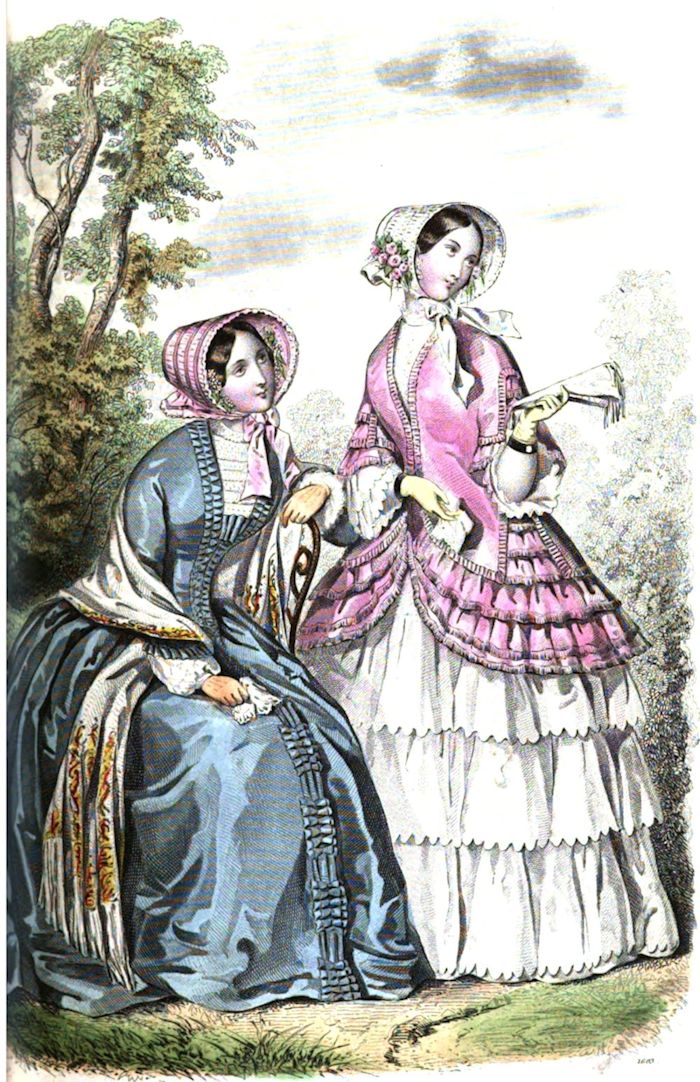
LE FOLLET, boul. St. Martin, 69
Chapeaux de Mlle. Grafeton, pl. de la Madeleine, 5 — Mouchoirs L. Chapron & Dubois, rue de la Paix, 7.
Fleurs de Chagot ainé, r. Richelieu, 73, Robes et pardessus Isabelle de Camille.
The styles of Goods here represented can be had of Messrs. L. J. Levy & Co. Philadelphia
and at Stewart’s, New-York.
Graham's Magazine 134 Chestnut Street
Transcriber’s Notes:
Archaic spellings and hyphenation have been retained as well as some spellings
peculiar to Graham's. Punctuation has been corrected
without note. Other errors have been corrected as noted below. For
illustrations, some caption text may be missing or incomplete due to condition of
the originals used for preparation of the ebook.
page 73, first untuned page ==> first unturned page
page 76, and he promisess ==> and he promises
page 77, a benificent God ==> a beneficent God
page 77, deepth of feeling ==> depth of feeling
page 77, Bartholdy, Sphor, Gluck, ==> Bartholdy, Spohr, Gluck,
page 78, the rushing Colorada ==> the rushing Colorado
page 78, traders of Chihuaha ==> traders of Chihuahua
page 88, exploring the the thickets ==> exploring the thickets
page 89, little bark of ==> little barque of
page 92, or petit-maitre modulations ==> or petit-maître modulations
page 95, whose fiancèe you ==> whose fiancée you
page 96, a litle expedition ==> a little expedition
page 98, Day past away ==> Day passed away
page 98, his bark may strand ==> his barque may strand
page 102, By some unforseen ==> By some unforeseen
page 104, were bestowod ==> were bestowed
page 106, Tinturn Abbey ==> Tintern Abbey
page 123, sat, pouring over ==> sat, poring over
page 126, Avoset, recurvirosta ==> Avoset, recurvirostra
page 128, of 12 guage ==> of 12 gauge
page 135, Sheeâh Traditions ==> Sheeãh Traditions
page 135, the Hyat-ul-Kuloob ==> the Hyât-ul-Kuloob
page 135, his usual interprise ==> his usual enterprise
page 135, London, Edinburg ==> London, Edinburgh
page 135, Peak of Derbyshire ==> Peaks of Derbyshire
page 136, accellerate his pace ==> accelerate his pace
page 136, awarded a a prize ==> awarded a prize