“Et l’on revient toujours à ses premiers amours.”
(This is the veriest nonsense ever penned. It chimes
in with our story and we use it, but without endorsing
it the least in the world.)
That night Ada relieved her full heart, by talking
over the events of the last six months to her mother,
who listened, as only a mother can listen, till midnight.
Mrs. Somers had scarcely kissed her daughter’s cheek
and left the room, when Ada rose, unlocked one of
her bureau drawers, and took thence an antiquated-looking
rose-wood box. Under heaps of broken chains
and old fashioned jewels lay a dingy little emerald
ring; she seized upon it, and uttered an exclamation
of pleasure, as she found that it fitted her third finger.
She then replaced her box, kissed the ring, and murmured
a “good-night” to the giver.
Some weeks after, Ada, her diamond and her emerald,
became, one and all, the property of James. Dr.
B. was at the wedding, and Catharine related to him
every circumstance connected with what she styled
“Ada’s pompous apostasy from the faith of her girlhood;”
beginning with the drowning, and ending with
the resumption of the emerald ring. Dr. B. evinced
such lively interest in her story, that she proclaimed
him to be the best listener she had ever met with in
her life.
The day after the wedding, Johnny Wilson was
favored with a large consignment of wedding-cake;
and in after life, when, through Ada’s means, he had
risen in station and fortune, he was heard to declare
that he had marked with a white stone the day on
which he had been nearly crushed to death by the
horses of Mrs. James Darrington Stanley.
———
BY HENRY B. HIRST.
———
There is a flower which haunts the banks of streams,
That blossoms only in the path of Spring,
Lovingly bending where the water gleams.
Its fragrant perfumes fill the azure air,
As, gazing always in the limpid brook,
It seems to watch the Naiades braid their hair,
Or sport, in naked beauty, caroling hymns
Of siren sweetness to poetic Spring,
While gliding, here and there, on milky limbs.
All day it gazes: day by day its eye
Searches the stainless crystal of the stream,
Watching those faultless, fairy forms float by.
Day after day it watches, hour on hour,
Like love above the grave of that it loved —
More like a mortal than a simple flower.
When night descends—when darkness, like the grave’s,
Falls on the stream—when moss and fern and grass
Are lost in gloom—when naught is heard but waves
That roll and ripple through the restless reeds,
It droops its head and sinks in dreamless sleep,
Couched, like a jewel, among worthless weeds.
But sometimes, when the argent moon awakes
The Naiades to midnight mirth and song,
The blossom from its mournful slumber breaks,
And breathes again its sweet, unanswered sighs;
And all the stars that gild the glassy stream
Shine on its heavy gloom like pitying eyes.
Day after day it watches—hour on hour —
Love weeping by the grave of what it loved,
More like a mortal than a simple flower.
And day by day it pales and wanes away
Until it lays its form along the stream,
And slowly sinks to silence and decay.
There is a legend told in classic Greece —
A myth, so musical of the olden time,
That none who hears can bid the singer “Peace!”
Pausanius tells it! In its rhythmic flow
We find how fair Narcissos, young in years,
Passionate beyond his age, so long ago
As when the gods came down and walked with men,
Had a sweet sister—would that sister’s name
Had ever have fallen within the poet’s ken —
A young, twin sister, lovely as the light
Of twilight in her own delicious land —
Lovely as Venus was at birth of Night.
Narcissos was as fair, albeit his mould
Had all the attributes that mark his sex;
And men were deities in the Age of Gold.
The sympathies of twin existence ran
So warm in both, their being grew like one,
Though she was feeble woman; he, strong man.
Hand locked in hand, they haunted hill and plain,
Passing in peace their simple innocent lives,
Both singing, so it seemed, the same refrain.
Or angling in the stream, or through the groves
Hunting the deer, they owned one only rule —
One gentle rule, and that was rosy Love’s.
One day—the air was swooning with the heat —
The maiden sought the border of a stream
And stood and laved and cooled her burning feet.
The loving water breathed an amorous tale;
The maiden gave herself to its embrace,
And in its passionate clasp grew deathly pale.
Narcissos was afar: he could not hear
His sister’s piteous murmur of his name:
Alas! that poor Narcissos was not near!
He came at night, and on the river’s shore
Beheld her garments; but her faultless form,
Save in his maniac dreams, he saw no more!
And from that night, and from that hour, he lay,
Swelling the stream with little brooks of tears,
Sighing his soul away day after day.
And gazing in its depths in search of her,
He saw his image, which was so like hers,
He grew to be his own sad worshiper.
The gods, who saw him act this piteous part,
Wept at the sight, and made his pallid form
A snowy blossom with a crimson heart.
There, by the stream, it watches, hour on hour,
Love mourning by the tomb of what it loved,
More like a mortal than a simple flower.
———
BY SARAH HELEN WHITMAN.
———
——Nec morti esse locum, sed viva volare
Sideris in numerum atque alto succedere cælo.
Virgil, Geor. IV.
“Star of resplendent front!” thy glorious eye
Again shines out from yonder sapphire sky,
Piercing the blue depths of the vernal night
With opal shafts and flames of rubient light;
Till the pale Serpent gliding round thy path
Hides in dim shades his ineffectual wrath,
Pining with envy at thy dazzling ray,
Deep-hued and damasked like the orb of day
When in the purple west he slowly sinks away.
Hast thou not stooped from heaven, fair star, to be
Through Night’s wide, pathless realm of phantasie
So near—so bright—so glorious—that I seem
To lie entranced as in some wondrous dream,
All earthly joys forgot—all earthly fear
Purged in the light of thy resplendent sphere: —
Gazing upon thee till thy flaming eye
Dilates and kindles through the stormy sky,
While, in its depths withdrawn, far, far away,
I see the dawn of a diviner day,
And hear celestial harmonies that come
Burdened with love from thine elysian home.
For in that gorgeous world, I fondly deem,
Dwells the freed soul of one whose earthly dream
Was full of beauty, majesty and wo —
One who, in that pure realm of thine, doth grow
Into a power serene—a solemn joy,
Undimmed by earthly sorrow or alloy;
Sphered far above the dread phantasmal gloom
That made his poet-heart a living tomb,
Tortured by fires that death alone could quell
Fierce as the flames of Farinati’s hell.
“Was it not Fate, whose earthly name is Sorrow,”
That bade him with prophetic soul to borrow
From all the stars that fleck night’s purple dome,
Thee, bright Arcturus! for our spirit home —
Our trysting star, where, while on earth’s cold clime,
Our mingling souls might meet in dreams sublime?
Was it not Fate, whose name in Heaven above
Is Truth and Goodness and unchanging Love —
Was it not Fate that bade him turn to thee
As the bright regent of his destiny? —
For when thine orb passed from the lengthening gloom
Of autumn nights a morning star to bloom
Beside Aurora’s eastern gates of pearl,
He passed from earth his weary wings to furl
In “the cool vales of Heaven”—thence through yon sea
Of starry isles to hold his course to thee.[1]
Now when again my wistful eyes I turn
To greet thy beacon fires, feeding the urn
Of memory with sweet thoughts—I almost see
The presence of the loved and lost in thee,
Kindling within my soul a pure desire
To blend with thine its pale, candescent fire.
I have “no refuge from thy light,” no home
Save in the depths of yon empyrian dome,
Where thy bright Pharos ’mid the stars doth burn,
“Whence I departed, whither I return,”
To lose my very life in thine, and be
Soul of thy soul through all eternity.
A PARTY OF PLEASURE.
———
BY F. E. F., AUTHOR OF “A MARRIAGE OF CONVENIENCE,” ETC.
———
A gayer party, bent on pleasure, never left the
wharf than that now on board the steamer bound for
Albany. It consisted of Mr. and Mrs. Castleton, Ruth
Meredith and her friend Grace Fanshaw, with young
Meredith, who had been coaxed by his sister to join
the party, so that “they need be no trouble to Mr.
Castleton.” He had consented, though voting it rather
a “bore.” The presence of the pretty, winning,
graceful Mrs. Castleton reconciled him, however,
somewhat to the scheme, which was declared perfect
in all its prospects and details, except the one drawback
to the young ladies, of having been obliged to
ask Mary Randall to accompany them.
There was no particular reason why Mary Randall’s
being invited should have been a point so much
objected to, as she appeared a quiet, inoffensive girl,
by Ruth and Grace, only that she was not intimate
with either, and seemed in their apprehension to spoil
the ease and interfere with the excessive intimacy and
familiarity of the other two. Harry Meredith, too,
was put out with the prospect of “another woman to
be civil to;” but, as Ruth said, “there was no help
for it. Papa makes a point of it, as he wants to pay
the Randalls some attention, and so does it by making
me civil to Mary. It’s not pleasant, Grace, but it is
better than not going at all.”
“Oh, to be sure,” replied Grace, thinking in her
heart that old Mr. Meredith was a very disagreeable
old gentleman; but there being no help for that either,
the matter was settled.
“I dare say Mrs. Castleton will take her a good
deal off our hands,” said Ruth.
“What a charming woman she is,” replied Grace.
“Mrs. Castleton? Oh, she has always been my
beau ideal,” answered Ruth. “She’s lovely both in
mind and person. Her manners are so graceful, and
her tones so sweet—there’s altogether a charm and
witchery about her that’s indescribable.”
“I hope your beau ideal will be a little more punctual
another time, Ruth,” said young Meredith smiling.
“Faith! I thought we had lost our passage.”
“Well, but we did not,” replied his sister.
“No,” said Meredith. “More by luck though than
good management.”
“What a fuss you men always make about punctuality,”
returned Ruth.
“And well we may,” replied her brother. “It’s
the soul of business—and traveling, too, you’ll find.
So pray have your carpet-bag ready in the morning—or —”
“Now don’t begin with scolding, Harry, because
Mrs. Castleton happened to be five minutes out of the
way.”
“Well, well,” replied Meredith, “that’s enough.
Now go and choose your state-rooms. One of you
will have to share one with a stranger.”
The girls looked at each other; Ruth and Grace
wanting to be together, and yet not liking to propose
it to Mary Randall, who said at once, with the almost
of good nature,
“Oh, I’ll take that one. It’s the same thing to me,
you know,” in a manner that quite warmed their
hearts to her.
Mrs. Castleton had the first choice, of course, and
so all the arrangements were made accordingly. But
just when they were retiring for the night, Mrs. Castleton
came to Ruth and Grace’s state-room, with a servant
following her, bag in hand, saying in her usual
sweet manner and soft tones,
“Girls, you’ll have to change with me. There’s
such a walking overhead that I can’t sleep below.”
And so bonnets and shawls and bags were hastily
gathered up, and all tumbled in confusion in the condemned
state-room below.
“She might have thought of that before,” said Ruth
with some little vexation. “It was her own choice.”
“Yes, I think so,” replied Grace. “She could sleep
here I suppose as well as we.”
“I should think so,” said Ruth. “However, it’s
no matter.” And so, full of talk of pleasure, they
chatted half the night, to the great annoyance of their
next neighbor, (who chanced to be a crusty bachelor,
who all but cursed “those girls,”) until they fell asleep,
to continue their schemes in their dreams.
“Oh, Ruth, dear, just stop and fasten my dress,”
said Mrs. Castleton, looking out from her state-room
in the morning, as her young friend was passing in a
great hurry. “I am so late,” she continued. “Do
help me pack up these things.”
Ruth looked round in despair at the floor and chair,
heaped with an indescribable mass of gowns, caps,
shoes, and every thing that had been quickly
out of the trunk, in Mrs. Castleton’s hasty search after
a particular pair of manchettes, which were deemed
indispensable to her toilette, because they just matched
the pattern of her collar, and answered,
“I’ll come back, Mrs. Castleton, as soon as I have
fastened my own trunk. I left my room in a hurry,
to speak to Harry, who wanted me, and half my things
are out yet.”
“Oh, you’ll have plenty of time,” urged Mrs. Castleton
persuasively, but still pertinaciously, “and my
husband will be so angry if I am late. He can’t scold
you, you know,” she added, with one of those playful
smiles Ruth usually thought so bewitching, but which
she was in no mood to admire now, as she thought—“And
so you mean to throw your unpunctuality on
me”—but hardly knowing how to refuse, she was beginning
to toss things in helter-skelter, venting her pet
upon helpless frocks and caps, when Mary Randall
coming by, saw her through the half opened door on
her knees before the trunk, (for Mrs. Castleton was
twining her long curls round her fingers at the glass,)
said,
“Can I help you, Ruth? I am all ready.” So, to
her inexpressible relief, she took Ruth’s place, saying
in a low voice, “Go and finish your own packing—I’ll
get Mrs. Castleton ready.”
“What a dear, good girl you are,” said Ruth, in a
perfect effervescence of gratitude—for it is not always
the magnitude of the favor, that produces the greatest
amount of gratitude. “I declare, Grace,” she said
afterward to Miss Fanshaw, “that Mary Randall is
the nicest girl I know. I would rather have her with
us than not.”
The hurry and skurry of getting ashore was hardly
over, when it was discovered that Mrs. Castleton’s
bag had been left in her state room, and to avoid an
explosion of vexation on the part of the provoked husband,
Harry Meredith had to start off poste haste to
get it, having scarcely time to spring back to shore ere
the boat pushed off for Troy, and thinking, as he did
so, that if the lady had not been so pretty he would
not have interfered to prevent her getting the scolding
she so richly deserved. Heated and panting he returned
in time for a cold cup of coffee, as the rest of
the party had already breakfasted during his absence.
But Mrs. Castleton said so gracefully, “I am afraid
my carelessness has made you lose your breakfast,
Mr. Meredith,” that he could not but answer,
“Oh, not at all. I have had a capital breakfast.”
The pleasant ride however to Utica restored the
travelers to their usual high spirits. Mary Randall
was discovered to have as keen a sense of enjoyment
as any of them, with a fund of good temper that seemed
inexhaustible.
“And so punctual,” as young Meredith said most
approvingly. Her shawl was never missing, and her
carpet-bag was always ready, (two great points, young
ladies, if you would win a gentleman’s heart in traveling,)
but graceful, charming Mrs. Castleton was forever
forgetting something, and they never stopped any
where that they did not hear Mr. Castleton’s voice
saying, in a tone of mixed vexation and despair,
“Now, Julia, have you got your bag? and where
is your shawl?” To which she generally answered
“Yes—no—is not this mine? No, dear, I believe I
left it in the car—or perhaps its only in the carriage.
Just call the driver back, wont you?”
“The stage starts at six in the morning for Trenton,
ladies,” said Meredith at night as they parted. “So
you must be bright and early. There’s no danger of
your not being ready,” he said, turning to Mary Randall
with a smile. “You are a capital traveler, I
see.”
Mrs. Castleton did not look pleased. She thought
the compliment to Mary was an implied reproof to
herself—and she was not used to any thing but admiration,
except, indeed, from her husband; but she seemed
used to his scolding, for somehow she did not appear
to mind, if indeed she heard it, which seemed doubtful.
Meredith often thought him downright cross.
“How he does scold that pretty wife of his,” he
said to Ruth. “And how sweetly she bears it. I declare
I can hardly keep from answering for her sometimes.”
“She does not seem to care for it though,” replied
Ruth, who was beginning to be a little disenchanted
of her beau ideal; “and she is provoking.”
“If she were not such a beauty, I suppose she would
be,” he replied.
“Are you ready, Mrs. Castleton?” said Ruth, in
her animated voice, at her door the next morning.
“Ready!” exclaimed Mrs. Castleton, who was
standing before the glass, as she stroked her glossy hair.
“Ready!”
“Yes,” said Ruth, looking aghast at the trunk which
was open as usual with half its contents on the floor.
“Yes, Mr. Castleton sent me up to say that the stage
starts in ten minutes.”
“Oh dear! then we can’t go in this one,” she replied,
quietly. “I can’t get ready in that time. We
must take the next one going.”
“But no other goes to-day,” said Ruth, in despair.
“Then we must wait until to-morrow,” replied Mrs.
Castleton, calmly. “I would just as leave stay here
a day as not.”
But Ruth would not, nor Grace, nor any of them;
and as Mrs. Castleton continued, “I’ve been to Trenton
before—so I don’t care about staying there more
than a day.”
Ruth thought she should have exploded. To be cut
short of a day at Trenton, she and Grace, who had
talked and dreamed of nothing else all summer. And
Mary, too, who wanted to take sketches there—it was
more than her patience, or rather impatience could
bear; but she saw that the only thing to be done, was
to get her ready herself—so she said with the energy
of desperation.
“Dress yourself, and I’ll pack your trunk. You
have plenty of time.” And so she turned to and
rapidly folded dresses, and packed and locked the
trunk, and then seized the carpet-bag, and stuffed every
thing in it she came across in an incredibly short time;
and ere Mrs. Castleton had calmly put her bonnet on,
she came panting down stairs, dragging the bag after
her, and loaded with shawls and cloaks, heated and
out of breath. She was just in time to hear Mr.
Castleton call out,
“All ready, ladies?” to which his wife answered in
the sweetest tones of bright alacrity,
“Yes, all ready!” to his infinite satisfaction and approving
surprise, for he answered,
“Ah, that’s right!” as he handed her in the carriage,
and as poor Ruth jumped in after her, she exclaimed,
“Why Ruth, dear, how heated you look!”
Now if any thing is provoking, it is to be told when
you are heated, that you look so. But Mrs. Castleton,
feeling fresh and cool, seemed quite amused as well
as surprised at her friend’s looking so flushed and
flurried.
Two stylish young men, strangers, who were to be
their fellow-travelers to Trenton, turned their eyes on
Ruth at this exclamation of Mrs. Castleton; and poor
Ruth, who really was a pretty girl, when not flushed,
feeling that she was appearing to no advantage, only
colored the more, and grew the hotter for the attention
she attracted, while she longed to say, “If I am hot,
it’s packing your trunk that has made me so;” but as
that would not do very well, she had no alternative
but silence, while she saw the strangers glance from
her to the delicate, fair, tranquil-looking Mrs. Castleton
with looks of admiration that did not tend to pacify
her. She had, however, to grow cool in temper and
temperament the best way she could. And off the
stage started for Trenton.
Two delightful days were passed at the Falls. The
stylish young strangers had made Harry Meredith’s
acquaintance, and been by him introduced to the party,
which they joined. So the girls were in ecstasies.
They could have staid there willingly for a month;
but their time was limited, as they wanted to be back
in time for the ball at West Point; and the young men
being, like themselves, bound for Niagara, they were
somewhat reconciled at leaving Trenton, which was
declared to be the most perfect spot under heaven.
“They could live there forever,” etc.; and so the whole
party, with its new made addition, returned to Utica
again.
“Oh, my bouquet! I left it on the table in the
drawing-room!” exclaimed Mrs. Castleton, the next
morning, just as they were all seated in the cars.
“Do, dear,” turning to her husband, “go and get it
for me.”
“It’s of no consequence, Julia,” he replied; “and
I have not time.”
“Oh yes, indeed it is,” she urged. “You have
plenty of time. Tell the conductor to wait a minute
for you.”
“Nonsense, Julia,” he replied, impatiently. “Do
you suppose he’d stop if I were to ask him—and I
certainly would not ask him if he would.”
But she looked so imploringly, and at the same time
so very pretty, that Mr. Sutherland (one of the strangers
before mentioned) thought her husband a brute to
refuse her, and darted out of the cars, which the next
minute were starting off.
“There! Sutherland has lost his place!” some one
exclaimed, as the bouquet was thrown in at the
window, and fell into Mrs. Castleton’s lap; but a
gentleman, putting his head out of the window, said,
“No! there he is, jumping on the outside!” “Oh, how
dangerous!” cried out two or three voices at once.
And one old gentleman drew in his gray head with the
quiet remark, “Young men will do these mad things.
I only wonder more accidents don’t happen;” and in
another minute, Mr. Sutherland, animated and laughing,
was making his way through the centre of the car, and
as he took his seat, said,
“I was afraid you would lose your flowers, Mrs.
Castleton. I quite gave you all up as I saw the cars
starting.”
“I am very much indebted to you,” she said, gracefully.
“I am so fond of flowers. Their fragrance
is really refreshing,” she said, as she raised the large
bouquet to her delicate face, not less fair and soft than
the beautiful flowers that almost hid it.
The young man looked at her most admiringly, as if
it was a beautiful and refined taste, just suited to so
lovely and graceful a creature.
The little party passed so pleasant a day together,
and the young men were so captivated with Mrs.
Castleton’s grace and beauty, and the high spirits and
general good looks of the three girls, that it was proposed
that they should join parties, and take an “extra”
together for the next stage of their journey.
This suited the ladies extremely well, who were not
less (only not so openly) charmed with the gentlemen.
And the next day a later hour was named for
their starting than usual, as the conveyance was their
own.
“Is Mrs. Castleton ready?” said Harry Meredith,
in a tone of suppressed impatience, the next morning.
“It’s most nine o’clock, and we were to have been
off at eight.”
“Oh, no!” replied Ruth, in a low voice. “I doubt
whether we get off to-day, Harry. She says there’s
no hurry as we have an “extra.” I do think with all
her pretty ways, she is the most provoking woman!”
“Where is Mary Randall?” he asked.
“Helping her,” continued his sister. “I came away
in perfect vexation and despair. As to her husband’s
being cross to her, I think he’s a perfect marvel of
patience.”
“I declare I am beginning to think so too,” said
Harry. “Well, to-morrow we take the boat on the
lake, thank fortune! so there’ll be no more running
back for flowers and bags.”
In spite of little drawbacks, however, the pretence
of the two young strangers, who kept Mrs. Castleton
in high good-humor, made the two days stage-traveling
very delightful; and now they had reached the boat,
and were on the broad and beautiful Ontario.
“Do, Ruth, put on your cloak,” said Meredith, to
his sister. “The morning air is very keen.”
“I can’t find it, Harry,” she replied.
“How could you mislay it!” he said, quite provoked.
“You will catch your death of cold.” And
a great stir was made for the missing cloak, everybody
getting up and looking under chairs and behind
benches; and poor Ruth, quite disconcerted at discomposing
so many persons, was saying all the time,
“Oh, it’s no matter, Harry.” But he only replied,
“It is matter, Ruth. You’ll be ill.” When the
general move having reached Mrs. Castleton, she said,
“What are you looking for, Mr. Meredith?”
“Ruth’s cloak,” he answered.
“Oh, I have it on,” she calmly replied. “I could not
find mine. It’s somewhere in the lady’s cabin,” she
continued, looking up at Ruth, without, however, making
any offer of returning Ruth her own.
“Go and get it, Ruth,” said her brother.
She went, and in a few minutes returned without
the cloak; and in answer to Mr. Meredith’s remonstrance,
said, in a low voice,
“I cannot help it, Harry; the air is so bad down
there that I could not stand it; and there’s such a
confusion, it’s impossible to find any thing.”
Meredith insisted, however, again. “You are
coughing already;” and this time he accompanied his
sister, and presently they returned with the cloak,
which it took all his good breeding to hand to Mrs.
Castleton politely, who took it as quietly as if it had
been quite a matter of course, and as she returned
Ruth her own, said,
“I hope you have not taken cold. You look quite
blue,” and she continued to gaze at her, with an air of
surprise, at anybody’s being so cold and looking so
ugly.
“Sutherland,” said his friend a few days after,
“your pretty Mrs. Castleton’s a bore, with her sweet
manner and dilatory selfishness. I mean to cut the
party and travel off for Niagara by myself. I don’t
ask you, however, to do so too, if you prefer remaining
with them.”
“No,” replied Sutherland, “I believe you are right.
Pretty women are very charming at home, and in
ball-rooms, but it is, as you say, a bore to be tied to
them in traveling.”
“The girls are nice girls,” pursued the other. “If
it were not for this spoilt beauty, I would rather remain
with them than not.” So it was determined between
them that they should go on in the night train,
and so free themselves from the rest of the party, who
they would meet again at Niagara.
“How strange,” said Mrs. Castleton, as her husband
conveyed to her the adieux of the young men,
who affected a sudden haste that must carry them immediately
on. “I declare it’s quite rude,” she continued,
somewhat offended.
“I am not at all surprised,” said Harry Meredith,
quietly.
“It’s very provoking,” said Ruth, who knew what
her brother meant, and all the ladies were for the first
time quite sulky. Mrs. Castleton, for she missed the
admiration of the two handsome, fashionable, agreeable
young men; Ruth, because she was angry with
Mrs. Castleton as being the cause of their being
driven away, and Grace, not less put out than the
other two at losing the society of their agreeable
traveling companions—all but Mary, were in thorough
bad humor.
“You seem to bear the loss of our new friends very
philosophically,” said Harry Meredith.
“They were very pleasant additions to our party,”
she replied, good-humoredly, “but as we started without
them, and without any idea or knowledge of them,
I do not think they are at all essential to our having
quite as agreeable a journey as we anticipated.”
“What a sweet tempered creature she is,” said
Harry, pleased with the calmness with which she regarded
the loss of the two heroes.
“Oh,” replied Ruth, “it is easy enough for her to
keep her temper. You have not left the party.”
“I,” he ejaculated, looking amazed.
“Yes,” pursued his sister. “You are almost as
much of a stranger to her, and quite as agreeable as
either of the other two.”
“Thank you,” said he, laughing. “Then how comes
it that you and Grace do not value me as highly?”
“You are my brother,” she replied, “and Grace
has known you since she was a baby. There is no
throwing the light of imagination round a man so circumstanced.”
Harry laughed, and he did not like Mary the less for
his sister’s explanation of her good temper.
“Mrs. Castleton,” he said, “I’ve been to look at
the rooms. There’s only one on the second story,
and another in the third. I presume you’ll take the
one on the second.”
“Oh, yes,” she replied, “I never mount more stairs
than necessary.”
“So I presumed,” he replied; and presently he
came back with a smiling expression in his eyes, that
made his sister ask him once or twice what was the
matter, to which he replied each time, “nothing.”
But she knew better. Something evidently pleased
him very much.
“It’s excessively cold,” said Mrs. Castleton, as she
drew herself up in her shawl. “I wish we had a little
fire.”
“You had better go up stairs as soon as your room
is ready,” said her husband. And presently, when the
housekeeper came to show them to their rooms, shivering
and blue, she bid the girls good night.
“Let me carry your shawls for you,” said Harry,
as he gathered up his sister’s and friends’ “things,”
and following them up, he heard one of the girls exclaim,
as she opened the door, “Oh, charming! How
comfortable!” It was a large room, and a nice wood-fire
was blazing most cheerfully.
“Now, Ruth,” he said, “you see what amused
me.”
“How?” she asked.
“Why, Mrs. Castleton chose, as usual, what she
supposed was the best; but her room has no fire-place
in it; and I really enjoyed her selfishness being for
once at fault.”
“Oh, I am sorry,” said Mary, “for she seemed
really suffering. I did not know it. If I had —”
“Yes,” said Harry, with an admiring look, “I
thought you would offer to change with her if you
knew it, so I said nothing about it.”
“You were right, Harry; I am glad of it,” said
Ruth. “There’s no reason why we should not be
comfortable too. So good-night to you.” And as she
shut the door, she continued with, “A very bright idea
of Harry’s; and now girls don’t let us go to bed this
hour yet. Let us enjoy this fire.” And they did enjoy
it, abusing Mrs. Castleton.
It was quite amusing to hear them. One would
scarcely think she could be the same person they
started with. But young girls are always equally enthusiastic
in either liking or disliking.
Mrs. Castleton had been an angel because she was
pretty and graceful. She was now, if not quite a
devil, at least, detestable, because she was discovered
to be spoilt. And “that cross Mr. Castleton,” was
now “poor Mr. Castleton.” So much for moods and
tenses. Traveling is a magic glass.
A few days at Niagara, in equal ecstasies, when Mr.
Sutherland and his agreeable friend were met again.
Then they turned their faces once more toward home.
The gentlemen pursuing their original plan, separated
to travel by themselves, but were to meet the ladies
again at West Point.
At Albany, however, Mrs. Castleton said to her
husband:
“We’ll take the night boat, my dear, I am tired.”
“But you want to stop at West Point, don’t you?”
he asked.
“Oh, no,” she replied, “I am tired, and want to get
home.”
“Not stop at West Point!” exclaimed the three
girls in a breath.
“No,” she replied. “Those balls are stupid things.”
“But, dear Mrs. Castleton,” said Grace, and “Oh,
Mrs. Castleton do,” said Ruth, in every accent of imploring
urgency.
But Mrs. Castleton, though very gentle, could be
very firm, when her own wishes were concerned, and
as she did not care to meet Mr. Sutherland again, who
had quite devoted himself to Grace the last few days
at Niagara, and as his friend had been indifferent from
the first, she saw no reason why she should stop there.
As for the ball, she quite laughed at the girls for even
wanting to go at all.
“It’s useless to say any thing more, Ruth,” said
Harry, in a loud tone. “She’s a selfish creature—that’s
the end of it.”
But that was not the “end of it,” for the three girls
did not meet for a month that at least half an hour was
not devoted to a lively abuse of their once beau ideal,
“that lovely Mrs. Castleton.” And we are mistaken
if Mary Randall, to whose joining the party Harry
Meredith had so warmly objected, because he’d have
to be civil to her, has not made a conquest of the
same Mr. Harry Meredith. And there is every appearance
of Trenton reminiscences leading to something
with Grace and Mr. Sutherland; and so I rather
think there’ll be two weddings next winter, at which
Ruth will be bridemaid.
———
BY WILLIAM M. BRIGGS.
———
There was a maiden once—so fair —
So shy in look—yet so beguiling —
With wealth of changeful golden hair,
And eyes so bright, yet ever smiling;
That fain thought I—so fair was she —
It should be writ in Poesie!
Her name was like a poet’s dream —
And that sweet name, they call it Mary —
A word of gentle, sunny sheen —
Though names may, like young maidens, vary —
And May, with woman’s wayward will,
Had sometimes gleams of April still!
But often on some dreamy day,
Out where the old green woods were swaying,
When the blue skies stretched far away,
And the glad sunshine’s every ray
Seemed with each bud and floweret playing,
And misty air and sunny beams
Grew tempting-full of foolish dreams;
Then would she sit in quiet mood,
With thoughtful face and gentle tone;
I dreamed the spirit of the wood
Had come to tryst with me alone,
And speak such earnest words as tell
That human hearts may love too well:
Such exquisite, sweet thoughts as rise
From souls that artless passion moves,
And mounting upward through the eyes
Betray the heart that loves,
And whisper, ere the lips can part,
That love lies brooding at the heart.
That love—young love—oh! who can tell
How much there is of mad’ning pain
For one who loves too deep—too well
To be beloved so back again —
To be so loved, yet doomed to see
All that he loves droop hopelessly!
Ah me! I look upon the past,
As o’er some book of faded flowers,
Where Joys, now crushed, too sweet to last,
Remind me of those vanished hours;
And every trace those leaves impart
Is pressed more deeply on my heart.
The touch, the tone, the melting look,
The half-reclining, gentle pressure,
The keeping time with hand and foot
To some love ditty’s murmured measure
While with her fingers, soft and fair,
She smoothed the tangles of my hair;
And how through long and silent ways
We wandered in the sunny weather,
As light of heart and full of lays
As any wanton bird in feather —
And every word that she would say
Seems ringing through my soul to-day.
There was a maiden once—so fair —
That I shall ne’er forget it—never —
Though time may silver o’er my hair,
And I may seem as calm as ever —
For dreams, whose guidance ne’er can vary,
Are trystings still for me and Mary.
———
By REV. J. N. DANFORTH.
———
In contemplating the varieties of human kind, nothing
is more obvious than that some men are endowed
with genius for the production of one set of results,
while others are invested with the same power with a
manifest adaptation to different results. So the interior
texture of that impalpable thing we call genius, is
diverse in various subjects. In some we find the development
of extraordinary energies, in others the
elaboration of the gentler traits of character. Some
are eminently capable of devising, others of executing.
One man is distinguished for the ardor of his imagination,
another for the soundness of his judgment. A
bold, daring temper of mind is indigenous to one class;
a gentle, timid disposition characterizes another. The
spirit of sarcasm, of irony, of invective, riots in the
mental activities of some men, while that of tenderness,
benevolence, and habitual charitableness constitutes
the repose of others. Of the former, Byron might be
mentioned as an example; of the latter, Cowper. They
were both men of acknowledged genius. The world
has adjudicated on their respective titles to the inheritance
of fame. But how different the men!
It may be true that the qualities of Byron were more
fitted to excite the stronger and sterner, as they certainly
were to awaken the severer and more rampant
feelings of our nature, while those of Cowper tend to
elicit whatever in man is tender, reverent, social and
sympathetic. He is eminently the poet of the home
and the heart, and even when contending with the
foul and formidable spirit of melancholy, he strives to
make others cheerful and happy.
In one of his letters he says that his own experience
contradicts the philosophical axiom that nothing can
communicate what it has not in itself, for that he wrote
certain poems “to amuse a mind oppressed with melancholy,”
and that by so doing he has “comforted others,
at the same time that they administer to me no consolation.”
One can hardly believe that from a mind
over which hung such clouds and darkness there could
issue such a piece as “John Gilpin,” or the “Report
of an adjudged case, not to be found in any of the
books.” Yet the mind of man is wondrous! What
powerful efforts will it not make to rise into a region,
where it can behold the cheerful light of day, and
breathe the healthful air of freedom. Cowper long
looked upon himself as a doomed reprobate, a hopeless
exile from the favor of God—but faith triumphed
at last. That exploded absurdity—that a powerful
genius must necessarily reside in a slender and morbid
frame—seems long to have possessed even intelligent
minds. Education is coming to be considered as properly
embracing our whole physical, intellectual, and
moral being, and the time, we hope, is at hand, when
it will be no reproach to carry about a robust mind in
a robust body. Indeed we have among the intellectual
magnates of the land, men of massive fames and ample
physical development. Look at the stalwort line of
Secretaries of State for some years past!
But a poet must be a man of more ethereal mould.
Why so? Behold Sir Walter Scott, that man of regal
imagination, who breathed the spirit of poetry into the
body of his romance, and transfused romance into his
poetry, while with dramatic energy and verisimilitude
he summons before us, on the stage he has erected, the
stirring scenes and characters of other days, as with
the wand of an enchanter. What an athletic form
ministered to the commands of his kingly mind, for it
was he who loved to say, “My mind to me a kingdom
is.” And Johnson, the critic, moralist, essayist, lexicographer,
poet—yes, POET, for in his great mind the
elements of the sublime and beautiful lay in all their
wondrous nativity; Johnson was a man of giant physical
strength, of an apparent animalism too awkward
to admit of refinement in this world. Burns, too, was
a man of massive mould, yet how exquisitely poetical.
The philosophy of the union of soul and body is as yet
little understood. We want healthy men to conduct
the affairs of the world, as well as to serve in the Court
of the Muses and the Graces. What injuries have
States sustained; what interruptions of the peace of
the world have been caused by a fit of the gout, of
dyspepsy, of morbid melancholy, of base intemperance,
or by some paroxysm of passion engendered by the
humors of an unhealthy body. The very Union of the
States may be endangered by these causes.
Had Cowper been free from those distressing maladies,
from the depredations of that “fierce banditti,”
as he calls them,
“That with a black, infernal train,
Make cruel inroads in the brain,”
how much happier had he been, how much more
might he have accomplished. Pity, not censure;
charity, not severity, are due to the interesting sufferer,
who had too much timidity to read aloud before his
superiors, thereby losing a good office. That, however,
was a trifle, compared with the deep fountain of
melancholy that existed within him, whose waters no
kind angel descending from heaven healed by casting in
some celestial gift. Religion itself became tinged with
the dark coloring of the disease it would relieve. To
most pilgrims of Time the “New Year” is a cheerful
season. “Happy” wishes then fly in clusters all
around the domestic and the social circles. How does
Cowper speak of the old year? “I looked back upon
all the passages and occurrences of it as a traveler looks
back upon a wilderness, through which he has passed
with weariness and sorrow of heart, reaping no other
fruit of his labor than the poor consolation, that, dreary
as the desert was, he left it all behind him.” While
indulging a similar strain of lugubriousness, his thoughts
fall into the natural language of the poet: “Nature revives
again, but a soul once slain, lives no more. The
hedge that has been apparently dead is not so: it will
burst into leaf, and blossom at the appointed time; but
no such time is appointed for the stake that stands in
it. It is as dead as it seems, and will prove itself no
dissembler.” Mournfully beautiful! And thus had he
been talking for eleven lingering years, long enough to
make “despair an inveterate habit.”
We do not recollect that any of the biographers of
Cowper have given sufficient weight, if they have even
adverted to one very natural cause of depression, the
destitution of any regular profession or employment
for nearly seventy years, with no wife to love, no
children to provide for. It were enough to wither
even a joyous temperament. “The color of our
whole life,” said Cowper, “is generally such as the
first three or four years in which we are our own
masters make it. Then it is that we may be said to
shape our own destiny, and to treasure up for ourselves
a series of future successes or disappointments.”
Those years were spent in idleness, to the influence of
which was added the effect of his mortifying failure
as clerk to the House of Lords, thus throwing him
upon any chance resources for the supply of the various
wants of life. The final result was the providential
overruling of the whole to the production of a consummate
poet. “Had I employed my time as wisely
as you,” he writes to his friend, Mr. Rose, “in a situation
very similar to yours, I had never been a poet
perhaps, but I might by this time have acquired a character
of more importance in society.”
He had reached fifty years before Fame had dropped
a single wreath upon his brow, or he had even seriously
courted the poetic Muse. “Dejection of spirits, which
I suppose may have prevented many a man from becoming
an author, made me one. I find constant employment
necessary, and therefore take care to be
constantly employed.” He seems to have thought that
the season of winter was the most congenial to the
operations of his mind and the productions of his fancy.
“The season of the year which generally pinches off
the flowers of poetry, unfolds mine, such as they are,
and crowns me with a winter garland. In this respect,
therefore, I and my contemporary bards are by
no means upon a par. They write when the delightful
influence of fine weather, fine prospects, and a brisk
motion of the animal spirits make poetry almost the
language of nature; and I, when icicles depend from
all the leaves of the Parnassian laurel, and when a
reasonable man would as little expect to succeed in
verse, as to hear a blackbird whistle.” The very spirit
of modesty breathing through language deeply poetical!
It is the province of genius, in its imaginative forms, to
render tributary to its object the whole circle of the
seasons, and to expound the thousand occult meanings
of nature in her depths and her varieties, as well as to
exhibit the more obvious images of beauty, of which
she furnishes in such profusion the striking originals.
Hear the voice of his Muse apostrophizing even stern
Winter:
“I crown thee king of intimate delights,
Fireside enjoyments, home-born happiness!”
Bachelor as he was, he sought his chief happiness
in the interior sanctities of domestic life. There his
gentle spirit was nourished with the aliment drawn
from the purest sources of friendship and virtue, and
thence his imagination took its flights, not bold, but
beautiful, not ascending to the lofty height of Milton’s
“great argument,” but holding its graceful way through
that middle region of thought, and fancy, and feeling,
familiar to the mass of minds in any measure susceptible
to the beauties of poetry. The critics of half a
century ago, while they hesitated to admit Cowper to
that high rank among the great poets, which has been
adjudged him by the verdict of posterity, confessed
that his works contained many traits of strong and
original genius, and a richness of idiomatic phraseology
seldom equalled in the English language. Readers of
poetry had become so accustomed to the refined diction
and polished versification of his predecessors—Addison,
Pope, Gray, and Prior—that they were slow to
welcome a new aspirant for the bays, who came with
a free, unfettered, and even somewhat careless air to
claim their homage. He might gather a few humble
flowers along the sides of Parnassus, but to think of
reaping near its summit was the height of presumption.
Yet which of those poets has now so many readers as
Cowper? Goldsmith may better compare with him
for permanence and extent of interest, so eminently
natural is he; but what shall be said of Dryden, earlier,
it is true, than the others, but one who had long been
considered as having passed into the apotheosis of the
Dii majores? He may have one reader to five hundred
who luxuriate in Cowper’s parlor, alcove, and
garden, with the Task in hand.
Then for purity, what a contrast between these last
two. The Bard of Christianity, as he has been called,
wrote no line, which, “dying he would wish to blot.”
To Cowper the sentiment is more impressively applicable
by the suffrage of the public mind, than Thomson,
to whom it is applied by Lord Lyttleton—and deservedly
so. They both communed with Nature, the one
with her minute lights and shades, the other with her
grander forms and more striking developments. The
imagination of Cowper, like the microscopic glass, detected
the shape and tint of the very petal of a flower.
That of Thomson ranged with the sweep of the telescope
through fields of light, and distant spheres, radiant
with beauty and vocal with harmony. Each
fulfilled his mission with dignity, propriety, and devotion,
causing us to pray O! si sic omnes! But the
nineteenth century has produced so much mysticism,
such an amount of nebulous metaphysics in poetry and
prose, as to make some honest people doubt the lawfulness
of their veneration for the standard poets, especially
the more intelligible ones, or whether there is
any such thing as standard poetry. Coleridge, indeed,
is clear, solemn, and sublime, when he approaches
nearest to Milton, as in his Sunrise Hymn; and Wordsworth
is most natural, perspicuous, and impressive,
when he most resembles Cowper; but Shelley, Keats,
Tennyson, Browning—what do they mean in half
their poetry?
Cowper stands almost alone in having nothing to do
with the passion of love, which has always figured at
such a rate in all sorts of novels, dramas, and poems.
It was not because he was destitute of sensibility.
His life was a tender sentiment, his heart was formed
for friendship; he was even an admirer of the female
sex, and he entrusted the happiness of his life to the
care and sympathy of female friends; but the romance
of the tender passion was beneath the dignity of his
Muse, while for real purity of affection, as well as of
imagination, no poet has been more distinguished.
He possesses the sweetness, if not the grandeur of
Milton; and if he does not emulate the song of the
Seraphim, who, in their exalted spheres, minister so
near the throne of the Eternal, his strain is ever coincident
with the thousand choral harmonies of nature
and mind around him. In speaking of the influence of
the “country” upon his mind, even that country which
“God made,” he says, with enthusiasm,
“I never framed a wish, or formed a plan,
That flattered me with hopes of earthly bliss,
But there I laid the scene; there early strayed
My fancy, ere yet liberty of choice
Had found me, or the hope of being free.
My very dreams were rural; rural, too,
The first born efforts of my youthful muse.”
The regions of fiction he left others to explore; the
artificial manners of a polished age; the martial deeds
of heroic periods he relinquished to their admirers, and
devoted himself to the socialities of domestic life, to
the promotion of pure morals, and the elevation of
public sentiment on a proper basis, and to a worthy
standard. “He impresses us,” says Campbell, “with
the idea of a being, whose fine spirit had been long
enough in the mixed society of the world to be polished
by its intercourse, and yet withdrawn so soon as to retain
an unworldly degree of purity and simplicity.”
He listened with alacrity to the secret suggestions of
the spirit of philanthropy, and at times rose to the
solemn dignity and fervor of a prophet’s strain, thus
realizing the classic, nay, the Hebraic idea of the
union of poet and prophet in the same venerated
person.
Among those sentiments which have been incorporated
into the thinking and speaking of men, may be
found many of the conceptions of Cowper’s genius,
especially as embodied in the Task, near the conclusion
of which he ascends to so lofty a height, as to remind
us of the sublimity of Milton. It is perfectly obvious,
that before his muse took that flight, she had bathed
her wing in the fountain of inspiration. The voice of
the bard seems to echo that of the Hebrew prophet,
as he stood upon the Mount of Vision, and beheld the
unfolding glories of the latter day.
The satire of Cowper was at times as keen as his
own sensibilities, yet blending itself with a gentle
manner and a genial humor, it disarmed all suspicion
of malignity in its composition, thus augmenting its
moral power. Vice, folly, and even finery, felt the
sharpness of his satire. In his themes, as in so many
clear mirrors, we see reflected the multiplied images
of the spirit of the man. Truth, Hope, Charity, Retirement,
Ode to Peace, Human Frailty, the Rose, the
Doves, the Glowworm, Lily, Nosegay, Epitaph on a
Hare, such are the subjects that wakened in him congenial
thought and feeling. The lines on his Mother’s
Portrait are exquisitely tender and affecting, instinct
with love, overflowing with affection, with that love
which is never so intense as when softened by affliction,
and intertwined with pensive recollections of the
past. His pieces are not wrought with the perfection
and coldness of artistic skill, like those of the
sculptor, but flow from the imagination right through
the channel of the heart, taking the most natural shape
and costume of the moment and the occasion.
The great critic of the North, who sat so many years
on the Bench of Literature before he occupied the
Bench of Civil Justice, from which death has recently
called him, thus pronounced his opinion of Cowper:
“The great variety and truth of his descriptions; the
sterling weight and sense of most of his observations,
and, above all, the great appearance of facility with
which every thing is executed, and the happy use he
has so often made of the most ordinary language, all
concur to stamp upon his poems the character of
original genius, and remind us of the merits that have
secured immortality to Shakspeare.”
Little need be added concerning his prose. It is
known to have been eminently easy and natural. His
letters especially are models. It is sufficient praise to
say, that Robert Hall, that master of the art of composition,
thus speaks of Cowper: “I have always considered
his letters as the finest specimens of the epistolary
style in our language. To an air of inimitable
ease and negligence, they unite a high degree of correctness,
such as could result only from the clearest
intellect, combined with the most finished taste. I
have scarcely found a single word which is capable of
being exchanged for a better. Literary errors I can
discern none. The selection of the words, and the
structure of the periods are inimitable; they present as
striking a contrast as can well be conceived to the
turgid verbosity which passes at present for fine writing,
and which bears a great resemblance to the degeneracy
which marks the style of Ammianus Marcellinus,
as compared to that of Cicero and Livy. A
perpetual effort and struggle is made to supply the
place of vigor; garish and dazzling colors are substituted
for chaste ornament, and the hideous distortions
of weakness for native strength. In my humble
opinion, the study of Cowper’s prose may on this account
be as useful in forming the taste of young people
as his poetry.”
———
J. R. BARRICK.
———
How sweet to me the evening hour,
When Nature sinks to rest,
And like a warrior in his pride
The sun goes down the west.
As evening stars, like diamonds bright,
Come peeping through the sky,
Ah! what a thing of joy ’twould be
From earth to fade and die.
MY “LIDA.”
———
BY “L’INCONNUE.”
———
The spring-time is waking to beauty and bloom,
The storm-clouds are breaking, and bright through the gloom
The blue heaven flashes like gleams of thine eye,
Through the dark silken lashes, which deepen its dye,
’Tis a glance full of tenderness, blended with pride,
Like thine own azure eye-beam, my sweet sister Lide!
The rose-buds are sleeping—but odors around
Tell of hyacinths peeping from yon grassy mound;
And the peach-bloom is blushing like cloudlets at even,
When the sunset is flushing the calm summer heaven,
And I dream as its leaflets float down at my side
Of the rose-tinted cheek of my sweet sister Lide.
The south wind is blowing, and up from the wood,
Where the streamlet is flowing, in charmed solitude,
Swells in low, liquid numbers the waterfall’s song,
As its chanting wave slumbers, or dashes along;
And the clear silvery tone of that murmuring tide
Seems the love-laden voice of my sweet sister Lide.
The soft stars are twinkling in beauty above,
And the dew-drops besprinkling their blossoms of love,
While a fresh, balmy breathing of spring-tide’s perfume
O’er my free soul is wreathing that delicate bloom,
Which glows o’er the beautiful feelings that glide
Through the pure angel-heart of my sweet sister Lide.
There’s a charm in the far gleam of waves on the sea,
And a spell in the star-beam that whispers of thee;
But as gay hours in fleeting new blushes of Spring
To this wild bosom’s beating in loveliness bring,
So its soft feelings deepen to glorious pride
When it dreams of its angel, my sweet sister Lide.
The world thinks us lonely—’tis true we’re alone,
Not as twin-spirits only—our hearts are but one —
With no parent, no brother, no glad, happy home,
We’re the world to each other, wherever we roam,
And my young life glides onward like spring’s sunny tide
When I dwell with “mine own one”—my “love of a Lide!”
Memphis, 1850.
———
BY GEO. D. PRENTICE.
———
It is a glorious eve—the stream
Without a murmur wanders by,
And on its breast, with softened beam,
The sleeping stars so sweetly lie,
’Twould seem as if the tempest’s plume
Had swept through woods of tropic bloom,
And scattered down their blossoms bright
To sleep upon the waves to-night.
And see—as hangs the moon aloft,
Her beams come gushing through the air
So mild, so beautifully soft,
That wood and stream seem stirred with prayer,
And the pure spirit, as it kneels
At Nature’s holy altar, feels
Religion’s self come floating by
In every beam that cleaves the sky.
There’s glory in each cloud and star,
There’s beauty in each wave and tree,
And gentle voices from afar
Are borne like angel-minstrelsy;
In such a spot, at such an hour,
My spirit feels a spell of power,
And all beneath, around above,
Seems earthly bliss and heavenly love.
Oh, Mary, idol of my life,
My heart’s young mate, my soul’s sweet bride,
Dear soother of my spirit’s strife,
I would that thou wert by my side,
And I would kneel on this green sod
In love to thee and praise to God,
And, gazing in thy gentle eyes,
Dream but of thee and Paradise.
I see thy name in yon blue sky,
In every sound thy name I hear,
All nature paints it to my eye
And breathes it in my listening ear;
I read it in the moon’s sweet beam,
The starlight prints it on the stream,
And wave and breeze and singing bird
Speak to my soul the blesséd word.
 THE QUEEN OF THE WOODS.
A LEGEND OF NEW ENGLAND.
———
BY MISS M. J. WINDLE.
———
(Concluded from page 334.)
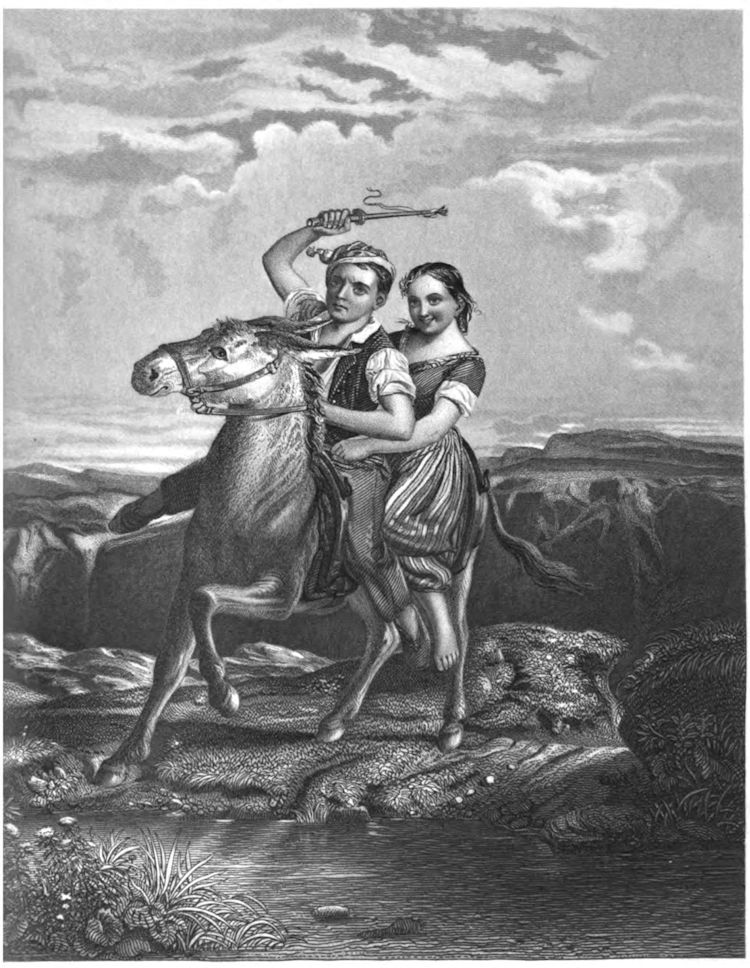
 Messrs. Lindsay & Blackiston, have in press, and
will publish during the summer, “The Broken Bracelet
and Other Poems,” by Mrs. Esling, formerly Miss Waterman,
who is well known to many of our old subscribers,
by the beautiful poems she formerly contributed to the
Casket, and afterward to Graham’s Magazine.