The word craft properly signifies art, ability, dexterity,
skill, as well as cunning and dissimulation—and
all these qualities have a close relation to discretion.
The pretended madness of Hamlet is therefore illustrative
of the theme; just as the real madness of Lear
is illustrative of the theme of that play. The dissimulation
of Hamlet, however, is not such as to lessen our
esteem for his character. Surrounded as he is with
spies and enemies, we feel that it is a justifiable stratagem.
It is worthy of remark that Edgar employs a
similar means of defense in the Play of King Lear;
and that as Shakspeare’s love of contrast has led him
thus to oppose the assumed madness of Edgar to the
real madness of Lear, so here we have the real madness
of Ophelia opposed to the assumed madness of
Hamlet.
Hamlet displays craft also (but still a justifiable craft,)
in his device of the play, “to catch the conscience of
the king.” And when he has succeeded, he triumphs
in this proof of his own skill, with a very natural
vanity. “Would not this, sir, and a forest of feathers,
(if the rest of my fortunes turn Turk with me,) etc.,
get me a fellowship in a cry of players?” In his interview
with his mother, (the picture scene,) he dwells
chiefly on her want of discernment; and, at the conclusion
of the scene, alluding to his “two schoolfellows,”
he boasts that he will “delve one yard below
their mines, and blow them at the moon;” a feat which
he very fully accomplishes. But after all he feels and
acknowledges that he is a mere instrument in the
hands of a higher power.
Our indiscretion sometimes serves us well,
When our deep plots do pall; and that should teach us,
There’s a divinity that shapes our ends,
Rough hew them how we will.
And when Horatio endeavors to dissuade him from
fencing with Laertes, because he acknowledges a foreboding
of evil he replies: “Not a whit, we defy augury;
there is a special providence in the fall of a
sparrow. If it be now, ’tis not to come; if it be not
to come it will be now; if it be not now, yet it will
come; the readiness is all.” These solemn sentiments
were a fit prelude to the tragic fate upon which he was
rushing.
Polonius frequently boasts of his own discernment.
As when he says to the king:
Hath there been such a time (I’d fain know that,)
That I have positively said ’tis so;
When it proved otherwise.
And though he was mistaken as to the cause of
Hamlet’s madness, he reasoned justly on the subject,
and erred in his conclusion only because there was a
supernatural cause at work, which he could not penetrate.
The king also dwells on the same topic (skill or
management,) in many places, and especially in his
several conversations with Laertes.
But I must hasten to a conclusion; hoping that I
have awakened sufficient interest in the reader’s mind
to induce him to pursue the subject with the play before
him; and assuring him that he will find the theme
in some one of its various phases, ever present; from the
sentinel’s challenge at the beginning, to the speech of
Fortinbras on propriety at the end; in the love-letter of
Hamlet; in the carol of Ophelia; in the doggerel song
of the old grave-digger; and every where else.
A glance at the progress of the play will show that
the theme, like the plot and the characters, is gradually
developed. A brief notice of the contents of each act
will make this apparent.
Act first.—This act is wholly occupied with matters
of an inquisitive character, and lectures on reserve
and prudence.
Act second.—Craft is the characteristic of this act.
Reynaldo is appointed a spy upon Laertes: Hamlet
begins to play the madman: Rosencrantz and Guildenstern
are appointed spies upon Hamlet: Polonius and
the king resolve to secrete themselves where they can
overhear Hamlet talking with Ophelia: and Hamlet conceives
the project of using the players to make the king
betray his own guilt. The object of all these plots, however,
it will be observed, is merely to gain information.
Act third.—In this act the several plots formed in
the last, are carried into execution.
Act fourth.—Here the subject assumes a more serious
aspect; Ophelia’s indiscreet love ends in madness
and death: Laertes, who has heretofore discoursed
like a philosopher on moderation, now becomes furious,
bearding the king on his throne; if craft is employed
it is no longer for the mere purpose of finding
out secrets, but for the destruction of life; as when the
king sends Hamlet to England, to be put to death; and
when, on his unexpected return, Laertes and the king
concert his death by means of the treacherous fencing-match.
Act fifth.—Inquisitiveness now assumes a more
intricate form in the old grave-digger’s riddles, and in
Hamlet’s refined speculations. Credulity (as Horatio’s
account of prodigies in the first act,) becomes
bigotry in the priest who buried Ophelia, and faith
in a special Providence in Hamlet. Foppery and
affectation reach their height in Osric; discretion assumes
its highest form in Hamlet’s frank apology to
Laertes, and in his anxiety lest he should leave a
“wounded name” behind him; Horatio crowns his
constancy by resolving to die with his friend; and
ungoverned passion produces the scandalous conflict
at Ophelia’s grave, and the scuffle in fencing, which is
the immediate forerunner of the bloody catastrophe.
The change of rapiers has been condemned as a bungling
device; but was it not most probably designed to
illustrate the theme, showing, as it does, the blind and
heedless rage of the combatants?
It is manifest that Ulrici’s method of reading these
plays must lead to a re-consideration of the most important
criticisms which have heretofore been made
upon them. The propriety and relevancy of each
part being considered with reference to the “central
idea,” many apparent anomalies will be reconciled,
and many imputed faults vindicated. A new value
will also be given to them; for, viewed in this light,
the masters of eloquence,—the Senator, the Advocate,
and the Preacher,—may, from these models, learn how
to discuss a theme, or conduct a discussion. The
poet rambles through all nature, yet never for one moment
forgets his purpose; now he convulses us with
laughter, and now melts us to tears; now fires us with
indignation, and now chills us with horror; yet ever,
amidst these various and conflicting emotions, steadily
pursues his argument. Every speech is to the same
purpose, and yet there is no repetition; and, though he
perseveres till the subject is wholly exhausted, our interest
seldom for one moment languishes. Let him,
therefore, who would see Logic, and Rhetoric, and
Poetry in their most perfect form and combination,
repair to the pages of Shakspeare.
They came—like bees in summer-time,
When earth is decked with flowers,
And while my year was in its prime
They reveled in my bowers;
But when my honey-blooms were shed,
And chilling blasts came on,
The bee had with the blossom fled:
I sought them—they were gone.
They came—like spring-birds to the grove,
With varied notes of praise,
And daily each with other strove
The highest strain to raise;
But when before the frosty gale
My withered leaves were strown,
And wintry blasts swept down the vale,
I sought them—they were gone.
I. G. B.
———
BY GEO. D. PRENTISS.
———
Sweet moon, I love thee, yet I grieve
To gaze on thy pale orb to-night;
It tells me of that last dear eve
I passed with her, my soul’s delight.
Hill, vale and wood and stream were dyed
In the pale glory of thy beams,
As forth we wandered, side by side,
Once more to tell love’s burning dreams.
My fond arm was her living zone,
My hand within her hand was pressed,
And love was in each earnest tone,
And rapture in each heaving breast.
And many a high and fervent vow
Was breathed from her full heart and mine,
While thy calm light was on her brow
Like pure religion’s seal and sign.
We knew, alas! that we must part,
We knew we must be severed long,
Yet joy was in each throbbing heart,
For love was deep, and faith was strong.
A thousand memories of the past
Were busy in each glowing breast,
And hope upon the future cast
Her rainbow hues—and we were blest.
I craved a boon—oh! in that boon
There was a wild, delirious bliss —
Ah, didst thou ever gaze, sweet moon,
Upon a more impassioned kiss?
The parting came—one moment brief
Her dim and fading form I viewed —
’Twas gone—and there I stood in grief
Amid life’s awful solitude.
Tell me, sweet moon, for thou canst tell,
If passion still unchanged is hers —
Do thoughts of me her heart still swell
Among her many worshipers?
Say, does she sometimes wander now
At eve beneath thy gentle flame,
To raise to heaven her angel-brow
And breathe her absent lover’s name!
Oh when her gentle lids are wet,
I pray thee, mark each falling gem,
And tell me if my image yet
Is pictured tremblingly in them!
Ay, tell me, does her bosom thrill
As wildly as of yore for me —
Does her young heart adore me still,
Or is that young heart changed like thee?
Oh let thy beams, that softest shine,
If still my love to her is dear,
Bear to her gentle heart from mine
A sigh, a blessing, and a tear.
———
BY MRS. E. J. EAMES.
———
Enchantress, come! and charm my cares to rest.
How shall I lure thee to my side again,
Thou, who wert once the Angel of my Youth?
Thou, who didst woo me with thy blandest strain —
Tinting wild Fancy with the hues of Truth;
Whose plumy shape, floating in rosy light,
Showered purest pearl-drops from its fairy wing,
Making earth’s pathway like the day-star bright,
Thou charmer rare of life’s enchanted spring!
Fair were the scenes thy radiant pencil drew,
When on my eyes the early beauty broke:
And thy rich-ringing lyre, when life was new,
A glowing rapture in my bosom woke.
Then thy gay sister Fancy made my dreams
Lovely, and lightsome as the summer-hours,
And in her fairy loom wrought hues and gleams
That clothed the Ideal in a robe of flowers.
Now, thou hast vanished from my yearning sight —
Thou comest no more in melting softness drest —
No more thou weavest sweet visions of delight,
No charm thou bring’st to lull my heart to rest.
The bloom has faded from thy face, dear Hope —
The light is lost—the shadow comes not back!
Thy green oasis-flowers no more re-ope,
To scatter fragrance o’er life’s desert track.
Oh, angel-spirit of my perished years!
Thy early memory stands before me now:
Ah! by that memory, which so fair appears,
Unveil once more the beauty of thy brow;
Come—if I have not quite outlived thee—come!
And bid thy rival dark Despair depart —
His touch has left me blind and deaf and dumb —
Bring thou one ray of sunshine to my heart!
———
BY CHARLES J. PETERSON, AUTHOR OF “CRUISING IN THE LAST WAR,” ETC.
———
It was on a sunny day in the winter of 183-, that
we dropped down the Mersey and took our leave of
Liverpool. Our vessel was a new ship of seven hundred
tons; and as she spread, one after another, her
folds of white canvas to the breeze, I thought I had
never seen a more beautiful sight. The scene around
was lively and inspiriting. Innumerable craft of all
sizes covered the waters far and near: here, a large
merchantman moving like a stately swan, there, a light
yacht skimming along with the swiftness of a swallow.
The sunlight sparkled and danced on the billows; the
receding coast grew more picturesque as we left it
astern; and the blue expanse of the Irish channel
stretched away in front, until lost in a thin haze on the
opposite horizon.
I had been reading below for several hours, but
toward nightfall went on deck again. How I started
at the change! It was yet an hour to sunset, but the
luminary of day was already hidden in a thick bank of
clouds, that lay stretched ominously along the western
seaboard. The wind had increased to a smart gale,
and was laden with moisture. The billows increased
in size every minute, and were whitening with foam
far and near. Occasionally as a roller struck the
ship’s bows, the white spray flew crackling over the
forecastle, and sometimes even shot into the top: on
these occasions a foreboding, melancholy sound, like
the groan of some huge animal in pain, issued from
the thousand timbers of the vessel. Already, in anticipation
of the rising tempest, the canvas had been reduced,
and we were now heading toward the Irish
coast under reefed topsails, courses, a spanker and jib.
“A rough night in prospect, Jack!” I said addressing
an old tar beside me.
“You may well say that, sir,” he replied. “It’s
bad on the Norway coast in December, and bad going
into Sandy Hook in a snow-storm; but both are nothing
to a gale in the channel here,” he added, as a
sudden whirl of the tempest covered us with spray.
“I wish we had more sea room,” I answered musingly.
“Ay! I’d give the wages of the voyage if we had.
How happy you all seemed in the cabin, sir, the ladies
especially, an hour or two ago—I suppose it was because
we are going home—ah! little did any of us
think,” he added, with a seriousness, and in a language
uncommon for a sailor, “that we might be bound to
another, and a last home, which we should behold
first.”
At this moment the captain shouted to shorten sail,
and our conversation was of necessity cut short. The
ship, I ought to have said, had been laid close to the
wind, in order to claw off the English coast, to which
we were in dangerous propinquity; and, as the gale
increased, the heavy press of canvas forcing her down
into the water, she struggled and strained frightfully.
While the crew were at work, I walked forward.
The billows, now increased to a gigantic size, came
rolling down upon us one after another, with such
rapidity that our good craft could scarcely recover
from one before another was upon her. Each time
she struck a head-sea she would stagger an instant,
quivering in every timber, while the crest of the shattered
wave would shoot to the fore-top like the jet of
a fountain: then, the vast surge sinking away beneath
her, she would settle groaning into the trough of the
sea, until another billow lifted her, another surge
thundered against her bows, another shower of foam
flew over her. Now and then, when a more colossal
wave than usual was seen approaching, the cry “hold
on all” rang warningly across the decks. At such
times, the vast billow would approach, its head towering
in the gathering twilight, until it threatened to engulf
us; but, just when all seemed over, our gallant
ship would spring forward to meet it, like a steed
started by the spur, and the mountain of waters would
break over and around us, hissing, roaring and flashing
by, and then sinking into the apparently bottomless
gulf beneath us.
Meanwhile the decks were resounding with the
tread of the sailors, as they hurried to and fro in obedience
to the captain’s orders; while the rattling of
blocks, the shouts of command, and the quick replies
of the seamen, rose over the uproar of the storm.
“Let go bowlines,” cried the stentorian voice of the
captain, “ease off the tack—haul on the weather-braces.”
Away went the huge sail in obedience to the order.
“Ease off the sheet—haul up to lee!”
The crew redoubled their quickness; and soon the
immense courses were stowed. In a few minutes the
ship’s canvas was reduced to reefed topsails, spanker,
and fore-topmast staysail. By this time evening had
set in, though the long twilight of that latitude prolonged
a sickly radiance.
But even this contraction of sail was not sufficient.
The thick duck tugged at the yards, as if it would
snap them in two. Every moment I expected to see
the spanker go.
“We must take in that sail,” said the captain finally,
“or she will tear herself to pieces. All hands in with
the spanker.”
In an instant the men were struggling with the huge
sheet of canvas; and never before had I been so forcibly
impressed with the power and usefulness of discipline.
In an incredibly short interval the gigantic
sail, notwithstanding its struggles, was got under control,
and safely stowed.
The ship now labored less for awhile, but, as the
storm increased, she groaned and struggled as before.
The captain saw it would not do to carry even the
little sail now remaining, for, under the tremendous
strain, the canvas might be continually expected to be
blown from the bolt-ropes. And yet our sole hope lay
in crowding every stitch, in order to claw off the
English coast! The sailor will understand this at a
word, but to the landsman it may require explanation.
Our danger, then, consisted in having insufficient
sea room. If we had been on the broad Atlantic, with
a hundred or two miles of ocean all around us, we
could have lain-to under some bit of a head-sail, or
fore-topmast sky-sail for instance, or a reefed fore-sail.
But when a vessel lies-to, or, in other words, faces the
quarter whence the wind comes, with only enough
canvas set to steer her by, she necessarily drifts considerably,
and in a line of motion diagonal to her keel.
This is called making lee-way. Most ships, when
lying-to in a gale, drill very rapidly, sometimes hundreds
of miles if the tempest is protracted. It is for
this reason that a vessel in a narrow channel dares not
lie-to, for a few miles of lee-way would wreck her
on the neighboring coast. The only resource, in such
cases, is to carry a press of sail, and head in the direction
whence the wind comes, but not near so close to
it as in lying-to. This is called clawing off a lee-shore.
A constant struggle is maintained between the
waves, which set the vessel in the same track they are
going themselves, and the wind, which urges her on
the opposite course. If the canvas holds, and the ship
is not too close to the shore under her lee, she escapes:
if the sails part, she drives upon the fatal coast before
new ones can be got up and bent. Frequently in such
cases the struggle is protracted for hours. It is a
noble yet harrowing spectacle to see a gallant ship
thus contending for her life, as if an animated creature,
breasting surge after surge, too often in vain, panting,
trembling and battling till the very last.
The captain did not appear satisfied with taking in
the spanker; indeed, all feared that the ship could not
carry what sail was left. Accordingly, he ordered the
topsails to be close-reefed. Yet even after this, the
vessel tore through the waters as if every moment she
would jerk her masts out. The wind had now increased
to a perfect hurricane. It shrieked, howled
and roared around as if a thousand fiends were abroad
on the blast.
In moments of extreme peril strong natures gather
together, as if by some secret instinct. It was in this
way that the captain suddenly found himself near the
old topman, whom I had been conversing with in the
early part of the evening, and who, it appeared, was
one of the oldest and best seamen in the ship.
The captain stood by the man’s side a full minute
without speaking, looking at the wild waves that, like
hungry wolves, came trooping down toward us.
“How far are we from the coast?” he said at last.
“Perhaps five miles, perhaps three, sir!” quietly replied
the man.
“And we have a long run to make before we get
sea-room,” said the captain.
“We shall all be in eternity before morning,” answered
the man, solemnly.
The captain paused a moment, when he replied,
“Our only hope is in the topsail-clews—if they
give way, we are indeed lost—God help us!”
“Amen!” I answered, involuntarily.
Silence now ensued, though none of us changed our
positions. For myself, I was occupied with thinking
of the female passengers, soon, perhaps, to be the prey
of the wild waters. Every moment it seemed as if
the topsails would give way, she strained so frightfully.
It was impossible to stand up if exposed to the full
force of the gale. So we sheltered ourselves in the
waist as we best could. The wind as well as spray,
however, reached us even here, though in diminished
violence, the latter stinging the face like shot thrown
against it. It seemed to me, each minute, as if we
made more lee-way. At last, after half an hour’s
suspense, I heard the surf breaking, with a noise
like thunder, on the iron-bound coast to the eastward.
Again and again I listened, and each time the awful
sound became more distinct.
I did not mention my fears, however, for I still
thought I might be mistaken. Suddenly the captain
looked up.
“Hark!” he said.
He stood with his finger raised in the attitude of one
listening intently, his eyes fixed on the face of the old
sailor.
“It is the sound of breakers,” said the seaman.
“Breakers on the lee-quarter!” cried the look-out at
this instant, his hoarse voice sounding ominously across
the night.
“Breakers on the lee-beam!” answered another.
“Breakers on the lee-bow!” echoed a third.
All eyes peered immediately into the darkness. A
long line of foam was plainly visible, skirting quite
round the horizon to leeward.
“God have mercy on our souls!” I involuntarily
ejaculated.
The captain sprung to the wheel, his eye flashing,
his whole frame dilated—for he had taken a sudden and
desperate resolution. He saw that, if no effort was
made, we should be among the breakers in twenty
minutes; but if the mainsail could be set, and made
to hold for half an hour, we might yet escape. There
were nine chances to one that the sail would split the
instant it was spread, and in a less terrible emergency
he would have shrunk from the experiment; but it was
now our only hope.
“Keep her to it!” he shouted; “keep her well up.
All hands to set the main-course!”
Fortunately we were strong-handed, so that it would
not be necessary to carry the tack to the windlass,
notwithstanding the gale. A portion of the crew
sprung to man this important rope; the remainder
hurried up the rigging, almost disappearing in the gloom
overhead.
In less than a minute the huge sail fell from the
yard, like a gigantic puff of white smoke blown from
the top. It struggled and whipped terribly, but the
good ropes held fast.
“Brace up the yard—haul out the bowline!” thundered
the captain.
“Ay, ay, sir!” and it was done.
“Haul aft!”
The men ran off with the line, and the immense
sheet came to its place.
This was the critical moment. The ship feeling
the additional propulsion, made a headlong plunge. I
held my breath. I expected nothing less than to see
the heavy duck blown from the yard like a gossamer;
but the strong fabric held fast, though straining awfully.
“She comes up, don’t she?” interrogated the captain
of the man at the helm.
“Ay, ay, sir—she does!”
“How much?”
“Two points, sir!”
“If she holds for half an hour,” ejaculated the captain,
“we may yet be saved.”
On rushed the noble ship, seeming to know how
much depended on her. She met the billows, she rose
above them, she struggled perseveringly forward. In
five minutes the breakers were visibly receding.
But hope had been given only to delude us. Suddenly
I heard a crack, sharper than an explosion of
thunder, and simultaneously the course parted from its
fastenings, and sailed away to leeward, like a white
cloud driven down the gale.
A cry of horror rose from all. “It is over!” I cried;
and I looked around for a plank, intending to lash myself
to it, in anticipation of the moment for striking.
When the course went overboard, the head of the
ship fell off immediately; and now the wild breakers
tumbled and roared closer at hand each moment.
Suddenly the captain seized my arm, for we were
holding on almost side by side.
“Ha!” he cried, “is not that dark water yonder?”
and he pointed across our lee-bow.
I looked in the direction to which he referred. Unless
my eyes deceived me, the long line of breakers
came to an abrupt termination there, as if the shore
curved inwards at that point.
“You are right—there is a deep bay ahead,” I cried,
joyfully. “Look! you can see the surf whitening
around the cape.”
The whole crew simultaneously detected this new
chance of escape. Though unable to head to the
wind as before, there was still a prospect that we
could clear the promontory. Accordingly, the next
few minutes were passed in breathless suspense. Not
a word was spoken on board. Every eye was fixed
on that rocky headland, around which the waters
boiled as in the vortex of a maelstrom.
The ship seemed conscious of the general feeling,
and struggled, I thought, more desperately than ever.
She breasted the huge billows with gallant perseverance,
and though each one set her closer to the shore, she
met the next wave with the same stubborn resolution.
Nearer, nearer, nearer we drilled toward the fatal
cape. I could now almost fling a biscuit into the
breakers.
I had noticed a gigantic roller coming for some time,
but had hoped we might clear the cape before it
reached us. I now saw the hope was in vain. Towering
and towering, the huge wave approached, its dark
side almost a perpendicular wall of waters.
“Hold on all!” thundered the captain.
Down it came! For an instant its vast summit
hovered overhead, and then, with a roar like ten
thousand cataracts, it poured over us. The ship was
swept before it like a feather on a gale. With the
waters dashing and hissing over the decks, and whirling
in wild eddies under our lee, we drove in the
direction of the cape. I held my breath in awe. A
strong man might almost have leaped on the extreme
point of the promontory. I closed my eyes
shuddering. The next instant a hurrah met my ear.
I looked up. We had shot by the cape, and miles of
dark water were before us. An old tar beside me
had given vent to the cheer.
“By the Lord!” he said, “but that was close
scraping, sir. Another sich would have cracked the
hull like an egg-shell. But this craft wasn’t made to
go to Davy Jones’ locker!”
And with all the coolness imaginable, he took out
a huge piece of pig-tail, leisurely twisted off a bit, and
began chewing with as much composure as if nothing
unusual had happened.
A year ago, when in New York, I met the captain
again, unexpectedly, at the Astor. We dined together,
when I took occasion to ask him if he remembered
our winter night’s experience in the Irish
Channel ten years before.
“Ay!” he said. “And do you know that, when I
went out to Liverpool on my next trip, I heard that
search had been made all along the coast for the
fragments of our ship. The escape was considered
miraculous.”
“Sir,” I replied, “I’ve had enough of the Irish
Channel.”
———
BY MRS. S. T. MARTYN.
———
Lady, when first upon my listening ear
Thy song harmonious fell, subdued, entranced,
And spell-bound by the strain, my spirit glanced
Adown Time’s darkening track, and as it hung
Upon the magic numbers, seemed to hear
The lay that erst to Lycidas was sung,
By Siloa’s rapt bard, whose visual orbs
Were quenched in the intenser brilliancy
Of Truth’s divinest radiance, that absorbs
All lesser brightness; thus I mused of thee;
But when I saw thee, fair as Hope’s young dream,
Freshness like Morning’s on thy brow and cheek,
Through which the soul’s celestial light doth beam
As through a sculptured vase, I felt how weak
Are images of manhood’s pride and fame
That birth-right’s priceless value to proclaim,
Where genius, wit, and poesy divine,
Make woman’s heart of love their best and holiest shrine.
———
BY S. SUTHERLAND.
———
Florence Hastings sat alone in one of the spacious
apartments of her uncle’s stately mansion in ——
square. The luxuriously cushioned sofa was drawn
quite close to the cheerful grate-fire, while the pale
cheek of its occupant, and the slight form almost hidden
in the folds of a large shawl, betokened an invalid.
And such in reality was our young heroine. Fresh in
her memory, and consequently in its effects upon her
personal appearance, was a lingering and dangerous illness,
and barely three weeks had elapsed since the
crisis was safely past, and she had been pronounced
convalescent.
Books and writing materials were now scattered
carelessly upon a table beside her—but they did not
claim her interest. She seemed in an unusually nervous,
restless mood. At times her eyes would wander
around the apartment with a strangely dissatisfied look,
(for every thing before her wore an appearance of
splendor very agreeable to the gaze of the beholder,)
then she would bury her face in her hands, while something
glittering and dewy—something greatly resembling
a tear-drop, would trickle slowly through those
slender fingers. Could it, indeed, be a tear-drop?
What cause for sorrow had Florence Hastings, the
young and accomplished heiress? Florence was an
orphan. At the early age of ten years she had lost
both the tender father, and the sweet mother who had
watched over her steps in infancy, and since that period
she had felt too deeply that there was no one to whom
she could look for the true love and sympathy for
which her spirit pined. Her uncle and guardian, absorbed
in the duties of an extensive mercantile establishment,
troubled himself little about his niece. He
was well assured that her own goodly inheritance
amply supplied all her desires—and the morning salutation
with which he honored Florence as she took
her accustomed seat beside him at the breakfast table,
and the gracious smile of approbation when he beheld
her at evening bending over her studies in the parlor,
were generally sufficient to relieve his mind of all
scruples concerning the duties of personal intercourse.
On this point, however, no one who knew Mr. Hastings
would have rested any blame upon him. He was
to all a man of few words—naturally cold and calm
in manner. His wife resembled him greatly in every
respect—being of a quiet, placid temperament, which
no emotion was ever observed to ruffle—pursuing the
tenor of her way by rule rather than by impulse. So
in this case, at least, it was plainly evident that
“Love’s delight” had not consisted in “joining contrasts.”
Casual observers might have said that a
similar description would apply to Mr. Hastings’ niece—but
in doing so they wronged her. Florence was,
indeed, reserved, and apparently cold, but it was from
habit and education—not by inheritance. Once she
had been a sunny, glad-souled child, whose bounding
footstep and merry laugh resounded gayly through a
home where she was tenderly loved and cherished—but
she was sensitive, too, beyond her years; and
when the light of that pleasant hearth was forever extinguished,
and she sat in affliction and desolation of
spirit by the fireside of those who till then had been
strangers to her, the chilling atmosphere of her new
home effectually checked the return of that animation
of manner, which, from the fortunate inability of childhood
to retain a lasting remembrance of sorrow, might
have been expected. So the gleeful laughter of the
once happy-hearted little Florence was hushed, and
her joyous, springing step exchanged for a slower and
more measured tread. It was a mournful thing for
one so young and gentle and loving in spirit as
Florence, to be obliged to repress all exhibition of the
sweet, frank impulses of her nature, and live on with
no voice to whisper words of encouragement and
affection. Yet the orphan succeeded in moulding her
manner in accordance with her new and strange existence.
A weary task it was, and oftentimes did her
rebellious soul
“Beat the bars
With burning wing and passionate song,
And pour to the benignant stars
The earnest story of its wrong.”
But the “benignant stars” alone looked down upon
these struggles; no human ear ever caught the moan
of that fettered and wounded spirit. Mrs. Hastings
never dreamed, nor is it to be supposed she would have
cared, that the quiet and apparently passionless child
who came with such seeming carelessness to receive
her customary good-night kiss, would have clung to her
fondly, and returned the caress with impassioned earnestness,
had it been impressed upon her brow with the
slightest token of feeling.
Till Florence had attained her fourteenth year her
education had been superintended by a governess who
came daily to her uncle’s dwelling, and with whom,
being devoted to books and study, she had made rapid
progress. But for many reasons which I have not
space here to enumerate, it was at length thought advisable
to send her to a celebrated seminary located in
the neighborhood of her residence. About the same
period, Mr. Hastings’ family received an addition, by
the arrival of a niece of his wife’s, who had also been
consigned to his guardianship. Ida Hamilton was
about a year the senior of Florence, and a bright, frank,
gay-spirited creature, who had passed her life hitherto
under none but genial auspices. She was exactly
what Florence would have been had her soul always
dwelt in the kindly atmosphere of affection. At the
school which they attended together, Ida was called
“the Sunbeam,” and Florence “the Iceberg;” and
the society of the former was courted by all, while the
latter was uncared for, though none dared to think
her neglected, for they said she was cold and proud —
“Proud of her pride,
And proud of the power to riches allied;”
and when in the hour of recreation she sat apart from
all, apparently absorbed in a book, and paying little
heed to what passed around her, what token had they
for suspecting that it was the indifference of a heart
only too proud to seek for sympathy where she believed
she would meet with no return. Ida Hamilton had
been an orphan from infancy; but the place of her
parents had been supplied by near and kind relatives,
who had petted and cherished her as their own. Her
first grief had been her separation from these relatives,
when by the ill health of one of its members the family
circle was broken up, and a residence in the South of
Europe advised by the physicians. Ida was, meanwhile,
left to the care of her guardian, Mr. Hastings;
and deeply as she at first mourned the departure of
her beloved friends, hope painted in glowing colors her
reunion with them at some future day, and so by degrees
the young girl became reconciled to the change.
For awhile she felt, indeed, a restraint upon her happy
spirit, for the constraint and formality which seemed
the governing powers of her aunt’s domestic circle
formed a vivid contrast with that free-hearted and
universal cordiality of feeling to which she had been
accustomed. But it was scarcely to be supposed that
she would long be daunted at the unpromising aspect
of things around her. Confiding, affectionate and
yielding to those who loved her, Ida was “as careless
as the summer rill that sings itself along” with those
who had no claim upon her heart, and possessed
withal of a certain independence of manner which
rendered all caviling out of the question. If Mrs.
Hastings felt any surprise when her niece gradually
cast aside the awe with which her presence had at
first inspired her, as usual, she gave no manifestation
of it. But the servants, well-trained as they were,
looked exclamation points at one another when, while
engaged in active duties, they heard Miss Ida’s lively
sallies to their master and mistress, and talked their
astonishment when, while in their own distinct quarters,
they caught the sound of her voice as it rang out
dear and free in laughter, or warbled silvery and
sweet, wild snatches of some favorite song.
It may be supposed that with such pleasant companionship
the life of Florence Hastings had become
more joyous. But it was not so. Though for more
than three years Ida Hamilton and Florence had been
domesticated beneath the same roof, upon the morning
on which my sketch begins (the ever memorable Fourteenth
of February, 1850,) they were to all appearance
scarcely better acquainted than upon the day of Ida’s
introduction to Mr. Hasting’s dwelling. Bending daily,
as they had done, over the same studies, they had
never sought one another’s sympathy; and when they
left school, it could scarcely be expected that the bond
of union would be more closely cemented. Mutually
calculated though they were to become warm-hearted
friends, beyond the common civilities of life, no intercourse
had subsisted between them. Ida never jested
with Florence, or strove to provoke a smile by the
thousand little witcheries that she sometimes practiced
upon others—not excepting her stately uncle and
aunt, and at intervals even in this case with success.
Florence often wished that she had but possessed a
sister like Ida; her heart throbbed with a deep, irrepressible
yearning whenever that little, soft hand by
chance touched hers; but she had learned too perfectly
the art of keeping her feelings in check to betray
them now, even “by faintest flutter of a pulse, by
lightest change of cheek, or eyelid’s fall.”
As I have said, Florence was but just recovering
from a lengthened and dangerous illness, from the
effects of which she was still weak. During that illness
she had been constantly attended by Mrs. Hastings;
and while deeply grateful for her care, she had,
though unobserved, moments of irritability when the
immobile features of her aunt were an absolute annoyance.
And it was enhanced by the striking contrast
of Ida’s bright face, who daily paid a ceremonious
visit to the sick-room—Ida, who was never cold to
any one but her! Then she would wish that Ida
Hamilton would not come near her at all—she was
never so wretched as after the reception of her unconscious
visiter; and yet when Ida delayed her coming
an hour later than usual, she was restless and uneasy!
And these spells of feverish excitability greatly retarded
her recovery. It was the return of one of them
upon the present occasion, by which the tears that
filled her eyes may be explained.
Among the various manuscripts lying upon the little
table before her, and bearing the signature of Florence
Hastings, was the following, characteristic of her present
emotions, and upon the surface of which the ink
was still moist. She had evidently penned it but a few
seconds previously.
This world is fair, with sunshine and with flowers,
That fragrance to its happy wanderers bring;
And while with listless step I roam life’s bowers,
Fain would I pluck the blossoms where they spring;
Ah! must I check the wish and pass them by —
Must sunless ever be my spirit’s sky?
And yet they deem me reckless of the love
Of kindred spirits, while they gaze with pain
At the strange picture of a mind above
All thoughts of waking warm affection’s strain;
Oh! can they think my proud, high heart would show
The wish for blessings it may never know?
Watchful and wary of each look and word,
Lest they, earth’s joyous ones, should chance to learn
The feelings that within so oft are stirred,
That such emotions in my bosom burn,
Yet here unseen, unheard, I must give way,
And for awhile to anguish yield the sway.
Alone! What weary thoughts at that word throng,
Vainly some refuge from their weight I crave,
Yet it shall be the burthen of my song
Until I rest within the quiet grave;
No brighter hope hath my sad spirit known —
And I must still live on unloved—alone!
They call me cold and reckless of the love
Of kindred spirits, while they gaze with pain
At the strange picture of a mind above
All thoughts of waking warm affection’s strain;
How can they dream my proud, high heart would show
The wish for blessings it may never know!
Florence was suddenly aroused from her melancholy
reverie by the sound of footsteps approaching the door
of her chamber. In another instant there was a low
knock—and hastily dashing aside her tears, and assuming,
as if by magic, her wonted exterior, she bade the
intruder enter. It proved to be a servant, who placed
a small package in her hand, saying, as she did so,
“A Valentine for you, Miss Florence.” The latter
started with pleasurable surprise; who in all the wide
world could have taken the trouble to write her a
valentine? But the query was answered by a single
glance at the superscription. It was strangely familiar—it
was Ida Hamilton’s! Just as she broke the seal
the servant withdrew, saying that she had been requested
to call in half an hour for a reply.
When the package was unclosed, the following
verses met the gaze of the astonished and delighted
Florence. They were entitled “A Supplication to
Florence.”
Hearest thou my spirit chanting
At the portals of thy heart?
’Tis to cross that threshold panting—
Pining—bid it not depart.
List not to its prayer unheeding,
Entrance though it seeks to win—
When it rises softly pleading,
Prithee, prithee take me in!
From a world of care and sadness,
From its shadows and its sin,
For Love’s sake, with love and gladness,
Prithee, prithee take me in!
Ah! within that mansion holy,
May its nobler life begin?
Turn not from its pleadings lowly,
Prithee, prithee take me in!
Accompanying this playful but deeply earnest little
strain—doubly earnest, as coming from Ida to Florence—was
an explanatory letter. Ida Hamilton wrote
thus:
“It must, doubtless, seem very bewildering to you,
Florence, that I should have taken the liberty of addressing
a Valentine to one between whom and myself
there has not hitherto existed an intimacy sufficiently
familiar to warrant the presumption. But when, in
excuse for my boldness, I plead my sincere wish for a
nearer intimacy, my earnest desire to call you by the
holy and tender name of friend—you will forgive me,
will you not, dear Florence?
“For the past three years, dearest Florence, your
image has haunted and troubled me—haunted me, because,
from the moment of our first meeting, I have
felt my heart irresistibly drawn toward you—troubled
me, because the belief of others, and their oft-repeated
assurance that you were totally destitute of warmth
of character, could not consequently be aught but a
source of pain. For this I must also crave your forgiveness,
for I know now that in having for a time
given credence to such assertions, I did you a grievous
wrong.
“For the last few months I have watched you closely,
Florence, though you little dreamed yourself the object
of my scrutiny. I have ascertained that you are not
the statue-like being you have been represented, and,
indeed, appear—that you are in reality
‘Not cold, but pure—not proud, but taught to know
That the heart’s treasure is a holy thing.’
“You are not aware that once, when you imagined
yourself quite unobserved, I beheld you bending tearfully
over the miniature of that dear parent whom God
so early recalled to his heavenly mansions—that I saw
you press your lips to it wildly and passionately; and
though you spoke but the simple word “Mother!”
the tone in which that word was uttered, was the revelation
that I sought. And from that moment I found
it easy to realize how the chilling atmosphere of my
aunt’s domicil had operated upon your gentle heart,
while I felt that had I been transplanted to my present
abode at an earlier and more impressible age, I, too,
should have learned to wear a mask similar to that
which concealed your ardent and sensitive spirit.
And the discovery that brought such joy to my soul,
gave new life to its former yearnings for your friendship.
But toward myself you had never evinced the slightest
token of preference—wearing in my presence the exterior
which deceived all others; and I could not offer
advances which I feared might be intrusive and unwelcome.
So I strove to content myself with a silent
interest in all your motions, and never until your recent
illness allowed myself to imagine that the affection of
a faulty, wayward heart like mine, would prove to you
an acceptable gift. The occasion to which I refer
was during one of my visits to your sick chamber,
when, as I rose to leave you, you clasped my hand
for the first time with a pressure, while as I spoke
formally enough, my pleasure at seeing you recovering
so rapidly, a faint color suffused your cheek. It faded
instantly, however, and your wonted self-possession
returned; but not before my heart had experienced a
thrill of delight at the hope, delusive though it may
have been, of winning your regard at some future day.
It is that hope which has given me courage for my
present proceeding—it has emboldened me to ask
whether we may not become friends—become dear
friends, Florence?
“In conclusion, I would say to you that I have to-day
received a letter from a distant relative, who lives
at the South, urgently pressing me to come and reside
with her till the friends of my early youth return from
abroad. She writes to me in a spirit of genial, heart-breathed
kindness, very welcome to my thirsting soul—and
her letter is different, indeed, from the precisely-worded
epistle in which my aunt invited me to become
a member of her household. It rests with you,
Florence, to tell me whether I shall go or stay. My
present abode has never been a congenial one; but
your friendship would cast a heart-glow around it, and
render me perfectly content to remain where I am.
“I await with impatience your answer. If it should
prove that I have had but a pleasant vision, too bright
and sweet ever to be realized, be at least frank with
me, Florence, as I have been with you.
“Ida.”
Florence Hastings closed that precious letter, upon
which, as she read, her tears had fallen thick and fast.
To her it was the first of those moments in life
“When such sensations in the soul assemble
As make it pleasure to the eyes to weep.”
And with scarce an instant’s delay, she traced the
following reply.
“Do not leave me, Ida. Heaven bless you for your
generous avowal—for your sweet offer of affection!
Oh! if you could but imagine how intensely happy it
has made me! I have always loved you, though I
scarcely dared confess it even to myself, for I never
dreamed that I could be an object of interest to any
one. My life has hitherto been so sad, and dark, and
desolate; and my proud efforts to conceal from view
the yearning for sympathy and appreciation that possessed
my soul, have given me an apathy of manner
which could not but prove repelling to those with
whom chance brought me in contact. You alone have
read me aright—you alone know that I am not what I
seem; that discipline and not nature, is shadowed
forth in my outward demeanor.
“Come, then, to me, darling, and let me reveal myself
to you more fully. Let me fold you to my bosom,
and then, while I confess how precious to my soul is
the promise of your true and earnest friendship, you
will forget that to you at least I have ever seemed
“The Iceberg.”
Florence had just finished her answer when the
servant came for it, and this time her voice trembled
perceptibly, as she repeated to the messenger her
desire to see Miss Hamilton as soon as she had perused
it.
Five minutes elapsed; Florence, meanwhile, impatiently
pacing the apartment, her usually colorless
cheek deeply flushed, and her dark eyes glowing with
an excitement that was destined speedily to end in
happiness the most perfect she had known since early
childhood. At length there was a light, hurrying tread
upon the stair; nearer and nearer it drew—and in another
instant the door of Florence’s apartment was
hastily unclosed, and Ida Hamilton stood before her!
There was a quick burst of tears on the part of each;
then Florence Hastings sprung forward and clasped
her newly found friend to her heart, returning her
caresses with impassioned fondness, and in tones that
thrilled to the inmost soul of her companion, murmuring,
“Ida—my own Ida! Darling, darling Ida!”
The Iceberg was irremediably thawed.
There is a cosy family party assembled in the well-lighted
parlors of Mr. Gordon’s dwelling, in —— street.
It is the anniversary of his wedding-day. Upon the
festival of St. Valentine, exactly nine-and-forty years
ago, (for Mr. Gordon has passed the allotted “three
score and ten,”) as his wife, he brought to his then
humble abode a lovely and sunny-souled maiden of
eighteen, now metamorphosed into the gray-haired
matron by his side, who has proved his genial partner
through all life’s joys and sorrows—the still blithe and
sweet-voiced Grandma Gordon. From time immemorial,
the members of Mr. Gordon’s family, from far
and near, have gathered together upon this especial
occasion. His own immediate household had consisted
originally of five sons and as many daughters;
and though some of these now rested beneath the sod,
in their place had arisen a numerous flock of grandchildren—and
a prouder boast still, he had lived to
pet, and I had almost said spoil, no less than two
bright-eyed and most wonderful great-grandchildren—to
wit, Master Benjamin Franklin Gordon, or little
Bennie, as everybody calls him, a promising young
gentleman of some three or four summers, and Helen
Gordon Bond, a most precocious young lady, who is
now gliding rapidly onward toward her second birthday.
Both these important juveniles are present upon
this particular occasion. Grandfather Gordon, himself
a silvery-haired, benevolent-featured old man, (in appearance
precisely such a grandsire as the genius of
a Waldmuller would have delighted to immortalize
upon canvas,) was seated in a capacious and well-cushioned
arm-chair by the fire. Occupying with becoming
dignity the post of honor upon his knee is
little Helen, while Bennie Gordon has perched himself
upon one arm of his grandfather’s chair, and is
teasing him for the information whether the little toy-watch
he holds in his hand—his first assumption of
manliness—is wound up or wound down.
It will be, perhaps, proper to introduce the reader to
a portion of the assembled family group. Yonder,
upon the sofa, sit the two elder sons of Mr. Gordon,
busily engaged in a discussion upon the merits of last
year’s Art-Union exhibition. Alfred, the senior, is the
genuine grandfather of little Bennie.
That lady, who is just about leaving her station at
the piano, is the parent of little Helen. She is a sweet,
fair creature, so childlike in appearance, that it is
difficult to recognize her as a wife and mother. She
has just been singing, “Be kind to the loved ones,”
with a grace and feeling that touched all hearts.
Next we behold a group of some half a dozen little
girls, huddled together in a corner, in most sociable
proximity to one another. Katie Wilmot, at present
the “leading member,” a rosy, chatty little curly-pate,
is detailing most eloquently her experience of Santa
Claus’s last donation visit, while the others are patiently
waiting their turn to relate how lavishly he supplied
their stockings.
Those two maidens of “sweet sixteen,” or thereabouts,
seated upon the ottoman, with their arms very
lovingly entwined round one another, are Mabel Wilmot
and Fanny Gordon, light-hearted school-girls and
affectionate cousins—inseparable companions whenever
a happy chance throws them together. But,
alas! their opportunities of intercourse have as yet
been “few and far between,” for Mabel’s home is in
the country, many miles distant. The cousins have
recently, however, laid their plans for removing this
obstacle to their intimacy. They talk of becoming
voluntary old maids, and of coaxing grandfather to
build for their sole occupation an “Old Maid’s Hall.”
Mabel has repeatedly declared her determination never
to be such a goose as to get married; while Fanny, in
one of her frequent letters to Mabel, has written, “Is
it not a glorious thing to be an old maid? And what
further recommendation can a lady need in the eyes
of society if it is known that she is an old maid!” It
may be well if their plans are eventually put into execution,
for rumor says, though Mabel Wilmot disclaims
the assertion with a most indignant toss of her
glossy ringlets, that a certain Mr. Merritt, the high-souled,
noble-looking, and wealthy rector of B——,
has lately, for the first time, been suspected of interested
motives in his intercourse with a member of his flock;
while the bright eyes and witching smile of Fanny
Gordon seem to argue for the future a prospectus of
hearts beguiled, one of which may eventually cause
the overthrow of the projected building.
A youth of nineteen or so, who is at present busily
engaged entertaining several younger cousins, is Mr.
Harry Gordon, a theological student, with whom
social qualities and professional abilities, will always
be happily blended. He is amusing his juvenile companions
with a game of his own invention—a sort of
play upon names, of which the following may be taken
as examples:
What well known scriptural name might a mother
use in requesting her son to escort home two young
lady visiters?—Jeroboam. (“Jerry, bow ’em!”)
If an old gentleman told his son to crowd into an
already well-filled omnibus, the name of what conspicuous
personage present would form the command?—Benjamin.
(“Ben, jam in!”)
The names of what popular authors of Great Britain
might a person, while gazing at a large bonfire, with
propriety repeat?—Dickens, Howitt, Burns. (“Dickens!
how it burns!”)
The second of these was received with especial
applause—not forgetting to mention the brilliant sparkle
of Grandfather Gordon’s eyes at this original mode of
bringing his pet, Bennie, into notice; while the third
particularly attracted the laughter and approval of a
group around the centre-table, consisting of Mrs.
Gordon, the mother of Harry, Amy Carter, her niece,
and Mrs. Clinton, her sister. Amy is an orphan, and
has been so from infancy. But the tenderness of her
grand-parents, with whom she has always resided, has
shielded her from the evils of orphanage. She is a
blithe, happy-hearted girl of seventeen, the very soul
of mirth and music. She is grandma’s especial darling;
and the dear old lady never gazes into that lovely,
sunny face, never hears that sweet voice warbling its
merry carols, but she thinks of her own bright youth,
and says, with complacent fondness of her treasured
grandchild, “She is just what I was at her age.” It
is Grandfather Gordon’s firmly expressed opinion that
Amy, more than any other member of their household,
resembles his wife as he first knew her. Cousin Harry
calls his favorite Amy the Household Witch, because
she has managed to wind herself so closely about the
hearts of all her relatives, that every eye invariably
brightens as her light footstep is heard approaching.
But this evening Amy seems for once herself to have
been bewitched, for she has found an absorbing object
of interest in a spirited volume now lying open before
her, entitled, “Greenwood Leaves,” by Grace Greenwood.
Amy Carter has long felt an appreciation of
the authoress, and to-night is not the first time that,
with all the fervor of a young, warm, generous heart,
she has wished her God speed in her journeys through
Authorland. Mrs. Clinton, who sits close beside her,
with one of Amy’s hands resting lovingly in hers, appears
to be equally interested in a splendidly bound and
illustrated volume of Mrs. Osgood’s poems. She has
just finished reading to her sister, Mrs. Gordon, a brief
essay upon the productions of her favorite poetess, cut
and preserved from a popular newspaper, and from
which the ensuing is an extract.
“The poems of Mrs. Osgood are not a laborious
balancing of syllables, but a spontaneous gushing forth
of thoughts, fancies, and feelings, which fall naturally
into harmonious measures; and so perfectly is the
sense echoed in the sound, that it seems as if many of
her compositions might be intelligibly written in the
characters of music. In all her poems we find occasion
to admire the author as well as the works. Her
spontaneous and instinctive effusions appear in a higher
degree than any others in our literature, to combine the
rarest and highest capacities in art with the sincerest
and deepest sentiments, and the noblest aspirations.
They would convince us, if the beauty of her life were
otherwise unknown, that Mrs. Osgood is one of the
loveliest characters in the histories of literature or
society.”
And it was pleasant to see what a beautiful glow of
sympathy and enthusiasm illumined the countenance
of the reader as she concluded that most happy and
fitting tribute to genius.
Mrs. Clinton is the youngest child of Grandfather
Gordon. When only eighteen, she became the wife
of one to whom she was devotedly attached, and two
years afterward bent wildly over the death-couch of
her idolized husband. Ten years have passed since
then, and time has softened the sorrow which at first
seemed too grievous for human endurance. Though
now past her thirtieth birth-day, Mrs. Clinton looks
much younger. You would scarcely suppose her
more than two-and-twenty; and though not what the
world calls a beautiful woman, it would be difficult to
deny that there is something striking and noble in her
appearance. She is somewhat above the medium
height, with a form of faultless symmetry, and a step
and carriage, though stately, yet eminently graceful.
The contour of her head is certainly superb, and its
effect upon the observer greatly enhanced by the
arrangement of her abundant soft, brown hair, which
is always wound about it simply, and with a grace the
more perfect, because, while perfectly natural, it is unconsciously
artistic. But her features are decidedly
irregular and unimpressive; and it is only when those
large, gray eyes are lighted, as upon the present occasion,
from within, when some inner chord is touched,
and the usually pale cheek is flushed and animated
with the fire of feeling, that you are ready to accord to
her the power of fascination. But once meet that peculiarly
soulful look, and it will reflect itself continually,
and haunt you forever after. You will probably gaze
frequently again upon the same immobile features, but
expressionless they will seem never more. By those
to whom she deigns to reveal herself, Mrs. Clinton is
worshiped as the personification of all that is lovely
and lovable and intellectual. And there are many
also who have caught accidental glimpses of that
beautiful, noble, and impassioned spirit, and who would
give worlds for the slightest token that the deep interest
with which she inspires them is returned. Mrs. Clinton
has had many offers of marriage; she has turned coldly
yet tearfully from the homage of many a true and
manly, ay, and gifted heart; for though she has long
since laid aside the weeds of widowhood, her soul is
still arrayed in mourning-garb for the husband of her
bright, fresh youth. She is one of those beings, few
and rare, indeed, with whom, having once passionately
loved and survived the object of their attachment,
no compensation, however heart-offered, could induce
one moment’s oblivion of the past, or the most remote
thought of yielding to another that place in their holiest
affections which has been occupied by the departed.
Though shut out from a sphere of usefulness which
she might truly have called her own, the years of Mrs.
Clinton’s widowhood had not been inactive. As she
recovered from the effects of that well-nigh overwhelming
affliction, her little niece, Amy, was approaching
the most interesting stage of childhood.
Her beautiful, bright face, and the daily revealings of
a mind unusually intelligent, together with the sweet
orphan’s naturally winning and bewitching ways, won
more and more upon the heart of her aunt. And so,
when Amy Carter was nine years old, Mrs. Clinton
begged that her niece might be altogether withdrawn
from school, and that she might herself be allowed to
superintend the little girl’s education. So from that
time Amy dwelt beneath the spiritual dominion of her
aunt; and never was pupil more docile, or preceptress
kinder or more fondly beloved. And Amy’s devotion
to Mrs. Clinton is still as ardent and enthusiastic as in
the days of her childhood. Wherever the latter has
stationed herself, you may be sure that the former is
not very many paces distant. Mrs. Clinton sometimes
laughingly, but lovingly, styles Amy her shadow; and
her eyes are often suffused with happy tears at some
unobtrusive mark of the young girl’s earnest affection.
But upon the foregoing imperfect daguerreotypes,
gentle reader, I have already lingered longer than my
time admits; for, after all, my principal object in asking
you to bear me company within the precincts of this
pleasant household, was, that we might inspect some
of the Valentines in yonder daintily-wrought basket
resting upon the table, beside which fair Amy Carter
is seated.
(As a particular secret, dear reader, I will whisper
to you that the authorship of most of these little friendly
missives is ascribed to Mrs. Clinton.)
The first Valentine within our reach is addressed to
Harry Gordon.
When on your downy couch you lie,
And thoughtful heave the pensive sigh,
Or muse on conquests—Cupid’s bow
Oft bent by thee—
Ere slumber comes—just then bestow
One thought on me.
And if your fancy can but paint
A modest maid, not quite a saint,
In stature small, in visage fair,
Mild and discreet,
’Tis she would free your mind from care
With whispers sweet.
Upon the reception of which, it may be as well to
mention, our anticipated doctor of divinity had laid his
hand most impressively upon his heart, in token of
his appreciating divination of a passion so divine.
Next we have a Valentine upon the tiniest of all tiny
sheets of gilt-edged note-paper. It is inscribed to
little Helen Bond.
Little Helen—list awhile,
And I’ll strive to wake a smile
On thy pure and dimpled cheek,
As I tell thee of a freak
That thy dainty spirit played,
Dreaming not ’twould be betrayed.
Little one—when thou to-day,
Cradled in sweet slumber lay,
To a very distant goal,
Lo! thy truant spirit stole.
To my study, love, it came;
And I hope thou wilt not blame,
That with eager, wild delight,
Greeted I a guest so bright!
With a sweetly joyous shout,
First it gayly skipped about,
Chanting forth a song of glee,
That awhile it might be free!
Then it nestled at my side,
Welcomed there with love and pride,
When it touched my silent lute,
Asking why its chords were mute?
And with eyes upraised to mine,
Pleaded for a Valentine!
Little Helen—not in vain
Did thy spirit seek the strain;
Not in vain, love, did it stray
From its native haunts away;
For I roused my lyre again,
Singing to a soft refrain
Prayers and wishes, warm and fond,
For thy Future—Helen Bond!
And such prayers are and will be
Gushing from my soul for thee
Every day and every hour,
Rare and lovely little flower!
Long may they who guard thy bloom
Live thy life-path to illume;
And may hearts as true respond
E’er to thine, sweet Helen Bond!
Where thy fairy feet fall lightly
Ever may their eyes beam brightly,
And those voices meet thine own,
Cherishing its faintest tone.
So will Love and Happiness,
Spirits bright, that reign to bless,
O’er thee wave their magic wand,
Darling little Helen Bond!
Here are two Valentines written upon the same
sheet of paper—not for economy’s sake, gentle reader,
but to convey an idea that the parties addressed are as
they profess to be—one in spirit. The first is inscribed
to Mabel Wilmot, and the following is its
language.
Mable, dear Mable! pray beware,
Or else you’ll fall into a snare;
Laid down, I’m very much afraid
For you—a volunteer—old-maid!
He waits but till you’re free from school,
To take you ’neath his lordly rule;
For then he hopes to hear you say,
You’ll “love and honor and obey!”
’Tis naught to you, though wealth and merit
Beyond a doubt he does inherit;
You’re bound to live and die a maid,
Demure, respectable and staid.
So, Mable, darling, do beware
Of that gay sportsman’s cunning snare,
And as your hand and heart’s his mark.
Just bid your heart emit the spark!
Upon the opposite page are traced the ensuing lines
to Fanny Gordon.
Sweet Fanny! deep within my “heart of hearts,”
A true and holy sentiment hath birth,
Which there must ever dwell till life departs —
Respect and reverence for thy modest worth!
Like the dear violet, blooming in the shade,
Scarce daring e’en to court the sun’s soft rays,
Shrinking and trembling when by chance betrayed
To the wild ardor of some earnest gaze.
Thus art thou, Fanny! and thus will the light
Of thy fair spirit burst from its disguise
With sudden glory, and the vision bright
Shall thrill all hearts with love and glad surprise;
And startled souls shall thy bright soul allure
To kneel and worship at a shrine so pure!
You should have seen, dear reader, with what exuberance
of glee Katie Wilmot received her Valentine,
which is the one we are now about to unfold. You
should have caught the sound of her merry, ringing
laughter, and the gayly triumphant tone in which, holding
her newly-gained treasure to view, she exclaimed,
“Sister Mabel—Cousin Fanny, can you guess who
this is for? Ah, you can’t guess—you wouldn’t
dream of such a thing? It’s for me—for me!” Then
you should have witnessed how joyously the little
fairy clapped her tiny hands together, and the impromptu
polka which she accomplished round the
apartment after the following all-important little missive
was read to her.
Within my heart, you darling elf!
I’ve caged your little frolic self,
There will I hold you tight and fast—
And so you see you’re caught at last;
While this resolve I’ve made sincerely,
To kiss and pet and love you dearly;
You need not struggle to get free,
You’re snugly locked—Love has the key;
And once within his power, you know,
He never lets a prisoner go!
You saucy witch! you need not pout,
And vow you’ll surely raise a route,
Unless within one minute more,
I summon Love to ope the door!
Now plead not with that coaxing smile,
Just to be free a little while;
You waste your cunning, for in vain
You strive to break Love’s silken chain.
Whene’er he plays the jailor’s part
He’s “up to” every dainty art,
And though you think he’ll let you off,
When well you know you’ll laugh and scoff
The moment when, on loosened pinions,
You wing away from his dominions;
From that wild dream you’ll soon awaken,
To learn you’re wofully mistaken;
Love never yet betrayed a trust,
So, for your comfort, stay you must!
Ah! by this time I see you’ve found
You’re really safely caught and bound;
So, having tamed you down in season,
I’m sure you soon will list to reason,
And cease for liberty to pine,
My true heart’s captive Valentine!
Yes, Katie Wilmot was very proud of that; and she
might have been heard from time to time, through the
evening, repeating with peculiar satisfaction what
seemed to be her two favorite lines,
While this resolve I’ve made sincerely
To kiss and pet and love you dearly!
These three appropriate little verses, addressed to
Amy Carter, next demand our attention.
The “Household Witch,” thy winning name,
Because o’er all around thee,
To weave Love’s magic spell the aim,
Which true as Truth has found thee!
Then as through future years thy smiles
Illume this favored dwelling,
All shadows by thy frolic wiles
And witchery dispelling.
By wile and smile in every niche,
All needless gloom suppressing,
Remaining yet the Household Witch,
Still prove—the Household Blessing!
Dear Amy Carter! The ardent, impulsive kiss
which your lips imprinted upon that well-known handwriting,
told how precious was this pleasant tribute;
that you recognized and blessed the traces of your
childhood’s loving friend, of your girlhood’s guardian
angel!
One more poetical heart-effusion and our recording
space is filled even to overflowing. It is inscribed to
Mrs. Clinton.
Though I turn, I fly not,
I cannot depart;
I would try, but try not,
To release my heart;
And my hopes are dying,
While on dreams relying,
I am spelled by art.
Thus the bright snake coiling
’Neath the forest tree,
Wins the bird beguiling
To come down and see.
Like that bird the lover,
Round his fate will hover,
Till the blow is over,
And he sinks—like me!
Ah, Mrs. Clinton! when you read that token of a
never-fading attachment, your sorrowing spirit murmured
in tones of subdued melancholy, “For years he
has followed me, and though I have never encouraged
his attentions, it has seemed as if I could not be forgotten—as
though he could not bear to give me up.
Yet I can never be grateful for his love, I must only regret
that it has been bestowed upon me. I can make
him no return—for still with me
“Affection sheds its holiest light
Upon my husband’s tomb!”
And so with “tears, radiant emanations,” welling
from the innermost depths of your soul, and glistening
in your eyes, with intuitive delicacy, you placed that
avowal of disappointed affection in your portfolio,
deeming it there so safe from observation that not even
Amy, your darling, would ever catch a glimpse of it.
But, unfortunately, on the way to your own apartment,
it escaped from its hiding-place, and was picked up
upon the stair by one of your little nieces, who transferred
it to the general Valentine-receptacle in the
parlor. By and by you will doubtless ask yourself
with regretful wonder, how it came there.
But the day is already too far spent to admit of a
longer sojourn with the Gordons. And it is solely the
fault of the recorder, gentle reader, if you are not able to
bid them adieu with the firm conviction that theirs is
one of those “homes of America” to whom Miss Bremer
referred when she said so sweetly, “wherever there
is a good husband and father, a true wife and mother,
dutiful children, the spirit of freedom and peace and
love, and that beautiful feeling of noble minds which
makes them confer happiness on their fellow-creatures
according to their gifts and wishes, there also would
I fain be myself, to see, to enjoy, to shed tears of delight
that paradise still is to be found on this poor
earth.”
———
BY HENRY B. HIRST.
———
When daylight ends, where night begins,
(May Jesus save us from our sins!)
There lies a narrow, shadowy vale —
(Mark me, I but repeat a tale
Which once, I know not how, or when,
Came mystically within my ken:)
A dark, sepulchral, silent vale,
Lying beyond the ultimate pale
Of distant Time—beyond the din
Of human tongues—by which the Djin,
And Ghoul, and Afreet, hating light,
Come in the noiselessness of night
To chant unearthly notes and bars
To the unquiet, pensive stars —
To carol many a carping tune
In mockery of the mourning moon —
By which the jackal and the lynx
Make curious queries to the Sphynx,
Who never drops her stony eyes
From contemplation of the skies
To heed the rout, whose awful howls
Alarm the fiery-visioned owls,
That, at the decadence of day,
Flit round and round in search of prey.
Without a stream, without a tree,
The vale has been and still will be —
Though obelisks with many a trace
Of many an immemorial race,
With many a mighty pyramid
In which lost histories lie hid,
Rudely engraved on silent stone,
For countless centuries unknown,
Point, here, and there, and yon, to where
God and his angels dwell in air; —
And thistles rise and grow and bloom,
And cypresses, those trees of gloom,
Frown everywhere along the pale
Which is the entrance to the vale; —
But nothing—nothing moves within:
There is no tumult and no din: —
Shut out by hills that scarcely show
A rift of sky to those below,
The dwellers in this lonely spot
Rest even by memory forgot: —
Recumbent, in a sunless rest
They lie, with hands across their breast,
So motionless of hand or head
That he who gazed would deem them dead,
Or sleeping, when their toil was done,
Until the rising of the sun.
They have no mind, thus left alone;
Strike them; you will not hear a groan;
An icy torpor fills their veins;
They have no mortal cares, or pains,
Or sense, as we have; theirs is life,
If sleep be life, with nothing rife
Which we who love the setting sun
And crimson sky and crystal run,
And all things else that God has made —
We, who would moulder in the shade,
Can contemplate or understand
Like these inhabitants of the land,
These rigid and insensible blocks
Of clay, as cold of heart as rocks:
Still, so the legend sings, whose tune
Dropped, dew-like, from the tearful moon,
When sky and earth shall pass away,
When space becomes eternal day
The Dwellers of the Vale will rise
Beyond what once have been the skies,
Radiant, before immortal eyes,
To live and love in Paradise!
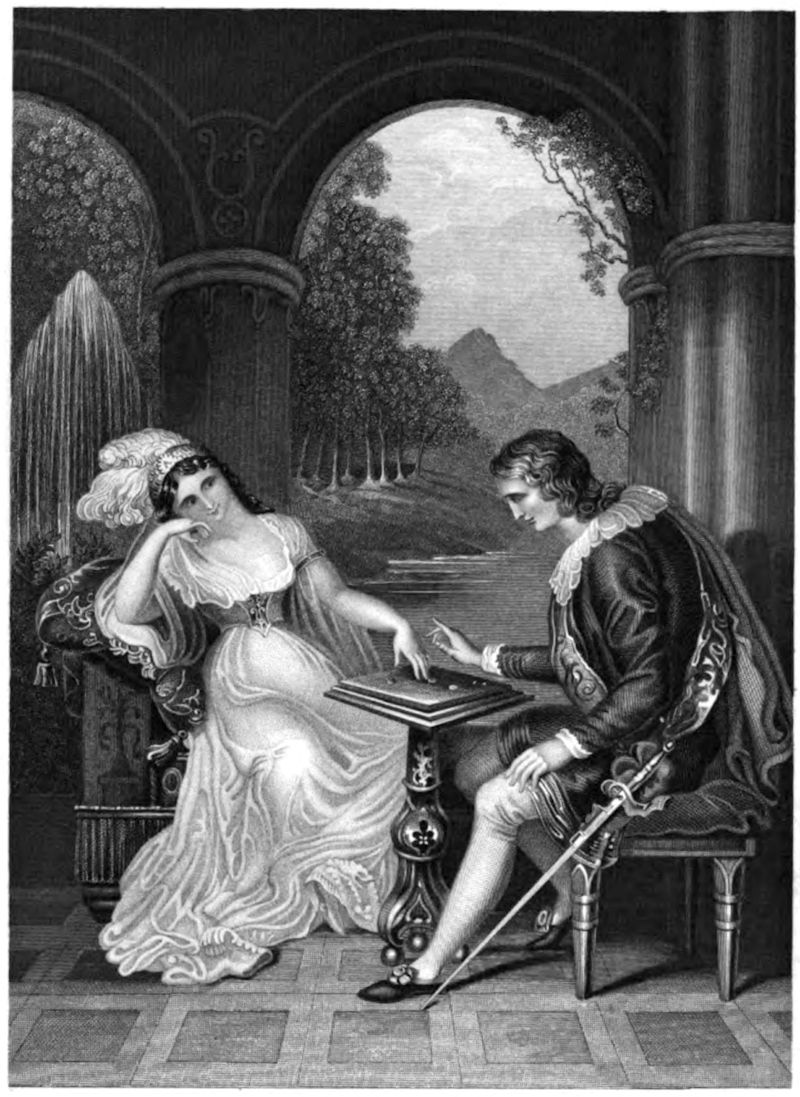 THE GAME OF DRAUGHTS.Engraved expressly for Graham’s Magazine.
[WITH A STEEL ENGRAVING.]
———
BY C. F. ASHMEAD.
———
There is a game,
A frivolous and foolish play,
Wherewith we while away the day.
Byron’s Mazeppa.
The Lady Arabella H—— was the reigning belle and
beauty of a court not excelled, in the long annals of its
previous history, for accomplished and fascinating women.
Many stars, of no little magnitude, sparkled in
the regal diadem of female loveliness, but she outshone
them all. In the graces of her person, in wit, in accomplishments,
she appeared without a competitor—not to
say without a rival. Her own sex reluctantly yielded
the palm to her indisputable pretensions, and the other
proudly crowned her with its leaves. She was the
Venus of the day.
Countless suitors knelt at her feet—from the gay
nobleman to the grave statesman—for in the versatility
of her attractions lay some charm for all. But the lady
was strangely cold to the accents of love. One gallant
after another retired with his suit rejected, and despair
in his heart: and it might have been believed that the
exquisite temple of her form enshrined a soul callous
to the passion it was so peculiarly fitted to inspire.
A brilliant ball was in progress. It was graced by
the presence of royalty, and the arrangements and
decorations were worthy of the distinguished visiters.
Beauty and fashion, and taste, conspired to lend a
magic to the festive scene. Conspicuous among the
admired of her sex shone the graceful figure of Lady
Arabella H. Her loveliness on this evening surpassed
itself: and there was a languishing tenderness in her
eyes that bespoke a softer mood than her wont, and
lent hope once more to her despairing suitors. With
renewed energy, these crowded around her to seek
her smiles, while new aspirants for her gracious favor
added the meed of their respective homage. One gallant
alone remained aloof from the idol of universal
worship. This was the young Lord R—, remarkable
for his handsome person, his general accomplishments,
and more than all, his noble soul. It was but recently
that he had appeared at court after an absence abroad.
On his first return, he had seemed to share in the fascination
caused by the charms of the Lady Arabella.
But by degrees, he had shunned her society: and on
this evening, he evidently avoided passing within the
charmed circle of her blandishments. His very glances
appeared schooled to prevent their resting on her, as
he stood dejectedly within the door, with his eyes cast
upon the ground.
“What aileth thee, my lord, that thou holdest thyself
to-night beyond the attraction of yonder dazzling
orb?” inquired Sir Charles G—, advancing close beside
him.
“I may not approach without being singed by its
fire, from which I have already suffered more than
enough for my happiness.”
“By my troth, then, the star is resolved to approach
thee: for lo! the lady nears us now, and takes her
station not far from thy side, attended by some of her satellites.”
Lord R. did not trust himself with a single glance to
ascertain the correctness of the assertion: but turned
his face toward the ante-room.
“Thou art too diffident of thyself,” continued Sir
Charles. “Attack the peace of the haughty belle even
as she hath thine, and she will surrender her hand at
thy discretion.”
“You flatter, my friend. How dare I to entertain
hope, when so many have been rejected by her with
less than indifference? Nay, there remains no alternative
for my happiness save to shun her altogether.”
A stifled sigh here arrested the attention of the
speakers, and the fair being who was the subject of
their remarks passed within the door-way in which
they stood. She leaned on the arm of a young nobleman
who regarded her with looks of anxiety. A sudden
indisposition had that instant seized her, and she
was retiring to seek her recovery apart from the crowd.
“Leave me here alone,” said she to her companion,
when they had reached the recess of a window in the
ante-room. “It is but a slight faintness, and I shall be
myself again presently.”
The gallant obeyed, and the lady occupied the ante-room
in solitude.
Giving way to a burst of tears, she murmured,
“Alas! he whom alone I love of all that seek my hand
hath declared that he will in future shun me altogether;
and yet the very declaration implies that he is not indifferent
to me. Untoward fate! how hast thou permitted
a misapprehension so cruel?——”
A succession of sobs interrupted her voice, and her
soliloquy sunk into inaudible words. But her unhappy
train of thought continued, and she remained for a considerable
time with her emotion deepening rather than
diminishing.
At length, by an effort, she recovered in some measure
her self-possession. The surprise her absence
from the dancers would occasion now suggested itself
to her mind, and she had arisen for the purpose of
rejoining them, when two persons entered the ante-room.
The projection of the window hid her from their
observation: and it was fortunate for her that this was
the case; for, on recognizing in one of the intruders the
graceful figure and handsome countenance of Lord R.,
her former emotion returned with increased violence.
Smothering her sensations to prevent her attracting
their attention, until the effort almost choked her, she
sank back again upon her seat, where the damask window-curtains
afforded her an effectual screen from discovery.
Entirely unconscious of her presence, the two gallants
drew a small side-table near the window, and sat
down to a game of draughts.
The gentleman who accompanied Lord R. was the
same with whom he had recently been conversing,
and he had, with the charitable design of diverting his
friend’s melancholy mood, suggested a trial against
himself of the noted skill of Lord R. at the game in
question—he being himself also a scientific and accomplished
player.
They went through five or six successive games,
and Lord R. was every time the winner.
As they played, the Lady Arabella, whose situation
gave her an opportunity of viewing the board,
though, as has been said, it was such as to prevent her
being herself observed, gradually became interested in
the moves, enlisting all her sympathies on the side of
the successful combatant.
“Conquered completely,” said Sir Charles at length,
pushing back the board and rising from the table.
“You are more than a match for me, and yet I have
ever been counted no mean player.”
“I have never met any one able to beat me since
the first dozen games I played as a tyro,” replied Lord
R., as he followed the example of the other in leaving
the table, and linking his arm within that of his friend,
they made their exit from the apartment.
It was not until some little time after their departure
that our heroine arose from the seat she occupied. But
when she did so, it would have seemed, from her
countenance, that some bright and sanguine idea had
struck her, possessing the power to dispel her previous
desponding state of mind.
When she again appeared in the ball-room, Lord R.
had quitted the scene. But her hope, whatever it was,
evidently extended beyond the present into the future:
and the reader, who is acquainted with her sentiments,
may augur, from the beaming smiles which throughout
the remainder of the evening she shed around her—too
bright to be the result of aught else than heartfelt confidence
and joy—that she had discovered some delicate
mode of communicating her preference for him whose
love for her, the words she had so lately heard from
his own lips, left her no room to doubt.
The Lady Arabella suddenly grew extraordinarily
partial to a pleasing, though not heretofore engrossing
amusement. Hoyle had not at that day been published;
but practice was her teacher, and she became
an astonishing adept at Draughts. A passion emanating
from so admired a source soon spread throughout
the court circle, until checker-boards took the
place of dancing and music, and conversation, in every
festive concourse. For the remainder of the season,
nothing else was in vogue. The ball-room continued
empty, the drama remained unnoticed, and the worshipers
at the shrine of Pleasure sought her only at
the table of the fashionable game. The lady who was
skillful at draughts, was deemed something more worthy
to aspire to distant rivalry with the Lady Arabella,
and the man who excelled at the same, was thought
more fitting to become, however unsuccessfully, her
suitor.
The excitement in the metropolis, caused by the retirement
of lords and ladies to their country residences,
was at its height. The atmosphere exhaled the balmy
softness and fragrancy of an English June; and a succession
of delicious days witnessed the arrival of a
party of the first noblemen of the realm at the Castle
of ——.
This castle was beautifully situated on the margin
of a winding lake, surrounded by the most bewitching
and graceful mountain scenery. Art, moreover, lent
its aid to increase the attractions of the spot, and gardens,
groves, grottos, arbors, and fountains, appeared
at every turn in rich and tasteful variety. It was a
residence worthy of a divinity. And such, indeed,
Fortune had placed in it, for the magnificent domain
was the inheritance of the father of the Lady Arabella,
while his daughter was the goddess of the place.
It was a singular mandate which here congregated
around her the chivalry of the day. She had caused
it to be known that she desired her suitors, one and
all, to meet her at this particular crisis, in trial of their
skill against her own, at the late fashionable game of
draughts. He who should prove her successful antagonist,
the proclamation declared, was to take his
revenge in claiming her hand. Three months had
been given them for practice, and the time had at
length expired. The aspirants day by day were arriving
in numbers, and the castle became filled with
guests.
England might well have been proud of the flower
of her manhood, as they showed on this occasion.
Stately and stalwort forms, and haughty brows, and
eyes of intellectual fire, were to be seen among the
motley but graceful crowd.
At length, the day which limited any further arrivals
dawned. It was the same that was to decide the fate
of those visiters already assembled.
At an early hour, clad in a dress of simple white,
with a bodice of blue satin, the Lady Arabella descended
among her palpitating guests.
“I am ready, gentlemen,” said she, with one of her
radiant smiles. “I will retire to the adjoining colonnade,
and let him who wishes to make the first trial
join me there. When a single game with him is over,
another can take his place. There is but one suggestion
I would make,” she added, “which is, that those
who are deemed the most skillful players remain until
the last.” So saying, she turned and departed.
The colonnade which the Lady Arabella had thus
dedicated to the singular contest, was situated so as to
receive the breeze from the neighboring lake. A fountain
of pure water, placed near, likewise contributed
to refresh the atmosphere, while the picturesque
mountain scenery in the distance delighted the eye,
and the songs of birds in an adjoining grove made melody
to the ear.
After a few moments’ consultation among her suitors,
our heroine was speedily followed into this pleasing
retreat, first by one and then by another in rapid succession.
The only interruption the routine experienced
was that caused by the necessity of her taking some
refreshment. In this manner, the day wore away, and
each of her antagonists retired in turn, crest-fallen and
vanquished.
It was almost twilight, and there now remained but
one gallant to be tested. He had unanimously been
voted the best player present; and had therefore, according
to the Lady Arabella’s suggestion, been preceded
by all his companions. As he entered the colonnade
with an embarrassed, though graceful step, the
lady blushed, and her eyes grew soft and tender. Intent
upon the great stake before him, these indications
were lost upon the nobleman, who took his seat at the
board. In fact, he dare scarcely trust himself with
more than a glance at the fair being opposite him, lest
the dazzling vision should disarm his skill.
But for the first time throughout the day, the gentle
combatant played carelessly. Her eyes were riveted
upon the countenance of her opponent, rather than as
previously, fixed upon the board. Her moves seemed
made without foresight, resembling those of a beginner
more than an adept, and she failed to crown a single
king. In a word, the meanest antagonist might have
won the game at issue, and in a quarter of an hour her
opponent gained an easy victory.
“Dare I,” asked he—gathering some suspicion of a
preference on her part, which alone could have led to
this result, after the skill she had previously manifested
towards his rivals—“dare I presume to claim
the rich reward?”
His voice grew lower—he drew his chair to her
side, and ventured to raise his eyes to her countenance.
It beamed sweet affection; and as she extended her
hand to meet his, the nobleman grasped the treasure
as one which that gesture made willingly and confidingly
his own.
The victorious gallant was Lord R., and ere another
winter, the Lady Arabella H—— became his bride.
Draughts went out of fashion in the beau monde, but,
during their hours of privacy, the game continued,
throughout their life-time, a favorite recreation of the
happy pair whom it was instrumental in bringing to a
blissful union.
———
BY A NEW CONTRIBUTOR.
———
The stars were weary—all the summer night
They held high revelry through heaven’s blue halls,
And danced along their wanton wanderings
To the weird chiming of the “Sister Seven,”
Now, slowly paling like young beauty’s cheek
Returning from the midnight festival,
Their glances faded, lest they should behold
The gentle dalliance of the earth and sky.
The silver lute of the young morning star
Thrilled faintly into silence, as the dawn
With red lip kissed the mountain’s snowy brow,
Which, bathed in softest slumber, blushed to own
The gentle pressure. As the waves of light
Broke o’er the margin of a darkened world,
In golden ripples, faintly they revealed
Bright uplands, where the spirit of the mist
Hung low upon the bosom of the hills,
And wept soft dewy tears, while o’er their crests
Swept her long tresses of the wreathing cloud,
With white peaks flashing through their tangled curls,
Like jewels crushed in the disheveled hair
Of maniac beauty, in some gentle hour
Of quiet sadness; and more faintly still,
Gleamed through the shadows at the mountain’s base,
Where smiling valleys dimpled Nature’s cheek,
And laughing meadows cradled singing streams.
On Horeb’s mount a holy man of God
Stood forth to view the fragrant strife of morn,
Sunshine with shadow—rosy day with night —
And sleeping Death with glory-wakened Life.
A close dark mantle wrapped his agéd form,
His brow uncovered, though a snowy lock,
Stirred by the breeze of morning, waved above
Its frozen marble; while the gathered shades
Of many years hung, like a coronal
Of withered leaves, around it—and his eyes,
Strange, deep, and fathomless, gleamed forth beneath
Its deadly whiteness, like two liquid flames.
From the recesses of a marble tomb.
Mystic and subtle as some charmed perfume,
A sense of pleasure thrilled upon his heart,
As quick, faint pulses of the scented breeze
Brought balmy odors from the dewy flowers,
Waved the plumed monarchs of the forest proud,
And wafted on the islets of the cloud
Through liquid sapphire, where they seemed to float
Softly and dreamily, and full of love.
He bowed and worshiped—and “the Lord passed by.”
The sky was changed—and hoarsely, from afar,
A sound of waters, and of mingled winds,
Through forests raging, crept upon the ear;
And, driving o’er the azure fields of heaven,
Cloud after cloud came rolling swiftly on,
Black Pelion upon gloomy Ossa piled.
Like giant towers they gather, and from point
To point along their frowning battlements
Red signal-fires are flashing far and free.
Hark! the deep watchword of the rushing storm!
The thunder-spirit calls his squadrons dark,
Far through the trackless void of scowling space,
And lightning rends the cloudy canopy,
As prophet’s vision tears aside the veil
That shadows o’er the future, and beholds
Beyond unfolded naught but dim, and wild,
And fearful mystery. Then the sullen roar
Of elemental conflict crashing fell —
A mingled din of crushing thunderbolts,
And sadly moaning winds, and heavy drops
Of rain, as though the demons of the storm
Wept o’er the ruin which their fury wrought.
’Twas past—and o’er the eastern mountains rolled
The cloudy banners, and the chariot wheels
Of burning levin—by the tempest led,
(As some great conqueror from battle won,)
The serried hosts of falling waters passed
Beneath the rainbow’s bright triumphal arch;
And Nature shouted as the wing of peace
Fell softly o’er the wild and wasted track
Of elemental war. “The Lord was not”
Amid the rushing armies of the storm,
Its fierceness was the shadow of his frown,
Deep-veiled, yet dark, and terribly sublime;
And, as upon its far retiring verge,
The glorious rainbow brightened, ’twas a dim
And faint reflection of His mercy’s smile!
Again the spirit of a fearful change
Came stealing o’er the blue and tranquil heaven —
A hollow, rushing murmur filled the air,
And the low sobbing of the rising wind
Grew deeper, till in howling gusts it whirled
Dark wreaths of earthy fragments to the sky,
As though the maddened gnomes were hurling death
Against the vapory armaments of air;
And lurid flames with blue and ghastly glare
Gleamed o’er the face of Nature till it blanched,
As though the warning of the last dread trump
Had smote her guilt upon a coward heart.
The earthquake rising from his burning lair,
Deep in the bosom of a rock-ribbed world,
Shook everlasting hills from out his path,
Like a roused lion flinging from his mane
The dewy drops of morning. At his tread
The pale earth trembled, and anon there came
A crushing down of rocky battlements,
Which, for a moment, high and quivering hung,
On cloud-crowned pinnacles, then thundering fell
Far down the dark, immeasurable void
Which yawned beneath them like the livid lips
Of fierce, insatiate hell. He tore away
The iron nerves from that strong mountain’s heart,
As though the destiny of a conqueror lay
Deep hid within it, and the hour was come
When he must march to seek it, in a last
And wild death-revel. As this passed away,
In racking throes, which might have seemed the strong
Convulsive shudder of dissolving worlds,
The earth moaned feebly, as a dying child
Will murmur faintly in its fever-dream —
Then darkness gathered round it, like the deep,
Black jaws of cold annihilation.
It came—it vanished—and “the Lord was not”
Throned high upon the earthquake’s blasting rage;
But, at the echo of His chariot wheels,
The iron land tossed like the ocean waves,
And mountains dashed aloft their crested heads
As surging billows flout a stormy sky.
The air was stagnant, cold, and dark, and dull,
Heavy as morn to aching senses, when
Some dreamer wakes to feel a load of care
Pressed back upon his memory, and hastes
To close his eyes, that he may cast it off,
And dream once more of happiness and hope.
Like molten lead along the sullen sky,
Gray clouds hung drooping, for the summer wind
Seemed frozen, and its restless wing was dead.
Strong, swift, and chainless as some maddening thought,
There came the spirit of a change, which seemed
To wave aloft the banner and the sword
Of a destroying angel—withering winds
Rose, winged with lightning, and the brazen sky
Was one red desert, peopled with a host
Of burning shadows, lurid shapes of hell,
That wildly mingled with the falling stars,
And whirled in flaming chaos up to heaven!
Clouds heated to a whiteness writhed and tossed
Along the horizon’s verge of liquid fire,
And, from their snowy foldings rent and torn,
Gushed forth a stream of meteors, like deep gouts
Of crimson blood from Beauty’s mangled bosom.
Bright glowed the valleys, and the eternal hills
Seemed towering to the brassy vault of heaven
In gorgeous pyramids of living flame —
A mighty holocaust, and offered high
On the red altars of a crumbling world
To some fierce god of elemental fire.
It flamed—it faded—but “the Lord was not”
Upon the burning pinions of its strength;
His glance, which withers dynasties and thrones —
His passing breath, where hangs the fate of kings
And mighty nations, kindled up the sky,
And lightened o’er a terror-stricken world.
Noontide poured down upon the sleeping earth
And dreaming waves a long and fervid kiss
Of panting passion, and the Orient’s heart
Glowed in its languid atmosphere of love.
The storm, the earthquake, and the flashing fire.
Had left it placid as the orbéd brow
Of slumbering Beauty—through the fragrant air
There came no sounding sweep of angel wings,
No frowning fury rushing on to tread
The wrathful wine-press of avenging God;
But the rich music of a “still, small voice,”
From the far arches of the vaulted sky
Stole slowly earthward, and as though the breath
Of God were sweeping o’er the Æolian line
Of universal being, till it thrilled
A new creation into loving life,
Hushed was the chiming of each starry sphere,
The universe of harmony was dumb,
For in the music of that “still small voice,”
Was blent the omnipresence of the Lord.
The prophet shrouded up his lofty brow
Deep in his mantle, and his soul grew still
With silent worship, as his thirsting heart
Drank the rich murmur of that mystic tone
Which told the mighty presence of his God!
The true existence of a gifted soul
Is like that prophet’s vision, and it seems
A dread reality, to which his trance
Was but the faint foreshadowing. The hues
Of morning sleep upon enchanted earth
When the young soul exulting presses on
To chase the pleasures of its opening day.
Its dreams are fairy cloudlets, flushed with hope,
Wrought into beauty by the singing wind,
Which bears them on its wing so joyously;
While the glad revel of its morning song
Fills the blue arches of its summer heaven.
The strong day deepens, as the spirit speeds
Along the crowded thoroughfares of life,
But apprehension’s vague, dim, shadow flits
O’er thought’s bright beauty; strange and fitfully
Gray tints of doubt will mingle with the hues
Of rainbow light, with which it used to paint
The future’s glory—and the Right and Wrong
Will struggle fiercely in the wavering heart,
Like light and shadow ’mid the wreathing folds
Of cloudy columns driven by the storm.
It grovels with the herd of Mammon’s slaves,
And drops of poisoned anguish from the heart
Will start and thicken on the pallid brow.
Deep disappointment, like the serpent’s fang,
Strikes through the spirit sharply, and the cry
Of midnight whirlwinds shrieking on the wold
Is not so weird and fearful. Tempest-tossed,
The soul must wander on its weary way,
Till, from the caverns of its being, rent
By strong fatality, a first, great love
Bursts on its raptured vision, as of old
A mighty angel rolled away the stone
Which shrouded o’er the sepulchre of God,
And clothed in living glory, as a robe,
Came forth the Crucified! How soft at first
The voiceless breathing of that atmosphere —
How sweet the stillness where no breezes sigh
Save that of Love’s impassioned oracle!
Anon ’tis broken, and the future sobs
A low, sad warning of the storm to come.
’Tis Passion’s earthquake rising in its might,
To scatter thought, as gathered cloud on cloud,
It hangs around the pinnacles of mind,
Perchance deep-freighted with some glorious truth,
Which, could it melt away in genial showers,
Would bless and beautify a desert world.
As some strong column, God-erected, on
The mountain’s misty summit, the young heart
Sways to and fro between the Right and Wrong —
The first may triumph, or the last may win,
It matters not, wild Passion’s dreams is past,
The soul is stagnant—but it sleeps no more.
Cradled in heaven, but entombed in hell,
Then comes the torture of its aching void,
Silent, beneath the suffocating press
Of bitter, sullen agony it lies.
The spirit sickens with its loneliness —
And thirst of power dissolves the icy spell,
Which bound its pulses into leaden sleep;
Then mad Ambition withers down the wrecks
Of disappointed Passion, as the crash
Of thunder follows in the lightning’s path;
The myrtle-wreath, now trampled and despoiled,
Is dashed aside to grasp a laurel crown.
The meed of genius, and of victory!
The past becomes a broken altar-stone.
But from the ashes of its cold despair
The strong soul rises into glorious life,
Like a young Phœnix flaming into birth.
Sweet rainbow-tinted fancies have decayed,
But lofty thoughts like gorgeous banners wave
In triumph o’er the citadel of Mind —
Though tossed, perchance, upon a sigh which tells
Of ruined hope, and desolated love;
The eloquence of passion-parted lips
Has softly faded, like the rich perfume
Of burning incense—but a vaporous flame
Of proud defiance scathes the listening world.
Thus goaded on to action by the fire
That madly rages in a wasted heart,
It struggles on to win the dust of time,
To strew it o’er the amaranthine leaves
Of an immortal coronal; its fame
Flashes, a meteor through the changing sky
Of popular opinion, ever urged
“Onward—still onward”—by the iron hand
Of strong, resistless Destiny. The storm,
The rocking earthquake, and devouring fire,
Have done their work upon the heart and soul;
Have torn away the sweetest bloom of life
And flung it wantonly upon the world —
Corroding Care has shed its poison dew
O’er Pleasure, which is foam upon the wave —
And Shame’s red plague-spot flashes in the heart,
While Pride and Passion’s flaming lava-drops
Fall hissing through its purest depths, to change
Their sweets to bitter burning.
O’er the fount,
Erewhile so wild and troubled, sweeps a spell
And “peace, be still,” is in its music tone.
The “still, small voice,” which breathes of “love divine,”
Steals o’er the spirit like the singing rain
To blossoms by the summer lightning crushed.
Shrouded in beauty, flows the fountain calm.
In dewy light the feelings sparkle on,
For every wave of thought is full of prayer.
Within its holy sanctuary hushed,
So softly beats the bosom purified,
So sweet the slumber of a soul forgiven, —
While blended with its harmony of thought
That angel “voice” is sounding peacefully,
With waning life alone to pass away,
And fade into the melody of Heaven!
Memphis, 1850.
“L’Inconnue.”
Renounce thy name, deceitful flower,
Nor boast an art beyond thy power;
Dost thou such consequence assume,
That yieldeth no such rich perfume?
The jessamine and fragrant rose
Surpass thee far, yet humbler those:
Nor does the woodbine e’er pretend
To cheer or to console a friend.
Cease, cease to promise happiness—
What widow’s desolate distress,
Or aged parent’s troubled soul
Hast thou been able to control?
Thou pretty groveler on the ground,
No spell for sorrow can be found
In thee—a gaudy, rich attire
Is all thy votaries admire.
When varied colors, gay and bright,
Can give a joyless mind delight,
My muse shall celebrate thy fame—
Till then, false flower, renounce thy name.
Burlington, N. J.
———
BY ENNA DUVAL.
———
Turn thy eyes back upon thyself, and see thou judge not the doings of others. Thomas A’Kempis.
“We missed you so much at Mrs. Fenton’s last
evening, Cornelia; why did you not come?” asked
Miss Lee.
“Because Miss Enna had just come to us, and was
not well; nor did I feel very well myself.”
“Mrs. Fenton told us Miss Duval had partly promised
to come also,” said Miss Ellen Lee, a younger
sister of the first speaker.
“So I did,” I replied; “when Mrs. Fenton called
at Miss Clemson’s yesterday morning, I told her if I
felt well enough in the evening I would come.”
“What a very pleasant young person Miss Clemson
is, Miss Duval,” drawled out young Colton, a dangling
beau of the Miss Lees, “my sisters go to school to
her, and I had no idea their school ma’am was such a
nice young woman.”
The young ladies giggled at this would-be witty and
patronizing remark, to which I only replied with a
cold assenting bow of my head.
“I have never met with her before,” said Miss
Ellen Lee, “but I really liked her very much.”
“She converses very well,” said the elder Miss
Lee. “We had an opportunity of judging last evening,
for she did the most of the talking.”
“She’s one of your talking women, I believe, but
that’s her business, you know,” rejoined the dandy, in
an affected languid tone of voice, as if the exertion of
talking was too much for a person of gentility. A
sharp retort trembled on my tongue, but I checked
myself, as my eyes passed over his insipid, characterless
face; and I returned with such animation to a
little drawing I was making for Cornelia’s mother,
that I snapped off the end of my pencil.
“I did not know that Miss Clemson visited this
winter in society,” said Cornelia. “Is she not in
mourning?”
“Oh! no,” exclaimed Miss Ellen Lee, “she is not
in mourning, for she was dressed beautifully last evening,
she had on a light silver-gray silk, very rich and
expensive looking;—any thing but mourning.”
“She does not approve of mourning,” said the elder
sister, “and although her brother and his wife died
only a few weeks since, I suppose she does not approve
of observing any of the customs of society on
such occasions, no matter how sad they may be.”
“Why, my dear,” said Mrs. Knowles, a purse-proud
parvenue woman, “persons not properly in
society, like Miss Clemson, are excusable in differing
from its usual customs; it matters little what they do.”
I quietly permitted the conversation to proceed, for
I felt too much contempt for the company, to take any
trouble to defend my dear friend, Mary Clemson. I
knew their remarks proceeded from willful malice, and
that it would be of little use to set them right. My
little pencil sketch, however, from my repressed temper,
was growing quite as spirited under my quick,
impulsive touches, as the original, from which I was
copying it—the only good that resulted from the gossip;
and I should have remained silent, had not my
friend, Cornelia Payne—who was not acquainted with
Miss Clemson, joined in the conversation, and animadverted
pretty severely on Miss Clemson’s want of
feeling.
“She might dress as she pleased,” said Cornelia, in
reply to a flippant remark of Ellen Lee’s, that Miss
Clemson dressed very expensively and extravagantly
for one in her position and circumstances; “dressing
is a matter that belongs to one’s own taste, and so far
as circumstances and means are concerned, that is
nobody’s business; but I think it argues a want of feeling,
a coldness of heart, when one who has recently
gone through so much trouble, can so readily throw it
aside and make their appearance at an evening party.”
“Oh, Miss Clemson prides herself upon being above
all such weaknesses,” said Miss Hill, another young
lady present. “Little Sallie Foster, one of her pupils,
told me the other day, that Miss Mary had given her
quite a lecture because she cried at the prospect of a
rainy day, which would necessarily put off a May
party, and said she could scarcely conceive of the necessity
of shedding tears, no matter how great the trial
might be.”
My memory quickly recalled the scene Miss Hill
alluded to. I had been visiting Mary Clemson the
week before, and had been present at the conversation
with little Sallie Foster. The remark quoted had been
meant to apply merely to temporal trials; and as the
sobbing Sallie left the room, I remembered the touching,
sad expression of my noble, strong-minded friend’s
countenance, as she turned to me, and said, “Heaven
grant the poor child may never have real trials to
weep for.”
“It’s well she is strong enough to overcome natural
feeling,” said Cornelia Payne, in reply to Miss Hill’s
remark, “that is, well for her own worldly comfort, I
mean, but I do not admire such unfeeling persons.”
This was going a little too far for my patience, for I
respected and loved Cornelia Payne, though I knew
her to be somewhat uncharitable, and harsh in her
judgments of others.
“Cornelia,” I said, “Miss Clemson is not unfeeling;
she has as warm and sensitive a heart as any one I
know.”
“Oh, we forgot,” exclaimed the Misses Lee in a
breath, “that Miss Clemson was an intimate friend of
Miss Duval’s.”
“Yes,” I said, looking at Mrs. Knowles, “my mother
knew Miss Clemson’s mother, when she was the
rich heiress, Miss Fleming; and your father Mrs.
Knowles, made Miss Fleming’s carriage, which was
the talk of the town, at the time of her marriage
with Mr. Clemson. I have heard my mother frequently
speak of it. You remember it, do you not,
Mrs. Payne?” I asked, turning to Cornelia’s mother.
“Perfectly well, my dear,” replied this gentlest of
all gentlewomen, smiling at my sudden arousing. My
tongue was now unloosened, and I felt ready to measure
swords, or the more feminine weapon, darning-needles,
with them all. I continued —
“I must scold my pretty, thoughtless friend, Mrs.
Fenton, for deceiving Miss Clemson. She assured us
that only Mrs. Fay and ourselves would be with her
last evening; and you, Cornelia, were only invited,
because I had promised you and your mother to commence
my visit here yesterday, and Mrs. Fenton
wanted to secure me, to accompany Mary Clemson.
Mrs. Fenton has been one of Miss Clemson’s most attentive
friends, and Mrs. Fay knew Mary’s mother
when she was a girl. Mrs. Fay wanted to see Miss
Clemson on business, and was too infirm to go to her;
she wishes Miss Clemson to take charge of her nieces,
the Miss Foresters.”
“What, our cousins the Foresters?” exclaimed the
two Lees. “Why I think Aunt Fay might have consulted
with mamma about it,” continued the elder one,
“however, it will be a great thing for Miss Clemson
to have them, for the girls are immensely wealthy.”
“Yes, Miss Lee.” I replied, trying to be very calm.
“But who would have thought, when your aunt, the
now rich Mrs. Fay, and your mother kept the fashionable
boarding school, at which Miss Fleming was educated,
that Miss Fleming’s daughter would in turn be
governess to the nieces of Mrs. Fay and her sister.
Life has many strange reverses, Mr. Colton.”
Poor Steenie Colton, colored to the roots of his
faded hair and whiskers. I suppose he thought I was
going to tell him of his respectable old grandfather,
who had kept a very nice meat and vegetable store,
but I spared him, for I felt I had said enough to my
discomfited gossips.
“Now tell me, Miss Lee,” I asked, “who all were
at this evening party of Lizzie Fenton’s.”
“It was no evening party, Miss Duval,” replied the
young lady sulkily. “Neither Ellen nor I have said
so. Mr. Colton went in with us during the evening to
see Aunt Fay.”
“Excuse me,” I said, “but did you go by invitation?”
“Why, Miss Duval?” inquired the younger one
pertly, as her elder sister answered me in the negative.
“Because,” I replied, “my friend has been accused
of heartlessness and want of feeling by one whom I
respect, and to clear Miss Clemson in Cornelia Payne’s
opinion, is all I care for. Others may think as they
please of her, but Cornelia can appreciate such a noble
good woman as Mary Clemson.”
The conversation naturally flagged after this, and
soon the morning visiters bade us good day.
“Bravo!” cried Cornelia, after they all left, clapping
her little hands on my shoulders. “Bravo! Captain
Duval, why you have routed my poor little gossiping
brigade completely, put them all to flight.”
“They are the most disagreeable people that visit
us,” said Mrs. Payne; “as for those silly Miss Lees,
I wonder, Cornelia, how you can endure them.”
“Oh, my dear mother,” replied the daughter, “it
takes all sorts of people to make up the world. You
know old Patsie tells you that every day. But, Enna,
I must know this paragon of yours; we will call on
her together.”
I was about to remonstrate with Cornelia for her
harsh and hasty judgment, during the preceding conversation,
but the entrance of some other visiters
prevented me.
I loved and respected Cornelia Payne; she was one
of my dearest friends, and, unlike most girls of her age—we
were only nineteen then—she had a strong, decided
character. Her oddities did not spring from affectation,
nor did her warmly expressed opinions proceed from a
spirit of arbitrary obstinacy. She was true and sincere,
and had a good, strong mind. She had faults,—who
has not? And her principal fault was a sad one,
she was harsh and uncharitable in her judgments of
others. She had never known trouble or temptation;
and honest, firm, and upright herself, she always
judged every one by her own standard—a standard
that had never been tested by a single trial. Whenever
we remonstrated with her, her replies were such
as “Nine times out of ten appearances are the best to
judge by,” or, “There is so much cant and affectation,
so much petty falsehood in society, that it makes one
forget there is such a virtue as charity,” or, “There
are certain bounds to charity beyond which it ceases
to be a virtue, and becomes a weakness, and a cowardly
shield to vice,” which replies generally silenced
me.
The evening following the conversation which
opened this sketch, we were all assembled in the
cozie, comfortable library. Some friends had called in,
and, according to the too usual custom, the conversation
turned upon the absent. The subject of discourse
was the conduct of two persons, a husband and wife,
with whom the company assembled were sufficiently
acquainted, to feel interested in their well or ill doings.
A few weeks previous the husband had made a most
disgraceful failure, and had been detected in various
dishonorable transactions; whereupon his wife, with
whom he had always lived happily, apparently, left
him, and returned to her family; and since her desertion
of him, her friends had made application for a
divorce. This was commented upon pretty severely,
and almost every one blamed the wife for her heartlessness;
and circumstances were mentioned to prove
the uniform kindness and lavish indulgence of the husband
in the days of his prosperity. My friend Cornelia
was almost the only one of the party who defended
her.
“That’s so like you, Cornelia,” said her cousin,
Harry Peters, laughing, “you always lake ‘the forlorne
hope’ in an argument, and seize up the cudgels
for the minority.”
“You are unjust, Harry,” replied Cornelia, a little
piqued, “I always take the side of my opinion, and
defend that which I think honest and right. I scarcely
know Mrs. Barclay, therefore, neither am I prejudiced,
for she is no favorite of mine; she always
seemed to me a cold, selfish woman, even when everybody,
and you particularly, Harry, admired her so
much. But I do say, that I do not excuse, I uphold
her conduct in this matter. Even thus should I have
acted had I been thus placed, guided by a strict sense
of duty. I could love as devotedly and truly as any of
you, but my love would wither away, under the scorching
breath of dishonor and crime.”
The conversation grew very animated, and all spoke
at once, to express their decided opposition to Cornelia,
but she stoutly defended her position.
“True, Cornelia,” said her mother, “your love
might be weakened, but would that change of feeling
justify desertion?”
“It would not be desertion, mother,” replied Cornelia,
“it would be fleeing from the plague spot of sin.
No one has a right to subject their spiritual nature
to the degrading influence of daily association with
crime.”
This was what Harry Peters playfully called, “one
of Cornelia’s grand, solemn, rhetorical conclusions,”
which generally silenced all further debate, without
convincing any one; but often, in after hours of sorrow,
Cornelia’s figure and countenance, as she looked
during this conversation, would come before me, with
painful distinctness. In her earnestness she had arisen
from her seat, and her fine, tall figure seemed dilated
with indignation, while her beautiful face was stern
and severe as that of the avenging Archangel.
Poor Cornelia! then, she knew not what trouble
was. Her father was a prosperous merchant, and her
mother was a gentle, delicate woman, who rarely interfered
with any one, except to do some sweet office
of love. Cornelia was a complete contrast to both of
her parents; for her father, a bright, joyous, warm-hearted
man, was even weakly indulgent to others.
They were a loving, happy family, and Cornelia, although
stern and severe to what she called error, was
enthusiastic in her love for her family, ready to sacrifice
any thing for them, if occasion required. I always felt
improved in spirit as well as in body, after a visit to
them, for they all seemed to enjoy life so healthily and
properly. Possessing ample means, and in the midst
of a pleasant circle of friends, they appeared to be exempt
from humanity’s penalty—trouble. But sunshine
dwelleth not always with us, and every light hath its
shadow.
I had not been many days with my friends when I
observed that the kind, good natured father was not in
his usual spirits. It was in the spring, following the
winter of 183—, a sad winter to commercial men in
——; and long will it be remembered as a season of
trying reverses. Mrs. Payne did not notice the change
in her husband; his health was not so strong as usual,
which would have accounted for his heaviness had
she noticed it; then, fortunately, her younger children
monopolized her attention; but Cornelia, I very soon
saw, both noticed and felt the change in her father’s
manner.
One pleasant, soft morning, Mrs. Payne being too
much engaged with some home duties, to accompany
us on a shopping or visiting excursion, Cornelia
and I concluded to take a long drive out of the
town, that we might enjoy the refreshing spring air.
The trees were just budding, and Nature was unfolding
a light, tender green mantle of foliage. We took
long breaths of the delicious air, and it seemed as if
the heavy cloud, which hung around us all in town,
was dispelled completely, under the genial influence
of the youthful spring. Cornelia was brighter, and as
we pointed out to each other striking bits of the landscape,
or noticed the graceful branches of the trees,
and the delicate hues of the blossoms, we chanted
aloud, passages from the old English poets, who so
particularly rejoiced in, and welcomed so melodiously,
the “Coming of the longed-for May.” How vividly
does my memory recal every word uttered during that
drive. I remember quoting with gleeful spirit, a verse
from Herrick, which is full of that bounding, flowing
melody that is heard in wild wood and dell, Nature’s
own music.
“Rise and put on your foliage and be seen
To come forth like the spring time fresh and green,
And sweet as Flora. Take no care
For jewels for your gown or hair;
Fear not the leaves will strew
Gems in abundance upon you;
Besides the childhood of the day has kept,
Against you come, some orient pearls unwept.”
As the horses’ heads turned homeward Cornelia’s
gayety faded away, and after a few moments of serious
silence, she looked up and said,
“My dear, own Enna, I am very much afraid we
are about to have some heavy trouble to contend
with.”
“Why, Cornelia?” was my reply, for as this was
the first time she had spoken to me of her presentiment
of sorrow, I did not wish to add to it, by letting
her know that I likewise had observed the cause for it.
She told me that she could not tell why she anticipated
this trouble; that she knew nothing certain, but she
had, like myself, noticed a change in her father—something
of moment she was sure must be resting heavily
on his mind, for he had not had his usual spirits for
some time.
“At night,” said she, “when my dear mother is
asleep, I hear him walking his dressing-room sometimes
until day-dawn. Mother says he is not well,
but I am very confident that it is not sickness of the
body that affects him; it is, I fear, sickness of the
mind; and yet how foolish, if it be pecuniary difficulties,
to grieve so much about it and keep it from us.”
“He knows, dear Cornelia,” I replied, “how unfit
his family are to bear reverses of fortune. You alone
are able to bear up against loss of means.”
“That’s true,” she sighed, “God only knows what
is coming, but I pray He may send strength when the
dark hour of trial does burst upon us.”
Poor girl, she did not know how much her father
needed her prayer at that very moment, for the hour
of trial had arrived to him, and strength was indeed
wanting.
At dinner Mrs. Payne received a note from her husband,
in which he said, that he would not be at home,
until late in the evening, as he was very busy at the
counting-house. The meal was a silent one, for even
Mrs. Payne looked serious, and expressed her anxiety
for her husband’s health, which she feared might be
injured by over-exertion. As we arose from the dinner
table, Mrs. Payne put her arm affectionately around
Cornelia, and said,
“Come, my daughter, give us some of your beautiful
music, something that is very brilliant to enliven
us, for we are rather heavy this evening.”
I knew well that Cornelia was unfit for any exertion,
and as we entered the gay, light drawing-room I
seated myself at the piano, and asked Mrs. Payne if
my music would not answer the purpose as well as
Cornelia’s. Cornelia’s eyes expressed such a world
of thanks, that I felt quite repaid for the effort—for
effort it was—and soon after I noticed that she quietly
slipped out of the room. Mrs. Payne was passionately
fond of music, and I sang and played for her, nearly
two hours. She was a fine harpist, though she seldom
played, but I even prevailed upon her, to play with me
some harp duets. While we were in the midst of a
brilliant piece, the waiter entered, and said that Mr.
Payne wished to see me in the library.
“Mr. Payne at home?” inquired Mrs. Payne.
“Yes, ma’am,” answered the man, “he has been
in some time, but has been busy with some gentleman
in the library.”
“Some news for you from home, Enna, dear,” said
Mrs. Payne quietly. “I suppose Mr. Payne thinks
we have company with us, we are so musical, and he
feels too tired to come up.”
“Very likely.” I answered with forced calmness,
glad that her easy, happy disposition prevented her
from feeling the sad apprehensions which had chilled
my heart at the summons. I knew, from the expression
of the waiter’s face, that something was wrong,
and as I reached the lower hall he said to me, as he
left me,
“Miss Cornelia’s very sick in the library, Miss
Enna.”
I opened the library-door, and Heaven grant such
another sight may never be presented to me again.
On a lounge lay Cornelia, partly insensible, and before
her knelt her father, not in trouble for her sickness
only, but in anguish, deep, heart-rending anguish. In
low tones he besought his child to open her eyes, to
look at him, and tell him she did not despise him. I
saw the insensibility was passing off, and I raised her
head and moistened her lips with some water. As I
took the water from the table, I saw on it a case of
pistols, over which I hastily threw my handkerchief,
though chilled and trembling with fear of I scarcely
knew what. When I raised Cornelia, and Mr. Payne
saw her returning consciousness, he shrunk, like a
guilty thing, behind a large, old-fashioned screen, that
stood partly in front of the lounge. Cornelia stared
wildly around.
“Where is father?” she exclaimed, and before I
could answer, she darted from the lounge, and was
about leaving the room, when she heard his low, suppressed
groan; quick as thought she was beside him.
She covered his hands, that hid his face, with kisses—she
soothed him with every affectionate endearing
word, and as he cowered to the ground, she raised
him as a mother would a child. They sat on the
lounge together, her arms encircled him tenderly, while
her lips rested on his brow, that was wrinkled with
heavy lines of anguish.
“My dear, dear father,” she said, “have you forgotten
your daughter, your Cornelia, who could not
live without you? Come, come, I was only a little
sick; it is all over now, and Enna Duval is here, to
take care of us both. Come, cheer up; think of mother,
and Tom, and Cassy, and all the dear ones. We
are all left to you yet.”
Thus she tenderly soothed him, and I, seeing that
she was so much stronger, thought I had better leave
the room. As I put my hand on the door, Cornelia
gave a low cry of alarm, I turned and saw that Mr.
Payne was in violent convulsions. In a little while
the best physicians in town were summoned, and Mr.
Payne declared to be in great danger, for his disease
was a raging brain fever. For days we watched beside
his bed—Cornelia and I—for with nervous anxiety she
kept every one from her father that she could. He
raved incessantly of disgrace and crime, and during
his agonized ravings, my poor friend would weep bitterly.
I never saw such devoted tenderness as Cornelia
displayed during this fearful illness. At one time
death seemed almost inevitable, but as Mr. Payne possessed
a good constitution, and had always been a man
of regular habits, he rallied under this sickness, which
would have proved fatal to most men. But when the
delirium left him, and he opened his languid eyes
beaming, though dimly, with the light of reason, their
expression of anguish was painful indeed. Cornelia
was beside him, her arms around him, and the sweetest,
tenderest words of love fell from her lips to greet
his returning senses.
“Then, my daughter,” he said in a low, feeble
whisper, “you do not hate and despise your father.”
No words could express the deep love of Cornelia’s
embrace, and with soothing, tender expressions she
sought to quiet him, which succeeded, for he sunk
back in her arms with a calm, peaceful smile on his
sad, care-worn face.
Mr. Payne grew gradually better, dear reader, and
during the hours of convalescence, when I was at different
times alone with him, he told me the sad scene
which had occurred previous to his sending for me to
the library. He had been staggering under a load of
business difficulties for some time, as Cornelia had
suspected, but could not bear to look upon his affairs
as they really were. He could not summon strength
and courage to come to his wife, and tell her that all
the fine fortune her father had left, was gone, that she
and her children were penniless. Day after day he
struggled on,—difficulties increased, and in a moment of
desperation, to relieve himself of a pressing demand,
he added the crime of forgery to the load of debt;
hoping to relieve himself before he should be discovered.
This happened on the day, at the very time of our
drive, when Cornelia was praying for strength. He
had some days before written to a business firm in a
neighboring town for assistance. Upon them he had
some, yes, great claims, for ten years before his capital
had established them in business; and he anxiously
looked for an answer to his demand, in order to relieve
himself before any one could discover his weak act.
Late in the afternoon he received, instead of the frank,
friendly aid he expected, a cold, short refusal. He
staggered home. The enormity of his offence increased
upon him, and as he reached his home, the
consciousness of having added disgrace to poverty,
almost set him wild. He went first into the library,
which was in the lower part of the house, because, as
he said, the sound of music and gayety that came from
the drawing-room, maddened him. He had scarcely
entered the room when the hall-bell rang, and the servant
ushered into the dimly lighted library, a gentleman;
and as he heard his name announced, Mr.
Payne shuddered,—it was the very name he had used
unlawfully, a few hours before. It was a young merchant
of great property, which he had inherited from
his father.
“I have come, Mr. Payne,” said the young man,
as the servant closed the door, “to return to your
hands a paper which you must destroy. No human
being knows of it, but you and myself—and believe
me, my dear sir,” he added, in a voice trembling with
feeling, as the guilty man buried his face in his hands,
groaning aloud, “believe me, I am certain, that great,
great must have been the temptation—the trial that
goaded Hartley Payne to such an act; and I thank
God! it was upon me—upon the son of Jacob Hallett
you did it. You befriended my father in the dark hour
of poverty, you helped him up on the stepping-stone to
fortune, and had you come to me in your emergency
for this money,—that and double, and thrice treble the
amount, should have been freely yours.”
Young Hallett then tore the note into a thousand
pieces and burned it.
“I thank you,” said Mr Payne in a hoarse voice,
“you have saved me from disgrace which is worse
than death; but you must leave me now, and when I
am more composed I will express to you my gratitude.”
“Not until you will promise me,” answered young
Hallett, “that you will let me come to you to-morrow,
and give me the satisfaction of assisting you in your
trouble.”
Mr. Payne took the kind young man’s proffered
hand, and pressing it, assured him, in broken words,
that he would accept his offer; and young Hallett seeing
that Mr. Payne was really suffering from the humiliation
and mortification which his presence caused
him, left him.
Mr. Payne walked up and down the room once or
twice. He felt like a maniac. The crime he had
committed stood before him in letters of fire. Maddened
with remorse, he opened an escritoir, and
taking from it a case of pistols, which were loaded, he
laid it upon the table. Calmly he snapped the spring
of the case, and throwing back the lid, took out one of
the pistols, which he held deliberately to his head. As
he did this, he heard a low shriek beside him, and with
a strong grasp, the pistol was taken from his hand. He
turned—and beside him stood Cornelia.
She had been in the library all the while. She had
come there from the drawing-room after dinner, to
watch for her father’s return, and had fallen asleep on
the lounge, which was hidden by the large old screen
that stood between it and the door. Her sleep was
heavy from exhaustion, and she had not awakened
until Mr. Hallett had entered; this aroused her, and
with chilling horror she heard the whole conversation
between them. After he left the room, she lay stunned,
and was only aroused by the click of the escritoir
lock. This startled her, and she sprang to her feet,
just in time to save her father’s life. The revulsion
was so great, that she sank to the floor, insensible, and
then it was he sent for me.
Mr. Payne knew Cornelia’s stern, severe opinions;
he remembered also how she always shrunk from all
those who had been guilty of even venial sins, and he
felt more keenly, the mortification of his crime before
her, than before any other living being. But so beautifully,
so tenderly, and respectfully did she bear herself
toward him, that one might have fancied she had
forgotten every thing but the fear of losing her father.
He grew stronger, and as soon as his health was restored
he courageously examined his affairs.
Young Hallett, who during Mr. Payne’s sickness
had been an excellent and efficient friend, was of great
service. Every thing was given up, the magnificent
town house, the carriages and horses, the plate, and
every luxury; but my friends looked very happy in
their pleasant country home, and though quite humble
was their style of living, they scarcely seemed to miss
their former splendor.
Even the tender, delicate Mrs. Payne, who had
been born and reared in luxury, and for whom we had
all trembled, bore the reverse of fortune as brightly
and philosophically as Cornelia. But the most beautiful
sight was the great change that had taken place in
my friend Cornelia’s character. All sternness, all severity
had vanished, and the gentlest spirit of Christian,
loving charity displayed itself in every word,
every act of hers.
“Sweet are the uses adversity,” I often repeated to
myself, when looking at her. Toward her father she
always displayed the most delicate and affectionate
respect, and the children no longer found in her a
stern, close judging Mentor, but a kind, loving, indulgent
companion.
Three years after, a gay party assembled at Mr.
Payne’s little country house. It was the wedding
party of our dear Cornelia, who was the bride of Mr.
Hallett. She is now the mistress of a fine establishment,
and had the satisfaction of seeing her father
once more comfortable. He was for many years associated
in business with his son-in-law, and no one
ever knew or dreamed that the highly respected Hartley
Payne, of the wealthy firm of Hallett & Payne,
was once on the verge of disgraceful ruin.
———
BY HENRY KIRBY BENNER, U. S. A.
———
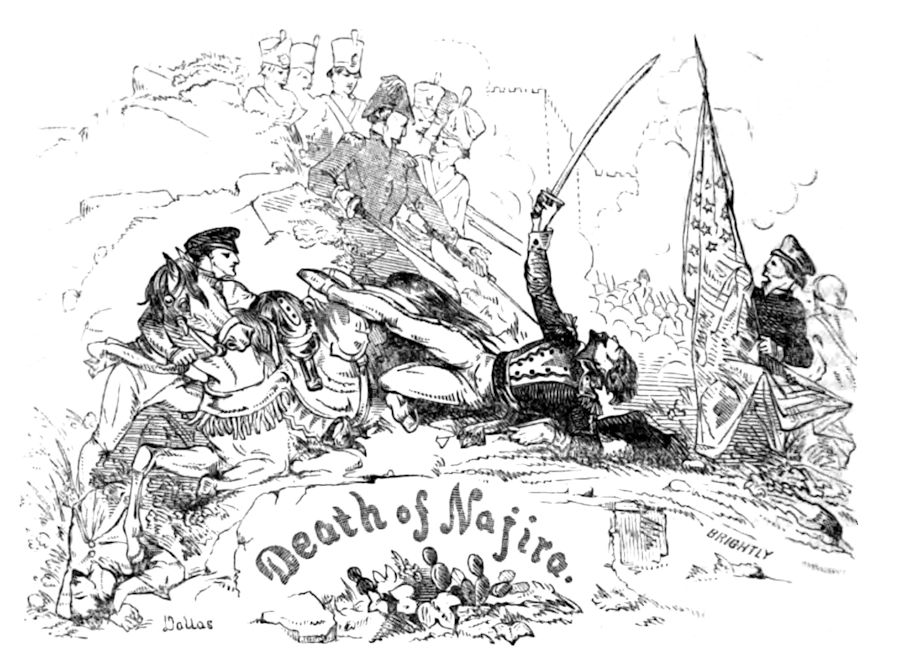
Death of Najira.
A LOVE STORY OF THE PRAIRIES. — THE MIGHT OF SONG. — THE LADY OF THE ROCK.
About the year 1820, among the Sioux, on Teton
river, was a young chief whose reputation had extended
throughout the West, and excited the envy and
wonder, not only of the warriors of his own nation,
but of every tribe, from the Chippeways, who paddle
bark canoes on the western lakes, to the root-digging
Shoshones at the base of the Rocky Mountains; and
far and near the hearts of the young Indian girls were
taken captive by the rude chivalry which added brilliancy
to his invariable success. Like many other
heroes, with his early history was mingled not a little
of the fabulous and superhuman, and what was most
singular, was, that there appeared to be some grounds
for this belief, it being well known that he was not a
Sioux by birth—a hunting-party of that tribe having
found him, when a mere infant, lying in the open
prairie, partially wrapped in a white buffalo-robe, a
string of grisly-bear’s teeth around his neck, and an
eagle-feather in his little clenched hand—all unmistakable
evidences of exalted birth. The tradition did
not stop here, for if the testimony of some was to be
credited, a great war-eagle was perceived soaring
away into the blue, from whose talons, beyond doubt,
the child must have dropped. One thing was certain,
the insignia of a chief about the young stranger admitted
of no dispute, and accordingly as a chief and with
no small care was he reared.
But now that Ta-his-ka (“the white buffalo,” a
name given him by the Sioux, from the robe in which
he was found) had grown, young as he was, to be the
most prominent warrior and successful hunter from
the Pacific to the Mississippi, it appeared that his parentage
was not so celestial as had been by some imagined,
for the Pawnees formally demanded the chief as
one of themselves; and to prove their priority of right,
described minutely a scar on his hip, which, whether
really what they claimed it to be, or a mark of which
they had obtained secret information and craftily turned
to account, was found to be as they had described.
The only result of this extraordinary proposal was a
storm of words in the Tepe-wah-kah (council-house)
of the Sioux, directed against the audacity of the
Pawnees, and an amount of hate cherished between
the two tribes which filled some of the lodges with
scalps and others with wailing as well on the Teton,
as in the vicinity of the River Platte. Ta-his-ka himself
both in the council and on the prairies was foremost
in opposing the Pawnees, and the trophies torn
from these last were neither few nor bloodless when
the young chief headed a hunting party whose search
was more frequently after the hunters of the buffaloes
than the herds themselves. But the latter were not
readily baffled, and bringing all their ingenuity into
play to entrap his person, succeeded at last one day in
decoying Ta-his-ka into a ravine, where his braves
were every man slain, and he himself, while performing
feats worthy of a copper-colored Achilles, stunned
by an arrow and disarmed instantaneously. Overjoyed
at having in their possession one whose presence they
superstitiously believed to be a pledge of good luck to
their lodges, the captors hastened homeward, guarding
him with the utmost vigilance, but always refraining
from binding his limbs, as they did not despair now by
large promises and offers to induce him to acknowledge
his Pawnee paternity. Accordingly, the chiefs loaded
him with honors and caresses, and made him proffers
of squaws, horses, lodges, robes, and, in short, every
thing which constitutes savage wealth; to all of which
he listened with a contemptuous indifference and total
silence, which was sufficient answer in itself. At this
time there existed among the Pawnees a custom probably
derived originally from the Mandans, remains of
whose villages are to be seen even so low down the
Missouri as the mouth of the Platte, the words used to
designate it being found in the latter tongue; this
custom was to select every alternate ten years the
most beautiful female child of the tribe, who was
placed under the strict guardianship of two old squaws,
without whom she left the medicine-lodge neither
day nor night, and between whom she was obliged to
sleep until her term of years expired, in order that she
might be a pure sacrifice to the Evil Spirit during the
feast of green corn, at the termination of the ten years,
when, in the midst of barbarous ceremonies, games,
etc., the victim suddenly disappeared no one but the
medicine-men knew where. This doomed girl was
called Mah-pen’ke’ka-morse,[4] (wife of the Evil
Spirit,) and they supposed, caused the fiend to abstain
from injuring the tribe to which he was related by marriage.
Now as Ta-his-ka was believed to be in some
sort supernatural, one of the divisions of the medicine-lodge
was assigned him, and the partitions in an Indian
house being neither so impervious to sight nor bodily
passage as plastered walls, a most unheard-of thing
took place—the appointed squaw of the Evil One
yielded up her heart and person to the illustrious
prisoner, eluding nightly the vigilance of her duennas.
As for Ta-his-ka, he loved for the first time, and with
all the resistless passion of a wild but earnest soul;
thus, although he was brought every moon before the
council of chiefs, and the former offers renewed only
to be answered by the same stern silence, (for no man
had heard him speak since his capture,) he made no
attempt at escape, contenting himself with merely food
enough to sustain life, and scorning to touch the prairie
delicacies daily set before him.
So light were, meanwhile, the feet of the girl, or so
heavy the eyes of her ancient guardians, that none
dreamed of the secret intercourse; and even when the
condition of the former could no longer be concealed,
strange to say, the medicine-men overlooked the
proximity of the handsome captive, and concluded
their evil-divinity willed to bestow on their nation
one of his own offspring, who might in time assume
the place proffered to the obstinate Ta-his-ka. But
when the infant proved to be a girl, they were at a loss
to determine whether their hero was to be born of
this squaw, when arrived at woman’s years, or
whether by the preference shown to the present wife
above all precedent, it was his wish to protract her
existence.
While they still debated the matter, an end was put
to their discussions in rather a startling manner; maternal
affection and love for the chief from whom she
had been parted some weeks, got the better of prudence,
and in the act of bearing the infant to her husband,
(for the marriage rites are simple enough in the
Great West,) a cry from the former at last aroused the
duennas, and the whole was as clear as day even to
their purblind eyes.
What a commotion was then in the village! the old
witches were immediately put to death, and the unfortunate
three reserved only until preparations for their
torture could be made on a scale equivalent to the
crime. All apathy had suddenly disappeared from the
noble face of the Sioux chief, his voice was found,
and dauntlessly acknowledging his child, offered to
lead them against whomsoever they desired, if they
would give him the Ka-morse for a squaw. But the
tide had now turned as strongly against him as it had
formerly flowed in his favor, and his proposal was
received with rage and horror. They both bound
his limbs, and surrounded the hut to which he was
removed with a circle of braves who slept as near to
one another as might be reached with the arm; but the
White-buffalo was now at bay, and resistless as of old.
In spite of these precautions, on the second morning
after the discovery, one of the warriors was found stiff,
with a knife in his heart, and despoiled of his weapons,
two others at the entrance of the medicine-lodge as
effectually silenced, and the two squaws who had been
bound, one on each side of the young mother, strangled
in their sleep, the cords cut, and their captive flown;
in short, Ta-his-ka had gnawed through, or found
means of severing his bonds, and after liberating his
wife and child, had carried them off on his own horse,
deliberately selected. Such a feat astounded the
Pawnees, but quietly recovering from their stupor,
every horse was bestrode, and the whole body of
warriors gave chase; the trail of the fugitives being
easily found and pursued. After many hours of vain
pursuit, however, and when they had found time to
consider the hopelessness of recapturing on the open
prairie a warrior noted for his own craft and endurance,
as well as the wonderful strength and size of his steed,
they resolved to refrain from farther pursuit, but to
send after the fugitives an enemy, which, with the
high southern wind then blowing, must overtake them
before the sun went down—a terrible messenger on
the prairies, indeed—fire.
It was already past mid-day and Ta-his-ka had repeatedly
turned his face to speak encouraging words
to the young wife, while with covert uneasiness he
watched the volumes of pale smoke rolling up from
the line of horizon far behind, and now that they had
entered one of those vast luxuriant bottoms so dreaded,
even by the Indians, in autumn, although nothing but
the sky overhead could be perceived, through the parted
tops of the tall grass and reeds, it was no longer to be
hidden even from the terrified Ka-Morse, that a dimness
had spread above not occasioned by clouds, and that
the scent of fire grew every moment less faint and uncertain.
The bottom lands to which I have referred
as so pregnant with danger during conflagrations on
the prairies, can scarcely be called such, as they extend
for leagues, and are not to the eye sensibly lower
than the greater portion of the surrounding plain; yet
that there is some depression may be deduced from the
frequent humidity of the soil, and the wild luxuriance
of the grass, rising to the height of eight or ten feet, and
matted together about the stalks with innumerable pea-vines,
from which causes a horseman can pursue no
other route than the trails made by the files of buffaloes,
and as these are often tortuous and winding in the last
degree, it sometimes occurs that Indians or traders
have found themselves enclosed between these combustible
hedges, turning in every direction, when the
whirlwind of fire behind would leave them little prospect
of escape in a straight line and on the open prairie.
And in this imminent risk must we leave the fugitives,
and allow Jean, now that he comes into the simple
narrative as an actor, to continue the story in his own
words as nearly as I can recall them.
“Voilà!” cried Jean, standing up in his stirrups and
reaching as high as he could with the hand, from which
he had let fall his rein, “de grass was tall comme ça,
oh, vere tall, and I could see not’ing mais smoke,
smoke, and hear de rattlin’ terrible ven de fire leap
into de canebrake like de—what you call?—volley ob
de ten thousands mousquets. Den de little deer and
de big deer, and de bears, and de painters, was all
runnin’ deir best to save deir hide from scorchin; and
de prairie-hens drop down and rise up and drop down
agen—and it was all like one big oven! Mais—hola!
j’ai oublié de buffalo, which was more worse dan all—he
bellow and tear along on dis hand and on dat—je
la confesse, I was vere much afraid dat a big bull
would choose de trail I was in, and punce mon cheval
in de hind part wid his horn!
“Presently, I look behind—ah, miséricorde! de
grass was carry by de win’ en avant, all in de blaze,
and w’ere it fall, it was one new fire immédiatement!
Den I say to myself, Ah, Jean Moreau, mon brave,
you will be roast alive, and dere is no help for it—and
de beautiful skins will be lost in dis dam fire! mais, at
de word, something say, not loud out, but softly—‘Quelle
sottise! why you not pray, eh? better dan
curse!’ Eh bien, good, I say—I will pray! Mais, I
have not any prayers! Enfin, je remembre—je dis
in de voice haute, ‘Malbrouc s’en va’t’en querre;’ and—what
do I see? Oh, quelle joie—de grass not so high,
and in de front a short hill! I gallop up—I am on de
pieds—I am strike a light—I blow vere softly, den
more hard—de grass is in one blaze—de win’ take de
fire—de black spot is dere w’ere I stan, and—I am
save! Den I feel de heart vere light, I smile at myself—I
smile at de horse, I rub my hand, and walk about—eh
bien, I was vere comfortàble! Presently I look; oh,
misericorde! voila—voila de diable—misericorde! and
I run to hide, for I was vere much scare; but dere
was no place to hide. Den I look agen, and it was
not de diable, mais one Ingen vere burn, and on de
face in de grass. I make haste, I pull him out ob de
fire—dere was one leetle drop in de canteen—ah, ha!
dat bring back de life.
“Mais w’en de life was com’, he would have lose
it immèdiatement, if I had not hold on to de horse.
‘Hola!’ I say, ‘you burn your own self, but you not
roast mon cheval—non, non!’
“Den he look at me hard, and strike his breast, and
talk in Ingen.
“‘Hist! de chief and his squaw and little one saw
de fire yonder. Look! de prairie lies black, and de
chief is here, but de squaw and little one are in de
belly of de chief’s horse!’
“‘What is dat?’ I cry, bien surpris. ‘Dans son
ventre! oh sacre! malheur—quel diable of a horse!
Mais, what for you let him eat up your squaw, eh?’
“‘Non, non!’ he cry; ‘w’en de fire was vere
close, he kills son cheval, and in de skin roll up de
squaw, voyez?’
“Ah, dat was better—bien good! j’étais satisfait,
moi!”
This was the most stirring part of Jean’s narrative,
and therefore to save time and patience, I will relate
the remainder, not in his but my words. The night
was so dark, from the smoke obscuring the sky, that
none but an Indian could have found his way back to
where Jean had sat composedly, after watching the
chief disappear toward the south on the former’s horse.
Back he came, however, after the lapse of some hours,
with a cheerful whoop, bearing in his arms his wife
and child, the green skin having protected them while
the fierce element swept over their heads.
The brave (for as yet Jean was ignorant of even the
name of his companion) professed to be acquainted
with the prairie thereabouts, and led them half a
mile to an island in a moist hollow, which had not
been touched by the conflagration; and here they all
supped on the jerked meat which Jean chanced to
have with him, all game being effectually frighted
away. There is no need of following them on their
journey, which was generally in the neighborhood of
the Missouri, for the sake of the deer and buffalos
which had fled for refuge to the wooded ravines and
valleys intersecting the banks, the young squaw and
child riding, while the men walked at her side. Not
far from the mouth of the Teton river they parted
company, Jean to proceed to the station of the American
Fur Company, and Ta-his-ka to rejoin his tribe,
the former insisting on the horse being retained for the
use of the young mother, whose slender frame had
begun to waste away under a continuance of fatigue
and excitement, for which the peculiar nature of her
former life, so different from that of ordinary Indian
girls, had rendered her totally unfit. There Jean learned
for the first time the name of the chief—one long familiar
to his ears—and the events already narrated.
He had not been more than a week at the company’s
fort, when, with marks of the deepest grief and rage
stamped on his countenance, Ta-his-ka presented himself
before him; the child lay mutely in his arms, but
no squaw—where was she?
“Ee-ohk paze!” (dark-dead,) was the laconic answer,
but accompanied by a twitching of the mouth-corners,
which showed how the fierce spirit was
moved. It seemed that the numerous enemies jealousy
of his fame and power had created among the Sioux,
had taken advantage of the White-buffalo’s prolonged
absence, to spread the most injurious and unfounded
reports of his deeds, and growing bolder by degrees,
asserted openly that Ta-his-ka had abandoned his
tribe, delivered up the warriors who followed him to
the knives of the Pawnees, and, won over by their
gifts and promises, become a Pawnee himself. Thus
when the chief re-appeared, he was charged before the
council of braves with treachery of the most abhorrent
kind, and his Pawnee wife cited as a proof of their accusations;
and but for his well-remembered strength
and resistless fortune, which no one cared to dispute,
even his proud and indignant denial would scarcely
have delivered him from his former companions on
the war-path.
But the frail flower from the Platte had drooped and
died on the return, and it was his wish now to leave
the child in charge of some one to whom it might be
safely intrusted. Jean related the circumstances to
the wife of one of the company’s officers, who immediately
adopted the infant until the chief should return
to claim it. Thus it was that Wah (snow) had surprised
us by the correctness of her English in the
chief’s lodge; for even after he had become once more
a powerful chief, he contented himself with occasional
and secret visits to the station, and did not carry her
home until about a year previous to our visit. The
rest of the story may be told in a few words. Ta-his-ka
crossed the river and wandered on until he
arrived at a village of the Ioways. These people
pleased him, and they were equally gratified by the
presence of a warrior whose feats in their hunts or
games appeared every day more marvelous; for, until
the Pawnees, who had traced the fugitive to his retreat,
claimed his person with threats, they were ignorant of
the renown of their guest. The Ioways were too
proud of their acquisition to pay much heed to the repeated
menaces of the ambassadors, and their principal
chief dying about that time, they chose the Sioux by
acclamation to lead them against the Pawnees of the
Platte. The old fire now returned to Ta-his-ka’s
breast—he was once more the terrible medicine chief,
(“Wakon,”) and the scourge of his old enemies, who,
losing more scalps in each skirmish than they could
hope to regain while the White-Buffalo led on, presently
petitioned that the hatchet might be buried, and
conducted themselves with a crafty obsequiousness
Ta-his-ka took no pains to conceal his contempt of;
and, in fact, as in the instance occurring the night of
our stay in his village, by stern opposition to their
evil plottings, occasionally brought to light the smouldering
hate lurking in their breasts. The story of
Wah—the snow-flake—which I heard nearly two
years afterward, if less wild than that of her mother,
the young Ka-morse, was more touching, and more
tinged with delicate romance—one of those gentle
episodes in the stir of prairie life, like the soft down
under the bristling feathers of the fierce war-eagle’s
wings.
An extract from a Poem delivered by W. H. C. Hosmer before the Literary Societies of Hamilton College, July, 1848.
If we were chained forever to the Real,
God’s benison would be indeed withdrawn;
Without rich glimpses of the bright Ideal
In vain would morning dawn.
Upward, on pinions of sublime devotion,
The soul would cleave its native sky no more,
But loathsome grow—a pool devoid of motion,
Foul to its weedy floor.
Our grosser nature ever strives to win us
From worship of the beautiful and bright,
And deaf are many to the voice within us
That whispers “seek the light!”
Not they alone work faithfully who labor
On the dull, dusty thoroughfare of life;
The clerkly pen can vanquish when the sabre
Is useless in the strife.
In cloistered gloom the quiet man of letters,
Launching his thoughts like arrows from the bow,
Oft strikes at Treason, and his base abettors,
Bringing their grandeur low.
Armed with a scroll, the birds of evil omen
That curse a country he can scare away,
Or in the wake of Error marshal foemen
Impatient for the fray.
Scorn not the Sons of Song! or deem them only
Poor, worthless weeds upon the shore of Time;
Although they move in walks retired and lonely,
They have their tasks sublime.
When tyrants tread the hill-top and the valley,
Calling the birth-right of the brave their own,
Around the tomb of Liberty they rally,
And roll away the stone: —
Or, roused by some dark peril, they have written
Words that awe Guilt behind his guarded wall,
Or, by the lightning of their numbers smitten,
Beheld the Bigot fall.
Though fierce, unbridled passions, running riot,
Hiss like Medusa’s vipers in the breast,
The witchcraft of harmonic sound can quiet
The turmoil into rest.
Who through the chieftain’s castle-hall is stealing
With the light foot-fall of some beast of prey,
While vengeance hushes every softer feeling,
Nerving his arm to slay?
Where is his home? To flame its roof was given,
And heavy clouds above the ruin lower—
While the dread foe, by whom his soul was riven,
Unwarned, is in his power.
Where are his kinsmen? Ask the fox and raven
That feed upon their corpses gashed and red;
And will he now turn back a trembling craven—
What, what arrests his tread?
Young Annot Lyle, her Highland clairshack waking,
Trills an old ballad to remembrance dear—
And dagger-hilt his rugged hand forsaking
Brushes away the tear.
Lo! the proud Norman and his host are flying,
While in pursuit, with fierce, triumphant cheers,
That drown the groans of horse and rider dying,
Press on the Saxon spears.
What stays their flight? The song of Rolla rising
In angry swell above the dreadful roar —
Again they charge!—the bolts of death despising,
And Harold’s reign is o’er.
Dread Power of Song! whose voice can thus awaken
Notes that consign an empire to the grave;
Or, when recoils a host by panic shaken,
From rout the valiant save.
The fearful mantle that the seer is wearing
Derives from thee its tints of living fire —
And higher mounts Philosophy when sharing
The wealth of thy attire:
And in the distance to thy vision brightly
Gleam happy homes beyond this land of graves,
As airy domes and towers at sunset lightly
Rise from Sicilian waves.
When History, her task but ill-achieving,
Fails some far epoch faintly to illume,
Her thread the muse, like Ariadne weaving,
Conducts us through the gloom.
She fronts the sun—and on the purple ridges
The virgin Future lifts her veil of snow —
Looks westward, and an arch of splendor bridges
The gulf of Long Ago.
She speaks, and, lo! Italian sunlight flashes
Over the dark expanse of northern skies —
Death hears her thrilling cry, and cold, gray ashes
Take mortal shape, and rise.
When factions vex a state, and new abuses
Bring to her drooping banner-fold disgrace,
And Mind, forgetful of its nobler uses,
Grows sensual and base —
When the gray fathers of a nation falter,
Muffling their faces for the funeral knell.
A lightning-flash, from her poetic altar;
The darkness can dispel.
Then honored be the Bard!—a heavenly mansion
Alone could be the birth-place of an Art
That gives to deathless intellect expansion,
And purifies the heart.
A LEGEND OF NEW ENGLAND.
———
BY MISS M. J. WINDLE.
———
(Continued from page 255.)
CHAPTER X.
The sun was slowly sinking to the west
Pavilioned with a thousand glorious dyes;
The turtle-doves were winging to the nest,
Along the mountain’s soft declivities.
Croley.
Young Stanley’s congratulations that he alone
knew of the communication held by Lucy Ellet and
her sister with the mysterious creature whom he had
seen, were not destined to be of long duration. The
lady of the vapor was soon beheld by various other
persons of the village at different times—and the
Haunted Rock became an object of universal dread.
The rumor, moreover, speedily grew rife that the
object of her visitations was to hold unholy intercourse
with the young nieces of the governor of the colony.
These, therefore, from having been the idols of all
classes in the place, became subjects of curiosity and
vague apprehension.
Superstition, when not arrayed in her full horrors,
had charms which makes us regret her banishment in
a state of society enlightened by reason and education.
Her system of imaginary terrors had something
exciting to minds fond of feeding upon the marvelous.
This is especially true with regard to the lighter forms
in which she sometimes appeared when fortune-tellers
were introduced as part of the amusements of the age,
and their auguries regarded as serious and prophetic
earnest. But as we have seen, none of the lighter
forms by which imagination works upon her subjects
were here indulged as the food of a wild and wayward
fancy. Their belief, though not less erroneous, was
founded on the records of that page which cannot lie,
and which warned them of the existence of one great
and mighty spirit of evil, wandering to and fro in the
earth, and seeking to decoy the souls of mankind to his
abode of darkness. The object of this dread was no
other than he who had once stood high in Heaven, and
afterward became prince of the powers of Hell.
Recollecting that the wiles of this same adversary
practiced upon the mother of our race, had become
the means of expelling her from the bowers of Paradise,
and bringing “death into the world and all our wo,”
it is not surprising that Lucy and Jessy Ellet were
now regarded with suspicion on all hands. The
gossips, like the sybils, after consulting their leaves,
arranged and combined their information, which
passed through a hundred channels, and in a hundred
different varieties in the village of L. The rumors to
which their communications gave rise were strange
and inconsistent. The result was that the society of
the sisters became as much avoided as it had been
previously sought after. Closer observation, however,
caused the chief blame to rest upon Lucy, who was
seen daily, at sunrise and sunset, wending her way to
the haunted spot.
It was some weeks after Stanley’s first sight of the
phantom lady that twilight overtook him on an evening
ramble. He had carefully, since the time we have
described, avoided bending his steps toward that
vicinity in any of his walks. Accordingly, on this
evening, he had turned off at the outskirts of the village,
at a place where another road met that leading to the
fearful spot. Having been occupied with reflections of
a deeper cast than are common to youths, he had remained
until the slow departing sunset reminded him
to retrace his steps. On approaching the place where
the two roads met, he was startled by the sight of a
light figure emerging into the main path. The thought
of the strange lady of the mist instantly suggested itself
to the mind of the youth. A new moon had just
risen behind the dim embodiment, and shed her soft
rays upon the spot where it stood. The last beams of
the setting sun were almost lost beyond the distant
hills, and nothing but the soft light of that evening-queen
lit the scene.
Stanley advanced to meet the spectral shape—it
turned—a pair of dark eyes flashed from beneath a
silken hood, and the clear voice of Lucy Ellet sounded
in his ears.
“Well met, Master Frank Stanley,” it said; “you
have avoided me of late, as have all our villagers.”
“After what I have been witness to, Miss Lucy,”
began Stanley —
“Believe me, Frank, the interview you beheld between
myself and the Lady of the Rock was pure as
the intercourse above.”
“I beseech you, Lucy Ellet,” exclaimed the youth,
earnestly, and not heeding her words, “for your own
soul’s sake, for your young sister’s sake, cease these
suspicious visits to yonder mysterious spot!”
“Oblige me, then, in relieving me of my duty toward
that unhappy lady, by assuming the task hitherto
performed by myself, and I will go thither no more.”
“I would do aught but perjure my own soul, to have
thee and thy sister reinstated in the opinion of our
little community, to say nothing of saving ye both from
future destruction. Yet,” continued he, “if I also
must hold frequent converse with that visionary form,
I dare not —”
“Out on thee, Frank,” interrupted the young lady,
“I had thought thee a brave youth, afraid of nothing
but sin.”
“And is it not sin to hold constant speech with a
spirit-messenger of Satan?” inquired the boy.
“I will request thee to have no speech of her; I
would merely depute you to bear, morning and evening,
a little basket resembling this, (and she drew one
from beneath her shawl,) place it on the rock—wait
until the unknown lady appears to remove it, and replace
it with another—then return to the village. Do
this to oblige me, Frank, and save me the necessity I
shall otherwise be under of continuing the visits so
execrated. More confidence I cannot put in you at
present; but will you not have faith that I would not
instigate you to the performance of an act that was
otherwise than noble.”
“Lucy Ellet,” said Stanley, looking on her steadily,
“there is that in your manner and your words which
shows me that you are actuated by some generous
principle in this singular affair. What this mystery
may be, time must prove. I will do your errand.”
“The Lord reward you,” replied Miss Ellet.
“The basket, then, shall be placed under the large
willow-tree at the end of your father’s orchard, that
we may not seem to have any connection in regard
to it. You must always replace on the same spot the
one you will receive at the rock; and I will cause it
to be removed and replenished in time to have it there
again ready for your next visit. But here we are
within the village,” added Lucy, “and had better not
be seen together, lest it might excite suspicion. You
will find a circuitous path to the rock in yonder direction,”
she continued, pointing to the left, “and had
better use it in your excursions, that you may be the
more likely to escape notice.” So saying, and without
giving the youth time to reply, Lucy parted from
Stanley, and soon after turned into her uncle’s house.
The boy proceeded on his way with an undefinable
sentiment of approval in his bosom. Some instinct
had prompted him, notwithstanding all his preconceived
notions of horror at the abandonment of the
young Ellets to the power of the Lady of the Rock,
to accede to Lucy’s proposal that he would supply her
place in her daily visits to that mysterious being; and
so far from feeling any reproaches of conscience in
remembering that he had given her his promise to that
effect, he rather enjoyed all the elation of spirit experienced
by one who generously sacrifices himself to
suspicion for a noble cause. Something in Lucy Ellet’s
manner convinced him that feelings of the same kind
had actuated her conduct in this strange affair, and he
thought of her now more with admiration than with
reproach. “Yet what,” said he to himself, startled at
the change a half an hour had wrought in his views,
“if this approbation of myself and Miss Ellet be only
a suggestion of the arch tempter to place me in his
power?” But no, the idea was dismissed in a moment
as incompatible with his feelings of satisfaction
in what he had pledged himself to undertake.
Stanley rose at sunrise on the following morning, for
the purpose of commencing the fulfillment of his promise.
Seeking the willow-tree in the garden, he found
the little basket prepared for him, and assuming the
charge of it, set out upon his walk. He speedily
turned into the winding path indicated by Lucy Ellet,
and pursued his way. The morning beams were just
breaking, and their light glanced upon the dewy grass
beneath his feet, and caused it to sparkle as though his
tread were upon myriads of diamonds. The waking
birds were chanting their matin lays, and the insects
humming in every brake and dingle. Every thing gave
promise of one of those days in the latter end of May
when spring seems resolved to triumph over summer,
by contrasting her superiority in beauty and freshness
with that sultry season so soon to appear, at the same
time that she might almost vie with the latter in the
genial heat of her noontide sun.
But the balmy morning and the day it presaged were
alike lost on our hero, whose mind was filled with reflections
concerning his singular mission. He walked
on, rapt in thought, till he approached the foot of the
hills. He there paused, despite his conclusions of the
previous evening, overpowered with a doubtful feeling
regarding his errand. He was about to minister to the
shadowy spirit whom he had twice beheld upon that
insecure summit. What fearful spells might she not
weave around him by thus doing her will? He ascended
a short distance, and turned to look behind
him. A scene of more complete solitude, having all
its peculiarities heightened by the serenity of the
weather, the quiet composure of the atmosphere, and
the perfect stillness of the elements, could hardly be
imagined. He could descry nothing of the scenes he
had left, save the valley beneath him, and the spire of
the village church in the distance. Should he return
home or proceed? He remembered his promise to
Miss Ellet, and again applied himself to continue his
ascent. He drew near the ominous spot—climbed a
few steps higher—touched the rock, and placed the
basket upon its base.
Slowly and gradually appeared the form of the lady
of the mist. It was not without something like alarm
that Stanley beheld this mysterious being standing close
beside him. She had been about to speak, but seeing the
boy, cast her beautiful azure eyes on him with a look
of surprise, exchanged the basket for another, and
with a pensive smile, disappeared from his view.
Had all the spells he had dreaded in his approach to
the spot been concentrated in that look and smile, the
change in the feelings of young Stanley could not have
been more instantaneous. Surprise succeeded to his
former superstitious sentiments of awe, for he had discovered
that the Lady of the Mist was no vague embodiment
as he had deemed, but a gentle shape of human
flesh and blood. Where or how she had vanished,
however, was still a mystery; but he was so overpowered
with a sense of his discovery, that he turned
to descend without attempting to make any investigation,
and reached the village to encounter a day of
great agitation.
——
CHAPTER XI.
Through solid curls of smoke, the bursting fires
Climb in tall pyramids above the spires,
Concentring all the winds; whose forces, driven
With equal rage from every point of heaven,
Whirl into conflict, round the scantling pour
The twisting flames, and through the rafters roar.
Barlow.
Yes, thou must die—there is but one resource,
The last—the worst—if torture were not worse.
Byron.
Several topics of excitement began at this time to
prevail in the village of L., in addition to that connected
with the haunted rock. One was the projected
marriage of Lucy Ellet very shortly to Mr. Elmore,
to whom she had been for some time betrothed; another,
the reappearance of Messrs. Brooks and Dale in
the village, where they took up their abode for a short
period; and a third, the threatened incursion of some
of the neighboring Indian tribes.
To guard against this last evil, the inhabitants were
obliged to appear at all times armed, and prepared for
repelling hostilities. A fast was likewise appointed
by the governor of the colony, and public worship held
daily to offer up prayer in view of the impending
danger. At such times, a guard of men, with muskets
ready for immediate use, was stationed without the
building, to repulse any attack of the savages, and give
the word of warning to those engaged within. In this
way, as the situation of the village was in itself strong,
owing to the hills that surrounded it, the inhabitants
trusted that they were fully prepared to resist any
sudden attack.
Things were in this state, when, on a certain day,
the morning beams had shone on the unpretending
spire of L. for five or six hours, and the people had assembled
in the building beneath as usual. The lengthy
prayer with which the Puritans were wont to commence
their exercises had concluded, and, just as every
voice was attuned to the melody of a pious psalm, a
loud and unusual noise was heard.
The worshipers of that humble meeting-house paused
to listen with ears erect and faces filled with boding
expectation. It was the terrific yell of the approaching
Indians. This was speedily followed by the appointed
signal from the soldiery stationed without, and at the
instant that the report of the musketry rang in the air,
the congregation started from their seats in terror.
Each man rushed for his arms, and crowding to the
doors and windows, found the building completely
surrounded by savages. The females, remaining
in the interior, shrieked in the extremity of their alarm.
The scene that followed is not easily described. A
fearful struggle, of course, ensued. Heaven, too, at
that moment, added its terrors to the scene. A furious
thunder-storm arose, and amidst the most vivid flashes
of lightning, and awful reverberations, the rain began
to descend in torrents. The villagers now yielded
themselves completely to terror, and abandoning the
conflict, prostrated themselves on their knees, and
resorted to prayer. The Indians took fresh courage
from this circumstance, and commenced firing the
meeting-house. For a little time the rain prevented
their efforts from taking effect. But at length, as the
strong army of a battle will rout the less powerful, so
did the fiercer element dispel the weaker.
The fire was finally triumphant, and spouted in jets
of flame out at each window of the consuming building,
while huge flakes of burning materials went driving on
the wind, and rolling a dark canopy of smoke over the
neighborhood. The lurid glow lit up the air, and
showed with terrible distinctness the waving crowd
that stood around. The rain, however, prevented the
progress of devastation further. But the shouts of
the Indians resounded far and wide, as they turned to
continue their work of destruction by setting fire to the
other dwellings in the village.
At this crisis, the villagers, as if animated by a sudden
and simultaneous impulse, arose from their knees,
and betook themselves again to the defensive. Previously,
in their resistance, wild confusion, despair,
and frenzied efforts had been blended in such a manner
as completely to destroy any thing like unity of action.
But now, in concert, and disposed according to the
best military arrangements, they advanced a second
time upon these invaders.
The Indians, in confidence of their approaching
triumph, had uttered the whoop of success, which
called their warriors from the adjoining vicinity to behold
the approaching scene. In surprise, therefore,
notwithstanding this addition to their forces, they
found themselves resisted with a power and a skill
such as they had never before witnessed. But their
previous success had given new spirit to an enemy
already sufficiently audacious, and continuing their
war-cries with redoubled ferocity, they pursued the
attack. The combat raged for about half an hour,
when the Indians were utterly defeated, and betook
themselves to flight.
At that moment the clouds of heaven suddenly
opened, shedding the blessed light of the returning sun
upon the village; and it might have been seen that the
recent victory had been obtained through the means of
a stranger, who had appeared and aroused the people
from their panic of fear, assumed the command,
arranged and ordered them in the best military manner,
and thus enabled them to repel and rout the Indians,
and save the village. This person was a man of
dignified and majestic bearing, and with an interesting
beauty and pallor of countenance.
The parting clouds had scarcely permitted the gleams
of renewed sunshine to fall upon the rescued spot, and
the inhabitants began to realize their safety, and look
around to return thanks to the skillful and unknown
commander to whom the rescue was due, ere it was
discovered that he had mysteriously vanished. Awe
and amazement filled the minds of the spectators, for
they were utterly unable to account for the singular
arrival and sudden disappearance of this remarkable
person. After many unsatisfactory conjectures, the
only conclusion they could arrive at was that the Lord
had sent an angel to their deliverance.
It was on the evening of the day on which this
attack took place, that Frank Stanley was proceeding
on his second errand to the rock. As he walked on,
he pondered deeply upon the discovery he had that
morning made. The recent scene of excitement in
the village had banished the thoughts of it throughout
the day from his mind. But now his curiosity recurred
to the subject with all the strength with which that
feeling fixes upon a mystery but partially solved.
The stranger who had so singularly appeared during
the conflict with the Indians and put them to flight,
seemed somehow associated in the boy’s mind with
the Lady of the Rock, and he could no more join with
the villagers in believing the one an angel of the
Lord, than he could now in supposing the other an
evil spirit.
The more perplexed the more he reflected, Stanley
one moment resolved at all hazards to penetrate the
singular mystery, to overcome on his present errand
the internal and undefinable feelings which would restrain
him from accosting the lady, and offering her
any further assistance in his power, and discovering
the place of her retreat. Yet to press himself on her
confidence might be impertinence, and as she had in
the morning disappeared without noticing his presence,
it was evident that she did not mean voluntarily to
make him her confident, and probably she was involved
in no difficulties where he might be useful.
The next instant, therefore, he resolved to suppress
all desire to penetrate the secret, dismiss his disquieting
and fruitless conjectures, and without attempting to
invade the manner and place of the sudden disappearance
of the fair but living vision, await the period
when time should throw light upon the subject.
He was thus divided in his own determinations
when he reached the woods at the foot of the hill
where his purposed visit lay. At that moment he became
startled from his reflections by the rustling of
leaves. Remembering the assault from the Indians
in the morning, the youth paused, and leaned forward
to listen, holding his breath, and condensing every
faculty in the single sense of hearing. Silence, however,
seemed restored to the disturbed foliage, and
reigned as completely as though it had previously been
unbroken. The boy pursued his course, supposing
the noise he had heard simply to have been occasioned
by a sudden gust of wind. But he had not
proceeded many steps when the sound was distinctly
perceptible of approaching voices, speaking in the
deep tones of the savages. He turned, and ere many
minutes elapsed, the forms of three Indians were
visible. “Dog of the pale faces!” was their exclamation,
as they rushed upon him. The youth was entirely
alone—cheered by no friendly eye, emboldened by no
encouraging voice, and so sudden had been the event
that his mind was wholly unprepared for the emergency.
Yet, perceiving at once his danger, and determined
to make one bold effort for his life, he burst
from them ere they were aware of his purpose, and
bounded off with the swiftness and alertness of a deer.
There was but one breathless moment, the Indians
raised the cry of alarm, and pursued hotly after him.
As soon as a favorable instant presented itself, he
darted through an opening and ascended the hill. A
bullet grazed his clothes, and several branches from
the bushes at his side, but not one harmed him.
Stanley knew too well the nature of the struggle in
which he was engaged to lose one of the precious moments.
Accordingly, he kept his way up the acclivity,
which, though neither very high nor very steep,
was yet sufficiently toilsome to one contending for
life to render it painfully oppressive. There, however,
he was obliged to slacken his speed to recover
breath. The violence with which his heart beat showed
how great had been his exertions. He must proceed
again, however, for the footsteps of his pursuers
were near.
He started off a second time, but his strength was
exhausted, and ere he had gained the summit of the
second hill, he fell prostrate upon the ground. He
rose, proceeded again for a few moments at his former
swift pace. By degrees this slackened—the Indians
were within a few yards of him. He had a loaded
pistol in his pocket—but he knew it could only destroy
one of his enemies, and there would still remain two
to contend with. Generously, therefore, he refrained
from using it, and prepared to resign himself into their
hands, and yielded himself up a prisoner with a dignity
that was remarkable for his years.
Dragging him to a glen which intervened between
the two hills, they bound him tightly, and then turned
apparently to make some consultations respecting the
manner of his fate. The prospect of death is terrible
at every period of life; but in the first spring-tide of
youth, with all the capacities of pleasure astir and
eager for gratification, to be forcibly snatched from the
untasted banquet is peculiarly trying, even when the
change comes in the form of a natural death-bed. But
to sit, like young Stanley, in horrid uncertainty in regard
to the mode in which life was to be extinguished,
was a situation to break the boldest spirit; and the unhappy
captive could not restrain the tears which
flowed from his eyes. We have seen that although
he was a brave youth in any danger which could be
met by action, yet withal, he was strongly imaginative
and apt to be led away by the exaggerations of fancy—exaggerations
likely to act more or less upon the
soul of any one who is in suspense and passively
awaiting an approaching calamity. This agony of
mind continued until the feelings of the youth arose
almost to a state of frenzy. He started up, and struggled
so violently to become freed from his bonds, that it
almost seemed that they should have burst by the
force of his strength, as did the withes of Sampson.
But the cords were of too firm a texture, and,
after an unavailing struggle, the boy fell back exhausted.
The Indians were evidently now preparing some
torture, which would put the sufferer to severe bodily
anguish. As Stanley lay and looked on, overcome
with his late violent exertions, the scene swam before
him. At this instant he became aware of an interruption
to the preparations of the savages, and had
just time to recognize the mysterious stranger of the
morning, to whom the preservation of his native village
was due, and behold him fall upon the enemy, when
he became insensible.
——
CHAPTER XII.
Can no rest find me, no private place secure me
But still my miseries like bloodhounds haunt me?
Unfortunate young man, which way now guides thee.
Guides thee from death? the country’s laid around for thee.
Women Pleased.
Did I but purpose to embark with thee
On a smooth surface of a Summer sea,
And would forsake the skiff and make the shore
When the winds whistle, and the tempests roar?
Prior.
A hopeless darkness settles o’er my fate —
I’ve seen the last look of her heavenly eyes;
I’ve heard the last sound of her blessed voice —
I’ve seen the fair form from my sight depart —
My doom is closed.
Count Basil.
When young Stanley first returned to consciousness
he found himself in a place whose shaded artificial
light seemed very grateful to his eyes, aching as they
were in sympathy with his throbbing brain: without
arousing himself sufficiently to consider the nature of
his situation, further than to know that his limbs were
free, and that he was lying upon a comfortable bed, he
fell into a heavy and unnatural slumber. During this
lethargy, which lasted many hours, sudden starts, the
perspiration which stood upon his brow, the distortions
of his countenance, and the manner in which he
flung about his limbs, showed that in his dreams he
was again encountering the terrors from which he had
escaped. This lasted for several hours, but, at length,
fatigue prevailed over nervous excitation, and he relapsed
into a soft untroubled repose.
After some time, he sighed, stirred and awoke. On
looking round, he found himself in a place surrounded
by walls of stone, with an opening on one side, blockaded
by a piece of rock, and leaving a single crevice
through which a faint ray of daylight fell. The floor
and ceiling of earth, showed that it was under ground;
yet it contained various articles of rude furniture, and
the moss bed on which he lay was soft and pliable
under his weight. The brands of a falling fire had
been carefully raked together in one corner, and were
burning with a feeble and wavering flame, which cast
faint, flickering shadows upon the dark walls.
Continuing his inspection more closely, the boy saw
the figure of an aged man, seated upon a stone, bending
over the pages of a large Bible which lay open
upon his knee. His countenance was majestic and
dignified. His brow had a care-worn and anxious expression,
yet withal an air of calm resignation inexpressibly
sublime. His locks were almost completely
white, though his dark and intelligent eye still retained
much of the fire of early youth, while the hale
cheek, and undaunted presence indicated patience
and content in the greatest suffering that can befall
humanity.
Stanley neither spoke nor moved; but remained
with his eyes riveted on the attractive countenance before
him with a species of holy awe. As he gazed,
the old man arose, kneeled, and poured out the aspirations
of a pure spirit in fervent petitions to that Power
whose support he evidently needed.
While he was yet praying, a manly form entered at
the opening of the cavern. The stranger wore a military
cloak. He stood in the shadow until the aged
man had ceased and risen, then dropped his cloak and
approached the latter, and Stanley knew him for the
mysterious deliverer of the village, and the person
whom he had seen when he lay bound by the Indians,
to fall upon them, and effect, he felt certain, the preservation
he had experienced. He was a specimen of
manly beauty; and the proud and lofty forehead, the
deep-set brow and eyes, the expressive lip, addressed
themselves to the interest of the youth.
Overcome with surprise, the boy still remained immovable,
and the old man addressed the stranger.
“Has she not yet arrived? the sun is high—it must be
noon-day.”
“It is reason enough for her detention,” replied the
other, in a half impatient voice, the tones of which
were deep and clear, “that I have gone forth to meet
her. All objects that I seek elude my pursuit: there
is a curse upon my every pathway.”
“Give not way to repinings, my son, turn thine
eyes upon the blessings that remain to thee, which far
exceed the deserts of the best of men.”
“Talk not to me of blessings, my father,” replied
the other. “If there crawls upon the earth a living
being deserving of pity, I am that man. My food no
longer nourishes me, my sleep fails to refresh me, my
devotions do not comfort me—all that is necessary and
cheering to me has turned to poison. Vegetating on
the same spot, fancy, feeling, judgment and health gradually
decaying, like a tree whose bark has been
destroyed—I have been a man more sinned against
than sinning.”
“He who is immured in a living grave like this,”
he continued, after an instant’s pause, “may well
wish for one yet more calm and sequestered. Let us
go forth, and challenge the death that awaits us.
Hunted by bloodhounds, our fate is doomed. Rather,
then, let it come at once than hold us longer in this
state of misery.”
“William,” said the old man, “would’st thou rashly
cast away the boon of life that God has given thee?
Canst thou be fated to death simply because the word
of a vindictive king has gone forth against thee? Nay,
my son, let us abide the Lord’s time, and endure here
unto the end, that we may obtain a crown of rejoicing
hereafter. And,” he added, while a tear dimmed his
eye, “would you leave Alice and your child?”
“William,” pursued the aged man, “you forbade me
but now to tell you of blessings. But, surely, thou art
strangely unthankful for thine—even for the incalculable
blessing thou hast in that noble-minded woman.
Hath she not accompanied us hither, and cheered and
sustained us with her angel presence?”
“My father, drive me not to frenzy,” exclaimed the
other. “You have struck the chord which another
touch would break. It is the sight of her, dearer to me
than life itself—immured in this ghostly hiding-place,
and day by day, growing thin and waxing pale, and
smiling in the midst of misery, that is more than I can
bear. And it is I who have brought this evil upon her.
But for me, she might now have been blooming in increasing
beauty in some brilliant destiny beyond the
seas. Never were the bright prospects of opening life
more cruelly dashed. And can she, frail as she is,
much longer sustain the effort by which she has met
this stroke of fortune? Will not the reaction, when it
comes, be too terrible to be borne? Oh, God, the
thought of her is agony!” and he covered his face
with his hands.
A female form entered. She advanced into the cave,
and throwing off a cloak and hood, Stanley recognized
the mysterious Lady of the Rock. For a second, she
regarded the younger of the two without speaking.
“My dearest William,” said she, at length, as drawing
close to him, she laid her hand in a sympathetic
manner on his arm, “why do you yield thus to grief?”
As if her touch and voice were magic, the unhappy
exile raised his head to meet her glance. “I grieve
for you, my Alice,” he replied, after gazing on her
anxiously for some moments, and throwing his arm
around her passionately, “to see you bereft of all
the appliances of comfort, and to behold your noble
spirit display its courage in mild submission, and
generous efforts to support the hearts of others. How
cruel doth the decree of Fate seem that you, so pure,
so gentle, so lovely, should be visited thus heavily.”
Unable to endure his own thoughts, he broke
abruptly away from her, and paced heavily up and
down the cave.
“My dear husband,” she said, approaching him,
and looking in his face; “do not think of my lot. Believe
me, it would have been but too happy if it could
have alleviated the bitterness of yours, or soothed one
sorrow of my father’s heart. Come hither, my parent,
I have news of encouragement for you both. There
is reason to trust that our troubles will be but short-lived.
Our friends have great confidence in the effect
of a personal appeal from me to Charles II. Nay, look
not thus distressed, my father: it is for your sakes
that I leave those who are dearer to me than life itself.
I will present myself at the throne of the king, and petition
him for your pardon: and Heaven grant that if
we meet again on earth, it may be in circumstances of
peace and safety.”
“Alice, thou shall not leave us!” exclaimed Heath.
“Death were far preferable to life in this gloomy
cavern uncheered by your presence. I will go forth
and yield myself up to my pursuers, if thou talkest
again of thine absence.”
“Nay, William, I shall not leave you in this place.
The marriage of Lucy Ellet will occur to-night, and
Mr. Elmore has kindly offered you both an asylum in
his house until my return, or for the remainder of your
lives, should it be necessary. The remote and secluded
nature of the spot will withdraw you from the
intrusions of impertinent curiosity.”
At that instant, the voices of men were heard without
the cavern, and a fearful suspicion dawned suddenly
on the minds of all present.
“Oh, God!” exclaimed young Stanley, starting
from his couch, “your pursuers are seeking you:
keep a profound silence, or your voices will betray
you.”
“Let them find us,” said Heath, aloud. “I am
weary of eluding them, and am glad my hour is arrived.”
“William, dear William, be silent,” whispered the
lady, bending toward him with a look of unspeakable
terror, as a deep flush mantled the cheek that a moment
back was so pale.
“Alice, I tell you it is useless——”
“Hush, love, for my sake, for your child’s sake,”
urged the lady in his ear, as her countenance became
agonized.
The voices without now grew so audible that words
could be distinguished. The old man clasped his
hands in resignation, and his half-parted lips murmured,
“The Lord’s will be done!” Alice threw one arm
around the neck of her husband, with a gesture of
unutterable love as though she would shield him, and
placed the other hand on his mouth, while she trembled
in every limb.
“The entrance of their asylum is well hidden,” said
one of the voices. “It will be a day’s work to discover
it.”
“Let us spend the day at it then,” replied the other
speaker, in a gruffer and harsher tone. “We will not
give up the search until we find it.”
And they seemed approaching the mouth of the
cavern. A moment of intense and breathless anxiety
to the inmates elapsed. They stood still and silent as
the rocks around them, suspending every, even the
slightest external motion, and would have ceased to
breathe, had nature permitted such an intermission of
her functions. More torturing their suspense than the
long, lingering seconds in which a duellist beholds his
adversary’s pistol wavering over his heart or brain.
Their discovery seemed inevitable. In a few minutes,
however, those outside passed on, and after a short
time their voices grew fainter and fainter, until they
were lost in the distance.
“Seize the opportunity of escape ere their return,”
said Alice, breaking the death-like stillness that had
been preserved. “Quick father, William, the moments
fly. Make your way toward the house of Mr. Elmore.
I will linger here to baffle the inquiries of your pursuers.”
“Come, my son,” said the old man, rising with a
sudden energy. “The Lord has opened another door
of salvation for us. Dost thou hear!”
“Nay, I will not again fly for my wretched life,”
said Heath. “I will passively await my fate.”
“William, William,” exclaimed his wife, in an
agony of heartfelt urgency and sweetness, “I pray
you, by whatever is dear in our past association together—by
all the claims, I will not say of the continued
love you but this day professed for me, but by
those of an affection on my part which would endure
all things for your sake—to use the proper means for
your preservation. Depart without delay;” and an
expression of unanswerable entreaty beamed in the
eye of the suppliant.
“I will do aught that you ask, beloved one, even to
the prolonging of my life of wretchedness,” rejoined
her husband, as he imprinted a kiss on her brow, and
drew her with him toward the door of the cave.
“Let me be your guide,” said Stanley, advancing
and addressing Heath. “It will be some small return
for the service you have rendered me.”
“I had almost forgotten, in my affliction, to see to
you, kind youth. But you have slept long, and appear
to be recovered.”
“Thanks to you, sir, I am living and well,” answered
the boy. “But time grows apace. Will you
accept my services?”
“Nay, I am acquainted with the whole neighborhood.
You will do me a greater favor to remain with
this deserted lady, and see her safe in the hands of
friends.”
With a countenance of perfect calmness, the heroic
wife and daughter endeavored to hasten the moment of
separation.
“Farewell,” she said, casting her arms around the
old man, while a smile was on her lips. “Farewell;
we may be parted for years, perhaps for ever,”—and
she made a violent effort to repress her distress.
“Bless me and forgive me, my parent, ere you depart.”
“Thou hast, thou hast my blessing, my suffering
dove; and for my pardon, how canst thou ask it, who
hast never done me an offence since God made me
parent to so noble a child? May the Lord be to thee
a rock of shelter, and a path of deliverance from affliction.”
The old man here turned away, and began to descend
the hill.
“You must not linger longer, William,” said the
lady, turning to her husband, who stood with his eyes
fixed upon her face. “Farewell; our fortunes look
dark, it is true, but mayhap the same bright morning
will yet dawn for us. And if not, we are not still denied
the glorious hope that in the darkest moments of
separation clings to humanity—the anticipation of reunion
in the future.”
“Farewell,” said Heath, folding her in a long embrace
to his heart, while his cheek trembled, and a
tear dimmed his manly eye. “My beloved wife, farewell:—my
Alice, my own one, adieu.” And drawing
his cap over his brow, and tightening the folds of the
cloak he had resumed, he broke away, and followed
his aged companion.
The lady watched the fugitives until they were out
of sight, and Stanley remained by her side silent, judging
it best not to disturb her feelings at the moment
with any ill-timed remark.
While they stood, he had time to examine the
entrance to the cavern, which had eluded his discovery
so completely on his former visits to the rock.
Nothing could be more concealed than its entrance.
The opening, extremely small, lay in the face of the
cliffs, directly behind a large gray rock, or rather upright
stone, which served at once to conceal it from
strangers, and as a mark to point out its situation to
those who employed it as a place of retreat. The
space between the stone and cliffs was very narrow,
and might easily escape not only ordinary observation,
but the minute search of a mind not perseveringly active.
The boy did not marvel when he perceived its
secret position, that it had previously been unnoticed
by him: for it might have eluded the attention of those
who had stood at its very opening. As he was still
engaged in admiring its security, the lady turned and
said to him, “Let us return within till I make the
necessary preparation for my departure.”
“I leave this spot,” said she, as they entered, “endeared
by many sad associations, never to return to
it again.”
“You are likely to leave it in a way you do not
imagine,” said a man, springing in at the opening. He
was speedily followed by another, and they both stood
within the cave.
“How is this?” said the latter, looking surprised
and disappointed—“a woman and a boy.”
Alice turned, at first much startled: but when a
moment was past, she prepared herself to receive the
intruders with the perfect confidence which a woman
never fails to feel in the mildness and reason of a man,
however rude. Moreover, having nothing to fear for
her husband and father, she found little difficulty in
retaining her self-possession, supported by her inherent
dignity.
One of them, who was distinguished from his companion
by much superiority of mien, lifting his hat respectfully,
addressed her: “It is unpleasant to question
a woman, especially one of your appearance; but,
madam, where are your companions?”
“I am unable to inform you,” said Alice modestly;
“yet I must say that in my present situation I could
have wished to be spared the pain of confessing my
ignorance.”
The harsh features of the elder contracted into their
sternest look, and it was evident how much he was
disturbed by the cool manner of her reply. Alice
gazed at his lowering features for a moment in perfect
composure, as if she had naught to fear from his intentions.
“Perhaps you can give us the information we desire?”
said he, turning to Stanley.
“Like this lady, I must confess my ignorance of
their whereabouts, if you allude to Messrs. Lisle and
Heath.”
“Pardon us, fair lady of this grotto,” replied the
younger cavalier, “but we will be obliged to search
its inmost recesses.”
“True, perhaps they are here, and this coolness
may be assumed,” said the other: “let us proceed to
make a thorough investigation.”
“I will vacate the premises for you, gentlemen,”
said Alice, drawing her arm through Stanley’s, and
leaving the cave. After which, at a slow pace, they
proceeded together toward the village.
——
CHAPTER XIII.
Bring flowers, fresh flowers, for the bride to wear!
They were born to blush in her shining hair:
She is leaving the home of her childhood’s mirth,
She hath bid farewell to her father’s hearth;
Her place is now by another’s side;
Bring flowers for the locks of the fair young bride!
Mrs. Hemans.
A calm and cloudless evening followed the exciting
morning which had been experienced in L. The fairest
moon of May shone above the ruined meeting-house,
which lay in blackened rubbish upon the
ground. Her soft light lit up the white dwellings and
shrubbery of the village with a holy beauty, until they
stood out in bold relief against the surrounding hills,
which, in like manner, stood out in similar relief
against a sky sparkling with myriads of stars. The
herbage sent up its sweetest fragrance, and the air
was balmy and delicious. In short, the earth and sky
seemed wedded in harmony, and formed a fitting emblem
of the marriage-tie about to be celebrated.
The laws regulating wedlock in the colonies were
suited to the infant state of society, and threw but
few obstacles in the way of the connection. Agreeably
with this banishment of all unnecessary form, it
was not usual to celebrate their nuptials in places of
public worship.
This was peculiarly fortunate in the case of Lucy
Ellet, whose marriage having been fixed for this evening,
would have had to be deferred, had it been the
expectation to celebrate it in the village meeting-house.
The arrangements, however, had been made
for the performance of the ceremony in the house of
her uncle, and the unpleasant affair of the morning
was not permitted to retard a matter of such vitality.
Lucy’s nerves, too, being of that firm kind which no
shock could shatter or disturb beyond the passing moment,
there was no necessity for deferring the period.
The hospitalities of her uncle’s house were thrown
open to the villagers—not, it is true, by great displays,
such as grace nuptial feasts at the present day, but by
means of that unpretending welcome and abundance
of cheer, which appeals at once to the heart and appetite
of the guest. The best parlor was graced with
vases of the freshest spring flowers, and tasteful green
branches interwoven with white roses—the whole
answering to the idea of a fitting place for a marriage
scene.
The gate leading to Governor H—’s house was besieged
by vehicles of almost every shape and description.
The company had assembled about eight o’clock,
and were awaiting the entrance of the bridal train,
when their attention was diverted by the appearance
of Jessy Ellet, the young sister of the bride, holding
by the hand of a lady, who, from the fact that she was
a stranger, as well as from something striking in her
aspect, elicited an unusual degree of notice. Care,
more than time, had made inroads upon a face still
exquisitely lovely; and the extreme simplicity of her
attire served to adorn the melancholy and touching
beauty of her countenance. There was something
elevated in the sadness of her expression, as though
her hopes lay scarce any longer upon earth, but were
removed into a scene where disappointment and sorrow
could never come. But withal there was occasionally
a lustre in her eye, and a beaming smile upon
her lip, that proved her capable of the deepest and
strongest earthly attachments.
This was evinced in her manner toward the child,
upon whom she frequently bestowed these momentary
marks of affection. Retiring to a distant part of the
room, it was evident that she sought to escape observation.
Curiosity, however, had been excited, and
every eye remained fixed upon her. As she seated
herself, and the little Jessy clung to her, and looked
up into her face, to make some childish sally, a strange
resemblance became perceptible between the two.
Upon the brow of each there was the same mild and
placid expression; the same azure eyes, and the identical
peculiar smile, changing the expression of the
whole countenance.
The bustle attending the arrival of the guests had
subsided, and the minister, with his features settled
into a suitable degree of solemnity, stood waiting with
becoming dignity the entrance of those upon whom he
was lo pronounce the nuptial benediction. The door
opened, and a group moved slowly forward. Lucy
was in front, leaning on the arm which Henry Elmore
had given her as much for her support as from motives
of courtesy. She appeared attired in a manner suitable
to the simplicity as well as the importance of the
ceremony. A dress of simple white concealed by its
folds the graceful proportions of her slender form.
Under it was a vest cut in the fashion of that period,
in such a manner as to give the exact outline of her
shape. A few orange blossoms were carelessly entwined
in the raven braids of her hair, showing more
spotlessly by the contrast.
As they drew near to the expecting clergyman,
Lucy’s step, which had been slightly unsteady, grew
firmer. Although she exhibited the least composure
of the two, yet she showed the most intentness on the
solemnity before them, and raising her eyes toward
the clergyman, she kept them fixed on him throughout
the ceremony with sweet and earnest attention.
In a moment, the low, solemn tones of the minister
were heard. As he delivered the usual opening
homily, he paused frequently and long, giving to each
injunction a distinct and marked emphasis. After performing
the ceremony, when he came to the closing
words, “what God hath joined together, let not man
put asunder,” he lifted his voice as though he were addressing
the guests: And when the blessing was pronounced,
for a few moments not a sound was heard
in the room. The minister advanced first, and congratulated
the pair, followed by the guests, who also
approached and made their compliments.
The enjoyments of the Puritans were of a very quiet
nature. They neither jested, heard music, nor drank
healths, and yet they seemed not the less to enjoy
themselves. Political leanings had not then contributed
their bitterness to private life: but religion being
the chief topic of their thoughts, became also the principal
subject of their conversation.
Throughout the evening, therefore, metaphysical
and doctrinal subjects were discussed, creeds and
sects compared, and their own views fortified by
Bible authority among the elder gentlemen; the merits
of different preachers balanced by the more advanced
ladies; while the young people of both sexes, without
entering into the discussion of subjects of that nature,
yet tempered their remarks on more ordinary matters
by many a scriptural phrase and pious expression.
A tone of cheerfulness, however, prevailed over all,
except when an eye occasionally rested on the stranger
lady, of whose melancholy look the faintest token of
liveliness seemed a mockery. This lady was not introduced
to any of the company, but remained throughout
the evening in the recess she had first chosen.
She kept the hand of the fair child, who seemed fascinated
by her presence, and continued riveted to her
side. Every kindness and attention was paid her by
her hosts. Frequently Governor H. and his wife approached
her and conversed; and the bride at one
time during the evening remained seated with her
more than an hour. Several persons made attempts
to satisfy the curiosity her presence and appearance
excited, by questioning those whom they had seen
speaking with her. But their queries were evaded,
and they obtained little or no satisfaction. For several
days succeeding she continued to form a subject of
much gossip and surmise. Not afterward, however,
being seen in L., her existence was soon forgotten.
A table groaning with every variety of excellent
cheer, and in the greatest abundance, was provided
for the company. Fish, flesh and fowl, cake of all
kinds, and sweetmeats in profusion, graced the board.
Nothing was wanting that trouble and good housewifery
could supply. This repast was partaken of at
an early hour, and the company returned to their
homes.
——
CHAPTER XIV. — THE MOUNTAIN SPRING. — HAPPINESS—A SONNET. — HOME: OR A VISIT TO THE CITY.
I, that please some, try all: both joy and terror
Of good and bad;—that make and unfold error —
Now take upon me in the name of Time
To see my wings. Impute it not a crime
To me or my swift passage that I slide
O’er sixteen years, and leave the ground untried
Of that wide gap.
Winter’s Tale.
The course of our narrative obliges us to pass over
sixteen years ere we again introduce its characters
to our readers. To those of them who may happen
to have lived nearly twice that period, the interval
will not appear long.
Lucy Ellet had removed on the day following her
marriage to the house of Henry Elmore, situated
about five miles distant from New Haven. It was a
cheerful country residence, fitted up with much neatness.
Around it, lay a perfect wilderness of flower-gardens,
amid which a refined taste had caused to be
erected little summer-houses, which afforded points of
view over the distant bay of New Haven. Attached
to these grounds was a large farm, over which Lucy
soon learned to preside with much matronly grace and
dignity. The house itself had been originally small;
but shortly after the marriage of the owner, it had
been enlarged by the addition of a wing at the back
part. This was not exactly adjoining the main building,
but connected with it by a corridor. With regard
to the purpose for which it had been added nothing
was known in the neighborhood with any certainty.
Many stories had been circulated concerning its object,
and a belief had at length become current that it was
haunted by spirits. There were those, indeed, who
stated that they had beheld through the opening of a
curtain at the window a strangely emaciated face,
with sunken eyes of an unnatural lustre, and a look
that was not of earth.
The mystery that was attached to this portion of the
building, and the tales that were circulated in relation
to it—together with the former reports that had
attached to Lucy Ellet and her young sister—rendered
its inmates avoided and unpopular throughout the
neighborhood. No distress or mollification, however,
seemed to be felt at this circumstance by Henry Elmore
and his wife, who showed no disposition for the
society of their neighbors, and who no more exchanged
visits with any other persons than Governor H. and
his wife, (who still resided in L.,) visits which were
mutually given and rendered as often as the distance
that intervened between their homes allowed.
Jessy Ellet, now grown to womanhood, resided with
her sister. She had retained the exceeding beauty of
her childhood, but exhibited what appeared a wildness
of character to those who were incapable of understanding
the superiority of her nature. She possessed
a certain elevated independence, and ardent
feelings, forming a character that few could love, and
still fewer could understand. With the enthusiastic
feelings we have described, the love of natural objects
was to her a passion capable not only of occupying,
but at times of agitating her mind. Scenes upon which
her sister looked with a sense of tranquil awe or
emotion, and the recollection of which became speedily
dissipated, continued long to haunt the memory of
Jessy, in moments of solitude and the silence of the
night. Although she had no selfish pride or vanity,
yet there was an air of superiority in her every gesture,
which, taken in connection with the other traits we
have mentioned, contributed to gain her the character
of the eccentric young lady. There was, however, a
life and animation in her gayety, a fascination in
her manners and expression, whether of language or
countenance, a touchingness also in her purity of
thought, which, in conversation with the very few
persons with whom she associated intimately, gave
her society a charm.
The parlor of Lucy Elmore’s house was a neat and
comfortable apartment. All its arrangements bespoke
the skill of a refined female genius—which genius was,
in fact, her tasteful and fastidious sister. It was Jessy
who had on this dark autumn-day caused the sofa to
be wheeled out opposite the fire; she it was who had
a few weeks previous directed the graceful looping of
the dimity and silk curtains in the windows. The
inventive mind of the same guardian divinity had likewise
anticipated the more modern fashion of the
centre or sofa-table, and induced her to keep a piece
of furniture of that description constantly replenished
with various new specimens of literature and art.
The geraniums and other house-plants in the windows
owed their flourishing condition to her training hand;
and many other little accessories to the tout ensemble
of the room, giving it an air of exceeding home-elegance
and comfort—felt rather than perceived—were
the results of her care.
It was the evening. Henry Elmore was in his little
study, and his wife had taken a book in her hand, and
retired to the mysterious wing of the house where her
sister knew she always spent an hour every morning
and evening, though for what purpose she had never
inquired, perceiving that Lucy desired the object of
these visits to be secret.
Jessy was seated alone in the parlor we have described.
She had drawn near the table, and bending
over a volume of poetry which lay open before her.
One fair hand was engaged in playing with the ringlets
of her hair, and the other lay upon the classic page.
The fire had given a slight flush to her cheeks, usually
perhaps a shade too pale; and, as she sat thus, it would
have been difficult to imagine a more beautiful object.
Sea and land might have been searched, and they would
have produced nothing half so interesting or half so
lovely.
A slight knock at the door interrupted her reading,
and a young man of polished manners and handsome
exterior presented himself. The new comer was about
five-and-twenty, in a military undress, and bearing in
his manner and looks a good deal of the martial profession.
Notwithstanding the great change which the
lapse from youth to manhood makes in his sex, it
would not have been difficult for any who had known
him in the former period, to trace in the countenance
of the visiter the lineaments of his boyhood. There
was the same brow, surmounted by its chestnut curls—the
latter, it may be, a shade darker and a fold
thicker; there was the same hazel eye, with its peculiarly
thoughtful expression, and a lip which had preserved
the native frankness of its smile. In short, the
person entering was—but, reader, we will not anticipate
Jessy Ellet in calling him by name.
She seemed slightly startled on recognizing him, but
rose with a blush and extended her hand. No hue of
rising or setting day was ever so lovely in the eyes of
the young man as that blush was in his recollection,
nor ever did enthusiastic visionary or poetic dreamer
discover so many fanciful forms in the clouds.
He advanced and took her offered hand with more
of tenderness than courtesy in his manner, for he held
it a moment ere he resigned it.
Some little time had elapsed in a few commonplace
remarks, when the gentleman drew his chair close to
Jessy’s side. “Miss Ellett,” said he, “I have come
this evening emboldened to pour into your ear the story
of a long and devoted attachment.”
“Mr. Stanley,” interrupted the lady, blushing deeply,
while the small hand which lay upon the edge of the
table might have been seen slightly to tremble, “I
cannot allow you to place yourself at the disadvantage
of uttering any thing you might regret when you become
acquainted with what I must have to reply in regard
to any declaration of this kind.”
“Do not, I beseech you, Miss Ellet, say aught to
dash my dearest earthly hopes. I had flattered myself —”
“I know what you would say,” rejoined the young
lady, again interrupting him. “You mean that you
had hoped—” and she hesitated an instant, “that you
were not altogether indifferent to me. But what avails
it whether or no this be the case, when I have that to
reveal to you which may make you instantly withdraw
your proffered affection?”
“No revelation that you could make would have
the power to effect a change in the feelings of one who
has known you so well.”
“Nay, wait until you hear what I have to tell.
Know, then, that I am not what I appear.”
“Your language is enigmatical,” said her lover,
looking at her bewildered; “but if it were possible for
any human being to surpass in internal graces the
loveliest outside, in that way I can believe that there
is truth in your words.”
“I thank you for the compliment,” said Jessy,
smiling in acknowledgment. “But it is not in regard
to my personal graces, either external or internal—for
I have too much vanity, I assure you, to suppose that
there is aught that can be said in disparagement of
either—but in regard to my outward position I speak.
I pass for the niece of Governor H., and the sister of
Lucy Elmore. Now I am confident that I am neither.”
“What is it you say?” said her lover, looking at her
in astonishment.
“Mr. Stanley,” continued she, “do you recollect
the melancholy-looking lady who was present at
Lucy’s wedding?”
“I do,” said he, “and can tell you more than you
have probably ever known. She was the mysterious
Lady of the Rock, and the noble wife of the exiled
regicide. I shall never forget her touching beauty,
nor the heroic fortitude with which she hastened the
flight of her husband and father on the day when
their hiding-place in the cave was discovered. But
what were you going to say of her?”
“I felt drawn to her by yearnings of a peculiar kind,
and a strange sympathy such as I have never known
before or since for any human being. At parting with
me, she dropped no tear on my face, but pressing me
to her heart with a lengthened and agonized caress,
whispered these words in my ears, ‘my daughter,
remember your mother!’ Mr. Stanley,” she continued,
looking at him steadily, “do you see no singular resemblance
in me to that strange lady? Methinks I
can behold a marvelous likeness.”
As she spoke, a curious similarity in the beloved
being before him to that unhappy lady, whose image
was impressed upon his memory, struck him in
the most forcible manner, thrilling him in addition
to Jessy’s words with the suspicion they suggested.
“She was my mother,” continued Miss Ellet. “I
know it by an instinct that cannot err. Look, too,
how little coincidence of looks, no less than taste,
exists between myself and my uncle’s family. Lucy,
too, although affectionate and kind, resembles me in
nothing. I am a mysterious and lonely being.”
“There maybe truth in what you surmise,” replied
Stanley, who had been pondering deeply during
her last remarks; “but call not yourself lonely, unless
you positively decline the companionship of one who
desires no higher pleasure in life than to share it
with you.”
“You do not shrink from me, then, because I am
thus shrouded in mystery?”
“Nay,” said he, venturing to take her hand, “nothing
that could be either surmised or proven in regard
to your parentage, could change the feelings or wishes
of my heart toward you. Jessy, I sail in a few days
for England, to be absent for six months, and would
know my fate from you ere I depart?”
There was a pause of a few moments of that expressive
kind which such an occasion only witnesses,
and Stanley gathered from its stillness that he might
deem his suit not rejected.
Some time longer passed, in which the lovers remained
alone conversing. Their language was of
that kind which none but those who have been in the
same situation can properly repeat, and which, therefore,
the inexperience of the historian prevents being
here repeated.
At length Lucy made her appearance, not like one
who had been dealing with spirits, but full of cheerful
interest in those earthly beings whom she encountered.
Time had passed lightly over her, and she looked as
young and blooming as on the night of her marriage.
The remainder of the evening passed pleasantly.
Stanley mentioned his intended visit to England, and
the conversation turned for a while upon the mother
country. The hour for family prayers arrived. Henry
Elmore read a chapter of the Old Testament in a
deep, solemn voice, and all standing up, he prayed
fervently.
The house being some miles distant from the
town of New Haven, the guest was shown to a room
above the parlor.
A cheerful fire burned in the hearth: the bed was
curtained and quilted with white, and every thing invited
comfort and repose. The occupant, however,
was too full of his late happy interview to feel inclined
to sleep, and he threw himself into a large easy chair
that stood near the fire. He sat there long, in a deep
reverie. After other reflections more intimately connected
with his blissful emotions, his thoughts reverted
to the revelation Jessy had made to him of her suspicions
in regard to the Lady of the Rock. His own
mind had readily received these suspicions until, in
reconsidering them, they amounted almost to a certainty.
What, then, had become of the lady, and what
was the fate of her companion? She had announced
in his hearing, in the cavern, her intention of going to
England for the purpose of endeavoring to obtain their
pardon. But she had never returned, nor had he heard
her mentioned since the excitement caused by her appearance
at Governor H.’s had subsided. There had
been no rumor of the apprehension of the regicides,
and it was therefore possible that they still remained
hidden. Young Stanley now recalled what he had
likewise overheard in the cave, about the exiles having
been offered a home with Mr. Elmore. He had
been absent prosecuting his studies, when the mysterious
wing was attached to the dwelling, and in that
way had missed hearing the reports to which it gave
rise, or it is possible he might have surmised differently
in regard to it, from the ordinary conclusion. At his
return, the gossip had pretty much subsided into a
steady avoidance of the family, so that none of the
rumors had ever reached him. It was hardly possible,
then, he thought, as he had seen or heard nothing of
the outcasts, that they could be residing with Mr. Elmore.
Jessy, too, had never named any such inmates
to him: nor, this evening, when he had mentioned
them in connection with the lady for whom she had
expressed such interest, had she evinced a knowledge
of their being. They had not, therefore, he concluded,
repaired to Mr. Elmore’s; whither had they gone?
Casting aside his reflections, after a considerable
length of time, Stanley rose from his seat and began to
prepare for bed. Walking to a window, he beheld a
light in what seemed a house or room opposite. It
seemed strange to him that there should be any dwelling
situated in this manner in regard to the house he
was in—since it was in the country. He was about to
persuade himself that it was merely the reflection of
his own room, when he saw standing facing him the
aged man of the cave. Convinced now that his own
imagination was at work, and had conjured up the
likeness of one of those who had just occupied his
thoughts to so great an extent, he turned away, and
hastened to court repose.
[Conclusion in our next.
———
BY MISS MARY MACLEAN.
———
[SEE ENGRAVING.]
On a sultry noon in summer,
When the very air was still,
Young Jessie from her cottage
Came, sighing, to the rill:—
Her graceless lover, Donald,
With his laird, Sir Vasavour,
And a troop of gallant gentlemen.
Were hunting on the moor;
And many a day and night had passed
Since he had sought her door.
But when the simple maiden
Drew slowly toward the spring—
So heavy with her loneliness,
She had not heart to sing—
She saw a stranger kneeling,
And paused, with modest fears,
But the cadence of her footstep
Had reached his eager ears—
And Jessie lay in Donald’s arms,
While he kissed away her tears.
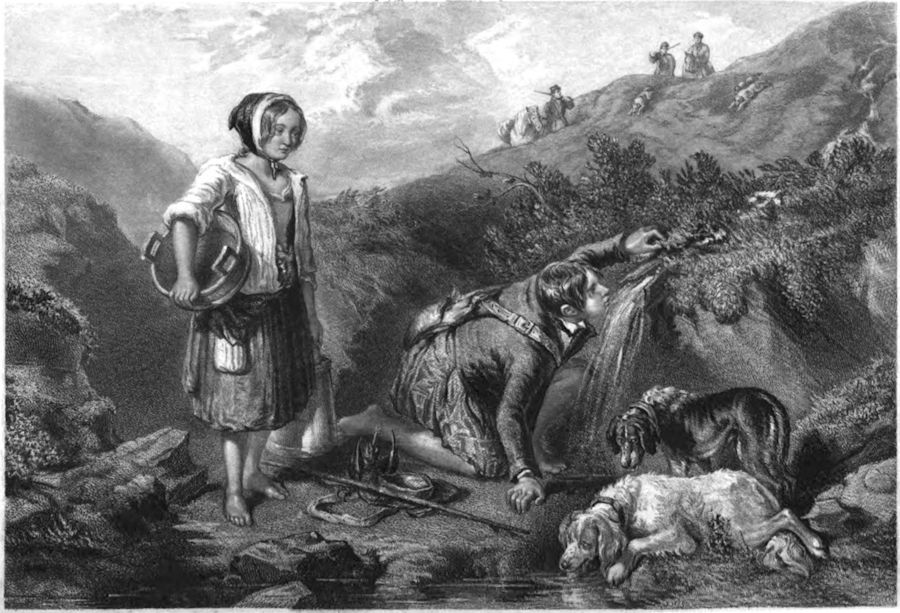
THE MOUNTAIN SPRING.
Engraved expressly for Graham’s Magazine by G. J. Anderson
———
BY RICHARD COX, JR.
———
Thou gilded phantom of the cheated brain,
Through days and nights of long-successive years
We follow thee—through sunshine and through tears,
With beating hearts and eager eyes, in vain
We wait thy coming! now thou art anear,
And now afar-off straying, and again
Dost give as something of thy bliss to feel,
That we, contrasting thy sweet self and pain,
Might know thee worthy all our woes to heal.
Thou art the essence of a joy supreme,
Too pure to dwell upon this earthly clod —
The real presence of the Christian’s dream;
Thy dwelling is where mortal never trod,
Thy home is Heaven! and thy creator—God!
A SOUTHERN STORY OF REAL LIFE.
———
BY THE AUTHOR OF “THE GOLD BEADS.”
———
CHAPTER I.
Far from the mad’ning crowds ignoble strife
Their sober wishes never learned to stray,
Along the cool sequestered vale of life
They kept the even tenor of their way.
Gray’s Elegy.
About thirty miles from Savannah, on the banks of
the river of that name, is a pretty little village, which,
with its small white houses nestled away in the thick
green woods, is something like a hail-stone which has
fallen in a cluster of green leaves. Scarce a quarter
of a mile from the village is the modest residence of
Mrs. Delmont, which is in itself a little paradise of
beauty. Shaded by the stately sycamore, the magnolia,
with its deep green leaves, the catalpa, with its
silver blossoms, and the luxuriant orange-tree, it
stands unrivaled for the romance of its situation for
miles around; while the cape-jessamine, the japonica,
the oleander, and many other rare and beautiful flowers
lend their radiant hues to ornament the latticed piazza,
which is covered over with the fragrant honeysuckle,
together with jessamines of every hue. In this beautiful
and peaceful retreat Mrs. Delmont had resided
since the death of her husband, which had taken place
when her children, of whom she had three, were very
young.
William, her only son, was a sunny faced boy of
eight years old. Rosa, two years older, had the blue
eyes and golden hair of her mother; while Clara had
her father’s dark eyes and shining hair, which clustered
in dark brown ringlets around her fair face.
Clara had just completed her eighteenth year, and
was a tall, graceful and beautiful girl; she had been
carefully trained by her affectionate mother, and well
did she repay that mother’s anxious care, for in her
bereavement she was her comforter and assistant in
many things, and in nothing more than in undertaking
the education of her little brother and sister, a useful,
although we cannot agree with the poet in styling it a
“delightful task,” yet one that Clara was well qualified
to perform, as she had herself received a finished
education, although she had never left her native village:
and she was thus occupied one morning, when
Mrs. Delmont entered the room with an open letter in
her hand, and addressed our heroine in the following
manner:
“My dear Clara, your cousin Mrs. Cleveland
writes that she, with Mr. Cleveland and their three
children, will be here next Wednesday evening, to
spend a fortnight with us, after which they wish you
to accompany them to their city residence, and remain
there for this winter.”
“Oh, mamma, that would be delightful,” exclaimed
Clara. “I know I will enjoy my time with cousin
Florence; and then, you know, the city is so gay a
place. I would be too happy to go.”
“So I think, my dear,” replied her mother, “and
therefore if you wish it I have no possible objection;
but how can you leave Mr. Seymour?” added she,
archly.
“Why, ma,” exclaimed Clara, blushing deeply,
“what is Mr. Seymour to me?”
“Ah, Clara,” replied Mrs. Delmont, “I know what
he is to you, better than you are willing to acknowledge
to yourself. But seriously, my dear child, you
must decide at once, so that I may write an answer to
your cousin’s letter.”
“Of course, mamma, I should be delighted to go.”
And Mrs. Delmont retired to write the letter, while
Clara indulged herself in a long walk, in order to
meditate on the news, and to anticipate the delights of
a visit to the city.
On the appointed day, after assisting the cook to
make a rich plum-cake, and some delicate tarts, she
repaired to the parlor, which she had taken great care
and pains to assist her mother in furnishing as handsomely
as their circumstances would allow, and
arranged with faultless taste the brilliant flowers
which her little brother and sister, who were now
entirely in the spirit of preparation, had gathered, and
placed the nuts they had cracked in a silver basket on
the carefully polished table, fastened back the snowy
curtains, with white chrysanthemums interspersed
with their rich green leaves, adjusting them so as to
throw the most advantageous light on a beautiful painting
which she herself had executed. From the parlor
Clara proceeded to the apartment which she intended
for her cousin: it opened on a grove in which
were several rustic seats and boxes of flowers, and
through an opening in the trees the broad river was
seen to glide calmly on through banks now dressed in
the brightest colors of an American autumn. The
furniture of this room was Clara’s peculiar taste, and
it well accorded with the simplicity and purity of her
own mind. The counterpane, curtains and toilet were
white as a snow-drift; the curtains being on this occasion
looped up with crimson roses, and the toilet beautifully
embroidered by Clara’s own hand, and on it
were laid a handsome Bible and Prayer-Book; and
she finished her preparations by taking a rich and
antique China vase, frosted with silver, which she
prized not a little, and placing it on the table, filled it
with the choicest flowers the garden afforded.
“Oh, mamma,” cried Clara, “come here;” and
throwing open the parlor-door, she exhibited the apartment;
“come here and see how you like my arrangements
for cousin Florence; are not those flowers
beautiful?”
“And will not Cousin Florence admire our new
carpet, mamma?” said little Rosa.
“I dare say,” said Clara, “it is handsomer than
Cousin Florence’s, as it is in all probability so much
newer.”
“Yes, my dears,” said Mrs. Delmont, smiling at the
simplicity of the young girls, while she was careful not
to destroy their pleasant anticipations by undeceiving
them. “Yes, my dears, every thing looks very sweet
and pretty; those flowers are really beautiful, and
I give you a great deal of credit for your good
taste. Come, daughters, and show me your cousin’s
room.”
“Here, mamma,” said Clara, opening the door,
“does it not look quiet and beautiful?”
“Oh, ma!” exclaimed Rosa, “look at those roses
on the window-curtains. Sister Clara, how did you
fasten them so prettily?”
“Really, my dear Clara,” said Mrs. Delmont, “I
congratulate you on your success. I do not think you
will see a prettier room in Savannah. Recollect,
Rosa, to have some plates in the parlor to eat those
nuts in, as I fear the children will soil the carpet with
them.”
“Oh, Cousin Florence would not let them soil our
pretty carpet, I do not think, mamma,” said little Rosa,
as she tripped off for the plates.
The sound of wheels was now heard in the distance,
and Clara and her mother hastened to meet
their cousin, whom they had not seen for several
years.
It was late in October, and the soft breath of summer
was chilled, but not frightened away by the
coming winter, and the vines that draped the windows
still perfumed the air with the rich fragrance of their
clustering blossoms. A gentle melancholy, peculiar
to autumn, overspread the scene, which seemed the
very habitation of beauty and happiness: when Mr.
and Mrs. Cleveland drove up the long avenue, and
alighted at the gate of Primrose Cottage, as Clara
had called Mrs. Delmont’s house, in memory of one
of her favorite books, the dear old Vicar of Wakefield.
Mrs. Cleveland was the wife of a flourishing merchant
in the city of Savannah, where she had resided
since her marriage, which had taken place about five
years previous to the commencement of our story;
and was an amiable though an exceedingly indolent
woman, and indulged her children to such an extent
that they were, in consequence, extremely annoying
to every one by whom they were surrounded. As
soon as Mrs. Cleveland entered the house complaining
of excessive fatigue, she was ushered by Clara into
her neat apartment, which, however, we are sorry to
say, did not long remain so, for the lady immediately
threw herself on the bed, caused her trunk to be
unpacked, insisted upon the children’s dresses being
changed, while the mother, the children, and their
nurse, seemed to vie with each other in the attempt to
fill every chair and vacant place with such articles as
were not in immediate requisition, which gave to the
room so disorderly and careless an appearance, that it
would never have been recognized as the same sweet
looking apartment which Clara had prepared that
morning for their reception.
“Ma, I want something to eat,” whined George,
the eldest boy.
“Well, my darling,” replied his mother, “Cousin
Clara will get you some bread and honey;” and Clara
immediately left the room in quest of refreshments for
the children, who, when they were obtained, immediately
placed them upon the new settee, which Clara
had re-covered expressly for this occasion, an arrangement
which did not tend greatly to improve its appearance.
“George,” said Mrs. Cleveland, “little Lucy has
been teasing for flowers the whole evening, give her
those on the table;” and the child, in his haste to hand
the flowers, turned the honey over on the settee, and
what was still more annoying, threw down Clara’s
beautiful vase and broke it into twenty pieces. Tears
filled the eyes of our unphilosophizing heroine at this
unfortunate accident, but her cousin only remarked:
“There, now, you careless boy, you have broken
the pretty vase, but don’t cry now pet; come kiss
your mother; Martha, (to the maid) take up those
pieces of broken china, I am afraid they will hurt the
children’s feet; Cousin Clara, do you recollect who it
is that says, ‘Crystal and hearts are only valuable for
their fragility,’ quite true.”
Tea was now announced, after which the whole
party adjourned to the parlor, where the children commenced
throwing the nuts over the floor; regardless
of the plates, a proceeding at which little Rosa was
greatly scandalized; particularly as Mrs. Cleveland,
instead of admiring the carpet, merely remarked,
“Really, Johnny, it is well your aunt’s carpet is not a
very elegant one, or you would soon spoil it.”
“How much better it is, Cousin Clara, to have a
plain carpet, children are so ruinous, and yet they are
so sweet one cannot scold them.” Clara thought that
if the sweetness of such spoiled children, as they
were, was their only protection, it was a coin that
would not pass current with every one.
We will not linger over the remainder of Mrs. Cleveland’s
visit to Primrose Cottage, nor describe the many
annoyances to which her children subjected Clara and
her mother, nor will we tire the reader with the many
pleasant anticipations which the former entertained of
her visit to the city, which, in her simplicity, she
imagined to be the most delightful place in the known
world.
——
CHAPTER II.
I remember its waking sigh,
We roamed in a verdant spot
And he culled for me, a cluster bright
Of the purple forget-me-not.
Ballad.
It was the last evening of Mrs. Cleveland’s stay;
and Clara was dressed with peculiar taste. An observing
eye could also have discovered, that the
freshest and rarest flowers decked the flower-pots;
and that Clara from time to time looked anxiously
from the window; who could she be expecting. But
the mystery was soon solved, by the appearance of a
very handsome young man, who invited Clara to join
him in a walk, a request which she readily granted;
and, accordingly, they soon left the domestic circle,
for a quiet stroll on the banks of the placid Savannah.
It was a lovely evening, the sun was setting in
autumnal splendor; the broad river, gilded by its last
rays, rolled majestically on; the tinkle of a bell was
heard in the distance; the ground was carpeted with
leaves of the brightest colors; and through the now
nearly bare trees a beautiful view was obtained of the
various windings of the river, and of the little village,
with its small white houses and their latticed porches,
shaded by magnificent sycamore, cypress, and magnolia
trees. When we are happy, autumn brings no
melancholy to our hearts, but the mournful sound of
the wind, the fading leaves, and the hazy beauty of the
landscape, is fraught with sadness to one already
anxious and dejected; and on this evening Edward
Seymour’s handsome countenance was clouded with
apprehension; for in addition to his grief at parting
with Clara, he could not banish from his mind the
gloomy possibility, that every bright hope he had cherished
through the balmy gales of spring, and the
sunny hours of summer, would vanish with the flowers
and leaves of autumn. But, the reader will inquire,
did not Clara sympathize with his feelings, and soothe
his fears? To a degree, she did; but although Clara
loved him, and would not have given him, or any other
friend, up for the whole city of Savannah, yet, like a
giddy girl, she was so much dazzled by its perspective
gayeties that she could not be so deeply affected at
leaving him as she would have been under other circumstances.
They returned to the house just as the stars began
to appear; and sat alone in the moonlit piazza; for
Mrs. Delmont, with a mother’s judicious care, had so
arranged things that the children could pursue their
boisterous sports in the back yard, while she sat with
Mrs. Cleveland in her own room. An hour passed
delightfully away, and when Edward regretfully arose
to take his departure, he gave to Clara a fresh bouquet
of orange flowers, which he had brought for her, and
as he did so, kissed the little hand that trembled in his
own. A tear sparkled in Clara’s eye at this token of
his affection, but her feelings of sadness were quickly
dissipated by the bustle of packing for her journey, in
which she was engaged, as soon as Mr. Seymour had
taken his departure.
The next day was cold and rainy, and it was late
when the travelers arrived at the place of their destination,
and Clara retired to her apartment much fatigued
with her ride, as she had carried Johnny, a troublesome
child of three years old, in her lap the whole way, not
because there was no room for him elsewhere, but
merely because the “little darling” wouldn’t ride any
where but with “Cousin Clara,” whose new riding-dress
he also chose to daub with molasses candy.
The next morning, when Clara arose, she was informed
by a servant that breakfast was ready, who at
the same time requested her to excuse “master and
missus, as they were too much fatigued with their
journey to come down.” Accordingly, Clara descended
to an elegantly furnished breakfast-room, which, however,
was extremely cold, on account of the very
small fire; and the handsome furniture seemed much
tarnished by the children, and the breakfast-table was
much disordered, as is always the case when, as they
did on this occasion, any members of the family take
their breakfast in their own room.
No one was at the breakfast-table but the two eldest
children, whose company was not very agreeable, as
they did nothing but quarrel with each other, and call
fretfully to the servants for articles which were not on
the table; and during her solitary meal Clara could
but compare the pleasant breakfast-room at Primrose
Cottage, with its neat carpet of domestic manufacture,
its snowy curtains, and its blazing fire, with the cold
and comfortless apartment in which she now sat; nor
could she avoid drawing a like comparison between
her own dear mother’s quiet and cheerful neatness,
and the sweet-tempered voices of her little brother
and sister, with her cousin’s careless self-indulgence,
and the fretful ill temper of her children; yet, while
Clara made these comparisons, not very flattering to
her cousin, she also reflected that Mrs. Cleveland had
just returned from a journey; and it was natural to
suppose that the house would be in some confusion,
and the children tired, and in consequence fretful, immediately
upon their return.
——
CHAPTER III.
But I was a gay and a thoughtless girl,
And I cast them all away,
And gathered the dandelion buds,
And the wild grapes gadding spray.
Ballad.
“Clara, my love,” said Mrs. Cleveland one morning
to our heroine, “you have now been here for some
weeks, and have received several calls, not half so
many though as you would have, had I the industry to
return visits that I owe to some of the most agreeable
of my acquaintances; however, we will to-morrow
return those which have been paid; and do, my dear,
wear the new silk which you thought me so extravagant
in making you purchase, merely because, like a
little country girl that you are, you thought that it did
not accord with your means.”
To this proposal Clara readily acceded, but could
not avoid thinking that her cousin might have exerted
herself sufficiently to return the calls she mentioned, if
it were only on her account. Accordingly, on the following
morning Clara, dressed with much care, descended
to the parlor, looking beautifully.
“Dear me, Clara,” exclaimed Mrs. Cleveland, “how
charmingly you are dressed, are you going out?”
“Why, my dear Florence, have you forgotten our
arrangement to make calls this morning.”
“Calls! how provoking that I should have forgotten
all about it; and what is still more so, have sent the
carriage driver into the country, to purchase some
necessary articles for family use; which, however, I
could easily have done without, had I recollected our
intended excursion. Never mind, Clara, my dear, you
shall not be disappointed, for after dinner we will go
shopping, for I have some purchases to make which
you shall assist me to select.”
But the walk did not afford much pleasure to Clara,
for it was nothing more than a continued search for
articles in which Mrs. Cleveland was too fastidious to
be pleased, and they returned home in the evening,
Mrs. Cleveland much fatigued, where they found that
Mr. Cleveland had just arrived before them.
“Well, Clara,” observed he, as they took their
places at the tea-table, “you have me to thank that after
your long walk, you have not to be kept up to-night
till ten o’clock with company: Mr. Hambden and Mr.
Lester asked leave to call, but I saw you and Florence
out, and concluded that you would be too much fatigued
to see them this evening; so I made some excuse.
They are very fine young men, by the way,
and you must attempt a conquest the first time you
happen in company with them.”
Now, although Clara had no idea of attempting a
conquest, yet naturally fond of company, she would
have been glad to have seen the gentlemen mentioned,
and wished that Mr. Cleveland had not been so solicitous
for her comfort; she therefore made no answer,
but Mrs. Cleveland exclaimed,
“Why, Cousin Clara! don’t you recollect the very
handsome and distingué looking young man you met
this evening, and admired so much; well, that was
Mr. Lester; I have no doubt the impression was returned.
Henry, why didn’t you let them call?”
“Why, my dear, I thought that you and Cousin
Clara were so happy in each other’s company, that I
disliked to introduce any one else into our quiet circle;
I think, now that Cousin Clara is with us, we ought to
be quite sufficient for our own happiness: for when I
am engaged in business I feel assured that my Florence
is not alone, and I hope that her cousin will become so
much attached to the city, that she will hereafter
spend every winter with us.”
“Indeed I perfectly agree with you, my dearest
Henry, and I now see that you were quite right in
acting as you did, for I am quite sure that Cousin
Clara enjoys herself with us. As for me, her company
is such an acquisition that I shall scarcely leave the
house this winter, but shall reserve all my dissipation
for the time when I shall be compelled to lose her, and
seek for amusement abroad. Clara, my dear, whenever
you wish to retire Mildred will give you a candle;
I am going now to sit in my own room, you
know the dear children will never go to sleep without
mamma;” and so saying, she retired to her own room,
accompanied by her husband, after which Clara went
to her apartment, which was rendered chilly, by the
small fire having nearly gone out; as it had been hastily
kindled by a careless servant.
“After all,” soliloquized Clara, throwing herself on
a chair in her cheerless apartment, “after all, it is
not so very delightful in the city as I anticipated.
Dear Cousin Florence is very kind and affectionate,
and yet it seems to me, that she is a little thoughtless,
and although I would not mention it to any one, yet I
think she considers my comfort and amusement very
little, and is so domestic herself, that she thinks I
ought to be so too, never considering for a moment
that she has a husband and children to interest and
occupy her mind, while I am left to my own resources.
Dull as my cousin seems to consider my own home, I
am beginning to wish I had never left it; there every
one studied my tastes, and sought to promote my happiness;
here I am completely thrown into the shade.
But one thing I have learned, and that is, that whoever
has a happy home should never sigh for the gayeties
of a city life, for they may feel assured, that they will
enjoy more true happiness at their own home, in partaking
of the pleasures which it affords, and performing
the duties which it enjoins.” As our heroine pronounced
these words her eyes fell on an open drawer,
where, crushed and faded, were carelessly thrown the
bouquet of orange flowers which Edward had given
her, and while her now fast falling tears dropped over
the neglected token, how bitterly did she chide herself
for the light value which she had attached to her last
precious interview with him to whom, however she
might strive to conceal them even from herself, she
now felt that she must ever cherish sentiments of the
sincerest affection.
——
CHAPTER IV.
In early youth when Hope is new,
The heart expands with love and joy,
Each prospect wears a brighter hue,
And pleasure seems without alloy.
E. M. B.
“My dear Florence,” said Mr. Cleveland, as he
entered the room, some days after the circumstances
related in the preceding chapter; “Mr. Preston is in
the parlor, and if you and Cousin Clara wish to see
him I will take you out.”
“Certainly, Henry,” replied Mrs. Cleveland, “I
will go as soon as I can change my dress. Wait for
me, dearest Clara, I am always so terribly afraid of
Mr. Preston.”
Clara’s heart beat tumultuously at the thought of
meeting Mr. Preston, who was an eminent literary
character, and nearly related to Edward Seymour, and
Clara knew that the latter would not only be pleased
to hear from his cousin and early instructor, whom he
had not seen for a considerable length of time, but had
expressed an anxious wish that she should see and become
acquainted with him. Meanwhile Mrs. Cleveland,
accompanied by Clara, went to her own room and
proceeded to arrange her dress, a task in which she,
indeed, seemed desirous to be expeditious, but which
she in reality, loitered over for such a length of time,
as almost to exhaust our heroine’s patience. At length,
when the last ribbon had been fastened, and the last
ornament arranged, Mrs. Cleveland said, “Well, Cousin
Clara, I am ready; yet, stop one moment, and let
me pacify my little Lucy, she is so fretful.” But the
one “moment” was extended to several, and as Mrs.
Cleveland turned to the door, her husband entered it
and informed her that Mr. Preston had just gone, as
he was compelled to leave the city that day, and the
boat was just starting.
“Really, my dear,” added he, “it is a pity you did
not make more haste, I never saw Mr. Preston so agreeable.”
Without waiting to hear Mr. Cleveland’s comments,
or Mrs. Cleveland’s regrets, poor Clara turned,
disappointed, to the window to catch a glimpse of one
so nearly connected with her lover.
Thus the winter passed fleetly away, and although
Clara certainly spent some portions of her time agreeably,
and made some very pleasant acquaintances, yet,
on the whole, she was much disappointed with her
visit to the city; during which she was not only
deprived of many novel and amusing scenes, highly
interesting to young persons, by her cousin’s indolence
and want of thought, but was, by the same culpable
negligence, prevented from seeing many of the curiosities
of the place, from a view of which she had promised
herself much amusement, as her residence in
the country had hitherto precluded her from any thing
of the kind; while Mr. and Mrs. Cleveland erroneously
imagined that whatever was stale to them must necessarily
be so to our heroine. Besides these sources of
vexation, Clara had one, which Mrs. Cleveland, habitually
careless in money matters, could not sympathize
with more than she did with her other annoyances,
and this was the state of her purse, as Mrs.
Cleveland, with characteristic thoughtlessness insisted
upon Clara’s purchasing whatever was handsome or
fashionable, without regard to expense.
In accordance with this habit, Mrs. Cleveland one
morning addressed Clara in the following manner:
“At last, my dear cousin, we are to have an excellent
performance by the Thalian Association; and I
have been anxious for you to see one, ever since you
have been with us; you know there has been only one
this winter, and then I could not go because the children
were so cross, but the little rogues shall not prevent
our going this time. By the way, my dear Clara,
Mrs. Dawson has some elegant head-dresses, and we
must go down this evening and get one for you.”
“But, Cousin Florence, you don’t recollect that
I have several already, and one that I have never
worn.”
“La, Clara, you wore that to Mrs. Armand’s party.”
“But the wreath of white roses, cousin.”
“Oh, Clara, that is too simple altogether.”
“To tell you the truth, Cousin Florence, the sum of
money mamma gave me when I left home was, I
thought, much more than I should need, but I now
find that it is nearly expended, and if I purchase these
superfluities I must exceed that sum, and you know
that our circumstances are limited.”
“Pshaw, child, what of that? you can get all you
want from your mother’s business man.”
Now, our heroine ought to have had moral courage
enough to have firmly declined making the unnecessary
purchase, but it must be recollected that she was very
young, and being always accustomed to depend on her
mother in such matters, it will not be wondered at if
she quietly gave up the point.
As soon as the head-dress, which was a very handsome
one for six dollars, was purchased Mrs. Cleveland
turned to a ribbon-box, and selecting a very pretty
piece insisted upon Clara’s purchasing it: “Yes,
Clara,” said she, “it is only four dollars.”
“Really, I do not think I need it, Cousin Florence,”
replied our heroine.
But Mrs. Cleveland would hear no objections, so the
sash was purchased, and Clara with her cousin left
the shop. When they returned home the sash was
much admired by every one; but Mrs. Cleveland discovered
that it was too long, and cutting off the superfluity,
saying that, “it would make beautiful pin-cushions
for the fair which Clara expected would
take place shortly after her return home.”
But Mrs. Cleveland might have spared herself the
trouble of assigning any use to the ribbon, for Johnny
having risen in haste from the dinner-table, his hands
were in such a state as, after having possessed himself
of the ribbon, soon to render it unfit for pin-cushions or
any other purpose. “Johnny! you mischief,” exclaimed
his mother, “Cousin Clara’ll whip you.”
She would have been mortified had she known that
Clara felt very much inclined to do so.
The evening at length arrived, which Clara hoped
so much to enjoy; but here again our heroine was
destined to disappointment, for immediately after tea,
Mrs. Cleveland observed,
“Really, my dear Clara, I am very sorry, but Mr.
Cleveland has gone to the Odd Fellows Lodge, he expressed
his intention before I said any thing about the
performance; and though he would willingly have
staid and gone with us, yet I did so much dislike to
disconcert, even the least of his arrangements, that I
said nothing about it. Never mind, my love, there will
be many more performances before you leave Savannah.”
Clara knew that she must shortly return home, and
that it was probable there would not be another performance
before she left town, and when she thought
that she could not gratify her little brother and sister,
as she had promised, with an account of the many
beautiful things which she expected to see there, and
thought—shall we confess it—of her new sash and
head-dress, she retired to her own room, and indulged
in a girlish burst of tears.
In a few moments a knock was heard at the door,
and hastily drying her tears, she opened the door,
when a servant entered and gave her a letter from her
mother, which informed her that, Mr. B—, an old
friend of the family, would visit Savannah in the
course of a few days, and that if Clara felt disposed, it
would be an opportunity for her to return home; at
the same time, she desired her to consult her own inclinations
on the subject. Clara’s eyes sparkled at the
thoughts of again being with the dear ones at Primrose
Cottage, and she retired to rest, determined to accept
Mr. B—’s protection home.
On the following morning, when Clara entered the
breakfast-room, Mrs. Cleveland exclaimed, “My dear
Clara, what do you think, Mrs. Wellwood’s ball, that
has been so much talked of, comes off next Wednesday
evening, and cards have just been left for us; now
I will tell you what we will do this very morning, we
will go to Dawson’s, and you shall get one of those
beautiful robes, they are just twelve dollars, and how
sweet you will look, for I will tell you, Clara, what I
never did before, that there are few girls in Savannah
with half your attractions. Now, will it not be delightful?”
Clara hesitated a moment, but considered that
the enjoyment of the ball would not be adequate to the
expense, besides preventing her return home with Mr.
B—, she therefore replied:
“In consequence of a letter I last night received
from mamma, I shall find it necessary, my dear cousin,
to return home before that time.”
“Oh, Clara!” exclaimed Mrs. Cleveland, “how
can you leave the city for that dull place?” And
Mr. and Mrs. Cleveland added many arguments and
entreaties to prevail on her to remain; but Clara had
made her decision, she therefore affectionately but
firmly insisted upon adhering to it; and the few remaining
days of her stay were spent in taking leave of
her friends, and making preparations for her journey.
——
CHAPTER V. — SPRING SNIPE SHOOTING OF 1850. — SONNET.—FROM THE ITALIAN. — THE FINE ARTS. — REVIEW OF NEW BOOKS. — NO JOY I’LL SEE BUT IN THOSE SMILES.
The wild rose, eglantine and broom
Scattered around their rich perfume. Scott.
Sweet is the hour that brings us home.
Quoted from recollection.
It was a bright and beautiful morning in March,
when Clara, after taking an affectionate leave of her
cousin, whom, despite her little foibles, she tenderly
loved, was seated by her old friend and commenced
her homeward journey.
March, in our southern clime, is not always rude
and boisterous, but has many a gentle day, when Nature
is dressed in as lovely a garb as she wears at any
season of the year, and such a day was the one of
which we speak; the woods were covered with fresh
green leaves, the marshes and banks of the streams
were gay with the yellow jessamine, the dew-drops
sparkled like diamonds in the morning sun, and the cooing
of the turtle-dove, the cheerful notes of the mockingbird,
and the fresh country air that fanned her cheek,
were to Clara like friends of her early days. The sun
was just setting when from a winding in the road Clara
obtained a glance of Primrose Cottage, as it stood imbosomed
in trees arrayed in the freshest green—of the
river, whose banks, where she had pursued her childish
sports, were now decked with wild flowers of every
hue, and finally, of the group of expecting friends, who
at the sound of wheels had hastened into the piazza,
and Clara’s heart beat high as she recognized Edward,
the foremost of the party.
Clara was soon out of the carriage, and in the arms
of her mother, nor did Edward neglect to press her
hand very tenderly, as he handed her from the carriage,
after which she was conducted into the house.
“And, now, which do you like best, Home or the
City, sister?” asked little Rosa, when Clara had
reached her own room, and was removing her traveling
dress, and arranging her hair.
“Home, my dear Rosa,” replied our heroine,
“there I enjoy myself much more than I ever have
during my visit to the city, and yet, mamma,” added
she, “if I had a house in Savannah, I would have
young ladies to visit me, and I know I would make
these visits delightful.”
They now returned to the parlor, where they had
left Mr. Seymour, and after tea, Clara sat once more
with Edward in the fragrant vine-covered piazza, before
mentioned, where the moonbeams sparkled on
the seat they occupied, through a richly blossoming
mass of yellow jessamine—that dear seat, which
seemed intended for the very use of which it was
made, namely, that of Edward’s offering his hand, and
of Clara’s accepting the offer, which was sealed by—no
matter what it was sealed by, gentle reader, only
accept that patient lover, whom you have been so long
trifling with, and you will soon find out for yourself.
———
BY HENRY WILLIAM HERBERT, AUTHOR OF “WARWICK WOODLANDS,” “MY SHOOTING BOX,” ETC.
———
It is a singular thing, and one which elucidates the
great research necessary, and the extreme difficulties encountered,
in the attempt to establish facts of natural
history with regard to birds of passage, that this beautiful
little bird, the general favorite of the sportsman and the
epicure, well known to all classes of men, and a visitant,
in some one of its closely allied varieties, of every known
nation, is still a mystery, as regards some of its habits,
and continues to baffle the inquiries of the most learned
and inquisitive ornithologists.
Its habits, the nature of its food, and therefore the necessities
of its existence, render it an inhabitant of temperate
climates, and of regions in which the moist and
loamy soil, from which it derives its sustenance of small
worms, insects, and the like, is not frozen during the period
of its visitations so hard as to preclude its boring
with its delicate and sensitive bill for its semi-aquatic
prey of worms and larvæ.
Still, as extreme cold prevents it from obtaining subsistence,
extreme heat would appear to be still less congenial
to its tastes or temperament; for, whereas it lingers
in the north until autumnal frosts seal up the marshes and
the soft stream margins against its probing bill, it flies
from its winter quarters in the rice-fields of Carolina and
Georgia, and the farther morasses of Texas and New
Mexico, the instant that opening spring admits of its return
to the fresh meadows and pure rivulets of the north-east.
The winter quarters of this bird, then, are fairly ascertained,
ranging from Carolina southward until almost the
northern limits of the Tropics; thence, so soon as the
blue-bird begins to pipe in the apple-trees, the shad to
appear in the rivers, the willow-buds to turn yellow, and
the frogs to croak and chirrup, with us to the northward,
the snipe is seen everywhere, hurrying, according to the
progress of the season, singly, in whisps of ten or twelve,
or in huge flights, ever, ever, northwardly. In Maryland,
in Delaware, in southern Pennsylvania and New Jersey,
he is wont to appear from the 1st to the 20th of March;
in New York and New Jersey northward, from the 15th
of March to the 20th of April, remaining for a longer
or shorter period according to the steadiness of the weather,
the state of the ground as regards wet or drought, and the
geniality of the season. In mild, soft, temperate, moist
seasons, with a prevalence of westerly weather, he will
linger with us into the lap of June; and in such seasons,
more or less, he woos his mate, nidificates and rears his
young among us, from the Raritan and the Passaic northward
and eastward to the Great Lakes, and throughout
Michigan, Wisconsin probably, and Canada west, up far
into the Arctic Circles.
Still, those which breed with us in the United States,
and even in the Canadas, are but as drops of water to an
ocean, to those which rush on the untiring pinions moved
by amatory instinct to the far breeding grounds of Labrador,
Symsonia, and Boothia Felix, where it is supposed
they resort to rear their young in hyperborean solitude,
thence to reissue, in the summer and the earlier autumn,
and re-populate our midland meadows.
In the neighborhood of Amherstburg, Canada west,
they appear very early; often in February of mild seasons,
always in March; and there may breed, and remain until
banished by severe cold. I shot one there myself last
autumn, the last bird of the season, very late in November,
I believe on the 28th or 29th; and with the plover,
the Hudsonian godwit, and the Esquimaux curlew, they
were seen there this spring in the first days of March.
Around Quebec, I have shot English snipe on the uplands,
in fallow fields and rushy pastures—for the grass in
the morasses does not begin to shoot in those far northern
latitudes, so as to afford them shelter, until much later in
the year—in the end of April and the beginning of May;
but they arrive there only by small scattered whisps, or
single birds, tarry a few short days, and flit onward to
their unknown destination.
This, then, is their mystery—that in no known land
are they perennial; in no ascertained region—so far as I
can learn—are they positively known to breed in the vast
concourses which must breed somewhere, in order to supply
the prodigious flights which issue yearly from the
northern regions of three continents, Europe, America,
and Asia, to fill the warmer countries, and to be slaughtered
literally by myriads, season after season, without
undergoing much if any visible diminution of numbers.
Ever, in all places, in all countries, in all continents,
which they visit in spring, they are seen pressing northward
still, from March until May; no one being able to say
here ends their tide of emigration, this is their chosen
resting place.
Their breeding season is from the middle of May to the
beginning of July; on the 4th of which month I have shot
young birds, with the pin-feathers undeveloped, as large
as the parents—these birds having been hatched on the
ground whereon I killed them. Indeed, it is my opinion,
that all birds which tarry in our latitudes beyond the 10th
of May, either do breed with us, or would do so but for
the persecution of the pot-hunter—all which intend to
steer farther north having departed ere that time.
About the 15th of July the returning hordes, young birds
and old together, full grown and in fine condition, begin
to reappear in the marshes of Quebec and its vicinity,
which may be said to be the extremest northern point
from which we have continuous and authentic annual information
of their appearance. At that time the slaughter
of the snipe on the marshes of Chateau Richer, and of
the islands farther down the St. Lawrence, is prodigious.
There they linger until the frosts become so severe as to
drive them from their feeding-grounds, which generally
takes place early in September, from which time, throughout
that month, all October, and a portion—more or less
according to the season—of November, and even December,
every likely swamp, morass, and feeding-ground of
Canada west, of the western, midland, and eastern states,
from which they are not persecuted and banished by the
incessant banging of pot-hunters and idle village boys,
swarms with them, in quantities sufficient to afford sport
to hundreds, and a delicacy to thousands of our inhabitants,
if they were protected from useless and unmeaning
persecution, by which alone they are prevented from being
as numerous among us as at any former period.
For I am well assured, that, unlike the woodcock,
which, breeding in our midst, and dwelling with us for
months at a time, is annually slaughtered while breeding,
hatching, or immature, and is thus in rapid progress toward
extirpation—the snipe, unmolested in its breeding-grounds,
is not diminished in its numerical production, but
is rendered scarcer in thickly settled districts, nigh to
large towns, by incessant harassing, which drives it to
remoter and securer feeding-grounds.
I do not mean by this, however, to assert that the abolition
of spring snipe-shooting would not be an advantage—on
the contrary, I am convinced that it would; although
well assured that no such measure can be hoped at the
hands of our legislators; for, as the snipe ordinarily lays
four eggs, the destruction of each one of the breeders on
their way northward, of course diminishes the stock of
the coming season by five birds.
So much for the times and places of the snipe’s migrations.
Of his appearance or characteristics—so well is he
known—it is almost useless to speak! It may, however, be
well to observe that although commonly termed the
English Snipe, our bird is a thorough native American,
differing from the bird of Europe in being about one inch
smaller in every way, and in having two more feathers,
sixteen instead of fourteen, in the tail. In other minute,
but still permanent, and therefore characteristic distinctions,
it differs from the Asiatic and Antarctic snipes;
although in their rapid, zigzag flight and shrill squeak
when flushed; in their irregular soaring through the air in
gloomy weather; in their perpendicular towering and
plumb descent, their drumming with the wing-feathers,
and bleating with the voice, during the breeding-season,
all the species or varieties so closely resemble each other
that they are far more easily confounded than distinguished
by the unscientific sportsman.
The American bird has, however, two or three habits,
during early spring-shooting, which I have never observed
in the European species, nor seen noticed in any work of
natural history; the first of these is frequenting underwood
and bushy covert abounding in springs and intersected
by cattle-tracks, and occasionally even high woods,
during wild, stormy, and dark weather, especially when
snow-squalls are driving; and this is a habit of the bird
meriting the attention of the sportsman, as in such weather,
when he finds no birds on the open and unsheltered marshes,
he will do well to beat the neighboring underwoods, if any,
and if not, the nearest swampy woodlands; by doing
which he will oftentimes fill his bag when he despairs of
any sport. The second habit is that of alighting, not unfrequently,
on rail-fences, or stumps, and even on high
trees, which I think I can safely assert that the European
bird never does; and the third is the utterance, when in
the act of skimming over the meadows, after soaring,
bleating, and drumming for an hour at a stretch in mid air,
of “a sharp reiterated chatter, consisting of a quick,
jarring repetition of the syllables, kek-kek-kek-kek-kek,
many times in succession, with a rising and falling inflection,
like that of a hen which has just laid an egg.”[5]
There is no Jack Snipe in America, though many persons
ignorantly and obstinately assert the reverse; the
true Jack Snipe being a northern bird of Europe and Asia,
visiting the milder climates during the hard weather. It
is an exact counterpart of the English Snipe, only about
one-half smaller; it never utters any cry on rising, and
rarely flies above one hundred yards, often dropping within
fifty feet of the muzzle of a gun just discharged at it,
although unwounded. The bird which is here confounded
with it, is the Pectoral Sandpiper, a bird about one-third
smaller than the snipe, of a lighter brown, with a
short, arched bill, and a feeble, quavering whistle. It is
found indiscriminately on the sea-shore, and in upland
marshes; I have shot it from Lake Huron to the Penobscot,
and the Capes of the Delaware; it lies well before dogs,
which will point it, and is a good bird on the table. It is
known in Long Island as the “Meadow Snipe” and the
“Short Neck,” in New Jersey, and thence westward, as
the “Fat Bird,” or “Jack Snipe” indiscriminately. It is
not a snipe at all, but a Sandpiper, Tringa Pectoralis.
The only other true snipe ascertained to exist in America,
is the Red Breasted Snipe, Scolopax Noveboracensis,
better known as the “Dowitcher,” an unmeaning
name, adopted and persevered in by the Baymen, or as
the “Quail Snipe.” At Egg Harbor the gunners call it
the “Brown-back.” It is found only on the salt marshes,
and is never hunted with dogs but shot from ambush over
decoys.
It appears, then, that the coming and stay of the common
snipe in our districts, in spring, is very uncertain, and dependent
on the state and steadiness of the weather. Some
seasons, they will stay for weeks on the moist, muddy
flats among the young and succulent herbage, growing fat
and lazy, lying well to the dog, and affording great sport.
Sometimes they will merely alight, feed, rest, and resume
their flight, never giving the sportsman a chance even of
knowing that they have been, and are gone, except by
their chalkings and borings where they have fed. Again,
at other seasons, they will lie singly, or in scattered
whisps on the uplands, in fallow fields, even among stunted
brushwood, lurking perdu all day, and resorting to the
marshes by night, leaving the traces of their presence in
multitudes, to perplex the sportsman, who, perhaps, beats
the ground for them, day after day, only to find that they
were, but are not.
This variance in the habit of the snipe it is, which
makes him so hard a bird to kill; for, although he is perplexing
from his rapid and twisting flight to a novice, I
consider him, to a cool old hand, as easy a bird to kill as
any that flies. The snipe invariably rises against or
across wind, and in doing so hangs for an instant on the
air before he can gather his way; that instant is the time
in which to shoot him, and that trick of rising against
wind is his bane with the accomplished shot and sportsman,
for by beating down the wind, keeping his brace of
dogs quartering the ground before him, across the wind, so
that they will still have the air in their noses, he compels
the bird to rise before him, and cross to the right on the
left hand, affording him a clear and close shot, instead of
whistling straight away up wind, dead ahead of him, exposing
the smallest surface to his aim, and frequently
getting off without a shot, as it will constantly do, if the
shooter beats up wind, even with the best and steadiest
dogs in the world. The knack of shooting snipe, as some
people who can’t do it choose to call it, is no other than
the knack of shooting quick, shooting straight, and shooting
well ahead of cross shots—this done with a gun that
will throw its charge close at 40 to 50 yards, with 1½ oz.
of No. 8 shot, equal measures of shot and of Brough’s
diamond-grain powder will fetch three snipe out of every
five, which is great work, in spite of what the cockneys
say, who pick their shots, never firing at a hard bird, or
one over twenty paces away, and then boast of killing
twenty shots in succession. Verbum sap.
The great difference of the grounds to be beaten in
different weathers; the difficulty in determining which
ground to assign to which day; the immense extent of
country to be traversed, if birds are scarce or wild, or if
there are many varieties of soil, covert, and feeding in one
range, and the sportsman fail in his two or three first beats
in finding game, and therefore have to persevere till he do
find them, these, and the hardness of the walking in rotten
quagmires and deep morasses, affording no sure foot-hold,
and often knee-deep in water, these it is which make successful
snipe-shooting one of the greatest feats in the art,
and the crack snipe-finder and snipe-killer—for the two are
one, or rather the second depends mainly on the first—one
of the first, if not the first artist in the line.
It is from this necessity of beating, oftentimes, very
extensive tracts of land before finding birds, and therefore
of beating very rapidly if you would find birds betimes,
that I so greatly prefer and recommend the use of very fast,
very highly-bred, and very far-ranging setters, to that of
any pointer in the world, for snipe-shooting in the open—apart
from their great superiority over the pointer in hardihood,
endurance of cold, powers of retrieving, beauty and
good-nature.
Of course, speaking of dogs, whether setter, pointer,
dropper, or cocking-spaniel, it is understood that we speak
of dogs of equal qualities of nose, staunchness to the point,
and steadiness at coming to the charge the instant a shot
is fired. No dog which does not do all these things habitually,
and of course, is worth the rope that should hang
him; and no man is worthy the name of a shot or a sportsman,
who cannot, and does not, keep his dogs, whether
setters, pointers, or cockers, under such command that he
can turn them to the right or left, bring them to heel, stop
them, or down charge them, at two hundred yards distance
if it be needful.
If these things, then, be equal, as they can be made
equal, though I admit a setter to be more difficultly kept
in discipline than a pointer—the fastest setter you can get,
is the best dog for snipe-shooting; his superiority, in other
points, infinitely counterbalancing the greater trouble it
requires to break and control him. I am well aware that
it has been said, and that by authorities, that the best dog
over which to shoot snipe, is an old, slow, broken-down,
staunch pointer, who crawls along at a foot’s pace, and
never misses, overruns, or flushes a bird.
And so, in two cases, he is; but in one case, no dog is
just as good as he is, and in the other, the argument is one
of incapacity to use what is best, and therefore is no
argument.
If birds are so thick on the grounds, and so tame that
you can fill your bag in walking over one or two acres at
a foot’s pace, a very slow pointer is better than fast setters—but
no dog at all, your walking up your birds yourself,
which you can do just as quickly as the dog can, is better
than the slow pointer. Indeed, on very small grounds,
very thickly stocked, it is by far the most killing way to
use no dog, but to walk up the birds.
If a man is so weak and infirm of purpose, or so ignorant
of the first principles of his art, as to be unable to control
his setters, he must, I suppose, use a slow pointer; but it
cannot matter what dog such a man uses, he never can be
a sportsman.
If there be a hundred birds lying, and lying well on one
acre of feeding-ground, the birds can be killed without a
dog, or with a slow dog, as you will; any man who can
pull a trigger must fill his bag.
If there be a hundred birds scattered, wild, over five
hundred acres of ground, where are you with your slow
dog, or your no dog? Just no where. While you are
painfully picking up your three or four birds with your
slow pointer, your true sportsman, and slashing walker,
with his racing up-head and down-stern setters, will have
found fifty, and bagged twenty-five or thirty.
There are ten days in a season when birds are wild and
sparse, for one when they are congregated and lie hard;
and the argument comes to this, that when birds can be
killed with ease, even without a dog at all, a slow pointer
is the best; when they are difficult to find, and hard to kill,
even by a crack shot, the slow pointer is no where, and of
no use, while the racing setters will fill the bag to a
certainty.
For my own part, I can say to a certainty, that I have
had more sport, and killed more birds, by many, many
times, when birds have been widely scattered, and difficult
to find, and when I have walked half or a quarter of
a mile between every shot fired, than I ever have when
birds have lain close, and jumped up at every pace under
my feet; and for a simple reason, that the places in which
birds so rise and lie, are rare and of small extent, and the
days on which they do so few and far apart.
Therefore I say, friend—for all true sportsmen I hold
friends—choose well thy day, when the air is soft and
genial, the wind south-westerly, the meadows green with
succulent and tender grasses, and moist with the deposit
of subsiding waters—select thy grounds carefully; in such
a time as I have named, the wide and open marsh
meadows; but if the wind be from the eastward, cold,
squally and snow laden, then try the bushy, briary brakes,
where cattle poach the soil, and the marsh waters creep,
or the verge of the meadows, under the lea of the maple
swamp, or at the worst the very grounds where you would
beat for woodcock in July—begin from the farthest windward
point of thy beat, casting thy brace of setters off
from thy heel, to the right and left, and so often as they
have diverged one hundred yards, taming them with a
whistle and a wave of the hand, so that they shall cross
continually before thy face, down wind of thee, at some
thirty paces distant; and so persevere—if birds be plenty
and lie well, walking not to exceed two miles the hour;
if they be rare and wild, four miles, or by ’r lady! five, if
thou mayest compass it. If one dog stand, while the
other’s back is turned, whistle, that he shall turn his head,
then hold thy hand aloft, with one quiet “toho!” but no
shooting; if he be broke, he shall stand like a carved
stone. Then walk up to the point leisurely, be sure that
thou go down wind, making a circuit if needs be, with thy
gun at half-cock, the ball of thy thumb on the hammer,
and the nail of thy fore-finger inside the guard, but not
upon the trigger. When the bird rises, cock your gun,
and down him! If thy dogs do their devoir, they
shall drop to the charge unbidden; if they do not, raise
thy hand with an imperious gesture, and cry coolly and
calmly “down charge;” but however ill they behave,
nay! even if they run in and eat thy bird, move not till
thy gun is loaded; then calmly walk up to them, drag
them, pitilessly scourging them all the way, to the place
where they should have charged, and rate them in the
best of thy dog-language. I say “scourging them pitilessly,”
because that is, in truth, the merciful course; for
so one or two whippings will suffice, instead of constant
small chastisement and irritation, which spoil a dog’s
temper and break his spirit, without conquering his obstinacy,
or gaining the ascendancy over him.
If, on the contrary, they charge as decent dogs should
and do charge, so soon as thy gun be loaded, lift them,
with a “Hold up, good lads!” and cast them gently onward,
checking them with a “Steady, dogs!” if they
show disposition to be rash, until they point the dead
bird, if killed, or draw on him, if running. Then, with a
“Toho! Steady!” walk to their point; pick up the bird
under their noses, praising them the while, or bid them
“Fetch!” according to the circumstances of the case;
but if they retrieve the bird without pointing him, or even
after pointing him, until told to “fetch,” let chastisement
not hide her head.
This, rest assured, friend is the way to do it.
For the rest, whether thou wear fen-boots, or shoes and
trowsers, or, as I use, by deliberate preference, arch-boots,
corduroy shorts, and leggins, suit thine own fancy; but
let thy shooting-jacket be roomy on the chest and shoulders,
and well supplied with ample pockets. Let thy gun
be—for my choice—of 31 inches, 12 or 14 gauge, 7¾ to 8
pounds. Let thy powder be Brough’s diamond grain, or
John Hall’s glass—on no account any other—thou mayest
get it of Henry T. Cooper, in Broadway, New York—thy
shot No. 8—thy caps Starkey’s central fire, or Moore
& Gray’s, or Westley Richards’—by no means French, or
Walker’s, the first of which fly, while the latter are, I
think, corrosive. Forget not to have in thy pocket a dog-whip,
a stout knife, a yard or two of strong cord, a pocket-flask,
replenished, as thou wilt, with old Otard, or as I
recommend thee, Ferintosh or Glenlivat whisky—stick in
the seam of thy waistcoat a strong darning-needle, headed
with sealing-wax, it is the only true and responsible gun-picker;
and so, good sport to thee, and health and temper
to enjoy it!—as good sport, gentle reader, as I trust myself
to enjoy this coming week of April, the rain-gods and
the river-gods permitting, and the nymphs remembering
us, as their long-time adorer, in their kind orisons.
The Cedars, March 25, 1850.
———
BY GIDDINGS H. BALLOU.
———
What is it to the fields of heaven
Light hath given,
Radiance glowing, unexpected,
And from soft imbosomed bowers,
And od’rous flowers,
Hath sweet Spring to us directed?
See! by gentle May upholden,
Beech-tree olden
Joyful welcomes springing leaflet;
Spring the flowers of glorious tinting,
Fair imprinting
Meadows kissed by smiling wavelet.
Ah, ’tis Lilla, ever charming,
Soul-disarming,
Gathers flowers, her hair adorning!
Dearest Lilla, dost discover
With thy lover
Spring and Summer now returning?
Flows for thee the tiny river,
Cheerful giver,
Early green and freshness bringing;
Springs for thee the joyous morning,
Heaven adorning,
All the air with praises ringing.
Shepherds, shepherds, to the chorus!
See, before us,
Binds with flowers her hair dark flowing —
While our hearts all homage will her —
Dearest Lilla,
Sing her name with praises glowing!
National Academy of Design.—The twenty-fifth
anniversary of this institution was held on the first of last
month, at the new galleries, No. 663 Broadway, in the
rear of the Stuyvesant Institute. It is extremely gratifying
to the friends of Art to know that this excellent nursery
of artistic talent has now suitable buildings for its accommodation,
and the display of the productions of the painters
of New York. It was only last fall that definite arrangements
were made for the construction of this building,
and already, as if at the bidding of the genii who
ministered to the wants of our youthful friend Aladdin, it
has sprung into existence. This result has been effected
by the constant exertions and devoted attentions of the
building trustees, Messrs. Durand, Cummings, Ingraham,
Edmonds, Sterges and Leupp. The new edifice is situated
in the heart of the fashion of the metropolis; the galleries
are five in number, all intercommunicating, well lighted,
airy, spacious and elegantly neat. The coup d’œil of the
whole, when filled with works of art for exhibition, will
present one of the most animating and beautiful scenes
which the city can afford. The artists of New York have
a right to be proud of this edifice, and we do not doubt
that the public will be equally proud of those splendid
productions with which they will adorn its walls. At the
advanced period, when we write this article, it is impossible
to give any definite account of the present exhibition;
but the notes of preparation, the foreshadowings and
the glorious promise of an array of talented names, are
the tokens that it will be of unusual brilliancy. Every
exertion will be made to give éclat to the opening, and
more pains will be bestowed on this display, that its debut
before the public may be dazzling and defiant of criticism.
We learn from the New York papers, and from other
sources, that all the artists of that city will offer “tastes
of their quality” to the public. Huntington, who has
been exhibiting nearly all his prominent works for his
own benefit, states in the catalogue that his latest efforts
have been retained privately for the opening of the new
gallery. Durand has a new work, of which report speaks
in the most rapturous terms; this, with others of his elaborate
and highly finished compositions, will be displayed.
Cummings, Ingraham, Gray, Edmonds, Elliott, Cropsey,
Stearns, Kensett, Gignoux, Cafferty, Edouart, Audubon,
and others, will contribute portraits, compositions, landscapes,
etc. In fact, the artists have determined by every
means in their power to make the first exhibition in the
new building both brilliant and attractive. We hope by
our next number to be able to speak more fully of this
exhibition.
The Philadelphia Art Union.—It is but a few years
only since the first plan of an Art Union was suggested
in Germany, and already they are in existence wherever
the beautiful is venerated and art admired. In this country
we have Art Unions in New York, Philadelphia, Boston,
Newark and Cincinnati. The Philadelphia institution
differs from all the rest in its mode of distribution,
and follows, we believe, in every respect the London one,
which has been by far the most successful ever started.
In New York the managers purchase pictures and distribute
them. Under this arrangement it frequently happens
that the person who draws a prize is disappointed, because
he has not obtained some particular picture in the
collection which pleased his fancy. The Philadelphia
plan is to divide the proceeds of the subscription money
into various sums, which are allotted to the subscribers,
who with the certificates, when successful, can choose
any picture which may suit their taste, provided it is by
an American artist, and on exhibition in some accredited
gallery of art in the country. The annual distribution of
the Philadelphia Art Union takes place on the 6th of this
month, and we are pleased to learn that its prospects are
most flattering. The engraving for this year is from
Huntington’s celebrated picture of “Mercy’s Dream,”
which will be executed in a mixed style of line, stipple
and mezzotint by A. H. Ritchie, of New York. This
composition is derived from Bunyan’s Pilgrim’s Progress,
where Mercy relates to Christiana the sweet dream she
had in a solitary place, where she saw a winged messenger
approaching, who placed a crown upon her head, and
invited her to a golden gate, etc. The landscape of this
picture is clothed in the first shades of evening, and the
figures of Mercy and the Angel form the attraction of the
work. In calm, spiritual expression, anatomical precision,
delicacy of coloring, and perfect keeping, there is
no modern work which can surpass this.
The Free Gallery of this Institution, located at No. 210
Chestnut Street, has doubtless had a most beneficial influence
in disseminating a taste for Art, and preparing the
public for its just appreciation. The walls of this gallery
have been constantly supplied with much-admired pictures,
and a crowd of visiters are always in attendance.
We hope hereafter to find much pleasure in referring to
the new pictures exhibited in this gallery. The effects
which are dependent upon the success of the Art Union,
are shown by the great impetus which has been given of
late years to many extremely varied branches of manufactures
and commerce by a judicious encouragement of the
Arts of Design. It has been found, more particularly in
Europe, that numerous classes, hitherto considered as inoperative
and useless, have been supplied with employment,
and entire districts revivified, as it were, by the
establishment of certain manufactures, whose excellence
depended mainly upon the skill of the artist. The surest
means of effecting this result, is to create a public taste,
and not merely comply with it as it exists at large; and
it may be brought about by offering rewards for the best
designs, by the publication of the best specimens of Art at
cheap prices, by the erection of free galleries of painting,
and chiefly by the encouragement of Art Unions. With
such objects in view, and such results to achieve, the
multiplication of these institutions in our country must be
regarded as a cheering indication of the true progress of
the age, and the precursor of a widely diffused love of the
Beautiful in Art, which cannot but tend to the general improvement
of the useful arts. All such results must be
effected by our citizens at large, for we cannot expect
legislative aid, and hence it is that we feel the necessity
of impressing upon the public attention the operation of
the Art Unions, as the great popular plan for fostering
talent, infusing a love for the beautiful in Nature and Art,
and cultivating those studies which invariably mark national
progress in civilization, refinement and general
happiness.
New Jersey Art Union.—We announce with great
pleasure that an association of the friends of art in Newark
have drawn up the programme of an Art Union, and made
a stirring appeal to the citizens of the State for encouragement
and co-operation. A free gallery will be opened immediately
at Newark, and pictures purchased for distribution
among subscribers. For the present, no engraving
will be contracted for, and this heavy item being dispensed
with, will increase the sum to be appropriated for
the purchase of paintings. We most cordially wish the
enterprise success, and trust that our New Jersey friends
will be prompt in sending their names to Thomas H.
Stephens, the Corresponding Secretary, at Newark.
Gliddon’s Panorama of the Nile.—This magnificent
work has been exhibited in New York and Boston with
great éclat. Mr. Gliddon is favorably and extensively
known as a lecturer on hieroglyphical literature, and has
rendered popular throughout our country, the wonderful
discoveries and theories of the Champollionists of ancient
mythological history. As a work of art, the superiority
of this panorama cannot be doubted, when we mention
the facts, derived from the Boston Transcript, that while
such artists as Warren, Bonomi, and Fahey, in England,
aided by numerous assistants, conceived and executed
the painting; Martin, the famed depictor of “Belshazzar’s
Feast,” volunteered the exquisite moonlight,
sunset, and other transparent scenes, where the effects of
fire, light, and heat are produced with magical skill,
Carbould volunteered the magnificent Arabian horses,
and Weigall the boats, and similar objects that actually
seem to spring forth from the canvas. The spectator of
the panorama begins his supposed voyage at Cairo, ascends
the eastern bank of the Nile to the second cataract, and
descends on the western bank, as far as the location of the
Sphinx. The interest is not in the ancient associations
alone, but Turks, Arabs, Bedouins, Nubians in their
variegated costumes, Mohammed Ali and his court, the
manners, customs, and usages of oriental life, with the
various geological, botanical, zoological, and even atmospherical
singularities of the land are faithfully depicted.
Even the music which accompanies the exhibition is
characteristically of Eastern origin, and novel airs of
Egypt, Arabia, Turkey, Greece, etc., are introduced.
The whole may be considered as a work of infinite attraction,
and of a high order of art.
Le Roi d’Yvetot.—This comic opera, by Adolphe
Adam, is but little known in this country, except the
overture, and it is very recently that it has been presented,
for the first time, to a London audience. It was first produced
October 1849, in Paris, at the Théâtre Royal de
l’Opéra Comique, and made a very decided impression.
It is founded on the political chanson of Béranger, and of
course the caricatures of royalty, and the hits at the nobility,
are the very life of the drama. The music is full
of vivacity and elegant melody. It is somewhat singular
that Adam is an expert organist, and composes a fugue or
a comic strain with equal facility; his sacred compositions
are very grand, and he has a remarkable skill in adapting
music to the most fantastic ideas and expressions in a
libretto. Many of his works in the opera buffa are well
known in our country—the “Postilion de Lonjumeau”
and “Le Brasseur de Preston,” in particular, while the
mournful sweetness and touching simplicity of his ballet
music, in “Giselle,” have been often felt and enjoyed.
We live in hopes that some day we may hear “Le Roi
d’Yvetot” —
——the king
In history little known,
Who thought that glory, useless thing,
Would not become his throne.
A cotton night-cap graced his brows,
Which Jeannette, mistress of his house,
Gave him as crown. O dear!
Oh! what a funny king was here.
Meyerbeer’s “Prophete” was given fifty times at
the Grand Opera in Paris, when it was withdrawn for a
time, as Madame Viardot had to visit Berlin, to fulfill
an engagement. Madame Castellan, so well remembered
in this country, sung the part of Berthe in this
opera.
Verdi has selected the subject of Shakspeare’s “Tempest,”
for the libretto of his next opera. The genius of
Verdi will luxuriate in the storm of the elements and the
fierce contentions of passion, but he will never be able to
illustrate the spirit of the “dainty Ariel,” or the innocent
devotedness of Miranda. We should think, however,
that he will construct a magnificent composition upon
the many sublime themes and graphic word-paintings of
the great bard.
The Scarlet Letter, a Romance. By Nathaniel Hawthorne.
Boston: Ticknor, Reed & Fields. 1 vol. 12mo.
In this beautiful and touching romance Hawthorne has
produced something really worthy of the fine and deep
genius which lies within him. The “Twice Told Tales,”
and “Mosses from an Old Manse,” are composed simply
of sketches and stories, and although such sketches and
stories as few living men could write, they are rather indications
of the possibilities of his mind than realizations
of its native power, penetration, and creativeness. In
“The Scarlet Letter” we have a complete work, evincing
a true artist’s certainty of touch and expression in the
exhibition of characters and events, and a keen-sighted
and far-sighted vision into the essence and purpose of
spiritual laws. There is a profound philosophy underlying
the story which will escape many of the readers whose
attention is engrossed by the narrative.
The book is prefaced by some fifty pages of autobiographical
matter, relating to the author, his native city of
Salem, and the Custom House, from which he was ousted
by the Whigs. These pages, instinct with the vital spirit
of humor, show how rich and exhaustless a fountain of
mirth Hawthorne has at his command. The whole representation
has the dreamy yet distinct remoteness of the
purely comic ideal. The view of Salem streets; the picture
of the old Custom House at the head of Derby’s
wharf, with its torpid officers on a summer’s afternoon,
their chairs all tipped against the wall, chatting about old
stories, “while the frozen witticisms of past generations
were thawed out, and came bubbling with laughter from
their lips”—the delineation of the old Inspector, whose
“reminiscences of good cheer, however ancient the date
of the actual banquet, seemed to bring the savor of pig or
turkey under one’s very nostrils,” and on whose palate
there were flavors “which had lingered there not less
than sixty or seventy years, and were still apparently as
fresh as that of the mutton-chop which he had just devoured
for his breakfast,” and the grand view of the stout Collector,
in his aged heroism, with the honors of Chippewa
and Fort Erie on his brow, are all encircled with that
visionary atmosphere which proves the humorist to be a
poet, and indicates that his pictures are drawn from the
images which observation has left on his imagination.
The whole introduction, indeed, is worthy of a place
among the essays of Addison and Charles Lamb.
With regard to “The Scarlet Letter,” the readers of
Hawthorne might have expected an exquisitely written
story, expansive in sentiment, and suggestive in characterization,
but they will hardly be prepared for a novel of
so much tragic interest and tragic power, so deep in
thought and so condensed in style, as is here presented
to them. It evinces equal genius in the region of great
passions and elusive emotions, and bears on every page
the evidence of a mind thoroughly alive, watching patiently
the movements of morbid hearts when stirred by
strange experiences, and piercing, by its imaginative
power, directly through all the externals to the core of
things. The fault of the book, if fault it have, is the
almost morbid intensity with which the characters are
realized, and the consequent lack of sufficient geniality in
the delineation. A portion of the pain of the author’s own
heart is communicated to the reader, and although there is
great pleasure received while reading the volume, the
general impression left by it is not satisfying to the artistic
sense. Beauty bends to power throughout the work, and
therefore the power displayed is not always beautiful.
There is a strange fascination to a man of contemplative
genius in the psychological details of a strange crime like
that which forms the plot of the Scarlet Letter, and he is
therefore apt to become, like Hawthorne, too painfully
anatomical in his exhibition of them.
If there be, however, a comparative lack of relief to the
painful emotions which the novel excites, owing to the intensity
with which the author concentrates attention on
the working of dark passions, it must be confessed that
the moral purpose of the book is made more definite by
this very deficiency. The most abandoned libertine could
not read the volume without being thrilled into something
like virtuous resolution, and the roué would find that the
deep-seeing eye of the novelist had mustered the whole
philosophy of that guilt of which practical roués are but
childish disciples. To another class of readers, those who
have theories of seduction and adultery modeled after the
French school of novelists, and for whom libertinism is of the
brain, the volume may afford matter for very instructive
and edifying contemplation; for, in truth, Hawthorne, in
The Scarlet Letter, has utterly undermined the whole
philosophy on which the French novels rest, by seeing
farther and deeper into the essence both of conventional
and moral laws; and he has given the results of his insight,
not in disquisitions and criticisms, but in representations
more powerful even than those of Sue, Dumas, or George
Sand. He has made his guilty parties end, not as his own
fancy or his own benevolent sympathies might dictate, but
as the spiritual laws, lying back of all persons, dictated to
him. In this respect there is hardly a novel in English
literature more purely objective.
As everybody will read “The Scarlet Letter,” it would
be impertinent to give a synopsis of the plot. The principal
characters, Dimmesdale, Chillingworth, Hester, and
little Pearl, all indicate a firm grasp of individualities,
although from the peculiar method of the story, they are
developed more in the way of logical analysis than by
events. The descriptive portions of the novel are in a
high degree picturesque and vivid, bringing the scenes directly
home to the heart and imagination, and indicating a
clear vision of the life as well as forms of nature. Little
Pearl is perhaps Hawthorne’s finest poetical creation, and
is the very perfection of ideal impishness.
In common, we trust, with the rest of mankind, we regretted
Hawthorne’s dismissal from the Custom House,
but if that event compels him to exert his genius in the
production of such books as the present, we shall be inclined
to class the Honorable Secretary of the Treasury
among the great philanthropists. In his next work we
hope to have a romance equal to The Scarlet Letter in
pathos and power, but more relieved by touches of that
beautiful and peculiar humor, so serene and so searching,
in which he excels almost all living writers.
Latter Day Pamphlets. Edited by Thomas Carlyle. No.
1. The Present Time. Boston: Phillips, Sampson &
Co.
The reader of Carlyle will find nothing new in principle,
and little new in phraseology, in this pamphlet, but
it is still fresh and racy, and exhibits the author hammering
as lustily as ever on his old anvil, with his old tools.
The picture given of the poor simple Pope, with the New
Testament in his hand—the pitying contempt with which
Lamartine is alluded to—and the view of American democracy—will
be found the most readable portions of the
pamphlet. Lamartine, with his fine French phrases and
sentimentalities, looks small enough as subjected to the
surly tests of such an Icelandic critic as Carlyle—“a
most eloquent, fair-spoken literary gentleman, whom
thoughtless persons took for a prophet, priest, and heaven-sent
evangelist, and whom a wise Yankee friend of mine
discerned to be properly ‘the first stump-orator in the
world, standing, too, on the highest stump for the time.’
A sorrowful spectacle to all men of reflection during the
time he lasted, that poor M. de Lamartine; with nothing
in him but melodious wind and soft sowder, which he and
others took for something divine, and not diabolic! Sad
enough: the eloquent latest impersonation of Chaos-come-again;
able to talk for itself, and declare persuasively
that it is Cosmos! However, you have but to wait a
little, in such cases; all balloons do and must give up
their gas in the pressure of things, and are collapsed in a
sufficiently wretched manner before long.” The wise
Yankee friend alluded to here is, we suppose, Mr.
Emerson.
Carlyle, though he seems with De Tocqueville, to consider
Democracy inevitable in Europe, still despises and
hates it, and thinks that even in America it is nothing
more than “Anarchy plus the constable.” His view of
the United States, sufficiently contemptuous as a whole,
closes with a bitter, sardonic jest, which we think will
make the tour of the world, and injure us more than a
thousand Trollopes and Basil Halls. He asks, “What
great human soul, what great thought, what great, noble
thing that one could worship, or loyally admire, has yet
been produced there?” We might answer this question
easily, but Carlyle answers it in a sufficiently provoking
manner—“What have they done? They have doubled
their population every twenty years. They have begotten,
with a rapidity beyond recorded example, eighteen
millions of the greatest bores ever seen in this world before—that,
hitherto, is their feat in History.”
As regards Great Britain, Carlyle considers that the
only practical way to remedy its evils, is to reject all cant
about liberty and constitutional government, and enslave
the lower classes. He accordingly recommends to the
English government a plan of enforced labor, and puts an
imaginary speech in the mouth of the Prime Minister,
addressed to the “floods of Irish and other Beggars, the
able-bodied Lackalls, nomadic or stationary, and the
General Assembly, outdoor and indoor, of the Pauper
Populations of these Realms.” This speech sounds well
enough as a joke, provided a man can view a horde of
men as he would so many horses, but it is ridiculous as a
practical exposition of principles. It is certain that in one
hour after a British minister had made such a declaration,
army, navy, and party would melt away from him, and
he would be on the gallows or in Bedlam. As a politician,
Carlyle is little more than a philosopher of sneers and
negations, without one positive practical principle. His
idea of government implies a falsehood in fact, reposing
on the monstrous assumption that civilized society is composed
of a vast collection of men, little better than brutes,
who would endure the tyranny of a smaller number of
despots, little better than Carlyle.
Modern Literature and Literary Men: Being a Second
Gallery of Literary Portraits. By George Gilfillan:
New York: D. Appleton & Co. 1 vol. 12mo.
Mr. Emerson has remarked that “it makes a great
difference in the force of a sentence whether a man be
behind it or no.” We hardly think that there is a true
man behind the best of Mr. Gilfillan’s sentences. He has
a mind of much sensitiveness to his own merits, and some
to the merits of others, and welters readily into the expression
of both; but his inspiration seems to spring from
presumption and whisky-punch. The reader is teased into
attention by Mr. Gilfillan’s confident manner, without
having his attention rewarded by intimacy with Mr. Gilfillan’s
nature. There is merit in his occasional thoughts,
and truth in his detached remarks, but the impression of
the whole is of a slush of shining words. The subject is
only an occasion for the author to pour out his own memories
and fancies, and thus to exhibit himself. The
movement of his mind is half-way between a strut and a
reel, and his faculties are ever in a state of pert intoxication.
He paws rather than handles a great poet, and we
never witness his approach to a Milton or Wordsworth
without a shudder. Having in his intellect no presiding
will or even principle, his compositions are an anarchy of
opinions and terms, without any intellectual conscientiousness
or austere regard for the truth of things; and
their popularity is the result of that sack of the dictionary
which has made so much of our popular literature a mere
debauch in words.
Cosmos: a Sketch of a Physical Description of the Universe.
By Alexander Von Humboldt. Translated from the
German, by E. C. Otté. New York: Harper & Brothers.
2 vols. 12mo.
The noble head of Humboldt which adorns the title-page
of this edition gives at once a favorable impression
of his capacity to treat even the vast subject which here
has tasked his powers. The head is high, broad, massive,
and roomy—spacious enough for knowledge as universal
as his, and strong enough to use that knowledge, and not
be used by it. The work promises to be one which will
leave its mark on the century. Even in England it is acknowledged
by some men of science to be the greatest
mental product of the time. The advantage which Humboldt
holds over most savans is his appreciation of the two
aspects under which nature may be viewed, and the two
uses she serves. He combines the philosopher and the
poet, looking for beauty as well as truth, and seeing also
that there is a point where they unite. “Cosmos” contains
a vast amount of generalized knowledge to satisfy
the understanding; but it is also replete with gorgeous
descriptions of natural scenery to fill and stimulate the
imagination. We know of few works which can be more
profitably read by enthusiasts either for the exclusively
scientific or the exclusively poetic method of observing
nature.
The East: Sketches of Travel in Egypt and the Holy Land.
By the Rev. J. A. Spencer, M. A. New York: George P.
Putnam. 1 vol. 8vo.
This work is elegantly printed and appropriately illustrated.
The field of the author’s travels is of exceeding
interest, and the mere title, “The East,” is sufficient to
stir the imagination and kindle the curiosity of all “the
West.” Mr. Spencer is a scholar, a Christian, and, we
may add, well versed in English Composition, but he has
chosen to preserve the epistolary form in which he recorded
his first impressions, and this he has done without
having in his letters much of that familiar charm which
is the justification of the practice. If the traveler be Lady
Montagu, or Horace Walpole, or Gray, or Cowper, or
Byron, or even Lord Chesterfield, we should be inclined
to wish to read his letters rather than his formal “tour;”
but few writers are gifted with a genius for epistolary
composition; and Mr. Spencer is not one of the few.
There is much in his volume which might have been
omitted with positive advantage. His style is the very
reverse of epistolary, and yet he says a great many things
having all the unimportance of chat without its raciness.
With this exception we think the book an excellent one,
containing valuable information clearly conveyed.
The Optimist. By Henry T. Tuckerman. New York:
George P. Putnam. 1 vol. 12mo.
This is the most delightful of Mr. Tuckerman’s many
volumes of essays. It contains twenty-two papers, on as
many subjects, is written in a style which evinces a
graceful mastery of the resources of language, and is no
less fluent in thought than in expression. Perhaps the
most pleasing quality of the volume is its wealth of illustration.
The writer’s mind is not only affluent in comparison
and imagery, but his literary culture is so extensive
as to give him a command of those sources of fascination
which come from felicitous allusions to the world of
authors and books. The object of the volume is finely
stated, in an elegantly written preface, to be the search
for the good in life, as that good is exhibited to one who
can comment kindly on society, and interpret the true and
beautiful in common experience. The best papers in the
volume are those on New England Philosophy, Art and
Artists, Lyric Poetry, Eye-Language, Flowers, Costume,
Music, and Conversation. The volume should be on the
shelves of every man who has the heart and imagination
to enjoy the English essayists, for to that goodly company
it is a positive addition.
The History of the Decline and Fall of the Roman Empire.
By Edward Gibbon, Esq. With Notes by the Rev. H. H.
Milman. A New Edition, to which is added a Complete
Index of the Whole Work. In six volumes. Boston:
Phillips, Sampson & Co. Vols. 1 & 2.
This is a cheap reprint of the latest and best edition of
Gibbon, and when completed will place one of the greatest
historical productions in the world within the reach of the
most limited means—the price of the whole not amounting
to four dollars. Milman’s edition is in some degree founded
upon Guizot’s French edition, and includes the principal
notes of the latter. Both Milman and Guizot have gone
carefully over Gibbon’s authorities, and while they have
thus been enabled to correct his misrepresentations, they
have also added much which he overlooked, or which has
been brought to light since the period in which the
history was written. Of the book itself, it may be said,
that in the combination of vast erudition with philosophic
thought, it is the object of emulous despair to all succeeding
historians. The subject is the greatest within the
range of historical composition, and Gibbon has so nearly
exhausted it that even a philosophical historian like Guizot
is contented to be but an annotator when he approaches it.
The general reader, after many repeated perusals of the
work, continually returns to it for the depth and acuteness
of its reflections, the richness and weight of its style, and
that masterly irony, sapping a solemn creed with “solemn
sneer,” which, though sometimes an expression of the
author’s moral deficiencies, and in a few instances disgracefully
disingenuous, is still a weapon which makes
falsehood and prejudice wither when it merely gleams,
and perish when it strikes.
A Few Thoughts for a Young Man. A Lecture, delivered
before the Boston Mercantile Library Association. By
Horace Mann. Boston: Ticknor, Reed & Fields.
The author of this eloquent lecture is known principally
for his great services to the cause of popular education—a
cause which he has adopted with his whole soul, and into
which he has thrown whatever of fire there is in his blood
and of intelligence there is in his brain. The present address
flames with the peculiar characteristics of his genius—vehement,
rapid, and epigrammatic in style, large, generous,
independent and original in thought. We disagree
with some of the positions he has assumed, but we know
of few books which contain, in so small a space, so much
to breathe energy and aspiration into the souls of young
men as this warm gush of blended thought and knowledge,
from a soul eminently energetic and aspiring itself.
The Modern Housewife. By Alexis Soyer. Edited by an
American Housekeeper. New York: D. Appleton & Co.
1 vol. 12mo.
This book we can commend to all ladies who are, or
hope to be, housewifes. It simplifies the whole art of
cooking, and has a receipt for every dish which the Heliogabalus
imagination of man has conceived. It has been
edited, seemingly with great care, by some gentleman
amateur of the table, and contains directions for the food
equally of rich and poor, the dyspeptic and the ostrich
stomach.
Memoirs of the Life and Writings of Thomas Chalmers,
D. D. LLD. By his Son-in-Law, the Rev. William
Hanna, LLD. New York: Harper & Brothers. 3 vols.
12mo.
The first volume of this important work has just been
issued, containing long extracts from the doctor’s early
diary and correspondence, and full accounts of his life and
writings to the year 1814. As the biography of a good
and eminent man, furnishing, as it does, the means of
understanding the process according to which his character
grew into such large proportions. The work promises to
be one of the most valuable of the season.
The Red Rover. By the author of “The Spy,” “The
Pilot,” etc. Revised, Corrected, and Illustrated with a
New Introduction, Notes, etc. by the Author. New York:
Geo. P. Putnam. 1 vol. 12mo.
We well recollect the excitement in the novel-reading
world produced by this book on its first publication. The
rush on the circulating libraries was continued for a
couple of months, and even boys were considered behind
the age, unless they had read it. In its present cheap and
elegant form, and enriched by the revision of the author’s
maturer judgment, we hope it will have another term of
popularity.
Elements of Natural Philosophy. By Alonzo Gray, A. M.
Illustrated by 300 Wood Cuts. New York: Harper &
Brothers. 1 vol. 12mo.
This work is designed as a text book for academies,
high schools, and colleges, but it is well adapted also for
the general reader. Principles are stated with equal
clearness and accuracy, and the examples and illustrations
are happily selected. The author evidently understands
the avenues through which scientific knowledge must pass
in order to reach the learner’s mind.
Hume’s History of England. Vol. 6. Boston: Phillips,
Sampson & Co.
This volume is the last of the Boston edition of Hume—an
edition which places one of the most valuable and
fascinating works in the language within the reach of
readers of the humblest means. We are glad to see that
the same enterprising house, intend to issue an edition of
Gibbon in the same style, and at the same low price.
Foreign Endorsement.—It must be amusing to the
subscribers of Graham’s Magazine, to see the American
Press praising the story of “The Village Doctor,” published
in “Blackwood’s Magazine” last year as the first
translation of that excellent French story. The article
appeared in “Graham’s Magazine” more than two years
before, i. e. in the October and November numbers, 1847,
and had therefore been read in this country by at least one
hundred thousand readers, before it was copied by the
weekly press in this country from Blackwood.
The truth is, the American Magazines contain every
month articles which would make the fortune of a London
or Edinburgh periodical, which are passed over in silence,
but the most inferior article of English stamp is endorsed
as something extraordinary, merely because it is English.
This should be corrected.
Mr. Leonard Myers, who translated the story of “The
Village Doctor” for us, has just had published by Messrs.
Lippincott & Co., a capital story from the French,
called “Money-bags and Titles.” It is a very creditable
volume in every respect; the story is well told and contains
some admirable hits at the follies of the age. It can
be sent by mail, and is published at the price of fifty cents
the volume.
A Capital Story.—The Saturday Courier has been
publishing, for the past few numbers, a story of more than
usual excellence, called “Linda,” by Mrs. Caroline Lee
Hentz, whose stories heretofore in this admirable family
paper have made so much stir among readers of light
literature. Her story of the “Mob-Cap” ran through
several editions, and is still praised as one of the most
effective articles that ever appeared in a periodical. Mr.
M‘Makin will find that “Linda” is destined to make a
fresh demand for articles from the able pen of this lady,
and we are sure he will receive the thanks of his hundred
thousand readers for his liberality in thus catering to their
refined taste.
 Our correspondent, Richard Coe, Jr., is about to
publish a volume of his beautiful poems—a neat edition
for the centre-table at the price of one dollar per volume.
His address is 33 Church Alley, Philadelphia, where any
of his friends will be supplied.
WRITTEN BY
JOSEPH A. NUNES.
COMPOSED BY
JAMES BELLAK.
Published by permission of Mr. E. L. Walker, No. 160 Chestnut Street.
I’ll think of thee, that thought alone
Can never from my mem’ry flee,
In ev’ry breeze I’ll find a tone
That whispers nought but love and
thee
And ev’ry sound that greets my ear,
And ev’ry object that I see,
Will be to me more sweet, more dear,
When mingled with the thought of thee.
Should fortune smile, and hope be bright,
And from the world be nought to fear,
Oh! what can add to that delight
But the one thought that thou art near.
Then pleasure, with its thousand smiles,
Will vainly strive this heart to free:
No joy I’ll see but in those smiles,
No rapture feel away from thee.
And when existence’s span is run
And death impatient waits for me,
My soul, as to its earthly sun,
Will turn a lingering look on thee:
E’en when the last sad scene of life
Shall mingle with the shades of death,
My spirit, in its latest strife,
Will bless thee with its parting breath.
Transcriber’s Notes:
Table of Contents has been added for reader convenience.
Archaic spellings and hyphenation have been retained.
Obvious type-setting and punctuation errors have been corrected
without note. Other errors have been corrected as noted below. For
illustrations, some caption text may be missing or incomplete due to condition of
the originals available for preparation of the eBook.
page 304, soulfull look, and ==> soulful look, and
page 306, reader, with what exhuberance ==> reader, with what exuberance
page 308, some of her satelites ==> some of her satellites
page 310, eyes were rivited upon ==> eyes were riveted upon
page 318, To batten and gorge on ==> To fatten and gorge on
page 341, of Amherstbergh, Canada west, ==> of Amherstburg, Canada west,
page 341, by incessant harrassing, which ==> by incessant harassing, which
page 346, and whom libertinism ==> and for whom libertinism
[End of Graham's Magazine, Vol. XXXVI, No. 5, May 1850]