A week subsequent to Clara’s arrival in Venice,
whither she had come after a month’s search in Paris,
Naples, Florence and Rome, for her husband, she sat
by the bed-side of Alfred, now rapidly recovering,
while Ella, their beautiful child, over a year old, was
sleeping in her arms.
“I know it would have been better, Clara, far
better,” said the invalid, replying to a remark which
his wife had made. “But the disasters of that western
business put me half beside myself. Ah me! how
much happier we would have been if your fortune had
been like my own—nothing.”
A cloud flitted over the brow of Clara as he made
this last remark. She sighed faintly, and was silent.
“I am weak and foolish on this subject,” said he,
after a few moments. “But you understand why it is
so. The weight of a feather will hurt an inflamed
wound.”
Clara looked at her husband half reproachfully, and
then changed the subject.
A year longer Ellison remained in Italy, devoting his
time to study and practice in the higher schools of art,
and then turned his face homeward, taking with him
about twenty pictures, half of which were his own
compositions, and all of a high order of merit.
There is now, in the city of New York, an artist
whose pictures are scarcely dry from the easel ere
they meet with purchasers at a liberal price. His
portraits are among the finest that are produced, and
he is, consequently, never without a sitter. Money
flows in to him by thousands, and from the proceeds
of his own work, he has surrounded himself with all
the elegances of life that a man of taste could desire.
That artist is Ellison. Fifteen years have elapsed
since the painful events we have described transpired.
But success has not entirely obliterated the
marks they left behind. To let his mind go back and
linger thoughtfully on the past, is but to throw a
shadow over his spirit. Often, as he looks into the
face of his wife, comes upon him the remembrance
that he sought her, at first, less for herself than for the
external advantages she would bring him, and that
she knows of the mercenary feelings which drew him
to her side.
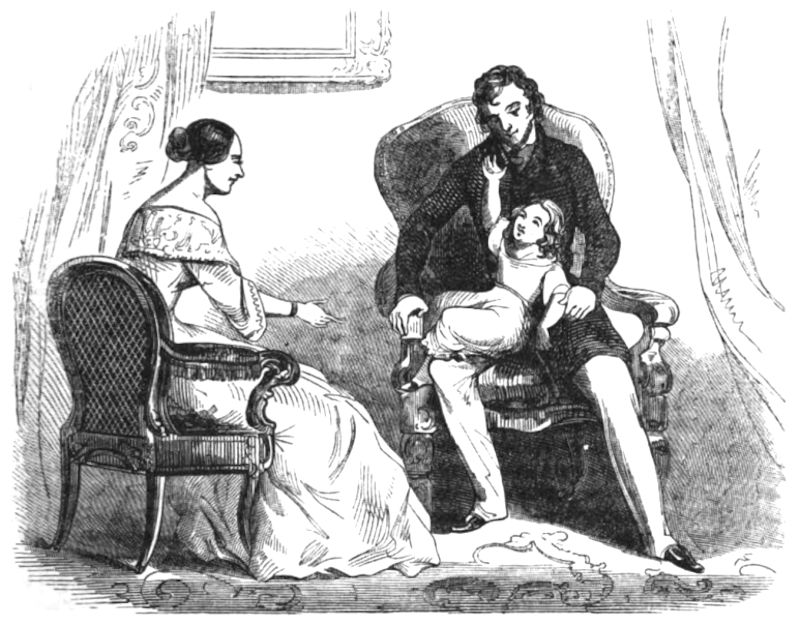
“If she had been poor, like myself,” he often sighs,
as he turns away from some memory of the past,
“there would have been nothing to dim the sunshine
of our happiness; nor, if I had won my way to success
by the force of my own talents, ere I asked to lead her
to the altar. Alas! that the fine gold of affection
should have been dimmed by the base alloy of selfishness!”
That the inflamed spot, fretted into painfulness by
the touch of even a feather, still remains, is evident
from the fact, that he has settled ten thousand dollars
upon his wife, and will not touch a farthing of the income
it yields. By this act he keeps alive in his own
mind, as well as in that of Clara, the memory of things
that should be buried with the mistakes and errors of
the past, and thus robs both her and himself of a portion
of the happiness that is rightfully their due. On
this subject, suffering has made him little less than a
monomaniac; and such he will probably remain while
he lives. How true is it that our motives give quality
to our acts, and mar all the effects that flow from them
if they be stained with selfishness. Most true is this of
marriage. If a base or mercenary end influence us in
entering into this relation, unhappiness must inevitably
follow. A reaction, such as that which occurred in the
case of Ellison, may not take place; but there will
come a reaction of some kind, and that a painful one,
as surely as an effect follows its producing cause.
Thousands around us fail to secure a true union in
marriage, that consummation above all things desired
by the heart, and for no other reason than the one
here assigned. Of all motives from which we act, let
those leading to marriage be freest from alloy. We
may err in other things, and escape without a severe
penalty; but never in marriage. We cannot do violence
to the heart’s best affections without after years
of pain and unavailing repentance.
I told my wife a secret—
“And did she keep it?” say you.
Ah! therein lies the moral, man,
To which give heed, I pray you!
She kept it but an hour or two—
She then put on her bonnet,
And called upon her Cousin Sue,
That both might comment on it!
Alas! ere half the day was o’er,
Most dearly did I rue it!
Sue told it to a dozen more,
And they to others talked it o’er;
I found on coming from my store
That all the village knew it.
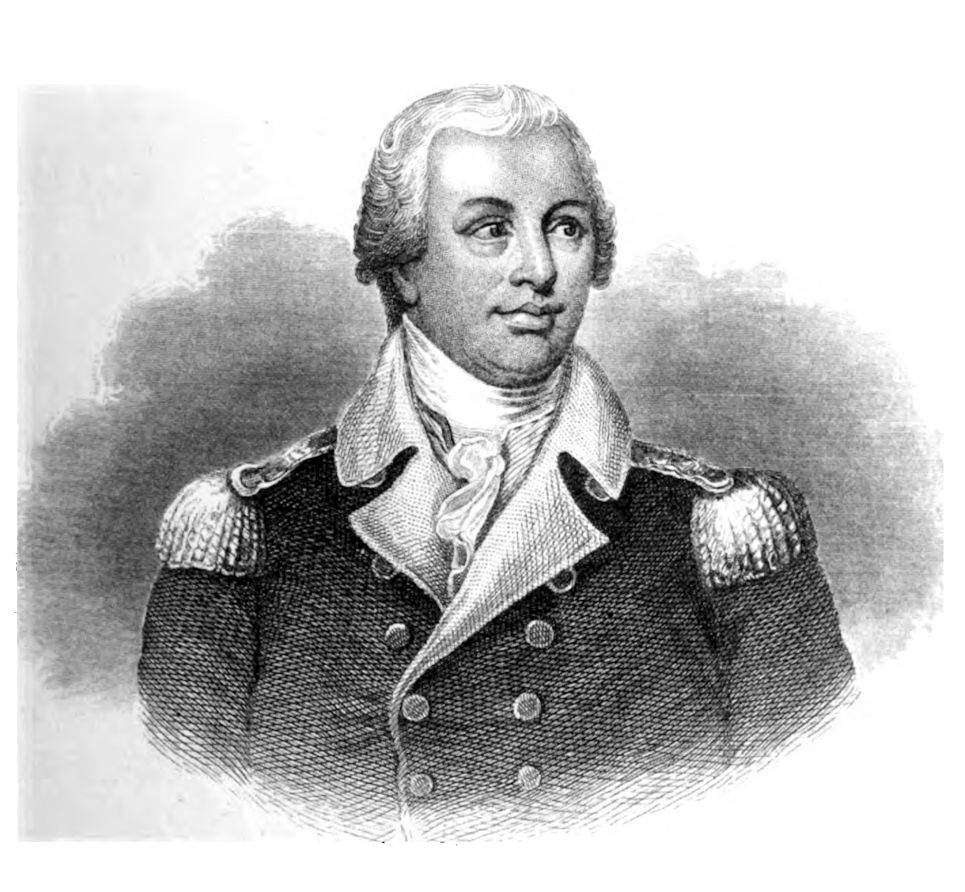
PORTRAIT OF GENERAL GREENE.
———
BY THOMAS WYATT, A. M., AUTHOR Of “HISTORY Of THE KINGS Of FRANCE,” ETC. ETC. ETC.
———
[SEE ENGRAVING.]
In the early part of the seventeenth century a number
of families emigrated to New England and took up
their residence in the colony of Plymouth.
Among them was a family of the name of Greene,
from which the subject of this memoir was a lineal
descendant. Not many years after their settlement
there, religious controversies began to wear a serious
aspect, and John Greene becoming involved in them,
determined to remove with his family to the settlement
formed a year before, by Roger Williams, on the
banks of the Providence river. We find the name of
John Greene recorded among the twenty-four original
colonists, who obtained a permanent organization by
the charter of Charles the Second. From that period,
members of this family are frequently mentioned as
holding offices of dignity and trust; one of them was
Governor of Rhode Island during several years of the
revolutionary war.
Nathaniel Greene, a brother of Governor Greene,
and direct in descent from the original emigrant, had
established himself as an anchor-smith near the head
waters of a small stream, which still retains its Indian
name of Potowhommett.
On the settlement of this town it was named Warwick,
where the subject of this sketch, and son of the
above Nathaniel Greene, was born, on the 27th of May,
1742.
The first years of his life were almost exclusively
passed in the labors of the farm, for which he was well
adapted by a strong and vigorous constitution. Losing
his mother when he was only ten years of age, his domestic
education more immediately devolved upon his
father, who was a rigid disciplinarian, confining his
son very closely to agricultural pursuits, and a stand at
the anvil. This was continued through the spring and
summer, but at the approach of winter a teacher was
sought to reside in the family to teach the elements of
an English education.
The Bible was the only book allowed to be used in
the family of the Quaker preacher, for such was the
rank his father held. But to Nathaniel such an education
was too limited, and therefore unsatisfactory; he
accordingly, as fast as his small savings would permit,
purchased himself a small, but well selected library,
and often spent the whole night, after the family supposed
he had retired to bed, in regular study. An acquaintance
casually formed, at the age of fourteen, with
a young man who happened to be spending his college
vacation at Warwick, first directed his attention to
higher and more absorbing pursuits. It is not for us to
conjecture what passed between Greene and his newly
found friend. But whatever it was, the spark in his
coarse clad bosom soon became ignited, and kindled
into a flame that was never to be quenched.
The next winter another teacher was engaged, better
qualified to direct the first efforts of a mind awakening
to a consciousness of its powers, and with him
he studied mathematics and the classics.
He had now reached his twentieth year, and by patient
industry and unwavering perseverance he had
acquired a certain amount of knowledge, which was a
matter of surprise to his neighbors, having so little
leisure between the mill and the forge. Every penny
of his hard-earned savings was devoted to his library,
and he now possessed many valuable and standard
works which he considered gems of invaluable worth.
His life was regular but methodical, one cup of coffee
in the morning, and one substantial meal in the afternoon
sufficed for each day. His father, as has been
before observed, was a strict disciplinarian, and every
morning strictly laid out the duty which Nathaniel had
to perform before night; this task he was never known
to neglect, but always carried in his pocket some favorite
volume, as a relaxation during the few intervals
of leisure through the day.
It might easily be supposed, that with such strict
habits he would have lost all his original buoyancy of
spirits and love of frolic, but it was the reverse; it appeared
to give a stronger zest to his sports, and no
sooner was his mind relaxed from study or toil, than
he entered at once into some feat of agility or mimic,
in which art he so frequently displayed his skill. In
notes written by his grandson, while consul at Rome,
we find the following amusing anecdote: he says—“His
chief passion was dancing, and that pleasure was
often purchased at the risk of a fall from the window
through which, when the watchful eyes of his father
were closed in sleep, he would steal away to the scenes
that he loved. It happened once, however, that something
had excited his father’s suspicion, and set him
upon the watch. There was a ball in the neighborhood
to which young Greene was invited. The
dance continued until late in the night, and he was
cautiously making his way homeward, when whom
should he see but his father, with horse-whip in hand,
patiently pacing to and fro beneath the window. Retreat
would have been useless, for the door was
locked, and there was no other way of getting into the
house. He knew the inflexible severity of his father
too well to dream of escape, for dancing, of
all misdemeanors, was most heinous in the eyes
of a Quaker, and there was nothing to be done
but to submit to his punishment with the best grace he
could.
“But, while he made up his mind to take his flogging
patiently, he was resolved to suffer as little from
it as possible; and accordingly, before he presented
himself to the lash, he cautiously thrust under his
clothes three or four shingles, from a pile that chanced
to be lying near him, and then coolly advanced to meet
his father. The reception was just such as he was
prepared for, and the blows fell quick and heavy upon
his corselet of shingles.”
Some of his biographers have said that this love of
frolic yielded at last to the rigorous discipline of his
parent, but this is a mistake. Many years after this,
when on a visit to Block Island, to the family of the
lady who subsequently became his wife, dancing and
riding were his chief amusements, and many persons
remember to have seen him in his house at Newport,
after the close of the war, amusing himself by playing
with his wife the old game of poor puss wants a corner.
About this time there was a considerable
change in domestic affairs, his father purchased a new
mill at Coventry, a few miles distant from his home,
and made him the director. For the first time in his
life he felt that he was his own master, and possessing
a small share in the concern, his resources were enlarged,
together with the means of employing them.
His library, which had been but scantily supplied, now
felt the benefit of this change, for it soon reached to between
two and three hundred volumes, which at that
period was considered an extensive affair. He now
began to feel of some importance in the neighborhood
in which he had made his new home. He began also
to take an active part in public affairs, and was soon
the means of establishing the first public school at Coventry,
the result of the interest he took in all that related
to the cultivation of mind. In 1770 he was
elected to the General Assembly of the Colony, and
from his zeal in the general cause, he continued to be
returned for the town of Coventry until sometime after
his appointment to the command of the Southern army.
As a member of the Assembly he was distinguished for
his dispassionate and patient investigation.
A portion of a correspondence of this period is still
preserved, which shows how steadily he kept in view
the cultivation and expansion of his mind. In 1769 a
circumstance took place which caused much excitement,
in which Greene took a conspicuous position.
It was the burning of the Gaspee in Providence
river. On this occasion Greene’s bold and unequivocal
expression of his sentiments drew upon him the
suspicions of the royal agents, and it was expected he
would have been summoned before the special tribunal
convened at Newport to trace out and condemn the
destroyers of the Gaspee.
From the exciting events continually occurring
around him, Greene became convinced that the hour
was not far distant when both parties must bring their
differences to the test of the sword, and that nothing
less than the sword could settle them. Being satisfied
on this point, and determined to share in the contest,
he at once commenced qualifying himself for the part he
considered it his duty to take. With his usual energy
he studied the art of war, and as military history had
long been one of his favorite branches, his progress in
this new science was both rapid and sure. He soon
found himself absorbed in the study of Sharp’s Military
Guide, Memoirs of Turenne, Cæsar’s Commentaries
and Plutarch, for these were his text books.
Every day brought fresh news, and the sound of preparation
summoned the farmer from his plough and
the mechanic from his workshop. Companies were
organising in all parts of the country, and a review of
a great number of men already under arms took place
at Plainfield, which was witnessed by Greene with
much enthusiasm and pleasure. This conduct, so entirely
opposed to the rigid doctrines of the broad-brims,
gave great displeasure, and he was summoned before
some of their leading men appointed for the purpose
of remonstrating with him for this open violation of
their rules, and to endeavor to bring him back to that
peaceful doctrine of his ancestors. He received their
remonstrances with respectful silence, but informed
them that it was his intention to persevere in the part
he had embraced.
This of course caused an immediate expulsion from
their society, to which he was never again united.
About this time, another change took place in his
domestic situation. During his frequent visits at the
house of Governor Greene, a lineal descendant of the
founder of the family, he became acquainted with a
young lady of the name of Littlefield, a niece of the
wife of the Governor; and a few visits consummated
the impressions so mutually made at their first interview.
It was during his visits to the young lady at
her house on Block Island where he indulged so freely
his taste for dancing, the more so, perhaps, for having
recently thrown off his Quaker’s garb. On the
20th of July, 1774, he was married at the residence of
the lady’s father on Block Island, and returned to his
home in Coventry to commence the enjoyment of a
married life. But he was not suffered long to enjoy
the repose of domestic life, the political horizon
seemed to grow darker every day, and men were
looking around them for the first burst of the tempest
which they were assured must soon come. In almost
every county or town independent companies
were being raised.
One of these was formed at East Greenwich, under
the name of the Kentish Guards, and Greene was solicited
to become their lieutenant; this however failed,
he not being able to obtain a sufficient number of
votes, and he enrolled himself as a private in the same
company. One of the most serious difficulties which
they had to surmount was a proper supply of arms;
but Greene (whose decision was prompt and decisive)
made a visit to Boston under the pretext of collecting
an old debt for his father, in order to look up and
procure the necessary accoutrements for the company.
There he beheld for the first time an array of armed
men sent from beyond the sea for the subjugation of
his native land.
During his visit he was very punctual in his attendance
on their morning and evening parades, and carefully
noted down every remarkable evolution; at the
same time referring to the lessons given in his text
book. Little did the British officers, while glittering
under their scarlet and gold, dream who was looking
on them, or how fatally their lessons would be applied.
It so happened that he fell in company with a deserter,
whom he at once engaged to return with him to Rhode
Island and become drill-master to the guards. This
he considered a signal triumph, and having procured
all he wished in the way of equipments, and bribed a
wagoner to hide both the accoutrements and the new
drill-master under the straw of his wagon, made the
best of their way to Coventry unharmed.
It was not many weeks after their return, when the
news of the first outbreak was announced to them in
the battle of Lexington. Not a moment was lost, the
drum of the Kentish Guards beat to arms, and they
were soon on their march toward Boston. News having
reached the Governor that they had left for the
seat of war, he sent a peremptory message for their
immediate return, and, strange to say, the whole
company, with the exception of Greene, his brother,
and another, responded to the request and returned to
their homes; these three gallant fellows mounted their
horses and repaired with all haste toward the scene of
action, but before they had completed half their journey
they were met with the welcome tidings of the
retreat of the British, and the triumph of their countrymen.
The first blow being given, retaliation commenced
with vigor; delegates were dispatched in all
directions, calling for assistance in this trying emergency.
The Assembly of Rhode Island voted an army
of one thousand six hundred men. The army was to
receive its officers from the Assembly; and then it was
that Greene’s real position among his colleagues was
felt, by the unanimous voice of that body he was
raised to the rank of major-general. In a few days
his preparations were completed, and in less than one
year from the day of his marriage, he entered upon
that career in which he was to encounter so many
hardships and reap so high a fame. Greene having
attained the age of thirty-three, in the month of May,
1775, assumed the command as major-general of the
Rhode Island troops to the army of the united colonies.
It was well for him that his mind and body had long
been trained to habits of laborious exertion, for he
soon found himself surrounded with cares and anxieties
which no one but a commander of an undisciplined
army can understand. His military knowledge, obtained
by his studies, was now brought into actual
service, and the information gained from the instruction
of the deserted drill-master was of immense importance
to him. Greene was a man who had made
human nature his favorite study, and deep indeed must
have been that disguise which could escape his penetrating
glance. With these important qualities, he
commanded with more than ordinary success, his
opinion was always listened to with deference and a
preference given to his acknowledged military talents.
A gentleman of distinction, who happened to be present
at a court-martial upon which he was sitting a few
weeks after the battle of Bunker’s Hill, was so struck
with the sagacity and pertinence of his remarks, and
the commanding dignity of his aspect, that without
even knowing his name, pronounced him to be a man
of real military genius, and decidedly the ablest member
of the court. In entering seriously upon his military
duties, Greene had firmly resolved to submit to
every sacrifice, and endure every hardship in the fulfillment
of them. The zeal and energy with which he
applied himself in the discipline of his men, caused his
troops to be pronounced, by a member of Washington’s
own staff, as the best disciplined men in the service.
On the 3d of July, General Washington joined
the camp at Boston.
His arrival was hailed with great delight by Greene,
who was anxious that the forces of the country should
be brought together under one common head. In
order to make his sentiments more publicly known, he
welcomed him to the army in the name of his troops;
and the feelings emanating from such relative positions,
led to the formation of that affectionate and confidential
intercourse, which ceased only with life.
The first duty assigned the commander-in-chief, was
to place the army upon the continental establishment,
the officers till now, holding their commissions from
their respective states, were received into the immediate
service of the united colonies.
Some dissatisfaction was felt among the officers, on
account of the changes in rank, but Greene found that
he had no cause for complaint at being required to exchange
the rank of major-general to brigadier, which
was offered him in the name of Congress.
Shortly after the arrival of General Washington, the
command of the left wing had been given to Major-General
Lee, and Greene with his brigade placed
under him. Nearly a year passed away without any
decisive movements on either side, although both
Washington and Greene were anxious to make
the trial. “Out of an army of twenty thousand men,”
says Greene, “it will be hard if we cannot find eight
thousand who will do their duty.” But many of the
officers were of a different opinion, and to their decision
he was obliged to acquiesce. At this time serious
apprehensions were entertained of the small-pox,
which was known to be raging in Boston, and against
which few were guarded by inoculation.
By Greene’s advice, a hospital was established at
Coventry, for the inoculation of the officers; and sending
his family into hired lodgings, he gave up his own
house for the purpose.
During the excitement which this disease caused
among both officers and men, Greene was seized with
a severe attack of jaundice, the first illness he ever
had, probably the consequence of this new mode of
life; and this, too, at a time when many officers and
men were down with the small-pox, and strong reasons
for supposing that an attack would at length be made
upon Boston. “Sick or well,” says he, “I intend to
be there, if I am able to sit on my horse.” But the
attempt was not made; and when, a month after, positive
preparations were making for an assault by water,
to support the movements at Dorchester, a brigade of
four thousand picked men was entrusted to his command.
A sudden tempest frustrated the plans of the British
commander, compelling him to put off the assault
which he had meditated upon the right wing of the
American army; and when the storm ceased, it was
too late to attempt it with any chance of success. He,
hastily embarking his troops, evacuated Boston.
Washington now ordered the forces to withdraw
with all speed to New York, where he next expected
to meet the enemy. Greene was ordered to march
with all haste, and take up his quarters at Brooklyn.
He had not reached his destination when he was
seized with a bilious fever, which brought him to the
brink of the grave. This was in the month of August,
and during this severe attack, the battle of Long Island
was fought; when the news reached him and he was
hardly able to raise his head from his pillow, he exclaimed,
“Gracious God! to be confined at such a
time!” From his bed he heard the sound of the cannon,
and received with the keenest anxiety the reports
which were brought to him every half hour of the
progress of the battle. When he was told of the havoc
that had been made in Smallwood’s gallant band, his
favorite regiment, he could no longer restrain his feelings,
but burst into an agony of tears, accompanied by
such severe spasms as to alarm the attendants who
were near him. Well might he mourn over such a
misfortune, for it was very generally believed, that
had he been permitted to have been present, the reverses
of that memorable day would have been
changed. As soon as he was able to mount his horse,
he was again at his post, the duties of which had
been much enlarged by his promotion to the rank of
major-general. The fate of New York was the question
which was now in suspense; and Greene being
stationed at Hærlem, took part in his first battle; for
he had hitherto seen nothing but distant cannonades
and slight skirmishes; in his journal he speaks of it
as one in which he had “fought hard.”
No sooner had this battle taken place than new difficulties
appeared before him; the terms of service of a
large portion of the troops was about to expire, and
no measures taken to supply their places. The only
resource that remained was the militia, and very many
of them had refused to serve, alledging as an excuse
the assurances of peace, liberty and safety which had
been given them by the British. This was a moment
of conflict, and he found that the strong hand of the
soldier must be used to enforce the injunctions of the
law. He instantly ordered down a detachment of his
regulars, to check it in its bud, threatening them, at
the same time, with the rigors of garrison duty in Fort
Lee, as a punishment for their cowardice.
Early on the morning of the 18th of November, Lord
Cornwallis crossed the Hudson with a strong body of
the British and Hessians, intending an attack upon Fort
Lee. Greene had four miles to march before he could
reach the river, and Cornwallis but one and a half.
Without losing an instant, he pushed forward with all
his forces to the head of the stream, and drawing them
up in front of Cornwallis, contrived to hold them at
bay until Washington, to whom a courier had been
dispatched, could come up. Then, leaving them under
the guidance of the commander-in-chief, he hastened
back to the fort, and collecting the stragglers and
others, nearly three hundred in all, conveyed them in
safety across the Hackensack River. This manœuvre
was his first encounter with Cornwallis. Now began
the memorable retreat through the Jerseys.
During the whole of this trying period Greene was
by the side of his commander, partaking his cares and
anxieties, and sharing with him that firm and unbending
trust in the ultimate triumph of their cause, which
forms one of the sublimest traits in the character of
Washington.
By rapid and exhausting marches, in a few days,
the hostile armies were ranged, front to front along the
banks of the Delaware.
During this halt was planned the brilliant attack
upon Trenton; in this Greene bore a distinguished
part, and strongly urged the following up of this blow
by an attack upon the other posts of the enemy in
New Jersey. During the winter of 1777, Washington
established his quarters at Morristown. Greene was
stationed with a separate division at Baskingridge;
and through the whole of a long and severe winter,
continual skirmishes took place, which very frequently
were attended with decided advantages to the Americans.
At the approach of spring, General Greene was
dispatched to Philadelphia, to hasten the action of
Congress upon the important subjects submitted for
their decision. After his return, he with General
Knox was sent to examine the passes of the Highlands
on the Hudson, and take measures for their defense.
The winter had thus far passed without much molestation,
and early in May Washington removed from his
quarters at Morristown to a strong station at Middlebrook.
While encamped at this station, an incident
occurred, which was well nigh depriving the army of
some of its bravest officers. The delicate etiquette of
military rank had never been fully understood by the
new and inexperienced Congress; and when a report
reached camp that a gentleman but recently arrived in
the country had been appointed a major-general, with
a commission of an earlier date than their own, it is
not surprising that it should cause Generals Greene,
Sullivan and Knox to declare their intention of resigning
in case the report should be found true; and each
of them addressed the President of Congress to this
effect. Happily the rumor was unfounded; and by it
Congress saw the necessity of a rigorous adherence
to the established laws of promotion.
Nearly the whole of the following summer was employed
in short marches and slight skirmishes, till the
10th of September, when they took up their position
on the banks of the Brandywine.
Early on the morning following, the British appeared
on the advance, preparing for an attack.
The passage of the ford, near which the chief of the
American forces had been stationed, was manfully defended;
but in the mean time a strong detachment, led
by Howe and Cornwallis, had crossed the river by a
circuitous march, and were rapidly gaining the American
rear. A few minutes sufficed to show how judiciously
this measure had been devised.
After a gallant resistance the Americans were forced
from the field, in spite of all the efforts of their officers
to rally them. Now was the time for Greene to display
his coolness and his energy.
Marching along a road which intersected the flight
of the Americans, and the advance of the enemy, he
hurried his men forward with such rapidity that they
marched four miles in forty-nine minutes. Here every
thing was in confusion; ranks broken, troops scattered,
the roads filled with fugitives, rushing forward they
knew not whither, in the wildness of fear, and the
enemy pressing close upon their footsteps with shouts
of exultation. Throwing himself between them and
his flying countrymen, he opened a sharp and well directed
fire from his field-pieces, opening his ranks from
time to time for the fugitives, and closing them the
moment they had passed.
Having retreated in this manner for half a mile, until
he came to a narrow defile protected on both sides by
woods, he halted and drew up his men for battle; first
depositing his cannon in a safe place, in case he should
be forced to a hasty retreat. The British soon made
their appearance, flushed with success, and thinking
only of putting the last hand to their victorious conflict;
but a close and destructive fire checked their
pursuit, and compelled them to halt. So well chosen
was Greene’s position, that it could neither be forced
nor turned, and the sight of his fierce eye and firm
countenance seemed to have inspired his men with an
energy like his own. For two hours did he maintain
the unequal conflict, and having wearied the enemy
out, he gave up the contest, and drew off his troops to
rejoin the army at their rallying point.
Howe was now resolved to follow up his success
by another battle, or a stroke at Philadelphia, and advancing
with two columns, was soon once more within
striking distance of the Americans.
This being perceived by Greene, he managed to
frustrate all his designs, till Howe, finding it useless to
continue his skirmishes, made the best of his way to
Philadelphia, where he made his triumphal entry on
the 26th of September. At this time the main body
of the British army were quartered at Germantown;
a portion was in the city, and another part scattered
between the two places. Washington now resolved
on attacking the main army at Germantown, and began
making preparations for that purpose.
Greene was ordered to march at once within the
limits prescribed by Washington, which was done, and
the effect was the sanguine and bloody battle of Germantown,
which historians have so repeatedly described.
Greene’s next orders were to examine the
forts on the Delaware, and then retire to Valley Forge
for winter quarters. It was customary with the generals
when retired to quarters for the winter to receive
their families; shortly after their arrival at Valley
Forge Mrs. Washington joined her husband, and about
the same time Mrs. Greene arrived, and the wives of
other officers hastened to follow the example, and the
cares and gloom of a winter encampment were illumined
for a moment by this transient return of the
sweets of domestic life. It was during this memorable
winter that the intrigues against the commander-in-chief,
commonly known as Conway’s cabal, became
public. These calumnies were traced and ferreted
out by the perseverance of Greene, and when exposed
by him, fell to the ground, like drops from the melting
icicle in the rays of the sun. In a letter to a friend,
before they went to Valley Forge, he writes thus, “I
have no hopes of coming home this winter, the general
will not permit it; Mrs. Greene is coming to camp;
we are all going into log huts; a sweet life after a
most fatiguing campaign.”
Time was now approaching for some action, and indications
were observed which led the army to suppose
that the British troops were about to evacuate
Philadelphia. But they were unable to ascertain
whether it was the intention of the enemy to return
overland to New York, or to engage in some more
distant enterprise.
News, however, having arrived, informing them
that the enemy was on the eastern bank of the Delaware,
and that it was his intention to direct his march
through the Jersey’s, the American army was now
hastily put in motion to follow, and after a few minutes
conversation, the orders were issued which ended in
the battle of Monmouth.
At this period the department of quartermaster in
the American army was in a very defective and alarming
condition, and required speedy reform.
The commander-in-chief was requested by Congress
to look out for an officer suitably calculated to fill
a post of so much importance. Washington well
knew that if Greene could be convinced that he
could render his country more essential service in the
department of quartermaster than in the field, he would
accept of the appointment. “There is not,” he observed,
“an officer in the army, nor a man in America,
more sincerely attached to the interests of his country
than General Greene; and could he best promote their
interests, in the character of a corporal, he would
readily exchange the epaulet for the knot.” When
the appointment was offered Greene, he at first declined
it, but on a second conference with the commander-in-chief,
he accepted, on condition that he
should forfeit nothing of his right to command in time
of action.
He entered on the duties of his office on the 22d
March, 1776. Very shortly after receiving his new
appointment, he took a high and distinguished part in
the battle of Monmouth, and followed in a very brilliant
expedition against the enemy in Rhode Island,
under the command of General Sullivan. At the
battle of Monmouth, General Washington, disgusted
with the behaviour of General Lee, deposed him in
the field of battle, and appointed Greene to his command,
which greatly contributed to retrieve the errors
of his predecessor, and to the events of the day.
General Greene had now been more than three years
from home, and during this period the direction of his
affairs had been intrusted to others, over which he had
neither time nor means of control.
His short visit to his home at Coventry was hailed
by his neighbors with affectionate demonstrations of
joy. Even the Society of Friends, who had reluctantly
excluded him from their communion, expressed their
sincere satisfaction at the high position he had attained
in the confidence of his country. One of the Society
of Friends was asked by a young officer, in jest, how
he, who was an advocate for peace, could keep company
with General Greene, whose profession was war.
“Friend,” said the Quaker, “ ’Tis true, I do not approve
of this many-colored apparel, but whatever may
be the color of his garments, Nathaniel Greene still
retains the sound head and virtuous heart, which have
gained him the love and esteem of our Society.”
About this time, General Greene was called to perform
one of the most trying and painful duties of his
life. The melancholy affair of Major Andre.
Washington having summoned a court of fourteen
general officers, appointed General Greene to preside.
When summoned before this military tribunal, the
unfortunate officer disclosed without interrogatory,
what bore heaviest on his own life, but studiously
concealed whatever might affect the safety of
others.
His own confessions were conclusive, and no witness
was examined against him. The court were
unanimous that he must suffer death. When the
sentence was communicated to the unhappy man, he
entreated that he might not be compelled to expire on
a gibbet, like a common felon, but that he might be
permitted to close his life by that law generally prescribed
by military usage; and to effect this, he dictated
a letter to General Washington, containing one
of the most affecting and pathetic appeals that ever
fell from mortal pen. The commander-in-chief referred
the subject to his general officers, who, with the
exception of Greene, decided that Andre should be
shot. The following remarks from the president of
the council show his firmness; that no circumstance
whatever could move him where the honor of his
country was involved. “Andre,” said he, “is either
a spy or an innocent man. If the latter, to execute
him in any way will be murder; if the former, the
mode of his death is prescribed by law, and you have
no right to alter it; and at this alarming crisis of our
affairs, the public safety demands a solemn and impressive
example. Nothing can satisfy it short of the
execution of the prisoner as a common spy; a character
of which his own confession has clearly convicted
him.”
This reasoning was considered conclusive by the
council, and the prisoner suffered as a common spy.
The post at West Point, now vacated by the treachery
of Arnold, was confided to Greene, and by the 8th of
October he was already at his new station on the banks
of the Hudson. He had hardly entered upon his duties,
when General Washington appointed him to the command
of the army in the South.
We now behold an entire change in the situation of
General Greene, and follow him through a southern
campaign, virtually invested with the supreme command
of a large section of the United States. On his
arrival at Charlotte, North Carolina, the head-quarters
of General Gates, and on entering on the duties of his
command, he found himself in a situation fearfully
embarrassing.
He found but a handful of men, amounting to about
two thousand, and these principally militia, with but
three days’ provision, and a very short supply of ammunition.
In front lay an enemy treble his number,
proud in victory, and too strong to be encountered.
Before him was a task which he considered hopeless—the
recovery of two States already conquered, and
the protection of a third. He saw the astounding difficulty
he had to encounter—to raise and provide for a
dispirited army in a devastated country, having to
create resources where they did not exist; to operate
with an incompetent force on an extended and broken
line of frontier, and to contend with an enemy superior
in numbers and discipline. To conduct a warfare like
this required a genius of the highest order, combined
with indefatigable skill and industry. In order to prepare
for such a campaign, Greene’s first care was to
provide for his troops subsistence and ammunition.
His next was to draw close the reins of discipline,
which had been shamefully relaxed, and make both
officers and men feel that they had a commander who
knew both his duty and theirs, and was resolved
that both should be performed. He called no councils
of war, studying every question himself, and communicating
his intentions to only two or three of his
officers whom he trusted most. In a letter to General
Hamilton, he says, “If I cannot inspire the army with
confidence and respect by an independent conduct, I
foresee it will be impossible to instill discipline and
order among the troops.”
His next care was to select a position where his
troops could be properly trained to the use of their
arms, and better and more easily supplied with food;
while at the same time it was essential that every step
on his part should be a connecting link in his general
plan of operations. It must be conceded that much of
the moral strength of an army consists in a confidence
in its leader, an attachment to his person, and a spirit
of subordination founded on principle. To such an
extent was this true, that even the common soldiery,
sensible of the superintendence of a superior officer,
confidently predicted a change of fortune. They felt
a solicitude to regain the reputation they lost at Camden
under their late commander, and to signalize their
prowess under the command of their present one. The
main part of the British army was then lying at Winnsborough,
between the Broad River and the Catawba,
with powerful garrisons in their flank and rear, and
Charleston to fall back upon in case of a defeat.
Cornwallis, who was at Charleston, receiving continual
supplies of both men and provisions from New
York, was expected to connect with the part of the
army at Winnsborough, and attack the Americans before
they could be ready to leave the village of Charlotte.
This called for a decided movement of the
American army, and Greene resolved to divide his
forces, sending one portion to act upon the west bank
of the Catawba, to the north of the enemy’s position,
and advancing with the other to the Cheraw hills on
the frontiers of South Carolina. The first dispatch was
about four hundred continentals, under General Morgan,
with Colonel Washington’s corps of dragoons,
and a few militia, amounting in all to six hundred men.
This judicious arrangement, which formed a rallying
point for the friends of independence, both in the East
and West, also facilitated the procuring of provisions
for the troops. General Greene soon began to feel the
good effects of this movement; it enabled him to make
the most of his little army by compelling his adversary
to divide his forces, and leaving him at a loss which way
to direct his efforts. By advancing against the American
commander, he would expose his posts at Ninety-Six
and Augusta, or Morgan, hovering upon his flanks or his
rear, might seize the critical moment for aiming a blow
in concert with the main army. Cornwallis, on discovering
the movements of Greene, and finding that
there was no time to be lost, dispatched Colonel Tarlton
with a strong detachment, amounting in horse and foot
to nearly a thousand men, for the protection of Ninety-Six,
with orders to bring General Morgan, if possible,
to battle. With numbers greatly superior to Morgan,
he advanced with a menacing aspect, and compelled
him at first to fall back rapidly. He accordingly continued
for a few days to retire before his adversary,
receiving at every step new accessions of strength from
the inhabitants of the country through which he passed,
alarmed by the presence, and irritated by the cruelty
of the enemy. Relying with confidence on the firmness
of his regulars, and glorying in action, Morgan
halted at the Cowpens, and prepared to give his adversary
battle. Tarlton seized the opportunity, and the
conflict, which was severe and stoutly contested,
ended in a complete victory obtained by the Americans.
Tarlton fled, leaving one hundred and eighty-four men
on the field, and more than five hundred as prisoners
in the hands of the victor. Two field-pieces, eight
hundred muskets, one hundred dragoon-horses, with
a very large supply of tents and ammunition, which
constituted, in the present state of the American army,
one of the most welcome fruits of the victory. This
battle of the Cowpens, although achieved under the
immediate command of Morgan, was the first stroke
of General Greene’s fortunate career at the South.
The disappointment of Cornwallis was severe, for
he had looked with confidence for victory under the
accomplished Tarlton. Still he received the tidings
with serenity, and immediately gave orders for pursuing
the victorious army, whose retreat he yet hoped to cut
off; and in order to prepare for the effort, and free
himself from every thing that could encumber or retard
his march, he ordered that all the baggage at head-quarters
should be committed to the flames.
This was done, and the example was followed by
his faithful soldiers with cheerfulness, reserving but a
small supply of clothing for each man, and a few
wagons for the conveyance of hospital stores, ammunition,
and of the sick and wounded. Every thing else
was burned. While these desperate measures were
going on in the British camp, Greene reached Morgan’s
head-quarters on the banks of the Catawba.
To his great mortification, Lord Cornwallis now
perceived that in two of his objects, the destruction of
Morgan’s detachment, and the prevention of its union
with the main division, he was completely frustrated
by the activity of Greene. But he still hoped to cut
off the retreat of the Americans into Virginia, after
their union, and to compel them to action, was still
perhaps practicable; and to the achievement of this
he now directed his undivided energies.
Notwithstanding the vigilance and activity of the
British commander, Greene brought his men in safety
into Virginia, without any loss of either men or ammunition.
Soon after his arrival in Virginia he received
reinforcements, and also effected a junction with a continental
regiment. Upon these accessions, he was
determined on attacking the British commander without
loss of time, and accordingly commenced his march
toward Guildford Court-House, the British then lying
at twelve miles distance. His army had now increased
to four thousand five hundred men, that of the British
about two thousand four hundred. General Greene
arrived at Guildford Court-House on the 14th of March,
and on the morning of the 15th Cornwallis marched to
meet him. He disposed his army in three lines—the
militia of North Carolina were in front; the second
line was composed of those of Virginia; and the third,
which was the flower of the army, was formed of
continental troops, near fifteen hundred in number.
They were posted on a rising ground, a mile and a half
from Guildford Court-House.
The engagement commenced by a brisk cannonade,
after which the British advanced in three columns
and attacked the first line composed of North Carolina
militia. Many of the latter had never been in action
before, and panic-struck, ran away without firing a gun,
or being fired upon, and even before the British had
come near them. The conflict lasted an hour and a
half, and was terminated by General Greene’s ordering
a retreat, when he found the enemy about encircling
his troops.
This was a hard fought battle, and the exertions of
the two rival generals, both in preparing for this action
and during the course of it, were never surpassed.
Forgetful of every thing but the fortune of the day,
they on several occasions, mingled in the danger like
common soldiers. The Americans lost in this battle
about 400; several of the number were officers of distinction.
The result of this conflict, though literally a
defeat, was eventually a victory; for on the part of
General Greene it will be seen that it placed him on
higher ground toward his adversary than he had previously
occupied. Believing that Lord Cornwallis
would follow him, he kept retreating slowly until he
had gained an advantageous position, where he could
renew the contest whenever his adversary came in
view. But Cornwallis, not being in a condition to
pursue, commenced his retreat, leaving behind him
about seventy of his wounded, whom he recommended,
in a handsome letter, written by himself, to the humanity
and attention of the American commander.
Had General Greene been in a situation to have pursued
his lordship, the destruction of that officer and
his army would have been inevitable; and Carolina
would have witnessed that momentous event which
was reserved for Virginia. But the exhaustion of
General Greene’s military stores, suspended his movements
till he had received a supply.
These having arrived, he immediately pursued the
enemy; but the advanced position of Lord Cornwallis,
and the bad state of the roads, determined him to
halt, in order to indulge his troops with that repose
which they so much needed. Having abandoned the
pursuit of the enemy, General Greene found himself
encircled with new difficulties. Of that part of the
Union over which General Greene’s command extended,
the enemy was in force in three large and important
sections. South Carolina and Georgia being
entirely in possession of the enemy, and Cornwallis
had taken post in the maritime district of North Carolina,
and part of Virginia was occupied by a powerful
detachment of British troops, under the command of
General Phillips. Greene, under all these difficulties,
was at a loss to determine in which of these points he
should act in person, and on consulting with officers,
he found them greatly divided in opinion. He accordingly
decided to penetrate South Carolina, and
after dividing his army into two columns, attack and
harass the enemy at their different posts, without permitting
them to concentrate their forces, and thus recover
that rich and important member of the Union.
General Greene commenced his march South, and
arrived at Hobkirk’s Hill, in front of Camden, the
head-quarters of Lord Rawdon, then the commander-in-chief
of the British forces in that section. In order
to prevent supplies from being brought in, and to take
advantage of such favorable circumstances as might
occur, he encamped at about a mile from the town.
Lord Rawdon’s situation was extremely delicate.
His supplies also were very precarious; and should
General Greene’s reinforcements arrive, which were
hourly expected, he might be so closely invested as to
be at length obliged to surrender. In this dilemma,
the only expedient that presented itself, appeared to
be a bold attack; for which purpose he armed every
person with him capable of carrying a musket, not excepting
even his musicians. On the 25th of April he
made the attack upon General Greene in his camp.
The defense was obstinate, and for some time appeared
to be in favor of America. At one time Lieut.
Colonel Washington, who commanded the cavalry,
had not less than two hundred British prisoners.
However, by the inadvertence of one of the American
regiments, victory was snatched from General
Greene, who was compelled to retreat, with a loss of
about two hundred killed, wounded, and prisoners.
The British general lost about two hundred and fifty-eight.
The evacuation of Camden, with the vigilance
of General Greene, and the several officers under him,
gave entirely a new complexion to affairs in South
Carolina, where the British ascendency declined more
rapidly than it had been established.
Nearly every fort, with the exception of fort Ninety-Six,
garrisoned by the enemy, with military stores and
artillery, fell into the hands of the Americans.
The next attempt was the siege of Ninety-Six, but
which proved unsuccessful, and Greene was obliged
to retreat over the Saluda. Lord Rawdon now prepared
to evacuate the garrison of Ninety-Six, and return
to Charleston; and General Greene became in reality
the pursuing party, exceedingly anxious to bring the
enemy to battle. But this did not take place till September;
the British at that time were posted at Eutaw
Springs, where General Greene, who had assembled
about two thousand men, prepared to follow and attack
them.
The American force was drawn up in two lines;
the first, composed of Carolina militia, was commanded
by Generals Marion and Pickens, and Colonel
de Malmedy. The second, which consisted of continental
troops from North Carolina, Virginia and
Maryland, was commanded by General Sumpter, Lieutenant-Colonel
Campbell, and Colonel Williams. As
the Americans approached toward an attack, they fell
in with some advanced parties of the enemy, at about
three miles ahead of the main body.
These being driven back, the action soon became
general. In the very heat of the engagement General
Greene ordered the Maryland and Virginia continentals
to charge with trailed arms. This decided the fate of
the day. “Nothing,” says Dr. Ramsay, “could surpass
the intrepidity of both officers and men on this
occasion. They rushed on in good order through a
heavy cannonade, and a shower of musketry, with
such unshaken resolution that they bore down all before
them.” The British were broken, closely pursued,
and upward of eleven hundred of them killed and
taken prisoners; the loss of the Americans was about
five hundred.
Judge Johnson, in his life of General Greene, says—“At
the battle of the Eutaw Springs, Greene says,
that hundreds of my men were naked as they were
born. Posterity will scarcely believe that the bare
loins of many brave men who carried death into the
enemy’s ranks at the Eutaw, were galled by their
cartouche-boxes, while a folded rag or a tuft of moss
protected the shoulders from sustaining the same injury
from the musket. Men of other times will inquire
by what magic was the army kept together? By
what supernatural power was it made to fight?”
General Greene in his letter to the Secretary of
War says—“We have three hundred men without
arms, and more than one thousand so naked that they
can be put on duty only in cases of a desperate nature.”
Again he says—“Our difficulties are so numerous,
and our wants so pressing, that I have not a moment’s
relief from the most painful anxieties. I have more
embarrassment than it is proper to disclose to the
world. Let it suffice to say that this part of the United
States has had a narrow escape. I have been seven
months in the field without taking off my clothes.”
Such then was the issue of the battle of Eutaw, and
the last essay in arms in which it was the fortune of
General Greene to command.
The surrender of Cornwallis at the battle of Yorktown
soon followed, and the happy moment arrived
when by the virtue and bravery of her sons, America,
aided by the bounty of Heaven, compelled her invaders
to acknowledge her independence; her armies
quitted the tented field, and retired to cultivate the
arts of peace and happiness.
General Greene now returned to his native state,
where he remained two years in the adjustment of his
private affairs, and in October, 1785, settled with his
family on his estate near Savannah, Georgia. The
three Southern States, South Carolina, North Carolina
and Georgia, who had been most essentially benefited
by his valor and services, manifested their sense of
justice and gratitude by liberal donations. South
Carolina presented to General Greene an estate valued
at ten thousand pounds sterling. Georgia, with an
estate, a few miles from Savannah, worth five thousand
pounds; and North Carolina, with twenty-five
thousand acres of land in the State of Tennessee. In
writing from his new home, he speaks of his plantation
with a kind of buoyant joy, which is constantly
breaking out in gay and cheerful expressions; of his
garden, and his flowers, the mocking-birds that sing
around him morning and evening, and the mild and
balmy atmosphere, with the same interest with which
he would once have spoken of his troops, of their
bravery and their discipline. But this felicity was to
be of short duration. On Monday, the 12th of June,
1786, he went down to Savannah with his wife, and
on their return the following day they paid a visit to
an old friend, at whose house he was seized with an
inflammation of the brain, which caused him to sink
into a torpor, from which he never again was roused;
he expired on Monday the 19th of June. The melancholy
tidings soon reached Savannah, calling forth the
strongest expressions of public grief. They had known
him first as the champion of the South, in the hour of
her greatest need, then as a fellow citizen, kind-hearted
and benevolent, endearing himself to all by his social
and civil virtues; and now, in the prime of manhood,
he was suddenly snatched away, and a grave was all
they could give him.
On the following day the body of the deceased was
conveyed to Savannah, and at the request of the inhabitants,
was interred in a private cemetery with military
honors.
On the 12th of August of the year in which General
Greene died, the Congress of the United States unanimously
resolved—“That a monument be erected to the
memory of the honorable Nathaniel Greene, at the
seat of the federal government, with the following inscription —
SACRED
TO THE
MEMORY
OF THE
HON. NATHANIEL GREENE,
who departed this life
the 19th of June, 1786.
Late Major-General
in the service of the United States,
and commander of the army in the
Southern Department.
The United States in Congress assembled
in honor of
his patriotism, valor and ability,
have erected this
monument.”
His relative and biographer very appropriately remarks—“More
than sixty years have elapsed since
the body of Greene was consigned to the tomb; and
thus far, a medal for the Eutaws, two pieces of cannon
for his general services, and a vote for a monument,
which has never been erected, are the only tributes
which the general government has ever paid to his
memory. The spot in which his ashes repose has
long been forgotten, and the chances of the preservation
of the simple silver slab on which his name was
engraved, are the only hopes which remain of ever
distinguishing his bones from those, which during this
long interval, have silently mouldered by their side.
Not a statue, not a bust, not a portrait of him, adorns
the halls of our national councils; and of the many
objects of interest which command the admiration of
the stranger at the seat of government, there is not one
which recalls his memory.” General Greene had
just completed his forty-fourth year, when he was thus
suddenly taken from his friends and his country.
Of all those who had distinguished themselves during
the war of the Revolution, he was, next to Washington,
the one who will ever hold the highest place
in public esteem; and few men, if any, have ever built
themselves a name upon purer or more durable foundations.
From the governor to the humble citizen, General
Greene was regarded as the object of every eye, the
praise of every tongue, he closed a life of deep, pure,
devoted patriotism to his country, and love and good-will
to all mankind.
———
BY D. ELLEN GOODMAN.
———
I feel the fever’s hot breath flashing
In deep and deadly strife,
From my pale, parched lips slowly dashing
The golden cup of life!
Disease, with cold and icy fingers,
Now creeps about my heart,
And Death but for a moment lingers,
To snap its chords apart!
My heavy pulse is weaker growing;
Life’s lamp burns feebly now,
And the long locks are darkly flowing
Upon my damp, cold brow.
I hear a voice, low, faint and broken,
Falling upon my heart;
Its tones in solemn awe have spoken
That I must soon depart.
And must my wild dreams coldly perish,
And wither in the dust!
The golden hopes I fondly cherish—
My earthly joy and trust!
The schemes my soul has long been forming,
Just bursting into light,
And tones of love my fond heart warming,
All—all be quenched in night!
Full many a bud of hope was wreathing
About my thornless path,
In mellow tones of music breathing
Of all but blight and death;
I had not thought to see them fading
And dying at their birth—
To view this cloud of darkness shading
The beautiful of earth.
Oh, there were softest whispers telling
Of greatness and of fame;
Of rapture in the bosom swelling,
And of an honored name;
And how the knee of genius bending,
Should own a deeper sway,
And shouts of joy the blue skies rending,
Bear higher deeds away.
And there were gentle voices finding
A way to my deep soul,
Love’s own sweet angel softly binding
My heart to her control;
And in my dreams of fame and glory,
Beamed ever her meek eyes,
Telling a fond and pleasant story
Of mingled smiles and sighs.
That tone—’twas music, ever hushing
My panting heart to rest—
And glorious dreams like sunlight gushing,
Thrilled through my peaceful breast,
Those dreams like summer buds have faded,
That tone hath died away,
Death’s cloud my beaming skies hath shaded,
And quenched the light of day.
I lay me down, faint, lone, and weary,
No hand upon my brow;
Through the dark valley, cold and dreary,
No voice to cheer me now.
My life has been a dream; in vain
Have soft eyes shed their light;
Frail phantoms of a fevered brain—
Their ray has sunk in night.
And thus, when earthly trust hath perished,
And earthly joy hath fled—
When hopes my fond heart loved and cherished
Are lying with the dead—
Oh! may there not in yonder heaven
Be for my brow a wreath,
Whose fadeless flowers shall ne’er be riven
By the rude hand of Death!
Father above, wilt thou now hearken
Unto my feeble cry—
Dispel the mists that coldly darken
And dim my failing eye?
I bless thee—for the cloud hath parted
That hid thy glorious face;
Joyful and glad, yet humble-hearted,
I sink in thine embrace.
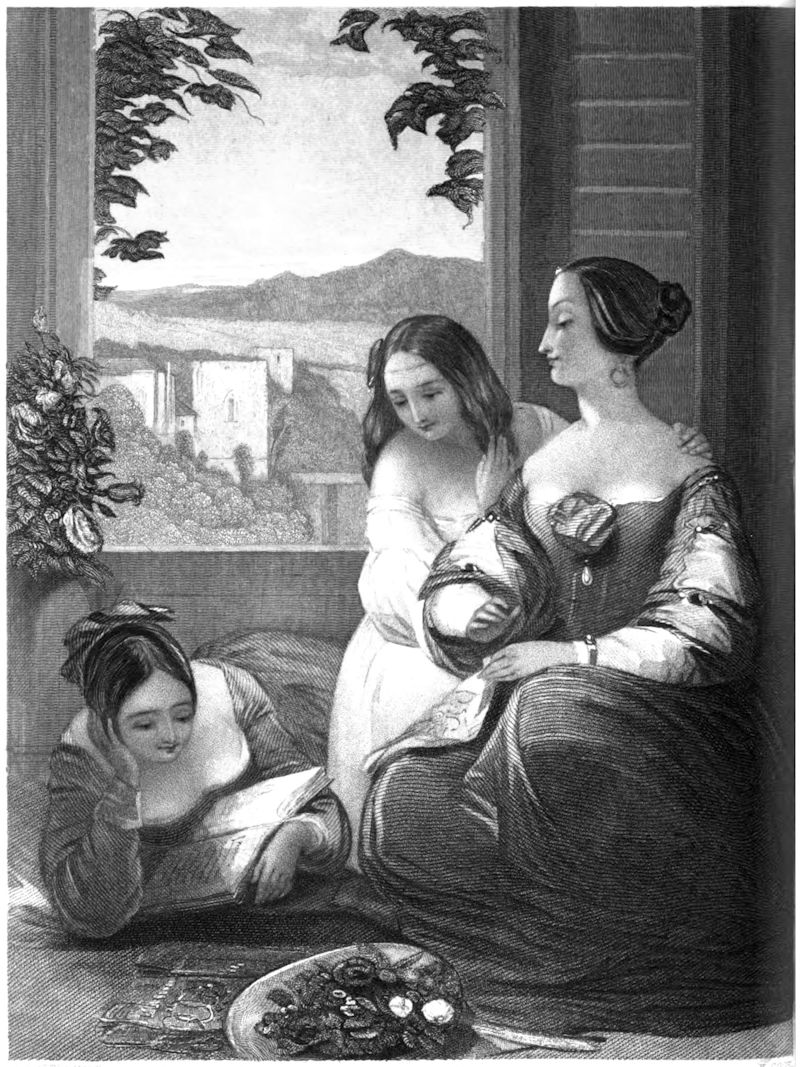
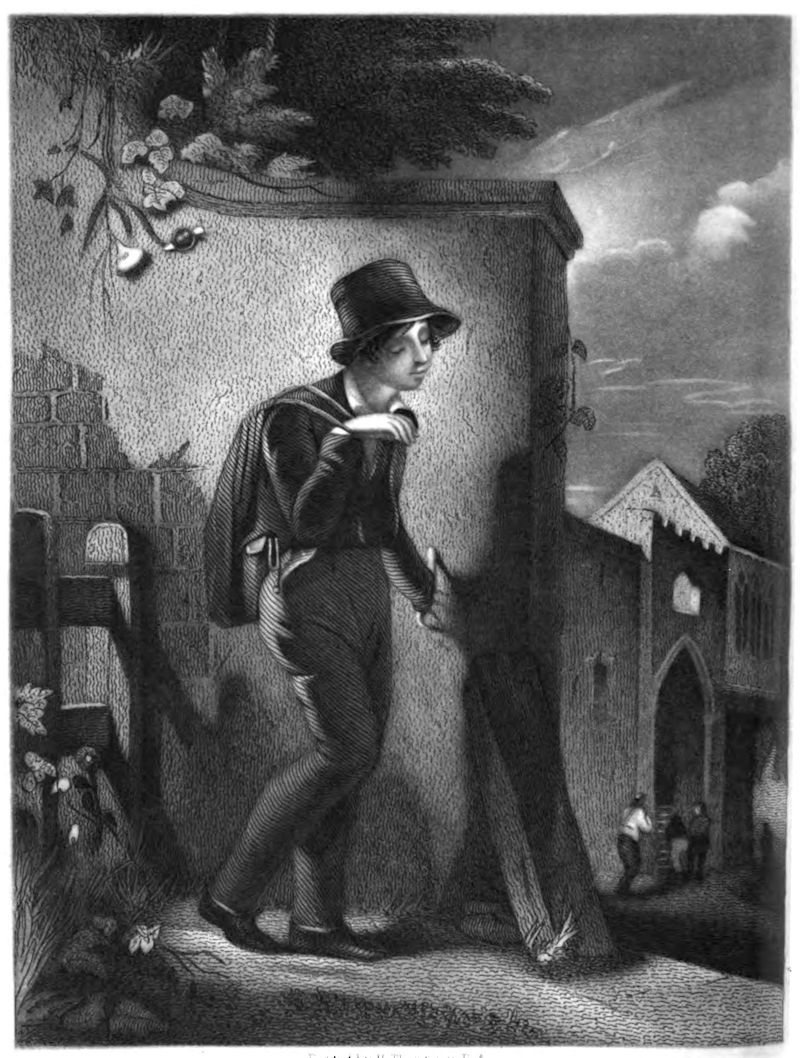
G. CATTERMOLE. H. ROSS
A DANGEROUS STUDENT.Engraved expressly for Graham’s Magazine.
———
BY GRACE GREENWOOD.
———
When first we met, beloved, rememberest thou
How all my nature was athirst and faint?
My soul’s high powers lay wasting still and slow,
While my sad heart sighed forth its ceaseless plaint.
For frowning pride life’s summer waves did lock
Away from light, their restless murmuring hushed —
But thou didst smite the cold, defying rock,
And full and fast the living waters gushed!
Oh, what a summer glory life put on!
What morning freshness those swift waters gave
That leaped from darkness forth into the sun,
And mirrored heaven in every smallest wave!
. . . . . . . . .
The cloud that darkened long our sky of love,
And flung a shadow o’er life’s Eden bloom,
Hath deepened into night, around, above —
But night beneficent and void of gloom.
The dews of peace and faith’s sweet quiet bringing,
And memory’s starlight, as joy’s sunlight fades,
While, like the nightingale’s melodious singing,
The voice of Hope steals out amid the shades.
Now it hath come and gone, the shadowed day,
The time of farewells that beheld us part,
I miss thy presence from my side alway —
Thy smile’s sweet comfort raining on my heart.
Yes, we are parted. Now I call thy name,
And listen long, but no dear voice replies;
I miss thine earnest praise, thy gentle blame,
And the mute blessing of thy loving eyes.
Yet no, not parted. Still in life and power
Thy spirit cometh over wild and wave,
Is ever near me in the trial-hour,
A ready help, a presence strong and brave.
Thy love breathes o’er me in the winds of heaven —
Floats to me on the tides of morning light —
Descends upon me in the calms of even,
And fills with music all the dreamy night.
It falleth as a robe of pride around me,
A royal vesture, rich with purple gleams —
It is the glory wherewith life hath crowned me,
The large fulfillment of my soul’s long dreams!
It is a paean drowning notes of sadness —
It is a great light shutting out all gloom —
It is a fountain of perpetual gladness —
It is a garden of perpetual bloom.
But to thy nature pride and power belong,
And death-defying courage; what to thee,
With thy great life, thy spirit high and strong,
May my one love in all its fullness be?
An inward joy, sharp e’en to pain, yet dear
As thy soul’s life—a warmth, a light serene,
A low, deep, voice which none save thou may hear —
A living presence, constant, though unseen.
Yet shalt thou fold it closer to thy breast,
In the dark days, when other loves depart —
And when thou liest down for the long rest,
Then, oh, beloved, ’twill sleep upon thy heart!
———
BY PROFESSOR FROST.
———
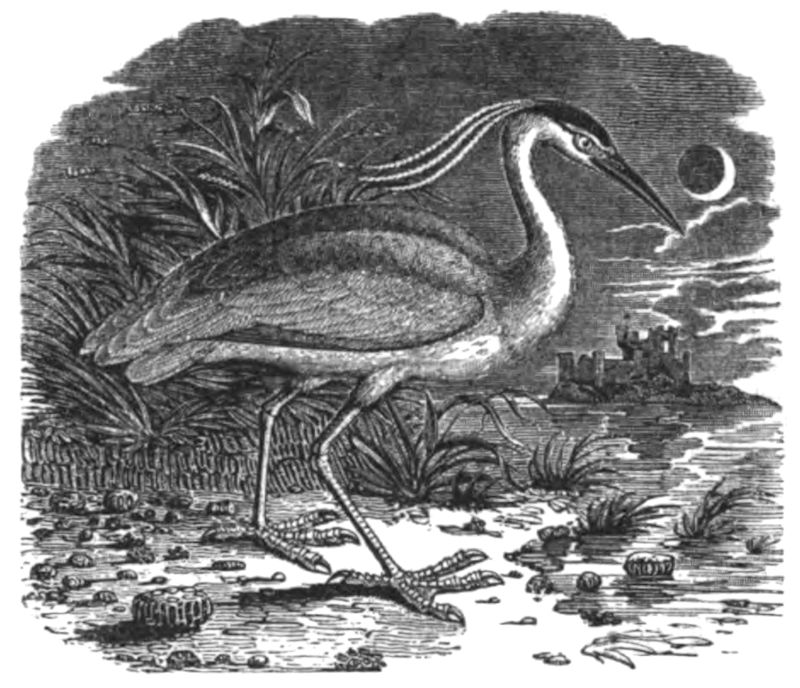
THE QUA BIRD. (Ardea Nycticorax. Wilson.)
This bird, otherwise known as the Night Heron,
and the Rail, is found both in Europe and America.
Its habits are somewhat different on the two continents,
but the American bird may be safely considered
as the type of the species. It is called Qua Bird on
account of the rough guttural sound, qua, qua, which
it utters while seeking its prey; and by some, Night
Heron, from the circumstance of seeking its prey at
night. During the day the Qua Birds perch in silence
on high trees, and it seems probable that their eye cannot
sustain the rays of the sun. But at night few birds are
more active or enterprising. They are generally found
in flocks, in the vicinity of deep swamps, or marshy
woods, partially submerged by water. From these
places troops of Qua Birds issue at twilight, and scatter
themselves along ditches and by the river shore,
to search for food. “On entering the swamp,” says
Wilson, “in the neighborhood of one of these breeding
places, the noise of the old and the young would
almost induce one to suppose that two or three hundred
Indians were choking or throttling each other.
The instant an intruder is discovered, the whole rise
in the air in silence, and remove to the tops of the
trees in another part of the woods, while parties of
from eight to ten make occasional circuits over the
spot, to see what is going on. When the young are
able they climb to the highest part of the trees, but,
knowing their inability, do not attempt to fly. Though
it is probable that these nocturnal birds do not see well
during the day, yet their faculty of hearing must be
exquisite, as it is almost impossible, with all the precautions
one can use, to penetrate near their residence
without being discovered. Several species of hawks
hover around, making an occasional sweep among the
young; and the Bald-Eagle himself has been seen reconnoitering
near the spot, probably with the same
design.”
Until recently the young of this bird was considered
as the female. The close observations of Wilson detected
the error; and his dissections proved that the
male and the female were so similar in external appearance
as to be distinguished only by a practiced
eye. The length of the full grown bird is two feet
four inches; extent of the wings four feet; the bill
four inches and a quarter long from the corners of the
mouth to the tip. The general color of the under plumage
is white, tinged with cream; the wings are ash;
and the back a glossy blue, inclining to green. From
the hinder part of the head flows three long tapering
feathers, about nine inches long, and so united, when
the bird is quiet, as to appear but one. When alarmed
or angry, the Qua Bird erects these singular appendages,
which then give it a strange and threatening appearance.
The eye of the species is noted for its
beauty, the pupil being black and the iris blood-red.
The young of the first year differs both in color and
shape from the parent bird. Their food is composed
of small fish, which the birds labor for with great industry
at night.
The Qua Bird extends over a large portion of North
America. It arrives in Pennsylvania about the beginning
of April; and invariably chooses each season
the building place occupied the season before. If that
place has been disturbed by the advances of cultivation,
the bird chooses a similar spot as near to it as
possible; although instances have occurred, that,
when persecuted by man, or teased by other birds, the
Qua flock have departed in a body, for parts unknown.
The eggs are four in number, of a pale blue color.
This bird is found in India; but it is smaller than the
American variety, and builds on the ground among
reeds. The European bird is smaller than the Indian,
but closely resembles it in other respects. It is,
however, undoubtedly the same species as that which
we have described.
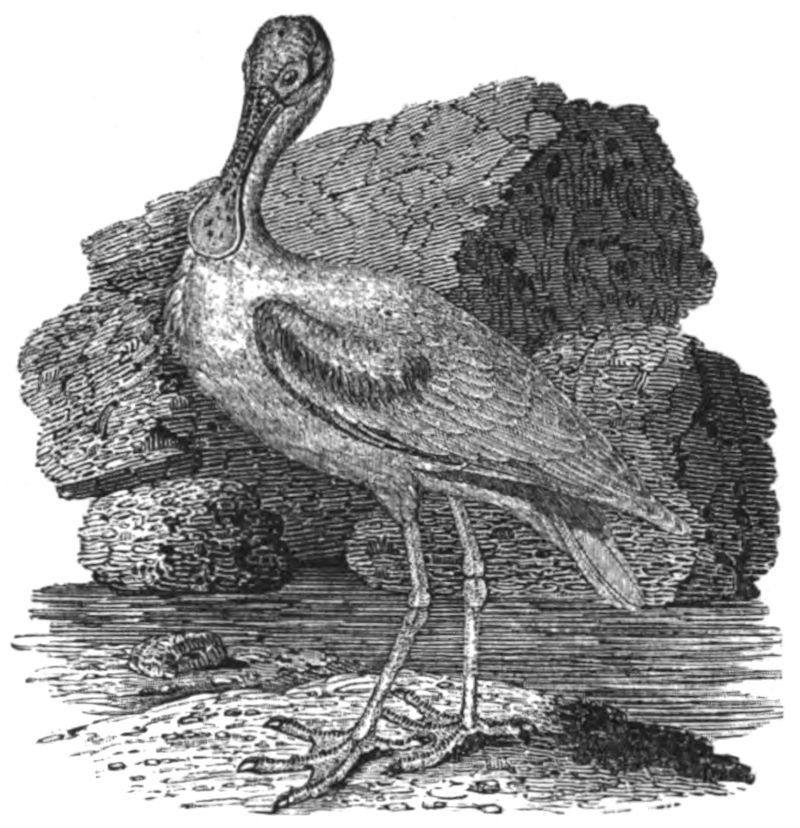
THE ROSEATE SPOON-BILL. (Platalea Ajaja. Wilson.)
The group to which this bird belongs, form a connecting
link between the Herons and the Tantali, and
receive their name from the singular shape of the bill.
Like the Herons, they live in flocks, preying in the
twilight upon fish and aquatic animals. They are
said to search the mud with their bills, in the manner
of ducks, straining out the insects and other small animals,
upon which they feed when nothing better can
be obtained. The European Spoon-bills breed on
trees by the sea-side, and sometimes take their prey
from other birds. At such seasons they are very
noisy, and will often attack birds larger than themselves.
They are sometimes tamed, and their flesh is
esteemed equal to that of the goose.
Of the habits of the species under consideration not
much is known. It is found along the seashore from
Brazil to Carolina, and has been seen in the northern
parts of Louisiana. It is not very common, however,
in any of the Southern States, but is frequently seen
in Mexico and the West Indies. It is generally in the
water, sometimes swimming about gracefully, at others
diving and then searching for its prey. This consists of
insects, fish, shell-fish and small crabs. Wilson gives
the following account of a specimen, which he received
from a friend, and which had been shot in the neighborhood
of Natchez.
“The Roseate Spoon-bill now before us measured
two feet six inches in length, and near four feet in extent;
the bill was six inches and a half long from the
corner of the mouth, seven from its upper base, two
inches over at its greatest width, and three-quarters of
an inch where narrowest; of a black color for half its
length, and covered with hard, scaly protuberances,
like the edges of oyster-shells; these are of a whitish
tint, stained with red; the nostrils are oblong, and
placed in the centre of the upper mandible; from the
lower end of each there runs a deep groove along each
side of the mandible, and about a quarter of an inch
from its edge; whole crown and chin bare of plumage,
and covered with a greenish skin; that below the
under mandible dilatable, like those of the genus Pelicanus;
space round the eye, orange; irides, blood-red;
cheeks and hind head, a bare black skin; neck,
long, covered with short white feathers, some of
which, on the upper part of the neck, are tipped with
crimson; breast, white, the sides of which are tinged
with a brown, burnt color; from the upper part of the
breast proceeds a long tuft of fine, hair-like plumage,
of a pale rose color; back, white, slightly tinged with
brownish; wings, a pale wild rose color, the shafts
lake; the shoulders of the wings are covered with a
long, hairy plumage, of a deep and splendid carmine;
upper and lower tail coverts, the same rich red; belly,
rosy; rump, paler; tail, equal at the end, consisting of
twelve feathers of a bright brownish orange, the
shafts reddish; legs and naked part of the thighs, dark
dusky red; feet, half webbed; toes, very long, particularly
the hind one. The upper part of the neck
had the plumage partly worn away, as if occasioned
by resting it on the back, in the manner of the Ibis.
The skin on the crown is a little wrinkled; the inside
of the wing a much richer red than the outer.”
———
BY ANSON G. CHESTER, A. B.
———
The harvest-field of Boaz. Like a host
Drawn up for battle stands its yellow grain,
Rustling its own sweet music. Brawny men
Are there to steal its beauty—and the noise
Of the keen sickle blends with random songs.
Close on their track the agile binders haste
To form the lately fallen grain in sheaves,
Which throng the field with golden monuments
To Industry and Labor.
Glance again —
Woman upon the field, the sweet and frail!
Like a young lily in a waste of thorns,
So she among the workmen. See! she bends —
And with a graceful, stainless hand collects
The single stalks that else would perish there.
’Tis gentle Ruth, the meek and beautiful,
Around whose name are wreathed the rarest flowers
Of generous remembrance—whom, though years
Counted by centuries have come and gone,
Woman delights to love and man to praise.
Oh! who can gaze upon her slender form,
Intent upon its labor, or can catch
The mild expression of her lovely face,
Nor feel his veins thrill deeper! Filial Ruth!
While that blest page endures that chronicles
Thy winning history for after times,
Love shall embalm thy name in benisons,
And hearts shall be thy home!
Another scene —
Behold before thine eye a mightier field —
Th’ unmeasured, the illimitable Past!
Yonder, well-busied with her ceaseless toil,
Lo! Memory—The Gleaner. Not like her,
The gentle Moabitess, laboring for love,
But as another Nemesis in look and work.
One gleaned to succor life—affection led
Her footsteps to the field and cheered her toil —
The other gleans for justice—hoarding up
A store of testimony in her garner-place,
For judgment and for Heaven. Pause awhile —
View her vocation and its circumstance —
Give wing to Thought—expand Reflection’s sails —
And thy salvation may be thy reward.
She stretcheth forth her hand and gleaneth. Day
And cheerless night are each to her the same;
A stranger to vicissitude and change,
She gathers up material for Heaven.
Mark what is in her grasp—lo! thrifty tares,
Old, unrepented sins thou hast forgotten —
And thistles, too, thine unforgiven wrongs —
And worthless weeds, thy lost and squandered hours —
And flowers, thy deeds of common charity,
Which Pity’s ardent hot-bed forced to shoot,
Not Duty’s tardy but unerring soil —
Life’s sweet embellishments, which make it fair,
Yet have no signal claim to merit—these
Were but unwelcome witnesses when thou
Art summoned for thy last account to meet
With thine accuser, Memory—and these,
If these were all to testify of thee,
Would seal thy doom with rayless misery:
It is alone the rich, ripe, perfect grain
Of Goodness and of Virtue that can win
For thee the taintless wealth of Paradise.
. . . . . . . . .
Our lives are what we make them—human will
Moulds human destiny—spirits on earth
But leave and bud, the blossom is the Future’s —
Earth, like a cunning sculptor, fashioneth
The form and features of Eternity.
Like Jacob’s dream-known angels we can rise
Upon “celestial stairs” to his and their fruition —
Or, like to him who burned and glowed in Heaven,
Be quenched amid the mists of endless night.
. . . . . . . . .
As thou shalt sow, man-brother, she shall glean —
Like maketh like—the seed thou scatterest
Into Life’s furrows shall produce its kind
In generous abundance. Oh! reflect
That thou art sowing for Eternity—that this
Thine earthly labor shall be known on high:
For as thou sowest, Memory will glean—
And as she gleans so shall thy portion be.
Her store-house shall be opened—from its depths
Her treasured evidence shall be produced,
Hoary with years, yet firm and forcible.
All else is worthless—but, if thou hast left
Upon thy pathway pure and sterling grain,
And Memory’s hand has gathered it for thee,
Then shalt thou tread the golden streets of Heaven,
And thy clear brow shall wear a seraph’s crown.
Scatter, oh! scatter on thine earthly way
The perfect seed of Goodness, Truth and Love:
That, when thou meetest Memory on high,
Bearing the tokens of thy life’s employ,
Thou shalt embrace her as an olden friend: —
And, counted with the angels, shalt remain
In the eternal childhood of the skies.
COME REST IN THIS BOSOM.
NO. III.—COME REST IN THIS BOSOM.
[SEE ENGRAVING.]
While engaged in writing songs to the native airs
of his country, Moore, in a letter to the Countess of
Donegal, makes these remarks on Irish music:
“It has been often said, and still oftener felt, that in
our music is found the truest of all comments upon our
history. The tone of defiance succeeded by the languor
of despondency—a burst of turbulence, dying
away into softness the sorrows of one moment lost in
the levity of the next—and all that romantic mixture
of mirth and sadness, which is naturally produced by
the efforts of a lively temperament to shake off, or forget
the wrongs which lie upon it. Such are the features
of our history and character, which we find
strongly and faithfully reflected in our music; and
there are even many airs, which it is difficult to listen
to, without recalling some period or event to which
their expression seems applicable. Sometimes, for
instance, when the strain is open and spirited, yet here
and there shaded by a mournful recollection, we can
fancy that we behold the brave allies of Montrose,
marching to the aid of the royal cause, notwithstanding
all the perfidy of Charles and his ministers, and remembering
just enough of past sufferings to enhance the
generosity of their present sacrifice. The plaintive
melodies of Carolan take us back to the times in which
he lived, when our poor countrymen were driven to
worship their God in caves, or to quit, forever, the
land of their birth—like the bird that abandons the nest
which human touch has violated.”
In writing to these melodies, the poet’s task, a most
difficult one, was to express sentiments in harmony
with the air. To give an intelligible utterance to the
feelings pent up in music, whether gay, solemn or
mournful. At the time he wrote, Irish patriotism was
in the ascendant, and many of the songs had a political
bearing. So apparent was this, that the fact was noticed,
we believe, by the government, or at least by
some high in office. In the following well-known
song, so full of the purest pathos, it is not clear to what
the poet particularly alluded. If there was an allusion,
as is not improbable, to Emmett and Miss Curren,
Moore deemed it but an act of prudence to withhold
the fact.
“Come, rest in this bosom, my own stricken deer,
Though the herd has fled from thee, thy home is still here;
Here still is the smile that no cloud can o’ercast,
And a heart and a hand all thy own to the last.
“Oh! what was love made for, if ’tis not the same,
Through joy and through torment, through glory and shame?
I know not, I ask not, if guilt’s in that heart,
I but know that I love thee, whatever thou art.
“Thou hast called me thy Angel in moments of bliss,
And thy Angel I’ll be, ’mid the horrors of this —
Through the furnace, unshrinking, thy steps to pursue,
And shield thee, and save thee—or perish there too.”
At any rate, the sentiments of this song might well
be applied to the personages mentioned, even if the
poet himself had another application in his mind.
Their tenderness is scarcely surpassed by any thing in
the language; and there are states of mind with every
one in which their repetition would bring tears.
Representative Men: Seven Lectures. By R. W. Emerson.
Boston: Phillips, Sampson & Co. 1 vol. 12mo.
The subjects of these lectures, originally delivered before
New England Lyceums, are Uses of Great Men;
Plato, or the Philosopher; Swedenborg, or the Mystic;
Montaigne, or the Skeptic; Shakspeare, or the Poet; Napoleon,
or the Man of the World; and Goethe, or the
Writer; subjects calculated to test the most various powers
of the greatest mind, and, as treated by Mr. Emerson,
appearing always in an original and fascinating, if not
always a true light. The volume we consider, on the
whole, the best of Mr. Emerson’s works. It is not, rhetorically
speaking, so carefully written as his “Essays,”
but it has more human interest, deals more generously
with facts, and indicates a broader and more stalwort
individuality. It is certainly one of the most fascinating
books ever written, whether we consider its subtle verbal
felicities, its deep and shrewd observation, its keen criticism,
its beautiful mischievousness, its wit or learning,
its wisdom or beauty. The best passages may be found
in the lectures on Plato, Shakspeare, and Swedenborg;
but the best lecture is probably that on Montaigne, which
must have been written con amore. Indeed, the author
seems a kind of Montaigne-Plato, with his eyes wide open
both to material and spiritual facts, without a hearty self-surrender
to either. There are in the volumes some
speculative audacities which, in common with the rest of
the human race, we consider equally erroneous and
hurtful. In matters of religious faith it may be confidently
asserted that mankind is right and Mr. Emerson wrong.
Our author puts objectionable doctrines in language which
shocks the minds of his readers without conveying to
them his real ideas—a blunder, equally as regards prudence
and expression.
The excellence of the book is not so much in its representations
of the representative men who form its subjects,
as in the representation of Mr. Emerson himself; and
we doubt if, in all literature, there are revealed many individualities
so peculiar, and so powerful in its peculiarity,
as the individuality stamped upon every page of the present
volume. We would not presume, in our limits, to
attempt an analysis of an intellect so curiously complex
as Mr. Emerson’s—with traits which strike us as a Parthian’s
arrows, shot while he is flying, and which both
provoke and defy the pursuit of criticism; but we will extract
instead, a few of the beautiful and brilliant sentences
which are inserted, like gems, in almost every lecture,
and in each of which some sparkle of the writer’s quality
appears. The lecture on Goethe is a perfect diamond necklace,
shooting out light in every direction, with some
flashes that illumine, for the instant, labyrinths of thought
which darkness is considered to hold as exclusively her
own.
In speaking of the acting of Shakspeare’s plays, he
translates into words an emotion which everyone has felt,
but which we never dreamed could be perfectly expressed.
“The recitation,” he says, “begins; one golden word
leaps out immortal from all this painted pedantry, and
sweetly torments us with invitations to its own inaccessible
homes.” Again, he remarks that Shakspeare is inconceivably
wise; all other writers conceivably. “A good
reader,” he says, “can, in a sort, nestle into Plato’s brain,
and think from thence; but not into Shakspeare’s. We
are still out of doors.” Speaking of Montaigne’s use of
language, he exclaims, “but these words, and they would
bleed; they are vascular and alive.” Of Mr. Emerson’s
peculiar wit the present volume is full of Examples. Thus
he speaks of “the heaven of law, and the pismire of performance
under it;” of Plato as having “clapped copyright
on the world;” of the possibility, as regards marriage,
of dividing the human race into two classes; “those
who are out and want to get in, and those who are in and
want to get out;” but quotation of small sentences is impertinent,
where so many paragraphs are thoroughly pervaded
with the quality.
In speaking of Plato’s mind, Mr. Emerson gives us
some of his keenest and most characteristic sentences—sentences
in which the thought seems to go in straight
lines right at the mark, but to lack a comprehension of
relations. In Plato, he says, “the freest abandonment is
united with the precision of a geometer. His daring imagination
gives him the more solid grasp of facts; as the
birds of the highest flight have the strongest alar bones.”
. . . “His strength,” he says, a few pages after, “is
like the momentum of a falling planet; and his discretion,
the return of its due and perfect curve.” Perhaps the
best passage, however, in the lecture on Plato, is that in
which he describes the divine delirium, in which the
philosopher rises into the seer. “He believes that poetry,
prophecy, and the high insight, are from a wisdom of
which man is not master; that the gods never philosophize;
but, by a celestial mania, these miracles are accomplished.
Horsed on these winged steeds, he sweeps the dim regions,
visits worlds which flesh cannot enter; he saw the souls
in pain; he hears the doom of the judge; he beholds the
penal metempsychosis; the Fates, with the rock and shears;
and hears the intoxicating hum of their spindle.”
Sentences, bright and beautiful as these, might be extracted
from this volume to such an extent as to bring
upon us an action for violating the copyright. For fineness
of wit, imagination, observation, satire and sentiment,
the book hardly has its equal in American literature;
with its positive opinions we have little to do.
With respect to these, it may be generally said, that Mr.
Emerson is always beneath the surface, and never at the
centre.
The Seaside and the Fireside. By Henry Wadsworth Longfellow.
Boston: Ticknor, Reed & Fields. 1 vol. 16mo.
We have not space this month to do much more than
refer to this beautiful collection of poems, instinct with
sentiment and imagination, and with that drapery of beauty
over the whole which constitutes the charm equally of
Longfellow’s narratives and meditations. The first poem
in the volume is “The Building of the Ship,” a worthy
counterpart of Schiller’s “Song of the Bell,” and a grand
example of the union of the common with the beautiful.
We doubt if any of the poet’s longer compositions will
equal it in popularity. To this succeed a number of pieces
relating to the sea, of which “The Light House,” and
“The Fire of Drift Wood,” appear to us the best. The
poems “by the fireside,” commence with “Resignation,”
an elegy warm from the author’s heart and imagination,
and whose exquisite pathos has been felt and acknowledged
all over the country. “The Open Window,” and
“The Sand of the Desert,” belonging to this portion of
the volume, are fine specimens of two processes of Longfellow’s
mind—its subtle suggestiveness and its clear
pictorial power. A long poem of twenty-seven pages,
translated from the Gascon of Jasmin, entitled “The
Blind Girl of Castèl-Cuillè,” is a tragedy whose power,
sweetness, and pathos the dullest reader cannot resist.
We wish that Mr. Longfellow would give us more specimens
of this charming poet, as worthily “Englished” as
the present.
We think that none of Mr. Longfellow’s volumes will
be received with more favor than this, embodying as it
does the best qualities of his muse, and leaving little for
even the critic to grumble at but the smallness of its bulk.
Old Portraits and Modern Sketches. By John G. Whittier.
Boston: Ticknor, Reed & Fields. 1 vol. 12mo.
This elegantly printed volume, from the press of a firm
celebrated all over the country for tasteful books, is one
of Mr. Whittier’s most characteristic productions. It contains
strongly marked representations of John Bunyan,
Thomas Ellwood, James Naylor, Andrew Marvell, John
Roberts, Samuel Hopkins, Richard Baxter, William Leggett,
Nathaniel P. Rogers, and Robert Dinsmoore. If
sympathy be, as Carlyle says, the first condition of insight,
there can be no doubt that these striking individualities
have sat to the right artist for their portraits.
The best pieces in the volume are John Bunyan, Naylor,
Marvell and Baxter, which are really mental portraits,
glowing with life and meaning. The inspiration of
Whittier is impassioned conscience—a conscience as bold
and resolute as it is quick and delicate; and wit, imagination,
understanding and learning, all work under the direction
of this moral force. His general taste is for the
strong and daring in action and meditation; his field, the
region of great ideas and universal sentiments; but at the
same time he has a capacity for embodying the delicacies
and refinements of thought and emotion, and in pure pathos
and beauty he has few American superiors. All these
qualities are displayed in this volume in their most genial
action, and the result is a book of equal fineness and power.
History of Spanish Literature. By George Ticknor. New
York: Harper & Brothers. 3 vols. 8vo.
Ben Jonson was wont to congratulate himself that his
solid dramas were called “works,” while the dramatic
productions of his contemporaries were but “plays.”
Professor Ticknor’s History is eminently a “work,” the
result of twenty years of thought and research. To its
erudition no other epithet can apply than Dominie Sampson’s
epithet of “prodigious.” Every department of the
literature of a whole nation, through some ten centuries
of existence, the author has thoroughly mastered. No
intellectual history with which we are acquainted rests
on such a solid basis of authorities. As the author has
had the subject in his thoughts from his youth, his erudition,
immense as it is, does not encumber his mind. It
does not use him, but he uses it; and the result is that the
work has the great merit of clear statement. It is not
only full of knowledge, but the knowledge is so presented
as to be communicated to every reader. Those who are
little interested in the subject as a whole, will still find
the work attractive from its biographical matter, its
analysis of the plot and characters of different plays, and
its fine translations of particular poems and ballads. The
accounts given of the stories forming the plots of some of
the dramas, are interesting as mere tales.
There are few American books which are so much calculated
to raise the foreign estimate of American Scholarship
and intelligence as this History of Spanish Literature,
and we doubt if there be many men, in Spain or
out of Spain, who could have written it.
People I have Met; or Pictures of Society and People of
Mark. Drawn under a Thin Veil of Fiction. By N.
Parker Willis. New York: Baker & Scribner. 1 vol. 12mo.
In this elegant volume we have a collection of Mr.
Willis’s tales and sketches, recording the results of his
intercourse with society on both sides of the Atlantic. It
indicates that the author’s practical observation of men
and things is as acute and sure as if his head did not contain
the most trickery and exuberant of human fancies.
No one can read the volume without delight, and without
having his knowledge of society increased. It is a fit
companion to the “Rural Letters,” being as full of the
world as those are of nature. The writer’s sunny and
sportive, keen and sparkling mind, glances and gleams
through every story and sketch; and over the whole there
is that indefinable grace, which the poet alone can communicate
to the things of convention, and which almost
lifts them into an ideal region of existence.
Monuments of Egypt; or Egypt a Witness for the Bible.
By Francis L. Hawks, D. D., LL. D. With Notes of a
Voyage up the Nile. By an American. New York; Geo.
P. Putnam. 1 vol. 8vo.
Mr. Putnam has got up this volume with his usual indifference
to expense, and his usual regard for typographical
beauty. The illustrative engravings are exactly
what the reader wants to assist him in the comprehension
of the text. Dr. Hawks refuses, in the preface, the name
of author, preferring the more modest appellation of compiler;
but we should like to see many more compilations
from the same source. He has carefully studied the works
of the great English and French savons and travelers relating
to the subject, and has presented in clear language
the truths which they have established. We commend
the book to all who are desirous of accurate information
about a most interesting country, in its past and present
condition.
A System of Ancient and Mediæval Geography, for the Use
of Schools and Colleges. By Charles Anthon, LL. D.
New York: Harper & Brothers. 1 vol. 8vo.
This solid and well printed volume is but one out of
many proofs of the author’s extensive erudition and
classical enthusiasm. We are incompetent to speak of its
value as a class-book, but certainly can bear testimony to
its wealth of information relating to ancient countries, and
its interest to all who are students of ancient history.
The work rests on a solid foundation of over a hundred
authorities, German, English, and French, and indicates
on every page a scholarship as minute in details as it is
large in its grasp. In the limits of some seven hundred
and fifty octavo pages, crammed rather than filled with
matter, Dr. Anthon has almost compressed a library of
knowledge.
The King of the Hurons. By the Author of “The First
of the Knickerbockers,” and “The Young Patroon.”
New York: Geo. P. Putnam. 1 vol. 12mo.
In the press of this month’s publications we trust that
this novel, the work of a man of shrewd and accurate observation,
graceful fancy, and brilliant style, will not
be lost in the crowd. The author’s wit and humor sparkle
over his narrative, and lend an increased fascination even
to the engrossing interest of the characters and incidents.
Essay on Christian Baptism. By Baptist W. Noel, M. A.
New York: Harper & Brothers. 1 vol. 16mo.
The author of this little volume has already attained
great notoriety by his volume directed against the union
of church and state. The object of his present work is to
declare himself by conviction a Baptist, and to exhibit the
train of scriptural argumentation by which he came to
the conclusion that believers have the exclusive right to
Christian baptism. The work is well written, and the
reasoning indicates a conscientious inquirer after truth.
Fairy Tales from all Nations. By Anthony R. Montalba.
New York: Harper & Brothers. 1 vol. 12mo.
The Harpers fairly bewilder critics by the number and
variety of their publications. In following their books we
have to make the most violent ascents and descents to and
from one department of letters to another. We had hardly
finished a survey of a Latin Dictionary before we came
directly upon this delicious volume of fairy stories, containing
a representation of supernatural novelties from
Denmark, Germany, France, Sweden, Russia, Poland,
Norway, Italy, Hungary, Iceland, Bohemia, and some
Eastern countries. The collection is one of the most
fascinating we have ever seen, and its interest is much increased
to the younger class of readers by some thirty
grotesque illustrations.
The History of England. By David Hume. Vol. 5.
Boston: Phillips, Sampson & Co.
This volume of the cheap Boston edition of Hume is
devoted to Charles I. and the Commonwealth; contains the
principal alleged offences of the author against the principles
of civil and religious liberty, and is, accordingly, that
part of his great work which has been made the subject of the
most vehement controversies. It is, perhaps, the ablest in
style and matter of the whole, and may be profitably read in
connection with Macaulay’s views on the same subjects.
Saint Leger, or The Threads of Life. New York: Geo. P.
Putnam. 1 vol. 12mo.
This is the work of a man of intense conceptions, whose
style is urged on by the furor of his thinking, and who, by
sheer strength, drags the readers along with him from the
first to the last page. The detail of the hero’s personal experience,
if given with less vividness, would certainly
tire, but as expressed in the author’s vehement style, it
fastens attention as much as the incidents.
The Whale and his Captors; or The Whaleman’s Adventures,
and The Whale’s Biography. By Rev. Henry T.
Cheever. New York: Harper & Brothers. 1 vol. 16mo.
This volume is the production of a scholar, a man of
letters, and a clergyman; and the characteristics of all
three are modified by a sort of assumed Jack-Tarism,
always racy, if sometimes in questionable taste. It is
spirited in style, full of a landsman’s exultation in the
incidents and scenery of sea life, and laden with interesting
information pleasantly told.