And how were passed the flying hours of that last
day, granted to the young and the beloved, on earth?
In desperate and wild, but vain appeals, to her love of
life—in still more mournful entreaties by her devotion
to them who were the joy of her existence, that she
would suffer them to bear her confession of penitence
and faith to the pasha.
It was pitiful to see the gray-haired father at one
moment pleading her by every consideration, to take
the words of the Mussulman upon her lips, even if her
heart rebelled, and the next, when her gentle, but
firmly expressed determination was reiterated, thanking
God that He gave to her strength to remain firm in
the face of every temptation. It was pitiful to see the
hopeless, almost sullen agony of the younger man, as
he sat beside the condemned all these wretched hours,
clasping her hands within his own, and folding her so
often to his bosom in a wordless embrace.
Such tears were shed within that dismal cell as
have no other source but broken hearts; such sighs
were breathed as only the autumn breeze gives utterance
to when the joy and the glory of earth is departing;
such prayers ascended, as the heart of man can
alone conceive when every earthly hope has failed,
when the terrors of death, and the more terrible agonies
of life surround the helpless soul!
Once, when a chance word had called to mind the
now almost forgotten, but despised and hated Orien
Fez, Myrrah was on the point of revealing to Othniel
the only cause she could conceive of his malice against
her. But the reflection that such knowledge would
only spur her beloved on to the committal of deeds
which would end fatally to him, while it could not
possibly avail even if made known to the prejudiced
mind of the pasha, in securing her pardon and liberation—made
her hesitate, and finally resolve in carrying
that slight clue to the cause of her arrest, into the silence
and oblivion of the grave.
Only once did she take the name of the accuser on
her lips, and then it was to implore Othniel to forgive
him his part in their calamity, and to leave him to the
mercy of God.
And the fiery youth promised it—revenge and hate—all
the evil passions which have to do with life, died
that day within him—the future time, after that woful
night on which he thought with agony, heaven with
Myrrah was all he dared to hope or think of—it was a
thought of blessedness—a dream, a hope which the
merciful spirit of God breathed into his soul when it
laid in the dust of despair.
The hours of daylight waned, night was fast approaching—then
came forth from the prison cell Othniel,
and on his arm was leaning the stricken father,
Raguel. The old man’s eyes had looked their last
upon the fair young idol which he worshiped with a
reverence approaching that which he held for his
Maker.
He wept not as the guard turned the key behind him
on the iron door, which would open again ere long that
she might be led forth to—death. He made no resistance
as they went with him to his deserted dwelling.
A sense of the awful bereavement seemed to have
passed away—he even smiled as they led him through
the cheerful rooms of the home that was always made
blessed by her presence—and said how pleasant it was
to be in one’s home again, away from the dark and
frightful prison. There was a bird of splendid plumage
caged in the old man’s parlor, (every portion of which
bore evidence of a woman’s frequent presence and exquisite
taste,) it was the young girl’s pet—the gift of
Othniel in days long since gone by. The noise of the
intruders on the silence of the house, startled the little
warbler, and he poured forth the most delicious flood
of melody; the sound aroused the old man, with an exclamation
of delight he threw himself upon the couch
near by, and listened in rapt astonishment and joy to
the exquisite songster.
Filled with gloomy foreboding as he noticed this
sudden and total change in the old Jew, Othniel left
him in the care of gentle friends, and hastened away
in the direction of the prison once more.
The sun was setting as he neared the great walls,
and the youth saw a procession moving from the gates,
and a band of soldiers was guarding the death-doomed
prisoner! The crowd gathered and increased with
every step of the slowly moving procession—in solemn
silence Jew and Mahommedan strode together, for the
moment forgetful of all save the mournful cause which
brought them there.
A moment Othniel moved on hastily, he would rejoin
Myrrah, would be with her to the last—then a
remembrance of his own weakness, and of the effect
his sorrow might produce upon her, stayed him—and
apart from the crowd he walked or crept, slowly and
heavily, for the burden of his unutterable sorrow was
too great to bear.
Afar in the distance, beyond the confines of the
town, the funeral pile was to be made—the sacrifice
pure and innocent as was ever brought to the altar,
was to be offered up.
Alone, deprived of her comforting words, and removed
from the restraining presence of the old man,
Othniel thought on all that she had been to him in the
happy past, of all that she might have been in that future
to which they were wont to look with so much
hope. He called to mind her beauty, her youth, and
her innocence; the love which she cherished for all
that was good, and pure, and true; for her aged father,
and for his unworthy self.
And as he thought, darker and darker grew the
cloud that swept over his mind; the lightning of hope
one second blazed athwart it, but was close followed
by the heavy pealing thunder of despair. His step
grew feeble and slow. The crowd was fast passing
by him, soon they were all gone, and the youth still
tried to totter on, as a feeble little child—for what? to
look once more, but once on her beloved face—but not
to witness her agony, he could not endure that. Faintness
crept over his limbs—his eyes became dim—slower
and slower was his step, but still he strove desperately
to move on in that direction in which the
multitude had gone.
At last he was forced to pause—his strength had all
deserted him. There were trees growing by the wayside,
and a little spring wound through the pleasant
grove. Othniel reached the shade, and half-fainting,
flung himself upon the ground. He bathed his burning
brow in the cool stream, he drank of the reviving
waters, but though by degrees strength came again to
his limbs, there was a faintness in his heart that would
not pass.
Soon impelled irresistibly to the road-side again,
Othniel looked toward the north—there whither the
crowd had gone. Great Heaven! the black, hateful
smoke already was staining the pure air! and a murmur
that arose from the great mass of people, a faint
sound of wo, was wafted to his ear on the soft breath
of evening. Inspired with new life and strength, he
moved again swiftly on. He must see indeed if it
were indeed a reality that they would sacrifice his bride,
his worshiped Myrrah, to that hellish lie the Moor had
conceived. The weakness of limb was gone with that
thought. Forward he rushed as borne on the eagle’s
wings, until he stood with the great multitude.
For a moment his heart failed him, and Othniel stood
gazing on the armed guard who were ranged about
the prisoner, on the blazing faggots, on the weeping
men and women—on the pallid and sorrowful countenance
of the pasha, on the motionless Orien Fez where
he proudly stood with his powerful relatives, and on
her, his beloved, adored Myrrah, who stood so calm,
so brave before the kindled fire, that was kindled to
consume her. Looking upon her as she stood thus,
alone and unsupported, save by the inward sustaining
consciousness of right and innocence, his resolve to
only look and then depart, was broken; he lost all self-control,
and with the force of a whirlwind rushed
through the dense, astonished mass, that gave way
right and left before him; past the ranks of vigilant
soldiery with maniac speed, until in the centre of the
awfully charmed circle, he flung himself before the
pale, loving, and forgiving idol, about to be crushed and
destroyed by the hand of power.
In those past moments, so fraught with horror to all
about her, Othniel had been in all her thoughts—but
she had hoped to never see his face on earth again—she
had hoped that his dear voice might not come,
drowning the voice of the angel God had sent to comfort
and to strengthen her.
“Othniel!”
“Myrrah!”
None strove to separate them, as they stood clasped
thus in a last, fond embrace. Only one whispered
word of deathless love was interchanged—only one
silent prayer that moment heard in Heaven for each
other’s peace, and their arms unclasped; they stood
pale and trembling, gazing on one another, and then
Othniel was gone.
A deep-drawn sigh escaped the awe-struck crowd
as that last evidence of human love had passed, and
the poor girl lifted her eyes to heaven, knowing that
consolation and strength could alone come from thence.
The sun had quite sunk, and the long twilight began.
There was not a fragment of cloud in all the clear,
calm sky—there was a stillness, holy, soul-elevating on
the earth—and the brightness of the Father’s glory
seemed alone waiting the frail child of earth, as she
stood there to offer life and all its blessedness and joy,
to a higher love, a loftier and purer faith.
They bound her to the stake; the flames—the hot
and angry flames pressed closely on her lovely form,
which he had but now clasped to his breaking heart.
And when the stars came out in heaven, and a horrible
loneliness crept over that deserted place—where a
dense black cloud ascended, and the flames had died
away, there was another saint in heaven worthy to
rest in Abraham’s bosom!
There was silence that night in Myrrah’s earthly
home—an old man slept upon the couch her fairy form
had ofttimes pressed—slept, but he dreamed not. His
eyes were closed—she was not there to watch his quiet
slumber—there was a sign of such deep peace laid
upon his brow as Myrrah never saw there; Raguel’s
heart had ceased its pulsations—the father was sleeping
the eternal sleep!
The calmness and the smiles which the amazed
friends beheld in him as he came from that last parting
with his child, were but the presage of the everlasting
calmness, the unfading smile, for the old man’s
spirit had sought the distant land ere another morning
dawned—called home by the merciful and loving Father
of the Gentile and the Jew.
And Othniel again became a wanderer. Not a murderer,
for Myrrah’s parting counsel and entreaty had
saved him from blood-guiltiness—and the life of Orien
Fez was never required at his hands. But Othniel
died young, when his heart had learned to say, “God
is merciful—His will is best,” and the sands of the
desert were his resting-place.
———
BY GIFTIE.
———
Darkness is on the wave,
The night wind hummeth low,
And through the soft bright air the gleams
Of moonlight come and go,
And all is hushed to rest
Upon Sleep’s quiet breast,
All save the human heart, that sighing waketh still —
The heart, that never sleeping —
Its lonely vigil keeping —
Findeth still naught on earth its depths to fill.
Thou art like Sleep, oh, Night!
Thou hast a thrilling power,
To awe, e’en with thy loveliest things,
The heart in this still hour.
Thou bringest up the past —
All bright things we have lost —
The dead whom we have loved look on us from the skies,
Yet naught of fear or wo,
That cloud man’s life below,
Is in the gaze of their calm spiritual eyes.
Ay—faces of the dead
Look downward from the sky.
They wear the same loved look and mien
They wore in days gone by,
Yet something dimly there.
Though cheek and brow be fair,
Says chillingly that human love hath passed away.
They care for us no more —
Those dwellers on the shore
Where night is lost in heaven’s effulgent day.
Still—all is still around;
I hear the sound of streams,
That through the long grass singing flow
Beneath the starlight beams
Thus let my soul repose,
Serene ’mid earthly woes,
Till death shall come and bid its longings cease,
Till I quench this weary thirst,
Where immortal fountains burst,
And heavenly voices welcome me to peace.
———
BY HENRY KIRBY BENNER, U. S. A.
———
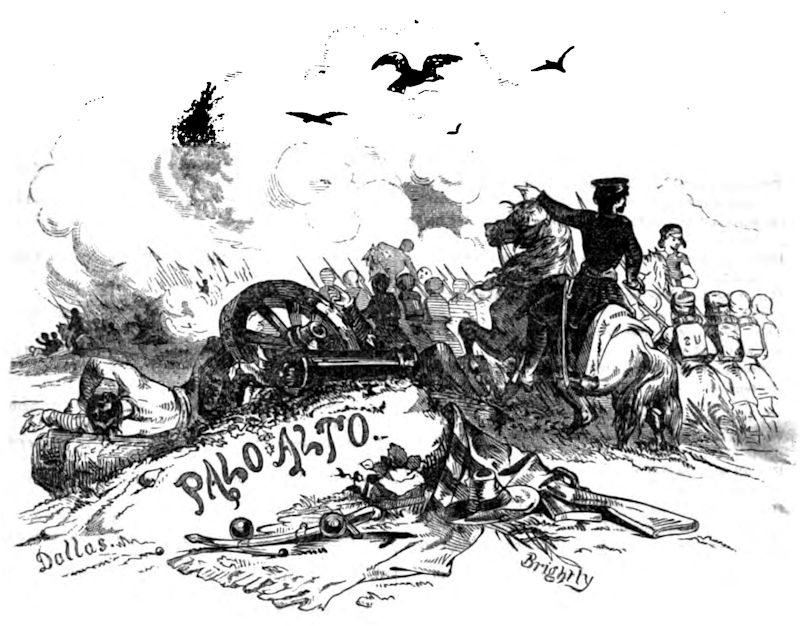
PALO ALTO.
The army lay in quiet rest: for many a weary league
Had we marched in battle order, combating with fatigue;
But when Point Isabel arose between us and the sun,
And the evening gun exploded, we felt our toil was done,
And we laid us down in silence, and we slept without alarm,
Each soldier resting on the ground, with his head across his arm.
But when the gray of morning made twilight in the east,
Like shadows, from the prairie arose both man and beast;
And the soldiers stretched their arms, and the steeds with neigh and stamp,
With the rattling rolling reveillé put motion in the camp;
And the sunrise-gun boomed loudly, when, as its sound declined,
A dull, funereal response rolled heavily down the wind.
The soldiers paused and listened, each with questions in his eyes,
As round and red the tropic sun walked, Mars-like, up the skies; —
It was no echo; never yet made echo sound like that,
For echo lives in the mountain glen, and not on the prairie flat:
We clasped our muskets closer as we hurried to parade,
Our beating hearts replying to the distant cannonade.
Not a word had yet been spoken, though, still, the cumbrous sound
Came rolling, like a tumbril, over the damp and dewy ground;
But beetling brows and heaving breasts and half-suspended sighs
Spoke the anger of the passionate hearts whose lightning lit our eyes;
Then a murmur rose along our ranks no discipline could drown,
And the burthen of the chorus was the syllables—“Fort Brown!”
Just then our gallant general, on his favorite white horse,
Rode slowly and serenely, like a father, through his force;
But as the ranks “presented arms,” another murmur ran —
“God bless old Rough and Ready,” loud and deep, from man to man.
The brave old heart looked gratified, but his eyes sunk slowly down,
For he thought of his companions who were battling at Fort Brown.
But scarcely had they fallen, when the air became so still
We heard the campanero[2] cry a league off, on the hill.
The old man’s gray eyes glistened, and his horse reversed his ears,
And stamped his hoofs, and neighed aloud, as laughing at our fears:
We stood like statues, listening, when Taylor made a sign,
And Walker left his Rangers, riding quickly down the line.
That night the Texan hero was missed by all our men;
But we smiled, for well we knew that he soon would come again,
For a braver, or a better, or a more chivalrous knight
Never put his lance in rest in the days when might was right;
And he had the fox’s cunning, and the eagle’s restless eye,
With his courage, to see danger, and that danger to defy.
Two days passed by, and hour by hour the army moved, with gloom
On heart and soul, as though each man stood gazing on his tomb;
But all at once a sudden cry!—our hearts sprung, like a steed
Who sees the flash and hears the gun, then headlong ploughs the mead —
Then Walker’s name—another shout!—and each one, with content
In breast and brain, accoutred, rushed delighted from his tent.
We all knew what was coming, when at the reveillé,
We saw the Texan head his men, and heard the laugh of May,
For all had learned the news, and knew, that ere two suns went down
Our army would be rolling, like a tempest, on Fort Brown;
And that the foe in thousands were gathering in our way —
Human panthers, couched in silence, expectant of their prey.
At last we heard the order, and along the grassy plain
Our army, like a sparkling snake, uncoiled its glittering train,
And silently, but earnestly, we marched from dawn till night,
And then laid down in silence till the breaking of the light:
No fires disturbed the darkness, no sound betrayed our camp,
Save, at intervals the countersign, with the sentinel’s measured tramp.
Next morning we pursued our march: it was a sultry day;
The sunlight flickered like a flame along our sandy way;
But no one lingered, for we knew our foemen were before,
And, like blood-hounds howling on the scent, we trailed the distant gore;
For we thought of our associates, and the thought had power to drown
All human feelings, for we heard the cannon at Fort Brown.
For twelve miles unmolested had we marched, when brazen noon
Beheld the enemy deploy along the green lagoon:
Our hearts beat high, for we were few, and scarcely one before
Had fleshed his sword in battle, or had heard the cannon’s roar;
But Lexington and Concord and Bunker-Hill beheld
Just such recruits victorious in the iron days of old.
And now the word was passed—to halt, and each, in turn, was seen
To stoop beside the limpid lake and fill his hot canteen;
And then the order came to march; and now our foemen lay
A musket shot before us, a barrier in our way,
When, like a Paladin of old, Blake, brave as brave could be,
Sprung from the lines, and spurred his steed along the grassy lea.
We saw him gallop toward the foe, and our passions thrilled us, when
We viewed him ride along their lines and coolly count their men,
And turn and gallop backward, and grasp our general’s hand,
Then silently resume his place, and head his little band:
We paused, when, rushing, roaring, whirling, whistling, wildly by,
Came the iron rain of Battle, while his thunder shook the sky.
Like a cloud the smoke closed round, and like steeds to frenzy lashed
The black eyes of our batteries their deadly fury flashed:
We were maniacs; we were furies; we were fiends, not mortal men,
And each one fought as if his arm contained the strength of ten;
But the smoke grew denser round us, for, like a funeral pyre,
The prairie blazed before our eyes—a sea of surging fire.
It was a fearful sight, but we fought for life and fame,
And incessantly and dauntlessly we answered flame with flame,
When, breaking from the enemy’s left, a thousand lancers dashed,
A human avalanche, on us; but our batteries fiercely flashed,
And we drove them back like deer; but our brains went round and round,
When Ringold, staggering on his steed, fell, dying, to the ground!
But Ridgely took the hero’s place, and, wheeling to the right,
Plunged with his light artillery in the thickest of the fight;
And Duncan, wheeling to the left, poured in his shot like rain,
While our never-ceasing muskets, like a hurricane swept the plain.
One moment, like a herd of wolves, they stood, then broke and fled,
As our army dashed in swift pursuit o’er the dying and the dead!
But the sun was setting fast, and darkness slowly fell,
Like a pall, above the fallen who had fought so long and well;
And we heard our leader’s summons, and our trumpets, call us back,
To refreshment and repose in our lonely bivouac;
And we laid us down in silence, surrounded by the slain,
And slept the sleep of conquerors on Palo Alto’s plain.
A TRUE STORY
———
BY JOSEPH R. CHANDLER.
———
More than fifty years ago, I was wont to sit at the
feet of a lady, then advancing considerably in years,
and to listen to her narrative of Indian wars and
French aggressions, until it seemed to me, on closing
my eyes, that I could call before me troops of hostile
aborigines dancing, by the light of a burning dwelling,
around prostrate prisoners, and celebrating their victory
with tortures upon the victims of their vengeance.
Or I could discern in the distance the fleets or troops
of the French king, rushing upon some weakly defended
colonial settlement, and sweeping away the
inhabitants, as if the full reward of a Frenchman’s toil
was an Englishman’s blood. I cannot say that I had
any very correct view of the geographical limits where
such scenes were enacted; nor am I able now to say
that my conceptions of the French or Indian character
were made wholly faultless by the exactness of the
lady’s account. ’Tis marvelous how the minds of
some persons become warped by early prejudices or
fears, but my instructive female friend, while she was
no exception to the general rule, did not, I imagine,
carry her prejudices much beyond those of persons
who would probably sneer at, if not condemn her,
should I tell the tales as she narrated them to me. But
I cannot so tell them. Often indeed have I tried to
recall the story, to give it shape and continuity, but in
vain; I can only recollect some vague fragments of
different tales, which she deemed history, and bring
back the impression which her narrative caused upon
my mind. It is certainly a sort of pleasure thus to fish
in pools whither are gathered the currents of other
years, and seek to drag to the shore, for present use,
what has so long remained undisturbed beneath the
waters. It is pleasant but profitless, for I cannot succeed;
and even if I could, is it likely that what was
so calculated to amuse me as a child, would be profitable
and pleasant with half a century’s experience on
my head since they were made its tenants?
An opportunity occurred last summer to refresh my
memory, while I was on a visit to that part of the
country in which I heard the stories. The good old
woman had survived those who started in life with
her, had buried the companions of her children, and
witnessed indeed the sepulture, or mourned the death
of most of the children of those who had been her
contemporaries; but she survived, and when I presented
myself before her she was knitting what appeared
to be the mate of the same stocking upon which
she was engaged two generations back. Time had
done no more for her locks than he had for mine, and
so we met on conditions as newly equal as were those
which distinguished our circumstances fifty years before.
After some conversation, by which I supplied,
at her request, information that served as some required
links to the chain of my own history, I ventured
to ask for a repetition of one or two of those stories
which were wont, in olden times, to keep my
little feet from the ice, and my tender hands from the
snow-balls.
“Why, don’t you remember them?” said she.
“Not the narrative, but I distinctly recall some incidents,
and the general effect.”
“But you must remember them, for Mr. Wilmer’s
daughter has frequently read to me some of your stories,
in which I recognised my own share in the composition.”
“It may be so. I may have drawn upon memory
instead of imagination, and thus have been retailing
your supplies instead of dealing in my own wares.
And to say the truth, Aunt Sarah, I should be very
happy now to owe you credit for a whole story.”
“Alas! I have found so few who would listen to
the whole of any story, that I have forgotten most that
I ever knew, and as books have been greatly multiplied
of late, neither I nor those who would have been
my auditors have any thing to regret.”
“Cannot you recall the principal events in the account
which you gave me of the Wilkinson family?”
“If you will have patience with my feeble voice,
and assist with your own recollection my even more
feeble memory, I will attempt that story, especially as
certain events have served to keep a portion of it, at
least, fresh in my mind, and especially as the act of
narrating it will call back to my memory the times
when I hired you to forbear outdoor sports, too rude,
in the weather too inclement for your tender age. I
have always considered that Providence had much to
do with the affairs of
‘THE WILKINSON FAMILY.’ ”
The persons concerned in the narrative which I
have to repeat, are now nearly all departed. Some
sleep beneath the sod in the rear of the meeting-house
on yonder hill, and some are of the number of those
who wait until the sea shall give up its dead, and like
the informant of Job I may almost say, “that I only
have escaped to tell.”
One day the stage which passed between Plymouth
and Boston, at stated periods, and rarely varying in its
time of passing any particular point more than two or
three hours, (the whole distance, you know, is now
performed in one hour and a half by rail-road.) One
day the stage stopped at the small house of Mrs. Wendall,
near Stony Brook, and a young, well-dressed lady
was seen to alight, with an infant, and enter the house.
A large trunk was deposited, and the stage passed on.
It was soon known throughout the village that a lady
with whom Mrs. Wendall had formed an acquaintance
at a boarding-house in Boston, had come to spend
some time with her. Curiosity and courtesy induced
several persons to call on Mrs. W. and her new guest,
though little was seen of the latter, excepting on Sunday,
when she was early at meeting, and devout in
her deportment. She was handsome certainly, and
much more refined in her manners than most of our
people. She declined entering into much social intercourse,
assigning as a reason that she was in delicate
health, and censure was therefore busy with her name,
and the conduct of Mrs. W. for receiving and entertaining
her. But an application having been made,
about this time, to the clergyman to admit her to
membership in the church, certain papers were
exhibited to him, and his sanction of her wish, and
his introducing her to his family, at once settled the
question of propriety. To a few leading questions,
which some of her more inquisitive female neighbors
chose to put, in what they denominated a spirit of
Christian feeling, and which they hoped would be
answered with Christian candor, the lady gave no
definite answer, but contented herself and quieted the
guests with the remark, that whatever she had to say
of herself she would make known without interrogation,
and whenever she declined an answer to such
questions as had been put, it would be because such
an answer involved the secrets of other persons.
This mode of treating the inquisitive was effective
if not satisfactory, and as Mrs. Bertrand did not thrust
herself upon any one, and as both the clergyman and
Mrs. W. were satisfied with the lady, things were
allowed to remain. It was supposed that Mrs. Wendall,
in her semi-annual visits to Boston, received
some money for Mrs. Bertrand. And at the death of
Mrs. Wendall, Mrs. B. entered upon the possession of
her neat house, and became the head of a little family,
consisting of herself, her daughter Amelia, and one
female in the character of assistant.
The education of Amelia was conducted by her
mother—we had then no school in which education
could be acquired—and the home lessons, by precept
and example, which Mrs. B. gave to her daughter
were effective in the formation of one of the most
lovely characters that ever blessed our neighborhood.
The melancholy, fixed and sometimes communicative,
of the mother had an effect upon the daughter. Not
indeed to infuse into her moral character any morbid
sensibility, but to check the exuberance of youthful
feeling, and to chasten and direct a girlish fancy.
There was religion, too, in all her thoughts—religion
lying at the foundation of her character—religion operating
upon all her plans and directing all their execution.
There was no time when she seemed without
this power, no time when she came into its possession.
She lived in the atmosphere of her mother; she was
from the cradle a child of prayer, and she participated
in thousands of acts of goodness and plans of beneficence,
of which none but herself and mother knew the
source, but which made the heart of the afflicted beat
with joy.
While such goodness blessed the dwelling of Mrs.
Bertrand, it was diffused through the neighborhood.
I dwell on these things because I have always
thought that the loveliness of Mrs. B.’s little family
circle, though peculiar, undoubtedly, was imitable, and
that the same education in the parent, and the same
care for the child, would result in similar excellencies.
But somehow, I never could make my views understood—and
people around seemed to be impressed with
the idea that what they admired in the mother and
daughter was some special endowment by Providence,
not attainable by any others. It is in this matter
pretty much as it was with the minister’s garden—all
admired its beauty, and each was willing to share in the
excellence of its produce, but we had few who were
willing to think that its beauty and usefulness resulted
from his culture, and that with the same care their
own weedy patch might have become rich in beauty
and profitable in fruits.
Such, however, was the chastened excellence of Mrs.
Bertrand’s character, such the beauty of her life, I
might add, indeed, of her person, and such the sweetness
of disposition and almost angelic temper and devotion
of Amelia, that perhaps it was not strange that
many should regard their domestic and social virtues
and their Christian graces as inimitable. Oh, how often
have I sat down in my chamber and resolved, with
God’s blessing, to copy into my heart some of the heavenly
lessons of their lives, and to exhibit in my conduct
and conversation something of the lesser graces
of this mother and her daughter. Alas! while I feel
much benefit in myself from the examples and excellence
with which I was occasionally associated, I
have little hope that I ever made others sensible of my
efforts.
It is certain that our whole town felt and acknowledged
the benefit of Mrs. Bertrand’s residence among
us; and, strange as it may appear, I do not remember
that any envious tongues were employed to diminish
the credit of her efforts, or to lessen her power of usefulness.
It was a beautiful homage to female excellence
which our neighborhood paid to the virtues of
mother and daughter, and I have often thought that
some credit was due to us all for thus appreciating
what was so truly beautiful, without allowing the disparity
between us and them to excite envy. Perhaps,
however, it was the vast difference between us that
served to keep down jealousy.
During a violent gale that followed the vernal equinox,
a vessel coming, I think, from Havana, and bound
for Boston, was wrecked on one of the outer capes of
the bay. She strode at some distance from the shore;
and went to pieces in the gale. It was believed that
all on board had perished as several dead bodies
washed ashore. One person, however, was taken up
lashed to a spar; he exhibited some evidence of remaining
vitality, and was put into a vessel to be conveyed
to Plymouth, but the tide and wind favored the
landing at this end of the bay, and he was conveyed to
a solitary house on the point of land at the mouth of
the river. There medical men ascertained that an arm
was broken, and some injury sustained in one of the
sufferer’s legs. Surgical aid was given, and careful
nursing was required. This was most difficult to procure—money
was to be had, for the pockets of the
sufferer were filled with gold coin, and subsequently
portions of the ceiling of the ship’s cabin which washed
ashore, were found to be studded with guineas, driven
into the boards that they might drift ashore. As the
suffering man was found to have similar coin with him,
it was supposed that these waifs were his also.
Mrs. Bertrand was at the time quite too unwell to
visit the Nook, as the place was called, where the
sick man lay—so Amelia went with such appliances
for the sick chamber as her mother could send, and
afterward she obtained permission of her mother to
remain and assist one of the other persons of the village
to take care of the sick man, that the family
whose rooms he occupied, might not be drawn from
their necessary labor.
The shipwrecked person seemed to be about forty
years of age; it was difficult to judge of his person, but
his face and head were attractive. He was rather
patient than resigned; and if he forbore to complain of
his suffering, it was evident that the pride of a man
habitually trusting to himself, rather than the Christian
submitting to Providence, restrained his tongue.
There was nothing in the case of the sufferer to
render his situation particularly perilous, unless a fever
should supervene, so said the doctor, but he also confessed
that the symptoms indicated more than ordinary
exhaustion of shipwreck and the consequence of broken
limbs, so he advised a disposition of worldly affairs, as
one of the best means of tranquillizing his system.
In the night, while Amelia relieved the watch of the
other person, the sufferer called her to him, and when
she had disposed his limbs in a favorable position, he
remarked that during the whole of her kind attendance
on him he had never seen her face—her voice he had
heard, it seemed familiar to him, and the name by
which she was called was one that he could never
forget.
Amelia drew the curtain aside, and the light of the
night-lamp gave the patient a full view of her face. He
started:
“And that face, too!—looks and name, too! Do I
dream, or is it real?”
“What do you see?” said Amelia with kindness.
“You seem astonished at my name—is it so unusual,
or so familiar to you?”
“You surely are not of this place? And the
name —”
“I am of this place—though I was not born here—and
though Amelia is the name of my mother, I have
reason to believe that I was named for the daughter of
one of our excellent neighbors.”
“It is so—yes. I must have been dreaming—perhaps
I am feverish. Will you talk a little, however,
and let me hear your voice?”
“If you feel able to hear me talk, perhaps you
would prefer to hear me read a short passage in the
Bible.”
The patient rather consented, than desired it.
There was the next day a much longer conversation
between the patient and his young nurse, in which he
took occasion to utter opinions upon religious matters
quite heretical.
“I did not come hither, captain,” said Amelia, “to
dispute upon religious subjects with you. I am no
disputant. It is my duty, however, to say distinctly,
lest you should mistake my silence, that in my opinion
you are quite wrong, and that your present situation is
such as to render your irreligious impressions the more
fearful to me as they are the more dangerous to
you.”
“Why then will you not discuss the question of the
truth of Christianity with me?”
“Simply because I do not think that I am competent
to the task; and—but no.”
“What do you mean by your unassigned second
reason?”
“I mean simply that I do not think you wish to be convinced
of the truth of religion.”
“That is hard—but I do wish to believe it if it is
true.”
“Captain Wilkinson, if you really wish to believe
in the great truths of Christianity, I will invite the
clergyman to come down hither and converse with
you. Tell me—not now, but tell me after thinking
maturely upon it, say this evening, whether you really
desire information.”
At night it was again Amelia’s turn to sit with the
patient. He intimated that he continued of the same
opinion.
“Then I will send for the minister.”
“Let me, while you remain, talk with you, we will
have the parson afterward.”
Considerable time was spent by the captain in presenting
his views of theology. They were crude and
disjointed. He had been poorly instructed, and having
led a life of great freedom he felt it much easier to
deny the existence of any law, than to reconcile his
conduct to the requirements of what was declared to
be a divine law. “Nay,” said he, “truth, honesty,
sincerity, sobriety, and all these virtues, are only the
result of long experience, and men willing to enforce
them as a sort of mercantile convenience have declared
them to be a part of the requirements of a divine power.
The very fact that they are found to be convenient to
social and public life, proves that they are mere deductions
from general experience, and not the requirements
of God.”
“So then you think that a God who is the father as
well as the creator of mankind, would not make the
rules which He gave for man’s government subservient
to man’s happiness?”
“Tell me, Amelia, does your happiness result from
your obedience?”
“So far as I am obedient I am happy. It is my mortification
to believe that my obedience is too often in
the act, rather than in the will. It is easy for me to
obey the command of my mother and to have her satisfied—but
God who sees the heart, undoubtedly
judges me closer, and knowing it, I lack the happiness
which perfect obedience would insure.”
“Do you see the relation between the actor of a
present life and his happiness or misery?”
“No, I do not. But I believe that such a relation
does exist, and though I may not be able now to show
that relation in others, yet I believe it becomes manifest
at some period; certainly where they are not
traceable in this world they become evident in the
next.”
“That next world is a sort of safety-valve to those
who argue on religious topics with men like me. But
if you could show me the relations which exist between
your conduct and your present situation, or the
dependence of my situation upon my present conduct,
I might believe that there was some law—and when
there is a law there must be a law-giver.”
“Alas, captain, the discussion of causes and effects
will not much benefit you at the present time, especially
with such an one as I for an expounder. What
you need is not argument, but reflection. Be assured
of one thing, religion has had stronger antagonists than
you, and they have been defeated, convinced, converted.
But what you need—and captain you do need
that—is to cease to argue in your own breast, and
against what I perceive to be your own convictions—confess
plainly now that you have made up your scepticism
to meet certain circumstances of your own life,
and that you are not prepared to admit of the connection
of revealed religion and the terrible consequences
of a neglect of its requirements.”
“What circumstance of my life,” said the captain,
with much emphasis, “what circumstance of my life
has thus induced me to shut my eyes and heart against
truth?”
“That I do not know. But I believe if you will go
over in your own mind candidly the events of your
life, you will confess that, if they have not brought
upon you the present fearful visitations, they have at
least served to make you argue yourself into infidelity.”
“Amelia, what you say may be true—I will think of
the matter. It would be curious if I should be brought
back to my early belief by one so young and delicate
as you.”
“My youth and ignorance may be altogether in
favor of such a result. You can have little or no pride
in a discussion with me, and thus, instead of seeking
to sustain an argument for the sake of a triumph, you
might be willing to listen to the truths which I utter
for the sake of the truth. But you intimated a disposition
to review your life, and see whether you cannot
find some relation between your past conduct and your
present scepticism. And permit me to say that your
present situation, though not dangerous perhaps, is one
that ought to suggest to you the inquiry, whether the
foundation on which you have placed your future condition
is safe, and the conversation which we have
already had is as much I am sure as the doctor would
permit were he here. Sleep will be advantageous to
your physical powers. I am confident that calm reflection,
and honest retrospection must be profitable to
your mind.”
“She talks like a parson,” said the captain, as he
settled himself for sleep or for thought.
More than two hours had elapsed before Amelia
could discover that her patient was asleep, though he
was perfectly still. At length the heavy, regular
breathing denoted that he had succeeded in his effort
to sleep, or had failed in his efforts to keep awake.
Before Amelia saw the captain again she had visited
her mother and made her acquainted with the state of the
patient’s mind. Mrs. B. could discover in the remarks
of the captain which her daughter repeated to
her, little else than the willingness of a sick or lame
man to be courteous and civil to a voluntary nurse,
and she expressed such an opinion to her daughter.
“I think otherwise, mother,” said Amelia, “not so
much from the words of the captain as from his tone,
his earnestness of expression, and his readiness to return
to the conversation whenever other persons leave
the room.”
“I have not so much confidence, Amelia, in the re-adoption
of early religious opinions upon a sick bed;
as some persons have. I love the virtue, the piety
which extends along from the nursery to the grave,
blessing and sanctifying the whole existence, and forming
a complete chain of moral life, a religious growth.”
“But, dear mother, if that chain has been ruptured
by extraordinary violence, is it not best to connect the
links? There may be less of continued perfection, but
the reproduction of a part is worth the effort.”
“The captain seems to have made a strong impression
upon you, and to have excited unusual interest for
a stranger.”
Amelia did not blush, because she did not understand
what would ordinarily be inferred from such a remark
as her mother’s.
“I do not know when I have felt a greater interest
for one of whom I know so little. But undoubtedly a
part of the interest is mingled with curiosity. He is a
man of some education, of much travel, and of more
observation than masters of ships generally have. But
there seems to be some event in his past life upon
which he is strongly sensitive, and to which he is constantly
referring; especially when a little feverish and
in disturbed sleep.”
“I need not say to you, my child, that you will hear
as little of such involuntary talk as possible, and never
repeat a word of it unless it be to his advantage.”
“I understand, mother. But I have already told the
captain that I thought his scepticism was referable to
some past event, and he seemed to be struck by the
remark.”
“You will find that you were correct; and you will
discern, moreover, that while he is sceptical from past
occurrences, he postpones investigating the foundation
of his opinions, on account of the interference
which a correction of error would have on some future
event. Men deceive themselves, or try to, just as much
as they try to deceive others; and the whole course of
the immoral man is one of deception, self-deception,
from which rarely any thing but death arouses him.”
Amelia received some advice with regard to her
conduct, and some instruction relative to her proposed
argument, and then took leave of her mother to enter
upon her turn of duty in the chamber of the captain,
promising to return the next morning.
But the next morning Mrs. Bertrand looked in vain
for her daughter, and more than ever regretted that she
herself was unable to share in the duties which Amelia
assumed. It was not until evening that a lad came to
the house, and brought a letter from Amelia, addressed
to her mother. This is a copy of the letter hastily, but
I believe faithfully made.
Thursday, Noon.
Dear Mother,—You will wonder at my absence,
and still more that, not returning in the morning, I did
not send word to you; before I conclude this hasty
note, you will see not only why I did not come, but
why I now write.
After some arrangements made for the night, the
other attendant left me with the patient, who seemed
unusually restless, and were it not for the large box in
which his leg is confined, he certainly would have left
the bed. I sought to soothe him, and it was only when
I reopened the conversation of my former visit, that he
seemed to forget his pain.
“You remarked,” said he, “that scepticism is often
referable to some former error of life, and the sceptic
is only seeking to hide his fears of consequences in
another state of existence, by creating a belief that
there is no other state.”
“That was the inference, if not the words of my
remarks,” said I.
“Well, I have thought much of it since you left me,
and I have wished for life to repair if possible some
injuries which I have done to others. The very
feverish condition in which I find myself, and which I
heard the doctor say would be dangerous should it come,
leads me to fear that I shall not be able to accomplish
my wish; and struck with the peculiar expression of
your face, and the coincidence of your name —”
“That is my mother’s name,” said I.
“But you were born in this town?”
I gave no answer.
“Nevertheless, I will yield to the suggestion which I
have felt, if you will allow me, and show you that
while I have greatly erred, and may refer my scepticism
to my errors, I yet have sought to repair a part
of the injuries I did in my youth.”
“If I heard your statement, should I be at liberty to
tell my mother, because I do not like to hear anything
which I may not communicate to her; and, of course,
I could not tell, and she would not hear what was told
to me in strict confidence?”
The captain reached his uninjured arm over the
bed-side, and pressed my hand. I understood it to be
a commendation of your instructions to me, and a
consent that I should be at liberty to repeat what he
said. But, oh, what a fever was scorching his skin.
“I was left with a fortune, a good education, and a
knowledge of mercantile life. Too young to have the
guidance of myself—but I escaped what the world
calls gross dissipation.
“At 21 I was married to a poor, friendless girl,
whom I had injured. I was married in the morning
at 6 o’clock, and in half an hour left the home of my
wife, whom I never saw again.
“I returned from Europe in about a year, having
added much to my knowledge of the world, and to my
means of enjoying it. In New York, I met a young
lady, whose excellence in every female qualification
so enraptured me, let me say rather, so awakened in
me the slumbering affection of my heart, that I became
attentive, and found that I had been successful in inducing
love for me in her breast. I will not, for my
mind now seems to waver, I will not attempt to describe
the progress of my courtship. But when I returned
from another voyage to England, I led Amelia
to the altar. We were married in Grace Church; and
if mortal ever felt happy, certainly I did, as I handed
my wife into the parlor of her distant relative with
whom she resided—her father and mother having been
dead for some years.
“Some time in the course of that day, for we were
married early in the morning, letters were received at
the house. One was addressed to Amelia—of course,
with her family name. I remember now, as she opened
it, she turned the letter over, and pointing to the superscription,
which was in a bold, masculine hand, remarked,
that if it was an offer, it came rather late.
“ ‘Too late for any thing now,’ said her relatives.
“My own heart seemed to sink within me.
“Amelia opened the letter. I looked at her as she
read it. She turned pale, and for a moment I thought
she would have fainted; but rallying herself, she placed
the letter in my hand, with the single remark, ‘It is
for you to explain this.’
“The letter was from some one in Albany—it contained
only these words:
“ ‘If the mail is not detained, this will reach you before
you are married. Ask Captain Wilkinson whether
he has not already a wife in Vermont.
‘A Friend.’
“For one moment I hesitated whether I would not
deny the charge implied, and take Amelia with me
to Europe—her means with my wealth would have
sustained us. But truth is always ready for utterance—and
before the lie could be formed, I was ready to
confess.
“ ‘Whatever wrong may have been done,’ said
Amelia, ‘all I ask is that it may not be increased.’
“ ‘The answer to the question in the letter,’ said I
‘is in the affirmative.’ And before explanation could
be given, Amelia had been conducted to her chamber,
and I took my hat and left the house. I have not seen
her since, nor have I ever been able to ascertain her
residence. She is probably dead, as is certainly also
the unfortunate woman in Vermont, who died soon after
my exposure. I have been in business, and I have
traveled much; I have wasted much wealth, and acquired
much. I have none to share with me my property,
and no one to inherit it when I depart, which
must be soon, as I believe the child born in Vermont
died soon after its mother’s decease. The deep solicitude
which you have manifested for my welfare, temporal
and spiritual, has not been without its effect, and
I have resolved that, whether I recover or not, you
shall inherit the remainder of my fortune, either by
right or by bequest; read—read a little—the Bible, or
some from the Prayer Book.”
I did read, and he seemed calmer for a moment,
and then he said, “you now see what are the errors—the
sins—and the misery of my past life; I give up
scepticism; I do believe,” and he added, “ ‘help thou
mine unbelief.’ ”
The face of Captain W. at this moment appeared inflamed
and swollen, and he became uneasy and quite
delirious—and all his symptoms were aggravated.
Early this morning Dr. F. pronounced the new disease
to be the small-pox. Of course, I have been exposed,
and I shall now remain in the house, and while I am
able, shall attend upon the Captain. Let no one else
be exposed to the contagion.
But, dear mother, what is this which I have heard?
I know that you once resided in New York. I have
seen in your desk, whither you had sent me, letters
addressed to you in a name different from that which
we both have. I saw also, in the same place, but never
ventured to mention the discovery to you, a miniature
which much resembled Capt. Wilkinson. What am I
to think? Is this your husband—are you the woman
whom he deceived—if so, who and what am I? Certainly
I cannot be his child. Let me know—let me
know all; but whatever else happen, oh, dear, dear
mother, let me not lose the title of your affectionate
daughter.
Amelia.
The next day Amelia received a note from her mother.
It was short and written under great agitation.
My Dear Child,—The information which your
letter conveyed has sent me to my bed. You are exposed
to the contagion of the small-pox; may God protect
you! I cannot doubt that Capt. Wilkinson is the
person whom you suppose him to be, if so, he is indeed
your father. Be kindly attentive to him, and pray for
Your affectionate mother,
Amelia Bertrand.
The information which this note conveyed struck
Amelia with painful surprise; if Capt. Wilkinson was,
indeed, the man to whom her mother had been married—and
there seemed to be no reason to doubt it—how
could he be her father? The poor girl sat wrapt in
doubt and perplexity. If he was her father, she knew
the duty which she owed to him—and she blessed God
that at any risk she had been allowed to minister to his
physical comforts, and, as she had reason to believe,
to his spiritual aid; and she would renew her devotion
to him. But what could she say of her mother’s conduct—her
pure-hearted, her saintly mother? Is there
shame on her name, too? Amelia arose up with firmness,
and as she passed to the sick-chamber of her
father, she said to herself, “I never knew her to say or
do aught unbecoming a Christian lady; should not
nearly twenty years experience teach me to trust to
her purity and truth, rather than yield to doubt, which
unexplained circumstances suggest. I will have faith
in her who has never deceived nor has ever distrusted
me. Misfortunes are around us—but may God shield
us from shame!”
Captain Wilkinson soon passed through the worst
stages of the loathsome disease, but he was still held to
his bed by the broken limbs. One morning he missed
his nurse, and on inquiry, learned that she was confined
to her chamber with evident symptoms of the
small-pox. This was most painful to him, as he felt
that she had taken the disease by her attendance on
him. “Am I destined,” said he, “to bring distress
into every family I visit, and repay the hospitality of a
stranger with misery, and perhaps death? If she should
ever recover it is likely that the ravages of the disease
will destroy the beauty of a face that made the loveliness
of the mind so captivating. Could I roll back
twenty years of my life, could I forget, or could heaven
forgive the follies which have caused so much
misery, surely this young woman would, however disease
may mar her beauty, be to me all that I had desired
in the charms of one I ruined and in the mental
excellence of her I shamefully imposed upon. How
like the two Amelias is she—the gentle manners of the
first, the mental excellence of the second. How can I
compensate her for the distress which my advent here
has wrought? If my life and hers are spared that
must be my study. Heaven helping me, I here dedicate
the remainder of my existence and my wealth to
compensate, as far as both will go, those who have
suffered by me, and when the injured individuals cannot
be found, may my efforts for the good of others be
accepted instead of the direct compensation.”
“That is a Christian resolution,” said the physician,
who had entered the room unnoticed by his patient.
“And as I have heard your remarks by mere accident,
will you allow me to express my congratulation at
what I regard a much greater change in your mental
than in your physical condition, though the latter is
truly hopeful?”
“Where two such physicians as yourself and my late
gentle, meek nurse are employed, we may hope for
every thing of which the patient is capable; but let me
add in truth, doctor, that skillful as you have shown
yourself with my broken and bruised limbs, and my
painful disease, I think Amelia has shown no less skill
in dealing with an unbalanced mind and an untoward
will.”
“But, captain, neither of us hope for much success
without a blessing.”
“Ah! such an attendant as Amelia was in itself a
blessing—she treated the wounds of my mind like
those of my body, with perfect gentleness, but with the
same direct application. But what will her aged mother
say to the terrible consequences of her daughter’s
kindness to me?”
“She will answer for herself, captain, as she is
with us.”
The doctor then mentioned Mrs. Bertrand’s name,
and Captain W. apologized for his inability to recognize
her; his lameness prevented him from moving,
and the room was darkened with reference to the
weakness of the eyesight consequent upon the small-pox.
Mrs. B. seated herself by the bed-side, and the physician
withdrew.
“Your daughter, madam, is I am afraid, paying a
terrible price for charity to me.”
“My daughter, sir, has been taught to consider it
proper to discharge a duty and leave the consequences
to Heaven. But are you aware, captain, that my
daughter felt it a duty to acquaint me with an interesting
account which you gave her of your own life?”
“I gave her full permission to do so.”
“I have come, having had the small-pox, to assist in
the care of my daughter, and as far as possible, to supply
her place by your bedside.”
“I have not deserved this from Heaven or of men.
Help me only to understand and do my duty, and you
will complete the work which Amelia began.”
In some conversation which Mrs. Bertrand had with
Captain W. the next day, she alluded to his resolution
to make reparation as far as possible for any injury he
had inflicted on others. “Do you,” said she, “continue
of that resolution?”
“Increasingly so. And if now I could find where I
might begin the work, I would divest myself at once,
if necessary, of every dollar I possess to alleviate the
suffering I have caused.”
“Such a sacrifice can scarcely be required, it is certainly
not necessary so far as I understand your situation.”
“What then can I do—when shall I begin the work
of repentance?”
“It is undoubtedly begun already in the resolve of
restitution. I take that to be the essence of repentance,
or rather the evidence of it.”
“Am I then to recover, as the doctor assures me I
shall? Am I to sit down in the enjoyment of my
ample means, and in no way minister to the comfort
of those whom my follies made miserable? My wife
and child dead—and she, who should have been my
wife, lost to me—dead perhaps likewise! I have by
various means sought to find Amelia. I even put into
a New York and a Boston paper an advertisement,
which if it met her eye, would have assured her of my
repentance; but, alas! I might repent, I might seek
now to marry her, with the same selfish views which
I had at first. I might even for her sake now do
what would be called justice by some, but what act of
mine, however just, could compensate for the horrible
outrage which I had committed, the gross insult, public,
palpable, unpardonable, which I had offered to her?
Yet I loved her, love her now, have ever loved her,
and though I have sought refuge for my conscience in
the clouds of infidelity, I have never ceased to love
her image in my heart, and that has saved me from the
follies and vices to which my state of mind and my
profession exposed me.”
The spring with its chill winds had passed, and summer
was warming the earth. It was then, as it is
now, delightful to sit and watch the waving of the long
grass on yonder meadows, as the breeze passed over
it, or to see the shadow of the cloud flit over the waters
that are rippled with the west wind. You who
have lived in other states, have undoubtedly found
much that you think far more beautiful than this scene,
but for me who have spent childhood and age on the
banks of this river and the shores of the bay, I know
of nothing in nature more lovely. It was just such a
morning as this when the invalids were brought from
the house, to taste the fresh air from the bay and to
look abroad upon land and water, and thank God that
they had been spared.
The captain walked with a crutch—his fine manly
form would have attracted attention any where.
Poor Amelia sat in her chair, wrapped about with
customary garments for the sick, and her face, then
sadly marked with the remains of the small-pox, was
covered with a green veil.
“I hope you enjoy this scene, captain,” said
Amelia.
“All of physical enjoyment which a healthful breeze
can impart I certainly have, but I am incapable of
mental ease.”
“Is that a fruit of repentance?”
“If repentance is the recognition of errors, surely
that repentance, even which seems the pardon of heaven,
must keep alive the grief for the offence, though
it may rather seem joy for the pardon.
“I may say to you, Amelia, that I have hinted to
your mother, that while I shall retain enough of my
wealth to sustain myself and do justice to others, I desire
to make you remuneration for the benefits you
have conferred on me, and the terrible suffering you
have endured for me, and for this I shall not wait my
own death, but I desire to place you at once in possession.”
“I am compensated—but here comes my mother.”
Mrs. Bertrand advanced, her face covered with her
veil.
“Captain Wilkinson,” she said, “your partial restoration
renders unnecessary any further attendance on
my part. You will probably leave to-morrow, and as
I shall remove Amelia immediately to my own house,
I have thought this a good opportunity to take my
leave of you. I know you feel thankful to Amelia—I
believe you are grateful to Heaven. I carry with me
the happy reflection, that you will soon be restored to
entire health, and that your moral condition is by the
mercy of God infinitely improved.”
“Am I not to be allowed to pay my respects to you—not
again to say farewell to my beloved nurse,
Amelia?”
“We part now—part forever, sir—part with my
prayers for your good—with my —”
Mrs. Bertrand fainted from excessive agitation, the
unbroken arm of Captain Wilkinson prevented her
from falling, and Amelia rose with pain from the chair
to remove the veil from the face of her mother, and
admit the fresh wind from the bay to her face. When
she recovered she looked up into the face of the captain;
for a moment he seemed to stagger under the
weight that rested upon him.
“Amelia, what is this—what does this mean?
Whom do I hold on my arm?”
“It is your Amelia,” said the girl—“Amelia Benton.”
Mrs. Bertrand was placed in the chair which the
captain had occupied, while he kneeling at her side,
and Amelia rested her hand upon her mother’s knees.
“It is Amelia Benton!” cried the captain—“but
who are you?”
“I am her daughter.”
“No, no!” exclaimed Mrs. Bertrand, “not my
daughter—not my daughter; your daughter, sir—the
child of Amelia Woodstock!”
I saw this scene. I heard the wild burst of grief, of
joy, of passion, of shame from the captain, and the
anguished cry of the young Amelia, but I cannot describe
them. She prevailed, nevertheless; and two
months after that, Amelia Benton was again married
to William Wilkinson; but not until she was satisfied
that his “repentance was unto life, not to be repented
of.”
They left us, returning only for an occasional visit.
Yet one of their children, and his daughter, Amelia,
are buried in this village. She lived to do good, and
to enjoy the blessings she had assisted to promote.
She died with no wish ungratified, and was buried here;
strange as it may seem to you, buried where the sunny
hours of childhood had been spent, and where she had
in that childhood selected a spot in which she desired
to await the call at which her mortality should put on
immortality.
———
BY FRANCES S. OSGOOD.
———
Bright fell thy smiling ray,
Rosy Aurora!
Where Alvarado lay,
Dreaming of Mora!
To the tent stole a youth
Lovely as morning,
Yet was his mien in sooth
Full of proud scorning.
Bright, wavy locks fell o’er
Eyes wildly beaming,
Deep the plumed cap he wore
Shadowed their gleaming.
To his pale cheek there came
Hues like the sunset,
For his light, fragile frame
Thrilled for the onset.
Fiercely his sword he drew,
Bold was his bearing,
While to the knight he threw
Words of wild daring.
Crying—“Thou craven false!”
Dark the knight lowered—
“He who in battle halts
Proves him a coward.”
Long had he calmly heard—
Brave Alvarado—
Deeming each daring word
Boyish bravado;
But as that bitter name
Left the lip curling,
Flashed his swift sword—a flame
Through the air whirling.
Proud as his princely foe,
Dauntless in danger,
Springing to meet the blow
Sprang the bright stranger.
Home struck the steel—and ah!
At his feet lying,
Pale as a waning star—
Who is it dying?
Back fall the cap and plume,
Back the bright tresses—
No more her rosy bloom
Meets his caresses.
Lightly her lovely hair
Floats o’er his shoulder,
To his heart’s mad despair
Soft his arms fold her.
“Wo worth the day,” he cried,
“Sweetest Lenora!
When I left thee, my bride
For the false Mora.”
Then in her wistful eyes,
Blue as yon heaven,
He saw her soul arise,
Sighing “Forgiven!”
But her pale, parted lips
Silently quiver,
And in Death’s dark eclipse
Falls she forever!
Sad fell thy sunny ray,
Rosy Aurora,
Where Alvarado lay
By his Lenora.
How many nights, old friend, in earlier times,
When we were boys, we sat together nights,
Poring on books, with ever-new delights,
Fresh, dewy prose, and sweet and flowery rhymes;
I looked for you, as sure as evening came —
I knew your footstep on the stair, I knew
Your sudden rap, and said it must be you —
For step and rap were evermore the same.
We talked of every thing a little while,
And then I took to writing simple themes,
And you to reading—and I could but smile
(Hunting for rhymes, perplexed and lost in dreams,)
To see you knit your thought-contracted brow,
And when you caught my eye, I wrote again—as now!
R. H. S.
———
BY MARIE ROSEAU.
———
(My dear Rose, you ask me to write something
which Mr. Graham will print, for your sake; because
it is the best Magazine extant, and because you subscribe
for it. I will try.)
Do you believe in presentiments?
Two summers ago Fanny Day and myself visited
Caroline Alden in her country home, about one hundred
miles from Philadelphia.
The morning previous to that fixed upon for our departure,
after vainly using all the ingenuity and strength
of which I was capable, to stow away in the top of
my trunk three dresses, one large shawl, nine bound
books, a portfolio, and the four last numbers of “Graham,”
I was forced to the conclusion that one-half the
articles named must be left behind. Then came the
serious business of deciding which of them should be
rejected.
“Couldn’t I leave one of the dresses?”
No, that was out of the question. If I meant to ramble
over rocks and hills the five (two were already deposited
in the lower part of the trunk,) would be
barely sufficient to last me through the visit.
“Suppose you leave some of the books—those two
large ones, for instance?” suggested one of my sisters,
called upon to aid me in the dilemma.
“Oh no, indeed! I could not think of taking fewer
books. Those two volumes of Waldie in particular
must go, for Caroline was so anxious to read ‘Modern
Societies’ and ‘Home.’ ”
“But the others?”
I picked them up one at a time. There were “The
Cricket on the Hearth, &c.;” “Sketches of Married
Life;” Mrs. Stowe’s “May Flower,” Willis and Longfellow,
and three of the Abbott series, for Sunday
reading. Each pleaded so eloquently to be taken, that
I thought that to leave either would be an insult to the
author, and so, after a little hesitation, I felt that all of
them must go.
“Couldn’t you do without the portfolio and magazines?”
was then asked.
“That would be impossible!” I exclaimed.
“Then you must take that small portmantua, too.”
“But I hate to take so much baggage with me,” I
said.
“Then I can’t think of any other mode of freeing
you from the difficulty.”
In the midst of this dilemma Fanny Day was announced.
“Tell her to come up here,” I said.
“What, in this disordered room?”
I hastily glanced at the books and dresses strewn
around me, and then replied:
“The room don’t look very well, I know; but I
can’t leave my packing just now: besides Fanny may
be able to assist me in this difficulty.”
I had expected to find Fanny full of joy and enthusiasm
in the near prospect of our visit, for so she had
always been when we talked about it previously; but
she looked sad and dispirited, and it was not until I
had made many repeated and eloquent exclamations
upon the subject, that she would take any interest in
my packing. Then she said quietly —
“Never mind, Marie, there is plenty of room in
my trunk for more than half those things.”
I thanked her with delight; yet could not but be surprised
that she should be satisfied with fewer “positively
necessary” articles than myself.
“Now, that you have this matter satisfactorily arranged,
will you go out with me?” she asked.
“Where?” I inquired with slight hesitation, for I
had already planned engagements of some sort for
every hour in the day.
“Down Chestnut street,” she replied.
“Will you keep me long?” I asked.
“I will tell you all about it when we get into the
street,” she answered.
I hesitated.
“Come, Marie, do go with me; that’s a dear, good
girl,” Fanny continued, looking coaxingly in my face
all the time.
I had not the heart to resist her pleading, and very
soon we were on our way to Chestnut street.
“I am going to Mr. Root’s to have my daguerreotype
taken,” Fanny said, when we were about a
square from home.
“But you had three taken last week,” I said.
“Yes, but my mother did not like those very well.
They were not taken by Root, and now I am determined
to have a good one for her.”
“Had you not better wait till we return?” I
asked.
“No; I cannot,” she replied, in a serious tone.
I looked at her inquiringly.
“I know you will laugh at me, Marie, and think me
very foolish,” she said, “but I have a presentiment
that I shall never live to return.”
“I have had a dozen such in my life-time,” I answered,
“yet they all proved untrue; and so may
yours, Fanny dear.”
“I fear not,” she replied in a sad tone.
Knowing that all reasoning would be ineffectual in
my friend’s present mood, I simply tried to relieve
her sadness by talking upon other subjects on the way.
The likeness was a perfect one. It might have presented
a gloomy countenance, but fortunately, I whispered
to her, as she seated herself —
“Now, Fanny, do let your mother have a pleasant
smile, or she will not like the picture.”
I wish you could see the likeness; the position was
so natural and the work so beautifully executed! But
you cannot—Fanny gave it into my hands to be faithfully
delivered to her mother at some future time; and
now—but my story must develop its present hiding-place.
Shall I tell you of our long rail-road journey, and of
the dark tunnels through which we passed, reminding
one of the “valley of death,” where, as I carelessly
alluded to this resemblance, Fanny’s hand grasped,
mine with a touch so cold as to send a sympathetic
chill of horror through my veins? Or shall I tell you
of the shorter stage-ride, and the close companionship
of its occupants? No, I will not weary you with
either of these in detail; for there was nothing to vary
the usual monotony of such journeys we being allowed
the customary number of crying babies, and troublesome
older children, and the same amount of agreeable
and disagreeable strangers.
We found Caroline delighted to see us, (as who
would not be,) and I was pleased to notice that much
of Fanny’s sadness had disappeared during the first
evening. The next morning, however, it was again
observable in a listless demeanor, or deep sigh in the
midst of a witty remark, or gay laugh.
“What is the matter with you, Fanny?” Caroline
asked, after some very marked signs of abstractedness
on the part of the former.
“Oh, nothing at all!” Fanny answered quickly, and
for a while she endeavored to take more interest in our
conversation, but this soon subsided.
“Fanny, if you can give no better explanation of
your conduct this morning, I must be under the necessity
of attributing it to the usual cause of sighs and
absent-mindedness, and believe you to be in love,”
Caroline said.
Fanny colored, and exclaimed—
“Oh, no indeed, I am not!”
“Then don’t look so confused and mortified, my
dear; for even if you were, you need not be ashamed
of it,” Caroline answered composedly.
Fanny left the room soon after this, and I produced
the daguerreotype from a corner in my work-box, and
showed it to Caroline. She pronounced it the very
best likeness she had ever seen, and laid it on the sofa-table.
Just then a visiter was announced, proving to
be Mr. Harry Lambert, who had spent the previous
winter in Philadelphia.
After a mutual recognition, and a few of the common-place
inquiries usually made upon such occasions,
had passed, he carelessly opened the case containing
Fanny’s likeness. As the face met his eye, I thought
he changed color, but this may have been mere fancy;
for he said, in a perfectly calm and indifferent tone,
“This face looks familiar to me. I must certainly
have met the original before.”
“Of course you have, it is Fanny Day. You were
quite well acquainted with her in Philadelphia, and I
trust you cannot so soon have forgotten an old friend,”
I said; and scarcely was the remark made, when the
object of it entered the room. This time there was no
mistaking the glow upon the gentleman’s face; but
Fanny’s cheek was quite colorless as she returned his
greeting.
Unfortunately for me, on this very evening, a young
gentleman of prepossessing appearance, and a stranger
to me, called. Unfortunately in the dénouement, I
mean. I was very much pleased with him, and
thought him quite like Harry Lambert; although I
wondered in what this likeness consisted, for there
were no general points of resemblance either in person
or manners between them. Very soon, however,
I found it to consist in the fact that they were both
lovers.
It is unpleasant to find one’s self completely thrown
upon the back-ground. I know that I am not naturally
envious; but I could not help feeling akin to chagrin
and disappointment upon perceiving the state of things;
yet it was not envy. I am sure I did not care one bit
that Fanny and Caroline should each have some one
so completely absorbed in their interests, as to be indifferent
to every thing else, for it made them happy;
and I like to see people enjoy themselves. But I did
think it looked stupid, or narrow-minded, or something
of the sort, of any persons to be so intent upon themselves,
as to take no notice of others, and so I told the
ladies after their visiters were gone, I said —
“Caroline, are the people here in the habit of giving
invitations to tea?”
“Oh, yes,” she replied; “you will be overwhelmed
with them, Marie, in a little time: but why do you
ask?”
“Because I shall be very glad, in the words of the
song,
‘——if any one invites me out to tea,
For ’tis very dull to stay at home with no one courting me,’ ”
I replied, poutingly.
Caroline looked at Fanny, and both laughed.
“Poor Mae,” the former said, in a coaxing tone,
putting her arm around me, “it was too bad of us;
but never mind, the next time we will behave better.”
“I do hope you will,” I answered, “for it is extremely
annoying when you are playing your best
pieces, and think you have succeeded in charming the
company, upon taking a sly peep to observe the effect,
to find them coupled off, and each enjoying a quiet
tête-à-tête; evidently regarding the music only as a
happy means of getting rid of one who would otherwise
be very much in the way.”
“You are not jealous, of course,” said Caroline, with
a comic laugh.
“Certainly I am not,” I replied. “I think beaux
extremely disagreeable.”
“Messieurs Russell and Lambert particularly so, I
presume,” Caroline remarked.
“Perhaps they may be,” I replied; “but I cannot
answer to a certainty, for my means of ascertaining
their endowments were very limited: they did not
either of them direct a half-dozen words to me.”
From this time there was a marked change visible
in Fanny. There was no unusual gayety in her manner,
but a habitual look of quiet happiness. She talked
no more of her presentiment, and, though strongly
tempted to do so, I could not bear to annoy her by reminding
her of it.
Harry Lambert was our constant visiter. No, not
our, for his visits were evidently only meant for Fanny’s
benefit. They walked, and rode, and played, and
sang together; always preferring a duet to a trio, or
quartette.
His appearance in Mr. Alden’s neighborhood was
entirely unexpected to both of us. We did not know
where he had settled. During his visit to Philadelphia
he had been very attentive to Fanny; yet we all regarded
this as a mere flirtation, or rather as the attentive
kindness of a friend, who had had no thought of
becoming a lover, as he left the city without having
made any profession of attachment to her. This, I
ascertained since, was owing to his having been led to
believe, just before the termination of his visit, that she
loved another. Afterward he learned that these suspicions
were unfounded, and deeply regretted that they
had ever existed.
Howard Russell performed the same part toward
Caroline that Harry Lambert did to Fanny, during the
remainder of our stay: but after the few first days had
passed, I was not left companionless; for I formed
some pleasant acquaintances there, the thoughts of
which will be always dear to my memory.
Before Fanny returned to Philadelphia, with the full
consent of her parents, she had entered into an engagement
with Harry Lambert, and the daguerreotype
was left as her parting gift to him.
Thus ended Fanny Day’s presentiment.
———
BY “ORAN.”
———
I saw him, at the dawn of day, come forth to greet the sun,
With salutation not unlike Electra’s orison;
And, as with sad, though manly voice, he breathed his morning prayer,
I knew that, like Electra’s self, he felt the weight of care.
“An idle student,” many said, “who talks to trees and flowers,
And loiters by the running brook, and wastes away his hours.”
I saw him in the maple wood, beside that murmuring stream,
Stoop, gazing downward thoughtfully, as in a pleasant dream;
And as he gazed thus often spoke—“O stream, away, away,
To some far-off and unknown sea thou hastenest every day!
And trees and flowers and stars and clouds are mirrored on thy breast,
They cheer thee on with greetings kind thou smilest, but dost not rest.
So to its far eternity the longing spirit goes —
This stream of life—away—away—O God, how fast it flows!”
I saw him, like a cloistered monk, at night, among his books,
He read and mused and wrote, with troubled, earnest looks;
Then late and weary sought his couch—I could not turn away,
For still with earnest, troubled looks the restless sleeper lay.
Then Fancy, by some magic art, the sleeper’s brain laid bare,
O Heaven, it seemed a universe had been concentred there!
The semblance of all outer things in miniature was there,
And, working each a wondrous art, all spirits, foul and fair.
Uncertain forms traversed a plain, far-reaching as the sight,
Whereon, what seemed a “mount of pain,” uprose in misty light.
“The flaming forge of life” glowed red, as burning fire could be,
And restless workmen toiled to forge an immortality.
Like beating surf on rocky shore, the sea of passion roared,
Like meteor on a dusky sky Ambition flashed and soared.
Far out imagination flew, on restless wings of light,
And myriad strangest forms of thought glimmered in reason’s sight.
Religion and her goddess train their golden offerings poor,
The spirit of the wondrous past unfolds her wondrous store.
And fast and fierce the work goes on, furnace and forge and fire,
And busy hands, which ply the loom and weave the golden wire.
In glee the shadowy workmen toil, and this the song they sing —
“In deepest shade of destiny lies hid what man would know,
And useful thought comes but by pain, drawn up from down below.
He surely is a child of heaven who brings new truth to man,
To whom ’tis given, with vision clear, the inner world to scan,
’Tis ours to work behind the veil, thanks to this earnest soul,
Soon from these varied gems of thought shall rise a beauteous whole,
Adown the aisles of distant time our thinker’s voice shall sound,
Inspiring hope and life and joy to souls in darkness bound.
To write a book inspired of heaven, O, ’tis a glorious task!
Pale thinker, though thy brain run wild, what higher boon couldst ask?”
And, Genius, by such toil as this thy fairest gifts are bought!
And he’s a child of pain, though blest, whose life is earnest thought.
Ye who, with careless eye, peruse the page ye’ve bought for gold,
Ye little know the cost of that to you so cheaply sold.
NO. II.—THE LAST ROSE OF SUMMER.
[SEE ENGRAVING.]
The simple, yet exquisitely touching air to which
Moore wrote the words of this song, is now one of the
most familiar that we hear. Yet, familiar as it is, it
never falls upon the sense without awakening in the
heart the most tender, and even sad emotions. The
song itself is in fine keeping with the melody.
’Tis the last rose of summer,
Left blooming alone;
All her lovely companions
Are faded and gone:
No flower of her kindred,
No rose-bud is nigh,
To reflect back her blushes,
Or give sigh for sigh.
I’ll not leave thee, thou lone one!
To pine on the stem;
Since the lovely are sleeping,
Go, sleep thou with them.
Thus kindly I scatter
Thy leaves o’er the bed,
Where thy mates of the garden
Lie scentless and dead.
So, soon may I follow,
When friendships decay,
And from Love’s shining circle
The gems drop away;
When true hearts lie withered,
And fond ones are flown,
Oh! who would inhabit
This bleak world alone?
Although in private fashionable circles, like the
“Meeting of the Waters,” this song is rarely heard
yet now and then the air, or the words and the air
united, break unexpectedly upon us in public, and the
effect is almost electric. Well do we remember, on
the first appearance of Herz, the effect produced on a
crowded assembly, combining nearly all the musical
taste and talent of our city, when, after a rapturous
encore, he let his fingers fall with the exquisite grace
that marked his playing on the keys of the piano, and
“The Last Rose of Summer” trembled upon the
hushed air. Literally, a pin might have been heard
falling upon the floor. There was not a heart there
that did not respond to the melody as an outburst of
true emotion. The same effect was produced, not
long since, when this air came thrilling over a large
audience in the Musical Fund Hall, from the violincello
of Knoop, and, soon after, from the warbling
throat of Madame Bishop. Not to the players nor
singer was this effect wholly to be ascribed. The
power lay in the melody itself, to which they gave a
full expression.
So long as there is an ear that can appreciate nature’s
own music, and a heart to be touched by genuine
emotion, “The Last Rose of Summer” will continue
to be a favorite.

THE LAST ROSE OF SUMMER.
———
BY MARY L. LAWSON.
———
Past from my heart the place and hour
When first I met and owned thy power —
To shadow life with vain regret,
And clouds that darkened when we met —
But still through changing years I see
The lengthened gaze then fixed on me,
As, thrilling with a strange surprise,
I trembled ’neath those earnest eyes.
I know not whence their lustre came —
They quiver with a living flame;
Their liquid light, like diamonds beam,
Through ebon lashes darkly gleam,
Or softly melt with passion’s ray,
That chase their baleful shades away,
Or with a hidden power control
The strongest impulse of the soul.
Those eyes have bent their glance on mine,
Each hidden feeling to divine
’Mid love’s first dream—and love’s decay —
Though from their gaze I turned away;
Read every hope and timid fear,
And smiled away the doubting tear;
Knew all I strove not to impart —
The weakness of my woman’s heart.
In parting once they met mine own,
And cold in stern reproach they shone,
And lost the anguish of the hour
Beneath their dark and withering power —
The blighting sting no words can tell —
That lurked beneath that calm farewell,
The silent glance that left behind
The fevered pulse and wasted mind.
Since then, through thoughts of joy and pain.
Those haunting eyes their spell retain,
And silently they’ve watched me weep
O’er lonely graves where dear ones sleep;
But in my deepest wo’s increase
Their beams have never whispered peace,
Though kindly words were breathed again,
I sought those speaking eyes in vain.
When steeped in wo, or wild with mirth,
The fickle, fleeting joy of earth,
Bound to the world with reckless thrall,
Those fated eyes have marked it all,
And taught the lip with mocking art
To act the tempter’s wily part,
The soul with dreams of bliss to fill
And gently veil the lurking ill.
Alone!—by life’s rough storms distressed,
Unprized, uncared for and oppressed,
Still wert thou near with tender tone,
That spoke of days forever gone,
Till softened memory made thee dear,
And half dispelled each chilling fear —
But starting from my heart’s warm sighs
I marked the gleaming of those eyes.
Some demon power thy soul must bear,
Though angel guise thy features wear,
Arrayed in love alluring mien
To stand my better thoughts between,
Sin imaged form to tempt away —
The holier hopes for which I pray —
A watch above my heart to keep
Till it has sunk to dreamless sleep.
———
BY D. T. KILBOURN.
———
(Concluded from page 75.)
As Arthur approached the city, the sun was sinking
behind the snowy clouds, wreathing its trail of gorgeous
light around their fleecy summits, then stretching
along the blue horizon, until its brilliant folds, resting
upon the leafless trees, swept o’er the barren earth,
bathing field, mountain, air, sky and water, in one
flood of golden light. A fitting robe to herald forth the
natal dawn of man’s Redeemer.
As Arthur gazed upon the beauteous scene, enhanced
by the music of the merry sleigh-bells as they glided
past, and the hurrying to and fro of gladsome faces, his
heart leapt for joy, and he bounded along, forgetting his
fatigue as the sweet face of the little Amy rose before
him, radiant with smiles, at his return. He felt her
little arms fondly clinging about his neck, and her
warm caress upon his cheek; and oh, how distant
seemed that pile before him, as his yearning heart leapt
to her embrace.
And then came the time when he would come to
take her away. And the past year, too, rose before
him—his struggles mid scorn and reproach, to be a man,
that he might take her to his own home, and be always
near her. What cared he if they did laugh, and call
him a poor alms-house boy, if one day he might always
have his loved sister near him? That sister who looked
so much like their dear, dead mother. He wondered
if she had grown—and how she looked; and thus his
happy heart glowed with fond anticipations of the
future.
Entering the gate, and passing rapidly round the
main building, with a beating heart, he rapped at the
door of that part occupied by the children.
A stranger ushered him in, but in a few moments
Mrs. Williams stood before him. In his joy he sprung
to meet her.
“Why, Arthur, is this you? How you’ve grown!
and so altered, I scarcely know you! But who would
have thought of you?”
Without noticing the last part of her speech, he cried,
“Where is sister Amy—can’t I see her?”
“Amy!—why Amy has been dead this long time!”
“Dead! dead!” cried he, grasping her hands, while
from his eyes gleamed a look of intense, imploring
agony. “Oh, dear Mrs. Williams, don’t, don’t say
that Amy is dead! She’s not dead! I know she
would not die and leave me alone!”
Trying to release her hands from his tightening
grasp, she cried, “Boy, you don’t know what you’re
saying! She is dead, and no fault of mine; for, after
you went away, she grieved so after you, poor thing!
I tried to do every thing I could for her, and told her
you would come back. But nothing would do—she
would not eat, and looked so pitiful, that we were all
glad when she died. And you ought to be glad too,
for she is much better off. She was such a poor little
delicate creature, she wasn’t fit to be in this cold world
without a mother.”
Arthur slowly relaxed his grasp, as a consciousness
of his utter loneliness came over him. Not a cry
escaped his lips—not a sigh. There he stood—his
wild, tearless eyes fixed on vacancy.
“Arthur, don’t take on so, child!” said Mrs. Williams,
forcing back her tears. “She’s better off;
come and see the boys”—taking his hand to lead him
away.
Again turning his fearful eyes upon her, he said,
“Wont you tell me where they have put her?”
“Oh, the snow has covered all the graves—you
can’t tell hers from any other.”
“Oh do! Mrs Williams; do, only show me where
they have laid her. Lead me to the spot, and I will
never trouble you again!”
Now really affected, Mrs. Williams, after wiping her
eyes, took Arthur’s hand, and led him to the humble
resting-place of the poor. Not a stone marked the spot
of their repose.
Long did Arthur gaze with that same look of wild,
unutterable agony, upon the spot which contained all
to which his young heart had clung with such fond
adoration; all for which he had borne mockery and
insult; all that to him was fair, or beautiful, or loved
on earth.
Turning to Mrs. Williams, in a hollow voice, he
asked, “Why has God taken my sister from me?”
“Because she would be better off, Arthur.”
“Why did he not take me, too? I would be better
off in the still grave.”
“It is wicked to say such things, Arthur.”
“Why wicked?” asked he, with an inquiring look.
“Because, God will be angry with you.”
“He is angry with me already,” murmured he,
turning from the spot.
The heavy clock told the hour of midnight; silence
hung heavily over the slumbering earth. In a small
room sat Arthur. The look of agony had settled down
into one of calm, hopeless misery. And as he gazed
upon the stars, his guardian angel hovered near—no
smile played round its radiant face, but tear-drops
sparkled in its eyes. Around his brow glowed the
beings of intellect; some, in their flight, mounted toward
those shining orbs, while others floated near to
earth, as if in search of something, they knew not
what. Love, too, was there, followed by the bright
beings of adoration. To and fro they moved, apparently
without an aim; while the ministers of flesh
poured incense on unhallowed altars, to obscure their
vision and lure them to earth.
A hand was laid upon his shoulder—he started.
“Come, Arthur, come to bed. I cannot sleep while
you sit here,” was said by a boy, apparently several
years his senior, who had arisen from a bed in the
room. But finding Arthur still immovable, he continued,
“Don’t mind them, Arthur—I would not mind
what they say. The whole crew have about as much
sense as their Poodle, on which the entire stock of
their susceptibilities seems expended. And to hear the
rascally old fellow threaten to flog you, after making
such a fuss to get you back. But that’s the old woman’s
fault, because the poor old gentleman, in his
perturbation at your disappearance, sat down on her
‘sweet Adonis’s paw!’ Why, Arthur, you would have
died laughing, (for I did nearly,) if you could have
heard the fuss that was raised over that miserable
little dog. But we were all glad that you had spunk
enough to go to see your sister.”
“I was not thinking of them,” interrupted Arthur—“I
don’t care what they say or do to me now.”
“Then, Arthur, wont you come and lie down?”
laying his arm coaxingly upon his shoulder.
Arthur suffered himself passively to be led to bed,
after which, Dick continued. “I suppose, when the
old woman broke her word with you, after you had
saved the life of her child, she thought she had a particular
license to lie! And the old man, too, when he
tells me to say that I am selling things ‘under cost,’
while he is getting a good profit on them. So I thought,
as they are good church-going people, there could be
no possible harm, in a poor dog like myself, following
their example. And when they asked me where you
were gone, I would not say what you had told me to,
for I thought it better you should get the start of them;
so I told them I did not know,” and with this Dick fell
asleep, leaving Arthur to his own melancholy reflections.
Spring again appeared in all her loveliness. The
full-orbed moon rode above on her chariot of clouds,
now smiling upon the tranquil earth, now veiling her
face in their misty folds. And as her smiles beamed
forth, they shone through a window upon a bunch of
drooping violets.
The little flower-spirit awakened, beheld before it
the child of yore; but oh, how changed! That brow,
though still so beautifully fair, had lost the halo of its
purity. The brilliant beings of the mind, pluming
their pinions to the distant spheres, were dragged to
earth. Love, too, with the bright beings that adore,
was bound, but a rosy light played round its fetters,
while ministers of flesh were tracing, with barbed
arrows, dark, fearful characters upon the throbbing
heart. The angel’s face was veiled, but sorrowful
supplications still went up to heaven.
The boy started from his feverish slumbers, and
looked fearfully around. Awakening his companion,
he cried, “Dick! Dick! do wake up! Oh, I have had
such horrible dreams I cannot sleep! Oh, this weight
upon my heart will kill me! I cannot deceive Mr.
Buckler any longer—I must go tell him all, or my
heart will break.”
“Go, and be kicked away as a poor alms-house
boy for your pains.”
“I cannot help it, Dick. I’d rather be called any
thing, bear any thing, than feel this weight upon my
heart. Before this I could feel that my mother and
sister were near me; but now that I am guilty of wrong,
they are gone, and every thing is so awful!”
“Oh, Arthur, you have had the nightmare, and are
frightened.”
“There was a time, Dick, that I knew not fear. I
was a very small boy, then. But if there were nothing
else, Dick, to meet Mr. Buckler and feel that I have
deceived him, when he has reposed so much confidence
in me!”
“Arthur, if you peach, you know that I shall be
sent away in disgrace, and it would break my poor
father’s heart—that father who was so kind to you;
who took you home and saved you from perishing of
cold. ’Twas but little, ’tis true, that he did, but that
little was much to you.”
Arthur groaned. After a few moments, he continued,
“Dick, do you never feel unhappy when you have
done wrong?”
“Yes, I used to be as chicken-hearted as you when
I first came here; but now that I see that every one’s
for himself, and that a man is respected for his cloth,
not his worth, I try to shake off such feelings. But I
cannot always banish them when I think of my father
and mother.”
“Let us go to Mr. Buckler, Dick, and tell him all—I
know that he will forgive us.”
“The old flint! I know him too well for that. But,
Arthur, if you want to peach, you may.”
“On no, Dick, you know I would not do that; but,
if you will only consent.”
“But what have I done, after all, only taken a little
of my own!”
“Your own, Dick—how so?”
“Why, don’t we do as much as the old man; and
if right’s right, is it not as much ours as his?”
“Oh no, Dick—not as long as we gain it for him and
not for ourselves.”
“But what have you done, Arthur? Why you only
saw me go to the money-drawer, and said you knew
nothing about it. That’s no deception, Arthur.”
“But it is, Dick.”
“Well, if that will satisfy you, I will promise not
to be guilty of the like again.”
“But will you likewise promise not to go into that
company again? I went with you, because I was so
unhappy at home. And you were the son of one who
had been kind to me, and I loved you for it; and after
Amy died, I no longer felt a motive for wishing to
become a great or a good man; but I feel to-night as if I
should have been happier if I had never gone with you.”
Dick was asleep. He knew that Arthur would
not expose him. His parent’s kindness sunk so
deeply into his grateful heart, that it seemed to give
their son a talismanic power over the unhappy boy, to
govern him at will.
Again ’twas evening, and the little flower-spirit,
cradled in the pearly folds of a pure snow-drop, looked
from its lovely bed. There sat Arthur. Beside him
glimmered the midnight lamp; his dark, full eyes were
fixed intently upon the pages of a book, on which,
spread by the ministers of earth, shone a glittering
banquet. The name of Love was there—aye, and the
counterfeit of its bright plumage, too, which threw a
hue of beauty o’er the scene. This, the master of the
feast, (to fix its spell on the unwary reader,) had deified
as the radiant vision sent from high Heaven. And
the bright beings of his soul caught greedily the tempting
viands, as the food for which they sighed. But,
as the poison mingled through their veins, their pinions
flagged—the Passions threw their hateful coils around,
binding them closer, tighter still to earth. And yet,
upon that title-page there shone the name of one
called great on earth.
And the little flower-spirit asked the weeping
guardian, why he was called great! since the sole
object for which he had labored, was to subject
the bright beings of the soul to the groveling ones of
flesh.
“He is great and god-like in his powers,” replied
the angel. “This, men see—and as he garnishes his
viands with the counterfeit of love, their dazzled
vision penetrates not the indignity he offers. And, oh,
when a being thus armed with the panoply of the archangel,
sent forth with powers to unseal the book of
knowledge to the starving spirits of the mind, that
they, gazing upon its effulgent pages, may drink in the
glory, light and love of Deity! When such a being not
only immolates this power-divine upon earth’s altars,
but, seizing thence unhallowed incense, wafts it forth,
a poison to the young, confiding soul—a cry of agony
mounts up to heaven, that echoes through the mazes
of eternity.”
The door opened, and Dick entered. “What,
Arthur, you up still! Why do you shut yourself up in
this confined room, poring over books, while there is
so much fun in life! You don’t know how much
you’ve lost. There was a splendid party at Mrs. M.’s
this evening, and the ladies were really quite displeased
with me for not bringing you along. Why,
Arthur, you are getting to be quite a Lion! To tell
the truth, I am jealous of you; and yet I shall not, after
this, dare to show my face any where, unaccompanied
by your beautiful self, for fear of getting no reception
at all. I’m half sorry that I persuaded you to go to
Mrs. Bailey’s ball, since you seem destined to eclipse
me every where. Still, I could not bear to see you
sit here moping, night after night, and month after
month, all alone. But, ah, ha! Mr. Arthur! I see
your time’s not all spent in dreaming, either! May I
ask, of what fair damsel that is a memento?” pointing
to the snow-drop.
Arthur had raised his eyes from his book, and was
listening with pleased attention to the rattle of his
friend; but at the mention of the snow-drop, the smile
fled from his parted lips. Taking the little flower and
gazing upon it, in melancholy accents, he said, “ ’Twas
Amy’s favorite—and it is so like her sweet self, that
I love to have it near me. The violet, too, I never
meet one but I pluck it; to me it is as if her own blue
eyes were mirrored in its little petals.”
“Oh, Arthur, you must not think of her—it always
makes you melancholy; and she has been dead now
so long.”
“The thoughts of my mother and sister, Dick, are
the only things that really give me any pleasure; and
could I once believe that their sweet spirits could die,
I would, without hesitation, subscribe to the opinions
of Voltaire.”
“Well, Arthur, I don’t trouble myself about any
thing of the kind, as you well know—and you must
not. Live and enjoy life while you can, is my motto.
I have promised to take you to Mrs. G.’s, and you
must go—so come, let’s to bed.”
Time sped. The sun had sunk to its ocean-bed;
the dark clouds, one by one, rode forth, until their
threatening hosts o’erspread the vault of heaven. And
the sullen murmur of the ebon deep, as it heaved to
and fro its struggling waters, all bespoke the coming
strife of elements.
Upon the bosom of that troubled deep, there rode a
frail, lone vessel, with white sails furled, like the wild
bird of storm. And as the heavy thunder boomed o’er
the mighty sea, and lurid lightnings, darting from cloud
to cloud, lit up the awful scene, there stood upon that
vessel’s deck, a human form. His arms were folded
on his breast—his head bared to the blast that whistled
through his massy locks—his dark eyes fixed, without
dismay, upon the forms of wrath, as they contended
in their mortal hate. And as the winds swept by,
making the light vessel leap and plunge upon its foamy
bed, while the bursting din and scathing glare, made the
heart of the rude sailor quake with fear; and as the
ghastly hue spread o’er his pallid face, he murmured,
“On, on, ye raging elements! ye ne’er can equal the war
within this heart. I love your horrid music, ’tis soothing
to my reeling brain! Once I feared you. Then, oh then,
this heart was like the summer-lake—but that is long,
long past. Oh, visions of happiness, why will ye rise before
me, in mockery of my wo! Then, there was a heart
to love me—to counsel me when I was wrong! but
now, a wretch, a lone outcast, and stained with vile ingratitude—a
forger! Accursed beauty! fatal friendship!
How have the powers of Hell been leagued against
me since that fatal night, when she, my mother, died
of cold and want! Tell me of a God—there is no God!
Yet why this bitter, burning, deep remorse! If there’s
a God—then I’m an outcast, and have been from my
infancy. But oh, what were the pains I suffered then,
of separation, loneliness, contempt, to those which
now devour my heart! And if there is a hell—its pains
were bliss to these!”
A week had passed. The same strange being stood
at the corner of a dark, deserted street, in the city of
——. No longer a look of proud despair flashed from
his eyes; but want and suffering sat upon his pale, wan
features. This noble form was bowed, and from his
starting eyes there gleamed, bitter, heart-rending
misery.
Two days had he sought employment, and sought
in vain. There he stood, without a home—without
food—without shelter. Beg he could not. A step is
heard—a horrid thought darts through his brain; despair
nerves him, and, as the unknown passes, he demands
his money. The stranger resists—with one
stroke of his powerful arm, he fells him to the earth—rifles
him of his purse—and fleeing, leaves him
for dead.
Reader, now we have witnessed the last step to
ruin of the miserable young man. Why follow him in
his downward career? Why enter with him into the
abodes of vice and infamy? Why present the blackened
picture to the mind of innocence? The guilty
can imagine it but too well.
For a moment Ellen seemed transfixed to the spot
whereon she stood. “I think it is all over with
him,” said the woman, who had followed her to the
bed-side.
Ellen, stooping, took one of the cold hands that lay
upon the coverlid, and pressing her fingers to his pulse,
discovered by its faint, slow movement, that the soul
yet lingered this side the portals of eternity.
Kneeling, she breathed one intense, imploring supplication,
which, caught by the listening angels, was
on wings of rapture borne to the throne of Grace.
Rising, she said to the woman, who stood gazing
wonderingly upon her—“Where is the clergyman
who belongs to this institution?”
“Oh! madam, he’s gone a traveling after his
health!”
“And the physicians?”
“If it’s the doctors you mean, ma’am, they gave
him up long ago.”
At this moment Mr. Norton, who had been conversing
aside with Mr. Barker, entered.
“Ellen, my child, you here!” And seeing her gaze
intently fixed upon the corpse-like form before her, he
looked inquiringly upon Mr. Barker, who said,
“Oh, the poor fellow! he’s gone then—I don’t
know that I ever pitied any one so much in my life.
He appears to have seen better days.”
“Has he no friends?” asked Ellen.
“We do not know,” was the reply. “He was
picked up in the street, almost frozen to death, about
six months ago—and has been, until about three weeks
since, confined in one of the cells. He raves a great
deal about his mother, who, as he seems to suppose,
was frozen to death—and a sister—and appears to be
one of those maniacs who fancy all kinds of demons
pursuing them. But, poor fellow! it’s all over with
him now.”
“He is not dead,” said Ellen, “his pulse moves!”
And as she again stooped to take his hand his lids
raised, and his large ghastly eyes bent full upon her.
Involuntarily laying her hand upon his marble brow,
she said in sweet tones of sympathy, while the tears
filled her eyes—“You are better now.”
Shrinking from her touch, while a lurid glare momentarily
fired his eyes, in a hoarse whisper he said—
“Don’t, don’t come near me! They will drag
you down to this horrible place where they have me.
Don’t you see how their eye-balls glare at you!”
“They can’t hurt us,” said Ellen, in soothing accents—“and
we have come to take you from them!”
And calling for some cold water, she seated herself by
his bed, and commenced bathing his temples.
“You are an angel,” murmured the poor maniac,
gazing wildly upon her. “My mother, did she send
you to release me? And Amy!”
“They are all happy,” said Ellen, following the
poor creature’s vagaries, “and you shall be happy too!
God will send away those demons from you.”
“Is there a God?” murmured he, a ray of reason
for one moment, seeming to dart across his brain.
“It was he who sent us to you,” answered she.
“Sweet angel! can you give me tears to quench this
raging fire?” he said, laying his hand upon his heart,
“naught but tears can do it! They took them all
away when Amy died.” Here nature yielded, and he
sank exhausted.
The purity of Ellen’s heart threw around her every
act a halo of beauty; and Mr. Barker, who had been
accustomed to see the fair ones of earth shrinking
with horror and disgust from the poor fettered wretch
deprived of reason, thought, as he gazed on Ellen as
she knelt beside the unhappy sufferer and bathed his
temples, that she was indeed an angel! And she had
risen and spoken to him the second time, ere he was
conscious of being addressed.
“Mr. Barker,” she continued, without noticing his
embarrassment, “cannot this poor man be removed to
a more comfortable apartment? I am sure that he is
perfectly harmless!” Seeing him hesitate, she continued—“Or,
at least, till he can be removed to the
insane hospital.”
“I will consult Dr. L.,” and he turned to retire,
when Lucy entered accompanied by that gentleman.
“Oh, papa, I could not think what had become of
you and Ellen—I waited till my patience was quite
exhausted, when meeting Doctor L. I taxed his gallantry
to help me find you.”
“We are very glad, cousin, that you have brought
the doctor hither,” said Ellen, “for Mr. Barker was
just going in search of him, to see if this poor man
cannot be removed to a more comfortable apartment
in the main-building.”
“I thought the poor fellow dead. He was sinking
very fast two days ago.”
“And have you not seen him since?” asked Ellen
in surprise.
“Oh, no! I think the sooner such people die the
better. They have no enjoyment themselves, and are
a burden to others. And as to his being removed to
the main-building, a raging maniac—that cannot be
thought of.”
“I do not see,” persisted Ellen, “what objection
can possibly be urged to removing a dying man to a
comfortable room, even if he be a raging maniac.”
“Really! Miss Lincoln,” said Doctor L. with a
meaning smile, “you seem to have taken a very deep
interest in the handsome stranger.”
Ellen raised her full eyes upon him, and while a
smile of pitying contempt cradled about her mouth,
said calmly—“The suffering, doctor, always excite
the sympathies of the humane, and I trust I am of that
class.”
And turning to the unconscious sufferer, she continued
bathing his wrists and temples, as if to hide
her emotion, while a tear trembled upon her downcast
lids.
“Let us go from here, Cousin Ellen,” whispered
Lucy, “we can do the poor man no good.”
“Dear Lucy,” said Ellen rising, “I cannot go and
leave this poor creature without a soul near him in his
last moments—and this good woman tells me that he
has been pleading for some one to pray for him, which
proves that reason has, at times, resumed her throne.
And if uncle will consent, I will remain here, while
Mr. Barker sends for the Rev. Mr. P., whose ear is
ever open to the call of distress.”
“But, Ellen, it is growing late, and you will be subject
to remark.”
“Lucy,” she continued, “it is well to regard the
world’s opinion when it combats not with duty, but if
the world remark unjustly, when I do my duty, be it
even so. But what say you, uncle, shall I not stay?”
“Ellen, my child,” said Mr. Norton, “I think with
Lucy, you had better not stay.”
“Oh! uncle,” cried Ellen, her eyes filling with tears,
“think, for one moment, if this were your own son.
Think if it were Lucy or myself, dying alone, without
one being to pity, or hand a drop of cold water to
soothe the parched lips—and in its last agonies, when
the poor soul is about to take its flight, perhaps to the
presence of an offended God, without one sympathizing
soul to breathe a prayer for mercy!” And here,
overcome by her feelings, she bowed her head upon
his arm and wept.
“My noble girl!” said Mr. Norton, folding her to
his heart, “you shall not only stay, but Lucy and myself
will stay with you.”
At length, raising her head, she said—“This place,
uncle, is cold and damp, and would, I fear, increase
your rheumatism—and Cousin Lucy, you know, dear
uncle, is not strong; and I fear his sufferings might affect
her too sensibly. But I am well and healthy, and
if you will send nurse and John to me, I will watch
here to-night, if Mr. Barker will permit.”
“You shall send for no one,” said Mr. Barker, much
affected. “Mary and myself will share your labors.
You have taught us our duty, Miss Lincoln.”
As a fragrant honeysuckle raised its tiny head to the
soft caress of the dewy night winds, a rude blast swept
it from its trellised home, through an open window,
until caught in the ample folds of a snowy curtain.
The unbidden breeze extinguished a flickering light,
rousing the nurse from her recumbent position beside
a couch whereon reposed a pale unconscious form.
Re-lighting the taper, she advanced to close the window,
and hastily throwing aside the curtain, the little
floweret found a resting-place below, upon the bosom
of a sweet bouquet formed of its beauteous sisters.
And, as the little flower-spirit gazed upon the sleeper’s
form, the same mysterious atmosphere was there that
erst had hovered round the fairy child, but greatly
changed.
No longer basked in golden beams the brilliant beings
of the mind, nor those of flesh wove chains; but
with each other waged a mortal strife. Among the
latter might another form be seen, grim, shadowy, and
severe. Within his hand a barbed shaft he bore, and
whatsoever it rested on was rendered powerless.
Above, far in the hazy atmosphere, there shone a radiant
light! mysteriously beautiful and fair it seemed;
too pure for earth’s conception—and there was seen
an angel form bearing a golden vessel.
And the little spirit asked the angel guide, who with
uplifted pinions, looks of love, and rapturous adoration,
gazed on that glorious vision—what these things
meant.
“Yon radiant vision is the cause of all you see. It
is the soul’s true aliment—the emanations of a dying
Saviour’s love, reflected from the noble hearts of those
who have so prayerfully watched around the sufferer’s
couch. This, the bright spirits of the soul perceive,
and strive to free themselves from earth’s dull chains,
to plume their pinions to yon glorious light.
“The grim and shadowy form you see moving amid
the ministers of flesh, is fell Disease, offspring of laws
transgressed—the direst fee and curse of earthly life.
Already have the ministers of flesh felt his barbed
shaft—and this it is, that sunk that noble form so low
and powerless.
“That angel bright, bearing a golden vessel, is hither
drawn from Calvary’s mount, by the united efforts,
prayers, and tears of those who, weariless, have at the
Throne of Grace implored that soul’s release. He
bears the purifying fount of Love, to wash and cleanse
that blackened, tainted heart from every trace of sin—nearer
it must not, cannot come, until his will shall
plead.”
The spirit of flowers turned to the sleeper. His
large eyes raised—one deep, imploring gaze—and then
his hands were tightly clasped in earnest supplication!
A cry of joy ecstatic burst from the angel-guide, ascended
heavenward, and caused the seraphs round
the Lamb’s pure throne to tune their harps anew!
Heavy, convulsive sobs burst from the bosom of the
penitent; and as the watcher raised his head, the light
of heaven played around his brow—while from his
heaving heart was washed away the name, with every
blackened trace of sin! But still, at times, dim shadows
flitted past, shading the lustre of its purity. And the
little spirit asked, in much surprise, why this should be?
“These are regrets,” the angel said, “shadowed
from wings of memory, as she flits o’er the past. On
earth these ne’er can be effaced.”
It was a beautiful morning in autumn. The mellow,
golden light of an Indian summer shed its soft rays
over the pensive earth, as arrayed in her magnificent
robe of a thousand varied hues, she seemed to cling
with fond remembrance to departed joys, while with
melancholy repose she awaited the chilling approach
of the stern and rigid form of winter.
Her sweet breath, wafted by gentle zephyrs through
an open casement, filling the apartment, and kissing the
pale, sad features of a beautiful invalid, as wrapped in
a morning-dress, resting in a large easy-chair, his head
supported by snowy pillows, he gazed thoughtfully
upon the winding river as it flowed beneath, not a ripple
resting upon its placid surface, save, ever and anon,
when some fairy sailboat moved gracefully along, reflecting
the bright sunbeams from its dazzling sails.
At last, raising his eyes to the benevolent countenance
of a matron, whose plain, neat attire, and light cautious
movement, bespoke the office of nurse, he said —
“Is it not time for some of Mr. Norton’s family to
be here?”
“I saw the carriage stop, sir, a short time since,
below the hill, and some persons get out. I think the
ladies,” she replied. A rap upon the door, and Mr.
Norton entered.
The invalid reached forth his emaciated hand, while
a smile of pleasure lit up his features. Grasping it
warmly within his own, Mr. Norton said —
“I am delighted to see you so much better, Mr. Edridge.
Dr. Warner tells me, if this fine weather continues,
we may take you home with us—although, I
don’t know that you will thank me for carrying you
away from this beautiful place, for every time I ascend
this hill and breathe its pure atmosphere, I feel
like a young man again. It is, indeed, a delightful
situation, just the place for a hospital.”
Tears filled the dark eyes of the invalid, as returning
the pressure of Mr. Norton, he said—“Kindness
such as has been bestowed upon an object as unworthy
as myself, Heaven alone can repay. Could I once
have received but one ray, I should not now have to
mourn over misspent time and degraded talents.”
“Oh, don’t think of the past,” interrupted Mr. Norton,
“you have many long years of usefulness yet
before you. You must not be sad. I left Ellen and
Lucy at the foot of the hill to gather flowers, they preferred
ascending on foot—but here they are, and they
must cheer you.”
At this moment nurse ushered them in; and as the
former approached, an expression of holy joy irradiated
his noble features, as with extended hand, she
said—“Mr. Edridge—well then, Arthur if you will—we
are, indeed, pleased to see you so much better.”
“But he seems to have a slight touch of the blues!
You must not let that be, girls,” said Mr. Norton,
laughingly.
“Mr. Edridge,” said Lucy, with a merry smile, “if
you did not know it before, you certainly will learn
by this,” (presenting him a bouquet of gay wild flowers,)
“that I am an inveterate enemy to every thing of a
sombre hue.”
“And myself, also,” responded Ellen.
“Miss Lincoln,” he continued, with a still deeper
tone of sadness, “if you had the same power to renew
the wasted energies of the mind, and blot out from the
pages of memory the dark characters of the past, as
you seem to possess, to lead the rebellious, blackened
heart to the fount of purifying Love, no gleam but
that of joy, should ever emanate from my grateful
heart.”
“Don’t say I, Mr. Edridge, but the humble, holy
man who led you to a Saviour’s arms.”
“I do not know which had the greater influence,
Miss Lincoln—your sympathy—your earnest pleadings
to remain with a poor abandoned wretch in that loathsome
room, to soothe his dying agonies, who conscious,
yet powerless, listened in wonder—your prayerful
watchfulness during that awful night, amid ravings of
despair and cries for mercy, intermingled with the
yells of the chained maniacs; or the unwearied kindness
and holy teachings of the Rev. Mr. P. If one
led me to this fount, the other had created in my soul
a thirst for its purifying waters. From the moment
you first knelt beside my couch, a new light seemed to
dawn upon my darkened soul, though at first faint and
indistinct, and this morning, as I gaze upon this beautiful
landscape, all, all comes up so vividly before my
mental vision, accompanied with the sad picture of my
wasted time and degraded powers, that, although it
may give you pain, I cannot deny myself the pleasure
of some slight expression of gratitude, even though
shaded by my own sombre reflections. Oh! could I
but regain my lost health and strength, how would I
labor to show forth the love, mercy, and wisdom of the
glorious Being whom I have so blasphemed. Then,
Miss Lincoln, would you see that your sympathies and
kindness have not been thrown away.”
“Resignation to the will of Heaven,” said Ellen,
endeavoring to regain her wonted composure, “has
power, if not to obliterate the dark characters upon
the pages of memory, to take from them their bitterness.”
“That you have yet to teach me, Miss Lincoln,”
said he with a melancholy smile.
“I shall teach, Mr. Edridge,” said Lucy laughingly,
(perceiving the embarrassment of her cousin, and
wishing to relieve her from the conversation,) “that
when I present to you a bouquet, you are not to pull
it to pieces.”
Arthur smiled, and commenced re-arranging the scattered
flowers. While the little flower-spirit saw his
bright guardian, now radiant with heavenly smiles,
hovering near. In its hand it bore a chalice, from
which it poured sweet odors upon the pure heart of
the noble Ellen.
’Twas midnight—every sound was hushed. The
earth lay slumbering in her fleecy robe of white. The
diamond-gemmed trees, the tall spires, and the distant
hills, all reflected back the smiles of the queen of night,
as she rode majestically above, presenting a scene of
enchanting loveliness.
In an elegant apartment, reposed a little flower-spirit
upon the soft bosom of the lily of the Nile. The same
strange, delicious music filled the atmosphere, that erst
had burst from cherub choir that hovered round the
sleeping babe—save that its strains were louder, more
triumphant.
Forth floated the little flower-spirit. There lay upon
a couch, round which gathered weeping friends, a form
of manly beauty. The ministers of earth lay cold and
lifeless—their work was done. The bright beings of
Intellect and Adoration rested upon the shadowy pinions
of the celestial guardian—while Love floated in
the ethereal beams of other worlds reflected from the
golden wreaths of light, encircling the snowy brows of
a seraph band, upon which the full dark eyes of the
dying man were fixed; while far above, beyond the
deep blue vaults, there burst forth strains of sublime,
entrancing melody—as if the revolving spheres had
joined the joyous anthem that echoed round the throne
of God—a soul redeemed.
“Arthur, are you willing to die, are you happy?”
whispered a sobbing voice, while a pearly tear fell
upon his brow.
“Oh, joy inconceivable! Happiness that mortals
ne’er can know! But see’st thou that bright seraph?
It is Amy—her arms stretched forth to meet me. And
my mother—she is pouring blessings on thy head!
Ellen, sister—friends farewell—we meet again.”
And as they grasped his icy hands, the spirit freed,
was borne upon the rapturous wings of the awaiting
angels to the realms of bliss.
“Dear Ellen,” said Lucy, as they were seated together
one pleasant morn, “why did you refuse the
hand of Dr. Warner? I am sure he is talented, pious,
and every thing one’s heart could wish. Then, you
know, he loves you for your own worth, and not your
wealth, for he has enough of that already.”
“What makes you suppose that I have refused him,
coz?” said Ellen, a bright blush suffusing her cheek.
“Simply, appearances. As you say such secrets
should not be revealed, I do not expect to get much
information from yourself,” was Lucy’s reply. “But,
in the first place, there used to be a peculiar looking
bouquet sent here every morning for Miss Lincoln—then
papa’s consent was asked! And lastly, he is
among the missing, bouquets and all.”
“Really, Lucy!” said Ellen laughing, “you form
very rapid conclusions.”
“But not always unjust ones,” she persisted.
“Well then, Lucy, if you will have it so, suppose I
did refuse the hand of Dr. Warner; it was simply, that
I neither wish nor intend to marry.”
“Do not intend to marry, cousin!” said Lucy, laying
down her work.
“Why, coz!” said Ellen smiling, “you seem surprised.”
“Cousin Ellen,” continued Lucy, in a more serious
tone, “I wish to ask you another question—will you
answer me candidly?”
“Certainly,” said Ellen, “if it be in my power.”
“Then Ellen, did you love the beautiful penitent?”
“Arthur! Lucy. What could have induced you to
ask such a question?”
“I have two reasons. The one, because the world
says so. The other, because I was half in love with
him myself, before he became so etherial.”
“The world says so,” responded Ellen.
“Yes, it says that you fell violently in love with his
handsome face at the alms-house; then, afterwards,
had him removed to the insane hospital, where he remained
at your expense, (though papa did pay the
bills!) and since his death, that you have formed the
resolution to devote your life to single blessedness.”
Here Ellen burst into a peal of merry laughter “Dr.
L. must have reported that story. Poor fellow! his
soul is so given to earth, that he cannot conceive one
idea above it—and it is but natural that he should form
such conclusions. But to be serious, Lucy,” continued
she, a sad smile lighting up her expressive countenance,
“I never felt for Arthur one ray of earthly love!
What I did for him at the alms-house, I would have
done as you well know, and would still do, for the
most hideous wretch who possesses an immortal soul.
His deep contrition, and early history, made me feel
for him the love of a sister for an erring, but penitent
brother; but, to say that his uncommon beauty, and
superior powers of mind, did not heighten that interest
would be false. We are all formed to love what is
beautiful and sublime, and I know of nothing more
beautiful, than beautiful features lit up by purity of
heart—or more God-like and sublime, than great
powers of mind rightly directed; for, even when fallen
and degraded from their high estate, we cannot divest
them of interest. And when he came to reside with
us, his pious resignation under suffering, and his deep
absorbing love for our blessed Saviour, made me feel
as in the presence of a pure spirit! and as such, I loved
him. And now, every spot that he loved—every
flower which he cherished—the room in which he
died—all have to me a holy charm!”
“Is this a new resolution, cousin?” said Lucy, after
a pause; “or do you suppose yourself incapable of
feeling any attachment for Dr. Warner?”
“No, Lucy, the resolution was formed long since.
And as for my affections, were I to permit them to
rest upon an object as worthy as he, I doubt not they
would cling to it—as the heart must cling to something.”
“You speak of permission, Cousin Ellen. Do you
think we have any power over our affections?”
“Certainly, Lucy. It is the greatest insult to reason
to suppose otherwise. For why are we punishable
for misplaced affections, if we have no power to govern
those affections? As I said before, we are created
to love all that is lovely, pure, and noble; and if the
heart turns to aught else, it arises, not from the laws
of the Deity, but from the transgression of those
laws.”
“Then, cousin,” said Lucy, “if the heart is formed
to love all that is good and noble, why do you speak
of not permitting your affections to rest upon a worthy
object—since they would naturally cling to it?”
“Dear Lucy,” answered she, her pure countenance
radiating with an expression of heavenly beauty,
“there is a higher and holier object of love than is
found on earth, and to which all human affections
should be subservient—the love for a crucified Redeemer!
In possessing this, we love all that his
eternal Father has created—all for whom that Saviour
died.”
“Then do you mean to say, Cousin Ellen, that in
order to make ourselves acceptable in the sight of
Heaven, we must all devote ourselves to a life of single-blessedness?”
“Far from it, dear Lucy. Matrimony as instituted
by God, and blessed by the presence of his divine Son,
can but be holy, and consequently acceptable. But
since, dear Lucy, we have seen the ‘Revealings of a
Heart,’ I feel that there could be so much misery relieved—so
many hearts gained for Heaven, by a knowledge
of self, and the perfections of the Deity—not
taught in dry, dogmatical truths, addressed only to the
reason, but in words and acts of sympathy and love,
which soothe the torn and lacerated heart, and bind in
sweet captivity the young and pure. And since, dear
cousin, I feel convinced of this truth, I have resolved
to devote the fortune, together with the few talents
intrusted to my care, to the relief of the unfortunate
and distressed. And the reason I do not wish to
marry, is, that my duties, my affections, would claim
much of my energies, and where the force is weak,
dear coz, you know that it were better not divided.”
“My dear, my noble cousin,” said Lucy, throwing
her arms around her, “I fear that I shall never understand
you. It was Dr. Warner himself who told me
of his rejection. He is so good, so noble, and was so
kind to poor Arthur from the first, that I promised to
intercede for him. Then papa was anxious you
should marry him; for he thinks, as he must part with
you some day, that Dr. Warner is the only person he
has ever met worthy of you. And now, dear Ellen,
shall I not tell them of your noble resolution? They
must love you for it as I do!”
Ellen was silent.
At length, while a mischievous smile danced through
her tears, Lucy cried—“I wonder if I wouldn’t do
for the doctor! and then papa can retain all his treasures.
There he comes! I must run to tell him of
this new plan!” And away she flew to meet her
father.
———
BY S. D. ANDERSON.
———
O sweet the dreams that gather now,
Around me with their magic power,
The years are falling from my brow,
And hope, and joyousness, and thou,
Are back again with childhood’s hour.
Thou, thou, a bright-eyed laughing girl,
With voice as sweet as summer glee,
And hair upon whose clustering curl
The sunbeams rested gloriously.
Footsteps, as light as legends tell,
By moonlight gather on the lawn,
Scarce shake the dew-drops from the cell
Of some down-looking lily bell,
That opens to the ardent dawn.
A nature mild as summer’s cheek,
On which the smile of beauty lingers;
But glowing as some mountain peak,
That’s tipt with sunlight’s dying fingers.
And now I look far down the vale,
Through which our weary steps have come,
And memory tells me many a tale,
Of hopes that perished in the gale,
Since last we looked on home.
I think of one around whose form
Thy arms have clung in fond caress,
Whose bark amid the world’s wild storm
Was guided by thy tenderness.
And fancy brings thy home again
Back as it was in years ago,
The robin by the window-pane,
Amid the woodbine pours his strain,
In murmurs soft and low.
The meadow, with its singing stream,
Is stretched before the door,
And in its crystal depths the bream
Plays on the pebbled floor.
I hear the songs of infancy,
At evening, in that peaceful cot,
And the young mother in her glee
Echoes them back in mimicry,
And cares and fears are all forgot.
Love’s sunlight pours beneath that roof
Its beams upon the path of all,
Threading with golden hopes the woof
Of life’s bright festival.
But time goes on, and far away,
Beneath another sun and sky,
Two graves are opened, and the day
Looks down into them mild and gay,
With scarce a murmur or a sigh.
And that young mother kneeling there,
Heart-broken, desolate and lone,
Hears nothing in that summer air
But grief would fashion to a moan.
Her heart is lying ’neath the flower
She planted on that quiet sod,
And memory with her magic power
Goes back, at evening’s holy hour,
With pilgrim’s staff and rod.
One morning, when the corn was green,
And song-birds warbled forth their glee,
A wan and faded form was seen
Beneath the church-yard tree.
A pale moss rose was in her breast,
Wet with the dew of burning tears;
And wandering words and looks confessed
That she, amid her wild unrest,
Was living o’er the by-gone years.
And thus with names she loved so well
Still lingering on her clay-cold lips,
Speaking affection’s fadeless spell,
She sunk beneath death’s dark eclipse.
This is a dream from which I start,
And wonder if it can be so—
For there, with ruby lips apart,
And sunny youthfulness, thou art,
As in those years long, long ago.

GENL. JOSEPH WARREN.
Engraved expressly for Graham’s Magazine
———
BY THOMAS WYATT, A. M., AUTHOR OF “HISTORY OF THE KINGS OF FRANCE,” ETC. ETC. ETC.
———
[SEE ENGRAVING.]
This illustrious champion of liberty was born in
Roxbury, near Boston, in the year 1741. His father
was a respectable farmer, and employed much of his
time in raising fruit. He was the person that produced
that species of apple called the Warren Russet.
The house in which his father resided is still standing,
near the centre of the village, in a street which has received
his name. One day in autumn, as he was in
his orchard, he saw an apple remaining on the top of a
tree, which, by its uncommon beauty tempted him to
climb the tree to pluck it, but as he was reaching the
apple, the branch upon which he stood broke under
him, and precipitated him to the ground a lifeless
corpse. His youngest son, the late Dr. John Warren,
of Boston, then four years old, who had been sent by
his mother to the orchard to call him to dinner, met
the body borne by two laborers. By this fatal accident
the mother of Warren was left a widow, with the
charge of four boys, of whom the eldest, Joseph, was
then about sixteen years of age. The fidelity with
which she executed this arduous trust, is sufficiently
attested by the eminent virtues and talents of her
children. She lived to a very advanced age at the
house in Roxbury, surrounded by the younger members
of the family, and reaping in their affectionate attention,
the best reward for her exemplary and maternal
duties. Joseph commenced his education at
the grammar-school of Roxbury, which at that time
had great celebrity from the superior attainments of its
teachers. At fourteen he entered college at Harvard,
and passed his examination with such satisfaction to
his preceptors, that drew from them expressions of surprise
and admiration. The whole term of his collegiate
life was marked by a generous, independent deportment,
fine manners, with indomitable courage and
perseverance.
In 1759, Warren graduated with the highest honors,
and on leaving college, signified his wish to study
medicine; this was complied with by his maternal
parent, who placed him under the care of a personal
friend of his father. His professional studies were
alike prosecuted with energy and success.
At the age of twenty-three he established himself at
Boston, and commenced the practice of his profession,
which he pursued with distinguished success.
He had not been in practice more than two years
when the town was threatened with that direful disease,
the small-pox, the treatment of which was but little
known at that day—it was considered the most dreadful
scourge of the human race. This disease continued
to rage with the greatest violence, baffling the
skill and efforts of many of the most learned of the
faculty.
Our young practitioner soon distinguished himself
by his successful method of treating that disease, and
from that moment was exalted to the highest pinnacle
of fame. He stood, week after week, untiringly by
the bed of his patient, using the necessary exertions
with his own hands. These noble and humane traits,
apart from his laborious profession, firmly attached
him to the people; he stood high among his older
brethren in the profession, and his courtesy and his
humanity won the way to the hearts of all—and what
he once gained he never lost.
A bright and lasting fame in his profession was now
before him, whilst wealth and influence were awaiting
his grasp; his exalted talents had secured the conquest
it had always been his aim to achieve. But the circumstances
in which his beloved country was then
placed necessarily directed the attention of Warren
from professional pursuits, and concentrated it upon
political affairs.
The same superiority of talents and ardor of temperament,
which would have given him an easy success
in any profession, rendered him more than ordinarily
susceptible of the influences which then operated
upon the community, and threw him forward into the
front rank of the asserters of liberal principles. The
fact, however, that men, like Warren, of the finest
talents, and in every respect the fairest promise, were
among the first to join in the opposition to the measures
of the government, shows sufficiently how completely
the whole mind of the colonies had given itself
up to the cause, and how utterly impossible it was for
the ministry to sustain their pretensions by any power
that could be brought to bear upon the people of
America.
In answer to a letter received from his late preceptor,
advising him against any action amounting to rashness,
he says, “The calls of my distracted country are paramount
to every interest of my own. I willingly leave
fame and all its glories to aid in bursting the bonds
of tyranny, and giving freedom to a virtuous people.”
And in another letter to a friend, who had remonstrated
with him on the same cause, he says, “It is the united
voice of America to preserve their freedom or lose
their lives in defense of it; their resolutions are not the
effects of inconsiderate rashness, but the sound result
of sober inquiry and deliberation. I am convinced
that the true spirit of liberty was never so universally
diffused through all ranks and orders of people in any
country on the face of the earth, as it is now through
all North America.”
No sooner were Warren’s intentions made known,
than he was appointed surgeon-general of the army.
At the time of Warren’s appointment, the conclusion
of the definitive treaty of peace, which terminated
the French war took place, and from that
period to the battles of Lexington and Bunker’s Hill,
eleven years intervened, which period was filled up by
a succession of interesting events, many of which occurred
in the vicinity of Boston.
The Stamp Act; the tumults which followed it; its
repeal; the Tea Act; the troubles which attended its
enforcement, and which terminated in the celebrated
Boston Tea Party; the military occupation of Boston
by the British army; the hostile encounters that occurred
so frequently between the troops and the
citizens, including the fatal events of the 5th March,
1770; these occurrences, with various others of less
importance, were the preludes to the tragedies of the
19th April and 17th June, 1775. In adverting to one
or two of these occasions, it will be seen that General
Warren was the leading spirit of the colony during
the eleven years before mentioned.
Mr. Everett, in his biography of this distinguished
officer, says, “The great authority and influence which
Warren exercised over his fellow citizens, evidently
show that he combined in a remarkable degree the
qualities requisite for excellence in civil pursuits, with
a strong taste and aptitude for war. In this particular
he stood alone among the leading patriots of Massachusetts;
this, had his valuable life been prolonged,
would have contributed very much to establish and
extend his political influence.
He also possessed, in high perfection, the gift of
eloquence, and in exercising it, he is represented as
having exhibited the discretion which in all respects
tempered so honorably the ardor of his character!
His voice was often raised in public, for the purpose
of dissuading the people from tumultuous movements,
and exhorting them to seek redress for their
wrongs, as much as possible, according to the forms
of law, and without detriment to the rights of individuals,
or a breach of the public peace. The daily
riots, which followed the attempt to enforce the new
revenue laws at Boston, produced, as must have been
expected, the military occupation of the town by
British troops.
In the year 1768, two regiments from Halifax, and
two from Ireland, making together nearly four thousand
men, were ordered to be stationed at Boston,
under the command of General Gage, an officer who
had honorably distinguished himself in the preceding
French war. This gave great dissatisfaction to the
inhabitants, and the general found great difficulty in
erecting barracks for their accommodations, and consequently
hired houses for the greatest part, and
the remainder were quartered in tents upon the
common.
This military occupation of Boston led to continual
animosity between the soldiers and the citizens. In
these very frequently the latter were in the wrong,
which was certainly the fact on the tragical 5th of
March, 1770.
On the evening of that day, while the soldiers were
on guard at the Custom House, King Street, now State
Street, a mob of citizens, armed with every description
of weapons, insulted, and finally assaulted them. The
guard exhibited great forbearance, until one of their
number had been actually knocked down by one of
the mob, and ill-treated; they then precipitately fired
and killed three persons on the spot, and wounded two
others. So satisfied were the patriots that the citizens
were in the wrong, that John Adams and Josiah
Quincy volunteered their services as counsel for Captain
Preston, the commanding officer of the guard who
had been brought to trial for the offence. He was
honorably acquitted. This unhappy affair left in the
bosoms of the citizens an impression that seemed impossible
to erase; and they determined to set apart
that day for an annual celebration; and it was accordingly
so observed for several years, until the anniversary
of the Declaration of Independence was finally
substituted for it. On the second of these celebrations,
Samuel Adams was invited to deliver the address.
He declined the task, and it was then committed to
Dr. Warren, who acquitted himself with great ability.
On another anniversary, three years afterward, he
again delivered another and last address, which, from
the mutual exasperation between the troops and the
citizens, was considered rather a critical duty. The
day arrived, however, and the weather remarkably
propitious; the old South Meeting-House was the place
appropriated for the delivery of the oration, and so
crowded was the building at an early hour, that on the
arrival of our young orator, there was no way of access
but by the pulpit window, which his friends
effected for him by means of a ladder. The British
officers occupied the aisles, and the stairs leading to
the pulpit. Each man felt the palpitation of his own
heart, and watched the pale but determined face of
of his neighbor. The speaker began his oration in a
firm tone of voice, and proceeded with great energy
and pathos.
Warren and his friends were prepared to chastise
contumely, prevent disgrace, and avenge an attempt at
assassination. The scene was sublime. A patriot in
whom the flush of youth and the grace and dignity of
manhood were combined, stood armed in the holy
sanctuary to animate and encourage the sons of liberty,
and to hurl defiance at their oppressors. The orator
commenced with the early history of the country,
described the tenure by which we held our liberties
and property; the affection we had constantly shown
the parent country, and boldly told them how, and by
whom these blessings of life had been violated.
There was in this appeal to Britain—in this description
of suffering, agony and horror, a calm and high-souled
defiance, which must have chilled the blood of
every sensible foe. Such another hour, perhaps, has
seldom happened in the history of man, and is not surpassed
in the records of nations. An able writer, commenting
on the oration, says, “The thunders of Demosthenes
rolled at a distance from Philip and his host—and
Tully poured the fiercest torrent of his invective
when Catiline was far off, and his dagger no longer to
be feared; but Warren’s speech was made to proud
oppressors, resting on their arms, whose errand it was
to overawe, and whose business it was to fight. If the
deed of Brutus deserved to be commemorated by history,
poetry, painting and sculpture, should not this instance
of patriotism and bravery be held in lasting
remembrance? If he
‘That struck the foremost man of all this world,’
was hailed as the first of freemen, what honors are not
due to him, who, undismayed, bearded the British
lion, to show the world what his countrymen dared to
do in the cause of liberty? If the statue of Brutus
was placed among those of the gods, who were the
preservers of Roman freedom, should not that of
Warren fill a lofty niche in the temple reared to perpetuate
the remembrance of our birth as a nation?”
The late Rev. Dr. Homer, of Newton, Massachusetts,
recently deceased, who was present on this
ever memorable occasion, related the following incident,
which we consider worthy a place on these
pages. He says, “while the oration was in progress,
a British officer, seated on the pulpit-stairs, raised
himself up and held one of his hands before the speaker,
with several pistol-bullets on the open palm. Warren
observed the action, and without discontinuing his
discourse, dropped a white handkerchief upon the
officer’s hand.”
How happy had it been for the country, if this gentle
and graceful admonition could have arrested the march
of violence, and averted the fatal presage afforded by
this sinister occurrence of the future fate of the patriotic
speaker—a presage too soon and too exactly realized
on the following 17th of June. The first position of
a public character in which Dr. Warren took a part,
were those which grew out of Governor Gage’s determination
to fortify the southern entrance of Boston, by
lines drawn across the isthmus or Neck, which unites
it to Roxbury. On this occasion a convention was
held, of delegates from all the towns in the county of
Suffolk, which then comprehended the present county
of Norfolk, for the purpose of endeavoring to prevent
this measure from being carried into effect. Dr.
Warren was a delegate to this convention, and was
made chairman of the committee which was appointed
to prepare an address to the governor upon the subject.
The governor replied in a brief and unsatisfactory
manner.
The committee rejoined in another address, of
greater length, which was transmitted to the governor,
to which he did not think proper to reply. These
papers were written by Warren, and give a very favorable
idea of his literary taste and talent, as well as of
his courage and patriotism. The correspondence was
communicated by Dr. Warren, as chairman of the
committee, to the Continental Congress; and that body,
in their reply, notice, in terms of high approbation, the
part taken in it by the committee. The high sense,
which was now entertained by his fellow-citizens, of
the value of the services of Warren to the cause of
liberty, was strikingly evinced on this occasion, first
by his election as a delegate from Boston to the Congress,
and secondly, by his designation as President of
that body, and chairman of the committee of public
safety. By virtue of these situations, he united in his
person the chief responsibility for the conduct of the
whole civil and military affairs of the new commonwealth,
and became a sort of popular dictator. The
Congress was organized at Salem, but shortly after removed
to Concord, and, a few days before the battle
of Lexington, adjourned to meet again at Watertown,
on the 10th May, 1775. The Committee of Safety
held its meetings, at this time, in a public house at
West Cambridge, and seems to have been in session
every day. It was soon apparent that the station now
occupied by Warren, in the councils of Massachusetts,
would be no sinecure. The events of the 19th of
April, including the battles of Lexington and Concord
were of such a character, that no individual could well
occupy a very conspicuous position in the field. There
was no commander-in-chief, and, properly speaking,
no regular engagement or battle. The object of the
British was to destroy the military stores at Concord;
that of the Americans, to prevent this, if possible, and
to show that, in this quarter of the country, every
inch of ground would be desperately contested. For
the vigor and determination which marked the conduct
of the people on this important day, it is not too
much to say, that the country is mainly indebted to the
vigilance, activity and energy of Warren.
It had been the intention of the British commander
to surprise the Americans, and so severe were the precautions
taken for this purpose, that the officers employed
in the expedition were only informed of it on
the preceding day. Information of a meditated attack
had been, however, for some time in possession of the
Americans; the first intimation having been given by a
patriotic lady of Boston, the wife of a royalist officer.
A most vigilant observation was, in consequence,
maintained upon the movements of the British; and, in
this operation, great advantage was derived from the
services of an association, composed chiefly of Boston
mechanics, which had been formed in the autumn of
the preceding year. The late Col. Paul Revere was
an active member of this society, and was employed
by Dr. Warren, on this occasion, as his principal confidential
messenger. Some preparatory movements
took place among the British troops on the 15th of
April, which attracted the attention of Warren. It
was known that the principal object of the contemplated
expedition was to seize the stores at Concord.
Presuming that the movement would now be made
without delay, the committee of safety took measures
for securing the stores by distributing a part of them
among the neighboring towns. John Hancock and
Samuel Adams were then at the house of the Rev.
Mr. Clark, in Lexington, and Colonel Revere was dispatched
as a special messenger to inform them of the
probable designs of General Gage. On his return to
Boston, he made an agreement with his friends in
Charlestown, that, if the expedition proceeded by water,
two lights should be displayed on the steeple of the
North Church, if it moved over the neck, through
Roxbury, only one. The British commander finally
fixed upon the 19th for the intended attempt; and, on
the evening of the 18th he sent for the officers whom
he had designated for this service, and communicated
to them, for the first time, the nature of the expedition
upon which they were to be employed. So strict had
been the secrecy observed by the governor in regard
to this matter. The same discretion had not been
maintained in other quarters, for Lord Percy, who was
to command the reserve, on his way home to his lodgings,
heard the expedition talked of, by a group of citizens,
at the corner of one of the streets.
He hastened back to the governor’s headquarters,
and informed him that he had been betrayed. An
order was instantly issued to prevent any American
from leaving town, but it came a few minutes too late
to produce effect. Dr. Warren, who had returned in
the evening from the meeting of the Committee of
Public Safety, at West Cambridge, was already informed
of the movement of the British army, and had
taken the necessary measures for spreading the intelligence
through the country. At about nine o’clock on
the evening of the 18th the British troops intended for
the expedition were embarked, under the command of
Colonel Small, in boats at the bottom of the Common.
Dr. Warren inspected the embarkation in person, and
having returned home immediately after, sent for
Colonel Revere, who reached his house about ten
o’clock. He had already dispatched Mr. Dawes overland
as a special messenger to Lexington, and he now
requested Colonel Revere to proceed through Charlestown
on the same errand. The colonel made arrangements,
in the first place, for displaying the two lights
on the steeple of the North Church, agreeably to the
understanding with his friends in Charlestown, and
then repaired to a wharf, at the north part of the town,
where he kept his boat. He was rowed over by two
friends, a little to the eastward of the British ship of
war Somerset, which lay at anchor in this part of the
channel, and was landed on the Charlestown side.
He pursued his way through Charlestown and West
Cambridge, not without several perilous encounters
with British officers, who were patroling the neighborhood,
and finally arrived safely at Lexington, where he
met the other messenger, Mr. Dawes, whom he had,
however, anticipated.
After reposing a short time, they proceeded together
to Concord, alarming the whole country as they went,
by literally knocking at the door of almost every house
upon the road. They had of course been in part anticipated
by the signals on the North Church steeple,
which had spread intelligence of the intended movement,
with the speed of light, through all the neighboring
towns. By the effect of these well-judged and
well-executed measures, Hancock and Adams were
enabled to provide in season for their personal safety,
and the whole population of the towns, through which
the British troops were to pass, were roused and on
foot before they made their appearance. On reaching
Lexington Green, they found a corps of militia under
arms and prepared to meet them. At Concord, they
found another; and when, after effecting as far as they
could, the objects of their expedition, they turned their
steps homeward, they were enveloped, as it were, in a
cloud of the armed yeomanry, which thickened around
them at every step, and did such fearful execution in
their ranks, that nothing but their timely meeting with
the reinforcements under Lord Percy, at West Cambridge,
could have saved them from entire disorganization
and actual surrender. Colonel Revere, many
years afterward, drew up a very curious and interesting
account of his adventures on this expedition, in the
form of a letter to the corresponding secretary of the
Massachusetts Historical Society, which is printed in
the Collections of that body, and is now familiar to the
public. Warren who was now in attendance on the
Committee of Safety at West Cambridge, expecting
the British troops to pass that way on their return from
Concord, awaited their arrival.
On their approach he armed himself and went out
in company with General Heath to meet them.
On this occasion he displayed his usual fearlessness,
by exposing his person very freely to the fire of the
enemy; and a bullet passed so near his head, as to
carry away one of the long, close, horizontal curls,
which, agreeably to the fashion of the day, he wore
above his ears.
This accident was regarded by the superstitious as
an ill-omen, or a presage of an early doom that awaited
him. But Warren himself, even in a superstitious
age, never yielded to such notions, his frank and generous
spirit would rather sympathize with the gallant
Trojan hero, who when he was advised to await, before
he entered upon a battle, till the omens deduced
from the flight of birds should become favorable, exclaimed,
“What care I for the flight of birds, whether
they take their course to the right or to the left? I ask
no better omen than to draw my sword in the cause of
my country.”
It is a remarkable fact, on examining the composition
of the New England army of 1775, how many
names we find of men, either previously or subsequently
illustrious in the history of the country.
The fact is one among many other proofs, how
completely the spirit of the times had taken possession
of the whole mind of the colonies, and drawn within
the sphere of its influence the most eminent professional,
political, and military characters, as well as the
mass of the people. In regard to the character of the
troops, it is sufficient to say that they were the flower
and the pride of our hardy yeomanry. They were not
like the rank and file of the regular armies of Europe,
the refuse of society, enlisted in the worst haunts of
crowded cities, under the influence of a large bounty,
or perhaps an inspiration of a still inferior kind. They
were, as they are correctly described by our enemies,
“the country people.”
Though generally unaccustomed to regular service,
their continual conflicts with the Indians made them
expert in the use of arms. Of the officers, who commanded
in this army, Warren has been rendered, by
subsequent events, by far the most conspicuous.
Prescott and Putnam, both veterans of the former
wars, occupied with him at the time, the highest place
in the confidence of the country. But, in addition to
these, there were many others whose names are not
much less extensively known throughout the world
than theirs. It will not be irrelevant we trust, to touch
some of the leading characters in connection at that
time, without this, the character of him who figures
in this memoir must be incomplete. To Mr. Everett,
the able historian of Warren, we are indebted for much
of the history following.
Prescott, the colonel of one of the Middlesex regiments,
was the officer, who, on the 16th of June,
received the orders of the commander-in-chief to occupy
and fortify the heights of Charlestown, and who
commanded in the redoubt on the day of the battle.
He was a native of Pepperell, in the county of Middlesex,
where his family, one of the most distinguished and
respected in the State, still reside during a part of the
year. Prescott inherited an ample fortune from his
father; but he seems to have possessed a natural aptitude
for military pursuits, and, at the opening of the
war of 1756, he, with so many others of the noble
spirits of New England, joined the expedition against
Nova Scotia, under General Winslow, with a provincial
commission. He served with such distinction,
that, after the close of the war, he was urged to accept
a commission in the British line; but he declined the
honor, and preferred returning to the paternal estate.
Here he resided, occupied in the peaceful pursuits of
agriculture, and in dispensing a frank and liberal hospitality
to his neighbors, many of whom were his old
companions in arms, until the opening of the Revolution
called him, already a veteran, to the council and
the field. During the progress of the battle of Bunker’s
Hill, he was frequently seen on the top of the
parapet, attired in a calico frock, with his bald head
uncovered to the sun, observing the enemy, or encouraging
his men to action. Governor Gage, who, at one
of these moments, was reconnoitering the American
works through a telescope, remarked the singular appearance
of Prescott, and inquired of Willard, one of
the council, who he was. “My brother-in-law Colonel
Prescott,” was the reply. “Will he fight?” returned
the governor. “Ay,” said Willard, “to the
last drop of his blood.”
Putnam, another veteran of the French wars, was
not less bold in action, and equally regardless of unnecessary
show and ceremony.
In the war of 1756 he commanded a company of
provincial rangers, and, in this capacity, rendered the
most essential services; passing through a series of
adventures, the details of which, though resting on
unquestionable evidence, seem like a wild and extravagant
fable. After the close of the seven years’ war,
Putnam returned to the plough, and was in the act of
guiding it, when he heard the news of the battle of
Lexington.
Like Cincinnatus of old, he left it in the furrow, and
repaired at once to Cambridge, though now more than
sixty years of age. He was particularly earnest, in the
council of war, in recommending the measure of fortifying
Bunker’s Hill; a part of his regiment was detached
for the service, and he was present and active
himself on the field, through the night of the battle, and
during the action.
Whether, as some suppose, he was charged by the
Council of War with a general superintendence of the
whole affair; or whether, like Warren, he appeared
upon the field as a volunteer, is not known with certainty;
for the official record of the orders of the day is
lost, and the want of it is not supplied, for this purpose,
by any other evidence.
It is certain, however, from all the accounts, that his
agency in the action was great and effectual. It may
be here remarked, that the principal British and American
officers were personally known to each other.
They had served together in the French wars, and in
some instances, had contracted a close and intimate
friendship.
Not long after the battle of Lexington, there was an
interview at Charlestown, between some of the officers
on both sides, to regulate an exchange of prisoners;
and Governor Brooks, who was present, was
accustomed to relate that General Putnam and Major
Small, of the British army, no sooner met, than they
ran into each other’s arms.
In this state of the hostile preparations of the two
parties, and with the strong feeling of mutual exasperation,
which, notwithstanding occasional instances of
a different character, prevailed generally between the
masses of both, it was apparent, that a trial of strength
on a more extensive scale, and of a much more serious
and decisive kind, than any that had yet occurred,
must soon take place.
The Americans had been for some time employed in
fortifying the heights of Charlestown, and in preparing
to defend them against the enemy; the British on their
part had commenced preparing for an attack.
At an early hour in the morning, Governor Gage
summoned a council of war at the City Hall. They
were all agreed as to the propriety of dislodging the
Americans from their work; but there was some difference
of opinion upon the mode of making the attack.
Generals Clinton and Grant were for landing at Charlestown
Neck, and attacking the works in the rear, but
this plan was considered too hazardous.
It would place the British between two armies, one
superior in force, and the other strongly intrenched, by
which they might be attacked at once in front and rear,
without the possibility of a retreat.
The plan preferred by the council was to attack the
works in front. Accordingly, at about noon, twenty-eight
barges left the end of Long Wharf, filled with the
principal part of the first detachment of the British
troops, which consisted of four battalions of infantry,
ten companies of light infantry, and ten of grenadiers.
They had six pieces of artillery, one of which was
placed in each of the six leading boats.
The barges formed in single file, and in two parallel
lines.
The day was without a cloud, and the regular
movement of this splendid naval procession, with the
glow of the brazen artillery, and the scarlet dresses and
burnished arms of the troops, exhibited to the unaccustomed
eyes of the Americans a brilliant and imposing
spectacle. The barges proceeded in good order,
and landed their freight at the south-eastern point of
the peninsula, commonly called Morton’s Point. Immediately
after they had landed, it was discovered that
most of the cannon-balls, which had been brought over,
were too large for the pieces, and that it was necessary
to send them back and obtain a fresh supply. A
British writer of that day gives the following ludicrous
account of this blunder of over-sized balls, he says:
“This blunder arose from the dotage of an officer of
high rank, who spends all his time with school-masters’
daughters.” It seems that General Cleveland,
“who,” as the same author says, “though no Samson,
must have his Delilah,” became very much in love with
the beautiful daughter of Master Lovell, and, in order
to gain favor with the damsel, had given her young
brother, a mere boy, an appointment in the ordnance
department, for which he was not qualified. His inexperience
was the cause of the error, for which
General Cleveland was much censured by his commanding
officer, as it created some delay and diminished
the British fire during the first two attacks.
While the British commander was preparing to send
off his second detachment, the first remained unmolested
at Morton’s Point, and quietly dined from the contents
of their knapsacks. At about two o’clock, the second
detachment followed in barges to join the first at Morton’s
Point, soon after a few companies of grenadiers
and light infantry, with a party of mariners, the whole
amounting to about four thousand men, who were
commanded by General Howe. He had under him
General Pigot, and Colonels Nesbit, Abercrombie, and
Clark.
Such, then, were the respective forces and positions
of the two armies immediately preceding the battle.
General Burgoyne, in a letter written some days after
the battle, has given a spirited sketch of the splendid
panorama, seen by the British officers from the heights
at the northern extremity of Boston. He says, “the
spectacle which was exhibited at this time by the two
peninsulas and the surrounding waters, was of a highly
varied and brilliant character; for immediately below
flowed the river Charles,” (not, as now, interrupted
by numerous bridges,) “pursuing a smooth, unbroken
way to the ocean. Between this and Charlestown
shore, lay at anchor, the ships of war, the Somerset,
the Lively, and the Falcon; and further on the left,
within the bay, the Glasgow. Their black and
threatening hulks poured forth at every new discharge,
fresh volumes of smoke, which hung like fleecy clouds
upon the air, till cleared by the northern breezes, when
the spectator could perceive on the opposite side of the
river, rising from the shore by a gentle ascent, the sister
hills of Charlestown, clothed in the green luxuriance
of the first flush of vegetation, excepting where their
summits were broken by the low and hasty works of the
Americans.” While both the armies and the assembled
multitude were hushed in breathless expectation,
might be seen our gallant fathers, eagerly awaiting the
signal for the action, ready to rush to the rescue of
freedom and their country. Their homely apparel had
but little to attract the eye, but frequently, when some
favorite officer made his appearance, a shout of gratulation
passed along the ranks, which showed the zeal
that inspired them for the cause. During this silent
suspense, a horseman was seen advancing at full speed
toward the American works. As he crossed the hill,
General Putnam rode forward to meet him, and perceived
it was General Warren.
“General Warren!” exclaimed the veteran, “is it
you? I rejoice and regret to see you. Your life is
too precious to be exposed here; but, since you are
arrived, I take your orders.”
“General Putnam, I have none to give. You have
made your arrangements, therefore proceed. I come
to aid you as a volunteer. Tell me where I can be
useful.”
“Go, then,” said Putnam, “to the redoubt; you will
there be covered.”
“I came not to be covered,” replied Warren, “I
came to do my duty; tell me where I shall be most in
danger, and where the action will be hottest.”
“The redoubt,” said Putnam, “will be the enemy’s
object; if that can be defended, the day is ours.”
General Warren at once hastened to the redoubt,
and his approach to the troops, who recognized him,
though he wore no uniform, was welcomed with loud
acclamations. When he reached the redoubt, Colonel
Prescott requested him to give him his orders.
“No, Colonel Prescott,” he replied, “give me yours—give
me a musket; I have come here to take a lesson
of a veteran soldier in the art of war.”
These particulars, including the dialogue, are given
substantially, as reported afterward by General Putnam
and Colonel Prescott, and may be depended on
as authentic. General Warren was originally opposed
to the plan of fortifying the Heights of Charlestown;
but when he found the Council of War had decided in
favor of it, he told them he should aid them personally
in carrying it into effect. Against this he was strongly
urged, but his resolution was immovable. Warren
had officiated the preceding day at Watertown, as President
of Congress; that body being in session there,
and had passed the whole night in transacting business.
At daylight he mounted his horse, and rode to headquarters
at Cambridge, where he arrived much indisposed
from fatigue; he was urged to take some repose,
which he did; but he had retired to bed but a short
time, when information was received from General
Ward that the British were moving.
He rose immediately, said he was quite well, and
attended the meeting of the Committee of Safety as
chairman. During this meeting, Elbridge Gerry, who
entertained the same opinion as Warren upon the prudence
of the attempt, earnestly requested him not to
expose his person.
“I am aware of the danger,” replied the young and
ardent soldier, “but I should die with shame, if I were
to remain at home in safety, while my friends and
fellow-citizens are shedding their blood, and hazarding
their lives in the cause.”
“Your ardent temper,” replied Gerry, “will carry
you forward into the midst of peril, and you will probably
fall.”
“I know that I may fall,” returned Warren; “but
where is the American who does not think it a glory
to die in defense of his country?”
After the adjournment of the committee, he mounted
his horse, and rode to Charlestown, where he arrived
but a short time before the battle commenced.
General Pomroy, of Northampton, reached headquarters
at this time, as a volunteer; he had served,
with the rank of captain, under Sir William Johnson,
in the war of 1756; and was distinguished in the celebrated
battle with the French and Indians, under Baron
Dieskau. When the sound of the artillery rattled in
his ears, he felt it as a summons to action, and could
not resist the temptation to repair to the field. He accordingly
requested General Ward to lend him a horse,
and taking a musket, set off at full speed for Charlestown.
On reaching the Neck, and finding it enfiladed
by a hot and heavy fire of round, bar, and chain-shot
from the Glasgow, he began to be alarmed, not, as
may be supposed, for his own safety, but for that of
General Ward’s horse. Horses were at this time
almost as rare and precious as the nobler animals that
rode them. Too honest to expose his borrowed horse
to “the pelting of the pitiless storm,” and too bold to
dream of shrinking from it himself, the conqueror of
Baron Dieskau dismounted, delivered the horse to a
sentry near, shouldered his musket, and marched on
foot across the Neck. On reaching the hill, he took
his station near the redoubt; and he had no sooner been
recognised by the soldiers, than his name rang with
repeated shouts along the line. About three o’clock in
the afternoon, every necessary preparation being made,
the signal for action was given by a general discharge
of artillery along the whole British line.
The troops advanced in two divisions, General
Howe, in person, led the right, toward the rail-fence;
General Pigot, with the left, aimed directly at the redoubt.
At this time, it appears, the order for the exchange
of balls sent in mistake, had not yet been answered,
which caused a suspension of the fire from
the British artillery very soon after it had commenced.
It was, however, renewed with grape-shot. The little
battery, stationed at the opening between the redoubt
and breastwork, in the American lines, replied with
great effect. In the meantime, the American drums
beat to arms. General Putnam, who was still at work
on the redoubt, quitted the intrenchment, and led his
men into action. “Powder is scarce,” said the veteran,
addressing them in his usual laconic style; “powder
is scarce, and must not be wasted; reserve your fire
till you see the whites of their eyes, then take aim at
the officers.” These laconic remarks were repeated
as an order along the line; but when the British had
come within gunshot of the works, a few sharp-shooters
disobeyed the injunction, and fired. “Fire again before
the word is given at your peril,” exclaimed Prescott;
“the next man that disobeys orders shall be instantly
shot.” The British were now at only eight
rods distance. “Now, men, now is your time!” said
Prescott. “Make ready! take aim! fire!”
So effectually was this order obeyed, that when the
smoke disappeared, the whole hill-side was covered
with the fallen. The British returned the fire, and
attempted to rally and advance, but without success.
After a moment’s irresolution, they turned their backs,
and hurried from the hill.
Such was the futile attempt to storm the works; and
had the reinforcements of artillery and supplies of ammunition,
which had been ordered from Cambridge,
arrived, a brilliant success must have followed. It
was at this moment that the mischief resulting from
Colonel Gridley’s ill-judged exhibition of parental partiality,
in giving the place of major in the artillery to
his son, in preference to Count Rumford, was severely
felt. This young officer, as his subsequent conduct
proved, was entirely incompetent to the duty assigned
him.
Could the long-tried and energetic character of Rumford
been employed, there would have been no want
of ammunition; powder and balls enough would have
found their way into their works, and the day might
still have been ours. But America paid the penalty of
Colonel Gridley’s fatherly weakness, as Great Britain
did that of General Cleveland’s superannuated gallantry.
The American artillery was badly served through the
whole action. Early in the day the officer, who was
stationed with his company and two field pieces at the
opening between the redoubt and breastwork, drew off
his pieces from the post assigned, in order, as he said,
to prepare his ammunition in safety. General Putnam
was obliged to employ Captain Ford to drag the pieces
back; by him and Captain Perkins, they were served
the whole day. Major Gridley, who had been ordered
with his battalion from Cambridge to the lines
with all speed; had advanced only a short distance
beyond the Neck, and halted, as he said, in order to
wait and cover the retreat, which his inexperience
deemed inevitable.
At that moment, Colonel Frye, a veteran of the old
French wars, whose regiment was in the redoubt, perceived
Major Gridley with his artillery in the position
described. Frye galloped up to him, and demanded
what it meant.
“We are waiting,” said Gridley, “to cover the
retreat.”
“Retreat!” replied the veteran, “who talks of retreating?
This day thirty years ago I was present at
the first taking of Louisburg, when your father, with
his own hand, lodged a shell in the citadel. His son
was not born to talk of retreating. Forward to the
lines!”
Gridley proceeded a short distance with his artillery,
but overcome with terror, and unequal to such a task,
he ordered his men to re-cross the Neck, and take a
position, where they were to fire with their three
pounders upon the Glasgow. The order was so absurd
that Captain Trevett refused to obey it, and proceeded
at once toward the lines. Major Gridley was
tried for neglect of duty, and dismissed from service.
A few hours had now passed in silence, when General
Howe determined upon a second attack, and, having
rallied and re-organized his men, gave the order to advance.
This was complied with, and the artillery
pushed forward to within three hundred yards of the
rail-fence, to prepare the way for the infantry. During
these movements, a solemn silence brooded over the
American lines.
The men were ordered not to fire till the enemy
were within six rods distance. While every thing
was in agitation, a new spectacle burst upon the eyes
of the assembled multitude, and added another feature
more startling, if possible, than the rest, to the terrible
sublimity of the scene. Clouds of smoke were seen
to overspread the air, from which flashed sheets of
fire. It soon became apparent that Charlestown was
in flames. The British General had been annoyed, at
his first attack upon the works, by the fire of a detachment
stationed in the town, and had given orders that
it should be burned. For this purpose, combustibles
were hurled into it from Boston, which commenced
the conflagration; and a detachment of marines from
the Somerset, were directed to land, and aid in its
destruction. The flames spread with devastating rapidity,
till street on street, and house on house, were
even with the ground. The last structure which
seemed to strive with holy efforts against the devouring
element, was the large church; sublime indeed was
the spectacle! the crackling flames ascending from the
body of the spacious building, and playing around its
lofty spire. Solemn indeed was the continuous toll of
the large bell, as the beams that suspended it were
vibrating, till they fell with one tremendous crash.
Scenes like these in ordinary times, which would have
driven the most inanimate soul to madness, were entirely
overlooked by both armies, who coolly prosecuted
their work.
The British troops ascended the hill by slow and
regular approaches, firing without aim, in platoons,
with all the precision of a holyday review.
The Americans, agreeably to their orders, reserved
their fire till the British were within six rods distance.
The word was then given, and the discharge took
place with more fatal effect than the former attack.
Hundreds of the British soldiers fell—General Howe
remained almost alone, for he lost almost every officer
belonging to his staff. His aids, Colonels Gordon, Balfour
and Addison; the last was a member of the family
of the author of the “Spectator.”
So tremendous was the havoc, that, the second time
on this eventful day, did the British army retreat from
the hill. At this period in the progress of the battle, a
little incident occurred, which shows that the American
officers were fighting for their country, not for the
sake of blood and carnage, and that they never forgot
that high-souled feeling for which they were ever distinguished.
After the fire from the American works
had taken effect, Major Small, (who has been named
before as a personal friend of Putnam,) like his commander,
remained almost alone on the field.
His companions in arms had been all swept away,
and standing thus apart, he became, from the brilliancy
of his uniform, a conspicuous mark for the Americans
within the redoubt. They had already pointed their
unerring rifles at his heart, and the delay of another
minute would probably have stopped its pulses forever.
At this moment Putnam recognized his friend, and
perceiving the imminent danger in which he was
placed, sprang upon the parapet, and threw himself
before the levelled rifles.
“Spare that officer, my gallant comrades, he is my
friend; do you not remember our affectionate meeting
at the exchange of prisoners?”
This appeal from the favorite old chief was successful,
and Small retired unmolested.
This anecdote, poetical as it appears, is attested by
undoubted authority.
General Howe, undaunted by the second repulse,
felt determined to venture a third attack, but thought
best to adopt a more judicious plan than before. He
this time concentrated his whole force upon the redoubt
and breastwork, instead of directing a portion of it
against the rail-fence.
He also directed his men to reserve their fire, and
trust wholly to the bayonet. He had discovered the
vulnerable point in the American defenses, and pushed
forward his artillery to the opening between the redoubt
and breastwork, where it turned our works and
enfiladed the whole line. By this time the Americans
were nearly reduced to the last extremity. Their ammunition
was exhausted; they had no bayonets; no
reinforcements appeared. Colonel Gardiner, who had
been stationed with his regiment at Charlestown Neck,
but had received no orders to march, reached Bunker’s
Hill with three hundred men. He had no sooner
reached the lines, when he received a wound from a
musket ball, which afterward proved fatal. As his
men were carrying him from the field, his son, a youth
of nineteen, second lieutenant in Trevett’s artillery
company, which had just come up, met and recognised
his father. Distracted at seeing him in this condition,
he offered to aid in conducting him from the field.
“Think not of me,” replied the gallant patriot,
“think not of me—I am well. Go forward to your
duty!”
The son obeyed his orders, and the father retired
from the field to die.
The Americans awaited with desperate resolution
the onset of the British, prepared to repel them, as best
they could, with the remaining charges of powder and
ball, with the stocks of their muskets, and with stones.
Having reached the works, the foremost of the
British attempted to scale them. Richardson, a private
in the Royal Irish regiment, was the first to mount the
parapet. He was shot down at once. Major Pitcairn
followed him, and as he stepped on the parapet was
heard to exclaim, “The day is ours!” But the words
had no sooner escaped his lips, than he was shot
through the body; his son caught him in his arms as
he fell, and carried him from the hill.
He led the detachment which first encountered our
troops upon Lexington Green, on the 19th of April; he
had a horse shot under him on that day, and was left
upon the field for dead. General Pigot, who had
mounted the redoubt by means of a tree left standing
there, was the first person to enter the works. He
was followed by others. The Americans, however,
still held out, till the principal of their officers were
badly wounded. Perceiving, at length, that further
resistance would be a wanton and useless sacrifice of
valuable life, Colonel Prescott ordered a retreat. The
Americans left the hill with very little molestation.
General Warren had come upon the field, as he said
to learn the art of war from a veteran soldier. He
had offered to take Colonel Prescott’s orders, and it
was with extreme reluctance that he quitted the redoubt.
He was slowly retreating from it, only a few
rods distance, when the British obtained full possession,
which exposed his person to imminent danger.
Major Small, whose life, as has been mentioned in the
preceding chapter, had been saved in a similar emergency,
by the interference of General Putnam, attempted
to requite the service by rendering one of a like
character to Warren. He called out to him by name
from the redoubt, and begged him to surrender, at the
same time ordering his men around him to suspend
their fire. On hearing the voice of Major Small, Warren
turned his head, but the effort was too late. While
his face was directed toward the works, a ball struck
him on the forehead, and inflicted a wound which was
instantly fatal. The magnanimous champion of liberty
had fallen.
The body of General Warren was identified the following
day, and the ball which terminated his life was
taken from the body by Mr. Savage, an officer in the
Custom House, and was carried to England. Several
years afterward it was returned to the family, in
whose possession it now remains. The remains of
Warren were buried on the spot where he fell, but
the following year they were removed to a tomb in
the Tremont Cemetery, and subsequently deposited in
the family vault, under St. Paul’s church, Boston.
In the official account of the battle of Bunker’s Hill,
the character of Warren is noticed in the most honorable
terms.
“Among the dead,” says the account, “was Major
General Joseph Warren, a man whose memory will
be endeared to his countrymen, and to the worthy in
every part and age of the world, so long as virtue and
valor shall be esteemed among mankind.”
General Warren left four children, two sons and two
daughters. Within a year after the death of Warren,
it was resolved, by the Continental Congress, that his
eldest son should be educated at the public expense;
and two or three years after, it was further resolved,
that public provision should be made for the education
of the other children, until the youngest should be of
age. The sons both died in their minority; the daughters
were distinguished for their amiable qualities, and
personal beauty; one of them married the late General
Arnold Welles, of Boston, and died without issue; the
other married Richard Newcomb, of Greenfield, Massachusetts,
whose children are the only surviving
descendants of the hero of Bunker’s Hill. In addition
to the public provision made by the Congress for the
children of Warren, it was also resolved by that body
that a monument should be erected, at the national
expense, to his memory. This resolution, like similar
ones to the other officers of the Revolution, remains as
yet without effect. Such are the only particulars of
interest that are known of the brief and brilliant career
of Joseph Warren. As Mr. Everett remarks:
“To Warren, distinguished as he was among the
bravest, wisest and best of the patriotic band, was
assigned, in the inscrutable degrees of Providence, the
crown of early martyrdom. It becomes not human
frailty to murmur at the will of heaven; and however
painful may be the first emotions excited in the mind
by the sudden and premature eclipse of so much talent
and virtue, it may perhaps well be doubted, whether
by any course of active service in a civil or military
department, General Warren could have rendered
more essential benefit to the country, or to the cause
of liberty throughout the world, than by the single act
of heroic self-devotion which closed his existence.
The blood of martyrs has been in all ages the nourishing
rain of religion and liberty. The friends of liberty
from all countries and throughout all time, as they
kneel upon the spot that was moistened by the blood
of Warren, will find their better feelings strengthened
by the influence of the place, and will gather from it a
virtue in some degree allied to his own.”
———
BY WM. P. BRANNAN.
———
O give me back my dream of youth,
When every pulse throbbed wild and gay,
My heart’s sweet spring-time when life’s flowers
Bewildering bloomed along my way;
When all the world was Paradise,
And Pleasure held a sovereign sway;
When every change brought new delight,
And all the blessed year was May.
O give again those rapturous hours
When first my soul with beauty thrilled,
And mad with ecstasy I dared
To love, nor cared if loving killed
When every radiant face I saw
Flashed with enchantment on my brain,
Till earth seemed changing spheres with heaven;
O give to me that dream again.
Those aspirations for a fame
Immortal through all coming time;
That faith which soared on angel wings
From gladsome earth to heights sublime;
When every air a perfume breathed,
Melodious with the voice of song,
That swayed me with resistless power
And nerved my soul with purpose strong.
O give me back my boyhood’s dream,
Those gleams of glory from above,
That hope which grasped a deathless name,
And blest me with undying love;
O let me taste that joy again
Which riots in my thought to-day —
That earnest and exulting youth
When all the blessed year was May.
FREAKS OF THE PEN.