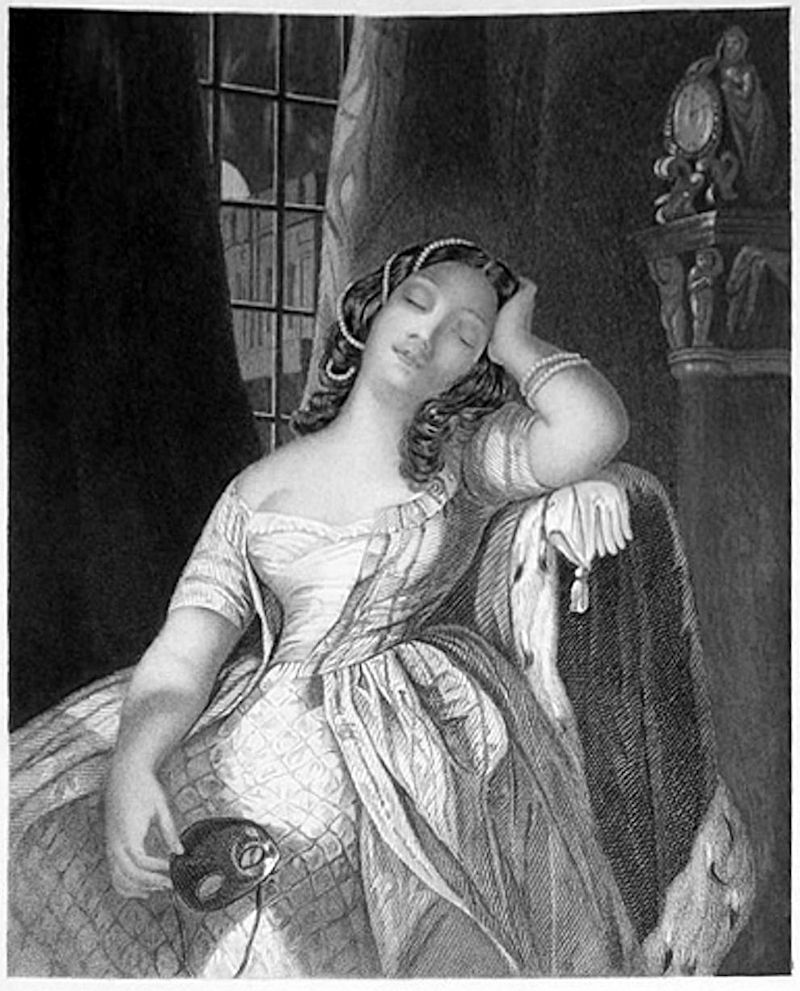
Ariadne was the daughter of Minos, king of Crete, one
of the sons of Jupiter by Europa. Her desertion by
Thésëus, whose life she had saved, and with whom she
had flown from Crete, has long been a thesis of more than
ordinary poetical importance. Thésëus, the son of Ægéus,
king of Athens, by Æthra, daughter of Pittheus, monarch
of Trœzen, on the discovery of his parentage, visited
Athens, and made himself known to his father, who acknowledged
him. Sometime before, Androgeos, a brother
of Ariadne, set sail for Athens for the purpose of participating
in the Athenian games. He was the victor in
every conflict. Ægéus, becoming jealous of his popularity,
caused him to be assassinated. Minos at once declared
war against Athens, conquered the Athenians, and
imposed upon them the annual penalty of sending fourteen
of their most beautiful male and female children as an
offering to the Minotaur, a ghastly monster who inhabited
the celebrated Cretan labyrinth, the latest invention of
Dædalos, the Athenian sculptor. Thésëus, on the day of
the embarcation of the victims, offered himself as one of
the number, with the hope of destroying the Minotaur,
and thus preserving Athens from any further payment of
the terrible tribute. The ship departed, as usual, under
black sails, which Thésëus promised to exchange for white,
in case he should return victorious. On his arrival in
Crete he saw Ariadne, who became enamored of him.
She gave him the clew which made him master of the
mazes of the subterranean labyrinth. After a desperate
conflict he succeeded in destroying the monster, and the
same night, fled to Athens, bearing Ariadne with him.
On his arrival en route at the island of Naxos, compelled
by the gods, he deserted his mistress and returned home.
By some accident he neglected to exchange his sails, and
his father, Ægéus, filled with grief at the supposed death
of his son, precipitated himself from a lofty rock, on which
he had taken a position to watch the return of the galley,
into the sea, and was drowned. Ariadne afterward became
the wife of Bacchus.
———
BY MISS LOUISA OLIVIA HUNTER.
———
“Henceforth thou wilt be all alone—
What shalt thou do, poor weeper?
Oh human love! oh human wo!
Is there a pang yet deeper?”
Mary Howitt.
Her eyes are closed—she sleeps at last!
We catch with joy that quiet breathing,
Her first dark day of wo hath passed,
A happier dream her soul is wreathing.
Hush! hush! around her curtained bed,
Perchance with love there glides another!
We cannot hear that spirit-tread—
Yet in her sleep she murmurs, “Mother!”
But four bright summers o’er her head
Have softly, sweetly breathed their blessing,
And yet she mourneth for the dead
With anguish to our souls distressing.
All day by every wile we’ve sought
From sorrow’s stern control to lure her,
Her mind to win from painful thought,
Scarce meet for mind and heart maturer.
With feeling far beyond her years,
We tried in vain her grief to smother,
For still burst forth those burning tears,
With this sad wailing—“Mother! mother!”
And last, as ’neath affliction’s blight,
She coldly turned from game and story,
We told her of the spirit’s flight
To realms of endless light and glory.
That vision of a clime so rare,
Brought out this thought anew to grieve her,
E’en for a home so wondrous fair,
Could one who loved her well thus leave her?
We strove in vain to lull her fears;
We sought in vain such doubts to smother,
More wildly came those bitter tears,
And this sad wailing—“Mother! mother!”
It ceased at length—those weary eyes
We marked with languor faintly closing,
And now on yonder couch she lies,
In slumber deep and sweet reposing.
Hush! hush! around her curtained bed,
Perchance with love there glides another!
We cannot hear that spirit-tread—
But in her sleep she murmurs, “Mother!”
A SKETCH FROM ENGLISH HISTORY.
———
BY MRS. CAROLINE H. BUTLER.
———
There is perhaps no data in the annals of English
History marked with a more bloody significance of
the fearful extent to which the evil passions of mankind
will reach, when not held in check by religious
or civil discipline, than that characterized as the
“Bloody Assizes,” in the reign of James the Second—1685—which,
even from out the lapse of two centuries,
still stands forth in loathsome and horrible distinctness.
When the savage and bloody-minded Jeffreys, empowered
by a vindictive and arbitrary monarch, stalked
like a demon through the land, tracing his passage with
blood and tears, while the music of his infernal march,
was the groans and death-shrieks of his victims. And
as he strode onward—behind him he left horrible, eye-blasting,
soul-harrowing proofs of his cruelty—corpses
swinging in the wind at the corners of the cross-roads—gibbets
stuck up in every market-place—and blackening
heads and limbs impaled, even before the windows
of the holy house of God!
Such was the more than brutal ferocity with which
this fiend in human shape, George Jeffreys, Chief
Justice of the Court of King’s Bench, prosecuted his
commission.
Through all those districts where the inhabitants had
either taken up arms in the Monmouth Rebellion against
the king, or who had been known five years before to
have received the unfortunate duke with favor and
homage, when assuming the rank of a rightful prince
he passed with almost regal triumph through the land,
did Jeffreys and his well-picked myrmidons pursue
their murderous track, sparing neither sex nor age—the
death-blow descending alike upon the silver head
of tottering age, or lisping, helpless infancy “And,”
says Macaulay, “his spirits rose higher and higher as
the work went on. He laughed, shouted, joked, and
swore in such a way that many thought him drunk
from morning to night, but in him it was not easy to
distinguish the madness produced by evil passions,
from the madness produced by brandy.”
In such a frame of mind he entered Southampton
and proceeded toward Winchester, which, although
not the scene of any warlike encounter with rebel and
royalist, had nevertheless been resorted to by many of
the former as a place of safety, among whom was
their unhappy leader, the infatuated Monmouth himself.
It was here, near the borders of the New Forest
that the unfortunate man was taken prisoner. Worn
out by fatigue—crushed by disappointment—his high
hopes blasted by defeat, the ill-fated son of Charles was
discovered concealed in a ditch, where all through a
long, long day, and a weary night, without food or
drink, the unhappy fugitive had vainly hoped to evade
the search of his pursuers.
Hither, then, came Jeffreys, tainting the air as with
a pestilence, and causing great terror and dismay, particularly
among the peasantry, no one knowing who
next might prove the victim of the tyrant’s insatiate
thirst for blood.
He was now, however, in hot pursuit of two men—one
a Nonconformist divine, named Hicks; the other
a lawyer, Richard Nelthorp, an outlaw, who had
made himself obnoxious by being concerned in the
Rye House plot. These men, it is needless to say,
Jeffreys was resolved to pursue to the death.
In a fine old mansion, encompassed by a closely
wooded park of a century’s growth, dwelt the Lady
Alice Lisle. She was the widow of John Lisle, who
had held a commission under Cromwell, and had also
sat in the Long Parliament. He had been created a
Lord by Cromwell, and the title of Lady was still
courteously assigned to his widow, for she was one
greatly beloved by all persons and parties, both
Whig and Tory, for her many excellent qualities, and
was also nearly allied to many noble families.
It was near the close of a beautiful autumnal day,
that the Lady Alice, clad in deep mourning weeds,
might be seen passing slowly beneath the dark foliage
of those venerable trees, stretching in such primeval
grandeur far on either side her domain. The chastened
radiance of the setting sun here and there burnished
the almost motionless leaves with gold, or stealing
athwart the mossy trunks, and over the deep green
sward, mildly illumined the forest aisles, seeming
thereby as paths angels might love to tread. The
only companion of the lady was a child—a beautiful
boy of perhaps six years old—an orphan, whom the
kind Lady Alice had taken under her protection, and
who now, far from partaking in the seriousness of his
benefactress, skipped and gamboled before her in wild
and happy recklessness—now springing like a fawn
into the path before her from behind some leafy screen,
where for a moment he had lain concealed, or striving
to attract attention by his childish prattle as he bounded
playfully at her side.
As heedless to the deepening twilight as she seemed
to all else around her, the Lady Alice had proceeded
further into the depths of the wood than was her usual
custom, when she was suddenly aroused to the lateness
of the hour by a scream from little Edwin, who, burying
his face in the folds of her mantle, cried,
“O run, dear lady, run—bad men—ah, they will
kill us!”
“What are you talking of, Edwin?” she answered,
taking his hand—“who will kill us? We shall soon
be at the Hall; fie, boy, are you afraid because the sun
has set, and the old woods grown dark! Ah, is this
my little hero!”
“But, lady, I see men—bad, wicked men; there,
lady, there,” pointing, as he spoke, to a clump of
low oaks.
“Foolish boy, it is only an owl!” said the lady, now
turning to retrace her steps.
At that moment two men sprung from out the thicket
and stood in her path. Well might that lady tremble,
alone and unprotected in the deep, dark wood, yet in
tones well belieing her fears, she unfalteringly bade
them stand aside, and give passage to herself and the
pale, timid child she led by the hand.
“We mean not to harm or frighten you, madam,”
said one of the men, lifting his goatskin cap, and stepping
aside, “we seek at your hands shelter and food.
For three days we have lain concealed within these
woods, not daring to venture forth even to satisfy the
cravings of hunger. We are neither thieves nor murderers—slight
offences may be in these signal times of
despotism and injustice—but men hunted down like
wild beasts in the cause of civil and religious freedom.
It is for our lives we implore your aid.”
“Yea, for our lives—that we may be spared to
trample the sons of Belial under our feet, and smite,
and slay and destroy the arch tools of oppression!”
interrupted the other, with violent gesticulations; “and
thou, woman, art the chosen vessel of the Lord to
shield his servants from the man of blood against that
dreadful day of retribution!”
“I ask not to know why you are thus thrown within
peril of your lives,” answered the Lady Alice, “it is
enough for me that you are fellow beings in distress,
and as such must claim my sympathy, and the shelter
of my roof. God forbid the doors of Alice Lisle should
be closed against misfortune. Follow me, then, friends,
and such food as my house affords, and such security
as its walls can give, may the Lord bless unto you.”
Confident in the attachment and fidelity of her domestics,
the Lady Alice, in a few words, made known
to them that the lives of these unfortunate men were
in jeopardy, and that they sought from her kindness
safety and concealment, and sharing in the benevolence
of their mistress, each one of that well-tried household
regarded the fugitives with generous sympathy.
An excellent supper, such as their famishing natures
required, and a bottle of old wine, was soon placed
before the weary men. They were then conducted
by the Lady Alice herself to a room on the ground
floor.
“Observe,” she said, “this oaken panel—press
your finger thus; a door opens, leading into a secret
passage, connected with the vaults of the old chapel,
where, in case of emergency, you will be perfectly
secure from search. Sleep, then, my friends, in peace,
one of my most faithful servants will this night keep
watch, and upon the least alarm, you will be notified
in time to avail yourselves of the way of escape I have
pointed out.”
As she bade them good-night, one of the men, seizing
the hem of her mantle, carried it to his lips with a
grace not unfitting the presence of a queen, while in
the canting oratory of the day, his companion devoutly
prayed the Most High to bless the woman, through
whose assistance vengeance was yet to be heaped on
the head of the scorner, and those who now sat in high
places to be brought low.
And thus fortified and encouraged by the assurances
of their noble benefactress, the fugitives took heart,
and throwing themselves upon the bed, were soon
soundly sleeping.
Not so the Lady Alice. True, these men had not
revealed their names, neither had she sought to discover
who they were, or for what crime they were
driven to their present strait—yet that they fled the
wrath of the cruel-minded Jeffreys she felt persuaded,
and fearful that with his myrmidons he might be close
on the track of these unhappy men, she, too, sat watching
all the night, or pacing with light footfall the long
galleries, ever and anon stepping out upon the balcony
and listening to every sound, her fears magnifying the
whispers of the wind stealing through the branches
of the old trees, into the suppressed murmurs of an
armed force. All, however, remained quiet. Just as
the day began to dawn, she threw herself upon her
couch—not meaning to sleep. But, overcome with the
fatigue of her lonely night-watch, and lulled perhaps
by the security which almost always comes to the
watcher with the dawn of day, she soon unconsciously
sunk into a deep sleep, from which, alas! she was but
too rudely aroused; for even in that brief half hour
when tired nature claimed its own, the wily Jeffreys
had surrounded the house with his no less brutal
soldiers.
“Come, come, madam, bestir yourself—you are
wanted,” cried the leader, seizing the Lady Alice by
the shoulder, and rudely shaking her; “methinks you
sleep well this morning—long watching makes sound
slumbers, eh! Come, up with you, woman, and tell
us in what corner of this rebel’s nest you have stowed
away the Presbyterian knave and his worthy friend?”
In a moment the lady was fully awake, and comprehended
at once her perilous situation. But her self-possession
did not forsake her, and breathing an inward
prayer for the safety of the two unhappy men so closely
pursued, she said, as she drew herself proudly up,
“What means this unmannerly intrusion? Off, sir!
unhand me, or your audacity shall be punished as it
deserves!”
“Ho-ho, my brave wench, words are cheap! you
will find proofs not so easy! Know, mistress, yourself
and your servants are my prisoners,” replied
Jeffreys.
“Your prisoners!” cried the lady, with cutting contempt;
“and who are you, and by whose authority do
you dare to lay hands on me or any beneath my roof!”
“Who am I? That you shall soon know to your
cost,” said Jeffreys, with a horrible oath. “George
Jeffreys has a peculiar way of making himself known,
my mistress. Now deliver up these two arch rebels—the
canting, whining priest, and the traitor Nelthorpe,
into our hands, and mayhap I’ll not press my further
acquaintance upon your ladyship, except to taste the
quality of your wine, for I’ll warrant you, my men,
(turning to his followers) these old cellars are not dry.”
“I know no such persons as those you seek,” replied
the Lady Alice, firmly; “and what reason have
you to suppose they are within my house?”
“We know it, and that is enough,” replied Jeffreys.
“They are known to have lain hid within your neighborhood;
and we know they have been secreted by
you; and now, by G—d, madam, unless you lead us
to their kennel, your body shall writhe in flames, or
be hacked in pieces by my soldiers!”
“Infamous, cowardly wretch,” replied Alice Lisle,
undaunted, “think you your threats would induce me
to betray, more especially into your blood-thirsty hands,
any unhappy individual who had sought my protection!
Know Alice Lisle better.”
“Ho-ho, are we so brave! here, my men, take this
boasting mistress, and give her a dance upon hot coals!”
cried the ferocious Jeffreys.
At that instant little Edwin, still in his night-dress,
opened the door of his little bed-room, and ran terrified
toward the Lady Alice; but he was not permitted to
reach her; a soldier rudely seized the poor boy by the
shoulder, and notwithstanding his shrieks, held him
with such a grip as left the print of his fingers upon the
tender flesh.
“Ruffian, unhand the child!” exclaimed the lady,
attempting to rise, but held back by the iron hand of
Jeffreys.
“Ha! a pretty hostage, truly!” he said. “Here,
Ratcliffe, draw your dagger across his pretty white
throat, unless this stubborn woman yields up our
prey—do you hear that?” turning to the Lady
Alice.
“O save me—save me! don’t let them kill me!”
screeched the poor little fellow, striving to break away;
then turning his beautiful eyes upon the hard, stern
features of the man who held him, he clung piteously
around his knees, repeating his cry for mercy, his face
uplifted, and his soft, golden curls falling over his white
shoulders, from which the loose night-dress had slipped
away.
Tears, which neither her own danger, or the insults
heaped upon her could draw forth, now streamed down
the pallid cheek of the Lady Alice.
“Are you men?” she cried, turning to the rude soldiers,
“are you men, and can you stand by and see that
innocent, helpless lamb inhumanly murdered before
your eyes!”
“Ah!” cried Jeffreys, with a hideous leer, “we
are used to butchering lambs, madam; bless you, we
do it so easy the poor things don’t have time to bleat!
Strike, Ratcliffe!”
A scream—a wild scream of agony burst from the
heart of Alice Lisle; then dashing off the arm of
Jeffreys, in the strength of her despair, as but a feather’s
weight, she sprung to the boy, and threw her arms
around him.
There was heard at the moment a loud shout from
the court-yard, coupled with oaths and imprecations,
and one of the troop burst in, waving his cap.
“Hurra, your honor! they’re caught, your worship;
we’ve got the rascals—hurra! hurra!”
“Now God help them!” murmured Alice.
“Your life shall answer for this, vile traitress!”
muttered Jeffreys, in a voice hoarse with rage, and
shaking his fist at the unshrinking heroine. “But
where found you the knaves?” he added, turning to
the bearer of such fiendish joy.
“Ha, ha, your worship—but I can’t help laughing;
we found his reverence, chin-deep, in a malt-tub—ha,
ha, ha! and the other rogue we hauled from the kitchen
chimney, as black as his master, the Devil!”
“And to his master he shall soon be sent with a
crack in his windpipe,” said Jeffreys.
“Wounds, your honor, you loves a joke!” said one,
who might be called the Trois Eschelles of the company,
edging up to Jeffreys with a horrid grin; “shall
we string the rascals up below there—yonder is a good
strong beam; or shall we leave their heads in the
market-place, as a kind of warning to all traitors!”
“Peace, knave!” replied Jeffreys, with a frown
which made the villain turn pale; “attend to your
duty, and see that the prisoners are well secured;
these fellows are slippery rascals—and now, madam,”
(turning to Alice Lisle,) “up with you, and prepare to
follow either to the scaffold or the stake, as suits my
pleasure.” Then, with a brutal blow with the back
of his sword, he rudely pushed his victim on before
him.
Her weeping and terrified domestics would have
approached their beloved mistress, but were thrust back
by the drawn swords of the soldiers, and when the unfortunate
lady crossed her threshold, it was over the
dead body of her aged butler, brutally struck down before
her.
“Farewell, my friends,” said the Lady Alice, turning
to her faithful attendants, “I look for no mercy at the
hands of these cruel men, whose pastime is death;
yet though they may torture the body, unto the mercy
of my Redeemer do I humbly commit my soul. May
God forgive these my enemies, for in their blind rage
they know not what they do; pray for them, my
friends.”
“Come, none of your cant here, if you please,
madam; if we want any praying done, we’ll call on
yonder long-nosed, whining saint,” cried Jeffreys pointing
to Hickes, who, with Nelthorpe at his side, and
both closely bound together with ropes, and guarded on
either side, was now brought forward.
Lest by appearing to recognize the Lady Alice they
might increase her danger, the prisoners took no notice
whatever of her who for their sakes was now in such
peril, and met her glance as they would that of a
stranger. Nelthorpe, indeed, essayed once to speak,
for the purpose of acquitting the Lady Alice of all
knowledge of himself and companion, but his speech
was cut short by vile taunts and curses.
These wretched men had slept soundly through the
night, and with the stupor of heavy fatigue still hanging
about them, heard too late the tramp of their pursuers,
and forgetting in their sudden alarm the secret panel,
sprung through a window, and endeavored to conceal
themselves in some of the outbuildings; but vainly—they
were soon dragged forth, and knew that from the
jaws of the blood-hound Jeffreys, death was to be their
only release.
And now, without any delay, the prisoners were
brought to trial, the Lady Alice being first placed at the
bar, charged with treason, in concealing or harboring
persons disaffected to the king, and known to have
been concerned in the late insurrection.
Many of the jurors were of the most respectable
men of Hampshire, and all shrunk from convicting an
amiable and exemplary female, for a crime (if crime
it could be called) which certainly arose from the
purest and noblest emotions of the heart. But Jeffreys
was not to be so robbed of his prey.
Witnesses, forestalled by his vindictive spirit, appeared
against her, and those who would have testified
in her favor, were so put down by the bold-faced
cunning of these hirelings, as to do more injury than
good to the cause which they came to sustain.
The Lady Alice was then called upon for her defence.
In a modest and dignified manner she addressed
the Court. She began by saying that she knew not
the men who had sought her protection, nor had she
asked for what offence they were thus hunted down;
it was enough that famished and weary they required
her assistance, and that assistance she had freely rendered
them; “Yet for this, gentlemen,” she continued,
“I am arraigned for treason. Has charity, then, become
a crime? Is it a capital offence to relieve the
wants of our suffering fellow beings; and must the cold
voice of prudence overcome the Divine precepts of
Jesus? Now God forbid!”
She was here interrupted by an insolent remark from
the judge; and if allowed again to speak, it was only
to draw upon herself his coarse, unfeeling ribaldry.
The jury retired, their sympathies more than ever
excited for the unhappy lady.
Their consultation was too long for the patience of
the judge. He grew furious at their delay—stamping
and swearing like a madman. “He sent a messenger
to tell them that if they did not instantly return, he
would adjourn the Court, and lock them up all night.
Thus put to the torture, they came, but came only to
say they doubted whether the charge had been made
out. Jeffreys expostulated with them vehemently, and
after another consultation, they gave a reluctant verdict
of ‘Guilty!’ ”[1]
This was received by demoniac joy by Jeffreys, who
immediately proceeded to pass sentence, which was,
that the most unfortunate Alice Lisle should that very
afternoon be burned alive!
This dreadful sentence caused universal horror, and
moved the pity even of the most devoted supporters of
the king. The judge was overwhelmed with petitions
and prayers for mercy; but the only mercy he granted
was a few days’ delay ere the dreadful sentence should
be accomplished.
During that time the royal clemency was eagerly
solicited, and many persons of the highest rank interceded
with James for the release of Alice Lisle.
Ladies of the Court entreated his mercy. Feversham,
flushed with recent victory, pleaded for her; and even
Clarendon, the brother-in-law of the king, spoke in her
behalf.
It was all in vain.
Scarcely less cruel than his cruel judge, James was
inexorable, and only so far showed his clemency as to
commute the sentence from burning to beheading!
But peace—peace, such as the world can neither
give or take away, went with Alice Lisle into that dark,
cold prison, to which her enemies consigned her.
Those damp walls, in whose crevices the slimy lizard
made its bed; though they shut her out from the world—from
friends—from freedom—they could not imprison
her soul, nor crush the spirit of the martyred
Alice, as it ascended in prayers to the Heavenly Throne.
Divine love and holy trust in the promises of her Redeemer
illumined her dark dungeon with the brightness
of heaven; and when led forth to the scaffold—death
was swallowed up in victory.
Alice Lisle was beheaded in the Market Place at
Winchester, Anno Domini, 1685.
“Blessed are the pure in heart, for they shall see
God.”
———
BY RICHARD COE, JR.
———
We are dreamers all! the babe that lies
Asleep on its mother’s breast,
In a dream of peace will sweetly smile,
As if its spirit were e’en the while
By angel ones caressed!
We are dreamers all!
We are dreamers all! the lover dreams
Of a fair one by his side;
Of the happy hour when he shall stand
Before the altar, to claim the hand
Of his bright and beauteous bride!
We are dreamers all!
We are dreamers all! the poet dreams
Of the laurel-wreath of fame;
He struggles and toils for weary years,
And awakes at last with sighs and tears,
To grasp but an empty name.
We are dreamers all!
We are dreamers all! the Christian dreams
Of a promised rest above;
Of the pleasant paths of Paradise—
Of a home of peace beyond the skies,
Prepared by the Saviour’s love!
We are dreamers all!
We are dreamers all! but oh! to me
The Christian’s dream be given!
For bright as his dream on earth may be,
He wakes to a blest reality
When he opes his eyes in Heaven!
We are dreamers all!
———
BY JEANNIE DEANE.
———
Mary Norrice! With that name how many blessed
memories come flitting by, like bright-winged passage-birds,
leaving in their flight a sadness—a feeling
of brightness gone!
It was the bright and merry autumn-time when I
met thee, Mary, and thou wert in thy girlhood—beautiful
and care-free. Another autumn-time—the time
when withered leaves go whirling over barren places
where flowers erst were blooming, and dancing to a wild
mournful measure over the graves where human flowers
are meekly sleeping—then saw I thee, sweet Mary,
on thy bridal morning, and orange-flowers were in thy
hair. And then another autumn-time—a sad and
withering autumn-time, and they laid thee in the
grave. Alas! that one so pure, so good as thou wert,
should lie there! Alas! for thee, sweet Mary Norrice!—and
yet joy for thee! Joy! joy for thee!
“An airy fairy Lillian” was my friend Mary—so
“innocent-arch, so cunning-simple,” that she was an
especial favorite, the “bright particular star” among
that joyous band of school-girls where I saw her first.
Dark, roguish eyes, soft brown curls clustering about a
low sweet forehead, and a sunny, bright complexion
had Mary Norrice.
For two bright years that went by on an angel-wing,
she was my constant companion—my best,
dearest friend, and in this time, I became well acquainted
with the beauty, trustfulness, and purity of
her character. If there was any fault in Mary, we
girls used often to say, it was in her adoption of the
Catholic religion. It might have been Mary’s imaginative
disposition which inclined her to this belief; or
perhaps because it was the faith of her mother, who
had died when Mary was very young, and whose
memory she cherished in her heart’s “holy of holies.”
Beautiful it was to see that fair child kneeling at morning
before an elegantly wrought crucifix, her mother’s
dying gift; her white fingers straying among the pearls
of her rosary: or at evening, her slight form bending
in the moonlight, the white night-robe falling gracefully
about her, a few curls escaping from the delicately
laced cap! her white hands crossed on her beating
breast—and her dark eyes full of prayer—as she
commenced with “Mary Mother.” It was a scene to
look upon, and feel that a pure spirit dwelt in her heart,
and beamed forth from the child-like, sinless face
which looked in pure devotion up to Heaven.
Years are gone since the sweet voice of Mary Norrice
was hushed—but often when I sit alone in the
thoughtful twilight, a “smiling band of early hours
come clustering about my memory,” and I can almost
believe that those soft brown curls touch once more
my cheek! that dear head seems again to nestle lovingly
down upon my shoulder—and the little hand feels
warm in mine—as looking out together upon the evening-star,
I hear the now stilled voice, singing once
more, so unutterably sweet and spiritual, its evening
song—“Ave Sanctissima!”
One evening when quiet, an unusual guest, seemed to
reign throughout the seminary of G——; when the
hum of subdued voices, and the softened tones of some
distant harp or guitar echoed through the halls only at
intervals, we sat together in the big, old-fashioned parlor—Mary,
her cousin Claude Norrice, who was the
pastor of the village, and myself. Mary was looking
from the window somewhat sadly—Claude was gazing
into her large dark eyes fondly and earnestly, while
my poor foolish heart was weaving a bright fabric for
those two gifted beings who sat beside me—a dream
which I was to waken from, even before that bright
ray of moonlight which was sleeping in its holiness
upon Mary’s brow, and which I had been watching
for the last ten minutes, should pass away. So golden
and so fleeting is the light which hope flings on the
fairy fabric of love.
“Sing us something, Cousin Mary,” said Claude,
and her musical voice stole upon our hearts in its
magic sweetness, chanting softly that song she loved,
“Ave Sanctissima!” Insensibly my heart was yielding
to the strain, and I walked in old cathedrals “high
and hoary,” listening to some fair nun, as she chanted
her mysterious vesper-hymn; when my fancies were
suddenly dispelled by Claude’s voice, begging Mary
would choose some other song.
“It is very beautiful,” said he, “and seems doubly
so, Mary, sung by your dear voice; but the devotion it
expresses for an ideal object is very disagreeable to
me.”
I was called from the room at that moment, and when
I returned an hour later, I knew that Claude Norrice
had told his cousin how dearly and truly he loved her,
how indispensable was her presence—her affection to
his life’s pathway. Mary stood before him, her head
erect, as she said proudly and with flashing eyes —
“I’m not to be treated as a mere child, Claude Norrice—I
tell you again that nothing you can say to me—no
professions of affection you have made, shall lure
my heart from the faith of my mother.”
And she bowed her head in veneration as she spoke
that name, and crossed her fair white arms upon her
breast as if she would still its wild beatings. But I saw
her cheek grow white as he bowed down and kissed
her forehead, and I saw her lips quiver fast, as he said:
“The shadow is on my heart, Mary—the shadow
which your cruel words have cast there, and it can
never be effaced. God forgive you, Mary—and Father
in Heaven, help me! help me!”
Again he bowed down and kissed her, long and
wildly—turned his face toward me pale with agony,
and rushed from the room.
“Claude! dear Claude, forgive me,” murmured
Mary as she slept that night; raising her pale face from
her pillow, and clasping her hands as if she prayed.
And often in that long, weary night she would wake
with a sudden start, and lifting her eyes toward the
crucifix, pray wildly—“Ave Mary! Madonna! help
me!” When she would place her hand beneath her
pale cheek, weary with her grief, and sleep again, murmuring
all the while of Claude—her mother and
Heaven.
There were no vows of eternal affection exchanged
when Mary Norrice and I stood on the shaded piazza
of G—— Seminary, watching for the old green coach,
which was momentarily expected to take her to her
city home. No vows were needed—we loved each
other with that trustfulness, that confidingness which
asks no pledge. Mary had promised to write me very
often, and this I assured her would be a panacea for
every human ill.
Not quite three months after we left school, I received
from Mary the following hastily written
letter:
“You will make big eyes, Jeannie, dear, when I tell
you that I am just about to commit matrimony—only
think of that! In one little week I am to slip my head
into the sacred noose, and who think you is to help me
bear the gentle yoke? Arthur Monterey, of whom
you have often heard me speak, is the “lucky man,”
and though he is a deal older than myself, I dare say
we shall learn to love each other very much. He is
very handsome, talented, and very much esteemed;
but more than all, he is of my own religion—of the
same faith as my sainted mother. You will “haste to
the wedding” Jeannie, because you remember you
long ago promised to act as bride’s-maid on the occasion
of this bit of a ceremony. Au revoir, Jeannie
dear, come to your own,
“Mary.”
I was not surprised that Mary was to marry a catholic,
but I was surprised to hear her speak of learning
to love Arthur Monterey—learn to love him!
Mary Norrice with her loving, enthusiastic nature,
learn to love the man who was to be her husband!
The sunlight fell in through the windows of stained
glass, glancing upon the high forehead of her betrothed,
and bathing in its warm rich light the snowy bridal
robes of Mary Norrice.
The vows were spoken; a golden circlet glistened
on Mary’s finger, and she was bound in joy and sorrow,
for “weal or wo,” to go through life’s pathway
by the side of Arthur Monterey. Mournfully fell the
tones of the organ upon my ear, for in my heart it was
two years agone, since I saw Mary standing in the
moonlight, and I heard Claude Norrice say in a voice
low with despair—“God forgive you, Mary!”
Arthur Monterey was a very handsome man, but
there was a stern expression on his proudly curved lip,
and about his high intellectual forehead, which made
me fear for Mary. In the few weeks of gayety which
followed their marriage, I saw but little of him, though
when with us, he seemed very proud of his wife’s
rare beauty and fascinations, and was wholly devoted
to her.
Winter, spring, and summer passed away, and in the
autumn I received a letter from Mary, saying that her
husband was traveling, and begging me to come to her.
There was a terrible feeling at my heart as it looked
once more into those once merry eyes, now so large
and sad—and somehow a thought of death as I kissed
those lips so mournful and resigned in their expression.
One evening we sat together in Mary’s room, at
twilight—her head rested on my shoulder, one pale
hand supporting her soft cheek, as the other swept the
chords of her harp, with her own peculiar grace and
magic. Mournful and low was the prelude; and sad,
and spirit-like the dear voice which sang once more
to me “Ave Sanctissima!” Midnight had passed, and
yet we sat by the open window—the moonlight falling
in through the curtains of snowy muslin, its beams as
pure, as spiritual as the frail creature who sat beside
me, and whose face I fancied grew paler in its light.
We stood within the church again—and Mary’s
robes were snowy white; but her brow was paler
than before—the long dark lashes fell upon a lifeless
cheek—and the pale hands were crossed upon a hushed
breast.
With mourning for the young and fair, solemnly
echoed the deep tones of the organ through the high
arches; and there were white faces, and stilled sobs
around the coffined—beautiful—the coffined—dead.
In a package directed to me, which I opened after
her death, Mary wrote these lines —
“I trusted in ideal worth, dear Jeannie—I have laid
my heart’s best and holiest affections as a sacrifice
upon the altar of my religion. I am dying now, and
promise me you will bring some of those deep-blue
violets from my mother’s grave, and plant them on my
own—then I shall sleep. My husband has been kind
to me—but his love is not that for which my heart has
yearned.
“If you do not think it wrong, Jeannie dear, you
may give my bible to cousin Claude, that same bible
which he gave me so long ago. I have placed a curl
among its leaves—in Heaven I shall be his wife—there
are no tears there.”
Bitterly did Claude Norrice weep as he held that
long bright curl first in the sunshine, then in the shade;
but there was a glance of joy in his dark religious eye
as he murmured, “Mine in Heaven—Mary Norrice!
in Heaven—mine forever!”
I stood beside him in the spot where Mary’s earthly
part is lying. The shadow of the willow-tree waved
sadly to and fro upon the white marble cross, on which
was graven “Mary Monterey, aged seventeen—there
are no tears in Heaven.” As I saw Claude Norrice
gather a tuft of violets from the grave, and press them to
his lips in an agony of grief, I wept that one so young
and beautiful should die. But when I thought of the
many high imaginings, the lofty hopes, and holy aspirations
the sleeper there had taken hence to Heaven—when
I thought how fair the flowers are, how sweet
the music, and how white are the angel’s wings in
Paradise, I said in my heart—joy for thee, dear Mary
Norrice! Thou art gone home!
“Joy! joy forever! thy task is done,
The gates are passed—and Heaven is won.”
[Genesis. Chap. xlix.]
———
BY MRS. JULIET H. L. CAMPBELL.
———
The day declined in Egypt, and the faintly fluttering breeze
Drooped, with dew-laden pinion, ’mid the dark pom’granate trees;
The purple grapes, like clustering gems, hung heavy on the vine,
Half bursting with their luscious pulp, and rich with ruddy wine,
The broad green leaves that shadowed them throughout the noontide glare,
Now, quivering, fanned their glowing rinds, and cooled the brooding air;
While hitherward, and thitherward, the date tree and the palm,
Their graceful branches, slowly swayed, majestically calm.
The day declined in Egypt, and the sun had sought the west,
Where, like a king whose destiny was done, he sunk to rest,
While palace, dome, and pyramid, gleamed with celestial fire,
And heaven’s burnished battlements, glowed like a funeral pyre.
But in the zenith of the sky, transparent clouds, and white,
Rolled hurriedly athwart the blue, their billowy zones of light,
And parting in translucent waves, as the sea was doomed to do,
A throng of white-winged angels, swept that gate of glory through.
The day declined in Egypt, and an old man looked his last
Upon evening’s fading glories, for his life was ebbing fast;
And dim, to him, the rosy earth, though beautifully bright,
And dark, to him, the western heaven, though bathed in golden light.
Yet, though his feeble sight no more might trace the forms of earth,
His kindling soul looked from its clay, prophetically forth;
Futurity’s enfolding shroud rolled heavily away,
And ages, yet to be revealed, their secrets to the day.
Nations unborn around him thronged, with all their deeds and doom,
And the Patriarch glowed with prophecy, on the confines of the tomb.
The day declined in Egypt, and the Patriarch’s sons drew nigh,
To hear their father’s parting words, receive his parting sigh.
A noble band of brothers they, the princely twelve, who came
And bowed their stately heads before that worn and weary frame.
“Draw near, my sons,” the old man said, “while I reveal to ye,
The hidden things, of old ordained, in latter days to be.
“Reuben! beginning of my strength! my first born and my flower,
The excellency of dignity, the excellency of power!
But what are lofty gifts to thee, while thy impulsive heart
Will prompt alike the generous deed, or choose the baser part!
Unstable as the waves thou art, I read thy nature well,
And dignity and power are vain, for thou shalt ne’er excel.
“Levi and Simeon, brethren ye, in wickedness and wile!
My soul abhors your cruelty, mine honor shuns your guile!
Lost and accursed shall ye be by God’s avenging wrath,
And scattered wide, like sifted chaff, upon the whirlwind’s path.
“Thou, princely Judah, nearer draw, my proud and peerless one,
Mine eyes would rest once more on thee, my lion-hearted son;
I see thy calm, majestic front, thou generous, true, and just!
In thee the children of thy sire, for aye shall place their trust.
The gathering of the nations around thy house shall be;
And until Shiloah’s coming the sceptre rests with thee!”
And thus, as round their prophet sire, the awe-struck brethren wait,
To each of all the listening twelve, he speaks, unfolding fate.
The brawny breast of Issacher, heaves heavily and high,
As years of cruel servitude arise before his eye;
Luxurious Asher’s curving lip, half wreaths into a smile,
As visions of voluptuousness, flit o’er his brain the while;
And Benjamin, exulting hears of his successful toil —
“At morn thou shalt pursue the prey, at eve devour the spoil.”
But Joseph, of the steadfast soul, triumphant over wrong,
Round thee, the best belovéd one, the choicest blessings throng.
Of the deep that lieth under, of the far spread heavens above;
Of thy home and of thy household, in thy life and in thy love,
The words wherewith he blesseth thee, o’er all prevaileth still —
Unto the utmost boundary of the everlasting hill.
The day declined in Egypt, and from fertile mound and plain,
The golden sunlight fades away—night gathers dark again.
The clouds roll their dark billows back, and through the rifts on high;
The solemn stars, in marshaled hosts, tread up the midnight sky;
While chanting, through the firmament, the errant angels come;
They lead the unfettered spirit up, in triumph to its home.
———
BY ALFRED B. STREET.
———
Monticello is one of the loveliest villages upon
which the sun shines. It occupies, in two rows, the
aides and summit of a steep hill, surrounded by orchards,
grain-fields, and meadows; which in turn are
girdled by the unbroken wilderness. The single street
is formed by the broad turnpike, with smooth grassy
margins that extend like carpets of emerald up to the
very porches, from the edges of the highway. Two
side-walks fringed with maples, (the most beautiful
shade trees in the world) form, with their brown
stripes, the only interruption to the smooth green margins
above referred to. The street (or highway more
properly speaking) is hard and smooth as a sea-beach,
over which the wagon-wheel rolls as evenly and
swiftly as over the surface of that very important invention
of modern times, the Plank road. Indeed it is
more like the glide of the rail-car over the T road than
any thing else, and the way that a span of Halsey’s
horses can whirl a carriage through the street of the
village, “is a caution” to lazy folks.
The houses are mostly new and uniformly painted
white, and peep out from their rows of maples in the
most agreeable and picturesque manner. In fact, so
sylvan is the whole appearance of Monticello, buried
as it is amongst its leaves, that it looks like some huge
bird’s nest in the branches of an enormous tree. It is
an isolated place, too, tucked away behind the Shawanyunk
Mountain, and although placed upon a hill, is
as far removed from the busy world as it well could
be. It is true, Hamilton’s red coach crawls daily from
Newburgh on the Hudson, through it, carrying the
mail with great regularity and despatch, (good conscience,)
on its snail-like pace to Lake Erie, but if the
line depended only for its continuance upon its passengers,
its life would be short indeed. In fact, if Uncle
Sam’s “pap” (as Uncle Jack says) were not freely bestowed,
it would not really last longer than a chicken
with the pip.
Such being the state of things, it may readily be imagined
that we villagers have every thing to ourselves,
as far as the great world without is concerned, and that
we are very little troubled with any affairs except our
own. It is true they furnish trouble enough of themselves,
but they are generally of such a nature that the
detachment of grannies and old maids from the main
body of the village which take a most pious and praise-worthy
care of the morals of the place, can usually
settle them over a long “tea drink” at one or the other
of their dwellings.
With these preliminaries I now proceed to endeavor
to sketch the gliding of a summer’s day over our beautiful
village, albeit my touches may be skill-less, and
my colors faint.
Not yet sunrise! What a sweet gray delicate light
glimmers in the air, and how fresh and cool the universal
hue over every object. The sky is stainless,
pure as the thoughts of Innocence, and bright as the
dreams of the happy, although it wants the splendor of
the risen sun. Faint, faint, as the memory of other
days to the aged are those few white stars throbbing in
the mid-sky, sinking deeper and deeper in the lustrous
heavens. In the east is a wreathed cloud, just
above the spot where the sun is expected, and evidently
awaiting the period for it to burn under the
glance of the orbed God, like the arch-angel nearest to
the Throne of the Mighty. The west is dusky with
the outlines of the forest upon it misty and undefined,
as if the breath of the vanished night was still lingering
there. Nothing is there to arrest my gaze; but the east
draws my eye toward it with the power of a magnet.
The east! solemn and mysterious spot in the wide
heavens! how it sways, with its mighty influence, the
whole human race.
Upon its brow did the splendid Star of the Nativity
blaze out with its sudden glory, upon the astonished
eyes of the shepherds upon the hill-side, and there was
the group of angels unveiled to the cowering mortals
who heard, as they shuddered upon their mother
earth, the glad anthem of “Peace on earth—good-will
to men,” pealing through the brightened heavens, and
echoing even down to the dim, night-clad scene around
them.
From the east did the steps of the “wise men”
come when they brought their gifts of “frankincense
and myrrh” to the hallowed infant in the manger. And
even now, as the first level ray streams across the desert,
does the wild Arab check the lofty step of his
camel, and kneeling toward the east, join in the praise
then ascending from a thousand minarets, that “God
is great and Mahomet is his Prophet.”
To the east then will I turn, and with no infidel
praise in my heart, but with the feeling of pure gratitude
to that beneficent Being who has watched my
pillow through the “dangers of the past night,” I gaze
upon it. Ha! that sudden flash, like the leaping of
flame upon the altar! How the wreathed cloud starts
into light—how it brightens, how it glows! like the
iron in the furnace, how it turns to sudden red! Now
o’er its downy surface a crimson flush is spread! now
its edges burn with gold, it is a glorious banner now,
burning, gleaming, flaring, glaring on the east’s illuminated
brow.
What a splendid object! and yet but a few moments
ago it was nothing but a wreath of cold gray vapor—a
fragment doubtless of that dim blanket which kept the
stars from shining the past night. What a splendid
object, and yet the tints will soon fade, and it will once
more turn to a dim curl of cloud insignificant and hueless.
Solomon’s mantle will change to a garment that a
beggar would scorn, particularly if the morning should
be cold. Garments of cloud may be very romantic,
but they would prove deucedly uncomfortable, particularly
in winter I fancy, although the sun does turn
them into golden, crimson, and jeweled glories.
But the east is kindling brighter and brighter, and at
last a spot, directly beneath the cloud, is burning almost
like “white heat.” That is the bath of splendor into
which the sun will rush when it spurns the mountain
top and launches into the heavens. And see the lower
edge now burns with a fire that sears the very eyeball,
and ha! yes, there comes the sun. Up, up, with slow
and stately, and solemn motion as yet, up, up, with
seeming accelerated speed; now it launches into its
bath of splendor, and in plain Saxon, it is sunrise.
Two broad streams of light roll toward me. One
comes flashing directly in front, tipping the summit of
“Tonner’s hill,” and placing, quick as thought, bright
caps of gold upon the pines and hemlocks of the next
ridge this way, thence lighting upon “Brownson’s
Hill,” and helmeting the pines and hemlocks of that
locality, and thence hitting here and touching there, it
bathes with rosy splendor the chimneys of the village,
and they straightway, like altars just touched by flame,
begin, every mother’s son of them, to smoke. And not
your blue, common smoke either, but smoke of lapis
lazuli, or whatever other hue is radiant and rich.
The other beam shoots off to the left, and leaving the
valley-meadows below Tonner’s, still steeped in their
silver down of mist, it glorifies the summits of the
next wood, and spreads in a huge ring of golden glow
upon the tops of the forests that form the framework
of “Pleasant Pond.” One towering pine that plumes
a green turban of a hill near the liquid silver of the
pond, has caught the splendor upon its apex, and how
the glad light there laughs and sparkles and dances.
Like the brain of a poet when the pure fire descends
upon it, it seems to break out into a glow of inspiration,
and hark! borne to the fine and subtle ear of
fancy, through the intervening space thus sounds the
song of this Memnon of the forest—its sunrise hymn —
Hail to the morning, hail! hail to its light and its splendor!
Hail to its keen swift arrows! hail to its joy and its gladness!
Light rushes up from the east, as from an eternal fountain,
And straightway all Nature glows like steel that burns in the furnace!
Hail to the morning, hail! hail to its radiant splendor!
Hail to the wings of its speed! to its glad and its glorious presence!
It comes to the dusky east like a thought of fire to the brain!
It comes to the brightening east, like a “bridegroom to his bride!”
It comes to the glowing east like liberty to the slave!
And Nature laughs out in its splendor, and turns into light in its joy.
Sing pæans, sing pæans all Nature! about pæans to God in His glory!
He rolls up the sun in His might! He spreadeth the wings of the morning!
Arise, oh! man, and come forth! glad morning calls out to arise!
Break, break the fetters of slumber! lo! beauty is here to salute thee!
Here freshness, here splendor, here beauty! yes, purity, beauty, and health!
Health in the soft sweet air, and beauty on earth and in heaven!
Wake man from the fetters of sleep! come forth and rejoice in this gladness.
Hail to the morning, hail! hail to its light and its splendor!
It comes like a seraph from heaven! yea, from heaven, and fresh with its glory!
And lighting upon the dim Earth, the dim Earth straight bursts into beauty.
Hail to the morning, hail! it comes with the speed of its pinion
To turn the dim Earth into splendor, to clothe it in garments of light!
Hail to the morning, hail! all hail to its glorious presence!
Peal upward, rise upward my song! hail beautiful morning! all hail!
And thus endeth the first chapter.
Scene the second, is after breakfast, for the inhabitants
of Monticello generally, notwithstanding the invocation
of the smitten pine to them, with almost the
single exception of myself, don’t trouble themselves
about rising until nature is pretty well aired. In other
words they are, nearly all, late risers.
This, however, is a sweeping remark, and does not
include the various “hired helps” of the village, who
are now sallying out of their respective domiciles,
milk-pail in hand; and soon at every gate, and in every
green lane I hear the whizzing sounds of the milk
streaming in slight threads of pearl into the fast mantling
pails beneath. Neither does it include poor Hank
Jones who, shaking in every limb from the want of his
morning dram, is hastening to the nearest bar-room; nor
“Loafing Joe” either, who, I believe, never goes to bed,
and who is always astir with the earliest bird, and who
now, with the seeds of the hay-mow which afforded
him his last night’s couch, and his hat all crushed up,
giving good evidence that he has used it for a night-cap,
is lounging, with his customary slouching gait,
along the maple-sidewalk leading from Hamble’s. But
these morning sights and sounds soon vanish—the
cows wend their lazy way, lowing, to their respective
sweet-scented pastures—the “helps” disappear with
their foaming pails—poor lost Hank, after swallowing
a draught sufficient to set his stomach in a flame, leaves
for home, and even “the Loafer” has turned up the
“Stone Store road” toward his little cabin on the hill-side.
(He lives on the summit of “Antimony Hill,”
the name for the bluff at the left of the road, forming
the termination of “Coit’s Ridge.” I have a story to
tell about that “Ridge” one of these days.)
The village is buried in quietude, and so, I’ll go
to breakfast. Well, breakfast has been dispatched,
and I am again at my post, pencil in hand, to note
down events as they shall occur. Ah! there comes
“Squire Belldong” along the turnpike from his dwelling,
after having discussed his first meal of the day.
I’ll hasten up and follow him into “Saint’s” store, for
I see he is bound there—that is always his first stopping-place.
There’ll be some fun now. He is the
greatest mischief-maker in the village, pursuing his
trade out of pure love for it, for nothing delights him
so much as “setting people by the ears,” as he calls it.
He is a lawyer, and as he lives by this laudable business,
perhaps he should not be blamed. At any rate,
living or no living, he follows the business up with the
pertinacity of a greyhound after a hare.
“Good morning, Saint! how are you this fine morning!”
is his first salutation to the keeper of the store.
“Good morning, Squire! I am very well! How
are you and your family!”
“Very well, I thank you! although I didn’t sleep
very well last night!”
“Ah! what was the matter?”
“Old John P.’s dog kept up such a confounded
barking and yelling, that I couldn’t sleep a wink.
However, there was a deuced quick stop put to it
about two o’clock as I should judge.”
“How was that?”
“A pistol shot I fancy. I heard the report, and one
yell from the dog, and then all was as quiet as could
be wished.”
Here Saint John began to pick up his ears. He stopped
measuring some calico which he had been busy
on, and said —
“The deuce! Who could have shot him?”
“Loafing Joe they say. At least old Wheeler,
whom I met at the upper end of the village, told me
so.”
“There’s a chance for a suit for you, Squire! John
P. will complain, wont he?”
“No doubt of it. Well Joe has got nothing, so he
must e’en go to jail!”
“Good riddance for the village. I wish the vagabond
was always there.”
“So do I. Good morning.”
“Good morning, Squire.”
Over goes the mischief-maker to Hamble’s across
the road.
“Good morning, Hamble!” as he enters the bar-room,
where he finds that worthy making his lemons
still sourer by looking at them.
“Have you heard the news, Hamble!” elevating his
heels on the bar-room table, and deliberately drawing
out a cigar. “By the way, Hamble, give me a light.”
(He is also the most free and easy fellow in the
world.)
“News! no—what news?”
“They say that old Wheeler shot John P.’s dog last
night!”
“They say! who says? They say means nobody.”
“Well, they say in this case means your own son-in-law.
Saint John just told me so.”
“Where! I don’t believe it!”
“Well, you are very polite, Hamble. (Puffing away
at his cigar in the most imperturbable manner possible.)
Saint told me so in his own store not a minute ago.
(Knocking off the gray ashy tip of his cigar with his
little finger.) However, it is a secret. Don’t say to
Saint that I told you, for he’ll be angry with me.”
“Not I. I shant probably think of it again.”
Down goes Belldong, not half satisfied yet, to Claypole’s
store.
“Hellow, Claypole! how goes it with you this beautiful
summer’s morning? Heigho! I’m so confounded
sleepy, I can hardly see.”
“What’s the matter now, Squire?”
“Why I was kept awake nearly all night, last night,
by that infernal dog of John P.’s. By the way, have
you heard the news?”
“No! what is it?”
“Saint John shot that devilish dog last night.”
“N-o! you don’t say so!”
“Yes, but I do say so, and know so too.” (Very
positively, at the same time throwing away the stump
of his cigar.)
“Why, who told you so?”
“Hamble—not a minute ago. He’s good authority
isn’t he? About his own son-in-law, too?”
“Why, yes—he’s the best kind of authority, considering
whom he tells it of.”
“Well it’s true, no doubt of it. However, don’t
say I told you that Hamble told me. It might get me
into trouble.”
“Of course not. I shant bring your name in. But
who would have thought it? However, I am glad of
it on the whole. That dog was the perfect horror of
the whole village with his yowling and yelling. I declare,
on the whole, I’m rejoiced at it. We’ll have
some peace nights and stand a chance of sleeping
some. I vow to you, the other moonlight night he
made such a noise I couldn’t close my eyes. I got up
and opened the window, and what should I see (you
know it was as bright as day) but that infernal creature,
planted on his four legs with his tail as stiff as a
mackerel, yowling at the moon, as if he was in the
last stages of the hydrophobia. I was so mad that I
took one of my old boots, and may I be hanged, if I
didn’t hit him slap, right on his head. He had just
opened his great mouth for another yowl, but it changed
to a yell double quick time, I tell you, and the way he
streaked it round the corner was nothing to nobody.
Ha! ha! ha! Well, I’m glad he’s dead, any way.”
“He! he! he! so am I. Well, good morning.”
Opposite walks he, straight as a bee-line, to Nate’s
store.
“Well, Nate, how are you?”
“Pretty well, how is it with yourself?”
“So as to be stirring, though I’m sleepy as the
deuce. Have you heard the news this morning,
Nate?”
“News, no! (Nate is as keen after news as after
money, and that is saying all that can be said on the
subject.) What news? Do tell me, Squire?”
“Well, I mean to tell you. You know John P.’s
big dog, don’t you?”
“Yes. I hear him often enough nights to know him.
What of it?”
“He’s been shot.”
“Good! First rate. But who shot him?”
“Old cheese, your brother-in-law up at the tavern
there.”
“What, Hamble! You don’t say so!”
“But I do say so. And I say further, (but this
you mustn’t repeat for the world, Nate, that is,
with me as your authority—now you wont, will
you?)”
“No, no, no, I tell you. What was you going to
say further?”
“Why, I was going to say further, (and of course
you wont repeat it as you’ve promised not,) that Claypole
told me so.”
“Whew! Who would have believed it? I’m devilish
glad of it though, anyhow.”
Down, as fast as his legs (and they are long ones,)
can carry him, stalks the mischief-maker to Wiggins’
tavern.
“I say, Wiggins, how goes the morning with you?
Had many customers at the bar yet, eh!”
“Well, not a great many, Squire! It’s rather airley
yet.”
“So it is. You’ve heard the news this morning,
doubtless, Wiggins?”
“News! no. What news, Squire?”
“Why, John P.’s infernal great yowling dog has
been shot!”
“Shot—dog—John P. Why, you don’t say so,
squire!”
“No. I don’t say so, but Nate Hemstitch does,
and further more he says who shot him.”
“The deuce he does. Who was it?”
“I’ll tell you, if you’ll promise not to bring me in
the scrape.”
“I promise of course. Now, who was it?”
“Well, Nate says that Bill Claypole did it.”
“Bill Claypole! Well—who—would—have—supposed
it. I’m all struck into a heap!”
“So am I, and I haven’t been struck out of it yet.
Ha! ha! ha! Well, I must go to my office. Good
morning.”
And away goes Belldong after having, like a great
spider, woven a web of mischief all over the blessed
village, that isn’t untangled in a month, and will probably
be the cause of divers fisticuffings, if not lawsuits.
In the meanwhile, the sun has glided higher and
higher on his golden wheel up his steep blue eastern
pathway. The day promises to be a real Titian,
where a splendid coloring steeps the landscape in a
lake of light, where the rich yellows and deep
blacks lie side by side in distinct gradations, where
the leaves embroider their ghostly counterfeits on the
sidewalks, where the sky is glittering in its most cerulean
intensity, and the air is so crystal clear that the
outlines of the distant hills seem as if traced with a
hair-pencil on their azure background. The morning
shadows, however, are commencing to shrink back,
so that an edging of sunlight stripes the left border of
the village street, whilst the street itself is bathed in
deep gold, and the white houses opposite sparkle from
the breaks in the glossy foliage with the most radiant
and beautiful effect.
The country wagons now begin to roll in. Old Taggett
appears with his ox-cart creaking like “Deacon
Morgan, with his voice like a wagon,” and urging his
piebald steeds with a goad as long as Mrs. T.’s tongue
(and that is long enough in all conscience).
Deacon Decker is also in the village, having driven
from “Decker’s Settlement” since sunrise, with eggs
and butter to exchange for goods and groceries at Saint
John’s store; and, as I’m alive if here doesn’t come
old Deacon Lackstir, urging his fat lazy horses to an
unwonted trot, as if on especial and driving business.
He is making his way to Esq. Loop’s, and I’ll enter
the precincts of “Pettifogger’s Delight,” to see what
constitutes his hurry.
“Good morning, Squire Loop,” says the deacon,
drawing in his breath through his mouth all puckered
up as if in the act of whistling. “How you do this
morning? How is your wife and children? Doing well
under Providence, I trust! Well, squire, I’ve come
this morning with a little piece of paper to have you
sue on’t. I don’t want to be deficient in Christian
meekness, but it’s scripter doctrine, you know, ‘to
pay what thou owest.’ He! he! he!”
Whilst the old deacon is thus giving evidence of his
“Christian meekness,” I take the opportunity to look
over the justice’s docket.
Ha! by all that’s laughable, there is a suit to come
off to-day.
“Nirum Coger vs. Jacob Kettle”—plea, slander.
“For that whereas the said defendant did on divers
days and times, to wit, on the 4th day of July, A. D.
1847, being then and thereunder the influence of strong
drink, and at the instigation of the devil, did, with
sticks, staves and stones, to wit, with a sharp instrument
commonly called the tongue, say, utter and publish,
in the presence and hearing of divers respectable
persons of the village, and to their great scandal, that
he (meaning the said Nirum) was an infernal thief, and
that he (meaning the said defendant) could prove it;
and furthermore, that he (meaning the said Nirum) had
stole a sheep and hid its ears in a stump,” &c. &c. &c.
Here’s fun enough in prospect for the greatest stoic
in the universe. “I will be there! At eleven o’clock—and
it is within a few minutes of the time now. So
I’ll e’en take a seat.”
In a few minutes Nirum comes stumping over, on
his crutches, from his little saddler’s shop opposite,
and after him, mimicking his gait in the most ludicrous
manner, comes his opponent, the most incorrigible
vagabond in the whole village, not excepting “Loafing
Joe” himself. Abe Kettle is certainly the very personification
of blackguardism. “You are as great a
vagabond as Abe Kettle,” is a perfect proverb throughout
the place. This will be a rich trial, depend
upon it.
By and by the jury (the standing one of the village,)
come stringing in, looking very solemn and important.
Esquire Loop takes his seat at his desk, “spectacles
on nose,” and calls over the case.
“Nirum Coger.”
“Here.” (Propping himself up on his crutches.)
“Abraham Kettle.”
“Here.” (Suddenly overtaken with lameness himself,
and limping up to the desk.)
“Gentlemen, are you ready to proceed?”
“Yes, your honor,” squeaked little “Blackberry,”
who was counsel for the plaintiff, and popping up from
his chair.
“I aint, your honor,” interrupts Abe.
“Why not pray?” asks the justice, looking over his
spectacles at him with a magisterial frown.
“I haint got no witness.”
“That’s your own fault, not mine. Constable, call
the jury.”
“I’ll make affidavy that it weren’t no lachees on
my part, your honor. I hope Mr. Coger wont take no
advantage nor nothen.”
“You needn’t set there and lie, Abe Kettle,” says
Nirum. “You haint got no witness anyhow, and you
knows it.”
“Well, heave ahead!” says Abe, taking his seat at
the desk. “All I want is to criss-cross your witnesses,
to show that this here suit is a spite suit. All
spite and malice, your honor, and nothen else.”
“Constable call the jury,” again commands the justice,
blowing his nose with a snort like that of a Pleasant
Pond bull-frog.
Hereupon this functionary, (who by the way, was
the perfect terror of all the apple-hooking boys in the
place, and, next to his dog, the greatest dependence,
the owner of the said dog had for the preservation of
his orchard,) commenced calling over his jury list, and
finding them all “on the spot,” (the magical shilling
would always bring about that phenomenon,) the justice
began the usual swearing in.
“James Bat, John Slow, Jacob Slush.”
Hereupon three vagabonds showed themselves.
“The evidence you shall give, (here the justice evidently
forgot the form of the oath, and began to fumble
the leaves of his ‘Justice’s Manual,’ with a sneaking
and puzzled look.) Ah! oh! shall give between,
what’s his name, plaintiff, and A. B. defendant shall
be the truth, the whole truth, and nothing but the truth.
Kiss the book!” snatching up an old song book near
him, (the justice is purblind without his spectacles, and
they had at that juncture slipped down to the very tip
of his nose.) They obeyed, and the rest of the jury
were all called and sworn in the same manner.
The first witness called for the plaintiff was a thick-headed
Dutchman, who could not manage to speak
English, and who looked as if it were beyond his management
altogether to keep his eyes open. He testified
to the plaintiff and defendant being together in Wiggins’
bar-room on the 4th of July last, and in the course
of a quarrel which sprang up between them, that the
defendant had said that the plaintiff was a thief—(“And
so he is,” ejaculated Abe, at this point of the
testimony, which elicited a loud “Silence!” from the
justice, and a grin of rage from Nirum)—and that he
had ‘stolen a sheep and hid its ears in a stump.’
Nothing could be more clear, but what was that to
Abe?
“Are you through, little Blackberry?” asked he of
the opposite counsel.
Young Kellogg looked at him indignantly for a moment
and then, drawing himself up, said —
“I demand the protection of the court here, from the
impertinence of this person.”
“Mr. Kettle, call the counsel by his name, or I shall
be obliged to commit you.”
“Why, your honor, I thought his name was Blackberry.
Loafer Joe says it is, and besides I never
heerd him called by any other name, your honor.
He’s always called ‘little Blackberry’ whenever they
tell of his hoss runnen away with him last Gineral
Trainen!”
“No matter what Loafer Joe says—you must call
him by his name, Mr. Kellogg, whenever you speak
to him.”
“Well, your honor, all’s the same to Abe. Are you
through, Mr. Kellogg?”
“Yes, and I demand judgment; the case is made
out.”
“Not as you knows on, little Black—Mr. Kellogg I
mean. Jest you wait a bit—jest wait till I criss-cross
this here witness a little might. Mr. Slump, (addressing
the witness,) who was present when I said that
aire?”
“Loafer Joe was, and I was too.”
“Hem—ha—was there any one else?”
“Not as I seed.”
“Very well—put that down your honor. What did
I say was the reason I called him by his name?”
“You didn’t call him by his name. You said up and
down, he was a thief.”
“Very well! but what was the reason I said he was
a thief?”
“Because you said that he’d stole a sheep and hid
its ears in a stump!”
“Now, Mr. Slump, be careful—remember your
oath; false swearen is a state’s-prison matter—are you
sarten I said a sheep! Didn’t I say a calf?”
“Calf!”
“Yes, calf—be careful now—remember state’s-prison!”
The witness began to open his eyes and looked puzzled,
and somewhat frightened.
“You see, your honor, he looks skeered. Put that
down, that he looks skeered. Answer, Mr. Slump!”
“Calf!”
“Yes, calf!” bawls out Abe, and striking the table
with his fist.
“Well, I don’t know but you did. Sheep—calf—calf—sheep—same
thing.”
“It may be in Dutch, but it isn’t in English by a
long shot, Mr. Slump. Put that down, your honor,
this ere intelligent witness doesn’t know the difference
between a calf and a sheep. He says, your honor,
that I said calf—and didn’t I also say his ears, availing
Nirum’s, instead of its ears.”
“Well, I don’t know but you did,” gasps out the
witness, looking frightened out of his wits.
“Put that down, your honor. I said his ears instead
of its. I call for a nonsuit.”
“Call for a nonsuit!” ejaculates Kellogg, in a tone
of indignant surprise—“on what ground, pray!”
“On three grounds, your honor—First, the declaration
says that I called the plaintiff a thief in the hearing
of ‘divers respectable persons,’ when the witness
testifies that I said it in the presence of Loafer Joe and
himself—the first one being the greatest vagabond, and
the last the most infarnal fool in the village. That’s
the fust ground. The second is, I didn’t say a
‘sheep’ at all, but a ‘calf,’ and that I’m ready to
stand up to any day—(here Nirum aimed a blow at him
with his crutch.) Oh, you needn’t fight about it, Mr.
Coger. It’s true and you know it. Keep your
crutches for your own carcass, you vagabone you.
That’s the second ground. The third ground is that
I said his ears instead of its ears, and that I’ll stand up
to; also, for that very mornen this here limpen saddler
was as drunk as an owl, and was a lyen in the woods
above the village, with his ears, head and all, in an old
rotten stump back of Coit’s Ridge. I know that, your
honor, for I pulled him out myself, and all the thanks
I got for it was abuse from the vagabone!”
In vain did Coger asseverate his innocence—(the
story being, in point of fact, a lie of Abe’s from beginning
to end, as Nirum was noted for his temperance all
over the village, and was a Methodist class-leader in
good standing, in addition). In vain did Kellogg start
upon his feet and commence a loud denial of the whole
story. The justice struggled not to smile—the constable
grinned—the jury followed suit, the audience
tittered, and the boys outside set up a yell like an Iroquois
war-whoop, of “Hooraw for Abe Kettle!”
As for Abe himself, he looked round him in the most
staid and sober manner, and then, after demanding for
a second time his nonsuit, as he termed it, took his
seat; and the justice, looking dark in the face with his
efforts to conceal his laughter, dismissed the suit.
“I want a warrant for the costs, ef they aint paid
on the spot,” says Abe. “I’m ready to swear, your
honor—”
“Pay him the costs and be hanged to him,” ejaculated
Kellogg to his client. “He’s ready to swear to
any thing.”
And Nirum, with a sigh takes out his leathern pouch
and defrays the costs to the justice. Kellogg then
takes his hat and sneaks over to his office. Nirum
hobbles to his shop—the justice closes his office door,
the boys melt away, and the farce is over.
Twelve o’clock! time for the stage—so I’ll take a
look at the hill. Sure enough, there is a pyramid of
dust shooting up from its summit, and, in the midst,
gleams out the crimson coach like a boiled lobster from
the gray mist of its pot.
Down the hill whirls the dust, and soon we’ll see
the machine upon the flat. Ah! here it is, spinning
along at a great rate. Past Griffin’s black domicile—past
the beautiful meadow on the right—past the rich
wheat-field on the left—past the smooth lawny hill,
with its birchen grove on its top—past Uncle Jack’s—past
the “ridge farm road,” and now it is creeping up
the hill by Owlet’s blacksmith shop. Ah! here comes
the ears of the leaders above the brow of the hill—then
the heads tossing up and down with their efforts—then
the bodies, reined and strapped—then the
wheelers—then the lower side of the slanting seat
which forms the driver’s throne—then the driver himself,
with his four reins slanting to the horses’ heads—then
the whole red coach, creaking and pitching. At
last the top of the hill is gained, and, with a loud crack
of the driver’s whip, through the village trot the jaded
steeds. The coach looks like a bobbed rooster with
his tail down, for the dusty boot protrudes immensely
at the rear, and all the weight appears to be on the hind
seat. Up rolls the coach, the driver making his whip
crack like Fanny Ellsler’s castanets in the “cracovienne,”
and with a prodigious attempt at creating a
sensation—the machine stops at Hamble’s. Here the
passengers, in the shape of a fat old lady, a lean old
gentleman, and a cross baby between them, empty
themselves on Hamble’s porch, and the driver, with a
loud “keh!” and an awful crack of his whip, gallops
over to the post-office.
Thither follow the whole village, all athirst for the
contents of the mail-bag, which the driver sends
straight at the head of the boy who appears at the
threshold of the store (for calicoes are distributed on
one side, letters on the other, and rum in the rear,) to
receive it. The boy lugs in the bag, casts it over the
counter with a wry face, and straight commences to
unlock it and unloose the iron chain through its rings.
That duty performed, he vomits forth the contents—tawny
parcels, large and small—inside the counter, and
stooping down commences, with the postmaster himself,
the task of “overhauling the mail.” Now a
packet would skim from his hand—and now another
would take a flying leap—and now another would
bound, with a jerk, away, and then he would place a
parcel carefully by his side—then away would fly another
packet, and then another would be placed by his
knee, the latter swelling into a small pile—the mail
matter for Monticello. At last, all the contents being
carefully picked over, the boy would rise painfully, as
if his knee joints were sore. The chain would again
be thrust through the loops—the padlock locked, and
the leathern sack be lifted over the counter and be
transferred to the box of the expectant coach, crushed
under the feet of the driver who, carefully gathering
up his reins, would give a chirrup and whistle to his
trampling team—off would dart the coach, and the fat
old lady, and the lean old gentleman, and the cross baby
between them, who by this time is very red in the
face, would disappear in thick wreaths of gray dust
up the turnpike leading to Cochecton on the Delaware
waters.
The Monticello mail is then grasped with both hands,
a package every now and then slipping to the floor, and
poured upon the post-office side of the store. An untwisting
of hempen strings then takes place—the
tawny covers torn from letter and newspaper, and after
conning a most tedious time over the packages, the
postmaster commences in a drawling lazy voice to call
over the names upon the backs of the letters. The Hon.
Mr. Johnson (or whatever his name is at Washington)
never selected his deputy for his skill in reading, I’ll
be bound, or else he has been awfully taken in—for
such a blunderhead I never heard attempt to call over
mail matter before:
“Mr. Screw-screw—s-c-r-e-w—Screwdriver!”
“Screwdriver! who the devil’s that?” ejaculates
one of the expectants.
“That’s the name on the letter, anyhow!” answers
the postmaster fiercely, and spitting out enough tobacco-juice
to drown all the flies in the store.
“ ‘S-s-’ that’s a ‘c’ r, stop, no that’s not an r,
that’s an ‘h’-oh, Schelmsford. Mr. Schelmsford!”
“Here!” promptly responds one of the number outside
the counter.
“Five cents, Mr. Schelmsford! That’s right!”
“Mr. Stickup! Is Stickup here?”
“No Stickup here.” (Or any where else I fancy,
continues one sotto voce.)
“It’s likely you know as well as I do, when I’m
looking right at the letter, and you are staring at the
rum barrels. I’ll thank you to hold your tongue.”
“Send to Washington—have him put out—can’t
read writen—dunce—fool—blunderhead—how long
must we wait?” burst out in paroxysms of wrath from
the expectants.
“Gentlemen have a little patience, will ye; you see
what spider’s tracks this writen is. It wants optics
like those of a microscope to decipher it,” responds
the poor postmaster, perspiring in his dread at the awful
threats of the expectants. “Now have a l-e-e-t-l-e
patience and you’ll all get your letters.”
“Mrs. Soapdish!”
“Soapdish, you wretch!” shrieks a female voice in
the crowd. “Soapdish, you mean puppy! Soapdish!
you low fellow!”
“Yes, Soapdish!” asseverated the postmaster, who
seeing it is only a woman begins to take courage.
“Have you any objection to Soapdish? If you have
leave the letter, that’s all. Leave the letter for the
dead office at Washington, only don’t interrupt me in
my official duties, my good woman! Soapdish is a very
good name, the name your husband gave you, no
doubt, Mrs. Soapdish! Does she want her letter, after
paying me five cents for it!”
“You mean Mrs. Soper, Mr. Skinner,” modestly observes
some one from the crowd.
“No I don’t. I mean Mrs. Soapdish. Miss-es—Misses—Soap-dish—Soapdish!
Stop though! what a
confounded crabbed hand!” squinting over it, then
glancing askance at it, and then fairly turning it upside
down, after endeavoring to squint inside, as if to
find the name there. “On the whole, I shouldn’t be
surprised if it were ‘Soper.’ Here, take it, my good
woman, and look at it yourself. If it isn’t Soapdish,
it’s Soper, and one name is as good as another in Tahoo,
for that’s the language the fellow has written in I
verily believe,” continues he, grumbling and fumbling
over his other letters.
“James Shipoker, Esq.!”
“James Shipoker, Esq.,” ejaculates the judge of the
county court. “Oh, what an incorrigible ass! James
Shipman you fool! Well, I can’t stand this. I’ll write
to my friend, the Postmaster-General, and have you
kicked out, neck and crop, you dunce you!”
“Just come and help yourselves, gentlemen! I see
how it is. You wish to interrupt me to avoid paying
the postage. I can see through a grindstone as well
as the best of ye, especially when there’s a hole in it
big enough to put John P.’s dog in. Here, boy, you
come and call over the letters. See if you have any
better luck!”
The store-lad fortunately could “read writen,” and
after a while each one got his letter or his paper and
left the post-office.
And thus endeth the second lesson. In other words,
it is dinner time.
Dinner is dispatched.
The glossy dark shades begin now to stretch themselves
from the golden west. The shadow of “Coit’s
house” (I mean to tell a story about that also) lies
strong and well-defined—a sable picture—upon the
sunny green—each tree “hath wrought its separate
ghost upon the”—grass. Hamble’s tall, straddling sign-post
looks like a prone black giant upon the gray highway,
and the long sweep of the corner-well seems
like an elbow a-kimbo.
The girls and boys of the village now assemble for
their usual afternoon stroll. Pleasant Pond is the
point fixed upon, and accordingly we start. We turn
up the green country-road leading to it, arm-in-arm.
How fresh and beautiful every thing is. The wheat
is goldening—the meadow grass is deepening—the
pasture-fields are clovering, and the air is one incense.
The distant hills are freckled with gliding shadows,
and the pure pearls of clouds are dissolving as if the
sky was Cleopatra’s goblet. Others are wreathing, as
if to form a silver garland for the brow of Antony,
whilst others are glittering in the sunlight, as if to
spread a canopy of snow for the fairy barge that in old
times floated along the Cydnus. The Titianesque
beauty it promised in the early morning, is gloriously
fulfilled—lo! it is all one bright and rich and golden
glow of beauty.
So up the hill we pass, and down the hill we go, and
now we are in the forest with the soft, cool, green
shadow falling over us like a mantle. We are pleased
with every thing—we smile at every thing—no thought
of care is in our happy hearts. The world is Eden,
with the angel Hope smiling us forward with her azure
wings, and bidding us, with soft entreating tones, to
enter in its pathways, whilst the gate, the pure white
gateway, swings upon the post, shrouding our eye
from all that is behind, and forcing us to dwell upon
the soft and fairy picture that the future paints, to
lure our steps in its delicious maze.
W-h-e-w! what a leap Pegasus has taken to be sure.
Pat him gently, pat him gently, for his eye is bright
with fire; pat him gently, pat him gently, for his heart
is hot with ire; pat him gently, rein him gently, or his
hoof will spurn the ground, and on high he’ll rise and
soar and fly, with a swift and curbless bound—and,
plain common sense! you will be left kicking in the mud.
Well, we’ve patted him gently, the arching of his
glossy neck is over—his eye hath lost its mad brightness,
his hoof settles into his customary trot, and “Pegasus
is himself again”—Shakspeare.
Hurrah! the pond is in view, appearing like a great
looking-glass. Come, let us hurry to the bank and
have some fun. Here is our usual parlor—a floor of
silver sand—a roof of thick woven laurels—mossy logs
for our chairs, and the pond itself for our mirror.
Here we are safe and sound—call the roll!—no one
missing. Now, now will we speed the bright hours
away, all shod with pure gold from the sun’s merry ray;
with song and with laughter we will wait till the west
with gold and with crimson the wreathed clouds has
dressed; no care shall distract us, no sorrow annoy,
again you’re a girl and once more I’m a boy; with a
pure sky above us, and heaven within, ere you had
known trouble or I had known sin; let pleasure then
smile on us—throw care away, come what may, come
what will, we’ll be happy to-day. So we will—say
one, say all.
A party of us “male critturs” now leave the ladies
plunged deep in song and sentiment, for a plunge in the
delicate balm of the waters stretched like a dream of
delight far, far away to our vision.
About half a mile from the party is a deep narrow
cove, with a long wooded point shutting it completely
from observation. It is the most lovely and retired
spot in the universe for a “quiet dip.” And, reader,
here let me inform you, that bathing in our American
ponds, and bathing in the surf at the sea-side, are two
different things. In the latter case you go habited in a
night-gown, striped like a state’s-prison bird, and with
many an “oh!” and “ah!” you feel your way over
the moist cool sand. At length you see the tall wave
lifting itself up like a rearing war-horse, and with
silver-mane flashing, and azure-breast dashing, on it
comes. You stand stock still with suspended breath,
and at length you see the glittering and magnificent
billow combing right over your head. You involuntarily
duck, but there is no escape, down comes the
gorgeous thing, slap, right over your whole person,
wetting you through in an instant, and as staggering
and blinded you reel back to the shore, you hear the
delicious crumble of the wave upon the beach, than
which no sound in nature can be so deep and yet so
rich, so sounding and yet so mellow. But fresh water
bathing is a different matter. No striped night-gowns,
but “in puribus naturalibus,” (I don’t know whether
that is good Latin or not, and don’t care,) you walk
boldly along some cool, soft, mossy log, its surface
yielding like velvet to your naked feet, and, souse, head
first you dive into the limpid element.
And that was the case with us, until a dozen heads
were on the surface looking like magnified lily blossoms.
A close net of these lilies was woven in the
water about six feet from the shore, the water being
perfectly paved with the great broad leaves, and it was
necessary to break our way right through them before
reaching the deeper waters of the cove. And right
through them our way did we break. We made a
charge like a charge of South Sea Islanders, and
though the tough, spongy, supple stems clung around
our limbs as if they meant to drag us under—and the
strong, thick, gigantic leaves, huge as the ear-flaps of
the moose, (who, by the bye, luxuriates upon the pond
water lily,) cut our arms and flapped heavily in our
faces—and the round, cylindrical, yellow blossoms
kept bobbing into our mouths and knocking into our
eyes, we persevered until we struggled through them,
and reached the deep water. And then didn’t we
luxuriate. Some “trod water,” some stretched themselves
out for a long swim, and one huge fellow, with
fat enough to keep him floating whether or no, elongated
himself in a most wonderful manner, laying his
head flat upon the water at every impulsion of his body
snorting all the time like a porpoise. At length we became
tired of the deep water, and concluded to adjourn
to the shallows inside the lilies, and have a battle of
shooting water at each other. This sport was the
usual termination to our baths.
Accordingly we hastened to the battle-ground, and
took opposite sides. Arranged in two long lines, we
approached each other, each elbow drawn back, and
hand raised so as to bring the bottom of the palm on a
level with the water. In silence did we eye each
other for a season—the word then came, and then
commenced the battle. And furiously raged the strife.
Not the legions of Cæsar pouring from their galleys,
and the wild warriors of Britain’s snowy cliffs—not the
fierce mustaches of Napoleon, and the sturdy red-coats
of Wellington, poured greater destruction upon one another,
than we dashed the glittering crystal of the
frighted cove on each other’s ranks. No faltering—no
backing—but looking steadily as the blinding water
would allow, into the eyes of our foes, we plied our
work—no faltering—no backing—but looking steadily
as the blinding water would allow into the eyes of
their foes, they also plied their work. Closer and
closer we approached, and then, each one singling his
opposite for single combat, closed for desperate strife.
One cataract of tumbling water, raised by four scooping
hands, now sheltered two combatants, who finding
the shots too heavy for face and eyes, fairly turned
back to back and madly dashed behind them the
flashing water. At length nearly blinded, all simultaneously
retreated from each other and sought the brink—all
but the fat-headed, porpoise-breathing fellow before
mentioned, who, blinded by his own torrents of
water, and supposing that his antagonist was still contending,
kept up a most determined, desperate, and
valorous dashing, until gasping, choking, and blind
from the cataracts which his own hands scooped, and
which dashed upon his own carcase, he turned at last
to the shore, bawling lustily for “quarter, quarter!”
yelling at the same time—“I yield—I yield—I yield!”
By the time this worthy had reached the shore, the
rest of us were dressed, and accordingly this victim to
his own courage, was obliged to undergo the interesting
ceremony of “mumbling the peg!” Plucking at
last, with his strong teeth, the peg, driven fast and
deep into the firm earth by the heels of certainly a half
dozen, he dons his garments, and we all then join the
ladies. By this time the pond is turning all colors in
the sunset. There, in the middle of its glassy surface,
is a blush as beautiful as ever crimsoned the cheek of
beauty whilst listening to the whispers of the dearly
loved—and near it is a space of golden water, lustrous
as the shield of Galahad when approaching the “round
table” of Arthur and his knights, (knight most blest,) he
proclaimed he had found the “holy grail.” Purple is
not wanting, rich as that around the neck of the wild
pigeon—nor emerald either, bright as the hue that glitters
on the body of the house-fly—nor glossy black,
deep as the thunder-cloud’s bosom when coming to
scathe and destroy. Ah, how the tints glow—ah, how
they tremble, such as in the rainbow show, such do
they resemble. Ah, how the tints glow, and mingle,
and pulsate—now are they woven in one gorgeous
robe that really makes plain Pleasant Pond look like
some paradisiacal scene of “the reign of Haroun
Alraschid.” But at last the colors fade—they die,
alas! alas! alas!—they fade—they die—and now remains
of all that brilliant Eden not one single gleam.
All—all has departed.
By the time we ascend the banks, thread the labyrinth
of “Bates’ ” logging, and regain the road, the
harvest-moon has risen. Snow white in the pearly
twilight, she soon will deepen into gold, and then
change into deep silver. Behold she changes even
now, and the twilight deepens, and now the broad and
magnificent moonlight reigns. Ah, how glorious! ah,
how beautiful! A silver day is smiling, more soft,
more delicate, more radiantly pure than the “garish”
one that just went glittering out through the rosy portals
of the west. The near forests and the distant hills
are all suffused, and mingled, and melted into a sweet
romantic picture of bewitching beauty. Back we retrace
our path through the jeweled woods, and now,
scenting the odor of the clover-grass, we diverge from
our road into the deep cool verdure of the meadow.
No danger of dampening the dainty delicate feet of our
girls either, for there has been no rain for a month, and
the earth is as dry as powder. So we wade through
the swaying verdure, and enjoy the “compacted
sweets” of the clover odors. Thence we scramble
over a rough stone-wall, the girls giving pretty screams,
and holding up their petti—I beg pardon, drapery, so
as to jump more readily, and enter a corn-field. The
rich soil loosened by the hoe crumbles at our tread,
and the plumy stalks shake above our heads, almost
excluding the moonlight. Mercy, what round thing is
that I stumbled over just then! not a skull I hope, although
corn-fields before now have sprung above
church-yards and battle-fields. Who knows but this
field now rustles above some “Indian burial-place” or
frontier battle-ground. However, this can’t be a skull,
for my foot has just “squashed” into another, and—why
it is only a pumpkin. Confound the long vines
too, how they trip one up. What on earth is the reason
that they can’t plant corn-fields without putting
pumpkins in also? They only serve to trip up the girls
and boys who condescend of a summer’s night to enter
the precincts.
I fancy a young ear of corn would not be unacceptable.
A young, green, succulent ear of corn. So come
here you plumed chieftain, “lend me your ears,” or
rather, plumed chieftain! I will take you by the ears.
I will cut off your ears, plumed chieftain! all feathered,
and satined, and tasseled as thou art. Yea, verily
will I, plumed chieftain! so here goes. I tear off the
emerald sheath and lo! the silver ear—pearly rich art
thou, silver ear of the plumed chieftain! all feathered,
and satined, and tasseled as he is, and I don’t think
thou wilt be less rich when the red fire shall make thee
tawny and fit for the teeth.
But we leave the corn-field, with its infernal pumpkins,
and once more merrily wend our way along the
moonlit road. Ah, here is the path diverging to the
“camp-meeting ground.” We are bound to enter, and
so we do. How sweetly quiet is the little glade with
the forest sleeping in a silver calm around it. Does
not the echo now repeal the loud enthusiastic “amens”
that then awoke the air at the last “camp meeting,”
and the struggling agonized prayer of that gray-headed
old man “that God would blot out his sins for they had
been many?” Does it not now, even now, seem to
thrill amidst those slumbering leaves? And the low
music of that lovely maiden’s commune with her God,
as if he were her earthly father, so tender, so affectionate—ah,
her prayers were known in heaven. The
seraphs knew them as the prayers of one, pure as
themselves, the Son knew them as the usual breathings
of a spotless soul, and the Mighty Father knew
them too, and loved and accepted them. Heaven is
made of such pure souls, oh, sweet and prayerful
maiden!
And the loud triumphant singing—the halleluiahs of
the throng. Oh, how they sprung from the earth—oh,
how they spread their wings—oh, how they flew up
to glory! Oh how they sprung—oh how they spread,
oh how they flew up to glory! Burning songs—burning
songs, oh how they flew up to glory!
But we leave this moonlight picture of peace and
serenity and seek once more our homeward road.
We ascend the hill, and beneath us, slumbering in the
magnificent moonlight, lo! our beautiful village. Sleeping
in the moonlight, lo! our quiet, our peaceful, our
beautiful village.
See, how the church steeple rises, soaring up, soaring
up, in the solemn and silvered heavens, with its
vane sparkling like a dew-gemmed lark hovering over
the steeple. Hark! from that silvered steeple, soaring
up, soaring up in the solemn and silvered heavens
there seems to come a song, thrilling along the hushed
and listening air, like the song of that same dew-gemmed
lark when he springs triumphant upon the highest
cloud of the morning. Hark! I hear the song, it trembles
through my soul. Listen, listen, listen to the
moonlight song of the praising and soaring steeple.
Art thou a seraph from heaven, thou sweet pure moonlight!
That thou comest in thy garb of dream-like and delicate beauty?
Dost thou bear the splendor of the “Great White Throne” near which thou dost touch thy lute, dost thou bear it on thy glittering and pearly wings!
Seraph!
For thou dost change all to a white and wondrous lustre,
Oh, Seraph!
Seraph of the starry brow and snowy pinion,
Brow of stars and pinion of snows.
Oh, heavenly Seraph! oh, Seraph of wonderful beauty!
Thou, thou, dost bear with thee the anthem of heaven,
Seraph!
Oh, Seraph!
Seraph of wonderful beauty!
And the anthem of heaven wakes echo on the bosom of earth.
Seraph!
Oh, Seraph!
Seraph of wonderful beauty!
The heavens are softly blue!
It is thy eye, Seraph!
That star glowing there like a gem from its mine,
Is a part of thy brow, Seraph! and that white cloud is thy pinion, Seraph, thy beautiful pinion of snow.
Oh, Seraph! sweet Seraph! bright Seraph of wonderful beauty!
I point to thee upward from earth, I point to thee, Seraph!
For I love to reflect thy glance, although I am only of earth.
And I love to hymn thy praise, oh holy Seraph of moonlight!
When the summer daylight has gone out like a flash in the crimsoning west,
And the dew of evening falls softly on grass and flower.
For then, oh, holy Seraph!
I know thou wilt come and reign the queen of the scene.
Farewell now, oh Seraph! oh Seraph that came from the skies,
And will wing back thy flight when the morn
Comes flashing again from the east!
Farewell—farewell—farewell!
Till the summer-night calls thee again!
And again will I praise thee in song,
Seraph!
Sweet Seraph!
Oh, Seraph of wonderful beauty!
The music melted on my ear, but upward through
the soft depths of the moonlit heaven soared a faint,
throbbing star, and vanished at last in the middle ether.
It was the sweet farewell to its “Seraph of wonderful
beauty” of the praising and soaring steeple.
———
BY HELEN IRVING.
———
In the sacred Hindoo Vega, is the sweet tradition found,
That while the waste of waters yet girt the new earth round,
Blooming out beneath the whisper of the great Almighty Power,
On the gloomy flood there floated, one lonely lotus-flower.
And within its crystal chalice, a frail, but heaven-blest shrine,
Was placed a spirit gifted with creative power divine,
Its celestial radiance making that lily-temple bright,
And through its pure leaves shedding on the wave a halo-light.
Filled with yearning was the spirit, dimly conscious of its power,
Feeling, yet not comprehending, all its grand and god-like dower;
Glowing with the joy and beauty of a soft supernal fire,
While his white wings restless quivered, with a seraph-like desire.
And his dreams and aspirations slowly took the form of prayer,
Wrestling till the blessing-answer, softly sounded through the air —
“Labor, for to thee is given, dower and destiny divine;
Labor, till the fire within thee, warmeth other hearts than thine!”
And with ceaseless, strong endeavor, wrought the spirit hour by hour,
Humbly looking up for guidance, to the Source of all his power,
Till in place of gloom and darkness, rosy light about him lay,
And dim forms of radiant beauty, seemed to throng around his way.
Forms of glory and of grandeur, and of fair immortal youth,
On his raptured vision shining, in the purity of truth,
Breathing love and throbbing life—life divine which he had given,
To his glowing spirit linking them, and thus through him to Heaven!
———
BY HERBERT ENKERT.
———
[SEE ENGRAVING.]
The moon was sinking down the west,
And slowly, through the eastern way,
Aurora Borealis-like,
Arose the delicate light of day.
The countless spheres that jeweled space,
A proud, exulting anthem sung,
As into life the youthful Year
With more than mortal beauty sprung.
Beneath his Predecessor lay;
Twelve cycles had he seen go by,
And now his aged, withered form
Was stretched in death athwart the sky.
The young Year gazed upon his face,
The dew of tears was in his eyes,
When, looking up, he saw the shape
Of hoary Saturn fill the skies.
And Saturn crowned the youthful Year,
And placed the sceptre in his hand,
And bade him journey, day by day,
And month by month, from land to land.
With counsels garnered from the Past,
Those counsels only age can give,
He taught him how to pass through life —
To live as only good men live.
And then he sent him forth. The youth
Sprung lightly on his Orient way,
Saluting the arising sun,
Bird-like, with many a matin lay;
Behind him lay the shrouded dead,
Before, Sahara-like, was space;
But, like a man, the boy strode on,
With hopeful heart and radiant face.
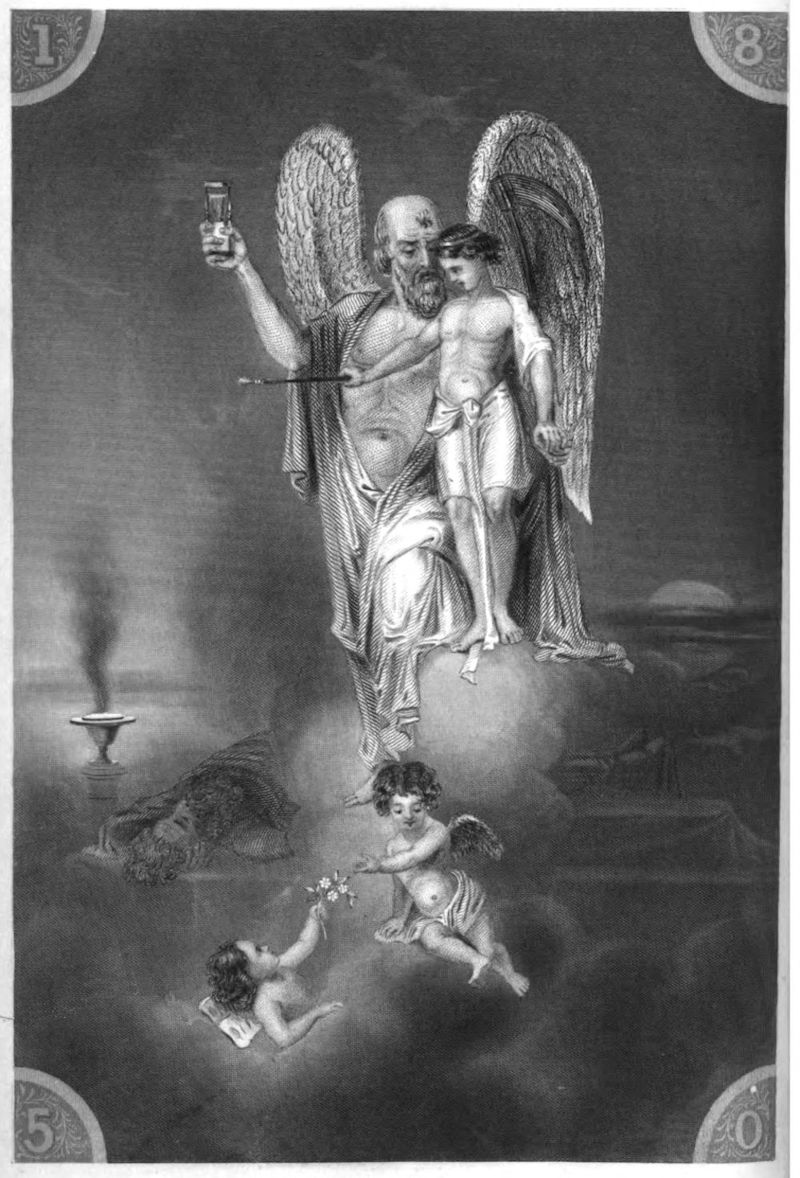
ADVENT OF THE YEAR.
Engraved expressly for Graham’s Magazine by W. E. Tucker
Printed by J. M. Butler
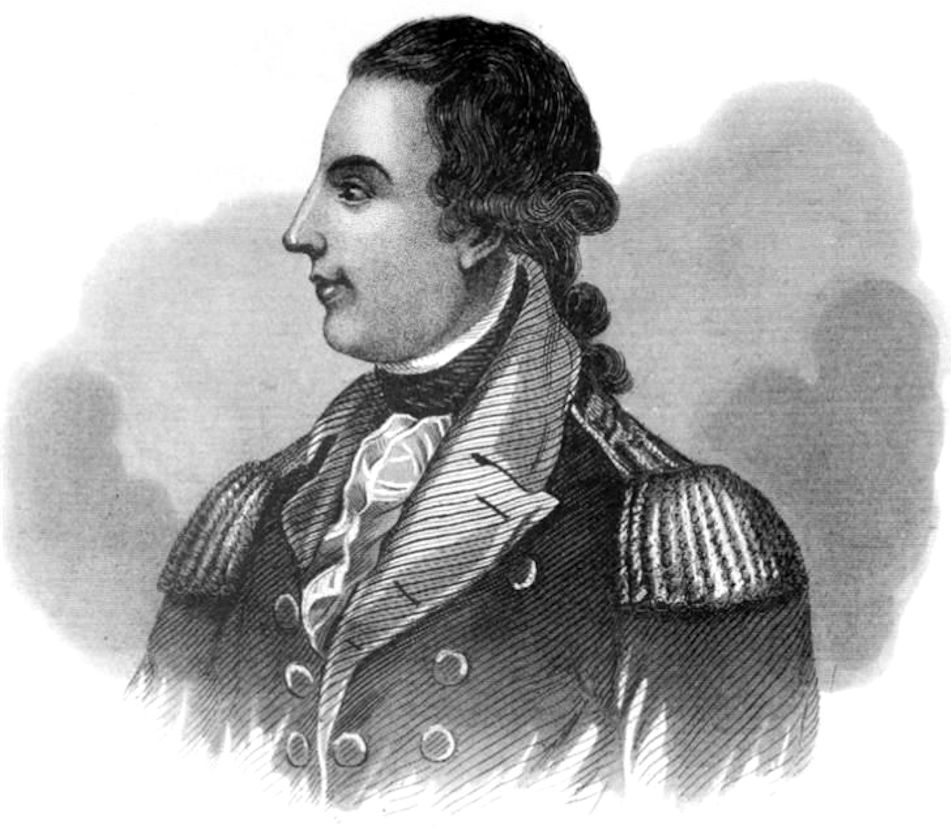
GENL. RICHARD MONTGOMERY.
Engraved expressly for Graham’s Magazine
———
BY THOMAS WYATT, A. M., AUTHOR OF “HISTORY OF THE KINGS OF FRANCE,” ETC. ETC. ETC.
———
Richard Montgomery, the subject of this memoir,
was born in the year 1737, at Convoy House, the seat
of his father, near Raphoe, in the north of Ireland.
Thomas Montgomery, father of the above, had three
sons, Alexander, John, and Richard. Alexander commanded
a grenadier company in Wolfe’s army, and was
also present at the capture of Quebec. He many
years represented the county of Donegal in the Irish
parliament. John, the second son, lived and died in
Portugal; and Richard, after receiving a liberal education
at Trinity College, Dublin, entered the British
army at the age of eighteen, under General Monckton.
In 1757 the regiment to which he belonged was ordered
to Halifax; and in the following year formed part
of the army at the reduction of Louisburg, a French
fortress, on which much money and science had been
expended, and which had been vauntingly named by
its possessors, “the Gibraltar of America.” Here our
young aspirant commenced his career of field-service,
which was destined to end in another war on the same
continent. Early in the spring of 1758, a naval and
military force commanded by Major-General Amherst,
and Admiral Boscawen, began its voyage from Halifax
to Cape Breton, and on the 2d of June arrived in Cabarras
Bay. As soon as practicable, the reconnoiterings
of the coast and other preliminaries were arranged.
Two divisions, commanded by Generals Lawrence
and Wetmore, were employed to keep the enemy in a
state of separation; while the third, composed of the
élite of the army under General Wolfe, pressed toward
the headland near Freshwater Cove, and in despite of
a heavy and well-directed fire from the French, and a
surf uncommon high and perilous, gained the bank,
routed the enemy, and seized a position which covered
at once the further debarkation of the troops, and the
necessary communications with the fleet. It was in
this movement Montgomery furnished the first decisive
evidence of those high military qualities which so
distinctly marked every step of his subsequent conduct.
An incident is related, as having occurred during
the bombardment of the fort, which excited the wit
of one of the officers. While commanding in the
trenches, a bomb thrown from the fort knocked off the
hat and grazed the skull of General Lawrence, but
without injuring him; which circumstance drew forth
a sarcastic remark from General Charles Lee, then a
captain in the British army—“I’ll resign to-morrow,”
exclaimed Lee. “Why so?” asked the person to
whom he spoke. “Because,” said the wit, “none but
fools will remain in a service in which the heads of the
generals are bomb-proof.” The siege terminated on
the 27th of July in the surrender of the fortress, the
destruction of several French ships of the line, and the
capture of a garrison of five thousand men.
So favorable were the impressions made of the aptitude
of our young soldier for military service, that he
was immediately promoted to a lieutenancy.
While the British were thus triumphant at Louisburg,
they at another and important point were fated
to sustain a heavy loss, as well in reputation, as in numerical
force, in the defeat of the army of Abercromby
at Ticonderoga.
In 1759, General Wolfe was placed at the head of
nearly eight thousand soldiers, and several ships-of-the-line,
with orders to reduce the fortress of Quebec.
After arriving and well reconnoitering the fortress,
the general discovered obstacles greater than he had
before conceived, and he found the only expedient left
for giving him a chance of accomplishing his plans,
was a constant and unrelaxing endeavor to decoy into
detachments, or to provoke to a general battle, his old
and wary antagonist, who seemed to understand too
well the value of the strength of his castle, to be easily
seduced from it. The attempt was accordingly made,
but ended in a new disappointment and increased vexation,
for the enemy refusing to quit his stronghold,
neither advanced in mass, nor in detachment, to attack
him, while his own troops showed a great want both
of order and discipline. This failure no doubt increased,
if it did not create, an indisposition, which caused a
temporary suspension of the general’s activity, during
which he submitted to the consideration of his officers
the general question of future operations and the direction
to be given to them, subjoining at the same time
statements and opinions relative to the proposed attack.
To these considerations Montgomery, though a junior
officer, was permitted to give an opinion, which was
received by his senior officers with much respect, and
afterward proved of great importance as followed by
Wolfe. Very soon, however, the fortress was surrounded
by the British, but nothing could be considered
as done while it remained to be taken, and for its security
there was still left a sufficient garrison and
abundant supplies, with an exterior force already formidable
and hourly increasing. Under the aspect of
things the chances were yet against the invaders, and
it required only a vigorous resistance on the part of the
garrison to have saved both the fortress and the province.
But fear betrays like treason. Ramsay, the
French commander, saw in some demonstrations, made
by the British fleet and army as trials of his temper, a
serious intention to attack him by land and water at
the same time, when, to escape this, he opened a negotiation
for the surrender of the fort at the very moment
when a reinforcement was ready to enter it.
The negotiation speedily closed by the surrender of the
capital, and Quebec was now in possession of the
British. Montgomery was the first to place the British
flag on the ramparts of the fortress with his own
hands.
By this time a large military force had been collected
in British America, and having no longer any professional
occupation there, detachments were made
from it against the French West India Islands. Of
these expeditions the principal objects were the reduction
of St. Pierre and Fort Royal in the island of Martinico,
and of Havana in that of Cuba. These campaigns
were extremely laborious and perilous, not only
by the climate and season, but by the means of defense
furnished by nature. In each of these Montgomery
had a full share, as well of the toil and danger, as of
the commendation bestowed upon efforts, which ultimately
triumphed over every kind and degree of resistance.
Martinico surrendered in February, 1762,
and Havana and the Moro Castle in the August following;
two events greatly tending to hasten the treaty of
Versailles, which put an end to the war on the 10th of
February, 1763. During this siege the loss sustained
by the British army amounted to twenty-eight thousand
men, besides which, more than half of the troops
sent back to New York, either died on the passage or
after their arrival.
Of the garrison left at Havana under General Keppel,
but seven hundred men were found fit for duty at
the peace. Soon after the official annunciation of
peace, Montgomery, who with the seventeenth regiment,
had returned to New York, sought and obtained
permission to return to England, where he remained
until the close of the year 1772. Although the military
abilities of Montgomery were highly distinguished, war
and conquest had no other charms to him than as the
means of peace and happiness to mankind, and he
found leisure in the midst of camps to cultivate an excellent
taste for philosophy and polite literature.
To these he added a careful study of the arts of government
and the rights of mankind, looking forward
to that time when he might return to the still scenes of
private life, and give a full flow to the native and acquired
virtues of a heart rich in moral excellence. He
had formed an early attachment, amounting even to an
enthusiastic love for this country.
The woodland and the plain; the face of Nature,
grand, venerable, and yet rejoicing in her prime; our
mighty rivers, descending in vast torrents through wild
and shaggy mountains, or gliding in silent majesty
through fertile vales; their numerous branches and tributary
springs; our romantic scenes of rural quiet; our
simplicity, then uncorrupted by luxury or flagrant vice;
our love of knowledge and ardor for liberty—all these
served to convey the idea of primeval felicity to a
heart which was fraught with benevolent feelings.
It was during his residence of nine years in England,
that the controversy between Great Britain and her
American colonies commenced. This he watched with
a jealous eye, and at last fancied he saw enough to
cause him to abandon the King’s service, and to seek
America as his future and permanent home. He accordingly
sold the commission he then held, and in
January, 1772, arrived in New York.
Very soon after his arrival he selected a delightful
spot on the banks of the Hudson river, in the state of
New York, purchased a farm there, and expected to
retire from the bustle of a noisy world. The following
year he married a daughter of Robert R. Livingston,
then one of the judges of the superior court of the province.
In this most eligible of all situations, the life of a
country gentleman, deriving its most exquisite relish
from reflections upon dangers and past services, he gave
full scope to his philosophical spirit and taste for rural
elegance. Satisfied with himself, and raised above all
vulgar ambition, he devoted his time to domestic pursuits,
the intercourse of a select society, the study of
useful books, and the improvement of his villa. But
neither wood nor lawn could make him forget the
duties which he owed to society. When the hand of
unlawful authority was stretched forth, Montgomery
was ready to exchange his peaceful groves for the
tented field. From that fatal day in which the first
American blood was spilt by the bands of British
brethren, and the better genius of the empire turned
abhorrent from the strife of death among her children,
our hero chose his part. In this state of things, the
National Congress employed itself in June, 1775, in
organizing an army, and, among other acts, appointed
a commander-in-chief, four major-generals, and eight
brigadiers.
Of the latter description Montgomery was one.
This unequivocal mark of distinction, conferred by the
highest acknowledged authority of the country, without
solicitation or privity on his part, was received by him
with a homage mingled with regret, apparently foreboding
the catastrophe which was soon to follow.
In a letter to a friend he says—“The Congress having
done me the honor of electing me a brigadier-general
in their service, is an event which must put an end
for a while, perhaps forever, to the quiet scheme of
life I had prescribed for myself; for, though entirely
unexpected and undesired by me, the will of an oppressed
people, compelled to choose between liberty
and slavery, must be obeyed.” Under these noble and
self-sacrificing views and feelings, Montgomery accepted
the commission tendered to him, and from that
hour to the moment of his death, the whole force of his
mind and body was devoted to the honor and interest
of his adopted country. His principles of loyalty remained
unshaken. Love to our brethren whom we
must oppose, the interchange of good offices, which had
so intimately knit the bands of friendship between the
two members, the memory of those days in which we
fought under the same banners; the vast fabric of mutual
happiness raised by our union, and ready to be
dissolved by our dissensions; the annihilation of those
plans of improvement in which we were engaged for
the glory of the empire—all these considerations conspired
to render this conflict peculiarly abhorrent to
him and every virtuous American, and could have been
outweighed by nothing earthly but the unquenchable
love of liberty, and that sacred duty which we owe to
ourselves and our posterity.
The necessity of resistance was manifest, and no
sophistry could question our right. “In cases of national
oppression,” says Blackstone, “the nation hath
very justifiably risen as one man to vindicate the original
contract subsisting between the king and the people.”—“If
the sovereign power threaten desolation to
a state, mankind will not be reasoned out of the feelings
of humanity, nor sacrifice liberty to a scrupulous
adherence to political maxims.” Montgomery did not
hesitate to accept the commission, praying at the same
time that “Heaven might speedily reunite us in every
bond of affection and interest; and that the British empire
might again become the envy and admiration of the
universe.” He was entrusted, jointly with General
Schuyler, with the expedition against Canada, but, in
consequence of the illness of that gentleman, the
whole duty devolved upon him. There was benevolence
in the whole plan of this expedition. It was
to be executed not so much by force as by persuasion,
and it was exactly suited to the genius of
Montgomery. He understood the blessings of a free
government, and could display them with captivating
eloquence.
He had a soul great, disinterested, affectionate, delighting
to alleviate distress, and to diffuse happiness.
He possessed an industry not to be wearied, a vigilance
that could not be eluded, and courage equal to
his other abilities. From the military character of the
French population in Canada, and its contiguity to the
northern section of the Union, it was determined to
endeavor to neutralize powers so extended and menacing.
This invasion was determined on by two
routes, the one by the river Sorel, the other by the
Kennebec; the army by the former route were to act
against Forts St. John, Chamblee, and Montreal;
while the second should enter Canada at or near
Quebec, contemporaneously with the other, and effect
a junction, if possible, with Major-General Schuyler,
who should command in chief.
To the first of these armaments Montgomery was
assigned, as the elder of the two brigadiers. He accordingly
hastened to Ticonderoga, the point selected
for the principal rendezvous and outfit of the projected
invasions. On arriving at his post his first object was
to acquire a correct knowledge of the force of the
enemy and his position, and found that General Carleton
was at Montreal preparing a naval force intended
to act on Lake Champlain. He perceived at once the
plan and the necessity of its defeat, and at once took
his post at the Isle-aux-Noix, as the best point to carry
his plan into execution. In a letter to General Schuyler
announcing his intention, he says—“Moving without
your orders, I do not like; but, on the other hand,
the prevention of the enemy is of the utmost consequence;
for if he gets his vessels into the lake, it is
over with us for the present summer. Let me entreat
you to follow in a whale-boat, leaving some one to
bring on the troops and artillery. It will give the men
great confidence in your spirit and activity; and how
necessary to a general this confidence is, I need not tell
you. I most earnestly wish that this suggestion may
meet your approbation, and be assured that I have your
honor and reputation much at heart. All my ambition
is to do my duty in a subordinate capacity, without the
least ungenerous intention of lessening that merit,
which is justly your due.” He hastened with his corps
of one thousand men, and two pieces of light artillery,
to begin his movement down the lake. It was ten
days, owing to the head winds, before he reached the
position he had selected. Major-General Schuyler arrived
about the same time, and it was thought a nearer
approach to the enemy advisable. The movement was
ordered, and a landing effected without obstruction,
about a mile and a half from St. John’s. On the evening
of their landing, after it was dark, they were
visited by a Canadian, who gave the following information —
“That the twenty-sixth was the only regular British
corps in Canada, that with the exception of fifty men,
retained by General Carleton at Montreal, the whole
of this was in garrison at St. John’s and Chamblee; that
these two forts were strongly fortified and abundantly
supplied; that one hundred Indians were at the former,
and a large body collected under Colonel Johnson; that
the vessel intended for the lake would be ready to sail
in three or four days, and would carry sixteen guns;
that no Canadian would join the American army, the
wish and policy of the people being neutrality, provided
their persons and property were respected, and
the articles furnished by, or taken from them, paid for
in gold or silver; that, under present circumstances,
our attack upon St. John’s would be imprudent; and
lastly, that a return to the Isle-aux-Noix would be proper,
as from this point an intercourse with the inhabitants
of Laprairie might be usefully opened.” On
hearing this report a council of war was called, and it
was decided to return to their former position on the
island. In General Schuyler’s report to Congress we
find the following—“I cannot estimate the many obligations
I lie under to General Montgomery for the
many important services he has done, and daily does,
and in which he has had so little assistance from me,
as I have not enjoyed a moment’s health since I left
Fort George, and am now so low, as not to be able to
hold the pen. Should we not be able to do any thing
decisively in Canada, I shall judge it best to move
from this place, which is a very wet and unhealthy
part of the country, unless I receive your orders to the
contrary.”
With this manifest foreboding of eventual disappointment,
the commanding general left the camp and
returned to Ticonderoga; and from thence to Albany,
where he was actively and usefully employed, during
the remainder of the campaign, in forwarding supplies
to the army. Montgomery remained at the island only
long enough to receive a reinforcement of men and a
few pieces of artillery.
He then re-embarked, again landed at St. John’s,
and commenced operations for its investiture.
On the 18th of September, he marched with a party
of five hundred men to the north of the fort, where
he met a considerable portion of the garrison returning
from the repulse of an American party under Major
Brown. A skirmish ensued, which in a few minutes
terminated in the repulse of the enemy, who fled in
disorder. But for the timidity among the Americans,
the whole party might have been captured. General
Montgomery in speaking of his men says, “As soon
as we saw the enemy, the old story of treachery
spread among the men; and the cry was, we are trepanned
and drawn under the guns of the fort. The
woodsmen were less expert in forming than I had expected,
and too many of them hung back. Had we
kept more silence we should have taken a field-piece
or two.”
Montgomery now determined to establish a camp
at the junction of the two roads leading to Chamblee
and Montreal, in order to cut off supplies, this he did,
and defended it with a ditch, and a garrison of three
hundred men. But new difficulties appeared to arise.
His artillery was so light that it made little or no impression
upon the walls, and the artillerists raw and
unskillful. And, added to all this, was the insubordinate
and mutinous conduct of his men, who, from constant
exposure to the damp and unhealthy climate,
were suffering from attacks of chills and fever; under
these circumstances, the commander was prevented
from enforcing discipline.
In this painful situation, he was frequently forced to
compromise with professional dignity, and submit his
own opinion to that of a board of officers of inferior
rank. To lessen the number and pressure of these
embarrassments, Montgomery decided on changing his
position and removing to the northwestern side of the
fort; which, as he was informed, would furnish ground
of greater elevation and dryer face, with a sufficient
supply of wholesome water. The misfortunes of
Montgomery appeared to follow one after the other
in rapid succession. To quiet the restless activity of
Ethan Allen, who, without commission or command,
had forced himself into the army as a volunteer, Montgomery
sent him to Laprairie, with an escort of thirty
men, and orders to mingle freely with the inhabitants,
and so to treat them, as would best conciliate their
friendship and induce them to join the American
standard. In the commencement, Allen was not unsuccessful,
for he added to his corps fifty Canadians;
when, either deceived in regard to the enemy’s
strength, or indifferent to its magnitude, and without
direction or privity on the part of his General, he determined
to risk an attack on Montreal. This insane
attempt was met by a party of British who captured
him and thirty-eight of his followers.
Shortly after, another event took place, as fortunate
as it was unexpected, and which eventually decided
the fate of the garrison. A gentleman from New
York, named James Livingston, had resided for a considerable
time in Canada, and by a proper course of
conduct had won the esteem of a large number of the
inhabitants. Montgomery was so fortunate as to enlist
this gentleman in his favor, and prevailed on him to
raise an armed corps, under the promise of eventual
protection, made and promulgated by the order of Congress.
With three hundred of these newly raised recruits,
Majors Brown and Livingston obtained possession
of Fort Chamblee, capturing the whole of the
garrison, and a large quantity of military stores, among
which were one hundred and twenty-six barrels of
gunpowder. By this fortunate movement, General
Carleton found himself compelled to quit his insular
position at Montreal, and risk a field movement in defence
of his fortress. The force at the disposal of
General Carleton, did not exceed twelve hundred men,
and which was composed partly of Canadian militia,
who were serving with reluctance, and emigrants from
Scotland, recently engaged—in no way acquainted
with military duty.
On the 31st of October he crossed the St. Lawrence
opposite Longueil, whence he determined, after mustering
his forces to march against the besieging army.
The movements of Sir Guy Carleton, though conducted
with considerable secrecy, did not escape the vigilant
eye of Montgomery, who had for some time expected
such a proceeding. He had previously ordered certain
officers to take a position with two regiments on
the Longueil road, ordering them to patrol that route
carefully and frequently, as far as the St. Lawrence;
to report daily to the commanding general such information
as he might be able to obtain, and to attack any
part of the enemy indicating an intention of moving in
the direction of the American camp.
These regiments, commanded by General Warner,
arrived at Longueil on the morning of the same day
that Carleton was preparing to cross, but did not display
their force until the British had nearly reached
the shore. He then suddenly opened upon them with
both musketry and artillery, killing many of the soldiers,
and scattering and disabling their boats. By a
most fortunate coincidence, at the same time, and with
similar orders, Easton, Brown, and Livingston approach
McLean, who, losing all hope of support from
Carleton, hastily withdrew to his boats and descended
the St. Lawrence.
This gratifying intelligence was immediately communicated
to General Montgomery, who presented
them in a written form to the commandant of St.
John’s, urging the impossibility of his deriving any relief
from Carleton, and the useless effusion of blood,
which must necessarily follow any attempt to prolong
the defense. After proper consideration the garrison
surrendered. The next step to be taken, was a rapid
movement on Montreal, but which was much impeded
by the disaffection of the troops; this was only overcome
by a promise of discharge at Montreal. Under
this arrangement, he was enabled to display a force in
front of the town, which on the 12th of November secured
to him a full and peaceable possession of it, and
of eleven armed vessels left by the enemy. Though
now master of a great part of Canada, Montgomery’s
labors, far from becoming lighter or fewer, were much
augmented in both number and character.
The pursuit of Carleton, (who had retreated to his
fleet, with the hope of making his escape through that
avenue; but finding this impossible, entered a small
boat with muffled oars, and at midnight passed through
the American fleet without being perceived and hurried
on to Quebec,) and an experiment on the strength
of Quebec, were objects sufficiently indicated by his
own judgment, and the hopes of the nation. To prosecute
so desperate an action required means of which
he was greatly deficient.
His situation described in a letter to R. R. Livingston,
then a member of Congress, is a faithful picture
of the embarrassments under which he labored. He
says:
“I need not tell you that until Quebec is taken, Canada
is unconquered; and that to accomplish this we
must resort to siege, investment, or storm. The first
of these is out of the question, from the difficulty of
making trenches in a Canadian winter, and the greater
difficulty of living in them, if we could make them;
secondly, from the nature of the soil, which, as I am
at present instructed, renders mining impracticable,
and, were this otherwise, from the want of an engineer
having sufficient skill to direct the process; and
thirdly, from the fewness and lightness of our artillery,
which is quite unfit to break walls like those of Quebec.
Investment has fewer objections, and might be
sufficient, were we able to shut out entirely from the
garrison and town the necessary supplies of food and
fuel, during the winter, but to do this well (the enemy’s
works being very extensive and offering many avenues
to the neighboring settlements,) will require a large
army, and from present appearances mine will not,
when brought together, much if at all exceed eight
hundred combatants. Of Canadians I might be able
to get a considerable number, provided I had hard money,
with which to clothe, feed, and pay their wages;
but this is wanting. Unless, therefore, I am soon and
amply reinforced, investment, like siege must be given
up.
“To the storming plan there are fewer objections;
and to this we must come at last. If my force be
small, Carleton’s is not great. The extensiveness of
his works, which, in case of investment, would favor
him, will in the other case favor us. Masters of our
secret, we may select a particular time and place for
attack, and to repel this the garrison must be prepared
at all times and places; a circumstance, which will
impose upon it incessant watching and labor by day
and by night; which, in its undisciplined state, must
breed discontents that may compel Carleton to capitulate,
or perhaps to make an attempt to drive us off.
In this last idea, there is a glimmering of hope.
Wolfe’s success was a lucky hit, or rather a series
of such hits. All sober and scientific calculation was
against him, until Montcalm, permitting his courage
to get the better of his discretion, gave up the advantages
of his fortress and came out to try his strength
on the plain.
“Carleton, who was Wolfe’s quartermaster-general,
understands this well; and, it is to be feared, will not
follow the Frenchman’s example. In all these views,
you will discover much uncertainty; but of one thing
you may be sure, that, unless we do something before
the middle of April, the game will be up; because by
that time the river may be open and let in supplies and
reinforcements to the garrison in spite of any thing we
can do to prevent it; and again, because my troops are
not engaged beyond that term, and will not be prevailed
upon to stay a day longer. In reviewing what I
have said, you will find that my list of wants is a long
one, men, money, artillery, and clothing accommodated
to the climate. Of ammunition Carleton took
care to leave little behind him at this place. What I
wish and expect is, that all this be made known to
Congress, with a full assurance, that, if I fail to execute
their wishes or commands, it shall not be from
any negligence of duty, or infirmity of purpose on my
part. Vale, cave ne mandata frangas.”
On the 19th of November, General Arnold having
crossed the St. Lawrence in safety, was joined by
Montgomery, and on the 4th of December, took a position
before Quebec. The first thing was to obtain a
knowledge of the extent and structure of the enemy’s
works; the force and strength of his garrison, and the
means possessed by the inhabitants to supply the wants
of the troops.
Montgomery having satisfied himself on these points,
next presented a summons to surrender in the customary
form, a cannonade of the fort from a battery of
five guns and one howitzer; a display of the American
force in full view of the British garrison, in the hope
that the enemy would forego a contest; but this was
done without producing any effect. At this moment
a circumstance took place which threatened the whole
project with defeat. Three companies of Arnold’s
detachment (whose term of service was on the point
of expiring) having taken offence at the conduct of their
commanding officer, the cause of which offence was
never properly explained; seized the present occasion
to make known their intention of quitting the army,
unless, in the approaching movement they were permitted
to attach themselves to some other corps. Upon
investigating the affair, General Montgomery found the
complaints so absurd, that he promptly determined, in
justice to Arnold, to reject the proposal. But before
officially announcing his decision, he thought it most
prudent to try what could be effected by expostulation;
in this attempt he finally succeeded, and brought them
back to a sense of good order and obedience, without
coercive means. The mind of Montgomery was not
yet at ease, and suspecting that the flame of the late
controversy might not be extinguished, he resolved to
call a council of war, in which he submitted two questions,—“Shall
we attempt the reduction of Quebec by
a night attack? And if so, shall the lower town be the
place attacked?” This seemed to infuse new life into
the officers, and both questions were affirmatively decided,
the troops were ordered to parade in three
divisions at two o’clock in the morning of the 31st of
December; the New York regiments and part of Easton’s
Massachusetts militia, at Holland House; the
Cambridge detachment and Lamb’s company of artillerists,
with one field-piece at Captain Morgan’s quarters;
and the two small corps of Livingston and Brown
at their respective grounds of parade. To the first and
second of these divisions were assigned the two assaults
on the opposite sides of the lower town; and
to the third, a series of demonstrations or feigned attacks
on different parts of the upper. This arrangement
was made to meet the expectations of colonies,
who looked to Montgomery for the capture of the
capital, and speedy reduction of the province. But
they understood little of Montgomery’s difficulties; the
steep heights which fortified the upper town rendered
the passage from one to the other almost impassable.
The number of soldiers in the garrison consisted of
about two hundred and seventy marines and regulars,
eight hundred militia, and four hundred and fifty seamen.
The movement began between three and four
o’clock in the morning, from the Heights of Abraham;
Montgomery advancing at the head of the first division
by the river road, round the foot of Cape Diamond to
Aunce au Mere; and Arnold at the head of the second,
through the suburbs of St. Roque, to the Saut de Matelots.
Both roads were so obstructed by snow and
thick masses of ice, as to render their progress very
difficult. These obstacles being at last surmounted,
the first barrier was approached, vigorously attacked,
and rapidly carried, and the troops after a moment’s
pause pushed on to the second.
A moment, and but a moment, was now employed
to re-excite the ardor of the troops, which the fatigue
of the march and the severity of the weather had somewhat
abated. “Men of New York,” exclaimed Montgomery,
“you will not fear to follow where your
general leads—march on!” then placing himself again
in the front, he pressed eagerly forward to the second;
he assisted with his own hands in pulling up some
pickets which hindered the march. Near this place a
barrier had been made across the road, and from the
windows of a low house, which formed part of it,
were planted two cannon. At his appearing upon a
little rising ground, at the distance of about twenty or
thirty yards, the guns were discharged, and the general
with his aide-de-camps fell dead. Thus terminated the
life and labors of Major-general Richard Montgomery,
in the thirty-ninth year of his age.
Upon hearing of the death of their commander, both
divisions made a disorderly and hasty retreat to the
Heights of Abraham.
The fortune of the day being now decided, the corpse
of the fallen general was eagerly sought for and soon
found. When the corpse of Montgomery was shown
to Carleton, the heart of that noble officer melted.
They had served in the same regiment under Wolfe,
and the most friendly relation existed between them
throughout the whole of the French war. The lieutenant-governor
of Quebec, M. Cramahé, ordered a
coffin to be prepared for him, and decently interred
within the walls of the city, where friends and enemies
united in expressions of sorrow, as his remains were
conveyed to their final resting-place. Ramsey, in his
History of the Revolution, has the following appropriate
remarks:
“Few men have ever fallen in battle so much regretted
on both sides as General Richard Montgomery.
His many amiable qualities had procured him an uncommon
share of private affection; and his great
abilities an equal proportion of public esteem. Being
a sincere lover of liberty, he had engaged in the American
cause from principle, and quitted the enjoyment
of an easy fortune, and the highest domestic felicity, to
take an active share in the fatigues and dangers of a
war instituted for the defense of the community of
which he was an adopted member. His well-known
character was almost equally esteemed by the friends
and foes of the side of which he espoused. In America
he was celebrated as a martyr to the liberties of mankind;
in Great Britain, as a misguided good man, sacrificing
to what he supposed to be the rights of his
country.
His name was mentioned in Parliament with singular
respect. Some of the most powerful speakers in that
assembly displayed their eloquence in sounding his
praise and lamenting his fate. Those in particular who
had been his fellow soldiers in the previous war, expatiated
on his many virtues. The minister himself
acknowledged his worth, while he reprobated the cause
for which he fell. He concluded an involuntary panegyric
by saying, “Curse on his virtues, they have undone
his country.”
“In this brief story of a short and useful life,” says
his biographer, “we find all the elements which enter
into the composition of a great man and a distinguished
soldier; a happy physical organization, combining
strength and activity, and enabling its possessor to encounter
laborious days and sleepless nights, hunger and
thirst, all changes of weather, and every variation of
climate.
“To these corporeal advantages was added a mind,
cool, discriminating, energetic, and fearless; thoroughly
acquainted with mankind, not uninstructed in the
literature and sciences of the day, and habitually directed
by a high and unchangeable moral sense. That
a man so constituted should have won the golden
opinions of friends and foes, is not extraordinary. The
most eloquent men of the British Senate became his
panegyrists; and the American Congress hastened to
testify for him their grateful remembrance, profound
respect, and high veneration. A monument to his
memory was accordingly erected, on which might
justly be inscribed the impressive lines of the poet:
‘Brief, brave, and glorious was his young career;
His mourners were two hosts—his friends and foes;
And fitly may the stranger, lingering here,
Pray for his gallant spirit’s bright repose;
For he was Freedom’s Champion, one of those,
The few in number, who had not o’erstept
The charter to chastise, which she bestows
On such as wield her weapons; he had kept
The whiteness of his soul, and thus men o’er him wept.’
“To express the high sense entertained by his
country of his services, Congress directed a monument
of white marble, with the following inscription on it,
which was executed by Mr. Cassiers, at Paris, and
was placed in front of St. Paul’s church, New York:
THIS MONUMENT
was erected by order of
Congress, 25th January, 1776,
to transmit to posterity
a grateful remembrance of the
patriotism, conduct, enterprise, and
perseverance,
OF MAJOR-GENERAL
RICHARD MONTGOMERY,
who, after a series of successes,
amid the most discouraging
difficulties, fell in the attack
on Quebec,
31st December, 1775,
aged 39 years.
“The remains of General Montgomery, after resting
forty-two years at Quebec, were, by a resolution of
the Legislature of the State of New York, brought to
the city on the 8th day of July, 1818, and deposited
with an imposing solemnity suited to the occasion, near
the monument erected by order of the United States.
The following inscription was placed upon the additional
coffin. ‘The State of New York, in honor of
General Richard Montgomery, who fell gloriously fighting
for the Independence and Liberty of the United
States, before the walls of Quebec, the 31st of December,
1775, cause these remains of this distinguished
hero to be conveyed from Quebec, and deposited on
the 8th day of July, 1818, in St. Paul’s Church, in the
city of New York, near the monument erected to his
memory.’ ”
It has been stated in several histories of this
lamented officer, that the body was privately interred
in the evening by a few soldiers; but this is not true;
and justice to his generous adversary requires that we
should vindicate the reputation of the lieutenant-general
of Canada from such a stigma. John Joseph Henry,
Esq., who was under Montgomery, and being taken
by the enemy, had an opportunity of witnessing the
honors that were paid to his memory, writes thus:
“It was on this day that my heart was ready to burst
with grief at viewing the funeral of our beloved general.
Sir Guy Carleton had, in our former wars with
the French, been the friend and fellow-soldier of
Montgomery. Though political opinion, perhaps ambition
or interest, had thrown these worthies on different
sides of the great question, yet the former could
not but honor the remains of his quondam friend.
About noon the procession passed our quarters. It was
a mournful sight. The coffin, covered with a black
pall, surmounted by transverse swords, was borne by
men. The regular troops, particularly that fine body
of men, the seventh regiment, with reversed arms, and
scarfs on the left arm, accompanied the corpse to the
grave. The funeral of the other officers, both friends
and enemies, were performed the same day. Many
and deeply heartfelt were the tears of affection shed
that day; of affection for those who were no more,
and of greeting and thankfulness toward Carleton.
The British soldiery and inhabitants appeared affected
by the loss of this invaluable man, though he was
their enemy. If such men as Washington, Carleton,
and Montgomery, had had the entire direction of the
adverse war, the contention in the event might have
happily terminated to the advantage of both sections of
the nation.”
———
BY HENRY T. TUCKERMAN.
———
As the last column of a temple vanished,
A Palm-tree, in a city of the West,
Stood, like a hero from his country banished,
A proud though lonely guest.
Perchance its birth-place was a holy mountain,
Or radiant valley of some tropic isle,
Near pyramid, or mosque, or wayside fountain,
By Jordan or the Nile.
And oft its high and tufted crest beholding,
In each vibration of the arching leaves,
A plaintive strain I seemed to hear unfolding,
As when an exile grieves.
For solemn is the air of isolation,
And that lone offspring of the desert wild
Wore to my eye a look of consecration,
That sympathy beguiled.
No more around it eastern balms were stealing,
But smoke and dingy vapors of the town,
No Moslem in its pillared shade was kneeling,
Nor caravan sunk down.
Before it once the sandy ridges heaving,
Spread like an ocean, limitless and free,
And the mirage its panorama weaving,
Rose beautiful to see!
Now waves of eager life beneath it swelling,
With restless care mock oriental ease,
And chimney-stacks, tiled roof and murky dwelling,
Shut out the sun and breeze.
Yet even here I marked, each day, appearing
An aged Syrian, sorrowful and calm,
With folded arms, wan smile, and looks endearing
Cast on the lonely Palm.
And once he murmured, as the night descended,
While gazing fondly through unconscious tears,
“Fair tree, the promise of thy life is ended,
For here thou hast no peers.”
How near the good we distantly are craving!
The Syrian long had weary vigil kept —
One morn his country’s tree was gaily waving —
It blossomed while he slept!
Some far-off nook of that vast city treasured
Another Palm by careless eyes unseen,
That drearily the lingering years had measured,
Yet put forth shoots of green;
Until its ripened flower-dust uplifting,
On the strong currents of the tideless air,
With certain aim to his pent garden drifting,
A mate encountered there!
Thus seeds of Truth their noiseless flight are winging,
And Love instinctively steals through the crowd,
To hearts receptive consolation bringing,
They may not breathe aloud!
Accept the omen, thou who toilest lonely,
And patiently Life’s blossoming await,
Where God has planted thee be faithful only,
And thou shalt conquer Fate!
A SLIGHT SKETCH.
———
BY GRACE GREENWOOD.
———
“Health to the art whose glory is to give
The crowning boon that makes it life to live.”
Holmes.
Start not, my fastidious reader, when I announce
that the young gentleman, in whose favor and fortunes
I would enlist your friendly sympathies, as the hero of
this sketch, is, or rather was, a medical student. Now
I am very well aware that medical students are proverbially
“hard cases”—wild, spreeing, careless, skeptically
inclined young gentlemen, whose handkerchiefs
smell of ether, and whose gloves are strongly suggestive
of rhubarb; whose talk runs large, with bold jests
on grave subjects, sly anatomical allusions, and startling
hints at something
“Mair horrible and awfu’,
Which e’en to name wad be unlawfu’,”
and whose very laughter has a sort of bony-rattle
about it.
But our friend, Will Ashley, fortunately belonged
not to the Bob Sawyer and Ben Allen class of Esculapian
disciples. He was a man of refinement, intellect,
education, and principle—pleasing address, fine
person, and good family. Republican as I am, I can
but think much of good blood—pure and honorable
blood, I mean. He had no bravado, no pretension, no
recklessness, no skepticism about him. He chose
his profession at the first, from a real, natural leaning
that way, and pursued it with true enthusiasm and untiring
constancy; and this partiality and devotion have
been rewarded with the happiest success. Dr. Ashley
is now regarded by his many patients, with a remarkable
confidence and affection. To them, there seems
“healing in the very creak of his shoes on the stairs,”
his cheerful smile lights up the sick room like sunshine;
his gentle words and sympathetic tones are as balm
and “freshening oil” to hearts and minds, wounded and
distempered with the body, and his bright laugh and
playful wit are a positive tonic to the weak and nervous
and fearful. But I am anticipating; my story has
perhaps most to do with the student-life of Ashley.
When William was quite young—a mere boy indeed,
he became much attached to a pretty cousin of
his own—a gentle, dark-eyed, Southern girl, who made
her home for some years with his mother and sister,
in the quiet, New England city of H——, where she
was attending school.
Jessie Archer was, in truth, a lovely creature—with
a heart full of all good and kindly feelings—with a soft,
endearing manner, but with very little strength of character,
or stability of purpose. She tenderly loved her
Northern relatives, and parted from them at last, from
her cousin William in particular, with many tears and
passionate expressions of regret. She was not positively
betrothed to this cousin—such a measure would
have been opposed by their friends, on account of the
extreme youth of the parties—but she knew well his
love and his dear hope—that he looked upon her as his
future bride, and she was well content with this understanding.
As a matter of course, and lover-like necessity,
William Ashley corresponded with his cousin. At
first, the letters on both sides were frequent, long, and
confidential; but after the first year of absence, those
of Miss Jessie changed gradually in their tone, and became
“few and far between.” But William, who
was faithful and believing, made a thousand kind excuses
for this, and continued to write out of his own
affectionate and changeless heart. But at length his
Jessie ceased to write altogether. Two months went
by, and then poor Ashley, in much distressful anxiety,
wrote to her, entreating to be told the cause of her
strange silence. There came a reply at last—a brief
reply, written in the dear, familiar hand, but bearing
for a signature, a strange name. She had been a fortnight
married to a wealthy Virginia planter.
This home-thrust at his heart by a beloved hand;
this sudden annihilation of his dearest hopes, by her
whose sweet source and centre they had been, almost
prostrated the young student, mind and body. He was
proud, sensitive, and twenty-one; he had the heart and
was at the age to feel acutely, to suffer and despair.
His ambition died out—his energies flagged—then his
appetite went by the board; his eye grew spiritless,
his step heavy, and his cheek pale. “He must give
up study,” said his mother. “He must take a journey,”
said his sister, speaking one word for him and
two for herself. This last proposition, which was
strongly pressed, was finally acceded to; and the young
gentleman set forth, dispirited and ill, under the care,
(“protection,” she called it,) of his charming sister,
Ellen. They went directly West, for a visit to the
Falls; the very journey which William had always
looked forward to as his bridal-tour. Now it seemed
but to depress and sadden him the more; he was restless,
moody, and abstracted—the very worst traveling-companion
possible to have. Ellen found it exceedingly
difficult to divert him from his melancholy
thoughts and tender recollections, “pleasant and mournful
to the soul.” The fine scenery along their route,
constantly reminded him of the double pleasure he had
anticipated in first viewing it with his beautiful bride.
At Buffalo, our travelers took the afternoon boat for
Chippewa. It was a bright and breezy day, early in
in July—water, earth and sky were lit up gloriously by
the declining sun, as they swept down that grand, immortal
river. As the brother and sister stood on deck,
silently drinking in the rare beauty of the scene and
hour, they noticed a party near them, distinguished
amid all the crowd, by a certain quiet elegance of dress
and manner, with a bearing of perhaps unconscious
superiority. This was a family party, and consisted of
an elderly gentleman, Mr. Harley, a wealthy banker,
and an honorable citizen of New York—his wife, a
sweet, motherly-looking woman—their daughter, Juliet,
a fair and delicate girl of eighteen, and their only son,
Master Fred, a lad of nine or ten.
Ashley was a thorough republican—poor and proud;
and being now more than usually inclined to coldness
and reserve, instinctively shrunk from all contact with
this party, in whom he at once recognized the air patrician
and exclusive. But toward evening, Mr. Harley
made some courteous advances, and finally succeeded
in getting up quite a free and animated conversation with
his young fellow-traveler, with whose well-bred air
and thoughtful countenance he had been attracted and
impressed. They discoursed on the magnificent
scenery around them, then on the battles and sieges,
bold generalship and grand fighting which had made
classic ground of the wild Niagara frontier; and Ashley,
who was an admirable talker, soon became earnest
and even eloquent, in spite of himself. All at once, in
looking up, he met the beautiful blue eyes of Miss Juliet
fixed upon him with evident interest and admiration.
The young lady dropped her gaze instantly, while a
deep blush suffused her bright, ingenuous face. An
involuntary thrill of pleasure agitated the heart of
Ashley, and his cold eye kindled with a new fire; but
as thought returned—the thought of all the fickleness
and coquetry, and heartlessness of woman, his brow
clouded, he bit his lip, and with a few hasty words,
turned abruptly, and drawing his sister’s arm within
his own, walked to the side of the vessel, and there
stood, silently and moodily, gazing down into the
darkening waters and off into the deepening twilight.
Owing to some detention, the boat was later than
usual, so that it was quite dark when they landed at
Chippewa. On leaving the boat, Mr. Ashley and his
sister found themselves directly behind the party with
whom they had been conversing. Mr. Harley looking
round and seeing them, began making some inquiries
respecting the hotel of which they had made choice,
when Master Fred, who, in his boyish independence,
was walking alone, suddenly stumbled and fell—fell
from the broad plank over which they were passing,
into the river below. There were screams and shouts,
and rushings to and fro, but no rescue was attempted,
until Ashley, breaking from the clinging hold of his
sister, leaped boldly into the deep, dark water. For a
few moments, which seemed an age to the spectators,
he searched in vain along the narrow space between
the vessel and the wharf, but finally he espied the lad’s
head appearing from under the boat, caught, and drew
forth the already insensible child, and greatly exhausted
himself, swam back to the plank with his precious burden.
They were drawn on board together with joyful
shouts and earnest thanksgiving.
As Ashley stood in the gangway, staggering and half
blind, the crowd cheering and pressing around him, his
sister flung her arms about his neck, and hung upon
him, laughing and weeping hysterically. But the poor
fellow was faint and chilled, and strove to release himself
from her passionate embrace. But just as he stood
free, he felt his hand clasped, but gently, timidly, and
looking round, saw Miss Harley at his side. She
hastily raised that cold, wet hand to her warm, quivering
lips, and kissed it gratefully, while her tears, her
irrepressible tears, fell upon it, as she murmured—“God
bless you! God in heaven bless you!” and then
hurried away to attend upon her brother, who had been
carried back into the cabin. The little lad soon recovered
sufficiently to be able to join the party, who
together took their way to the Clifton House.
That night, after supper, which he had served in a
private parlor, Mr. Harley sought the room of Ashley—his
heart overflowing with gratitude toward the
young hero, and his thoughts busy with plans of generous
recompense. At the door he met a servant
bearing away a wet traveling-suit, which sight quickened
even more his warm and kindly feelings. He
entered, to find Mr. Ashley wrapt in a dressing-gown,
sitting by a table, his head bent down on his hands, a
plate of light food, almost untasted, and a cup of tea,
half drank, pushed back from before him. He was
looking even paler and more spiritless than usual. In
fact, our friend was completely exhausted by the excitement
and exertion of the evening, and consequently
deepened in moodiness and reserve. He rose, however,
as his visiter entered, and bowing politely, begged
him to be seated. But Mr. Harley came forward, took
his hand, and pressing it warmly, looked kindly into
that pale, quiet face, his own countenance all a-glow,
and tears actually glistening in his deep-set, gray eyes.
Ashley cast down his own eyes in painful embarrassment,
which Mr. Harley perceiving, took the proffered
chair, and strove to converse awhile on indifferent
topics. But he soon came round to the subject nearest
his heart—dwelt long and at large on his paternal joy
and gratitude, not seeming to heed the impatience of
his sensitive auditor, and finally closed with,
“I trust that there is some way in which I can prove
my gratitude—in part reward you for your generous
heroism. Tell me, my dear young friend, can I repay
you in any way?”
To Ashley’s jealous ear there was a tone of patronage—an
insulting jingle of the banker’s purse in these
words, at which he involuntarily drew himself up, and
curled his short upper-lip; and when Mr. Harley
earnestly repeated his question, thus:
“Is there no way in which I can serve you?” he
replied with a sort of nonchalant hauteur,
“Yes; by never mentioning this little circumstance
again. I but did for your son what I would do for any
fellow-creature. It was a mere act of humanity, I
assure you.”
Mr. Harley, quite taken aback, chilled, and withal
deeply hurt, rose at once, and with a stately bow and
a cold “good-night,” parted from the rescuer of his
child, the young hero, with whom five minutes before
he would have divided his fortune. Tired and indifferent,
Ashley flung himself upon his bed, and slept
soundly till late in the morning; then rose with a headache,
made a light breakfast, and hurried down to
Table-Rock with his sister, who had been up since
daybreak, impatiently awaiting his appearance.
Ashley was long lost in that first contemplation of
the grand scene before him; his soul seemed born to a
new life—a new world of beauty, and power, and
dread, overwhelming sublimity.
The day was wondrously beautiful, and floods of
sunlight were mingling with the waters, and pouring
over that stupendous precipice; into the darkest deeps
fell the fearless, glad sunbeams, sounding like golden
plummets those terrible abysses. There hung the rainbow,
and Ellen, as she gazed, remarked a wild-bird,
who seemed sporting in the spray, pass through the
illuminated arch, and become glorified in its midst;
and it seemed to her like an innocent, confiding spirit,
coming near to the might and grandeur of Deity, through
the beautiful gateway of love.
Ashley was at length roused from his trance of high-wrought
rapture, by feeling a small, timid hand laid on
his arm, and turned to see Master Fred standing at his
side, with a faint glow on his cheek, and an affectionate
pleasure shining in his sunken eye. The lad, to-day
something of an invalid, was accompanied and half-supported
by a servant. Ashley felt an instinctive attraction
toward this child, who was a fine, intelligent boy,
by the way, and talked with him more kindly and familiarly
than he had ever felt disposed to converse with
the elder Harley.
On leaving the rock, the Ashleys overtook Mr.
Harley with his wife and daughter. Juliet blushed
painfully, as her eye met that of William, but he bowed
and smiled, as she bade the brother and sister, “Good-morning.”
Mr. Harley merely lifted his hat, but Mrs.
Harley, who had been so absorbed the evening previous
by her intense anxiety for her son, as almost to forget
his brave rescuer, now, dropping the arm of her husband,
and grasping the hand of the young student,
poured the whole story of her boundless gratitude, of
her deep, immeasurable joy, into his not willing ear.
But after all, the blessing of that mother sunk into his
heart—a good heart, though somewhat wayward, and
sadly out of harmony with life just now.
A short time after this, Ashley again saw Miss
Harley. They met in a fearful place, behind the sheet,
on Termination Rock—the secret, dread abode, the
dim, awful sanctuary of sublimity.
Even then, Ashley, exalted by poetry, solemnized
by grandeur as he was, could but remark the miracle
of beauty which made the young lady look lovely as
ever in the rude, grotesque costume, the clumsy waterproof
dress provided for this adventurous expedition.
He next noticed the fearless, yet awe-struck enthusiasm,
the high, rapt expression of her face, as, sheltering
her eyes from the storm of spray with her fair
hand, she gazed upward, to where the huge columns
of water, dark-green, and snowy-white, leaped over
the shelving precipice, and plunged with a thunderous
roar into the black abyss at her side.
In after days he often thought of that fair creature,
as she thus appeared—so young, so delicate, yet so
brave—so lost to herself almost to life, in a deep
trance of awe and adoration. He often thought of her
thus, as his last sight of her; for after this they parted—he
and Ellen passing over to the American side, saw
no more of the Harleys during their brief stay at the
Falls.
Ashley was, almost in spite of himself, much improved
in health and spirits by travel; and on his return
resumed his studies with a sort of dogged devotion,
if not with all his old enthusiasm. Yet sometimes,
as formerly, the vision of a fair being would
come to disturb and distract his thoughts—would flit
across his humble room, be almost palpably present to
his waking dreams. But it hardly seemed the “lovely
young Jessie,” the “beloved of his early years;” this
was a fairer, slighter form, clad, oddly enough, in a
heavy dress of yellow oil-cloth, with a sort of hood,
which, half-falling back, revealed a sweet face, all
glorified by sublime adoration. He saw—how distinctly
he saw, the deep, abstracted eyes, the bright,
parted lips—ah, those lips! whenever he recalled them
by some mysterious association, his eye would fall on
his own right hand—a tolerably symmetrical hand,
surely, but with nothing more peculiar about it, that I
could ever see.
The fall succeeding the journey to Niagara, William
Ashley received his diploma, and the next spring opened
an office in his native city. Not possessing wealth, or
much family-influence, and being young and modest,
he had at first few, very few calls. But he was always
at his post, never employed his leisure unworthily, or
was idle or desponding. He studied as diligently as
ever, and waited patiently for those patients whom he
rested assured, in the future—the fair, golden future—were
“bound to come.”
It happened that the young physician’s way home
from his office, lay past, and very near to the elegant
residence of Mr. N——, a wealthy and somewhat distinguished
citizen of H——; and, pouring through the
open windows of this mansion, he one night heard the
sweetest singing that had ever met his ear. It was a
clear, fresh contralto voice, artistic in execution, yet
sweet, and full of feeling.
Ashley, a fine singer himself, was passionately fond
of music; and he lingered long before that house, walking
up and down beneath the thick shadows of the
grand old elms.
This was but the beginning of pleasure; night after
night, for some weeks, found the young physician in
the same spot, when he was almost always so happy
as to hear that rare, delicious singing, thrilling and
quivering through the still and dewy air. It was generally
accompanied by the piano; but sometimes he
would see a gay group on the piazza, and among them
a slight figure in white, looking very fair and delicate
in the moonlight; then there would come the tinkling
of a guitar, and sweet love-lays of Italy, or wild ballads
of Spain.
And thus it went on, till Ashley, the invisible listener,
had become altogether enchanted, spell-bound—in love
with a voice, till fast and far in the dim distance, faded
away that late familiar vision in yellow oil-cloth and
falling hood, and fair, kindling countenance. He now
spent as many hours over his books as ever, but his
thoughts, alas! were far enough from the page; for,
to tell the truth, and expose his boyish folly, he was
constantly dreaming out the form and features of the
dear, unknown—of her with the voice. Unlike his
former self, he now looked searchingly at the fair promenaders
whom he met on the street, and he there saw
pretty young ladies enough, but no one in whom he recognized
his idea of the sweet singer.
At length the hour of good fortune came alike to the
physician and to the lover.
Just at sunset, one pleasant evening, a young horseman
came dashing up to Dr. Ashley’s office, to summon
him to a lady who had dislocated her ankle in springing
from her horse. Our hero’s heart beat quick as
the messenger directed him to the house of Mr. N.
The doctor was shown into a small parlor, where, on
a lounge, clad in a white wrapper, reclined his first
patient. A wealth of rich, golden hair, somewhat disheveled,
first attracted Ashley’s eye; there was something
strangely familiar in those bright curls, and he
was not taken altogether by surprise when Mrs. N——
presented him to her niece, “Miss Harley.”
The lady was lying with her hands over her face,
to conceal the tears drawn forth by her acute suffering;
but at the mention of the doctor’s name, she removed
them, and looked up eagerly, smiling in the midst of
her pain, with pleasure and surprise.
But this was no time for more than a simple recognition,
and the next moment saw the doctor bending
professionally over the throbbing and swollen foot of
the sufferer.
The setting of the dislocated joint caused this young
girl excruciating torture; but she bore herself through
all with heroic patience—the silent resignation of a
true woman.
Yet when all was over—the ankle bound up, and a
composing draught administered, as the doctor took
leave of his interesting patient, he saw that her cheek
was deathly pale, and that her lips quivered convulsively.
From that time, for some weeks, day after day, the
young physician might have been seen (by Mrs. N——)
kneeling by the side of Miss Juliet’s couch—bending
over that poor foot, bathing and dressing it, watching
with intense interest the subsiding of the swelling, and
the disappearance of the discoloration, till it became at
last white and delicate, like its mate and former fellow-traveler.
It is strange how, through all this time, the late
music-mad young gentleman existed without listening
to the beloved voice, for now, through the windows
of that parlor, through the vines and roses of that
piazza, no sweet singing floated out into the moonlight.
I told you, dear reader, that Dr. Ashley used to kneel
by Juliet’s side to dress her ankle; but when that was
better—very much better, almost well, indeed, and clad
in silken hose and slipper—it happened that once, when
quite alone with his fair patient, at the dreamy twilight
hour, the doctor suddenly found himself, by the force
of habit, I suppose, in his old position. This time
Miss Juliet bent over him till her hand lay on his
shoulder—till her long, bright curls touched his forehead,
till they mingled in with his own dark locks.
She said but a word or two, and the young practitioner
sprung up, impulsively and joyfully, and took a prouder
position by the side of his beloved patient. His arm
was soon about her slight waist—to support her, probably,
as her recent indisposition had left her but weak;
her hand was in his own; and as he held it thus, he
mentally observed—“Quite the quickest pulse I have
ever felt.”
Miss Harley called herself well, but she did not seem
perfectly so, while she remained with her relatives in
H——; at least her physician called more and more
frequently, nor did it appear that her poor ankle ever
quite regained its strength; for when she took her
evening strolls with Dr. Ashley, they were observed
to saunter along slowly, and she was seen to lean
heavily on the arm of her companion.
It is said that there are men who think that a slight
lameness imparts a new interest to a lovely woman—and
Dr. Ashley was probably one of these.
One fine morning, early in September, Mr. Ogden
Harley, the rich banker, and respectable citizen, was
seated in his cushioned arm-chair, in his elegant library,
in his princely residence in Waverly Place, in the city
of Gotham. He was looking as easy and comfortable
as usual—as well pleased with the world, and its ways
in general, and its ways toward himself in particular;
and even more than usually happy and genial.
Mr. Harley was not alone on this morning. There
was then and there present a young man, rather tall,
and quite handsome, modestly, yet elegantly dressed—(our
friend, the doctor, to let you into the secret, dear
reader)—who, with a very red face, and in a manner
half proud, half fearful, was just making a confidant of
the old gentleman—telling him a love-story of his own,
in short. The good man seemed greatly interested in
this history, badly told as it was; and at its close, he
rose, quite hastily for one of his aldermanic proportions,
and going up to his visiter, and laying his hand kindly
on his shoulder, said,
“With all my heart—with all my heart! I will give
you my Juliet, and place her fortune in your hands—for
I honor and like you, young man.”
Ashley, quite overcome, could only stammer out,
“Oh, Mr. Harley, my dear sir, how can I ever repay
you for this goodness—this great kindness!”
“By never mentioning this little circumstance
again!” replied Mr. Harley, with a roguish twinkle
of the eye. “I saw, my dear boy, what a sad condition
you were in, and this is ‘A Mere Act of Humanity,
I assure you.’ ”
———
BY HENRY W. LONGFELLOW.
———
Witlaf, a king of the Saxons,
Ere yet his last he breathed,
To the merry monks of Croyland
His drinking-horn bequeathed;
That whenever they sat at their revels
And drank from the golden bowl
They might remember the donor,
And breathe a prayer for his soul.
So sat they once at Christmas,
And bade the goblet pass;
In their beards the red wine glistened
Like dew-drops in the grass.
They drank to the soul of Witlaf,
They drank to Christ the Lord,
And to each of the Twelve Apostles,
Who had preached his holy word.
They drank to the Saints and Martyrs
Of the dismal days of yore,
And as soon as the horn was empty,
They remembered one Saint more.
And the Reader droned from the pulpit,
Like the murmur of many bees,
The legend of good Saint Guthlac,
And Saint Basil’s homilies;
Till the great bells of the convent,
From their prison in the tower,
Guthlac and Bartholomæus,
Proclaimed the midnight hour.
And the Yule-log cracked in the chimney,
And the Abbot bowed his head,
And the flamelets flapped and flickered,
But the Abbot was stark and dead!
Yet still in his pallid fingers
He clutched the golden bowl,
In which, like a pearl dissolving,
Had sunk and dissolved his soul.
But not for this their revels
The jovial monks forbore,
For they cried, “Fill high the goblet!
We must drink to one Saint more!”
TO A FRIEND, WHO COMPLAINED OF WINTER AS A SEASON OF ENDURANCE.
———
BY A. D. WILLIAMS.
———
What if the snowy drapery
Of winter clothe the earth,
And rude “north-westers” chase thee
To the quiet fireside hearth?
And if the sportive wildness
Of others please thee not;
If summer’s balmy mildness
Comes not from grove or grot?
If in the narrowed towers
Of granite walls and gray,
Thy spirit mourns the flowers,
Through all the live-long day?
The muses still are beaming
Their radiance on thy way;
With light and beauty gleaming—
Dread shadows flit away.
And Art the breast is filling
With generous impulse, free;
The Poet’s lyre is thrilling
The soul with melody.
The student’s vigil proffers
The hope-lit spirit’s aim;
And honored duty offers
What truth and virtue claim.
And friendship true is smiling
In confidence and joy,
The lonely hours beguiling.
With sweet and loved employ.
Nor think that oft it fadeth,
On earth’s cold chilling stream,
Through many a heart pervadeth,
More than a “poet’s dream!”
And should thy soul be weary
Of mundane joys and ill,
Yet think not winter dreary,
For heaven the soul can thrill.
Bright, strong-winged Hope is pointing
In gladness to the skies,
And Faith, with Heaven’s anointing,
Bids brighter visions rise.
Then, call not winter dreary,
Sigh not for summer’s joy,
Nor let thy soul be weary
With dutiful employ.
OR THE PEOPLE WHO KNEW EVERY BODY AND WHOM NOBODY KNEW.
———
BY AGNES L. GORDON.
———
“My dear Mrs. Armitage, I am delighted to see you;
I have just this moment heard of your return, and hastened
to claim the privilege of an old friend, in being
the first to welcome you home again.”
So saying, little Mrs. Grey carefully navigated her
way amid the piles of trunks and band-boxes that
strewed the hall, and warmly saluted her friend, who
was superintending the arrangement of the baggage.
After the first greetings were over, Mrs. Armitage
led her visiter into the drawing-room, that looked
cheerless enough, draped in brown Holland and shrouded
in gloom. When the ladies were seated upon one
of the veiled divans, Mrs. Armitage said —
“I need not apologize to you, my dear Mrs. Grey,
for the disorder in which you find me. We have but
just arrived, and the covers are not yet removed from
the furniture—nothing is in readiness for our reception,
because our return is entirely unexpected. Mr. Armitage
was obliged to be in the city, or we should have
staid at least a fortnight longer. I am quite at a loss
to know how you should so soon have heard of our
arrival.”
“Why, I called upon Mrs. Leonard, this morning,”
replied her guest, “and there met your friend Mrs.
Rumsey, who came down in the cars with your party;
she said she had just parted with you, and on that
hint I rushed off, regardless of etiquette, that I might
give you the warm welcoming I felt.”
Mrs. Armitage pressed her friend’s hand in acknowledgment,
and then with a puzzled look exclaimed:
“Mrs. Rumsey! Who in the name of wonder is
she? I know no person of that name, neither have I
any recollection of it.”
“Not know her!” ejaculated Mrs. Grey, now surprised
in turn. “Not know her!—impossible! Why
she was entertaining Mrs. Leonard with a long account
of your sayings and doings, and went off in ecstasies
over Helen’s beauty and musical talent.”
“Very strange!” repeated the other lady, musingly.
“Mrs. Rumsey—Rumsey—I cannot remember any
such person. However, there were so many people
at the hotel that I did not see half of them, and of
course only made acquaintance with those who pleased
me. Certainly this Mrs. Rumsey was not among the
number.”
“Well, you certainly must have had some conversation
with her,” said Mrs. Grey, “else she would
not have repeated remarks that you made to her, and
beside she told us how very intimate Helen was with
her daughters, and what delightful strolls you all took
together. Perhaps you have not heard her name
aright?”
“Perhaps not,” answered Mrs. Armitage; “what
kind of looking person is she?”
“Oh!” replied her friend, smiling, “she has not
much in appearance to delight one, certainly, though
her tout ensemble is rather striking, and I should think
not easily forgotten. She is rather short, and rather
thin, with a quantity of light frizzed curls, surmounted
with pink flowers and marabout feathers—she seems
to make up in drapery what she lacks in solidity, and
wears deep flounces, and a quantity of lace trimming,
beside a very elegant watch and chatelaine. Altogether,
she was rather over-dressed, but must be of
some standing, for I heard her mention many of our
first families in the most familiar manner.”
“And perhaps with no more claim to their acquaintance
than she has to mine,” replied Mrs. Armitage in
a provoked tone, for she prided herself a little upon
her rank in the world of fashion. “I am sure I have
no acquaintance with the person whom you describe,
and as for her daughters—but here comes Helen, let
her answer for herself.”
As she spoke Helen Armitage entered the room. She
was a graceful, beautiful girl of eighteen, with a decided
style, though quiet in manner, and justified the
proud glance which her mother bestowed upon her, as
she advanced to welcome Mrs. Grey, who was deservedly
loved by all the family.
“My dear Helen how well you are looking,” exclaimed
their visiter. “Really you fully deserve all
the encomiums that I have heard lavished upon you this
morning by the mother of your friends, the Miss Rumseys.”
“Helen, who are these Rumseys who seem to
know us so well? I have no recollection of them,” interrupted
her mother.
“Really, mamma, I cannot tell,” replied Helen with
a smile. “I think there must be a mistake—where
did they say they had met us, Mrs. Grey?”
Mrs. Grey then repeated all she had previously said,
and added—“You must surely remember them, Helen,
since I understand that the young Mr. Rumsey, Samuel
Rumsey, junior, was your devoted cavalier.”
Helen shook her head—“I do not think I can claim
the gentleman as upon my list of admirers,” she said
laughing; “and as for the young ladies, I have no recollection
of them.”
“Really, Helen,” said her mother, a little impatiently,
“I wish you had been more discreet in your choice
of associates, it is not pleasant to have one’s name
connected with every ill-bred person whom you may
meet at a watering-place. You must have had some
intimacy with them, or they would not presume to
mention you so familiarly.”
“I assure you, mamma, that I made no acquaintance
except with those whom you approved. Of the
Rumseys I have not the slightest knowledge. I remember
now, that the day before we left, our general
picknick party was joined by a group who had arrived
in the morning. The eldest lady answered to Mrs.
Grey’s description of our unknown friend; she was
accompanied by two younger ladies and a gentleman,
whose style of appearance, as well as her own, was
rather outré, and they were evidently strangers. One
of the young ladies addressed a remark to me upon the
beauty of the scenery, to which of course I replied,
and the gentleman upon whose arm she leaned showed
a desire to continue the conversation, but as I had not
been introduced, and he was moreover, an ignorant, ill-bred
person, I merely bowed and passed on. What
their names were I cannot tell, but they might have
been the Rumseys.”
“Very likely,” said Mrs. Armitage, with a half
smile, “but they say they came down with us, and
seem to know me.”
Helen laughed outright—“I remember that they
were in the same car with us. Don’t you recollect,
mamma, that a lady sitting behind you, very considerately
pulled your shawl up on your shoulders, saying
she feared you would take cold? That was the same
person whom I supposed to be Mrs. Rumsey, and her
polite son quite stared me out of countenance during
the journey, while his sisters seemed comparing notes
together.”
“Taking an inventory of your dress and charms,
Helen, that they might be able to describe you correctly,”
laughed Mrs. Grey, who began to enter into
the spirit of the affair, and was a good deal amused at
her friend’s evident annoyance.
“But really,” she continued, “you should not have
cut your brother’s college chum so decidedly. I understood
that Harry and the young Rumsey were a
second Damon and Pythias.”
“Absurd,” exclaimed Mrs. Armitage, now more
nettled than ever. “Absurd, my dear Mrs. Grey, I
wonder you could have patience to listen to such an
evident tissue of falsehoods. You could not suppose I
would tolerate such a person as you describe.”
“I had no right to suppose them falsehoods,” replied
the other quietly, for she was the least bit of a
quiz in the world. “I found the lady comfortably
seated in Mrs. Leonard’s drawing-room, and conversing
familiarly of you as a friend for whom she had
the highest esteem. I saw she was rather ill-bred to
be sure, but she may be a very good sort of woman
for all that you know, and so on the strength of your
friendship I invited her to call upon me.”
“Poor Mrs. Grey,” ejaculated Helen, laughing,
“she will come of course, and then it will be your
turn to be victimized. How could she ever have become
known to the Leonards?”
“I shall take care never to meet her,” said Mrs.
Armitage, decidedly. “To think of that officious person
who insisted upon carrying my traveling bag upon
her lap, and constantly annoyed me with offers of services,
claiming my acquaintance, indeed. One thing is
very certain, she shall never procure an introduction.”
“Don’t be too sure,” said her merry friend, as she
rose to take leave; “strange things do happen sometimes.
However, I am sorry that I have caused you
any annoyance, though I must say I think I have the
worst of it.”
So speaking Mrs. Grey departed, and Mrs. Armitage
was speedily so deeply engaged in household arrangements,
that she forgot for a season the unlooked-for
acquaintance of Mrs. Rumsey.
A few days after her return home, Mrs. Armitage
called upon Mrs. Leonard, and here again was doomed
to hear of Mrs. Rumsey, and the warm friendship that
existed between the young scion of the Rumseys and
her son Harry, with the decided admiration of the former
for her daughter Helen. Poor Mrs. Armitage!
she began to think this Mrs. Rumsey was an evil-genius
sent to persecute her. She disclaimed all knowledge
of her tormentor, and asked Mrs. Leonard how she
became known to her.
Her friend replied that she had met Mrs. Rumsey at the
house of a friend very frequently, and from her apparent
familiar acquaintance with many good families, supposed
her to be a desirable visiter. She gave her a
casual invitation to call, which was immediately accepted,
and she had since brought her daughters.
They were tall, showy girls, Mrs. Leonard said, and
much more presentable than their mother.
Mrs. Armitage denying all knowledge of the family
seemed to surprise her friend, as Mrs. Rumsey, to her
knowledge, had used her name as a card of introduction
to several other persons.
Perplexed and thoroughly annoyed, Mrs. Armitage
returned home. This determined claim of friendship
from a person who she was very sure must be ill-bred
and ridiculous, troubled her not a little.
The Armitage family occupied a high position in society.
Mr. Armitage was a man of intelligence and
wealth, his mercantile influence was great, and though
mingling but little in the gay crowds which his wife
and daughter frequented, he was universally sought
after and respected. Mrs. Armitage was a refined and
elegant woman, nurtured in luxury—she shrunk from
any contact with rude, or ill-bred persons, and thoroughly
despised the mean-spirited parasites who
sought to bask in the influence which her husband’s
wealth and her own fashion shed abroad. She was
fastidious in her choice of associates, perhaps a little
too much so, and consequently her acquaintance was
eagerly sought.
Her daughter Helen was, as has been said, a beautiful
girl of eighteen, with as much refinement, and less
exclusiveness than her mother; a belle in society, and
the idol of her father at home. While Harry Armitage,
a frank, manly, high-spirited youth, just of age,
full of fun, yet the soul of honor, was his mother’s delight
and the beau ideal of the ladies.
Truly not to know the Armitages was to argue oneself
unknown.
Harry Armitage, who was away on a shooting excursion,
did not return home until a few days after his
mother, and consequently had heard nothing of the
Rumseys. But it so chanced, that on the very morning
upon which his mother called upon Mrs. Leonard,
he was strolling up one of the principal promenades
with a friend, when they met a person whose appearance
attracted Harry’s attention.
“Who, in the name of all the tailors, is this walking
fashion-plate?” he exclaimed, glancing at the same moment
toward a small, slight young man, with very light
hair, and a luxuriant buff-colored moustache, who,
with an air of ill-attempted ease, came sauntering toward
them. He was attired according to the latest
mode, his bottle-green “cut-away” displaying a gaudy
vest and plaid neckerchief to great advantage, while
from beneath his drab pantaloons appeared feet snugly
encased in patent-leather pumps and crimson hose.
Harry’s friend looked up, as he replied smiling—“Why,
Armitage, don’t you remember your old chum
and particular friend, young Rumsey?”
“I can’t say that I do,” replied the other with a
smile, as the individual in question passed, with a
stare at Armitage and a low bow to his friend. “At
least,” he added, “you see he has cut me quite coolly.
I don’t think he recognized me any better than I did
himself, for I am pretty sure we never met before.”
“Strange, that he should not have known you,” said
his companion. “Why, he used your name as a
means of introducing himself to me.”
“My name!” ejaculated Harry in surprise. “Impossible—how
did it happen?”
“Why, I met him at the tailor’s one day, and as I
was waiting to be served, heard him say—‘I think I
will have a coat from the same piece as my friend Armitage
ordered, I like his taste.’ Of course I turned
upon hearing your name, and noticing my inquiring
look, he asked—‘Do you know Harry Armitage, sir?’
I bowed assent. ‘Fine fellow,’ said he, ‘an old college
chum, and particular friend of mine—his sister
Helen is a superb girl. Happy to make your acquaintance,
sir.’ He tendered me his card, which bore the
name of Samuel Rumsey, Esq., and received mine in
exchange. Since then I have met him several times
at the theatre and elsewhere, and have been not a little
amused at his assumption of fashionable manners,
which sit upon him as awkwardly as a dress-coat upon
a Turk; but as your friend I have always treated him
civilly. I am surprised at your apparent ignorance of
each other now.”
“I have been trying to recollect when I ever knew
a person by that name,” said Harry, after a pause, “and
I remember such a boy at one of the first schools to
which I ever went. He was a lazy fellow, who spent
all his pocket-money in buying gilded watch-chains
and imitation breast-pins, and his leisure time in writing
letters directed to himself, purporting to come from
fashionable friends in town. I recollect he burnt
nearly half his hair off at one time with the curling
tongs, and was constantly begging old boot-tops from
the elder boys to make straps, which he pinned fast to
his pantaloons. We called him ‘gentleman Rumsey,’
a title with which he appeared highly delighted. This
person is doubtless the same, though I have never met
him since I left school, and why he should claim me
as an acquaintance, I know not. Do you know the
family?”
“I have seen his sisters,” replied the other, “they
are dashing girls, but seemingly infected with the same
desire to shine.”
“It is very evident that he did not know me, at
least,” said Harry; “if you meet him don’t enlighten
him as to my identity, we may have some sport yet.”
Soon after the young men separated, and Harry returned
home.
Mrs. Armitage had just concluded a most pathetic
account of her morning visit, when Harry entered the
room where his mother and sister were seated, and
began in his off-hand style an amusing relation of his
morning rencontre. When he mentioned the name of
Rumsey, his mother lifted her hands with an exclamation
of terror, and Helen exclaimed laughing —
“ ‘Monsieur Tonson come again,’ I declare. Well,
Harry, I am wicked enough to rejoice in your share
of our annoyance, as perhaps through your restless
wits we may find a way to rid ourselves of it. This
very morning, when I returned to purchase some more
ribbon such as I had to trim my fall bonnet, the milliner
said she had sold the last to the Miss Rumseys,
who were decided in their choice on being told I had
selected the same.”
“What is all this about the Rumseys?” asked
Harry. And forthwith his mother and sister proceeded
to enlighten him on the subject so far as they knew
themselves.
Harry shared fully in the annoyance, and determined
to devise some method of punishing this pushing and
impertinent family, and to find out who and what they
were.
“Who were the Rumseys?” This was a question
much easier asked than answered, as all allusion to
past years was carefully avoided by the people in
question, and moreover, they came from an eastern
city. They occupied a stylish house in a fashionable
quarter, and lived in a showy manner; spending most
of their time in promenading and receiving the visits
of those who ventured to call upon them.
The mother was an ignorant, ill-bred, over-dressed
woman, who, to judge by her conversation, was intimate
with almost every family of note, and who by
dint of persevering assiduity had succeeded in gaining
the entrée to a few fashionable houses. It was whispered
about, to be sure, that a waiter had seen her
quietly transfer the card of an exclusive from the card-receiver
of the lady she was visiting to her own
pocket, and said card was afterward observed occupying
a conspicuous place upon her centre-table. But
this might have been mere servant’s gossip, and it was
scarcely credible that all the cards of distinction that
filled her gilded card-racks were obtained in the same
way. The supposition that she was known in one
circle was the magical spring that opened her way
into another, and in this way she endeavored to pick
the locks, as it were, of the gates of fashionable
society.
The daughters were what men of coarse taste would
call “dashing girls that make a fine show.” They
were rather tall, with bright dark eyes, brilliant complexions,
irregular features, wide mouths, and large
feet. Their bonnets were always bent to the last extreme
of fashion, and the bright colors they wore were
always in striking contrast. They affected the fashionable,
and certainly most ungraceful lounge, with decided
success, and in their daily promenades received
numerous bows from gentlemen of every variety.
The son has been already introduced, it need only be
added that he excelled his family in forward impertinence,
and we have the picture complete.
Such were the Rumseys as they appeared candidates
for fashionable distinction. One peep behind the
curtain will discover who they were.
Samuel Rumsey, senior, had been a green grocer in
an eastern city. He was a thrifty, pains-taking, plain
man, who amassed a small fortune by small means.
His wife, who was a milliner’s apprentice, never
could persuade him to live in any other than the plain
manner to which he had always been accustomed.
She succeeded, however, in prevailing on him to send
his children to fashionable boarding-schools, and upon
his death, the delighted widow found herself mistress
of her own actions, and a comfortable income. She
immediately determined to become a woman of
fashion, but finding this impossible in a place where
she was known, and which is beside noted for the peculiarly
high-bred tone of its aristocracy, the ambitious
widow removed to the goodly city of Gotham,
where she had understood that a golden key would unlock
every avenue to distinction, and where wealth is
the only acknowledged sign of caste.
True as this opinion was, (and it has passed into a
proverb and a reproach to the great metropolis,) Mrs.
Rumsey found some difficulty in making her way. She
visited watering-places, and freely used the names of
those of standing in her original place of abode. But
she found herself regarded with distrust by those
whose acquaintance she was most anxious to claim,
and thought no subterfuge too mean to gain her desired
aim. The prestige of Mrs. Armitage’s friendship she
was particularly anxious to secure, and thus followed
the family to the watering-place where they were staying,
in the hope of accomplishing her designs. Their
unexpected departure foiled her plans; but determined
not to be baffled, she returned to town in the same
cars, and hastened to spread abroad the news of her
friend, Mrs. Armitage’s, unexpected arrival. It did not
seem to occur to her shallow conception that such
bare-faced falsehoods as she found it necessary to tell
must eventually be exposed. In her anxiety to accomplish
her wishes she lost sight of prudence, and thus
hastened the mortifying dénouement.
Harry could not discover much of the Rumseys’ history,
but he heard enough of their proceedings to justify
himself, he thought, in the scheme he had formed
for their mortification and exposure. He persuaded
his friend to introduce him to young Rumsey by his
middle name, which was Lee, and represented himself
as a young stranger who was anxious to become acquainted
in the city. His friend feared exposure, but
Harry was sure of never meeting the Rumseys in his
circle, and so persisted in his design.
Young Mr. Lee was accordingly introduced, and received
with patronizing condescension. His fine appearance
and elegant manners could not fail of making
a favorable impression, and the family contented themselves
with the remark, that if they were harboring a
nobody, he was at least a very presentable one.
Harry said nothing at home regarding his plans, but
visited the family frequently. He could scarcely forbear
discovering himself when he heard his mother
and sisters mentioned in the most familiar terms, and
one of the Miss Rumseys would occasionally say —
“I certainly must introduce you to my lovely friend,
Helen Armitage; you will be struck with her, I am
sure.”
On one occasion Harry could not forbear pointedly
replying that he should claim her promise upon the
first opportunity. He amused himself by observing
their adroitness in parrying questions about their supposed
acquaintances, while he became thoroughly disgusted
at the deliberate falsehoods which he heard
them repeat of persons whom he knew perfectly well,
but of whom they had no knowledge further than a
chance introduction, or perhaps only knew by sight.
When he thought them sufficiently committed by their
deceptions, he prepared for the grand finale.
Harry’s friend and confidant in this affair was Mrs.
Grey, with whom he was an especial favorite, and
who, beside her innate love of mischief and desire to
assist her young friend, had her own private reasons
for desiring to mortify the Rumseys. They had annoyed
her exceedingly by the perseverance with
which they followed up her chance invitation to Mrs.
Rumsey. That lady promptly accepted the invitation,
and although her visit was not returned, yet came
again, introducing her daughters, and running over her
list of fashionable friends with all the volubility of a
parrot. Go where she would, poor Mrs. Grey was
doomed to meet her tormentor, and at every turn
found herself already heralded by her indefatigable
follower. She fully sympathised now in the annoyance
of her friend Mrs. Armitage, but concealing her
vexation waited until the proper season for crushing
this impertinence effectually.
Many moments of merriment did the two conspirators
enjoy over the contrivances to which this foolish
family subjected themselves. And Harry described
the patronising air of Samuel Rumsey, Esq., and his
adroit avoidance of those to whom he had promised
Mr. Lee an introduction, with infinite glee. It was
fortunate for Harry that his companion did so, or the
ruse might have been discovered too early. He frequently
heard himself mentioned as a particular and
intimate associate, and often felt like punishing the impostor
who thus made mention of himself and family.
It was decided, at length, that Mrs. Grey should give
a soirée, to which the Rumseys were to be invited.
She was afraid they would decline the invitation,
fearing to meet the people of whose acquaintance they
had falsely boasted; but Harry, who knew them better,
was sure they would not lose so favorable an opportunity
of an introduction into the society they aspired
to, and so prevailed upon his friend to send the
invitations.
The Rumseys received Mrs. Grey’s card of invitation
with delight. No scruples were felt, no fear of
exposure entertained. The mother had repeated the
names of fashionable people so often, that she began
to believe she really knew them, and the daughters
trusted to their address in avoiding any mortifying contre-temps,
while the son was wholly absorbed in the
one idea of the great sensation his stylish appearance
would produce. An acceptance was sent, dress-makers,
milliners, and tailors put in immediate requisition,
and on the appointed evening, fluttering in lace and
rustling in silks, the Rumseys were ushered into Mrs.
Grey’s elegant and crowded apartments.
After due presentation to the hostess, the Rumseys
looked about them and found themselves surrounded
by entire strangers. There were a very few, and
among them Mrs. Leonard, upon whom Mrs Rumsey
had called, and several whom they knew by sight
only. As the group were debating which way to
turn their steps, Mrs. Grey advanced, and addressing
Mrs. Rumsey, said —
“You will meet many of your friends here this evening,
Mrs Rumsey. There are Mrs. Starsbury and
the Floyds, have you spoken to them yet? Shall I
walk over with you?”
Now these ladies Mrs. Rumsey had only heard of
through her milliner, and had no claim whatever to
their acquaintance; she therefore replied that she was
waiting an opportunity of speaking to her friend, Mrs.
Leonard, who was engaged in conversation with another
lady.
“Oh yes!” said the provoking Mrs. Grey, “now
she is looking this way, she evidently recognizes you,
as does her friend.” So saying she escorted her visiter
toward the group.
Mrs. Leonard replied civilly to Mrs. Rumsey’s eager
salutation, but the lady at her side maintained a dignified
silence.
“My dear Mrs. Mornton,” cried Mrs. Grey, “don’t
you recognize your friend, Mrs. Rumsey? I have heard
her talk of you so frequently.”
“Who is Mrs. Rumsey?” replied the lady, who
was very exclusive, with a well-bred stare. “I do
not know her.”
“Not know her! Oh, I understand—some little
disagreement,” said Mrs. Grey, in an undertone.
“Not at all,” answered the other decidedly; “the
lady is an utter stranger, believe me.”
Mrs. Grey looked around, but Mrs. Rumsey had disappeared.
Meanwhile the young ladies met several gentlemen
whom they knew slightly, and who relieved their awkwardness
by a polite attention. They were evidently
surprised, however, to see troops of ladies constantly
passing, among whom were many whose acquaintance
the Miss Rumseys had claimed, but none of whom
recognized or noticed them in any way. As for
Samuel Rumsey, Esq., he was quite shocked at the
indifference with which his attentions and remarks
were received, and Mrs. Rumsey now joining her
daughters, their position was becoming very unpleasant,
when they beheld the quondam Mr. Lee talking
with their hostess. Surprise at seeing him was mingled
with satisfaction at the appearance of one person,
at least, to whose acquaintance they had a real claim.
But their astonishment was increased upon beholding
the general welcome he received from those to whom
they supposed him an utter stranger.
He soon approached them, and after a few remarks
observed that he had been introduced to several of
their friends, and offered his arm for a promenade.
This offer was gladly accepted by the young ladies.
“Here are the Miss Floyds,” said Harry, pausing
before two elegant looking girls; “doubtless they will
be delighted to see you.”
The Miss Rumseys colored—they had seen the
Miss Floyds at their milliners. They bowed in confusion,
and Harry mischievously added:
“The Miss Rumseys have not met you before in a
long time, I presume.”
“I do not remember the name,” replied the eldest
Miss Floyd politely; “where had we the pleasure of
meeting you, Miss Rumsey?”
“We met at Mrs. Leonard’s,” answered one of the
young ladies, determined to brave it out, and with an
affected air of indifference she gave place to a group
who now advanced, and remarking to Harry that
“they were proud girls,” moved away.
Harry replied with a quizzical look, and the young
ladies fearful of another mortification, complained of
the heat, and took their seats near where Mrs. Armitage
was sitting. Mrs. Rumsey was upon a sofa at
their side talking energetically to a strange lady, who,
like many others had been, was deceived by her apparent
acquaintance with persons of standing, and who
was entertained by the personal chit-chat which she
retailed.
Meanwhile the rebuff of Mrs. Mornton, and the confusion
of the young ladies upon meeting the Miss
Floyds was whispered about, and the question of
“Who are the Rumseys?” was passed from one to
another of those whose names had been freely used by
the family.
Harry stationed himself behind the young ladies, and
out of his mother’s view, then bending low —
“Who is that beautiful girl with a camelia in her
hair?” he asked, pointing to his sister, who stood near
her mother with a group of admirers about her.
“That is Helen Armitage,” replied Miss Rumsey,
proud of her knowledge of the belle of the evening.
“I shall claim your promise of an introduction,” answered
Harry, “she does not appear at all proud.”
The sisters looked confused, and Harry pitying their
evident uneasiness almost repented of his scheme,
when he heard his mother’s name coupled with that
of “dear Helen,” mentioned in the most familiar manner
by Mrs. Rumsey, who was enlarging upon the delightful
summer excursion which she had so much
enjoyed with her dear friend Mrs. Armitage. Harry
could bear this no longer, but rising, addressed Mrs.
Rumsey.
“My dear madam, your daughters have kindly promised
me an introduction to Miss Armitage, but as the
young lady is engaged at present, may I beg your kind
offices in making me acquainted with her mother, who
it seems is your intimate friend, and I will trust to my
own address in winning her daughter’s suffrage.”
Just then Mrs. Grey, accompanied by young Rumsey,
approached. She had heard Harry’s speech, and
Mrs. Rumsey finding herself completely cornered,
and elated by her confidential conversation with the
strange lady, who was evidently a guest of note, determined
by a bold stroke to master her dilemma. She
accordingly, despite her daughters’ appealing looks,
rose, and accompanied by Harry and her son, approached
Mrs. Armitage, and dropping a profound
courtesy, said very rapidly —
“My dear Mrs. Armitage, you have perhaps forgotten
me, as we have not met since last summer, but
allow me to present you my son, Mr. Samuel Rumsey,
a college chum and companion of your son Henry,
they were great friends, I assure you; and this is a
young protégé of mine, very desirous to make your acquaintance,
Mr. Harry Lee.”
“Armitage!” added Mrs. Grey, who stood at her
shoulder.
Mrs. Rumsey looked around in surprise, and Mrs.
Armitage with a flushed cheek, rose from her seat,
saying haughtily —
“The introduction is altogether valueless, as yourself
and son are both entirely unknown to me—and as
to this young gentleman,” she added, turning with a
displeased air to the ci devant Mr. Lee, “it is scarcely
necessary to introduce a son to his mother, though I
marvel much at finding him in such society.” And
placing her hand upon her son’s arm she moved away
with a stately air.
Poor Mrs. Rumsey stood perfectly still in a state of
blank bewilderment, while Mrs. Grey exclaimed —
“How could you, Mrs. Ramsey, present Harry
Armitage as a stranger to his mother, can it be
possible that you had no acquaintance with her after
all?”
Mrs. Rumsey looked around, she saw the suppressed
smile that hovered on the lips of those about her, and
murmuring something about explaining it all on another
occasion, hastily left the room. Her daughters had
already vanished, and as for Samuel Rumsey, Esq.,
he was no where.
Mrs. Armitage was some time in becoming reconciled
to the stratagem of Mrs. Grey and Harry, but
finding herself no longer haunted by the Rumseys, forgave
the two conspirators at last.
The Rumseys found it convenient to leave town immediately.
Their furniture was sold—the house
rented to another tenant, and “The people who knew
every body and whom nobody knew,” ceased to be
talked of or remembered.
But many hundred miles away, in another state, the
Rumseys still flourish, and occasionally boast of their
charming friend Harry Armitage, and the elegant Mrs.
Grey.
Who that mingles in the harlequin crowd of this
jostling, restless world, has not known one person at
least who might belong to the Rumseys?
———
BY JOHN A. STEIN.
———
Proudly down the western mountains
Rolls the monarch of the skies,
And the heavy clouds around him
In a craggy archway rise —
Seeming, with their rugged edges,
In a molten glory bright,
Glowing portals to a region
Bathed in Eden’s golden light.
And as downward from the headland
On the wooded vale I gaze,
I may view the sunbeam fainting
On the forest’s bluish haze —
And, in bronzéd lustre winding,
Mark the bright Swatara glide,
With the trees like joyous pilgrims
Flocking by on every side.
And I hear the vesper warbling
Of the wood-birds ’mid the trees —
And I breathe the odorous incense
Of the flow’rets of the leas —
And I hear the reapers singing
’Mid the nodding yellow grain,
Till the universal gladness
Wakes a rapture in my brain.
And a host of blesséd memories,
Long unthought-of, burst their trance —
And in fairy garb around me
Weave a wild, fantastic dance —
Weave a glad and restless measure
To the heart’s accordant beat,
Circling merrily around it
With their airy, agile feet.
To my soul they sing a yearning
They at times have sung before —
“Oh! that upward through the ether
I in ecstasy could soar —
Burst the shackles which confine me
To this slavish earth, and fly
With my tinted wings the ranger
Of the gleaming evening sky.”
And responsive to the cadence,
’Neath inspired Fancy’s spell,
With its fringéd wings expanding,
Leaps my spirit from its cell;
And above it hovering, whispers,
In the golden sunset light,
“Oh! for one to share the rapture
Of my Eden-seeking flight.”
By the cloud-arch bounded radiance
Of the regions of the blest —
By the empress star that gleams above,
That cloudy archway’s crest —
By the gladness of the earth beneath —
The loveliness above —
I invoke thee, and entreat thee,
Glorious spirit of my Love!
Thou art with me, oh, my idol!
Thou art trembling by my side —
And with rustling pinions crossing,
Through the lambent air we glide.
Through the glowing arch before us
Let us seek the Eden-land —
We are pilgrims of the Beautiful,
The Happy, and the Grand.
In the illuminated calendars prefixed to old Romish
Missals, January is frequently represented as a man
carrying faggots for burning, or a woodman’s axe,
shivering and blowing his fingers. Modern artists and
poets represent Winter as a feeble old man—a type of
the pale “descending year.” Against this idea a celebrated
writer thus warmly protests: —
Talk not of Winter as a dotard old!
Gray-haired and feeble, palsied every limb,
‘A withered branch his sceptre:’ ’tis a whim
He well may laugh to scorn; a warrior bold,
Girded with strength is he! Asleep—awake —
He is all energy to ear and sight;
He bids the winds go forth, and forests quake,
Like flowers before gay Summer’s fresh’ning gale;
He doth unchain the floods, and, in their might,
Adown the hills they rush, and through the vale,
With deafening clamor, till they reach the main.
The Romans dedicated this portion of the year to the
heathen god Janus, from whom it derives its name.
Our Saxon ancestors gave it the name of wolf-monath,
or wolf-month, because the wolves, which anciently
infested the British forests, impelled by hunger, at this
season descended from their accustomed haunts and
attacked the domestic animals, and even man himself,
when the inclemency of the weather had destroyed or
put to flight their usual prey. Such scenes are now
unknown in Great Britain. Thomson describes the
dire descent of a troop of such monsters from
The shining Alps,
And wavy Apennines and Pyrenees,
——By wintry famine roused:
Cruel as death, and hungry as the grave,
Burning for blood!—bony, and gaunt, and grim!
Assembling wolves in raging troops descend;
And, pouring o’er the country, bear along,
Keen as the north wind sweeps the glossy snow.
All is their prize.
Rapacious at the mother’s throat they fly,
And tear the screaming infant from her breast,
E’en beauty, force divine! at whose bright glance
The generous lion stands in softened gaze,
Here bleeds, a hapless, undistinguished prey.
In this inclement month, the feeble rays of the sun
are rarely felt, the smaller rivers and ponds are frozen
over, and sometimes a strong and sudden frost converts
the gliding streams into blocks of solid ice.
An icy gale, oft shifting o’er the pool,
Breathes a blue film, and in its mid career
Arrests the bickering storm.
Loud rings the frozen earth, and hard reflects
A double noise; while, at his evening watch,
The village dog deters the nightly thief;
The heifer lows; the distant waterfall
Swells in the breeze; and with the hasty tread
Of traveler, the hollow-sounding plain
Shakes from afar.
It freezes on
Till Morn, late rising o’er the drooping world,
Lifts her pale eye, unjoyous. Then appears
The various labor of the silent Night:
Prone from the dripping eave and dumb cascade,
Whose idle torrents only seem to roar;
The pendent icicle, the frost-work fair,
Where transient hues and fancied figures rise;
Wide-spouted o’er the hill, the frozen brook,
A livid tract, cold gleaming o’er the morn.
How strikingly beautiful is the appearance of the
hoar frost, which clothes the trees in crystals, which
sparkle like the most brilliant gems. Well might
Howitt exclaim, as he gazed on the gorgeous effects of
its incomparable loveliness,
What dream of beauty ever equalled this!
What visions of my boyhood do I miss,
That are not here restored! All splendors pure;
All loveliness, all graces that allure;
Shapes that amaze; a Paradise that is —
Yet was not—will not in few moments be;
Glory from nakedness, that playfully
Mimics with passing life each summer boon,
Clothing the ground, replenishing the tree,
Weaving arch, bower, and delicate festoon,
Still as a dream—and, like a dream, to flee!
The inclemency of the season is shown by its effects
on animals, particularly on the numerous tribes of
birds. As the cold advances, they become bold by want,
and fearlessly approach the habitations of man. The
little snow-birds, as they are commonly called, crowd
into the farm-yards, and at the barn-doors pick their
scanty fare from the chaff and straw. Robins and
thrushes in flocks descend from the tops of trees, and frequent
the warm manured fields in the neighborhood of
towns. Snipes, woodcocks, wild ducks, and other
water-fowl, are forced from the frozen marshes, and
obliged to seek their food about the rapid streams which
are yet unfrozen.
As the cold grows more intense, various kinds of
sea-fowl quit the bleak open shores, and ascend the
rivers, where they offer a prey to the fowler. Cowper
thus beautifully paints the sufferings of the feathered
tribes: —
How find the myriads that in summer cheer
The hills and valleys with their ceaseless songs,
Due sustenance, or where subsist they now?
Earth yields them naught; the imprisoned worm is safe
Beneath the frozen clod; all seeds of herbs
Lie covered close; and berry-bearing thorns
That feed the thrush, (whatever some suppose,)
Afford the smaller minstrels no supply.
The long protracted rigor of the year
Thins all their numerous flocks. In chinks and holes
Ten thousand seek an unmolested end,
As instinct prompts; self-buried there they die.
And Burns, with true poetic sympathy for the sufferings
of all created things, while listening to the stormy
terrors of a winter’s night, thus apostrophizes the
feathered songsters of the grove: —
Ilk happing bird, wee helpless thing,
That in the merry months o’ spring
Delighted me to hear thee sing —
What comes o’ thee?
Whare wilt thou cow’r thy chittering wing,
An’ close thy e’e?
Yet amid all these indications of the severity of the
season, there are pleasing circumstances which sometimes
occur. In the prairies of our western world, the
song of the prairie-thrush is heard occasionally ushering
in the new year. This is the most early songster
in that part of the world, which, sitting on the top of
some high bending shrub, in showery weather, as he
rides to and fro with the breezes, exerts his throat in
loud, uninterrupted strains, which has gained for him
the appellation of the storm-bird.
In this month the small wren of the prairie sings
melodiously as it hops from reed to reed in search of
food. If we examine the plants at this season of
the year, we perceive the hand of the Creator, in
his wise protection of what he intends for the happiness
of his children. Those plants called herbaceous,
which die down to the root every autumn, are safely
concealed under ground, preparing their new shoots to
burst forth when the earth is softened by spring.
Shrubs and trees, which are exposed to the open air,
he has closely wrapped in a covering sufficient to protect
them from the most severe weather. The buds
are protected in their hard-coated calyx to secure their
forthcoming beauty from decay; if one of those buds
be carefully opened, it is found to consist of young
leaves rolled together, within which are even all the
blossoms in miniature, which are afterward intended
to delight our eyes, or probably to refresh by their
fragrance our senses. As that great and celebrated
naturalist, Cuvier, would often say to his pupils, “Show
me a botanist who is a skeptic, and I will show you an
idiot. An infidel naturalist is a rara avis I have never
yet met with.”
This gloomy month is, however, not altogether without
flowers, for now the Heleborus fœtidus, and
various mosses blossom in our woods, and fructification
goes on below a depth of snow. One of the most
remarkable products of the season are the white berries
of the mistletoe. This plant, which was almost worshiped
by the Druids as a sacred emblem and decoration
of their domestic hearths, during the festival of
Christmas, is chiefly remarkable for the peculiarity of
its growth—being always found adhering to and deriving
its nourishment from the juice of some tree, and
never attached to the earth. It flowers early in the
year, but its berries do not make their appearance till
December. They are the food of non-migrating birds
of the most hardy kinds; the plant is principally found
attached to the apple-tree, but sometimes, though rarely,
on some others; it is least frequently found on the oak,
on which its occurrence is considered a curiosity by
botanists.
We have, however, in the month of January, occasionally,
days which we, for the moment, regard as of
exceeding beauty, because, perhaps, of the contrast
between them and seasonable weather amidst which
they occur. The sun shines bright and warm, the
gnat is tempted forth from its secret dormitory, and we
are apt to forget that the winter is not yet “past and
gone.” The morrow recalls us to a full sense of our
position in the scale of the seasons—the sky is black
and threatening, or a pelting storm of snow and sleet
so alters the fair face of nature, that we are glad once
more to take refuge from her frowns amid the delights
of the social hearth.
The amusements of sliding, skating, and other pastimes
on the ice, give life to this dreary season; and
during the continuance of our long frosts, armies of
skaters of all ages may be seen almost equal to the
skaters of Wilna, where the peasant girl frequently
skates sixteen miles to market to dispose of her basket
of eggs, which she carries on her head.
The opening and the close of the year each afford
topics and occasion for mournful meditation. Who
is he, on taking a view of the past, but would
gladly recall many words and actions which at the
moment of utterance were thought to be correct, or
actions for which he would gladly make restitution?
The following reflections are very appropriate:
“I stood between the meeting years,
The coming and the past;
And I asked of the future one—
Wilt thou be like the last?
For sorrow, like a phantom, sits
Upon the last year’s close;
How much of grief, how much of ill,
In its dark breast repose!
I think on many a wasted hour,
And sicken o’er the void;
And many darker are behind,
On worse than naught employed.
Oh vanity! alas, my heart!
How widely hast thou strayed;
And misused every golden gift,
For better purpose made!
I think on many a once loved friend,
As nothing to me now;
And what can mark the lapse of time
As does an altered brow?
Thus thinking of the meeting years,
The coming and the past;
I needs must ask the future one—
Wilt thou be like the last?“
[SEE ENGRAVING.]
In times of joy, when pleasure’s glow
Sends through the heart a rapturous thrill;
In hours of care and mournful wo,
When all is anguish, pain and ill:
From the blest volume of God’s word.
The light of life shines bright and clear,
Awaking praise for good conferred,
And bidding grief find comfort there.
Clara.
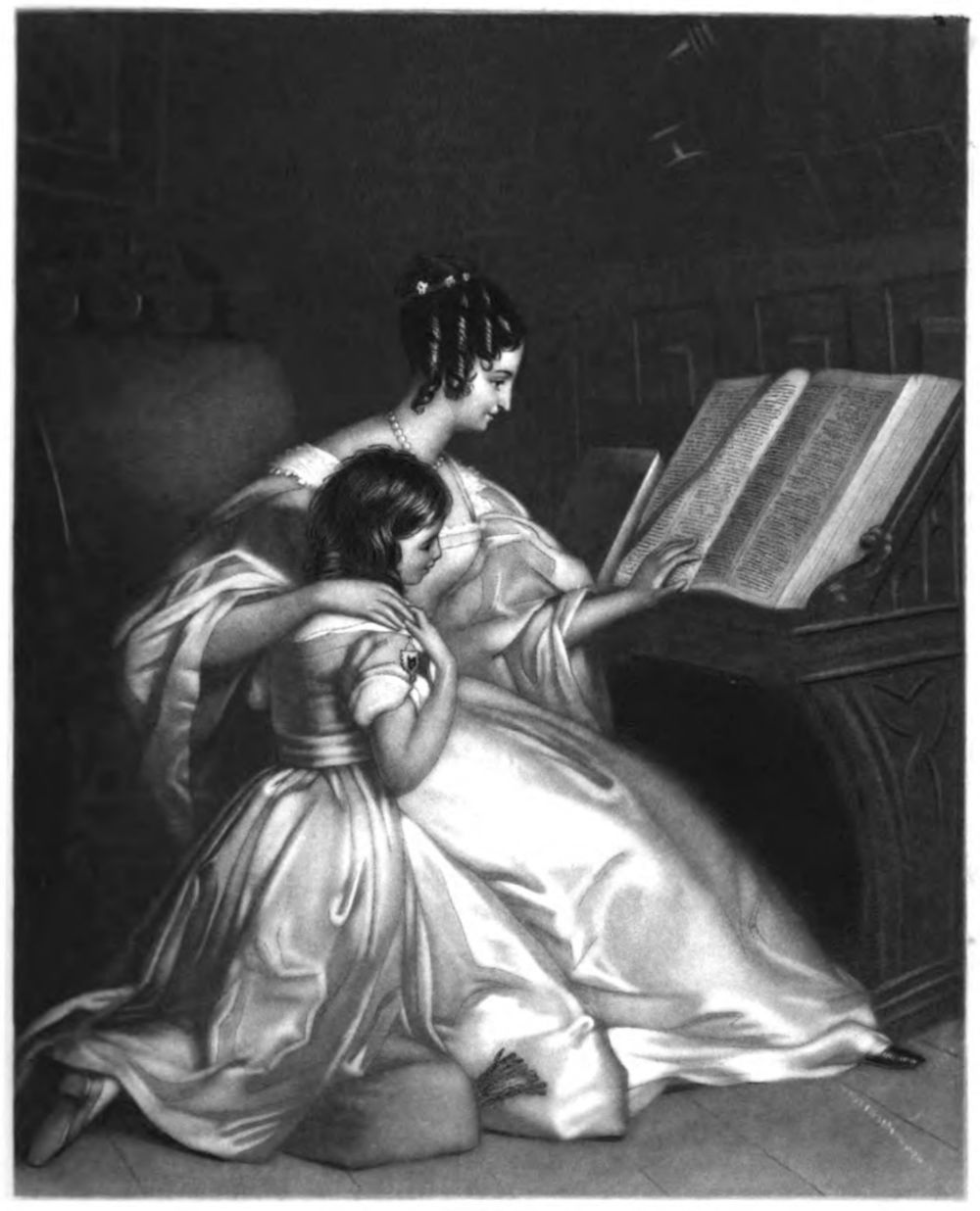
DRAWN BY JOHN W. WRIGHT.
THE LIGHT OF LIFE. ENGRAVED BY T. B. WELCH EXPRESSLY FOR GRAHAM’S MAGAZINE.
———
BY THE LATE EDGAR A. POE.
———
Our most analytic, if not altogether our best critic,
(Mr. Whipple, perhaps, excepted,) is Mr. William A.
Jones, author of “The Analyst.” How he would
write elaborate criticisms I cannot say; but his summary
judgments of authors are, in general, discriminative
and profound. In fact, his papers on Emerson
and on Macaulay, published in “Arcturus,” are
better than merely “profound,” if we take the word
in its now desecrated sense; for they are at once pointed,
lucid, and just:—as summaries, leaving nothing to be
desired.
Mr. Whipple has less analysis, and far less candor,
as his depreciation of “Jane Eyre” will show; but he
excels Mr. Jones in sensibility to Beauty, and is thus
the better critic of Poetry. I have read nothing finer in
its way than his eulogy on Tennyson. I say “eulogy”—for
the essay in question is unhappily little more:—and
Mr Whipple’s paper on Miss Barrett, was nothing
more. He has less discrimination than Mr. Jones, and
a more obtuse sense of the critical office. In fact, he
has been infected with that unmeaning and transparent
heresy—the cant of critical Boswellism, by dint of
which we are to shut our eyes tightly to all autorial
blemishes, and open them, like owls, to all autorial
merits. Papers thus composed may be good in their
way, just as an impertinent cicerone is good in his
way; and the way, in either case, may still be a small
one.
Boccalini, in his “Advertisements from Parnassus,”
tells us that Zoilus once presented Apollo with a very
caustic review of a very admirable poem. The god
asked to be shown the beauties of the work; but the
critic replied that he troubled himself only about the
errors. Hereupon Apollo gave him a sack of unwinnowed
wheat—bidding him pick out all the chaff for
his pains.
Now this fable does very well as a hit at the critics;
but I am by no means sure that the Deity was in the
right. The fact is, that the limits of the strict critical
duty are grossly misapprehended. We may go so far as
to say that, while the critic is permitted to play, at times,
the part of the mere commentator—while he is allowed,
by way of merely interesting his readers, to put in the
fairest light the merits of his author—his legitimate task
is still, in pointing out and analyzing defects and showing
how the work might have been improved, to aid the
general cause of Letters, without undue heed of the
individual literary man. Beauty, to be brief, should
be considered in the light of an axiom, which, to become
at once evident, needs only to be distinctly put.
It is not Beauty, if it require to be demonstrated as
such:—and thus to point out too particularly the merits
of a work, is to admit that they are not merits altogether.
When I say that both Mr. Jones and Mr. Whipple
are, in some degree, imitators of Macaulay, I have no
design that my words should be understood as disparagement.
The style and general conduct of Macaulay’s
critical papers could scarcely be improved.
To call his manner “conventional,” is to do it gross
injustice. The manner of Carlyle is conventional—with
himself. The style of Emerson is conventional—with
himself and Carlyle. The style of Miss Fuller
is conventional—with herself and Emerson and Carlyle
that is to say, it is a triple-distilled conventionality:—and
by the word “conventionality,” as here
used, I mean very nearly what, as regards personal
conduct, we style “affectation”—that is, an assumption
of airs or tricks which have no basis in reason or
common sense. The quips, quirks, and curt oracularities
of the Emersons, Alcots and Fullers, are simply
Lyly’s Euphuisms revived. Very different, indeed, are
the peculiarities of Macaulay. He has his mannerisms;
but we see that, by dint of them, he is enabled
to accomplish the extremes of unquestionable excellences—the
extreme of clearness, of vigor (dependent
upon clearness) of grace, and very especially of
thoroughness. For his short sentences, for his antitheses,
for his modulations, for his climaxes—for
every thing that he does—a very slight analysis suffices
to show a distinct reason. His manner, thus, is
simply the perfection of that justifiable rhetoric which
has its basis in common-sense; and to say that such
rhetoric is never called in to the aid of genius, is
simply to disparage genius, and by no means to discredit
the rhetoric. It is nonsense to assert that the
highest genius would not be benefited by attention to
its modes of manifestation—by availing itself of that
Natural Art which it too frequently despises. Is it not
evident that the more intrinsically valuable the rough
diamond, the more gain accrues to it from polish?
Now, since it would be nearly impossible to vary
the rhetoric of Macaulay, in any material degree,
without deterioration in the essential particulars of
clearness, vigor, etc., those who write after Macaulay
have to choose between the two horns of a dilemma:—they
must be weak and original, or imitative and
strong:—and since imitation, in a case of this kind, is
merely adherence to Truth and Reason as pointed out
by one who feels their value, the author who should
forego the advantages of the “imitation” for the mere
sake of being erroneously original, “n’est pas si sage
qu’il croit.”
The true course to be pursued by our critics—justly
sensible of Macaulay’s excellences—is not, however,
to be content with tamely following in his footsteps—but
to outstrip him in his own path—a path not so much
his as Nature’s. We must not fall into the error of
fancying that he is perfect merely because he excels
(in point of style) all his British cotemporaries. Some
such idea as this seems to have taken possession of
Mr. Jones, when he says:
“Macaulay’s style is admirable—full of color, perfectly
clear, free from all obstructions, exactly English,
and as pointedly antithetical as possible. We have
marked two passages on Southey and Byron, so happy
as to defy improvement. The one is a sharp epigrammatic
paragraph on Southey’s political bias:
‘Government is to Mr. Southey one of the fine arts.
He judges of a theory or a public measure, of a religion,
a political party, a peace or a war, as men judge of a
picture or a statue, by the effect produced on his imagination.
A chain of associations is to him what a
chain of reasoning is to other men; and what he calls
his opinions are, in fact, merely his tastes.’
The other a balanced character of Lord Byron:
‘In the rank of Lord Byron, in his understanding, in
his character, in his very person, there was a strange
union of opposite extremes. He was born to all that
men covet and admire. But in every one of those eminent
advantages which he possessed over others, there
was mingled something of misery and debasement.
He was sprung from a house, ancient, indeed, and
noble, but degraded and impoverished by a series of
crimes and follies, which had attained a scandalous
publicity. The kinsman whom he succeeded had died
poor, and but for merciful judges, would have died
upon the gallows. The young peer had great intellectual
powers; yet there was an unsound part in his
mind. He had naturally a generous and tender heart;
but his temper was wayward and irritable. He had a
head which statuaries loved to copy, and a foot the
deformity of which the beggars in the street mimicked.’ ”
Let us now look at the first of these paragraphs.
The opening sentence is inaccurate at all points. The
word “government” does not give the author’s idea
with sufficient definitiveness; for the term is more frequently
applied to the system by which the affairs of
a nation are regulated than to the act of regulating.
“The government,” we say, for example, “does so
and so”—meaning those who govern. But Macaulay
intends simply the act or acts called “governing,” and
this word should have been used, as a matter of course.
The “Mr.” prefixed to “Southey,” is superfluous;
for no sneer is designed; and, in mistering a well-known
author, we hint that he is not entitled to that
exemption which we accord to Homer, Dante, or
Shakspeare. “To Mr. Southey” would have been
right, had the succeeding words been “government
seems one of the fine arts:”—but, as the sentence
stands, “With Mr. Southey” is demanded. “Southey,”
too, being the principal subject of the paragraph, should
precede “government,” which is mentioned only in
its relation to Southey. “One of the fine arts” is
pleonastic, since the phrase conveys nothing more
than “a fine art” would convey.
The second sentence is quite as faulty. Here
Southey loses his precedence as the subject; and
thus the “He” should follow “a theory,” “a public
measure,” etc. By “religion” is meant a “creed:”—this
latter word should therefore be used. The conclusion
of the sentence is very awkward. Southey is
said to judge of a peace or war, etc., as men judge of
a picture or a statue, and the words which succeed are
intended to explain how men judge of a picture or a
statue:—these words should, therefore, run thus:—“by
the effect produced on their imaginations.” “Produced”
moreover, is neither so exact nor so “English”
as “wrought.” In saying that Southey judges of
a political party, etc., as men judge of a picture, etc.,
Southey is quite excluded from the category of “men.”
“Other men,” was no doubt originally written, but
“other” erased, on account of the “other men” occurring
in the sentence below.
Coming to this last, we find that “a chain of associations”
is not properly paralleled by “a chain of
reasoning.” We must say either “a chain of association,”
to meet the “reasoning” a “chain of
reasons” to meet the “associations.” The repetition
of “what” is awkward and unpleasant. The entire
paragraph should be thus remodeled.
With Southey, governing is a fine art. Of a theory
or a public measure—of a creed, a political party, a
peace or a war—he judges by the imaginative effect;
as only such things as pictures or statues are judged of
by other men. What to them a chain of reasoning is,
to him is a chain of association; and, as to his opinions,
they are nothing but his tastes.
The blemishes in the paragraph about Byron are
more negative than those in the paragraph about
Southey. The first sentence needs vivacity. The
adjective “opposite” is superfluous:—so is the particle
“there.” The second and third sentences are, properly,
one. “Some” would fully supply the place of
“something of.” The whole phrase “which he possessed
over others,” is supererogatory. “Was sprung,”
in place of “sprang,” is altogether unjustifiable. The
triple repetition of “and,” in the fourth sentence,
is awkward. “Notorious crimes and follies,” would
express all that is implied in “crimes and follies which
had attained a scandalous publicity.” The fifth sentence
might be well curtailed; and as it stands, has
an unintentional and unpleasant sneer. “Intellect”
would do as well as “intellectual powers;” and this
(the sixth) sentence might otherwise be shortened advantageously.
The whole paragraph, in my opinion,
would be better thus expressed:
In Lord Byron’s rank, understanding, character—even
in his person—we find a strange union of extremes.
Whatever men covet and admire, became his
by right of birth; yet debasement and misery were
mingled with each of his eminent advantages. He
sprang from a house, ancient it is true, and noble, but
degraded and impoverished by a series of notorious
crimes. But for merciful judges, the pauper kinsman
whom he succeeded would have been hanged. The
young peer had an intellect great, perhaps, yet partially
unsound. His heart was generous, but his
temper wayward; and while statuaries copied his
head, beggars mimicked the deformity of his foot.
In these remarks, my object is not so much to point
out inaccuracies in the most accurate stylist of his
age, as to hint that our critics might surpass him on his
own ground, and yet leave themselves something to
learn in the moralities of manner.
Nothing can be plainer than that our position, as a
literary colony of Great Britain, leads us into wronging,
indirectly, our own authors by exaggerating the merits
of those across the water. Our most reliable critics
extol—and extol without discrimination—such English
compositions as, if written in America, would be
either passed over without notice or unscrupulously
condemned. Mr. Whipple, for example, whom I have
mentioned in this connection with Mr. Jones is decidedly
one of our most “reliable” critics. His honesty I
dispute as little as I doubt his courage or his talents—but
here is an instance of the want of common discrimination
into which he is occasionally hurried, by
undue reverence for British intellect and British opinion.
In a review of “The Drama of Exile and Other
Poems” by Miss Barrett, (now Mrs. Browning,) he
speaks of the following passage as “in every respect
faultless—sublime:”
Hear the steep generations how they fall
Adown the visionary stairs of Time,
Like supernatural thunders—far yet near,
Sowing their fiery echoes through the hills!
Now here, saying nothing of the affectation in
“adown;” not alluding to the insoluble paradox of
“far yet near;” not mentioning the inconsistent metaphor
involved in the sowing of fiery echoes; adverting
but slightly to the misusage of “like” in place of “as;”
and to the impropriety of making any thing fall like
thunder, which has never been known to fall at all;
merely hinting, too, at the misapplication of “steep”
to the “generations” instead of to the “stairs”—(a
perversion in no degree justified by the fact that so
preposterous a figure as synecdoche exists in the school-books:)—letting
these things pass, we shall still find it
difficult to understand how Mrs. Browning should have
been led to think the principal idea itself—the abstract
idea—the idea of tumbling down stairs, in any shape,
or under any circumstances—either a poetical or a decorous
conception. And yet Mr. Whipple speaks of it
as “sublime.” That the lines narrowly missed sublimity,
I grant:—that they came within a step of it,
I admit; but, unhappily, the step is that one step which,
time out of mind, has intervened between the sublime
and the ridiculous. So true is this that any person—that
even I—with a very partial modification of the
imagery—a modification that shall not interfere with
its richly spiritual tone—may elevate the passage into
unexceptionability. For example:
Hear the far generations—how they crash
From crag to crag down the precipitous Time,
In multitudinous thunders that upstartle
Aghast, the echoes from their cavernous lairs
In the visionary hills!
No doubt my version has its faults; but it has at
least the merit of consistency. Not only is a mountain
more poetical than a pair of stairs, but echoes are more
appropriately typified as wild beasts than as seeds;
and echoes and wild beasts agree better with a mountain
than does a pair of stairs with the sowing of seeds—even
admitting that these seeds be seeds of fire, and
be sown broadcast “among the hills” by a steep generation
while in the act of tumbling down the stairs—that
is to say, of coming down the stairs in too great a
hurry to be capable of sowing the seeds as accurately
as all seeds should be sown:—nor is the matter rendered
any better for Mrs. Browning, even if the construction
of her sentence be understood as implying
that the fiery seeds were sown, not immediately by the
steep generations that tumbled down the stairs, but
mediately, through the intervention of the “supernatural
thunders” that were occasioned by the steep
generations that were so unlucky as to tumble down
the stairs.
———
BY JNO. S. DU SOLLE.
———
The telegraph-wires utter, when the wind blows, certain singularly sad, yet spirited music-tones. When they pass
through the leaves of a tree the effect is strangely beautiful.
Mysterious Spirit! hark! I hear thee voicing,
Up where the wind-breath woos thee, with its tone
Of mingled mournfulness and strange rejoicing —
As though ’twould fear thee, yet to love were prone.
What doth it whisper ’mid the green tree’s shading?
Or art thou trembling, not with hope but ire?
Chid’st thou its love? Or is it thee upbraiding
With thine inconstant tongue of living fire?
Is it some life-tale thou art subtly telling?
Some tale of dark and passionate romance —
That the young leaflets seem with wonder swelling,
Shrink at thy touch, and eye thee so askance?
Or are they timid only with emotion?
And pout their tiny lips up but for show,
O’er some new story of the heart’s devotion,
That thou art murmuring to the earth below?
Or, ravished from the grasp of Time and Distance,
Com’st thou with News, to gift, with sudden joy,
The sad heart with a sense of fresh existence —
Making the old man feel once more a boy?
Or bear’st thou words to soothe not, but to sunder?
Quietly rupturing the holiest ties —
Just as the lightning’s flash, without its thunder,
Blasts what it looks on with its venomous eyes!
Or is’t, oh, Captive One! thy life-voice fretting,
That, like a caged-bird wrested from its home,
(Thy fluttering wing its sky paths unforgetting,)
Along thy prison-wires such murmurs come?
I hear thee now! And chafing, ah, how vainly!
For they have chained the death-glance of thine eye —
Sightless as Samson—struggling more insanely —
Thou couldst not if thou wouldst, lie down and die!
AMIDST THE RUINS OF CARTHAGE.
A SKETCH FROM HISTORY.
———
BY W. GILMORE SIMMS, AUTHOR OF “GUY RIVERS,” “THE YEMASSEE,” “RICHARD HURDIS,” &c.
———
The Dungeon of Minturnæ.
Marius. The Cimbrian.
Marius. What art thou, wretch, that in the darkness com’st,
The midnight of this prison, with sly step,
Most fit for the assassin, and bared dagger
Gleaming in thy lifted grasp!
Cimbrian. I am sent by those
Whose needs demand thy death. A single stroke
Sets us both free forever—thou from Fate,
Me from Captivity.
Marius. Slave, hast thou the heart
To strike at that of Marius!
Cimbrian. That voice! that name
Disarm me; and those fearful eyes that roll
Like red stars in the darkness, fill my soul
With awe that stays my hand. Master of the world,
The conqueror of my people hast thou been!
I know thee as a Fate! I cannot harm thee.
Marius. Go to thy senders, and from Marius, say,
That, if they bare the weapon for my breast,
Let them send hither one who has not yet
Looked in a master’s eye. ’Tis not decreed
That I shall perish yet, or by such hands
As gather in Minturnæ. Get thee hence!
——
Public Hall of Minturnæ.
Magistrates. The Cimbrian. Augur.
Cimbrian. I cannot slay this man. Give me to strike
Some baser victim, or restore to me
My chains. I cannot purchase at such price
The freedom that I covet.
Magistrate. Yet this man
Conquered thy people.
Cimbrian. He hath conquered me!
Augur. And he must conquer still!
His hour is not yet come. The Fates reserve
His weapon for their service. They have need
Of his avenging ministry, to purge
The world of its corruptions. I behold
A fearful vision of the terrible deeds
That wait upon his arm. Let him go free.
Give him due homage; clothe him with fresh robes;
Speed him in secret with a chosen bark
To other shores. So shall your city ’scape
Rome’s wrath, and his hereafter.
Magistrate. It is well:
This counsel looks like wisdom.
Augur. It is more!
So the Gods speak through their interpreter.
Magistrate. Release him straightway—send him forth in honor;
We give him freedom—let the gods give safety.
——
Island of Ænaria.
Marius. Cethegus.
Cethegus. Thou hast slept, Marius.
Marius. And thou hast watched my sleep.
Ah! truest friend and follower, not in vain;
Dismiss that cloudy trouble from thy brows,
The doubts that vex thy heart; for know that Fate
Still has me in its keeping, and decrees
Yet other deeds and conquests at my hand,
And still one glorious triumph. I shall be
Once more, in Rome, a Consul! When a child,
Sporting, on summer slopes, beneath old hills,
Seven infant eagles, from a passing cloud,
Dropt clustering in my lap. The Augurs thence
Gave me seven times the Roman Consulate.
Cethegus. Thou hast had it six.
Marius. One other yet remains.
Cethegus. Alas! the Fates but mock thee with a dream;
For know that, while thou sleptst, our treacherous bark
Loosed sail, and left the shores.
Marius. Gone!
Cethegus. Clean from sight.
Marius. Ha! ha! Now thank the gods that watch my sleep,
And save me when the might of man would fail!
Courage, my friend, that vessel speeds to wreck,
Racked on some lurking rock beneath the wave,
Or foundering in the tempest. We are safe!
Cethegus. Thou’rt confident.
Marius. As Fate and Hope can make me.
Yet look! there is an omen. We must fly
This place for other refuge. See the strife
Betwixt these deadly scorpions on the sands.
Cethegus. What read’st thou in this omen?
Marius. Sylla’s soldiers
Are fast upon our heels. Get to the shore;
Some fisher’s boat will help us from the land,
And bear us whither the directing fates
Decree for refuge—safely o’er the seas
That gulphed our treacherous vessel.
Cethegus. Be it so!
I follow thee whatever be thy fate!
Marius. Hark! dost thou hear?
Cethegus. What sound?
Marius. The tramp of horse;
And lo! the boat awaits us by the shore!
——
Marius, alone, seated among the Ruins of Carthage.
Alone, but not a captive—not o’ercome
By any fate, and reckless of its doom,
Even midst the ruins by his own arm made,
There sits the Exile, lone, but unafraid!
What mighty thoughts, that will not be repressed,
Warm his wild mood, and swell his laboring breast;
What glorious memories of the immortal strife,
Which gave him fame, and took from Carthage life;
That giant-like, sea rival of his own
Proud realm, still challenging the sway and throne;
Doomed in long conflict, through experience dread,
To bend the neck at last, to bow the head;
To feel his foot upon her lordly brow,
And yield to him who shares her ruins now.
How o’er his soul, with passion still that gushed,
The wondrous past with all its memories rushed;
These ruins made his monument. They told
Of wisest strategy, adventure bold.
Dread fields of strife—an issue doubtful long,
That tried his genius, and approved it strong;
That left him robed in conquest, and supreme,
His country’s boast, his deeds her brightest theme;
Written in brass and marble—sung in strains
That warm the blood to dances in the veins;
That make young hearts with wild ambition thrill,
And crown the spirit with achieving will;
That seem eternal in the deeds they show,
And waken echoes that survive below;
Brood o’er the mortal slumbering in the tomb,
And keep his name in song, his works in bloom,
Till envious rivals, hopeless of pursuit,
Join in the homage, who till then were mute;
Catch up the glorious anthem, and unite
To sing the bird they could not match in flight;
Content to honor where they could not shame,
And praise the worth they could not rob of fame.
How, with these memories gathering in his breast,
Of all the labors that denied him rest —
Of all the triumphs that his country bore
To heights of fame she had not won before —
Broods he, the exile from his state and home,
On what awaits thee and himself, O Rome!
Of what thy hate deserves, and his decrees,
Whom thou hast brought unwilling to his knees.
No sad submission yields he to his fate,
So long as solace comes to him from hate,
Or hope from vengeance. In his eyes, ye trace
No single look to recompense disgrace;
With no ambition checked, no passion hushed,
No pride o’erthrown, no fond delusion crushed;
With every fire alive that ever swayed,
His soul as lordly as when most obeyed,
He broods o’er wrongs, forgetful of his own,
And from his heart hears vengeance cry alone.
Fixed on the ruins round him, his dread eye
Glances, as if fastened on his enemy;
His hand is on the fragment of a shrine
That Hate may henceforth deem a thing divine:
Grasped firmly—could the fingers but declare
How dread the oath the soul was heard to swear!
The awful purpose nursed within, denies
Speech to the lips, but lightens up the eyes,
Informs each muscle with the deadliest will,
But till the murderous moment, bids “be still!”
Come read, ye ministers of Fate, the lore
That fills the dark soul of the fiend ye bore;
Reveal the secret purpose that inspires
That deadly mood, and kindles all its fires;
Scan the dread meaning in that viperous glance
Fixed on those ruins in intensest trance,
That nothing speaks to that it still surveys,
And looks within alone with meaning gaze;
Unclose that lip, that rigidly compressed,
Stops the free rush of feeling from the breast;
And on that brow, with seven deep furrows bound,
Write the full record of his thought profound.
What future scene beneath that piercing eye
Depicts the carnage and the victory;
The flashing steel—the shaft in fury sped —
The shrieking victim, and the trampled dead:
Say, what wild sounds have spelled that eager ear,
That stretches wide, the grateful strain to hear;
How many thousands perish in that cry
That fills his bloody sense with melody;
What pleading voices, stifling as they swell,
Declare the vengeance gratified too well?
What lordly neck, beneath that iron tread,
Strangled in utterance, leaves the prayer unsaid?
What horrid scene of triumph and of hate,
Do ye discover to this man of Fate,
Which, while his Fortune mocks the hope he bears,
Consoles his Past, and still his Future cheers?
He hath no speech, save in the ruins round;
But there’s a language, born without a sound,
A voice whose thunders, though unuttered, fly
From the red lightnings of the deep-set eye;
There passion speaks of hate that cannot spare,
Still tearing those who taught him how to tear;
One dream alone delighting his desire —
The dream that finds the fuel for his fire;
Let fancy shape the language for his mood,
And speak the purpose burning in his blood.
——
Marius. “If thou hadst ears, O Carthage! for the voice
That speaks among thy ruins, it would cheer
The spirit that was crushed beneath my heel,
To hear the tongue of thy destroyer swear
To live as thy avenger. I have striven
For Rome against thee, till, in frequent strife,
Thy might was overthrown—thy might as great
As Rome’s in days most palmy—save in this:
Thou hadst no soul as potent in thy service,
As I have been in hers. And thou, and all —
The Gaul, the Goth, the Cimbrian—all the tribes
That swelled the northern torrents, and brought down,
Yearly, the volumed avalanche on Rome,
Have sunk beneath my arm, until secure
She sat aloft in majesty, seven-throned,
And knew or feared no foe. This was my work —
Nor this alone; from the patrician sway,
That used her as the creature of his will,
I plucked her eagles, casting down his power
Beneath plebeian footstep. For long years
Of cruellest oppression and misrule,
I took a merited vengeance on her pride,
Debasing her great sons, that in their fall
Her people might be men. I loved her tribes,
Since they were mine. I made their homes secure;
I raised their free condition into state —
And I am here! These ruins speak for me —
An exile; scarred with honorable wounds,
At seventy years, alone and desolate.
“But the o’er-ruling Deities decree
My triumph. From thy ruins comes a voice
Full of most sweet assurance. Hark! it cries
To me as thy avenger. Thou forgiv’st
My hand the evil it has wrought on thee,
That the same hand, upon thy conqueror’s head
May work like ruin. The atoning Fates
Speak through thy desolation. They declare
That I shall tread the ungrateful city’s streets,
Armed with keen weapon and consuming fire,
And still unglutted rage. My wrath shall sow
The seeds of future ruins in her heart,
So that her fall, if far less swift than thine,
Shall be yet more complete. She shall consume
With more protracted suffering. She shall pass
Through thousand ordeals of the strife and storm,
Each bitterer than the last—each worse than thine —
A dying that shall linger with its pain
Its dread anxieties, its torturing scourge;
A period long as life, with life prolonged,
Only for dire, deserved miseries.
Her state shall fluctuate through successive years,
With now great shows of pride—with arrogance
That goes before destruction—that her fall
May more increase her shame. The future grows —
Drear characters, as written on a wall —
In fiery lines before me; and I read
The rise of thousands who shall follow me,
Each emulous of vengeance fell as mine,
By mine at first begotten. Yet why gaze
In profitless survey of the work of years,
Inevitable to the prescient soul,
And leave our own undone? I hear a voice
Reproaching me that I am slow to vengeance;
I, whom the Fates but spare a few short hours,
That I may open paths to other masters,
For whom they find the scourge. They tutor me
That mine’s a present mission; not for me
To traverse the wide future in pursuit
Of those who shall succeed me in their service,
But to speed onward in the work of terror,
So that no hungering Fate, the victim ready,
Shall be defrauded of its prey. I rise,
Obeying the deep voice that, from these ruins,
Rings on mine ear its purpose. I obey,
And bound to my performance as the lion,
Long crouching in his jungle, who at last
Sees the devoted nigh. The impatient blood
Rounds with red circle all that fills mine eye;
A crimson sea receives me, and I tread
In billows thus incarnadined from nations
That bleed through ages thus at every vein.
Be satisfied, ye Fates! Ye gods, who still
Lark homeless in these ruins that ye once
Made sacred as abodes, and deemed secure,
I take the sword of vengeance that ye proffer,
And swear myself your soldier. I will go,
And with each footstep on some mighty neck,
Shall work your full revenge, nor forfeit mine!
Dost thou not feel my presence, like a cloud,
Before my coming, Rome?[A] Is not my spirit,
That goes abroad in earnest of my purpose,
Upon thy slumbers, City of the Tyrant,
Like the fell hag on breast of midnight sleeper,
That loads him with despair? Alone I come;
But thousands of fell ministers shall crowd
About me with their service—willing creatures
That shall assist me first to work on thee,
And last upon themselves! The daylight fades,
And night belongs to vengeance. I depart,
Carthage, to riot on thy conqueror’s heart.”
Silent once more the ruins—dark the night,
Yet vengeance speeds with unembarrassed flight;
No fears delay, no toils retard the speed
Of that fierce exile, sworn to deadliest deed;
And thou, O Queen of Empires, now secure
Of state that might be peaceful, were it pure,
Too soon thy halls shall echo with the yell
That summons human fiends to works of hell!
Ambition, long unsated, urged by Hate,
Queen of the Nations, speaks thy mournful fate;
Thy valor wasted, and thy might in vain,
Thy virtues sapped to break thy despot’s chain;
Long didst thou rule, in simple courage strong,
The guardian friend of right, the foe to wrong;
Great in thyself, and conscious of the sway
That kept meet progress with the march of day;
That from all nations plucked the achieving arts,
That make sway sov’reign in a people’s hearts;
Proud on thy heights rose forms to worship dear,
There swelled the temple’s crest, the column there,
Each with its chronicle to spell the soul,
And each most precious to the crowning whole;
A world thyself—a wondrous world—that made
The admiring nations silent in thy shade;
Genius and art commingling in thy cause,
And gods presiding o’er thy matchless laws.
But dark the hour impends—the storm is nigh,
And thy proud eagles flaunt no more the sky;
Thou hast not kept thy virtues to the last,
And all thy glories centre in thy past —
Thy safety in thy glories. From beneath
Thy altars swells the midnight cry of death;
The tocsin summons—not to brave the foe,
But to make bare thy bosom to the blow;
From thy own quiver flies the shaft of doom,
And thy own children hollow out thy tomb.
The exulting shouts that mock thee in thy shame,
Were those that led thee once to heights of fame;
The bird that swoops to riot on thy breast,
Is the same eagle that made safe thy nest.
Hark at his shrilly scream! the sleuth-hounds wake,
The bloody thirst which in thy heart they slake;
Thy proud patricians, hunted down, survey
The herds they kept most busy with the prey.
These are the flocks they fostered from their foes,
And these are first to drink the blood that flows.
Wondrous the arts of vengeance, to inspire
The maddened son to prey upon the sire!
Wondrous the skill that fierce plebeian wields
To make this last the bloodiest of his fields.
Vain all thy prayer and struggle—thou art down,
His iron footstep planted on thy crown;
But in thy fate, ’tis something for thy pride,
Thus self-destroyed, thou mighty suicide!
Give wings to thy wildest hopes,
For thy destiny now is known,
And even a lover’s dreams
Could scarcely thus high have flown.
Give wings to thy wildest dreams—
The loved one now is thine,
Nor moveth there on the earth
A being so like divine.
A form so noble and free,
A heart so high and so true;
Oh! thine is as bright a star
As gleams in yon sky of blue.
Then give to thy glad thoughts wings,
Thy raptures no more conceal,
For to thee every coming hour
Can only new joys reveal.
Wilfred.
THE MEETING OF THE WATERS.
NO. I.—THE MEETING OF THE WATERS.
[SEE ENGRAVING.]
There are two things that never grow old—good
poetry and good music. They live in the heart like
the memory of a beloved friend. Good poetry is the
out-birth of real emotions. It is the language of the
affections. When the heart feels deeply its utterance
takes the form of poetry; and when it seeks to vary
its affections and give them a deeper and more expressive
form, it seeks the aid of music. Poetry, in coming
into the mind, touches it with a sense of beauty,
moves its sympathies, or elevates it into a higher appreciation
of the pure and heroic; but when music is
married to immortal verse, all becomes more intense
and real. How fully this is perceived when we hear
some familiar ballad or fine lyric sung with skill and
taste. We saw beauties before, but now we feel
them.
With Moore’s exquisite Irish Melodies, we have
been familiar from childhood as poetry and music
united. “The Meeting of the Waters,” “The Last
Rose of Summer,” “The Legacy,” “Come Rest in
this Bosom,” and a dozen besides that could be named,
we think of but to love. Fashionable they are not, because
the fashion of this world changeth, and in fashionable
assemblages we rarely hear them; but now and
then a gentle friend warbles them for us in private—or
some one bold enough for an innovation, ventures upon
a “Melody” in public. How the old sounds stir
the heart! How old associations and old feelings come
up from the dim past!
The words of these melodies were all written to old
airs, familiar throughout Ireland—native airs born from
the hearts of the people, and, like links in a golden
chain, binding their hearts together. We need not say
how well Moore performed his task. Their popularity,
for nearly half a century, would make praise an
idle tribute. Before these songs were written, the
wildly-beautiful, tender, and often spirit-thrilling melodies
of the people found only an imperfect utterance.
But, when words in correspondence with the music
were given, the whole island broke forth into song as
by a single impulse. And, soon Albion took up the
strains responsive to her sister Erin, (we wish she had
not proved to Erin so unnatural a sister,) and for once,
at least, found something to admire and love that was
born in the Emerald Island.
A remarkable instance of the power of some of
these melodies over the heart is that related of Lucretia
Davidson. She was particularly sensitive to
music, and there was a song, “Moore’s Farewell to
his Harp,” to which she took a great fancy, and which
always affected the fine poetical organism of her mind
in a peculiar manner. She wished to hear it only in
the twilight. Then she would listen to the strain
until she became cold, pale, and almost fainting. It
was her favorite of all songs, and gave occasion
to the verses addressed, in her fifteenth year, to her
sister.
It was not the words of this song that alone affected
Miss Davidson. Without the melody in which
they found a more perfect utterance, she might never
have thought of them after the first reading. But the
music spoke to her in the heart’s own language, and
her spirit felt an intense sympathy.
Of this particular native air, Moore says, it is “one
that defies all poetry to do it justice.”
Among the most tender and beautiful of the Irish
Melodies is that known as “The Meeting of the Waters,”
Maclise’s exquisite illustration of which we give
in the present number of Graham. In the summer of
1807 Moore paid a visit to the Vale of Avoca, in the
county of Wicklow, where the two rivers Avon and
Avoca meet, a most lovely and enchanting spot. This
visit suggested the song which has since been so wide
a favorite, and which has associated the vale of Avoca
with all that is charming and romantic.
“THE MEETING OF THE WATERS.
“There is not in this wide world a valley so sweet,
As that vale in whose bosom the bright waters meet;
Oh! the last rays of feeling and life must depart,
Ere the bloom of that valley shall fade from my heart.
“Yet, it was not that nature had shed o’er the scene
Her purest of crystal and brightest of green;
’Twas not her soft magic of streamlet or hill,
Oh! no, it was something more exquisite still.
“ ’Twas that friends, the beloved of my bosom, were near,
Who made every dear scene of enchantment more dear,
And who felt how the best charms of nature improve
When we see them reflected from looks that we love;
“Sweet vale of Avoca! how calm could I rest
In thy bosom of shade, with the friends I love best.
Where the storms that we feel in this cold world should cease,
And our hearts, like thy waters, be mingled in peace.”
The vale of Avoca, thus made classic ground, thousands
have since visited; and the tourist through Ireland
would as soon think of neglecting the lakes of
Killarney as “the vale in whose bosom the bright
waters meet.”
From among the many descriptions of this beautiful
spot, we will select that given by an American lady
who visited Ireland in 1845. It is brief but eloquent.
She says —
“It was Ireland’s summer twilight, lingering long,
as though loth to draw the curtain closely about a
bright isle in a dark world like this. It was early in
July, the rich foliage had attained its maturity, and not
a seared leaf was sprinkled on bush or tree, to warn
that autumn was near. For the first mile the road was
smooth and broad, lined with trees, now and then a
white gate with white stone pillars, opening to some
neat cottage or domain; the glowing streaks of the setting
sun had not left the western sky, and glimmered
through the trees; while the air, made fragrant by the
gentle shower, diffused through body and mind that
calmness which seemed to whisper, ‘Be silent; it is
the Vale of Avoca you are entering.’ We descended
a declivity, and the vale opened upon us at ‘the Meeting
of the Waters.’ The tree under which Moore sat
when he wrote the sweet poem had been pointed to
me in the morning. We now stood near the union of
the two streams, where the poet says,
‘There is not in the wide world a valley so sweet,
As the vale in whose bosom the bright waters meet.’
The rich variety of wood; the still, clear, limpid
water; the hill and vale, in some parts dark and wild,
in others light and soft, ever and anon relieving the
eye by some new variety; but above all, the pleasant
association that this vale, however dark and deep its
recesses, harbors not a venomous serpent or reptile—no,
not even the buzz of the mosquito is heard—made
it unlike all others. We rode three miles, scarcely
uttering a syllable all the while; a holy repose seemed
to rest on this hallowed spot, as when it first bloomed
under the hand of its Maker, and imagination was
prompted to say, as no serpent has ever coiled here, the
contaminating touch of sin has not left its impress.
“Never did I leave a spot more reluctantly; it was a
night scene which never has faded from my eye, and I
hope never will.
‘O! the last rays of feeling and life must depart,
Ere the bloom of that valley shall fade from my heart.’
In the deep silence, the voice of God and the soft whisper
of angels seemed to be there. These voices said
kindly, ‘There is mercy yet for poor erring man.’ It
appeared like the bow of the covenant, telling us to look
and remember that though this world has been cursed
by sin, yet a new heaven and earth are promised, of
which this is a shadowy resemblance.
“The borders of this valley are interspersed with
gentlemen’s seats, and here and there dotted with the
white-washed cottages of the peasants; and the rich
cluster of foliage upon the hill sides, upon bush and
tree, almost persuade you that the dew of Hermon has
fallen upon them. Stranger, when you visit Ireland,
visit the Vale of Avoca. If you love God, here you
will see him in a picture that must be read; if your
stay be limited, waste it not in decyphering a time-defaced
stone, telling the bloody deeds of some ancient
warrior, or the austerity of some long-lived ascetic;
but linger in this spot; stop at the neat little hotel,
erected on purpose for the accommodation of the
stranger; and morning, noon, and night explore its
never-dying beauties of light and shade. Three times
did I go through, and when I turned away at last, I
felt that
‘I could stay there forever to wander and weep.’ ”
T. S. A.
———
BY HON. J. LEANDER STARR.
———
On Nyack’s shore the mighty Hudson flows,
And on its banks the weeping willow grows;
A wood-embowered spot thus shaded o’er,
Lies half-concealed, sloping toward the shore.
Beneath the willows which are growing there,
Repose the forms of those once young and fair;
The aged, too, here rest in mystic sleep,
And here the widow often comes to weep.
It is a lovely spot for those who think —
For close beside the forest-covered brink,
The placid river rolls its gentle waves,
And breezes fresh fan o’er the silent graves.
Oft here I have sat on a still summer day,
When lured from city life, and cares away;
And lost in contemplation here reclined,
And sought to calm the turbulence of mind.
The bright sun sparkling on the rippled wave,
The light-winged bird chanting on every grave,
The balmy, pure, and health-restoring breeze,
Sporting its gambols through the leafy trees.
In such a spot whole hours have past and fled,
With no companionship except the dead;
Yet not time lost, for even the silent tomb
Proclaims its lesson—teaches of our doom.
And we may read, while thoughtful and alone,
A useful lesson from the sculptured stone;
And lay to heart, and in our own behalf,
The moral found in every epitaph.
How calm the mind when rambling ’mid such scenes,
What lessons thus the soul unconscious gleans!
How vapid—worthless—now seem worldly cares,
How vain and mad our mis-spent life appears.
The busy world drives fast its votaries on,
Months succeed days, and years these months again;
Then life is o’er—“the morning vapor” fled!
And we take rank with the unnumbered dead.
Who would not choose his grave in village ground?
Nature all calm—all sympathy—around!
Instead of that false mockery and wo,
Which city pageants, grand and heartless, show.
Numbered among the village dead I’d lie,
This be my resting-place whene’er I die!
No epitaph—no tomb-stoned fulsome fame,
But simply this—the record of my name.
A TALE OF THE AMERICAN REVOLUTION.
———
BY S. D. ANDERSON.
———
No portion of the infant colonies suffered more from
the rude and unsparing hand of war than did the South,
and especially the Carolinas. The storm of desolation
fell with double fury on those devoted sections of our
country, not only from the foreign invaders, seeking to
strike down the germ of our liberties, but also from the
intestine foes with which she was cursed. This latter
kind of warfare was the more to be dreaded, as it fell
alike on the old and the young—the blooming youth
and the blushing maiden. No condition was permitted
to escape. Gray hairs were nothing in the estimation
of those fiends in human shape, called Tories. Children
were taken from a weeping mother and consigned to a
lingering death; beauty was torn from the bridal altar,
and innocence from the house of prayer; all the kind
and holy feelings of the human heart were given to the
winds, and the family hearth, and even the household
circle were often made the scene of a brutal death.
Such were some of the dangers and difficulties our
fathers had to encounter in the struggle for Independence.
A beautiful day, in the spring of 1781, was drawing
to a close. The day had been warm, but now the
genial breeze of night, so peculiarly pleasing in southern
climates, had sprung up. Dim twilight had taken the
place of day, the song of the night-bird was beginning to
be heard in the wood, the deep-green foliage of the pines
looked still deeper in the fast increasing shadows of
night, and one by one the stars took their places in the
sky. Silence still and deep rested all around; and
naught was heard save the occasional hoot of the
solitary owl far in the sombre depths of the forest that
shaded both sides of the road, (if such the dimly marked
path might be called,) which led through this section
of the wood. The ground was covered with a dense
growth of pines and other trees, interlaced with wild
vines and smaller shrubbery, so that their shade, even
in daylight, excluded from the eye every thing that was
removed a few paces from the road-side, but now, as
the darkness came down, all was a blank. Suddenly
the stillness of the scene was broken by a slight noise,
and a solitary horseman emerged from the cover of
the wood into the opening. When he had gained the
road, he checked his horse, and carefully examined the
vicinity, as if to satisfy himself of the safeness of his
position, as well as to mark the locality of the spot.
This caution seemed to proceed as much from a settled
habit of watchfulness, common in days of peril, as from
a sense of personal danger. In appearance the stranger
seemed not to have arrived at the full age of manhood.
He was clad in a hunting-frock of blue domestic, common
in those days among the inhabitants of the Southern
States. The style and finish of the dress, however,
bespoke more than usual attention to the fitness of the
articles. Around his waist was girded a broad leather
belt, embellished in front with a massive buckle, and
underneath this might have been seen, almost concealed
by the folds of his coat, a pair of pistols, such as were
used by the horsemen of that day. His pantaloons were
of the same materials as his coat, and on his head he
wore a hat that differed from that of a common citizen
of the times, only in the additional ornament of a small
cockade, worn on the left side near the top. This,
with a pair of boots made of untanned leather, and
armed with rude spurs, made up the costume of the
new comer. In stature he was rather over the usual
standard, but not so much so as to take from his figure
its appearance of grace and activity. His features
were large and manly, and his complexion, though
darkened by exposure to the burning rays of the
southern sun, still showed the tinge of blood upon the
cheek. His eyes were dark and piercing, and a profusion
of black and curling hair covered a finely-shaped
head. In the whole appearance and bearing of the
individual could be read the love of the daring and adventurous,
shared in common with the noble and
chivalrous sons of the South in those days of peril and
danger.
After he seemed to have been satisfied of the absence
of any intruder, he advanced a short distance up the
path we have mentioned, until he gained a place where
the underwood was still more dense and impenetrable.
It was a small ravine, made by a rivulet in the wet
seasons, but at this time was dry. There the branches
of the trees interlaced and formed a natural retreat, so
dense as to preclude its being reached with any chance
of success. When immediately in front of this, he
raised his hands to his mouth and produced a sound so
nearly resembling the cry of the wood-owl, that a
person who was not very familiar with the singular
note of this bird must have been mistaken. It was
immediately repeated from the ravine, and in a short
time a second person made his egress from the leafy
ambush. The appearance of the new comer differed
in all respects from that of the first. He was a modern
Hercules in frame and figure, and bore the marks of
long and severe service in sun and storm. But he was
dressed much after the fashion of his companion,
though the materials were of a coarser kind, and
boasted no ornaments. He wore on his head a cap
made of the skin of a fox. His arms were the usual
brace of pistols, but in addition he bore in his hand a
short rifle, and slung from his broad shoulder was the
powder-horn and bullet-pouch of the forest ranger. In
his face could be seen the marks of the frontier life—good-nature
and courage—a man to trust in danger—a friend
when most needed. He advanced with
slow and cautious steps until he gained the edge of the
wood, and then raising his rifle into a position for immediate
use, he breathed in a faint but distinct voice
“Hawks.” He waited a moment, and then the voice
of the stranger repeated, “They fly.” “All’s right,”
was the glad answer from the forester, and breaking
from the thicket, he seized the hand of the horseman
with a nerve and energy that made the blood tingle to
the ends of the fingers.
“Well, Harry, what of the cavalcade?” asked the
younger of the men, in a voice that bespoke the excitement
under which he was laboring. “Have they
passed? How many of them were there?”
“Oh, a score or more of the villains,” answered the
other, in a bold, free voice, “and young Wilson and
his sister in the midst. They seemed particularly
choice of him, as he was lashed to one of the largest
of the gang; but what is to be done—have you seen
the captain?”
“No,” replied the other, in an excited manner, “he
has not returned from the Santee. If the captain was
but here, we would soon teach these renegades better
manners than to fire and kill at pleasure; and the sister,
too—was not the brother enough?”
There was something in the voice and manner of
the speaker when he alluded to the capture of this
couple, that told a tale of the feelings, plainer, perhaps,
than he would have wished, if he had been in other
company than that in which he was. When he again
spoke, however, he was more calm and collected.
Addressing himself with confidence to his companion,
he said,
“Harry, what would you advise? You have had
more experience in this mode of life than I, and
this is an occasion which calls for all our energies.”
A look of honest pride stole over the face of the forester
at this marked display of the confidence of his
superior in rank; but it was only for a moment, and
then the old expression of caution and determination
again resumed its place. After a pause, in which he
seemed to be debating in his mind the better way of
serving the wish of the other, he appeared to have hit
upon the plan, and advancing still nearer to his companion
to prevent the possibility of being overheard, he
said, in a low whisper,
“You must go back to the camp and raise the men,
I will follow in the trail of the party; they must have
taken the lower route, as the late defeat of the Tories
in the north would make the other unsafe. If I fail I
will meet you at the Big Pine—you will take that road—they
cannot get farther than the Cypress Swamp to-night—I
will be there.”
This arrangement seemed to meet the views of the
other, as he made no objections to it, but after some
minor matters had been disposed of, the two prepared
to separate. Shaking his companion heartily by the
hand, the younger of the friends struck into the forest
in the same direction as that from which we saw him
emerge. The other gazed after him until he became
lost in the darkness of the shadows, and then striking
into the wood in the opposite direction, he proceeded
for some distance with hasty steps, until he gained a
spot more densely shaded than usual. Parting the
branches, he entered the enclosure, and in a few moments
came forth leading a horse, which he immediately
mounted, and plunged more deeply into the wood.
Leaving our two friends to the fulfillment of their tasks,
we must give the reader some account of the circumstances
that preceded their introduction to us.
William Seaton, the hero of our narrative, was the
only child of one of the oldest families in the South. At
the breaking out of the war of the Revolution, his
father took a firm and decided stand in the defense of
the rights of the Colonists, and sealed that defense with
his blood. He fell at the Siege of Charleston, bequeathing
to his son the care of a mother. With the same
bold and fearless love of his native land that distinguished
his sire, young Seaton, on the receipt of this intelligence,
hastened home from the little band of men to
which he belonged, and bearing his mother to a place
of safety, hurried to rejoin his comrades again. He
had joined that band, by the consent of his patriot
father at the outbreaking of the war, though then but a
stripling, and had acted with them in all those prominent
events that has rendered them so famous in the
annals of freedom.
Attached to the same company as Seaton was a
young man named Wilson, like him a volunteer in the
cause of liberty; and both being in the spring of youth
and promise, they became mutually attached. The
hours not devoted to labor were spent in the society of
each other. In one of the many changes that the fate
of war made in the position of this band of patriots,
they encamped in the vicinity of Wilson’s father, and
now, when the duties of the camp did not call for the
attendance of our friends, the snatches of time were
spent at the paternal residence. George Wilson’s
father was far advanced in the vale of years, and consequently
remained neutral, as far as actions went, in
the excitements of the day. But still his heart was
with the Colonists in the unequal struggle for their
rights. The chief attraction for Seaton, however, was
Emma Wilson, the sister of George; and she was
well worthy a soldier’s admiration and love. She was
a soldier’s sister, full of noble daring, and untameable
spirit. At each visit Seaton lingered longer and longer.
Each glance of his eye was full of meaning, and told
more truly to Emma, than words, the conquest she
had made. Seaton feared to offer the hand of a nameless
soldier to the sister of his high-souled friend,
though that hand had been raised at the altar of liberty.
But he was poor, his father had periled his all in the
cause of his country, and it had been wrested from
him; and now the son had nothing, save his sword and
the consciousness of rectitude. But that could not
prevent the growth of the passion in the breast of young
Seaton; and how often would he think he saw in the
hesitation and blushes of Emma, when he requested
her to sing his favorite songs, something on which to
build a lover’s hopes; and this, though slight, would
raise into a flame the fire of his affections.
Thus stood matters, when, one evening, Seaton
started to visit the Wilson’s, George having been absent
some days on account of the illness of his father.
It was some distance from the camp, and as he was
in the dreaming mood, he suffered his horse to proceed
at a slow pace, and gave full vent to his fancy.
From this trance he was aroused by a slight noise, and
raising his eyes, he beheld (for a turn of the path
brought him within view of it) the mansion of the
Wilsons in flames. Putting spurs to his steed he
soon arrived at the spot. Here all was desolation and
ruin. The truth flashed upon him. It was the work
of the Tories. But what had become of the inmates?
Had they fallen victims, or had they been made captives?
No one was visible to solve the question.
But no time was to be lost, and after a hasty survey of
the vicinity, he started in the direction of the camp to
report the affair and procure assistance for the prisoners.
On the return he fell in with one of the scouts,
and making known the affair to him, it was determined
to fall upon the trail of the party, if possible to watch
them until they should encamp, and then the scout, by
superior knowledge of the windings of the forest, must
return to the camp and ensure the surprise and capture
of the foe. Acting on this, and knowing that the
captain was at this time on his way from the Santee
with a body of recruits, Seaton chose the route most
likely to fall in with him, to whom he would communicate
the intelligence and obtain assistance. Giving
his instructions to his companion to await him at the
Crossings, he gave the reign to his horse and dashed
into the wood. With the result of this meeting the
reader is already acquainted in the conversation between
the two at the commencement of the story.
Buried in the gloom of the ravine, Harry Burton saw
the prisoners pass, guarded by a strong band of the
Tories. Marking their direction, he had in quiet
awaited the coming of his comrade.
Our business now is with the scout. After he parted
from his companion, he left the main route, and striking
deeper into the forest, pursued his way for some time
with as much rapidity as the nature of the ground
would admit of, appearing to be guided more by instinct
than reason, so well did he, amid the darkness of
the dense wood, find out the different pathways and
crossings of the forest. After continuing his unbroken
course for some time, he turned again in the direction
of the main path. Falling into the stream of a small
rivulet that ran in that direction, he followed it up, as
if to prevent any marks of his horse’s feet being seen
in the coming light, if he should not succeed in his
enterprise. Silently and steadily did he ride on until
he gained a bend in the stream, where he dismounted,
and leaving his animal in the deep shade of the trees,
continuously advanced to the edge of the pathway, and
bent his gaze long and earnestly along the road. Satisfied
of the absence of any hostile party, he emerged
into the clearing, and commenced a careful survey of
the path, with as much accuracy as the faint beams
of a partially risen moon would permit. Long and
anxious was the labor, and not till he was satisfied of
the recent passing of a band of mounted men did it
cease. Once confident of this, he again mounted, and
pressed on with renewed vigor, still keeping hid in the
shade, though not at so great a distance as before.
Continuing his course for some time, he gained the
top of a hill, and here, for the first time since the passing
of the band at the Crossings, he again gained sight
of the captives. Halting, that the distance between
them might be increased, and thus the danger of discovery
lessened, he had a full opportunity to observe
them. No material change had taken place in the
aspect of the party since he last saw them, save that
the bonds of the female had been unloosed, and she
was suffered to ride between two of the band. Her
brother was still bound, and his horse fastened to that
of one of the escort. The only circumstance that
struck the quick sight and sense of the scout was the
want of that caution and discipline that betokens the
consciousness of danger.
Taking advantage of this want of prudence on the
part of his enemies, the active mind of the scout suggested
the bold expedient of pushing into the front of
the party, and by secreting himself in the dense foliage
that skirted both sides of the road, gather, if possible,
from the lips of the Tories, some hints of their designs.
Without waiting to calculate the danger of the undertaking,
he again took to the forest, and putting his steed
into a swifter pace, made a circuit of some distance to
avoid the most remote possibility of being seen.
Having again gained the road-side, he took a position
more favorable for his purpose. He did not wait long
ere the foremost of the band came in sight. When
sufficiently near, Harry recognized him as one of the
most active and unprincipled of the men who had long
been a terror and dread to that vicinity. He had been
an unsuccessful suitor for the hand of Emma Wilson;
and this, joined to his unrelenting hatred of the Whigs,
made the object of the recent attack apparent to the
scout. He was attended by several others of the same
character—some actuated by motives of personal malice,
and others by the love of plunder. The leader
appeared in earnest conversation with those who rode
near him; and, as they neared the place where the
scout was concealed, the words of some of them
reached his ear. They were directed to the captain
of the band, and were spoken as if in continuation of a
question.
“But what do you intend doing with the brother?
He fought well, no matter what else he has done, and
deserves a better fate than I fear you intend for him.”
“He shall have the same fate as his father—death.
The one fell by this hand, by the sword it is true; his
son shall die by the rope. I’ll teach them to refuse
me. One more, and then my vengeance is complete.
That young lover of hers, Seaton!—but he cannot escape
me; we have tracked the band that he belongs to,
and in a few days he too will be mine. But how
stands my modest beauty?” he asked of one of the
gang who just rode up from the rear. “She shall have
a merry ride to-night, and in the morning—”
“She has fainted from fatigue, and cannot ride farther,”
interrupted the other; “what must be done?
As there is no danger from pursuit now, I think we
had better halt for the night. The Cypress is nigh, and
that will be the safest place between here and the Corners.
Besides, the captain, as they call him, is in the
south now. So no fear of him.”
“I do not fear him,” answered the leader; and then
after a pause of a few moments he resumed—“Well,
give the command to encamp at the swamp. In the
morning we will see what is to be done.”
Saying this, he relapsed into silence, and the other
fell back on the rear to give the orders for the night.
Harry waited until the last of the band had passed his
place of concealment, and faded from sight in the direction
of the proposed stopping-place for the night;
and then, as if satisfied with the result of his plan, he
again took the backward trail to wait at the appointed
place young Seaton, and his band, if he should succeed
in raising them.
Morning broke upon the forest with unusual freshness
and beauty. The dew sparkled on the young
grass—the birds caroled sweetly from the trees—the
streamlet went leaping on its way in gladness, and
sending its music out into the sunny air as if the spirit of
rejoicing sat upon its tiny waves. It was yet early morning
when our scene opens in the camp of the outlaws.
Here all was bustle and excitement. Men could be
seen gathered in groups in low conversation, as if some
event of more than usual interest was about to take
place. In the centre of the encampment could be seen
two persons we have heretofore described. They
were seated some distance apart; the brother being
fastened to a tree in a sitting posture, with his hands
confined to his side, while the sister was suffered to
remain unbound, but subject to a strict guard. He was
already doomed to death, and that the shameful one of
the gibbet. Bitter as was the pang at being cut off in
the bloom of life, when the road to fame was open to
his view, and when his suffering and bleeding country
called aloud on all her sons for aid in this desperate
contest. Still this was nothing for him. But then his
sister, and that sister the witness of a father’s murder,
was now a captive, and at the mercy of that father’s
murderer—this made the doom doubly bitter. And
there at his side sat that sister mute and tearless, for
the dreadful scenes through which she had passed
seemed to have shut up the fountains of her grief,
while he who should have been her protector was now
helpless as herself. These were the thoughts that
were coursing through his mind when the leader of the
band approached the spot where he was confined. If
ever vice and malignity had chosen a resting-place, the
face of that man was their home; and now as he
gazed upon the consummation of all his long-cherished
plans of lust and vengeance, the time for which he had
hoarded up the passion of years, his look assumed the
aspect of a demon. Calmly he gazed upon the captives,
as preparing himself for the outbreak, and then
advancing still nearer, he said —
“Do you accept my proposals, or must I compel you
to that you cannot now avoid?” This was addressed
to Emma Wilson. “Accept this hand, and your brother
lives; refuse me, and he dies upon the tree before
an hour.”
What answer Emma would have given is unknown,
as at this moment her brother caught the question, and
turning to the ruffian, he answered —
“No, Emma, murderer as he is, he dare not do this;
and if death must come, it would be nothing compared
to the union with a wretch like this.”
But then as the helpless condition of that sister, already
in the power of this man, and as the desperate
and lawless character of the band, all pressed upon the
mind of the brother, he sunk his voice to a whisper,
and said, as the tears came gushing into his eyes —
“Man, man, if you have the commonest feelings of
humanity, I implore you do not harm my sister. Do
with me as you like—give me to the fire, or the tree—but
spare a brother the agonizing thought of a sister’s
shame.”
A bitter smile passed over the face of the outcast as
he saw the agony of his prisoner—a smile that spoke
of triumph and revenge—but it was only for a moment,
and when he again spoke, his voice was calm and resolute.
“And does the high-spirited and haughty blood of
the Wilson’s deign to supplicate me? Me! the outcast
they once spurned. To what am I indebted for
this favor? But no!” and sinking his voice into that
of a person fearful of his own passions, he proceeded,
“I offer her this hand—if she accept it you are free, if
not, you die—not the death of a man, but the death of
a dog. And still she shall be mine.”
For the first time since the captain of the gang had
made his appearance, Emma raised her eyes to those
of her brother. She heard the determination of the
ruffian, and knew from his previous acts that to will
and to do was the same with him. Nerving herself,
therefore, for the contest, she said:
“Do your worst—I never will be yours. Your hand
struck down my gray-haired father when he knelt to
you, and your hand raised the torch to the family roof-tree,
and sent us, homeless orphans, out upon the
world. It can but be death, and that is paradise compared
to a life with you.” And then turning to her
brother, she continued—“George, I would do all to
save you but dishonor myself and our spotless name—that
I cannot do—forgive me—that is a sister’s resolve.”
“Bless you, Emma, for those words—now I can
die.” And sinking his voice, he continued—“But
there still may be hope—our men cannot be far off, and
if Seaton did but know of this.” The paleness of his
sister’s cheek told George he had touched a tender
chord, and hastening to redress the wound he had inflicted,
he said—“I do not entirely despair, if I could
but gain a few hours; the captain is still in the field,
and there is still hope.”
The leader had now left them, and the brother and
sister now talked of the past, and Emma’s heart was fast
telling her, as the name of Seaton was mentioned, that
she had long and fondly loved him. But this reverie
was interrupted by the return of the outlaw, who had
been talking with some of his band. Advancing still
closer to Emma, he said:
“Have you decided?—the time has come, and I am
in no mood for trifling—remember, this is the last
chance for your brother’s life.”
“I remember,” replied Emma, “and I have decided—for
death—both of us, for I survive not him.” And
drawing a small knife from her bosom, she said—“Now
leave us.”
“ ’Tis well—you will find me no sluggard in the fulfillment
of my promises,” said the other, his voice
hoarse with suppressed passion. “Here, guard, hang
this rebel to the nearest tree; we will find if his high-bred
sister can act as well as talk.”
Obedient to their leader’s command, the outlaws
seized upon the prisoner, and leading him to a little
distance from the spot where his sister sat, commenced
the horrid preparations for his death. Shading her
eyes with her hands, Emma sat mute and motionless,
the picture of despair. In haste the fated noose was
made and fastened around the neck of the captive, and
now all was ready. Again did the heartless villain
urge the sister to accept the offer of his hand, but this
time in mere mockery; but the words of her brother,
as he blessed her for the resolve, came to her and she
sat mute. Stung by this display of courage, the ruffian
now gave the word for the completion of the execution.
The cord had been run over the limb of the tree, and
two of the band waited the signal from the captain.
Around had congregated the gang to witness the proceeding.
All was stillness. The spot was wild and
lonely—a single open space amid the dense swamp
that on every hand spread its curtain of foliage, so that
the eye could not reach but a small distance into the
environs of the encampment. And there stood that
brother. He had taken the last view of nature—the
last farewell of his sister—the last thought of his country—and
now, he stood firm and collected. And near
him was the leader of the band, a glare of triumph
lighting up his eyes as he saw the end of all approaching.
Gazing upon his victim’s face for a moment, he
said —
“George Wilson, you once despised me and rejected
my friendship. I loved your sister—you thwarted me
in that love, now I am your captor, ask no mercy—I
will grant none.”
“Wretch!” replied Wilson, “I despise alike your
friendship and your mercy. Talk not of love. Such
a villain cannot feel the passion; but think not to escape
for this deed, the band to which I belong will not
let my blood be spilt in vain. You tremble at the
name—well you may—it will be a curse on your
path, and you will pay a heavy penalty for this day’s
work.”
“No more of this ranting,” interrupted the outlaw.
“Think not to fright me from my purpose. Marion
himself could not do that. Ha! ha!—who conquers
now?”
As he finished, he raised his bugle to his lips and
blew a shrill blast—the signal for the execution. The
blast was repeated from the wood, and the last note
had not died upon the ear, when breaking from the
thickness came the band of Marion. Had the trump
of the Archangel sounded, it could not have struck
greater consternation into the gang, who stood paralyzed,
mute and lifeless as statues. A moment after
came the crash of a hundred rifles, carrying death and
dismay into the ranks of the Tories, followed by the
sabres and pistols of the men, and the iron heels of the
horses. Escape was impossible. Surrounded on all
sides, and struck with terror at this unthought of
rescue, the ruffians made no resistance, but fled. Dashing
into the midst of the scene, the rescuers, with
young Seaton at their head, soon made a clear field.
Giving orders to capture the few remaining Tories, he
dismounted and cut the bands that confined his friend,
who until this time seemed unconscious of what was
acting around. But as he saw the face of his companion,
and recollected other familiar comrades, he
awoke, and seizing the hand of his friend, pressed it in
silence.
When the first moment of surprise was over Seaton
asked the fate of Emma, in a tone and manner that
told how much of his happiness was centered there.
Her brother pointed to where he had left her, and
there she lay upon the green sod, for she had fainted
amid the noise and tumult of the last few moments.
To fly to her and raise her up—to clasp those soft
hands, and sprinkle the pure brow with water, was the
work of a moment for Seaton, and as she recovered
and rested her head upon his bosom, to tell her
she was safe, and that her brother was safe, was a
sweet task; and then to hear from those lips the throbs
of a guileless heart, and to read in those bright eyes
more than a maiden’s modesty would tell, was a sweet
recompense for Seaton. And now the brother and
sister were united, and Seaton left them to complete
the victory. He saw the day had been won, as one
by one his men returned, bringing with them the bare
remnants of the gang. On the ground he discovered
the scout engaged in searching for the body of the
leader. It was found, still holding in his hand the
trumpet, as he had held it when the death-shot had
struck him. Giving his orders to the scout, Seaton
made instant preparations for departure. The lover
rode by the side of Wilson and his sister, and from
them he heard all the occurrences of the last few
hours. After a ride of some length they reached the
camp in safety, and the next day Emma Wilson was
placed under the charge of some friends remote from
the scene of war; but not until she heard from the lips
of Seaton the confession of his love, and he received in
return the assurances of her affection.
The conclusion is soon told. After Seaton left the
scout, he repaired to the camp, and as Marion had not
arrived, he assumed the command of the band, and led
them to the place agreed upon by him and the scout.
Here he fell in with Harry who was waiting for them,
and he led them to the Tories’ encampment, where
they arrived just in time to thwart the designs of the
outlaws.
Seaton and Wilson continued to serve with Marion
until the close of the war. Both were in most of those
daring and successful enterprises which so distinguished
that gallant officer. Harry also served out the war in
the capacity of scout, one of the most dangerous, as
well as useful posts in the army. After the close of
the war Seaton pressed his suit with Emma, and she
again became a captive, though this time the chains
were garlanded with flowers. They rebuilt the old
family mansion, near which they erected a monument
to the memory of Emma’s father, and with her brother,
who still continued a bachelor, they made their residence
there. Harry had his home there, and in the
long winter nights would tell to the children the story
of “The Captives.”
Who is the Poet? Know him by
The downcast and abstracted eye;
By careless mien and lofty brow;
By tones so musically low;
By a pale cheek of spirit light,
Telling of hopes and visions bright;
By a deep communing with all
That earth can good or gentle call;
By silent reveries and lone
The Poet, God’s best work, is known.
Where dwells the Poet? Seek him where
Voices of music fill the air;
Where flowers in beauty meet the sun;
Where streams in gentle silence run;
Seek him beneath the forest tree,
Where bird and breeze meet whisperingly;
Seek him where thunder peals are heard;
Where the proud elements are stirred;
Where Nature shows her giant force,
And earth is troubled in its course.
Seek him where all that stirs the soul
Is independent of control;
Where torrents rush, and lightning gleams,
Till earth a fierce volcano seems;
Where the proud ocean, boiling o’er,
Lashes the weak and frightened shore;
Where Nature moves in awful might,
Or proudly smiles in living light;
Wherever earth hath might or bloom —
There is the Poet’s cherished home.
What is the Poet? One who hath
A lonely and a troubled path;
He walks through life as in a dream —
Among mankind, but not of them;
A strange anomaly of earth —
A compound of despair and mirth;
A proud, high spirit, strange and wild,
Yet gentle as a little child;
A being filled with love and hate —
Each powerful—a thing of fate!
Who are the Poet’s friends? Alas!
But few in human shape he has;
Yet Nature shrines a hoard for him,
Far in her sanctuary dim:
Forth, from the flowers and gentle streams,
For him a ray of friendship gleams;
The breeze that shakes the forest-tree,
For him hath love and sympathy;
The sunset cloud a radiance lends —
And wave and star to him are friends.
Who is the Poet’s worshiped love?
A being from the halls above;
A thing of ideal life and light,
Intensely beautiful and bright;
Embodying it in human form,
With passions redolent and warm —
But sees, upon a near survey,
The visionary pass away;
And finds, instead of hope’s ideal,
A being cold, and false, and real.
What is the Poet’s heritage,
In every clime, in every age?
While living, disappointment, doubt,
To wear his wasting spirit out;
To feel ambition’s haughty fire,
Yet doomed to see its light expire;
To struggle on, and toil for fame;
To bear with scorn, and want, and shame;
To hope, and find that he must die.
For him, is life’s sole certainty.
What is the Poet’s meed, when life
Has passed, with all its toil and strife?
A tardy justice to his name;
A place upon the scroll of fame;
A wreath of praise which must atone
For years of suffering dark and lone;
A guerdon valueless at last,
When he who would have prized has past
Far from the sound of man’s rank breath —
A victor over all—even Death!
When should the Poet die? At eve,
When dew-drops glisten on each leaf;
When stars come forth from their abode
Beneath the footstool of our God,
And linger on the holy sky;
Then should the earth-worn Poet die:
When all is still, and pure, and calm,
Beneath the twilight’s hallowed balm —
When flowers and stars unfold to pray —
The Poet’s soul should pass away.
Where should the Poet sleep, when death
Has chained his proud, aspiring breath?
For those who loved earth’s gentle bloom,
Within a quiet lonely tomb,
Afar the deep still woods among —
Beneath green shadows, where the song
Of bird, and bee, and breeze can fall,
Making it pure and sacred all;
Where flowers pour forth their latest sigh —
There should the lowly Poet lie.
The proud in heart should slumber where
Enters no sound of earthly air;
Silent, in some cathedral old,
Where shadows fall from each marble mould;
Where the colored radiance scarce can tell
Of the world he toiled for, long and well —
Where, side by side, the mighty dead
A hallowing spell from their proud tombs shed —
Where the kings of the earth to muse may come —
The Poet may find his last, long home.
What is the Poet’s future lot
When death has passed? Oh, question not!
Those who in virtue’s pathway trod
Have found a dwelling with their God;
Those who, like straying sheep, have erred,
And doubted His revealed word,
Their fate is in His power who tries
Each pilgrim underneath the skies;
And He who kept the Poet here
Will bless him in a holier sphere.
FROM MY BUDGET OF ADVENTURES.
———
BY ELLA RODMAN.
———
It was a most lovely afternoon in June, neither inconveniently
warm nor uncomfortably chilly; the birds
were singing merrily around, the breeze came clear
and refreshing, and an inexpressible gladness seemed
to be borne on the very atmosphere, while I stood in a
state of considerable satisfaction before the toilet-glass
in my own particularly pleasant little room. Not that
I was in the least vain; oh no, I do not think I was, because
I remember wishing that my nose was not quite
so retroussé, and wondering if people could have the
assurance to call my eyes green, though, to tell the
truth, I did not exactly know what else to call them
myself. I was going out to tea that afternoon; not to
meet a bevy of girls and get up a complete frolic, but
to see an old friend of my mother’s, a regular married
woman, with several responsibilities, who claimed
all her care and attention—a place where there was
not an article in the shape of a beau, and yet I wished
to be particularly fascinating, interesting, and agreeable.
I wore nothing but a simple white muslin to be sure,
yet I think I have seldom, if ever, taken as much pains
with my toilet as on that particular afternoon. I brushed,
and brushed my hair, which would friz in spite of me;
and at last, finding that I could do no better, I concluded
to be sweet simplicity in natural curls and unadorned
innocence. I was pretty short, and pretty
stout, and not much calculated for a heroine at best,
and yet as I clasped a certain little gold cross around
my neck, I fell to building castles in the air, and dreaming
scenes from life, in which I figured as chief performer.
Must I explain? It is rather awkward to expose
one’s own little plots and manœuvres, but I really see
no help for it, as this particular one happens to be the
centre around which all my movements revolved. We
lived in the village, which was quite a pretty collection
of half houses half villas, but still it was not quite the
country; there were no handsome edifices standing far
back from the road, with noble, English-looking lawns
in front, and endless gardens and a beautiful water
prospect back; oh no! every thing looked far more
exact and methodical, and an actual tea-drinking, with
strawberries and cream, at a real country-seat was not
to be despised. There was a very handsome place
about a mile from the village, which had lately been
taken by an old friend of my mother’s, who, on moving
from the city, was considerably shocked and discouraged
by the many inconveniences attending a residence
in the country.
Mrs. Morfield, when she had time, was a very entertaining
woman, and always had a great deal to say
to my mother, and not much in particular to me; but
she had repeatedly pressed me in a very kind manner
to come and take tea with her sociably; and having
never before availed myself of this invitation, I had now
concluded to go. Mrs. Morfield’s good qualities, however,
were considerably enhanced in my estimation by
the knowledge of her being the happy sister of a brother
who had been quite a favorite with me in my younger
days. It was now three years since Henry Auchinclass
departed for college, and during that time I had
never once seen him, but his name had been frequently
brought forward with a grand flourish of trumpets, till
my curiosity was quite excited to see if he had altered
so much from what I remembered him. Once a fugitive
piece of poetry fell into my hands, after passing
through various channels, and having just begun to admire
sentiment, this production of my old playmate’s
stirred up all my ecstasy and enthusiasm. Prizes were
showered upon him at every examination, and in the
eyes of his old acquaintances his brow was encircled
with a wreath of laurel that raised him almost to a
level with Shakspeare and Milton. This hero was
now actually coming among us with all his honors fresh
upon him; whether he really had arrived, or was going
to arrive that afternoon, I did not know, but thinking
it extremely probable that, as the distance from Mr.
Auchinclass was not far, he would visit his sister as
soon as possible, I was seized with a sudden fancy to
execute one of my long promised tea-drinkings. At
our last parting something of a fracas took place; but
I was quite a juvenile then, not more than fourteen,
and now, with the experience and improvement of three
additional years, I collected all my energies to startle
him with my fancied transformation.
There was a gentle tap at my door, and, her face
quite radiant with excitement and anticipation, in
walked (or rather bounded, for she never walked,) my
chosen colleague, Annie Wilmot. A small basket hung
on her arm, a huge sun-bonnet almost concealed her
pretty face, and she was evidently bound on a strawberry
excursion.
“Come, quick!” she exclaimed, “put on your hat,
snatch up a basket, and let us be off, for we shall have
a grand time of it. The girls are all pretty lazy, and
require considerable stirring up, but there is a whole
caravan at the door now, waiting for the light of your
presence. Come, Ella, you’re a terrible snail! do
make haste!”
A strawberry excursion! Dear me, what an idea!
my lip curled at the very thoughts of it. Soil and tear
my white frock among the brambles, disarrange my
carefully smoothed ringlets, and stain my hands like
any old strawberry-picker! I, a young lady of seventeen,
perform such an undignified part!
“I am sorry, Annie,” I replied, “but you really
must excuse me in consequence of a prior engagement.”
“Prior engagement!” repeated the laughing girl,
mimicking my tone, as she eyed me from head to foot,
“I am afraid you will choke yourself with big words—have
you swallowed Webster, my dear? But really,”
she continued, with a courtesy of mock reverence,
“you must excuse my not being struck with your resplendent
appearance before. Pray, if I may be so
bold as to ask, what do all these curls mean, and that
cross, and that particularly unrumpled-looking dress?
Do initiate me as to this prior engagement.”
“I am only going out to tea,” I replied, a little confused,
while I determined not to tell her where, for
fear of her suspecting me. “But I really think,” said
I, “that we are too old to go a-strawberrying, Annie—remember
that we are no longer children.”
“Mercy on us! what has got into the girl? too old
to go a-strawberrying! If we are too old to gather
strawberries,” said she, “we must be too old to eat
them, so I advise you to give them up at once. Farewell,
Miss Propriety; I shall certainly send you a cap
and a pair of spectacles suited to your advanced years.
Wherever you are going,” she concluded, “I hope you
will enjoy yourself as much as we expect to—but I
very much doubt it.”
“So much you know,” thought I; and away bounded
my merry visiter, probably to enlighten the waiting bevy
as to the nature of my objections, for I soon heard a
great deal of buzzing and laughter as the whole troop
finally disappeared.
My toilet had received its last finishing touch, I
screened my face with a large sun-bonnet, and taking
my parasol for further protection, sallied forth. I
entered upon my journey in a very pleasant frame of
mind; I was benevolently inclined that afternoon, and
quite disposed to view every thing in the best possible
light; but notwithstanding this happy temper, I became
reluctantly convinced that walk was one of the hottest
and most disagreeable I had ever taken; the trees were
few and far between, so that it was really fatiguing
to get from one to the other, and scarcely a blade of
grass refreshed the eye—nothing but barren, parched,
discouraging looking soil, whereon nothing ever could,
would, or did grow. Resolved, however, not to be
damped at the very outset, I toiled along, shut my eyes
to keep out the sun, and tried to feel happy and contented
with my mouth full of dust.
At length, to my great relief, I approached the house,
and worn and exhausted as I was, it burst upon me
almost like a vision of Paradise—looking as cool and
shady as possible in the midst of trees that appeared at
least half a century old. I closed the heavy gate behind
me, and walked leisurely up the graveled walk,
quite charmed and enraptured with every thing I saw.
Here and there was placed a handsome marble urn;
tubs of orange and lemon-trees lined the whole walk
from the house; and in the back-ground I perceived
strawberry-beds, cherry-trees, and a large green-house.
The steps leading to the front entrance were very broad,
and with a light step I sprung up the whole flight, quite
prepared for an afternoon of felicity. Those dark,
solemn-looking trees—there was something sad in
their very grandeur. A low melody played among the
leaves as the summer wind wailed gently through
them, and I stood watching and listening, fascinated by
a strange power, until I almost forgot that I was to
enter the house. All appeared very still around, the
blinds were closed, and the sound almost startled me
as my hand touched the bell.
Some time elapsed before the ring was answered; I
was obliged to give another, and another—and at length
a slatternly-looking Irish girl made her appearance,
who kept the door as closely shut as possible, and by
placing her own substantial person in the aperture,
effectually prevented my efforts at ingress. She appeared
by no means to relish my intention of entering,
and saying, in no gentle key: “And is it the misthress
ye’d be wanting to see? She’s busy with the childer,
and pr’aps will not lave them—but walk in a bit till
I see.”
I followed my conductor, and entered an apartment
on the first floor, which evidently answered the purpose
of a dining-room, and was, without exception, as
dismal-looking an apartment as I ever entered. The
black hair-cloth sofa was ornamented with slits in
various places, from which the stuffing was peeping
forth, an exploit of which the young Morfields were
particularly proud; the chairs were in the same condition,
the carpet was torn in various places, and the whole
room had a very poverty-stricken appearance. On the
mantel-piece were two large glass jars, covering pots
of very unnatural-looking artificial flowers, considerably
faded; over the sofa hung a picture of a sinking
ship, and on one side a representation of Robinson
Crusoe landed on the desert island. I felt irresistibly
drawn toward that picture—it was dark, gloomy, and
discouraging, and it sympathized with my own feelings.
My hopes, too, had suffered a complete wreck; I
entered upon the expedition with warm, glowing feelings,
but the walk, the Irish woman, and the hopeless-looking
apartment had blasted them entirely; and I
was almost wishing myself with the strawberry party,
when the door opened, and Mrs. Morfield entered, with
a very bold, staring baby in her arms.
She appeared delighted to see me, and welcomed
me so cordially, that I quite forgot my recent dissatisfaction.
She had one of the most sunny, joyful dispositions
I have ever encountered; she would have
turned a desert island into sunshine, and laughed at
every trouble that came in her way. Her temper must
have been a happy one to stand the wear and tear of
six noisy boys; but although a delightful and entertaining
companion, she would have been still more so
had she not always been in a hurry. All she said was
uttered so fast that her auditors were in continual fear
of her losing her breath; and one carefully avoided
lengthy replies with her, she always seemed so pressed
for time.
“I am very glad,” said she, with a merry laugh,
“that you have come, for my own sake—and very
sorry for yours, for both cook and nurse left me this
morning in a fit of ill-temper; and as I have only Kitty
for a helper, I am afraid you will fare but poorly for
your tea. However, I shall not make a stranger of
you.”
I hastened to assure her that it was not of the least
consequence to me, for I thought to myself that with
strawberries and cherries, a person need not care for
any thing else; and having succeeded in setting her
mind at ease on that point, she proposed that we should
leave our room for some other apartment. “Exactly
like Kitty to put you here,” said she, laughing, “but
we will try if we cannot find a pleasanter.”
The baby, who behaved very much like a wooden
machine, with the exception of staring and sucking its
fingers, was again clasped in her arms, and we proceeded
to the parlors. The blinds were shut closely
and fastened to, and Mrs. Morfield, encumbered with
the baby, tried in vain to open them. I gazed around,
as well as I was able in the dark, and saw that the
rooms were very large and handsomely furnished—having
a cool appearance that was extremely pleasant.
Very well satisfied with this prospect, I lent my assistance
to unfasten the shutters—but in vain, they were
obstinately determined not to open; and with a sigh I
followed Mrs. Morfield into the hall.
“Come here,” said she, as she threw open a door
on the other side, “here is a room that will just suit
you, Miss Ella. I believe you are a little romantic,
and the prospect from these windows cannot fail to
please you.”
It was a complete fairy bower; the floor was covered
with a light straw matting; the pretty French bedstead
had a canopy of thin white muslin, bordered with lace,
with a corresponding cover on the little toilet-table;
the chairs were of wood, prettily painted, and every
thing looked as light, airy, and country-like as possible.
I was in ecstasies with the whole arrangement, and
on glancing from the window, I found that the prospect
quite justified Mrs. Morfield’s praises. Directly beneath
was the green, close-shaven lawn, studded with
wide-spreading trees, across which a majestic peacock
every now and then strutted in all the glory of beauty
and splendor; while far away rose a dim, indistinct
mist of blue waters and purple mountains.
Mrs. Morfield, having placed her marvelous baby on
the floor—marvelous because it had been so quiet—seated
herself in a low rocking-chair, and gave me the
whole history of her morning’s misfortunes. I was
totally uninterested in the whole proceeding, but not
being required to make any responses, I fixed my eyes
on the scene without, and listened patiently to the end.
She then commenced a panegyric on the still piece of
humanity that sat sucking its shoe, which was quite
natural, considering that it was the only sister of six
brothers. I even joined in these praises, for its not
crying appeared to me remarkable; and I began to
think that I had at length met with that often-described,
but always invisible curiosity—a good baby! The
young lady was lifted from the floor, and even bribed
to sit on my lap, which surprised me still more, as
babies always had an invincible repugnance to me,
which I returned with interest, and no performance
was more disagreeable to me than baby-talk. I quite
sympathized with the old bachelor, who, having
picked up a woman and baby on the road, took them
into his wagon on condition that the mother refrained
from talking nonsense to her child. This the lady
readily promised; but forgetting at length the scruples
of her companion, she burst forth with: “Bless its
little heart! so it should go ridy pidy in the coochee
poochee—” “Get out of my wagon!” thundered the
exasperated gentleman.
But the baby in question behaved remarkably well,
and I really began to feel quite an attachment for it.
It was no great beauty, certainly; and I did think I had
seen heads that boasted more hair; but in its mother’s
eyes it was pre-eminently lovely, and as I wished to
earn a character for amiability, I praised it up to the
skies. Its eyes were round, and very staring, so I remarked
on their unusual size, and Mrs. Morfield observed
complacently that they were exactly like its
father’s—its forehead was high and broad, which of
course was a mark of genius—and thus, with my own
skill, and some promptings from the mother, I patched
up quite a beauty out of materials which seemed to
have been thrown together at random.
We had been chatting gayly for some time, and
with the prospect from the window, the charming
room, and the pleasant manners of Mrs. Morfield, to
say nothing of what was yet in expectancy, I looked
forward to a delightful afternoon, when my entertainer
suddenly rose, and declaring she had quite forgotten
Kitty, requested me to watch the child during her
absence.
“You seem to be so fond of her,” said she, “that I
am going to make you head nurse for a little while;
but all you will have to do is to see that she does not
get into mischief. Just keep an eye upon her, will
you?”
I smilingly consented to perform this slight service:
and skillfully manœuvering her way out without attracting
the child’s attention, Mrs. Morfield closed the
door behind her, and left me absorbed in a train of very
pleasant fancies. I thought it very probable that she
would ask me to make her a visit of a week at least;
she must be so lonely, with no companions but those
riotous boys—for her husband, having just become
initiated into the mysteries of farming, spent his whole
time out of doors, directing, arranging, and often hard
at work himself. He was only visible at meal times,
and I did wonder what had possessed his wife to marry
him, he was so little of a companion; but she appeared
quite satisfied with him, and looked upon all he did
with admiring eyes. I intended, during my visit, to be
the tenant of the pretty room in which I sat, and I
pictured myself early in the morning throwing up the
sash, and leaning out to catch the sweet air of summer
as it played amid my hair, while a perfect burst of
melody swept around from the birds, who always took
up their station in those grand old trees—or at evening,
when I wandered over the lawn, or rested, with a
book in my hand beneath one of those spreading oaks—oh,
it would be so delightful!
Here my attention was suddenly brought back to
realities by a loud squeal which proceeded from the
mouth of my forgotten charge. The young lady,
having grown tired of amusing herself with an old shoe,
glanced about for further employment, and not being at
all pleased to see a stranger substituted for her mother,
gave vent to her indignant feelings in a succession of
particularly edifying screams. I was at first quite
surprised, having been deluded into the belief that she
was an excellent kind of a child, who would maintain
almost the same position for a whole day at least. I
did not suppose it necessary to feel the least responsibility
concerning her; but I soon found that nothing
was further from her intentions than to be neglected
in this manner. Having a mortal aversion to strangers,
the child crept rapidly toward the door, crying all the
time, and it seemed almost impossible to pacify her.
But at length I succeeded in placing her on my lap,
where I tried very hard to convince her that the cross
which I wore, and two or three rings, were the greatest
curiosities that had refreshed her sight in a long time.
For a little while she condescended to be duped by the
lavish encomiums which I bestowed upon these articles;
but soon recollecting that she had seen very much such
things before, she broke forth anew. I then resorted
to the very original amusement of shaking a thimble on
a pair of scissors; but quite enraged at the idea of my
attempting to quiet her in this manner, she screamed
louder than ever, and I was obliged to surrender my
poor curls to her savage grasp.
She even deigned to laugh and be quite amused
with this employment for some time, especially when
she saw my evident reluctance to be so tortured; but
after a while I grew more accustomed to it, and endured
her pulls with so much philosophy that she left
off in high dudgeon. She then became quite interested
in the excitement of scratching at me with her nails,
and crying between spells; but finding this performance
any thing but pleasant, I placed her on the bed
and gave her a small box of tapers from the writing-table,
which she opened and shut, and scattered about
with evident satisfaction. Finding the young termagant
so quietly disposed, I ventured to glide back to
my window, and wondered what could keep Mrs.
Morfield so long—not feeling exactly satisfied with this
baby-tending. But then as her sunny face rose up before
me all my anger vanished, and I felt quite sorry
and concerned to think that she was probably busy in
the kitchen with the awkward Kitty, in order to get a
presentable tea for her visiter. The baby was now so
quiet and well-behaved, that I almost regretted the
hard thoughts I had entertained toward it; and in a
more pleasant frame of mind, I took up the last number
of “Graham,” which lay upon the table, and was
soon deeply buried in its fascinating pages.
The quiet, however, was of short duration; I was
startled by a noise of something falling, and on glancing
at the bed, it was empty! In horror and despair I
sprung to the other side, and there lay my young torment,
quite purple in the face, with the tapers scattered
around, and one of the large, ruffled pillows
under her. I fully expected to be imprisoned and tried
for murder, and hesitating to have my fears confirmed,
I caught up the child to see if it still breathed. My
touch immediately restored life and animation; having
fortunately fallen with the pillow under her, she had
not been hurt in the least—but extremely frightened
and angry at her unceremonious descent, she held her
breath for some time with passion, (an exploit in which
good babies are very apt to indulge,) but she now sent
forth screams that were absolute music in my ears, as
they assured me beyond a doubt that my tormentor
was still in the land of the living. The tapers were
bitten quite flat in various places, and several had disappeared—whether
down her throat or not I could not
tell; but I gathered up the remainder, and devoted myself
to the task of quieting the child.
I was now fairly in for it; I reasoned with myself a
short time, and became convinced that the fault must
be entirely my own—I was the one to blame, for its
own mother had praised it as an excellent baby, and
she surely ought to know—my bad management was
the sole cause of its present behavior. My ambition
was concerned to restore its good humor; Mrs. Morfield
would be far better pleased to be relieved from
the trouble of tending it, and animated with new
energy, I seized it in my arms, and began dancing
wildly around the room. The young lady regarded
me with a look of approval, and sucked her fingers in
quiet content. It was very solid, and appeared to me
the heaviest baby I had ever carried, still I toiled on
as long as I was able, but the moment I sunk into a
seat she began to scream; and as I had at length found
the means of quieting her, I endeavored to keep up for
a short time longer—hoping every moment that Mrs.
Morfield would enter the door and relieve me. I wondered
that she did not hear the child cry; it seemed as
though such screams must pierce the thickest wall;
but the time passed on, and I was still imprisoned with
my tormenting charge. At length I was obliged to
give up—I really could not lug her around any longer;
and sinking down in a kind of despair, I was entertained
with an interminable fit of crying.
In the midst of this ebullition I happened to look out
upon the lawn, and seeing a peacock pass leisurely
along, I resolved to turn it to some account. Resting
my heavy burden on one arm, with the other I pointed
out the bird, knocked on the glass to it, talking as much
nonsense in the meantime as I had ever heard in my
whole life. The young lady was highly delighted—she
stopped crying, and gazed with rapture on the brilliant
color of the feathers. But at last, the peacock
grew tired of spreading out his tail, and walked slowly
away to my great annoyance, and also to that of my
charge—who, finding that no more was to be seen, resumed
her customary music. If ever a full sense of
the beautiful dawned upon me, it was at the sight of
a black hen and a brood of little chickens, who very
obligingly supplied the absence of the peacock, and
quarreled over some crumbs which had been thrown
beneath the window. The child appeared to be fascinated
by any thing that had the power of life; on the
disappearance of the hen and chickens she transferred
her raptures to a grave-looking cat; and I even hailed
with delight the appearance of a grasshopper, if he
took a pretty high spring.
But at last everything was gone; there seemed to be
a strange perverseness among the live-stock that afternoon—not
a peacock refreshed my sight, not a chicken
could I spy, not even a grasshopper beamed upon my
eagerly strained vision; and evidently regarding me as
the cause, the child screamed furiously, and struggled
to escape from my hold. Oh, how my poor arm did
ache with tending that little termagant! I was hot and
exhausted with my efforts to amuse her, the afternoon
was now rapidly passing away, and as yet I had tasted
none of my expected felicity. The child was screaming;
I sat quite listless and passive in a large easy-chair,
regarding my burden with a look of hopeless
weariness, and wondered if this could possibly be the
excellent baby who had only wanted an eye kept upon
it. An eye, indeed! Eyes, arms, tongue, feet, breath,
every thing had been spent in vain; and now, in a state
of desperation, I resolved to be freed from my odious
bondage, and flung wide open the door leading into the
hall, that Mrs. Morfield might reap the full benefit of
her child’s inexhaustible lungs.
This manœuvre answered the expected end; my
hostess soon made her appearance with a troubled
look, and relieving me of the torment, she clasped it
fondly in her arms, saying in a soothing voice:
“Did they leave it, darling? No, they shouldn’t
plague my baby, no they shouldn’t—mother’s own
pet! Ah, oh, you naughty girl!” with a pretended
slap, “I’ll teach you to plague my darling!”
The young lady, having satisfied herself that I was
undergoing proper correction for my misdemeanors,
condescended to be pacified, and surveyed me with an
aspect of great complacency. Quite wearied out with
her superhuman exertions, she soon fell asleep; and
having deposited her on the bed, Mrs. Morfield expressed
her wonder at the child’s behavior.
“It is quite surprising,” she continued, “she is
generally so good and so little trouble—I begin to think,
Ella, that you cannot be very well versed in the accomplishment
of nursing.”
I was quite provoked at this insinuation, after all the
pains I had taken, and replied with some warmth, that
good or bad, such a child was enough to provoke the
patience of Job.
“Oh, stop! stop!” said she pleasantly. “It is easy
to see that you are cut out for an old maid.”
Well, if this really was not too much! wasn’t it,
now? To be sure old maids are very nice people—I
would speak of the community with all due respect;
but still no girl of seventeen likes to be threatened with
a life of single blessedness, because she cannot regard
with much affection a cross, troublesome baby, who
has teased and tormented her a whole afternoon. I
was too full to speak, and Mrs. Morfield regarded me
with considerable amusement; but swallowing my irritated
feelings as I could, I complied with her invitation
to walk out to tea. I fear that I regarded the table
with a blank look of astonishment, for not a sign of
fruit could I discover; and Mrs. Morfield apologized
for the omission by saying that she had no one to
gather it. I had quite forgotten that fruit did not drop
into dishes of its own accord; and in no very amiable
mood I sat down to a supper of flannel-cakes, which
I soon found had been very appropriately named.
Mr. Morfield now made his appearance, and took
his seat without a coat; the table being further embellished
with the six young Morfields, who had been
sent out with their father. Mr. Morfield liked every
thing countrified, and in accordance with this prejudice,
the eating utensils consisted of large buck-handled
knives and forks, which, after my fatigue, I could
scarcely hold; and my hand trembled so in lifting my
cup that I narrowly escaped spilling the whole contents.
I never worked so hard in my life as I had
then; I felt completely reduced and enervated, and
could scarcely move my arms.
“It is rather strange,” said Mrs. Morfield, “that
Henry has not been here—he was to have come to-night,
was he not, father?” Mr. Morfield nodded assent,
being busily engaged with the flannel-cakes, and
she continued—“It is really too bad, Miss Ella, to
have no beau to offer you—but have patience, and perhaps
the truant will come yet.”
After tea I concluded to reconnoitre the garden; but
there was not much pleasure, after all, in wandering
off alone; Mrs. Morfield being engaged with the baby,
who was now wide awake, and Mr. Morfield occupied
in some distant part of the ground. Then, too,
the view of ripe fruit staring one right in the face with
such an impudent kind of an air, as if it knew that I
could not get at it, was any thing but agreeable; I
thought of the baskets I had intended to bring to carry
home all my spoils, and turned aside in extreme irritation.
I looked up and down the road, but the tardy
collegian was not to be seen; and with no very high
opinion of “a social tea-drinking,” I returned to the
house. We passed a tedious evening, and at length
quite tired out, I announced my intention of going
home. With Mr. Morfield for an escort, I again traversed
the weary road, forcibly impressed with the
difference between Romance and Reality.
Oh, how they did laugh at me! as bursting into tears
I recounted all my toils and troubles; the idea of going
out sociably to tea, and tending baby for an afternoon’s
amusement, drew forth bursts of merriment, that grated
on my ears as if in mockery of my overthrown expectations.
But I seemed to dwell more particularly on
Mrs. Morfield’s disagreeable prophecy than the unsatisfactoriness
of the visit, and their laughter redoubled
when after representing in glowing colors my toiling
efforts to gain the name of a good nurse, I told of my
dismay at finding myself branded with such an epithet.
This appeared to strike them as the most ridiculous
part, and I sat in sullen silence while they gave vent
to their amusement. “So much for sympathy,”
thought I.
For myself, I was thoroughly disgusted with “not
being made a stranger of;” but my mortification was
complete when the next morning Anne, looking over
the fence which joined ours, exclaimed —
“You cannot tell what a delightful strawberrying we
had. None of us returned with empty baskets, which
you know has sometimes been the case; and we not
only found strawberries, but, would you believe it,
picked up a real, actual beau! Now, guess who it
was—some one you have not seen in a long time?”
I did guess, but remaining silent, my companion
continued —
“Why, we were actually discovered by the college-poet,
Henry Auchinclass, just returned to be lionized
and spoiled—who came upon us rather suddenly as we
were making somewhat of a noise for well-behaved
young ladies, and insisted upon helping us. What a
merry time we had! He told us so many funny
stories, and then we all concluded to take a walk off
to the mill-pond; and I believe we stayed almost as
late as you did. Now, where were you?”
Where, indeed! Oh, that I had gone with the strawberry-party!
Anne communicated many more particulars,
and then, unperching herself from the fence,
ran into the house, while I, in quite a brown study,
followed her example. That very afternoon I beheld
the object of this commotion, but with that one glance
vanished all my disappointed feelings—for he had a
cigar in his mouth! Sentiment, vanity, castle-building,
all ended in smoke. I had always despised tobacco-snuffers,
tobacco-chewers, and tobacco-smokers;
that one cigar brought down my hero from the pedestal
whereon I had placed him, and again I “roamed in
maiden meditation, fancy free.”
By the bye, Mrs. Morfield never did ask me to make
her a visit—she would doubtless require a better baby-tender;
and ever since I have had an unconquerable
aversion to taking tea sociably.
———
BY FRANCES S. OSGOOD.
———
I promise while I love you,
To love you true and well;
But, by that cloud above you,
How long—I dare not tell.
I promise to be tender,
And docile to your sway;
I promise to surrender
My soul—at least—a day.
But if—but if—to-morrow
I chance to grow more wise—
If Love should dream you borrow
Your light from Fancy’s eyes;
If I should weary, playing
On one eternal lyre,
And touch, with fingers straying,
Some other chords of fire;
If they should answer willing,
In sweeter tones than you,
Forgive my heart for thrilling,
And own my ear is true.
You have the same permission
To tire, to change, to go,
With only one condition—
That you will let me know.
Then chide me not for changing
When I’ve gone through the book,
But chide the bee for ranging,
And chide the sportive brook.
When through the dark cloud smiling
The sunbeam wandered warm,
A rainbow came, beguiling
To beauty all the storm.
But if when light was banished
By cold, unwelcome rain,
That rare guest paled and vanished,
Oh! could the cloud complain?
A wild bee found a rose
And nestled in its heart,
But when its leaflets close
The flutterer fain would part.
Air, freedom, light and heaven
It would not so resign;
Then if those leaves be riven,
Ah! should the rose repine?
Since round your being real
My fancy deigns to fly,
Keep up to my Ideal,
Or you are false—not I.
Yet though unlike most lovers,
I vow at once to change
If fancy e’er discovers
A nobler field to range.
Of this at least be sure,
That even when I go
I’ll probably be truer
Than some who swear they’re so.
And though less true than truant,
I shall not fall in love;
But of some star pursuant,
Still rise to light above.
Then, since around your Real
My Fancy deigns to fly,
Keep up to my Ideal,
Or you are false as I.
Harm not the living—on the stage of life
Play well your parts, that when the bell shall toll
To note your exit, ye shall hear the strife
Of echoing plaudits, and the deafening roll
Of music round you. O! across the soul
Will come the freshness of its dewy Spring;
And ye shall leap toward the destined goal,
And snatch the victor’s garland; while there ring,
Through the arena, shouts of kindly welcoming!
So live, that when upon the voiceless air
Shall come the echoes of your passing bell,
From the lone minster, they to you shall bear
Sweet thoughts and pleasant memories—the dell
Where grew the violets, shall, like a spell,
Rise up before your spirit, and the rill
That wantoned with them, laughing, ere it fell
For very joy adown the craggy hill —
And so your dream shall end—awake in Heaven ye will.
———
BY D. T. KILBOURN.
———
“Oh, Ellen! is not this a most enchanting prospect!
How lovingly those little islands rest their grassy heads
upon the tranquil bosom of the deep blue waters!
And those distant sails—how like beings of life and
thought they seem, gliding so gracefully over its glassy
surface. Indeed, when one views this noble edifice—these
cultivated gardens—this lovely prospect—and inhales
the cool sea-breeze wafted from the bosom of the
mighty ocean—instead of the abode of the poor, helpless
and forsaken, he would suppose it the resting-place
of some of the great from yon proud city; who,
weary of its noise and din, had retired hither to enjoy
in sweet repose the accumulated wealth of years.”
“It is, indeed, a lovely prospect,” said her companion,
gazing thoughtfully upon the scene before her—and
as a pensive smile lit up her expressive features,
she continued—“Invariably after visiting an institution
of the kind, such a weight of sadness seems to oppress
me, that my mind is little calculated to enjoy the beautiful.”
“Sadness, Ellen! What is it possible you can find
here to make you sad! For, laying aside the beauties
of nature, have we not seen with what care and neatness
every thing is arranged—what a regard to comfort.
And then not only are the physical wants of the
inmates provided for, but the mental and religious seem
not forgotten.”
“Mental, Lucy! Where the mental?”
“Why,” said her companion, slightly coloring, “did
we not see those spacious school-rooms for the children,
and the chapel, where public services are held
every Sunday?”
“Why, Lucy, you cannot possibly suppose some
eighty or a hundred children, placed under the care of
one instructor, and that one, perhaps, taking no interest
in his duties further than to secure a livelihood, as
likely to derive much benefit from such a course of
mental instruction. But,” added she, in a more lively
tone, observing the embarrassment of her companion,
“but, dear coz, those little ones formed not the burden
of my thoughts—for children, you know, like flowers,
though crushed to the earth by the pelting storm, the
drops which weigh down their trembling petals, reflect
but light and love. And however the foreshadowings
of their destiny may creep upon the soul, it requires
but one bright smile to chase all gloom away. Bless
their sunny hearts! this earth would be a dreary waste
without them. But, Lucy, what makes me particularly
sad, is that whenever I visit a place of the kind,
I see so little of joy and gladness; so much of sorrow
and concealed despair expressed in the countenances
of its inmates.”
“But, Ellen, is it not always thus wherever we meet
the unfortunate?”
“This is precisely what oppresses me—to see their
physical condition so materially altered, while the diseases
of the mind remain unchanged. I may be, Lucy,
like ‘the Charming Woman,’ talking of things which I
do not understand, but still it is no heresy for me to express
my thoughts, at least to yourself, dear coz. It
seems to me, could we but raise the veil which shrouds
the human heart, and witness there its temptations, its
hopes, its fears, its anguish; its struggles to free itself
from the incubus of passion which weighs it to earth;
its ardent longings for the soothing dews of Heaven to
cleanse and heal its poisoned wounds; yes, could we
but look into the heart of the veriest wretch that
breathes, and trace throughout the searing hand of sin,
and then into the depths of our own bosom, it might be
that the only difference we should find between that
blackened, noisome thing, and our own boasted
purity would prove but the absence of temptation!
And yet, when we see around us all the exertions
which are made for the relief of the poor and distressed,
the imperfection of the work seems not so much a lack
of will, as a lack of knowledge of its cause. Had
there been but one-fourth the time devoted to man’s
spiritual, that has been to his physical being—to the
habits, dispositions and sagacity of the inferior animals—or
even to the investigation of unorganized
matter—how different would have been the result.”
“Ellen,” said her cousin, “can you believe that
every heart craves the pure aliment of Heaven! Are
there not some, who, place before them what inducements
you might, would still prefer the grosser joys of
earth?”
“Lucy,” answered she, while from her deep blue
eyes beamed Heaven’s own purity—“look at those
beautiful islands, like so many emeralds embedded in
the deep. Those cultivated fields, rich with the burden
of a coming harvest. Should the dews of Heaven
cease to refresh them what would they present? One
barren, scorching waste, from which the eye would
turn with pain. Our body, too, deprive it of its proper
sustenance, how soon would it sicken and die! And
thus, if the soul be immortal (and surely it must be so,
since it is a breath of Deity!) then must it ever crave
the food of immortality, though the poor trembling
wretch, led blindfold by his passions, may not know
for what he so longingly sighs, nor why his earthly
pleasures, as soon as tasted, become a nauseous drug.
But see, uncle is waiting for us.”
The foregoing conversation was held between the
daughter and niece of a wealthy merchant of one of
our populous cities. His daughter, Lucy, the younger
by two years, possessed, together with great personal
beauty and love for the beautiful, an active and playful
imagination, which, like the first glad rays of the morning
sun, that sport around the mountain’s brow, gilding
its summits with a thousand varied hues, but never
penetrate the depths below—while from Ellen’s
stronger and more highly cultivated intellect (though
possessing in a less degree the light attractiveness of
morn,) there radiated the glowing and vivifying influence
of its noontide intensity. Lucy, with her merry
laugh, sunny smiles, and playful wit, was the delight
of her father. Ellen was his support! She prepared
his favorite dishes—she charmed him with her conversation,
and soothed him with her song. Often was
the old gentleman heard to exclaim—“Never was a
man so blessed in his children! My merry Lucy
forms the sunny spot in life—but my beautiful Ellen
gives to life its charm.” Though few beyond her own
domestic circle, and the poor, were ever heard to call
her beautiful! To a common observer, or (in the circles
of fashion) as she moved by the side of her lovely
cousin, there appeared little in Ellen’s face or figure to
call forth admiration; although, as mistress of a large
fortune, flatterers were not wanting. But, as one
gazed upon her animated countenance, as with witching
kindness she endeavored to chase from the brow
of her aged uncle, some cloud of anxious care, or
bent over the couch of distress in the home of the
wretched, and, with the soft low tones of sympathetic
melody seemed to quell the raging storm in
the bosom of the blasphemous inebriate, such a halo
of purity seemed to encircle her broad, thoughtful
brow, that the gazer turned away a better and a holier
being.
The two girls had been standing on the eastern balcony
of the Alms-house at ——, so absorbed that they
noted not the flight of time, until Ellen’s exclamation,
“Uncle is waiting for us,” aroused them.
“My children,” said Mr. Norton, as they descended,
“I had begun to think you had quite forgotten me, and
my rheumatism prevented me seeking you above
stairs; but, now that you are here, Mr. Barker is going
to accompany me through the insane department—you,
Ellen, I know would like to go—but what says
my little Lucy?”
“If you please, papa, I will wait here your return,
and watch that noble steamer as she ploughs the wave,
proud as it were of her happy burden, for from the
music and the throng, I judge they have a pleasure-party
on board. And as cousin Ellen seems determined
to chase away all my fairy visions, do, dear
papa, take her with you while I endeavor to recruit
my spirits.”
Ellen, smiling, placed her arm within her uncle’s,
and Mr. Barker led the way to a long low range, not
far from the main-building.
Entering an apartment from which the light and pure
atmosphere of heaven seemed banished, while the
howls of the wretched maniacs (caged, like so many
wild beasts, in their dreary cells, with naught upon
which to rest their weary, lacerated limbs, but a heap
of filthy straw,) struck upon the ear like the shrieks of
the lost, causing the warm life-blood to recede from
the heart and curdle in the veins. Mr. Norton, feeling
the sudden grasp of Ellen, and noting her pallid
countenance, said hurriedly —
“My dear, we had better not proceed; let us turn
back.”
“Oh, no! dear uncle,” she exclaimed, making an
effort at composure, “do not think of me, it was but a
momentary weakness.”
As they proceeded from cell to cell, Ellen’s kind
tone and pleasant smile, seemed to touch some hidden
spring in the heart of these wretched beings, causing
the jarring discordant strings to vibrate in momentary
harmony. Each strove to withdraw her from the
other, to listen to his tale of wo or imagined felicity.
Some insisted that she was a being of superior order,
sent to release them from their horrible confinement—until
at last, overcome by her feelings, she leant for support
against the frame of a half-open door that led to
an inner apartment, lost in thought, and taking no
cognizance of what passed around her.
From this abstraction she was aroused, by—“Madam,
he has been dying these two days. I do not think he
can last over to-night.”
“Who dying?” said Ellen, with a shudder, observing
at the same time the coarse, hard-hearted looking
female that addressed her.
“I thought you were looking at that gentleman,”
pointing to a low cot. “Yes, as I said, he has been
dying these two days; and a hard time we’ve had of it
with his endless screeching and screaming for somebody
to pray for him! But hard praying it would
take, in my opinion, to do much good for the likes o’
him! Why, madam, you should have heard his raving—it
would have made your hair stand on end!”
Ellen approached the bed. Before her lay, though
pale and motionless as in the cold embrace of death, a
being of God-like impress. His jetty locks flung from
his upturned face, fell in loose masses on his pillow,
displaying a brow which bore the stamp of high and
lofty intellect: while drooping lashes of the same dark
hue, pressing so heavily on his marble cheek, contrasted
strangely with the deathly pallor of his chiseled
features, on which were marked deep furrows—not
such as wrought by either time or care, but mighty
convulsions of the soul!
It was a dreary night in the month of November—the
dark spirit-wind which had all day murmured in
sullen grandeur the funeral dirge of the departing year
among the leafless branches of the mighty forest, as the
sun sunk in the cloudy west, and the gray mists of
evening closed in around the cheerless earth, swept forth
in strains louder and more terrific, until the naked
branches of the towering oaks danced in wild glee, as
it rushed past them howling along through the caverns
of the giant mountains, and playing its rude gambols
round their hoary heads, exulting in barbarian triumph
over the gentler spirits of earth.
But though he had frightened the spirits of song from
the woods, and chained the melody of the little brooks,
banishing from the laughing fields the spirits of the
flowers, and leaving them all barren and desolate—yet
some of these sweet fugitives had sought a refuge in
the habitations of man—for, in a neat little cottage,
sheltered in the valley beneath, one might be seen
peeping from the petaled cup of a snowy japonica.
And as it looked forth from its pearly bed, when the
storm had passed by, sweet delicious tones of a thousand
lutes and harps, as touched by the spirits of the
sunbeams and showers, burst upon the ear, filling the
room with an atmosphere of strange delicious melody.
Forth, on aerial pinions, floated the little flower-spirit,
and lit upon the mossy sepals of a bursting rose-bud—beneath
upon a downy couch lay a sleeping babe—above
and around hovered a choir of cherub angels,
some playing with its golden locks, and others whispering
sweet words of peace and love, parting its rosy
lips with a bright, sweet smile.
On wings of dreamy light was a shadowy form of
beauty inconceivable! Its long, fair hair floated on
the rosy air, while encircling its radiant brow was a
chaplet of beautiful flowers, sparkling with dew drops
fresh from heaven’s own bowers. This bright and
glorious being, sent from the presence of the great
“I Am!” to guard the footsteps of this precious child,
just purified from every stain of earth in the regenerating
waters of the sacred font—the image of its God
restored; the object of a Saviour’s fondest love; a spectacle
for angels and for men.
As the little flower-spirit gazed entranced upon this
glorious scene, a tear drop seemed to sparkle in the
angel’s eye. In mute surprise it left its mossy couch
and lit upon a drooping floweret grasped within the
sleeper’s tiny hand, and as it gazed to where the angel’s
eyes seemed bent, there lay exposed to view that infant’s
fluttering heart, pure and white as fresh fallen
snow-flakes; and there, too, glistened the angel’s tear.
And then was borne on zephyr’s wings, a sweet and
sorrowful supplication to the Majesty enthroned on
high, “Oh, Father! give to me the power to banish
from this little heart those dark and dreary shadows
that are hovering near: that I may bring it thee
when life shall cease, all pure and beautiful as now it
is, a trophy worthy the redeeming love of thy dear
Son.”
And a voice, like the murmuring of many waters as
they rush through the caverns of the deep, replied:
“My laws are fixed, immutable—man was made for
glory, pure and holy—the breath which animates his
clay is breath of Deity—it gave the power of a God,
the power to choose between the good and ill. Those
dark forms you so dread, are the effects of laws transgressed;
for it is written in my sacred word—‘the
father’s sins are visited upon the child.’ ”
“But, oh!” still pleaded the angel-voice, “this babe is
sinless, stainless, pure as those sweet flowers that wave
upon the banks of Paradise.”
“He’s born of flesh, and like the Holy One of God,
he’s heir to its temptations; but Calvary is on earth,
and one free, ardent sigh, heaved by that heart, and
borne upon thy wings to Calvary’s height, can have
the potency to banish far all the contending powers
of ill.”
The angel’s head bent low in silent adoration.
Four years had passed. ’Twas in the month of
May. The earth was clothed in emerald-robe of
varied hue, begemmed with sparkling flowers. The
blushing trees poured forth their spicy fragrance on the
hazy atmosphere, till it seemed heavy with their odorous
breath. The social hum of a thousand insects—the
carol of the feathery songsters, warbling forth their
richest strains from the topmost boughs, rousing the
wood-nymphs from their mossy beds to mingle their
wild music with the laughing brooks that gurgle at the
shaggy mountain’s base—all, all shone forth with the
unrivaled splendor of the primal moon, when Nature
first, awaked by God’s command, burst forth from
chaos!
Such was the scene—well suited to the gambols
which a fairy child held with his guardian-angel as
they played along the flowery meads, like cherub spirits
in the fields of Paradise. As the little one would tottle
o’er some tiny shrub, the angel form with outstretched
wing upheld him, and he rose unhurt, and onward ran,
till charmed by the music of some little flower, he
wondering stopped to pluck its shining blossoms, and
as the golden petals of a buttercup were scattered in
his grasp, the little spirit freed, beheld the rosy babe
that erst had slumbered on the downy couch—the
same sweet angel by his side. Full in the pathway of
the innocent there lay a sleeping reptile—his tiny
foot was raised to tread upon the venomed head—when
lo! a gaudy butterfly, lured by the angel’s
whisper, lit on his outstretched arm, and when from
shrub to shrub it flew, the little rover turned in eager
chase.
Time sped again. The sweet flower-spirits had,
once more, sought the abodes of man. One rested on
a nectared leaf of rose-geranium; a low moan roused
it from its fragrant couch; and there before it lay the
little child, and near, hovered the angel! But, as it
bent over the restless sleeper, a cloud, like mists that
veil the evening star, shadowed its beaming face: for,
on the surface of that snowy breast, there sat a little
elf, tracing dark characters. A rude blast whistling
through the trees shook the loose casement. The
dreamer woke—and, clambering from his little bed in
haste, he sought his mother’s couch. “Oh! mother,
mother dear!” he cried—her arms were forth to meet
him—and as she clasped his trembling limbs, and
folded him closer to her breast, he murmured, “Dear,
dear, sweet mamma! let me sleep beside you! I’m
afraid to stay in that cold, dark room alone!”
“My love,” answered a mild, sweet voice, “Arthur
is not afraid—Arthur’s a little man!”
“But Arthur is afraid to-night, mamma!” cried he,
nestling still closer to her breast.
“ ’Tis nothing but the wind you hear, my love; the
good wind, that blew down Arthur’s pretty kite when
it had lodged in the high branches. And will it not
displease papa, when he comes home, to find his little
son afraid to stay alone.”
“Mamma, but will the wind not hurt me when it
blows so hard?”
“No, my love; God will let nothing injure Arthur
while he is good.”
“But Arthur’s not good! Arthur’s naughty. Arthur
did not say his prayers!” And here, bursting
into tears, he clung sobbing to his mother’s neck;
while her fond arms encircling his form pressed him
still closer to her heart in yearning tenderness. Then,
in a voice so sweet, so gentle, she inquired, “Why
did my love not say his prayers?”
“Arthur was thinking of his pretty new hat and
coat, and so forgot them; and oh! mamma, I felt so
badly here, (pressing his little hand upon his heart,) I
could not sleep! and something seemed gone! and
then it was so dark, I was afraid. Mamma, I will
not wear them any more; they make me forget my
prayers!”
“My love, the fault lies with yourself—not with
your hat or coat. It was that you thought more of
them than of the kind, good God, who gave them to
you.”
“Mamma, if I say my prayers now, will God forgive
me, and will he let me feel afraid no more?”
“Yes, love, God will forgive you, if you are sorry
for forgetting them.”
He knelt—and while that cherub face, now bathed
in pearly drops, was raised to heaven, he lisped, in
accents sweet, a prayer to Jesus. Then, clasping his
hands in joy, while a gleam of sunshine glistened
through his tears, he cried, “Arthur’s not afraid now,
mamma; he don’t feel alone any more!”
One fond embrace—and soon the little penitent was
locked in slumbers sweet; while near, all radiant with
the smiles of heaven, hovered his angel guide.
In an arbor, round which the jasmine and honeysuckle
gracefully clung, mingling their spicy breath
with the gentle zephyrs that fondly caressed their
trembling leaves, sat a beautiful child, his curly
locks resting upon his little arm, his whole soul mirrored
in his deep, full eyes, as he gazed out upon the
distant hills, now bathed in sun-set splendor. And, as
he continued thus in childish thought to muse, the
spirit of the flowers saw him encircled with an atmosphere
of strange, mysterious beings; some, in their
dull and heavy flight scarce rising from the earth,
seemed busy linking chains to bind his spirit to their
groveling appetites; others, with silvery wings sporting
in sunbeams mounted high in air, while others
still, of diamond light, to which the rays of mid-day sun
looked pale, played round his noble brow.
As the bright guardian whispered sweet visions to
the innocent, it saw the little flower-spirit gazing inquiringly
upon the scene, and in a sweet melodious
voice, it said, “The beings that you see belong to this
fair child. Together, all, they form what man calls
life! The beauteous form he bears is made of dust;
and when this life forsakes it, it returns to dust. Those
beings creeping on the earth are ministers of flesh.
They add to its pleasures, modify its pains, and by
collecting other particles of dust together, construct for,
feed, and clothe it. Every creature crawling on the
earth partakes this life, these appetites. Their home
is in the flesh, and with the flesh they die. In worldly
language, these are called ‘The Passions!’
“Those pure, bright spirits, sparkling like the rays of
morn upon the ice-capped mountains, gamboling in
sunbeams, are formed to worship, to adore; to bask
forever in the beauty, power, and wisdom of creation’s
God. These are called ‘Moral Sentiments.’
“And those that cluster round his brow, beings of
power, called ‘Intellect,’ encompass sea and land,
penetrate the deep bowels of the earth, and mount on
wings of light to the revolving spheres, tracing in all
the wisdom, power, consistency of nature’s laws, then
tracing all to God.
“See’st thou yon radiant vision clothed in light, reflecting
every tint of joy in earth and heaven? Its
name is Love. Its birth-place is the bosom of a God.
’Twas sent from the high court of heaven as help-meet
to man’s will—that power which likens him to Deity.
Together, they are ministering angel and guardian of
the soul, while prisoned in its earthly tenement.
While free, love bears the smiles of heaven reflected
on its wings to the bright beings of the mind. These
crave a still higher aliment—knowledge of God!
Unsatisfied, they pluck the specious fruit which earth
presents, and hug it to the heart, believing to have
found the ‘Pearl of Price.’ In haste, ere they awake
from the delusion, the Passions weave their dull and
heavy chains fast round the Will, and with it, this
bright being’s dragged to earth. Love’s pinions may
be clipped, its lustre dimmed, its beauteous form be
shrouded in earth’s clay; but its celestial nature can’t
be changed. Disfigure it, crush it to dust if you will,
the glory of heaven will cling round it still, and hallow
all on whatsoe’er it rests. And when this pure and
holy vision forms a chain, linked by the will, uniting
the brilliant powers of intellect with the bright spirits
that adore, then is man god-like.
“Each of these orders leaves its impress on the heart
for weal or wo. The heart, that great ‘Recording
Scroll’ of Majesty Supreme.”
Again the dark spirit-wind held upon earth his desolating
reign, and breathing forth his icy breath till all
nature seemed locked in the frozen embrace of death;
then, as at loss whereon to wreak his wrath, he sought
the haunts of men.
All day long had he pelted his missiles of snow and
hail on the defenseless heads of the weary pedestrian
in the city of ——. The rich heard but his threatening
war-notes, as he rushed madly, but harmlessly against
the casements of their luxurious homes; but the trembling
poor felt the full burden of his merciless ire, as he
swept through the gaping crevices of their time-shattered
dwellings. Thus, as he fled howling down a
dark, dismal alley, a creaking-door flew wide at his approach,
scattering the blaze of paper and shavings,
over which a little girl was stooping. As she endeavored
to close the resisting door, a feeble voice
from the corner of the miserable apartment whispered,
“My son, have you returned?”
“No, mamma, it is not brother,” answered the sweet
voice of the child. “It was the wind, and it has blown
all my fire away.” Then seating herself by the low
bed of her mother, and endeavoring to cover her little
red feet with her scanty robe, she said, “Dear mamma,
did you feel any warm when I made the fire?”
“I saw the blaze, my love, and it looked warm,”
was said, in a low, hoarse tone; “but come, my Amy,
lie down beside me, and I will try to keep you warm.”
Shrinking back from her mother’s arms, while the
tears flowed down her wan little cheeks, she cried,
“No, no, sweet, dear mamma, you are so sick and I
am so cold; I told brother Arthur I would try to keep
you warm till he came back.” And seeing the tears
fill her mother’s eyes, she continued, “Dear, pretty
mamma, I am not cold, but Buhddy said I would make
you sick; and when he comes home, he will bring me
some bread, and take me in his arms to warm me”—and
she continued blowing on her little cold fingers.
On rushed the spirit-wind along a public thoroughfare,
making harsh music with the loose shutters and
creaking signs, while the gas-lamps shone with a
ghost-like light through the murky atmosphere. On a
corner, heedless of the beating hail, stood a lad of some
twelve years; near hovered an angel, as if to shelter
him from the storm—but he heeded it not. Dark forms
of temptation encircled him—hunger, want, and despair
shone from his dark, full eyes, as he gazed eagerly
into the countenance of each passer-by. Oh! could
but one have heeded that imploring look—given but
one word, one tone of sympathy, one mite from
their abundance, what a host of dark spirits had been
banished, what years of misery had been saved.
But no, each one hurried on to his own comfortable
abode, leaving that young, untaught heart to battle with
its fierce temptations. At length, as the pale faces of
his mother and sister rose before him, he put forth his
hand for charity. It was repulsed—and oh! with what
withering blight that look sunk to his heart, while the
dark spirits gathered round him closer and closer.
But still his angel hovered near, as he rushed recklessly
along the streets, until exhausted nature yielding,
he sunk on the steps of an elegant mansion. The soft
light peeping through the half-closed shutters, whence
issued the sound of merry voices, recalled to mind the
dear image of his once happy home. Again the voice
of the angel echoed in his heart, “Here is plenty of
bread, and here are kind hearts also!” One hand was
tremblingly raised to the knocker, while the other was
pressed upon his heart to hush its throbbings.
A liveried porter answered his feeble summons.
Again was he repulsed, and with harsh words. Despair
now seized his heart; and as the dying form of
his mother, that mother, so dearly, fondly loved, his
only parent and friend in the cold, dark world—and
the little patient, suffering face of his sweet sister,
whose smile was once so bright—as they rose before
his reeling brain, he rushed toward the market-place.
Here was bread enough—and should all that he loved
die for one morsel? The angel whispered him a
Father in heaven—but hunger, and love, and despair
urged him on; and as the vender turned from the stand,
he seized a loaf, and thrusting it beneath his threadbare
coat, sped with the wings of lightning along the
now nearly deserted streets until he entered a dark
alley.
A few moments brought him panting to the abode
described. Raising the latch, one bound brought him
to the centre of the room. Amy uttered a cry of joy,
and would have sprung to meet him, but her little
limbs, weakened by long fasting, now stiff with cold,
refused to support her trembling frame, and staggering
forward, she fell upon the hard, damp floor, ere his
outstretched arms could save her.
Clasping her to his heart, he cried, “Amy, dear—dear
sister! don’t, don’t die! see, I have brought you
bread!” and he seized the loaf, which had rolled upon
the floor, broke, and pressed some to her quivering lips.
Raising her blue eyes to his, and clasping her little
cold arms about his neck, she murmured, “Oh,
Buhddy, you have been gone so long! and I have tried
to keep dear mamma warm, and did not cry! The
wind blew all my fire away—but I would not lie beside
mamma, because I was so cold, and I would make her
sick, you said. But mamma’s asleep now. I have
been blowing on her cheeks to warm them, they are
so cold. Shall we not wake her, Arthur, and give her
some bread?”
“No, Sissy, while she sleeps, she don’t feel hungry
and cold. She don’t know that we are cold! We
will sit beside her and wait till she wakes.”
“Buhddy, don’t you think that God will send somebody
to take care of dear mamma in the morning?
I tried to pray when I was waiting for you, Buhddy.
I know he will. I prayed for bread, and he gave you
some.”
Every word of the little prattler struck like a dagger
on the poor boy’s heart. Yet, as he saw how greedily
she swallowed the crusts, carefully laying aside the
soft part for her sleeping mother, and felt her warm
breath upon his cheek, a wild delight seemed to fill
his heart that he had procured the bread. And he
dared not pray, for he recollected his mother had told
him he must be sorry for his fault, ere he asked
God’s forgiveness. Wrapping her little purple feet
in part of his own scanty covering, and pressing her
closer in his arms, her little prattle soon ceased, and
she lay asleep upon his breast. With his precious
burden he crept nearer to his mother’s side, and anxiously
watched her pallid countenance as the uncertain
rays of the glimmering taper, flitted across that
form, once so beautiful, still so loved, so reverenced.
Dark shadows seemed to gather round him, as he kept
his lonely vigils; and at every gust of wind, fear, to
which he had before been a stranger, crept chillingly
along his veins. Some genial influence seemed to
have left him. No more he raised his eyes in confidence
above. All was lone, and dark, and desolate.
Thus wore on each weary hour; and, oh! how that
young heart did yearn to pour forth its sorrows to his
mother’s fond ear, that she might, at the throne of
heaven, plead for his forgiveness. But when he gazed
upon her tranquil slumber, and then around upon the
cold, dark room, he could not wake her; it had been
so long since she had slept. Perhaps she would be
better in the morning; and at the thought, oh, what a
thrill of joy shot through his heart.
Where was his angel-guardian? Had that fled?
Oh no, it hovered near, though shrouded; and on the
wings of the winds was borne a prayer so sad, so
mournful, that the angels paused in their songs of bliss
around the throne of God.
The morning-sun beheld the poor boy gazing in
speechless agony upon the cold, stiff form of his dead
mother, while the little Amy, to whom death was a
stranger, endeavored by every fond endearment, to
awake her from that long, long slumber.
It was the hour of midnight; not a cloud veiled the
faces of the clear stars, as they looked down in their
silent beauty upon the slumbering earth, throwing
around it a holy light, such as emanates only from
those spheres unknown.
One soft ray, borne upon the balmy breath of spring,
stole through a casement, across the bed of a sleeping
boy; and, as it rested on his downy cheek, one by one,
the big tears started from his closed lids, and trembling
upon the drooping lashes, dropped heavily upon his
pillow, while in his feverish dreams, accents of love
trembled upon his quivering lips, as he seemed endeavoring
to clasp some cherished form.
Near by was his celestial guardian, but a hazy mist
obscured it, rising from that child’s fluttering heart,
from which the angel seemed trying to obliterate with
its tears, the dark unformed images traced thereon.
The dreamer woke, and starting up, looked fearfully
around; but as his eyes rested on his little sleeping
companions, consciousness seemed to resume her
throne. Creeping from his bed, he gazed awhile upon
the shining stars, then throwing himself upon his
pillow, wept long and bitterly. Again he went to the
casement, and seemed watching for the coming dawn.
Its gray robe at length appeared in the east, when
hastily throwing on his clothes, he stole cautiously, as
if fearful of awakening his companions, to a side door,
and rapped. A harsh voice asked from within, “Who’s
there?”
“It is Arthur,” answered the child. “Do let me
see dear sissy, before they come to take me away.”
“There’s time enough—go to bed,” was the impatient
reply.
“Oh, good Mrs. Williams, do, do let me see her
alone, before they are all up!”
Whether the woman’s heart was touched, or that
she foresaw she could not easily rid herself of his importunities,
we know not, but rising and opening the
door, she said, “You’re a very foolish boy, to be crying
so about your sister! Like as not, you’ll never see
her again after you leave here! But go down stairs, I’ll
send her to you.”
A few minutes, and the little Amy was clasped in
the arms of her brother. She was the same little
fragile being that we saw watching beside the form of
her dead mother; but there was a subdued shade of
touching sadness in her sweet face, that showed the
blight of sorrow was on her young heart. Twining
her arms about her brother’s neck, and kissing the tears
from his cheeks, she said,
“Dear Buhddy, don’t cry. I know that they are
going to take you a long way from me; but don’t cry,
dear Buhddy, I shall not be left alone long. I am
going to dear mamma. Last night, when they told
me they were going to send you away from me, oh,
how I cried. I could not sleep; and then Sarah whipped
me, because I kept her awake. I could not help
crying—I tried not to cry; and then I dreamed there
came such a beautiful little angel, and it sat down beside
me, and told me not to cry, for it was going to take
me home to dear mamma. You will go too, wont you,
Arthur?”
“I dreamed, too, that the angels had taken you
away; but you wont go, dear Amy, will you? I will
grow to be a man; I will get money, and come and
take you to a pretty home.”
“Will dear mamma be there, Arthur?”
“No, mamma’s dead!” and here again the tears
filled his eyes.
“Buhddy—what is dead?”
“I don’t know; but they put her, when she was so
pale and cold, and could not speak to us, into the ground;
and they said that her spirit had gone to a good Father
in Heaven, who made her die, and can do any thing.
But I don’t think him a good Father, who let the fire
burn up our beautiful home, and killed papa, and made
dear mamma die of cold and hunger, (as that good man
said she did, who cried so, when he came in and found
her dead,) and let them bring us to this ugly old Alms-House.”
“Buhddy, but that pretty lady who came here the
other day, and gave me those sweet flowers, said that
God had taken mamma to his own beautiful home in
the clouds, where there was no cold, and she could
never die any more, and that we would go there too,
if we are good. Dear mamma always said that God
was good, Buhddy.”
Here Mrs. Williams entered, and told Arthur that
the man was waiting for him. But seeing that he
clasped his little sister still closer to his heart, she tore
her forcibly from his arms, and bore her struggling
form to another apartment.
“Who could have foreseen this, Mrs. Buckler? I
wonder where the boy can be gone. I must certainly
advertise him,” was said by a wealthy merchant, as
he impatiently threw himself upon an elegant lounge,
regardless of his lady’s favorite poodle, that lay upon
its velvet covering, one eye half open, as if ruminating
on the luxuries of his home, and of his importance in
comparison with the rest of his canine race. From
these cogitations he was aroused to a sense of danger
by the descending form of his master. Giving a loud
yelp, he endeavored to elude the honor, but not
quickly enough to save one of his outstretched paws.
At this outcry, the lady sprung from her languid position,
followed by her daughters, and folding the trembling
dog to her bosom, exclaimed, “Oh dear, Mr.
Buckler, you have killed my darling Adonis!” while
the elder daughter flew to the bell and rang it violently.
“Oh, Martha,” cried Mrs. Buckler, as the frightened
domestic made her appearance, “for Heaven’s sake,
make haste and bring the linen and hartshorn! I fear
my sweet pet’s foot is broken.”
“This all comes, pa,” said Clementina, the younger
daughter, “from your thinking so much of that low
boy! Indeed, I feel relieved that he’s gone. To have
a creature about one who has been the inmate of an
Alms-House—it is so vulgar! And then one always
feels afraid of being contaminated!”
“I do not know why you should be afraid of him,
Clem; he’s a very gentlemanly little fellow, and I
would not part with him for five hundred a year.
The store has never been opened so early, nor things
kept in such order since I have been in business, as
during the time Arthur has been in it.”
“Why, papa, the cook told me to-day that he is in
the habit of sitting up half the night studying and
writing.”
“I don’t care what he did, nor how he sat up, as he
was at the store, and all things ready betimes. And
so provoking, to have him go away just at Christmas,
when we have so much extra to do in the store, and
so many bills to send out!”
“Do you think, my dear, it is possible he can have
gone to the Alms-House? You know he left a sister
there,” said Mrs. Buckler, looking up from her poodle,
who had now been be-hartshorned and be-linened
to her satisfaction.
“Oh, surely not—that is more than fifty miles distant.
Beside, he has no money to pay his fare; and
more than all, he does not know the way. But now,
I think of it, he did want me to let him go there at
Christmas; but I told him I could not spare him, and
he had better not think of it. Beside, it was very unlikely
he would find his sister there, as in all probability
she had been taken out by some person before
now.”
“Yes,” continued Mrs. B., “he seems to have had
it on his mind; for last summer, when he saved our
little Willy from drowning, and I in gratitude asked
him what I should give him, he said he wanted nothing;
but if I would only beg of you to let him go to
see his sister. I told him I would; but I thought afterward,
if he was going to remain with us, it were better
he should give up such associations.”
During the above conversation poor Arthur was pursuing
his tedious way along a rough frozen road toward
the city of P——. In his hand he bore a little
bundle, the hoarded treasures of months, destined as
gifts for that dear, loved sister. The day had been
beautifully clear, but as night approached, dark clouds
hung over the earth, and the snow had already begun
to fall. Still Arthur continued his lone and weary way;
sometimes blinded by the snow, he would stumble into
a rut, or fall upon the slippery ground, until completely
exhausted, he leaned against a tree for support.
“Who goes there?” cried a rough voice—and a
man, bearing an axe upon his shoulder, emerged from
the gloom.
“It is a poor boy,” answered Arthur, “that’s going
to P—— to see his sister.”
“To P——! not to-night, surely! that’s thirty miles
from here. Where are you from, my lad?”
“From L——, sir,” answered Arthur.
“From L——! and have you walked all that distance
to-day?”
“I have, sir,” was Arthur’s reply.
“Then you’ve walked far enough for one day, my
boy; beside, you are on the wrong track. Come, go
home with me, take a good sleep, and start fresh in
the morning.”
“Could I get there, to-morrow evening?” asked
Arthur, hesitatingly.
“You may not—but what then, there’s another day.”
“But to-morrow will be Christmas Eve!” here his
voice began to tremble.
“Never mind, my lad, come with me, and if I find
you a good boy, I will try to help you on the way.”
And reaching forth, he grasped the unresisting hand of
Arthur.
It was long since the poor boy had heard words of
kindness, and there was something in the warm grasp
of that hard hand, and in the tones of that coarse voice
which recalled the visions of the past, and the tears
silently coursed each other down his cheeks, as he
involuntarily clung closer to the side of his companion.
When the cottager arrived at his neat home, there
burned a bright, cheerful blaze, around which his wife
and children waited his return. He presented Arthur,
saying, “Here, Mary, I have brought you a little
traveler to spend the night, who is on his way to P——
to see his sister, and has walked all the way from
L—— this cold day.”
“Poor boy!” said she, rising, and taking his cold
hands within her own, then brushing his dark locks
from his pale brow, and glancing at her own hearty,
cheerful-faced little ones, (who had clustered around
to get a sly peep at the stranger,) she murmured, “Poor
boy, a mere child, to be going so far! Have you no
mother?”
Poor Arthur could bear no more; at the name of
mother, he bent his head, and sobbed aloud.
Pressing him to her heart, while the tears streamed
down her own benevolent face, she said, hushingly,
“There, there now, never mind! God takes care of
the orphan!” while her good husband, who had taken
the youngest child upon his knee, brushed his sleeve
across his eyes, saying, “There, there, never mind;
don’t cry, and to-morrow Johnny shall take you a good
bit of your journey on the old mare.”
The good couple had so won on Arthur’s heart, that
ere supper was over he had told them his simple tale;
and they felt a still deeper interest when they found in
him the companion of their eldest son, who had been
in Mr. Buckler’s store for several years. And as he
knelt with them ere he retired to rest, and heard them
ask God to bless and protect him, a feeling of happiness
crept over his soul, such as he had never felt since
that fearful night on which he had sought bread for
his dying mother.
[Conclusion in our next.
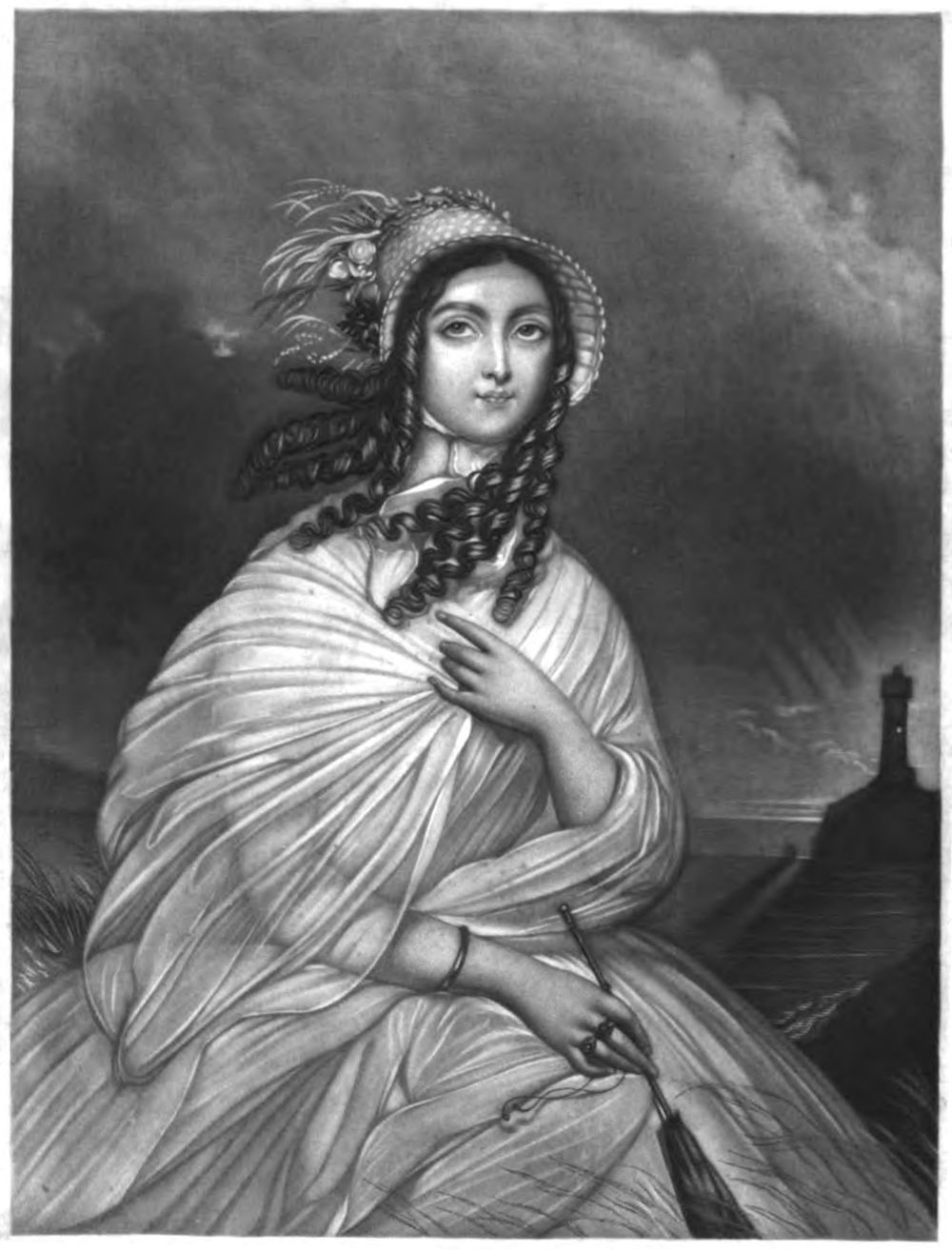
THE BELLE OF THE SEASON.
Engraved expressly for Graham’s Magazine by A. S. Walter.
———
BY CHARLES J. PETERSON.
———
It was the height of the season at Newport, and the
long piazza of the Ocean-House was crowded with
loungers. Suddenly a young man, with something of
a foreign air, exclaimed —
“Heavens, Harry! what a divinity!”
He pointed, as he spoke, with his light cane to a
young lady, who, having approached on the other side
of the street, was now picking her way daintily across
the dusty road. Her figure was one of unusual grace,
and her step light and elastic. When she reached the
pavé she glanced up at the piazza, but seeing a score
of idle eyes fixed upon her, she dropped her veil, and
advanced to the ladies’ entrance with a slightly hurried
pace.
But the momentary exposure of her countenance
showed that its beauty justified the general look of
admiration. The eyes were lustrous and dark, a rich
bloom mantled healthily on her cheek, and the fresh
air blew freely to and fro her redundant curls of glossy
raven hair; added to this the mouth was one of indescribable
loveliness, around the dimpled corners of
which Love himself seemed to lurk.
“By Jove!” said the gentleman who had spoken
before, “I have seen no woman so beautiful in all my
travels abroad. What eyes! they seem to look into
one’s very soul. And such a step, free and graceful
as a fawn’s, or rather like that of Diana, the maiden
huntress, herself.”
“That, Derwent,” replied his companion, “is Miss
Stanhope, the belle of Newport we call her; beautiful
enough, to be sure, but only the companion to some
rich Southern heiress.”
“And half the house, I suppose, is in love with
her?”
“No, and yes,” replied Harry. “She has plenty of
admirers, but no suitors; her friend, the rich Miss
Arnott, though as ugly as a giraffe, carries the palm off
from her.”
“I find my countrymen as mercenary as foreigners,
though without half the excuse,” said Derwent.
“However, they can’t be blamed. Take my own
case, for instance. Here am I with just income enough
to support myself, and no prospect of being able to marry
unless I select a rich wife, or what is even worse, go
to work in earnest at my nominal profession! In such
a case, one must either remain single or look out for an
heiress. It is well enough to talk of ‘love in a cottage,’
but what can two people accustomed to the luxuries
of life do in a house no bigger than a dog-kennel, and
with but one servant, a maid-of-all-work. However,
you must introduce me to this Miss Stanhope, I may
as well flirt with her like the rest.” Thus spoke Derwent,
one of whose affectations was to seem worse
than he was.
That evening accordingly saw Derwent numbered
among the acquaintance of the belle of the season. She
received him graciously, for in addition to a remarkably
fine person, he had an air of high-breeding;
while his countenance carried assurance of the owner
being something more in both intellect and heart, than
the ephemeral men of fashion around him. Indeed,
Derwent possessed unusual ability, improved by book-study
and travel. He talked to Miss Stanhope of England,
and its lordly demesnes; of Paris, and its boulevards;
of Germany, and the Rhine; of Italy, and her
priceless works of art; of Greece, and her temples,
even in decay the wonder of the spectator; and of
Egypt, the parent of all, with her venerable Nile, her
Luxor, her Philæ, and her pyramids, which though
they have braved three thousand years, seem as if
they will yet, in the minds of the awe-struck Arabs,
conquer Time itself. Nor did he confine himself
merely to these monuments of the past. He spoke of
the manners, the religious and the social condition of
the nations he had traveled among, from the starving
operative of England to the free Bedouin of the desert.
This style of conversation, so different from the empty
small talk and insensate flattery with which her ears
were usually greeted, arrested the attention of Miss
Stanhope; for being of a cultivated mind herself, she
not only appreciated what he said, but felt it as a compliment
to be talked to thus. In a word, Derwent
managed to monopolize her evening, and when the
hour of retiring came neither imagined it was half
so late.
“And so you were engrossed by the beauty the
whole of last evening,” said Harry, as the friends sauntered
to the billiard-room the following morning.
“You had other listeners, however, than Miss Stanhope;
and, let me whisper to you confidentially, have
made quite a conquest in a certain quarter. Miss
Arnott herself, it seems, heard you describe your presentation
at St. James’, and was so charmed with your
account of the queen, that she has asked to be introduced
to you; a favor never bestowed on any gentleman
before.”
“I forgot all about Miss Arnott, last night,” replied
Derwent. “How does she look? Is she a woman
of sense?”
“As for how she looks,” replied Harry, “here she
comes with Miss Stanhope: you see her now, a tall,
lean figure, with a face that might be pretty if it had a
bit of expression. There, that slouchy, awkward
figure, is worth just twenty thousand a year; while the
one beside it, all grace, beauty, and vivacity, has not a
cent. Whether Miss Arnott has common sense you
must decide for yourself, for I intend to introduce you
on the moment.”
Before Derwent had time to reply, the introduction
had taken place, and Derwent been left dexterously to
Miss Arnott, while his friend had contrived to monopolize
her companion.
It was a lovely morning for walking. A shower
the preceding evening had laid the dust, the sun shone
without a cloud, and a cool breeze, laden with saline
freshness from the sea, blew pleasantly past. The
ladies were executing a long cherished determination
to visit the cliffs on foot; and the two young men solicited
leave to accompany them. In a few minutes
Derwent had grown heartily tired of his companion.
She was, he thought, the most insipid creature he had
ever met. Yet, to do Miss Arnott justice, she was
quite as interesting as most fashionably educated young
ladies; but then Derwent could not help contrasting her
with Miss Stanhope, whose playful wit, strong sense,
and rich stores of reading rendered the penniless companion
as fascinating as the heiress was dull. He
was glad when, the cliffs being reached, his tête-à-tête
was broken up. He had secretly resolved to be revenged
on Harry, and accordingly luring Miss Stanhope
off to look at the sea from a new point, he set out
on his return, without going back for Harry and Miss
Arnott, contenting himself with waving his hat for
them to follow.
If Miss Stanhope detected his little stratagem, she
was not displeased with it; and the walk back to the
hotel comprised an hour of the sweetest enjoyment to
Derwent. Though the beauty of Miss Stanhope had
first attracted his attention, it was the qualities of her
mind that now fascinated him; yet we will not deny
that what she said received additional interest by falling
from such lovely lips. In short, from that morning
Derwent became the constant cavalier of Miss Stanhope;
and this, notwithstanding the marked efforts
which Miss Arnott made to attract him to herself. At
last, the partiality of the heiress became so strong that
she frowned openly on her companion whenever she
saw Derwent and Miss Stanhope together—finally, the
latter from some cause avoided his attentions, and left
the field open to her more fortunate rival.
Whether, however, this was the result of Miss Arnott’s
direct interference, or whether Miss Stanhope
herself began to think Derwent only trifling with her,
our hero had no means of discovering. For three or
four days he bore the avoidance of his mistress with
comparative patience, but when he found that she persisted
in it, and was apparently not governed by any
whim, he became almost mad with jealousy and despair.
For the first time in his life he was really in
love. He no longer thought of the comparative moderation
in which he would have to live, if he married
a woman without fortune; on his part he was now
willing to make any sacrifice. After a sleepless night,
he arose resolving to seek Miss Stanhope to offer his
hand, when, on opening a letter that had been sent up
to his room, marked “in haste,” he read the astounding
intelligence that the bank in which most of his fortune
was invested, had stopped payment, and that he
was now comparatively a beggar.
Those who have never experienced the sudden loss
of wealth, and who have never found themselves reduced,
as it were in an hour, from a competence to
poverty, know nothing of what Derwent suffered. For
awhile he even forgot his love. He read and re-read
his letter, but there was no mistake in the fact; he
rang for the public papers, the announcement of the
bank’s failure was there too. He paced his chamber,
how long he knew not, until at last the door was
thrown violently open, and Harry entered.
“What, in heaven’s name, is the matter?” cried his
friend. “Have you forgotten your engagement to ride
with me this morning? I waited till past the hour,
and then came up and knocked at your door; you gave
me no answer, though I heard you walking about like
a mad lion in his cage; so I made bold to enter vi et
armis, as a plea of trespass says. Now, don’t look
as if you would eat me—but tell me what’s the row.”
Derwent had indeed glared at Harry like an enraged
wild beast when the latter entered. He did not wish
to be interrupted, much less by his mercurial companion;
but, while Harry was speaking, he reflected
how ridiculous anger would be, and hence, when the
latter ceased, he advanced to the table by which Harry
stood, and pushed the open letter, which contained the
news of his ruin, to the intruder.
“Good God!” cried Harry, when he had perused it,
“how unfortunate. I saw the failure of the bank in
the papers, but did not know you owned any of
the rascally stock. How came it, my dear fellow? I
always invest in mortgages or ground-rents.”
“It was left there by my guardians, and since I came
of age I have been abroad. I intended to change the
investment, but left the business, with other things, till
fall, intending to be here all summer. And what is
worse, it is my entire fortune, except about five thousand
dollars.”
“You shock me,” said Harry. “I did not think it
was half so bad as that.” He paused, mused, and then
said, looking up brightly—“However, Derwent, you
are a lucky fellow yet. I have seen, for some days,
that you have had half a mind to make love seriously
to Miss Stanhope; now this blow will rescue you from
that folly, for to marry on three hundred a year would
be lunacy itself. Miss Arnott will have you, if you
speak quick, so cheer up, it is always darkest just before
the day.”
Derwent looked at his friend sternly, and was about
to characterize the proceeding Harry advised as villainy;
but he said nothing, only mournfully shaking his
head.
“Pshaw!” said Harry, “what foolish notions have
come over you? Be a man, Derwent. I wish to
heaven Miss Arnott would only have me; I like to
talk to her companion well enough; and it’s pleasant,
too, to dance with such a beautiful creature; but, egad,
my two thousand a year would not go far toward supporting
a wife.”
“I will be a man,” replied Derwent, with sudden
energy, “I will not yield to this blow. There, Harry,
good-bye for the present—I will join you in an
hour.”
When the door had closed on his friend, Derwent
said —
“Yes! I will be a man. All thoughts of Miss Stanhope
must now be dismissed; the most delightful
dream of my life is over. I must hereafter toil for
my very bread. Well, let the storm rage—I can
breast it!”
In this half defiant, half despairing mood, he concluded
his toilette and went down stairs. His first
visit was to the office, where he announced his intention
of leaving early the next morning—“For since,”
he said, “I must pull the oar, the sooner I begin the
better.”
He hesitated whether to seek Miss Stanhope and tell
her all, or to leave her without explanation. “I will
say nothing,” at last he said. “She will hear of the
cause of my departure soon enough; and even if she
had thought of me, will then bless her good fortune
which preserved her from marrying a beggar.”
He had scarcely arrived at this conclusion, however,
when he met Miss Stanhope herself face to face.
He had been sauntering up the street, his hands folded
behind him, his whole air listless and dejected. He
was taken by surprise, bowed to her with embarrassment,
and then, after she had passed, remembering that
she looked amazed at his manner, he turned about and
joined her mechanically. He scarcely knew why he
went back; and when he had done it, he was more
embarrassed than ever. Miss Stanhope was the first
to speak.
“Are you ill, Mr. Derwent?” she said, in a voice of
sympathy, “you look so.”
The tone of kindness in which these words were
spoken opened the flood-gates of his heart, and he could
not resist the impulse to tell her how much he had
loved her, and how he should cherish her memory,
though fate had placed an insurmountable barrier between
them. His words flowed in a torrent of burning
eloquence. Unconsciously he and Miss Stanhope
walked on, though they had long passed the hotel;
and when he had concluded they were at the end of
the street, on the wild, bleak common.
Not until he had told his tale, and a minute or two
of silence had followed, did Derwent venture even to
look at his companion. But, on doing so, he found she
was scarcely less agitated than himself. She trembled
visibly, and when, as soon happened, she turned to
answer him, traces of tears were on her cheeks.
“Mr. Derwent,” she said, “I will be frank with
you, for, in these matters, perfect frankness is a suitor’s
right. I will not say that this declaration of passion
surprises me, for, in spite of my having heard that you
were insincere, I thought I saw in you a real esteem
for me. It would be affectation for me to deny this.
That I am shocked at your loss of fortune, I need not
say; I feel too great an interest in you to do otherwise,
and this interest I am not unwilling, you see, openly
to acknowledge.”
She looked at him with such noble frankness, that
Derwent, enraptured by so unexpected an avowal,
could scarcely refrain from snatching her hand and carrying
it to his lips. But he thought of the public common;
and then he thought also of his poverty, and how
idle all this was—so he remained motionless and
silent.
“You tell me,” she continued, “that you are now
almost a beggar; and that, therefore, you resign my
hand. But, excuse me—for surely it is not unmaidenly
for me to say this—are you doing right in acting thus?
Is wealth necessary to happiness? Will not a sufficiency
insure felicity if there is real love in the union?
You have talents, and I hope, energy; if I thought
otherwise I could not love you. You have also a profession,
which you avow your intention of following.
Pray do not misunderstand me—I do not wish to make
myself a burden to you—but neither must you suppose
that I am base enough to you, or sufficiently ignorant
of what will constitute my own happiness, to refuse
you because you are a poor, instead of a rich man. In
a worldly view even a penniless lawyer,” she said,
smiling, “is a very good match for the companion of a
rich heiress.”
Amazement at this noble conduct had kept Derwent
silent until now, but he could no longer remain quiet.
“And you are generous enough,” he cried, “to unite
your fate with mine, if ever I grow rich enough to
offer you a home?”
“I am not very exacting in my tastes, Mr. Derwent,”
replied the fair girl, “and, therefore, shall be
contented with what you would think a very humble
home. The moment, therefore, that you can give me
one, in which you will be willing to live yourself, that
moment I will become your wife. But remember,”
she added archly, “I am flesh and blood after all, and
cannot live merely on love. I am willing, with that
confidence which my affection inspires, to wait for
you, and believe you will never seek me until you can
support me; but that will not be long hence, if I judge
your talents aright. And now never, never,” she
added earnestly, “doubt again a woman’s single-heartedness
in love.”
Derwent was equally bewildered and transported.
In his wildest dreams he had never imagined Miss
Stanhope as noble and generous as he now found her.
He told her as much.
“You flatter me more than I deserve,” she replied.
“Life, in all circumstances, is a season of trial; wealth
cannot secure immunity from trouble; and perhaps the
happiest, after all, are those who labor for their daily
bread, because their toil sweetens the meal. Nay,
I am sure I shall love you more, because I shall think
you more manly.”
Derwent parted from Miss Stanhope a different man
from what he had been before the interview. It was
not the knowledge of her love merely which had
worked the change in him, but it was the discovery
that he had thought the human heart more selfish than
it is, that he had doubted the existence of a generous
affection.
They parted that evening. Miss Stanhope, though
she pledged herself to Derwent, stipulated that he
should not accompany her to the South, but that he
should at once begin the practice of his profession.
“You may write to me,” she said, playfully, “and I
will answer, and we shall then see, from the punctuality
of the answers, which loves the most. Next
year I shall probably come North again with my
cousin, and be assured I will let you know of my arrival
the instant we are established at the hotel in
New York.”
Derwent had now an object for which to struggle,
and nobly did he labor for the great end he had in
view. The fall and winter he devoted to assiduous
study, taking no relaxation except what was necessary
for health, visiting nowhere; his sole solace being a
weekly letter to Miss Stanhope. Her replies still
breathed unabated affection. High as was the estimate
he had placed on her abilities, they fell short of
the reality as he discovered by this correspondence,
and proud was he that such a woman was some day
to be his wife.
Nor did that day appear far distant. His knowledge
of European languages brought him several foreign
clients, whom other lawyers were unable to converse
with; and one of these clients placed a case in his
hands which he won, and which from the large claim
at risk, as well as from the abstruse points of law
involved, brought him much reputation. His business
increased so fast that he wrote to Miss Stanhope:
“Congratulate me, I have gained the first move in
the game, and am now considered a hard-working
lawyer; I am already able to offer you a home, but
let us wait another year that we may be certain.”
And she replied—“I have placed my fate in your
hands, and rejoice to find you all I hoped. Dear Derwent,
you are more precious to me now than if worth
millions, since you have shown that you are something
more than an idler.”
About a month after Derwent received this letter, a
note was brought to him, the superscription of which
was in the handwriting of his mistress. He opened it
with emotion, for he knew from it that she had arrived in
New York. The delicate little missive contained
but three lines:
“Come to me: I am in New York; my present
home is No. — , Union Square.”
“Who does she, or rather Miss Arnott, know in
Union Square?” he said. “I expected to be summoned
to the Astor or the Irving.” He thus soliloquized
as he drew on his gloves.
It does not take an expectant lover long to walk two
miles; so Derwent found himself, in half an hour, at
the door of a magnificent mansion, on which he saw,
with bewilderment, the name of “Stanhope.” Just
as he had rung the bell an elegant private carriage
drove up, and Miss Stanhope herself stepped out. He
looked for Miss Arnott to follow, but she did not. His
mistress was quite alone. The servant obsequiously
bowed, and showed the way into the drawing-room,
whither, first giving her hand to Derwent, Miss Stanhope
led our hero, his amazement increasing as a
strange, wild suspicion, which the name on the door
had first suggested, grew stronger within him.
His affianced bride laughed musically at his perplexity;
and leading him to a tête-à-tête said, as she
laid her hand fondly on his shoulder:
“Are you astonished? Will you believe me when
I tell you that all this is mine? You have thought me
a pattern of frankness, dear Derwent, yet I have been
deceiving you for a whole year; making you work,
when I had enough for us both. But I wished to test
you; and now that I have found you even more than I
hoped, and that I love you better than ever, you will
not,” she continued, looking up archly into his face,—and,
truth must be told, positively kissing him—“disown
me, even though I am co-heiress with my
cousin, in my own right, to twenty thousand a year.”
How would you have acted reader? We will tell
you how Derwent did; he took the beautiful creature
in his arms, and blessed her over and over again.
Blessed her, not for her fortune, but for her having
taught him to rely on himself, and not to live the idle
life of a mere man of fortune.
“And you will still follow your profession, and win
an even greater name?” said his lovely mistress, her
fine eyes kindling with enthusiasm. “I want a husband
I can be proud of, and I know I have found such
a one in you.”
Derwent made the promise, and she continued —
“As a girl, I wished to be loved for myself rather
than my fortune; and my scheme of going to Newport,
as my cousin’s poor companion, was the result of that
desire. There I found one whom I felt had but one
fault, and that was idleness. There I found you preferring
the penniless girl to the rich cousin. But I
saw you wasting your fine powers away in a life of
mere fashion, and was hesitating whether I ought not
to strive against my increasing affection, when your
ruin”—she hesitated, and then added quickly, blushing
roseate over face, neck, and bosom—“but you know
the rest.”
Derwent has now no superior as an orator, and has
declined a nomination to Congress, because even
higher honors are open to him. His wife loves him
more devotedly than ever, and is still as beautiful as
when known as the Belle of Newport.
Speak gently, tread lightly—I’m dreaming now,
And the soft light of Hope gilds my upturned brow,
While brightly love-phantoms before me shine,
And joy’s festal garlands around me entwine.
Light carols the Future—I echo its lay,
And am happy and glad as a young child at play.
Speak softly and low:—Though I’m dreaming now,
A shade from the past presses cold on my brow:
I list for loved voices—they greet not mine ear;
And I watch—all in vain—for the forms once so dear.
Naught, naught is forgot—and a quivering thrill,
As I dwell on lang-syne, in my breast responds still.
Speak gently no more; I’m awak’ning now,
And Care’s darksome shadow steals over my brow;
My spirit has lost its fair rainbow hue,
And wrong, and deceit, cloud its roseate view:
With a mournful cry, through the wild rustling air,
Comes a voice which breathes ever a strain of despair.
Speak boldly and free—I’m not dreaming now;
Reality’s signet is stamped on my brow:
Gone, gone are Hope’s beacons, and faded is joy;
The shroud mantled Future all bliss doth destroy!
With a heart stricken sore—a soul that’s bowed low,
I am pinioned to Earth by the fetters of wo.
CHROMIA.
———
BY CAROLINE C——.
———
“These things write we unto you that your joy may be full.”
Let us by earnest thought, make this fleeting hour
of a fleeting existence sacred to the memory of the
Evangelist. For to the striving actors of the “living
present,” the past can offer few better gifts than the
scripture “record” of this “good man’s life.”
He was one other of that band of obscure fishermen,
who, adorned with none of the pride and pomp of
official station—destitute of all the attractions of wealth—distinguished
by none of the refinements and graces
of cultivated life, appeared before the astonished people
and rulers of Judea and all the East, suddenly
gifted with such miraculous powers as enabled them
to proclaim, and enforce, the most important truths on
the minds of a nation, which counted itself, in every
respect, far beyond all necessity of instruction.
Rightly to study and to estimate the record of St.
John, cannot prove to us a profitless task; a deeper
feeling than admiration, and an exalted appreciation
that will not subside into mere respect for him, is sure
to be aroused. The conviction will force itself upon
a searcher after truth, of the exceeding beauty and excellence
of the character of this Apostle, and disciple—the
brother of James—the son of Zebedee and Salome—the
fisherman of the Sea of Galilee—the man
to whom was revealed the volume of deep mysteries—the
meek, attentive, self-forgetful follower, whom
Jesus loved.
He lived through all those convulsions, wondrous
and terrible, that marked the first century of the Christian
era; and when was he found wanting in that indomitable
courage that suffered and endured all things
for the love of the blessed Jesus? True, it is recorded
that when alone in the place of banishment, the Angel
of the Lord appeared before the exiled man, uttering
the divine proclamation, “I am Alpha and Omega, the
beginning and the ending—which is, which was, and
which is to come, the Almighty,” he fell as one dead
at the angel’s feet. What then? Dwells there a
mortal on the earth, whose spirit and whose form
would not perforce bow before the messenger of Jehovah,
crushed by the thought of utter impotency and
nothingness? Indeed one might well be called fool-hardy,
and idiotically bold, rather than really brave,
who could look unabashed and undismayed upon the
“terrors of the Lord,” and on “the glory of His
power.”
John had not perhaps the ever-glowing ardor of the
great Peter—his career may not have been marked by
the constantly self-possessed bravery with which that
Apostle every where, and at all times, stormed the
citadels of Satan, casting in all directions his weapons
of spiritual defiance, and carrying on unceasingly what
was most emphatically a warfare; but we are not told
that he ever denied his Master; we have no proof,
we receive no intimation that he was ever a weakly
or blindly zealous preacher, or one unreasonably secure
in his powers. Never was he a withholder of
the truth when once it was revealed to him—and not
an inefficient leader in the valiant army of the saints—no
weak defender of the moral rights of man, and the
sacred truths of eternal life.
And to whose written or spoken words shall we
turn, to find a better exemplification of the milder
truths, and the more endearing graces, of that faith, of
which our Saviour is the chief corner-stone, than to
the record of John the Evangelist.
The language he almost invariably adopted to address
lost sinners, was not that of denunciatory wrath
or of stern condemnation—but rather was it mild, persuasive,
gentle and loving, such as tended to soften
and win the rebellious heart, rather than terrify it and
repel. The great truths of religion as uttered by his
lips, were the love and infinite compassion of God—the
constant care with which He watches over and
provides for all things created; the readiness and
joy with which He ever listens to the cries of those
who in a right spirit draw nigh to Him.
Never, or very rarely, did he seek to frighten and
compel sinners to repentance, by proclaiming to
weak and helpless beings the wrath of a God who
would surely destroy if they did not instantly yield
their allegiance. He did not, to add force to an argument
which in itself he conceived all-powerful, strive
to make predominant in the minds of terrified hearers
the thought of the avenging arm uplifted—the bright
sword suspended over the heads of all offenders,
threatening to cut them instantaneously from the
land of the living. Nor was it the lake of eternally
burning fire, nor the deep, dark, dreadful pit, nor the
everlasting torments, nor the never appeased wrath
of God—nor the undying worm, that he made the
themes of his eloquent appeals. Ah, no! but ever
was his voice heard urging the beloved in Christ’s
name to be reconciled to God; the mild eyes fixed
on the people, who could not listen unmoved to his
pleading words, and the gentle voice, was sounding
in their ears who had been deaf to sterner commands,
like sweet and never to be forgotten melody. And
tears were shed, and groans were heard, when he
stood like an angel of light and of mercy amid the
unrepentant and unforgiven.
Childlike, pure-minded, and kind, and charitable in
his dealings with the most grievous sinner, as he delivered
the doctrine of redemption it became peculiarly
the doctrine of reconciliation. And yet, the gentleness
and affectionateness of John’s nature, evinced in his
every word and deed, may not be taken as a proof, or
as a support, of the idea that either personally or spiritually
he was a coward!
It was surely no evidence of a weak or trifling character,
the readiness with which in his early manhood
he listened to and obeyed the Saviour’s “follow me.”
Could we even for a moment suppose that his mind
was cast in a mould so weak as would render him
unable to resist any command made, with a show of
superior power? Speedily that thought would die
away in the reflection, that no power or authority on
earth could in such case have held him steadfast to his
vows, till the shadows of a century clustered around
him! To the cause which he espoused that morning
when the people’s Heavenly Teacher promised that
He would make them “fishers of men,” he cleaved
steadfast, through persecutions and fiery trials innumerable,
until worn out by many toils, and many
years, he died. The love of God, revealed by his son,
Jesus, extended to miserable, erring man, was the
great truth that first touched and won his heart; and
it was because he fervently believed that the marvellous
mercy of God could not be otherwise than powerfully
efficacious in turning sinners from the ways of
death, that he so constantly presented that blessed
thought to the mind of his hearers. In the recesses of
his once darkened mind had penetrated the glorious
mystery “God is Love.” To a generous, lofty spirit,
that truth having made his own peace, it was the instant
and abiding impulse, that he should always, and
most earnestly, by that argument, urge the Christian
duties on his fellows.
The recorded deeds of this missionary do not occupy
so important or prominent a place in the sacred
pages as do those of Peter, and of Paul, but by no
means are we to consider him as gifted with less natural,
or less miraculous power; neither was he subordinate
to them in any particular.
When we think of these remarkable men, it is true,
we are struck with their boldness, and perseverance,
and unconquerable energy—we regard with admiring
thought the action of their strong will, directed to the
attainment of the most holy, heavenly objects; but
even such contemplation does not take away the interest
with which we consider him, on whose manly
nature was laid the crown of loving gentleness; which,
when we consider what his mission was, and what he
taught, seems peculiarly and beautifully appropriate,
and renders his character irresistibly attractive to
whosoever studies it.
God and Love were the words graven on his spirit.
Indeed, they were terms almost synonymous to his
apprehension. God was love—and love an emanation
from God, and these two, (if we may call them separate
thoughts) induced as great a result, and as strongly
marked John’s character, making so prominent the
angelic features of his soul, as did self-love and covetousness
stamp that of Judas—as did defiance of evil,
and confidence in God’s justice, mark that of Paul;
or, as did persevering faith, and determination for victory,
distinguish the career of Peter.
His amiable and conciliatory nature did not exempt
him from suffering, any more than did the straight-forward
boldness of the bravest disciple of Christ.
Distress and danger were his hand-maids, as they
were of all who in that dark age advocated Christianity,
and never could the humility, kindness, and forbearance
of John, by his most bitter enemies, be construed
into meanness, or to the promptings of a paltry
spirit that weakly cringed to the rich men and the
powerful.
In that solemn hour when Judas went forth from
the presence of the Lord, convicted of his foul treachery,
when the Saviour addressed to his disciples the
saddest words of prophecy, speaking to them in that
tender manner which won their deep attention, and
lasting affection. He called them “little children”—saying—“A
little while and I am with you, ye shall
seek me, and as I said to the Jews, whither I go ye
cannot come; so now I say unto you. A new commandment
I give unto you, that ye love one another,
as I have loved you. By this shall all men know that
ye are my disciples, if ye have love one to another.”
Not one of the eleven listened to those words in
vain, but a deeper impression seem they to have made
upon the youngest of that honored group, the holy
John; for the sentiment of that most impressive address
was the burden of his thought and of his voice,
to the last hour of his life.
Among the weeping women who gathered around
the sacred Cross, the youngest disciple stood, notwithstanding
his recent desertion, still the object of his
Master’s kind regard and favor. How lovingly did
the Saviour’s eyes rest upon the apostle—with what
earnest emotion he directed John’s attention to the
Virgin Mother, saying to her, “Woman, behold thy
son!” and to John, “behold thy mother!” remembering
even in that hour of bitterest sorrow, to provide
for her who had been the guardian of his infancy,
the fond, unfailing lover of his manhood.
To think on that obscure home of poverty, where
the blessed Mother Mary dwelt, with the beloved
disciple!
Blessed indeed was she, most worthy to be held by
all the world in an ever affectionate remembrance;
and yet, as a mortal woman, subject to like infirmities,
passions and sins, with all born of the flesh, altogether
unworthy adoration or worship!
What a communion of thought, and of hope, must
there have been between those two human beings, in
the years when, as mother and son, they dwelt together!
With what inconceivable interest must the
narratives of Mary respecting the Redeemer’s early
life, have fallen upon the ear of John, when, after his
fatiguing labors were for a brief time suspended, he
would return to his home, and to her! How must
his heart have thrilled, as he listened to the mournful
words, and witnessed the regretful tears with which
she called to mind His days of helplessness—when he
lay beautiful in his weakness in her arms, and she
knew that he was the Son of God! Fraught with intense
interest, as she related it, must have been the
story of that visit of the wise men from the East, of
whose fame she had often times heard, but whom she
had always regarded as a superior race of beings!
How eagerly must he have listened to that tale which
had so many times been repeated in his hearing, of the
shepherds who came in the night time to worship
Jesus. Of how, while they looked with so much
wonder and awe on the infant, so like in all respects to
their own children, their faith grew strong to recognize
in Him, even while He lay helpless in the manger,
a mighty ruler—a lord over them all—a king greater
than any that had ever reigned on the throne of Israel.
And how must John have rejoiced as he beheld
anew the proof of the all-protecting power of God,
when many spoke of that most opportune gift of the
wise men, which enabled the distressed parents to
escape with their child to the land of Egypt, where in
safety they might dwell, far removed from the cruelty
of Herod.
As she told the faith that upheld both Joseph and
herself when they set out on that long, tedious journey
toward the strange land, which had proved a land of
such dread bondage to their fathers, how greatly must
his courage have revived, how strengthened must
have become his confidence in God! And then, how
must the desire, and the ability which almost invariably
accompanies strong desire to labor, have increased,
when John heard from Mary’s lips the story of the
perseverance, humility and diligence, with which her
child had applied himself to learn his father’s craft,
how he had so faithfully labored to better the temporal
condition of his poor parents, giving thus to the whole
world an example of patient and uncomplaining perseverance,
beneath the strong test, poverty—and proving
that when he adopted the nature of humanity, he did
not exempt himself from that dread curse pronounced
on Adam, “by the sweat of thy brow shalt thou eat
thy bread.”
With no common emotion could that disciple have
listened, when Mary told of Jesus as he was in the
years of his boyhood, while he was increasing in stature,
and in favor with God and man. With no unsympathizing
ear could he have heard her tell of those
days, when she, with Joseph, sought for the child with
tears, finding him at last in the temple questioning and
arguing with the learned doctors and teachers!
And then, what sorrowful tears must they have
wept together, as they recalled the scene of His last
bitter agony!
She, the mother, with a sorrow which at times
would not be comforted, lamented the child who was
ever so affectionate, obedient and truthful—the son of
her heart, her pride, and her deep love—who, born
under the most adverse circumstances, had lived a life
of great exertion, of poverty, persecution, and deep
sorrow, and oh, horrible and most strange consummation
of such a life! She had seen him, the blameless
and the perfect, ignominiously sacrificed upon the
Cross, with malefactors!
And John, the companion of that Saviour’s manhood,
while with regretful thought he pondered on all
these things which had come to pass, still buoyed up
by a hope that never faded, would seek to comfort her,
repeating the kind words of encouragement their Lord
had spoken when He was alone with the disciples.
The mother mourned a son, such as never was given
to another parent—and the apostle wept over the
memory of a friend, whose like neither before or since
His coming, has the world ever seen!
Ah, never was there such a mingling of thought, and
of prayer, as in that humble household!—never were
such regret, and hope, and love rising with the memory
of one departed, as with His, whose image was so devoutly
shrined in their hearts!
When Mary, (unable always to merge her affection
as a mortal mother, in the thought that the risen Lord
was no more her son, that as the ascended God,
he was to her only as to all the world, a Redeemer, a
Saviour, and a Judge) wept, as she remembered the
“wonder child,” her first born, whose infancy Joseph
and herself had watched with the fondest care, and
with such an ever-present feeling of responsibility,
with what consoling words, taught him by that spirit
which Jesus had sent to all his apostles, must John
have comforted her! And there was efficacy in his
words to calm the troubled waters of her soul, and the
“peace! be still!” he spoke, was singularly powerful
to reconcile her, to cheer, and to inspire with new
hope.
For fifteen years, as is supposed by some, John
dwelt in Jerusalem with that woman, who to this day
is honored of all who have received the truth, and
adored, and glorified, and worshiped by that church
built on the unfailing foundation, “the infallible Peter”—as
its members declare. Yes! and there are
myriads who never heard that the great Cæsar reigned
once in power and magnificence—to whom the rulers
and the high-priests of that day are as though they
never had been. There are multitudes of these, who,
even at this distant day, bow down to the very dust to
supplicate a blessing of Mary, the Mother of God!
Tenderly, as over an aged mother, did St. John
watch her declining years, providing for her comfort,
soothing and cheering her heart, and smoothing the
pathway to her feet, as they tottered toward the
grave. But during all this time the apostle had not
forgotten the duties of his more important and more
dangerous vocation.
In the great, the holy city, he had performed the duties
devolving on his ministerial office, with great encouragement.
Though, with Peter, he had suffered
cruel imprisonment, and wicked men had not failed to
afflict, and torment him, by bringing evils in innumerable
shapes upon him—for in such ways did they seek
to dissuade the apostles from preaching, and the people
from lending a listening ear.
Many times St. John had journeyed to the various
churches scattered round about, unfolding in every
place where he sojourned the heavenly message that
was given him to reveal, but invariably he had returned
to Jerusalem, and to Mary, making his home
with her.
As has been stated, it is supposed by many that at
the expiration of these fifteen years, the mother of
Jesus died; and, that John then removed from Jerusalem
to Asia Minor, where he founded seven churches,
while he resided chiefly at Ephesus.
In this new scene of labor, St. John did not escape
persecution—surrounded, as he was, by a superstitious
and idolatrous people, danger and sorrow constantly
attended and awaited him.
Neither was it given him to labor in a portion of the
Master’s vineyard, untroubled by the distress and misfortune
that attended his distant brethren. The tidings
which from time to time came to him of the progress
of the holy work, and the welfare of those, who, from
the peculiar ties that bound them to him, he held most
dear, were such as caused his heart to ache, and his
tears to fall, oftener than they aroused his soul to gratitude,
or his voice to thanksgiving.
And all this time the missionary was not continuing
in the “vigor of his youth;” old age was rapidly taking
from him his strength, and his power of exertion—but
wondrous scenes were yet to be revealed to John before
his final departure. Jerusalem, the vast, proud
city, whose destruction the Jews held to be a thing
impossible, when Jesus foretold its ruin, deeming it
the wildest and most absurd idea, that a misfortune so
overwhelming should overtake them. Jerusalem, the
glory of monarchs, and of whole generations of men;
Jerusalem, the stronghold of pride and intolerance,
was destroyed!—completely despoiled, and ruined!
Many authorities agree that this signal punishment
of sin occurred seventy years after the death of Christ.
Assuredly it was a complete, an awful visitation to
those proud, rebellious, persecuting Jews, who raised
the cry—“His blood be upon us and on our children!”
Never since that time have they become a united, separate
people—never yet have they regained their
country, or a shadow of their former power!
John had outlived all his apostolic brethren. And
it was in that trying time when the care of all the
churches devolved upon him, that the sentence of banishment
was pronounced against him. It was like
taking the deputed shepherd, the watchful and careful
guardian, away from a helpless and wandering flock;
for not well could be spared, at that time, his vigilant
eye, his loving heart. Especially needed then, was
his voice, to warn, to teach, to cheer, and to encourage.
They who were weak in the faith required to have
much before their eyes that living witness of the
power of faith—the old man, who through so many
years, even from his youth, had fought a most excellent
fight.
During the loneliness of his exile, the marvelous
Revelation was delivered to the veteran apostle. In
a dreary island, uncheered by the sound of human
voices, those aged eyes beheld the glory of the Lord
revealed—saw the heavenly angel, heard the wondrous
voice. It was there those mysterious shadowings
of things to come, were given him to spread before
all men. The voices of the prophets all were
hushed—now came one forth from the very presence
of God, to prophecy great and wondrous things indeed—to
foretell the before unuttered secrets of time and
eternity; to “win souls to repentance,” by revealing
one glimpse of the blessed land, which needeth not
sun, nor moon, nor candle—which the smile of the
Lord God illumines forevermore; to point out to the
hardened and presumptuous hearts of sinners the horrors
of the second death—to tell of the worm that dieth
not, and the fire that is unquenchable!
How strange to think of that white-haired man,
severed from all he held most dear on earth, distressed
with constant tears for the firmness of his repentant
people, bearing in mind many beloved ones whom he
yet hoped to see bowing down to the mild sceptre of
Jesus, and whom daily he presented before the throne
of God in prayer, and fearing ever for the steadfastness
of the churches he had established in the midst of the
idolatrous and unbelieving, and separated from all who
through years of friendly companionship had grown
very dear to him.
Well nigh seventy years had passed since John, in
the vigor of his youth, had stood a horrified witness of
the death of torture to which the Almighty Master had
submitted; and there he was, having passed bravely
through the raging sea of persecution, bearing up
bravely under all the infirmities of age, heightened by
a life of exposure and hardship, banished to an island
where, we are not aware, was one congenial companion
to cheer his lonely hours; compelled, after so
many years of unceasing exertion, to what would at
first, perhaps, seem a most wretched kind of rest.
A wretched rest? dreary loneliness? Ah, no! such
peace, such joy as the most prosperous worldling never
knew, made sweet and bright the days of that man’s
exile!
God the Father watched over him, assuring him, in
the hour when his mortal courage and strength utterly
failed him, whispering “it is I! be not afraid!” God
the Son, the exalted, glorified Friend, was, though invisible,
ever nigh at hand! and John knew it, and as in
a dream, he heard the echo of the words the Saviour
had once spoken on earth, “Whatsoever ye ask the
Father in my name, He will give it you.” And God
the Holy Ghost, the Comforter, was ever near, sustaining
and cheering with a power nothing less than
Almighty.
Was he alone, then? Alone! God was with him, a
Friend, a Companion, a Guide, a Consoler. Alone!
Methinks in that banishment St. John could scarcely
have learned the meaning of the word!
Considering the subject of the Revelation delivered
to him, we are struck with the peculiar fitness attending
all the circumstances of its delivery.
To whom were the mystical words given? Not to
a youth brave-hearted, and fiery, whose feet were
newly shod with the “preparation of the Gospel of
Peace.” Not to a man who had served the Lord
Jesus for a few troublous years, but to one who, from
youth to extreme old age, had wrought in the fields of
his Master, bearing with all patience and meekness,
the burden and the heat of the day, and who now stood
upon the very verge of the grave! Observe, too, the
time that was chosen for the Revelation to be made.
It was not while St. John was borne down by anxiety,
and exposed every hour to danger, insult, and all that
could distract his mind, but when far-removed from
the scene of his labors, it was impossible for him to
longer turn up the furrows of the field, or gather in the
fruit ripe for the harvest. And the place! far removed
from his home, surrounded by a quiet “deeper than
silence is,” safe from persecution—away from the
jarring sights and sounds of a busy world.
Beholding under such circumstances a vision so
wonderful, so miraculous, listening for the first time to
a voice whose sound was like the rushing of many
waters, it is neither a very strange thing, nor the
slightest evidence of a want of entire confidence and
faith in God, that John fell as one dead at the feet of
the Son of Man, whose countenance was like the sun
shining in his strength.
Into that mystery of mysteries, the revelation of
the Divine, it is not my purpose now to look.
Its deep things which remain yet unsolved, I cannot
flood with light, and as regards much of the Revelation,
far-reaching, keen, and subtle minds, have endeavored
(with how much of success it were best each
reader should determine for himself) to sweep back the
clouds which hang around that declaration of things
that have been.
Of those pages St. John has said, “Blessed is he that
readeth, and they that hear the words of this prophecy,
and keep those things which are written therein, for
the time is at hand.” And surely we are not to consider
those words as applicable only to the Seven
Churches to which they were first addressed. And
if, in all those pages so gorgeously illumined with prophecy,
there is advanced no truth the mind can comprehend,
save the record of the New Jerusalem’s
glory, if that, and the promise of the everlasting “rest
of the saints,” only inspires the reader to strive without
ceasing for the blessings that await the redeemed,
it will surely not have proved a sealed volume to him.
There are none who by searching may find out God,
further than he in his good pleasure chooses to reveal
himself; but there can be no one who is possessed of
a “seeing eye,” or a “hearing ear,” who is incapable
of perusing this allegorical or highly figurative series
of prophecies with an uninterested or uninstructed
mind and heart.
Who that has once read, can forget “the pure river
of the water of life, pure as crystal, proceeding out of
the throne of God and the Lamb?” or who that toils
on, wearing in weariness the burden of life, does not
rejoice to think of that “tree of life, the leaves of which
are for the healing of the nations;” and of that blessed
land, whereof it is told “there shall be no night there;
and they need no candle, nor light of the sun, for the Lord
God giveth them light, and they shall reign forever and
ever?”
Or who that would make a jest and a mock of sacred
things, can read without a thrill of terror of the “great
white throne, and Him that sat on it, from whose face
the earth and heaven fled away, and there was found
no place for them;” and of the dead, small and great,
whom he saw stand before God, when the books were
opened, and “the sea gave up the dead which were in
it, and death and hell delivered up the dead which were
in them—and they were judged every man according
to his works, and death and hell were cast into the
lake of fire?”
Was it strange that he to whom this marvel was
revealed fell even as one dead?
Overpowered by the glory of the “mighty angel,”
the aged saint would have knelt to worship him. So
great was John’s reverence for his Maker, that he
felt constrained to render homage to his ambassador
also. But the angel said, “See thou do it not, for I
am thy fellow-servant, and of thy brethren the prophets,
and of them which keep the sayings of this book—worship
God!”
History says that “After Dominitian had reigned
fifteen years, and Nerva succeeded to the government,
the Roman Senate decreed that the orders of Dominitian
should be revoked, and that those who had been
unjustly expelled should return to their homes, and have
their goods restored.” And among those banished
men then recalled was St. John, who, with great joy,
returned again to Ephesus, bearing with him a scroll,
that was to him more precious than was in the eyes of
Nerva the crown and the throne which had fallen to him.
It is estimated that the Revelator was at this time
ninety-seven years old; but even then—and it is a fact
on which the laggard may well ponder—even then,
though infirm, and struggling with the weariness of
years, gladly and zealously (as though he had but just
received his commission to labor,) did he set out on the
homeward journey.
He was returning to his churches and his people;
should he find them faithful still, or would they all be
gone astray? Would they receive him as a friend who
had taught them truths most blessed and welcome, or
would they meet him with cold words and scornful looks,
and despitefully treat him, as though they were ashamed
to have been once beguiled by what they now believed
to be a foolish, senseless humbug?
Once more among that people, the doubts and misgivings
which probably so troubled the aged preacher
on his homeward journey, were happily all put to
flight. The good work had gone forward, the prayers
of repentance were not hushed; the songs of praise
which burst from the redeemed on earth, so far from
dying utterly away into a mournful silence, had gathered
strength and caught the tone of triumph! the voices of
the “ministers of grace” were still adjuring sinners by
the love of God to put away the thoughts and deeds of
unbelief; the tears of men subdued by the striving
spirit were falling yet.
It was after his return to the field of his labor at
Ephesus, as is supposed, that John wrote his gospel,
or a great portion of it, together with the Epistles addressed
to his brethren.
Even when the day of his death drew near, and the
weakness of the time-worn body prevented his moving
among them, even then his spirit labored, and they
who so loved and reverenced him, feeling that when
he was among them their prayers would prove more
“articulate in the ear of heaven,” would bear him in
their arms to the place of worship, that his so dear, but
feeble and faltering voice, might be yet once more
heard teaching them with words of inspiration.
Well might they love him who had spent himself in
their service; well might they venerate the aged
preacher, and treasure up his mild and peaceful words
in their hearts; well might they give heed to the dying
entreaties of the saint, “Little children, keep yourselves
from idols,” and “love one another.”
In his one hundredth year the faithful missionary
died, breathing his last amongst the grateful people for
whom he had so successfully labored, and making
them, and all the world, heirs of a treasure of blessed
example, by which whosoever shall be led, will not
need to go through life,
“Forever sighing
For the far-off, unattained, and dim!”
because, in that case, Love, the first-born of the Father,
will have entered the heart, and in the brightness of
her smile fruits will ripen, which will certainly prove
other, far other than the poor “apples of Sodom.”
Is it a vain thing to urge upon the reader a careful
examination of his character, the scenes of whose life
we have now so rapidly glanced over?
Is there, my beloved, no reason why we should
turn our eyes to the distant Past for lessons of wisdom,
because the brightest sunlight streams around us
now?
Ah! whence come all these rumors of wars—these
unlawful strivings after power—these convulsions of
governments—this inordinate seeking after riches?
Why art thou, oh earth, so disquieted within thee,
when so many centuries ago angels came unto thee,
singing “peace upon the earth?” The Prince of Peace
has lived and died, and now reigneth forevermore in
glory; the Prophets are also dead; and the Apostles—what,
are they dead to us? Not so! they are “alive
unto God!” and behold what they have left to us in
this world! A treasure-house, where are garnered
riches they have bequeathed to all posterity, which are
vast enough to ransom an enslaved world!
Within those jeweled gates, glistening and glowing in
the light of the Father’s smile, we may enter, we may
take to ourselves what shining gems we will, for, enriched
as we shall be, the treasury will not be impoverished—the
riches there are exhaustless as is the
compassion of God.
Then why is it that we consume our years, our
hopeful youth, our powerful manhood, our perfected
age, in a search that never yet, in any case, has proved
successful; hunting forever amid the sandy wastes of
time for what is constantly eluding our grasp? Why
is it that we seek continually a good that never satisfies?
Why is it that we are ever so averse to entering that
place which is so radiant with the purest gold and
gems magnificent?
Oh, can it be because the portal is so narrow and
so low, that we must bend to the dust if we would
enter, or because our worldly garments must be flung
aside, that we may say with truth, “we are miserable,
blind, and naked?” Is it because we are required to
give to the winds the dust which we have gathered
through years of wasting toil? For, bearing only the
olive branch, freed from pride, from disbelief, from ingratitude,
thus only, thus only, may we enter the
treasury of God!
By wisdom we shall seek the entrance-gate in vain.
Faith and Love alone can guide us. Had it been possible
that the world should by the light of wisdom
know God, then had the multitudes who have followed
the plausible imaginings of their own hearts never
perished so miserably! the Celestial city had at this
hour been revealed for the misguided ones, who for
years sought it carefully and with tears!
Oh! let us remember that it was Love that created
us; it was Love that redeemed us! And shall we
madly refuse to know aught of that Divine effulgence—that
centre of all life—that light of the world—that
God? Through the coming ages, by the light of Revelation
I behold the day when He shall come again
in power and great glory, to judge the world—and it
will be in righteousness!
Let us not deceive ourselves! God is Love, but He
is also Justice! If one of earth is saved, it will be
through His boundless mercy; if we are lost, only
upon ourselves can be laid the burden of such unaccountable
folly.
———
BY CLARA MORETON.
———
“But of all the pictures, there were none as beautiful as ‘The Orphan,’ by an unknown artist. The expression of
utter loneliness depicted upon the serene, but pensive face, and that of the soft blue eyes, revealing the heart’s yearnings
for the love it had lost, were touchingly beautiful.”—Letter.
I am alone! in all the world
There’s none to care for me —
None who would miss my sad-voiced tone
If I should cease to be;
I am alone! yet in my heart
The founts of love o’erflow,
For all the lovely things of earth —
For all that’s bright below.
The tree that waveth from the woods —
The vine that clasps it round —
The bird that buildeth there its nest —
The wild flower on the ground —
I love them all; they need it not,
For they are not alone;
They know no grief—no loneliness —
No joys forever flown.
The melodies of earth I love;
The music breathing sea,
The wild wind’s loud and clarion notes,
The streamlet’s laughing glee.
Strange chords within my heart are swept;
Their echoes linger long,
Till I forget my lonely fate,
In gushes wild of song.
Oh, earth is very beautiful
In sunshine or in storm!
I only wish I had one heart —
One gentle loving form,
Which in dark hours of sadness
Would ever cling to me,
Even as clasps the humble vine
About the wild-wood tree.
———
BY MRS. LYDIA JANE PEIRSON.
———
She was beautiful, and pure of heart, but from her
very infancy a child of romance. In this short sentence
is included a history of suffering, and a broken-hearted
death. I will call her Grace. She was my
near relative, and I loved her very dearly, though I
could not always sympathize with her wild idealities.
Sometimes, when we went out with a merry band
of our school companions, to range the hills, or gather
flowers by the river’s brink, I have missed her from
our company, and on searching around, discovered
her seated in some sheltered nook, or on some picturesque
eminence, so wrapped in contemplation, that
it was with difficulty she could be aroused from her
musings. I used to fear that she was laboring in the
incipient stage of some mental disease, and to dread
that she would become crazy.
As soon as she could read, she seized with avidity
upon works of romance, and sentimental poetry, and
would talk so much transcendentalism, that I used to
doubt whether she understood herself, or knew what
she was wishing to express.
Her thoughts of heaven were beautiful as angels,
and quite as untangible; and her views of life were as
unreal as the view of a landscape when it is shrouded
in a silvery mist. But in her eyes every thing was
beautiful, and pure, and full of love, just as she was
herself. From the every day things of life she seemed
to shrink, as from a copse of brambles; or, if she
could not escape them, she would cover them with
wreaths of artificial flowers.
It was almost amusing to hear her, as she grew toward
womanhood, expatiate on the perfect happiness
of fervent and mutual affection, friendship, she named
it thus, but the friend she had not found. I might have
been the one, only I could not understand her spirit,
she said, and of a truth I could not, and I much doubted
whether she understood it herself. But I frequently
assured her that she would go all her life mourning,
for that the perfection she sought did not exist on
earth.
But it was really distressing to hear her talk of love;
“the perfect adaptation, the blissful union of heart and
soul, the blissful blending of the whole being, the pure,
unselfish devotion; and, finally, the happiness, the
certain, the enduring, the all-pervading happiness of
mutual and successful love.” She could not see that
her parents, though affectionate and devoted, were not
always happy; she could not perceive that all the
married people of her acquaintance had cause for dissatisfaction,
and were more or less unhappy.
Finally, the beautiful imagery of her pure and loving
nature began to take form, and portray itself in song.
She was a true poet, for she gave voice to the real
feelings and convictions of her soul; she was a visionary
poet, for all her feelings were of romance, all
her convictions were fanciful and extravagant. But
time would have made of these a real, as well as
true poet, by chastening the romance, dispelling the
visions of fancy, and sobering the young spirit with
the lessons of experience and the teachings of reality.
The seclusion in which she passed her life, while it
shielded her purity from the heartless world’s contamination,
afforded every facility for the fostering of her
constitutional romance of feeling. Shut up within the
little circle of her kindred and early friends, she knew
nothing of the deceit, the fickleness and selfishness of
the human race; and her opinions, formed from high
colored novels, were all extravagant and unreal.
Have you ever seen a country Miss appear in a city,
dressed and adorned, according to the pattern of the
last fashion plate of the city magazine, and presenting
a perfect burlesque upon the real fashion of the day?
Just in this way was the mind of poor Grace furnished
after the exaggerated patterns of the heroines of romance.
Well, her “destiny” came at last. Her father
was a noted member of one of our innumerable Christian
denominations, and his house was a resort of all
the traveling preachers of that particular sect. Grace
believed them all to be, as indeed they ought to have
been, holy and sincere men, and delighted to sit at
their feet, as Mary of old sat, at the feet of Him whom
they called Master. Finally, a young and handsome
man appeared amongst the preachers. Gifted with an
abundance of self-esteem, confidence in his own merits,
and considerable oratorical talent, Mr. Blane was creating
a great excitement wherever he went. He was
precisely the man to take captive such a woman as
poor Grace. And she did worship him, trembling
upon his words, and living upon his smile. And he
paid her every flattering attention, induced her to read
for him, and went into rapture with the magnificence
of her selections, and the pathos and justness of her
delivery. He praised her own poetic effusions with
expressions of ardent delight; and gave admiring assent
to all her romantic dreams of life, death, and
heaven.
And she had found the brother of her soul, the kindred
spirit after whom she had been yearning ever.
In this vision of bliss two whole years rolled away;
and then this same perfect Mr. Blane—this idol of her
soul—this sun of her existence—this cynosure of all
her hopes, aims and aspirations—sat calmly down beside
her, and told that before he had seen her, he had
plighted his faith to one less excellent, less beautiful
than herself, but nevertheless pious, gentle, and pure.
That the time had arrived when his vows must be
redeemed; but knowing the ethereal loveliness of her
nature, that it could harbor no earthly passions, he felt
confident his marriage would occasion no jealousy in
her angelic soul; and that though another must be his
wife—she must remain his familiar spirit; and he
hoped the dear communion which had been theirs so
long, might continue uninterrupted through life, and
through eternity.
And so her heart was broken. She saw life a blank,
and death the only refuge from her agony, and in the
romance of her broken hopes, she resolved to die—not
by any self violence, but by the cankering broodings of
a wounded spirit. She contemned all the precious
things that God had given her, because the idol that
her fancy had made, crumbled down to common dust.
She counted as naught the strong, pure love of her parents,
her bright-eyed brothers, and gentle sisters; she
turned away from the consolations of long-tried and
fervent friendship, and wept away her hours in her
solitary chamber—wandered alone, by woodland and
mountain, or sat in the dewy twilight upon the river
bank. Is it strange that consumption found her, that
she faded away from the tree of life, and with beautiful
visions of heavenly beatitude, went down to the
silent house of death?—leaving hearts reft and bleeding,
duties unfulfilled, her place on earth vacant, and
the honor which she owed to God unpaid, and unredeemable.
This was the end of Romance—which is
always a beautiful parasite, displaying its tender foliage
and fragile blossoms, at the expense of the soul
in which its insidious roots find nurture, weighing it
down with an unprofitable burden, concealing its symmetry
and natural excellence, and wasting out the very
sap of its life.
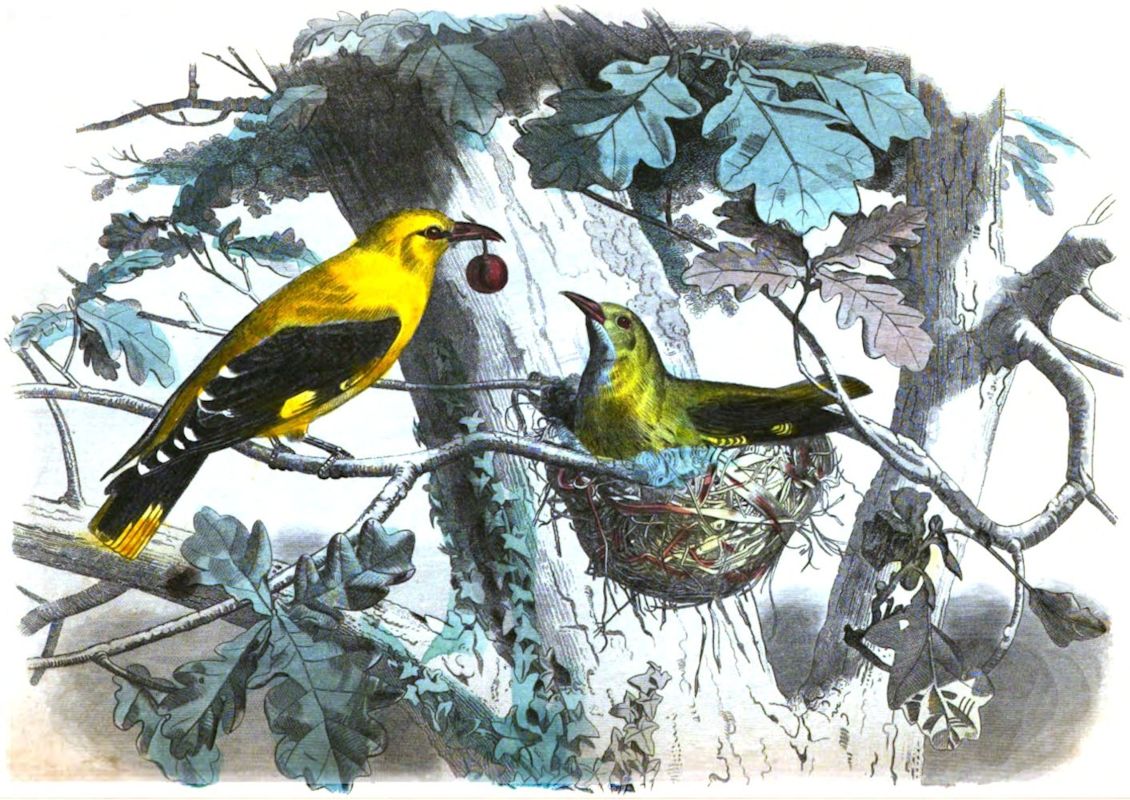
———
FROM BECHSTEIN.
———
[SEE ENGRAVING.]
This species, the male of which is very beautiful,
is about the size of a blackbird. Its length is nine
inches, of which the tail measures three and a half,
and the beak one. The head, neck, back, breast,
sides, and lesser wing-coverts, are of a brilliant golden
yellow; the wings and the tail are black, with yellow
gradually increasing to the outer feathers.
The female is not so brilliant, the golden yellow is
only visible at the tip of the olive feathers in the tail,
and in the lesser and under wing-coverts. All the upper
part of the body is of the green color of the siskin,
the lower part greenish white with brown streaks,
and the wings gray black.
Habitation.—When wild, it generally frequents
lonely groves, or the skirts of forests, always keeping
among the most bushy trees, so that it is rarely seen
on a naked branch; it always frequents orchards during
the time of cherries. It is a bird of passage, departing
in families in August, and not returning till the
following May.[2]
In the house, if it cannot be let range at pleasure, it
must be confined in a large wire cage.
Food.—When wild, its food is insects and berries.
In confinement, and if an old one be caught by means
of the owl, like the jays, it must be kept at first in a
quiet and retired place, offering it fresh cherries, then
adding by degrees ants’ eggs, and white bread soaked
in milk, or the nightingale’s food. But I confess there
is great difficulty in keeping it alive, for with every
attention and the greatest care, I do not know a single
instance of one of this species having been preserved
for more than three or four months.
Breeding.—The scarcity of the golden oriole arises
from its breeding but once a year. Its nest, hung with
great art in the fork of a small bushy branch, is in shape
like a purse, or a basket with two handles. The female
lays four or five white eggs, marked with a few
black streaks and spots. Before the first moulting, the
young ones are like their mother, and mew like cats.
If any one wishes to rear them, they must be taken
early from the nest; fed on ants’ eggs, chopped meat
and white bread soaked in milk, varying these things
as their health requires, and as their excrements are
too frequent or too soft. In short, they may be accustomed
to the nightingale’s food. I must here remark
that a very attentive person alone can hope to succeed.[3]
Attractive Qualities.—I have seen two golden
orioles that were reared from the nest, one of which,
independent of the natural song, whistled a minuet,
and the other imitated a flourish of trumpets. Its full
and flute-like tones appeared to me extremely pleasing.
Unfortunately, the fine colors of its plumage were tarnished,
which almost always happens, above all if the
bird be kept in a room filled with smoke, either from
the stove or from tobacco. One of my neighbors saw
two golden orioles at Berlin, both of which whistled
different airs.
Its note of call, which in the month of June so well
distinguishes the golden oriole from other birds, may
be well expressed by “ye, puhlo.”[4]
———
BY EMILY HERRMANN.
———
The forest leaves are falling
Throughout the quiet day,
And dreamy haze is shutting
The outer world away;
They move along the sunlight,
Upon their shining cars,
With golden edges burning,
Like lines of midnight stars.
Slowly and silently, falling,
Dreamily floating by,
Down on mosaic mosses
Their purple vestures lie.
Move they in stately sorrow,
Out from their palace-home,
Where they reveled, alike in star-light
And when the day had come?
Sink they, in sad bereavement,
Along Despair’s dim shore,
Because to their sheltering shadow,
The young birds come no more?
The sunshine and the starshine,
Will seek their summer homes
Full oft, in pleasant weather,
And find them in their tombs.
The little birds will seek their
Well-remembered shadow,
And build their nests above them,
In the meshes of the meadow.
Like travelers benighted,
Where heaping snow-drifts lie,
They’ll wither all the winter
Beneath the open sky.
Like fated generations
They vanish, in a light
That flings a treacherous beauty
Above its deadly blight.
Like altars, strangely lighted,
That burn in human souls,
They shed their sparkling showers
Before the blackening scrolls.
As roses we have tended,
Though fainting in the noon,
Still kept a pleasant fragrance
Until the eves of June.
Our forest, from the summer,
Is fading in the frost,
And the glories of his dying
Are more than she could boast.
Here in their mottled shadows,
With bended heart and knees,
Sweet thought comes to my spirit
From out the aged trees.
It seems, when flesh is failing,
And Life folds up her wing,
That soonest, in these crimson tents,
We’d hear the angels sing!
And many a bright and tangled thread,
Here Fancy ever weaves,
And Faith lifts up her trustful eyes
Above the falling leaves;
She knows that, to her native hills
No blight can ever come,
That trees, with leaves of healing, rise
Forever round her home!
Small, yellow leaves, from locust boughs,
Sprinkle the deep green grass,
Where drowsy herds, on a zigzag path,
To bubbling streamlets pass.
The earliest lamps of fire-flies
Grow dim with the rose of June,
Now droning pipes, of the insect tribe,
Practice an autumn tune.
The clover-blooms, ’mid scented grass,
Await the dews of night,
The western pane, through clustering vines,
Shines in the evening light.
Yet why so light the hurrying tread
Across yon entrance hall?
And why no more on the garden walk,
Do children’s shadows fall?
The little stranger’s fevered lips,
Like sound of struggling rills,
Murmur of far, familiar things,
Among his native hills.
His words go out on evening airs,
Where glancing leaves are still,
And sadly tones of a foreign land
In the pleasant homestead thrill:
“Weep not, dear mother! think how great
With Jesus Christ the joy.”
Thus, ’mid our changing forest, lies
The little German boy.
E. H.
———
BY PROFESSOR FROST.
———