“Palsambleu!” the old major exclaimed to himself,
as he crossed the Pont Royal; “I have an idea that
things have changed a little in three months in ‘Little
Provence,’ and that my gentleman, tired of waiting to
see my chagrin, has vacated his place—or at least
some new rascal has taken it into his head to finish
the other’s work; that is, to disgust me with existence.
Bah! that’s all nonsense, I shall find my little bench
smaller than ever—if however Fortune is still against
me—then, mille diables, I will show him that I am a
Phalsbourg—morbleu!—a descendant of the Lorraines,
corbleu!—a gray musqueteer!—bombs and cannon!—and
we will see whether this fellow will keep his
ground. It is indifferent to me whether I die by the
stroke of a sabre, or of a little bench usurped. By the
bye! how long is it since my last duel? Let me see!
forty two years! Humph! that’s rather a long interval
for the honor of Phalsbourg. But that duel had
great results, and cost me dear—one hundred thousand
crowns! I would like to know whether my money
went to the bottom of the sea with that Palissandre—whom
may Heaven confound! When I think that we
endeavored to cut each other’s throats for that little
sinner Guimard!—a little fool! who had no other
merit, on my conscience, but that she was her mother’s
daughter—another adventuress who so completely
turned inside out the pockets of the infatuated and unfortunate
Soubise.”
Major Anspach hummed a tune as he lounged along
with a most gallant air in the long brown scabbard
which he called his overcoat, and which gave something
so extravagant to his appearance, that the gate-keeper
at the Tuileries had some remorse for letting
him pass: nevertheless, the major, when he had entered
the orangery, resumed his gravity and dignified
deportment; besides, he stretched out his neck and
held his head so proudly, that his length was increased
beyond all conception, giving one an idea of the sword
of a Swiss guard perambulating the garden.
The promenade offered that day every imaginable
splendor—the sunlight danced upon the liquid surface
of the fountains, and its red rays piercing the interstices
of the foliage, bathed the atmosphere in glittering
vapor—the rays of warm light striking upon the
marble statues, started them as it were into being,
while Reverie, with bended head, seemed to throw its
somniferous influence over flowery meads and shaded
walks—and Zephyr, escorted by voluptuous Idleness,
sought each wooded recess like a nymph of Délos
under the sacred laurel.
We dare not affirm that our ex-musqueteer sensibly
enjoyed the delights of the garden, thus illumined by
the morning sun as we have described them, for it is
the opinion of philosophers that a less pleasure is swallowed
up in a greater one—the little bench, its roses
and jasmine, alone entered his thoughts, and at that
moment for it alone he lived. His eyes on approaching
it were directed timidly toward the little seat, and
who can describe the bounding pulsation of his heart
on perceiving it vacant! And besides, how much was
it embellished since he last beheld it! the roses had
climbed up and mingled with the jasmine, and formed
a delicious bower of perfume and beauty, almost concealing
the little bench in its deep recesses.
A hundred thousand pounds weight, and something
more, slid from the heart of the dear old major, and
enabled him for the first time in three months to breathe
freely. His emotion was so great that his limbs tottered,
and he was obliged to cling to an orange tree for
support—tears sprang to his eyes—he tried to utter
some words to himself that he might hear his own
voice, as if he doubted the evidence of his senses—but
he could only bring forth inarticulate sounds whilst his
chest heaved convulsively. He fell into a reverie.
“The storm that lowered on his house” was about to
be dissipated, and he had now only to combat the unhappy
daughter of Memory—talon-fingered Regret!
In celebrating thus in thought his returning happiness
Major Anspach resumed his march, and walked
along with eyes cast down, as if overcome with his
own pleasant thoughts, when he raised them he was
within two feet of his Mecca. He suddenly bounded
backward as if an adder had stung him, and then stood
breathing wildly and with glassy stare—his rival was
there!
The reader would be wrong to conclude that the ill
opinion formed in the mind of Major Anspach regarding
the unknown was a just one. The face of the old
man was wrinkled like that of an old soldier of Italy,
as painted by M. Charlet, giving evidence of years of
hardship spent in the service of his country—and if his
countenance was somewhat austere, that severity in
his looks was softened by something of amiability and
sweetness.
It was easy to perceive that he had suffered much
and long. His person partook of the military rigidity
of his countenance, the blue coat he wore over a white
waistcoat buttoning to the throat, with nankeen pantaloons,
and buckled shoes, indicated a fashion long gone
by, and its well-brushed surface, though worn, presented
to the eye a tout ensemble which claimed the
respect of the stranger. In a word, there existed between
the unknown and the major so many points of
resemblance, that it required the blind aversion which
had taken possession of the latter to prevent a feeling
of the warmest sympathy springing up between him
and his antagonist: but far from perceiving these symptoms
of a poverty noble and proud in his rival, and
which should have inclined him to stretch out the arms
of a brother rather than those of an enemy, the descendant
of the Phalsbourgs, blinded with rage, could
scarce recover himself sufficiently to salute the stranger
with a touch of his beaver of very sinister augury.
The unknown returned the salutation with much
urbanity and self-possession.
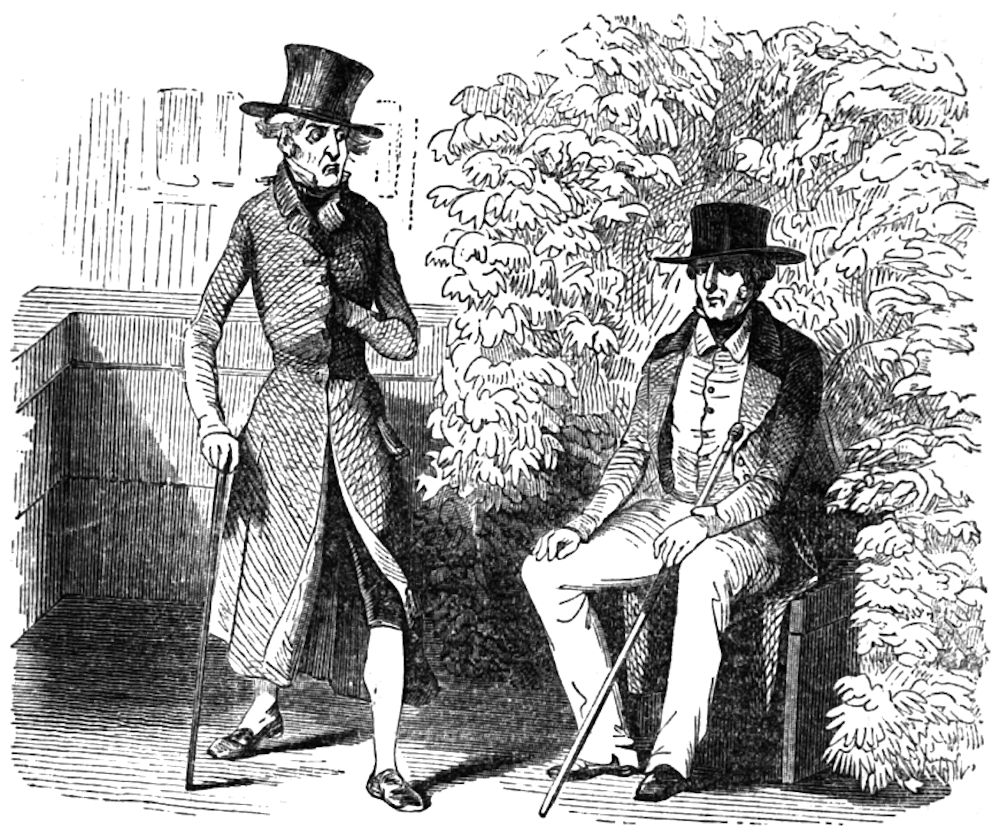
M. Anspach, this duty to politeness performed, mechanically
as it were, drew his hat down over his eyes
and made a step forward.
At this gesture his rival smiled, and looked around
him as if to make his visiter comprehend that it was
impossible from the narrowness of his quarters to offer
him hospitality.
M. Anspach observing this pantomime, smiled also,
but it was a bitter smile. He made increditable efforts
to recover his voice.
“I believe I see in you a lover of the Tuileries,”
observed he of the blue coat, bowing gracefully, “and
that you have come, like myself, to enjoy here the fine
weather?”
“It is three months since I have enjoyed it, sir,” the
choking major answered, rolling his eyes.
“True—I have remarked your absence.”
“Ah!” growled M. Anspach de Phalsbourg.
That “ah!” was a little fiendish.
“You appear to suffer,” rejoined he of the blue coat,
“and are fatigued,” he added, without offering, however,
to yield his seat.
“You are right,” replied the major, all at once recovering
the use of his epiglottis. “Yes, sir! I am
fatigued—no one was ever more fatigued.”
The major made a pause as if gathering himself up
for an encounter—then stepping up boldly under the
very nose of his adversary, continued:
“Hear me, my very dear sir. I have not the honor
to know you, but I take you to be an honorable man;
besides, your exterior pleases me; you suit me well,
and I should be pleased if you will permit me the
honor of cutting your throat.”
The blue coat drew back in astonishment, mingled
with fright; he began to think he had to deal with an
insane person, but the major, interpreting the movement,
continued—
“Do not judge the horse by his harness”—assuming
at the same time a port full of dignity and well-bred
self-possession. “You will have in me an antagonist
not unworthy of the sword of a man of honor—and if
reasons altogether personal did not at present oblige
me to ask as a favor the permission to conceal my
name, you would learn that I was of a blood which
has never dishonored the veins through which it ran.”
“Then, sir,” replied the unknown, in a tone almost
serious, “I am delighted by the accident, whatsoever
it may be, that brings us together; for the name I bear,
though I boast not of it, is one of the most esteemed
in Angoumois.”
“This meeting is delightful!” chimed in the major.
“Nevertheless,” resumed our blue coat, rising as
he spoke—“perhaps you will do me the pleasure to
explain to me to what unexpected cause I owe the
honor of your challenge?”
“You shall have it in few words. You have not
formally insulted me, I acknowledge, but you have
nearly killed me—and I plainly perceive from the
course you have taken that you will eventually accomplish
it. I prefer to anticipate my end.”
The unknown reseated himself; for the idea returned
that he was conversing with a lunatic. But
this time the major, appearing to comprehend most
perfectly the suspicions of his enemy, shrugged his
shoulders and smiled in disdain, as he said—
“I hoped that your age, sir, would have prevented
any precipitate judgment concerning my motives; but
I see that I was mistaken, for you appear to partake of
that vulgar prejudice which puts beyond the pale of a
just opinion all that apparently outrages the conventionalities
of social life. Be pleased, then, to excuse
the strangeness of my address, and I dare hope that
you will reconsider your opinion, when you know the
just grounds I have to seek the honor of a meeting
with you.”
The composed and self-possessed manner with
which these last words were spoken, struck the unknown,
and he again stood up, while the major, throwing
a rapid glance over the blue coat, continued—
“I believe, sir, you are in a condition to feel some
sympathy for those whom fortune has not deigned to
favor. I can, then, without a blush acknowledge to
you that I am one of her victims. Happily, I have
not received in the New World, where I passed many
years, severe lessons of wisdom and moderation without
profiting somewhat by them. I have been twice
entirely ruined, and yet am consoled by my philosophy.
Returning from America, I saw myself neglected—even
repulsed—by my royal masters, to whom I had
consecrated the best years of my life—a king—princes
who have not deigned to extend the hand of friendship
to an old and faithful servant, and who let him grow
old in indigence and want. Well, I am still resigned,
and for more than ten years have lived without complaint,
in a state bordering on the extremest misery.
But you know, sir, that man’s strength is not inexhaustible—there
is a point beyond endurance—it is to
that point you, sir, have brought me—”
“I, sir? I?”
“You will see, sir. The necessity I was under to
contract my desires has conducted me, little by little,
to a modesty of enjoyment which will astonish you.
Our desires increase with fortune; but a wise man
has strength of mind enough to diminish them in inverse
ratio to his misfortunes. Mine, sir, are concentrated
upon an object so humble that I might well believe
it beyond the caprice of destiny. The object of
which I speak is the little bench where you are seated—where,
since the 17th of April, you, sir, have come
to seat yourself each day, a little earlier than it was
my custom to come out to rest myself. For two years
I have taken a fancy to this spot in the garden. I love
that bench—that shade—those flowers. In summer I
come here in the sweet morning hour, peacefully to
enjoy the perfume of these honeysuckles. In autumn—in
winter—the smallest ray of sunshine upon the
corner of the garden wall reflects its heat upon that
narrow bench, making it a delightful resting-place for
the worn out frame of an old man. What shall I say?
This sweet resort obtained soon such an empire over
me, that I had but one end—but one desire to gratify—the
least sunshine upon the roofs which my garret
overlooks—the least smile of heaven had for me, a
poor old man, more intoxicating charms than ever
glance of a mistress to the most devoted lover. It was
a real passion—a love with all its joys and delicious
griefs—a cloudy or a rainy day threw me in despair,
and I felt all the torments of absence from the thing I
loved—but was the morrow beautiful, I made the
most brilliant toilet I could imagine, and ran to my
little bench, convinced that I should find its pleasures
increased.
“Is it necessary to tell you now, sir, that since the
17th of April you have driven me from my paradise,
and that you have become my executioner!
“I have but little more to say but that when I was
a gray musqueteer I would have killed any one who
raised his eyes toward my mistress; you, sir, have done
more than raise your eyes toward her—you have robbed
me of her—you have taken my little bench. It is
more than an insult. It is, believe me, a murder—an
assassination. Then, sir, give me again that seat;
assure me on your honor that you will respect my
right in future, or name your place and weapons.”
The unknown listened to the major with increasing
interest; the impress of a thousand contrary feelings
flitted by turns across his countenance, and an observer
might have remarked at times that lively combats
were going on within.
When M. Anspach ceased to speak, waiting the
answer of our blue coat, the latter walked backward
and forward for some time in silence, a prey to a
visible sorrow, which the major could not but respect.
At length he stopped, and fixing upon the major a
grave and melancholy look, replied—
“I am an old soldier, and the alternative you offer
is not repugnant to me. I, too, for three months have
had the habit of resorting to this sweet spot, and to it
I have consecrated the last enjoyments of a life without
happiness.
“You speak of your misfortunes,” added he, with a
serious smile; “mine do not cede to them in number
or severity: I was noble and wealthy before the
Revolution, but on my return, after a long absence, I
found France republican, and I too became a republican
from love to her. My nobility was opposed to
public opinion—I renounced it. My wealth appeared
to insult the public poverty—I offered my entire fortune
upon the altar of my country. The enemy
menaced our frontiers—I hastened to join the phalanx
under Moreau. I gave my all to France—my name,
my blood, my fortune. But Bonaparte appeared, and
nothing remained for me to offer to the expiring Republic
but my tears and my despair. Advances were
made to me—I rejected them. They would have restored
my fortune and my rank—I preferred my honor
and my misery—and it was only in 1815, when France
made a last effort, that I prepared to die at Waterloo.
Alas! much better would it have been to have died
there! Prisoner, and designedly overlooked in the
exchanges, (for you are aware that it could not be
forgiven to a count to have fought for France,) I was
banished to the end of Russia, dragged to Tobolsk,
and abandoned there without resources to all the horrors
of nakedness and hunger.
“How I escaped from those deserts would not interest
you. Heaven has permitted me to revisit
France, and here I am a mark for the resentments of
the throne; regarded as a traitor to the monarchy, and
contemned by those who to-day might aid me.”
The old man on concluding these words slowly
crossed his arms upon his breast, his head drooped,
as if memory remounted the lapse of years of misfortune,
and without apparent consciousness of the presence
of his interlocutor.
The major, let us say it to his praise, had equally
lost sight of the subject of their quarrel. Touched by
this recital, which awakened in his heart sensibilities
somewhat moss-grown by age, he approached the unknown,
and placing his hand upon his arm, said in a
voice filled with emotion—
“Providence has had its secret designs, my dear
count, (for I perceive you bear that title,) in permitting
two unfortunates such as we are to cross each other’s
path; and if I experience something soothing to my
pain in listening to the recital of your sorrows, it is in
thinking that you have met the only person in the
world capable of sympathizing with you as you deserve.”
“You forget, my dear sir,” replied the blue coat,
smiling blandly, “that we have to cut each other’s
throats to-morrow.”
The major hung his head in confusion.
“Hear me,” said the old soldier of the Republic.
“I do not really think that this affair is important
enough to fight about. Confess, besides, that such
pastime does not become our age. Ah! there was a
time I did not say so! In coming from the theatre, I
as willingly went to fight at the Porte Maillôt as to
laugh at the Café Procope. Sir, would you believe
it, he who speaks to you has fought and been wounded,
and afterward voyaged six thousand miles to seek his
antagonist, and all because one evening Mademoiselle
Guimard, the younger, let her handkerchief fall!”
“What do I hear!” exclaimed Major Anspach,
making a start of surprise, “you said—you—ah! mon
Dieu!”
“What do I see! you tremble—you become pale—do
you know any thing of that unhappy affair? Ah!
sir, if it is true that you do, render me a service that I
will never forget—tell me what has become of Major
Anspach?—but now I think of it, you said you had
been a gray musqueteer under the Comte D’Artois—perhaps
you have known the major—you certainly
must have been acquainted with him—ah! speak. I
only possess six hundred francs of revenue, but I
would give it all only to see the major once more before
I die.”
“You are then the Chevalier De Palissandre?”
murmured the grand-nephew of the Guises by the female
line, who had fallen upon the little bench from a
faintness he in vain endeavored to overcome.
“I inherited the title of count on the death of my
two brothers, but you, sir—may I believe—my eyes do
not deceive me!—those features! Oh, speak once
more—you are—”
“Yes, count. I am—I am your ancient rival—”
“Oh, joy! Heaven is just—it would not let me
perish without seeing him once more. Oh! if you
knew, my dear baron, how often since your departure
from France—your flight I may call it—I have cursed
the ill-fortune which did not allow me to arrive in London
in time to join you—I was acquainted with the
rascality of your banker, and not wishing to entrust to
his hands the fortune which you had left in your carriage,
I hastened after you to inform you of it—to
advise you of your danger of loss through him in time
to remedy it. Missing you there, I did not feel myself
relieved of the obligation to seek you. I followed you
to the Havana—I pursued your traces, but meeting
contrary winds and tempests, the vessel in which I
embarked failed to overtake you, and I was obliged to
renounce the dearest object of my life.”
“Well, chevalier—that is to say, sir count—pardon
me the neglect. Take the hand I offer you, and let us
bless the good fortune which permits us to meet in our
unhappy circumstances, in which we both have need
of the friendly offices of the other.”
“What the devil do you say, D’Anspach?” cried the
count, crushing in his own the offered hand of the
major. “What do you say about unhappy circumstances?
There are none hereafter for you, my friend—you
are rich, devilish rich—I believe, devil take me!
that you are a monstrous millionaire!”
The old major fixed his eye on De Palissandre in
stupid astonishment.
“Notwithstanding your surprise, it is nevertheless
true,” continued the count, “for despairing of ever
seeing you again, I took the only course which remained,
which was to wait until you should yourself
return to seek your 300,000 francs. But not wishing
to resemble the bad servant in the parable who buried
his talent in the earth, and not believing your money
safe in France, I returned to London, placed your little
fortune in the hands of one of my friends connected
with the East Company—and remember, major, that
forty years have passed away since that! May I go
to the devil, if I can pretend to tell you what the
honorable baronet has done to multiply your francs; but
his son, who succeeded him in business fifteen years
ago, and with whom I have corresponded since my
return from Russia, wrote me the other day that the
funds invested in the house of Ashburton & Co.
amounted to nearly eight hundred thousand pounds
sterling—twenty millions of francs! It seems like a
fairy tale!”
We will not attempt to paint the expression upon
the face of Major Anspach. He remained for a long
time without speech or color—his eyes shut—like a
man half-killed by some overwhelming blow, and who
seems bewildered in his mind—at length his features
regained their natural appearance, his cheeks their
color; he drew a long sigh, opened his eyes, and saw
before him M. de Palissandre anxiously watching the
effect of the crisis—stretched out his arms and threw
them around the neck of his old friend; shedding torrents
of tears.
When the first effervescence of feeling was a little
subdued, the major seized the hand of the count anew.
“Hear me, Palissandre—if you do not promise me
to submit yourself without the slightest remark to my
wishes, I take to witness my great grand-aunt, who
was cousin in the eighth degree removed of Monsieur
de Guise le Balafré, that I will go to London, receive
my millions, and on my return will throw them into
the sea. Ma foi! it will only be the second fortune
old ocean owes to me.”
“Sarpejeu! speak then!”
“Well, then, we will live together—be happy—be
rich together—and both shall have new suits of
clothes!—and when we have lived long enough, I
hope Heaven will put an end to us both at the same
time. I shall give immediate orders for the purchase,
at whatever cost, of the lands of De Phalbourg and
our Castle de Palissandre. Then we shall have two
fine estates, and you will see what lots of nephews
and nieces, who do not know us to-day, will spring
out of the earth as it were, expressly to continue the
rank and blood of the two noble houses. We shall
not want for heirs, depend upon it!”
The two friends again embraced each other—the
treaty was concluded.
Then the count and baron, with arms interlaced,
marched from the Tuileries with a step which would
have done honor to two voltigeurs of Louis Quinze—
And the little seat?
We feel ashamed to tell the truth, the whole truth,
and nothing but the truth. Yes, dear lady reader,
Major Anspach in departing forgot to salute even with
a parting glance that little embowered seat, perfumed
with jasmine and rose—the object of so much tender
regard, and for which a single hour ago he was willing
to risk cutting throats with a stranger. Alas! Mademoiselle,
love will not last forever even at sixty years!
Nevertheless, it must be confessed the little bench,
like your sex, soon obtained consolation.
———
BY S. S. HORNOR.
———
Many a maiden, if she knew
The sorrows of an injured wife,
Would robe herself in sable hue
When entering on married life.
Oh, man! be careful how you deal
With one so tender and so pure;
Remember that a wife can feel
A wound for which there is no cure.
Like to the fond, confiding dove,
Howe’er so gay and blithe before,
Repel the promptings of her love,
Her spirits sink to rise no more.
Teach her but that she loves in vain
And life becomes a worthless part;
The streams of love rush back again
And choke the fountains of the heart.
Though she may flourish for awhile,
The counterfeit of what she’s been.
The secret sadness of her smile
Tells, but too plainly, death’s within.
’Twere better she were never born
Than feel the shaft of anger dealt;
The deep contempt, the bitter scorn,
That many a suff’ring wife has felt.
Remember you’re her only stay;
And every slight and insult shown
Will fester unto deep decay,
Until the grave shall claim its own.
Then, with affection trifle not,
Nor smite the breast you should protect,
Lest mem’ry sad should haunt the spot,
Where lies the victim of neglect.
———
BY GIFTIE.
———
Upon the margin of a blue stream that ran singing
through a lonely valley among the green hills of New
England, there stood in the olden time, a low cottage,
built of logs, and half covered with woodbine and wild
honeysuckle. The small patch of Indian corn near it
hardly deserved the name of a garden, and the dense
forests that surrounded it, showed that as yet civilization
had penetrated but little way into the wilds of
the new world. Yet the variety of wild flowers which,
transplanted from their native glades, blossomed around
the low doorway, and the air of neatness that pervaded
the rude establishment, proved a degree of refinement
greater than was usual among the Indian tribes.
It was now the hour of twilight, and not a sound
was heard save the low murmuring of the wind as it
swept through the dark recesses, and swayed the
tangled branches of the mighty forest-trees. In one of
the two small rooms into which the cottage was divided,
an aged Indian and his squaw were seated beside
a rude couch, where lay the form of a dying woman.
Her delicate complexion and light hair betrayed
her English origin, and she was still young,
and had once been beautiful, though her face bore the
traces of a wo more heavy than the weight of years.
Yet peace was there, and the smile of calm resignation
which rested upon her features, told that not in
vain had been the sorrow which had bowed her to
the grave. At the foot of the couch stood a missionary—one
of those holy men whose lives of toil and suffering
were passed in the vain endeavor to counteract the
effects of the vices introduced among the Indians by
their foreign oppressors.
The chieftain lifted his head from his breast and
said, in a low tone, “She is passing away. The fair
flower we would have cherished upon our hearts is
withered.”
At these words the dying woman opened her eyes,
and a smile broke over her pale face as she said,
“Mourn not for me, kind father; and thou, tender
mother, weep no more. Ye would not keep a bird
from its native sky, that its song might cheer you.
Even like a bird my spirit would spread its wings that
it may fly away and be at rest.”
The Indian mother raised her eyes wildly and
wrung her hands as she gazed on her adopted child.
Then swaying her body to and fro, she murmured in
the half singing half wailing tones of an Indian lament,
“Will not our hut be very desolate, my bird, when
thy song is hushed; and who will bring us light like
the light of thy starry eyes? Shall we not miss thy
voice at eventide when we kneel to the God thou hast
taught us to worship? Leave us not—leave us not,
for our life goes with thee to the grave!”
The missionary raised his hands to heaven, and a
lofty faith spoke in his voice, as he said, “Mourn ye
not, nor weep. The exile departeth for her native
land, the wanderer for her father’s house. A light is
fading from your path, but another star shall soon be
added to the Redeemer’s crown. The flower ye would
have cherished hath drooped amid these alien skies,
but it shall bloom in fresher beauty in the Paradise
above.”
As he finished speaking, the dying lady placed in his
hands a manuscript, bidding him read it when she was
dead; and then, with one farewell look of love on the
kind faces that surrounded her, she closed her eyes
wearily, and crossing her small white hands upon her
breast, she composed herself as if to sleep. There was
a long silence, broken only by the low wailing of the
Indian woman, as she murmured in an under tone,
“The way is long, the way is dark; oh, bird of the
bright eye, thou soarest out of sight! who shall tell us
the path to the spirit-land when thy singing voice is
hushed? Wo for us! wo, wo—for the way is dark!”
Gradually these low moans seemed to reach the ear
that was fast closing to earthly sounds. The lips of
the dying moved, as if in a vain effort to speak, and at
length, in faint tones, she whispered, “They shall be
gathered out of every kindred and tribe and nation, and
there shall be one fold and one Shepherd. I know—I
know that my Redeemer liveth.” A brilliant smile
lighted her whole face with an expression of triumph,
as she uttered these words of hope, and even in speaking
them, the spirit fled.
That evening the missionary opened the manuscript.
It read as follows:
“You have been kind to me, and have respected the
sacred silence of the sorrow which has worn out my
life. There are moments when every heart yearns
for sympathy, and the long closed fountains of the soul
flow again. Such a mood is on me now, and therefore
I open to you this long-sealed heart.
“Of my childhood I will say little, save that it passed
like a fairy revel. Heiress of unbounded wealth, and
last of a long-descended and honorable family, I was
loved with a lavish and doating fondness, until a sudden
and terrible disease, that cut down my parents in
the pride and glory of their days, left me an orphan.
From that grief, which, for a time, was so violent as
to threaten the destruction of life and reason, I never
fully recovered. Even when change of scene, the
progress of time, and the natural elasticity of youth
had so far changed me, that I appeared to have forgotten
my sorrow, there lay ever upon my heart the shadow
of the tomb. After a time I was sent to reside with
my aunt, at the north of England. She was waiting
in the castle gate to receive me when I arrived there,
and beside her rode her only son—my Cousin Gerald.
“How slight a thing may seal the whole future of our
lives. We greet with a careless word and a momentary
glance those whose fate is to color our own forever,
and then pass on unthinking that henceforth our
destiny is fixed. And yet the first time I saw him his
image was stamped on my heart. Sorrow, change,
wrong, despair have passed over it—but that image is
there still. As I write, the curtain of the past seems
drawn back, and again I greet thee, Gerald Bellamont.
Again I meet the gaze of those flashing eyes—I hear
the low, rich music of thy voice, and I feel the floods
of deep, unquenchable love, rising in my soul for thee—thou
loved so vainly.
“Days, weeks and months passed on, and we spoke
not of love, perchance knew not that the fatal spell was
upon us. But at last the dream was broken—the hours
of peaceful affection passed away. Gerald left us for
a tour on the Continent, and with the struggle of that
first parting came the knowledge of all that we were
to each other—came the tumult, the trembling, the
fearfulness of love.
“At first the tedious hours were relieved by frequent
letters from him, so full of tender affection,
and withal so overflowing with youthful enjoyment of
the new scenes around him, that even my fond heart
was content to have him absent. Then letters came
more seldom—then ceased altogether—and then, in
the midst of our wonder and anxiety, he appeared suddenly
in his old home; but so changed from the merry-hearted
boy to the reserved, thought-stricken man, that
my timid nature was abashed, and I dared not question
him concerning the change which I felt had come
over his inmost being.
“We were wedded; and if I detected, even amid the
bridal festivities, a shade of sadness on my husband’s
brow, I strove to console myself with the hope that
now he was mine—mine forever; the love so deep,
so self-sacrificing, which I would every moment lavish
upon him, could not but chase away the bitter memories
which oppressed him. Residing on my own estate
near London, our house was the resort of the noble
and the gay; and amid the exciting whirl of this new
life, little time was left for anxious thought. I entered
into the pleasures which surrounded me with the zest
of a young and joyous heart; and for a few months life
was filled with sunshine—and the hours flew swiftly
away; ah! why came so soon that night of agony on
which there dawned no morrow.
“I was dressed at last—ready for the fancy ball.
My costume, which had been selected by Lord Bellamont,
had been pronounced perfect by my maids, and
even my fastidious taste could suggest no improvement.
After one parting glance of satisfaction at the mirror
which reflected my brilliant figure, I descended to the
library, where I knew Gerald waited for me, expecting
to be welcomed with that smile of admiration which
woman so highly prizes from the lips of love. To my
surprise, Gerald did not turn at my entrance; and as I
approached the window where he sat, I found him
gazing at a small picture, with which he was so intently
occupied as to be unconscious of my presence.
It was a full-length female figure. She stood with one
arm thrown across a lyre, and one raised to heaven.
A long, dark curl had strayed from her bandeau of
pearls and rested on her neck, and the hair was parted
back smoothly from her high brow. The face was
passing beautiful, with a fire in the dark eyes, and on
the small mouth, an air of lofty determination which
might have become a priestess at the altar of sacrifice.
Beneath was written—Leonore St. Clair.
“As I stood behind him, hesitating how to break his
revery, Gerald started up suddenly, and tearing the
picture to pieces, threw the fragments out of the window,
where the night wind scattered them far and wide.
He watched them with a look made up of scorn and
grief, and was turning away with a sigh, when he first
saw me standing near him. A deep flush passed over
his face, and he looked earnestly, almost sternly at me
for a few moments. I was as much confused as himself,
though I scarce knew why, but I had sufficient
command of myself to ask some question about the
picture—I know not what. Folding me in his arms,
he kissed me again and again before he answered. ‘I
will tell you about it some time—do not ask me now.
I thought it destroyed long ago, until by accident I
found it to-night. It is a relic of something I must
forget—I would gladly forget;’ and he pressed me passionately
to his heart, with words of deep tenderness.
Was I mad, was I blind, that even then no foreboding
whisper told my heart its doom? Yet at that moment I
thought only that he was unhappy; and when I saw him
smile again, the suspicion fled, that for a moment had
disturbed me, and, gayest of the gay, proudest of the
proud, I mingled with the throng which filled the
saloons of Lady Gordon.
“Late in the evening, as leaning on the arm of Lord ——,
I wandered from room to room, seeking refuge
from the crowd and the oppressive heat, we found our
way into the library, where but few had collected.
As we entered, we were greeted by a strain of music
so sweet and thrilling, that I involuntarily pressed forward
to listen. On a sofa near us the musician was
seated. One arm, exquisitely moulded, and white as
snow, was thrown across a harp, as she drew from the
strings a few simple notes. She was dressed in white
satin, which was not more purely beautiful than her
complexion, and was without ornament, save a few
pearls that gleamed among the braids of her raven hair,
and on her bosom she wore a single white rose—its
leaves were withered. The instant I saw her, I had
a dim recollection of having seen that face before, and
while I was striving to recall the time and place, she
commenced singing. Never heard I music like the
melody she uttered. It might have been thought the
voice of an angel chanting the songs of heaven; but,
alas! though the voice was of heaven, the song
was earthly. She sang of love—not the happy love
of that better land, but sad, broken-hearted, such
as woman’s hath too often been—utterly vain and
hopeless.
‘I love thee not—and yet thy name,
A word, a thought of thee,
Can flush my cheek and thrill my frame,
Almost to agony.
‘And rarely do I think of thee,
Save at some lonely hour,
When memories of the buried past
Come over me with power.
‘Or when upon the moonlit air,
I hear the sound of song,
Or a low music, like thy voice,
Borne on the wind along,
‘Touches some fragment of the chord
That lies all shattered now,
Stirring its thrilling tones to tell,
Of thy forgotten vow.’
“At this moment I was startled by a deep sigh near
me, and looking up, saw Gerald standing in the deep
shadow of the window recess. He was gazing on the
singer, who sat directly before him. The lady heard
the sigh—their eyes met, and the glance which flashed
from them, spoke volumes. For a moment she seemed
confused and agitated, then with a look of proud
anguish, and a voice that faltered not in its clear, low
tones, she finished the song.
‘Farewell—farewell! My dearest hope
Is that we ne’er may meet;
That passing years may teach my heart
To scorn thee, and forget.’
“Her lips quivered, and her pale cheek became
crimson as she concluded, and I fancied tears trembled
in the depths of her dark, radiant eyes. She turned
her face toward Gerald, and for a moment they continued
gazing on each other with a look full of sorrowful
love, of agony and despair. It was not till she had
left the room that I found strength to speak. ‘Who
is she?’ I asked. The answer told me the whole
story. It was Leonore St. Clair.
“When and how he had met her I knew and thought
not. It was enough to know that she loved him—that
his whole soul was given to her, and that I—oh God!
I was unbeloved. My brain seemed to burn, and my
heart ceased to beat—and yet I did not faint. There
is a fearful strength in woman’s heart, of which she is
unconscious till the hour of her uttermost agony.
Turning from the brilliant scene, I passed through the
window into the garden. There was one walk which
had been left unlighted, and thither my steps were
bent. It led to a small temple, which had been erected
to Cupid, and a lamp that hung over the altar, showed
the figure of the sleeping boy; but the recesses of the
temple were in deep shadow. I entered, and threw
myself on a seat in the darkest corner. Was it chance,
or was it ordered by the mysterious Providence which
revealed to me the fearful secret that was to blight my
happiness forever?
“As I lay there striving to still the tumult of my
thoughts, footsteps approached, and Leonore St. Clair
entered, followed by my husband. She cast a hurried
glance around, but saw me not, and then turning to
him, said, haughtily, ‘Leave me, rash man. Is it not
enough that you once cold and cruelly deceived me,
but must you thus force yourself into my presence, and
revive the memory of feelings I deemed long since dead.
Leave me—I command you!’ and she motioned him
away with an impatient gesture. I leaned forward to
hear the reply. ‘Say not so, Leonore. Hear me—nay,
turn not away, for you must hear me. Long ere
I knew you I was betrothed to another. She was
gentle and beautiful; oh, dearest, can you blame me
that I shrunk from breaking her kind and faithful heart.
Would you have taken my hand if it were stained with
her tears? Would you have accepted a dishonored
name? Too well I knew you, too deeply had I read
your noble nature to dream of doing aught but to bow
in silence to my sad destiny. Nay, more, deeply,
wildly as I loved you, until that last day we spent together
on the Rhine, I knew not that I was beloved
in return; I had been told you were the promised bride
of another. Then, when I first knew that you were
free, and I—I bound to another; I cannot speak of this—I
cannot think of it; sometimes I fear I am going
mad.’
“I did not hear her answer, for as he spoke he drew
her to the steps of the altar, and they sat down together.
They conversed some time in a low tone, and I heard
the sound of weeping. At last they rose, and as the
light fell full on their faces, I saw they were both fearfully
agitated. She drew her hands from his with a
look of passionate despair. ‘Go, now,’ she said, ‘go,
while I have power to bid you leave me. God knows
I shall never forget you; but from this moment we
must never, never meet again.’
“ ‘I go,’ he replied, sadly; ‘yet ere we part, Leonore,
I ask one kiss—the first, the last. Let me press you
once to this heart, and it will be nerved to endure all
things.’
“She fell into his arms—he clasped her to his bosom,
and I saw their lips meet. Another moment and he
had turned from her. ‘Farewell!’ he said, in a low,
hoarse tone. ‘Farewell, forever!’ was the response.
“She remained standing until the sound of his steps
had died away, and then flung herself down heavily
on the marble floor. Even in that first hour of misery
I felt no hatred of her. I longed to creep to her bosom,
and mingle my tears with hers, and echo the sobs that
came thick and gaspingly from her lips. After a while
she rose slowly, and leaned against the altar, while
words came from her lips, faint at first, and broken, but
growing louder, till I could distinguish them. ‘To die—to
die! It would be but a moment of agony, and then
all is peace. Why should I tremble? What can the
world be to me henceforth but a living tomb? And he—the
vainly loved; ah! Gerald, were I gone forever—couldst
thou not soon learn to forget me? For thy
sake, beloved, I dare die.’ As she spoke she took from
her bosom a small phial, and as it passed before the light,
I saw it was full of a red liquid. Almost involuntarily
I sprung forward and dashed it to the ground as she
raised it to her lips. ‘Do not—do not commit murder!’ I
whispered breathlessly. She gazed at me wildly for a
few moments, pressed her hands to her brow, and
sunk fainting to the floor.
“I supported her till she revived, and with her first
breath of consciousness she asked my name. I did
not reply. Just then we heard voices calling her. She
sprung up hastily, and I was astonished at her self-possession—for
I was new in the school of misery,
she poor thing, knew what it was to smile, while her
heart was breaking. For a while she buried her face
in her hands, and when she looked up, save a slight
trace of tears round her eyes, all trace of emotion had
vanished from her features. Seizing my arm as I stood
leaning for support against a pillar, she drew me forward
to the light, saying, in a tone too proudly bitter ever
to be forgotten, ‘You have seen and heard much—more
than could have been wrung by years of torture from
the proud heart of Leonore St. Clair. Yet when you
see me, you shall know how bravely a strong soul can
sustain itself when all its hopes are crushed, and life is
a burden. You shall see how my calm, haughty mien
shall fling defiance at you if you choose to publish my
secret. Tell me, girl—who are you?’
“ ‘I am the wife of Gerald Bellamont.’
“With a start of horror and a faint cry, she dropped
my arm and fled from the spot.
“Do you wonder that I can think and write of this
with calmness? I tell you there have been moments
when, as the flood-gates of memory were opened, and
the buried past came rushing back over my soul, I
have cried out in my agony, and prayed to drink of the
blessed fountain of Lethe, and forget forever. But
this is past now. A higher faith hath taught me the
meaning of this fearful lesson, a higher hope sustains
me than was ever born of human love. Truly earth
hath no sorrow that heaven cannot cure.
“The night was far spent ere I reached my home.
My husband came soon after. I heard him enter his
chamber, and for a long time I listened to the sound
of his heavy steps as he paced the floor. At last he
threw himself on the bed, and then all was still. Nature
could endure no more, and I fell asleep. Wild
and terrible were the visions that flitted around my
couch. I was in a vast banqueting-hall, and with me the
companions of the last night’s revel. Again I saw the
flowers, the lights, the bright, happy faces, and again
the dancers whirled by me. The night waned, the stars
went out one by one, and daylight shone in on the
dying lamps; yet still those wild revelers flew by me.
The sun rose up and shed his fervent beams upon us.
The flowers faded, and the faces of the dancers grew
wan, and one by one they dropped down and died. The
twilight crept over the hills, and night came on—not
radiant with stars, and redolent with the breath
of flowers, but horribly dark—the realization of impenetrable
gloom. And slowly from out of that blackness
came forth the form of a woman, clothed in white,
and grasping a lyre, from the strings of which she drew
forth no sound. Over her head a veil was thrown,
hiding her face, and descending in wavy folds to her
feet. She moved not, breathed not—all was still as
the silence of the tomb.
“Light rose no more upon me, but I saw all
things in that deep darkness more distinctly than
ever. Years passed over me. I saw the finger of
Time smite the walls of my prison-house, and they
crumbled to dust. The grass grew up from the decaying
floor, and became longer and longer, till its dull
rustling answered to the moaning wind. From the
dust of those beings, once so full of life and loveliness,
the ivy weed sprung and wound itself round the roofless
pillars till the vast charnel-house was green and
beautiful as a garden.
“Then there came around me, as I stood there in
my awful solitude, faces and forms that looked out
fitfully from the darkness, and then disappeared. They
wandered around, they stood beside me, some gazing
on me with pale, spiritual faces, bright, yet mournful
in their loveliness, and some with the countenances of
fiends, that laughed horribly at my desolation. And
there was one form that took its place beside that
marble figure, and fixed upon me the glance of its
dark eyes, reaching forth its hands as if in vain efforts
to approach me. Amid a thousand phantoms I should
have known him—it was Gerald.
“I had borne all things else in my dreadful destiny,
but I could not bear the mournful expression of that
dear face. Tears, blessed tears came to my relief. I
sprung forward, the fetters that had bound me seemed
broken, and I would have flung myself into his arms,
when suddenly that long, motionless figure interposed
itself between us, and as her hand swept the lyre-strings,
there came from them a strain of unearthly
melody. It was repeated from the distance, and on its
pealing echoes there came the sound of voices mingled
with the tramping of many feet, and forth from the
darkness there came, two by two, a band, clothed in
garments of sable blackness, and girdled each with a
girdle of living fire; and on the girdle, and on the forehead
of each were written, in letters of blood, these
words, ‘forever and forever.’ They passed slowly by,
and in passing each turned and looked at me. I shuddered
at the sight, for it was like the faces of the damned.
“Suddenly I felt myself seized and borne onward by
an invisible force. Then there rose on the air a low,
wailing anthem, that might have been the dirge of a
lost soul, and as it grew louder and nearer, directly
before me there seemed as it were a great curtain
rolled up, and I was in a vast cathedral. We stood
before the altar; around me were ranged that band of
fearful ones, with their burning girdles, and before me
the priest, dressed in his pontifical robes, and wearing
still that cincture of living fire. The marriage ceremony
proceeded—it was finished, and I turned to receive
the bridal kiss. The person at my side turned
also, and I saw his face—it was Gerald. With a cry
of joy I sprung forward to his embrace, when suddenly
there came that marble form between me and my beloved.
She fell into his arms, she was pressed to his
heart, she received the kiss which should have been
mine alone. Then rose again that strain of dirge-like
music—then pealed the shouts of fiendish, mocking
laughter; the whole scene vanished from my sight; I
felt the ground pass from under my feet, and from the
immense distance I heard a voice cry, ‘Come, come,
come—come to the judgment of the deceived and the
deceiver.’ With these words I felt myself borne
swiftly through the air. A giant’s strength would
have been vain against the force which held me—I
was powerless as an infant.
“We passed with the speed of a whirlwind through
the region of clouds and storm, and left star after star
behind us, till we reached the bounds of the visible
universe. Still there appeared system after system of
worlds, each with its suns and stars, and still our flight
was onward—onward, while ever and anon there came
through the blue ether, the echo of that awful summons,
‘Come, come, come!’ At length we reached
the bounds of inhabited space, and entered the lone
fields of chaos. And now faintly there came upon my
vision another star, which seemed flying on its way as
if pursued by the spirit of wrath. We approached it
rapidly—it was a world on fire. I saw forms that
wandered to and fro, striving in vain to fly from their
torments—‘hateful, miserable, and hating one another.’
They ran to and fro, they plunged into rivers that rolled
in sullen billows through that world of despair, and
shrunk back howling, for the waves were of liquid
fire. They glared horribly on one another with their
fiery eyes, and raised their hands with deep curses to
where, in the lurid sky above them, burned in blood-red
letters, the curse of their awful sentence, ‘forever
and forever!’
“Upon the verge of this fiery world we paused, and
for a few moments there was a deep and fearful silence.
Then the band of dark spirits opened their ranks and
led forth the form of a man. It was Gerald. I saw
them hover with him over the fiery abyss. I saw his
impotent struggles to escape; and breaking from the
power that held me, I cried, ‘I am thine, beloved—take
me with thee—in the midst of guilt and anguish,
thine, still thine!’ An instant more and I should have
reached him, when, with a wild laugh, that form came
again between us. Slowly she raised from her features
the shadowy veil—it was the face of Leonore.
With a sharp cry, I started from her. The spell which
had bound me was broken. In mercy I awoke.
“Trembling, scarcely daring to think it all a dream,
I drew aside the curtains to look around, and beheld
my husband standing before me. He was frightfully
pale and haggard, his eyes were dim and bloodshot,
and startled at his appearance, and for a moment half
forgetting the dreadful secret I had learned, I threw
my arms around him, and drew his face down to mine.
A deeper shade passed over his brow, and he sighed
heavily as he pressed his lips to my cheek. I could
not return the kiss. I could not speak. Perhaps he
did not notice my silence, for in a few moments he
told me that he had received letters requiring his immediate
presence in France, and had made preparations
to leave in a few hours. Some more words he
spoke, but I knew not what they were, and then clasping
me convulsively to his heart, he bade me try to
sleep again, and left me.
“Sleep—oh mockery! What had I to do with sleep
or rest, while I bore within me the blight of a sleepless
wo! How may I tell of the weary days that succeeded?
At first there were hours of frantic misery—tears of
wild and passionate despair. Then came the silent
sorrow—the dull heart-aching that so slowly and
surely wears out the life. Had I loved Gerald less, I
might have called pride to my aid—I should have felt
resentment or jealousy, but judging him from the fullness
of my forgiving heart, I had none of these emotions,
which might have nerved me to forget my wrongs.
Once after that fatal night I saw Leonore at the Opera,
where I had been carried by the solicitations of my
friends. She was fearfully changed. The rich fullness
of her form was gone, the bloom had faded from her
cheek, and her eyes were dim, as if she too had wept
tears of vain sorrow. She sat among her gay and
splendid companions, silent, motionless, abstracted.
“That night I returned home to find a new affliction.
Lights were flitting to and fro, and the servants avoided
me as I entered—for none cared to tell me the sad
tidings. Lord Bellamont had returned home violently
ill, and when I entered his bed-chamber, I found the
physician already there, striving to rouse him from
the stupor into which he had fallen. Sorrow and
sickness had written deep lines on that dear face, and
even amid the weakness of delirium he seemed to
battle with the strong heart’s agony. Seven days I
sat beside his pillow. I faltered not—I wearied not.
Seven nights I saw the twilight steal over the hills, and
the moon fade from the sky, and I slept not. Naught
but a love like mine could have endured these torturing
vigils. My whole being resolved itself into one intense
thought of him—one fervent prayer that he might not
go down in the noonday of his life and beauty to be a
dweller with the dead. For myself—my resolution
was taken. I would no longer be the living mildew
on his brightest hopes—the fetter that bound him from
all he loved best. Ah, woman’s heart is strong, and
He who formed it for love and sorrow, alone knows
how much it will endure ere it break.
“Religion forbade that I should for his sake give up
this mortal life, else I would willingly have died, but I
could give up the life of life—sacrifice all that made
earth joyous or beautiful—break the tie that bound him
to misery and to me. I could leave him. Poorly as
he had requited my love, he was still the chief pleasure
and glory of my existence. Even then to hear
his voice, to watch the return of health to his enfeebled
frame, to gaze upon his face in silence and unheeded,
was the sole happiness left me, and that, even that I
gave up for his sake. Ah, Gerald, could I know that
when free thy heart turned back once, only once, after
the lost one, I would not regret the sacrifice. Alas!
it was vain—all in vain. Let me hasten on, lest my
brain grow wild again with these fearful memories.
“My preparations were soon made. Fortunately
for my purpose, one of the servants had some relatives
who were to emigrate to America, and I had at
his request, supplied them with the requisite means. I
sent for him, and with a calmness at which I even then
wondered, I told him I wished to send under his care
a young friend, whom I requested him to treat with
respect and attention, as grief for the loss of a friend
had made him slightly insane. He promised to take
the charge, and appointed the place where I should
meet him, suspecting nothing of my design. Why
should he? Too well had that fatal secret been kept;
my nearest friends knew nothing of what had passed.
“The parting hour came too quickly. I was calm,
for there was neither hope nor fear in my heart. I
only knew that I must leave Gerald, and what else remained
to me in life. I stained my face till I was dark
as a gipsy, and cut off the long, silken tresses of which
I was once so proud. Then clothing myself in the
garments of my page, I secreted about my person a
small amount of money, and taking a bundle of clothes
in order to sustain my assumed character, I was ready
to depart. At the threshold of the door I paused, and
unable to go without seeing him once more, I stole
softly to the room where my husband lay sleeping; I
knelt by his couch, over which the moonlight fell
brightly, and gazed into his face with that earnest look
which a drowning man might give of earth and sky
ere the blue waters closed over him forever. As I
gazed, the sleeper stirred, a smile passed over his face,
and he spoke my name. That one word unnerved
me. Tears rose to my eyes, and hope, which I had
deemed long since dead, sent her low, thrilling whisper
through my heart. For a few moments I was swayed
with conflicting emotions, as visions of past days rose
before me. It was not long. Again came the thought
of the last few months of sorrow, and I could no longer
doubt. Rising with a new resolution, I went to the
table that stood near and wrote a few lines—the transcript
of my heart’s despair.
“ ‘Farewell, Gerald—I know all; I can no longer
endure to be the cause of wo to you, whom I love far
more than life. Ere you read this I shall be gone from
you forever. Be happy, for I shall never return from
that last resting-place to cast a shadow over your soul.
God knows I blame you not. It was sufficient of
blessedness for me that I was worn a little while on
your heart, though I be now cast aside like a withered
weed to perish.’
“Folding the letter, I laid it on the pillow. Still he
slept, but the smile had faded from his face, and I bent
over him and pressed on his lips one last kiss—the seal
of my sacrifice. The touch disturbed him, and I paused
to catch the words that he spoke, as he turned restlessly
on his pillow—the last words I might hear from
him. It came—the word was ‘Leonore.’
“Silently, as if that word had been a curse to cling
to me through life, I turned and left him. Without a
pause I tracked the mazes of the garden and the park—heedless,
tearless, miserable. As I came near to
the Park Lodge, lights were glancing in the cottage,
and a carriage stood at the door. The children were
already seated in it, and soon the parents came to the
door, and as I leaned exhausted against a tree, I saw
the parting, and heard the sound of low sobbings, of
blessings, and of prayers. Alas! I had departed, unblest,
unwept. I know not what spell was in the sound,
but in a moment I was collected and firm, and entering
the carriage I wrapped myself in my cloak, and as
they asked me no questions, we rode in silence from
the spot which contained all that was dear to me on
earth. Morning was breaking before we reached the
vessel, whose sails were spread, and her deck crowded
with passengers. A short time sufficed to place us
among them, and in a few moments the anchor was
weighed, and the vessel dropped down the river.
“After this there is a long, long period of which I
remember nothing. The various incidents of our
voyage and our arrival in the new world, passed before
me like the vague and changing scenes of a dream.
The necessity for action taken away, my whole being
sunk into a sort of apathy, and heart and mind seemed
palsied. From this state I was roused by finding that
preparations were being made to send me back to England,
and a vague horror seized me at the thought,
though I had no recollection of the past. With the
cunning of insanity, I made no objection to the plan,
but one day, unnoticed, I rambled away from the
village, and for many days wandered on through the
woods without aim or motive, save the vague fear of
something behind. I remember reaching at last the
top of a high hill, amid a violent storm of thunder and
lightning, and there night closed around me, dark and
mirky, and beneath the pouring rain I lay down on a
bare rock and slept. There I was found next morning
by the Indian chief whose wigwam has from that time
been my home. A long sickness which ensued reduced
me to the brink of the grave, and for many
weeks I was insensible to the care of my kind nurses,
but their simple skill and constant attention at last
triumphed over the violence of disease, and I awoke
to reason and—wo is me—to a recollection of the long
hidden past.
“It was Gerald—it was my husband! Merciful
heaven! after so many years of painful separation did
we meet again!
“I had been sick and weak for some days, and my
Indian father had led me forth one sunny morning into
the green old woods, where I reclined, concealed by
flowering shrubs, upon the mossy trunk of an old tree.
Suddenly we heard the tramp of horses, and winding
along the narrow path came a band of armed men, and
their leader was Lord Bellamont. His face was stern
and pale, and there lay the weight of years which were
not his, in the thin, gray locks which floated over his
brow; yet at the first glance I knew him, and rising
almost unconsciously, I followed after him. Mile after
mile I went on unheeding, and my kind protector accompanied
me without a question, for he saw that a great
purpose nerved my feeble frame. When the noontide
heat had passed, we reached the top of a small hill,
and in an open level plain below, we saw hostile
armies arrayed for battle. One long hour I watched
the waving of that snow-white plume, hither and
thither among the soldiers, till at last it was struck
down. Horribly distinct even now is the agony of that
moment, when my straining eye was fixed on that spot
with an intensity which through the confused mêlée
of the fight never for one instant wavered. When the
course of the conflict swept the armies further down
the plain, I rose and went to the spot. I knew him—ghastly
and bleeding as he was, and God gave me
strength to know that he was dying, and yet to endure.
“A few hours after he opened his eyes, and the pain
of his wounds seemed relieved. I had laid him on
my own bed, and was kneeling beside him. ‘Pray
for me,’ he said, faintly, ‘for I must die, and there is
guilt on my soul.’ I bowed my head lower, and tears
fell from my hot and aching eyes. As I listened to
that well-remembered voice, all the wild joy of our
first love came rushing back over my soul, and over-powered
by the recollection, I fainted.
“When I recovered, they told me that the missionary
we had sent for had arrived and was with Gerald. I
crept silently into the room, and stood concealed behind
a screen, which had been arranged to protect the
sufferer from the draught of air. He was speaking in
a low, mournful tone, but I heard every word distinctly.
‘It was a wild, and sad, but not a guilty love,’
he said. ‘My own heart would have scorned me, had
I brought shame on the young head I have bowed even
to the grave with a weight of sorrow too heavy to be
borne. I looked upon Ella in her young beauty, and
strove to forget the dark, spiritual eyes of Leonore.
We were wedded—Ella and I—and when I spoke the
bridal vows, it was with a heart as pure as if she
whose destiny had been so fatally linked with mine,
was what she now is, an angel in heaven, I loved her;
but that hopeless and ideal passion was only part of
my remembrance of the beautiful scenes of sunny
Italy; and while those sad thoughts chastened all present
joy, they interfered not with the love I bore for
Ella. Perhaps, had I understood better the deep,
thoughtful nature of my gentle and joyous bride, I had
after a while forgotten Leonore. But, wrapped in
painful musings, I heeded not the manifestations of her
sensitive nature, and regarded her only as the play-fellow
of my thoughtless youth—too airy and brilliant
to understand my saddened heart.’ He paused for a
few moments, and then continued, in an agitated tone,
‘We met once more—Leonore and myself—oh, that I
had died ere that evening. I knew not of her presence
until I heard her singing a plaintive melody, and
before it ended, she met my impassioned gaze. I saw
the thrill of agony that shook her frame, and when she
left the room, I followed; for the sight of her suffering
maddened me. Then were wild words spoken—words
which left lightning traces on more than one
heart and brain. There were tears which seared as
they fell—there was one long kiss, when our two souls
rushed into one, and fell back, crushed and bleeding,
from that fearful embrace. There was one wild, despairing
farewell, and we were parted forever. The
next morning I left England, and for months wandered
over the Continent like a spirit of unrest, till at length
wearied and sick with that heart-sickness which no
art can cure, I returned home to die. Ella was absent
when I reached my home. I remember being seized
with a sudden fainting as I entered the room, and then
all is a vague dream, till I awoke one morning as from
sleep, and found myself weak as an infant. Then,
as I slowly recovered, I first became aware of the
exceeding strength of woman’s love. My wife, who,
like an angel of mercy, had watched over my sick bed,
whose gentle and patient tenderness had endured all
things without a complaining word; oh, my father,
spare me the recital of what followed—she knew all—she
left me, that I might once more be free; she hoped
I might be happy.’
“For a long time he was silent, and when he spoke
again, his voice was feeble and broken, and he wiped
the large drops from his brow.
“ ‘There is but one scene more. I sat alone in my
deserted house, and prayed to die, for my grief was
too heavy to be borne. Suddenly a carriage drove to
the door, and a letter was handed me. It contained
but few words, but those few I can never forget.
‘The time is come when without guilt thou mayest
look upon me. The love which men give the dead,
even the living may forgive. Now, when passed away
from thee forever—now only may I say—I love thee!’ ’
“ ‘I descended to the carriage, and they drove me
to the door of a large mansion, where I was met by
General St. Clair. His face was sad but stern, as he
seized my arm, and simply saying it had been the last
request of Leonore, he led me to a darkened room, and
left me. On a couch near the window lay a form
covered with a heavy pall. I raised it, and saw
Leonore reclining there in the perfect beauty of repose.
I knelt beside her, and pressing her cold hand to my
aching heart, spoke her name. But the dark lashes
moved not on her cheek—never more might those
glorious eyes flash forth their welcome at my coming—never
more would those pale lips open with words
of greeting. She was dead, and the guilt of a double
murder lay upon my soul.’
“Again there was a deep silence, and I heard the
slow, labored breathing of the dying man. The priest
bent over him, saying ‘Son, there is mercy for the
guiltiest—despair not.’
“ ‘I do not despair,’ replied he, fervently speaking
with effort. ‘The time for that passed away with the
hour when calmed and humbled I knelt at the altar of
my God, whose dealings with me even then I understood
not, and consecrated my life to his service.’
“ ‘Thine hour is come. Son, art thou ready to depart?’
“ ‘There was one hope,’ he replied, faintly, ‘one
last hope that my fatal life might end in peace. But
God hath ordered otherwise, and it is well.’
“ ‘What was that hope?’ asked the priest.
“ ‘I heard not long since that Ella was not dead.
That she escaped to this new world. I hoped to find
her, and solace her for years of suffering by my deep
devotion. Oh, my God!’ he added, suddenly clasping
his hands together, ‘why couldst thou not grant this
last prayer of a broken heart. To see her, to hear her
say that I am forgiven—to die upon her breast—’
“I could restrain myself no longer, and rushed forward,
exclaiming, ‘Gerald, my love, my husband!
behold me here, loving thee, forgiving thee, even as
when for thy sake, I left thy country and thy home!’
I sunk, half kneeling, on the floor beside the bed. He
gazed on me a moment in speechless wonder, and then,
with the supernatural strength of life’s last effort, lifted
himself from the pillows, and clasping his arms around
me, drew me close, close to his heart. Oh, the blissful
repose, the unmingled ecstasy of that moment. Forgotten
were my wrongs and my sorrow—the agony
behind, and the desolation before—the coming and the
bygone despair.
“Closer and closer grew his embrace, and his face
touched mine. ‘My wife, my bride—receive the last
kiss of him who is now wholly thine!’ I raised my
head, and his cold lips pressed mine. I felt his form
sink slowly beneath me, and the clinging arms relax
their hold. I knew that the spirit had fled, and thanked
God for that one hour of bliss which left me alone
again on earth.”
Here the manuscript ceased suddenly, and though
some words had been added, apparently at a later date,
the hand of the writer must have been weak indeed,
for they were illegible.
———
BY JOHN JONES.
———
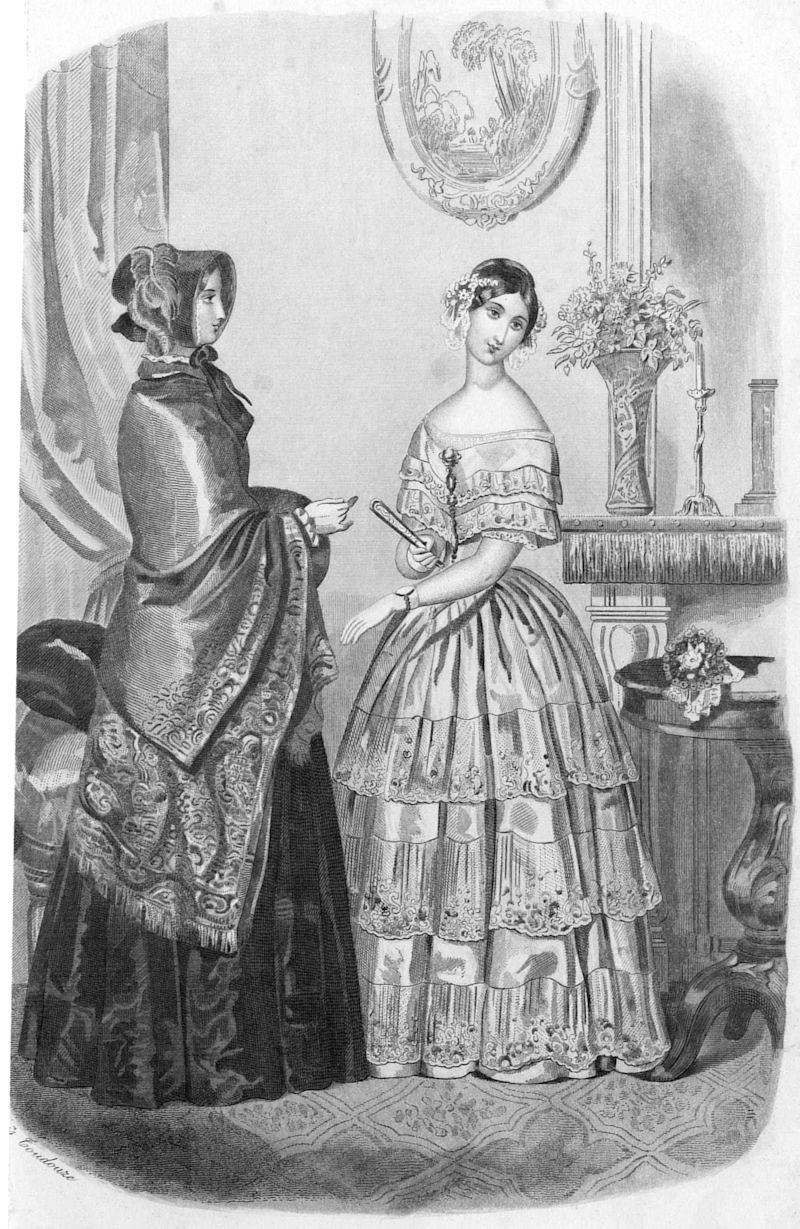
[SEE ENGRAVING.]
Mr. Edwards Perley was not a man of wealth,
although, at different periods of his life, he had been
the owner of property valued at from one hundred
thousand dollars to half a million. But this property
being either in Texas land scrip, South Carolina gold
mines, Western town lots, Mulberry trees, Maine
wild lands, or other people’s promises to pay, Mr.
Perley had never been able to realize what was so
nearly a splendid fortune within his grasp. The revolution
in Texas destroyed the value of Mexican grants,
in which he had become largely interested, and the
sale of square leagues of the “best cotton land in the
world,” not only ceased suddenly, but the bills received
for previous sales came back upon him dishonored.
This was a sad damper on the golden hopes
of the enthusiastic Mr. Edwards Perley. For a couple
of years he had been selling land scrip from Bangor
to New Orleans; and had been out on the Red River
twice, during the time, with a surveying company,
whose business it was to locate the little league-square
lots. On these expeditions, he had become rather intimately
acquainted with alligators and ague, and, on
his return, deemed it no more than prudent to keep
himself quiet until he regained his complexion, and the
healthy roundness of his limbs and features. Mr.
Perley worked hard in this matter; but it suited his
temperament. He was no plodding genius, content to
count sixpences first, then shillings, and so on until
dollars began to appear. Not he. In that slow way
to wealth he could not walk.
Just as Mr. Perley, who valued his property at hundreds
of thousands of dollars in the present, and looked
upon it as possessing an annually duplicating quality—just
as Mr. Perley had selected a beautiful site for
building a palace in New York, and had decided upon
the plans submitted by a distinguished architect, the
troubles in Texas destroyed the value of his scrip, and
down he went to ruin like a collapsed balloon; and
dozens of his confiding friends went with him.
But Mr. Edwards Perley had too much native buoyancy
of character, too much hope in life, to be put
down by ill-natured fortune after this summary manner.
In the wreck and ruin in which he was involved,
he managed to get hold of a plank on which to float
ashore. With a few hundred dollars, which he had
contrived to save, under a self-enacted “homestead
exemption” law, he opened an exchange office in Wall
street, on a very small scale. Though his business
operations scarcely reached, for a time, the aggregate
of hundreds per day, there were not a few of his
acquaintances who believed his transactions to be
limited only by thousands; and they were indebted to
him for their ideas on the subject. Give a man the
reputation of doing a large business, and business will
be sure to come. So it was in the case of Edwards
Perley. Talking and boasting were of great use to
him. In a few years he was getting along, as the saying
is, “swimmingly.” But, like the man who, after
creeping along for a week in a stage-coach, grows impatient
if the cars do not make thirty miles an hour
instead of twenty, Mr. Perley, as soon as affairs became
prosperous with him again, grew dissatisfied
with what appeared a slow accumulation, and began
to look around him for some good speculation. He
was not long in finding what he sought.
But it is not our purpose to follow Mr. Perley
through the various stages of his Carolina gold and
Morus Multicaulis fevers; nor to minutely detail his
operations in Western lands and town lots. As it had
been in Texas land scrip, so it proved in all these.
The visionary speculator, who sought wealth for its
own sake, and was too eager for its possession to be
willing to give back to society an equivalent of useful
acts, after running a wild course for a few years,
again tripped and fell. This time he found it much
more difficult to recover himself. But with an elasticity
of feeling that few possess, he went hopefully to
work, and by dint of magnifying his own peculiar
abilities, and his knowledge of business, induced a
shrewd, calculating Yankee, who had a few thousand
dollars, to join him in business.
For a year or two, Perley was content to move on
slowly. After that, he grew ambitious and restless
again. The fire had not burned out; it was only
covered for a while. Of Jenkins, his partner, he had
no very high opinion. He considered him a mere
plodding genius, whose mind was in no way suggestive.
He would do for a well beaten track, but for
enterprise he was nobody. So he thought. But Jenkins
had rather more shrewdness than his partner gave
him credit for. He belonged to the class of men who
think a great deal before they act, and who, therefore,
rarely make mistakes in business matters. He understood
Perley “like a book,” and was, therefore, prepared
to counteract, judiciously, all his efforts that
were not wisely directed. Reactions of this kind becoming,
as business grew into importance, more and
more frequent, Mr. Perley felt restless under them,
and often lamented that affairs were not entirely under
his own control.
This was the aspect of things when the golden news
from California startled the most sober-minded with its
tale of wonder. Perley believed every word of the
first account, while Jenkins coolly took the liberty of
doubting the whole story.
“It’s preposterous,” said he.
“But look at the official nature of the intelligence,”
urged Perley.
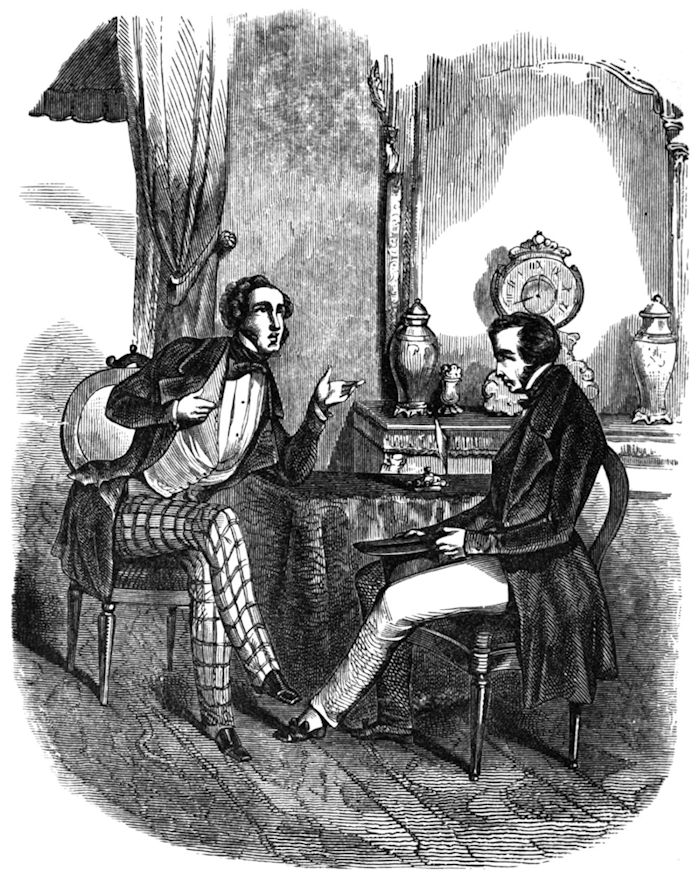
Engraved Expressly for Graham’s Magazine.
A CASE OF GOLD FEVER.
“Officials can lie as well as other people. It’s all
a speculation to get settlers out there. Don’t tell me
of gold scattered about as thick as jack-stones.”
Perley maintained the other side of the question, and
soon had the satisfaction of pushing most abundant
confirmations into the face of his partner.
“Well,” said Jenkins, “what of it? Suppose there
is gold there? It doesn’t make me any better off.”
“But it will make you better off, if you seize the advantage
now offered to every energetic and truly enterprising
man.”
Mr. Jenkins opened his eyes rather wider than usual;
then shrugging his shoulders, he answered:
“My business creed is—‘Let well enough alone.’ ”
“And mine,” replied Perley, “is to seize upon every
advantage that offers.”
At this point the conversation was interrupted, and
as neither party, for good reasons, thought it advisable
to renew it, the subject did not come up between them
for several days. During this time Perley could think
of little else but California, and the golden harvest it presented;
and the more he thought of it, the more fully
satisfied was he that an immense fortune might speedily
be realized by trading in that region. What was in the
way, when blankets sold for ten dollars each, a pair of
boots for double that sum, flour for sixty dollars a barrel,
and every thing else in proportion?
“The fact is, Jenkins,” said he, renewing the subject
not many days after the first conversation, “we
must make some of this hay while the sun is shining.”
“The golden hay, you mean.”
“I do.”
“How are we to make it?”
“By going sickle in hand to the field, and reaping
with the rest.”
“Suppose the field should be reaped before we get
there?”
“That cannot be. The gold region is a thousand
miles in length and several hundreds in breadth. There
is enough for all who will go for the next ten years.”
“I must beg leave to doubt that,” coolly replied
Jenkins. “It’s all a feverish imagination. Gold dazzles
the eyes and keeps men from seeing in a clear
light.”
“But, my dear man,” said Perley, “look at the facts
and judge for yourself. Take Governor Mason’s statement.”
“Very well. Suppose we believe all the governor
says, what then? Why, the man who finds an ounce
of gold a day has to pay about sixteen prices for the necessaries
of life, and, so is no better off than the man
here who earns a dollar in the same time. The only
way in which he can accumulate gold is to live like a
savage.”
“But, I wouldn’t go to dig gold!”
“Go! Surely you do not think seriously of going?”
“I certainly do.”
“I’m sorry to hear you say that, Mr. Perley. We
are doing exceedingly well and our business is growing.
Last year it doubled, and is in a fair way of doubling
itself again this year.”
“But what is such a rate of increase to the golden
gains that are now offered? Nothing—nothing.”
Mr. Jenkins could not talk as fluently as his partner,
and was in this instance, as he had been once or twice
before, silenced but not convinced.
Daily there came some fresh intelligence touching
the gold deposits in our new possessions, and the note
of preparation for a speedy flight was sounded in all
directions. The newspapers teemed with exciting statements,
and every man you met in the street, on ’change,
or in the social circle, had something to say about
California. Daily the fever increased, and particularly
with Mr. Edwards Perley, until he began to be slightly
delirious. But, though the epidemic raged all around
him, Mr. Jenkins remained calm and cool. If any one
talked to him about California, he shook his head with
an emphasis that left no doubt as to the state of his
mind.
“My California is here,” he sometimes replied.
“Wait for ten years, and see then who is best off. If
gold is so abundant as they say it is, and obtained so
easily, I shall benefit as well as those who dig for it.
‘Come easy, go easy,’ you know. The man who
picks up a pound of gold wont value it as much as he
who earns it by the sweat of his brow, and will part
with it far more easily. So, after all, the gold will flow
from the hands of those who gather it freely, through
all the channels of trade, and we who continue in the
pursuit of useful employments, will be likely to reap
the most abundant harvest.”
“All this,” Perley said, “was little better than nonsense.
‘Give me a bird in the hand, and you may have
two in the bush.’ ”
“Just my own sentiment,” returned Jenkins. “I have
the bird in the hand here, I can’t let it go for two in
the bush away out on the Pacific.”
Still the fever went on increasing.
“Mr. Jenkins,” said Perley, as he was about leaving
the store one afternoon, “I wish you would drop
down to my house this evening, I want to have some
talk with you.”
“Very well,” replied the partner. So about eight
o’clock he called down.
“I want to see you in order to have a more serious
talk about California,” said Perley. “I am satisfied
that the subject has not had in your mind the consideration
it demands, and that if you saw it as I do, you
would not be so insensible to the extraordinary advantages
that are now offered.”
Jenkins felt in no mood for argument or controversy,
though his mind was as clear as a bell, and his purpose
as immovable as ever. So he bent his head in a listening
attitude, and looked up from under his drooping
eyelashes, willing to listen, but firmly resolved not to be
started from the rock upon which he had fixed himself.
The first proposition made by Perley, after eloquently
setting forth the advantage of turning all their capital
and energy into this new field, was to charter a vessel,
put their whole stock of goods on board, and take a
flight to San Francisco. But the wonderful profit to be
made did not in the least tempt his phlegmatic, long-headed
partner, who was beginning to calculate the
amount of advantage he might gain in the approaching
dissolution of co-partnership—for to that he saw it
would come.
“You will not go,” said Perley, on receiving a positive
negative to this proposal.
“No, not for twice the inducement. I am not going
to risk my life, nor abridge my comfort, in a wild
enterprise like this, when I am doing well at home.”
Perley leaned back, looked to the ceiling, and mused
for some moments.
“Very well,” said he, “if you are unwilling to
assume so great a risk, let me go out with an adventure,
and you remain at home.”
But Jenkins was growing wider awake every moment.
Having once entertained the idea of getting
rid of his partner, and coming into the undivided advantage
of his business, he had no notion of agreeing
to any thing short of that. So he affirmed, in his quiet
way, that he would have nothing to do with the gold
bubble in any form.
“Then we must dissolve,” said Perley, half fretfully.
He was restive under the check-rein of his
cool-tempered partner.
“As you like about that,” was imperturbably answered.
It would have taken an eye well skilled in
the signs of human emotions to have detected, in the
immovable face of the calculating Yankee, the smallest
indication of pleasure. Yet his pleasure was great.
The proposition thus made and agreed to, was forthwith
carried out. As Perley was determined upon a
dissolution at all hazards, and, as his partner affected
entire indifference, the odds were altogether against
him, and he was compelled to accept of any arrangement
that suited the other. So excited was he about
California, and so eager to get off, that he accepted, as
his half of the business, a portion of old, and, to a
great extent, unsaleable stock, and shipped it by the
first vessel that sailed for Monterey and San Francisco.
Its real value in the New York market was
about five thousand dollars; its estimated value in the
settlement ten thousand, and its prospective value as
an adventure at the gold diggings fifty thousand.
Above this, three thousand dollars in cash were paid
to Mr. Perley. Two thousand were left for the support
of his family, and one thousand he took with him.
Three weeks after the vessel in which he had shipped
his goods sailed, the impatient Mr. Perley, who
neither thought nor dreamed of any thing else but gold,
and who already saw himself surrounded with heaps
of the precious lumps and scales from Feather River,
left New York in a steamer for Chagres. As to what
Chagres was really like, and as to the real nature of
the journey across the Isthmus, Mr. Perley had no
correct notion. He had thought of a town with comfortable
accommodations, and when those around him
talked of canoes and mules as the means of transportation
to Panama, something elegant, like a Venetian
gondola, or a richly caparisoned animal, was present
to his imagination. A few mud huts, with their naked
inhabitants, was all he found, upon being disgorged,
with some two hundred others, in the rain, to join a
congregation of nearly a hundred others, who had arrived
on the day before, and who were awaiting the
return of canoes from Cruces.
Mr. Perley, like most men of his class, never gave
as much attention to little things as prudence required.
The man who couldn’t waste time and precious
thought on so insignificant an article as a linchpin,
was about as wise as Mr. Perley in many of the affairs
of life. His friends had nearly all asked him in regard
to his outfit.
“Oh, that is all right!” or, “I’ve taken good care
of that,” he would unhesitatingly answer. Yet, on
reaching Chagres, he had neither tea, coffee, sugar,
bread nor meat in his possession. He had money, and
this he knew to be all powerful in procuring supplies
of any kind; at least, such had been his experience in
life. But he was about coming into some new experiences.
Neither food nor lodgings were to be had
from the natives at Chagres, for “love or money.”
Such a sudden influx of Yankee gold diggers was a
thing altogether unanticipated and unprovided for, and
those who came had, therefore, to provide for themselves.
A week was spent at Chagres before Mr. Perley
was lucky enough to procure passage up the river in a
canoe, with one of the five trunks of merchandise he
had brought with him in the steamer—the remaining
four were left behind, with instructions to have them
sent over to Panama as quickly as possible. He never
saw or heard of them afterward! During this week
the poor man nearly starved, for all he could get to eat
was an occasional hard biscuit from some fellow passenger.
It rained nearly the whole time, and night
and day he was in the open air. Wet to the skin,
when affirmed of Mr. Perley, was about as literally
true as ever the saying was or will be. In this plight,
with a fever of rather a more serious character than
the gold fever, our adventurer embarked in a canoe,
for the privilege of sitting in one end of which, or lying
flat on the bottom, for three or four days, he paid the
moderate price of fifty dollars, and then thought himself
lucky. For a hundred dollars more he was to
share the scanty food of his traveling companion, who,
wiser than he, had more accurately counted the cost,
and prepared himself for the contingencies of the
journey.
On the day after leaving Chagres, the sun came out
from beneath a veil of clouds, and poured its hot rays
upon the head of Mr. Perley. Under this he wilted
down like a leaf before the fire. On the second day
he was so ill that he could not hold up his head;
and by the time he reached Cruces, instead of being
in a condition to take his place on a mule’s back, he
was utterly prostrate in body, and delirious with fever.
Seeing this, and considering him as good as dead, his
companion, after possessing himself of his money and
trunk, gave the natives who had brought them up
twenty dollars to take him back to Chagres in their
canoe.
When distinctly conscious once more, Mr. Perley
found himself on shipboard, with the rush of waters
around him. He was as weak as an infant in body,
and almost as weak as an infant in mind. Ideas came
confusedly, and faded ere he was able to separate the
tangled mass. In a few days he was enough recovered
to connect his thoughts, and to call up events to the
period of his embarking from Chagres. Beyond that,
his memory did not serve him. He soon after became
apprized of the fact that he was on his way to New
York, and might expect to be there in less than a
week.
On arriving at home, Mr. Perley was as one who
had risen from the grave. News of his illness, with
a prophecy of his certain death, had reached New
York by a previous arrival. Slowly recovered the
disappointed man, and as health came flowing once
more along his veins, his thoughts were again turned
toward El Dorado, whither he had sent an adventure,
and from which, he yet hoped to realize a splendid
fortune. Of his five trunks and the money he had
taken with him no traces remained. Even he had
some pretty well grounded doubts of ever seeing them
again; and in this matter his doubts only foreshadowed
the truth.
A month after Mr. Perley’s return to New York, he
was preparing to start again, although thousands and
thousands had gone before, and were choking up all
the avenues of communication to the Pacific and along
the coast. His friends urged him not to risk his life
again; but his goods were on the way to San Francisco,
and here was his only chance to realize a fortune.
So he got himself ready for another flight. But
just as he was on the point of starting, the vessel in
which he had shipped his goods returned to port, so
much damaged by a storm as to be unfit to weather
the Cape. When she put to sea she was scarcely
equal to the voyage, and insurance could only be
effected at very high rates. A heavy leak had damaged,
more or less, a great portion of the cargo,
among which were the goods of Mr. Perley. This
damage, so far as Mr. Perley was concerned, was
assessed at one thousand dollars, and paid. The balance
of his goods were sold off at auction, in a spirit
of recklessness engendered by a temporary despondency,
for two thousand dollars more. And thus ended
Mr. Perley’s California expedition!
Disappointed, disheartened and almost beside himself,
the unfortunate man wandered about the city in a
state of irresolution for a month or two; while his old
partner, the cool, shrewd Yankee, was rejoicing over
the fine business which had come exclusively into his
hands, and saying to himself—“It’s an ill wind that
blows nobody any good.” At last Mr. Perley’s organ
of Hope became again active; and, as intelligence
from the gold region came with so many drawbacks,
he concluded to try his fortune once more at home,
and so, with the three thousand dollars that remained,
started his old exchange business in Wall street, where
he may now be seen counting his uncurrent money,
and sighing over the smallness of his gains.
———
BY HENRY MORFORD.
———
They are all laying hands on the things I loved best,
They are all closing up my dim past,
They are all heaping sods upon Memory’s breast,
Till but little is left me at last;
But I sometimes look back to the things of old time,
And I think of the things that have been,
And the memory comes, like a nursery rhyme,
Of the Old Wooden Church on the Green.
It is little and old in this plentiful age,
It has neither a steeple nor bell,
It is bowing its roof to the pitiless rage
Of the storms it has battled so well;
It is guiltless of glass, and the paint’s washed away
In the storm and the sunshine, I ween,
For no kind hand attends, for this many a day,
To the Old Wooden Church on the Green.
Beneath the mossed roof the small swallow-nests hang,
And the bees hive and swarm in the eaves,
And the loosed shutters swing with a sorrowful clang
When the wind through the old church-yard grieves;
Neglect and decay are around the old walls,
Dark ruin looks over the scene,
Oh, sad is the sound of the lone foot that falls,
Round the Old Wooden Church on the Green.
Yet I’d rather to-day they should crumble away,
Earth’s proudest and loftiest pile,
Built up as a mock for neglect and decay,
To stand while the broad heavens smile—
Than tear off one shred from its moss-eaten roof,
Or call it the shabby and mean,
For we’re all, when grown old and neglected enough
Like the Old Wooden Church on the Green.
And I hear the sweet voices that chanted within,
Oh! many a summer ago,
Still chanting the hymn when the eve closes in,
Though they echo from heaven, I know;
And I sit in the pew where they sat by my side,
And as back in the shadows I lean,
I hear the low prayers that echoed and died
In the Old Wooden Church on the Green.
I will weep when it falls, I will smile while it stands,
As winter on winter goes by,
Protected by naught but invisible hands,
Till I sleep in its shade when I die;
Let them bury me there in a mound poor and low,
When the blast of the winter is keen,
That the winds that wail over me pass as they go
The Old Wooden Church on the Green.
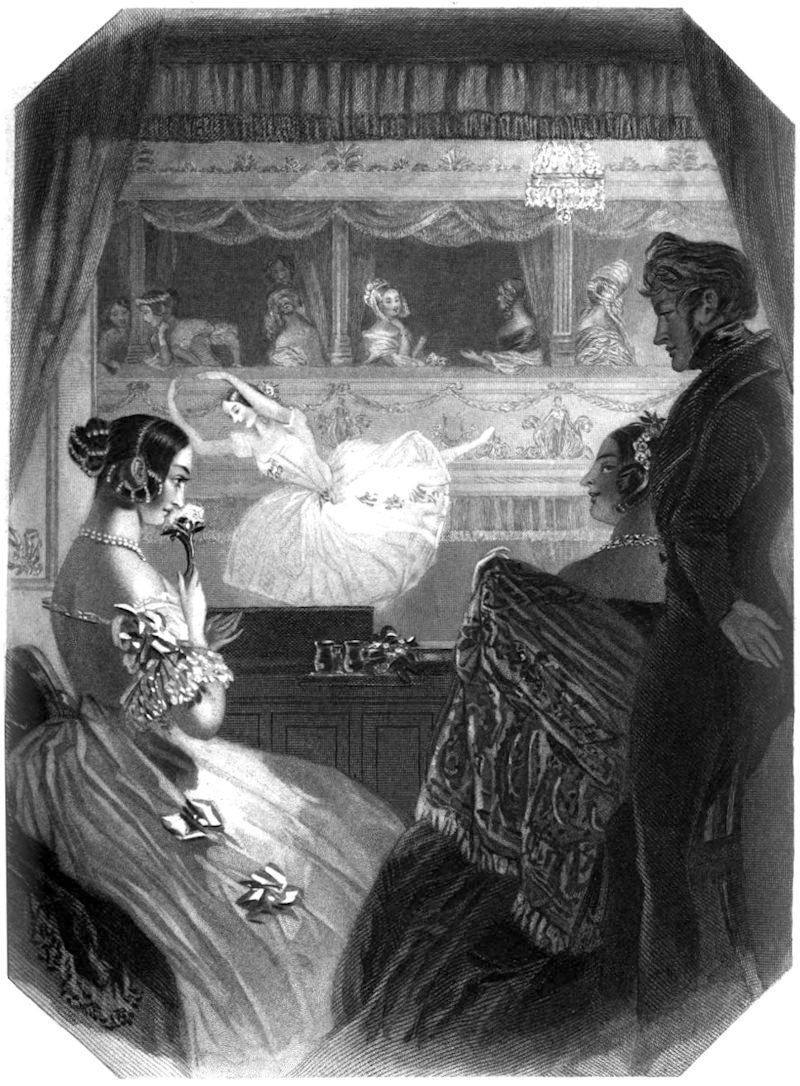
OPERA EXTRAVAGANCE.
Engraved expressly for Graham’s Magazine.
OR THE NIGHT-KEY.[1]
———
BY MRS. E. F. ELLET.
———
Although a stricken bachelor, I cannot speak without
emotion of my first love. An eastern philosopher
says—it is with first love as with a first cigar; one
precipitates himself upon it, luxuriates to the utmost in
the draught, and when it is over, is sensible of a melancholy
unlike that induced by any other loss. I suppose
I may consider myself particularly fortunate,
having felt no reaction after my first cigar, and finding
equally harmless consequences from my first love. I
do not mean to say that I was so happy as to find the
passion returned; ah, no! for then—I should have been
a Benedict. I mean that I imbibed all of bliss which
belongs to the feeling, without hazarding the loss of my
peace; I enjoyed it while it was permitted to last, with
but a few trifling drawbacks, and that without stirring
a fountain of remorse or regret to sprinkle with bitterness
my future years.
In the winter of 18— I chanced to lodge in ——
Place, in the establishment then kept by Mrs. ——.
My apartment was on the third floor, and overlooked
the street; the room immediately back of it, which I
used for my books and papers, looked into a small court,
and commanded a view through the windows opposite,
of the parlor on the second floor in the rear, which was
occupied by the young lady to whom my attention was
devoted. She and her mother had been inmates of the
house but a short time, when the sight of her, seated
at her embroidery-frame near the window, took my
heart captive at once. She had long, fair ringlets, that
seemed touched with gold when the light fell on them;
her complexion was beautifully fair, with a rose-like
tint in her cheeks; the bright line of her lips disclosed
pearly teeth, and she had the finest turned neck and
shoulders nature ever fashioned to put art to shame.
But her hand—that small, white, dimpled hand, which
she often held up in my view, while selecting a shade
of worsted, threading her needle, counting the stitches,
or practicing any of the little coquetries of her work!
No sculptor could have rivaled the perfection of that
hand. Those taper fingers drew the string which sped
Cupid’s arrow to my heart. I often tried to draw that
hand, and as often gave up the task in despair, for it
never was still long enough. Sometimes I saw it
wandering over the strings of her guitar; for almost
always, of an evening, she played and sang, and then,
after having watched her tuning it, how I hated the
envious curtains that were so closely drawn to shut out
paradise from my longing eyes. For hours I would stand
at my window, having no other occupation than feeding
the pigeons that gathered about the frame, observing
her by stealth as she worked or watered the
flowers that lived under her care, or petted a delicate
canary-bird, whose cage hung on the wall outside. I
had no pleasure so great as that of gazing upon her;
yet I could plainly see that my devotion was unmarked,
for she was near-sighted, and could not, at even a short
distance, perceive that she was so earnestly regarded.
To that circumstance, in all probability, I owed the
liberty I enjoyed.
I always retreated from the window when her
mother approached, for she had eyes that rivaled those
of a lynx. She was tall, moreover, with black eyes
and hair; rather robust in person, and with an unmistakable
air of hauteur, which proved quite as effectual
as she could have wished in keeping people at a
distance. Her voice was naturally harsh and imperious,
though usually subdued in its tones, except on
occasions when sudden irritation caused the speaker to
forget her dignity. Even in her gentlest moods it had
a latent sharpness that twanged uneasily on my ears,
especially when I remembered how necessary it was
to secure the favor of this haughty lady, in order to
advance a step toward the accomplishment of my hopes
with the lovely daughter.
Thus, then, stood the case; I was desperately, irremediably
in love with this young girl; ready for any
venture to win her, but uncertain how to commence
an acquaintance, for I was not even among the privileged
number of her visiters. We lodged under the
same roof; we sat at the same table, though at different
ends of it; but I knew no one of whom I could ask an
introduction to her; and I felt, alas! that my position
in life did not quite entitle me to enter the list of her
suitors without such formalities as might smooth over
a surprise. I was a painter; rising in my profession,
it is true, and numbering many friends, but as yet,
having fortune only in prospect. Mrs. Elwyn, for that
was the name of the mother of my charmer, was independent,
though not rich; and having in early life
moved much in fashionable society, and been much
admired, was very proud, and would scarcely have
owned among her acquaintances one who depended
on the labor of hands or head for a maintenance.
Neither she nor her daughter ever entered the common
drawing-room; and those of the lodgers who knew her
slightly, spoke of her as distant and unsocial, except
to the favored few whom she thought worth cultivating,
on account of their possession of worldly advantages.
She was precisely the sort of woman on whom I would
never have wasted an act of courtesy, had she been
the mother of any other daughter. But in the fair
Gertrude there was such a bewitching unconsciousness
of her own superiority, such an appealing eloquence
in silence, to the sympathy of those around her—such
an air of child-like humility, mingled with just
enough of the graceful pride of woman, as completed
the fascination her beauty had begun, and inspired one
with a wish to please even her repulsive parent. I saw
her not only at meals, but occasionally out of the house,
at concerts or the Opera. To me she was the soul of
the music, and the finest symphony of Beethoven would
have been lifeless without her. At church I met her now
and then, and sometimes walking; but Mrs. Elwyn
never vouchsafed me the most distant bow of recognition.
She seemed by intuition to guess my bold
wishes and frown upon them. Gertrude was always
modestly looking down; but at intervals the fringe of
her blue eyes would be suddenly lifted, disclosing a
world of witchery beneath, to be quickly veiled again,
as if she knew she was transgressing. It was the evidence
of this consciousness on her part that fanned my
love continually into a brighter flame, and caused me
to revolve various expedients to secure to myself the
enjoyment of her society.
I thought of painting her picture as she sat embroidering
at the window, and sending it as a present to
the mother; but I lacked as yet, sufficient confidence
in my talent for the art, in which I was but a student,
and the terror of her condemnation, both of the artist
and the lover, was too formidable to be encountered.
A dread of her cold penetration prevented me also from
putting in execution a cherished project; that of offering
my services to teach the beautiful Gertrude Italian,
which I knew she wished to acquire. The very day
I had mustered up courage to resolve on the experiment,
I heard that Mrs. Elwyn had hired a teacher—a
dark-visaged, whiskered fellow, whom, from that
moment, I wished in the dungeons of Spielberg.
Was there ever a more hopeless case of love; yet
I was not unhappy, for I had the privilege of seeing
her, unawed by fear of interruption; and my passion
was not yet so encrusted with selfishness that it demanded
more. I lived in the present, and hope colored
the future with rosy light; even the feeling of disappointment
was but momentary. I almost dreaded a
change, though I knew this could not satisfy me long,
and that a wilder, more impetuous, and less amiable
stage was to follow. Already the first sweet, sparkling
foam of the cup had been quaffed; beneath was
that which bewilders the brain and steals away the
senses.
I had been reading one night till past midnight—for
strangely enough, I had a taste for novels after the
beginning of the romance of my life—when my attention
was arrested by hearing a carriage stop in the
street before the door. Presently the bell rang, not
very gently. A short pause, and it was again rung;
while I was conscious of a twinge of sympathy for the
late comer; for the night was piercing cold, and the
wind came in hoarse blasts, rattling the window-panes,
and sending a chill through the bones. The contrast
offered by my snug apartment, with its crimson curtains
and chintz-covered sofa, and the dying glow of
the embers thrown on the Venetian rug, was peculiarly
suggestive of ideas of comfort. I thought how
hard it must be for the porter to be summoned out of
his warm bed in the little chamber at the back of the
court, and judged the applicant for admission at such
an hour justly punished by delay.
Again, and again, and yet again sounded the bell,
each time with a more prolonged and angry pull, as if
the person at the door, with patience exhausted, was
resolved to take the house by storm. A thought darted
like lightning through my brain. I had seen Miss
Elwyn that evening, in full dress, passing with her
mother through the hall. They had gone to a party—they
had returned late. I sprung to the window—threw
it open; and sure enough, though it was too
dark to distinguish any object, I heard with sufficient
distinctness the shrill, complaining tones of the mother.
By good luck I was still dressed, and I lost not an
instant. Snatching up the light, I hastened down two
flights of stairs, to the front door. My heart beat; my
breath came quickly; I felt as if the crisis of my life
were at hand. I should meet her face to face; I
should speak to her—should render a service that
demanded acknowledgment, and might open for me a
vista of happiness; I grasped the handle of the door,
and with trembling hands unlocked and opened it; there
was a rush of wind, and—my light was extinguished.
“You sleep like a night-watcher, sir!” screamed
the angry voice of Mrs. Elwyn, as she pushed her
way in. “To keep us standing half an hour in the
cold! We might have caught our death! You deserve
to lose your place; I shall make complaint of you in
the morning, depend upon it.”
While she spoke, the daughter’s silken mantle
brushed past me, and her gloved fingers pressed something
into my hand. I had no time to explain; I could
not have uttered a word; my breath seemed to forsake
me, and my silly bashfulness held me motionless,
as if chained to the spot. I stood there till the ladies
had ascended the first flight of stairs—the mamma
grumbling as she went—still grasping mechanically in
my hand what the fair Gertrude had placed therein.
Ere long, however, my self-possession returned; I
ascended to my room, lighted the candle, and examined
the gift. My beloved had presented me with
half a dollar.
It was quite evident that both had mistaken me for
the unlucky porter, at that time snoring in his dormitory;
and that the gentle girl had bestowed the coin
by way of consolation for her mother’s chiding. I
kissed the piece of silver which had come from her
hand, and was a token of the benevolence of her heart.
A ray of hope gleamed from its polished face. The
matter must necessarily be explained; the mistake
must be rectified. This would lead to an interview;
and I would trust fortune for the rest.
After due deliberation, I came to the conclusion that
as the affair in some points wore a comical aspect, it
would be best to present it in that light. I took my pencil
and hammered out some poetry, which was to be sent
with the half dollar to the fair donor. Under the veil
of a sprightly and facetious effusion, I thought, more
could be said, than in a grave note; and no offence
could be taken at verses meant for a jeu d’esprit, describing
the feeling experienced when the coin touched
my palm, as “shocking”—which word terminated the
line—imperative necessity called for a rhyme—it ran
as follows:
“Oh, had the gift been but a glove—or stocking!
Such token from thy hand a joy had given,
I would not barter for the joy of heaven!”
I was not much used to writing poetry; but on reading
over the missive, it struck me as combining humor
and sentiment in a manner peculiarly felicitous. The
lines could not fail to make an impression; she would,
perhaps, reply; all would fall out as I wished, and I
should look upon that night as the most fortunate of
my life. I mended a crow-quill, and copied the verses
neatly on rose-colored paper, resolving to send them
the first thing in the morning. She would then see
they had been written impromptu. It was late when
I threw myself on the bed, and late when I awoke.
No benevolent genius warned me in the visions of
slumber.
The next day I folded the money and verses together,
and dispatched the package to my charmer by the
maid. I was frequently at my post of observation;
but not once did I catch a glimpse of her at the window.
The guitar was silent—the embroidery-frame untouched.
Toward evening I waylaid the chamber-maid,
and having crossed her hand with a piece of
silver, inquired particularly how my dispatch had been
received.
“Why, sir,” was the answer, “the young lady only
laughed, and showed the paper to her mother; and
Mrs. Elwyn threw it into the fire, and said as how she
wondered how you could have had the impudence;
but she expected you did not know any better.”
A blight fell upon my hopes; I had evidently committed
an error. That unlucky “stocking!”, it was
that which had played me false—which had offended
the lady’s sense of propriety—which had suddenly let
down a partition-wall between me and the accomplishment
of my hopes. But through the chinks of
that now impassable barrier, Gertrude appeared lovelier
than ever. A thousand wild projects floated through
my brain. I would hire bandits to assail her; would
rush in time to the rescue, and be wounded in her defense.
I would play the incendiary, and bear her in
triumph through the flames; I would get up a quarrel,
and fight a duel for her sake. But these were only
feverish fantasies—castles built in the air—which
melted in the cold current of reality. I could perceive
plainly that at table, when I stole a glance at her, Mrs.
Elwyn had grown colder and statelier than ever.
She never honored me by a look, and, worse than all,
Gertrude did not appear. It was not till after two days
I learned, by mere accident, that she had taken cold on
that eventful night, and was indisposed.
But ill luck cannot last always. The beautiful girl
soon reappeared at meals as blooming and radiant as
usual; and, oh joy! again I was so happy as to behold
her seated at the window, and watch the movements
of her delicate fingers over the strings of her guitar.
Here was a bliss of which no frowning matron could
deprive me. One day, too, as in my eagerness to
drink in the tones of her music, I had softly opened my
window, and was imprudently leaning forward, rapt
in a trance of bliss, I saw an unmistakable smile on
her lips. Yes, she smiled; and though at the same
moment she drew back, and let the guitar slide from
her lap, my heart was thrilled by the knowledge that
she was at last aware of my secret. What woman
could be insensible to homage so delicate and unobtrusive.
Hope once more stirred within me. The
next morning I bribed the maid to leave on her table,
as if by mistake, a just published number of the “Home
Journal,” in which was a poem of rare beauty, which
aptly expressed my admiration and my love. I had
ventured to draw a light pencil line around the verses,
which I hoped she might perceive and understand.
My little ruse succeeded. A servant brought me the
paper in the evening, saying it had been left by mistake
in Mrs. Elwyn’s apartment; but it bore evidence
of having been carefully read.
It was not safe to venture often on such expedients;
but the fourteenth of February was at hand; and the
most timid lover might avail himself of its privileges.
Valentines of all descriptions, for all stages of the
tender passion, were to be had at the fancy stores; and
a little alteration made them original. On the morning
of the festival, one, delicately painted on embossed
paper, and glowing with sentiment, was dispatched to
the fair Gertrude, and was followed by one for each
day of the week succeeding. I received none in return—but
I was not discouraged; it was enough that
mine were read.
I was now at the height of my content; for there
was a charm in the sort of mystery that enveloped our
intercourse, the more delightful to me, because I had
the authority of all the romances I had ever read, for
believing that it was the best nourisher of affection.
Fancy would invest with a thousand gifts and graces,
the lover whom she knew not, yet whose devotion
was breathed into the air around her. Flowers would
succeed verses as the messengers of the heart; I should
grow bolder in time, till every obstacle was triumphed
over. Such would have been the natural course of
things but for the awkward interruption which brings
me to the conclusion of my story.
I had gone one evening to a supper given by a
bachelor friend, and returned late from the scene of
mirth and revelry. As I walked rapidly down ——
Place, for the night was chilly, and the street covered
with snow, I saw two ladies alight from a carriage in
front of Mrs. ——’s house. I hastened my pace; a
thrill of joy penetrated my breast; it was she—my beloved,
with her mother; and both were, by a happy
chance, destined to be obliged to me. I sprung up the
steps, murmured a “good evening,” and drew out my
night-key. I was surprised to find how much courage,
nay, even pride, I derived from the possession of this
little instrument. Briefly apologizing to the ladies for
thus venturing to save them the trouble of summoning
a servant, I thrust the key in the lock, and turned it with
all my force. It snapped violently; I drew out the
fragment, and, to my horror, discovered that in my
haste, I had not used the night-key, but the key of my
chamber.
“I really—beg ten thousand pardons,” I faltered—“it
was the wrong key—”
“The key is broken!” cried the shrill voice of Mrs.
Elwyn. “It is dreadful to be kept standing here!” She
pulled the bell furiously.
In affright I pulled it also; the porter’s hurried steps
were presently heard in the hall, and he was rattling at
the lock.
“Open the door!” cried the lady, impatiently.
“I cannot unlock it!” said the man within; “there
must be something in the key-hole.”
“The broken key!” screamed Mrs. Elwyn, with an
angry glance at me; “so officious, to insist—”
“Mother!” pleaded the soft, low voice of Gertrude;
for she saw that the dame was forgetting herself.
“It must—it can—I will run for a locksmith!” I
exclaimed. I saw that the carriage had driven off.
“And we are to stand here alone, perhaps to be insulted
by any drunken vagabond!” cried Mrs. Elwyn.
“But go—nothing else can be done. Make haste—why
do you wait?”
A locksmith lived in the next street; I flew thither;
by chance he was still up, and as soon as his tools
could be collected, he hastened to the spot. There
stood the angry lady, her teeth chattering with cold,
her mantle covered with the snow-flakes that had
begun to fall, murmuring at the delay; her daughter
was leaning in silence against the side of the door; and
within could be heard the grumbling of the porter. I
could not see Gertrude’s face, even if I had been calm
enough to read its expression.
The skillful locksmith, with the ready tact of his
profession, soon comprehended the difficulty, and
having tried to pick the lock, decided that it must be
done from the inside. A ladder was in requisition, to
enter by the window above. Mrs. Elwyn was in despair
at this intelligence, and broke out into complaints
and reproaches, intended for me, which I heard but
imperfectly, as I ran to borrow a ladder of some firemen
in the neighborhood. It was brought by two
of the company, who were followed by several others
eager to learn what was going on. These were joined
by some late idlers, while the windows of the adjoining
and opposite houses, as well as those of our own, were
thrown open, and a multitude of heads thrust out to
see what was the matter. A pretty scene for the
crowd-hating, aristocratic, haughty Mrs. Elwyn! For
once, unmindful of her dignity, she stood giving voluble
directions to the locksmith, already at the window,
calling to him with flurried emphasis, to be careful not
to throw down the flower-stand, or break the vase full
of goldfish—which articles belonged to her. As for
me, my only feeling was one of absolute despair, for I
knew that my transgression, with its consequences,
was unpardonable. We obtained entrance at last, and
I heard the farewell of my love in the indignant rustle
of Mrs. Elwyn’s mantle, as she swept up stairs. A
day or two after she and her daughter departed on a
visit to Washington, and when they returned, took
lodgings elsewhere. I heard in a few months of Gertrude’s
marriage, but felt no sorrow, for the spell was
broken. That midnight scene, with the mortification
it caused me, was a harmless termination to my First
Love.
———
BY W. GILMORE SIMMS, AUTHOR OF “GUY RIVERS,” “THE YEMASSEE,” “RICHARD HURDIS,” &c.
———
Guard. What work is here? Charmian, is this well done?
Charmian. It is well done, and fitting for a princess,
Descended of so many royal kings.
Shakspeare.
Augustus Cæsar. Dolabella.
Augustus. Dead! say’st thou? Cleopatra?
Dolabella. She sleeps fast—
Will answer nothing more—hath no more lusts
For passion to persuade—nor art to breed
Any more combats. I have seen her laid—
As for a bridal—in a pomp of charms,
That mocked the flashing jewels in her crown
With beauty never theirs. Her bridegroom one
Who conquers more than Cæsar—a grim lord
Now in the fullest possession of his prize,
Who riots on her sweets; seals with close kiss
The precious caskets of her eyes, that late
Held—baiting fond desire with hope of spoil—
Most glorious gems of life; and, on her cheek,
Soft still with downy ripeness—not so pale,
As sudden gush of fancy in the heart
Might bring to virgin consciousness—he lays
His icy lip, that fails to cause her shrink
From the unknown soliciting. Her sleep
Dreams nothing of the embrace, the very last
Her eager and luxurious form may know,
Of that dread ravisher.
Augustus. If it be true,
She still hath baffled me. My conquest sure—
My triumph incomplete! I had borne her else,
The proudest trophy of a myriad spoil,
In royal state to Rome. Give me to know
The manner of her death.
Dolabella. By her own hands,
That conscious still, commended to her breast
The fatal kiss of Nile’s envenomed asp;
That subtle adder, that from slime and heat
Receives a gift of poison, whose least touch
Is a sure stoppage of the living tides.
Augustus. Her death commends her more than all her life!
’Twas like a queen—fit finish to a state,
That, in its worst excess, passionate and wild,
Had still a pomp of majesty, too proud
For mortal subjugation! She had lusts
Most profligate of harm—but with a will,
That, under laws of more restraint, had raised
Her passions into powers, which might have borne
Best fruits for the possessor. They have wrought
Much evil to her nature; but her heart
Cherished within a yearning sense of love
That did not always fail; and where she set
The eye of her affections, her fast faith
Kept the close bond of obligation sure.
This still should serve, when censure grows most free,
To sanctify her fault. In common things
Majestic, as in matters of more state,
She had besides the feminine arts to make
Her very lusts seem grateful; and with charms
That mocked all mortal rivalry, she knew
To dress the profligate graces in her gift—
Generous to very wantonness, and free
Of bounty, where Desert might nothing claim—
That Virtue’s self might doubt of her own shape,
So lovely grew her counterfeit. O’er all,
Her splendor, and her soul’s magnificence.
The pomp that crowned her state—luxurious shows
Where Beauty, grown subservient to a sway
That made Art her first vassal—these, so twinned
With her voluptuous weakness, did become
Her well, and took from her the hideous hues
That else had made men loathe!
That else had made men loathe!I would have seen
This princess ere she died! How looks she now?
Dol. As one who lives but sleeps; no change to move
The doubts of him who sees, yet nothing knows,
Of that sly, subtle enemy, which still
Keeps harbor round her heart. Charmian, her maid,
Had, ere I entered, lidded up the eyes,
That had no longer office; and she lay,
With each sweet feature harmonizing still
As truly with the nature as at first,
When Beauty’s wide-world wonder she went forth
Spelling both art and worship! Never did sleep
More slumberous, more infant-like, give forth
Its delicate breathings. You might see the hair
Wave in stray ringlets as the downy breath
Lapsed through the parted lips, and dream the leaf
Torn from the rose and laid upon her mouth
Was lifted by that zephyr of the soul
That still kept watch within—waiting on life
In ever anxious ministry. Lips and brow—
The one most sweetly parted as for song—
The other smooth and bright, even as the pearls
That, woven in fruit-like clusters, hung above,
Starring the raven curtains of her hair—
Declared such calm of happiness, as never
Her passionate life had known. No show of pain—
No writhed muscle—no distorted cheek,
Deformed the beautiful picture of repose,
Or spoke th’ unequal struggle, when fond life
Strives with its dread antipathy. Her limbs
Lay pliant, with composure, on the couch,
Whose draperies loosely fell about her form,
With gentle flow, and natural fold on fold,
Proof of no difficult conflict. There had been,
Perchance, one pang of terror, when she gave
Free access to her terrible enemy;
Or in the moment when the venomous chill
Went sudden to her heart; for from her neck
The silken robes had parted. The white breast
Lay half revealed, save where the affluent hair
Streamed over it in thick disheveled folds,
That asked no further care. Oh! to behold,
With eye still piercing to the sweet recess,
Where rose each gentle slope, that seemed to swell
Beneath mine eye, as conscious of my gaze,
And throbbing with emotion soft as strange,
Of love akin to fear. Thus dwelling still,
Like little billows on some happy sea,
They sudden seemed to freeze, as if the life
Grew cold when all was loveliest. One blue vein
Skirted the white curl of each heaving wave,
A tint from some sweet sunbow, such as life
Flings ever on the cold domain of death;
And, at their equal heights, two ruby crests—
Two yet unopened buds from the same flower—
Borne upward by the billows, rising yet,
Grew into petrified gems, with each an eye
Eloquent pleading to the passionate heart
For all of love it knows! Alas! the mock!
That Death should mask himself with loveliness,
And Beauty have no voice, in such an hour,
To warn its eager worshiper. I saw—
And straight forgot, in joy of what I saw,
What still I knew—that Death was in my sight,
And what was seeming beautiful, was but
The twilight—the brief interval—betwixt
The glorious day and darkness. I had kissed
The wooing bliss before me, but that then
Crawled forth the venomous reptile from the folds
Where still it harbored—crawled across that shrine
Of Beauty’s best perfections, which, meseemed,
To shrink and shudder ’neath its loathly march,
Instinct with all the horrors at my heart.
Augustus. Thus Guilt and Shame deform the Beautiful!
———
BY HEINRICH.
———
Stars are twinkling bright above us,
Music calls us on;
Shades of eve that guard and love us,
Veil the hallowed lawn;
Hand in hand,
All the band,
Dance we till the breaking dawn!
Hark! the gently swelling measure!
Twine the magic rings!
Dance, while lasts our nightly pleasure,
While the bluebells ring;
And above,
’Mid the grove,
Nightingales in chorus sing.
Far away all human voices!
Spirits far away!
Naught but Fairy Elf rejoices
Where the Fairies play;
Play and dance,
’Neath the glance
Of the moon’s reflected ray!
Faster! Faster! Night is waning;
All must end with night.
Russet clouds of morn are staining
Phœbe’s silvery light;
Sisters, hark!
’Twas the lark!
Fairies! Fairies! Take to flight.
A MAS-SA-SANGA LEGEND OF WESTERN CANADA.
———
BY G. COPWAY, OR KAH-GE-GA-GAH-BOWH.
———
There lived among the hills of the North two most
intimate friends, who appeared to have loved each
other from the hour of their earliest childhood. In
summer they lived by a beautiful lake, in autumn on
the banks of a noble river. In appearance they were
nearly similar, apparently of the same age as they
were of the same size. In their early days a good old
Indian woman attended to their wants, and cared for
their wigwam. Together they strolled among the green
woods and shared the results of their ramblings. Years
passed by, and manhood came. They used larger
bows and arrows. One day the old lady took them
by her side and said—“The nation to which we belong
fasts, and now I want you to fast, that you may
become great hunters.” So they fasted.
As spring advanced they killed a great many wild
ducks, and kept the old woman of the wigwam busy.
In the latter part of the year they killed large numbers
of beavers, with the furs of which they clothed their
grandmother and themselves. In their journey one
day they made an agreement, to the effect, that if
when they fasted the gods were kindly disposed toward
one, he would inform the other.
In the fall they were far from the rivers, but yet
moved toward the north, where, as they knew, the
bears most resorted.
During that winter they killed a great many, as also
during the month of March ensuing.
At the close of one of their hunting expeditions, they
turned their feet toward their home, at which they
arrived at a late hour. As they approached, they
heard the sound of several voices besides that of their
grandmother. They listened. They knew that strangers
were in the wigwam, and entering beheld two
young and beautiful damsels, seated in that part of the
room in which they generally rested during the night.
To the young hunters the young women appeared
very strange and modest. At length the old lady said
to the young men—
“Nosesetook—my children—I have called these
two young women from the south, that they may aid
me in taking care of all the meat and venison you
bring home, for I am getting old and weak, and cannot
do as much as I used to. I have put them by your
sides that they may be your companions.”
When the last words were spoken they looked upon
each other, and soon left to wander by themselves in
the forest around. They consulted together as to
whether they should comply with her request. One
said he should leave the wigwam. The other said
that if they left there would be no one to supply their
aged grandmother. And they finally agreed to remain
in the wigwam and pay no regard to the new-comers.
They slept side by side every night, and agreed that
if either should begin to love one of the young strangers
they would inform the other, and would then separate
forever. In February they obtained a vast amount of
game, as the bears having retired to their winter-quarters
were easily found and captured.
It was observed one evening that one of the young
men gazed very intently at one of the strangers, and
the next morning as they went out he asked the other
whether he did not begin to love the young damsel
who sat on his side of the birchen fire. He replied
negatively.
It was observed that one of the cousins appeared to
be deeply absorbed in thought every evening, and that
his manners were very reserved. After a fortunate
hunting-day, as they were wending their way home
with their heavy burden of bear and deer, one accused
the other of loving the young woman. Tell me, said
he, and if you do, I will leave you to yourselves. If
you have a wife I cannot take the same delight with
you as I did when we followed the chase.
His cousin sighed and said, “I will tell you to-night
as we lie side by side.” At night they reasoned together
and agreed to hunt. If they did not meet with
success, they must separate.
The next morning they went to the woods. They
were not far distant from each other. The one who
was in love shot only five, while the other returned
with the tongues of twenty bears. The former was
all the time thinking of the damsel at home, while the
latter sought out his game with nothing else to divert
his mind.
On their return home the lucky man informed his
grandmother that he should leave the next day, and
that what he should kill on the morrow must be
searched after, as he should not return to tell them
where he had killed the game. His cousin was grieved
to find that his mind was made up to leave, and began
to expostulate with him to change his determination,
but he would not be persuaded to do so.
The next day, the young man who was to leave
bound a rabbit-skin about his neck, to keep it warm,
and having painted himself with red and yellow paints
he left; his cousin following just behind, entreating
him not to go. “I will go,” said he, “and live in the
north, where I shall see but four persons, and when
you look that way you will see me.”
They walked side by side until he began to ascend,
and as he did so, the other wept the more bitterly, and
entreated him more perseveringly not to leave him.
The cousin ascended to the skies, and is now seen in
the north, Ke-wa-din Ah-nung (North Star,) still hunting
the polar bear; while the other wept himself to
naught before he could arrive home, and now he
answers and mocks everywhere everybody. He lives
in craggy rocks, and his name is Bah-swa-nay (Echo.)
The young maidens lived for a long time in the south
under ambrosial bowers, awaiting the return of their
lovers, until one fell in love with mankind, and the
other yet lives in that country, awaiting the return of
her lover, where
——“she looks as clear
As morning roses, newly washed in dew.”
———
BY T. S. ARTHUR.
———
Thirty years ago, a small, barefooted boy, paused
to admire the flowers in a well cultivated garden. The
child was an orphan, and had already felt how hard
the orphan’s lot. The owner of the garden, who was
trimming a border, noticed the lad, and spoke to him
kindly.
“Do you love flowers?” said he.
The boy replied, “Oh yes. We used to have beautiful
flowers in our garden.”
The man laid down his knife, and gathering a few
flowers, took them to the fence, through the panels of
which the boy was looking, and handing them to him,
said as he did so,
“Here’s a nice little bunch for you.”
A flush went over the child’s face as he took the
flowers. He did not make any reply, but in his large
eyes, as he lifted them to the face of the man, was
an expression of thankfulness, to be read as plainly as
words in a book.
The act, on the part of the man, was one of spontaneous
kindness, and scarcely thought of again; but,
by the child, it was never forgotten.
Years went by, and through toil, privation and suffering,
both in body and mind, the boy grew up to
manhood. From ordeals like this, come forth our
most effective men. If kept free from vicious associates,
the lad of feeling and mental activity becomes
ambitious, and rises in society above the common level.
So it proved in the case of this orphan boy. He had
few advantages of education, but such as offered were
well improved. It happened that his lot was cast in a
printing office; and the young compositor soon became
interested in his work. He did not set the types as a
mere mechanic, but went beyond the duties of his
calling, entering into the ideas to which he was giving
verbal expression, and making them his own. At
twenty-one he was a young man of more than ordinary
intelligence and force of character. At thirty-five he
was the conductor of a widely-circulated and profitable
newspaper, and as a man, respected and esteemed
by all who knew him.
During the earnest struggle that all men enter into
who are ambitious to rise in the world, the thoughts
do not often go back and rest, meditatively, upon the
earlier time of life. But after success has crowned
each well-directed effort, and the gaining of a desired
position, no longer remains a subject of doubt, the mind
often brings up from the far-off past most vivid recollections
of incidents and impressions that were painful
or pleasurable at the time, and which are now seen to
have had an influence, more or less decided, upon the
whole after life. In this state of reflection sat one day
the man we have here introduced. After musing for a
long time, deeply abstracted, he took up his pen and
wrote hastily—and these were the sentences he traced
upon the paper that lay before him.
“How indelibly does a little act of kindness, performed
at the right moment, impress itself upon the
mind. We meet, as we pass through the world, so
much of rude selfishness, that we guard ourselves
against it, and scarcely feel its effects. But spontaneous
kindness comes so rarely, that we are surprised when
it appears, and delighted and refreshed as by the perfume
of flowers in the dreary winter. When we were
a small boy, an orphan, and with the memory of a
home forever lost too vivid in our young heart, a man,
into whose beautiful garden we stood looking, pulled a
few flowers, and handed them through the fence, speaking
a kind word as he did so. He did not know, and
perhaps never will know, how deeply we were touched
by his act. From a little boy we loved the flowers,
and ere that heaviest affliction a child ever knows—the
loss of parents—fell upon us, we almost lived
among them. But death separated between us and
all those tender associations and affections that, to the
hearts of children, are like dew to the tender grass.
We entered the dwelling of a stranger, and were treated
thenceforth as if we had, or ought to have, no feelings,
no hopes, no weaknesses. The harsh command came
daily and almost hourly to our ears; and not even for
work well done, or faithful service, were we cheered
by words of commendation.
“One day—we were not more than eleven years old—something
turned our thoughts back upon the earlier
and happier time when we had a true home, and were
loved and cared for. We were once more in the
garden and among the sweet blossoms, as of old, and
the mother, on whose bosom we had slept, sat under
the grape arbor while we filled her lap with flowers.
There was a smile of love on her dear face, and her
lips were parting with some word of affection, when,
to scatter into nothing these dear images of the lonely
boy, came the sharp command of a master, and in
obedience we started forth to perform some needed
service. Our way was by the garden of which we
have spoken; and it was on this occasion, and while
the suddenly dissipated image of our mother among
the flowers was re-forming itself in our young imagination,
that the incident to which we have alluded
occurred. We can never forget the grateful perfume
of those flowers, nor the strength and comfort which
the kind words and manner of the giver imparted to
our fainting spirit. We took them home, and kept
them fresh as long as water would preserve their life
and beauty; and when they faded, and the leaves fell,
pale and withered, upon the ground, we grieved for
their loss as if a real friend had been taken away.
“It is a long, long time since that incident occurred;
but the flowers which there sprung up in our bosom,
are fresh and beautiful still. They have neither faded
nor withered—they cannot, for they are unfading
flowers. We never looked upon the man who gave
them to us that our heart did not grow warm toward
him. We know not now whether he be living or dead.
Twenty years ago we lost sight of him; but, if still
among the dwellers of earth, and in need of a friend,
we would divide with him our last morsel.”
An old man, with hair whitened by the snows of
many winters, was sitting in a room that was poorly
supplied with furniture, his head bowed down, and
gaze cast dreamily upon the floor. A pale young girl
came in while he thus sat musing. Lifting his eyes
to her face, he said, while he tried to look cheerful,
“Ellen, dear, you must not go out to-day.”
“I feel a great deal better, grandpa,” returned the
girl, forcing a smile. “I am able to go to work again.”
“No, child, you are not,” said the old man, firmly;
“and you must not think of such a thing.”
“Don’t be so positive, grandpa.” And as she uttered
this little sentence, in a half playful voice, she laid her
hand among the thin gray locks on the old man’s head,
and smoothed them caressingly. “You know that I
must not be idle.”
“Wait, child, until your strength returns.”
“Our wants will not wait, grandpa.” As the girl
said this, her face became sober. The old man’s eyes
again fell to the floor, and a heavy sigh came forth
from his bosom.
“I will be very careful and not overwork myself
again,” resumed Ellen, after a pause.
“You must not go to-day,” said the old man, arousing
himself. “It is murder. Wait at least until to-morrow.
You will be stronger then.”
“If I do not go back to-day, I may lose my place.
You know I have been home for three days.”
“You were sick.”
“Work will not wait. The last time I was kept
away by sickness, a customer was disappointed; and
there was a good deal of trouble about it.”
Another sigh came heavily from the old man’s heart.
“I will go,” said the girl. “Perhaps they will let
me off for a day longer. If so, I will come back.
But I must not lose the place.”
No further resistance was made by the old man.
In a little while he was alone. Hours went by, but
Ellen did not return. She had gone to work. Her
employer would not let her go away, feeble as she
was, without a forfeiture of her place.
About mid-day, finding that Ellen did not come back,
the old man, after taking some food, went out. The
pressure of seventy years was upon him, and his steps
were slow and carefully taken.
“I must get something to do. I can work still,” he
muttered to himself, as he moved along the streets.
“The dear child is killing herself, and all for me.”
But what could he do? Who wanted the services
of an old man like him, whose mind had lost its clearness,
whose step faltered, and whose hand was no
longer steady? In vain he made application for employment.
Younger and more vigorous men filled all
the places, and he was pushed aside. Discouraged
and drooping in spirit, he went back to his home, and
there awaited the fall of evening, which was to bring
the return of the only being left on earth to love him.
At night-fall Ellen came in. Her face, so pale in the
morning, was now slightly flushed; and her eyes were
brighter than when she went out. The grandfather
was not deceived by this; he knew it as the sign of
disease. He took her hand—it was hot; and when he
bent to kiss her gentle lips, he found them burning with
fever.
“Ellen, my child, why did you go to work to-day?
I knew it would make you sick,” the old man said, in
a voice of anguish.
Ellen tried to smile and to appear not so very ill; but
nature was too much oppressed.
“I brought home some work, and will not go out to-morrow,”
she remarked. “I think the walk fatigued
me more than any thing else. I will feel better in
the morning, after a good night’s sleep.”
But the girl’s hope failed in this. The morning
found her so weak that she could not rise from bed;
and when her grandfather came into her room to learn
how she had passed the night, he found her weeping
on her pillow. She had endeavored to get up, but her
head, which was aching terribly, grew dizzy, and she
fell back under a despairing consciousness that her
strength was gone.
The day passed, but Ellen did not grow better. The
fever still kept her body prostrate. Once or twice,
when her grandfather was out of the room, she took
the work she had brought home, and tried to do some
of it while sitting up in bed. But ere a minute had
passed, she became faint, while all grew dark around
her. She was no better when night came. If her
mind could have rested—if she had been free from
anxious and distressing thoughts, nature would have
had some power to react, but as it was, the pressure
upon her was too great. She could not forget that
they had scarcely so much money as a dollar left, and
that her old grandfather was too feeble to work. Upon
her rested all the burden of their support, and she was
now helpless.
On the next morning Ellen was better. She could
sit up without feeling dizzy, though her head still ached,
and the fever had only slightly abated. But the old
man would not permit her to leave the bed, though she
begged him earnestly to let her do so.
The bundle of work that Ellen had brought home,
was wrapped in a newspaper, and this her grandfather
took up to read some time during the day.
“This is Mr. T——’s newspaper,” said he, as he
opened it, and saw the title. “I knew T—— when
he was a poor little orphan boy. But, of course, he
don’t remember me. He’s prospered wonderfully.”
And then his eyes went along the columns of the
paper, and he read aloud to Ellen such things as he
thought would interest her. Among others was a reminiscence
by the editor—the same that we have just
given. The old man’s voice faltered as he read. The
little incident, so feelingly described, had long since
been hidden in his memory under the gathering dust
of time. But now the dust was swept away, and he
saw his own beautiful garden. He was in it and among
the flowers; and wishfully looking through the fence
stood the orphan boy. He remembered having felt
pity for him, and he remembered now as distinctly as
if it were but yesterday, though thirty years had intervened,
the light that went over the child’s face as he
handed him a few flowers that were to fade and
wither in a day.
Yes, the old man’s voice faltered while he read;
and when he came to the last sentence, the paper
dropped upon the floor, and clasping his hands together,
he lifted his dim eyes upward, while his lips moved in
whispered words of thankfulness.
“What ails you, grandpa?” asked Ellen, in surprise.
But the old man did not seem to hear her voice.
“Dear grandpa,” repeated the girl, “why do you
look so strangely?” She had risen in bed, and was
bending toward him.
“Ellen, child,” said the old man, a light breaking
over his countenance, as though a sunbeam had suddenly
come into the room, “it was your old grandfather
who gave the flowers to that poor little boy.
Did you hear what he said?—he would divide his last
morsel.”
The old man moved about the room with his unsteady
steps, talking in a wandering way, so overjoyed
at the prospect of relief for his child, that he was
nearly beside himself. But there yet lingered some
embers of pride in his heart; and from these the ashes
were blown away, and they became bright and glowing.
The thought of asking a favor as a return for that little
act, which was to him, at the time, a pleasure, came
with a feeling of reluctance. But when he looked at
the pale young girl who lay with her eyes closed and
her face half buried in the pillow, he murmured to himself,
“It is for you—for you!” And taking up his staff,
he went tottering forth into the open air.
The editor was sitting in his office, writing, when he
heard the door open, and turning, he saw before him
an old man with bent form and snowy head. Something
in the visiter’s countenance struck him as familiar;
but he did not recognize him as one whom he
had seen before.
“Is Mr. T—— in?” inquired the old man.
“My name is T——,” replied the editor.
“You?” There was a slight expression of surprise
in the old man’s voice.
“Yes, I am T——, my friend,” was kindly said.
“Can I do any thing for you? Take this chair.”
The offered seat was accepted; and as the old
man sunk into it, his countenance and manner betrayed
his emotion.
“I have come,” said he, and his voice was unsteady,
“to do what I could not do for myself alone. But I
cannot see my poor, sick grandchild wear out and die
under the weight of burdens that are too heavy to be
borne. For her sake I have conquered my own
pride.”
There was a pause.
“Go on,” said T——, who was looking at the old
man earnestly, and endeavoring to fix his identity in
his mind.
“You don’t know me?”
“Your face is not entirely strange,” said T——. “It
must have been a long time since we met.”
“Long? Oh yes! It is a long, long time. You
were a boy, and I unbent by age.”
“Markland!” exclaimed T——, with sudden energy,
springing to his feet as the truth flashed upon him.
“Say—is it so?”
“My name is Markland.”
“And do we meet again thus!” said T——, with
emotion, as he grasped the old man’s hand. “Ah, sir,
I have never forgotten you. When a sad-hearted boy,
you spoke to me kindly, and the words comforted me
when I had no other comfort. The bunch of flowers
you gave me—you remember it, no doubt—are still
fresh in my heart. Not a leaf has faded. They are
as bright and green, and full of perfume as when I first
hid them there; and there they will bloom forever—the
unfading flowers of gratitude. I am glad you have
come, though grieved that your declining years are
made heavier by misfortune. Heaven has smiled on
my efforts in the world. I have enough, and to spare.”
“I have not come for charity,” returned Markland.
“I have hands, and they would not be idle, though it
is not much that they can accomplish.”
“Be not troubled on that account, my friend,” was
kindly answered. “I will find something for you to
do. But first tell me all about yourself.”
Thus encouraged, the old man told his story. It was
the common history of loss of property and friends, and
the approach of want with declining years. T—— saw
that pride and native independence were still strong
in Markland’s bosom, feeble as he was, and really unable
to enter upon any serious employment; and his
first impulse was to save his feelings at the same time
that he extended to him entire and permanent relief.
This he found no difficulty in doing, and the old man
was soon after placed in a situation where but little
application was necessary, while the income was all-sufficient
for the comfortable support of himself and
grandchild.
The flowers offered with a purely humane feeling,
proved to be fadeless flowers; and their beauty and
perfume came back to the senses of the giver when all
other flowers were dead or dying on his dark and
dreary way.
———
BY PROFESSOR FROST.
———