A change came o’er the spirit of my dream.
The lady of his love was wed with one
Who did not love her better.
Byron.
Two years had passed away since Durzil Bras-de-fer
set sail on the Virginia voyage, and from that day
no tidings had been heard of him in England.
In the meantime, changes, dark melancholy changes,
had altered every thing at Widecomb. The two old
men, whom we last saw conversing cheerfully of
times long gone, and past joys unforgotten, had both
fallen asleep, to wake no more but to immortality.
Sir Miles St. Aubyn slept with his fathers in the bannered
and escutcheoned chapel adjoining the Hall,
wherein he had spent so many, and those the happiest,
of his days; while William Allan—he had preceded
his ancient friend, his old rival, but a few weeks on
their last journey—lay in the quiet village church-yard,
beneath the shade of the great lime-trees, among the
leaves of which he had loved to hear the hum of the
bees in his glad boyhood. The leaves waved as of
old, and twinkled in the sunshine, and the music of
the reveling bees was blithe as ever, but the eye that
had rejoiced at the calm scenery, the ear that had delighted
in the rural sound, was dim, and deaf forever.
Happy—happy they. Whom no more cares should
reach, no more anxieties, forever—who now no more
had hopes to be blighted, joys to be tortured into sorrows,
and, worst of all, affections to breed the bitterest
griefs, and make calamity of so long life. Happy, indeed,
thrice happy!
There was a pleasant parlor, with large oriel windows
looking out upon the terrace of Widecomb Hall,
and over the beautiful green chase, studded with grand
old oaks, down to the deep ravine through which the
trout stream rushed, in which the present lord of that
fair demesne had so nearly perished at the opening of
my tale.
And in that pleasant parlor, within the embrasure of
one of the great oriels, gazing out anxiously over the
lovely park, now darkening with the long shadows of
a sweet summer evening, there stood as beautiful a
being as ever gladdened the eye of friend, husband, or
lover, on his return from brief absence home.
It was Theresa—Allan no longer, but St. Aubyn;
and with the higher rank which she had so deservedly
acquired, she had acquired, too, a higher and more
striking style of beauty. Her slender, girlish stature
had increased in height, and expanded in fullness,
roundness, symmetry, until the delicate and somewhat
fragile maiden had been matured into the perfect, full-blown
woman.
Her face also was lovelier than of old; it had a
deeper, a more spiritual meaning. Love had informed
it, and experience. And the genius, dormant before,
and unsuspected save by the old fond father, sat enthroned
visibly on the pale, thoughtful brow, and looked
out gloriously from those serene, large eyes, filled as
they were to overflowing with a clear, lustrous, tranquil
light, which revealed to the most casual and
thoughtless observers, the purity, the truth, the whiteness
of the soul within.
But if you gazed on her more closely,
You saw her at a nearer view
A spirit, yet a woman too.
You saw that how pure, how calm, how innocent so-ever,
she was not yet exempt from the hopes, the fears,
the passions, and the pains of womanhood.
The woman was more lovely than the girl, was
wiser, greater, perhaps better—alas! was she happier?
She had been now nearly two years a wife, though
but within the last twelve months acknowledged and
installed as such in her husband’s house. It had been
a dark mystery, her love, the child of sorrow and concealment,
although she might thank her own true
heart, guided by principle, and lighted by a higher star
than any earthly passion, even the love of God, it had
not been the source of shame.
Artfully, yet enthusiastically, had that bold, brilliant,
fascinating boy laid siege to her affections; and soon,
by dint of kindred tastes, and feelings, and pursuits, he
had succeeded in winning the whole perfect love of
that pure, overflowing soul.
She loved him with that fervor, that devotion, of
which women alone are perhaps capable, and of women,
only those who are gifted with that extreme sensibility,
that exquisite organization, which, rendering
them the most charming, the most fascinating, and the
most susceptible of their sex, too often renders them
the least happy.
And he, too, loved her—as well, perhaps, as one of
his character and temperament could love any thing,
except himself; he loved her passionately; he admired
her beauty, her grace, her delicacy, beyond
measure. He understood and appreciated her exquisite
taste, her brilliancy, her feminine and gentle
genius. He was not happy when he was absent from
her side; he could not endure the idea that she should
love, or even smile upon another, he coveted the possession
of a creature so beautiful, a soul so powerful,
and at the same time so loving. Above all, he was
proud to be loved by such a being.
But beyond this he no more loved her, than the
child loves its toy. He held her only in his selfishness
of soul, even before his passion had
“Spent as yet its novel force,
Something better than his dog, a little dearer than his horse.”
But he knew nothing, felt nothing, understood nothing
of her higher, better self; he saw nothing of her inner
light—guessed nothing of what a treasure he had won.
He would have sacrificed nothing of his pleasures,
nothing of his prejudices, nothing of his pride, had such
a sacrifice been needed to make her the happiest of
women. While she would have laid down her life for
the mere delight of gaining him one moment’s joy—would
have sacrificed all that she had, or hoped to have,
save honor, faith and virtue. And to yield these he
never asked her.
No! in the wildest dream of his reckless, unprincipled
imagination, he never fancied to himself the
possibility of tempting her to lawless love. In the very
boldest of his audacious flights, he never would have
dared to whisper one loose thought, one questionable
wish in the maiden’s ear. It had, perhaps, been
well he had done so—for on that instant, as the night-mists
melt away and leave the firmament pure and
transparent at the first glance of the great sun, the
cloud of passion which obscured her mental vision
would have been scattered and dispersed from her
clear intellect by the first word that had flashed on her
soul conviction of his baseness.
But whether the wish ever crossed his mind or not,
he never gave it tongue, nor did she even once suspect
it.
Still he had wooed her secretly—laying the blame
on his father’s pride, his father’s haughty and high ambition,
which he insisted would revolt at the bare idea
of his wedding with any lady, who could not point to
the quarterings of a long, noble line of ancestry; he had
prevailed on her, first to conceal their love, and at
length to consent to a secret marriage.
It was long, indeed, ere he could bring her to agree
even to that clandestine step; nor, had her father lived
but a few weeks longer, would he have done so ever.
The old man died, however, suddenly, and at the
very moment when, though she knew it not, his life
was most necessary to his daughter’s welfare. He
was found dead in his bed, after one of those strange,
mysterious seizures, to which he had for many years
been subject, and during which he had appeared to be
endowed with something that approached nearly to a
knowledge of the future. Although, if such were, indeed,
the case, it was scarce less wonderful that on
the passing away of the dark fit, he seemed to have
forgotten all that he had seen and enunciated of what
should be thereafter.
Be this, however, as it may, he was found by his
unhappy child, dead, and already cold; but with his
limbs composed so naturally, and his fine benevolent
features wearing so calm and peaceful an expression,
that it was evident he had passed away from this
world of sin and sorrow, during his sleep, without a
pang or a struggle. Never did face of mortal sleeper
give surer token of a happy and glorious awakening.
But he was gone, and she was alone, friendless,
helpless and unprotected.
How friendless, how utterly destitute and helpless,
she knew not, nor had even suspected, until the last
poor relics of her only kinsman, save he who was a
thousand leagues aloof on the stormy ocean, had been
consigned to the earth, whence they had their birth
and being. Then, when his few papers were examined,
and his affairs scrutinized by his surviving, though now
fast declining friend, St. Aubyn, it appeared that he had
been supported only by a life-annuity, which died with
himself, and that he had left nothing but the cottage at
the fords, with the few acres of garden-ground, and the
slender personal property on the premises, to his
orphan child.
It was rendered probable by some memoranda and
brief notes, found among his papers, the greater part
of which were occupied by abstruse mathematical
problems, and yet wilder astrological calculations, that
he had looked forward to the union of his daughter
with the youth whom he had brought up as his own
son, and whose ample means, as well as his affection
for the lovely girl, left no doubt of his power and
willingness to become her protector.
What he had observed, during his sojourn at the
cottage, led old Sir Miles, however, who had assumed
as an act of duty, no less than of pleasure, the character
of executor to his old friend, to suspect that the
simple-minded sage had in some sort reckoned without
his host; and that on one side, at least, there would be
found insuperable objections to his views for Theresa’s
future life. And in this opinion he was confirmed immediately
by a conversation which he had with the
poor girl, so soon as the first poignant agony of grief
had passed from her mind.
In this state of affairs, an asylum at the manor was
offered by the old cavalier, and accepted by the orphan
with equal frankness, but with a most unequal sense of
obligation—Sir Miles regarding his part in the transaction
as a thing of course, Theresa looking on it as an
action of the most exalted and extraordinary generosity.
In truth, it had occurred already to the mind of the
old knight, so soon as he was satisfied within himself
that Theresa’s affections were not given to her wild
and dangerous cousin, that he would gladly see her
the wife of his own almost idolized boy. For, though
of no exalted or ennobled lineage, she was of gentle
blood, of an honorable parentage, which had been
long established in the county, and which, if fallen in
fortunes, had never lost caste, or been degraded, as he
would assuredly have deemed it, by participation in any
mechanical or mercantile pursuit. He had seen enough
of courts and courtiers to learn their hollowness, and
all the empty falsehood of their gorgeous show—he
had mingled enough in the great world to be convinced
that real happiness was not to be sought in the hurly-burly
of its perilous excitements, and incessant strife;
and that which would have rendered him the happiest,
would have been to see Jasper established, tranquilly,
and at his ease, with domestic bonds to ensure the permanency
of his happiness, before his own time should
come, as the Lord of Widecomb.
And such were his views when he prevailed on
Theresa to let the House in the Woods be her home,
until at least such time as news could be received of
her cousin; who, certainly, whatever might be the
relative state of their affections, would never suffer her
to want a home or a protector.
He had observed that Jasper was struck deeply by
the charms of the sweet girl; he knew, although he
had affected not to know it, that, under the pretence of
fishing or shooting excursions, he had been in the
almost daily habit of visiting her, since the accident
which had led to their acquaintance; and he was, above
all, well assured that the girl loved him with all the
deep, unfathomable devotion of which such hearts as
hers alone are capable.
Well pleased was he, therefore, to see the beautiful
being established in the halls of which he hoped to
see her, ere long, the mistress; and if he did not
declare his wishes openly to either on the subject, it
was that he was so well aware of his son’s headstrong
and willful temper, that he knew him fully capable of
refusing peremptorily the very thing which he most
desired, if proffered to him as a boon, much more
urged upon him as the desire of a third party—which
he was certain to regard as an interference with his
free will and self-regulation—while, at the same time
he feared to alarm Theresa’s delicacy, by anticipating
the progress of events.
Thus, with a heart overflowing with affection for
that wild, willful, passionate boy, released from the
only tie of obedience or restraint that could have bound
her, poor Theresa was delivered over, fettered as it
were, hand and foot, to the perilous influence of
Jasper’s artifices, and the scarce less dangerous suggestions
of her own affections.
It was strange that, quick as she was and clever,
even beyond her sex’s wonted penetration, where
matters of the heart are concerned, Theresa never suspected
that the old cavalier had long perceived and
sanctioned their growing affection. But idolizing
Jasper as she did, and believing him all that was high
and generous and noble, seeing that all his external
errors tended to the side of rash, hasty impulse, never
to calculation or deceit, she saw every thing, as it
were, through his eyes, and was easily induced by him
to believe that all his father’s kindness and father-like
attention to her slightest wish, arose only from his love
for her lost parent, and compassion for her sad abandonment;
nay, further, he insisted that the least suspicion
of their mutual passion would lead to their instant
and eternal separation.
It was lamentable, that a being so bright, so excellent
as she, believing that such was the case, and
bound as she was by the closest obligations, the dearest
gratitude to that good old man, should have consented,
even for a moment, to deceive him, much more to frustrate
his wishes in a point so vital.
But she was very young—she had been left without
the training of a mother’s watchful heart, without
the supervision of a mother’s earnest eye—she was
endowed marvelously with those extreme sensibilities
which are invariably a part of that high nervous organization,
ever connected with poetical genius; she
loved Jasper with a devotedness, a singleness, and at
the same time a consuming heat of passion, which
scarcely could be believed to exist in one so calm, so
self-possessed, and so innocently-minded—and, above
all, she had none else in the wide world on whom to
fix her affections.
And the boy profited by this; and with the sharpness
of an intellect, which, if far inferior to hers in depth
and real greatness, was as far superior to it in worldly
selfishness and instinctive shrewdness, played upon
her nervous temperament, till he could make each
chord of her secret soul thrill to his touch, as if they
had been the keys of a stringed instrument.
The hearts of the young who love, must ever, must
naturally resent all interference of the aged, who
would moderate or oppose their love, as cold, intrusive
tyranny; and thus, with plausible and artful sophistry,
abetted by the softness of her treacherous heart, too
willing to be deceived, he first led her to regard his
father as opposed to the wishes of that true love, which,
for all the great poet knew or had heard, “never did
run smooth,” and thence to resent that opposition as
unkind, unjust, tyrannical; and thence—alas! for
Theresa!—to deceive the good old man, her best
friend on earth—ay, to deceive herself.
It is not mine to palliate, much less to justify her conduct.
I have but to relate a too true tale; and in relating
it, to show, in so far as I can, the mental operations,
the self-deceptions, and the workings of passion—from
which not even the best and purest of mankind are
exempt—by which an innocent and wonderfully constituted
creature was betrayed into one fatal error.
She was persuaded—words can tell no more!
It was a grievous fault, and grievously Theresa
answered it.
When ill things are devised, and to be done, ill
agents are soon found, especially by the young, the
wealthy, and the powerful.
The declining health of Sir Miles St. Aubyn was no
secret in the neighborhood—the near approach of his
death was already a matter of speculation; and already
men almost looked on Jasper as the Lord, in esse, of
the estates of Widecomb Manor.
The old white-headed vicar had a son, poor like
himself, and unaspiring—like himself, in holy orders;
and for him, when his own humble career should be
ended, he hoped the reversion of the vicarage, which
was in the gift of the proprietor of Widecomb. The
old man had known Jasper from his boyhood, had
loved Theresa, whom he had, indeed, baptized, from
her cradle. He was very old and infirm, and some believed
that his intellect was failing. Between his
affection for the parties, and his interest in his son’s
welfare, it was easy to frame a plausible tale, which
should work him to Jasper’s will; and with even less
difficulty than the boy looked for, he was prevailed
upon to unite them secretly, and at the dead of night,
in the parish church at the small village by the fords.
The sexton of the parish church was a low knave,
with no thought beyond his own interest, no wish but
for the accumulation of gain. A gamekeeper, devoted
to the young master’s worst desires, a fellow who had
long ministered to his most evil habits, and had in no
small degree assisted to render him what he was, only
too willingly consented to aid in an affair which he
saw clearly would put the young heir in his power
forever.
He was selected as one of the witnesses—for without
witnesses, the good but weak old vicar would not perform
the ceremony; and he promised to bring a second,
in the person of his aged and doting mother, the respectability
of whose appearance should do away with
any scruples of Theresa’s, while her infirmity should
render her a safe depository of the most dangerous
secret.
And why all this mystery—this tortuous and base
deviation from the path of right—this unnecessary
concealment, and unmeaning deceit?
Wherefore, if the boy were, indeed, what he has
been described, and no more, impulsive, willful, rash,
headlong, irresistible in his impulses—if not a base
traitor, full of dark plots, deep-laid beforehand—wherefore,
if he did love the girl, with all the love of which
his character was capable, if he had not predetermined
to desert her—wherefore did he not wed her openly
in the light of day, amid crowds of glad friends, and
rejoicing dependents? Why did he not gladden the heart
of his aged father, and lead her to the home of his
ancestors a happy and honored bride, without that one
blot on her conscience, without that one shadow of
deceit, which marred the perfect truthfulness of her
character, and in after days weighed on her mind
heavily?
[To be continued.
———
BY BAYARD TAYLOR.
———
The northern winds are raw and cold,
And crust with ice the frozen mould;
The gusty branches lash the wall
With icicles that snap and fall.
There is no light on earth to-day—
The very sky is blank and gray;
Yet still the fountain’s quivering shaft
Leaps upward, as when Spring-time laughed.
No diamonds glitter on its brink,
No red-lipped blossoms bend to drink,
And on the blast, its fluttering wing
Is spread above no kindred thing.
The drops that strike the frozen mould
Make all the garden doubly cold,
And with a chill and shivering pain
I hear the fall of sleety rain.
The music that, in beamy May,
Told of an endless holyday,
With surly Winter’s wailings blent,
Becomes his dreariest instrument.
The water’s blithe and sparkling voice,
That all the Summer said, “rejoice!”
Now pours upon the bitter air
The hollow laughter of despair.
So, when the flowers of Life lie dead
Beneath a darker Winter’s tread,
The songs that once gave Joy a soul
Bring to the heart its heaviest dole.
The fresh delight that leaped and sung
The sunny bowers of Bliss among,
But gives to Sorrow colder tears,
And laughs to mock our clouded years.
———
BY PROFESSOR CAMPBELL.
———
Free—as the lonely eagle free—
A leaden sky is o’er me—
I’m out upon a leaden sea—
A wide, cold world before me.
Wait’st thou to woo a breeze, my bark?
The eager wave’s upheaving
Chideth thy stay—the little lark
Her upward way is cleaving.
Hymn-bird, how oft thy glorious note
Hath trumpeted the day,
When bark and I were both afloat
Upon our wandering way.
For I have wandered many an hour,
My trusty bark, with thee,
And culled full many a breathing flower
Of wildest Poesy.
In those bright hours, when gliding down
Each flower-reflecting stream,
When health, hope, fancy—all had thrown
Their light o’er boyhood’s dream—
Ah! little did I dream, my boat,
That thou and I should be
Alone upon the world, afloat
Upon the wide, wide sea.
Yet speed we forth—what care I now
That once those bright hours shone?
Is there a blight upon my brow?
No—’tis enough, they’re gone.
Then speed we forth—we leave behind
A home still passing fair,
Some spot to call a home to find—
I know not—care not where.
Be it but distant, distant far,
Across the billowy deep,
Where thought and passion cease to war—
Where misery may sleep.
Sleep! no—’tis but a foolish thought,
That may not, cannot be—
O’er the wide world there is no spot
Of sleep for misery.
Wherever winds the ocean fan,
To-morrow’s born and dies,
Wherever man deceiveth man,
And woman lisps and lies—
In city, or in solitude,
In banquet-hall, or cell—
The past—the past will still intrude—
Memory—the wretch’s hell.
Chance choose the clime—I only seek—
To what else tortures bound—
The spirit feel no vulture beak
Of pity in the wound.
Then speed we forth—ay, speed we forth—
I know not—care not where;
Thou’lt build on any spot of earth
Thy lone, proud home, Despair.
So leap, so leap, brave heart, brave will—
Misery hath taught to know
Still the fierce strength invincible,
That springs to meet the blow.
False friends—fond hopes—mad joys of old
May not forgotten be—
But room, and hurrah! for joys untold
Of brave heart’s victory.
This joy’s infectious—bounds my bark,
As prouder far to bear
Her master, now the heav’ns are dark,
Than when they smiled most fair.
The purpling waters, as they leap
Around her eager prow,
Laugh out in sympathy, and keep
Dark commune with me now.
On, on, my bark, thy gallant keel
Is bounding merrily—
Tossing the white foam, thou dost feel
That now we both are free.
And we are free—oh! we are free—
A sky of storms is o’er us—
A glorious strife, to end with life
And victory, before us.
———
BY MRS O. M. P. LORD.
———
Thou can’st not dream of darkness now,
My child! so full of radiant light
Thy morning breaks, with song of birds;
That beaming eye no gloomy night
Discerns, when weary petals close,
And birds with folded wing repose.
Nor would I change this fair design;
As well the dew might fall at noon,
Or fierce December’s coming blast
Assail the shrinking flowers of June,
As fall o’er hearts in light arrayed,
From dim, prospective ill, a shade.
And yet, my darling child, the night,
With starless depths, may come, and day,
The sunniest e’en, hath gloomy hours;
What then will cheer the darkened way?
Lo here! where deepest shade appals,
The Saviour’s constant footstep falls.
Seek thou, my child, the record oft,
When faint thy weary heart, and dim
With tears thine eye; our varied life
Revealed in his appears; from him
A light doth pierce the shadows through,
Which fall on heaven’s long avenue.
JUDAS ISCARIOT:
“Who also betrayed Him.”
———
BY CAROLINE C——.
———
Thus always, the last mentioned among the holy
Apostles, and with the brand of shame attached to his
name, is Judas Iscariot, the traitor, brought before us.
And inasmuch as from the lives of them, who in all
circumstances continued faithful to their Lord, lessons
of the highest benefit may be drawn by the teachable
mind, I am constrained to think there comes to us a
lesson and a warning we may not lightly heed, from
him who “by transgression fell.” He, too, when the
Voice was heard crying in the wilderness gave willing
heed; he, too, amid the eager crowd was seen listening
anxiously to the inspired word of John the Baptist;
he, too, when the meek Saviour came, attended
on His preaching, and his heart was stirred by the
words of entreaty and condemnation that he heard.
He, too, would fain believe, and be forgiven, and be
numbered among the disciples of the new king.
When, as one of the twelve Apostles, he was
chosen, and in a peculiar manner recognized by the
Saviour as one of his own household, Judas rejoiced—for
he doubtless conceived that if Christ’s kingdom
was to be of an earthly nature, it was certainly a great
advancement, and a high honor, to be chosen publicly
as one of His chief ministers. How then must he
have listened to the words of Jesus, when, after he
had selected the Twelve, he charged them with their
duty, and told them all that they must bear and suffer
for His sake. “In the world ye shall have tribulation
and sorrow—but, be of good cheer, I have overcome
the world.” One cannot but think that the latter part
of this declaration must have fallen with little weight
on the disappointed heart of Judas. The Saviour had
consecrated them to their holy work—to the lives of
persecution, and sorrow, and pain, which He knew
awaited them—he was calling down the power of his
spirit to rest and abide with each of them, the power
which should enable them to release guilty humanity
from its load of sin, wherever it should be felt in its
oppressiveness—and while in humility the eyes of
some of those disciples were fixed upon the ground,
unto his majestic countenance others were raised,
catching from his fervid devotion the spark of heavenly
fire that was to make them indeed beacon lights on the
mountain of Truth! By the words he uttered, he
bade them remember the difficulties which would beset
them—fully pointing out to them the thorny path
which they must tread. Not with the conviction that
a life of ease was before them went they forth. They
had enlisted as soldiers in His service, it was therefore
meet that they should know the dangers of the
hostile country through which they were to pass.
“Behold I send you forth as sheep amidst wolves!”
Danger, privation, and perchance a horrible death
were the foes they were to meet.
But, those dangers all revealed, He did not leave
them struck down, as it were, by the heavy weight of
the cross they had chosen to bear—kind words, encouraging
promises, assurances of his fatherly protection
and guidance fell from his lips, and comforted
and cheered them.
There was one heart on which the words of the
Saviour fell with chilling force—in his hearing, was
now forever decided the question as to the nature of
Christ’s kingdom and service. When Judas heard
that calm, deep voice telling of the power of the
enemy into whose hands they were voluntarily placing
themselves—when he became convinced of the danger
and wo which would encircle them on every side—that
the prison might prove their place of abode—that
the scourge and instruments of torture would be the
welcoming extended to them in the world—that contumely,
shame and reproach, and despiteful treatment
would inevitably meet them in all their wanderings,
he shrunk back—when he listened to the promises
Jesus made to them of rest in heaven, of the continued
care of God, which nevertheless might not preserve
them from a death of torture and ignominy—when he
reflected that the rewards promised were none of them
of a temporal nature, and were to be made good only
in the dim future, in another existence that was called
eternal, he shrunk from the prospect of so much present
misery, to be endured for a reward so vague—he
forgot the weight of glory that was to be revealed, or,
if he remembered it at all, the future of bliss was so
far distant, and the promises so obscure, that they fell
like dust in the balance of that scale where wo, vexation
and privations innumerable were to be weighed.
Better, ah far better, he thought, that former life of
labor and obscurity he had led, than a life of such publicity
and danger as he was now to lead. None ever
molested him then, quietly and peacefully he had lived
till that hour when he lent too willing an ear to the
compassionate words of Him who spoke, not as man,
but as God and Saviour.
And yet despite this irresoluteness, when the young
man thought of his companions who were setting forth
so zealously on the path at whose very threshold he
faltered, he was almost constrained to rush boldly onward
with them. His pride shrunk from the thought
of proving so soon recreant to the cause which he had
espoused so gladly and earnestly.
That first moment when he wavered in his zeal—when
his determination faltered—we may count as
the moment of his downfall, of his fearful ruin—that
moment when the first bewildering thought rushed
into his brain, what shall I gain by this life of self-denial?—that
moment when the chilling conviction of
the folly of his enthusiasm in the service of Christ
crept over him—that moment of unguarded temptation
when Satan obtained a hearing, that was his trial-time—then
he was found wanting—then he fell—then was
he lost to the cause he had vowed to support.
And yet in that moment of hesitation it is not to be
supposed that Judas had the courage, or even the wish,
forever to reject and disown his master, Jesus. We
cannot believe that he had crept into the camp of Salvation
under false colors, merely to spy out its secrets,
its most vulnerable points, that so he might deliver the
great chief of the army into the hands of his enemy.
Not so. It was impossible for the man to harden in
unbelief; for such convincing proof of the might and
divinity of Jesus had been given him, as it was not
possible for him to reject. And as he pondered on the
gentle and touching loving kindness that Master had
shown toward him and his apostolic brethren, it may
be that the desire to aid and to serve him became for
the time stronger even than his natural cowardice and
selfishness. And this may be the reason why he resolved
for a little time, at least, to be considered by the
people as one of the followers of Jesus. And in making
this decision there may possibly have revived in
the man’s heart a little of that fervor of spirit which
he had once felt for the sacred cause.
So it was, that again his face turns toward the upward
path, and for a season he will continue therein.
Thus goes he forth on his mission, entertaining in his
heart two guests, whose hopes and aspirations, whose
every end and aim are totally at variance. Love of
the world, of his former life of careless sin, and of
money, that root of all evil, was there; and there also
was a standard bearer from the camp of Heaven, who
came upholding a banner which, at the will of the entertainer,
he would have gladly unfurled upon the
highest battlement of the castle of his soul—against
which the powers of sin and darkness were knocking,
and demanding entrance, with voices which reverberated
through every secret corner of the tenement.
That banner once unfurled, the importunate foe
would flee in haste—oh, why was the word not spoken—the
word which would so speedily have scattered
those convulsing legions? Because—ponder upon it,
thou who art halting between two opinions—because
the master of that castle faltered at his post through
fear and indecision.
He has gone forth now on the path of discipleship,
and his works of miraculous power proclaim him. At
his call and command the gates of oblivion are opened,
and the dead come back to life—the sick, laid on their
couches of pain and agony, arise and walk at his word;
and the gospel of mercy and salvation sounds with
marvelous success when its blessings are proclaimed
by his eloquent tongue to the weary, and the poor, and
the heavy-laden. The evil spirits suffered to torment
them who would fain tread in the right path are cast
forth, and then the sorrowing repentant goeth on his
way rejoicing! But, as he works all this good for
others, his own mind is tormented by the conflicting
voices which are calling to him. He stills the tempests
in the minds of the distressed, and those burdened
with cruel doubts, but in his own breast there is a
storm raging continually, which he cannot command
to silence. He holds up to the parched and dying
creatures surrounding him a cup, while he proclaims,
“Ho ye that thirst! buy wine, buy milk, without
money and without price!” “Drink, and ye shall not
thirst again!” while he himself is dying of thirst—and
ever as he raises to his own lips the cup which contains
the healing for the nations, his spirit shrinks back
from the draught—it will not drink—it is gall and
wormwood to him!
He lifts his voice, and conviction and peace fall upon
them who listen to him. Repentance is hurled to the
sinful heart with the words, “His yoke is easy, and
His burden light!” while himself is drooping and
fainting under the weight of deceit which is upon him.
Wherever he goes he proclaims “Peace!” to the
children of men—and peace visits all who will hearken
to him. But in his own breast—ah, there is warfare
and strife, the accusings of conscience, the warnings
of wrath to come! In the chambers of sickness, where
the dying were restored to health; by the wayside,
where the foully diseased were cleansed—before the
opened tomb, whence at his call the dead came clothed
once again with the garment of life, amid the multitudes
who listened with deepest interest to his most
forcible words, alone, in the solitude of his own heart,
or when in holy communion of thought with the faithful
brethren, alike at all times, and in all places, heard
he the still small voice of his accusing spirit.
The outward form of grace was his, but the purification
had not penetrated into the recesses of his heart!
The agonizing knowledge that at each onward step he
was plunging deeper and deeper into the sin which
could not be forgiven—the continual remembrance
that he was dispensing to others the mercy of that God
who would forget to be gracious to him, may be easily
conjectured; but may Heaven spare us all from such
agony of conflicting thoughts and hopes as must have
been the daily and nightly companion of Judas Iscariot,
long before he came out from the disciples’ ranks to
betray his lord into the hands of sinners!
In the magnificent chambers of the High Priest,
adorned with so much costliness and luxury, Caiaphas
sat in state. Ushered in by menials, a young man
enters timidly to the presence of the haughty potentate.
The dignity of mien which once distinguished the
ambassador of the Lord, which would not bend to the
splendor of court or king, is no longer to be seen in
Judas. The meanness of servility speaks in every
motion, every word of the man—his self-respect is
gone, and with it all the confidence of manhood. But
if the craftiness of the stranger’s appearance struck
most unfavorably on the High Priest, how much more
must he have been startled and amazed, as Judas unfolded
the reason of his appearance there; and it was
not till his mission was fully revealed that Caiaphas
recognized in the craven supplicant one of those far-famed
Apostles, with whose names he was already
familiar.
The proud man must have shrunk back in horror
from the revolting proposal of Judas—for, though it
placed within his reach the accomplishment of one of
the highest wishes of his life, (the deliverance of Christ
into his hands,) yet the means by which he was offered
the capture were opposed to all the principles of his
creed of manly honor. Could he in all his high mightiness
stoop to receive the prisoner at the hands of one
who had been his friend—his companion and ministering
servant? No—he must certainly at the first have
turned away contemptuously from the detail of such
consummate villainy; it must surely have been more
than even he could countenance—for though not wont
to cavil at the means employed, when any wished for
end was to be gained, yet Caiaphas must have wondered,
as the question burst from the covetous impatient
heart of Judas, “What will ye give me, and I
will deliver him unto you?” But as the High Priest
pondered on that question, gradually his spirit ceased
its noble revolting, he began to lose sight of the contemptible,
horrible treachery of the man on his knees
before his throne, and he felt something like rejoicing
in the thought, that the object he had so longed to accomplish,
was within his reach at last. Therefore it
was not long ere he turned with a more readily listening
ear, and began to bargain with the Apostle!
At length the agreement was made—the covenant
formed—the price of the Saviour’s life was set, and the
thirty pieces of silver were paid into the hands of
Judas! And then the traitor arose, and went from the
presence-chamber of Caiaphas, but faintness was within
his dastard heart, and the flush of shame upon his forehead,
and with downcast eyes, and hasty step he went,
for in his hands he bore the proofs of his condemning
guilt and sordid meanness; knowing also that even the
enemies of Christ, gladly as they would receive Him
into their power, had shrunk from taking the prisoner
from an apostle’s hands. But, the contract was made,
the wages of sin were in his hands; for Judas there
was no going back; onward—onward—onward he was
impelled by the unchained fiend within him, to work
out his own eternal ruin.
He must know rest neither day nor night—constantly
he must be on the alert, that Jesus should not
altogether escape him—and when the favorable moment
arrived, he was to deliver Him up to the
rulers!
And with that price of the innocent blood in his
hands he dared still to labor and associate with the
holy Apostles, dared to express submission and reverence
for the God who read his every inmost thought.
It seems a thing almost incredible—for the paltry sum
of money he had dared appoint himself the judge to
deliver the prisoner into the executioner’s hands!
Already he had been guilty of taking money from the
common purse of the disciples, which was entrusted to
him, in order that he might gratify his selfish desires—and
this guilt was known to Jesus, but the compassionate
Saviour had refrained from making it known;
it would have brought down dishonor on the holy
cause which Judas at the best served so unfaithfully,
and would have heaped on the sinful man’s own head
shame and condemnation, had the transaction been
made known publicly—thus he was still suffered to
retain his post of trust and honor.
Were we not daily beholding crimes, only less heinous
than those of Judas, it would be difficult indeed for
us to conceive his guilt! We could not believe it
possibly within the range of human capability to sin,
that he would sacrifice even his God for money! The
Saviour’s blood—it was indeed a high price to pay for
thirty pieces of silver! But, though his crime was
such as has placed the name of Judas the very first on
the long, long list of human guilt—though, from the
very nature, and necessity of things, there never can
be another soul stained with sin so deep and dreadful,
though now, when as a completed whole we survey
our blessed Saviour’s life on earth, we stand aghast as
we think on his betrayer, yet, my reader, who among
us shall dare to say that had we lived in those days
we surely would have been guiltless of the blood of
that just man? There is nothing easier than to accuse
our “first parents,” Adam and Eve, of an unaccountable
transgression—it is very easy to say that nothing
could ever have tempted us to the commission of a
crime so great—I would assuredly be the last to dare
uphold Judas in his deadly sin, or to endeavor to
cleanse from his name the terrible blackness of the
crime attached to it—it was monstrous guilt of which
he through all the ages has stood convicted, but I repeat,
by no means was it unaccountable!
Think of our world, and of human nature as it is
now, after so many centuries have passed, and the
light of knowledge has spread far and wide. Consider
what the covetousness, the folly, the ambition of the
heart work among us now; behold even at this hour,
what multitudes are there among us who are scoffers,
and deniers, and mockers of the Lord who bought
them! Ah, were it a veritable truth which the Jews
believe and assert, that the Messiah has not yet come,
even now would not be found wanting the vengeful
unbelievers, the betrayer, the judge, the proud religion,
the cross, and the thorny crown, and earth and
heaven would be rent again with that cry which a
false-hearted people wrung from Him who died upon
the cross!
The feast of the Passover was at hand, and the little
band of apostles which had been widely dispersed, fulfilling
every where they went their onerous duties,
met together once more to celebrate the feast.
And at eventide the holy men assembled in the
“upper room” of a house to which Jesus had directed
them, wherein they had made ready for the ceremonial
celebration. But it was a new feast, to partake of
which the Saviour had called them together. The forms
of the ancient days were being fast set aside; there was
no more need that the lamb should be slain in commemoration
of the mercy of God in a time when his
people were in most dire necessity—soon was a Lamb
to be sacrificed whose efficacious blood was to save,
and cleanse from sin all who would have faith in God
and his crucified Son. And it was meet that that
night, when the feast of the Passover was wont to be
celebrated, should be chosen for the superseding of a
dead form by a more living faith. The consecrated
bread and wine, the emblems of His sacred body and
blood, these were the symbols to be used—there was
not any longer need for the shedding of the blood of
beasts.
The twelve were all together. They had come rejoicing
that they might meet again with their Master
in safety and peace, that they might once more listen
to His words and counsel whom they loved so well.
In their short time of separation they had met all of
them with wonderful success, and the scornful, harsh
rebukes they had oftentimes been forced to listen to,
they had patiently, ay, gladly endured, for it was all
for Him, and they could not but rejoice that they were
counted worthy to suffer shame for His name. But
reproach, and contumely, and condemnation of the
world, was not all that they had met; they had looked
on eyes their words had caused to brighten with joy—they
had heard voices, sad and desponding, raised in
hymns of thanksgiving and rejoicing—they had seen
many hopeful manifestations of repentance, had pointed
out to many the straight path and the narrow way leading
to eternal life. Well might they come as faithful
stewards with gladness and haste at the call of their
Lord!
Did I say all came with rejoicing to look upon their
Master’s face again? nay, verily, not all!
One in their midst whose words had flown far over
the land, who had besought sinners most effectually to
repent, who had given to many a most blessed hope,
came among them to partake of the feast of the Passover,
to offer to his brethren the hand of fellowship,
wherein he had so recently clapped with greedy joy
the infamous price of the Redeemer’s blood!
He came with a troubled mind, feeling that he had
no right to commune with the more faithful eleven,
and dreading to meet the glance of the Searcher of
Hearts. He knew full well, that though his brethren
and fellow-laborers beheld his successful preaching
with gladness, that they could see no further—they
could do no more than judge him by his outward acts,
which had, as far as their knowledge went, been always
blameless—but he also knew that He who had
bidden them to the supper gazed with more than human
power of vision into his evil heart, that He saw
and beheld the vile thing which he had done; full well
the fearful sinner knew that the flimsy veil he had
been able to fling over his guilt, was far from being
efficient to screen him from the scrutinizing gaze of his
Lord.
Oh, how like the knell of condemnation must those
mournful words have fallen on the ear of Judas:
“Verily I say unto you that one of you shall betray
me!”
It was the sudden death of every hope of concealment.
Fear and wonder filled the minds of the faithful
eleven. One of them betray their beloved Master? It
was a thought inconceivable to them. With astonished
looks they turned from one to another, and with full
confidence in the integrity of their hearts they asked,
“Lord, is it I?”
Solemnly upon the stillness broke that answer.
“He that dippeth his hand into the dish with me, the
same shall betray me, and wo unto that man by whom
the Son of Man is betrayed, it had been good for that
man had he never been born.”
When these fearful words of warning were pronounced,
and every voice was hushed, and every
heart was awe-struck, again was heard the trembling
voice of Judas the guilty, echoing faintly, and as though
irresistibly compelled to utter the words, “Master, is
it I?”
The sad eyes of the eleven were fixed upon their
brother and their Lord, and oh what a thrill of horror
must have run through every heart as the answer
“Thou hast said,” was whispered in a tone of sorrowful
reproach by the Saviour, who knew that he
was already betrayed!
When Judas saw the reproachful expression that
every face wore, and was thus assured that his
treachery was known, he felt his place was no longer
amid the faithful followers and servants of Jesus—he
knew well enough the just horror with which the holy
men surrounding him would look upon his ingratitude
and soul-destroying guilt. He had still sense enough
left to feel that he should no longer remain among
those who had such cause to deeply deplore the desecration
he had done the service of Christ; and, too,
his inclination for, and pleasure in that service, and his
desire to remain in that holy company was gone. He
had chosen another master, even the Evil One—he
must fight under another banner, even that of the
Blackness of Darkness!
Publicly he had parted with his heavenly portion for
a mere handful of silver, and now what part or lot had
he in the work, to do which a clean heart and a right
spirit were so pre-eminently required? Self-forgetfulness,
constancy, devotion, truth, he lacked all these!
how then could he further the cause of the Redeemer?
Judas must have gone from that chamber of mournful
feasting feeling himself to be a doomed man, bearing
upon himself the full weight of the heavy curse of
God!
An impassable barrier, an unfathomable gulf lay now
between him and the works of holiness—a separating
wall built even by his own willing hands up to the
portal of heaven, shut him forever from the hope of
mercy or the possibility of repentance!
It is night. Over the Garden of Gethsemane is
spread the shadow of a dark cloud. The moon’s light
is obscured; or, where at intervals it appears between
the broken clouds, its dim rays render the sadness and
silence of the place only more mournful still. To the
quietness and retirement of that garden, One has come
whose soul is filled with sorrow even unto death! He
has spoken kindly words of love to his disciples, he has
bidden them tarry in the garden to watch with Him;
but though Jesus would fain have them nigh, his agony
and suffering were too great for any but the Father to
witness, therefore he went apart from them, and falling
on his face, in the depth of anguish he prayed, “Oh!
my Father, if it be possible, let this cup pass from me—nevertheless
not as I will, but as Thou wilt!”
Bending submissively to the will of that Father in all
things, he could drink even the bitterness of that cup
wherein was garnered a whole world’s sin. Three
times was the agonized prayer repeated, and still the
aid from heaven was not sent, nor the bitter cup removed!
Oh, reader, by that night of unexampled
agony, by the blood-drops which burst from our Saviour
in the extremity of His anguish, bedewing the
ground of Gethsemane—by the remembrance of the
cross-planted Calvary—by the bitterness of that draught
the dregs of which were not spared, how are we taught,
and warned, and implored to consider well the value
of that sacrifice which He has made for us! Can’st
thou think on that night of unexampled agony and
longer refrain from flinging thyself wholly, with no reserve,
at the foot of the blood-stained cross? Oh never
suffer the remembrance of that night of passion to fade
from thy mind or from thy heart—let it cling to thee
continually, inciting to patience, and courage, and faith,
till thou hast learned by them to enter the path from
which His death has taken the sorrow, to which His
agony has lent the glory! Thus shall the cross-crowned
Calvary prove to thee a sure reliable ray that
shall guide thee to heaven; thus shall the blood-dew
shed in Gethsemane, spread a reviving freshness over
the dying tree of Faith, which perchance is drooping
even at this moment in thy heart!
The Saviour’s last prayer is breathed forth when the
sound as of a multitude breaks on his ear—full well
He knoweth who it is that is now hastening on and
entering the Garden sanctified by His presence to take
Him captive. Foremost among the ruthless intruders
comes one whose treacherously smiling face tells of
guilt, and ill-concealed shame, and remorse. He treads
through the else silent garden, where the night blooming
flowers are just opening, shedding their rich perfumes
abroad; but Judas heeds not the beauty and
tranquillity of that place—carelessly his feet trample
upon the fair blossoms unfolding, which though crushed
still rise again as the weight is removed, and their perfumes
ascend to heaven on the evening air, a living
witness against him.
The multitude come armed as if to the fray—swords
and staves are in their hands, curses and execrations
escape their lips, and thoughts of fiery vengeance and
hatred fill their minds. He whom they seek stands
awaiting them. He makes no effort to escape, though
had He willed it, His Father had instantly sent legions
of angels to deliver him. No—his hour was come!
the hour for which He left the brightness of the heavenly
kingdom—the hour for which he had put on
mortality had arrived—he would not delay it.
The torches which the arch-traitor and his companions
bore fell on the little group of men they sought—the
defiant Apostles, and the calm and unmoved son
of Mary. The multitude faltered in their purpose as
they looked upon these men—the bold, brave-hearted
Peter, the loving John, the humble, faithful, affectionate
James, and the man Christ Jesus whom they came
to make captive. Sorrow, such as never beamed from
the eyes of a mortal being, and the consciousness of a
power that was able to scatter at once, as chaff, those
who had come out to make Him captive, spoke from
His countenance distinctly and audibly to their sin-hardened
minds.
But Judas—Judas hesitated not. When he saw the
Man he was to betray standing before him, making no
effort to escape, he dropped the torch which had
lighted him on his awful mission, and flinging his arms
around the Divinity, he kissed Him! and as he embraced
with the lips the God he had offered to betray,
Judas cried aloud in a tone of affectionate and joyful
recognition, “Master! Master!”
Aside from the horrible, daring guilt of Judas, there
is something humiliating and revolting in the thought
of the traitor’s assuming friendliness, and love even, as
the guise under which to make successful his nefarious
scheme. A kiss, the most fond, familiar greeting;
by that Christ was made known to those who came to
take Him by violence, as though He were a thief, or a
common offender, or breaker of the laws of the land!
Of the remainder of that night the Scriptures tell us
naught of the betrayer. We do not hear of his appearing
before Caiaphas as a witness against his Lord—all
his part in that most awful transaction seems to have
been fulfilled—the accusation and condemnation were
for others to make. It is no pleasant task to picture to
the fancy the manner in which the remaining hours of
Judas’ life must have passed. The torturing of conscience—the
deadly fear—the sting and constant consciousness
of guilt which must have tormented him, is
what the mind shrinks from contemplating, but to
which it returns, as if of necessity, again and again.
The deed was accomplished, there remained nothing
further for him to do, and so he went out from the sacred
garden by himself, that he might be alone, and
count over in security and feast his eyes on the fruits
of his guilt. Ah, that shining treasure! those thirty
pieces of silver! At the moment when for the first
time a full conviction of the iniquity of his deed swept
over his thought, and could be kept back no longer by
his will, then it was, if ever, that he needed to
strengthen his covetous heart; and how better could
he accomplish that than by keeping in constant sight
the much loved riches he had gained?
But while he counted over the glittering heap, how
very strange! he did not rejoice in it as he had thought to!
Possession had robbed anticipation of all allurements
and pleasure, and while alone, watched only by the
eye of his God he counted over the riches, constantly
haunted him those words Jesus spoke on the night of
the feast of the Passover, “it were better for that man
had he never been born!” Judas already was accursed—already
was given over to the power of the tormentors;
already his terrified mind was conjuring up the
death and sufferings of the Saviour he had betrayed,
and that coveted, cherished silver was as a stone
hanging about his neck, dragging him down, down to
the depths of the sea of perdition!
When the first rays of daylight streamed over Jerusalem,
might have been seen, I fancy, the form of Judas
Iscariot wandering through the city, seeking to escape
from his condemning thoughts; oh, the accusations, so
fraught with everlasting wo, his heart must have whispered
to him, when the sunlight fell upon him and the
fresh breeze of morning fanned his brow!
Before the palace where the judges still slept, the
wretched man paced to and fro, bearing with him the
thrice accursed silver which burned his bosom—burned
his soul. As yet there were few signs of life in the
silent streets. Only the humblest laborers had come
forth to begin with the earliest light their day of toil.
Judas gazed on them as they went calmly and cheerfully
about their accustomed tasks, oh, how wistfully!
Could he only once more know that lightness of heart
which innocence alone confers! Could he but look
on the glad light of the sun, and see there no accusing
form which now incessantly uprose before his imagination!
Could he but listen to the voice of Nature,
without feeling that for him she sung only a far-resounding
chorus of condemnation! Could he only go
forth to his peaceful labor, and forget that fearful
looking for of judgment which now alone awaited
him!
As by degrees the streets filled with men, and women,
and little children, how suspiciously and consciously
his eyes glanced at all who passed by him, the
greetings of the companions of former days were unreturned,
or misunderstood, for Judas wondered how
that any should speak to him! And when the Pharisee
went by, folding his robes closely about him, lest
they might come in contact with the garments of the
poor publican, when with a supercilious look which
said so plainly, “Stand back, for I am holier than
thou!” he felt the justice of the unspoken rebuke
though it did come from sinful humanity. And when
troops of gay and innocent children passed on, their
voices of mirth and gladness filling the air which was
ere long to echo with the dying Saviour’s cry and the
mocking shouts of unbelieving Jews, he crept more
closely to the wall, fearing lest his sin penetrated garments
might by a touch convey contamination!
At last the palace-gates were opened, and breathlessly
Judas rushed within, and entered unbidden, unannounced
and alone the presence chamber of Caiaphas,
where he had stood so recently to bargain for the blood
of Jesus Christ!
Already the chief priest, and the scribes and rulers
had gathered together to confer respecting the fate of
their prisoner. How astonished must they have looked
upon the haggard, guilt-stricken man who came so suddenly
before them! No wonder if they started in fear
as they saw the despairing look of his blood-shot eyes,
for the glare of a maniac was in them. With outspread
hands he held the dear-bought money toward
them, while the wailing of a spirit doomed forever to
despair broke forth in the words, “I have sinned! I
have betrayed the innocent blood!”
In fearful mockery and derision came back the answer,
“What is that to us! See thou to that!”
Vainly did he look for sympathy there! Hardened,
selfish, sinful, they could not even feel for him who
had been all too late aroused by the tortures of remorse
to a sense of his most awful guilt. It was a vain thing
to appeal to them to receive again the silver and let the
precious prisoner go free!
Oh, what marvel that the wretched man should
have shrunk from an existence which he was well
assured would never be blessed by one hour free from
the maddening tortures of his conscience? What
wonder that he hastened from the presence of the
fiendish Caiaphas to die before the sentence of condemnation
had been passed on the Master whom his
treachery had given to the cross? What wonder,
reader, that the wretched man perished by his own
hands? and can the wildest hoper believe that his
was not an eternal death?
A DUTCH ROMANCE.
———
BY CHARLES P. SHIRAS.
———
One night, when skies were bright and calm,
I left my home in Amsterdam;
I cast my schuyt from moorings loose
And steered across to Wilhelm Sluis:
Upon the North Canal I sailed;
The wind was fair and never failed.
Quoth I: “My prow shall kiss no sand
Till I reach Broek-in-Waterland.”
Before an hour I saw the town,
And soon the tapering mast was down;
But ere I left my graceful schuyt
I heard the music of a flute;
And songs of love and shouts of joy
Upon the wind came floating by.
Quoth I: “They seem a happy band
That dwell in Broek-in-Waterland.”
I walked upon a winding street
That seemed too clean for mortal feet,
Ere long a stranger met my gaze—
What joy!—one loved in boyish days!
Quoth he: “We revel here to-night,
That all may share in my delight,
For soon I’ll claim the fairest hand
In happy Broek-in-Waterland.”
As thus he spoke, we walked along,
And soon were mingled in the throng;
He vowed, in all a lover’s pride,
That I should see his chosen bride,
And soon he cried: “Behold her now,
Yon maiden of the peerless brow.
The richest, claims the fairest hand
In happy Broek-in-Waterland!”
I looked, and swift as lightning dart
A hopeless anguish seized my heart!
It once had been my lot to save
A maiden from the Zuyder’s wave;
I bore her to her friends on shore,
And never thought to see her more;
Nor did I, till I saw her stand
Betrothed in Broek-in-Waterland!
But why such grief? for what to me
This maiden saved from Zuyder Zee?
She knew me not before that day,
Scarce saw me ere I turned away.
I heard her voice, I saw her face,
Yet asked nor name nor dwelling place.
Then why this grief to see her stand
Betrothed in Broek-in-Waterland?
Love’s deeds are wild—his power divine!
The maiden’s eye had glanced to mine!
I heard her speak of thanks to me,
My heart was moved and yet was free;
But parting told, and told too late,
That love had mingled with my fate;
And now another claimed her hand
And heart, in Broek-in-Waterland!
Grown sick at heart, I turned to go,
Lest men might see and mock my wo;
But one cried out: “Oh stir not forth,
A storm has risen in the north!”
I looked, the sky, of late so blue,
Was hung in clouds of darkest hue;
An ocean-storm had reached our strand,
And burst on Broek-in-Waterland!
I turned, and heard the maidens shout:
“What reck we for the storm without,
For joy is mistress here within—
Again! again! the dance begin!”
The waltzers float around the floor—
But stay! what means that dreadful roar,
Those shouts of grief or stern command,
In peaceful Broek-in-Waterland?
Alas! the troth too soon was known,
The northern dykes were overthrown;
And far and wide the vengeful waves
Their victims swept to markless graves!
How changed this scene of wild delight!
Some shrieking fled, some swooned in fright;
The bravest hearts were now unmanned
In hapless Broek-in-Waterland!
The bride, who had betrayed no joy,
Yet seemed in truth more sad than coy,
Looked quickly round, with dauntless brow,
And cried: “Come death or freedom now!”
Strange words were these! but marked by none,
For even the lover now had flown,
And I, alone, for her had planned
Escape from Broek-in-Waterland.
Thus far, it seemed she knew me not;
I turned to draw her from the spot;
But long before I reached her side,
She saw—she knew me! and she cried:
“The guardian of my life restored!
My own, though seeming lost! adored!
With thee I dare all storms withstand,
Come! fly from Broek-in-Waterland!”
Around my neck her arms were prest,
She laid her cheek upon my breast,
Then, yielding, swooned, as if no harm
Could pass the shelter of my arm!
An age of thought swept through my brain,
And joy that rose to fearful pain:
“All mad!” I shrieked, “some demon’s wand
Is held o’er Broek-in-Waterland!”
’Twas but a moment! then I knew
A chance with every moment flew;
For as I bear her through the street
The waves come dashing round my feet.
My schuyt floats on the deepening tide;
By struggling long I reach her side.
With oar and sail at my command,
We’re saved from Broek-in-Waterland!
An hour has past—in Wester Dock
The maid recovers from the shock;
But, danger past, deep blushes rise,
Hot tears of shame start from her eyes;
She feels that fear hath made her bold,
That all her secret love is told
For one who, calmly, saw her stand
Betrothed in Broek-in-Waterland!
But love hath power, and bears the will
To clear all doubts with matchless skill!
Before the weeping maid I kneel,
My own long cherished love reveal;
Believing all, she checks her sighs,
And, smiling, gently lifts her eyes,
To tell me why I saw her stand
Betrothed in Broek-in-Waterland.
“With strangers I have dwelt,” she said,
“For I’m a lonely orphan maid.
They loved me not, and would have sold
My hand to one who offered gold.
I scorned him, for I knew his soul
Was lost to virtue’s safe control.
He was a stranger—born in Gand—
No son of Broek-in-Waterland!”
“Yet hold! he was my friend,” said I;
“I loved him well in days gone by.”
She answered: “But your friend in youth,
In manhood left the paths of truth.
For wealth, how steeped his soul in sin!
How basely sought my hand to win!
And vainly hoped to see me stand
His bride in Broek-in-Waterland!”
“Why vainly hoped?” I quickly cried.
“I scorned their power,” the maid replied—
“I loved”—she paused—I knew the rest,
And clasped her closely to my breast.
I felt that she was truly mine,
By honor’s law, by law divine,
That none with shame our flight could brand,
From hapless Broek-in-Waterland.
We never thought of storm or calm,
But held our course to Rotterdam.
The gale had fallen to a breeze,
And sails were spread to greet the seas.
We bade our native land adieu,
And o’er the waste of waters flew;
And soon we touched a foreign strand
Far, far from Broek-in-Waterland!
And there, in lawful marriage rite,
We claimed the triumph of our flight;
But many a year had passed before
We touched again our native shore.
No traces of the storm were seen,
The meadows waved in brightest green!
We wept with joy once more to stand
In happy Broek-in-Waterland!
A HEART-HISTORY.
———
BY EMMA C. EMBURY.
———
“I wish that those whose vocation it is to tell stories would deal less in the details of human events, and give us
a glimpse, sometimes, of the hidden springs which move the human machine, and influence its volition.”
In these stirring times of revolution and anarchy, of
experiment and discovery, of mighty changes and
astounding vicissitudes, it would seem as if a story so
simple and uneventful as that I am about to relate,
ought to be prefaced by an apology for its very simplicity.
But let the world wag as it may there will
ever be a few dwellers by the woodland brook, a few
sojourners at the cottage door, a few wayfarers along
the by-paths and green lanes of quiet life who will like
to listen to the “still small voice,” that counts the
throbbings of a single human heart amid all this sounding
tramp of nations. The tale of wild adventure and
startling incident charms us by its very wildness and
improbability—the story of life’s many-colored changes
draws us from our own commonplace cares—the glowing
record of passionate love comes to us like a realization
of our own early ideal, and for all these narratives
there are many readers. But who will ponder over
the quiet domestic details of a life which wasted slowly
away, unmarked even by the ordinary events which
checker woman’s tranquil existence, and colored with
so sober a gray that even the rose-tint of love’s romance
scarce brightened its dull hue? Who will read
such a record save those whose own life presents to
their remembrance the same sober volume of tear-blurred
pages? Earth holds too many such, but the
world knows not of them. Life has been to them a
monotonous round of anxiety and care—a November
day of clouds unbroken by a single sunbeam, and thus
youth passes away, and hope dies out, and in time they
forget their own identity, living on to old age with
their souls dead within them and their hearts dry as
dust. “The heart may break yet brokenly live on,”
but even this is happiness compared to the slow,
chronic heart-withering, which in its dull but certain
progress, leaves no remembrance of any healthier or
more vivid existence in the past.
The father of Minnie Clifton was one of those gifted
and graceful (too often also GRACELESS) persons on
whom society generally bestows the mysteriously
comprehensive epithet of “fascinating.” He was
exceedingly handsome, possessed many of those superficial
accomplishments which the indiscriminating and
good-natured world regards as the blossomings of
genius, and was master of the most perfect tact in the
display of his various gifts. It is in no wise extraordinary
therefore that the elegant Charles Clifton should
have been one of the most consummate “lady-killers”
of his time, and that the innumerable hearts he was
said to have broken, or at least cracked, during his
fashionable career should have won for him, among
graver people, the despicable title of a “male flirt.”
At the age of forty-five, when his credit with his tailor
was utterly exhausted, and when his too faithful mirror
convinced him that—
“Years may fly with the wings of the hawk; but, alas!
They are marked by the feet of the crow,”
he condescended to bestow himself upon a young and
pretty heiress, who eloped with him from boarding-school.
Fortunately for him, his wife proved to be
one of those tender, devoted, womanly creatures, who
never call in the aid of the head to destroy the illusions
of the heart. Her love for her husband long outlived
the qualities, real or imaginary, which had first called
it into being, and in the dull selfish egotist of the fireside
she could still see the brilliant and attractive man
of fashion who had won her gratitude by deigning to
accept her fortune and affection. When a woman is
won unsought, in other words, when she loves first,
she is always doubly enslaved by her affections, and
this was decidedly the case with Mrs. Clifton. She
fancied she could never do enough for her selfish husband,
and he soon showed himself the despot when he
found himself possessed of a slave. As he grew older
he became a martyr to gout, and in the slovenly, plethoric,
testy-looking, elderly man, who swore at his
pale wife fifty times a day, and kept his only child in
bodily fear by his fierce threats—none of his former
friends would have recognized the “model man of
fashion.”
In the atmosphere of such a home, Minnie imbibed
her first ideas of womanly duties and womanly rewards.
She idolized her gentle mother, and that mother’s
idea of home duties and virtues was condensed
into one single article of faith—perfect submission to
the will of a husband and father. Mrs. Clifton’s mind
was too feeble, her experience too limited, and her affection
to her husband too extravagant to allow her to
entertain the slightest doubt of his wisdom or his virtue.
She honestly believed woman to be the inferior
creation, and her ideal of a wife was the patient Grizzel
of the old Fabliaux—a creature whose will, whose
wishes, whose very sense of duty was to be placed at
a husband’s mercy. That men might be found whose
noble, generous, self-forgetting affection would place
woman like a queen upon the throne of their hearts,
asking nothing in return but the enlightened and true
devotion of a loving nature, was an idea that never had
been presented to her imagination. She fancied that
hers was but a common lot, and therefore she early
trained Minnie to the servitude which she supposed
would accomplish her destiny.
Minnie inherited none of the rare beauty which had
been her father’s greatest charm. She had the soft
dove-like eyes, the pale clear complexion, and the peculiar
delicacy, almost fragility of frame which she
derived from her mother. These personal traits, combined
with her timid, gentle manner, her perfect good
temper, and quiet undemonstrative tenderness of nature,
made her seem merely one of those commonplace
children whom old ladies are apt to praise as good
quiet little girls. Yet Minnie had a fund of practical
good sense, together with a certain playfulness of
fancy, and a quick perception of the beautiful as well
as the good in life, which if properly trained and cultivated
might have made her a very superior woman.
But in her early home patience, good temper, and
industry were the only qualities called into exercise,
and neither her father nor her mother knew or
cared for any thing beyond the useful attributes in her
character. As she emerged from infancy, she gradually
became the little domestic drudge, for the rapid waste
of her mother’s fortune soon reduced them to the narrowest
mode of life, and when her father came home
from the club, where he could still keep up appearances,
to the small, ill-furnished house where his extravagance
had imprisoned his wife, it was Minnie
who waited on his caprices and ran at his call like a
servant. As he became diseased and still more reduced,
matters grew worse, and poor Minnie’s home
became the scene of discord and discomfort, as well as
the abode of positive want. Mr. Clifton grew into a
sick savage, Mrs. Clifton sunk into querulous discontent,
and Minnie was little more than the recipient of
the ill-humor of both.
Yet Minnie loved her parents dearly, and not a murmur
ever escaped her lips, however unreasonable
might be the demands upon her childish patience or
her limited time. But she was destined to a heavier
thraldom than that which nature had imposed. One
of those local epidemics which sometimes devastate
a neighborhood broke out near them, and both her
parents fell victims to it while she lay in a state between
life and death. When she recovered her consciousness
she learned that her father and mother had
been buried a week before, and she was now a poor
friendless orphan. The tidings, uncautiously communicated,
caused a relapse which brought her a second
time to the brink of the grave. But the principle of
life is wonderfully strong in youth, and after many
weeks of suffering Minnie was restored to health.
During her convalescence she gradually learned all the
circumstances of her bereavement from a kind and
careful nurse, in whose neat and pleasant apartment
she found herself domiciled.
“But how came I here?” asked the bewildered
child, as she looked out upon the green fields that surrounded
her present abode.
“Let me answer you, my little cousin,” said a strange
but pleasant voice, as a tall young stripling entered the
room.
The explanation was soon given. There was a
certain Mrs. Woodley, the maternal aunt of Mrs. Clifton,
who, offended at her imprudent marriage, had refused
to hold any intercourse with her. This lady had
a son pursuing his studies in the metropolis, who had
accidentally heard Minnie’s story told by a benevolent
physician. To Hubert Woodley such a story would
have been felt as a call upon his sympathies under any
circumstances, but when he found upon inquiry that
the child was his own blood relation, he acted promptly
and decidedly. Minnie was removed to healthy country
lodgings, and when all danger was over he wrote
to his mother requesting her to give Minnie a home with
her for the future. To his doting parents Hubert’s will
was law, and he was fully authorized to bring his little
cousin home as soon as her health would bear the
journey.
How many people there are in the world who perform
all the duties of life, and apparently enjoy a fair
proportion of its pleasures, yet are as utterly deficient
in all that goes to constitute a warm, generous, sympathizing
heart, as if they had been mere animals! They
are like machines, moving with clock-like regularity
in their own narrow circle, doing exactly what their
“hands find to do,” but never seeming to suspect that
the head might suggest, or the heart might impel to
higher duties or broader responsibilities. Such were
the new friends who now came forward to claim the
friendless orphan.
Mr. and Mrs. Woodley were dull, plodding, commonplace
people, who had begun life in a very small way,
and by close attention to the “day of small things,”
had grown moderately rich, exceedingly selfish, and
tolerably fat. Mr. Woodley had made his fortune by
such minute accumulations that he might perhaps be
pardoned for literally believing that
“Trifles make the sum of human things.”
And to those who hold the belief in “predestinate
missions,” Mrs. Woodley’s taste for watching over
the trivialities of existence proved that she was born
“to look after candle-ends and cheese-parings.” As
soon as they had collected what they considered a competent
fortune they had retired to a country town,
where the attractions of a new brick-house, planted in
the midst of a broad and treeless meadow, proved irresistible
to the utilitarian tastes of both, especially as it
could be purchased at a low price. In this new home
the good couple had ample opportunity to gratify their
peculiar tastes. Mr. Woodley raised his own vegetables,
and occasionally was not above selling any surplus
produce of his land to a neighbor, while his wife
succeeded in making her house the very pattern of cold
formal neatness, merely at the expense of hospitality,
good-humor, cheerfulness, and everything like rational
or intellectual occupation. She scrubbed, and scoured,
and scolded, until she drove her single servant to desperation,
when a new one was found to go through the
same ordeal for awhile. She saw no company, because
it was expensive and troublesome—she went
no where because she was too busy at home—she enjoyed
nothing, not even her own neatness, because
there was always some mote in the sunbeam, or some
grain of dust in the air which either had, or would, or
might fall somewhere in the midst of her cleanliness.
One only feeling seemed to have lived and thrived in
the stiff hard soil of these people’s hearts, and this was
their love for their only son. It is true it had required
the death of eight other children to concentrate and
condense parental affection into any thing like a sentiment
upon the remaining one, but all there was of love
in their natures was unreservedly bestowed upon
Hubert.
To such parents and in such a home Hubert might
well seem like a human sunbeam. He was one of
those light-hearted, merry-tempered, affectionate boys,
who are always such loveable creatures in early
youth, and whose characters are in after life entirely
formed by the mould and pressure of circumstances.
The only strong quality in his whole nature was ambition,
but this ambition was without fixed aim or purpose.
To go beyond his companions in whatever they
chose to undertake was his usual object, but he never
struck out a path for himself. His earliest friends had
become students, and therefore Hubert was a student
with them; his versatility and quickness of mind enabling
him to keep pace with plodding industry, and
sometimes even to emulate genius. He was tall, well-made,
and handsome, but a physiognomist might have
detected infirmity of purpose in his flexible, loosely-cut
lips, and phrenology would have turned in despair from
a head which exhibited such a deplorable want of
balance. But at eighteen Hubert was handsome
enough to satisfy a mother’s pride, and warm-hearted
enough to be agreeable to every one.
Hubert’s kind feelings had been especially called
forth by the desolate child whom he had rescued from
distress, perhaps from death. He looked upon her as
his especial charge, and the gratified self-love which
is apt to mingle with all our better feelings, made him
cherish her with unusual tenderness. But Minnie had
been so unused to kindness that she shrunk almost in
dismay from her cousin’s boyish gayety and boisterous
attentions. Disappointed by her cold quiet manner
and unconquerable sadness, Hubert soon ceased all
attempt to call her out from her shy reserve, and as he
soon returned to the city to resume his studies, Minnie
was left to learn the routine of daily duties by which
she was expected to repay her debt of gratitude to Mrs.
Woodley.
Minnie was twelve years old when she entered the
dull and quiet home in which she was thereafter to
dwell, apart from all companionship with youth, and
chained by the strong fetter of gratitude to the most
exacting of domestic despots. Timid, submissive in
temper, and meek, both from natural temperament and
from early experience of suffering, she was precisely
the docile, uncomplaining, unresisting slave that realized
Mrs. Woodley’s ideal of a poor relation. Of course
she was thoroughly and severely drilled into an intimate
knowledge of all the important minor duties of
life. Her early taste for books was diligently repressed,
her delicate perceptions of every thing good and beautiful
were sadly confounded by Mrs. Woodley’s practical
views of life, and from a child of great intellectual
promise, she was gradually transformed into a faithful,
unwearied, and industrious upper servant, in a household
where eating and drinking and house-cleaning
were such important objects of existence, that the
whole soul must be devoted to them.
And thus passed on the sunny years of childhood
and the beautiful days of early girlhood, while not one
ray of the sunshine, nor one gleam of the beauty ever
blessed the eyes and heart of poor Minnie. A dull
calm stole over all her faculties, and in time she might
have become the mere machine which her benefactress
could best appreciate, had it not been for the occasional
visits which Hubert Woodley paid to his quiet home.
Hubert was one of those restless versatile beings who
in early life often exhibit something so resembling
genius that they are allowed to indulge a sort of dreamy
indolence, which their friends mistake for the waywardness
of superior powers. He was something of
an artist, a little of a poet, an easy conversationist, and,
as he had really studied much, was certainly superior
to most youths of his age. But whether he would
concentrate himself upon any one pursuit, or whether
he would remain an idle dreamer, or whether, as his
father secretly hoped, he would finally centre his ambition
upon the rewards of wealth and become a man of
business, was yet doubtful. He deferred a decision as
long as possible, and it was rather to put off the necessity
of choosing a course of life than from any other
motive, that he determined to make the tour of Europe.
For more than four years Hubert wandered about
the world with a vague purpose and aimless projects,
happy only in escaping from the dull monotony of
home, until a long-continued illness, contracted by imprudent
exposure in the Campagna de Roma, at length
sent him to England in the hope of benefiting by the
skill of a celebrated physician there. During his stay
in that land of wealth and comfort, Hubert found himself
surrounded by new and powerful influences. He
had learned that he was not born to “build the lofty
rhyme,” and as he walked through the rich galleries
of art in Italy, he had discovered that he was not a
painter. What then was his destiny? He still had
his old restlessness of ambition, and felt that he must
be something in order to satisfy his own cravings. As
he stood on the quay at Liverpool, and looked abroad
upon the winged ships and crowded storehouses, the
mystery of his being was suddenly solved. Commerce
was the most liberal of deities to her true votaries, and
riches would command rank and control talent. The
same sudden impulse which had formerly made him
fancy he would be an artist, now decided him to become
a merchant and a man of fortune. He determined
to return to his native land and devote himself to business.
His next letter to his father made known his
present views, and while his father gladly made all
necessary arrangements for his new pursuit, Hubert
hastened his preparations for revisiting his long deserted
home.
It is an old proverb that “opportunity makes thieves,”
and I once heard an old maid say that “opportunity
makes wives;” one thing is most certain—that propinquity
often makes lovers. When Hubert returned he
found Minnie wonderfully developed in her personal
appearance. She was now nineteen, with a graceful
figure, a face combining delicacy of feature with great
sweetness of expression, and manners of the most winning
softness. Yet she was not one calculated to excite
admiration, still less was she a person to be fallen
in love with suddenly, but there never was a creature
so eminently fitted to glide quietly into one’s heart of
hearts as gentle Minnie Clifton. Hubert had seen much
of women while abroad, but a creature so like “the
angel of one’s home,” had never before crossed his
path. Had he met her in society she would have been
like a lovely picture placed in a wrong light, but in the
narrow circle of home every trait in her exquisitely
feminine character was unconsciously displayed to the
best advantage.
Mrs. Woodley, like all selfishly affectionate mothers,
had long dreaded the time when her influence over
Hubert would be superseded by that of a wife. Unwilling
to have him leave her for another home, she
was quite as unwilling to resign her authority, and sink
into merely the dowager dignity of “old Mrs. Woodley,”
yet her good sense told that she could scarcely
hope to retain the sceptre of power for many years
longer. Nothing could have happened so effectually
to disappoint her fears and brighten her hopes, as this
dawning affection of Hubert for his “little cousin,” as
he still called her. With a daughter-in-law so thoroughly
trained to submission, so docile, so perfectly
good-tempered, so exactly moulded after Mrs. Woodley’s
own model, she could have nothing to fear either
for herself or for Hubert. As for Mr. Woodley he had
become really attached to the quiet girl who aired his
shirts, mended his stockings, brought him his slippers,
and always made his second cup of tea quite as good
as the first. He wanted Hubert to marry and settle
down to business, but he hated change of all sorts, and
if Minnie became Hubert’s wife the whole affair could
be settled without either expense or trouble; therefore,
after talking the matter over with his good lady, it was
decided that nothing could have turned out better for
all parties.
Minnie was the only one who was ignorant of these
new plans and projects. From the time when Hubert
had entered her sick-room, and uttered his kindly
greeting at the moment when she felt herself the most
desolate of human beings, she had regarded him as
something more than mere mortal. But when he returned
from Europe, so much improved in person, so
polished by society, and with a mind enlarged by travel,
she looked upon him almost with awe as well as admiration.
Unaccustomed as she was to kindness or
appreciation, it is not strange that she should have
been entirely unaware of Hubert’s growing attachment
to her. She felt that the atmosphere of her home had
become a more congenial one—she was conscious that
every thing had grown brighter even to her sad and
serious eyes, since he had taken up his abode among
them, but she did not dream of the individual influences
which were about to waken her to a new perception
of life and its enjoyments.
But the chief defect in Hubert’s early character was
indecision. He loved his cousin Minnie, but, somehow
or other, he hated to put it out of his power to change
if he pleased. He wanted to be unshackled by any
bond except his own inclinations, and feeling very sure
that no rivals could ever interfere with his plans, he
made no open avowal of his love for the present. He
devoted himself to business with an ardor that showed
he had at last found his true bent, and that money was
actually the true aim of his ambition. He lived a
lonely retired sort of life, being only one of the “singles”
in a large private boarding-house, and as he never
gave suppers, or went to parties, not even the servants
were interested in him. Once a month the stage set
him down within a quarter of a mile of his father’s
door, and then he found himself in the enjoyment of
all the attentions that could be lavished upon him for
the few days of his stay. To say that he beguiled the
time during his visits by making love to his cousin,
would be hardly fair, but he certainly said and did
things which a woman of the world, without any great
stretch of vanity might have understood as love-making.
Thus passed on month after month, and Minnie was
unconsciously drinking deep from that fountain of
freshness which had so lately sprung up in her lonely
path, while Hubert lived in the full enjoyment of all
that sweet unconsciousness, which lent such a charm
to her manners, such new loveliness to her gentle face.
It was not until more than two years had passed that,
in an unguarded moment, he was led into such a warm
expression of his feelings as to require some decided
explanation. He then spoke out plainly and manfully,
avowed his love and asked Minnie to become his wife.
Terrified at the excess of her own emotions, shocked
at her own apparent ingratitude toward her benefactors
in being thus made happy by what she could not hope
they would approve, Minnie could only weep. But
when Hubert assured her that his parents would willingly
receive her as a daughter, she gave her whole
soul up to the enjoyment of such unlooked for bliss.
Yet, even in that moment of full unrestrained affection,
why did Hubert counsel silence for the present, and
secrecy until he should fix the moment for frank disclosure?
Convinced that matters were going on as they
wished, the old people asked no questions. Perhaps
Mrs. Woodley was not sorry to defer the period which
would elevate Minnie from the humble position of a
poor relation into the condition of an equal, so Hubert
was allowed to manage matters in his own way, and a
stranger would have seen nothing in the manner of the
quiet family which portended any change among them.
Indeed to no one but Minnie herself had this new state
of affairs made any difference. To her, the sad and
lonely and unloved orphan, the consciousness of being
at last beloved for her own sake, lent a charm to every
thing in life. But her heart had been too early crushed
to regain the elasticity and buoyancy which ought to
have belonged to her youth. She was happy, deeply,
entirely happy, but no one could have suspected the
fervid thankfulness of her prayerful happiness, beneath
the quiet demeanor which had now become so habitual
to her. It was when alone, in the solitude of her own
chamber, that she gave way to the emotions which
almost overpowered her. It was on her knees that
she poured out the fullness of her joy to Heaven—it
was only for the eye of her Heavenly Father to see
the swelling surges of that sea of happy emotion,
which she was too timid, too self-distrustful to exhibit
to her lover.
Perhaps there are no people so completely enslaved
by habit as those who are only moved by impulse.
Persons who have fixed principles of action govern
their lives by those principles, and habits are only the
secondary forms which those motives assume. But
when a man is thoroughly impulsive, and only to be
stirred through some strong emotion, a large part of
his life must be controlled through the unconscious
agency of circumstance and habit, unless, indeed, he
should be one of those human volcanoes, occasionally
to be met with, who are never in repose except the
moment after an explosion. Hubert Woodley was a
perfect exemplification of the apparently anomalous
fact that a man may have noble and generous impulses
yet be involved in a net-work of selfish habits. The
selfishness which he had inherited from both parents
was overlaid by so much that seemed good and beautiful
in his nature, that its existence was utterly unsuspected
by every one, and certainly unknown to
himself. Yet it was this very quality which had made
him ambitious at first of the renown of the scholar,
and afterward of the fame of the painter, and now actuated
him to seek after great wealth. Self was the
soil in which every thing grew, even the herbs of
grace, which embellished and concealed the base
source from whence they sprung.
Hubert loved Minnie as well as he could love any one
beside himself, but he knew nothing of that affection
which makes self a forgotten idea, and concentrates
the whole being upon another. His love had been
a fancy growing out of the novelty of finding so
sweet a flower in such an ungenial spot. Then the
desire of approbation, which had always been a latent
propensity with him, stimulated him to make love to
her. The vague stirrings of passion, the necessity of
some habitual stimulus to make home endurable, and
the cravings of an unoccupied heart made up the rest
of those mixed motives which led him first to stir the
quiet depths of Minnie’s half-frozen soul. He enjoyed
the excitement of her feelings, just as one might enjoy
their first glass of champagne. His brain was not in
the least bewildered, but the effervescence gave him a
new and pleasurable sensation. He liked to hear the
hurrying of her quiet footsteps as she came forward to
meet him at the door; he loved to see the flitting blush
come over her pale face when he took her hand in
his; and it was with a sort of epicurean pleasure he
felt the trembling of her shrinking frame as with an
excess of maiden reserve she would glide from his encircling
arm in some moment of endearment.
But never once did Hubert reflect on the rights
which all these things were gradually giving her over
him. Never did he consider that those quiet depths
of affection which but for him would have been sealed
forever, were now destined to become a fountain of
sweetness, or a pool of bitter waters, according as he
directed their flow.
Months had now become years, and yet the relations
between the cousins remained unchanged. Living
amid all the gentle ministry of affection, Hubert
scarcely felt the want of any thing beyond what he
had already won. Minnie was tender, gentle and
affectionate, ever meeting him with a smile of welcome,
ever studying all his humors, never thwarting
his moods, never exacting any return except such as
his own whim might dictate; content if he was cold
and absorbed, grateful and happy if he was affectionate
in his manner; and Hubert certainly enjoyed some of
the pleasantest privileges of married life, without any
of its attendant evils, and therefore he was content to
go on year after year, heaping up money, of which he
had become exceedingly careful, and growing richer
every day, while his marriage seemed just as much
hidden in the mists of the distant future as it had been
years before.
But changes will occur in human life, not withstanding
all our efforts to prevent them. The Woodleys
had a sort of morbid dread of a wedding, but they did
not seem to remember that there might be such a thing
as a funeral to alter the aspect of affairs, until one fine
morning, just as Mrs. Woodley had succeeded in turning
the whole house out of the windows, preparatory
to what she called her “spring cleaning,” she was
struck with apoplexy, and died in a few hours. The
shock was a terrible one to the family, and in addition
to the grief of such a loss, the fearful quiet of the house,
now that the voice of the restless mistress was silenced
forever, pressed with overpowering weight upon the
spirits of the survivors. But there was little of the
sentiment of affection to embalm the memory of the
dead. Mrs. Woodley was buried, and under the direction
of Minnie the house cleaning was completed,
after which matters seemed to resume their old course.
Mr. Woodley said something to Hubert about “settling
himself,” and giving the house a mistress, now
that his poor mother was gone. But Hubert looked
down at his deep mourning dress, and seemed shocked
at his father’s irreverent haste in suggesting such ideas,
at such a moment. So nothing more was said on the
subject.
In the meantime, what thought, and what felt, and
what said Minnie? She said nothing—she thought
she was most unreasonable and ungrateful not to be
perfectly contented—she felt as if the best years of her
life were gliding away, and bearing with them the
youth, and freshness and cheerfulness which were her
chief claims upon Hubert’s affection.
Ten years had passed away since the quiet, half-acknowledged
engagement which bound the cousins
to each other, and opened for Minnie a vista of happiness
which seemed ever receding as life advanced.
Ten years had passed and Minnie was certainly
changed. The unsatisfied yearnings of affection, the
wearing anxiety of hope deferred, the dull stagnation
of a life whose destiny seemed decided, yet never fulfilled,
all aided the work of time, and the thin, pale,
careful-looking woman of nine-and-twenty was only
the shadow of the quiet, gentle, graceful creature of
nineteen. Busied in accumulating wealth, Hubert had
scarcely noticed these gradual changes, but when the
shock of his mother’s death awakened his faculties,
and startled up his home feelings, then he beheld Minnie’s
faded face in the mirror of his own altered heart.
At thirty-four he was as handsome as ever, notwithstanding
the lines of care which Mammon had stamped
on his brow. He was rich, too—rich even beyond
his hopes; he felt full of the energy of animal life, for
his health was perfect, and he began to fancy that he
had made a mistake in confining himself to so monotonous
a kind of existence. There was an uncomfortable
routing of conscience whenever he caught himself
thinking of Minnie’s faded looks, so, with his
usual palliating policy, he resolved to settle up his
business, spend a winter in Washington, and marry
Minnie the following spring.
His business was soon arranged, he retained a special
partnership in the lucrative concern, leaving all
responsibility in the hands of trusty persons, and, without
informing Minnie of his final intentions, set off on
his winter’s pleasuring. It was just as well that he
was silent on the subject, for it would only have increased
the turpitude of his conduct. His good looks,
pleasant manners, and great wealth, made him a favorite
in that emporium of speculation. His vanity, which
had been kept so long in abeyance by his love of
money, was called forth by the flatteries and attentions
of society. He was surrounded by beautiful and gifted
women; he lived in a constant whirl of excitement,
and the remembrance of his home, haunted by the
sad-eyed spectre of the woman he had once loved, became
utterly disgusting to him.
The end of all this may easily be guessed. One
night Hubert sat until dawn, pondering over a letter
which he wanted to write, which he felt he must
write, yet which he knew not how to shape into words
without branding himself as a villain. At last the letter
was written and dispatched; he had not quite satisfied
himself, but it read thus:
“I write to you, my dear cousin, because I want
you to inform my father of an event which may not be
altogether pleasing to him, but which you can soften
away so as to quiet any irritation he may feel. You
perhaps know, Minnie, that he has always wished you
to become my wife, indeed I partly made him a promise
to that effect, ages ago, at the time when you and
I had some boy-and-girl love-passages—do you remember
them, my little cousin? or have you forgotten
our moonlight rambles, and all our juvenile love-making
when I first returned from Europe. It seems to me
like a far-off dream, and yet it was only ten or twelve
years ago. Well—I was a romantic boy then, and
you as romantic a little girl—my father always liked
you, and fearing I might be led into bondage by some
strange Delilah, he wanted to make a match between
us. My mother, poor soul, liked your housewifery,
and so she joined in the plot. Had we been married
then, Minnie, we might have been a quiet, comfortable
couple, treading in the footsteps of my honored
parents; I, daily growing pursy and plethoric, you a
matron, in all the dignity of lace-caps, growing more
learned every year in the management of children and
the making up of baby-linen. When I look back at
the past, Minnie, I can almost find it in my heart to
wish it had been so. But perhaps it is best as it is.
If under the excitement of my boyish passion I ever
said any thing to you, Minnie, which could involve
any bond between us, I pray you to forgive me, and
to attribute it entirely to my ignorance of my own
nature. We have lived on terms of the closest intimacy
ever since I found you, a little sick and suffering
child, without a friend or protector in the wide world.
It has been a bond closer than that of brother and sister,
because it had much of the peculiar piquancy
which belongs only to that sweetest of all relationships,
which early entitled me to call you my little
cousin. But I am dallying with old recollections,
when I should be telling you of coming events. I am
going to be married, Minnie; you will wonder when
I tell you that my bride has not yet counted her
eighteenth summer. She is the prettiest little fairy in
the world, and as artless as a child, indeed she has not
been out in society, so I have plucked the flower with
the morning dew yet fresh upon it. My father will
object to her youth, and will conjure up the image of
my mother, armed with her bunch of keys, the insignia
of her old-fashioned housekeeping. But you
must make my peace with him, Minnie. My intention
at present is to take furnished lodgings in New
York, where I can be near my business, which I mean
to resume as soon as this affair is settled. You will
of course remain with my father and watch over his
declining years, unless you should marry, when I shall
take care that a suitable provision be made for you.
And now, my dear cousin, having wearied you, doubtless,
as well as myself, with this long epistle, I bid
you adieu; trusting that my father may not be inexorable
under your kind ministry, I shall wait with some
impatience for your reply.”
Such was the heartless, yet craftily worded letter
which was put into Minnie’s hands, as she sat watching
beside the sick-bed of poor Mr. Woodley, who
had been stricken with paralysis, and now lay between
life and death. It would require a colder heart
and more graphic pen than mine to describe her feelings.
Fortunately for her Mr. Woodley was utterly
insensible, and there was no one to witness her emotion.
When the doctor came to visit the patient at
evening, he looked amazed at the change which he
saw, not in the sick man, but in the gentle nurse.
“You are ill, Miss Clifton, suffer me to send a nurse
for Mr. Woodley, and let me persuade you to go to
bed.”
“If I am not better tomorrow, doctor, I will accept
your kind offer, but I would rather watch him to-night!”
The next morning the good doctor found Minnie
looking as pallid as a corpse, though she had now obtained
more control over her nerves. She refused to
give up her charge, but she requested the doctor to
write to Mr. Hubert Woodley and inform him of the
event which had befallen his father. In the course of
the following day came a Washington paper. With
trembling hands Minnie unfolded it and looked at the
list of marriages. She had conjectured truly; Hubert
had been married the day after he wrote the letter
which had crushed that gentle and loving heart.
The doctor’s letter did not reach Hubert until his
return from his bridal tour. Leaving his wife among
her relatives to lament over the interruption which this
untoward event would necessarily make in her wedding
festivities, he hastened to his father’s bedside.
But Mr. Woodley had lost the use of every faculty.
He did not know his son—he could not lift his hand
to welcome him—all that remained to him of life was
the merest animal existence; he could take food and
sleep, but all hope of restoration to reason and the use
of his limbs was out of the question.
“He may linger thus for years,” said the doctor, in
reply to Hubert’s questioning.
Hubert could ill bear to see his father’s distorted
visage, but it was worse, far worse, for him to look
upon the ghastly pallor which had settled on the face
of Minnie. She scarcely raised her eyes to his face,
and the hand she extended toward his proffered grasp
was cold and nerveless. He could not stand it. In
three days he was again in Washington, and as his
father was so accommodating as to live on, the round
of projected gayeties was not interrupted. Hubert
daily received tidings from the doctor respecting his
father, until it was decided that death was yet far distant,
and this living death might be dragged out through
many months, when all present anxiety ceased.
His first care was to secure a provision for Minnie,
hoping in this way to relieve his conscience of the terrible
load which weighed upon it. The house where
she had so long resided with his parents was secured
to her for life, together with a small annuity, to commence
at his father’s death, on condition that she remained
with his father during the remainder of his
existence. It was a cruel precaution, for Minnie
would never have dreamed of deserting her benefactor.
To look upon the ghastliness of death for the
rest of her life—to humor the caprices and minister
to the diseased appetite of a gibbering and restless
corpse (for such seemed the stricken man) was the
fulfillment of her destiny.
For five years Minnie lived on in this dreary and
solitary manner, the helpless invalid and a single servant
forming the whole household. But it mattered
little to her now. A dull torpor had gradually crept
over her feelings. She was like an automaton, moved
by some other mechanism than that of her own volition.
Long ere Mr. Woodley dropped into the grave,
she had grown gray, and wrinkled, and bent, like one
in extreme old age. At length the end came. The
last spark of life went out, and Mr. Woodley was consigned
to darkness and the worm. Again Hubert
came to look upon the wreck he had made. She made
a feeble attempt to tell him her future plans. She
wished to enter a recently established charity for
“poor gentlewomen,” but the pride of the man of
wealth revolted at such a scheme. He refused to permit
her to depend on any other than himself for a support,
and Minnie felt that the time was past when she
could have earned her own maintenance. The last
remnant of her womanly pride was crushed by the
strong hand of him who had ruled her whole life with
a rod of iron. She lived a dependent on the bounty
of Hubert Woodley, dwelling in the house where he
had wooed her in her days of girlish loveliness, and
fed by the dole with which he had silenced his remorse,
until she had counted her half century of sorrow;
then, weary and worn out in mind and body,
she sunk into the grave, with none to mourn over her,
none to treasure any memorial of her existence. Hubert,
of course, took possession of her few effects.
He found among her papers a lock of sunny brown
hair, which he well remembered to have given her,
and the cruel letter which had announced his marriage.
There were no love-gifts—he had been too cautious
to commit himself by such trifles. As he sat alone in
that dreary old parlor, with its sombre paper, its dark
carpet, its high-backed perpendicular chairs, and that
dreadfully monotonous clock ticking as loudly as if it
would fain awaken the conscience of the solitary occupant
of that melancholy apartment, he felt a superstitious
awe steal over him which he could not overcome.
He threw the letter and the lock of hair into
the smouldering embers of the wood fire upon the
hearth, and as the flame leaped up to consume those
remnants of the past, the drooping figure of Minnie
Clifton stood between him and the sudden blaze. A
wild cry broke from his lips, he started from his seat,
and at that moment a servant unclosed the door. To
the day of his death Hubert Woodley believed that by
the mysterious agency of fire, burning as it did into
the very soul of that mystery which involved the happiness
of a human being, he had called up the spectre
of the wronged and joyless object of his early love—the
victim of his selfishness—whose whole life had
been like a dull and dreary dream.
———
BY THOMAS FITZGERALD, EDITOR CITY ITEM.
———
Ah! do not speak so coldly,
Cold words my heart will chill;
If I have loved too boldly,
Oh, let me worship still.
The pure heart loves forever,
To its own likeness true,
And though fate bids us sever,
I’ll love, I’ll love but you!
The heart will throb in sorrow
If from its idol torn,
Nor elsewhere joy will borrow
If love’s return be scorn.
Then do not speak so coldly,
Cold words my heart will chill;
E’en if I’ve loved too boldly,
Oh, let me worship still.
———
BY RICHARD PENN SMITH.
———
Ibad the Dervise, instead of feeling proud in the
right of the Source of All Good, shrunk from his sight
as if unworthy of the hand that had fashioned him. He
did not worship as the birds and children worship, with
songs and joy, but he built himself a cell, and there, in
solitude, worshiped his God, amidst groans and torture
screaming—“Yahu, ya allah! I am not a Naeshbendee,
and live not among sinful men.” The birds and
the children in their simplicity thank the Prophet, and
even while dying sing their gratitude. Ibad worshiped
in suffering, believing that temporal torment, self-inflicted,
would be acceptable in the sight of him who
gave all to render man happy. The children and the
birds understand God’s dispensations better than did
Ibad the dervise.
Ibad slept and had a vision. He beheld a broad and
extended path over a verdant meadow, where balmy
breezes sported in the sunbeams. A stalwort figure
suddenly appeared, with head erect, front of pride, and
with eyes that quailed not while staring at the eye of
day. Onward he strode, and seemed to spurn even the
path he trod, and as he gazed at the sun, his shadow
that dogged his heels was tenfold his colossal stature;
yet the shadow was willing to follow, without an attempt
to lead the way. The figure was Ambition; the
shadow Dependence, hunting in his trail.
Onward they strode. The pathway was strewed
with flowers and tempting fruit, when suddenly a fascinating
figure stept beside Ambition—it was Friendship,
and Friendship cast his shadow also—a shadow
as substantial as the substance.
The four marched proudly on, Ambition, Friendship
and their shadows, and as they traversed the level
pathway they mutually laughed, self-satisfied—Friendship
smiled and simpered, while Ambition chuckled in
his sleeve.
A change came over Ibad’s vision. The sun was
overshadowed, murky clouds hung over their path,
and Ambition entered a wilderness where no light
glimmered to guide him; he knew that Death had
spread a snare before every footstep; but he knew not
where the pitfall had been spread.
Ambition, as he entered this dark passage, looked up
to the heavens for light, but the sun was sleeping; he
turned to his gay companion Friendship who had prattled
over the flowery meadows in the sunshine, but
Friendship was not there; he looked behind him—all
was darkness, and even the sycophantic shadow that
had crawled at his kibes had deserted him. Ambition
exclaimed in bitter irony—“Can I not, in the dark day
of my progress leave even a shadow behind me!
Have both Friendship and my shadow vanished together
because a cloud is upon me! Forward; emerge
from the present gloom, and the sun will laugh in your
eye to-morrow, and then you will find Friendship with
his cheerful face, simpering beside you, and your shadow
will assume ten fold its former dimensions, will
mimick more accurately every motion of your body,
and stick more closely to your heel while you walk in
the sunshine.”
The morning sun arose, and as Ambition emerged
from his dark and thorny pathway, his road became
light, broad and fragrant. The fresh breeze was as
wine to his wearied spirit, and he winked and smiled
at the sun in the pride of his manhood. Friendship
came up smiling beside him, and as they again walked
together, their tall dark shadows followed closely
upon their heels, fantastically mimicking their motions,
as if even their shadows were endeavoring to deceive
each other.
They now approached a precipice. Their path became
narrow, and still more narrow as they ascended,
until finally Friendship jostled Ambition in endeavoring
to maintain his foothold, at the same time striving to
take the lead. Even their unsubstantial shadows jostled
each other in like manner. “The path hath become
too narrow for us two,” cried Ambition, as he
coolly hurled Friendship headlong down the precipice,
without even casting a glance upon his destruction.
He was now alone, without even the shadow of
Friendship to sustain him; still onward he strode up
the dizzy height, while his own shadow, at every step,
diminished in its immense proportions. At length his
course was intercepted by a perpendicular barrier,
upon which there was no safe foothold. He looked
behind him and discovered that his shadow had departed;
he looked down upon his feet to ascertain upon
what safe pedestal he stood, and lo! there was nothing
more substantial than the heels of his shadow to sustain
him; its gigantic outline had dwindled to a pigmy.
He raised his proud head and exclaimed exultingly—“but
one daring leap is required to surmount this obstruction,
and then all will be sunshine!” He made
the leap; he touched the rocking pinnacle where
all his hopes were perched; his shadow, true to
him in sunshine followed, but he found no foothold
there, for in an instant he overtoppled and fell on
the other side, and he and his shadow disappeared
forever.
“And is it so?” cried Ibad as he awoke. “Is the
path of life too narrow to admit of Friendship without
being jostled, and too dangerous for Ambition to tread
in safety; and must that proud being disappear as a
meteor, without leaving behind even a shadow of his
existence! Yahu, ya allah! Praise to thee! I am no
Naeshbendee, and live not among sinful men!”
Ibad retired to his solitary cell, where he feared not
the selfish duplicity of Friendship, and as his sole ambition
was to worship the Prophet, he apprehended no
barrier in his pathway; and though he might disappear
from the eye of man as a shadow, he felt that the
shadow he had cast in this world would be gathered
up, and become substance in the sight of God through
eternity in the next.
———
BY KATE SUTHERLAND.
———
[SEE ENGRAVING.]
“Rose, dear,” said Mrs. Carleton to her daughter,
whom she met at the door of the dining-room, with a
decanter of wine and glasses on a waiter, “who is in
the parlor?”
“Mr. Newton,” replied the young girl.
“The young man from New York?”
“Yes.”
“You are going to take him wine?”
“Yes. It is only hospitable to offer him some refreshment.”
Mrs. Carleton stood with her eyes resting on the floor
for some moments, in a thoughtful attitude.
“I rather think, Rose,” said she, as she lifted her
eyes to her daughter’s face, “that it would be as well
not to hand him wine.”
“Why, mother?” inquired Rose, looking curious.
“We know nothing of the young man’s previous
life and habits.”
“Why do you say that, mother?” asked Rose, who
did not comprehend the meaning of what had been
uttered.
“He may have been intemperate.”
“Mother! How can you imagine such a thing?”
“I know nothing of him whatever, my child,” replied
Mrs. Carleton, “and do not wish to wrong him
by an unkind suspicion. My suggestion is nothing
more than the dictate of a humane prudence. I have
recently had my thoughts turned to the subject of intemperance,
and, by many forcible illustrations, have
been led to see that the use of even wine, unrestrictedly,
is fraught with much danger. We never can
know whose perverted taste we may inflame, when
we set even wine before guests of whose history we
know nothing. It is, therefore, wiser to refrain. But
you have left Mr. Newton alone, and must not linger
here. Do not, however, present him with wine.
After he is gone we will talk on this subject again;
when I think you will be satisfied that my present
advice is good.”
Rose left the wine on the sideboard, and went back
to the parlor, wondering at what she had heard. After
the young man had gone away, she joined her mother,
when the latter said—
“You seemed surprised at my remarks a little while
ago; and I was, perhaps, as much surprised when
like suggestions were made to me. But when, from
indisputable evidence, we become aware that our
actions may wrong others, we are bound by every
consideration to guard against such injurious results.
You know how painfully afflicted the family of Mr.
Delaney has been, in consequence of the intemperate
habits of Morton?”
“Yes. Poor Flora! the last time I was with her,
he passed us in the street so much intoxicated that he
almost staggered. Her heart was so full that she could
not speak, and when I left her, a little while afterward,
her eyes were ready to gush over with tears.”
“Unhappy young man! So young, and yet so
abandoned.”
“Until I met him, as just said, I thought he had reformed
his bad habit of drinking,” said Rose.
“It was in order to refer to this fact that I mentioned
his name just now,” returned her mother. “He
did attempt to do better, and for some months kept fast
hold of his good resolutions. But, in an evil hour, he
fell, and his temptress was a young girl of your own
age, Rose. A few weeks ago he went to New York
on business. While there, he visited the house of a
relative, where wine was presented to him by a beautiful
cousin, and he had not the resolution to refuse the
sparkling draught. He tasted, and—you have seen the
result.”
“Oh, mother!” exclaimed Rose, “I would not have
that cousin’s feelings for the world!”
“She acted as innocently as you would have done
just now, my daughter.”
“Was she not aware of his weakness?”
“No. Nor had she ever been told that for one
whose taste is vitiated, it is dangerous, in the highest
degree, to take even a glass of wine.”
“I am so glad that I did not offer wine to Mr. Newton!”
said Rose, drawing a long breath.
“Mr. Newton,” returned the mother, “may never
have used intoxicating drinks to excess. He may not
be in danger from a glass of wine.”
“But I know nothing of his previous life.”
“And, therefore, it is wisest to take counsel of prudence.
This is just what I want you to see for yourself.
To such an extent has intemperance prevailed
in this country, that the whole community, to a certain
extent, have perverted appetites, which are excited
so inordinately by any kind of stimulating drink
as to destroy, in too many instances, all self-control.
Another case, even more painful to contemplate than
that of Morton Delaney, occurred in this city last
week. I heard of it a day or two since. A beautiful
young girl was addressed by a gentleman who had
recently removed here from the South; and her friends
seeing nothing about him to warrant disapprobation,
made no objection to his suit. An engagement soon
followed, and the wedding was celebrated a few days
ago. The father of the bride gave a brilliant entertainment
to a large and elegant company. The choicest
wines were used more freely than water, and the
young husband drank with the rest. Alas! before the
evening closed he was so much intoxicated that he
had to be separated from the company; and, what is
worse, he has not been sober for an hour since.”
“Oh, what a sad, sad thing!” exclaimed Rose.
“It is sad, sad indeed! What an awakening from
a dream of exquisite happiness was that of the beautiful
bride! It now appears that the young man had
fallen into habits of dissipation, and afterward reformed.
On his wedding night he could not refuse a
glass of wine. A single draught sufficed to rekindle
the old fire, that was smouldering, not extinguished.
He fell, and, so far, has not risen from his fall, and
may never rise.”
“You frighten me!” said Rose, while a shudder
went through her frame. “I never dreamed of such
danger in a glass of wine. Pure wine I have always
looked upon as a good thing. I did not think that it
would lead any one into danger.”
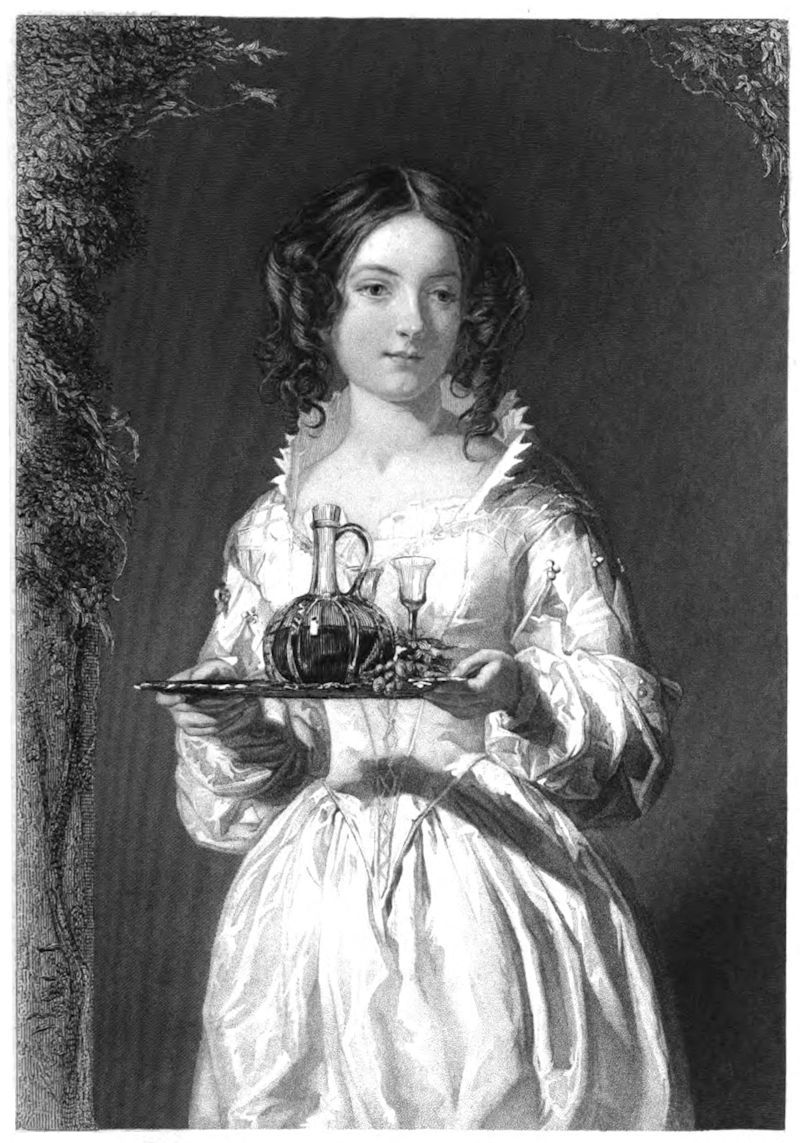
W. P. Frith W. H. Egleton
ROSE CARLTON.
Engraved expressly for Graham’s Magazine
“Even the best of things, my child, may be turned
to an evil purpose. The heat and light of the sun is
received by one plant and changed into a poison, while
another converts it into healthy and nourishing food.
Pure wine will not excite a healthy appetite, although
it may madden one that has become morbid through
intemperance. Here is the distinction that ought to
be made.”
“Is it not dangerous, then, to serve wine in promiscuous
companies?”
“Undoubtedly. I did not think so a little while ago,
because the subject was not presented to my mind in
the light that it now is. To this custom I can well
believe that hundreds who had begun the work of restricting
their craving appetites owe their downfall.
Where all are partaking, the temptation to join in is
almost irresistible; especially, as a refusal might create
a suspicion against the individual that he was
afraid to trust himself.”
“I will be very careful how I offer wine to any one
again,” said Rose. “I would not have the guilt of
tempting a man to ruin upon my conscience for all the
world.”
“The more I ponder the subject,” remarked Mrs.
Carleton, “the more surprised am I at myself and
others. I invite some friends to an entertainment, or
to spend a social evening, and I serve wine to my
guests. Among them is a man who has fallen into
intemperate habits at one time of life, and whose
present sobriety is dependent upon his rigid observance
of the rule of total abstinence. He is, it may be,
the husband of my most cherished friend. I place
wine before him with the rest. He is tempted to
break his rule, and falls. Ah, me! How many hundreds
of such cases occur in our large cities.”
Mrs. Carleton was a widow in easy circumstances,
and moved in fashionable society. She entertained a
good deal of company, and did it in the fashionable
way. When gentlemen called at her house, wine was
invariably set before them; and when she gave parties,
wine was always served to her guests. But,
suddenly startled into reflection, she saw that the practice
was a dangerous one, and determined to abandon
it. On this resolution she acted, much to the surprise
of many of her acquaintances. Some said she was
“queer,”—others decided that it was a foolish notion;
while others pronounced her conduct positively absurd.
But she did not in the least swerve from her purpose.
Wine was no more placed before her guests.
The visits of Mr. Newton to Rose, which at first
were only occasional, became more and more frequent.
A mutual attachment ensued, which ended in marriage.
No wine was provided at the wedding party—to
many a strange omission—and Rose observed that
at the parties given them by friends her husband invariably
let the wine pass him untasted. Curious to
know the reason for such abstemiousness, she one day,
some months after marriage, said to him—
“Do you never drink wine?”
The question caused Newton to look serious; and
he replied in a simple monosyllable.
“Don’t you like it?” inquired Rose.
“Yes; too well perhaps.”
The way in which this was said half startled the
young wife. Newton saw the effect of his words,
and forcing a smile said—
“When quite a young man, I was thrown much
into gay company, and there acquired a bad habit of
using all kinds of intoxicating drinks with a dangerous
freedom. Before I was conscious of my error, I was
verging on rapidly to the point of losing all self-control.
Startled at finding myself in such a position, I
made a resolution to abandon the use of every thing
but wine. This, however, did not reach the evil.
The taste of wine excited my appetite to such a degree
that I invariably resorted to brandy for its gratification.
I then abandoned the use of wine, as the
only safe course for me, and, with occasional exceptions,
have strictly adhered to my resolution. In a
few instances young ladies, at whose houses I visited,
have presented me with wine, and not wishing to push
back the proffered refreshment, I have tasted it. The
consequence was invariable. A burning desire for
stronger stimulants was awakened, that carried me
away as by an irresistible power. You, Rose, never
tempted me in this way. Had you done so, we might
not have been as happy as we are to-day.”
A shudder passed through the frame of the young
wife, as she remembered the glass of wine she had
been so near presenting to his lips. Never afterward
could she think of it without an inward tremor. And
fears for the future mingled with her thoughts of the
past; but these have proved groundless fears, for Mr.
Newton has no temptation at home, and he has resolution
enough to refuse a glass of wine in any company,
and on all occasions. Herein lies his safety.
“What! refuse a harmless glass of wine?” will
sometimes be said to him. To this he has but one
answer.
“Pure wine may be harmless in itself; so is light—yet
light will destroy an inflamed eye.”
———
BY HENRY T. TUCKERMAN.
———
Ere from thy calm seclusion parted,
O fairest village of the plain!
The thoughts that here to life have started
Draw me to Nature’s heart again.
The tasseled maize, full grain, or clover,
Far o’er the level meadow grows,
And through it, like a wayward rover,
The noble river gently flows.
Majestic elms, with trunks unshaken
By all the storms an age can bring,
Frail sprays whose rest the zephyrs waken,
Yet lithesome with the juice of spring.
By sportive airs the foliage lifted,
Each green leaf shows its white below,
As foam on emerald waves is drifted,
Their tints alternate come and go.
And then the skies! when vapors cluster
From zenith to horizon’s verge,
As wild gusts ominously bluster,
And in deep shade the landscape merge;—
Under the massive cloud’s low border,
Where hill-tops with the sky unite,
Like an old minster’s blazoned warder,
There scintillates an amber light.
Sometimes a humid fleece reposes
Midway upon the swelling ridge,
Like an aerial couch of roses,
Or Dairy’s amethystine bridge:
And pale green inlets lucid shimmer,
With huge cliffs jutting out beside,
Like those in mountain lakes that glimmer,
Tinged like the ocean’s crystal tide:
Or saffron-tinted islands planted
In firmaments of azure dye,
With pearly mounds that loom undaunted,
And float like icebergs of the sky.
Like autumn leaves that eddying falter,
Yet settle to their crimson rest,
As pilgrims round their burning altar,
They slowly gather in the west.
And when the distant mountain ranges
In moonlight or blue mist are clad,
Oft memory all the landscape changes,
And pensive thoughts are blent with glad.
For then, as in a dream Elysian,
Val d’Arno’s fair and loved domain
Seems to my rapt yet waking vision,
To yield familiar charms again.
Save that for dome and turret hoary,
Amid the central valley lies
A white church-spire unknown to story,
And smoke-wreaths from a cottage rise.
On Holyoke’s summit woods are frowning,
No line of cypresses we see,
Nor convent old with beauty crowning
The heights of sweet Fiésole.
Yet here may willing eyes discover
The art and life of every shore,
For Nature bids her patient lover
All true similitudes explore.
These firs, when cease their boughs to quiver,
Stand like pagodas brahmins seek,
Yon isle, that parts the winding river,
Seems modeled from a light caique.
And fanes that in these groves are hidden,
Are sculptured like a dainty frieze,
While choral music steals unbidden,
As undulates the forest breeze.
A gothic arch and springing column,
A floral-dyed, mosaic ground,
A twilight shade and vista solemn
In all these sylvan haunts are found.
And now this fragile garland weaving
While ebbs the musing tide away,
As one a sacred temple leaving,
Some tribute on its shrine would lay;
I bless the scenes whose tranquil beauty
Have cheered me like the sense of youth,
And freshened lonely tasks of duty,
The dream of love and zest of truth.
———
BY ISAAC GRAY BLANCHARD.
———
The flower springs by the fountain-side,
And blooms its little day;
Speechless it lives the life it has,
And silent fades away.
O, I would not be like the flower,
To perish in the mould,
And leave no record of my heart,
No fond affection told.
Let beauty be to others given,
And beautiful array—
To those who, like the flower, are but
Ambitious to be gay;
I only ask the pen, the tongue,
That can the heart unfold,
That the deep beauty of the soul
Be not unsung, untold.
———
BY C. M. FARMER.
———
Gentle reader! allow me to introduce to your consideration
the characters of Mr. Brigs, (soi disant
Allen Brigs, Esquire,) and his distinguished lady Mrs.
Polly Brigs. Imagine a stout built, corpulent “five
footer,” with a very big head, on which there never
was hair enough to make a decent pair of whiskers,
and on which, consequently, rode a red wig, curled as
many different ways as the sunbeams point; with the
largest of all large noses, into which he incessantly—or
at least fifty times in each day—thrust the raw rappee
with no small degree of relish; little pop-eyes, just
large enough to see every body in church at one and
the same time; a blue silk vest, striped cassimere pantaloons,
a leviathian shad-belly coat, and a milk-white
cravat tied in a double bow before, and surrounding
a collar made partly of very coarse linen, and mostly
of very stiff starch, which came up on either side to
his ears, sustaining the equilibrium of his head. Of
course, his head could only move in two directions—backward
and forward—without manifest danger to
the implements of hearing thereto attached, all set off
by a pair of cork-sole boots six and a quarter inches
across the instep when on, the toes of which looked
right into the master’s face; and here you have Allen
Brigs—alias, Mr. A. Brigs, Esquire.
Mr. Brigs had undoubtedly seen the eclipses of a
great many years. According to his own averment,
he had “waded through as many snows as there were
hairs on his wig;” and as he had repeated this averment
so many times, and nobody had ever evinced any
inclination to contest the point with him, he had persuaded
himself that he was ipso facto, a “very old
man.” Be this as it may, Mr. Allen Brigs was not the
man to be eschewed for his aged stupidity. He was
amusing and buoyant as a boy. He never took the
unnecessary trouble to correct himself for errors in
language, no matter how gross, but would leave that
to be done by any body who chose to “take it up.” If
he was asked if it was Jonah who swallowed the
whale, he would reply in the affirmative, and when
corrected, would invariably answer—“Zooks! it’s all
the same in Dutch—just vice versa, as the lawyers
say—that’s all!”
In short, Mr. Allen Brigs was a man not to be scared
by any “livin’ warmint,” two-legged, or four-legged,
male or female—a perfect man of the world in business—“a
real out and outer”—crushing all opposition to
his own schemes, and believing in his heart that every
body was a fool who did not coincide in all things with
him, Mr. Allen Brigs.
Mrs. Brigs was some ten years the junior of her
partner in life, and was a lady in every sense of the
word. It was evident that she had once been beautiful,
but that once had been past a long time; and now,
where then dangled the glossy curls, (not false curls—girls
never wore false curls in those days,) she displayed
two huge bows of yellow ribbon. These were
necessary ornaments, however, for they were appendages
to a very neat frilled cap. Mrs. Brigs had never
been known to wear a stay-body frock, or a bustle—indeed,
such things were not then in fashion—she
never wore sleeves of the mutton-leg cut; nor were
they ever so tight as to render the arms useless members,
but always large enough and small enough to be
comfortable. Mrs. Brigs never could endure small
shoes—consequently, she never was compelled to endure
the pains incident to corns. She was an inflexible
knitter and darner, and though Mr. Brigs never had
but one pair of socks, they never had a hole in them,
because whenever the legs wore out she would leg
them, and when the feet wore out she would foot
them. Mrs. Brigs was so good herself—so artless and
unsuspecting, that she thought every body else was
good, and artless, and unsuspecting too. Mrs. Brigs
was literally the very woman for Mr. Brigs, and that
gentleman was the very man for Mrs. Brigs. Hence,
it can only be inferred that they lived happily together—so
happily, indeed, and contentedly, that they were
known but to be loved. A peaceful country village
was their home. A ten acre farm of fertile land,
through which murmured a dear, bright stream
“That wound in many a flow’ry nook,”
was the fee simple property of Allen Brigs. A pretty
little white-washed house, almost hidden by the clustering
fruit-trees, was their humble tenement. A
handsome little garden, tastefully laid out, occupied the
space between the house and rivulet, and here Mrs.
Brigs sought recreation when burthened with the ennui
of knitting and darning. A cow and calf—a sow and
pig—a horse, and a yard full of poultry of every species,
composed the family stock. And with all these, and
nothing more, they were rich—rich in the honesty of
their own hearts which knew no covetousness—contentment
was theirs, and that was riches. They were
surrounded by kind neighbors—some affluent, but not
aristocratic. An athletic son of sixteen, and a beautiful
daughter of twelve, were their only offspring. Solomon
Brigs was his father’s sole help, but they managed
every thing to admiration. Nanny was a sweet tempered
child—affectionate and dutiful. Every body
loved her, and she loved every body. Notwithstanding
she was a country girl, there was a native, witching,
fascinating grace in her every movement. She
was so active, and gay, and cheerful—so full of life
and joy—and so mild and modest! She had never
known sickness: health flowed through every vein,
and glowed in her soft dark eyes and blooming
cheeks—and her smiling face was a sure index to
her pure heart. Her finely shaped head, and intelligent
forehead, bore testimony to her keen susceptibilities.
Solomon was a smart boy—so said his knowing father;
and though he had made no higher attainments
than reading, writing, and cyphering to the single rule
of three, he knew how to plough the corn, and hill the
potatoes, and weed his sister’s flower-beds. He could
not solve a problem in mathematics, but he could jump
higher and hallo louder than any boy in the village,
large or small.
Nanny was a proficient in the art of housekeeping,
but not in French, painting, &c. &c. She, too, could
read, write, and cypher, and Mr. Brigs considered that
enough book learning for his children. It was all he
knew, and there was danger in too much. But we
come now to give our characters a more conspicuous
place in the public mind.
It was one cold morning in December, when the
snow was thick on the ground, and a luxuriant fire
was blazing on every hearth in the village, and when
nobody living would have thought of visiting, except
Miss Lachevers, the housekeeper of John Doe, next
door neighbor to the Brigses, No. 10 Lachevers’ lane.
As I said, it was cold—extremely cold; but Miss Lachevers,
No. 10 Lachevers’ lane, did not regard cold
weather. Now, whether a young lady, living to the
age of forty odd, becomes invulnerable to the piercing
air of a December morning, or whether the young lady
in question was differently constituted from other people,
I shall not attempt to decide—probably the latter.
Nevertheless, on this same morning, almost as soon as
the sun showed his face, Miss Lachevers peeped in
at the door of Allen Brigs. Mr. Brigs was drying the
morning’s paper by the fire, while Mrs. Brigs busied
herself “clearing away” the breakfast table. Solomon
and Nanny were both reading from the same book,
the story of “Aladdin’s Lamp.”
“Good mornin’ to you,” said Miss Lachevers, introducing
her body as well as her head—“cool mornin’
this.”
“Rather,” replied Mr. Brigs senior, laying down the
paper and rubbing the palms of his hands hard enough
together to erase the skin. “Come to the fire, Betty—be
seated—have off your bonnet.”
The finishing clause of this address proceeded from
the voluble tongue of Mrs. Brigs; and Nanny arose
from her seat to hand Miss Lachevers a chair.
“Don’t trouble yourself, child—I never have time
to sit. I must go back in one second. It’s trot, trot,
from mornin’ till night, with me. I just stepped in,”
she continued, turning her eyes on Mrs. Brigs, “to ask
you all if you’ve hearn the news?”
“What news?” inquired Mr. Brigs senior, glancing
first at the paper on the chair and then at the early
visiter—“any body dead or dying—or any steamship
busted—or any thing of that species?”
“Oh, no!” said Miss Lachevers, “nothin’ of that
are character. But somethin’ more important and
novel than either.”
All eyes were now turned toward the significant
countenance of Miss Betty Lachevers, who still remained
standing. Mr. Brigs senior, not exactly understanding
the application of the word “novel” to the
sudden intelligence of any thing new—having never
heard it applied to any thing but a book—requested
Miss Lachevers to explain herself. Mrs. Brigs insisted
that Betty should take a chair and tell all about it; and
Solomon and Nanny continued their reading, as if nothing
novel was going on.
“Why, raly,” said Miss Lachevers, drawing a seat,
and depositing her person thereon, “I haint hardly got
time to tell you. But it’s wonderful to think of. The
fact is, a young schoolmaster arrived in town last
night, and I hear it’s his intention to set up a school
here for the eddication of youth; and the worst of all
is, nobody knows who he is, or where he come from.
His name I heered, but I almost forgot it—it’s Dubbs—or
Grubbs—or Dobbs—or somethin’ like that. They
say he’s a wonderful genus, smart as can be, and full
of larning. He stopped at old Jenkins’s, cross the way—whether
he means to board there I can’t say—but
there he is. I s’pose we’ll get a peep at him to-day.
For my part, I should like to know why he put up at
old Jenkins’s.”
“A schoolmaster!” repeated Mr. Brigs, the elder,
with emphatic surprise.
“Yes—a reg’lar built, yankee schoolmaster,” replied
Miss Betty.
“Come to teach the children how that the earth revolves
round the sun, instead of the sun revolving
round the earth, and things of that extravagant natur’,
I s’pose?”
“To be sure he will,” said the young lady, “and
he’ll be after coaxin’ your children into his notions—see
if he don’t.”
“Not he!” consequentially returned the old man—“Sol
has too much sense for any Yankee that ever
lived yet; and I guess Nanny will have enough to do to
larn of her mother. Not he!” and Mr. Brigs inflicted
two slaps on the left side pocket of his blue vest.
Mrs. Brigs sighed, and Miss Lachevers coughed—whether
for want of something to say, or to render
what she had said complete, it matters not—but
she coughed, and bidding a hasty adieu, left the
room.
Mr. Brigs settled himself down to read the paper,
and his lady settled herself down to her favorite exercise—knitting;
while Solomon and Nanny repeated to
each other surmises as to the probable appearance of
the new comer—his age—dress, &c.
The day passed away, and night came on. Tea was
over, and this happy little family had gathered around
the cheerful fire. A gentle tap was heard at the door,
and a voice pronouncing the simple word—“housekeepers.”
“Come in,” responded Mrs. Brigs, and in came Mr.
Jenkins, followed by a young man apparently about
twenty-two, with black hair and eyes, straight, tall,
and erect, handsome, and of a genteel and prepossessing
appearance, who was introduced by his conductor as
Mr. Timothy Dobbs.
“My friend,” said Mr. Jenkins, after being seated,
and taking an accurate survey of the premises, “has
come among us for the purpose, he says, of opening a
school. He is an orphan, of very superior endowments—brings
with him ample credentials of his
capacity, and expects to find patronage for his support
from the inhabitants of our village.”
Mr. Dobbs bowed a concurrence in the remarks of
Mr. Jenkins, and hoped that Mr. Brigs could furnish
him with board and a convenient room in his house.
“Ah, that’s it!” said Mr. Jenkins, recollecting the
object of his visit—“that’s what we’re a coming to.
This gentleman, Mr. Brigs, wishes to reside in your
family, and to eat at your table, sir. I hope—I s’pose
you can accommodate him, Mr. Brigs?”
Mr. Brigs said that he could, and that he should be
happy to serve him, Mr. Dobbs, in any other manner
possible. Matters being thus considered, and terms
agreed on, Mr Jenkins arose to depart; having first
satisfied Mr. Dobbs that he, Dobbs, would be sure to
sleep soundly that night, and assured him of the total
absence of all danger from external assaults under the
roof of so great and good a man as his friend and
neighbor Allen Brigs.
Before retiring to rest, Mr. Dobbs acquainted himself
with the characters before him, by conversing
with them, and each of them, on various topics; and
found to his satisfaction that they were kind and noble-hearted
people. The characteristic traits of Mr. Brigs
were rough and unique, yet there was a generous
frankness about him—such a flow of spirits and good
humor—that he considered him a pleasant man. Nor
was Mrs. Brigs unlike her husband in these particulars.
To tell the truth, Mr. Dobbs was pleased. More
than once did he get a full view of the sweet face of
Nanny; and more than once did Nanny blush to catch
his eye. Timothy admired her modest looks, and
fancied that he might one day love her. He wondered
how old she was, and blest his luck that he had fallen
into that particular family, where such a beautiful face
as hers might shed its sunny smiles about him—perhaps
to cheer many of his tedious moments. He
fancied she must be young, yet she seemed already
expanding into womanhood. Such perfect symmetry
of form, and grace of carriage, he had never seen in a
country girl: and then the rich intelligence that beamed
through her soft dark eyes, convinced him that she was
born to follow some more noble pursuit than housewifery.
The hour grew late, and Timothy bade good-night,
and crept softly to his room, where fatigue soon lulled
him to sleep. But he dreamed! Yes, he dreamed of
one sweet angelic being, whom he had only seen
once—only once—and that sweet being was Nanny!
“Zooks!” said Mr. Brigs, after Timothy had left the
parlor—“but he seems to be a clever youth. Nanny,
what do you think of him—eh?”
“I don’t know, father,” replied Nanny—“but—I
think—he’s quite handsome.”
“Handsome! Yes, and I reckon he considered
Miss Nanny Brigs a leetle specimen of the handsomest
girl he ever saw. I saw him a squintin’ on that side
of the house.”
“Oh, father!” cried Nanny, faintly blushing. “I’m
sure he looked at us all—he looked at Solomon, too.”
“What’s his name, father?” inquired Solomon—“Stobbs?”
“Dobbs—Timothy Dobbs, I think, and that’s all I
know about him yet: but we’ll find what kind of a
chap he is soon, I guess. I expect he’s a squirt, any
how.”
“I hope not,” said Mrs. Brigs.
“And I hope not, too,” rejoined Mr. Brigs; “but
we’ll see!”
Time sped on. The village school was in a flourishing
condition. Pupil after pupil had been added to the
charge of Mr. Timothy Dobbs, the “great unknown,”
until (to use a cant phrase) he had his hands full. It
is very natural to suppose that our village schoolmaster
had become very popular among all the villagers,
and particularly so in the discerning eyes of
Miss Betty Lachevers, No. 10 Lachevers’ lane. Notwithstanding
the violent protestations of Mr. Brigs
against the idea of suffering his children to become
scholars of Mr. Dobbs, the old gentleman had confessed
his wrong in that respect, and now protested with the
same vehemence, that Mr. Timothy Dobbs was the
finest fellow that ever lived; and that it would be high
treason in any parent or guardian to refuse children
and wards generally, the benefits of Mr. Dobbs’s seminary
of learning; and he (Mr. Brigs) was firmly of the
opinion that Solomon and Nanny would one day
become the successors of their tutor in the office
of “eddicating youth;” and on this hypothesis,
he built the future prospect of the erection of the
“Brigs’ College,” to be called after his own name, and
of which, as a matter of course, Solomon was to be
principal professor. Mr. Brigs saw all this as clear as
a whistle, and he had no doubt that his prophecy
would be fulfilled. Mr. Dobbs continued to board and
lodge at Mr. Brigs’ house. Nanny grew more lovely
and interesting every day, and made rapid advancement
in her studies. Solomon declared that Mr. Dobbs
paid more attention to his sister than to any other
young lady in the school—to her instructions he meant;
and that he believed seriously, that Mr. Dobbs had a
notion of making her his assistant—in the school he
meant. Miss Lachevers always happened to hoist the
window of Mr. Doe’s parlor at the particular moment
when the schoolmaster, Nanny, and Solomon passed
the gate, on their return from school; and as it was as
invariably the case that Mr. Dobbs walked closer to
Nanny’s side than Solomon’s, the former young lady
never failed to give her features an expression of scorn—at
least, whenever her eye met Nanny’s. It might
have been necessary for Miss Betty to hoist the window
on all these occasions, for some domestic purpose,
such as dusting, &c., and therefore she could not help
seeing the passers by; she, however, at such times
looked unusually prim, but Mr. Dobbs seemed, in
every case, unconscious that the eyes of any third
person were upon him, for he never turned his on
either side, but looked straight forward. One day
Nanny actually had her arm in that of the schoolmaster,
when the walking was very bad on account of
snow, and then Miss Lachevers looked daggers, and
from thenceforth her deportment toward our innocent
heroine grew cold and formal. Perhaps Miss Betty
had different views of village etiquette from other
young ladies, and thought it extremely rude for a young
lady to lock arms with a gentleman, under an acquaintance
of four years and a half; or perhaps she considered
the law of primogeniture applicable to her individual
case, and thought that if any body was to lock arms
with the schoolmaster, it should be herself, as she was
rather older than Miss Nanny Brigs. Nevertheless,
she did not make her visits to Mr. Brigs’s less frequent.
She would sometimes—though altogether accidentally—chance
to “fall in” when Mr. Dobbs was there;
and whenever that event occurred, she made herself
extremely agreeable—so she thought. But Mr. Dobbs
was a sober-minded man, of keen perception and sound
views of propriety, and could read her writing as well
as she could herself. Nor was it long ere his disgust
was manifested at her sociable behavior, which caused
her to bestow upon him the classic epithet of “itinerant
pedagogue.” And now matters took another turn.
A year had passed away since the “itinerant pedagogue”
first opened his school. The population of the
village had considerably increased. Uncle Sam had
established a post-office there. Lachevers’ lane was
become the principal thoroughfare of the “town.”
Stores—groceries—and tailor’s shops had been erected;
sign-boards hung out and nailed to the window shutters.
A handsome church “with tapering spire,” and surrounded
by young trees, was now the Sabbath rendezvous
of the villagers. The school-house had been
enlarged—the play-ground enclosed—and every thing
wore a new aspect. Miss Betty Lachevers, after exhausting
all her efforts to captivate Timothy Dobbs, had
abandoned him to the more attractive charms of Miss
Brigs; and the former young lady was now scarcely
ever seen, save at church on Sundays. A Sabbath-school
had been opened in the basement-room of the
village church, of which Timothy was superintendent,
and Solomon and Nanny teachers; and the signs of the
times bade fair to verify the predictions of Mr. Brigs
with regard to colleges, &c. in general. But, still all
was not right! Timothy had declared his love to
Nanny, and had received an answer of satisfaction.
He had solicited the consent of her parents, and had
received a REFUSAL!! Not that Mr. Brigs thought him
unworthy of the hand of his daughter, but because his
history was still enveloped in mystery and obscurity.
Mr. Jenkins and Mr. Brigs, and Mrs. Jenkins and
Mrs. Brigs, and half a dozen more misters and mistresses,
had used all means to find out his origin, but
to no effect. He would always, when spoken to on
that point, fall into a state of dejected gloom, and evade
all questions bearing on his nativity; and this was a
barrier which intervened between him and the object
of his affections.
A large oil painting ornamented the wall over the
fire-place, representing a young mother, with an infant
on her breast, reclining on the left arm of a man, who
was defending her with his right, from the assaults of
a ruffian. A beautiful girl lay weltering in blood near
the surviving group; and the husband seemed to have
received several dangerous wounds, from which large
drops of blood were falling. It was a scene of deep
and thrilling interest, and expressive of some awful
tragedy. It was also well executed, and the languishing
despair which beamed from the face of the young
mother would almost seem, at times, to convert the
painted canvas into a mass of animation. At this picture
Mr. Dobbs was often seen to gaze with sad countenance
and quivering lip; while the throbbings of his
temples told that the mind was at work with melancholy
thoughts. He became sad and cheerless,
avoided all company (but Nanny’s) as much as possible,
and was sometimes found weeping. Yet none knew
the cause of his silent grief. Nanny observed the
effect which had been wrought on him by the picture,
and communicated the fact to her mother.
“He seems,” said she, “to take a sad pleasure in
looking at the painting. He showed me a miniature
yesterday, which is the express image of the lady with
the infant child in her arms; and when I had examined
it, and returned it to him, he pressed it to his lips, and
the tears fell from his eyes. There must be something
strange connected with his history!”
“And did he say nothing about the miniature or the
painting?” inquired Mr. Brigs.
“Nothing!” replied Nanny, “I saw the subject gave
him pain, and I feared to ask him any thing about it.”
“Where is the miniature?” asked Mrs. Brigs.
“He keeps it in his vest pocket,” answered Nanny.
“I will beg him to show it to you, mother—I know he
will.”
“No, child—don’t. I will inquire into the secret
myself. But Nanny, did you never hear the story of
the painting over the fire?”
“No,” said Nanny; “what is it?”
“Ah! it’s an awful thing—all true as Gospel—dreadful!”
Here Mrs. Brigs requested her daughter to ask her
no questions, and she would tell her some other time.
The young girl’s fears were excited, but she concealed
them within her own bosom.
“Mr. Dobbs,” said Mrs. Brigs one evening, “what
on earth ails you? You look like you have lost the
best friend you had in the world. Do pray tell us
what has made you so gloomy for so many days.”
Timothy sighed deeply, and a crimson flush suffused
the cheek of Nanny. Mr. Brigs turned up his collar,
and ran his fingers through his gray locks, and looked
very hard at Mr. Dobbs. Solomon looked very hard
at his father; and Mrs. Brigs looked at every one in the
room alternately.
“Come,” said Mr. Briggs—“Come, Mr. Dobbs,
let’s hear what’s the matter. Remember, young man,
you are among friends; and if I can do any thing for
you—why, I’ll do it. Come, now, let out. Don’t
kill yourself for no trifle, young man.”
“I feel much obliged to you,” replied Timothy,
“and will ask but one favor. I cannot now tell you
what ails me; but there is something in this house
which gives me great anxiety. I have long wished to
make the inquiry, but had not the courage. Tell me,
then, what is the meaning of that picture which hangs
before me?”
“Zooks!” cried Mr. Brigs, “and is it the picture
that has caused all your bad feelings, Mr. Dobbs?”
“It is,” returned the schoolmaster; “and I wish to
know what it means!”
The surprise of Mr. Brigs and Solomon may be better
imagined than described. The old gentleman drew
out his red silk handkerchief and rubbed his eyes,
stuffed it into his pocket again, and stared with all his
might right into the schoolmaster’s face. Solomon
stared also; and laying down the book he was reading,
prepared himself to hear something strange. Mrs.
Brigs and her daughter were before partially acquainted
with the cause of Timothy’s disease—at
least, they knew that it sprung from the oil painting in
question. All was now deep interest, awaiting the
development of some wonderful discovery.
“Ah!” said Mrs. Brigs, “it’s a solemn thing that!
It used to make me sick to look at it; but it’s a long
time since it was hung up there, and I’ve got used to
it. Still it sticks deep into my heart—it does! It tells
a sad story—but you shall hear it, Mr. Dobbs!” And
Mrs. Brigs began.
I will not give the reader the story in the very words
in which Mrs. Brigs gave it to Timothy; because that
is impossible: for she paused more than once to wipe
away the big tears, and to sob; and was obliged to
commence afresh as many as three times before she
satisfied herself that she was in the right path, and had
begun at the beginning. But, as I said, she began,
and the following is the substance of the narrative: