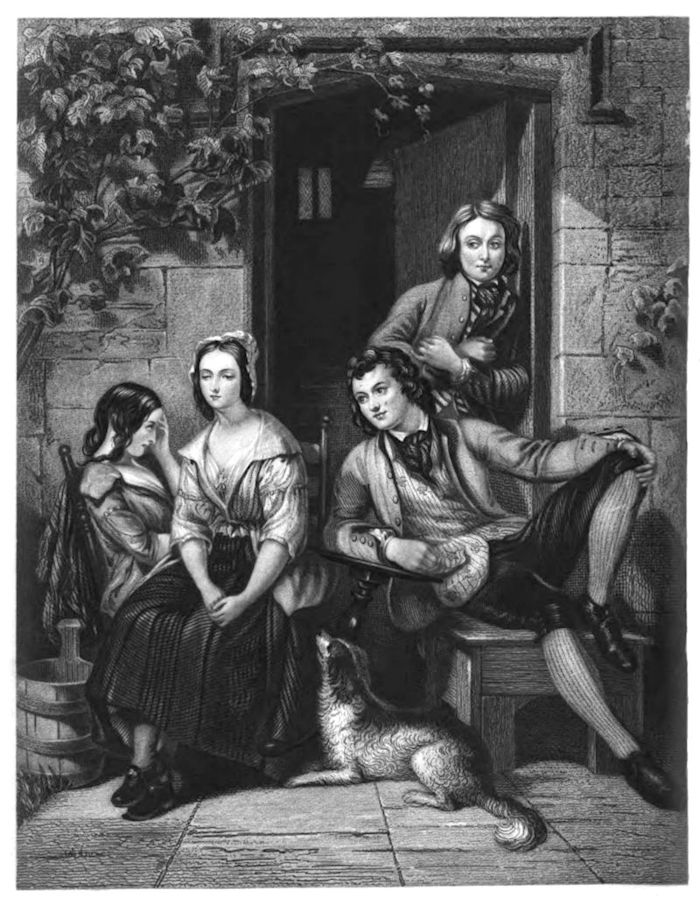
Of his right eye young Acon was bereft;
His sister Leonilla lost the left;
Still each in form can rival with the gods,
And, though both Cyclops, beat them by all odds.
Spare her, my boy, your blinker, be not stupid,
She then will be a Venus, you a Cupid.
———
BY HENRY B. HIRST.
———
I have had my days of sadness: youth, which we review in age,
Spelling once again its syllables, was a blurred and blotted page.
Drifting down the tide of Time my tiny barque, unguided, passed
Toward the Mäelstrom of Manhood, puppet both of wave and blast.
But an all-protecting Providence watched the craft, when tempest-tost
On the Atlantic of Adversity; and the vessel was not lost.
Through the distance, when the clouds were lifted by the eddying breeze,
Sunny sapphire skies shone on me, with, beneath, Pacific seas.
But the gloom came down around me, and the billows rolled and moaned,
And the little laboring ark with more than human agony groaned.
Shoals and sunken rocks around it,—like a frenzied steed that flies,
Terror burning, like a beacon, in his wide-distended eyes,—
Through this Archipelago of danger such as no one knows,
Save the wanderer in a wilderness, filled with savage hungry foes—
Rode the Argo of my Destiny; for what storm could overwhelm
When God’s holy hand, or else His angel’s, held the fragile helm?
Suddenly from the desperate darkness stole the tender, trembling light
Of a luminous, blushing planet, gleaming gently on my sight.
And the gloom fell down before it, and the billows knew surcease,
And the horrid howling winds reclined in slumber, breathing peace.
Night by night the sun descended, and I saw the moon arise,
With that luminous planet near it, like a deity, in the skies.
Then said I unto my spirit—“Reigning in those realms above,
O, my soul, behold at last the unassuming star of love.
“Like a queen she walks the infinite, saying softly, ‘Peace; be still!’
And the lion winds and waters crouch, submissive to her will.”
Now in safety rides my vessel, for that luminous, blushing star
Sits forever in my “House of Life,” a ruling Guardian Lar;
And the haven it has entered lies encircled by a shore
Green as Eden was, calm as Heaven is; and the storm is known no more.
There with one whose type is Beauty, Adam-like, I dwell in dreams,
Whose realities were delirium, sleeping by love’s silver streams.
Eve, my angel, always with me, leads my spirit by the hand
Tenderly from its painful memories toward the Better—Happier Land.
And like ghosts, when, clarion-tongued, proud Chanticleer salutes the dawn,
All my ghastly recollections flit, like shadows, and are gone.
———
BY RICHARD COE, JR.
———
Come! Come! Come!
Nature, teacher sweet, will tell
Where the Lord of all doth dwell,
He who doeth all things well,
And in glory reigns!
In the mountain—in the stream—
In the hushed and charmed air—
In the working of a dream—
God is everywhere!
In the star that decks the sky,
Shining through the silent air;
In the cloud that saileth by—
God is everywhere!
In the lily of the field—
Or in floweret more rare—
In the perfume roses yield—
God is everywhere!
In the sunbeam clear and bright—
In the rainbow wondrous fair—
In the darkness of the night—
God is everywhere!
In the gentle summer breeze—
In the rushing winter air—
In the rustling of the trees—
God is everywhere!
In the organ’s solemn sound—
Or in music’s lighter air—
All above—beneath—around—
God is everywhere!
———
BY PROFESSOR ALDEN.
———
“Uncle, have you a fowling-piece to lend me?”
said Henry Deforest, on the morning after his arrival
at Beech Grove, whither he had come to enjoy a brief
interval of rest from his professional studies.
“Yes,” replied Mr. Woolcott, “as fine a one as you
ever handled.”
“What do you want to do with it, pray?” said
Aunt Martha, Mr. Woolcott’s maiden sister and housekeeper,
who, like a sensible woman, believed that
guns and gunpowder were infernal inventions, and
dangerous in every possible shape and shade of combination.
“I have some thoughts of taking a gunning excursion,”
said Henry.
“Are you a good shot?” said Mr. Woolcott.
“About equal to Mr. Winkle.”
“I don’t know him—where does he live?”
Henry was happily relieved from the necessity of
replying to the question of his matter-of-fact uncle, by
Aunt Martha, who declared her somewhat exulting
belief that the gun was lent.
“No, it is at home—it came home last night. Here it
is,” said Mr. W., bringing it forth from a secure hiding-place
constructed under Aunt Martha’s sole direction
and authority.
“Is it loaded?” said Henry.
“No, I guess not,” said his uncle.
“I’ll warrant it is,” said Aunt Martha.
“What is there to shoot in these parts?” said Henry.
“Boys,” replied Aunt M., rather sharply. “Mr.
Johns shot one last week.”
“Boys are not good to eat, my dear aunt, and I cannot
in conscience shoot any thing not good to eat.”
Aunt Martha uttered an inarticulate aspiration which
signified that she should lose her temper if she said any
thing more.
Mr. Woolcott, who had been quite a rustic sportsman
in his younger days, furnished his nephew with a
liberal allowance of powder, shot and wadding, and
the said nephew sallied forth with murderous intentions
toward all feathered bipeds possessing the attribute
of being good to eat.
It was early in June. The sweet breath of the
morning spoke so lovingly of peace and gentleness,
that he began to question the propriety of his savage
purposes. His conscience, or his good sense, or his
humanity, or something else, suggested, that to pollute
the flower-laden breeze with sulphurous vapors, and
to hush the sweet music of God’s innocent creatures,
was not the most fitting employment for one proud of
his immortality. He had not a very definite idea of the
pleasures of bird-murder—in fact, that it might be a
source of pleasure to him at all, it would be necessary
for him to “make believe” with as much intensity as
did “the small servant,” when she used orange-peel
water for wine.
He soon reached a beautiful meadow. In consequence
of his admiration of the lilies and daisies which
adorned it, he failed to observe the meadow-larks that
frequently rose before him, and uttered their notes of
gladness to the mounting sun. At length one rose from
his very feet. In an instant his finger was upon the
trigger; but the sweet note of his intended victim
charmed him. While he listened, the bird passed beyond
the range of his weapon. Perhaps he mentally
compared the pleasure of listening to its song with that
of witnessing its dying gaspings.
The murmuring of a streamlet fell upon his ear. In
a moment he was bending over its pure, bright waters.
A large, smooth stone, shaded by a clump of willows,
invited him to a seat. He laid aside his weapon, and
sat down, baring his forehead to the breeze, and fixing
his eyes upon the tiny inhabitants of the rivulet, his
thoughts took the peaceful hue of the objects around
him. It was not till the changing shadows of the willows
exposed him to the rays of the sun, that he became
conscious of the flight of time. He then rose and
went to a small grove which clothed the summit of a
gentle elevation in the vicinity. The grove was composed
of saplings, about twenty feet in height. As he
entered it, a false step led him to cast his eye downward.
He had planted his foot in the hollow of a
sunken grave. On looking around him, he found he
was in the midst of an ancient grave-yard. The headstones
which marked the resting places of the sleepers,
had apparently been taken from a neighboring ledge.
Only one bore an inscription, or had received the impress
of the chisel. He looked in vain for a new-made
grave. It was long since the funeral-train had entered
that grave-yard—long since the mourner had come
thither to weep.
Deforest had visited cemeteries in which wealth had
lavished its treasures, and art exhausted its resources
in order to disrobe death of his gloom. No splendid
mausoleum, no carefully penned epitaph, so disposed
him to reflection, as did the leaf-filled hollows and rude
stones of that neglected grave-yard. He spent an hour
in serious thought, and was about to leave the place,
when the sound of approaching footsteps arrested his
attention. He turned and saw an aged man entering
the grove. The stranger approached the grave near
which Deforest was standing. He appeared slightly
embarrassed when he perceived that he was not alone.
He returned the courteous salutation of Deforest, and
seemed disposed to converse with him.
“You do not live in these parts?” said he.
“I am on a visit to my uncle, Mr. Woolcott. I reside
in the city,” said Deforest.
“Your uncle came into the place after I left it. I was
born here, in a house that stood on the knoll yonder.
That cluster of bushes stands where the hearth-stone
used to lie.”
“I noticed, as I passed the spot this morning, that a
building once stood there. It must have been a long
time ago.”
“Sixty-nine years ago, last March, I was born in that
house, or rather in the house which stood there then.
This country then was a wilderness. There was one
log-house where the village now stands, and one between
this and the river. I have not lived here for more
than forty years. Latterly I go through the place once a
year, as I go for my pension, and I always come to this
spot. My father lies here, and—another friend. I always
come and look upon the place of their rest. They do not
know it. It does not do them any good, but it does
me good. This is the grave of my father,” laying his
hand on the stone noticed above as being the only one
which bore an inscription. The inscription was as
follows: “James Hampton, died July 16, 1777, aged
forty-five years.”
The old man uncovered his head as he laid his hand
upon the stone, and gazed in silence upon the earth
which lay above the remains of his parent. Deforest
felt that he was an intruder, and was about to retire.
“Do not go,” said the stranger. “I never met any
one here before. It seems like meeting with a friend.
That is a feeling which persons as old as I am seldom
experience.”
Deforest, whose warm heart was strongly interested
in the aged stranger, gladly accepted his invitation to
remain.
“You were young when your father died,” said he,
looking again at the inscription.
“I was in my fourteenth year. He was killed by a
rifle-ball, in an attack made upon the house by a party
of Indians. I have no doubt they were led by a tory
who lived in a house which stood behind the ridge
yonder, to the east. My friends wished to have it put
on the tombstone that he was shot by the Indians. I
believed that the shot which killed him was fired by a
neighbor. I would not have the stone tell an untruth;
so nothing is said about the manner of his death.”
“I should be greatly interested in hearing an account
of the matter, if it be not painful to you to relate it.”
“Come and sit down on this rock and I will tell you
all about it. It happened more than fifty years ago, yet
it is as fresh in my mind as if it had happened yesterday.”
He led the way to a large moss-covered rock, which
afforded them a comfortable seat under the shade of a
thicket of young chestnuts. Near it was a grave on
which the old man’s eyes were fastened. He did not
seem disposed to resume the conversation. A tear
ran down his furrowed cheek. Deforest sympathized
with him in silence.
“You must ask me questions, my young friend,”
said he, somewhat abruptly, “or my mind will wander
away from the things you wish me to speak of.”
“Did your father build the house in which you were
born?” said Deforest.
“Yes, he came here about ten years before the war,
when, as I said before, there was only one house between
this and the river. I was born the year after
the house was built. I was but a little over ten years
old when the troubles with England came on. My
father and mother had many consultations upon the
question, whether it was best for them to return to the
east or not. There were no Indians near, and there
was nothing to call them—for nearly all the people
along the river were friends to the king. My father
was from Massachusetts, and of course, liberty was
natural to him; but he had said little or nothing about
matters in dispute, for the very good reason that there
were but very few persons to converge with. So he
concluded to remain here. I could see that my mother
did not feel easy. She grew thin and pale, and seemed
unwilling to have us out of her sight.
“Once in a while, a rumor of what was going on
reached us, though the accounts were always in favor
of the king’s troops.
“In June of the year ’77, one day, as my father was
in the cornfield, he saw an Indian skulking behind a
large tree in the woods, that then stood where those
oats are now growing. He continued at his hoeing
for an hour or two, and was careful not to indicate by
his appearance that he had seen any thing unusual.”
“Was he not afraid that the Indian’s bullet might
put an end to his work?” said Deforest.
“No, he reasoned in this way. If the object of the
Indian had been to kill him on the spot, he would have
done so before he was seen. When my father came
to the house, he was not disposed to say any thing about
what had occurred, for he was not willing to give unnecessary
alarm to his family. His anxious countenance
led to inquiries which revealed the true state of
the case. He began at once to make preparation to
resist an attack, which he anticipated would be made
in the night. I was employed in casting bullets, while
he was busy in barricading the windows, and in making
openings between the logs to serve as port-holes.
Night at length drew near, and we sat down to supper,
sad and silent, feeling that in all probability it was the
last meat we should ever take together. The night
passed slowly on. None of us were disposed to sleep.
About midnight my father persuaded my mother to lie
down, with my sister, who was sleeping unconscious
of danger. Very soon there was a gentle knocking at
the door. We had no light burning. My father had
his rifle in his hand, while I held a musket, ready to
exchange with him as soon as he had fired. He crept
silently to the port-hole that commanded the door. He
saw an Indian, with a rifle, standing before the door.
The moonbeams fell full on his face, the expression of
which left no doubt on my father’s mind respecting the
object of the visit. The knocking was repeated. The
answer was the discharge of the rifle from the port-hole.
The Indian bounded high in the air, and fell to
the earth a corpse. A yell from about half a dozen
voices in the vicinity revealed the probable number of
our foes. We were greatly encouraged, for it seemed
well-nigh certain that their numbers would be so far
diminished ere they could effect an entrance, as to
render the result of the conflict by no means doubtful.
The opening from which the shot was fired did not
command the approach to the door. This was probably
observed by our enemies, and after some time,
apparently spent in consultation, two of them took a
long, heavy pole from the fence, and drew near with
the evident purpose of using it as a battering-ram to
force the door. My father placed himself before an
opening which he had made for the purpose of commanding
the approach to the door, and when they were
near enough to make the aim sure, he fired, and the
hindmost man fell, never to rise again. I instantly
gave my father the musket, and he fired at the other
man, who had made a brief halt before he commenced
his retreat. Either because the smoke prevented a
good aim, or the musket carried ball less accurately
than the rifle, the Indian did not fall, but from the blood
that marked his retreat, it appeared that he was
severely wounded.
“We could see a group of four or five persons in the
distance. They were not quite near enough to make
a sure shot, and my father thought it of the utmost importance
that every ball should tell. While our attention
was fixed upon them, a light shone in from a
crevice on the side of the house opposite to the door.
On that side there was neither door nor window. The
enemy had sent one of their number, who had procured
a bundle of straw from the barn, and placed it
against the side of the logs, and set fire to it. It was
their object to burn us alive, or to shoot us down when
attempting to extinguish the flames. From the crevice
which revealed the fire, my father saw an Indian
grinning like a demon as he watched the progress of
the flames. The good rifle soon put him out of the
way of doing any more mischief. He then seized a
pail of water, and ran to the chamber, and removed a
board from the roof, and poured the water upon the
fire. He had loosened the board in the course of his
preparations for defense, thinking it possible that the
opening might afford a means of escape. Fortunately
the opening was immediately over the spot where the
fire was kindled. Three of our foes had now been
killed, and one of them wounded, (though we did not
know it till the next day,) and we hoped they would
become discouraged and retire. We heard nor saw
nothing of them for an hour or more, though we kept
watch in every direction.
“A new danger revealed itself. The fire had not
been wholly extinguished; it had caught in the logs,
and now began to blaze. My father took a bucket of
water and went to the roof as before, but the moment
his head appeared, three or four rifles were discharged
from the grove near by. One of the balls slightly
grazed his cheek. He had the presence of mind to
make immediate application of the water before they
had time to reload, but he did not succeed in applying
it to the spot where it was most needed. Before another
pailfull could be procured, they had loaded their
pieces. He raised his hat above the opening in the
roof, in hopes that they would all fire, that he might
then extinguish the flames before they could reload.
Only one shot, however, was fired. It pierced the hat,
which fell. A savage yell of triumph caused our blood
to curdle. The hat was raised again, and another shot
fired, and another, both of which missed it. The
water was then poured on the fire; but just as he was
descending the stairs, a ball, apparently fired at random,
passed through the clay between the logs, and
entered his neck. He told us that he should bleed
to death in a few minutes, but encouraged us to hope
that the enemy would retire without any further efforts.
He told me to keep a vigilant watch, and to shoot down
those that came near the house. ‘Take care of your
mother and sister,’ said he, ‘take them to the east
if—’ he never finished the sentence. He bled to death
in spite of all we could do.”
The old man paused in his narrative, and again
fixed his eyes upon the grave noticed above.
“Was the attack renewed?”
“No, they went off before daylight, leaving their
dead unburied. I dug a grave in the cellar, and buried
my father. We then took our horses, and were on
the other side of the river before night.”
“Were you not afraid of being waylaid and murdered?”
“We were, chiefly from the fact that so many of
the Indians had been killed. We felt safe when we
had crossed the river. We went to my mother’s
native place, and remained there till the war was over,
when we returned here. I was in the army during
the last year of the war.”
“I should hardly have thought that your mother
would have been willing to return here.”
“We had a good farm here, and several families
from her native place concluded to come with us and
settle here. By cultivating the farm I could fulfill my
father’s command to take care of my mother and
sister, and I did not see how I could do it in any other
way. The first thing I did was to bury my father in
this place. Several years afterward this stone, which
marks his grave, was brought on from the east.”
“You told me you thought the shot which killed
your father was fired by a neighbor.”
“We had no suspicion of any such thing at the
time. As was natural, I kept the ball that caused the
death-wound. It was of a peculiar size, and had a
singular mark upon it. After my return, I happened
one day to be present where there were a number of
persons shooting at a mark. Alter they had finished
their sport, the boys began to cut the balls out of the
tree on which the mark had been placed. I was standing
near and happened to hear one say, ‘that was
Sawyer’s ball. I can always tell his ball by this mark.’
I looked at the ball, and saw that it bore the same
mark as the one that was taken from my father’s neck.
I put it into my pocket, and went home and compared
it with the ball I had preserved. The size and marks
corresponded perfectly. I then went to the boy and
found that all Sawyer’s balls had the same mark.
There was something in the bore of the rifle that made
a peculiar crease in the ball as it was forced out. I
then got a neighbor to inquire of Sawyer how long he
had owned his rifle, and I found that it was in his possession
before the war came on. My suspicions were
then strongly excited. It was not probable that there
were two rifles that would make the same impression
upon the ball discharged from them. I remembered,
too, that Sawyer had expressed great surprise at our
return, and had appeared somewhat embarrassed when
he met me. I met him in the street one day, and took
the ball out of my pocket and held it before him, and
fixing my eye fully upon his, asked him if he had ever
seen it? He turned very red, and then came near
fainting. I laid my hand upon him. He trembled
like a leaf. I repeated the question in a louder tone,
for I was sure that the murderer of my father was before
me. His lips moved, but he could not speak.
‘Do you think,’ said I, ‘that it is safe for you to stay
in this country?’ I flung him from me, and went on
my way. The next day he left for the west, and some
time afterward sent for his family.”
“How long did you live here after your return?”
“Nearly ten years; I lived here till my mother
died.”
“Is she buried here?”
“No, she died while we were on a visit to the east.
She was buried among her kindred. After her death,
I returned here and remained till I helped fill up that
grave,” pointing to the one which he had gazed at so
earnestly when he took his seat upon the rock.
“Then I felt there was nothing more to keep me here—in
fact, I felt that I could not live here. My sister
was married at the East; so I sold the farm and became
a wanderer. I did not visit the place for nearly twenty
years. When the pension-law was passed, I had occasion
to come here, for one who was in the same company
with me lived here. Since then, I have commonly
passed through the place once a year, and I
always visit this spot. This is the first time I ever
met any one here. I once thought of having the bushes
cut down; but on the whole, I concluded to let it grow
up to wood. It will shield the graves from the gaze
of the careless passer-by; and I like, too, the idea of
having the birds sing over her grave. Farewell,”
said he, rising and extending his hand. Henry returned
the warm pressure of his hand, and was retiring,
that he might be left alone by the sepulchre of his
parent. The stranger, however, kept by his side till
he reached the stone wall which separated the grove
from the meadow. He seemed unwilling to part with
his new acquaintance. Henry laid his hand upon his
shoulder, and said, “Will you not tell me about her?”
After a moment’s silence the stranger replied,
“Young man, I will, though it is many a year since I
have pronounced her name aloud, unless I have done
so in my dreams. They say I often talk in my sleep.
I often dream of her, and sometimes it seems so much
like reality, that I cannot help weeping when I awake,
and find it nothing but a dream. She lived in a house
which stood beyond the hill yonder. I have never
seen it since the day she was carried out of it, and I
shall never see it again.”
“Her name?” whispered Henry.
“Mary Everson lies in that stoneless grave—I
wanted no stone to keep her in my memory, and I
wanted nothing to call strangers to her resting-place.
The world never contained a purer and warmer heart.
She came here with her uncle about a year before my
mother’s death. Her father had been wealthy, and
had taken great pains with her education. He lost his
property in time of the war, and died soon afterward.
His wife soon followed him, and Mary became dependent
upon her uncle, who removed here, as I said,
about a year before my mother died. I saw her, for
the first time, at a meeting in a log school-house. She
was seated opposite me, and I thought I never set eyes
on so fair an object. I have seen countenances which
would form better subjects for description, but I never
saw one which spoke to the soul like hers. It was
transparent. It seemed as though you could see the flow
of her pure thoughts and the beatings of her warm heart.
“It so happened that on the next day I had occasion
to see her uncle on business. As I drew near the
house, I heard the loud and angry voice of a female.
I soon saw Mary coming down the foot-path. She
was sobbing. ‘O, mother,’ said she, ‘I am glad that
you do not know what your poor child has to suffer.’
She looked up and saw me with tears in my eyes—the
words she had spoken brought them there—and felt,
as she afterward told me, that I sympathized with
her. I passed her without speaking, transacted my
business with her uncle, and took my leave as speedily
as possible, hoping to meet with her on my return.
But I was disappointed. She had gone into a retired
thicket to unburthen her grief by prayer. The truth
was, her aunt treated her with great cruelty. Her
uncle had little power to protect her. I made an errand
there the next day, and found Mary alone. We sped
rapidly in our acquaintance, and our parting was like
that of old familiar friends. I became a frequent
visiter at Mr. E.’s house. He received me cordially,
but his wife, I could see plainly, disapproved my visits,
and the more as it became evident that Mary and I
were attached to each other. When it was known to
her that we were engaged to be married, she became
outrageous in her treatment of the poor orphan. She
caused her many days of bitterness, and many nights
of weeping.
“We were to be married on my return from a visit
with my mother to the east. My mother never returned.
As soon as she was buried I hastened here,
and found Mary ill of an inflammation of the lungs.
The disease was brought on by exposure occasioned
by the cruelty of Mrs. E.
“I watched by her bedside till she died. When she
was laid in the grave, I felt that there was a void in
my heart that could never be filled. Nearly half a
century has passed—the shadow of no earthly attachment
has ever fallen for a moment on the place in my
heart which belongs to her. The grave, as you see,
is no longer a hillock—the coffin has fallen in—the
heart that loved me so truly has mouldered, but her
memory is as fresh as when I felt the last feeble pressure
of her hand, or when I passed the whole night on
her grave before I left the place. Men have called
me indolent, irresolute, weak; but they knew not of
the shadow which rested upon my path.
“Of late, I trust, I have known something of the
higher life which her dying lips entreated me to live.
I am waiting for my appointed time, when I shall meet
her in a world where affection is never blighted, and
separation is unknown.
“I have never said as much as I have now to any
mortal; you seem to be capable of sympathizing with
one. May your young heart find one whom it may
love as entirely as I loved her; and may she be spared
to you, that your life may not, like mine, be wasted.
Farewell!”
He turned and walked into the grove. Henry set
out on his return to his uncle’s house. On his way,
he thought of his gun with which he was to do such
execution. He returned to the place where he had
left it. It had fallen into the water, and was apparently
an object of great curiosity to the shiners who surrounded
the lock in great numbers. A frog sat resting
on his elbows on the opposite bank, surveying the examination.
When the gun was lifted from the water,
he disappeared with a sound rather indicative of contempt
either for the gun or its possessor.
Aunt Martha received Henry with smiles, when she
was assured that he had not silenced any innocent
songsters, and her complacency was positive when she
learned the manner in which the gun had been disposed
of during the morning. She suggested that it
would be an improvement if it were kept under water
all the time.
———
BY ENNA DUVAL.
———
’Tis midnight.
Lo! the Old Year stands upon
The threshold of the Past. To God it speeds
Its way, but bears a burden, for I see
Its form bend drooping with the weary weight
Of evil deeds, and feelings harsh and cold.
Farewell, Old Year! With light heart full of joy
I greeted thee, before thou mad’st thy sad
And bitter revelations to my soul.
Temptations, grievous trials thou didst bring,
And sorrow’s blinding, overwhelming tide.
And yet I leave thee with a grateful heart,
Thou stern but blest Instructor! Lessons harsh
Of thee I’ve learned, but strength’ning have they been:
And though thou bearest with thee record sad
Of my poor deeds, and goodness left undone,
That fills my heart with sorrow for the past,
Bright blessed hopes like angels hover round
This coming year.
Hail, then, thou unknown one!
I see proceeding from thee spirit forms;
They are my future hours, good or bad.
Mysterious shapes are they. Their mantles hang
Around them dark and heavy—hooded, veiled,
They give no sign of sorrow, nor of joy.
Slowly each form advances; and to me
Alone is given the right to raise those veils;
But as I lift each hood, upon the face
Beneath, my spirit traces there a mute
But yet unchanging record of my thoughts—
A faithful impress of my inner self—
Then past recall the hour floats away!
A gift these hours have in charge for me.
My weal or wo they hold—my light—my shade.
Dark sorrow they may bring me—bitter tears—
Or sunny joys—bright Laughter’s merry crew
May playful lurk behind those gloomy folds
But if to me the right were given to lift
Those veils, before the ordered time, and know
The gifts they bring—I’d pause. I do not seek
To know my future. This I humbly ask,
In joy or wo, that God may give to me
A firm, strong faith, and purity of heart.
With gifts divine like these, my future years
Might come unfeared, and pass without regret
Or sad remorse.
And now, my soul, regard
This new-born year, just launching on the sea
Of life. Twelve moons will roll around, and thou
May’st stand as now, with sad and heavy thoughts,
Upon its brink, and see with hopeless tears
This year float from thee. Dark and mist-like shapes,
Dim spirit forms may hover o’er the past.
Forms that were once, like youth’s sweet visions, bright
And filled with glory—resolutions, hopes,
And thoughts of what thou purposed to have been;
But unfulfilled and fading there may float—
These are the forms that spectre-like may haunt
And darken then thy past.
Think well of this,
My soul, and ere within the portal dark
Of this unknown and silent future thou
Dost float, remember that within thyself
No power lies. Thou may’st have brilliant dreams,
And aspirations grand and holy thou
May’st cherish—aimless, futile all, without
The aid and strength which God alone can give;
Pray then to Him for faith, confiding, true,
And strength to make thy resolutions firm—
For all the good that in thy future thou
Wouldst purpose to perform ask aid of Him.
Then with this help divine thou need’st not dread
Dark Sorrow’s form, nor Pleasure’s tempting smiles,
And when the future years which God may give,
Have each their changing cycles rolled around,
Then floated off unto the solemn Past—
When life’s last hour comes, with drooping wing,
And thou art borne unto the judgment seat
Of God! Eternity’s dread bar! o’er thee
No shadows dark will hang, but Faith’s bright form,
And heav’nly Love, will clasp thee round, and bear
Thee up unto thy Father, God!
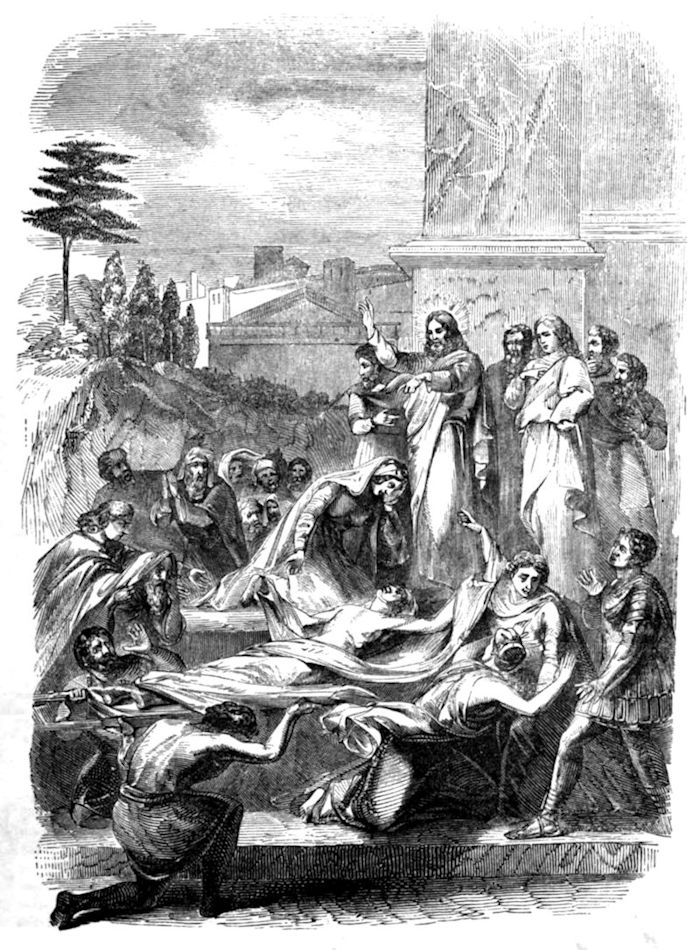
THE WIDOW OF NAIN.
———
BY JOSEPH R. CHANDLER.
———
[SEE ENGRAVING.]
How little can we of this latitude, or rather of this
country, for latitude seems not to rule in all cases with regard
to temperature; on one side of a continent, that
parallel which gives agreeable winters and dry, healthful
summers, is marked on the other side with cold,
snowy winters and most unhealthful summers; what the
variant circumstances are which produce this difference
it is not easy to tell; the difference does exist, and
ingenious theories have been constructed to suit those
results; we say then again, how little can we of this
latitude, or this country, judge of the enjoyments which
others at a distance from us, but with the same shadows,
have in the dry coolness of their evenings, or lassitude
to which they are subject by the peculiar warmth
which prevails during most of their summer days.
The habits and customs among us are soon made conformable
to the circumstances of our climate; though
it must be confessed that people will always pertinaciously
insist on a warm day on the first of May, and a
stinging cold one on the 25th of December, while actual
experience has shown that the thin floral garb adopted
for the first has often led to consumption, and the
winter furs and the great Yule-log that have distinguished
the latter, have been considered rather seasonable
than pleasant. So much for a poetical conformity,
but in the every-day business of life things are
better disposed of; people do not think in this country
of sitting under their own vine till mid-summer, and
then they look out for spiders; and as to their fig-trees,
nobody gets under them unless it be the house-cat for
a summer siesta. While eastward of the shores of
the Mediterranean, people stretch themselves out upon
the house-top for a comfortable night’s sleep, and
spend a warm summer’s day beneath the cording
shadow of the fig or the olive, and make life itself a
blessing, not the means of enjoyment, but enjoyment
itself; life and its accidents, the gratification of simple
appetites—eating, drinking, and sleeping. Leaving
to others the profitless toils that accumulate heaps of
gold, only a portion of which can ever be used, and
that portion will buy little more than what may be had
and enjoyed without it. In this country we retreat
away from an oppressive heat or a stinging cold, and
make the absence of either an excuse for our merriment.
In that other land to which we have referred,
positive enjoyment is had in the uses of the evening
air, and the contemplation of the heavenly hosts. Stars
and planets twinkling in the clear blue ether above,
not larger than seen from this continent, but far, far
more intensely brilliant in the atmosphere, which
allows of little refraction, and whose purity makes an
upward gaze like the contemplation of some sanctified
enclosure.
Sitting on a bank that faced westward were observable
two human figures in the closing twilight of an
autumn day. They were gazing out upon the gorgeous
west, and marking the successful struggles of the
starry host to obtain visibility above. In all the rich
flush that marked the pathway of the sun, and hung a
glory around his place of exit, only one light had
strength enough to be visible; and so pure was the
atmosphere, that when the flush in the heavens retired,
the splendid planet Venus seemed a delicate crescent—a
diminutive moon, sinking downward to the western
waters.
“How beautiful, dear Reuben,” said the young
female, as she pressed closely the hand of her companion;
“how beautiful the heavens above us are to-night.
It seems as if a peculiar brilliancy were observable;
and I hope it is not sinful for me to say that
the glorious array of stars seems to have communicated
to my bosom something of their own transparent
light; an unusual serenity seems to descend from them
to me, and I feel now as if I owed to them sensations
of inexpressible delight—quiet, gentle, but full. Whence
is this, Reuben?”
“May you not, my dear Miriam, have mistaken a
cause for an effect? Is it not the quiet, peaceful delight
of your heart that makes all outward objects more
lovely to you? And, as the stars are the most brilliant
and the most distant objects at the present moment,
your feelings have connected themselves with those
ministers of Him, and allowed that deep, mysterious
connection of the planetary world with ours to work
upon your imagination, as if the stars had a direct influence
upon your condition.”
“Perhaps so; but I alluded to my feelings and not
my condition. How beautifully did our Prophet King
refer his own elevated sensations to the planetary
world, ‘The moon and the stars which Thou hast
ordained.’”
“True, true, my dearest Miriam; but you will recollect
that while he made himself, and man generally,
small in his contemplation of the heavens, it was not
in comparison with them, it was comparing or contrasting
man with Him who garnished the heavens,
and wrote ‘all our members in a book.’ But are not
your feelings, like mine, elevated with a hope, nay,
with almost a certainty, that the elders will persuade
my mother that the rights of our family can be retained,
even though I marry you, or rather that the argument
against our union was as unsustained by our laws as
the attempt to give you to Salathiel was a violation of
your affection and my rights.”
“I know not but that may be the case. I feel it,
Reuben, warmly at my heart. Let me say it without
violating the delicacy of a maiden’s feelings, that such
was my love for you, that even the alternative to which
I consented, though of no moment, gave me a severe
pang.”
“What was that alternative?” asked the young
man, with importunity.
“Simply, that if you should not live to marry me,
then Salathiel might take me to wife.”
“I would haunt him with terrible bodings,” said
Reuben, “even as Samuel frightened the falling Saul.”
“And I, dear Reuben,” said the maiden, with a
smile, “should, I suppose, be the Witch of Endor to
call up your wandering and jealous spirit.”
“And it is settled, then,” said Reuben, “and you
are to be mine with the consent of our families. And
the next new moon shall see us one.”
“It shall be thus if your mother consents. I have
none to consent or refuse, save my aunt. But let it
not wound your feeling or excite suspicion in your
mind, Reuben, that I ask you not to cherish feelings
of unkindness against Salathiel. He is my kinsman
and my early friend.”
“Has he not sought to supplant me in your possession?”
“Have you not supplanted him in my heart? Is it
so much, my dear Reuben, for you to fear to lose me,
and is it nothing for him to see me given to another?”
“He tried for your possessions, Miriam, for your
wealth only.”
“Does not my wealth, little as it is, go with my
hand—and why may not he have designs honorable
as well as others?”
“Because he would not leave it to your decision, to
the arbitration of your affections. He could not love
you and be willing to do violence to your love.”
“May he not, dear Reuben, say the same of you?”
“Of me! Miriam, you plead the cause of Salathiel.
You wish the alternative—you would be free.”
“Reuben, you may wound my pride by your injustice,
but you cannot make me cease to love you. You may
hereafter learn that woman may esteem a man for his
virtues without loving him as a husband; and that for
me to wish that you were less unkind to Salathiel, is
no evidence that I love you less. I have heard within
a few weeks such lessons of forgiveness, such preaching
of high virtues—high, though always practical—that
I desire to conform in some measure to them, and
to have him whom I love and respect, augment my
affection, not by any new love on his part, but by a
new exhibition of greatness of mind. Reuben, though
protracted maidenhood is a reproach in Israel, be assured
that my love is stronger than death—as I feel
that your jealousy is more cruel than the grave.”
“I will not be jealous. I will forget what I have
deemed the wrongs of Salathiel. I will learn of you
to respect myself. But, Miriam, what teaching is that
to which you allude—what lessons of forgiveness have
you received, and from whom? Is not the law of
Moses sufficient for the daughters of Israel?”
“I suppose the laws of Moses are not sufficient, else
why have kings and prophets written and preached?
But you know that several times within a year the
teacher from Nazareth hath been in the synagogues of
Nain, and has, indeed, spoken in the houses of our relatives,
whither he hath come and broken bread.”
“I have heard of his visits, and that his teaching
had been eminently attractive—how instructive,”
continued Reuben, with a sneer, “how instructive
may be inferred from the proportion of women among
his immediate followers.”
“There were more women than men, undoubtedly,
at his household instruction, because more women had
leisure to listen. But let me tell the truth, Reuben.
There are many women among his followers, for he
speaks to the heart of woman. He recognizes woman
as the equal of man in the necessity for salvation, and
he appeals to her affections, her experience, her wrongs
and her neglect. What other prophet has come among
us, that has thought it needful to recognize even his
descent from woman, while He of Nazareth soothes
our sorrows, elevates our hopes, and sanctifies our
human relations? As I listened of late to him when he
reproved but encouraged our sex, my heart said ‘this
teacher’s doctrines may save man,’ but how they
elevate and purify woman. And then the lessons
of love, of forbearance, of forgiveness, that he inculcates,
belong to what I have deemed woman’s nature
and man’s necessity.”
“You have followed the teacher, then, Miriam?”
“He is a prophet, Reuben, and he attests his divine
mission by miracles. He has healed the sick, he has
cured the lame, and made the blind see and the deaf
hear.”
“Has he raised the dead, as did the bones of Elisha?”
“I have heard that he has wrought that miracle, but
do not know it, though I have such faith in his mission
as to believe he might.”
“If he would raise me from the dead when I come
to die, I would have faith too!”
“I should think, Reuben, that this act would be the
consequence rather than the cause of faith. Though
many others believed, in Jerusalem, as my Cousin
Jacob says, in consequence of the restoration of blind
Bartemus to his sight, yet the Master said, ‘Thy faith
hath made thee whole!’”
“I have, nevertheless, no faith in this teacher as a
prophet—why, whose son is he, Miriam?”
“He is of the house of David, Reuben, and even
though his parents are poor, are they much poorer than
David’s parents? May there not be something in the
great truths which he teaches, that is not dependent
upon the parentage of the teacher?”
“These things are important, Miriam, I confess, and
we will confer of them together, but not now. We
are about to part, let us mark the separation by a recurrence
to a subject on which we both agree. The
next new moon sees us united, and my joy at the anticipation
is doubled by the belief that you share with
me in the pleasure.”
Miriam pressed the hand of her lover as they rose
to descend the hill; and as they entered the gate of
Nain, the rising moon poured its strong light through
the gorges of the mountain, the pair wended their way
through the broken streets of the city to the residence
of Miriam, blessed in their mutual affection, and refreshed
by the dry, cool breeze of evening, which had
fanned them on the elevated seat which they had just
left.
Reuben turned toward home with a resolution to
discuss the doctrine which he had heard imputed to the
new teacher. Miriam, with woman’s humility, “kept
all these things and pondered them in her heart.”
Miriam and Reuben met daily as espoused people;
and frequent allusions were made to the doctrines of
the teacher; and the pride of a Hebrew man was a little
touched at the evidences of the elevating effect of a
doctrine upon women, which Miriam’s language and
conduct presented. Yet Reuben loved her too well to
regret any circumstance which pleased and benefited
Miriam. The customs of the country were too well
fixed to lead him to fear the assumption of any inappropriate
position by his future wife; indeed, it is believed
that men do not begin to grow jealous of the
authority of women until after marriage.
“I do not find in the teaching of the new master,”
said Reuben, one day as they were conversing on the
subject now so important to her, and so generally interesting
to him, “I do not discover any denunciations
of our creed or our system and form of worship—why
may not his doctrines prevail without danger to the
Hierarchy?”
“I cannot guess of that, Reuben; but certainly the
teacher, while he refers to particular virtues and special
sins, seems to desire a purification of the motives. He
has conformed to all the requirements of our religion,
but seems at times to be above it. I wish I understood
him better. And yet how simple, how comprehensible
are all his teachings. Why should I seek to
know more? Why should I desire aught but that
which shall make me better—happier—more hopeful?
How the poor, the afflicted in body and in mind seek
him out, and sit in joy at his teaching.”
“Miriam, I will hear him—I will hear him soon,”
said Reuben.
It was only a few days before the new moon that
Miriam had from the widow mother of Reuben an
intimation that her only son and heir was prostrated by
sudden and very severe sickness. The young woman
hastened across the town to be in attendance upon
Reuben, and to cheer him into health by her presence.
But when she reached the house, she learned rather by
the appearance than the words of the widow, that the
sickness of Reuben was not of a kind to yield to such
remedies as she had to offer.
The attention of Miriam to Reuben was all that her
feelings would permit her to give. She sat by his side
and bathed his temples, and moistened his feverish
hands, and listened with painful satisfaction to his unconscious
utterance of her name.
On the seventh day of Reuben’s sickness all awaited
the crisis, and a few hours before sunset he awakened
from a protracted sleep, and turned his eyes on the
hopeful countenance of Miriam. The members of the
family present saw with inexpressible pleasure that his
consciousness had returned, and they hoped.
But the physician pronounced against them. It was
but a restoration of mental light before the darkness of
death should set in.
“Miriam,” said Reuben, “let me speak to thee alone
one moment”—and the family retired.
“I am dying, and the truths which you announced
to me as we sat upon the hill-side some nights since—truths
which the new teacher uttered, come home with
strange distinctness to my heart. But is he, as his
disciples would have us believe—is he the Messiah?”
“Do you believe it, dear Reuben?”
“I do not know, but I forgive all who have injured
me, and I ask pardon of all whom I have injured.”
“Surely that is the spirit of the Master’s teaching,
Reuben, and what can you more.”
“But, oh, Miriam, where are the blessings which I
had promised myself in thy love? Where the years of
happiness in thy possession—when thou shouldst have
been only mine?”
“Are these regrets, my beloved, suited to one who
leans upon the verge of the grave? Oh, look forward,
Reuben, and look upward. In heaven we can meet
again—meet without fear of separation, without doubt
of love.”
“But in heaven, where, oh, where shalt thou be,
Miriam?”
“Reuben, dear Reuben?”
“Nay, my beloved, let me show my affection for
you and my sense of duty to God at this last moment.
I know, my Miriam, that by the customs of our people
you should have been the wife of Salathiel, and I feel
that next to me, (I do your love no injustice, my betrothed,)
next to me, Salathiel has your affection. Hear
me out. When I am gone, it must be your duty. Oh,
then, let it be your pleasure to receive him. Who
better than he can be your protector? He is your
nearest kinsman, and the laws and customs of our
people are in his favor—promise me.”
“Reuben, shall I call in your mother?”
Reuben turned his eyes again toward the west, and
the sun was sinking with all his evening glory into the
great sea. A gentle breeze swept into the window,
and blew the hair of the kneeling maid upon the pale
face of her lover.
“Turn my face, Miriam, to the east, let me pray
thitherward. Let me hold you thus, ‘though the sorrows
of death compass me about—’”
When the widowed mother entered the room the
dead form of her son was resting in the arms of the
unconscious Miriam.
Stricken with grief, and with a sense of her utter
loneliness, the widow lifted up her voice and wept.
Miriam was conveyed away—to be purified from the
legal uncleanness that results from contact with the dead.
It was the morning of the third day from the death
of Reuben, and Miriam was sitting lonely in her
chamber.
“And this,” said she, as she looked forth from her
darkened room, “this was the day appointed for our
marriage; and to-day they will take my beloved and
carry him forth from the city, and lay him in the earth
with his fathers; and his beautiful form shall moulder
into the dust, and the worms shall feed sweetly on
him. Yes, he shall return to the dust again, and his
spirit to God who gave it.”
“Oh, Father,” said the
anguished maiden, as she kneeled with folded hands
and upturned, streaming eyes, “oh, Father, receive his
spirit!” And she poured out her soul in prayer for
the dead, “after the custom that is among the Jews,
even unto this day.”
Shortly afterward the relatives of Miriam came in
to comfort her before they went to assist in the funeral
of Reuben. They respected her grief too much to
make open allusion to a subject which was occupying
their minds.
One of the elders of the family, before going out, took
aside the afflicted girl and attempted to console her
with those cold arguments that interest suggests, and a
want of respect for woman’s position warrants.
“Still, Miriam,” continued the old man, after disregarding
her requests to be left alone, “still the possessions
of your father’s family remain with you; and
these may now, as they ought to have been before, be,
with you, the property of our Cousin Salathiel.”
“Nay, my Uncle Achan, you trouble me, indeed;
spare me that, let the possessions of our house go
whither you list, to yourself or to Salathiel, but let me
remain as I am. Give me peace—give me peace and
time for my tears, and I will endure the reproach of
maiden-widowhood, and let my name be lost from the
family of our fathers.”
Achan and his friends departed to meet at the house
of the widow, and to be of the company of those who
should assist in the funeral of her son.
Miriam sat in her chamber, looking forth from the
closed lattice to mark the first approach of the funeral-train
which would pass her aunt’s dwelling on its
way to the burying-place that lay beyond the walls of
the city.
The solemn train at length approached, and the cold,
insensible form of her lover lay upon a bier, wrapped
round with grave-clothes, and borne forth by men.
As she gazed down upon the appalling sight, her
heart seemed ready to burst with the grief that had no
utterance, and she fell insensible to the floor.
When Miriam opened her eyes, they rested upon the
forms of her aunt and of Salathiel bending over her.
“Was this well, Salathiel? Could you not have
spared me one day for grief, must my affections for
another be outraged, even in the presence of his
passing remains?”
“Miriam, my cousin,” said Salathiel, “I came in
hither only to assist your aunt. No selfish feeling
brought me into your presence. I know where your
affections are, I know how deep-seated is your grief.
Let me rather, my Miriam, be to you a means of consolation,
than an occasion of offence, since my love to
your person is less than my sympathy in your grief.”
Miriam placed her hand in that of Salathiel, and a
gentle pressure signified her appreciation of his feelings—and
such a sign, at such a moment, too, told him
how hopeless would be his love. He obeyed the sign.
“The funeral has passed on,” said she.
“It is now near the gate of the city,” said Salathiel.
“We shall see it once more,” said Miriam, “as it
ascends the hill that overlooks the valley of tombs.”
“What is that faith, Miriam,” asked her aunt, “of
which you spoke to me yesterday?”
“It is but confidence in the promises and power of
the teacher.”
“Confidence that he will grant your wishes?”
“Yes, if they be right, or that if he grant them not,
then confidence that the refusal is best.”
“Have you that confidence, Miriam?”
“Oh aunt, oh my mother, do not tempt me. I would
believe; my heart tells me that miracles such as his,
could only be performed to attest a momentous truth.
But do not tempt me, the body of Reuben is scarcely
passed, in him my heart, my affections, my hope were
centered—and he is taken from me. Why? is it good
for me to be afflicted?”
“Could the Master have saved his life, my child?”
“Did he not yesterday save the life of the Centurion’s
servant at Capernaum,” answered Salathiel,
struck with the coincidence of the woman’s question
with the recent fact.
“Did you ask him, Miriam?”
“I saw him not, and if I had seen him, what am I
to him?”
“If you had asked him, might he not have done it?”
“I believe, aunt; I believe, Salathiel, that he could
have saved the life of Reuben.”
“Would he not, then, raise him now?”
“I do believe he could—I have faith in his power.
But I would not be presumptuous. Yet, yet—oh, that
Reuben might be restored to me?”
“Amen!” said Salathiel, “Amen!” and the deep
tone of voice, and the upward turn of his eyes, told
how truly his heart responded to the prayer of his
cousin.
Two hearts were then united in solemn petition.
There was faith, but none thought of hope.
After a few minutes of solemn silence, the eyes of
Miriam were turned mournfully, and yet eagerly, toward
the hill beyond the city’s wall.
“They are passing upward,” said Deborah to her;
“the procession moves toward the brow of the hill, but,
alas! the dust of the road conceals the train.”
They all looked forth to follow with their eyes as
long as possible the mournful procession.
“But what is there?” exclaimed Deborah, pointing
to a column of dust which denoted a crowd of people
descending the hill toward the funeral.
“The procession has passed,” said Miriam.
“Both parties have stopped,” exclaimed Deborah.
Salathiel looked earnestly out and said, in a low
voice, but with much feeling, “Do the Romans come
to insult us even when we bury our dead? We are a
conquered people, but we are not slaves.”
“Hush!” said Miriam, “hush, my brother! let us
not at this moment forget the teaching of the Master.”
Salathiel leaned forward and kissed the brow of
Miriam.
“I thank you, I thank you, Miriam, for the monition,
and I bless you for the term, brother; henceforth, my
sister, know me for such. But let me go forth to learn
what hath turned our people from their sepulchral
rites.”
Salathiel went forth, and Miriam, kneeling, buried
her face in the lap of her aunt, and poured out her soul
in prayer—deep, anguished, heart-engendered, heart-and-heaven-moving
prayer.
It was some time before the low voice of Miriam
ceased. But her feelings had been overwrought, and
at length she lay silent yet suffering, with her head still
on Deborah’s knees.
The quiet of the street and even of the chamber was
at length disturbed by the confused footfall of a multitude
who seemed to press onward with few words,
and those uttered in a subdued tone. The multitude
at length paused in front of the dwelling of Miriam, and
the opening of the front door intimated that the procession
of the people had some connection with the
inmates of the house.
The door of Miriam’s chamber at length opened, and
Salathiel stood before the two women pale and agitated.
“My sister, praise the Lord! A miracle has been
wrought.”
The agitated maiden shrunk into the arms of her
aunt as she gazed toward Salathiel.
“What,” exclaimed the aunt, “what is it, Salathiel?
Speak?”
“Reuben—”
“Reuben!” exclaimed Miriam.
“Reuben lives!”
“Where—where is he?”
“He has been borne back to the house of his mother.”
“How has this been wrought?” asked Deborah.
“There is our Cousin Asher, who was a witness of
the whole. Shall he come in and tell you all?”
Asher was admitted with one or two others of the
family, and briefly stated the facts.
“The rear of the very long procession that followed
the corpse of Reuben had scarcely left the gate of the
city, when I, who was assisting to bear the bier upon
which rested the beloved remains, discovered a vast
crowd of people coming down the hill. I soon, however,
perceived that there was no intention on the part
of the approaching mass to offer any offence or discourtesy
to the funeral party; and, indeed, the expressions
of grief by our widowed and bereaved kinswoman
were so loud, that it was difficult to hear whether any
word was uttered by the descending party. I have
never seen a Hebrew woman so distressed; and though
few have had such cause for grief, few have been
more deeply wounded, yet I had hoped that she would
have been able to repress her feelings. But as we
grew nearer the grave, her lamentations were increased,
and it was heart-rending to hear her exclamations. The
whole procession seemed to have lost their own sense
of bereavement in the presence of one the utterance of
whose anguish was so impressive. To me it seemed
almost an arraignment of Providence by our kinswoman.
I cannot tell you how every one was affected;
each seemed to wish silently but heartily that some
event might occur to soothe the sorrows of the
widow.
“At length the descending party, which was very
large, met our procession; and almost every member
of that company manifested deep sympathy for the
suffering of the chief mourner. In a moment the principal
of the company stepped forward and took our
kinswoman by the hand, and whispered to her words
of comfort. What they were I could not hear, but
the effect was instantaneous—the clamor of grief was
hushed—and our kinswoman walked quietly on, gazing
with a sort of rapt awe upon the comforter, whose
countenance though marked with sympathy for her
suffering was yet majestic and dignified.
“The mother’s eyes for a moment wandered from
the face of the visiter, and fell upon the form of her
son stretched out before her, and again her agony
found vent—again the mother was heard, again the
mountain seemed to echo with her lamentation.
“He who was walking at her side did not rebuke
the mourner, but a new and more intent feeling of
compassion was evident in his look and manner, and
taking the hand of the afflicted one, he said in a tone
of deep consolation, ‘Weep not.’
“Almost immediately afterward he left the widow
standing where she was, and approaching us ‘came
and touched the bier,’ and we who were carrying it
stopped; for there was a sort of authority in the air
and movement of this person, or let me say the effect
rather than the assumption of authority. When the
eyes of all were turned toward the dead body, and toward
him that stood by it, the person with a mild tone,
with no ceremony, with a simple utterance of the
words, said,
“ ‘Young man, I say unto thee, Arise!’ ”
“And Reuben, dear Asher, Reuben!” exclaimed
Miriam.
“And Reuben sat up on the bier, and began to speak
of the sensations which crowded upon him.
“But He who had restored him to life, seemed to
comprehend that the mother’s feelings should be first
consulted, her rights first respected, and so ‘He delivered
him to his mother.’”
“And he lives now?”
“Yes now, and with his mother. But what an awe
came upon those who witnessed that august scene.
There was no shouting at the success of the effort, no
cheering that human life had been restored. But with
an overpowering sense of divine visitation, the people,
in devout fear, kneeled, and ‘glorified God,’ saying ‘a
prophet has risen up among us.’”
It was not deemed safe to the convalescent Reuben
that Miriam should visit him immediately. His life
not his health had been restored. And the effect of a
too early interview, might be too much for both. A
few days afterward Salathiel conducted Miriam to the
house of Reuben, and as they proceeded thither he
cautioned her against the indulgence of too much feeling,
lest her own frame should yield. Leading her to
the door of the chamber, the young man felt that his
presence would be too much of a restraint, so knocking
lightly he heard a voice from within bidding them
enter, and he turned and went to the mother in another
part of the house.
What was said by the young lovers, separated as
they had been by death, and thus restored this side the
grave, we shall not now repeat. It was a sublime
colloquy, for it included the experience of a heart in
which hope had contended against hope—and the awful
experience of a soul that had been freed from the
trammels of flesh. But it was still Reuben and Miriam.
Death had not destroyed the identity, for the
same love that had animated them in his former life
was felt and reciprocated now.
“I did fear, Reuben; indeed, for a moment I feared,
when I heard of your restoration, that the love which
had been a part of our lives, would have been quenched
in you by death, or sublimated beyond the uses and
comprehension of earth.”
“Oh, Miriam love is the immortal part of our affections—it
is the soul of the mind—it is stronger than
death—and that which is pure and rightly placed on
earth is indestructible, and thousands of years, my beloved,
passed in separation would work no change.
We should at our renewed communion find the same
love that had existed in past centuries in full and satisfactory
operation. You know that the seeds which
our travelers bring from the mummies of Egypt are as
fruitful as those which are sown from the last year’s
harvest, so, my beloved one, is the love that is worthy
the soul’s cherishing.”
“But, Reuben, has it struck you that you have received
the testimony which you almost impiously
challenged as a ground of faith?”
“It has, it has, and while I have been struck with
shame at the impiety of such a thought, I have yielded
the faith which I promised, and am henceforth a
follower of the teachings of Him of Nazareth.”
“Oh, my prayers, dear Reuben—”
“They were pure, and effective to your good, Miriam,
undoubtedly, but it was from compassion for my
widowed, childless mother that the miracle was
wrought.”
“Who shall tell the motives of Him that can work
miracles? What we call ends, dear Reuben, may be
means with him, and the babe that is sent in answer to
the Hebrew mother’s prayer, may be the saviour or
the destroyer of his people.”
Salathiel then knocked for admittance. He entered
and kissing both of his cousins he wept with joy—“And
this, this is the consummation of my highest
earthly wish,” said he.
“Is it indeed? Can you rejoice, Salathiel, that I am
come to take Miriam from you; is it indeed thus, my
cousin?”
“I have loved Miriam as dearly as you could love
her, Reuben. I will yield in that to none. I will not
affect to conceal that. But the miracle that has raised
you to life has shown me that I have a higher duty to
perform, a more glorious mission to fulfill. Be yours,
my cousin, the enjoyment of domestic love and peace
and happiness, which virtue ensures; and let your
home and your lives illustrate the power of the Master’s
doctrine to purify and multiply home affections.
Henceforth, if permitted, I will sit at the feet of the
teacher and learn; and when sent I will go, and offer
his doctrines and my life for the good of our people.”
The new moon had again come, and the house of
the aunt of Miriam was filled with her kinspeople,
who had come to the marriage; and when the feast
was over, and parties had formed in different rooms,
and some, with the bride and bridegroom, were on the
housetop enjoying the delightful air of evening, as it
swept down the hills loaded with the scents of roses
and acacia, some drew the attention of the party to the
brilliancy of the slender moon in the west, and the
stars that were scattered through the heavens.
“It is a good omen,” said Asher, “when the planet
that is so near the moon assumes with her the crescent
shape at a marriage, or when at this season the Pleiads
and Orion are peculiarly brilliant.”
The newly married ones looked up smilingly toward
the heavens, as if they recognized the doctrine of stellar
influences.
Salathiel, who had been looking upon the pair with
deep interest, then stepped forward, and taking a hand
of each, he said, “My cousins, I am called away—not
again to mingle in this delightful scene—called to a
higher duty; pray that it may be as delightful—it cannot
be more dangerous. Keep the faith—mark the
signs of the times in the conduct of man and in the instigations
of your passions, but look not to the stars for
your instruction. Oh, my beloved one,” and he stooped
and kissed the lips of Miriam, “oh, my dear brother,”
and he pressed his lips to the forehead of her husband;
“oh, Reuben and Miriam, ‘seek Him that maketh the
Seven Stars and Orion, and turneth the shadow of death
into morning, and maketh the day dark with night,’—the
Lord is his name.”
———
BY A. J. REQUIER.
———
Thou dwellest in my thoughts
As shines a jewel in some ocean cave,
Which the eye marks not and the waters lave;
A ray of light imprisoned! which none save
The soul that shrines it knows—its temple and its grave.
Thou bathest in my dreams;
A form of dainty Beauty—something seen
At cloudy intervals, through a gauze-like screen—
A voice of gentle memories—a mien
Too tender for an angel’s, yet as fair, I ween.
Thou sparklest through my fears;
A hope which bloometh as an early flower,
Shines in the sun nor droops beneath the shower;
A holy star that glides at vesper hour
Into the dusk-hung sky—and, saintly, seems to lower!
In daylight and in dreams,
’Mid hopes that beckon and ’mid fears that frown,
Thou art the juice that every care can drown;
A rose amongst the thorns—the azure down
Of the meek-brooding dove—the halo and the crown!
ABOUT GRACE GERMAIN’S LIFE-ROMANCE.
———
BY CAROLINE C——.
———
’Tis as easy for the heart to be true
As for grass to be green, or skies to be blue—
’Tis the natural way of living!
Vision of Sir Launfal.
The school was dismissed, and a multitude of boys
and girls came rushing out from the old frame building,
and tore pell-mell down the streets of a country village,
just like merry, care-naught mad-caps as they were.
Of all ages and sizes were these little folks—they were
the life and the care of a great many homes; some
heirs of poverty, and some, but these were few, heirs
of wealth—but each and all had brought with them
into the world enough of love to secure for themselves
a welcome place at the board, and by the hearth.
They resembled very much any other congregation of
children in the world—some of them remarkable for
their stupidity, and presenting always to their teachers
the same thick skulls, which it appeared nothing could
penetrate—others again, quick at learning, to whom it
was a relief for the weary Mentors to turn, and to
whose mental wants they attended with a glad alacrity.
But I am not going to generalize any more at this
time; and shall only add to the foregoing remarks, that
this school was a marvel in its way—the teachers
prodigies in learning, and all the parents thought their
young children’s acquirements actually verging on to
the miraculous—which state of things, I will add as a
P. S., is remarkably pleasant for all parties concerned.
Is it not teachers, and parents, and you poor little
scholars?
Several girls, from nine to twelve years of age, were
walking homeward leisurely, and talking loudly and
earnestly on some important topic, as school-girls
sometimes will, when a young boy, also one of the
scholars, passed by them. With singular boldness he
turned his handsome face full toward the little party as
he passed, and one of the girls, whose name was Grace
Germain, must have seen something remarkably expressive
of somewhat in the boy’s black eyes, for very
suddenly she seemed to have lost all interest in the
conversation, in which, by the way, she had been one
of the chief participators the moment before—and the
little girl’s step grew slower and slower. Finally,
taking one of her school-books from under her arm,
Grace seemed all at once to be seized with a decidedly
studious fit, (for the first time that week,) and then her
shoe-strings must needs unloosen, and she must stop
to fasten them, till at last, as might be expected, her
companions were far beyond her in the homeward
way, and she was left quite alone. When the child
passed by a little lane her face became quite suddenly
and unaccountably flushed, and Grace grew decidedly
nervous in her movements, and she turned away her
head, as though it were forbidden, and a sin for her to
look down that narrow by-way where Dame Corkins
and the little lame child lived.
But these mysterious movements were all explained
when, a moment after, some one came marching, to a
tune of double-quick time, up the lane, and when he
appeared on the main-street again, lo and behold! it
was that same black-eyed urchin Hugh Willson, who
had a few moments previous passed by her, and he
called out,
“Grace, Grace Germain, wait a moment; I want to
tell you something!”
Grace of course blushed, and looked sideways, and
down, and finally at the boy, but for the life of her she
could not summon up a look of astonishment at his
appearance, finally she said,
“Well, what do you want, Hugh?”
“I’m going home, Grace, to-morrow, and—and—I
wanted to see you just to give you this; perhaps you’ll
think I’m a fool for my pains. I wish though it was
worth its weight in gold!”
Oh! you would have certainly thought that the poor
girl’s face was on the point of blazing instantly, could
you have seen it, and Hugh thought there were really
tears in her eyes too, as she put out her hand for the
little package he had brought her. For some distance
they walked on together, and neither spoke.
At length, as she drew near home, Grace found
courage to look up and say, “Hugh, what are you going
home for?”
“Father has sent for me, I am to go to an academy,
but—” Hugh did not finish the sentence, and after
waiting an unconscionable time, and speaking at last
as though a “drag” were fastened to every word,
Grace said,
“You will come to see us again sometime, wont you,
Hugh?”
“Yes, if I ever can. I can’t bear to go away now,
Grace, but, as father says, I am getting old. I’m
almost fifteen, and it’s a fact I ought to know more
than I do. Perhaps I’ve staid in the country too long
already; but I hate a city, and I shall come back here
just as often as I can, for I love this place better than
all the world.”
And that, reader, was rather a strange confession to
be made by a spirit so active and stirring as was Hugh
Willson’s, for of all country villages on the face of the
earth, “Romulus” was certainly the dullest, and least
attractive.
“I’m coming down by here to-night, Grace,” said
the lad, as he opened the gate for the child, “if you
would like to see me, come out here—I cannot bid
you good-bye now—will you be here?”
“Yes, Hugh,” was the reply given sadly—and this
time it was a great deal more than she could do to
keep back or hide her tears—for Grace Germain
thought Hugh Willson the handsomest and kindest boy
she ever knew, and she could not bear to think of his
going away. So she left him with little ceremony,
and went into the house. And the boy saw her grief,
and he could have wept also—he loved Grace Germain!
Well, what do you think made up that unpretending
package—the parting gift? First and foremost, there
was a little box, and it contained—not a gem, not a
book, but—a fresh, beautiful rose-bud; and Grace did
not laugh when she saw it, neither did she smile as
she unwound the strip of paper from the stem, and
read thereon,
“Give me but
Something whereunto I may bind my heart—
Something to love, to rest upon, to clasp
Affection’s tendrils round!”
She did not laugh, I say, for sorrow was in her heart,
the first deep sorrow she had ever known. Hugh was
going away—and how much better she liked him than
all other boys she had ever known in her life! But
the rose-bud was not all the contents of the box; there
was beside it a magnificent sheet of blue paper, gilt
edged, and “superfine,” and on it Hugh had copied the
“Parting Song,” by Mrs. Hemans; and perhaps, good
reader, though you be not fresh from Yankee land, you
may guess how the child’s heart beat faster than ever
it had before, as she read the words—
When will you think of me, dear Grace?
When will you think of me?
When the last red light, the farewell of day,
From the rock and the river is passing away,
When the air with a deep’ning hush is fraught,
And the heart goes burdened with tender thought?
Then let it be!
When will you think of me, sweet Grace?
When will you think of me?
When the rose of the rich midsummer time
Is filled with the hues of its glorious prime,
When ye gather its bloom, as in bright hours fled,
From the walks where my footsteps no more may tread;
Then let it be!
Thus let my memory be with you, Grace—
Thus ever think of me!
Kindly, and gently, but as of one
For whom ’tis well to be fled and gone;
As of a bird from a chain unbound,
As of a wanderer whose home is found;
So let it be!
And what had Grace to give to Hugh? What had
she among her few treasured possessions a boy would
care for? The dolls maimed for life—the broken
china—the picture-books—the bits of lace and ribbons,
what were they to him? Grace never realized her
poverty before that day—and then the very thought
was humiliating. If she could only buy a knife,
or a pocket-book, or a pencil-case; but the child
had no purse, and, unfortunately, no money either, so
that thought was speedily abandoned. It grew quite
dark while she stood in her little room, still before the
opened drawer which held all her keepsakes and
treasures, but no good fairy was nigh at hand to lay before
her the thing she wished, and at last, quite in despair,
she went and stood by the parlor window, and
lo, there was Hugh already passing by, whistling, and
looking for all the world as though the inmates of that
particular house were nothing in the least to him.
In a few moments, side by side, the boy and girl
were walking in the garden.
“I have read your note, Hugh,” said Grace, for the
“shades of evening” creeping over them, gave her a
wonderful and unnatural boldness to speak, “but what
shall I give you for a keepsake? I haven’t a book in
the world you would give a fig for.”
“Don’t talk about books,” replied he, hastily, “there
is something that wouldn’t cost you much, I’d give
more for than for all the books in Christendom!”
“What is it, Hugh, tell me quick?”
“Just that curl on your forehead! Give me that,
Grace, and I never will part with it.”
In a moment it was separated from the thick curls
that adorned her head, and stooping down, Grace laid
a forget-me-not in it, and gave it to Hugh. He—what?
kissed it, and kissed Grace, and then put the curls safely
in his vest-pocket, and told the child she was the prettiest
and best girl he ever knew, and that he should
miss her more than all the boys and girls of the village
together.
But while the lad was in the very midst of his ardent
protestations, a voice from the house called to Grace,
and the children parted—to meet again, how and
when you shall not be so long learning as they were.
Hugh went to his city home, Grace to her school.
He dreaming of Grace Germain as a woman, and
wondering if she would not then be his wife—she to
resume her studies with no great interest, to wish day
after day that Hugh would only come back again, and
to wonder if he would be so handsome when he was a
man as he was then.
Years passed, Grace was no longer a child but a
beautiful girl—a bride; and yet Hugh Willson was not
her bridegroom.
A rich young merchant of a neighboring town, captivated
by her loveliness and charming manners, had
“wooed an won,” and a nine days’ wonder in the village
of Romulus, was the wonderful good fortune of the
orphan—for of late years Grace had been dependent
on her relatives, her parents having died while she
was yet very young.
Grace had never seen or heard of the boy of rose-bud
memory since their first parting, but her thoughts
of him had always been those we have for a pleasant
unforgotten dream. And she kept the little gift that
Hugh had given her most religiously. The very night
before her bridal, though she had wept happy tears
over the noble, tender note that Clarence Lovering
sent her with a splendid ornament—a wedding-gift—still
she had it in her heart even then, to look with no
ordinary interest on the little pasteboard box that held
the withered flower, and to read, not carelessly, the
verses Hugh had written her in a large, boyish hand
so long ago.
Yet it was not faithlessness to later vows that
prompted her to kiss the rose-bud, and to preserve still
longer the blue note and the little box, for Grace with
all her heart respected Clarence Lovering, and she
loved him well, too. She was a lofty, true-spirited
girl, and when she married the young merchant, for
better or for worse, as it might prove, she did it with
a true and loyal heart; and it was in all respects a
union in which might well be asked, and without doubt
or fear, the blessing of Heaven.
But there were bitterer tears to be shed, and deeper
griefs to be borne than Grace Lovering had yet known;
six months after her marriage she followed her young
husband to the grave, and there was none on earth
that could sustain or uphold her in that day of terrible
visitation. Voices and forms with which she was
scarcely familiar came to comfort her, but the friend
whose companionship would have made any place in
the wide world a pleasant home for her, was dead;
and the bereaved woman longed to return once again
to her early home—the village where all her early
life was passed—to bury her husband and lover beside
her parents, under the willow-tree in the old burial-ground,
and then to mourn in quietness, and alone,
away from the scenes of the bustling, noisy town.
And all her desires were speedily complied with—her
old guardian and uncle from the little village came
to her to assist, and conduct her back to Romulus;
and before the year was passed, Grace was again at
home in the old house where she was born, and in the
grave-yard near by, on which she could daily, hourly
look, her husband slept.
Kindly and tenderly the old neighbors welcomed
back the mourner to their midst; and there, where in
her childish heart love had first awakened, there,
where in later years she had watched in agony the
dear ones of the household “passing away” silently
into the “silent land;” there, in the old dwelling,
which, during the few past years had stood tenantless,
and looking so broken-hearted; there, in her early
womanhood, Grace Lovering, the desolate and stricken,
came back to make it her abiding-place, her lonely
home. She felt that to her a cold twilight of existence
only was remaining, that the sunshine which rests so
richly and revivingly on the young and the beloved,
would be henceforth faint and weak as her own heart.
But it was not wholly so, time the great soother, as
well as destroyer and chastener, took the sting and the
poignancy from her grief, and, like the dove with its
olive branch, there spread through her soul that trust
in Heaven’s infinite goodness, that makes the wilderness
even to blossom.
Placed far above the reach of poverty, the miseries
and cares of want did not mingle their bitterness with
her heart-sorrow. And in all, save those few natural
but dread experiences, Grace bade fair to be a “babe
at seventy,” in that unwelcome wisdom which continued
misfortunes only can impart.
It was her thirtieth birth-day, and the anniversary of
her marriage. The widow sat alone in the pleasant
parlor of her cottage; she had remained alone that day,
and with tears dedicated it to her heart’s sacred memories.
Every thing about the room and the house,
was pleasantly indicative of a refined and peaceful way
of living, and of cheerfulness, too, save and except the
sorrowing woman, who, at nightfall paced the room,
and looked so sadly into the past. The curtains of the
windows were drawn and the door closed; Grace had
been looking again over the treasures of her casket.
It was in that very room, twenty years before, she
had laid down on that night of their parting, to dream
about Hugh Willson, and to pray for his happiness; and
now she stood there a widow, sad and desolate, in her
prime of life, thinking of the love of her later life—and
weeping as she thought—for Clarence Lovering was
worthy to be so remembered and loved.
In the beautiful casket, his gift, were laid the bridal
ornaments which he had given; she had never worn
them since his death, but kept them where no eye but
her own could gaze upon them, and think of his loving
kindness, but with them was preserved still a withered
flower whose fragrance had fled quite away, and never
with a heart quite calm, had Grace been able to look
upon it; neither had she ever been able to think with
indifference, or a mere idle curiosity of thought, on the
probable worth of Hugh Willson’s manhood.
At length, as the night came on, the letters, and the
jewels, and the rose, were laid away, but the miniature
of her lost husband was lying next her heart then—for
the love of the woman was vaster and deeper than
that of the child; and Grace had dried her tears, for
the hope that consoles the Christian mourner had conquered
the agony of spirit that for a time overwhelmed
her.
The evening proved dark and stormy, the pattering
of the rain upon the window-sill, and the still softer
and more dream-like sound with which it falls upon
the grass, which is so pleasant to hear when all within
the house is bright and cheerful, was a melancholy
sound to the lonely woman, for it fell upon the graves
in the burial-ground, where the damp earth was the
only shelter of her beloved ones, and its echo fell upon
that grave in her heart where lay buried the hopes of
her youth—she might have, and I know not but she
did, draw from it a hope and a promise of resurrection
and of life both for her lamented dead, and for her
vanished joy in life.
The quiet of the chamber was for a moment broken,
a servant entered, a letter laid upon the table, and then
the door was closed, the post-boy gone, and all was
still again.
Mechanically the widow tore off the envelope, and
opened the epistle. Let us read it with her, for Grace
Lovering is born to a new life when those contents
are made known to her—she dwells no longer in the
so lonely present, or the sad past. For her also the
future is alive again. She did not look for a resurrection
so sudden and so strange—did you?
“Grace, dear Grace Germain, from the sands of the
desert my voice, perhaps long, long forgotten, comes
to you again. It is night, ‘night in Arabia,’ and I am
for a moment alone; my traveling companions are gone
to their rest, but I—I cannot sleep, and so have come
from out my tent to write by the light of the burning
stars once again to her who was the little girl I knew
and loved in childhood. You may think my man’s
estate has been reached unworthily, because I still love
to think of boyish hours, and long so to recall them—yes,
that is it, long to recall them. Are you yourself
unable to think of them as the very blessedest days
you ever knew? If it is so, Grace, how idly will my
words fall on your ear.
“I know nothing of what has been the fate of the child
I loved so well. I know not if you are the bride of
another, or, perchance, I may be addressing myself to
one who no longer has a name on the earth; but even
if the idol of my boyish years is living for, and to another,
I can pray for and bless her. Yes, I pray God
to bless you, Grace Germain. I cannot and will not
believe that the woman to whom I address myself, is
no more. There is something whispering to my spirit
now, it is not so. I feel to-night a strong conviction,
an irresistible presentiment that you and I will meet
again. I dare not think how, but this I know, if it is
not in this world, we shall know one another hereafter.
“If you remember me at all, I know it is only as the
wild and trifling boy who loved you better than his
books, better than all children he ever knew. You
know me not at all as the stern, time-tried, care-worn
man, who has fought fierce battles with fortune and
life, who finds himself wasting the powers of his manhood,
far severed from all domestic, humanizing ties,
treasuring in his heart only one name that makes the
joyful recollection of his youth—careless, cold, and
selfish perhaps, but never losing hold of that one, dear
link to the affection, the lasting, undying affection that
was born of you in my youthful soul, and still, still
preserves its strength through you.
“Perhaps, indeed, you do not in the faintest degree
remember me. You may have to recall with an effort
the time of childhood, or at least that time when I was
your school-companion; nay, it may be an effort for
you to recall my name. Oh, if that is the truth, how
very different is it to the memory I have treasured of
you, dear Grace. My home has been upon the oceans
and in the deserts, and mid the wilds of nature every
where. Many years have passed since I left my
father’s house, and my feet have never from that time
touched upon my native shores. During these years
of absence I have had opportunities to try my heart.
I have learned who are the friends most dear to me,
and over the vast sea of the desert sand, across the
great ocean, let my voice come and whisper in your
ear, Grace, there are none, none whose memory is so
treasured now as is your own! The longing which is
so often felt by the wanderer for the scenes and familiar
faces of his native land, has never before pressed so
heavily on me as this night; and now I wish, oh, how
eagerly, to revisit, if it be only for an hour, that quiet
place where a portion of my school-life was passed;
and yet it is only because it is, or may be still your
home; and were I there again, I might tread with you
along the race-course, and over the old bridge to
—— Grove, and through all the haunts now treasured
in my memory. Do you remember the gifts we gave
at parting? and did you fling away the bud as a worthless,
trifling thing, even before it was faded? Or—what
madness, you will think, prompted such an idea—do
you keep it still? Perhaps you had not then so fully
awakened to the life of the heart, you may not have
dreamed that with that simple memento I gave to you the
dreams of my boyhood, the hopes of my youth. Grace,
I gave you MY HEART with the flower. I have never
since recalled it. And now, if memories are returning
again to you, if you are looking half tremblingly into
the past, you will think of the little curl and the frail
forget-me-not. Oh, you will not need that I should
tell now how in danger and in suffering, and through
all the most varied experiences I have preserved them—and
how I have not forgotten.
“Last night I dreamed that you kept the rose-bud
yet, and, will you believe it, when I awakened, and
recalled to mind the proverb about the truthfulness of
dreams, and their contrariness, it troubled me. Thousands
of miles lie between us, and we may never
meet again, all recollections of my native land save
those relating to you only, are hateful to me; but,
could I only hear your voice assuring me this night,
or could I believe that you would welcome me back,
and say to me with your own sweet voice that you
were glad to see me, oh, I should run and could not
weary nor grow faint, and neither day nor night should
look upon my lagging feet until I stood once more
beside you. Thou, beautiful joy of my childhood, say,
wouldst thou welcome me?
“Perhaps you will think I have taken an unwarrantable
liberty in so addressing you, for the friendships
and loves of children are, I know, usually evanescent
as dreams, yet I cannot, will not, think that whatever
may be your position in life now, or whatever may be
the relations you sustain in life, I do not believe that
you will scorn me for the words I have written, or
that you will read carelessly this record of my thoughts.
“Time has dealt with no light hand to me, he may
have given you, perhaps, with every passing year, a
blessing. He has laid no caressing arm on me; possibly
he has guided you thus far tenderly as a mother
would lead her child. I have bowed beneath his
frown, and you, you may have grown to glorious perfectness
in the light of his smile. I have known deep
sorrows—it may be, oh, I pray it may not be—that
you also have not escaped the universal heritage. It
might be far beyond your possibility to recognize in
me the bright boy filled with glad expectations that you
once knew; but I cannot but believe that I should
know you, and recognize you amid a multitude—the
mild and beautiful blue eyes—the meek, gentle, and
so expressive countenance—the smile, so sweet and
winning, that rested so often on the face of the dear
child; oh, they are not yet forgotten. I am convinced
the woman whom I love has a face whose expression
is heavenly! Do not censure me, I pray, for daring
to tell my love. The hope of being with you once
again, and of speaking with and looking upon you, is
like the hope of heaven to the pilgrim, weary and out-worn
with earth-striving.
“Months will pass away before these words, uttered
from the fullness of my heart, reach you—the heart
from which they come may have ere then ceased its
beating, may be cold and dead; but will it be nothing for
you to know that its beatings were ever true to you,
even though you never have, and do not now need my
homage? Will you care to think that when I wrote
these words it was my highest hope that I might one
day follow them to the home of Grace Germain, to
beseech at least her friendliness, to hear the tones of
her dear voice again, and then perhaps to lie down to
rest in the grave-yard near her home, where it would
be no wrong for her to come sometimes, even from a
circle of beloved ones, to think of days gone by, the
days of merry childhood.
“I have written too much—too much; the day is
dawning, we shall journey far through the desert before
to-morrow morning, but to-night, with every word I
have written, thoughts and great hopes have awakened
which will never be stilled again—they will be with me
till I stand once more before you; and if there be a
dearer one on whom your eyes will rest as you lift
them from this page, to whom you will confide this
folly of an old man, as you perhaps will call it, yet still
remember me, and let him think of me with forgiving
kindness.
“May the rich blessing of heaven be with you now
and ever.
“Hugh Willson.”
And had Hugh Willson, indeed, committed an unpardonable
trespass in writing thus, after the lapse of
so many years, to his old schoolmate? No, no! bear
witness the sudden flashings of color, and the as sudden
paleness which swept over the lady’s face as she
read on; bear witness the occasional smiles, and the
long and passionate weeping in which the lonely woman
indulged, when her eyes rested so tenderly and
sadly on the name affixed to the strange epistle. They
were not tears of anger that she shed; it was not a
smile of derision and mockery, at the sudden betrayal
of affection the man had given, after a silence of years;
they were not words of scorn which escaped her lips
when she laid down to rest that night; ah, no! he had
powerfully touched a chord in her soul, that from her
childhood had ever vibrated even at the mention of his
name.
There were eyes that were not closed in sleep during
the hours of that night—but it was not grief that caused
the widow’s wakefulness. There was one who
listened till the morning to the heavy falling rain—but
not in sadness; there was a lady who arose when the
sunlight streamed once more through her chamber, who
looked out on the blue heavens whence all the clouds
had vanished, and hailed then a new era in her life-history.
From that day there was a marked change in the
existence of Grace Lovering. That message of love
which had come to her from the desert, at a time when
life pressed heavily upon her, and death seemed the
only hope of relief; that message aroused and cheered
her, and made her to look more thankfully on the life
yet vouchsafed to her, and the blessings which had
been given along with the sorrows. Though the hope,
and the thought even, seemed a wild one, that Hugh
Willson would ever again return, the idea that he even
remembered her, and thought still with interest on
their childish years was grateful to her heart, and made
her feel that neither for her nor for any one in the
wide world is life utterly lonely and worthless.
True, the widowed and orphaned woman never
forgot that she had buried her dead, that all her nearest
of kin slept the long and quiet death-sleep; but a serenity
and cheerfulness quite usurped the past frequent
melancholy, and smiles were oftener seen upon her
lovely face than tears. And not only in herself was
the change visible; her household, and the little cottage
seemed to share in the awakened happiness; and then,
too, the poor and the needy had oftener cause to bless the
widowed woman. The sick and suffering shared her
loving care; and they blessed her—well might they—when
she stood so often like a ministering angel beside
them. The old and the weary mingled her name in
their thanksgiving, for she failed not to make their
downward path easy, and her voice was the voice of
a comforter to them.
And this, as it were, instantaneous rousing up to
active life, was a blessed thing for Grace. Time, after
that great change, sped on no leaden wing; the clouds
began to break, and stars came out, even when she
had thought nothing but midnight darkness was forever
her portion. The heart of the widow grew strong
then, for she knew that when those stars were set, or
hid again as they had been from her eyes, that the
great sun itself would arise, and the never-ending daylight
would break for her.
Ten years thus passed away. The shadows of forty
winters had crept over the wife of Clarence Lovering;
and still she wore the garments of mourning, in remembrance
of the husband of her youth; but it was not a
repining, murmuring spirit that dwelt beneath those
doleful robes.
“Her faith had strengthened in Him whose love
No change or time can ever shock;”
and she dwelt on the earth blessing and blest.
Many times her hand had been sought in marriage;
strong-willed men had bowed themselves, and sued
humbly for her love—but she had none to give, and no
prospect of increased worldly prosperity could influence
her to utter with less of truthfulness and honesty of
soul than she had once spoken them, the marriage
vows!
Grace had her treasures still, and there was an unfinished
romance connected with her life, of which I
would not say she did not at times long to know the
conclusion—for she felt it was not concluded.
There were gray hairs—only a very few, my gentle
reader—visible among the beautiful brown locks, and
the clustering curls Hugh Willson treasured the memory
of so well, were all vanished; there was no bloom
upon the pleasant face—the blue eyes were less bright—but
the “features of the soul” remained unchanged,
or if at all changed, only in their nearer approach to
perfection. And amid her kindly charities, and the
thousand love-inspired duties had Grace forgotten the
letter ten years old, and its author! Very far from that;
and it had been a source of happiness deeper than she
cared to acknowledge even to herself, to look once
again on Hugh Willson, and to hear his voice. But
none save that one letter had ever reached her from
him; he might have forgotten, though that to her
seemed a thing impossible. The depths of feeling revealed
in that letter might have existed no longer, or
at least might have ceased to bear her reflection and
image, when he had fully exposed it to the light. He
might be dead!
Once or twice she harbored the wild idea of answering
his letter, to bid him come back—to assure
him that there was at least one who would most
heartily welcome him; and at such times Grace could
but smile at her own folly—for the wanderer had no
settled home, and there was no possibility of knowing
where, even for a moment, his abiding place was; and
so her natural good sense dispatched that fancy with a
multitude of others to the land of shadows and dreams.
There came round in the natural order of things a
sacrament Sabbath.
It was one of those heavenly days in the month of
all months, that is, the “month of roses,” when,
——“If ever come perfect days;
Then Heaven tries the earth if it be in tune,
And over it softly her warm ear lays;
Whether we look or whether we listen,
We hear life murmur, and see it glisten!
Every clod feels a stir of might,
An instinct within that reaches and towers,
And grasping above it blindly for light,
Climbs to a soul in grass and flowers.”
Thus describes Lowell one of those “perfect days”
I am speaking of. (And, by the way, have you yet
read that, the most exquisite poem produced in these
latter days? If you have not, I prithee leave my
romance unfinished, and inflict whatever other penance
on yourself you may deem proper for neglecting so
long that “gem of the first water,” whether regarded
as a luxuriously printed book, or as a poem beyond
all praise or—criticism!)
Well, it was on a Sabbath in June, as I began to tell
you when the remembrance of “Sir Launfal” startled
me from my story-telling proprieties; the windows
of the little church were opened wide, and doubtless
troops of invisible angels had entered in, to see how
the congregation would commemorate His death—and
probably the assembly had a faint idea of this, for
solemn was the expression of every face, and reverent
and humble every voice, that joined in the so beautiful
and appropriate responses of the liturgy of “dear mother
church!”
In one of the slips nearest the door, a stranger had
seated himself shortly after the opening of the service;
though his voice joined with those of the congregation
in the supplications and thanksgivings, he seemed at
times to be lost in other thoughts than those which
should fill the minds of them who gather themselves
together to worship Jehovah.
He was a man of middle age, and his hair was
slightly tinged with gray—exposure, or hardship, or
sorrow had made him prematurely old—his form was
slightly bent, and his face was brown, as though the
burning sunlight of the East had rested long upon it.
When the priest turned to the people at the conclusion
of the service of the day, and said—
“Ye who do truly and earnestly repent you of your
sins, and are in love and charity with your neighbors,
and intend to lead a new life, following the commandments
of God, and walking from henceforth in his holy
ways, draw near with faith, and take this holy Sacrament
to your comfort; and make your humble confession
to Almighty God, devoutly kneeling”; the stranger
arose, but seemed as he did so, overcome with strong
emotion; but in a moment more he had mastered it,
and followed a portion of the congregation to the altar.
And he knelt there beside Grace Lovering, and partook
with her the consecrated elements; his hands trembled
when they grasped the cup filled with the Saviour’s
blood, but I do not think that was because of the emotion
arising from the thought that he might be partaking
unworthily, so much as from the fact that he was once
more standing and kneeling in the village church,
where since his boyhood he had not trod; it was because
he was kneeling beside a woman who as a child
had been his embodied dream of all perfection.
He had sought her amid the many faces totally
strange around him; and when his eyes had turned
from one to another, and he knew that thus far they
had sought in vain, when they had fallen on her face
at last, he knew that it was she—the little girl—the
woman middle-aged—whom he sought, and a thrill,
and a thought of thanksgiving swept through his soul,
as he looked on her still so lovely face. He felt that
he had come home—he dared to hope that he should
never be a wanderer again—and even in that sacred
place his wild thoughts finished the romance which had
been so long in its narration.
When the congregation went from the little church,
and Grace turned alone toward her pleasant cottage
home, the eyes of the stranger followed her—and—his
feet, as of necessity, followed too. There was very
little in the quiet village that seemed familiar and dear
to Hugh Willson, as he walked down the almost noiseless
street. Prosperity had not come with its years to
Romulus, and the little town had, I confess, a decided
broken-down appearance; but it was not for love of
the village Hugh had sought it; it was not because of
its beauty he thought it a very Paradise! He was
dreaming still a dream that had haunted him, or rather
that he had been dreaming for a score of years, and
how, what if this day he must awaken from it forever?
When he had reached the house he had seen the
lady enter, he paused a moment, hesitatingly, for the
heart of the stern man beat wildly. If it should not
prove to be her after all—though he knew that was an
idle fear—but, would she care to remember him—must
he look upon her, and see her at last slowly and coldly
recognize him? Must he listen to her, and then depart
again to laugh at his own folly, and to curse at the
madness and stupidity of his day-dreaming? He
might find her bound by ties lasting as life to another.
But if was never decisive, and Hugh Willson must
speak with Grace Germain.
He knocked at the door of the cottage, and the
widow, who had preceded him by a few moments,
answered his call immediately.
“Does a lady called Miss Germain live here?”
asked the stranger.
“That was once my name,” replied Grace.
Once, thought Hugh, and he had but little heart to
proceed when he heard that answer.
“May I come in and ask of her father and mother?
It is many years since I left this place, and I do not
find many of my old friends here.”
There was a momentary light illumining the face of
the lady as she heard these words, but it passed, and
she did not speak; but leading the way into the parlor,
she motioned the gentleman to a seat, then she said—
“My father and mother have been dead these many
years. I do not wonder that the village seems altered
to one who has been long a stranger here, for the little
life it once had is now quite gone, and there are but
few of the old settlers left here now.”
There was a pause, and the stranger seemed to have
forgotten the inquiries he had intended making. While
she was speaking he seemed lost; but he was only
living so intensely in the present, and the rush and
confusion of thought was so great he knew not what
to say. The chief thing that he longed to know, was
not who had grown rich, and who poor, who was
dead, and who married, and who had moved away,
but—did Grace Germain remember an old playmate
who had given her a rose-bud ever so many years ago?
The longer he thought, only the more embarrassing
grew the stranger’s situation. Would she not laugh
to hear that he had come, when the summer-time of
life was well nigh passed, weary, and worn out with
worldly trials and sorrows and doubts, to simply ask a
woman if she remembered him?
“I do not know that you remember,” he said at last—but
having proceeded thus far he stopped. “Have
you ever heard—” he began again, and then he broke
off suddenly, seemingly forgetful of the question he
had meant to ask. But this hesitation would not do—and
the man knew it would not—and so he started up,
and, as though the time was short, and they the last
words he ever intended uttering, he approached the
lady, exclaiming,
“Grace Germain, don’t you remember a boy who
went to school here long ago, in the old frame school-house,
whose name was Hugh Willson?”
“Yes—yes—I do indeed! How could I have been
so stupid! Hugh, I welcome you back with all my
heart,” was the frank and generous answer, and Grace
and the boy-lover shook hands heartily.
The Rubicon was fairly passed; he was remembered,
he was welcome! and in his gratitude Hugh forgot
to wonder if Grace had a husband living still, and if he
had gone off on a journey! He forgot all, save that
the child had grown to be a woman he could both love
and honor—and for a moment so complete was his
happiness, that the words would not have been an
empty sound from his lips, “Lord, now let thy servant
depart in peace!”
And what thought Grace as she looked upon the
face of which but one feature, the dark and thoughtful
eyes, seemed familiar? She thought, “Does he remember
the letter he wrote me from Arabia—and was
it truth he wrote?”
The Sabbath bell rung vainly in the ears of the long
parted boy and girl that afternoon, but at night-fall the
wife of Clarence Lovering led the way to the old
burial-ground, and showed Hugh Willson the graves
of her parents and of her husband. And he on whose
arm she leaned then, felt no pang of jealousy when her
lip faltered and her eyes wet, as she spoke of the
bridegroom of her youth—for Grace had not listened
coldly or carelessly to her companion as he had spoken
to her such words as these—
“Grace, we are neither of us young any longer. I
have grown gray in my hard struggle with life—but
there is nothing gray or dead about our hearts. I
know that by the strong and joyous beating of my own,
I know it by the heavenly peace that marks your life,
surrounding you as it were with a very halo of glory.
But the passionate glow of feeling is, I am equally confident,
with neither of us any more. The noise of the
bounding brooks has gone—like the quiet, deep flow
of the river is the course of our existence now. The
waves leap not so brightly in the sunlight, but still the
broad beams of the sun fall down as warmly and as
cheerily upon us. And is it too late, because I am old,
for me to find a realization of that dream which has
haunted me so long? I have been wild and fickle in
the eyes of men; perhaps my way of life, could you
know it all, has not been such as you would look approvingly
upon; but, in the midst of all worldly excitements,
I have always borne a talisman in my heart
that has preserved me honorable and true—the thought
of you, Grace! I have come here, not expecting to
find the little girl I left, neither altogether a woman
who has known nothing of sorrow and care; I have
come to pray that I may, even at this late hour, become
your husband, your life-companion. My prayer
is fraught with no ordinary hope—it is not the bewildering
dream of youth I am now indulging—it is the
highest, strongest, noblest desire of my manhood!
Have I sought in vain, or must I go forth once more a
wanderer, and friendless, with another and dearer
image than has heretofore been impressed on my life,
the image of the matchless woman I have lost—or
rather cannot win?”
And Grace had listened to his words with tears of
gratitude; she had given him her hand, and nobly said,
“You have not sought in vain, dear Hugh. I thank
God that you are here, and if you again become a
wanderer, a pilgrim, ready to give up all but you in
this life, will tread beside you! Henceforth, there are
no mountains, nor deserts, nor oceans that can divide
us—the lengthening shades of years falling around us
are grateful and pleasant—the quiet paths of life we
will pursue together. Thank God that you are here!”
Grace Lovering was not, it is true, a very youthful
bride when she was made Hugh Willson’s wife, but
had she been more beautiful than “Grace Greenwood’s”
most exquisite dream of womanly loveliness,
she had not proved more lovable to the wanderer,
who, when the shadows of years were folding round
him, found in her a friend, and a wife, and a worshiped
ideal!
There were some who laughed, to be sure—there
are always some that laugh and poh! at romances in
real life—and some there were who said it was all fal
de ral, the idea of a man and woman of such an age
marrying for love. I only wish in its marvelous “progress”
the world had not journeyed up to that icy peak
whence all human love, and love matches among humans,
is to be regarded as the folly of fools, and the
madness of delusion!
Let the miserable woman now reading this page,
who in her girlhood wedded wealth—or the wretched
man who in his youth was led captive by the deceitful
smiles of beauty—let these, if there be any such—and
I know very well there are multitudes—look for once
within the peaceful cottage where our hero and the
dear heroine live, and if they do not speedily begin to
think with amaze on their own paltry lives, and wonder
when their romance is to begin, then—why then—I
will not strive any more to teach the people!
Look you, reader, and more especially if you be
young and beautiful, do not sell your birthright for a
tasteless mess of pottage—ah, in that case you may as
well begin to look for a tragedy, and a fearful kind of
denouement, instead of a romance and a pleasant closing
of the scene!
And furthermore the Wayside Voice saith not.
———
BY MRS. MARY G. HORSFORD.
———
’Twas early morn, the low night-wind
Had fled the sun’s fierce ray,
And sluggishly the leaden waves
Rolled over Plymouth bay.
No mist was on the mountain-top,
No dew-drop in the vale,
The thirsting summer-flowers had died,
Unknelled by autumn’s wale.
The giant woods with yellow leaves
The blighted turf had paved,
And o’er the brown and arid fields
No golden harvest waved.
And calm and blue the cloudless sky
Arched over earth and sea,
As in their humble house of prayer
The Pilgrims bowed the knee.
The gray-haired ministers of God
In supplication bent,
And artless words from childhood’s lips
Sought the Omnipotent.
And many a brave and manly heart,
And woman’s gentle eye,
Inured by discipline to wo,
Were raised in suppliance high.
No wild bird’s joyous song was heard,
No sound from shore or height,
With mute but mighty eloquence
Had Nature joined that rite:
The drooping corn and withering grass
Upon the hot earth lay:
The lofty forest-trees had stooped
Their aged heads to pray.
The sultry noontide came and went
With steady, fervid glare;
“Oh! God, our God, be merciful,”
Was still the Pilgrims’ prayer.
They prayed, as erst Elijah prayed
Before the sons of Baal,
When on the waiting sacrifice
He called the fiery hail.
They prayed, as prayed the prophet seer
On Carmel’s summit high,
When the little cloud rose from the sea
And blackened all the sky.
And when around the spireless church
Night’s length’ning shadows fell,
The customary song went up
With clear and rapturous swell:
And as each heart was thrilling to
That simple chant sublime,
The rude, brown rafters of the roof
Woke to a joyous chime.
The rain! the rain! the blessed rain!
It came like Hemnon’s dew,
And watered every field and wood,
And kissed the surges blue.
Oh! when that Pilgrim band came forth
And pressed the humid sod,
Shone not each face as Moses’ shone
When “face to face” with God?
———
BY THOMAS FIZGERALD, EDITOR CITY ITEM.
———
Dear mother, in the silent hours of night,
When stars around me shed their chastened light,
I think of thee, and mourn thou art not here,
With smile to bless, and kindly word to cheer.
Ah, mother, life is but a thorny way;
When longest, ’tis at best a little day;
A gleam of sunshine, and anon a cloud,
The bridal robe, soon followed by the shroud.
Dear mother, sadness fills my sleepless eye,
And tears fast follow the unconscious sigh,
But still the heart, o’erwhelmed with heavy grief,
In thought of thee, dear mother, finds relief.
Dear mother, be thou still the watchful guide,
In honor’s path, of him who was thy pride;
So shall my feet, from snares of error free,
Tread only paths of truth, toward Heaven and thee.
AN APOLOGUE.
———
BY RICHARD PENN SMITH.
———
Thus spoke the gray-haired dervise. Selim was
left to my care; his dying parents bequeathed him an
ample fortune, and their example of virtue and affection.
Such was his inheritance.
He was a dreamy boy, in whose soul the opposite
passions reveled. Gentle as the dove, yet, under
aggression, fierce as the tiger. He loved as angels
love; hated as fiends hate. Framed as delicately as
the gazelle, yet every sinew was endowed with the
tenacity of steel. At the age of manhood, I, his old
preceptor, bowed to the superior endowments of my
pupil, but knew not the fountain of his knowledge.
I have said he was a dreamy boy, yet he had made
the broad pages of nature his book of knowledge, even
while dreaming. The fertile earth presented her abundant
lap overflowing with fruit to delight his palate;
the flowers peered in his face with their variegated
eyes, and sent forth their incense, even while he trod
upon them. The cadence of the waterfall, the low
twittering of the wearied bird as it flitted to its fledglings
in the nest, and the murmuring of the passing
breeze as it struggled through the grove, were to him
a lullaby that charmed to sleep as the angels sleep.
Nature was his mother, and she nursed him with play-things
as her child.
I have seen him by the small streams composing
songs to the music that the dimpled waters babbled,
until his rosy cheeks dimpled and laughed in concert
with the rippling brook, as if it were a thing of life,
rejoicing in its existence, as his own pure heart rejoiced.
They laughed and babbled together.
On the wood-clad mountains, at midnight, when the
elements battled, I have seen him straining his feeble
voice to sound the master-key that attunes to universal
harmony; and having caught it, he would spring like
the antelope to a lofty waterfall to discover the same
note there; and then turn up his bright face to the stars
that smiled upon him, and laugh, expecting to hear
them respond to his note as they revolved on their
eternal axes. His dark eyes smiled, and the conscious
stars smiled back in the heaven of his dark eyes, which
danced with delight in the diamond rays of the stars.
Flowers were books to him, and from every leaf he
read wisdom fragrant with truth. He cultivated them
as a father would his last child. The little birds were
his companions, and every morning he joined their
concert until the tiny minstrels seemed to imagine that
he was the leader of their orchestra. All nature was
to him one mighty minister, bestowing all, while he
asked from nature no more than the blessed privilege
of imitating her, by bestowing on his fellow man all in
return. He had a dog, whose former owner had
thrown into a stream to drown as worthless. Selim
swam and saved the ill-looking cur, who followed him
ever after until it appeared that instinct trod close upon
the heel of reason. Selim in his turn, while bathing,
became exhausted, and sinking beneath the stream, the
dog plunged in and saved his dying master. Was this
instinct or reason? It matters not, but Selim perceived
that the Prophet had made his humanity toward a
friendless dog the means of prolonging his own existence
here. Despise not little things, cried Mehemet,
for the smallest is of magnitude in the sight of the Prophet.
A straw may break the back of the overburthened;
one word may consign a man to poverty or
prosperity, one deed to hell or heaven.
Selim’s wants were few, his fortune ample, which
he bestowed upon the deserving with as liberal a hand
as it had been bestowed upon himself. Still he labored
in the pursuit he had adopted, not for self-aggrandizement,
but to assist others; and he knew not why
man should be a sluggard while all nature is incessantly
at work. The bee and ant work in their season—and
even the spider too.
His garden blossomed as Eden, and the flowers
offered up their grateful incense even as they faded
and died upon the universal altar of Nature’s God.
His aviary from morn until night was vocal, and when
the flaming chariot of the bright eye of day was
whirled by fiery-footed steeds over the eastern hills, I
have seen him with his flute, surrounded by nature’s
tiny choristers pouring forth their matins until some
note in the universal harmony touched the heart of his
poor shaggy cur who sported around and tried to bark
in unison. Then Selim laughed outright, and the birds
stopped their hymns, and seemed to laugh with Selim,
and the poor dog slunk away abashed, and slyly laughed
at his miserable failure.
He married the dark-eyed Biribi. Selim was a
poet; his soul reveled alike in tempest or sunshine, and
his voice was as musical as the wings of the bee when
he distills honey. He possessed the sweets of the
bee, and his sting also. Biribi was abjectly poor, but
in Selim’s eyes as full of truth and as beautiful as the
houries. He exclaimed, I will raise poverty above oppression,
and place virtue where all her handmaids may
minister to her enjoyment. Alas! it was but a young
poet’s dream—and such dreams are too frequently disturbed
by palpable agony. Thus spoke Mehemet.
He had a friend who was his fellow-student while
under my charge. Selim loved him as a brother, and
when he married he requested Zadak to dwell with
him. Neither house, garden, nor fields could be more
beautiful, while his flocks and herds were nature’s
ornaments. Such was Selim’s Eden.
Zadak borrowed a portion of his fortune, which he
squandered; but the poor boy simply replied, “no
matter, we require but little, and enough still remains
to make us happy. Thank the Prophet for that which
we still possess, and repine not for that which we
have lost. We can labor with our fellow-men.”
Biribi became estranged from the pure being who
fancied he had made in her bosom a nest for his dove-like
heart to sing in. He awoke from a dream of repose
to battle with the tempest. Zadak had betrayed him,
and the gentle spirit of my boy was crushed between
the sledge and the anvil; but the eternal fire that burnt
within him, burst forth in one mighty blaze as the
sledge fell; and even the sledge and the anvil rejoiced
at the fire they had elicited from his heart’s blood.
What was to be done? The question was soon
settled. The dove had winged its way to heaven, but
left the tiger on earth to punish the injuries done to the
dove. Selim slew Zadak, and then walked to the
tribunal to receive his sentence, knowing that an act
that was approved by the immutable principle of eternal
justice in heaven, would be pronounced a damning
crime by drones who are fed to dole out punishment
for breaking the conventional rules by which fools and
knaves are linked together on earth. He confessed all
before man as he had already confessed before God.
Ignominious death was his sentence in the eye of his
fellow-creature; but God changed his sentence to that
of eternal life; he died of a broken-heart, and escaped
man’s justice, tempered with degradation, and flew to
the limpid and overflowing fountain—the bosom of his
Creator for justice—knowing it to be a principle of
eternity, and not of time.
I buried him beneath a cluster of trees, where he
had pursued his studies. He had no mourners except
myself and his dog. The grave of the rich man
is seldom bedewed by the tears of his heirs; while
the poor hard-working man may have many sincere
mourners, provided they depended upon his daily labor
for their bread. It was spring-time; I planted flowers
from his garden over his grave, and placed his aviary
among the trees. The birds sang and the flowers
smiled as if he were still with them. One morning I
missed his dog, and searched for him until the impulse
of nature guided my footsteps to the boy’s grave. The
dog was there, pillowed on a cluster of fragrant flowers—dying;
big tears stood in his leadened eyes, while
the little birds from the blooming trees, warbled his
requiem. They knew the dog, and he knew the birds
even while dying. The flowers were bedewed with
his tears, and I buried him beside his master, beneath
the flowers.
Autumn came; the little birds had taken wing; the
grove was no longer vocal; the flowers had faded, and
their fragrance had passed away. Well, I exclaimed,
the rosy-fingered spring will return, leading the birds
back to warble as usual, and the flowers will revive
with their former fragrance and beauty? “And is my
boy dead?” my soul shrieked. “No!” replied a voice,
kindly, and it seemed to me as if the lips were smiling
as the judgment passed the lips, “the boy is not dead,
but sleepeth, awaiting his spring-time, when the birds
will sing, and the flowers bloom for him again, and
bloom for eternity.” Thus spoke the dervise, and his
old frame chuckled with delight, for he was confident
of the fulfillment of the promise.
I reposed by his grave, said Mehemet, and had a
vision, which was this. His grave opened, and he
arose more beautiful than when in the bloom of manhood.
There was a bright star just over his heart,
and methought it was composed of the tears his dying
dog had shed upon his grave, and I smiled in my sleep
at the fantastic thought. The flowers sent forth their
incense, and myriads of birds, as he ascended from his
tomb, fluttered about him, leading the way, warbling
their anthems; the gay flowers smiled at heaven, as
if they were the eyes of the teeming earth, laughing
their gratitude. The features of Selim became more
benign as he ascended; the songs of the birds more
seraphic, and the fragrance of the flowers more refreshing.
Suddenly a cloud of inky darkness covered the face
of the earth. Two ghastly figures emerged from it,
with uplifted eyes, that were rayless, and supplicating
hands that trembled with terror. Oh! what must that
man be, exclaimed Mehemet, who trembles before the
All-merciful, even while supplicating mercy! Selim
cast a look of compassion upon the guilty pair, and
tried to tear the star from his bosom to throw to them,
but the more he strove, the brighter the star became—it
illuminated his ascending spirit—and finding his
efforts fruitless, he raised his radiant face toward the
boundless blue canopy, cheered onward by the hymns
of his little choristers through regions of light, and
the teeming earth smiled as she poured forth her grateful
incense, as if jealous that the disembodied spirit
might forget the fragrance of this world while reveling
in the atmosphere of heaven.
I heard a shriek of despair, and turning to the sea of
darkness which was fearfully troubled, I beheld the
guilty pair, desperately struggling in their agony against
the angry billows. They struggled in vain. With a
fiendlike shriek they disappeared, and sunk through a
rayless abyss of doom, without even the tear of a dog
to bewail their destiny. Selim soared upward, and
still more effulgent became the heavens as he ascended.
There was one mighty strain of seraphic music that
filled the universe; the blue arch opened, from which
issued a stream of light strong enough to restore vision
to the rayless eyes of the ancient dead; then I awoke
as I beheld Selim enter the eternal portals.
This, continued the old man, may be but a dream at
present, but the time will come when it must be
verified. He then slowly tottered to his cell to dream
out the remnant of his existence.
———
BY PROFESSOR FROST.
———