The morning agreed upon by Julie and Mrs. Colman
for the beginning of the former’s labors arrived,
but the young girl did not appear. Knowing well
her eagerness to enter upon her new duties—the eagerness
of a noble spirit to throw off the yoke of dependence—Alice
Colman might well feel anxious at
Julie’s non-fulfillment of her promise. For the first
time a thought crossed her mind that the suspicions
of her husband concerning his brother’s continued ill-feeling
toward him, might be just, and that Walter
Malcolm had resolved to oppose his daughter’s constant
association with them. But not long would she
allow herself to imagine thus. Perhaps Julie was ill
again—or some unforeseen circumstances had prevented
her coming. So Mrs. Colman determined to
wait till the following day, when if the object of her
solicitude was still absent, and she received no message
from her, she felt that she would then be more
capable of judging the matter.
It was not until near the close of the afternoon
that she was relieved of uncertainty upon the subject
by the reception of a note from Julie. The latter
stated that her father was very ill of a dangerous
fever, brought on, as the physician averred, by distress
of mind—and that it was doubtful whether in
his enfeebled condition he could live a week longer.
She added that only a few hours previously he had
informed her that their benefactress was the wife of
his brother, and also of the unfeeling treatment which
that brother had received from him. And Julie said
that from the hour when he had learned the circumstance
of their relationship, remorse and the knowledge
of his unworthiness to accept assistance from
the one whom he had injured, preyed upon her father’s
spirits, and at last caused the fever that threatened
soon to terminate his existence. His last
earthly wish now was to see his brother and ask forgiveness
of the past—and Julie concluded by begging
Mrs. Colman to use all her influence in order to
bring her uncle to her parent’s couch, if it were possible,
that very evening.
And that evening Mr. Colman, accompanied his
wife to the abode of Walter Malcolm. The meeting
between the brothers was a painful one. There
was mingled shame and penitential sorrow on the
part of the elder, while the countenance of the
younger was expressive of the deepest agitation as
he stood by the bedside of him who had cast so dark
a cloud upon his youth. Harry Colman had yielded
to the entreaties of Alice for this interview, while he
felt that it would have been wrong to have denied it—but
it was not until he looked upon Walter’s pallid
face, and heard that once stern and familiar voice
supplicating forgiveness, even with the humble
avowal that it was undeserved, that the lingering
spark of resentment was entirely extinguished within
his breast—and when he breathed the much-desired
word of pardon they were truly heart-felt.
And by returning good for evil he had indeed
“heaped coals of fire” upon the head of his brother.
“From your birth, Harry, you were the object of
my bitterest envy and hatred,” was the confession
of Walter Malcolm, “for upon you was freely lavished
the love of that mother whose affection I had
never possessed. She had been forced by her family
into a union with my father while her heart was another’s—and
when her husband died and she was
free to wed again, she married the one who had first
gained her regard. This was the key to your superior
claim upon our mother’s love. I will not now
blame her for the wrong of partiality, though it was
the basis of my demeanor toward yourself. I should
have had sufficient strength of mind to have resisted
its influence—but in this I was sadly deficient. To
the last hour of her life my mother’s chief thought
was of you. Yes, even in her dying moments her principal
anxiety was for your future happiness, while
there was but little reference to the welfare of her
eldest child. When she was no more, and you came
to dwell beneath my roof, I scrupled not openly to
show the sentiments which during our parent’s life-time
I was obliged to conceal. And I had now an
additional cause of dislike. I secretly accused you
of robbing me of the affection of my little girl, who,
as you will perhaps remember, always manifested a
decided preference for your society. I did not reflect
that my manner toward her was often cold and distant,
and widely different from your own; and with
such feelings of jealousy concerning you in my
heart, it was scarcely to be wondered that I seized
the first opportunity of ridding myself of your presence.
Though I knew you to be guiltless of the
fault for which I blamed you, I drove you from my
dwelling, refusing from that moment to own you as
a brother. Nor did I then experience the least remorse
for the act—and during the years that followed
I strove to forget that you had ever existed.
“It was only within the past twelvemonth, when
surrounded by poverty, and the victim of an incurable
malady, that as I lay restlessly upon my bed, the
memory of my cruel conduct toward my innocent
brother has pressed heavily upon my mind. Often
have I busied my brain with vain conjectures respecting
your fate—whether you still lived—and if
you had escaped the whirlpool of crime and sin
within which the young and unadvised are but too
frequently engulfed. When I thought, as I sometimes
did, that you might have fallen—my sensations were
those of the most acute anguish, for I felt that the sin
would all be mine, and that at the judgment day I
should be called to the throne of God to hear him
pronounce the fearful penalty for the murder of a
brother’s soul.
“At length, through the illness of my daughter, who
was very unexpectedly thrown upon the benevolence
of your wife, I obtained from your servant some information
concerning the family to whom I owed so
much, and discovered in the hand stretched forth to
aid my child, the wife of my discarded brother. It
would be vain to attempt a description of my emotions
as I learned this fact. Joy that you were not
forever lost, predominated—and then was added
shame, and a consciousness of my own unworthiness
to receive the benefits which henceforth you daily
conferred upon me, as I felt that you must have
recognized me—for I had given to your wife an account
of my previous life. Each successive service
lavished upon my family by your own, sunk like a
weight of lead upon my heart, while as I saw how
generously you repaid me for the evil I had committed
against you, I longed to cast myself at your feet
and supplicate forgiveness. But one thought deterred
me. It was the fear that you might deem me actuated
by interested motives—by the desire to leave my
daughter at my death under the care of her now
wealthy uncle. And so, for a time, I set aside the
yearning for a reconciliation. But it returned with
double force when this, which I know will be my
last illness, came upon me, and I felt that I could not
die happily without hearing from your lips a pardon
for my misdeed.”
The weeping Julie had stood by the bedside listening
attentively as her father spoke, one hand resting
affectionately in her uncle’s, while the other was
clasped in that of his wife. Though scarcely six
years old when Harry Colman was dismissed from
his brother’s house, she had ever retained a vivid recollection
of the event. She remembered how passionately
she had wept when told by her nurse that
she would probably never again behold her favorite,
and how indignant she had felt when they said that it
was owing to his own naughty conduct he had been
sent away—while her ignorance of the fact that her
uncle’s name was not the same as her father’s prevented
a recognition of him when they again met.
Walter Malcolm survived a week after the scene
just described. Having made his peace with earthly
objects, his last hours were devoted to solemn preparations
for a future state, looking trustfully for the
mercy of Him who listens kindly to the prayer of the
penitent. His brother was constantly with him till
his eyes were forever closed in the death-slumber;
and from the day when the remains of her father
were borne to their last resting-place, the orphan
Julie found a home with her uncle, to whose pleasant
hearth she was lovingly welcomed, while by every
kind and sympathizing attention her relatives strove
to alleviate the sorrow for a parent’s loss, which at
first seemed almost insupportable.
———
BY MRS. L. S. GOODWIN.
———
“Far out of the usual course of vessels crossing that ocean, they discovered an unknown island, covered with majestic
trees. The captain, with a portion of the crew, went on shore, and after traversing its entire circumference
without seeing a solitary representative of the animal kingdom, were about to return to their ship, when the skeleton
of a man was found upon the beach, and beside it lay a partially constructed boat.”
Bleaching upon the sands that pave
An unknown islet strand,
Where surges bear from mermaid cave
The music of her band,
A clayey temple’s ruin lies—
Of that grand pile a part
Whereon the Architect Divine
Displayed His wondrous art;
Its tenant long since hath obeyed
The summons to depart.
Mysterious, as dire, the doom
That cast a death-scene where
Deep solitude converts to gloom
What else were brightly fair:
Perchance wild waves that made a wreck
Of some ill-fated bark,
Giving his valiant comrades all
To feast the rav’nous shark,
Swept hither this lone mariner,
For misery a mark.
Yon half-completed boat his lot
In mournful tones doth tell;
With what assiduous zeal he wrought
Upon that tiny cell,
Which promised o’er the billows broad
The worn one to convey
Within compassion’s genial realm,
Where woes find sweet allay;
’Twere better e’en the sea should whelm
Than thus with want hold fray.
Believe you not that in his pain,
His agony of soul,
Flew o’er the dark engirding main
The thoughts which spurn control?
Abiding with the cherished ones
Who blest a far-off home;
O how his sinking spirit yearned
To view once more that dome;
To hear young voices gayly shout
For joy that he had come.
He mused how love with pining frame
Her grief-fount would exhaust,
As on time’s laggard wing there came
No tidings of the lost.
Ah! who may speak the bitter pangs
That exile’s bosom knew.
As, day by day, and hour by hour,
Faint, and yet fainter, grew
The hope that erst had nerved him on
His labor to pursue.
To ply their wonted task, at length,
Refused his weary hands;
His form was stretched, bereft of strength.
Upon the burning sands.
Haply his latest wish besought
’Mong kindred dead to lie;
But fate denied the boon, and death
Seized him ’neath stranger sky;
While mercy drew a mystic veil
’Twixt him and friendship’s eye.
———
BY THE LATE WALTER HERRIES, ESQ.
———
Oh! the times will never be again
As they were when we were young,
When Scott was writing “Waverlies,”
And Moore and Byron sung;
When “Harolds,” “Giaours” and “Corsairs” came
To charm us every year,
And “Loves” of “Angels” kissed Tom’s cup,
While Wordsworth sipped small beer.
When Campbell drank of Helicon,
And didn’t mix his liquor;
When Wilson’s strong and steady light
Had not begun to flicker;
When Southey, climbing piles of books,
Mouthed “Curses of Kehama;”
And Coleridge, in his opium dreams,
Strange oracles would stammer;
When Rodgers sent his “Memory,”
Thus hoping to delight all,
Before he learned his mission was
To give “feeds” and invite all;
When James Montgomery’s “weak tea” strains
Enchanted pious people,
Who didn’t mind poetic haze,
If through it loomed a steeple.
When first reviewers teamed to show
Their judgment without mercy;
When Blackwood was as young and lithe
As now he’s old and pursy;
When Gifford, Jeffrey, and their clan,
Could fix an author’s doom,
And Keats was taught how well they knew
To kill à coup de plume.
Few womenfolk were rushing then
To the Parnassian mount,
And seldom was a teacup dipped
In the Castalian fount;
Apollo kept no pursuivant,
To cry out “Place aux Dames:”
In life’s round game they held GOOD hands,
And didn’t strive for palms.
Oh! the world will never be again
What it was when we were young,
And shattered are the idols now
To which our boyhood clung;
Gone are the giants of those days,
For whom our wreaths we twined,
And pigmies now kick up a dust
To show the march of mind.
———
BY JOSEPH R. CHANDLER.
———
[SEE ENGRAVING.]
Power, consequence, importance, greatness, are
relative terms; they denote position or attainment,
comparable with some other. And hence a queen is
a queen at the head of a band of gipsies as much as
if she sat upon a throne, at the head of a nation
whose morning drum beats an eternal reveille. It
was therefore, and for another cause yet to be told,
that I lifted my hat with particular deference when
I opened suddenly upon the head woman of a gipsy
tribe, as I was passing through a small piece of
woodland. Though, truth to say, I had been looking
at her for some time, an hour previous, as she was
giving some directions to one or two of her ragged
and dirty train. Now I had known that woman in
other circumstances. I had seen her in the family,
had heard her commended by the men for her graceful
movements, and berated by the women for exhibiting
those movements to the men, and being as
free with her tongue in presence of her female superiors
as she had been with her feet before her male
admirers. But neither the admiration of the men nor
the rebuke of the women produced any effect. All
that this woman received from a long sojourn with
the people of the village, was a little loss of the darkness
of the skin, and a pretty good understanding of
the wants and weaknesses of society. Everybody
knew that she had been left in exchange for a healthful
child—and some years before it had been discovered
that the healthful child would be worth nothing
to the gipsies, and the gipsy girl would, at the
first opportunity, return to her “brethren and kindred
according to the flesh.” And such was the skill
which she manifested on her return, such her ability
to direct, such her knowledge of the wants of the
villagers, and her power to take advantage of these
wants, that she became the head of the tribe with
which she was associated, and might have directed
numerous tribes, could they have been collected for
her guidance.
I could not learn that there was much of a story
connected with the life of the queen, much indeed
that would interest the general reader. But she was
a woman—and her heart, a mystery to the uninitiated,
would, if exposed, have been worth a world’s perusal.
A woman’s heart—alas! how few are admitted
to loose the seals and open that secret volume!
How very few could understand the revelation if it
were made. I could not, I confess; and it is only
when a peculiar light is thrown upon here and there
a pace, that I can acquire even a partial knowledge
of what is manifested. The Queen of the Gipsies,
though elevated by right, and sustained by knowledge,
was no less a woman than a queen. She could and
did command male and female, old and young. She
was treated with all that marked distinction which,
even among her rude people, continues to be paid to
preeminence. And while she sought to do the best
for all, she received all this homage with that ease,
and that apparent absence of wonder, which denote
the right to distinction—this was a part of her queenly
character admirably sustained, natural, easy, dignified.
But the queen was a woman. I had heard her
give orders, which sent certain of the most active of
the young, male and female, to the other side of the
village, and then she gave employment to the old and
the young in the moving hamlet, and seeing the first
depart, and the last busy, she left the camp, and took
her way through the wood. I followed her and
traced her rapid steps to the burying-ground of the
town, which stood a distance from any dwelling.
Seating myself out of view, I saw the queen walk
directly to a recently sodded grave, upon which she
looked down for a moment, and then clasping her
hands wildly above her head she threw herself with
a subdued cry upon the grave. I was too far from
her to distinguish all the words of her lament, but
they were wild and agonizing.
After a short time the woman arose, and said with
a distinct, clear voice, “With thee and for thee I
could have endured the mockery of their boasted
civilization, and suffered the ceremonies of their
tame creed. With thee and for thee I would have
foregone my native tribe and my hereditary rights.
So persuasive was thy affection that I could have
forgotten—or at least would not have boasted—that
I was of the glorious race that knows no manacles of
body or of mind, but what it chooses to impose. But
thou art gone, and with thee all my attraction to the
idle, wearisome life of thy race. I have returned to
my people, and I may lead them, and power and
activity may for a time weaken my agony. I need
no longer sacrifice my love for my race—but yet one
sacrifice I will make, and thy grave shall be the
altar. With thee my heart is buried. To thee do I
here swear an eternal fidelity—and year by year
will I lead my tribe hither, that I may pour out my
anguish upon the sod that rises above thee. And I
may hope that such devotion may lead the spirit that
made our race for future happiness as for present
freedom, to give thee back to me when I enter on
my world of changeless love and glorious recompense.”
Kneeling again, the Gipsy Queen kissed the grave,
and gathered a few blades of grass and one or two
flowers, shook away the tears which she had let fall
upon them, and placing them in her bosom turned
and left the burying-place, and proceeded toward the
camp. I left my position by the other route, and
passing through the wood I met her. Her face was
cleared from every cloud, no trace of a tear was evident;
she had prepared herself to meet her party in
a way to excite no inquiry.
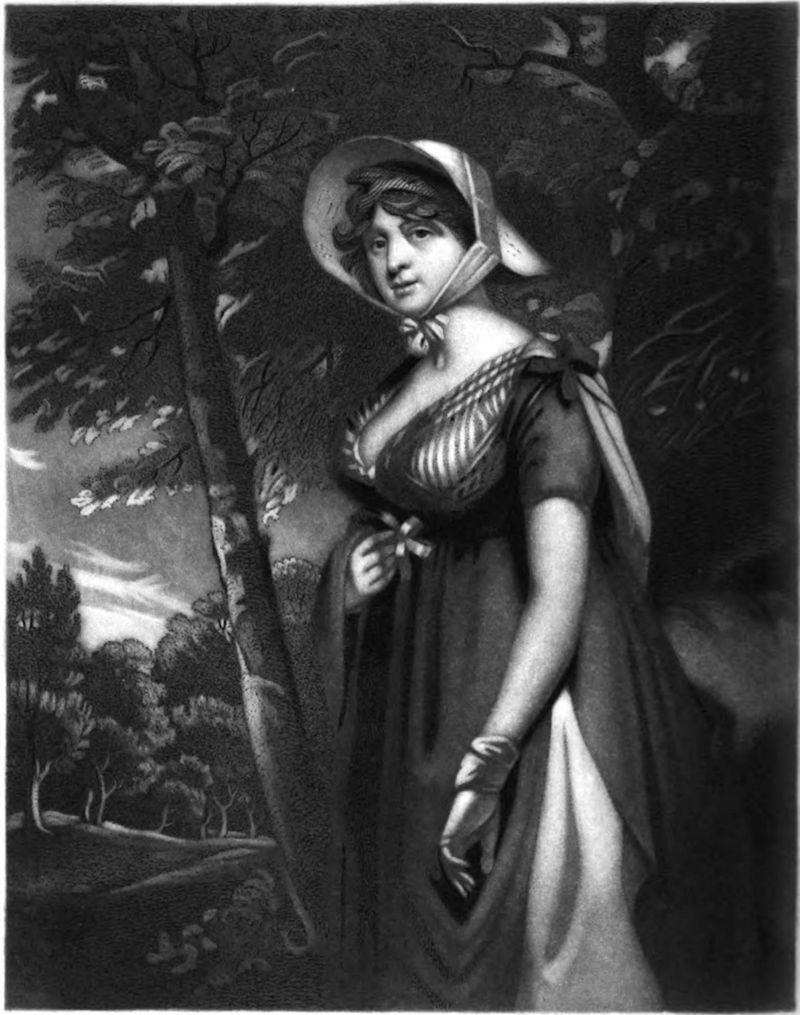
THE GIPSEY QUEEN.
Engraved expressly for Graham’s Magazine
The little that I knew of the Gipsy Queen previous
to that day, and what was told me by one who had
lived in the village very long, I have set down. I
never saw her after I passed her in the woods. But
she made an impression on my mind that will not be
easily removed. And she bore in her heart motives
for action which few but herself and me will ever
know.
———
BY MRS. AMELIA B. WELBY.
———
One moment more, beneath the old elm, Mary,
Where last we parted in the flowing dell—
One moment more through twilight tints that vary,
To gaze upon thy grave, and then, farewell!
Ere from this spot, and these loved scenes I sever,
Where still thy lovely spirit seems to stray—
One look—to fix them on my soul forever—
And then away!
Mary, I know my steps should now be shrinking
From this sad spot—but on my mournful gaze
A scene floats up that sets my soul to thinking
On all the dear delights of other days!
I’m gazing on the little foot-bridge yonder
Thrown o’er the stream whose waters purl below,
Where I so oft have seen thee pause and ponder,
Leaning thy white brow on thy hand of snow.
I’m standing on the spot where last we parted,
Where, as I left thee in the fragrant dell,
I saw thee turn so oft—half broken-hearted—
Waving thy hand in token of farewell.
I start to meet thy footstep light and airy—
But—the cold grass waves o’er thy sweet young head;
Would that the shroud that wraps thy fair form, Mary,
Wrapped mine instead!
In vain my heart its bitter thoughts would parry,
An adder’s grasp about its chords seem curled,
For you were all I ever thought of, Mary—
Were all I doted on in this wide world!
And yet, I’d sigh not while thy fate I ponder,
Did memory only bring thee to my eyes
Pale as thou sleepest in the church-yard yonder—
Or as an angel dazzling from the skies!
I then at least could treasure each sweet token
Of thy pure love—and in life’s mad’ning whirl
Steel my crushed heart—had not thine own been broken,
Poor hapless girl!
But, Mary—Mary, when I think upon thee,
As when I last beheld thee in thy pride—
And on the fate—oh God!—to which he won thee—
I curse the hour that sent me from your side!
Oh why wert thou so richly, strangely gifted
With mortal loveliness beyond compare?
The look of love beneath thy lashes lifted—
Its fatal sweetness was to thee a snare!
Yet sleep, my sister—I will not upbraid thee—
Thou wert too sweet—too innocently dear;
But he—the exulting demon who betrayed thee—
He lives, he lives, and I am loitering here!
Even now some happier fair one’s chains may bind him
In dalliance sweet—but I’ll avenge thee well!
Avenge thee?—Yes! a brother’s curse will find him,
Though he should dive into the deeps of hell!
I swear it, sister—as thou art forgiven—
By all our wrongs—by all our severed ties,
And by the blessedness of yon blue heaven,
That gives its world of azure to mine eyes!
By all my love—by every sacred duty
A brother owes—and by yon heaving sod,
Thine early grave—and by thy blighted beauty,
Thou sweetest angel in the realms of God!
I swear it, by the bursting groans I smother,
And call on Heaven and thee to nerve me now.
Mary, look down!—behold thy wretched brother,
And bless the vow!
Sister, my soul its last farewell is taking,
And I for this had thought it nerved to-night,
But every chord about my heart seems breaking,
And blinding tears shut out the glimmering sight.
One look—one last long look to hill and meadow—
To the old foot-bridge and the murmuring mill,
And to the church-yard sleeping in the shadow—
Cease tears—and let these fond eyes look their fill!
One look—and now farewell ye scenes that vary
Beneath the twilight shades that round me flow!
The charm that bound my wild heart here, was Mary—
And she lies low!
———
FROM THE ITALIAN OF MAMIANI.
———
Thou mighty one, whose winged words of yore
Have spread on history’s page Italia’s wars,
The sad mischances of intestine jars,
Like beacons blazing where the breakers roar.
Still canst thou glance out civil discords o’er?
Some solace for us canst thou not divine?
Canst thou not oil on troubled waters pour,
And soothe each petty tyrants ruthless mind?
Why else unveil the falsehood of our land,
Which sees not why its tale thou deign’st to tell?
Why else didst thou with an unsparing hand
Make bare the wounds whose angry scars will tell
The lasting shame of ignomy’s brand,
All petrified at history’s command?
———
BY EMMA C. EMBURY.
———
Don Pedro. I pray you, hold me not responsible for all these travelers’ tales. I am but the mouthpiece of others:
therefore, if I question the infallibility of the Pope, summon me not before the Inquisition; if I speak treason against
the king, clap me not up in the Tower; and if I utter heresy against the ladies, let me not be flayed alive by the nails
of enraged damsels. Old Play.
“There is no use in wasting words, Cousin
Charles; you never can persuade me that men love
more devotedly than women.”
“How can you be so unreasonable, Anne? I only
want to convince you that affection being an essential
part of woman’s nature, she cannot help loving
something or somebody all her life. The most she
does, even in her most intense devotion, is to individualize
the general sentiment which pervades her
character; but when men love, they actually take up
a new nature, and concentrate upon it all their
strength of mind and force of character.”
“You have certainly a droll method of reasoning,
cousin; because women are loving creatures, therefore
they cannot love as well as the rougher sex.”
“You are willful, Anne, and are determined not
to understand me. I mean that love is usually a
habitude with women, while with men, if it exists
at all, it is a positive, determinate thing—a graft, as
it were, upon their sturdy natures, and partaking
therefore of the strength of the stock which nourishes
it.”
“How can you say so when men are always in
love, from the time they quit the nursery until they
are gray-headed, or married?”
“Such attachments are mere fancies.”
“Pray, how is one to distinguish between a fancy
and a fact in so delicate a matter?”
“It is difficult to decide at first, because in their inceptive
state they are much alike; but time is the
true test. A fancy, a mere intoxication of the senses,
is scarce worth talking about; but in a genuine manly
love there is a depth, a fervor, a disinterestedness, a
devotion, such as woman can never feel—nay, which
they can rarely appreciate.”
“Heresy—rank heresy—Cousin Charles. I appeal
to Uncle Lorimer, who has heard our whole discussion,
if you do not deserve excommunication with
‘bell, book and candle,’ for holding such opinions.”
The cousins were sitting together in the twilight,
and, as the shadows of evening deepened around
them, the light of the soft-coal fire in the polished
grate gave a beautifully cheerful look of home comfort
to the pleasant apartment. An old gentleman,
whose silver hair glittered in the fire-light, had been
sitting in the chimney-nook, and, thus appealed to by
his merry niece, he smiled good-humoredly as he
replied—
“If you submit the dispute to me, I must decide
against both.”
“Why so?”
“Because you are both too generalizing in your
remarks. In this work-a-day world of ours there is
a daily and hourly need of the tender, watchful,
kindly ministry of sympathy and affection; now the
peculiar attributes of woman’s nature are such as fit
her for this ministry; and whether it be a mere
habitude or not, it is the quality most needed by men
and most generally possessed by women.”
Anne clapped her hands, and looked triumphantly
at her cousin; but Uncle Lorimer continued—
“I must agree with Charles, however, that when
men give out their whole strength to a genuine affection,
it is a more unselfish, magnanimous and higher
emotion than ever could dwell in the bosom of
woman. The same qualities which make her the
gentler half of man mingle their leaven in her affections.
For instance, a woman will make any sacrifice
for one whom she loves, she will bear all kinds
of privation and suffering for his sake, but earth
holds not the creature more pitilessly exacting of
affection than she is, or more jealously awake to
every whisper of distrust. Another weakness in her
character is vanity; and I must confess I never yet
found a woman so much in love with her lover, that
she would not curl her hair and dress in her best to
meet the eyes of other men.”
“Oh! uncle. You are worse than Charles.”
“But perhaps you will like to hear my whole
opinion, Anne. I have said that women possess
most of the quality which is required in daily life;
as I am not one of those who pretend to despise good
habits because they are not heroic virtues, I think
you ought to be satisfied with my decision.”
“But you attribute so much nobler a quality to
men.”
“That is true, but let me comfort you by just
whispering in your ear, that not one man in a thousand
is capable of such an affection. True sentiment
is the rarest thing upon earth. To use the
language of your favorite poet—
Accident, blind contact, and the strong necessity of loving,
often bring together hearts which habit afterward
keeps united. Few, very few, create an ideal in
their youth and see it substantialize into a reality
as life goes on. Still fewer of those men who
are capable of real love ever bestow its treasures
upon one who can appreciate them. I think I have
never known a single instance of such an attachment
being reciprocated and rewarded.”
“Did you ever know more than one man who possessed
this faculty of loving, uncle?”
“In the course of my long life I have known three;
and if you choose I will tell you the history of one
of these, to prove my theory.
“Among my earliest school friends and playmates
were Edgar and Herbert Darsie. They were twin-brothers,
the only children of a widow, whom I remember
as a tall, pale lady in close mourning, which
she never laid aside till the day of her death. There
was little of that resemblance between the twins
which generally makes the pleasant puzzle of mothers
and nurses in similar cases; for, though alike
in feature and height, and even in their peculiarity
of gait and manner, yet Edgar had the fair complexion,
blue eyes, and light silken hair of his mother;
while Herbert’s olive complexion, dark eyes,
and curling black locks betrayed the French blood
which he derived from his father. They were cheerful,
happy-tempered boys, and possessed a certain
natural sweetness of manner, which made them universal
favorites with old and young. Their mother
lived in the retired but handsome style which, in
those days, was considered the proper mode of
showing respect for the memory of a husband. She
kept up the establishment exactly as it had been
during Mr. Darsie’s life, and seemed to find her only
pleasure in doing precisely as he would have wished.
She was apparently in the enjoyment of a handsome
income, kept her carriage, and had a number of servants,
while the house and grounds exhibited taste
as well as no stint of expense.
“The boys were about twelve years of age, when
an accident happened to Herbert, which, though apparently
slight at first, finally led to the most disastrous
consequences. While skating, he fell and received
some injury, which, after months of suffering, finally
developed itself in an incurable disease of the spine,
entailing upon him a life-time of pain, and branding
him with frightful deformity. The tall, lithe, graceful
boy, whose step had been as light and free as the
leap of the greyhound, was now a dwarfed and distorted
cripple. As soon as he was able to leave his
sick-room, Mrs. Darsie placed Edgar at boarding-school,
and sailed for Europe, with the intention of
giving Herbert the benefit of all the modern discoveries
in medicine. She designed to be absent a year,
but, led on by fallacious hopes, she traveled farther,
and remained much longer than she had anticipated.
Three years elapsed before her return, and to all appearance
Herbert had derived little benefit from the
various experiments to which he had been subjected.
He was still dependent on his crutch, and his gnarled
and stunted figure presented a pitiable contrast to the
tall and well-knit form of his brother. But his health
was somewhat improved; his paroxysms of pain
were less frequent, and he could now enjoy weeks
of comparative ease and comfort.
“The brothers had early been remarkable for their
affection for each other, and their unbroken concord,
but their long separation had not been without its
effect upon them. Edgar was gay, active, volatile,
and not destitute of a leaven of selfishness; while
Herbert had become grave, quiet, gentle in manner,
and most thoughtful and considerate for others. To
him suffering had been a teacher of all good things,
and the misfortune of being cut off from fellowship
with the world had taught him to find resources
within himself. He could not and did not expect
Edgar to sympathize in all his tastes, for he was
conscious that their paths must henceforth be divided
ones. He schooled himself to overcome the pang
which this reflection gave to his sensitive spirit, and
tried to find in his brother’s enjoyments of outer life,
a pleasure which he could only receive from the
reflection of another’s joy.
“Soon after their return from Europe, Mrs. Darsie
received into her family the orphan child of a poor
clergyman, partly from charity, partly with a view
to furnish a companion and attendant for Herbert.
Jessie Graham was a pale, delicate-looking child,
about twelve years old, when she took up her abode
with her benefactress. Her thin and almost transparent
cheek, her bloodless lips, and large gray,
timid-looking eyes, spoke of fragile health, and of a
certain shyness of character which might be the result
of early anxieties, or perhaps denoted feebleness
of mind and indecision. But she was a sweet-tempered,
gentle little girl, and her compassion for
Herbert’s melancholy condition soon dissipated her
shyness toward him, though to every one else, even
to Mrs. Darsie, she was as timid as a startled fawn.
“To divert his lonely hours Herbert undertook her
instruction. He was but a boy of fifteen, but sorrow
had given him the stability of manhood; and never
did a more discreet, tender, and watchful Mentor
attempt the training of a female mind. Jessie was
docile and intelligent, quickly acquiring every thing
which called forth the perceptive faculties, but utterly
incapable of abstract reasoning or profound reflection.
Her mind possessed a certain activity, and a kind of
feminine patience that enabled her to do full credit
to her teacher, without ever attaining to his high
reach of thought. To cultivate her mental powers,
to impart to her a portion of his accomplishments,
and to train her moral sense, now became Herbert’s
chief occupation. That such employment of heart
and mind saved him from bitterness and misanthropy
there can be no doubt; but whether he did not pay
dearly for his exemption we shall see in the sequel.
“Time passed on without making any great change
in the affairs of the Darsies. Edgar went through
college rather because it was necessary to a gentlemanly
education than from any love for study, and,
immediately after graduating, he set off on the tour
of Europe. In the meantime Herbert continued to
lead his usual quiet life, driving out in his low pony-carriage
every day, teaching Jessie all she would
learn, and surrounding himself with pictures of his
own painting in the intervals of his severer studies.
“It was on the anniversary of their birth—the day
they attained their twenty-first year—that the brothers
again met upon their own hearth-stone. Mrs. Darsie’s
health had begun to fail, and Edgar, at Herbert’s
suggestion, had unwillingly torn himself from the
enjoyments of Parisian life to return to his quiet
home. He found his mother sadly changed, and
evidently suffering from the insidious disease which
so slowly saps the foundations of health and life.
Herbert, like all deformed persons, had early lost the
freshness of youth, and he was not surprised, therefore,
to find him looking at least ten years older than
himself, but he was astonished at the intellectual
beauty which seemed to radiate from his noble countenance.
To the shapeless form of a stunted tree he
united the head of a demi-god. The beauty of his
classical features, the splendor of his deep, dark eyes,
and rich glossy hair curling in heavy masses round
his temples, gave him the appearance of a magnificently
sculptured head joined on to some distorted
torso.
“But if Edgar was startled at the change in his
mother and brother, how was he amazed and bewildered
when he saw Jesse Graham! The pale,
puny, frightened-looking little girl had expanded into
one of the very loveliest of women. At eighteen
Jessie had all that delicate yet fresh beauty which a
painter would select as his model for a youthful
Hebe. “A rose crushed upon ivory” was not too
extravagant a simile for her cheek; her lips were
like the berry of the mountain-ash; and her eyes so
soft, so tender, with just enough of their former shyness
to make them always seem appealing in their
expression, were like nothing else on earth.”
“You are extravagant, Uncle Lorimer; pray how
did you avoid falling in love with such a creature?”
asked Anne, saucily.
“By the best of all preventives—pre-occupation.
But my story has to do with others, not with me.
Soon after Edgar’s return, his mother took an opportunity
to inform him of her plans with regard to
Jessie. She had watched the progress of Herbert’s
attachment to his young pupil, and she believed it to
be fully reciprocated by the docile girl. She had,
therefore, as she thought, fully provided for Herbert’s
future happiness; and, lest Edgar should be attracted
by Jessie’s loveliness, she hastened to tell him that in
the beautiful orphan he beheld his brother’s future
wife. Mrs. Darsie was a weak woman, though
kind-hearted and affectionate. She proceeded to
inform Edgar how the idea first came into her head—how
she had told Herbert of it—how she had been at
first shocked at the thought of sacrificing Jessie’s
youthful loveliness to such a union—how she discovered
his secret love even from his heroic self-denial—how
she had finally succeeded in persuading
him that Jessie really loved him better than any one
in the world—and how he had at last consented to
entertain the hope and belief that Jessie might become
his wife without repugnance. To Edgar’s
very natural question, whether Jessie was really
willing to marry Herbert, his mother replied that as
yet Jessie knew nothing of their plans, Herbert
having forbidden her to use her influence in the
matter, being determined that if he won Jessie, it
should be through her own free and unbiased will.
“Whether it arose from that perverseness in human
nature, which teaches men to value a thing just in
proportion to its difficulty of attainment, or whether
Jessie’s loveliness was irresistible to a man of Edgar’s
temperament, I cannot determine; but certain it is,
that from that time he looked upon her with far different
eyes than he had at first regarded her. Edgar
was precisely the kind of man who is always successful
with women. His talents and accomplishments
were all of the most superficial kind, but he
danced well, sung beautifully, played the guitar
gracefully, and withal was exceedingly handsome.
His voice was perfect music, and when he bent down
in a half-caressing manner over a lady’s chair, flinging
back his bright, silken hair, and gazing in her
face with eyes full of dangerous softness, while his
rich voice took the sweetest tone of deference and
heart-felt emotion, it was next to impossible for any
woman to resist his fascinations.”
“Was his character a perfectly natural one, uncle,
or was this exquisite manner the result of consummate
art?”
“It was natural to him to wish to please, and he
aided his natural attractions by a certain devotedness
of manner, which made each individual to whom he
addressed himself appropriate his tenderness as her
own right. Jessie had lived in such close seclusion
that she knew nothing of the world or its ways. It
is probable that had Herbert asked her to become his
wife before the return of Edgar, she would have
easily consented, for she certainly loved him very
dearly, and long habit of associating with him had
accustomed her to his deformity. To her he was not
the shapeless dwarf, whose crippled limbs scarce
bore the weight of his crooked body. He had been
her ideal of excellence—the friend, the Mentor who
had made her orphaned life a blessing, and she could
imagine no stronger, deeper affection than that which
he had long since inspired.
“But after Edgar had been at home a few months,
she was conscious of a great change in her feelings.
She loved Herbert as well as ever, but she had
learned the existence of another kind of affection.
Edgar’s sweet words and honied flatteries were unlike
any thing she had ever heard before, and unconscious
of any disloyalty to Herbert, she gave herself up to
the enjoyment of this new sensation of happiness.
“Herbert was tried almost beyond his strength, for
it was when his mother lay on what was soon to be
her death-bed that he first suspected the fatal truth
respecting his brother and Jessie. A lingering illness,
protracted through many weeks (during which time
Herbert was his mother’s constant companion, while
Edgar enjoyed the opportunity of unrestrained companionship
with Jessie,) finally terminated in Mrs.
Darsie’s death; and, as Herbert closed her eyes, he
could not but feel that sinking of the heart which told
him that he was now alone upon earth. Immediately
after his mother’s funeral he was taken alarmingly
ill, and for several days his life was considered in
imminent danger. It was not until his recovery that
he again saw Jessie Graham, who, in compliance
with the world’s notions of decorum, had left the
home of her childhood on the decease of her benefactress.
She had found her temporary abode in the
family of a friend in the neighborhood, and Herbert’s
sick-bed had known no other attendance than that of
the housekeeper and servants. In his first interview
with Jessie after his convalescence, he drew from
her a confession, or rather an admission of her love
for Edgar. The manner in which she confided this
to him—the frank, sisterly feeling which seemed to
animate her, stung him to the heart. But he possessed
great self-command, and Jessie never suspected the
actual state of his feelings while she confided to him
her own.
“As soon as practicable after Herbert’s recovery,
his mother’s will was opened, and then arose a new
subject of wonder and dissatisfaction. No one but
Mrs. Darsie and her lawyer had known that she had
been merely in the enjoyment of a life interest in her
fortune; but it was now ascertained that her husband’s
estate had been very trifling, and that her
large income was the product of a handsome fortune
bequeathed to Herbert by an old uncle, in consideration
of his physical misfortunes. The yearly product
was given to Mrs. Darsie during her life, but at
her death the whole reverted to Herbert. His father’s
property, amounting only to a few thousand dollars,
was bequeathed solely to Edgar, and a legacy of five
hundred dollars, (to purchase her wedding-dress, as
the will stated,) marked the testator’s wishes regarding
her protégé, Jesse Graham. Every body was
surprised at this development, but no one more so
than the brothers. Why their mother had left them
in such close ignorance of their affairs, it is impossible
to say, but they certainly had no suspicion of
the facts until they were thus legally made known.
“One of the first wishes of Herbert’s heart was to
see Jessie placed in her proper position, and he therefore
nerved himself to speak to Edgar on the subject.
What was his surprise, therefore, when his brother
treated the whole thing as a boyish affair, and avowed
his determination to spend his pittance (as he termed
it) abroad, and then to repair his fortunes by a wealthy
marriage! If ever the gentle spirit of Herbert entertained
a feeling of abhorrence for any living creature,
it was at that moment. His own hopes had been
ruthlessly blighted, and Jessie’s heart estranged from
him, merely to gratify a boyish fancy!
“What he suffered, and what he felt, however, it is
not for me to attempt describing. He had garnered
up all his treasures of affection in Jessie and his
brother. Now Jessie was lost to him, and Edgar
was a villain. How he, with his delicate sensibility,
his high sense of honor, and his stern principles of
duty, must have suffered, I leave you to imagine.
But his love for Jessie conquered all other feelings.
He knew that her happiness depended on her union
with Edgar, for she was precisely that kind of
character, which, though infirm of purpose in the
outset, yet have a certain tenacity of feeling when
once a decision has been made for them. He revolved
many schemes in his mind before he could form a
practicable one, and at last he suffered his frank and
candid nature to lead him with its usual directness
to his object. He asked Edgar to be more explicit in
his confidences, and when Edgar declared that had
he been the heir of wealth he would gladly make
Jessie his wife, but that nothing would ever induce
him to tie himself down to a life of privation and
poverty, Herbert’s decision was at once made. He
proposed dividing his income with Edgar, on condition
that his brother should marry Jessie, and reside
in the home of their childhood, while he himself
should travel into distant lands. But Edgar, with
the quick-sightedness of selfishness, saw how deeply
Herbert’s soul was interested in the matter. Pretending
a jealousy of his brother’s influence over
Jessie—a jealousy of which he declared himself
ashamed, yet which he could not subdue—he said
that if he had the means he would marry Jessie, and
take her far from all her early associations, but that
he would never let her live in Herbert’s house, or in
a place where she might at any time be subject to
his visits.
“Pained as he was by this appearance of distrust,
Herbert’s conscience accused him of cherishing a
wicked love for one who was about to become his
brother’s wife, and he therefore submitted meekly to
this new trial. What terms were finally decided upon
could only be known at that time to the two brothers.
“Six months after Mrs. Darsie’s death Edgar was
united to Jessie Graham, in the little village church,
and immediately after the ceremony, the wedding-party
left for New York, from whence they sailed a
few days afterward for Havre.
“Herbert dismissed the greater part of the servants,
shut up all except one wing of the large house, sold
off the carriage and horses, (reserving only the little
pony-carriage, without which he would have been
deprived of all means of locomotion,) and restricted
his expenses within such narrow limits, that people
began to consider him mean and miserly. He withdrew
entirely from society, and lived more utterly
alone than ever. His books, his pictures, his music,
were now his only companions. Yet he did not forget
that earth held those to whom even he might
minister. The door of the poorest cottages often
opened to admit the distorted form of the benefactor
and friend, but the sunlight on the rich man’s threshold
was never darkened by his shapeless shadow.
“Edgar Darsie went to Paris with his beautiful wife,
and there he lived in luxury and splendor, surrounded
by every thing that could minister to his love of
pleasure. Only himself and one other, the lawyer
who had drawn up the papers, knew whence his
wealth was derived. Even Jessie never suspected
that Herbert was living with the closest economy in
order that the poor should not suffer from the lavish
generosity which had induced him to secure to his
brother more than three-fourths of his whole income
as a bribe to insure her happiness.
“Ten years passed away, dragging their weary
length with the lonely and suffering Herbert, winging
their way on golden pinions to Edgar, weaving their
mingled web of dark and bright to the womanly heart
of Jessie. She had witnessed the changes of a fickle
nature in her husband—she had learned to endure
indifference, and to meet with fitful affection from
him—she had borne children, and laid them sorrowing
in the bosom of mother earth—she had drunk of
the cup of pleasure and found bitterness in its dregs;
and now she stood a weeping mourner beside the
dying bed of that faithless but still beloved husband.
Edgar Darsie had inherited his mother’s disease,
together with her beauty. His excesses had hastened
the period of its development, and ten years after his
marriage he was withering like grass before the
hunter’s fire, beneath the touch of consumption. Day
after day he faded—his stately form became bowed,
his bright face changed, his silken locks fell away
from his hollow temples. Health was gone, and
beauty soon departed.
“With the approach of death came old memories
thronging about his heart, and filling his sick chamber
with fantasies and spectres of long by-gone days.
“Take me home! take me home!” was the bitter
cry. But his “home-wo” came too late. Never
again would he leave his bed until he was carried
to the house appointed for all living. At the first
tidings of his illness Herbert had sailed for Havre,
and traveled with all speed to Paris; but when he
arrived there his heart failed him. He remembered
Edgar’s avowed jealousy of him, and the wild, fierce
joy which thrilled his heart when he found himself
once more near to Jessie, taught him that he was not
entirely guiltless toward his brother. He accordingly
took lodgings in the same hotel, that he might
be near Edgar, in case he should wish to see him,
well knowing that the mode of life in Paris secured
him the most perfect privacy. He made known his
present abode to a certain business-agent, through
whose hands letters had usually been sent to him
from Paris, and thus he received from Jessie’s hand
constant tidings of his brother’s condition.
“But this state of things could not last long. His
impatience to be with Edgar led him to seize upon
the first faint intimation of a wish to see him, and he
soon found himself welcomed with tears of joy by
Jessie while Edgar thanked him with his eyes—those
tender eyes—for his thoughtful kindness in coming
without waiting for a summons. During three months
Herbert shared with Jessie her care and watchfulness
over the invalid. All the lovable qualities of Edgar’s
nature were brought out by his sickness, and Herbert
could not help feeling the full force of those
fascinations which had won for him the love of every
one. Weakened in mind as well as in body by his
disease, he was like a lovely and gentle child, so
docile, so affectionate, so helpless, so tender, and so
altogether lovely did he appear, as the dark wing of
death flung its shadow broader and deeper above his
couch.
“He died with penitence for past misdeeds deep-rooted
in his heart, and prayer for pardon lingering
on his lips. He died clasping his brother’s hand in
his, and the last act of his life was a vain attempt to
unite Jessie’s hand in the same grasp. There was
no time for the indulgence of selfish feeling at such
a moment. The presence of death had hushed the
whispers of earthly passion, and the grief of both the
brother and the widow was the genuine tribute of
affection to the departed.
“As soon as Edgar’s affairs could be arranged, the
widow, with her only surviving child, returned to
America under the protection of Herbert. Ignorant as
a child about pecuniary affairs, Jessie left every thing
to Herbert, and consequently never knew at what
sacrifice he rescued Edgar’s good name from obloquy,
and paid his enormous debts. Nor did she ever know
that the money which had supported their extravagant
expenditure in Paris, was the free gift of Herbert.
But daily and hourly did she experience Herbert’s
considerate kindness. Fearing to awaken her suspicions
relative to his agency in her marriage, he
determined to continue to her an allowance similar
to that which he had bestowed upon his brother.
But to do this required new retrenchments, and the
sacrifice of a fine landed property; for Edgar’s lavish
prodigality had cost him so large a portion of his
fortune that it now needed the most careful and
judicious management.
“If Herbert hoped to marry his brother’s widow, he
at least determined to leave her free to choose for
herself. Jessie found herself pleasantly domiciled in
a new home, with a handsome provision for herself
and child, and surrounded by all the appliances of
American comfort before she had yet recovered from
the dull torpor of her grief. For fifteen years Herbert
had lived but for her. During the five years preceding
her marriage his whole soul had been devoted
to her; and when afterward he tried to banish her
image, he found though he might dethrone the idol,
the sentiment of loyal love, like a subtile perfume,
had diffused itself through his whole being. Was it
strange, then, if he should once more dream that his
love and faith might do more than remove mountains—that
his devotion might veil the unsightliness of his
person—that he might yet be beloved and rewarded?
“Now tell me, Annie, how do you think my story
is going to end?”
“In the marriage of Jessie to the devoted Herbert,”
replied Annie. “It is not in the nature of woman to
be insensible to such devotion.”
“Remember that Jessie knew nothing of his
pecuniary sacrifices, had no suspicion of his agency
in bringing about her marriage; did not dream of his
self-denying, self-forgetting love.”
“But no woman could doubt the true meaning of
all his devotedness.”
“He had never flattered her with gentle words;
never wooed her in courtly phrase; never played the
lover in the most approved fashion. He had been
the adviser, the Mentor, the steady friend; love had
been the pervading and animating soul of all he
thought and all he did, but his very magnanimity had
been as a cloak to conceal his affections. Do you
think a woman like Jessie—an ordinary woman,
lovely and gentle, but withal having no perception
of that inner life which so few can penetrate—do you
think she could see through this magnanimous reserve,
and detect the hidden love?”
“Surely, surely!”
“Recollect that she had early learned to pity him
for his personal defects, and though ‘pity’ may be
‘akin to love’ in our sex, yet no woman ever loves
a man she must look down upon with compassion.”
“But his nobler qualities must have commanded
her respect.”
“Suppose they were so far above her perceptions
as to inspire her with awe instead of respect? A
woman never loves the man she pities, nor will she
love the man whose superiority she fears. Jessie
compassionated Herbert’s bodily weaknesses, and
she had a vague terror of his stern, uncompromising
ideas of right and wrong.”
“Nevertheless, I am sure she married Herbert,
uncle.”
“You are mistaken, Annie. Herbert continued
his devotion for years; he learned to love her child
as if it were his own, and gave proofs of disinterestedness
and tenderness such as no woman could misinterpret;
but he never offered her his hand.”
“Why not?”
“Because he knew it would be rejected, and he
preferred being a life-long friend, to occupying the
position of an unsuccessful suitor.”
“Then I suppose she never married again.”
“You are wrong again, Annie. At forty years of
age, when her beauty was faded, and her character
had deteriorated amid the follies of society, she
married a man some ten years her junior, who,
tempted by the income which Herbert had bestowed
upon her, flattered her into the belief that she had
inspired him with the most passionate love.”
“And her child?”
“Was adopted by Herbert Darsie, and at his death
inherited his estate.”
“Poor, poor Herbert!”
“He suffered the penalty which all must pay who
give to earth the high and holy sentiment which is
only meant to make us companion with the angels
in heaven. Not one in a thousand can love thus, and
that one always finds that in the world’s vast desert,
he has expended his strength in vain—‘hewn out
broken cisterns which can hold no water.’”
———
BY S. ANNA LEWIS.
———
The struggle is over—my pulses once more
Leap free as the waves on the surf-beaten shore;
And my spirit looks up to that world of all bliss,
And heaves not a sigh for the faithless in this.
’Twas in Sorrow’s bleak night, when the sky was all dark,
And the tempest shrieked loud round my storm-beaten bark,
That arose, ’mid the darkness, thy radiant form,
Like the rainbow illuming the brow of the storm.
An angel thou seemedst, that had come to the earth,
To guide me—to nourish my heart in its dearth;
And blindly, as Paynim kneels down to his god,
I have loved thee—have worshiped the earth thou hast trod.
But this waste of affection—this prodigal part—
Is over—the mask has been torn from thy heart—
And back with affright and amazement I shrink—
At a fount so unholy my soul cannot drink.
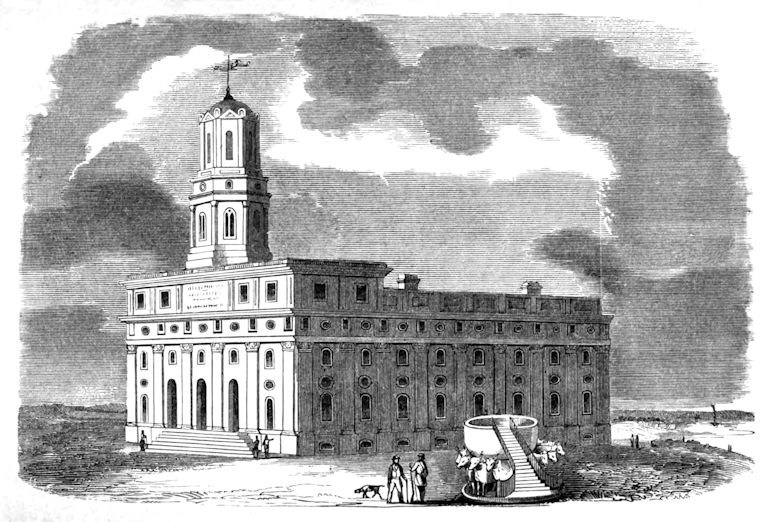
Mormon Temple, Nauvoo
[SEE ENGRAVING.]
By permission of Mr. J. R. Smith, we have caused
a view of the Mormon Temple at Nauvoo to be
engraved from his splendid Panorama of the Mississippi,
and we give the engraving in this number.
As the building has been recently destroyed by fire,
our engraving, the first ever published, acquires additional
value. We copy from Mr. Smith’s description
of the Panorama, the following account of
Nauvoo and the Temple:
“Nauvoo.—A Mormon city and settlement, now
deserted. It is one of the finest locations for a town
upon the river, it being situated at the second and last
rapids below the Falls of St. Anthony, which extend
from this place to Keokuk, a distance of 12 miles.
The great Mormon Temple stands out conspicuous.
It is the finest building in the west, and if paid for
would have cost over half a million of dollars. It is
built of a white stone, resembling marble, 80 feet
front by 150 deep; 200 feet to the top of the spire.
The caps of the pilasters represent the sun; the base
of them, the half moon with Joe Smith’s profile. The
windows between the pilasters represent stars. A
large female figure with a Bible in one hand is the
vane. An inscription on the front, in large gilt letters,
reads as follows:
“The House of the Lord, built by the Church of Jesus
Christ of the Latter Day Saints. Commenced April 6,
1841. Holiness to the Lord.”
There is in the basement of the temple a large stone-basin,
supported by twelve oxen of colossal size,
about fifteen feet high altogether, all of white stone
and respectably carved. A staircase leads up to the
top of the basin. It is the font where all the Mormons
were baptized. It is seen in the Panorama
standing aside the Temple, but in the basement is its
real situation.
A TALE OF FIRST LOVE.
———
BY ESTELLE.
———
“I shall never have another hour’s happiness as
long as I live!” exclaimed Rose Winters, weeping
passionately. “You wouldn’t let me marry him,
father, and now he’s gone to sea, and said he should
never come back.”
“Don’t believe it, Rose,” said Mr. Winters.
“He’ll be glad enough to come back, I’ll warrant
you—and the longer he stays away the better, I’m
thinking, it will be for you.”
“It’s not like you, father, to be so unfeeling,” said
Rose, sobbing almost hysterically.
“Nonsense, child—unfeeling, indeed! ay, ay, it
may be so in your judgment, I dare say, but I must
judge with the head, and not with the heart.”
“I think I ought to be allowed to judge for myself,
now I’m of age,” answered Rose, with sudden
spirit. “I was eighteen my last birthday.”
“True, Rose, you have had great experience of
mankind, no doubt. But come, now, just tell me
what you could have done if you had married Bob
Selwyn, with no fortune yourself, and he nothing to
depend on but his hands?”
“We could have done as other people do,” said
Rose—“we could have worked. Have I not always
worked at home, father?”
“To be sure you have. You have been a good,
industrious girl, Rosy, that I sha’n’t deny; but your
work at home was not like pulling continually at
the rowing oar, which would have been your portion
all your life, I’m afraid, with Robert. I can’t see,
for my part, what you wanted to marry him for.”
“Because I loved him, and he loved me. Didn’t
you and mother marry for love, father?”
Mr. Winters could not forbear laughing at this question,
notwithstanding Rose’s grief—and his natural
droll humor struggled with his former seriousness as
he replied, “Well, I must try to remember. It is
nearly twenty years ago, now—so long that you have
come of age in the meanwhile, and fancy you are
wiser than your father. But I can tell you one thing,
Rose, if we did marry for love, we had something to
begin the world with, which is quite as necessary.
You know the old proverb, ‘When poverty comes
in at the door, love flies out of the window.’”
“I don’t believe any such thing, father. Whoever
wrote that proverb never knew what love was. It
was a mean thing in any man to say so; and what
would never have come from a woman, I’ll be
bound.”
“Well, well, Rosy, you may dry your eyes. I
wish I was as sure of a fortune for you, as I am that
Robert will be back with the ship, if his life is spared;
but if that shouldn’t be the case, you will be young
enough then, and pretty enough, too, to get another
beau.”
“I wont have any other!” exclaimed Rose. “I
am determined to wait for him, if he stays twenty
years!”—and with this resolution she hastily turned
away and ran to her own room, where, secure from
observation, she might give free vent to her full
heart in a long fit of weeping.
We are at a loss to imagine what sort of an impression
our rustic heroine, Rose Winters, has made
on the minds of our readers, from her unceremonious
introduction to them through the foregoing dialogue:
but at all events, she is deserving of a more detailed
description. She was the daughter of a respectable
farmer on Long Island, who resided in a country
village, situated on the Atlantic ocean, and near a
large seaport town. Mr. Winters was a shrewd,
practical man, of strong natural powers of mind, and
excellent plain common sense. Rose was his eldest
and favorite child, and inherited his independent
spirit and natural gifts of understanding, which had
been improved in her by a useful and solid education
at a first-rate country school. She was not,
perhaps, strictly beautiful, but her cheeks were bright
with the hue of health, and her dark-blue eyes sparkled
with animation, and the joyousness of a young heart,
over which a lasting shadow had never passed, until
her lover left her to try his fortunes on the sea. Her
figure was small, but of exquisite proportions, and
her steps sprang elastic with the unchecked spirits of
happy childhood. She was always agreeable and
entertaining without effort, for her words flowed in
the easiest manner possible, from a mouth which nature
had made perfect; and then there was nothing on
earth more inspiring than her merry laugh, which
seemed like the very chorus of joy, and insensibly
imparted a portion of her own gayety to all around
her. Rose had but little of imagination in her heart or
feelings. She was a young, gay creature, full of
spirits and activity, and only actuated by the every-day
scenes of life, from which she extracted mirth
and enjoyment to diffuse unsparingly among all who
came within her influence. There was also a truthfulness
and integrity in her nature, which could not
fail to give beauty, strength, and elevation to her
thoughts and character. The visions of romance
which so often pervert the minds of the young, and
throw a false coloring over the world, were all unknown
to Rose. She had been nurtured amid scenes
where there was but little to excite or enrich the
imagination, but much to awaken bold and lofty
sentiments. Born and brought up within sight and
sound of the grand and magnificent ocean, she delighted
to gaze on its rolling and breaking billows,
and listen to its ceaseless sounding roar, which had
often been the solemn lullaby to her nightly slumbers.
The wide and level fields outspread before her native
home, and the few bare hills which skirted here and
there the distant outline, were but little calculated
to inspire those enchanting, but unreal dreams, which
seem insensibly to arise amid the mountain scenery
so wildly beautiful and picturesque in many parts of
our western world.
Rose had never been twenty miles from her
father’s dwelling. All that she knew of the world
had been learned in her own village, which was an
occasional resort for a small number of strangers
during the heat of summer; but its situation was too
remote to be very generally visited before there were
either railroads or steamboats to facilitate and add
comfort and convenience to traveling. Communication
with New York, which was the nearest city,
was at that time tedious and fatiguing, as the road
lay for many miles through sandy woods, or over a
bleak and rough country. By water, the journey
was performed in sloops, taking from three days to
a week to accomplish the voyage. In consequence
of these disadvantages, the transient sojourners in
the village consisted chiefly of sportsmen, who
sought its solitary retreat for the purpose of enjoying
the game which was formerly found there in great
abundance. The birds were seldom frightened away
from the lanes and meadows, excepting by the gun
of the stranger, who, having once found his way to
that lonely yet delightful part of the country, returned
again and again, not only to scare the plover from
their haunts, but to enjoy the refreshing and invigorating
breezes from the ocean, and revel in the luxury
of freedom from fashion and restraint. There was
a primitive simplicity in the manners of the inhabitants
of the village which was peculiarly pleasing;
and in which school Rose had received her first model.
She was easy and unaffected, because seeking to
appear no higher nor better than she really was.
Among her associates, she was a universal favorite.
Her presence was sure to be in requisition at all the
balls or merry-makings in the neighborhood, for nothing
of the kind could go off well, unless Rose Winters,
with her quick wit, irresistible good humor, and
gay spirits, made one of the party. Her father, though
a man of severe morals and true piety, was far from
being puritanical in his views or feelings. He
loved to see Rose happy, and enjoyed the sunny
atmosphere which her never-failing cheerfulness and
vivacity spread around the household dwelling.
The bright sallies which flashed from her lips, instead
of being checked by the farmer, frequently occasioned
a repartee of wit from him, which gave Rose
a habit of sharpening her own against her father’s
weapons. Thus it was that she learned to respect
her parent without fearing him. She knew him to
be possessed of the most inflexible principles of
truth and rectitude; and that his jocose and lively
temperament could never induce him to swerve for
a moment from the straight-forward course of honesty
and honor. In his judgment she placed the most
unbounded confidence; and it was only in the one
instance in which her heart rebelled against it, that
she yielded to its mandate with bitter and unsatisfied
feelings. Her mother, whom we have not yet mentioned,
had been dead several years; and three sisters,
considerably younger than herself, partook more of
her care than her confidence. It thus happened that
her father had been her companion, more than is
usually the case in such relationships. She had been
accustomed to consult him in all affairs of consequence;
and self-dependent as she was by nature, she
durst not incur the responsibility of acting in direct
opposition to his counsels. In this slight sketch we
have endeavored to give a faint outline of the character
of our heroine, unlike, we are sensible, to the
usual heroines of romance; but the portrait is drawn
from real life, with its beauties unflattered, and its
blemishes unconcealed; and we leave it as it is to
make what impression it may on the opinions of
others.
Robert Selwyn was a native of the same village.
He was a few years older than Rose, but had been
accustomed to mingle in all the country pleasures
and amusements of which she had been for a time
the principal attraction. His handsome form, his
manly and pleasing countenance, and his gay and
careless manners, were his only passports to favor.
He had no fortune to assist him in winning his way,
but he had energy and ambition, which were yet to
be aroused into action. There was a distant connection
between the families of Winters and Selwyn,
which served as a plea for frequent and familiar intercourse.
Rose called him Cousin Robert, and under
that name he was received as a sort of privileged
guest at her father’s house. The farmer always
welcomed him; and Rose chatted and laughed and
flirted with him, until at last the flirtation ended in a
serious attachment. Mr. Winters, with all his habitual
foresight, had not looked for this result. To
part with Rose, was an event for which he had made
no calculation, and he could not persuade himself to
believe that her affections were irrevocably engaged.
The application of her lover, therefore, for his consent
to their marriage, was met by a decided refusal.
“Pooh, pooh, Robert,” said he, in answer to his
solicitation, “I wonder what you would do with a
wife. Tell me first, how you expect to make a
living for yourself, let alone Rose?”
“Why, if I can do nothing else, sir,” said Selwyn,
“I can follow the sea, and at least get a living out of
the whales. You know others here have got rich
that way.”
“Yes, yes, Robert, but it’s a hard life, and not
much to your taste, I reckon.”
“It might not be my choice, Mr. Winters; but
I’m not afraid of hardships any more than other men—and
I should think nothing hard with Rose.”
“Oh, that’s the way all young men talk when
they’re in love; but have you no other plan than that?”
“Yes, sir—I thought of either setting up a store,
or trying to get the school, as the old master is going
away. I believe I know about as much as he does.”
Mr. Winters laughed as he replied, “Very likely
you may, Robert, and be no Solomon either; but it
wont answer. Set up a store on credit, and break
next year; and as for school-keeping—no, no, I must
see some surer prospect of your being able to support
a wife, before you can have Rose with my
consent.”
“But, Mr. Winters, none of our girls here expect
to marry rich. I wonder where they’d find husbands,
if they looked for money! not in this town, I
am sure.”
“There must be something to look to, though,
either money or business. Take my word for it,
young man, you would find love but light stuff to live
upon without something more substantial along
with it.”
Selwyn was silent for a few moments, and then
said in a tone of severe disappointment, “Well, I
must say, sir, that I did not look for this refusal. You
never objected to my visits to Rose.”
“No, but I wish I had, since neither of you have
as much sense as I thought for. I have been to blame,
and am sorry for it; but there has been enough said
now, Robert—all the talking in the world will not
alter my mind at present.”
It was after this conversation that Selwyn, finding
the farmer inflexible, and Rose determined to sacrifice
her love rather than disobey her father, formed the
resolution to go out in a whaling ship, just about to
leave the port. Rose sought in vain to dissuade him.
He told her his mind was made up. “If you wont
have me, Rose,” said he, “I may as well be on the
ocean as the land, for I shall never marry any one
else; but I shall not hold you bound—for most likely
I shall never return.”
“I didn’t expect to hear you say such a thing as
that, Cousin Robert,” answered Rose, with her eyes
full of tears; “but you may hold me bound or not,
just as you please, I shall wait for you. If you should
forget me, I could never believe in the love of any
man afterward.”
The ship sailed unexpectedly, and Selwyn, much
to his disappointment, was obliged to depart without
again seeing Rose; and the sudden news that he had
gone, occasioned the burst of feeling in her, with
which our story opened.
We must now pass over a few anxious and tedious
years. Rose waited and dreamed of her lover’s return,
until her spirits flagged, and her young heart
grew sick with “hope deferred.” Mr. Winters was
puzzled and confounded. He had mistaken his
daughter’s disposition, and was not prepared for the
depth of feeling and affection which she had garnered
in her bosom. That his bright and merry
Rose should suddenly become the reflective and
thinking being, and perform her household duties
with methodical and earnest care, instead of flying
like a bird from room to room, and singing or laughing
off a thousand grotesque mistakes, which before
were continually occurring under her management,
was to him a matter of serious consideration. In
truth he did not much like the change; for what was
gained in order and regularity in his house, was
lost in that inexhaustible fund of animating gayety
which had been wont to beguile him at sight of the
fatigue of daily labor, and cast an unfailing charm
over his retired dwelling. Not that Rose had altogether
sunk into the sober and serious mood—that it
was not in her nature to do—but an indescribable
change had passed over her former manner, which
had somewhat of a depressing influence on her
family. She could not help laughing and being lively,
any more than she could help the beating of her
pulse, or the breath that came without her will or
agency; but there was something missing in the inward
spring from which her spirits flowed. It was
the heart’s happiness—and the spring, in consequence,
sometimes yielded bitter waters.
Three years had fulfilled their annual revolutions,
before the ship returned in which Selwyn had embarked,
and then, alas! it returned without him.
The voyage had been a most disastrous one. They
had been nearly shipwrecked, after being but a few
months out, and had been obliged to put in at one of
the islands in the Pacific to repair and refit. This
operation necessarily detained them a long time; and
the second year of the voyage, Selwyn got sick and
discouraged, and left them at a port where they had
stopped to winter, and went to London. It was
hinted that he was wild and reckless, and would
never do any thing for want of stability and perseverance.
Rose was indignant at these innuendos.
Her sense of justice and generosity spurned the
meanness of traducing the absent, and her woman’s
love shielded him in her own mind from every attack
on his reputation. She received a letter from
him shortly afterward, the first he had written since
his departure. The general tone of it was sad and
desponding, but it breathed the most unabated affection
toward herself, while at the same time it set her
perfectly free from her engagement to him.
“I cannot ask you, dear Rose,” he wrote, “to
wait for me, when it is so uncertain if I ever can
return to claim your promise. I have made nothing
by this voyage, and am determined never to see
your father again until I can give him a satisfactory
answer to his question of ‘how I am to support a
wife.’”
Rose wept over the letter, and then consigned it
to her most secret hiding-place, and returned with
unshaken resolution to her usual train of duties. She
had lost none of her beauty, for the healthful exercise
of necessary and constant employment, preserved
the bloom on her cheek, and kept her from
giving way to useless repining. Among the beaux
of the village, she continued to have her full share
of admirers; and there was one of the number,
Edward Burton, an enterprising and promising young
man, who sought earnestly to gain her hand. It was
all in vain. Rose was deaf to his entreaties, and
laughed at his remonstrances, until he was obliged
to give up his suit.
In the meanwhile Robert Selwyn was seeking encouragement
and advancement from a foreign people.
He continued to follow the sea, but without returning
to his native place. He went out from London, and
had risen by the usual gradation of ship-officers,
lastly to captain. At the expiration of three more
years, Rose received another letter from him; but
the time of meeting seemed still further and further
in the future. He knew not when he should return.
His employers kept him constantly engaged, and he
hoped in the end to realize an independence; but it
might be long yet before it was accomplished.
Such was the burden of the letter, and Rose decided
promptly on a new course of action for herself.
She had long had it in her mind to leave home.
Her eldest sister was fully competent to take her
place in the management of the house, and the other
two were old enough to be companions and assistants;
but Rose felt that she should have to encounter the
opposition of her father. She therefore determined
on making all her arrangements to go before apprising
him of her intention. Much, indeed, then, was the
farmer astonished when Rose took her seat by his
side, after he had finished his evening meal, and addressed
him as follows:
“Father, I am going to New York to live.”
“Going to New York to live!” repeated he, slowly,
as if unable or unwilling to comprehend her words,
“Why what has put that notion in your head, Rose?”
“I’ve been thinking of it for a year, father, but
put off telling you till the time came. Last summer,
when Mrs. Sandford was here, she often advised me
to go to New York; and a few days ago I had a letter
from her. She says she can get me a situation as
teacher in a school, where I shall have many advantages,
and I have made up my mind to accept it.”
“You ought to have consulted me about it first,
Rose; I’m doubtful if it will be for the best.”
“Well, I shall do it for the best,” answered Rose,
“and if it shouldn’t turn out so, I can’t help it. You
know I’m too much like you, father, to give up any
thing I judge to be right; and I hope you wont blame
me for leaving home now, since Betsey is quite as
good a housekeeper as I am.”
Mr. Winters bent his eyes downward, and was
silent. It was not his habit to betray any outward
emotion, but there was grief in his heart. His fortitude
was sorely tried. The departure of Rose
would cause a sad break in his home enjoyments,
and the philosophy of the man was destroyed for the
moment, by the feelings of the father. Inwardly he
struggled, till unable to control himself longer, he
rose quickly, and snatching his hat, went out from
the house.
After some time, he returned calm and composed,
and simply remarked to his daughter, “You say
you’ve decided to go, Rose, so there’s no use in
arguing—but you’ll find a great change in a city life.
If you shouldn’t like it, come back to your old home—that’s
all. Now call the girls in to prayers—it’s
nigh bed-time.”
Rose did as she was bid—and that night the farmer
prayed earnestly and fervently for the child who was
about to quit his protection, and committed her to
the watchful care of Him who neither slumbers nor
sleeps. The prayer over, he retired immediately to
his pillow, which was wet before morning with an
old man’s unwonted tears.
In the course of the following month, Rose was
duly installed in the authority of her new station.
Her active and energetic mind, on which the useful
branches of education had been thoroughly grounded,
soon comprehended all the mysteries of her office,
while her sprightliness and good humor, joined to her
unusual decision of character, fitted her admirably
for her occupation. The first term of her initiation,
however, passed wearily away. Her spirit pined in
the confinement to which she had voluntarily subjected
herself—and with a feeling of home-sickness
gnawing at her heart, she repaired to her patroness,
Mrs. Sandford, to tell her that she could remain no
longer. “I get thinking of my father,” said she,
“when I ought to be attending to the lessons—and
sometimes my mind gets so confused, that I almost
imagine myself mad, and the school a bedlam. Indeed,
Mrs. Sandford, I cannot engage for another
quarter. I find I was not made for a city life, after
all. The confusion distracts me, and the high houses
and narrow streets, make me gloomy and low-spirited.
I feel as if I couldn’t breathe in the smoke and dust
here. Oh, if you only knew how I long for the
pure air of the country, and the sight, once more, of
the wild, free ocean.”
“But, my dear child,” said the lady, “you cannot
think of returning now, in the depth of winter. The
communication by water is closed, and you know it
is a three days’ journey by land in the best of traveling.
At present, they say the roads are nearly impassable.
Come, take my advice and content yourself
till spring. Believe me, you will not find every
thing as you expect when you return to the country.
A short absence from home, often produces a great
change in our own minds, and we are led to view
the same objects in a different light. New impressions
of life and manners frequently destroy the
power of old associations to bring back past happiness;
and we are left to experience a painful disappointment,
without being at first sensible that the
change is in ourselves. We can never be again what
we were before.”
Rose listened attentively, and though far from being
fully convinced by the reasoning of Mrs. Sandford,
she bent her will to a seeming necessity, and consented
to remain. Naturally buoyant, she rallied her
spirits, and overcame her transient depression. Interested
continually in receiving as well as imparting
knowledge, she said no more about returning home
until the summer vacation left her at liberty to revisit
her native town. Then it was that she understood
the change which the more experienced woman
of the world had sought to picture to her imagination.
She was once more in the bosom of her family; on
the very spot where life had opened to her with such
bright anticipations of happiness. The same scenes
were around her. The extended range of level
country, and “The sea, the open sea,” with its
mountainous and heaving billows, presented itself,
as in former days, to her unobstructed view. What
then was lost? It was the simple taste, the unsophisticated
mind, the feelings untainted with the
world, and, most of all, the heart at peace! She
was no longer contented. The quietude and sameness
of the country left her too much time for thought;
and her restless spirit wandered again to the thronged
and bustling city, and the ceaseless routine of her
labors in the school as a sort of necessary means of
relief. The sight of the ocean grew painful to her,
from its reminding her too forcibly of her absent lover.
Selwyn wrote not, came not. Some said he was married
in London, and there came not a word from himself
to contradict the report.
Edward Burton took advantage of it to renew the
offer of his hand to Rose.
“No,” answered she, decidedly, “if Cousin
Robert is really married, as people say, my faith in
man’s love is destroyed forever. I hope you will
never ask me again, Edward, for my answer will
always be the same.”
So Burton gave her up, and consoled himself by
marrying another; and Rose returned to New York,
and again devoted herself to the arduous task of
teaching, which often filled her heart with weariness;
yet no one would have imagined her to be a disappointed
girl. Love-sick she was not; she had too
much strength of mind—but she was true-hearted
and constant. Nine years had elapsed since she had
heard a word of Selwyn, and she knew not whether he
were living or dead. They had been parted fifteen
years; and who will wonder that time had robbed
her of some of her early bloom; but there was an
added expression of intellect in her countenance,
and a certain refinement of manner imperceptibly
acquired, which she had never possessed in her
father’s house: so that altogether she was more attractive,
more to be admired at thirty-three years of
age, than when she first appeared at eighteen as a
country belle.
And where was Robert Selwyn, while by slow
gradations from year to year this change had been
silently wrought in his heart’s first idol. His migrations
in the meantime had been many, and his fortunes
varied. Profits and loss were for some years
nearly balanced in his accounts, but at length the
brighter side predominated. Misfortunes and mishaps
were cleared away from his horizon, and his
sails swept onward through a tide of unexpected
success. It was then that he began to weary of his
long, self-imposed exile, and turn his thoughts and
wishes to home and “native land.” Energetic in
purpose, and prompt in action, he no sooner formed
the resolution of returning than it was put in execution.
The voyage, quickly accomplished, he once
more found himself among his old friends and townsmen,
who shook him heartily by the hand, and welcomed
him back with right good will. Some author
remarks, that “one of the greatest pleasures in life,
is to be born in a small town, where one is acquainted
with all the inhabitants, and a remembrance clings
to every house.” He no doubt felt this on his first
arrival, and his satisfaction was unalloyed; for, like
Rose, he had yet to know himself as he now was.
Most of his youthful companions were married, and
settled down into steady, sober-minded, every-day
sort of people—having made but little improvement
either in mind or manners; but they were not slow
to perceive that the Selwyn who had just returned,
was quite a different man from the Selwyn they had
formerly known. There was certainly a change in
him, but in what it consisted, they found it impossible
to decide. He lacked nothing in cordiality—he
assumed no airs of superiority—he was neither
elegant nor fashionable—but he was not what he
used to be. Perhaps it was that he had acquired
more manliness of character; and there was the least
bit more of dignity in his manners; he was the
smallest possible degree more guarded in his expressions;
and his frank and easy address was entirely
free from the most distant approach to awkwardness.
It is true, he was still the gay and jovial
sailor, noble-spirited and generous to a fault—but he
was more the gentleman, more the man of the world
than before he went to foreign parts; and upon the
whole, the conclusion was that he was greatly improved,
and would most likely turn out to be quite a
credit to the town. He had certainly grown handsomer,
as he had grown older. His face wore no
traces of any inward discontent or disappointment,
and it is probable that he had worn his love either
lightly or hopefully in his heart. His first inquiry,
after his return, however, was for Rose; and hearing
she was in New York, he hastened thither to meet
her. It was at the close of a summer afternoon
when he found himself at the door of the house where
he was told she boarded. He inquired for her,
walked in, and sat down in the parlor in the dim
light of the fading day, which was rendered more obscure
in the shadow of the curtained windows.
Rose had gone to her room fatigued and somewhat
dispirited. The name of her visiter was unannounced,
and as she descended with a languid step
to the parlor, she was little prepared for the surprise
that awaited her.
Selwyn rose at her entrance with a confused and
doubtful air. “I beg your pardon, madam,” said he,
“I called to see Miss Winters—Rose Winters—I
understood she was here.”
“And so she is, Cousin Robert!” exclaimed Rose.
“She is before you, and yet you do not know her.
Am I altered so very much, then?”
The question was accompanied with a painful
blush, from the consciousness that the bloom of youth
in which he had left her, had passed away forever.
Selwyn sprang toward her and caught her hand.
“Rose, my own dear Rose,” said he, with real
feeling, “forgive me. No, you are not altered; but
if you were, I should know your voice among a
thousand.”
“Ah, I know I have grown old, cousin,” said
Rose, struggling to recover herself, “how could it
be otherwise, when so many years have passed since
we met.”
“Well, Rosy, look at me! Has my age stood still,
do you think? Look at the crow’s feet and the gray
hair, and tell me if you love me the less for them.
You would be the same to me, if you were twice as
old as you are; for you see I have come back for
no earthly reason but to marry you, unless your own
consent is as hard to obtain now as your father’s
was before.”
“Why, your friends said you were married in
London.”
“No, not my friends, Rose. It must have been
my enemies who said that; but you knew better.
Didn’t I tell you I would never marry any one
but you?”
“Yes, fifteen years ago, Cousin Robert—but the
promise might be outlawed by this time, for all I
knew. You do not pretend to say that you thought
my faith in your word would hold out, without even
receiving a line from you the last nine years.”
“Why not pretend to say it, coz, when I know it
has. Deny it now if you can.”
“But why didn’t you write to me, Robert?”
“Because I’m no writer, and meant to come myself.
You said you’d wait for me—and I knew you
never broke your word. So now, my sweet little
flower, I’ve come to claim you, like a blunt sailor,
as I am, with few words, but a heart full of love,
and what is better, something to live on beside.”
“You are in a great hurry now,” said Rose,
laughing and blushing. “Suppose you wait a little,
seeing you learnt the art so well in your absence.
Why I have not had a chance yet to ask you what
kept you away so long.”
“Never mind that, coz. There ’ill be plenty of
time hereafter. Answer my question first, whether
you mean to have me or not, and let me know
which way to shape my course. If you’ve changed
your mind, and lost your affection for me, just say
so at once, and I’m off to sea in the first ship. You’ll
never be troubled with me again.”
“What an unreasonable man you are,” said Rose,
“just as impatient and headstrong as before you
went away.”
“You knew all my faults, dearest, long, long ago,”
said Selwyn. “They did not hinder you from loving
me once. Love me still, Rose, as you once did.
Be mine, as you promised you would before we
parted, and you shall make me what you please.”
Rose was silent. Her lover’s arm was around
her, and memory was holding its mirror to her mind:
and when she did speak at length, her voice was low
and indistinct, and her words nearly unintelligible.
The spirit of them may be guessed, however, from
the fact that Selwyn did not go to sea, and she resigned
her situation as teacher, and returned with
him to her former home. The wedding was soon
after celebrated with the sanction of her father, and
but one source of regret to Rose, that the old minister,
who in her youthful days was the pastor of her
native village, had been removed in the meanwhile
to another world, and the ceremony of her marriage
was performed by a stranger.
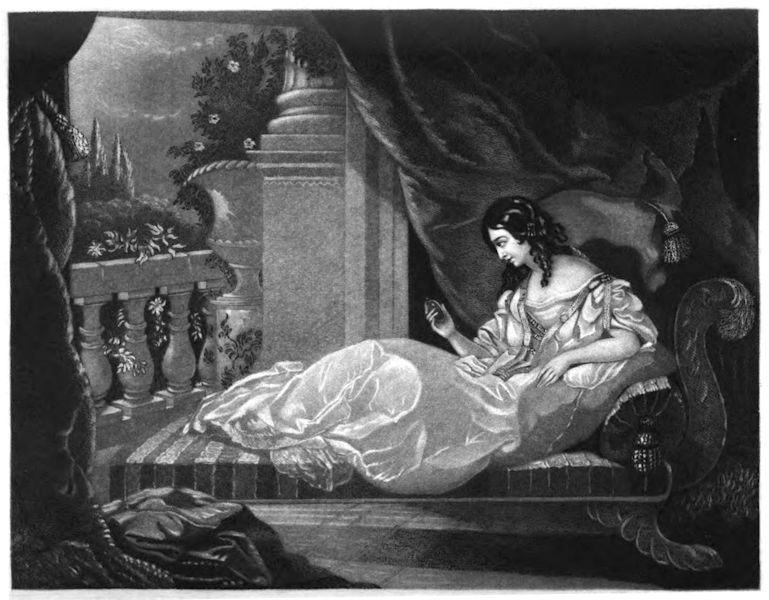
THE MINIATURE.
———
BY FAYETTE ROBINSON.
———
[A Mexican soldier, being grievously wounded in one of the battles of Hidalgo, was deserted by his victorious companions.
Unable to defend himself against the numerous Zopilotes, or vultures, which hovered around him, he put an
end to his life with his own hand.]
I feel the motion of each heavy wing—
I hear the rustling of the air they cleave—
The shadows they, like sombre phantoms, fling
Closely around and o’er me, hovering,
Beget wild fears, which busy fancies weave
Into a dreadful certainty.
I hear the war-cry on the distant field!
I see the dust, by charging squadrons cart;
The cannon’s blaze, the flash of burnished steel;
Bright banner’s wave, the rapid march and wheel,
Where every step may be, perhaps, the last
A soldier e’er may take.
Closely, more closely, still I see them sweep,
Their wings are furled, and eagerly, they tread,
Yet silently, as one who walks in sleep,
Swiftly, as tyrant monsters of the deep
Rush on their helpless prey, which seems to dread
Far, far too much to fly.
Ye whom I loved, my brethren of the sword,
With whom I left my distant mountain-home,
Come, come to me. Alas! no single word
I speak will ever by your ears be heard,
Where battle cries, the trump and stirring drum,
Salute your victory.
Was it for this I left my mother’s side,
And bade to her I loved a last adieu,
The dark-eyed girl I won to be my bride?
Was it to watch this warm, empurpled tide
Of life come gurgling, like a fountain, through
My rent and gaping breast?
Wounded, alone, upon the field of strife,
The shouts of victory upon mine ear,
My comrades joyous, or bereft of life,
Martyrs, with fame and glory ever rife—
I do not dread to die alone e’en here,
As yon brave men have died.
But oh, great God! I would not feel the beak
Of yon dark vulture tear away my heart;
Not that I wish my failing strength to eke—
A soldier’s death it was my joy to seek,
Wounded, alone, I have no other art
To save me. Let me die.
DURING THE EIGHTEENTH AND THE BEGINNING OF THE NINETEENTH CENTURY.
———
BY FAYETTE ROBINSON.
———
(Continued from page 198.)
Nor does the following present a much greater
difference, and, but for the ear-rings and knee-breeches,
would pass muster even now amid our
infinite varieties of palelots, sacks and Hongroises.
The boot-black represented in the cut is a miniature
bonnet-rouge.
It is worth while to state that costumes, like
opinions, reproduce themselves. As the ideas which
were once in vogue, and have been abandoned, return
and resume their influence and orthodoxy, so
do the costumes of other days continually reappear,
it is true, with a difference often striking enough, for
men no longer wear either coats of mail or inexpressibles
of velvet, yet the Norman cloak of the
Black Prince, and the sack of Lauzun, the handsome
French colonel, who, during our own Revolutionary
war, turned the heads and carried away the
hearts of half the women of Philadelphia, are still
every day to be seen.
The same thing is observable in female costume.
The long waists, tight sleeves and full skirts of old
times have returned, and even the ungainly ruffs of
Queen Elizabeth’s age have shown a disposition to
return. The mode of dressing the hair is also retracing
itself, so that there is little real difference
between the traditional court-dress of former times
and that of every-day life worn at present, except
the train.
The following is a caricature of that day, but
scarcely more outré than the bearded creatures from
time to time seen in our own streets. It may be remarked
that the passion for hair on the face always
is consequent on a war. In the time of Henri IV,
all the world was bearded; so during the days of
Cromwell were his ironsides, and now men who
never saw a shot fired, force the sublime into the
ridiculous, by parading a moustache in every thoroughfare
throughout the country.
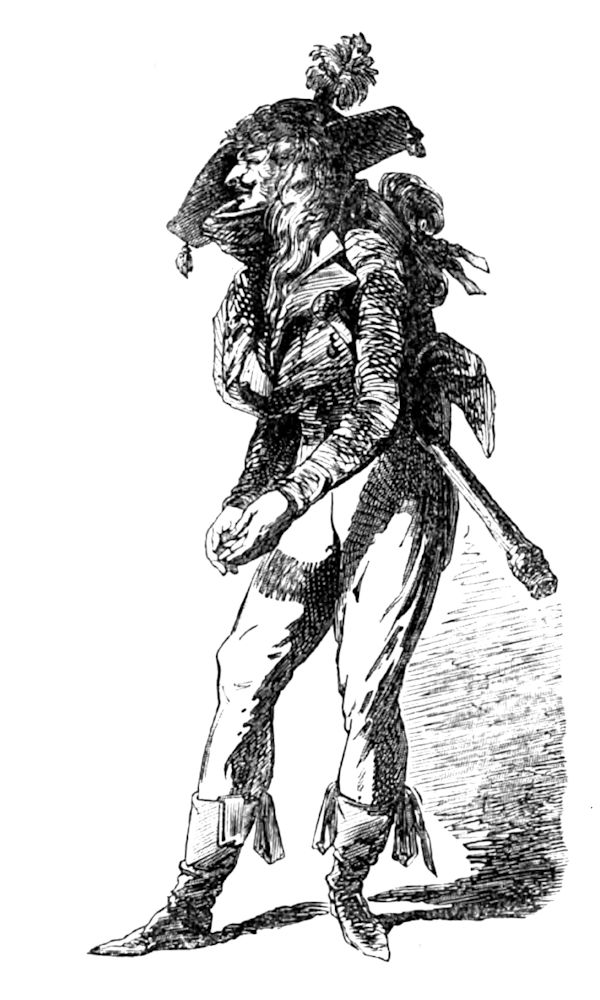
Who knows but that our own Mexican war may
exert an influence on dress, and that some day the
Ranchero’s striped blanket and broad-brimmed hat
may become the fashion. Men will stalk about the
streets in boots of cow-hide, and instead of hunting
with dogs and rifles, the lazo or lariette will be
adopted universally. All the world knows that immediately
after the return of the army of the Duke
of Wellington to England, from Waterloo, the military
black stock was adopted, and it may be that the
green pantaloons with the brown stripe, now worn,
are an imitation of the dress of the Mexican veterans
who were defeated at Cherebusco. The same may
be said of the cloth caps, with the covers of oil-skin,
now so much in vogue. It may be remarked that
this article of dress has always followed the tenue of
the army, the flat cap replacing the hussar’s, as the
latter did the old gig-top leather apparatus.
Other nations of Europe did not participate in the
French Revolution, but became imitators of the costumes
it created. We have now come to the period
of the Directory, which exerted its influence on costume,
or rather the influence of which was reflected
by the costume of the day.
The Directory and Consulate saw all France seized
with fury for the antique. These were the days of
the Romaines and Atheniennes, when David was
toiling with the pencil to effect a reform of costume,
and when Talma sought to introduce correct ideas
of dress on the stage. The men of Paris still adhered
to the English costume, which, fortified by
their fiat, became that of the world. They compromised
their English predilections, however, so far as
to wear their hair à la Titus or à la Caracalla,
what that was may be seen from the following
engraving.
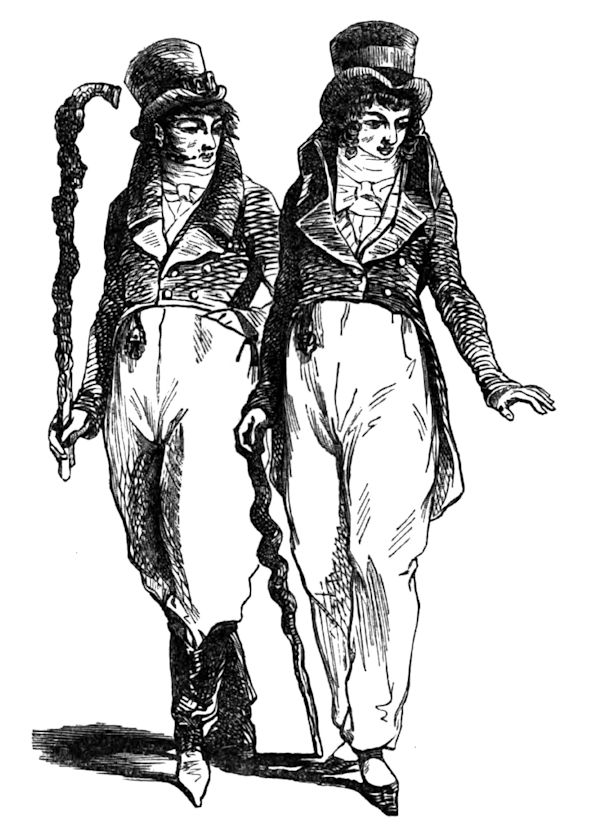
They seemed, however, to struggle to make this
costume as unbecoming as possible, wearing the
coats loose, the collars immense, the breasts small,
and such pantaloons and shocking bad hats as were
never seen before or since. The costume of a dandy
of 1798 consisted of a blue coat, a white waistcoat,
open in the breast, a finely worked shirt-bosom,
fastened with a diamond pin, a huge muslin cravat,
Nankin pantaloons, with black stripes down the
seams, and thrust into the boots. (In society the boot
was replaced by a small and pointed shoe.) The
everlasting bludgeon was as indispensable in the
street as the boots and the hat. To young Thelusson,
when thus dressed and armed, Madame de Stael,
who wore an oriental toilette, said, “Citizen, you
bear the sceptre of ridicule.” “Madame,” replied
he, “you are certainly competent to award it to
whom you please.” Never were there so many
strange costumes seen in any one city as in Paris
at that time, when peruques, powder, hair à la
Titus, cocked and round hats all were mingled together.
Costume was indeed republican if the government
was despotic.
[Conclusion in our next.
All Nature’s beauteous forms, of light, of earth, or air, or sky,
Compare not with the flexile frame, the lustrous, speaking eye;
The opening flower, the rainbow tint, the blue and star-lit dome,
Are things of naught, in contrast with the angels of our home:
All gentle acts, all noble thoughts, of Heaven-directed birth,
Are centered in the fair and good, the beautiful of earth.
———
BY PROFESSOR FROST.
———
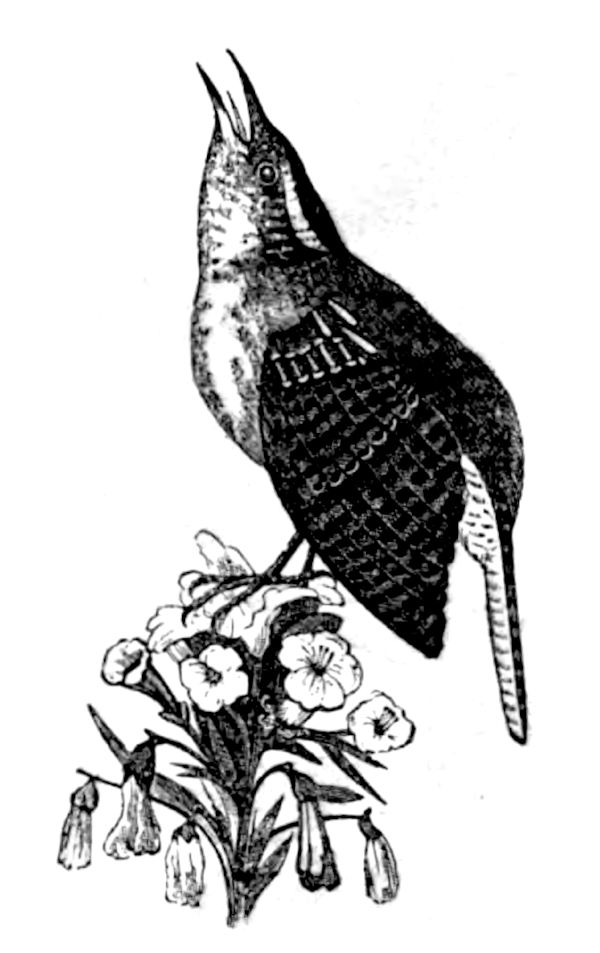
CAROLINA OR MOCKING WREN.
This interesting bird is strictly southern in its
habits, being rarely found north of Maryland and
Delaware, while it abounds during the whole year
in the warmer states. Occasionally it strays to the
vicinity of Philadelphia and even of New York;
but this is so seldom that the indefatigable Wilson
never found its nest north of the Maryland line.
Like the House-Wren it is a sprightly, industrious
and familiar bird, and a general favorite in the neighborhood
where it abounds. Other qualities render
its nature so ambiguous that some have hesitated to
place it among the Wrens. One of the most remarkable
of these is its power of imitating the songs
of other birds. With much sweetness and accuracy it
blends its own notes with the simple twittering of the
Ground-Robin, the harsh noise of the Woodpecker,
the trilling of the Blackbird and Warbler, and the
whistling of the Cardinal. These are its favorite
imitations; but its powers of mimicry embrace the
songs of almost all our forest-birds. But notwithstanding
this capriciousness in sounds, the Carolina
Wren is said to have a favorite theme, repeated
more regularly than any other. Nuttall thus pleasantly
describes it. “This was the first sound that
I heard from him, delivered with great spirit, though
in the dreary month of January. This sweet and
melodious ditty, tsee-toot, tsee-toot, tsee-toot, and
sometimes tsee-toot, tsee toot-seet, was usually uttered
in a somewhat plaintive or tender strain, varied
at each repetition with the most delightful and delicate
tones, of which no conception can be formed
without experience. That this song has a sentimental
air may be conceived from its interpretation by the
youths of the country, who pretend to hear it say,
sweet-heart, sweet-heart, sweet! nor is the illusion
more than the natural truth, for, usually, this affectionate
ditty is answered by its mate, sometimes in
the same note, at others in a different call. In most
cases, it will be remarked, that the phrases of our
songster are uttered in 3s; by this means it will be
generally practicable to distinguish its performance
from that of other birds, and particularly from the
Cardinal Grosbeak, whose expression it often closely
imitates, both in power and delivery. I shall never,
I believe, forget the soothing satisfaction and amusement
I derived from this little constant and unwearied
minstrel, my sole vocal companion through many
weary miles of a vast, desolate, and otherwise cheerless
wilderness.”
The food of the Carolina Wren consists of the insects
found in old timber, and along the banks of
streams, places which it delights to frequent. It is
found among the thick cypress swamps of the south
even in the middle of winter. It can see well in the
dark, sometimes searching food in caves, where to
most other day birds objects would be undistinguishable.
Its building places are a barn, or stable, some
old decayed tree, or even a post-fence. The female
lays from five to eight eggs, of a dusky white, mottled
with brown. Two broods are raised in a season,
and sometimes even three. The adult bird is five
and a quarter inches long, of a chestnut brown, beautifully
mottled with black and other colors. The
female differs little in color from the male.
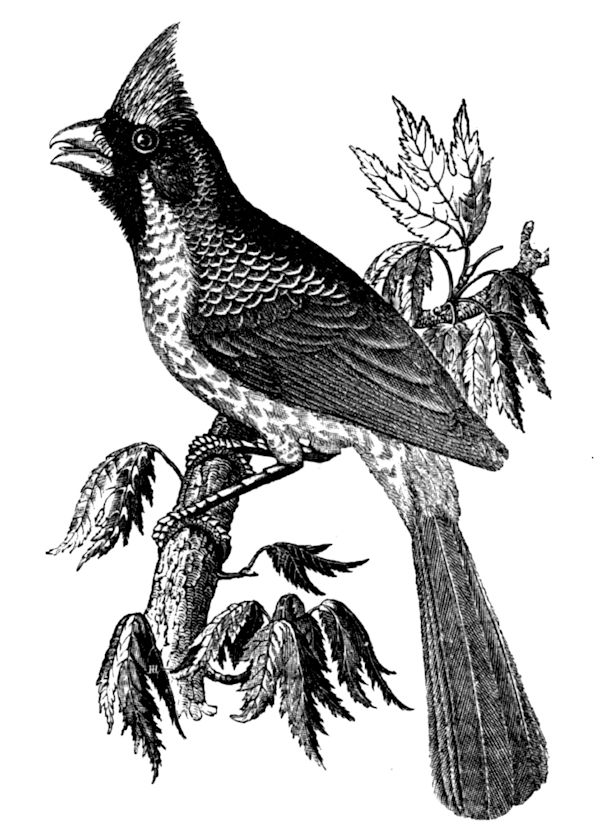
THE CARDINAL BIRD.
This bird is known under the names of Virginia
Red Bird, Virginia Nightingale and Crested Red
Bird. It is one of the most beautiful of American
songsters, and in power and sweetness of tone it has
been compared with the Nightingale. The species
belongs mostly to the United States and Mexico, but
has been found in considerable numbers in the West
Indies, Central America and Colombia. Although
delighting in a southern clime, it is sometimes observed
in Pennsylvania, and even New England.
Being migratory, it often flies in large flocks, presenting
a splendid appearance, especially when
moving in relief over a clear sky, and in the rays of
the sun. At other times several of these birds are
found associated with Sparrows, Snow-Birds and
other half domestic species. When alone his favorite
haunts are the corn-field, small clumps of trees, and
the borders of shaded rivulets. Corn is their favorite
food, in addition to which they eat seeds of fruit,
grain and insects. They are easily domesticated,
even when taken quite old, and require very little
trouble in order to thrive well. Loss of color, however,
has often been the result of long confinement,
although with care this might perhaps be obviated.
They are lively in the cage, and maintain their
powers of song to the last. Numbers of them are
carried to France and England, where they are
highly esteemed. Their time of song lasts from
March to September.
The Cardinal Bird’s song consists of a favorite
stanza often repeated, with boldness, variety of tone
and richness. Its whistling somewhat resembles that
of the human voice, though its energy is much
greater. In his native grove, his voice rises above
almost every other songster except the Mocking-Bird.
The powers of the female are almost equal to
those of the male, of whom she is a most constant
and affectionate partner.
Latham admits that the notes of the Cardinal “are
almost equal to those of the Nightingale,” the sweetest
of the feathered minstrels of Europe. But, says
Nuttall, “the style of their performance is wholly
different. The bold martial strains of the Red Bird,
though relieved by tender and exquisite touches, possess
not the enchanting pathos, the elevated and varied
expression of the far-famed Philomel, nor yet
those contrasted tones, which, in the solemn stillness
of the growing night, fall at times into a soothing
whisper, or slowly rise and quicken into a loud and
cheering warble.”
The Cardinal Bird measures eight inches in length,
and eleven from the tip of one wing to that of the
other. The whole upper parts are of a dull dusky-red,
except the sides of the neck, head and lower
parts, which are of a clear vermilion. The chin,
front and lores black. The head is ornamented with
a high pointed crest. The bill is coral red, and the
legs and feet are pale ash color. The female is somewhat
less than the male, and a little different in
color. Both sexes are noted for affection to their
young, and to each other; but so jealous are the
males that they have often been known to destroy
those of their own sex.
———
BY MISS M. SAWIN.
———
A world’s sweet enchantress, unbounded in fame,
O how shall I sing of so peerless a name—
Thy tones, from the wilds of a picturesque land,
The billows of ocean have borne to our strand;
Though I ne’er have beheld thee, yet bound in thy spell,
My bosom thine echoes still onward would swell—
Would enshrine in my song the sweet soul of thy strains,
Till fresh incense should rise from our mountains and plains.
Though long on the altar thou’st kindled the fire,
Oh how shall it burn on the strings of the lyre!
’Tis the music of Nature sublimed in thy lays
Which has won thee thy guerdon of lore and of praise;
’Tis hence that the depths of the spirit it thrills,
That responses start forth from mountains and hills,
That no barriers the flight of thine echoes can bind,
Which are borne o’er the earth on the wings of the wind.
There is glowing within us, all restless, a lyre,
Which would swell like an angel’s its anthems of fire,
But the shroud of mortality fetters its strings—
Yet thou while on earth hast unfolded thy wings,
Canst dwell with the fairies in chalice of flowers,
And glide with the wood nymphs in deep sylvan bowers;
Canst float with the moonbeams in dew-silvered trees,
And rise on the wings of the morn’s fragrant breeze,
While sunbeams are waking the rapturous lays
Of dew-drops and birds, and yet all ’neath their blaze;
Canst hover o’er ocean when storm it enthrones,
And bear from the foam-crested surges their tones;
When dark are the skies and the thunder-clouds lower,
With the eagle’s bold flight to the mountain’s crest soar;
The streams of the forest to their fountains canst wind,
And caverns resounding in solitude find;
Enshrined in thy spirit their voices canst keep,
Sublimed by thine alchemy subtile and deep,
At thy will from thy spirit their harmonies sweep,
And I ween thou hast soared to the portals of Heaven,
Or some angel a tone to thy praises has given.
O, Jenny, the brightest cynosure below!
The fount in thy bosom must here cease to flow;
Like the sear leaves of autumn which shroud the old years,
Thy harp-strings must perish ’mid wailings and tears;
Thy lovers who bend at thy purity’s shrine,
Enchained by the spells of thy carols divine,
When no temple’s proud arches resound with thy strain,
In the wilds of thy forests shall seek thee in vain;
But when from thy tomb they despairing return,
In lyres immortal thine echoes shall burn.
Alas! that thy music should ever here die,
Should leave the sad earth and ascend to the sky;
Yet when thou art fled to the seraphim throng
Will fancy yet list to thy glorified song,
Will dream that no harp on the heavenly plains
Has music so sweet as are there thy high strains.
Though we never may list while on earth to thy lays,
For the boon of thy being high Heaven we’ll praise;
Where thy strains are ascending must Paradise be—
Humanity’s scale is exalted in thee.
There is a tone in my bosom as yet unexpressed,
And fain would I bid it to ever there rest,
But the woes of the earth for its utterance plead,
Then may it go forth as a merciful deed:—
O, Jenny, while shining so brilliant on high,
Like the Lyrian star on the vault of the sky,
While the peers of the realms bow in homage to thee,
Dost never thy race in their miseries see?
To the charm of thy music we ever would yield,
By thee would be borne to Elysium’s field,
And forgetful that wrong or that wo were on earth,
Forever would list to thine angel-like mirth.
But the heart fraught with sympathies true, must embrace
The lowest as well as the stars of our race—
Round the poor and the wretched in bitterness twine—
On devotion’s wings rise to where pure seraphs shine;—
In our pathway to Heaven we encounter the thorn,
Each brother’s woes feel and the proud tyrant’s scorn—
The way that our holy Redeemer has trod
But leads us through tears to the throne of our God.
I know that thine own gushing spirit is free
As the winds that o’ersweep the high mountains and sea;
Thy genius has burst from all species of chains,
And freedom unbounded swells forth in thy strains;
But while ever exulting on fetterless wing,
Wouldst not the blest boon to each lorn spirit bring?
Thy music, which thrills to the depths of the heart,
Might bid us to deeds of true chivalry start;
Might bid the kind fountain in proud bosoms flow,
To heal the crushed hearts that are writhing in wo.
Both Knowledge and Virtue like angels descend,
The sad thralls of Sin and of Darkness to rend,
Perchance that the tyrant may yield to thy charms,
And avert the dread doom of the Future’s alarms,
Till unwilling vassals no more bend the knee,
But rise at his bidding and ever be free.
And the gold thou hast won by the charm of thy name,
To its splendor might add the philanthropist’s fame,
Till many an oasis from deserts shall spring,
When the arches of Heaven with thy praises shall ring.
———
BY J. BAYARD TAYLOR.
———
When the rains of November are dark on the hills, and the pine-trees incessantly roar
To the sound of the wind-beaten crags, and the floods that in foam through their black channels pour:
When the breaker-lined coast stretches dimly afar, through the desolate waste of the gale,
And the clang of the sea-gull at nightfall is heard from the deep, like a mariner's wail:
When the gray sky drops low, and the forest is bare, and the laborer is housed from the storm,
And the world is a blank, save the light of his home through the gust shining redly and warm:—
Go thou forth, if the brim of thy heart with its tropical fullness of life overflow—
If the sun of thy bliss in the zenith is hung, and no shadow reminds thee of wo!
Leave the home of thy love; leave thy labors of fame; in the rain and the darkness go forth,
When the cold winds unpausingly wail as they drive from the cheerless expanse of the North.
Thou shalt turn from the cup that was mantling before; thou shalt hear the eternal despair
Of the hearts that endured and were broken at last, from the hills and the sea and the air!
Thou shalt hear how the Earth, the maternal, laments for the children she nurtured with tears—
How the forest but deepens its wail and the breakers their roar, with the march of the years!
Then the gleam of thy hearth-fire shall dwindle away, sad the lips of thy loved ones be still:
And thy soul shall lament in the moan of the storm, sounding wide on the shelterless hill.
All the woes of existence shall stand at thy heart, and the sad eyes of myriads implore,
In the darkness and storm of their being, the ray, streaming out through thy radiant door.
Look again: how that star of thy Paradise dims, through the warm tears, unwittingly shed—
Thou art man, and a sorrow so bitterly wrung, never fell on the dust of the Dead!
Let the rain of the midnight beat cold on thy cheek, and the proud pulses chill in thy frame,
Till the love of thy bosom is grateful and sad, and thou turn'st from the mockery of Fame!
Take with humble acceptance the gifts of thy life; bid thy joy brim the fountain of tears;
For the soul of the Earth, in endurance and pain, gathers promise of happier years!
The Child of the Sea and Other Poems. By Mrs. S. Anna
Lewis, Author of “Records of the Heart,” etc. etc. New
York: George P. Putnam.
A large edition of “Records of the Heart” was sold in
a few months, and the fair author stepped at once into a
very enviable position. “The Child of the Sea,” etc. will
add much to her poetical fame. The poem which gives
name to the volume, and occupies most of it, is a romantic
and passionate narrative, and embodies all the main features
of Mrs. Lewis’s thought as well as manner. The
story is well conducted and somewhat elaborately handled;
the style, or general tone, is nervous, free, dashing—much
in the way of Maria del Occidente—but the principal
ground for praise is to be found in the great aggregate of
quotable passages. The opening lines, for example, are
singularly vivid:
Where blooms the myrtle and the olive flings
Its aromatic breath upon the air—
Where the sad Bird of Night forever sings
Meet anthems for the Children of Despair.
The themes of the poem—a few lines farther on—are
summed up in words of Byronic pith and vigor:—
——youthful Love,
Ill-starred, yet trustful, truthful and sublime
As ever angels chronicled above—
The sorrowings of Beauty in her prime—
Virtue’s reward—the punishment of Crime—
The dark, inscrutable decrees of Fate—
Despair, untold before in prose or rhyme.
We give a few more instances of what we term “quotable”
passages—thoughtful, vivid, pungent or vigorous:
Fresh blows the breeze on Tarick’s burnished bay—
The silent sea-mews bend them through the spray—
The beauty-freighted barges bound afar
To the soft music of the gay guitar. . . . . .
The olive children of the Indian Sea.
That rayless realm where Fancy never beams—
That Nothingness beyond the Land of Dreams.
Folded his arms across his sable vest
As if to keep the heart within his breast.
——Violets lifting up their azure eyes
Like timid virgins whom Love’s steps surprise.
And all is hushed—so still—so silent there
That one might hear an angel wing the air.
——There are times when the sick soul
Lies calm amid the storms that ’round it roll,
Indifferent to Fate or to what haven
By the terrific tempest it is driven.
The dahlias, leaning from the golden vase,
Peer pensively into her pallid face,
While the sweet songster o’er the oaken door
Looks through his grate and warbles “weep no more!”
——beauteous in her misery—
A jewel sparkling up through the dark sea
Of Sorrow.
Delirium’s world of fantasy and pain,
Where hung the fiery moon and stars of blood
And phantom ships rolled on the rolling flood.
“Isabelle or The Broken Heart” occupies some 40 pages,
and is fully as good as “The Child of the Sea”—although
in a very different way. There is less elaboration, perhaps,
but not less true polish, and even more imagination.
The “Miscellaneous Poems” are, of course, varied in
merit. Some of them have been public favorites for a
long time. “My Study,” especially, has been often
quoted and requoted. It is terse and vigorous. From
“The Beleagured Heart” we extract a quatrain of very
forcible originality:
I hear the mournful moans of joy—
Hope, sobbing while she cheers—
Like dew descending from the leaf
The dropping of Love’s tears.
The volume is most exquisitely printed and bound—one
of the most beautiful books of the season.
The History of England, from the Accession of James II.
By Thomas Babington Macaulay. New York: Harper
& Brothers. Vols. 1 and 2. 8vo.
No person, of whig or tory politics, could in the present
age, propose to himself the task of writing the history of
England, without feeling the delicacy and responsibility
of his undertaking, and the necessity of exercising a different
class of powers from those which may have given
sparkle and point to his partisan efforts. The importance
of the principles involved in the events and characters
coming under his view, and their wide applications to
contemporary controversies, would be sure to bring down
upon the unlucky advocate a storm of moral and immoral
indignation. It would seem on the first blush that Macaulay,
with all his vast and vivified erudition, was not
a writer calculated to experience the full force of a historian’s
duties, or to display in the analysis and judgment
of events that intellectual conscientiousness which is a
rare quality even in powerful minds. His historical
essays bear as unmistakable marks of partisanship as
ability, and are especially characterized by a merciless
severity, which, in the name of justice, too often loses the
insight us well as the toleration which come from charity.
Sir James Macintosh, toward the commencement of his
career, referred to him as “a writer of consummate ability,
who has failed in little but in the respect due to the abilities
and character of his opponents.” Though as a partisan,
Macaulay was a partisan on the right side, on the side of
liberty and truth, the unmeasured scorn he poured, hot
from his heart, on tyrants and bigots, and the fierce,
swift sweep of his generalizations, often made his cooler
readers suspicious of his accuracy when most dazzled and
delighted by his brilliancy. In the present history a great
change is manifest. The petulance, the flippancy, the
dogmatism of the essayist, are hardly observable, and in
their place we have the solid judgment of the historian.
There is a general lowering of the tone in which persons
and principles are considered, consequent upon the change
in the writer’s position from an antagonist to a judge. The
style, while it has no lack of the force, richness, variety,
directness and brilliancy, which characterized the diction
of the essayist, has likewise a sweetness, gravity and
composure which the essayist never displayed. Though
the writer’s opinions are radically the same as ever, they
are somewhat modified by being seen through a less extravagant
expression, and by being restored to their proper
relations. In fact, the history presents Macaulay as a
wiser and more comprehensive man than his essays, and
if we sometimes miss the generous warmth and intensity,
and the daring sweep of his earlier compositions, we also
miss their declamatory contemptuousness and mental
bombast.
The volumes which the Harpers have given to us in so
elegant a form, (vulgarized a little by Dr. Webster’s ortho-graphical
crotchets,) close with the proceedings of the
Convention which gave the crown to William and Mary.
A long historical introduction, containing a view of
English history previous to the reign of James II., and a
view of England, in its manners, customs, literature and
people at the time of his accession, occupy the larger portion
of the first volume, and are almost unmatched, certainly
unexcelled, in historical literature, for the combination
of condensed richness of matter with popularity of
style. Then follows the narrative of the three years of
folly and madness which produced the revolution of 1688,
and hurled James II. from his throne. This narrative is
detailed with a minuteness which leaves nothing untold
necessary to the complete apprehension of the subject in
all its bearings, and it evinces on almost every page not
only singular felicity in narration, but great power of
original and striking observation. Masterly generalization,
and sagacity in seizing and luminousness in unfolding
the principles of events. The whole history has the
interest of a grand dramatic poem, in which the movement
of the story and delineation of the characters are managed
with consummate skill. The portraits of Charles II.,
James II., Danby, Rochester, Sunderland, Godolphin,
Halifax, Churchill, and especially William of Orange, are
altogether superior to any which have previously appeared.
Halifax and King William seem to be Macaulay’s favorites,
and he has surprised many of his readers by his
comparative coolness to Russell, Sydney, and the whig
patriots generally.
The history closes with an eloquent passage on the
“glorious” Revolution of 1688. It appears to us that the
meanness and lowness which Macaulay has developed
in the actors in the event, impress the reader with a
different notion of it. The whole thing has a jobby air,
in which no commanding genius is observable, and no
sacrifices seem to have been made. Indeed Macaulay
himself, in one of his essays, remarks truly that the only
sacrifices made in the Revolution, “was the sacrifice
which Churchill made of honor and Anne of natural
affection.” That the Revolution, in its results, was one
of the most glorious recorded in human annals, there can
be little doubt, but it had its birth in such odious treachery,
and was conducted by men so deficient in elevation of mind
or even common honesty, that its story is little calculated
to kindle sympathy, or awaken admiration.
The History of England from the Peace of Utrecht to the
Peace of Paris. By Lord Mahon. Edited by Henry
Reed, Professor of English Literature in the University of
Pennsylvania. New York: D. Appleton & Co. 2 vols. 8vo.
The author of this history is all English nobleman of
large historical acquirements, who has managed to produce
two or three valuable works demanding great study
and research, without interfering with his duties as a
member of Parliament, though, doubtless with some interference
with his pleasures as a member of the English
aristocracy. The present work is valuable for its accuracy,
and interesting from its giving a connected view of the
history of England during a period but little known except
by the empty abstracts of stupid compilers, or the brilliant
but prejudiced letters and memoirs of contemporary
writers and statesmen. It comprehends the administrations
of Harley and Bolingbroke, of Stanhope, Walpole,
Carteret, Newcastle and Chatham, thus including the
latter years of the reign of Queen Anne and the reigns of
George I. and II. The period covers a wide field of
characters and events, and Lord Mahon has been especially
successful in unraveling the threads of the foreign policy
of England, and indicating the difficulties experienced by
her statesmen in sustaining the House of Hanover on the
throne. In a narrative point of view the best portions of
the history are those relating to the rebellions of 1715 and
1745. It is almost needless to say that Professor Reed
has added much to the value and interest of the work by
his elucidative notes.
But the richness of Lord Mahon’s materials and the
interest of his subject cannot conceal the fact that he lacks
both the heart and the brain of an able historian, and that
he is essentially a common-place man. The reflections he
appends to some of his narratives are commonly such
obvious truisms, or such poor apologies for reason, that
the reader is made painfully aware of his being in the
company of a mediocre gentleman, who, while he always
means well, never means much. Lord Mahon is deficient
equally in historical science and historical imagination,
and his work equally barren of profound principles and
vivid pictures. A moderate tory, he holds the hearsays
of his creed with a lazy acquiescence, without sufficient
passion to be a bigot, and without sufficient logic to be a
sophist. When he is tempted into historical parallels, or
disquisitions on the changes of parties, as in that passage
where he essays to prove that a modern whig is synonymous
with a tory of Queen Anne’s day, he adopts the argumentation
of Fluellen rather than Chillingworth—shows that
“there is a mountain in Wales and a mountain in Macedon,”
and leaves the reader to mourn over the misdirection
of the human faculties. In his estimate of literature he is
still worse. The disquisition on the literature of Queen
Anne’s time, in the present history, is a medley of mingled
commonplace, which has been worn to rags, and critical
nonsense, which has been long exploded. His history,
therefore, must be considered simply as a useful narrative
of important events, and carefully distinguished from those
of Guizot and Thierrey, of Hallam and Macaulay, of Prescott
and Bancroft.
Leaves from Margaret Smith’s Journal in the Province of
Massachusetts Bay, 1678-9. Boston: Ticknor, Reed &
Fields. 1 vol. 16mo.
This beautifully printed volume sustains both the reputation
of its publishers for printing handsome books, and
its reputed author for writing good ones. It is generally
attributed to Whittier, and it certainly displays throughout
the shrewdness with which that poet observes, and
the facility with which he idealizes events. Here is a
volume bringing up to the eye with the vividness of reality
the scenes and characters of a past age, and making us as
familiar with them as if we had ridden by the side of Margaret
in her journey from Boston to Newbury, and yet
through the whole book runs a vein of pure poetry, lending
a consecrating light to scenes which might possess
but little interest if actually observed. The quaint spelling
undoubtedly adds to the illusion of its antiquity, but
what makes it really seem old is its primitive sentiment
and bold delineations. Margaret herself is a most bewitching
piece of saintliness, with the sweetness and
purity of one of Jeremy Taylor’s sermons, and as full of
genial humanity as of beautiful devotion. Placed as she
is amid the collision of opposite fanaticisms, the austere
fanaticism of the Puritan and the vehement fanaticism of
the Quaker, she shines both by her own virtues and by
contrast with the harsh qualities by which she is surrounded.
The book provokes a comparison with the
Diary of Lady Willoughby, and that comparison it will
more than stand, being superior to that charming volume
in the range of its persons and events, and equal to it in
the conception of the leading character. The author has
shown especial art in modifying every thing, by the supposed
medium of mind through which it passes—the heroine
telling the whole story in her own words—and at the
same time preserving every thing in its essential life.
This is a difficult and delicate process of representation,
but Whittier has performed it.
Democracy in France. By Monsieur Guizot, Late Prime
Minister. New York: D. Appleton & Co.
This little volume is well worthy the reputation of one
of the greatest historians, philosophers and statesmen at
the age—in other words, of the reputation of Guizot. It
is marked by preeminent ability in statement, analysis,
argumentation and composition, and we doubt not will
exert some considerable influence on the politics of France.
In his preface the author avers that nothing in the volume
bears the impress of his personal situation, and he adds,
“While events of such magnitude are passing before his
eyes, a man who did not forget himself would deserve to
be forever forgotten.” The book justifies the author’s
assertion. It is simply an examination of things without
regard to persons, and is as philosophic in its tone as in
its method. The chapters on The Social Republic and
The Elements of Society are masterpieces of analysis and
statement, and well deserve the attentive study of all who
think or prattle on social science. It seems to us that the
present volume is sufficient to convince all candid minds,
that whatever may be the faults and errors of Guizot as a
statesman, he has no equal among the men at present
dominant in France. Since his fall that country has been
governed, or misgoverned, by soldiers and sentimentalists,
with a pistol in one hand and the Rights of Man in the
other, and is a standing monument of the madness of trusting
the state to men of “second rate ability and first rate
incapacity.” The Red Republicans have principles; M.
Guizot has principles; the legitimists have principles;
but the present dynasty has the peculiar character of being,
in an intellectual sense, the most thoroughly unprincipled
government that French ingenuity could have
formed.
Oregon and California. By J. Quinn Thornton. New
York: Harper & Brothers, 1849.
A pleasant book, well written, and containing much information
just now, peculiarly valuable in relation to
Oregon and California. Many strange phases of life in
the wilderness and prairie, are described by one who
knows its peculiar hardships and pleasures. The terrible
sufferings, the awful stories told of the early emigrants,
are faithfully given, and, if official accounts be true, are
scarcely exaggerated. A valuable appendix on the gold
country is added, undoubtedly to be relied on. The book
is well illustrated in wood.
The Parterre, a Collection of Flowers Culled by the Wayside.
By D. W. Belisle. Philadelphia: J. B. Lippencott
& Co., 1849.
A pretty looking volume, very creditable to the publishers
in a typographical point of view, and containing
a number of poems of various lengths, on a variety of subjects.
The longest, Wallenpaupack, is an attempt, and a
very creditable one also, to commemorate an incident of
the history of the North American Indian, a source of
poetical subjects too much neglected. The book is well
worth attention. It may not be uninteresting to state that
the type has all been set up by the author.
Roland Cashel. By Charles Lever. Illustrated by Phiz.
New York: Harper & Brothers.
This is probably the best novel of one of the most popular
novelists of the day. Lever has not much solidity of mind,
and accordingly never produces any masterpieces of characterization
or passion, but he has a quicksilver spirit of
frolic and drollery, and an intensity of mirthful feeling which
have made some critics place him on a level with Dickens.
The present volume will more than sustain the reputation
which his former frolicksome audacities have attained.
“GRAHAM” TO “JEREMY SHORT.”
My Dear Jeremy,—In my last I promised you a reminding
hint, a sketch reflective and suggestive of mining
operations, as an offset to the brilliant visions of “Gold
Placers,” which haunt the mind, sleeping and waking, of
Uncle Sam’s children. While multitudes are making haste
to grow rich, by going around the Horn, and at the terminus
of their long voyage will find themselves coming
out of the little end of it, you and I may amuse ourselves
over a subject somewhat kindred—a retrospective folly—feeling
the while a good deal like the boy on getting rid
of the jumping tooth-ache—“a heap better” are we, “now
it is over.”
Copper! You have heard of it before, I believe? and
may have about you a memorandum of a few thousands,
entered on the credit side, not available now at your
bankers. It was a very happy delusion, was it not? I’ll
warrant me that you had already planned your cottage
orné and had the walks laid out, and the shrubbery planted
quite tastefully and imaginatively picturesque. Several
castles, with steeples rather airy, of my own, were toppled
down, and elegantly bronzed as they were, are quite
useless now for purposes of reproduction, so that we may
say, that we have had some of the advantages of wealth
without a present care in disposing of it. The servant
girl who wished for riches “that she might ride in her
carriage and feel like missus,” had the delights of anticipation
only, poor soul! while ours are embodied in the
delicious reflection of having passed that “missus” on the
road, with a pair of fast trotters—taking the air with quite
an air, at the rate of “two forty.”
“Come easy, go fast,” was the remark of an old German
Uncle, who, having made a fortune by hard knocks at the
anvil, looked with a quiet smile at these thousands in perspective.
In regard to the horses, the old gentleman was
right—but as the money never came, I think his premises
were altogether wrong. One thing is certain, real estate
rose very rapidly in our vicinity at that time, and as several
lots went off at spanking prices, to be kept out of our
clutches, we may be said to have been benefactors to the
sellers and conveyancers. So that copper—the vilest of
metal—may, in some crucibles, be transformed into gold.
But not to anticipate.
Grubemout had been upon the mountain-side, which
overlooks the delightful village of Fleeceington, for a
month or more, making careful chiselings from rocks,
and excavations at their sides. Uptosnuff carried his pick-axe
and his basket. The “collection” gradually swelled
upon their hands, until it became quite formidable; and
the “choice specimens,” were without number, rich, and
without reason, rare. Drawitwell, the host of “The
Hawk and Buzzard,” had his eye upon their movements,
and always made it a point to take a peep at their basket
when they descended in the evening. He was an open-eyed
sort of an old lark, who had had his own way in the
village at election times and at trainings, by virtue of a
colonelcy and aidship to the governor—a cheap sort of
payment for service rendered—and he felt as if nothing
of importance ought to transpire in the place, unless he
had a hand in it. Drawitwell did not like the air of
mystery with which his lodgers slipped the covered basket
up stairs, after they had performed their ablutions; nor
the roaring noise made overhead, as the “specimens”
were poured into the two great chests, previously prepared;
and he was just the man to get at the bottom of
a mare’s nest. So, by virtue of appliances best known to
himself, he contrived to get a look at the collected specimens,
and made up his mind at once that the thing was
too slily managed by half, and that if there was wealth in
the rocks he would have a finger in the transaction.
“He would at any rate.”
Crispin, the village cobbler, had thrown his eyes from
his lapstone, across the creek, and up the hill-side, to take
note of the motions of “the wandering stone-crackers,”
as he called them, and his brain was in a pother.
The blacksmith had sharpened their pick more than once,
which had put on edge his curiosity, and had “contrived
to pick their brains, while they pecked the rocks,” as he
jocosely remarked, and he had smelt metal in their
movements.
Over their evening ale, at the tavern, the probabilities
and possibilities of gold or silver being found in the mountain,
were discussed with various degrees of profundity,
and the certainty that something of the kind was there,
was most sagely resolved on. Time, in whose crucible
all doubts are solved, soon confirmed their sagacity by a
“copper button” presented to the landlord with the compliments
of Uptosnuff, with hints, but not positive injunctions
as to secrecy. He knew his man.
“What do you think of that?” asked Drawitwell, of his
cronies the same evening, with an air of authority, holding
up the copper button. “What do you think of that,
my lads?”
“Hellow!” exclaimed the bewildered cobbler, “landlord,
why—why is that goold?”
“Gold, you fool! No, it’s not gold—but it’s a precious
sight more valuable—because there is a great deal more
of it used.”
“Why what on earth is it, then?” asked the blacksmith,
in amazement.
“It’s Copper! my lads! Copper!!”
“Copper!!”
“Yes, I reckon it is!—and the genuine metal, too!
And the mountain is as full of it as an egg is of meat!
Only melt down one of the rocks up there, and you’ll see
how it will fly out!”
To have stopped the spread of such information as this,
would have surpassed the ingenuity of our clerical friend,
who was opposed to the Magnetic Telegraph, as “a device
of the devil.” There was a California excitement in a
village, with California itself in their own mountain. He
would have been a lucky traveler, who could have had
his horse shod for a guinea, or a bridle-rein mended for
double the amount.
“You see, my lads!” says Drawitwell, haranguing
the crowd, “they are going to do the fair thing by us, they
have bought the land, and are getting their act of incorporation
ready, and we are all to have shares in it at a
reasonable rate—and I reckon I’ll have a few, or money
must be scarce in Fleeceington. There’ll be high times at
the “Hawk and Buzzard”, now, I should say, when every
man in this prosperous village can be an owner, for a
small sum, in one of the richest mines on the face of the
earth. You see it’s going to be most unconscionable high,
too—it’s now twenty-two cents a pound—for the government
is advertising for it in the newspapers—no doubt to
make bullets with to match the infernal poisonous Mexicans.
Gad, we’ll give the rascals a taste of their own
physic, now, I reckon! And then don’t they make water-pipes
with it now, and sheetings. And don’t they cover
houses with it, and ships; and I guess the time is not far
off when government will have her mint on this spot—and
what’s to hinder us, then from spending our own
coppers, bran new, ha! ha! If any body here has got a
farm for sale, I’m his man!”
As for buying farms, the thing was perfectly absurd
now, and Drawitwell should have known it; for who
could tell that there was not a copper-mine under every
one of them. It was not to be supposed either that the
good people of Fleeceington could keep the knowledge of
such extraordinary wealth all to themselves, and our
usually quiet city was all agog, with the wondrous stories
of the extent and richness of the mines; and to confirm its
truth, Grubemout and Uptosnuff were here with the
charter, and the script elegantly engraved, and any number
of specimens, and copper-buttons confirmatory.
In a day or two a few shares were in the market at “a
slight advance on the original cost.” Capitalists had been
up who thought they “knew a thing or two”—and gudgeons
began to nibble, the knowing ones among the
number. The market advanced. One, two, three, four
hundred per cent. was quickly achieved as competitors
increased; and considering that the first cost was perhaps
a dollar an acre, for an unwooded, untillable, rocky hillside,
curved up and set down at a dollar per square foot
as “original cost,” the profit was tempting—the market
active—ditto the original holders. There was a fierce
avidity for a stock which advanced at such rapid strides,
and the reckless became crazy, the cautious reckless and
visionary. “The Board”—knowing dogs—looked on for
a while doubtfully, but in amazement. The “Outsiders”
indulged in ecstasies and fanciful millions. Thousands
were added up upon stock-books, as if they were “trifles
light as air”—and they were. Merchants cut the shop—lawyers
the red tape and sheep-skin—editors told the
messenger for copy to “go to the devil”—and all became
“gentlemen on ’change.” Healths were drunk “to the
United Copper-Heads”—and champagne and Havanas
“suffered some.” Fun and puns flashed fast and furious—and
all this the while the great bubble rose up, expanding
and beautifying as it ascended.
It was not to be expected that a single mountain should
contain all this good luck exclusively, and in various
quarters envious copper-rocks poked their noses out, quite
seductively to anxious companies, who formed upon the
spot. One gigantic intellect proposed the formation of a
company to shovel the sand off of the whole State of New
Jersey, so as to get at the substratum, at once and emphatically.
Copper became substantially the great business
of life—the only business of the board—the board
being in fact rather a small affair while copper abounded.
Sharp occupied his time in buying up superfluous real
estate, which seemed to have been infected by copper,
and showed a disposition to rise—and he was afraid it
might go up and never come down again. The conveyancers
assured him that he ought to take it—like a sportsman—on
the wing, right and left. He did, and clapped a
heavy mortgage on it to keep it steady.
That disturbed the figures on Flat’s memorandum—for
he hoped to have bought and paid for it with his expected
profit on copper, and to have staggered somebody else’s
property with a mortgage from the surplus. It was
provoking.
Jones and Wilkins resolved to “take a shy at the
copper anyway, while it was going;” but the stock of all
the companies seemed shy of them. They “bid ten
dollars through a broker”—it was twelve. “Bid twelve”—it
was fourteen. Wilkins had had enough of it. He believed
it was “only a bubble blown up to catch the eyes
of fools. He was done with it.” But Jones was down
in the morning, as merry as a lark, and as early. He
“knew some of the outsiders, and thought he would catch
some of them before the morning was over.” He did—and
went home to dinner, having made “a fortunate hit.”
“Five hundred shares,” said he, “at fifteen, and the
last sale ‘after board,’ nineteen and a half! Four dollars
and fifty cents per share. Five aught is naught; five
fives are twenty-five, five fours are twenty, and two are
twenty-two. Twenty-two hundred and fifty dollars—that
will do for one day, I should say. Wilkins would
like me to give him half, as we were to have gone in together
yesterday, but I wonder what Wilkins ever did for
me, that I should give him eleven hundred and twenty-five
dollars! Not quite so green!”
The next morning Grubemout brought down some specimens,
which “he thought” would yield forty per cent.
if they were assayed, and thought that they ought to make
an assessment of a dollar a share, so as to put on more
hands and drive out the ore. Jones said that “that was
right enough.”
The assessment was called in, at which the stock hesitated
for a day or two—made a start and went on—but a
second installment being urged, it faltered a little, and
then stopped. At the third it “declined a shade,” at
which the “bears” gave a shake and a growl.
But Grubemout had—in the nick of time—“just received
a letter from the mines of the most important nature,
which it would not do to show in ‘the street,’ or
the stock would be balooning it—Uptosnuff had just made
a cross-cut.”
“The deuce he has!” exclaimed Jones, rather nervously.
“What is that?”
“A cross-cut, you see,” says Grubemout, “is nothing
more than ‘a shaft’ run at right angles past the old one
we have been working. He struck some glorious ‘deposites,’
and—”
“Why I thought you always said there was a vein,
Grubemout? These deposites are confoundedly leaky and
treacherous affairs.”
“And so there is a vein, my boy, and we are just getting
into it; deposites are always the first thing we look
for in copper mining. As long as we have them we get
on swimmingly; but you are so confoundedly skittish! I
was just going to tell you, that in making the ‘cross-cut,’
Uptosnuff has struck ‘the master vein!’ and found an old
‘drift’ in the mountain, which you will see after a while,
is important. In it he found old hatchets, and hammers,
and images in copper, supposed to have been the rude
efforts at mining and smelting by the Indians long ago—say
before the Dutch had taken Holland, or achieved the
renowned name of Knickerbockers, and had gone home
copper-fastened.”
Information so desirable as this would work its way out
somehow, and gentlemen would now bet you a trifle—say
champagne and cigars—that a dividend of twenty-five
per cent. would be declared on the stock the first year; or
would give you a hundred dollars for agreeing to pay the
annual dividend on a hundred shares.
Jones is “satisfied now,” and forthwith buys five hundred
shares more, as do other Joneses, and Browns, and
Greens. Outsiders became as plenty as gooseberries, and
as verdant; and it would seem, from the number of shares
reported at the Board, and “after,” that certificates had
quadrupled, and never could multiply fast enough to supply
the demand. Indeed, as one old gentleman was heard to
end a prolonged whistle, by exclaiming—“Gas!” the
market became so inflated that the Joneses, Browns, and
Greens, declined the attempt of cornering the stock, in
despair.
“The company,” called for an additional installment at
once. “Why, what the deuce,” asks Jones, “does the
company want with more installments? Haven’t they got
copper enough!”
“Copper ore, my dear fellow,” responded Grubemout.
“Yes, lots of it. But Uptosnuff wasn’t brought up in a
Cornish mine for nothing. The furnaces at Baltimore and
Boston want it for half-price, but as they are nearly out,
we intend to make them smoke, ha! ha! But we must go
to the expense of an “adate” in the meanwhile.”
“Why, what’s the use of that—what good will that
do?” asks Jones. “What is an adate, anyway?”
Poor Jones had a good deal yet to learn about copper-mining,
and felt naturally alarmed at these ominous terms.
The “cross-cut” was the beginning of puzzlers. He had
yet to see—I may as well say he ultimately did see, “the
drift,” to help along “the pumps,” as well as the adate
with installments, and to become familiar with a variety
of mining lore, which assists knowledge in its acquisition,
by obligingly allowing us to pay for it. But I believe he
never did understand “what they wanted with so many
work-shops—he thought they were miners!”
“An adate, Jones, is only a drain to relieve the mine
when it is overcharged with water.”
“Oh! is that all!”
But this calling in of installments seems to be a sort of
patent condenser in the stock market, and shows with
how much force a given quantity of air can be squeezed
into a given compass.
Grubemout was as active as a bee at sunrise, and offered
his advice gratuitously—but “confidentially”—to any
number of anxious inquirers—but some of them having a
copper-mine of their own, by the attractive and taking
name of “Penny-wise Company,” and others having
taken a snap with the “Alligator Mountain Company,”
and not liking the bite they received, shook their heads at
Fleeceington and looked knowing—the “New Jersey”
chaps were quite sprightly, for as their title covered the
whole State, they had a fair chance of realizing something
when the “Mammoth Shoveling Company” got to
work, and lifted the crust off.
Grubemout assured them—“on his honor”—that “the
Company did not intend to sell an ounce of its ore to
the furnaces. They intended to have ‘a crushing machine’
of their own erected at once, and proceed in a style
that would soon settle the whole business.”
Jones was “ready for any number of crushers or
mashers, grinders or pounders. Head up the creek—dam
it! Put up the water-works and the mill-wheel, and give
it to the blasted furnaces! Carry the war into Africa!”
said he.
The installment to carry on the adate was paid, though
it depressed the stock, but Jones could not see how having
paid the company five thousand dollars in installments
should depress his stock in the market. “Hang it!” said
he, “the company is that much richer in property and excavations,
and don’t I belong to the company—haven’t I
a thousand shares? It’s only paying money out of one
pocket, and putting into the other. Wilkins may laugh,
but he’s a fool! That’s a capital idea about the furnace.
You’re a boy, Uptosnuff—you are?”
The installment for crushing purposes was soon called
in also, and paid, though the stock looked sickly, and
trembled as if it had the ague, or had passed through a
crushing process on its own hook. It was just composing
itself when Uptosnuff discovered that it was of the highest
importance to the company to have a small engine and an
iron pump erected at the mines at once, as the richest ore
is always found below water level!
Jones—the active, energetic Jones—“had no doubt of
it at all. The Cornish miners assured him, when he was
up, that as soon as they got below water level, they would
come to something that couldn’t be trifled with. If Wilkins
wasn’t a fool he would go in soon, before it gets out.”
Uptosnuff, too, had had a quantity of the late ore assayed,
and Professor Stuffemwell, Geologist to Her Majesty,
thought it would do bravely. If ore that yielded fifty per
cent. would not, he would like to know how her majesty’s
subjects got rich, after paying the miners, on mines that
yield but fifteen per cent.
Copper buttons now replenished the pockets of dealers,
and the stock made several violent gasps and starts for a
desirable existence. But it was consumptive—evidently
going into a rapid decline. The crushing process and the
iron pump having depressed its spirits, and exhausted still
further its vital energy.
Grubemout thought that if the buttons were pressed
into bars, and shown upon Change it might be encouraging,
and mitigate the violence of the disease; but some
wag of a broker suggested that it was “a BAR sinister;”
which remark sinister ruffled the backs of the bars, caused
the bulls to toss their horns unpleasantly, and shook still
further the liveliness of the stock, which drooped visibly
under the imputation.
Even Jones—the ardent, trustful Jones—got earnestly
anxious about the state of the patient, and “suggested a
consultation.”
Brown was full of good intentions, but “pleaded debility
of the pocket, which, under heavy depletion, was
rather low.”
Green was a little vivacious, and “suggested a new
cross-cut.”
Grubemout was pleased with the idea, and hinted at “a
new installment.”
Uptosnuff had “missed the stage, and was unable to
get down to the meeting.”
Wilkins, in answer to a pressing invitation to “come
in,” was “busy selling goods.”
Sharp would not attend—“he had never had any thing
to do with the rascally copper, and found his real estate
bad enough just now.”
Flat “had enough of copper stock—it was not very
heavy, to be sure, having rather a tendency to dissolve
into air, its original element, but he was satisfied.”
The Stock grew feebler after consultation, as patients
are apt to, in critical cases, from want of remedy.
The Bulls looked surly, as if they had been disappointed
in pasture.
The Bears were as frisky as it is possible to be on a
frosty morning, and were so much in their own element,
that you looked involuntarily around for floating icebergs—and
copper in this temperature of the atmosphere sunk
into a torpor.
On Change, in this changing world of ours, copper
looked blue.
The Outsiders had rubbed out their pencil-marks on stock
memorandums, and dissipating the written evidence of
thousands that had vanished into air, they themselves
vanished. It was needless to say any thing to them about
copper, they “never had any thing to do with it, beyond
a hundred shares or so, which they sold out before the
bubble looked like bursting.” Stockdom was desolate,
save that a few of the bears showed their teeth, and grinned
as furiously as if they had just arrived fresh from the
Polar regions, and had brought any quantity of wet
blankets with them. Yet they looked as if they would
rather than not that any dealer in copper should take hold
of them. The bulls were more plentiful—looked savage
but knowing, but showed no disposition to dash at imaginary
enemies in scarlet, having rather a taste left for their
friends, the Browns and the Greens, who were urgently entreated
to “come in again, and help sustain the market.”
The case was desperate, and desperate remedies were
resolved on. It was deemed advisable to “ask the opinion
of the directors!”
The directors “have no opinion of the stock! They
never had,” of their own. They trusted to Grubemout,
to Uptosnuff, to the Cornish miners. Their geological
and mineralogical education, had been shockingly neglected
in their youth, and they have verified the fact, by having
on their hands, a thousand shares apiece at high
prices, by having assisted to sustain the market in the
various stages of the experiment. But “they would like
to know who were the ‘original’ stockholders of the company
who did them the honor to elect them.”
Grubemout “thought it of the highest importance that
they should know, and as the original book of minutes
was up at the mines and as he was going up by the next
stage, would write and send them.”
It would be, perhaps, as well to give his letter:
Fleeceington, Dec. 10, 18—.
Gentlemen,—I arrived safely at the mines last evening,
after rather a fatiguing journey by stage, and found,
to my unspeakable amazement, that Uptosnuff had exhausted
the vein, and that as no more deposites are to be
found he had thought it advisable to abandon the mine.
The tools, viz., four pickaxes, three shovels, and two
wheelbarrows—rather dilapidated—the property of the
company, I have put under shelter, to preserve them from
the weather—subject to your order or disposal. The iron
pump I should have removed also, but being rather heavy
in the absence of the hands—who have gone back to their
farms—I found it impossible to take in. It cannot, however,
suffer from rust more than ten per cent., and as the
original cost was but seventy dollars, the loss to the company
will be inconsiderable. There is a trifle of two hundred
dollars due, for boarding the hands, to the host of the
“Roaring Lion,” who will forward you his account by
this mail. As Uptosnuff and myself have suffered a great
deal from anxiety, and exposure in the mines of the company,
we deem it proper to seek a more genial clime.
Any little complimentary remuneration which you may
see proper to bestow on us, you will please enclose to
Mr. Drawitwell, of the Hawk and Buzzard, to whom we
are indebted for various little civilities, in the shape of
breakfast, dinner and supper, for the past six months, and
which no doubt the generosity of your complimentary
donation will amply cover.
Enclosed are “the original minutes.” Uptosnuff wishes
to be remembered by you. I join in the same prayer.
Yours, as ever,
Christian Grubemout, Pres’t.
To the Directors, Stockholders, etc.
P. S. Please ask Jones to think of us. Not that it is
any of our business, but would like to know whether he
ever divided with Wilkins—it would be civil, you know.
Regards to the Bulls. Uptosnuff says ditto to the Bears,
for there is no knowing when one may want a friend, and
civility costs nothing.
C. G.
Minutes, First Meeting.—At a large and enthusiastic
meeting of the joyous and delighted inhabitants of the
charming and romantic village of Fleeceington, held at
“The Hawk and Buzzard Hotel,” to elect officers for the
newly discovered, freshly chartered, and highly valuable
and productive Copper Mine, just incorporated by an act
of the Legislature, under the name, style and title, to wit:
“The Grand Open Sesame and United Catchem Copper
Mining, Crushing, Stamping, Pumping and Smelting
Company,”
Christian Grubemout, Eliakim Uptosnuff, J. Drawitwell,
T. Crispin and John Smith, the original incorporators of
the Company, after regaling themselves, proceeded to the
election of officers, and knowing that in the goodly city of
Philadelphia there were a number of persons by the names
of Jones, Brown and Green, and not a few Sharps and
Flats, they, in order to avoid giving offence, placed in a
hat the whole of the names, as above, found in the Directory,
(significant of the office they were to hold,) and drew
the following first three names, A. Jones, B. Flat, C.
Green, directing them to supply vacancies, and to fill additions
to the number of five; adding in the meanwhile
the names of the first two corporators, as ex-officio directors,
to conduct silently the operations of the mines,
and to enlighten the others as to the true plan of working
copper-mines profitably and efficiently.
(Signed) C. GRUBEMOUT, Pres’t.
E. Uptosnuff, Sec’ry.
The cleverness and explicitness of the whole transaction
showed that it had been done neatly; and the Directors
with singular unanimity felt themselves included in the
operation.
There can be no doubt that Grubemout and Uptosnuff
are among the “placers” in California. The one being
undeniably the man who sold the two barrels of brandy,
by installments of a thimblefull at a time, for $14,000—the
other, with positive certainty, we aver to have been the
man who “confidentially” communicated the following
item to the newspaper press, and he must have been there
to have seen it:
“
 The Biggest Lump Yet?—The following is about
the latest news from the gold diggins that we have seen
recorded in the ‘papers:’ A runaway soldier is said to
have discovered a lump or a rock of gold that weighed 889
pounds and 11½ ounces; he was afraid to leave it, and
mounted guard upon it, and at the latest dates he had sat
there 17 days; had offered $27,000 for a plate of pork and
beans, but had been indignantly refused, and laughed at
for the niggardliness of his offer, by parties going further
on, where this article was said to be more abundant!”
Jones is among the lame ducks, and pretty roughly
plucked at that. But he still avers that if the furnaces
had only paid a good price for the ore at the outset, or
Wilkins had only helped him to sustain the market when
he asked him, he should have been the master of a pretty
snug little fortune. If he only had it now, he would charter
a steamer, and take his own freight and passengers for
the gold mines.
The Hawk and Buzzard appears to have been “pidgeoned,”
for the last time I passed that way the house was
shut up. The business having amused itself by stepping
over to the Roaring Lion, while the Hawk and Buzzard
had flown to the city, “to watch the market.”
Crispin “would only like to have one of those fellows
tied for a while, until he had expressed his opinion on him
with a stirrup.”
Smith appears to be solicitous to “make them intimately
acquainted with the red-hot end of a poker—he’d
smelt ’em, dam ’em, and crush ’em too!”
The “Dam,” the “Drift,” the “Cross-Cut,” the “Iron
Pump” and the “Adate,” you can see as you go wood-cock
shooting next August—but the “Steam-Engine” and
the “Mill-Wheel” never arrived, owing to some informality
in the order given to the mechanics.
“The Crusher,” it is supposed, is in California with
its friends.
G.R.G.
WORDS BY D. W. BELISLE.
ARRANGED FOR THE PIANO, BY JAMES PIPER.
My native land adieu;
Ye blooming, sunlit hills,
Ye mountains tipped with blue,
And lovely, dancing rills,
My
heart is sad to part with scenes like you,
Ye much loved haunts of youth, adieu, adieu.
SECOND VERSE.
Sweet Memory, how my soul
Beats at thy magic touch!
’Tis strange that thy control
Can make us bear so much;
For, while my thoughts in sadness turn to you,
My heart in silence breathes a fond adieu!
Transcriber’s Notes:
Archaic spellings and hyphenation have been retained. Grammar has
been maintained as in the original. Punctuation has been
corrected without note. Other errors have been corrected as noted below.
For illustrations, some caption text may be missing or incomplete due to condition of
the originals available for preparation of the ebook.
Page 217, in the “Scientfic Halls,” ==> in the “Scientific Halls,”
Page 219, and platted his long ==> and plaited his long
Page 219, nicely platted queues ==> nicely plaited queues
Page 222, courtiers whom Lí ==> courtiers with whom Lí
Page 222, assidiously rubbing his ==> assiduously rubbing his
Page 224, I hav n’t it ==> I haven’t it
Page 225, has no othe ==> has no other
Page 227, to entercept the ==> to intercept the
Page 227, below. Unforfortunately, the ==> below. Unfortunately, the
Page 236, many rejuvinated forests, ==> many rejuvenated forests,
Page 238, and wild-geraneum flowers ==> and wild-geranium flowers
Page 239, fair daugher of the ==> fair daughter of the
Page 241, be poweful to cheer ==> be powerful to cheer
Page 244, fly-leaves was writen ==> fly-leaves was written
Page 251, was therefor, and ==> was therefore, and
Page 254, free and unbiassed ==> free and unbiased
Page 256, beloved and rewared ==> beloved and rewarded
Page 269, T’is hence that ==> ’Tis hence that
Page 275, Havn’t they got ==> Haven’t they got
Page 276, number off five; ==> number of five;
Page 276, The Bigest Lump ==> The Biggest Lump