Wilt thou take measure of such minds as those,
Or sound, with plummet-line, the Artist-Heart?
Mrs. Norton.
Its holy flame forever burneth,
From Heaven it came, to Heaven returneth;
Too oft on Earth a troubled guest,
At times deceived, at times opprest,
It here is tried and purified,
Then hath in Heaven its perfect rest!
It soweth here with toil and care,
But the harvest time of Love is there.
Southey.
“Paul Talbot is in the city of wonders. Ivy-girdled
ruins of the time-embalming Past are lying
in the distance. Lofty cathedrals, rich in votive
offerings of surpassing magnificence, surround him
on every side. Stately palaces, their long galleries
filled with the noblest works of the mighty minds of
old, are baring their treasures to his gaze. The ‘dew-dropping
coolness’ of the marble fountain, breathes
new vigor into his frame. He is excited—bewildered—‘dazzled
and drunk with beauty,’ and for weeks
Paul wandered about Rome and its environs, half
forgetful that his lot was still to struggle and to toil.
“When roused to action, he threw himself heart
and soul into his art, and the consequence was a
long and severe illness, brought on by that absorbing
devotion which often kept him at his pursuits until
the morning dawn peering into his room reminded
him that he was weary and overtasked. For months
he lay wasted by sickness, helpless at times as a
feeble child, but nature triumphed over disease, and
he wandered once more beneath the blue sky, and
felt the kiss of the balmy air upon his pallid cheek.
“With a return to health, Paul returned with renewed
ardor to his task, until the picture on which
he had long and earnestly labored was at length completed.
He had chosen for his subject a scene representing
the Hermit Peter exhorting the people to join
the crusaders. Standing in the midst, with one arm
outstretched, and the other raised to heaven, was
seen the enthusiast. On either side, were grouped
mailed knights and stalwart forms, the tillers of the
soil. One gentle lady, like the weeping Andromeda,
was clinging to her lord, and a villager’s wife held up
her child for his father’s last fond kiss. So animated
and life-like was the figure of the preacher—so
eager and intense the emotion betrayed by the assembled
multitude—that you listened to hear the eloquence
that roused all Europe, and sent prince, peer,
and peasant to rescue the holy sepulchre from the
hand of the Infidel, to cast down the crescent of Mohammed,
and to raise the cross of Christ.
“And now came that fame for which the young
painter had toiled, and to which he had looked forward
as his highest guerdon. Crowds were daily
drawn to his atelier, and artists who had themselves
won a world-wide renown, bestowed their warmest
praises upon the ‘Hermit’ of Paul Talbot.
“The following winter Paul passed in Florence,
and there his picture was purchased by a Florentine
merchant, at a price which relieved the artist from
fear of pecuniary embarrassment. Paul was requested
to visit the house of the merchant, and select
the most fitting place to display the work of which
the fortunate possessor was so justly proud. He
went, and in the picture-gallery of the wealthy
Florentine was opened a new page in the artist’s
book of life.
“Poets and painters have ever an eye for beauty
in women; and when Carlotta D. entered the apartment,
leaning on the arm of her father, Paul started
as if one of the bright visions of his ideal world stood
suddenly embodied before him. The lady, too, was
for a moment half-embarrassed—for the fame of the
young painter had reached her ears, and, womanlike,
she had been wondering if report spoke truly
when it ascribed to him the dark clustering locks,
and the lustrous eyes of her own sunny south.
‘Love’s not a flower that grows on the dull earth;
Springs by the calendar; must wait for sun—
For rain; matures by parts—must take its time
To stem, to leaf, to bud, to blow. It owns
A richer soil, and boasts a quicker seed!
You look for it and see it not: and lo!
E’en while you look the peerless flower is up,
Consummate in the birth!’
“Was it strange that Paul and Carlotta, both worshipers
of the beautiful, with souls alive to the most
holy sympathies of our nature, was it strange that
they should love?
“Paul had hitherto lived for his art alone. Painting
was the mistress he had ever wooed with intense
passion, but now another claimed his homage, and
he bowed with a fervor little less than idolatrous at
woman’s shrine. Such a love could not long remain
concealed. The father of Carlotta, a vain and
purse-proud man, hoping by his wealth to obtain a
husband for his daughter among some of the haughty
but decayed nobility, frowned on the artist, and forbade
him his house. In secret the lovers plighted
their troth, and parted, not knowing when they
should meet again.
“Paul left Florence with the resolve to win not
fame alone, but wealth.
“At Rome he was enrolled a member of the
Academy of St. Luke, under Overbeck—the spiritually-minded
Overbeck—who himself the son of a
poet, has enriched his art with the divinely poetical
conceptions of his own pencil. At Munich, one of
his pictures was shown by Cornelius to the king of
Bavaria, and purchased by that munificent patron of
art at a price far exceeding the painter’s expectations.
At Vienna a similar success attended him, and he
returned to Florence after an absence of six years,
with fame, and wealth enough for the foundation of
a fortune.
“From Carlotta he had rarely heard, but he knew
her heart was his, and he had that faith in her character
as a true woman, which made him believe
that no entreaties or commands of her father would
induce her to wed another. And Paul was right—Carlotta
D. still remained unmarried. In her the
budding loveliness of the girl had expanded into the
fuller beauty of the woman, but Talbot was sadly
altered. The feverish excitement—the continued
toil—the broken rest—the anxiety of thought to
which he had been subjected, undermined his health,
and planted the seeds of that insidious disease, which,
while it wastes the bodily strength, leaves the mind
unimpaired, and the hope of the sufferer buoyed to
the last. The father of Carlotta finding that neither
persuasion nor coercion could make his high-souled
daughter barter her love for a title, consented at last
that she should become the bride of the artist; but
many said the wily Florentine had given his consent
the more readily, because he saw that Paul
would not long be a barrier in the way of his ambition.
“Paul Talbot had buffeted the adverse waves of
fortune; he had gained renown in a land filled with the
most exquisite creations of the gifted; he had won a
promised bride. Whence, in that bright hour loomed
the one dark cloud that blotted the stars from the sky?
Could it be the shadow of the tomb? Was death
interweaving his gloomy cypress with the laurel on
the painter’s brow? Oh, no, no—he was but weary—he
only wanted rest, and his powers would again
be in full vigor. Then, with Carlotta at his side—with
her smile to cheer him on—he would aim higher,
and yet higher in his art.
“And the young wife was deceived. Although a
nameless dread, a dark prescience lay heavy at her
heart, she yet thought the bright flush on the cheek
of Paul a sign of returning health. How tenderly
and anxiously she watched lest he should fatigue
himself at his easel, and how gently she chid, and
lured him from his task into the open air of their
beautiful garden.
“One of the days thus passed had been deliciously
mild, and, although mid-winter, in that heavenly
climate where flowers are ever blooming in the open
air, each breeze was laden with the heavy odor of
the orange blossom, and the fainter perfume of the
Provence rose. Stepping lightly from the balcony
where Paul and she had been seated watching the
piled-up masses of crimson, of purple, and of gold
that hung like regal drapery round the couch of the
western sun, Carlotta pushed aside the opening
blossoms of the night-jasmine which intercepted her
reach, and gathering a handful of rose-buds, carried
them to Paul. He took the flowers from his wife,
and looking mournfully upon them, said, ‘When
we cross the waters to visit my native land, we will
take with us some of your precious roses, beloved,
and beautify my mother’s silent home; and now,’ he
continued, twining his arm round her waist, and
leading her to the harp, ‘sing me that little song I
wrote while yet a student in old Rome.’ Pressing
her lips upon his brow, Carlotta seated herself, and
sung the song, which she had set to music. The air
was soft and melancholy, and the sweet tones of the
singer were tremulous with emotion.
Fill high the festive bowl to-night,
In memory of former years,
And let the wine-cup foam as bright
As ere our eyes were dimmed with tears.
Pledge, pledge me those whose joyous smile
Around our happy circle shone,
Whose genial mirth would hours beguile,
Which, but for them, were sad and lone.
Those hours, those friends, those social ties,
They linger round me yet,
Like twilight clouds of golden dyes,
When summer suns have set.
Then fill the bowl—but while you drink,
In silence pledge all once so dear,
Nor let the gay ones round us think
We sigh for those who are not here.
“‘My dear Paul,’ said his wife, smiling through
the tears with which, in spite of her efforts to repress
them, her eyes were suffused, ‘this sad song should be
sung on the last night of the year, the night for which
it was composed. It should be sung while the student-band
of artists stood around, each holding the
flower-wreathed goblet from which he might quaff
in silence, while his heart-memories were wandering
back to fatherland. Let me sing,’—she paused on
seeing the deep melancholy depicted on her husband’s
countenance—‘nay, forgive me for jesting, love, I
know with whom are your thoughts to-night, and will
not ask you to listen to a lighter strain.’
“A month went by winged with love and hope.
Paul found himself growing weaker, but he looked
forward to a sea-voyage as a sure means of restoring
him to health. Carlotta was hastening her preparatory
arrangements, willing to leave her home,
willing to brave the perils of the deep, in the belief
that old Ocean’s life-inspiring wave would prove the
fabled fountain of youth to her beloved. She had
never seen consumption in any of its varied and
sometimes beautiful forms. She knew not that the
eye could retain its lustre, that the cheek could glow
with more than its usual brightness, that the heart
could be lured by a false hope, until, like a red leaf
of the forest, dropping suddenly from the topmost
bough, the doomed one fell, stricken down in an
unthought of moment by the stern destroyer.
“One morning, when Paul had remained much
longer than usual in his apartment, Carlotta sought
him for the purpose of whiling him abroad.
“He was lying asleep on a couch, where he must
have thrown himself from very weariness, as one of
the brushes with which he had been painting had
fallen from his hand upon the floor. His wife softly
approached. She stooped and kissed his lips. He
opened his eyes, smiled lovingly upon her, and
pointed to the picture.
“‘You have made me too beautiful, dearest; this
must be a copy of the image in your heart.’
“‘Ah, I have not done you justice, you are far
more lovely, my own wife, yes, far more lovely—my
mother—my mother—’ repeated Paul, dreamily.
It was evident his thoughts were wandering.
“‘You are exhausted, dear love; but sleep now,
and I will watch beside you.’
Carlotta knelt down and laid her cheek on his.
Afraid of disturbing him, some minutes elapsed ere
she again raised her head and turned to look upon
the sleeper. She took the hand that hung listlessly
by his side. It was cold, and she thought to warm it
by pressing it to her lips—to her cheek—to her heart.
She bent her ear close to the sleeper—there was no
sound; she laid her lips on his—oh, God! where was
the warm breath? A horrible dread came over her,
and unable from the intensity of her agony to utter any
cry, she sunk down and gazed fixedly in her husband’s
face, realizing the heart-touching thoughts of
the poet.
‘And still upon that face I look,
And think ’twill smile again,
And still the thought I cannot brook
That I must look in vain.’
“And thus were they found by her father, who
was the first to enter the apartment. Paul quite
dead—Carlotta lying to all appearance lifeless at his
side—and before them the unfinished picture.
“When the fond wife was restored to consciousness,
and felt the full weight of that misery that was
crushing out her young life, her reason became unsettled.
It was very sad to see her wandering from
room to room as if in search of some lost object,
often stopping to unfold, and then folding again, the
garments prepared for their journey. She would
frequently rise with a sudden start, walk hurriedly
to the window, and stand for a long time in an attitude
of fixed attention, then mournfully shaking her
head to and fro, would slowly resume her accustomed
seat, and in a low voice repeat ‘not yet—not yet—Paul
still lingers in Rome.’ Carlotta remained in
this melancholy state during the time I was in
Florence, but a letter received since my return home
informs me that after a short interval, in which
reason resumed her sway, the sufferer calmly departed,
coupling the name of her beloved with the
rest and the bliss of Paradise.
“The wretched father was filled with self-upbraidings.
But for him, he said, Paul Talbot might have
been living, and his daughter living, happy in each
other’s love. He spoke truly. To gratify his ambition,
Paul had overtasked the powers of life. The
frail shrine was consumed by the flame which for
years had been scorching and burning into the heart
and soul of the artist. Too late had he obtained his
reward. Too late had Carlotta’s father consented to
her union with Paul. Too late had the old man
found that by his daughter’s alliance with a man of
genius, a greater lustre would have shone upon his
house than could ever be reflected from his glittering
hoard.”
Here ended my friend’s narration, and while with
him I lamented the fate of genius, I could not forbear
blaming the conduct of the wealthy Florentine. Nor
could I help thinking, that too often the golden ears
betray the ass, while wisdom, virtue, talent, constitute
the only real greatness.
———
BY HENRY MORFORD.
———
Little that moves the pulse of youth and joy
My wayward heart bends downward to confess;
Little of virtue, without some alloy
To make my good deeds vain and valueless;
Though the world pass me, trusting and deceived,
Though sunny smiles glitter where frowns have been,
There is a spirit in my bosom grieved,
Before whose eyes I may not draw the screen;
And here, when I am sad, she folds her wings
To warble of lost hopes and past desires,
My heart-strings loosen as the spirit sings,
And cooling tears drop on my wasting fires.
And then I know that I have turned away
From the proud picture that my fancy drew,
That I am passing further every day
From my own standard of the good and true;
We go not to the grave as we arise
From childhood’s slumbers, in the outward face,
And the soul, looking out from human eyes,
Becomes corrupt and bitter in the race.
I deemed that I should pass into my age
As I began, warm, generous and kind,
And pausing here upon life’s second stage,
I turn and look upon a cankered mind!
I have o’erstepped my bound—I have passed by
The goal that none may pass and yet be pure,
The pole star has grown glimmering to my eye,
And meteors have become my spirit’s lure—
So from one failing step we come to tread
Paths that in early youth we swore to shun,
So, from the blue sky shining overhead,
The whispering angels leave us, one by one.
I have past by the goal; ’tis hard to pause,
And, but for pride, I should shake hands with Vice.
Trample on Virtue’s desecrated laws,
And with my own dishonor pay the price.
Wo to us, when our pride becomes our truth
And hollow-hearted selfishness our trust,
With age’s avarice creeping over youth,
And clothing all things in corroding rust!
Pride is frail hold on virtue, yet ’tis all
That binds me to one deed of human hope;
Let me forget my pride and I shall fall
So low contempt will lose me in its scope!
How long shall this frail pride support my name?
How long ere malice o’er my head shall creep.
And touch me with the fangs of his dark shame,
And lure me, with his serpent eyes, to sleep?
I know not that I shall forget my kind,
Nor shame the form I owe to human birth;
I know not but the foaming of my mind
May leave a legacy of good to earth;
But I am saddened when I think that all
Of the world’s plaudit flows from my deceit,
And that the eyes that love me would recall
Their pleasant looks, could they but trace my feet!
The heart’s confession bears the curse of years,
To be without a pure thought at my side,
And if I fall lament me not with tears,
But think that time has shorn away my pride!
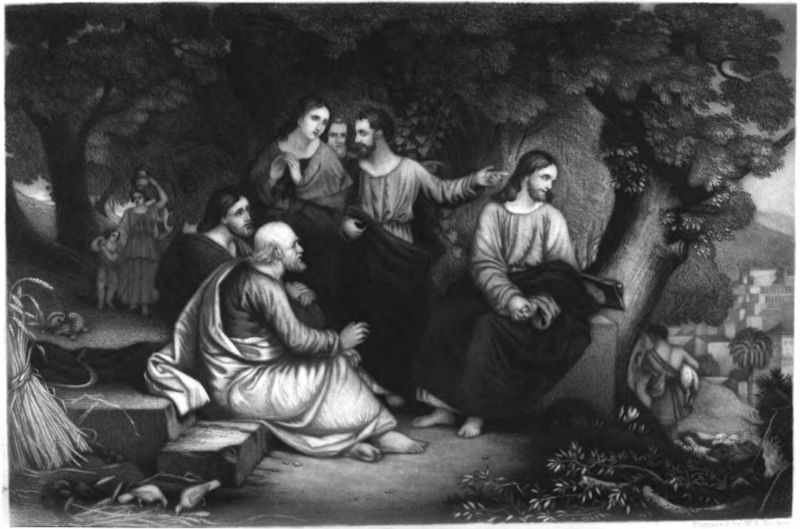
Painted by C. L. Eastlake R. A. Engraved by W. E. Tucker
CHRIST WEEPING OVER JERUSALEM.
———
BY JOSEPH E. CHANDLER.
———
[SEE ENGRAVING.]
“How beautiful upon the mountain are the feet of
those that bring glad tidings,” is the language of
elder Scripture, and how often has the heart of man
responded to the truth of the declaration, as the eye
has caught the earnest smile and noted the lightness
of feet that distinguish the bearer of pleasing intelligence.
The great poet of nature hath, in the spirit of the
above comment, remarked that the bearer of unwelcome
news has “but a losing office.” And thousands
of those who have been messengers of good
to the great, the wealth-possessing and honor-conferring
among men, have found themselves ennobled
and sometimes enriched, for the simple narrative
of an event in which they had no share, and of which
they knew little more than the report which they had
received from others and delivered where it was
greatly desired.
We know that the text of Scripture which we
have placed at the beginning of these remarks has
allusion to tidings of greater joy, of more gladness,
than all the bulletins of battles and statements of victories
which the hastened dispatch bearer has ever
conveyed to the awaiting monarch—more lovely
and more desired than messages of love and tokens of
reciprocation which the herald of man’s affection and
woman’s deep, late-told love ever conveyed. The
triumph of the conqueror of armies must be short
and partial—the love of the most devoted perishes, at
least with the object, if it is not quenched by its own
fitful sallies. But the glad tidings which hasten and
beautify the feet of those who come over the mountain
of our offences is of life-long endurance, and
enters into the eternity for which it prepares.
There is a picture in this number of the Magazine
to which we are alluding, and to which we mean to
refer when we talk of messengers of glad tidings.
We know that the common reader will look at the
title, and, if he recollects the narrative, he will be
startled at the idea of “glad tidings,” when sorrow
and tears were on the face of the messenger, bodings
of terrible afflictions were in his mind, and their
nearness was being foretold.
Are these glad tidings? Do such messages make
beautiful the bearer? Can we rejoice at the overwhelming
evil that is to befall the “City of Peace,”
and sweep away the temple of the Most High, and
give to famine, to violence, to dishonor and to death
the sons and the daughters of the people of God?
But if these evils were the consequences of crimes,
if the destroyer were but an instrument in the hand
of omnipotent love to waste the destroyed, and to
be himself the object of a similar wrath, that the
“peace” which the great messenger was to bring
on earth might have an abiding place, in consequence
of the terrible things which he only foretold—surely
the feet of such an one are beautiful. He brings
salvation, while he only foretells destruction; he
makes the wrath of man, which he prophecies, the
instrument to produce that love and peace of which
he is the real author.
There had been much confusion in the city in consequence
of reports brought to the principal ecclesiastical
and civic officers, of the unusual proceedings
of citizens at a short distance beyond the place,
where palm branches had been strewn in the highway,
and garments spread out, upon which the hoofs
of the rider’s animal were to tread—tokens of remarkable
respect, which seemed to look treasonable
to the foreign power, that directed the political
affairs, and to the native priests who directed the
spiritual concerns—the forum and the temple were
agitated; the viceroy and the high-priest each
started at such evidences of neglect of fealty.
Rome and Jerusalem both felt that there was an antagonistic
power operating, if not directly against,
at least incidentally hostile to them; and Rome and
Jerusalem—the conqueror and the conquered—joined
in efforts to suppress the evil. Each would have
crushed the power of the other, but both would unite
to repel a power that was hostile to both. Each
would have bruised the mailed arm of the other, but
both trembled at what would have healed the breast
of each.
There had been a scene of triumph—but He who
had been the object of the huzzas of the multitude
that thronged his way with tokens of obedience—head
obedience, with little of heart in the offering—he
had sat unmoved by outward demonstration of feeling
for the acclamations of those who thronged his
path. Another mission was his—another triumph
was desired—another evidence of popular feeling
was to be experienced, and in a little time he separated
from the multitude, and ascending the mount,
at whose base he had stood, he sat down with the
four or five that were with him, and gazed abroad
upon the outstretched scene below them.
It was a beautiful evening. Behind them the dust
which had not yet subsided since the people had
thronged the roads with songs of triumph, was reflecting
the light of the declining sun. Beneath them
was the Valley of Jehoshaphat, the terrible seat of
judgment and dread; and beyond was the beloved
city, stretched out in the repose of the evening sun,
which was reflected by numerous gorgeous domes;
and the busy hum of business came up to the quiet
summit of Olivet, as if to bear to those who rested
here the story of man’s heedlessness of his life’s
great end.
They were Jews that thus looked out, the leader
and the followers, Hebrews of Hebrews, and they
loved the land of their birth and the city of their nation’s
boast. Every affection of the human heart was
enlisted for the beautiful towns and sacred edifices,
and all the outspread loveliness of the country’s hills
and valleys; and as the sun seemed to pour surpassing
splendor upon the place, and as youth and beauty
went forth to seek their pleasures, and age toiled upward
toward the temple for the evening sacrifice,
and all that was seen, and all that the heart suggested,
appealed to the patriotic affection of the four—they
looked to see whether the loveliness of the scene
would not light up an unwonted smile upon the face
of their Master, who was looking intently upon the
city.
But there was no smile. The deep thought that
rested on his brow, and the tear that glistened in his
eye, showed that the past and the future were with
him. That all the blessings which had been pronounced
upon Jerusalem, and all the promises made
in her behalf, all the sins which she had committed,
and which God had pardoned, and all the negligence
against which she had been warned, and for which
pardon had been presented; all her thoughtlessness
now, and all the uncomprehended miseries which
were in her path, were in one group in his mind—and
the sound of the destroyer and the desolation of
the conquered stood before him—the famine that
wasted the people and the fire that destroyed the
temple were there, and as he remembered how He
would have sheltered them from the consequences
of their own follies, and how they despised his love;
how he would have shielded and comforted the sons
and daughters of that city of his love, but they refused,
He wept—wept human tears—wept tears of
earthly fondness, that came bursting up from his
heart—deep agony marked his face when gathering
the recollection of all the promises which had accompanied
their probation, the glories by which they
had been invited to goodness—he exclaimed, “But
now they are forever hidden from thine eyes.”
What a mission was that the Master assumed—what
an experience was that of his intimate followers.
The many listened to his heavenly doctrine and
love—many were astonished at the miracles that
marked his public ministry, that made the temple
and the wayside clinics where his divine skill was
exhibited, and drew the people from their synagogues
and altars, to offer at the street corners the sacrifice
of enlightened hearts and the homage of soul admiration.
But these, the favored few, the elders and
chosen ones of his little flock stood with him in the
terrible moments, when the office of his mission was
not exercised on others, but came to be ministered on
himself—three of them witnessed the tears at the
grave of a friend—they saw with trembling awe the
glory of his transfiguration with Moses and Elias—and
now these stood there solemn, trembling witnesses
of an agony of affliction that wrung tears for
others from Him who could look down upon the
garden that was to be the scene of a trial which
human eyes could not witness and live—who could
look forward to the hall of infamy that was to witness
his mockery, to the winding way of sorrow
in which he was to bear his cross, and upward to
the eminence where the work was to be consummated.
The tears were not for himself. He wept
for the misery of those who should procure the agonizing
passion.
The artist has chosen this moment for his picture.
It was a bold thought—but it was a good one—what
the pen records may not the pencil illustrate, and is
not the lesson of that most instructive hour brought
closer home to the heart by the representation of the
scene which the sacred historian describes? How
well the artist has executed his task is not for us to
say. Indeed such a picture is in its conception so
full of suggestion, that we may safely leave to the
painter’s professional pride the finishing of his work
according to the canons of his art. The moment
that we recognize the subject, the moment we catch
the time, the place and the office, we lose sight of
all that the pen has written or the pencil attempted
to delineate, and acknowledge that our hearts, our
fancy have taken hold of all and borne us back to
the awful hour—we do not pause to look at features
or position on the canvas, but at once we kneel in
imagination at a distance from the consecrated group,
and as Olivet and Sinai and Calvary meet the eye,
and the temple gleams in the light of the setting sun,
we inquire what is the thought, the high, mighty
thought that swells upward in the heart of the Master
there? Alas! who shall know? Who could conceive?
Eternities are in his mind, and all the vast
concerns of angels and of men are before him; and
yet for one city, one erring city, one little spot upon
the great map of the universe, he fixes his eyes, and
over its fate he weeps tears of earthly sorrow—weeps
not that one stone of the temple shall not be
left upon the other—weeps not that all the monuments
of his nation’s glory shall be wasted, and that
the ploughshare of the infidel shall upturn the sacred
soil. Not for these did he weep—but that those children
of the Father, whom he “would have gathered
as a hen gathereth her chickens under her wings,”
should be destroyed by the sword, and the virtue of
the daughters of his people should be the derision
and spoil of the conqueror. They were human tears—but
divine sympathies!
And in that scene of wounded love, when the
foreseeing, or the foredwelling of his higher nature
made the present of his human exposure terrible—in
that hour of sympathy and sorrow, the favored and
the intimate were his companions. Theirs was not
yet the gift of foreknowledge—they lived only in the
present, and knew only of the past. Little indeed
could they comprehend the agony of the Master, as
they could not foresee the cause. Their highest gift
was faith—they could believe—they could confide—they
could listen with silent assurance—and however
contradictory might appear the words of the
Teacher and the circumstances of the times, they had
learned from rebukes and experience to trust to the
former. And as they follow with their eyes the
mournful bend of the Master’s gaze, as they melted
before the weeping of the sinless and loving, they
bowed in meek assent to the terrible anathema foretold,
and, not being authorized to give, or to proclaim
it, they meekly sighed the maranatha, and
left the work to God.
You see some of the multitude pressing up toward
the Master, but not upon him. You see, too, in the
distance, woman with her face set toward Him to
whom her heart is given. Woman following but
not approaching. The first evidence of personal
suffering would have brought her to his side—the
first chance of offering homage would have taken
her to his feet. It is woman, too, in her beautiful office—her
heart is with the Master—it is good for her to
stand where she may be called. He may not indeed
speak to her, but virtue might go forth from him and
bless her—and so she had brought with her a little
child. It seemed not meet to her that she should
seek Jesus and her child not be led to him. She had
indeed heard the Master say, in regard to some others,
“suffer little children to come unto me,” and how did
she know, standing afar off though she might be—standing
in awe and reverence—how did she know
but when his moment of bitter sorrow had passed
away, the Master might turn and smile on her—and
take her little child in his arms and bless him—so
had he done to others—and so she was willing to
await, willing to stand and see what the Lord
would do.
But in the immediate scene of tears and solemn
wailing woman is not found. Where are those that
followed his steps? Where are those who ministered
to his wants? Alas! the scene was not for such
hearts. It was the last sacrifice of national feeling;
humanity acknowledges the claim—for mental mortal
agony at events to come there was no consolation.
It was for woman to make beautiful her mission by
her implicit faith; it was for woman to minister to his
physical wants; her humility would find a delightful
office when she bathed his feet with her tears, and her
faith had comforting expression when she wiped
them with the hairs of her head. Woman’s care
provided the household comforts which humanity
needed, and woman’s piety sat self-abased, yet
gathered strength at the Master’s feet as he opened
the oracles of truth. Woman wept for him as he
bore his cross upward to Calvary; and woman lingered
at the foot of that cross when others had fled;
and it was woman that came earliest to kneel at the
sepulchre. Where service was to be performed,
where faith was to be tried, where physical wants
were to be supplied, and physical suffering assuaged,
there woman was to be found. But where the agony
of mental passion was to be endured; where the
unspeakable and the incomprehensible were to be
exhibited, woman was not. Her mission of faith
and love required no such exercise, her feelings demanded
no such purification.
We have done. The picture which we give is
suggestive, and we hope that it will suggest more to
others than we have been able to express; because to
such a scene as the artist represents, when the heart
or fancy enters it is lost in amazement. A thousand
thoughts crowd, less for utterance than for existence,
and we feel that when there is more than earthly
love, more than earthly interest, the idea must be
more than human, and expression will be infinitely
short of the conception.
———
BY MARIE ROSEAU.
———
Oh! deem not thou canst lightly err,
And none may bear its weight but thee:
There’s none on earth who stands alone,
None so devoid of sympathy,
But that each fault will wing a dart
To pierce some gentle, feeling heart.
Oh! say not that no sin of thine
Will cause another, weaker one,
To fall, or stumble by the way—
By following thee his soul undone—
Drawn to the very depths of shame:
Then on whose head shall rest the blame?
Oh! say not thou art far too weak
To help some brother poor and frail,
Whose footsteps falter by the way—
Whose burthened strength begins to fail—
Thy words of hope may sooth his grief,
Thy hand, though weak, may bring relief.
Perchance some weary spirit mourns,
In bitterness of grief e’en now,
That thus in bonds, by error wrought,
So strong a soul as thine should bow—
That thou, of all the world shouldst stray
From wisdom’s straight and pleasant way.
Perchance e’en now thy many faults
Stand in some wand’ring brother’s road,
That but for thee his feet would tread
The path of wisdom and of God—
Who, but for thee, or for thy sin,
A victor’s glorious crown might win.
Oh! none there are whose deeds and words
May not exert an influence wide,
There is no hand that hath not strength
Some wand’rer from the way to guide:
No voice with tones too weak to bless
Some hapless brother in distress.
A TALE OF OLDEN TIMES.
———
BY MRS. LYDIA JANE PEIRSON.
———
Grenada had fallen. The miserable remnant of a
once powerful nation, driven from the cities of their
glorious empire, hunted by an untiring zeal to destroy,
crowded at length into their chief stronghold,
the city of their regal power—the birth-place and the
sepulchre of a long race of puissant monarchs—had
endured all the miseries of siege, of famine, and of
slaughter; had endured with an invincible determination
to die rather than yield; and they had died
by the sword, by hunger and thirst, by despair, by
pestilence; and their rich and magnificent city had
been sacked, plundered, ravaged, made the prey of
soldiers, greedy for spoil, thirsting for the blood of
an infidel foe, exasperated by resistance, and maddened
by fanatical zeal. Grenada had fallen; the
Moors were no longer a nation of the earth. Ferdinand
and Isabella, weary of war, and satiated with
conquest, were reposing in state at Santa Fe, or San
Felipe, with every demonstration of triumph, every
show of thanksgiving to the God of battles. The
days were divided between the most gloriously marshaled
tournaments and the most magnificent religious
processions; the nights were devoted to the
masquerade and the mass; the whole world seemed
vocal, now with strains of triumphant martial music,
now with the no less lofty Te Deum, or Gloria in Excelsis.
All was joy and gladness, triumph and gratitude.
The temporary palace was shining like the
fabled palace of Aladdin, builded of the gold and
gems of the genii world. In all the apartments the
magic of regal magnificence was displayed in the
taste of the most approved style of art. Tapestries
of regal blue and Tyrian purple, broidered and
fringed with scarlet, green and gold, in the inimitable
style of the artists of Babylon, swept from the lofty
ceilings to the velvety carpels of the marble pavements
which were rich with tufted work of flowers
of every hue, while in the recesses of the windows,
where the tapestries were looped aside with cords
of the richest dyed and braided silks, entwined with
strings of glittering gems, and heavy with tassels of
feathery silk and drops of gold and diamonds, were
placed beautifully enameled vases of the porcelain
of Italia, supporting branches of artificial flowers and
fruits of immense value. From the daisy, with its
petals of pearl and eye of platted gold, to the rose of
Damascus, formed of flashing rubies, and dewed with
purest diamonds; from the rich clusters of grapes of
amethyst, to the golden pear and nectarine, beryl
and sardonix. Doors opened upon seemingly interminable
vistas of trees and flowering shrubs, intermingled
with candelabras of gold, wrought into the
semblance of tall plants, bearing flowers of crystal
and purest porcelain of every delicate tint, each of
which was a lamp, burning perfumed oil, and giving
out rich fragrance with its mellowed light; while
birds of every clime, from the stately pea-fowl to
the minutest lady-bird, admirably imitated in enameled
gold and precious stones, were fixed upon elastic
sprays, swaying to every breath, and chirping forth
melody from little organs, played upon by their own
tremulous motions, and so perfect was the workmanship
that their forms and notes were hardly to
be distinguished from those of the real birds that
walked or flew amongst them in the gay parterres.
Amid all this enchantment moved groups of richly
habited men and women; dons and cavaliers, in their
blazing military costumes, and dark-eyed donnas, in
soft silks, rich velvets, and transparent muslins of
India, ornamented with brilliants, plumes, or flowers,
each as her fancy dictated. Some were dancing to
lively music, some listening to soft melodies and
songs of love; some were grouped around the beautifully
imitated trees, on which ripe fruits of every
clime seemed to hang in nature’s wild profusion;
some clustered around statues, which presented baskets
and trays of the choicest viands; others again
rested beside fountains which threw up jets of perfumed
wine, which, as it descended in drops, displayed
rainbows of inimitable splendor, painted by
colored lights arranged for the purpose, while here
and there a youthful couple, walking apart, and apparently
unconscious of all the surrounding splendor,
betrayed the tender topic of their sweet communings.
Could discontent and heaviness of heart exist
amid all this wealth and splendor and apparent happiness?
or do all these fail to satisfy the yearnings of
the immortal mind? In a retired part of the gardens,
where a few dark evergreens clustered over a natural
spring of living water, stood a man apparently
forty years of age, plainly habited in rich black
velvet, which displayed to the best advantage a form
of manly mould and exquisite symmetry. His
beaver lay beside him on the turf, and his noble head
thus exposed, displayed the perfection of nature’s
statuary. His high and expansive forehead, strongly
marked and delicately moulded features, dark,
piercing and restless eyes, bespoke genius to conceive,
energy to prosecute, perseverance to complete
achievement of lofty daring. But there was an expression
of melancholy around his perfect mouth,
and his dark brows had acquired a contraction which
proved that he was familiar with disappointment,
and the contumely of inferior souls. Wrapped in
deep thought he seemed, except that from time to
time, as he lifted his eyes and glanced up the vista,
there flashed from their dark depths the impatience
of a mighty spirit, baffled of its aim, chained in its
flight, and misunderstood in the darkness of surrounding
ignorance. A figure, elastic with the buoyancy
of joy, advanced toward him, a warm hand clasped
his, and a glad voice exclaimed, “Courage, my
friend, she has consented to see you, to listen to
your plea, to weigh your arguments, and decide
upon your claims to patronage. Courage, I say, for
if she listen to you, she will espouse your cause.”
A light, intense, but momentary, flashed over the
face of the dark-browed man, as he pressed the hand
of his messenger, exclaiming, “Thank you—to me
you are, indeed, San Angel!”
Gradually the gay groups disappeared from the
scene of magnificent enchantment; the lights went
out one by one, like stars at the approach of day;
the voices of melody ceased amongst the pavilions,
and in the echoing halls, and silence seemed resuming
her natural empire over the night.
In a retired apartment of the royal palace sat
Isabella of Castile, with her two young daughters.
The beauty of the queen was of a style to command
respect rather than admiration, obedience rather
than love. Majesty was in her form and mien,
pride sat on her brow, and in her tones and gestures
lived an authority which none dared question or disobey.
Well was it for herself and those around her
that she was governed by the nicest principles of
honor; that her whole life was swayed by the most
fervent and conscientious devotional feelings; so
that as a queen, as a wife, and as a mother, she was
above reproach.
Her eldest daughter, the Lady Isabella, inherited
with her mother’s name, a large portion of her personal
and mental qualities; but while one was a woman
and a queen, the other was a young princess,
proud, impatient of control or contradiction, and
delighting in magnificence and admiration. Her
younger sister, the Lady Joanna, though she had a
fine form and regular features, with the dark, languid
eyes of her country, was destitute of that grace and
vivacity which is the great charm in woman’s character.
The warm blood never gave a living glow
to the dark olive of her complexion, and it was seldom
that the deep fringes of her eyelids were lifted
sufficiently to allow those with whom she conversed
to mark the beautiful and flitting shadows of the
deep and sweet emotions of her loving spirit.
“Oh, mother!” cried the young Isabella, her whole
person radiant with the spirit’s light, “oh, mother,
what a glorious thing it is to be a queen’s daughter;
to live in such magnificence, to be an object of admiration
and worship, to listen while gay and noble
cavaliers extol one’s beauty and accomplishments;
but, mother, it is my highest glory that I am your
child, your namesake, and like you in mind and
person. Oh, how my heart swelled last night as I
heard men speak of the truly royal Isabella of Castile.
But, mother, I am not quite as noble-souled as you,
for I heard them tell that in your girlhood, when the
discontented nobles and people would have placed
you on your brother’s throne, you utterly refused to
consent to his being deposed, and only allowed yourself
to be declared his successor. I could not have
been so moderate; oh, I long to be a queen like you.”
“A queen!” murmured Joanna, who occupied a
cushion at her mother’s feet, “a queen,” and her
voice was low and sweet as the murmur of a guitar,
when its strings are moved by the orange-scented
breeze alone. “I would be queen of one loving
heart alone. I ask no kingdom beyond a quiet home,
with one to love me, dearly, truly, unchangingly, as
I could love again. Oh, mother, I am weary of all
this noise and show; my heart grows sick, as I mark
these glorious things, and feel that they are spoils of
war, relics of a fallen power, trophies of a victory
achieved by bloodshed, fire, famine, and pestilence.
Do not frown, dear mother, my queen; but I cannot
help thinking of the loving hearts, and beautiful women,
and tender babes that perished in Grenada.
They were infidels, but they had human hearts; they
loved, and were beloved, and, oh, what bitter sundering
of holy ties was in that devoted city. I cannot
rejoice in such dreadful victory; I dare not thank our
merciful Father in Heaven that he has permitted our
armies to inflict such a vast amount of misery, not
only on our armed foes, but on their helpless and
innocent families.”
The queen’s countenance was troubled; she regarded
her daughters alternately. “Alas! my children,”
she said at length, “I foresee unhappiness for
you both. Isabella’s spirit will never be satisfied
with power and grandeur; and your heart, Joanna,
will never be filled with the love for which alone it
asks. It is possible to be beautiful, honored, and a
mighty queen, and yet be very miserable—oh, very
miserable! Leave me now, my children, for the
hour of audience is at hand; and I am to listen to a
strange suitor and weigh a mighty project.”
Queen Isabella sat in her private audience-chamber,
surrounded by her nobles. There was a shadow on
her brow deeper than the shade of business cares;
and it was remarked by her counsellors that every
article of the spoils of the fallen Moors had been removed
from her apartments.
Presently San Angel and his friend, Columbus,
were ushered to the royal presence. The great adventurer
wore the same plain habit of black velvet,
but appeared infinitely more noble in that dress than
did any of the embroidery-decked cavaliers in the
royal presence. Columbus was no stranger to courts
and princes, yet as he bent his knee before Isabella
of Castile, he felt to pay her the homage of the soul,
and she thought that she had never until then looked
upon true greatness.
“Rise,” she said, “and speak what you have to
say.”
He stood before her calm, collected, and with the
air of a man having full confidence in himself; and
his speech, which at first was hesitating and low,
soon flowed in a torrent of strong eloquence, betraying
the tide of the deep spirit which thus poured out
its speculative treasures.
“Madam,” he said, “you behold me, a native of
Genoa, a suitor to your majesty for aid, not to prosecute
an idle enterprise to attain for myself gay
baubles, or the yellow gold that lies like a heavy
chain upon the souls of its votaries, but to prosecute
a great and glorious enterprise, of the success of
which I am morally certain, and which will be an
inestimable benefit to the whole world, and add, if it
be possible, new honors to the name of Isabella of
Castile. Madam, the teachings of science, as well
as my apprehension of the goodness and wisdom of
our bountiful Creator, have led me to a firm conviction
that all the unexplored surface of this vast globe
is not, cannot be, a barren waste of waters. I know
that there are vast islands, probably a great continent,
sufficient to balance the lands that now compose the
world, lying away in the western ocean. These
unknown lands I would discover and explore. Or
even if such do not exist, as we know that the earth
is globular in form, I shall at least discover a passage
to India through the western ocean, and so add a
glory to the crown of Castile which shall eclipse the
lustre which recent navigators have given to Portugal.
This is the age of naval enterprise and great discoveries;
let the most important exploit of this age
live with the name of Queen Isabella on the historic
page forever and forever.
“Madam, I know that I am no idle dreamer, no
speculative theorist; I seek to confirm by actual discovery
the truths which reason and religion proclaim
to my mind as indisputable. And yet I have found
no soul capable of understanding mine; no rich
prince or noble willing to risk a few thousands for
an incalculable benefit to the whole world through all
the years to come, and a fame which shall live until
the sun burns out in the great temple of the blue ether.
You will ask why I, a citizen of Genoa, a rich and
powerful state, find it necessary to solicit the aid of
foreign powers. I have said I find no souls capable
of understanding mine. The great ones of my dear
native city have pronounced me a framer of illusive
theories. I would have won for her an imperishable
honor; she would not receive it at my hand. Filled
with sorrow and indignation, I then turned toward
Portugal, encouraged by her recently acquired reputation
as a patron of adventurous navigators. Her
great ones listened to my suit, amused with hopes,
and delayed to give me a definite answer; and while
I waited and strove to convince them of the rationality
of my speculations, they treacherously drew
from me all my grounds of belief in the existence of
another continent, my intended method of discovery,
with the direction I meant to steer, and all the information
I could give concerning my projected voyage;
and, indeed, madam, you will find it hard to believe
such infamy, they fitted out a fleet secretly, which
sailed, failed of its object, encountered storms, and returned,
asserting that they had done all that navigators
could do, and that my theory is false and futile. Thus
I have been cheated out of three years of my existence,
while my ardent soul is burning out its habitation.
Then I thought of England. I sent my brother to lay
my project before her royal Henry. Years have
passed, and yet he has not returned. Madam, I know
that the lands of which I have spoken do exist. I
know that I am able to search them out in the world
of dark waters which has wrapped them from our
knowledge since the world began. I know that I
can reach them, for God has raised me up and endowed
me as his instrument to affect these great discoveries,
and he will preserve my life, and guide me
by his almighty power. I have petitioned your
august consort, but he is occupied by other matters, or
swayed by those who would prevent me from achieving
that which they dare not undertake themselves,
who would withhold from me the honors which they
have not courage and ability to achieve for themselves.
On you, therefore, illustrious madam, now
rest my ardent hopes. Surely amid all this magnificence,
the small sum necessary for my outfit
would not be felt. And in the event of my success,
which I deem certain, would not the vast and rich
territory thus added to the dominions of Castile and
Aragon, bring millions of revenue for every hundred
expended on my expedition. I beseech your highness,
listen to my plea; I am like a strong eagle,
longing to scale the pinnacle of a lofty mountain, but
bound by a heavy chain in a dark and miry valley, I
am wearing out my life in a vain effort to spread my
shackled pinions to the glorious sunlight. Let your
royal bounty remove these shackles, give me the
means, and say to me go, explore the ocean, discover
new worlds, and take possession in the name of
Isabella, the illustrious queen of Castile. Let me go,
in pity to my restless spirit. Let me go and win
everlasting honors for myself and the age, and for
my royal patroness.”
Queen Isabella had listened with evident interest,
her dark eyes flashed, and her cheeks burned with
excitement. She extended her beautiful hand to the
suppliant. “I grant your prayer,” she said; “I will
furnish funds for your voyage. This display of magnificence
is not at my command. It belongs to our
nobles, our churches, our officers and soldiers. You
behold here the spoils of the vanquished, which must
reward the vanquishers. It is possible to be poor in
the midst of regal splendor. But I have jewels which
are at my own disposal, which add nothing to my
power or my happiness. I will dispose of them, and
give you the means to prosecute your project to discover
new worlds amid the wilderness of waves, and
win that undying fame which you deem within your
reach.”
Low on his knees fell the joyful adventurer, and
poured out his gratitude in few but forceful words.
Looks of scorn, contempt, and bitter enmity were
fixed upon the adventurous Genoese by the courtiers
who surrounded her majesty, and it was evident that
her presence alone restrained them from openly expressing
their hatred of him, and disapproval of her
decision. One cavalier in particular ground his teeth
with rage, and muttered his vow of eternal enmity to
him whose soul so overreached all human intellect
had heretofore achieved.
But Isabella’s royal word was pledged, and her
powerful eloquence had won her regal Ferdinand of
Aragon to espouse the cause of Columbus, and associate
his name with hers in patronage of his great
adventure. But the man of mighty soul had departed
on his limitless voyage, and his scoffers continued to
clamor against him, and predict the utter failure of
his project, and destruction of his fleet and crews.
Ferdinand and Isabella were holding their court in
Barcelona, when a courier arrived with intelligence
that Columbus with his fleet had made the harbor of
Palos, from which he sailed about ten months previous.
Various rumors followed the announcement,
rumors of glory, and gold, and territories, rich and
blooming as the garden of Eden. Then gushed in
clamorous torrents the bitter waters of envy, hatred,
and detraction; but Isabella heeded not their clamors,
but awaited with hope and exultation the arrival of
her protégé.
At length a triumphant train approached the city.
Loud shouts swelled up to heaven from the excited
multitudes; the city poured out her torrents of living
creatures to meet the mighty man who had wrested
a world from the untraversed ocean floods.
The monarchs, in their most glorious apparel, sat
upon their throne in the magnificently furnished reception
hall of their palace home.
The procession approached; a herald announced
the great discoverer. He entered the presence, and
the monarchs arose and stood to greet him.
With him came natives of his new world, with
their strange features and unheard of complexions—habited
in the grotesque costume of their native
clime. In beautiful caskets and vases were borne
gold, unwrought, and fashioned into curious ornaments,
fruits and flowering plants, and strangely beautiful
specimens of verdure and foliage, with articles
of the manufacture of those far-off lands—all things
strange to the admiring beholders, and different from
aught that the eastern continent produced. All was
wonder, admiration and delight, except in the black
habitations of envy and murderous hate. But Columbus
had achieved his triumph—he had discovered
a new world; he had triumphed over the malice of
his enemies, he had won for himself an imperishable
fame; but he laid all his glories at the feet of his royal
patroness, Isabella of Castile, without whose
aid the mighty soul of enterprise would have worn
itself out in vain endeavors to spread its glorious
pinions. Oh, that every mighty mind could find an
Isabella.
Ought not the name of Isabella to be forever associated
with that of Columbus, as without her aid he
could never have crossed the Atlantic? Should not
the honor of the discovery of the western world rest
alike upon him who conceived, and her who enabled
him to execute the mighty project? And yet the
fame of Columbus is wide as the world, and eternal
as the lands to which he opened the way across the
billows; while she who gave wings to his genius and
power to his arm is almost forgotten.
But I would wed her name to his forever by
christening this great and hitherto nameless republic,
by the appropriate and euphonious title of Columbella.
Thus would I give honor to whom honor
is due.
———
BY MARY L. LAWSON.
———
In a soft, still summer twilight,
When the sunset’s golden beam
Gleamed behind the cold gray mountain,
With a misty haze between,
When the stars were faintly breaking,
One by one, upon the sky,
And the winds that whispered near me
Were as gentle as a sigh,
’Neath a mossed and gnarled oak,
With its branches ivy-bound,
Where the mingled sweets of flowers
Threw a breathing perfume round,
There a lovely dream stole o’er me,
’Twas life’s sweetest, last, and best;
Bright Egeria, lost Egeria,
Thou hast left my lonely breast.
I have sought the spot full often
In the morning, in the noon,
In the chill and bleak December,
In the rosy light of June;
And when floods of silvery moonlight
O’er the valley slept serene,
While its pale and silent splendor
Mocked my spirit’s restless dream.
Yet I linger as of old—
Still I seek the shadowed lake,
And the mountains stern and drear,
Where the Alpine glaciers break;
There I watch the storm-god rise,
But I wander on in vain;
Bright Egeria, lost Egeria,
Will we never meet again.
’Mid my deep and yearning sadness,
With enrapturing thought I dwell
On the scenes whose hues are melting
Into memory’s mystic spell;
But my gladness hath departed,
For I tremblingly pursue
The beloved yet changing phantom
That still fades before my view;
Aerial music floats around,
Aerial voices meet mine ear,
And my sighs are oft repeated
By soft echoes hovering near;
And from visions half ethereal—
Mad with hope—I wildly start—
But thy footsteps, lost Egeria,
Are the beatings of my heart.
DURING THE EIGHTEENTH AND THE BEGINNING OF THE NINETEENTH CENTURY.
———
BY FAYETTE ROBINSON.
———
(Continued from page 141.)
We had almost forgotten to speak of another class,
important though youthful, of the saucy, petted and
spoiled pages. They, too, are gone, and not one of
them survived the eighteenth century. The Almanac
of the Empire, it is true, bears the names of thirty-two
pages, and that of the restoration of seventy-two;
but all this means nothing, for the last page,
who really was what he professed to be, and who
was the most celebrated of his class, was named
Cherubim, and was born April 27, 1784.
The following is his portrait.
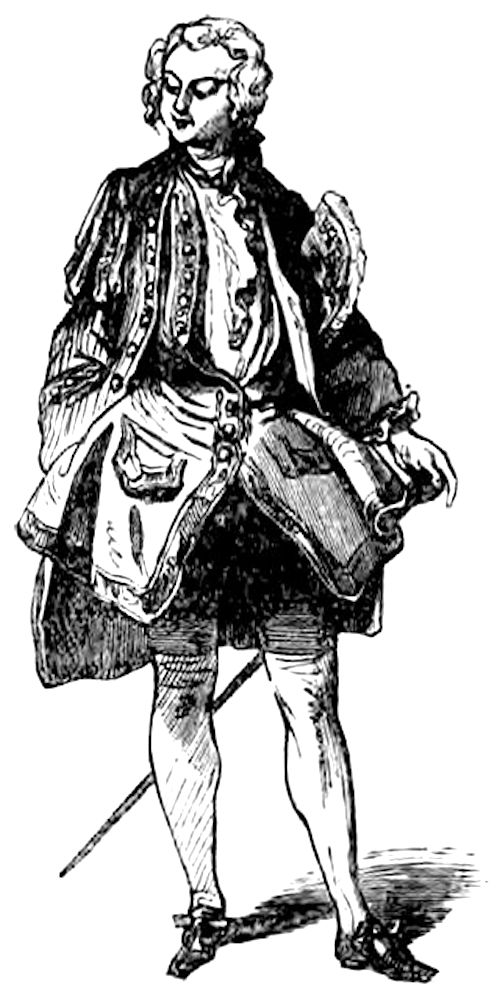
The old Duke of Lauraguais said that the first
English frock worn in France had been the death-blow
of the French nobility, one of the most numerous
of the grades of which had been the first to
adopt it. The Marquises, with their proverbial love
of change, began from that time to transform their
modes, and effected it so rapidly that their brocade
garments were soon only found on the stage, or in
the bals-costumés. This frock, (fr. froc,) which had
so disadvantageous an influence, was a kind of
loose gown, with pockets on the inside, and without
any tightness at the waist. It was cut lengthwise
with the cloth, and though first without a collar, ultimately
acquired one. The dress of the age in other
respects remained long unaltered, though its accessories,
such as buttons, plaits, etc., were constantly
changing. The coats first were made to button all
the way up, and then only from the pockets up:
finally buttons were not used at all. After some
lapse of time loops were used, which clasped the
narrow coat over the often portly tournure in the
most ridiculous manner. Waistcoats then were
waistcoats, not gilets, but substantial coats without
sleeves. The wardrobe of a gentleman also contained
another garment called a veston, covered with
lace and broderie, a volant, which was always single-breasted,
various kinds of redingotes, such as the
roquelaure, the houppelande, etc., all of which were
made of every conceivable material and color. The
above are the general characteristics of costume, all
the variations of which we cannot be expected to describe
any more than the botanist is to count every
leaf on a tree.
Black, now the ne plus ultra of dress, was then
worn only by procureurs, authors, small landholders,
and, in a word, all persons who were negligent in
their toilette. It was the index of restricted means,
and of mourning, when the most obscure bourgeois
dressed himself like a count or marquis.
The greatest variety of colors were worn, and contrasts
which now would seem most repulsive were
every day met with. A scarlet velvet coat, with
a black collar and steel buttons, sulphur-colored
breeches and blue-striped hose were considered in
very good taste about 1785. Boue de Paris (brick-dust
color) and London smoke were worn in both
London and Paris in 1786, and in 1788, a color
known by the repulsive name of beef' s-blood was the
extremity of fashion. Waistcoats had all kinds of
names, taken from operas, such as Figaro, Cœur-de-Lion,
etc. Handkerchiefs aux adieux de Fontainebleu
were worn; neither of these, however, seem to
have differed materially from other waistcoats and
handkerchiefs.
This was the age of cravats, made of fine lawn or
baptiste richly laced, with hanging ends; peruques à
la Grecque, with three buckles; the sword and plumed
hat. Some persons also wore the stockinet breeches,
by the side of which Adam’s fig-leaf was decent.
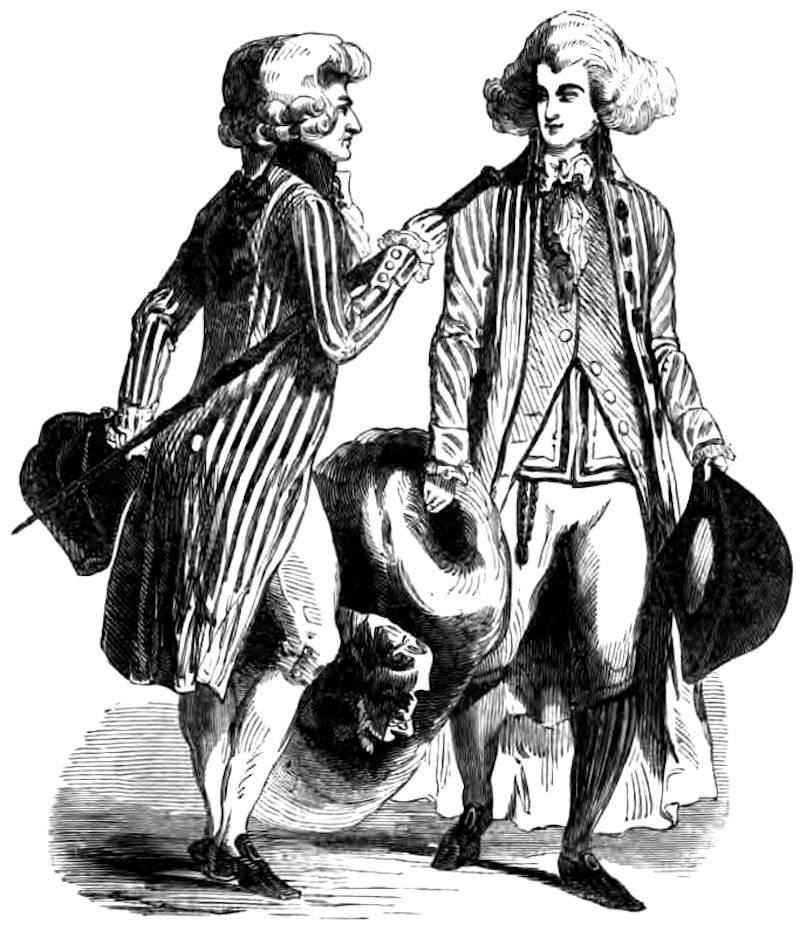
The following is a group altogether characteristic
of that age in which the redingote, the coiffure à
la Grecque, and plumed hat all appear:
None now can take an interest in all the mysteries
of powder and coiffure, with their high-sounding
names à la Brigadière, à la Sartine,
à trois marteaux,
etc., they are gone forever, and when the great
Leonard fled to Russia after the execution of the
king were forgotten in Paris. It will be remembered
that other capitals always copied the costumes of
the French capital, and that in speaking of Paris we
describe the costume of Europe.
Grave reflections do not belong to the history of
so frivolous a thing as costume, but any one may
see that it is impossible to avoid making a comparison,
not only between the costumes, but the ideas of
the past and present. The decay of the luxury of
the old monarchy was but the forerunner of the
fall of the monarchy itself, so that rightly enough
Dumourier echoed the prophecy of its ruin, made
by an old gentleman-usher who saw the great
Roland appear before the king with shoes with
strings instead of buckles. We have brought down
the history of costume to the verge of a revolution,
all the terrors of which luxury survived, and there
may be those who think the crisis in the midst of
which France is, may pass away, and things yet a
second time resume their old state. This cannot be
the centre of fashion is destroyed, and cannot be
again created. France has more serious things to
attend to, and though all the world submitted to
French dictation, it is scarcely probable that it will
bow itself to another sceptre. France cannot resume
her sway. In 1792 the dispersed court bore
away with it all the splendor and magnificence of
the past, and left a void which the republic could not
fill. In 1830 noblesse, as a cast, had disappeared,
but an opulent class yet remained, who had grown
accustomed to dictate in fashion. In the year 1848
the revolution was more complete, and all have
other things to do besides thinking of periwigs and
shoe-buckles.
Among the causes which tended in the eighteenth
century to modify French costume, by assimilating
all classes, we must in the first place mention the
influence of what is now called Anglo-mania. Even
as far back as Louis XV., the young nobles had become
accustomed to visit England, where they acquired
new habits if not new ideas. England for a
time was the sovereign of fashion, and hats were
worn à la Tamise instead of à la Seine. The nobles,
in imitation of the English, ruined themselves by extravagance
in horses and equipages. Quarrels arose
about the good looks of jockeys, and princes of the
blood and dukes transformed themselves into coach-drivers.
Marie Antoinette even took pride in the
dexterity with which she handled the whip and reins
of a pony-phaeton. The revolution has naturalized in
France many political phrases, but long before that
French ears and the French palate had grown used
to punch, or ponche as they called it, and both sexes
had become accustomed to cover up their costume
with the redingote, or English riding-coat. Tea
canes and hats were ultimately adopted, also from
England.
The revolution in England, and the round-head
ideas it evolved, had much simplified English costume,
and by the Anglo-mania this simplicity was
now reflected back on France, and continued to as
late a day as the revolution. In 1786 the English
costume was frequently seen in the streets of Paris,
and contributed in a great degree to dissipate the air
of pretension which yet animated French society.
The English boot was adopted almost universally,
and gaiters became as common as in London.
The loose locks of the English sailors were also
imitated, and this was a severe blow on the old costume,
an important portion of which was the coiffure.
The three-cornered cocked was replaced by
the jockey’s round hat, a ridiculous and ungainly
thing which no taste can make becoming, and no art
make comfortable. The probability, however, is
that it will become universal, and that some day all
the world will wear this head-piece.
This mutual imitation continued until the adoption
of Napoleon’s Continental system, which, as is well
known, separated England from all intercourse with
Europe. When peace had put an end to the long
wars this system had occasioned, and Englishmen
again came on the Continent, their appearance struck
each other as supremely ludicrous, as the apparition
of one of our own grandfathers in the gigantic
waistcoat and the bag wig they wore would seem to
us in a modern drawing-room.
Before, however, an universal costume had been
adopted the revolution came. Fortunes were swept
away, palaces lost, and the people who inhabited
them dispersed. We here lose sight of powdered
hair forever, for both sexes cut their hair short, and
shoes with strings were universally adopted. The
reign of terror came, sans-culottism was the rage.
The red cap of liberty, the houppelande of red
worsted, or the carmagnole usurped the place of the
plumed hat and the graceful roquelaure. Open shirt
collars and a knotted stick, like the Irish shilelah,
were indispensible accompaniments to this dress, an
admirable representation of which is to be seen in
the making up of James Wallack, senior, for one of
his many admirable impersonations, called David
Duvigne, in that pretty two act drama of the “Hazard
of the Die.” This costume is scarcely worthy of
remark, except on account of the red Italian cap, a
garment far more graceful than our hat, but proscribed
on account of the horrors enacted by those who wore
it. It, however, never was worn except in France,
and we may well enough drop it here forever.
Yet people must not think there was no richness of
costume during the republic. There was as much
extravagance as ever, only every one dressed according
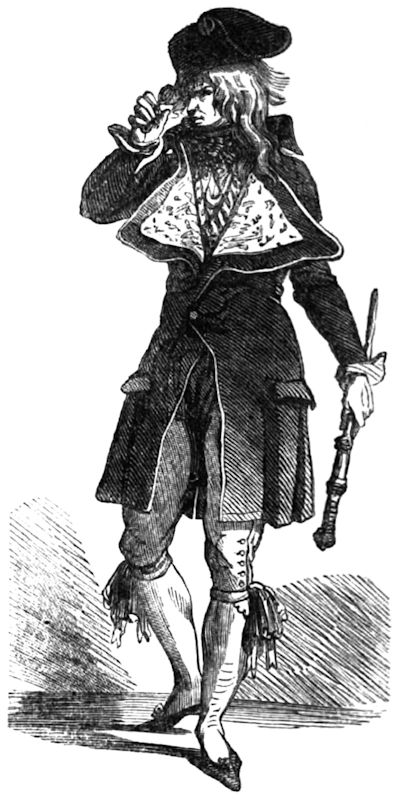
to his own whim. There were fops, too,
called Muscadins incroyables and mervilleux, who
aped the manners of the old marquis. One great
trait of these was they were all near-sighted, and
could not pronounce the letter R. They were the
prototypes of our own dandies, as may be seen by
the following specimen:
This costume was imitated over all the world, and,
except in the hat, breeches and ribbons at the knee,
does not differ greatly from the dress of our own day.
[To be continued.
“WHO COULD NEVER DRESS WELL.”
———
BY M. TOPHAM EVANS.
———
“Hang it!” I exclaimed, as I thrust the poker
violently into the grate, and slammed myself into an
arm-chair before the fire, “I am the most unfortunate
rascal in the world!”
I had just returned from the Hon. Mrs. Scatter’s
squeeze. I can’t imagine why it should be the case,
but it seems to be my unlucky destiny either to be
thrust or to thrust myself eternally into the most inappropriate
places possible. What the deuce should
have taken me there? I know that I have no business
at such assemblies—yet, oh, Julia!
She waltzed with that fool, Fitzcrocky. The fellow
hasn’t a particle of brain, but such a moustache!
And then the style of his dress. With what elegant
ease he sports his habiliments! Such perfect taste in
their arrangement, and so harmonious the tout ensemble!
Then look at me. They were whispering.
He cast a sneering glance at my exterior. I know
she laughed at me. Zounds, I could tear my hair
to tatters!
I never could dress well. If I have a handsome and
well-made coat, the vest and pants are sure to be of
the most unsuitable colors. That infernal tailor, I
verily believe, takes every advantage to make me
appear disadvantageously; and I could swear that he
palms all his unsaleable remnants upon me. Let me
see how he has figged me out for what I intended to
be the victorious campaign of this evening. Scipio,
wheel up that cheval glass. Gods and fishes! A
purple coat with silver filagree buttons—a white satin
vest—scarlet under ditto—light drab pantaloons, and
a check cravat! Black silk stockings and pumps
with rosettes. Jupiter and Moses! Why I look like
one of Bunbury’s caricatures! Tregear’s shop-window
never exhibited such a monster. No wonder
they laughed at me. Ha! ha! By Jove, I can’t help
laughing at myself, and it’s no joking matter, after I
had laid myself out to make a deep impression.
There, Scipio, draw the curtains and go. Stay;
hand me the brandy-bottle and some cigars before
you make your final exit. I might as well get drunk,
and by that means bury my woes in a temporary oblivion,
despite of all temperance societies.
Give me my dressing-gown, and pitch this infernal
coat out at the window. Ha! here’s another specimen
of my undeniable taste. What man, save myself,
would ever encase himself in a brocade of a pattern
like a bed-curtain. No matter; your Persian says it
is all takdeer—destiny. All this, I presume, was
fore-ordained—it must have been predestined, this
atrocious, villainous piece of business, and I suppose
I can’t help it. Scipio, go to bed.
Scipio retired, and I was left alone. The night
was dark and confoundedly cold. I picked up a
volume. It was Peter Schlemihl. I lighted a cigar,
and mixing some strong brandy-and-water, I applied
myself to the business which the reader has been
previously informed I had in contemplation.
But all would not do. I could not succeed in my
intention. I smoked one Dos Amigos after another,
and quaffed glass after glass of Seignette. The more
I drank, in the more odious light did I appear to myself.
I ruminated upon Julia’s flirtation with Fitzcrocky.
I attempted to analyze the causes of my
abominable want of taste in the components of
costume.
“Deuce take me!” at last I cried, exhausted, and
half mad with vexation, “I wish to Heaven that I
could exchange this unlucky carcass with some more
fortunate individual, whose kinder stars may have
granted him a comelier body and a more recherché
taste in its decoration than my miserable self!”
Scarcely had I spoken these words when a gentle
cough attracted my attention. I looked up. Opposite
to me there sat a gentleman of the most prepossessing
exterior. He had drawn up a lounge to the
side of the grate, and was seated, with patient politeness,
as if in expectation of drawing my attention to
himself. He was attired in a neat and elegant suit of
black, which fitted him à merveille. A dark maroon
velvet vest, buttoned tightly to his chest, and falling
over into a rolling collar, displayed his linen of
superb make and texture, fastened by a small diamond
pin. His cravat was tied with a prim precision;
his boots and gloves would have driven Staub
and Walker to despair. His hat was of the most appropriate
block, and a cambric handkerchief, delicate
as the web of Arachne, and scented with bouquet du
roi, was occasionally applied to his nose, in the most
graceful manner. The contour of his face was perfect
Grecian, and a mass of wavy chestnut-hair was
negligently disposed over his forehead. He wore
neither whisker nor moustache.
For some time I sat in silent amazement, wondering
how my guest had procured his entreé, inasmuch
as I knew that all the doors were locked and bolted,
and that my janitor had gone to bed some hour and a
half previous to the stranger’s appearance. He sat
in equal silence. Presently he arose, and pouring
out a glass of brandy, he swallowed it in a twinkling,
bowing to me with infinite gravity. He next produced
a long and slender meerschaum from his pocket,
lighted it with a pastille ambreé and resuming his
seat, his eyes traveled over my attire from head to
foot, with an air of well-bred curiosity. My bile
began to work.
“May I ask, sir,” said I, “what is the meaning of
this unusual visit?”
The stranger, carelessly desisting from his investigation,
expelled a mouthful of smoke, and with a
kind of concealed chuckle, which I did not half like,
replied,
“Pray, sir, may I, without infringing upon propriety,
inquire of you, who is your tailor?”
My hand inadvertently sought the decanter, and I
had a vague idea of hurling it at my visiter’s head.
One moment’s reflection, together with a glance at
the well-made and sinewy form before me, determined
me to waive hostilities.
“I cannot imagine, sir,” I replied, with severe
dignity, “your motives in making any such inquiry.”
“Oh, a mere trifle. I was anxious to become acquainted
with the name of your fashioner, who, to
judge from the appearance of your habiliments, must
possess a most exquisite taste.”
For a moment, I had suspicions that my amis inconnu
was quizzing me. I eyed him narrowly, but
the expression of his face was that of respectful earnestness,
mingled with some curiosity. Not the
slightest trace of a quiz could be detected upon his
immovable aspect.
“If you are really anxious to know,” said I, and
I confess I fell naturally gratified, for it was the first
compliment I had ever heard addressed to my taste,
“I can refer you to Cabbage & Stickem, Oxford
street.”
“I could almost wish to exchange my vile taste
in costume for your more original and certainly more
refined style,” said the stranger, without moving a
single muscle of his face.
“And I,” I cried, seizing him by the hand, “highly
as I feel flattered by such a declaration, would willingly
make such an exchange, if it were possible to
do so.”
“We shall find it very possible,” replied the
stranger. “Come, let us take a glass to our better
acquaintance. I am charmed to have it in my
power to confer an obligation upon a gentleman like
yourself, especially when it meets so exactly with
my own inclinations.”
“Egad,” said I, as we hob-nobbed very cordially
together, “I am agreed to make the exchange directly.”
I had no sooner said the word than I felt a most
violent blow at the back of my head. On my recovery,
for it almost stunned me, I was stupefied
with astonishment, upon looking up, to behold myself
sitting at my ease, and smoking with great
insouciance, upon the very seat which I had previously
occupied in propria persona.
“Be so good, worthy sir,” said I, or the figure
I saw seated in my-arm chair, “to look in yonder
glass, and you will discover that your wishes have
been complied with.”
I stepped to the cheval, and to my unspeakable
amazement and joy, viewed in the reflection the
person of the elegant gentleman with whom I had
exchanged exteriors.
“I hope,” said the personage who rejoiced in my
original ugliness and odious garments, “that this exchange
is entirely to your satisfaction?”
I could have hugged him, for I was almost beside
myself with delight.
“How can I thank you for your kindness,” I exclaimed,
for my old attire looked doubly ridiculous
to my new optics. “I do assure you, sir, that I am
forever at your service.”
“That’s it,” said the gentleman with a peculiar
smile, which in the plenitude of my joy I did not
notice at the time, although I recollected it afterward
perfectly well. “And now, as it grows late, I
will bid you good evening.”
As he spoke, I saw my ancient figure walk quietly
out at the door. I don’t know, but I thought I heard
him laugh a little after closing it. For my own part
I was so elated, that I could not think of going to
bed, so I sat drinking and singing, building castles in
the air, and ruminating upon the magnificent figure
which I should oppose against the fascinations of
Fitzcrocky, in the eyes of Julia. I determined, with
the afternoon of that day, to commence my triumphal
progress in her affections. In fact, I never noticed
how time slipped by, and when the entrance of some
one at the door aroused me, and I collected my scattered
senses, it was at least four hours after sunrise.
“Gollamighty!” exclaimed the voice of Scipio.
“What de debbil we got heah? Trange man in
massa’s bed-room, and he not up yit. What you
want, eh? He some tief—some robber.”
“Why you old fool,” said I, “don’t you see it’s
me—myself?”
“Who me?—what dat, eh? Debbil tak me if I
no b’lieve dat he has murdered massa and teal all de
spoons! Help! murder!”
“What do you mean, you old villain!” cried I.
“Do you want to bring in the whole neighborhood?”
and seizing a candlestick, I leveled it at his woolly
pate.
“What do you mean, you scoundrel, by abusing
my servant?” roared a voice from the bed. I looked
in that direction. There was my head protruded
from the curtains, surmounted by a red night-cap, and
a clenched fist was violently shaken at me from the
same purlieu.
“Turn him out, Scipio!” I shouted.
“Turn him out!” repeated my Eidolon, if I may
so term him.
“Turn who out!” queried Scipio, in a state of profound
bewilderment.
Perfectly frantic with rage, I flew toward the bed,
eager for a pugilistic encounter, when the door was
thrown open, and my old housekeeper, with pallid
visage, peeped into the apartment. I determined to
make an appeal to her.
“Am I, or am I not your master, Nancy?” said I,
in a very melancholy tone.
“You my master! Come up, mister himperence,”
replied Nancy. “My master is in yonder bed, young
man. Run, Sip, and call a policeman. He’ll make
you know your master, jail-bird.”
“Ah!” thought I, “it’s all up, I see. That fellow’s
me, and I’m somebody else, but hang me if I
know who. Well, as I don’t choose to take a morning
airing at Hatton Garden, I might as well abdicate
at once. But,” cried I, “you scoundrel, you shall
pay for this.”
“Turn him out, Sip!” grunted my former voice
from the bed. How hateful it sounded! “Turn him
out, and don’t let me be disturbed till twelve. My
head aches confoundedly.”
I sneaked out of my own room like a detected
pickpocket, Nancy and Scipio attending me down
stairs, and delivering a brace of running lectures
upon the evil courses which I was pursuing, admonishing
me likewise of the certain and ignominious
end which awaits such depraved and dissolute characters
as I was presumed to be. At the foot of the
stairs, Scipio insisted upon searching me, an operation
to which, crest-fallen as I was, I did not pretend
to make the slightest opposition. I was then dismissed
in the same manner with Master Candide from
the château of Thonderdentronck, namely with
grands coups de pied dans le derrière, pretty well
administered by a brace of sturdy valets, whom
Scipio had summoned to his assistance from a neighboring
area.
This ejection from my own mansion took place
about half past nine o’clock. In the first impulses of
my rage and despair, I resolved to apply to my
friends, in order to establish my identity by their testimonies.
It was early; too early in fact to find any
of them up, and I was fain to stroll the streets until
the lingering hands of the clock should signify the
proper and canonical hour of rising. So I patrolled
Hyde Park for an hour or so, until my insides began
to give me very unequivocal tokens of their desire
for breakfast. Rage, as well as love and all other
sublunary matters, must yield to the calls of hunger.
I entered a coffee-house in Upper Brook street, and
ordered my morning meal. I drank a couple of cups
of tea, ate a French roll and a modicum of raw beefsteak,
and walked to the bar to pay my bill. I put
my hand into my pocket in search of my purse. It
was not there. I tried another, and another, and yet
another pocket. Horrid to relate, I could not meet
with the smallest coin of the realm! The waiter
began to look very black, and I could overhear the
monosyllable “bilk” ground out between his teeth
in a tone which indicated profound aversion and
contempt. My hair fairly stood on end. Nevertheless
I thought it best to brazen it out.
“Do you see, my good fellow,” said I, and I assure
you, I spoke in a very bland and courteous tone, “I
have most unaccountably forgotten my purse—”
“Gammon!” was the very significant response of
the Ganymede. “How d’ye know you ever had
one?”
“Confound your impudence, fellow!” said I, nettled
by the coolness of the query. “What d’ ye mean by
insulting a gentleman?”
“More like a swell out o’ luck,” growled the servitor.
“Come, young ’un, this here kind of a job’s
no go. Post the cole, my boy, or it’ll be the worse
for somebody.”
As luck would have it, I thought of my diamond
breastpin, and taking that article of jewelry from my
shirt front, I offered it to the waiter.
“Blast your Brummagem traps!” quoth that gentleman.
“D’ ye think I don’t know a diamond from
a Bristol stone, or gold from pinchbeck?”
It was pinchbeck, by Jupiter!
The waiter must have been touched by the despair
depicted upon my countenance. With a grim
smile,
“Come, my fine chap,” said he, “if you are a bilk,
it’s plain that you’re a new hand at the trade, and I
don’t care about being too hard upon you. Give
me your wipe, and I’ll let you off for this time, but
you take care you doesn’t come the swell mob again
over this ’ere house, that’s all.”
My heart was too full for speech. I gave him my
handkerchief with a profound sigh, and throwing the
pinchbeck breastpin into the coal-scuttle, I vanished
with all convenient speed.
Leaving the coffee-house, I espied my crony, Dick
Buffers, across the street. To join him was but the
work of a moment.
“Hollo, Dick!” said I, slapping him heartily upon
the shoulder. This was the irrepressible outpouring
of a bosom, into which a ray of light, imparted by
hope, had penetrated, cheering the darksome abode
with its enlivening presence. Quickly was my joy
turned into sorrow.
“What do you mean, sir?” said Dick, drawing
himself up with magnificent reserve. “Do you
mean to insult me?”
“Come, Dick,” said I, in a sort of whimper,
for I was really becoming very much alarmed,
“don’t put a strange face on the matter. It isn’t
possible that you don’t know your old friend, Flashington
Highflyer? Why we only parted at midnight,
and dined together no later than yesterday.”
“Highflyer!” said Buffers. “To be sure I know
him, and very well, too. We undoubtedly did dine
together yesterday, although I cannot account for
your knowledge of the fact. But it will take even
more than your impudence to convince me that you
are the man. You must be either drunk or a fool.
Flashington Highflyer! ha! ha! Your very dress
convicts you of a lie.”
Buffers might have spared this sarcasm.
“Upon my honor, Richard Buffers,” said I,
solemnly, while the tears actually stood in my eyes,
“I am that most unfortunate man.”
“You are? Why, the man’s mad! View that
looking glass in yonder shop-window, and if you
haven’t been looking into the glass too often this
morning already, you will discover that your countenance
bears not the slightest resemblance to that of
Mr. Highflyer, that is, if you are at all acquainted
with the physiognomy of the gentleman to whose
name you have laid claim.”
I stepped to the window. One glance was sufficient.
Oh! how I cursed my super-lunatic folly, and
how I longed for my former shape.
“Egad, it’s true,” I soliloquized. “It’s all correct,
as my Yankee friends have it. That rascal has
got into possession of my goods and chattels, as well
as of my person, and has left me nothing in return but
a most confoundedly disagreeable sense of my own
individuality. What a horrid piece of business to
be sure!”
I turned. Dick was gone.
“Who am I, then?” was my next very natural
self interrogatory.
It was needless to disturb my remaining acquaintance
for proofs of my identity, as, indeed, if any
body had demanded of me my address, I should have
been amazingly puzzled to give it. I turned about,
entirely reckless of whither I went. Twelve, one
o’clock went by. I met many of my acquaintance,
but there was no recognition. I was in despair, and
could have sat down upon the curb-stone and wept.
My walk procured me one thing, it is true, namely,
a very good appetite; but I could have readily dispensed
with that, inasmuch as I was painfully conscious
that, without pawning my coat, I was utterly
unable to satisfy the cravings of hunger.
The hours rolled on. The force of habit, I presume,
led me to Hyde Park once more. All the world was
abroad. Beauty, rank and fashion were collected in
one splendid, aristocratic mass. Carriages and four,
with servants in gorgeous liveries; every variety of
vehicle, from the dashing tandem to the humbler
carriage and pair, tilburies, buggy-wagons, and cabs
thronged and thundered around the ring. Horsemen
dashed along the carriage-ways, and pedestrians
crowded the footpaths. I sat down upon a bench
and mechanically surveyed the scene. Every well-known
face, which was wont to greet me with
smiles, but which now bestowed upon me, en passant,
but a vacant stare, struck a pang to my heart.
My despair would have been uncontrollable, and I
should have groveled and bit the ground with fury,
but an innate self-respect, and a desire to appear to
every possible advantage, qualities which I presume
I gained together with my once admired, but now
odiously detested figure, prevented me from making
such an exhibition, although I verily believe that I
was haunted with demoniac incitements to perform
all manner of curious antics.
The crowd was now at its thickest. A chariot,
with servants in splendid liveries, which I immediately
recognized as my own, whirled onward.
Julia was seated in it by myself, or the devil in my
shape. There I was, perfectly plain to behold. The
face, the form were the same, but the dress superlatively
exquisite, and beautifully adapted to the figure.
The turn-out of Fitzcrocky dashed by at the same
time. He glared furiously upon my happy representative.
With matchless insinuation this latter
ogled and flirted with Julia. She returned his smiles
with eyliads of incipient affection. As they passed
me by, the fellow who had thus impudently usurped
my figure and property winked—yes, he absolutely
winked at me. My veins boiled with rage. Shrieking
out a fearful oath, I seized a fragment of paving-stone
and hurled it frantically at him. A scream, a
rush, and I turned and fled, without stopping to
ascertain the amount of damage inflicted by my missile,
and ran as if the furies had been after me. But
I ran not alone. A dense crowd of policemen, servants
and gentleman on horseback dashed in pursuit.
Never did fugitive from the galleys exert his legs
with a better will, or with more effect, than I did.
Timor additit alas. On I rushed, amidst the clamor,
and dust, and clatter of the yelling multitude,
as if the avenger of blood had been behind me. I
had been a sportsman, and never did a Leicestershire
fox lead a squad of Meltonians such a circumbendibus
as I did my pursuers. One by one they gave in—the
noise died away gradually, and I was safe.
When partially recovered, I found myself within
a queer, dark-looking old court, in the neighborhood
of Hertford street and Brick Lane. I was surrounded
by a multitude of crazy, loitering, reeking houses,
apparently the abodes of no living beings, save Jew
clothesmen, oyster venders, pawnbrokers, and gin
dealers. A squalid, miserable, broken-down dog-kennel
it was too! Tattered children ran about,
dabbling in the filthy gutters, indulging in the mockery
of play. Rough looking men, wrapped in heavy
pea-coats and coarse jackets, with red and bloated
faces, lounged about the doors of the various dealers,
and haggard, wretched-looking women might have
been descried entering the dens of the pawnbrokers,
in hopes to raise some pittance of money for the purchase
of food or liquor, by pledging paltry articles of
dress or furniture. I sat down on the pavement side
and stared around me. The scene was altogether
dissimilar to any thing I had been in the habit of witnessing,
and it was an interesting though a painful
novelty. Good God! the misery, and wretchedness,
and grinding poverty, deadening to the heart, which
exist in large cities, within ken of opulence, of
luxury and of splendor! O! could the voice of
these wretched throngs be heard, in its collected
wailing, what a cry of despairful agony would go
up to the throne of the Everlasting! Dead souls in
living sepulchres, stalking their gloomy round of
poverty, neglect and wo—uneducated, ungodly,
famine-stricken—what hope is there for them in this
world, and, word of horror, what in the next!
As I sat in revery, some one tapped me on the
shoulder. I looked up. A stout, heavily built man,
with a pimpled and swollen face, attired in a rough
drab over-coat, with leather gaiters and hob-nailed
bootees, stood beside me.
“Hollo, gen’l’mn Bill,” quoth this interesting parsonage.
“Vy, vot brings you in these parts?”
I knew the fellow at first glance, but, by Jupiter, I
had never seen him before.
“Well, old fellow,” said I, with a hilarity that
disgusted me, although Heaven knows I couldn’t
help it, “what news from your ken?”
“I’tell thee vot,” said Gabriel Sooterkins, for the
gentleman was familiarly known by that appellation,
“a’ter this night, Billy, my bo, you had better change
your tramp. The beaks ’ave nabbed Ikey about
that ’ere job on Saffron Hill, and they say he’s
peached upon it. Confound the trade, say I, if pals
can’t be true to one another.”
I recollected perfectly the matter he alluded to. It
was a burglary committed upon an old miser, who
had fixed his dwelling in that delicate abode, and I
very well remembered, now that Mr. Gabriel Sooterkins
mentioned it, that I had been the head and front
of the offending, and that Ikey and himself were accomplices
in the business.
An exceedingly reputable exchange of persons I had made.
“Well,” said I, “if it’s done it can’t be helped,
you know, and I’m off this night,” although I had
not the most remote idea of where I was going.
“If I’d a known vere you vos,” said Mr. Sooterkins,
“I’d ha’ blowed this here spot o’ work afore.
But step in here. I’ve a vord or two to say to you,
for I s’pose there’s very little dust at the bottom
of your fob.”
Mr. Sooterkins plunged downward into a dingy
cellar, and I followed him very obediently.
The place into which I accompanied him was a
filthy diving, or slap-bang shop, in which retreat was
collected as motley an assemblage as the imagination
of man can conceive. A long table extended from
one end of the cellar to the other, covered with pewter
mugs and dishes, cheap crockery ware, and
knives and forks, which latter implements were
chained to the table. A very satisfactory idea of the
morals of the guests might be gathered from this circumstance;
although, indeed, if that hint had been
wanting, the variety of villany stamped upon the
faces of the profligate crew which surrounded the
table, gave proof satisfactory that they were not of
that number who rank with the honest of this world.
Mr. Sooterkins nodded to this amiable assembly
upon entering, and I obeyed his example, inasmuch
as I recognized among these gentlemen some very
familiar acquaintances. We were received in a remarkably
hilarious manner, and some of the most
jovial of our friends pressed their regards rather
closely, by playing off two or three practical jokes
upon Mr. Sooterkins. The application of a quart
pot to the head of the most forward of these wits
sent him howling into a corner, and, to my unspeakable
satisfaction, put a very sudden conclusion to the
incipient merriment.
“Take that,” growled Sooterkins, “and now, as
you gen’l’mn seems to be so ’ighly delighted at
this here cheerful occasion, you’ll just ’ave the
goodness to leave me and my pal to our own
cards for a brace of minnits. You see, Bill, ve
must speak to Sal, and git posted up on this last
score. Hollo! Sal! you old limb of Satan, move
yer shanks this way, I tell ye!”
A withered crone, who seemed to be the mistress
of the cellar, came hobbling forward, being thus politely
conjured to appear.
“Wot!” said she, extending her wrinkled hand to
me. “Gentleman Bill here! Here’s a sight for
sore eyes!”
“Dight your gab,” interrupted Sooterkins. “Bill’s
here, but he’ll be obliged to cut and run this darkey,
for the beaks are a’ter him ’bout that job of Ikey’s.
Now he’s got no stump, and the devil a mag have I,
so you must fork over, for the purchase wot come
in vos fairly vorth double as much nor you paid for
it. Bill, and Ikey, and I, are all in fur the business,
but the blackguard daren’t peach on me, ’cause if
he gits off from this scrape, I knows enough of other
matters about him to bring him to a hemp crawat
wery speedily. You’ve got the plunder, you old
hag, and it’s only fair as you should come down
with the tin for the tramp.”
“Ah, Gabe,” said the old woman, “you will drive
hard bargains with me. But I can’t well refuse for
the pretty face of him.”
Singular as it may appear. I felt gratified by the
compliment of the hag.
“Yes, mother,” said I, “change of air is good for
the constitution, and I’ll cheat Jack Ketch of his
fees in spite of fate for this bout.”
“How much can you do vith?” queried Mr.
Sooterkins, who had lighted a fragment of a clay
pipe, and commenced to smoke most industriously.
“Ten pounds will carry me on to Portsmouth,”
said I, for the localities and resources of roguery
were fast becoming familiar to me.
“Too much,” grumbled the crone. Gabe was
about to make a savage reply, when two females descended
the ladder, and entered the cellar.
“By my forks!” whistled Gabe. “This ’ere is
just wot I hoped vouldn’t ’appen; but these cussed
gals is everlastin’ly a riggin a man, till he trots over
the Old Bailey valls on a vooden oss.”
“Bill!” cried one of the females, recognizing and
running to me. “Is it you, Bill? I’ve been over
the whole of this blessed town after you, for I heard
that Ikey Solomon had let all out, and I feared that
you were caught. But, thank Heaven, you’re safe—you’re
safe!”
With an hysterical burst of laughter, the girl threw
her arms around me and embraced me tightly. Her
laughter gradually ceased, and gave way to a violent
fit of weeping.
Amazed at first, and not knowing what she could
mean, the truth began to break upon me. Poor girl!
The burglar’s mistress! What a world of guilt and
wo are in those words! Her face was handsome,
but oh! how deadly pale, save on the summit of the
cheek-bones, where the fire of the hectic blazed.
Her large, dark orbs were sunken, and gleamed like
the reflected glow of a furnace from their deep cavities.
Her apparel, which was a shade or two better
than that of her companion, and her language, which
showed her to be superior to the wretched assemblage
around us, told a tale of sorrow—which, although
a common tale, struck deeply on my heart.
“Hang it, Bess,” said Sooterkins, endeavoring to
push the girl away, “vot dost mean, crying
and sniveling about a chap ven his wery life hangs
on his speed in gettin’ out o’Lunnun? Stand aside,
thou foolish jade, and let me have my say out vith
him.”
“Stand by, Bess dear,” said I, “and I will speak
with you directly.”
The girl obeyed.
“Now then,” said Sooterkins, “As I’ve vormed
the ten pounds out o’ Sal, all you’ve got to do is this.
Be off now, d’rectly, and take all the by cuts till
you’re out o’ town, snug in the fields. I’ve a friend
as goes down on the mail in the morning, and mind,
give him this jark. He’ll be down on the sly with
you, for my sake. Then pull for Common Hard, and
off over the Channel, till this ’ere job blows by. Lose
no time, the night’s dark, and make forward like the
wind.”
“And Bess?” said I, for the girl’s affection had interested
me, and the emotions of my burglar friend
began to quicken in my breast.
“Pshaw!” said Sooterkins, “why canst not mind
thine own affairs, and let the girl alone?”
“I must speak to her before I go, Gabe,” I replied.
“What she is, I have made her, and it would break
my heart to leave her thus.”
“Speak, then, fool, and be spry about it.”
“Bess,” said I, stealing my arm around the waist of
the unfortunate girl, “I must be off for Portsmouth.”
“Are you going, Bill?” she said, in a low and
tremulous voice, as she lifted her eyes anxiously
to mine; and that expression cut me to the soul, keen
as a knife, “I never shall see you again.”
“Hush, dearest, you must not speak so. We shall
see each other soon, and live as happy days as ever.”
The eyes of the young girl became suffused with
tears.
“Happy! No, Bill, I never shall know happiness
again. I have been weak and ill of late. I’m dying,
Bill, and I know it. Before you will dare to return
here, I shall be laid, in the parish shell, cold enough
in the grave of a pauper. Do you remember the
little cottage near the Downs? Ah! those were my
happy days. Then I was innocent, but you—but I
wont speak of that, dearest, for I would not distress
you.”
“Nay, Bess, compose yourself—”
“In the sleep of death? There is no other composure
for me. You are going, and the strings of my
heart snap as I look upon you for the last time. Oh!
through misery and crime, Bill—and we have been
miserable and criminal—I have loved you, dearer
than the light of heaven! But, dearest, if you do
escape and return, quit this awful life, for the sake
of her whom you once vowed never to abandon—quit
this den of villainy, and for God’s sake, oh,
never enter it again!”
The tears gushed from my eyes at this appeal, and
my whole frame was shaken.
“I promise—I swear it,” whispered I.
“Thank you, dearest. Take this little ring. You
know its history. And now, for the last time, this
kiss. Farewell!”
Her head sunk upon her breast. Bestowing an
embrace upon her, I darted from her side, and sprang
up the steps of the cellar. At the foot I paused for a
moment. Bess had hidden her face in her lap, and
the heaving of her breast, plainly perceptible through
its thin covering, testified the agony of her spirit.
The labyrinths of the dark and dingy by-streets
seemed familiar to me as the interior of my own
house. In fact, I was becoming rapidly identified
with the character, as well as with the person of the
burglar. But as I sped on, the recollection of my
former condition was forcibly recalled, as I came
upon a tailor’s shop, ostentatiously placed at the
corner of a well lighted street. The view of that shop
acted as a talisman. It recalled me to a due sense,
and to a most painful recollection of the transactions
of the preceding night, and of my rencontre in Hyde
Park with the usurper of my rights. I recollected
perfectly well that I had received an invitation to a
grand gala at Lord Flannery’s for this evening, of
which I doubted not for an instant that my representative
would avail himself. Julia, I also knew, had
promised to be there. Curiosity, no less than jealousy,
spurred me on. I felt a strong desire to see
in what manner and to what advantage I should appear.
I determined to make my way to his lordship’s,
forgetting that if the police laid eyes upon me,
I should dangle most loftily from the front of Newgate
or the Old Bailey.
Onward I strode until I reached Grosvenor Square,
from near which point I had started on my morning
peregrinations. It was past eleven o’clock. I stationed
myself in front of Lord Flannery’s mansion,
where the glow of lights, crowds of liveried menials,
and the sound of music indicated the commencement
of the rout. Equipage after equipage rolled up, and
depositing their inmates at the door, drove off in rapid
succession. Crowds of fashionables swarmed the
apartments. I waited for Julia’s arrival until my
patience was nearly exhausted, and I was upon the
point of giving the matter up in despair, when a magnificent
turn-out drove up to the door, and Flashington
Highflyer, Esquire, descended from the vehicle, attired
in a most recherché evening dress, and handed
out—proh pudor!—the Honorable Miss Julia Adeliza
Dashleigh!
I was petrified with astonishment. There was the
figure which had excited her laughter but the previous
night, and which was evidently the present object
of her favorable regard. As the pair passed me,
the light from the hall shone strongly upon my features.
My representative gave me, en passant, a
most facetious dig in the small ribs with his elbow,
and suddenly clapping his hands upon his pockets,
exclaimed,
“There are thieves here! I have lost my snuff-box
and my handkerchief!”
“Dear Mr. Highflyer!” said Julia, with a winning
glance.
“Secure this fellow,” said the hateful scoundrel,
for whose crimes I was penitently atoning, pointing
to me. “He has a suspicious look. Bring him into
the hall. Come, dearest Julia, I will attend you to
the dressing-room, and will then return to examine
this man.”
Instantly I was pounced upon by a police officer,
assisted by a dozen servants, and in spite of my cries
and protestations of innocence, was dragged into the
hall. Mr. Highflyer was not long in making his appearance.
“Search him, officer,” said he, as he drew out his
tooth-pick, and planted himself in a very Lara-like
style, with his back to the banisters.
“You infernal, thieving, rope-cracking black-guard!”
I roared, goaded to the very verge of insanity
by these accumulated misadventures.
“Gag him,” said my tormentor. “Have you found
any thing, officer?”
“All right, sir,” replied that functionary, “Is this
here vipe yours?”
Shocking to relate, the missing articles were found
upon me!
“That handkerchief is mine, as well as the snuff-box.
I shall appear to prosecute. Off with him to
Bow Street. A p-r-e-e-tt-y good-looking chap for a
pickpocket,” continued he, as he turned his head
with a supercilious smile, and examined me through
his eye-glass. The smile gave way to a sneer of the
most diabolical description as he ascended the staircase.
I had never thought myself so confoundedly
ugly as I did at that moment.
Of course I was dragged off to the police-office,
upon the charge of robbing myself. All that I could
say would be of no avail, therefore I kept a most
stoical silence. Having arrived at our destination, I
was walked in before the head of the police, who,
after a long and scrutinizing survey of my person,
whispered an officer, who went out. I was then desired,
or rather commanded, to extend my wrists to
another officer, who placed upon them a very ornamental,
but not very agreeable appendage, in the
shape of a pair of manacles. I had subsided into a
dogged, sullen, almost unconscious state of mind,
and was becoming, in fact, very careless as regarded
consequences. Half an hour had elapsed, when the
officer who had spoken with the chief of police, returned.
He whispered the presiding functionary,
who grinned approvingly.
“Well, my kiddy,” said he, “the Saffron-Hill job
warn’t enough for you, eh? But I’ve caged you
now, bird, and you’ll be made to sing plenty loud
for that matter, outcepting this altogether.”
“I never heerd the like of this lark,” said the under-strapper.
“It’s a rigler demeanin’ of the trade. Here’s
one of your Jimmy burglary swells come down to
a-sneak of a pickpocket!”
It would be a work of supererogation to detail
the variety of insults and the tortures of mind that
I was forced to undergo from my appearance before
the magistrate the next morning, until my final trial
at the Old Bailey upon the charge of burglary. I had
heard nothing of my ingenious tyrant, who was evidently,
at the time I saw him last, in a very fair way
to lead my lady-love to the altar. Nor, indeed, had
I any opportunity of hearing from him. I saw no
persons save my keeper, and a little, seedy, Jew
attorney, whom I discovered to be in pay of the gang
of which I was a worthy member. After various
consultations with this gentleman, who informed
me that he would be able, in spite of the veracious
testimony of the respectable Mr. Ikey Solomons, to
produce a satisfactory alibi, it was decided that I was
to put in the plea of Not Guilty.
The day of trial arrived, after a weary and solitary
residence within the walls of my prison of a month.
None of the gang came near me, and I could never
learn any tidings of Bess. At the appointed time, I
was escorted into the court, and being duly arraigned,
the charge was read to me, in that agreeable nasality
of tone peculiar to the clerks of all legal tribunals.
During this process, to which I paid not the least attention,
I espied a newspaper lying by the side of
the dock. I picked it up, and was vacantly pouring
over the columns, unseen by my jailers, when my
attention was riveted by the following paragraph,
which filled my breast with horror and despair.
“Married, by the Right Rev. Doctor Dumfungle,
at St. Martin’s in the Fields, Flashington Highflyer,
Esq., to the Hon. Julia Adeliza, daughter of Sir
Poins Dashleigh, Bart.”
The climax to my sorrows had then arrived. The
whole man was quelled within me. Spectators,
judge and jury were all forgotten, and the tide of
my woes rushed irresistibly onward, overwhelming
me in the vortex. The question was put in the usual
form, “guilty or not guilty?” Life had cloyed with
me. I longed to occupy a resting place where I
should be secure from the scorn and the persecutions
of the world. The grave offered this refuge, and I
gladly embraced it.
I therefore rose from my seat, and replied to the
query of the clerk, “guilty.”
My attorney fairly fell under the table with astonishment.
The whole assemblage seemed utterly confounded
at my audacity, and a voice was heard
above the general buz of tongues, which I recognized
as appertaining to my acquaintance, Mr.
Sooterkins.
“Vell, by blazes, h’aint you gone and done it!”
Of course I was sentenced to be hanged. Day
after day dragged on its weary course, and as I
gazed at the gray walls of my dungeon, my heart
seemed to harden like the stone itself. In vain did
the ministers of the gospel strive to arouse me from
my apathy. All was cold and dead within me. The
day before that which was fixed for my execution,
to my extreme surprise, Mr. Flashington Highflyer
entered my cell.
For some time indignation chained up my tongue.
I experienced a choking sensation as I stared furiously
upon my visiter, whose countenance was
drawn out into the most hypocritical length. This
did not very long continue, for the solemn visage
which he had chosen to exhibit at his entrance soon
gave place to a most malicious and devilish sneer.
“Well,” said he, with an odious chuckle, “my
fine fellow, how d’ye like your bargain?”
“Avaunt, fiend!” I exclaimed. He certainly
manifested no symptoms of departure, but lolling
upon my bunk, produced a Havana from his mother-of-pearl
cigar-case, and igniting it by means of
a Lucifer, commenced to smoke with great sang
froid.
“Pretty pleasant lodgings, those of yours, my old
chap, but your wardrobe was horridly low and vulgar.
In fact, I was compelled to make a bonfire of all your
old clothes, before I could manage to put it into
tolerable order.”
“You infernal scoundrel!” I roared, goaded to
madness by this last insult. “I told you that you
should pay for your rascality, and, by heaven, you
shall pay for it now!”
As I spoke, I rushed upon him and grappled tightly
with him. He resisted strenuously, but rage had
nerved me with the strength of a dozen men, and
seizing him by the throat, we rolled upon the ground
together.
“Ya—ya—yough! Gollamity, massa, what you
do? Want fur choke Sip?—oh, murder! murder!”
I looked with bewildered eyes around me. I had
upset the table, tumbled from my chair upon the
floor, and had grappled poor Scipio by the throat,
until his eye-balls protruded an inch from his
head.
“Hollo!” I cried, “where the devil am I?”
“Why, you home, be sure, massa,” replied
Scipio, whimpering from the effects of the rough
salutation I had bestowed upon him, “and be broad
daylight, and you no bin to bed yit.”
I looked at the decanter. It was empty.
“Oh!” ejaculated I.
The odious apparel of the preceding night still
decked my person and strewed the room. There
was a sickening odor of stale tobacco-smoke hovering
through the chamber, and, with a very clear
perception that I should require a tumbler of Hock
and soda to reinvigorate the inner man, I arrived at
the comfortable conclusion that I was still in propria
persona, the “man who could never dress well.”
P. S. I’m off to Paris. Fitzcrocky has Julia’s
promise. A pea-green coat with gilt buttons, and
a scarlet satin lining has done my business.
———
BY J. BAYARD TAYLOR.
———
Fill the cup from some secretest fountain,
Under granite ledges, deep and low,
Where the crystal vintage of the mountain
Runs in foam from dazzling fields of snow!
Some lost stream, that in a woodland hollow
Coils, to sleep its weariness away,
Hid from prying stars, that fain would follow,
In the emerald glooms of hemlock spray.
Fill, dear friend, a goblet cool and sparkling
As the sunlight of October morns—
Not for us the crimson wave, that darkling
Stains the lips of olden drinking-horns!
We will quaff, beneath the noontide glowing,
Draughts of nectar, sweet as faery dew;
Couched on ferny banks, where light airs blowing,
Shake the leaves between us and the blue.
We will pledge, in breathless, long libation,
All we have been, or have sworn to be—
Fame, and Joy, and Love’s dear adoration—
Summer’s lusty bacchanals are we!
Fill again, and let our goblets, clashing,
Stir the feathery ripples on the brim:
Let the light, within their bosoms flashing,
Leap like youth to every idle limb!
Round the white roots of the fragrant lily
And the mossy hazels, purple-stained,
Once the music of these waters chilly
Gave return for all the sweetness drained.
How that rare, delicious, woodland flavor
Mocked my palate in the fever hours,
When I pined for springs of coolest savor,
As the burning Earth for thunder-showers!
In the wave, that through my maddened dreaming
Flowed to cheat me, fill the cups again!
Drink, dear friend, to life which is not seeming—
Fresh as this to manhood’s heart and brain!
Fill, fill high! and while our goblets, ringing,
Shine with vintage of the mountain-snow,
Youth’s bright Fountain, clear and blithely springing.
Brims our souls to endless overflow!
[SEE ENGRAVING.]
We present our readers this month with the first
of a series of views which, by permission, we have
caused to be engraved expressly for this Magazine,
from Mr. John R. Smith’s celebrated Panorama of
the Mississippi River. It represents the cotton plantation
belonging to the recently elected President of
the U. S., General Zachary Taylor. It is situated
on the eastern branch of the Mississippi River, in
Jefferson county, Mississippi, seven miles below the
town of Rodney, between the estates of James Suggett,
on the north, and Colonel Barker, on the south.
The view embraces the overseer’s house, the
cottages of the laborers, with a small portion of the
broad acres which are comprised in the plantation.
The spot is interesting, not only as being the property
and the occasional residence of a distinguished
public man, but as affording a specimen of those
cotton estates, the culture of which exerts so important
an influence on the commercial and financial
destinies of the republic.
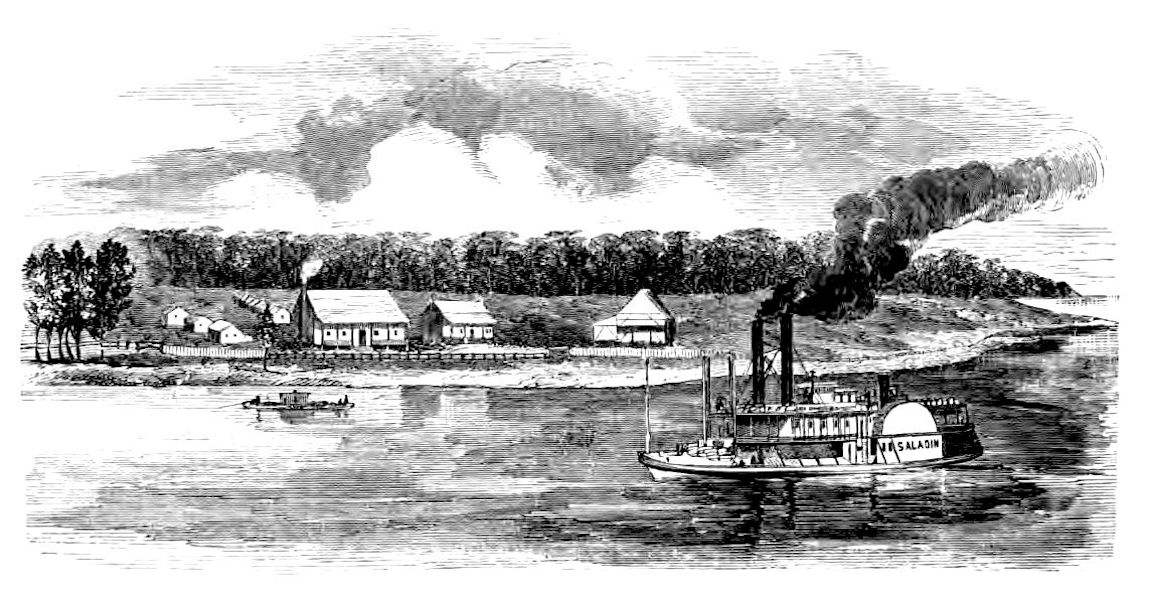
Plantation of General Taylor
———
BY S. D. ANDERSON.
———
What is this dream that o’er me now
Comes with its bright and sunny spell,
As starlight falls on childhood’s brow?
Haply this lock of hair can tell.
Ah me! how thoughts of early years
Are linked with this dear gift of thine—
The doubts, the memories, and the tears
That cluster round this bygone shrine.
The air seems filled with boyhood’s flowers,
The perfume of the summer fields;
The dreams and gladness of the hours
That freshness to our pathway yields.
Times when the heart was glad and young,
A thousand scenes of love and truth,
That, rose-like, from our track have sprung,
Amid the dreamy times of youth.
Hours when each gushing fount of life
Leaped high amid this desert wild,
Come angel-like to calm the strife,
As once they did when Eden smiled.
Not often on life’s beaten track
Come such rich summer times,
To bring the heart’s pure sunshine back,
Like old remembered rhymes.
But now I see, deep in a wood,
Two lovers ’neath the trees so hoary;
She, blushing to the solitude
Beneath his simple touching story;
Her sweet face coyly turned away,
To hide the thoughts that on her cheek
Are mantling like the wakened day
Upon the mountain’s highest peak.
And he, perhaps some poet who
Had filled the world with golden dreams,
Hopes, that around his path upgrew,
As wild flowers deck the singing streams.
And thus, as hand in hand they go,
He tells her much we may not hear—
How his heart swelled to overflow
Under a sky so dark and drear—
How on the soul came Care and Pain,
Twin-sisters of the soulless Real,
The race and haggle for the gain
That those who win the world must feel.
The striving to become a part
Of that great sea whose tideings ever
Bears on its waves each manly heart,
That, struggling, droops its pinions never.
And now there is a bridal throng
Slow winding through the moss-grown aisle;
The ring, the vow, the nuptial song—
From age a tear, from youth a smile.
A cot with jessamine-covered door,
A streamlet singing all the day,
And on the dew-bespangled floor
A thousand golden sunbeams play.
Gay groups of happy children there,
The old oak and the breathless swing,
The shouts of laughter on the air,
The chaplets that the young girls bring.
All’s gone! except these gushing tears,
Sad relics of the joyous past,
The shrines that memory uprears
To shield the incense from the blast.
Some sleep beneath the ocean’s wave,
Some ’neath the flowers that loved ones tend,
Others have found an early grave
Where stranger skies above them bend,
And she, the cherished one, she sleeps
Beneath the violet-covered earth,
Where spring-time’s earliest cloudlet weeps
And roses have a dewy birth.
Enough, she sleeps—would that my dreams
Could rest forever by her side,
As peaceful as the morning beams
Are pillowed on the sleeping tide.
———
BY RICHARD COE, JR.
———
Once on a lovely summer day,
I saw a little child at play,
While in a garden straying—
Till suddenly I heard him say,
“I am tired with playing!”
Then running to his father he
Laid down his head upon his knee,
And slept, oh! how contentedly?
So life is but a summer day,
And man—a little child at play—
While through the world a-straying:
And often, too, we hear him say,
“I am tired with playing!”
Till hast’ning to his Father, he
Lays down his head upon his knee,
And rests, oh! how contentedly!
———
BY PROFESSOR FROST.
———
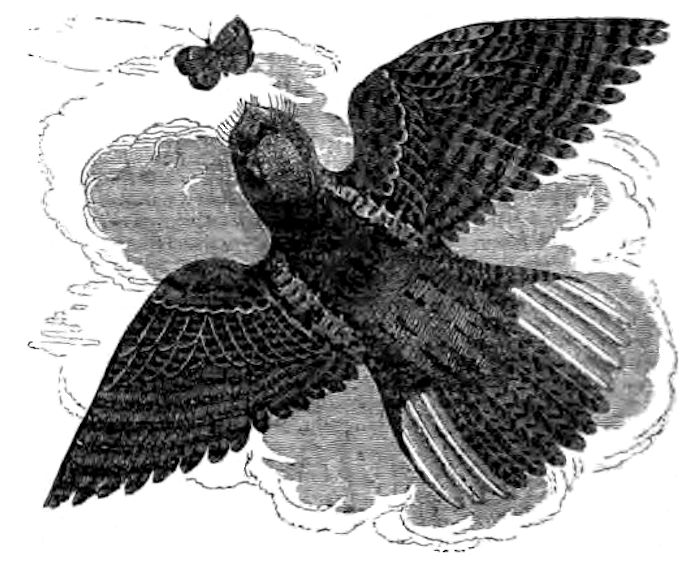
THE WHIP-POOR-WILL.
This singular bird is found throughout the greater
portion of the United States, and by the notes from
which it derives its name is known to almost every
farmer. The species was long considered identical
with the Night Hawk; but this fallacy was fully exposed
by Wilson. The Whip-poor-will appears in
the Middle States toward the end of April, when its
low, sad wail, may be heard at evening along the
creeks and by the woods of the country. So peculiarly
mournful is this sound that the ignorant almost
invariably consider it an omen of approaching evil.
By the Indians it is regarded as a spirit-voice, boding
death or perhaps national calamity. The bird articulates
pretty distinctly the syllables whip-poor-will,
the first and last being uttered with great emphasis.
A kind of chuckling sound sometimes precedes the
principal tone. At these times the bird is generally
on the wing, flying close to the ground in the manner
of swallows, and sometimes skimming around houses.
The notes of the Whip-poor-will are continued until
about midnight, and on fine moonlight nights until
morning. The shady banks of creeks and rivulets
are favorite haunts. During the day they remain in
the darkest parts of the forest, hushed to silence like
owls, and apparently annoyed at the presence of sunlight.
The cry of the Whip-poor-will is not heard
after the middle of June; and early in September it
departs for the south.
The Whip-poor-will is nine inches and a-half long,
of a beautiful mottled-brown, relieved by other colors.
It is noted for an extravagantly large mouth, beset on
each side with thick bristles, and for a very strong
bill. The female is less in size than the male, and
rather lighter colored. She begins to lay toward the
middle of May, choosing for this purpose a dry situation,
covered with brush, decayed leaves, etc., but
building no nest. The eggs are two in number, dark
and marbled. The young appear early in June.
The Goatsucker, Night Hawk, and seventeen other
species belong to the same genus as the Whip-poor-will.
Of these fifteen belong to America. Nuttall
has the following remarks on some of these.
“But if superstition takes alarm at our familiar
and simple species, what would be thought by the
ignorant of a South American kind, large as the
Wood Owl, which, in the lonely forests of Demerara,
about midnight, breaks out, lamenting like one in
deep distress, and in a tone more dismal even than
the painful hexachord of the slothful Ai. The sounds
like the expiring sighs of some agonizing victim,
begin with a high, loud note, ‘ha, ha, ha, ha, ha! ha!
ha!’ each tone falling lower and lower, till the last
syllable is scarcely heard, pausing a moment or two
between this reiterated tale of seeming madness.
“Four other species of the Goat-sucker, according
to Waterton, also inhabit the tropical wilderness,
among which is included our present subject. Figure
to yourself the surprise and wonder of the stranger
who takes up his solitary abode for the first night
amidst these awful and interminable forests, when,
at twilight, he begins to be assailed familiarly with a
spectral equivocal bird, approaching within a few
yards, and then accosting him with ‘who-are-you,
who—who—who are you?’ Another approaches,
and bids him, as if a slave under the lash, ‘work-away,
work—work—work-away!’ A third, mournfully
cries, ‘willy come go, willy—willy—willy
come go!’ and as you get among the highlands, our
old acquaintance vociferates, ‘whip-poor-will,
whip—whip—whip-poor-will!’ It is, therefore, not surprising
that such unearthly sounds should be considered
in the light of supernatural forebodings issuing
from spectres in the guise of birds.”
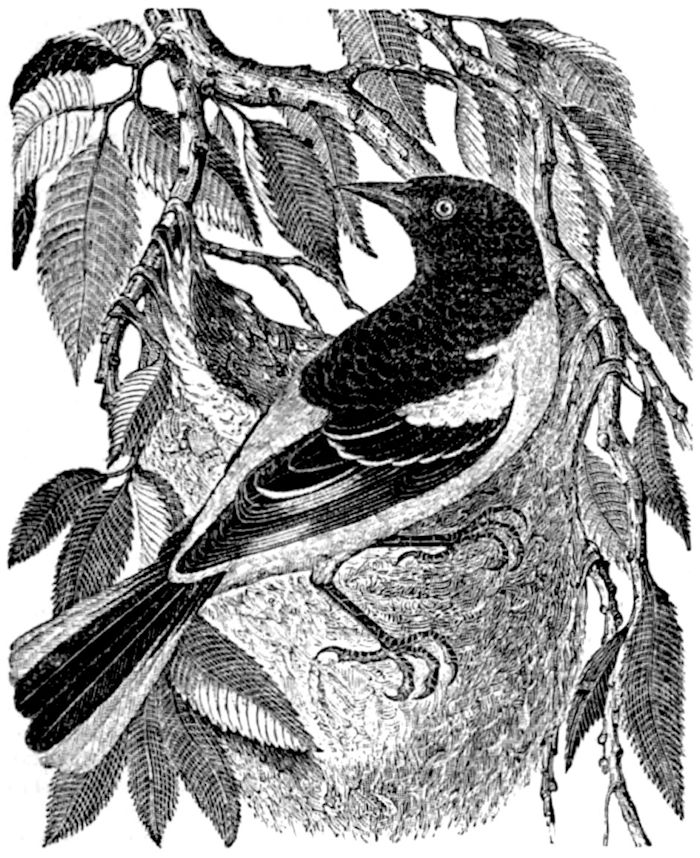
THE BALTIMORE ORIOLE.
This lively and beautiful bird is widely diffused
through the United States under the names of Oriole,
Hanging-Bird, Golden Robin, Fire Bird, and Baltimore
Bird. According to Catesby, the latter name
originates from the colors of its plumage being the
same as that of Lord Baltimore’s livery. It is seven
inches in length. The head, throat, and upper part
of the back, are black, and the remaining portions
bright orange, inclining to vermilion on the breast,
with some white among the feathers of the wings.
The colors of the female are less bright than those of
the male, and she is somewhat smaller. The male
does not acquire his full plumage until the third spring,
undergoing in the intermediate time many singular
changes.
The Oriole family are distinguished for the singular
manner of building. “For this purpose,” says
Wilson, “he generally fixes on the high-bending extremities
of the branches, fastening strong strings of
hemp or flax round two forked twigs, corresponding
to the intended width of the nest. With the same
materials, mixed with quantities of loose tow, he
interweaves or fabricates a strong, firm kind of cloth,
not unlike the substance of a hat in its raw state,
forming it into a pouch of six or seven inches in
depth, lining it substantially with various soft substances
well interwoven with the outward netting,
and lastly, finishes with a layer of horse-hair; the
whole being shaded from the sun and rain by a
natural pent-house or canopy of leaves.” The solicitude
of the Baltimore to obtain proper materials for
his nest, often leads him to commit depredations on
the farmer’s hemp, or the thread and silk of the
housewife. Skeins of these materials have been
found in the nest after its being deserted by the
young.
According to Nuttall, the Oriole possesses a propensity
to imitate other birds. He is particular in
describing their natural notes. “The mellow-whistled
notes which they are heard to trumpet from the
high branches of our tallest trees and gigantic elms,
resemble at times, tshippe-tshayia too too, and
’tshippee-’tshippee, too too, (with the two last syllables
loud and full.) These notes are also varied so
as to resemble ’tsh, ’tsh ’tsheet shoo tshoo tshoo,[2] also
tsh, ’tsheefa ’tsheefa tshoo and ’k’túfatúf a túf a
téa kerry.[3] Another bird I have occasionally heard
to call for hours, with some little variation, tu teo
teo teo too, in a loud, querulous, and yet almost ridiculously
merry strain. At other intervals, the sensations
of solitude seem to stimulate sometimes a loud
interrogatory note, echoed forth at intervals, as k’rry
kerry? and terminating plaintively k’rry k’rry tu,
the voice falling off very slenderly in the last long
syllable, which is apparently an imitation from the
Cardinal Grosbeak, and the rest is derived from the
Crested Titmouse, whom they have heard already in
concert as they passed through the warmer states.
Another interrogatory strain which I heard in the
spring of 1830, was precisely ’yip ’k’rry, ’yip ’yip
k’rry, very loud and oft repeated. Another male
went in his ordinary key, tsherry tsherry, tshipee
tsh’rry, notes copied from the exhaustless stock of
the Carolina Wren, (also heard on his passage,) but
modulated to suit the fancy of our vocalist. The female
likewise sings, but less agreeably than the male.”
This particularity in describing sounds which
are almost indescribable may seem frivolous to some of
our readers, but those who have ever listened to the
melting notes of the Baltimore Oriole will pardon
this accurate observer of nature the attempt.
The common food of the Oriole is insects, especially
a species of small beetle. They are said to
love the honey in the blossoms of trees. If domesticated,
they must still be fed on animal food, principally
minced meat, soaked in milk. When adult,
they will also eat fruit-cakes and meal. They are
not difficult to tame, and form a pleasant pet. Their
eggs are four or five in number, white, with dark
lines and spots. In the Southern States they sometimes
raise two broods; but further northward only
one. The Oriole extends over the continent as far
south as Brazil, where hundreds of nests are found in
every forest.
———
BY CAROLINE MAY.
———
How dear to my heart and my memory
Is that old majestic evergreen tree!
It stands like the guardian of our cot
Time-honored friend! it shall ne’er be forgot,
For I’ve spent bright hours of glee,
And of quiet rest
More deeply blest,
In the shade of the dark pine-tree.
A rose-tree lived ’neath this agéd one,
Concealed from the noontide rays of the sun,
And ’twas sweet to mark in his resting hour,
(The only time he could look on the flower,)
How he smiled on her lovingly,
Till her rosy hue
Still rosier grew,
In the shade of the dark pine-tree.
Up by its trunk I would stand and lean,
Gazing with rapture upon the soft scene,
(On the feathery-outlined isle that lay
Where the river and stream together play,)
For beauty and love seemed to be
Everywhere felt,
The spirits that dwelt
In the shade of the dark pine-tree.
And, laid at its feet, I oft tried to read,
But the breeze would play with my book, and plead
For my heart and ear, in a witching song
Which I could not resist, for ’twas never long,
And plaintive as plaintive could be;
So I listened, and sighed
When the sweet breeze died
In the shade of the dark pine-tree.
And there in the quiet I fain would rhyme,
And weave loving lays with a measured chime,
But my thoughts, as wild as the birds, would fly
From the beautiful earth to the beautiful sky
Unfixed, unfettered, and free,
In a dreamy joy
Which naught could destroy,
In the shade of the dark pine-tree.
I loved to be up on a merry May morn,
When musical sounds and bright clouds were born,
And join in the earliest chant of praise,
Which all that had life seemed glad to raise,
The clear carols of gushing glee
The birds would make,
Just at day-break,
In the shade of the dark pine-tree.
And I loved in the summer twilight dim,
To sing with my sister some holy hymn,
And watch the green shades as they deeper grew,
And a strange mysterious darkness threw;
And most dearly I loved to see
O’er the wavy grass
The night-wind pass,
In the shade of the dark pine-tree.
Then since I have loved both in shape and shine
Under its sheltering boughs to recline—
Since what I once love I love to the end,
Be it tree, bird or flower—book, music or friend—
When death cometh I fain would be
There laid to sleep,
Lowly and deep,
In the shade of the dark pine-tree.