Ah! poor youth! in pitiful truth,
Thy pride must feel a fall, poor youth!
What thou shalt be well have I seen—
Thou shalt be only what others have been.
. . . . . . . . .
. . . . . . . . .
The commonest drudge of men and things,
Instead of your—conquering heroes and kings!
Martin Tupper.
Arthur Harrington continued very much at the
“Institute” what he had been at the grammar school,
a show boy, with now an incipient dash of the
dandy. From thence he was transferred to college,
which he did not enter as high as he and his mother
expected. She took it for granted that he must
enter the Junior year, as Frank Ashhurst had done,
though most boys of his age commence with the
Freshman. And here again, but for the crying injustice
that always followed Arthur, when he found
himself not rated higher than others, he would have
taken the first honors. But, somehow, though Arthur
was universally reckoned a “promising youth,”
he never achieved any decided distinction when
put to the test. At the debating societies he was
ready and fluent, though often incorrect as to his
facts, (but that made little impression on his auditors,
who did not expect exact information from so
young an orator,) and there he was quite conspicuous.
He was a scribbler, too; wrote for
magazines and papers, and now and then had the
triumph of having an article inserted in one of the
graver reviews. Altogether he had quite a reputation
with parents, though the boys did not rate him
as much.
“He’s a conceited chap,” they would say, and
their elders and betters thought they were jealous.
But give me a boy’s reputation with boys, and I’ll
give you the future man’s among men. However,
let that pass. Arthur graduated, and this time with
an honor. It was not the highest, but he did not
care much for that. It gave him an opportunity of
delivering an oration; and fluent and easy, sparkling
with well-turned phrases and showy antithetical
sentences, though containing little thought, and
no originality, it drew down frequent applause, and,
in short, made quite a hit. The graceful manner
and handsome person of the youthful orator went a
great way—three-fourths certainly—for Francis
Ashhurst, who took the valedictory, really delivered
an oration that showed the germ (and that is all that
can be looked for on such occasions) of real power.
But then the manner was so bad that few listened
to the matter, and he hurried through as fast as he
could, and retired, much to his own relief and that
of the audience.
On quitting college, Mr. Harrington would have
been glad to have had his son enter the counting-house.
But “Harrington & Son” did not shine as
proudly in the mother’s eyes as in her husband’s.
And Arthur thought it was the “old man’s” business
to make money, not his, and negatived the proposition
decidedly, not to say haughtily. He was destined
to be a great man—the head of the bar—the
leader of the Senate, possibly an author, certainly
an orator, perhaps an ambassador—the path was
not clearly defined—in fact, it was crossed with too
many bright lights to be very distinct—but it was to
be something distinguished—that point had been
settled by his mother when he was in his cradle—and
he himself had entertained the same views ever
since he had been out of petticoats.
The bar, of course, was the only stepping-stone
to these future honors, and it chanced that he and
Francis Ashhurst entered the same office.
Francis had gone on quietly but steadily, the
same boy and lad that he now entered life as man,
and set himself in earnest to his profession.
Arthur talked earnestly, nay enthusiastically of
his profession, and delighted in attending court
when any great cause was being argued. But for
the reading Blackstone, Coke and Littleton he found
heavy work, and the dull routine of office business
quite disgusting. He was fond of general reading,
and skimmed the surface of things with great
rapidity. He was quite a brilliant talker, too, for
one so young, though more remarkable for his fluency
than facts, and always made an impression,
particularly on a first acquaintance. He had a decided
reputation for talents in general circles, though
in the office Mr. Osgood never turned to him when
he wanted any thing of consequence done. He
had soon found that Ashhurst was the man for real
work, and being a man of keen perceptions, and
but few words, he said nothing, but placed every
thing that required attention in his hands.
Arthur was unpopular with the young men of the
office. They called him “shallow and conceited.”
The fact was, he assumed a superiority they were
unwilling to accord to him. He prided himself not
only on his talents, but his position, and thought
they entitled him to a consideration that he never
dreamt of according to others.
He did not mean to give offence, nor was even
aware of his haughty tone of superiority, for it never
occurred to him that his fellow-students could put
themselves on a footing of equality with himself.
They did not mix in the same circles—had neither
fashion, nor wealth, nor consequence of any kind.
What claims had they to his civility? He looked
upon them merely as Mr. Osgood’s “clerks,” who
did the underwork of the office; and from a boy
Arthur had only associated with lads as delicately
brought up as himself, and he now shrunk from the
association of others as an annoyance. He would
rather they had not come between the “wind and
his nobility;” but since it was a “necessary evil,”
he endured it. Ashhurst was the only one of them
with whom he was on any terms of fellowship, and
that was rather from early habit than from real feeling.
Besides Ashhurst’s family belonged to the same
clique as his own, and therefore was entitled to some
respect, though Ashhurst himself seldom frequented
the gay circles of which Arthur formed quite a prominent
member. Mrs. Harrington delighted to see
him conspicuous in society, and looked anxiously
around to select from the youthful belles of the day
the most distinguished for his wife. But Arthur
showed no disposition to lay his heart as yet on the
shrine of any fair one. In fact he was too much
wrapped up in himself to find interest in others,
and thereupon grew fastidious, and gave himself
airs. Perhaps this somewhat enhanced his fashion,
as he had the reputation of talent, and was decidedly
good looking; beside which, as the only son of a
rich man, he was called a “good match.” Ah!
that bon parti—how much does it help and cover
in “good society.”
Much, therefore, was excused him that might not
have been so kindly received had circumstances
been different. And so, what with reading a little
law, and a good deal of light literature, mixing much
in society, and doing none of the drudgery of the
office, the three years of Arthur’s preparatory studies
glided by pleasantly enough, at the end of which time
he passed his examination, and supposed himself
fairly started for his future career. But there’s
nothing brilliant in the life of a young lawyer, let
his talents and application be what they may. It’s
hard work for the present with compensation in the
future. Now Arthur had never done work—real
work—in his life. His quick abilities had enabled
him to skim the surface of subjects, and make a
show with whatever knowledge he had. But the
law is not to be skated over so rapidly; and Arthur
had neither the taste, and, indeed, scarcely the
power now of the close application the dry study
required; and not being urged by necessity, he
scorned the small business that might have fallen
in his way, and taught him something. He longed
for a great cause—which he could not have tried if
he had got it; and being tired now of society,
panted for distinction, and became impatient and
dissatisfied with a profession which required labor,
and brought in no immediate returns of reputation.
There was such a crowd, too, of young lawyers that
it was quite disgusting; and so he neglected his
office rather more, perhaps, than he had ever done
Mr. Osgood’s, and began to turn his weary, impatient
spirit to politics, as the “only arena, after all,
worthy of a man of talent;” and “the lawyer rarely
makes a great statesman—the study contracts the
mind; the most distinguished of them seldom rises
above a special pleader, when called upon in the
more elevated sphere of public business.”
Mr. Harrington died suddenly about this time—fell
in the traces, exhausted with the labors and
anxieties of his arduous life; and it was found to the
surprise of most people, that his fortune was not the
half of what it had been estimated. No doubt it had
been greater at different times, but the variations of
commercial affairs are known to all, and Mr. Harrington
had had his ups and downs as well as others.
It happened to be at one of these times of depression
that he died, and the estate he left was scarcely
more than a comfortable provision for his wife and
son. Arthur was no longer looked upon as a young
man of fortune; but then he had what he had at
command, and that satisfied him for the present
quite as well, and perhaps better, than fortune in
perspective. It enabled him to do as he chose just
then, and gave him the immediate consideration he
wanted with a certain class of politicians. He attended
public meetings, and spoke frequently, and
took sides hotly and denounced men and measures
that did not meet his views fiercely; and as he
threw himself with ardor in the opposition party, and
spent liberally, he was received with open arms and
cheered heartily.
This was the excitement he had longed for. He
now felt that he had gained the open space he
wanted, and his mother, flattered and delighted,
spoke of him as one of the leaders of the party.
There’s no telling the visions with which his brain
now teemed; but as most dreamers, whether waking
or sleeping, are the principal figures in their visions,
so he himself always occupied the foreground in all
his mental pictures. Meantime his nights were
passed chiefly in clubs, and halls, and committee-rooms,
where he condescended, in the hot conflict
of political feeling, to companionship he would once
have stood aloof from as from something quite
contaminating. He made himself conspicuous at
the next election, expecting to be taken up after that
as one of the prominent men himself. But when the
second term came round, Arthur saw his means well
nigh exhausted, and he no nearer the goal than
when he first started. His mortification and disappointment
were extreme, when he found he had
no chance for any nomination whatever, either for
general, state, or even City Councils; for he would
have been glad to run for any thing rather than not
run at all. But they would not even take him up.
In fact they found he was neither a useful nor a
popular man. Talents and information of a commanding
order may dispense with the minor morals
of good manners; but Harrington’s conceit was not
atoned for by any such qualifications; and arrogance
that is not backed by decided talent and sound information
meets with small favor from the community
at large.
And so he had had a few years of excitement,
and spent his little patrimony, and was now just
where he had started—if that can be said of any
man, when years have passed over his head bringing
neither added reputation nor knowledge. He
had lost time and gained nothing; and, moreover,
as we have said, had spent the little independence
left him by his father.
It was now necessary for him to do something,
for though his mother could give him a home, her
fortune was not sufficient for them both. There was
his profession, which he hated. He could not go
back and drudge for dollars and cents. Beside it
was too late—others that had started with him had
got before him. Those who had kept to the beaten
well-worn path, while he had been hunting for a
short-cut, had reached the goal before him. As for
Ashhurst, he was not only doing a good business,
but beginning to be known. His name was mentioned
with respect, and he was often associated
as junior counsel with the leaders of the bar.
There, too, was his pen. But sketchy articles
and slight productions, which are kindly received
as the efforts of a boy, elicit no applause when
coming from a man of mature years. And Harrington
had not risen with the public; he had been
called a “youth of promise” when a lad, but his
manhood had not kept pace with the promise. He
had made no friends and some enemies in his
state of political effervescence, when he had dealt
round accusations and epithets that scarcely even
electioneering excitement will excuse. So now
what to do he knew not. He paused and looked
around, discomfited and mortified. He complained
loudly, of course, of the treatment that he had met
with—for injustice, as we have seen, had pursued
Arthur from a boy, and now he was growing bitter—a
keen sense of ill-usage is sometimes a great comfort—and
his mother listened to his out-pourings
with the deepest sympathy; for Arthur’s ambition
and conceit had been of her cultivation. She had
planted the seed, and now the tree over-shadowed
her. She was deeply chagrined by his failure in all he
had undertaken, or rather, we should say, commenced;
for, like him, she did not comprehend that
there is no rail-road to fame. But still she did not
give up. Matrimony, woman’s great resource, was
left him. She had always wanted him to marry;
and now an heiress seemed the readiest means of
mending his broken fortunes. Harrington himself
saw no other; and so he entered society again with
other views beside amusement.
A new set of beaux and belles were occupying
the places of those who had been prominent when
he first came forward; those who had been the
gayest of the dancers then, were now wives and
mothers, and most of them withdrawn from such
assemblies. The men looked to him like boys, and
the “boys” returned the compliment, and called
him an “old fellow.” The beauties were most of
them penniless; and it so happened that the few
girls of fortune in society just at that time, were any
thing but beauties; and Harrington wanted to suit
his taste as well as his necessities, and he hated to
do any thing he did not like; and he detested an
ugly woman. He had always been very dainty of
his feelings, and he could now neither work nor
marry, if it was not in exact accordance with his
taste. And, altogether, society did not seem to him
the same as it once had been. Somehow it had lost
its zest and freshness. He did not know where the
change was, but he felt there was a change that
robbed it of all its charm.
The secret was, that he was no longer a person
of consequence, and excited no sensation among
the young belles he saw around him. His first
glow of youth and beauty was gone; and he had
acquired no reputation to stand him in its stead in
youthful eyes. He had no fortune either, and
mammas and daughters don’t court and flatter a
ci-devant jeune homme, who is no match. Nor was
he called agreeable. He was bitter, and cynical,
and egotistical; and girls don’t want to talk to men
who talk always of themselves, particularly when
there is nothing in their attentions to flatter their
vanity. Women expect either to be amused, or to
have their feelings interested, or their pride gratified.
Now Arthur Harrington did none of these things,
and consequently he thought society a “bore,” and
society was beginning to return the compliment.
There was but one person who at all interested
him, not that he thought of her—for she had no fortune,
and would not do—but still he admired her.
Sybil Effingham he could not look at nor listen to,
without partly forgetting himself. She was in truth
a bright, spirited, beautiful creature, high-toned, with
a look of sensibility and disinterestedness—a something
to touch the imagination—altogether a being
that made him sigh as he thought of his altered fortunes;
and though he meant nothing, he could not
help visiting at her father’s more frequently than he
thought quite prudent. To his surprise he occasionally
met Ashhurst there; and what surprised
him more was the consideration with which he was
received when he did come. But Ashhurst was
now a marked man, distinguished for his age, and
women always yield a ready homage to talent, and
delight in honoring those whom the world honors.
And, moreover, Ashhurst was a man to please,
though Harrington could not comprehend it; and,
indeed, few men understand the female taste in that
respect. What is called a “lady’s man,” is not, as
men suppose, the most agreeable to women. Those
are not the men who excite enthusiastic and romantic
attachments. A woman’s imagination must
be roused before her heart is deeply touched; and
it is only a man of superior mind and character that
does that.
And Ashhurst’s was an earnest, vigorous spirit,
and the beautiful Sybil felt her soul awaken in
his presence, and she listened to his words of power
and truth as she listened to no other man. But if
Harrington was surprised and vexed to see the
reputation and ascendancy Ashhurst was gaining,
his feelings were as nothing to his mother’s on the
subject. It was really amusing to see the tenacity
with which she clung to early impressions, (and
Mrs. Harrington was a woman who had great faith
in her own “impressions.”) She had pronounced
him then a “heavy boy,” and altogether thought
him a very coarse piece of clay, compared to her
son of delicate porcelain; and how he had stood
the fire and heat, and come out so much truer tempered
through the rough usage of the world, was a
matter she did not comprehend or patiently acquiesce
in.
But to return to Arthur. He found it would not
do to spend his time dangling after Sybil Effingham;
and, perhaps, the coolness with which she received
his attentions helped to awaken him to their folly;
and about this time, too, a really pretty, high-bred
heiress made her appearance on the horizon of
fashion, and set all the gay world in a commotion,
and among the first and most assiduous of her
admirers was Arthur Harrington. But the young
lady, like most heiresses and beauties, knew her
own claims quite as well as anybody, and expected
as much for her money as Arthur could for his
name and talents; and so, to his great wrath and
amazement, he was coolly rejected.
Her fashion and beauty were now his misfortunes,
as in making her prominent in society, they also
made her suitors conspicuous, and consequently,
Arthur’s rejection was immediately as well known
to the public as if it had been published in the papers;
and he who one heiress wont have, another is very
apt to refuse, because he has already been rejected—and
one or two offers settles him as a fortune-hunter,
and then his business is done.
And so it was with our hero. And this mortification
he and his mother felt more keenly, perhaps,
than all the rest—for there could be no injustice or
foul play in these cases; and angry though he might
be, he could not complain. He anathematized the
whole sex in his heart, and said to his mother,
“I’ve supported politics—let politics now support
me.” The meaning of which grand sentiment was,
that he would turn office-seeker—a party politician
for private purposes—the meanest of all professions.
Meanwhile Ashhurst had won the beautiful
Sybil; and not only that, but was deemed a great
match for her, for he had made an independence
and a name, and might justly look forward to the
highest honors that are open to genius and industry.
“That Harrington is a disagreeable man,” was
one day remarked by some one, “he abuses every
body—only no one cares for his abuse.”
“He’s a disappointed man,” was the reply.
“Disappointed!” rejoined the first speaker, “I
like that! And what right has he to be disappointed?
What are his claims to any thing more than
he has?”
“Well, I hardly know,” replied the other, smiling,
“now that you bring me to the point. But, somehow,
we all expected Harrington to make a figure
in the world; and why he has not done so I don’t
know.”
“Then I’ll tell you,” said the first speaker;
“because he’s a poor creature—there’s no stamina
in him. He has neither vigor of mind or character.
He’s been cursed with ambition without industry.
He has not the energy to act out his own dreams.
He was just one of those promising youths who
never come to any thing.”
“Pity ’tis true; but there’s no reputation
without labor; and he who expects it, will turn out
like Arthur Harrington, bitter and cynical. He
may give himself the airs of a disappointed man, but
that does not alter the fact of his being only a ‘poor
creature.’ ”
And so Arthur Harrington sunk to a place-hunter;
and, poor devil! “To dig he was unable, and beg
he was ashamed.”
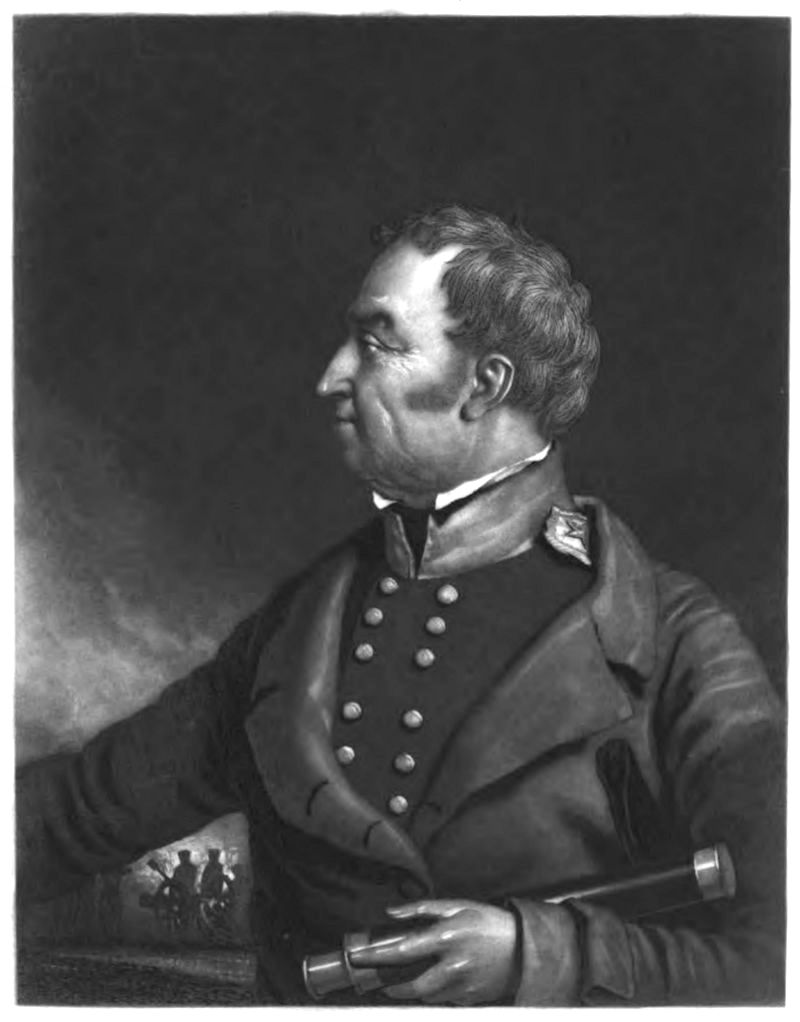
ENGRAVED BY J. SARTAIN FOR GRAHAM’S MAGAZINE
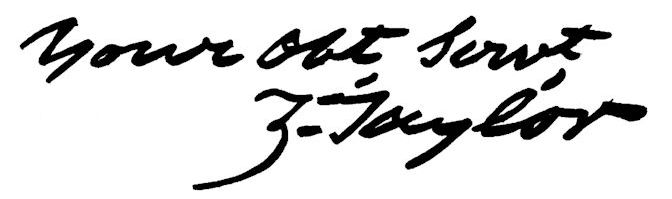
Your obt Servt
Z. Taylor
FROM A SKETCH BY CAPT. EATON, AID DE CAMP CAMARGO, MEXICO, AUGUST 15TH 1845
Entered according to Act of Congress in the year 1847 by Geo. R. Graham in the Clerks’ office of the District Court for the Eastern District of Pennsylvania.
A Memoir of Gen. Taylor’s life is, to one who
writes it with no purpose but to do justice to a
bright particular star in the constellation of our
country’s patriots, a pleasant and easy task; for his
career and character present no inconsistencies to
be reconciled, no acts that crave vindication. His
actions form his eulogy; and the severest narrative
of what he is, and what he has done, is the most
appropriate tribute to his modesty and merit, and to
the gratitude and admiration of his country.
Zachary Taylor is descended from one of the
oldest and most distinguished families of those who,
two centuries since, settled in Virginia; and is
kindred to James Madison, John Taylor of Caroline,
Judge Pendleton, and others, the most ardent and
spotless patriots of their time. His father was one
of the pioneers of Kentucky, one of those who worshiped
with their rifles beside them, and listened, in
the pauses of their labor, for the yell of the Indian.
Of the heroes of the dark and bloody ground he is
said to have been the most daring. To that wilderness
of wo, for such it then was, he bore his family,
including Zachary, who was born in Orange county,
Virginia, in the year 1790. It was under these
auspices that the young hero was educated. His
way to school was beset by savage foes, and in one
instance, one of his mates snatched from him by
the Indians. There could be no better school to
form the mind and fix the character of the warrior,
to teach caution and thoughtfulness, and to inspire
enterprise and a contempt of danger. This education—the
education of early Kentucky—has been
admirably described by Byron, in his verses on
Boone —
And tall and strong, and swift of foot were they,
Beyond the dwarfing cities’ pale abortions,
Because their thoughts had never been the prey
Of care or gain; the green woods were their portions;
No sinking spirits told them they grew gray,
No fashion made them apes of her distortions;
Simple they were, not savage; and their rifles,
Though very true, were not yet used for trifles.
Derived from such a stock, and invigorated by
such an education, he grew, as might be expected,
a man ardent but thoughtful, bold but guarded—one
likely to be successful in any sphere, and if after
life afforded the means of maturing his powers, certain
to be eminent. His early life abounds in anecdotes
characteristic of generous and noble qualities,
which, though derived from the best authority, our
limits compel us to omit. From the first to the last,
he has been regarded by those who knew him as
above the common stature of his fellow men. In
his retirement he was characterized as one whose
genius and power were adequate to any exigency,
civil or military, and who lacked only an opportunity
to leave his name
“A light and landmark on the cliff of fame.”
He has ever possessed those rare faculties which
induce the trust of others; to him has always been
consigned the task which involved most of peril and
demanded most of the power which overcomes it;
and it is singular that every prominent action of his
life has been a conflict with an adverse superiority,
in which he has always triumphed. The greatest
generals of the past have been applauded as fortunate;
but Taylor has triumphed, at every step,
with fortune against him. He has trusted nothing
to luck; his achievements have been the result of a
genius fertile in resources, prompt in their application,
resolute to the exclusion of a doubt, and
energetic to compel the result which had been determined
upon.
The outrages of England upon our commerce
fired every generous spirit in the west, and as early
as 1808, about the time when the outrage upon the
Chesapeake thrilled through every nerve of the republic,
young Taylor determined to wed his fortunes
with those of his country. The character and the influence
of his family readily secured him a commission
as lieutenant in the seventh infantry. He
addressed himself with characteristic ardor to his
profession, and before the war broke out, had arisen
to the rank of captain. His first commission was
granted by Jefferson, his second and third by
Madison, his fourth by Jackson, and his subsequent
commissions by Polk. He received the first reward
of valor, granted in the last war—a brevet majority;
and his rise to his present lofty position has been
gained, not from the patient indolence of rank, but
from brevets for victories.
The most vulnerable point of our country, in the
commencement of the last war, was the sparsely
settled West, encompassed as it was by ferocious
Indians in the pay of the British Government. This
was naturally the sphere of exertion for the young
hero. In a war abounding with almost daily and
ever deadly skirmishes with the Indians, he was,
of course, exposed to a series of perilous adventures
which escape the attention of the historian. He
was early appointed to the command of one of the
most important defences of the west, Fort Harrison.
In this post he won the first laurels, and the first
brevet, of the late war—the oldest brevet in the
army.
Fort Harrison, a rude structure, was garrisoned
by fifty men, though but ten or fifteen were in health
and effective; and it was crowded with the sick,
with women and children. Every precaution had
been taken, though it was impossible to raise a
guard of more than six men and two commissioned
officers. It was known that the Indians, in great
strength, were in the vicinity; and at 11 o’clock on
the night of September 3d, 1812, the attack was made.
The odds were fearful; and the fort, though it contained
many souls, could boast few prepared to
meet the exigency. The night was dark, and the
forests rang with the yells of hundreds of Indians.
The little band, forewarned of their danger, were at
their posts. But scarcely had the attack been made,
before a broad glare of light, rising in the gloom of
midnight, informed the feeble garrison that the block-house
connected with the fort had been fired by the
Indians. Every being, save Taylor, within the fort,
was panic-stricken at this terrible intelligence. The
alternative seemed a death in the flames, or by the
tomahawks of the Indians. The yells of the Indians,
the shrieks of the devoted women and children,
heard above the reports of the Indian rifles,
which poured a death-shower upon the fort, appalled
the garrison, who, enveloped in smoke, and exposed
by the glare of the conflagration to the rifles of the
foe, shrank and cowered. It was the trial-hour that
determined the character of the young hero. He
rose above the exigency; he rallied his few assistants,
disconnected the block-house from the fort, by
throwing off the roof, subdued the fire, fortified the
gap made by the destruction of the block-house,
and, after a desperate encounter of seven hours,
drove off the overwhelming force that beleaguered
him. The triumph was his alone; for all, save he,
had fettered under what seemed an inevitable doom.
In his after career he has encountered no darker
danger; and this achievement, though small the
numbers under his command, forms a worthy opening
to the daring and lustrous actions which followed.
He held the fort until the population of the West
gathering around him, rendered the post secure.
For this achievement he was brevetted by Madison,
and admired by the nation; but, although glowing
with a desire to distinguish himself in the fields that
followed, his orders compelled him to remain in the
seat of dangers which he had proved himself so
well qualified to encounter. In active and perilous
service in this section of the country, he remained
until the close of the war, and long after. A soldier
of the republic, he has never repined at any duty
imposed upon him, and never desired to gratify his
ambition by abandoning an humble post to win
laurels in other and more favorable fields. He was,
however, distinguished in all the operations in the
west; and in the expedition of Major Gen. Hopkins,
received, in the dispatches of that officer, thanks
“for a prompt and effectual support in every instance.”
In the war of 1832, against Black Hawk and his
tribe, Col. Taylor was actively engaged. He commanded
the regulars, under Gen. Atkinson, in the
trying march through the wilderness, in pursuit of
Black Hawk; and was at their head in the destructive
and decisive battle of the Wisconsin. The result
of that battle was the capture of Black Hawk
and the Prophet, who were surrendered to Col.
Taylor. This sanguinary conflict closed the war.
Col. Taylor remained in the West, in command
of different posts, until the period of the Florida
War. In this long interval of peace, his attention
was directed to study, and to the improvement of
his private fortune. He married a lady of Maryland,
who blessed his fire-side with one son and two
daughters, one of whom married Col. Davis, of the
Mississippi regiment, severely wounded at Buena
Vista. During this period Col. Taylor, (for in 1832
he was advanced to that rank,) established, throughout
the entire west, a reputation for enlarged intelligence,
bold sagacity, and high moral character,
which marked him out as the hero of an exigency.
Such an one arrived, and secured for him the confidence
and admiration of the government and the
nation.
It is unnecessary to characterize the failures of
the Florida War, or the war itself. It is sufficient
to say that our boldest and best sank under its hardships,
and were left to the wolf of the wilderness,
while no encounter won laurels, and no advantage
promised success. Col. Taylor was, in 1836, ordered
to Florida, and soon became distinguished for his
energy, perseverance, and indomitable hardihood
and resolution. His determination was to bring
the Seminoles to battle, and this was effected by
efforts of the most extraordinary character.
On the 19th of December, 1837, he received intelligence
that all efforts for conciliation had failed, and
being then in command of the first brigade, at Fort
Gardiner, he struck into the wilderness. He bore
but twelve days’ rations, and had with him about
one thousand men. He had learned that the Seminoles
and Mickasaukies, under their chiefs, Alligator
and Sam Jones, had selected a post deemed impregnable,
and that they challenged him to the
encounter. Advancing with caution but celerity,
and overcoming every obstacle, he arrived on the
25th of December at the point selected by the enemy,
upon the lake of Okeechobee. They were concealed
in a thick hammock, which could only be
approached by a swamp three quarters of a mile in
breadth, covered with grass five feet high, and knee
deep in mud and water. Our forces advanced; the
volunteers were received with a fire from the
hammock, and after a brief resistance, retired across
the swamp. The regulars, however, persisted in
advancing, and drove the enemy back. The struggle
was terribly severe. The advantages were all
against us. Our officers signalized themselves by
their valor, and many of them fell. The battle lasted
from half past twelve until three P. M. The immediate
command of Col. Taylor suffered most
severely; and his own preservation, conspicuous as
he was, for he refused to dismount, was almost
miraculous. Our victory was complete. The enemy
received a blow which, more than any thing that
occurred during the war, broke their spirits and
prepared them for submission. The loss of Col.
Taylor was severe. To use his own words, “besides
the killed, there lay one hundred and twelve
wounded, officers and soldiers, who had accompanied
me one hundred and forty-five miles, most
of the way through an unexplored wilderness, without
guides, who had so gallantly beaten the enemy,
under my orders, in his strongest position.” His
humanity was, however, as conspicuous as his
valor; and though the wounded were conveyed
back to their post with incredible difficulty and
labor, every thing was done which the most delicate
sensibility could have suggested in their behalf.
The detachment commanded by Col. Taylor in this
desperate encounter numbered about five hundred.
The enemy were seven hundred strong, and from
their concealment, and the extraordinary advantages
of their position, confidently calculated upon
a victory. The battle was the most successful of
the war; and the victory was only won by an extraordinary
effort of heroism—more than one-fourth of
the whole number engaged being killed or wounded.
The government appreciated, applauded, and rewarded
the conduct and heroism of Taylor in this
bloody conflict, and immediately promoted him to
the brevet rank of brigadier general, and gave him
the chief command of the war. On taking this
command he fixed his head-quarters at Tampa Bay,
and continued to prosecute what was termed “a
war of movements,” with a vigor and enterprise
which no ordinary energy of mind and body could
have endured. The foe, after the lesson taught at
Okeechobee, afforded him no subsequent opportunity
of meeting them in a general battle; but in
the prosecution of a contest peculiarly exhausting
and dangerous, he manifested the rarer qualities of
patience, vigilance, and unwearied promptitude and
vigor which form so large a part in the character of
a great military leader.
In 1840 he was relieved from duty in Florida, and
in the following year was assigned to the command
of the second department on the Arkansas, in which
station he continued, performing his duties with
characteristic diligence and success, until the difficulties
with Mexico opened a new and more glorious
career for the development of those powers matured
by so long a career of arduous and devoted service.
In prospect of the annexation of Texas, Gen.
Taylor received from the Department an order,
dated 17th September, ordering him to hold the
troops under his command in readiness to march
into Texas, and repel any hostile incursion of
Indians. An “Army of Observation” upon the
south-western frontier having been determined upon,
the Administration selected Gen. Taylor for that
command. The relations of our country rendered
it a post of great difficulty, requiring the highest
qualities of civil and military intellect; and the
choice of Gen. T. in preference to those of superior
rank, was a distinguished evidence of the confidence
of the Government. He was commanded to take a
position between the Neuces and Rio Grande; and
in August, 1845, established his camp at Corpus
Christi. The army remained in this position until
March 11th, 1846.
Having received positive orders to take a position
upon the eastern bank of the Rio Grande, Gen.
Taylor commenced his march. At the Rio Colorado
he was met with a stern resistance, and
assured that an attempt to cross would be followed
by actual hostilities. It is scarcely necessary to add
that he crossed, notwithstanding. On the 24th,
Gen. Taylor left the advancing army, and, with a
body of dragoons, repaired to Point Isabel, which
place he occupied, and received, from steamboats
opportunely arriving, supplies for the army. Gen.
Taylor soon rejoined the army; a position was
occupied opposite Matamoras, and the army proceeded
to fortify their camp. On the 11th of April,
Gen. Ampudia, in command at Matamoras, summoned
Gen. Taylor to break up his camp, and
retire beyond the Neuces within twenty-fours, adding
that if he did not, arms alone must decide the
question. In reply, Gen. Taylor informed him that
his instructions would not permit him to retrograde
from the position he occupied.
Col. Cross, of our army, having been murdered
when absent, and alone, some distance from the
camp, a party was, on the 17th, sent to discover and
seize the murderers. They were set upon by a
large party of Mexicans, and some of them killed.
On the 19th, Gen. Taylor blockaded the Rio Grande,
a measure which elicited an immediate protest from
Ampudia; and it was vindicated by Taylor as the
necessary result of the Mexican declaration of a
determination to commence, and actually commencing,
hostilities. The character of the two letters is
in singular contrast, that of Gen. Taylor being high-toned
and masterly, but moderate and courteous.
A collision had, from the first movement to occupy
the western bank of the Rio Grande, been inevitable;
and every day precipitated that result. Addresses,
over the signature of the Mexican general, were
scattered throughout our camp, inviting desertion.
The communications between Fort Brown and
Point Isabel were forcibly interrupted by large
bodies of the enemy. The war had begun. On the
first of May Gen. Taylor took up his line of march
for Point Isabel, leaving a small but sufficient force
at Fort Brown. His departure was the signal for a
furious but ineffectual attack, which resulted in the
death of the gallant commander, Major Brown, and
continued until the glorious return of Gen. Taylor.
The course of Gen. Taylor in this trying emergency
has elicited the praise of the greatest surviving captain
of the age—Wellington. The exigency was a fearful
one. Surrounded by an enemy greatly superior
in force, his supplies limited, and all communication
cut off, he resolved, not on retreat—for he left his flag
flying in face of the enemy—but on resuming his position.
He reached Point Isabel, May the 3d, without interruption;
and the Mexicans exulted in the division
of his army—one portion at Fort Brown, and another
at Point Isabel, and a superior force between
them. Intelligence was received at this latter place
of the successful resistance of Fort Brown, and the
embodiment of vast masses of Mexican troops to
oppose the return of Gen. Taylor. He waited for
no reinforcements, although they were daily expected;
he did not even take with him the untrained
soldiers at Point Isabel—for the conflict was to be
one in which the blenching of a single company
might be ruin. On the 7th of May he moved forward,
and the next day, about noon, at Palo Alto,
he found the enemy. His force consisted of less
than 2300 men—the enemy had in the field 6000
regular troops, the irregular force not known. He
encountered the flower of the Mexican army, fully
equipped, provided with ten pieces of artillery, and
confident of victory.
Gen. Taylor paused a time, that his panting host
might slake their thirst in the water of Palo Alto,
and then moved on to the conflict. The enemy
were drawn in line of battle, stretching a mile and
a half across the plain—their resplendent lancers in
advance on the left, and their overpowering masses
of infantry, and batteries of artillery forming the rest
of the line. On our side, Col. Twiggs commanded,
with the 3d, 4th, and 5th infantry, and Ringgold’s
artillery, on the right; Col. Belknap on the left, with
the 8th, and Duncan’s artillery; and Lieutenant
Churchill commanded the two eighteen pounders
in the centre. The battle was almost wholly one
of artillery—and never did artillery such service as
ours that day. Ringgold opened with terrible effect;
the gallant cavalry of the enemy fell as if smitten by
lightning; yet they recovered, and making a sweep,
threatened our rear, where they were met and repelled
by the infantry in square. While Ringgold
mowed his fatal harvest on the right, Duncan on the
left poured volley upon volley into the reeling
columns of the foe; and in the centre, the two
eighteen pounders kept up a steady and staggering
fire. Still the enemy, notwithstanding the obvious
superiority of our artillery, maintained their fire
with vigor, and urged the battle with determination.
At length, as if to swell the horror of the scene, the
prairie took fire, and for a time veiled the combatants
from each other, and stayed the contest.
When suddenly dashing, like incarnate spirits,
through the flames, which rose ten feet high, Duncan
and his men took position on the flank of the enemy,
and opened with terrific effect, rolling back the
ranks of the enemy, who recoiled in confusion.
Assailed in front and flank, they retired into the
chapparal; and thus night found the combatants—the
victors encamping where they fought, amid the
dying and the dead, with the promise of a bitterer
and bloodier conflict for the morrow. That night the
Mexicans retired to Resaca de la Palma. Their
loss was two hundred killed and four hundred
wounded; and ours was four men killed, three
officers, and thirty-seven men wounded, several
mortally, and among the latter, Major Ringgold and
Capt. Page.
Gen. Taylor’s bearing in this battle was marked
by every trait that ennobles a hero. But his victory
had not relieved him from the danger that over-shadowed
his little host. He had won glory, but
not safety. Should he advance, it must be against
an enemy overpowering in his superiority of numbers,
and with an advantage of position. A council
was held on the early morn of the next day. Its
advice was against an advance; Gen. Taylor closed
its deliberations by declaring that, if living, he
would sleep that night in Fort Brown. The army
advanced against the foe.
The next morning disclosed the retreat of the
Mexicans. Reinforced by 2000 men, they had
selected a position of great strength, with a ravine
in front, guarded by a pond on one flank, and the
chapparal on the other, defending their position
with eight pieces of artillery, and with a vast superiority
of force, they awaited the approach of the
American army. Their expectations were not baffled.
The field is known, and will be remembered as
Resaca de la Palma.
The advance of our army was accompanied by
every precaution, and at length the presence of the
enemy was ascertained. The artillery of Lieut.
Ridgely moved rapidly to the front and encountered
that of the enemy. The infantry, meanwhile, pressed
upon those on the right, and though met with resolution,
succeeded in penetrating through the chapparal,
and gaining his flank; while on the left a
murderous fire was kept up by our advancing
troops. But, in the centre, the enemy maintained
a steady and destructive fire, from which Gen.
Taylor, when entreated to do so, refused to retire.
Lieut. Ridgely, unlimbering, advanced, from time to
time, toward the enemy, discharging his canister at
a distance of one hundred yards upon the foe. The
Mexicans, however, with a well-directed fire, continued
to sweep our lines. At this crisis Gen.
Taylor ordered Capt. May to charge the battery
with his dragoons. His words were, “Capt. May,
you must take it.” That gallant officer, saying to
his company, “Men, we must take it,” leapt to the
charge. It was successful. With those who survived
the discharge with which they were met, he
swept through the enemy’s line, and was immediately
followed and sustained by a fierce onslaught
from the infantry at the point of the bayonet. The
enemy’s centre was broken, and the fortune of the
day decided. The flight of the Mexicans became
general, and was soon hurried into panic by the
ardor of the victors. Every thing was left to the
conqueror; and rushing on in one confused mass,
the Mexicans trampled down each other in the
eagerness of fear. The victory was complete as it
was wonderful. Never, in any field, was the omnipotence
of heroism more signally displayed; and of
those most calm, yet most ardent—in every chasm
made by the swoop of the artillery—in every scene
that demanded the cool, clear intellect, and the
daring heart—the foremost was Taylor.
This conflict was one to be remembered. Taylor
brought into the action but 1700 wearied men,
against a force of at least 6000, well disciplined,
officered and conditioned. The enemy had every
advantage of position, and that position was not
only strong, but was valiantly maintained. The
victory was the result of no sudden panic on the
part of the enemy; it was wrested from them by
fair, open, hard fighting. Our loss in this contest
was about 110 killed and wounded. That of the
enemy was probably tenfold, though not ascertained,
as many perished in the river. The triumph was
affluent in standards, artillery, prisoners and other
evidences of victory. To use the language of Gen.
Taylor’s dispatch—“Our victory has been decisive.
A small force has overcome immense odds of the
best troops Mexico can furnish—veteran regiments,
perfectly equipped and appointed.”
Gen. Taylor’s promise was fulfilled, and Fort
Brown was rescued. But it was found impossible
immediately to follow up the victory. Every obstacle
was, however, by untiring energy and perseverance
overcome; when, on the 17th of May,
Arista offered an armistice. It was now too late:
the offer was declined. The next day Taylor, without
resistance, took possession of Matamoras.
His instructions required his advance into the
interior, but for a long period, a period filled up by
the hero with impatient protests to the War Department,
and entreaties for further means of transportation,
and anxious efforts, on his own part, to supply
them, he was compelled to remain inactive. At
length, however, the army was set in motion. Its
object was Monterey, a place strong by nature,
amply fortified, and maintained by an army of 7000
troops of the line, and 3000 irregulars. Against
this stronghold he marched with an army comprising
425 officers, and 6220 men. Against the forty-two
pieces of cannon of the Mexicans, he arrayed but
one 10 inch mortar, two 24 pounder howitzers, and
four light field batteries of four guns each—the
mortar being the only piece suitable to the operations
of a siege. With these fearful odds against him he
advanced upon Monterey.
Gen. Taylor arrived before the city on the 19th,
and established his camp three miles from its defences.
Reconnaissances were made, and it was
found possible to turn the position of the enemy, and
gain the heights in his rear. The gallant Worth
was detached upon this duty, and to carry the
enemy’s works. From this moment the operations
became two-fold—the assailing party of Worth
being independent of the command of Taylor, and
the object of the latter principally to divert the
enemy from Worth.
This order was given on the 19th; and the next
day at 2 o’clock Worth moved forward, and succeeded
in reaching a position above the Bishop’s
Palace. The succeeding morning, that of the 21st,
commenced the conflict which determined the fate
of Monterey. Worth pressing forward, encountered
the enemy in force, and overcame him; he gained
the Saltillo road, and cut off his communications;
and he succeeded in carrying two heights west of
the Saltillo road, and turned a gun on one of them
upon the Bishop’s Palace. These triumphs were
confident auguries of victory. Meanwhile, a vigorous
assault was made upon the city from below, by
the force under Gen. Taylor. It would be vain to
attempt a description in limits so brief as those
allotted us, of this terrific and bloody contest. Our
loss was heavy, from the character of the enemy’s
defences, and the daring ardor of our troops; and
where it was heaviest, Gen. Taylor, seeming to bear
a charmed life, was exposed unhurt. His object
was, however, attained; he diverted attention from
the operations of Gen. Worth, carried one of the
enemy’s advanced works, and secured a strong foothold
in the town. Thus passed the third day of this
desperate conflict. The fourth saw Worth victorious
at every point. The Bishop’s Palace was taken
at dawn, the palace itself at mid-day; while the force
under Taylor pressed upon the city, the lower part
of which was evacuated that night. On the fifth day,
the 23d, the troops under Taylor advanced from
square to square, every inch of ground being desperately
disputed, until they reached within a square
of the principal Plaza; while Worth, with equal
vigor, pressed onward, encountering and overcoming
difficulties insuperable, except to such
energies as he commanded. At length the period
had arrived for a concerted storm of the enemy’s
position, which was determined upon for the
ensuing day. The morning, however, brought an
offer of capitulation. The negotiation resulted in
the surrender of the city. This victory, though won
at the expense of about 500 hundred killed and
wounded, secured the possession of an immense
territory, and a vast amount of military spoil.
Monterey now became Gen. Taylor’s head-quarters.
Saltillo and Parras were occupied; and the
Mexicans fell back to San Luis Potosi. This movement
was, however, the precursor of a fresh and most
formidable effort against our army under Gen.
Taylor. Santa Anna was recalled to Mexico, and
placed at the head of the government and army.
He proceeded immediately to raise and organize an
army, and before December, had 20,000 men under
his command. With this force he determined to encounter
and crush Taylor, and redeem the extensive
provinces conquered by the Americans. While he
was thus engaged, our government, for the purposes
of an attack upon Vera Cruz, withdrew from
Gen. Taylor the most effective portion of his force,
leaving him with an extended line of territory to
defend, a formidable foe in front, and a small force,
principally untried volunteers, with which to encounter
the enemy. He was advised by the Department
to retire to Monterey, and there defend himself;
but such a policy would have opened the entire
country, as far as the Rio Grande, and probably the
Neuces, to the enemy, and have given a severe, if not
fatal, blow to our arms. He therefore determined to
encounter the foe at an advanced position, and
selected Buena Vista for that purpose. This field
was admirably chosen, and the hero and his little band
there awaited the shock of his powerful adversary.
Santa Anna brought 20,000 men into the field, and was
encountered by a force of 334 officers and 4425 men.
On the 22d of February, Santa Anna summoned
Gen. Taylor to surrender, vaunting his immense
superiority, and the impossibility of successful resistance.
The hero’s reply was a brief and polite
refusal. It was followed by the attack of the Mexicans
upon our extreme right, in an effort to gain our
flank, and the skirmishing was continued until night.
During the night the enemy threw a body of light
troops on the mountain side, with the purpose of out-flanking
the left of our army; and at an early hour
the next morning the engagement here commenced.
Our limits will not permit us to give its details. On
the part of the Mexicans it was conducted with
consummate skill, and maintained with courage
and obstinacy. Overpowering masses of troops
were poured upon our weakest points, and at
several periods of the battle their success seemed
almost inevitable. But Gen. Taylor was found
equal to every crisis of the conflict. Calm, collected,
and resolved, he rose superior to the danger of his
situation, and compelled a victory. It is admitted
by all who were present, that no man but Gen.
Taylor could have won the victory of Buena Vista.
The battle raged with variable success for ten
hours; and the carnage on both sides was terrible.
At length night put an end to the conflict. The
Americans slept upon the field of their heroic
achievements; and the foe, shattered and disheartened,
retired, and the next day were in full retreat
to San Luis Potosi. Our loss in this extraordinary
conflict was 267 killed, and 456 wounded; that of
the enemy was from 1500 to 2000. A distinguished
officer present, thus describes the demeanor of Gen.
Taylor during the battle:
“During the day an officer approached our lines
with a flag of truce, and requested to be shown to
General Taylor. The brave old man was sitting
quietly on his white charger, with his leg over the
pommel of the saddle, watching the movements of
the enemy, when the Mexican officer was presented.
In a very courteous and graceful manner
the officer stated that ‘he had been sent by his excellency
General Santa Anna to his excellency
General Taylor, to inquire, in the most respectful
manner, what he (General Taylor) was waiting for?’
From the silence of General Taylor’s batteries, and
the quiet manner in which he received Santa Anna’s
terrific cannonading, the Mexican supposed he was
asking a very proper question; to which, however,
old Rough and Ready gave the very pertinent reply
that ‘he was only waiting for General Santa
Anna to surrender.’ The Mexican returned hastily
to his lines. This message proved to be a ruse to
ascertain where General Taylor’s position was, for
after the return of the Mexican officer to his own
ranks, the whole Mexican battery seemed to open
upon Gen. Taylor’s position, and the balls flew over
and about him like hail. Utterly indifferent to the
perils of his situation, there sat the old chief on his
conspicuous white horse, peering through his spy-glass
at the long lines of Mexican troops that could
be seen at a great distance on the march. The persuasion
of his aids could not induce him to abandon
his favorite point of observation, nor to give up his
old white horse. To the suggestions of his staff
that ‘old whitey’ was rather too conspicuous a
charger for the commander, he replied, that ‘the
old fellow had missed the fun at Monterey, on account
of a sore foot, and he was determined he
should have his share this time.’”
The victory of Buena Vista closed the war in
that quarter of Mexico. Since that period Gen.
Taylor has found no enemy willing or able to
encounter him.
The character of Gen. Taylor has been throughout
his life, from the commencement of his career
of victory at Fort Harrison down to the present moment,
consistent and self-sustained. Its leading trait
has been a disinterested devotion to his country,
and the dedication of his life and energies to its service.
In public and in private, he has always been
distinguished for the lofty and iron integrity of an
Aristides or Cincinnatus. Always independent and
self reliant, he owes nothing to the patronage of the
great, or the partiality of the powerful, but has
fought his way up to the lofty eminence which he
now occupies in the minds and hearts of his countrymen.
His triumphs have been won by his own
genius and virtues—his own counsels have directed,
his own energies sustained him. His vigor of character,
his power of will, and fertility of resources,
have swept every obstacle from his path; laborious
and intense in his exertions, patient and perseverant
in the pursuit of his object, he has risen superior to
the most perilous exigencies, and made every trial a
triumph. To these high qualities he has added a
sagacity which nothing could baffle or elude, and
which, in the course of his long career, has in no
emergency been found in error. Unerring and profound,
it has been prompt to discover every advantage
and powerful to improve it. His dispatches,
in answer to questions propounded by the Department,
in relation to the general policy, disclose a
grasp and comprehension of intellect, an extent of
information, and a depth of judgment that would
distinguish any living statesman; while the style of
his correspondence, simple, but polished, eloquent,
but unostentatious, may be and has frequently been
cited as a model of that species of composition.
Gen. Taylor’s disposition is kindly and affectionate;
his heart glows with benevolence, and his manners
are gentle and pleasing. To those under his command
his demeanor has ever been paternal and
affectionate; and he has been rewarded in a devotion
on their part as zealous and ardent as any
which soldiers ever cherished for the hero that led
them to victory. To his officers his deportment has
always been generous, affording them, as in the
case of Worth, every opportunity to win distinction,
and eager to secure for them the admiration and
reward which they merited. Even the foe not only
learned to fear him as an enemy, but to revere him
as a protector. His refusal to sack Monterey and expose
the helpless and innocent women and children
to the mercy of the flushed soldier, rough, and hard
of heart, will be remembered as one of the noblest
incidents of the war. His tenderness to the wounded
of the foe, and his anxiety to secure sepulture for
their dead, approve him to be as humane as he is
heroical. Gen. Taylor is now fifty-seven years of
age; he is about five feet ten inches in height, well
built, muscular and hardy in his appearance. Our portrait
may be relied upon as a correct and characteristic
delineation of the features of one who will hereafter
live in the most cherished affections of our people,
and on the brightest page of our country’s history.
———
BY CAROLINE A. BRIGGS.
———
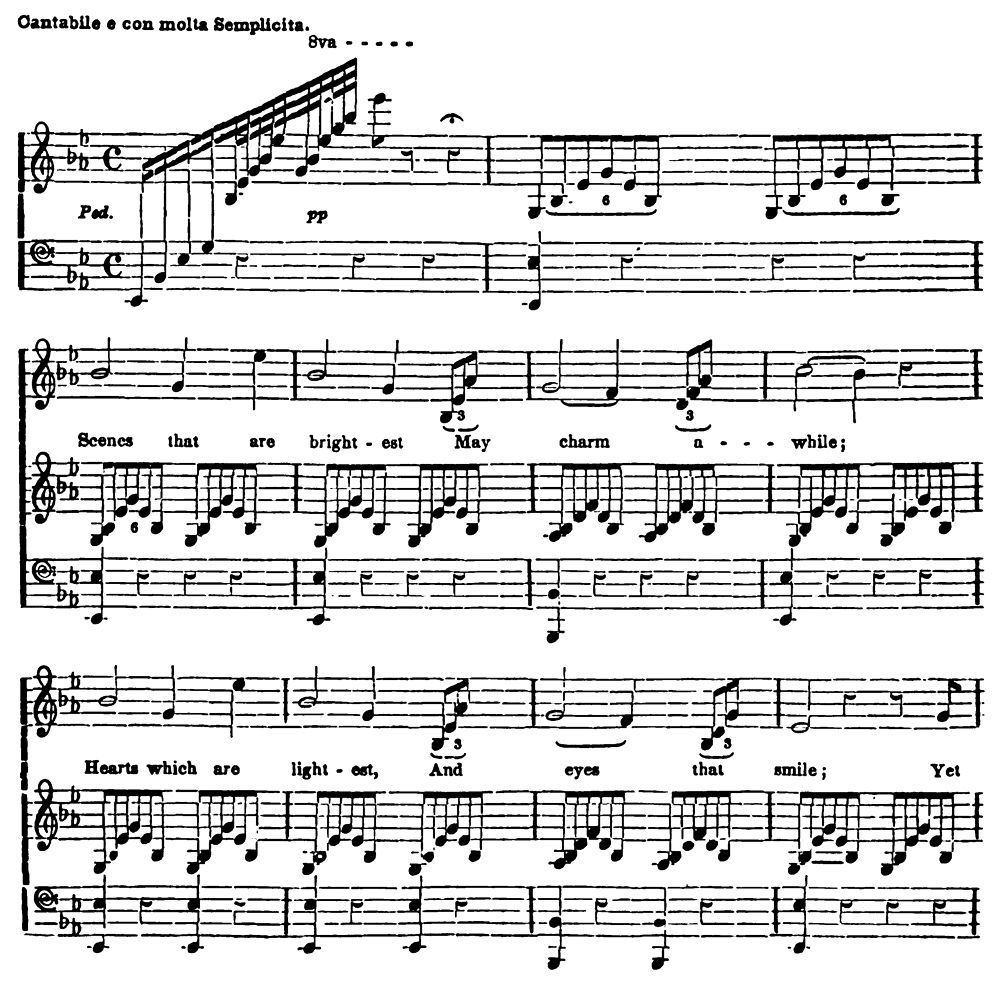
Thou sayest thou wilt ne’er forget;
That I shall ever be
A green spot on Life’s desert waste,
A star of love to thee—
A ray to cheer and warm—and yet,
Believe it not; thou wilt forget!
A few short years perchance thou’lt keep
My mem’ry fresh and green,
Recalling e’en each look of mine,
Without a mist between—
And think ’twill aye be so—and yet,
Believe it not; thou wilt forget!
I’ve met with friends who’ve vowed to me,
To love through good and ill;
To cherish me till life’s great pulse
Within their hearts grew still—
Forgetting me, oh, ne’er!—and yet,
Alas! Alas! they did forget.
My name to them is now like some
Dim mem’ry of a song
They used to love to listen to—
But that was long since—long—
’Tis charmless now—and yet, and yet,
They said they never would forget.
A little time, and thou wilt write
My name all names above,
And then, perchance, thou too wilt find
Some dearer one to love—
Some fairer one whom thou hast met,
And I, alas! thou WILT forget!
Believe it not that I shall live
Within thy heart for aye;
Recall this weary parting hour,
Some future, distant day—
And thou wilt start to find that yet.
With all thy care, thou DID’ST forget!
———
TRANSLATED BY ALICE GREY.
———
Fallen is the lofty column, the laurel green;
The refuge sweet of my o’er wearied thought.
I have lost that, which may in vain be sought
The stormy North and the sweet South between.
My dearest treasure death’s cold arms enfold,
The joy and glory of my every hour;
And Earth cannot restore it; nor can power,
Nor oriental gems, nor hoards of gold.
Since fate such sorrow doth for me prepare,
How can I choose but bear a bleeding heart,
Eyes ever moist, and looks by grief inspired?
Oh life! which seen afar appears so fair,
How often in one morning doth depart,
That which long years of suffering had acquired.
FIRST AND LAST VISIT TO THE ALE-HOUSE.[7]
———
BY T. S. ARTHUR.
———
When Sally Lester gave her hand in marriage
to Ralph Lyon, she was a delicate, timid girl of
eighteen, who had passed the spring-time of life
happily beneath her father’s roof. To her, care,
anxiety, and trouble were yet strangers. The first
few years of her married life passed happily—for
Ralph was one of the kindest of husbands, and suffered
his wife to lean upon him so steadily, that the
native strength of her own character remained
undeveloped.
Ralph Lyon was an industrious mechanic, who
always had steady work and good wages. Still, he
did not seem to get ahead as some others did, notwithstanding
Sally was a frugal wife, and did all
her own work, instead of putting him to the expense
of help in the family. Of course, this being
the case, it was evident that there was a leak somewhere,
but where it was neither Ralph nor his wife
could tell.
“Thomas Jones has bought the piece of ground
next to his cottage,” said Ralph one day to Sally,
“and says that next year he hopes to be able to put
up a small frame-house, big enough for them to live
in. He paid sixty dollars for the lot, and it is at least
a quarter of an acre. He is going to put it all in
garden this spring, and says he will raise enough to
give him potatoes, and other vegetables for a year to
come. It puzzles me to know how he saves money.
He doesn’t get any better wages than I do, and his
family is quite as large.”
“I am sure,” returned Sally, who felt that there
was something like a reflection upon her in what
her husband said, “that Nancy Jones doesn’t spend
her husband’s earnings more frugally than I do
mine. Every week she has a woman to help her
wash, and I do it all myself.”
“I am sure it isn’t your fault—at least I don’t
think it is,” replied Ralph; “but something is wrong
somewhere. I don’t spend any thing at all, except
for a glass or two every day, and a little tobacco;
and this, of course, couldn’t make the difference.”
Sally said nothing. A few glasses a-day and tobacco,
she knew, must cost something, though, like
her husband, she did not believe it would make the
difference of buying a quarter of an acre of ground,
and building a snug cottage in the course of a few
years.
Let us see how this is. Perhaps we can find out
the leak that wasted the substance of Ralph Lyon.
He never drank less than three glasses a-day, and
sometimes four; and his tobacco cost, for smoking
and chewing, just twelve and a half cents a week.
Now, how much would all this amount to? Why,
to just sixty-five dollars a year, provided but three
glasses a-day were taken, and nothing was spent in
treating a friend. But the limit was not always observed,
and the consequence was, that, take the
year through, at least eighty dollars were spent in
drinking, smoking, and chewing. Understanding
this, the thing is very plain. In four years, eighty
dollars saved in each year would give the handsome
sum of three hundred and twenty dollars. Thomas
Jones neither drank, smoked, nor chewed, and, consequently,
not only saved money enough in a few
years to build himself a snug little house, but could
afford, during the time, to let his wife have a washer-woman
to help her every week, and to dress much
more comfortably than Sally Lyon had been able
to do.
The difference in the condition of the two families
sets Mrs. Lyon to thinking very seriously about the
matter, and thinking and calculating soon made
the cause quite plain to her. It was the drinking
and the smoking. But with a discovery of the evil
did not come a cheering consciousness of its easy
removal. How could she ask Ralph to give up his
glass and his tobacco, to both of which he seemed
so strongly wedded? He worked hard for his money,
and if he chose to enjoy it in that way, she had no
heart to interfere with him. But from the time that
Ralph discovered how well his neighbor Jones was
getting along, while he, like a horse in a mill, had
been toiling and sweating for years, and yet stood
in the same place, he became dissatisfied, and often
expressed this dissatisfaction to Sally, at the same
time declaring his inability to tell where all the
money he earned went to.
At length Sally ventured to hint at the truth. But
Ralph met it with —
“Pooh! nonsense! Don’t tell me that a glass of
liquor, now and then, and a bit of tobacco, are going
to make all that difference. It isn’t reasonable.
Besides, I work very hard, and I ought to have a
little comfort with it when I’m tired, a glass
warms me up, and makes me bright again; and I am
sure I couldn’t do without my pipe.”
“I don’t ask you to do so, Ralph,” replied Sally.
“I only said what I did, that you might see why we
couldn’t save money like our neighbor Jones. I
am sure I am very careful in our expenses, and I
haven’t bought myself a new gown for a long time,
although I am very bare of clothes.”
The way in which Ralph replied to his wife’s
suggestion of the cause of the evil complained of,
determined her to say no more; and as he felt
some convictions on the subject, which he was
not willing to admit, he was ever afterward silent
about the unaccountable way in which his money
went.
In about the same ratio that the external condition
of Thomas Jones improved, did that of Ralph Lyon
grow worse and worse. From not being able to
save any thing, he gradually began to fall in debt.
When quarter-day came round, there was generally
several dollars wanting to make up the rent; and
their landlord, with much grumbling on his part,
was compelled to wait for the balance some two or
three weeks beyond the due-day. At length the
quarter-day found Ralph with nothing laid by for his
rent. Somehow or other, he was not able to earn
as much, from sickness, and days lost from other
causes; and what he did earn appeared to melt
away like snow in the sunshine.
Poor Mrs. Lyon felt very miserable at the aspect
of things; more especially, as in addition to the
money squandered at the ale-house by her husband,
he often came home intoxicated. The grief to her
was more severe, from the fact that she loved
Ralph tenderly, notwithstanding his errors. When
he came home in liquor, she did not chide him,
nor did she say any thing to him about it when
he was sober; for then he appeared so ashamed and
cut down, that she could not find it in her heart to
utter a single word.
One day she was alarmed by a message from
Ralph that he had been arrested, while at his work,
for debt, by his landlord, who was going to throw
him in jail. They now owed him over twenty
dollars. The idea of her husband being thrown into
a jail was terrible to poor Mrs. Lyon. She asked a
kind neighbor to take care of her children for her,
and then putting on her bonnet, she almost flew to
the magistrate’s office. There was Ralph, with an
officer by his side ready to remove him to prison.
“You shan’t take my husband to jail,” she said,
wildly, when she saw the real aspect of things,
clinging fast hold of Ralph. “Nobody shall take
him to jail.”
“I am sorry, my good woman,” said the magistrate,
“to do so, but it can’t be helped. The debt
must be paid, or your husband will have to go to
jail. I have no discretion in the matter. Can you
find means to pay the debt? If not, perhaps you
had better go and see your landlord; you may prevail
on him to wait a little longer for his money,
and not send your husband to jail.”
“Yes, Sally, do go and see him,” said Ralph; “I
am sure he will relent when he sees you.”
Mrs. Lyon let go the arm of her husband, and,
darting from the office, ran at full speed to the house
of their landlord.
“Oh, sir!” she exclaimed, “you cannot, you will
not send my husband to jail.”
“I both can and will,” was the gruff reply. “A
man who drinks up his earnings as he does, and
then, when quarter-day comes, can’t pay his rent,
deserves to go to jail.”
“But, sir, consider—”
“Don’t talk to me, woman! If you have the
money for the rent, I will take it, and let your husband
go free; if not, the quicker you leave here the
better.”
It was vain, she saw, to strive with the hard-hearted
man, whose face was like iron. Hurriedly
leaving his house, she hastened back to the office,
but her husband was not there. In her absence he
had been removed to prison. When Mrs. Lyon
fully understood this, she made no remark, but
turned from the magistrate and walked home with a
firm step. The weakness of the woman was giving
way to the quickening energies of the wife, whose
husband was in prison, and could not be released
except by her efforts. On entering her house, she
went to her drawers, and took therefrom a silk
dress, but little worn, a mother’s present when she
was married; a good shawl, that she had bought
from her own earnings when a happy maiden; a
few articles of jewelry, that had not been worn for
years, most of them presents from Ralph before they
had stood at the bridal altar, and sundry other things,
that could best be dispensed with. These she took
to a pawn-broker’s, and obtained an advance of
fifteen dollars. She had two dollars in the house,
which made seventeen; the balance of the required
sum she borrowed from two or three of her neighbors,
and then hurried off to obtain her husband’s
release.
For a time, the rigid proceedings of the landlord
proved a useful lesson to Ralph Lyon. He worked
more steadily, and was rather more careful of his
earnings. But this did not last a great while.
Appetite, long indulged, was strong; and he soon
returned to his old habits.
The shock the imprisonment of her husband produced,
awoke Mrs. Lyon to the necessity of doing
something to increase their income. All that he
brought home each week was scarcely sufficient to
buy food; and it was clear that there would be nothing
with which to pay rent when next quarter-day
came round, unless it should be the product of
her own exertions. Plain sewing was obtained by
Mrs. Lyon, and an additional labor of three or four
hours in the twenty-four added to her already over-tasked
body. Instead of feeling rebuked at this,
the besotted husband only perceived in it a license
for him to use his own earnings more freely, thus
making his poor wife’s condition really worse than
it was before.
Things, instead of getting better, grew worse, year
after year. The rent Mrs. Lyon managed always
to pay; for the fear of seeing her husband carried off
to jail was ever before her eyes, stimulating her to
constant exertion; but down, down, down they went
steadily and surely, and the light of hope faded daily,
and grew dimmer and dimmer before the eyes of
the much-enduring wife and mother. Amid all, her
patience was wonderful. She never spoke angrily
to Ralph, but strove, rather, always to appear cheerful
before him. If he was disposed to talk, she
would talk with him, and humor his mood of mind;
if he was gloomy and silent, she would intrude nothing
upon him calculated to fret his temper; if he
complained, she tried to soothe him. But it availed
nothing. The man was in a charmed circle, and
every impulse tended to throw him into the centre
where ruin awaited him.
At last even the few dollars she had received
every week from her husband’s earnings, ceased to
come into her hands. The wretched man worked
little over half his time, and drank up all that he
made. Even the amount of food that the entire
product of Mrs. Lyon’s labor would procure, was
barely sufficient to satisfy the hunger of her family.
The clothes of her children soon began to hang in
tatters about them; her own garments were faded,
worn, and patched; and every thing about the
house that had not been sold to pay rent, was in a
dilapidated condition. Still, there had been no unkind
word, not even a remonstrance from the
much-enduring wife.
Matters at last reached a climax. Poor Mrs.
Lyon had not been able to get any thing to do for a
week, and all supplies of food, except a little meal,
were exhausted. An anxious day had closed, and
at night-fall the mother made some hasty-pudding
for the children, which was eaten with a little
milk. This consumed her entire store. She had
four children, the two oldest she put to bed, but
kept the two youngest, one five years old, and the
other three, up with her. She moved about with a
firmer step than usual, and her lips were tightly
closed, as if she had made up her mind to do something
from which, under ordinary circumstances,
she would have shrunk.
After the older children had been put to bed, she
made the two younger ones draw near to the hearth,
upon which a few brands were burning, and warm
themselves as well as the feeble heat emitted by
the almost exhausted fire would permit. Then she
wrapped each around with a piece of an old shawl,
and after putting on her bonnet, took them by the
hands and left the house. It was a chilly night in
winter. The wind swept coldly along the streets,
piercing through the thin garments of the desperate
mother, who was leading forth her tender little ones
on some strange, unnatural errand. But she shrunk
not in the blast, but walked rapidly along, almost
dragging the children after her. At length she
stopped before the window of an ale-house, and
standing on tip-toe, looked over the red curtain that
shaded half the window, and concealed the inmates
from the view of passers by. Within she saw her
husband sitting comfortably by a table, a glass by
his side, and a pipe in his mouth. Half a dozen
pot-companions were sitting around, and all seemed
enjoying themselves well.
Mrs. Lyon remained without only a few moments;
then taking hold of the door she walked firmly in,
and without appearing to notice her husband, went
up to the bar and called for three glasses of brandy.
After doing this, she seated herself at a table near
by her husband. Great, of course, was the surprise
of Lyon at this apparition. He jumped from his
chair and stood before his wife, just as she had
taken her seat at the table, saying, in an undertone,
as he did so —
“For Heaven’s sake, Sally! what brings you
here?”
“It is very lonesome at home, Ralph,” she replied,
in a calm but sad voice. “Our wood is all gone,
and it is cold there. I am your wife, and there is
no company for me like yours. I will go anywhere
to be with you. I am willing to come even here.”
“But, Sally, to think of your coming to such a
place as this.”
“If it is pleasant to you, it shall be so to me.
Any where that my husband goes, surely I can go.
God hath joined us together as one, and nothing
should divide us.”
By this time the three glasses of brandy that Mrs.
Lyon had called for were placed before her on the
table.
“Bring another glass,” said Mrs. Lyon calmly,
“my husband will drink with us.”
“Sally, are you mad?” ejaculated Ralph.
“Mad, to go with my husband? Why should
you say that, Ralph? Drink, children,” she added,
turning to her two little ones, and placing a glass of
unadulterated brandy before them. “It will do you
good.” As Sally said this, she lifted her own glass
to her lips.
“Surely, you are not going to drink that?” said
Ralph.
“Why not? You drink to forget sorrow; and if
brandy have that effect, I am sure no living creature
needs it more than I do. Besides, I have eaten
nothing to-day, and need something to strengthen
me.”
Saying this, she sipped the burning liquid, and
smacking her lips, looked up into her husband’s
face and smiled.
“It warms to the very heart, Ralph!” she said.
“I feel better already.” Then turning to the children,
whose glasses remained untouched before
them, she said to the astonished little ones,
“Drink, my children! It is very good.”
“Woman! are you mad? My children shall not
touch it;” and he lifted the glasses from the table
and handed them to one of the company that had
crowded around to witness this strange scene.
“Why not?” said his wife, in the calm tone with
which she had at first spoken. “If it is good for
you, it is good for your wife and children. It will
put these dear ones to sleep, and they will forget
that they are cold and hungry. To you it is fire
and food and bed and clothing—all these we
need, and you will surely not withhold them from
us.”
By this time Ralph was less under the influence
of liquor than he had been for weeks, although he
had drank as freely as ever through the day. Taking
hold of his wife’s arm, he said, in a kind voice, for
he began to think that her mind was really wandering —
“Come, Sally, let us go home.”
“Why should we go, Ralph?” she replied, keeping
her seat. “There is no fire at home, but it is
warm and comfortable here. There is no food
there, but here is plenty to eat and to drink. I
don’t wonder that you liked this place better
than home, and I am sure I would rather stay
here.”
The drunken husband was confounded. He
knew not what to do or to say. The words of his
wife smote him to the heart; for she uttered a stunning
rebuke that could not be gainsaid. He felt a
choking sensation, and his trembling knees bore
heavily against each other.
“Sally,” he said, after a pause, in an altered and
very earnest tone—“I know it is more comfortable
here than it is at home, but I am going home, and I
intend staying there. Wont you go with me, and
try to make it as comfortable as it used to be? The
change is all my fault, I know; but it shall be my
fault no longer. Here, once and forever, I solemnly
pledge myself before God never again to drink the
poison that has made me more than half a brute,
and beggared my poor family. Come, Sally! Let
us hurry away from here; the very air oppresses
me. Come, in Heaven’s name! come!”
Quickly, as if an electric shock had startled her,
did Mrs. Lyon spring from her seat, as her husband
uttered the last word, and lay hold of his arm with
an eager grasp.
“The Lord in heaven be praised!” she said,
solemnly, “for it is his work. Yes, come! Let us
go quickly. There will again be light, and fire and
food in our dwelling. Our last days may yet be our
best days.”
Lifting each a child from the floor, the husband
and wife left that den of misery with as hasty steps
as Christian’s when he fled from the City of Destruction.
The hopeful declaration of Mrs. Lyon proved indeed
true. There was soon light, and fire, and food
again in that cheerless dwelling; and the last days
of Ralph and his family have proved to be their
best days. He has never since tasted the tempting
cup, and finds that it is a very easy matter to save
one or two dollars a week, and yet live very comfortably.
The scene in the ale-house is never alluded to
by either the husband or wife. They take no pleasure
in looking back—preferring, rather, to look
forward with hope. When it is thought of by either,
it is something as a man who has endured a painful
operation to save his life, thinks of the intense sufferings
he then endured.
TO A YOUNG INVALID ABROAD.
Health unto thee! ’Twill come, though coy and slow:
Thou canst not die, before I cease to live.
Are we not one? Ay, brother, boughs that give
Their verdure from one trunk, and cannot know
A life-drop but from thence? The topmost bough
Still withers first: whilst mine is green on high,
I feel—and fear not—that thou canst not die!
Would that my life’s blood, warm and healthful now,
Were welling in thy veins—and I like thee!
’Twere joy to suffer for thee, could I hear
Thy light laugh, as of old, ring in my ear:
So thou wert happy what aught else to me?
An angel-ward our mother’s prayers have set
Around thee. Courage then! Thou’lt kiss her pale cheek yet!
C.
Philadelphia, April 1847.
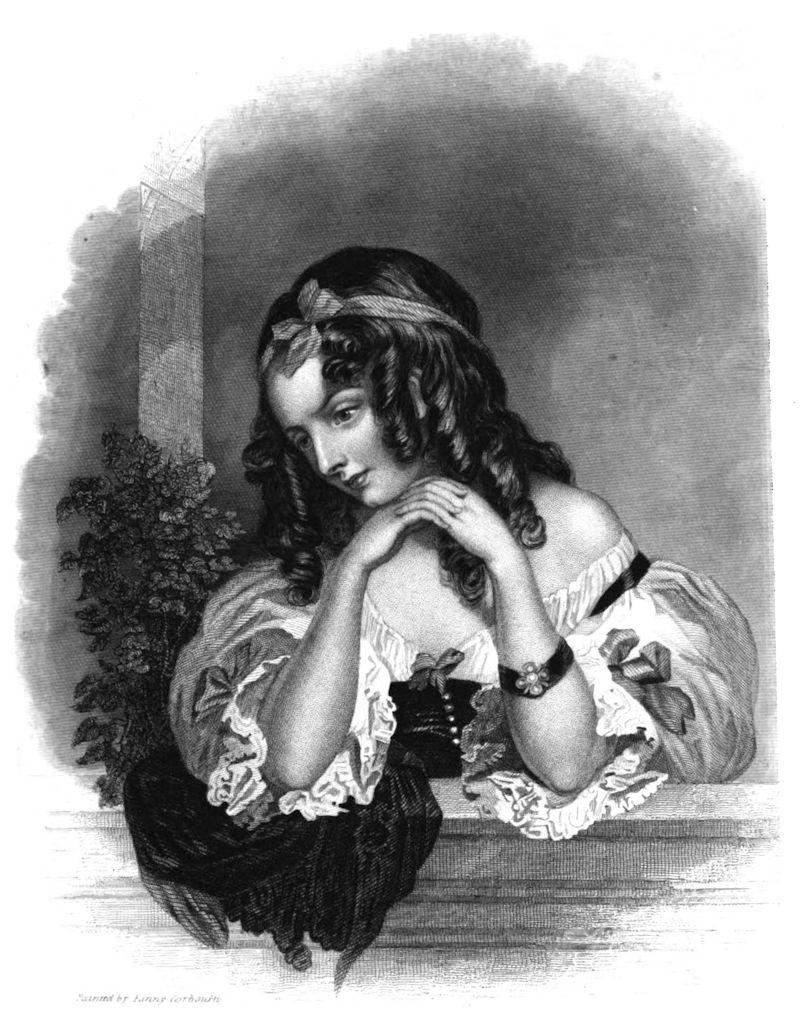
Painted by Fanny Corbourn Engraved by A. L. Dick
MIRIAM. Engraved expressly for Graham’s Magazine.
———
BY E. M. SIDNEY.
———
She opens her lattice,
And looks on the lake;
O’er its slumbering surface,
No murmurs awake.
Afar, o’er the mountain,
The moon has long set:
The morning breeze freshens,—
Why tarries he yet?
A sound in the distance,
A low plashing oar:
See! yonder a shadow;
It touches the shore.
’Tis he—safe returning—
Joy leaps to her eyes:
And clasped to his bosom,
“My husband!” she sighs.
OR, ROSE BUDD.
Ay, now I am in Arden; the more fool
I; when I was at home I was in a better place; but
Travelers must be content. As You Like It.
———
BY THE AUTHOR OF “PILOT,” “RED ROVER,” “TWO ADMIRALS,” “WING-AND-WING,” “MILES WALLINGFORD,” ETC.
———
[Entered, according to the Act of Congress, in the year 1846, by J.
Fenimore Cooper, in the Clerk’s Office of the District Court of the
United States, for the Northern District of New York.]
(Continued from page 360.)