Ay, fare you well, fair gentleman.—As You Like It.
While the tyro believes the vessel is about to
capsize at every puff of wind, the practiced seaman
alone knows when danger truly besets him in this
particular form. Thus it was with Harry Mulford,
when the Mexican schooner went over, as related
in the close of the preceding chapter. He felt no
alarm until the danger actually came. Then, indeed,
no one there was so quickly or so thoroughly
apprized of what the result would be, and he directed
all his exertions to meet the exigency. While there
was the smallest hope of success, he did not lessen,
in the least, his endeavors to save the vessel;
making almost superhuman efforts to cast off the
fore-sheet, so as to relieve the schooner from the
pressure of one of her sails. But, no sooner did he
hear the barrels in the hold surging to leeward, and
feel by the inclination of the deck beneath his feet,
that nothing could save the craft, than he abandoned
the sheet, and sprang to the assistance of Rose. It
was time he did; for, having followed him into the
vessel’s lee waist, she was the first to be submerged
in the sea, and would have been hopelessly drowned,
but for Mulford’s timely succor. Women might
swim more readily than men, and do so swim, in
those portions of the world where the laws of nature
are not counteracted by human conventions. Rose
Budd, however, had received the vicious education
which civilized society inflicts on her sex, and, as
a matter of course, was totally helpless in an element
in which it was the design of Divine Providence
she should possess the common means of sustaining
herself, like every other being endued with
animal life. Not so with Mulford, he swam with
ease and force, and had no difficulty in sustaining
Rose until the schooner had settled into her new
berth, or in hauling her on the vessel’s bottom immediately
after.
Luckily, there was no swell, or so little as not to
endanger those who were on the schooner’s bilge;
and Mulford had no sooner placed her in momentary
safety at least, whom he prized far higher than his
own life, than he bethought him of his other companions.
Jack Tier had hauled himself up to windward
by the rope that steadied the tiller, and he had
called on Mrs. Budd to imitate his example. It was
so natural for even a woman to grasp any thing
like a rope at such a moment, that the widow instinctively
obeyed, while Biddy seized, at random,
the first thing of the sort that offered. Owing to
these fortunate chances, Jack and Mrs. Budd succeeded
in reaching the quarter of the schooner,
the former actually getting up on the bottom of the
wreck, on to which he was enabled to float the
widow, who was almost as buoyant as cork, as, indeed,
was the case with Jack himself. All the stern
and bows of the vessel were under water, in consequence
of her leanness forward and aft; but
though submerged, she offered a precarious footing,
even in these extremities, to such as could reach
them. On the other hand, the place where Rose
stood, or the bilge of the vessel, was two or three
feet above the surface of the sea, though slippery
and inclining in shape.
It was not half a minute from the time that Mulford
sprang to Rose’s succor, ere he had her on the
vessel’s bottom. In another half minute, he had
waded down on the schooner’s counter, where
Jack Tier was lustily calling to him for “help,” and
assisted the widow to her feet, and supported her
until she stood at Rose’s side. Leaving the last
in her aunt’s arms, half distracted between dread
and joy, he turned to the assistance of Biddy. The
rope at which the Irish woman had caught, was a
straggling end that had been made fast to the main
channels of the schooner, for the support of a fender,
and had been hauled partly in-board to keep it out
of the water. Biddy had found no difficulty in
dragging herself up to the chains, therefore, and
had she been content to sustain herself by the rope,
leaving as much of her body submerged as comported
with breathing, her task would have been
easy. But, like most persons who do not know
how to swim, the good woman was fast exhausting
her strength, by vain efforts to walk on the surface
of an element that was never made to sustain her.
Unpracticed persons, in such situations, cannot be
taught to believe that their greatest safety is in
leaving as much of their bodies as possible beneath
the water, keeping the mouth and nose alone free
for breath. But we have seen even instances in
which men, who were in danger of drowning, seemed
to believe it might be possible for them to crawl over
the waves on their hands and knees. The philosophy
of the contrary course is so very simple, that
one would fancy a very child might be made to
comprehend it; yet, it is rare to find one unaccustomed
to the water, and who is suddenly exposed
to its dangers, that does not resort, under the pressure
of present alarm, to the very reverse of the
true means to save his or her life.
Mulford had no difficulty in finding Bridget, whose
exclamations of “murther!” “help!” “he-l-lup!”
“Jasus!” and other similar cries led him directly to
the spot, where she was fast drowning herself by
her own senseless struggles. Seizing her by the
arm, the active young mate soon placed her on her
feet, though her cries did not cease until she was
ordered by her mistress to keep silence.
Having thus rescued the whole of his companions
from immediate danger, Mulford began to think of
the future. He was seized with sudden surprise
that the vessel did not sink, and for a minute he was
unable to account for the unusual fact. On the
former occasion, the schooner had gone down almost
as soon as she fell over; but now she floated with
so much buoyancy as to leave most of her keel and
all of her bilge on one side quite clear of the water.
As one of the main hatches was off, and the cabins
doors, and booby-hatch doors forward were open,
and all were under water, it required a little reflection
on the part of Mulford to understand on what
circumstance all their lives now depended. The
mate soon ascertained the truth, however, and we
may as well explain it to the reader in our own
fashion, in order to put him on a level with the
young seaman.
The puff of wind, or little squall, had struck the
schooner at the most unfavorable moment for her
safety. She had just lost her way in tacking, and the
hull not moving ahead, as happens when a craft is
thus assailed with the motion on her, all the power
of the wind was expended in the direction necessary
to capsize her. Another disadvantage arose
from the want of motion. The rudder, which acts
solely by pressing against the water as the vessel
meets it, was useless, and it was not possible to luff,
and throw the wind from the sails, as is usually
practiced by fore-and-aft rigged craft, in moments
of such peril. In consequence of these united
difficulties, the shifting of the cargo in the hold, the
tenderness of the craft itself, and the force of the
squall, the schooner had gone so far over as to carry
all three of the openings to her interior suddenly
under water, where they remained, held by the
pressure of the cargo that had rolled to leeward.
Had not the water completely covered these openings,
or hatches, the schooner must have sunk in a
minute or two, or by the time Mulford had got all his
companions safe on her bilge. But they were completely
submerged, and so continued to be, which
circumstance alone prevented the vessel from sinking,
as the following simple explanation will show.
Any person who will put an empty tumbler,
bottom upwards, into a bucket of water, will find
that the water will not rise within the tumbler
more than an inch at most. At that point it is
arrested by the resistance of the air, which, unable
to escape, and compressed into a narrow compass,
forms a body that the other fluid cannot penetrate. It
is on this simple and familiar principle, that the
chemist keeps his gases, in inverted glasses, placing
them on shelves slightly submerged in water.
Thus it was, then, that the schooner continued to
float, though nearly bottom upward, and with
three inlets open, by which the water could and did
penetrate. A considerable quantity of the element
had rushed in at the instant of capsizing, but meeting
with resistance from the compressed and pent
air, its progress had been arrested, and the wreck
continued to float, sustained by the buoyancy that
was imparted to it, in containing so large a body of
a substance no heavier than atmospheric air. After
displacing its weight of water, enough of buoyancy
remained to raise the keel a few feet above the level
of the sea.
As soon as Mulford had ascertained the facts of
their situation, he communicated them to his companions,
encouraging them to hope for eventual safety.
It was true, their situation was nearly desperate,
admitting that the wreck should continue to float
forever, since they were nearly without food, or
any thing to drink, and had no means of urging the
hull through the water. They must float, too, at
the mercy of the winds and waves, and should a sea
get up, it might soon be impossible for Mulford himself
to maintain his footing on the bottom of the
wreck. All this the young man had dimly shadowed
forth to him, through his professional experience; but
the certainty of the vessel’s not sinking immediately
had so far revived his spirits, as to cause him to
look on the bright side of the future, pale as that
glimmering of hope was made to appear whenever
reason cast one of its severe glances athwart it.
Harry had no difficulty in making Rose comprehend
their precise situation. Her active and clear
mind understood at once the causes of their present
preservation, and most of the hazards of the
future. It was not so with Jack Tier. He was
composed, even resigned; but he could not see the
reason why the schooner still floated.
“I know that the cabin-doors were open,” he said,
“and if they wasn’t, of no great matter would it be,
since the joints ar’n’t caulked, and the water would
run through them as through a sieve. I’m afeard,
Mr. Mulford, we shall find the wreck going from
under our feet afore long, and when we least wish
it, perhaps.”
“I tell you the wreck will float so long as the air
remains in its hold,” returned the mate, cheerfully.
“Do you not see how buoyant it is?—the certain
proof that there is plenty of air within. So long as
that remains, the hull must float.”
“I’ve always understood,” said Jack, sticking to
his opinion, “that wessels floats by vartue of water,
and not by vartue of air; and, that when the water
gets on the wrong side on ’em, there’s little hope
left of keepin’ ’em up.”
“What has become of the boat?” suddenly cried
the mate. “I have been so much occupied as to
have forgotten the boat. In that boat we might all
of us still reach Key West. I see nothing of the
boat!”
A profound silence succeeded this sudden and
unexpected question. All knew that the boat was
gone, and all knew that it had been lost by the
widow’s pertinacity and clumsiness; but no one felt
disposed to betray her at that grave moment. Mulford
left the bilge, and waded as far aft as it was at
all prudent for him to proceed, in the vain hope that
the boat might be there, fastened by its painter to
the schooner’s tafferel, as he had left it, but concealed
from view by the darkness of the night. Not finding
what he was after, he returned to his companions,
still uttering exclamations of surprise at the unaccountable
loss of the boat. Rose now told him that
the boat had got adrift some ten or fifteen minutes
before the accident befell them, and that they
were actually endeavoring to recover it when the
squall, which capsized the schooner, struck them.
“And why did you not call me, Rose?” asked
Harry, with a little of gentle reproach in his manner.
“It must have soon been my watch on deck, and it
would have been better that I should lose half an
hour of my watch below, than we should lose the
boat.”
Rose was now obliged to confess that the time for
calling him had long been past, and that the faint
streak of light, which was just appearing in the east,
was the near approach of day. This explanation
was made gently, but frankly, and Mulford experienced
a glow of pleasure at his heart, even in that
moment of jeopardy, when he understood Rose’s
motive for not having him disturbed. As the boat
was gone, with little or no prospect of its being
recovered again, no more was said about it; and the
widow, who had stood on thorns the while, had the
relief of believing that her awkwardness was forgotten.
It was such a relief from an imminent danger to
have escaped from drowning when the schooner
capsized, that those on her bottom did not, for some
little time, realize all the terrors of their actual situation.
The inconvenience of being wet was a trifle
not to be thought of, and, in fact, the light summer
dresses worn by all, linen or cotton as they were
entirely, were soon effectually dried in the wind.
The keel made a tolerably convenient seat, and the
whole party placed themselves on it to await the
return of day, in order to obtain a view of all that
their situation offered in the way of a prospect.
While thus awaiting, a broken and short dialogue
occurred.
“Had you stood to the northward the whole
night?” asked Mulford, gloomily, of Jack Tier; for
gloomily he began to feel, as all the facts of their
case began to press more closely on his mind. “If
so, we must be well off the reef, and out of the track
of wreckers and turtlers. How had you the wind,
and how did you head before the accident happened?”
“The wind was light the whole time, and for
some hours it was nearly calm,” answered Jack, in
the same vein; “I kept the schooner’s head to the
nor’ard, until I thought we were getting too far off
our course, and then I put her about. I do not think
we could have been any great distance from the
reef, when the boat got away from us, and I suppose
we are in its neighborhood now, for I was tacking
to fall in with the boat when the craft went over.”
“To fall in with the boat! Did you keep off to
leeward of it, then, that you expected to fetch it by
tacking?”
“Ay, a good bit; and I think the boat is now away
here to windward of us, drifting athwart our bows.”
This was important news to Mulford. Could he
only get that boat, the chances of being saved would
be increased a hundred fold, nay, would almost
amount to a certainty; whereas, so long as the
wind held to the southward and eastward, the drift
of the wreck must be toward the open water, and
consequently so much the further removed from the
means of succor. The general direction of the
Trades, in that quarter of the world, is east, and
should they get round into their old and proper
quarter, it would not benefit them much; for the
reef running south-west, they could scarcely hope to
hit the Dry Tortugas again, in their drift, were life
even spared them sufficiently long to float the distance.
Then there might be currents, about which
Mulford knew nothing with certainty; they might
set them in any direction; and did they exist, as
was almost sure to be the case, were much more
powerful than the wind in controlling the movements
of a wreck.
The mate strained his eyes in the direction pointed
out by Jack Tier, in the hope of discovering the
boat through the haze of the morning, and he actually
did discern something that, it appeared to him,
might be the much desired little craft. If he were
right, there was every reason to think the boat
would drift down so near them, as to enable him to
recover it by swimming. This cheering intelligence
was communicated to his companions, who received
it with gratitude and delight. But the approach of
day gradually dispelled that hope, the object which
Mulford had mistaken for the boat, within two hundred
yards of the wreck, turning out to be a small
low, but bare hummock of the reef, at a distance of
more than two miles.
“That is a proof that we are not far from the reef
at least,” cried Mulford, willing to encourage those
around him all he could, and really much relieved
at finding himself so near even this isolated fragment
of terra firma. “This fact is the next encouraging
thing to finding ourselves near the boat, or to
falling in with a sail.”
“Ay, ay,” said Jack, gloomily; “boat or no boat,
’twill make no great matter of difference now.
There’s customers that’ll be sartain to take all the
grists you can send to their mill.”
“What things are those glancing about the vessel?”
cried Rose, almost in the same breath; “those
dark sharp-looking sticks—see, there are five or six
of them; and they move as if fastened to something
under the water that pulls them about.”
“Them’s the customers I mean, Miss Rose,” answered
Jack, in the same strain as that in which
he had first spoken; “they’re the same thing at
sea as lawyers be ashore, and seem made to live
on other folks. Them’s sharks.”
“And yonder is truly the boat!” added Mulford,
with a sigh that almost amounted to a groan. The
light had, by this time, so far returned, as to enable
the party not only to see the fins of half a dozen
sharks, which were already prowling about the
wreck, the almost necessary consequence of their
proximity to a reef in that latitude, but actually to
discern the boat drilling down toward them, at a
distance that promised to carry it past, within the
reach of Mulford’s powers of swimming, though not
as near as he could have wished, even under more
favorable circumstances. Had their extremity been
greater, or had Rose begun to suffer from hunger or
thirst, Mulford might have attempted the experiment
of endeavoring to regain the boat, though the
chances of death by means of the sharks, would be
more than equal to those of escape; but still fresh,
and not yet feeling even the heat of the sun of that
low latitude, he was not quite goaded into such an
act of desperation. All that remained for the party,
therefore, was to sit on the keel of the wreck, and
gaze with longing eyes at a little object floating past,
which, once at their command, might so readily be
made to save them from a fate that already began
to appear terrible in the perspective. Near an hour
was thus consumed, ere the boat was about half a
mile to leeward; during which scarcely an eye was
turned from it for one instant, or a word was spoken.
“It is beyond my reach now,” Mulford at length
exclaimed, sighing heavily, like one who became
conscious of some great and irretrievable loss.
“Were there no sharks, I could hardly venture to
attempt swimming so far, with the boat drifting from
me at the same time.”
“I should never consent to let you make the trial,
Harry,” murmured Rose, “though it were only half
as far.”
Another pause succeeded.
“We have now the light of day,” resumed the
mate, a minute or two later, “and may see our true
situation. No sail is in sight, and the wind stands
steadily in its old quarter. Still, I do not think we
leave the reef! There, you may see breakers off
here at the southward, and it seems as if more rocks
rise above the sea, in that direction. I do not know
that our situation would be any the better, however,
were we actually on them, instead of being on this
floating wreck.”
“The rocks will never sink,” said Jack Tier, with
so much emphasis as to startle the listeners.
“I do not think this hull will sink until we are
taken off it, or are beyond caring whether it sink or
swim,” returned Mulford.
“I do not know that, Mr. Mulford. Nothing
keeps us up but the air in the hold, you say.”
“Certainly not; but that air will suffice as long as
it remains there.”
“And what do you call these things?” rejoined
the assistant steward, pointing at the water near
him, in or on which no one else saw anything
worthy of attention.
Mulford, however, was not satisfied with a cursory
glance, but went nearer to the spot where
Tier was standing. Then, indeed, he saw to what
the steward alluded, and was impressed by it,
though he said nothing. Hundreds of little bubbles
rose to the surface of the water, much as one sees
them rising in springs. These bubbles are often
met with in lakes and other comparatively shallow
waters, but they are rarely seen in those of the
ocean. The mate understood, at a glance, that
those he now beheld were produced by the air
which escaped from the hold of the wreck; in
small quantities at a time, it was true, but by a constant
and increasing process. The great pressure
of the water forced this air through crevices so
minute that, under ordinary circumstances, they
would have proved impenetrable to this, as they
were still to the other fluid, though they now permitted
the passage of the former. It might take a
long time to force the air from the interior of the
vessel by such means, but the result was as certain
as it might be slow. As constant dropping will
wear a stone, so might the power that kept the
wreck afloat be exhausted by the ceaseless rising
of these minute air-bubbles.
Although Mulford was entirely sensible of the
nature of this new source of danger, we cannot say
he was much affected by it at the moment. It
seemed to him far more probable that they must die
of exhaustion, long before the wreck would lose all
of its buoyancy by this slow process, than that even
the strongest of their number could survive for such
a period. The new danger, therefore, lost most of
its terrors under this view of the subject, though it
certainly did not add to the small sense of security
that remained, to know that inevitably their fate
must be sealed through its agency, should they be
able to hold out for a sufficient time against hunger
and thirst It caused Mulford to muse in silence
for many more minutes.
“I hope we are not altogether without food,” the
mate at length said. “It sometimes happens that
persons at sea carry pieces of biscuit in their
pockets, especially those who keep watch at night.
The smallest morsel is now of the last importance.”
At this suggestion, every one set about an examination.
The result was, that neither Mrs. Budd nor
Rose had a particle of food, of any sort, about their
persons. Biddy produced from her pockets, however,
a whole biscuit, a large bunch of excellent
raisins that she had filched from the steward’s
stores, and two apples; the last being the remains
of some fruit that Spike had procured a month
earlier in New York. Mulford had half a biscuit, at
which he had been accustomed to nibble in his
watches; and Jack lugged out, along with a small
plug of tobacco, a couple of sweet oranges. Here,
then, was every thing in the shape of victuals or
drink, that could be found for the use of five persons,
in all probability for many days. The importance
of securing it for equal distribution, was so
obvious, that Mulford’s proposal to do so, met with
a common assent. The whole was put in Mrs.
Budd’s bag, and she was intrusted with the keeping
of this precious store.
“It may be harder to abstain from food at first,
when we have not suffered for its want, than it
will become after a little endurance,” said the mate.
“We are now strong, and it will be wiser to fast as
long as we conveniently can, to-day, and relieve
our hunger by a moderate allowance toward evening,
than to waste our means by too much indulgence
at a time when we are strong. Weakness
will be sure to come if we remain long on the
wreck.”
“Have you ever suffered in this way, Harry?”
demanded Rose, with interest.
“I have, and that dreadfully. But a Merciful Providence
came to my rescue then, and it may not
fail me now. The seaman is accustomed to carry
his life in his hand, and to live on the edge of
eternity.”
The truth of this was so apparent as to produce
a thoughtful silence. Anxious glances were cast
around the horizon from time to time, in quest of
any sail that might come in sight; but uselessly.
None appeared, and the day advanced without
bringing the slightest prospect of relief. Mulford
could see, by the now almost sunken hummocks,
that they were slowly drifting along the reef, toward
the southward and eastward, a current no
doubt acting slightly from the north-west. Their
proximity to the reef, however, was of no advantage,
as the distance was still so great as to render
any attempt to reach it, even on the part of the
mate, unavailable. Nor would he have been any
better off could he have gained a spot on the rocks,
that was shallow enough to admit of his walking,
since wading about in such a place would have
been less desirable than to be floating where he
was.
The want of water to drink, threatened to be the
great evil. Of this, the party on the wreck had not
a single drop! As the warmth of the day was added
to the feverish feeling produced by excitement, they
all experienced thirst, though no one murmured.
So utterly without means of relieving this necessity
did each person know them all to be, that no one
spoke on the subject at all. In fact, shipwreck
never produced a more complete destitution of all
the ordinary agents of helping themselves, in any
form or manner, than was the case here. So sudden
and complete had been the disaster, that not a single
article, beyond those on the persons of the sufferers,
came even in view. The masts, sails, rigging,
spare spars, in a word, every thing belonging to the
vessel was submerged and hidden from their sight,
with the exception of a portion of the vessel’s bottom,
which might be forty feet in length, and some
ten or fifteen in width, including that which was
above water on both sides of the keel, though one
only of these sides was available to the females, as a
place to move about on. Had Mulford only a boat-hook,
he would have felt it a relief; for not only did
the sharks increase in number, but they grew more
audacious, swimming so near the wreck that, more
than once, Mulford apprehended that some one of
the boldest of them might make an effort literally to
board them. It is true, he had never known of one
of these fish’s attempting to quit his own element
in pursuit of his prey; but such things were reported,
and those around the wreck swam so close and
seemed so eager to get at those who were on it,
that there really might be some excuse for fancying
they might resort to unusual means of effecting their
object. It is probable that, like all other animals,
they were emboldened by their own numbers, and
were acting in a sort of concert, that was governed
by some of the many mysterious laws of nature,
that have still escaped human observation.
Thus passed the earlier hours of that appalling
day. Toward noon, Mulford had insisted on the
females dividing one of the oranges between them,
and extracting its juice by way of assuaging their
thirst. The effect was most grateful, as all admitted,
and even Mrs. Budd urged Harry and Tier to take
a portion of the remaining orange; but this, both
steadily refused. Mulford did consent to receive a
small portion of one of the apples, more with a
view of moistening his throat than to appease his
hunger, though it had, in a slight degree, the latter
effect also. As for Jack Tier, he declined even the
morsel of apple, saying that tobacco answered his
purpose, as indeed it temporarily might.
It was near sunset, when the steward’s assistant
called Mulford aside, and whispered to him that he
had something private to communicate. The mate
bade him say on, as they were out of ear-shot of
their companions.
“I’ve been in sitiations like this afore,” said Jack,
“and one l’arns exper’ence by exper’ence. I know
how cruel it is on the feelin’s to have the hopes
disapp’inted in these cases, and therefore shall proceed
with caution. But, Mr. Mulford, there’s a sail
in sight, if there is a drop of water in the Gulf!”
“A sail, Jack! I trust in Heaven, you are not
deceived!”
“Old eyes are true eyes in such matters, sir. Be
careful not to start the women. They go off like
gunpowder, and, Lord help ’em! have no more
command over themselves, when you loosen ’em
once, than so many flying-fish with a dozen dolphins
a’ter them. Look hereaway, sir, just clear of the
Irish woman’s bonnet, a little broad off the spot
where the reef was last seen—if that an’t a sail, my
name is not Jack Tier.”
A sail there was, sure enough! It was so very
distant, however, as to render its character still
uncertain, though Mulford fancied it was a square-rigged
vessel heading to the northward. By its
position, it must be in one of the channels of the
reef, and by its course, if he were not deceived, it
was standing through, from the main passage along
the southern side of the rocks, to come out on the
northern. All this was favorable, and at first the
young mate felt such a throbbing of the heart as we
all experience when great and unexpected good
intelligence is received. A moment’s reflection,
however, made him aware how little was to be
hoped for from this vessel. In the first place, her
distance was so great as to render it uncertain even
which way she was steering. Then, there was the
probability that she would pass at so great a distance
as to render it impossible to perceive an object as
low as the wreck, and the additional chance of her
passing in the night. Under all the circumstances,
therefore, Mulford felt convinced that there was
very little probability of their receiving any succor
from the strange sail; and he fully appreciated
Jack Tier’s motive in forbearing to give the usual
call of “Sail, ho!” when he made his discovery.
Still, he could not deny himself the pleasure of communicating
to Rose the cheering fact that a vessel
was actually in sight. She could not reason on the
circumstances as he had done, and might at least
pass several hours of comparative happiness by
believing that there was some visible chance of
delivery.
The females received the intelligence with very
different degrees of hope. Rose was delighted.
To her their rescue appeared an event so very
probable now, that Harry Mulford almost regretted
he had given rise to an expectation which he himself
feared was to be disappointed. The feelings of
Mrs. Budd were more suppressed. The wreck and
her present situation were so completely at variance
with all her former notions of the sea and its incidents,
that she was almost dumb-founded, and feared
either to speak or to think. Biddy differed from
either of her mistresses—the young or the old; she
appeared to have lost all hope, and her physical
energy was fast giving way under her profound
moral debility.
From the return of light, that day, Mulford had
thought, if it were to prove that Providence had
withdrawn its protecting hand from them, Biddy,
who to all appearance ought to be the longest liver
among the females at least, would be the first to
sink under her sufferings. Such is the influence of
moral causes on the mere animal.
Rose saw the night shut in around them, amid the
solemn solitude of the ocean, with a mingled sensation
of awe and hope. She had prayed devoutly,
and often, in the course of the preceding day, and
her devotions had contributed to calm her spirits.
Once or twice, while kneeling with her head bowed
to the keel, she had raised her eyes toward Harry
with a look of entreaty, as if she would implore him
to humble his proud spirit and place himself at her
side, and ask that succor from God, which was so
much needed, and which indeed it began most
seriously to appear that God alone could yield.
The young mate did not comply, for his pride of
profession and of manhood offered themselves as
stumbling-blocks to prevent submission to his secret
wishes. Though he rarely prayed, Harry Mulford
was far from being an unbeliever, or one altogether
regardless of his duties and obligations to his Divine
Creator. On the contrary, his heart was more
disposed to resort to such means of self-abasement
and submission, than he put in practice, and this
because he had been taught to believe that the
Anglo-Saxon mariner did not call on Hercules, on
every occasion of difficulty and distress that occurred,
as was the fashion with the Italian and
Romish seamen, but he put his own shoulder to the
wheel, confident that Hercules would not forget to
help him who knew how to help himself. But
Harry had great difficulty in withstanding Rose’s
silent appeal that evening, as she knelt at the keel
for the last time, and turned her gentle eyes upward
at him, as if to ask him once more to take his place
at her side. Withstand the appeal he did, however,
though in his inward spirit he prayed fervently to
God to put away this dreadful affliction from the
young and innocent creature before him. When
these evening devotions were ended, the whole
party became thoughtful and silent.
It was necessary to sleep, and arrangements were
made to do so, if possible, with a proper regard for
their security. Mulford and Tier were to have the
look-out, watch and watch. This was done that no
vessel might pass near them unseen, and that any
change in the weather might be noted and looked
to. As it was, the wind had fallen, and seemed
about to vary, though it yet stood in its old quarter,
or a little more easterly, perhaps. As a consequence,
the drift of the wreck, insomuch as it
depended on the currents of the air, was more
nearly in a line with the direction of the reef, and
there was little ground for apprehending that they
might be driven further from it in the night. Although
that reef offered in reality no place of safety, that
was available to his party, Mulford felt it as a sort
of relief, to be certain that it was not distant, possibly
influenced by a vague hope that some passing
wrecker or turtler might yet pick them up.
The bottom of the schooner and the destitute
condition of the party admitted of only very simple
arrangements for the night. The females placed
themselves against the keel in the best manner
they could, and thus endeavored to get a little of
the rest they so much needed. The day had been
warm, as a matter of course, and the contrast produced
by the setting of the sun was at first rather
agreeable than otherwise. Luckily Rose had thrown
a shawl over her shoulders, not long before the vessel
capsized, and in this shawl she had been saved. It
had been dried, and it now served for a light covering
to herself and her aunt, and added essentially to
their comfort. As for Biddy, she was too hardy to
need a shawl, and she protested that she should not
think of using one, had she been better provided.
The patient, meek manner in which that humble,
but generous-hearted creature submitted to her fate,
and the earnestness with which she had begged
that “Miss Rosy” might have her morsel of the
portion of biscuit each received for a supper,
had sensibly impressed Mulford in her favor; and
knowing how much more necessary food was to
sustain one of her robust frame and sturdy habits,
than to Rose, he had contrived to give the woman,
unknown to herself, a double allowance. Nor was
it surprising that Biddy did not detect this little act
of fraud in her favor, for this double allowance was
merely a single mouthful. The want of water had
made itself much more keenly felt than the want of
food, for as yet anxiety, excitement and apprehension
prevented the appetite from being much
awakened, while the claims of thirst were increased
rather than the reverse, by these very causes.
Still, no one had complained, on this or any other
account, throughout the whole of the long and
weary day which had passed.
Mulford took the first look-out, with the intention
of catching a little sleep, if possible, during the
middle hours of the night, and of returning to his
duty as morning approached. For the first hour
nothing occurred to divert his attention from brooding
on the melancholy circumstances of their situation.
It seemed as if all around him had actually
lost the sense of their cares in sleep, and no sound
was audible amid that ocean waste, but the light
washing of the water, as the gentle waves rolled at
intervals against the weather side of the wreck. It
was now that Mulford found a moment for prayer,
and seated on the keel, that he called on the Divine
aid, in a fervent but silent petition to God, to put
away this trial from the youthful and beautiful Rose,
at least, though he himself perished. It was the
first prayer that Mulford had made in many months,
or since he had joined the Swash—a craft in which
that duty was seldom thought of.
A few minutes succeeded this petition, when
Biddy spoke.
“Missus—Madam Budd—dear Missus”—half
whispered the Irish woman, anxious not to disturb
Rose, who lay furthest from her—“Missus, bees ye
asleep at sich a time as this?”
“No, Biddy; sleep and I are strangers to each
other, and are likely to be till morning. What do
you wish to say?”
“Any thing is betther than my own t’oughts, missus
dear, and I wants to talk to ye. Is it no wather at
all they’ll give us so long as we stay in this place?”
“There is no one to give it to us but God, poor
Biddy, and he alone can say what, in his gracious
mercy, it may please him to do. Ah! Biddy, I fear
me that I did an unwise and thoughtless thing, to
bring my poor Rose to such a place as this. Were
it to be done over again, the riches of Wall Street
would not tempt me to be guilty of so wrong a thing!”
The arm of Rose was thrown around her aunt’s
neck, and its gentle pressure announced how completely
the offender was forgiven.
“I’s very sorry for Miss Rose,” rejoined Biddy,
“and I suffers so much the more meself in thinking
how hard it must be for the like of her to be wantin’
in a swallow of fresh wather.”
“It is no harder for me to bear it, poor Biddy,”
answered the gentle voice of our heroine, “than it
is for yourself.”
“Is it meself, then? Sure am I, that if I had a
quar-r-t of good, swate wather from our own pump,
and that’s far betther is it than the Crothon the best
day the Crothon ever seed—but had I a quar-r-t of
it, every dhrap would I give to you, Miss Rose, to
app’ase your thirst, I would.”
“Water would be a great relief to us all, just
now, my excellent Biddy,” answered Rose, “and
I wish we had but a tumbler full of that you
name, to divide equally among the whole five of
us.”
“Is it divide? Then it would be ag’in dividin’
that my voice would be raised, for that same r’ason
that the tumbler would never hold as much as you
could dhrink yourself, Miss Rose.”
“Yet the tumbler full would be a great blessing
for us all, just now,” murmured Mrs. Budd.
“And isn’t mutthon good ’atin’, ladies! Och! if
I had but a good swate pratie, now, from my own
native Ireland, and a dhrap of milk to help wash it
down! It’s mighty little that a body thinks of sich
thrifles when there’s abundance of them; but when
there’s none at all, they get to be stronger in the
mind than riches and honors.”
“You say the truth, Biddy,” rejoined the mistress,
“and there is a pleasure in talking of them, if one
can’t enjoy them. I’ve been thinking all the afternoon,
Rose, what a delicious food is a good roast
turkey, with cranberry sauce; and I wonder, now,
that I have not been more grateful for the very
many that Providence has bestowed upon me in
my time. My poor Mr. Budd was passionately fond
of mutton, and I used wickedly to laugh at his
fondness for it, sometimes, when he always had his
answer ready, and that was that there are no sheep
at sea. How true that is, Rosy dear; there are indeed
no sheep at sea!”
“No, aunty,” answered Rose’s gentle voice from
beneath the shawl; “there are no such animals on
the ocean, but God is with us here as much as he
would be in New York.”
A long silence succeeded this simple remark of
his well beloved, and the young mate hoped that
there would be no more of a dialogue, every syllable
of which was a dagger to his feelings. But
nature was stronger than reflection in Mrs. Budd
and Biddy, and the latter spoke again, after a pause
of near a quarter of an hour.
“Pray for me, Missus,” she said, moaningly, “that
I may sleep. A bit of sleep would do a body almost
as much good as a bit of bread—I wont say as
much as a dhrap of wather.”
“Be quiet, Biddy, and we will pray for you,” answered
Rose, who fancied by her breathing that her
aunt was about to forget her sufferings for a brief
space, in broken slumbers.
“Is it for you I’ll do that—and sure will I, Miss
Rose. Niver would I have quitted Ireland, could I
have thought there was sich a spot on this earth as
a place where no wather was to be had.”
This was the last of Biddy’s audible complaints,
for the remainder of this long and anxious watch of
Mulford. He then set himself about an arrangement
which shall be mentioned in its proper place. At
twelve o’clock, or when he thought it was twelve,
he called Jack Tier, who in turn called the mate
again at four.
“It looks dark and threatening,” said Mulford, as
he rose to his feet and began to look about him once
more, “though there does not appear to be any
wind.”
“It’s a flat calm, Mr. Mate, and the darkness
comes from yonder cloud, which seems likely to
bring a little rain.”
“Rain! Then God is indeed with us here. You
are right, Jack; rain must fall from that cloud. We
must catch some of it, if it be only a drop to cool
Rose’s parched tongue.”
“In what?” answered Tier, gloomily. “She may
wring her clothes when the shower is over, and in
that way get a drop. I see no other method.”
“I have bethought me of all that, and passed most
of my watch in making the preparations.”
Mulford then showed Tier what he had been
about, in the long and solitary hours of the first
watch. It would seem that the young man had dug
a little trench with his knife, along the schooner’s
bottom, commencing two or three feet from the
keel, and near the spot where Rose was lying, and
carrying it as far as was convenient toward the
run, until he reached a point where he had dug out
a sort of reservoir to contain the precious fluid,
should any be sent them by Providence. While
doing this, there were no signs of rain; but the
young man knew that a shower alone could
save them from insanity, if not from death, and in
speculating on the means of profiting by one, should
it come, he had bethought him of this expedient.
The large knife of a seaman had served him a good
turn, in carrying on his work, to complete which
there remained now very little to do, and that was
in enlarging the receptacle for the water. The
hole was already big enough to contain a pint, and
it might easily be sufficiently enlarged to hold
double that quantity.
Jack was no sooner made acquainted with what
had been done, than he pulled out a knife and commenced
tearing splinter after splinter from the planks, to
help enlarge the reservoir. This could only be
done by cutting on the surface, for the wood was
not three inches in thickness, and the smallest hole
through the plank, would have led to the rapid
escape of the air and to the certain sinking of the
wreck. It required a good deal of judgment to
preserve the necessary level also, and Mulford was
obliged to interfere more than once to prevent his
companion from doing more harm than good. He
succeeded, however, and had actually made a
cavity that might contain more than a quart of
water, when the first large drop fell from the
heavens. This cavity was not a hole, but a long,
deep trench—deep for the circumstances—so nicely
cut on the proper level, as to admit of its holding a
fluid in the quantity mentioned.
“Rose—dearest—rise, and be ready to drink,”
said Mulford, tenderly disturbing the uneasy slumbers
of his beloved. “It is about to rain, and God
is with us here, as he might be on the land.”
“Wather!” exclaimed Biddy, who was awoke
with the same call. “What a blessed thing is good
swate wather, and sure am I we ought all to be
thankful that there is such a precious gift in the
wor-r-ld.”
“Come, then,” said Mulford, hurriedly, “it will
soon rain—I hear it pattering on the sea. Come
hither, all of you, and drink, as a merciful God furnishes
the means.”
This summons was not likely to be neglected.
All arose in haste, and the word “water” was murmured
from every lip. Biddy had less self-command
than the others, and she was heard saying aloud,—“Och!
and didn’t I dhrame of the blessed springs
and wells of Ireland the night, and haven’t I dhrunk
at ’em all; but now it’s over, and I am awake, no
good has’t done me, and I’m ready to die for one
dhrap of wather.”
That drop soon came, however, and with it the
blessed relief which such a boon bestows. Mulford
had barely time to explain his arrangements, and to
place the party on their knees, along his little reservoir
and the gutter which led to it, when the pattering
of the rain advanced along the sea, with a deep
rushing sound. Presently, the uplifted faces and
open mouths caught a few heavy straggling drops,
to cool the parched tongues, when the water came
tumbling down upon them in a thousand little
streams. There was scarcely any wind, and merely
the skirt of a large black cloud floated over the
wreck, on which the rain fell barely one minute.
But it fell as rain comes down within the tropics,
and in sufficient quantities for all present purposes.
Everybody drank, and found relief, and, when all
was over, Mulford ascertained by examination that
his receptacle for the fluid was still full to overflowing.
The abstinence had not been of sufficient
length, nor the quantity taken of large enough
amount, to produce injury, though the thirst was
generally and temporarily appeased. It is probable
that the coolness of the hour, day dawning as the
cloud moved past, and the circumstance that the
sufferers were wetted to their skins, contributed to
the change.
“Oh, blessed, blessed wather!” exclaimed Biddy,
as she rose from her knees; “America, afther all,
isn’t as dhry a counthry as some say. I’ve niver
tasted swater wather in Ireland itself!”
Rose murmured her thanksgiving in more appropriate
language. A few exclamations also escaped
Mrs. Budd, and Jack Tier had his sententious eulogy
on the precious qualities of sweet water.
The wind rose as the day advanced, and a swell
began to heave the wreck with a power that had
hitherto been dormant. Mulford understood this to
be a sign that there had been a blow at some distance
from them, that had thrown the sea into a
state of agitation, which extended itself beyond the
influence of the wind. Eagerly did the young mate
examine the horizon, as the curtain of night arose,
inch by inch, as it might be, on the watery panorama,
in the hope that a vessel of some sort or other
might be brought within the view. Nor was he
wholly disappointed. The strange sail seen the
previous evening was actually there; and what was
more, so near as to allow her hull to be distinctly
visible. It was a ship, under her square canvas,
standing from between divided portions of the reef,
as if getting to the northward, in order to avoid the
opposing current of the Gulf Stream. Vessels
bound to Mobile, New Orleans, and other ports
along the coast of the Republic, in that quarter of
the ocean, often did this; and when the young mate
first caught glimpses of the shadowy outline of this
ship, he supposed it to be some packet, or cotton-droger,
standing for her port on the northern shore.
But a few minutes removed the veil, and with it
the error of this notion. A seaman could no longer
mistake the craft. Her length, her square and
massive hamper, with the symmetry of her spars,
and the long, straight outline of the hull, left no
doubt that it was a cruiser, with her hammocks unstowed.
Mulford now cheerfully announced to his
companions, that the ship they so plainly saw,
scarcely a gun-shot distant from them, was the
sloop-of-war which had already become a sort of an
acquaintance.
“If we can succeed in making them see our
signal,” cried Mulford, “all will yet be well. Come,
Jack, and help me to put abroad this shawl, the only
ensign we can show.”
The shawl of Rose was the signal spread. Tier
and Mulford stood on the keel, and holding opposite
corners, let the rest of the cloth blow out with the
wind. For near an hour did these two extend their
arms, and try all possible expedients to make their
signal conspicuous. But, unfortunately, the wind
blew directly toward the cruiser, and instead of exposing
a surface of any breadth to the vision of those
on board her, it must, at most, have offered little
more than a flitting, waving line.
As the day advanced, sail was made on the
cruiser. She had stood through the passage, in
which she had been becalmed most of the night,
under short canvas; but now she threw out fold
after fold of her studding-sails, and moved away to
the westward, with the stately motion of a ship
before the wind. No sooner had she got far enough
to the northward of the reef, than she made a deviation
from her course as first seen, turning her stern
entirely to the wreck, and rapidly becoming less
and less distinct to the eyes of those who floated
on it.
Mulford saw the hopelessness of their case, as it
respected relief from this vessel; still he persevered
in maintaining his position on the keel, tossing and
waving the shawl, in all the manners that his ingenuity
could devise. He well knew, however, that
their chances of being seen would have been trebled
could they have been ahead instead of astern of
the ship. Mariners have few occasions to look behind
them, while a hundred watchful eyes are
usually turned ahead, more especially when running
near rocks and shoals. Mrs. Budd wept like an
infant when she saw the sloop-of-war gliding away,
reaching a distance that rendered sight useless, in
detecting an object that floated as low on the water
as the wreck. As for Biddy, unable to control her
feelings, the poor creature actually called to the
crew of the departing vessel, as if her voice had the
power to make itself heard, at a distance which
already exceeded two leagues. It was only by
means of the earnest remonstrances of Rose, that
the faithful creature could be quieted.
“Why will ye not come to our relaif?” she cried
at the top of her voice. “Here are we, helpless as
new-born babbies, and ye sailing away from us in a
conthrary way! D’ye not bethink you of the missus,
who is much of a sailor, but not sich a one as to sail
on a wrack; and poor Miss Rose, who is the char-rm
and delight of all eyes. Only come and take off
Miss Rose, and lave the rest of us, if ye so likes; for
it’s a sin and a shame to laive the likes of her to die
in the midst of the ocean, as if she was no betther
nor a fish. Then it will be soon that we shall ag’in
fale the want of wather, and that, too, with nothing
but wather to be seen on all sides of us.”
“It is of no use,” said Harry, mournfully, stepping
down from the keel, and laying aside the shawl.
“They cannot see us, and the distance is now so
great as to render it certain they never will. There
is only one hope left. We are evidently set to and
fro by the tides, and it is possible that, by keeping
in or near this passage, some other craft may appear,
and we be more fortunate. The relief of the rain is
a sign that we are not forgotten by Divine Providence,
and with such a protector we ought not to
despair.”
A gloomy and scanty breaking of the fast succeeded.
Each person had one large mouthful of
bread, which was all that prudence would authorize
Mulford to distribute. He attempted a pious fraud,
however, by placing his own allowance along with
that of Rose’s, under the impression that her strength
might not endure privation as well as his own.
But the tender solicitude of Rose was not to be thus
deceived. Judging of his wishes and motives by
her own, she at once detected the deception, and
insisted on retaining no more than her proper share.
When this distribution was completed, and the
meager allowance taken, only sufficient bread remained
to make one more similar scanty meal, if
meal a single mouthful could be termed. As for the
water, a want of which would be certain to be felt
as soon as the sun obtained its noon-day power,
the shawl was extended over it, in a way to prevent
evaporation as much as possible, and at the
same time to offer some resistance to the fluid’s
being washed from its shallow receptacle by the
motion of the wreck, which was sensibly increasing
with the increase of the wind and waves.
Mulford had next an anxious duty to perform.
Throughout the whole of the preceding day he had
seen the air escaping from the hull, in an incessant
succession of small bubbles, which were formidable
through their numbers, if not through their size.
The mate was aware that this unceasing loss of the
buoyant property of the wreck, must eventually lead
to their destruction, should no assistance come, and
he had marked the floating line on the bottom of the
vessel with his knife, ere darkness set in, on the
previous evening. No sooner did his thoughts
recur to this fact, after the excitement of the first
hour of daylight was over, than he stepped to the
different places thus marked, and saw, with an
alarm that it would be difficult to describe, that the
wreck had actually sunk into the water several
inches within the last few hours. This was, indeed,
menacing their security in a most serious manner,
setting a limit to their existence, which rendered
all precaution on the subject of food and water useless.
By the calculations of the mate, the wreck
could not float more than eight-and-forty hours,
should it continue to lose the air at the rate at which
it had been hitherto lost. Bad as all this appeared,
things were fated to become much more serious.
The motion of the water quite sensibly increased,
lifting the wreck at times in a way greatly to increase
the danger of their situation. The reader
will understand this movement did not proceed from
the waves of the existing wind, but from what is
technically called a ground-swell, or the long, heavy
undulations that are left by the tempest that is past,
or by some distant gale. The waves of the present
breeze were not very formidable, the reef
making a lee; though they might possibly become
inconvenient from breaking on the weather side of
the wreck, as soon as the drift carried the latter
fairly abreast of the passage already mentioned.
But the dangers that proceeded from the heavy
ground-swell, which now began to give a considerable
motion to the wreck, will best explain itself by
narrating the incidents as they occurred.
Harry had left his marks, and had taken his seat
on the keel at Rose’s side, impatiently waiting for
any turn that Providence might next give to their
situation, when a heavy roll of the wreck first attracted
his attention to this new circumstance.
“If any one is thirsty,” he observed quietly, “he
or she had better drink now, while it may be done.
Two or three more such rolls as this last will wash
all the water from our gutters.”
“Wather is a blessed thing,” said Biddy, with a
longing expression of the eyes, “and it would be
betther to swallow it than to let it be lost.”
“Then drink, for Heaven’s sake, good woman,
it may be the last occasion that will offer.”
“Sure am I that I would not touch a dhrap, while
the missus and Miss Rosy was a sufferin’.”
“I have no thirst at all,” answered Rose, sweetly,
“and have already taken more water than was good
for me, with so little food on my stomach.”
“Eat another morsel of the bread, beloved,”
whispered Harry, in a manner so urgent that Rose
gratefully complied. “Drink, Biddy, and we will
come and share with you before the water is wasted
by this increasing motion.”
Biddy did as desired, and each knelt in turn and
took a little of the grateful fluid, leaving about a
gill in the gutters for the use of those whose lips
might again become parched.
“Wather is a blessed thing,” repeated Biddy, for
the twentieth time—“a blessed, blessed thing is
wather!” —
A little scream from Mrs. Budd, which was dutifully
taken up by the maid, interrupted the speech
of the latter, and every eye was turned on Mulford,
as if to ask an explanation of the groaning sound
that had been heard within the wreck. The young
mate comprehended only too well. The rolling of
the wreck had lifted a portion of the open hatchway
above the undulating surface of the sea, and a large
quantity of the pent air within the hold had escaped
in a body. The entrance of water to supply the
vacuum had produced the groan. Mulford had made
new marks on the vessel’s bottom with his knife,
and he stepped down to them, anxious and nearly
heart-broken, to note the effect. That one surging
of the wreck had permitted air enough to escape
to lower it in the water several inches. As yet,
however, the visible limits of their floating foundation
had not been sufficiently reduced to attract the
attention of the females; and the young man said
nothing on the subject. He thought that Jack Tier
was sensible of the existence of this new source of
danger, but if he were, that experienced mariner
imitated his own reserve, and made no allusion to
it. Thus passed the day. Occasionally the wreck
rolled heavily, when more air escaped, the hull
settling lower and lower in the water as a necessary
consequence. The little bubbles continued
incessantly to rise, and Mulford became satisfied
that another day must decide their fate. Taking
this view of their situation, he saw no use in reserving
their food, but encouraged his companions to
share the whole of what remained at sunset.
Little persuasion was necessary, and when night
once more came to envelope them in darkness, not
a mouthful of food, or a drop of water remained to
meet the necessities of the coming morn. It had
rained again for a short time, in the course of the
afternoon, when enough water had been caught to
allay their thirst, and what was almost of as much
importance to the females now, a sufficiency of sun
had succeeded to dry their clothes, thus enabling
them to sleep without enduring the chilling damps
that might otherwise have prevented it. The wind
had sensibly fallen, and the ground-swell was altogether
gone, but Mulford was certain that the relief
had come too late. So much air had escaped while it
lasted as scarce to leave him the hope that the wreck
could float until morning. The rising of the bubbles
was now incessant, the crevices by which they
escaped having most probably opened a little, in consequence
of the pressure and the unceasing action
of the currents, small as the latter were.
Just as darkness was shutting in around them for
the second time, Rose remarked to Mulford that it
seemed to her that they had not as large a space
for their little world as when they were first placed
on it. The mate, however, successfully avoided an
explanation; and when the watch was again set for
the night, the females lay down to seek their repose,
more troubled with apprehensions for a morrow of
hunger and thirst, than by any just fears that might
so well have arisen from the physical certainty that
the body which alone kept them from being engulfed
in the sea, could float but a few hours
longer. This night Tier kept the look-out until
Jupiter reached the zenith, when Mulford was
called to hold the watch until light returned.
It may seem singular that any could sleep at all
in such a situation. But we get accustomed, in
an incredibly short time, to the most violent changes;
and calamities that seem insupportable, when looked
at from a distance, lose half their power if met and
resisted with fortitude. The last may, indeed, be
too significant a word to be applied to all of the
party on the wreck, on the occasion of which we
are writing, though no one of them all betrayed
fears that were troublesome. Of Mulford it is unnecessary
to speak. His deportment had been
quiet, thoughtful, and full of a manly interest in the
comfort of others, from the first moment of the
calamity. That Rose should share the largest in
his attentions was natural enough, but he neglected
no essential duty to her companions. Rose, herself,
had little hope of being rescued. Her naturally
courageous character, however, prevented any
undue exhibitions of despair, and now it was that
the niece became the principal support of the aunt,
completely changing the relations that had formerly
existed between them. Mrs. Budd had lost all the
little buoyancy of her mind. Not a syllable did she
now utter concerning ships and their manœuvres.
She had been, at first, a little disposed to be querulous
and despairing, but the soothing and pious
conversation of Rose awakened a certain degree of
resolution in her, and habit soon exercised its influence
over even her inactive mind. Biddy was a
strange mixture of courage, despair, humility, and
consideration for others. Not once had she taken
her small allowance of food without first offering it,
and that, too, in perfect good faith, to her “Missus
and Miss Rosy;” yet her moanings for this sort of
support, and her complaints of bodily suffering much
exceeded that of all the rest of the party put together.
As for Jack Tier, his conduct singularly
belied his appearance. No one would have expected
any great show of manly resolution from
the little rotund, lymphatic figure of Tier; but he
had manifested a calmness that denoted either great
natural courage, or a resolution derived from familiarity
with danger. In this particular, even
Mulford regarded his deportment with surprise, not
unmingled with respect.
“You have had a tranquil watch, Jack,” said
Harry, when he was called by the person named,
and had fairly aroused himself from his slumbers.
“Has the wind stood as it is since sunset?”
“No change whatever, sir. It has blown a good
working breeze the whole watch, and what is surprising,
not as much lipper has got up as would
frighten a colt on a sea beach.”
“We must be near the reef, by that. I think the
only currents we feel come from the tide, and they
seem to be setting us back and forth, instead of
carrying us in any one settled direction.”
“Quite likely, sir; and this makes my opinion of
what I saw an hour since all the more probable.”
“What you saw! In the name of a merciful Providence,
Tier, do not trifle with me. Has any
thing been seen near by?”
“Don’t talk to me of your liquors and other
dhrinks,” murmured Biddy in her sleep. “It’s
wather that is a blessed thing; and I wish I lived,
the night and the day, by the swate pump that’s in
our own yard, I do.”
“The woman has been talking in her sleep, in
this fashion, most of the watch,” observed Jack,
coolly, and perhaps a little contemptuously. “But,
Mr. Mulford, unless my eyes have cheated me, we
are near that boat again. The passage through the
reef is close aboard us, here, on our larboard bow,
as it might be, and the current has sucked us in it
in a fashion to bring it in a sort of athwart-hawse
direction to us.”
“If that boat, after all, should be sent by Providence
to our relief! How long is it since you saw
it, Jack?”
“But a bit since, sir; or, for that matter, I think I
see it now. Look hereaway, sir, just where the
dead-eyes of the fore-rigging would bear from us, if
the craft stood upon her legs, as she ought to do.
If that isn’t a boat, it’s a rock out of water.”
Mulford gazed through the gloom of midnight, and
saw, or fancied he saw, an object that might really be
the boat. It could not be very distant either; and his
mind was instantly made up as to the course he would
pursue. Should it actually turn out to be that which he
now so much hoped for, and its distance in the morning
did not prove too great for human powers, he was
resolved to swim for it at the hazard of his life. In
the meantime, or until light should return, there remained
nothing to do but to exercise as much patience
as could be summoned, and to confide in
God, soliciting his powerful succor by secret prayer.
Mulford was no sooner left alone, as it might be,
by Tier’s seeking a place in which to take his rest,
than he again examined the state of the wreck.
Little as he had hoped from its long-continued buoyancy,
he found matters even worse than he apprehended
they would be. The hull had lost much air,
and had consequently sunk in the water in an exact
proportion to this loss. The space that was actually
above the water, was reduced to an area not more
than six or seven feet in one direction, by some ten
or twelve in the other. This was reducing its extent,
since the evening previous, by fully one-half;
and there could be no doubt that the air was
escaping, in consequence of the additional pressure,
in a ratio that increased by a sort of arithmetical
progression. The young man knew that the whole
wreck, under its peculiar circumstances, might sink
entirely beneath the surface, and yet possess sufficient
buoyancy to sustain those that were on it for
a time longer, but this involved the terrible necessity
of leaving the females partly submerged themselves.
Our mate heard his own heart beat, as he became
satisfied of the actual condition of the wreck, and
of the physical certainty that existed of its sinking,
at least to the point last mentioned, ere the sun
came to throw his glories over the last view that
the sufferers would be permitted to take of the
face of day. It appeared to him that no time was
to be lost. There lay the dim and shapeless object
that seemed to be the boat, distant, as he thought,
about a mile. It would not have been visible at all
but for the perfect smoothness of the sea, and the
low position occupied by the observer. At times
it did disappear altogether, when it would rise again,
as if undulating in the ground-swell. This last
circumstance, more than any other, persuaded Harry
that it was not a rock, but some floating object that
he beheld. Thus encouraged, he delayed no longer.
Every moment was precious, and all might be lost
by indecision. He did not like the appearance of
deserting his companions, but, should he fail, the
motive would appear in the act. Should he fail,
every one would alike soon be beyond the reach
of censure, and in a state of being that would
do full justice to all.
Harry threw off most of his clothes, reserving
only his shirt and a pair of light summer trowsers.
He could not quit the wreck, however, without
taking a sort of leave of Rose. On no account
would he awake her, for he appreciated the agony
she would feel during the period of his struggles.
Kneeling at her side, he made a short prayer, then
pressed his lips to her warm cheek, and left her.
Rose murmured his name at that instant, but it
was as the innocent and young betray their secrets
in their slumbers. Neither of the party awoke.
It was a moment to prove the heart of man, that
in which Harry Mulford, in the darkness of midnight,
alone, unsustained by any encouraging eye, or
approving voice, with no other aid than his own
stout arm, and the unknown designs of a mysterious
Providence, committed his form to the sea. For
an instant he paused, after he had waded down
on the wreck to a spot where the water already
mounted to his breast, but it was not in misgivings.
He calculated the chances, and made an intelligent
use of such assistance as could be had. There
had been no sharks near the wreck all that day,
but a splash in the water might bring them back
again in a crowd. They were probably prowling
over the reef, near at hand. The mate used great
care, therefore, to make no noise. There was the
distant object, and he set it by a bright star, that
wanted about an hour before it would sink beneath
the horizon. That star was his beacon, and muttering
a few words in earnest prayer, the young
man threw his body forward, and left the wreck,
swimming lightly, but with vigor.
[To be continued.
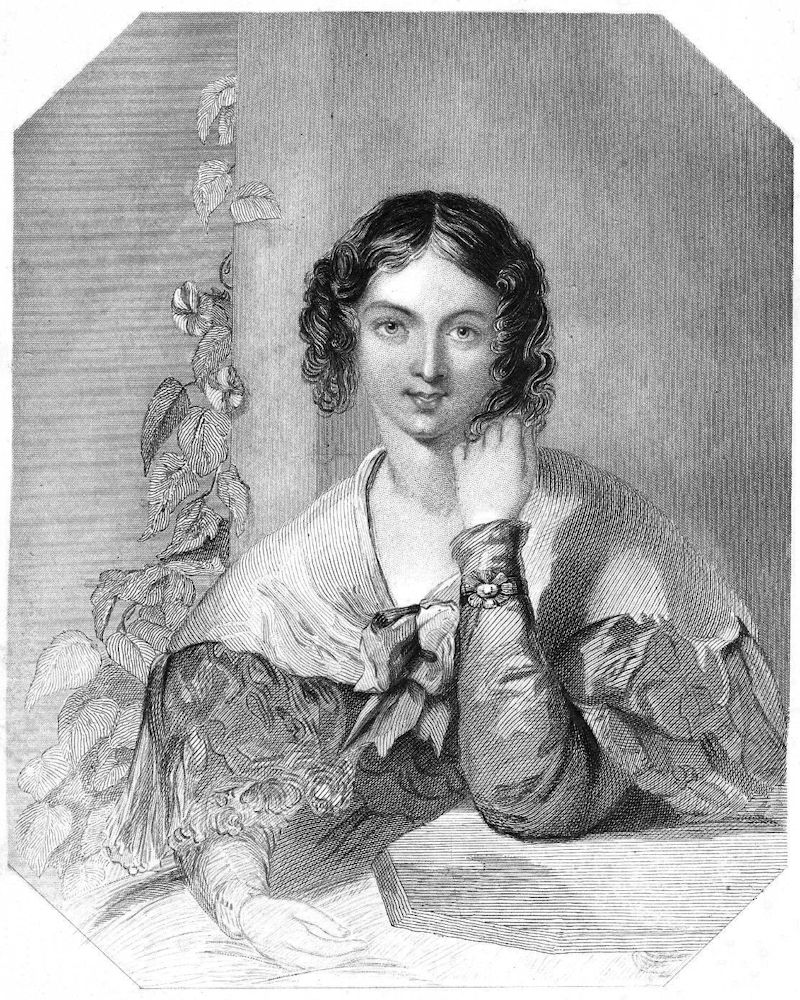
Sweetest Ianthé, I can read thy features,
And tell the latent meaning of each look —
Thou most inscrutable of earth’s bright creatures;
Thou unread riddle in an open book —
To me thou art a clear and crystal brook,
And I need be no wonder-raising seer
To tell thee that thy brow of Parian stone
Is radiant with pure thought; that deep and clear
Thine eye is lighted from the soul alone.
That on thy tranquil nostril Courage sleeping
Heeds not the fears that Reason smiles to see;
That from the dimples round thy mouth are peeping
Sweetness and mirth and heavenly charity —
Thy glances—nay, look up—I’ll read them silently.
———
BY R. BALMANNO.
———
Belief in the supernatural has obtained credit in
the world from the earliest records with which we
are acquainted. The Grecian and Roman histories
are full of it; even the Sacred Volume contains instances
of spectral or preternatural appearances,
which can neither be denied nor explained. In all
civilized nations, at all times, up to the present
period, we have testimony of unequivocal authority,
giving minute details of extraordinary facts, on the
evidence of individuals of unimpeachable integrity,
which confound experience, elude investigation, and
baffle research. The wisest of our divines, and the
most accomplished of our philosophers are all forced
to admit that there are things, with which human comprehension
and reason cannot successfully grapple.
We must allow the truth of the remark of that
immortal poet, whose commanding intellect and
reach of thought, soared far above that of any “man
of woman born;”—“there are more things in heaven
and earth than are dreamt of in our philosophy.”
The boastful wisdom of vain-glorious men, like Voltaire,
and such deistical writers, must bow before the
Almighty fiat, “Thus far shalt thou go, and NO
farther.” That fiat can never be violated by man.
As I am about to give the result of some rather
extraordinary circumstances which have either occurred
to myself, or to personal friends with whose
names the world is well acquainted, it may not be
altogether out of place to introduce them, by a short
notice of those very singular annoyances to which
the family of the Reverend Samuel Wesley, of
Epsworth Parsonage, in the county of Leicester, in
England, were subjected for a considerable length
of time.
And it is remarkable that these extraordinary
circumstances were not confined to the experience
of one, nor two, nor three individuals, but to a
whole family, consisting of nine persons, besides a
neighboring clergyman; and it is still more extraordinary
that they were not made apparent to one sense
alone, but to several, inasmuch as they heard, they
felt, and they saw. Confederacy or collusion appears
to have been out of the question, and, indeed,
to have been strictly guarded against, at the suggestion
of Mr. Wesley’s two sons, then absent,
whose suspicions were deeply excited.
Both these gentlemen were men of strong sense
and highly cultivated mind. Samuel, the elder of
the two, was at the time an usher in Westminster
High School, and John, so celebrated afterward as
the founder of Methodism, was a student of Christ
Church, the most aristocratic of all the colleges in
Oxford.
These gentlemen, in writing to their parents concerning
the appearances, suggested the possibility
of collusion, or the work of young men wishing to
get access to the house, to enable them to make love
to their sisters, who were, however, young ladies of
unsullied purity and virtue.
Dismal groans were heard, and strange knockings,
three or four at a time. Loud rumblings above and
below stairs. Clatterings amongst bottles; footsteps
of a man going up and down stairs at all times of
the night; dancings in an empty room, whose door
was locked; and gobblings like a turkey-cock. Mr.
and Mrs. Wesley endeavored at first to persuade
the children and servants it was rats within, and
mischievous persons without, or that some of their
daughters sat up late, and made the noises as a hint
to their lovers; but these ideas soon underwent a
change. Mrs. Wesley supposed she saw a black
badger run from under the bed; and the man,
Robert Brown, saw a white rabbit, with its ears
erect, and its scut standing straight up, run from behind
the oven. A shadow might explain the first,
and the last might be owing to the propensity of
ignorant persons to exaggerate.
But no such animals had ever been kept on the
premises, nor were any such in the neighborhood.
Yet, granting them to have been shadows, or an
affection of the retina, these in no degree invalidate
the other parts of the story, which rest on the concurrent
testimony of many intelligent persons.
They cannot be explained by confederacy, collusion,
legerdemain, nor ventriloquism, nor by any
secret of accoustics. Such things may be preternatural,
and yet not miraculous; they may not be
in the ordinary course of nature, yet imply no violation
of its laws.
The sounds seemed sometimes in the air of the
room, and the family could not by any contrivance
make such sounds themselves. The pewter
trenchers were rattled down—the doors clapped—curtains
were drawn—the nursery door was thrown
open—the mastiff dog barked violently when the
noises first commenced, but ever afterward, and
sometimes before the family were sensible of its
approach, he ran whining behind some of the company,
or into the servant’s bed; and this is a remarkable
feature in the case, because the intelligence of
a dog is such, and his ear so fine, that he is invariably
the first to discover the advance of a stranger—he
never shrinks at the approach of man, but becomes
fierce and forward to defend his protectors.
It never came by day, until Mr. Wesley ordered
a horn to be blown about the premises, and then it
was as frequent in the day as in the night. After
that, none of the family could go from one room to
another without the latch of the room they were
going to being lifted before they entered it. It
never went into Mr. Wesley’s study, until he reproved
it sharply, and called it “a deaf and dumb
devil,” and bid it cease to disturb the innocent children,
and come to him in his study, if it had any
thing to say to him; after which it visited him in
his study frequently, nay, once it pushed him in,
almost headlong. At other times it slammed the
door in his face. There is the mother’s account of
it to her son John Wesley, a student at Oxford, his
sister Emilia’s account, his sister Mary’s account,
his sister Susan’s account, his sister Ann’s, the
Rev. Mr. Horne’s account, and Robert Brown, the
servant’s account.
All these give long details in letters to the brothers,
and other persons.
On one occasion it seemed as if a vessel full of
silver were poured on Mrs. Wesley’s breast, and
ran jingling about her feet, as she was going down
stairs to breakfast with her husband.
The noises continued from the second of December
till the end of January following, nearly two
months.
None of the family felt the goblin until Mr.
Wesley had called it a deaf and dumb devil; after
that, they were sensible of being touched, pushed forward.
Once or twice, when Mr. Wesley, in his
clerical capacity, rebuked it severely, he heard two
or three feeble squeaks, a little louder than the chirping
of a bird, but not at all resembling the noise
made by rats.
The details are so perplexing, that Dr. Southey,
from whom the account is in part extracted, does
not attempt to explain them. They are better
authenticated than any similar story on record, by
persons whose testimony, on any other subject,
could not for one moment be questioned.
What interest could a quiet, retired, respectable
clergyman, of the established Church of England,
have for imposing on the world? His acknowledged
piety precludes the suspicion; he was fast approaching,
and was very near that period of life
when he knew he had to account to his Creator for
his truth or falsehood. His testimony is supported
by that of a brother clergyman, equally pious and
respectable, who came to assist in detecting the
cheat, if cheat there had been. Can it be for one
instant believed, that if there had been collusion,
the ladies of the family would not in after life have
confessed it to their husbands or children? No less
than nine respectable witnesses lived and died
in the belief of its supernatural origin, and at
their respective deaths, they were as unable to
account for the mystery as at the time of its occurrence.
It commenced without apparent or ostensible
cause, and terminated with no other effect than the
annoyance of an amiable family.
I shall now endeavor to relate a few remarkable
circumstances which have occurred either to myself
or to personal friends, on whose veracity I
place implicit reliance; they are altogether unlike
the preceding, and I think I shall be enabled to
show that, by a quiet, cool, persevering investigation,
we may generally be enabled to account in a
natural way, for imaginary preternatural circumstances
and appearances, although the senses may
have been many times deceived.
Every story or averment of the sort ought to be
taken quære tamen, or sed quære, as the lawyers have
it—searched, sifted, scrutinized.
In Scotland, the land of second-sight, of brownies,
bogles, kelpies, and fairies, a superstition prevailed
when I was a child, which was called the Dead
Candle. It was said that when a person was in
the last agony, in the act of departing this life, a
pale blue gleam of light, resembling the flame of a
small spirit-lamp, was seen to flit slowly across the
room and through the passages, and disappear,
without its being evident whence it came, or whither
it went. It was said and supposed to be the soul
of the departed, taking its flight for eternity. Many
were the dismal narratives of the dead candle, to
which, while a mere boy, I had listened amongst
the servants of my father’s household.
In a certain ancient city in Scotland which I
could name, the houses are very large and very
old; they are built entirely of granite, having very
thick walls, in a far more substantial manner than
houses of the present day.
The different floors, or flats, as they are there
called, are shut off from the general stair-case, and
are let out to separate families, each having a complete
suite of apartments within itself.
In a large antique house of this sort, in the city
alluded to, whilst I and my brother were at school,
under the charge of a sister considerably older than
ourselves, there resided in the flat above us, a
young lady who was lying dangerously ill of a brain
fever. One night, about eleven o’clock, during her
illness, some time after my brother and I had retired
to bed, and as I lay thinking of the poor girl, I
distinctly saw a faint gleam of light pass across the
foot of the bed in which I and my brother were reposing.
The house at the moment was perfectly
still, and the beam of light passed without the
slightest sound; its appearance exactly corresponded
with what, in my childhood, I had been told
was presented by a “dead candle.” I was considerably
alarmed, but probably not so much as
might have been expected in a boy twelve years
of age, inasmuch as from my earliest years, my
parents had endeavored to disabuse my mind of
all superstitious fancies, and the venerable and
venerated clergyman, at whose school I then was,
had, I believe, almost eradicated them.
I watched the light as it slowly moved across the
inequalities of the bed-clothes, over my own and
brother’s feet; and as its appearance recalled all
the dismal stories of dead candles, I fully expected
the young person who lay sick had just then expired.
But next morning I found that although
she had been exceedingly ill, she was still alive.
On the following night, about the same hour, I
again saw the self-same appearance, in every respect
as on the preceding night. The pale beam of
light was clearly and palpably defined, moving
slowly athwart the foot of the bed, as it had done
on the former occasion; it was impossible I could
be mistaken—seeing is believing.
The young lady certainly did die that night, about
the very hour that I saw what I then verily believed
to be her dead candle. I found it impossible to
divest myself of the impressions with which my infant
mind had been imbued; but what was, perhaps,
rather singular in so young a person as I then
was, I concealed the circumstance of seeing her
spirit even from my brother; he was my senior by
some years, and I well knew he would have jeered
and laughed at me, if I had told him—I was a
trifle more sensitive to ridicule then than now.
My brother had been asleep on both occasions and
did not see it.
Of course, I pondered much on so extraordinary
an appearance, which I then actually believed to be
a real dead candle, and it was not long before I had
all doubt respecting its reality removed. On the
following night, at the same hour, I saw the apparition
a third time, and—the explanation shall be
detailed in the sequel.
I was indebted to my late eminent friend, Henry
Fuseli, R. A., the celebrated historical painter, for
the following story of a spectral apparition which
he himself saw.
During the time of his residence in Italy as a
student at Rome, he had gone on an excursion to
Frascati, where he intended to remain all night,
but having changed his intention, he returned to
Rome, rather late in the night. Being fatigued with
the journey, which he performed as a pedestrian,
and having gained access to his apartments without
calling for a light, or otherwise disturbing the family
in whose house he resided, he undressed in the
dark and retired to rest.
On awaking, between two and three o’clock in
the morning, he was horror-stricken to behold in
the dim light afforded by the now risen moon, the
figure of an angel of majestic proportions, arrayed
in a loose flowing robe of radiant whiteness, hovering
over the foot of his bed.
He gazed on the seraphic vision with straining
eyes, lost in amazement to observe that, at one moment
it seemed to approach with outstretched arms,
as if intending to descend and embrace him, and
then gracefully and slowly recede, gazing all the
time with deep, fixed attention on his countenance.
As far as his terror permitted, he observed that
always between the approach and retreat of the
vision there was a pause, as if it hesitated, and
stopped in uncertainty.
All the while the Seraph was palpably floating “in
thin air.” The artist was both astonished and
alarmed at so terrifying a phantom, even although
the purity of its robe threw a halo of glory around it
exceedingly Corregiesque.
In that Catholic country, where visions of saints
are seen, and apparitions visible, the phantom, to a
good Catholic, would probably have been hailed as
a manifestation of Divine presence, a Beatification
of the blessed Virgin.
Not so, however, to a sturdy Swiss—a Protestant
Master of Arts—educated in the school and church
of John Calvin, the contemporary, school-fellow,
and friend of Lavater, Hess, Bodmer, and Bretinger.
But notwithstanding all this, it shook his nerves
to their inmost extremity, and made each particular
hair like quills; and as he once said to me with
deep-toned emphasis, “it made my marrow cold.” For
a length of time he continued spell-bound, with his
large blue eyes riveted on the vision as intensely as
his own sublime Hamlet glares on the ghost of his
father. Those in this country who remember the
penetrating eyes and look of the late lamented Dr.
Follen, can easily picture to themselves Henry
Fuseli, for there was a striking resemblance between
them.
Becoming at last overpowered by the agony of
his fears, and almost mad with excitement and apprehension,
involuntarily and sudden as lightning,
he sprung from the bed, and with outstretched arms
clutched at the angelic form, as it came floating
majestically toward him, and seemed to court his
embrace.
Alas! poor youth, he little dreamt what an angel
is composed of—the beatific form was evanescent;
he caught the radiance, but it was unearthly—fleshless—boneless—a
shadow, “an unreal mockery;”
like Ixion, he had embraced—that which shall
appear hereafter.
The next incomprehensible circumstance which
I shall relate, occurred to myself. When I first became
a resident in the Temple, “eating” my way
into the technicalities of English jurisprudence,
I rented chambers, consisting of a suite of three
rooms and a spacious entrance hall, in one of those
ancient brick tenements, which have what I believe
architects call a well-staircase, built of solid timber
from bottom to top, intended to last, as they have
lasted, for ages. Each suite has two doors, a strong
outer one, with a very substantial lock, and an inner,
which can also be locked, should occasion require,
or when the occupant is absent on circuit.
They are snug, cosy places—for bachelors—these
Inns of Court, whether it be in the Temple, the
most ancient of all, or Lincoln’s, Grey’s, Clement’s,
Clifford’s, Furnival’s, Serjeant’s, or Staple’s Inn.
Most of them have extensive squares, besides
gardens of great extent, with fountains and jets of
water playing under old ancestral trees. All are
extra parochial, and the whole have peculiar privileges—let
the limbs of the law alone for that!
There are gates at the various entrances, strong
enough to defy the force of a battering-ram, which
are carefully barred, bolted, and locked, every night
at ten o’clock, and none, save inmates having
chambers, are admitted after that hour.
The benchers, barristers, and students, resident
within the precincts of the Temple, number from
one thousand two hundred to fifteen hundred persons,
which will give some idea of the extent of the societies
of the Inner and Middle Temple. Respectable
elderly females, called laundresses, who mostly
reside in the neighborhood, come every morning
to clean the rooms, light the fires, prepare breakfast,
&c., &c.
That glorious spirit, Charles Lamb, was a Templer,
at the time I speak of, and rented chambers not far
from my own. Perchance I may hereafter give
some reminiscences of dear Elia.
The first night I slept in the Temple was the
most melancholy and uncomfortable which, in the
whole course of my life, I remember ever to have
passed.
It was toward the end of the long vacation,
during autumn, when most of the profession were
in the country. I felt a solemn awe steal over me
as I locked the outer-door upon myself in a suite of
large, lofty, gloomy rooms, some centuries old,
which were wainscoted and paneled from floor
to ceiling, with fifty, perhaps five hundred coats of
paint, that had once been white.
Melancholy and heavy did the hours pass, until
I lit my reading lamp, and took up that detested
collection of Commentaries, the text book of lawyers;
but I soon laid it aside in disgust. A Black-snake
could not have been more loathsome to me than
was Blackstone, that dismal, solitary, sad, and heavy
evening.
Finding it impossible to read, or write, or do any
one thing in the way of study, I passed through the
hall into the very dark bed-room, and my uncomfortable
fears, or fancies, induced me to take down
a long antique rapier, which I had hung up at
the head of my bed, and I was silly enough to
plunge it underneath, in case any assassin or
robber might be lying perdu under it. So “stern
was the dint,” that I had some difficulty in withdrawing
the point from the wainscot, into which it
had penetrated on the further side of the bed.
Ridiculous as it now seems, I continued this practice
of pinking the panels for some nights afterward.
There were five or six floors in the house,
on all which were suites of chambers. Mine
were on the floor which, in this country, would
be called the second; in England it is known
as the first. On entering from the courtyard, you
ascended three stone steps into a long passage, in
which were a set of chambers, directly underneath
mine. At the end of the passage you ascended
a short flight of nine steps to a landing, and then
went up nine more, making in all eighteen steps
from the entrance hall. These eighteen steps landed
you close to the door of my apartments. I am thus
particular for very good reasons, to be stated presently.
It was during the second, or possibly the third night
after I had taken possession of the rooms, between
ten and eleven o’clock, that I heard a very heavy
foot coming along the paved court. Whoever it
was, ascended the three stone steps, came along
the entrance hall, up the stairs, and made a sudden
dead stop at my door. I waited, expecting every
moment to hear some one knock, but all was silent,
the intruder stirred no further. I went softly, a tip-toe,
to the door, listened, put my ear to the key-hole,
but could hear no one move or breathe.
I thought it very singular, and stood considering
what I should do. After remaining ten minutes
breathless, with the light in my hand, I came
away, thinking as there were two stout doors between
us, each of which had strong patent locks,
the person outside would find it a difficult matter to
get at me, if so disposed; but I kept a lamp burning
all night, and had my rapier ready at hand.
The following night, after I was in bed, I distinctly
heard from the window of the room, which
opened upon the stair-case, the same heavy tread
coming up the stairs, and again it stopped close to
my door. What can the man want haunting my
door? thought I. I lay long immovable, with my
head raised from the pillow, scarcely drawing my
breath—but I could hear no further movement.
Finally, I concluded it might be some drunken man,
who, having no home, had somehow contrived to
get into the Temple before the gates were closed,
and had probably since then been sitting under the
cloisters, and was now come to lie down and sleep
on the mat. I determined to get up early in the
morning and give him into the custody of the porters
at the gate-house.
As the Temple bell struck four, I rose, dressed
hastily, and went to the door; but the bird was
flown—no trace of him was there. I thought I
might, possibly, have been deceived, although the
sound of the heavy tread coming up the stairs, and
stopping exactly at my door, was so distinct, and
the death-like stillness of the house at the time,
seemed to preclude the possibility of mistake; but
to guard against any chance of future deception, I
counted the number of steps on the stairs, and found
them to be eighteen, as I have stated.
Although I watched attentively the next night,
the unwelcome footsteps were not heard; but on
the succeeding one I heard them distinctly—counted
the sound of the foot on the three stone steps—the
walk along the passage—then the first nine risings—the
turn—and the succeeding nine steps landed
him close to my door. No mistake now, thought
I to myself. I was burning with rage at the fellow’s
pertinacity, and going boldly to the door,
whipt it open in a twinkling, and found—what
thinkest thou, reader? Exactly that which the
Dutchman caught in his famous bear-trap—“nothing
at all.” Not a soul was there. And yet that a
heavy man had entered, had come along the hall,
had ascended the stair, and had stopped at my
door, I felt as morally certain as I could have been
of any thing whatever. I could have sworn to it,
because on this last occasion the night was remarkably
still, so still, indeed, that I could distinctly hear
the pattering of the drops of water, as they fell into
the basin from the jet d’eau in the quadrangle of
Garden Court. I had heard the footsteps on the
pavement of the court-yard, before the person entered
the door. The adjoining houses were too large and
too solid for a sound from them being audible, and
I had now several times heard the same footsteps,
agreeing in every particular, and always stopping
at my own door. I was completely baffled and at
fault.
I tried to account for it in every way I could
think of, and failed in all. So I determined, the
next time I heard the mysterious unknown, to dash
down stairs and seize him in the act of entering
from the court-yard. I had become excited, nervous,
and was perpetually on the watch. Sooner than
expected, my curiosity was amply gratified; for the
very next night, as I patiently sat on the watch,
scarcely drawing my breath, I heard the well-known
sounds,
“Tramp, tramp, along the court,
Stump, stump, into the hall.”
I bounded down the stairs like a tiger on his prey,
and as I leapt into the passage, the frightful unknown
was discovered—the mystery cleared completely
and satisfactorily. I could scarcely believe my
own eyes; but as I had expended much valuable
time, and much deep thought in endeavoring to
elucidate the mystery, I shall beg permission to
leave the solution, and the reader to ponder, think,
weigh, and determine, as I had done. He shall
be gratified hereafter; and I doubt not will wonder
at much as I did.
This affair of mine was, however, mere child’s
play, compared with the long series of mysterious
occurrences which happened to a very dear friend,
whom I shall call Mr. Crofton. He is yet alive, and
I hope he will long live to enjoy the happiness and
felicity to which he is eminently entitled. He is
a gentleman who has been long and favorably
known in the literary world as author of many
popular and highly embellished works; and he is,
moreover, in common parlance, as good a fellow as
ever stirred a tumbler—and many is the recherché
goblet compounded by his delicate hand, which I
have sipped, listening to his sparkling wit, and most
interesting conversation long years ago. This
gentleman being then a bachelor, and of very
studious habits, occupied lodgings in a remarkably
quiet house, in a quiet street, leading from Holborn
to Bloomsbury Square, where he had a large, elegant,
richly furnished room, with a spacious bay-window,
and excellent attendance; in short, he
found himself as comfortably situated as is possible
or compatible for a bachelor—to feel. There was
no other lodger in the house—no children—no pet-animals—no
parrot—and no piano. The family
consisted of a respectable old gentleman who had
a respectable old wife, both of whom were strictly
“Sober, steadfast, and demure.”
The female attendant was one of those sweet, artless,
rosy-cheeked damsels, which I verily believe no
country on the face of the earth can produce equal
to England, in the same station of life.
Mr. Crofton was eminently happy. In process of
time, however, as is generally the lot of humanity,
where people begin to feel themselves too happy,
he was somewhat annoyed by frequently finding his
books and papers in disorder, his pens split up to
the plume, and his ink sputtered or overturned.
Now, Mr. Editor, I am very sure you can sympathize
with my friend in these petty annoyances.
Did you never feel your bile, if you have any, bubbling
up, on returning to your sanctum, after having
left your papers and proofs in apple-pie order, finding
them all knocked into pi, as your affectionate friends,
the compositors, would call it?
But Mr. Crofton being a gentleman of an uncommonly
amiable disposition, said little, in fact nothing,
about it, believing it to be occasioned by the maid,
in her assiduity to keep his room “tidy.”
As, however, repeated and increased annoyances
of this kind will, in time, ruffle the sweetest temper,
Mr. Crofton one day, in the mildest possible manner,
ventured to tell the damsel it would much oblige
him, if she would be kind enough always to leave
his papers and books exactly as she found them.
To his surprise, the girl burst into tears, and said
she was very glad he had named it, as she had now
an excuse for giving her mistress warning to quit
her service.
On inquiring her reason for conduct which seemed
to him rather extraordinary, she said, “There is
something wrong about this house, sir. I never
touch your books or papers, and sometimes when I
am cleaning the room, I hear whisperings near me,
sometimes groans and moanings, as of a person in
distress. I have searched every corner, but can
discover nothing. I am sure the house is haunted
by the spirit of some woman who has been murdered.”
Mr. Crofton was more surprised at this recital,
than he chose to express, as he had himself reason
to suspect there was some secret mystery to be
cleared up; but he comforted Marianne with the
assurance that, if she would say nothing about it,
and would endeavor to arrange the room whilst he
was taking his breakfast in the bay-window, he would
lock the door when he went out to his office, and
carry the key with him.
This plan proved extremely acceptable to Marianne,
because Mr. Crofton’s kind, gentlemanly
manners, and very handsome Christmas present,
had probably made a deeper impression on her
simple heart, than she was, perhaps, aware of, or
would have been willing to admit.
Soon after this arrangement was entered into,
Mr. Crofton was seized with a complaint to which
he was occasionally subject; it was, in fact, a fit of
the gout; and during the first night of his confinement
to the house, as he lay reading, with his
candle on a small round-table, which stood close by
the bed-side, he noticed that the light was becoming
paler and fainter; when looking up from his book,
he was astonished and amazed beyond the power
of utterance, to observe that the table was moving,
silently and slowly away, and by degrees gliding
from the bed-side.
At first he could scarcely believe his own eyes,
he fancied he was laboring either under an optical
delusion, delirium, or hallucination of the brain,
induced by his illness; but on reaching out his hand
to feel whether the table was absolutely removed, he
became sensible, beyond all doubt, that it had not
only moved away, but was then silently traversing
the room. He watched its slow progress along the
floor with intense emotion, and noticed that, when
it reached the right hand side of the fire-place, its
usual stand, it became stationary.
The effect of this unaccountable movement of
the table, combined with previous circumstances,
operated on Mr. Crofton’s corporeal system, just as
if he had swallowed a dozen papers of James’s
powders. At first he became cold as lead, but when
the table stopped, and the candle appeared to be
burning blue, and he was every instant expecting
something would appear, he burst into a violent perspiration,
and the fear of taking cold prevented him
from getting up to investigate the cause of the
table’s volition; so he continued gazing and perspiring
until the candle, which was nearly burnt
out, dropped down into the socket; and as the light
alternately flickered up or fell, he again saw the
table, of its own mere motion, making its way back
toward the bed-side, as slowly as it had retreated,
and then it stopped at the exact spot from whence
it had taken its mysterious departure, of which he
made certain by rising on his elbow, and raising
the slide in the candlestick; and just at that moment
he fancied he heard a mouse run along the carpet;
yet the idea of a mouse moving a table backward
and forward, across a large room, was too absurd
to be entertained for a moment. In a state of most
painful perplexity and suspense he passed the first
part of the night, but at last fell asleep; and on
awakening late the next day, he found the copious
perspiration which he had been thrown into, had
had the most salutary effect on his gout. When he
got up, he minutely examined the table; but after a
long inspection of it, he failed to discover the slightest
cause for its extraordinary perambulations backward
and forward along the room.
A short time after this unaccountable movement
of the table, a friend came to breakfast with him one
morning, and as the maid servant could not with
propriety be in the room to arrange it, during the
time his friend was there, they went out together,
leaving the breakfast equipage on the table, to be
removed, and the room put to rights, at leisure.
When Mr. Crofton returned in the afternoon, Marianne’s
handsome features, as she let him in, indicated
that all was not right. She followed him up
stairs.
“Oh, sir,” were her first words, “I have been so
frightened; I’ll never enter this room alone again.”
“Why, what’s the matter, Marianne?”
“The matter, sir! Why, as soon as you and Mr.
Brooke went out, sir, I set about cleaning the room,
and directly heard those dreadful mutterings all
around me, with such sighs, and such groans, and
weeping and distress, and as I was removing the
ashes from under the grate, one of your books was
thrown at me with such force, I do believe if it had
hit me, it would have been the death of me. The
house is haunted by evil spirits; I am sure some
horrid murder has been committed.”
“Do you hear any thing of this in any other of the
rooms, Marianne?”
“No, sir, only in yours, sir; and I cannot think of
staying longer in such a shocking place—there, sir,”
said she, starting, “did you hear that?”
Now Mr. Crofton did hear something, at the very
moment, but the noise was of a vague, confused
nature, difficult to comprehend. It annoyed him
exceedingly, however, as he found it impossible to
account for or explain the cause of the disturbances,
but he was possessed of an indomitable courage, and
affected to treat it all lightly, so begging the girl
to say nothing about the matter, nor by any means
to think of leaving her place; he put a guinea into
her hand, and told her to continue as good and virtuous
a girl as she had ever been, and to fear
nothing.
Always on his return home in the afternoon, the
girl was in the habit of lighting the fire, and having
done so, one evening, Mr. Crofton immediately afterward
went out to call on his friend Mr. Priestly, the
bookseller, with whom he staid and took tea. He
came home about nine o’clock, and on unlocking
his door, was horrified to behold a creature, which
to all outward appearance was the devil, standing
on his cloven hoofs at the farther side of the table,
engaged in munching some pears which Mr. Crofton
had left on a plate. The creature, or being, was
large and black, it had horns, which were sharp and
slightly crooked, and an enormous beard. This
frightful apparition stared Mr. Crofton full in the
face, with a pair of large, black, oblique, glittering
eyes, the glance from which seemed to pierce his
very soul! And still it kept its place at the table
devouring the fruit. There was a peculiarly offensive
effluvia in the room—it was not exactly brimstone,
but equally nauseous and strong. From the
extremely offensive odor which was emitted, however,
it was soon apparent that the intruder was
no other than an enormous he-goat! but how it had
obtained access to the room was inexplicable. Mr.
Crofton hesitated not a moment what was to be
done; he instantly relocked the door, went down
stairs and procured a musket, which having charged
with buck-shot, he almost immediately, or in less
than five minutes, as he told me, returned to his
room, fully determined to shoot the hateful beast,
but what was his astonishment on entering the door,
to meet, instead of a goat, a very fine, large bashful
Newfoundland dog, wagging his bushy tail in the
most friendly manner. Mr. Crofton could scarcely
credit his own eyes—the room still smelt of a
goat, but there was no mistake about the noble,
honest dog! Now it happened that Mr. C. was uncommonly
fond of dogs—who that has a heart is
not? So he laid aside the musket and all hostile
intentions, but he made an immediate examination
of his canine visiter’s paws, to verify whether there
was not among them a cloven foot! The scrutiny
was satisfactory, but whether it was dog or devil,
he was allowed to escape, and happy he seemed
thereat.
The mystery seemed to thicken, and Mr. Crofton
now felt really uneasy. He spoke to his landlord on
the subject, but it was quite clear from the old gentleman’s
artless manner, and the real alarm he manifested,
that he was entirely ignorant of the cause of
the disturbances.
He sent for a police officer, and had every part of
the room and the whole house carefully examined,
but no clue to a discovery could be obtained.
To guard against future surprises, Mr. Crofton
procured and kept a brace of pistols, constantly
loaded, at the head of his bed, and directed Marianne,
as she lighted the fire, to put the poker between
the bars, in order that it might be always red
hot.
Now let me assure you, Mr. Editor, that a red
hot poker is a potent weapon in the hands of an
angry man.
I can of my own personal knowledge vouch, that
from some singular crotchet in his head, arising
probably from apprehension of personal danger, the
late eminent antiquary and author, Francis Douce,
invariably, during the winter months, kept his poker
in the fire! I observed he always took it out and
laid it aside to cool, whenever I entered his noble
library to settle a Shakspearean difficulty, or resolve
a disputed point of antiquity; and I noticed, that
from long service in the fiery ordeal, his poker was
half burnt away, and become very short, and as thin
as a skewer toward the point; in fact it bore a striking
resemblance to some men’s love—it was become—“too
hot to hold!”
Neither dog nor devil ever again made their appearance
in the room; but one afternoon, when Mr.
Crofton had caught a cold, and was lying down on
his bed, he was startled to notice the closet-door
near the fire-place slowly and cautiously opening—and
at last, the apparition of a human head, upon
the upper shelf of the closet! Its large, round, black
eyes were fixed on his, exactly like those of a
rattlesnake intent on its prey. The head had a horrible
indescribable grin, or ghastly smile. For a
second, surprise at the apparition paralyzed him,
but his natural intrepidity rallied the next, he seized
a pistol, and pointing it at the head—which still
grinned—he pulled the trigger, but the weapon
flashed in the pan; he instantly seized the other, but
before he could point it and draw the trigger, the
door closed, and the pistol only flashed like the
former. Mr. Crofton sprung from his bed, seized
the red-hot poker, rushed to the closet and whipt
open the door, but the head had vanished, whither
did not appear; he thrust the poker against the
back of the closet, between the shelves, where the
head had appeared, but the brick wall was solid.
The clew was, however, at last found; it was
plain and palpable all the annoyances had proceeded
from that closet. Detection soon followed—ample
and astounding—but as its details lead back to,
and are connected with the fiercest and bloodiest
period recorded in history, I shall for a short time
defer the explanation, whilst I relate the circumstantial
account of a spectral vision which appeared
to two intelligent persons, at or near the same moment
of time. I give it on the authority of a lady
of the highest respectability, who is connected with
some of the first families in the city of New York.
She related it one evening, when ghost stories and
second-sight—fruitful themes—were the subject of
discussion; and I was not a little surprised to learn,
at the same time, that there is a family in New
York, consisting of two maiden sisters, of high respectability,
natives of New Jersey, who are subject
to those mysterious, melancholy and terrible visitations,
identical in every respect with what is known
in the Highlands of Scotland, as the “second-sight.”
Equal ridicule has been attached to the second-sight
as to Mesmerism and clairvoyance; the very name
is almost enough to raise a smile, yet I am assured
that the ladies in question, could, if they chose, relate
circumstances of a character so dismal, that
they would change smiles into tears, and ridicule
into awe.
It ought to be remembered that the fearful visitation
of the second-sight is involuntary to the party
who is subject to it. It is sudden, unexpected, and
unforeseen at the time of its occurrence, and renders
its victim miserable and melancholy to the last
degree.
Of this I can vouch, that my friend, the late James
Miller, M.D., of Islington, near London, has often
assured me he knew from boyhood a servant of Sir
John Sinclair’s, who resided at his castle near
Thurso, in Caithness, who was one of these pitiable
beings, and the doctor related to me many of the
man’s fearful and fatal predictions, which came to
pass, literally, under his, the doctor’s, own personal
knowledge, when he was resident in that part of
Scotland. But I digress.
The vision related by the lady I allude to, I considered
so singular, that I requested the favor of
her to write it down for me. She kindly complied
with my request, and the following is a verbatim
copy of her letter. The names, of course, I suppress.
“Dear Sir,—The vision or dream which you
wished me to relate, is, as nearly as I can recollect
it, as follows: James, the second son of Mrs. G****,
who lives in the south of England, was suddenly
awakened one night, by the apparition of his elder
brother Charles, who seemed visibly to approach
his bed, dressed in his night-clothes, looking pale
and death-like. Charles was at the time absent in
the West Indies, and when the family last heard
from him, was in perfect health, so that James had
no anxious fears respecting him, and although the
vision made a powerful and painful impression on
his mind, as it was likely to do from its vividness,
he determined to think no more of it, but compose
himself again to sleep. He had, however, been so
much startled by the unearthly look of his brother,
that he found sleep impossible, and therefore rose to
take a few turns about his room, in order to shake
off the melancholy impression, and he remarked, on
looking at his watch, that it was then just three in
the morning!
“When the usual breakfast hour arrived, he went
down to the parlor, where the family were assembled.
His mother appeared exceedingly dejected,
and complained of violent headache, which she
accounted for by saying she had been much shocked
during the night, at having been awakened by the
appearance of her eldest son, who seemed as if
alive in her room, and to approach her bedside in
his night-clothes, looking at her with fixed eyes, and
a countenance so pallid and corpse-like, that she
could not get rid of the impression and belief that
he was either dead or dying!
“James and her other children rallied her upon
her superstitious fears and faith in dreams and
visions, and endeavored to dissipate her fears.
James appeared carelessly to inquire, whether she
knew at what hour of the night the vision appeared,
and was answered it must have been a few minutes
before three in the morning, as she heard the hall
clock strike three directly after the spectre vanished.
“Nothing further was said on the subject, but as
soon as James left the parlor, he went to his own
room, and wrote a minute account of his own and
his mother’s dream or visitation, mentioning the
precise hour and day of the month when it occurred.
“He sealed up the paper and asked his eldest
sister to certify in writing, that he had delivered
that sealed paper to her that day.
“Both of them had almost forgotten the circumstance,
when, about two months afterward, a letter
arrived from Jamaica, conveying the sad intelligence
that their brother had died there, at the very moment—allowing
for the difference of time—of his death-like
appearance to his mother and brother!
“Mr. James G**** was a student of medicine
at the University of Edinburgh, and resided in the
same house in which I lived, at the time he related
to us the circumstances. I regret that although
only a few years have elapsed since I heard him
relate it, the exact dates which he then communicated
have escaped my memory, and I will not
attempt to supply them. He was a young gentleman
of undoubted veracity, and I believe the circumstances
to be true as stated.
“New York, 22d December, 1840.”
In remarking on this communication, I will not
say it is impossible that the extraordinary circumstance
of two persons having each the same dream—I
will call it—at the same hour, and that both believed
they were awakened by the phantom of a
distant relative, may not be explained by natural
causes, as some things of a similar character were
attempted to be explained, under the word “spirit,”
in an early edition of the Encyclopædia Britannica,
but in the absence of facts, what do such attempts
amount to? Probabilities and possibilities!
But in this instance, although the young man’s
death may have been imprinted on his mother’s and
brother’s imagination—from apprehension of his
fate, we will say, by reading or hearing of the
ravages of yellow fever—which, however, is not
alluded to in the lady’s interesting letter, the singularity
is, how the dream, or phantom, should come
to visit both—at precisely the same hour—and dressed
exactly alike, and that so vividly, as to awake them
in fear and terror!
It would be folly to attempt a rational explanation—such
things are beyond human comprehension.
We may speculate, but we can never penetrate the
veil under which the Divine Will has shrouded
such mysteries; yet I have not the shadow of a
doubt that in some future state of existence, they
will, to those who walk aright in this, be made clear
and manifest, and we will then, possibly, wonder
how near, how very close we have been allowed
to approach the threshold, without being able to
cross it! “Thus far shalt thou go, and no farther!”
I well remember one lovely starlight night, walking
on the terrace in front of Somerset House with
Henry Fuseli, and whilst speculating on futurity, he
told me that he and Lavater had made a solemn
agreement, that whichever should die first, would,
if permitted, make himself manifest to the other, in
some way. Lavater died many years before his
friend, but Mr. Fuseli informed me with a sigh, he
had never, in any way, waking or dreaming, made
himself manifest. It is, perhaps, useless to mention
that Fuseli was a classical scholar of very high attainments,
and I know that he was a firm, undoubting
believer in the immortality of the soul. He died
at the ripe age of 86, whilst on a visit to the Dowager
Countess of Guilford, and whilst on his death-bed,
within an hour of the time his immortal spirit
took its flight for a better world, he had an impression
that he heard soft sweet music in the room,
and faintly inquired of the countess, why she had
placed musical snuff-boxes on the bed. Yet the
dying man never had an ear for music, and could
not distinguish one air from another—music was
all perfectly monotonous to him—but the music
which he imagined he then heard was to him
heavenly. This impression on the ear seems altogether
different to that made on the visual organ of
many persons on the approach of death. Fervently
do we pray that such impressions as visited the
dying hour of Henry Fuseli, may equally be the
blissful harbinger to eternity of all such good men.
The above story related by a lady, coincides in
some degree with a visitation which occurred to
Sir Walter Scott and his lady, at Abbotsford, who
were both awakened by some extraordinary noise
on the premises. He says in a letter—“The night
before last, we were awakened by a violent noise,
like the drawing of heavy boards along the new
part of the house. I fancied something had fallen,
and thought no more about it. This was about two
in the morning. Last night, at the same witching
hour, the very same noises occurred. So I got up,
with Beardies’ broad-sword under my arm, but nothing
was out of order, neither could I discover what
occasioned the disturbance.
“I protest to you, the noise resembled half a
dozen men putting up boards and furniture, and
nothing can be more certain than that there was
nobody on the premises at the time.”
It subsequently appeared, that at the exact hour
mentioned by Scott, Mr. George Bullock died suddenly
in London. He was a particular friend of
Sir Walter’s, and had been very active in planning,
and procuring articles of antiquity and old furniture
for the embellishment of Abbotsford. The circumstance
appeared to have made a strong impression
on Sir Walter’s mind. But I think I could show—as
I certainly believe—that the death of Mr. Bullock,
at the time when Sir Walter and Lady Scott
fancied they heard noises, was merely a coincidence.
A near and dear relative of my own, a manufacturer,
whose dwelling-house adjoined the factory,
was so successful in business, that his wife, according
to the superstition of the period, thought he
was assisted by fairies during the night! The
excellent lady and her maid servants from hearing
the sound of the machinery all day, thought
they heard the “good people” making the same
noise in the night; and, as I was told, they more
than once went slyly and softly to the factory-door,
which they opened with the greatest caution, in
order to gratify that laudable curiosity, falsely attributed
to the fair sex!—they longed to see the little
folks whom they heard so well, but the moment they
peeped in, that instant the fairies ceased! The
accuracy of the eye, exactly as in the case of Scott,
destroyed the deception of the ear!
But Sir Walter’s eye, in consequence probably of
irregularity of the stomach, was sometimes more at
fault than his ear. Once, while crossing the hall at
Abbotsford, he believed he saw Lord Byron standing
before him, but the imaginary form soon faded
into a plaid cloak hanging on a screen. At another
time, on his way to Abbotsford, he supposed he saw
a shepherd in his plaid, standing on the moor a
short distance from the road, but the man vanished
as soon as Scott came opposite to him, but reappeared
after he had passed a little way. Sir Walter
turned his horse to ride up to the man, who again
vanished, into a pit as he supposed, but on searching
for it, he found it was merely an optical delusion,
the ground was all smooth and firm.
It is now high time I should enter the Confessional,
and render to the reader—if he or she have followed
me so far—my account—detailing the mystery of
the “dead candle,” and sundry other marvels contained
in this article.
Imprimis, then. Of the annoyances to which the
family of Mr. Wesley were subjected, I have little
further to add. The story must stand or fall on the
degree of credibility attached to the witnesses, but,
as Doctor Southey says, it is better authenticated
than any similar story on record.
In reading the letters written from Egypt, by the
sister of Mr. Lane, author of the Manners and Customs
of the Modern Egyptians, she details a series
of annoyances to which she and her brother’s family
were subjected, in a house at Cairo, supposed to be
haunted by an ’Efreet, or evil spirit, in consequence
of a murder having been committed in it.
Some of the events closely resemble those which
befel the family at Epsworth parsonage, consisting
of knockings, and other annoyances, at all hours of
the night, which eluded investigation; none of the
native maid servants would remain in the house
over a week, and although it was in every respect
a delightful and most desirable residence, Mr. Lane
and his sister were reluctantly compelled to abandon
it.
My own detection of the “dead candle” arose in
this way. On the third night of its appearance, the
beam of light was as clearly defined to my sight as
it had been on the two preceding nights, but it was
now passing across the bed clothes more quickly,
and was accompanied by a faint rustle, and that
sound flashed the truth upon my mind in a moment.
It was my own sister crossing the hall, and the ray
of light from her live candle shining through the key-hole
of the door!
I had formed a boyish admiration for the young
lady who was ill, and apprehension for her fate, and
thoughts of her, kept me much longer awake than
usual. On the two first nights my sister crossed the
hall slowly and noiselessly, in order that she might
not disturb the dying sufferer, but now that the sad
catastrophe was over, she moved quicker, and I
could hear her!
The ANGEL—whose radiant effulgence had excited
such fearful emotion in the mind of Henry
Fuseli, was neither more nor less than the white
dress of an Italian lady, which his hostess, not expecting
his return from Frascati before the following
day, had hung up on a cord stretched across the
room, to dry, and its slow floating movements
were occasioned by the air from the window,
which was left open to facilitate the drying.
Fatigued by his long walk, he undressed the moment
he gained his own apartment, and retired to
rest without observing the signora’s robe, or that
the window was open. The moon had risen whilst
he was asleep, and was faintly shining on the white
drapery when he awoke, and the effect, to an imaginative
mind like his, gave it the appearance of animation.
The whole story, as related by him, was glorious—but
who could relate a ghost story, or any story,
like Fuseli? His choice and powerful language,
and his acting of the scene, were inimitable. He
was equally successful in any comic story, although
in a dryer way; even his description of the manner
in which the present Lady Jersey catches a flea!
was irresistible. What action, what emphasis, what
a look. You could have almost sworn you saw the
indignant flash of her ladyship’s bold, brazen eye, and
her long nose, when she discovered the little blood-sucker
upon her cream-colored skin. The recollection
of it is so perfect at this moment that I cannot
resist a laugh as I write; but the manner of the
thing I must defer until I give my Reminiscences of
Harry Fuseli, in which I shall try to detail some of
his literary combats at the table of Joseph Johnson,
where he vanquished the great Porson, with his,
Porson’s, own chosen weapon, Greek.
But his angelic ghost story was absolutely terrific;
after having worked one up to the highest pitch of
excitement, the denouement came so entirely unexpected.
With a low, sepulchral tone, he would say,
“I was mad with apprehension; and in an agony
which I could not repress, I sprung up like a maniac,
clutched the apparition in my arms, and came down
like a dog, and broke both my shins on a d—d
chair!—instead of an angel, I grasped a white gown,
perhaps smock, of some Italian trollop.”
The invisible and mysterious personage who had,
as I supposed, so pertinaciously haunted the door
of my chambers, was a large, heavy man, employed
as a porter in a shop near Temple Bar. His wife
was a respectable laundress, who, unknown to me,
occupied the basement of the house. The entrance
hall was rather dark, and as I had just taken possession,
I had not observed a narrow passage which,
by proceeding a few steps beyond the foot of the
stairs leading up, led to a staircase going down,
having exactly the same number of steps, and, in consequence
of the whole staircase from bottom to top
being a species of conductor, the sound of footsteps
going down was conveyed up so perfectly, that to any
one sitting in my rooms it was impossible for the
nicest ear to tell, whether the person was coming up
or going down; and the floor of the basement being of
brick, the sound was lost the moment it was trodden
on.
I was perfectly dumb-foundered when I saw the
big fellow pass quietly by me without taking the
least notice; and I felt a mighty inclination for a
fight, in consequence of his having so cruelly disappointed
and mocked my determined belief in a
ghost. But, like Mr. Van Buren, “sober second
thought,” induced me to retrace my steps, and walk
quietly up stairs, somewhat like a president walking
down, when he is unexpectedly turned to the right-about.
My Andrea Ferrara was hung upon its peg,
from which it was never afterward removed,
during all the unhappy years I afterwards passed as
a Templar in those old-fashioned rooms. What reminiscences
do they not now revive?
The vexatious annoyances to which my friend,
Mr. Crofton, was so long subjected, arose from an
admirably concocted scheme of female waggery, in
which a youth bore a principal part; but to render
its details intelligible, it is, as formerly hinted, necessary
to digress a little into history.
In the year 1794, during the frenzy excited by
the French Revolution, when every throne in
Europe was shaken to its centre, a society was
formed in London for the pretended reform, although
it was in fact for the overthrow of the English
Government.
It was called the London Corresponding Society
for Constitutional Reform, and it was in secret
correspondence with Robespierre, and other monsters
of that terrible tribunal which never spared,
until it had deluged France with the blood of
1,022,351 of its best citizens. Start not, reader, in
doubt, there is no mistake in the figures—ONE
MILLION, TWENTY-TWO THOUSAND, THREE HUNDRED
AND FIFTY-ONE victims, male and female, adults and
children, perished under the axe of the accursed
guillotine, or other wholesale murders, perpetrated
during the Reign of Terror.
May its bloody horrors be a lesson and A WARNING
to nations, in all future time, to beware or the perils
attending MOB LAW!
The London Corresponding Society was headed
by Hardy, Horne Tooke, Thelwall, and other turbulent
spirits of the time. But by the firmness of
the Prime Minister, William Pitt, son of the Earl of
Chatham, the leaders were apprehended in their
own homes, during the night, and tried for high
treason. But the society, although with greater
privacy, still held its sittings, and in order to defeat
the government police, one of its agents hired
two houses adjoining each other, where, with extraordinary
care and secrecy, a secret passage was
constructed between the two, by means of closets,
so artfully contrived, that at a moment’s warning the
members could escape with their papers from one
house to the other, and elude the chance of capture.
In the room where the traitors met, the back of
the closet was built up of bricks, resting on strong
shelves, which were fixed to a door of strong plank.
This door, with its shelves and brick back, swung
on well oiled pivots. The bricks were whitewashed,
and were firmly attached to the shelves,
which were furnished with China and crockery,
coated with fine dust, to make it appear, on looking
into the closet, as if it had not been opened for a
long time.
The closet in the adjoining house, resembled it
exactly, except in the arrangement of its contents.
The back or swing door, on that side next to the
committee-room, had strong secret bolts, which kept
all firm in its place.
The two houses had passed into the occupation
of different persons, years after the society ceased
to exist, without the secret of the “corresponding”
closets having been divulged; but at the time when
Mr. Crofton occupied his apartment, the servants
of the adjoining house had discovered the secret of
the bolts and swing door, in consequence of a brick
coming loose, in driving a nail, and with that amiable
curiosity generally attributed to the fair sex, and
probably from envy of her beauty, and of hearing
some compliments paid to Marianne’s graceful
figure, they determined on the species of pantomime
which they so successfully put in practice, being
mainly aided in it by a youth of great inventive
genius, and a very dare-devil at mischief.
The disarrangement of the books, papers, pens and
ink, with suppressed mutterings, groans, weepings
and wailings, can therefore be easily understood.
The movement of the table was effected by
means of a long piece of string, of the color of the
carpet, which the young genius first passed round
one of the table-casters, then around the foot of the
bed, and the two ends of the string brought through
the closet under the door, by pulling either one end
or the other, he could withdraw or advance the
table at pleasure; when the manœuvre was complete,
he let go one end, and, in nautical phrase,
“hauled in the slack.” The withdrawing of the
cord was what Mr. Crofton took for a mouse.
The goat was obtained from the stable-yard of the
George and Blue Boar, a well-known Inn on the
other side of Holborn, in the immediate neighborhood;
and the dog was one which the lad had
enticed from the street. Being perfectly cognizant
of every thing said or done in Mr. Crofton’s apartment,
they overheard the conversation about the
pistols and poker, and found it necessary to be
rather cautious. They were perfectly aware of
Mr. Crofton’s out-goings and in-comings, and during
his absence, the charges were withdrawn from his
pistols, and plugs of lead, covered with cotton,
introduced, and firmly rammed down. When the
girl stealthily opened the closet door, she was not
aware Mr. Crofton was at home, and the appearance
of her head on the shelf, in the act of reconnoitering,
led to the detection and exposure of the
whole thing; for the landlord was so exasperated,
he had them all up before the police. Ample apology,
however, was made, and the joke, from its
ingenuity, forgiven. But the party-walls of both
houses were restored to their original condition,
putting an effectual stop to all further correspondence,
or tricks, upon Mr. Crofton; but I believe it may
have been this very extraordinary affair, that induced
him to write one of his most popular works; and I
only wonder he was never induced to work up the
details of the mystery (which I have so imperfectly
attempted) into a tale, or drama, of exciting interest.
With reference to my chambers in the Temple,
when I spoke of the unhappy years I had passed in
them, I alluded to the contrast which they presented
to the felicity which a married life soon afterward
conferred on —
An Unbeliever in Spectral or Supernatural
Appearances.
“Are there not deep, sad oracles to read
In the clear stillness of that radiant face?
Yes, ev’n like thee must gifted spirits bleed,
Thrown on a world, for heavenly things no place!”
Those poet-eyes, with inspiration burning —
Half wild, half pensive, still they haunt my dream —
Eyes, in whose depths the soul of passionate yearning,
Intense unrest, and high devotion gleam.
The Spirit of the Ideal, throned in glory,
Shines with superior brightness on that brow: —
O, laurel-crowned! thou famed in song and story,
How sweetly float thy spell-strains o’er me now!
Doth this rapt, earnest, mournful face resemble
In all its shaded lineaments thine own?
Did the soft love-vow on that proud lip tremble —
Yet fear to deepen to a tenderer tone?
And the rare love that haunts thy magic numbers —
Didst thou not hope to make such worship thine?
The passionate paleness on thy cheek that slumbers,
Tells that thy heart was but Love’s lonely shrine!
The love of Genius!—with its dream and vision —
Its hopes and fears—vainest of earthly things.
Only in spiritual visitings Elysian
Are realized the bard’s imaginings.
Meanwhile thine image rises oft before me,
With memories that to mine own heart belong;
And as I muse on thy life’s hist’ry, o’er me
Comes the conviction, O, sad son of song!
That the celestial gift can never, never
For all the unrest it hath cost atone;
The Unattained still haunts us here forever —
There, in thy world, vain yearnings are unknown!
ELIZABETH J. EAMES.
A TALE FOUNDED UPON FACT.
———
BY HENRY COOD WATSON.
———
I was traveling outside the coach from B ——,
early in the year 18—, after a season of fashionable
dissipation, tired with the important nothings
which eke out the existence of the beau monde,
and determined to seek relief in change of scene,
from the daily increasing ennui that oppressed me.
I am not one of those who travel from Dan to Beersheeba
without seeing any thing worthy of attention.
To me the face of every human being is a
book, in which strange and eventful histories are
written legibly by the hand of time and passion, and
with the assistance of my somewhat active imagination,
I often fancy that I can trace the actions and
events, the hopes and fears, that have made up
their sum of life. It is a pleasing and grateful
task to watch the face of youth; to trace love, hope,
and confidence, in every line of the countenance.
There is not to be seen one doubt, one look of distrust
in this the brightest page of life’s eventful history.
My companions were a young girl, a free and
generous-hearted sailor, two ordinary, every-day
travelers, and a pale, and to all appearances, an
intellectual youth. I make it a rule, when thrown
into the company of strangers, if but for an hour, to
make that hour, by conversation, pass as pleasantly
as possible; and as I was likely to remain with my
present companions for some hours, I determined
to draw them into a familiar discourse. Our sailor
was a character such as Dibden loved to draw—light-hearted
and careless to a fault. At each place,
while the horses were being changed, he would dismount,
and insist upon treating every one around,
spending his hard-earned cash without a thought for
to-morrow. He kept us in a roar of laughter for
some hours, by the strange tales he told. One, I remember,
but it was so interlarded with technical
terms, which he explained at the time, that I fear it
will lose half its gist by their omission, and the substitution
of my shore-going phraseology.
“We were cruising off the Bermudas,” said he,
“in the summer of 179-. And a blazing summer it
was—so hot, that all the sugar on board was turned
into hard bake, and the purser’s skin was so dried,
that he kept his tally on his face for the rest of the
voyage; to say nothing of the captain’s dog, Toby,
who was sitting on deck one day, when the pitch
in the seams melting, he was held so fast by the
stern, that he was unable to cut and run, and was
in consequence exposed to the heat of the varticle
sun, whereby he caught what the parley-voos call a
‘coop do sol’s heel,’ which, I suppose, means a
‘kick from the sun’s heel.’ Howsomever, that’s as
may be. Well, as I said before, we were sailing
with a fine steady breeze, at the rate of eight knots
an hour, when, all of a sudden, we felt ourselves
brought up, as it were, with a round turn. All
hands immediately jumped on deck; the skipper
came up in a devil of a hurry, swearing that we
had struck upon some hidden rock. We sounded
but could not find the bottom. The wind was
rising and filled the canvas almost to bursting, but
not an inch did she move. The skipper was flabbergasted,
and the master, an old Northman, said
that he thought we were over some magnetical
rocks, and, according to the doctrine of substraction,
they would draw all the iron out of the bottom, and
we should fall to pieces. When, all of a sudden, it
strikes Harry Dare-em-all—ah, by the by, he was
a fellow—bathing one day in those very seas, he
saw a shark as big as a whale coming right upon
him. Away swims Harry; down he dives, and up
he comes again, but Mr. Sharkey, was close upon
his heels, and at last had turned over, ready for a
grip, when Harry darts under him, and gives him
such a kick in the small of his back, just to help him
on the faster, that he broke him in half. The gentleman
was hauled on board, and to this day I uses
one of his grinders for a baccy-stopper. Well,
says Harry, I shouldn’t wonder if it’s one of them
feline animals of the shark species—for you see
Harry knew something of fishogomy—as has bolted
the junk we threw astarn to catch them beggars
with. Away we all flies to the starn, and sure
enough, there was the rope as taut as nothing.
We pulled and hauled, but it was no go; so at last
we gave it a turn round the capstan, and all hands
were ready to toe it merrily round; but devil a bit
of a round could they go, for the more they pushed
the more he pulled. He must have had pretty
tough muscle to stand against a stiff breeze and the
whole ship’s crew—but he did, and beat us too.
So at last the skipper ordered the carpenter to cut the
rope—and so he did. But, my eyes! no sooner was
it cut than away goes the barkey at such a rate, for
two hours, that we thought we should have lost
every stick. Howsomever, the shark got nothing
by his move, for I met one Bill Jones, some years
after, which had been cruising in them seas, and
he says that there is a atomy of a shark, as goes
diving about like one demented, with an iron hook,
and a hundred fathom of cable hanging to his jaws,
so that he hasn’t disgested ’em yet.”
The young girl, when she started, was weeping
most bitterly, and sobbed as though her heart would
break. Being a stranger, I dared not intrude upon
her sorrow, but I longed to speak comfort to the
poor wanderer. To take one shade of grief from a
sorrowing heart, affords me more sincere pleasure,
than all the luxuries of a winter campaign, however
brilliant it may be. The sight of her grief brought
on a train of thought, and suggested the following
lines to my mind: —
What makes thy bosom heave, thy tears o’erflow,
Say, hast thou ever felt the throb of wo?
Has sorrow ever come, fair girl, to thee,
To dash thy cup of joy with misery?
But such is life!—too sure the brightest sky
That ever beamed to bless a mortal eye,
Must pass away;
The sweetest flower that ever yet has bloomed,
By Nature’s law, is all too early doomed
To know decay.
Has she, the idol of thy friendship, proved
A traitress, where she fondly vowed she loved?
Or is it but affection’s tear,
That falls at leaving friends so dear?
Grievest thou to leave this lovely scene,
Where all thy early joys have been,
Thy youthful hours?
Where thou hast frolicked through the days,
With childhood’s many pleasant ways,
In summer bowers?
What, weeping still? believe ’tis folly
To give full way to melancholy.
Youth should be as an April day,
Then smiles should chase those tears away;
For if in youth deep sorrows come,
Oh, where shall mem’ry find a home,
In after years,
To linger on, and raise a smile,
Amidst the world’s deceit and guile,
And other cares?
Say, hast thou left thy parents dear,
And need their smiles thy heart to cheer?
For all these woes there is a cure —
They never can ’gainst Time endure.
If one of these is not thy grief,
Then cannot Time bring thee relief;
For should it prove,
What now I deem thy cause for cares,
There is no cure in after years
For hopeless love.
I accosted the youth, whose appearance so interested
me, and found him intelligent, but of a
wildly romantic turn of mind, on which fancy might
work her wildest spells. He told me that he was
a musician, and proceeding to the metropolis to get
his works published. Without friends or connections,
I greatly feared—for I know something of
these publishers—that his speculations would prove
but a source of annoyance to him, without yielding
him any profitable return. I offered to give him
letters of introduction to my friends, to introduce
him to my circle of acquaintance, and it was extensive;
in short to be a patron to him in his outset of
life. But, with expressions of fervent gratitude, he
modestly declined my assistance, saying, “that he
had determined to rely solely on his own resources,
to depend upon no one, but to let whatever talent
he possessed make a road to fortune for itself.”
How confident is youth! How trusting in its own
powers. He fancied that he knew, and was prepared
for all the delays and disappointments endured
by those who have to dance attendance upon
the all-powerful publishers. However, while we
were taking refreshments, I wrote a note to one of
my most powerful friends, an amateur devotedly
attached to the study of music, and prevailed upon
him to accept it, and made him promise to use it if
he did not find fortune so smiling as he expected.
I gave him my address when we parted, and begged
him to remember me when he was in need of a
sincere friend.
Shortly after this, business called me to the Continent,
and, being there, I was induced to make a
tour of Europe, which detained me abroad some
years. On my return I made inquiries about him;
but all I could learn was, that he had published
many beautiful compositions, and was looked upon
as one whose genius promised greatly for the future.
At one time he seemed fortunate and prosperous,
but for some months past he had disappeared; no
tidings could be learned of him, and it was supposed
that he had left London.
I had not been in town many weeks, when one
evening a person brought me a note from Ernest
Moreton, requesting me to visit him immediately.
I followed the bearer of the message, through many
low streets in the neighborhood of Fleet street, until
we arrived at a narrow, wretched-looking court.
In a small, dark room, without furniture, on a miserable
couch, lay my poor friend. He pressed my
hand, and a sad smile passed over his wan, emaciated
features, as I seated myself upon the only
chair in the room, by his side. Poor fellow! he
was, indeed, sadly changed! From the confident
and aspiring youth, eager in the pursuit of fame,
and strong in hope, I beheld him shrunk to the
miserable occupant of a sick, untended bed. Where
now are all those bright delusive dreams which
thy too warm fancy wove? Have they not all faded
into nothingness? Alas! do they not always fade?
“My friend,” he said, “I see by your countenance
that you think me much changed since our parting.
I am also aware of it; but you do not think me so
ill as I really am. Dear sir, I feel that I am dying, and
rapidly will life’s flame be extinguished. But do not
mourn for me, my friend; it does not grieve me now.
There was a time, indeed, when youth’s delusions
were strong within me; when ambition and love
struggled for mastery, and quite bewildered my too
excitable imagination with glorious dreams of the future;
that thoughts of death seemed to fall upon my
soul like a blight. But the hand of God has been upon
me; sorrow has chastened the heart that transient
prosperity had too much elated. In my home, and, as
you see, not very happy home, without a friend,
without money, food, fire, clothing, in sickness and
desolation, the folly and vanity of my pursuits have
come most forcibly upon me. I am much altered;
though nothing can banish from my breast the old
enthusiasm for my profession, yet ambition has now
no place there. You see, even here I have written
much; but of what avail, further than as a relief to
my overburthened heart? Music holds still her
spell upon me, but hope has quite departed. I am
dying of no disease, save that of a broken heart. I
have for months been wasting away; as hope upon
hope has taken flight, deeper and deeper has sunk
the barbed arrow of sorrow into my heart, and life
has ebbed away, purely from the want of a wish to
live. To you, my generous friend, in this last hour
I call. With you by my side, I would breathe my
last breath. I have not power to say much more.
A short account of my life you will find amongst
my papers; read it, and you will learn by what
means I was brought to this despairing state. My
music you will burn; and my last request is, that
you will, if it be possible, have my body placed by
her side. Do not leave me, my friend, for the world
is passing rapidly away.”
I took his thin, white hand in mine, and the slight
pressure it returned showed how weak he was.
He lay still as death; but ever and anon a smile
would illumine his countenance, as if the memory
of some happy hour shed its bright influence over
his latest moments. And he would murmur the
name of Adeline, in accents so tenderly bewailing,
that it melted me to tears. “My poor girl,” he said,
“thy broken heart is now at rest; and I am coming,
freed from my many sorrows, to lie me down beside
thee. I have never smiled since you left me—my
smiles were all buried with thee, Ada, in the grave;
but I am happy, now, for I come to join thee in
heaven! The tomb separated us, but the barrier is
passed, and hope is mine again.” As morning approached,
his sentences grew fainter and less frequent.
As the dawn appeared he sunk into a quiet
slumber, which proved, as I feared, the sleep of death.
And thus died one, who, under happier circumstances,
might have lived honored, prosperous, and
happy. Who, for want of some true friend to regulate
his wild enthusiasm—to save him from himself—perished
like a beggar, in a hovel, when his
talents ought to have secured him an independence.
He belonged to a class of beings little understood or
appreciated by the world. The bright imaginings
of the poet’s mind can be understood by the million,
for he writes in a language that is common to all.
But the musician pours forth his thoughts through
a medium so refined, so exquisitely delicate, that it
requires a fancy as chastely imaginative, a mind as
richly stored with bright thoughts, a soul as open
to the liveliest and warmest emotions, and stored
with feelings of depth and intensity, with emotions
which have a mixed derivation—the effect of a devoted
love and reverence of mistress, parents,
sisters, friends, of nature, and of God—it requires all
this to comprehend his dreamings, or to enter in
any degree into the emotions of his soul. The poet
has a thousand means by which he can place his
works before the world. Publications are appearing
daily wherein their works would be gladly received;
the musician has but one—the music publisher.
Those who have had any dealings with
them, can bear witness how generously disinterested
they are. No young composer can “get any thing
out,” unless he pays for it, and then, as it is of little
consequence to the publisher whether it sells or not,
it is of course allotted the least prominent place in
the shop; and, saving the immediate friends of the
author, if he has any, none know that the work is in
existence. Or, if too poor to indulge in the luxury
of publishing on his own account, he offer to give
some works, for the sake of their publication, such
a one is sure to be chosen as will offer the least
evidences of his capability. So he has no resource
but to watch and wait upon these mighty men,
gathering a harvest of sorrow and bitterness of heart;
living through disappointments and hopes deferred,
and dying in poverty from neglect and a broken spirit.
I paid the last offices of friendship to my departed
friend, and he rests quietly beside her he so dearly
loved in life. There are persons who seem to be
born for each other—whose souls own the same
emotions, the same passions excite them, the same
destiny impels them—their fates seem to be linked
together by preordination. It is a strange fact, but
of the many instances which have come under my
personal observation, of hearts apparently fore-doomed
for each other, in not one case has happiness
resulted. It appeared as though they were
only to love and to be wretched. So in this instance
it proved; for they were to each other as a sorrow,
even while most devoted. But they rest, now,
where sorrow cannot reach them.
I shall give the short history nearly as I found it.
On entering London, my friend’s first care was to
procure lodgings in one of the most humble streets
of the metropolis—the best suited to his narrow
means. When the excitement of the change of
scene had subsided, he began to feel that he was
alone. “I,” to use his own words, “wandered
about the first few days, in an ecstasy of delight;
but chilling sensation of loneliness crept on apace;
I felt myself alone amidst the thousands; I looked
around, and sought in vain for one familiar face to
give a smile of recognition; not one among the
million that surrounded me, would return a friendly
pressure of my hand; there were none to smile at
my prosperity, to weep at my misfortunes, or to
tend me should I sink upon a bed of sickness. I
have walked amidst the loneliest scenes of nature,
where not one sign of mortality intruded; I have
wandered alone upon the barren heath; have
buried myself within the bosom of the deepest wood,
have singly stood upon the lofty mountain’s brow,
but never felt that I was truly, utterly alone till now.”
After a few days he began to present himself to the
notice of the publishers. He was received with the
utmost politeness by many, and was requested to
bring some of his works, that they might judge of
their merits. He left them, flushed with hopes of
success, and returned with some of his best compositions,
but, unfortunately, the gentlemen were
from home. Again and again, and yet again he
called, until at last, when hope was departing, he
was honored by a hearing. The songs were
“beautiful, charming,” but they feared that they
would not sell—this symphony was too long, that
required altering; these harmonies were too full,
that passage was too difficult; but if these, not perhaps
faults, only publishing faults, were altered, they
would get them out for him. He left them much
depressed, and felt lowered in his own opinion—for
a young and sensitive mind is depressed or elated
by the good or bad opinion of the world. To cut
and hack his songs to pieces went sorely against
his feelings. The very symphonies which the buying
public would not play, contain most frequently
the most refined and choice thoughts, and to omit
these were to give forth a false impression of his
talents. But the mighty fiat had gone forth, and
altered they must be. Accordingly, he in a measure
re-wrote them; but it was then found, without a
hearing, that their printers were employed for many
months to come. Thus, after keeping him months
in continued suspense, he was in every case put off
with some palpable lie, or some frivolous excuse.
These annoyances, nay, misfortunes, are told in few
words, but the time of their duration was some
eighteen months.
For some months his funds had been getting
alarmingly low; and at this period he was forced
to part with much of his wardrobe, his books, and
other articles. This continued until he had parted
with every thing that would procure the means of
existence. “I left my home in a state of mind
bordering upon insanity. I walked rapidly, with a
scowling brow, through the crowded streets, and
felt the demon of despair brooding over my heart. I
knew myself to be disunited from my kind by misfortune;
none could feel sympathy with the starving
musician; he is a being apart from the rest—let him
die! I had wandered unconsciously out of the
city, and found myself in view of the river. My
soul seemed to start with joy at the sight. Deliverance
was at hand—total oblivion was within my
grasp, eternity already seemed gained, and I rushed
on wildly to the banks of the Thames. For awhile I
remained gazing abstractedly upon the darkly flowing
stream, till the floodgates of memory opened
upon my soul; my happy, joyous childhood, my
mother’s fond and tender smile, my sister’s pure
and deep devotion, seemed to call me back to earth.
But with my childhood, memory’s pleasures ceased.
I recalled my youth passed amidst strangers, in the
cold and calculating world; the severing by death
of all those sweet endearing ties, and finally, my
manhood, barren in aught save misery, without
parents, sisters, friends, starving and desolate, my
talents unappreciated, my hopes blasted! What had
I to live for? Oh! welcome then the oblivion of thy
wave, dark river! One plunge, one struggle with
mortality, and the world, with its petty, though
maddening miseries, is lost forever. Oh, if it be a
sin for the soul to resume its immortality, yet surely
it were better thus to die, having some hope of forgiveness,
than starving, die. Parting with life inch
by inch; enduring days of mortal agony, till the overburthened
soul, cursing its Maker, dies despairing.
I took out my pocket-book, to pencil a short note to
the owner of my wretched home, begging her to
accept my small stock of worldly goods as a remuneration
for her slight pecuniary loss, when, as I
opened it to tear from it a leaf, a letter fell upon the
ground. I snatched it up; a gleam of hope flashed
upon my soul. It was the letter of introduction
given to me by my generous friend of a day. I felt
the hand of heaven had interposed between me and
damnation. The magnitude of the crime I was
about to commit came fully before me; my feelings
softened, my soul melted into tears; and on my
knees, with a heart bowed down by misfortune, and
filled with feelings of remorse and gratitude, I
poured forth my prayers and thanks to God.”
He returned home once more, with a heart humbled
and trusting. In the morning he waited upon
the gentleman to whom the note was addressed,
and was received in the kindest manner. He led
him to speak of his prospects, and asked why the
letter had not been delivered before. My poor friend
then related how he had relied upon his talents, and
recounted all the misfortunes and disappointments
which had befallen him. Mr. Singleton seemed
much touched by the recital, and begged him to
dine with him that day, and in the meantime he
would think how he could assist him. With expressions
of gratitude Moreton took his departure.
The events of the party had better be told in his
own words. “On reaching Mr. Singleton’s house,
I was introduced to his daughter, a creature so
lovely, that to gaze upon was to adore. Of the
middle stature, with a form of the most perfect symmetry;
her face was oval, with a complexion neath
which the warm blood came and went, as warm
tints play upon the snow-crowned Alps. An intellectual
brow, sad and contemplative; with eyes of
great beauty, bespeaking a depth and intensity of
passion, whose wildest fires were hidden, and were
only to be roused by the emotions of the soul.
There was some unutterable charm about every
movement of her form or features which entranced
me. I felt at once that I had found my destiny, and
therefore did not attempt to place any restraint upon
my feelings. I could not deny myself the luxury
of drinking in love with her every look or word.
I felt myself urged toward her by an irresistible impulse,
and did not, therefore, attempt to check it.
In the evening, Mr. Singleton begged me to publish
a song, and dedicate it to him, and said that he
should like me to overlook the musical studies of
his daughter. Had the proudest fortune been placed
at my disposal, it would not have inspired me with
the deep joy this privilege bestowed upon me. I
should then be near her; should see her often, and
be blessed by a smile from those speaking eyes.
The past was all forgotten. The sorrows of my past
life were all merged in dreams of future happiness.
“In the course of the evening I was introduced to
the nephew of my host, a low-browed youth, with a
keen grey eye, and a look of habitual cunning, but
poorly concealed under a manner of assumed frankness.
Months, nay, two years passed away, and
found me still attending at the house. My prospects
were much improved. I had many pupils, and the
few things I had published were highly spoken of.
Those years were passed in a state of intoxicating
delight. I lived but for her; it was her image that
inspired me when I wrote; it was ever before me,
and formed at once my blessing and my bane.
When I thought of the immense distance which
wealth had placed between us, I felt how utterly
hopeless was my love—and I was wretched. Then
it was that music came to my aid. I would sit for
hours at my piano, and in its harmony forget all else
beside. While there, what are to me the pomp and
luxury of the rich and great? What to me their
parties and their feastings? Do they enjoy for one
moment the blissful rapture which fills my heart
then? Do they revel in rapture, purged of all earthly
grossness? These are the remunerating moments
of a musician’s wretched life. The soul seems
floating in an atmosphere of delicious harmony; a
sad but pleasing melancholy comes on; a grateful
languor falls upon his heart, and softens it to happiness.
How indefinable those feelings; the emotions
then felt have no sympathy with things that
be; the present has no connection with it; it is like
the dream of some dim, far-off land of beauty, the
mortal eye never saw, but with which the memory
of the soul seems charged. I cannot word the
feeling—it is nameless.”
But I must bring the history to a conclusion. A
month or two after the date of the last quotation, he
was tempted to declare his love, which, to his great
joy, was returned with an ardor equal to his own.
He had gained her heart’s first love—her young
heart’s deep devotion was his, and given with a
fervor which nothing could exceed. For months
they enjoyed uninterrupted happiness, when, after
a short illness, her father died. His property was
left entirely, saving an annuity to the nephew, to
Adeline, with this proviso, that if she died without
heirs, the whole was to revert to the nephew. Expressing
at the same time a wish that their fortunes
should be united. Time wore on, and at the end of
the mourning, Adeline promised to wed Moreton. Her
cousin had, by every means in his power, endeavored
to gain possession of her hand, but had met
with a decided refusal, and to avoid further persecution,
Adeline left London on a visit for a few months.
The lovers parted with every expression of tenderness
and unalterable affection—but they parted to
meet no more in happiness. Her cousin, Arlington,
maddened by the indignant refusal he had met with,
and the probable loss of the property, determined to
use every means in his power to frustrate the intended
marriage. This he was enabled to effect, by
bribing the waiting-maid of Adeline. She was, indeed,
the confidant of her mistress. From childhood
had she lived with her, and had been treated more
as an humble friend than a servant. Many and
sore were the poor girl’s struggles of conscience,
but the offered reward was too much for honesty to
resist, and she fell. A few weeks after Adeline’s
departure, Moreton was seized with an illness which
proved to be a malignant fever, at that time very
prevalent, which confined him to his bed for many
weeks. No letters came to him. Between the
wanderings of his mind at the fever’s height, he
would ask for the letters from Adeline, his wife,
and would not believe but that they were kept from
him. As health began, though slowly, to come, he
wrote to Adeline, telling her of his illness, and complaining
of her neglect; to which he received in
reply a renouncement of every vow, at the same
time declining any further correspondence with the
fortune-hunter. The shock occasioned by this letter,
so unexpected and so cruel, acting upon a constitution
debilitated by a long illness, brought on
an inflammatory fever, which rendered him helpless
for months. As he recovered, his landlady,
a good old babbling soul, used to bring the newspapers
and read to him in the hope to divert
his mind, and rouse him from his habitual melancholy.
He listened, for he would not hurt the feelings
of one who had been as a mother to him during
his long illness. One morning she read, among other
things, that “Miss Adeline Singleton, the rich heiress,
would be led to the hymenial altar by her cousin,
Alfred Arlington, Esq., to-morrow morning at Hanover
Church.” Ernest scarcely started, but begged
for the paper, and to be left alone. His course
was fixed. . . . . . . .
The bride and bridegroom approached the altar!
Ah! never was there a sadder bride—the roses
that were placed upon her brow were not more
pale than she. Life held but a slight tenure in that
fair form, for the hectic spot upon her cheek betrayed
that the grave was not far distant. The
priest had raised his voice to breathe the prayer
that was to join their hands forever, when a form
was seen hastening up the aisle, with a tottering
and uncertain step—he approached the altar; with
a wild, haggard and death-like look, gazed upon the
bride, and uttering her name sunk at her feet. The
poor girl shrieked out, “Ernest!” and swooned in the
arms of her bridemaids. She was carried to her
home, never to stir from thence, but to a quieter
home—the grave. Moreton, who had left his sick
couch to meet her at the altar, was removed to his
dwelling, and for three days remained in a state of
listless stupor. On the fourth day, a note from Adeline,
begging him to come to her, roused him from
his lethargy, and, reckless of consequences, he complied
with her request. With a beating heart he
entered the house; he found her reclining on a
couch, with the traces of recent tears upon her
cheeks, and very, very pale. On seeing him a
bright smile irradiated her countenance; he approached
not—anger and love were struggling in
his breast for mastery. She held out her hands to
him and murmured, “dear Ernest!” Love had
triumphed! he was kneeling by her side. Then
came that outpouring of the heart—that blissful
confidence; sighs, tears, and deep regrets spoken
by each, removed ages of sorrow from their hearts.
On the disastrous termination of the wedding, the
faithless servant, conscience-stricken, disclosed the
whole of the scene of heartless treachery acted by
her at the instigation of the villain Arlington. How
she, assisted by him, had intercepted letters; written
others in their place, and, by a system of the most
artful deception, contrived to make Moreton appear
despicable, and to raise Arlington, in the estimation
of Adeline. The continued illness of Moreton
materially assisted their plot, as he could not defend
himself. His guilt and falsehood were made
so apparent, that Adeline could not doubt their existence,
and with a woman’s heart, as quick in
revenge as in love, and unswerving in both, in
mortified pride and wounded feelings, she gave her
consent to marry her cousin. But now all doubts
were at an end, and they could smile again and
hope for the future.
Too true is it, that even in life we are in the midst
of death! The thought of Moreton’s falsehood had
fixed sorrow too deeply in her heart for health to
live there too. During their separation, after the
scheming of the plotters began to take effect, she
sought earnestly to banish every feeling of love
from her heart. But who shall control the heart—a
woman’s heart? Her love is not a thing of calculation;
she looks not to external circumstances;
she asks not even if he be worthy of her affection.
If once her love be given, it is given without reserve.
The whole volume of that mighty and absorbing
passion is laid at his feet. Her all of earthly
happiness is placed in his possession; no other passion
divides with it the interest of her heart; no
other feelings or sensations, save those which have
their rise in this all-powerful passion, can dwell
therein. All ties of relationship or friendship are
trifling, compared to that tie which binds her heart
to his, and sink to nothing in the scale when opposed
to it. To him she awards all the attributes
of virtue and honor; friends may condemn him;
fortune may leave him; the present may be a blank,
and the future without a hope, but she clings only
the closer to him. She feels a sort of selfish joy at
being his only comfort; the only thing left him to
love, that leads her almost to rejoice in the misfortunes
which make her his all in all. Her heart
teems with exhaustless affection, that only flows
more freely the more sorrow assails the object of
her love. Though where this deep feeling exists
it must be paramount, yet the correlative passions
of self-love and jealousy are also there; and though
dormant when no exciting cause is in action, yet,
when aroused, they go near to banish love forever
from the heart, however deeply based. Adeline’s
self-love had been aroused most powerfully; the
thought of being loved only for her wealth galled
her proud, but warm and confiding soul.
Here at once were scattered all her most cherished
hopes. She had hitherto looked upon life as a bright
and happy dream, thinking but to wake from it
when the grave should have opened to her dazzled
sight the glories of our heavenly home. But now
the veil was torn aside, and cold deceit was placed
before her view, which had hitherto only looked on
love and joy. To be thus suddenly awoke from the
beautiful but fallacious dreamings which our first
love ever weaves around us: to have the world
with all its selfishness thrust thus rudely upon our
shuddering hearts, is hard indeed. No shock of
after years can ever equal its intensity. All the
ties and pleasant memories that our past life has
created are at once severed; the past has no connection
with the present; one is all dream, the other
stern and rugged truth. It is not, then, to be wondered
at, that so frail a thing as a woman’s heart,
under the feeling of her first and only love, should
sink beneath the disruption of all her fondest wishes.
The idol she worshiped has been unsanctified; its
altar desecrated, and her heart lies shattered at its
feet, a useless sacrifice. And the same spirit which
led her to give her hand to another, to hide from
the common gaze her hopeless sufferings, was
silently, but surely, undermining her health, and
sowing the seeds of that remorseless disease which
in a few months removed her broken spirit from its
earthly travail. . . . . . .
The disease rapidly assumed a more alarming
aspect. Physicians were called in; they advised a
change of climate, but at the same time feared that
nothing could save her life. She felt that hope was
past, and refused to leave her home. For the few
months she lived, Ernest never left her. The days
were passed in performing acts of the tenderest
solicitude, and the nights in feverish slumbers,
whose visions showed him his Adeline in all her
former loveliness, and pictured forth scenes of deep
and holy love, such as might have been his, had
Heaven so willed it, only to sink him deeper in
despair by the contrast the waking truth presented.
He would read to her the wild and visionary
tales of Germany, and her eyes would brighten
as she listened to some speculative but beautiful
theory of the future, or she would clasp his hand
within her own, and gaze up into his eyes with
unspeakable affection, as she listened to some tale
of deep devotion, and murmur out, “they must
have loved as we love.” She would listen to his
music for hours, with a breathless attention, absorbed
and unconscious of the passing time, as if
unwilling to lose one note of that harmony which
must soon sound for her in vain. Nothing so
heightens and refines the passion of love as music;
that passion which would be firm and vigorous
without its aid, becomes under its influence more
refined, luxurious, more blissful, more yielding, but
not less holy. All grossness and sensuality are
purged from it; the heart is softened to languor,
but at the same time etherealized.
Thus days and weeks flew rapidly on unmarked;
each day adding to their deep devotion, and lessening
the time to that day which was to separate them
forever in this world. It came at last.
The morning had been unusually overcast. Not
an air stirred, and the atmosphere was sultry and
oppressive. They had felt a vague sensation, such
as is experienced previous to some unknown calamity,
all the morning, which prevented them following
their usual occupations. Adeline looked
unusually well; there was a flush upon her lovely
cheek, and her eye beamed with unwonted brightness.
They had drawn the sofa to the window,
which looked upon a charming lawn, and was
thrown open as a relief to the sultriness of the
weather. They sat there, his one hand holding her
waist, the other clasping her slender hands. Her
cheek rested upon his shoulder, and oh! as he gazed
upon that cheek, what a gush of tenderness filled
his heart! He thought what a scene of misery his
life had been until she rose upon his sight, an angel
of light, dispelling all grief and sorrow. He thought
of what they had suffered for each other; her deep
devotion; her unswerving love; her pure and
classic mind; her virtuous principles; her beauty,
whose spell was now upon his heart; the scenes of
dreamy bliss they had passed together, and the
whole intensity of his love filled his heart almost to
bursting. All that the mind can imagine of the extremest
joy, thankfulness, hope and love, was concentrated
in that one fond look. She seemed to understand
the thoughts that were passing in his
mind, and as he stooped to kiss those murmuring
lips she pressed his hand to her throbbing heart,
and a tear, the offspring of feelings too deep for expression,
stole slowly and silently down her glowing
cheek. At that moment the sun shone suddenly
forth, and brightened again the face of nature. Till
then they had not spoken. “Dear Adeline,” he
said, “let this be an omen of the future, as the preceding
gloom was of the past. There are, believe
me, many happy years in store for us. The bloom
of health is mantling upon your cheeks, and there
is new vigor in the sparkling of your eyes; and
though this little and transparent hand, be but the
shadow of its former self, will not the summer’s
genial warmth, and the tranquillity that waits upon
reciprocated love, and unclouded prosperity, soon,
very soon restore it? I have a strange sensation
at my heart, which your altered appearance translates
into a precursor of happiness. My spirit
seems to have burst from the trammels of earth,
and to revel in an atmosphere where love and hope
are fadeless. You do not smile, love! Does not
your heart echo my joy? Does not the same happy
presentiment pervade your heart, and gild the future
in brilliant colors?”
“I have the same presentiment, but my heart refuses
to give to it the flattering meaning with which
your hopes have invested it. I always feared that
our love was doomed never to meet with happy
consummation. Even in the first hours of our passion,
when not one thought of grief should have intruded,
there was a fear that would not leave me,
of future sorrow. Our love was never meant for
happiness on earth; it was too exclusive—too perfect.
The future would hold out no attraction or
hope, did death rudely destroy the state of present
perfect bliss. But to the weary and heavy-hearted,
death opens a path to peace, and even to the happy
and joyful, a home of more blissful and lasting happiness.
I look on death as a kind and tender friend,
who releases my soul from its weak material companion,
which, with its decay and rottenness, clogs
that immortal part. That it separates me from thee
is my only grief; my poor heart rebels against it,
and clings to thee with a tenacity which nothing
can relax. But oh! my beloved, if, as we are told,
the infinite space is peopled with disembodied
spirits, who wander round those spots where centers
all they loved—all that life has rendered dear, shall
I not be with you ever? Sleeping or waking, I
will hover round you, and as you wander over
those spots sacred to our young hearts’ deep devotion,
I will be upon your heart as I am now; my
spirit shall be upon your memory, and awaken it to
thoughts of those passionate hours. I will throw a
charmed halo round the Past, will sweeten the Present,
and will gild the Future with visions of fadeless
bliss in heaven with our God. Death cannot
separate our souls! It shrinks the body into dust,
but there is an immortal link which binds soul unto
soul, that death can never break.”
As she uttered these words, her cheek became
flushed, her eyes brightened, and her whole air
partook of a spiritual grace, and a deep and holy
enthusiasm. There was something unearthly in
her look and manner that chilled the heart of Ernest.
At length with a voice faltering with emotion, he
replied, “Whatever be the end of these forebodings,
dear Ada, my heart is unchangeably yours. You
are my first love, the chosen of my heart, and living
or in the grave, I dedicate that heart to you alone.
No other being shall have a vow of mine—this hand
shall clasp no other hand in love—no other lip shall
join to mine with passion’s kiss—no other form shall
rest within these arms, or find a pillow on my troubled
breast; this I swear to you, by all my hopes of
our eternal joy hereafter. I will live and die your
own in heart and thought. And let this fond and
holy kiss seal my vow of eternal constancy.” He
imprinted a long and ardent kiss upon her paling
lips. The tears coursed each other rapidly down
her pale cheeks, for the false hectic bloom had fled,
and the ravages of the fell disease were now terribly
visible in her sunken cheeks—her heart beat
convulsively at intervals—she pressed him closer
to her, and gazing up into his face with a look in
which the whole intensity of her mighty and absorbing
love was centered, in a voice scarcely audible
from emotion, she murmured out—“I could die
now.” Again his lips sought hers, and clung there
as though they had been incorporate—her head
drooped upon his breast—her hand relaxed its
grasp—she had died then! . . . . . . . . .
How he died, I have before related.
Past and Present, and Chartism. By Thomas Carlyle.
New York: Wiley & Putnam. 2 parts, 12mo.
In these works Carlyle states his views regarding the
source and character of the evils afflicting the British
nation, and the means by which they may be mitigated and
removed. “Past and Present” is the most splendidly
written and carefully meditated of the two. It contains
many sentences of remarkable force and beauty, with numerous
touches of that savage humor peculiar to Carlyle.
The tone of the work, however, is one of perfect discontent.
The style bristles with the author’s usual extravagance
about society and government, declaring both to be shams
and unveracities, and sneering at all plans for improvement
which the ingenuity or benevolence of others have framed.
If we understand Carlyle aright, he considers that the constitutional
government of England is a humbug; that William
the Conqueror, and Oliver Cromwell were the best
governors that England has ever had; that since Cromwell’s
time the country has been governed by Sir Jahesh
Windbag, strong in no faith but that “paragraphs and
plausibilities will bring votes;” and that everybody is a
fool or a flunkey except Thomas Carlyle. He hates every
form of government which it is possible to establish in this
world—democracy among the rest. If his work may be
said to have any practical bearing on politics, it is this—that
a governor is wanted with force enough to assume
arbitrary power, and exercise it according to the dreams of
mystics and sentimentalists. His system is a compound of
anarchy and despotism. His ideal of a governor is of a
man, with an incapacity or indisposition to explain himself,
who rises up some day and cries—“the government of this
country is a lie, the people cannot make it a reality, but
I can and will.” His notion of the wretched condition of
society is disheartening enough. Man, he tells us, has lost
all the soul out of him. “This is verily the plague-spot—centre
of the universal social gangrene, threatening all
modern things with frightful death. You touch the focal-centre
of all our disease, of our frightful nosology of diseases,
when you lay your hand on this. There is no religion;
there is no God; man has lost his soul, and vainly seeks
antiseptic salt. Vainly: in killing kings, in passing Reform
Bills, in French Revolutions, Manchester Insurrections,
is found no remedy. The foul elephantine leprosy
reappears in new force and desperateness next hour.” Sad
condition of poor depraved humanity! A whole generation,
except one man, without souls, and that one exception
without his senses! It is curious to notice the illusions of
an understanding so powerful when governed by a sensibility
so tempestuous. It would be unjust, however, to
deny the depth of many detached thoughts, and truth of
some of his speculations in this volume.
It would doubtless be unjust to deny Carlyle’s claim to be
considered a thinker, but he is an intense rather than a
calm and comprehensive one. A comprehensive thinker
looks at every thing, not singly, but in its relations; an intense
thinker seizes hold of some particular thing, exaggerates
it out of its proper place in the economy of the world,
and looks at every thing in its relation to his own hobby.
In reasoning on the evils of society and government, it is
useless to growl or snarl at what you desire to improve.
If a man cannot look an evil in the face without rushing off
into rage at its prevalence, and considering that evil as the
root of all others, he will do little for reform. Indeed,
Carlyle appears to us to find delight in getting the world
into a corner. Nothing pleases him more than to shoot a
sarcasm at statesmen and philanthropists who are grappling
practically with some abuse; in this way warning everybody
to avoid particular medicines, and come to him for
an universal panacea. Thus his works on social evils are
substantially little more than savage jests at the depravity
of mankind, and contemptuous fleers at those who are
attempting to mitigate it. It is needless to remark that he
is not always consistent; but this, it seems to us, is the
general character of his political writings. He criticises
human life as he would a play or a novel, and looks to his
own taste alone in passing his judgments.
Many objections have been made to Carlyle’s style.
Now style, to be good for any thing, should be characteristic
of the writer; and certainly Carlyle’s style, viewed
in this light, is very good. It is an exponent of himself.
The fault lies in the man, not in the style. Those who
contrast the diction of the Life of Schiller with Past and
Present, should recollect that a change as great has occurred
in the character of the author. No other style
than his present could fully express the whole meaning
of his thoughts. Most of his ideas are commonplace
enough in themselves; and their originality consists in the
peculiar modification they have received from his own
mind.
The Constitutional History of England from the Accession
of Henry VII. to the Death of George II. By Henry
Hallam. From the Fifth London edition. New York:
Harper & Brothers. 1 vol. 8vo.
This great work was originally published in 1827. Since
that period the author has made many additions to it. The
present edition is printed from the latest London issue, in
1846, and is therefore the best and most complete edition
in the country. The Harpers have printed it in clear, readable
type, on good paper, and have placed it at a price so
moderate as to bring it within the means of the humblest
student. Of the value and importance of the work it is
hardly necessary to speak, as it has forced reluctant praise
even from those whose principles and policy it condemns.
It has taken a prominent place among those standard
books which no library can be supposed to be without.
There are probably few books since Adam Smith’s
Wealth of Nations, which have equaled this in the task
of demolishing prejudice, and guiding public opinion
aright. The space of political history which the volume
occupies, has long been the battle-ground of opposing
sects, factions, and parties. Historians, who have explored
it most successfully, have generally been unduly influenced
by their political or religious prejudices, in their accounts of
events and estimates of persons. The Whig and the Tory,
the Catholic, the Churchman, and the Puritan, each has
bent the truth of history to the purposes of party, and
accommodated, like poets, the shows of things to the
desires of the mind. This has turned English political
history into historical romance. Cranmer, Burleigh,
Charles I., Strafford, Laud, Hampden, Cromwell, Sidney,
Marlborough, Somers, Sunderland, have been so often
passed from the partisan who daubs to the partisan who
damns, as to appear like the heroes of bad novels, rather
than mortal men.
Mr. Hallam has been especially able and courageous in
his opposition to all this perversion of facts and character.
Though himself a moderate Whig, and a sturdy friend of the
popular element of the Constitution, he is as remorseless
in breaking the idols of the Whigs as of the Tories. He
holds no terms with the declamation of either side; and,
indeed, takes a peculiar delight in weighing in his impartial
scales every English politician who has been the
object of stereotyped admiration or hatred. Parties naturally
individualize their principles, and depend a good
deal for their influence on the character of their great
men, and the charm of their catch-phrases. They naturally
dislike that their saints and martyrs should be subjected to
calm scrutinizing criticism, and deprived of their exaggerated
virtues, and exhibited, naked and shivering, to the
profane eyes of the crowd. Mr. Hallam, from his mind
and disposition, was admirably calculated to perform
this work well. Without doing positive injustice to any
statesman, and heartily praising all who have labored
in their generation for the public good, he has considered
truth of more importance than the service of party, and
has not spared the excesses of tyranny and fanaticism, even
when committed by the champions of freedom and toleration.
Many a fine bubble, blown up to a beautiful magnitude
by the breath of political superstition, bursts the
moment it feels the prick of his pen, and is “resolved
into its elemental suds.” A critic very happily characterizes
his work as eminently judicial. “Its whole spirit
is that of the bench, not of the bar. He sums up with
a calm, steady impartiality, turning neither to the right
nor the left, glossing over nothing, exaggerating nothing,
while the advocates on both sides are alternately
biting their lips to hear their conflicting mis-statements and
sophisms exposed.”
Clarsach Albin, and Other Poems. By James M. Morrison.
Including his Correspondence with Clark, McCammon,
and Longlap. Phila.: Zieber & Co.
We advise those who understand the Scottish dialect to
read this unpretending little book. The subjects of the
poems are not such as to excite much attention, and the
interest of the very clever rhyming correspondence carried
on by the author with Messrs. Clark, McCammon, and
Longlap, must, of course, be in a great measure evanescent;
but there is a sly humor, a readiness of rhythm, and
very often a burst of pure poetical feeling, which will repay
the reader. While we thank him for this little book, from
which we have derived much pleasure, the author will
allow us to say, that he is capable of far better things; and
we hope to have from his pen, at some future day, a collection
of pure lyrics, in good broad Scotch, both serious
and playful.
Feudal Times; or the Court of James the Third. A Scottish
Historical Play. By Rev. James White. New York:
William Taylor & Co.
The merits of this play consist in the general vigor of
its style, the elevation of its sentiment, and the bustle of
its action. It appears well calculated to succeed in representation.
The characters, however, and many of the
incidents, show little invention or imagination; and the
whole drama presents greater evidence of the playwright
than the dramatist. Compared, however, with the usual
run of plays, and tested by the rather gentle rules now
applied to dramatic compositions, it would honorably
pass muster. The interest centres in Cochrane and Margaret,
two lofty natures, placed among a herd of feudal
barons, and becoming their victims. There are many
striking passages of poetry in the play.
Aunt Kitty’s Tales. By Maria J. McIntosh. New York:
D. Appleton & Co. 1 vol. 12mo.
The authoress of these pleasant stories has won a deserved
celebrity by her novel, entitled “To Seem and
To Be”—a book which deserves a high place among works
on practical morals. The present volume is designed more
particularly for the young, and, we trust, will find its way
to that interesting portion of society. We cordially join
in Aunt Kitty’s wish that her efforts for the improvement
of her young friends will not prove unsuccessful, and that
her stories will be found “not altogether unworthy teachers
of those lessons of benevolence and truth, generosity, justice,
and self-government, which she designed to convey
through them.”
Streaks of Squatter Life, and Far-West Scenes. By John
S. Robb. Phila.: Carey & Hart. 1 vol. 12mo.
These sketches, hastily dashed off in a few hours of the
author’s leisure from engrossing business, show quite an
eye for character, and are exceedingly amusing. With
more care in composition, and a higher aim, Mr. Robb
might write a fine humorous novel. The “Streaks” in
this volume are full of life, but they are too coarse.
Every writer in this style would do well to study the art
with which Dickens delineates the lowest and most vulgar
characters, without any sacrifice either of taste or propriety.
Modern Chivalry, or the Adventures of Captain Farrago
and Teage O’Regan. By H. H. Breckenridge. Phila.:
Carey & Hart. 2 vols. 12mo.
This novel belongs to Carey & Hart’s Library of Humorous
American Works. It is a reprint of an old book. The
style is clear and familiar, the humor such as touches the
risibilities, and the strokes of satire sometimes peculiarly
happy. Though the author formed himself on the model
of Fielding, the allusions and subject matter are essentially
American. The illustrations by Darley are excellent.
Like all true humorists the author makes his pleasantries
the vehicle of knowledge and wisdom. He has sound
political maxims embodied in jokes, and curious bits of
learning swimming on the surface of his humor.
LE FOLLET
Boulevart St. Martin, 61.
Chapeaux de Mme. Penet, r. Nve. St. Augustin, 4,—Plumes et fleurs de Mme. Tilman, r. Ménars, 5;
Robes de Palmyre;—Dentelles de Violard, r. de Choiseul, 2 bis.;
Ombrelle de Lemarechal, bt. Montmartre, 17.
Graham’s Magazine.
Transcriber’s Notes:
Table of Contents has been added for reader convenience. Archaic
spellings and hyphenation have been retained. Punctuation and obvious type-setting errors have been corrected
without note. Other errors have been corrected as noted below. For
illustrations, some caption text may be missing or incomplete due to condition of
the originals available for preparation of the eBook. A cover has been created
for this eBook and is placed in the public domain.
page 332, ce que tu mange, ==> ce que tu manges,
page 333, will soon loose her ==> will soon lose her
page 335, true diplomate will ==> true diplomat will
page 344, They had drank of ==> They had drunk of
page 346, pay the exhorbitant ==> pay the exorbitant
page 347, lady rung the bell ==> lady rang the bell
page 347, own and her childrens’ ==> own and her children’s
page 351, quarter of the word, ==> quarter of the world,
page 356, than he out knife and ==> than he pulled out a knife and
page 363, built of sold timber ==> built of solid timber
page 360, added [To be continued.
page 375, barren in ought save ==> barren in aught save
page 375, by an irresistable impulse, ==> by an irresistible impulse,
Le Follet, Chapeau de Mme. ==> Chapeaux de Mme.
[End of Graham's Magazine, Vol. XXX, No. 6, June 1847]