The western wave was all a flame,
The day was well nigh done,
Almost upon the western wave
Rested the broad bright sun;
When that strange ship drove suddenly
Betwixt us and the sun.
The Ancient Mariner.
At that hour, on the succeeding morning, when
the light of day is just beginning to chase away the
shadows of night, the Molly Swash became visible
within the gloom of the high land which surrounds
so much of the bay of Hempstead, under easy sail,
backing and filling, in order to keep within her
hiding place, until a look could be had at the state
of things without. Half an hour later, she was so
near the entrance of the estuary, as to enable the
look-outs aloft to ascertain that the coast was clear,
when Spike ordered the helm to be put up, and the
brig to be kept away to her course. At this precise
moment, Rose appeared on deck, refreshed by the
sleep of a quiet night, and with cheeks tinged with a
color even more delicate than that which was now
glowing in the eastern sky, and which was almost
as brilliant.
“We stopped in this bit of a harbor for the night,
Miss Rose, that is all;” said Spike, observing that his
fair passenger was looking about her, in some little
surprise, at finding the vessel so near the land, and
seemingly so much out of her proper position. “Yes,
we always do that, when we first start on a v’y’ge,
and before the brig gets use to traveling—don’t we,
Mr. Mulford?”
Mr. Mulford, who knew how hopeless was the
attempt to mystify Rose, as one might mystify her
credulous and weak-minded aunt, and who had no
disposition to deal any way but fairly by the beautiful,
and in one sense now helpless young creature
before him, did not see fit to make any reply. Offend
Spike he did not dare to do, more especially under
present circumstances; and mislead Rose he would
not do. He affected not to hear the question, therefore,
but issuing an order about the head-sails, he
walked forward as if to see it executed. Rose herself
was not under as much restraint as the young
mate.
“It is convenient, Capt. Spike,” she coolly answered
for Mulford, “to have stopping places for
vessels that are wearied, and I remember the time
when my uncle used to tell me of such matters,
very much in the same vein; but, it was before I
was twelve years old.”
Spike hemmed, and he looked a little foolish, but
Clench, the boatswain, coming aft to say something
to him in confidence, just at that moment, he was
enabled to avoid the awkwardness of attempting to
explain. This man Clench, or Clinch, as the name
was pronounced, was deep in the captain’s secrets;
far more so than was his mate, and would have been
filling Mulford’s station at that very time, had he not
been hopelessly ignorant of navigation. On the
present occasion, his business was to point out to
the captain, two or three lines of smoke, that were
visible above the water of the Sound, in the eastern
board; one of which he was apprehensive might
turn out to be the smoke of the revenue craft, from
which they had so recently escaped.
“Steamers are no rarities in Long Island Sound,
Clench,” observed the captain, leveling his glass at
the most suspected of the smokes. “That must be
a Providence, or Stonington chap, coming west with
the Boston train.”
“Either of them would have been further west,
by this time, Capt. Spike,” returned the doubting,
but watchful boatswain. “It’s a large smoke, and
I fear it is the revenue fellow coming back, after
having had a look well to the eastward, and
satisfying himself that we are not to be had in
that quarter.”
Spike growled out his assent to the possibility of
such a conjecture, and promised vigilance. This
satisfied his subordinate for the moment, and he
walked forward, or to the place where he belonged.
In the mean time, the widow came on deck, smiling,
and snuffing the salt air, and ready to be delighted
with any thing that was maritime.
“Good morning, Capt. Spike,” she cried—“are
we in the offing, yet—you know I desired to be told
when we are in the offing, for I intend to write a
letter to my poor Mr. Budd’s sister, Mrs. Sprague,
as soon as we get to the offing.”
“What is the offing, aunt?” enquired the handsome
niece.
“Why you have hardly been at sea long enough
to understand me, child, should I attempt to explain.
The offing, however, is the place where the
last letters are always written to the owners, and to
friends ashore. The term comes, I suppose, from
the circumstance that the vessel is about to be off,
and it is natural to think of those we leave behind,
at such a moment. I intend to write to your aunt
Sprague, my dear, the instant I hear we are in the
offing; and what is more, I intend to make you my
amanuensis.”
“But how will the letter be sent, aunty?—I have
no more objections to writing than any one else,
but I do not see how the letter is to be sent. Really,
the sea is a curious region, with its stopping places
for the night, and its offings to write letters at!”
“Yes, it’s all as you say, Rose—a most remarkable
region is the sea! You’ll admire it, as I admire it,
when you come to know it better; and as your poor
uncle admired it, and as Capt. Spike admires it, too.
As for the letters, they can be sent ashore by the
pilot, as letters are always sent.”
“But, aunty, there is no pilot in the Swash—for
Capt. Spike refused to take one on board.”
“Rose!—you don’t understand what you are
talking about! No vessel ever yet sailed without
a pilot, if indeed any can. It’s opposed to the law,
not to have a pilot; and now I remember to have
heard your dear uncle say it wasn’t a voyage if a
vessel didn’t take away a pilot.”
“But if they take them away, aunty, how can they
send the letters ashore by them?”
“Poh! poh! child; you don’t know what you’re
saying; but you’ll overlook it, I hope, Capt. Spike,
for Rose is quick, and will soon learn to know better.
As if letters couldn’t be sent ashore by the pilot,
though he was a hundred thousand miles from land!
But, Capt. Spike, you must let me know when we
are about to get off the Sound, for I know that the
pilot is always sent ashore with his letters, before
the vessel gets off the Sound.”
“Yes, yes,” returned the captain, a little mystified
by the widow, though he knew her so well, and
understood her so well—“you shall know, ma’am,
when we get off soundings, for I suppose that is
what you mean.”
“What is the difference? Off the Sound, or off
the soundings, of course, must mean the same thing.
But, Rosy, we will go below and write to your aunt
at once, for I see a light-house yonder, and light-houses
are always put just off the soundings.”
Rose, who always suspected her aunt’s nautical
talk, though she did not know how to correct it, and
was not sorry to put an end to it, now, by going
below, and spreading her own writing materials, in
readiness to write, as the other dictated. Biddy
Noon was present, sewing on some of her own
finery.
“Now write, as I tell you, Rose,” commenced the
widow—
“My dear sister Sprague—Here we are, at last,
just off the soundings, with light-houses all round
us, and so many capes and islands in sight, that it
does seem as if the vessel never could find its way
through them all. Some of these islands must be
the West Indies”—
“Aunty, that can never be!” exclaimed Rose—“we
left New York only yesterday.”
“What of that? Had it been old times, I grant
you several days might be necessary to get a sight
of the West Indies, but, now, when a letter can
be written to a friend in Boston and an answer
received in half an hour, it requires no such time to
go to the West Indies. Besides, what other islands
are there in this part of the world?—they can’t be
England—”
“No—no”—said Rose, at once seeing it would be
preferable to admit they were the West Indies; so
the letter went on:—
“Some of these islands must be the West Indies,
and it is high time we saw some of them, for we
are nearly off the Sound, and the light-houses are
getting to be quite numerous. I think we have
already seen four since we left the wharf. But,
my dear sister Sprague, you will be delighted to
hear how much better Rose’s health is already becoming—”
“My health, aunty! Why, I never knew an ill
day in my life!”
“Don’t tell me that, my darling; I know too well
what all these deceptive appearances of health
amount to. I would not alarm you for the world,
Rosy dear, but a careful parent—and I’m your
parent in affection, if not by nature—but a careful
parent’s eye is not to be deceived. I know you
look well, but you are ill, my child; though, Heaven
be praised, the sea air and hydropathy are already
doing you a monstrous deal of good.”
As Mrs. Budd concluded, she wiped her eyes, and
appeared really glad that her niece had a less consumptive
look than when she embarked. Rose sat,
gazing at her aunt, in mute astonishment. She knew
how much and truly she was beloved, and that induced
her to be more tolerant of her connection’s
foibles than even duty demanded. Feeling was
blended with her respect, but it was almost too
much for her, to learn that this long, and, in some
respects painful voyage, was undertaken on her
account, and without the smallest necessity for it.
The vexation, however, would have been largely
increased, but for certain free communications that
had occasionally occurred between her and the
handsome mate, since the moment of her coming
on board the brig. Rose knew that Harry Mulford
loved her, too, for he had told her as much with a
seaman’s frankness; and, though she had never let
him know that his partiality was returned, her
woman’s heart was fast inclining toward him, with
all her sex’s tenderness. This made the mistake
of her aunt tolerable, though Rose was exceedingly
vexed it should ever have occurred.
“Why, my dearest aunt,” she cried, “they told me it
was on your account that this voyage was undertaken!”
“I know they did, poor, dear Rosy, and that was
in order not to alarm you. Some persons of delicate
constitutions—”
“But my constitution is not in the least delicate,
aunt; on the contrary, it is as good as possible; a
blessing for which, I trust, I am truly grateful. I did
not know but you might be suffering, though you do
look so well, for they all agreed in telling me you
had need of a sea-voyage.”
“I, a subject for hydropathy! Why, child, water
is no more necessary to me, than it is to a cat.”
“But going to sea, aunty, is not hydropathy—”
“Don’t say that, Rosy; do not say that, my dear.
It is hydropathy on a large scale, as Capt. Spike
says, and when he gets us into blue water, he has
promised that you shall have all the benefits of the
treatment.”
Rose was silent and thoughtful; after which she
spoke quickly, like one to whom an important
thought had suddenly occurred.
“And Capt. Spike, then, was consulted in my
case?” she asked.
“He was, my dear, and you have every reason to
be grateful to him. He was the first to discover a
change in your appearance, and to suggest a sea
voyage. Marine Hydropathy, he said, he was sure
would get you up again; for Capt. Spike thinks your
constitution good at the bottom, though the high
color you have proves too high a state of habitual
excitement.”
“Was Dr. Monson consulted at all, aunt?”
“Not at all. You know the doctors are all against
hydropathy, and mesmerism, and the magnetic
telegraph, and every thing that is new; so we
thought it best not to consult him.”
“And my aunt Sprague?”
“Yes, she was consulted after every thing was
settled, and when I knew her notions could not
undo what had been already done. But she is a
seaman’s widow, as well as myself, and has a great
notion of the virtue of sea air.”
“Then it would seem that Dr. Spike was the
principal adviser in my case!”
“I own that he was, Rosy dear. Capt. Spike was
brought up by your uncle, who has often told me
what a thorough seaman he was. ‘There’s Spike,
now,’ he said to me one day, ‘he can almost make
his brig talk’—this very brig, too, your uncle meant,
Rosy, and of course one of the best vessels in the
world, to take hydropathy in.”
“Yes, aunty,” returned Rose, playing with the pen,
while her air proved how little her mind was in her
words. “Well, what shall I say next to my aunt
Sprague?”
“Rose’s health is already becoming confirmed,”
resumed the widow, who thought it best to encourage
her niece by as strong terms as she could
employ, “and I shall extol hydropathy to the skies,
as long as I live. As soon as we reach our port of
destination, my dear sister Sprague, I shall write
you a line to let you know it, by the magnetic
telegraph—”
“But there is no magnetic telegraph on the
sea, aunty,” interrupted Rose, looking up from the
paper, with her clear, serene, blue eyes, expressing
even her surprise, at this touch of the relict’s
ignorance.
“Don’t tell me that, Rosy child, when every body
says the sparks will fly round the whole earth, just
as soon as they will fly from New York to Philadelphia.”
“But they must have something to fly on, aunty;
and the ocean will not sustain wires, or posts.”
“Well, there is no need of being so particular; if
there is no telegraph, the letter must come by mail.
You can say telegraph, here, and when your aunt
gets the letter, the post-mark will tell her how it
came. It looks better to talk about telegraphic
communications, child.”
Rose resumed her pen, and wrote at her aunt’s
dictation, as follows:—“By the magnetic telegraph,
when I hope to be able to tell you that our dear Rose
is well. As yet, we both enjoy the ocean exceedingly;
but when we get off the Sound, into blue
water, and have sent the pilot ashore, or discharged
him, I ought to say, which puts me in mind of
telling you that a cannon was discharged at us only
last night, and that the ball whistled so near me, that
I heard it as plain as ever you heard Rose’s piano.”
“Had I not better first tell my aunt Sprague what
is to be done when the pilot is discharged?”
“No; tell her about the cannon that was discharged,
first, and about the ball that I heard. I
had almost forgot that adventure, which was a very
remarkable one, was it not Biddy?”
“Indeed, Missus, and it was! and Miss Rose
might put in the letter how we both screamed at
that cannon, and might have been heard as plainly,
every bit of it, as the ball.”
“Say nothing on the subject, Rose, or we shall
never hear the last of it. So, darling, you may conclude
in your own way, for I believe I have told
your aunt all that comes to mind.”
Rose did as desired, finishing the epistle in a very
few words, for, rightly enough, she had taken it into
her head there was no pilot to be discharged, and
consequently that the letter would never be sent.
Her short, but frequent conferences with Mulford
were fast opening her eyes, not to say her heart, and
she was beginning to see Capt. Spike in his true character,
which was that of a great scoundrel. It is true,
that the mate had not long judged his commander
quite so harshly; but had rather seen his beautiful
brig and her rare qualities, in her owner and commander,
than the man himself; but jealousy had
quickened his observation of late, and Stephen Spike
had lost ground sensibly with Harry Mulford, within
the last week. Two or three times before, the
young man had thought of seeking another berth,
on account of certain distrusts of Spike’s occupations;
but he was poor, and so long as he remained
in the Swash, Harry’s opportunities of meeting Rose
were greatly increased. This circumstance, indeed,
was the secret of his still being in the “Molly,” as
Spike usually called his craft; the last voyage
having excited suspicions that were rather of a
delicate nature. Then the young man really loved
the brig, which, if she could not be literally made to
talk, could be made to do almost every thing else.
A vessel, and a small vessel, too, is rather contracted
as to space, but those who wish to converse can
contrive to speak together often, even in such
narrow limits. Such had been the fact with Rose
Budd and the handsome mate. Twenty times since
they sailed, short as that time was, had Mulford
contrived to get so near to Rose, as to talk with
her, unheard by others. It is true, that he seldom
ventured to do this, so long as the captain was in
sight, but Spike was often below, and opportunities
were constantly occurring. It was in the course of
these frequent but brief conversations, that Harry
had made certain dark hints touching the character
of his commander, and the known recklessness of
his proceedings. Rose had taken the alarm, and
fully comprehending her aunt’s mental imbecility,
her situation was already giving her great uneasiness.
She had some undefined hopes from the
revenue steamer, though, strangely enough as it
appeared to her, her youngest and most approved
suitor betrayed a strong desire to escape from that
craft, at the very moment he was expressing his
apprehensions on account of her presence in the
brig. This contradiction arose from a certain esprit
de corps, which seldom fails, more or less, to identify
the mariner with his ship.
But the writing was finished, and the letter sealed
with wax, Mrs. Budd being quite as particular in
that ceremony as Lord Nelson, when the females
again repaired on deck. They found Spike and his
mate sweeping the eastern part of the sound, with
their glasses, with a view to look out for enemies;
or, what to them, just then, was much the same
thing, government craft. In this occupation, Rose
was a little vexed to see that Mulford was almost
as much interested as Spike himself, the love of his
vessel seemingly overcoming his love for her, if not
his love of the right—she knew of no reason, however,
why the captain should dread any other vessel,
and felt sufficiently provoked to question him a little
on the subject, if it were only to let him see that the
niece was not as completely his dupe as the aunt.
She had not been on deck five minutes, therefore,
during which time several expressions had escaped
the two sailors touching their apprehensions of vessels
seen in the distance, ere she commenced her
inquiries.
“And why should we fear meeting with other
vessels?” Rose plainly demanded—“here in Long
Island Sound, and within the power of the laws of
the country?”
“Fear!” exclaimed Spike, a little startled, and a
good deal surprised at this straight-forward question—“Fear,
Miss Rose! You do not think we are
afraid, though there are many reasons why we do
not wish to be spoken by certain craft that are
hovering about. In the first place, you know it is
war time—I suppose you know, Madam Budd, that
America is at war with Mexico?”
“Certainly,” answered the widow, with dignity—“and
that is a sufficient reason, Rose, why one
vessel should chase, and another should run. If
you had heard your poor uncle relate, as I have
done, all his chasings and runnings away, in the
war times, child, you would understand these things
better. Why, I’ve heard your uncle say that, in
some of his long voyages, he has run thousands
and thousands of miles, with sails set on both sides,
and all over his ship!”
“Yes, aunty, and so have I, but that was ‘running
before the wind,’ as he used to call it.”
“I s’pose, however, Miss Rose,” put in Spike,
who saw that the niece would soon get the better
of the aunt;—“I s’pose, Miss Rose, that you’ll acknowledge
that America is at war with Mexico?”
“I am sorry to say that such is the fact, but I
remember to have heard you say, yourself, Capt.
Spike, when my aunt was induced to undertake
this voyage, that you did not consider there was the
smallest danger from any Mexicans.”
“Yes, you did, Capt. Spike,” added the aunt—“you
did say there was no danger from Mexicans.”
“Nor is there a bit, Madam Budd, if Miss Rose,
and your honored self will only hear me. There is
no danger, because the brig has the heels of any
thing Mexico can send to sea. She has sold her
steamers, and, as for any thing else under her flag,
I would not care a straw.”
“The steamer from which we ran, last evening,
and which actually fired off a cannon at us, was not
Mexican, but American,” said Rose, with a pointed
manner that put Spike to his trumps.
“Oh! that steamer—” he stammered—“that was
a race—only a race, Miss Rose, and I wouldn’t let
her come near me, for the world. I should never
hear the last of it, in the insurance offices, and on
’change, did I let her overhaul us. You see, Miss
Rose—you see, Madam Budd—” Spike ever found
it most convenient to address his mystifying discourse
to the aunt, in preference to addressing it to
the niece—“You see, Madam Budd, the master of
that craft and I are old cronies—sailed together
when boys, and set great store by each other. We
met only last evening, just a’ter I had left your own
agreeable mansion, Madam Budd, and says he,
‘Spike, when do you sail?’ ‘To-morrow’s flood,
Jones,’ says I—his name is Jones;—Peter Jones,
and as good a fellow as ever lived. ‘Do you go by
the Hook, or by Hell-Gate—’ ”
“Hurl-Gate, Capt. Spike, if you please—or Whirl-Gate,
which some people think is the true sound;
but the other way of saying it is awful.”
“Well, the captain, my old master, always called
it Hell-Gate, and I learned the trick from him—”
“I know he did, and so do all sailors; but genteel
people, now-a-days, say nothing but Hurl-Gate, or
Whirl-Gate.”
Rose smiled at this, as did Mulford; but neither
said any thing, the subject having once before been
up between them. As for ourselves, we are still so
old fashioned as to say, and write, Hell-Gate, and
intend so to do, in spite of all the Yankees that have
yet passed through it, or who ever shall pass through
it, and that is saying a great deal. We do not like
changing names to suit their uneasy spirits.
“Call the place Hurl-Gate, and go on with your
story,” said the widow, complacently.
“Yes, Madam Budd—‘Do you go by the Hook, or
by Whirl-Gate?’ said Jones. ‘By Whirl-a-Gig-Gate,’
says I. ‘Well,’ says he, ‘I shall go through
the Gate myself, in the course of the morning. We
may meet somewhere to the eastward, and, if we
do, I’ll bet you a beaver,’ says he, ‘that I show you
my stern.’ ‘Agreed,’ says I, and we shook hands
upon it. That’s the whole history of our giving the
steamer the slip, last night, and of my not wishing
to let her speak me.”
“But you went into a bay, and let her go past
you,” said Rose, coolly enough as to manner, but
with great point as to substance. “Was not that a
singular way of winning a race?”
“It does seem so, Miss Rose, but it’s all plain
enough, when understood. I found that steam was
too much for sails, and I stood up into the bay to let
them run past us, in hopes they would never find
out the trick. I care as little for a hat, as any man,
but I do care a good deal about having it reported
on ’change that the Molly was beat, by even a
steamer.”
This ended the discourse, for the moment, Clench
again having something to say to his captain in
private.
“How much of that explanation am I to believe,
and how much disbelieve?” asked Rose, the instant
she was left alone with Harry. “If it be all invention,
it was a ready and ingenious story.”
“No part of it is true. He no more expected that
the steamer would pass through Hell-Gate, than I
expected it myself. There was no bet, or race,
therefore; but it was our wish to avoid Uncle Sam’s
cruiser, that was all.”
“And why should you wish any such thing?”
“On my honor, I can give you no better reason,
so far as I am concerned, than the fact that, wishing
to keep clear of her, I do not like to be overhauled.
Nor can I tell you why Spike is so much in earnest
in holding the revenue vessel at arm’s length; I
know he dislikes all such craft, as a matter of
course, but I can see no particular reason for it just
now. A more innocent cargo was never struck into
a vessel’s hold.”
“What is it?”
“Flour; and no great matter of that. The brig
is not half full, being just in beautiful ballast trim,
as if ready for a race. I can see no sufficient reason,
beyond native antipathy, why Capt. Spike
should wish to avoid any craft, for it is humbug his
dread of a Mexican, and least of all, here in Long
Island Sound. All that story about Jones is a tub
for whales.”
“Thank you for the allusion; my aunt and myself
being the whales.”
“You know I do mean—can mean nothing, Rose,
that is disrespectful to either yourself or your aunt.”
Rose looked up, and she looked pleased. Then
she mused in silence, for some time, when she again
spoke.
“Why have you remained another voyage, with
such a man, Harry?” she asked, earnestly.
“Because, as his first officer, I have had access
to your house, when I could not have had it otherwise;
and because I have apprehended that he
might persuade Mrs. Budd, as he had boasted to me
it was his intention to do, to make this voyage.”
Rose now looked grateful; and deeply grateful did
she feel, and had reason to feel. Harry had concealed
no portion of his history from her. Like herself, he
was a ship-master’s son, but one better educated
and better connected than was customary for the
class. His father had paid a good deal of attention
to the youth’s early years, but had made a seaman
of him, out of choice. The father had lost his all,
however, with his life, in a ship-wreck, and Harry
was thrown upon his own resources, at the early
age of twenty. He had made one or two voyages
as a second mate, when chance threw him in Spike’s
way, who, pleased with some evidences of coolness
and skill, that he had shown in a foreign port, on the
occasion of another loss, took him as his first officer;
in which situation he had remained ever since,
partly from choice and partly from necessity. On
the other hand, Rose had a fortune; by no means a
large one, but several thousands in possession, from
her own father, and as many more in reversion from
her uncle. It was this money, taken in connection
with the credulous imbecility of the aunt, that had
awakened the cupidity, and excited the hopes of
Spike. After a life of lawless adventures, one that
had been chequered by every shade of luck, he
found himself growing old, with his brig growing
old with him, and little left beside his vessel and
the sort of half cargo that was in her hold. Want
of means, indeed, was the reason that the flour barrels
were not more numerous.
Rose heard Mulford’s explanation favorably, as
indeed she heard most of that which came from him,
but did not renew the discourse, Spike’s conference
with the boatswain just then terminating. The captain
now came aft, and began to speak of the
performances of his vessel in a way to show that
he took great pride in them.
“We are traveling at the rate of ten knots,
Madam Budd,” he said exultingly, “and that will
take us clear of the land, before night shuts in ag’in.
Montauk is a good place for an offing; I ask for no
better.”
“Shall we then have two offings, this voyage,
Capt. Spike?” asked Rose, a little sarcastically. “If
we are in the offing now, and are to be in the offing
when we reach Montauk, there must be two such
places.”
“Rosy, dear, you amaze me!” put in the aunt.
“There is no offing until the pilot is discharged, and
when he’s discharged there is nothing but offing.
It’s all offing. On the Sound, is the first great
change that befalls a vessel as she goes to sea;
then, comes the offing; next the pilot is discharged—then—then—what
comes next, Capt. Spike?”
“Then the vessel takes her departure—an old
navigator like yourself, Madam Budd, ought not to
forget the departure.”
“Quite true, sir. The departure is a very important
portion of a seaman’s life. Often, and often
have I heard my poor, dear Mr. Budd talk about
his departures. His departures, and his offings and
his—”
“Land-falls,” added Spike, perceiving that the
ship-master’s relict was a little at fault.
“Thank you, sir; the hint is quite welcome. His
land-falls, also, were often in his mouth.”
“What is a land-fall, aunty?” enquired Rose—“It
appears a strange term to be used by one who
lives on the water.”
“Oh! there is no end to the curiosities of sailors!
A ‘land-fall,’ my dear, means a ship-wreck of course.
To fall on the land, and a very unpleasant fall it is,
when a vessel should keep on the water. I’ve
heard of dreadful land-falls in my day, in which
hundreds of souls have been swept into eternity, in
an instant.”
“Yes; yes, Madam Budd—there are such accidents
truly, and serious things be they to encounter,”
answered Spike, hemming a little to clear his throat,
as was much his practice whenever the widow ran
into any unusually extravagant blunder; “yes,
serious things to encounter. But the land-fall that
I mean is a different sort of thing; being, as you
well know, what we say when we come in sight of
land a’ter a v’y’ge; or, meaning the land we may
happen first to see. The departure is the beginning
of our calculation when we lose sight of the last
cape or head-land, and the land-fall closes it, by
letting us know where we are, at the other end of
our journey, as you probably remember.”
“Is there not such a thing as clearing out in navigation?”
asked Rose quickly, willing to cover a
little confusion that was manifest in her aunt’s
manner.
“Not exactly in navigation, Miss Rose, but clearing
out, with honest folk, ought to come first and
navigation a’terwards. Clearing out means going
through the Custom House, accordin’ to law.”
“And the Molly Swash has cleared out, I hope?”
“Sartain—a more lawful clearance was never
given in Wall Street; it’s for Key West and a
market. I did think of making it Havana and a
market, but port-charges are lightest at Key West.”
“Then Key West is the place to which we are
bound?”
“It ought to be, agreeable to papers; though
vessels sometimes miss the ports for which they
clear.”
Rose put no more questions, and her aunt being
conscious that she had not appeared to advantage
in the affair of the “land-fall,” was also disposed to
be silent. Spike and Mulford had their attention
drawn to the vessel, and the conversation dropped.
The reader can readily suppose that the Molly
Swash had not been standing still all this time. So
far from this, she was running “down Sound,” with
the wind on her quarter, or at south-west, making
great head-way, as she was close under the south
shore, or on the island side of the water she was in.
The vessel had no other motion than that of her
speed, and the females escaped every thing like
sea-sickness, for the time being. This enabled them
to attend to making certain arrangements necessary
to their comforts below, previously to getting into
rough water. In acquitting herself of this task, Rose
received much useful advice from Josh, though his
new assistant, Jack Tier, turned out to be a prize
indeed, in the cabins. The first was only a steward;
but the last proved himself not only a handy person
of his calling, but one full of resources; a genius,
in his way. Josh soon became so sensible of his
own inferiority, in contributing to the comforts of
females, that he yielded the entire management of
the “ladies’ cabin,” as a little place that might have
been ten feet square, was called, to his uncouth-looking,
but really expert deputy. Jack waddled
about below, as if born and brought up in such a
place, and seemed every way fitted for his office.
In height, and in build generally, there was a surprising
conformity between the widow and the
steward’s deputy, a circumstance which might induce
one to think they must often have been in
each other’s way, in a space so small; though, in
point of fact, Jack never ran foul of any one. He
seemed to avoid this inconvenience, by a species of
nautical instinct.
Towards the turn of the day, Rose had every
thing arranged, and was surprised to find how much
room she had made for her aunt and herself, by
means of Jack’s hints, and how much more comfortable
it was possible to be, in that small cabin,
than she had, at first, supposed.
After dinner, Spike took his siesta. He slept in
a little state-room that stood on the starboard side
of the quarter-deck, quite aft; as Mulford did in
one on the larboard. These two state-rooms were
fixtures; but a light deck over-head, which connected
them, shipped and unshipped, forming a
shelter for the man at the wheel, when in its place,
as well as for the officer of the watch, should he see
fit to use it, in bad weather. This sort of cuddy,
Spike termed his “coach-house.”
The captain had no sooner gone into his state-room,
and closed its window, movements that were
understood by Mulford, than the latter took occasion
to intimate to Rose, by means of Jack Tier, the
state of things on deck, when the young man was
favored with the young lady’s company.
“He has turned in for his afternoon’s nap, and
will sleep for just one hour, blow high, or blow
low,” said the mate, placing himself at Rose’s side
on the trunk, which formed the usual seat for those
who could presume to take the liberty of sitting
down on the quarter-deck. “It’s a habit with him,
and we can count on it, with perfect security.”
“His doing so, now, is a sign that he has no immediate
fears of the revenue steamer?”
“The coast is quite clear of her. We have taken
good looks at every smoke, but can see nothing that
appears like our late companion. She has doubtless
gone to the eastward, on duty, and merely
chased us, on her road.”
“But why should she chase us, at all?”
“Because we ran. Let a dog run, or a man run,
or a cat run, ten to one but something starts in
chase. It is human nature, I believe, to give chase;
though I will admit there was something suspicious
about that steamer’s movements—her anchoring off
the Fort, for instance. But let her go, for the present;
are you getting things right, and to your mind,
below decks?”
“Very much so. The cabin is small, and the two
state-rooms the merest drawers that ever were used,
but, by putting every thing in its place, we have
made sufficient room, and no doubt shall be comfortable.”
“I am sorry you did not call on me for assistance.
The mate has a prescriptive right to help stow away.”
“We made out without your services,” returned
Rose, slightly blushing—“Jack Tier, as he is called,
Josh’s assistant, is a very useful person, and has
been our adviser and manager. I want no better,
for such services.”
“He is a queer fellow, all round. Take him
altogether, I hardly ever saw so droll a being! As
thick as he’s long, with a waddle like a duck, a voice
that is cracked, hair like bristles, and knee high,
the man might make a fortune as a show. Tom
Thumb is scarcely a greater curiosity.”
“He is singular in ‘build,’ as you call it,” returned
Rose, laughing, “but, I can assure you, that he is a
most excellent fellow in his way—worth a dozen of
Josh. Do you know, Harry, that I suspect he has
strong feelings towards Capt. Spike; though whether
of like or dislike, friendship or enmity, I am at a
loss to say.”
“And why do you think that he has any feeling,
at all? I have heard Spike say, he left the fellow
ashore, somewhere down on the Spanish Main, or
in the Islands, quite twenty years since, but a sailor
would scarce carry a grudge so long a time, for such
a thing as that.”
“I do not know—but feeling there is, and much
of it, too; though, whether hostile, or friendly, I will
not undertake to say.”
“I’ll look to the chap, now you tell me this. It is
a little odd, the manner in which he got on board
us, taken in connection with the company he was
in, and a discovery may be made. Here he is,
however, and, as I keep the keys of the magazine,
he can do us no great harm, unless he scuttles the
brig.”
“Magazine! Is there such a thing here?”
“To be sure there is, and ammunition enough in
it, to keep eight carronades in lively conversation
for a couple of hours.”
“A carronade is what you call a gun, is it not?”
“A piece of a one—being somewhat short,
like your friend Jack Tier, who is shaped a good
deal like a carronade.”
Rose smiled—nay, half laughed, for Harry’s pleasantries
almost took the character of wit in her
eyes, but she did not the less pursue her inquiries.
“Guns! And where are they, if they be on this
vessel?”
“Do not use such a lubberly expression, my dear
Rose, if you respect your father’s profession. On a
vessel is a new fangled Americanism, that is neither
fish, flesh, nor red-herring, as we sailors say—neither
English nor Greek.”
“What should I say, then? My wish is not to
parade sea-talk, but to use it correctly, when I use
it at all.”
“The expression is hardly ‘sea-talk,’ as you call
it, but every-day English—that is when rightly used.
On a vessel is no more English, than it is nautical—no
sailor ever used such an expression.”
“Tell me what I ought to say, and you will find
me a willing, if not an apt scholar. I am certain of
having often read it, in the newspapers, and that
quite lately.”
“I’ll answer for that, and it’s another proof of its
being wrong. In a vessel is as correct as in a
coach, and on a vessel as wrong as can be; but
you can say on board a vessel, though not ‘on a
vessel!’ Not on the ‘boards of a vessel,’ as Mrs.
Budd has it.”
“Mr. Mulford!”
“I beg a thousand pardons, Rose, and will offend
no more—though she does make some very queer
mistakes!”
“My aunt thinks it an honor to my uncle’s memory
to be able to use the language of his professional
life, and if she do sometimes make mistakes that
are absurd, it is with a motive so respectable that
no sailor should deride them.”
“I am rebuked for ever. Mrs. Budd may call
the anchor a silver spoon, hereafter, without my
even smiling. But, if the aunt has this kind remembrance
of a seaman’s life, why cannot the niece
think equally well of it.”
“Perhaps she does,” returned Rose, smiling again—“seeing
all its attractions through the claims of
Capt. Spike.”
“I think half the danger from him gone, now that
you seem so much on your guard. What an odious
piece of deception, to persuade Mrs. Budd that you
were fast falling into a decline!”
“One so odious that I shall surely quit the brig at
the first port we enter, or even in the first suitable
vessel that we may speak.”
“And Mrs. Budd—could you persuade her to
such a course?”
“You scarce know us, Harry Mulford. My aunt
commands, when there is no serious duty to perform,
but we change places, when there is. I can
persuade her to any thing that is right, in ten
minutes.”
“You might persuade a world!” cried Harry, with
strong admiration expressed in his countenance; after
which he began to converse with Rose, on a subject
so interesting to themselves that we do not think it
prudent to relate any more of the discourse, forgetting
all about the guns.
About four o’clock, of a fine summer’s afternoon,
the Swash went through the Race, on the best of
the ebb, and with a staggering south-west wind.
Her movement by the land, just at that point, could
not have been less than at the rate of fifteen miles
in the hour. Spike was in high spirits, for his brig had
got on famously that day, and there was nothing in
sight to the eastward. He made no doubt, as he
had told his mate, that the steamer had gone into
the Vineyard Sound, and that she was bound over
the shoals.
“They want to make political capital, out of her,”
he added, using one of the slang phrases that the
“business habits” of the American people are so
fast, and so rapidly incorporating with the common
language of the country—“They want to make
political capital out of her, Harry, and must show
her off to the Boston folk, who are full of notions.
Well, let them turn her to as much account in that
way, as they please, so long as they keep her clear
of the Molly. Your sarvant, Madam Budd”—addressing
the widow, who just at that moment came
on deck—“a fine a’ternoon, and likely to be a clear
night to run off the coast in.”
“Clear nights are desirable, and most of all at sea,
Capt. Spike,” returned the relict, in her best, complacent,
manner, “whether it be to run off a coast,
or to run on a coast. In either case, a clear night,
or a bright moon must be useful.”
Capt. Spike rolled his tobacco over in his mouth,
and cast a furtive glance at the mate, but he did not
presume to hazard any further manifestations of his
disposition to laugh.
“Yes, Madam Budd,” he answered, “it is quite as
you say, and I am only surprised where you have
picked up so much of what I call useful nautical
knowledge.”
“We live and learn, sir. You will recollect that
this is not my first voyage, having made one before,
and that I passed a happy, happy, thirty years in the
society of my poor, dear husband, Rose’s uncle.
One must have been dull, indeed, not to have picked
up, from such a companion, much of a calling that
was so dear to him, and the particulars of which
were so very dear to him. He actually gave me
lessons in the ‘sea dialect,’ as he called it, which
probably is the true reason I am so accurate and
general in my acquisitions.”
“Yes, Madam Budd—yes—hem—you are—yes,
you are wonderful in that way. We shall soon get
an offing, now, Madam Budd—yes, soon get an
offing, now.”
“And take in our departure, Capt. Spike—” added
the widow with a very intelligent smile.
“Yes, take our departure. Montauk is yonder,
just coming in sight; only some three hours’ run
from this spot. When we get there, the open ocean
will lie before us, and give me the open sea, and I’ll
not call the king my uncle.”
“Was he your uncle, Capt. Spike?”
“Only in a philanthropic way, Madam Budd. Yes,
let us get a good offing, and a rapping to’gallant
breeze, and I do not think I should care much for
two of Uncle Sam’s new-fashioned revenue craft,
one on each side of me.”
“How delightful do I find such conversation,
Rose! It’s as much like your poor, dear uncle’s, as
one pea is like another. ‘Yes,’ he used to say, too,
‘let me only have one on each side of me, and a
wrapper round the topgallant sail to hold the breeze,
and I’d not call the king my uncle.’ Now I think
of it, he used to talk about the king as his uncle, too.”
“It was all talk, aunty. He had no uncle, and
what is more, he had no king.”
“That’s quite true, Miss Rose,” rejoined Spike,
attempting a bow, which ended in a sort of a jerk.
“It is not very becoming in us republicans to be
talking of kings, but a habit is a habit. Our forefathers
had kings, and we drop into their ways
without thinking of what we are doing. Fore-topgallant
yard, there?”
“Sir.”
“Keep a bright look-out, ahead. Let me know
the instant you make any thing in the neighborhood
of Montauk.”
“Ay, ay, sir.”
“As I was saying, Madam Budd, we seamen drop
into our forefather’s ways. Now, when I was a
youngster, I remember, one day, that we fell in with
a ketch—you know, Miss Rose, what a ketch is, I
suppose?”
“I have not the least notion of it, sir.”
“Rosy, you amaze me!” exclaimed the aunt—“and
you a ship-master’s niece, and a ship-master’s
daughter! A catch is a trick that sailors have,
when they quiz landsmen.”
“Yes, Madam Budd, yes; we have them sort of
catches, too, but I now mean the vessel with a peculiar
rig, which we call a ketch, you know.”
“Is it the full-jigger, or the half-jigger sort, that
you mean?”
Spike could hardly stand this, and he had to hail
the top-gallant-yard again, in order to keep the command
of his muscles, for he saw by the pretty frown
that was gathering on the brow of Rose, that she
was regarding the matter a little seriously. Luckily,
the answer of the man on the yard diverted the
mind of the widow from the subject, and prevented
the necessity of any reply.
“There’s a light, of course sir, on Montauk, is
there not, Capt. Spike?” demanded the seaman who
was aloft.
“To be sure there is—every head-land, here-abouts,
has its light; and some have two.”
“Ay, ay, sir—it’s that which puzzles me; I think
I see one light-house, and I’m not certain but I see
two.”
“If there is any thing like a second, it must be a
sail. Montauk has but one light.”
Mulford sprang into the fore-rigging, and in a
minute was on the yard. He soon came down and
reported the light-house in sight, with the afternoon’s
sun shining on it, but no sail near.
“My poor, dear Mr. Budd used to tell a story of
his being cast away on a light-house, in the East
Indies,” put in the relict, as soon as the mate had
ended his report, “which always affected me. It
seems there were three ships of them together, in
an awful tempest directly off the land—”
“That was comfortable any how,” cried Spike;—“if
it must blow hard, let it come off the land,
say I.”
“Yes, sir, it was directly off the land, as my poor
husband always said, which made it so much the
worse you must know, Rosy, though Capt. Spike’s
gallant spirit would rather encounter danger than
not. It blew what they call a Hyson, in the Chinese
seas—”
“A what, aunty?—Hyson is the name of a tea,
you know.”
“A Hyson, I’m pretty sure it was, and I suppose
the wind is named after the tea, or the tea after the
wind.”
“The ladies do get in a gale, sometimes, over their
tea,” said Spike gallantly. “But I rather think Madam
Budd must mean a Typhoon.”
“That’s it—a Typhoon, or a Hyson—there is not
much difference between them, you see. Well, it
blew a Typhoon, and they are always mortal to
somebody. This my poor Mr. Budd well knew,
and he had set his chronometer for that Typhoon—”
“Excuse me aunty, it was the barometer that he
was watching—the chronometer was his watch.”
“So it was—his watch on deck was his chronometer,
I declare. I am forgetting a part of my
education. Do you know the use of a chronometer,
now, Rose? You have seen your uncle’s often, but
do you know how he used it?”
“Not in the least, aunty. My uncle often tried to
explain it, but I never could understand him.”
“It must have been, then, because Capt. Budd did
not try to make himself comprehended,” said Mulford,
“for I feel certain nothing would be easier than
to make you understand the uses of the chronometer.”
“I should like to learn it from you, Mr. Mulford,”
answered the charming girl, with an emphasis so
slight on the ‘you,’ that no one observed it but the
mate, but which was clear enough to him, and
caused every nerve to thrill.
“I can attempt it,” answered the young man, “if
it be agreeable to Mrs. Budd, who would probably
like to hear it, herself.”
“Certainly, Mr. Mulford, though I fancy you can
say little on such a subject, that I have not often
heard, already, from my poor, dear, Mr. Budd.”
This was not very encouraging, truly, but Rose
continuing to look interested, the mate proceeded.
“The use of the chronometer is to ascertain the
longitude,” said Harry, “and the manner of doing it,
is simply this: A chronometer is nothing more nor
less, than a watch made with more care than usual,
so as to keep the most accurate time. They are of
all sizes, from that of a clock, down to this which I
wear in my fob, and which is a watch in size and
appearance. Now, the nautical almanacs are all
calculated to some particular meridian—”
“Yes,” interrupted the relict, “Mr. Budd had a
great deal to say about meridians.”
“That of London, or Greenwich, being the meridian
used by those who use the English Almanacs,
and those of Paris or St. Petersburgh, by the French
and Russians. Each of these places has an observatory,
and chronometers that are kept carefully regulated,
the year round. Every chronometer is set by
the regulator of the particular observatory or place
to which the almanac used is calculated.”
“How wonderfully like my poor, dear Mr. Budd,
all this is, Rosy! Meridians, and calculated and
almanacs! I could almost think I heard your uncle
entertaining me with one of his nautical discussions,
I declare!”
“Now the sun rises earlier in places east, than in
places west of us.”
“It rises earlier in the summer, but later in the
winter, every where, Mr. Mulford.”
“Yes, my dear Madam, but the sun rises earlier
every day, in London, than it does in New York.”
“That is impossible,” said the widow, dogmatically—“Why
should not the sun rise at the same
time in England and America?”
“Because England is east of America, aunty. The
sun does not move, you know, but only appears to
us to move, because the earth turns round from
west to east, which causes those who are farthest
east to see it the first. That is what Mr. Mulford
means.”
“Rose has explained it perfectly well,” continued
the mate. “Now the earth is divided into 360 degrees,
and the day is divided into 24 hours. If 360
be divided by 24, the quotient will be 15. It follows,
that for each fifteen degrees of longitude, there
is a difference of just one hour in the rising of the
sun, all over the earth, where it rises at all. New
York is near five times 15 degrees west of Greenwich,
and the sun consequently rises five hours
later at New York than at London.”
“There must be a mistake in this, Rosy,” said the
relict in a tone of desperate resignation, in which
the desire to break out in dissent, was struggling
oddly enough, with an assumed dignity of deportment.
“I’ve always heard that the people of London
are some of the latest in the world. Then I’ve been
in London, and know that the sun rises in New
York, in December, a good deal earlier than it does
in London, by the clock—yes, by the clock.”
“True enough, by the clock, Mrs. Budd, for London
is more than ten degrees north of New York,
and the farther north you go, the later the sun rises
in winter, and the earlier in summer.”
The relict merely shrugged her shoulders, as
much as to say that she knew no such thing; but
Rose, who had been well taught, raised her serene
eyes to her aunt’s face, and mildly said—
“All true, aunty, and that is owing to the fact that
the earth is smaller at each end, than in the middle.”
“Fiddle faddle with your middles and ends, Rose—I’ve
been in London, dear, and know that the sun
rises later there than in New York, in the month of
December, and that I know by the clock, I tell you.”
“The reason of which is,” resumed Mulford,
“because the clocks of each place keep the time of
that place. Now, it is different with the chronometers,
they are set in the observatory of Greenwich,
and keep the time of Greenwich. This watch
chronometer was set there, only six months since,
and this time, as you see is near nine o’clock, when
in truth it is only about four o’clock, here, where we
are.”
“I wonder you keep such a watch, Mr. Mulford!”
“I keep it,” returned the mate smiling, “because
I know it to keep good time. It has the Greenwich
time; and, as your watch has the New York time,
by comparing them together, it is quite easy to find
the longitude of New York.”
“Do you, then, keep watches to compare with
your chronometers?” asked Rose, with interest.
“Certainly not, as that would require a watch for
every separate part of the ocean, and then we should
only get known longitudes. It would be impracticable,
and load a ship with nothing but watches.
What we do, is this: We set our chronometers at
Greenwich, and thus keep the Greenwich true time,
wherever we go. The greatest attention is paid to
the chronometers, to see that they receive no injuries,
and usually there are two, and often more of
them, to compare one with another, in order to see
that they go well. When in the middle of the ocean,
for instance, we find the true time of day at that
spot, by ascertaining the height of the sun. This
we do by means of our quadrants, or sextants; for,
as the sun is always in the zenith at twelve o’clock,
nothing is easier than to do this, when the sun can
be seen, and an arc of the heavens measured. At
the instant the height of the sun is ascertained by
one observer, he calls to another, who notes the time
on the chronometer. The difference in these two
times, or that of the chronometer and that of the sun,
gives the distance in degrees and minutes, between
the longitude of Greenwich and that of the place on
the ocean, where the observer is; and that gives
him his longitude. If the difference is three hours
and twenty minutes, in time, the distance from
Greenwich is fifty degrees of longitude, because the
sun rises there three hours and twenty minutes
sooner in London, than in the fiftieth degree of west
longitude.”
“A watch is a watch, Rosy,” put in the aunt, doggedly—“and
time is time.—When it’s four o’clock
at our house, it’s four o’clock at your aunt Sprague’s,
and it’s so all over the world. The world may turn
round—I’ll not deny it, for your uncle often said as
much as that, but it cannot turn in the way Mr.
Mulford says, or we should all fall off it, at night,
when it was bottom upwards. No, sir, no; you’ve
started wrong. My poor, dear, late Mr. Budd always
admitted that the world turned round, as the books
say; but, when I suggested to him the difficulty of
keeping things in their places, with the earth upside
down, he acknowledged candidly—for he was all
candor, I must say that for him—and owned that he
had made a discovery, by means of his barometer,
which showed that the world did not turn round, in
the way you describe, or by rolling over, but by
whirling about as one turns in a dance. You must
remember your uncle’s telling me this, Rose?”
Rose did remember her uncle’s telling her aunt
this, as well as a great many other similar prodigies.
Capt. Budd had married his silly wife, on account of
her pretty face, and when the novelty of that was
over, he often amused himself by inventing all sorts
of absurdities, to amuse both her and himself. Among
other things, Rose well remembered his quieting her
aunt’s scruples about falling off the earth, by laying
down the theory that the world did not “roll over,”
but “whirl round.” But Rose did not answer the
question.
“Objects are kept in their places on the earth, by
means of attraction,” Mulford ventured to say, with
a great deal of humility of manner. “I believe it
is thought there is no up or down, except as we go
from, or towards the earth; and that would make
the position of the last a matter of indifference, as
respects objects keeping on it.”
“Attractions are great advantages, I will own,
sir, especially to our sex. I think it will be acknowledged
there has been no want of them in our
family, any more than there has been of sense and
information. Sense, and information, we pride ourselves
on; attractions being gifts from God, we try
to think less of them. But all the attractions in the
world could not keep Rosy, here, from falling off the
earth, did it ever come bottom upwards. And,
mercy on me, where would she fall to!”
Mulford saw that argument was useless, and he
confined his remarks, during the rest of the conversation,
to showing Rose the manner in which the
longitude of a place might be ascertained, with the
aid of the chronometer, and by means of observations
to get the true time of day, at the particular
place itself. Rose was so quick witted, and already
so well instructed, as easily to comprehend the
principles; the details being matters of no great
moment to one of her sex and habits. But Mrs.
Budd remained antagonist to the last. She obstinately
maintained that twelve o’clock was twelve
o’clock; or, if there was any difference, “London
hours were notoriously later, than those of New
York.”
Against such assertions, arguments were obviously
useless, and Mulford, perceiving that Rose began
to fidget, had sufficient tact to change the conversation
altogether.
And still the Molly Swash kept in swift motion.
Montauk was, by this time, abeam, and the little
brigantine began to rise and fall, on the long swells
of the Atlantic, which now opened before her, in
one vast sheet of green and rolling waters. On her
right, lay the termination of Long Island; a low,
rocky cape, with its light, and a few fields in tillage,
for the uses of those who tended it. It was the
“land’s end” of New York, while the island that
was heaving up out of the sea, at a distance of
about twenty miles to the eastward, was the property
of Rhode Island, being called Blok Island.
Between the two, the Swash shaped her course for
the ocean.
Spike had betrayed uneasiness, as his brig came
up with Montauk; but the coast seemed clear, with
not even a distant sail in sight, and he came aft
rubbing his hands with delight, speaking cheerfully.
“All right, Mr. Mulford,” he cried—“every thing
ship-shape and brister-fashion—not even a smack
fishing here-away, which is a little remarkable.
Ha!—what are you staring at, over the quarter,
there?”
“Look here, sir, directly in the wake of the setting
sun, which we are now opening from the land—is
not that a sail?”
“Sail! Impossible, sir. What should a sail be
doing in there, so near Montauk—no man ever
saw a sail there, in his life. It’s a spot in the sun,
Madam Budd, that my mate has got a glimpse at,
and, sailor-like, he mistakes it for a sail! Ha—ha—ha—yes,
Harry, it’s a spot in the sun.”
“It is a spot on the sun, as you say, but it’s a spot
made by a vessel—and here is a boat pulling towards
her, might and main; going from the light, as if
carrying news.”
It was no longer possible for Spike’s hopes to
deceive him. There was a vessel sure enough,
though, when first seen, it was so directly in a line
with the fiery orb of the setting sun, as to escape
common observation. As the brig went foaming on
towards the ocean, however, the black speck was
soon brought out of the range of the orb of day, and
Spike’s glass was instantly leveled at it.
“Just as one might expect, Mr. Mulford,” cried
the captain, lowering his glass, and looking aloft to
see what could be done to help his craft along; “a
bloody revenue cutter, as I’m a wicked sinner!
There she lies, sir, within musket shot of the shore,
hid behind the point, as it might be in waiting for
us, with her head to the southward, her helm hard
down, topsail aback, and foresail brailed; as wicked
looking a thing as Free Trade and Sailor’s Rights
ever ran from. My life on it, sir, she’s been put in
that precise spot, in waiting, for the Molly to arrive.
You see, as we stand on, it places her as handsomely
to windward of us, as the heart of man could
desire.”
“It is a revenue cutter, sir; now she’s out of the
sun’s wake, that is plain enough. And that is her
boat, which has been sent to the light to keep a lookout
for us. Well, sir; she’s to windward, but we
have every thing set for our course, and as we are
fairly abeam, she must be a great traveler to overhaul
us.”
“I thought these bloody cutters were all down in
the Gulf,” growled the captain, casting his eyes aloft,
again, to see that every thing drew. “I’m sure the
newspapers have mentioned as many as twenty that
are down there, and here is one, lying behind Montauk,
like a snake in the grass!”
“At any rate, by the time he gets his boat up, we
shall get the start of him—ay; there he fills and falls
off, to go and meet her. He’ll soon be after us,
Capt. Spike, at racing speed.”
Every thing occurred as those two mariners had
foreseen. The revenue cutter, one of the usual
fore-topsail schooners that are employed in that
service, up and down the coast, had no sooner
hoisted up her boat, than she made sail, a little off
the wind, on a line to close with the Swash. As for
the brig, she had hauled up to an easy bowline, as
she came round Montauk, and was now standing
off south south-east, still having the wind at south-west.
The weatherly position of the cutter enabled
her to steer rather more than one point freer. At
the commencement of this chase, the vessels were
about a mile and a half apart, a distance too great
to enable the cutter to render the light guns she
carried available, and it was obvious from the first,
that every thing depended on speed. And speed it
was, truly; both vessels fairly flying; the Molly
Swash having at last met with something very like
her match. Half an hour satisfied both Spike and
Mulford that, by giving the cutter the advantage of
one point in a freer wind, that she would certainly
get along side of them, and the alternative was to
keep off.
“A starn chase is a long chase, all the world
over,” cried Spike—“edge away, sir; edge away,
sir, and bring the cutter well on our quarter.”
This order was obeyed, but to the surprise of
those in the Swash, the cutter did not exactly follow,
though she kept off a little more. Her object
seemed to be to maintain her weatherly position,
and in this manner, the two vessels ran on, for an
hour longer, until the Swash had made most of the
distance between Montauk and Blok Island. Objects
were even becoming dimly visible on the last,
and the light on the point was just becoming visible,
a lone star above a waste of desert, the sun having
been down now fully a quarter of an hour, and
twilight beginning to draw the curtain of night over
the waters.
“A craft under Blok,” shouted the look-out, that
was still kept aloft as a necessary precaution.
“What sort of a craft?” demanded Spike, fiercely;
for the very mention of a sail, at that moment,
aroused all his ire. “Arn’t you making a frigate
out of an apple orchard?”
“It’s the steamer, sir. I can now see her
smoke. She’s just clearing the land, on the south
side of the island, and seems to be coming round to
meet us.”
A long, low, eloquent whistle from the captain,
succeeded this announcement. The man aloft was
right. It was the steamer, sure enough; and she
had been lying hid behind Blok Island, exactly as
her consort had been placed behind Montauk, in
waiting for their chase to arrive. The result was
to put the Molly Swash in exceeding jeopardy, and
the reason why the cutter kept so well to windward,
was fully explained. To pass out to sea between
these two craft was hopeless. There remained but
a single alternative from capture, by one or by the
other, and that Spike adopted instantly. He kept
his brig dead away, setting studding-sails on both
sides. This change of course brought the cutter
nearly aft, or somewhat on the other quarter, and
laid the brig’s head in a direction to carry her close
to the northern coast of the island. But the principal
advantage was gained over the steamer, which
could not keep off, without first standing a mile or
two, or even more, to the westward, in order to
clear the land. This was so much clear gain to the
Swash, which was running off at racing speed, on
a northeast course, while her most dangerous enemy
was still heading to the westward. As for the
cutter, she kept away; but, it was soon apparent
that the brig had the heels of her, dead before the
wind.
Darkness now began to close around the three
vessels; the brig and the schooner soon becoming
visible to each other principally by means of their
night-glasses; though the steamer’s position could
be easily distinguished by means of her flaming
chimney. This latter vessel stood to the westward
for a quarter of an hour, when her commander
appeared to become suddenly conscious of the
ground he was losing, and he wore short round,
and went off before the wind, under steam and
canvas; intending to meet the chase off the northern
side of the island. The very person who had hailed
the Swash, as she was leaving the wharf, who had
passed her in Hell-Gate, with Jack Tier in his boat,
and who had joined her off Throgmorton’s, was now
on her deck, urging her commander, by every consideration,
not to let the brig escape. It was at his
suggestion that the course was changed. Nervous,
and eager to seize the brig, he prevailed on the
commander of the steamer to change his course.
Had he done no more than this, all might have been
well; but, so exaggerated were his notions of the
Swash’s sailing, that, instead of suffering the steamer
to keep close along the eastern side of the island,
he persuaded her commander of the necessity of
standing off, a long distance to the northward and
eastward, with a view to get ahead of the chase.
This was not bad advice, were there any certainty
that Spike would stand on, of which, however, he
had no intention.
The night set in dark and cloudy, and, the instant
that Spike saw, by means of the flaming chimney,
that the steamer had wore, and was going to the
eastward of Blok, his plan was laid. Calling to Mulford,
he communicated it to him, and glad to find that
his intelligent mate was of his own way of thinking.
The necessary orders were given, accordingly, and
every thing was got ready for its execution.
In the meantime, the two revenue craft were
much in earnest. The schooner was one of the
fastest in the service, and had been placed under
Montauk, as described, in the confident expectation
of her being able to compete with even the Molly
Swash successfully; more especially if brought upon
a bowline. Her commander watched the receding
form of the brig with the closest attention, until it
was entirely swallowed up in the darkness, under
the land, towards which he then sheered himself, in
order to prevent the Swash from hauling up, and
turning to windward, close in under the shadow of
the island. Against this manœuvre, however, the
cutter had now taken an effectual precaution, and
her people were satisfied that escape in that way
was impossible.
On the other hand, the steamer was doing very
well. Driven by the breeze, and propelled by her
wheels, away she went, edging further and further
from the island, as the person from the Custom
House succeeded, as it might be, inch by inch, in
persuading the captain of the necessity of his so
doing. At length a sail was dimly seen ahead, and
then no doubt was entertained that the brig had got
to the northward and eastward of them. Half an
hour brought the steamer along side of this sail,
which turned out to be a brig, that had come over
the shoals, and was beating into the ocean, on her
way to one of the southern ports. Her captain said
there had nothing passed to the eastward.
Round went the steamer, and in went all her
canvas. Ten minutes later the look-out saw a sail
to the westward, standing before the wind. Odd as
it might seem, the steamer’s people now fancied
they were sure of the Swash. There she was,
coming directly for them, with square yards! The
distance was short, or a vessel could not have been
seen by that light, and the two craft were soon near
each other. A gun was actually cleared on board
the steamer, ere it was ascertained that the stranger
was the schooner! It was now midnight, and nothing
was in sight but the coasting brig. Reluctantly,
the revenue people gave the matter up; the Molly
Swash having again eluded them, though by means
unknown.
[To be continued.
———
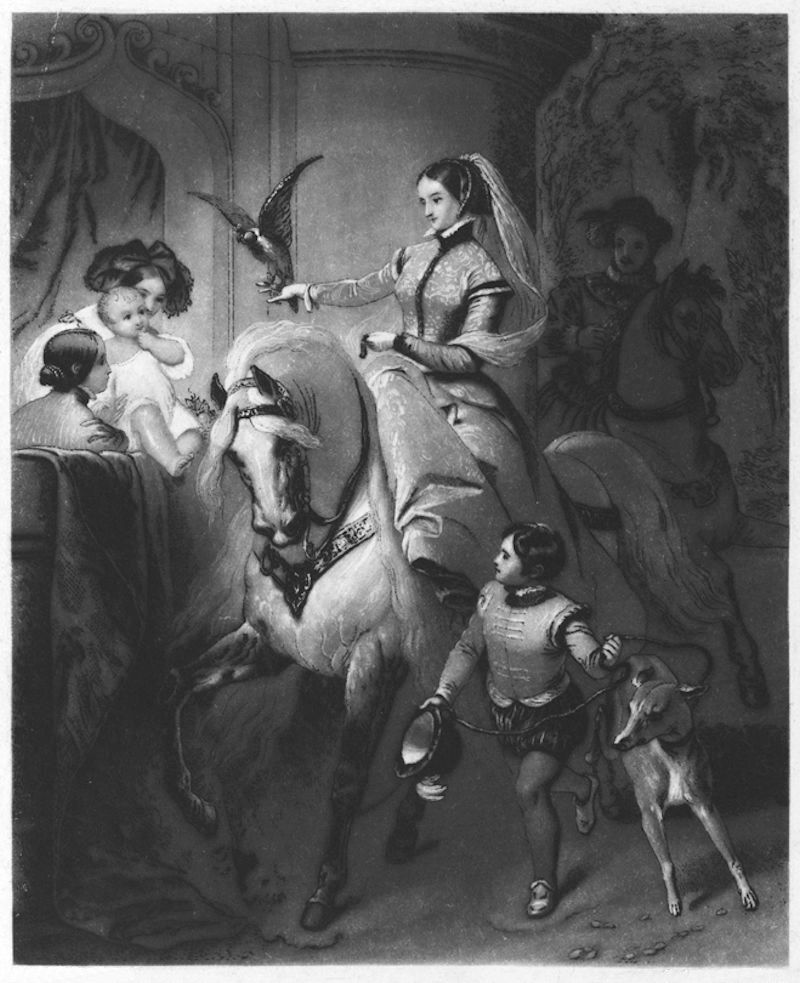
BY E. M. SIDNEY.
———
Up and away, for the day is bright,
With the falconers shouting cheerily!
Look at the gos-hawk’s eye of light,
As he plumes his pinions merrily!
He sees the heron, and quick he starts,
Wheeling to heaven so cheerily!
Now, like a thunderbolt down he darts
Away, away right merrily!
History of the Thirty Years’ War. Translated from the
German of Frederick Schiller. By the Rev. A. J. W.
Morrison, M. A. New York: Harper & Brothers. 1 vol.
12mo.
In the opinion of Carlyle this is the best philosophical
history that Germany has produced. The Harpers have
reprinted it in the cheap and elegant series of valuable
books, entitled their “New Miscellany.” The volume
presents a graphic and exceedingly interesting view of one
of the most terrible and devastating wars with which Europe
was ever cursed. It represents the struggle of the
Protestant States against the overgrown power of Austria,
and the various motives, religious and devilish, which animated
the parties during the contest. The skill and bravery
of the commanders engaged in the war, give a personal as
well as general interest to the narrative. On the one side
we have Gustavus Adolphus, Count Thorn, Mansfield,
Bernard of Weimar, Banner, Torstensohn, on the other
Wallenstein, Tilly, Piccolimini, Pappenheim, and Hatzfeld.
Gustavus Adolphus and Wallenstein are, of course, the
leading objects of interest. In reading this history the
mind becomes so accustomed to the devastation of provinces,
the murder of peasants, and horrible outrages on all
the decencies and sanctities of life,—that fire, famine and
slaughter become mere commonplaces and matters of
course. We read, at last, the most terrible accounts of
wretchedness and cruelty, with hardly a shudder. Schiller,
in summing up the various evils of this war, a war which
devastated whole provinces, reduced towns and cities to
ashes, “smothered the glimmering sparks of civilization in
Germany, and threw back the improving manners of the
country into their pristine barbarity and wildness,” still
finds consolation in the thought that from this fearful war
Europe came forth free and independent. “In it she first
learned to recognize herself as a community of nations;
and this intercommunion of States, which originated in the
thirty years’ war, would alone be sufficient to reconcile the
philosopher to its horrors.” There is, in truth, some consolation
in the idea that a soul of goodness abides in things
evil,—that men, mad with passion or drunk with fanaticism,
cannot hack each other to pieces, without having
their blind fury directed by a higher power to a good result.
The History of Civilization from the Fall of the Roman
Empire to the French Revolution. By F. Guizot. Translated
by William Hazlitt. New York: D. Appleton &
Co. 4 vols. 12mo.
No person can have watched the course of the prominent
American publishers of the United States, without observing
a manifest improvement, within the last three or four
years, in the character of the books they reprint, and the
style of their execution. The house of Appleton & Co.
have been especially distinguished for the intrinsic value,
and the cheapness and elegance, of their publications.
Their mercantile daring, in hazarding capital on books
which were not considered, until lately, profitable speculations,
deserves the highest praise. The present edition of
Guizot’s admirable work on Civilization, is one of their
most important additions to the stock of works, combining
great learning and profound thought, with some of the
most charming qualities of style. The first portion of the
present publication, on the General History of Civilization
in Europe, is well known; but the other three volumes,
containing Guizot’s lectures on the History of Civilization
in France, have been but lately translated. Guizot is probably
the greatest historian that France has produced, in
the combination of those qualities which go to make up a
genius for history. He yields to none in the research
which collects facts, the understanding which analyses and
arranges them, and the imagination which represents them
as realities, and endows them with substantial life and
meaning. To all these advantages, he adds a beautiful
clearness, vigor and brilliancy of style, in narrating the
progress of events and setting forth their laws and principles.
The present history is at once popular and profound.
It is calculated to delight and instruct the common reader
as well as the student. We cordially recommend it to
all, as a book containing a vast amount of erudition and
thought, devoted to the illustration of a subject in which
everybody has an interest, and calculated to improve the
literary taste of the reader, as well as to inform and enlarge
his understanding.
Stories from the Italian Poets. By Leigh Hunt. New
York: Wiley & Putnam. 1 vol. 12mo.
This is one of the most entertaining volumes of the season.
It contains a summary in prose of Dante’s Divine
Comedy, and various stories from the poems of Pulci,
Boiardo, Ariosto and Tasso, with occasional passages versified,
and some interesting critical notices of the lives
and genius of the poets. In the criticisms Hunt evinces a
knowledge of his authors, founded on a long acquaintance
with them, and a keen enjoyment of their excellencies.
The account of the Divine Comedy is the best, for the
general mind, which we have yet seen in English, and is
calculated to give delight to thousands, to whom Cary’s
translation would be a bore. The stories from Pulci are
exquisite for their mirthful beauty. The tales from Boiardo,
Ariosto and Tasso, will introduce the common novel reader
into a new world of beauty, heroism and romance. The
passages of grandeur and sublimity, of pathos and sweetness,—the
images both delicate and magnificent, with
which the volume abounds,—make its circulation in this
country a thing devoutly to be wished. It will enable the
reader to obtain some idea of the splendor and opulence of
the Italian mind, in all which enchants the senses and thrills
the imagination.
Hunt’s critical notices and occasional comments are very
characteristic. His style has the same sweetness and felicity
which constitute the charm of his other essays; and is
dotted over with those little impertinences of personal
opinion, from which nothing that he writes is wholly free.
His remarks on Dante throw more light upon his own character
than that of his subject. From the very constitution
of his mind he revolts at all infliction of suffering, even for
sin. He would have ice-creams in Pandemonium. He is
inexpressibly shocked at Dante’s severity and spleen, and
speaks many a fair word for the poor rascals whom the
austere Florentine has consigned to perdition. His comments
on the remorseless severity of the punishments in
Hell,—his indignation that Cato should be placed in Purgatory
while his wife, Marcia, sojourns in the pit,—his exceptions
to some of the persons placed on high seats in
heaven,—are often exquisitely amusing. It requires a man
like Hunt to criticise a man like Dante.
The Poetical Works of Thomas Moore. New York: D. Appleton
& Co. 1 vol. 8vo.
This is a splendid edition of one of the most popular of
English poets. It has ten fine steel embellishments, and its
general execution places it very nearly on a level with the
English edition. As a specimen of American typography
it is very honorable to the enterprising publishers. It is the
only complete edition of Moore ever published in this
country, being reprinted from the London collection, lately
edited by the poet himself, and containing his autobiographical
prefaces and illustrations. In these the poet very
pleasantly prattles about his own life and works, and is
exhibited as the most graceful of egotists. The volume
contains an immense number of brilliant verses, ranging
in subject from the romantic poem to the political squib.
Without depth of passion, elevation of sentiment, or grandeur
of imagination, the poems of Moore still evince a
quickness of sensibility, an opulence of fancy, and a brilliancy
of wit, which have made them among the most
popular works produced within the present century. His
poems are lit up with an incessant shower of sparkling
fancies. Almost everything he has written is full of glitter
and point—his sentiment as well as his satire. His songs
are often epigrams of feeling. Though, as a poet, he can
hardly stand by the side of Wordsworth, Shelley, Coleridge,
or Byron, in the greatest qualities of the bard, yet
no one can glance over the present volume without being
impressed with the brilliant genius of its author, and fascinated
with the stores of wit, fancy, learning and sentiment,
which glisten and gleam on every page.
The French Revolution. A History. By Thomas Carlyle.
Newly Revised by the Author, with Index. New York:
Wiley & Putnam. 3 Parts. 12mo.
This is Carlyle’s grandest work—a prose epic on the
great event of modern history. In our narrow limits we
cannot hope to do any thing like justice, to the imagination,
fancy, learning, humor, pathos, sublimity, characterization,
with which the volumes abound. In spite of some
obstinate faults, in spite of much false and pernicious doctrine,
in spite of the style, no work ever written on the
French Revolution equals this in the clearness with which
it represents the causes of that revolution, in the vividness
with which it brings up its different events in magnificent
pictures, speaking directly to the eye, and in the grandeur
of its delineations of the principal actors in the drama.
The portraits of Mirabeau, Danton, Robespierre, are masterpieces.
Every page glows with vital life. The words
are all alive with meaning. They paint objects so distinctly
that we become observers of the scenes to which
they relate. Carlyle, in truth, is a master of expression as
distinguished from mere fluency. He selects the “inevitable
best word,” or compounds it, with an unmistakable
tact and sureness. If to his other great qualities he joined
calmness, comprehension, mental honesty, the present work
would be almost perfect. Viewing it with an eye to all its
faults, it must be pronounced a work of great genius and
power.
The Life and Correspondence of John Foster. Edited by J.
E. Ryland. New York: Wiley & Putnam. 2 vols. 12mo.
Foster is well known as the author of a volume of essays,
laden with weighty thought and acute observations on character
and life. The present volume, containing his letters
and journals from his earliest to his latest years, is one of
great value, not merely to his own sect, the Baptists, but
to all who can appreciate originality of character and
thought. Foster was a hard, determined, patient thinker,
gifted with much imagination, and impressing on every
thing he wrote the invincible honesty of his character. His
correspondence reveals to us the inmost recesses of his
mind and disposition, and constitutes a kind of psychological
autobiography, replete with materials of interest and
instruction. The separate thoughts scattered over these
volumes would alone be sufficient to reward abundantly
the trouble of its perusal. One of the strongest peculiarities
of genius, Foster says in one place, “is the power of
lighting its own fire.” Of a soft and pensive evening, he
remarks—“It is as if the soul of Eloisa pervaded all the
air.” Shakspeare, he observes, had perceptions of every
kind; “he could think every way. His mind might be
compared to that monster the prophet saw in his vision,
which had eyes all over.” Again he says—“Lord Chatham
did not reason; he struck, as by intuition, directly on the
results of reasoning; as a cannon-shot strikes the mark
without your seeing its course through the air as it moves
towards its object.” When shown a piece of ornamental
worsted-work, with a great deal of red in it, he said “it
was red with the blood of murdered time.” The volumes
are full of thoughts and observations equally striking and
pointed.
The New Timon. A Romance of London. Philadelphia:
Carey & Hart. 1 vol. 12mo.
This poem has excited no inconsiderable interest in London.
It is reprinted from the third English edition. Bulwer
has been mentioned as the probable author, but this must
be a mistake, unless Bulwer has essentially changed his
literary opinions. Wordsworth, Keats and Tennyson, each
of whom the author of “Pelham” has warmly praised, the
author of “Timon” most ignorantly and pertly ridicules.
The poem, it must be admitted, has much merit. It is
written in a vigorous style, contains numerous passages of
flashing description, much keen portraiture of prominent
English politicians, and many beautiful scenes of pathos
and passion. The pith and nerve of the verse, the half-misanthropic,
half-romantic tone of the sentiment, the
frequent allusion to contemporary events and persons, and
the bitter sharpness of the satire on social evils,—often remind
the reader of Byron. The work evidences a brilliant
and restless intellect, ill at ease with the manners and institutions
of society, scornful, dogmatic and perverse, but
quite felicitous in running keen observations into the moulds
of fancy and wit. Kinglake, the author of Eothen, might
have written it. The author’s character is a composite,
made up of Diogenes and Alcibiades.
Memoirs of the Life of Addison. By Miss Aiken. Philadelphia:
Carey & Hart. 1 vol. 12mo.
The publishers of this volume have started a “Library
for the People,” of which the Life of Addison constitutes
No. 5. It makes a volume of about 300 pages, elegantly
printed. The price is only fifty cents, or one-fourteenth of
the cost of the English edition. All the mistakes of the
English edition, so acutely pointed out by Macaulay, have
been corrected in the American reprint. The work is well
written, and introduces us to a most interesting period of
English literature and history. The correspondence of
Addison confers great value upon the work. Most of the
letters were never before printed. The beautiful character
of the subject, joined to the immense influence which his
writings have exerted on English letters and manners, give
to the details of his virtuous and well-spent life a peculiar
interest and charm. A volume which introduces us so
completely to Addison, and strengthens that affectionate
companionship with him, which his works may have commenced,
cannot fail to be popular.
The Poetry of Wit and Humor. Selected from the English
Poets. With an Illustrative Essay, and Critical Comments.
By Leigh Hunt. 1 vol. 12mo.
The matter of this book will ensure its success. It contains
extracts from Chaucer, Shakspeare, Ben Jonson,
Beaumont and Fletcher, Suckling, Dryden, Pope, Goldsmith
and Wolcot, with running comments on the authors
and on particular passages of the poems. The essay on
Wit and Humor, though it does not exhaust the topic, is
ingenious, and pleasantly illustrated. We do not think that
in the case of a few of the authors, Hunt has hit upon the
happiest selections. Few, for example, would obtain an
idea of the comic genius of Fletcher from the specimens
quoted in the volume. The task, however, was a difficult
one to perform; and the editor, in compiling an entertaining
volume, has done all that perhaps could be expected, in
the limited space to which he was confined.
The Island Bride, and other Poems. By James F. Colman.
Boston: Wm. D. Ticknor & Co. 1 vol. 12mo.
The most superficial glance over this volume would convince
even the supercilious critic, that the author is destined
to take a high rank among American poets. “The Island
Bride” contains nine Cantos of Spenserian verse, finished
in diction, poetical in feeling, and replete with thought,
fancy and imagination. It is one of the very few long
poems in American literature, which more than repay
perusal. The other pieces are of much merit, and bear
unmistakable marks of power. The most surprising quality
manifested in the volume, is perhaps the correct taste
which is everywhere observable throughout its pages. It
seems the work of a veteran in composition, rather than
the first volume of a youthful poet. We should be pleased,
had we time, to make it the subject of a more extended
notice; but at present, we can do little more than cordially
commend it to the notice of our readers.
Classical Antiquities, a Compendium of Roman and Grecian
Antiquities, with a Sketch of Ancient Mythology. By
Joseph Salkeld. New York: Harper & Brothers. 1 vol.
12mo.
The object of this volume is a good one, and it will be
found eminently useful. To read modern books understandingly,
some knowledge of the religion, government and
manners and customs of the Greeks and Romans, is indispensable,
from the multitude of allusions to them throughout
every department of modern literature. In addition to
this, the subject of Classical Antiquities is sufficiently interesting
of itself, to justify the reading of a much larger book
than the present. The “way of life” among two nations,
which have once held a vast dominion on earth, by virtue
of their power and policy, and still hold even a vaster
dominion over the mind by virtue of their literature, must
be interesting to every reflective and curious mind.
Rationale of Crime, and its Appropriate Treatment; being
a Treatise on Criminal Jurisprudence considered in relation
to Cerebral Organization. By M. B. Sampson. With
Notes and Illustrations by E. W. Farnham. New York:
D. Appleton & Co. 1 vol. 12mo.
The character of this volume is indicated by its title. It
is the application of the principles of phrenology to the
phenomena of crime. The notions of the author are illustrated
by a number of portraits of criminals and other persons,
the shape of whose heads are said to indicate the bent
of their characters. The book is readable, even to unbelievers
in the science of bumps. Phrenology, however, to
all intents and purposes, is an exploded system; and thieves
and murderers cannot, at this day, save themselves from
punishment, by exhibiting in extenuation of their crime, the
most gigantic organs of acquisitiveness and destructiveness.
Notes on the Northwest and Valley of the Upper Mississippi.
By Wm. J. A. Bradford. New York: Wiley & Putnam.
1 vol. 12mo.
A work like this has long been wanted. The large mass
of readers are singularly deficient in accurate knowledge
respecting the great region of which it treats. Mr. Bradford
has interesting chapters on the physical geography,
history, topography, pursuits, health, geology, botany,
monuments, and aboriginal inhabitants of the Northwest.
Under this name he includes the country between Lakes
Superior and Michigan, east,—the Illinois and Missouri
Rivers, and the Northern Boundary of the United States,—including
Iowa and Wisconsin, part of Michigan northwest
of the Straits of Mackinaw, and Northern Illinois and
Missouri.
Poetry and Truth from my Life. From the German of
Goethe. By Parke Godwin. New York: Wiley & Putnam.
2 Parts, 12mo.
It is singular that this is the first good English translation
of the celebrated work of Goethe on his own life. As a
record of the external influences and internal experiences,
which went to form the character of Germany’s master-intellect,
it is one of the most important works of the age.
Carlyle, in referring to it, well says—“what would we give
for such an autobiography of Shakspeare, of Milton, even
of Pope or Swift?” The publishers have included it in
their series of “Choice Books”—an enterprise which they
have successfully extended to eighty numbers, without any
evidence of exhausting their materials.
Something for Every-Body: Gleaned in the Old Purchase,
from Fields often Reaped. By Robert Carlton. New
York: D. Appleton & Co. 1 vol. 12mo.
This book well bears out its title. It is a collection of
anecdotes, personal adventures, and hits upon popular
errors. The author is a shrewd observer of life and character,
and has an eye for the tendencies of popular movements.
There is much sense and humor in his remarks on
the various moral reforms of the day. He is “a gentleman
of the old school,” and perhaps does not always do complete
justice to the objects of his sarcasm or indignation;
but he well probes their weak points.
Sartor Resartus: the Life and Opinions of Herr Teufelsdröckh.
In Three Books. New York: Wiley & Putnam.
1 vol. 12mo.
This edition of Carlyle’s celebrated work on the philosophy
of clothes, is revised by the author; and Wiley &
Putnam are authorized by him, to “print and vend the
same in the United States.” The book, itself, with all its
wildness of style, is one of the most fascinating works of
the century—full of splendid imagination, deep thought,
and humorous insight into life, character and manners. Its
wealth of pictorial expression, would alone entitle it to a
high rank among works of imagination. The present
edition is altogether the best and most elegant ever published
in the United States.
Experimental Researches on the Food of Animals, and the
Fattening of Cattle; with Remarks on the Food of Man.
By Robert Dundas Thomson, M. D. New York: D. Appleton
& Co. 1 vol. 12mo.
This work presents the results of an extensive series of
original experiments, undertaken by order of the British
government. It is full of matter important at once to the
practical agriculturist and the scientific physiologist. The
publishers have issued it in a cheap form, so as to bring it
within the reach of the humblest means. The author is
evidently a patient man of science, who may be relied upon
as a close observer of facts, and strict reasoner from them.
No farmer can well dispense with the book.
LE FOLLET
Boulevart St. Martin, 61.
Coiffure de Normandin, passage Choiseul, 19—Chapeaux de Mme. Baudry, r. Richlieu 87;
Toilettes de Mme. Ferrière Pennona, r. Mondovi, 1—plumes de Mme. Tilman, rue Minars, 5;
Dentelles de Violard, r. de Choiseul, 2bis—Mouchoirs de L. Chapron & Dubois, r. de la Paix, 7;
Essences & flacons de Guerlain, r. de la Paix, 11—Chaussures de Hoffmann, r. du Dauphin, 9.
Graham’s Magazine.
Transcriber’s Notes:
Table of Contents has been added for reader convenience. Archaic spellings and hyphenation have been retained. Punctuation has been corrected
without note. Other errors have been corrected as noted below. For
illustrations, some caption text may be missing or incomplete due to condition of
the originals available for preparation of the eBook.
page iv, by Charles E. Cathrall, 149 ==> by Charles E. Cathrall, 140
page iv, Fox and Saukie Indians, ==> Saukie and Fox Indians,
page 5, a suprise took place ==> a surprise took place
page 21, like barks again put ==> like barques again put
page 28, thou seeest, hearest, ==> thou seest, hearest,
page 30, the streets, massacreing ==> the streets, massacring
page 31, supremay of the Pope! ==> supremacy of the Pope!
page 31, they were massacreing men, ==> they were massacring men,
page 46, your neice, I might ==> your niece, I might
page 51, with a manifest distate ==> with a manifest distaste
page 54, this arrangment, but in ==> this arrangement, but in
page 55, was a taunt top-mast, ==> was a taut top-mast,
page 60, would be villified ==> would be vilified
page 144, Firm of Domby & Son ==> Firm of Dombey & Son
Le Follet, Chapeau de Mme. Baudry ==> Chapeaux de Mme. Baudry
[End of Graham's Magazine, Vol. XXX, No. 1, January 1847, George Rex Graham, Editor]