Perhaps there is no place in America where the
people continued to cling so long, and so fondly, to
the relics and traditions of the olden time, as in Boston—their
first era being that of the early settlers,
their second that of the revolution. At the commencement
of my acquaintance with Boston and
Bostonians, I was particularly struck with the prevalence
of this feeling, having found so little of it in
my native city, Philadelphia. Yet I was sorry to
hear from my eastern friends, that comparatively it
was fast subsiding, and that a fancy for modern improvements
(blended with the powerful incentive of
pecuniary interest) was rapidly superseding that
veneration so long cherished for the places and things
connected with the history of their “ancient and
honorable town,” and the founders of their country’s
freedom. On my second visit to Boston I missed
much that on my first I had found still undesecrated.
On my third, but few vestiges remained of the
poetry, the romance, and the quaintness that, with
regard to external objects, had so interested and
amused me in the year 1832. I looked in vain for
the “old familiar faces” of certain antiquated and,
perhaps, unsightly structures that I had delighted to
contemplate as the time-honored habitations of men
with undying names. They were gone, and new
and more profitable buildings erected on their site.
In many of these instances “I could have better
spared a better house.”
Fortunately the charter of the city specifies that
Faneuil Hall is never to be sold, nor can the ground
on which it stands be appropriated to any other purpose.
Except that the market-place in the lower
story is now occupied by shops, the whole edifice
still remains nearly as it was when the walls of its
chief apartment resounded with the acclamations of
the people who discussed, at their town meetings,
those principles that led to their self-emancipation
from the sway of Britain. Acclamations elicited by
the bold and overpowering eloquence of James Otis,
the enthusiastic outbreakings of the impetuous spirit
of Warren, the pure and self-sacrificing patriotism
of Quincy, and the calm but energetic plain sense
of Samuel Adams, backed by the generous liberality
of that wealthy and noble-minded merchant whose
name, as president of the first Congress, leads on the
glorious array of signatures appended to the Declaration
of Independence. Did no one think of preserving
the pen with which those names were written?—the
sacred quill
“That wing’d the arrow, sure as fate,
Which ascertain’d the rights of man.”
The full-length portrait of Peter Faneuil stands at
the upper end of the hall, looking like its guardian
spirit. It is a fine copy of a small original that was
painted in his lifetime. In regarding the likeness of
a person of note (provided always that the painter is
a good artist) you can generally judge of its verisimilitude,
by its representing the features of the mind
in conjunction with those of the face. If a well
painted portrait has no particular expression, you
may safely conclude that the sitter had no particular
character. When, at the first glance of a picture,
you are struck with the conviction that the original
must have looked exactly so, it is because you at
once perceive his mind in his face. Who that has
ever seen it, while it hung so long in the Pennsylvania
Academy of Fine Arts, does not recollect Berthon’s
admirable and life-like portrait of Buonaparte
in the first year of that consulate. Every beholder
was struck with an irresistible conviction of its perfect
and unimpeachable fidelity of character. There,
in his gold embroidered blue coat, his tri-colored
sash, and his buff-leather gauntlets, was the pale,
thin, almost cadaverous young soldier, just returned
from the unwholesome regions of the Nile; with his
dark, uncared-for hair shading his thoughtful brow,
and his deep-set, intense eyes, that looked as if they
could search into the soul of every man they saw.
So self-evident was the truth of this picture, that it
was unnecessary to be aware of its exact accordance
with all the descriptions given at that time of the
republican general, who had just made himself the
chief magistrate of the French people, and was called
only Buonaparte. A few years afterward, when
“the hero had sunk into the king,” and was termed
Napoleon, and when, in becoming more handsome,
his face lost much of its original expression, this picture
was equally valuable, as showing how he had
looked in the early part of his wondrous career.
Another picture which we feel at once to be a
most faithful representation, is Greuze’s portrait of
Franklin. It was painted by that excellent artist
when the venerable printer, philosopher, author,
statesman (what shall we call him) was living in
Paris. The dress is a coat and waistcoat of dark reddish
silk, trimmed with brown fur. The head is very
bald at the top, and he wears his gray locks plain and
unpowdered. He has that noble expanse of forehead
which is almost always found in persons of extraordinary
intellect. His eye is indicative of strong
sense and benevolence, enlivened with a keen relish
for humor. His whole countenance exhibits that
union of genius and common sense, shrewdness and
kindness, which formed his character. My father
had once in his possession (but lost it by lending) a
fine French engraving taken from this very portrait,
and printed in colors. He had known Dr. Franklin
intimately, and he considered it the most admirable
likeness he had ever seen—in fact the very man.
To return to Mr. Faneuil—his portrait also is
highly characteristic. No one can look at this picture
of a tall, dignified gentleman, in a suit of crimson
velvet and gold, a long lace cravat, and a powdered
wig, according to the patrician costume of his
time, and can view his fine open countenance, without
believing the whole to be a correct portraiture of
the opulent and public spirited merchant who, while
he was yet living, gave its first market-place, with a
hall for the accommodation of public meetings, to
the town that had afforded an asylum to his Huguenot
ancestor. The remains of Peter Faneuil, who died
suddenly in 1743, are interred amid the green shades
of the Granary Burying Ground, so called from the
town granary having been in its immediate vicinity.
This cemetery is close to the Tremont Hotel, and in
view of another “ancient place of graves,” belonging
to the King’s Chapel, which was founded in 1688,
and, in early times, numbered among its congregation
the largest portion of the Boston aristocracy;
and many of their descendants still worship there.
It is built of light brown stone, and is frequently
called the Stone Chapel.
The length, thickness, and luxuriance of the grass,
(which appears to require perpetual mowing,) and the
closeness of the burial mounds, which seem almost
piled upon each other, make it somewhat difficult to
explore the monumental memorials of the old Boston
families, whose first progenitors are slumbering beneath.
A large number of these tombs are sculptured
with armorial bearings, as an evidence that
their mouldering occupants belonged, in their fatherland,
to “gentle blood.” Of the tomb-stones dated
after the revolution, I saw few that bore any indications
of “the boast of heraldry, the pomp of power.”
The founder of Boston, John Winthrop, is interred
in the northwest corner of this cemetery, with his
daughter, Grace Sears, (from whom the present
Sears family is descended,) and his son, Waitstill
Winthrop. The mansion of Governor Winthrop
was a large two-story frame house, surrounded by a
garden, and shaded with aboriginal trees that had
been left standing for the purpose. Its location was
near the old South Church, just below School street.
Its site is now covered with stores; the block of
buildings being termed South Row. I have seen an
old portrait of this chief of the Boston colonists. It
represents him as a tall, thin, dark-complexioned
man, with an oval face, regular features, and a very
serious countenance. He is habited in “a sad colored
suit,” with a white lawn ruff round his neck,
and a black cap on his head. In this burial ground
Cooper has placed the vault of the Lechmere family,
at the entrance of which the mother of Job Pray was
found dead; and from the gallery of the stone chapel
the half maniac father of Lionel Lincoln interrupted
the marriage of his son with Cecil Dynevor, as they
stood at the altar. Though reason may reject the
interesting associations that emanate from fiction,
feeling and fancy always unconsciously adopt them.
It is this which conducts so many travellers to the
shores of Loch Katrine, and sends them in a boat to
the island of Ellen Douglas, though well aware that
the damsel of the lake never in reality existed. I
knew a gentleman who traversed the wilds of Connaught
to visit the sea-beaten castle of Inismore, because
it had been the fancied abode of Glorvina, the
Wild Irish Girl, another charming creation of genius.
And few will wonder at his doing so, who are
familiar with the work that caused the flood-tide of
Miss Owenson’s fortune, and who have, of course,
read and re-read that beautiful letter in which Horatio
describes his first acquaintance with the castle and
its inmates.
I was yet a stranger in Boston, when a few days
after my arrival I accompanied a lady and gentleman
who were residents in that city, (and excellent
ciceroni) on an exploring walk into what is called
the North End. This is a very old part of the town,
extending northerly from Court street to Lynn street,
and bounded on its eastern side by the waters of the
harbor, and on the west by those of the estuary
denominated Charles River. Its extreme point is
immediately opposite to Bunker Hill. As it did not
modernize as fast as the other sections of Boston,
and as its old buildings were longer in getting demolished
or furbished up, the habitans of the North End
lay under the imputation of being an old fashioned
people, sadly deficient in the organ of go-a-headness,
and pitifully submitting to creep on all fours, while the
rest of the community were making unto themselves
wings. There was even a scandalous story circulated
of one of their pastors, (a good old gentleman,
whose nasal elocution had not improved by age,)
uttering in his prayer the words, “Have mercy upon
us miserable offenders,” in a manner that sounded
very much like, “Have mercy upon us miserable
North-enders.”
To give me an idea of the habitations of the early
Bostonians, I was purposely taken through some of
the oldest and crookedest streets; several of which had
pavements so narrow that we had to break rank and
to proceed Indian file; for when we attempted to
walk abreast and the wall was politely ceded to me,
the other lady took the curb-stone, and the gentleman
the gutter. Be it known, however, that a Boston
gutter is merely a minor ravine, edged with wild
flowers; and not a reservoir of liquid mud or a conduit
for dirty water; all the conduits in that city
being sub-terraneous, and entirely out of sight.
We saw very old houses, some of time-discolored
brick, and some of wood in many instances unpainted,
and therefore nearly black; in a few, the second
story projected far over the first. Many of the ancient
frame habitations were very large, and must have
been built by people “that were well to do in the
world.” In some, the clap-boards were ornamentally
scolloped; and in many, the window frames
instead of being inserted in the wall, were put on
outside, and looked as if ready to burst forth upon us.
There were primitive porches with seats in them,
sheltered by moss-grown pent-houses, some of which
would have furnished a tolerable crop of that roof-loving
plant the house-leek. There were wooden
balconies, with close heavy balustrades, of the pattern
that looks like a range of innumerable narrow
jugs. In some houses, the balconies were gone, but
the door-windows belonging to them, were still there
all the same; and as they now opened upon nothing,
they looked most dangerous, especially for children
or somnambulists to walk out at. There were street-doors
cut horizontally in half, with steps descending
inside instead of ascending outside. Many of the
houses that stood alone had no front entrance, but
ingress and egress were obtained through a small
unpretending door in the side. This seemed to be a
good plan, when the front was facing the chill blasts
of the northeast. It is very disagreeable to have
your street door blown open by the violence of the
wind.
In an early stage of “our winding way,” we came
to the junction of Union and Marshall streets, and
there I saw a large square block of dark brown
stone, on one side of which was painted in white letters
the words “Boston Stone.” Supposing it to be
one of the landmarks of the city, and something memorable,
I seated myself for a few moments upon
it. I was told by one of my companions, that this
stone had been an object of great controversy among
certain antiquaries of the city. In newspapers a
century old there were advertisements of shopkeepers
and mechanics, who, in giving their locations,
made assurance doubly sure, by stating that they
lived near the Boston Stone. Houses were announced
for sale or hire in the neighborhood of the
Boston Stone. Street-fights and dreadful accidents
happened not far from the Boston Stone. What
then was the Boston Stone? How came it there,
and for what purpose? There was no mention of it
in history. Patriotic picturesque people thought it
was the foundation-stone of a flag staff or a beacon-mast;
and it is certain that the top or upper surface
of the block exhibited a slight circular cavity, evidently
made on purpose for something: though practical
people contended that the hollow was not deep
enough to hold anything. I cherished for two or
three months the persuasion that the Boston Stone
was either a remarkable relic connected with great
events, or else that it had been placed there when
the peninsula was first laid out for a town, as a mark
to designate where some place left off, and another
place began; or perhaps to denote the very centre
of the settlement. But “the shadows, clouds and
darkness” that rested upon all my conjectures, were
very prosaically dispelled just before my departure
from Boston, by a most unexciting account obtained
through the medium of a grandson of “the oldest
inhabitant” of that neighborhood. The real solution
of the mystery was so very natural, that none but
very commonplace people would believe it. It
simply implied that a certain apothecary of the olden
time being in want of a very large mortar, and unable
to obtain one ready made, procured this block
of stone and set his boys to hollowing it out for the purpose.
They made a beginning, but soon found that
the stone was too hard and the labor too great;
and having taken a spite at the obdurate block, they
shoved it out of doors and left it on the pavement in
front of the shop. From hence no one took the
trouble to remove it, and finding that the neighbors
began to date from its vicinity, the apothecary’s boys
made it more distingué by inscribing it with the title of
the Boston Stone—How a plain tale will put us down.
Shortly after quitting the Boston Stone, we came
to a house at the corner of Union and Hanover
streets, which was shown to me as the one in which
Dr. Franklin was born. It is of two stories, and built
partly of brick and partly of wood. The lower part
was now occupied by a little shop, with a blue bell
as a sign. Adjoining it in Hanover street was a dark
low grocery store into which you descended by a step.
It looked exactly as if it had been the soap and candle
shop of Josiah Franklin. It was easy to imagine
poor Ben. serving customers behind the old counter;
cutting candle-wicks into lengths; and snatching, at
intervals, a few minutes to read a little in hidden
books when nobody saw him. An aged and excellent
woman, who had passed her life in this part of
the town, told me at a subsequent period, that she
well remembered, when a little girl, seeing the
old corner house (the dwelling part of the establishment,)
pulled down, and the present one
erected in its stead. The original corner house had
always been regarded as one of the habitations of
the Franklin family, and the adjoining old one-story
shop (now the grocery) as theirs. It seems to me
highly probable that the elder Franklin did live in
Milk street (as is generally believed) at the time his
son Benjamin was born, and that the infant was wrapped
in a blanket and carried over the way to the old
South Church to be christened. His baptism is noted
in the register of the church, and the date is the same
as that of his birth. This speedy performance of the
rite of baptism was in accordance with the custom of
the times. The Milk street house was a small two-story
frame building, and was accidentally burnt in
1810. On the spot has since been erected a three-story
furniture warehouse. It is but a few steps from
the corner of Washington street, opposite to the Old
South. There was an old printing office just back of
it; and it is said that Josiah Franklin relinquished the
Milk street house to his son James the printer, and
removed with his wife and the younger children to
Hanover street, and there carried on the soap and
candle business, in the dark low one-story shop that is
still there: living in the adjoining house at the corner.
That the parents of Franklin were residents of the
North End at the time of their death there can be no
doubt, as they were interred in the North Burying
Ground on Copp’s Hill. Many years ago their remains
were exhumed, and transferred to the Granary
burial place in Tremont street, at the expense
of several gentlemen of Boston. A neat monument
of granite has been erected upon the mound that
covers their ashes; and in the front of the little obelisk
is inserted a slab of slate, a part of the original grave
stone on Copp’s Hill. This humble medallion bears
the names of Josiah Franklin and Abiah his wife,
with the date of their deaths. I regarded this monument
with much interest, as reflecting back upon his
lowly but respectable parents a portion of the honor so
universally accorded to the great man their son.
Having diverged from Hanover street to the North
Square, we soon found ourselves in front of two very
old and remarkable houses; one of which had been the
residence of Governor Hutchinson, and the other of
William Clarke, a wealthy merchant of the early part
of the last century. Both were large old-fashioned
buildings, their sides and chimneys overgrown with
the scarlet-flowering creeper-vine. Above the front-door
of the Hutchinson House, was the wooden balcony
from which “Stingy Tommy,” as he was
disrespectfully called by the populace, sometimes
addressed the restive and stiffnecked people whom it
was his hard lot to govern; and by whom he was so
much disliked, that whether he did well or ill they
were resolved not to be pleased. Perhaps the primary
cause of his unpopularity may be traced to his
parsimonious habits, or at least to the stories circulated
of them. No man that is noted for a mean and
avaricious disposition ever was or ever can be liked,
either in private life or in a public capacity. However
he may attempt to disguise it by an occasional
act of liberality, the sordid spirit that is in him will
be always creeping out, and exciting disgust and
contempt. Yet (as is often the case with such
persons) Governor Hutchinson spent much upon
show and finery. At the time his house was sacked
by the mob (when he narrowly escaped with his life)
from this balcony were thrown the splendid brocade
gowns and petticoats of his wife, with her laced
caps, and numerous ornamental articles of dress and
furniture. A bonfire was made of them in the street
before the door.
The gentleman who piloted us on this walk through
the North End was acquainted with the occupants
of the Clarke House, (much the most curious of the
two,) therefore we stopped in, and were courteously
shown its principal apartments. It was built by Mr.
Clarke, in the time of Queen Anne, and was after
him occupied by Sir Henry Frankland, and called,
for awhile, the Frankland House. It had a large,
wide entrance hall, with a parlor on each side. All
the ceilings were much too low for the taste of the
present times; and a low ceiling always causes a
room to look smaller than it really is. The walls of
the left hand parlor had been covered with rich
tapestry, over which a modern wall-paper was now
pasted. A small portion of the papering being peeled
off, we saw part of the tapestry beneath. But the
other parlor had been evidently the room of state.
The floor required no carpet, for it was parqueté all
over with small square pieces of American wood,
comprising, as we were told, fifty different sorts or
specimens; the light-colored pieces forming the
ground-work, and the dark ones the figure or pattern.
At the first glance it resembled an oil-cloth, or rather
(to adopt a very homely comparison) it was not unlike
the block-work bed quilts that our grandmothers
took such pains in making. On this floor there was
a border all round: and in the centre the marquetry
represented a large swan with a crown on its head,
and a chain round its breast. This was the cognizance
of the Clarke family. Those conversant with
heraldry know that there is always a reason, either
historical, traditionary, or allegorical, for the introduction
of certain strange symbols into a coat of
arms. We were told that this tesselated floor had
cost fifteen hundred dollars. The walls of the room
were divided into compartments, edged with rich
gilded mouldings; each containing an oil painting,
tolerably good, but very vividly colored. The subjects
were beyond our comprehension. We did not
know whether they were what the drawing-masters
call figure-pieces, or whether they were landscapes
with figures in them.
In the room over this parlor the chimney-piece was
of marble, decorated with a rich and admirably executed
carving of flowers, fruit, and Indian corn,
beautifully arranged, and descending down the sides
as far as the hearth. Above the mantle-piece was
a very mediocre picture, in a narrow gilt frame, inserted
in the wall. This painting represented a boy
and girl, evidently brother and sister. The boy is
presenting something that is either a peach or an
apple to the girl, who is dressed in a ruffled night-gown
and sitting on the side of a couch. The young
gentleman is standing upright, habited in a rich suit
of blue and gold, ornamented at the wrist with deep
cuffs of white lace. On his legs are white silk stockings,
ascending above his knees, and buskins laced
with gold cord. Neither of the children are looking
towards each other, but both are staring out of the
picture, and fixing their very large eyes on the spectator.
We were told that Cooper had visited this house
previous to commencing Lionel Lincoln. Changing
its location to Tremont street, he has described it as
the mansion of Mrs. Lechmere.
Few of our American cities have retained their old
family domiciles as long as the town of Boston, and
they attest the opulence of many of its early inhabitants.
However, they are fast disappearing; the
large portions of ground that they occupy, surrounded
with their gardens and lofty trees, having become
too valuable to escape being converted to more profitable
purposes. When I first knew Boston, the
spacious domain of Gardiner Green extended along
Pemberton Hill, far back of Somerset street, including
garden, shrubbery, and pasture ground, from
whence I was sometimes disturbed at night by the
tinkling of a cow-bell, which seemed to me strange
in the very heart of a large city. Near it, on Tremont
street, stood, with its pilasters and tall windows,
the mansion of Jonathan Philips, looking like the
residence of an old English nobleman. It had a
smooth green lawn in front, and an elevated terrace,
which was ascended by a lofty flight of stone steps,
bordered with vases of exotics; and among its fine
shade trees was the beautiful mountain ash, with its
clusters of light scarlet berries. It was built, and
originally occupied, by Mr. Faneuil, uncle to the
gentleman who bestowed the town-hall on Boston.
Next to the house of Governor Philips stood the
residence of the talented and unfortunate Sir Harry
Vane, who had come over with the early settlers,
and afterwards been appointed governor of the province
of Massachusetts. He returned to England
during the protectorate of Cromwell; and after the
restoration, was committed to the Tower for the republican
principles he persisted in advocating.
Charles the Second had him tried on a charge of high
treason, and he was beheaded on Tower Hill—behaving
on the scaffold with the utmost composure
and dignity. He attempted to address the people, but
the drums and trumpets were sounded to drown his
voice. This house of Sir Harry Vane was near two
centuries old. It was a large brick building, with a
garden at the side. The antique back casements still
retained the small diamond-shaped panes set in lead;
but, when I saw the house, its front windows looked
as if they had been modernized about a century ago.
On my last visit to Boston, about two years since,
I found that all the above-mentioned old mansions
had been demolished, and their places filled with
rows of modern structures suited to the utilitarian
spirit of the times. The old Coolidge house, in Bowdoin
Square, was still standing in 1840. It also is
a large brick building, the bricks much darkened and
discolored with time and damp. The house is almost
hidden by enormous old trees, which cast their impervious
branches so close to the windows that I
wondered how its inhabitants could possibly see to
do anything, unless they burned lamps or candles all
day long. The dense gloominess of shade that environed
this mansion, reminded me of the commencement
of one of Moore’s earliest poems.
“The darkness that hung upon Willemberg’s walls
Has long been remember’d with grief and dismay,
For years not a sunbeam had play’d in its halls,
And it seem’d as shut out from the regions of day.”
———
BY ALBERT PIKE.
———
It is the evening of a pleasant day
In these old woods. The sun profusely flings
His flood of light through every narrow way
That winds around the trees. His spirit clings,
In orange mist, around the snowy wings
Of many a patient cloud, that now, since noon,
Over the western mountains idly swings,
Waiting when night shall come—alas! too soon!
To veil the timid blushes of the virgin moon.
The trees with crimson robes are garmented:
Clad with frail brilliants by the Autumn frost,
For the young leaves, that Spring with beauty fed,
Their greenness and luxuriance have lost,
Gaining new beauty at too dear a cost:
Unnatural beauty, that precedes decay.
Too soon, upon the harsh winds wildly toss’d,
Leaving the naked trees ghost-like and gray,
These leaf-flocks, like vain hopes, will vanish all away.
How does your sad, yet calm and cheerful guise,
Ye melancholy Autumn solitudes,
With my own feelings softly harmonize!
For though I love the hoar and solemn woods,
In all their manifold and changing moods—
In gloom and sunshine, storm and quietness,
By day, or when the dim night on them broods;
Their lightsome glades, their darker mysteries—
Yet the sad heart loves a still, calm scene like this.
Soon will the year like this sweet day have fled,
With swift feet speeding noiselessly and fast,
As a ghost speeds, to join its kindred dead,
In the dark realms of that mysterious vast,
The shadow-peopled and eternal past.
Life’s current deathward flows—a rapid stream,
With clouds and shadows often overcast,
Yet lighted often by a sunny beam
Of happiness, like sweet thoughts in a gloomy dream.
Like the brown leaves, our lov’d ones drop away,
One after one, into the dark abyss
Of Sleep and Death. The frosts of Trouble lay
Their withering touch upon our happiness,
Even as the hoar frosts of the Autumn kiss
The green lip from the unoffending leaves;
And Love and Hope and Youth’s warm cheerfulness
Flit from the heart—Age lonely sits and grieves,
Or sadly smiles, while Youth fondly his day-dream weaves.
Day draweth to its close—night cometh on—
Death standeth dimly on Life’s western verge,
Casting his shadow o’er the startled sun—
A deeper gloom, that seemeth to emerge
From gloomy night—and bending forth, to urge
His eyeless steeds, fleet as the tempest’s blast:
And hear we not eternity’s dim surge
Thundering anear? At the dread sound aghast,
Time hurries headlong, pale with frantic terror, past.
———
BY MRS. EMMA C. EMBURY.
———
In the days of my early childhood, the little village
of ——, separated by green hills and broad fields
from the busy city, formed one of the pleasantest
summer resorts of the wealthy inhabitants of New
York. Many a stately villa was reared upon the
banks of the Hudson, many a neat country-house
sheltered itself within the winding lanes which traversed
the village, for its vicinity to the great mart
offered irresistible temptations to those whose hands
were chained to the galley of commerce, while their
hearts were still wedded to nature. One of the fairest
pictures in the “chambers of mine imagery” is
that of a large old-fashioned mansion, seated in the
midst of a garden “too trim for nature, and too rude
for art,” where a long avenue of cherry trees threw
a pleasant shade across the lawn, while a rude swing,
suspended between two of these sturdy old denizens
of the soil, afforded a cool and delightful lounge to
the studious and imaginative child. My earliest days
were passed in that pleasant home, and my earliest
lessons of wisdom learned in the school of that
pretty village; therefore it is that my thoughts love
to linger around those scenes, and therefore it is that
I have fancied others might find something of interest
in one of my reminiscences.
My shortest road to school led through a narrow
green lane, rarely traversed by the gay vehicles
which dashed along the main avenues of the village,
and I was delighted to find such a quiet and shady
path, where the turf was always so soft, and the air
so fragrant with the breath of flowers. But I was
soon induced to take a wide circuit rather than pass
the solitary cottage which stood within that secluded
lane. It was a low one-story building, with a broad
projecting roof, throwing the narrow windows far
into shade; and, as if to add to its sombre appearance,
some former occupant had painted the house a
dull lead color, which, by the frequent washings of
the rain, and powderings of wayside dust, had
assumed the grayish tint that gave to the cottage its
distinctive appellation. Every village has its haunted
house, and an evil name had early fallen on the
“gray cottage.” Behind it, and so near that three
paces from the little porch would lead a person to its
very brink, was a deep and rocky ravine, forming a
basin for the waters of a rapid brook, which, after
flowing in sunshine and music through half the village,
fell with sullen plash into the gloom of this
wild dell. Some dark and half forgotten tale of
guilt had added the horrors of superstition to the
natural melancholy of the place, and few of the
humbler inhabitants of the neighborhood would have
been willing to stand after sunset on the brink of the
Robbers’ Glen. It was said that the house, in former
times, had been the abode of wicked and desperate
men. The earth of the cellar beneath it was heaved
up with hillocks like graves, and supernatural sounds
had been heard to issue from these mysterious
mounds. For many years it had stood untenanted,
and the boys of the village often amused themselves
by pelting it, at a cautious distance, with stones.
But a “haunted house” had great attractions for
the mind of one who revelled in fancies of the wild
and wonderful. I was exceedingly anxious to behold
the interior of the lonely cottage, which had now
become invested with so much dignity in my eyes,
and finding a few companions of like spirit, we determined
to visit it. We accordingly fixed upon a
certain Saturday afternoon, and determined to find
some means of ingress into the barred and bolted
cottage. A gay and light-hearted troop were we,
as we scrambled over rail fences, gathered our
aprons full of wild flowers, or chased the bright butterflies
which mocked our glad pursuit. But as we
entered the lane our merry shouts of laughter ceased,
each looked earnestly in the face of the other, as if,
for the first time, sensible of the mysterious importance
of our undertaking, and, but for shame, several
would have retraced their steps. I believe not one
of us was insensible to the gloom which seemed
suddenly to fall upon us, and as we looked towards
the cottage, standing in the deep shadow of a spreading
elm, while all else within the lane was glistening
in the slant beams of the declining sun, we almost
feared to approach the darkened spot. Cautiously
advancing, however, and peeping through the rusted
keyhole, we found our curiosity entirely baffled by
the total darkness of the interior. It was proposed
that we should climb the fence and attempt an entrance
from the rear of the building, where we
should be less likely to be interrupted or discovered
by wayfarers, and after a brief consultation, held in
hurried whispers, we resolved upon the daring feat.
Silently treading the margin of the Robbers’ Glen,
we reached the back porch of the little cottage, and
beheld one of the window shutters open. We looked
into the apartment but saw nothing save the naked
walls of the dilapidated room, and as one of our party
turned the latch of the door, to our great astonishment,
it yielded to the touch and allowed us free entrance.
Half frightened at our own success, we
stood huddled together in the narrow passage, hesitating
to advance, when suddenly a tall woman, clad
in the deepest black, and displaying a countenance
as white and (as it seemed to our excited fancies) as
ghostly and rigid as a sheeted corpse, stood in the
midst of us. How we ever got out of the house I
cannot tell. I remember our desperate speed, the
wild and headlong haste with which we threw ourselves
over the low fence, and the total exhaustion
we felt when once fairly escaped from that frightful
place. As we lay on the grass, to rest before returning
home, each one told her own story of that terrible
apparition. None had heard a footstep when that
fearful woman came among us; none had seen her
approach, and though the sound of our own buzzing
voices, and the fixed attention with which we were
just then regarding the door of the apartment, which
we wished yet dreaded to enter, might easily account
for both these circumstances, yet we all came to the
conclusion that we had seen a ghost, or, at the least,
a witch.
On the following Sunday we were scarcely less
alarmed, for, just as the services were commencing,
the same tall figure, arrayed in deep mourning and
veiled to her very feet, slowly proceeded up the aisle
and took her seat on the step of the altar. My blood
ran cold as I looked upon her, and when I afterwards
heard that she had recently become the occupant of
the gray cottage, my dread of her supernatural powers
gave place to a belief that she was in some way or
other mysteriously connected with the guilty deeds
of which that cottage had been the scene. I did not
trouble myself to remember that the events which
had flung such horror around the Robbers’ Glen must
have occurred at least half a century previous, and
therefore could have little to do with a woman yet in
the prime of life. The curiosity which her presence
excited was not confined to the children of the village.
Her tall stature, her sombre garb, her veiled
face, and her singular choice of a place of abode
excited the conjectures of many an older and wiser
head. But whatever interest her appearance had
awakened, it was not destined to be satisfied. Those
who, led by curiosity or real kindness, sought to visit
her, were repulsed from the threshold; no one was
allowed to enter her house; all prying inquiries were
silenced, either by stern reserve or bitter vituperations;
even the village pastor was refused admittance
to her solitude; and, after months and even
years, as little was known of her as on the day she
first appeared. She lived entirely alone; once in
each week she was seen walking towards the city,
and on Sunday she was regularly to be found at the
foot of the pulpit—but beyond this nothing was to be
discovered. Few, very few, had ever distinctly seen
the face whose paleness gleamed out from the folds
of her thick veil, and, after some time, the people
found other objects of interest, while the children
carefully avoided all approach to the haunted cottage,
and could scarcely repress a shudder of horror as
they heard the low rustle of her dusky garments on
each returning Sunday.
Years passed on; circumstances occurred to remove
me from the village, and the various changes
which the heart experiences between the period of
joyous childhood and earnest womanhood, had
almost effaced from my mind all recollection of the
“black witch,” when I was unexpectedly and rather
strangely made acquainted with her true history. It
was a tale of ordinary trials and sorrows, such as
might have befallen many others, and yet there are
peculiarities in the sufferings of every individual as
strongly marked as are the traits of character.
There was no supernatural interest in her story, but
it invested her in my mind with the dignity of unmerited
sorrow, and it enables me to open for your
perusal, gentle reader, another of the many strange
written pages of human nature.
For more than twelve years Madeline Graham had
been an only child, the darling of her invalid mother,
and the pride of her doting father, when the birth of
a brother opened a new channel for the affections of
all the family. During the earliest period of his infancy
the child seemed feebly struggling for existence,
but he gradually acquired strength to resist the
frequent attacks of disease, and though he gave no
promise of robust health, his constitution seemed
sufficiently invigorated to warrant a hope of prolonged
life. The most unwearied exertions, however,
were necessary, and his guidance over the very
threshold of being was a task of more difficulty than
the lifelong care of a hardy and healthy child. Yet
the anxiety which his precarious state awakened,
and the constant attention which he required, seemed
to endear him the more closely to the little family.
He became their idol, the object of their incessant
solicitude, and comfort, happiness, even life itself
was sacrificed to his welfare. Ere he had attained
his third year, Mrs. Graham, who had long been in
declining health, sank beneath the fatigue and anxiety
she had endured, while, with her dying breath, she
enjoined upon Madeline the most devoted attention
to her darling boy. Madeline scarcely needed such
admonition, for, from his very birth, her brother had
been the object of her passionate love; but such a
charge, given at such a solemn moment, sank deep
into the heart of the young and sensitive girl. Falling
on her knees beside her mother, she uttered a
solemn vow that no earthly affection and no other
duty should ever induce her to place her brother’s
interests secondary to her own. A smile of grateful
tenderness lit up the face of the dying woman, and
her last glance thanked Madeline for the self-sacrifice
to which she had thus unconsciously pledged herself.
From that hour the young Alfred became his sister’s
especial charge. Young as she was, her father
knew that he could trust her latent strength of character,
and when she took her brother, even as a
child, to her bosom, he felt assured that his boy
would never need a mother’s care.
Madeline Graham was no common character.
Though she had scarcely counted her fifteenth
summer, she had grown up tall and stately, with a face
almost severe in its fixed and classical beauty, while
her manners, calm almost to coldness, were scarcely
such as are usually found connected with youthful
feeling and girlish simplicity. Educated solely by
her parents, Madeline had acquired some of the
characteristic traits of both. To her mother’s morbid
sensibility and enthusiasm she united her father’s
reserve and fixedness of purpose. She possessed
strong passions, but an innate power of repressing
them seemed born with them. Her love for truth
was unbounded; even the common courtesies of
society seemed to her but as so many fetters on the
limbs of the goddess of her idolatry, and, therefore,
even in her girlhood, her manners had become
characterized by a sincerity almost amounting to
brusquerie. Her talents were of the highest order,
and her habits of reflection, which were singularly
developed in one so young, enabled her to reap a
rich harvest of knowledge from her father’s careful
culture. She was one to be admired, and praised,
and wondered at, but she was scarcely calculated to
awaken affection. The spontaneous gush of feeling,
the guileless frankness of a heart that knows no evil
and dreads no danger, the warm sympathy of a
youthful nature, the sweet susceptibility which,
though dangerous to its possessor, is yet so winning
a trait of girlish character—all these attributes,
which seem to belong to the spring-time of life, even
as the buds and blossoms are inseparably connected
with the renewed youth of the visible creation, were
wanting to Madeline.
But it was from the religious opinions of her parents
that the deepest tint of coloring was imparted
to the mind of Madeline. Mrs. Graham, a lineal
descendant of one of the sternest and most intolerant
of the puritans, had early united herself to one of the
strictest of strict sects, and had been accustomed to
practise a system of self-denial as rigid, if not quite
as visible, as the penances of cloistered austerity.
The impulses of innocent gaiety, the promptings of
harmless vanity, the wanderings of youthful fancy
were regarded by her only as evidences of a sinful
nature, which ought to awaken remorse as keen as
that which visits the penitent bosom of deep-dyed
guilt. In the enthusiasm of her early zeal she seemed
lifted above the weaknesses of humanity, and even
the gray-headed members of the Christian community
looked upon her as a chosen servant of the truth.
But her excitement had been too great; the hour of
reaction came, and it was when lukewarmness and
weariness had taken full possession of her feelings
for a season, that she first met with her future husband.
Ever in extremes, an earthly passion now
absorbed the heart which had consumed its energies
in zeal without knowledge, and she married Mr.
Graham without allowing herself to look upon the
broad line of separation which lay between them.
Had she ever made religion a question she would
have learned the fact; for if good taste forbade him
to obtrude his opinions upon others, yet love of truth
prevented him from seeking to conceal them. Mr.
Graham was a skeptic. The great truths of revealed
religion were to him but as fables to amuse the multitude;
and while in the works of creation he recognised
the hand of a Deity, he read not in the hearts
of men the necessity of a Redeemer. Mrs. Graham
was horror-stricken when she discovered that her
husband was not a Christian, and in proportion as
the ardor of youthful passion faded into the tender
light of conjugal affection, the terrible abyss which
yawned between them became more painfully visible
to her sight. The attempt to change his opinions
again awakened her slumbering zeal, and with all
the penitence of one who was conscious of having
fallen from a state of elevated piety, she endeavored to
make amends for her temporary alienation by renewed
devotion. But her system of ascetic severity
was little calculated to make religion attractive to
her husband. The “beauty of holiness” was hidden
beneath the sackcloth and ashes with which her mistaken
judgment endued it, and Mr. Graham learned
to look upon her piety as the one defect, rather than
the crowning grace, in his wife’s character. Her
sincere affection, and a desire to preserve domestic
harmony, at length compelled her to give up all
attempts to change her husband’s opinions, and she
was therefore doomed to cherish a secret sorrow
which wasted her very life away. The ascetic devotion
which seemed so unlovely to the husband, produced
a very different effect upon the imagination of
Madeline. Accustomed to regard her mother as the
best of human beings, she early learned to reverence
and imitate her fervent zeal. Her reserve of character
induced her to conceal her impressions even from
the mother who labored to deepen them, and no one
suspected the severe self-discipline which, even in
childhood, she practised in imitation of her parent’s
example. Her father, who, while despising Christianity,
yet paid it the involuntary homage of considering
it a very proper safeguard for women and
children, did not attempt to interfere in her religious
education. He contented himself with cultivating
the field of mind, and left her mother to sow her
moral nature with the tares of prejudice along with
the seed of true piety.
Madeline had scarcely attained her twentieth year
when a sudden and violent illness deprived her of
her father, and left her the sole guardian of her
young brother. Upon looking into Mr. Graham’s
affairs, it was found that his profession had only procured
for him a comfortable subsistence, and, as his
income died with him, the orphans were almost penniless.
The small house which they had long occupied,
together with its furniture and a library of some
value, were all that remained. To convert these
into money was Madeline’s first care, and her next
step was to invest the amount thus obtained in the
name of her brother, as a fund for his education and
future subsistence. For herself she seemed to have
no anxieties, and with a degree of disinterestedness,
as rare as it was praiseworthy, she determined to derive
her own maintenance from the labor of her
hands. With characteristic energy she made all her
arrangements without consulting any one, or asking
the advice of her father’s best friends. The bold
self-reliance which formed her most striking and
least amiable trait was now fully developed, and she
felt no need of other aid than that of her own strong
mind. She had a deep design to work out in future—a
darling scheme to mature—a hope, which in her
stern nature assumed the form of a determination to
compass, and all sacrifices seemed light which could
aid her to a successful issue. Need I add, that her
brother was the object of all her future aspirations.
Alfred Graham had already given evidence of
precocious genius which seemed fully to justify
Madeline’s ambition. Nature in his case had displayed
her usual compensating kindness, and since
she had bestowed on him a dwarfed and diminutive
form, a delicate and fragile body, made amends by
giving him a countenance of almost feminine beauty,
and a mind filled with the most exquisite perceptions.
He was born a poet. His fervid feelings, his nervous
temperament, his delicate sense of beauty in the
moral and physical world—even the very fragility
of constitution which shut him out from the rude
conflicts of real life, and confined him within the
limits of the fairyland of reverie—all seemed to
point out his future vocation. Too young to frame
in numbers the fancies of his childish hours, he yet
breathed into his sister’s ear the eloquent words of
pure and passionless enthusiasm, and Madeline’s
heart thrilled with high hopes of his future glory.
But she did not suffer nature to direct his course.
Long ere the child had seriously commenced the
work of education, she had destined him to become
an apostle of Christianity to the benighted world of
paganism. Imaginative, high minded, stern, and
self-sacrificing, Madeline was just such a woman as
in the olden time might have embroidered the cross
upon the mantle of her best beloved one, and sent
him forth to fight the battles of the holy church.
But the missionary of modern days has a far more
difficult and therefore far nobler office to perform.
Amid belted knights and men-at-arms to do battle
with myriads of the Paynim foe is a lighter task
than that which falls upon him, who goes forth alone
and single handed to face the more insidious foes of
ignorance and sin amid the blinded and perverse
heathen. Yet such was the high and holy duty to
which Madeline destined her brother, while her own
ambition was limited to the hope of being the companion
of his toils and his labors. She looked forward
to the time when they should go forth hand in
hand into the howling wilderness of superstition,
with the gospel as a light to their feet and a lamp to
their path, while they scattered the blessings of truth
among the benighted idolaters of distant lands.
As Alfred advanced in life he learned the full
extent of his sister’s sacrifices for his welfare. He
saw her relinquishing all the intellectual pleasures
she had once enjoyed, and devoting herself day and
night to the humble labors of the needle. He noticed
her attention to his most trifling wishes, and he did
not fail to observe that while his dress was of the
neatest and finest texture, and his food of the delicate
kind which best suited the capricious appetite of an
invalid, Madeline practised the strictest economy in
all that affected only her own individual comfort.
Yet Alfred did not love Madeline with the entire
affection which could alone repay her devotedness.
There was too much awe, too much fear blended
with his feelings towards her. Her strong mind and
stern integrity seemed ever ready to rebuke the
vacillating temper and morbid sensibility of the
youth. Superior to temptations which had no power
over herself, she had little charity for the failings of
another; and the boyish errors, often but the earliest
trial of principles which the world will hereafter put
to a far more severe test—were regarded by her as
heavy sins. Educated in the seclusion of home, she
could not imagine the dangers which beset a boy
from his first entrance into the miniature world of a
large school. Instead of rewarding with her approbation
the first struggles of principle with passion in
the youthful heart, she seemed only shocked and
mortified that any conflict should have been necessary,
and was more keenly sensible to the weakness
which had required defence, than to the strength
which had offered resistance. Such mistaken views
of character soon checked the flow of confidence
between them. Alfred could not open his whole
heart to one who was incapable of comprehending
all his feelings, and though he never needed a
mother’s care, he early learned the want of a mother’s
sympathy.
Madeline had seen sufficient proofs of Alfred’s
facile temper and instability of purpose to dread
his introduction into scenes of greater temptation,
and, vainly fancying that he would be safer any
where than in the busy city, she preferred that he
should enter a distant college. At the age of seventeen
he was removed from his sister’s influence to
enter upon his new course of studies, and although
at first truly unhappy at this separation from his only
relative, it was not long before the absence of her
keen eye and stern rebuke became a positive relief
to him. Hitherto his life had passed amid the sombre
shades of domestic life, and with all Madeline’s
noble traits of character, she lacked the tact, so
truly feminine, which enables a woman to throw
sunshine around the humblest home. The cheerful
song, the pleasant jest, the merry voice, the bright
smile, the buoyant step—all the lighter graces without
which a woman’s character, however elevated and
noble, is but as a Corinthian column without its
capital, or as a rose without its perfume—were
wanting to the unbending nature of Madeline. The
world was to her a scene of probation and preparation,
and to waste a thought upon enlivening its
grave duties seemed to her as idle as planting flowers
around a sepulchre. When therefore Alfred
found himself amid a throng of young men from
every part of the country—some ambitious of renown,
some fond of study for its own sake, some
utterly careless of present duties, some slothful and
indifferent to honor, but all equally alive to pleasurable
excitement and equally eager in the pursuit
of amusement, he felt as if he had suddenly been
transported to a world of which he had never dreamed.
His susceptible temper rendered him an easy prey to
the lures of gay society. Intellectual enjoyments
mingled their pure odors with the fumes of the wine
cup, and the refinements of elegant taste served to
veil the native deformity of vice, until, long before
he had learned the danger of his position, he was
bound in the strong toils of sensual indulgence.
Full of intellect, and wonderfully acute in his perceptions,
he soon became distinguished for his
genius, and the heart of his sister was often gladdened
by tidings of his success. But she knew not
that he was drinking from more turbid waters than
those which flow from the fountain of wisdom—she
dreamed not that the offering which she hoped to
bring pure and unpolluted to the altar of Heaven was
already blemished and unworthy to be presented.
Alfred Graham was not designed by nature to be a
votary of evil. Temptation had found him weak to
resist, but conscience was still true to her charge,
and the youth was as free from habitual vice as he
was destitute of unsullied virtue. When the vacations
brought him to his quiet home, the better
feelings of his nature were ever aroused; he respected
the virtue of his sister’s character, and
when surrounded by that pure atmosphere which
envelopes real goodness, he forgot even to harbor a
sinful thought. But day by day the profession to
which he was destined became more repugnant to
his feelings, and after deferring as long as possible
the announcement of his wishes, he at length summoned
courage to reveal the truth to his sister. The
blow fell upon Madeline with almost stunning violence.
He had just left college crowned with honors
and flushed with success, and Madeline was exulting
in the hope of his future usefulness, when he revealed
to her his change of purpose. The first intimation
of his unwillingness to devote himself to the church,
almost drove her to frenzy. All the violence of her
secret nature broke forth in the fearful threats of
temporal and eternal punishment which she predicted
for such apostacy, and Alfred’s feeble temper
was actually crushed beneath the weight of her indignation.
He trembled at the storm which he had
raised, and when, after days of entreaty and expostulation,
Madeline, the stern, proud Madeline, even
knelt at his feet, and implored the child of her affections
to listen to the voice of God, speaking by the
lips of her who had ever been as a mother to his
heart, the weak youth yielded to her prayers and
promised what he well knew he could not conscientiously
perform. His was not the free-will offering
of talents and time and health and strength in the
service of the Redeemer. He entered the sanctuary
as one driven onward by irresistible force, not as
one drawn by the cords of love and piety.
Time passed on and taught Alfred a lesson of
deep hypocrisy. His timid and feeble nature could
neither resist the influence of evil nor brave its consequences,
and therefore it was that the fair face of
the youth became more and more characterized by
sanctity in proportion as his heart became less susceptible
of its influences. Happy is it for mankind
that the eye rarely pierces beneath the veil which
conceals the hideous depravity of the heart. Who
but would have shrunk from the delicate beauty of
Alfred’s gentle countenance—who but would have
shuddered at the contemplation of those clear blue
eyes, that feminine complexion, the delicate rose
tint of his thin cheek, and the exceeding loveliness
of his chiselled and flexible lips, if the dark mass of
evil thoughts which lay beneath that fair seeming,
could have been discerned. Yet Alfred was far
from being happy. Unstable as water, he had no
power over his own impulses, and remorse preyed
upon him, even while he sought to drown his
senses in indulgence. Conscience was his perpetual
tormentor, and yet a constant course of sinning
and repenting left him neither time nor will to struggle
effectually with his errors.
But a still darker change came upon his character.
His health, which had several times required a suspension
of his studies, began again to fail, a short
time before the period fixed upon for his ordination,
and he eagerly seized the opportunity of deferring
the dreaded ordeal. The physicians ordered perfect
relaxation from all mental labors, and unfortunately
for his future peace, the listlessness of unwonted
idleness led him to examine a chest of old papers,
the accumulated records of many years, where he accidentally
met with a catalogue of his father’s library.
Alfred was so young at the time of his father’s death
that he retained little recollection of him, and Madeline
had carefully kept him in ignorance of those
skeptical opinions which had so grieved both mother
and daughter. It was with no little surprise, therefore,
that Alfred found the names of so great a number
of infidel works among his father’s books. He
pondered long upon the subject, and at length conjectured
the truth. This excited his interest, and a
vague curiosity, awakened rather by a belief in
his sister’s desire to conceal from him his father’s
opinions, led him secretly to procure the prohibited
volumes. Upon the feeble mind of one who was
“blown about by every wind of doctrine,” and who
yearned after worldly pleasures while he shrunk
with unutterable disgust from religious duties, the
subtleties of the skeptics had a most fatal effect.
He had never been well grounded in the faith, and
the doubts now suggested to his mind were exactly
such things as in his present state of feeling he would
gladly have adopted as truths. These six months of
respite from theological studies were spent in the
careful perusal of all skeptical writings, and when
Alfred resumed his former pursuits the plague spot
of infidelity had already given evidence of the fatal
disease which was spreading over his moral nature.
If my tale were designed only for the eye of the
student of human nature, I might dwell long upon
the strange incongruity of feeling and action, the
wonderful contrariety between principle and practice,
and all the complicated workings of a wayward
heart, which characterized the deceptive course of
the young student. With his usual timid hypocrisy
he concealed every real feeling, every genuine impulse.
His conduct was apparently irreproachable,
his principles seemed unimpeachable, and he even
schooled himself to come forward and enrol himself
beneath the banner of the cross, when he was but
too conscious that he had already trampled the holy
emblem beneath his feet. Why did he carry his
deceit to such an awful extent? Alas! who can tell
just where the waves of sin may stay their whelming
force? He feared the world’s dread laugh at his
apostacy, he shrunk from the scorn of all good men,
and, above all, his mind absolutely cowered at the
thought of his sister’s bitter wrath. So he buried his
secret within his own bosom, and trusting to some
future chance to rescue him from the irksome duties
of his profession, prepared himself for the ceremony
of ordination. But he was not yet sensible of the
terrible power of Conscience.
The day came, and, as usual, crowds were assembled
to witness the dedication of the youthful candidates.
The two young men—for Alfred had a
companion, a pious, humble-minded, meek-hearted
youth—stood before the altar to offer their vows.
Madeline, the weeping but happy Madeline—who
had sacrificed her youth and health and beauty, aye
and the hopes ever dearest to a woman’s heart, to
this one darling hope—was there too, and as she
looked on her brother bending before the altar, while
his bright curls just caught one straggling sunbeam
which shed a glory around his youthful brow, she
was heard to murmur “Lo, here am I, Lord, and the
child which thou hast given me.”
The services commenced—the prayers of the congregation
had arisen to Heaven, the incense of praise
had floated upward on the solemn melody of the
organ, the exhortation to the candidates had been
affectionately uttered by an aged pastor, and the
moment came when the presentation of the two was
made to the Bishop by the officiating clergyman.
The solemn appeal was then uttered—
“Brethren, if there be any of you who knoweth
any impediment or any notable crime on either of
these persons for the which he ought not to be admitted
to the holy office, let him come forth in the
name of God and show what the crime or impediment
is.”
At these words a sudden terror seemed to seize
upon Alfred Graham. His frame shook with suppressed
emotion, his countenance became livid, and
his fine features were strangely contorted as if some
sudden pang had convulsed him. The next instant
he uttered a faint cry and fell prostrate to the ground,
while his very life-blood was poured at the foot of
the altar which he had dared to touch with polluted
hands.
He was borne to his home in utter insensibility.
The sting of conscience had finished the work which
disease had long since begun, and the rupture of a
blood-vessel in the lungs had been the consequence
of his unnatural excitement and self-command. All
that medical skill could effect was tried, but without
success, and ere the lapse of another day it was
known that Alfred Graham was sinking into the arms
of death. There was no time for repentance—no
time to combat prejudices and awaken better impulses.
He lay as if in the deep torpor of insensibility,
until aroused by some cordial administered by
his physician, when his strength seemed to rally, and
raising himself on his pillow, he addressed his sister
in words which fell like molten lead upon her heart.
With all the eloquence of passion he poured forth a
wild confession of his errors and his doubts, and then,
in language equally fervid but far more bitter, he reproached
her—her who had devoted her whole life
to his welfare—as the cause of all his guilt. He accused
her of having crushed his timid spirit by sternness
and unbending rigor—of having taught him
hypocrisy by her fierce contempt for his weaknesses—of
having killed him by forcing him to a profession
which he hated and contemned.
“I am not mad, Madeline,” he exclaimed, in a
hoarse voice, broken by his difficult and long-drawn
breath, “I am not mad, but so surely as I am now
stretched upon the bed of death, so surely has your
ambition and your mistaken zeal laid me here to die.
I seek not to excuse myself, and may God forgive me
my many secret sins; but never, never would my soul
have been so deeply stained had it not been for your
unrelenting indignation at my boyish follies, and
your determined will in the choice of my future destiny.
I forgive you, Madeline, but you will not forgive
yourself.”
The exertion of uttering these terrible words was
too great, and ere the sounds yet died upon the ear
of the horror-stricken sister, the spirit of the misguided
youth had gone to its dread account.
From that hour Madeline was utterly and entirely
changed. Whatever were her feelings she shared
them with none, but shrunk alike from question and
sympathy. Those dying reproaches, unjust as she
felt them to be, were yet engraven in ineffacable
characters upon her heart, and with a feeling akin to
the mistaken austerity which punishes the body for
the sins of the soul, she resolved to make her future
life a penance for her involuntary error. Lonely and
desolate, she took up her abode in a place well
suited to her embittered and almost misanthropic
feelings. For more than ten years the gray cottage
was her abode, and the labors of the seamstress furnished
her scanty subsistence. During all that period
not a creature was ever admitted beyond the threshold
of her door, and all curiosity about her had quite
subsided long before the termination of her lonely
career. At length she was missed from her usual
lowly seat in church. A second Sabbath came, and
still the black and veiled form of the recluse was not
seen. Common humanity demanded some inquiry
into her fate, and after several vain attempts to procure
admission into the cottage, the door was forced.
Upon a truss of straw, in one corner of the desolate
chamber, lay the emaciated form of the unfortunate
Madeline, stiff, and cold, and ghastly, as if days had
passed since the spirit had escaped from its clay tenement.
She died as she had lived, lonely, and unknown,
for it was not until years had elapsed that I
heard the story of the brother and the sister from the
lips of one who had known them in early days;
while other incidental circumstances enabled me to
identify Madeline Graham with the tall “weird
woman” who had so terrified my childish fancy.
The erring brother sleeps beneath the shadow of
the sanctuary, in ground still consecrated by holy
usage, but all trace of the hapless sister has vanished
from the earth. The village graveyard is now a
populous highway, bordered by tall houses and traversed
by busy feet, while the green hillock which
once marked the burial place of Madeline Graham
has long since been crushed beneath the weight of
pavements, echoing to the noisy tread of many a
thoughtless wayfarer.
Alas, for human love! and, alas, for human error!
How dreary and desolate would seem many a scene
of unmerited suffering did we not know that there is
a brighter world, where all tears shall be wiped from
all eyes, and where there shall be no sorrow nor
sighing through an eternity of happiness!
———
BY REV. GEORGE B. CHEEVER.
———
Thou lovely miniature of Nature’s painting!
Thy beauty mingles care with my delight.
These colors are to grow: not like the fainting,
Soft, dying hues, that mark the eve’s twilight—
But evermore renewed, as if the dawn,
With its deep rosy tinge, instead of fading,
Ran hand in hand with the bright dewy morn,
The sky by sunlight with all colors shading.
These colors are to grow, from where, an infant,
Thou sleepest cradled by thy mother’s side,
On through thy childhood’s beauty, every instant,
To maiden loveliness—thy mother’s pride.
And she will guide the pencil, hers the art
To deepen Nature’s lineaments, or alter:
To image Heaven or Earth upon the heart—
What if her love should err, her pencil falter!
O! ’tis a sacred, sweet and fearful duty
To train these earth-born spirits for the skies!
To keep this household flower green in its beauty,
Till it in Paradise transplanted rise.
May He, who took the nurslings in his arms,
Keep thee and thine, his richest grace revealing,
Hid, as his Pilgrims, from the world’s alarms,
Where quiet brooks in pastures green are stealing!
A COMIC SONG.
———
BY GEORGE P. MORRIS.
———
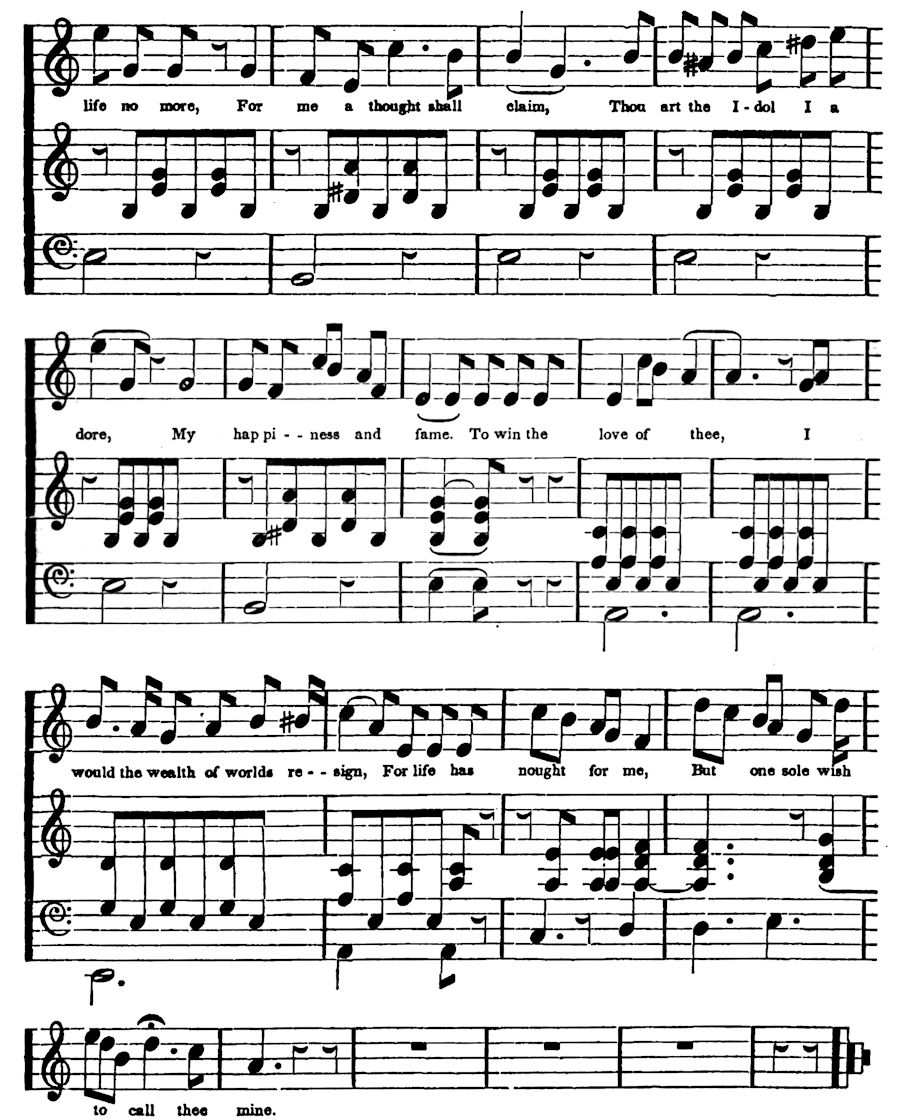
Heigh-ho! for a husband!—heigh-ho!
There’s danger in longer delay!—
Shall I never again have a beau?
Will nobody marry me, pray?
I begin to feel strange, I declare!
With beauty my prospects will fade!—
I’d give myself up to despair
If I thought I should die an old maid!
I once cut the beaux in a huff!—
I thought it a sin and a shame
That no one had spirit enough
To ask me to alter my name!
So I turned up my nose at the short,
And rolled up my eyes at the tall;
But then I just did it in sport,
And now I’ve no lover at all!
These men are the plague of my life!—
’Tis hard from so many to choose!—
Should one of them wish for a wife,
Could I have the heart to refuse?
I don’t know—for none have proposed!
Oh, dear me!—I’m frightened, I vow!
Good gracious!—whoever supposed
That I should be single till now?
———
BY PARK BENJAMIN.
———
Beautiful are the Birds of the Tropics. Bright,
clear, sparkling, brilliant is their plumage. It is
steeped in “all the hues that gild the rainbow.” I
seek in vain for epithets by which to convey a
thought of their surpassing beauty. Had I, dear
reader, the pencil of Audubon, I might show you
what they are in repose; but repose does not display
their loveliness in its perfection. They are
most charming to behold when in motion—when
their many vivid colors contrast with the deep green
of the forests, in which they live and hold their
jocund revels.
Not many years ago, I passed a winter—or, I
might better say, the first months of the year—in the
Northern part of South America, where these birds
abound. There, was I often delighted by these
“exquisite, gay creatures of the element.” They
seemed to me like so many winged jewels, as they
glanced about in the rays of a dazzling sun. But let
me not indulge too much in fanciful allusions, lest
I should reluctantly enter upon the real purpose I
have in view in preparing this article: which is to
offer some account of Tropical Birds, so that the
reader may be attracted to the study of their Natural
History. It appears to me that our American
periodicals have too much of the dulce and too little
of the utile. It is well, sometimes, to mingle the
useful with the agreeable even in works of taste: I
may fail in my attempt to do so in this place, but
I shall at least deserve the credit of having made the
attempt.
Doubtless many of my readers have in their possession
certain glass cases in which specimens of
birds with variegated plumage, having undergone
the art of the taxidermist, are arranged on artificial
trees or bushes as ornaments for the drawing room.
There are many persons in Guiana, who make it
their business to kill and prepare these birds, so that
they may adorn the halls of Natural History Societies
or private cabinets. Some birds, which fly about
the houses or plantations, are easily obtained; but
those, upon which most value is set, live in distant
wilds and woods, and are procured with great difficulty
and only by individuals long practised in the
art. Great caution must be observed in approaching,
and greater skill in shooting them; for they
must be slain so skilfully that their feathers shall not
be torn nor their color spoiled by an effusion of
blood from the wound. When one, who is unskilful,
tears or disfigures his birds, he makes up one specimen
out of two or more individuals of the same
species. Thus, upon a close examination, you may
often detect the wings of one bird joined to the body
of another, or, perhaps, an old head upon young
shoulders. But the worst piece of trickery, and one
which renders the specimen wholly valueless to an
ornithologist, is the altering of the natural color of
the bird by fire. I have seen many a brilliant specimen
exceedingly admired, which obtained a false
lustre in this manner.
There seems to be no limit to the wonderful varieties
of these birds. Every day brings to view some
new species, which outvies its compeers in the
grace of its form and the brilliancy of its plumage.
The adventurous bird-seeker will penetrate deeper
and deeper into the solitudes of those vast forests,
which, in primitive grandeur, lift up their leafy
columns and form umbrageous temples in the heart
of the Southern continent. Those lovely and still
unexplored domains are the probable haunts of thousands
and thousands of birds of dazzling beauty.
The clear beams of the sun, glinting through the
leaves of mighty trees, play among colors, as various
and as shifting as those of gems. No human
eye, save that of some Indian hunter who may
have lost his homeward way, has gazed upon these
strange, bright creatures; and the most fantastic
imagination may vainly endeavor to paint those tribes
of the air which have lived in their safe retreats, undisturbed
save by one another and the war of the
elements, since light first dawned upon creation.
Among the various little birds, black, yellow and
red, which may be observed in the midst of the
sugar canes and in the many trees of orange, mango
and lemon, there is a tribe, called Tyrants, which
is very extensive. Great numbers are constantly
seen. They are about the size of our robin. One
species is called “the butcher bird,” and most
appropriately, since it pounces upon and slaughters
its prey with tyrannical cruelty. It is said to be of
service to the planter in destroying grubs and insects,
upon which it seizes in the manner of a hawk. It
first strikes its prey with its bill (like a dun) and
then grasps it in its claws so instantaneously afterward,
that the most acute observation alone can
enable one to decide on the priority of the action.
Its bill is of moderate length (unlike a tailor’s) compressed
and sharp. Its head is black and all its body
is white, save the outer feathers of the wings and
tail, which are black. This family of “Tyrants,”
of which the butcher bird is an influential member,
has very extensive connections; but as they are distinguished
neither for beauty nor behavior (“handsome
is that handsome does”) and can be very easily
“got round,” no great consequence is attached to
their possession.
The next most numerous tribe is one whose
habits and characteristics are widely dissimilar—the
Parrots. These exhibit plumage of the most diversified
hues; but the predominating is bright green. This
is often set off and contrasted by black, lilac, pink,
orange, violet and blue. It is impossible to tell how
many species have been discovered; for our traveller
refers the specimen which he has obtained to some
former description, and then points out the differences.
“This,” says one, “is the blue parrot; our
specimens, however, are bright lilac, with red spots
on the back, between the wings”—a remark which,
were it made by a native of the Emerald Isle, would
be called a bull; but the fact, nevertheless, may be
as true as the somewhat notorious one that “black-berries
are red when they are green.”
The parrots are of all sizes from the macaw or
ava, down to the smallest paroket. The common
green parrot, which is known in the United States,
and taught to speak, is of the medium size. The best
and clearest whistle is uttered by the homely brown
parrot, which is brought from Africa. It is likewise
the most docile. These birds resemble humanity in
other respects besides the faculty of speech; some
are hopelessly stupid, while others take to learning
very kindly. Curious stories are told of their powers
of articulation. The smallest kind, which cannot
live in our climate, are sometimes very successfully
educated. The manager of a plantation, which I
visited, owned a little parrot, which used to reside
in a cage at the door of his house. As I rode up, I
was agreeably astonished by hearing the polite bird
very considerately sing out, “Boy, take the gentleman’s
horse—boy, why the deuse don’t you take the
horse!”
The largest kind is the macaw. It is a huge,
clumsy thing, with a head out of all proportion to its
body, (“great head, little wit;”) its plumage is for
the most part red, interspersed with green and blue.
The noise which it makes is most horribly discordant;
and its loudest yell is very like an Indian war-whoop,
(one of Mr. Cooper’s;) yet is this monster a great
favorite in the West Indies, and, as you pass the
residences of the inhabitants, you often see three or
four of these ugly wretches clambering awkwardly
up the piazzas, and uttering their hoarse, scolding
cries, ten times more grating to the ear than the objurgations
of a Xantippe, heard above the shrieks of
her castigated offspring. The hardihood of these
birds is surprising. There was one of them on board
of a small vessel, in which it was my ill fortune to
voyage from the mainland to the island of Barbadoes.
Mr. Macaw, like a militia major in red and blue
uniform, would strut about on the lower rigging, and,
as soon as he could get near enough to the ear of a
sailor, would utter one of his shrillest and most appalling
yells. Jack Tar, in his summary method of
dealing vengeance, would fetch him a blow with a
handspike, that would send him flapping to the
quarter-deck; perhaps, with an utter disregard of
decorum and discipline, into the very face and eyes
of the surly old captain, who, in his rage, would beat
him soundly; yet would the valiant and stalwart
feathered marine regard those lusty strokes no more
than would a pet goldfinch the taps of his lady’s fan.
Some species of parrots exist in almost every region;
the smallest and most beautiful, however, are
found only in tropical countries. They are seldom
seen near thickly populated places, but can be procured
with facility in the woods adjacent, where
they live in tolerable fellowship with their mischievous
neighbors, the monkeys.
Another numerous tribe of tropical birds is known
by the name of Chatterers. I do not know what
they are called by the ornithologists; but thus are
they designated by the inhabitants, from the peculiar
sounds which they utter, (being not unlike those of a
congress of spinsters, sitting in committee of the
whole on some grand question of scandal.) They
are distinguished by the epithets—red-breasted, purple-throated,
firebirds, pumpadore, red-headed, gold-headed,
white-throated, white-capped, purple-shouldered,
and Mahometan. The first five migrate; the
last five stay at home. Of the former, the firebird is
so named from the fact that, in stuffed specimens,
the color is sometimes changed by the application of
fire. Its natural hue is a dark crimson, but it is susceptible
of being changed, by the application of heat,
into a rich vermilion. Of the latter, the purple-shouldered
is the most rare and the most beautiful.
The upper parts of its wings or shoulders are the
deepest purple; the remainder of the wings is interspersed
with blue, and they end in black. Its back
is blue mingled with black; its breast is a delicate
blue, and the lower part of its neck is a dark crimson.
I describe the male bird only; for (unlike
bipeds without feathers) it monopolises the beauty of
the species. The female is very plain, though there
seems to be a certain winning modesty about her,
for all her homely looks. The sumptuously attired
male, (“Solomon, in all his glory, was not arrayed
like one of these,”) if his choice of a partner were
left to himself—which I doubt—must have been
guided by a taste as unsophisticated as that of the
praiseworthy Cock-Robin, when he courted Jenny
Wren, who
“Always wore her old brown gown,
And never dressed so fine!”
While on the subject of homeliness, I may as well
conclude it by alluding to a bird, which, on account
of its hideousness, the negroes call “Old Witch.”
What a very mortifying circumstance it must be to
be so ugly, when every body else is so bewitchingly
fair! Don’t you think so, Miss Smith? (I do not
mean the Miss Smith, who is reading this article,
but another.)
Before passing to an account of the third and last
family, which I shall try to describe—being by far
the most numerous, the strangest, and the most
charming of all the tropical birds—I will detain the
reader for a moment with an account of two rare
species of water birds. They are in general so
classed, because, like rails, they frequent reedy
ponds and marshes and the borders of streams. I
select these two species, because the one is very
curious and the other is of a kind with which classical
associations are connected, and because they
admirably serve to show how wide and fertile a field
of interesting investigation lies before the student in
this particular realm of Natural History.
The curious species is the Jacana. It is doubtful
whether it should be classed with land or water
birds; it resembles the latter in its nature, its habits,
the form of its body, the shape of its bill, and the
diminutiveness of its head; it differs essentially, however,
from all others of the class, in the curious spurs
which protrude from its wings; its claws are very
long and slender, and its nails very pointed and
sharp—hence has been derived its name, “The Surgeon.”
It is exceedingly wild and can be caught
only by stratagem. These birds are of various colors:
some dark, tinged with violet; some green;
some black; some dusky red. Their flight is very
rapid, and their cry sharp and shrill. They travel
in pairs, frequenting the borders of rivers and
deep marshes. That which is particularly singular
about the Jacana is the manner in which it is armed;
when it strikes with its wings, it must do considerable
execution; it does not seem to be happily called
the Surgeon, for its instruments are rather intended
to kill than cure.
The classical species is called by moderns, “the
Sultana Hen.” It is the smallest of that genus, which
was named by the ancients Porphyry—in Greek,
Πορφυριωι—in Latin, Porphyrio. Aristotle describes
it as a fissiped bird, with long feet, a blue plumage,
with a very strongly set, purple-colored bill, and of
about the size of a domestic cock. Some old writers,
in describing this bird, have said that one of its feet
was furnished with membranes, and made to swim
like a water-bird’s, and that the other was fissiped,
so that it might run like a land-bird. This is not
only untrue, but contrary to nature, and signifies no
more than that the porphyry or pelican is a bird of
the shore, living on the confines of land and water.
It was easily tamed, and was very pleasing on account
of its noble carriage, its fine form, its plumage
brilliant and rich in colors of mingled blue and purple
and aquamarine, its docile nature, and its happy facility
of agreeing with any companions among whom
its lot might be cast. It was held in the highest
esteem by both Greeks and Romans; they never
suffered it to be eaten; they sent to Lybia for it;
always treated it with kindness, and placed it in their
palaces and temples, as worthy to dwell there on
account of the nobleness of its port, the sweetness
of its temper, and the beauty of its plumage. The
largest of the species, now known as “the sultana
hen,” is precisely the same as the ancient porphyrio.
The smallest is called “the little sultana hen.” Her
petite majesty is very queenly, but is, no doubt, as
well satisfied with the modern name by which she is
dignified, as she would be with that which the Greeks
gave to the tall highnesses of her very old and royal
family. Her robe of state is a brilliant changeable
blue and green; and it has never gone out of fashion.
Having thus given an unsystemized and rather imperfect
account of a few species of tropical birds, I
pass on to treat of the most marvellous and most
beautiful tribe of plumed creatures that float in the
invisible atmosphere. There have been more than
a hundred species already discovered, and every naturalist,
who visits the equatorial regions of this
Western World, adds a new name to the splendid
schedule of HUMMING-BIRDS.[2] From their delicate
structure, these tiny birds cannot endure the rigors
of our climate, where there are very few of those
gorgeous plants, upon which they banquet in tropical
latitudes. There, when the warm sun calls into life
myriads of flowers, vast numbers of humming-birds
visit the fields and gardens every morning, and mingle
their golden-green tints in gleaming contrast with
the white and rose-colored blossoms, that cluster on
the vines above the traveller’s head, or spring luxuriantly
at his feet. They seem, as they dart rapidly
around, humming their faintly heard tunes, to be the
very Pucks and Ariels of the light, and each night
take up the burden of the fairy song, sung at the
feast of Titania,
Over hill, over dale,
Through bush, through brier,
Over park, over pale,
Through flood, through fire,
I do wander every where,
Swifter than the moon’s sphere.
For, at one moment, you behold “the fine apparition”
before the cup of a flower, and at the next he is gone
“To drink the air before him and return
Or ere your pulse twice beat.”
The bright little beings must own the very best
secret of the fairies; for none, so well as they,
“Know a bank whereon the wild thyme blows,
Where oxslips and the nodding violet grows,
Quite over canopied with luscious woodbine,
With sweet musk-roses and with eglantine.”
But alas! however elfin-like and ethereal their forms
appear, they share the fate of mortals. They are
easily caught by nets thrown over them, or killed by
very fine shot or sand. I have seen some very
splendid collections. I remember one, comprising
seventy-two species—from the king of the humming-birds,
as he is called, with his topaz and emerald
crown, to one so small that, when on the wing, it
could scarcely be visible. When the glass case, in
which they were arranged in too studied an order,
was held in the sunshine, their myriad colors would
gleam and flash with a brilliancy as perfect as that of
the many gems, after which they are prettily named.
An enumeration of some of their names will convey
an idea of their appearance—sapphire-throated,
ruby-throated, sapphire and emerald, amethystine,
topaz-throated; then there are the purple, tri-colored,
violet-tufted, violet-crowned, blue-fronted, the superb,
the magnificent, the sabre-winged. And there
is one which must have been bestowed by some
ornithological phrenologist, who had great skill in
interpreting “the natural language” of birds—the
supercilious humming-bird. The largest species yet
discovered is that which is called the gigantic, and
the smallest, as I believe, is one that Sir William
Jardine describes as Gould’s humming-bird.
The gigantic is in remarkable contrast to the rest
of his tribe, both in size and in the color of his plumage.
He is not only the largest but the homeliest,
while the smallest is the most beautiful. The gigantic
(the monster!) is nearly eight inches in length;
the crown, the back, the under and lesser wing-coverts,
brownish green, with reflections of green
tint; the under parts, light reddish mingled with a
deeper tint and shaded off with green; the feathers
are generally darker at the base, and the paler tips
give a slightly waved appearance to the breast. On
the throat, the feathers, though without lustre, retain
the scaly form and texture of the more brilliant species.
The wings slightly exceed the tail in length,
bend up at the tips, and exhibit the form of the most
correctly framed organ of flight; they are of a uniform
brownish violet. The tail is composed of ten
feathers, of a brownish color, and with golden-green
reflections; they gradually decrease in length. This
is a very rare species.
Gould’s is the smallest species and of the most
dazzling beauty. It is scarcely over two inches in
length; its forehead, throat and upper part of its
breast are of a most brilliant green—the feathers of a
scaly form. From the crown springs a crest of bright,
chestnut feathers, of a lengthened form and capable
of being raised at pleasure. The back is a golden-green,
crossed with a whitish band; the wings and
tail are brownish purple, the latter having the centre
feathers tinged with green; the lower parts are dark
brownish green. The neck tufts are of the most
splendid kind, and have a chaste but brilliant effect;
they are composed of narrow feathers of a snowy
whiteness—the tips of each having a round, serrated
spot of bright emerald green, surrounded with a dark
border; the largest are at the upper part of the tuft,
and they decrease in length, assuming the shape of a
butterfly’s wing; shorter feathers again spring from
the base, and their green tips are relieved on the
white of the longer ones behind them.
The most common species, and that which abounds
in all parts of the West Indies, is the ruby-crested.
Though seen every day about the gardens, near the
honeysuckle and other flowering vines, it presents
some of the most splendid coloring of the family.
(Those which I have mentioned are of that sub-genus,
which Linnæus calls trochilus.) The upper
parts of the head and throat are clothed entirely with
those scaly formed feathers, which always produce
the parts producing the changeable hues. On the
hind head, the feathers are elongated and form a
short, rounded crest. In one position this part appears
of a deep, sombre, reddish brown; when
viewed transversely it assumes a bright, coppery
lustre, and when looked upon directly with a side
stream of light, it becomes of the richest and most
brilliant ruby. The scaly part of the throat and
breast again, when wanting the lustre, is of an
equally sombre, greenish brown; and, when turned
to diverse lights, changes from a clear golden-green
to the most brilliant topaz. It is impossible to convey
by words—especially as it is necessary to repeat
the same again and again—an idea of these tints.
The most that can be done is to name those substances,
which they most nearly resemble, then
rely upon the imagination of the reader.
The birds, thus attempted to be described, are a
few of that multitudinous tribe which excites the
liveliest wonder, and fills the mind with admiration
of that creative power, which clothes the eagle with
strength to resist the fury of the mountain storm, and
so fashions the delicate plumage of the humming-bird
that the softest air from heaven seems to visit it
too roughly. The vine-clad forests and rose-covered
gardens of Guiana literally swarm with these fairy-birds.
The Indian word, by which they are distinguished,
signifies beams or locks of the sun; that
such a designation is not less appropriate than poetical,
may be concluded by all who have seen them
darting with the rapidity as well as the splendor of
light from flower to flower. Compared to the humming-bird,
the bee is a mere loiterer. He poises
himself on wing, while he thrusts his long, slender
tube into the flower-cups in search of food. But he
subsists not simply on honey-dew and the nectar that
dwells in the lips of roses. He may often be observed
darting at the minute insects that float in
the air.
Mr. Audubon thus beautifully describes the humming-bird
in quest of food: “carefully visiting every
opening flower-cup, and, like a curious florist, removing
from each those injurious insects, that otherwise
would ere long cause their beauteous petals to
droop and decay. Poised in the air, it is observed
peeping cautiously and with sparkling eye into their
innermost recesses, whilst the ethereal motions of its
pinions, so rapid and so light, appear to fan and cool
the flower, without injuring its fragile texture, and
produce a delightful, murmuring sound, well adapted
for lulling the insects to repose. Then is the moment
for the humming-bird to secure them. Its long delicate
bill enters the cup of a flower, and the protruded,
double-tubed tongue, delicately sensible, and
imbued with a glutinous saliva, touches each insect
in succession, and draws it from its lurking place to
be instantly swallowed. All this is done in a moment,
and the bird, as it leaves the flower, sips so
small a portion of its liquid honey, that the theft, we
may suppose, is looked upon with a grateful feeling
by the flower which is thus kindly relieved from the
attacks of her destroyers.”
Their favorite places of resort were those woods,
in which the superb bignonia abounds, and when the
huge trees are garlanded with parasites; but since
the cultivation of the country they frequent gardens
and seem to delight in society, becoming familiar
and destitute of fear, hovering over one side of a
shrub while the fruit or flower is plucked from that
opposite. They do not alight on the ground, but
easily settle on twigs and branches, when they move
sidewise in prettily measured steps, frequently opening
and closing their wings, shaking and arranging
the whole of their apparel with neatness and activity.
They are particularly fond of spreading one wing
at a time, and passing each of their quill-feathers
through their bills in its whole length, when, if the
sun is shining, the wing thus plumed is very transparent
and light. The humming noise proceeds
entirely from the surprising velocity with which
they perform that motion by which they will keep
their bodies in the air, apparently motionless, for
hours together. When flying to any long distance,
the manner of their flight is very different from that
shown in speeding among flowers, for they sweep
gracefully through the air in long undulations, raise
themselves for some distance and then fall in a curve.
Strange as it may seem, one of the chief characteristics
of this tiny creature, is its bravery. It
will unhesitatingly attack the mocking-bird, or the
king-bird, or any other by whom it imagines its territories
invaded; it directs its sharp, needle-like bill,
immediately at the eyes of its enemy, and when so
employed this must be a truly formidable weapon.
These birds are also extremely pugnacious among
themselves—two males seldom meeting, without a
battle. The combatants ascend in the air, chirping,
darting and circling round each other till the eye is
no longer able to follow them. They are particularly
susceptible of jealousy, and, under the influence
of this failing, they run tilts at each other till the less
doughty champion falls exhausted to the ground.
The nests of these little creatures are very curious;
they are built with great delicacy, but at the same time
with much compactness and warmth. Wilson says
that the nest of the ruby-throated humming-bird is generally
fixed on the upper side of a horizontal branch,
not among the twigs. It is sometimes, however,
attached to an old moss-grown trunk, and sometimes
fastened on a strong stalk or weed in the garden. It
seldom builds more than ten feet from the ground.
The nest is about an inch in diameter and as much in
depth. The outward coat is formed of small pieces
of a species of bluish-gray lichen, that vegetates on
old trees and fences, thickly glued with the saliva of
the bird, giving firmness and consistency to the whole
as well as keeping out moisture. Within this are
thick, matted layers of the fine wings of certain flying
seeds, closely laid together; and, lastly, the downy
substance from the great mullein, and from the stalks
of the common fern, lines the whole. The base of
the nest is continued round the stem of the branch to
which it closely adheres, and, when viewed from
below, appears a mere mossy knot or accidental protuberance.
The nest of one species in Guiana is
principally composed of a spongy cellular substance,
apparently similar to that of a fungus, of which some
kinds of wasps build large habitations, suspended
from the branches of trees, and an account is given
of a nest of another species composed entirely of the
down of some thistle; the seed is attached and is
placed outwards, giving a jagged and prickly appearance
to the outside. Latham describes the nest
of the black humming-bird as made of cotton, entwined
around the thorns and twigs of the citron-tree,
and of so firm a texture as not to be easily
broken by winds. The nest of the topaz-crested
is about seven eighths of an inch in diameter, also
made of cotton, stuck over with lichens on the outside
and firmly fixed in the hanging cleft of some
strong creeper by threads of a cottony substance,
and very slender roots or tendrils, the whole lower
part as if cemented by a thin coat of glue. It is
probable that the greater number build their nests
nearly in the same manner. Descriptions, however,
are given of those built in different forms—one is
suspended with the entrance downwards; another is
of a lengthened form, composed of dry grass and
slender roots and moss, and is not made so compactly.
A person, who saw a bird building her nest,
describes her manner of construction as very ingenious.
“Bringing a pile of small grass, she commenced
upon a little twig about a quarter of an inch
in diameter, immediately below a large leaf, which
entirely covered and concealed the nest from above,
the height from the ground being about three feet.
After the nest had received two or three of these
grasses, she set herself in the centre, and putting her
long slender beak over the outer edge, seemed to use
it and her throat much in the same way as a mason
does his trowel, for the purpose of smoothing, rubbing
it to and fro and sweeping quite around. Each
visit to the nest seemed to occupy only a couple of
seconds, and her absence from it not more than as
many minutes.”
The extraordinary beauty of these strange beings
has induced many attempts to tame and keep them
in cages, but they have not been successful. When
placed in cages and fed daintily on honey and water,
and supplied every morning with fresh cups of flowers,
they have been known to live for a long time in
their native country, and in warm weather; but no
artificial warmth has as yet kept them alive for
many weeks, when transported to a less genial
climate. It is conjectured, however, that with very
great care and a strict regard to diet, as the doctors
say, they will, by and by, be kept alive and happy
in our conservatories. There was once a nest of
them successfully carried to England from Jamaica.
It was presented to a lady, from whose lips the little
loves would deign to accept honey. One died, probably
from excess of happiness; but the other, being
more hardy, survived for two months. Could a lady
succeed in so taming one of these winged jewels so
perfectly that it would accompany her to a ball,
curiously perched upon her bouquet, or hovering
around the flowers which composed it, at her gentle
bidding, so original an ornament would doubtless be
more highly prized than
“Whole necklaces and stomachers of gems.”
The ancient Mexicans are said to have woven their
plumage into gorgeous robes.
If the extraordinary beauty of these birds, their
mode of existence, their nature, then habits, excite
our admiration, how must we also wonder at their
structure!—the perfect adaptation of their forms to
that life which it is theirs to enjoy, and to the variations
of that glowing climate where they abound.
“On presenting a humming-bird to a common observer,”
says an eminent naturalist, “the first exclamation
generally is, ‘what a beautiful little creature!’—the
second, ‘but what large wings he has!’
Such, indeed, is the case, and, in most instances, the
size of the wings and strength of the quills are entirely
out of proportion to our ideas of symmetry in
a creature clothed with feathers; but, upon comparing
them with its necessities and the other parts
of its frame, their utility and design become obvious.”
The principal reason for their possessing organs of
such power is, doubtless, to enable them to pass in
safety through the migrations and the long flights
which are necessary for their preservation, and,
during which, they have to withstand passing gales
and showers. The delicious climes which they inhabit
are at seasons subject to tremendous rains,
which drench and almost inundate their abodes, or
to hurricanes that, in a few minutes, leave but a
wreck of all that was before so splendid and luxuriant.
By means of these organs, before the dangerous
season comes, which the unerring instinct of
nature warns them to avoid, they fly to districts of
country where the reparation of some previous
wreck is proceeding with all the rapidity of tropical
vegetation.
I cannot more pleasingly conclude these notices of
the most wonderful tribe of birds, than by quoting
the melodious verses of a poet, who is a native of
that glowing clime which they so exquisitely adorn.
“Still sparkles here the glory of the West,
Shows his crowned head and bares his jewell’d breast,
In whose bright plumes the richest colors live,
whose dazzling lines no mimic art can give.
The purple amethyst, the emerald’s green
Contrasted, mingle with the ruby’s sheen,
While over all a tissue is put on,
Of golden gauze by fairy fingers spun.
Small as a beetle, as an eagle brave,
In purest ether he delights to lave;
The sweetest flowers alone descends to woo,
Rifles their sweets and lives on honey-dew,
So light his kisses not a leaf is stirred
By the bold, happy, amorous humming-bird.
No disarray, no petal rudely moved,
Betrays the flower the callibree has loved.”[3]
I have thus given partial descriptions of four of
the principal tribes of Tropical Birds. I hope the
reader has not been so wearied that he will not
kindly suffer me to draw this article to a close by a
brief notice of those two birds most remarkable for
their peculiar notes. The one pours forth a stream
of rich melody, which surpasses the far-famed song
of the nightingale, and is, likewise, celebrated for
its peculiar power of imitating the tones of almost
every fellow-songster. The other utters only one
sound, but so strange and solemn as to inspire the
mind of the hearer with a religious awe. The natural
music of the one is as gay, cheerful and enlivening
as that of the other is mournful and soul-subduing.
The first to which I allude is the Matthews of the
woods, THE MOCKING-BIRD. This species abound in
all parts of the Western Indies; they are found in
great numbers near the sea-shore. From the trees
which grow on the beaches float their rich songs,
more melodious than strains of flute, or bugle, or
any “cunningly devised instrument;” and, in mellowness,
in modulation and gradation, in extent of
compass and rapidity and brilliancy of execution,
outrivalling the most magnificent bravuras of a Sontag
or a Malibran. When confined in cages and
brought to our cold climate, for the amusement of
man, the bird loses, in the loneliness of its captivity,
half the richness of its voice. Though it delights to
mimic other plumed minstrels, this astonishing faculty
is feeble, in its most miraculous exhibition, when
compared with its own delicious song; but he who
would listen to it in its perfection, must go to those
regions where the great magnolia shoots up its majestic
trunk, covered with evergreen leaves, and decorated
with a thousand flowers, where the forests
and fields are buried in blossoms of every hue, and
where the golden orange decorates the gardens and
the groves.
The bird whose note is so melancholy is called by
the Indians campanero; by the Spaniards arapongo
or guirapongo, and by the English the bell-bird. It is
extremely rare. I was so fortunate as to see a single
specimen. It is of about the size of a Barbary dove,
but more gracefully shaped, with a larger head. It
is of a snowy whiteness. From the forehead there
rises a spiral tube of about a bodkin’s length. This
tube, it is said, is raised and depressed at pleasure;
it is black, dotted with white feathers, and, as it is
hollow, and communicates with the palate, it is
probably elevated when filled with air, and becomes
pendulous when empty. That strange sound, for
which it is remarkable, is probably produced by the
raising and depressing of this tube. It resembles
the tolling of a bell, and is very loud and distinct.
It is heard morning and evening in the woods, and
one might fancy its toll to proceed from some hidden
convent, calling to matins and vespers.
The bell-bird is seldom found in forests inhabited
by other birds; it selects lonely and desolate haunts.
A recent traveller, in describing his journey through
a South American forest, writes—“Nothing can be
more still and solitary than everything around; the
silence is appalling and the desolation is awful;
neither are disturbed by the sight or voice of living
thing, save one—which only adds to the impression.
It is like the clinking of metals, as if two lumps of
brass were struck together; and it sometimes resembles
the distant and solemn tolling of a church-bell,
struck at long intervals. This extraordinary sound
proceeds from a bird called arapongo or guirapongo.
It is about the size of a small pigeon, white, with a
circle of red round the eyes. It sits on the tops of
the highest trees, and in the deepest forests, and,
though constantly heard in the most desert places, is
very rarely seen. It is impossible to conceive any
thing of a more solitary character than the profound
silence of the woods, broken only by the metallic
and almost preternatural sounds of this invisible bird,
coming from the air, and seeming to follow you
wherever you go. I have watched with greet perseverance,
when the sound seemed quite close to me,
and never but once caught a glance of the cause. It
passed suddenly over the top of a very high tree, like a
large flake of snow, and immediately disappeared.”
———
BY PERCIE H. SELTON.
———
The lower counties of New Jersey are proverbially
barren, being covered with immense forests of
pine, interspersed with cedar swamps. During the
dry summer months these latter become parched to
an extent that is incredible, and the accidental contagion
of a fire-brand often wraps immense tracts of
country in flames. The rapidity with which the
conflagration, when once kindled, spreads through
these swamps can scarcely be credited except by
those who know how thoroughly the moss and twigs
are dried up by the heat of an August sun. Indeed
scarcely a spot can be pointed out in West Jersey,
which has not, at one time or another, been ravaged
by conflagration. It was but a few years since that
an immense tract of these pine barrens was on fire,
and the citizens of Philadelphia can recollect the
lurid appearance of the sky at night, seen at the distance
of thirty or even forty miles from the scene of
the conflagration. The legendary history of these
wild counties is full of daring deeds and hair-breadth
escapes which have been witnessed during such
times of peril. One of these traditionary stories it is
our purpose to relate. The period of our tale dates
far back into the early history of the sister state,
when the country was even more thinly settled than
at present.
. . . . . . . . . . . . . . . . . . . . . . .
It was a sunny morning in midsummer, when a
gay party was assembled at the door of a neat house
in one of the lower counties of New Jersey. Foremost
in the group stood a tall manly youth, whose
frank countenance at once attracted the eye. By his
side was a bright young creature, apparently about
eighteen years of age, whose golden tresses were a
fit type of the sunny beauty of her countenance. But
now her soft blue eyes were dim with tears, and
she leaned on the shoulder of her mother, who was
apparently equally affected. The dress of the daughter,
and her attitude of leave-taking, told that she was a
bride, going forth from the home of her childhood,
to enter on a new and untried sphere of life. The
other members of the group were composed of her
father, her brothers and sisters, and the bridemen
and bridemaids.
“God bless you, my daughter, and have you in his
holy keeping,” said the father as he gave her his last
embrace, “and now farewell!”
The last kiss was given, the last parting word was
said, the last long look had been taken, and now the
bridal party was being whirled through the forest
on one of the sweetest mornings of the sweet month
of July.
It was indeed a lovely day. Their way lay through
an old road which was so rarely travelled that it
had became overgrown with grass, among which the
thick dew-drops, glittering in the morning sun, were
scattered like jewels on a monarch’s mantle. The
birds sang merrily in the trees, or skipped gaily from
branch to branch, while the gentle sighing of the
wind, and the occasional murmur of a brook crossing
the road, added to the exhilirating influences of
the hour. The travellers were all young and happy,
and so they gradually forgot the sadness of the parting
hour, and ere they had traversed many miles the
green arcades of that lovely old forest were ringing
with merry laughter. Suddenly, however, the bride
paused in her innocent mirth, and while a shade of
paleness overspread her cheek, called the attention
of her husband to a dark black cloud, far off on the
horizon, and yet gloomier and denser than the darkest
thunder cloud.
“The forest is on fire!” was his instant ejaculation,
“think you not so, Charnley?” and he turned
to his groomsman.
“Yes! but the wind is not towards us, and the fire
must be miles from our course. There is no need
for alarm, Ellen,” said he, turning to the bride, his
sister.
“But our road lies altogether through the forest,”
she timidly rejoined, “and you know there isn’t a
house or cleared space for miles.”
“Yes! but my dear sis, so long as the fire keeps
its distance, it matters not whether our road is
through the forest or the fields. We will drive on
briskly and before noon you will laugh at your fears.
Your parting from home has weakened your nerves.”
No more was said, and for some time the carriage
proceeded in silence. Meantime the conflagration
was evidently spreading with great rapidity. The
dark, dense clouds of smoke, which had at first been
seen hanging only in one spot, had now extended in
a line along the horizon, gradually edging around so
as to head off the travellers. But this was done so imperceptibly
that, for a long time, the travellers were not
aware of it, and they had journeyed at least half
an hour before they saw their danger. At length the
bride spoke again.
“Surely, dear Edward,” she said, addressing her
husband, “the fire is sweeping around ahead of us:
I have been watching it by yonder blasted pine, and
can see it slowly creeping across the trunk.”
Every eye was instantly turned in the direction in
which she pointed, and her brother, who was driving,
involuntarily checked the horses. A look of dismay
was on each countenance as they saw the words of
the bride verified. There could be no doubt that the
fire had materially changed its bearing since they
last spoke, and now threatened to cut off their escape
altogether.
“I wish, Ellen, we had listened to your fears and
turned back half an hour ago:” said the brother,
“we had better do it at once.”
“God help us—that is impossible,” said the husband,
looking backwards, “the fire has cut off our
retreat.”
It was as he said. The flames, which at first had
started at a point several miles distant and at right
angles to the road the party was travelling, had
spread out in every direction, and finding the swamp
in the rear of the travellers parched almost to tinder
by the draught, had extended with inconceivable
velocity in that quarter, so that a dense cloud of
smoke, beneath which a dark lurid veil of fire
surged and rolled, completely cut off any retrograde
movement on the part of the travellers. This volume
of flame, moreover, was evidently moving
rapidly in pursuit. The cheeks, even of the male
members of the bridal party, turned ashy pale at the
sight.
“There is nothing to do but to push on,” said the
brother, “we will yet clear the road before the fire
reaches it.”
“And if I remember,” said the husband, “there is
a road branching off to the right, scarce half a mile
ahead: we can gain that easily, when we shall be
safe. Cheer up, Ellen, there is no danger. This is
our wedding morn, let me not see you sad.”
The horses were now urged forward at a brisk
pace, and in a few minutes the bridal party reached
the cross road. Their progress was now directly from
the fire; all peril seemed at an end; and the spirits
of the group rose in proportion to their late depression.
Once more the merry laugh was heard, and
the song rose up gaily on the morning air. The conflagration
still raged behind, but at a distance that
placed all fear at defiance, while in front the fire,
although edging down towards them, approached at
a pace so slow that they knew it would not reach the
road until perhaps hours after they had attained their
journey’s end. At length the party subsided again
into silence, occupying themselves in gazing on the
magnificent spectacle presented by the lurid flames,
as, rolling their huge volumes of smoke above them,
they roared down towards the travellers.
“The forest is as dry as powder,” said the husband,
“I never saw a conflagration travel so rapidly.
The fire cannot have been kindled many hours, and
it has already spread for miles. Little did you think,
Ellen,” he said, turning fondly to his bride, “when
we started this morning, that you should so narrowly
escape such a peril.”
“And, as I live, the peril is not yet over,” suddenly
exclaimed the brother, “see—see—a fire has
broke out on our right, and is coming down on to us
like a whirlwind. God have mercy on us!”
He spoke with an energy that would have startled
his hearers without the fearful words he uttered.
But when they followed the direction of his quivering
finger, a shriek burst from the two females,
while the usually collected husband turned ashy
pale, not for himself, but for her who was dearer to
him than his own life. A fire, during the last few
minutes, had started to life in the forest to their right,
and, as the wind was from that quarter, the flames
were seen ahead shooting down towards the road
which the bridal party was traversing, roaring, hissing,
and thundering as they drew near.
“Drive faster—for heaven’s sake—on the gallop!”
exclaimed the husband, as he comprehended the
imminency of their danger.
The brother made no answer, for he well knew
their fearful situation, but whipped the horses into
a run. The chaise flew along the narrow forest
road with a rapidity that neither of the party had
ever before witnessed; for even the animals themselves
seemed aware of their peril, and strained
every sinew to escape from the fiery death which
threatened them.
Their situation was indeed terrible, and momentarily
becoming more precarious. The fire, when
first seen, was, at least, a mile off, but nearly equidistant
from a point in the road the bridal party was
traversing; and, as the conflagration swept down
towards the road with a velocity equal to that of the
travellers, it soon became evident that they would
have barely time to pass the fire ere it swept across
the road, thus cutting off all escape. Each saw
this; but the females were now paralized with fear.
Only the husband spoke.
“Faster, for God’s sake, faster,” he hoarsely cried,
“see you not that the fire is making for yonder tall
pine—we shall not be able to reach the tree first
unless we go faster.”
“I will do my best,” said the brother, lashing still
more furiously the foaming horses. “Oh! God, that I
had turned back when Ellen wished me.”
On came the roaring fire—on in one mass of flame—on
with a velocity that seemed only equalled by
that of the flying hurricane. Now the flames caught
the lower limbs of a tall tree and in an instant had
hissed to its top—now they shot out their forky
tongues from one huge pine to another far across
the intermediate space—and now the whirling fire,
whistled along the dry grass and moss of the swamp
with a rapidity which the eye could scarcely follow.
Already the fierce heat of the conflagration began to
be felt by the travellers, while the horses, feeling the
increase of warmth, grew restive and terrified.
The peril momentarily increased. Hope grew fainter.
Behind and on either side the conflagration roared in
pursuit, while the advancing flame in front was cutting
off their only avenue of escape. They were
girdled by fire. Faster and quicker roared the
flames towards the devoted party, until at length
despair seized on the hearts of the travellers. Pale,
paralized, silent, inanimate as statues, sat the females;
while the husband and brother, leaning
forward in the carriage and urging the horses to
their utmost speed, gazed speechlessly on the approaching
flames. Already the fire was within a
hundred yards of the road ahead, and it seemed
beyond human probability that the travellers could
pass it in time. The husband gave one last agonizing
glance at his inanimate wife. When again he
looked at the approaching flames, he saw that during
that momentary glimpse they had lessened their
distance one half. He could already feel the hot
breath of the fire on his cheek. The wind, too, suddenly
whirled down with fiercer fury, and in an
instant the forky tongues of the advancing conflagration
had shot across the road, and entwined themselves
around the tall pine which had been the goal
of the travellers’ hopes. He sank back with a groan.
But the brother’s eye gleamed wildly at the sight,
and gathering the reins tighter around his hand, he
made one last desperate effort to force the horses
onward; and with one mad leap, they lifted the carriage
from the ground as if it had been a plaything,
plunged into the fiery furnace, and the next instant
had shot through the pass.
Charnley gave one look backwards, as if to assure
himself that they had indeed escaped—he saw the
lurid mass of fire roaring and whirling across the
spot through which they had darted but a moment
before; and overcome with mingled gratitude and
awe, he lowered his head on his breast and poured
out an overflowing soul in thanksgivings to the Power
which had saved them from the most dreadful of
deaths. And long afterwards, men, who travelled
through that charred and blackened forest, pointed to
the memorable scene where these events occurred,
and rehearsed the thrilling feelings of those who had
been encompassed by the Girdle of Fire.
———
BY GEORGE LUNT.
———
I call upon the waves and they reply,
But not the voice I fain would hear replied,
Vainly I seek it in the wind’s deep sigh,
Earth, air, the sky’s blue depths and ocean’s tide.
These have their various voices, soft or stern,
Moulding our feelings to the varied hour,
And the wrung heart will hear them and return
To claim on Nature’s breast a mother’s power.
The dewy freshness of earth’s vernal prime,
Her budding promise lapp’d in fragrant showers,
The sacred sweetness of her summer time,
And her bright bosom cover’d o’er with flowers;
The viewless music of the breathing air,
The rushing wind that sweeps across the plain,
The breeze that dallies with the brow of care
And stirs the languid pulse to life again;
Heaven’s glorious arch, when morning through the skies
Skirts all its blue with gold, or sweeter far
At the dim twilight, or when softly rise
The new-born moon and glittering star on star;
And the dark-rolling voiceful sea, whose moan,
On the wide waste or by the storm-beat shore,
Asks the soul’s answer like a spirit tone,
And the deep soul speaks inly to its roar;
These have their language, mirthful, sad, or wild,
Like changing passion in the human breast;
We call them to us, as a wilder’d child
His home’s companions, and they give us rest;
Yet though they speak, I cannot hear—no more
Comes the sweet music of the one loved tone,
And standing lonely by the lone sea-shore
Sad as my heart falls its perpetual moan.
———
BY WILLIAM WALLACE.
———
Oh! I could weep when I perceive the cloud
Of dark impurities around our Stage,
Where those creations, gay, or sad, or proud—
Hamlet’s strange wo, or wronged Othello’s rage
Hallowed fair Albion’s selectest age:
Yet would I not, like certain ones, behold
Theatric pomp proscribed in liberal land,
While pale Contempt (as once in ages old)
Kills with a single look the buskin band.
A beauty sparkles yet around the Place—
A mystic charm—a fairy-beaming grace—
Appealing loudly to the coldest heart:
These boards once held the glory of our race,
And still they reverence a Shakspeare’s Art.
BALLAD.
DEDICATED TO MISS LEO M. CASSIN, OF GEORGETOWN, D. C.
BY J. G. E.
———
John F. Nunns, 184 Chesnut Street: Philadelphia.
———
To win the love of thee,
I would the wealth of worlds resign,
For life has nought for me,
But one sole wish to call thee mine.
All other joys of life no more,
For me a thought shall claim,
Thou art the Idol I adore,
My happiness and fame.
To win the love of thee,
I would the wealth of worlds resign,
For life has nought for me,
But one sole wish to call thee mine.
Strive not with ornament to hide
Thy beauty’s op’ning flower;
Simplicity should be thy bride.
For therein lies thy power.
Of Constancy the model I
To wand’ring eyes should prove,
For I should only wish to die
If e’er I lose thy love.
To win the love of thee, &c.
Notes of a Tour through Turkey, Greece, Egypt, Arabia
Petræa, to the Holy Land; including a Visit to Athens,
Sparta, Delhi, Cairo, Thebes, Mount Sinai, Petræa, &c.
By E. Joy Morris. Two vols. 12 mo. pp. 550. Philadelphia,
Carey & Hart: 1842.
Were we disposed to be hypercritical, we should begin
by finding some fault with the title of these volumes. It is
quite too long, besides being tautological. Why speak of
a tour through Egypt, and a visit to Thebes! Or of a tour
through Greece and a visit to Athens? It would be as
proper to announce a journey through England, including
a visit to London. He who travels over a country of
course visits its capital. If he supposes the readers of his
journal do not know what city enjoys that distinction, it is
even then better to let them acquire this geographical information
by degrees. Too great and sudden developments
may defeat his object; a man’s vision is sometimes obscured
by excess of light.
Of the improbabilities which are scattered throughout the
work we have space only to notice one or two. Mr. Morris
informs us that the harem of the Governor of Smyrna,
which he encountered on board a steamer, “consisted of
some half-dozen ladies, (wives,) and, with attendants,
amounted to near thirty persons.” Rather too many wives
for the simple Aga of Smyrna, and more than the Koran
allows. The holy book of the Mahommedan permits no
one, save the Grand Sultan—the representative of the prophet—to
have more than two; and that highest of dignitaries,
and hereditary favorite of the immortals, has but four.
The Governor of Smyrna, we are assured by a competent
authority, has but one wife, and she is of Turkish descent,
and not, as our author avers, a Circassian. Had she been
of Circassia she would have been a concubine, not a wife,
or, as the author blunderingly calls her, a Sultana. That
title belongs only to the favorite wife of the Sultan. Our
traveller tells us that he offered to this lady some sweet-meats,
although her husband and the keeper of his harem
were both present! An averment which we would be as
chary of believing as if it were that the “light” of the
Grand Seigneur’s palace had accepted an invitation to
swim with him in the Bosphorus!
Mr. Morris tells us that he found in the slave market of
Constantinople two beautiful Georgian girls, “destined for
the harems of the rich,” in cages, but that he was “only
indulged with a glance at them through the bars!” Now
a cage, or such a place as he intended to describe by that
word, even for the ugliest Numidian, would not be tolerated
in Constantinople for an hour; nor has there been
for many years a Georgian girl publicly exhibited in the
markets of that city. When a writer, sensible of the dulness
of his performance, seeks to impart to it some interest
by weaving into its chapters romantic fictions, he should
be careful to give them an air of probability. We have
not time nor inclination to point out other “attractions” in
these volumes of a similar description.
While writing of Athens and Constantinople, Mr. Morris
doubtless had by his side Mr. Colton’s “Visit” to those
places; and in his notices of Arabia Petræa and Egypt he
has availed himself of the information acquired by Mr.
Stevens and Professor Robinson. He has made what, in
the language of the trade, is called a readable book;
but it possesses neither originality, vigor, nor freshness;
and his delineations, besides lacking these qualities, are
often tediously long and needlessly particular. He does
not pretend to give any new topographical information, and
his work contains none. It was probably written out from
slight notes taken during his tour, and the more elaborate
descriptions of other travellers. It evinces some taste and
judgment in the selection of themes, and is now and then
graced by a classical allusion or quotation, gleaned, perhaps,
from the guide-books, which make authorship so
easy to the tourist.
Punishment by Death: Its Authority and Expediency. By
Rev. George B. Chester. One vol. 12mo. pp. 156. New
York: M. W. Dodd.
Several able sermons on this important subject have
issued from the press. This is a more extended and elaborate
effort. It displays learning, research, and philosophical
acumen, and is worthy of general and serious attention.
We know of no treatise in our language, on this subject, so
well calculated for circulation among the people at large.
It is brief, clear, comprehensive, written in an interesting
style, and often rising to a strain of vivid and stirring eloquence.
About half the volume is devoted to the argument from
Scripture; in which the original Noahic ordinance is
taken as the ground-work, commented upon in the Mosaic
statutes, and confirmed in the New Testament. The writings
and experience of Paul are examined, and the course
of the Divine Providence is shown to be consentaneous
with this argument. The state of legislation and society
in the antediluvian world, as well as afterwards, are investigated,
with the origin of government, and the nature
of its sanction in the Scriptures.
The remainder of the book is taken up with the argument
from Expediency. The question is examined, What constitutes
the perfection of criminal jurisprudence! The
efficacy of punishment by death in restraining crime is
argued, and also that the abrogation of this punishment
would prove a premium on the crime of murder, through
the desire of concealing other crimes. The law of nature
is examined, with the powerful convictions of conscience
on this subject, as sustaining the Divine legislation, and
demanding support also in human law. Various objections
are considered and answered, with the occasion of the prejudice
against Capital Punishment. The book concludes
with a chapter on the power and solemnity of the argument
from analogy, in reference to the sanctions of the Divine
Government.
A Popular Treatise on Agricultural Chemistry: intended
for the use of the Practical Farmer. By Chas. Squarey,
Chemist. One vol. Lea & Blanchard: Philadelphia.
An excellent work, in which most of what is really
valuable in the treatises of Liebig, Davy, Johnson and
Daubeny, has been condensed for the practical reader.
Tecumseh, or the West Thirty Years Since: A Poem: By
George H. Colton. 12mo. pp. 412. New York: Wiley &
Putnam, 1842.
We alluded to this work very briefly in a former number,
and now recur to it mainly for the purpose of presenting
some specimens of the author’s versification, by which the
reader may be enabled to judge of its general execution.
“Tecumseh” is a narrative, founded on the history of that
great chief whose name is chosen for its title, and whose
efforts to unite the various divisions of the red race into
one grand confederacy, to regain their lost inheritance,
though unsuccessful, should secure to him a fame as lasting
as is awarded to the most celebrated heroes and patriots of
the world.
The measure of the main part of the poem—extending to
nine long cantos—is octo-syllabic. It is free, and generally
correct, though in some cases marred by inexcusable carelessness,
and phraseology more tame and meaningless than,
had he kept his manuscript for a few years, the author
would have permitted to go before the critics. The hero,
with the wily prophet, Els-kwa-ta-wa, who was his evil
genius through life, is introduced in the second canto.
Distinguished
“By his broad brow of care and thought,
By his most regal mien and tread,
By robes with richest wampum wrought,
And eagle’s plume upon his head,”
he emerges with his companion from a forest;
“Nor e’er did eye a form behold
At once more finished, firm and bold.
Of larger mould and loftier mien
Than oft in hall or bower is seen,
And with a browner hue than seems
To pale maid fair, or lights her dreams,
He yet revealed a symmetry
Had charmed the Grecian sculptor’s eye,
A massive brow, a kindled face,
Limbs chiselled to a faultless grace,
Beauty and strength in every feature,
While in his eyes there lived the light
Of a great soul’s transcendant might—
Hereditary lord by nature!
As stood he there, the stern, unmoved,
Except his eagle glance that roved,
And darkly limned against the sky
Upon that mound so lone and high,
He looked the sculptured God of Wars,
Great Odin, or Egyptian Mars,
By crafty hand, from dusky stone,
Immortal wrought in ages gone,
And on some silent desert cast,
Memorial of the mighty Past!
And yet, though firm, though proud his glance,
There was upon his countenance
That settled shade, which oft in life
Mounts upward from the spirit’s strife
As if upon his soul there lay
Some grief which would not pass away.
“The other’s lineaments and air
Revealed him plainly brother born
Of him, who on that summit bare
So sad, yet proudly met the morn:
But, lighter built, his slender frame
Far less of grace, as strength, could claim;
And, with an eye that, sharp and fierce,
Would seem the gazer’s breast to pierce,
And low’ring visage, aye the while
Inwrought of subtlety and guile,
Whose every glance, that darkly stole,
Bespoke the crafty, cruel soul.
There was from all his presence shed
A power, a chill mysterious dread,
Which made him of those beings seem,
That shake us in the midnight dream.
Yet were his features, too, o’ercast
With mournfulness, as if the past
Had been one vigil, painful, deep and long
Of hushed Revenge still brooding over wrong.
No word was said: but long they stood,
And side by side, in thoughtful mood,
Watched the great curtains of the mist
Up from the mighty landscape move;
’Twas surely spirit-hands, they wist,
Did lift them from above.
And when, unveiled, to them alone
The solitary world was shown,
And dew from all the mound’s green sod
Rose, like an incense, up to God,
Reclined, yet silent still, they bent
Their eyes on Heaven’s deep firmament—
As if were open to their view
The stars’ sun-flooded homes of blue—
Or gazed, with mournful sternness, o’er
The rolling prairie stretched before;
While round them, fluttering on the breeze,
The sere leaves fell from faded trees.”
At the close of a conference which ensues, Tecumseh
expresses his determination to
“go forth
Through the great waters of the North,
Round the far South, and o’er the West
By the lone streams, nor ever rest,
Till all the tribes united stand
In battle for their native land.”
There are scattered through the poem many passages of
minute and skilful description of external nature, and interwoven
with the main history is a story of love, resulting,
in the end, like most tales of the kind, in the perfect felicity
of the parties. Some episodes, by which the narrative is
broken, are well-wrought, and the entire poem possesses a
deep and sustained interest. The rapid action of the narrative
is illustrated by the following passive, descriptive
of the last conflict, in which Tecumseh fell:
“Forth at the peal each charger sped,
The hard earth shook beneath their tread,
The dim woods, all around them spread,
Shone with their armor’s light:
Yet in those stern, still lines assailed
No eye-ball shrunk, no bosom quailed,
No foot was turned for flight;
But, thundering as their foemen came,
Each rifle flashed its deadly flame.
A moment, then recoil and rout,
With reeling horse and struggling shout,
Confused that onset fair;
But, rallying each dark steed once more,
Like billows borne the low reefs o’er
With foamy crest in air,
Right on and over them they bore,
With gun and bayonet thrust before,
And swift swords brandish’d bare.
Then madly was the conflict waged,
Then terribly red Slaughter raged!
“How still is yet yon dense morass
The bloody sun below!
Where’er yon chosen horsemen pass,
There stirs no bough nor blade of grass,
There moves no secret foe!
Yet on, quick eye and cautious tread,
His bold ranks Johnson darkling led.
Sudden from tree and thicket green,
From trunk, and mound, and bushy screen,
Sharp lightning flashed with instant sheen,
A thousand death-bolts sung!
Like ripened fruit before the blast,
Rider and horse to earth were cast,
Its miry roots among;
Then wild, as if that earth were riven,
And, pour’d beneath the cope of heaven,
All hell to upper air were given,
One fearful whoop was rung,
And, bounding each from covert forth,
Burst on their front the demon birth.
‘Off! off! each horseman to the ground!
On foot we’ll quell the foe!’
And instant, with impetuous bound,
They hurl’d them down below.
“Then loud the crash of arms arose,
As when two forest whirlwinds close;
Then filled all heaven their shout and yell,
As if the forests on them fell!
I see, where swells the thickest fight,
With sword and hatchet brandish’d bright
And rifles flashing sulphurous light
Through green leaves gleaming red—
I see a plume, now near, now far,
Now high, now low, like falling star,
Wide waving o’er the tide of war,
Where’er the onslaught’s led;
I see, beneath, a bare arm swing,
As tempest whirls the oak,
Bosom and high crest shivering
The war-club’s deadly stroke;
The eager infantry rush in,
Before their ranks, with wilder din,
The wav’ring strife is driven—
Above the struggling storm I hear
A lofty voice the war bands cheer,
Still, as they quail with doubt or fear,
Yet loud and louder given;
And, rallying to the clarion cry,
With club and red axe raging high,
And sharp knives sheathing low,
Fast back again confusedly
They drive the staggering foe.”
We conclude our extracts with a graphic description of
a forest scene, from the last canto.
“Within a wood extending wide
By Thames’s steeply winding side,
There sat upon a fallen tree,
Grown green through ages silently,
An Indian girl. The gradual change
Making all things most sweetly strange,
Had come again. The autumn sun,
Half up his morning journey, shone
With conscious lustre, calm and still;
By dell, and plain, and sloping hill
Stood mute the faded trees, in grief,
As various as their clouded leaf.
With all the hues of sunset skies
Were stamp’d the maple’s mourning dies;
In meeker sorrow in the vale
The gentle ash was drooping pale;
Brown-seared the walnut raised its head,
The oak displayed a lifeless red;
And grouping bass and white-wood hoar
Sadly their yellow honors bore;
And silvered birch and poplar rose
With foliage gray and weeping boughs;
But elm and stubborn beech retained
Some verdant lines, though crossed and stained,
And by the river’s side were seen
Hazel and willow palely green,
While in the woods, by bank and stream
And hollows shut from daylight gleam,
Where tall trees wept their freshening dews,
Each shrub preserved its summer hues.
Nor this alone. From branch and trunk
The withered wild-vines coldly shrunk,
The woodland fruits hung ripe or dry,
The leaf-strown brook flowed voiceless by;
And all throughout, nor dim nor bright.
There lived a rare and wondrous light
Wherein the colored leaves around
Fell noiselessly; nor any sound,
Save chattering squirrels on the trees,
Or dropping nuts, when stirred the breeze,
Might there be heard; and, floating high,
Were light clouds borne along the sky.
And, scarcely seen, in heaven’s deep blue
One solitary eagle flew.”
From these passages the general character of the work
may be inferred. It is too long: it would be unwise to
extend a poem on any theme to nine cantos, of near fourteen
thousand lines; and besides its diffuseness, in parts,
it has other faults, to which we have already alluded. It
is the first production, however, of an author just freed
from the University; not yet, apparently, twenty-two
years old; and, so regarded, the severest critic must deem
it remarkably free from errors in design and execution.
Some half dozen elaborate metrical tales, founded on
Indian histories or traditions, have before appeared in this
country, of which but one—the “Yamoyden” of Sands
and Eastburn—is comparable to this; and that is inferior
to it in unity, and, indeed, in almost all its essential features.
The admirable proem to “Yamoyden,” in which
Sands laments in such touching strains the early death of
his associate and friend, is not rightly considered a part of
the poem to which it is prefixed. To this Mr. Colton has
produced nothing equal; nor is he worthy yet to be ranked
with Sands as a poet. But “Tecumseh,” until some nobler
work is written, must be considered the best poem of its
class written by an American.
Memoir of India and Avghanistoun, with Observations on
The Present State and Future Prospects of those Countries.
By J. Harlan, late Counsellor of State, Aid-de-Camp,
and General of the Staff, to Dost Mahomed,
Ameer of Cabul. One vol. 12mo. Philadelphia: J.
Dobson, 1842.
General Harlan resided in India and Avghanistoun
eighteen years, and his official stations during that period
were such as he would have chosen had his principal
object been to form a correct judgment in regard to the
social and political conditions of those countries. The facts
and opinions contained in this work must therefore command
regard, especially since the recent military operations
in that quarter have drawn so much attention to the
British East Indian Empire. The volume comprises remarks
on the late massacre of the British Army in Cabul, and the
British policy in India; a reply to the Count Björstjerna’s
work on that country; the Russian influence in central
Asia; the foreign relations of the Indo-British government;
the moral, religious and political character and
condition of the Indians and Avghans; and the results of
missionary exertions and prospects of Christianity among
them; together with an interesting sketch of the history
and personal character of Dost Mahomed, one of the most
remarkable individuals that have appeared in the oriental
nations during this century. In an appendix, the author
indulges in some speculations on a passage in the Book of
Daniel, which he supposes has reference to the present
condition of the Mahommedan countries, and indicates the
speedy extinction of the Ottoman empire. The book is
illustrated with maps and a portrait of the Ex-Ameer of
Cabul.
We shall look with some anxiety for General Harlan’s
“Personal Narrative of Eighteen Years’ Residence in
Asia,” which we believe is now in press.
History of the Expedition under the command of Captains
Lewis and Clarke, to the sources of the Missouri, thence
across the Rocky Mountains, and down the river Columbia
to the Pacific Ocean: Performed during the years
1804, 1805, 1806, by order of the Government of the United
States. Two vols. Harper & Brothers: New York.
The expedition of Lewis and Clarke was the first ever
made through the Oregon Territory to the Columbia River.
An account of their tour was published soon after their return;
but as that work has since gone out of print, and as
the Oregon Territory is now a subject of much interest, the
Messrs. Harpers have issued the present volumes, in which
unimportant details in the former edition have been omitted,
and explanatory notes have been added, by Archibald
M’Vickar, Esq. The volumes form Nos. 154 and 155 of
the Family Library. Perkins & Purvis: Philadelphia.
The Life of Wilbur Fisk, S. T. D. first President of the
Wesleyan University. By Joseph Holdich. One vol. 8vo.
Pp. 455. New York: Harper & Brothers.
Wilbur Fisk was one of the purest and most useful men
of our time. With a temperament remarkably sanguine
and ardent, all his qualities were so subdued and harmonized
by religion, as to form one of the finest models of
elevated Christian character that has been presented to the
world. He was a native of Brattleborough, Vermont,
where he was born in 1792. In his early years he enjoyed
no advantages that are not within the reach of almost
every young man of New England. When about twenty-two
years of age he began to study the law, but soon after
turned his attention to the ministry, and in the spring of
1818 was licensed to preach by a Conference of the Methodist
Episcopal Church. In 1823 he was made a ruling
elder, and in 1825, principal of the Methodist Seminary of
Wilbraham. In 1829, he received the degree of Doctor in
Divinity, from Augusta College, and from Brown University,
and the following year was elected to the presidency
of the Wesleyan University at Middletown. In the
autumn of 1835, he visited Europe, and passed about a
year on the continent and in Great Britain. The record of
his travels, published soon after his return, has been one of
the most popular works of its kind written by an American.
He died at Middletown, after a long and painful illness,
borne with singular fortitude and resignation, on the
twenty-second of February, 1840. The Memoirs before
us, by his friend Professor Holdich, are written with ability
and candor; but the most interesting portions of the work
are Dr. Fisk’s admirable private letters, distinguished
alike for a beauty of style, simplicity, earnestness, and affection,
that indicates, better than any labored delineation by
another hand, his high character and endowments. Philadelphia:
H. Perkins.
A Narrative of Voyages and Commercial Enterprises. By
Richard J. Cleveland. Two vols. 12mo. Cambridge:
John Owen, 1842.
This is one of the many narratives of adventures at sea
given to the public in consequence of the success of Mr.
Dana’s “Two Years before the Mast.” The author, who
retired from the merchant service more than twenty years
ago, presents some interesting reminiscences of voyages to
India, South America, and other parts of the world, written
in a style of simple elegance rather unusual for a veteran
sailor. The industry and enterprise of the New Englanders
is in nothing more conspicuous than in their mercantile
marine, and we infer from his pleasant work, that Mr.
Cleveland has done his part to gain for them their enviable
reputation.
Athanasion, and other Poems. By the Author of “Christian
Ballads.” New York: Wiley & Putnam.
The author of “Christian Ballads” is the Rev. Arthur
Cleveland Coxe, Rector of St. Anna’s Chapel, Morrisania,
near New York: a young poet who has won an enviable
reputation by numerous contributions to the periodical literature
of the day, and by some more elaborate writings.
“Athanasion” is, perhaps, his best metrical composition.
It has, with many excellencies, some defects, which we
lack space and inclination to point out in this number of
our Magazine. The volume before us is printed in a style
equal to that of the best English impressions.
Fathers and Sons: a Novel. By Theodore E. Hook, Esq.
Two vols. 12mo. Philadelphia: Lea & Blanchard, 1842.
Theodore Edward Hook was one of the most popular of
the authors who died in the last year. His table wit, it is
said, in freshness and exuberance, was never equalled in
England; and the humor that pervades his writings will
keep them in favor probably for centuries. The novel
before us was his last. It appeared originally by separate
chapters in the New Monthly Magazine, of which he
was editor; and he was engaged in its revision when
seized by the disease which terminated his career. His
first work—excepting some plays written in his boyhood—was
“Sayings and Doings,” published in 1824. It was
followed by a second and third series of the same work;
by “Maxwell,” “The Parson’s Daughter,” “Jack Brag,”
“Births, Deaths, and Marriages,” “Gilbert Gurney,”
“Gurney Married,” “Precepts and Practice,” several
volumes of biography, and “Fathers and Sons.” He died
on the twenty-second day of September, 1841, in the fifty-third
year of his age.
His last work has all his peculiarities; the most felicitous
humor; graphic delineations of character; and incidents
interesting and ingeniously diversified. We have
not space for an analysis of its plot; and one is the less
necessary, as, notwithstanding the “hardness of the
times,” very few will permit the last legacy of Theodore
Hook to go unread.
Sermons and Sketches of Sermons, by the Rev John Summerfield,
M. A. With an Introduction, by the Rev.
Thomas E. Bond, M. D. One vol. 8vo. Pp. 437.
Harper & Brothers: New York.
John Summerfield was one of those remarkable men who
have appeared from time to time to electrify the religious
world, by eloquence the most persuasive, and lives which
served as samples by which those who would might guide
their course to heaven. He began to preach in Ireland,
when but twenty years of age, and soon after came to
the United States, where he continued to labor as an
evangelist until his death, which occurred sixteen years
ago. Most of the sermons and sketches of sermons included
in the volume before us were written down after
their public delivery. They possess a deep interest, especially
to those who remember the sainted author, more
worthy of canonization than were ninety-nine hundredths of
those whose names are included in the calendar. Henry
Perkins: Philadelphia.
Practical Geology and Mineralogy; with Instructions for
the qualitative analysis of Minerals. By Joshua Trimmer,
F. G. S.—Itum est in viscera terræ. One vol. Lea
& Blanchard: Philadelphia.
A valuable elementary treatise on Geology. For the
convenience of those who have not access to cabinets of
minerals, the author has collected various chemical and
mineralogical details, to enable any person easily to
recognise the different minerals when discovered in the
fields. In the purely geological part of the work, Mr.
Trimmer has confined himself to facts and classifications
and a few universally admitted inferences, avoiding all
questions affecting the higher generalizations, since they
are still and must long continue to be matters of controversy.
The work is illustrated with wood-cuts. We commend it
to students in geology.
Italy and the Italian Islands, from the earliest ages to the
present time. By William Spalding, Esq. With engravings
and illustrative maps and plans. Three vols.
Harper & Brothers: New York.
This is an able and comprehensive work, and may be
consulted with confidence by persons who wish to inquire
concerning the history, scenery, antiquities, topography,
and present condition of Italy. The author is, perhaps,
less profound than he would have been if he had
contemplated a more voluminous treatise. For all purposes,
however, of general reference, or as a guide to
more detailed inquiries, his volumes may be consulted with
advantage. The account of the social, religious and political
revolutions of the ancient and modern Italians, and the
history of the rise and progress of the arts and literature in
Italy, constitute two of its most valuable divisions.
These volumes form Nos. 151, 152 and 153 of the Family
Library, and are published in the usual style of that
excellent series. Carey & Hart: Philadelphia.
A Discourse on Matters pertaining to Religion; by Theodore
Parker, Minister of the Second Church in Roxburgh,
Massachusetts. Pp. 505, 8vo. Boston: Charles C.
Little and James Brown. 1842.
This is a bold and eloquent attack on the doctrines of the
Bible, by one who avows himself to be a Christian minister,
and is ordained and settled over a religious congregation.
Some of the readers of Mr. Parker’s “Discourse”
who are unacquainted with the writings of the German
rationalists, may fancy that he is a man of deep research
and profound scholarship; but there is little danger that an
intelligent student in theology will be so deceived. The
work embraces the substance of five lectures, delivered in
Boston during the last autumn. The author denies the inspiration
of the Holy Scriptures, the divinity of Jesus Christ,
and most of the other ideas of what he terms the “popular
theology.” We leave him and his labors to the critics of
the Christian churches.
Masterman Ready, or, the Wreck of the Pacific. Written
for Young People. By Captain Marryat, R. N. Second
Series. One vol., 18mo. New York: D. Appleton & Co.
This is a sequel to the entertaining volume published
under the same title last year. Though “Masterman
Ready” is an entertaining story, it is far from being equal
in any respect, save its freedom from the coarser kind of
jests, to “Peter Simple,” “Jacob Faithful,” or the other
early works of the author.
Means and Ends, or Self-training. By the author of
Redwood, Hope Leslie, Home, Poor Rich Man, &c., &c.
Second edition. One vol. Harper & Brothers: New
York.
One of the best of Miss Sedgwick’s smaller works. It
is written in a light, rambling style, enforcing truths by
anecdotes or short stories. It has been deservedly popular,
and we predict that it will pass to a third and even
fourth and fifth edition.
What’s to be Done? or, the Will and the Way. By the
author of “Wealth and Worth,” &c. One vol. 12mo.
Pp. 232. New York: Harper & Brothers.
The pleasant little volume entitled “Wealth and Worth,”
which we commended to our readers a month or two since,
has been succeeded by another work from the same pen,
which we think even superior to its predecessor. It is a
story of American life, conveying, as its piquant title
indicates, a useful and impressive moral. The style is
animated and pure, and the sketches of character are
graphic, forcible, and various; while the plot preserves a
deep and natural interest. “Wealth and Worth” has
gone through five large editions in the course of as many
months—a remarkable instance of rapidly attained popularity.
A success equally decided must attend the spirited
little tale of “What’s to be Done?”
The Divine Rule of Faith and Practice, or a Defence of the
Catholic Doctrine, that Holy Scripture has been since the
Times of the Apostles the Sole Divine Rule of Faith and
Practice to the Church, against the dangerous Errors of
the Authors of the Tracts for the Times and the Romanists,
as, particularly, that the Rule of Faith is “made up
of Scripture and Tradition together,” &c: In which also
the Doctrines of the Apostolical Succession, the Eucharistic
Sacrifice, &c., are fully discussed. By William
Goode, M. A., of Trinity College, Cambridge. Two vols.
8vo. Philadelphia: Herman Hooker.
This is probably the most learned and able theological
work that has been published in England or America during
the year. Those who have read the “Tracts for the
Times,” and all who feel any interest in the religious controversies
of the age, will thank us for directing to it their
attention.
Diary and Letters of Madame D’Arblay: Edited by her
Niece. Parts I. and II. Philadelphia, Carey & Hart.
Miss Burney, afterward Madame D’Arblay, is best
known to the literary world as the authoress of “Evelina,”
one of the most admirable and popular novels in the English
language. She died early in the year 1841, at the advanced
age of ninety, and two volumes of her autobiographical
remains have since been published in London,
both of which are included in these “parts” of the American
edition. She was intimately acquainted with Johnson,
Sheridan, Burke, Boswell, and other eminent persons of
their time; and her diary, including a great number of
interesting anecdotes and reminiscences of her early career,
is one of the most entertaining works of the day.
Rufus Winter Griswold, a gentleman of fine
taste and well known literary abilities, has become associated
with us as one of the editors of this Magazine. The
extensive literary knowledge of Mr. G. renders him a most
valuable coadjutor.
The connection of E. A. Poe, Esq., with this work
ceased with the May Number. Mr. P. bears with him our
warmest wishes for success in whatever he may undertake.
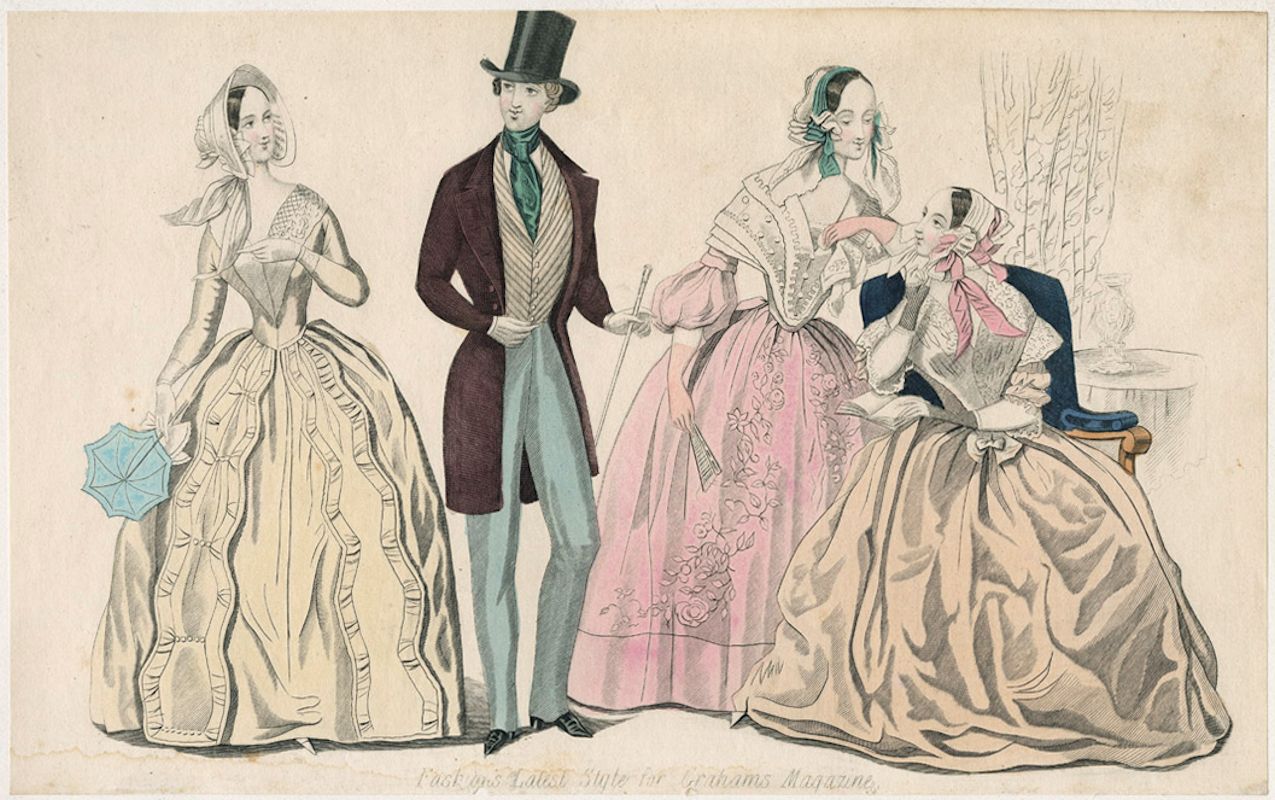
Fashion’s Latest Style for Graham’s Magazine
Transcriber’s Notes:
Table of Contents has been added for reader convenience.
Archaic spellings and hyphenation have been retained. Obvious
punctuation and typesetting errors have been corrected
without note.
[End of Graham’s Magazine, Vol. XXI, No. 1, July 1842, George R. Graham, Editor]