“We could not pray together on the deep,
Which, like a floor of sapphire, round us lay,
Soft, solemn, holy!”
Hemans.
’Tis Sunday!—Far to the westward lie the regions
of the Amazonians, and, in the east, the Caffre
hunts the ostrich. From the south, the lonely island
of Tristan d’Acunha looms high above the horizon.
Although twenty-three miles of water intervene between
us and the base of this extinct volcano, the
spray of the long billows of the southern ocean rises
in misty clouds above the perpendicular and rocky
shores, shading the mountain with a pearly veil,
widely different in color from the soft blue tint of
distance.—Even from the mast-head, whither the
desire of solitude has led me, the summits of three
or four billows complete the range of vision; for,
around the entire circuit of the earth, the eternal
west winds sweep, with scarce a barrier to their
action.
To those who are familiar with the Atlantic only—that
comparatively diminutive expanse, which Humboldt
has appropriately called “an arm of the sea,”—the
extent of these mountain swells must appear
almost incredible. It is not their height—for this is
fixed within narrow limits by an immutable law—but
their vast, unbroken magnitude, that awes the observer
with the consciousness of infinite power. What
are the proudest monuments of human strength and
skill, dotting the surface of creation, when compared
with these majestic waves, which are themselves
but the ripple of a passing breeze?
Reclining in the main-top, above all living things
except the wild sea bird—an antiquated volume on
the Scandinavian mysteries in hand—I give myself
up to solitary reflection.—Dark dreams of superstition!—and
must the order and loveliness of this glorious
world be terminated in one wild wreck—one
chaos of hopeless ruin!—shall all the labors of creative
goodness sink beneath the power of the unchained
demon of destruction!
We move upon the hardened crust of a volcanic
crater!—The solid pillars of the earth have given
way once and again!—The stony relics of a former
world forewarn proud man himself, that he too, with
all his boastful race is hurrying to his doom!—All
things have their cycles.
“This huge rotundity we tread grows old!”
What a pitiful guide is the unaided light of human
reason, when it grapples with the mysteries of creation!
The good and great have lived in every land,
and all have striven to elevate the soul of man above
the grovelling passions and desires that link him
with the brutes—pointing his attention to the future,
and instilling a belief in other powers, by whose
high best our destiny is governed, and whose wise
decrees will prove hereafter the reward of virtue
and the scourge of vice.—Yet what have they accomplished!—Each
forms a Deity, whose attributes are
the reflection of the physical objects which surround
him, or the echo of his own ill-regulated feelings!
In the bright regions of the East, where the unremitting
ardor of the sun gives birth to an infinity of
life, and the decaying plant or animal is scarce
resolved into its elements, ere other forms start forth
from its remains—there, the soul of man must wander
from link to link in the great chain of Nature,
till, purified by ages of distress, it merges into the
very essence of the power supreme!—a power divided
and engaged in an eternal contest with itself! a
never-ceasing war between the principles of Good
and Evil!
In those distant regions of the North, where winter
rules three-quarters of the year, and the orb of day,
with look askance, but half illuminates man’s dwelling
and his labors—where verdure, for a few days,
clothes the hills with transitory grace; but all that
seeks support from vegetable aliment is endowed
with fleetness like the reindeer, or migrates, in the icy
season, to more genial climes with the wild duck and
the pigeon;—in that gloomy circle, where the frozen
earth scarce yields a foot in depth to all the warming
influence of summer, and men, curtailed of half the
sad resource spared even in the primeval curse,
swept with their robber hordes the provinces of their
more fortunate neighbors until the iron art of war
barred up the avenues to these precious granaries;—in
that inhospitable region where dire necessity
inters the living infant with the departed mother, and
resigns the aged and decrepit to starvation!—the
Parent of Good is a warrior armed, compelled to
struggle fruitlessly with Fate, until, with Thor’s
dread hammer in his hand, he yields, and breathes
his last beneath the arm of liberated Locke!
All! all contention!—Our very nature refuses credence
in annihilation! Then—
“When coldness wraps this suffering clay,
Ah! whither flies the immortal mind!”
Is there no place of rest?—no truth in the visions
which haunt us as the sun declines, and the rich hues
of evening fade away—when the spirits of those we
have loved “sit mournfully upon their clouds,” gazing,
with a chastened melancholy which refines but
cannot darken the calm bliss of Paradise, upon the
ceaseless, bootless turmoil of their once cherished
friends? Mythology presents us with no brighter
future than the wild riot of the Hall of Odin, the
lethean inanity of Hades, or the sensual and unmanly
luxury of the Moslem Bowers of the Blest.
But hark! A manly voice, speaking of a loftier
philosophy, rises upon the clear air from the very
bowels of the vessel.
“And the earth,” it cries, “was without form and
void, and darkness was upon the face of the deep:
and the spirit of God moved upon the face of the
waters.”
Slowly and in measured cadence poured forth,
from the lips of one who felt the truths he uttered,
the exposition of the order of creation and the high
destinies of the creature. ’Tis a layman’s effort,
clothed in language suited to the rude ideas of simple-minded
men:—I am not of his faith,—and cannot
crowd my thoughts within the narrow compass of
our wooden walls:—aloft in air, my temple is the
canopy of heaven!—my hymn—the wild tone of the
ocean-wind with the low rushing of the billows!—the
symphony of Nature!—yet, as the words of
prayer ascend upon the gale, my own thoughts follow
them.—I know them for the pure aspiration of
the heart,—the breathing of a contrite spirit!—They
are registered above!
All is still!—But, again, the harmony of many
voices strikes the ear. A hymn of praise from the
wide bosom of the southern ocean!—No hearer but
the spirit to whose glory these sweet notes are tuned!
The distance, and the deadening influence of the narrow
hatches, render words inaudible; but, such as
this, their tenor might have been.
Being of almighty power,
On the wide and stormy sea,
In thy own appointed hour,
Here, we bow our hearts to thee!
What is man, that he should dare
Ask of Thee a passing thought?
Ruling ocean, earth, and air,
Thou art all—and he is naught!
Like a mote upon the earth!
(Earth—a mote in space to Thee!)
What avails his death or birth!
What, his hopes or destiny?
Yet, a spirit Thou hast given
To thy creature of the clay,
Ranging free from Earth to Heaven,
Heir of an eternal day!
In thy image Thou hast made,
Not the body, but the mind!
That shall lie defiled—decayed!
This to loftier fate consigned,
Shall, above the tempest roar,
Viewless, gaze on all below,
And, its mundane warfare o’er,
Calmly watch Time’s ceaseless flow!
Aid us! Father! with thy power!
(Without Thee our strength is naught!)
Thus, in Nature’s dreaded hour,
We may own the peaceful thought,
That, our blinded efforts here,
May not mar Thy great design,
And each humble work appear
Worthy of a child of Thine!
The voices have ceased.—The service, in which
all the company except the helmsman and myself
had joined, is ended; and, one by one, the officers
of the vessel, followed by the watch on duty, in their
well blanched trousers and bright blue jackets,
appear on deck; their sobriety of mien, and cheerfulness
of countenance speaking volumes in favor
of the benign influence of Christianity, even when
acting upon what are erroneously considered by
many, the worst materials.
———
BY JAMES RUSSELL LOWELL.
———
Thou look’d’st on me all yesternight,
Thine eyes were blue, thy hair was bright
As when we murmured our trothplight
Beneath the thick stars, Rosaline!
Thy hair was braided on thy head
As on the day we two were wed,
Mine eyes scarce knew if thou wert dead—
But my shrunk heart knew, Rosaline!
The deathwatch tickt behind the wall,
The blackness rustled like a pall,
The moaning wind did rise and fall
Among the bleak pines, Rosaline!
My heart beat thickly in mine ears:
The lids may shut out fleshly fears,
But still the spirit sees and hears,
Its eyes are lidless, Rosaline!
A wildness rushing suddenly,
A knowing some ill shape is nigh,
A wish for death, a fear to die,—
Is not this vengeance, Rosaline!
A loneliness that is not lone,
A love quite withered up and gone,
A strong soul trampled from its throne,—
What would’st thou further, Rosaline!
’Tis lone such moonless nights as these,
Strange sounds are out upon the breeze,
And the leaves shiver in the trees,
And then thou comest, Rosaline!
I seem to hear the mourners go,
With long black garments trailing slow,
And plumes anodding to and fro,
As once I heard them, Rosaline!
Thy shroud it is of snowy white,
And, in the middle of the night,
Thou standest moveless and upright,
Gazing upon me, Rosaline!
There is no sorrow in thine eyes,
But evermore that meek surprise,—
Oh, God! her gentle spirit tries
To deem me guiltless, Rosaline!
Above thy grave the robin sings,
And swarms of bright and happy things
Flit all about with sunlit wings,—
But I am cheerless, Rosaline!
The violets on the hillock toss,
The gravestone is o’ergrown with moss,
For Nature feels not any loss,—
But I am cheerless, Rosaline!
Ah! why wert thou so lowly bred?
Why was my pride galled on to wed
Her who brought lands and gold instead
Of thy heart’s treasure, Rosaline!
Why did I fear to let thee stay
To look on me and pass away
Forgivingly, as in its May,
A broken flower, Rosaline!
I thought not, when my dagger strook,
Of thy blue eyes; I could not brook
The past all pleading in one look
Of utter sorrow, Rosaline!
I did not know when thou wert dead:
A blackbird whistling overhead
Thrilled through my brain; I would have fled
But dared not leave thee, Rosaline!
A low, low moan, a light twig stirred
By the upspringing of a bird,
A drip of blood,—were all I heard—
Then deathly stillness, Rosaline!
The sun rolled down, and very soon,
Like a great fire, the awful moon
Rose, stained with blood, and then a swoon
Crept chilly o’er me, Rosaline!
The stars came out; and, one by one,
Each angel from his silver throne
Looked down and saw what I had done:
I dared not hide me, Rosaline!
I crouched; I feared thy corpse would cry
Against me to God’s quiet sky,
I thought I saw the blue lips try
To utter something, Rosaline!
I waited with a maddened grin
To hear that voice all icy thin
Slide forth and tell my deadly sin
To hell and Heaven, Rosaline!
But no voice came, and then it seemed
That if the very corpse had screamed
The sound like sunshine glad had streamed
Through that dark stillness, Rosaline!
Dreams of old quiet glimmered by,
And faces loved in infancy
Came and looked on me mournfully,
Till my heart melted, Rosaline!
I saw my mother’s dying bed,
I heard her bless me, and I shed
Cool tears—but lo! the ghastly dead
Stared me to madness, Rosaline!
And then amid the silent night
I screamed with horrible delight,
And in my brain an angel light
Did seem to crackle, Rosaline!
It is my curse! sweet mem’ries fall
From me like snow—and only all
Of that one night, like cold worms crawl
My doomed heart over, Rosaline!
Thine eyes are shut: they nevermore
Will leap thy gentle words before
To tell the secret o’er and o’er
Thou could’st not smother, Rosaline!
Thine eyes are shut: they will not shine
With happy tears, or, through the vine
That hid thy casement, beam on mine
Sunfull with gladness, Rosaline!
Thy voice I nevermore shall hear,
Which in old times did seem so dear,
That, ere it trembled in mine ear,
My quick heart heard it, Rosaline!
Would I might die! I were as well,
Ay, better, at my home in Hell,
To set for ay a burning spell
’Twixt me and memory, Rosaline!
Why wilt thou haunt me with thine eyes,
Wherein such blessed memories,
Such pitying forgiveness lies,
Than hate more bitter, Rosaline!
Woe’s me! I know that love so high
As thine, true soul, could never die,
And with mean clay in church-yard lie—
Would God it were so, Rosaline!
If some small savor creep into my rhyme
Of the old poets, if some words I use,
Neglected long, which have the lusty thews
Of that gold-haired and earnest hearted time,
Whose loving joy and sorrow all sublime
Have given our tongue its starry eminence.—
It is not pride, God knows, but reverence
Which hath grown in me since my childhood’s prime;
Wherein I feel that my poor lyre is strung
With soul-strings like to theirs, and that I have
No right to muse their holy graves among,
If I can be a custom-fettered slave,
And, in mine own true spirit, am not brave
To speak what rusheth upward to my tongue.
———
BY PARK BENJAMIN.
———
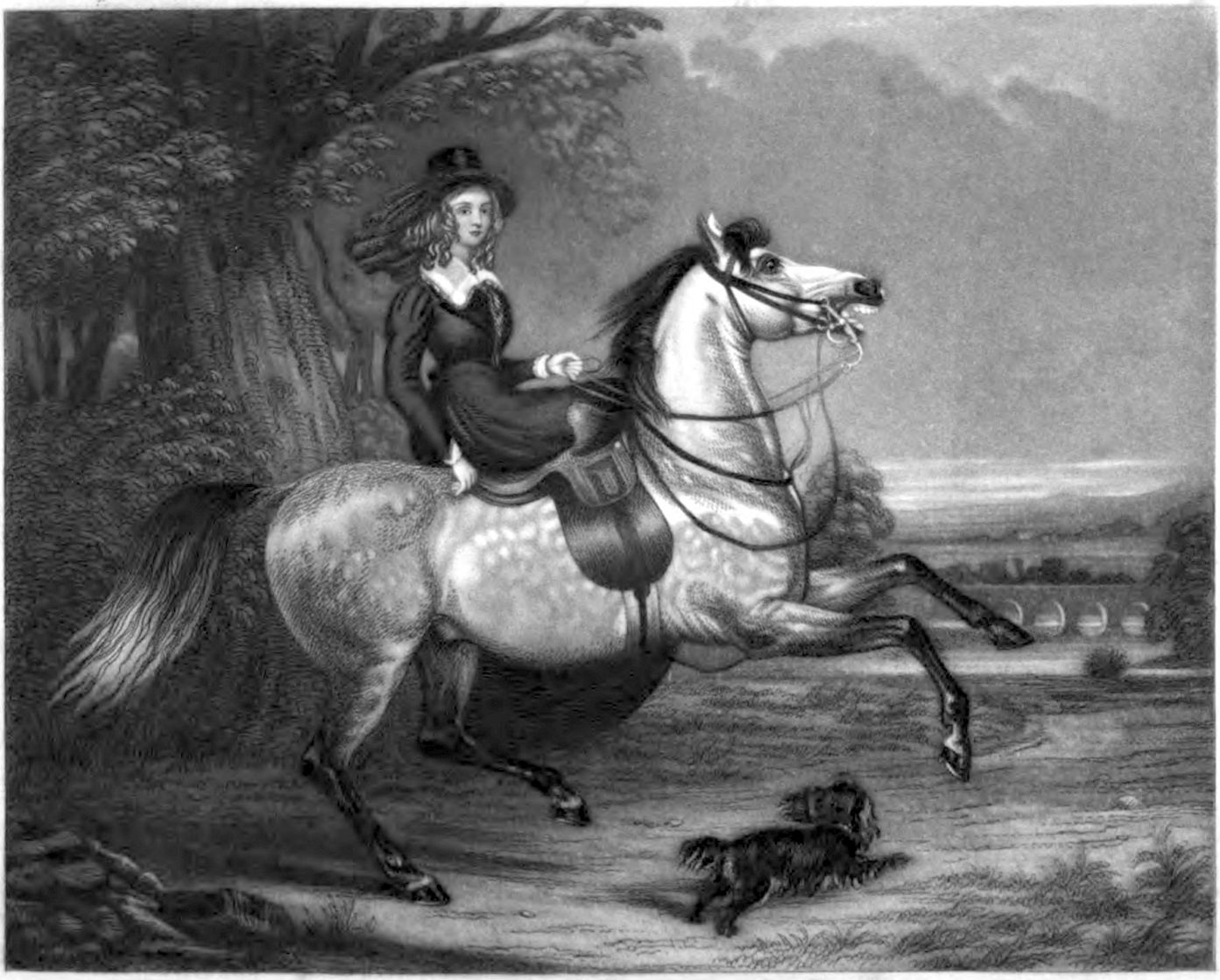
In the last edition of Mrs. Norton’s poems, the
unrivalled burine of Lewis has attempted to trace
the form and lineaments of the authoress—one of
the most perfect specimens of female loveliness that
ever furnished an idea to the painter or inspiration
to the poet. Affliction, which has graven
such deep lines into her heart, has not yet effaced
the beauty of her countenance, or impaired the perfection
of her form. We have, in the engraving before
us, the full maturity of that gorgeous beauty,
which, in its infancy, commanded the unqualified
admiration of the most severe and fastidious critics,
that ever sat in the Court of Fashion. We have
still spared to us, that full and voluptuous bust—the
arm that statuaries delight to chisel, and a neck that
would have crazed Canova, while it rivals in whiteness,
the purest Carrara of his studio. But it is the
more minute and delicate lines of her beauty that have
been swept by the touch of grief. Her countenance
is sad and subdued; her full and flexible lip is no
longer played upon by ever-varying smiles, and her
eye, which once beamed with every expression,
from the twinkle of arch simplicity to the flash of an
insulted Jewess, has now settled into the melting,
mournful, appealing gaze of heart-breaking sorrow.
When we consider that a form so peerless, is the
dwelling place of a most brilliant and gifted spirit—that
a countenance so winning and expressive is but
the reflex of a pure and exalted soul,—that her
eye is moistened by the swelling fountain beneath—that
lips whose mute beauty is so persuasive, are the
oracles of “thoughts that breathe and of words that
burn,” we can no longer discredit the miracles,
which, in all ages, female loveliness has wrought,
the devotion and the sacrifices it has wrung from the
stern and selfish spirit of man. We are at no loss
for the reason, why the Greeks of old raised altars
to incarnate Beauty, why heroes bent their knees at
her feet, and purchased trophies with their blood
that they might suspend them in her temples.
If such endowments melt us into fealty, when, like
the distant stars, they shine above our reach and
our aspirations,—if such a being commands our respectful
yet ardent love, when moving in a sphere
we never can approach, exacting homage from a
thousand hearts, and raised as much above our sympathy
as our position—what strength of affection,
what full, free, unreserved devotion is enlisted in
her service, when she is brought near to us by sorrow,
when the sympathy of the humblest may be a
balm to the wounded spirit of the highest, when
innocence is assailed in her form, her character defamed,
her honor maligned, her “life’s life lied
away!”
It must be known to most of our readers, that,
incited by the political enemies of Lord Melbourne,
the husband of Mrs. Norton commenced legal proceedings
against that nobleman, alleging at the same
time, the infidelity of his own wife. No means,
which personal hatred or political bigotry could employ,
were left untried, to sustain the accusation,
and the fate of this unfortunate lady became involved
with the triumph or the overthrow of Cabinets. All
the arts, which were so successfully used to blacken
the memory and hurry to an early grave the illustrious
consort of George the Fourth, were revived
against Mrs. Norton. Servants were bribed, spies
were employed, key-holes searched, perjury encouraged,
letters forged, surmises whispered about as
facts, and doubts magnified into certainties, that the
lady might be convicted and the minister crushed.
The whole life, conduct, and conversation of the
victim were subjected to the most searching scrutiny,
her letters and private papers, her diary even—the
communings of an imaginative woman with her
own soul—were placed in the hands of dexterous
and sophistical attorneys, that they might be tortured
into proofs of guilt. Acts which the most rigid
duenna would not have named—indiscretions, the out-gushings
of a heart conscious of its own purity, the
confiding conduct of innocence, and the licentiousness
of her grandfather, were the strong proofs of
adultery which counsel had the impudence to present
to an English Jury. On the testimony of bribed
witnesses, perjured coachmen and lubricious chambermaids,
they sought to impeach the unsullied honor
of a British matron; to fix stain on the pure lawn of
a seraph by evidence which would not have sullied
the flaunting robes of a Cyprian. Need it be said
that the result of such an infamous attempt was the
complete and triumphant vindication of the accused?
But the acquittal of a Jury can be no reparation to
a woman whose honor has been publicly assailed.
Female virtue must not only be above reproach, but
beyond suspicion, and the breath of calumny is frequently
as fatal to it as the decrees of truth. The
verdict of “not guilty,” is no bar to the malignity of
scandal-loving human nature; there remain the cavil,
the sneer, the “damning doubt,” the insolent jest.
She is separated by an impassable gulf from her only
lawful protector; she can fly to no other without
shame; she is placed in the most ambiguous position
in society—that of an unmarried wife; fettered by
all the restraints, watched with all the jealousy, but
entitled to none of the privileges of the conjugal tie.
And, in addition to all this, she becomes a bereaved
mother; for the “righteous law entrusts the children
to the exclusive guardianship of the father.” Such
is the position which a combination of most untoward
circumstances has forced upon a lady who has
every claim upon the protection, the respect, the
admiration and the love of mankind.
We have dwelt thus long upon the domestic infelicity
of Mrs. Norton, for the purpose of illustrating
the influence which it has had in modifying her
genius, and accounting for the undercurrent of deep
melancholy which is discernible in many of her
pieces, and for the outbreaks of passionate sympathy
with the peculiar sorrows and sufferings of her own
sex, which distinguish all of her more recent productions.
Not alone, however, is Mrs. Norton in
her misfortunes. She is but one of a large sisterhood,
who, finding the waters poisoned that rill from
“affection’s springs,” have sought to relieve their
thirst from the “charmed cup” of Fame, who, in
the deep and bitter fountains of unrequited love, in
the gulfs of their own woe, have gathered pearls to
deck the brow of female genius. The mournful song
of Hemans, of Tighe and of Landon, had scarcely died
away, before the lips of a fourth were touched with
live coals from the same furnace of affliction. Indeed,
domestic infelicity is so often connected with
the developement of the poetical faculty in woman,
is so frequently the cause which first awakens
those deep and vivid emotions which are the essence
of poetry, is so universally the concomitant and the
burthen of female song, that the relation between
the two is well worthy of philosophic investigation.
It seems to us that the effect is a very manifest result
of the cause. The female mind is distinguished
from that of the sterner sex, by its more delicate organization,
by its keener sensibility, by its stronger
and more sensitive affections; by its inferiority in
mere strength of intellect, clearness of understanding,
and range of observation. Her vision, therefore,
though nicer, more accurate and susceptible, within
its own range, takes in but a very small portion of
that poetic realm which stretches from “heaven to
earth, and from earth to heaven.” She is consequently
more entirely introversive than man, and
draws whatever she communicates more from within
than from without. She does not derive her inspiration,
she does not form her genius, from a wide and
accurate survey of human passions. The emotions
which gave birth to such creations as Satan, Prometheus,
Shylock, Manfred; the frightful visions which
glare from the lurid page of Dante’s Inferno; the
wide range of incident, description and passion which
distinguish the poetry of Scott and Southey—it would
be unnatural and unreasonable to expect from the
delicate and peace-loving nature of woman. Her
heart could never “bide the beatings” of such storms.
She can, at the most, but love ardently, hope lastingly,
and endure faithfully; and when she sings she
can be but the oracle of her own heart. When her
hopes are baffled, when her household gods are scattered,
when despair takes up its abode within her
breast these emotions become vocal, and she sings
of yearning love, of deathless affections, of unshaken
constancy, of patient endurance, of self-sacrificing
devotion. As by the law of her nature, so by her
position in society, the cultivation of her affections
must be by far the most prominent object of her life,
as well as her most reliable source for enjoyment.
In man’s life love is but an episode; in woman’s it
is the entire action of the piece. With him it is but
one act in the drama, with her it is the beginning,
middle, and end. Man’s warfare with the world is
like the battle array of the Romans—they had their
first, second, and third rank. If the first was defeated
it fell back into the intervals of the second, and
both together renewed the attack; if vanquished
again they were received into the wider intervals of
the third, and the whole mass united made a more
impetuous onset. Thus with man, if unsuccessful
in Love he rallies on Ambition; if again defeated, he
falls back with accumulated energy upon Avarice—the
peculiar passion of old age. Not so with woman;
upon her success as a wife and a mother, her whole
happiness is risked. In her encounter with the world
she has no passion in reserve; she concentrates her
whole force into one line and trusts herself and her
fortune upon the success of a single charge. If unfortunate
in this venture, she has no place for retreat
except the recesses of her own heart. Can we wonder,
then, that disappointment in what she values the
most, the utter blight of her hopes, affections driven
back upon her heart, and trust betrayed, should excite
those strong and fervent emotions which will not
“down” at mortal bidding, but express themselves
in song? or, that the wing of her spirit while brooding
over the ruin of her peace, should gather strength
for poetic flight?
We do not know where we could have found a
more complete illustration of these views than in
the history of Mrs. Norton. The blow which blighted
the fair promise of her spring, found her a poetess
of some celebrity. She had given to the world
many pieces, imbued with the warm sensibility,
the pure, ardent, and devoted love of woman; but
nothing which in sincerity, strength, fervor and truthfulness
of passion, can compare with the “Dream”—gushing
as it does from the heart of the betrayed wife
and abandoned mother. We had intended to speak
at some length of the characteristics of Mrs. Norton’s
genius, but we believe that the same end will be accomplished
more to the edification of our readers,
by giving a short analysis of this beautiful poem.
The story of the piece, is brief and simple, and was
undoubtedly suggested to her mind by the association
of contrast. We are presented with a widowed
mother watching
“her slumbering child,
On whose young face the sixteenth summer smiled.”
And we have the following exquisite family piece
presented—“O matre pulchrâ filia pulchrior.”
“So like they seem’d in form and lineament,
You might have deem’d her face its shadow gave
To the clear mirror of a fountain’s wave;
Only in this they differ’d; that, while one
Was warm and radiant as the summer sun,
The other’s smile had more a moonlight play,
For many tears had wept its glow away;
Yet was she fair; of loveliness so true,
That time which faded, never could subdue;
And though the sleeper, like a half blown rose,
Show’d bright as angels in her soft repose,
Though bluer veins ran through each snowy lid,
Curtaining sweet eyes by long dark lashes hid—
Eyes that as yet had never learnt to weep,
But woke up smiling like a child from sleep;—
Though fainter lines were pencill’d on the brow,
Which cast soft shadow on the orbs below;
Though deeper color flush’d her youthful cheek,
In its smooth curve more joyous and less meek,
And fuller seem’d the small and crimson mouth,
With teeth like those that glitter in the south,—
She had but youth’s superior brightness, such
As the skill’d painter gives with flattering touch,
When he would picture every lingering grace,
Which once shone brighter in some copied face;
And it was compliment when’er she smiled
To say, ‘Thou’rt like thy mother, my fair child’.”
Over such a child the mother hangs with devoted
fondness, with sweet recollections of her infancy, and
“of the change of time and tide
Since Heaven first sent the blessing by her side,”
and with mournful anticipations, of what would befall
the fledged bird, when it should grow impatient
of the nest. The child at length awakes—
“And when her shadowy gaze
Had lost the dazzled look of wild amaze,”
she relates her dream to the mother.
“Methought, oh! gentle mother, by thy side
I dwelt no more as now, but through a wide
And sweet world wander’d, nor even then alone;
For ever in that dream’s soft light stood one,—
I know not who,—yet most familiar seem’d
The fond companionship of which I dream’d!
A Brother’s love is but a name to me;
A Father’s brighten’d not my infancy,
To me in childhood’s years no stranger’s face
Took from long habit friendship’s holy grace;
My life hath still been lone, and needed not,
Heaven knows, more perfect love than was my lot
In thy dear heart; how dream’d I then, sweet Mother,
Of any love but thine, who knew no other?”
Dear little innocence! you have much to learn.
Thy “shadow and herself” wander together by the
“blue and boundless sea,” the shore is covered with
flowers and “tangled underwood” and “sunny
fern.” The ocean, “the floating nautilus,” the
“pink-lipped” shells—
“And many color’d weeds
And long bulbous things like jasper beads,”
and ships with “swelling sails unfurled,” dance before
her in this delightful vision until—
“The deep spirit of the wind awoke,
Ruffling in wrath each glassy verdant mound,
While onward roll’d the army of huge waves,
Until the foremost with exulting roar,
Rose proudly crested o’er his brother slaves,
And dashed triumphant to the groaning shore.”
The ocean finally passes from her sleeping vision and
the winged travellers fly into a different scene—
“We look on England’s woodland fresh and green,”
and a beautiful picture is presented of the rural
scenery of Great Britain, until the scene changes
again to some romantic resting-place of the dead, to
some Père la Chaise, or Laurel Hill, or Mount
Auburn, to a—
“heath
Where yew and cypress seemed to wave
O’er countless tombs, so beautiful, that death
Seemed here to make a garden of the grave.”
And as the fair one wanders over the “mighty
dead,” over “warriors,” and “sons of song” and
orators—
“whose all persuading tongue
Had moved the nations with resistless sway,”
and “pale sons of science”—
“He who wandered with me in my dream
Told me their histories as we onward went,
Till the grave shone with such a hallowed beam,
Such pleasure with their memory seem’d blent
That, when we looked to heaven, our upward eyes
With no funereal sadness mock’d the skies.”
We are ourselves getting rapidly to envy that “fellow”
who is “wandering with her.” In our opinion
she will soon be able to answer her own naïve question
about love. Her companion leads her, with admirable
discernment, as we think, into a glorious “old
library.” What better place could he have selected
to impress the heart of an imaginative and appreciating
“little love.” If the cemetery and those
“histories” did not explain to her the novel psychological
emotion about which she consulted her
mother, what occurs in the library certainly will.
For see how the youth plays with the susceptibilities
of a girl of “sixteen”—
“We sate together: his most noble head
Bent o’er the storied tome of other days,
And still he commented on all we read,
And taught me what to love and what to praise.
Then Spencer made the summer day seem brief,
Or Milton sounded with a loftier song,
Then Cowper charmed, with lays of gentle grief,
Or rough old Dryden roll’d the hour along.
Or, in his varied beauty dearer still,
Sweet Shakspeare changed the world around, at will;
And we forgot the sunshine of that room
To sit with Jacques in the forest gloom;
To look abroad with Juliet’s anxious eye
For her gay lover ’neath the moonlight sky;
Stand with Macbeth upon the haunted heath,
Or weep for gentle Desdemona’s death;
Watch on bright Cydnus’ wave, the glittering sheen,
And silken sails of Egypt’s wanton Queen;
Or roam with Ariel through that island strange,
Where spirits and not men were wont to range,
Still struggling on through brake and bush and hollow,
Hearing the sweet voice calling ‘Follow! follow!’
Nor were there wanting lays of other lands,
For these were all familiar in his hands:
And Dante’s dream of horror work’d its spell,—
And Petrarch’s sadness on our bosoms fell.—
And prison’d Tasso’s—he, the coldly loved,
The madly-loving! he, so deeply proved
By many a year of darkness, like the grave,
For her who dared not plead, or would not save,
For her who thought the poet’s suit brought shame,
Whose passion hath immortalized her name!
And Egmont, with his noble heart betrayed,—
And Carlo’s haunted by a murder’d shade,—
And Faust’s strange legend, sweet and wondrous wild,
Stole many a tear;—Creation’s loveliest child!
Guileless, ensnared, and tempted Margaret,
‘Who could peruse thy fate with eyes unwet?’ ”
If such a quantity of poetry and such poetry—Spencer,
Milton, Dryden, Cowper, Shakspeare,
Dante, Tasso and Göethe did not enlighten the
“young innocent,” respecting the emotions with
which she regarded the “fond companion of her
dreams,” we do not know to whom to commend her
for instruction. But we must hurry on with the
story; the pair wander over Italy, and a picture is
presented, of mountain and vale, of orange and myrtle
groves, of grottoes, fountains, palaces, paintings,
and statues that would “create a soul” under the
ribs of a utilitarian. We were inclined to think that
he of “the most noble brow,” entrapped the young
affections of the dreamer in the “old library,” but
we do not believe that she breathed the delicious
confession into his ear until they reached the sunny
clime of Italy. It was the unrivalled music of that
land which unsealed her lips.
“We sate and listened to some measure soft
From many instruments; or faint and lone
(Touch’d by his gentle hand or by my own)
The little lute its chorded notes would send,
Tender and clear; and with our voices blend
Cadence so true, that when the breeze swept by
One mingled echo floated on its sigh!
And still as day by day we saw depart,
I was the living idol of his heart:
How to make joy a portion of the air
That breathed around me seemed his only care.
For me the harp was strung, the page was turned;
For me the morning rose, the sunset burn’d;
For me the Spring put on her verdant suit;
For me the Summer flowers, the Autumn fruit;
The very world seemed mine, so mighty strove
For my contentment that enduring love.”
But the slumbers of the dear girl are at length broken,
she discovers that it is but a dream, and thus repines
over the contrast.
“Is all that radiance past—gone by for ever—
And must there in its stead for ever be
The gray, sad sky, the cold and clouded river,
And dismal dwelling by the wintry sea?
Ere half a summer altering day by day,
In fickle brightness, here, hath passed away!
And was that form (whose love might well sustain)
Naught but a vapor of the dreaming brain?
Would I had slept forever.”
The “mournful mother” now speaks. And how
sweetly come from her lips the lessons of piety and
resignation. She gently rebukes her daughter, contrasts
the world which fancy paints with the stern
realities of existence, and distils into the opening
mind of the child the wisdom which her own sad experience
had taught.
“Upbraid not Heaven, whose wisdom thus would rule
A world whose changes are the soul’s best school:
All dream like thee and ’tis for mercy’s sake
That those who dream the wildest soonest wake;
All deem Perfection’s system would be found
In giving earthly sense no stint or bound;
All look for happiness beneath the sun,
And each expects what God hath given to none.”
It is in this part of the argument that we discover the
fervor, strength, and pathos that the lessons of experience
impart. It is here that Mrs. Norton teaches
in song what she has herself learnt in suffering. If
the following is not poetry it is something that
moistens the eye very much like it.
“Nor ev’n does love whose fresh and radiant beam
Gave added brightness to thy wandering dream,
Preserve from bitter touch of ills unknown,
But rather brings strange sorrows of its own.
Various the ways in which our souls are tried;
Love often fails where most our faith relied.
Some wayward heart may win, without a thought,
That which thine own by sacrifice had bought;
May carelessly aside the treasure cast
And yet be madly worshipped to the last;
Whilst thou forsaken, grieving, left to pine,
Vainly may’st claim his plighted faith as thine;
Vainly his idol’s charms with thine compare,
And know thyself as young, as bright, as fair.
Vainly in jealous pangs consume thy day,
And waste the sleepless night in tears away;
Vainly with forced indulgence strive to smile,
In the cold world heart-broken all the while;
Or from its glittering and unquiet crowd,
Thy brain on fire, thy spirit crushed and bow’d,
Creep home unnoticed, there to weep alone,
Mock’d by a claim which gives thee not thy own;
Which leaves thee bound through all thy blighted youth
To him, whose perjured heart hath broke its truth;
While the just world beholding thee bereft,
Scorns—not his sin—but thee, for being left!
* * * * * *
“Those whom man, not God, hath parted know,
A heavier pang, a more enduring woe;
No softening memory mingles with their tears,
Still the wound rankles on through dreary years,
Still the heart feels, in bitterest hours of blame
It dares not curse the long familiar name;
Still, vainly free, through many a cheerless day,
From weaker ties turns helplessly away,
Sick for the smile that bless’d its home of yore,
The natural joys of life that come no more;
And, all bewildered by the abyss, whose gloom
Dark and impassible as is the tomb,
Lies stretch’d between the future and the past,—
Sinks into deep and cold despair at last.
Heaven give thee poverty, disease or death,
Each varied ill that waits on human breath,
Rather than bid thee linger out thy life
In the long toil of such unnatural strife.
To wander through the world unreconciled,
Heart-weary as a spirit-broken child,
And think it were an hour of bliss like Heaven
If thou could’st die—forgiving and forgiven,—
Or with a feverish hope, of anguish born,
(Nerving thy mind to feel indignant scorn
Of all thy cruel foes who ’twixt thee stand,
Holding thy heart-strings with a reckless hand,)
Steal to his presence now unseen so long,
And claim his mercy who hath dealt the wrong!
Within the aching depths of thy poor heart
Dive, as it were, even to the roots of pain
And wrench up thoughts that tear thy soul apart,
And burn like fire through thy bewildered brain.
Clothe them in passionate words of wild appeal
To teach thy fellow creatures how to feel.—
Pray, weep, exhaust thyself in maddening tears,—
Recall the hopes, the influences of years,—
Kneel, dash thyself upon the senseless ground,
Writhe as the worm writhes with dividing wound,
Invoke the heaven that knows thy sorrow’s truth,
By all the softening memories of youth—
By every hope that cheered thine earlier day—
By every tear that washes wrath away—
By every old remembrance long gone by—
By every pang that makes thee yearn to die;
And learn at length how deep and stern a blow
Near hands can strike, and yet no pity show!
Oh! weak to suffer, savage to inflict,
Is man’s commingling nature; hear him now
Some transient trial of his life depict,
Hear him in holy rites a suppliant bow;
See him shrink back from sickness and from pain,
And in his sorrow to his God complain—
‘Remit my trespass, spare my sin,’ he cries,
‘All-merciful, All-mighty, and All-wise:
Quench this affliction’s bitter whelming tide,
Draw out thy barbed arrow from my side;’—
And rises from that mockery of prayer
To hate some brother-debtor in despair.”
From what deep fountains of suffering must these
lines have been drawn! What days, weeks, months
of deferred hope, of doubt, and of final despair are
recorded here!
What life-drops from the minstrel wrung
Have gushed with every word?
The mother at length ceases, and the spirited girl
shrinking from the picture of life which has been
presented to her, thus replies:—
“If this be so, then mother, let me die
Ere yet the glow hath faded from my sky!
Let me die young; before the holy trust,
In human kindness crumbles into dust;
Before I suffer what I have not earned
Or see by treachery my truth returned;
Before the love I live for fades away;
Before the hopes I cherish’d most decay;
Before the withering touch of fearful change
Makes some familiar face look cold and strange,
Or some dear heart close knitted to my own,
By perishing, hath left me more alone!
Though death be bitter, I can brave its pain
Better than all which threats if I remain,
While my soul, freed from ev’ry chance of ill,
Soars to that God whose high mysterious will,
Sent me, foredoom’d to grief, with wandering feet
To grope my way through all this fair deceit.”
The mother then breaks forth in a beautiful strain,
inculcating confidence in God and submission to his
will. We have never heard a homily from any pulpit
that has taught these lessons with one half the force
and eloquence of these beautiful lines. If any of our
readers, in the midst of sorrow, suffering or despair,
are inclined to forget that there is “another and a
better world,” we advise them to learn patience under
tribulation from the lips of Mrs. Norton. We
wish we could quote them—but we cannot—we have
already transcended our limits and can only give the
beautiful and touching end of this “sad and eventful
history.”
“There was a pause; then with a tremulous smile,
The maiden turned and pressed her mother’s hand:
‘Shall I not bear what thou hast borne erewhile?
Shall I, rebellious, Heaven’s high will withstand?
No! cheerly on, my wandering path I’ll take;
Nor fear the destiny I did not make:
Though earthly joy grow dim—though pleasure waneth—
This thou hath taught thy child, that God remaineth!’
“And from her mother’s fond protecting side
She went into the world, a youthful bride.”
Fain would we linger longer among the brilliant
creations of Mrs. Norton’s genius; but, like her own
beautiful sleepers, our “dream” is broken, and we
must return from fairy-land to encounter “the rude
world.”
OR THE POET’S DREAM.
———
BY MRS. R. S. NICHOLS.
———
I bent me o’er him as he lay upon his couch,
Deep sleep weighed down the curtains of his eyes,
Forever and anon the seraph seemed to touch
His dreaming soul with radiance of the skies!
I bent me o’er him then, for mighty thoughts did seem
To pant for utterance, as he sighed for breath,
And strove to speak—for in that dark and fearful dream
He passed the portals of the phantom Death!
“The chains that clogged my spirit’s pinions roll
Powerless back to earth—a vain, base clod,
And awe-inspiring thoughts brood o’er my soul,
As angels hover round the ark of God!
I see before me in the distance far
A mystic altar veiled, and part concealed
Amid the tresses of a burning star,
Whose mysteries from earth are ever sealed!
“It gleams—that fountain of mysterious light
At holy eve, far in the western sky,
And angels smile, when man ascends by night
To read in it his puny destiny!
A something bears me onward towards the throne
With speed which mocks the winged lightning’s glance!
And here, amid the stars’ eternal home
I stand, with senses steeped as in a trance!
“I feel a power, a might within my soul
That I could wrest from angels, themes for song!
My earth-freed spirit soars and spurns control,
While deep and chainless thoughts around me throng!
I know the veil is pierced—the altar gained—
I bend me lowly at its foot sublime;
Yet false inspirers, who on earth have feigned
The God, depart from this eternal clime!”
He woke—and swift unto the land of misty sleep
His dreams rolled back, and left him still on earth,
But ever after did the Poet’s spirit keep
This deep, unchanging, mystic, second birth!
———
BY MRS. EMMA C. EMBURY.
———
“In terms of choice I am not solely led
By nice direction of a maiden’s eyes.”
Merchant of Venice.
“I want to ask you a question, Mildred, but I am
afraid you will deem it an impertinent one.”
“Ask me what you please, dear Emily, and be assured
that you shall receive a frank reply; we have
known and loved each other too long to doubt that
affection and not mere idle curiosity prompts our
mutual inquiries respecting each other’s welfare
during our separation.”
“When I bade farewell to my native land, Mildred,
I left you surrounded by a wide circle of admirers;
you were beautiful and rich,—these gifts
alone would have won you many a suitor,—but you
were also possessed of the noblest qualities of heart
and mind, and were as worthy to be loved as to be
admired. How has it happened then that from
among the many who sought your hand, you selected
one so—so—”
“I understand you, Emily,—so misshapen and ugly,
you would say; it is precisely because I possessed a
little more heart and soul than usually belongs to a
fashionable belle.”
“What do you mean, Mildred? when I parted from
you I thought you were more than half in love with
the handsome Frank Harcourt.”
“And you return to find me married to his crooked
cousin.”
“I did not know Mr. Heyward was related to your
quondam admirer.”
“Ah, I see I must tell the whole story; ‘wooed
an’ married an’ a’ ’ is not enough for you; I must
relate all the particulars which led to such an apparently
whimsical choice.
“You remember me doubtless as the enfant gâtée
of society; the spoiled child of doating parents, and
the flattered votary of fashion. My web of life, unbroken
by a single sombre thread, seemed woven
only of rose-color and gold. My mirror taught me
that the world spoke truth, when it assigned to me
the brightest of all womanly gifts: experience showed
me my superiority in mind over the well dressed
dolls of society: and the earnestness of my affection
for the friends of my youth, convinced me that many
stronger and deeper emotions still lay latent within
my heart. Yet with all these gifts, Emily, I narrowly
escaped the fate of a fashionable flirt. I could not
complain, like Voltaire, that ‘the world was stifling
me with roses,’ but I might have truly said, that the
incense offered at the shrine of my vanity was fast
defacing, with its fragrant smoke, the fine gold that
adorned the idol. Selfishness is a weed which flourishes
far more luxuriantly beneath the sunshine of
prosperity than under the weeping skies of adversity;
for, while sorrow imparts a fellow-feeling with all
who suffer, happiness too often engenders habits of
indulgence, utterly incompatible with sympathy and
disinterestedness. Wherever I turned I was met by
pleasant looks and honied words, everybody seemed
to consider me with favor, and I was in great danger
of believing that the world was all sincerity and Miss
Mildred all perfection. The idea that I shone in the
reflected glitter of my father’s gold never occurred
to me. Too much accustomed to the appliances of
wealth to bestow a thought upon them; entirely ignorant
of the want and consequently of the value of
money, I could not suppose that other people prized
what to me was a matter of such perfect indifference,
or that the weight of my purse gave me any undue
preponderance in the scale of society. Proud, haughty
and self-willed as I have been, yet my conscience
acquits me of ever having valued myself upon the
adventitious advantages of wealth. Had I been born
in a hovel I still should have been proud:—proud of
the capabilities of my own character,—proud because
I understood and appreciated the dignity of
human nature,—but I should have despised myself if,
from the slippery eminence of fortune, I could have
looked with contempt upon my fellow beings.
“But I was spoiled, Emily, completely spoiled.
There was so much temptation around me,—so
much opportunity for exaction and despotism that
my moral strength was not sufficient to resist the
impulses of wrong. With my head full of romantic
whims, and my heart thrilling with vague dreams of
devoted love and life-long constancy; a brain teeming
with images of paladin and troubadour, and a
bosom throbbing with vain longings for the untasted
joy of reciprocal affection,—I yet condescended to
play the part of a consummate coquette. But, no; if by
coquetry be meant a deliberate system of machinations
to entrap hearts which become worthless as
soon as gained, then I never was a coquette, but I certainly
must plead guilty to the charge of thoughtless,
aimless, mischievous flirtation. If the Court of Love
still existed,—that court, which, as you know, was
instituted in the later days of chivalry, and composed
of an equal number of knights and dames, whose duty
it was to try all criminals accused of offences against
the laws of Love; if such a tribunal still existed, I
think it might render a verdict of wilful murder
against a coquette, while only manslaughter could be
laid to the charge of the flirt. The result of both
cases is equally fatal, but the latter crime is less in
degree because it involves no malice prepense. Do
not misunderstand me, Emily, I do not mean to exculpate
the lesser criminal; for if the one deserves
capital punishment the other certainly merits imprisonment
for life, and, next to the slanderer, I look
upon the coquette and habitual flirt as the most dangerous
characters in society. Yet I believe that
many a woman is imperceptibly led to the very verge
of flirtation by a natural and even praiseworthy desire
to please. The fear of giving pain when we
suspect we possess the power, often gives softness to
a woman’s voice and sweetness to her manner,
which, to the heart of a lover, may bear a gentler
interpretation. Among the chief of our minor duties
may be ranked that of making ourselves agreeable;
and who does not know the difficulty of walking
between two lines without crossing either? You
think I am saying all this in exculpation of my past
folly, and perhaps you are right.
“I was just nineteen, and in the full enjoyment of
my triumphs in society, when I officiated as your
bridesmaid. I must confess, Emily, that the marriage
of such a pretty, delicate creature, as you then
were, with a man full twice your age, in whose dark
whiskers glistened more than one silver thread, and
on whom time had already bestowed a most visible
crown, seemed to me one of the marvels of affection
for which I could not then account.”
“Now you are taking your revenge, Mildred, for
my saucy question respecting your husband; but if
you can give as good a reason for your choice as I
found for mine, I shall be perfectly satisfied.”
“Let me gratify my merry malice, ladye fair;
time has shown some little consideration for you in
this matter, for, while he has left no deeper impress
on your husband’s brow, he has expanded the slender
girl into the blooming, matronly-looking woman.
You are now well matched, Emily, and your husband
is one of the handsomest men of—his age.”
The arch look of the speaker interpreted the
equivocally-worded compliment, and, with a joyous
laugh, Mrs. Heyward resumed:
“It was about the time of your marriage, and
shortly before your departure for Europe, that I became
acquainted with Frank Harcourt. You must
remember his exceeding beauty. The first time I
beheld him, Byron’s exquisite description of the
Apollo Belvedere rose to my lips:
——“In his delicate form,—a dream of Love
Shaped by some solitary nymph, whose heart
Longed for a deathless lover from above
And maddened in that vision, is exprest
All that ideal beauty ever blessed
The mind with in its most unearthly mood.”
His admirable symmetry of form, and a face of such
perfect contour, such exquisite regularity of feature,
that its semblance in marble might have been valued
as a relic of Grecian ideal beauty, were alone sufficient
to attract the admiration of such a lover of the
beautiful as I always have been; but the charm of
perfect coloring, the effect of light and shade was
not wanting in this finished picture. His full dark
eye sparkled beneath a snow-white forehead,—his
cheek was bronzed by exposure and yet bright with
health,—his lips were crimson and velvet-like as the
pomegranate flower,—his teeth white as the ocean
pearl,—his raven curls fell in those rich slight tendrils
so rarely seen except on the head of infancy,—while
the soft and delicate shadowing in his lip and
chin resembled rather the silken texture of a lady’s
eyebrow, than the wiry and matted masses of hair
usually cherished under the name of whiskers and
moustache.”
“You are quite impassioned in your description,
Mildred; what would your husband say if he were
to hear you?”
“He would agree with me in thinking that Frank
Harcourt is the most beautiful specimen of humanity
that ever presented itself to my admiring eyes.”
“He has less jealousy then in his nature than most
of his sex.”
“A man has little cause to be jealous of a rival he
has so utterly discomfited.
“Harcourt soon professed himself my admirer and
need I say that his attentions were by no means displeasing
to me. The buzz of admiration which met my
ear whenever he appeared,—the delight with which
ladies accepted his slightest civilities,—the manœuvres
constantly practised to secure his society, all
tended to render me vain of his homage. Had he
been merely a beautiful statue,—a rich but empty casket,
I should soon have become weary of my conquest.
But Harcourt possessed a mind rather above mediocrity,
fine taste, elegant manners, and, what was
especially useful to him, great skill in decyphering
character and consummate tact in adapting himself to
its various peculiarities. When those beautiful lips
parted only to utter the language of high-toned sentiment,
or to breathe the impassioned words of Byron
and Moore,—when those bright eyes glistened with
suppressed tears at the voice of melancholy music,
or sparkled with merry delight at the tones of gayety;
when that fine person swayed itself with inimitable
grace to the movements of the mazy dance, or bent
its towering altitude with gentle dignity over the
slight form of some delicate girl, it is not strange,
that, even to my eyes, he should seem all that was
noble and majestic in mind as well as person. Flattered
by his courtly attentions, congratulated by my
fashionable friends, and captivated by his brilliant
qualities, my imagination soon became excited to a
degree which bore a strong semblance to affection.
He offered me his hand and was accepted. You look
surprised, Emily; I thought you knew that I was
actually engaged to him.”
“Indeed I did not, Mildred, and I regret now to
learn that such was the case. There is something
to me very wrong,—I might almost say disgraceful
in the disruption of such bonds; and the levity with
which young ladies now make and break engagements,
argues as ill for the morality of society, as does
the frequency of bankruptcies and suspensions.”
“I agree with you, Emily, and since it has become
the fashion to consider the most solemn obligations
only as a strait-laced garment which may be
thrown off as soon as we can shut out society from
our solitude,—since women pledge their hands without
even knowing whether they have such an article
as a heart to accompany it,—since men with equal
ease repudiate their debts and their wives, I am
afraid the next generation has little chance of learning
morality from their parents. But sometimes,
Emily, the sin is in making not in breaking the engagement.
However, hear my story, and then judge.
“All the world knew that I was affianced to the
handsome Frank Harcourt, and I was quite willing
to enjoy my triumph as long as possible, before I settled
myself down to the dull routine of domestic life.
This disposition to defer my marriage might have led
me to suspect the nature of my feelings, for no woman
will ever shrink from a union with one to whom
her soul is knit in the close bonds of affection. My
lover was respectably connected, but had been educated
for no profession and was not possessed of
fortune. He had left his native village to find employment,
and, as he hoped, wealth, in the busy mart
of the Empire state. How he managed to satisfy
my father, who, in the true spirit of an old Dutch
burgomaster, looked upon every man as a rogue if
he did not possess some visible occupation, I never
could discover. He probably flattered his self-love
by listening to all his schemes for the reformation of
society; and, I am not sure that he did not draw up
the constitution and by-laws of a certain association
which my father wished to establish,—to be entitled
a “Society for the Encouragement of Integrity
among men of Business,” and of which the old gentleman
meant to constitute himself president.
“It was agreed that our marriage should take place
at the expiration of a year, and my father (who was
as fond of coincidents as a newspaper editor) declared
that on the very day of our nuptials, the name
of Harcourt should be added to the very respectable
firm of Marchmont, Goodfellow & Co. About this
part of the arrangement I cared very little. I enjoyed
the present moment, and lavished my time, my
thoughts and my feelings as foolishly as I did the
gold with which my father supplied me. I was a
mere child in my knowledge of the duties of life, and
perhaps there never was one of my age to whom the
word ‘responsibility’ was so mystical a sound.
“I soon discovered that I had a serious rival in the
affections of my future husband. Frank Harcourt
loved himself far better than he did his mistress;
and though his tact enabled him to avoid any offensive
expression of this Narcissus-like preference, it
was still very perceptible to me. Yet how could I
blame him when I looked upon his handsome person?
Indeed I often found myself quoting Pope’s celebrated
couplet, but with a difference,
“If to his share a coxcomb’s errors fall,
Look in his face and you forget them all.”
The truth was, that my vanity induced me to excuse
his weakness. I was proud of exhibiting, as my
lover, the man whom all admired; and I felt redoubled
satisfaction in hearing him applauded by the very
people who had already bestowed on me the meed of
praise. I was even so foolish as to be vain of his
costume, and although I knew that he wasted hours
upon the adornment of his person, I delighted to see
him appear attired in that manner, so peculiarly his
own, which gave a graceful negligence to a toilet the
most soignée and made a fanciful poet once style his
dress ‘an elegant impromptu.’ Like some other
(so-called) impromptus, many a weary hour had been
bestowed upon the task of making it seem extemporaneous.
“The only one of Frank Harcourt’s family with
whom I then became acquainted, was his cousin
Louis Heyward, and, among the whole circle of my
acquaintances, there was no one whom I so cordially
disliked. His form was diminutive and slightly misshapen,
while his face would have been positively
ugly, but for the effect of a pair of large, dark, soft eyes
which seemed to speak a more fluent language than
his lips. His manners were cold, quiet and indifferent;
he mingled but little in society, and I think our
well-filled library and my music alone induced him to
conquer his reserve sufficiently to become one of my
habitual visiters. To me he was always polite and
gentlemanly but no more. He never flattered,—never
even commended, though he often looked as if he
would have censured, had he felt himself privileged
to do so. Frank used to take great pains to bring
him out into company, (Heaven forgive me if I
wrong him in believing now that he wanted him as
a foil to his own exceeding beauty,) but, excepting
at our house, Louis was rarely seen in society. He
had devoted himself to the gospel ministry, and, in
order to support himself independently during the
period of his theological studies, he had engaged to
give instructions in some of the higher branches of
education, at one of our principal schools. In fact
Louis Heyward was only a poor student, a school-master,—yet
he dared to criticise the conduct of the
flattered and spoiled Mildred Marchmont; and he
alone,—of all the gifted and the graceful who bowed
before her power,—he alone—the deformed, the unlovely—seemed
to despise her influence.”
“Pray how did you discover that he was actuated
by such feelings? he surely did not venture to disclose
them?”
“No, Emily; he was usually silent and abstracted
in my presence. His relationship to Frank, placed
him at once on a familiar footing in our family, and,
we soon became accustomed to his somewhat eccentric
manners. When not listening to my harp or
piano, he was often occupied with a book, seeming
utterly regardless of every one around him. But,
often, when I have been sitting in the midst of an
admiring circle of ‘danglers’ bestowing on one a
smile, on another a sweet word, on another a trifling
command, and, in short, playing off the thousand
petty airs which belles are very apt to practise in order
to claim the attentions of all around them,—I
have stolen a glance at that cold, grave countenance,
and there has been such severe expression in his
speaking eyes,—such a smile of contempt on his pale
lip, that I have blushed for my own folly even while
I hated the cynic who made me sensible of it. I was
constantly disputing with him about trifling matters
of opinion, and I delighted in uttering beautiful fallacies,
which I knew he would contradict. It was a
species of gladiatorial game which I enjoyed because
it was new and exciting. I had been so long accustomed
to assent and flattery that it was quite refreshing
to meet with something like opposition, which
could arouse the dormant powers of my mind. The
information with which my early reading had stored
my memory,—the quickness of repartee which generally
belongs to woman,—the readiness to turn the
weapon of the assailant with a shield for our own
weakness which is so very feminine a mode of argument,—all
afforded a new gratification to my vanity,
and while I heartily disliked the disputant, I yet
eagerly sought the dispute. Louis at length discovered
my motives for thus seeking to draw him into
discussions, and, after that, no provocation could induce
him to enter into a war of wit with me. In
vain I uttered the most mischievous sophistries,—in
vain I goaded him with keen satire; he smiled at my
futile attempts, as if I were a petted child, but deigned
me no reply. It was not until then that I estimated
the treasures of his gifted mind, for when he no longer
allowed himself to be drawn from his reserve,—when
his fine conversational powers were no longer exerted,
I felt I had lost a positive enjoyment which when
in my possession I had scarcely thought of valuing.
“I happened one afternoon to be walking on the
Battery with the two cousins, when we overtook an
acquaintance who was unattended, except by a young
brother. We immediately joined her, and, with a
feeling of gratified vanity, (knowing that she had
once diligently sought to attract Mr. Harcourt,) I
stepped back, and taking the arm of Louis, left the
lady in uninterrupted possession, for a short time, of
my handsome lover. There was a mean and petty
triumph in my heart at which I now blush, and, as I
looked up into the face of my companion, after performing
the manœuvre, I was almost startled at the
stern contempt which was visible in his countenance.”
“ ‘Come, Mr. Heyward, do make yourself agreeable
for once,’ I exclaimed, with levity, ‘do tell me you
are flattered by my preference of your society.’
“ ‘I never utter untruths,’ was the cold reply.
“My first impulse was to withdraw my arm from
his, but I restrained myself, and flippantly said:
“ ‘You are as complimentary as usual, I perceive.’
“ ‘Would you have me to feel flattered by being
made the tool of your vanity, Madam?’ said he,
while his cheek flushed and his eye sparkled; ‘do
I not know that you only sought to gratify a malicious
triumph over your less fortunate rival?’
“A denial rose to my lips, but my conscience forbade
me to utter it. I was perfectly silent—yet,
perhaps, there was something of penitence in my
countenance, for he immediately added:
“ ‘Good Heavens! Mildred,—Miss Marchmont, I
mean—what capabilities of mind,—what noble characteristics
of feeling you are daily wasting in
society! How rapidly are the weeds of evil passion
springing up amid the rich plants of virtue which
are still rooted in your heart! How awful is the
responsibility of one so nobly gifted as yourself!’
“ ‘What do you mean, sir?’ exclaimed I, startled
at his earnestness.
“ ‘Have you never read the parable of the unfaithful
steward who hid his talent in the earth?’ was
his reply: ‘God has given you beauty and mental
power, and wealth and influence; yet what is your
beauty but a snare?—What are your talents but
instruments to gratify your vanity? Where is your
wealth expended if not in ministering to your luxuries?
What suffering fellow-being has ever been
cheered by your sympathy?—or what weak and erring
mortal has ever been strengthened in duty, or
wakened to virtue by your influence?’
“I cannot describe how deeply I was shocked and
pained at these impressive words. An emotion resembling
terror seized me;—I was actually alarmed
at the picture they abruptly presented to my view.
“Louis continued: ‘Forgive me, Miss Marchmont,
if I have trespassed beyond the limits of decorum. I
speak the language of truth,—a language you are
but little accustomed to hear; but my conscience
and my heart have long reproached my silence.’
“ ‘You are a severe judge, Mr. Heyward,’ said I,
with a faint attempt at a smile; and just at that moment
we were interrupted by some jesting remarks
from the party who preceded us. No opportunity was
afforded for renewing our conversation; but as we
approached home, Louis lingered so as to secure a
moment’s time, and said in a low voice:
“ ‘I will not ask you to forgive my frankness, Miss
Marchmont, for something tells me that the time will
come when you will not resent my apparent rudeness.
I owe to you some of the happiest, and, it
may be, some of the saddest moments of my life.
Before we part, I would fain awaken you to a sense
of your own true value, for amid all the frivolities
which now waste your life, I have discovered that
you were born for better things.’ As he uttered these
words, we found ourselves at my father’s door, and
with a cold bow he turned away.
“That night I was engaged to attend a brilliant ball,
but my spirits were depressed, and my brow clouded
by unwonted sadness. Whether wheeling in the
giddy dance, or gliding with light words and lighter
laugh amid the groups of pleasure-seeking guests,
still the deep voice of Louis Heyward rung in my
ears; and the words ‘you were born for better
things,’ seemed written upon everything that I
beheld.
“ ‘You are triste to-night, ma belle,’ said Frank
Harcourt, as he placed me in the carriage to return
home: ‘I shall be quite jealous of my crooked
cousin, if a tête-à-tête with him has such power to
dim your radiance.’
“Many a truth is uttered in the language of mockery.
That walk with Louis had become an era in my
life. How I longed to weep in solitude! The weariness
and satiety which had long unconsciously possessed
me,—the unsatisfied cravings for excitement, which
had long been my torment, now seemed to me fully
explained. Louis Heyward had unfolded to me the
truth,—he had revealed the secret of my hidden discontent,
when he told me I was born for better things.
I had ‘placed my happiness lower than myself,’ and
therefore did I gather only disappointment and vexation.
Why did I not utter these thoughts to my
affianced lover? Why did I not weep upon his
bosom and seek his tender sympathy? Because I
instinctively knew that he would not understand me.
The charm which enrobed my idol was already unwinding,
and I had learned that there were many
subjects on which there could exist no congenial
sentiments. For the first time in my life, I began to
reflect; and, with reflection, came remorse for
wasted time and ill-regulated feelings. Like the
peasant girl in the fairy tale, mine eyes had been
touched with the ointment of disenchantment, the
illusion which had made life seem a scene of perfect
beauty and happiness was dispelled forever,
and I now only beheld a field where thorns grew
beneath every flower, and a path where duties were
strewn far more thickly than pleasures.
“A circumstance which soon after occurred confirmed
my melancholy impressions. Do you remember
little Fanny Rivers whom my mother took while yet a
child, with the intention of making her my confidential
servant and dressing-maid? She was about my
age, and had grown up to be very pretty,—with one
of those sweet, innocent, child-like faces, which are
always so lovely in woman. Soon after your marriage
she abruptly left my service, and much to my
regret I was unable to obtain any trace of her. At
the time of which I have just spoken, however, I
received a note from her. She was sick and in distress,
and she requested from me some pecuniary
aid. I did not receive the appeal with indifference,
and instead of merely sending her assistance I determined
to seek her in person. I found her residing
with a relative, a poor washerwoman, and as I sat
by the sick bed of the young invalid, I for the first
time beheld, with my own eyes, the actual life of
poverty. Hitherto I had been lavish of money in
charity, from a thoughtless and selfish wish to avoid
the sight of suffering, but now I learned to sympathise
with the poor and unhappy. Poor Fanny was
dying with consumption, and daily did I visit her
humble apartment, led thither as much by my morbid
and excited feelings as by my interest in the failing
sufferer. But it was not till she was near her death-hour
that she revealed to me her painful story. Never
shall I forget her simple words:
“ ‘I used to think ma’m, that nothing was so
desirable as fine clothes, and when I saw you dressed
in your beautiful silks and satins, I used to cry with
envy because I was only a servant. As I grew older
this wicked feeling increased, and often when you
had gone to a party, I have locked myself in your
dressing-room, and put on your laces, and flowers
and jewels, just to see how I should look in such
fine dress. I felt very proud when the large glass
showed me that I looked just like a lady; but it only
made me more envious and unhappy. At last my
hour of temptation came. One,—whose name I
have sworn never to reveal,—came to me with promises
of all that I had so long wanted. He offered
me silk dresses, and plenty of money, and said I
should have servants to wait on me if I would only
love him. He was so handsome, and he brought me
such costly presents,—he talked to me so sweetly
and pitied me so much for being a servant when I
ought to be a lady, that I could not refuse to believe
him. He told me I should be his wife in the sight of
Heaven, and he ridiculed what he called my old-fashioned
notions, until he made me forget the prayers
which my poor mother taught me and the Bible
which she used to read to me. I was vain and so I
became wicked. I sold my happiness on earth and
my hopes of Heaven hereafter, for the privilege of
wearing fine clothes; for indeed, Miss Mildred, I
never was happy after I left your house.’
“I sought to learn no more of poor Fanny’s history,
Emily; I scarcely heard the tale of her subsequent
desertion and destitution. My conscience was
awakened, and fearfully did she knell in my ears my
own condemnation. ‘Who made ye to differ?’ asked
my heart, as I gazed on this victim to vanity and
treachery. Who taught this fallen creature to value
the allurements of dress beyond the adornment of
innocence? Who sowed in her bosom the seeds of
envy and discontent, and nurtured them there until
they bore the poisoned fruit of sin? Was I guiltless
of my brother’s blood? Had not I been the first
tempter of the guileless child? Here, then, was an
evidence of my influence;—how fatally exercised!
“Emily, I have repented in tears and agony of
spirit:—I have prayed that this weight of blood-guiltiness
might be removed from my soul; and I
humbly trust my prayer has not been in vain:—but
even now my heart sickens at the recollection of the
being whom my example first led astray. It was at
the bedside of the dying girl,—when my spirit was
bowed in humble penitence—that the words of religious
truth first impressed themselves upon my adamantine
heart. I had listened unmoved to the promises
and denunciations of the gospel, when uttered
from the pulpit; but now, the time, the place, the
circumstance gave them tenfold power. I visited
Fanny Rivers daily, until death released the penitent
from her sufferings, and then, I fell into a deep
melancholy from which nothing could arouse me,
and for which no one could account.
“Frank Harcourt was annoyed and vexed at this
change. He earnestly pressed our immediate marriage,
and talked about a trip to Paris as an infallible
cure for my ‘nervous excitement.’ But in proportion
as my better feelings were awakened, my attachment
to him decreased, until I actually shrunk from
a union with him. He now appeared to me frivolous
in his tastes, and the light tone with which he spoke
of moral duties, though often listened to as an idle
jest, in calmer times, now offended and disgusted
me. In vain I tried to recall my past feelings. In
vain I gazed upon his exquisite face and watched
the movements of his graceful form, in the hope of
again experiencing the thrill of pleasure which had
once been awakened by his presence. The flame
had been kindled at the unholy shrine of vanity, and
already the ashes of perished fancies had gathered
over it to dim its brightness. I could no longer cheat
myself into the belief that I loved Frank Harcourt.
He was still as glorious in beauty,—still the
idol of society; but the spell was broken, and I looked
back with wonder to my past delusion.
“You will ask where, during all these changes,
was Louis Heyward. The very day after the conversation
which had so awakened my remorse of
conscience, he bade me farewell, having been summoned
to take charge of a small congregation, and
to ‘build up a church in the wilderness.’ I would
have given much for his counsel and his sympathy,
but he was far away, absorbed in noble duties, and
had probably ceased to remember with interest, the
being whom his one true word had rescued from
destruction. I was exceedingly wretched, and saw
no escape from my unhappiness. The approach of
the period fixed upon for my marriage only added to
the horror of my feelings, and I sometimes fancied
I should be driven to madness.
“But the dénouement,—a most unexpected one—came
at length. The aunt of poor Fanny, who was
very grateful for my attentions to the unhappy girl,
accidentally heard that I was on the point of marriage
with Mr. Harcourt, and, instigated no less by
revenge than by a sense of gratitude to me, she
revealed to me the name which Fanny had sworn,
and she had promised to conceal. You can imagine
the rest, Emily. With the indignant feeling of insulted
virtue and outraged womanhood, I instantly severed
the tie that bound me to him. Did I not do right in
breaking my engagement?
“More than two years passed away. I had withdrawn
from the follies, though not from the rational
enjoyments of society; and, having joined myself
to the church, I endeavored to live in a manner
worthy of my profession. Alas! all my good deeds
were insufficient to make amends for my wasted
years and baleful example. The world ceased, at
last, to wonder and ridicule my sudden reformation,
(which they kindly attributed to my lover’s fickleness,)
and I was beginning to enjoy the peace of
mind, always attendant on the exercise of habitual
duty, when I was surprised by the intelligence that
Louis Heyward had been chosen to succeed the
deceased pastor of our church. The day when he
preached his first sermon for us will long live in my
remembrance. Associated, as he was, with my
brightest and my darkest hours, I almost feared to
see him, lest the calm of my feelings should be disturbed
by painful recollections. But he now appeared
before me in a new and holier light. He was
a minister of truth unto the people, and as I watched
the rich glow of enthusiasm mantling his pale cheek,
and the pure light of zeal illumining his dark eyes,
I thought there was indeed ‘a beauty in holiness.’
“Do not think I was in love with our young pastor.
I fancied that my heart was dead to such impressions,
and it was only with quiet friendship that I greeted
him when he renewed his acquaintance with her
whom he had once known as the glittering belle
of a ball-room. I saw him frequently, for I now understood
the value of wealth and influence when they
could be made subservient to the interests of religion
and humanity. My purse as well as my time was
readily bestowed for the good of others. Always in
extremes, I was in danger of running into the error
of fanaticism, and I owe it to Louis that I am now a
rational, and I trust, earnest Christian. But a long
time elapsed after this renewal of our intercourse
before I was permitted to read the volume of his
heart. It was not until he was well assured that the
change which he beheld was the result, not of temporary
disgust with the world, but of a thorough
conviction of error, that he ventured to indulge the
affections of his nature. He had loved me, Emily,
during my days of vanity and folly. His cold, stern
manner was a penance imposed upon himself,
to expiate his weakness, and while he strove to
scorn my levity, he was, in fact, the slave of my
caprice. But he crushed the passion even in its bud,
and forced himself to regard me only as his cousin’s
bride. Yet the glimpses of better feelings which
sometimes struggled through every frivolity, almost
overcame his resolution, and the conversation which
first awakened me to reflection, was the result of a
sense of duty strangely blended with the impulses
of a hopeless passion.
“Perfect confidence now existed between us. My
external life had been almost an unbroken calm, but
my heart’s history was one of change and tumult
and darkness. Louis wept,—aye, wept with joy,
when he learned that his hand had sown the good
seed within my bosom. It is Madame de Stäel who
says that ‘Truth, no matter by what atmosphere it
is surrounded, is never uttered in vain;’ and I am
a living proof that she is right. I have now been
five years a wife; and, though my husband has not
a face that limners love to paint and ladies to look
upon,—though his form is not moulded to perfect
symmetry, and his limbs lack the graceful comeliness
of manly strength,—in short,—though he is a little,
ugly, lame man, yet I look upon him with a love as
deep as it is enduring, for the radiant beauty of his
character has blinded my feeble eyes to mere personal
defects. Frank Harcourt was the sculptured
image,—the useless ornament of a boudoir, but
Louis,—my own Louis is the unpolished casket,—rude
in its exterior, but enclosing a pearl of price,—the
treasure of a noble spirit.”
“And what has become of your former lover?”
“He is the ornament of Parisian saloons; living
no one knows how, but suspected to be one of that
class, termed in England, ‘flat-catchers,’ lending the
aid of his fine person and fascinating manners to
attract victims to the gaming-table. He is said to be
as handsome as ever,—dresses well, and is the admiration
of all the young ladies as well as the dread
of all the mammas who are on the watch to avoid
‘ineligibles.’ And now that you have heard my
story, Emily, are you still surprised at my choice?”
———
BY MRS. A. M. F. ANNAN.
———
“I do admire
Of womankind but one.”
John Gilpin.
“So then, Julius, you are at last a lawyer, out and
out?—how did you pass your examination?”
“Just to please myself, uncle, I wasn’t stumped
once.”
“Bravo! I am glad to hear it; that was exactly
following my example. Before I got through, they
tried hard to pose me, but I was an overmatch for
them. I would have made a capital lawyer, Julius,
had I chosen to practise.”
“What a pity you did not, uncle!”
“Yes, that’s what all my friends say, and that, if I
had not been too rich to need it, they would have
given me all the business in their power,—every
cent’s worth of it. Many of them wish that I had
been poorer, that I might have been of greater service
to the public.”
“What kind friends you must have, sir!”
“You rascal! I see that you are laughing at me.
However, I intend to take you for my raw material,
and make of you everything that I have failed to be
myself. In the first place, you are to rise to the
height of the profession here, in this very city, to
make amends for my not having attained the station.”
“But the opposite reason to yours will forbid my
accomplishing that, my dear sir,—too light a purse,
is, in the generality of cases, a greater obstacle than
one too heavy.”
“An ingenious lawyer, to presume that, when I
employ you to do my work for me, I expect you to
go upon your own means! why, my worshipful attorney,
you must live here with me, in my own house,
and make use of my own purse. It is my place to
pay the expenses.”
“Dear uncle! how kind you are! how generous!—I
can never be sufficiently grateful—”
“Spare your eloquence to plead my causes for me!—we
lawyers know how much speeches ought to go
for, so I want none of them here, just now. Am I
not telling you that you are to work for me in return?—and
I wish you to fulfil another of my duties towards
society.”
“Anything in the world, uncle, after all the kindness—”
“Poh! it’s not any uncommon task I wish you
to undertake. It is only to marry a wife and to raise
a family. You may imitate me in everything but in
being an idler, and an old bachelor.”
“Why, everybody thinks you, sir, the happiest,
most independent, most contented old bachelor in the
world. Quite an enviable person.”
“I am not at all to be envied, Julius. As to being
happy,—that’s all a sham. I have never been contented
since they called me an old bachelor. No,
no,—you must have a wife. I have picked one out
for you.”
“Indeed! pray who is she, uncle?”
“One of the loveliest girls in the city,—your
cousin Henrietta Attwood.”
“Etty Attwood! the pretty little second-cousin
who used to come sometimes to visit us when I was
a boy! I remember her well;—the most beautiful,
sweetest tempered child in the world; with bright
brown eyes, and flaxen ringlets curling over her
shoulders and down to her waist! if she is as charming
a woman as she was a child, I have not the
shadow of an objection. I used to call her my little
wife then, and the first poetry I ever perpetrated,
was some stanzas addressed to her on her birthday.”
“Yes, she has shown them to me more than once;
she remembers you as well as you do her, and often
inquires of me about her cousin and old play-fellow,
Julius Rockwell.”
“But do you think she would have me, uncle?”
“Why shouldn’t she?—you are plaguy good-looking,—you
know that well enough,—very much like
what I was at your age; you have sense plenty,—that
is, if you are not a degenerate shoot of your
family; if you have not, you must acquire it; you
have formed no bad habits, I hope;—if you have, I
must cane them out of you. And Etty will do whatever
I bid her,—I know she will. She is aware that
I was looking for you, and will expect you to call to
see her immediately.”
“I shall be delighted to do so; can you take me
this evening, uncle? But how does it happen that
she is in the city? Her parents, I believe, reside in
the country still.”
“She is with her aunt, Mrs. Attwood, a rich
widow, who having married off all her own daughters,
has begged a share of her time for the sake of her
company. She is very much of a belle, but if you
manage properly, you and she will make a match of
it in less than six months, or my name is not Herman
Holcroft. You must then live with me. I begin to
feel lonesome as I grow old, and, you perceive, I
have house-room for twenty more.”
“My dear uncle, you are too kind!”
“Stop a moment! remember it is only on condition
you bring Etty with you; I don’t know that I would
like any one else. So I will go with you, and introduce
you to-night. I was afraid you would have to
wait to be provided with a new suit, but am agreeably
disappointed. You look not only genteel but
fashionable. Your country tailors must be on the
march of improvement.”
“Oh! since steam-engines are so abundant, no one
need be behind the fashions, unless he chooses;—but,
uncle,—look here, quick!—Ah! she has gone around
that corner!”
“Who?—what is it?” asked the old bachelor,
hastily rising from his superb, damask covered rocking chair,
to approach the window.
“A young lady,—the loveliest, brightest—”
“Pho!” returned Mr. Holcroft, sinking again into
his cushions with a look of disappointment; “why I
see thousands of lovely, bright-looking girls passing
here every day, and so it has been for the last twenty
years. That, I suppose, is one reason why I have
not married. I never could get one pretty face fixed
in my heart, before a hundred others presented themselves
to drive it away.”
The windows of the apartment, in which the gentlemen
sat, opened upon one of the most noted
thoroughfares on this side of the Atlantic, which at
that hour, was crowded by an unusually brilliant
throng of the fair and the gay, called out by the
bright sunshine of a clear December afternoon, to
exhibit, each, her new assortment of winter finery.
During the foregoing dialogue, young Rockwell had
not been so much occupied as to be unable to throw
an occasional glance into the street, and the one
which preceded his exclamation, had been met by a
pair of radiant eyes, with an expression so cordial
and familiar, that he was quite startled,—and the
more easily, that they belonged to one of the most
beautiful faces and one of the richest costumes that
he had noticed on the crowded pavé. “I could never
have seen her before,—no, I never did,”—said he to
himself, and the passage of Moore so generally
known to the sentimental and romantic youths, who
sigh in our language, came into his mind:—
“As if his soul that moment caught
An image it through life had sought;
As if the very lips and eyes,
Predestined to have all his sighs,
And never be forgot again,
Sparkled and smiled before him then.”
“That is a favorite excuse with you old bachelors,”
said he, at length, remembering that a reply
might be expected to his uncle’s last observation;
“but this young lady,—such a face could not be
easily driven away! I wonder who she can be?—perhaps
you know her,—she is evidently one of your
élite, but I can’t describe her; one thing I noticed,
however, she had on a blue velvet—, what is the
name of those new articles?—neither a cloak nor a
shawl;—you understand what I mean, uncle.”
“A mantilla, you block-head!” replied the old
bachelor, consequentially, as if proud of being so far
read in women’s gear.
“Yes, a mantilla,—a blue velvet mantilla, worked
in yellow figures.”
“Embroidered in gold color, or straw, or canary,
or lemon, the ladies say,” returned Mr. Holcroft, in
a tone of correction; “there are plenty of blue
velvet mantillas, and how am I to know which you
mean?”
Julius admitted that it might be rather difficult, and
looked out of the window with renewed interest,
while his uncle kept up a rambling discourse which
required no reply. In a few moments the blue mantilla
again appeared, another witching glance was
thrown upon him, and snatching up his hat, without
a word of explanation or excuse, he darted from the
room. Immediately after, a fine looking young man
entered, and was saluted by the name of Elkinton,
by Mr. Holcroft, who sat wondering at his nephew’s
sudden disappearance.
“Has Rockwell arrived, Mr. Holcroft?” asked the
visiter.
“Yes,—did you not meet him at the door?—he
reached this an hour or two ago, and has just bolted
out as if life and death depended on his speed. I
suppose he saw something wonderful in the street.
These rustics, when they come to town, are always
on the stare for novelties. A fire-bell startles them
as much as an earthquake would us. But won’t you
sit down?—he will be back again in a few minutes,
no doubt.”
“Thank you, I have not time to wait. I merely
called in to see if he had come. Perhaps I may find
him in the street.”
Meanwhile Julius was eagerly tracing the fair unknown,
and unpractised as he was in threading the
mazes of a city crowd, he found little difficulty in
gaining upon the light, quick step he followed. But
at length, as he joyfully held, his good genius befriended
him. She was stopped by a distinguished
looking girl, whose tall figure, dark eyes, and black
hair, contrasted strongly with her own rather petite
proportions, hazel eyes and ringlets of light brown.
He came up in time to hear the lady of his pursuit
say to the other, “I half expect visiters this evening,
but should they not call, I shall go certainly. I believe
it is the Vandenhoffs’ benefit, and, no doubt, a treat
may be looked for.”
Just then a carriage drew up to the curbstone, and
an elderly lady called from it, “I have half a notion
to make you both walk home;—I have been driving
up and down street for an hour, expecting to meet
you. Get in,—quick!”
The steps were let down, and the black-eyed damsel
was handed in. Her companion was about to
follow, when, glancing over her shoulder, she beheld
our hero. She paused, half-smiled, blushed, and
springing into the carriage, was driven off, and out
of sight in a moment, while Julius stood transfixed
where she left him. He was aroused by a hand laid
on his arm, and turning, he exclaimed, somewhat
abashed at being found in a position so equivocal,
“Is it possible, Elkinton!”
“My dear Rockwell! I am rejoiced to see you! I
almost passed without recognising you; I could
scarcely have expected to meet you, fresh from the
country, standing in a brown study, in the most
crowded square of the city!”
The two young men had been classmates at college,
and though a regular correspondence had not
been kept up between them, they were always the
warmest of friends whenever they chanced to meet.
They turned to walk together towards Mr. Holcroft’s.
“Pray, Elkinton, do you know any lady who
wears a blue velvet mantilla?” asked Julius as soon
as politeness allowed him to introduce an extrinsic
subject.
“Very probably I may, but I never recollect ladies
by their dress, as I seldom pay the slightest attention
to it. What sort of a lady do you mean?”
“A young, very beautiful one, with bright complexion,
clear hazel eyes and sunny tresses.”
“I know several such,—you may see plenty of
them passing any hour; but what about her?”
“Oh, nothing! only I saw her in the street and
was struck with her appearance.”
“Pshaw! you will be struck ten times a minute
if you are on the look-out for beauty. For my part, I
have given up looking at the ladies in general.”
“Then it must be because you are engrossed by one
in particular.”
“Right, and I’ll introduce you to her for old acquaintance
sake. Don’t you remember our standing
argument, that neither of us would marry without a
communication to, and a consultation with, the
other?”
“Of course,” replied Julius abstractedly; “I must
try to find out who she is.”
“You shall know all about her, my Julius, and become
acquainted with her; as soon as you are at
leisure, I should like to have your impression of my
choice,” returned Elkinton cordially; of course alluding
to his own lady love; “but I have not time
to talk longer, just now. I’ll call to see you in the
morning.”
“Stay, at which house are the Vandenhoffs to perform
to-night?” asked Julius, detaining him.
Elkinton named the theatre and hurried away.
On returning to his uncle, there being visiters present,
no questions were asked about his absence, and
when they were again alone, the old gentleman desired
him to have himself in readiness to call on his
cousin, Miss Attwood, after tea. With some hesitation,
he excused himself. “Perhaps you would like
to go to see the Vandenhoffs, as this is their last
night,” said Mr. Holcroft, presuming that to be his
objection; “if so, by going early to visit Etty, we
may have a chance to take her along, if she is not
engaged. You need not mind being out of etiquette,
as I shall propose it myself.”
Still Julius demurred about the visit, and added,
“It was my intention to go to the theatre, but I should
prefer going alone.”
“Going alone!” repeated the old gentleman, looking
at him scrutinizingly; “that is altogether wrong,
Julius. A young man should not, if possible, appear
at a place of amusement, which ladies are sanctioned
to attend, without having one along. They are a
protection from improper associations, and add greatly
to the respectability of one’s appearance. On the
present occasion, your attendance on Henrietta
Attwood will establish your standing in society at
once. She is certainly one of the most admired girls
in the city.”
“No doubt of it, uncle; but for my part I never
admired dumpy girls.”
“Dumpy girls?—what do you intimate by that, sir?
why Etty has one of the most perfect figures I ever
saw! she is a very sylph.”
“Indeed! when she was a child, she was very
short and fat. At any rate, she must have white
hair,—she formerly had,—and I have no great partiality
for ‘lint white locks.’ ”
“White hair! what the plague has got into the
fellow? she has no such thing. An hour or two ago
you were all anxiety that I should take you to see
her, and you seem ready to decline going altogether.”
“Excuse me, uncle, but really I don’t feel in the
humor for ladies’ society this evening.”
“Oh, very well, sir; consult your own pleasure,”
replied the old bachelor in a tone of pique, and took
his tea in silence.
Julius noticed it, but though sorry to displease
him, was ashamed to confess his motive for wishing
to go alone, and, after a few minutes of constraint, in
the drawing-room, he set off for the theatre.
He arrived early, and selecting a place which
commanded a view of the whole house, he kept his
eyes in constant motion from door to door, with the
purpose of scanning every group that entered, a feat
not easy to accomplish, as an unusual number were
thronging the house. At length, a round of applause,
on the rising of the curtain, distracted his attention,
for a moment, and on again turning round, he beheld
in a box near him, the identical blue velvet mantilla,
accompanied by an elderly gentleman, and the tall
brunette. The best acting of the season was all lost
upon him, the one object alone chaining his eyes and
his thoughts. She, too, evidently perceived him,
while surveying the audience. At the end of the first
act, and several times afterward, she met his gaze
with conscious blushes, and an apparent effort to repress
a smile. He also fancied that some communication
on the subject passed between her and her
companions.
The play at length was over, and the party rose to
go. Julius pushed through the crowd until he found
himself beside them. In the press, the mantilla became
unfastened, and, unperceived, by its owner, a
gentleman set his foot upon it. “The lady’s mantilla,
sir!” said our hero, eagerly catching it up.
She nodded her thanks with looks half downcast, and
confusedly taking it from his hand, wrapped it around
her and, in a few minutes, they had reached the
door. The old gentleman handed his fair charges
into a carriage in waiting, and, saying that he would
walk, ordered the servant to drive on.
“Have a hack, sir?” asked a coachman.
“Yes,—follow that carriage,” replied Julius, and
springing in, was driven into one of the most fashionable
streets of the city. The carriage stopped before
one of the handsomest houses in it, and he saw
the ladies alight and enter the door. Then discharging
his coach, he reconnoitered the house and square,
to know them again, and congratulating himself on
his discovery, he returned to his uncle’s.
Mr. Holcroft had recovered, in some degree,
from his displeasure against the morning, and with
a return of his usual manner, he questioned his
nephew upon the quality of the past night’s entertainment.
“I can hardly tell, sir; that is,—I believe it was
good, sir;” answered he with some incoherence.
“Why, my good fellow, I hope you are not so
green as not to know whether a theatrical performance
was good or the contrary!” said the old bachelor,
staring at him, whereupon the young gentleman
felt himself necessitated to be somewhat less
abstracted.
After breakfast he took up his hat with unexpressed
intention to visit the scene of his discovery, and
half formed hopes, and his uncle, having observed
that in a stroll through the city he might see some
books, or other such matters, which he would like to
possess, kindly proffered him funds to purchase them.
Julius thanked him, and answered that he was
provided with a sum, naming it, amply sufficient for
the expenses of the three or four weeks he had proposed
for the length of his visit.
“Don’t forget to be back again at twelve,” said
Mr. Holcroft; “against that time I shall want you
to go with me to see your cousin Etty.”
“Hang my cousin Etty!” thought Julius, but he
said nothing, and, with a bow, he departed. On
reaching the place where his thoughts had been all
the morning, he examined the door, but could find no
name, nor could he see a child or a servant within
half a square, of whom he might have obtained information.
But, crossing the street in his disappointment,
he noticed on the first house before him, a
large brass door-plate, inscribed “Boarding,” and
actuated by the first suggestion of his fancy, he rang
the bell, and inquired if he could obtain lodgings for a
short time.
“My rooms are all taken, sir,—that is, all the best
apartments,” replied the mistress of the mansion,
presuming, from his appearance, that none but good
accommodations would answer.
Julius paused a moment, but having gone so far,
he concluded not to draw back. “I would be willing
to put up with an inferior one, provided it is in the
front of the house,” said he.
“The small room, in the third story, over the
entrance, is vacant,” said the lady, hesitating to
offer it.
“I’ll take it, madam,” he returned, and without
further question or examination, he hastened to have
his baggage brought. This he executed without the
knowledge of his uncle, the old gentleman having
rode out after breakfast.
He felt half ashamed of his precipitancy, when he
saw his trunks deposited in a chamber, so filled up
by a narrow bed, a washstand and a single chair, that
there was hardly space enough for them, but on approaching
the window, he beheld the blue mantilla
descending from the steps of the house opposite,
and he regarded himself as fully compensated for the
sacrifice.
“Who lives in the house immediately across the
way?” asked he of the servant who was arranging
the room.
“Mr. Lawrenson, sir,—that gentleman coming
out.” It was the old gentleman of the theatre.
“There are a couple of young ladies in the house,
are there not?”
“Only one, sir, that I know of,—a great belle
among the quality. The gentlemen call her the beautiful
Miss Lawrenson.”
Julius was satisfied. He knew the family by reputation,
and to have attracted the attention, and commenced
a flirtation of the eyes with a beauty so distinguished,
he felt was an adventure to be pursued
without respect to little inconveniences. He was
strengthened in this sentiment by some of the gentlemen
at the dinner-table stating, that one of the most
prominent ornaments of the dress circle, at the
theatre, the night before, was the beautiful Charlotte
Lawrenson.
After dinner he watched long for the return of
his fair neighbor, an occupation not the most comfortable,
as there was no chimney in the room, and
therefore no possibility of his having a fire; but she
did not again appear, and recollecting that his uncle
ought to be informed of his change of quarters, he
proceeded to fulfil that duty. On his way he had
some misgiving that the old gentleman would not
receive his apprisal on the best of terms, and he was
projecting some plausible excuse to satisfy him, when
the result of his ingenuity was annihilated by his encountering,
face to face, the lady of his thoughts,—his
heart, as he believed. The same half-smile met
him,—there might have been observed an additional
expression of familiarity;—the same blush, and he
would have turned to follow her again, but his sense
of propriety had not so far left him, as to admit of the
repetition,—particularly as there was no object to be
gained by it. So, satisfied that from his close vicinity,
he could have an opportunity of seeing her daily,
and of taking advantage of any favorable accident
for a better acquaintance, he entered the drawing-room
of the old bachelor, who received him with an
exclamation of “Where upon earth have you been
all this day, Julius?”
“At my lodgings, sir,” replied the youth, having
come to the conclusion that it would be best to
treat his desertion in the most matter of course way
possible.
“Your lodgings!” repeated Mr. Holcroft, in astonishment.
“Yes, uncle; as I don’t like to trouble my friends
more than I can help, I decided upon taking boarding,
and your absence, when I came to remove my baggage,
prevented my informing you of it.”
“What, after I had proposed your taking up your
residence in my house, not only during your visit,
but during my life time! I need a better excuse than
that. Where have you gone?”
Julius named the place.
“One of the most expensive establishments in the
city, and one frequented by dandies, roués, and bon
vivants,—the very worst sort of society for a young
man, who aspires to attaining eminence in one of the
learned professions. You might, at least, have consulted
me about a place proper for you, even though
you had decided upon mortifying me by leaving my
house. How long have you engaged to stay?”
“Only a week or two, uncle,” replied Julius, devoutly
hoping that no questions would be asked,
which would compel him to confess that he had
ensconsed himself in the worst apartment in the
house.
“I waited dinner for you an hour, after having expected
you for two or three to go with me to visit
your cousin Etty. However, you can stay to tea, and
go with me in the evening.”
“Excuse me, dear sir,—I have a particular reason
for declining.”
“What! again?—how do you intend to dispose of
yourself?”
“I—I shall stay in my own room, I believe, uncle.”
“You vex and surprise me more and more, Julius.
Independent of my earnest desire that you should
see your cousin, your duty as a gentleman and as a
relative requires that you should make her a visit,
and the sooner it is done, the more it will be to your
credit.”
“The young lady in question being only my
second-cousin, I cannot perceive that there is any
duty connected with the matter. Second-cousins,
except in cases of convenience, are seldom regarded
as relatives at all.”
“Whew! I presume that, after all that, I need
not be surprised if you should propose to dissolve the
connection between me and yourself! I, a queer,
plain, old fellow, will hardly be likely to remain an
acknowledged kinsman of one who declines the relationship
of one of the loveliest girls that ever the
sun shone upon!”
“My dear uncle, I meant no disrespect towards
Miss Attwood, much less to you, but really, I have
something to attend to, that will debar me from the
pleasure of fulfilling your wishes, to-night. I will
see you again in the morning. Good evening.”
“I must keep a sharp watch on that youngster,”
said the old bachelor to himself; “he can’t have
formed an attachment at home, for he appeared delighted,
at first, with my proposition for his settlement.
As to his leaving my house, it strikes me that
it was done for the purpose of escaping my surveillance.
I must be careful as to what sort of habits he
has formed, before I decide on carrying out my plans.
I must go to see Etty this evening myself, and as she
will expect some excuse for his not calling, I can
tell her that he is diffident,—not used to ladies’ society,
or something that way. She has not been
here for several days, I presume on his account; so
I’ll tell her that he has taken boarding at Mrs.
W——’s. I have no notion of being cheated out of
my only lady visiter by the ungrateful scamp.” And
the old gentleman carried his resolve into execution.
Julius had really told the truth in saying that he
intended to remain at home that evening, but he
would not for any thing in the world,—except, indeed,
the heart under the blue velvet mantilla,—have
acknowledged his reason for so doing. The fact
was, he had concluded that no time was to be lost in
pursuing his advantage, and that, as he had been the
poet of his class at college, he might be inspired, if in
solitude, to produce a metrical accompaniment for
some pretty gage d’amour, to be sent the next morning.
His muse not unpropitious, but cabin’d, confined,
in his fireless dormitory, his ardour would, no
doubt, have abated, had he not, by an occasional
glance out of the window, been reminded, by the
blue sky and its golden embroidery of stars, of the
azure mantilla. Thus refreshed, whenever he found
himself flagging, he completed his performance to his
full satisfaction, and after copying it on paper perfumed
and gilt,—with his washstand for a writing
table,—he retired to dream the night into day.
In the morning, as soon as breakfast was over, he
set off in quest of his intended gift, and seeing the
gorgeous display of exotics, in the window of a celebrated
florist, he stopped and selected flowers for a
bouquet, the richest and rarest, without regard to
cost, and ordering them to be sent immediately to
his lodgings, he hastened to meet them there. He
was stopped, however, in his course by his friend
Elkinton.
“I am glad at the accident of meeting you,” said
the latter; “I called last evening and this morning
at Mr. Holcroft’s in expectation of your coming in,—the
servants having told me yesterday that you had
changed your residence. Where do you lodge?—your
uncle was not at home, and, consequently, I did
not ascertain.”
Julius evaded an answer, afraid of exposing to any
acquaintance how comfortless a place he had deposited
himself in, and though they had now nearly
reached it, he walked off in a contrary direction to
avoid suspicion, talking all the while with much
more animation than he would have been likely to do
in his present state of feeling, if there had not been a
strong motive to prompt him.
“Have you any engagement for this evening?”
asked Elkinton; “if not, I will take you to see my
fiancée, as I promised you the other day. I really
wish to have your congratulations on my selection.
All the fellows of my acquaintance regard me with
envy;—you need not smile,—I say it without vanity
or boasting.”
Julius declined without offering an excuse.
“When will you go then?” persisted the intruder.
“I don’t know,—in truth I go very little into ladies’
society at present,” replied Rockwell, with an air of
nonchalance.
That his friend should be totally indifferent towards
his mistress, is little less unpardonable to a lover,
than that he should attempt to rival him in her affections;
accordingly Elkinton, after replying coolly,
“very well, I hold you to no appointment,” bowed
stiffly, and walked away.
Not giving his friend’s change of deportment a
thought, Julius hastened to his room, where the
flowers had arrived before him, and folded his poetical
billet-doux to send with them. How to direct it
was the next question, and determining that it would
be disrespectful, without his having an introduction,
to address it to “Miss Lawrenson,” he substituted,
in place of her name, to “The Blue Velvet Mantilla.”
He then rang the bell, and giving the waiter who appeared,
a liberal douceur to carry it across the street,
and leave it for Miss Lawrenson, with the bouquet,
he watched at the window until he saw it delivered
to a servant at the door.
The other boarders having left the parlors, he
took possession of one of the front windows with a
newspaper in his hand, and watched every movement
across the way. In a short time the tall brunette
emerged from the doorway, but her companion
of the sunny ringlets did not appear. After dinner
she really did present herself,—he was on the watch
again;—and he noticed that, before she reached the
steps, she glanced across with apparent curiosity,
from which he conjectured that she had discovered,
by means of the servant, whence the offering had
come. And then, when she turned to look again,
after she had pulled the bell, he was confident that
she recognised his figure at the window. Towards
evening he tore himself from his loadstone long
enough to saunter out with the object of paying his
respects to his uncle, but the old gentleman not being
in the house, he did not enter, and returning to his
room, he busied himself, as the evening before, in
writing verses for a future occasion.
Thus ended one day of folly, and the next was
spent in a similar manner, except that he sent a
costly English annual, as his second tribute, and, to
his surprise and ecstasy, received, in return, by his
messenger, a geranium leaf, enclosed in a sheet of
rose-colored note-paper, in which was inscribed, in
a dainty female hand, the single line,—“From the
Blue Velvet Mantilla.”
The third day, he sent a present equally elegant,
and employed some of the most skilful members of a
famous band to discourse their most elegant music
under her window in the night, and he felt not a little
flattered, secretly, to hear some of the boarders pronounce
it the most delightful serenade ever heard,
even in the neighborhood of Miss Lawrenson. But
it would be tedious to follow him in his extravagances.
He dispensed his flowers, and books, and
music, and tasteful bijoux as prodigally as if he had
possessed the purse of a Fortunio, until better than a
week had passed. During this time he forced himself
to call daily on his uncle, and daily declined a
visit to his cousin, until the old gentleman, deeply offended,
ceased to invite him to his house, and he for
the same reason, ceased to go. Elkinton, too, met
him once or twice, and, in remembrance of his want
of courtesy, passed him with merely a nod, but what
was all that, in comparison with the compensation
he received from the lady of the mantilla?—sundry
glances and blushes, when he chanced to meet her
on the street; a wave of her scarf across the window,
which could not have been accidental; and above
all, two several notes, containing, each, familiar
quotations, in her own delicate hand, as answers to
some of his impassioned rhapsodies. A new incident,
however, brought him somewhat to his senses.
One morning his messenger, on returning, presented
him with a note, markedly different, from its bold
penmanship, to the others, and on opening it, he read
to the following effect.—
“The person, who, for a week past, has been so
liberal of his favors to Miss C—— L——, is requested
to call this afternoon, three o’clock, at No. 26, —— Hotel,
and explain his conduct to one possessed of a
right to demand it. Should he not comply, it will be
presumed that he is unworthy of being treated as a
gentleman, and he shall be dealt with accordingly.”
“From whom did you receive this?” asked he of
the servant.
“From Mr. Lawrenson’s footman, sir, who always
receives my messages; he said it was given to
him by a gentleman who ordered him not to tell his
name.”
“Very well; that is sufficient,” said Julius, with
considerably more self-possession than if it had contained
another quotation or geranium leaf.
What explanation should he make?—was he to
meet a father, or a brother? whom? or, what? was
he to be called upon to apologize, or to fight? or what
was to be done? He could settle none of these questions
to his satisfaction, and so he concluded to remain
as unconcerned as possible, and be guided by
the relative position and deportment of his challenger.
The appointed hour came, and found our hero at
the house designated. He asked to be shown to No.
26, and, on rapping at the door, to his surprise, it
was opened by Elkinton. The latter, also, looked
surprised, but presuming that he had called to atone
for his former unfriendliness, he invited him in, and
seated him, with much cordiality. Julius looked
around, and perceiving no other person in the room,
took the letter from his pocket, and remarked—“There
must be some mistake here. To confess
the truth, Elkinton, I did not expect to find myself in
your apartment. This note directed me to number
26, but it must be a mistake of the pew. However,
as I am here, I would be very glad of your advice as
a friend. Read this.”
Elkinton glanced at the note, and, with a heightened
color, returned, “There must, indeed, be some
mistake. I am the writer of this, but you, certainly,
cannot be the person for whom it was intended.”
Julius started, but commanded himself to reply
coolly,—“Judging from its import, it undoubtedly
was destined for my hands.”
Elkinton paced the room once or twice, and then,
seating himself beside his visiter, remarked, “This
is a delicate affair, Julius, but, as old friends, let us
talk it over quietly. That there may be no misunderstanding,
let us be certain that we both interpret
these initials alike.”
“I presumed them to be those of Miss Lawrenson,—Charlotte
Lawrenson,” answered Julius.
“She, indeed, is the person meant, and to prove
to you my right to interfere in this matter, she is the
lady to whom I am engaged, of which I informed
you,—who is affianced to be my wife in a few
months.”
Julius sprang to his feet, and turned pale as marble.
To be thus flirted and betrayed!
“Now,” pursued Elkinton, earnestly, “you will
understand why I should have felt indignant at any
one presuming to make such advances, as you have
done, towards the lady in question, and you will not
be surprised if I ask by what you were encouraged to
persist in them, so assiduously.”
“By the lady’s own conduct,” said Julius, with
his usual impetuosity; “by her accepting my presents,
which were invariably accompanied by expressions
of admiration,—nay, of passion; by her
noticing those expressions with answers, which, if
not explicitly favorable, could not have been construed
otherwise, as they were not reprobatory; by
tokens of personal recognition from her house, and
by conscious, and not discouraging looks, whenever
we met in the street.”
“Stay, Julius! these are serious charges, and such
as no man could patiently listen to of his affianced
wife. Your presents I know she received, for from
her jestingly showing them to me, and pointing out
the house from which they came, I was led to write
the note in your hand, of which she is aware; but
that a girl of Charlotte Lawrenson’s dignity of character
would answer love-letters from an entire stranger,
and exchange coquettish glances with him in
the streets, is more than I can credit.”
“That is language, Elkinton, that I cannot and will
not submit to,” retorted Julius angrily; “if you
must have proofs farther than the word of a man of
honor, take these!” and he drew the notes from his
bosom, where, in the most approved fashion of lovers,
he had kept them secured day and night.
Elkinton snatched them, and after a scrutinizing
examination replied, “I can say, almost positively,
that not a word here is in her handwriting.”
“No doubt, you find it very satisfactory to feel
thus assured,” said Julius, with a sarcastic smile.
“To save further dispute, by which neither of us
can be convinced,” returned Elkinton, endeavoring
to be more composed, “I will go directly to Miss
Lawrenson, and ask an explanation from her, without
which, I at least, cannot feel satisfied. If you shall
be at leisure, I will call on you, or, if you prefer it,
shall expect you here at eight this evening.”
For particular reasons, unnecessary to specify,
Julius chose the latter, and Elkinton, escorting him
out with cold politeness, proceeded, in much perturbation,
to the mansion of Mr. Lawrenson.
Our hero was punctual to his appointment in the
evening, and found Elkinton impatiently awaiting
him. “I have laid your representations before Miss
Lawrenson, and, for your sake, am sorry that she
disclaims their veracity. Though she again acknowledges
having your presents in her possession, she
denies having answered your notes, or even having
opened them; denies ever having given you a mark
of recognition, and denies that, to her knowledge,
she ever saw you in the street.”
Julius stood aghast. To have the truth so pointedly
disowned, to have his word so plainly doubted,
it was not to be borne. “Her retaining my love-tokens,
I think, might be sufficient evidence to you
that all is not exactly as you would desire,” he replied
indignantly, “a woman who encourages the advances
of a total stranger, in everything but words, while
betrothed to another, and then, to preserve his favor,
denies the whole course of her conduct, is unworthy
the notice of any man who calls himself a
gentleman.”
“One thing can yet be done,” said Elkinton, repressing
a furious answer; “let me have those notes,
and, through them, Miss Lawrenson may probably
be enabled to discover by whom they were produced.
If that cannot be done, I shall hold you responsible
for gross misrepresentations of her character;” and
he strode out, leaving his rival in possession of his
room.
Matters now wore a serious aspect. Should the
lady make no confession, a challenge would be the
consequence, and even should she vouchsafe to explain,
it would be to make him a laughing stock by
proving him quizzed, coquetted and jilted. If the
first were to occur, it behoved him to prepare to leave
the world; if the latter, at least to leave the city.
And on his way homeward, he decided to put his affairs
in order. He remembered that his landlady
had sent in her bill that morning, requiring money
for a pressing engagement, and that, having pretty
well exhausted his funds in his expensive outlays for
his fair enchantress, he had concluded to apply to his
uncle for means to discharge it. Accordingly he
stopped to inquire for him, but not finding him at
home, he left on his secretaire a note, requesting the
loan of the sum he required, and saying he would
call for it in the morning. He then retired to his
lodgings in such a state of excitement as it had not
been his lot before to experience.
In the morning, when completing his toilet, for
breakfast, he heard the sound of a stick and an unusually
heavy step on the stairs, and after a loud rap
on the door, Mr. Holcroft, to his great surprise, presented
himself.
“So,” said the old bachelor, seating himself on the
side of the bed, the only chair being occupied by
Julius’ collar and cravat, and looking around in
astonishment, “a pretty exchange you have made,
young gentleman, for the pleasant apartments to
which I welcomed you on your arrival!”
Julius saw that his ire was aroused, but unable to
conjecture why, and somewhat abashed at the shabbiness
of his surroundings, he could only stammer
something about having found it impossible to obtain
the accommodation of a better room.
“And what are your reasons, young man, for submitting
to such discomforts and inconveniences?—You
need not take the trouble to fabricate an answer.
Your last night’s demand for money has given me a
full insight into your character and pursuits, and I
have come to assert my tacit right as your mother’s
brother, and your nearest living relation, to use the
power of a guardian, and remove you from scenes
in which you are in a fair way to prove a disgrace to
me and to the memory of your parents. On your
arrival in the city, I laid before you my plans for
your future benefit,—that you should make your
home with me as my son, and my prospective heir,
an offer which almost any young man would have
considered extraordinary good fortune,—and suggested
to you an alliance which, I felt confident, would
secure your happiness. I was not such an old block-head
to expect you to marry your cousin without
your own conviction that she would suit you, but
merely named her to you as a woman who, to any
reasonable man, would be a treasure, such as, I fear,
you will never deserve to possess. Then, instead of
calling on your cousin, as I requested, if only through
civility to me,—you displayed a churlish indifference
to female society, which young men of good principles
and education seldom feel, and to escape from
the watch and control which you supposed I would
keep on your movements,—you clandestinely left my
house. To be sure, you did make a show of respect,
by coming occasionally to see me, but your abstracted
manner, and entire silence as to your engagements
and mode of spending the time, confirmed my suspicions
that your amusements were such as you
were ashamed to confess them to be. On one occasion,
however, you committed yourself,—in naming
the amount of funds you had brought with you,—quite
sufficient for any young man of good habits for
a month, situated as you are; and now, though I am
perfectly willing to give you the sum you require,
and as much in addition, as will take you away from
temptation as far as you may choose to go, I demand
in return, to know how your own has been spent.”
Hurt, mortified and vexed at suspicions so unjust
and injurious, Julius did not attempt to interrupt him,
and against he concluded, had made up his mind to
confess the whole truth, which he did, circumstantially
and minutely.
“Can it be possible that my sister’s son should
have made such a fool of himself?” exclaimed the
old gentleman, raising his hands in amazement, “that
you should have given up the comforts of my house,
and the pleasures of the agreeable society you would
have met there, for this inconvenient dungeon in a
boarding-house; squandered your money like a tragedy
hero, and put yourself into a situation to shoot,
or to be shot by, one of your best friends, all for the
sake of a girl who was silly and impudent enough to
cast a few coquettish glances at you in the street!
truly! truly!—however, it is not quite so bad as I
apprehended, certainly less unpardonable that you
should play the idiot than to have turned out a gambler
or roué, as I suspected. But just see how easily
all this might have been avoided!—merely by your
going with me to see your cousin, and falling in love
with her, and thus putting yourself out of danger of
becoming entangled in the snares of another. It is a
lucky thing for you, my gentle Romeo, that we came
to an understanding so soon, for I had made up my
mind, partly, to marry Mrs. Attwood, the widow,
right off, and as Etty would have been a sort of niece,
to make her my heiress. What d’ye think of that?
But there’s your breakfast bell, and my carriage is
waiting for me. Go down, and in half an hour I
will call and take you home with me. In the meantime
I will see Elkinton, and try if the matter can’t
be settled without pistols.”
At the end of the half-hour Mr. Holcroft returned,
and apprising Julius that he had made an appointment
with Elkinton to meet him at eleven, he took
him away, talking all the time with much spirit, evidently
to engage and amuse the thoughts of the
chagrined and disappointed lover. This seemed to
have little effect, when, thinking of another expedient,
he ordered his coachman to stop at the rooms
of an eminent painter, where, he stated to Julius,
he was getting some pictures executed, which he
would like him to examine. He would take no
refusal, and the young gentleman was obliged to
alight and accompany him into the gallery. When
they had reached it, he found no difficulty in recognizing
the first piece pointed out to him as the
portrait of his uncle himself, and after giving it
the appropriate measure of approbation, he strolled
away, on seeing the artist approach. With occasionally
a cursory glance at them, he walked in
front of a row of ladies and gentlemen, who smiled
upon him from the canvass in a manner that, to his
moodiness, appeared quite tantalizing, and, at length,
an exclamation from him drew Mr. Holcroft to his
side, who found him gazing pale and breathless upon
a picture, the very counterpart, even to the blue velvet
mantilla, of the one in his heart.
“Why, what’s the matter?—whom do you recognize
there?” asked the old bachelor.
“She,—herself,—the fair cause of my late—insanity;”
answered he, with an unsuccessful effort to
return the smile.
“Who?—that?—the original of that! Whew! ha!
ha!” exclaimed the old gentleman with a stare and
then a boisterous laugh; “and is it she, that you
have allowed to put you on the road to Bedlam!—a
dumpy little thing like that! ha! ha! But I see that
I have frustrated my own intention, in bringing you
here to compose you. Don’t stand there in such an
attitude, and looking so wo-begone, or Mr. —— will
make a caricature of you; he has his keen eye fixed
on you now, come along!” and Julius followed unwillingly
down stairs, his uncle laughing all the way
in a manner that was excessively provoking.
In a few minutes they had reached home. “I’ll
not get out,” said the old bachelor, “just go in and
amuse yourself, until I return, which will be shortly.
Be sure that you wait for me, as I wish to be present
at your interview with Elkinton.”
Julius did as he was requested, and in due time his
uncle returned. “Come now,” said he, “I have
no doubt that the young lady will make a confession,
and that you will escape with your character untarnished
except by folly. Then after we have got over
our business with Elkinton, if it should be settled
amicably, we will go to see your cousin Henrietta.”
“My dear uncle! I beseech you do not propose my
going to visit a lady, in my present frame of mind!
I really should disgrace both myself and you. Make
my excuses to Etty, and when I have returned to the
city, after I shall have banished the remembrance
of my disappointment by a few months in the country,
I will endeavour to do everything that is proper.”
“I forgot to tell you,” said Mr. Holcroft, “that we
are not to meet Elkinton at his lodgings, but in a
private house; an arrangement made, I suspect, that
Miss Lawrenson might be present, to make an explanation
of her conduct. Here is the place, now.”
Julius started, but the carriage stopped, and he
followed his uncle in silence. They were ushered
into an elegant drawing-room, and on an ottoman, in
full view of the door, sat the blue velvet mantilla.—She
bowed to Mr. Holcroft, and looked at Julius, as
if quite prepared to confront him. The sight of her
convinced him that he was not yet cured of his passion,
but before he had had any time to betray it, his
uncle took him by the arm, and said as he drew him
forward, “Allow me, Julius, to present you to your
cousin Henrietta Attwood.”
“The most unnecessary thing in the world, Mr. Holcroft,”
returned the lady rising, “as I would have
known my cousin Julius anywhere. He, however, I
presume, would not have found it so easy to recognize
me!” and looking into his face with a merry, ringing
laugh, she approached him, and held out her hand.
Confounded by the many emotions that crowded
upon him, Julius stood speechless, and almost afraid
to touch it, when her laugh was echoed from the adjoining
room and Elkinton appeared, accompanied by
the dark-eyed damsel, whom our hero had seen as the
companion of his cousin, and introduced her as Miss
Lawrenson.
“My dear Rockwell,” said he, heartily grasping
Julius’ hand, “I am delighted to meet you again as
one of the most valued of my friends. We have good
reason to congratulate each other that we did not fall
victims to a stratagem, planned by these cruel nymphs,
as cunning as ever was devised by Circe of old.”
“Stop, stop, Elkinton!” interrupted the old bachelor,
“as the merit of the dénouement is mine, I think
I am entitled to make a speech to Julius.”
“Not now, not here, before us! dear Mr. Holcroft!”
exclaimed both the girls laughing and blushing,
but as he showed signs of proceeding, they ran
away, and left the gentlemen by themselves.
According to Mr. Holcroft’s explanation, Henrietta
had recognized her cousin on the day of his arrival,
which fully accounted for her pleasant glances; and
from his following her in the street, approaching her
at the theatre, and tracing her to Mr. Lawrenson’s,
which that gentleman had observed, she presumed
that she was equally known to him, and, of course,
wondered that he did not avail himself of the easier
method of renewing their acquaintance by means of
his uncle. But on discovering, from Mr. Holcroft’s
representations, that she was mistaken, learning his
change of residence, and receiving through Miss
Lawrenson, his verses, in which she recognized his
hand, she was struck with a clearer perception of the
case, and she determined to engage in the flirtation,
and pursue it until he should make her a visit, as a
relation, and then have a laugh at his expense. Miss
Lawrenson, in return for assisting her, by receiving
his communications, claimed the privilege of having
some amusement of her own out of the adventure,
and to effect this, she made use of his beautiful gifts
to excite the jealousy of Elkinton; they both, however,
discovered that they had carried the game too far,
and alarmed at the turn it had taken, had sent for Elkinton,
an hour or two before, from Mrs. Attwood’s,
and made a full confession. There Mr. Holcroft had
found him, when he called to inform Etty of his discovery
in the picture-room, and of his nephew’s difficulties,
and there the grand finale was projected.
“It must have been my indistinct and unconscious
recollection of my old play-fellow, after all,” said
Julius, “which so attracted me, and it was her
getting out of the carriage at Mr. Lawrenson’s and
being there so often, which brought you into the
drama, Elkinton.”
“Yes, she is to be our bridesmaid, and, no doubt,
she and Charlotte have a good many little matters to
talk over;—that accounts for their being so much
together. She stayed over night the time in question.”
“Well, well, it is a mercy that in their confabulations
they did not set you two blowing each other’s
brains out; and it would have been no wonder,
Julius, if such a catastrophe had happened, to punish
you for your disobedience,” said the old bachelor,
“now, if you had obliged me, like a dutiful nephew,
by calling on your cousin, and acted a friend’s part
towards Elkinton, by going to see his sweetheart,
everything would have ended properly without any
of this trouble. But it is too often the case that people
run after all sorts of shadows, and get themselves
into all sorts of scrapes, in their search after happiness,
when they could find it at once by quietly attending
to their duties at home.”
The young ladies returned, and, through delicacy
towards them, no allusion was made to the subject
just canvassed, but Julius, on returning with his
uncle to dinner, declared his intention of offering
himself to Etty that very evening, if he should find
an opportunity. This the old gentleman expressly
forbade, giving him a fortnight as a term of probation;
but whether he was obeyed more closely in this than in
his former requisitions, was, from certain indications,
a matter of doubt.
At the end of the two weeks, there was a friendly
contest between Rockwell and Elkinton, as to which
must wait to be the groomsman of the other. It was
left to the decision of Mr. Holcroft, who declared in
favor of the latter, he having determined to serve in
that capacity, towards his nephew himself.
He did so, in the course of a few months, and
though Julius has not had time to rise, as his substitute,
to the height of the profession, he has carried
out the original plan so far as to have furnished the
Holcroft mansion with a boy, athletic enough already
to ride on his grand uncle’s cane, and a girl, so ingenious
as to have, occasionally, made a doll’s cradle
of his rocking chair.
IN THREE CHIMERAS.
———
BY LOUIS FITZGERALD TASISTRO.
———
A curse! a curse!—the beautiful pale wing
Of a sea-bird was worn with wandering,
And, on a sunny rock beside the shore
It stood, the golden waters gazing o’er,
And they were heaving a brown amber flow
Of weeds, that glittered gloriously below.
It was the sunset, and the gorgeous hall
Of heaven rose up on pillars magical
Of living silver, shafting the fair sky
Between dark time and great eternity.
They rose upon their pedestal of sun,
A line of snowy columns! and anon,
Were lost in the rich tracery of cloud
That hung along magnificently proud,
Predicting the pure star-light, that beyond
The East was armoring in diamond
About the camp of twilight, and was soon
To marshal under the fair champion moon,
That called her chariot of unearthly mist,
Toward her citadel of amethyst.
A curse! a curse!—a lonely man is there
By the deep waters, with a burden fair
Clasped in his wearied arras.—’Tis he; ’tis he
The brain-struck Julio and Agathè!
His cowl is back—flung back upon the breeze,—
His lofty brow is haggard with disease,
As if a wild libation had been pour’d
Of lightning on those temples, and they shower’d
A dismal perspiration, like a rain,
Shook by the thunder and the hurricane!
He dropt upon a rock, and by him placed,
Over a bed of sea-pinks growing waste,
The silent ladye, and he mutter’d wild,
Strange words, about a mother, and no child.
“And I shall wed thee, Agathè! although
Ours be no God—blest bride—even so!”
And from the sand he took a silver shell,
That had been wasted by the fall and swell
Of many a moon-borne tide into a ring—
A rude, rude ring; it was a snow-white thing,
Where a lone hermit limpet slept and died,
In ages far away.—“Thou art a bride,
Sweet Agathè! wake up; we must not linger.”
He press’d the ring upon her chilly finger,
And to the sea-bird, on its sunny stone,
Shouted,—“Pale priest! that liest all alone
Upon thy ocean-altar, rise away
To our glad bridal!” and its wings of gray
All lazily it spread, and hover’d by
With a wild shriek—a melancholy cry!
Then swooping slowly o’er the heaving breast
Of the blue ocean, vanish’d in the west.
And Julio is chanting to his bride,
A merry song of his wild heart, that died
On the soft breeze through pinks beside the sea,
All rustling in their beauty gladsomely.
A rosary of stars, love! we’ll count them as we go
Upon the laughing waters, that are wandering below,
And we’ll o’er the pearly moon-beam, as it lieth in the sea
In beauty and in glory, like a shadowing of thee!
A rosary of stars, love! a prayer as we glide
And a whisper in the wind, and a murmur on the tide!
And we’ll say a fair adieu to the flowers that are seen,
With shells of silver sown in radiancy between.
A rosary of stars, love! the purest they shall be,
Like spirits of pale pearl, in the bosom of the sea;
Now help thee, virgin mother! with a blessing as we go,
Upon the laughing waters, that are wandering below.
He lifted the dead girl, and is away
To where a light boat in its moorings lay,
Like a sea-cradle, rocking to the hush
Of the nurse waters; with a frantic rush
O’er the wild field of tangles he hath sped,
And through the shoaling waves that fell and fled
Upon the furrow’d beach.
The snowy sail
Is hoisted to the gladly gushing gale,
That bosom’d its fair canvass with a breast
Of silver, looking lovely to the west;
And at the helm there sits the wither’d one,
Gazing and gazing on the sister nun,
With her fair tresses floating on his knee—
The beautiful death-stricken Agathè!
Fast, fast, and far away, the bark hath stood
Out toward the great heaving solitude,
That gurgled in its deeps, as if the breath
Went through its lungs of agony and death!
The sun is lost within the labyrinth
Of clouds of purple and pale hyacinth,
That are the frontlet of the sister sky
Kissing her brother ocean; and they lie
Bathing in blushes, till the rival queen,
Night, with her starry tiar, floateth in—
A dark and dazzling beauty! that doth draw
Over the light of love a shade of awe
Most strange, that parts our wonder not the less
Between her mystery and loveliness!
And she is there, that is a Pyramid
Whereon the stars, the statues of the dead,
Are imaged over the eternal hall,
A group of radiances majestical!
And Julio looks up, and there they be,
And Agathè, and all the waste of sea,
That slept in wizard slumber, with a shroud
Of night flung o’er his bosom, throbbing proud
Amid its azure pulses, and again
He dropt his blighted eye-orbs, with a strain
Of mirth upon the ladye:—Agathè!
Sweet bride! be thou a queen and I will lay
A crown of sea-weed on thy royal brow!
And I will twine these tresses, that are now
Floating beside me, to a diadem:
And the sea foam will sprinkle gem on gem,
And so will the soft dews. Be thou the queen
Of the unpeopled waters, sadly seen
By star-light, till the yet unrisen moon
Issue, unveiled, from her anteroom,
To bathe in the sea fountains: let me say,
“Hail—hail to thee! thrice hail, my Agathè!”
The warrior world was lifting to the bent
Of his eternal brow magnificent,
The fiery moon, that in her blazonry
Shone eastward, like a shield. The throbbing sea
Felt fever on his azure arteries,
That shadow’d them with crimson, while the breeze
Fell faster on the solitary sail.
But the red moon grew loftier and pale,
And the great ocean, like the holy hall,
Where slept a seraph host maritimal,
Was gorgeous, with wings of diamond
Fann’d over it, and millions beyond
Of tiny waves were playing to and fro,
All musical, with an incessant flow
Of cadences, innumerably heard
Between the shrill notes of a hermit bird,
That held a solemn pæan to the moon.
A few devotional fair clouds were soon
Breath’d o’er the living countenance of Heaven,
And under the great galaxies were driven
Of stars that group’d together, and they went
Like voyagers along the firmament,
And grew to silver in the blessed light
Of the moon alchymist. It was not night,
Not the dark deathly shadow, that falls o’er
The eye-lid like a curse, but far before
In splendor, struggling through a fall of gloom,
In many a myriad gushes, that do come
Direct from the eternal stars beyond,
Like holy fountains pouring diamond!
A sail! awake thee, Julio! a sail!
And be not bending to thy trances pale.
But he is gazing on the moonlit brow
Of his dead Agathè, and fondly now,
The light is silvering her bloodless face
And the cold grave-clothes. There is loveliness
As in a marble image, very bright!
But stricken with a phantasy of light
That is not given to the mortal hue,
To life and breathing beauty: and she too
Is more of the expressless lineament,
Than of the golden thoughts that came and went
Over her features, like a living tide
No while before.
A sail is on the wide
And moving waters, and it draweth nigh
Like a sea-cloud. The elfin billows fly
Before it, in their armories enthrall’d
Of radiant and moon-breasted emerald:
And many is the mariner that sees
That lone boat in the melancholy breeze,
Waving her snowy canvass, and anon
Their stately vessel with a gallant run
Crowds by in all her glory; but the cheer
Of men is pass’d into a sudden fear,
And whisperings, and shaking of the head.—
The moon was streaming on a virgin dead,
And Julio sat over her insane,
Like a sea demon! o’er and o’er again,
Each cross’d him, as the stately vessel stood
Far out into the murmuring solitude!
But Julio saw not; he only heard
A rushing, like the passing of a bird,
And felt him heaving on the foam, that flew
Along the startled billows: and he knew
Of a strange sail, by broken oaths that fell
Beside him, on the coming of the swell.
“They knew thou wert a queen, my royal bride!
And made obeisance at thy holy side.
They saw thee, Agathè! and go to bring
Fair worshippers, and many a poet-king,
To utter music at thy pearly feet.—
Now, wake thee! for the moonlight cometh sweet,
To visit in thy temple of the sea;
Thy sister moon is watching over thee!
And she is spreading a fair mantle of
Pure silver, in thy lonely palace, love!—
Now, wake thee! for the sea-bird is aloof,
In solitude, below the starry roof:
And on its dewy plume there is a light
Of palest splendor, o’er the blessed night.
Thy spirit, Agathè!—and yet thou art
Beside me, and my solitary heart
Is throbbing near to thee: I must not feel
The sweet notes of thy holy music steal
Into my feverous and burning brain,—
So wake not! and I’ll hush thee with a strain
Of my wild fancy, till thou dream of me,
And I be loved as I have lovéd thee:—”
’Tis light to love thee living, girl, when hope is full and fair
In the springtide of thy beauty, when there is no sorrow there—
No sorrow on thy brow, and no shadow on thy heart!
When, like a floating sea-bird, bright and beautiful thou art!
’Tis light to love thee living, girl—to see thee ever so,
With health, that, like a crimson flower, lies blushing in the snow;
And thy tresses falling over, like the amber on the pearl—
Oh! true, it is a lightsome thing, to love thee living, girl:
But when the brow is blighted, like a star at morning tide,
And faded is the crimson blush upon the cheek beside:
It is to love as seldom love, the brightest and the best,
When our love lies like a dew upon the one that is at rest,
Because of hopes that fallen are changing to despair,
And the heart is always dreaming on the ruin that is there.
Oh, true! ’tis weary, weary, to be gazing over thee,
And the light of thy pure vision breaketh never upon me!
He lifts her in his arms, and o’er and o’er,
Upon the brow of chilliness and hoar,
Repeats a silent kiss:—along the side
Of the lone bark, he leans that pallid bride,
Until the waves do image her within
Their bosom, like a spectre—’tis a sin
Too deadly to be shadow’d or forgiven
To do such mockery in the sight of Heaven!
And bid her gaze into the startled sea,
And say, “Thy image, from eternity,
Hath come to meet thee, ladye!” and anon
He bade the cold corse kiss the shadowy one,
That shook amid the waters, like the light
Of borealis in a winter night!
And after, he did strain her sea-wet hair
Between his chilly fingers, with a stare
Of mystery, that marvell’d how that she
Had drench’d it so amid the moonlit sea.
The morning rose, with breast of living gold,
Like eastern phœnix, and his plumage roll’d
In clouds of molted brilliance, very bright!
And on the waste of waters floated light.—
In truth, ’twas strange to see that merry bark
Skimming the silver ocean, like a shark
At play amid the beautiful sea-green,
And all so sadly desolate within.
And hours flew after hours, a weary length,
Until the sunlight, in meridian strength,
Threw burning floods upon the wasted brow
Of that sea-hermit mariner; and now
He felt the fire-light feed upon his brain,
And started with intensity of pain,
And washed him in the sea;—it only brought
Wild reason, like a demon; and he thought
Strange thoughts, like dreaming men,—he thought how those
Were round him he had seen, and many rose
His heart had hated; every billow threw
Features before him, and pale faces grew
Out of the sea by myriads:—the self-same
Was moulded from its image, and they came
In groups together, and all said, like one,
“Be cursed!” and vanish’d in the deep anon.
Then thirst, intolerable as the breath
Of Upas, fanning the wild wings of death,
Crept up his very gorge,—like to a snake,
That stifled him, and bade the pulses ache
Through all the boiling current of his blood.
It was a thirst, that let the fever flood
Fall over him, and gave a ghastly hue
To his cramp’d lips, until their breathing grew
White as a mist and short, and like a sigh,
Heaved with a struggle, till it faltered by.
And ever he did look upon the corse
With idiot visage, like the hag Remorse
That gloateth over on a nameless deed
Of darkness and of dole unhistoried.
And were there that might hear him, they would hear
The murmur of a prayer in deep fear
Through unbarr’d lips, escaping by the half,
And all but smother’d by a maniac laugh,
That follow’d it, so sudden and so shrill,
That swarms of sea-birds, wandering at will
Upon the wave, rose startled, and away
Went flocking, like a silver shower of spray!
And aye he called for water, and the sea
Mock’d him with his brine surges tauntingly,
And lash’d them over on his fev’rous brow,
Volleying roars of curses,—“Stay thee, now,
Avenger! lest I die; for I am worn
Fainter than star-light at the birth of morn;
Stay thee, great angel! for I am not shriven,
But frantic as thyself: Oh! Heaven! Heaven!
But thou hast made me brother of the sea,
That I may tremble at his tyranny:
Or am I slave? a very, very jest
To the sarcastic waters? let me breast
The base insulters, and defy them so,
In this lone little skiff.—I am your foe!
Ye raving, lion-like, and ramping seas,
That open up your nostrils to the breeze,
And fain would swallow me! Do ye not fly,
Pale, sick, and gurgling, as I pass you by?
“Lift up! and let me see, that I may tell
Ye can be mad, and strange, and terrible;
That ye have power, and passion, and a sound,
As of the flying of an angel round
The mighty world: that ye are one with time,
And in the great primordium sublime
Were cursed together, as an infant-twain,—
A glory and a wonder! I would fain
Hold truce, thou elder brother! for we are,
In feature, as the sun is to a star.
So are we like, and we are touch’d in tune
With lunacy as music; and the moon,
That setteth the tides sentinel before
Thy camp of waters, on the pebbled shore,
And measures their great footsteps to and fro,
Hath lifted up into my brain the flow
Of this mad tide of blood—ay? we are like
In foam and frenzy; the same winds do strike,
The same fierce sun-rays, from their battlement
Of fire! so, when I perish impotent
Before the might of death, they’ll say of me,
He died as mad and frantic as the sea!”
A cloud stood for the East, a cloud like night,
Like a huge vulture, and the blessed light
Of the great Sun grew shadow’d awfully;
It seemed to mount up from the mighty sea,
Shaking the showers from its solemn wings,
And grew, and grew, and many a myriad springs
Were on its bosom, teeming full of rain.
There fell a terrible and wizard chain
Of lightning, from its black and heated forge,
And the dark waters took it to their gorge,
And lifted up their shaggy flanks in wonder
With rival chorus to the peal of thunder,
That wheel’d in many a squadron terrible
The stern black clouds, and as they rose and fell
They oozed great showers; and Julio held up
His wasted hands, in likeness of a cup,
And drank the blessed waters, and they roll’d
Upon his cheeks like tears, but sadly cold!—
’Twas very strange to look on Agathè!
How the quick lightnings, in their elfin play,
Stream’d pale upon her features, and they were
Sickly, like tapers in a sepulchre!
(To be continued.)
A SKETCH FROM REALITY.
———
BY MISS LESLIE.
———
(Concluded from page 65.)