The parting word had been said, the last look had
been taken, and my traps had all been snugly stowed
away in the narrow room which, for some years,
was to be my home. I stood by the starboard railing
gazing back on the dear city I was leaving, and,
despite the stoicism I had affected when bidding
farewell to my friends, I could not now prevent a
starting tear. Nor did my mess-mates seem in a
more sportive mood; for they could be seen, some
in the rigging and some leaning over the ship’s side,
looking back on the well known landmarks of the
town with a seriousness in the aspect which betokened
the thoughts passing through the heart. Yes!
we were about leaving the scenes of our boyhood,
to enter on a new and untried life—and who knew
if any of us would ever return again to our homes?
The chances of war are at all times dreadful, but in
our case they were terribly increased by the flag
under which we sailed. Who could tell whether
the officers of the revolted colonies might not be
considered as traitors as well as rebels? Who knew
but that the very first enemy we should meet would
either sink us or hang us at the yard arm? And yet,
firm in the righteousness of our cause, and confiding
in the God of battles, there was not one of our number
who, having put his hand to the plough, wished
to turn back. Sink or swim—live or die—we were
resigned to either destiny.
Evening was closing fast around the scene, and,
even as I gazed, the town melted into gloom, Copp’s
Hill alone standing up in solemn majesty over
the shadowy city. The distant hum of the town
died fainter and fainter on the darkness, the evening
breeze came up fresher across the waters, the song
of the fisherman and the dip of passing oars ceased,
and, one by one, the white sails of the ships
around us faded away, at first seeming like faint
clouds, but finally losing themselves altogether in
the darkness. All around was still. The low monotonous
ground swell heaving under our counter, and
rippling faintly as it went, alone broke the witching
silence. Not a breath of air was stirring. The
boatswain’s whistle was hushed, the whisper had died
away, no footfall rose upon the stillness, but over
shore and sea, earth and sky, man and inanimate
creation, the same deep silence hung.
Gradually, however, the scene changed. Lights
began to flash along the town and from the ships in
port, and, in a few moments, the harbor was alive
with a long line of effulgence. A half subdued halo
now hung over the city. The effect produced was
like that of magic. Here a ship lay almost buried in
gloom—there one was thrown out in bold relief by
the lights—now a tall warehouse rose shadowy into
the sky, and now one might be seen almost as distinctly
as at noon day. The lights streaming from the
cabin windows and dancing along the bay, the swell
tinged on its crest with silver, but dark as night
below, and the far off sails gleaming like shadowy
spectres, through the uncertain light, added double
effect to the picture. And when the stars came out,
one by one, blinking high up in the firmament, and
the wind began to sigh across the bay and wail sadly
through our rigging, the weird-like character of the
prospect grew beyond description. Hour after hour
passed away and we still continued gazing on the
scene as if under the influence of some magician’s
spell; but, at length, exhausted nature gave way,
and one after another went below, leaving only those
on deck whose duty required their presence. For
myself, though I sought my hammock, a succession
of wild indistinct dreams haunted me throughout the
livelong night.
A pleasant breeze was singing through the rigging
as I mounted the gangway at dawn, and the tide
having already made, I knew no time would be lost
in getting under weigh. Directly the captain made
his appearance, and, after a few whispered words,
the pilot issued his orders. In an instant all was
bustle. The boatswain’s whistle, calling all hands
to their duty, was heard shrieking through the ship,
and then came the quick hurried tread of many feet,
as the men swarmed to their stations. The anchor
was soon hove short; the sails were loosed; the
topsails, top-gallant sails and royals were sheeted
home and hoisted,—the head yards were braced
aback and the after yards filled away; a sheer was
made with the helm; the anchor was tripped; the
gib was hoisted; and as she paid beautifully off, the
foretop sail was filled merrily away, and the spanker
hauled out. Then the yards were trimmed, the
anchor catted, and with a light breeze urging us on,
we stood gallantly down the bay. As we increased
our distance from the town, the wind gradually
freshened. One after another of the green islands
around us faded astern; the heights of Nahant opened
ahead, glanced by and frowned in our wake; and
before the sun had been many hours on his course,
we were rolling our yard arms in a stiff breeze,
leagues to sea. Before sun-down the distant coast
had vanished from sight.
My mess mates had already gathered around the
table in the long narrow room which was appropriated
to the midshipmen, when I dove down the
hatchway after the watch had been set. They were
as jovial a set as I had ever seen, and, although our
acquaintance was but of twenty-four hours standing,
we all felt perfectly at home with each other; and
as the salt beef was pushed from hand to hand, and
the jug passed merrily around, the mutual laugh and
jest bore token of our “right good fellowship.”
“A pretty craft, my lads,” said a tall fine-looking
fellow, obviously the senior of the group, and
whom I had been introduced to as a Mr. O’Hara; “a
pretty craft and a bold captain we have, or I’m no
judge. I’ve been at sea before, but never in as gallant
a ship as this. Here’s success to The Arrow—no
heel-taps.”
The toast was drunk with a huzza, and O’Hara
continued the conversation, as if, under the circumstances,
he felt that he was the only proper person to
play the host.
“You’re most of you green-horns, my boys—excuse
the word, but ‘tell the truth,’ you know—and
will not be good for much if this swell continues.
One or two of you are getting pale already, and, if
I’m not mistaken, Cavendish and I are the only two
of the set that have smelt salt water before. Now,
take a word of advice. Cut into the beef like the
deuce, never mind if it does make you worse, cut
away still, and bye and bye, when you get all your
long shore swash out of you, you’ll find that you feel
better than ever. We’re for a long voyage, and
many a hard rub you’ll get before it’s over, but never
flinch from duty or danger—even if Davy Jones
himself stares you in the face. Kick care to the
wall, and be merry while you may. But always
have an eye to what is due to your superiors. The
captain’s a gentleman. God bless him! The first
lieutenant, I’ve a notion, is a sour sinner—never let
him catch you tripping,—but you needn’t mind him
further, for he looks as if he ought to be tarred and
feathered as the Boston boys served the exciseman.
And now, lads, here’s to a prosperous voyage, and
let’s turn in, one and all, for I’ve got the morning
watch, and I’ve a notion this breeze will have settled
down into a regular hurricane, and be blowing great
guns and marlin-spikes before then.”
The air of easy good-humor with which O’Hara
spoke, attracted me to him at once. He was evidently
my senior, and had seen some service; but it was
equally as evident that he affected no superiority
which was not his of right. I determined to know
him better.
It was still dark when I was aroused from sleep
by the calling of the watch, and, hastily springing up,
I soon stood upon the deck. The first glance around
me proved that O’Hara’s anticipations were fulfilled,
for the tempest was thundering through the rigging
with an almost stunning voice, driving the fine spray
wildly along, and blowing with an intensity that
threatened to sweep one overboard. The men, bent
before the blast, and wrapped in their thick overcoats,
stood like statues half seen through the mist. The
night was bitterly cold—the fine spray cut to the
marrow. As far as the eye could see, on every hand
around us, the sea, flattened until it was nearly as
level as a table, was a mass of driving foam. The
binnacle lamp burned faint and dim, with a sickly
halo, through the fog. Above, however, all was
clear, except a few white fleecy clouds, driven wildly
across the frosty stars that twinkled in the heavens.
As I ran my eye along the tall taper masts, now
bending like rushes in the hurricane, I saw that nearly
all the canvass had been taken in, and that we were
scudding before the tempest with nothing spread but
a close-reefed maintopsail, a reefed fore-course, and
the foretopmast staysail,—and even these, as they
strained in the gale, threatened momently to blow
out into ribbons before the resistless fury of the
wind. Under this comparative press of canvass,
The Arrow was skimming along, seeming to outvie
even the spray in velocity. And well was it that
she sped onward with such hot haste!—for, on
looking astern, I saw the billows howling after us,
urging on their white crests in fearful proximity, and
threatening at every surge to roll in over our taffrail.
Wilder and wilder, more and even more fiercely
they raced each other in the pursuit, like a pack
of famished wolves pitching and yelling after their
prey.
“Keep her so,” said the first lieutenant, as he left
the deck in charge of his successor, “for you see it
is neck and neck with those yelling monsters astern.
If the sails are blown from the bolt ropes they must
go—but as the canvass is new I think they will
stand.”
“Ship ahoy!” shouted a look-out at this moment,
startling us as though a thunderbolt had fallen at our
feet, “a sail athwart hawse.”
“Where, where?” exclaimed both the officers
incredulously.
“Close under our fore-foot—a brig, sir.”
“My God, we shall run her down,” was the exclamation
of the second lieutenant.
All eyes were instantly turned in the direction of
the approaching danger, and there, sure enough,
directly athwart our hawse, a small trim-looking brig
was seen lying-to—the wild hurricane of flying
spray, which covered the surface of the deck in places
with an almost impervious fog, having hitherto concealed
her from our sight. It was evident that the
inmates of the brig had but just discovered us, for
her helm was rapidly shifted and a few hurried
orders, whose import we could not make out, were
given on board of her. All, indeed, seemed confusion
on the decks of the unhappy craft. Her crew were
hurrying to and fro; the officer of the vessel was
shouting in his hoarsest tone; two or three forms, as
if those of passengers, rushed up the companion way;
and to crown all, the sheets were let fly, and with
a wild lurch she rolled over, and lay the next moment
wallowing in the sea broadside on. I could almost
have jumped on her decks. All this had passed with
the rapidity of thought. Never shall I forget the
shriek of horror which burst simultaneously from
both vessels at this fearful crisis. Already were we
close on to the brig, driving with the speed of a sea-gull
with the gale, and we knew that before another
moment should elapse, aye! almost before another
breath could be drawn, the collision must lake place.
But the lightning is not quicker than was the officer
of the deck.
“Port—a-port—ha-a-rd, hard,” he thundered,
grinding the words between his teeth in his excitement,
and waving his hands to larboard, and the
helmsman, taking his cue more from the gesture than
from the words—for in the uproar of the tempest he
could not hear a dozen yards to windward—whirled
around the wheel, and our gallant craft, obedient to the
impulse like a steed beneath the spur, swept around
to starboard. For a second the ill-fated brig could be
seen dancing under our stem, and then, rolling heavily
around, she seemed as if she would escape, though
narrowly, from her frightful position. A cry of joy
was already rising to my lips; but, at that instant, I
heard a crash, followed by a dull grinding noise, and
simultaneously I beheld the brig come into collision
with us just abaft the cathead, and, while all our
timbers quivered with the shock, she whirled away
astern, rolling and rubbing frightfully, and half buried
in the brine. A shriek rent the air, on the instant,
whose thrilling tones haunted me for days and nights,
and seems even now to ring in my ears.
“God of my fathers!” I exclaimed, “every soul
will be lost!”
“Heave her to,” thundered the officer of the deck.
“For life or death, my lads! Up with the foresail—down
with your helm—brace up the after yards—set
the mizzen stay sail there.”
It is a libel on sailors to say they never feel. No
men are more ready to aid the unfortunate. On the
present occasion the crew seemed inspired with an
energy equal to that of their officer, and springing to
their duty performed the rapid orders of the lieutenant
in an almost incredible space of time. Happily a
momentary lull aided the manœuvre, and our proud
craft obeying her helm came gallantly to.
“Meet her there, quarter-master,” continued the
officer of the deck; “set the main stay-sail—brace
up the fore-yards—merrily, merrily—there she has
it—” and, as these concluding words left his mouth,
the manœuvre was finished, and we rode against the
wind, rising and falling on the swell, and flinging the
spray to our fore-yard arm as we thumped against the
seas.
My first thought was of the brig. As soon, therefore,
as our craft had been hove-to, I cast a hurried
glance over the starboard bow to search for the
unfortunate vessel. I detected her at once lying a
short distance on our weather bow,—and it was
evident that the injury she had sustained was of the
most serious character, for even through the mist
we fancied we could see that she was settling deeper
in the water. Her officers were endeavoring to heave
her to again; while rising over their orders, and
swelling above all the uproar of the hurricane, we
could hear the despairing wail of her passengers. At
length she lay-to a few fathoms on our starboard
bow, drifting, however, at every surge bodily to
leeward. Confusion still reigned on her decks. We
could see that the crew were at the pumps; but they
appeared to work moodily and with little heart; and
we caught now and then the sound of voices as if of
the officers in expostulation with the men. A group
of female figures also was discernible on the quarter-deck,
and a manly form was visible in the midst,
as if exhorting them to courage. At the sight a thrill
of anguish ran through our breasts. We would have
laid down our lives to save them from what appeared
to be their inevitable doom, and yet what could we
do in the face of such a tempest, and when any attempt
to rescue them would only entail ruin on the adventurers,
without aiding those we would preserve?
As I thought of the impossibility of rendering succor
to those shrinking females, as I dwelt on the lingering
agonies they would have to endure, as I pictured to
myself the brig sinking before our eyes, and we all
powerless to prevent it, a thrill of horror shivered
through every nerve of my system, my blood ran
cold, my brain reeled around, and I could with difficulty
prevent myself from falling, so great was my
emotion. But rallying my spirits, I tried to persuade
myself it was all a dream. I strained my eyes through
the mist to see whether I might not be mistaken—to
discover if possible some hope for the forlorn
beings on board the brig. But, alas! it was in vain.
There were the white dresses blowing about in the
gale as the two females knelt on the deck and clung
to the knees of their protector—there was the crew
mustered at the pumps, while jets of brine were
pouring from the scuppers—and there were the
crushed and splintered bulwarks betokening that the
efforts of the men were dictated by no idle fears.
I groaned again in agony. Had it been my own fate
to perish thus, I could have borne my doom without
a murmur; but to see fellow creatures perishing
before my sight, without my having the power to
succor them, was more than I could endure. I closed
my eyes on the dreadful scene. Nor were my
emotions confined to myself. Not a heart of our vast
crew that did not beat with sympathy for our unhappy
victims. Old and young, officers and men, hardy
veterans and eager volunteers, all alike owned the
impulses of humanity, and stood gazing, silent, spell-bound
and horror-struck, on the ill-fated brig and her
despairing passengers. At this instant a gray-haired
man, whom we knew at once to be her skipper,
sprung into the main-rigging of the wreck, and
placing his hands to his mouth, while his long
silvery locks blew out dishevelled on the gale,
shouted,
“We—are—sink-ing!” and, as he ceased, a
shiver ran through our crew.
“God help us,” said the captain, for that officer
had now reached the deck, “we can do nothing for
them. And to see them sink before our eyes! But
yet I will not despair,” and raising his voice, he
shouted, “can’t you hold on until morning, or until
the gale subsides a little?”
The skipper of the brig saw by our captain’s gestures,
that he had hailed, but the old man could not
hear the words in the uproar of the gale, and he shook
his head despondingly.
“We are sinking!” he shouted again; “there is a
foot of water in the hold, and the sea is pouring in
like a cataract. We have been stove.”
Never shall I forget that moment, for, to our excited
imaginations, it seemed as if the brig was visibly
going down as the skipper ceased speaking. His
words sounded in our ears like the knell of hope.
A pause of several seconds ensued—a deep, solemn,
awe-inspiring pause—during which every eye was
fixed on the battered vessel. Each man held his
breath, and looked in the direction of the brig, as she
rose and fell on the surges, fearful lest the next
billow would submerge her forever. We all saw
that it was useless to attempt holding any communication
with her, for no human voice, even though
speaking in a voice of thunder, could be heard against
the gale. The two vessels were, moreover, rapidly
increasing the space betwixt them,—and, although
objects on the deck of the brig had been at first
clearly perceptible in the starlight, they had gradually
grown dimmer as she receded from us until now, they
could scarcely be seen. There was no alternative,
therefore, but to abandon her to her fate. The skipper
of the brig seemed to have become sensible of this,
for, after having remained in the main rigging watching
us for several moments longer, he finally descended
to the deck, waving his hand mournfully in
adieu.
Meantime the aspect of the heavens had materially
changed. When I first came on deck, the stars, I
have said, were out bright on high, with only a few
scud clouds now and then chasing each other over
the firmament. Even then, however, I had noticed
a small black cloud extending across the western
horizon, and giving an ominous aspect to the whole
of that quarter of the sky. But during the last half
hour my attention had been so engrossed by the
events I have just related that I lost all consciousness
of this circumstance. Now, however, the increasing
darkness recalled it to my mind. I looked up. Already
dark and ragged clouds, precursors of the vast body
of vapors following behind, were dimming the stars
overhead, now wrapping the decks in almost total
darkness, and now flitting by and leaving us once
more in a dim and shadowy light, through which the
men loomed out like gigantic spectres. The wind
had perceptibly decreased, while the sea had risen
in proportion. The spray no longer flew by in showers,
but the white caps of the billows, as they rolled
up in the uncertain light, had a ghastliness that thrilled
the heart with a strange emotion, almost amounting
to superstitious dread. The ship strained and creaked
as she rose heavily on the billows, or sunk wallowing
far down in the abyss; while ever and anon the
sea would strike on her bows like a forge-hammer,
breaking in showers of spray high over the forecastle,
and often sending its foam as far back as the main
hatchway.
The huge mass of vapors meanwhile had attained
the zenith, and was rolling darkly onward towards
the opposite horizon. Directly the wind died nearly
altogether away, while a total darkness shrouded us
in its folds. Even then, however, a few stars could
be seen low in the eastern seaboard, twinkling sharp
and serene, just under the edge of that ominous
cloud, but casting only a faint and dreamy radiance
around them, and in vain attempting to penetrate the
gloom higher up in the sky. The brig was last seen
to the north-west, where the darkness had become
most intense. She was still doubtless in that quarter,
but no trace of her could be discerned.
“It’s as black up yonder as the eye of death,” said
the captain, “and I can see nothing there but a dense,
impenetrable shadow—your sight is better, Mr.
Duval,” he continued, addressing the first lieutenant,
“can you make out any thing?” The officer shook
his head. “Well, we will hail, at any rate. I would
not have run afoul of them for my commission!”
The hail rung out startlingly on the night, and
every ear listened for the response. No answer
came.
“Again!” said the captain.
“A-ho-o-y!—Hil-lo-o-o-o!”
A second of breathless suspense followed, and
then another, when we were about giving up all
hope; but at that instant a faint cry,—it might have
been a wail or it might not, God knows!—came
floating across the waste of waters. It fell on our
listening ears like a lamentation for the dead.
“Heaven preserve us!” solemnly said the captain,
“I’m afraid all is over with them.”
“Amen!” ejaculated the lieutenant, and for an
instant there was a breathless silence, as if each
was too awe-struck to speak. Suddenly the huge
sails flapped against the mast, bellied out again, and
then whipped backward with a noise like thunder.
The effect was electric. The captain started and
spoke.
“The wind is shifting,” he ejaculated, holding up
his hand, after having first wet it slightly; “ha! the
breeze is coming from the north. It will strike by the
mainmast. Let her stretch away at first, but we’ll
heave-to as soon as possible. I wouldn’t for the
world desert this neighborhood: God grant we may
find some vestige of the brig when morning dawns!”
The hurried orders of the officer of the deck to
prepare for the coming hurricane had scarcely been
given and executed, before it seemed to us as if we
could see, even amid the blackness of darkness to
the north, the whirling motion of gigantic clouds,
and, almost simultaneously, with a roar as of ten
thousand batteries, this new tempest was upon us.
Its first fury was beyond description—surpassing
imagination—defying belief. It howled, shrieked,
and bellowed through the rigging in such awful and
varied tones, that the oldest hearts were chilled with
fear. It was as if the last convulsive throe of a
world was at hand. It was as if the whole fury of
the elements had been collected for one last effort—as
if tortured nature, made frantic by agony, had
broke loose from her tormentors—as if the mighty
deep itself, in horror-struck penitence, was thundering
its awful “de profundis” on the eve of final
dissolution. I could scarcely breathe, much less
stand. I could only grasp a rope, fling myself almost
prostrate, and await either the subsidence of the
storm, or the foundering of our ship,—for, during
several minutes, it appeared to me as if every second
was to be our last. Torrents of water, meanwhile,
swept in sheets from the crests of the billows, were
whirling like smoke-wreathes along the decks,—while
the ravening surges, faintly seen like shadows
through the gloom, chased each other in wild and
rapid succession along our sides. All was darkness,
doubt and terror.
But happily the duration of the squall was proportioned
to its intensity, and, in less than five minutes,
the hurricane began to decrease in violence. After
the lapse of a short period more the gale rapidly
subsided, although its power was still considerable.
Before half an hour, however, we were lying-to as
near to our old position as we could attain,—having
suffered no loss except that of our maintopsail,
which was blown from the bolt ropes in the first
moment of the squall, but with a noise which was
lost in the louder uproar of the wind.
“They have never survived this,” said the captain
in a melancholy tone, when we were once more
snugly hove-to: “how many souls are in eternity
the All-Seeing Eye only knows! Keep her here,”
he added after a pause, turning to descend to his
cabin, and addressing the officer of the deck, “and
with the first streak of light, if the gale shall have
abated, as I suspect it will, cruize up to our old position,
maintaining a sharp look-out in every direction.
But I shall be on deck myself by that time,” and with
the words, taking a last but fruitless look towards
the west, he went below. In half an hour the
crowded decks were deserted by all except the silent
watch; and no sound broke the whistle of the winds,
except the tread of the men, or the cry of “all’s
well” passing from look-out to look-out along the
decks.
With the first appearance of morning I was on
deck. The gale had nearly gone down; the clouds
had broken away; and the stars were out again, clear
and bright, in the firmament. Yet the waves still
rolled mountain high around us, now heaving their
snowy crests above us in the sky, and now rolling
their dark bosoms far away under our stern. Morning
slowly dawned. Gradually, one by one, the stars
paled on high, and a faint shadowy streak of light
began to spread along the eastern seaboard. Over
the boundless expanse of waters around us no living
object met the eye, so that, in that dim mysterious
light, the sense of loneliness was overpowering. But
I had no thought then for aught except the ill-fated
brig. I felt an unaccountable interest in her. It
seemed as if some unknown sympathy existed betwixt
me and those on board of her, as if my destiny
in some mysterious manner was connected with
theirs. I could not rest on deck, but ascending to the
cross-trees I took my station there, and gazed out
anxiously over the waste of waters. Our ship had,
by this time, been put about, and we were now, as
near as I could judge, in the vicinity of the spot
where the collision occurred. The moment came
which was either to realize or confirm my fears. A
strange emotion took possession of me. My heart
beat nervously, my breath came heavily, I trembled
in every fibre of my system. I strained my eyes in
every direction around, and, once or twice, as a
billow rolled its white crest upwards, I fancied I
saw a sail,—but, alas! my agitation had deceived
me, and all was a blank watery waste around. For
more than an hour we cruized to and fro, but in
vain. As time passed and hope died away, the officers
and men, one by one, left the rigging, until finally
even the captain gave up the search, and issued a
reluctant order to put the ship away on her course.
At that instant I saw, far down on the seaboard, what
seemed to me a tiny sail; but as we sank in the
trough of the sea the object faded from my sight.
With eager eyes, I watched for it as we rose on the
swell, and—God of my fathers!—it was the long
looked for boat.
“A sail!” I shouted almost in a phrenzy—“they
are in sight!”
“Where away?” demanded the officer of the
deck, while every eye swept the horizon in eager
curiosity.
“On the lee-beam!”
“What do you make it out?”
“A ship’s launch—crowded with human beings!”
“God be praised!—it is the brig’s crew,” ejaculated
the captain. “Up with your helm, quarter-master—around
with her all—there she dances,”
and as he spoke the gallant ship wheeled around and
in a few minutes the brig’s launch was rocking under
our bows.
The discipline of a man-of-war could scarcely
suppress the loudest demonstrations of emotion on
the part of the crew, when the freight of that tempest-tost
launch reached our decks. The sailors of the
brig were instantly seized by our tars, and borne
forward in triumph,—while our superior grasped the
hand of the rescued skipper with visible emotion.
But when the two females, with their protector,
an elderly, gentlemanly looking man, were safely
landed on the quarter-deck, every eye was at once
attracted to the interesting group. Both the females
were young and beautiful, but one was surpassingly
lovely. As I gazed on her, it seemed as if some long
forgotten dream had come back to me; but in vain
were my attempts to give it reality. At this instant
their protector spoke in reply to a question from the
captain.
“It is indeed a miracle that we are saved. The
brig went down in that fearful squall, and though
we had taken to the launch, as a last hope, we did not
believe we should live a minute in such a hurricane.
But an Omnipotent Power preserved us for some
wise ends. All night long we were tossed at the
mercy of the waves. We saw you long before you
saw us, and thought that you had given up the search,
when suddenly your head was brought around in
our direction—and here we stand on your decks.
To whom are we indebted for our discovery? We
owe him our eternal gratitude.”
All eyes were instantly turned towards me, and
the captain taking me by the hand, said,
“Mr. Cavendish has that enviable honor,” at the
same time presenting me.
“Cavendish!” exclaimed a silvery female voice in
delighted surprise.
At the mention of that name I looked up with eager
curiosity, and saw the eyes of the lovely speaker
fixed upon me, as if in recognition. She crimsoned
to the brow at my eager glance, and as she did so,
the crowd of dim recollections in my mind assumed
a definite shape, and I recognized in that sweet
smile, in that delicately tinted cheek, in those now
tearful eyes, in that lustrous brow, the features of
my old playmate Annette!
“Cavendish—what, little Henry Cavendish?” exclaimed
the gentleman, eagerly seizing my hand,
“yes! it is even so, although the years that have
passed since you used to visit Pomfret Hall have
almost eradicated your features from my memory.
God bless you, my gallant young friend! We owe
you our lives—our all.”
The scene that ensued I will not attempt to describe.
Suffice it to say I retired that night with a
whirl of strange emotions at my heart. Was it
Love?
———
BY J. R. LOWELL.
———
Violet! sweet violet!
Thine eyes are full of tears;
Are they wet
Even yet
With the thought of other years,
Or with gladness are they full,
For the night so beautiful,
And longing for those far-off spheres?
Loved one of my youth thou wast,
Of my merry youth,
And I see,
Tearfully,
All the fair and sunny past,
All its openness and truth,
Ever fresh and green in thee
As the moss is in the sea.
Thy little heart, that hath with love
Grown colored like the sky above,
On which thou lookest ever,
Can it know
All the woe
Of hope for what returneth never,
All the sorrow and the longing
To these hearts of ours belonging?
Out on it! no foolish pining
For the sky
Dims thine eye,
Or for the stars so calmly shining;
Like thee let this soul of mine
Take hue from that wherefor I long,
Self-stayed and high, serene and strong,
Not satisfied with hoping—but divine.
Violet! dear violet!
Thy blue eyes are only wet
With joy and love of him who sent thee,
And for the fulfilling sense
Of that glad obedience
Which made thee all which Nature meant thee!
———
BY MRS. EMMA C. EMBURY.
———
“O what a goodly outside falsehood hath.”—Shakspeare.
“I have been thinking, Henry, that I should like to
invite cousin Agatha to spend the winter with us:
what do you say to my plan?”
“Really, Alice, I can say nothing about it, since
I know nothing of the lady.”
“Oh, I had forgotten that you had never seen her;
she is only distantly related to us, but being left an
orphan at an early age, she became an inmate of our
family and continued to reside with us until she married.
Agatha is several years my senior, and entered
society while I was yet in the school-room; she
married rather in opposition to the wishes of my
parents, as they approved neither of the profession
nor the character of her husband, who was an officer
in the army, and known to be a man of dissolute
habits. Poor thing! she has fully paid the penalty of
her folly during seven years of poverty and discomfort.
Her husband has been sent from one frontier
station to another, until the health of both was destroyed,
and at the time of his death they were both
at Sackett’s Harbor.”
“Then she is a widow?”
“Yes, her vile husband died about a year since, and
cousin Agatha is released from bondage, but reduced
to actual penury. I received a letter from her yesterday,
the first she has written since my marriage, and
she alludes most touchingly to her desolate condition
as contrasted with my happiness.”
“And that letter, I suppose, induced you to think
of inviting her to spend the winter with us?”
“It did, Harry; for I felt as if it was almost selfish
in me to be so happy when my early friend was
pining in loneliness and poverty.”
“I love the kindliness of feeling which prompts
you to such acts, dear Alice, but, to confess the truth,
I would rather relieve your cousin’s distresses in any
other way.”
“But there is no other way of doing so, Henry—she
would not accept pecuniary aid from us: why do
you object to her visit?”
“Because we are so happy that I dread any interruption
to the calm current of our life.”
“Thank you, dear Harry, I cannot find it in my
heart to scold you for your selfishness,” said the
young wife, as she laid her hand on her husband’s
arm; “but really,” she continued, “Cousin Agatha
would be the last person in the world to disturb our
tranquillity. She is full of gentleness and sentiment;
a creature of warm and affectionate impulses, and
she would delight in adding to our enjoyments. You
know my health will confine me to the house this winter,
and you may find the long evenings hang heavy
upon your hands.”
“Not in your society, Alice.”
“I am glad you think so, Harry; but when I am
languid and dispirited from indisposition, you would
find cousin Agatha a charming companion; besides,
she would relieve me from some of the cares of
house-keeping.”
“Well, my dear, you offer so many good reasons
in favor of her coming, that I can find no argument
against it, but I have a sort of a presentiment that
she will not be agreeable.”
“Oh, Harry, how can you think so? if you could
see her you would change your opinions very soon,
for her picturesque appearance would charm your
artistical taste.”
“Is she very beautiful?”
“No, but she is just the person to please a painter,
for there is so beautiful a combination of light and
shade in her face. She has those grey eyes which,
when fringed with long, dark lashes, are so full of
varied expression, and her hair, black as the raven’s
wing, falls in heavy natural ringlets that put to shame
the skill of a coiffeur.”
“May she not be altered since you saw her, Alice?”
“True, I had forgotten that more than five years
have passed since we last met; but, even if her person
has changed, her heart, I am sure, has not, and
when you know her you will thank me for my pertinacity
in thus wringing your reluctant consent to her
visit.”
“If you think it will add to your enjoyments, Alice,
invite her by all means.”
Alice Wentworth had been a wife scarcely two
years, and her married life had been a scene of uninterrupted
happiness. Nothing would have induced
her to risk the disturbance of her tranquillity, but remembering
the companion of her early years as one
who had been the confidant of all her childish joys
and sorrows, she looked upon her presence as the
completion of her plans of enjoyment. Her husband’s
scruples she naturally attributed to unfounded
prejudice which an acquaintance with her cousin
could not fail to overcome, and, therefore, following
the dictates of kindly feeling, she determined to cheer
the bereaved widow by an affectionate letter of invitation.
Some three weeks after she had despatched her
missive, at an early hour, on a cold autumnal morning,
a carriage drove up to the door, and a loud ring
announced the expected guest. Alice had not yet
finished her morning toilet, and Mr. Wentworth
hastened down to receive the lady; but scarcely had
he got through the awkwardness of a self-introduction
when his wife entered, full of impatience to
embrace her early friend. During the mutual raptures
of their meeting, he had leisure to scrutinize
the new inmate of his family, and certainly his impressions
were any thing but favorable. Cousin
Agatha had taken a violent cold, her countenance
was disfigured by a swollen cheek, and her eyes were
bleared and inflamed by a severe attack of influenza,
while the effect of steamboat slumbers and a steamboat
toilet did not tend to the improvement of her
appearance. Indeed Harry Wentworth could scarcely
refrain from laughter when he contrasted his wife’s
enthusiastic description with the reality before him.
But Alice, with ready hospitality, conducted her cousin
to her apartment, and to that room the wearied
traveller, overcome with illness and fatigue, was
confined during the several succeeding days.
“When will your friend be presentable, Alice?”
asked Mr. Wentworth one evening as he threw
himself upon a sofa, after tea, “since she has been
here you have not sat with me a half hour, for
your whole time seems devoted to nursing.”
“I hope she will be well enough to meet you at
dinner to-morrow, Harry; the swelling has left her
face and she begins to look like herself. What
amuses you so much?” she asked, as her husband
burst into a loud laugh.
“I was thinking of the force of contrast, Alice; you
are an excellent painter, dear, but you draw your tints
too exclusively from fancy; who could have recognized
your picturesque beauty with soft grey eyes and
raven curls in the dowdyish looking woman with red
nose and redder eyes whom I welcomed as cousin
Agatha?”
“For shame, Harry, you ought not to judge of her
by her appearance at that time.”
“Perhaps not; but first impressions are the most durable,
and I shall never see any beauty in your cousin,
for even if she should hereafter appear to advantage
when dressed for display, I shall never forget how
she looked in her travelling dishabille; one thing
you may be sure of, Alley, you will never have cause
to be jealous of your picturesque cousin.”
“I don’t mean to be jealous of any one, Harry,
but I shall be much mistaken if you do not learn to
admire cousin Agatha.”
“Then you may prepare yourself for a disappointment,
Alice; I do not think I should feel perfectly
satisfied with any one who had thus broken in
upon our tranquil happiness, and even if I were disposed
to like your cousin elsewhere she would not
please me in our quiet home. Besides, I was disappointed
in my idea of her personal beauty, and her
manners appeared to me abrupt and inelegant.”
“Harry, you never were more mistaken in your
life.”
“Well, well—it will be difficult to convince me
of my error.” A slight rustle at the door was heard
as Mr. Wentworth finished his ungallant speech, and
the next moment cousin Agatha entered.
“I thought I would endeavor to make my way to
the drawing-room instead of depriving you any longer
of the society of your husband, dear Alice,” said
she as she languidly sank into the softly-cushioned
chair which Mr. Wentworth drew forward for her
accommodation. Of course the usual congratulations
followed, and as the invalid dropped the heavy shawl
from her shoulders, Alice glanced towards her husband
in the hope that he would not fail to observe
the symmetry of her petite figure. He was too great
an admirer of beauty to fail in such notice, yet still
he could see little to claim admiration in her face.
Her complexion was not clear; her mouth, though
well formed and adorned with superb teeth, was
large, and her eyes were dim from recent illness,
while her curls were hidden beneath one of those
fairy fabrics of gossamer and ribbon which often display
the taste of the wearer at the expense of a
crowning beauty. But, ere the evening had expired,
Mr. Wentworth was forced to acknowledge that he
had formed too hasty an opinion of her manners, for,
whatever brusquerie he might have observed on the
morning of her arrival, he was certainly struck now
by the easy elegance and graceful dignity of her
deportment.
From this time cousin Agatha laid aside the character
of an invalid, and, quietly taking her place at
the table and fireside, seemed to have no other wish
than to make herself useful. Devoted in her attentions
to Alice, she took little notice of Mr. Wentworth
except to receive his courteous civility with
profound gratitude. He was nothing more to her
than the husband of her friend, and while she exhibited
the deepest interest in the development of Alice’s
mind and feelings, she seemed scarcely to observe
the fine taste, the elegant scholarship, and the nobleness
of sentiment which characterized Mr. Wentworth.
Alice suffered no small degree of mortification
from this evident coldness between those whom she
was so anxious to behold friends. She could not bear
to find Agatha so totally blind to the perfections of her
beloved Henry, and she was almost as much annoyed
at her husband’s indifference to the graces of
her cousin.
“You are pained because I do not sufficiently admire
your husband, Alice,” said Agatha, one day,
when they were alone, “but surely you would not
have me estimate him as highly as you do?”
“I would not have you love him quite as well, but
I would have you appreciate his exalted qualities.”
“My dear coz,” said Agatha, with a slightly sarcastic
smile, “do not, I pray you, make it one of the
conditions of our friendship that I should see through
your eyes. Mr. Wentworth is a fine scholar, a tolerable
amateur painter, and a most ardent lover of his
pretty wife; is that not sufficient praise?”
Alice felt uncomfortable, though she could scarcely
tell why, at this and similar remarks from cousin
Agatha. She had been accustomed to consider her
husband a being of superior worth and endowments,
but there was something in her cousin’s manner of
uttering commendation of him, which seemed to imply
contempt even while it expressed praise. In the
innocence of her heart, Alice several times repeated
cousin Agatha’s sayings to her husband, and they
were not without their effect upon him. The self-love
which exists, more or less, in every heart, was
by no means a negative quantity in the character of
Mr. Wentworth. He knew his wife overrated his
talents, but he loved her the better for her affectionate
flattery, and cousin Agatha’s apparent ignorance of
his character mortified and vexed him. He began to
think that his prejudices had prevented him from
showing himself in a proper light, and his wounded
vanity led him to redouble his attentions to his guest.
Heretofore he had never thought of her except when
in her company; but now, the certainty that she was
as yet blind to his merits, made her an object of interest.
He was not a very vain man, but his wife’s
idolatry had gratified even while he was fully aware
of its extravagance, and he was proportionably annoyed
by the perfect coldness with which cousin
Agatha regarded him. She seemed to think him a
very good sort of a man, but not at all superior to the
common herd, and he was determined to convince
her of her mistake. Agatha had succeeded in her
first design:—she had aroused him from the torpor
of indifference.
Cousin Agatha was a most invaluable assistant to
a young housekeeper, for she had a quick hand, a
ready invention, and exquisite taste, so that whether
a pudding was to be concocted, a dress trimmed, or
a party given, she was equally useful. Alice had
learned the duties of housekeeping theoretically and
was now only beginning to put them in practice, as
every young wife must do, for whatever she may
know in the home of her childhood, she still finds
much to be learned in organizing and arranging
a new household. Cousin Agatha, on the contrary,
had been trained from her childhood to do all these
things, for the dependent orphan had early learned to
earn her bread by her own usefulness. In the course
of her married life she had been compelled to practice
the thousand expedients which pride and poverty
teach to a quick-witted woman, and it is not surprising,
therefore, that her skill should far surpass that of
the gentle and self-distrusting Alice. Doubting her
own knowledge only because Agatha was near to advise,
the young wife applied to her on all occasions,
until at length the regulation of domestic affairs was
entirely in her hands, and Alice was left only to assist
in the execution of Agatha’s plans. Cousin Agatha
was always busied in some pretty feminine employment.
She had very beautiful hands, and her long
taper fingers were always engaged in some delicate
needle-work or an elegant piece of tapestry. Did it
ever occur to you, my fair reader, that a pretty hand
never appears to such advantage as when busied with
the needle? The piano extends the fingers until the
hand sometimes resembles a bird’s claw;—the pencil
or the pen contracts it until half its beauty is concealed;
but needle-work, with the various turnings
and windings necessary to its accomplishment, displays
both hands in perfectly natural positions and in
every variety of grace. This fact was not unknown
to cousin Agatha; she had no accomplishments, but
she was rarely seen without the tiniest of gold thimbles
upon her slender finger.
Slowly and by scarcely perceptible degrees, Agatha
seemed to learn the full value of the prize which her
friend had drawn in the lottery of life. His fine
talents seemed to dawn upon her with daily increasing
vividness, his amateur sketches became more
and more characterized by genius, his musical taste
developed itself surprisingly, and, ere many weeks
had elapsed, Alice had the satisfaction of repeating
to her husband many a heart-warm compliment
breathed into the ear of the happy wife by cousin
Agatha in her hours of confidential communing
with her friend. Nor was Mr. Wentworth slower
in discovering the latent charms of his guest. Restored
to her former health, and associating as the
guest of Mrs. Wentworth, in a pleasant circle of society,
cousin Agatha threw aside the weeds of widowhood,
and appeared in all the attractive coquetry of
tasteful and becoming dress. Her luxuriant tresses
were once more allowed to shadow her low feminine
brow, and fall upon her graceful neck, or, if bound
up in conformity with fashion, the very restraint was
studiously arranged in such a manner as to display
their rich redundancy. Her grey eyes sometimes
seemed actually flashing with light, and again were
filled with the soft liquid lustre of intense sensibility;
and then her smile, displaying her brilliant
teeth and lighting up her whole face, had the effect
of a sudden sunbeam upon a darkened landscape.
The charm of Agatha’s face was its vivid and varied
expression; the grace of her person was the effect
of long and carefully studied art. Not a look, not a
gesture, not even a movement of her fringed eyelids,
but was the result of frequent practice. There was
a perfection of grace in her attitudes that seemed like
Nature’s self. Her head always assumed a pretty
position, her curls always seemed to drop in their
proper place, her drapery always fell in becoming
folds, and no one observed that she was particular in
avoiding cross lights, especially careful not to face a
broad glare of sunshine, and remarkably fond of
placing herself at the arm of a sofa, so as to obtain
a fine back ground for the exhibition of her attitudes.
Harry Wentworth wondered how he could ever have
thought her ugly. And then her manners:—what
could be more gentle, more feminine, more fascinating
than the tenderness of her tones and the sweetness
of her deportment? She seemed to look upon
gentlemen as if she felt all a woman’s helplessness,
and was willing to consider man as a “chevalier sans
peur et sans reproche,” born to be her natural protector.
There was something so pleading in the soft
eyes which she lifted to the face of the sterner sex,
that few could resist their charm, and actually Harry
Wentworth was not one of those few.
Long before the time fixed for the termination of
Agatha’s visit, Alice had urged her to prolong her
stay, and, when Mr. Wentworth added his earnest
entreaties, she was induced to promise that she would
set no other limit to its duration than such as circumstances
might create. But as week after week fleeted
by, Alice began to doubt whether she had acted
wisely in making this request. She was ashamed to
acknowledge even to herself the feeling, but, somehow
or other, she was not quite as happy as she had
been before cousin Agatha’s coming. She attributed
it to the nervous irritability from which she was
now suffering, and endeavored to think that when
she should once more recover her health, she would
find her former enjoyment in Agatha’s society. But
Agatha sometimes made such singular remarks;—they
were uttered with the utmost simplicity and
naïveté, her smile was full of sweetness, her tones
like the summer breeze when she spoke, and yet the
import of her words was excessively cutting and sarcastic.
There was often an implied censure in her
manner of replying to Alice—not in the words themselves,
but rather in their application, which the
young wife, sick and dispirited, felt perhaps too
keenly. Alice was uncomfortable and yet she scarcely
could tell why. A shadow was resting upon her path,
and she felt, although she saw it not, that there was
a cloud in her sunny sky. The idea that she was
no longer absolutely essential to her husband’s comfort
sometimes crossed her mind. During the many
hours which she was obliged to spend in her own
apartment, she found that Henry was fully occupied
with his game of chess, or his favorite book in company
with cousin Agatha, and though it seemed only
a realization of her own wishes, yet she was not
prepared to find herself so entirely thrown into the
back-ground of the family picture.
At length Alice became a mother, and in the new
emotions awakened in her bosom, she forgot her
vague feelings of discomfort. Mr. Wentworth was
too proud and happy to think of anything but his
boy, and when Alice beheld him bending over their
cradled treasure with a feeling almost of awe as well
as love, she wondered how she could ever have felt
unhappy for a moment. Cousin Agatha seemed to
share in all their joy, and in the presence of the
father she fondled and caressed the child as gracefully
as possible.
“Do you not think, Alice,” said she one day, as
she sat with the babe lying on her lap, while Wentworth
bent fondly over it, “do you not think your
sweet little Harry resembles poor Charles Wilson?”
“No, indeed I do not,” exclaimed Alice, quickly,
while the blood mounted to her pallid cheek and
brow.
“Well, I certainly see a strong likeness; there is
the same peculiar dimple in the chin, which neither
you nor Mr. Wentworth have, and even the color
of his eyes reminds me of Charles,” said cousin
Agatha.
“His eyes are like his father’s,” said Alice, “and
nothing is more common than to see in the face of a
child a dimple which entirely disappears in later life.”
“Well, Alice, dear, I did not mean to awaken any
painful reminiscence by my remark; I did not know
you were so sensitive on the subject.” These words
were uttered in the blandest tones, and the sweet
smile which accompanied them was as beautiful as a
sunbeam on a troubled sea; but Alice felt both pained
and vexed. Agatha had recurred to the only unpleasant
recollections of her whole life, and she could
not determine whether it had been done by design,
or was merely the result of thoughtlessness. The
remark had not been without its effect upon Mr.
Wentworth. He saw with surprise the evident vexation
of his wife at the mention of Charles Wilson’s
name, and while he feared to ask an explanation from
her in her present feeble state of health, he determined
to satisfy his curiosity by appealing to cousin
Agatha.
“Did you never hear of Charles Wilson?” exclaimed
Agatha, in great apparent surprise, when, a
few hours afterwards, he asked the question.
“Never until I heard you mention him,” was the
reply.
“Then I ought not to tell you anything about
him, because I cannot betray the confidence of a
friend.”
“But as a friend I entreat you to tell me.”
“It is impossible, Mr. Wentworth:—what Alice
has thought best to conceal I certainly will not disclose:
strange that she should not have told you; there
certainly ought to be the most perfect confidence between
husband and wife.”
“Agatha, you have excited such a painful interest
in the secret, whatever it is, that I must know it.”
“You will not betray me to Alice if I tell you?”
“Certainly not, if secrecy be the only condition on
which I can learn the truth.”
“And you promise not to think harshly of poor
Alice?”
“It would be strange if I should think other than
well of one whose purity of heart is so well known
to me.”
“Well, then,” replied the insidious woman, with a
slight, a very slight sneer on her lip, “since you have
such undoubting faith in your wife there can be no
harm in telling you. But really we are making a great
affair of a very trifling occurrence. Charles Wilson
was a clerk to Alice’s father, and while she was yet
at school, he made love to her in the hope of enticing
her into a clandestine marriage. Alice was only
about fifteen, and like all girls of her age was delighted
with a first lover. He lived in the house with,
us, and of course enjoyed many opportunities of
meeting her, so that before we knew anything about
it, an elopement was actually planned. I happened
to discover it, and as my duty required, I made it
known to her parents. The consequence was that
Wilson was dismissed and Alice sent to boarding-school;
I dare say she has thanked me for it since,
though then she could not forgive me. You look
pained, Mr. Wentworth. I hope my foolish frankness
has not made you unhappy. I really thought it
such a childish affair that I felt no hesitation in alluding
to it to-day, supposing that Alice had lost all sensitiveness
about it, and I was never more surprised
than by her evident agitation. However, I confess I
was wrong; I ought to have known that an early
disappointment is not easily forgotten even in the
midst of happiness.”
“How long since this happened?” asked Mr.
Wentworth.
“Just before I was married—I suppose about
eight years ago; I wonder Alice did not tell you the
whole story, but she is such a timid creature that I
suppose she could not summon courage enough to be
perfectly frank with you.”
Wentworth made no reply, but the poisoned arrow
had reached its mark. His confidence in his wife was
shaken; he had not been the first love of her young
heart,—she had loved and been beloved,—she had
plighted her faith even in her girlhood, and the creature
whom he believed to be as pure in heart as an
infant, had narrowly escaped the degradation of a
clandestine marriage with an inferior. He was
shocked and almost disgusted; he felt heartsick, and
even the sight of his child, connected as it now was
with the similitude of the early lover, was painful to
him. He recalled a thousand trifling circumstances
which would pass by unheeded but for cousin
Agatha’s kind attempts to explain Alice’s meaning,
and all now corroborated his suspicions of his wife’s
perfect sincerity. The more he discussed the matter
with Agatha, the more dissatisfied did he become with
Alice; and in proportion as she fell in his estimation
the frank and noble character of Agatha arose. There
was a high-toned sentiment about her, a sense of
honor and an intensity of feeling which added new
charms to her expressive countenance and graceful
manners. Wentworth was not in love with Agatha,
but he was a little out of love with his wife, and the
constant presence of such a fascinating woman, at
such a moment, was certainly somewhat dangerous.
More than once he caught himself regretting that
Alice was not more like her cousin, and long before
Alice was well enough to leave her apartment, he
had become quite reconciled to her absence from the
drawing-room. Alice felt his increasing neglect, but
she dared not allow herself to attribute it to its true
cause. Cousin Agatha was so kind, so attentive to
her, and studied so much the comfort of Mr. Wentworth,
that she almost hated herself for the growing
dislike which she was conscious of feeling towards
her.
One day, about two months after the birth of her
babe, Alice, who had been suffering from a slow
fever, felt so much better that she determined to surprise
her husband by joining him at dinner. Wrapping
a shawl about her, she slowly proceeded down
stairs, and finding the drawing-room door partly open,
entered so silently as not to disturb the occupants of
the apartment. Mr. Wentworth was lying on a sofa,
while cousin Agatha sat on a low ottoman beside
him, with one hand threading the mazes of his bright
hair, while the other was clasped in his. The face
of Agatha was hidden from her, but the wretched
wife beheld the eyes of her husband upturned towards
it with the most vivid expression of fondness
and passion. Her very soul grew sick as she gazed;
she turned to glide from the room and fell senseless
on the threshold. Weeks had elapsed ere she recovered
her consciousness. The sudden shock which
her weakened nerves had sustained, produced inflammation
of the brain, and for many an anxious day
her husband watched beside her sick bed, dreading
lest every hour should be her last. She lay in a state
of stupor, and her first signs of returning consciousness
was the shiver that ran through her frame when
the voice of cousin Agatha struck upon her ear.
Mr. Wentworth was conscience-stricken when,
aroused by the sound of her fall, he had beheld
Alice lying lifeless on the floor. He uttered not a
word of enquiry, but he readily divined the cause of
her condition, and, as he bore her to her apartment,
he almost hated himself for the brief delirium in
which his senses had been plunged. He could not be
said to love Agatha, but her fascinations had not
been without their effect upon his ardent nature. He
did not attempt to analyse his feelings, but yielding
to the spell which enthralled him, abandoned himself
to the enjoyment of her blandishments. Hour after
hour had he spent in listening to the false sentiment
which fell from her lips in the most honied accents,—evening
after evening had he consumed in attending
her to parties of pleasure,—day after day had been
bestowed on the completion of her portrait, while
Alice was left to the solitude of her sick room. But
now, when he beheld her stricken down at his very
feet, the scales seemed to fall from his eyes, and his
infidelity of heart appeared to him in all its true
wickedness. The toils which the insidious Agatha
had woven about him were broken as if by magic,
and his wife, his long-suffering, wronged Alice was
dearer to him than all the world beside. He watched
by her with all the kindness of early affection, and well
did he understand her abhorrent shudder at the presence
of Agatha. His devoted attention and the adieus
of cousin Agatha, who now found it necessary to terminate
her visit, had no small share in restoring Alice
to convalescence.
Alice was slowly regaining health and strength; the
faint tint of the wild-rose was once more visible on
her thin cheek, and her feeble step had again borne
her to the room so fraught with painful remembrances.
But far different were the feelings with which she
now revisited that neglected apartment. Cousin
Agatha was gone,—she was once more alone with
her husband, and with true womanly affection she
willingly forgot his past errors in his present tenderness.
But there were some things yet to be explained
before perfect confidence could exist between them.
The serpent had been driven from their Paradise, but
its trail had been left on many a flower;—the shadow
of distrust still lay dark upon the pleasant paths
of domestic peace, and yet both shrunk from uttering
the mystic word which might chase its gloom forever.
But the moment of explanation came. A letter from
cousin Agatha was placed in the hands of Alice, and
repressing the shudder with which she looked upon
it, she proceeded to peruse it; but scarcely had she
read three lines, when, with an exclamation of surprise,
she handed it to her husband, and telling him
it interested him no less than herself, begged him to
read it aloud. It was as follows:
“My sweet Cousin,
“I write to repeat my thanks for the exceeding
kindness and hospitality which I received while an
inmate of your family. I feel especially bound to do
this, because, as I am on the point of embarking for
France, I may be unable for several years to offer
my acknowledgments in person. You are doubtless
surprised, but you will perhaps be still more so when
I tell you that I am going to join my husband. Our
marriage took place more than a year since, but we
thought it prudent to conceal it both on account of
my then recent widowhood, and because my husband
was not then of age. His guardian was opposed to
his union with your penniless cousin, and he was sent
off on a European tour to avoid me; but we were
secretly married before his departure, and as he has
now attained his majority, he has written to me to
meet him in Paris, where I hope to find that domestic
felicity which I failed to derive from my former unhappy
connection. By the way, my dear Alice, I
fancied, when I was at your house, that there was
some little coldness existing between you and your
husband. I sincerely hope that I was mistaken, and
that it was my love for you which rendered me too
observant of the little differences which frequently
occur in married life. I think Mr. Wentworth was
piqued about your early engagement with Charles
Wilson; you had better explain the matter to him
and he will probably find as little cause for his jealousy
as, I assure you, there was for yours. Don’t
pout, dear Alice, you certainly were a little jealous
of me, but I only flirted harmlessly with your husband
pour passer le temps; and perhaps a little out of
revenge. I wanted to try whether a ‘little dowdyish
red-nosed woman’ could have any attractions for him.”
“By Jupiter! she must have been listening at the
door when I was discussing the subject of her ill-looks
just after her arrival,” exclaimed Mr. Wentworth.
“Yes, and mortified vanity will account for her
well-practised seductions, Harry,” said Alice; “but
let us hear the end of this precious epistle.” Mr.
Wentworth resumed:
“I hope he has fallen into his old habits again and
is as fond and lover-like as I found him on my arrival.
One piece of advice I must give you, my sweet
Alice; do not trust him too much with those who
have greater powers of fascination than his little wife,
for believe me, he possesses a very susceptible nature.
Do not be such a good spouse as to show him
my letter. Remember I write to you with my usual
impudent frankness. Kiss little Harry for me and
remember me most kindly to your amiable husband.
“Ever your devoted friend and cousin,
“Agatha.”
“P.S. Can I send you any nicknackery from Paris?
I shall be delighted to be of service to you.”
“Well, that is as characteristic a letter as I ever
read,” exclaimed Wentworth as he flung it on the
table; “how adroitly she mingles her poison with her
sweetmeats; and how well she has managed to affix a
sting at the last: I wonder whom she has duped into
a marriage.”
“Some foolish boy, doubtless, for she speaks of
him as being just of age, while she will never again
see her thirtieth summer,” said Alice; “but what
does she mean Harry about my early engagement
with Charles Wilson? He was a clerk to my
father.”
“She told me a long story Alice about a proposed
elopement between you and this said Charles Wilson
which had been prevented by her interference.”
“Good Heavens! Harry how she must have misrepresented
the affair. Wilson was in papa’s employ
and probably fancied it would be a good speculation
if he could marry his employer’s daughter. He became
exceedingly troublesome to me by his civilities,
and finally made love to me in plain terms, when I
communicated the whole affair to cousin Agatha, and
begged her to tell papa of it, because I was such a
child that I was ashamed to tell him myself. She did
so, and Wilson was dismissed; but I was then only a
school girl.”
“You seemed so agitated when she recurred to the
subject that I readily believed her story.”
“I was vexed, Harry, because she insinuated that
there was a likeness between our dear boy and that
vulgar fellow.”
“How I have been deceived by a fiend in the form
of an angel,” exclaimed Wentworth; “we should
have been saved much suffering if she had never
entered our doors.”
“Indeed we should, Harry, and I shall never cease
to reproach myself for my folly in introducing such a
serpent into our Elysium.”
“Your motives were kind and good, Alice; and
though it has been to you a severe lesson in the deceitfulness
of the world, and to me a still more painful
one in the deceitfulness of my own heart, yet, I
trust, that to both of us it may not be without its
salutary influences.”
I think of thee by night, love,
In visions of the skies,
When glories meet the sight, love,
That dazzle mortal eyes—
I think a waving cloud, love,
A golden cloud I see,
A half transparent shroud, love,
That moveth like to thee!
I hear a voice of singing,
A sound of rushing wings,
A joyous anthem ringing
As if from silver strings,
A chorus loudly swelling,
A low sweet voice alone—
And I know thou hast thy dwelling
Beneath the eternal throne.
A. A. J.
———
BY EDGAR A. POE.
———
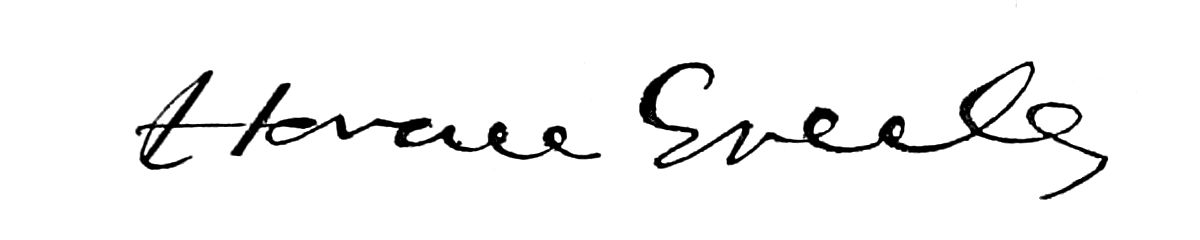
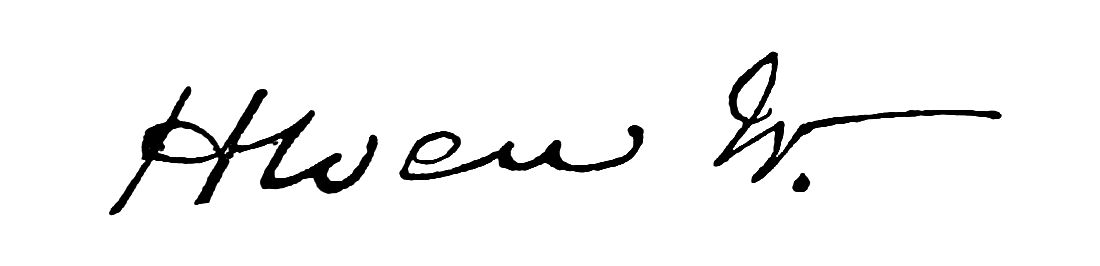
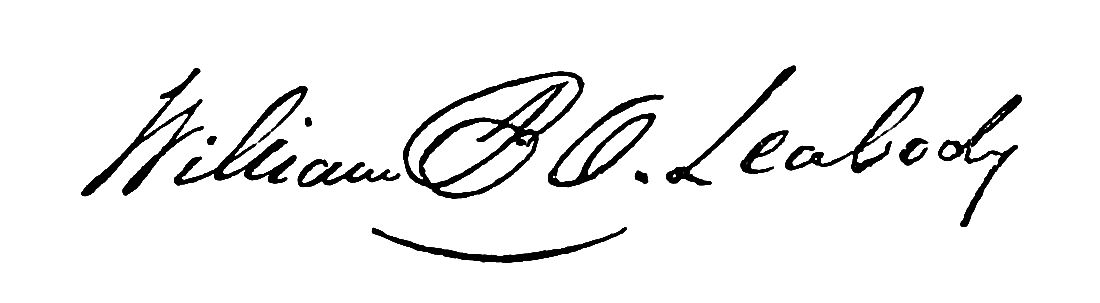
In our November and December numbers we gave
fac-simile signatures of no less than one hundred and
nine of the most distinguished American literati.
Our design was to furnish the readers of the Magazine
with a complete series of Autographs, embracing
a specimen of the MS. of each of the most noted among
our living male and female writers. For obvious
reasons, we made no attempt at classification or arrangement—either
in reference to reputation or our
own private opinion of merit. Our second article
will be found to contain as many of the Dii majorum
gentium as our first; and this, our third and last, as
many as either—although fewer names, upon the
whole, than the preceding papers. The impossibility
of procuring the signatures now given, at a
period sufficiently early for the immense edition of
December, has obliged us to introduce this Appendix.
It is with great pleasure that we have found our
anticipations fulfilled, in respect to the popularity
of these chapters—our individual claim to merit is
so trivial that we may be permitted to say so much—but
we confess it was with no less surprise than
pleasure that we observed so little discrepancy of
opinion manifested in relation to the hasty critical, or
rather gossiping observations which accompanied the
signatures. Where the subject was so wide and so
necessarily personal—where the claims of more
than one hundred literati, summarily disposed of,
were turned over for re-adjudication to a press so
intricately bound up in their interest as is ours—it is
really surprising how little of dissent was mingled
with so much of general comment. The fact, however,
speaks loudly to one point:—to the unity of
truth. It assures us that the differences which exist
among us, are differences not of real, but of affected
opinion, and that the voice of him who maintains
fearlessly what he believes honestly, is pretty sure to
find an echo (if the speaker be not mad) in the vast
heart of the world at large.
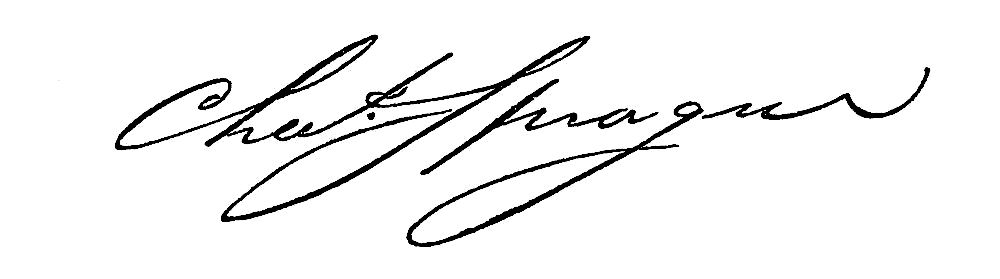
The “Writings of Charles Sprague” were first
collected and published about nine months ago, by
Mr. Charles S. Francis, of New-York. At the time
of the issue of the book, we expressed our opinion
frankly, in respect to the general merits of the author—an
opinion with which one or two members of the
Boston press did not see fit to agree—but which, as
yet, we have found no reason for modifying. What
we say now is, in spirit, merely a repetition of what
we said then. Mr. Sprague is an accomplished
belles-lettres scholar, so far as the usual ideas of
scholarship extend. He is a very correct rhetorician
of the old school. His versification has not been
equalled by that of any American—has been surpassed
by no one, living or dead. In this regard there
are to be found finer passages in his poems than any
elsewhere. These are his chief merits. In the essentials
of poetry he is excelled by twenty of our countrymen
whom we could name. Except in a very few
instances he gives no evidence of the loftier ideality.
His “Winged Worshippers” and “Lines on the
Death of M. S. C.” are beautiful poems—but he has
written nothing else which should be called so. His
“Shakspeare Ode,” upon which his high reputation
mainly depended, is quite a second-hand affair—with
no merit whatever beyond that of a polished and
vigorous versification. Its imitation of “Collins’
Ode to the Passions” is obvious. Its allegorical
conduct is mawkish, passé, and absurd. The poem,
upon the whole, is just such a one as would have
obtained its author an Etonian prize some forty or
fifty years ago. It is an exquisite specimen of mannerism
without meaning and without merit—of an
artificial, but most inartistical style of composition,
of which conventionality is the soul,—taste, nature
and reason the antipodes. A man may be a clever
financier without being a genius.
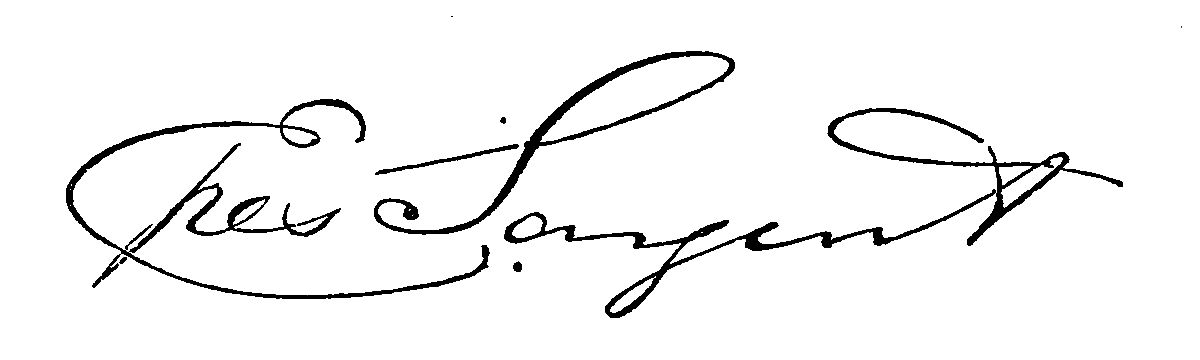
It requires but little effort to see in Mr. Sprague’s
MS. all the idiosyncrasy of his intellect. Here are
distinctness, precision, and vigor—but vigor employed
upon grace rather than upon its legitimate
functions. The signature fully indicates the general
hand—in which the spirit of elegant imitation and
conservatism may be seen reflected as in a mirror.
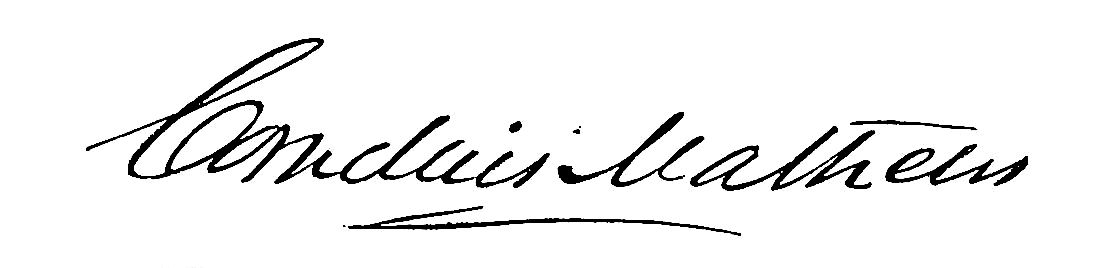
Mr. Cornelius Mathews is one of the editors
of “Arcturus,” a monthly journal which has attained
much reputation during the brief period of its existence.
He is the author of “Puffer Hopkins,” a clever
satirical tale somewhat given to excess in caricature,
and also of the well-written retrospective criticisms
which appear in his Magazine. He is better known,
however, by “The Motley Book,” published some
years ago—a work which we had no opportunity of
reading. He is a gentleman of taste and judgment, unquestionably.
His MS. is much to our liking—bold, distinct and
picturesque—such a hand as no one destitute of talent
indites. The signature conveys the hand.
Mr. Charles Fenno Hoffman is the author of
“A Winter in the West,” “Greyslaer,” and other
productions of merit. At one time he edited, with
much ability, the “American Monthly Magazine” in
conjunction with Mr. Benjamin, and, subsequently,
with Dr. Bird. He is a gentleman of talent.
His chirography is not unlike that of Mr. Matthews.
It has the same boldness, strength, and picturesqueness,
but is more diffuse, more ornamented and less
legible. Our fac-simile is from a somewhat hurried
signature, which fails in giving a correct idea of the
general hand.
Mr. Horace Greely, present editor of “The Tribune,”
and formerly of the “New-Yorker,” has for
many years been remarked as one of the most able
and honest of American editors. He has written
much and invariably well. His political knowledge
is equal to that of any of his contemporaries—his
general information extensive. As a belles-lettres
critic he is entitled to high respect.
His MS. is a remarkable one—having about it a
peculiarity which we know not how better to designate
than as a converse of the picturesque. His
characters are scratchy and irregular, ending with
an abrupt taper—if we may be allowed this contradiction
in terms, where we have the fac-simile to
prove that there is no contradiction in fact. All
abrupt MSS., save this, have square or concise terminations
of the letters. The whole chirography
puts us in mind of a jig. We can fancy the writer
jerking up his hand from the paper at the end of each
word, and, indeed, of each letter. What mental
idiosyncrasy lies perdu beneath all this, is more than
we can say, but we will venture to assert that Mr.
Greely (whom we do not know personally) is, personally,
a very remarkable man.
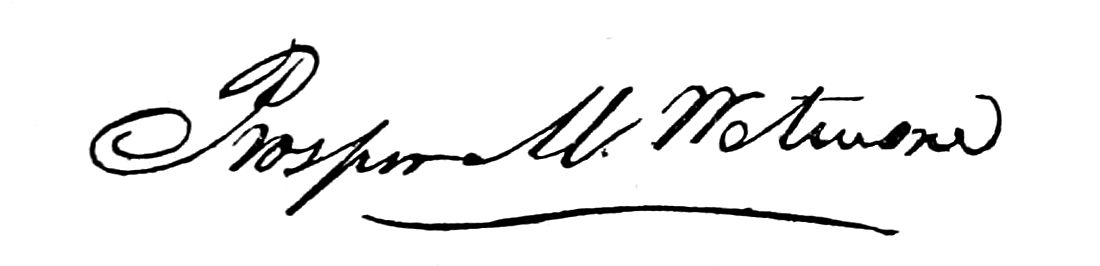
The name of Mr. Prosper M. Wetmore is familiar
to all readers of American light literature. He has
written a great deal, at various periods, both in prose
and poetry, (but principally in the latter) for our
Papers, Magazines and Annuals. Of late days
we have seen but little, comparatively speaking, from
his pen.
His MS. is not unlike that of Fitz-Greene Halleck,
but is by no means so good. Its clerky flourishes
indicate a love of the beautiful with an undue straining
for effect—qualities which are distinctly traceable
in his poetic efforts. As many as five or six
words are occasionally run together; and no man
who writes thus will be noted for finish of style.
Mr. Wetmore is sometimes very slovenly in his best
compositions.
Professor Ware, of Harvard, has written some
very excellent poetry, but is chiefly known by his
“Life of the Saviour,” “Hints on Extemporaneous
Preaching,” and other religious works.
His MS. is fully shown in the signature. It evinces
the direct, unpretending strength and simplicity which
characterize the man, not less than his general compositions.
The name of William B. O. Peabody, like that
of Mr. Wetmore, is known chiefly to the readers of
our light literature, and much more familiarly to
Northern than to Southern readers. He is a resident
of Springfield, Mass. His occasional poems have
been much admired.
His chirography is what would be called beautiful
by the ladies universally, and, perhaps, by a large
majority of the bolder sex. Individually, we think it
a miserable one—too careful, undecided, tapering,
and effeminate. It is not unlike Mr. Paulding’s, but
is more regular and more legible, with less force.
We hold it as undeniable that no man of genius ever
wrote such a hand.
Epes Sargent, Esq., has acquired high reputation
as the author of “Velasco,” a tragedy full of beauty
as a poem, but not adapted—perhaps not intended—for
representation. He has written, besides, many
very excellent poems—“The Missing Ship,” for
example, published in the “Knickerbocker”—the
“Night Storm at Sea”—and, especially, a fine production
entitled “Shells and Sea-Weeds.” One or
two Theatrical Addresses from his pen are very
creditable in their way—but the way itself is, as we
have before said, execrable. As an editor, Mr. Sargent
has also distinguished himself. He is a gentleman
of taste and high talent.
His MS. is too much in the usual clerk style to be
either vigorous, graceful, or easily read. It resembles
Mr. Wetmore’s but has somewhat more force.
The signature is better than the general hand, but
conveys its idea very well.
The name of Washington Allston, the poet and
painter, is one that has been long before the public.
Of his paintings we have here nothing to say—except
briefly, that the most noted of them are not to our
taste. His poems are not all of a high order of merit;
and, in truth, the faults of his pencil and of his pen
are identical. Yet every reader will remember his
“Spanish Maid” with pleasure, and the “Address to
Great Britain,” first published in Coleridge’s “Sybilline
Leaves,” and attributed to an English author, is
a production of which Mr. Allston may be proud.
His MS. notwithstanding an exceedingly simple
and even boyish air, is one which we particularly
admire. It is forcible, picturesque and legible, without
ornament of any description. Each letter is
formed with a thorough distinctness and individuality.
Such a MS. indicates caution and precision, most
unquestionably—but we say of it as we say of Mr.
Peabody’s, (a very different MS.) that no man of
original genius ever did or could habitually indite it
under any circumstances whatever. The signature
conveys the general hand with accuracy.

Mr. Alfred B. Street has been long before the
public as a poet. At as early an age as fifteen, some
of his pieces were published by Mr. Bryant in the
“Evening Post”—among these was one of much
merit, entitled a “Winter Scene.” In the “New-York
Book” and in the collections of American poetry
by Messieurs Keese and Bryant, will be found many
excellent specimens of his maturer powers. “The
Willewemoc,” “The Forest Tree,” “The Indian’s
Vigil,” “The Lost Hunter” and “White Lake” we
prefer to any of his other productions which have
met our eye. Mr. Street has fine taste, and a keen
sense of the beautiful. He writes carefully, elaborately,
and correctly. He has made Mr. Bryant his
model, and in all Mr. Bryant’s good points would be
nearly his equal, were it not for the sad and too perceptible
stain of the imitation. That he has imitated
at all—or rather that, in mature age, he has persevered
in his imitations—is sufficient warrantry for
placing him among the men of talent rather than
among the men of genius.
His MS. is full corroboration of this warrantry. It
is a very pretty chirography, graceful, legible and
neat. By most persons it would be called beautiful.
The fact is, it is without fault—but its merits, like
those of his poems, are chiefly negative.
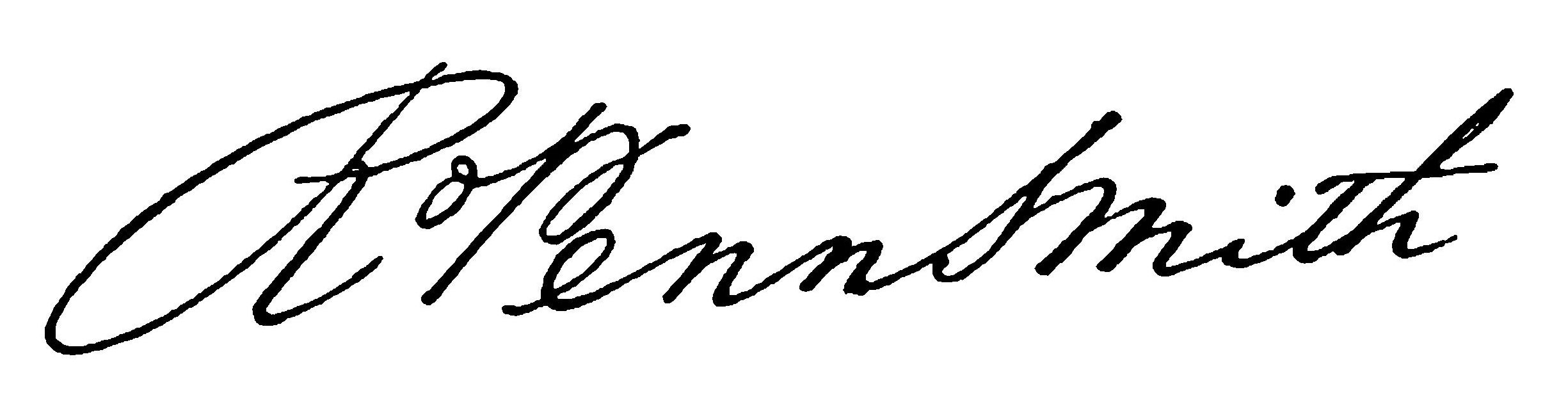
Mr. Richard Penn Smith, although, perhaps,
better known in Philadelphia than elsewhere, has
acquired much literary reputation. His chief works
are “The Forsaken,” a novel; a pseudo-auto-biography
called “Colonel Crocket’s Tour in Texas;”
the tragedy of “Caius Marius,” and two domestic
dramas entitled “The Disowned,” and “The Deformed.”
He has also published two volumes of miscellanies
under the title of “The Actress of Padua and
other Tales,” besides occasional poetry. We are not
sufficiently cognizant of any of these works to speak
with decision respecting their merits. In a biography
of Mr. Smith, however, very well written by his
friend Mr. McMichael of this city, we are informed
of “The Forsaken,” that “a large edition of it was
speedily exhausted”—of “The Actress of Padua,”
that it “had an extensive sale and was much commended”—of
the “Tour in Texas,” that “few books
attained an equal popularity”—of “Caius Marius,”
that “it has great capabilities for an acting play,”—of
“The Disowned” and “The Deformed,” that they
“were performed at the London theatres, where they
both made a favorable impression”—and of his
poetry in general, “that it will be found superior to
the average quality of that commodity.” “It is by
his dramatic efforts,” says the biographer, “that his
merits as a poet must be determined, and judged by
these he will be assigned a place in the foremost rank
of American writers.” We have only to add that we
have the highest respect for the judgment of Mr.
McMichael.
Mr. Smith’s MS. is clear, graceful and legible, and
would generally be called a fine hand, but is somewhat
too clerky for our taste.
Dr. Oliver Wendel Holmes, of Boston, late Professor
of Anatomy and Physiology at Dartmouth College,
has written many productions of merit, and has
been pronounced, by a very high authority, the best
of the humorous poets of the day.
His chirography is remarkably fine, and a quick
fancy might easily detect, in its graceful yet picturesque
quaintness, an analogy with the vivid drollery
of his style. The signature is a fair specimen
of the general MS.
Bishop Doane, of New Jersey, is somewhat more
extensively known in his clerical than in a literary
capacity, but has accomplished much more than sufficient
in the world of books to entitle him to a place
among the most noted of our living men of letters.
The compositions by which he is best known were
published, we believe, during his professorship of
Rhetoric and Belles Lettres in Washington College,
Hartford.
His MS. has some resemblance to that of Mr.
Greely of “The Tribune.” The signature is far
bolder and altogether better than the general hand.
We believe that Mr. Albert Pike has never published
his poems in book form; nor has he written
anything since 1834. His “Hymns to the Gods,”
and “Ode to the Mocking Bird,” being printed in
Blackwood, are the chief basis of his reputation.
His lines “To Spring” are, however, much better in
every respect, and a little poem from his pen, entitled
“Ariel,” and originally published in the “Boston
Pearl,” is one of the finest of American compositions.
Mr. Pike has unquestionably merit, and that of a
high order. His ideality is rich and well-disciplined.
He is the most classic of our poets in the best sense
of the term, and of course his classicism is very different
from that of Mr. Sprague—to whom, nevertheless,
he bears much resemblance in other respects.
Upon the whole, there are few of our native writers
to whom we consider him inferior.
His MS. shows clearly the spirit of his intellect.
We observe in it a keen sense not only of the beautiful
and graceful but of the picturesque—neatness,
precision and general finish, verging upon effeminacy.
In force it is deficient. The signature fails to convey
the entire MS. which depends upon masses for its
peculiar character.
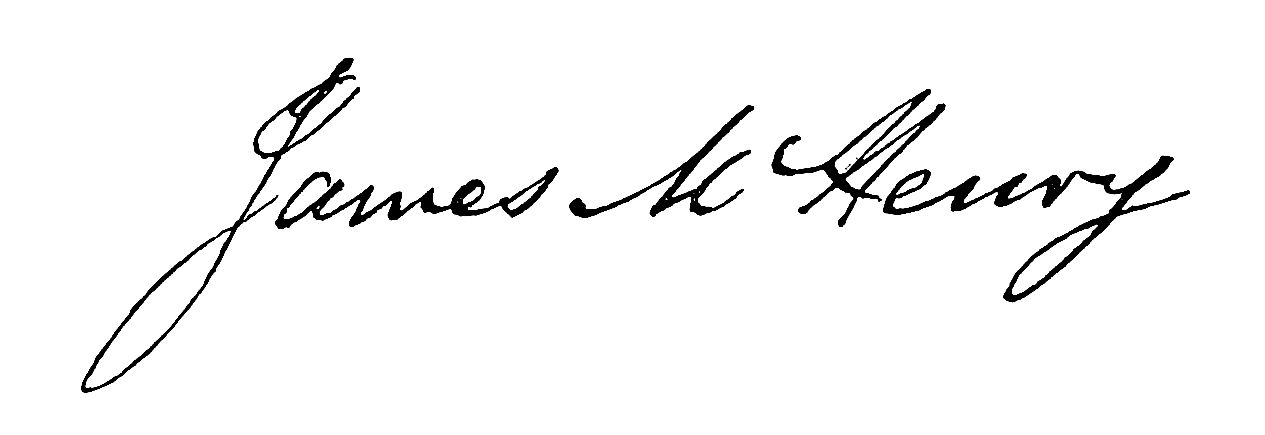
Dr. James McHenry, of Philadelphia, is well
known to the literary world as the writer of numerous
articles in our Reviews and lighter journals, but,
more especially, as the author of “The Antediluvians,”
an epic poem which has been the victim of
a most shameful cabal in this country, and the subject
of a very disgraceful pasquinade on the part of
Professor Wilson. Whatever may be the demerits,
in some regard, of this poem, there can be no question
of the utter want of fairness and even of common
decency which distinguished the Phillipic in
question. The writer of a just review of the “Antediluvians”—the
only tolerable American epic—would
render an important service to the literature
o his country.
Dr. McHenry’s MS. is distinct, bold and simple,
without ornament or superfluity. The signature
well conveys the idea of the general hand.
Mrs. R. S. Nichols has acquired much reputation
of late years, by frequent and excellent contributions
to the Magazines and Annuals. Many of her
compositions will be found in our pages.
Her MS. is fair, neat and legible, but formed somewhat
too much upon the ordinary boarding-school
model to afford any indication of character. The
signature is a good specimen of the hand.
Mr. Richard Adams Locke is one among the few
men of unquestionable genius whom the country possesses.
Of the “Moon Hoax” it is supererogatory
to say one word—not to know that argues one’s self
unknown. Its rich imagination will long dwell in
the memory of every one who read it, and surely if
the worth of any thing
Is just so much as it will bring—
if, in short, we are to judge of the value of a literary
composition in any degree by its effect—then was
the “Hoax” most precious.
But Mr. Locke is also a poet of high order. We
have seen—nay more—we have heard him read—verses
of his own which would make the fortune of
two-thirds of our poetasters; and he is yet so modest
as never to have published a volume of poems. As
an editor—as a political writer—as a writer in general—we
think that he has scarcely a superior in
America. There is no man among us to whose
sleeve we would rather pin—not our faith (of that
we say nothing)—but our judgment.
His MS. is clear, bold and forcible—somewhat
modified, no doubt, by the circumstances of his editorial
position—but still sufficiently indicative of his
fine intellect.
Mr. Ralph Waldo Emerson belongs to a class of
gentlemen with whom we have no patience whatever—the
mystics for mysticism’s sake. Quintilian
mentions a pedant who taught obscurity, and who
once said to a pupil “this is excellent, for I do not
understand it myself.” How the good man would
have chuckled over Mr. E! His present rôle
seems to be the out-Carlyling Carlyle. Lycophron
Tenebrosus is a fool to him. The best answer to his
twaddle is cui bono?—a very little Latin phrase very
generally mistranslated and misunderstood—cui
bono?—to whom is it a benefit? If not to Mr.
Emerson individually, then surely to no man living.
His love of the obscure does not prevent him, nevertheless,
from the composition of occasional poems
in which beauty is apparent by flashes. Several of
his effusions appeared in the “Western Messenger”—more
in the “Dial,” of which he is the soul—or
the sun—or the shadow. We remember the
“Sphynx,” the “Problem,” the “Snow Storm,”
and some fine old-fashioned verses entitled “Oh fair
and stately maid whose eye.”
His MS. is bad, sprawling, illegible and irregular—although
sufficiently bold. This latter trait may
be, and no doubt is, only a portion of his general
affectation.
The name of Gulian C. Verplanck has long been
familiar to all American readers, and it is scarcely
necessary to say more than that we coincide in the
general view of his merits. His orations, reviews,
and other compositions all evince the cultivated
belles-lettres scholar, and man of intellect and taste.
To high genius he has about the same claim as Mr.
Sprague, whom in many respects he closely resembles.
His chirography is unusually rambling and school-boyish—but
has vigor and precision. It has no
doubt been greatly modified by adventitious circumstances,
so that it would be impossible to predicate
anything respecting it.
———
BY W. GILMORE SIMMS, AUTHOR OF “ATALANTIS,” “THE YEMASSEE,” ETC.
———
[“Dorchester” was a beautiful little country town on the banks of the river Keawah, now Ashley, about twenty miles
from the city of Charleston, in South Carolina. It was chiefly settled by New Englanders. For a time it flourished and
became a market town of some importance. The planters of the neighborhood were generally persons of substance,
who lived in considerable state, and exercised the virtues of hospitality in an eminent degree; but with the war of the
Revolution, in which it suffered greatly, it began to decline, and its only remains now are the ruins of its church and the
open walls of the old British fort. From a memorandum which I made during a visit to the spot in 1833, I take the following:—“The
fort made of tapis—works still in considerable preservation—the wood-work alone decayed—the magazine
in ruins—and the area overgrown with plum trees. The church still standing—the steeple shattered by lightning,
and the wooden interior torn out—the roof beginning to decay at the ends of the rafters. It will probably fall in before
very long.” This prediction was not permitted to be verified. The fabric, I learn, has since been utterly destroyed by
an incendiary. Dorchester was distinguished by several actions of partisan warfare during the Revolution It was, by
turns, a military depot of the Carolinians and the British. These particulars will explain the little poem which follows.]
Not with irreverential thought and feeling I resign
The tree that was a chronicle in other days than mine;
Its mossy branches crown’d the grove, when, hastily array’d,
Came down the gallant partisan to battle in the shade;
It saw his fearless eye grow dark, it heard his trumpet cry,
When, at its roots, the combat o’er, he laid him down to die;
The warm blood gushing from his heart hath stain’d the sod below—
That tree shall be my chronicle, for it hath seen it flow!
Sweet glide thy waters, Ashley, and pleasant on thy banks
The mossy oak and mossy pine stand forth in solemn ranks;
They crown thee in a fitting guise, since, with a gentle play,
Through bending groves and circling dells thou tak’st thy lonely way:
Thine is the Summer’s loveliness—thy Winter too hath charms,
Thus sheltered in thy mazy course beneath their Druid arms;
And thine the recollection old, which honors thy decline,
When happy thousands saw thee rove, and Dorchester was thine.
But Dorchester is thine no more, its gallant pulse is still,
The wild cat prowls among its graves and screams the whippoorwill,
A mournful spell is on its homes, where solitude, supreme,
Still, coaching in her tangled woods, dreams one unbroken dream:
The cotter seeks a foreign home,—the cottage roof is down,
The ivy clambers all uncheck’d above the steeple’s crown;
And doubly gray, with grief and years, the old church tott’ring stands,
Ah! how unlike that holy home not built with human hands!
These ruins have their story, and, with a reverent fear,
I glide beneath the broken arch and through the passage drear;
The hillock at my feet grows warm—beneath it beats a heart
Whose pulses wake to utterance, whose accents make me start;
That heart hath beat in battle, when the thunder-cloud was high,
And death, in every form of fate, careering through the sky;
Beside it now, another heart, in peace but lately known,
Beats with a kindred pulse, but hath a story of its own.
Ah! sad the fate of maiden whose lover falls in fight,
Condemned to bear, in widowhood, the lonely length of light;—
The days that come without a sun, the nights that bring no sleep;
The long, long watch, the weariness, the same, sad toil—to weep!
Methinks, the call is happiness, when sudden sounds the strain
That summons back the exiled heart of love to heaven again;—
No trumpet-tone of battle, but a soft note sweetly clear,
Like that which even now is heard when doves are wooing near.
———
BY ANN S. STEPHENS.
———
One church and three dwelling houses, occupied
by bishops, had already been torn down to supply
material for the magnificent palace which the Duke
of Somerset was erecting for himself in the Strand,—a
sacrilege which the populace were beginning to
feel and resent, in a manner which threatened some
disturbance to the public peace. A rumor went
abroad that the Duke’s workmen had received his
commands to repair to Westminster on a certain day,
in order to pull down the Church of St. Margaret’s,
and add its materials to those already so boldly
wrested from their sacred purposes.
The gray of a summer’s morning was yet hanging
over the city, when a large number of workmen, each
wearing the Lord Protector’s badge, gathered in detached
parties about the Abbey. These men had been
employed in the destruction of St. Mary’s Church but
a few days before, and their coarse vestments were
torn and covered with the lime and dust which they
had brought from the ruin, a mark of their late sacrilegious
employment, which brought upon them many
a bitter taunt and frowning look from the wayfarers,
even before they entered the parish of Westminster.
So great was the manifestation of public resentment,
that each band of workmen, as it went along, drew
close together, and exhibited the pickaxes, crowbars,
and other heavy tools of iron with which they were
armed, like soldiers compelled on an irksome duty,
but resolute to perform it. These men gathered
slowly around the Abbey, and waited for a larger
body of working-men, who were expected to leave
their employment in the Strand and come to their
assistance in a force and number that might awe
the people into quiet submission to the injustice of
their lord.
The morning wore on, but they still lingered about
the church, trifling with their heavy tools and talking
together with some degree of anxiety, for the expected
aid had not yet arrived, and each instant the
streets and angles about the Abbey became more and
more thronged with sullen and discontented men, all
with lowering brows and flashing eyes, bent menacingly
upon them.
Still the crowd increased. Men hurried to and fro
eagerly and with cloudy looks. The workmen gradually
gathered in a close phalanx about the little
church, whispered anxiously together, and brandished
their tools with a faint show of defiance, yet seemed
afraid or reluctant to level them against the sacred
pile which stood among that mass of eager human
beings in the cool morning light, quiet and tranquil
as the spirit of holiness that brooded over its altar.
Though the persons gathered about St. Margaret’s
were considerable in numbers, they were not yet
condensed into a form that could justly be termed a
mob. The streets were alive, but not yet blocked up
with people. Men, and even women, might pass to and
fro on ordinary business without much fear of injury
or interruption, but with a certainty of being jostled
and pushed about by the scattered stream of human
life that flowed toward the cathedral.
While the neighborhood of St. Margaret’s was in
this unusual state, two females, followed by more
than an equal number of serving-men, each with the
Lord Protector’s badge upon his sleeve, came suddenly
round a corner, and, before they seemed aware of it,
were encompassed by the crowd, through which it
seemed each instant more difficult to make a free
passage. The two females were muffled in their
mantles, with the hoods drawn so closely that it
was difficult to distinguish their features, or gather
an idea of their station, save by a certain air of dignity
and refinement which hung about the shorter of
the two, and which no vestments could entirely conceal.
Both this lady and her companion seemed
bewildered and terrified by the rush of human beings
with which they had become so strangely mingled. At
first they attempted to retrace their steps, but the
street through which they had come was now blocked
up by a company of more than two hundred
working-men, who were coming up from their employment
on the Strand, to assist in the destruction
of St. Margaret’s. When thus convinced that all
hopes of retreat were cut off, the female who had
seemed most anxious to escape the crowd, put forth
a white and trembling hand from beneath her mantle
and drew the hood still more closely over her face,
while the other in her fright allowed the drapery to
fall back from her head and exposed the features of
an elderly woman slightly wrinkled, and at the moment
pale as a corpse with apprehension. Her sharp
black eyes were keen with terror, and her wrinkled
hands shook in a way that rendered the effort to draw
her hood forward one of considerable difficulty. The
servitors who followed these bewildered persons
were but little annoyed by the position which
seemed so painful to them, but one, a tall insolent
man, held up his arm that all might see the Lord
Protector’s badge, and ordered those immediately
around him to make way for a noble lady of the
Duke’s household to pass. He spoke loud and arrogantly,
but the muffled female grasped his arm, and
while her words came gaspingly from excess of fear,
muttered—
“Dost thou not see how these men lower and frown
upon us already? Hearest thou not my noble father’s
name bandied from lip to lip, and each time with a
curse coupled with it? Take down thy arm, good
Richard—muffle the sleeve within thy cloak and
let us struggle forward as we are best able.”
The serving-man hastened to obey this direction,
and wrapped his arm in the short cloak which
had been allowed to float back from his shoulder.
This act was performed the more promptly as a score
of burning eyes had flashed back a stern admonition
of danger when challenged by the Somerset badge
thus ostentatiously uplifted in their midst. Even as
it was, the man’s temerity might have been followed
by violent consequences, but that a deeper and more
general object of resentment presented itself in the
body of workmen that had made its way up from the
Strand through the cross street which our little party
had left but a moment before, and now flung itself
impetuously into the excited crowd. The moment
these men were seen pushing their way towards
their brethren gathered about St. Margaret’s, shouting
defiance and pushing the citizens about with their
heavy iron-tools, the spirit of discord broke loose
like a wild beast from his cage. A hoarse shout
thundered through the air. The hitherto stern and
silent multitude swayed round and plunged forward,
a mass of enraged, reckless, human life, eager to
trample down the body of men who came among
them armed to do sacrilege on the holy temple of their
worship. When the first fierce cry of their onset
swept over the females whose movements we have
recorded, the one whose features were yet concealed
grasped her companion’s arm, and, shrieking with
affright, sprang wildly on one side, forcing a passage
to the steps of a dwelling-house, where she sunk at
the foot of a granite pillar, panting like a wounded
fawn beneath the drapery which still concealed her
person. Her attendants strove to follow her but were
swept away by the rushing multitude, and, spite of
their struggles, forced into the mêlée raging between
the citizens and the Somerset workmen. These men
fought their way valiantly. Keeping in a compact
body they resolutely cleared a path through the unarmed
mob with their heavy crowbars and pickaxes,
which proved most effective weapons of defence.
The people goaded to fury by opposition rushed
madly upon them, strove to wrest away their weapons
by brute force, and when that failed tore up the pavement
and hurled the massive stones furiously into
their midst. Many were wounded, more than one
dropped down dead, crushed beneath the deadly missiles
which filled the air. The sweet breath of morning
was made terrible by the groans and cries and
harsh sounds of hot-blooded men, goaded to fury
and fierce with a thirst for strife, which threatened
to deluge the torn pavements with blood and carnage.
The band of workmen which had already reached
St. Margaret’s at first essayed to aid their companions
but it was impossible even to penetrate the mob of
citizens which separated the two parties, and they
returned to their station before the church, which
the mob, in its blind eagerness to attack the larger
and more obnoxious party, had left almost entirely at
their mercy. Still their numbers were small, and
the enraged people so near at hand that but the lifting
of an implement of destruction would have placed
them in imminent peril. So they remained inactive,
contenting themselves with a hope that Somerset,
the Lord Protector, would hear of the riot and come
to his people’s rescue. Still the fight raged on, the
workmen were driven back, step by step, to a cross
street whence they had emerged, and which their
numbers choked up, forming a solid front, narrow
and compact, which the assailants found impossible
to break and difficult to contend against, as few had
the hardihood to come within the sweep of those
heavy iron bars which were never wielded but they
crushed some human being to the earth. While the
workmen maintained this position the assailants
were compelled to abate the fury of their attack.
The scene of strife too had been considerably removed
from the first place of encounter.
The young female, who is the especial object of
our interest, crouched at the base of the granite pillar
where she had sought refuge, shuddering and sick
with fear, amid this tumult of strife and terrible passions
raging about her. She heard the shrieks and
howling cries of the multitude as they struggled together,
heard them tear up the pavement with curses,
and felt the air tortured into unnatural currents as
the heavy stones whirled fiercely over her head.
Still she neither shrieked nor moved a limb, but clung
with a shuddering clasp to the pillar, helpless and
almost stupefied with terror. While the fight raged
fiercest about her she remained unnoticed, for even
there, amid that throng of men tugging at each other’s
throats and wrangling like wild animals together,
females were to be seen fighting and eager for strife—the
most relentless among the throng. In this terrible
mingling of sexes and strife of angry passions, a
helpless and prostrate female, shrinking from a
scene too horrible even for her imagination, might
well have been overlooked. All were too fiercely
occupied to offer her protection or insult. But as the
scene of strife became more distant the dense crowd
around her was scattered, and more than one of the
rude persons who hang about the skirts of a riotous
mob from idle curiosity or in hopes of plunder, observed
the deathly stillness of her position. There
was a delicacy in the small white hand and rounded
arm which clung to the pillar, exposed by the falling
drapery and flung out in beautiful relief upon the stone
as if a limb of exquisite sculpture had been chiselled
there. But the persons who gazed were too rude
for thoughts of beauty though so strangely betrayed. A
cluster of brilliants that blazed on one of the fingers,
and the rich drapery that lay in a picturesque heap
over her whole person, conveyed hopes of rich plunder,
and many a covetous eye twinkled with expectation
that when the crowd were drawn to a distance
she might be left helpless and exposed to their rapacity.
At last an artisan or mechanic of the lowest
order ascended the steps where she had sought
refuge, and, apparently heedless of her presence, sat
down on the opposite side of the pillar, so near that
his dusty leathern jerkin almost touched the arm still
wound immovably around it. He now uncovered
his head and wiped the perspiration from a low and
disagreeable forehead with the sleeve of his jerkin,
pushed back a mass of coarse hair that had fallen
over his eyes, and was about replacing his cap, when
a flash of sunshine fell upon the cluster of brilliants
which gemmed one of the fingers just in a range with
his eye. A look of coarse delight came to his repulsive
features, a cunning avaricious joy disagreeable
beyond description. He cast an eager look upon the
throng, which was still great, and toyed with his cap,
waving it up and down with both hands carelessly as
if to cool his face when any person seemed especially
regarding him. At last, when the general attention
was drawn another way by a party of horsemen
coming at a hard gallop down the street, he, as if by
accident, held his cap so as to conceal his face from
the multitude, and drew back slowly till the pillar
half concealed him, then, softly removing the hand
from its clasp on the stone, he drew the ring away
quick as lightning, and grasping it in his rough palm
allowed the little hand to fall down cold and lifeless
upon the step.
“Plunder from the dead is free to the first comer,”
he muttered, replacing his cap, “a woman completely
killed or in a swoon is the same thing, and one or the
other state belongs to this dainty lady, I take it.”
As he muttered these words, the plunderer sauntered
with a heavy idle swagger down the steps, and
would have mingled with the crowd, but at that moment
an elderly man, evidently the servitor of some
noble family, paused by the steps, glanced at the recumbent
figure, and hastily inquired who the person
was, and why no assistance had been rendered. The
artisan, to whom he addressed himself as the nearest
person, was suddenly taken with a decided and absorbing
interest in the struggle that still raged farther
down the street, and, when the question had been
thrice repeated, only withdrew his attention long
enough to declare that he was quite ignorant regarding
the lady so strangely situated, and, in truth, had
observed her for the first time when pointed out by
the worshipful questioner.
The new comer ran hastily up the steps, flung
back the mantle which had fallen over her face, and
revealed the features of a young girl, pale as death,
and lying cold and lifeless close to the pillar. A flood
of rich chestnut-brown hair had broken loose, and the
string of rough emeralds that had confined it lay
broken and scattered among the folds of her dress.
The man seemed to recognize those sweet features,
for he turned pale, and an exclamation, almost of
terror, broke from his lips. “She is dead!” he cried
in a voice of keen emotion—“her hands are cold as
ice. What shall I say to my poor lord—who will
dare tell him?”
“Then she has taken leave within a short space
of time,” muttered the artisan, who stood with his
back toward the pillar, gazing intently afar off, as if
he had some heavy stake which the contest would
decide. “I can swear that her hand trembled as I
pulled off the ring.”
“For the love of heaven, is there no one here who
will call assistance!” exclaimed the new comer,
kneeling down and raising the senseless lady with
his arm.
“Can I do anything?” inquired the artisan, gruffly,
as if aroused to a consciousness that the fainting lady
required some attention.
“Thank you, good friend, yes—run, I beseech
you for the nearest leech, or rather look out my
Lord Dudley, who has just ridden by; say to him
that a lady whose welfare is dear to him, has
swooned in the street, and is in danger from the mob.
Go, good man, go at once, or I fear me our blithesome
lady will never smile again!”
“Nay,” said the artisan, who had fixed a greedy
eye on the emeralds scattered over the lady’s dress.
“As I may not know the Lord Dudley when he is
found, had you not better leave the poor lady to me
while you seek him out yourself; the more especially
as you may see that her mouth is red again,
and there is a tear breaking through the thick eye-lashes
that were so black and still when you first
uncovered her face. The air has done her good.
Leave her to me, and by the time you come back with
the gentleman you wot of she will be well again.
Truly, my jerkin is none of the cleanest,” he added in
reply to a glance which the other had cast on his mean
raiment, “nor my face much to your liking, I see;
but I shall not run off with your dainty trouble there,
not being fool enough to cumber myself with anything
of womankind, be she gentle or simple, so you
can trust me.”
There was something in the artisan’s manner more
than in his appearance—and that was suspicions
enough, that rendered the person he addressed reluctant
to trust a being so helpless to his charge. He
hesitated and was deliberating how to act, when the
multitude came rushing back to their old station near
the church, shouting fiercely and uttering terrible
imprecations on the Duke of Somerset, who had sent
a large body of armed men up the Thames, who
had landed at the foot of Westminster Bridge, resolute
to support his artisans in the destruction of St.
Margaret’s. It was the first charge of this party, as
it joined the body of workmen, which still defended
the passage up St. Margaret’s street, that sent the
crowd rushing back upon the church. The small band
of horsemen which had just passed, wheeled suddenly
round and came back almost by compulsion, for their
way was entirely blocked up by the populace, and
behind were the Somerset men, urged to fierce
resentment, and goading them on to madness.
The leader of this equestrian band—for it evidently
belonged to neither of the contending parties—was a
young and remarkably handsome man, who seemed
entangled with the crowd by accident, and only
desirous of continuing his morning ride in tranquillity.
The magnificent trappings of his black charger—the
jewelled buckle which fastened the plumes on his
cap, leaving a fine open forehead and a mass of light
curling hair exposed to view. The short cloak of dark
green velvet bordered with gold—the slashed and
pointed doublet and hose underneath, betrayed him as
one of the brightest and most noble ornaments of the
young King Edward’s court, and were all in striking
contrast with the rude mob from which he was deliberately
striving to extricate himself. He was followed
by a number of retainers well mounted, and
all wearing his family badge; yet it was not till they
were forced to retrace their way and made some
slight commotion in the crowd in wheeling their
horses, that the tumultuous populace seemed to
recognize them. But when the leader was known,
those men not actively engaged in the fight, pressed
back to give him way, and greeted him with uncovered
heads—a few flung their caps in the air, calling
out for those in advance to make room for the
Lord Dudley; others took up the cry, and then went
up a loud eager shout of
“A Warwick! a Warwick! room, room for a
Warwick!” Thus sounding a defiance to the Somerset
battle-cry, that rang so fiercely up from the distance.
This recognition by the mob seemed to annoy the
object of their clamor beyond measure. He lifted
his hand with an imperative motion, in a vain effort to
silence their noisy greeting; but when he saw that this
was mistaken for encouragement, and that his family
name rang louder and with more joyous acclamation
above all the tumult, he bent his noble head to
the multitude with forced resignation, and strove more
resolutely to retreat from a scene, which from many
causes, filled him with anxiety and regret. More than
once his high spirit was so chafed by the notice
which he had unwillingly obtained, that nothing but
compassion for the multitude seemed to prevent him
giving a free rein to the noble beast which shook
his head, champed angrily his tightened bit, and curveted
with impatience among the mass of human
beings that scarcely gave his hoofs free play upon the
pavement.
The two men whom we left near the young female,
who was just returning to animation, were interrupted
in their discussion by these two sources of
renewed commotion which we have just related, and
when the cry of “a Warwick, a Warwick,” swept
by, the last comer, who was still supporting the
lady, started to his feet, placed a hand over his eyes
to shade them from the sun, and looked earnestly
over the sea of human heads rising and falling and
flowing by, like the motion of a forest when the
wind sweeps over it. All at once he uttered an
exclamation of pleasure, and rushing down the steps,
forced his way to the young horseman who was now
almost opposite the place he had occupied. Pushing
eagerly through the crowd which surrounded the
struggling charger, he seized him by the bit, as the
only means of attracting the rider’s attention in a
scene where his voice was exerted in vain; but so
great was the tumult that even this method proved
ineffectual, and it was not till he had flung the beast
almost upon his haunches that he was recognized
by the anxious nobleman. The young man bent his
head, for the eager face of his retainer startled him,
though the words he would have uttered were swept
away by the thousand fierce sounds that filled the air.
At last, by the aid of gesture and such broken words
as reached his master’s ear, the man made himself
understood. The horseman started upright in his
stirrups, cast a keen look toward the spot pointed out
by his attendant, and, heedless of all former caution,
plunged his spurs into the restless charger, which
reared and plunged with a violence that sent the
people back upon each other, and cleared a space of
some yards about him. Regardless of consequences,
the nobleman scarcely gave his horse time to recover
himself, but urged him through the frightened crowd
with an impetuosity that sent a shower of sparks
about his hoofs when they struck upon the lower-most
of the stone flags where the lady had taken
shelter.
The young man sprang from his saddle, and pushing
aside the artisan who still hung about her, took
the now partially recovered lady in his arms, and in
a voice of hurried and anxious affection inquired it
she were hurt, and multiplied questions one upon
another, mingling them with broken expressions of
tenderness, which she could only answer by sobs
and the profuse tears that rushed over her burning
cheeks. She seemed entirely overcome with joy at
his presence, and the intense shame arising from her
extraordinary situation. All his questions only served
to make her weep the more bitterly; but she clung
nervously to his hand, trembling between the pleasure
of his protection and the fear that he might
condemn her, and besought him, in broken tones, to
take her home, to forgive her, but, above all things,
to help her away from the mob of coarse rough
faces that were gazing upon her humiliation.
“Nay, compose yourself,” said Dudley, in those
low and persuasive tones best calculated to allay her
nervous excitement, “are you not safe with me?
you are too feeble to move yet. In a little time I
trust that we may pass in safety, but—”
“Forgive me, my lord,” interrupted the man who
had informed his master of the lady’s plight. “If her
ladyship can find strength to walk, had we not better
remove her at once to a place of safety? It is yet
possible to make our way round the corner, and so
into the Park.”
The Lord Dudley looked upon the crowd and
shook his head.
“See, my lord,” said the man still more earnestly,
“the people are becoming more turbulent than ever—in
less than five minutes the space between this
and the church will be crowded full again.”
“I fear she is too weak for the attempt,” replied
Dudley, looking down with tender anxiety into the
sweet troubled face lifted with an expression of timid
confidence to his.
“Oh, no, I am quite strong now; I can walk very
well if you are with me,” said the young girl; but
her pale and trembling lips belied the words as she
turned her back to the people and strove with unsteady
hands to gather the scattered masses of her
hair beneath the hood, which scarcely served to conceal
its rich beauty, dishevelled and loose as it was.
“See, I am quite ready,” she added, wrapping the
mantle about her, and gathering courage beneath the
concealment of its folds, and clinging to the young
nobleman’s arm she stood terrified, it is true, but
willing to submit herself to his guidance.
“My poor bird, how it pants and trembles beneath
my arm,” murmured Dudley. And amid all the annoyance
of his position, his heart thrilled with a
sense of the protection which it gave to the object
of his love; but the feeling gave way to one of keen
anxiety; for the populace were by this time assailed
so fiercely by the Somerset men that it was giving
way before them, and rapidly condensing itself
around the Abbey, which threatened soon to become
the scene of contention.
“What can be done? which way shall we go?”
said Dudley, appealing to his attendant.
The man looked around and gravely shook his
head. “I see no plan of escape unless we struggle
through the crowd,” he replied despondingly, “and
yet there is but your lordship and my humble self to
protect the Lady Jane, and the press threatens to be
great.”
The artisan who had made a show of holding
Dudley’s horse, while he concealed the ring and as
many of the jewels which had dropped from the
lady’s hair as he could purloin during the short time
that she had been left alone with him, in the sleeve
of his jerkin—now slipped the bridle over his arm,
and came up the steps so far as its length would
permit.
“If I might advise, fair sir,” he said, doffing his
cap, and concealing a large emerald that had before
escaped him, with his foot, as he spoke. “If I might
make bold to give an opinion, three stout men are
enough to cover the retreat of one woman any day.
Your gallant self and my worshipful friend here, to
say nothing of the man before you, who lacks not
both tough bone and sinew in a fair fight, and the
noble horse, which I take it, is worth at least two
men, having a fine knack, as I but now witnessed, of
scattering a crowd with his hoofs. Well now, fair
sir, supposing you mount this noble nag and push
a way through the crowd, while my worshipful
friend and humble self follow at his heels with the
lady between us. Oh, this does not jump with the
lady’s humor, I see,” continued the man without
breaking the thread of his speech, as the Lady Jane
drew closer to her companion and murmured in an
affrighted voice, “no, no Dudley—keep you with
me or I shall die with terror else.”
Dudley answered by a gentle pressure of the arm
clinging to his, and the man went on, as we have
said, regardless of the interruption.
“Well, if she does not fancy the cut of my face,
perhaps the black charger there will have better
taste. Shall I mount and clear a path for you? It
is not often that I sit on a crimson saddle with housings
of velvet and gold—but there is an old saying
or a new one, it matters not which, that if you ‘put
a beggar on horseback he will ride’—I must not say
exactly where in the presence of this lady, but to
such a journey a passage through this crowd of
hooting scoundrels would be child’s play—shall I
mount, fair sir? you see the fight is getting nearer
and there will be hot work anon.”
As the man finished speaking, he dropped his
sheepskin cap quite by accident, and displayed considerable
awkwardness in picking it up again. For
a person rather shabbily dressed he certainly was
somewhat fastidious in replacing it jauntily on one
side of his head; but in the process a large emerald
was sent, with a dexterous movement of the fingers,
flashing down the sleeve of his jerkin, which probably
had some connection with this elaborate display
of taste.
At any other time Dudley would have rebuked the
fellow’s boldness, but he was too anxious for thoughts
of station or dignity, and turning from the rude
speaker to his attendant, he demanded earnestly if his
plan were practicable. Before the person addressed
could reply, an immense paving stone was hurled by
his temple, and, tearing off the artisan’s cap in its
progress, was dashed to pieces against the granite
pillar which had so long sheltered the Lady Jane
Saymore. A shriek burst from her pale lips, and
every face in that little group turned white as death.
After a moment the artisan took up his cap, and
thrusting his hand through a hole cut in it by the
stone, tried to convince himself and those about him,
by a broad laugh, that he was a man of decided
courage and not to be daunted by trifles that could
drive the blood from a nobleman’s cheek; but his
voice died in the miserable attempt, and he slunk
down to the horse’s head again, for the moment subdued
into silence.
“For the love of heaven, let us be gone,” said
Lord Dudley, terrified by the danger which threatened
the object of his love. “Mount, fellow; and if you
clear a way for this lady, you shall have gold”—
Before he could finish the sentence, the artisan
sprang to a seat on the gorgeous saddle, and striking
his mutilated cap down upon his head with one hand,
drew up the bridle, and shouting, “Make room for
the noble Dudley—a Warwick, a Warwick,” plunged
into the crowd.
Dudley threw his arm firmly round the Lady Jane,
and directing his attendant to keep close on the other
side, followed his strange conductor, who proved an
excellent guide; for in his appeal now to the people
in behalf of their favorite noble, now to the Somerset
men as one of their number, he succeeded in forcing
a passage for the party till they had almost reached
the front of St. Margaret’s; but here their position
became more dangerous than ever, for a detachment
of the Somerset men, after a desperate struggle to
force a passage through the body of people, had
found the way across a corner of the park and along
Prince’s street, almost within a stone’s throw of the
church, before their movement was discovered by
those resolute on its defence. It was in vain the
artisan pleaded for a passage now, his voice was overwhelmed
by the roar. He was raised considerably
above the crowd, and was among the first to discover
this new difficulty. He arose in the saddle, cast a
crest-fallen look over the sea of human heads that
surrounded him, then bending backwards, he addressed
the young lord and his companion in a voice
that was less steady than he would gladly have rendered
it—
“To the church, my lord—to the church at once!
The street is choked, as far as I can see—is choked
up with Somerset men; but they are mistaken if they
hope to reach St. Margaret’s; here are stout angry
fellows enough to keep them at bay till Michaelmas.
Seek shelter for the lady, fair Sir, before they all see
as much as I do, for there will be bloody work there,
or I am no reader of men’s faces.”
There was no time for parley or delay, the pale
craven face of the artisan bore witness to the truth
of what he said. Lord Dudley clasped his companion
more firmly, and forced his way with almost supernatural
strength toward the church. The artisan
would gladly have sought the shelter which he had
so wisely recommended to his noble companion; but
the horse had become restive under a strange guidance,
and before his head could be turned toward
St. Margaret’s, the mob had discovered the Somerset
workmen, and closed round him with a violence that
rendered a change of direction impossible. It was
in vain that he waved his cap, shouted Lord Dudley’s
name, and craved a free passage. His voice was
overwhelmed in the roar and rush of a conflict
more dreadful than had been witnessed that day.
The people saw the spoilers almost upon their consecrated
ground, and they fought like lions to protect
the sacred rest of their dead and the altar of their
worship. It was a just cause, but the strife a terrible
one indeed. So great was the press, that our
artisan found the motion of his horse cramped and
almost prevented. His limbs were crushed against
the noble animal till the pain became almost insupportable.
He would gladly have dismounted and have
taken his chance with the throng, but so dense was
the sea of human beings crowding upon him, that
there was not an inch of space through which he
might hope to reach the ground. So horse and rider
were violently borne forward at the mercy of the
crowd, and exposed to the shower of missiles that
now darkened the air.
Meantime Dudley and his companions had reached
the door of St. Margaret’s; but it was closed, and a
company of armed men stood resolutely before it.
The little band of workmen, which had kept its station
there till within the last hour, had at length deserted
their post, terrified by this guard of armed
men added to the mob which they had so long braved.
Despairing of escape they had clambered, each as
he best might, up the gothic windows and rough
stone work of the little church, and were now
crouching in groups on the roof, and striving to conceal
themselves behind the small turrets or steeples
that surmounted its four corners, afraid of being detected
by the populace, who were each moment becoming
more and more exasperated by their brethren.
“In the name of heaven, good friends, allow me
to find shelter for this lady within the church,” exclaimed
Lord Dudley, as pale and fearfully agitated
he turned in despair from the bolted door which he
had reached in spite of the pikes presented by the
self-constituted guard, “I am a friend to the people,
and this lady”—
“Is his sister,” interrupted the attendant hastily,
well knowing that her true title would harden the
men’s hearts against her, though she was almost
lifeless, and only kept from sinking at their feet by
the strong arm of her noble protector.
“But, even our church may soon be no place
of safety,” said one of the men, “a few minutes
and this building where our parents worshipped—where
our children were baptised—may be a heap
of ruins like those of St. Mary. Our holy altar stones
may be made into door steps for the Duke of Somerset’s
fine palace—yes, our chancels sacked to yield
stones to flag his wine-cellars, while the bones and
sacred dust of our fathers are cast into the street,
and scattered to the four winds of heaven.”
Dudley felt the gentle being, who clung to him for
safety, tremble and shrink, as if this angry speech
had been levelled at her alone.
“I know that the people have suffered some
wrong,” he said, in a mild but unsteady voice, for
he was painfully agitated, both by his late struggle
with the crowd, and the torture which the man’s
impetuous speech was inflicting on his gentle charge.
“But let me beseech you, unclose the door, my—my
poor sister is well nigh sinking to the earth with
fatigue and terror.”
Still the men remained obstinate, not only refusing
to open the door, but guarding it with a close row of
levelled pikes. The sound of fierce strife, which
now arose with appalling violence, within a few
roods of the church, seemed to fill them with cold
and stubborn bitterness. At last, when a loud and
terrible cry swept over them—a cry of triumph from
the Somerset men, mingled with a yell of defiance
from the mob, in which Somerset, the Lord Protector’s
name, was winged by shouts and curses through
the dense air, the man who had spoken before
turned almost menacingly on the young nobleman.
“Did I not tell you,” he exclaimed, “this is no
place for a lady? If we cannot guard our dead, how
can your charge be safe? Hear that shout—the
Duke of Somerset is himself coming up from the
river to reinforce his band of pillagers. A curse light
upon his sacrilegious head for this day’s work—a
curse on him and his!”
“Oh no, no; do not curse him!” exclaimed the
Lady Jane, starting from Dudley’s arm, and flinging
the hood back from her pale face with a wild impulse—“he
does not know—he has not thought how
dreadful all this is: you do not dream how kind he
is. In pity—for sweet mercy’s sake, do not curse
my father!”
“Her father,” exclaimed the men almost simultaneously,
and with menacing looks; “her father!”
Lord Dudley drew the young girl back to his side,
pulled the mantle almost roughly over her face, and
turned sternly upon the men.
“Behold,” he said, with a flashing eye, “behold
the effect of your cruel delay; my poor sister is
driven stark mad at last.”
The speech, and the pale steadfast features of
the young man, had the desired effect. The guard
did not open the door, it is true, but their manner
was more subdued, and they consulted in a low
voice together.
“And if we unlock the church, what warrant have
we that you are not a partisan of the Duke’s?” said
the leader, glancing suspiciously at the young nobleman’s
rich vestments; “you may be of his household,
nay, his son, for aught we know.”
“You have the word of a Warwick, and this
proof that the pledge is not given without right,”
said the young man, flinging aside his velvet cloak,
and displaying the family crest, set in brilliants, on
his sword-hilt. “Now, sirs, let me pass! I have
no share in this broil, and would gladly have escaped
from it unknown.”
“Pass in, and heaven’s blessing go with you!”
said the man, almost angrily striking up the line of
weapons which his band still kept levelled.
He unlocked the heavy door, and while the dense
mob shouted around him, eager to know why he
acted thus for a stranger, he stood, with uncovered
head, till the young nobleman had entered the church;
then, he closed the door again with a half repeated
blessing upon the lips that had been almost blistered
with imprecations a few moments before. The solemn
stillness and cool atmosphere, which pervaded
that little church, fell like a breath from heaven on
the three persons who entered it, weary and faint
from the turmoil that raged without.
The blended hues of purple and gold and crimson,
shed from the stained and diamond-shaped glass that
filled the gothic windows, flooded the building with
a dim mellow light, and slept, in a rich haze, among
the funereal urns of snowy marble placed in the various
niches, once occupied by images of Catholic
worship. A shadowy light, such as beams from a
mild sunset, lay upon the altar-stone, which gleamed
out white and pure above the purple velvet that carpeted
its steps. A baptismal fount of marble stood
on the right hand filled with clear water; but in that
rich light it seemed almost brimming with wine. Two
censers of massive silver stood above the altar, but
only as remnants of a discarded faith, for no incense
had been kindled in their hearts since the divorce of
the late Henry and Catherine of Arragon.
The whole church was pervaded with a beautiful
quiet, such as might reign in the shadowy dwellings
of paradise. Dudley yielded to its influence, and
drew a deep breath, half in awe, half in thankfulness,
as he gently placed the Lady Jane upon one of the
steps of the altar, and sprinkled her pale face with
the water which he dipped with his hand from the
baptismal fount. He took off the mantle which she
still unconsciously held tightly about her person, and
gathering up the rich tresses of her hair as they fell
upon the marble, made an awkward attempt to bind
them round her head. The poor lady was conscious
of his kindness, but so exhausted that she had no
power to thank him. The very effort to unclose her
eyes was an exertion too much for her languid state,
and the soft light which fell over her like a rich sunset
seemed lending beauty to a marble statue, so pale
and deathlike were her features. When Dudley inquired
with anxious tenderness after her welfare,
from time to time, she answered him with a faint
clasp of the hand which he took in his, and grateful
tears gushed in bright drops through her closed lashes,
and fell, one after another, like jewels upon the purple
velvet beneath her cheek. At last she opened
her eyes, a sweet and tender expression of pleasure
came to her face, and one of the familiar smiles
which Dudley loved so well sprang like sunlight to
her reddening lips. She was yet bewildered and
dreamy, but tranquillized by the one dear presence,
and the holy quiet which brooded over the place of
her rest. For a time she was unconscious of the
tumult which still raged without, for the sounds came
but faintly to that holy place, and seemed more like
the heaving beat of a far off ocean than a strife of
angry men, heated and drunken with bad passions.
All at once a shout so long, loud and fierce, that it
filled that tranquil building like the howl of a demon,
fell upon her ear. She started up with a full consciousness
of all that had happened to her during the
morning, and again sinking upon the steps of the
altar buried her face between her hands, and held
her breath with a feeling of terror such as she had
never known before.
At that moment Dudley’s attendant, who had remained
near the church door, came hurriedly toward
his master with information that the Duke of Somerset
had joined his men in person, and was now within
a few paces of the church.
(To be continued.)
———
BY JULIET H. LEWIS.
———
I sat by the casement; before me there
Lay a treasured thing, a long tress of hair,
And it moved my heart with a touching power—
’Twas the cherished gift of a parting hour.
The sun-shine lay ’mid its nut-brown fold
With a loving smile, as it did of old.
When the curl waved free in its careless grace,
Like a cloud in the sky, o’er the smiling face
Of the gentle girl that I loved so well—
A dimming tear on the bright lock fell
As thoughts of the loved one far away,
And the teeming past, on my sad heart lay.
A Zephyr, that all this time had play’d,
Like a laughing child, ’mid the rose tree’s shade,
Flew up, like a bird, to the casement there,
And bore off in triumph the lock of hair.
’Twas a cruel theft! and harsh words of blame,
Like a mountain stream, from my full heart came,
For the reckless deeds of the careless thing,
Ever hovering near on mischievous wing.
But the day before, he had entered my bower,
And scattered the leaves of its loveliest flower,
And bore off a letter that lay unread,
’Neath the scented buds, on a mossy bed,
To the brook hard by, who, with dimpled cheek
And a smothered laugh at the Zephyr’s freak,
Received the gift, and bounded on
As wild, and free, as a forest fawn,
To its hiding spots ’neath the greenwood shade,
Glancing back, through the leaves, where the young wind play’d.
“Now! Spirit of Air,” I cried, “gay breeze—
Are all thine acts as unkind as these?
Thy wings are unfettered—thy path is free—
Yet mine is the power to follow thee.”
Then thought sprang up on her weariless wing,
And tracked the wind, in imagining.
He stole the white plume from the thistle’s crest,
Which was light as down on the swan’s pure breast,
And with waving wing bore the prize away
To a happy group ’mid the flowers at play,
And fanning the cheek of each laughing boy,
With his cooling wing, waved the downy toy
Their bright heads above, and the careless band,
With eager eye, and with outstretched hand,
Ran away, in chase of the silvery thing
That the Zephyr bore on exulting wing.
Now slowly it floated their hands beneath—
Now upward it sprang on a stronger breath—
Now wafted afar—’twas a merry race
The Zephyr to lead, and the children in chase!
He left them behind, but bore along
Their glee-toned voices, in joyous song,
And each lone mother looked up and smiled,
As she caught the tones of her darling child,
And paused awhile from her toil, to bless
The heart, o’erflowing with happiness.
Then he went his way and on manhood’s brow
His cooling fingers are busy now,
He parts the dark hair from its resting place,
And prints a kiss on the anxious face,
And woos him to leave the dust and glare
Of the crowded town, for a spot more fair,
Where trees in blossom, and birds on wing,
Lead the rapt heart from each worldly thing.
But man heeds not, for his rest is sold,
And his heart bows down to the god of gold;
For the tempting Zephyr he “cares not a groat,”
He is eagerly reaching a “ten pound note,”
That ragged, and soiled on the counter doth lay,
But the Zephyr indignantly bears it away.
He toss’d it, he pull’d it, he twirled it around,
Now high in the air, and now low on the ground,
He moaned in derision, he whistled with glee,
Ah! never was Zephyr as merry as he,
Till at length, in his frolic, he entered a shed
Where a widow was praying for daily bread,
In the voice of faith, low, subdued and mild,
She prayed for food for her starving child:
Then the wind bowed down with its burden there,
And Heaven thus answered the widow’s prayer.
Then he entered the halls, where many a scene
Of joyous pleasure, and mirth had been—
He softly sighed o’er the festal board,
Where the jest had passed, and the red wine poured,
He swept the harp with his quivering wing,
And woke the tones of each mournful string,
While his murmuring voice, with its gentle chime,
Seemed singing a song of the olden time,
Or breathing a dirge o’er the gay hearts fled
To their silent homes ’mid the lowly dead.
He sighed through the banners that hung on high—
(Dimmed was their gorgeous blazonry,)
But they waved aloft, as they waved of old,
When the shout and song shook each heavy fold,
While the dust fell down in a darkening cloud—
And the moth was rocked in her silken shroud—
And the bat sprang forth from his loathsome nest,
’Mid the pennons there, an unseemly guest!
Then he went to the violet’s lonely bowers,
And gathered their breath, though he left the flowers,
And hastened on with the rich perfume
And a gladsome song, to the invalid’s room.
He hushed his voice as he entered there,
For holy and sad rose the sound of prayer,
With his wealth from the woods he wafted on,
And rushing memories of bright things gone
To the dying bore, while a low-breathed sigh,
Told of the Zephyr’s sympathy.
One tender act that he did that day,
Was a moment to pause where a stranger lay,
In an unknown land, with no loved one near
To breathe a sigh o’er his lowly bier,
Or moisten his grave with the tear-drops shed
From the mourning heart, o’er the loved and the dead.
Then mounting upward, on breezy wing,
To the white haw tree richly blossoming,
And, gathering its sweets with a gentle wave,
He spread them like snow o’er the stranger’s grave.
Green leaf, and bud, and starry flower,
Filled the rich air, like a lovely shower
Of bright things, sent from a fairy land,
And lay on the grave as though some kind hand
Had scattered, that silent heart above,
The sweets that in life it had learned to love.
But ’twere vain to tell of his wanderings free
O’er leafy land, and o’er foaming sea—
How he swept round the palace, and played through the cot—
Passed “the highest, the lowest, the loneliest spot;”
How he wafted the purple of lordly pride,
And fluttered the rags of the beggar aside,
How he made of a spray-capped wave his steed,
And rode o’er the ocean with Jehu speed,
(’Till his charger tossed its snowy mane,
And sank to its native depths again,)
How he hastened the ship on her homeward way,
And scattered her track with the ocean’s spray.
’Twere vain to number the acts like these,
That were done that day, by the joyous Breeze—
While I could but mark that, what first seemed rude,
Was gentle, and tender, and kind, and good.
I followed him far on his wayward track,
And when, from wandering, I turned me back,
He whispered at parting, these words, methought,
To my hasty heart,—“Judge not! judge not!”
———
BY THEODORE S. FAY, AUTHOR OF “NORMAN LESLIE,” “THE COUNTESS IDA,” ETC.
———
It is the fashion to consider Macbeth a spotless
and noble soul, ensnared by the toils of the fiends,
and pulled down from heaven to hell by the chance
meeting of the weird sisters on the heath. There is
a serious objection to this view. It makes machines
of men. It takes from us the most obvious and sublime
attribute of an immortal being, viz: free agency. If
a high-minded and God-revering mortal is unprotected
against the attacks of supernatural beings—if
foul witches may watch for him in unguarded moments,
and weave around his enchanted feet the
fatal snares of crime and death, then are we truly a
wretched race. But this is not Shakspeare’s creed.
This is not the character of the tragedy. Macbeth
was a villain. He had deliberately adopted vice as
his god long before the fiends were permitted to
patter with him. They come as a consequence not as
a cause of wickedness. The withered and wild sisters
on the blasted heath were conjured up by his
own cherished weaknesses and secret deeds.[4] They
were the haggard and hellish impersonations of his
own hidden thoughts and passions. He was not the
pure, generous, heaven-adoring person he is represented.
The germs of his guilt he had received into
his heart by himself years before, and they lay
shooting there in silence, only waiting the quickening
beam of opportunity—waiting the first, feeblest
temptation to start forth in all their force. He was
one of those fair-seeming men who pass for honest
and noble. The world contains now, as then, many
such. Many a man with an uplifted brow and a
clear name, waits only occasion to prove himself a
scoundrel. It is such specious hypocrites that gather
around them (as the smell of carrion does the hawk
and vulture) the plotting witches who watch for
power over the children of men. They had never
tempted the pure good old King Duncan. He might
have passed the blasted heath every day of his life,
and these hags would never have dreamed of appearing
to him. His soul was not prepared for their wiles.
But that of Macbeth—as well as that of his stern
wife—was corrupted by the whole tenor of their previous
life.
Had there been left no evidence of this, I should
still have asserted it. The innocent—the pure in
heart—they who daily commune with their Maker—who
acknowledge their weakness and danger
when left to themselves—and implore humbly at his
feet his all-sufficient aid—never fall victims to the
accursed fiends, whether they appear in the deformity
of Paddock and Graymalkin, or disguised
under the fair temptations of life.
But Shakspeare has left proof enough in his tragedy.
He meant to show, not (as is frequently
asserted) the downfall of noble grandeur and unsuspecting
innocence, but the destruction of a fair-showing,
unsuspected villain—the wreck of a ship
whose outward semblance was tall and imposing, but
which was unseaworthy and destined to go down
before the first gale.
In the first place, why does not Banquo suffer
from the fiends? He is with Macbeth when they
appear. He even boldly addresses them, and at once—with
the frank fearlessness of a noble and virtuous
mind, conscious of its honesty, commands them, if
they can read the future, to speak to him also.
“Speak then to me, who neither beg nor fear your favors,
nor your hate.”
Here is at once a man not to be tampered with.
They promise him also as well as Macbeth a dazzling
future good—a posterity of kings—but it in
no way changes his plans of life, or raises the least
idea in his mind of crime or intrigue. Even when,
according to the prediction of the witches, Macbeth
instantly receives intelligence, of his being thane of
Cawdor, Banquo’s clear-seeing sense of right, his
innocence of nature takes the true and virtuous view
of the affair, looks, at a glance, through all the complicated
web of the sisters’ plots, and keeps himself
unsoiled, unendangered by them.
Banquo. “But ’tis strange;
And often-times, to win us to our harm,
The instruments of darkness tell us truths;
Win us with honest trifles, to betray us
In deepest consequence.”
And while he is making this just reflection, the
obvious impulse of a mind not warped from the
erectness of a moral and religious integrity and reverence,
Macbeth soliloquizes with a kind of inexpressible
anticipatory triumph.
“Two truths are told
As happy prologues to the swelling act
Of the imperial theme.”
And he then goes on, like a ready made, long-matured
rascal as he is—like one whose mind had
no habit of virtuous or religious contemplation, but
which has always had a familiarity with evil and a
tendency downward:
——“Why do I yield to that suggestion
Whose horrid image doth unfix my hair,” etc.
The very moment his attention is directed to the
subject of his becoming king, he conceives the idea
of murdering the actual occupant of the throne, notwithstanding
the fact that there are two sons living.
An innocent man, were he told he would become
king of England, would not instantly set about murdering
the queen. He would (supposing him to have
faith in the prediction) say to himself, as indeed
Macbeth does at one time:
“If chance will have me king, why chance may crown
me, without my stir.”
The very first page of the tragedy marks Macbeth
for a villain even before he has made his appearance.
1. Witch. When shall we three meet again
In thunder, lightning, or in rain?
2. Witch. When the hurly-burly’s done,
When the battle’s lost and won;
3. Witch. That will be ere set of sun.
1. Witch. Where the place?
2. Witch. Upon the heath.
3. Witch. Then to meet with Macbeth.
Why have these fiendish women selected the gallant
soldier as their victim? What gathers them
about the “battle” that is raging near? What but
the scent of a sinful heart?
But there are other proofs of an extrinsic nature,
which settle the previous character of Lady Macbeth
at the same time, and shows how ripe they both
were for the fiends.
If a man’s true nature may be supposed to be
known to any one it is to his wife. He may put on
a smooth face before his best friend; he may write
or speak virtuous sentiments to the public; he may
give charitable donations, and follow the career of a
flaming patriot or a meek saint, but the lady upon
whom he has conferred with his name, the right of
being with him continually, will be pretty able to tell
how matters really are. I do not say that, because
a wife abuses her husband and calls him names, he
must necessarily be a rascal; but, as a general rule,
the partner of his woes and joys has better opportunities
of knowing the man than almost any one
else—at least, if she be a person of Lady Macbeth’s
discrimination. Well then, see what his lady says
of him, to herself, on receiving his letter recounting
the prediction of the weird sisters.
“Glamis thou art, and Cawdor; and shalt be
What thou art promis’d:—yet I do fear thy nature;
It is too full o’ the milk of human kindness,
To catch the nearest way.”
That she should suppose him too full of the milk
of human kindness to do cruel actions is a skilful
stroke in the delineation both of his nature and hers.
However well she knew him, as he had been till
then, an unprincipled man—even she had never
fathomed those depths of character, (for good or for
evil common to all men, and equally unfathomed
probably by himself,) which the subsequent events
disclosed. Shakspeare somewhere else says, “It is
not a year or so that shows us a man”—and it is an
important truth, that we are not thoroughly known
by our best friends, and do not know ourselves till
late in life. This same person, so full of the milk of
human kindness that she feared his “softer nature”
could never be brought to the necessary resolution,
no sooner finds himself once fairly compromised than
his atrocities throw the cruelties of ordinary oppressors
quite into the shade.
“Thou would’st be great;
Art not without ambition; but without
The illness should attend it. What thou would’st highly
Thou would’st holily; would’st not play false,
And yet would’st wrongly win,” etc. etc.
This passage has been often misunderstood. “Without
the illness” that should attend ambition—“what
thou would’st highly thou would’st holily,” does not
mean, thou art without the vices which should attend
ambition, and, what thou would’st highly—thou
would’st in a holy spirit. It means, he is without the
courage to bear the risk and odium necessary to the
successful carrying out of ambitious plans, although
he is willing enough to be guilty if he may not appear
to be so. “What he would highly,” he would also
with an appearance of holiness. He loves the mask
of virtue, but he loves also the sweets of sin. He
has thus far enjoyed the good opinion of the world.
He cannot bear to throw aside the wreath which he
has worn and which flatters his weakness and vanity.
It is the world which alone he thinks of. This is his
only god. Of the Supreme Being, there is not a
word; but of his inclination to assume the moral
responsibility there is a distinct acknowledgment:
“Would’st not play false
And yet would’st wrongly win. ‘Thou’d’st have, great Glamis,’
That which cries, ‘Thus thou must do if thou have it!’
And that which thou dost rather fear to do,
Than wishest should be undone.”
Here we have Macbeth’s character. Here we have
the secret of his goodness. It is fear and love of the
world.
Shakspeare meant to draw a very—very common
character, only he has made it colossal. How many
men in the common life of this day are irreproachable
from the same considerations—fear and love
of the world, joined to a certain dislike of the trouble,
exertion and risk of wrong. (“If we should fail!”)
That these are the moving springs of this seemingly
noble and generous but really remorseless and impious
character we see again from a remark of his
own. After contemplating the murder for some time,
he concludes to abandon the plan. Why? Because
he will not incur the moral guilt? Because he has
thoughts of his God, whose eye is on him, and who
cannot but punish a crime? Because the commandment
has been written, “Thou shalt do no murder?”
Because the Deity himself has decreed “blood for
blood?”
No. For reasons much more suited to his irreligious,
infidel, worldly mind:
“We will proceed no further in this business!
He hath honored me of late; and I have bought
Golden opinions from all sorts of people,
Which should be worn now in their newest gloss,
Not cast aside so soon.”
These are his reasons for not wishing to proceed.
Not a thought of his Maker—not an allusion to a
future world. He expressly says, in another passage,
if he could but be secure against detection in this
world, he does not feel any apprehension respecting
the other. He’ll “jump the world to come.”
No man, not corrupt by long previous backslidings
either of thought or deed, would act as Macbeth acts.
He grasps at the first idea of murder with the true
zest of an assassin. All his struggles are only those
of fear. The first time he meets the king, his generous,
grateful, and gracious master, he seems already
to have arranged the murder in his mind, and his
hypocrisy and cruelty do not waver an instant. He
discovers the self-possession and plausible villany of
a practised criminal, and this too before he sees his
wife upon the subject. It almost seems as if they
had spoken on this point before. When Duncan
heaps him with thanks and rewards, he answers:
Mac. “The service and the loyalty I owe,
In doing it, pays itself. Your Highness’ part
Is to receive our duties: and our duties
Are, to your throne and state, children and servants;
Which do but what they should, by doing every thing
Safe toward your love and honor.”
When the King says, as if in dark conformity to
the witches’ prediction:
“from hence to Inverness,
And bind us further to you,”
Macbeth, like a hungry leopard trembling with joy
at seeing his victim take refuge in his very den, says,
with an affectation of grateful submission:
Mac. “The rest is labor which is not used for you:
I’ll be myself the harbinger, and make joyful
The hearing of my wife with your approach.”
And then already, to himself:
Mac. “The Prince of Cumberland! That is a step
On which I must fall down, or else overleap;
For in my way it lies. Stars, hide your fires!
Let not light see my black and deep desires,
The eye wink at the hand, yet let that be
Which the eye fears, when it is done, to see.”
His famous soliloquy, “Out, out, brief candle,” is
in itself a superb piece of earthly philosophy, but it
becomes resplendently significant when regarded as
the creed of infidelity which has brought him where
he is; for he is an atheist, and therefore he is a
murderer.
“Life’s but a walking shadow; a poor player,
That struts and frets his hour upon the stage,
And then is heard no more: it is a tale
Told by an idiot, full of sound and fury,
Signifying nothing.”
These are not the thoughts of the gentle, happy-hearted
Shakspeare. These are the blasphemous
outbreakings of a blood-drenched, disbelieving soul,
vainly striving to make head against God’s vengeance
by denying his existence. No. Life’s not a
walking shadow. It is more than a poor player—than
a tale signifying nothing. It signifies much not
to be known by the “ignorant present,” as they find,
unhappy lost ones, who mistake such wicked blasphemies
for truth.
The pertinacity with which his selfish soul is
wedded to the world is again betrayed in one of his
last soliloquies, where, in running a kind of balance
in his accounts between the gains and losses of his
murderous ambition, he complains:
“And that which should accompany old age,
As honor, love, obedience, troops of friends,
I must not look to have; but, in their stead,
Curses, not loud, but deep, mouth-honor, breath,
Which the poor heart would fain deny, and dare not.”
Always the world bounds his hopes and his fears.
The original viciousness of his nature is also betrayed
by the readiness with which, once embarked
in the career of crime, he plunges in headlong. The
very morning of the murder of the king, he stabs in
their sleep the two grooms of the chamber, then
Banquo and Fleance (which latter escapes by chance.)
He rushes on from murder to murder with the rabid
fury of a hound maddened with the taste of blood.
He adopts the direst principles of action,
Mac. “From this moment
The very firstlings of my heart shall be
The firstlings of my hand.”
Surprises the castle of Macduff, and massacres his
wife, his babes,
“And all the unfortunate souls
That trace him in his line.”
That Shakspeare meant to draw, in this remarkable
portraiture, a worldly character unsupported by religion,
is evident from the tone of piety which runs
through the other characters. The gentlewoman’s
“Heaven knows what she has known,” and her
“pray God it be well.” The doctor’s “God, God
forgive us all!” Macduff’s
“Did Heaven look on
And would not take their part? Sinful Macduff,
They were all struck for thee! Naught that I am,
Not for their own demerits, but for mine,
Fell slaughter on their souls: Heaven rest them now.”
This is the oft repeated apprehension of a pious
heart which fears still its own weakness, and finds,
in the inscrutable and most awful visitatings of God
a merited blow—a chastener of its still corrupt desires—a
lesson to unlink it yet more from its grasp
on mortality.
Immediately again Macduff prays to heaven—and
in the same page Malcolm says:
“Macbeth
Is ripe for shaking, and the powers above
Put on their instruments.”
Another instance of the pure christian piety with
which the poet invests his good characters, and of
which he deprives his bad ones, telling strongly for
Dr. Ulrici’s theory, occurs in the third scene of the
fourth act, where Malcolm, the heir to the throne, in
order to try Macduff, represents himself as being full
of vices. Macduff replies,
“Thy Royal Father
Was a most sainted King; the Queen, that bore thee,—
Oftener upon her knees than on her feet.”
In his answer, Malcolm uses the expression, full
of pious reverence:
“But God above
Deal between thee and me,” &c.
And still another, the morning after the murder,
when Macduff says:
“In the great hand of God I stand,” &c.
A SKETCH OF REALITY.
———
BY MISS LESLIE.
———
On my first visit to Boston, about nine years since,
I was offered, by a lady of that kind and hospitable
city, (the paradise of strangers,) an introduction to
the two daughters of the celebrated Mather Byles:
and I gladly availed myself of this opportunity of
becoming acquainted with these singular women,
whom, I had been told, were classed among the
curiosities of the place.
Their father, a native Bostonian, (born in 1706,
during the reign of Queen Anne,) was connected
with the family of Cotton Mather. His education
was completed in England, where he studied theology
at Cambridge, and was afterwards ordained a minister
of the gospel according to the Episcopal faith.
On his return to Boston, Mather Byles was inducted
into the first pastor-ship of Hollis street church, then
a newly-erected edifice, constructed entirely of wood,
as were most American churches of that period.
He became proprietor of a house and a small piece
of ground near the junction of Tremont and Nassau
streets. In this house all his children were born,
and here the two that survived were still living.
His wife was a daughter of Governor Taylor.
The position of Dr. Byles as a clergyman, his literary
acquirements, his shrewd sense, and his ready
wit, caused him to be highly popular at home, and
brought him into personal acquaintance or epistolary
correspondence with many of the principal men of
his time, on both sides of the Atlantic. He frequently
exchanged letters with Pope and with Dr. Watts:
and among the visiters at his “modest mansion”
might be enumerated some of the most distinguished
persons of his native province—while strangers of
note eagerly sought his acquaintance.
All went smoothly with Dr. Byles till America
became impatient of her dependence on the crown
of Britain; and, unfortunately for him, his sympathies
were on the side of the mother country. He could
not be persuaded that her children of the new world
had sufficient cause for abrogating the authority of
the nation from whence they had sprung; and he
considered their alleged grievances as mere pretexts
for throwing off a chain which, in his opinion, had
pressed but lightly on them; and that, in short, as
Falstaff said of the Percy and Mortimer insurrection,—“Rebellion
lay in their way, and they found it.”
His congregation had warmly and almost unanimously
espoused the popular cause, and, consequently,
were much irritated at the ultra royalist feelings and
opinions of their pastor, whose difficulties with his
flock seeming daily to increase, Dr. Byles eventually
thought it best to resign his situation as minister of
Hollis street church.
The war broke out; the battle of Bunker Hill was
fought, and Boston was subsequently occupied by the
British army, and besieged by the Americans, who
established themselves in hostile array upon the
heights that commanded the town,—and, with a
view of dislodging the enemy, they vigilantly exerted
themselves in stopping all supplies of fuel and provisions.
After holding out against the patriots during
a leaguer of more than eight months, the British
finally withdrew their forces, and embarked them to
carry the war into another section of the country.
Now, that something like order was again restored
in the town of Boston and its vicinity, it was thought
time to punish those who had rendered themselves
obnoxious by aiding and abetting the cause of the
enemy. Some of the most noted royalists were
expelled from the province and took refuge in Nova
Scotia, others went into voluntary exile and repaired
to England, where they preferred a claim of indemnification
for the losses they had sustained by adhering
to the cause of monarchy. Among others, Dr. Mather
Byles was denounced at a town-meeting, for his
unconcealed toryism: for having persisted in praying
for the king; and for interchanging visits with the
British officers, most of whom were received familiarly
at his house. Upon these charges he was tried
before a special court, and at first sentenced to have
his property confiscated, and himself and family transported
to England. But the board of war, out of
respect to his private character, commuted his punishment
to a short imprisonment in his own house,
under the guard of sentinels, and allowed him to
retain his possessions.
The rebellion eventuated in a successful revolution;
and honor, fame, and the gratitude of their
country rewarded those who had assisted in the
glorious contest for independence; while all who had
held back, and all who had sided with the enemy,
were contumeliously cast into the shade, regarded
with contempt by their former associates, or compelled
to wear out their lives in exile from the land
of their birth. Most of the connections of the Byles
family quitted the States. But the doctor remained,
and finding that he could not regain his former place
among his townsmen, he lived in retirement during
the residue of his life, and died at his own house in
Boston, in 1788, in the 82d year of his age. He was
interred beneath the pavement of the chancel in
Trinity church, having worshipped there with his
family after quitting that of Hollis street.
In the old family house his two surviving daughters
had ever since continued to reside, steadily refusing
to sell either the building or the lot of ground attached
to it, though liberal offers for its purchase had repeatedly
been made to them. So deep-rooted was
their attachment to this spot, where they had been
born, and where they had always lived, that they
considered it impossible for them to exist in any
other place, continually asserting that a removal
from it would certainly kill them. They had a trifling
source of income which brought them two hundred
dollars annually, and they contrived to save nearly
the whole of this little sum. Also, they possessed a
tolerable quantity of old-fashioned plate, which they
had put away in a chest up stairs, never to be used
or sold while they lived. In the mean time their
wants were chiefly supplied, (and, indeed, many little
luxuries were furnished them,) by the benevolence of
certain ladies of Boston, who, in the goodness of
their hearts, overlooked the anomaly of two women
who had the means of a comfortable independence
within their reach, submitting to receive assistance
from eleemosynary bounty rather than relinquish
the indulgence of what, in those matter-of-fact times,
would, by most persons, be regarded as a mere
morbid fancy. But on this point of feeling they
believed their happiness to depend; and their tolerant
benefactresses kindly enabled them to be happy in
their own way.
The Miss Byleses kept no domestic; but a man
came every morning to attend to the wood and water
part of their ménage, and to go their errands—and
a woman was employed every week to do up the
Saturday work. A newspaper was sent to them
gratuitously—books were lent to them, for the
youngest was something of a reader, and also wrote
verses; and they frequently received little presents
of cakes, sweetmeats, and other delicacies. They
rarely went out, except to Trinity church. Then
they put on their everlasting suits of the same Sunday
clothes: their faces being, on these occasions,
shaded with deep black veils suspended from their
bonnets, not so much for concealment as for gentility.
The lady who volunteered to introduce me to the
daughters of Dr. Byles, was, as I afterwards understood,
one of those who assisted in affording them
some of the comforts which they denied to themselves.
We set out on our visit on one of the loveliest
mornings of a Boston summer, the warmth of the
season being delightfully tempered by a cool breeze
from the sea. After passing the beautiful Common,
(why has it not a better name?) my companion
pointed out to me, at what seemed the termination of
the long vista of Tremont street, an old black-looking
frame-house, which, at the distance from whence I
saw it, seemed to block up the way by standing
directly across it. It was the ancient residence of
Mather Byles, and the present dwelling of his aged
daughters; one of whom was in her eighty-first and
the other in her seventy-ninth year. This part of
Tremont street, which is on the south-eastern declivity
of a hill, carried us far from all vicinity to the
aristocratic section of Boston.
At length we arrived at the domain of the two
antique maidens. It was surrounded by a board
fence, which had once been a very close one, but
time and those universal depredators, “the boys,”
had made numerous cracks and chinks in it. The
house (which stood with the gable end to the street)
looked as if it had never been painted in its life. Its
exposure to the sun and rain, to the heats of a hundred
summers and the snows of a hundred winters,
had darkened its whole outside nearly to the blackness
of iron. Also, it had, even in its best days, been
evidently one of the plainest and most unbeautified
structures in the town of Boston, where many of the
old frame-houses can boast of a redolence of quaint
ornament about the doors, and windows, and porches,
and balconies. Still, there was something not unpleasant
in its aspect, or rather in its situation. It
stood at the upper end of a green lot, whose long
thick grass was enamelled with field flowers. It
was shaded with noble horse-chestnut trees relieved
against the clear blue sky, and whose close and
graceful clusters of long jagged leaves, fanned by
the light summer breeze, threw their chequered and
quivering shadows on the grass beneath, and on the
mossy roof of the venerable mansion.
We entered the enclosure by a board gate, whose
only fastening was a wooden latch with a leather
string; like that which secured the wicket of Little
Red Ridinghood’s grand-mother. There was a
glimpse of female figures hastily flitting away from
a front window. We approached the house by a
narrow pathway, worn by frequent feet, in the grass,
and a few paces brought us to the front door with
its decayed and tottering wooden steps. My companion
knocked, and the door was immediately
opened by a rather broad-framed and very smiling
old lady, habited in a black worsted petticoat and a
white short-gown, into the neck of which was tucked
a book-muslin kerchief. Her silver hair was smoothly
arranged over a wrinkled but well-formed forehead,
beneath which twinkled two small blue eyes. Her
head was covered with a close full-bordered white
linen cap, that looked equally convenient for night or
for day. She welcomed us with much apparent
pleasure, and my companion introduced her to me as
Miss Mary Byles. She was the eldest of the two
sisters.
Miss Mary ushered us into the parlor, which was
without a carpet, and its scanty furniture seemed at
least a century old. Beneath a surprisingly high
mantel-piece was a very low fire-place, from whence
the andirons having been removed for the summer,
its only accoutrement was a marvellous thick cast-iron
back-plate, of a pattern antique even to rudeness.
There were a few straight tall-backed chairs,
some with bottoms of flag-rush, and others with
bottoms of listing; and there was one fauteuil, to be
described hereafter. My attention was attracted by
the oldest-looking table I had ever seen, and of so
dark a hue that it was difficult to tell whether it was
mahogany or walnut. When opened out it must
have been circular; but, now that the leaves were
let down, it exhibited a top so strangely narrow (not
more than half a foot in width) that it was impossible
to divine the object in making it so; unless, indeed,
it was the fashionable table of the time. And fashion,
at all periods, has been considered reason sufficient
for anything, however inconvenient, ugly or absurd.
To support the narrow top and the wide leaves, this
table seemed to be endowed with a hundred legs and
a proportionate number of bars crossing among them,
in every direction, all being of very elaborate
turned work. I opine that this must have been a
great table in its day.
My companion inquired after the health of Miss
Catherine Byles, the youngest of the ladies. Miss
Mary replied that sister Catherine was quite unwell,
having passed a bad night with the rheumatism.
Regret was expressed at our losing the pleasure of
seeing her. But Miss Mary politely assured us that
her sister would exert herself to appear, rather than
forego an opportunity of paying her respects to the
ladies; and we as politely hoped that, on our account,
she would not put herself to the smallest inconvenience.
While compliments were thus flying, the door
of the next room opened, and Miss Catherine Byles
made her entrance, in a manner which showed us
that she went much by gracefulness.
Miss Catherine was unlike her elder sister, both in
figure and face; her features being much sharper, (in
fact, excessively sharp,) and her whole person extremely
thin. She also was arrayed in a black bombasin
petticoat, a short-gown, and a close lined cap,
with a deep border that seemed almost to bury her
narrow visage. She greeted us with much cordiality,
and complained of her rheumatism with a smiling
countenance.
My eyes were soon rivetted on a fine portrait of
Dr. Mather Byles, from the wonderful pencil of
Copley—wonderful in its excellence at a period
when the divine art was scarcely known in the provinces,
and when a good picture rarely found its way
to our side of the ocean. And yet, under these disadvantages,
and before he sought improvement in the
schools of Europe, did Copley achieve those extraordinary
fac-similes of the human face, that might
justly entitle him to the appellation of the Reynolds of
America, and are scarcely excelled by those of his
cotemporary, the Reynolds of England.
The moment I looked at this picture I knew that
it must be a likeness; for I saw in its lineaments the
whole character of Dr. Byles, particularly the covert
humor of the eye. The face was pale, the features
well-formed, and the aspect pleasantly acute. He
was represented in his ecclesiastical habiliments,
with a curled and powdered wig. On his finger was
a signet-ring containing a very fine red cornelian.
While I was contemplating the admirably-depicted
countenance, his daughters were both very voluble
in directing my attention to the cornelian ring, which
they evidently considered the best part of the picture;
declaring it to be an exact likeness of that very
ring, and just as natural as life.
Before I had looked half enough at Copley’s picture,
the two old ladies directed my attention to another
portrait which they seemed to prize still more
highly. This, they informed me, was that of their
nephew, “poor boy,” whom they had not seen for
forty years. It was painted by himself.—His name
was Mather Brown, and he was the only son of
their deceased elder sister. He had removed to London,
where, as they informed me, he had taken the
Prince of Wales and the Duke of York—“and,
therefore,” said one of the aunts—“he is painter to
the royal family.” They both expressed much regret
that they had not been able to prevail on their father,
after the revolution, to give up America entirely, and
remove with his family to England. “In that case,”
said Miss Mary, “we should all have been introduced
at court; and the king and queen would have spoken
to us; and I dare say would have thanked us kindly
for our loyalty.”
The truth was, as I afterwards found, that a much
longer period than forty years had elapsed since their
nephew left America; but they always continued to
give that date to his departure. He had painted
himself with his hair reared up perpendicularly from
his forehead, powdered well, and tied behind,—and,
in a wide blue coat with yellow buttons, and a very
stiff hard-plaited shirt-frill with hand-ruffles to
match. In his hand he held an open letter, which,
both his aunts informed me, contained the very words
of an epistle sent by one of them to him, and, therefore,
was an exact likeness of that very letter. To
gratify them, I read aloud the pictured missive,
thereby proving that it really contained legible words.
Having looked at the pictures, I was invited by
Miss Mary Byles to take my seat in the large arm-chair,
which she assured me was a great curiosity,
being more than a hundred years old, having been
sent over from England by “government,” as a present
to their maternal grandfather, Governor Taylor.
The chair was of oak, nearly black with age, and
curiously and elaborately carved. The back was
very tall and straight, and the carving on its top terminated
in a crown. This chair was furnished with
an old velvet cushion, which was always (by way of
preservation) kept upside down, the underside being
of dark calico. Miss Mary, however, did me the
honor, as a visiter, to turn the right side up, that I
might sit upon velvet; and as soon as I had placed
myself on it, she enquired if I found it an easy seat?
On my replying in the affirmative. “I am surprised
at that”—said she, with a smile—“I wonder how
a republican can sit easy under the crown.”—Beginning
to understand my cue, I, of course, was properly
diverted with this piece of wit.
Miss Catherine then directed my attention to the
antique round table, and assured me that at this very
table Dr. Franklin had drank tea on his last visit to
Boston. Miss Mary then produced, from a closet by
the chimney-side, an ancient machine of timber and
iron in the form of a bellows, which she informed
me was two hundred years old. It looked as if it
might have been two thousand, and must have been
constructed in the very infancy of bellows-making,
about the time when people first began to grow tired
of blowing their fires with their mouths. It would
have afforded a strange contrast, and a striking illustration
of the march of intellect, if placed by the
side of one of those light and beautiful, painted, gilt
and varnished fire-improvers which abound in certain
shops in Washington street. This bellows of other
days was so heavy that it seemed to require a strong
man to work it. The handles and sides were carved
all over with remarkably cumbrous devices; and the
nozzle or spout was about the size and shape of a
very large parsnep with the point cut off.
Miss Mary now asked her sister if she had no
curiosities to show the ladies? Miss Catherine modestly
replied that she feared she had nothing the
ladies would care to look at. Miss Mary assured us
that sister Catherine had a box of extraordinary
things, such as were not to be seen every day, and
that they were universally considered as very great
curiosities. Miss Catherine still seemed meekly
inclined to undervalue them. My companion, who
had seen the things repeatedly, begged that their
Philadelphia visiter might be indulged with a view
of these rarities—and, finally, after a little more
coquetry, a sort of square band-box was produced,
and Miss Catherine did the honors of her little
museum.
She showed us the envelope of a letter addressed
to her father by no less a person than Alexander
Pope, and directed in the poet’s own hand. The
writing was clear and handsome, and had evidently
been executed with a new pen, and with a desire
that the superscription should look well. Next, were
exhibited four commissions, each bearing the signature
of a different British sovereign. The names of
the royal personages were placed at the top of the
document and not at the bottom. This, the old ladies
told us was to show that royalty ought to go before
every thing else. The first signature was that of
Queen Anne, and headed the appointment of their
grandfather to the government of the province of
Massachusetts. I have never in my life seen any
autograph so bad as that of “great Anne whom three
realms obeyed”—if this was to be considered a fair
specimen. It looked as if nobody had ever taught
her to write, and had the appearance of being
scratched on the paper, not with a pen but with a
pin dipped in ink. I believe it is related of the Emperor
Charlemagne (who pressed the seals of his
missives with the hilt of his dagger) that he effected
his signature by plunging his thumb into the ink, and
making with it a large black spot or blot on the
parchment. No doubt, being a man of sense, he took
care that his dab or smear should always be of exactly
the same shape and dimension, and so unique
in its look as to preclude the possibility of counterfeits.
The next document shown us by Miss Catherine,
was honored with the name of the First George—that
sapient Elector of Hanover, whose powers of
comprehension were so obtuse that he never could
be made exactly to understand by what means he
succeeded to the throne of England, and often said
“he was afraid he was keeping some honest man
out of his place.” His majesty’s pen-maker was palpably
unworthy of holding that office, for, in this
autograph, both up strokes and down were so thick
that they looked as if done with the feather of the
quill instead of its point.
Afterwards was displayed a commission signed by
George the Second. Here the royal caligraphy seemed
on the mend. The signature was well written, and
his majesty’s pen-provider was evidently fit for his
station.
Last, was a paper bearing the name of George the
Third, written in a fair and easy hand, but rather
inferior to that of his predecessor, notwithstanding
that the second of the Hanoverian monarchs had
“never liked bainting or boetry in all his life, and did
not know what good there was in either.”
It is a most fallacious and illiberal hypothesis that
the hand-writing is characteristic of the mind. And
those who profess that theory frequently employ it
as a vehicle for the conveyance of impertinent and
unjust remarks.
We were next shown a small portion of moss
gathered from the time-honored roof of Bradgate
Hall, the mansion in which the unfortunate Lady
Jane Grey first saw the light.
These relics of the departed great were followed
by the exhibition of some little articles, only remarkable
as specimens of mechanical ingenuity. Among
them was a large deep-red mulberry, looking surprisingly
like a real one.
“And now,” said Miss Catherine, “I will show
you the greatest curiosity of all.” She then took out
an inner pasteboard box that had been placed within
the larger one, and setting it on the floor, produced,
from a round hole in the lid, an artificial snake, that
looked something like a very long, very close string
of button-molds. By giving it some mysterious impulse,
she set the reptile in motion, and caused it to
run about in the neighborhood of our feet. We
thought it best to be a little startled and a little
frightened, and very greatly surprised at the ingenuity
of the thing. After we had sufficiently enjoyed the
sight, Miss Catherine attempted to replace her
snake in the box, telling him it was time to go home.
But he seemed rather refractory, and quite unwilling
to re-enter his prison. “What”—said she—chastising
him with two or three smart taps—“won’t you
go in.—Are you a rebel too!”—The serpent stood
rebuked; and then obediently hurried back into his
hole. And we laughed as in duty bound—also with
some admiration at the old lady’s slight of hand in
managing the reptile.
Miss Catherine, having completed the exhibition of
her snake, now addressed Miss Mary, and proposed
that her sister should show us an extraordinary trick,
“which always astonished the ladies.” To this
Miss Mary made some objection, lest we should
have her taken up and hanged for a witch. On our
promising not to do so, she took a scrap of white
paper which she tore into four little bits, and then
laid them in a row on the table. Having done this,
she left the room, shutting the door closely after her,
so as to convince us, that while remaining outside
it was impossible for her to see or hear anything that
was done in her absence. Miss Catherine now desired
me to touch, with my finger, one of the bits of
paper—any one I pleased. I touched the second—and
Miss Mary was then called in by her sister, who
said to her, as she entered,—“Be quick.”—Miss
Mary immediately advanced to the table, and unhesitatingly
designated the second paper as that which
I touched while she was out of the room. Being
unacquainted with the trick, I was really surprised;
and wondered how she could have guessed so correctly.
The trick was several times repeated, and
every time with perfect success.
After I had been thoroughly astonished, and declared
my utter inability to fathom the mystery, the
sisters explained to me its very simple process. The
four bits of paper, arranged on the table in a row,
denoted the four first letters of the alphabet.—When
I touched the second, (which signified B,) Miss
Catherine directed her sister to it by saying, as she
returned to the room—“Be quick.”—When I
touched the third—D—Miss Mary, on her entrance,
was saluted by her sister with the words—“Do you
think you can tell?”—After I had touched the first
paper, A, Miss Mary was asked—“Are you sure
you can guess?”—and when I touched C, Miss
Catherine said to Miss Mary, “Come and try once
more.” And thus, by commencing each sentence
with the letter that had just been touched, she unfailingly
pointed out to her sister the exact paper. To
succeed in this little trick, there must, of course, be
an understanding between the two persons that
exhibit it: and to most of the uninitiated it appears
very surprising. By adopting a similar plan of collusion,
some of the professors of Mesmerism have
contrived to obtain from their magnetized sleepers,
replies which, to the audience, seemed truly astonishing.
We now arose to take our leave; and our attention
was then directed to a square pine table standing by
one of the windows, and covered with particularly
uninviting specimens of pincushions, needle-books,
emery-bags, &c. The old ladies informed us that
this was a charity table, which they kept for the
benefit of “the poor.” I had thought that the Miss
Byleses were their own poor. However, we gratified
them by adding a trifling sum to their means of
doing good: and I became the proprietor of the
ugliest needle-book I had ever seen. But I magnanimously
left the less ugly things to tempt the choice
of those persons who really make an object of their
purchases at charity tables.—“Dear good little me.”
The Miss Byleses were very urgent in inviting me
to repeat my visit, saying, that any time of the day
after nine o’clock, they were always ready to see
company, and would be happy to receive me and
such friends as I might wish to bring with me. And
they enumerated among their visiters, from other
parts of the Union, some highly eminent personages.
While we were listening to the “more last words”
of Miss Catherine, her sister slipped out into the very
short passage that led to the house door, and then
slipped back again. We, at last, paid our parting
compliments, and Miss Mary escorted us to the front
door, but seemed to find it locked, and seemed to find
it impossible to unlock. This gave her occasion to
say wittily—“The ladies will have to send home
for their night-caps; as they are likely to be kept
here all night.” Luckily, however, this necessity
was obviated, by the key yielding as soon as it was
turned the right way: and finally Miss Mary Byles
curtsied and smiled us out.
(To be concluded.)
———
BY MISS MARY SPENCER.
———
Night has eyes—sparkling eyes!
Some soft, some bright;
The flashing fire ne’er dies
From eyes of night.
Night has many wooers
To watch her eyes,
To love her silent hours
And mellow skies.
Night has a witching spell
To bind the heart;
Its silent glances quell
And awe impart.
A perfumed breath has Night:
It wafts the sighs
Of flowers young and bright
Around the skies.
Night has a breathing tone
Like distant swell
Of softest music, thrown
From fairy’s knell.
Oh! how I love the Night!
Its sparkling eyes—
Its softened shadowy light—
Its melodies.
BALLAD.
SUNG BY MR. DEMPSTER.
WRITTEN BY
THE HON. MRS. NORTON.
———
Philadelphia: John F. Nunns, 184 Chesnut Street.
———
Thy name was once the magic spell
By which my heart was bound,
And burning dreams of light and love,
Were wa-ken’d by that
sound my heart beat quick,
When stranger tongues with idle praise or blame,
Awoke its deepest thrill of life,
To tremble at thy name.
Long years, long years have pass’d away,
And alter’d is thy brow,
And we who met so fondly once,
Must meet as strangers now;
The friends of yore come round me still,
But talk no more of thee;
’Tis idle e’en to wish it now—
For what art thou to me?
Yet still thy name, thy blessed name,
My lonely bosom fills,
Like an echo that hath lost itself,
Among the distant hills,
Which still with melancholy note,
Keeps faintly lingering on,
When the joyous sound that woke it first,
Is gone, for ever gone.
In commencing, with the New Year, a New Volume, we
shall be permitted to say a very few words by way of exordium
to our usual chapter of Reviews, or, as we should
prefer calling them, of Critical Notices. Yet we speak not
for the sake of the exordium, but because we have really
something to say, and know not when or where better to
say it.
That the public attention, in America, has, of late days,
been more than usually directed to the matter of literary
criticism, is plainly apparent. Our periodicals are beginning
to acknowledge the importance of the science (shall
we so term it?) and to disdain the flippant opinion which
so long has been made its substitute.
Time was when we imported our critical decisions from
the mother country. For many years we enacted a perfect
farce of subserviency to the dicta of Great Britain. At last
a revulsion of feeling, with self-disgust, necessarily ensued.
Urged by these, we plunged into the opposite extreme. In
throwing totally off that “authority,” whose voice had so
long been so sacred, we even surpassed, and by much, our
original folly. But the watchword now was, “a national
literature!”—as if any true literature could be “national”—as
if the world at large were not the only proper stage
for the literary histrio. We became, suddenly, the merest
and maddest partizans in letters. Our papers spoke of
“tariffs” and “protection.” Our Magazines had habitual
passages about that “truly native novelist, Mr. Cooper,” or
that “staunch American genius, Mr. Paulding.” Unmindful
of the spirit of the axioms that “a prophet has no honor
in his own land” and that “a hero is never a hero to his
valet-de-chambre”—axioms founded in reason and in truth—our
reviews urged the propriety—our booksellers the
necessity, of strictly “American” themes. A foreign subject,
at this epoch, was a weight more than enough to drag
down into the very depths of critical damnation the finest
writer owning nativity in the States; while, on the reverse,
we found ourselves daily in the paradoxical dilemma of
liking, or pretending to like, a stupid book the better because
(sure enough) its stupidity was of our own growth, and discussed
our own affairs.
It is, in fact, but very lately that this anomalous state of
feeling has shown any signs of subsidence. Still it is subsiding.
Our views of literature in general having expanded,
we begin to demand the use—to inquire into the offices and
provinces of criticism—to regard it more as an art based
immoveably in nature, less as a mere system of fluctuating
and conventional dogmas. And, with the prevalence of
these ideas, has arrived a distaste even to the home-dictation
of the bookseller-coteries. If our editors are not as yet
all independent of the will of a publisher, a majority of them
scruple, at least, to confess a subservience, and enter into
no positive combinations against the minority who despise
and discard it. And this is a very great improvement of
exceedingly late date.
Escaping these quicksands, our criticism is nevertheless
in some danger—some very little danger—of falling into
the pit of a most detestable species of cant—the cant of
generality. This tendency has been given it, in the first
instance, by the onward and tumultuous spirit of the age.
With the increase of the thinking-material comes the desire,
if not the necessity, of abandoning particulars for masses.
Yet in our individual case, as a nation, we seem merely to
have adopted this bias from the British Quarterly Reviews,
upon which our own Quarterlies have been slavishly and
pertinaciously modelled. In the foreign journal, the review
or criticism properly so termed, has gradually yet steadily
degenerated into what we see it at present—that is to say
into anything but criticism. Originally a “review,” was
not so called as lucus a non lucendo. Its name conveyed
a just idea of its design. It reviewed, or surveyed the book
whose title formed its text, and, giving an analysis of its
contents, passed judgment upon its merits or defects. But,
through the system of anonymous contribution, this natural
process lost ground from day to day. The name of a writer
being known only to a few, it became to him an object not
so much to write well, as to write fluently, at so many
guineas per sheet. The analysis of a book is a matter of
time and of mental exertion. For many classes of composition
there is required a deliberate perusal, with notes, and
subsequent generalization. An easy substitute for this
labor was found in a digest or compendium of the work
noticed, with copious extracts—or a still easier, in random
comments upon such passages as accidentally met the eye
of the critic, with the passages themselves copied at full
length. The mode of reviewing most in favor, however,
because carrying with it the greatest semblance of care,
was that of diffuse essay upon the subject matter of the
publication, the reviewer (?) using the facts alone which
the publication supplied, and using them as material for
some theory, the sole concern, bearing, and intention of
which, was mere difference of opinion with the author.
These came at length to be understood and habitually practised
as the customary or conventional fashions of review;
and although the nobler order of intellects did not fall into
the full heresy of these fashions—we may still assert
that even Macaulay’s nearest approach to criticism in its
legitimate sense, is to be found in his article upon Ranke’s
“History of the Popes”—an article in which the whole
strength of the reviewer is put forth to account for a single
fact—the progress of Romanism—which the book under
discussion has established.
Now, while we do not mean to deny that a good essay is
a good thing, we yet assert that these papers on general
topics have nothing whatever to do with that criticism
which their evil example has nevertheless infected in se.
Because these dogmatising pamphlets, which were once
“Reviews,” have lapsed from their original faith, it does
not follow that the faith itself is extinct—that “there shall
be no more cakes and ale”—that criticism, in its old
acceptation, does not exist. But we complain of a growing
inclination on the part of our lighter journals to believe, on
such grounds, that such is the fact—that because the British
Quarterlies, through supineness, and our own, through a
degrading imitation, have come to merge all varieties of
vague generalization in the one title of “Review,” it therefore
results that criticism, being everything in the universe,
is, consequently, nothing whatever in fact. For to this end,
and to none other conceivable, is the tendency of such propositions,
for example, as we find in a late number of that
very clever monthly magazine, Arcturus.
“But now” (the emphasis on the now is our own)—“But
now,” says Mr. Mathews, in the preface to the first
volume of his journal, “criticism has a wider scope and a
universal interest. It dismisses errors of grammar, and
hands over an imperfect rhyme or a false quantity to the
proof-reader; it looks now to the heart of the subject and
the author’s design. It is a test of opinion. Its acuteness
is not pedantic, but philosophical; it unravels the web of
the author’s mystery to interpret his meaning to others; it
detects his sophistry, because sophistry is injurious to the
heart and life; it promulgates his beauties with liberal,
generous praise, because this is its true duty as the servant
of truth. Good criticism may be well asked for, since it is
the type of the literature of the day. It gives method to
the universal inquisitiveness on every topic relating to life
or action. A criticism, now, includes every form of literature,
except perhaps the imaginative and the strictly dramatic.
It is an essay, a sermon, an oration, a chapter in
history, a philosophical speculation, a prose-poem, an art-novel,
a dialogue; it admits of humor, pathos, the personal
feelings of auto-biography, the broadest views of statesmanship.
As the ballad and the epic were the productions of
the days of Homer, the review is the native characteristic
growth of the nineteenth century.”
We respect the talents of Mr. Mathews, but must dissent
from nearly all that he here says. The species of “review”
which he designates as the “characteristic growth of the
nineteenth century” is only the growth of the last twenty
or thirty years in Great Britain. The French Reviews, for
example, which are not anonymous, are very different
things, and preserve the unique spirit of true criticism. And
what need we say of the Germans?—what of Winkelmann,
of Novalis, of Schelling, of Göethe, of Augustus William,
and of Frederick Schlegel?—that their magnificent critiques
raisonnées differ from those of Kaimes, of Johnson,
and of Blair, in principle not at all, (for the principles of
these artists will not fail until Nature herself expires,) but
solely in their more careful elaboration, their greater thoroughness,
their more profound analysis and application of
the principles themselves. That a criticism “now” should
be different in spirit, as Mr. Mathews supposes, from a
criticism at any previous period, is to insinuate a charge of
variability in laws that cannot vary—the laws of man’s
heart and intellect—for these are the sole basis upon which
the true critical art is established. And this art “now”
no more than in the days of the “Dunciad,” can, without
neglect of its duty, “dismiss errors of grammar,” or “hand
over an imperfect rhyme or a false quantity to the proof-reader.”
What is meant by a “test of opinion” in the
connexion here given the words by Mr. M., we do not comprehend
as clearly as we could desire. By this phrase we
are as completely enveloped in doubt as was Mirabeau in
the castle of If. To our imperfect appreciation it seems to
form a portion of that general vagueness which is the tone
of the whole philosophy at this point:—but all that which
our journalist describes a criticism to be, is all that which
we sturdily maintain it is not. Criticism is not, we think,
an essay, nor a sermon, nor an oration, nor a chapter in
history, nor a philosophical speculation, nor a prose-poem,
nor an art novel, nor a dialogue. In fact, it can be nothing
in the world but—a criticism. But if it were all that Arcturus
imagines, it is not very clear why it might not be
equally “imaginative” or “dramatic”—a romance or a
melo-drama, or both. That it would be a farce cannot be
doubted.
It is against this frantic spirit of generalization that we
protest. We have a word, “criticism,” whose import is
sufficiently distinct, through long usage, at least; and we
have an art of high importance and clearly-ascertained
limit, which this word is quite well enough understood to
represent. Of that conglomerate science to which Mr.
Mathews so eloquently alludes, and of which we are instructed
that it is anything and everything at once—of this
science we know nothing, and really wish to know less;
but we object to our contemporary’s appropriation in its
behalf, of a term to which we, in common with a large
majority of mankind, have been accustomed to attach a
certain and very definitive idea. Is there no word but
“criticism” which may be made to serve the purposes of
“Arcturus?” Has it any objection to Orphicism, or Dialism,
or Emersonism, or any other pregnant compound indicative
of confusion worse confounded?
Still, we must not pretend a total misapprehension of the
idea of Mr. Mathews, and we should be sorry that he misunderstood
us. It may be granted that we differ only in
terms—although the difference will yet be found not unimportant
in effect. Following the highest authority, we would
wish, in a word, to limit literary criticism to comment upon
Art. A book is written—and it is only as the book that we
subject it to review. With the opinions of the work, considered
otherwise than in their relation to the work itself,
the critic has really nothing to do. It is his part simply to
decide upon the mode in which these opinions are brought
to bear. Criticism is thus no “test of opinion.” For this
test, the work, divested of its pretensions as an art-product,
is turned over for discussion to the world at large—and
first, to that class which it especially addresses—if a history,
to the historian—if a metaphysical treatise, to the
moralist. In this, the only true and intelligible sense, it
will be seen that criticism, the test or analysis of Art, (not
of opinion,) is only properly employed upon productions
which have their basis in art itself, and although the journalist
(whose duties and objects are multiform) may turn
aside, at pleasure, from the mode or vehicle of opinion to
discussion of the opinion conveyed—it is still clear that he
is “critical” only in so much as he deviates from his true
province not at all.
And of the critic himself what shall we say?—for as yet
we have spoken only the proem to the true epopea. What
can we better say of him than, with Bulwer, that “he must
have courage to blame boldly, magnanimity to eschew envy,
genius to appreciate, learning to compare, an eye for beauty,
an ear for music, and a heart for feeling.” Let us add, a
talent for analysis and a solemn indifference to abuse.
Stanley Thorn. By Henry Cockton, Esq., Author of “Valentine
Vox, the Ventriloquist,” etc., with Numerous Illustrations,
designed by Cruikshank, Leech, etc., and engraved
by Yeager. Lea and Blanchard: Philadelphia.
“Charles O’Malley,” “Harry Lorrequer,” “Valentine
Vox,” “Stanley Thorn,” and some other effusions now “in
course of publication,” are novels depending for effect upon
what gave popularity to “Peregrine Pickle”—we mean
practiced joke. To men whose animal spirits are high, whatever
may be their mental ability, such works are always
acceptable. To the uneducated, to those who read little, to
the obtuse in intellect (and these three classes constitute
the mass) these books are not only acceptable, but are the
only ones which can be called so. We here make two
divisions—that of the men who can think but who dislike
thinking; and that of the men who either have not been
presented with the materials for thought, or who have no
brains with which to “work up” the material. With these
classes of people “Stanley Thorn” is a favorite. It not only
demands no reflection, but repels it, or dissipates it—much
as a silver rattle the wrath of a child. It is not in the least
degree suggestive. Its readers arise from its perusal with
the identical ideas in possession at sitting down. Yet,
during perusal, there has been a tingling physico-mental
exhilaration, somewhat like that induced by a cold bath, or
a flesh-brush, or a gallop on horseback—a very delightful
and very healthful matter in its way. But these things are
not letters. “Valentine Vox” and “Charles O’Malley” are
no more “literature” than cat-gut is music. The visible and
tangible tricks of a baboon belong not less to the belles-lettres
than does “Harry Lorrequer.” When this gentleman
adorns his countenance with lamp-black, knocks over
an apple-woman, or brings about a rent in his pantaloons, we
laugh at him when bound up in a volume, just as we would
laugh at his adventures if happening before our eyes in the
street. But mere incidents, whether serious or comic, whether
occurring or described—mere incidents are not books.
Neither are they the basis of books—of which the idiosyncrasy
is thought in contradistinction from deed. A book without
action cannot be; but a book is only such, to the extent of
its thought, independently of its deed. Thus of Algebra;
which is, or should be, defined as “a mode of computing with
symbols by means of signs.” With numbers, as Algebra, it
has nothing to do; and although no algebraic computation
can proceed without numbers, yet Algebra is only such to the
extent of its analysis, independently of its Arithmetic.
We do not mean to find fault with the class of performances
of which “Stanley Thorn” is one. Whatever
tends to the amusement of man tends to his benefit. Aristotle,
with singular assurance, has declared poetry the most
philosophical of all writing, (spoudiotaton kai philosophikotaton
genos) defending it principally upon that score. He
seems to think,—and many following him, have thought—that
the end of all literature should be instruction—a favorite
dogma of the school of Wordsworth. But it is a truism
that the end of our existence is happiness. If so, the end
of every separate aim of our existence—of every thing
connected with our existence, should be still—happiness.
Therefore, the end of instruction should be happiness—and
happiness, what is it but the extent or duration of pleasure?—therefore,
the end of instruction should be pleasure. But
the cant of the Lakists would establish the exact converse,
and make the end of all pleasure instruction. In fact, ceteris
paribus, he who pleases is of more importance to his fellow
man than he who instructs, since the dulce is alone the utile,
and pleasure is the end already attained, which instruction
is merely the means of attaining. It will be said that Wordsworth,
with Aristotle, has reference to instruction with eternity
in view; but either such cannot be the tendency of his
argument, or he is laboring at a sad disadvantage; for his
works—or at least those of his school—are professedly to
be understood by the few, and it is the many who stand in
need of salvation. Thus the moralist’s parade of measures
would be as completely thrown away as are those of the
devil in “Melmoth,” who plots and counterplots through
three octavo volumes for the entrapment of one or two souls,
while any common devil would have demolished one or two
thousand.
When, therefore, we assert that these practical-joke publications
are not “literature,” because not “thoughtful” in
any degree, we must not be understood as objecting to the
thing in itself, but to its claim upon our attention as critic.
Dr.—what is his name?—strings together a number of
facts or fancies which, when printed, answer the laudable
purpose of amusing a very large, if not a very respectable
number of people. To this proceeding upon the part of the
Doctor—or on the part of his imitator, Mr. Jeremy Stockton,
the author of “Valentine Vox,” we can have no objection
whatever. His books do not please us. We will not
read them. Still less shall we speak of them seriously as
books. Being in no respect works of art, they neither deserve,
nor are amenable to criticism.
“Stanley Thorn” may be described, in brief, as a collection,
rather than as a series, of practical haps and mishaps,
befalling a young man very badly brought up by his
mother. He flogs his father with a codfish, and does other
similar things. We have no fault to find with him whatever
except that, in the end, he does not come to the gallows.
We have no great fault to find with him, but with Mr.
Bockton, his father, much. He is a consummate plagiarist;
and, in our opinion, nothing more despicable exists. There
is not a good incident in his book (?) of which we cannot
point out the paternity with at least a sufficient precision.
The opening adventures are all in the style of “Cyril Thornton.”
Bob, following Amelia in disguise, is borrowed from
one of the Smollet or Fielding novels—there are many of
our readers who will be able to say which. The cab driven
over the Crescent trottoir, is from Pierce Egan. The swindling
tricks of Colonel Somebody, at the commencement of
the novel, and of Captain Filcher afterwards, are from
“Pickwick Abroad.” The doings at Madame Pompour’s
(or some such name) with the description of Isabelle, are
from “Ecarté, or the Salons of Paris”—a rich book. The
Sons-of-Glory scene (or its wraith) we have seen—somewhere;
while (not to be tedious) the whole account of Stanley’s
election, from his first conception of the design, through
the entire canvass, the purchasing of the “Independents,”
the row at the hustings, the chairing, the feast, and the
petition, is so obviously stolen from “Ten Thousand
a-Year” as to be disgusting. Bob and the “old venerable”—what
are they but feeble reflections of young and old
Weller? The tone of the narration throughout is an absurd
echo of Boz. For example—“ ‘We’ve come agin about
them there little accounts of ourn—question is do you mean
to settle ’em or don’t you?’ His colleagues, by whom he
was backed, highly approved of this question, and winked
and nodded with the view of intimating to each other that
in their judgment that was the point.” Who so dull as to
give Mr. Bogton any more credit for these things than we
give the buffoon for the rôle which he has committed to
memory?
That the work will prove amusing to many readers, we
do not pretend to deny. The claims of Mr. Frogton, and
not of his narrative, are what we especially discuss.
The edition before us is clearly printed on good paper.
The designs are by Cruikshank and Leech; and it is observable
that those of the latter are more effective in every
respect than those of the former and far more celebrated
artist.
The Vicar of Wakefield, A Tale. By Oliver Goldsmith, M. B.
Illustrated with Numerous Engravings. With an Account
of the Author’s Life and Writings. By J. Aikin,
M. D., Author of Select Works of the British Poets. D.
Appleton and Co: New York.
This publication is one of a class which it behoves every
editor in the country to encourage, at all times, by every
good word in his power—the class, we mean of well
printed and, especially, of well illustrated works from among
the standard fictions of England. We place particular
emphasis upon the mechanical style of these reprints. The
criticism which affects to despise these adventitious aids
to the enjoyment of a work of art is at best but étourderie.
The illustration, to be sure, is not always in accordance
with our own understanding of the text; and this
fact, although we never hear it urged, is, perhaps, the most
reasonable objection which can be urged against pictorial
embellishment—for the unity of conception is disturbed;
but this disturbance takes place only in very slight measure
(provided the work be worth illustration at all) and its disadvantages
are far more than counterbalanced by the pleasure
(to most minds a very acute one) of comparing our
comprehension of the author’s ideas with that of the artist.
If our imagination is feeble, the design will probably be in
advance of our conception, and thus each picture will stimulate,
support, and guide the fancy. If, on the contrary,
the thought of the artist is inferior, there is the stimulus of contrast
with the excitement of triumph. Thus, in the contemplation
of a statue, or of an individual painting of merit,
the pleasure derivable from the comments of a bystander is
easily and keenly appreciable, while these comments interfere,
in no perceptible degree, with the force or the unity of
our own comprehension. We never knew a man of genius
who did not confess an interest in even the worst illustrations
of a good book—although we have known many men
of genius (who should have known better) make the confession
with reluctance, as if one which implied something
of imbecility or disgrace.
The present edition of one of the most admirable fictions
in the language, is, in every respect, very beautiful. The
type and paper are magnificent. The designs are very
nearly what they should be. They are sketchy, spirited
cuts, depending for effect upon the higher merits rather than
upon the minor morals of art—upon skilful grouping of
figures, vivacity, naïveté and originality of fancy, and
good drawing in the mass—rather than upon finish in
details, or too cautious adherence to the text. Some of the
scraps at the commencement are too diminutive to be distinct
in the style of workmanship employed, and thus have
a blurred appearance; but this is nearly all the fault we
can find. In general, these apparent trifles are superb;
and a great number of them are of a nature to elicit enthusiastic
praise from every true artist.
The Memoir by Dr. Aikin is highly interesting, and embodies
in a pleasing narrative, (with little intermixture of
criticism upon what no longer requires it,) all that is, or
need be known of Oliver Goldsmith. In the opening page
of this Memoir is an error (perhaps typographical) which,
as it is upon the opening page, has an awkward appearance,
and should be corrected. We allude to the word “protégée,”
which, in the sense, or rather with the reference
intended, should be printed protégé. This is a very usual
mistake.
Tales and Souvenirs of a Residence in Europe. By a Lady
of Virginia. Lea and Blanchard: Philadelphia.
Barring some trifling affectation, (apparent, for example,
in heading a plain English chapter with the French Pensées,)
this volume is very creditable to Mrs. Rives—for it
seems to be well understood that the fair author, in this
case, is the wife of the well-known Senator from Virginia.
The work is modestly prefaced, and disclaims all pretension.
It is a mere re-gathering of sketches, written originally
for the amusement of friends. A lady-like taste and
delicacy (without high merit of any kind) pervade the
whole. The style is somewhat disfigured by pleonasms—or
rather, overburdened with epithets: a common fault with
enthusiastic writers who want experience in the world of
letters. For example:
“There is an inexpressible pleasure in gliding rapidly in
a little car, over the neat but narrow turnpike roads, bordered
by hawthorn hedges, looking out upon bright fields,
clothed with the richest and most exquisite verdure, occasionally
catching a glimpse of some sequestered cottage, with
its miniature gravel walks, and innumerable flowers, which,
at this season, in the distant land of the traveller, may have
bloomed and passed away, but which here offer their brilliant
tints, and rich perfume; while on the other hand some
proud castle rises in bold relief against the dappled sky.”
Of mere errors of grammar there are more than sufficient;
and we are constrained to say that the very first sentence
of the book conveys a gross instance of faulty construction.
“The gratification of friends must once more serve as an
apology for permitting the following souvenirs to see the
light.”
Has the gratification of friends ever before served as an
apology for permitting the following souvenirs to see the
light?
The Poetical Works of Reginald Heber, Late Bishop of Calcutta.
Lea and Blanchard: Philadelphia.
It was only a year ago that the poems of Heber were first
given to the public in a collection, from which the present
edition is a re-print; but, individually, the pieces here presented
have been long and favorably known—with the
exception of two or three lighter effusions, now first published.
The qualities of Heber are well understood. His poetry
is of a high order. He is imaginative, glowing, and vigorous,
with a skill in the management of his means unsurpassed
by that of any writer of his time, but without any
high degree of originality. Can there be anything in the
nature of a “classical” life at war with novelty per se? At
all events, few fine scholars, such as Heber truly was, are
original.
The volume before us is a study for the poet in the depth
and breadth of its execution. Few nobler poems were, upon
the whole, ever penned than are “Europe,” “The Passage
of the Dead Sea,” and the “Morte D’Arthur.” The minor
pieces generally are very naïve and beautiful. The Latin
“Carmen Seculare” would not have disgraced Horace himself.
Its versification is perfect. A sketch of the author’s
life would have well prefaced the edition, and we are sorry
to miss it.
The Poetical Works of Lord Byron. Complete in one volume.
J. B. Lippincott and Co: Philadelphia.
This is a duodecimo of six hundred and eight pages,
including all the poetic works of Lord Byron. The type
is, of course, small—a fine nonpareil—but very clear and
beautiful; while the paper is of excellent quality, and the
press-work carefully done. There is a good plate engraved
by Pease from Saunders’ painting of the poet at nineteen,
and another (by the same engraver) of a design of Hucknall
Church by Westall. The binding is neat and substantial;
and the edition, on the whole, is one we can recommend.
The type is somewhat too diminutive for weak eyes—but
for readers who have no deficiency in this regard—or
as a work of reference—nothing could be better.
As a literary performance it is scarcely necessary to
speak of this compilation. We make objection, however,
and pointedly, to the omission of the biographer’s name. A
sketch of the nature here inserted is worth nothing when
anonymous. Nine-tenths of the value attached to a certain
very rambling collection of Lives, depends upon our cognizance
of their having been indited by Plutarch.
Critical and Miscellaneous Essays. By Christopher North,
(Professor Wilson.) In Three Volumes. Carey and Hart:
Philadelphia.
This publication is well-timed—if, at least, there be any
truth in the report, that Professor Wilson is about to visit
this country. The reception of the man will thus be made
a part of the perusal of his works. And very glorious
works they are. No man of his age has shown greater versatility
of talent, and few, of any age, richer powers of
imagination. His literary influence has far exceeded that
of any Englishman who ever existed. His scholarship, if
not profound, is excursive; his criticism, if not always
honest, is analytical, enthusiastic, and original in manner.
His wit is vigorous, his humor great, his sarcasm bitter.
His high animal spirits give a dashing, free, hearty and
devil-may-care tone to all his compositions—a tone which
has done more towards establishing his literary popularity
and dominion than any single quality for which he is
remarkable. The faults of Professor Wilson, as might be
supposed from the traits of his merits, are many and great.
He is frequently led into gross injustice through personal
feeling—this is his chief sin. His tone is often flippant.
His scholarship is questionable as regards extent and accuracy.
His style is apt to degenerate, or rather rush, into a
species of bombastic periphrasis and apostrophe, of which
our own Mr. John Neal has given the best American specimens.
His analysis, although true in principle (as is
always the case with the idealist) and often profound, is
nevertheless deficient in that calm breadth and massive deliberateness
which are the features of such intellects as
that of Verülam. In short, the opinions of Professor Wilson
can never be safely adopted without examination.
The three beautiful volumes now published, will be followed
by another, embracing the more elaborate criticisms
of the author,—the celebrated critiques upon Homer, &c.,
which it has not been thought expedient to include in this
collection.
Pocahontas, and Other Poems. By Mrs. L. H. Sigourney.
Harper and Brothers: New York.
Some years ago we had occasion to speak of “Zinzendorf,
and Other Poems,” by Mrs. Sigourney, and at that
period we found, or fancied that we found many points, in
her general manner, which called for critical animadversion.
At no period, however, have we been so rash as to
dispute her claim to high rank among the poets of the land.
In the volume now published by the Messieurs Harper, we
are proud to discover not one of those more important
blemishes which were a stain upon her earlier style. We
had accused her of imitation of Mrs. Hemans—but this imitation
is no longer apparent.
The author of “Pocahontas” (an unusually fine poem
of which we may take occasion to speak fully hereafter)
has also abandoned a very foolish mannerism with which
she was erewhile infected—the mannerism of heading her
pieces with paragraphs, or quotations, by way of text, from
which the poem itself ensued as a sermon. This was an
exceedingly inartistical practice, and one now well discarded.
The lesser pieces in the volume before us have, for the
most part, already met our eye as fugitive effusions. In
general, they deserve all commendation.
“Pocahontas” is a far finer poem than a late one on
the same subject by Mr. Seba Smith. Mrs. Sigourney,
however, has the wrong accentuation of Powhatan. In the
second stanza of the poem, too, “harassed” is in false
quantity. We speak of these trifles merely en passant.
Hereafter we may speak in full.
The Letters of Horace Walpole, Earl of Orford: Including
Numerous Letters now first published from the Original
Manuscripts. In Four Volumes. Lea and Blanchard:
Philadelphia.
Horace Walpole has been well termed “the prince of
epistolary writers,” and his Letters, which in this edition
are given chronologically, form a very complete and certainly
a very piquant commentary on the events of his age,
as well as a record, in great part, of the most important historical
transactions from 1735 to 1797.
Prefixed to the collection are the author’s “Reminiscences
of the Courts of George the First and Second”—Reminiscences
which have been styled “the very perfection
of anecdote writing.” There is, also, the “Life,” by Lord
Dover. The volumes are magnificent octavos of nearly 600
pages each, beautifully printed on excellent paper, and
handsomely bound. It is really superfluous to recommend
these books. Every man who pretends to a library will
purchase them of course.
The Early English Church. By Edward Churton, M. D.,
Rector of Crayke, Durham. With a Preface by the Rt.
Rev. L. Silliman Ives, M. D., Bishop of the Protestant
Episcopal Church in the Diocese of N. Carolina. From
the second London edition. D. Appleton and Co.: New
York.
The title of this volume does not fully explain its character.
The aim of the writer, to use his own words, has been
“by searching the earliest records of English history, to lay
before the English reader a faithful picture of the life and
manners of his Christian forefathers.” This design, as far
as we have been able to judge in a very cursory examination,
is well executed.
The Life and Adventures of Robinson Crusoe. By Daniel
De Foe, with a Memoir of the Author, and an Essay on
his Writings. With Illustrations by Grandville. D.
Appleton and Co.: New York.
A magnificent edition—to our taste the most magnificent
edition—of Robinson Crusoe. The designs by Grandville
are in a very superb style of art—bold, striking, and original—the
drawing capital.
Somerville Hall, or Hints to those who would make Home
Happy. By Mrs. Ellis, author of “Women of England,”
“Poetry of Life,” etc. etc. D. Appleton and Co.:
New York.
This interesting volume is one of a series to be entitled
“Tales for the People and their Children.” To this series
Miss Martineau and Mary Howitt will contribute.
Wild Western Scenes. Nos. 1, 2, 3, and 4. By J. Beauchamp
Jones. Philadelphia: Drew and Scammell.
Mr. Jones is a man of talent, and these descriptions of
Wild Western Life evince it. We read each successive
number with additional zest.
Transcriber’s Notes:
Table of Contents has been added for reader convenience.
Archaic spellings and hyphenation have been retained. Obvious
punctuation and typesetting errors have been corrected
without note. Other errors have been corrected as noted
below. For the text only version of this eBook, in the article
“An Appendix of Autographs”, the various signatures which were given
in other eBook formats as an illustration, are represented
in the text version as text with variable spacing and punctuation
representing the way in which the particular signature is handwritten.
A cover has been created for this ebook and is placed in the
public domain.
An interesting note on the poem “Agathè.—A Necromaunt, In
Three Chimeras” found in this issue of Graham’s is that it was plagiarized
by Mr. Tasistro. It was previously published as a stand alone publication in 1831,
titled “Death-Wake, or Lunacy, A Necromaunt. In Three Chimeras.” by Thomas T.
Stoddart. Copies of Mr. Stoddart’s poem can be found online for those
interested in comparing the two.
page 64, Miss Mary, having completed ==> Miss Catherine, having completed
page 64, Miss Catherine made some objection ==> Miss Mary made some objection
[End of Graham’s Magazine, Vol. XX, No. 1, January 1842, George R. Graham, Editor]