“Hillo!” said Westbrook, “who’s skulking
here?” and he pushed his foot against a dark
heap, huddled up under the shade of one of the
guns. As he did so, a slight, pale-faced, sickly-looking
boy started up. “Ah! it’s you, Dick, is
it?—why I never before thought you’d skulk—there,
go—but you mustn’t do it again, my lad.”
The boy was a favorite with all on board. He
had embarked at Newport, and was, therefore, a
new hand, but his quiet demeanor, as well as a
certain melancholy expression of face he always
wore, had won him a way to our hearts. Little
was known of his history, except that he was an
orphan. Punctual in the discharge of his duties,
yet holding himself aloof from the rest of the boys,
he seemed to be one, who although he had determined
to endure his present fate, was yet conscious
of having seen better days. I was the more confirmed
in my belief that he had been born to a
higher station from the choice of his words in
conversation, especially with his superiors. His
manner, too, was not that of one brought up to
buffett roughly against fortune. That one so young
should be thrust, unaided, out into the world, was a
sure passport for him to my heart, for his want of
parents was a link of sympathy uniting us together;
and we had, therefore, always been as much friends
as the relative difference of our situations, on board
a man-of-war would allow. Yet even I, so great
was his reserve, knew little more of his history than
the rest of my shipmates. Once, indeed, when I
had rendered him some little kindness, such as an
officer always has it in his power without much
trouble to himself, to bestow upon an inferior, his
heart had opened, and he had told me, more by
hints though than in direct words, that he had lost
his father and mother and a little sister, within a
few weeks of each other, and that, houseless, penniless
and friendless, he had been forced to sea by
his only remaining relatives, in order that he might
shift for himself. I suspected that he did not pass
under his real name. But whatever had been his
former lot, or however great were his sufferings, he
never repined. He went through his duty silently,
but sadly, as if—poor child!—he carried within
him a breaking heart.
“Please, sir,” said he, in reply to Westbrook’s address,
“it’s but a minute any how I’ve been here.”
“Well, well, Dick, I believe you,” said the
warm-hearted midshipman. “But there go eight
bells, and as your watch is up, you may go below.
What! crying—fie, fie, my lad, how girl-hearted
you have grown.”
“I am not girl-hearted always,” sobbed the
little fellow, looking up into his superior’s face,
“but I couldn’t help crying when I thought that
to-night a year ago my mother died, and I crept
under the gun so that no one might see and laugh
at me, as they do at every one here. It was just
at this hour she died,” he continued, chokingly,
bursting into a fit of uncontrollable weeping, “and
she was the only friend I had on earth.”
“Poor boy! God bless you!” said Westbrook,
mentally, as the lad, finishing his passionate exclamation,
turned hastily away.
It was my watch, and as Westbrook met me
coming on deck, he paused a moment, and said,
“Do you know any thing about that poor little
fellow, I mean Dick Rasey? God help me I’ve
been rating him for skulking, when the lad only
wanted to hide his grief for his mother from the
jests of the crew. I wouldn’t have done it for
any thing.”
“No—he has always maintained the greatest
reserve respecting himself. Has he gone below?”
“Yes! who can he be? It’s strange I feel
such an interest in him.”
“Poor child!—he has seen better days, and this
hard life is killing him. I wish he could distinguish
himself some how—the skipper might then take a
fancy to him and put him on the quarter-deck.”
“What a dear little middy he would make,” said
Westbrook, his gay humor flashing out through his
sadness, “why we havn’t got a cocked-hat aboard
that wouldn’t bury him up like an extinguisher, or
a dirk to spare which isn’t longer than his whole
body.”
“Shame, Jack—its not a matter for jest—the
lad is dying by inches.”
“Ah! you’re right, Parker; I wish to heaven
the boy had a berth aft here. But now I must go
below, for I’m confoundedly sleepy. You’ll have
a lighter watch of it than I had. The moon will
be up directly—and there, by Jove! she comes—look
how gloriously her disc slides up behind that
wave. But this is no time for poetry, for I’m as
drowsy as if I was about to sleep, like the old
fellow in the Arabian story, for a matter of a
hundred years or more, or even like the seven
sleepers of Christendom, who fell into a doze some
centuries back, and will come to life again the Lord
knows when,” and with a long yawn, my mercurial
messmate gave a parting glance at the rising luminary,
and went below.
The spectacle to which Westbrook had called
my attention was indeed a glorious one. The
night had been somewhat misty, so that the stars
were obscured, or but faintly visible here and there;
while the light breeze that scarcely ruffled the sea,
or sighed above a whisper in the rigging, had given
an air of profound repose to the scene. When I
first stept on deck the whole horizon was buried in
this partial obscurity, and the view around, excepting
in the vicinity of the Fire-Fly, was lost in
misty indistinctness. A few moments, however,
had changed the aspect of the whole scene.
When I relieved the watch the eastern horizon
was shrouded in a veil of dark, thick vapors—for
the mists had collected there in denser masses than
any where else—while a single star, through a
rent in the midst of that weird-like canopy, shone
calmly upon the scene: but now the fog had lifted
up like a curtain from the seaboard in that quarter,
and a long greenish streak of light, stretching along
for several points, and against which the dark waves
undulated in bold relief, betokened the approach of
the moon. Even as Westbrook spoke, the upper
edge of her disc slid up above the watery horizon,
disappearing and appearing again as the surges rose
and fell against it, until gradually the huge globe
lifted its whole vast volume above the seaboard,
and while the edge of the dark canopy above shone
as if lined with pearl, a flood of glorious light,
flickering and dancing upon the billows, was poured
in a long line of molten silver across the sea toward
us, bathing hull, and spars, and sails in liquid radiance,
and seeming to transpose us in a moment
into a fairy land. Such a scene of unrivalled
beauty I had never beheld. The contrast betwixt
the dark vapors hanging over the moon, and the
dazzling brilliancy of her wake below was indeed
magnificent. I looked in mute delight. The few
stars above were at once obscured by the brighter
glories of the moon. Suddenly, however, as I gazed,
a dark speck appeared upon the surface of the moon,
and in another instant the tall masts and exquisite
tracery of a ship could be seen, in bold relief against
her disc, the fine dark lines of the hamper seeming
like the thinnest cobwebs crossing a burnished
shield of silver. So plainly was the vessel seen
that her minutest spars were perceptible as she rose
and fell gallantly on the long heavy swell.
“Ah! my fine fellow,” I exclaimed, “we have
you there. Had it not been for yonder pretty
mistress of the night you would have passed us
unseen. Make all sail at once—and bear up a
few points more so as to get the weather gauge of
the stranger.”
“Ay, ay, sir.”
“How gallantly the old schooner eats into the
wind,” I said, gazing with admiration on our
light little craft. I turned to the chase. “Has
the stranger altered her course?” I asked, looking
for her in the old position, but finding she was no
more visible.
“No, sir, I saw her but an instant ago: oh!
there she is—that fog bank settling down on the
seaboard hid her from sight. You can see her
now just to leeward of the moon, sir.”
I looked, and as the man had said, perceived
that the dark massy bank of vapors, which had
lifted as the moon rose, was once more settling
down on the seaboard, obscuring her whole disc at
intervals, and shrouding every thing in that quarter
in occasional gloom. For a moment the strange
sail had been lost in this obscurity, but as the moon
struggled through the clouds, it once more became
visible just under the northern side of that luminary.
Apparently unconscious of our vicinity the stranger
was stealing gently along under easy sail, pitching
upon the long undulating swell, while, as he lay
almost in the very wake of the moon, every part of
his hull and rigging was distinctly perceptible. Not
a yard, however, appeared to have been moved: not
an additional sail was set. Occasionally we lost
sight of him as the moon, wading heavily through
the sombre clouds, became momentarily obscured,
although even then, from beneath the frowning
canopy of vapors above, a silvery radiance would
steal out at the edges of the clouds, tipping the
masts and sails of the stranger with a soft pearly
light that looked like enchantment itself, and which,
contrasted with the dark hues of the hull and the
gloomy deep beneath, produced an effect such as I
have never seen surpassed in nature or art.
Meanwhile the wind gradually failed us, until at
length it fell a dead calm. All this time the fog
was settling down more heavily around us, not
gathering in one compact mass however, but lying
in patches scattered over the whole expanse of the
waters, and presenting a picture such as no one,
except he is familiar with a tropical sea, can imagine.
In some places the ocean was entirely clear
of the fog, while a patch of cold, blue sky above,
spangled with innumerable stars, that shone with a
brilliancy unknown to colder climes, looked as if
cut out of the mists, which on every hand around
covered the sky as with a veil. At times a light
breeze would spring up ruffling the polished surface
of the swell, and, undulating the fog as smoke-wreaths
in the morning air, would open up, for a
moment, a sight of some new patch of blue sky
above, with its thousand brightly twinkling stars, reminding
one of the beautiful skies we used to
dream of in our infant slumbers, and then, dying
away as suddenly as it arose, the mists would
undulate uncertainly an instant, roll toward each
other, and twisting around in a thousand fantastic
folds, would finally close up, shrouding the sky
once more in gloom, and settling down bodily upon
the sombre surface of the deep. At length the
moon became wholly obscured. A few stars only
could be seen flickering fainter and fainter far up
in the fathomless ether, and finally, after momentarily
appearing and disappearing, they vanished
altogether. A profound gloom hung on all around.
The silence of death reigned over our little craft.
Even the customary sounds of the swell rippling
along our sides, or the breeze sighing through the
hamper faded entirely, and save an occasional
creaking of the boom, or the sullen falling of a
reef-point against the sail, not a sound broke the
repose of the scene. The strange sail had long
since been lost sight of to starboard. So profound
was the darkness that we could scarcely distinguish
the look-out at the forecastle from the quarter-deck.
Silent and motionless we lay, shut in by that dark
shroud of vapor, as if buried by some potent enchanter
in a living tomb.
“Hist!” said a reefer of my watch to me, “don’t
you hear something, Mr. Parker?”
I listened, attentively, and though my hearing
was proverbially sharp, I could distinguish nothing
for several moments. At length, however, the little
fellow pinched my arm, and inclining my eye to the
water, I heard a low monotonous sound like the
smothered rollicking of oars that had been muffled.
At first I could not credit my senses, but, as I
listened again, the sound came more distinctly to
my ears, seeming to grow nearer and nearer.
There could be no mistaking it. Directly, moreover,
these sounds ceased, and then was heard a
low murmured noise, as if human voices were
conversing together in stifled tones. At once
it flashed upon me that an attack was contemplated
upon us—by whom I knew not—though it was
probable that the enemy came from the strange
sail to starboard. It was evident, however, that
the assailants were at fault. My measures were
taken at once. Hastily ordering the watch to arm
themselves in quiet, I ordered the men to be called
silently; and, as by this time the look-outs began
to detect the approach of our unknown visitors, I
enjoined equal silence upon them, commanding
them at the same time, however, to keep a sharp
eye to starboard, in order to learn, if possible, the
exact position of the expected assailants.
In a few minutes the men were mustered, and
prepared for the visitors, whether peaceful or not.
Most of the officers, too, had found their way on
deck, although as it was uncertain as yet whether
it might not be a false alarm, I had not disturbed
the skipper. Westbrook was already, however,
prepared for the fight, and as I ran my eye hastily
over the crew I thought I saw the slight form of
Dick Rasey, standing amongst them.
“Can you hear any thing, Westbrook?” said I.
“It’s like the grave!” was his whispered answer.
“Pass the word on for the men to keep perfectly
quiet, but to remain at their stations.”
“Ay, ay, sir.”
For some minutes the death-like silence which
had preceded the discovery of our unknown visitors
returned, and as moment after moment crept by
without betraying the slightest token of the vicinity
of the assailants, I almost began to doubt my
senses, and believe that the sounds I had heard
had been imaginary. The most profound obscurity
meantime reigned over our decks. So great was the
darkness that I could only distinguish a shadowy
group of human beings gathered forward, without
being able to discern distinctly any one face or
figure; while the only sound I heard, breaking
the hush around, was the deep, but half-suppressed
breathing of our men. Suddenly, however, when
our suspense had become exciting even to nervousness,
a low, quick sound was heard right off our
starboard quarter, as if one or more boats, with
muffled oars, were pulling swiftly on to us; while
almost instantaneously a dark mass shot out of the
gloom on that side, and before we could realise the
rapidity of their approach, the boat had struck our
side, and her crew were tumbling in over the bulwarks,
cutlass in hand. Our preparation took
them, however, by surprise, and for a moment they
recoiled, but instantly rallying at their leader’s voice,
they poured in upon us again with redoubled fierceness,
cheering as they clambered up our sides, and
struggled over the bulwarks.
“Beat them back, Fire-Flies!” I shouted, “give
it to them with a will, boys—strike.”
“Press on, my lads, press on—the schooner’s
our own!” shouted the leader of the assailants.
Levelling my pistol at the advancing speaker,
and waving our men on with my sword, I gave
him no answer, but fired. The pistol flashed in
the pan. In an instant the leader of the foe was
upon me, having sprung over the bulwarks as I
spoke. He was a tall, athletic man, and lifting his
sword high above his head, while in his other hand
he presented a pistol toward my breast, he dashed
upon me. I parried his thrust with my blade, but
as he fired I felt a sharp pain in my arm, like the
puncture of a pin. I knew that I was wounded,
but it only inspired me with fiercer energy. I
made a lunge at him, but he met it with a blow of
his sword, which shivered my weapon to atoms.
Springing upon my gigantic adversary, I wreathed
my arms around him, and endeavored to make up
for the want of a weapon, by bearing him to the
deck in my arms; but my utmost exertions, desperate
as they were, scarcely sufficed to stagger
him, and shortening his blade, he was about plunging
it into my heart, when a pistol went off close
beside me, and my antagonist, giving a convulsive
leap, fell dead upon the deck. I freed myself
from his embrace and sprang to my feet, just in
time to see little Dick, with the smoke still wreathing
from the mouth of his pistol, borne away by
the press of the assault. In the next instant I lost
sight of him in the melee, which now became really
terrific. Hastily snatching a brand from one of the
fallen men, I plunged once more into the fight, for
the enemy having been by this time reinforced by
another boat, were now pouring in upon us in such
numbers that the arm of every man became absolutely
necessary. It was indeed a desperate contest.
Hand to hand and foot to foot we fought;
desperation on the one hand, and a determination to
conquer on the other, lent double fury to our crew;
while the clash of swords, the explosion of fire-arms,
the shouts of the combatants, and the groans and
shrieks of the wounded and dying, gave additional
horror to the scene. By this time our captain had
reached the deck, and his powerful voice was heard
over all the din of the battle urging on his men.
The fall of the enemy’s leader began now to be
generally known among his crew, and the consequence
was soon apparent in their wavering and
want of unity. In vain the inferior officers urged
them on; in vain they found their retreat cut off by
the shot we had hove into their boats; in vain they
were reminded by their leaders that they must now
conquer or die, they no longer fought with the
fierceness of their first onset, and though they still
combatted manfully, and some of them desperately,
they had lost all unity of purpose, and, struck with
a sudden panic, at a last overwhelming charge of
our gallant followers, they fled in disorder, some
leaping wildly overboard, some crying for quarter
when they could retreat no farther, and all of them
giving up the contest as lost. Not a soul escaped.
They who did not fall in the strife were either
drowned in the panic-struck flight, or made prisoners.
The whole contest did not last seven
minutes. When they found themselves deserted by
their men the officers sullenly resigned their swords,
and we found that our assailants were a cutting
out party from the ship to starboard, an English
frigate.
The man-of-war had not, it seems, discovered us
until some time after the moon arose, when her
light, happening to fall full upon our sails, betrayed
us to their look-outs. The darkness almost directly
afterward obscured us from sight, and the calm that
ensued forbade her reaching us herself. Her boats
were consequently manned, with the intention of
carrying us by boarding. The most singular portion
of it was that none of us perceived that the
stranger was a man-of-war, but this may be accounted
for from her being built after a new model,
which gave her the appearance of a merchantman.
The bustle of the fight was over; the prisoners
had been secured; the decks had been washed
down; my wound which turned out slight had been
properly attended to; and the watch had once more
resumed their monotonous tread; while at proper
intervals, the solemn cry, “all’s well,” repeated
from look-out to look-out, betokened that we were
once more in security, before I sought my hammock.
I soon fell asleep, but throughout the night
I was troubled by wild dreams in which Beatrice,
the ship’s boy, and the late strife, were mingled
promiscuously. At length I awoke. It was still
dark, and the only light near was a single lantern
hung at the extremity of the apartment. My fellow
messmates around were all buried in sleep. Suddenly,
the surgeon’s mate stood beside me.
“Mr. Parker!” said he.
I raised myself up and gazed curiously into his
face.
“Little Dick, sir—” he began.
“My God!” I exclaimed, for I had actually forgotten,
in the excitement of the combat and the
succeeding events, to enquire about my young preserver,
and I now felt a strange presentiment that
the mate had come to acquaint me with his death—“what
of him? Is any thing the matter?” I asked
eagerly.
“I fear, sir,” said the messenger, shaking his
head sadly, “that he cannot live till morning.”
“And I have been lying here,” I exclaimed, reproachfully,
“while the poor boy is dying,” and I
sprang at once from my hammock, hurried on my
clothes, saying, “lead me to him at once.”
“He is delirious, but in the intervals of lunacy
he asks for you, sir,” and as the man spoke we
stood by bedside of the dying boy.
The sufferer did not lie in his usual hammock,
for it was hung in the very midst of the crew, and
the close air around it was really stifling; but he
had been carried to a place, nearly under the open
hatchway, and laid there in a little open space of
about four feet square. From the sound of the
ripples I judged the schooner was in motion, while
the clear calm blue sky, seen through the opening
overhead and dotted with myriads of stars, betokened
that the fog had broken away. How calmly
it smiled down on the wan face of the dying boy.
Occasionally a light current of wind—oh! how
deliciously cool in that pent-up hold—eddied down
the hatchway, and lifted the dark chesnut locks of
the sufferer, as, with his little head reposing in the
lap of an old veteran, he lay in an unquiet slumber.
His shirt-collar was unbuttoned, and his childish
bosom, as white as that of a girl, was open and exposed.
He breathed quick and heavily. The wound
of which he was dying, had been intensely painful,
but within the last half hour had somewhat lulled,
though even now his thin fingers tightly grasped
the bed-clothes as if he suffered the greatest agony.
Another battle-stained and gray-haired seaman stood
beside him, holding a dull lantern in his hand, and
gazing sorrowfully down upon the sufferer. The
surgeon knelt beside him, with his finger on the
boy’s pulse. As I approached they all looked up.
The veteran who held him shook his head, and
would have spoken, but the tears gathered too
chokingly in his eyes. The surgeon said,—
“He is going fast,—poor little fellow—do you
see this?” and as he spoke he lifted up a rich gold
locket, which had lain upon the boy’s breast. “He
has seen better days.”
I could not answer, for my heart was full. Here
was the being to whom, but a few hours before I
had owed my life—a poor, slight, unprotected
child—lying before me, with death already written
on his brow,—and yet I had never known of his
danger, and never even sought him out after the
conflict. How bitterly my heart reproached me in
that hour. They noticed my agitation, and his old
friend—the seaman that held his head—said sadly,
“Poor little Dick—you’ll never see the shore
again you have wished for so long. But there’ll
be more than one—thank God!—when your log’s
out, to mourn over you.”
Suddenly the little fellow opened his eyes, and
gazed vacantly around.
“Has he come yet?” he asked in a low voice.
“Why won’t he come?”
“I am here,” said I, taking the little fellow’s
hand, “don’t you know me, Dick?”
“Doctor, I am dying, ain’t I?” said the little
fellow, “for my sight grows dim. God bless you,
Mr. Parker, for this. I see you now,” and he
faintly pressed my hand.
“Can I do nothing for you, Dick?” said I, “you
saved my life. God knows I would coin my own
blood to buy yours.”
“I have nothing to ask, only, if it be possible,
let me be buried by my mother,—you will find the
name of the place, and all about it, in my trunk.”
“Anything—everything, my poor lad,” I answered
chokingly.
The little fellow smiled faintly—it was like an
angel’s smile—but he did not answer. His eyes
were fixed on the stars flickering in that patch of
blue sky, far overhead. His mind wandered.
“It is a long—long way up there,—but there
are bright angels among them. Mother used
to say that I would meet her there. How near
they come, and I see bright faces smiling on me
from them. Hark! is that music?” and, lifting his
finger, he seemed listening intently for a moment.
He fell back; and the old veteran burst into tears.
The child was dead. Did he indeed hear angels’
voices? God grant it.
I opened his trunk, and then discovered his real
name. Out of mercy to the unfeeling wretches,
who were his relatives, and who had forced him to
sea, I suppress it. Suffice it to say, his family had
once been rich, but that reverses had come upon
them. His father died of a broken heart, nor did
his mother long survive. Poor boy! I could not
fulfil the whole of his injunction, for we were far
out at sea, but I caused a cenotaph to be erected
for him beside his mother’s grave. It tells the simple
tale of The Ship’s Boy.
———
BY JOHN W. FORNEY.
———
There is a sweet and wildering dream
Of by-gone fresh and joyous hours,
Which gilds the memory with its beam,
And the stern spirit overpowers.
Seen thro’ the chequered glass of Time,
How spell-like do its glories rise!
Like some ethereal pantomime
Danced on the skirt of autumn skies!
We stand and gaze; and wonder-rapt,
Think of the changing power of years,
As on our brow its trace has crept,
And from our eyes exacted tears.
There is glad childhood, rob’d in smiles,
And beauteous as a dew-gem’d flower,
Whose silver laugh and boyish wiles,
Usurp the mother many an hour.
There is the first half-spoken word,
How rare a music to her ear!
She listens, as she had not heard,
And hearing, owns it with a tear.
There is a passing on of Time—
The boy is merged into the man—
And daringly he frets to climb
What once his vision could not scan.
Come back from this poetic scene!
Come from this scene of flowery youth!
Come from the time when all was green,
To cold and dreary, stubborn truth.
Look on your own now withered brow,
Where care sits emperor of the mind;
Look to your throbbing heart; and now
Cast all these dreams of youth behind.
Read the sad change which Time has wrought
Compare it by your memory’s glass;
And turn from that whose lightest thought
Points to the grave where ages pass.
See, from the cradle to the tomb,
Though years are multiplied between,
How brief, in varied joy and gloom,
Is Life’s wild, feverish, fitful scene.
But yesterday, and youth was drest
In dimpled and in smiling glee,
Drawn, with fond fervor, to her breast,
Or throned upon a mother’s knee.
To-day, and Time, with added years,
Has stampt his progress on our brow
In manhood’s pallid care, and tears
Unbidden dim the vision now.
———
BY H. J. VERNON.
———
“Well flown, falcon—see how it mounts into
the clouds—the heron has it—on, on knights and
ladies fair, or we shall not be in at the death.”
As the speaker ceased, the falcon, which had
been mounting in gyrations growing narrower and
narrower as it ascended above its prey, suddenly
stooped from its height, and shooting upon the
heron, like a thunderbolt, bore the huge bird in its
talons to the earth. The swoop, and the descent
passed with the rapidity of lightning, and in a
moment after the gallant train were gallopping to
the assistance of the falcon.
Their way lay along the high bank of the river,
from whose reedy margin the heron had been
roused. The path was often broken, and difficult
to traverse; but so eager were all to reach the
desired point that no one appeared to mind these
inequalities. Suddenly the path made an almost
precipitous descent, and while a portion of the
train dashed recklessly down the steep, the more
prudent checked their course, and sought a less
dangerous road. By this means the party became
divided, that which remained on the brow of the
hill being by far the more numerous. The other
group consisted, indeed, of but three individuals—a
falconer, a page, and the niece of their master, the
Earl of Torston. The palfrey of the latter was one
of rare speed, and it was with difficulty that the
two servitors could keep up with their beautiful and
high-spirited mistress.
“On Ralph—ay, Leoline, you are falling behind,”
she said, glancing around at her companions as the
distance between them rapidly increased.
“To the right—to the right,” shouted the falconer,
“the heron has fallen in the marsh.”
The maiden suddenly drew her rein in, to follow
this direction; but as she did so a half a score of
men, attired as Scottish borderers, started from the
thickets around, and seizing her bridle, and that of
her attendants, vanished with them into the recesses
of the forest. All efforts at resistance were precluded
by the numbers of the assailants, and lest
the two servitors should alarm their now rapidly
approaching companions, they were hastily gagged.
The whole party then set forward at a brisk pace
toward the neighboring Scottish border.
The lady Eleanor was one of the most beautiful
maidens of the north of England, and her expectations
from her childless uncle were equalled only by
her charms. Already had many a gallant knight
broken a lance in defence of her beauty, or sought
even more openly to win her for his bride. But to
all alike she bore the same demeanor. Her heart
was as yet untouched. Gay, sportive, full of wit,
and not altogether unconscious of her exalted station,
the heiress of three baronies continued to be
the idol of her uncle, and the admiration of the
English chivalry. It was while engaged in
hawking with her train that she had been surprised,
as we have related, by a band of Scottish
marauders, with the intention of profiting by her
ransom.
For some hours the party continued their flight
with unabated speed, concealing themselves in the
depths of the forests, until they had left the possessions
of Lord Torston, and gained a range of barren
and desolate hills, where there was little likelihood
of meeting with interruption. The object of the
capturers was obviously to bear off their prize
across the border, so rapidly as to defy all measures
to be taken for her rescue.
The lady Eleanor was not, however, without
considerable energy of character, arising in part
no doubt from the stormy times in which she lived,
for she had listened so often to the tales of her
ancestor’s deeds that she felt it would derogate
from her, even though a maiden, not to shew a
portion of the same spirit in disaster. As they
were hurried along, therefore, she busied herself in
revolving a plan for her escape. But she could
think of no feasible scheme, without the co-operation
of her servitors, and they were kept so far in
the rear, and guarded so carefully, that any communication
with them she saw would be impossible.
In this perplexity she breathed a silent prayer to
the virgin, and was about resigning herself to her
fate when the wail of a bugle broke upon her ear,
and looking up she beheld three horsemen crossing
the brow of a hill, a few yards distant. At the
same moment the marauders recognised the new
comers as enemies, and hurrying their captives into
the rear prepared for the fray.
“Ah! what have we here?” exclaimed the leader
of the men-at-arms, a bold stalwart youth, just verging
into manhood, turning to his companions, “by
St. George, a pack of Scottish thieves—and there
is a lady among them, a prisoner I trow, for she
is dressed like a maiden of rank. What say you,
comrades? we are three good men against yon
dozen varlets, shall we attempt a rescue?”
“Ay—ay—Harry Bowbent, lead on,” exclaimed
the leader of his companions, “for though your
blood is often over-hot, yet who could refuse to
charge yon Scottish knaves in such a cause?”
The marauders had, meanwhile, drawn themselves
up across the road, and when the three men-at-arms
spurred their horses to the charge, the
Scots received them by stepping briskly aside, and
striking at the animals with their huge swords.
Two of the assailants were thus brought to the
ground at the first onset; but the one called Bowbent,
and his elder companion, bore each a Scotsman
to the earth with his long lance, and then
taking to their swords, struck about them with
such fury as to finish the contest in a space of time
almost as short as that which it takes to narrate it.
They did not, however, gain this victory without
cost. Both the youth and his elder comrade were
wounded, while the man-at-arms, who had been
unhorsed, was killed. Several of the marauders
fell on the field, and the others took to flight.
“Poor Jasper,” said the youth, looking mournfully
upon his slain follower, “your life was soon
ended. God help me! misfortunes seem to attend
on all who espouse my fortunes.” And, after regarding
the dead man a moment longer, the youth
turned away with a sigh, to fulfil his remaining
duty, by inquiring whom he had rescued, and offering
to conduct her to a place of safety.
Meanwhile the lady Eleanor had been an anxious
though admiring spectator of the contest, and many
a prayer did she breathe for the success of her gallant
rescuers. The boldness of the youth especially
aroused her interest, and her heart beat faster
and her breath came quicker, whenever he seemed
on the point of being overpowered. As he now
moved toward her, she felt, she knew not why, the
color mounting in her cheeks,—and as he raised
his visor, she could not but acknowledge that the
countenance beneath, vied with, and even excelled,
in manly beauty and frankness of expression, any
she had ever seen. The youth, however, had just
began to express, in the courtly language of the
day, his delight at having come up so opportunely,
when a sudden paleness shot over his countenance,
and after endeavoring vainly to speak, he sank,
fainting to the ground.
“It is only this ugly wound in his side,” said his
older comrade, noticing the alarm in the maiden’s
countenance, “he has fainted from loss of blood.”
“Can he not be borne to the castle?—here
Ralph, Leoline, a litter for the wounded man—but,
see, he revives.”
The wounded youth opened his eyes faintly, and
gazed upon the maiden as she spoke, and then
closed them, as if in pain.
“He has fainted again,” said the lady Eleanor,
“cannot the blood be staunched? I have some
slight skill in the healing art, let me at least bind
up his wounds.”
Taking a scarf from her neck as she spoke, the
maiden proceeded to examine the hurts of the young
man-at-arms, and having carefully bound them up,
during which operation the reviving sufferer testified
his mute gratitude by his looks, she allowed him to
be placed on the rude litter her servitors had hastily
prepared for him, and then the whole party set out
to return to the castle.
It was a fortnight after the above events, and the
wounded youth was now convalescent. The room
in which he sat, was a large old gothic apartment,
but the mild breath of summer stealing through the
open window, and bearing the odor of flowers upon
its bosom, gave a freshness to that old chamber,
which banished, for the time, its gloominess. The
invalid was sitting up, and by his side was the lady
Eleanor, gazing up into his eyes with a look which
a woman bestows only upon the one she loves.
On reaching the castle, the lady Eleanor, in the
absence of her uncle, ordered the utmost attentions
to be paid to the wounded young man. In consequence,
the best room in the castle was allotted to
him, and in the absence of a better leech, and in
compliance with the customs of the time, the lady
Eleanor herself became his physician. Opportunities
were thus presented for their being together,
which, as he grew more convalescent, became dangerous
to the peace of both. Perhaps it was his
dependence on her skill; perhaps it was the wound
he had received in her cause; perhaps it was that
she had expected no refinement whatever in one
apparently of such questionable rank; perhaps—but
no matter—like many a one before and since, it
was not long before the lady Eleanor found that in
attending her patient, she had lost her heart.
Nor was the wounded youth less inspired by
affection for his fair physician. Gratitude for her
kindness, to say nothing of her sweetness and
beauty, had long since won his most devoted love.
And, now, as they sat together, one might perceive,
by the heightened color on the cheek of the maiden,
and the unresisting manner in which her hand lay
in that of the youth, that their mutual affections had
just been revealed to each other in words.
“Yes—sweet one,” said the youth, as if continuing
a conversation, “we may have much to overcome
before we triumph, if indeed we ever may;
and I almost wish that we had never met.” His
companion looked at him chidingly. “No, not
that either, dearest. But yet I would I could remove
this uncertainty that hangs around my birth.
I am at least a gentleman born—of that I have
always been assured—I am, moreover a knight;
but whether the son of a peer, or of one with only
a single fee, I know not. Until this uncertainty
can be removed, I cannot pretend openly to aspire
to your hand. I almost fear me that my honor
may be questioned, thus to plight my vows with
you, dear Eleanor; yet fate, which has thrown us
thus together, has some meaning in her freak.”
“May it prove indeed so,” said the maiden.
“But you say you were always told you were noble
born. Who assured you of this? Indeed, I must
hear your history, for who knows,” continued she
archly, “but I may unravel your riddle?”
“Of my early life I know little, for though I
remember events as far back even as infancy, yet
it is but faintly, as we often remember incidents in a
dream. Indeed I have often thought that these
memories may be nothing more than vague recollections
of dreams themselves happening so far back
in my childhood as to seem like realities. Be that
as it may, I have these shadowy impressions of
living when very young in a large old castle, with
hosts of retainers, and being served as if I was the
owner of all. I remember also a fine noble looking
man, and a lovely lady who used to take me in her
arms and smile upon me. One day—it seems but
yesterday, and I remember this more distinctly than
any thing else—I was taken out by my attendants,
who were, I suspect, attacked and overpowered, for
I found myself rudely seized by a rough soldier, at
whom I cried, and by whom I was carried off. I
never saw any of my attendants more. Every face
around me was new, and for days I thought my
heart would break. I think I must have been
carried into Scotland, for as I grew up the country
around looked barren like it, and my protectors
were continually returning from forays over the
border on the Southron as they call us. Besides
even yet I have somewhat of their accent in my
speech.
“I could not have been but a very young child,
however, when I changed my protectors, and went
beyond sea. For two or three years we travelled
much; but finally settled in France. Those with
whom I resided were of the better sort of peasants,
and consisted of an old woman and her daughter.
We were often visited by a stern, dark man, whom
I was told was a knight. He indeed must have
been the person who was my real protector, for
after a while, my habitation was again changed,
and I became the resident of an old decayed fortalice,
where a warden and one or two servants constituted
the whole household. Here I remained
for many years, and until I was past my boyhood.
I saw no more of my imagined protector, but I
have every reason to believe he owned the old
castle, where, by-the-bye, I picked up some knowledge
of war-like-exercises; sufficient indeed to fit
me, at the age of eighteen, to be sent to the army
as a man-at-arms. I served a campaign under the
banner of the Sieur de Lorenge, to whom I had
been recommended by, I suppose, my unknown
protector. His secret agency I have no doubt was
exerted in procuring me to be knighted. Since
then I have been thrown upon my own resources,
and for a couple of years have served in Flanders,
but wishing to discover, if possible, my real birth, I
left the continent, and reaching England, set out on
this apparently insane search. I have been engaged
in it more than a half a year, and have yet obtained
no clue to my parentage. I judge it, however, to
be English, from my having been brought up in
Scotland, for I was certainly taken prisoner in a
foray. And now, dearest, you have my history—and
what, alas! do you know of me, except that I
am a penniless unknown knight, hunting through
this broad realm for a parentage?”
The maiden did not answer the question of her
lover directly, but seemed lost in thought. She
gazed wonderingly upon the speaker, and said,—
“Strange!—if it should prove to be so.”
Wondering at her inexplicable question, her lover
said,—
“What is strange, dearest?” But scarcely had
this inquiry been made, when a servant appeared,
informing the lovers, that the uncle of the lady
Eleanor had arrived unexpectedly from court, and
begged at once to be allowed to pay his thanks to
the brave knight who had rescued his niece.
It was a fortnight later in our history. A small
cavalcade was winding along a romantic road, late
in the afternoon. At its front rode two knights,
completely armed, except as to their heads, which
were covered with light caps, instead of helmets.
A palfrey, upon which rode a lady, and the numerous
handmaidens in the group, showed the cavalcade
to be that of a woman of rank.
Suddenly the procession reached the brow of a
hill, overlooking a wide reach of pasture and woodland.
An extensive valley stretched below, through
which meandered a stream, that now glittered in
the sunlight, and was now lost to sight as it entered
the mazes of the forest. In the very centre of the
valley, and on a gentle elevation, stood a large and
extensive castle, its defences reaching completely
around the low hill upon which it stood. As the
prospect broke upon the sight, the two knights drew
in their reins, and the elder turning to the younger
one, whom the reader will instantly recognise as
the hero of our tale, said,—
“Yonder is Torston castle, and in less than an
hour we shall be within its walls.”
“And a noble fortress it is, my lord. I have
seen many both in this fair realm and in France,
but few to equal yon proud castle.”
“The landscape is itself a fine one,” said Lord
Torston, “though few of our profession of arms
have an eye for beauty.”
“The rudest boor, my lord, could not fail to
admire this scene. And yet it does not seem
wholly new to me. I have an indistinct impression
of having beheld something like it before.”
“Perhaps, in some fair valley of France. But
we must push on, or we shall not reach the castle
until nightfall.”
A brisker pace, however, soon brought the cavalcade
to the outskirts of the domain. Descending
the hill, they passed amid verdant woods and open
lawns, and villages scattered here and there, until
they readied the immediate vicinity of the castle,
and in a few minutes more they entered the large
gateway, and drew up in the court-yard. Every
thing around seemed to recall to the mind of the
young knight some long forgotten dream; and
when alighting, they entered the hall, with its raised
table at the upper end and the large antlers surmounting
the dais, it appeared to him as if he had
returned to some favorite place on which he had
been wont to gaze in days long gone by. Suddenly
he paused, looked eagerly around, placed his hand
to his brow, and said—
“My lord, this is strange. It seems to me as if
I knew this place, and every step only reveals some
old remembered feature to me. It cannot be that I
have dreamed of it.”
“No, Sir Henry, you have not. You have seen
it, but long ago. I have suspected this for some
days, but I am now convinced.”
“My lord,” said the young knight with a bewildered
air, “what mean you? It cannot be, and
yet your words, your looks, your gestures, imply it—am
I to find in this castle my birth-place?”
“Yes! my son,” exclaimed the baron, unable
longer to control the emotions, which had been
swelling for days in his bosom, “and in me you
find a father,” and opening his arms, his long lost
son fell into his arms.
“I no sooner saw your face,” said the father,
when these emotions had subsided sufficiently to
permit an explanation, “than I felt a yearning towards
you, for it reminded me of your mother. But
when I heard your story,” he continued, “it tallied
so completely with the loss of my only son, that I
suspected at once that you were my child. Your
age, too, agreed with what his should have been.
Unwilling, however, to make known my belief, I
enjoined silence on my niece, determining to bring
you here in order to see if the sight of your birth-place
would awaken old recollections in your bosom.
I have succeeded. I do not doubt but that
you are my son,—and now let me lead you to your
cousin, who by this time will have changed her apparel,
and be ready to receive us.”
“One moment, only,” said Sir Henry, “I have
that here, which as yet I have shewn to no one. It
is a ring I wore on my neck when a child. Here
it is.”
“God be praised, my son,” said the old baron,
“for removing every doubt. This is your mother’s
wedding ring, which, after her death, you wore
around your neck,” and the long-separated father
and son again embraced, while tears of joy and
thankfulness stole down the old man’s face.
Is it to be supposed that the lady Eleanor looked
more coldly on her lover, now that every difficulty
in the way of their union was removed: or that the
young heir was less eager to possess himself of his
bride, because, by wedding her, he would preserve
to her the possessions which otherwise she would
lose? Truth compels us to answer both questions
in the negative. Scarcely a month had elapsed
before the young knight led his blooming cousin to
the altar, while his new-found father looked on with
a joy which he had thought, as a childless man, he
could never more have experienced. And in the
proud array of England’s proudest chivalry, which
met at Torston castle to celebrate the nuptials, no
one demeaned himself more gallantly, or won more
triumphs in the lists, than the young knight, now
no longer Harry Bowbent, the soldier of fortune,
but the heir of the richest earldom in the realm.
———
BY CHARLES WEST THOMSON.
———
My heart is like the basin deep,
From which a fountain’s waters flow—
It cannot all its treasures keep,
Nor find them welcome when they go.
From its recesses dark and drear,
There bubble up a thousand springs,
Sparkles of hope, and drops of fear,
Wild thoughts and strange imaginings.
’Tis full of great and high desires—
It swells with wishes proud but vain—
And on its altar kindle fires,
Whose wasted warmth but nurtures pain.
And feelings come, with potent spell,
In many a wildering throng combined,
Whose force no words can ever tell,
Nor language e’er a likeness find.
But, ah! how sinks my saddened soul,
To know, with all its longings high,
It ne’er can reach the tempting goal,
Nor to the lofty issue fly.
To feel the ardent wish to range
The world of thought and fancy o’er,
Yet know—oh! contradiction strange!
It owns a wing too weak to soar.
To have the love of all that’s fair,
And beautiful and pure and free,
Yet find it choked with weeds of care,
Flung from the world’s tempestuous sea.
To feel affections warm and high,
Boiling within my panting breast,
And meet a careless, cold reply,
Where sought my weary soul for rest.
Oh! give me Nature’s kindly charm,
A scene where quiet beauty reigns—
Give me a heart with feeling warm,
To share my joy, to soothe my pains.
And they who love the stormy path
Of wild Ambition’s wildered scheme,
May revel in its rage and wrath,
Most welcome to the bliss they dream.
WRITTEN FROM DAMASCUS, BY SERVILIUS PRISCUS OF CONSTANTINOPLE, TO HIS KINSMAN, CORNELIUS DRUSUS, RESIDING AT ATHENS, AND BUT NOW TRANSLATED.
Damascus.
Servilius to Cornelius—Greeting:
I hope you will not deem me tedious, my friend,
if I endeavor to describe to you the manner in which
Lactantius maintained the truth of that faith of
which he is one of the most illustrious advocates.
But you should have heard him, to have felt yourself
in the presence of one of the greatest of men. As
the day was mild, Septimus ordered the couches to
be disposed along the level roof, as affording much
the most delightful place to hold a conversation,
for so harmless is the air of this climate, that you
may even take your midnight repose under the
open sky; and this they inform us is the reason
why this land is so noted for those who are skilled
in the map of the heavens. This, you may truly
say, should be no matter of surprise, for it may be
held impossible that one the least inclined to meditation
should behold, night after night, without being
fired with the spirit of investigation, that overspreading
canopy unbounded and far reaching as eternity,
but bright with wheeling stars, that rise at their
own fixed moment, and set behind some well-known
peak, and thus, year after year, traverse the same
unvarying and harmonious circle, without collision
with their sister orbs—glorious and imperishable.
The sun, last sinking toward Cyprus, robbed of
his exhausting heats, was mildly burning above
Lebanon. The city lay on every side. In one
direction rose the pillar of Antonine; in another
the amphitheatre; and you might, with steady observation,
see the wild beasts pacing to and fro,
with impatient step, their well-barred cages, kept
now more for curiosity than sport. In another
quarter the accustomed grove relieved the wilderness
of marble, like a clump of palms which often
starts out so refreshingly against the whitened sands.
But, what was most beautiful to behold from this
elevated site, was the far receding valley in which
this city is built, sheltered on either hand by an
eternal battlement of rocks, cultivated to the utmost
stretch of industry, clothed with its fruitful vines,
and glistening with its hundred gardens, temples
and villas, wherever you might look. Through its
centre ran the mazy Leontes, shining from among
its tufted banks, and catching ever and anon the
parting glories of the sun while on its bosom, or
suddenly emerging from some green shade, the eye
detected, by the sparkling of the oar, the gaily
colored galley, freighted with many a light heart.
Thus raised above the bustle of the crowded
thoroughfares, and soothed by the Cyprian breeze,
we felt the inspiring influence of all we saw.
Lactantius was the first to speak.
“I hesitate not to avow,” said he, “that I feel
a deep solicitude in behalf of my friend Mobilius.
Would that I had the power to expound to him the
unsatisfactory reliance of his faith, the feebleness
of its supports, and the terms of its delusions. As
the shivering reed trembles on the first assault of
the rude wind, so does this perishable belief upon
the first advance of swift-footed adversity; forsaking
you when you most require the aid of ready guidance
and bright-eyed consolation.
“Brought from Egypt by the crafty priest, that
land of science, but of superstition, he planted it in
a soil where he was certain it would thrive, and
to make success more sure he mingled with it the
gaudy ceremonies of Chaldea. Strange that so
noxious a plant should flourish as well as in its
native soil, and so near the walls of Bethlehem.
“They burn an offering of perpetual fires to the
king of day—what a sorry imitation of his light
when but a struggling ray shall quench it! They
behold his blinding brightness, they feel his piercing
heats, they see nature bloom beneath his smiles,
and they forget he sprang from something. They
look not beyond. Will the sun rescue us from
affliction, and heal us in the hour of sickness?
How,” he exclaimed, warming as he spoke, and
felt the influence of rapt attention—“How shall
glittering rites propitiate that which can neither
feel nor see, which was created to rule the day,
divide the light from darkness, and mark the rolling
seasons, but has no power to save, to heal or vanquish?
The throbbing pulse, the glistening eye, the
kindly sympathy we feel in another’s anguish speaks
to us of a soul, declares to us we sprang from some
sublime and all wise original. Behold,” said he,
rising from his couch with a commanding attitude,
“yon temple, the boast of Syria, what symmetry,
what grandeur!—as wise would it be to say it sprang
from nothing, as that sun, which from time almost
incalculable, has risen in the east and set beneath
those mountains. It must have been the instrument
of an all wise purpose. Then why not adore
the source through whose command it blazed into
existence?
“How is it, Mobilius, that the faithful follower
in our faith, worn out by agonising pain, or hastening,
hour after hour, toward certain dissolution,
every thing, the bright skies, the anxious faces of
those that gather round him, exposing to his fading
eye—how is it he is yet more cheerful as his shattered
frame sinks into increasing weakness—so
that neither the stake, with its tortures, the amphitheatre,
with its jeers and cruel glances, nor the
silent chamber, where the last enemy of the good
man approaches with slower step, and where he
does not find the support or triumph of a martyrdom,
shall shake his confidence?”
Here Mobilius seemed oppressed with affliction.
“What is it, my good friend,” said Lactantius,
“that grieves you?”
“I will tell you: your words shoot anguish
through my soul, but it is for memories that are
past. My sister, she on whom I lavished every
thought, and all that I possessed, was snatched
from me in the midst of mutual happiness. She
lingered, and was buoyed up by some sweet and
hidden consolation she appeared anxious to impart,
but the flickering flame of life burnt too feebly in
the lamp. It was, it must have been this; would I
had known it, that I might have whispered into her
ear I knew it. Her last look was cast upon the
blue depths of heaven, as if in earnest contemplation
of some glorious spectacle, and she died with
a sweet smile upon her features, as if listening to
sweet music. ‘Mobilius,’ she said, pointing upward,
‘Mobilius, my dear brother, behold the—’
but the trembling syllables died into a whisper—she
had fled! There were to me sweet smiles no
longer to cheer the vigor of my desolation—I was
alone in the world.”
“Console yourself,” replied Lactantius, “this
was an evidence your sister died in peace. Trouble
not yourself on this account, you may meet her
again.”
At this communication his countenance, dull and
heavy with grief, brightened as the sun through
showers. You have seen a piece of marble carved
into a coarse resemblance of the face. You have
come again. The chisel of a master spirit has
been busy in its god-like lineaments. It almost
speaks; the dull, cold marble almost warms into a
smile—such was the change. Mobilius, gathering
his mantle about him, abruptly left us, nor did I see
him again throughout that day.
The stars began to glimmer as the sunlight
waned, and we felt in all its bounteous fulness the
care-dispelling influence of this clime. The conversation
was prolonged, and I found that Lactantius
was as well skilled in the policy of existing
governments, as in the peculiarities of all the prevailing
theologies, in short, as competent for the
duties of a statesman as a bishop; and it grieves
me not a little that so many should be raised to
this eminent station in the church so far inferior to
Lactantius, while he, blessed with every natural
gift, endowed with the quickest of intellects—enriched
with all the learning—polished, fiery and
overwhelming in speech, or if it please him, mild
and winning as the softest Lydian measure, the
Christian and the philosopher, should be thrust aside.
This age will be signalised upon the page of the
historian, as much because it gave birth to a Constantine
as that on it there flourished a Lactantius.
We now descended, and the evening passed in
the enjoyments of those rational pleasures which
are always sought with an increasing relish.
To turn to another topic, shall I propose a subject
for thy solution? What is that which may be
likened to the gleam that struggles through the
dark and overhanging mists, driving away in its
scattering brightness the gloom of the weeping
clouds? Yes, and I have known it prove stronger
than the precepts of philosophy, or the examples of
heroic ardor, kindling dying courage, inspiring god-like
resolution, and confessing a manly port and
look which seemed to herald victory ere it was
achieved. More enlivening than the wine of Chios,
let it but beam upon you, and the mist of bewilderment
flies, and in its place you find that joy the
poets so sweetly picture. What is it, you say, has
induced Servilius to wander from the thread of his
narrative? Of a certainty you cannot hesitate a moment—a
woman’s smile! You whisper the boy
Cupid, and that no other than one assailed by his
dart, could invest with such rosy hues that which
one sees and feels every hour of the day.
But let me pause. I am writing to a philosopher,
and one who may chide me when he remembers
the discussions we have had upon this matter, and
in which I took the sterner part. But I recant, I
renounce my errors. You have influence, Cornelius,
at Athens. Place the good of all that is left to us
below upon a loftier pedestal. Woman should be
looked up to with admiration, and not down upon
with contempt. What, as yourself must admit, so
softens the rigors of existence as the winning influence
of woman, and why should they be treated
as so insignificant a portion of the state? Be persuaded
that that nation, which by its laws most
elevates the character of woman, which pays the
most profound obeisance to their gentle virtues, is
nearest the standard of true happiness, and surest
in the certainty of its duration.
These were my reflections, when who other
should approach, as wearied and heated from exposure
to the sun, I had thrown myself upon a couch
beside a fountain in the hall of Septimus, both unperceiving
and unperceived until too late to retreat,
than Placidia and Lucretia. They seemed to hesitate
and blush, but instantly arising, I invited them
to stay.
“You came, I know, to seek the coolness of
this airy hall, and you must permit me to retire.”
“No!” they exclaimed, “that we must not do.”
“You look wearied,” Lucretia added.
“Yes, I have been pacing the crowded streets
of this proud city in search of amusement and instruction.”
“How is it?” she asked, “that you youth of
Rome who travel, take such pleasure in beholding
a pile of marble variously disposed. Having seen
one handsome temple, I am sure all the rest are
like it, though perchance they may be somewhat
larger or smaller, or have an additional column or
so. Is it a taste which is natural or does it come
of cultivation?” and thus she dashed on in the
same gay strain, as if undetermined whether to
speak with lightness or with seriousness. Placidia
now began a skilful attack upon my adversary, nor
could the best disciple of the schools have made a
more effectual sally.
“It was but yesterday, Lucretia, I heard you
discourse so prettily about the great buildings in the
city, with choice of language, and glow of thought
that any poet might have envied. There were the
flowery capitals—the happy arrangement—the beautiful
designs—the—but I cannot remember the
learned phrases which you used. I have it—you
spoke but to draw our friend into an argument,
in order that he might show wherein you are in
error.”
Lucretia stood silent, half-smiling, half-angry, as
if to say, tarry until a more fitting opportunity—wait
until we are alone my sweet Placidia, and I
will amply revenge myself for these unreserved
communications.
“I must acknowledge, Placidia,” I replied, “the
kindness of your interposition. But the inquiry of
Lucretia has been fully answered by the unfortunate
Longinus, a copy of whose immortal works I have
now in my possessions, and it would be a source
of pleasure to study them with you.”
“We embrace the proposition with delight,” she
answered, but then, as if fearing she had been too
eager, she replied, “but Mobilius must be of the
number.”
“Placidia,” said Lucretia, “do you know then
that Septimus and all his friends are alarmed at the
absence of Mobilius: he has not been seen since
he left us last night?” This was uttered in a tone
which led me to believe her previous gaiety was
but assumed.
“Is it possible?” replied Placidia with emotion.
“I must go and assist my friends in their search,”
I replied.
“But you are not acquainted with the streets of
Heliopolis, and what service could you render?”—
“Friendship, Placidia—” but she interrupted me
as if in anticipation of what I was about to say.
“Go—hasten,” at the same time whispering in
my ear as she turned, and deeply blushing, “let me
see you on your return—I have something to confide
to you which hangs heavily upon my spirits.”
“I see how it is,” and the fire of jealousy shot
through my veins, “she loves Mobilius;” but such
ungenerous thoughts were soon driven from my
mind, when I remembered the uncertainty of the
fate of my friend. At this moment I heard the
name of Septimus cried aloud.
“Where is Septimus?” exclaimed one of the
slaves as he rushed into the hall; “a lion has escaped
from the amphitheatre—” he said, and trembled
with fear.
“And has been chasing you, or you are frightened,”
I replied. “Why hesitate? the door is
closed.” He looked up, as if imploring my patience.
“Worse, worse,—Mobilius was found on the
road that leads to the temple of Venus, upon Lebanon,
mangled,—” here he was completely overpowered.
Indeed, it was dreadful news, and I
asked the man no further questions. Placidia sank
senseless upon a couch, while Lucretia, greatly
affected, endeavored to support her tottering frame.
As soon as she was partially restored, I departed,
and meeting Lactantius, who had been more active
in his enquiries, he cheered me by a most agreeable
piece of news, as compared with the hopeless story
I had heard. It was only the mantle of Mobilius
that had been found, and there was no blood upon
it. I hastened to relieve the anxieties of my
friends, and was ushered into the presence of Placidia,
by her maid, who stood waiting for me under
the portico.
I hastily told her what I had heard. After expressing
her joy, she broke to me her story. “Servilius,
my friend, for you must permit me to call
you such, from your many acts of kindness I shall
never be able to repay—”
“You cannot repay,” I whispered to myself,
“oh! cruel Placidia.”
“There is something, which greatly troubles me,
and some hidden prompter seems to tell me that by
unburdening to you the cause of my sorrow, I shall
find the speediest relief.”
My heart now beat high with expectation, “dare
I hope?” I said to myself.
“It cannot be a dream,” she said, with her eyes
fixed, and half-musing, as if for the moment unconscious
of my presence. “It cannot be a dream—but
I no sooner beheld the face of Mobilius, than
the recollection of youth rushed upon my memory,
and I thought of my brother and my sister, who
have long slept with the perished. They were
wrecked upon the coast of Africa, and none escaped
to bear to mourning friends the brief story of their
fate, but one, who, floating on a fragment of the
vessel, was taken up as he was on the point of
relinquishing his hold, from utter weakness, by a
Syrian galley. Messengers were despatched, and
my uncle himself undertook the risk and toil of a
journey on our behalf. But all was in vain.”
“There is still an expectation to be cherished,” I
said.
“Do you give hope?” said she, faintly smiling
through her tears, “affection once clung to the
feeblest support, but it has long since despaired.”
“It shall not despair,” I answered, with an
energy that startled, her, hurrying out of the apartment.
I soon recollected myself.
“What have I done?” I thought, “years have
rolled by, nor could I flatter myself with the hope
of success even if I wandered over all the territory
of Rome, and ventured to the unknown land of the
barbarian.”
I now remembered that I had heard Apicius
speak of some wealthy merchant residing in Berytus,
who owned many galleys in communicating
with the coast of Africa, but he had gone to his
villa, and I was obliged to postpone my investigation.
Returning to the hall, I met Septimus, who told
me the last that had been heard of Mobilius was
from a Syrian merchant, who knew and accosted
him hastening toward the road leading to the
mountains, but with his eye riveted upon the path.
He advanced with rapid strides. I then told Septimus
the news his slave had brought.
“Alas! there is no longer a doubt, Servilius,” he
replied, “since this is the same road on which the
temple stands.”
We parted in grief, and Septimus in despair.
When first I met Mobilius there was a levity in
his manner which did not please me, but since his
conversations with Lactantius a noted change had
been wrought in him, and the hidden virtues of his
character shone unclouded.
We did not meet until we mingled at the evening
tables; but no joy was there, and the silence was
only broken by a loud cry from the slaves, as if
something unusual had taken place. Septimus
arose to ascertain the cause, when he was suddenly
confronted by Mobilius, with dishevelled hair and
robes. A shriek of surprise and joy burst from
every tongue.
“We greet you, my dear Mobilius,” said Sergius,
as he pressed his hand with parental fondness.
Mobilius cast upon him a look of wonder, blended
with bewilderment, as if in the sudden but vain
effort to recall some long effaced recollection, or it
might have been from gratitude at the interest of a
stranger in a stranger’s fate. All with one accord
begged him to tell the cause of his absence.
“I knew you would feel solicitude,” he said,
“and as you perceive by the dust upon my robe, I
have hastened to relieve your anxieties. The conversation
of last night, and the light that suddenly
broke upon my soul, for the while robbed me of my
senses. I hurried from you, nor did I stop until I
left the city many a pace behind me. Midnight
gathered on. I began to recollect myself and
sought shelter at the temple which lay in my way.
I struck its gate with redoubling blows. I cried
aloud, but none answered. Verily you might perish
before these cruel priests would give you protection.
A lofty tree presented the only refuge. Awakened
by the morning sun, and descending, I retraced my
steps with as much anxiety to reach Heliopolis as I
had felt to leave it. I had not gone far, however,
when to my horror I encountered that terrible lion
of the amphitheatre. Subterfuge and presence of
mind afforded the only chance of safety. Escape
was impossible, and weapon I had none. He fixed
his fiery eye upon me, lashed his tail, as if sure of
his prey, and crouched to spring. Now was the
only hope. Hastily unloosening my light robe, I
suddenly raised it upon a slender stick, torn from a
neighboring bush, and quickly stepped aside. The
deceit was successful, the furious animal sprang at
it, dragged it on the ground, and tore it into atoms.
Rushing toward a tree, while I left him at the
garment, I mounted among its branches as with
wings. I do assure you I never climbed with more
alacrity. The noble animal, discovering his mistake,
scowled with sullen fierceness toward my
place of shelter, and seemingly satisfied with the
vengeance he had taken, strode onward.”
“A most fortunate escape,” ejaculated Valerius;
“you must present your gifts to-morrow at the
temple.” A tear twinkled in the eye of Lactantius,
and I fancied I saw his lips move as in the act of
prayer.
“Yes, Valerius, and it is not the first escape with
which a guardian Providence has blessed me. Shipwreck
and slavery I also have escaped.”
“Shipwreck,” enquired Sergius, with anxiety,
“will you tell us the sad story? I had a son who
was shipwrecked,” and the old man trembled in the
effort to subdue his grief.
“I will. I left Rome on a voyage to Athens;
we were driven by stress of weather into a port of
Sicily. The storm abating, we pursued our course
along the coast of Africa, being obliged to touch at
Alexandria, but we were wrecked before we reached
our haven, and nearly all the crew were swallowed
by the waves.”
“Pardon me for asking,” said Marcus, “but did
you not write to Rome, after you secured your
liberty, to discover whether your kindred were still
living?”
“I wrote many epistles, and to my uncle also,
who told me they were all carried off by a terrible
pestilence, which visited the city, and that my patrimony
had been previously confiscated to the state,
because of some act of my parent, and that if I
ventured to Rome the rage of my father’s enemies
would doubtless be turned against me. I had no
wish, however, to undertake the voyage, since those
most cherished were no more.”
“And what was the name of your father?” asked
Lactantius.
“Lucius Sergius.”
The venerable man paused for a moment in
mute bewilderment, and then rushed into the arms
of Mobilius, exclaiming, “Caius, my son, my long
lost son!”
“My sisters,” he cried, as they ran to embrace
their beloved brother, and wept with joy. It was a
touching scene, and the ecstacy of gladness brightened
every face. Here let me drop the veil with
the promise of ending the description of the trials
and fortunes of my friend in my next epistle.
Farewell.
Gently, gently, beating heart!
Love not earthly things too well!
Those who love too soon may part,
Sorrow’s waves too quickly swell.
Softly, softly, boding fear!
Tell me not of fleeting bliss—
Ever would I linger here
With a joy so pure as this.
Shame thee, shame thee, earthly love!
Chain not thus my spirit here!
Earth must change, and joy must prove
Sure forerunner of despair.
Cheer thee! cheer thee, child of God!
Trust in Heaven, and all is well,
Come the smile, or fall the rod,
Cheer thee! cheer thee, all is well!
M. S. B. D.
TRANSLATED FROM THE FRENCH.
———
BY WILLIAM DUANE, JR.
———
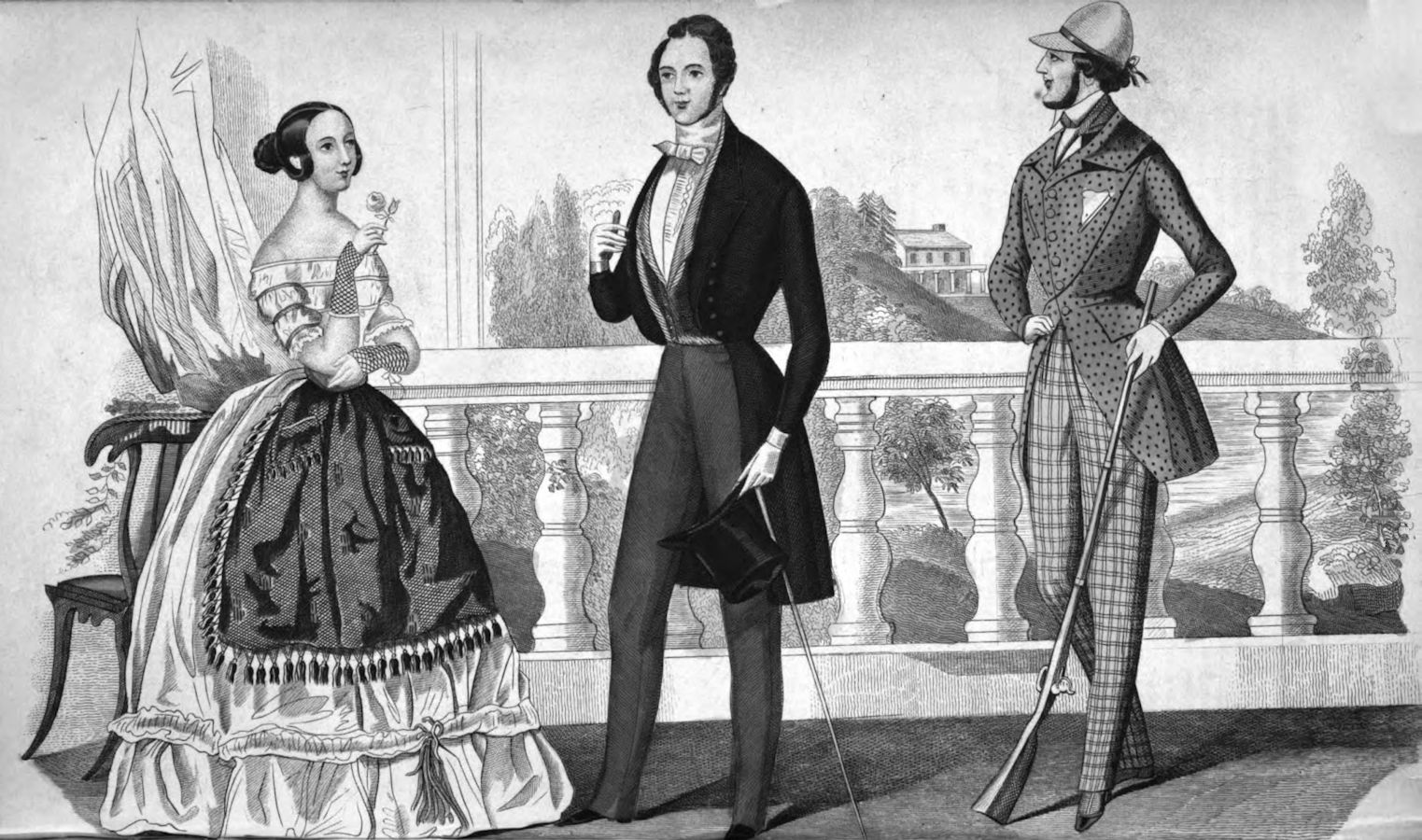
If the ancient inhabitants of the world had
extreme difficulty in sheltering themselves from
the severity of the seasons, they experienced much
more in giving to their clothes the impress of art
or industry. Consult Strabo; he will tell you that
certain nations covered themselves with the bark
of trees, fig-leaves or rushes, rudely intertwined.
Often also the skins of animals were employed,
without the least preparation, for the same end.
In proportion as the barbarism disappeared which
had been introduced by the confusion of tongues,
they began to think of the wool of sheep, and to
ask themselves if there were no means of uniting in
a single thread the different pieces of this substance
by the aid of a kind of spindle. Seeing their efforts
crowned with success, “Let us now,” said they,
“try to imitate the spider.” They did so; and,
behold, as Democritus begs us to observe, the art
of weaving invented! After that, the invariable
custom which existed among the Jews, fifteen
hundred years before Jesus Christ, of collecting
the fleeces of their sheep at fixed periods; and
great was the account which they made of it
according to the testimony of Genesis (31, 19.)
The history, true or fabulous, of the web of
Penelope, the wife of Ulysses, proves to us that
wool was not the sole material to which they
thought of applying the art of weaving. And do
we not read in Pliny that “the cotton plant grew
in Upper Egypt, that they made stuffs of it, and
that the Egyptian priests made admirable surplices
of it?” It is undeniable that garments of cotton
and of linen were in use in the time of the patriachs;
indeed Moses commands his people in the 22d
chapter of Deuteronomy, “not to wear a dress of
linen;” and the ancient Babylonians, as Herodotus
informs us, (Book I.) “wore immediately over their
skin a cambric tunic, which fell down to their feet
in the oriental manner.” It was the same among
the Athenians, according to Thucydides.
In the age of Augustus, many people had already
arrived at great perfection in the manufacture of
linen stuffs: it is the express assertion of the historian
Pliny. “The Faventine cloth,” says he, “is
always whiter than the Allienne cloth. That which
they have designated by the word Retovine, is so
exceedingly fine that its threads are as slender as
those of the spider. I have myself seen a thread
of Cumes hemp so thin that a great net made of
this material could go through a common ring; and
I have heard tell of a man who could carry on his
back as much as was required to encircle an entire
forest. The fine cambric, made of the linen of
Byssus, is a product of Achaia; it was sold in old
times for its weight in gold.” (Book 19.)
In the Egyptian Museum of the Royal Library
of Paris, you may cast your eyes upon mummies,
found in the catacombs of Cairo: the cloth in
which they are wrapped is not at all coarser than
the cambric of your shops; and yet it has been
woven three hundred years. On this occasion it is
not inappropriate to add that the art of weaving is
still more ancient than that of embalming; which
this answer of Abraham to the king of Sodom
indicates: “I will not carry away a single thread
of your wool,” said the patriarch to him, “lest you
should say—I have made Abraham rich!” Elsewhere,
Moses informs us that Abimelech presented
a veil to Sarah; that on the approach of Isaac,
Rebecca covered her face with a veil; and that
when Joseph was appointed viceroy of Egypt,
Prince Pharaoh covered him with a linen robe
after having placed his own ring upon his finger.
The Book of Job (the most ancient writing perhaps
in existence) mentions a weaver’s shuttle, (chapter
7.) A thousand years before the Christian era, do
you see, setting out along the desert, those messengers
of the wise Solomon, going to procure in
Egypt cloths of fine linen for the king, their master?
Shortly after, the city of Tyre obtained great celebrity
for the beauty of its fine linens; and Ezekiel
dwells enraptured on the opulence of its merchants
in the following terms:—“All the planks of thy
vessels are of the fine fir tree of Senir, and their
masts are of the cedar of Lebanon! For their
sails thou hast employed the fine linen of Egypt,
splendidly embroidered.” Do not suppose that all
the sails of this period were of as precious a material
as those of the Tyrians: like those of the
Arabians of our days, they were generally composed
of woven rushes.
The women commonly wore white dresses; besides,
the ancients had early made rapid progress
in the art of bleaching. They were all ignorant,
as you may well suppose, of the expeditious process
which the illustrious Berthollet has conceived, with
the assistance of a hydrochlorate of lime or of
soda; they knew, however, how to use other
detersive substances to impart a shining whiteness
to their stuffs. “There exists among us,” says
Pliny, “a species of poppy, very rare, which bleaches
linen cloth wonderfully; and yet, would one believe
it? we have among us a crowd of people so vain
that they have attempted to dye their linen as well
as their wool.” In alluding in another passage to
the sky-blue curtains of the Emperor Nero, he begs
us not to forget that, despite of all the rich shades
produced by dyeing, white cloth never ceased to
enjoy the highest reputation, to such a degree that
they conferred the title of Great on a person named
Lentulus Spinter, who first conceived the idea of
hanging white curtains around the places consecrated
to the Olympic games. This same kind of
stuff was spread upon all the houses of the Via
Sacra, by order of Cæsar, the Dictator, who planning
magnificent decorations, wished that they
should extend from his residence up to the Capitol.
The basis of the hard soap of our days was undoubtedly
known to the ancients. The natron or
sub-carbonate of soda, which they collect in the
channels of the Nile at the present time, was really
gathered there in sufficient abundance in the first
ages of the world. From another place, the man
of Uz made use of it; for he makes ready in
one of his chapters (Job, ch. 9.) to wash his clothes
in a pit with bor or borith, a plant much esteemed
on account of its alkaline properties. (You must
not confound this with the boron of modern chemistry,
which with oxygen constitutes the boracic
acid.) Open the Sixth Book of the Odyssey;
Homer will there shew you Nausicaa, and her
companions, trampling their clothes with their feet
to whiten them for an approaching marriage; the
bard adds that the ladies knew perfectly well the
property which the atmosphere possessed of assisting
in the destruction of the only substance which
imparts a greyish appearance to cloths. In alluding
to this passage, Goguet affirms that all the linen
and cotton garments were washed daily. An anecdote
related by Apuleius in his book of “The Golden
Ass,” goes to prove still more the attention which
they formerly paid to the art of bleaching; “A
wag,” said he to us, “being secretly introduced
into the house of a merchant, came near being
suffocated by the sulphurous gas which was given
out by a bleaching machine in which he was hid.”
The ability of the ancients to bestow upon their
linen, cotton[2] and woolen cloths a brightness not
inferior to that of the snow of their mountains, did
not fail them when they had to dye them. More
than three thousand years ago a cunning shrew,
as Genesis informs us, (ch. 28.) fastened a scarlet
ribbon around the hand of one of the children of
Tamar: and Homer speaks to us in the part of his
poem above mentioned, of the colored cloths of
Sidon as admirable productions. Jacob made for
his beloved son Joseph, “a robe of many colors,”
and the king of Tyre sent into the palace of Solomon
“a man skilful to work wonderfully in gold,
silver, &c. and to produce upon fine linen the
shades of purple, blue and crimson.” According
to Herodotus, who wrote, as you know, four hundred
years before Jesus Christ, some people of
Caucasus washed in water the leaves of a certain
tree, which yielded at length a brilliant color, with
the aid of which they drew upon stuffs the figures
of lions, monkeys, dolphins and vultures.
Among the brave knights who perished at
Colchis, in the Argonautic expedition, there was
one whom the historian Valerius Flaccus distinguishes
by his painted tunic, at the same time that
he expresses his admiration of the whiteness of the
fine cloth which the hero also wore:
“Tenuia non illum candentis carbossa lini,
Non auro depicta chalymis, non flava galeri
Cæsaries, pictoque juvant subtemine bracæ.”
(Val. Flac. 6.)
Speaking of Colchis, it was there that the best
materials for painting were formerly procured.
Besides, if you will ascend in spirit to the days
of old, you will perceive every year on the roads
leading from Georgia to the principal cities of
India, as well as to Dimbeck, an immense drove
of two thousand camels, loaded with madder.
Thence the red[3] flowers were derived, of which
Strabo speaks, which the nations dwelling on the
borders of the Indus and the Ganges loved to
spread upon their cloths. It is a particular worthy
of remark that the Egyptians who constantly
clothed the statues of their goddess Isis with linen
and cotton drapery, never employed wool for that
purpose, a substance which they hated so much
that they did not permit the use of it, even in interments,
as the 44th chapter of Ezekiel informs us.
This aversion extended even to shepherds, for you
may read in Genesis that every shepherd was an
abomination to the Egyptians. (46.)
The purple of Tyre was known at an epoch
exceedingly remote, and the dyers of Phœnicia surpassed
in skill those of all the other nations of the
east. This people came a thousand years ago as
far as Great Britain to procure an enormous quantity
of tin, a metal which has the property, or rather
certain salts of it have, of augmenting the intensity
of the principal red colors contained in many vegetable
and animal substances. Upon this subject, we
would advise you to run over, in the third book of
Strabo, the interesting recital which he gives of the
pursuit of a Phœnician vessel by a Roman bark,
which wished to seize the tin with which it was
freighted. It was in the neighborhood of the coast
of Cornwall: the Phœnician, seeing the prow of the
Roman near his stern, threw three-fourths of his
cargo overboard, and steered right upon a sand-bank,
where the enemy, as you may well suppose,
did not think of following him. The Tyrians,
astonished at the great opulence which their city
attained, attributed to the gods the magic art of
dyeing in purple. All writers, and especially
Ctesias, physician to a king of Persia, who lived
four hundred years before the Christian era, and
Ælian, a contemporary of Alexander Severus, frequently
allude to an insect, to which the Phœnicians
were indebted for the superior manner in
which they could produce an admirable scarlet. It
was evidently the cochineal: and this little animal
must have been at that time less rare than at present
in Syria, India, and Persia, since the humblest
classes frequently wore stuffs dyed with purple. It
is not surprising that they knew not how to extract
from the cochineal the most brilliant of all the
known reds, the carmine, before which the vermillion
grows pale, and which chemistry can procure
for us, in our days, in great abundance; and you
know that this little insect lives upon the cactus
which grow in Brazil, in Mexico, at Jamaica, and
at Saint Domingo.
The fashion of wearing silk was unknown at
Rome, before the beginning of the empire. The
rage for dressing in it was already so great in the
time of Tiberius, that the emperor prohibited the
use of it by a positive law. The Greeks also had
a taste for it; and the cloak of Amphion was certainly
of silk, for the historian Philostratus (Ion,
Book I.) tells us that its color changed according
to the different ways in which the light was reflected
from it. Pliny gives us to understand that the gold
stuffs of the ancients were not made as those of
our time, of a thread of gold or silver, wrapped
around a woof of silk, but that they were woven of
gold deprived of all alloy: knowing this, he speaks
of the manner in which the wife of Claudius dressed
herself to attend a Naumachia or sea fight, in
the following terms—“Nos vidimus Agrippinam—indutam
palludamento auro textile, sine alia materia.”
It is about fifty years since they extracted,
by assaying, more than four pounds weight of pure
gold from some old dresses which the fathers of
the Clementine College, at Rome, discovered in an
urn of basalt, buried in their vineyard. Tarquin,
the Elder, was he, among the Roman Sovereigns
who most usually wore dresses of gold.
From the time of Homer the Greeks wore black
dresses for mourning. This bard shews us Thetis
wearing, after the death of Patroclus, the blackest
of her dresses. (Iliad, 24.) For many years the
same usage prevailed among the Romans, but it
was partly changed under the emperors, so that
when Plutarch wrote, the women in mourning
could wear nothing but white. Besides, we have
a proof of it at the obsequies of Septimius Severus:
“The image of this emperor,” Herodian tells us,
“formed of wax, was surrounded on one side by a
row of women in white, and on the other by the
body of all the senators, clothed in black. At the
death of the Empress Plotina,” adds the historian,
“her husband Trajan covered himself with very
black habits for the space of nine days.” The
toga necessarily received as many shades of color
as the other garments: but as to the form of this
kind of robe it is impossible to decide. When
Dionysius, of Halicarnassus, asserts that the toga
presented the appearance of a semicircle (’ημικυκλος)
he did not at all intend to describe its shape, but
only the form which it assumed when worn upon
the body. Strabo asserts that the military cloak
with which the warriors clothed themselves had an
oval form; and that among the Athenians it was
often worn by the young people even in time of
peace. The tunic, which was the principal part
of the under clothing, was not generally used
among the nations of antiquity, except the Greeks
and Romans; all the Cynic philosophers disdained
to make use of it. We know that Augustus put
on as many as four tunics in winter. The name
of this great emperor reminds us that it was in his
reign, or thereabouts, that the Romans began to
use table-cloths. Montfaucon believes that the
greater part of them were of cloth striped with
gold and purple. In France the ancient table-cloths
were intended for collecting, after the meal,
the smallest crumbs that were left, that nothing
might be lost; and D’Arcy informs you that among
our neighbors, the English, table linen was very
seldom used in the thirteenth and fourteenth centuries.
As there exist in our days many nations, especially
in the torrid zone, who do not wear hats,
(a name by which we must understand every covering
for the head, as its etymology plainly indicates,)
so it formerly happened that the nations did not
always think of making use of them. Thus one of
the most civilized, the Egyptians, went bare-headed,
according to the authority of Hesiod. Amongst
the Orientals, and especially amongst the Persians,
the turban was in great vogue; that of the sovereign
was composed of a whole bale of muslin. It was
from this last mentioned people that the Jews derived
the turban. The hats of the Greeks must
have had very large brims, to judge from the root
of the word (πετασος) which designated them. The
Romans granted to their freedmen the right of
covering themselves with a kind of cap, which has
been since adopted as the emblem of liberty. It is
to a Swiss, residing in Paris, about the beginning
of the fifteenth century, that we owe the first invention
of felt hats. They were generally known
at the close of the reign of Charles VII.: this
monarch himself wore one at his triumphal entry
into Rouen, in 1449. We read in Daniel that the
worthy townsmen of that ancient city stood still
as if petrified, so much were they astonished at
seeing his majesty’s hat; the historian adds that its
lining was of red silk, and that it was surmounted
by a superb bunch of feathers. Before the period
of which we speak, it is probable that the French
covered their heads in the same way as the English,
that is to say, with woven caps or rather with
cloth and silk hoods.
The stockings of the ancients were made of little
pieces of cloth sewed together. We cannot say
with certainty in what country the stocking-frame
was invented. France, England and Spain respectively
claim this useful discovery. A short time
before the unfortunate tournament, in which Henry
II. lost his life, he put on the first pair of silk
stockings ever worn. Five years afterward, we see
in England, William Ryder presenting a pair, as a
very precious article, to William, Earl of Pembroke.
Ryder had learnt the method of making
them from an Italian merchant.
Many persons probably know not that wooden
shoes date from a very remote period; for the
Jews wore them long before the age of Augustus.
Perhaps they were not made exactly like the
wooden shoes so common among the poorer
classes in France; but it is not less true that
this kind of covering for the feet was generally
adopted among nearly all the people of Judæa:
sometimes, however, we observe leather shoes
among them; and the Jewish soldiers covered
their feet with copper, or with iron. The shoes
of the Egyptians were of papyrus; the Chinese
and the Indians manufactured theirs of silk, of
rushes, of the bark of trees, of iron, of brass, of
gold or of silver, according as their fortune permitted,
or their fancy dictated. At Rome, as in
Greece, leather was the material which covered
the feet of every one. The Roman women wore
white shoes: the common people wore black: and
the magistrates set off their feet with red shoes on
solemn occasions. A thousand years ago the most
powerful sovereigns of Europe had wooden soles
to their shoes. Under William Rufus, son of the
great Duke of Normandy, who conquered at Hastings,
in 1066, a fashion was introduced into England
of giving to the shoes an excessive length;
the point which terminated them was stuffed with
tow, and curved up on high like a ram’s horn. In
the fourteenth century they thought of connecting
these points with the knee, by means of a gold
chain. Great must have been the surprise of the
worthy Anglo-Saxons, on beholding this strange
species of vegetation sprouting up suddenly amongst
them! Some called to remembrance the history of
the serpent’s teeth, which Cadmus sowed, whence
a swarm of soldiers issued; others conceived that
it was the costume of magicians; and little children
sometimes, when going to bed, asked their mothers
if there was no danger that their heads might be
metamorphosed in the night into those of a horrible
deer? Before leaving this paragraph upon shoes,
we would call to recollection the antiquity of the
art of the leather-dresser: open for that purpose the
Iliad, and you will find in the Seventeenth Book,
tanners preparing skins to make leather of them.
This class of manufacturers composed, three hundred
years ago, a very important body, since we
possess the account of a furious quarrel which
broke out, under Queen Elizabeth, between them
and the shoe-makers. We are pleased to record
here the perfection with which they manufacture
leather at this date in the New World. In South
Carolina, as well as in the state of Virginia, the
Indian women are so skilful in this branch of
industry that a single person can dress as many
as ten deer-skins a day.[4] Of all the transformations
which are wrought in the arts, that of the
animal substance into leather is, without doubt,
one of the most curious. The process, by means
of which they set about accomplishing it in old
times, was the result of a calculation still more
ingenious than that of changing two opaque bodies
into a transparent body to make glass, for instance;
or else two transparent bodies into an opaque body
for making soap. Besides, you know that chemistry
actually teaches us that leather is a real salt, a
tannate of gelatine. This assertion was not uttered
with confidence until M. Pelouze had extracted from
tan in late years the tannic acid in a state of remarkable
purity. Besides this, you may now explain
a phenomena which is repeated at a great
distance upon the ocean, at the time of some
lamentable shipwreck. The journal which records
for you the history of one of these sad events often
tells you that in the last moment of famine, the
unhappy survivors took to eating their shoes, and
that life is sometimes prolonged by these means!
Certainly, for the gelatine possesses nutritious properties,
even when its peculiarities are stained with
a thousand impurities, as is leather.
The subject upon which we have endeavored to
present some observations, is so capable of being
extended that a large volume in octavo would
scarcely suffice to contain all the historical knowledge
relating to it. But such a dissertation, carried
out to the extent or with the exactness which it
admits of, would only constitute at last a kind of
catalogue or bare enumeration of the thousand
modifications which human vestures have undergone
down to our times. The memory of the reader
would be unable to retain so prodigious a number
of minute particulars, and the curiosity of his mind,
fatigued by so many useless details, would be extinguished
before finishing the third part. These
changes have often, it is true, nothing for their
object but the accessory and secondary parts of
dress, as the following passage, which we meet
with in the voyages of M. de Chateaubriand, seems
to point out.
“One thing has at the same time struck me and
charmed me; I have met in the dress of the Auvergne
peasant the attire of the Breton peasant.
Whence comes this? It is because there was formerly
for this kingdom, and for all Europe, a
groundwork of a common attire.” (Vol. 2., p. 296.)
In another particular also, men have always been
constant, that they have never ceased to seek for
the material to compose their clothing from the
animals which the Creator has placed in their respective
climates. It will probably be the same till
the end of the world. It is thus that the nations
under the temperate zone have recourse for covering
to wool, because, being a bad conductor of caloric, it
prevents the escape of it from their bodies. In the
frozen zone the Russians, the Esquimaux, and the
Greenlanders, clothe themselves in furs, a material
which is a still worse conductor of caloric; while
the natives of countries under the influence of the
torrid zone, make their dresses of hair or horse-hair,
whose conducting properties are in an inverse ratio
to those of furs. It is worth remarking that the
animals which in temperate regions are covered
with wool or ordinary hair, are provided, when
they inhabit countries really cold, with an under-fleece
of very fine wool: it is the case with goats,
sheep, dogs, horses, and Thibet cows.
If by a game of metempsychosis, you were enabled
to return to existence two hundred years hence,
what unheard of changes would you not see in
the dress of individuals. Transport in anticipation
your shade to a point commanding one of the public
promenades of the capital; suppose yourself, for instance,
on the top of the Vendôme Column, on a
fine summer’s evening; you would, perhaps, perceive
the dandies of the time strutting in frocks, whose
leg of mutton sleeves are as voluminous as those of
our sylphides at this day. Their hats, instead of
being of beaver or of fur, have a similar shape to
that which our ladies adopted in 1839. For the
young folks a notched veil would be the prescribed
mode; the men, of a certain age, would embellish
their hats with a superb scarlet plume. As to the
women, who will now dare to affirm that they will
not then cover their heads with perukes à la Louis
XIV. topped off with three-cocked hats, and that
from their chin there will not descend a band à la
procureur du roi? Extend your Pythagorean glance
farther into the ages, and you will, perhaps, discover
another part of mankind adding to their dress an
enormous pair of wings! We may doubt that the
gnomes, the sciences, will never render the attempt
to make use of them more effectual than that of
the son of Dædalus in old times; but in return,
posterity may fly by another process, in case
the æronauts can discover the secret of steering
themselves in mid-air. Should this expectation be
realised, we may then hear one of your future
grand-nieces (who will be the belles of the noble
Faubourg) say to her domestic on rising from
her breakfast, “Ganymede! my balloon, with its
boat; I wish to go dine to-day with my cousin,
at Florence.”
FROM THE FRENCH OF LAMARTINE.
———
BY R. M. WALSH.
———
Thou, whose true name the world doth yet not know,
Mysterious spirit, mortal, angel, fiend,
Whate’er thou art, oh! Byron, still I love
Thy concerts’ savage harmony, ev’n as
I love the noise of thunder and of winds
Commingling in the storm with torrents’ voice!
Night is thy dwelling, horror thy domain;
The eagle, king of deserts, thus doth scorn
The lowly plain; he seeks, like thee, steep rocks
By winter whitened, by the lightning riven;
Shores strewn with fragments of the fatal wreck,
Or fields all blackened with the gore of carnage:
And whilst the bird that plaintive sings its griefs
’Mid flow’rets, builds its nest on bank of streams,
Of Athos he the summits fearful scales,
Suspends his eyre o’er the abyss, and there,
Surrounded by still palpitating limbs,
By rocks with bloody banquets ever foul,
Soothed by the screaming anguish of his prey,
And rocked by tempests, slumbers in his joy.
Thou, Byron, like this brigand of the air,
In cries of woe dost sweetest music find.
Thy scene is evil, and thy victim man.
Like Satan, thou hast measured the abyss,
And plunging down, far, far from day and God,
Hast bid to hope farewell for evermore!
Like him, now reigning in the realms of gloom,
Thy dauntless genius swells funereal strains;
It triumphs; and thy voice in hellish tone
Sings hymns of glory to the god of evil.
But why against thy destiny contend?
’Gainst fate what may rebellious reason do?
It hath but (like the eye) a bounded scope.
Beyond it nor thy eye nor reason strain;
There all escapes us; all is dark, unknown.
Within this circle God hath marked thy place.
How? why? who knows?—From His Almighty hands
The world and human beings he hath dropped,
As in our fields he spread around the dust,
Or sowed the atmosphere with might or light.
He knows; enough; the universe is his,
And we can only claim the present day.
Our crime is to be man and wish to know:
To serve and know not is our being’s law.
Byron, this truth is hard, and long I strove
Against it; but why turn away from truth?
With God, thy title is to be his work;
To feel, t’adore thy slavery divine;
In th’universal order to unite,
Weak atom as thou art, to his designs
Thy own free will; by his intelligence
To have been conceived, and by thy life alone
To glorify him—such, such is thy lot!
Ah! rather kiss the yoke that thou wouldst break;
Descend from thy usurped rank of god;
All, in its place, is well, is good, is great;
In His regard, who made immensity,
The worm is worth a world; they cost the same!
This law, thou say’st, revolts thy sense of right;
It strikes thee merely as a strange caprice;
A snare where reason trips at every step—
Let us confess and judge it not, great bard!
Like thine, my mind with darkness is replete,
And not for me it is to explain the world:
Let Him who made, explain the universe.
The more I sound the abyss, the more, alas!
I lose myself amid its viewless depths.
Grief, here below, to grief is ever linked,
Day follows day, and pain succeeds to pain.
In nature bounded, infinite in wish,
Man is a fallen god rememb’ring Heaven:
Whether that, disinherited of all
His pristine glory, he doth still preserve
The mem’ry of his former destinies,
Or that the vastness of his wishes gives
A distant presage of his future greatness—
Imperfect at his birth, or fallen since—
The great, the awful mystery is man.
Within the senses’ prison chained on earth,
A slave, he feels a heart for freedom born,
And wretched, to felicity aspires.
He strives to sound the world; his eye is weak;—
He yearns to love; whate’er he loves is frail.
All mortals unto Eden’s exile bear
A sad resemblance—when his outraged God
Had banished him from that celestial realm,
Scanning the fatal limits with a look,
He sat him, weeping, near the barred gates,
He heard within the blest abode afar,
The sigh harmonious of eternal love,
Sweet strains of happiness, the choral song
Of angels sounding God’s triumphant praise;
And tearing then his soul from heav’n, his eye
Fell back affrighted on his dismal lot.
Woe, woe to him who from his exile here
Hath heard the concerts of an envied world!
When Nature once ideal nectar tastes,
She loathes the cup Reality presents.
Into the possible, in dreams she leaps;
(The real is cramped; the possible, immense;)
The soul with all her wishes there doth take
Her sojourn, where forever she may drink
From crystal springs of knowledge and of love,
And where, in streams of beauty and of light,
Man, ever thirsty, slakes his thirst.
And thus, with Syren visions charming sleep
On waking, scarce she knows herself again.
Such was thy fate, and such my destiny!
I too the poisoned cup did drain; like thine
My eyes were opened, seeing not; in vain
I sought the enigma of the universe;
I questioned nature for its cause; I asked
Each creature why created; down the abyss,
The bottomless abyss, I plunged my look;
From the atom to the sun, I all explored;
Anticipated time, its stream did mount;
Now passing over seas to hear the words
That drop from wisdom’s oracles; but found
The world to pride is ever a sealed book!
Now, to divine the world inanimate.
To nature’s bosom flying with my soul,
I thought to find a meaning in her voice.
I read the laws by which the heav’ns revolve.
My guide great Newton, through their shining paths.
Of crumbled empires o’er the dust I mused;
Rome saw me ’mid her sacred tombs descend;
Of holiest manes disturbing the repose;
The dust of heroes in my hands I weighed,
Asking their senseless ashes to restore
That immortality each mortal seeks.
What say I? hanging o’er the bed of death,
I sought it even in expiring eyes;
On summits darkened by eternal clouds,
On billows tortured by eternal storms,
I called; I braved the shock of elements.
Like to the sybil in her rage divine,
I fancied nature in those fearful scenes
Some portion of her secrets might reveal:
I loved to plunge amid those horrors dread.
But vainly in her calm and in her rage
This mighty secret hunting, everywhere
I saw a God, and understood him not.
I saw both good and ill, without design,
As if by chance, escaping from his hands;
I saw on all sides evil, where there might
Have been the best of good, and too infirm
To know and comprehend him, I blasphemed;
But breaking ’gainst that heav’n of brass, my voice
Had not the honor to e’en anger fate.
One day, however, that by mis’ry wrung,
I wearied heaven with my fierce complaint,
A light descended from on high, that filled
My bosom with its radiance, and inspired
My lips to bless what madly they had cursed.
I yielded, grateful, to the influence,
And from my lyre the hymn of reason poured.
“Glory to thee, now and for evermore,
Eternal understanding, will supreme!
To thee, whose presence space doth recognise!
To thee, whose bright existence every morn
Announceth! Thy creative breath hath stooped
To me, and he who was not hath appeared
Before thy majesty! I knew thy voice
Ere I had known myself, and at its sound
Up to the gates of being I did rush.
Behold me! nothingness doth here presume
To hail thee at its coming into life.
Behold me! but what am I? what my name?
A thinking atom—who may dare to hope
Between us two the distance e’er to scan!
I, who in thee my brief existence breathe,
Myself unknown and fashioned at thy will,
What ow’st thou, Lord, to me, were I not born?
Before or after, naught—hail end supreme!
Who drew all from himself, to himself owes all.
Enjoy, great artist, of thy hands the work.
I live thy sov’reign orders to fulfil.
Dispose, ordain, control, in time, in space;
My day and sphere, for thy own glory mark;
My being, without question or complaint,
In silence hasten to assume its place.
Glory to thee! annihilate me, strike!
One cry, one cry alone shall reach thy ear—
Glory to thee, now, and for evermore!”
———
BY JESSE E. DOW.
———
The Life Guard of Washington! Who can
think upon this band of gallant spirits without
feeling a glow of patriotism warming his heart,
and stirring up the sluggish feelings of his soul?
Fancy paints again the figures which history has
suffered to fade away, as the shadows departed
from the magic mirror of Cornelius Agrippa; and
the heroes of the past start up before us like the
clan of Roderick Dhu at the sound of their chieftain’s
whistle. They come from Cambridge, and
from the Hudson, from Trenton and from Princeton,
from Yorktown and from the Brandywine, from
mountain pass and woody vale, gathering in battle
array around the lowly bed of their sleeping leader,
amid the solitary shades of Vernon.
The life guardsmen are fast fading away. One
by one the aged members have departed, and now
Lee’s corporal slumbers beside his commander.
Their march of life is over.
A more efficient corps never existed on this side
of the Atlantic than the Life Guard. Animated by
one motive, guided by one object, they surrounded
their beloved commander-in-chief, and gloried in
being known as his body guard. Was there any
difficult duty to perform? it fell to this body, and
gallantly did they perform the service entrusted
to them. The eye of the general glistened with
delight as they filed before him in the shade of
evening, or returned into camp from some successful
incursion beyond the enemy’s lines, ere
“Jocund day stood tiptoe on the mountain top”—
or the reveillé aroused the army from their slumbers.
It was the anniversary of the battle of Princeton,
when an aged man, with a stout staff in his hand,
was seen trudging manfully down Broadway. As
he passed along from square to square, he cast his
eyes upon the signs and door-plates, and muttering,
continued on his course.
“Here,” said he, “was Clinton’s Quarters”—“Edward
Mallory silks and laces”—“and here was
the house that Washington stopped at”—“John
Knipherhausen, tobacconist,” “and here was where
the pretty Quakeress lived, who used to furnish the
commander-in-chief with information as to the
enemies movements”—“Câfé de mille colonnes”—“all,
all are changed; time has been busy with every
thing but the seasons—they are the same—the sun
and the rain—the evening and the morning—the
icicle and the dew-drop—the frost and the snow-drift
change not: but man and his habitations—aye,
the very names of places and people have been
altered, and the New York of the Revolution is
not the New York of ’37.”
As the old man said this he seated himself upon
a marble door-step, and wiped the perspiration from
his brow; for he had walked a long way that morning,
and the thousand associations that pressed upon
his memory wearied him.
A company of volunteers, in all the pomp and
circumstance of city war, now approached by a
cross street. The bugle’s shrill note, mingled in
with the clarionet and cymbals; and the glance of
the sun upon their bayonets and polished helmets,
lit up the martial fire that slumbered in the old
man’s soul. He rose upon his feet.
“It is pleasant enough now to look upon such
gatherings,” said he, “but those who have heard
the drums beat to drown the cries of the wounded
and the dying, cannot forget their meaning, though
youth and joy accompany them, and though the
smiles of beauty urge them on.” And the old man
wept, for the men of other days stood about him;
and the battle-fields, then silent and deserted, teemed
with the dead and the dying; and the blood formed
in pools amid the trampled grass, or trickled in little
rills down the smoky hill-side.
A servant now came out of a neighboring house
and invited the old man in. He thankfully accepted
the hospitality of the polite citizen, and soon stood
in a comfortable breakfast room. A young man of
twenty-one received him with kindness; and a tall,
prim woman of eighty-six cordially insisted upon his
joining her family at the breakfast-table. A beautiful
girl of eighteen took the old man’s hat and
cane, and wheeled up an old arm-chair that had
done the family some service in ancient days. The
old man as she seated herself beside him, patted
her upon the head, and a firm—“God bless you”—escaped
from his wrinkled and pallid lips. The
old lady suddenly paused in her tea-table duty, and
looked earnestly at her guest. The old man’s eyes
met hers—they had seen each other before—but
the mists of time shrouded their memories, and
blended names and places and periods strangely
together.
“Will thee have another cup of tea?” said the
matron to the old man.
“I have heard that voice,” thought the stranger,
as he took the proffered cup with gratitude, and
finished his breakfast in silence.
“Oh! grandmother,” said the maiden, springing
to the window, “here come the Iron Greys; how
splendidly they look.”
“I cannot look at them,” said the matron, in a
trembling voice—“thy grandfather was killed by
the Brunswick Greys at Princeton.”
“What was his name?” said the old man, fixing
his dim eye steadily upon the speaker’s face.
“Charles Greely,” said the matron, shedding an
unexpected tear.
“Charles Greely,” said the old man springing
up—“why he was a Life Guardsman, and died by
my side—I buried him at the hour of twilight by
the milestone.”
“And thou art?” said the matron, earnestly.
“Old Hugh Maxwell, a corporal of Washington’s
Life Guard at your service,” said the stranger
guest.
“Oh! well do I know thee,” said the matron,
weeping—“it was thee who gave me directions
where to find him, and delivered to me his dying
sigh. This is an unhappy day to me, Hugh Maxwell,
but thy presence lends an interest to it that I
had no idea of enjoying. William and Anne, thy
grandfather died upon Hugh Maxwell’s breast in
battle—let us bless God that we are permitted to
entertain the gallant soldier upon the anniversary
of that day of glory.”
And the son brought forth the old family bible,
and the widow Greely prayed after the manner of
the Quakers, amid her little congregation.
When the service was over, and the breakfast
equipage had been removed, the son and the daughter
each drew a seat beside the old veteran, while
their grandmother carefully wiped her spectacles
and took a moderate pinch of Maccouba. Then
seating herself as straight as a drill sergeant in her
cushioned seat in the corner, she turned her well
ear toward the old corporal and looked out of the
window.
“Tell us about the battle of Trenton and of
Princeton, Mr. Maxwell,” said the grand-children,
in one voice. The old man looked inquiringly at
the widow Greely.
“Thee may tell it, though it may be a sad tale
to me,” said the matron, and Hugh Maxwell, after
resting his head upon his hand for a moment, began
his account of