“Sail ho!” sung out the look-out, one sunny
afternoon, as we bowled along before a pleasant
gale. In an instant the drowsiest amongst us was
fully awake. The officers thronged the quarter-decks;
the foretop-men eagerly scanned the horizon;
the skulkers stole out from beneath the
bulwarks where they had been dozing, and the late
quiet decks of the schooner, which but a moment
since lay hushed in the drowsy silence of a sultry
afternoon, now swarmed with noisy and curious
gazers.
“Whereaway?” asked the officer of the deck.
“Broad on the weather-beam.”
“Can you make her out?”
“A heavy square-rigged vessel.”
“Do her royals lift?”
“Aye, sir; but only this moment.”
“How does she bear?”
“West and by west sou’ west.”
“A West Indiaman, perhaps.”
“Ay, sir, I can see her to’-gallants now: they
belong to a heavy craft.”
“Pipe all hands to make sail, boatswain.”
“Aye, aye, sir.”
“The strange sail is hauling up into the wind,”
sung out the look-out.
“Ay—take the glass, Mr. Parker, and spring
into the cross trees to see what you can make of
her. All hands aloft—loose and sheet home fore
and maintopsails. Merrily, there. How does she
look, Mr. Parker?”
“She seems a heavy merchantman by her rig;
ah! now her topsails lift, large and square, with a
cross in them. It’s not the rig of a man-o’-war.”
“Ease off the sheet—man the lee-braces—hard
down the helm.”
“Ay, ay, sir,” said the quarter-master, as he
whirled around the wheel, and the gallant craft
danced lightly up into the wind, like a racer beneath
the spur; while the men stood at their
respective stations eagerly waiting the command.
“Round there, with the foretop-sail—haul in fore
and aft—belay all!” came in quick succession from
the quarter-deck, as we bowed before the breeze,
and dashing the spray on either side our cutwater,
went off almost dead in the wind’s eye. The sharp
wind, as it sang through our cordage, and the momentary
dashing of the sea across our bows, as we
thumped against the surges, afforded a pleasant relief
to the occasional creaking of the shrouds, or
the dull monotonous sounds of the water washing
lazily alongside, which we had been listening to for
the last hour. The change had an exhilarating
effect upon our spirits, which was perceptible as
well among officers as among men. Besides, we
were all eager for a prize. Every man, therefore,
was at his station, and a hundred eager faces
looked out from the forecastle, the tops, or wherever
their owners chanced to be. The captain, too,
was upon deck, scanning the stranger with a scrutinising
eye.
“Can you see her hull yet, Mr. Parker?” he
asked.
“No, sir—her courses show to the very foot—but
here it comes—six ports on a side, sir, though
they look like painted ones.”
“She’s setting her light sails.”
“Every one of them, sir: and wetting down
their mainsail.”
“How are her decks?”
“Crowded, sir. There’s the glancing of a musket
as I live; ah, of a dozen. She carries troops,
sir, I fancy.”
“A transport?”
“Aye, sir!”
The interest had gone on deepening, during these
rapid questions and answers, until at my last reply
a suppressed buzz ran around the ship. No one
spoke, but each looked into his messmate’s face,
and it was obvious that the question, “could we
capture our opponents, or would we ourselves become
the prey?” was uppermost in every mind.
But the person most interested in the event was
apparently the least concerned of any; and without
moving a muscle of his face, the captain leisurely
closed his glass, and turning, with a smile, to his
lieutenant, said,—
“We shall be likely to have a sharp brush, Mr.
Lennox; in fact our men are getting rusty, and we
want something of a close-contested battle to burnish
them up. We shall open the magazine, and
go to quarters directly.”
Every thing that could be made to draw, was by
this time set, and we were eating into the wind
after the stranger with a rapidity that promised even
to the most sanguine of us a speedy realisation of
our hopes. As we gained upon the merchantman,
the crowded state of his decks became more and
more apparent, and we could plainly detect, by
means of our glasses, that every exertion, even to
wetting down the sails to the royals, was being
made on board of him to escape. But all was in
vain. Few vessels afloat could beat us on the tack
we were now going, nor was it long before we had
the chase within range of our long Tom.
“She hasn’t shown her bunting as yet,” said
Captain Stuart, “but we’ll throw a shot across her,
run up our flag, and see what answer she makes.”
The long gun was cast loose, the foot of the
foresail lifted, and the gunner applying the match,
the ball went whizzing on its way; while at the
same moment our flag was run up to the gaff, and
blowing out to leeward, disclosed the arms of our
colony.[1] For a few minutes the shot might have
been seen ricocheting along the waves, until it
plunged into the sea a few fathoms on the larboard
of the stranger. Still, however, no ensign was
shown by the chase.
“Pitch a shot into her this time, Mr. Matchlock,”
ejaculated the skipper, addressing the gunner, “and
see if that will bring her out.”
“Ay, ay, sir,” said the old fellow, squinting
along his piece, and aware that he was one of the
best marksmen afloat in any service, “ay, ay, we’ll
awake them to a sense of their condition presently;
we’ll drive the cold iron through and through the
reprobates: too high, a little more starboard—steadily
all, and mark the mischief,” cried the old
fellow, applying the match. The rest of the sentence
was lost in the deafening report of the cannon;
a sheet of fire was seen streaming out an
instant from the mouth of the piece; and as the
pale white smoke sailed slowly eddying away to
leeward, the old gunner might have been discerned,
bending eagerly forward, and shading his eyes with
his hands, as he gazed after the path of the ball.
“By the Lord Harry how it makes the splinters
fly!” said the old fellow, as the shot, striking full
on the quarter of the chase, went through and
through her deck.
“And there goes her flag at last,” said Westbrook,
as the ensign of England floated from the
quarter of the merchantman, while at the same
moment a cloud of smoke puffed from his stern,
and a shot, skimming along the deep, toward us,
plunged into the waters a cable’s length ahead.
“We’re beginning to make him talk, eh!”
chuckled the gunner, waxing warm in his work.
“Let him have it again now—ah! that will bring
out his teeth—give it to ’em, you old sea-dog,” he
continued, familiarly patting his piece, “and by the
continental Congress, he’s got it among his sky-scrapers.
There come his to’-gallant sails—hurrah!”
The fight now became one of intense interest,
for the merchantman perceiving that escape was
impossible, seemed determined to resist to the last,
and kept up a brisk and well-directed fire upon us
from his stern-guns. Their range not being, however,
so great as that of our piece, we were enabled
after a while to regulate our distance so as to cripple
the chase effectually without sustaining any
damage ourselves. But it was not long that we
were suffered to maintain the combat on our own
terms. Worried beyond endurance by the havoc
made among his spars, the chase soon put his
helm up, wore round, and hauling up his courses
in gallant defiance, came down boldly toward us.
“We shall have it now,” whispered Westbrook
as he stood by the division where he commanded,
“they must outnumber us two to one—but we’ll
give them a lesson for all that.”
“Ay! hand to hand, and foot to foot, will be the
struggle, and God defend the right.”
No sooner had the chase altered his course, and
shown a determination to accept our challenge, than
the firing on both sides ceased, and the two ships
steadily but silently approached each other.
The eve of a battle is a solemn time. However
men may talk in their jovial hours, or feel amid the
maddening excitement of the contest itself, there is
something inexpressibly awe-inspiring in the consciousness
that we are soon to be arrayed in deadly
hostility against our fellow-creatures; and now as I
gazed along the silent decks, and beheld our brave
fellows gazing, as if spell-bound, upon the approaching
foe, I perceived that their emotions were akin
to my own. Yet there was nothing of fear in those
hardy bosoms. There was a compression of the
lip, an occasional flashing of the eye, and a half-suppressed
word now and then among the men,
which showed that amid all their other feelings, a
deep, unflinching detestation of their tyrants was
uppermost in their hearts. At times their eyes
would glance proudly along our sanded deck, with
all its apparatus of cutlasses, boarding pikes, and
cannon balls, and then turn indignantly, and almost
triumphantly, toward the enemy, now bearing down
upon us. Meantime a death-like silence hung upon
them; not a sound was heard except the sighing
of the winds through the hamper, and the dash of
the waters under our bows.
The chase had now approached almost within
musket shot, and yet no demonstration of an attack
had been made. We could see that the chase was
alive with men. From every port, and look-out,
and top, a score of faces warned us of a bloody
battle. Each man was at his post, determination
stamped on his countenance. As I gazed upon
this formidable array of numbers, and beheld
the comparatively gigantic hull of our adversary,
steadily advancing on us, like some portentous
monster of the deep, I almost trembled for our
victory; but when my eye fell again on the brawny
chests, and determined visages of our gallant crew,
I felt that nothing but extermination could prevent
them from hoisting our own flag above the proud
ensign of our foe which now flapped lazily in
the breeze. But my reverie—if such it might be
called—was cut short by perceiving a sheet of
flame rolling along the Englishman’s side, and,
while his tall spars reeled backward with the
recoil, a shower of shot came hurtling toward us.
In an instant the gaff of our mainsail fell; our
sails were perforated in various places; and a
cannon ball striking us amid-ships, cut through
both bulwarks, and laid one poor fellow dead upon
the deck. The men started like hounds when they
see their prey.
“Stand to your guns—my men!” thundered the
captain in this emergency, “let not a shot be fired
until I give the word. Bear steadily on your helm,
and lay us across their bows.”
The moments that elapsed before this endeavor
could be consummated seemed to be protracted
into an age. Our gallant fellows could, meanwhile,
scarcely be restrained within the bounds of discipline.
As shot after shot came whizzing over us,
the crew grew more and more restive, casting
uneasier glances at our commander at every successive
fire. Several of the spars had by this time
been wounded, and our hull showed more than one
evidence of the foe’s skill in gunnery. At length a
shot came tearing through the bulwark but a short
distance from where I was stationed, and after
knocking the splinters wildly hither and thither,
struck a poor fellow at his quarters, and laid him
mangled and bleeding across his gun. I ran to
him. One of his shipmates had already lifted the
man’s head up, and laid it carefully in the lap of
a comrade. The face was dreadfully pale—the
features unnaturally distorted. Agony, intense and
irresistible, was written in every line of the face.
The motion, however, revived him, and he opened
his eyes with a groan. Unsettled as was their
gaze, they took in the anxious group around him.
He saw, on every face, the deepest commiseration.
His glazing eye lightened for a moment.
“How are you, Jack?” said the shipmate, in
whose lap he lay.
The dying man shook his head mournfully.
“Don’t you know me, Jack?” said his messmate.
There was no answer. The eyes of the sufferer
were closed. “God knows I little thought you
were to die thus!” continued his shipmate, with
emotion. “For twenty years, in gale and calm, in
winter and summer we have sailed together, and
now you’re going to part company, without being
able even to bid an old messmate farewell,” and he
wiped the cold sweat from the dying man’s brow.
“Jack, Jack, don’t you know me? Can I do
nothing for you?”
The sufferer opened his eyes, and made a gesture
as if he wished to be lifted up. His desire was
gratified. He looked around eagerly until his eyes
fell upon the enemy.
“Bury—me,” he faintly articulated, “after you’ve—hauled—down
her flag. And—and Rover,”
and his voice, for an instant, became stronger, “send
the prize-money to the old woman—and—a—a.”
He gasped for breath.
“What?—in God’s name what?” But the
senses of the dying man began to wander.
“Speak!—Jack—for the love of God!”
“A—alls—we—e—el!” murmured the man,
brokenly. He ceased. A quivering motion passed
across his face. His shipmate gently laid his head
upon the deck.
“He’s dead—and now boys, for revenge!” said
Rover, as he started to his feet.
The crisis had come. So rapidly had the foregoing
scene passed, and so intently had we all been
gazing upon the dying man, that, in the interval,
the schooner had gained a position on the bow of
the enemy, and as the sturdy seaman rose up from
beside his murdered companion, we ran short across
her in a raking position; and before the words had
died upon the air, the long-expected command
came from the quarter-deck, to open our fire.
“Fire!” shouted our leader, “one and all—pour
it into them—remember you fight for your all!”
“Give it to ’em like h—l, my boys,” thundered
the gunner, “that’s it; there goes her sprit-sail
yard—hurrah!”
It was a terrific scene. No sooner had the
signal been given, than, as with one accord, our
gallant fellows poured in their deadly fire. Every
shot told. Stung almost beyond human endurance
by the restraint in which they had been kept, and
maddened by the spectacle of a messmate slain at
his post before he could fire a shot, our crew fought
like demons rather than men, jerking their guns out
as if they were playthings in their hands. Nothing
could withstand them. Not a shot was wasted on
the rigging of the foe: every one was driven along
her crowded decks. The slaughter was immense.
Man and boy, sailor and marine, officers and crew
went down before that murderous, incessant fire.
The flashes of the cannon, the roars of the batteries,
the crashing of spars, and the shrieks of the
wounded and the dying rose up together in terrific
discord. Meanwhile the thick clouds of smoke
settling down upon us hid the hull of the enemy
completely from sight. Nothing but her masts,
rising tall and gallantly above the dim canopy of
her decks, could be seen. Directly one of these
was seen to stagger; then it swayed to and fro a
moment; and directly giving a lurch, the whole
lofty fabric of spars and hamper went tumbling over
her side.
“Hurrah, boys! we have her now,” shouted the
captain of a gun near me, “there goes her fore-mast—let
her have it again,” and, jerking out his
piece at the word, another deadly discharge of grape
was sent hurtling along the enemy’s decks.
By this time the two vessels had got afoul, the
bowsprit of the foe having become entangled with
the shrouds of our mainmast. Unable longer to
resist the whirlwind of grape poured along their
decks, the crew of the enemy determined on making
a desperate effort to retrieve the tide of battle by
boarding, and gathering suddenly forward, at the
call of their leader, they made an instantaneous
rush upon us. But their attack was as quickly
met. A momentary vacillation of the veil of
smoke hanging over the deck of the foe, by disclosing
the numbers gathering upon her forecastle,
betrayed to our gallant leader the intention of the
enemy. He saw at a glance that the attack must
be repulsed speedily or that we were lost. The
vessels were already rapidly swinging around side
to side, and in a few moments the overwhelming
numbers of the Englishman would be enabled to
leap upon our decks, with almost as much ease as
if we were moored along side of their craft in port.
Not a moment was to be lost. Either the enemy
must be repulsed at once, and so promptly as to
preclude all future attempts of the like character,
or else we must lose every advantage we had
already gained, and be overpowered finally by the
mere force of numbers. What I have taken so long
to describe, flashed through our minds with inconceivable
rapidity. The captain did not hesitate a
moment. Waving his sword aloft he thundered,
“Boarders ahoy! muster at the main—to beat
back the enemy,” and then in a lower tone he
added, “charge the long gun to the muzzle with
grape—”
Obedient at the word our gallant fellows hurried
to their stations, and stood eagerly awaiting the
onset of the foe; who having, by this time, mustered
on the fore part of their craft, stood ready to spring
upon our decks at the first opportunity. That was
now at hand. The two ships, which had momentarily
receded, now rolled together, and every man of
the enemy’s crew strained his muscles to their utmost
tension, as he prepared to spring on our decks.
Never shall I forget that sight. Clustered around
the fore-shrouds and on the cat-head, and covering
the whole space between, were the dense masses of
the enemy, their dark frowning countenances, and
glittering weapons forming prominent objects in the
spectacle. They had sprung up, as if by magic,
from a score of lurking places, and gathering at the
call of their commander, now stood with threatening
numbers about to leap upon us. To resist such a
whirlwind of cutlasses with our little crew was well
nigh madness. But our leader had already determined
to make their very numbers the cause of
their ruin. At this moment, when the two ships
approached each other, he turned rapidly to the
gunner, and shouted,
“Give it to them with the long gun—fire!”
The effect was electric. With a noise, like the
bursting of a volcano, the instrument of death went
off, belching forth its fiery torrent with resistless
fury. An avalanche could not have swept off its
victims more ruthlessly than did that discharge
disperse the foe. Nothing could withstand that
hurricane of grape. Its effect was awful. Clearing
a lane through and through the crowd upon the
forecastle of the enemy, it tore its passage onward
amid the spars and hamper of the ship with resistless
violence, almost drowning the shrieks of the dying,
and the curses of the wounded in its terrific crash.
The enemy’s boarders staggered and fell back, and
before they could rally the two ships fell asunder.
While they were still wavering, our hamper became
disentangled, and we once more floated free of the
enemy. As we passed along her side our fire was
renewed with redoubled impetuosity, while the Englishman,
crippled as he was by our last frightful
discharge, could only feebly reply.
“Pour it in, my lads,” shouted the gunner again,
“and we’ll soon bring her to quarters—give it to
’em now, for the honor of old Plymouth.”
“God save the king;” came hoarsely back from
the enemy, “blow the rebels out of water.”
The speaker was standing just abaft the mainmast,
and had distinguished himself, during the
attempt to board us, by his vehement gestures,
and apparent influence over the men. I noticed
that the eye of Westbrook watched him keenly
as he spoke. Suddenly an officer approached and
gave him an order. He looked around, started
from his protected situation, and dashed up the
main-shrouds, with the intention, as we now perceived,
of reeving a rope which had been shot
away, and the loss of which prevented the main-topsail
from being hoisted to the cap.
“They’re about to make off,” said I to Westbrook,
“he’s a daring fellow to go aloft in this fire,
any how.”
“He’s not so sure of success,” said Westbrook,
“for they’ll have a shot at him from the forecastle.”
The man had by this time, with almost inconceivable
rapidity, effected his purpose, although
more than one musket had been fired at him from
our craft. He now turned to descend, but proud
of his achievement, he could not resist the temptation
of a momentary bravado. He took off his
hat and gave a hurrah.
“It’s your last boast,” cooly said Westbrook,
as he snatched a musket, and lifting it to his shoulder,
glanced his eye along the barrel, and fired. I
shuddered involuntarily, even though an enemy was
the victim, for I knew Westbrook’s deadly aim.
My presage was true. The man staggered on his
footing an instant; made an abortive grasp at the
air instead of a rope; and falling backward, struck
the shrouds, and re-bounded into the sea. He
squattered a moment on the water like a wounded
duck, and then sank forever, leaving only a small
dark stain of blood upon the wave to tell where
he disappeared.
By this time the fire of the enemy had almost
ceased, and, even amid the smoke of battle, we
could see that her scuppers were literally running
with blood. An ineffectual attempt was now made
to escape from us, but we ran down upon the enemy
at the first symptom, and re-commenced our
fire with unabated fury. Their rigging was soon
terribly cut up, as we now aimed principally at that.
As a few moments removed all possibility of an
escape on the part of the Englishman, and as we
had suffered ourselves in our hamper somewhat
from his fire, we then ran off a short distance, and
began to repair our damages. An hour and a half
sufficed to place us in nearly as good a condition
as before going into battle, when running down
upon the enemy we once more opened our battery.
The first gun, however, had hardly been fired, before
the British ensign, which had doggedly been
kept flying, was hauled down. I was despatched
to board the capture. As I stepped upon her decks
a scene of desolation met my eye. My path was
literally slippery with blood. Scarcely a man was
on deck. The helmsman, a single officer, two
marines, and a few common seamen, were the only
ones, of all that numerous crew, who were not
wounded or dead. God knows a more terrific
slaughter I had never participated in! I think I
behold it at this day.
A LEGEND OF THE RHINE.
On the brow of a lofty and rugged hill, which
overlooks the Rhine, stand the ruins of the ancient
Castle of Ehlendorf. The ivy has clambered over
its crumbling towers, as if to shield them from the
destructive hand of time, and bind with its creeping
tendrils the wounds which he has made. Once its
halls resounded with the mirth of the young and
gay, of brave knights and ladies fair, while the
songs of minstrels, and tales of heroic enterprize,
whiled away the hours of night, until the purple
light of dawn appeared. Now it has fallen to decay:
the race of its noble possessors has become extinct;
and the ivy grows, and the owl hoots amid its deserted
courts.
At the time when our tale commences, it was in
the possession of Conrad, Baron of Ehlendorf, the
remaining scion of that noble family. His brother
had died in Palestine, leaving to him the title and
all the vast estates of his ancestors. In early life
he had wedded the beautiful Elfrida, of Aldenburg,
and never was a purer gem more dearly valued than
the young bride of Ehlendorf by her doting lord.
Years of bright, unclouded happiness rolled over
their heads; and if unalloyed pleasure has ever
dwelt on earth, it was the portion of Conrad, of
Ehlendorf, when he looked upon his angel bride
and their little Katrine, scarcely knowing which
was the loveliest, the mother or the child. Often as
he saw their fair offspring, with bounding footsteps,
dimpled cheeks, and laughing eye, throwing back
her golden curls, and rushing with playfulness and
love into her mother’s arms, he felt that without
her his treasures were but glittering dust.
Like the other barons of ancient times, his retinue
was composed of a vast number of armed
retainers, and his power and wealth were unequalled
by any other of equal rank in the country. His
kindness and hospitality were every where proverbial,
and the noblest of the land delighted to gather
round his festive board. Thus, love, wealth and
beauty conspired to fill the heart of Ehlendorf with
joy, and nought could dim his happiness till his loved
Elfrida was called from earth to blossom in a fairer
clime. Sad and afflictive was this bereavement to
the young baron, overthrowing as it did the dreams
that he had been weaving through eight bright years
of wedded happiness. Still, as he turned in anguish
from the lifeless form of the object of his heart’s
best affections, one ray of hope enlivened the surrounding
gloom. His lovely Katrine grew more
and more beautiful day by day, and in her he felt
that he possessed a purer treasure than wealth could
afford. In his constant watchful care over her
helplessness, and the fond confiding affection with
which she repaid his tenderness, he found forgetfulness
of every sorrow.
As successive years rolled on she grew more and
more lovely, and new charms in her unfolded daily.
No opportunity had been neglected which would
tend to her intellectual advancement; and at the
age of sixteen she possessed the charms of beauty,
and an intellect of the highest degree. Their castle
was thronged with young cavaliers, eager to win
so lovely a prize,—and though her smiles were bestowed
on all, yet no one of the noble train had
received any evidence of her preference. Happy in
the fondness, nay, almost idolatry of her father, she
remained insensible to any other than paternal
affection. The baron, though still in the pride of
manhood, had never indulged serious thoughts of a
second union, and when bright eyes beamed on him,
and silvery voices fell in tones of melody upon his
ear, he had only to look upon the face of Katrine,
where every feature of her sainted mother was reflected
as in a faithful mirror, and his heart was
steeled against every attraction.
It was a beautiful morning in the month of June,
when the baron and his daughter went forth for
their accustomed ride. The air was balmy; the
fragrance of the flowers was borne upon the breeze,
and the groves were vocal with the melody of the
feathered songsters. Suddenly dark clouds obscured
the sky, and foretold a coming tempest. They
hurried on, but when they arrived at the castle, the
storm-clouds hung darkly and fearfully over its
rugged towers. Then loud thunders rent the sky;
gleams of lightning darted from pole to pole. The
rain fell in torrents from the darkened sky, hour
after hour, incessantly; the swollen waves of the
Rhine beat in fury upon their rugged banks. Katrine
was seated at her chamber window, watching
the raging billows as they rushed in wild commotion
against the rocks. Suddenly her attention was
attracted by the sight of a cavalier upon the opposite
shore. The vision was transient, for scarcely
had he appeared ere his fiery charger leaped from
the towering height of the rock into the boiling
waves below. The baron’s sturdy vassals had witnessed
his disaster, and rushed forth to rescue him
if possible. Urged on by impassioned signs from
Katrine, they put forth every effort. For awhile he
struggled successfully against the foaming billows,
but was at length thrown with violence against the
rocks, and when the vassals of the castle had succeeded
in bearing him to the shore, he was insensible.
Hour after hour the baron and Katrine hung
anxiously over his couch, watching for signs of returning
consciousness, but he remained pale and
motionless as the work of a statuary; his faint
breathing and a slight pulsation alone giving evidence
that life was not extinct. At length a
delicate flush overspread his marble countenance;
his eyelids gently raised, and he gazed in bewildered
astonishment on all around him.
“Fear not,” said the baron, “you are with
friends, who will watch over you carefully, until
you have recovered from your late disaster.”
The following morning he was able to relate the
circumstances which had led him there. He gave
his name as Hildebrand, a young knight of Hanover.
He had been engaged in the chase, the day
before, and had followed the deer so far that he
lost sight of his companions, and wandered through
the intricate mazes of the forest, not knowing whither
his way might lead. Soon the tempest arose,
and as he reached the opening of the forest, he
spurred on his charger, ignorant of his proximity to
the Rhine, until he was precipitated down the
frightful chasm. He expressed his gratitude in the
highest terms to his noble host for his kindness,
and a wish to leave the castle as soon as possible.
The extreme debility resulting from his late accident,
however, precluded the possibility of his immediate
departure. Besides, the ravages of the
storm had rendered the highways impassable.
During this time the fair Katrine left no means
untried to cheer the lingering hours. Her harp beguiled
those moments which would otherwise have
been tedious, and her voice, whose melody was
unrivalled, seemed even more sweet than it was
wont to be, as she sung the wild and beautiful
legends of their country. Charmed by her beauty,
her accomplishments, and filial affection, young
Hildebrand became daily more and more attached
to Katrine, while she returned his affection with
fond idolatry. Thus passed day after day in peace
and happiness, and the only sorrow which dimmed
Katrine’s pleasures was the thought of parting, and
his wish that their engagement should be concealed
from her father, until he should return to claim his
affianced bride. Sincere and trusting, she yielded
to the conviction that he was urged to this wish by
powerful motives, then unknown to her, nor allowed
the slightest suspicion of his constancy to enter her
mind.
One bright morning three weeks after his arrival
at the castle, a courier alighted with despatches for
Hildebrand. As he perused them, a cloud rested
upon his brow, and he hastened to find Katrine.
He told her that his presence was demanded at
court, but with many promises of a speedy return,
he bade her a fond farewell. Weeks, nay, even
months passed away, and still Katrine received no
tidings from her stranger lover. She had withdrawn
herself from gay society, and her gladsome
laugh no longer resounded through the silent halls.
Her anxious parent saw with anguish the sorrow of
his child, and finally won from her the tale of her
love. In vain he used every endeavor to find the
retreat of their guest. The name of Hildebrand
was unknown to any of the barons of the vicinity,
and he was forced to relinquish his fruitless inquiry.
At length it was announced that a tournament was to
be held at the capital, in honor of the nuptials of
the Elector of Hanover, and the baron hoping that
this scene of gaiety would dissipate her melancholy,
won the consent of Katrine to accompany him.
The morning of the day appointed dawned with
unusual splendor, and the eye of Katrine beamed
with the light of hope, as she took her place in a
gallery commanding a full view of the field of action.
“Surely,” she thought to herself, “when the
bravest of the land are about to signalise themselves,
Hildebrand will not desert the noble band.”
The field was elegantly prepared; and the tents,
glittering with all the splendor of martial panoply,
added double richness to the scene. On either side
of the lists were galleries of blue and red and purple
silk, crowded with the beauty of the land. All was
anxious expectation. Soon a shout of joy from the
assembled multitude announced that the elector and
his young bride were approaching. Mounted on a
fiery charger, which he managed with perfect skill,
his noble form appeared to the best advantage. His
bride rode a beautiful white palfrey, and though
there was something noble in her flashing eye and
masculine firmness, still her beauty could not be
compared, without disparagement, to the angelic
loveliness of Katrine. As they advanced near the
place where Katrine was seated, an undefined horror
thrilled through her frame, yet her eyes remained
fixed upon the prince. Surely it was the same
noble form. Could it be Hildebrand? He turned
his dark eye upon her and met her anxious glance;
the color receded from his cheek. She uttered a
faint cry of agony, pronounced the name of Hildebrand,
and fell senseless into the arms of her attendants.
The tale can be told in a few words. Her faithless
lover had been summoned from his delightful
retreat at Ehlendorf by the duties of state; and
ambition had led him to form an alliance from
which his heart revolted. In the cares of state and
the hilarity of his nuptials he had in a measure
drowned the memory of Katrine, but now she
seemed to rise like a gentle spirit to reprove his
falsehood. The arrows of remorse had entered his
soul and poisoned his enjoyment. Though surrounded
by all the honors and dignities of this
world he found no peace. Katrine was borne by
her afflicted parent to their once happy home, but
the light of existence had fled forever, and the house
of Ehlendorf was soon to be remembered as among
the dead. A few sad years rolled on. The baron
was borne to his last resting place. Katrine with
her attendants alone remained within the castle
walls. At length she yielded up her vast domains
in favor of a distant relative, with this restriction,
that the old castle should remain undisturbed, and
as it was reported, retired to a convent in Switzerland.
From this period the old fortress was left
to the ravages of time, uninhabited by any mortal,
though the superstitious inhabitants of the vicinity
declared it to be the abode of supernatural beings.
A tall form according to the neighboring villagers,
robed in white, had been seen upon the battlements
at midnight, while strains of wild unearthly melody
were heard floating on the breeze; and when the
storm was raging, the same spirit form was seen
hovering over the yawning chasm and keeping its
fearful vigils where no mortal foot durst approach.
The benighted traveller turned away, choosing to
wander through the mazes of the forest, rather than
pass the fearful place, and even the adventurous
mountain boy fled in terror from its lonely walls.
Years had rolled on, when the Elector of Hanover
chanced in hunting to pass through the domains
of Ehlendorf. One of his followers related to him
the superstitions concerning the castle, and despite
their entreaties he insisted upon exploring its recesses.
He reached it just as its towers were gleaming
in the pure moonlight; and the waters of the
Rhine flowed gently on, while each tiny ripple wore
its glittering coronet of moonbeams. How vividly
bright the visions of the past rose in his memory,
as he entered once more through the castle’s lonely
gates. Just as he passed the threshold the notes of
an Æolian harp sent a thrill of superstitious terror
through every vein. He opened the door which
led to Katrine’s boudoir, when a sight met his eye
which caused him to recoil with terror. Extended
on a couch, and guarded by an old attendant, was
the form of the once beautiful heiress of Ehlendorf.
The deep flush of agitation overspread her cheek as
she recognised him and said,
“Why intrude upon the sanctity of one devoted
to Heaven, or strive to bind a heart to this earth
which its sorrows have broken?”
These words assured him that the true Katrine
and not the spirit was before him, and he slowly
approached her saying,
“I come, to crave the boon of pardon from one
so deeply injured as you have been.”
A sweet smile beamed on her placid countenance
as she said,
“It is granted, and may kind Heaven forgive all
your wanderings, as freely as I now forgive your
falsehood. I have found the bitterness of earthly
sorrow, and for awhile brooded sadly over disappointed
love, but the deep dream now is past. For
years my hopes have been fixed upon a brighter
world, and not one lingering trace of earthly idolatry
has mingled in my devotions. I would have
secluded myself in the sacred walls of a monastery,
but my heart clung with fondness to my father’s
halls. I have traced the Creator’s power in the
starry heavens and stolen abroad to view the glories
of nature in the pure moonlight. This has given
rise to the superstitions of the peasantry, and I have
carefully avoided undeceiving them lest they should
intrude upon my retirement. And now, farewell.
My sands of life are well nigh spent, and I shall
soon join my sainted parents in Heaven. Leave
me in solitude, I entreat you, lest the lingering
spell be thrown again upon me. Once more farewell.”
Thus saying she motioned to the door where he
had entered, and he retired in sadness of spirit. A
few weeks after, the form of Katrine was deposited
in the family vault, and the castle remained untenanted.
The peasantry still call it the Haunted
Castle, asserting that the fair lady of Ehlendorf is
seen to wander by moonlight over its crumbling
towers.
EMMA.
Female Seminary, Yonkers, N. Y. 1841.
———
BY J. S. FRELIGH.
———
I saw Alethe—she was young and fair:
A rose-bud op’ning to the balmy spring;
And as she knelt in holy, fervent prayer,
Her youthful heart to God surrendering,
The music of her voice in murmurs low,
Sounded like tones of sweetest melody,
Half-waking heard—or like the silver flow
Of some lone woodland stream—she seem’d to be
A type of perfect beauty—Heav’nly symmetry.
Again I saw Alethe.—It was where
Dwelt sickness, poverty, and misery deep—
Where prison-walls enclos’d a parent dear;
And like an angel, she had come to keep
Watch while he slept—to comfort him—to pray.
In innocence she came, like Mercy’s dove,
With healing balm, to sooth his care away!
Oh! such sweet tenderness—such holy love,
Must be akin to that in the bright world above!
Once more I saw Alethe—at her breast
Hung a sweet infant, and the radiant smile
That revell’d round its lips while calm at rest,
Was like the smile of cherubs,—free from guile.
Ethereal—bright—surpassing Fancy’s dreaming,
The mother shone—for Fancy ne’er could paint
Aught so much like a guardian Angel beaming
In full beneficence upon a saint
As sweetly innocent—as free from earthly taint.
———
BY LYDIA JANE PIERSON.
———
“Well, well,” said my grandfather, “sit down,
girls, and I will tell you all about it.”
Cousin Sarah and myself accordingly got our
work, and sitting down at a proper distance, assumed
the attitude of earnest listeners.
“If you had ever been in France,” he commenced,
“I could make you understand my story
much better, but your little rustic American imaginations
can never conceive any thing like the
refinement, and yet freedom of society in that
polished country; the softness and beauty of the
earth and sky; or the striking magnificence of the
old ruinous chateaux; but as it is I shall be very
brief in my sketches of these things.”
“Oh, no, no, grandfather,” we both exclaimed
at once, “you must be the more particular in your
description; for being strange to us they are the
more interesting.”
“Well,” he replied, “I will as much as I can,
without making a long story of it; but do not
interrupt me, for that will utterly break the chain
of my recollections.
“First, you must consider that although I am
an old American citizen, I was once a young
French nobleman; and your grandmother whom
you see busied in household duties is a Stuart, of
the royal blood of Scotland. The estate of my
ancestors lies in view of the ancient and noble city
of Lyons, stretching from the beautiful Rhone west
to the Cervennes mountains. A fine chateau near
the river is the modern residence of our family; but
its ancient strong-hold is a rude and magnificent
old castle, built on the rocky summit of a mountain
which stands alone in its majesty, looking down
with seeming scorn on the proud city, and the
river which can never more than kiss its feet.
My noble grandsire had two sons, of whom my
father was the younger. My uncle, of course, inherited
the title and estate, and was sole lord of
the old castle; although my father occupied magnificent
apartments in the chateau. I remember
when quite a child, accompanying my father in his
visits to my uncle, at such seasons as he chose to
reside on the mountain. My awe and admiration
of the dark, old structure were boundless. There
it sat, firm as the eternal rock to which it was
secured, utterly inaccessible on the side toward the
river; and scarcely approachable in any direction,
save by an expensively constructed road, dug or
built along the margin of a brook which flows at
the bottom of a ravine, down the mountain, toward
the river. This traversed ravine presented to my
eyes a thousand wild, beautiful, and romantic spots.
I had not then seen the forests, and mountains, and
wild glens, of this panorama of nature’s most grand
and beautiful works; this land of the majestic and
the terrible; the lovely and the sweet; from the
savage chieftain beside the soul-stunning Niagara,
to the enameled humming bird kissing the blossoms
that overhang the silver fountain. Oh! this is a
glorious country; but it is not my native France.
“In that dear land every perpendicular rock,
every babbling cataract, every gnarled tree, or ragged
shrub was a picturesque and wonderful object
to my young imagination; and to be allowed to
visit my uncle at the castle was the highest reward
at which my efforts were aimed. My uncle was a
widower. At thirty years of age he married a
beautiful child of seventeen, whom he fervently
idolised: but in less than two years the fair creature
began to fade. He carried her to balmy Italy, but
he returned alone. From that time he was sad
and gloomy, almost morose. He never left the
castle, except to ramble over the mountains, among
the wild recesses of which he often spent whole
nights, and I sometimes shuddered as I heard the
domestics hint that he was or would be utterly
crazed. Such was my uncle’s condition, when on
a beautiful summer morning my father set out with
me toward the castle. I was eight years of age,
and had just been made master of a fine sleek mule,
which I was permitted to ride by the side of my
father’s noble Arabian horse. That was a proud
day to me. Never since have I felt myself of as
much consequence as then. My uncle’s steward
who saw in me the future lord of the estate, always
paid me great deference, and I was an idol in his
family. Of course I spent the time of my visits
with them, after paying my respects to my uncle,
who always saluted me with grave courtesy, and
then turned sorrowfully away. I was an especial
pet of the steward’s daughter, a pretty girl of about
seventeen, who always treated me with choice cakes
and delicious fruits. On this day she spread a table
in a garden arbor with her choicest viands, adding
rich creams and sweet-meats, to which we sat down
joyfully. But she soon made me sad by saying that
in all probability I should not soon dine with her
again. She was about to be married, and go far
away. But she wished to tell me something of
great importance, only she feared that I was too
young to have discretion sufficient to manage so
strange an affair. This mysterious prelude wrought
my curiosity to the highest pitch. I protested and
promised every thing she required of me, and so
she began:
“ ‘You see the square tower all covered with ivy
that stands on the angle of that perpendicular rock.
Did you ever notice how lonely it is; how small
and high the windows are, and that there is no
way of getting to it from without? Well, you see
it is only connected with the rest of the building by
one long, dark gallery; the other sides being closed
up with strong walls. This tower has been called
the Haunted Tower these hundred years. I used
to be afraid to go near it. You were a very little
baby when your beautiful aunt died abroad, and
your uncle came home a mourner to this place. I
was then about as old as you are now. I cried
bitterly for the loss of my young lady, and pitied
my lord exceedingly. I observed that he went
frequently to that tower, and remained for hours
within it. Once I ventured to follow him. I know
not what impelled me; but I was surprised when I
entered the hall. It was tastefully furnished, and
adorned with the most beautiful and fragrant exotic
and native plants and shrubs. I stood a moment
lost in admiration, when I thought I heard low
voices in conversation. I listened; I distinctly
heard my lord speaking, and detected the murmur
of a soft female voice. A door on one side the
hall stood partly open. I approached it stealthily,
and saw my lord kneeling before a most beautiful
woman, who sat upon a low seat, resting her face
upon her hand, seemingly in deep sorrow. She
was dressed in black, and her hair was of the same
dark hue, while her hands, face, and shoulders were
white as alabaster, I did not look long, but I saw
my lord press her hand to his lips, when she suddenly
withdrew it with a shudder, and bending
down placed both her hands over her face and
wept. I stole away; but whether I was observed,
or my intrusion suspected, or from some other
cause, my lord ever after secured the door behind
him, so that I entered there no more. Yet often
in the mellow twilight I have heard strains of
solemn music, so soft and sorrowful that I have
sat down and wept until the melody ceased. But
I never saw the lady since that time. I have
heard others assert that they have seen an apparition,
which they say is like our deceased lady, and
that while they gazed it vanished away. But the
person whom I saw was as unlike my lady as
possible, and as to vanishing, as these sights were
always seen in the evening, I suppose she wore a
white dress and a black mantle, which on being
alarmed she drew around her, and so became invisible.
Now who she is, or how she came here, or
why she keeps herself concealed I cannot guess. I
have kept it secret out of respect to your uncle, but
I thought as you will be lord here after his death,
and as he is slowly wasting away, I would tell
you, and so when you come to the estate you will
examine into it. But do not mention it until then;
for I am sure that any discovery or investigation
would greatly afflict your poor uncle, whose melancholy
I am sure is connected with this mystery.’
“Now, girls,” said my grandfather, “if you can
tell me how such a piece of information would
make you feel, I shall have no need of telling you
the wonder, the terror, the curiosity and anxiety
which it awakened in my mind. Sleeping or waking
my thoughts were full of Annette’s story. Once I
ventured to ask my mother why people thought my
uncle’s castle haunted? ‘It is a common thing,’
she replied, ‘for the vulgar to tell marvellous tales
of old buildings, castles in particular; but I hope
that you will show your superior breeding, by never
giving heed to such tales. Your father has been
there much by day and night, and he never saw
any thing wonderful; and it would grieve him if
he knew that you had been listening to stories of
supernatural agency.’ I assured her that I did not
believe in ghosts; and I never again ventured to
propose the subject. As years passed on, the impression
became less vivid, until Annette’s tale of
wonder seemed to me like some old familiar legend.
I was about eighteen when I was suddenly summoned
from the University to attend my uncle’s
death-bed. When I found myself again in that old
familiar place, although the old steward had died,
and his place was filled by a stranger, the story of
the old tower came first among the recollections
of the past. My uncle was so wan and wasted
that I should not have known him, yet he seemed
exceedingly glad to see me. In the night as I sat
beside his bed, he dismissed the nurse, saying that
she must need rest and sleep. He then said that
as I was his kinsman and successor, he hoped that
he might confide to me something which nearly
concerned his honor. I remarked that as his honor
was mine he need be under no apprehension. So
he commenced.
“ ‘I was, according to custom, betrothed in my
boyhood to a sweet little babe almost as soon as
she saw the day. Our fathers were sworn friends,
and I saw the little Adela frequently, and loved her
as a dear sister. But when I began to consider
myself a man, I sometimes felt as if I could not
wait for her, for she was much younger than I.
Being fond of reading, and naturally romantic, I
drank in with avidity every wild and passionate
legend, and longed for some thrilling adventure.
My alliance was tasteless, because it lacked the
excitement of adventure or opposition. And yet
when weary of noise and pleasure, I found it sweet
to pass an hour in her society; she was so gentle,
unassuming, and affectionate. At the age of
twenty-five I departed on my travels, with a soul
thirsting for adventure. I pass over all, however,
until I arrived at Constantinople. Here among the
licentious I felt that all the passions of man’s nature
had full licence. I shall not carry you by my details
into scenes by which I pray God you may
never be polluted. Suffice it that a young and
lovely creature, whose innocence and fond confiding
I should have respected, forgot her alliance to
her nominal lord, and became mine with a fervor
of affection which is never equalled, or even understood
in these cold climes. I thought only of
dallying with her awhile when I first sought to
win her; but there was an enchantment about her
which I often fancied to be in reality the magic of
which I had often read. At length the time of my
sojourn in that unequalled city was expiring. I
sought to tear myself away, for I never dreamed of
taking Alma with me. But she would not leave
me. I felt embarrassed as to the manner in which
I should dispose of her if she accompanied me to
France. But my hackneyed heart felt no compunction
for the deceit I had practised upon her;
and I resolved formally to retain her, keeping her,
if possible, in ignorance of our laws and customs,
and of Christianity of course; and to marry Adela
according to contract. So I gave myself up to the
pleasures of her society; and she dreamed not of
the workings of the heart which she fondly considered
all her own.
“ ‘Arrived at home, I placed her in an elegant
mansion, furnished her with attendants, and every
elegance and luxury of life; and while preparations
were going forward for my union with Adela, found
my highest enjoyment in the society of the ardent
Alma. She was a perfect contrast to Adela in
every particular. I loved them both, just as you
may admire the lily and the rose. The wedding-day
arrived, and I pledged to Adela a perjured vow.
“ ‘I had been married one year when my wife
enquired of me who the beautiful girl was whom I
was in the habit of attending to places of public
amusement. I was prepared for this, and told her
that it was a Turkish lady, the wife of a sea captain,
a particular friend of mine, who was absent at sea.
Adela insisted on being introduced to her, for she
said she felt a great curiosity to look on the
woman whose beauty had become the theme of
every tongue. Here was a dilemma for which I
was utterly unprepared. I could make no reasonable
excuse, and the hesitancy and embarrassment
of my manner excited or confirmed suspicion.
It seemed that Adela was completely a woman, and
determined to gratify her curiosity, although by so
doing she made herself wholly miserable. When I
next visited Alma I found her sorrowful and pale.
She had been visited by a lady, whom, from her
description, I knew to be my wife, who had drawn
from her artless tongue her whole history, and then
set before her the ignominy and sinfulness of her
present situation. These were strange words for
the poor girl’s ear, yet I succeeded in calming her
mind, and left her with emotions of such sorrow
as I never felt before. I fully comprehended the
wrong that I had done her, and the anguish that
must from this time be her portion. I felt angry
at Adela, and yet how could I blame her. She
discovered a coldness and restraint in my manner,
and became herself cold and restrained; in short,
we were all three wretched. Adela in her zeal
employed her confessor to teach Alma the mysteries
of religion. Alma was ever in tears; and
Adela began to pine and waste away. At length
she became so ill that the physician declared that
nothing could help her unless it were a journey
and short residence in Italy. But before I set forward
I conveyed Alma to this castle, and placed
her in the tower which superstition had cast a spell
around; entrusting her to the sole care of an aged
female domestic, lest during my absence she should
be persuaded to enter a convent.
“ ‘I came home widowed, but not in heart. I
flew to Alma, and told her there was no drawback
on our happiness now; that she should now possess
both hand and heart. She wept long and agonisingly
upon my bosom, and then told me that the
magic glass of life was broken. That the clear
cold light of reality now lay upon all the ways of
love. That earth to her was no longer a blissful
paradise. And finally, that she had resolved to
enter a nunnery. Oh! the agony of that hour. I
sought by every argument to divert her from her
purpose, but she was unyielding. For a long time
I refused to let her go, and kept her prisoner in the
tower. But when I could by no means move her,
when she turned ever weeping from me, or kneeling
besought me no longer to keep her from the court
of heaven, I gave her the keys of her prison, and
left the castle. I returned after a few days. She
was gone. I was desolate; and from that hour I
have been dying.
“ ‘Last week my confessor put a letter into my
hand, observing that it was given him by one who
said that it required no answer as the writer was
dead. It was from Alma. She said she must be
brief, for her minutes on earth were few. She bade
me reproach myself on her account no more, as she
was passing away to heaven, leaving me her prayers
and blessings. She had loved me ever and alone.
She begged that I would freely pardon her if she
had done me wrong. But her chief object in writing
was to entreat my protection for our child.
Oh! my God, how that word thrilled me. I had
not dreamed of such a thing. Yet she said that
during my absence with my injured wife she had
borne a female child. That she had concealed the
circumstances from me, lest it should be made an
impediment to her becoming a nun. That the child
was named Adela, was now in the convent, and was
ignorant of her parents. She desired me to suffer
her to continue so, if she should prefer to remain
and take the veil; but if she should leave her sanctuary,
she besought me to be her guardian. I
visited the convent; I knelt on the cold marble
that lies above my Alma’s colder bosom—I saw
my daughter; she told me that she would take the
veil. I passed as her mother’s uncle; told her that
she was an orphan, and offered her protection if she
would leave the convent. She replied that as she
had no earthly parents she would never leave her
present place of refuge. I came home and lay
down to die.
“ ‘I have now, my dear nephew, told you that
which I had thought would never pass my lips;
but it is for the sake of my poor child. My heart
bleeds for her, orphan, and pennyless as she is. I
could not speak of her to your father; but you are
young, and your heart is as yet uncalloused. You
will eventually succeed to these estates. Albert, I
do not wish my child to become a nun; I will give
you a letter and casket; you will find them in that
bureau; take them to her when I am no more.
Say I bade you deliver them only to her. You
will thus obtain an interview with her. I am sure
you will love her, for she is the image of her
mother. If so, take her from the convent, and
make her your wife. Promise to do this and I will
die content. Your relationship need be no obstacle,
for it is known only to yourself. Will you promise?’
‘I swear to do all you ask, provided Adela
is willing.’ ‘Thank you, my son. Now I can depart
in peace.’
“My uncle died, and was laid in the stately
mausoleum of the family. I went to execute his
commission to my cousin. As I looked upon her
face and figure I no longer wondered that my uncle
loved her mother. She was beautiful beyond all
description. No eye could scan her features, for
her face was like a pellucid fountain, in which all
lovely objects of earth and heaven were constantly
and changefully reflected.
“As she was not of the sisterhood I was allowed
to see her daily, and converse with her through the
grate, and I need not tell you that I loved her madly.
She confessed that her heart was mine, and promised
to leave the convent and become my wife. I was
now obliged to go on business into Germany. I
told Adela that I would be back in eight weeks.
“I wrote to her frequently, and at length despatched
a letter naming a day for our meeting.
Soon after I had mailed it, I fell on the ice and
broke my leg, beside injuring my head so severely
that I was unconscious of my own existence for
nearly three weeks. As soon as I was sufficiently
recovered I wrote an account of the accident to
Adela, and continued to write at short intervals
until I was able to travel.
“I arrived at home after an absence of four
months, and flew to the convent to see my soul’s
delight once more. Judge of my agony when I
was told that I could not see her, and that she had
taken the veil. I felt as if the whole beautiful
world had become a miserable chaos, amid the
horrors of which I was eternally lost. At length
I began to hope. I got a letter conveyed to her,
in which I pictured as forcibly as language could,
the distraction of my mind, and besought her to
give me some consolation. She sent me an agonising
reply. She had ever been taught that men
were false, and that love was sin. When I failed
in my return these precepts were enforced, and she
gave them renewed credence. She saw no letter
from me afterward, and being urged to join the
sisterhood, in her despair and agony consented, and
was now lost to me forever. But I could not so
resign her. I plead with her that her promise to
me being prior made her monastic vows null; and
I urged her to elope with me to America.
“She at length gave a reluctant consent. I
gathered up a large sum of money, and we soon
found ourselves on ship-board, and plying from our
native land. Think you that I was then happy?
Alas for human hopes and passions! I was in
possession of my adored and beautiful Adela, but I
was a fugitive from my country, I was fleeing like
a felon from my father’s house, and I felt that I
had left mourning and bitterness in the places where
I should have been diffusing peace and joy. Of the
rank and wealth that I had relinquished I thought
little, for poverty and contempt had not then taught
me to value them. But I was sad even in the hour
in which I had attained that for which I would
freely have given life itself. Adela and I were
united by the chaplain of the ship, on board of
which we sailed, but he was a Protestant. Poor
Adela scrupled at the validity of a ceremony thus
performed; and the prejudices of her education, with
the vows she had broken, were persecuting spirits
ever torturing her heart, and mixing gall and venom
forever with the cup of joy. Her eyes lost their
lustre, and her smile was sorrowful; I saw it, and
my heart grew sad. I had one hope left, that she
would regain her spirits when we should arrive
amid the novel and beautiful scenes of the New
World; and then I hoped that she would become a
Protestant, in which case she would cease to agonise
over her monastic vows. The chaplain, at my
request, used every argument with her in vain; her
distress augmented and ere we had been one month
at sea she was attacked by a violent fever.
“Oh! the bitter, dreadful agony with which I
watched beside her couch. Her pains of body
were intense, but her distress of mind was more
terrible still. At length her reason failed her, and
her death-bed scene was indeed agony. But as
death approached more nearly, her pains remitted,
and her phrenzy passed away. She said that she
was forgiven, and ready to appear before God,
leaning on the mercy of her Redeemer. She
besought me to seek His consolations, and bidding
me a fond farewell, her young spirit passed away.
“And now what remained to me of all my treasures?
I had bartered every thing for her; and a
cold and rigid form was all that I had left. Terrible
and hideous as death had come to her, I
longed to feel his hand upon me also. But he
turned from me. I was obliged to live and see
my poor Adela cast into the deep sea, almost as
soon as her spirit had departed. My misery was
now overflowing. I was bereft, and alone in the
world. I dared not return to France, for I feared
the power of the religion whose sanctuaries I had
feloniously invaded. I assumed the name which I
and all my descendants bear, and landed in Philadelphia
a heart-broken and sorrowing stranger. I
was greatly disappointed; for I had been taught
to believe America a beautiful paradise, in which
wealth and happiness awaited every adventurer who
was so fortunate as to set his foot upon its shores.
But I learned in time to procure a decent livelihood;
the romance of youth was dissipated; I
became a reasonable creature; I married your
good grandmother with rational expectations, and
now I am an old man, surrounded by a numerous
progeny, and almost ready to depart in peace.
And now girls that I have told you the story of
my life, which you have entreated of me so often,
I hope you will find instruction in it, and learn to
value the frail and evanescent things of time, less
than the peace of others, and the approbation of
your own mind. Now go, and leave me to seek
the repose which agitation of mind occasioned by
retracing the scenes of my youth renders so necessary
for me.”
———
BY MRS. E. C. STEDMAN.
———
The last Sabbath of the year 18— was far spent,
and the little band of worshippers who had assembled
in the village church of ——, were preparing
to return to their respective homes, and digest the
homily of their worthy pastor; when deacon Gravely
advanced toward the altar, with all the dignity of
official-bearing in his step, where pausing in the
measured tones of one who is in authority, he requested
the congregation to “tarry a moment.”
There was a sudden revolution of faces—a quick
rustling of cloaks, and rattling of foot-stools, and
then all was so still, one might have heard a pin
drop, and every eye bent with eager curiosity on
the speaker; who only wished to remind them that
the annual visit to their “beloved pastor” would
take place as usual on January first, and it was
hoped there would be a general attendance on the
occasion.
An instantaneous gleam of pleasure ran over the
faces of the audience, followed by a motion for the
door, which was obstructed here and there by the
meeting of female friends, who kept impatient footsteps
in the rear, whilst in audible whispers, they
exchanged opinions touching the sermon, the proposed
visit, and their various domestic grievances.
But the little church was at length empty, and the
sexton proceeded to extinguish the fire in the stove,
and close its sacred doors against any week-day
intruders. It would be detracting from the solemnising-powers
of the respected dominie, to say that
the few words spoken by the deacon, had been
more effectual than his well-written discourse on
the departure of the year, and uncharitable to suppose
that the church-going villagers thought more
and talked more on their way home, of visiting
their minister, than of attending to the admonitions
he had that day given them; and though I
am telling a true story, it does not follow that the
whole truth must be told; so let me pass on to the
following Monday, which dawned without a cloud.
There was an earlier stirring than usual in the
village, particularly among the farmers’ wives, who
must needs get their week’s-washing out of the way
as soon as possible, that preparations might commence
for the anticipated visit, which was to take
place on Wednesday. The city-reader may not be
aware that it is a custom in country villages
throughout many of the older states, to atone
somewhat for the meagre salaries allotted to the
ministerial department, by donations from those
whose hearts are opened to give of such things as
they have, to him who breaks the “Bread of Life”
to their souls. Furthermore, it is so arranged by
the considerate deacons’ wives, that these donations
shall be sweetened on the part of the donors, by a
social cup of tea at the parsonage; which certainly
cannot be considered as among “The multitude of
Sins” which need the mantle of charity for a
covering.
By the hasty moving to and fro of the villagers
through Monday and Tuesday, it was evident that
until their memories were jogged by deacon Gravely,
they had thought nothing of, nor made any
reservations for the annual gathering: but to their
credit be it said, that they were not slow to act on
this occasion, and designed having everything in
“apple-pie order.” The farmer unlocked the rich
treasures of his granary, corn-crib and fruitery:
wheat in “good measures, pressed down” and overflowing,
was laid aside; the best of the yellow corn
was selected; the golden pippins packed systematically,
and even the more solid wealth of the pork
barrel gave of its abundance to complete the New
Year’s offering. The axe too of the woodman
resounded through the neighboring forests, and many
a sturdy hickory and oak bowed the willing head,
at the bright promise of adding cheerfulness and
comfort to the parsonage hearth. Nor was the
ambitious house-wife to be out-done by her lord:
from the “wool and the flax,” which she had sought
and worked “willingly with her hands,” a worthy
portion was chosen for the pastor’s wife and her
nursery-flock. And the store-room held out its donation
of butter and cheese; not forgetting that
weightier matter of economy, ycleped “black-butter”—so
indispensable to the farmer’s table! (being a
mixture of quinces and apples, boiled down to
sauce in sweet cider, and eaten on bread by the
children, instead of butter.) Nor was this all:
Doughnuts and twisted cakes were soon dancing
merrily over the fire, plumcakes swelling in the
oven, and many a little delicacy contrived by the
inventive geniuses that were busy on the occasion;—for
it is understood that these gatherings are to
be no source of trouble or expense to the minister’s
wife. One of the neighboring house-wives is
appointed to the high office of mistress of ceremonies,
and some half dozen others move at her beck
and call through the parsonage-house, making all
needful arrangements, while the lady herself is but
an admiring spectator of the scene, and has only to
dress and receive her profitable visiters.
The farmers were not alone in their “labors of
love,” for the enterprising shop-keepers were as
busy on their part in preparation. “Dry-goods
and Groceries,” read their signs, and “the signs of
the times,” were read in the liberal offerings that
were made ready for the day, each having the
savor of their trade withal.
And the day at length arrived! A New Year’s
sun enlivened the spirits of the villagers, (albeit,
they knew nothing of fashionable “calls” on Time’s
natal day,) and threw open the gates of the parsonage.
At an early hour might be seen gliding over
the polished surface of a late fallen snow, the farmer’s
sled, bearing its ponderous load of wood; here
and there, wheel-barrows and hand-barrows, groaning
with the burden of such variety as would puzzle
any head to remember, all wending their way to
the pastor’s dwelling. Two o’clock, P. M. found
the elder portion of his congregation, having sent
their gifts as a passport, preparing to appear in
person before their minister. For once, the “Sunday
suit” of true blue and shining gilt, was put in
requisition on a work-day; and the buxom dame
came forth from her toilet in her “best” gown and
cap, and when in addition, the “meeting-bonnet”
and hat were donned, away trudged the farmer and
his “better half,” leaving the care of the homestead
to the young folks, who were to take their turn at
candle-light; when it was understood that the old
folks were to return, and give them a chance by
themselves.
Ye who love the cheerful, unostentatious scene,
peep with me in imagination into the minister’s
parlor:—see that weather-beaten group of farmers
in the corner, animated by the light of each other’s
countenances, while the crops of the late season
are compared, and the improvements in modern
husbandry denounced as “innovations,” and hostile
to the wisdom and practice of their respected fore-fathers.
Or if you would hear of broken banks
and money-matters in general, listen to that trio,
which comprises the chief of the village merchants:
and then pass to those social wives and spinsters
who are rocking, knitting and gossiping, all most
industriously at the same moment. The latter accomplishment
they evidently excel in; as can be
proved by their remarks on the domestic qualifications
of Mrs. Tidifield; the lax government of
Mrs. Gadabroad; the inferior household management
of Mrs. Carelittle, and the “high notions” of
Mrs. Citybred, (a late comer among them,) which
they “guess will have to come down, after she has
lived in the country awhile,” &c. &c. But as these
industrious ladies had no ill meaning in this species
of detraction, and would do “a good turn” for any
of their erring neighbors before mentioned, we
must attribute this propensity for scandal, to the
“original sin” which is inherent to their sex. The
tea “goes off” in old presbyterian style, and each
discovers something of her own handiwork amid
the variety spread before them. * * * But alas!
all earthly pleasures must terminate. As the evening
shades gather without, there is a breaking up of
the gathering within, and the afternoon visiters disperse
to the “quickstep” of “Homeward bound.”
The first light that gleamed through the parsonage-windows
was a signal, that seemed well understood
by the belles and beaux of the village;
who light of heart and light of step, hurried in
blooming clusters to the evening gathering, evidently
reckoning on a merry-making of no common
order. But after the excitement of arriving was
over, and the last guest had been ushered into the
presence of the company, there arose a question
in the minds of some, as to what they had met
together for; and in sooth no one seemed exactly
to know. On one side of the ample apartment, in
bright array, were seated all the fair of the neighborhood,
in blushing, simpering silence! While opposite,
in formidable rows, sat the young farmers
and shop-keepers of the village, as “slick” as pomatum
and starch could make them, twisting their
thumbs one way for lack of thought, and the other
way, for lack of talk; but not daring to cross the
dividing-line, into “fairer realms beyond.”
“The awful pause” was at length broken by a
proposition which came from some unknown
source, to “get up a play,” and many were the
bright smiles that responded to it. Every one
knows, that when the young folks of a village
once throw off the stiffness of distance, and mingle
in the unrestrained mirth of a rustic game, they are
the happiest of the happy! On this New Year’s
evening, they would have had a regular “jollification,”
but for the timely caution of deacon Gravely,
who remained to sustain the dignity of his office,
by keeping the lambs of the flock within due
bounds; reminding them that they were at the
minister’s house: a fact which they seemed quite
willing to forget.
The deacon’s notice proved something of a
damper upon their gaiety; but after all was far less
effectual than that given on the preceding Sunday;
as many a chasing for the kiss which was to redeem
a pawn, and loud bursts of merriment testified;
much to the discomfiture of the deacon. But there
were at the party two who kept themselves aloof
from the festivities of the evening, and were observed
to sit in a corner together, engaged in conversation
and apparently unconscious of the merry
scenes around them. They were none other than
the daughter of Mrs. Citybred, and the intelligent
young physician of the village. It was evident that
they had been accustomed to the refinements of
education and good society, and were for the first
time in their lives at a parsonage gathering. Many
were the sly jokes and whisperings interchanged by
the company touching these exclusives; but of none
effect on the doctor and his unsuspecting companion.
What they conversed about is none of our business;
but certain it was that the lady’s countenance
glowed with pleasure; and it was observed by
all that the doctor never looked happier before. On
the breaking up of the party, it did not escape observation
nor remark, that the doctor waited on
Mrs. Citybred’s daughter home.
What the effect of such an agreeable meeting
was, none could say decidedly; but as they were
afterward seen riding together several times in a
very exclusive looking vehicle; and as the doctor
has never before been known to ride out with a
lady alone, since he settled in the village, of course
there were rumors of a wedding to take place before
the next gathering, and much commiseration
wasted on the doctor in anticipation of his “extravagant
wife.” But as the next New Year’s day
found him still a bachelor, it yet affords matter for
gossip and conjecture among the villagers whether
the Dr. and Mrs. Citybred’s daughter will ever
be married or not.
Liberty, Pa. April, 1841.
———
BY G. G. FOSTER.
———
Well! hands of friends have all been pressed—
My mother’s kiss is on my cheek—
My father’s hands and eyes have blessed
His first-born—though he could not speak!
And now I break the ties that bind
Me to the last of my own kind.
But yet, to thee, my old grey rock,
I hasten as in days of yore;
And memories sweet and pleasant flock
In throngs around me, as I pour
My last heart-gushes over thee,
Friend of my wayward infancy!
For oft ere yet my tongue expressed
The wild emotions of my soul,
And strange, proud feelings heaved my breast,
Like tides beneath the moon’s control,
I’ve wandered to this cool retreat,
The Spirit of the place to meet.
And often in the solemn night,
While kissing winds slept on the lake
Which murmurs at thy base, and light
And starry music kept awake
The thronging fires of thought within,
I’ve stolen to thee an hour to win
From all the carking care which rushed
Over my untamed spirit’s mood,
And leaned on thee, like infant hushed,
And felt, as thus secure I stood,
The god whose shrine was in my brain,
Return to his old haunts again!
And when the friends of youth grew cold,
And loving eyes were turned away,
And even Hope was growing old,
And all my heart-flowers withered—aye,
I turned to thee, my firm old rock,
And learned, like thee, to bear the shock.
But now, I go—Old Rock, farewell!
And thou my tiny lake, adieu!
Proud Hope my wandering steps impel
O’er yonder mountain calm and blue.
When fame is won and withered too,
Old friends! I will return to you.
———
BY THE LATE J. G. BROOKS.[2]
———
They tell me thine eyes are blue, lassie,
They tell me thy cheek is fair.
May grief never spoil its hue, lassie,
Nor give its bloom to the air.
The world lies before thee now, lassie,
And when time rolls a few more years
Its troubles may blight thy brow, lassie,
And dim thy blue eyes with tears.
Thou art come to a stormy life, lassie,
Where often the hurricanes lower—
Where wild are the waves of strife, lassie,
And strong is affliction’s power.
Where flowers soon fade away, lassie,
And strew their leaves to the blast—
Where one moment the sky is gay, lassie,
The next with clouds overcast.
Thou art the new-born rose of spring, lassie,
As soft, as fair, and as frail—
The hands of the storm oft fling, lassie,
The rose of spring to the gale.
May that hand never fall on thee, lassie,
To blight thy rose in its pride,
Mayst thou glide o’er a sunny sea, lassie,
On a calm and gentle tide.
May the cup of thy life never cloy, lassie,
May thy heart e’er be light and gay;
Mayst thou meet with the smile of joy, lassie,
And a blest, and a cloudless day.
THE ROBBERY AND MURDER.
Macd. O, horror! horror! horror! tongue, nor heart,
Cannot conceive nor name thee!
Macbeth.
“James,” said a mild but feeble voice, “cheer
up, God will yet send us relief. Has he not said
that he heareth even the young raven’s cry, and
think you that he will suffer us to starve? Oh!
no,” continued the sick wife, forgetting her own
sufferings in those of her husband, “believe it not.
Succor will yet come: we shall once more see
happy days—”
“Ay!” answered the husband, bitterly, “when
we are in our graves. Ay! when want has driven
the nails in our coffins: but not till then. My God!”
he exclaimed suddenly, with the fierceness of despair,
“was it for this I was sent into the world?”
“Oh! James,” said the meek wife, bursting into
tears, “I can bear all except such terrible repinings.
Father,” she continued, raising her streaming eyes
to heaven, “forgive him, for he knows not what he
says.”
The husband was moved. He turned his head
away from his wife, perhaps to hide a tear; but if
so, his weakness vanished as he gazed upon the
ruinous and desolate apartment to which poverty
had driven them, while all the bitterness of his soul
once more lowered on his face.
The room was a low garret, black with age, and
tottering to ruin. In its best days it had been at
most but a wretched apartment, for at its highest
part it would scarcely admit of a man standing upright,
while on the opposite side the cracked and
leaky ceiling shelved down until it met the floor.
The walls had once been plastered, but age had
long since peeled them nearly bare; and the time-stained
beams of which the building had been constructed—it
was a wooden one—now gaped through
many a crevice. In several places even the weather-boarding
without had given way or rotted off,
admitting in copious draughts, the biting wintry
blast which roared around the house. A solitary
candle burned in the room, flaring wildly as the
gusts whirled through the apartment. There was
no fire-place in the garret—God knows it was well
enough!—for the poverty-stricken inmates had not
wherewithal to purchase food, much less fuel. No
furniture was in the room, except an old chest, a
broken cup or two, and the ricketty bedstead, on
which, with a mattress of straw beneath her, lay
that suffering wife. She was pale, emaciated,
and evidently ill, but, amid it all, you could see
on her wasted countenance, traces of the rarest
beauty. The marble forehead; the classic eye-brow;
the Grecian contour of face; the finely
chiselled mouth and throat; and above all, the dark
blue eye, its chastened expression lighting up the
whole countenance as with an angel’s purity, told
what must have been the loveliness of the sufferer,
before care, or poverty, or woe had driven their
iron ploughshares through her soul. Oh! well
might it fill her husband’s heart with agony to look
upon her now, and think of the day when in far
different circumstances, he led her a blushing bride,
to his home. But if such were his feelings when
gazing on his angelic wife, how far more poignant
did they become as his eye fell upon the almost
famished babe lying in her arms. Poor little thing!
it had fallen asleep at length, after crying long for
that sustenance which its mother had not to give,
although she would have drained her heart’s blood,
if, by so doing, she could have appeased the hunger
of her babe. By its side lay a boy, apparently
about four years of age, his little delicate face worn
with hunger and privation, and his thin fingers
tightly grasping the bed-clothes, as though he feared
lest some one should snatch the scanty covering
from around his form. Alas! he had been early
introduced to misfortune. Often had he gone supperless
to bed of late, forbearing even to ask for
food, because he knew his mother had it not, and
that it would only pain her to refuse him; and often,
too, when her husband being absent in the vain
search after employment, his mother would indulge
freely in the tears she checked in his presence, her
little boy would climb upon her knee, and throwing
his wan arms around her neck, kiss her and
tell her not to cry. At such times the mother’s
tears would only fall the faster, and clasping her
babes convulsively to her bosom, she would find a
melancholy pleasure in the sympathy of her child.
But all these things were now forgotten by the boy.
He lay in the deep sleep of infancy; and as he
slumbered a smile played across his little face. Perhaps
he was dreaming of the angels in heaven.
James Stanhope was a young man of good family,
a fine personal appearance, and the manners
of a gentleman. Destitute, however, of a fortune,
he obtained a livelihood by acting as a clerk in a
public office. He moved in good society, and enjoyed
a moderate income, which, by proper economy
afforded him, at least once a year, the means of
spending a fortnight at one of those public places
of amusement to which beauty, wealth, and fashion
annually resort. During a visit to one of these
summer pleasure haunts he met, and formed an
acquaintance with Miss Howard, a young lady,
scarcely seventeen, a beauty, and an heiress, who
was spending a month at the watering-place, with a
maiden cousin for a chaperon. An intimacy was
the result of a casual introduction, which soon
ripened into that most dangerous of all things to
two young hearts—an acknowledged friendship.
In one short word, they loved, and loved as few
have done. But Stanhope, while he addressed the
younger, did not neglect the older cousin; and the
consequence was that the simple-hearted spinster
fancied that it was her company to which the handsome
young stranger was attracted. She thus shut
her eyes effectually to the increasing intimacy between
the young people, and their love had become
not only unconquerable, but so evident as to be the
theme of general remark, before the deluded chaperon,
became aware of Miss Howard’s entanglement.
She was then thunder-struck at her own indiscretion.
She was more: she was enraged at the
deception which had been practised upon her, or
rather which she had practised upon herself.
Dreading, moreover, the consequences of Mr. Howard’s
displeasure, she determined at once, by flying
from the place, to escape the attentions of Stanhope.
Her carriage was instantly ordered to the door,
their baggage hastily collected, and with scarcely
an hour’s warning, Miss Howard was torn from her
lover’s presence, without a moment being afforded
her to communicate with him. She was not able
even to wave him a silent adieu, as he was absent
that morning on a ride. Disturbed by a thousand
fears lest her lover should think her faithless, and
compelled to listen to the bitter recriminations of
her cousin, when sympathy was rather needed for
her tortured mind, the poor girl lay back in the
corner of the carriage and wept with a bitterness
of heart such as she had never experienced before.
Oh! who can picture the agony of one thus rudely
torn from the object of her love. Life seemed to
her to have lost its charm. Death, in those first
moments of crushing anguish would almost have
been welcome.
But if such were Miss Howard’s feelings, what
were those of her lover when, on returning from
his ride, he learned her sudden departure! A
thousand doubts tortured him. At length, however,
he gleaned enough of the real cause of Miss
Howard’s disappearance, to convince him that her
flight did not, as he had at first feared, originate in
herself. Oh! the joy, the bliss of that knowledge.
Ellen still loved him, loved him as warmly as ever.
But here another reflection shot across his mind.
With the sanguine temper of youth he had indulged
the hope that his want of fortune would be overlooked
by Mr. Howard, especially as his cousin
had suffered the intimacy between his daughter and
Stanhope to continue so long unopposed; but now—how
could he resist the intimation so plainly
given to him? Few can tell the agony of the
lover’s feelings who have not passed through the
same terrible ordeal.
“I will follow her,” at length he said, “I will
see her once more. To live without beholding
Ellen is more than I can endure,” and having
come to this conclusion the ardent young man set
out within a day to the city which was the residence
alike of himself and his mistress.
We will not detail the progress of these two
young beings’ passion. As in every like case
opposition only fanned their love. Young, ardent,
and uncalculating they had already exchanged those
vows, which are only less lasting and holy than the
marriage ones,—and the pure mind of Miss Howard
looked upon it as sacrilege to break her troth, even
had her heart whispered a willing assent thereto.
But, on the contrary, all that was said against her
lover, only increased her admiration of his character,
and consequently heightened her affection.
There is nothing like injustice to draw a woman’s
heart closer to that of her lover. In vain they
originated slanders to lower him in her eyes; in
vain they even brought pretended letters to convince
her of his infidelity; she remained inflexible, for
every one, who knew Stanhope, joined in asserting
his innocence, and it was impossible to conceal
this from her without secluding her wholly from
society. How often does a woman, in some trying
circumstances, rise above herself, and display a
sudden energy of character which those who had
known her for years had thought foreign to her.
Thus it was with Miss Howard. How long this
reliance in her lover’s unabated integrity might
have continued, if she had remained without meeting
him, we know not; but Stanhope soon found a
means to open a communication with his mistress,
which effectually checked all danger, and deepened
incalculably their mutual love.
Foiled in his attempts to obtain an interview
with his mistress, Stanhope had found out the
church which she attended, and thither he resorted
every Sunday, to enjoy the happiness of at least,
beholding, if he could not address her. It was
not long before Ellen detected his presence, and
the stolen glances they exchanged across the
church, were mutual assurances of their unabated
love. How Stanhope’s heart fluttered as he saw
her enter the church, and move up the aisle to her
father’s splendid pew. And if, perchance, when the
family turned to depart, Ellen could, unobserved,
give him a smile and a nod of recognition, how
would he long to clasp the dear girl to his arms,
and thank her for her kindness. Weeks passed
in this manner, however, before the two lovers
found an opportunity for an interview. At length
one Sunday morning Ellen came alone. As Stanhope
beheld her enter the door unattended, he could
hardly contain himself in his seat, so great was his
joy. The moment the service was over he hurried
down stairs, and amid the crowd in the vestibule,
with a beating heart, awaited her. Her agitation
was scarcely less than his own, as he addressed
her. A thousand eyes seemed to her fancy to be
bent upon her, and she turned pale and trembled by
turns. They had proceeded some distance down
the street before either could speak more than the
common words of salutation. At length Stanhope
broke the silence.
“Ellen, dear Ellen, do we meet at last?” he
said, in a low tone, “oh! how can I describe the
joy of this moment. Since we last parted what
agony have I not endured: doubt, fear, hope, despair
have all succeeded each other in my mind.”
“How could you be so unjust?” said the sweet
girl, reproachfully, “oh!” she thought to herself,
“if he only knew what I have suffered for his
sake.”
“Pardon me, dear Ellen, but though I felt convinced
of your truth, yet I knew not what false
accusations might be made against me. It was
that which troubled me. I never doubted you,
believe me. But oh! you cannot know how terrible
it is to be forever excluded from your presence.
How often have I watched your window at night,
hoping to catch even a glimpse of your shadow,
and how long and hitherto how fruitlessly have I
waited for this blessed opportunity, if only to assure
you of my unabated love, and to ask if you are still
my own Ellen. Answer me but once more, dearest:
let me hear it from your own lips again.”
The arm of Ellen trembled within her lover’s
during this passionate address, and, as he continued,
her agitation increased so visibly that when
he ceased, and looking up into his face, she essayed
to answer him, for a moment, she could not speak.
At length she murmured brokenly.
“Why do—you ask me—such a cruel question?”
and giving her lover a look of mingled reproach
and affection that dissolved him with tenderness,
she continued, “you know I love you!” and overcome,
by her emotions, and even forgetting her
public situation, she burst into tears.
If Stanhope could have that moment clasped her
to his arms, and poured forth upon her bosom his
thanks for her renewed avowal, what would he not
have given! But he could only press her arm as
it lay within his own, and murmur his gratitude.
Oh! the ecstacy of that moment: it repayed him
for all he had suffered during the months he had
been separated from Ellen.
Their conversation was long and full of moment
to their future lives. Urged passionately by her
lover, and half persuaded by her own heart, Ellen
consented at length to meet Stanhope in her morning
walks; and then, bursting afresh into tears, left
him at the corner of the street, not far from her
father’s princely dwelling, and hurried home. It
was a hard task for her that day at the dinner
table to conceal her emotion; but she did so.
When the meal was over, she hurried to her
room to indulge in her feelings. Had she done
right in thus consenting to meet her lover clandestinely?
Her heart answered yes—her reason no.
A fresh flood of tears came to her relief, and thus
tortured by conflicting emotions, she sank toward
morning into a troubled sleep.
Well—they met—once—twice—daily. It was
a dream of bliss, but it could not last. Every time
they saw each other their love grew stronger. Yet
Ellen, although urged by her lover to elope, was
unwilling to consent to it. Indeed on this point
she was inflexible. With tears she said to herself
in the solitude of her chamber, that if she had erred
at first through her inexperience, and allowed her
affections to be placed irrevocably on one whom
her parent even unjustly disapproved of, she would
not go farther on the path of disobedience. She
was young, and she hoped. She trusted that time
would make all right. But a bolt was about to
fall upon her head, which, for the honor of human
nature, we would gladly escape recording.
We have said little as yet directly of Mr. Howard,
though a glimmering of his character must have
been perceptible in the foregoing pages. Mean,
crafty, purse-proud, haughty, and inflexible to obstinacy,
he had nothing in common with his daughter,
except the tie of relationship. Ellen was like her
mother in every thing, but that mother had been
long since dead,—and could the secrets of her
grave have been unfolded, perhaps it might have
been seen that she died of a broken heart. Yes!
her husband was her destroyer. But he did nothing
which made him amenable to the law. No.
He was always outwardly respectful to his wife.
It was only at home that his brutality broke forth;
and Mrs. Howard was too meek and forgiving to
publish her own sufferings. And thus like too
many gentle beings in our midst she drooped, and
sickened, and died; and when they laid her in her
gorgeous coffin, and bore her to her tomb, amid
all the splendor of wealth, how little did they think
that she had been murdered—aye! murdered by her
husband’s brutality. God help the thousands who
thus die of a broken heart!
With such a father had Ellen now to do. He
had forbidden her all communication with her lover
as soon as he suspected that they met, threatening
to disown her at once if she disobeyed, and Ellen
was returning from a parting interview with Stanhope,
in which she had told him of her father’s
commands, and rejecting every proposal to elope,
had signified, with a burst of tears, her determination
to obey her parent, when on reaching the
door-step she met Mr. Howard. He was in a
towering passion, though he affected at first to
conceal it.
“Very well, Miss, very well. You’ve seen fit
to disobey my orders,” he commenced, “have you?
I’ve watched you, you hussy, myself,” he continued,
following his daughter into the hall, and
closing the door, “what have you to say?”
Ellen made a vain attempt to speak, but her
emotions overpowered her, and looking up imploringly
into his face, she burst into tears.
“By G—, Miss, I’m not to be answered this
way,” said Mr. Howard, not longer affecting to
conceal his rage, and brutally seizing his daughter’s
arm he shook it violently, “why don’t you speak?
None of your whining: Answer me!” and again
he shook her.
Never before had her parent used her thus. This
personal indignity, added to his brutal language, cut
her to the heart, and brought on a fresh flood of
tears, which only increased her father’s rage. By
this time, too, the servants had gathered in the
hall, and were witnesses of the whole of this deplorable
scene.
“D—n it,” he said, his face flushing with passion,
as he again shook her violently, “I’ll bring an answer
out of you—I will. Ain’t you going to speak?
I told you I’d disown you for this,—and,” here he
muttered an oath I dare not repeat, “I will. You
and your beggarly, upstart paramour”—oh! had
that father a heart?—“may go to the alms-house
together. Out of my door this instant. You are
no daughter of mine. Out, I say. Open the door,
John.”
The man hesitated an instant. It only increased
the rage of Mr. Howard.
“Open the door, I say. By G— am I to be
disobeyed by all of you? I’ll remember you for
this, you villain—you—”
“I’m sure I don’t care,” said the man, almost
crying; for he had lived in the family since Ellen
was a babe, and loved her as his own, “for if you
are going to turn my poor dear mistress out of
doors the sooner I follow the better. I’d not
live with such a brute,” continued he, boldly, “for
millions.”
“Out of the house, both of you, out, I say,”
roared Mr. Howard, with a volley of curses, for
he was now stung to an ungovernable rage, and
cared not what he did, “begone!” and taking his
daughter by the shoulders he pushed her violently
toward the door.
Up to this period of the scene, the events of
which had passed in less time than we take to
describe them, Ellen, stupefied and astonished, had
been unable to utter a word. Her father’s unparalleled
barbarity called forth continued floods of
tears. But she now spoke.
“Oh! father,” she said, “do not turn me from
your doors. You are my only parent, and I will,
I would have told you all. I only went to bid
farewell to him—indeed, indeed I did—”
“You met him, you own to it,” said Mr. Howard,
almost choked with rage, “before my face.
This is too much—out I say.”
“Father! Father!” said Ellen, falling on her
knees, “do not cast me off. For the love of
heaven do not. I will be all you ask. I will
never see him again; I have parted with him
forever—oh! father! father—”
“Yes! you may father, father me now till you
are tired; but it’s too late. Go, and see if your
beggar of a clerk can help you. Go, and God’s
and a father’s curse go with you!” and, with the
fury of a madman the brutal parent seized his
daughter by the arms, lifted her up, and pushing
her so violently from the door that she went reeling
down the steps, slammed it to after her. Ellen
was alone—no! not alone, for the faithful John,
who had sacrificed his place for her was at her
side, and as the innocent outcast looking wildly up
at the portal which was thus forever closed upon
her, gave a faint cry, and fell insensible to the
pavement, he caught her in his arms, and bearing
her to a neighboring shop, gave her in charge to
the females there, to restore her.
Shall we pursue the details of this melancholy
story? Oh! let us rather hurry to its close. It
terminated as might have been expected. Thrust
from her father’s doors, dreading his brutality even
if she could return, and knowing not where to seek
protection in this sudden emergency, Ellen yielded
to the solicitations of her lover, and was married.
Poor girl! though she never looked lovelier than
on her wedding-day, in her pale, sweet face might
be seen the traces of that sorrow which had already
begun to darken her life.
From the hour when Mr. Howard so inhumanly
turned his daughter from his doors, he never was
heard to make the slightest enquiry respecting her.
He seemed to have discarded her forever from his
mind. He never even mentioned her name; he
appeared to feel no remorse for the deed into which
his passion had hurried him. Not that his conscience
never smote him. God knows that would
have displayed a malignity of heart worthy of a
fiend. But no one ever saw these visitings of
remorse,—for his pride forbade him to betray
them, as much as it hindered him from re-opening
his doors to his daughter. Yet day by day he
grew more irascible. The worm was at his
heart: he felt, though he would not own its sting.
And for awhile the young pair was supremely
happy, or if a care did cloud the young wife’s
brow when she thought of her father’s curse, it was
kissed away by her adoring husband. They had
enough to provide them the necessaries, and they
cared little for the superfluities of life. The birth
of a charming boy only served to knit their hearts
closer to each other.
The first spring after their marriage Stanhope
embarked in business, for he found his salary insufficient
for the wants of a family. And for three years
he seemed to prosper. But then came reverses.
The times were critical; even heavy capitalists
could scarcely weather the storm; and, in a word,
Stanhope was compelled to fail, after having sunk
all he had embarked by heavy losses. Had he been
a large trader, and becoming bankrupt, dragged
scores into ruin with him, he would have been
universally pitied, and perhaps his creditors would
have yielded up to him from the wreck of millions
a sufficiency for the rest of his life; but as he was
only a poor man his case met no commiseration.
He determined, however, to pay every debt. The
endeavor exhausted almost literally his last dollar.
He had barely a sufficiency left to transport his
family to the village of ——, having been offered
a situation as a clerk in a store in that obscure
hamlet. Before leaving the city, however, his
sweet wife, believing that under such circumstances
her father must relent, had, without informing her
husband of her intention, sought admittance at her
parent’s mansion, determining to fling herself at his
feet, and solicit his forgiveness and aid. But she
was repulsed—my pen shakes as I record it—she
was repulsed like a common beggar from her own
father’s door.
Let us hurry on. Have we not often seen how
misfortune when it once begins to lower on a man,
will sometimes continue its pitiless shower without
intermission, until it has laid its victim in his
grave? Well! every day beheld Stanhope, in
despite of his utmost exertions, sinking lower and
lower into distress. His scanty salary barely afforded
his family the coarsest food, and even this
was lost within a year, and directly after the birth
of a daughter, by an illness which incapacitated
him from labor, for so long a period that his employer
was forced to discharge him, and procure a
substitute. At length he recovered; but how fearfully
was he in debt! A year’s labor at his late
scanty pittance would scarcely discharge his liabilities.
Ellen had foreseen this, and ventured to
write to her father, but the letter was returned
unopened. To add to Stanhope’s distress, after
various efforts to procure steady employment, which
only resulted in constant disappointment, his furniture
was sold under a distress, and his now alarmed
creditors falling like vultures on what remained, left
him with nothing but the bedding on which they
slept, and the clothes which they wore, with the
few other articles protected by the law from an
execution. These, however, he was soon, forced
to dispose of to gain sustenance for his family. In
this strait they had found shelter in the crumbling
garret, where they now were,—and though a month
had elapsed, and every thing they had to part with
was sold, Stanhope was still without employment.
His wife, after bearing up till nature could endure
no longer, had for several days been lying on a
bed of sickness; and that night they had—oh! God
can it be true?—gone dinnerless and supperless to
bed.
Until within a few days Stanhope had breasted
the storm with unshrinking firmness, although, at
times, when he looked upon his angelic wife and
little ones, suffering the full horrors of poverty, his
resolution had almost given way. But even he
could not withstand the accumulated miseries
which now beat so bitterly upon his unsheltered
head. Let it not be thought that we exaggerate
his misfortunes. God forbid! Even in our boasted
city, and at this day, too, when charity has become
fashionable, more than a dozen die annually from
sheer starvation. Stanhope saw nothing but this
before them. He could not seek employment in
other places, for how would his family subsist in
his absence?—nor could he take them with him,
for alas! he had not the money to transport them.
Broken in spirits and maddened with despair, the
thoughts which rushed through his mind as he
gazed around the room can be easier imagined
than described. In that moment his whole life
passed before him as in a panorama. He thought
of his happy boyhood; of the bright hopes of his
youth; of his first sanguine love for Ellen; of the
bitter disappointment which followed; of the hopes,
and fears of their separation, and the joy of their
first meeting afterward; of the tumult of feelings,
all, however extatic, with which he welcomed the
houseless wanderer to his own humble home; of
the three bright and happy years which, like a
dream of heaven, followed their union; and finally
of the series of misfortunes, heaped one upon another,
and growing daily more and more intense,
which had closed the whole, and brought him down
to abject poverty. Had he been alone in the world
he could have borne it all without a murmur. But
to see his darling uncomplaining Ellen, his little
Henry, his innocent babe, starving before his eyes!
Oh! it was too much. Frenzied with agony he
started from his seat, placed his hand to his brow,
and gazing a moment wildly around the room,
rushed from the house.
Hour after hour passed, and still he returned not.
His wife grew alarmed. She had noticed his wild
air as he left the room; she had seen that his
soul was tortured almost to madness; and she
now trembled lest he might in his despair have made
away with himself. But no!—it could not be.
Her Stanhope would never do that. Yet it was
almost dawn and he was still absent. She rose
painfully from her bed, and staggered to the door
to look out. A light snow covered the ground to
the depth of an inch; and the whole landscape was
as silent as death, except when the wind moaned
out a moment in the neighboring forest. For some
moments she gazed vainly through the twilight, but
could perceive no one. At length her straining
eyes detected the outlines of a form, and—could it
be?—yes! it was her husband. She rushed into
his arms, almost fainting with joy, as soon as he
reached the threshold, murmuring,—
“Thank God, dear James! you are returned—oh!
how glad, how glad I am,” and then burst
into tears.
“Thank God! too, Ellen for I have brought
you money—I begged it—we shall not starve, no
matter at what cost it was gained,” said her husband
wildly, as he flung a small purse upon the
floor. Ellen scarcely noticed the manner or the
tone of the speaker in her joy at his return.
The night passed away rapidly: indeed the day
was breaking when Stanhope returned. She still
wept on her husband’s bosom. At length they returned
up stairs, when the contents of the purse
were examined. They were not very valuable; yet
they sufficed to ensure that family from starvation,
mind, only from starvation, for at least a fortnight.
Such a timely relief seemed indeed providential, and
once more they suffered themselves to hope.
“Did I not tell you God would not utterly forsake
us?” said the sweet wife. “Oh! let us thank
him, dear James,” and falling upon her knees, while
her agitated husband followed her example, that
angelic being poured out her gratitude before her
maker. Stanhope was deeply affected, and he sobbed
aloud. When, at length they arose, they saw
that their sweet boy, who had awoke in the interval,
had also fallen on his little knees beside them. They
clasped him to their arms, and wept afresh. But
they were tears of joy—the first they had shed for
weeks. Alas! they were destined to be but too
short lived.
That morning the whole village was thrown into
consternation, by the intelligence that the mail had
been robbed, and a passenger murdered, just before
daybreak, and within a mile of the hamlet. After
the first burst of horror had passed, measures were
taken to ferret out the perpetrators of this awful
deed. The nearest magistrate entered promptly
upon this duty; witnesses of all kinds were examined;
and after a laborious, though secret investigation
of several hours, a warrant was issued for
the apprehension of James Stanhope charged with
the double crime of mail-robbery and murder. Do
not start reader! When you shall have heard the
evidence which led to this fearful accusation you
will yourself have painful doubts. And yet could
the generous, the noble, the high-minded Stanhope
be a murderer? Listen.
It appears that the mail-coach, on that calamitous
night, had but three passengers besides the
driver. The snow was falling fast, but evidently
subsiding, when, about a mile from the village, and
in sight of the turnpike-gate light at its hither extremity,
three men, emerging from a hedge by the
road side, had stopped the horses, cut the traces,
knocked down the driver, and after rifling the mail-bags,
had proceeded to rob the passengers, who, all
this while, guarded by one of the robbers with a
pistol in either hand, had been forced to look upon
the perpetration of this enormous felony in silence.
At this point, however, when each robber was occupied
with his man, one of the passengers, thinking
he could overpower his antagonist, attempted to
escape. In the scuffle he was thrown down; oaths
ensued; and the robber exclaiming suddenly, “Is
that you, then by G— take this!” was seen at
the word to shoot him through the brain. All this
had passed so rapidly that the other robbers had not
even time to interfere; but no sooner was the deed
done, than apparently alarmed lest the report of the
pistol should bring up succor, they sprang into the
hedge and disappeared. The two passengers were
so paralysed by the murder of their comrade, that
they stood for some minutes, without making an
effort to follow the robbers—and even when they
recovered their presence of mind, they were afraid
to make any pursuit until they had first obtained aid
from the village. One of them therefore mounted
a leader, and aroused the inmates at the turnpike
gate, and in the neighboring houses. Before a
sufficient force could be collected, day had broken;
but as the snow had ceased falling immediately after
the flight of the robbers, it was not difficult to trace
their retreat. This was done for nearly half a mile
to a bye-road, back of the village, where the footsteps
divided—two of the robbers appearing to
have turned off to a stream down which they continued
their way, while the other one struck across
to the village. This latter trail was followed in
mute horror; and though at intervals it was almost
obliterated by the drifts, yet its course could still be
distinctly traced, up to the very door of the building
in whose garret James Stanhope lodged.
“Now, gentlemen,” said the magistrate, “if any
one left that house last night, or if any one entered
it near daybreak, he is the man.”
This was soon settled. The landlord of poor
Stanhope, who occupied the lower stories, deposed,
that being kept awake nearly all night, by a violent
tooth-ache, he had heard some one descend the
stairs after midnight, and, from the heavy step, supposed
it to be Mr. Stanhope. Just before daylight
he heard another person come down stairs, when
his curiosity being excited, he arose and peeped
through the bowed shutters. He saw Mrs. Stanhope
standing at the front door, as if looking for
some one. In a few minutes her husband returned.
He thought even then that there was something
wild in his tenant’s appearance; and his attention
was particularly called to it by seeing Stanhope
place, or rather fling, a small purse into his wife’s
hands, exclaiming, “Here is money, we shall not
starve, no matter how it was got,” or words to that
effect. They then went up stairs, and he retired,
wondering, to bed. As soon as he heard of the
catastrophe of the night, he determined on acquainting
the magistrate with his suspicions.
“It does seem, gentlemen,” said the justice,
taking his spectacles from his eyes, and looking
around at the astonished listeners, when the witness
had concluded his testimony “as if the finger of
God had pointed us directly to the perpetrator of
this enormous felony and murder. James Stanhope
was always a beggar, and no honest man need be
so in this highly-favored country.”—The magistrate
forgot that but a week before he had refused to engage
his victim as a common day-laborer, because
he said Stanhope’s late sickness had left him too
weak to work with any profit to his employer.—“Let
three or four of you get ready to accompany
me, for the murderer may prove desperate. I’ll
take my father’s pistols he wore at Princeton.”
Meanwhile, the coroner, having been sent for by
express, had arrived and impanelled a jury, in the
language of the law, “super visum corporis.” The
murdered man was identified as a passenger, and
his name, on searching his pockets, discovered to
be Mr. Howard. A verdict, that the deceased came
to his death by the hands of a person or persons
unknown, was given in, and the jury adjourned.
Could it be that the deceased was Ellen’s parent?
Alas! subsequent investigations proved it to be too
true, and the village was in a few days thunder-struck
with the intelligence that Stanhope had murdered
his own father-in-law. But we anticipate.
Meanwhile, the victim of these investigations,
exhausted by his last night’s watching, was lying in
his crazy garret, in a calm deep sleep. His wife
sat beside him, leaning her head on her hands, and
gazing into her husband’s face, as his features
smiled in slumber; while now and then, as her little
boy would steal up to her for a kiss or a caress, she
would drop a tear of mingled happiness and love
upon his face. Sweet, noble woman! As she
looked upon that calm, chiselled face, and thought
of all her husband had suffered for her sake, how
her heart swelled with emotions of tenderness toward
him. His pale, high brow was partly shaded
by the dark locks which curled around it. On
every line of its broad surface could be seen the
traces of care. Ellen stooped and kissed it. At that
moment the door was suddenly opened, and a crowd
of men broke rudely into the apartment. The noise
awakened the sleeper, and he started half up and
gazed around him, while the frightened little fellow
ran and clung to his mother’s side, peeping tremblingly
at the strangers. Ellen sprang to her feet
equally alarmed, gazing with an ashy cheek on the
intruders.
“There he is—seize him, seize him,” said the
magistrate.
Three of the officers rushed forward, but Ellen
instinctively interposed between them and her husband.
One of the men attempted to thrust her aside.
Quick as lightning the indignant husband felled the
wretch to the floor.
“He resists the law,” shouted the magistrate,
“down with him—shoot him if he don’t instantly
surrender.”
“The law!—what authority have you produced
for this insulting entrance on my privacy?” said
Stanhope, placing himself before his wife and child,
and frowning sternly on the intruders.
“I have authority,” said the magistrate, advancing,
“you are my prisoner!”
“Your prisoner!—for what?” said the astonished
husband.
“For the robbery of the mail, and the murder of
a passenger.”
One long piercing shriek rang through that apartment
as the wife of his bosom fell fainting to the
floor. The next moment, despite his entreaties,
despite his struggles when he found his prayers
unsuccessful, despite even the petitions of his little
son which might have moved a heart of stone, he
was torn from his senseless wife, and borne in
triumph to the village jail. When, through the
humane attentions of a poor neighbor, Ellen revived,
it was only to learn that her husband had
been rent from her to await—perhaps the scaffold.
A few days brought the intelligence that Mr.
Howard had died intestate, and that consequently
his daughter was now his sole heir. His untimely
fate had frustrated his design of disinheriting his
only child. But oh! at what a cost had Ellen
purchased his fortune. Could wealth bring any
joy to that almost heart-broken wife? Willingly
would she have surrendered it to have been as they
were the day before, poor but unsuspected. Not
that for a moment she doubted her husband’s innocence—no!
she felt that the bosom on which
she had so often leaned could never have been that
of a murderer—but she saw that the evidence, so
circumstantially adduced against him, was almost
unanswerable. Alas! the public sentiment sufficiently
forewarned her of her husband’s fate. No
one even whispered the possibility of his innocence.
One universal cry of indignation attested the horror
with which the crime, and he as its reputed author,
were regarded.
But how did Stanhope deport himself in these
trying circumstances? From the first he had
asserted his innocence, and accounted for the
tracks leading to his house, by stating that he
had met three men, whom he supplicated, in his
agony, for aid,—and that one of them had hurriedly
thrown him the purse which he brought
home. Every one shook their heads at this story.
Yet the general incredulity did not produce any
show of weakness in Stanhope. His character
seemed to rise in majesty as his fortunes grew
darker, and he prepared himself to breast the storm
with fortitude at least, if not with resignation. Yet
the sight of his sweet wife, almost unnerved him at
times; and his greatest consolation was in reflecting
that, if he should perish ignominiously, she
would not be left a penniless outcast. And oh!
how bitterly, and with what scalding tears did that
wife weep upon his bosom.
Meantime, however, another examination of
Stanhope’s case was to take place, preparatory to
fully committing him for trial at the next oyer and
terminer. It was at this stage of the transaction
that I was called in as counsel for the accused.
We had known each other in society, in our
younger days, and nothing ever more startled me
than the news of his arrest. I could not believe
him guilty of such an appalling crime. And yet
I had fearful doubts. Could it be, that, stung to
madness by approaching starvation, and recognising
the author of his miseries in Mr. Howard, he had
yielded to a momentary hallucination, and become
a murderer?
Never shall I forget my first interview with him
in my new capacity of his counsel. It was in a
damp, narrow cell, little better than a dungeon. I
had not seen Stanhope for years. When we last
met it had been in a gay ball-room, where my poor
client was “the admired of all observers.” Now
how changed. His face no longer wore the hue
of health; care had ploughed his brow across with
many a furrow; and his wan cheek told of the long
hours of agony through which he had passed. Yet
his mien was collected, even lofty. I felt an innate
conviction of his innocence, and hastened to assure
him that I came not only as a professional adviser,
but as a friend. He grasped my hand eagerly, but
could not for a moment speak. At length he said
with a faint smile in reply,
“We meet under far different circumstances than
when we met last.”
“Yes!—but we shall soon, I hope, acquit you,”
said I, expressing what I scarcely believed. “There
is some extraordinary mistake in this matter.”
“Oh! can you indeed save us?” said his wife,
eagerly advancing—I had only noticed that a female
was in the back-ground of the cell, and never having
seen Stanhope’s bride, I did not know her until she
spoke—“God in heaven bless you, if you can!” and
after a vain effort at composure, the sweet being
burst into tears, and fell upon her husband’s bosom.
Stanhope did not speak; he bent over her and folded
her to his heart; and I thought I saw a tear-drop
fall sparkling upon her dark raven hair. My own
eyes were scarcely dry.
But why protract these painful scenes? Suffice
it to say that I retired from that solitary cell, more
than ever convinced of my client’s innocence, and
full of admiration at the generous devotion of that
sweet, angelic wife.
The examination of Stanhope took place on the
next morning—and it was only then that I became
fully aware of the terrible evidence against him.
Indeed the chain of testimony was so thoroughly
welded together in every link, that, for a moment,
I not only despaired, but almost recanted my belief
in the prisoner’s innocence. I am sure that I was
the only one present who did not believe him guilty.
The evidence against him was much the same
as that given on the morning after the murder.
Many additional facts, however, were elicited,
which materially strengthened the case for the
prosecution. A purse which was found on Stanhope’s
person at the time of his arrest was identified,
by a passenger, as having been seen in Mr.
Howard’s hands on the evening of the murder,
when he paid for a bottle of wine which they
drank together. Mr. Howard’s house-keeper also
knew the purse. Neither of the passengers could
recognise the murderer’s countenance; but both concurred
in making oath that the figure of the murderer
was similar to that of Stanhope. Here was a
mass of testimony which was sufficient, if unanswered,
to condemn any man; and when the personal
interest which Stanhope had in Mr. Howard’s death
was taken into consideration, was not his situation
really alarming? And what had he to oppose to
this? Nothing, positively nothing, except his oft
repeated explanation, and his continued asseverations
of innocence.
Meanwhile I spared no effort to elucidate the
mystery which seemed to hang over this catastrophe.
Believing, as I did, in Stanhope’s innocence,
I longed for some clue which might lead to
the detection of the real murderer. But in vain.
As a last resort I wrote a letter to the most eminent
counsel at the —— bar, earnestly urging him
to join me in the case. He replied favorably.
“Speak to me freely, D——,” said Stanhope to
me, the day before his trial, “for my wife is absent
now, and I can hear the worst. Am I without
hope? God knows it is hard enough to part with
all you love; it is hard for an innocent man to die
a felon’s death; it is hard to leave behind you a
stain on your children’s name,—but yet, if it is to
be, let me not be deceived. As you would, in my
situation, wish to be done by, so do by me. Tell
me frankly—tell me all.”
I hesitated; I evaded his question.
“It is enough, D——,” said he, with a quivering
lip, “God help my wife and little ones,” and, overcome
by his emotion, he buried his face in his
hands. It was the first time I had seen him give
way to his feelings. But it was soon past. He
looked up, “This is weakness,—it is over now.
My enemies shall not, at least, triumph in beholding
my agony.”
This stoicism was even more affecting than his
agitation. My eyes involuntarily filled with tears,
and I pressed his hand in silence.
“God bless you,” said he, with renewed emotion,
“except my poor family you are my only friend.”
The morning of the trial dawned without a cloud.
Never had such an excitement pervaded the village.
The atrocity of the deed; the standing of the parties;
the high talent arrayed on the part of the prosecution;
and a rumor which had got afloat that the
prisoner intended to confess his guilt, had awakened
such an intense interest, that, long before the hour
of trial, the court-room was crowded to overflowing.
The whole town seemed alive. From every lane
and street, from every house and hovel, they poured
along, rich and poor, old and young, crowding and
jostling each other, until the court-room was densely
packed with the spectators, and farther admittance
was impossible. The windows were blocked up
with the multitude; the bar, and even the bench
were full of people; and hundreds of eager faces,
peered one above another in the back-ground, until
they terminated in the gallery above. The hall
without was noisy with the populace, and crowds,
unable to obtain an entrance, waited breathlessly in
the yard to learn, by the murmurs from within, the
fluctuations of the trial.
The prisoner entered with a firm, composed bearing,
and bowing to the bench, glanced a moment
round the room. There was a lofty pride in his
demeanor which I shall never forget. A death-like
silence pervaded the hundreds there, and scarcely
an eye but quailed beneath that fearless glance.
He then took his seat. A murmur ran around the
room. The impression made by the prisoner’s
demeanor was evidently favorable. Pity usurped
the place of idle curiosity. His sweet wife’s presence
did not lessen this favorable sentiment. She
had insisted on being present during the whole of
the trial, and she now sat beside her husband,
clasping his hand in hers, and looking up into his
face with a glance which told, that whatever others
might think, she at least knew him to be innocent.
Thank God! there is such a thing in this world as
woman’s love.
The jury was impanelled; the indictment read;
and the prisoner pleaded “not guilty,” putting himself,
in the words of the law, “upon God and his
country.” The attorney general then arose and
opened his case; and rarely have I listened to a
more artful address. The history of the prisoner’s
love, his marriage with the daughter of the deceased,
the separation which had ever since existed
betwixt the families, and the natural irritation
which the accused must have felt toward the murdered
man, and which might have led to the sudden
sacrifice of his life in a moment of passion, even
without any premeditated design against him, were
all worked up with such consummate skill, that,
when the evidence came to be detailed, the jury
looked knowingly at each other, as if satisfied that
the prisoner was the only person who could have
been guilty of the murder. Indeed, the circumstances
were unanswerable. Look at them. Here
is a man wronged, deeply wronged by the deceased—that
man is stung to madness by the horrors of
approaching starvation—he leaves his house, at the
dead of night and does not return until morning,
and he brings with him on his return a purse which
is subsequently identified as having been in the possession
of the murdered man. Nor is this all. The
murderer obviously committed the crime under a
sudden impulse, for on recognising the deceased he
made a passionate exclamation, and discharged his
pistol. After the deed, he, as well as his companions,
terrified at what had been done, fled in dismay.
They are tracked until one of their number
left them, and the footsteps of that one led to
Stanhope’s door. What could be more conclusive?
Such was the substance of the argument against
the prisoner, an argument so compact, candid, and
devoid of declamation as to be irresistibly convincing;
and when it was finished I trembled—and
not without cause—for the life of the accused.
The evidence was the same as that upon the
examination prior to the commitment of the prisoner.
There was no discrepancy in the statements
of the witnesses. All was clear, truth-like, and
irresistible. Even the talents of my colleague failed
to elicit any thing material on the cross-examination,
although he subjected the witnesses severally
to as severe a scrutiny as I ever saw exercised.
The man especially who testified to having examined
the tracks of the robbers in the snow underwent
the most searching probing. The efforts of
the defence were directed to establish the possibility
that there might have been three fugitives on the
first track even after the separation—in short, to
overthrow the view taken by the prosecution that
the robbers separated at this point.
“Did you,” said my colleague, “inspect the
tracks of the larger body of fugitives after the
supposed defection of one of their number?”
The man answered in the affirmative, and said
that he was certain there could not have been more
than two, by the number of foot-marks.
“How far did you follow the tracks?”
“To the neighboring creek.”
“And why did you not pursue them farther?”
“Because the creek being frozen over, the ice
was what is called glip, and the wind had consequently
so drifted the snow off from the surface,
that we lost all sight of the path pursued by the
robbers.”
“Did you examine the opposite bank in order to
recover the trail?”
“Yes!—for a quarter of a mile, but to no purpose.”
My colleague was foiled.
We opened our case as we best could. The
gigantic difficulties against which we had to contend
almost disheartened us; but one look at the
prisoner and his sweet wife inspired us with renewed
energy. Poor Ellen! how eagerly she hung
on every word, gazing now on her husband and
then on the speaker, and seeming to say in every
look, that though all the world might desert the
accused, she at least would cling to him to the last.
Our evidence was confined almost wholly to the
character of the accused, although the account
which he gave of himself on the night of the murder
was skilfully introduced by my colleague, as a
portion of a conversation between the prisoner and
one of the commonwealth’s witnesses, which had
been given only in part by the prosecution. It was
in substance as follows:
Stung to madness on the night of the murder,
by the horrors of approaching starvation, Stanhope
had left his home, scarcely knowing whither to
bend his steps for aid. For several hours he wandered
about in the wintry night, and at length
found himself on the borders of the creek, back of
the village. While standing there moodily, it began
to snow. All was silent around. As the white
flakes drove in his face, and the biting air swept
over his cheek, his feelings became gradually less
excited, and he was on the point of returning home,
when he perceived three men rapidly approaching
through the snow-storm. For the first time in his
life he stooped to beg. The nearest man turned
sharply around on him as he spoke, seemed to hesitate
a moment, and then, as if by a sudden impulse,
flung him the purse, which was subsequently identified
as Mr. Howard’s. The men then dashed
down the bank toward the stream, and vanished as
rapidly as they had appeared.
Such was the substance of our defence. It met
with nothing but sneers from the prosecuting officer,
who, in his address to the jury, treated it as a story
fabricated solely for the occasion. Too many of
the spectators appeared to agree with him, and
when he sat down, the ominous faces of the jury
chilled my very heart. At this moment, however,
my colleague rose to reply.
Never shall I forget the impression made by this
rejoinder. Few men of his day possessed so much
eloquence, and on the present occasion it was exerted
to the utmost. Skilfully availing himself of
the course of argument adopted by the attorney
general, he drew in the darkest colors, the unnatural
conduct of Mr. Howard to his daughter, and
her subsequent destitution owing thereto, and then,
by one of those bursts of passion for which he was
remarkable, picturing her as she now sat, almost
heart-broken, by her husband’s side, he succeeded
in awakening the deepest pity in his audience toward
the accused. Then, by a sudden transition,
he seized upon the testimony of the last witness of
the prosecution, and in a few rapid, lightning-like
sentences, tore it into shreds. “Yes! gentlemen
of the jury,” continued my impassioned colleague,
“there is no evidence whatever to criminate the
defendant. The grand error of all prosecutions is
in thinking a certain man guilty, and then proceeding
to account for his conduct. But you must
proceed in a manner directly the reverse of this.
You must start with the murder and trace up, from
that point, the perpetrator. Take the present case,
dismiss the idea that Stanhope is the murderer—start
afresh on the search after the guilty man—follow
up the fugitives to the moment when these
other footsteps are met with, and then before God
and your own consciences, is there any proof—I
repeat it, is there any proof, that James Stanhope
left the path, or even whether any man left it?
You start. But here is the gist of the argument.
Here is the broken link in the chain of testimony
against us. Unless you are satisfied that some one
of the robbers did leave the gang, you must acquit
the prisoner. Might not the unfortunate man at
the bar have been, as he says, on the spot when
these men passed? The finding of the purse
on the prisoner proves nothing, for might he not
have obtained it in alms? Would not the murderer,
indeed, gladly rid himself of this tell-tale, in order to
divert suspicion from himself? The character, the
relationship, the honor, the common sense of my
client forbid the supposition that he would commit
so frightful a crime, and yet instantly seek his
home, although the ground was covered with snow,
and he knew that detection, under such circumstances
would be inevitable. Gentlemen, it could
not be. On your oaths you will say it could not be.
And as you value a fellow creature’s life, as you
value your eternal peace, I conjure you to remember
that the least doubt must acquit the prisoner.
Convict him—and you destroy an innocent man.
Acquit him—and you give peace to a broken-hearted
wife. If you condemn him, oh! what will
be your pangs of remorse when the real criminal is
detected. I leave you to your God and yourselves.
I implore heaven to guide you aright.”
He took his seat. A dead silence hung over the
vast assembly. The effect was too deep for words.
At length a heavy, long-protracted sigh was heard
throughout the crowd, as if men had held their
breaths in awe, and found relief, only that moment,
from the spell which bound them. Oh! how I
longed that the verdict might then be taken. The
sweet wife of the prisoner felt a hope which hitherto
she had scarcely ventured to cherish, and clasping
her husband’s hand, looked up into his face with a
love no language can express, while the tears rolled
fast and thick down her cheeks.
At length the attorney general rose to reply.
Guarding the jury against being led away by their
feelings, he plunged as soon as possible into the
argument, and keeping constantly before their minds
the fact of the possession of Mr. Howard’s purse
by the accused, and the exclamation used by the
murderer at the moment of committing the deed, he
soon succeeded in removing from their minds at
least, the impression of the prisoner’s innocence.
How my heart sickened as I saw them turn from
one to the other, with those significant glances.
And when the prosecuting officer sat down, after
his adroit and effective harangue, I felt almost as if
my own doom was at hand.
The judge proceeded to charge the jury. Long
afterward that judicial effort was talked of as a
model of clear and comprehensive logic. It was
as I feared. He bore terribly upon the prisoner,
treated the story of the accused as of no credibility,
and concluded by a powerful appeal to the jury not
to be misled by the eloquence of counsel. Yet, even
when thus performing what he deemed his duty,
his eye happened to fall upon the prisoner’s wife,
and I noticed that his lip quivered.
The jury arose and retired. The anxiety, not to
say excitement of the spectators, was wound up
to an unusual pitch, and increased momentarily.
Whatever might be the sentiment of those who
were the arbiters of the prisoner’s fate, but one
feeling seemed to pervade that vast assembly—and
a deep, intense sympathy for the accused, had
supplanted the almost universal opinion of his guilt
with which the trial had opened. Men eagerly
leaned forward to catch a sight of the proud bearing
of Stanhope, or the touching demeanor of his wife,
and more than one hand brushed away a tear as
its owner beheld that melancholy group, awaiting
the decision of its fate. As time passed on, the
audience grew restless with impatience, glancing
now at the clock and now at the door where the
jury were expected to enter,—and when at length
the bearers of the prisoner’s fate entered, one by
one, with slow and solemn steps, like mourners on
the shores of Styx, a deep-drawn breath of mingled
dread and curiosity, was heard throughout the room.
It was an ominous sign to me that every man
of the jury avoided looking at the prisoner.
As the accused was ordered, according to the
usual form, to stand up and look upon the jury, I
glanced at the face of his wife. It was pale and
red by turns. She seemed fainting. But the bearing
of my client was as calm and collected as a
Roman martyr’s. Save a slight flushing of the face,
he betrayed no emotion. The audience, however,
was lost in the most intense curiosity. Judge,
officers, attorney general—all gazed anxiously at
the foreman. Bending eagerly forward, they
breathlessly awaited the verdict. The silence of
the dead reigned in the room.
“How say you, gentlemen of the jury,” said the
clerk, “is James Stanhope, the prisoner at the bar,
guilty or not guilty, in manner and form as he
stands indicted?”
There was a thrilling suspense of a moment,
which seemed protracted into an age. Then came,
in a low but fearfully distinct voice, the answer of
the foreman, as, laying his hand upon his heart, he
said,—
“Guilty of murder in the first degree!”
A half-suppressed cry shot wildly throughout the
apartment, and then followed a heavy sob at my
side. It was the prisoner’s wife who had fainted,
and would have fallen, had I not caught her.
“And so say you all?” asked the clerk.
The jury nodded, and while the foreman handed
in the verdict, prepared to take their seats, when
suddenly, in one corner of the apartment, a commotion
arose, as if some person was endeavoring
to make way through the crowd, but was resisted.
The opposition, however, was only momentary, for
after a murmured altercation, cries arose of “pass
her on—make way,” ending at length in a prolonged
huzza, and before the astonished officers of
the court could move toward the scene of the
uproar, or be heard commanding silence in the din,
the form of a woman was seen hurried through an
opening in the crowd, and in an instant she stood
within the bar. She was evidently highly excited.
“Stop!” she said, turning to the foreman, “in
God’s name stop—don’t hand in your verdict—the
prisoner is innocent—I can point out the murderer.”
If I could live, throughout an eternity, I should
never forget that moment. Every man started to
his feet. Without waiting for an explanation, the
crowd caught at her assertion, with an eagerness
which could not have been surpassed had their own
fate depended on its truth. A universal frenzy
seized on the spectators, which showed itself in long
and reiterated shouts, lasting for several minutes.
Even the officers caught the excitement. The
judge himself was visibly agitated. The prisoner,
for the first time, turned pale as death, and gasped
convulsively, while his poor wife, recovered from
her momentary shock, grasped my hand as if in a
vice, and trembled violently.
“Mr. Clerk—don’t record the verdict yet!” said
the judge, with an excited voice. “Let us hear the
woman first. Swear her!”
As soon as silence could be procured, the woman
was sworn. She proved to be the mistress of the
real murderer, and had intended preserving silence,
but her conscience, not yet altogether seared, would
not suffer her to stand by, and see an innocent man
convicted, when a word from her might save him.
She was cognizant of both the robbery and murder,
and now offered to turn state’s evidence. The murderer
had confessed to her his meeting with Stanhope,
and exulted in having given him the purse of
the murdered man.
The exclamation of the criminal on discharging
his pistol was accounted for by his having formerly
been a clerk in the employment of Mr. Howard,
who had turned him off on suspicion of a robbery
of which he averred he was innocent. But the
imputation could not be shaken off, and he was
eventually driven in reality to crime. On thus suddenly
discovering his old master, he had yielded to
a long-cherished thirst for revenge, and murdered
him in the impulse of the moment.
“All this will be clear,” said the judge, “if you
produce the real criminal. I cannot suffer the jury
again to retire until you have thus corroborated
your story.”
“Let your honor send a couple of officers to my
house. Nat Powers, whom every one knows, is
the man.”
In less than a minute a posse had set forth,
every one wondering that suspicion had passed
ever the most notorious character in the neighborhood,
and who had not left the penitentiary a
twelvemonth. Before an hour the guilty man was
produced in court. He maintained his dare-devil
expression of countenance until he saw by whom
he was accused, when he turned pale as death, and
muttered a curse on her treachery.
The real murderer was subsequently tried, found
guilty, and hung. The disclosures he made after
sentence led to the arrest of one of the mail robbers,
who suffered also. Yet no one would ever have
suspected them, if the murderer’s leman had kept
silence. Thus closely allied in appearance are
often innocence and guilt.
Need I say that a verdict was returned unanimously
acquitting the prisoner—or that the joy of
that sweet wife was past utterance? Stanhope,
who had stood all till now, wept like a child. God
knows their after felicity was dearly purchased by
the agony of that day.
D.
———
BY T. G. SPEAR.
———
’Tis sweet, belov’d, to have thee nigh,
In pleasant converse thus with me,
For while these social moments fly,
I feel my heart-strings cling to thee—
Yes, cling to thee with stronger ties
Than e’er I felt or knew before,
As day by day some charm supplies,
That makes me bless thee more and more.
Though love may be a troubled stream,
And oftimes seek a troubled sea,
I find the passage like a dream,
In sailing down its tide with thee;
And feel resigned amidst the roar
That would against our barque prevail,
Till every idle gust is o’er
That hangs around its bridal sail.
I cling to thee, by night by day—
With all a wife’s affection tried,
And bless thee fondly when away,
And when reclining at my side.
I think of thee where’er thou art,
Nor can forget thee though unseen—
Thou beacon of my trusting heart!
That cheer’st it through each passing scene.
In doubt—in transport—or distress,
My soul reclines itself on thee,
Whose words are ever quick to bless—
And being bless’d it clings to thee.
It clings around the cherished name
It first rejoic’d to know was thine—
In bliss or sorrow—wrong or shame,
For ever yours—for ever mine.
I cling to thee as guide and friend—
The plighted guardian of my heart—
Whose presence doth a brightness lend,
That leaves a sadness when apart.
The love I know, the joy I feel,
As closely with thy Fate entwin’d—
And time cannot thy memory steal,
From out the chambers of my mind.
I cling to thee in calm or storm—
In terror—torture—bond or free,
My love from out its fountain warm,
Still rolls in tranquil rills to thee.
For thee it pours the fervent prayer—
The morning hymn—the evening lay—
That thou mayst never know despair,
Nor fell Misfortune’s friendless sway.
I cling to thee as clings the vine
Around some noble forest tree—
And when thou shalt thy strength resign,
I too would fall and sleep with thee
Yes, ’neath yon bright and flaming sun,
And this our own dear native sky,
We long have liv’d and lov’d as one,
And would as one together die.
Thou’rt dear to me through all of time—
And in that hour when life takes wing,
The thought serene—the hope sublime—
Departing still to thee shall cling.
But shouldst thou, love, first sink to sleep,
And light my worldly path no more,
My soul shall wait, and watch, and weep,
And cling to thee, though gone before.
———
BY EDGAR A. POE.
———
We had now reached the summit of the loftiest
crag. For some minutes the old man seemed too
much exhausted to speak.
“Not long ago,” said he, at length, “and I
could have guided you on this route as well as the
youngest of my sons; but, about three years past,
there happened to me an event such as never
happened before to mortal man—or at least such
as no man ever survived to tell of—and the six
hours of deadly terror which I then endured have
broken me up body and soul. You suppose me a
very old man—but I am not. It took less than a
single day to change these hairs from a jetty black
to white, to weaken my limbs, and to unstring my
nerves, so that I tremble at the least exertion, and
am frightened at a shadow. Do you know I can
scarcely look over this little cliff without getting
giddy?”
The “little cliff,” upon whose edge he had so
carelessly thrown himself down to rest, that the
weightier portion of his body hung over it, while
he was only kept from falling by the tenure of his
elbow on its extreme and slippery edge—this “little
cliff” arose, a sheer unobstructed precipice of black
shining rock, some fifteen or sixteen hundred feet
from the world of crags beneath us. No consideration
would have tempted me to within half a dozen
yards of its brink. In truth so deeply was I excited
by the perilous position of my companion, that I
fell at full length upon the ground, clung to the
shrubs around me, and dared not even glance
upward at the sky—while I struggled in vain to
divest myself of the idea that the very foundations
of the mountain were in danger from the fury of the
winds. It was long before I could reason myself
into sufficient courage to sit up and look out into
the distance.
“You must get over these fancies,” said the
guide, “for I have brought you here that you
might have the best possible view of the scene of
that event I mentioned—and to tell you the whole
story with the spot just under your eye.”
“We are now,” he continued, in that particularising
manner which distinguished him—“we are
now close upon the Norwegian coast—in the
sixty-eighth degree of latitude—in the great province
of Nordland—and in the dreary district of
Lofoden. The mountain upon whose top we sit is
Helseggen, the Cloudy. Now raise yourself up
a little higher—hold on to the grass if you feel
giddy—so—and look out beyond the belt of vapor
beneath us into the sea.”
I looked dizzily, and beheld a wide expanse of
ocean, whose waters wore so inky a hue as to
bring at once to my mind the Nubian Geographer’s
account of the Mare Tenebrarum. A panorama
more deplorably desolate no human imagination
can conceive. To the right and left, as far as the
eye could reach, there lay outstretched, like ramparts
of the world, lines of horridly black and
beetling cliff, whose character of irredeemable
gloom was but the more forcibly illustrated by the
surf which reared high up against it its white and
ghastly crest, howling and shrieking forever. Just
opposite the promontory upon whose apex we were
placed, and at the distance of some five or six miles
out at sea, there was visible a small, bleak-looking
island; or, more properly, its position was discernible
through the wilderness of surge in which it was
enveloped. About two miles nearer the land, arose
another of smaller size, hideously craggy and barren,
and encompassed at various intervals by a cluster of
dark rocks.
The appearance of the ocean, in the space between
the more distant island and the shore, had
something very unusual about it. Although, at the
time, so strong a gale was blowing landward that a
brig in the remote offing lay to under a double-reefed
trysail, and constantly plunged her whole hull out
of sight, still there was here nothing like a regular
swell, but only a short, quick, angry cross-dashing
of water in every direction—as well in the teeth
of the wind as otherwise. Of foam there was little,
except in the immediate vicinity of the rocks.
“The island in the distance,” resumed the old
man, “is called by the Norwegians Vurrgh. The
one midway is Moskoe. That a mile to the northward
is Ambaaren. Yonder are Islesen, Hotholm,
Kieldhelm, Suarven, and Buckholm. Farther off—between
Moskoe and Vurrgh—are Otterholm,
Flimen, Sandflesen, and Stockholm. These are
the true names of the places—but why it has been
thought necessary to name them at all, is more
than either you or I can understand. Do you hear
any thing? Do you see any change in the water?”
We had now been about ten minutes upon the
top of Helseggen, to which we had ascended from
the interior of Lofoden, so that we had caught no
glimpse of the sea until it had burst upon us from
the summit. As the old man spoke I became
aware of a loud and gradually increasing sound,
like the moaning of a vast herd of buffaloes upon
an American prairie; and at the same moment I
perceived that what seamen term the chopping character
of the ocean beneath us was rapidly changing
into a current which set to the eastward. Even
while I gazed, this current acquired a monstrous
velocity. Each moment added to its speed—to its
headlong impetuosity. In five minutes the whole
sea, as far as Vurrgh, was lashed into ungovernable
fury; but it was between Moskoe and the coast that
the main uproar held its sway. Here the vast bed
of the waters, seamed and scarred into a thousand
conflicting channels, burst suddenly into phrensied
convulsion—heaving, boiling, hissing—gyrating in
gigantic and innumerable vortices, and all whirling
and plunging on to the eastward with a rapidity
which water never elsewhere assumes except in
precipitous descents.
In a few minutes more, there came over the
scene another radical alteration. The general surface
grew somewhat more smooth, and the whirlpools,
one by one, disappeared, while prodigious
streaks of foam became apparent where none had
been seen before. These streaks, at length, spreading
out to a great distance, and entering into combination,
took unto themselves the gyratory motion
of the subsided vortices, and seemed to form the
germ of another more vast. Suddenly—very suddenly—this
assumed a distinct and definite existence,
in a circle of more than a mile in diameter.
The edge of the whirl was represented by a broad
belt of gleaming spray—but no particle of this
slipped into the mouth of the terrific funnel, whose
interior, as far as the eye could fathom it, was a
smooth, shining, and jet-black wall of water, inclined
to the horizon at an angle of some forty-five degrees,
speeding dizzily round and round with a swaying
and sweltering motion, and sending forth to the
winds an appalling voice, half shriek half roar, such
as not even the mighty cataract of Niagara ever
lifts up in its agony to Heaven.
The mountain trembled to its very base, and the
rock rocked. I threw myself upon my face, and
clung to the scant herbage in an excess of nervous
agitation.
“This,” said I, at length, to the old man—“this
can be nothing else than the great whirlpool of the
Maelström.”
“So it is sometimes termed,” said he. “We
Norwegians call it the Moskoe-ström, from the
island of Moskoe in the midway.”
The ordinary accounts of this vortex had by no
means prepared me for what I saw. That of
Jonas Ramus, which is perhaps the most circumstantial
of any, cannot impart the faintest conception
either of the magnificence, or of the horror of
the scene—or of the wild bewildering sense of the
novel which confounds the beholder. I am not
sure from what point of view the writer in question
surveyed it, nor at what time—but it could neither
have been from the summit of Helseggen, nor during
a storm. There are some passages of his description,
nevertheless, which may be quoted for their
details, although their effect is exceedingly feeble in
conveying an impression of the spectacle.
“Between Lofoden and Moskoe,” he says, “the
depth of the water is between thirty-six and forty
fathoms; but on the other side, toward Ver (Vurrgh)
this depth decreases so as not to afford a convenient
passage for a vessel, without the risk of splitting
on the rocks, which happens even in the calmest
weather. When it is flood, the stream runs up the
country between Lofoden and Moskoe with a boisterous
rapidity; but the roar of its impetuous ebb
to the sea is scarce equalled by the loudest and
most dreadful cataracts; the noise being heard
several leagues off, and the vortices or pits are of
such an extent and depth, that if a ship comes
within its attraction, it is inevitably absorbed and
carried down to the bottom, and there beat to
pieces against the rocks; and when the water relaxes
the fragments thereof are thrown up again.
But these intervals of tranquillity are only at the
turn of the ebb and flood, and in calm weather,
and last but a quarter of an hour, its violence gradually
returning. When the stream is most boisterous,
and its fury heightened by a storm, it is
dangerous to come within a Norway mile of it.
Boats, yachts, and ships have been carried away
by not guarding against it before they were within
its reach. It likewise happens frequently, that
whales come too near the stream, and are overpowered
by its violence; and then it is impossible
to describe their howlings and bellowings in their
fruitless struggles to disengage themselves. A bear
once attempting to swim from Lofoden to Moskoe,
was caught by the stream and borne down, while
he roared terribly, so as to be heard on shore.
Large stocks of firs and pine trees, after being absorbed
by the current, rise again broken and torn
to such a degree as if bristles grew upon them.
This plainly shows the bottom to consist of craggy
rocks, among which they are whirled to and fro.
This stream is regulated by the flux and reflux of
the sea—it being constantly high and low water
every six hours. In the year 1645, early in the
morning of Sexagesima Sunday, it raged with such
noise and impetuosity that the very stones of the
houses on the coast fell to the ground.”
In regard to the depth of the water, I could not
see how this could have been ascertained at all in
the immediate vicinity of the vortex. The “forty
fathoms” must have reference only to portions of
the channel close upon the shore either of Moskoe
or Lofoden. The depth in the centre of the Moskoe-ström
must be immeasurably greater; and no
better proof of this fact is necessary than can be
obtained from even the sidelong glance into the
abyss of the whirl which may be had from the
highest crag of Helseggen. Looking down from
this pinnacle upon the howling Phlegethon below, I
could not help smiling at the simplicity with which
the honest Jonas Ramus records, as a matter difficult
of belief, the anecdotes of the whales and the
bears; for it appeared to me, in fact, a self-evident
thing that the largest ship of the line in existence,
coming within the influence of that deadly attraction,
could resist it as little as a feather the hurricane,
and must disappear bodily and at once.
The attempts to account for the phenomenon—some
of which, I remember, seemed to me sufficiently
plausible in perusal—now wore a very
different and unsatisfactory aspect. The idea generally
received is that this, as well as three smaller
vortices among the Ferroe islands, “have no other
cause than the collision of waves rising and falling,
at flux and reflux, against a ridge of rocks and
shelves, which confines the water so that it precipitates
itself like a cataract; and thus the higher
the flood rises, the deeper must the fall be, and the
natural result of all is a whirlpool or vortex, the
prodigious suction of which is sufficiently known
by lesser experiments.”—These are the words of
the Encyclopædia Britannica. Kircher and others
imagine that in the centre of the channel of the
Maelström is an abyss penetrating the globe, and
issuing in some very remote part—the Gulf of
Bothnia being somewhat decidedly named in one
instance. This opinion, idle in itself, was the one
to which, as I gazed, my imagination most readily
assented; and, mentioning it to the guide, I was
rather surprised to hear him say that, although it
was the view almost universally entertained of the
subject by the Norwegians, it nevertheless was not
his own. As to the former notion he confessed
his inability to comprehend it; and here I agreed
with him—for, however conclusive on paper, it
becomes altogether unintelligible, and even absurd,
amid the thunder of the abyss.
“You have had a good look at the whirl now,”
said the old man, “and if you will creep round this
crag, so as to get in its lee, and deaden the roar of
the water, I will tell you a story that will convince
you I ought to know something of the Moskoe-ström.”
I placed myself as desired, and he proceeded.
“Myself and my two brothers once owned a
schooner-rigged smack of about seventy tons burthen,
with which we were in the habit of fishing
among the islands beyond Moskoe, nearly to
Vurrgh. In all violent eddies at sea there is good
fishing, at proper opportunities, if one has only the
courage to attempt it; but among the whole of the
Lofoden coastmen, we three were the only ones
who made a regular business of going out to the
islands, as I tell you. The usual grounds are a
great way lower down to the southward. There
fish can be got at all hours, without much risk,
and therefore these places are preferred. The
choice spots over here among the rocks, however,
not only yield the finest variety, but in far greater
abundance; so that we often got in a single day
what the more timid of the craft could not scrape
together in a week. In fact, we made it a matter
of desperate speculation—the risk of life standing
instead of labor, and courage answering for capital.
“We kept the smack in a cove about five miles
higher up the coast than this; and it was our practice,
in fine weather, to take advantage of the
fifteen minutes’ slack to push across the main
channel of the Moskoe-ström, far above the pool,
and then drop down upon anchorage somewhere
near Otterholm, or Sandflesen, where the eddies are
not so violent as elsewhere. Here we used to remain
until nearly time for slack-water again, when
we weighed and made for home. We never set
out upon this expedition without a steady side wind
for going and coming—one that we felt sure would
not fail us before our return—and we seldom made
a miscalculation upon this point. Twice, during
six years, we were forced to stay all night at
anchor on account of a dead calm, which is a rare
thing indeed just about here; and once we had to
remain on the grounds nearly a week, starving to
death, owing to a gale which blew up shortly after
our arrival, and made the channel too boisterous to
be thought of. Upon this occasion we should have
been driven out to sea in spite of every thing, (for
the whirlpools threw us round and round so violently,
that at length we fouled our anchor and
dragged it) if it had not been that we drifted into
one of the innumerable cross currents—here to-day
and gone to-morrow—which drove us under the
lee of Flimen, where, by good luck, we brought up.
“I could not tell you the twentieth part of the
difficulties we encountered ‘on the grounds’—it is
a bad spot to be in even in good weather—but we
made shift always to run the gauntlet of the Moskoe-ström
itself without accident; although at times
my heart has been in my mouth when we happened
to be a minute or so behind or before the slack.
The wind sometimes was not as strong as we
thought it at starting, and then we made rather
less way than we could wish, while the current
rendered the smack unmanageable. My eldest
brother had a son eighteen years old, and I had
two stout boys of my own. These would have
been of great assistance at such times, in using the
sweeps, as well as afterward in fishing—but, somehow,
although we ran the risk ourselves, we had
not the heart to let the young ones get into the
danger—for, after all is said and done, it was a
horrible danger, and that is the truth.
“It is now within a few days of three years
since what I am going to tell you occurred. It
was on the tenth day of July, 18—, a day which
the people of this part of the world will never
forget—for it was one in which blew the most
terrible hurricane that ever came out of the heavens.
And yet all the morning, and indeed until late in
the afternoon, there was a gentle and steady breeze
from the south-west, while the sun shone brightly,
so that the oldest seaman among us could not have
foreseen what was to follow.
“The three of us—my two brothers and myself—had
crossed over to the islands about two o’clock,
P. M. and had soon nearly loaded the smack with
fine fish, which, we all remarked, were more plenty
that day than we had ever known them. It was
just seven, by my watch, when we weighed and
started for home, so as to make the worst of the
Ström at slack water, which we knew would be at
eight.
“We set out with a fresh wind on our starboard
quarter, and for some time spanked along at a great
rate, never dreaming of danger, for indeed we saw
not the slightest reason to apprehend it. All at
once we were taken aback by a breeze from over
Helseggen. This was most unusual—something
that had never happened to us before, and I began
to feel a little uneasy without exactly knowing why.
We put the boat on the wind, but could make no
headway at all for the eddies, and I was upon the
point of proposing to return to the anchorage, when,
looking astern, we saw the whole horizon covered
with a singular copper-colored cloud that rose with
the most amazing velocity.
“In the meantime the breeze that had headed
us off fell away, and we were dead becalmed, drifting
about in every direction. This state of things,
however, did not last long enough to give us time
to think about it. In less than a minute the storm
was upon us—in less than two the sky was entirely
overcast—and what with this and the driving spray,
it became suddenly so dark that we could not see
each other in the smack.
“Such a hurricane as then blew it is folly to
attempt describing. The oldest seamen in Norway
never experienced any thing like it. We had let
our sails go by the run before it cleverly took us;
but at the first puff both our masts went by the
board as if they had been sawed off—the mainmast
taking with it my youngest brother, who had lashed
himself to it for safety.
“Our boat was the lightest feather of a thing
that ever sat upon water. It had a complete flush
deck with only a small hatch near the bow, and
this hatch it had always been our custom to batten
down when about to cross the Ström, by way of
precaution against the chopping seas. But for this
circumstance we should have foundered at once—for
we lay entirely buried for some moments. How
my elder brother escaped destruction I cannot say,
for I never had an opportunity of ascertaining. For
my part, as soon as I had let the foresail run, I
threw myself flat on deck, with my feet against the
narrow gunwale of the bow, and with my hands
grasping a ring-bolt near the foot of the foremast.
It was mere instinct that prompted me to do this—which
was undoubtedly the very best thing I could
have done—for I was too much flurried to think.
“For some moments we were completely deluged,
as I say, and all this time I held my breath,
and clung to the bolt. When I could stand it no
longer I raised myself upon my knees, still keeping
hold with my hands, and thus got my head clear.
Presently our little boat gave herself a shake, just
as a dog does in coming out of the water, and thus
rid herself, in some measure, of the seas. I was
now trying to get the better of the stupor that had
come over me, and to collect my senses so as to
see what was to be done, when I felt somebody
grasp my arm. It was my elder brother, and my
heart leaped for joy, for I had made sure that he
was overboard—but the next moment all this joy
was turned into horror—for he put his mouth close
to my ear, and screamed out the word ‘Moskoe-ström!’
“No one ever will know what my feelings were
at that moment. I shook from head to foot as if
I had had the most violent fit of the ague. I knew
what he meant by that one word well enough—I
knew what he wished to make me understand.
With the wind that now drove us on, we were
bound for the whirl of the Ström, and nothing
could save us!
“You perceive that in crossing the Ström channel,
we always went a long way up above the whirl,
even in the calmest weather, and then had to wait
and watch carefully for the slack—but now we
were driving right upon the pool itself, and in such
a hurricane as this! ‘To be sure,’ I thought, ‘we
shall get there just about the slack—there is some
little hope in that’—but in the next moment I cursed
myself for being so great a fool as to dream of hope
at all. I knew very well that we were doomed,
had we been ten times a ninety-gun ship.
“By this time the first fury of the tempest had
spent itself, or perhaps we did not feel it so much,
as we scudded before it, but at all events the seas,
which at first had been kept down by the wind,
and lay flat and frothing, now got up into absolute
mountains. A singular change, too, had come
over the heavens. Around in every direction it
was still as black as pitch, but nearly overhead
there burst out, all at once, a circular rift of clear
sky—as clear as I ever saw—and of a deep bright
blue—and through it there blazed forth the full
moon with a lustre that I never before knew her
to wear. She lit up every thing about us with the
greatest distinctness—but, oh God, what a scene it
was to light up!
“I now made one or two attempts to speak to
my brother—but, in some manner which I could
not understand, the din had so increased that I
could not make him hear a single word, although
I screamed at the top of my voice in his ear.
Presently he shook his head, looking as pale as
death, and held up one of his fingers as if to say
‘listen!’
“At first I could not make out what he meant—but
soon a hideous thought flashed upon me. I
dragged my watch from its fob—it was not going.
I glanced at its face by the moonlight, and then
burst into tears as I flung it far away into the
ocean. It had run down at seven o’clock! We
were behind the time of the slack, and the whirl of
the Ström was in full fury!
“When a boat is well built, properly trimmed,
and not deep laden, the waves in a strong gale,
when she is going large, seem always to slip from
beneath her—which appears very strange to a
landsman—and this is what is called riding, in sea
phrase. Well, so far we had ridden the swells
very cleverly; but presently a gigantic sea happened
to take us right under the counter, and bore us with
it as it rose—up—up—as if into the sky. I would
not have believed that any wave could rise so high.
And then down we came with a sweep, a slide, and
a plunge, that made me feel sick and dizzy, as if
I was falling from some lofty mountain-top in a
dream. But while we were up I had thrown a
quick glance around—and that one glance was all
sufficient. I saw our exact position in an instant.
The Moskoe-ström whirlpool was about a quarter
of a mile dead ahead—but no more like the everyday
Moskoe-ström, than a mill-race is like the
whirl as you now see it. If I had not known
where we were, and what we had to expect, I
should not have recognised the place at all. As it
was, I involuntarily closed my eyes in horror. The
lids clenched themselves together as if in a spasm.
“It could not have been more than two minutes
afterward until we suddenly felt the waves subside,
and were enveloped in a wilderness of foam. The
boat made a sharp half turn to larboard, and then
shot off in its new direction like a thunderbolt.
At the same moment the roaring noise of the water
was completely drowned in a kind of shrill shriek—such
a sound as you might imagine given out by
the waste-pipes of many thousand steam-vessels,
letting off their steam all together. We were now
in the belt of surf that always surrounds the whirl,
and I thought of course that another moment would
plunge us into the abyss—down which we could
only see indistinctly on account of the amazing
velocity with which we were borne along. The
boat did not seem to sink into the water at all, but
to skim like an air-bubble upon the surface of the
surge. Her starboard side was next the whirl, and
on the larboard arose the world of ocean we had
left. It stood like a huge writhing wall between
us and the horizon.
“It may appear strange, but now, when we were
in the very jaws of the gulf, I felt more composed
than when we were only approaching it. Having
made up my mind to hope no more, I got rid of
a great deal of that terror which unmanned me
at first. I suppose it was despair that strung my
nerves.
“It may look like boasting—but what I tell you
is truth—I began to reflect how magnificent a thing
it was to die in such a manner, and how foolish it
was in me to think of so paltry a consideration as
my own individual life, in view of so wonderful a
manifestation of God’s power. I do believe that I
blushed with shame when this idea crossed my
mind. After a little while I became possessed with
the keenest curiosity about the whirl itself. I positively
felt a wish to explore its depths, even at the
sacrifice I was going to make; and my principal
grief was that I should never be able to tell my old
companions on shore about the mysteries I should
see. These, no doubt, were singular fancies to
occupy a man’s mind in such extremity—and I
have often thought since, that the revolutions of the
boat around the pool might have rendered me a
little light-headed.
“There was another circumstance which tended
to restore my self-possession; and this was the cessation
of the wind, which could not reach us in our
present situation—for, as you saw yourself, the belt
of surf is considerably lower than the general bed
of the ocean, and this latter now towered above us,
a high, black, mountainous ridge. If you have
never been at sea in a heavy gale, you can form
no idea of the confusion of mind occasioned by the
wind and spray together. They blind, deafen, and
strangle you, and take away all power of action or
reflection. But we were now, in a great measure,
rid of these annoyances—just as death-condemned
felons in prison are allowed petty indulgences, forbidden
them while their doom is yet uncertain.
“How often we made the circuit of the belt it is
impossible to say. We careered round and round
for perhaps an hour, flying rather than floating,
getting gradually more and more into the middle of
the surge, and then nearer and nearer to its horrible
inner edge. All this time I had never let go of the
ring-bolt. My brother was at the stern, holding on
to a small empty water-cask which had been securely
lashed aft under the coop of the counter, and was
the only thing on deck that had not been swept
overboard when the gale first took us. As we approached
the brink of the pit he let go his hold
upon this, and made for the ring, from which, in
the agony of his terror, he endeavored to force my
hands, as it was not large enough to afford us both
a secure grasp. I never felt deeper grief than when
I saw him attempt this act—although I knew he
was a madman when he did it—a raving maniac
through sheer fright. I did not care, however, to
contest the point with him. I knew it could make
no difference whether either of us held on at all;
so I let him have the bolt, and went, myself, astern
to the cask. This there was no great difficulty in
doing; for the smack flew round steadily enough,
and upon an even keel—only swaying to and fro,
with the immense sweeps and swelters of the whirl.
Scarcely had I secured myself in my new position,
when we gave a wild lurch to starboard, and rushed
headlong into the abyss. I muttered a hurried
prayer to God, and thought all was over.
“As I felt the sickening sweep of the descent, I
had instinctively tightened my hold upon the barrel,
and closed my eyes. For some seconds I dared
not open them—while I expected instant destruction,
and wondered that I was not already in my
death-struggles with the water. But moment after
moment elapsed. I still lived. The sense of falling
had ceased; and the motion of the vessel seemed
much as it had been before, while in the belt of
foam, with the exception that she now lay more
along. I took courage, and looked once again
upon the scene.
“Never shall I forget the sensations of awe,
horror, and admiration with which I gazed about
me. The boat appeared to be hanging, as if by
magic, midway down, upon the interior surface of
a funnel prodigious in circumference, immeasurable
in depth, and whose perfectly smooth sides might
have been mistaken for ebony, but for the bewildering
rapidity with which they spun around, and for
the gleaming and ghastly radiance they shot forth,
as the rays of the full moon, from that circular rift
amid the clouds which I have already described,
streamed in a flood of golden glory along the black
walls, and far away down into the inmost recesses
of the abyss.
“At first I was too much confused to observe
anything accurately. The general burst of terrific
grandeur was all that I beheld. When I recovered
myself a little, however, my gaze fell instinctively
downward. In this direction I was able to obtain
an unobstructed view, from the manner in which
the smack hung on the inclined surface of the pool.
She was quite upon an even keel—that is to say,
her deck lay in a plane parallel with that of the
water—but this latter sloped at an angle of more
than forty-five degrees, so that we seemed to be
lying upon our beam-ends. I could not help
observing, nevertheless, that I had scarcely more
difficulty in maintaining my hold and footing in this
situation, than if we had been upon a dead level;
and this, I suppose, was owing to the speed at
which we revolved.
“The rays of the moon seemed to search the
very bottom of the profound gulf; but still I could
make out nothing distinctly, on account of a thick
mist in which everything there was enveloped, and
over which there hung a magnificent rainbow, like
that narrow and tottering bridge which Mussulmen
say is the only pathway between Time and Eternity.
This mist, or spray, was no doubt occasioned by
the clashing of the great walls of the funnel, as they
all met together at the bottom—but the yell that
went up to the Heavens from out of that mist, I
will not attempt to describe.
“Our first slide into the abyss itself, from the
belt of foam above, had carried us a great distance
down the slope; but our farther descent was by no
means proportionate. Round and round we swept—not
with any uniform movement—but in dizzying
swings and jerks, that sent us sometimes only a
few hundred yards—sometimes nearly the complete
circuit of the whirl. Our progress downward, at
each revolution, was very perceptible, but slow.
“Looking about me upon the wide waste of
liquid ebony on which we were thus borne, I
perceived that our boat was not the only object in
the embrace of the whirl. Both above and below
us were visible fragments of vessels, large masses
of building timber and trunks of trees, with many
smaller articles, such as pieces of house furniture,
broken boxes, barrels and staves. I have already
described the unnatural curiosity which had taken
the place of my original terrors. It appeared to
grow upon me as I drew nearer and nearer to my
dreadful doom. I now began to watch, with a
strange interest, the numerous things that floated
in our company. I must have been delirious—for
I even sought amusement in speculating upon the
relative velocities of their several descents toward
the foam below. ‘This fir tree,’ I found myself at
one time saying, ‘will certainly be the next thing
that takes the awful plunge and disappears,’—and
then I was disappointed to find that the wreck of a
Dutch merchant ship overtook it and went down
before. At length, after making several guesses of
this nature, and being deceived in all—this fact—the
fact of my invariable miscalculation—set me
upon a train of reflection that made my limbs again
tremble, and my heart beat heavily once more.
“It was not a new terror that thus affected me—but
the dawn of a more exciting hope. This hope
arose partly from memory, and partly from present
observation. I called to mind the great variety of
buoyant matter that strewed the coast of Lofoden,
having been absorbed and then thrown forth by the
Moskoe-ström. By far the greater number of the
articles were shattered in the most extraordinary
way—so chafed and roughened as to have the appearance
of being stuck full of splinters—but then I
distinctly recollected that there were some of them
which were not disfigured at all. Now I could not
account for this difference except by supposing that
the roughened fragments were the only ones which
had been completely absorbed—that the others had
entered the whirl at so late a period of the tide, or,
for some reason, had descended so slowly after entering,
that they did not reach the bottom before
the turn of the flood came, or of the ebb, as the
case might be. I conceived it possible, in either
instance, that they might thus be whirled up again
to the level of the ocean, without undergoing the
fate of those which had been drawn in more early,
or absorbed more rapidly. I made, also, three important
observations. The first was, that, as a
general rule, the larger the bodies were, the more
rapid their descent—the second, that, between two
masses of equal extent, the one spherical, and the
other of any other shape, the superiority in speed
was with the sphere—the third, that, between two
masses of equal size, the one cylindrical, and the
other of any other shape, the cylinder was absorbed
the more slowly. Since my escape, I have had
several conversations on this subject with an old
school-master of the district; and it was from him
that I learned the use of the words ‘cylinder’ and
‘sphere.’ He explained to me—although I have
forgotten the explanation—how what I observed
was, in fact, the natural consequence of the forms
of the floating fragments—and showed me how it
happened that a cylinder, swimming in a vortex,
offered more resistance to its suction, and was
drawn in with greater difficulty than an equally
bulky body, of any form whatever.
“There was one startling circumstance which
went a great way in enforcing these observations,
and rendering me anxious to turn them to account,
and this was that, at every revolution, we passed
something like a barrel, or else the yard or the mast
of a vessel, while many of these things, which had
been on our level when I first opened my eyes upon
the wonders of the whirlpool, were now high up
above us, and seemed to have moved but little from
their original station. I no longer hesitated what
to do. I resolved to lash myself securely to the
water-cask upon which I now held, to cut it loose
from the counter, and to throw myself with it into
the water. I attracted my brother’s attention by
signs, pointed to the floating barrels that came near
us, and did everything in my power to make him
understand what I was about to do. I thought at
length that he comprehended my design—but, whether
this was the case or not, he shook his head
despairingly, and refused to move from his station
by the ring-bolt. It was impossible to reach him;
the emergency admitted of no delay; and so, with
a bitter struggle, I resigned him to his fate, fastened
myself to the cask by means of the lashings which
secured it to the counter, and precipitated myself
with it into the sea, without another moment’s hesitation.
“The result was precisely what I had hoped it
might be. As it is myself who now tell you this
tale—as you see that I did escape—and as you are
already in possession of the mode in which this
escape was effected, and must therefore anticipate
all that I have farther to say—I will bring my story
quickly to conclusion. It might have been an hour,
or thereabout, after my quitting the smack, when,
having descended to a vast distance beneath me, it
made three or four wild gyrations in rapid succession,
and bearing, my loved brother with it, plunged
headlong, at once and forever, into the chaos of
foam below. The barrel to which I was attached
sunk very little farther than half the distance between
the bottom of the gulf and the spot at which
I leaped overboard, before a great change took
place in the character of the whirlpool. The froth
and the rainbow disappeared. The slope of the
sides of the vast funnel became momently less and
less steep. The gyrations of the whirl grew feeble
and fluctuating—then ceased altogether—then finally
reversed themselves with a gradually accelerating
motion. And then the bottom of the gulf uprose—and
its turgid aspect had in great measure departed.
The sky was clear, the winds had gone down, and
the full moon was setting radiantly in the west,
when I found myself on the surface of the ocean,
in full view of the shores of Lofoden, and above
the spot where the pool of the Moskoe-ström had
been. It was the hour of the slack—but the sea
still heaved in mountainous waves from the effects
of the hurricane. I was borne violently into
the channel of the Ström, and in a few minutes was
hurried down the coast into the ‘grounds’ of the
fishermen. A boat picked me up—exhausted from
fatigue—and (now that the danger was removed)
speechless from the memory of its horror. Those
who drew me on board were my old mates and
daily companions—but they knew me no more than
they would have known a traveller from the spirit-land.
My hair had been raven-black the day before,
and now it is white as you see. They say too that
the whole expression of my countenance had
changed. I told them my story—they did not believe
it. I now tell it to you—and you will put no
more faith in it than did the merry fishermen of
Lofoden.”
———
BY PLINY EARLE, M. D.
———
’Tis nearly past—this fitful dream,
Whose phantoms dazzle to deceive,
Like glittering bubbles on the stream,
Or meteors in a summer eve;
And now, half-opening to my sight,
I see the realms of lasting Light.
These feeble pulses speak of death;
This clouded vision bids me look,
With the undaunted eye of faith,
To climes for which Elijah took
From Carmel’s cliffs his joyous way—
Translated to eternal day.
The blood which, in my childhood, rushed
Like mountain torrents in the isles
Where earth with constant life is flushed,
And everlasting summer smiles,
Now struggles in its sluggish flow,
Like streams through Greenland’s bank of snow;
Yet not all frozen,—if a beam
Of light return from earlier years,
If, from the spell of childhood’s dream,
Triumphant over grief and tears,
One bright, enchanting moment come,
Like a lost, loved one welcomed home,
The loosened current, warmed anew,
Hurries along these frigid veins,
As the hot Geyser rushes through
The frozen banks on Iceland’s plains;
And, all forgetful of my years,
I yield again to child-like tears.
Go, tell me not of loving earth;
Tell me not life is fraught with joy;
Say not this world has given birth
To happiness without alloy;
Too subtle is the spirit’s bliss
To stay in atmosphere like this.
There’s not a pang that rends the heart,
In the long catalogue of woe,
Of which I have not shared a part,
In this, my pilgrimage below;
I’ve quaffed at sorrow’s bitter cup,
And drank its turbid waters up.
And now I wish to lay me down,
My mother, Earth, upon thy breast,
When the green turf, with flowers o’ergrown,
Shall flourish o’er my couch of rest;
Gladly would I resign this trust,
And dust consign to native dust.
Why should I not? my former friends
Have fallen round me, one by one,
As fall the leaves when autumn sends
His breezes through the forests dun.
The grave has garnered all my love,
Why, why remain its walls above?—
Here do I stand alone—alone—
As stands the stern and sturdy oak,
When all its forest-frères are gone,
Before the woodman’s fatal stroke,
Or wintry tempest sweeping by,
With the leagued legions of the sky.
Then speed thou home, my wearied soul,
On angel-pinions; bend thine eye,
Unmoved, upon the glorious goal
That waits thy coming in the sky.
Ho, for the waters which arise
At Zion’s foot, in Paradise!
There shall thou lift thy spirit-tongue,
In praises, that thy bonds are riven,
As, by the fountain, Miriam sung
Hosannahs to the God of Heaven,
When Israel, freed from Pharoah’s hand,
Departed for the promised land.
———
A RHAPSODY BY JEREMY SHORT, ESQ.
———
It is April, and the rain is pattering against our
window as we write, with a low monotonous tinkle
like the far-off music of an evening bell. How
every thing has changed since yesterday! The
sunlight no longer floods the hill-side—the birds
sing not their jocund lays—the brooklet by our
window no more goes frolicking onward in its glittering
sheen. The sky is dun, spongy, and covered
with flitting clouds. The fields are drenched by
last night’s rain, and the cattle cower under the
sheds in the barn-yard. Yet the south wind has
a warmth and freshness in its touch delicious to
the fevered brow of a student, and as it breathes
through the casement the blood dances more merrily
along our veins and we feel a new life within
us.
It is April, fickle fooling April, but already one
begins to dream of May. And soon it will be here.
Oh! how we long for its bright sunshine, its budding
flowers, its delicious perfumes, its breezy
mornings and its starry nights, reminding us of
that better country where the streams sing on
forever, where the spring-time never fades, and
where all the sainted ones we have loved on earth,
purified and made more glorious than ever, await
us with their seraphic smiles. May!—bright, beautiful
May!—what is like to thy loveliness? The
Summer may be full of maturer beauty, the Autumn
more like a matron in her queenliness, but thou art
as a young and innocent bride, all blushing and
trembling in thy tearful gladness. And of all days
in May give us the first—the vesperus of her sky—the
proudest gem in her coronal.
Is there any thing so exquisite in the older poets
as their habit of constantly alluding to the merry
sports with which our English ancestors were accustomed
to celebrate the first of May? Is there
any thing more captivating to the lover of green
and sunshiny fields and antique customs, than the
dance around the flower-decked pole of the village,
with the rosy-cheeked maidens for partners, and
the hobby-horse, the morrice-crew, and the combatants
of the ring around? Alas! the day for these
spectacles has gone forever. Even in merry England
the first of May has lost its popularity, and it
is only in some quiet dell, secluded among the
hills, far away from the metropolis, that the Maypole
is wreathed with garlands on the eventful
morning, and the blushing beauty is crowned with
flowers as queen of May. How many kindly
feelings, how many happy hours, how many holy
associations have been lost to us by the neglect of
this simple rural custom! Far away from home
and friends, in lands remote even from his native
continent, the sight of a pole decked out with
flowers for some pagan festival, has recalled to
the wanderer’s mind the happy days of his youth,
when he sported with his gay companions on the
village lawn, or slily kissed some blushing little
beauty who had been his partner on the first of
May.
We wish this good old custom could be revived
among us, not with its grotesque maskers, but as
a day for greenwood sports. We sing “Io Pæn”
at the few celebrations which are vouchsafed to us
in these degenerate days. Your crabbed utilitarians
may talk of its uselessness, and sneer at it as
a childish pastime, but who that has a soul for the
beautiful in nature can fail to love this merry-making
on the greensward? Give us the pure canopy of
heaven for our ball-room ceiling—let us dance
where the birds may carol around us and the
balmy breath of flowers kiss our cheeks. Let us
welcome in the blushing month with the young,
and beautiful, and gay, feeling as we partake in
their sports, as if old Spenser had dreamed of the
fair ones around us, when he drew that immortal
picture of May:
“Then came faire May, the fayrest mayd on ground,
Deckt all with dainties of her season’s pryde,
And throwing flow’res out of her lap around:
Upon two bretheren’s shoulders she did ride,
The twinnes of Leda; which on either side
Supported her, like to their Soveraine Queene.
Lord! how all creatures laught, when her they spide,
And leapt and daunc’t as they had ravisht beene!
And Cupid selfe about her fluttered all in green.”
Exquisite! “The fayrest mayd on ground!”
Have you ever been on a May party? Then do
you not remember that blue-eyed one, with the
golden tresses, and that small fair hand, whom
your eyes followed throughout the whole bright day,
and whom you could have gone on your knees and
sworn to be not only the loveliest flower of the
group, but of the county, aye! for that matter,
of the world? You were just nineteen then, and
she was in her sixteenth spring, by our faith! You
had never met before, but long ere nightfall,—what
with wandering through the wood together, or
plucking flowers for each other, or lifting her over
the pebbly little brook clear and musical as her own
pure heart—you have come to feel as if you had
known each other for years. And that night you
cannot sleep for thinking of her, or if toward morning
you drop into a doze, you dream—oh! how
sweetly—of your little partner; so sweetly that
when you awake, you sigh, and close your eyes,
and would give the world if you could only sleep
and dream thus of her forever. And you get up
and feel even melancholy, wishing all the while that
every day was the first of May, and that—for why
not?—your golden-haired darling was your constant
partner. And that very morning you chance,
mind! only chance—to have some business that
takes you down the street where she resides, and
you happen so accidentally to meet her as she
comes forth, looking to your eyes, with her snowy
virgin robe, and her blooming cheek, and her neat
chip bonnet wreathed around with flowers, more
beautiful than ever—aye! more beautiful than you
had imagined aught earthly could be, even though
“Deckt all with dainties of the season’s pryde.” And
so you can but address her—and she happens to be
going your way too—and nothing can be more
natural than that you should talk about yesterday—and
thus you go on smiling and chatting and
feeling so joyous withal, that in the very gladness
of your heart you can almost carol aloud with the
happy birds, or “leap and daunce as you had
ravisht beene!” Ah! verily young May-goer thou
hast lost thy heart.
And so it proceeds. And you call upon her—as
of course you must—to ask her whether she over-fatigued
herself on May-day, you having forgotten
altogether in your casual meeting to propound to
her that question. And when thus calling you find
she has a harp or a piano, and as you play on the
flute, it is the most natural thing in the world to
practise duetts together. Or perhaps you are both
learning French, or reading Goethe in the original,
or doing something else—no matter what!—which
can be better done in company. And by and bye
you get so used to these visits, that not an evening
passes without beholding you together; and gradually
you forget your studies and care less for them,
though all the while perhaps you are learning a
sweeter lesson; and your golden-haired partner will
sigh now—most singular!—so very often; and you
yourself will begin to feel your heart flutter when
her soft blue eye meets your own by chance, for of
late you do not look into each other’s faces as you
used to; and so by and bye—heaven only knows
how—you will find yourselves sitting side by side
on the sofa; a few smothered words will be whispered;
you will draw her with a holy embrace
toward you; her head will sink upon your bosom;
and thus for—it may be five minutes, it may be
longer—you will sit in silence, a deep sacred silence,
with your hearts quick beating against each other in
a rapture no words can tell. And at length you
will whisper her name: and with a happy sigh she
will look up “smiling tearfully,” as the blind old
Sciote has it; and again you will press her to your
bosom, breathing your deep, deep love in every
word; and she will murmur back your vows, at
length, with maidenly whispers, blushing to her
bosom the while, and speaking lower than an angel
might be thought to sigh. And so—and so—years
after, when she sits beside you at your household
hearth, with that fair-haired little one smiling on
her knee, you will bless God that ever you went
a-Maying. Ah! give us the love which comes in
the freshness and innocence of youth.
But May-Day is not all that charms us in the
blushing month. All through its sunny days there
is the song of birds, and the odor of flowers, and
the waving of green grass, the more beautiful because
we have just emerged, from the snows of
Winter, the blustering winds of March, and the
fickle skies of April. Everything is budding and
breaking into life. If you go out into the fields
you can almost hear the grass growing. The garden
has a thousand colors, and they all mingle in
harmony. The birds greet you at morning beneath
your window, and your favorite steed gambols at
your approach in wanton joy. The winds murmur
low like rushes by the river side, the hills are covered
once more with verdure, and the delicious
greenness of the meadow land is past the poet’s
pen. And most of all, the ONE whom for years you
have loved, seems to grow more beautiful daily,
smiling and carolling around you, to your eyes
more lovely than when you first won her for your
bride. May! bright beautiful May, why tarry the
wheels of thy chariot?
J. S.
Oh! life is but a dream,
A sunbeam’s play,
A flower on a stream
Passing away.
A song upon the air,
A festal gay,
A something wondrous fair
Passing away.
A prison-house of woe,
A wintry day,
A dark gulf’s ceaseless flow
Passing away.
A bird upon the wing,
A meteor ray,
A wild mysterious thing
Passing away.
R. E. J.
A MUCH ADMIRED DUETT;
ARRANGED FOR THE PIANO FORTE,
BY
J. MOSCHELLES.
Philadelphia, John F. Nunns, 184 Chesnut Street.
The sweet birds are winging
From arbour to spray, from arbour to spray, And
cheerily singing Of spring time and May, merry May, merry May. Sing, shepherds
sing with me, Cheerily, cheerily, Sing, shepherds sing with me, Merry, Merry May
Our dear girls to meet us,
Are now on their way,
With garlands to greet us,
And songs of the May.
Sing shepherds, &c. &c.
The cattle are lowing,
Come! up from your hay,
Lads! let us be going,
The morning is May.
Sing shepherds, &c. &c.
DOG BREAKING. — REVIEW OF NEW BOOKS.
To ensure good sport, the shooter must be provided
with good dogs. However abundant game may be,
there can be no real sport without good; and however
scarce game may be, a good day’s sport is attainable
with good dogs, by a person who feels what
sport is, and who does not look upon filling the game-bag
and loading the keepers with game, as the sole
end and aim of the sportsman’s occupation. The
mere act of killing game no more constitutes sport,
than the jingling of rhyme constitutes poetry. Since,
then, good dogs contribute to good sport, the shooter
should be careful to whom he entrusts the breaking
of them. Bad habits, by dogs, as well as by bipeds,
are sooner acquired than got rid of. If it suit his
convenience, the shooter should frequently accompany
the breakers when practising his dogs: he
should direct them to make use of few words, and
those words should be the same that he is in the habit
of using. A multiplicity of directions only serves to
puzzle a dog, as a person’s speaking Irish, Scotch,
and Welsh alternately would perplex a Spaniard!
In common with other sports, shooting has a
vocabulary of its own. We subjoin a list of some
of the words made use of by breakers and sportsmen
to dogs, many of them being anything but euphonious
to the unaccustomed ear. To-ho spoken in an under
tone, when the dog is ranging, is a warning to him
that he is close upon game, and is a direction to him
to stand. There is no necessity for using it to a dog
that knows his business. Spoken in a peremptory
manner, it is used to make the dog crouch when he
has run up game, or been otherwise in fault. Down-charge,
or down-to-charge, is to make the dog crouch
while the shooter charges. Take-heed, and be-careful,
are used when the dog ranges over ground where it
is customary to find birds. Take-heed, is a word of
correction; be-careful, of encouragement. The former
is used by way of caution or notice to prevent the dog
putting up birds by running over the ground too fast;
the latter is likewise a caution, but used when the
dog beats slowly or carelessly. Back, is used to
make a dog follow at heel. ’Ware fence, is used to
prevent dogs passing a fence before the gun. The
dog should never, on any account, leave an enclosure
until its master has left it. ’Ware or beware, is used
to rate a dog for giving chase to a hare, birds, or
cattle, or for pointing larks, or approaching too near
the heels of a horse. Seek, is a direction to the dog
to look for a dead or wounded bird, hare, or rabbit.
Dead, is to make a dog relinquish his hold of dead or
wounded game. The dog should not touch a dead
bird, but should retain possession of wounded game
until it is taken from him; for should he suffer a bird
that is only slightly wounded to disengage himself
from his grasp, another seek becomes necessary, and
the bird is either lost, or despoiled of its plumage by
the catching and re-catching.
A dog-breaker who has not a good temper, or what
is tantamount thereto, a plentiful store of patience,
should never be employed, or he will ruin any really
valuable dog entrusted to his care. Dog-breakers
are an impatient race of people, and it is but natural
that they should be so, since nothing tries the patience
more than the management of a number of
young dogs of different dispositions, except shooting
over bad ones.
A young dog that carries his head well up when
beating, should be chosen in preference to one that
hunts with his nose on the ground. It is not only
the best dog that carries his head up, but game will
suffer him to approach nearer than one that tracks
them. The handsomest dog is that which shows the
most breed; the most valuable that which affords the
sportsman the greatest number of shots.
It is more desirable to break young dogs in company
with a pointer than with a setter. The former
makes a more decided point than the latter.
The dog should be taught to quarter his ground
well. He should cross over before the shooter continually,
at not more than twenty paces distance in
advance, ranging about thirty paces on either hand,
and leaving no part of his ground unbeaten. If in
company with other dogs, he should not follow them,
but each dog should beat independently.
The dog may be taught to back or back-set, by the
breaker holding up his hand and crying to-ho! when
another dog makes a point. A well-bred dog will
invariably back-set instinctively. To back-set instinctively
is the distinctive characteristic of a promising
young dog; indeed, it is the only safe standard
by which the shooter may venture to prognosticate
future excellence. A dog’s pointing game and larks
the first time he is taken out, is no certain criterion
of merit: but there is no deception in a dog’s backing
instinctively the first time he sees another dog
make a point. It is a proof that he is a scion from
the right stock.
The shooter should kill nothing but game over a
young dog, or the dog will never learn his business.
He should of all things avoid shooting larks and
field-fares. When the shooter is in the habit of
killing small birds, such as larks sometimes, and at
other times is in the habit of correcting him for
pointing them, the dog becomes confused, and is
puzzled when he comes upon a snipe, whether to
point or not. Where game is scarce, the best dogs
will occasionally point larks: and it requires much
time to teach a young dog that they are not game,
and to break him of pointing them when once he has
acquired the habit.
When punishing a dog, it is better to beat him
with a slender switch than with a dog-whip. But
whether a switch or dog-whip be used, the dog
should be struck across, not along, the ribs; or, in
other words, the switch or lash should not be made
to lap round his body, but the blow should fall on
the whole length of his side. A dog should never
be kicked, or shaken by the ears. When the shooter
is unprovided with a switch or dog-whip, he should
make the dog lie at his foot several minutes, which
the dog, eager for sport, will consider a severe punishment,
and it is a sort of punishment not soon forgotten.
The following is the routine of dog breaking. We
very much approve of the system. The first lesson,
and the one on which the breaker’s success chiefly
depends, is that of teaching the dog to drop at the
word “down;” this must be done before he is taken
into the field. Tie a strong cord to his neck, about
eighteen yards long, and peg one end into the ground.
Then make the dog crouch down, with his nose between
his front feet, calling out in a loud voice
“down.” As often as he attempts to rise, pull him
to the ground, and repeat the word “down” each
time. When he lies perfectly quiet while you are
standing by him, walk away, and if he attempt to
follow you, walk back, and make him “down” again,
giving him a cut or two with the whip. This lesson
must be repeated very often, and will take some
trouble before it is properly inculcated. When once
learned it is never forgotten, and if properly taught
in the beginning, will save an infinity of trouble in
the end. He ought never to be suffered to rise, until
touched by the hand. This lesson should be practised
before his meals, and he will perform it much
better as he expects his food, and never feed him
till you are perfectly satisfied with his performance.
After you have been flogging him, always part friends,
and never let him escape while you are chastising
him, at least, if he does, do not pursue him, as if he
sees (which he soon will) that he is the quicker runner
of the two, all discipline will be at an end.
When he has become tolerably steady, and learned
to come in to the call, and to drop to the hand, he
must be taught to range and quarter his ground; a
thing which is seldom seen in perfection. On some
good brisk morning choose a nice piece of ground,
where you are likely to find. Take care to give him
the wind, i. e. to let him have the wind blowing in
his face, wave your hand with “hey on good dog,”
and let him run off to the right hand to the distance
of about eight yards. (We suggest thirty.) Call
him in, and, by another wave of the hand, let him
go off to the same distance to the left. Walk straight-forward
with your eye always on him. Go on and
let him keep crossing you from right to left, and vice
versâ, calling him in when at the limit of his range.
This is a difficult lesson, and requires great nicety in
teaching. Never let him hunt the same ground twice
over. Always have your eye on him, and watch every
motion.
A fortnight’s attention to diet, bedding, and exercise,
will bring a dog into condition, however lean or cumbrous
he may be, if not diseased. Dogs should be allowed
plenty of exercise. They cannot be too often
taken out, either with or without a gun, by a person
who understands their management, and is disposed to
attend to them. Their kennels should be warm and
dry, and, if not under cover, should be placed in sheltered
situations. The straw should be often changed,
as cleanliness is indispensable to health. They should
be kept free from ticks: when a dog is tormented with
these troublesome creatures, he should be well rubbed
with a mixture of train oil and spirit of turpentine,
which maybe washed off the next day with soft soap.
The dog seems to be endued with some instincts
for the exclusive service of man; whereas the instincts
of all other animals are conducive to the
supply of their individual wants, and their usefulness
to man is secondary thereto. It would be difficult
to controvert the argument, that the pointer’s
instinct was given for the purpose of aiding men
to capture or kill game, by means of such engines
as nets or guns. This, we are aware, may be a
doubtful position to maintain; but who can say for
what other apparent purpose this peculiar faculty
was given? It may, indeed, be urged, that the
propensity to point, in the pointer, is a means
ordained by Providence for his subsistence in a
wild state, by enabling him to approach within
reach of his prey, and thus to accomplish, by
another species of stealth, what the tiger and other
animals of the cat tribe effect by ambuscade. Such
an argument, however, is presumptively rebutted
by the fact, that all existing races of wild dogs are
gregarious, and resort to the chase for food; nor is
there any record of the existence of dogs in a state
of nature, except those calculated for the chase. It
is therefore gratuitous to assert, that the instinct or
faculty of pointing was bestowed upon the pointer as
a means of subsistence, since he has ever been dependant
on man for food.
It is strongly argued, that all dogs have descended
from one common stock, and that by difference in
food, climate, and training, they have become what
they are at present; nor is it more improbable that
such is the fact, than that the human race are descended
from one common parent; for dogs are
not more dissimilar than the various tribes of men,
who differ not only in outward form, but morally
and intellectually, as much as dogs vary in size,
shape, temper, and sagacity. Those animals which
can be domesticated improve by acquaintance with
man, as the wild fruits by cultivation. All wild dogs
have some qualities in common; but their instincts
are somewhat limited or not called forth. It is only
in its domesticated state that we find the various
qualities which render the dog so useful a servant to
man. Wild dogs are, in comparison with domesticated
dogs, what savages are to civilised society; for wherever
savages are found, they bear some resemblance
to each other, and are engaged in similar pursuits.
“The Old Curiosity Shop, and other Tales.” By
Charles Dickens. With Numerous Illustrations by
Cattermole and Browne. Philadelphia: Lea &
Blanchard.
“Master Humphrey’s Clock.” By Charles Dickens.
(Boz.) With Ninety-one Illustrations by George
Cattermole and Hablot Browne. Philadelphia:
Lea & Blanchard.
What we here give in Italics is the duplicate title,
on two separate title-pages, of an octavo volume of
three hundred and sixty two pages. Why this method
of nomenclature should have been adopted is more
than we can understand—although it arises, perhaps,
from a certain confusion and hesitation observable in
the whole structure of the book itself. Publishers
have an idea, however, (and no doubt they are the
best judges in such matters) that a complete work
obtains a readier sale than one “to be continued”
and we see plainly that it is with the design of intimating
the entireness of the volume now before us,
that “The Old Curiosity Shop and other Tales,” has
been made not only the primary and main title, but
the name of the whole publication as indicated by the
back. This may be quite fair in trade, but is morally
wrong not the less. The volume is only one of a
series—only part of a whole; and the title has no
right to insinuate otherwise. So obvious is this intention
to misguide, that it has led to the absurdity of
putting the inclusive, or general, title of the series,
as a secondary instead of a primary one. Anybody
may see that if the wish had been fairly to represent
the plan and extent of the volume, something like
this would have been given on a single page—
“Master Humphrey’s Clock. By Charles Dickens.
Part I. Containing The Old Curiosity Shop, and
other Tales, with Numerous Illustrations, &c. &c.”
This would have been better for all parties, a good
deal more honest, and a vast deal more easily understood.
In fact, there is sufficient uncertainty of purpose
in the book itself, without resort to mystification
in the matter of title. We do not think it altogether
impossible that the rumors in respect to the sanity of
Mr. Dickens which were so prevalent during the
publication of the first numbers of the work, had
some slight—some very slight foundation in truth.
By this, we mean merely to say that the mind of the
author, at the time, might possibly have been struggling
with some of those manifold and multiform
aberrations by which the nobler order of genius is so
frequently beset—but which are still so very far removed
from disease.
There are some facts in the physical world which
have a really wonderful analogy with others in the
world of thought, and seem thus to give some color
of truth to the (false) rhetorical dogma, that metaphor
or simile may be made to strengthen an argument, as
well as to embellish a description. The principle of
the vis inertiæ, for example, with the amount of momentum
proportionate with it and consequent upon it,
seems to be identical in physics and metaphysics. It
is not more true, in the former, that a large body is
with more difficulty set in motion than a smaller one,
and that its subsequent impetus is commensurate with
this difficulty, than it is, in the latter, that intellects
of the vaster capacity, while more forcible, more constant,
and more extensive in their movements than
those of inferior grade, are yet the less readily
moved, and are more embarrassed and more full of
hesitation in the first few steps of their progress.
While, therefore, it is not impossible, as we have
just said, that some slight mental aberration might
have given rise to the hesitancy and indefinitiveness
of purpose which are so very perceptible in the first
pages of the volume before us, we are still the more
willing to believe these defects the result of the moral
fact just stated, since we find the work itself of an
unusual order of excellence, even when regarded as
the production of the author of “Nicholas Nickleby.”
That the evils we complain of are not, and were not,
fully perceived by Mr. Dickens himself, cannot be
supposed for a moment. Had his book been published
in the old way, we should have seen no traces of
them whatever.
The design of the general work, “Humphrey’s
Clock,” is simply the common-place one of putting
various tales into the mouths of a social party. The
meetings are held at the house of Master Humphrey—an
antique building in London, where an old-fashioned
clock-case is the place of deposit for the M. S.
S. Why such designs have become common is
obvious. One half the pleasure experienced at a
theatre arises from the spectator’s sympathy with
the rest of the audience, and, especially, from his
belief in their sympathy with him. The eccentric
gentleman who not long ago, at the Park, found himself
the solitary occupant of box, pit, and gallery,
would have derived but little enjoyment from his visit,
had he been suffered to remain. It was an act of
mercy to turn him out. The present absurd rage for
lecturing is founded in the feeling in question. Essays
which we would not be hired to read—so trite is their
subject—so feeble is their execution—so much easier
is it to get better information on similar themes out
of any Encyclopædia in Christendom—we are brought
to tolerate, and alas, even to applaud in their tenth
and twentieth repetition, through the sole force of
our sympathy with the throng. In the same way we
listen to a story with greater zest when there are
others present at its narration beside ourselves.
Aware of this, authors without due reflection have
repeatedly attempted, by supposing a circle of listeners,
to imbue their narratives with the interest of
sympathy. At a cursory glance the idea seems
plausible enough. But, in the one case, there is an
actual, personal, and palpable sympathy, conveyed
in looks, gestures and brief comments—a sympathy
of real individuals, all with the matters discussed
to be sure, but then especially, each with each. In the
other instance, we, alone in our closet, are required
to sympathise with the sympathy of fictitious listeners,
who, so far from being present in body, are often
studiously kept out of sight and out of mind for two
or three hundred pages at a time. This is sympathy
double-diluted—the shadow of a shade. It is unnecessary
to say that the design invariably fails of its
effect.
In his preface to the present volume, Mr. Dickens
seems to feel the necessity for an apology in regard
to certain portions of his commencement, without
seeing clearly what apology he should make, or for
what precise thing he should apologise. He makes
an effort to get over the difficulty, by saying something
about its never being “his intention to have the
members of ‘Master Humphrey’s Clock’ active
agents in the stories they relate,” and about his “picturing
to himself the various sensations of his hearers—thinking
how Jack Redburn might incline to poor
Kit—how the deaf gentleman would have his favorite,
and Mr. Miles his,” &c. &c.—but we are quite sure
that all this is as pure a fiction as “The Curiosity
Shop” itself. Our author is deceived. Occupied
with little Nell and her grandfather, he had forgotten
the very existence of his interlocutors until he found
himself, at the end of his book, under the disagreeable
necessity of saying a word or two concerning
them, by way of winding them up. The simple
truth is that, either for one of the two reasons at
which we have already hinted, or else because the
work was begun in a hurry, Mr. Dickens did not
precisely know his own plans when he penned the
five or six first chapters of the “Clock.”
The wish to preserve a certain degree of unity
between various narratives naturally unconnected, is
a more obvious and a better reason for employing
interlocutors. But such unity as may be thus had is
scarcely worth having. It may, in some feeble measure,
satisfy the judgment by a sense of completeness;
but it seldom produces a pleasant effect; and if the
speakers are made to take part in their own stories
(as has been the case here) they become injurious by
creating confusion. Thus, in “The Curiosity Shop,”
we feel displeased to find Master Humphrey commencing
the tale in the first person, dropping this for
the third, and concluding by introducing himself as
the “single gentleman” who figures in the story. In
spite of all the subsequent explanation we are forced
to look upon him as two. All is confusion, and what
makes it worse, is that Master Humphrey is painted
as a lean and sober personage, while his second self
is a fat, bluff and boisterous old bachelor.
Yet the species of connexion in question, besides
preserving the unity desired, may be made, if well
managed, a source of consistent and agreeable interest.
It has been so made by Thomas Moore—the
most skilful literary artist of his day—perhaps of any
day—a man who stands in the singular and really
wonderful predicament of being undervalued on
account of the profusion with which he has scattered
about him his good things. The brilliancies on any
one page of Lalla Roohk would have sufficed to establish
that very reputation which has been in a
great measure self-dimmed by the galaxied lustre of
the entire book. It seems that the horrid laws of
political economy cannot be evaded even by the inspired,
and that a perfect versification, a vigorous
style, and a never-tiring fancy, may, like the water
we drink and die without, yet despise, be so plentifully
set forth as to be absolutely of no value at all.
By far the greater portion of the volume now published,
is occupied with the tale of “The Curiosity
Shop,” narrated by Master Humphrey himself. The
other stories are brief. The “Giant Chronicles” is
the title of what appears to be meant for a series
within a series, and we think this design doubly objectionable.
The narrative of “The Bowyer,” as
well as of “John Podgers,” is not altogether worthy
of Mr. Dickens. They were probably sent to press
to supply a demand for copy, while he was occupied
with the “Curiosity Shop.” But the “Confession
Found in a Prison in the Time of Charles the Second”
is a paper of remarkable power, truly original in conception,
and worked out with great ability.
The story of “The Curiosity Shop” is very simple.
Two brothers of England, warmly attached to each
other, love the same lady, without each other’s knowledge.
The younger at length discovers the elder’s
secret, and, sacrificing himself to fraternal affection,
quits the country and resides for many years in a
foreign land, where he amasses great wealth. Meantime
his brother marries the lady, who soon dies,
leaving an infant daughter—her perfect resemblance.
In the widower’s heart the mother lives again through
the child. This latter grows up, marries unhappily,
has a son and a daughter, loses her husband, and
dies herself shortly afterward. The grandfather
takes the orphans to his home. The boy spurns
his protection, falls into bad courses, and becomes
an outcast. The girl—in whom a third time lives
the object of the old man’s early choice—dwells with
him alone, and is loved by him with a most doting
affection. He has now become poor, and at length
is reduced to keeping a shop for antiquities and curiosities.
Finally, through his dread of involving the
child in want, his mind becomes weakened. He
thinks to redeem his fortune by gambling, borrows
money for this purpose of a dwarf, who, at length,
discovering the true state of the old man’s affairs,
seizes his furniture and turns him out of doors. The
girl and himself set out, without farther object than
to relieve themselves of the sight of the hated city,
upon a weary pilgrimage, whose events form the
basis or body of the tale. In fine, just as a peaceful
retirement is secured for them, the child, wasted
with fatigue and anxiety, dies. The grandfather,
through grief, immediately follows her to the tomb.
The younger brother, meantime, has received information
of the old man’s poverty, hastens to England,
and arrives only in time to be at the closing scene of
the tragedy.
This plot is the best which could have been constructed
for the main object of the narrative. This
object is the depicting of a fervent and dreamy love
for the child on the part of the grandfather—such a
love as would induce devotion to himself on the part
of the orphan. We have thus the conception of a
childhood, educated in utter ignorance of the world,
filled with an affection which has been, through its
brief existence, the sole source of its pleasures, and
which has no part in the passion of a more mature
youth for an object of its own age—we have the idea
of this childhood, full of ardent hopes, leading by the
hand, forth from the heated and wearying city, into
the green fields, to seek for bread, the decrepid imbecility
of a doting and confiding old age, whose
stern knowledge of man, and of the world it leaves
behind, is now merged in the sole consciousness of
receiving love and protection from that weakness it
has loved and protected.
This conception is indeed most beautiful. It is
simply and severely grand. The more fully we survey
it, the more thoroughly are we convinced of the
lofty character of that genius which gave it birth.
That in its present simplicity of form, however, it
was first entertained by Mr. Dickens, may well be
doubted. That it was not, we are assured by the
title which the tale bears. When in its commencement
he called it “The Old Curiosity Shop,” his
design was far different from what we see it in its
completion. It is evident that had he now to name
the story he would not so term it; for the shop itself
is a thing of an altogether collateral interest, and is
spoken of merely in the beginning. This is only one
among a hundred instances of the disadvantage under
which the periodical novelist labors. When his work
is done, he never fails to observe a thousand defects
which he might have remedied, and a thousand
alterations, in regard to the book as a whole, which
might be made to its manifest improvement.
But if the conception of this story deserves praise,
its execution is beyond all—and here the subject naturally
leads us from the generalisation which is the
proper province of the critic, into details among
which it is scarcely fitting that he should venture.
The Art of Mr. Dickens, although elaborate and
great, seems only a happy modification of Nature.
In this respect he differs remarkably from the author
of “Night and Morning.” The latter, by excessive
care and by patient reflection, aided by much rhetorical
knowledge, and general information, has arrived
at the capability of producing books which might be
mistaken by ninety-nine readers out of a hundred for
the genuine inspirations of genius. The former,
by the promptings of the truest genius itself, has been
brought to compose, and evidently without effort,
works which have effected a long-sought consummation—which
have rendered him the idol of the
people, while defying and enchanting the critics.
Mr. Bulwer, through art, has almost created a genius.
Mr. Dickens, through genius, has perfected a standard
from which Art itself will derive its essence, in rules.
When we speak in this manner of the “Old Curiosity
Shop,” we speak with entire deliberation, and
know quite well what it is we assert. We do not
mean to say that it is perfect, as a whole—this could
not well have been the case under the circumstances
of its composition. But we know that, in all the
higher elements which go to make up literary greatness,
it is supremely excellent. We think, for instance,
that the introduction of Nelly’s brother (and
here we address those who have read the work) is
supererogatory—that the character of Quilp would
have been more in keeping had he been confined to
petty and grotesque acts of malice—that his death
should have been made the immediate consequence
of his attempt at revenge upon Kit; and that after
matters had been put fairly in train for this poetical
justice, he should not have perished by an accident
inconsequential upon his villany. We think, too,
that there is an air of ultra-accident in the finally
discovered relationship between Kit’s master and the
bachelor of the old church—that the sneering politeness
put into the mouth of Quilp, with his manner of
commencing a question which he wishes answered
in the affirmative, with an affirmative interrogatory,
instead of the ordinary negative one—are fashions
borrowed from the author’s own Fagin—that he has
repeated himself in many other instances—that the
practical tricks and love of mischief of the dwarf’s
boy are too nearly consonant with the traits of the
master—that so much of the propensities of Swiveller
as relate to his inapposite appropriation of odds and
ends of verse, is stolen from the generic loafer of
our fellow-townsman, Neal—and that the writer has
suffered the overflowing kindness of his own bosom
to mislead him in a very important point of art, when
he endows so many of his dramatis personæ with a
warmth of feeling so very rare in reality. Above
all, we acknowledge that the death of Nelly is excessively
painful—that it leaves a most distressing oppression
of spirit upon the reader—and should, therefore,
have been avoided.
But when we come to speak of the excellences of
the tale these defects appear really insignificant. It
embodies more originality in every point, but in
character especially, than any single work within our
knowledge. There is the grandfather—a truly profound
conception; the gentle and lovely Nelly—we
have discoursed of her before; Quilp, with mouth
like that of the panting dog—(a bold idea which the
engraver has neglected to embody) with his hilarious
antics, his cowardice, and his very petty and spoilt-child-like
malevolence; Dick Swiveller, that prince
of good-hearted, good-for-nothing, lazy, luxurious,
poetical, brave, romantically generous, gallant, affectionate,
and not over-and-above honest, “glorious
Apollos;” the marchioness, his bride; Tom Codlin
and his partner; Miss Sally Brass, that “fine fellow;”
the pony that had an opinion of its own; the boy that
stood upon his head; the sexton; the man at the
forge; not forgetting the dancing dogs and baby
Nubbles. There are other admirably drawn characters—but
we note these for their remarkable
originality, as well as for their wonderful keeping,
and the glowing colors in which they are painted.
We have heard some of them called caricatures—but
the charge is grossly ill-founded. No critical principle
is more firmly based in reason than that a
certain amount of exaggeration is essential to the
proper depicting of truth itself. We do not paint
an object to be true, but to appear true to the beholder.
Were we to copy nature with accuracy the
object copied would seem unnatural. The columns
of the Greek temples, which convey the idea of
absolute proportion, are very considerably thicker
just beneath the capital than at the base. We regret
that we have not left ourselves space in which to
examine this whole question as it deserves. We
must content ourselves with saying that caricature
seldom exists (unless in so gross a form as to disgust
at once) where the component parts are in keeping;
and that the laugh excited by it, in any case, is radically
distinct from that induced by a properly artistical
incongruity—the source of all mirth. Were
these creations of Mr. Dickens really caricatures
they would not live in public estimation beyond the
hour of their first survey. We regard them as creations—(that
is to say as original combinations of
character) only not all of the highest order, because
the elements employed are not always of the highest.
In the instances of Nelly, the grandfather, the Sexton,
and the man of the furnace, the force of the
creative intellect could scarcely have been engaged
with nobler material, and the result is that these
personages belong to the most august regions of the
Ideal.
In truth, the great feature of the “Curiosity Shop”
is its chaste, vigorous, and glorious imagination. This
is the one charm, all potent, which alone would suffice
to compensate for a world more of error than Mr.
Dickens ever committed. It is not only seen in the
conception, and general handling of the story, or in
the invention of character; but it pervades every
sentence of the book. We recognise its prodigious
influence in every inspired word. It is this which
induces the reader who is at all ideal, to pause frequently,
to re-read the occasionally quaint phrases,
to muse in uncontrollable delight over thoughts
which, while he wonders he has never hit upon
them before, he yet admits that he never has encountered.
In fact it is the wand of the enchanter.
Had we room to particularise, we would mention
as points evincing most distinctly the ideality of the
“Curiosity Shop”—the picture of the shop itself—the
newly-born desire of the worldly old man for the
peace of green fields—his whole character and conduct,
in short—the school-master, with his desolate
fortunes, seeking affection in little children—the
haunts of Quilp among the wharf-rats—the tinkering
of the Punch-men among the tombs—the glorious
scene where the man of the forge sits poring, at
deep midnight, into that dread fire—again the whole
conception of this character; and, last and greatest,
the stealthy approach of Nell to her death—her gradual
sinking away on the journey to the village, so
skilfully indicated rather than described—her pensive
and prescient meditation—the fit of strange musing
which came over her when the house in which she
was to die first broke upon her sight—the description
of this house, of the old church, and of the churchyard—every
thing in rigid consonance with the one
impression to be conveyed—that deep meaningless
well—the comments of the Sexton upon death, and
upon his own secure life—this whole world of
mournful yet peaceful idea merging, at length, into
the decease of the child Nelly, and the uncomprehending
despair of the grandfather. These concluding
scenes are so drawn that human language, urged
by human thought, could go no farther in the excitement
of human feelings. And the pathos is of that
best order which is relieved, in great measure, by
ideality. Here the book has never been equalled,—never
approached except in one instance, and that is
in the case of the “Undine” of De La Motte Fouqué.
The imagination is perhaps as great in this latter
work, but the pathos, although truly beautiful and
deep, fails of much of its effect through the material
from which it is wrought. The chief character, being
endowed with purely fanciful attributes, cannot command
our full sympathies, as can a simple denizen of
earth. In saying, a page or so above, that the death
of the child left too painful an impression, and should
therefore have been avoided, we must, of course, be
understood as referring to the work as a whole, and
in respect to its general appreciation and popularity.
The death, as recorded, is, we repeat, of the highest
order of literary excellence—yet while none can
deny this fact, there are few who will be willing to
read the concluding passages a second time.
Upon the whole we think the “Curiosity Shop”
very much the best of the works of Mr. Dickens. It
is scarcely possible to speak of it too well. It is in
all respects a tale which will secure for its author
the enthusiastic admiration of every man of genius.
The edition before us is handsomely printed, on
excellent paper. The designs by Cattermole and
Browne are many of them excellent—some of them
outrageously bad. Of course it is difficult for us to
say how far the American engraver is in fault. In
conclusion, we must enter our solemn protest against
the final page full of little angels in smock frocks, or
dimity chemises.
“Writings of Charles Sprague.” Now first collected.
Charles S. Francis, New York.
In the “publisher’s preface” to this volume (which
is a handsome octavo) we are told that it has been
printed partly with a view of anticipating a similar
design from another quarter—“one which was not
likely to be accomplished in a manner satisfactory to
the friends of the author”—and also that Mr. S. has
done “nothing to promote” the present publication,
which he has “only not forbidden.” About the
whole of this prolegomena there is much of unnecessary
rigmarole, not to say of superfluous humbug. If
the facts are as stated, and Mr. Francis has really
made himself so busy as to force the gentleman into
press, will I nill I; we can only say that he has been
guilty of a singular piece of impertinence. But if
Mr. Sprague, on the other hand, was privy and a party
to the issuing of the book (as we believe he was, and
as the preface intimates he was not) it may then be
remarked that since the poet of the “Shakspeare
Ode” is not ashamed of his efforts, and has no reason
to be ashamed of them, it is but a weak affectation to
counterfeit a modesty which he does not feel, and to
sneak forth into the light of the public eye, wrapped
up in that flimsiest of all veils, the veil of a “publisher’s
preface.”
The volume embraces, we believe, all the best
compositions of Mr. Sprague—certainly all the best
of his poems. These latter have had a wide circulation,
and are well known. Some of the pieces have
attained a reputation—in some measure deserved—for
example “The Shakspeare Ode,” “The Winged
Worshippers,” the “Lines on the Death of M. S. C.,”
and “I See Thee Still.” Others have acquired a
notoriety which is any thing but desirable fame. We
speak of the Prize odes for Festivals and Opening
Nights of new theatres—a species of literature almost
beneath contempt, and whose sine quâ non of success
is pedantic common-place. Who believes that a really
good poem would even be glanced at a second time
by any one of a committee appointed to decide upon
such things as “Opening Addresses?”
The “Shakspeare Ode” of Mr. Sprague is, after
all, scarcely an exception to our general rule in this
case. We may, perhaps, modify matters so as to
admit that while all prize articles are bad ex officio,
the Shakspeare Ode is the best of them. It carries
the essential error to the height of its perfection—that
is precisely what we mean. Farther than this
no man should go. We allow that public opinion is
here against us, and that the poem in question is
generally considered as a “brilliant production.”
Public opinion, however, is a certain intangible
something of which we have no opinion at all. By
this we mean what is called public opinion; for the
true unbiased judgment of the majority is a different
thing, but can never be accurately ascertained. If it
could, it would nearly always be found in accordance
with critical decision. We must keep in mind the
distinction when we read the words of Chamfort.
“Il y a à parier,” says he, “que toute idée publique,
toute convention recue, est une sottise; car elle a
convenue au plus grand nombre.”
In fact all that a just criticism can say in favor of
this Ode, is that its versification is of the highest order
of excellence (it includes finer lines and even finer
entire paragraphs than are to be found elsewhere)
and that its imagery is scrupulously accurate and
well-sustained:—its imagery such as it is. What
indeed can be more outrageously absurd than an
obstinate persistence, at this epoch, in the mawkish
allegory of ancient theology—a thing, which in its
origin, and under the best circumstances, never
had—never could have had, from its very nature, the
slightest effect or force, beyond that of an inane
assent to its ingenuity. We say nothing of the imitation
of Collins’ “Ode to the Passions”—this is
too obvious to need a word of comment.
“Curiosity,” the longest poem in the volume is
entitled just to that amount of praise which we have
awarded to the “Shakspeare Ode”—while its defects
(of a similar character with those upon which we
have commented) are scarcely so glaring. Its versification
is superb—nothing could be better. Its
thoughts are tersely put forth. The style is pungently
epigrammatic. Upon the whole, it is fully
as good a poem as Pope could have written, upon
the same subject, in his finest hour of inspiration.
We must bear in mind one important distinction,
however. With Pope the ideas and the management
of the piece would have been original—with Mr.
Sprague they are Pope’s. We will end our comments
upon “Curiosity” with the general remark
that didactic subjects are utterly beyond, or rather
beneath the province of true poesy.
The “Lines on the Death of M. S. C.” are distinguished
by all the minor beauties for which Mr. S. is
so remarkable, while they abound in merit of a better,
although still not of the highest order. They are
pathetic and simple—but evince little ideality.
“The Winged Worshippers” is, beyond question,
a beautiful little poem, and relieves us from a distressing
doubt we had begun to entertain—a doubt
whether we should not, after all, be forced to look
upon Mr. Sprague as merely a well-educated poetaster,
of what is (satirically?) called classical taste, of
accurate ear, and of sound negative judgment.
“The Sovreignty of Mind.” A Poem delivered
before the Philomathæan Society of Pennsylvania
College, February 16, 1841. By John N. McJilton.
Joseph N. Lewis, Baltimore.
Mr. McJilton is a gentleman for whose talents we
have much respect—far more than for his performances.
Indeed, while there is indication of genius
in almost every thing he writes, he has yet written
very little worth reading. We remember a short
poem from his pen, first published in the “Casket,”
and entitled “Serenade,” which was truly beautiful—but
beyond this we can call to mind none of his compositions
which, as a whole, are even tolerable.
There are always fine imaginative passages:—but
their merit is scarcely discernible through the clouds
of verbiage, false imagery, bad grammar, and worse
versification in which they are enveloped.
We are grieved to see Mr. McJilton occupied in
“delivering” poems to order before Philomathæan
societies. It is a business in which no man of talent
should be employed—in which no man of genius
could hope to succeed. As for The “Sovreignty of
Mind” it is a hackneyed subject, and he has handled
it in a hackneyed manner. It has some glowing paragraphs—but
abounds in all the worst faults of the
author. We do not feel justified in speaking of it at
greater length.
Notices of “Charles O’Malley, vol. 1;” “The
Dowager;” “Combe’s tour through the U. States;”
“Ranke’s History of the Popes;” “Earle’s visit to
thirteen Insane Asylums;” “The Quadroone,” and
other works, have been crowded out.
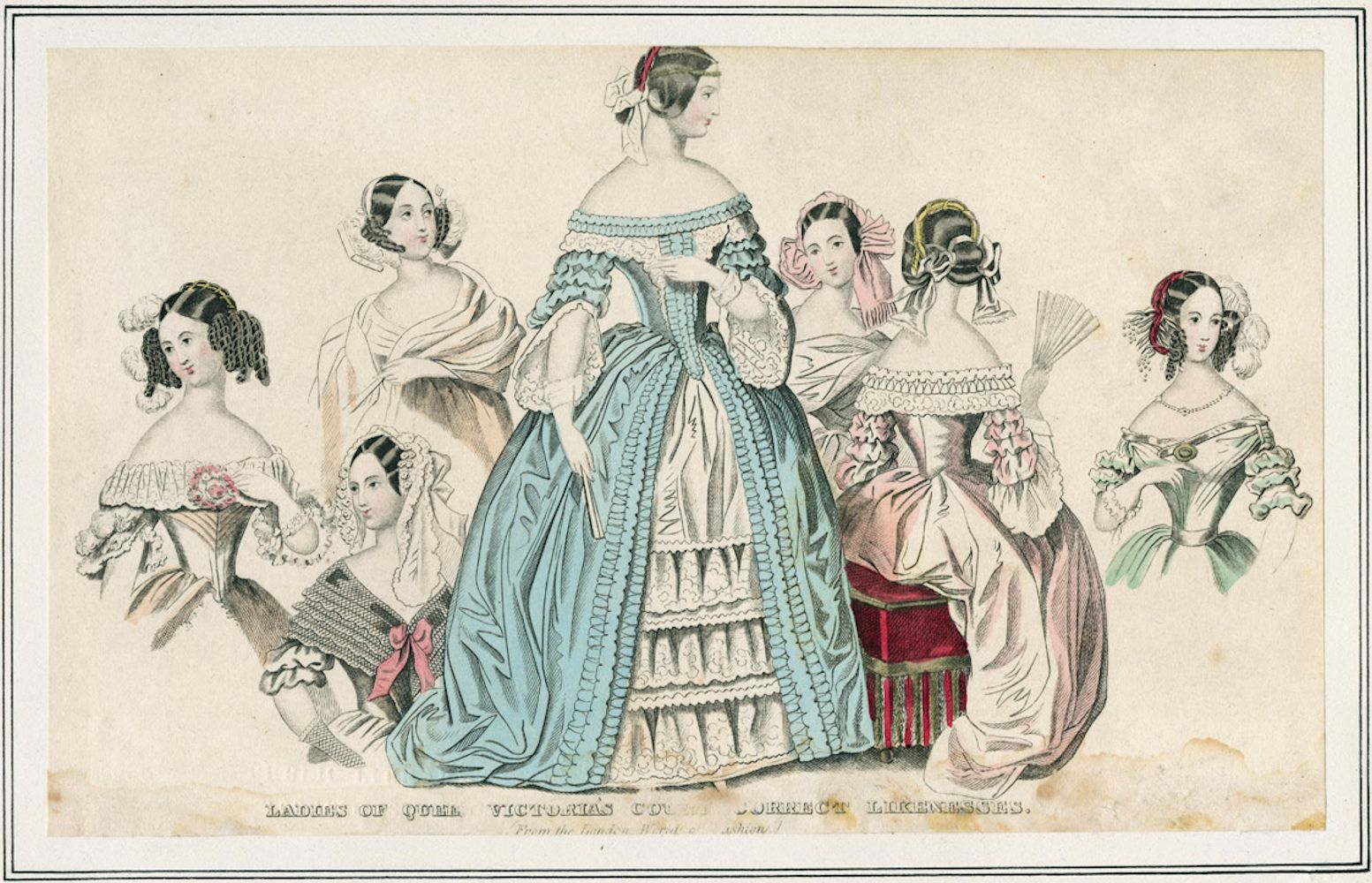
LADIES OF QUEEN VICTORIA’S COURT, CORRECT LIKENESSES.
From the London World of Fashion.
Transcriber’s Notes:
Table of Contents has been added for reader convenience. Archaic spellings and hyphenation have been retained.
Obvious punctuation and typesetting errors have been corrected
without note. A cover was created for this ebook and is placed in the public domain.
[End of Graham’s Magazine, Vol. XVIII, No. 5, May 1841, George R. Graham, Editor]