He Comes.
“Your cousin, young Harry, now Sir Henry
Lorraine, knight banneret, is coming to visit us,
Isabel,” said Lord Deraine, one morning, as he
entered the breakfast room, holding an open letter
in his hand, “he has come over with despatches,
and says that he shall have a few days of leisure.
Here is his letter. It came by a special courier, to
whom I gave a reply, inviting Lorraine down here
at once. So you may expect the gallant boy to-morrow.”
“But pa, how know you he will come?” said
Isabel, with ill-concealed agitation, for she had not
yet forgotten their last parting.
“Come! why where else would he go, but to
those who love him like we do? Ah! I wonder if
glory has changed him. By the honor of my house
but it will make me young again to see the gallant
lad, who has made the name of a Lorraine to ring
like a watch word through Europe.”
Isabel knew not scarcely how she felt. She
dreaded, and yet wished to meet her cousin. Long
did she think over it that night, and wonder if he
had conquered his ill-fated passion. And when at
length she fell asleep, it was after many a prayerful
hope that Lorraine might have learned to
look upon her only as a cousin, and have sought
among fairer and loftier ones, to whom he might
fearlessly aspire, a being more worthy of his fortunes.
Why had Lorraine, after tearing himself away
from Isabel, determined to re-visit her? Alas! who
can tell the workings of that master passion LOVE?
How often do we resolve to see the face of some
dear one no more, and how often do we return
again and again to her presence, hoping even
against hope, until we feel that the cup of bliss is too
surely dashed from our lips forever.
It was a glorious afternoon when he arrived at
the gates of the park, and at every step seeing
something to remind him of the past, he gradually
fell into a reverie, from which he was only aroused
by coming in front of the hall, and finding himself
welcomed by the noisy tenantry, as well as by a
score of old familiar faces in the shape of trusty
servitors. Their homely but joyous greetings went
to Lorraine’s heart, and almost drew tears from his
eyes, when he reflected how differently he had
passed that threshold the last time. His uncle met
him at the hall door, and falling into his arms,
blessed him: while Isabel frankly extending her
hand, greeted him as she would have done in their
old and happy hours.
The dinner passed off, Isabel withdrew, and Lorraine
was alone with his uncle.
“How you have altered, Henry,” said the old
earl, “you left us a boy, and now your brow is that
of a warrior. Ah! I always knew you would prove
an honor to your house. Another glass of the Burgundy.
But now we are alone, let us hear of your
battles and sieges.”
It was almost evening when they rose from the
table, and Lorraine signified his wish to seek the
open air. His uncle pleaded his gout, and the
young knight stepped out upon the lawn.
Soon, however, as if led by a mysterious influence,
he sought the old terrace, where he had sat
at Isabel’s feet the last day he had spent at the hall.
His cousin was there. For a moment both were embarrassed.
A woman on such occasions, is always
the first to speak; and Isabel broke the spell by an
allusion to their early days. Long then they conversed;
for both their hearts were full. But neither
spoke of love.
It was a golden evening, the very counterpart to
the one he had last spent there, and when, for a few
minutes both paused, it is not improbable that each
reverted to that memorable occasion, and for awhile
they gazed without speaking on the landscape.
And mournful were Lorraine’s thoughts as he gazed.
What was honor, or rank, or wealth to him, since
they brought him not Isabel? But was her love
then hopelessly lost to him? Alas! had not De
Courtenay assured him of her continued affection;
and would it not be even dishonorable to win that
affection if he could? Yet might there not be hope?
Such feelings, whirling through his mind, almost
determined Lorraine, in the excitement of the
moment, to fling himself at Isabel’s feet. Suddenly,
however, two horsemen appeared in the
distance, winding up the avenue of the park.
Isabel and himself started simultaneously, and
looked at each other. Could it be that both
divined in the foremost of the riders the same individual?
A moment passed, when their ears were aroused
by the rapid clattering of approaching hoofs, and
looking down they beheld a couple of horsemen
spring from their steeds. The eye of one of the
riders happened to fall upon them, and he turned
hastily in their direction. Surely it was not—yes! it
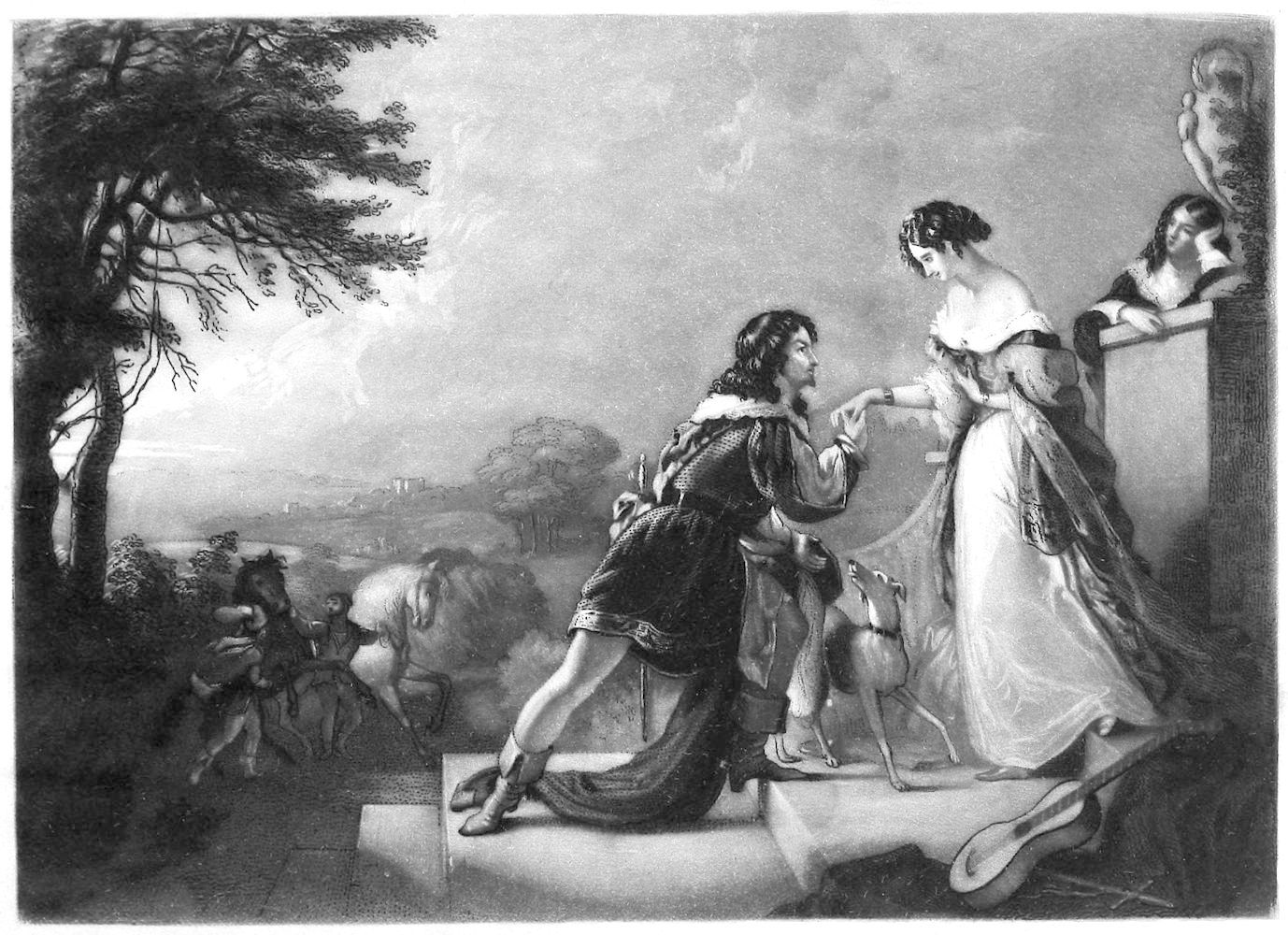
was—De Courtenay. He dashed up the terrace
with eager haste, and Isabel, forgetting, in her glad
surprise, everything except that the lover she had
not seen for years stood before her, rushed forward
to meet him.
“Edward—Edward!” was all the agitated
girl could utter, as she stooped to her half kneeling
lover.
“Isabel—dearest Isabel, we meet at last,” passionately
exclaimed De Courtenay, as he looked up,
and clasped her in his arms.
Oh! who can tell the agony of Lorraine during
that moment? Was it for this he had toiled; was
it for this he had struggled; was it for this he had
breasted the fierce assault? It was the last drop
in his cup of bitterness. His heart was wrung with
unutterable woe. He spoke no word, he breathed
no sigh; but he gazed a moment sadly on the spectacle,
and then noiselessly entered the apartment
behind. When the lovers looked around he was
gone.
That night a solitary traveller might be seen on
the high road to London. He had just parted with
another, who had pursued him hotly for several
miles, and finally overtaken him. The two were
Lorraine and De Courtenay. The latter, learning
every thing from Isabel for the first time, had set
out and overtaken his preserver, with the generous
design to relinquish his mistress to the young knight.
But Lorraine would not listen to him.
“No, no, you tempt me over much,” sadly said
Lorraine, “for can you give me the love of Isabel?
God bless you both. As for me, glory henceforth
is my only mistress. Farewell!” and pressing his
friend’s hand, he plunged his rowels into the flanks
of his steed, and dashed on.
De Courtenay had followed Lorraine to England
unexpectedly within twenty-four hours of the young
knight’s departure, and, having hastily transacted
his business in London, had hurried down to Deraine
hall, and met Lorraine as we have described.
None of his house ever saw Lorraine again. He
appeared in a few days in the camp, but within a
week fell in an assault, the only man who had succeeded
in mounting the breach. There he fought
unsupported for several minutes, but finally sank
pierced with a hundred wounds.
And long did Isabel and De Courtenay weep for
the ill-fated page. And when the war was over,
and they were married, often would they sit on
that old terrace, and feel a melancholy pleasure in
talking of Lorraine. Need we wonder that their
eldest boy bore the name of Isabel’s unfortunate
cousin? * * *
———
BY J. K. MITCHELL.
———
Let Araby boast of her soft spicy gale,
And Persia her breeze from the rose-scented vale;
Let orange-trees scatter in wildness their balm,
Where sweet summer islands lie fragrant and calm!
Give me the cold blast of my country again,
Careering o’er snow-cover’d mountain and plain,
And coming, though scentless, yet pure, to my breast,
With vigor and health from the cloudless Nor-West.
I languish where suns in the tropic sky glow,
And gem-studded waters on golden sands flow,
Where shrubs blossom-laden, bright birds, and sweet trees,
With odors and music encumber the breeze;
I languish to catch but a breathing of thee,
To hear thy wild winter-notes brilliant and free,
To feel thy cool touch on my heart-strings opprest,
And gather a tone from the bracing Nor-West.
Mists melt at thy coming, clouds flee from thy wrath,
The marsh and its vapors are seal’d on thy path,
For spotless and pure as the snow-covered North,
Their cold icy cradle, thy tempests come forth.
Thy blue robe is borrowed from clearest of skies,
Thy sandals were made where the driven snow lies,
And stars, seldom seen in this low world, are blest
To shine in thy coronet—brilliant Nor-West.
Health bounds to thy pathway, joy shouts in thy course,
The virtues of manhood thy breathings enforce;
The pure, and the fair, and the brave, and the free,
Are purer, and fairer, and braver, for thee;
As flames sweeping wildly o’er mountain and heath,
But burn the more fiercely the colder thy breath,
So glow, but more brightly for thee, in the breast,
The virtues of freedom—soul-stirring Nor-West.
Forever, forever, be thine, purest wind,
The lakes and the streams of my country to bind;
And oh, though afar I am fated to roam,
Still kindle the hearths, and the hearts of my home!
While blows from the Polar skies holy and pure,
Thy trumpet of freedom, the land shall endure,
As snow in thy pathway, and stars on thy crest,
Unsullied and beautiful—glorious Nor-West.
Philadelphia, March, 1841.
———
BY MRS. LAMBERT.
———
“I am gone sir, and anon
I’ll be with you again.”
Tempest.
Some years since I chanced to stop, during one
of my summer rambles, in a pretty village, picturesquely
situated in the county of F——d. I
arrived about sun-set, and the quiet loveliness which
appeared every where around, won me to the spot.
A row of neat white houses, with pretty gardens in
front, arose on each side of the way, for the distance
of nearly half a mile. At this point the road
branched off in different directions, and exactly on
the centre of division stood the village church; a
plain, unpretending edifice, whose slender spire rose
high above the full tops of venerable elms and dark
pendant willows that surrounded its peaceful walls.
A row of fine trees planted regularly at the
road side, gave the appearance of an avenue to the
village street, which viewed from its entrance, has
an uncommonly pleasing effect, the eye ranging
through the grass-bounded road, and the umbrageous
arch which overshadows it, till the consecrated
building terminates the vista.
The country immediately adjoining the village is
divided into numerous enclosures, bearing marks of
good cultivation; while pretty farm-houses are scattered
in every direction, with woods, streams, rocks
and groves, beautifying the landscape. A chain of
hills, which might without the charge of an extraordinary
degree of presumption, aspire to the name
of mountains, bounds the view on the south-east—their
undulating outline beautifully marked against
the clear horizon. Through an opening of the
range, a glimpse is caught of the deep blue waters
of the sound—a sail just distinguished—diminished
by distance to a mere speck, gives frequent interest,
and adds to the magic of the scene.
Pleasing, however, as was the village, and
abounding in objects most inviting to a lover of
simple life, I determined not to make it my place
of abode. Enquiring my way to a farm-house, of
which I had some previous knowledge, I directed
my steps thither. It was situated about a mile
from the village, at the foot of a gentle slope, and
adjoining a grove vocal in spring-time with the
notes of almost innumerable birds.
The master of it was a plain farmer, but one of
Heaven’s nobility, an honest man. He lived like
one of the Patriarchs of old, surrounded by his
descendants to the third generation. His still
athletic form was unbent by age, although his
venerable locks were whitened by the snows of
seventy winters.
I was received with all the kindness I could
wish. Every thing was done to make me comfortable,
and cause me, as the phrase goes, to feel
at home, and I did so.
The farm-house was a large, old building,
abounding in long, low rooms, the ceilings of
which were crossed by heavy beams, a century
ago considered no defect in architectural embellishment—narrow
windows, glazed with exceedingly
small panes, carefully leaded—a fire-place
built across one corner of the room, over the
mantel-piece of which appeared a wooden clock,
flanked on each side by a china figure, intending
to represent, as I supposed, Flora and Pomona.
The former of these heathen beauties balanced
her well-filled basket with sufficient gravity on a
head none of the smallest—but her companion
from the carelessness with which she held her
cornucopia, suffered its treasures to escape with
an indifference truly wonderful. A pair of pink-colored
candles, rising from sockets garnished with
curiously cut paper, finished the decorations of the
fire-place.
My hostess was a little, fat, short, good-humored
woman, and with her youngest daughter, the only
one remaining unmarried, and a daughter-in-law,
whose husband was absent in a distant part of the
country, constituted those members of the family,
with whom I had most frequent and social communication.
There were, also, two or three large
dogs, of prepossessing physiognomy, and urbane
gentlemanly manners, with whom I soon found a
sort of companionship.
But of all the oddities, animate or inanimate,
with which I became acquainted during my visit
to Redbury, I saw none that interested me more
than an urchin who officiated in the family as a
sort of boy of all work.
Short, stout, broad-shouldered as an infant Hercules,
with a round, good-humored face, laughing
grey eyes, and elf-locks tanned to a dead flaxey
whiteness, by continual exposure to the sun and
wind—“Our Bill,” for so he was constantly and
familiarly denominated, was to be found every
where, and equal to every imposed duty. He
chopped wood, made the fires, fetched water,
brought the cows, and helped the maids to milk
them; went of all the errands, and did all the
chores. When the farmer came in wearied from
the field, “Our Bill” ran to the cellar and drew for
his refreshment a mug of hard cider. If an extra
hand was wanted in hay-time or harvest, it was
only to send to the house for “Our Bill.” If a
neighbor was at a loss for a messenger in any
emergency—the first thought was to request of
neighbor Dawkins the loan of “Bill.” In short,
he was in demand for every thing, and I began to
consider him ubiquitous.
The readiness with which he complied with every
requisition, his unvarying good-humor and promptness
to oblige, soon drew my attention and gained
my approbation.
The first marked kindness which I received from
him I well remember. I was sitting in the apartment
allotted to my use, and taking my breakfast.
The morning was dark, and it rained violently. I
looked toward the windows with a sort of hopelessness
of feeling, for I expected that letters were
lying in the post-office in the village, from my
friends in the city, and I knew not how to procure
them. To be sure I might send “Our Bill,” but I
had not the heart to do so.
While meditating thus, a gentle tap came to my
door. I opened it, and who should appear but
“Our Bill.” His garments were soaked and dripping
with rain, which fell in rapid and discolored
drops from numerous ragged points and edges.
He held his tattered, crownless hat in one hand,
while he extended to me in the other no less than
three letters—three letters from dear friends in
town—how dear, let friendship in absence determine.
I looked up at the windows involuntarily, as I
broke the seal of one missive.
“Why William, (I never could bear to call him
Bill,) you have been to the post-office—and through
all the storm—I hope you did not go entirely on
my account?”
“Yes, but I did though.”
“Why, my lad, I never would have sent you
through such a tempest of wind and rain.”
“I know that. But I heard you say last night
that you thought there were letters for you in the
village, so I determined you should have ’em.”
“You are a kind boy, Will. Are you not
cold? You had better go quickly and change
your clothes.”
“Change my clothes, oh no—I don’t mind a
wet jacket. I’ll make a fire up for you though,
if you please,” and he looked at my vacant hearth.
“Do so,” said I, and while he was engaged I
perused my letters. Their contents were satisfactory
and pleasing, and I sat ruminating on the past,
with no painful anticipations about the future, while
the boy went on with his self-imposed employment.
“There,” exclaimed he, as a cheerful crackling
flame blazed up the chimney, “I think you’ll do,
now.”
“So do I, Willy, and here is something for your
pains.” I handed him a small silver piece. He
took it with a rustic bow, and looked at it with
delight. His face, cheerful before, now grew bright
with pleasure. Down he sat, sans cérémonie, upon
the hearth, and diving his hand into some unimaginable
recess about his person, brought to light a
dingy-looking rag, which he untied. In it I beheld
a few pieces of copper coin. He added to them
the silver which I had given him, retied his little
bag, thanked me again, and was about to leave the
room. My voice arrested him.
“Why, Willy, you are quite rich; what are you
going to do with so much money?”
The boy actually blushed and hung his head.
“I know,” he replied.
“I suppose you do,” said I, “my man, and may
I not know too?” He was silent. “It will go to
buy tops and marbles, I suppose,” I added.
“No it won’t,” he answered, with quickness.
“Perhaps you are saving it till you get enough
to purchase a new hat, or a pair of shoes. If so,
I think, you are doing very right.”
No answer, and at this moment Mrs. Dawkins
calling him, he left the room.
This economy was a trait I little suspected in
my young acquaintance. Most boys of his age
expend the few pence which they casually acquire,
in the purchase of apples, or nuts, or gingerbread,
but I never saw “Our Bill” indulge in any luxuries
of this sort. I, therefore, could only return to my
first supposition, that he was hoarding up the means
of buying a Sunday jacket, trowsers, shoes or hat.
The chief things that I disapproved of, about the
boy, were the indifference which he evinced as to
his appearance, and his love of mischief. It is true
he had not much time to devote to personal neatness;
yet numerous as were his avocations, there
was not a solitary scheme of mischief carried into
effect within a mile of the village, in which Bill did
not bear a part. If mammy Jennings’s orchard
was to be thinned of its superfluous number of
golden pippins—or cross-grained old Squire Grummand’s
fine walnut tree laid under contribution—or
the Deacon’s melon-patch to be examined by moonlight,
I am sorry to say that “Our Bill” was sure
to be an assistant, if not officiating as president of
the board of directors. In short, he was a mischievous,
but good-natured and obliging boy, that
might by a little care exercised by some kind-hearted
individual, be rendered a good and useful
member of the community. But if neglected and
suffered to grow up in idleness, or desultory employment,
which is next akin to it, he stood a fair
chance of falling into a career of dissipation, profligacy
and vice.
I took an early opportunity of enquiring more
particularly about this boy of Mrs. Dawkins: who
gave me the following account. His parents, who
were natives of the village, and poor, had married
early in life. They were industrious—the man
particularly so—and they were virtuous and honest.
For some time after their marriage the world went
hardly with them. An increase of family brought
an increase of cares and want, with no additional
means wherewith to answer them. James Lee
(that was his name) became dejected—and Nancy
unfortunately lost not her cheerfulness only, but her
good temper: and although James worked hard
from day to day, and gave her every penny of his
earnings, to lay up or expend in supplying the wants
of the family, as she chose; yet she was still peevish
and dissatisfied. Harassed by his wife’s growing
ill-temper, and threatened by all the evils attendant
upon increasing poverty, James began to seek in
company at the village tavern a temporary relief
from care. This only made matters worse; Nancy
instead of striving to make his home pleasant, and
soothing his uneasiness, by bidding him hope for the
best, always met him with tears and upbraidings.
Thus matters went on for some time, when one
day as Mrs. Lee was about heating her oven for a
baking of bread, she found that there was no oven
wood cut. Her husband always prepared the wood
for her in the nicest manner; but he had somehow
or other forgotten to do so at this time. Instead
of going quietly out to him where he sat at work
in the little shop, opposite their house, (he was a
shoemaker by trade) she began by angrily accusing
him of negligence, and want of consideration for
her comfort—with sundry reflections on the manner
in which he had too frequently passed his hours of
late, to the great detriment of both purse and credit.
He heard all she had to say with exemplary patience;
and when she had finished arose from his
bench, and walked to the door.
“Are you going to get the oven-wood?” she
asked.
“Yes, Anne,” he replied meekly, and walked
away.
Mrs. Lee returned to her kitchen, and remained
waiting for the wood till a good hour had elapsed.
Out of all patience, she at last sent her daughter, a
fine, stout lass, of ten years, to hurry her father,
bidding her tell him her bread would be entirely
ruined by waiting so long.
The girl went, but searched for her father in
vain, returning to the house only to give an account
of her ill success. The displeasure of her
mother was again excited, and she sallied forth
herself, fully determined on giving James a piece of
her mind. But James was no where to be seen.
The wood lay uncut. His shop was still open—the
tools which he had been recently employing,
lay on a bench beside that on which he had been
sitting. In short, every thing remained just as he
had left it one short hour before; but from that
time to this, a period of seven years, James Lee
has never been heard of.
“This is a surprising story,” said I, when the
good dame had concluded, “what do people suppose
became of Lee?”
“There’s no telling,” answered Mrs. Dawkins,
“some say one thing and some another. Whether
he left the country—or whether he made away with
himself, there’s nobody knows—for my own part
I think he was harassed out of his life by the odd
temper of his good woman—but there’s no knowing—well,
this here boy, that you’ve been asking
about is her son. She has but two children left—Nancy,
who is about seventeen, and ‘Our Bill.’
My husband took the boy, to keep him out of evil
courses, and if he behaves himself, Mr. Dawkins
will do well by him.”
“That is certainly very kind of your husband,
and I hope the lad will reward him by industry
and good conduct.”
“I hope so, too,” replied my hostess, “but Bill is
rather too much inclined to mischief—yet he is a
good boy, too, in many respects, and is very fond
of his mother, whom he goes to see regularly.”
“What are her means of support?” I asked.
“Well—she has to work hard enough since the
loss of her husband; and many a time I have seen
her standing in the doorway, looking over at the
little shop in which he used to sit at work, with
her eyes brimful of tears. Ah, I guess it goes to
her heart to think how roughly she used to speak
to poor James. She takes in spinning and plain
work, and sometimes goes out a nursing; and her
daughter does a little at millinery, for she has a
pretty taste about such matters; and so they make
out a living.”
“Is the daughter industrious?” I asked.
“As industrious a girl as you would wish to see,
and as handsome. She has a lover too; indeed a
couple of them; but there her mother and she are
at odds; for the one that Nancy likes is not favored
by Mrs. Lee.”
“That is unfortunate; and what kind of a person
is the young man preferred by Nancy?”
“Why, he is a likely lad—the blacksmith of our
village. He has not much before hand to be sure,
but is honest, good, and true.”
“And the other?”
“Oh, he is better off—quite rich. Keeps a store
in the village, and makes a great dash. But for
my own part I think Nancy’s choice is the best;
for Josiah Goodwin is steady as a clock, while
folks do say, that young Sturges, the shop-keeper,
likes a small spree now and then.”
“If that is the case,” said I, “it is to be hoped
that Nancy will remain firm in her determination
to have nothing to do with him.”
“She has a sad time of it at any rate,” replied
my informant. “Her mother keeps her close at
home, and has ordered her never to see or speak to
young Goodwin; who is so troubled about it, that
he has closed his shop and left the village.”
“Really,” said I, “I am sorry for this poor girl,
and I should like to pay a visit to Mrs. Lee.”
“That you may do this evening, if you please,”
said Mrs. Dawkins, “my daughter is going to her
house to carry some work.”
The circumstances of Mrs. Lee’s case as respected
her husband, greatly interested me; my
curiosity was awakened, and I agreed to accompany
Lizzy Dawkins. At the hour appointed we
set out together. After a pleasant walk through
winding roads, and shady lanes, we arrived at the
cottage of Mrs. Lee.
It was an humble abode, unmarked by any exterior
improvement. One large sycamore grew in
front, and threw a portion of its branches across
the moss-grown roof. A rustic bench was placed
at the foot of the tree. This had been done by
James, in the earlier days of wedded love.
The door of the house stood partly open, and
Lizzy, taking the privilege of an old acquaintance,
entered without knocking. I followed. We walked
into the kitchen, which large, clean and comfortable,
served as a reception room. I must acknowledge
that my first glance was directed toward the oven.
Nancy greeted us with a kindly welcome; but
the first object that drew my attention was “Our
Bill,” standing by the side of his mother, and
emptying the contents of his dingy-looking purse
into her lap. In seeing us enter he started, and
looked as much confused as if he had been caught
in some act of delinquency. A look from me gave
him courage. I saw at once for what purpose the
money had been saved, and from that moment
determined that while I lived Bill should never
want a friend.
After Lizzy had delivered the work which she
had brought for her neighbor, the conversation fell
upon different matters. Nancy, however, bore but
a small part therein; she seemed absent and sad.
A young female friend of hers came in, and she
made an effort to appear more cheerful.
It was now the season when whortleberries were
in their prime; and Bill was exceedingly anxious
that a party should be formed for gathering them
in the neighboring wood. Nancy’s young friend
joined warmly in the project. Lizzy Dawkins was
pleased with the arrangement. I agreed to make
one of the number. Nancy evinced small interest
in the matter, though she agreed to go with us if
her mother was willing: and as the good dame
was relieved from her apprehensions on the score
of Goodwin, since she had learned that he had left
the village, she gave her assent. The following
day was fixed upon for our little excursion; and as
the weather proved fine, we accordingly went.
The wood was not far distant from the house of
Mrs. Lee. It was wild, shady, and beautiful: the
resort of the squirrel and the rabbit—gay with innumerable
wild-flowers, and vocal with the sweet
music of its feathered denizens. Numerous openings
amid the thickets disclosed irregular knolls,
covered with the shrubby bushes which now hung
full of the purple berry of which we came in search,
and whose abundance in many past years had given
to this rural spot the name of Whortleberry, or in
village nomenclature, Huckle-berry wood. We soon
met with two or three other parties on the same
errand with ourselves: some acquaintances of Lizzy
and Nancy were among them: we united our forces,
filled our baskets with berries, and chatted and
laughed the hours away.
It was about noon, when, tired and rather hungry,
we concluded to seek for a shady spot where
we might rest, and partake of the refreshment with
which we had taken the precaution to provide ourselves.
Bill, who had acted the part of master of
the ceremonies during the whole of the day, now
preceded us, boasting aloud of his superior skill in
discovering a cool and pleasant spot for the purpose
we desired. After a few turns among the bushes
and underwood, we suddenly emerged upon the
borders of a broad and rapid brook, which was
murmuring its way most delightfully among the
reeds and wild-flowers that graced its margin. And
here we were at a stand. To arrive at the spot
designated by our young conductor, and represented
by him as the best in the wood, it was necessary
that we should cross the stream; but how to do so
was the question. Bill suggested the placing a few
large stones in the bed of the river, by means of
which we might easily step across. This was accordingly
done; and Bill, taking his sister by the
hand, preceded the rest of the party, who paused
while they marked the progress of the adventurers
across their unsteady footway. As soon as they
touched the opposite margin, a loud shout from
Bill electrified us. “A rattle-snake! a rattle-snake!
run—run for your lives!” and forgetful of the courage
which I had hitherto seen him assume on
almost every occasion, Bill dragged his terrified sister
up the rough bank, and disappeared with her in
the thick groves beyond.
The cry had affrighted all. Each one ran in a
different direction from his fellow, and each thought
the rattle-snake close at his heels. The panic
could scarcely have been greater had a boa-constrictor
appeared wreathing its voluminous folds
among the branches of the beech, walnut, and oak,
that rustled above our heads. It was sorrowful to
see the labors of the morning scattered in a moment,
for many of the well-filled baskets, overturned by
their respective owners in the precipitation of their
flight, poured their purple treasure among moss,
lichens, and fern-blossoms.
Meanwhile, I looked in vain for the reptile
which had caused this alarm, and finding myself
left entirely alone, I concluded to follow the footsteps
of the valorous William and his gentle sister.
Crossing the stream, and clambering the bank on
the opposite side, I found myself in a charming
grove of tall young trees of rapid growth.
All was still, save the whistle of the robin, or the
solitary call of the cat-bird. I wandered along,
almost forgetful of the cause which brought me
hither, when at the entrance of a thicket of young
hazels, seated at the end of a fallen tree, and leisurely
employed in stripping the bark from a sapling
branch, which he seemed desirous of forming into
something resembling a walking stick, I discovered
“Our Bill.”
Surprised at the quiet in which I beheld him,
contrasted as it was with his late trepidation and
alarm, I immediately accosted him with enquiries
after his sister.
“She isn’t far, I guess.”
“Do you know where she is?”
“Yes.”
“I wish to see her.”
“Well—stop a bit.”
“I want to know if she is not hurt?”
“Hurt?—what should hurt her?”
“The snake, perhaps.”
The boy grinned archly.
“Bill,” said I, “what has become of that snake,
think you?”
“I’m sure I don’t know.”
“Do you think there really was any there?”
“I’m sartain I cannot tell.”
“Well,” said I, advancing, “I shall continue my
search till I find Nancy.”
The boy started up, and putting his fingers to his
mouth, blew a shrill whistle. I looked at him, in
order to discover, if I could, the end and aim of this
new fantasy. A rustle among the bushes at a little
distance was heard. I turned my eyes in the direction
of the sound. There was Nancy, and by
her side, one of his arms encircling her waist, stood
as fine and good-looking a country youth as one
would wish to see.
They were about parting,—a few more last
words—a kiss and then farewell. Nancy came
tripping toward the spot where she had left her
brother, but on seeing me stopped and looked confused.
I hastened to re-assure her; and quickly retracing
our steps to the brook-side as a sort of
rendezvous, we soon were joined by our companions.
So much for the strategy of “Our Bill.”
Gathering up our fruit as well as we were able,
we pursued our way through the mazes of “Huckle-berry”
wood. Bill who had been for some time in
advance of our party, now came running toward us
announcing our near approach to the house of Betty
Nares the fortune-teller. “The fortune-teller—the
fortune-teller” was echoed from lip to lip. And,
“who will have their fortune told?” was asked of
each, by the other.
And now we came in sight of Betty’s dwelling.
A lowly roof it literally was; for a person would
scarcely be able to stand upright except in the
midst of the only apartment which it contained, so
lowly and sloping was the roof,—so covered with
moss and lichens, that it resembled a green hillock
surrounded by trees. The interior was such as
might have been expected from its outward appearance.
An earthen floor; a stool with three legs;
an empty barrel, the elastic end of which answered
the purposes of a table; a glazed earthen pipkin; a
bowl or two; a wooden platter and spoon, completed
the number and variety of Betty’s furniture and
culinary utensils. A bundle of something indescribable—rolled
up in one corner, was supposed to be
the couch on which this modern sybil reposed her
wearied limbs. A heap of stones formed the fire-place—and
an aperture in the roof answered the
purpose of a chimney in so far as a portion of the
smoke occasionally made its escape thereat.
We found the mistress of this inviting retreat
seated beside a few dying embers, over which she
extended her withered hand, seeking to animate
their torpidity by artificial heat. On seeing us she
rose, and presented to our view a veritable hag-like
face and form. Her garments were tattered, her
shoes decayed, and her grey locks imperfectly
covered by a dilapidated bonnet. She saluted us
in a shrill voice, and, in no very gentle terms, demanded
to know our business.
As this was a question we were not altogether
prepared to answer, each looked at his neighbor,
desirous that he or she should expound. Betty,
finding us silent, and growing rather impatient, commenced
an objurgation in a high key, accompanied
by a few ominous flourishes with a stunted broom
which she snatched from a corner near her fire-place.
At this moment Bill stepped up to her, and
in a low voice made some communication which
had the effect of mollifying her at once.
“Do you wish to have your fortunes told, gentlemen
and ladies?” said she, addressing us with an
attempt at looking gracious. One of the village
girls presented her a small piece of money, while
Betty, from some private nook, brought out a terribly
soiled pack of cards, the corners worn by
constant attrition, and the edges blackened by
frequent devotion to the service of the curious in the
prescient art.
It was amusing to see the interest displayed. The
cards were cut and divided. Attention became fixed.
The fair enquirer into the mysteries of the future,
placed before this modern oracle, looked pale and
red by turns. And now we were informed of a
strange man who would soon arrive and bring good
news to a certain family not many miles off. And
of a dark-haired woman who was a friend, and of a
light-haired woman who was an enemy, to the
young enquirer. How a journey would be made to
a distant land, and how somebody of fair complexion
and immense wealth was to come over the
water and offer himself a candidate for her fair hand.
There were letters to be expected without number,
and presents to be sent without name. At each
separate piece of intelligence sly looks were exchanged
among the circle; meaning smiles, and
conscious glances. “How wonderfully true!” “Surprising!”
“How she could have known such or
such a circumstance, it was hard to tell, but so it
was. She seemed to know every thing.”
Nancy Lee could not be prevailed upon to enquire
into the circumstances of her future lot, and
by such neglect considerably displeased Betty; and
to pacify her, Bill invited her to his mother’s house
the following evening. To which arrangement
she at last graciously consented.
We all returned home cheerful and happy; well
pleased with our day’s excursion.
The following evening I walked out to see Mrs.
Lee, curious I must own, to learn the proceedings
of Betty Nares in persuading Nancy to have her
fortune told.
I found Mrs. Lee as usual in her neat kitchen.
She was sitting quietly there, for the business of the
day was finished, and that of the evening, which
consisted generally of knitting or spinning, was not
yet begun. Nancy was sitting on a low stool by
the side of her mother, and I thought she looked as
if she had been weeping. The milk pans had been
placed away, filled with their simple treasure. The
chairs stood aside, the hearth was swept up, and all
things looked the very abode of quiet.
The last beams of the setting sun shone through
the open door, and threw a soft purple tint across the
humble apartment, which was reflected by a row of
brightly burnished tin pans—proofs of the industry
and neatness of Nancy—which decorated the opposite
wall—and—just as the last tints faded away,
a cricket from some crevice in the rural hearth-stone
commenced tuning his “tiny reed.”—It was
the hour of peace.
Mrs. Lee began to wonder why her son had not
returned. He had been absent she said, for two
hours in “Huckle-berry” wood. She wished with
all her heart that the season of gathering berries
was over. She dreaded every day when farmer
Dawkins would get out of patience with his idling,
and send him home.
While she was speaking the window became
darkened by some opaque body, and on looking up
we recognised the head of Betty Nares. Directly
the fortune-teller entered, and took a seat near the
fire-place.
And now Bill came in. “Well,” he exclaimed
on seeing Betty, “I’m glad you are here. Now
mother do just let her tell Nancy’s fortune. She
told a power of things to Lucy Harroby and Kitty
Dixon, and all of ’em came true—now do, mother.”
“Don’t be a simpleton, Bill. I have no faith in
such stuff.”
I looked at Nancy—she smiled faintly but said
nothing.
“You don’t believe me,” said the sybil—“you
won’t believe me I suppose, if I tell you that you
yourself are soon to be married?” I must confess
that I thought this a bold and daring assertion of
Betty, and calculated to strike at the root of all her
hopes of success: as Mrs. Lee was known to be
scrupulously correct and reserved in her deportment,
most particularly since the mysterious departure of
her husband. As I expected, Betty received a look
of disdain.
“You need not look so scornful, Mrs. Lee,” said
Betty, “what I tell you is true, and you can’t get
aside of it. And I’ll tell you more. The man you
want your daughter to marry, is going to meet with
a great deal of trouble in his worldly matters,—and
the one you don’t wish her to have is likely to be a
rich man—and more—the day you give your consent
that Nancy shall marry Goodwin, a stranger
from across the water will come here, and give her
a dowry that shall set them both well a going in
the world.”
Mrs. Lee in great displeasure asked Betty if she
really supposed “that she had lost her senses, that
she should for one minute be induced to credit such
idle trash.” Betty however, kept her ground, and
repeated her opinions with a tenacity that surprised
me. Bill still continued to entreat. Nancy hid
her face in her hands, and burst into tears. Mrs.
Lee scolded, and Betty solemnly shaking her head,
declared she “had her knowledge from one who
would not lie.”
Feeling my presence, in the existing circumstances,
rather an incumbrance, I rose to take
leave. This I did, just as Bill was blowing a coal
in order to light a candle, and Betty was beginning
to shuffle her cards.
Some particular business of my own, prevented
me for a few days from inquiring into the civil and
domestic relations of the House of Lee. I saw
however, that my friend Bill was still in action.
Indeed he seemed more busy than ever. How the
boy sustained such a constant course of riding and
running, of chopping and lugging, of cattle-driving
and hog-feeding, with numerous other et ceteras, all
generally terminating—of late—in an excursion to
“Huckle-berry” wood, I could scarcely imagine.
Wishing one morning to speak to my hostess, I
went to the kitchen; secure of finding her there,—that
being the seat of empire, with a good New-England
house-wife. For once, however, I was
disappointed; but there sat Bill. Returned from
some nameless excursion, he was eating a late
breakfast. It was rather picturesque. His naked
feet, stained by the soil through which he had lately
plodded, were raised upon the cross piece of his
chair—his knees appearing through two very unnecessary
apertures in his nether garment—his
ragged hat lying on the floor at his feet, and two
large house-dogs seated on the ground—one on each
side, watching with eager interest each morsel that
he conveyed to his lips.
I have said that I was somewhat anxious on the
score of Bill’s health; but when I saw the devotion
with which he applied himself to his hashed pork
and potatoes, and the complacency with which
from time to time he eyed a smoking dish of
pumpkin-pudding which stood close at his elbow,
waiting his acceptance, I comforted myself with the
belief that the means and appliances with which he
strengthened his inward man, would abundantly
enable him to sustain the labors which heaven had
allotted to his share.
We had long been the best of friends, and perfectly
understood each other. He looked up at me
with his laughing grey eyes.
“Our Nance is going to be married.”
“You don’t say so—Bill, are you in earnest?”
Bill nodded, for by this time his mouth was again
full, and he could not speak. He took a draught
of cider from the great brown jug on the table.
“Yes, it’s true enough.”
“And to whom is she to be married?”
“Siah Goodwin.”
“Bless me, what could have brought about such
a change?”
“Anan?”
“How has it all happened, Bill?”
“Why Betty Nares told Mother it was to be; so
how could she hinder it?”
“Ah, very true. Well, when is the wedding to
take place?”
“To-morrow evening—won’t you come?”
“Certainly.”
“Do,—we shall have a main sight of pumpkin
pies; mother says it will be like a training day.”
Was it possible that the artful and ignorant
Betty had succeeded in imposing upon the plain
good sense of Mrs. Lee? I was sure there must be
more in it than at first sight appeared. However,
I determined to be at the wedding. On enquiry, I
found that the Dawkinses were invited, and also that
they were as much surprised at the turn affairs had
taken as myself.
The next evening we all repaired to the house of
Mrs. Lee. On entering her little parlor, we found
a few of the neighbors assembled. Nancy sat near
a window, and beside her one whom I supposed to
be the bridegroom. I thought that I recognised in
him the same young man whom I had seen with
her in Huckle-berry wood. My doubts, if I had any
remaining, would soon have been dissipated by her
brother, who walking up to me, and looking expressively
in my face, and putting two of his fingers
to his mouth, produced in a subdued tone a sound
resembling the hissing of a snake. The whole truth
flashed upon me at once.
The exterior of Bill himself was greatly improved,
dressed as he was for the occasion, in a good suit
of home-spun cloth, his feet covered with a decent
pair of leather shoes, and his flaxen hair combed
smoothly over his forehead, cut short and even all
round, with the exception of two pendant locks, left
as a partial covering to his ears.
Every thing was now in readiness, and we waited
only for the clergyman who had been sent for to
perform the marriage ceremony.
A knock came to the door. Bill flew to open it.—“Here
he is.” “That’s he”—was whispered
around—“No, not yet.”—
A fidgetty restlessness took possession of the
party. Steps were heard outside. The door again
opened, and Bill appeared preceding a stranger. He
was dressed like a plain countryman, of good-looking
face and appearance, and he bore in his arms a
rather unusual burthen, supposing him to be a
traveller. He advanced into the middle of the room.
Mrs. Lee rose from her seat and stared at him
wildly. The stranger extended his hand to her
smiling. “Nancy,” said he, “I’ve brought in the
oven-wood.”
The poor woman gave one shriek and fell on the
floor. Down went the wood on the hearth, and
the stranger flew to her assistance. Slowly she
regained her senses, and when she did so, she threw
herself in the arms of the new comer and wept
aloud. We all crowded around, eager for an explanation.
It was soon given. James Lee, distressed
by poverty, and worn by the fretful temper
of his wife, had, on the memorable morning of his
disappearance—on the impulse of the moment, resolved
to quit his home and seek his fortune in a
foreign clime. For this act, his only apology was
the bitterness of despair. He sought the nearest
port, and embarked as a common sailor on board a
vessel about sailing to the West-Indies. Changing
his name that he might not be traced, he made
himself useful, and became a favorite with his captain:
was generally esteemed, and by degrees
enabled to traffic a little on his own account. He
had made many voyages and been unusually successful.
He had acquired a snug competence with
which he now returned, for the purpose of enjoying
it in the bosom of his family. As he approached
his home, the recollection of the manner in which
he had left it suddenly occurred to him, and when
Bill opened the door, the thought struck him that
he would go to the wood-pile, fill his arms with
wood, and thus bring to his wife’s mind, for the
joke’s sake, the remembrance of their parting scene,
seven years before.
When he had concluded, and we had offered our
congratulations on this happy event, a shrill voice
was heard to exclaim,
“Didn’t I tell you so—didn’t I say you were
going to be married, Miss Lee—hasn’t everything
I said come to pass—didn’t I tell you?”—
“Yes, yes,” said Mrs. Lee, smiling, “you told
me, as you tell others of things to happen which
you take good care to find out before-hand.” Betty
looked rather blank when she found that no credit
was allowed her for her skill in prescience, more
especially as “Our Bill” in the pride and fullness of
his heart unfolded the secret of his numerous expeditions
to the wood. Here at Goodwin’s farm
which was in the immediate neighborhood, Lee had
remained for a few days till the harmless plot which
he laid in conjunction with the young man was ripe
for development, and his wife had given her consent
to his daughter’s marriage with “Siah.” It
is scarcely necessary to say that Bill had met and
recognised his father—been made privy to his and
Goodwin’s scheme, and in short, been active agent
in the whole affair.
Several years have passed since that period.
William Lee has grown to man’s estate. He is
married and has a snug little home of his own.
He is a carpenter by trade, and fills a respectable
station in the community of which he is a member.
For my own part, I love to think over the past,
for many a pleasing idea is connected with the reminiscences
of “Huckle-berry” wood, and “Our Bill.”
———
BY THE AUTHOR OF “HOWARD PINCKNEY.”
———
And Helen, not neglectful she
Of her proud sex’s dignity,
If, in the mazes of the dance,
Perchance she met her loved of all,
You’d think that nothing met her glance
Between her and the wall,
Her eye around is thrown so free,
Her laugh rings out so merrily:
How soon a slighted woman learns
To hide that pang, however deep,
Though in her tortured heart it burns,
Her bosom-thoughts seem all asleep:
You’d think that peace was resting there,
With her light shawl upon her breast,
That exercise and healthy air,
And day-dreams that be wondrous fair,
With hopes that sweetest fruitage bear
Had caused the slight unrest:
Know you that her young heart bleeds—
That in this laughing mood.
The Pelican of Passion feeds
Her ever hungry brood—
The two extremes approach we know
And therefore often laughs our woe;
Hers tells, that laugh which rung so loud,
Of withered hopes within their shroud.
———
BY REV. J. KENNADAY.
———
“Why don’t you hurry, woman? Sure it is no
wonder that the child sleeps in your arms. And
yourself will be asleep next, if you walk at this
creeping rate.”
“Be patient, William. You know that the
mountain is steep; the child is heavy; and it’s but
little strength I have, any way.”
This was part of a dialogue I chanced to hear,
while passing the parties, who were clambering up
one of the most rugged roads in the Catskill mountains;
a road so steep indeed, that my horse puffed
at every step, and the saddle creaked beneath me as
I grasped the pummel.
The man was some twelve or fifteen feet in
advance of the woman, and at the sound of my
horse’s feet, paused till I passed, when he turned the
hasty glance of his eye from me, in a heavy frown
upon her whom he upbraided. A light breath of
wind touching the hood, together with the effort of
the woman to step aside from the road till I passed,
laid open the face of the sleeping child, and gave
evidence, in the fullness of its face, of the weight of
its frame, and of health, derived almost at the
expense of the one upon whose bosom it reposed.
Possessing an enormous and hardy frame, the
man trode the mountain path almost with the step
of an elephant, and appeared to require nothing but
a palanquin upon his huge shoulders to enable him
to carry both the mother and the babe. The
woman was of small and delicate form. Her face
was round and very fair, over which was cast the
mildness of a bright but modest eye. Although her
age was about thirty, she appeared at least fifteen
years younger than her husband.
A bend in the road, and the rapid walk of my
horse, soon led me so far in advance, that I ceased
farther to hear a dialogue which, as far as it was
heard, intimated the unfeeling character of the one,
and satisfied me that the other had ample opportunity
to manifest her piety in the perfect working of
her patience.
In the progress of another mile of the ascending
road, I came to a pass, where, in a close of about
half an acre of level land, there stood a little hut,
immediately on the side of the road. The building
was formed of large unhewn logs, interlaid with
clay. The door, swinging upon hinges made of the
soles of worn-out shoes, being partially open, disclosed
the scanty and mutilated furniture within.
There was only one window, consisting of a slender
sash, designed for four small panes of glass, but in
which only two remained.
Notwithstanding the poverty indicated in the
appearance of every thing presented to my view,
there was a general neatness with which I was
forcibly struck. A thrifty honey-suckle climbed up
the little hut, and the garden was much enlivened
by a variety of lovely flowers. I know not how
correct the criterion may be found by others, but
my observations have long since confirmed me in the
accuracy of the inference that, however humble or
elegant a country dwelling-house may be, wherever
there is a choice collection of flowers in the garden,
there is usually taste and cleanliness within the
dwelling. The approach of a little boy and girl to
the door of this humble hut, with coarse but well
mended apparel, and the sedate and polite manner in
which they expressed their obeisance as I passed,
satisfied me that the mistress of this cot possessed
feelings worthy of a better home. The manners of
the children were the more perceptible, as they
could not have been acquired at school, in as much
as in this section of the mountains, schools are
seldom heard of. I knew of but one school-house
within a distance of three miles from these children,
and that was open only during three months of the
year, and when those who attended must wade
through highland snows.
Another mile brought me to my place of destination,
the glass-works, consisting of a low, spacious,
sombre frame building, standing in a field, every
where studded with the most formidable stumps of
the hemlock, a tree the most common in these
mountains, and the most majestic in its growth.
With a trunk measuring from five to eight feet in
diameter, and rising more than a hundred feet high,
this tree seems the fitting plumage of the mountain
it adorns. Scattered at various distances from the
glass factory were a few buildings, which, from their
dilapidated appearance, evidenced that their inmates
would never suffer persecution for belonging to a
suspected aristocracy. Perhaps, however, I ought
to except one building which stood in palace-like
contrast with the rest, and adjoined the “factory-store.”
This was the mansion of my friend, Dr. ——,
physician, agent of the glass-works, justice of
the peace, keeper of the store, and frequently member
of the Legislature.
Here, with as much authority as is sometimes
possessed by a continental prince, the Doctor resided,
enjoying the character of a “people’s-man.” Strange
as it might appear, yet it is certain that the glass-blowers
and wood choppers seldom remove from
under his “agency,” without having a balance
against them on the Doctor’s book, either for
rent, medical attendance, justice, groceries or gin.
He, it is true, got rich, yet no one ventured to
question his integrity, or to doubt his protection of
the poor.
It was not until the following day that I was
able to gratify my curiosity by going into the
factory. The blower, at the furnace nearest to
which I stood, soon gave his instrument to another,
and kindly tendered his services to accompany me
through the works, and to give me the information
respecting the process of glass-blowing, of which I
was in quest. We had passed only one or two men
before I perceived, at one of the furnaces, the man
whom I passed in ascending the mountain.
“Who is that man?” said I, to my guide.
“That is Bill Hunter,” said he, “and a great
bear he is.”
“Then you know him well?”
“I’ faith I do,” said the man, whose broad dialect
had shown before this that he was an Englishman.
“I have known him this many a year. A
fine woman is she, his wife, but a dog’s life it is, she
has with him.”
“He drinks, I suspect.”
“Yes, he does; but he’s a bad man when sober;
and it was a dark day for her when she left her
father’s house for such a dolt as Hunter.”
“Then you know something of their history, I
presume. Did you know her father?”
“What, John Shaw of Spittlefields! indeed I
knew him well, and it’s all good I know of him.
Sure, a better man there never lived.”
“My curiosity is quite awake my friend,” said I,
“and you will greatly gratify me by giving me a
little of their history.”
“Oh! but it is a sorry history for her, poor
woman,” said he. “Do you see, then, her father
was a wealthy manufacturer, and much thought on.
When Margaret was about fourteen years of age,
he took this same Hunter into his factory and store
to be a kind of porter or runner. For the purpose
of aiding in family errands, he boarded in Mr.
Shaw’s house. At the end of a year, the father
discovered that Margaret treated Hunter’s addresses
with favor, and in disgust and chagrin dismissed
him from his employ; not because he was poor, but
that he was so ould. We, who knew him, thought
it was strange that the poor wench could think any
thing of such a surly, selfish fellow. But then he
was good-looking, and as slender as ye. It was
not long before the whole town was in a stir, when
it was said that Shaw’s Margaret had gone to the
States with Hunter. Sure enough, it was true; for
it was found out that under pretended names they
had sailed from Liverpool for Philadelphia. The
vessel, however, went into Wilmington, in the state
of Delaware, where they were married and went
into the country, and found employment in a factory.
He was ever a low fellow and a fool, was Mr. Shaw,
for admitting him under his roof. About three
years since, he came to this place poor enough.
For Margaret’s sake, poor girl, whom I knew
when the whole town was proud of her, I gave
him an insight into this business. He scratches a
scanty living, having five children, and lives in the
hut that you passed down the mountain a piece.
He is but a brute to her, who shares a hard life on
it, poor thing; and must ever repent leaving a
father’s house for one so unworthy of her.”
With this simple narrative I was much interested,
and not the less so because it was to me an additional
evidence of what I had often thought to be
the case, that in the humbler walks of life, and in
some of the scenes, of poverty and suffering, there
are those often who spend years of pain in weeping
over the inadvertence of the hour in which their
affections were misplaced.
———
BY MRS. M. S. B. DANA.
———
And strangers gazed and wondered at the sight.
Round that lone being glowed a hallowed light;
Upon her pale, thin face a heaven-born smile
Played like a sunbeam on some lonely isle.
Yet plaintive were her tones in speech or song,
Like the low moaning winds the trees among,
And you could see her tender heart was riven,
And all the love she had, she gave to Heaven,
Oft, when the god of day had sunk to rest,
And sunlight lingered in the rosy west,
Still would she wander forth, with noiseless tread,
And, by a secret influence spirit-led,
Seek the same spot to which her steps would stray
With those she loved—but now, oh! where are they?
A SKETCH FROM REAL LIFE.
———
BY MRS. E. C. EMBURY.
———
“Warriors and statesmen have their meed of praise,
And what they do or suffer men record;
But the long sacrifice of woman’s days
Passes without a thought—without a word;
And many a holy struggle for the sake
Of duties sternly, faithfully fulfilled—
For which the anxious mind must watch and wake,
And the strong feelings of the heart be stilled,—
Goes by unheeded as the summer wind,
And leaves no memory and no trace behind!”
Mrs. Norton.
“Do you believe, cousin Grace, that the world
is as disinterested as it was in the days of the
‘preux chevaliers, sans peur et sans reproche?’ ”
“I do, Frank; and even though you quote the
great Edmund Burke, you will not convince me
that the days of chivalry are gone! The days of
knight-errantry are passed away, and well is it for
society that they are so, but there is as much of
the true chivalric spirit now existing as was to be
found in the time of Richard of the Lion Heart.”
“Do you really believe this, Grace?”
“Let me retaliate by another question, cousin
Frank; do you believe that all the knights and
squires of olden time were inspired purely by a
noble desire to win fame and redress wrongs? Did
not avarice, ambition, selfish gratification, and love
of wild excitement mingle their elements then, even
as they do now, in the mass of human feeling?”
“Undoubtedly the grosser passions were often
commingled with the better qualities of man’s
nature; selfishness existed, but was not then so
widely diffused.”
“There we differ, Frank; the selfishness of
modern times certainly shows itself in less fearful
shapes.”
“Because society has been compelled to make
laws to protect itself against those who would
sacrifice all things to their own will; ‘might no
longer makes right,’ and therefore the selfishness
of human nature is shown less in high-handed
spoliations than in secret machinations.”
“Well, Frank, that there is enough, aye, and to
spare of selfishness on earth I do not mean to
dispute; but I still adhere to my first assertion
that there is no lack of the true chivalric spirit.”
“And pray how does it exhibit its qualities in
this very dull and prosaic world?”
“Disinterestedness, self-devotion, purity of intention,
integrity of principle, delicacy of sentiment, a
high-toned sense of honor, and indomitable courage—these
are the essential qualities of a chivalric
character; and surely, Frank, there is no want of
arenas in which to exercise these virtues.”
“You will find few knights ready to enter the
lists if such are the requisites, cousin Grace.”
“I hope you are mistaken in your estimate of
men, Frank; I have a better opinion of your sex
than to adopt your ideas. But if it be as you say,
if selfishness be so active a principle among men,
then have the virtues taken up their abode in the
hearts of women.”
“Do they possess the chivalric spirit, Grace?—courage
and all?”
“You need not laugh, I can prove what I say.”
“No, no, Grace, I am willing to allow your sex
all superiority in goodness and purity of feeling, but
the virtues of women are of a passive nature,—they
have fortitude to suffer, patience to endure,
but rarely energy to act. Men make sacrifices—women
suffer them.”
“How little you know of the sex when you
make such an assertion, Frank. A woman’s sacrifices
are of daily and hourly occurrence; she
lives but to minister to others, and to forget
herself. If her courage is of a more passive
nature it is because her sphere of action is very
properly limited. She is not called to stem the
tide of battle, or to face death in warrior’s array;
but is it nothing to look calmly upon the king of
terrors in the chamber of pestilence—to wait for
his fatal blow, with placid fortitude, when assailed
by sudden peril—to gaze, unmoved, upon the weltering
wave—or to perish with unquailing courage
amid flames and tortures? Yet all this has been
done by women. Awaken but a woman’s feelings,
arouse the hidden strength of her affections, and
earth holds not a peril which she will not brave.”
“You are eloquent, cousin Grace, but you
scarcely make out your own case; according to
your own evidence woman must have a personal
motive for action; her strength of character must
be called forth by some individual affection, or to
use a less gentle term, by some selfish impulse.”
“According to your way of viewing character,
then, Frank, the noblest impulses of our nature
arise from selfishness.”
“I should like to hear you draw a parallel between
the sexes, cousin Grace; you seem to be so
impartial—to concede so much goodness to man’s
fallen nature, while you exalt so highly the weaker
sex, that I am a little curious to know how you
would distinguish them.”
“You would probably only dispute my positions,
and make a jest of my distinctions, Frank.”
“I will promise to do neither, Grace.”
“Well, then listen to the opinions of one who
is content with the dispensations of Providence,
and who believes that the finger of God himself
has marked out the line which separates the impulses,
the habits, the character of the two sexes:—Man
has vigor—woman refinement: man has the
reasoning faculty best developed—woman the perceptive:
man has the power of abstraction—woman
rarely possesses it: man is the creature of calculation—woman
of impulse: man is capable of deep
research, he proceeds slowly and cautiously, measuring
every distance, and counting every step of
his progress—woman bounds along with rapid foot,
observing the most prominent objects in her path,
and from them forms conclusions often erroneous,
but always ingenious. The intellectual faculty in
man is usually concentrated—in woman it is diffused:
men of genius commonly devote themselves
to some one favorite pursuit—women of genius are
remarkable for their versatility. Man has the more
correct judgment—woman the more correct feelings.
He has a knowledge of right which he
often forgets—she a consciousness of it which
never forsakes her, even in the midst of crime:
man possesses the stronger passions—woman the
stronger affections: man has boldness—woman
fortitude: man can perform heroic deeds—woman
can endure the extreme of suffering: man has the
more physical daring—woman the more moral
courage: man controls others by the force of his
character—woman influences by the gentleness of
hers. In a word, my dear Frank, the relative
position of the sexes is fixed beyond all change;
their respective duties are well defined. Man has
been given the weapons of moral and mental warfare,
that he may go out into the world, and do
battle with and for his fellows—while on woman
is bestowed that skill in moral and mental culture
which enables her to improve the field of duty at
home.”
“Very clearly defined, cousin Grace; so then
you do not agree in opinion with those who are for
enlarging the boundaries of woman’s domain, and
would fain make her a gladiator in the arena, instead
of a spectator in the amphitheatre of action.”
“That women have some wrongs to be redressed
is an undoubted fact, but I am no friend to this
new warfare for the ‘rights of women;’ let the sex
only do their duty at home to parents, brothers,
husbands, or friends, and they will have little cause
to repine that the forum, the pulpit, or the poll is
closed against them. But I have not forgotten
your innuendoes respecting the selfishness of women,
Frank, and I should like to tell you a story which
will convince you of how much self-devotion a
woman may be capable, even when the strongest
passions of her nature are to be subdued.
“Fanny Wilbank was one of those patient, long
suffering creatures, who seem sent into the world
to fulfil the command, ‘Bear ye one another’s burdens,’
for from her very childhood she had borne
the burdens of the whole family. Her father, one
of those good-hearted, thoughtless prodigals, who,
in their readiness to help other people, are apt to
forget their own interests, had been all his life
unfortunate. Nothing seemed to succeed in his
hands—the most promising business was sure to
fail if he undertook it, and as his family increased
his means diminished, until they were reduced to
the utmost straits to preserve that respectability of
station in which they were born and bred. Fanny
was the eldest of the family, and of course upon
her devolved the duty of assisting her sickly mother
in the care of the children, and the management of
their household. Here was a wide field for the
exercise of self-denial and patience. A weary lot
is that of hopeless poverty, when it relies on charity
alone for food and warmth and raiment; but wearier
still is the lot of those, who, amid privation and
want, still struggle to keep themselves from the
deep abyss of beggary, and strive with decent pride
still to retain their foothold in a world which too
often confounds misfortune with disgrace. It was
amid cares, and troubles, and anxieties of every
kind that Fanny Wilbank grew up to womanhood.
To say that she was beautiful would convey but
little idea of the gentleness, the delicacy, the loveliness
of her countenance. I might describe her
soft black eyes, her full bright lips, the jetty
blackness of her luxuriant tresses, the grace of
her slender form, and the elastic spring of her
bounding step, but it would need the painter’s art
to image the tender sweetness of her expression.
Her face was such as one might fancy for a
Madonna—pale, pensive and full of high-souled
thought; but Fanny knew little of her beauty and
cared less. Had she possessed the talisman of
wealth she might have been the artist’s model and
the poet’s theme; but the spell of beauty alone is
powerless to unlock the treasures of earth, and
Fanny was too poor to behold her own charms in
the magic mirror of flattery. Indeed she never
seemed to think of herself; she managed for every
body, ministered to the comfort of every body, and
took her share of enjoyment in beholding the
gratification of others. But it must not be supposed
that her beauty and goodness were unknown
and unappreciated. Several unexceptionable offers
of marriage were made to her—offers, which if
accepted, would have placed her far beyond the
reach of want and labor—but Fanny was not to
be influenced by sordid motives in so momentous
a matter, and resisting all the temptations of a life
of ease, still preserved her quiet cheerfulness to
illumine the home of her childhood.
“Her hour of severer trial, however, came at last.
Among the few companions of her childhood was
a youth of humble fortunes but of noble character,
whose name I shall conceal under that of William
Grey. Their regard for each other had grown up
so gradually in their hearts, probably neither was
aware of its strength, until the time when William
was to go out into the world and strive amid his
fellows to earn his bread by the sweat of his brow.
The grief which each felt at this separation, revealed
the nature of their feelings, and Fanny wondered at
herself when she found how closely her love for a
stranger had entwined itself with the affections
which she had hitherto devoted to the claims of
kindred. But they plighted faith to each other, and
looking forward to a future of mutual love and
quiet happiness, William obeyed the call of duty,
while the gentle Fanny continued to pursue her
routine of heavy cares with a cheerful and hopeful
spirit.
“After an absence of two years, William full of
eager anticipation returned to claim the fulfilment
of her pledge, and to bear her to a humble home in
another part of the country. Fanny’s heart misgave
her sadly, when she looked on her pale mother
and thought of the burden which would fall upon
her when she was gone. She half repented of her
promise to William, dearly as she loved him, for
she had so long been accustomed to think of the
comfort of others, in preference to her own, that
self gratification seemed to her almost a sin. But
her scruples were soon put to rest, for her parents,
unwilling to make any sacrifices on their part for
their self-denying child, positively refused to listen
to her lover’s suit. Nay, they even accused Fanny
of selfishness, and made out a charge of black
ingratitude against her, for wishing to leave them.
With the usual impatience of man’s temper, William
was deeply incensed at such treatment, and endeavored
to persuade Fanny to a clandestine marriage.
Her answer to his proposal was one which might
be remembered with profit by those who rush heedlessly
to the altar, even when their path lies over
the crushed hearts of those who watched their
helpless infancy.
“ ‘How could I hope to perform my duties to you,
William,’ said she, ‘if I came to you with the
curse of a broken commandment clinging to me?
Think you a disobedient child could prove a good
wife? No, dearly as you now love me, you would
be the first to doubt me, were I to give you such a
proof of my selfish disregard to the ties of blood.
We are both young yet, let us then wait until the
future shall bring us better prospects.’
“ ‘God knows, Fanny, I would serve for you even
as Jacob did for Rachel, could I but hope to see you
my own, but I know not how time is to remove the
obstacles which divide us,’ was his reply.
“ ‘Oh, Mary will soon be old enough to fill my
place, and then I can be spared from home,’
said she.
“ ‘Alas if I am to wait till your place can be
supplied by another, I shall but live on hope to die
in despair,’ said William despondingly; ‘no one can
ever be the same, thoughtful, patient, affectionate,
ministering angel that you have been to all around
you.’ And thus they again parted, but which think
you suffered most keenly from this disappointment?
Was it he whose love was but the episode in the
striving tale of life—who listened to the voice of
affection, but as soft music played between the acts
of the great tragi-comedy of existence? No! the
shaft of pain sunk deepest in the heart of her who
remained in the seclusion of home, shut up within
the narrow circle of duties which daily, hourly
reminded her of the almost hopeless nature of her
feelings.
“Time sped on and brought its usual changes.
The boys grew old enough to be provided with
situations beyond the parental roof, and Fanny
began to look forward once more to a union with
her lover. But in the midst of her brightening
hopes, her mother died, leaving to Fanny as her
last bequest, the charge of watching over the youth
of her only sister. This sacred duty was one which
Fanny might easily have fulfilled without the sacrifice
of a single desire of her own heart, had not
Mary’s failing health rendered it a task of unceasing
anxiety. An accident received in infancy had
slowly and insidiously undermined the once vigorous
constitution of the child, and soon after the mother
was laid within the tomb, an incurable disease of
the spine confined Mary entirely to her bed. It
was then, with a heart bleeding over the severed
ties of kindred, that Fanny first taught herself to
reflect upon the necessity of a final sacrifice of her
hopes of happiness. Her father was fast sinking
under the infirmities of age, and Mary was now
helplessly dependent on her for every comfort; how
then could she indulge the vain dream of being able
to study her own welfare. There was a bitter
struggle in the heart of the poor girl ere she could
bring herself to write a letter of renunciation to
William. But she swerved not her duty, however
severe might be its requisitions, and while the
tears fell like rain over the thoughts of her blighted
hopes, not one drop was allowed to blister the
page which bore him her final farewell. But Fanny
was sadly mistaken when she fancied that the
severest part of the conflict was past. The letter
only served to bring William in person to combat
the resolution she had formed, and she was now
to endure the redoubled anguish of beholding her
lover’s sorrow. But in vain he sought to alter her
decision. She knew that instead of being a help-meet,
she could now be only a hindrance to one
who was obliged to labor for his daily bread, and
her unselfish love taught her that it was for her
‘Alone to suffer and alone to strive.’
“ ‘My fate is fixed, William,’ said the hopeless
girl; ‘I cannot perform the duties of a poor man’s
wife, without neglecting my afflicted sister; her
sufferings would mar your daily comfort, and her
necessities demand my undivided attention. God
knows how tenderly I have loved you, and how
gratefully I feel your faithfulness, in thus abiding
constant through years of absence and disappointment,
but that must be at an end now, William;—our
long engagement must be forgotten,—you are
free—and may heaven grant you a happier destiny
than to be linked with one who seems born only
for sorrow.’
“Poor Fanny! how bitterly she wept as she uttered
these words of self-immolation! But she knew she
was right, and even William, when the first burst of
grief had subsided, and he was able to reflect calmly
upon all the circumstances, acknowledged within
himself, that Fanny had judged wisely for both.
He could appreciate the honest pride which forbade
her to fill a husband’s home with her own helpless
relatives, and he could well understand the disinterested
affection which taught her to make her own
heart the victim rather than heap heavier burdens upon
one with whom the world had already dealt hardly.
Again they parted, but no hope of reunion now
cheered their last farewell;—henceforth they were
to meet as friends, but never more to exchange the
sweet tones of lovers’ vows. How much less heroism
is required to perform noble deeds in the sight,
and beneath the applause of thousands, than thus to
sacrifice love, and hope, and happiness, in silence
and secrecy on the altar of duty! Yet the warrior
receives his meed of glory, while the woman who
calmly surrenders the ‘life of life’ without the stimulus
of fame or the hope of guerdon;—she who
patiently lives on, ‘in helpless, hopeless, brokenness
of heart,’ ministering meekly to others, while a
wasting grief is eating into her very soul—goes
down to the grave unnoticed and unknown—perhaps
regarded as a cold and eccentric being by those
who cannot fathom the pure depths of such a mind.
Fanny’s cheek grew pale and hollow, but she
gave no other evidence of secret sorrow, for she
well knew that Mary’s keen eye would watch for
traces of her heart’s struggle, and she would not
pain her suffering sister by a knowledge of the bitter
price at which her comfort had been purchased. At
length she heard of William’s marriage, and this
severed the last frail link that bound their hearts
together. From that time his name was never
mentioned, and resolutely forbidding her thoughts to
dwell upon the past, Fanny Wilbank compelled herself
to cheerfulness. But a shadow had gone over
her bright face, and her voice learned a new tone of
melancholy pathos—she spoke like one who often
weeps.
“The death of her father soon after left her alone
with her helpless sister, and having a small apartment,
Fanny now commenced the task of obtaining
a livelihood for both by the labors of her needle.
The constant attention which Mary required, rendered
this very difficult, for many an hour which
should have been employed in earning their daily
bread, was spent in soothing the pangs of the
afflicted invalid. It was at that period that I first
met with this heroine of humble life, for what I have
hitherto been telling you I learned long afterward.
My mother had occasion to employ a sempstress,
and Fanny Wilbank having been recommended to
her, I was sent to make some enquiry of her
previous to giving her the work. I was a giddy
school-girl at the time, but I shall never forget the
impression made upon me by the neatness of the
apartment, the snowy whiteness of the bed-linen,
and above all, by the extreme beauty of both the
females. Mary’s disease did not in the least impair
the bloom of her lovely countenance, and as
she sat propped up in bed by pillows, she looked in
far better health than her pale sister. But I soon
found that her face was the only part of her frame
which had escaped the distorting touch of pain, for
her body was shrunken to the size of that of a
child, and her limbs were sadly mis-shapen. My
business with them was soon settled, but the interest
which they had awakened in my bosom did not so
quickly subside. My mother became one of their
warmest patrons, and having heard their history
from one of their early friends, I need scarcely add
that we felt increased respect and regard for the
self-devoted Fanny Wilbank.”
“And did she meet with no reward for all her
virtues, cousin Grace?”
“Alas! Frank, it is only in novels I fear, that
we find virtue always rewarded and vice signally
punished. Such things are rarely recompensed on
earth, it is only in Heaven that we are told ‘all
tears shall be wiped away.’ But I have not yet
finished my story. Medical skill was procured for
Mary, which, though it could not cure a disease
ingrafted in her whole system, yet afforded some
alleviation of her severest sufferings. Constant employment
was also secured to Fanny, so that as far
as pecuniary matters went, their condition was
much improved; but no human hand could bring
back health to the one, or restore the blighted
blossoms of hope in the bosom of the other.
“Some few years later I married, and accompanied
my husband to Europe, and my parents having
about the same time removed to the south, I lost
sight of Fanny Wilbank. When, however, after
some years absence I returned to my native city,
one of my first wishes was to learn something of
her present condition. But the friends who had
promised to employ her, had neglected to do so
until it was too late; all trace of her had vanished,
and I was left to conjecture her fate. I was one
day passing a handsome house in —— street, when
I heard a voice from an upper window exclaim
‘Mrs. ——! I am sure it is Mrs. ——!’ I looked
up in surprise and beheld Fanny Wilbank. The
next moment the hall door opened, and Fanny
hurrying down the steps, grasped my hand with the
warmth of earnest affection. I followed her into a
neatly furnished room, and mechanically seating
myself, wondered what it all meant. Fanny divined
my thoughts, for she smiled, blushed, and seemed
about to tell me some news, when a little chubby
boy, of some three summers, twaddled into the room
and saluted her by the appellation of ‘mother.’
This solved the whole mystery.
“ ‘Come into the next room, where you will
find Mary,’ said Fanny, ‘and I will tell you all
about it. For you really did not know that I was
married?’
“ ‘No indeed,’ was my reply, ‘pray how long
have you been a wife?’
“ ‘Almost a year.’
“ ‘Almost a year?’ I exclaimed in stupid wonder!
‘and that child?’
“ ‘Is my husband’s youngest boy.’
“ ‘Then you married to take care of another’s
children.’
“ ‘Yes, I could not refuse him,—fortune had
prospered him, so that he could afford to take care
of poor Mary, and I consented, though I was almost
ashamed to become a bride at my age.’
“ ‘At your age! why you look younger and prettier
than ever, Fanny, in that tasteful little cap.’
“ ‘Do not laugh at me, dear Mrs. ——, I know
it was foolish to marry for love at forty-five, but
William was so lonely, and his poor children were
so desolate.’
“ ‘Then it was William Grey you married?’
“ ‘To be sure;—did you think it could be any
one else?’
“ ‘Ah!’ said Mary smiling, ‘William would not
have won her even now, if it had not been for his
motherless children. Fanny has been so long accustomed
to sacrifice her own inclinations, that she cannot
be persuaded to any self-indulgence unless some
duty be closely connected with it.’
“Fanny Wilbank still lives; the beauty of her noble
countenance has faded beneath the touch of time,
and many a thread of silver is mingled with her
dark locks, yet is she the centre of a circle of loving
and beloved friends, still the same, patient, tender,
self-forgetting being, that she was in the day of her
early adversity.”
“So she was at last rewarded, cousin Grace, notwithstanding
your assertion to the contrary.”
“And do you deem her after fortunes a fitting
recompense for the trials of her youth, Frank?
The bloom of youth, the freshness of feeling, the
glow of hope, the buoyancy of health,—all things
that give a charm to life, faded one by one from her
view, even as the stars vanish in the slowly-gathering
tempest cloud,—patience, long suffering, meekness,
and resignation had taken the place of bright
anticipation in her bereaved heart,—time had laid
his cold touch upon her fair brow, aye, and upon
her warm heart too, and then, at the last she was
rewarded—how?—why forsooth, by wedding the
object of her early love, after her life had ‘fallen
into the sear and yellow leaf,’—and thus obtaining
the enviable privilege of educating the children of
her predecessor.”
“What became of poor Mary, cousin?”
“Do you not remember, Frank, the sick lady on
whose bed you loved to clamber, when you were
a merry little urchin, who used to cover your balls
so neatly, and paint so many pretty devices for your
kites?”
“To be sure I do;—I remember too how bitterly
I cried when they told me she was dead, and I saw
them bring in the small coffin for her shrunken form.
You don’t mean to say that was Mary Wilbank?”
“It was, cousin Frank, and in the story of Fanny
Wilbank, I have been relating to you the early life
of one whom you have ever loved with filial tenderness—I
mean your excellent step-mother.”
“She is the only mother I have ever known,
cousin Grace, and you can tell me nothing good
of her which I cannot readily believe; so if you take
her for an example, I have no more to say against
the existence of disinterestedness in this selfish
world. It is only a pity there are so few like her.”
———
BY E. CLEMENTINE STEDMAN.
———
Unclouded the sun from his glittering throne
Looked radiantly down where the tempest had gone!
For in darkness it came with the tokens of wrath,
But fled at the dawn on its ice-covered path.
And straight in the sunbeams the forest displayed
A host in the armor of battle arrayed;
There the “helmet of brass,” and the shield glistened clear,
And the bright flashing steel of the sword and the spear.
The garden, where Flora in summer is green,
At the glance of the sun was all dazzling with sheen;
And never a princess outvied, with her gems,
The jewels that hung there on numberless stems!
The lawn trees which stand in the glory alone,
Each sparkled with diamonds, like kings, on a throne,
And ne’er when o’erspread with their green foliage shade,
Were they in such beauty or splendor arrayed!
And silver and gold, as in Solomon’s reign,
Were plenty as stones by the wayside again,
And bright did the spire and the roof with them glow,
While diadems shone on the tall mountain brow.
I gazed on the scene with unearthly delight,
And thought, while its radiance enraptured my sight.
Of that city, which one did in visions behold,
Whose gates were of pearl, and its streets paved with gold.
Again I looked forth, while the sunlight yet shone,
But the scene of enchantment I sought for was gone!
The sun, which had gilded each shrub with its ray,
Was melting the landscape of glory away!
Thus my hopes have dissolved, which once glistened so bright
In the sun of youth’s morn, to my fanciful sight;
Their brilliancy passed off in tears,—oh! how soon!
As the sleet-jewels melt in the sunbeams of noon.
———
BY JOHN T. MAULL.
———
Ou trouverez vous un homme sans défauts?
Télémaque.
In the beautiful season of youth, when life is
just budding forth in all the dewy freshness of
ardent hope; when the heart is buoyant, and the
energies alive, and panting after objects around
which to shed the virtuous influence of their association,
oh! then it is that we feel, like the harp
that is delicately attuned, the full force of every
impression:—of what moment, therefore, are those
early connections and restraints which are voluntarily
assumed to fit us for our companionship with
the world, or in other words to form the character
by which we are to be known and appreciated
among our fellow men; but that character when
formed, like the vestal fire of the ancients, demands
the constant vigilance of our noblest faculties to
keep alive and perpetuate.
George Morris was in his twenty-fourth year,
when partly by the intercession of rich relatives,
and in a great measure by the possession of personal
endowments of no ordinary kind, he was
called upon to assume an office of public trust.
I knew him well. Gay without frivolity—proud
in the consciousness of correct principle, and gifted
with enviable powers of pleasing, his career, indeed,
seemed to offer the rich rewards, if not of honorable
fame, at least of high respectability. He loved,
and after a short courtship, was wedded. Never
were two hearts more willingly allied. The whole
ardor of his soul was devoted to the fair being
whom he had chosen for his own, and in the
retirement of his home did he acknowledge his
earthly happiness. Did reflection dwell on the
noise and bustle of the world without, it was only
to assure him of the comforts of his peaceful fire-side.
Thus did time glide on with silken wing,
dispensing the calm and rational pleasures of domestic
life, which Morris of all others was so
formed to appreciate. He began his career, which
it was foretold would be so honorable to him, in
the capacity of one of the chief officers of an institution
of public monetary trust. Here, with principles
of integrity, deep rooted as the rock, he
persevered in industrious habits, and by continued
vigilance deservedly won the esteem of the community.
His probity had been tested, and the man
of business implicitly confided in him. Society
courted him. Living in a populous city, as years
progressed, he occupied an advanced position
among his fellow men—honorable alike to himself
and to a growing family: no cares had with him
an abiding place, for his children, whom he dearly
loved, were gladdening the father’s heart, and
yielding him bright hopes for the future. All
was happiness—all love and tranquillity. Who
then would venture to disturb this domestic Eden?
What baneful influence could bring desolation
here? Who could wring the tear of anguish from
that young and doating mother—or the helping
cry from that unprotected child—who convert, as
with magic wand, the happy homestead into the
refuge of want and affliction? The husband! the
father himself! Mystery of mysteries! yet did
Morris work to himself this very ruin. Lured by
the expensive fashions of the day, the splendid
equipage, and the gay coterie of wealth, and desirous
to equal, if not eclipse the brilliance which he
saw in the circles wherein he was called to move,
he had given the rein to his appetite and ambition,
until he was forced to do an act—an act from
which he once would have shrunk aghast, with
horror and dismay. He defrauded, and was detected—he
fled: but could he avoid himself?
Could he escape the guilty conscience—the bitter
remorse? It was in vain. Go where he would,
fancy would revert to that blighted, ruined home;
and the thought of that one withering act—it
was insupportable—it was madness. His reputation
was irrecoverably gone, and he roamed
abroad far from his native land—a wandering
outcast. Of what avail were now to him the
common blessings of nature? the light to him was
as the darkness—the very air was heavy, and
laden as with the vapors of a dungeon—the
world itself was one vast prison-house. Did he
sleep—frightful phantoms would haunt his couch,
and drive away repose; supplicating hands of beggared
orphans and stricken widows would rise in
airy forms, while strange, unearthly voices would
cry aloud, and pierce the air in wail and lamentation,
then die away as if in mock and derision.
Afar from country, relatives and friends, lived
the Defaulter. Bitter was the cup which that man
drained to the very dregs. Providence had set its
sure seal of condemnation on his destiny, and although
the laws of man were impotent, the great
law of the Omniscient failed not. There was no
retreat from that presence, which hath so solemnly
declared “thou shalt not steal.”
At length news was brought to him from afar—it
told him that the wife of his bosom was dead—his
children dependant upon the charity of strangers.
It was upon the receipt of this intelligence
that I met Morris, who was dwelling in a retired
part of one of the chief cities upon the Continent.
I dared not think upon what might be the probable
result of my interview. Conflicting emotions were
agitating my breast, but I had fully resolved on the
meeting, and on my arrival accordingly, sought out
his residence. It was about eight o’clock, of a
summer’s night, that, in an abstracted mood, I
sauntered leisurely toward the house. Having presented
myself, I was admitted to a small chamber,
neatly furnished, where I found him alone. I
knew not how to begin, how to address myself to
my early friend—so altered. He was lying on a
couch, evidently in the last stage of a fever. You
felt at once he was a dying man. His presence
bewildered me; the hollow and glassy eye riveted
my gaze, until recollecting myself, in a subdued
tone I spoke of the country I had left—my object
in travelling—my desire to obtain tidings of himself;
and then ventured to recall his memory to
the many happy days we had spent in each other’s
society.
“Gone, gone!” said he, groaning aloud, and
seeming to awaken from a listless reverie. In a
moment he continued. “Will not one human
creature compassionate George Morris?—a stranger
in a strange land! My Julia—my wife—the
mother of my little ones, they tell me is dead; and
I, who loved her so, poor thing, they say was her
destroyer. Oh, God! have mercy on thy creature, I
feel thy indignation, and am smitten in the dust.
Come death, come the grave—welcome your embraces!
But I cannot—cannot endure the iron
that is now thrusting itself in my soul.”
There is something grand and terrible in the
moral subjugation of man.
“L——,” he faintly articulated, after a pause,
during which he wept—yes, wept for the first and
last time, “I feel that I am dying—thank God!
for his mercy; forgive, my friend, the weakness of
these tears—they are of contrition—of—of penitence.”
Exhausted by this effort, he sank into my arms.
“L——,” continued he, reviving, and raising
his voice—“do you not see her—there L——,
there she is, she’s beckoning to me—she looks
the same as on that bridal night—she smiles, too,
upon me—and look, L——, look, she forgives
me—I come! we were sundered once, but now
they cannot disunite us.”
A struggle ensued, but it was short; a moment
more, and he was dead.
The flickering flame of the taper had gone out;
the moonlight rested upon the pale features of the
corpse; and the soul of the Defaulter had sped to
its eternal reckoning.
———
BY CHARLES WEST THOMSON.
———
A leaf upon the stream,
When the brook is rushing by
In its glorious summer dream,—
Such am I.—
A feather in the air,
When the autumn breeze is high,
Driven here and driven there,—
Such am I.—
A wild flower in the glade,
Where the quiet Zephyrs sigh,
Most happy in the shade.—
Such am I.—
As the aspen among trees,
Where the sleeping waters lie,
Stirred by every passing breeze,—
Such am I.—
But the leaf will find a shore,
The feather cease to fly,
And both be seen no more,—
So will I.—
The flower soon will fade,
And the aspen’s leaves be dry,
Both forgotten in the glade,—
So am I.—
———
BY EDGAR A. POE.
———
It is not improbable that a few farther steps in
phrenological science will lead to a belief in the
existence, if not to the actual discovery and location
of an organ of analysis. If this power (which
may be described, although not defined, as the
capacity for resolving thought into its elements) be
not, in fact, an essential portion of what late philosophers
term ideality, then there are indeed many,
good reasons for supposing it a primitive faculty.
That it may be a constituent of ideality is here suggested
in opposition to the vulgar dictum (founded,
however, upon the assumptions of grave authority,)
that the calculating and discriminating powers
(causality and comparison) are at variance with
the imaginative—that the three, in short, can
hardly coexist. But, although thus opposed to
received opinion, the idea will not appear ill-founded
when we observe that the processes of
invention or creation are strictly akin with the
processes of resolution—the former being nearly,
if not absolutely, the latter conversed.
It cannot be doubted that the mental features
discoursed of as the analytical are, in themselves,
but little susceptible of analysis. We appreciate
them only in their effects. We know of them,
among other things, that they are always to their
possessor, when inordinately possessed, a source of
the liveliest enjoyment. As the strong man exults
in his physical ability, delighting in such exercises
as call his muscles into action, so glories the
analyst in that moral activity which disentangles.
He derives pleasure from even the most trivial
occupations bringing his talent into play. He is
fond of enigmas, of conundrums, of hieroglyphics—exhibiting
in his solutions of each and all a degree
of acumen which appears to the ordinary apprehension
preternatural. His results, brought about by
the very soul and essence of method, have, in truth,
the whole air of intuition.
The faculty in question is possibly much invigorated
by mathematical study, and especially by that
highest branch of it which, unjustly, and merely
on account of its retrogade operations, has been
called, as if par excellence, analysis. Yet to calculate
is not in itself to analyse. A chess-player,
for example, does the one without effort at the
other. It follows that the game of chess, in its
effects upon mental character, is greatly misunderstood.
I am not now writing a treatise, but simply
prefacing a somewhat peculiar narrative by observations
very much at random—I will, therefore,
take occasion to assert that the higher powers
of the reflective intellect are more decidedly and
more usefully taxed by the unostentatious game of
draughts than by all the elaborate frivolity of chess.
In this latter, where the pieces have different and
bizarre motions, with various and variable values,
that which is only complex is mistaken (a not
unusual error) for that which is profound. The
attention is here called powerfully into play. If it
flag for an instant, an oversight is committed, resulting
in injury or defeat. The possible moves
being not only manifold but involute, the chances
of such oversights are multiplied; and in nine cases
out of ten it is the more concentrative rather than
the more acute player who conquers. In draughts,
on the contrary, where the moves are unique and
have but little variation, the probabilities of inadvertence
are diminished, and the mere attention
being left comparatively unemployed, what advantages
are obtained by either party are obtained by
superior acumen. To be less abstract. Let us
suppose a game of draughts, where the pieces are
reduced to four kings, and where, of course, no
oversight is to be expected. It is obvious that
here the victory can be decided (the players being
at all equal) only by some recherché movement,
the result of some strong exertion of the intellect.
Deprived of ordinary resources, the analyst throws
himself into the spirit of his opponent, identifies
himself therewith, and not unfrequently sees thus,
at a glance, the sole methods (sometimes indeed
absurdly simple ones) by which he may seduce into
miscalculation or hurry into error.
Whist has long been noted for its influence upon
what are termed the calculating powers; and men
of the highest order of intellect have been known
to take an apparently unaccountable delight in it,
while eschewing chess as frivolous. Beyond doubt
there is nothing of a similar nature so greatly tasking
the faculty of analysis. The best chess-player
in Christendom may be little more than the best
player of chess—but proficiency in whist implies
capacity for success in all those more important
undertakings where mind struggles with mind.
When I say proficiency, I mean that perfection in
the game which includes a comprehension of all
the sources (whatever be their character) from
which legitimate advantage may be derived. These
are not only manifold but multiform, and lie frequently
among recesses of thought altogether inaccessible
to the ordinary understanding. To observe
attentively is to remember distinctly; and so far
the concentrative chess-player will do very well at
whist; while the rules of Hoyle (themselves based
upon the mere mechanism of the game) are sufficiently
and generally comprehensible. Thus to
have a retentive memory, and to proceed by “the
book,” are points commonly regarded as the sum
total of good playing. But it is in matters beyond
the limits of mere rule where the skill of the
analyst is evinced. He makes, in silence, a host
of observations and inferences. So perhaps do his
companions; and the difference in the extent of the
information obtained lies not so much in the falsity
of the inference as in the quality of the observation.
The necessary knowledge is that of what to observe.
Our player confines himself not at all; nor, because
the game is the object, does he reject deductions
from things external to the game. He examines
the countenance of his partner, comparing it carefully
with that of each of his opponents. He considers
the mode of assorting the cards in each
hand; often counting trump by trump, and honor
by honor, through the glances bestowed by their
holders upon each. He notes every variation of
face as the play progresses, gathering a fund of
thought from the differences in the expression of
certainty, of surprise, of triumph or of chagrin.
From the manner of gathering up a trick he judges
whether the person taking it can make another in
the suit. He recognises what is played through
feint by the air with which it is thrown upon the
table. A casual or inadvertent word; the accidental
dropping or turning of a card, with the accompanying
anxiety or carelessness in regard to its
concealment; the counting of the tricks, with the
order of their arrangement; embarrassment, hesitation,
eagerness or trepidation—all afford to his
apparently intuitive perception indications of the
true state of affairs. The first two or three rounds
having been played, he is in full possession of the
contents of each hand, and thenceforward puts
down his cards with as absolute a precision of
purpose as if the rest of the party had turned outward
the faces of their own.
The analytical power should not be confounded
with simple ingenuity; for while the analyst is
necessarily ingenious, the ingenious man is often
utterly incapable of analysis. I have spoken of
this latter faculty as that of resolving thought into
its elements, and it is only necessary to glance
upon this idea to perceive the necessity of the
distinction just mentioned. The constructive or
combining power, by which ingenuity is usually
manifested, and to which the phrenologists (I believe
erroneously) have assigned a separate organ,
supposing it a primitive faculty, has been so frequently
seen in those whose intellect bordered
otherwise upon idiocy as to have attracted general
observation among writers on morals. Between
ingenuity and the analytic ability there exists a
difference far greater indeed than that between the
fancy and the imagination, but of a character very
strictly analogous. It will be found, in fact, that
the ingenious are always fanciful, and the truly
imaginative never otherwise than profoundly analytic.
The narrative which follows will appear to the
reader somewhat in the light of a commentary
upon the propositions just advanced.
Residing in Paris during the spring and part of
the summer of 18—, I there contracted an intimacy
with a Monsieur C. Auguste Dupin. This young
gentleman was of an excellent, indeed of an illustrious
family, but, by a variety of untoward events,
had been reduced to such poverty that the quondam
energy of his character succumbed beneath it, and
he ceased to bestir himself in the world, or to care
for the retrieval of his fortunes. By courtesy of
his creditors there still remained in his possession
a small remnant of his patrimony; and upon the
income arising from this he managed, by means of
a vigorous economy, to procure the necessaries of
life, without troubling himself about its superfluities.
Books, indeed, were his sole luxuries, and in Paris
these are easily obtained.
Our first meeting was at an obscure library in
the Rue Montmartre, where the accident of our
both being in search of the same very rare and
very remarkable volume brought us into closer
communion. We saw each other again and again.
I was deeply interested in the little family history
which he detailed to me with all the candor which
a Frenchman indulges only when self is his theme.
I was astonished, too, at the vast extent of his
reading—and above all I felt my soul enkindled
within me by the wild fervor, and what I could
only term the vivid freshness, of his imagination.
Seeking in Paris the objects I then sought, I felt
that the society of such a man would be to me a
treasure beyond price; and this feeling I frankly
confided to him. It was at length arranged that
we should live together during my stay in the city;
and, as my worldly circumstances were somewhat
less embarrassed than his own, I was permitted to
be at the expense of renting, and furnishing in a
style which suited the rather fantastic gloom of our
common temper, a time-eaten and grotesque mansion,
long deserted through superstitions into which
we did not inquire, and tottering to its fall in a
retired and desolate portion of the Faubourg St.
Germain.
Had the routine of our life at this place been
known to the world, we should have been regarded
as madmen—although, perhaps, as madmen of a
harmless nature. Our seclusion was perfect. We
admitted no visiters whomsoever. Indeed the locality
of our retirement had been carefully kept a
secret from my own former associates; and it had
been many years since Dupin had ceased to know
or be known in Paris. We existed within ourselves
alone.
It was a freak of fancy in my friend (for what
else shall I call it?) to be enamored of the Night
for her own sake; and into this bizarrerie, as into
all his others, I quietly fell; giving myself up to
his wild whims with an utter abandon. The sable
divinity would not herself dwell with us always,
but we could counterfeit her presence. At the
first dawn of the morning we closed all the massy
shutters of our old building, lighting a couple of
tapers which, strongly perfumed, threw out only the
ghastliest and feeblest of rays. By the aid of these
we then busied our souls in dreams—reading, writing,
or conversing, until warned by the clock of
the advent of the true Darkness. Then we sallied
forth into the streets, arm in arm, continuing the
topics of the day, or roaming far and wide until a
late hour, seeking, amid the wild lights and shadows
of the populous city, that infinity of mental excitement
which quiet observation would afford.
At such times I could not help remarking and
admiring (although from his rich ideality I had
been prepared to expect) a peculiar analytic ability
in Dupin. He seemed, too, to take an eager delight
in its exercise, if not exactly in its display;
and did not hesitate to confess the pleasure thus
derived. He boasted to me, with a low chuckling
laugh, that most men, in respect to himself, wore
windows in their bosoms, and was wont to follow
up such assertions by direct and very startling
proofs of his intimate knowledge of my own. His
manner at these moments was frigid and abstract;
his eyes were vacant in expression; while his voice,
usually a rich tenor, rose into a treble which would
have sounded petulantly but for the deliberateness
and entire distinctness of the enunciation. Observing
him in these moods I often dwelt meditatively
upon the old philosophy of the Bi-Part Soul, and
amused myself with the fancy of a double Dupin—the
creative and the resolvent.
Let it not be supposed, from what I have just
said, that I am detailing any mystery, or penning
any romance. What I have described in the
Frenchman was but the result of an excited, or
perhaps of a diseased intelligence. But of the
character of his remarks at the periods in question
an example will best convey the idea.
We were strolling one night down a long dirty
street, in the vicinity of the Palais Royal. Being
both, apparently, occupied with thought, neither of
us had spoken a syllable for fifteen minutes at
least. All at once Dupin broke forth with these
words—
“He is a very little fellow, that’s true, and
would do better for the Théâtre des Variétés.”
“There can be no doubt of that,” I replied
unwittingly, and not at first observing (so much
had I been absorbed in reflection) the extraordinary
manner in which the speaker had chimed in with
my meditations. In an instant afterward I recollected
myself, and my astonishment was profound.
“Dupin,” said I, gravely, “this is beyond my
comprehension. I do not hesitate to say that I
am amazed, and can scarcely credit my senses.
How was it possible you should know I was
thinking of ——?” Here I paused, to ascertain
beyond a doubt whether he really knew of
whom I thought.
——“of Chantilly,” said he, “why do you
pause? You were remarking to yourself that his
diminutive figure unfitted him for tragedy.”
This was precisely what had formed the subject
of my reflections. Chantilly was a quondam cobbler
of the Rue St. Denis, who, becoming stage-mad,
had attempted the role of Xerxes, in Crebillon’s
tragedy so called, and been notoriously pasquinaded
for his pains.
“Tell me, for God’s sake,” I exclaimed, “the
method—if method there be—by which you have
been enabled to fathom my soul in this matter.”
In fact I was even more startled than I would
have been willing to express.
“It was the fruiterer,” replied my friend, “who
brought you to the conclusion that the mender of
soles was not of sufficient height for Xerxes et id
genus omne.”
“The fruiterer!—you astonish me—I know no
fruiterer whomsoever.”
“The man who ran up against you as we entered
the street—it may have been fifteen minutes
ago.”
I now remembered that in fact a fruiterer, carrying
upon his head a large basket of apples, had
nearly thrown me down, by accident, as we passed
from the Rue C—— into the thoroughfare where
we now stood; but what this had to do with Chantilly
I could not possibly understand.
There was not a particle of charlatânerie about
Dupin. “I will explain,” he said, “and that you
may comprehend all clearly, we will first retrace
the course of your meditations, from the moment
in which I spoke to you until that of the rencontre
with the fruiterer in question. The larger links of
the chain run thus—Chantilly, Orion, Dr. Nichol,
Epicurus, Stereotomy, the street stones, the fruiterer.”
There are few persons who have not, at some
period of their lives, amused themselves in retracing
the steps by which particular conclusions of
their own minds have been attained. The occupation
is often full of interest; and he who attempts
it for the first time is astonished by the apparently
illimitable distance and incoherence between the
starting-point and the goal. What then, must have
been my amazement when I heard the Frenchman
speak what he had just spoken, and when I could
not help acknowledging that he had spoken the
truth. He continued—
“We had been talking of horses, if I remember
aright, just before leaving the Rue C——. This
was the last subject we discussed. As we crossed
into this street, a fruiterer, with a large basket upon
his head, brushing quickly past us, thrust you upon
a pile of paving-stones collected at a spot where
the causeway is undergoing repair. You stepped
upon one of the loose fragments, slipped, slightly
strained your ankle, appeared vexed or sulky, muttered
a few words, turned to look at the pile, and
then proceeded in silence. I was not particularly
attentive to what you did—but observation has
become with me of late a species of necessity.
“You kept your eyes upon the ground—glancing
with a petulant expression at the holes and ruts in
the pavement, (so that I saw you were still thinking
of the stones) until we reached the little alley called
Lamartine, which has been paved, by way of experiment,
with the overlapping and riveted blocks.
Here your countenance brightened up, and, perceiving
your lips move, I could not doubt that you
murmured to yourself the word ‘stereotomic.’ You
continued the same inaudible murmur, with a knit
brow, as is the custom of a man tasking his
memory, until I considered that you sought the
Greek derivation of the word ‘stereotomy.’ I knew
that you could not find this without being brought
to think of atomics, and thus of the theories of
Epicurus; and as, when we discussed this subject
not very long ago, I mentioned to you how singularly,
yet with how little notice, the vague guesses
of that noble Greek had met with confirmation in
the late nebular cosmogony, I felt that you could
not avoid casting your eyes upward to the great
nebula in Orion, and I certainly expected that you
would do so. You did look up; and I now was
assured that I had correctly followed your steps.
But in that bitter tirade upon Chantilly, which appeared
in yesterday’s ‘Musée,’ the satirist, making
some disgraceful allusions to the cobbler’s change of
name upon assuming the buskin, quoted a very
peculiar Latin line upon whose meaning we have
often conversed. I mean the line
Perdidit antiquum litera prima sonum.
I had told you that this was in reference to Orion,
formerly written Urion; and from certain pungencies
connected with this explanation I was aware
that you could not have forgotten it. It was clear,
therefore, that you would not fail to combine the
two ideas of Orion and Chantilly. That you did
combine them I saw by the character of the smile
which passed over your lips. You thought of the
poor cobbler’s immolation. So far, you had been
stooping in your gait—but now I saw you draw
yourself up to your full height. I was then sure
that you reflected upon the diminutive figure of
Chantilly. At this point I interrupted your meditations
to remark that as in fact he was a very
little fellow—that Chantilly—he would do better
at the Théâtre des Variétés.”
Not long after this we were looking over an
evening edition of “Le Tribunal,” when the following
paragraphs arrested our attention.
“Extraordinary Murders.—This morning,
about three o’clock, the inhabitants of the Quartier
St. Roch were aroused from sleep by a succession
of terrific shrieks, issuing, apparently, from the
fourth story of a house in the Rue Morgue, known
to be in the sole occupancy of one Madame L’Espanaye,
and her daughter, Mademoiselle Camille
L’Espanaye. After some delay, occasioned by a
fruitless attempt to procure admission in the usual
manner, the gateway was broken in with a crowbar,
and eight or ten of the neighbors entered,
accompanied by two gendarmes. By this time the
cries had ceased; but as the party rushed up the
first flight of stairs, two or more rough voices in
angry contention were distinguished, and seemed
to proceed from the upper part of the house. As
the second landing was reached, these sounds, also,
had ceased, and every thing remained perfectly quiet.
The party spread themselves, and hurried from room
to room. Upon arriving at a large back chamber
in the fourth story, (the door of which, being found
locked, with the key inside, was forced open) a
spectacle presented itself which struck every one
present not less with horror than with astonishment.
The apartment was in the wildest disorder—the
furniture broken and thrown about in all directions.
There was only one bedstead; and from this the
bed had been removed, and thrown into the middle
of the floor. On a chair lay a razor, besmeared
with blood. On the hearth were two or three long
and thick tresses of grey human hair, also dabbled
in blood, and seeming to have been pulled out by
the roots. Upon the floor were found four Napoleons,
an ear-ring of topaz, three large silver spoons,
three smaller of metal d’Alger, and two bags, containing
nearly four thousand francs in gold. The
drawers of a bureau, which stood in one corner,
were open, and had been, apparently, rifled, although
many articles still remained in them. A
small iron safe was discovered under the bed (not
under the bedstead.) It was open, with the key still
in the door. It had no contents beyond a few old
letters, and other papers of little consequence.
Of Madame L’Espanaye no traces were here
seen; but, an unusual quantity of soot being observed
in the fire-place, a search was made in the
chimney, and (horrible to relate!) the corpse of
the daughter, head downward, was dragged therefrom;
it having been thus forced up the narrow
aperture for a considerable distance. The body
was quite warm. Upon examining it many excoriations
were perceived, no doubt occasioned by the
violence with which it had been thrust up and
disengaged. Upon the face were many severe
scratches, and upon the throat dark bruises, and
deep indentations of finger nails, as if the deceased
had been throttled to death.
After a thorough investigation of every portion
of the house, without farther discovery, the party
made its way into a small paved yard in the rear of
the building, where lay the corpse of the old lady,
with her throat so entirely cut that, upon an attempt
to raise her, the head fell off, and rolled to some
distance. The body, as well as the head, was fearfully
mutilated—the former so much so as scarcely
to retain any semblance of humanity.
To this horrible mystery there is not as yet, we
believe, the slightest clew.”
The next day’s paper had these additional particulars.
“The Tragedy in the Rue Morgue. Many individuals
have been examined in relation to this
most extraordinary and frightful affair.” [The
word ‘affaire’ has not yet, in France, that levity
of import which it conveys with us,] “but nothing
whatever has transpired to throw light upon it.
We give below all the material testimony elicited.”
Pauline Dubourg, laundress, deposes that she
has known both the deceased for three years,
having washed for them during that period. The
old lady and her daughter seemed on good terms—very
affectionate toward each other. They were
excellent pay. Could not speak in regard to their
mode or means of living. Believed that Madame
L. told fortunes for a living. Was reputed to have
money put by. Never met any persons in the house
when she called for the clothes or took them home.
Was sure that they had no servant in employ.
There appeared to be no furniture in any part of
the building except in the fourth story.
Pierre Moreau, tobacconist, deposes that he has
been in the habit of selling small quantities of
tobacco and snuff to Madame L’Espanaye for
nearly four years. Was born in the neighborhood,
and has always resided there. The deceased and
her daughter had occupied the house in which the
corpses were found for more than six years. It
was formerly occupied by a jeweller, who under-let
the upper rooms to various persons. The house
was the property of Madame L. She became dissatisfied
with the abuse of the premises by her
tenant, and moved into them herself, refusing to let
any portion. The old lady was childish. Witness
had seen the daughter some five or six times during
the six years. The two lived an exceedingly
retired life—were reputed to have money. Had
heard it said among the neighbors that Madame L.
told fortunes—did not believe it. Had never seen
any person enter the door except the old lady and
her daughter, a porter once or twice, and a physician
some eight or ten times.
Many other persons, neighbors, gave evidence to
the same effect. No one was spoken of as frequenting
the house. It was not known whether there
were any living connexions of Madame L. and her
daughter. The shutters of the front windows were
seldom opened. Those in the rear were always
closed, with the exception of the large back room,
fourth story. The house was a good house—not
very old.
Isidore Musèt, gendarme, deposes that he was
called to the house about three o’clock in the morning,
and found some twenty or thirty persons at the
gateway, endeavoring to gain admittance. Forced
it open, at length with a bayonet—not with a crowbar.
Had but little difficulty in getting it open, on
account of its being a double or folding gate, and
bolted neither at bottom nor top. The shrieks
were continued until the gate was forced—and then
suddenly ceased. They seemed to be screams of
some person (or persons) in great agony—were
loud and drawn out, not short and quick. Witness
led the way up stairs. Upon reaching the first
landing heard two voices in loud and angry contention—the
one a gruff voice, the other much shriller—a
very strange voice. Could distinguish some
words of the former, which was that of a Frenchman.
Was positive that it was not a woman’s
voice. Could distinguish the words ‘sacré’ and
‘diable.’ The shrill voice was that of a foreigner.
Could not be sure whether it was the voice of a
man or of a woman. Could not make out what
was said, but believed the language to be Spanish.
The state of the room and of the bodies was
described by this witness as we described them
yesterday.
Henri Duval, a neighbor, and by trade a silver-smith,
deposes that he was one of the party who
first entered the house. Corroborates the testimony
of Musèt in general. As soon as they forced an
entrance, they reclosed the door to keep out the
crowd, which collected very fast, notwithstanding
the lateness of the hour. The shrill voice, this
witness thinks, was that of an Italian. Was certain
it was not French. Could not be sure that it was
a man’s voice. It might have been a woman’s.
Was not acquainted with the Italian language.
Could not distinguish the words, but was convinced
by the intonation that the speaker was an Italian.
Knew Madame L. and her daughter. Had conversed
with both frequently. Was sure that the
shrill voice was not that of either of the deceased.
—— Odenheimer, restaurateur. This witness
volunteered his testimony. Not speaking French
was examined through an interpreter. Is a native
of Amsterdam. Was passing the house at the time
of the shrieks. They lasted for several minutes—probably
ten. They were long and loud—very
awful and distressing. Was one of those who
entered the building. Corroborated the previous
evidence in every respect but one. Was sure that
the shrill voice was that of a man—of a Frenchman.
Could not distinguish the words uttered.
They were loud and quick—unequal—sometimes
quick, sometimes deliberate—spoken apparently in
fear as well as in anger. The voice was harsh—not
so much shrill as harsh. Could not call it a
shrill voice. The gruff voice said repeatedly ‘sacré,’
‘diable,’ and once ‘mon dieu.’
Jules Mignaud, Banker, of the firm of Mignaud
et Fils, Rue Deloraine. Is the elder Mignaud.
Madame L’Espanaye had some property. Had
opened an account with his banking house in the
spring of the year —— (eight years previously.)
Made frequent deposites in small sums. Had
checked for nothing until the third day before her
death, when she took out in person the sum of 4000
francs. This sum was paid in gold, and a clerk sent
home with the money.
Adolphe Le Bon, clerk to Mignaud et Fils,
deposes that on the day in question, about noon, he
accompanied Madame L’Espanaye to her residence
with the 4000 francs, put up in two bags. Upon
the door being opened Mademoiselle L. appeared
and took from his hands one of the bags, while the
old lady relieved him of the other. He then bowed
and departed. Did not see any person in the street
at the time. It is a bye street—very lonely.
William Bird, tailor, deposes that he was one of
the party who entered the house. Is an Englishman.
Has lived in Paris two years. Was one of
the first to ascend the stairs. Heard the voices in
contention. The gruff voice was that of a Frenchman.
Could make out several words, but cannot
now remember all. Heard distinctly ‘sacré’ and
‘mon dieu.’ There was a sound at the moment
as if of several persons struggling—a scraping and
scuffling sound. The shrill voice was very loud—louder
than the gruff one. Is sure that it was not
the voice of an Englishman. Appeared to be that
of a German. Might have been a woman’s voice.
Does not understand German.
Four of the above-named witnesses, being recalled,
deposed that the door of the chamber in which was
found the body of Mademoiselle L. was locked on
the inside when the party reached it. Every thing
was perfectly silent—no groans or noises of any
kind. Upon forcing the door no person was seen.
The windows both of the back and front room
were down and firmly fastened from within. A
door between the two rooms was closed, but not
locked. The door leading from the front room
into the passage was locked with the key on the
inside. A small room in the front of the house, on
the fourth story, at the head of the passage, was
open, the door being ajar. This room was crowded
with old beds, boxes, and so forth. These were
carefully removed and searched. There was not an
inch of any portion of the house which was not
carefully searched. Sweeps were sent up and
down the chimneys. The house was a four story
one, with garrets, (mansardes). A trap door on
the roof was nailed down very securely—did not
appear to have been opened for years. The time
elapsing between the hearing of the voices in contention
and the breaking open of the room door
was variously stated by the witnesses. Some made
it as short as three minutes—some as long as five.
The door was opened with difficulty.
Alfonzo Garcio, undertaker, deposes that he
resides in the Rue Morgue. Is a native of Spain.
Was one of the party who entered the house. Did
not proceed up stairs. Is nervous, and was apprehensive
of the consequences of agitation. Heard
the voices in contention. The gruff voice was that
of a Frenchman. Could not distinguish what was
said. The shrill voice was that of an Englishman—is
sure of this. Does not understand the English
language, but judges by the intonation.
Alberto Montani, confectioner, deposes that he
was among the first to ascend the stairs. Heard
the voices in question. The gruff voice was that
of a Frenchman. Distinguished several words.
The speaker appeared to be expostulating. Could
not make out the words of the shrill voice. Spoke
quick and unevenly. Thinks it the voice of a
Russian. Corroborates the general testimony. Is
an Italian. Never conversed with a native of
Russia.
Several witnesses recalled, here testified that the
chimneys of all the rooms on the fourth story were
too narrow to admit the passage of a human being.
By ‘sweeps’ were meant cylindrical sweeping-brushes,
such as are employed by those who clean
chimneys. These brushes were passed up and
down every flue in the house. There is no back
passage by which any one could have descended
while the party proceeded up stairs. The body of
Mademoiselle L’Espanaye was so firmly wedged in
the chimney that it could not be got down until
four or five of the party united their strength.
Paul Dumas, physician, deposes that he was
called to view the bodies about day-break. They
were both then lying on the sacking of the bedstead
in the chamber where Mademoiselle L. was found.
The corpse of the young lady was much bruised and
excoriated. The fact that it had been thrust up
the chimney would sufficiently account for these
appearances. The throat was greatly chafed.
There were several deep scratches just below the
chin, together with a series of livid spots which
were evidently the impression of fingers. The face
was fearfully discolored, and the eye-balls protruded.
The tongue had been partially bitten through. A
large bruise was discovered upon the pit of the
stomach, produced apparently by the pressure of a
knee. In the opinion of M. Dumas, Mademoiselle
L’Espanaye had been throttled to death by some
person or persons unknown. The corpse of the
mother was horribly mutilated. All the bones of
the right leg and arm were more or less shattered.
The left tibia much splintered, as well as all the
ribs of the left side. Whole body dreadfully bruised
and discolored. It was not possible to say how the
injuries had been inflicted. A heavy club of wood,
or a broad bar of iron, a chair, any large heavy and
obtuse weapon, would have produced such results,
if wielded by the hands of a very powerful man.
No woman could have inflicted the blows with any
weapon. The head of the deceased, when seen by
witness, was entirely separated from the body, and
was also greatly shattered. The throat had evidently
been cut with some very sharp instrument—probably
with a razor.
Alexandre Etienne, surgeon, was called with M.
Dumas to view the bodies. Corroborated the testimony,
and the opinions, of M. Dumas.
Nothing farther of importance was elicited,
although several other persons were examined. A
murder so mysterious, and so perplexing in all its
particulars, was never before committed in Paris—if
indeed a murder has been committed at all. The
police are entirely at fault—an unusual occurrence
in affairs of this nature. There is not, however,
the shadow of a clew apparent.”
The evening edition of the paper stated that the
greatest excitement still continued in the Quartier St.
Roch—that the premises in question had been carefully
re-searched, and fresh examinations of witnesses
instituted, but all to no purpose. A postscript,
however, mentioned that Adolphe Le Bon had been
arrested and imprisoned—although nothing appeared
to criminate him, beyond the facts already detailed.
Dupin seemed singularly interested in the progress
of this affair—at least so I judged from his
manner, for he made no comments whatever. It
was only after the announcement that Le Bon had
been imprisoned, that he asked me my opinion
respecting it.
I could merely agree with all Paris in considering
it an insoluble mystery. I saw no means by
which it would be possible to trace the murderer.
“We must not judge of the means,” said Dupin,
“by this shell of an examination. The Parisian
police, so much extolled for acumen, are cunning,
but no more. There is no method in their proceedings,
beyond the method of the moment. They
make a vast parade of measures; but not unfrequently
these are so illy adapted to the objects
proposed, as to put us in mind of Monsieur
Jourdain’s calling for his robe-de-chambre—pour
mieux entendre la musique. The results attained
by them are not unfrequently surprising, but, for the
most part, are brought about by simple diligence
and activity. When these qualities are unavailing
their schemes fail. Vidocq, for example, was a good
guesser, and a persevering man. But, without educated
thought, he erred continually by the very
intensity of his investigations. He impaired his
vision by holding the object too close. He might
see, perhaps, one or two points with unusual clearness,
but in so doing he necessarily lost sight of the
matter, as a whole. Thus there is such a thing as
being too profound. Truth is not always in a well.
In fact as regards the more important knowledge I
do believe that she is invariably superficial. The
depth lies in the valleys where we seek her and not
upon the mountain tops where she is found. The
modes and sources of this kind of error are well
typified in the contemplation of the heavenly bodies.
To look at a star by glances—to view it in a side-long
way by turning toward it the exterior portions
of the retina (more susceptible of feeble impressions
of light than the interior) is to behold the star
distinctly—is to have the best appreciation of its
lustre—a lustre which grows dim just in proportion
as we turn our vision fully upon it. A greater
number of rays actually fall upon the eye in the
latter case, but in the former there is the more
refined capacity for comprehension. By undue profundity
we perplex and enfeeble thought—and it is
possible to make even Venus herself vanish from the
firmament by a scrutiny too sustained, too concentrated,
and too direct.
“As for these murders, let us enter into some
examinations for ourselves, before we make up an
opinion respecting them. An inquiry will afford us
amusement,” [I thought this an odd term, so applied,
but said nothing] “and, besides, Le Bon once
rendered me a service for which I am not ungrateful.
We will go and see the premises with our
own eyes. I know G——, the Préfet de Police,
and shall have no difficulty in obtaining the necessary
permission.”
This permission was obtained, and we proceeded
at once to the Rue Morgue. This is one of those
miserable thoroughfares which intervene between
the Rue Richelieu and the Rue St. Roch. It was
late in the afternoon when we reached it, for this
quarter is at a great distance from that in which
we resided. The house we readily found; for there
were still many persons gazing up at the closed
shutters, with an objectless curiosity, from the
opposite side of the way. It was an ordinary
Parisian house, with a gateway, on one side of
which was a glazed watch-box, with a sliding panel
in the window, indicating a loge de concierge. Before
going in we walked up the street, turned down
an alley, and then, again turning, passed in the rear
of the building—Dupin, meanwhile, examining the
whole neighborhood, as well as the house, with a
minuteness of attention for which I could see no
possible object.
Retracing our steps we came again to the front
of the dwelling, rang, and having shown our credentials,
were admitted by the agents in charge. We
went up stairs—into the chamber where the body
of Mademoiselle L’Espanaye had been found, and
where both the deceased still lay. The disorders
of the room had as usual been suffered to exist.
I saw nothing beyond what had been stated in the
“Tribunal.” Dupin scrutinized every thing, not
excepting the bodies of the victims. We then went
into the other rooms, and into the yard; a gendarme
accompanying us throughout. Our examination
occupied us until dark, when we took our departure.
On our way home my companion stepped in for a
moment at the office of one of the daily papers.
I have said that the whims of my friend were
manifold, and that—Je les menagais:—for this
phrase there is no English equivalent. It was his
humor now to decline all conversation on the subject
of the murder, until after we had taken a bottle
of wine together about noon the next day. He
then asked me, suddenly, if I had observed any
thing peculiar at the scene of the atrocity.
There was something in his manner of emphasizing
the word “peculiar,” which caused me to
shudder, without knowing why.
“No, nothing peculiar,” I said, “nothing more,
at least, than we both saw stated in the paper.”
“Le Tribunal,” he replied, “has not entered, I
fear, into the unusual horror of the thing. But we
will not revert to the idle opinions of this print. It
appears to me that this mystery is considered insoluble,
for the very reason which should cause it to
be regarded as easy of solution—I mean for the
outré character of its features. The police are confounded
by the seeming absence of motive—not for
the murder itself—but for the atrocity of the murder.
They are puzzled by the seeming impossibility of
reconciling the voices heard in contention, with the
facts that no one was discovered up stairs but the
assassinated Mademoiselle L’Espanaye, and that
there were no means of egress without the notice
of the party ascending. The wild disorder of the
room; the corpse thrust with the head downward
up the chimney; the frightful mutilation of the body
of the old lady; these considerations, with those
just mentioned, and others which I need not mention,
have sufficed to paralyze the powers, by putting
completely at fault the boasted acumen, of the
government agents. They have fallen into the
gross but common error of confounding the unusual
with the abstruse. But it is by these deviations from
the plane of the ordinary, that reason feels its way,
if at all, in its search after the true. In investigations
such as we are now pursuing, it should not
be so much asked ‘what has occurred,’ as ‘what
has occurred which has never occurred before.’ In
fact, the facility with which I shall arrive, or have
arrived, at the solution of this mystery, is in exact
ratio with its apparent insolubility in the eyes of the
police.”
I stared at the speaker in mute astonishment.
He continued.
“I am now awaiting,” continued he, looking
toward the door of our apartment—“I am now
awaiting a person who, although perhaps not the
perpetrator of these butcheries, must have been in
some measure implicated in their perpetration. Of
the worst portion of the crimes committed it is
probable that he is innocent. I hope that I am
right in this supposition; for upon it I build my
expectation of reading the entire riddle. I look for
the man here—in this room—every moment. It
is true that he may not arrive; but the probability is
that he will. Should he come, it will be necessary
to detain him. Here are pistols; and we both
know how to use them when occasion demands
their use.”
I took the pistols, scarcely knowing what I did,
or believing what I heard, while Dupin went on,
very much as if in a soliloquy. I have already
spoken of his abstract manner at such times. His
discourse was addressed to myself; but his voice,
although by no means loud, had that intonation
which is commonly employed in speaking to some
one at a great distance. His eyes, vacant in
expression, regarded only the wall.
“That the voices heard in contention,” he said,
“by the party upon the stairs, were not the voices
of the women themselves, was fully proved by the
evidence. This relieves us of all doubt upon the
question whether the old lady could have first
destroyed the daughter, and afterward have committed
suicide. I speak of this point chiefly for the
sake of method; for the strength of Madame L’Espanaye
would have been utterly unequal to the task
of thrusting her daughter’s corpse up the chimney
as it was found; and the nature of the wounds
upon her own person entirely preclude the idea of
self-destruction. Murder, then, has been committed
by some third party; and the voices of this third
party were those heard in contention. Let me
now advert—not to the whole testimony respecting
these voices—but to what was peculiar in that
testimony. Did you observe anything peculiar
about it?”
I remarked that, while all the witnesses agreed
in supposing the gruff voice to be that of a Frenchman,
there was much disagreement in regard to the
shrill, or as one individual termed it, the harsh voice.
“That was the evidence itself,” said Dupin, “but
it was not the peculiarity of the evidence. You
have observed nothing distinctive. Re-employing
my own words, I may say that you have pointed
out no prominence above the plane of the ordinary,
by which reason may feel her way. Yet there was
something to be pointed out. The witnesses, as
you remark, agreed about the gruff voice; they
were here unanimous. But in regard to the shrill
voice the peculiarity is—not that they disagreed—but
that, while an Italian, an Englishman, a Spaniard,
a Hollander, and a Frenchman attempted to describe
it, each one spoke of it as that of a foreigner.
Each is sure that it was not the voice of one of his
own countrymen. Each likens it—not to the voice
of an individual of any nation with whose language
he is conversant—but the converse. The Frenchman
supposes it the voice of a Spaniard, and ‘might
have distinguished some words had he been acquainted
with the Spanish.’ The Dutchman maintains
it to have been that of a Frenchman; but we find it
stated that ‘not understanding French this witness
was examined through an interpreter.’ The Englishman
thinks it the voice of a German, and
‘does not understand German.’ The Spaniard
‘is sure’ that it is that of an Englishman, but
‘judges by the intonation’ altogether, ‘as he has
no knowledge of the English.’ The Italian believes
it the voice of a Russian, but ‘has never conversed
with a native of Russia.’ A second Frenchman
differs, moreover, with the first, and is positive that
the voice is that of an Italian; but, not being cognizant
of that tongue, is like the Spaniard, ‘convinced
by the intonation.’ Now, how strangely unusual
must that voice have really been, about which such
testimony as this could have been elicited!—in
whose tones, even, denizens of the five great divisions
of Europe could recognise nothing familiar!
You will say that it might have been the voice of
an Asiatic—of an African. Neither Asiatics nor
Africans abound in Paris; but, without denying the
inference, I will just now merely call your attention
to three points which have relation to this topic.
The voice is termed by one witness ‘harsh rather
than shrill.’ It is represented by two others to
have been ‘quick and unequal.’ No words—no
sounds resembling words—were by any witness
mentioned as distinguishable.
“I know not,” continued Dupin, “what impression
I may have made, so far, upon your own
understanding; but I do not hesitate to say that
legitimate deductions even from this portion of the
testimony—the portion respecting the gruff and
shrill voices—are in themselves sufficient to engender
a suspicion which should bias, or give direction
to all farther progress in the investigation of the
mystery. I said ‘legitimate deductions;’ but my
meaning is not thus fully expressed. I designed to
imply that the deductions were the sole proper ones,
and that the suspicion arose inevitably from them
as the single result. What the suspicion is, however,
I will not say just yet. I merely wish you to
bear in mind that with myself it was sufficiently
forcible to give a definite form—a certain tendency—to
my inquiries in the chamber.
“Let us now transport ourselves, in fancy, to
that chamber. What shall we first seek here? The
means of egress employed by the murderers. It is
not too much to say that we neither of us believe
in præternatural events. Madame and Mademoiselle
L’Espanaye were not destroyed by spirits. The
doers of the dark deed were material, and escaped
materially. Then how? Fortunately, there is but
one mode of reasoning upon the point, and that
mode must lead us to a definite decision. Let us
examine, each by each, the possible means of egress.
It is clear that the assassins were in the room
where Mademoiselle L’Espanaye was found, or at
least in the room adjoining, when the party ascended
the stairs. It is then only from these two apartments
that we have to seek for issues. The police
have laid bare the floors, the ceilings, and the
masonry of the walls, in every direction. No secret
issues could have escaped their vigilance. But, not
trusting to their eyes, I examined with my own.
There were, then, no secret issues. Both doors
leading from the rooms into the passage were
securely locked, with the keys inside. Let us turn
to the chimneys. These, although of ordinary
width for some eight or ten feet above the hearths,
will not admit, throughout their extent, the body of
a large cat. The impossibility of egress by means
already stated being thus absolute, we are reduced
to the windows. Through those of the front room
no one could have escaped without notice from the
crowd in the street. The murderers must have
passed, then, through those of the back room. Now,
brought to this conclusion in so unequivocal a
manner as we are, it is not our part, as reasoners,
to reject it on account of apparent impossibilities.
It is only left for us to prove that these ‘impossibilities’
are not such.
“There are two windows in the chamber. One
of them is unobstructed by furniture, and is wholly
visible. The lower portion of the other is hidden
from view by the head of the unwieldy bedstead
which is thrust close up against it. The former
was found securely fastened from within. It resisted
the utmost force of those who endeavored to
raise it. A large gimlet-hole had been pierced in
its frame to the left, and a very stout nail was found
fitted therein nearly to the head. Upon examining
the other window a similar nail was seen similarly
fitted in it; and a vigorous attempt to raise this sash
failed also. The police were now entirely satisfied
that egress had not been in these directions. And,
therefore, it was thought a matter of supererogation
to withdraw the nails and open the windows.
“My own examination was somewhat more
particular, and was so for the reason I have just
given—because here it was, I knew, that all apparent
impossibilities must be proved to be not such
in reality.
“I proceeded to think thus—a posteriori. The
murderers did escape from one of these windows.
This being so, they could not have re-fastened the
sashes from the inside as they were found fastened,—(the
consideration which put a stop, through its
obviousness, to the scrutiny of the police in this
quarter). Yet the sashes were fastened. They
must, then, have the power of fastening themselves.
There was no escape from this conclusion. I stepped
to the unobstructed casement, withdrew the nail
with some difficulty, and attempted to raise the
sash. It resisted all my efforts, as I had anticipated.
A concealed spring must, I now knew, exist; and
this corroboration of my idea convinced me that my
premises, at least, were correct, however mysterious
still appeared the circumstances attending the nails.
A careful search soon brought to light the hidden
spring. I pressed it, and, satisfied with the discovery,
forbore to upraise the sash.
“I now replaced the nail and regarded it attentively.
A person passing out through this window
might have reclosed it, and the spring would have
caught—but the nail could not have been replaced.
The conclusion was plain, and again narrowed in
the field of my investigations. The assassins must
have escaped through the other window. Supposing,
then, the springs upon each sash to be the same, as
was probable, there must be found a difference between
the nails, or at least between the modes of their
fixture. Getting upon the sacking of the bedstead,
I looked over the head-board minutely at the second
casement. Passing my hand down behind the board
I readily discovered and pressed the spring, which
was, as I had supposed, identical in character with
its neighbor. I now looked at the nail. It was as
stout as the other, and apparently fitted in the same
manner—driven in nearly up to the head.
“You will say that I was puzzled; but if you
think so you must have misunderstood the nature of
the inductions. To use a sporting phrase, I had
not been once ‘at fault.’ The scent had never for
an instant been lost. There was no flaw in any
link of the chain. I had traced the secret to its
ultimate result—and that result was the nail. It
had, I say, in every respect, the appearance of its
fellow in the other window; but this fact was an
absolute nullity (conclusive as it might seem to be)
when compared with the consideration that here, at
this point, terminated the clew. ‘There must be
something wrong,’ I said, ‘about the nail.’ I
touched it; and the head, with about the eighth of
an inch of the shank, came off in my fingers. The
rest of the shank was in the gimlet-hole, where it
had been broken off. The fracture was an old one
(for its edges were incrusted with rust) and had apparently
been accomplished by the blow of a hammer,
which had partially imbedded in the top of the
bottom sash, the head portion of the nail. I now
carefully replaced this head portion in the indentation
whence I had taken it, and the resemblance to
a perfect nail was complete. I gently raised the sash
for a few inches; the head went up with it, remaining
firm in its bed, I closed the window, and the
semblance of the whole nail was again perfect.
“The riddle, so far, was now unriddled. The
assassins had escaped through the window which
looked upon the bed. Dropping of its own accord
upon their exit (or perhaps purposely closed by
them) it had become fastened by the spring; and it
was the retention of this spring which had been
mistaken by the police for that of the nail—farther
inquiry being thus considered unnecessary.
“The next question is that of the mode of descent.
Upon this point I had been satisfied in my
walk with you around the building. About five
feet and a half from the casement in question there
ran a lightning-rod. From this rod it would have
been impossible for any one to reach the window
itself, to say nothing of entering it. I observed,
however, that the shutters of the fourth story were
of the peculiar kind called by Parisian carpenters
ferrades—a kind rarely employed at the present
day, but frequently seen upon very old mansions at
Lyons and Bourdeaux. They are in the form of
an ordinary door, (a single, not a folding door)
except that the lower half is latticed or worked in
open trellis—thus affording an excellent hold for
the hands. In the present instance these shutters
are fully three feet and a half broad. When we
saw them from the rear of the house, they were
both about half open—that is to say they stood off
at right angles from the wall. It is probable that
the police, as well as myself, examined the back of
the tenement; but, if so, in looking at these ferrades
in the line of their breadth, (as they must have
done) they did not perceive this great breadth itself,
or, at all events, failed to take it into due consideration.
In fact, having once satisfied themselves
that no egress could have been made in this quarter,
they would naturally bestow here a very cursory
examination. It was clear to me, however, that the
shutter belonging to the window at the head of the
bed would, if swung fully back to the wall, reach to
within two feet of the lightning-rod. It was also
evident that, by exertion of a very unusual degree
of activity and courage, an entrance into the window,
from the rod, might have been thus effected.
By reaching to the distance of two feet and a half
(we now suppose the shutter open to its whole
extent) a robber might have taken a firm grasp
upon the trellis-work. Letting go, then, his hold
upon the rod, placing his feet firmly against the
wall, and springing boldly from it, he might have
swung the shutter so as to close it, and, if we imagine
the window open at the time, might even have
swung himself into the room.
“I wish you to bear especially in mind that I
have spoken of a very unusual degree of activity as
requisite to success in so hazardous and so difficult
a feat. It is my design to show you, first, that the
thing might possibly have been accomplished:—but,
secondly and chiefly, I wish to impress upon your
understanding the very extraordinary—the almost
præternatural character of that agility which could
have accomplished it.
“You will say, no doubt, using the language of
the law, that ‘to make out my case,’ I should
rather undervalue, than insist upon a full estimation
of the activity required in this matter. This may
be the practice in law, but it is not the usage of
reason. My ultimate object is only the truth. My
immediate purpose is to lead you to place in juxtaposition,
that very unusual activity of which I have
just spoken, with that very peculiar shrill (or harsh)
and unequal voice, about whose nationality no two
persons could be found to agree, and in whose utterance
no syllabification could be detected.”
At these words a vague and half-formed conception
of the meaning of Dupin flitted over my mind.
I seemed to be upon the verge of comprehension,
without power to comprehend—as men, at times,
find themselves upon the brink of remembrance,
without being able, in the end, to remember. My
friend went on with his discourse.
“You will see,” he said, “that I have shifted the
question from the mode of egress to that of ingress.
It was my design to convey the idea that both were
effected in the same manner, at the same point.
Let us now revert in fancy to the interior of the
room. Let us survey the appearances here. The
drawers of the bureau, it is said, had been rifled,
although many articles of apparel still remained
within them. The conclusion here is absurd. It
is a mere guess—a very silly one—and no more.
How are we to know that the articles found in the
drawers were not all these drawers had originally
contained? Madame L’Espanaye and her daughter
lived an exceedingly retired life—saw no company—seldom
went out—had little use for numerous
changes of habiliment. Those found were at least
of as good quality as any likely to be possessed by
these ladies. If a thief had taken any, why did he
not take the best—why did he not take all? In a
word why did he abandon four thousand francs in
gold to encumber himself with a bundle of linen?
The gold was abandoned. Nearly the whole sum
mentioned by Monsieur Mignaud, the banker, was
discovered, in bags, upon the floor. I wish you,
therefore, to discard from your thoughts the blundering
idea of motive engendered in the brains of the
police, by that portion of the evidence which speaks
of money delivered at the door of the house. Coincidences
ten times as remarkable as this (the delivery
of the money, and murder committed within
three days upon the party receiving it,) happen to
each and all of us every hour of our lives, without
attracting even a momentary notice. Coincidences
in general are great stumbling-blocks in the way of
that class of thinkers who have been educated to
know nothing, and care less, of the theory of probabilities—that
theory to which the most glorious
objects of human research are indebted for the most
glorious of illustration. In the present instance,
had the gold been gone, the fact of its delivery
three days before would have formed something
more than a coincidence. It would have been corroborative
of this idea of motive. But, under the
real circumstances of the case, if we are to suppose
gold the motive of this outrage, we must also imagine
the perpetrator so vacillating an idiot as to
have abandoned his gold and his motive together.
“Keeping now steadily in mind the points to
which I have drawn your attention—that peculiar
voice, that unusual agility, and that startling absence
of motive in a murder so singularly atrocious as
this—let us glance at the butchery itself. Here is
a woman strangled to death by manual strength,
and thrust up a chimney, head downward. Ordinary
assassins employ no such modes of murder as
this. Least of all, do they thus dispose of the murdered.
In the manner of thrusting the corpse up
the chimney, you will admit that there was something
excessively outré—something altogether irreconcilable
with our common notions of human
action, even when we suppose the actors the most
depraved of men. Think, too, what must have
been the degree of that strength which could have
thrust the body up such an aperture so forcibly that
the united vigor of several persons was found barely
sufficient to drag it down! Turn now to other
indications of the employment of a vigor most marvellous.
On the hearth were thick tresses, very
thick tresses—of gray human hair. These had
been torn out by the roots. You are aware of the
great force necessary in tearing thus from the head
even twenty or thirty hairs together. You saw the
locks in question as well as myself. Their roots
(a hideous sight!) were clotted with fragments of
the flesh of the scalp—sure token of the prodigious
power which had been exerted in uprooting perhaps
a million of hairs at a time. The throat of the old
lady was not merely cut, but the head absolutely
severed from the body. The instrument was a mere
razor. Here again we have evidence of that vastness
of strength upon which I would fix your attention.
I wish you also to look, and to look steadily,
at the brutal ferocity of these deeds. Of the bruises
upon the body of Madame L’Espanaye I do not
speak. Monsieur Dumas, and his worthy coadjutor,
Monsieur Etienne, have pronounced that they were
inflicted by some obtuse instrument; and so far
these gentlemen are very correct. The obtuse instrument
was clearly the stone pavement in the
yard, upon which the victim had fallen from the
window which looked in upon the bed. This idea,
however simple it may now seem, escaped the police
for the same reason that the breadth of the
shutters escaped them—because, by the affair of the
nails, their perceptions had been hermetically sealed
against the possibility of the windows having ever
been opened at all.
“If now, in addition to all these things, you have
properly reflected upon the odd disorder of the
chamber, we have gone so far as to combine the
ideas of a strength superhuman, an agility astounding,
a ferocity brutal, a butchery without motive, a
grotesquerie in horror absolutely alien from humanity,
and a voice foreign in tone to the ears of men
of many nations, and devoid of all distinct or intelligible
syllabification. What result, then, has ensued?
What impression have I made upon your
fancy?”
I shuddered as Dupin asked me the question.
“A madman,” I said, “has done this deed—some
raving maniac, escaped from a neighboring Maison
de Santé.”
“In some respects,” he replied, “your idea is not
irrelevant. But the voices of madmen, even in their
wildest paroxysms, are never found to tally with
that peculiar voice heard upon the stairs. Madmen
are of some nation, and their language, however
incoherent in its words, has always the coherence
of syllabification. Besides, the hair of a madman
is not such hair as I now hold in my hand. I disentangled
this little tuft from among the tresses remaining
upon the head of Madame L’Espanaye.
Tell me what you can make of it.”
“Good God,” I said, completely unnerved, “this
hair is most unusual—this is no human hair.”
“I have not asserted that it was,” said he, “but
before we decide upon this point, I wish you to
glance at the little sketch which I have here traced
upon this paper. It is a fac-simile drawing of what
has been described in one portion of the testimony
as ‘dark bruises, and deep indentations of finger
nails,’ upon the throat of Mademoiselle L’Espanaye,
and in another, (by Messrs. Dumas and Etienne,)
as ‘a series of livid spots, evidently the impression
of fingers.’
“You will perceive,” continued my friend, spreading
out the paper upon the table before us, “you
will perceive that this drawing gives the idea of a
firm and fixed hold. There is no slipping apparent.
Each finger has retained—possibly until the death
of the victim—the fearful grasp by which it originally
imbedded itself. Attempt now to place all
your fingers, at one and the same time, in the impressions
as you see them.”
I made the attempt in vain.
“We are possibly not giving this matter a fair
trial,” he said. “The paper is spread out upon a
plane surface; but the human throat is cylindrical.
Here is a billet of wood, the circumference of which
is about that of the throat. Wrap the drawing
around it, and try the experiment again.”
I did so; but the difficulty was even more obvious
than before. “This,” I said, “is the mark of
no human hand.”
“Assuredly it is not,” replied Dupin; “read now
this passage from Cuvier.”
It was a minute anatomical and generally descriptive
account of the large fulvous Ourang-Outang of
the East Indian Islands. The gigantic stature, the
prodigious strength and activity, the wild ferocity,
and the imitative propensities of these mammalia are
sufficiently well known to all. I understood the
full horrors of the murder at once.
“The description of the digits,” said I, as I made
an end of reading, “is in exact accordance with this
drawing. I see that no animal but an Ourang-Outang,
of the species here mentioned, could have
impressed the indentations as you have traced them.
This tuft of yellow hair is identical in character
with that of the beast of Cuvier. But I cannot possibly
comprehend the particulars of this frightful
mystery. Besides, there were two voices heard in
contention, and one of them was unquestionably the
voice of a Frenchman.”
“True; and you will remember an expression
attributed almost unanimously, by the evidence, to
this voice,—the expression, ‘mon Dieu!’ This,
under the circumstances, has been justly characterized
by one of the witnesses (Montani, the confectioner,)
as an expression of remonstrance or
expostulation. Upon these two words, therefore, I
have mainly built my hopes of a full solution of the
riddle. A Frenchman was cognizant of the murder.
It is possible—indeed it is far more than probable—that
he was innocent of all participation in the
bloody transactions which took place. The Ourang-Outang
may have escaped from him. He may have
traced it to this chamber; but, under the agitating
circumstances which ensued, he could never have
re-captured it. It is still at large. I will not pursue
these guesses—for I have no right to call them
more than guesses—since the shades of reflection
upon which they are based are scarcely of sufficient
depth to be appreciable by my own intellect, and
since I could not pretend to make them intelligible
to the understanding of another than myself. We
will call them guesses then, and speak of them as
such. If the Frenchman in question be indeed, as
I suppose, innocent of this atrocity, this advertisement,
which I left last night, upon our return home,
at the office of ‘Le Monde,’ (a paper devoted to
the shipping interest, and much sought for by sailors,)
will bring him to our residence.”
He handed me a paper, and I read thus:—
Caught—In the Bois de Boulogne, early in the
morning of the — inst., (the morning of the murder,)
a very large, tawny-colored Ourang-Outang
of the Bornese species. The owner, (who is ascertained
to be a sailor, belonging to a Maltese vessel,)
may have the animal again, upon identifying it
satisfactorily, and paying a few charges arising
from its capture and keeping. Call at No. —,
Rue ——, Faubourg St. Germain—au troisième.
“How was it possible,” I asked, “that you
should know the man to be a sailor, and belonging
to a Maltese vessel?”
“I do not know it,” said Dupin. “I am not
sure of it. Here, however, is a small piece of ribbon,
which has evidently, from its form, and from
its greasy appearance, been used in tying the hair in
one of those long queues of which sailors are so
fond. Moreover, this knot is one which few besides
sailors can tie, and is peculiar to the Maltese. I
picked the ribbon up at the foot of the lightning-rod.
It could not have belonged to either of the deceased.
Now if, after all, I am wrong in my induction from
this ribbon, that the Frenchman was a sailor belonging
to a Maltese vessel, still I can have done
no harm in stating what I did in the advertisement.
If I am in error he will merely suppose that I have
been misled by some circumstance into which he
will not take the trouble to inquire. But if I am
right—a great point is gained. Cognizant of the
murder, although not guilty, the Frenchman will
naturally hesitate about replying to the advertisement—about
demanding the Ourang-Outang. He
will reason thus:—‘I am innocent; I am poor;
my Ourang-Outang is of great value—to one in my
circumstances a fortune of itself—why should I lose
it through idle apprehensions of danger? Here it
is within my grasp. It was found in the Bois de
Boulogne—at a vast distance from the scene of that
butchery. How can it ever be suspected that a
brute beast should have done the deed? The police
are at fault—they have failed to procure the slightest
clew. Should they even trace the animal, it would
be impossible to prove me cognizant of the murder,
or to implicate me in guilt on account of that cognizance.
Above all, I am known. The advertiser
designates me as the possessor of the beast. I am
not sure to what limit his knowledge may extend.
Should I avoid claiming a property of so great a
value, which it is known that I possess, I will render
the animal at least, liable to suspicion. It is
not my policy to attract attention either to myself
or to the beast. I will answer the advertisement—get
the Ourang-Outang, and keep it close until this
matter has blown over.’ ”
At this moment we heard a step upon the stairs.
“Be ready,” said Dupin, “with your pistols, but
neither show them nor use them until at a signal
from myself.”
The front door of the house had been left open,
and the visiter had entered without ringing or rapping,
and advanced several steps upon the staircase.
Now, however, he seemed to hesitate. Presently
we heard him descending. Dupin was moving
quickly to the door, when we again heard him
coming up. He did not turn back a second time,
but stepped up quickly, and rapped at the door of
our chamber.
“Come in,” said Dupin, in a cheerful and hearty
tone.
The visiter entered. He was a sailor, evidently—a
tall, stout, and muscular-looking man, with a certain
dare-devil expression of countenance, not altogether
unprepossessing. His face, greatly sunburnt,
was more than half hidden by a world of whisker
and mustachio. He had with him a huge oaken
cudgel, but appeared to be otherwise unarmed. He
bowed awkwardly, and bade us “good evening,” in
French accents, which, although somewhat Neufchatel-ish,
were still sufficiently indicative of a Parisian
origin.
“Sit down, my friend,” said Dupin, “I suppose
you have called about the Ourang-Outang. Upon
my word, I almost envy you the possession of him;
a remarkably fine, and no doubt a very valuable
animal. How old do you suppose him to be?”
The sailor drew a long breath, with the air of a
man relieved of some intolerable burden, and then
replied, in an assured tone,—
“I have no way of telling—but he can’t be more
than four or five years old. Have you got him
here?”
“Oh no—we had no conveniences for keeping
him here. He is at a livery stable in the Rue Dubourg,
just by. You can get him in the morning.
Of course you are prepared to identify the property?”
“To be sure I am, sir.”
“I shall be sorry to part with him,” said Dupin.
“I don’t mean that you should be at all this
trouble for nothing, sir,” said the man. “Couldn’t
expect it. Am very willing to pay a reward for
the finding of the animal—that is to say, any reward
in reason.”
“Well,” replied my friend, “that is all very fair,
to be sure. Let me think!—what reward ought I
to have? Oh! I will tell you. My reward shall
be this. You shall give me all the information in
your power about that affair of the murder in the
Rue Morgue.”
Dupin said these last words in a very low tone,
and very quietly. Just as quietly, too, he walked
towards the door, locked it, and put the key in his
pocket. He then drew a pistol from his bosom and
placed it, without the least flurry, upon the table.
The sailor’s face flushed up with an ungovernable
tide of crimson. He started to his feet and grasped
his cudgel; but the next moment he fell back into
his seat trembling convulsively, and with the countenance
of death itself. He spoke not a single word.
I pitied him from the bottom of my heart.
“My friend,” said Dupin, in a kind tone, “you
are alarming yourself unnecessarily—you are indeed.
We mean you no harm whatever. I pledge you
the honor of a gentleman, and of a Frenchman, that
we intend you no injury. I perfectly well know
that you are innocent of the atrocities in the Rue
Morgue. It will not do, however, to deny that you
are in some measure implicated in them. From
what I have already said, you must know that I
have had means of information about this matter—means
of which you could never have dreamed.
Now the thing stands thus. You have done nothing
which you could have avoided—nothing certainly
which renders you culpable. You were not even
guilty of robbery, when you might have robbed with
impunity. You have nothing to conceal. You have
no reason for concealment. On the other hand,
you are bound by every principle of honor to confess
all that you know. An innocent man is now
imprisoned, charged with that crime of which you
can point out the perpetrator.”
The sailor had recovered his presence of mind in
a great measure, while Dupin uttered these words;
but his original boldness of bearing was all gone.
“So help me God,” said he, after a brief pause,
“I will tell you all that I know about this affair;—but
I do not expect you to believe one half that I
say—I would be a fool indeed if I did. Still, I am
innocent, and I will make a clean breast if I die
for it.”
I do not propose to follow the man in the circumstantial
narrative which he now detailed. What
he stated was, in substance, this. He had lately
made a voyage to the Indian Archipelago. A party,
of which he formed one, landed at Borneo, and
passed into the interior on an excursion of pleasure.
Himself and a companion had captured the Ourang-Outang.
This companion dying, the animal fell
into his own exclusive possession. After great
trouble, occasioned by the intractable ferocity of his
captive during the home voyage, he at length succeeded
in lodging it safely at his own residence in
Paris, where, not to attract towards himself the unpleasant
curiosity of his neighbors, he kept it carefully
secluded, until such time as it should recover
from a wound in the foot, received from a splinter
on board ship. His ultimate design was to sell it.
Returning home from some sailors’ frolic on the
night, or rather in the morning of the murder, he
found his prisoner occupying his own bed-room,
into which he had broken from a closet adjoining,
where he had been, as it was thought, securely confined.
The beast, razor in hand, and fully lathered,
was sitting before a looking-glass, attempting the
operation of shaving, in which he had no doubt
previously watched his master through the key-hole
of the closet. Terrified at the sight of so dangerous
a weapon in the possession of an animal so ferocious,
and so well able to use it, the man, for some
moments, was at a loss what to do. He had been
accustomed, however, to quiet the creature, even in
its fiercest moods, by the use of a strong wagoner’s
whip, and to this he now resorted. Upon sight of
it, the Ourang-Outang sprang at once through the
door of the chamber, down the stairs, and thence,
through a window, unfortunately open, into the
street.
The Frenchman followed in despair—the ape,
razor still in hand, occasionally stopping to look
back and gesticulate at his pursuer, until the latter
had nearly come up with him. He then again made
off. In this manner the chase continued for a long
time. The streets were profoundly quiet, as it was
nearly three o’clock in the morning. In passing
down an alley in the rear of the Rue Morgue, the
fugitive’s attention was arrested by a light (the only
one apparent except those of the town-lamps) gleaming
from the open window of Madame L’Espanaye’s
chamber, in the fourth story of her house. Rushing
to the building, he perceived the lightning-rod,
clambered up with inconceivable agility, grasped the
shutter, which was thrown fully back against the
wall, and, by its means swung himself directly upon
the head-board of the bed. The whole feat did not
occupy a minute. The shutter was kicked open
again by the Ourang-Outang as he entered the room.
The sailor, in the meantime, was both rejoiced
and perplexed. He had strong hopes of now recapturing
the ape, as it could scarcely escape from
the trap into which it had ventured, except by the
rod, where it might be intercepted as it came down.
On the other hand, there was much cause for anxiety
as to what the brute might do in the house.
This latter reflection urged the man still to follow
the fugitive. A lightning rod is ascended without
difficulty, especially by a sailor; but, when he had
arrived as high as the window, which lay far to his
left, his career was stopped; the most that he
could accomplish was to reach over so as to obtain
a glimpse of the interior of the room. At this
glimpse he nearly fell from his hold through excess
of horror. Now it was that those hideous shrieks
arose upon the night, which had startled from slumber
the inmates of the Rue Morgue. Madame
L’Espanaye and her daughter, habited in their night
clothes, had apparently been occupied in arranging
some papers in the iron chest already mentioned,
which had been wheeled into the middle of the room.
It was open, and its contents lay beside it on the
floor. Their backs must have been towards the
window; and, by the time elapsing between the
screams and the ingress of the ape, it seems probable
that he was not immediately perceived. The
flapping-to of the shutter they would naturally have
attributed to the wind.
As the sailor looked in, the gigantic beast had
seized Madame L’Espanaye by the hair, (which was
loose, as she had been combing it,) and was flourishing
the razor about her face, in imitation of the
motions of a barber. The daughter lay prostrate
and motionless; she had swooned. The screams
and struggles of the old lady (during which the hair
was torn from her head) had the effect of changing
the probably pacific purposes of the Ourang-Outang
into those of ungovernable wrath. With one determined
sweep of his muscular arm he nearly severed
her head from her body. The sight of blood inflamed
his anger into phrenzy. Gnashing his teeth,
and flashing fire from his eyes, he flew upon the
body of the girl, and imbedded his fearful talons in
her throat, retaining his grasp until she expired.
His wandering and wild glances fell at this moment
upon the head of the bed, over which those of his
master, glazed in horror, were just discernible. The
fury of the beast, who no doubt bore still in mind
the dreaded whip, was instantly converted into
dread. Conscious of having deserved punishment,
he seemed desirous to conceal his bloody deeds, and
skipped about the chamber in an apparent agony of
nervous agitation, throwing down and breaking the
furniture as he moved, and dragging the bed from
the bedstead. In conclusion, he seized first the
corpse of the daughter, and thrust it up the chimney,
as it was found; then that of the old lady, with
which he rushed to the window, precipitating it immediately
therefrom.
As the ape approached him with his mutilated
burden, the sailor shrunk aghast to the rod, and
rather gliding than clambering down it, hurried at
once home—dreading the consequences of the butchery,
and gladly abandoning, in his terror, all solicitude
about the fate of the Ourang-Outang. The
words heard by the party upon the staircase were
the Frenchman’s exclamations of horror and affright,
commingled with the fiendish jabberings of the
brute.
I have scarcely anything to add. The Ourang-Outang
must have escaped from the chamber, by the
rod, just before the breaking of the door. He must
have closed the window as he passed through it.
He was subsequently caught by the owner himself,
who obtained for him a very large sum at the Jardin
des Plantes. Le Bon was instantly released
upon our narration of the circumstances (with some
comments from Dupin) at the bureau of the Préfet de
police. This functionary, however well disposed
to my friend, could not altogether conceal his
chagrin at the turn which affairs had taken, and
was fain to indulge in a sarcasm or two, in regard
to the propriety of every person minding his own
business.
“Let him talk,” said Dupin, who had not thought
it necessary to reply. “Let him discourse; it will
ease his conscience. I am satisfied with having
defeated him in his own castle. In truth, he is too
cunning to be acute. There is no stamen in his
wisdom. It is all head and no body—like the pictures
of the goddess Laverna—or at least all head
and shoulders, like a codfish. But he is a good
fellow, after all. I like him especially for one master
stroke of cant, by which he has attained that
reputation for ingenuity which he possesses. I mean
the way he has ‘de nier ce qui est, et d’expliquer
ce qui n’est pas.’ ”
Philadelphia, March, 1841.
The spring has come, the low south wind
Is breathing sweet,—
The showers are patt’ring in the wood,
Like fairy feet.
Hark! in yon silent grove a bird
Pours out its lay,—
Such strains, I ween, have not been heard
For many a day.
The feath’ry clouds scud o’er the sky,
The sun between,—
A thousand rain-drops glisten bright,
Upon the green.
And such is life—an April morn,
A changing sky,—
To mingled joy and grief we’re born,
And born to die.
A. A. I.
Philadelphia, March, 1841.
Say magic strain—from whence thy wild note straying?
Comes it in sadness, or in raptured glee?
Art thou a thing of earth, that sweetly playing,
Blends in each fitful blast, so tenderly?
Or, art thou from the star-gem’d vault of Heav’n,
Perchance the music of some distant sphere,
That faintly echoes on the gales of even,
To claim from earth—grief’s solitary tear?
Art thou the revelling of some fairy sprite,
Tripping the dewy world fantastically,
To keep its tryst beneath the clear moonlight,
Awak’ning tones of deepest minstrelsy?
Or, art thou, breathing from a holier clime,
A voice, that calleth tremulously low;
To lure the enraptured soul to things divine,
Far from deluding joys it meets below?
Thou com’st with inspiration ’mid thy sighing,
A melody, unearthly and unknown;
A mingled strain, that on the night-breeze dying,
Wakens the heart-strings to thy thrilling tone.
Recalling wanderings of the spirit-past,
The wayward visions of our fleeting youth;
The ling’ring day-dreams that in mem’ry last,
Untouch’d by Time’s realities of truth.
Again we roam where forest-shadows blending,
Ring with the gladness of our playful hours,
Along the murm’ring stream once more we’re wending,
Lured by the sunny mead, soft winds, and flowers—
Or, oft renew the link that death hath broken,
The cherish’d dead—again recall to view;
Hear ’mid thy varied tones, the fond words spoken,
That erst from sorrow’s fount deep anguish drew.
And fairest visions float through Fancy’s fane,
Caught from the soul’s illuminated shrine;
Elysian forms, that purer realms retain,
Thoughts of the blest, ethereal, and divine.
Earth too is mingling with her mortal hours,
The touching softness of her gentle things;
And Love—deep-gushing Love—with winged powers,
Chimes with the ecstacy each wild note brings.
Hast thou not sounds to rouse the soul to madness,
To flattering joys—emotions long enshrined;
Deep silent melodies of youthful gladness,
That spring unbidden to the raptur’d mind?
This, then thou art—the power of plaintive measure,
To call forth passion by the wind-swept wire;
To mingle Hope, with memory’s sad pleasure,
This is thy power—Oh! sweet Æolian lyre.
A. F. H.
———
BY THE AUTHOR OF “CRUISING IN THE LAST WAR.”
———