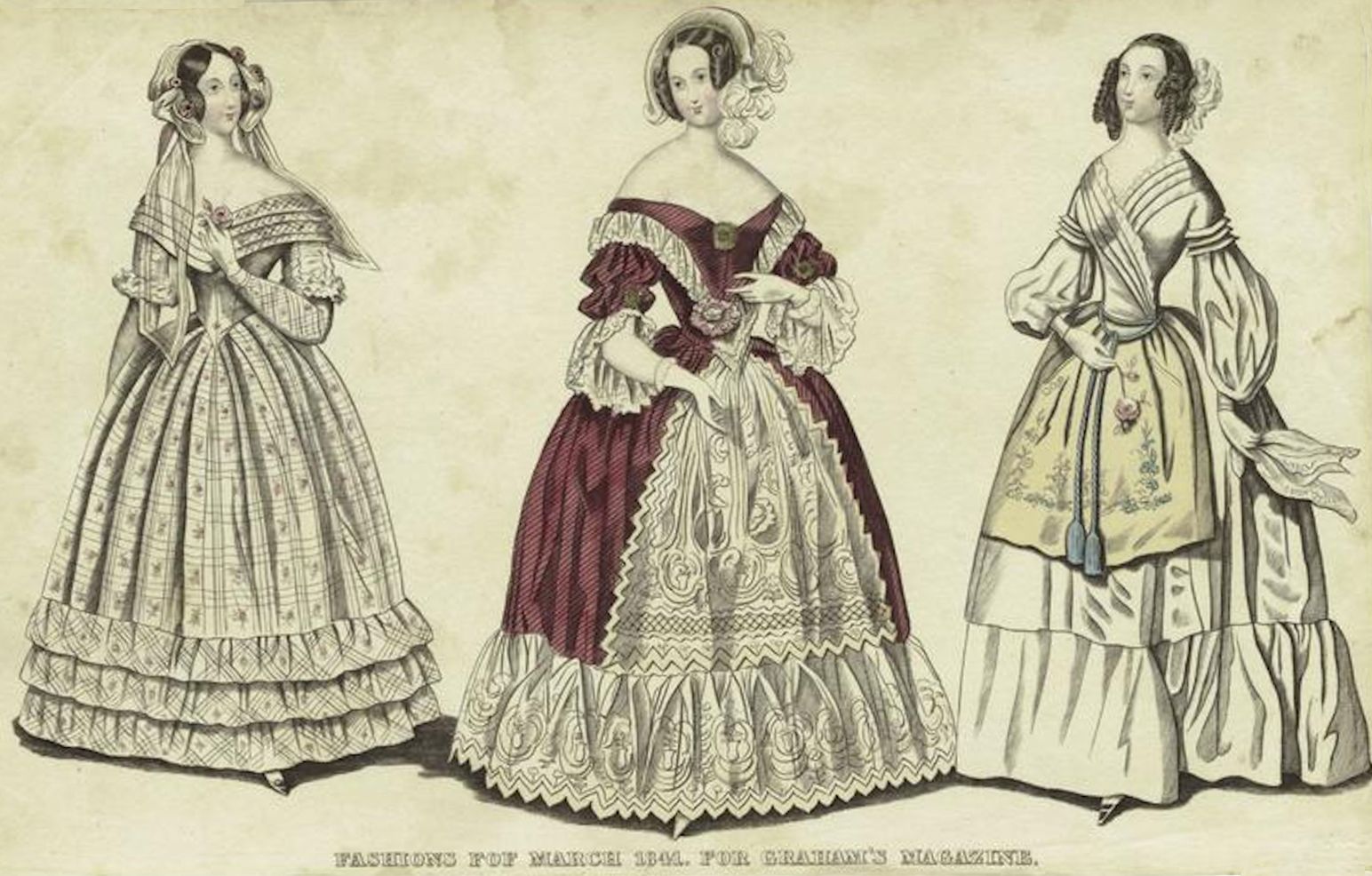
That irrevocable passion which sprung up between
Marco Da Vinci and Valeria, during the
hours of mutual communion which they enjoyed
while preparations were in progress for the annual
exhibition at the Academy of Arts, was not destined
to wither in its infancy.
Scarcely had the portrait been finished, when
notice was conveyed to the candidates to send in
their productions; and of course my anxiety was
great to ascertain what impression my daughter’s
beauty should make in public. Completely blinded
by those deep and damning schemes which have
proved my ruin, I meantime suspected nothing of
what was in progress between the young and ardent
lovers. They were bound heart and soul to each
other; but except by those involuntary signs,
which none but the victims of passion can understand,
their love was unuttered. Hourly was this
misplaced flame acquiring an increasing degree of
vigor, from the very means taken to suppress it.
I saw not, in my blindness, that in spite of the respectful
and irreproachable conduct of Da Vinci
toward the idol of my mercenary dreams, his tender
flame, his ill-disguised sentiments of admiration,
his involuntary devotion, were all returned in the
same manner by Valeria.
In due time the exhibition took place. A week
of thrilling excitement passed away. On the evening
the premiums were to be awarded, I sallied out
to await the decisions, persuaded that Valeria’s
beauty, and not the skill of Marco Da Vinci, must
make serious impressions in favor of the portrait.
How describe my delight, when the premium was
bestowed on the limner of my daughter’s charms!
Her fame, I well knew, would now rapidly spread,
and my fortune was sure!
In the excitement of the moment, I hurried from
the Academy, and sought to drown my feeling in
deep potations. While under the influence of an
unusual quantity of the stimulant, the time flew rapidly
past; and it was late in the night before I
recovered myself sufficiently to stagger home. To
account for the sight which there paralyzed my eyes,
it is necessary to touch upon what happened during
my inebriation.
Marco Da Vinci, on learning the decision made
in favor of his work, proceeded with haste to pour
out his feelings of gratitude to Valeria, whom he
regarded as the instrument of his success. In the
passionate eloquence of his temperament, he dwelt
upon all, save that which was consuming his vitals,
and which he dared not avow. They who pass
any portion of their time in a state of beatitude,
can alone say how swiftly it flies. Valeria and Da Vinci,
entranced with their own dreamy visions of
future happiness and of present joy, noted not that
the hour of midnight had approached. At length
the “iron tongue” of the town clock warned them
to part; and with a deep sigh Valeria murmured a
request that Da Vinci would visit the house again
and frequently.
“My determination,” said Marco, “can no longer
be suppressed.” In a voice of the deepest agitation
he proceeded: “I had hoped, Valeria, that we
might part without a word of regret on either side;
but your kindness and friendship toward me, render
it a duty that I should make some explanations in
defence of my refusal of your hospitable invitation.
I must speak, whatever be the penalty. Your
beauty and charms of person—your mental fascination—render
it too dangerous for me to continue
my visits! We must part—forever!”
In a hurried and agitated manner the young
painter rushed toward the door.
“Stay!” cried Valeria, in whom the struggle
between love and duty was for a moment so violent
as to deprive her of her faculties, “Da Vinci, why
must we part thus? Why are we never again to
meet? I am sure it is no harm for us to enjoy the
pleasure of each other’s society.”
This was said in a voice of such warmth and
artlessness, that, for a moment, he was unnerved in
his resolution. The danger, however, was too great;
and he resisted the temptation.
“Valeria,” said Marco Da Vinci, endeavoring to
answer calmly, “I am an outcast—a beggar!”
“But I do not think less of you for that!” cried
Valeria, passionately.
“Hear me!” cried Da Vinci, in a hurried and
choaking voice, “you know me not! I have dared—I
still dare—to love you!”
Valeria might have suspected, and probably did
suspect, that this declaration was inevitable; but
there is a great deal of deceit in the female heart;
and she evinced much astonishment at the words of
her lover. She endeavored to frown—to look serious—to
speak of my authority—but love was the
conqueror!
That resource which woman is ever prone to
make use of, was at hand; and Valeria wept. Her
beauty had always been a subject of dangerous interest
to Marco Da Vinci: it was now heightened
in his mind by the consciousness that she loved him.
No longer able to control those feelings, which
from the moment of their meeting, had taken
possession of Da Vinci’s heart, the enthusiastic
lover sprang forward and clasped Valeria to his
bosom. He pressed her lips to his own, and imprinted
on them the burning kiss of first-love.
At this critical moment I entered. Unable to
believe my senses, I stood gasping for breath, and
transfixed with doubt and astonishment. Convinced
at length that I was not deceived, I sprang forward
to wreak my vengeance on the villain who had so
basely abused my confidence.
“Monster!” cried Da Vinci, confronting me face
to face, and darting from his fine expressive eyes
the most deadly hatred, “Monster! you are known!
whatever obligations I may have formerly considered
myself under to you, I now look upon them as
entirely cancelled by your hypocrisy toward myself,
and your base conduct toward your daughter.
Know, hoary villain, that no later than to day, I
received a letter from Don Ferdinand Ruzzina,
warning me to be on my guard in any of my transactions
with you. Nor was this all! He openly
exposed your villainy, and revealed the unnatural
and cruel schemes you have concerted for the disposal
of your daughter’s honor. Behold, wretch, in
me her protector! You have forfeited the title, and
by the God that made me, your baseness shall not
triumph!”
So struck was I at this change in the conduct of
Da Vinci, that for several moments I stood transfixed
to the spot. Still stupified with rage and
shame, I staggered back, and flung myself on a
bench. Valeria, with that filial affection, which I
had never known her to violate, sprang toward me
in an agony of remorse; and kneeling at my feet,
earnestly avowed her determination to remain forever
obedient to my will; and craved forgiveness for
her instrumentality in causing me such shame and
misery. Already goaded to desperation by the
taunts of young Da Vinci, and the reproaches of my
own conscience, I was not prepared for this act of
unmerited constancy. In the bitterness of my own
self-detestation, I rushed from the room, striking
my temples with my clenched hands, and uttering
imprecations on those who gave me life. I hastily
mounted the ladder, leading to my miserable garret;
and darting through the trap-door, threw myself
head-long on the squalid and tattered pallet.
Ruzzina had not forgotten me! Awed by the
unconquerable virtue of my daughter, he had no desire
to renew visits which he well knew were alike
useless and unwelcome. But I had exacted large
sums from him. He was my dupe! Even in that,
there was a pleasure. Aye, such a pleasure as a
miser can feel when avarice triumphs over conscience,
and vice over virtue!
Early on the following morning, I indited a
note to Don Ferdinand, which, in the plenitude of
my craft, I looked upon as relieving me from all
claims whatever on his part. It ran thus:
“If you have any intention of consummating your
designs on my daughter’s virtue—a thing which I
regard as a mere misnomer—you must do so immediately.
The advance-money hitherto received from
you, I consider fairly my own; and if you think proper
to neglect the chance I now give you of achieving
your wishes, I am sure it is your own fault.
“Be so good as to let me have a definite answer,
when it suits your convenience; and believe me,
Catruccio Faliri.”
It afforded me much gratification to anticipate
the wrath and indignation Ruzzina should evince on
reading this. To gloat over the dark traits of men’s
characters, has ever been my choicest amusement;
and I well knew that he would either make a desperate
attempt to retrieve his imprudence by
recovering the money, or desist altogether and keep
silent to avoid the shafts of satire and ridicule.
I suffered much uneasiness, and had much to
fear on account of the ardent and fiery temperament
of Valeria. The passion she had betrayed for
Marco Da Vinci was no childish fancy; but a deep-rooted,
irrevocable love, which nothing could eradicate
or assuage. Her pure Italian blood permitted
no medium between passion and indifference. She
loved him once, and was destined to love, or hate
him forever after. Of this I quickly had a most
satisfactory proof.
Enraged one day at the obstinate manner in
which she rejected the advances of every suitor I
thought proper to introduce into my house, I bitterly
reproached her for her disobedience; and in the
excess of my anger, struck her a violent blow. Her
proud spirit was instantly up.
“Father,” said she, “you have struck me for the
first, and for the last time. In defiance of your
cruel and unnatural machinations for the disposal of
my honor, you shall never reproach me with their
success. I have hitherto mildly resisted your iniquitous
designs; and I now boldly put myself out of
your power. This roof shall never more shelter
your daughter!”
In scarcely any gradation of human depravity is
man totally callous to the qualms of conscience.
I have before remarked that I anticipated with joy
the hour of death; but this was merely a fiendish
delirium, wrought by the recollection of past iniquities:
a kind of bravo, which, in the hour of cool
contemplation, would be regarded with fear and
horror.
I confess I was much staggered at the justice
of Valeria’s reproaches, and the firmness and
dignity of her demeanor. Whatever might have
been the nature of my former conduct toward her,
I did feel, at that moment, a sense of my baseness.
Her fine, expressive eyes were eloquent with determination;
and her beautiful figure, as she glided
steadily from my presence, seemed to acquire a
queenliness from passion and indignation. She
spoke no more; and I was too relentless to
excuse myself, or break the silence. I had pride—ay,
the pride of a demon. I would not humble it
by confessing my cruelty, or soliciting her forgiveness.
Thus originated a disunion, which was soon
destined to lead to the most tragical effects.
I follow, for a moment, the fortunes of Valeria.
During her residence in that part of Venice, in
which we had latterly lived, she had, by the merest
accident, become acquainted with the daughter of
a neighboring officer, and had cultivated the society
of this young lady, more from a natural fondness
for association with the educated of her sex, than
from any particular liking to her new acquaintance.
Signora Almeda—the lady’s name—was not unusually
prepossessing in her person or manners; but
she had a vigorous and masculine mind, and possessed
no small share of sound knowledge, both
literary and scientific. She had, from the beginning,
regarded my daughter with peculiar favor.
Their acquaintance had latterly become quite intimate;
and on the strength of this intimacy, and
the dependance of her situation, Valeria resolved
to claim the hospitality of her friend, until fortune
should place it in her power to earn a livelihood
by her own exertions. Signora Almeda accepted,
with pleasure, the proposition of her accomplished
acquaintance.
For several months a sisterly harmony was
observed between the friends. Though Valeria
steadily refused to enter into society, yet it soon
became obvious to her entertainer that she had
the ascendency in the social circle. Of all stings
prone to penetrate the female heart, none is so
poisonous or painful as that which wounds vanity.
Signora Almeda was piqued to discover that the
suitors, who had before paid her the utmost devotion,
now eagerly transferred their addresses to her
guest. From learning to view her as a rival, she
presently looked upon her as an ungrateful and
disagreeable dependant. Every opportunity was
now taken advantage of, both publicly and privately,
by Signora Almeda, to vent her envy toward
Valeria. The innocent cause of this disquietude,
meantime wondered at the change. It was true,
her entertainer still continued to treat her with
formal hospitality; but all intimacy and friendship
were at an end. This state of things was destined
to be speedily brought to a close.
Signora Almeda had among other suitors, one
who really admired her, and for whom she had
evinced much respect. This gentleman, inspired by
the superiority of Valeria, physically if not mentally,
forgot for a moment his promises and devotions
toward Signora Almeda. The blow was not to be
borne. A proud Italian spirit was roused. Revenge
was now the sole subject of her thought.
Valeria one evening, soon after this, retired to
her chamber to enjoy a few moments of solitude.
In searching a small drawer for some article of
habiliment, she accidentally discovered a note,
directed to herself and handsomely sealed. It was
inscribed in a bold, masculine hand; and ran thus:—
“Bewitching girl!—In accordance with your repeated
desire, I shall to-night gently tap at your
chamber-window. O raptures! how I shall—but
why anticipate.
“Votre roturiex
“Caius Pazzio.”
Astonished and indignant, Valeria was about to
tear this insulting epistle to atoms, when the door
gently opened; and Signora Almeda glided in.
“Ah! my charming guest,” she whispered, with
forced friendship, “what now? Mercy, you seem
like one who had just caught sight of an apparition!
Dear me! what’s the matter?”
“Matter!” cried Valeria, fired with shame and
indignation, “read!—but no—the insult must not
be known!”
“Heavens! a letter—Ah, I guess the contents!”
She snatched it playfully, and read with apparent
surprise—what she had herself written!
The result was such as might be expected. Valeria
was peremptorily forbidden the house. Her
character was blasted—her happiness destroyed!
In this melancholy situation, Marco Da Vinci
found her, when after a long and indefatigable
search, he succeeded in tracing her to the residence
of Signora Almeda. With all the ardor and sincerity
of his character, Da Vinci had determined on
bringing his fate to a speedy close, either by wedding
the object of his affection, or by bidding her
farewell forever. The critical situation in which he
found her, immediately determined him to adopt the
former course, if possible. He had, since his
triumph at the Academy of Arts, attained some
eminence; and his circumstances were now in a
favorable condition.
Valeria had many objections to the course proposed;
but on the one hand poverty—perhaps beggary
would be her lot; while on the other the
importunities of Da Vinci were so urgent as to
remove most of the remaining obstacles. After
much hesitation she consented to acquiesce in
his wishes. The young and loving couple were
immediately united. I now return to my own
narrative.
Nearly a year had elapsed since I was left alone
and desolate; when one evening I was astonished
to see a female, closely muffled, enter my house.
My mind had that day been peculiarly embittered
against my daughter, and she was even now the
subject of my thoughts. Great, indeed, was my
astonishment, when the apparent stranger flung
herself in a kneeling posture before me, and casting
off her disguise revealed to my sight the faded
lineaments of Valeria!
“Father!” she cried, “forgive me!—forgive the
partner of my misery! We are ruined by a reverse
of fortune—we are beggars! Distress has deprived
us of pride! We seek your pardon!”
“Curse you!” I shouted, spurning her with my
foot, “you demand pardon do you? Begone! Pardon,
eh? Begone!” I thundered; and I pushed her
violently toward the door. She fell. Her head
struck a bureau; and the warm blood spouted from
the gash. Had I reflected on the delicacy of her
situation, it is probable I might have felt compassion
enough to let her pass unmolested; but the deed
was done. I did not regret it. My vengeance for
the series of disappointments she had caused me
was satiated.
(To be Continued.)
Louisville, Kentucky, February, 1841.
———
BY MRS. LAMBERT.
———
“The machine of human life, though constituted of a thousand parts, is in all its parts systematically
connected; nor is it easy to insert an additional member, the spuriousness of which an accurate observation
will not readily detect.”—Godwin.
It was midnight. Darkness, deep as the sable
of a funeral pall, hung over the streets of Madrid.
The wind blew in strong gusts, and the rain fell in
torrents. The lightning, which, at brief intervals,
rent the clouds, and flashed across the gloom,
revealed no living, moving thing. For an instant
only, the livid sheets lit up the streets and squares,
and glared over the Plaza Mayon, so often the
scene of savage bull-fights, of cruel executions,
and, in former years, of the horrible Auto de fé.
And again, as it seemed, a tenfold blackness
enveloped every object; convents, colleges and
hospitals, closed at every aperture, were shrouded
in the general gloom. Man, though the noblest
work of his Creator—glorying in his wisdom and
in his might—towering in the battle-field—great
in council—overweening, arrogant, boastful; in
such a night learns to feel his own insignificance.
He, who adorned with all the pageantry of wealth,
elevates himself far above the lowly individual that
seeks his daily bread by daily labor—who looks
down as from an immeasurable height upon the
poor peasant of the soil—even he, so rich, so
powerful, sheltered within his stately walls, listens
to the war of the elements that rage without—and
inwardly congratulating himself on his rich and
comfortable asylum, yet shrinks involuntarily as the
blast shrieks by—and silently acknowledges his
own impotence.
I have said no living thing moved in the street,
and every building was closed against the storm;
but in the outskirts of the city, in a narrow and
solitary lane, built up at intervals with a few houses
of mean and wretched appearance—a faint light
shone through the gloom. It proceeded from the
casement of a house of antique structure, and dilapidated
appearance. Years must have gone by
since that dwelling was the abode of comfort, for
poverty and wretchedness seemed to have long
marked it for their own. The exterior gave faithful
promise of what was revealed within.
In a large and gothic room, the broken and
discolored walls of which betokened decay, an
aged man was bending over a fire of charcoal,
and busily engaged in some metallic preparation.
His form was bent by age. The hair of his head,
and the beard, which descended to his breast,
were bleached by time to a silvery whiteness. His
forehead was ample, but furrowed by a thousand
wrinkles. His eyes, deep set, small, and still retaining
much quickness and fire, yet at times their
expression was wild, despairing, even fearful.
A cap of peculiar and ancient form was upon
his head, and his person was enveloped in a robe
of russet, confined about the waist by a twisted
girdle. His motions were tremulous and feeble, his
countenance wan and death-like, his frame to the
last degree emaciated.
A bed stood in one corner of the room; a table,
and two roughly made forms, were all the furniture
of that miserable apartment; but around the small
furnace, at which the old man had been lately
employed, were gathered crucibles, minerals, chemical
preparations, and tools of mysterious form and
curious workmanship, but well understood by the
artist. Once more the adept, for such was the
inmate of this lonely dwelling, scanned with searching
eye the contents of a crucible; while the pale
flame which rose suddenly from the sullen fire, cast
over his sunken features a hue still more livid and
cadaverous.
His labors had resulted in disappointment; he
sighed heavily, and dropping his implements, abandoned
his self-imposed task.
“It is over,” he murmured, “my hour is almost
come—and should I repine? No—no. Life!—wretched
and misspent!—world! I have sacrificed
thee, to thyself!—wonderful enigma, yet how true!”
Turning his steps to the table, he took from
thence a lamp, and walked feebly to a remote end
of the room. Here, on a humble couch, lay a
sleeping child; it was a boy, slender, pale, and
bearing in his young face the indications of sorrow
and of want—yet was he exquisitely beautiful. He
slept still, and heavily. The adept gazed at him
long and deeply.
“He sleeps. Victim as he is, of his father’s
errors, and his crimes—shunned by his fellows—hunted
by the unfeeling—pinched with cold—and
perishing with hunger—yet—he sleeps. Father of
Heaven! such is the meed of innocence! I, shall
never more know rest,—till the long sleep of
death that knows no awakening!—No awakening—and
is it so?” A blast of wind swept by, rocking
the old pile to its foundation, the thunder rolled
heavily above, and the keen blue lightning shone
through every crevice.
The old man looked fearfully around: a deeper
paleness overspread his face, and cold drops stood
on his brow and sallow temples.
“The angel of death is surely abroad this night—he
seeks his victim.”
Tottering to the bed he sunk down upon it,
and closing his eyes, an almost deadly sickness
seized him. He called faintly for Adolf. The lad
had already risen, for the storm had awakened him.
He went to the bedside. The old man could not
speak. The child was affrighted and gazed earnestly
upon the face of his parent. The senses of the
latter had not forsaken him, and he motioned with
his hand toward the table, on which stood a small
cup. Adolf brought it to his father, and moistened
his lips with the liquid. The old man revived.
After a few moments he spoke, but his voice was
tremulous and low.
“Adolf,” he said, “thy father is about to leave
thee—dear object of my fond affection, thou art
all that remains of my beloved Zillia—boy,” he
continued exerting the last remains of strength,
“thou must go hence. The moment thy father
ceases to breathe thou must fly.”
The child looked on his parent with alarm, and
sorrow depicted in his young face.
“Yes,” he repeated, “thou must quit this place.
My enemies are on the alert. Me they would certainly
destroy, and thy youth and innocence—will
hardly save thee from their wrath. Long have they
watched, and sought, and hunted me, from country
to country, and from town to town. I have mingled
in the crowd of cities, and hoped to be confounded
with the multitude—to pass unmarked—unquestioned—unknown—in
vain; the ever wakeful eye of
suspicion followed me—danger dogged my footsteps.
I sought the shelter of thick woods—of
impenetrable forests, where the wolf howled, and
the raven croaked—but the foot of my persecutor—Man—seldom
came. Even there I was discovered.
Imprisonment—famine—torture have been
my portion—and yet I live. I live—but thy gentle
spirit, Zillia, could not bear up under the pressure
of so many woes. Adolf, thou wilt shortly be all
that survives of the family of Zampieri.—I repeat,
by the morning dawn I shall be no more, and thou
must fly.”
“No, no,” returned the boy, “urge me not to
depart—father, I will remain and share thy fate.”
He threw himself as he spoke upon the bosom of
the old man who pressed him in his feeble arms.—“And
oh! father, I cannot go hence—I am weak—I
am ill—father I die of hunger.”
An expression of keen anguish passed over the
face of Zampieri, and he pushed his child from him.
“Boy,” he cried, “ask me not for bread—thou
knowest I have it not. Have I not been laboring
for thee—for thy wealth—for thy aggrandizement—ingrate—bread
sayest thou—thou shalt have
gold, boy, gold.”
The intellect of the adept wandered, and he
laughed wildly. The large, soft, lustrous eyes of
Adolf swam in tears, and his heart trembled within
his bosom. With weak steps he retreated to the
foot of the bed, and kneeling there, hid his face on
his folded arms, and wept.
After a pause Zampieri again spoke.
“Life!” he muttered, “how have I wasted thee.
Time! Thou art no longer mine. Would that I
could redeem thee—but it is too late. Zillia, my
murdered love! Thou art avenged. I left thy fond
and simple affections for the depths of mysterious
research. I madly thought to realise the dreams of
illimitable wealth. Vain and destructive ambition.
For thy sake have I riven asunder every tie.”
The voice of the old man ceased, and the
sobs of the child too were silenced—perchance in
sleep.
The violence of the tempest had subsided, and all
was still; save that the blast still shrieked at intervals
by, making the old casements rattle as it passed—and
the thunder muttered low at a distance.
The hours rolled on. A faint grey light dawned
in the east. The clouds broken in heavy masses,
rolled rapidly onward obscuring and revealing, as
they flew, the few bright stars that appeared far
beyond this scene of petty turmoil, shining on, in
their own unchanging, never ending harmony.
And now the dawn strengthened, and the stars
grew pale. The last blue flickering flame, that
wandered ignus-fatuus like, over the surface of the
dying charcoal, had spent itself; and the wasting
lamp looked ghastly in the beams of rising day.
A noise was heard at the lonely portal. It was
that of forcible entrance, and came harshly over the
deep silence that reigned within. Footsteps approached,
not such as told the drawing near of a
friend, the light, soft step of sympathy with sorrow.
No. They heralded force and violence—bond and
imprisonment—racks and torture.
Three Alguazils of the Inquisition entered the
solitary apartment. They came to conduct Nicoli
Zampieri to the holy office on a charge of performing
or seeking to perform preternatural acts by
unholy means—by conjuration and necromancy.
Guilty or not guilty, suspicion had fallen upon him,
and he had become amenable to the law. Their
anticipated victim remained quiet. The Alguazils
approached the bed on which he lay. The limbs
were stark and stiff—the features immoveable.
The Alchymist was dead.
Yet the eyes—widely opened, glassy, fixed and
staring, gave the startling idea, that the gloomy and
reluctant soul had through them strained its last
agonising gaze on some opening view—some unimaginable
scene in the dread arena of the shadowy
world beyond the grave.
Silently they turned from the bed of death, for the
power of the king of Terrors, thus displayed before
them, quelled for a moment their iron nerves.
A kneeling figure at the bed’s foot next drew
their attention. It was Adolf. They spoke to
him, but he answered not: they shook him, but the
form immobile, gave no sign of warmth or elasticity.
One of the men turned aside the rich curls
that clustered above the boy’s fair brow, and gently
raised his head. It was cold and pale. The suffering
spirit of the young and innocent Adolf, had
winged its way to a happier world.
———
BY ESTHER WETHERALD.
———
“She walks in beauty, like the nights
Of cloudless climes and starry skies.”
Byron.
Nerinda was the daughter of a shepherd, who
dwelt in one of the charming portions of Circassia.
If beauty was a blessing, Nerinda was blessed beyond
the ordinary lot of mortals, for the fame of her
loveliness had extended through the neighboring
vallies, and at the early age of fourteen her hand
had been sought by many, with an earnestness
which showed her parents what a treasure they
possessed in their eldest born. But no one had been
able to obtain her.
Money is not so plentiful in the vales of Circassia,
as in the mart of Constantinople; and few of the
neighboring youths might venture therefore to aspire
to her hand. There appeared, every day, less
probability that the fair girl would be permitted to
pass her life amidst scenes endeared to her by a
thousand childish and tender recollections. Nerinda
felt this and her eye became less bright, and
her step less buoyant, than when she trod the flowery
turf a few short months before, a happy careless
child, attending those flocks now abandoned to the
care of the younger children. She became pensive
and melancholy. Her rich color faded, and her
parents saw with surprise and concern that the
dazzling beauty on which so much depended, would
be tarnished by the very means they were taking to
preserve it. What was to be done? She must resume
her old employment, since healthful exercise
was of such consequence to her appearance; she
could do so in the neighboring meadows without
danger, accompanied by her sister Leila. Oh! how
happy was Nerinda, when she received this unlooked
for indulgence; with what haste did she braid
and arrange her beautiful hair, and fasten on the
veil without which she must not be seen; then joining
her sister, she visited every spot endeared to her
by memory, and at length, seating herself on a
mossy bank which separated her father’s possessions
from those of a neighboring shepherd, began to
arrange the many flowers she had culled into beautiful
bouquets and chaplets, an occupation befitting
one so young and lovely; but even whilst her hands
were thus employed, it was evident her thoughts
were far distant, for she fell into reveries so deep,
that her sister, unable to arouse her from her abstraction,
became weary of attempting it, and
returned to her fleecy charge, leaving Nerinda to
muse alone.
Nerinda believed herself alone, but immediately
after the departure of Leila, a finely formed youth
had crossed the stream, and stood at the distance of
a few paces, gazing on her with a passionate tenderness
which betokened the strength of his attachment.
Almost afraid to disturb her meditations,
yet anxious to obtain a single word, a single glance,
he remained motionless; waiting, hoping that she
might raise her eyes, and give him permission to
advance. She raised them at length, uttered an
exclamation of surprise, and in a moment the youth
was at her feet. “Nerinda!” “Hassan!” were the first
words that escaped their lips.
“Do I indeed see thee? and dost thou still love
thy Nerinda?” said the maiden.
“Love thee?” replied the youth in an impassioned
tone, “thy image is entwined with every fibre
of my heart. They may tear thee from me, they may
destroy me if they will, but while life remains I
cannot cease to love.”
“Alas!” said Nerinda, “weeks have passed since
I saw thee, and I feared—I—.” She stopped confused,
for Hassan had seized her hand, and was pressing
it to his lips with an energy which showed how
well he understood what was passing in her mind.
“Oh! Nerinda,” said he, “I have entreated, I have
implored thy father to bestow thee on me, but in
vain, for all the money I could offer was not one
tenth of the sum he requires; yet do not despair,”
he said, as the color faded from her cheek, “I
still may hope if thou remainest constant.”
“This very morning,” continued Hassan, “I
sought thy father; at first he was unwilling to listen
to me. At length I prevailed on him to hearken,
even if he refused his assent to what I proposed:
but he did not refuse. Pleased with my anxiety to
obtain thee, he has promised that if in two years
I can gain the required sum thou shalt be my wife;
if I cannot he will wait no longer, but part with
thee to him who will pay the highest price.”
The voice of the youth faltered—he was scarcely
able to continue, “in two days I am to take all the
money my father can spare, and join the caravan
which proceeds to the south; fear not,” said he,
replying to the alarm expressed in her varying
countenance, “there is no danger, the caravan is
large, and if fortunate as a trader, I shall return
before two years have passed to claim my plighted
bride. Wilt thou be true? may I trust thee?”
were questions the lover asked, though he felt sure
the answers would be such as he could desire, and
when the assurance was given, he for the first time
ventured to impress a kiss on those beautiful lips.
Long did they thus converse, but at length they
parted; Nerinda promising to come to the same
spot on the next evening to bid him farewell.
They parted, Hassan vainly endeavoring to inspire
Nerinda with his own hopes. She almost sank
under the trial, and it was many days before she
had strength to revisit the bank of turf, their accustomed
trysting place. When she did, how changed
did all appear; the flowers were still blooming
around; the stream flowed on with its accustomed
murmur; the birds carolled sweetly as of old; where
then was the change? Alas! it was in her own
heart: joy and happiness had fled with Hassan, and
melancholy had taken their place.
Two years and six months had passed since the
departure of the youth, and there seemed little probability
of his return; even his venerable father
mourned him as dead, when a company of traders
entered the mountains. One of them was an old
acquaintance in the valley. He renewed his solicitations
to the father of Nerinda, that she might
be placed under his charge; offering the highest
price, and promising that her future lot should be as
brilliant and delightful as her past had been obscure.
The shepherd was greatly disappointed by the non-appearance
of Hassan, for he would have preferred
keeping his daughter near him if he could have
done so with advantage to himself, but being poor
as well as avaricious, and imagining he should be
perfectly happy if possessed of so much wealth as
the trader offered, he consented to part with her,
who had ever been his chief delight, and the pride
of his heart.
Language cannot paint the consternation of
Nerinda when she learned her father’s determination.
The delay of Hassan she accounted for by
supposing he had not yet acquired the full amount
necessary for his purpose, and hoped that after a
while he would return to call her his. Now all
hope was at an end. Hassan might still come, but
she would be far distant, perhaps the wife of another.
Her mother and sister too shared her grief,
for they thought it would be impossible to live
without Nerinda; but all entreaties and lamentations
were vain, the shepherd had made the bargain
and would abide by it; and she was hurried to the
caravan in a state little short of insensibility.
And where was Hassan? He had determined
in the first place to proceed with the caravan to
Mecca, whither it was bound, and laying out the
money he possessed in merchandise, to trade at the
different towns on their route. Before they arrived
at the holy city he had consequently so greatly
increased his store, that he felt no doubt he should
be able to return before the time appointed; but
meeting soon afterward with a heavy loss, he was
thrown back when he least expected it, and at the
end of two years had not more than half the
amount required. To return without it was useless,
and he set about repairing his loss with a
heavy heart. Six months passed in this endeavor,
at the end of which time he found himself rich
enough to return, but it was necessary he should
proceed to Constantinople to settle some business,
and join a caravan which was going toward his
native country. His anxiety increased every day:
of what avail would be his wealth, if she, for whose
sake it had been accumulated, was lost forever?
The day before the one fixed for his departure
from Constantinople, a company of traders arrived,
bringing with them Circassian slaves. He happened
to be passing by the slave-market, and impelled
by sudden curiosity, entered the room. He
had scarcely done so when he was struck by the
graceful figure of one of the girls, which reminded
him of Nerinda. He felt almost afraid to have her
veil removed, then remembering that it would be
impossible for her to recognise him in his present
dress, and determining to suppress his emotions
whatever the result, he made the request, which
was instantly complied with. It was indeed
Nerinda, but how changed! She stood before
him pale as marble, with downcast eyes, looking
as if no smile would ever again illumine those
pensive features; once only a faint color tinged
her cheek as he advanced toward her, then instantly
gave place to more deathly paleness. The
price was soon agreed upon, for the trader was now
as anxious to get rid of his fair slave as he had
been desirous to obtain her; having resigned the
hope of making an immense profit in consequence
of the continual dejection and grief she indulged,
which had greatly impaired her health and beauty.
Hassan ordered the trader to send her to his apartments
immediately.
When he entered the room to which she had
been conducted, he gently raised her veil. She
looked up, and recognised him instantly; her joy
was as unbounded as his own, but was displayed in
a different manner. She threw herself into his
arms and sobbed and wept. She was, however, at
length able to listen tranquilly to the account of his
adventures, and to relate her own.
The remembrance of his aged parent, doubly
endeared by absence, and of his joyous childhood,
were still alive in the breast of Hassan; and after
a few days spent at Constantinople, he proposed to
return to his native valley.
They set out, the health and beauty of Nerinda
improving, in spite of the fatigues of their journey.
The joy with which they were greeted was unbounded.
All had given Hassan up for dead, and
Nerinda was regarded as lost to them forever. Even
her father had repented of his avarice, and would
willingly have returned his gold, could he have once
more had Nerinda by his side. Her mother and
sisters hung around her with tears of joy; and the
whole valley welcomed her return with glad rejoicings.
The young couple took up their residence with
Hassan’s father; many a visit did they pay to that
bank of turf, the scene of their former meetings,
and never did they look on that spot without feeling
their bosom swell with the emotions of gratitude to
that kind Providence who had disposed all things
for their good, and had watched over and protected
them, even when they believed themselves deserted.
A TALE OF THE EARLY SETTLERS OF VIRGINIA.
“Well Kate,” said her bridesmaid, Lucy Cameron,
“the clouds look very threatening, and you
know it is said to be an unlucky omen for one’s
wedding night to be stormy.”
“Pshaw, Lucy, would you frighten me with
some old grandmother’s tale, as if I were a child?
I believe not in omens, and shall forget all unlucky
presages, when the wife of Richard Gaston,” answered
the lovely and smiling bride.
“You treat it lightly, and I trust it may not
be ominous of your conjugal life,” resumed Lucy;
“but my Aunt Kitty says that’s the reason she
never married; because it was raining in torrents
the day she was to have been wedded, and she
discarded her lover because it was unlucky.”
“Ah, Lucy, I do not mean to doubt your good
aunt’s word; but there must have been some more
serious cause linked with the one you have mentioned.
My life on it, I do not lose a husband for
so slight a cause. It must be something more
than a common occurrence, that shall now break
off the match with Dick and myself. But see, the
company are beginning to arrive,” said Kate, as
she looked from the window of her room, “and I
must prepare for the ceremony.”
The morning of the day of which we have
spoken, had opened in unclouded splendor, and all
seemed propitious to the nuptials that were to be
solemnised in the evening. The inmates of the
cabin in which the preceding conversation had
been carried on, had arisen cheerfully with the
first notes of the early robin, to prepare for the
festival, to which the whole neighborhood, consisting
of all within fifteen or twenty miles, (for
neighborhoods were then large, and habitations
scarce) were indiscriminately invited.
Kate Lee was the only child of her parents, and
had been born and raised in the humble cottage
which her father had assisted to construct with his
own hands. Mr. Lee had moved to his present
residence, when few ventured thus far into the
Indian territory; and by his own labors, and that
of his two servants, had erected a double cabin,
and cleared about fifty acres of land, upon a rich
piece of high ground, a mile and a half from the
James River. By his urbanity and kindness, he
had gained the confidence of the Indians; and in all
their depredations so far, he had gone unscathed.
He was of good birth and education, and the most
hospitable man in the settlement. The property
which he held, and the style in which he lived,
together with his superior knowledge, gave him a
standing among the settlers superior to all. Ever
ready to assist the needy, and always just in his
opinions and actions, he was looked to for council,
rather than treated as an equal.
As we said before, Kate was his only child, and
had been the solace of her parents for nineteen
years. She had now attained to full-blown womanhood,
and, from her beauty and intelligence,
her hand had been often asked, by the hardy sons
of the pioneers. Her heart was untouched, until
young Gaston laid siege to it. To his eloquent
appeals she lent a willing ear, and promised to be
his bride.
As Kate was the loveliest girl in the country, so
was Richard Gaston the most to be envied among
the youths. Of fine, manly stature, superior intellect,
and unflagging energy, he was the best match
in the settlement. He cultivated a little farm on
the other side of the river, and when occasion
offered, engaged in the practice of law, for which
both education and nature fitted him. He had been
in the settlement about seven years, and from his
open and conciliatory manners, his bold and manly
bearing, had become a favorite with all around him.
He was always the first to take up his rifle, and
sally against the hostile Indians, when necessity
required it, and from his undoubted courage, was
always chosen leader of the little bands, formed
to repel the savage foe.
When the toils of the week had passed, Gaston
might be seen, with his rifle on his shoulder, moving
toward the river where his canoe was fastened, and
springing lightly into it, dashing through the foaming
waters, and among the rocks, as safely and
cheerfully, as if passing over a smooth and glassy
lake; and on the following evening, he might be
seen again, braving the rushing current, with the
same careless ease, but more thoughtful brow; for
who ever yet parted from the girl of his heart, with
the same joyful aspect, which he wore when going
to meet her? Let us now return to the wedding
day.
“Have you heard of the Indian that was found
murdered on the bank of the creek this morning?”
said a young man, after the company had assembled,
to Mr. Lee.
“No,” answered Mr. Lee, with surprise, “I had
hoped from the long peace that has reigned, we
should have no more such outrages against the
poor Indians. But how is it possible, sir, if they
are thus shot down, that we can expect them to be
quiet?”
“The body,” continued the first speaker, “was
found by some of his tribe; and they immediately
threatened vengeance if the murderers were not
given up. But that is impossible; because we do
not know them.”
At this moment, a loud crash of thunder echoed
through the woods, so suddenly as to make all start
from their seats.
“Well, my friends,” said Mr. Lee, as soon as
all was again quiet, “we shall be as likely to suffer
from this rashness as the offender, and must be prepared.
I am glad you have brought your guns
with you, for unless they come in too large a body
we shall be able to hold out against them.”
This was said with that calmness which a frequent
recurrence of such circumstances will produce;
and as he rehung his rifle, after preparing it
for immediate use, the bride entered the room, in
all the loveliness of graceful beauty. Few ornaments
decked her person, because none could add
to her natural grace and elegance. Her hair of
jet black, was simply parted in front, drawn back,
and fastened behind, displaying a forehead of marble
whiteness; a wreath, mingling the wild rose with
other forest flowers, was the only ornament on her
head. Her skin was of transparent whiteness.
Her large black eyes, peering through their long
lashes, spoke a playful mischief in every glance.
A perfectly Grecian nose; cherry lips; a beautiful
row of pearly teeth; a dimple displaying itself in
each cheek whenever a smile suffused itself over
her features, and a complexion richer than the soft
red of the tulip, completed a picture such as the
mind can rarely imagine. Her neck and arms
were perfectly bare, and seemed as if they, with
her small fairy feet, and the rest of her figure, had
been made in nature’s most perfect mould.
The storm, which had before been heard but at
a distance, seemed now to have attained its greatest
violence, and to be concentrated over the house.
Peal after peal of thunder, came ringing through
the hollows, each succeeding one apparently louder
and more crashing than the former. Flash upon
flash, of the quick and vivid lightning, streamed
out, resting awhile upon the surrounding scenery,
and striking terror into the hearts of the more
superstitious guests. The rain, which at first fell
in large drops, that could be distinctly heard, amid
the awful silence, save when the thunders echoed,
now came down in torrents; and the thunder pealed
out, louder and louder, quicker and quicker, leaving
scarcely intermission enough, for the voice of
Richard Gaston to be heard by his beautiful bride.
He had impatiently awaited the invitation of Mr.
Lee to meet his daughter, but no longer able, amid
the war of elements, to restrain himself, he advanced
to, and seated himself by the side of his beloved
Kate, and gently taking her hand in his, inquired if
she was alarmed by the storm? To his enquiry,
she only smiled, and shook her head.
“I see not then, why we may not proceed with
the ceremony; the storm,”——here a keen and
fearful crash, jarred the house to its foundation,
leaving traces of fear on the countenances of all,
but the lovers and the parson; Gaston continued,
however, “the storm may last an hour, and that is
longer, my Kate, than I would like to defer the
consummation of my hopes.”
“I am ready,” answered Kate, blushing, and
without raising her eyes.
They rose from their seats, and advanced to the
parson, who immediately commenced the ceremony.
It was impossible to tell, whether pleasure or fear
predominated on the countenances of the guests, as
they pressed forward, to witness the solemn ceremony
of uniting two beings for life. In the intervals
of the thunder, a faint smile would play upon
their faces, but, as a rattling volley would strike
their ears, their shrinking forms and bloodless lips,
betrayed their terror. The tempest seemed for a
moment to have held its breath, as if to witness
the conclusion of the nuptials; but now as the
parson concluded with, “salute your bride;” a peal
of thunder, keener and more startling than any yet,
struck such terror to their souls, that none, not
even the parson, or Gaston himself, both of whom
had been shocked, perceived that the chimney had
fallen to the earth; until awakened to a sense of
their situation, by the shrill war-whoop of the Indians,
which now mingled in dreadful unison with
the howling storm.
All thought of the storm vanished at once—defence
against the savages seemed to be the first
idea of all, as each man, with determined look,
grasped his rifle, and gathered around the females.
The Indians, led on by their noted chief Eagle
Eye, to avenge the death of their comrade, found
in the morning, would perhaps have awaited the
subsidence of the storm, had not the falling of the
chimney displayed to them, the disorder and confusion
within the cabin. Viewing it, as the most
favorable time for an attack, they raised their
dreaded war-whoop, and sprung to the breach.
That whoop, however, served but to nerve the
hardy pioneers, and chase from their bosoms the
fears, which the wars of nature alone created.
Richard Gaston, from custom, assumed the command;
and with that coolness and self-possession,
which indicates undaunted bravery, proceeded to
give such orders as the time would allow.
“Let the females,” said he, “go above, and lie
upon the floor, and we, my brave boys, will show
them what stout hearts and strong arms can do
in defence of beauty. Six of you go in the next
room, and see that the villains enter not, except
over your dead bodies; the rest will remain, and
defend this opening.”
The reader must not suppose that all was still
during this brief address. The Indians, whose
numbers amounted to several hundred, had fired
once, and not being able, on account of the rain,
to load again, now attempted to enter over the
ruins of the chimney, and through the windows.
The lights had been extinguished at the first yell,
and all was dark, save when the flashes of lightning
revealed to the few within, the fearful odds
against them without. Several volleys had meanwhile
been poured into the Indians, and a momentary
flash revealed the effects. Many were lying
dead or dying, forming a sort of breastwork at the
breach. Becoming more infuriated, as those who
had gone before, fell, under the constant fire of the
whites, the savages, now, in a compact body, attempted
an entrance; and the whites, still cool, as
if danger threatened not, waited until they reached
the very breach, and then every man, with his
muzzle almost touching the Indians, discharged his
piece. The savages wavered and then fell back,
amid the shouts of the victorious yeomen.
The next flash of lightning discovered the Indians
retreating to the woods, and dragging many
of their dead with them. Another wild shout burst
from the lips of the victorious whites. When all
was again still, the voice of Mr. Lee was heard in
thanksgiving, for their deliverance so far; and when
he had concluded, he proposed a consultation upon
the best means to be pursued, as it was certain the
Indians had only retired to devise some other mode
of attack. Some were for deserting their present
situation, and flying to the woods for concealment;
others, and the greater number, proposed remaining
where they were, because the Indians had not
certainly gone far, and if discovered, unprotected
by the logs, they must fall an easy prey, to such
superior numbers, while by remaining, they had
some advantage, and a small chance to keep them
off.
In the meantime, the females, the firing having
ceased, had left their hiding-place, and now mingled
with the warriors. It was soon determined to hold
on to their present situation, and defend it to the
last, should they be again attacked. The better to
add to its security, several of the stoutest commenced
raising a barrier at the opening, with the
logs that had been thrown down; while others,
barricaded the doors and windows. This being
finished, they began an enquiry into the injury they
had received; and found six of their number were
killed.
The rain meanwhile had ceased, and the distant
mutterings of the thunder could be heard only at
intervals. All was silent in the cabin, awaiting the
expected approach of the savages. Kate had approached
Gaston when she first came into the
room, and timidly asked if he was hurt. Having
received a satisfactory answer, she had remained
silently by his side, until all was prepared for action.
Then, for a moment forgetting the dangers that surrounded
him, Gaston yielded to the impulse of his
heart, and drawing the lovely being, who was now
his wedded wife, in all the ardor of passionate love,
to his bosom, imprinted upon her ruby lips, the kiss
of which he had been so suddenly deprived by the
onset of the savages.
“My own Kate,” said he, “if you find we are
to be overcome, you must try and make your escape
through the back door, and thence to the woods.
Here is one of my pistols, take it, and if you are
pursued, you know how to use it; shoot down the
first foe who dares to lay a hand on you. Make
for the river, you know where my canoe is; the
current is rapid and dangerous, but, if you can
reach the other bank you are safe. Farewell now,
my own sweet love, and if I fall, may heaven shed
its protection over you.”
Gaston was not a man to melt at every circumstance,
but to be thus separated from his bride,
perhaps never to meet again, brought a tear to his
manly cheek. Love, had for a moment, unmanned
his firm and noble heart; but it had passed, and he
was again a soldier; thinking only how best to
defend, what he valued more than his life—his
wife.
At this instant the whoop of the Indians again
sounded to the assault. Each man sprang to his
post. The whites had been equally divided, and a
party stationed in each room. The rooms were
now simultaneously attacked by the foe; and with
clubs and large stones, they endeavored to force
the doors. The silence of death reigned within,
while without all was tumult and confusion. The
door at length yielded—one board and then another
gave way, while yell upon yell rose at their
success.
“Hold on boys, until I give the word,” said
Gaston, “and then stop your blows only with your
lives.”
The door and its whole support yielded, and in
poured the savages like a whirlwind. “Fire now,”
cried Gaston, “and club your guns.”
Almost as one report, sounded the guns of every
one in the house—the yells and cries of the
wounded and infuriated foe, almost appalled the
stoutest hearts; but this was no time to admit fear,
if they felt it. The Indians were making every
exertion to enter over the pile of dead bodies that
blocked up the doorway; and the gun of each man
within, clenched by the barrel, was lowered only to
add another to the heap. For twenty minutes the
fight had raged with unabated fury, and with unrelaxed
exertions, when the moon, breaking forth in
all her splendor, exhibited the combatants as plain
as in the light of mid-day. One Indian, stouter
and bolder than the rest, had gained an entrance,
and fixing his eyes on Gaston, as he saw him encouraging
and directing the others to their work of
death, he gave a loud yell, and sprang at him like
the tiger on his prey. The quick eye and arm of
Gaston were too rapid for him; and in an instant
he lay dead from a blow of the young man’s rifle.
But the strength of the brave little band began
at length to fail. Their numbers had diminished
more than half. Before the enemy had, however,
entered, it had been proposed and acceded to, as
the only chance, that the females should attempt an
escape from the back door, next the river, while
the men should cover their retreat, as well as their
diminished numbers would admit. Accordingly,
the attempt was made, and an exit gained; the
whole force of the Indians being collected at the
front door, to overcome the stubborn resistance of
the whites.
The little phalanx stood firm to its post, until
they saw the women had sufficient start to reach
the woods before they could be overtaken; and
then, pressed by such superior numbers, they slowly
fell back to the same door, and the few that survived,
made a rush, and drew the door close after
them. They had now given way, and nothing but
superior speed could possibly save them. If overtaken
before reaching the woods, they were inevitably
lost—if they could gain them they might
escape. The delay caused by the closing of the
door was short, and the enemy were now scarcely
fifteen yards in the rear. Fear moved the one
party almost to the speed of lightning—thirst for
revenge gave additional strength to the other.
The Indian, fresher than his chase, gained upon
them rapidly. As they heard the savages close
upon them, every nerve was excited, every muscle
strained to the utmost. For a short distance indeed
they maintained the same space between them, but
alas! the strength of the whites failed, and too
many of them overtaken, fell beneath the club of
the savages. Gaston, who was equal in activity to
any of his pursuers, had soon gained the lead; and
with the speed of an arrow, had increased the distance
between him and the Indians.
He knew that his wife would make for the river,
and in all probability, would be able to reach it,
and it was his object to get there also, if possible,
in time to assist her across the rocky and rapid
current, or at least to see that she was safe beyond
pursuit. The river was not far, and as he bounded
down the rough hill sides, he could distinctly hear
the rolling of its waters, over the rocky bed. He
took the nearest course to the landing, and the
yells of the Indians, scattered in every direction
through the woods, strained him to the greatest
exertions. He reached the river—his canoe was
there—his wife was not—despair overcame his
soul.
“She must be taken, and I too will die,” he
exclaimed, in bitter agony.
At that moment, a light and bounding step, like
that of a startled fawn, drew his attention to the
top of the bank, and his wife, whom he had given
up for lost—his darling Kate, bounded into his
embrace. This was no time for love. He took
but one embrace, and hurried her into his canoe;
for the Indians were but a few yards behind. It
was but the work of a moment, to cut loose the line
that held his bark; but before he could spring into
it, three stout Indians were close upon him.
“Shove off, Kate, and trust to fortune to reach
the other shore,” cried Gaston, distractedly, as he
turned to engage the Indians, while his bride escaped.
The devoted girl seemed doubtful whether
to fly, or stay and die with her husband. Gaston,
seeing her hesitation, again called frantically to her
to escape, before the Indians were upon them.
She now attempted to push her boat off, but she
had remained a minute too long—a brawny and
athletic savage seized the boat and sprang into it,
within a few feet of the alarmed maiden. She
quickly retreated to the other end, and faced about,
despair painted in every lineament of her face. The
Indian involuntarily stopped to gaze upon the beautiful
being before him. That pause was fatal to
him. Kate’s self-possession instantaneously returned,
and as the savage sprang toward her she
levelled her husband’s pistol and fired. The bullet
entered the savage’s brain: he fell over the side
of the boat, and disappeared beneath the bubbling
waters; while instantly seizing the oar which had
dropped from her hand on her first alarm, Kate
turned the bow of her boat in the direction of the
opposite shore, and began to stem the rapid current.
During the few seconds that had thus elapsed,
the canoe had shot below the place where her
husband struggled with the remaining Indians; and
she was now out of hearing of the combatants.
Standing erect in the boat, her long hair hanging
loosely on her uncovered neck, her white dress
moving gently to the soft breeze, and her little
bark avoiding the many rocks jutting their heads
above the rushing waters, it gave to a beholder the
idea of some fairy skiff, kept up, and guided by the
superior power of its mistress. Steadily she moved
on, until near the middle of the river, when she
heard a splash, followed by a voice, some distance
behind her. At first she thought it another Indian
in pursuit, but soon the chilling thought was dispelled.
Her own name, breathed in accents that had
often thrilled her to the soul, was heard, sounding
a thousand times more sweetly than ever on her
ear. She quickly turned the head of her boat, and
although she could not propel it against the stream,
she kept it stationary, until Gaston, who had overcome
his pursuers, reached it. His great exertions
in the unequal struggle on the bank, his efforts to
reach the boat, and the loss of blood from a deep
cut on his arm, had left him so little of the powers
of life, that he fainted a few moments after he had
regained his wife. Kate knew the peril of permitting
the boat to float with the current, and with all
that courage and coolness, which woman possesses
in times of danger, she did not stop to weep over
him, but again seizing the oar, directed her bark to
the opposite bank. Guided by the careful hand of
love, how could the fragile skiff be lost, even amid
the rushing whirlpools it had to pass. They safely
reached the bank, and Gaston having returned to
consciousness, supported by the arm of his wife,
slowly wended his way to his farm.
Their anxiety, however, was, for some time,
almost intolerable to learn the fate of their friends
whom they had left on the other side of the river.
Whether the Indians had triumphed completely,
whether a successful stand had been made by any
of those they pursued, or whether all had been
alike murdered by the relentless savages, were unknown
to Kate and Gaston, and filled their minds
with uneasy fears. While, however, they were
thus in doubt as to the fate of their friends, a hurried
footstep was heard approaching, and Mr. Lee,
the next moment, was in his daughter’s arms.
With about half of his visitors, he had escaped,
and, in a few days, rallying around them their remaining
border neighbors, they succeeded, finally,
in driving the hostile savages from their vicinity.
If any one will visit the hospitable mansion of
the present proprietor of the estate, which has descended
from our Kate, they may hear her story
with increased interest, from the lips of some of
her fair descendants; and upon taking a view of
the place, where she crossed amid such perils, they
will not be surprised to learn that the circumstance
should have given to it the name of the
“Maiden’s Adventure.”
S.
———
BY J. E. DOW.
———
“About the twenty-second of January, 1821, Napoleon’s energies revived. He mounted his horse
and galloped for the last time around Longwood, but nature was overcome by the effort.”
Chained to a wild and sea-girt rock
Where the volcano’s fires were dead;
He woke to hear the surges mock
The living thunder o’er his head.
His charger spurned the mountain turf,
For he o’er glaciered Alps had trod,—
He scorned to bear the island serf,
And only stood to Europe’s God.
And now, the prisoner’s spirit soared,
And fiercely glanced his eagle eye;
He grasped again his crimson sword,
And bade his silken eagle fly.
High on a cliff, that braved the storm,
And beat the thundering ocean back;
He felt the life-blood coursing warm
As oft in mountain bivouac.
Around him bowed a bannered world:
And lightnings played beneath his feet;
The storm’s wild ensign o’er him curled,
And ocean drums his grand march beat.
Above the Alps’ eternal snows
He led his freezing legions on:
And when the morning sun arose—
The land of deathless song was won.
The desert waste before him rolled,
And haughty Mam’lukes bit the ground;
Old Cairo reared her mosques of gold,
And Nile returned his bugle’s sound.
The doors of centuries opened wide
Before the master spirit’s blows,
And flapped his eagles’ wings in pride
Above the time-dried Pharoahs.
Then northward moved his chainless soul,
And Europe’s host in wrath he met,
The Danube heard his drum’s wild roll,
And Wagram dimmed his bayonet.
On many a field his cannons rung,
The Nations heard his wild hurrah:
And brazen gates were open flung,
To usher in the Conqueror.
The Cossack yelled his dread advance,
And legions bared their scymetars,
When with the infantry of France
He trampled on the sleeping Czars.
And Moscow’s sea of fire arose
Upon the dark and stormy sky,
While cohorts, in their stirrups froze,
Or pillowed on the snow to die.
A merry strain the lancers blew
When morning o’er his legions shone!
But evening closed o’er Waterloo,
And death, dread sentinel, watch’d alone.
His eagles to the dust were hurled,
And bright Marengo’s star grew dim,
The conqueror of half the world,
Had none to sooth or pity him.
And he has come to view again
The hills his flashing sword hath won:
To hear the music of the main,
And note the thunder’s evening gun.
His heart is cold, his eye is dim,
His burning brand shall blaze no more;
The living world is dead to him,
The sea’s wild dash, the tempest’s roar.
Marengo’s cloak is round him cast,
And Jena’s blade is by his side,
But where is now his trumpet’s blast?
And where the soldiers of his pride?
They sleep by Nilus’ bull-rushed wave,
They slumber on the Danube’s bed;
The earth is but a common grave
For gallant France’s immortal dead.
His charger rushes from the height:
The fitful dream of life is o’er,
And oh! that eye that beamed so bright,
Shall never wake to glory more.
Beneath the mountain’s misty head,
Where streamed the lava’s burning tide.
They made the scourge of Europe’s bed,
And laid his falchion by his side.
He sleeps alone, as sweetly now
As they who fell by Neva’s shore:
And peasants near him guide the plough,
And craven Europe fears no more.
He sleeps alone—nor shall he start
Till Time’s last trumpet rings the wave:
For death has still’d the mighty heart
Where fierce ambition made his grave.
’Tis sad to view, when day grows dim,
The stone that closed o’er Europe’s fears:
And listen to the waves’ wild hymn,
That swallowed up the exile’s tears.
The eagle screams his dirge by day,
The tempest answers, and the sea,
And streaming lightnings leap to play
Above the man of Destiny.
Washington, February, 1841.
To the Author of the Requiem, “I See Thee Still.”
———
BY E. CLEMENTINE STEDMAN.
———
Oft when o’er my young being, shades of grief
Have darkly gathered, and been spent in tears,
Thy “spirit-stirring muse” hath brought relief,
And called back images of other years!
As from the world my soul removed her care,
And sought the healing balm of Poesy to share.
Perchance ’twas but some scraps that met my eye,
Yet like a charm, it soothed an aching heart—
Bidding it turn from hopes beneath the sky,
To choose above the wise, unfailing part;
And while I read, I blessed aloud thy name,
And prayed that Heaven’s best gifts might mingle with its fame!
And now, though stranger to thy form and face,
Yet since familiar with thy spirit’s tone;
Pardon this humble pen, which fain would trace
Some thought, to cheer a heart bereaved and lone,
Some sympathetic token, from a soul
Which bleeds to know that thine is bowed ’neath grief’s control.
The human heart, it hath been aptly said,
Is like that tree, which must a wound receive,
Ere yet the kindly balsam it will shed,
Which to the sufferer’s wound doth healing give;
Such as have seen their fondest hopes laid low,
Can only feel for thee, or thy deep anguish know!
This bosom bears a kindred stroke to thine.
Yet owneth that the Hand which wounds can heal!
May Gilead’s balm, as it hath brought to mine,
So to thy wound restoring life reveal;
Show thee a Father, in a chastening God,
And bid thee meekly bow, and kiss his gentle rod.
I knew her not, whose image blendeth yet
With every dream of joy the night doth bring—
Whose blessed features Love will ne’er forget,
Nor of whose worth thy muse e’er cease to sing!
But ’tis enough, that she was all thy choice,
To know that sorrow hath with thee a deep-toned voice.
And is she not thy “guardian angel” now?
Doth she not “live in beauty” yet, above,
And oft descend, to watch thy steps below,
And whisper in thy dreams sweet words of love?
A spirit, ’twixt whose spotless charms, and thee,
Hangs but the veil of Time, behind which, soon thou’lt see.
Till then, look upward to her home of light—
’Twill chase the shadows from thy lonely hearth,
And think of her, as of a being bright—
Still thy “beloved,” though not now of earth!
Follow the traces of her heavenward feet,
And soon in perfect love, to part no more, ye’ll meet.
Cedar Brook, Plainfield, N. J., 1841.
For if we do but watch the hour,
There never yet was human power
Which could evade, if unforgiven,
The patient search, and vigil long,
Of him who treasures up a wrong.
Mazeppa.
The night was waxing late, when the beautiful
and witty Mrs. Anson was promenading at a party
where all the élite of the city were assembled, with
an imposing looking man, who seemed to unite—rare
combination—high fashion and dignity of
bearing. His face was almost constantly turned
toward the lady, and he seemed careful that his
words should reach no ears but those for which he
uttered them. His last remark, whatever it was,
seemed to have offended the lady, for she stopped
suddenly, and gazing full in his face, exhibited as
dark a frown as those bright, beautiful eyes could
be made to produce. It was but a passing cloud,
however, for the next moment she said, laughingly,
“Upon my word, Major Derode, you give your
tongue strange license.” His peace was soon
made, and drawing the arm of Mrs. Anson within
his own, he asked her if she would dance any more.
“No,” she replied, “if you’ll tell them to draw
up, I’ll go home; the rooms are close; I am
fatigued; besides, in the absence of my husband, I
must keep good hours.”
“Excuse me,” said the major, “if I am not
anxious for his return. I should not dare to hope
for so much of your precious society, were he to
command it.”
“He has the best right to it,” rejoined the lady,
“but he never uses command with me;—I vow I
am an ungrateful wretch, and love him much less
than he deserves to be loved.”
“That sentiment, my dear Mrs. Anson, is not
founded on nature or truth. Gratitude and love
are sensations as different in their natures, as your
disposition and that of your husband; but for what
should you be grateful to him? For having had
the vanity to address, and the good fortune to win
the loveliest creature that ever wildered human brain,
or fired human heart? And how does he repay an
affection which monarchs would value more than
conquest?—by indifference,—nay, studied neglect.”
“You wrong him,” said the wife, but with much
less warmth than she would have defended her
husband a fortnight before, “his passion for literature,
it is true, estranges him from me more than
many wives would like, but I have reason to know
he loves me well. Alas! why should love be such
a sickly flower, that needs constant culture to keep
it from perishing! Time was, when the hour he
passed from my side was fraught with anxiety,—now,
days glide by, and I scarcely think of him!”
“Think only of him,” returned the major,
“whose love for you is as imperishable as it is
ardent. Renounce the man who is unworthy of
you, and—”
“Render myself unworthy of any man,” continued
the lady, “no, I implore you, urge me to
this no more; spare me, dear Henry, I entreat
you.” And I will spare the reader the remainder
of a dialogue which evinced yielding virtue on one
side, and seductive sophistry on the other. “The
woman who hesitates is lost,” says the proverb.
Charles Anson, a young man of high intellectual
endowments, and fine personal appearance, had
studied law in his native city—Philadelphia—and
at an early age married the daughter of a merchant
in moderate circumstances. The union was thought
to have resulted from love on both sides, and indeed
for four years the youthful pair enjoyed as much
happiness as is allotted to mortals; when, depending
on his professional exertions, no ambition disturbed
their dreams, no envy of rank or grandeur
poisoned their present blessings.
In a luckless hour, a relation, living in England,
from whom Anson had no expectations, died, leaving
him a large fortune. This sudden acquisition
of wealth enabled him, much to his satisfaction, to
quit a profession in which he wanted several
requisites for great success. He turned his attention
to a science which has since become popular in
this country, and became so devoted to its pursuit,
that he spent large sums of money in prosecuting
it. His wife launched at once into a mode of life
which she said her husband’s altered circumstances
justified. She plunged deeply into fashionable
dissipation, and although Anson seldom accompanied
her into the gay circles she frequented, he
never objected to her giddy course. His only wish
was to see her happy. He was on a visit to an
eastern city, collecting materials for a work on his
favorite science, at the time I introduced his wife
to the reader, and spring advanced before he was
ready to bend his steps homeward. He had travelled,
as was usual then, by land from New York,
and having taken a whole day to perform the journey,
it was night when the lumbering mail coach,
set Anson down at the door of his house. He had
received no answer to the last two letters he had
written to his wife, and he feared she was ill. If
any one of my readers has been long absent from
a happy home, he can understand the trembling
eagerness with which the traveller placed his foot
upon his door-stone. He pulled at the bell, and its
clear sound came back upon his ear, as he stood
in breathless anxiety waiting for an answer to the
summons. No hasty footstep, however, no opening
of inner doors, no audible bustle within, gave token
of admittance. Almost convulsively, he grasped
again at the handle of the bell, and its startling
response pealed through the adjacent dwellings.
Slowly a sash creaked up in an adjoining house,
and a petulant female voice said,—
“There’s no use of your disturbing the neighborhood
by ringing there,—nobody lives in that
house.”
Anson staggered back from the step, and falteringly
enquired,—
“Has Mrs. Anson removed?”
“Removed!” croaked the old woman, “aye, she
has removed, far enough from this, I warrant.”
“Where has she gone?” gasped the husband.
“I know nothing about her,” was the reply, and
the sash fell with a rattling sound that struck like
clods upon a coffin upon the desolate heart of
Anson. He stood upon the pavement with one
foot resting on a trunk, and his eyes turned to the
windows of his late dwelling, as if expecting the
form of his wife to appear there. The voice of the
watchman, calling the first hour of the night,
aroused him from his abstraction, and suggested the
necessity of present action. He remembered that
he had a duplicate key of the street door, and if
not fastened within, he could at least gain admittance.
On applying the instrument, it was evident
that the person who had last left the house, had
egressed through the door, for no bar or bolt betrayed
the caution of an inmate. Anson engaged
the watchman to place his effects in the hall, and
procure a light. Having once more secured the
main entrance of the house, he wandered through
its tenantless chambers, like a suffering ghost among
scenes of its happier hours. The splendid paraphernalia
which wealth and taste had spread throughout
that happy mansion, were there yet. Not an ornament
had been removed, nor had the most fragile
article decayed,—nay, the very exotics in the bow-pots
had begun to put forth their tender blossoms
under the genial influence of the season. But human
life was absent. She that had diffused joy,
and hope, and a heaven-like halo round her, was
gone.
Mad with apprehension, Anson rushed to his
wife’s bed-chamber, hoping there to find some clue
to her mysterious departure. Her toilet was in
confusion; ornaments lay scattered about; and a
diamond ring, his gift to her on her last birth-day,
shone, on the approach of the light, so like a living
thing, that Anson, in the wildness of his brain,
thought that its thousand eyes flashed with intelligence
of its departed mistress. On a small writing
desk lay some sheets of pure paper, and in the open
drawer a sealed note caught the eye of Anson. He
seized it with a trembling hand, but paused ere he
opened it; a sickness, like that of death, settled
down upon his heart. Unhappy man! What had
he to hope or fear?—he read:
“Husband:—We meet no more on earth. At the
bar of eternal justice your curse will blast me! I am
in the coils of a fiend, disguised like a god! As the
fluttering bird, though conscious of destruction, obeys
the fatal fascination of the serpent’s eye, so I, beholding
in the future nought but despair, yield, a victim to a
passion that has mocked my struggles to subdue it.
You must be happy because you are virtuous, and in
mercy forget the fallen,
“Josephine.”
Anson sat long with this letter in his hand,
gazing firmly on a portrait of his wife, that hung
over her escritoire. She had sat for that painting
at a time when her health was delicate, and a sacred
pledge of their happy love was expected. Heaven
had—mercifully it seemed now—denied the boon.
Memory struck the fountain of tears in the heart
of that bereaved man, and he wept. Oh! it is
fearful to see a strong man weep. Tears are natural
in children, and beautiful in women;—in men,
they often seem mysterious gushings from the stern
soul—dread forebodings of evil to come. The deserted
husband gazed upon the painting, until he
thought some evil spirit had changed the sweet
smile and mild eye into a scornful sneer. A change
came over his spirit—his features gradually assumed
a look of unutterable ferocity; his frame dilated as
with the conception of awful deeds—strange whisperings
of dark purposes whizzed, as from legions
of fiends, through his brain, and he went forth
REVENGE!
Major Derode, of the British army, was one of
the most strikingly handsome men of the last age,
and his address the most insinuating that a constant
intercourse with the best society could confer.
Although he had led a life of much dissipation, his
fine constitution had withstood its ravages, and
calling art to the aid of nature, he looked like a
man of thirty, when he was really twelve years
older. He had married in early life, and was the
father of a son and daughter. The son had entered
the navy, and had already obtained a lieutenancy,—to
the daughter fell a large share of the singular
beauty of her father, refined into feminine loveliness
by the delicate graces of her mother. Mrs. Derode
had been dead some years, and the major’s present
visit to America was connected with some governmental
mission to the commander-in-chief of the
British forces in Canada. Viewing the cities of
the United States on his return home, he became
acquainted with the beautiful Mrs. Anson. He became
at once her lover. He was a cold-hearted
systematic seducer, and besieged her heart with a
perseverance and address long accustomed to conquer.
He imagined that his own callous heart
was touched by her bright eyes, and he delayed his
departure for two months, in order to accomplish
her ruin.
When I introduced him to the reader, in conversation
with Mrs. Anson, the poison of his flattery
had already tainted that weak woman’s heart. I
will not follow his serpent-like course—it is sickening
to mark the progress of such arts. We left
him in a gay assembly in Walnut Street—we now
find him in London, and, it pains me to write it,
Mrs. Anson was with him. To dispel the gloom
that had already overcast her features, and to feed
his own inordinate vanity, Derode introduced his
victim to much society, but her keen eye soon
penetrated the equivocal character of those who
visited her in her splendid apartments. With this
discovery came the first deep sense of her utter
degradation.
“I will mix no more with these people,” said
she to the major one day, after an unusually large
party left the house.
“As you please,” said he, “I was in hopes
society would amuse you.”
“Not such society,” she replied with some dignity.
The major observed the slight curl on her lip, and
said, with something of a sneer,—
“Your notions are elevated, my pretty republican;
your visiters are people of fashion, and you
know we should not scrutinise character too severely.”
This cruel remark pierced deeper than the base
speaker intended. The deluded woman raised her
eyes—those eyes, in repose so meek—to the face
of Derode, and he quailed beneath their unnatural
light.
“True,” said she with a choking voice, “true,
true!—the meanest wretch that ever bartered her
soul for bread, should spurn my fellowship, and flee
my infecting touch.” Her head fell on her lap, and
a series of hysterical sobs threatened to end her
brief career of guilt upon the spot.
But it was not so to be. She recovered only to
new miseries. Half tired of his new victim already,
Major Derode hired a cottage a few miles from
London, and, taking Mrs. Anson at her word, carried
her down there to reside in lonely misery. His
visits, at first frequent, soon became rare, and many
days had now elapsed since she had seen him. She
stood by the open casement watching the moonlight
for his expected appearance, but he came not. A
horseman emerged from the deep shadow of the
trees, but seemed to pass on toward the turnpike.
Hope sank within her, and she wished to die. She
was now gathering the bitter fruits of her guilt.
Her love for her destroyer was eating up her life—the
scorching intensity of her passion was consuming
the heart that gave it birth.
“Great God!” she exclaimed with frantic impiety,
“art thou just? Thou didst not endow me
with strength to resist this destiny. Thou knowest
it was not volition, but FATE! If for thine own
unseen ends, thou hast selected me to work out thy
great designs.—oh! for the love of thy meek son
who was reviled on earth, make my innocence
clear. I am but thy stricken agent, oh! God! I am
innocent—innocent!”
The suffering creature was on her knees, and
when she had uttered this wild sophistry, she threw
her head downward, until it almost touched the
ground. Her temples throbbed till the bandage that
confined her hair snapped, and the dark covering
of her head enveloped her figure like a pall.
“Innocent! ha! ha! ha!” shouted a hoarse
voice, in a tone of wild mockery, that rung through
the lonely house, and reverberated in the stillness of
the night.
Starting to her feet, Mrs. Anson gazed around
the room with an indescribable awe, for she thought
the sound bore a harsh resemblance to that of her
forsaken husband. No one, however, was visible,
and she began to think it was some creation of her
excited fancy, when, turning her eye to the latticed
casement that overlooked the garden, she plainly
saw a man gliding away through the copse. Another
moment, and the same horseman she had
before observed, dashed into the shadow at furious
speed, and disappeared.
Major Derode was holding high revel in London.
There was a report that two marriages had been
projected—those of himself and of his daughter.
His fortune, never large, had been entirely dissipated
at the gaming table, and he was deeply involved in
debt. The contemplated alliances would, however,
bring wealth into the family, and causing his expectations
to be known, his creditors were patient.
The object of his personal attentions was the Honorable
Mrs. Torrance,—a widow of brilliant
charms and large property. The handsome major
had won her heart and received her troth before his
visit to America, and but one obstacle existed to
their immediate union. Rumor, with her hundred
tongues had apprised the dashing widow that the
gallant major had brought over with him an American
beauty, who was now residing in the neighborhood
of the metropolis. The major first denied,
then confessed it, but declared she had returned to
her native forests.
“I scarce believe you,” said the widow, “but I
will send down to-morrow to the cottage, which
has been pointed out to me as her residence, and
learn the truth.”
“She must remove, then, before to-morrow,” said
Derode to himself as he drove home. “Fool that
I was to bring her here; however, I suppose I can
ship her home again, consigned to her plodding
Yankee husband, who will be rejoiced that his wife
has seen the world free of expense.”
Night had closed in when Derode arrived at the
cottage. Mrs. Anson was ill. She had been in a
high fever, as the abigail informed the major, and
delirious. She was calmer now, however, and he
approached her couch.
“How unlucky you are ill at this time,” said he,
“for circumstances render it necessary for you to
quit this place immediately.”
“Let me remain a few days longer,” replied the
heart-broken woman, “and my next remove will be
to the peaceful grave.”
“It is impossible—to-morrow morning, the earlier
the better, you must depart.”
“And whither must I go?”
“Why, reflection must have convinced you that
it was an imprudent step to leave your husband;
nay, tears are useless now,—the frolic was pleasant
enough while it lasted, but it is time to think of
more serious matters. My advice to you is, that
you immediately return home, solicit your husband’s
forgiveness, and no doubt that will be the end of
the affair. For myself, you must know it—and it
is best you should learn it at once—my pecuniary
involvements make it imperative on me to marry
immediately—the sale of this furniture will enable
you—”
But his voice fell on a dull ear. Mrs. Anson
heard nothing after the word “marry,” and she lay
in a death-like swoon. Finding she did not revive
immediately, Derode consigned her to the care of
her maid, and hastily wrote the following lines:—
“Madam,—Our unfortunate connexion must be
broken off at once. I can see you no more. I enclose
you twenty pounds, a sum sufficient to bear your expenses
to America. My last command is, that you
quit this cottage to-morrow morning.
“Yours,
“Derode.”
He gave the note to the girl, for her mistress,
and left the house.
“How do you feel now, madam?” enquired the
maid, as Mrs. Anson opened her heavy eyes, and
pressed her hands against her temples, as if endeavoring
to collect her thoughts, “can I do anything
for you, madam?”
“Yes; assist me to rise; bring my bonnet and
shawl;—thank you. You have been very kind to
me my good girl; take this ring—it is of some
value—keep it for the sake of her whom no living
thing regards.”
“But, dear madam,” affectionately enquired the
girl, “for heaven’s sake, where are you going?
You will not leave the house to-night? you are
ill—weak—a storm threatens,—there—the thunder
mutters already, and the rain is plashing in big
drops on the broad leaves of that strange-looking
tree at the window. It is midnight, and will be
broad day before you can reach the nearest part of
London. The major said you might stay till morning,—and,
oh! I had forgot, here is a letter he left
for you.”
The hapless woman took the note mechanically;
no ray of hope gave brightness to her eye—no
emotion lighted up her features as she broke the
seal. Misery had chilled her heart’s blood—despair
had unstrung the chords of life. She glanced
over the lines, and dropping the letter and bank
note on the floor, supported herself for a moment
by a chair. She rallied her strength, and saying,
“farewell, my good Martha,” staggered forth into
the dreary night.
The sun had long risen, when Martha was
startled from the deep sleep into which the last
night’s watching had thrown her, by a loud knocking
at the cottage door. A splendid carriage had
driven up the narrow avenue, and a liveried footman
enquired if a young lady, under the protection
of Major Derode, lived there. Martha stated the
manner in which Mrs. Anson had, on the previous
night, left the cottage.
“My mistress, the Hon. Mrs. Torrance,” said
the footman, “seems so anxious to learn the particulars
respecting this young woman, that I wish
you would ride up to town with us, and give her
whatever information you can.”
Martha willingly complied, and the carriage had
scarce accomplished seven miles of the journey,
when the girl observed a female toiling slowly and
painfully along the road. She called to the coachman
to stop, for she recognised her mistress in the
wanderer. They partly forced the passive creature
into the carriage, and as she expressed no wish to
be driven to any particular place, in less than an
hour she was reposing her wearied limbs on an
ottoman in the house of the Hon. Mrs. Torrance.
All the servants who knew of the arrival of the
strange lady, were forbidden by the Hon. Mrs.
Torrance to reveal the circumstances, and Martha
was instructed to tell the major she had seen nothing
of Mrs. Anson after her departure from the
cottage;—Derode, therefore, had no doubt that his
victim had left the kingdom. Still he observed that
the widow had altered her demeanor toward him.
She received him coldly, and with something like
mystery. He urged the hastening of the nuptials.
She baffled him by trifling excuses, for she resolved
the moment Mrs. Anson had recovered from the
fever which seized her on the day she entered that
hospitable abode, to confront her with the treacherous
man.
“So, in three weeks more, my dear Isabel, I must
give more form to my speech, for I shall address in
you the bride of Lord Edward Fortescue; your
elevation to the peerage will not change your heart
toward us, Isabel?” said a sprightly girl to the
daughter of Major Derode.
“For shame, to think of such a thing,” answered
the affianced, “but, as poor Juliet says in the play,
‘I have no joy in this contract to-night.’
I have, my dear Emily, for a day or two past, felt
a strange reluctance to marry his lordship. His
title dazzled me at first, but I fear its novelty will
wear off, and then where shall I seek for happiness?”
“In the spending of his fortune, to be sure,” replied
her companion, “and as his lordship’s way of
life is fallen into the sere and yellow leaf, he surely
cannot object to such a proceeding. Besides, if
dame nature does you but common justice, you’ll
be in weeds before you are thirty. But when was
it your first objection started against his lordship?—last
Thursday, was it not?—yes, Thursday it was:
I remember it, because it was the morning after
you danced with that young wild man of the woods.
Where did they say he came from? New South
Wales was it?—or Slave Lake—or the Ural
Mountains? the Carrabee Islands—New Holland—or
New Jersey? Why don’t you answer? You
must know; for after he led you to a seat so
gracefully, I observed you took a deep interest in
his conversation during the rest of the night, and I
have no doubt he was giving you lessons in Geography.
Well, he is a handsome fellow, although
his eyes have so wild an expression. Now, if he
had a plume of eagle feathers on his head, and a
tiger skin thrown over his shoulder, he would be
irresistible. I think it entirely out of taste for
these foreign monsters, when they come among us,
to cast off their savage costume, and don our unpoetic
garb.”
“Peace, Emily, you talk absurdly,” exclaimed
the now thoughtful Isabel. “I scarce attended to
what he was saying—I only observed he seemed
to be a man of general information and great conversational
powers. He possesses refinement in an
eminent degree, and the earnestness and evident
candor of his politeness contrast favorably with the
sickly, superficial, drawling sentiment that daily and
nightly clogs our wearied ears.”
“Ah! it is clear you scarce attended to what he
said. I met him this morning at Mrs. Balford’s,
and thinking you wished to resume your researches
into ‘The History of the Earth and Animated Nature,’
I asked him to come here this evening.”
“Heavens, Emily! you could not be so imprudent!”
“Where can be the imprudence, Isabel, since
you scarce attend to what he says? Hark! a cab;
it is the American,—stay where you are—I’ll
bring him up;” and away flew the giddy girl, leaving
her companion in a state of flurried anxiety,
scarce proper for the bride elect of Lord Edward
Fortescue.
The American prolonged his stay till a late hour,
and that night Isabel Derode imbibed a deep, absorbing
passion for the graceful foreigner. Lord
Edward, feeling himself secure of his prize, troubled
his betrothed but little with his company. He confined
his attentions to sending her presents, and
escorting her twice a week to the opera.
The latitude which English society allows females
of rank, caused the persevering assiduities of the
American to be but little noticed, and one week
before the intended nuptials of Lord Edward Fortescue
and Isabel Derode, the fashionable circles
were thrown into unutterable excitement by the
following announcement in a morning paper:—
“Elopement in High Life.—On Wednesday last,
the beautiful and accomplished daughter of a certain
gallant major in —— Square, eloped with a young
gentleman of fortune from the United States. This
imprudent step, on the part of the young lady, is the
more to be regretted, as she was under promise of
marriage to a certain noble lord. As her flight was
almost immediately discovered, hopes are entertained
of overtaking the fugitives before they reach Gretna
Green.”
No such parties, however, as those described, had
reached that matrimonial mart. Pursuit was made
on almost every avenue leading from the metropolis,
but in vain. The fugitives had an hour’s
start, and the advantage of having arranged their
means of flight. The smoking horses were scarcely
checked at the door of each inn, when fresh relays
were springing in the harness, and Anson—for it
was he—with his victim, was enjoying a hasty repast
in Calais, at the moment the emissaries of
Derode reached Dover.
Lord Edward professed himself greatly shocked
at the unhappy occurrence, but derived comfort
from the reflection that his betrothed had eloped
before, instead of after marriage; and having politely
expressed to Derode his opinion that all the
daughters of Eve were dangerous, if not useless
members of the community, he, with the utmost
sangfroid wished him adieu.
A month elapsed, and Derode pushed his suit
with Mrs. Torrance with more vigor, from the unlucky
circumstance of his daughter having frustrated
his hopes of her high match with Lord Edward.
All enquiries concerning the whereabout of the
erring girl were fruitless, and what was singular,
none knew the name or person of her seducer—until
one night a hackney coach drew up at the
door of Mrs. Torrance, and a gentleman handed, or
rather lifted a drooping woman out of the carriage,
and placed her on the steps of the house. The
parties were Anson and his victim. He merely
said to the servant who answered the knock, “take
care of this lady: she is a friend of your mistress,”
and hastily re-entering the vehicle, drove rapidly off.
The benevolent mistress of the mansion received
the forsaken wanderer with the utmost kindness,
and overlooking her error, sought, with true Christian
charity, to bind up her crushed spirit. Thus,
by a strange coincidence, this amiable lady had
under her roof at the same moment, two wretched
outcasts—victims to man’s unhallowed passions.
Mrs. Anson had been growing weaker every day
since she entered this hospitable dwelling, and it
was now evident she held her life by a frail tenure.
Derode was a constant visitor, yet he knew not
Mrs. Anson was an inmate of the house; he deemed
she had complied with his wishes and crossed the
Atlantic.
“What motive can you have,” said he to Mrs.
Torrance one day, “for deferring our happiness?
You are too generous to allow so untoward an
event as my daughter’s flight to influence your decision.
Add not to the affliction of that blow, by
cold procrastination. Speak, madam, have my
misfortunes lost me your affection?”
“No, major,” replied the lady, “but I fear your
faults have lessened it. Where is the American
lady?”
“At home,” said he earnestly, “at home, with
her husband. I, myself, placed her on board a
packet bound to New York.”
The lady regarded the utterer of this bold falsehood
with ineffable contempt, and stepping into the
middle of the room, she threw open a folding door,
and pointed to Mrs. Anson, who was reclining on
an ottoman.
“Are there devils in league against me?” muttered
Derode, “how came that wretched woman
here, madam?—she is a maniac—but I will convey
her to an asylum, whence she shall not escape,”
and he was advancing toward her.
“Stay,” exclaimed Mrs. Torrance, restraining
him, “that lady is under the protection of my roof,
and she leaves it only with her own free will.”
“By heavens! madam,” said he, “she quits not
my sight till I consign her to a mad house;” and,
forgetting every thing in his wrath, he roughly removed
the lady from before him, as the door
abruptly opened, and a tall, stern looking man stood
before him. The intruder was dressed in strict
conformity with the fashion of the day, and, on removing
his hat, he exhibited a forehead of high
intelligence, but two or three strong lines were
drawn across it; two deep furrows also descended
between his heavy brows, giving, to his otherwise
agreeable features, a fierce, if not a ferocious expression.
His dark eyes, deeply set in his head,
flashed with the fierceness, and yet fascination, of a
serpent’s orbs, ere he makes his deadly spring. The
stranger expanded his lofty figure, and throwing
forward his ample chest, he crossed his arms upon
it, and gazed intently on Derode.
The major turned from his burning gaze, and
advancing to the couch where lay the invalid, said,
in a harsh voice, “rise, madam, and follow me,” at
the same time laying his hand on her shoulder.
Three strides brought the stranger to the spot, and
seizing Derode, he whirled him against the opposite
wall with the strength of a giant, exclaiming, “let
your victim die in peace!” The expiring woman
raised herself with her last collected strength, and
articulating, “my husband!” sank back in a swoon.
The moment Derode became aware of the relation
in which the stranger stood to the fainting
woman, he made an attempt to reach the door,
but was intercepted by Anson.
“Stay,” said the latter, “you stir not hence.
Stay, and behold the consummation of your villainy.
See! she breathes again. Let her curse
you and expire!”
The lamp of life had been long flickering in the
poor patient, and was now giving forth its last
brightness. She held out her hands imploringly to
her husband, and said, “forgive me!” but before
his lips could utter the pardon, she fell back in the
arms of Mrs. Torrance—a corpse.
The mysterious awe with which the presence of
death fills the human heart, caused a silence as profound
as that which had just fallen on the departed.
Anson bent over the stiffening body and murmured:
“Hadst thou died spotless, my wife, how joyfully
would my spirit have journeyed with thine to the
bar of God—and in the realms of peace, where
the tempter comes not—where sin and shame, and
sorrow enter not—we should forever have enjoyed
that bliss—our foretaste of which on earth, was
so rudely broken by the destroyer. But enough.
The last tears these eyes shall ever shed, have
fallen upon thy bier—and now again to my work
of vengeance!” He arose, and bent on Derode a
look of ineffable ferocity. “Look,” he said, “on
the man you have ruined. You beheld me for the
first time, yet my eyes have scarce lost sight of
you for months—and henceforward will I be like
your ever-present shadow. The solace of my life
shall be to blight the joy of yours—in crowds or
in solitude—amid the gay revel, and through the
silent watches of the night, will I hover around you.
I will become the living, embodied spirit of your
remorse; walking with you in darkness and in light,
and when a smile would mantle on your lips, I will
dispel it with the sound of MURDERER!”
“I’ll rid myself of such companionship,” said
Derode,—“I have pistols here—follow me, sir,
and seek a manly satisfaction at once.”
The loud voices of Anson and her father, had
been heard by Isabel, and the unhappy girl on
entering the apartment—to the astonishment and
horror of Derode—threw herself on the bosom of
Anson, who, putting her aside, exclaimed—“that
you may want no motive to hate as well as fear
me, know that I am the seducer of your daughter.
Thus have I begun my work of destruction.”
Driven to desperation by this taunt, Derode drew
a pistol, aimed it at Anson, and fired. By a movement
equally sudden, Isabel, with a scream, threw
herself before her betrayer, and received the ball
in her shoulder. The wretched father groaned in
agony, and fled from the house, while Anson,
consigning the wounded girl to the care of Mrs.
Torrance, pursued the culprit.
The same day on which Anson committed his
wife to the earth, Isabel Derode yielded up her
spirit—and a jury declared that she died from a
wound inflicted by the hand of her father.
Time passed slowly away, and Derode was preparing
for his trial. The legal gentlemen whom
he had employed, could perceive some palliating,
but no justifiable points in his case. He vehemently
declared he had no purpose of injuring his
daughter—his object being to inflict a just punishment
on her seducer. His counsel, however, sorrowfully
assured him, that if the intent and attempt
to kill could be proved, and a death resulted from
such attempt, it mattered little who fell by his hand.
The amiable Mrs. Torrance, resolving not to
appear as a witness against him, had retired to the
continent, and was now living in much seclusion
at Dresden. But Anson remained; and the relentless
heart of that altered man expanded with savage
joy when he reflected that it was his evidence that
would condemn his wronger. Some of the friends
of the unhappy criminal waited on Anson, and
besought him, in the most moving manner, not to
appear against the wretched man, alleging that if
no direct evidence were adduced, justice would
wink, and the offender escape. The witness was
inflexible. Derode himself sent a respectful request
to see him. Anson entered his cell, and the despairing
murderer begged for life like a very coward.
Anson spurned the miserable suppliant from
him:—“Villain! villain!” he said, “ten thousand
dastard lives like yours would but poorly expiate
your fiend-like crime, or glut my insatiate vengeance!”—and
casting a look of inextinguishable
hate on the prisoner, he left the cell.
A few days after his commitment, Derode had
written to his son who was stationed at Bermuda,
an account of his misfortunes and imprisonment.
The dutiful boy having obtained leave, had instantly
sailed for England, and was now sitting in his father’s
dismal apartment.
“Cheer up, father,” said the young sailor,—“things
will go well yet. No proof, you say, but
that man’s evidence,—and that man the seducer of
my sister?”
“Even so,” replied the parent—“no prayers can
touch him.”
“I’ll touch him,” said the fiery young man,
“but not with prayers. Farewell father! to-morrow
I’ll be here to tell you I have stopped the
mouth of the king’s witness.”
Anson, promptly answering the challenge of
young Derode, was at Chalk Farm at daylight.
When he surveyed the slightly formed, but noble
looking youth who stood before him, prepared for
deadly contest, he remembered his unremitting pistol-practice,
his unerring aim, and one human feeling,
one pulsation of pity played around his heart.
They were evanescent. He recalled his deserted
home, his violated hearth, his vow for REVENGE, and
at the fatal signal, his youthful antagonist lay on
the frozen earth, with his life-blood bubbling out.
Could Anson have seen Derode when his son’s
death was communicated to him, he would have
deemed the destroyer’s cup of bitterness full.
Anson was arraigned for this murder, and underwent
a trial, which was mere mockery, for having
plied his gold freely—flaws, defective evidence, and
questions of identity, as usual, in cases of dueling,
hoodwinked justice.
“Plate sin with gold, and the strong lance of justice hurtless breaks,
Clothe it with rags, a pigmy’s straw will pierce it.”
Well, the day of trial came. Public excitement
was at its highest pitch. The jailor, accompanied
by sheriffs and tipstaves, proceeded to the cell of
the prisoner, to escort him to the tribunal of justice.
But lo! the apartment was tenantless. The criminal
had escaped. A brief survey of his cell revealed
the means of his egress. The heavy stones forming
the sides of his grated window, were displaced.
Large tools lay scattered about—files, chisels, and
other articles, plainly indicating a bold confederacy.
And such was indeed the case:—for the officers
belonging to the same regiment with Derode had
contrived his escape.
Words cannot depict Anson’s feelings of mingled
rage and disappointment when he learned that his
victim had fled. At his own expense, he instituted
a search that pervaded the three kingdoms. He
himself flew to the continent, and offered a thousand
guineas for the capture of the murderer. His
efforts were fruitless. The men who liberated Derode
did not withdraw their protection until they
had placed him in safety.
For more than a year Anson wandered about
Europe, in hopes to light upon the fugitive. Weary
at length with the vain pursuit, and thinking that
the fire in his heart was consuming his life, he
returned home, as he thought, to die. He remained
in Philadelphia a few months, during which
time he conveyed a great part of the remainder of
his property to some of our public charities, and
then retired from the haunts of men to live and die
alone. With a strong tinge of romance, he selected
a wild, mountainous country, in the interior of our
state, never leaving the precincts of the hovel where
he dwelt, except to purchase a stock of the homeliest
food.
He had been living thus more than eight years
without any thing occurring to disturb the monotony
of his life, when one blustering night, a cry from a
creature in distress reached his ear, as he sat in
his mountain hut, poring over a black-letter folio.
Surprised that any one should invade his dangerous
premises, and on such a night, he ignited a fragment
of resinous wood, and sallied forth. As he
descended the path that left his door, and struck
into that which wound round a precipitous ledge,
the voice came nearer on the blast. Anson
shouted loudly to the stranger not to approach,
until he reached him, as another step in the dark
might be certain destruction. Proceeding hastily
onward, he found the traveller standing on the
outermost edge of the fearful precipice. The torrent
was heard boiling and dashing far below, and
the wind swept in eddying blasts round the dizzy
cliff. Anson extended his hand to the wanderer,
and the blaze of the torch flashed brightly in the
faces of both men. Anson riveted his eyes on the
features of the stranger, and with a yell of demoniac
joy fastened on his throat. It was the miserable
Derode, who, in the last stage of poverty, was wandering
from the far west, to the sea-board, on foot.
In the darkness, he had mistaken the mountain
path for a bye-road, which had been described to
him as greatly shortening the distance to the village.
He quailed beneath the iron grasp of Anson, and
struggled to say:—“dreaded man! are you not
surfeited with revenge? My ruined daughter!—my
murdered son!”
“No!” shouted the infuriated recluse, “my
ruined—murdered wife! I see her pale face
there—down in the black abyss! she demands
the sacrifice! down!”
He hurled the trembling seducer over the precipice,
and laughed aloud as the wretch dashed from
rock to rock in his descent. A heavy plunge! and
the surging torrent closed over the hapless Derode
forever!
Anson dwelt on in his gloomy solitude, until his
hair became blanched, and the memory of passion
and crime had furrowed deep channels in his face.
In the summer of 1828, we one day followed a
trout stream far up into the mountain, and encountered
the old man. Giving him the fruits of our
morning sport, and seating ourselves in his hut, we
learned from himself the leading incidents of this
melancholy story. His eye lighted up with unnatural
fire, as he pointed with unsteady finger to the
fearful cliff, and said, “there, sir, ’twas from yon
projection, I dashed my destroyer into the chasm.
The law would call it murder, and I live in daily
expectation that the bloodhounds will drag me
hence. Well, let them come when they will; from my
youth, life has been to me one deep, enduring curse.”
We saw him at least once in the summer for
many years, and in our last interview with him, we
said cheerfully,—“you look quite hale yet, Mr.
Anson.” He regarded us steadily for a moment,
and said, in a voice that reminded us of Shelley’s
Ahasuerus, “I cannot die.” * *
“Adieu, my lord—
I never wished to see you sorry; now,
I trust, I shall.”
Winter’s Tale.
It was evening. The mass had been concluded
in the royal chapel, and the Empress Josephine was
returning to her apartments through the gallery that
led thereto. As she was proceeding along, she felt
a touch upon her arm, and, upon looking round,
discovered the form of a man beside her. He
made his obeisance, and she immediately recognised
the Counsellor Fouché.
“What would Monsieur Fouché?” she demanded.
“A few moments private converse with you, if
it please your majesty,” he replied, and, at the same
time, pointing to the embrasure of a window near by.
Josephine understood the motion, and made a
sign that she would follow. He led the way; and
when they arrived, she again demanded what he
wanted.
“I crave your majesty’s pardon for the liberty I
have taken,” said the minister of police respectfully,
yet boldly, “but I wish to make a communication,
which, though it may not be of the most pleasing
nature, yet, demands your majesty’s most serious
attention.”
“And what may it be? speak,” said the empress.
“You are aware,” began the minister, “that I
am much with the emperor, and have ample opportunity
for learning his secret wishes and desires.
I have become acquainted with one recently, which,
of late, has much occupied his mind, and which he
would fain gratify but for the love he bears your
majesty. It is this: he wishes for an heir to inherit
his title and power. Every man, you know,
feels an inherent pride in transmitting his name to
posterity; and it is but natural that the emperor
should feel such a desire. I would, therefore, suggest
to your majesty the necessity of a sacrifice,
which will add to the interest of France, make his
majesty happy, and which would be as equally
sublime as it will be inevitable. Beg him to obtain
a divorce.”
During this disclosure, the empress betrayed excessive
emotion. Her mild eyes were suffused
with tears—her lips swelled—her bosom heaved—her
face became deadly pale—and the tremor that
took possession of her frame, told how deeply her
feelings were agitated. But it was as the momentary
cloud that obscures the noonday sun; in a
moment it was past, and with a slightly tremulous
voice, she asked—
“And what authority has the duke of Otranto
for holding such language?”
“None,” he replied, “it is only from a conviction
of what must most certainly come to pass, and
a desire to turn your attention to what so nearly
concerns your majesty’s glory and happiness, that
I have dared to speak upon the subject. Nevertheless,
if I have offended, I beg your majesty’s
forgiveness. Permit me now to depart.”
He stood silent for a few minutes, as if waiting
for her assent. She waved her hand, and the
boldest political intriguer of his time departed,
conscious of having done that which none other
in France would have presumed.
Josephine turned away with a beating heart.
She reached her apartments, and throwing herself
on a sofa, gave vent to her over-burthened soul in
a flood of tears. It was not long before dinner
was announced; but she refused to appear at the
table, on a plea of indisposition, and retired to her
chamber.
It was a short time afterward that the door of
the chamber opened, and the emperor entered. He
approached Josephine. Her eyes were red with
weeping, and the tears yet moistened those bright
orbs, in defiance of her efforts to appear calm. He
seated himself beside her, and put his arm around
her waist.
“Josephine,” said he, in an affectionate tone,
“what is the cause of this emotion?”
“Nothing,” she answered, in a faltering voice,
and scarcely audible.
“Something has occurred to bring forth those
tears. Tell me, what is it?” and he looked tenderly
in her face.
“I cannot,” she said, bitterly, whilst she leaned
her head upon his shoulder, and gave vent to another
flood of tears. “No, I cannot speak those
fearful words.”
“What words, Josephine? speak; what words?”
She hesitated, and then faltered out,
“That—that you—you do not love me as you
used to.”
“ ’Tis false!” he exclaimed.
“Then why wish to be separated? why wish for
a divorce? Oh! Napoleon, is it my fault that we
have no children to bless our union? God has so
willed it,” and her bosom heaved convulsively.
He started as she pronounced the two first sentences,
and compressed his lips as if to suppress the
pang of conviction that shot through his heart.
“Josephine,” said the emperor, tenderly, “some
one has been poisoning your mind with idle tales.
Who has it been?”
She then related to him her interview with
Fouché, and asked him to dismiss that minister
as a penalty for his audacity in playing with her
feelings. He strenuously denied the communication;
but refused to dismiss him.
“No,” said he, “circumstances compel me to
retain him, though he well deserves my displeasure.
But why give credit to such silly assertions, Josephine?
Have I ever treated you but with affection?
Have you discovered aught in my behaviour to warrant
suspicion? No; believe me you are still dear
to me. Banish those foolish fears from your breast
then, and weep no more.” So saying, he imprinted
a kiss upon her lips, and left the chamber to attend
to the affairs of state.
It was touching to hear such expressions of tenderness
issue from the greatest monarch of his
time, and to witness that act of devotion—to see
that proud spirit unbent; but it was those tears of
anguish, and the whisperings of that “still small
voice” of conscience, that had humbled him, to
whom kings and monarchs humbled themselves,
and whose mighty mind aspired to the conquest of
the world.
The setting sun threw its parting rays over the
earth, and pierced the windows of the imperial
palace. The golden flood, softened by the crimson
curtains, fell upon the charming features of the
empress Josephine, as she sat in thoughtful attitude,
with her head resting upon her hand, on a sofa of
royal purple, near the centre of her chamber. A
page, in waiting, stood near the door, carelessly
humming a light ditty; his heart as sunny as his
own native France. What a contrast with that
which beat within the bosom of the empress! Care
weighed heavily upon her breast. Long before
her interview with Fouché she had, from the
very cause hinted at by the minister, dreaded a
withdrawal of her husband’s affections; but since
that event her anxieties had doubly increased,
and suspicion would take possession of her mind,
amounting, at times, even to jealousy. Not that
she apprehended his proceeding to that extreme
at which the wily minister had hinted; no!—no
person on earth could have persuaded her that he,
whose joys and woes she had cheerfully shared,
wished for a separation: but that some Syren
would ensnare him with her charms, and usurp
that place in his heart which she only should hold.
All the powers she possessed were exerted by
Josephine, in order to retain his love, and sometimes
she fancied she had succeeded; for of late,
in proportion as the sense of injustice he was about
to do her, presented itself to his mind, he became
more than usually kind and tender; but there were
moments when a gloomy melancholy would settle
upon her—an indefinable something that seemed
to warn of approaching affliction.
It was in one of those fits of abstraction, so
foreign to her naturally cheerful nature, that she
sat, as we have said, seemingly unconscious of all
around, when the door opened, and Napoleon entered.
He seemed disturbed, and trouble was vividly
depicted in his expressive countenance. He motioned
for the page to retire, and seated himself
beside her.
“Josephine!” he said.
She started from her reverie, as he pronounced
her name—for buried in thought, she had not observed
his entrance—and bent upon him such a
look, full of sweetness and affection, that it disarmed
him; he could not proceed. He arose. He folded
his arms upon his breast and paced to and fro; his
brow was contracted,—his lips compressed; and
the unquiet restlessness of his piercing eye, betokened
the agitation he could scarce control. He
thus continued for some moments. At length he
stopped before her, as if his resolution was taken,
and then again turned away, continuing to walk up
and down the apartment with rapid and hasty
strides. After a short time he stopped again.
“It must be done,” he muttered, “I will acquaint
her with it at once; delay but makes it still more
difficult.”
He made an effort to suppress his emotion, and
seated himself beside her. But again his voice
failed him, and he could only articulate,—
“Josephine, prepare yourself for sad news.”
Ever on the alarm, the purport of his words
seemed anticipated by her, though not to their full
extent, and she burst into a flood of tears, scarce
knowing why.
Dinner was now announced, and their majesties
proceeded to the table. Silence prevailed throughout
the meal, and the dishes were scarcely touched.
They arose from their seats, and as they did so,
the page on duty presented the emperor with his
accustomed cup of coffee. He took it, but handed
it back scarcely touched. He then proceeded to
his chamber; the empress followed.
They seated themselves when they had entered,
and remained for some time silent. The emperor
at length spoke.
“There is no use in deferring the truth, Josephine,”
said he, in a tremulous voice, “it must sooner
or later be made known to you, and suspense is
more cruel than certainty. The interests of France
demand that we separate.”
“What!” she exclaimed, placing both hands on
his shoulders, and gazing with an eager and inquiring
look in his face, “what? separate!”
“Yes,” he answered, “France demands the
sacrifice.”
Her hands dropped heavily—her bosom heaved—and
hot, burning tears, such only as flow from a
surcharged heart, gushed forth in torrents from her
eyes.
“And I—oh! God!” she exclaimed, “I who
have shared your joys and sorrows—who have been
your companion for years—who loved you through
weal and woe—who—but I will not upbraid you,
Napoleon. Yet she who supplants me, Maria
Louise, the daughter of the Emperor Francis, can
never love you as I have done,—oh! no!”
She buried her face in her hands; the emperor
remained silent.
“But,” she continued, starting suddenly, and
throwing her arms around his neck, “you do not
mean it. Oh! no! say you do not! speak,—you
cannot mean it. Tell me, quick—say it is not
so—that it cannot, must not be. Speak, Napoleon,
and the blessing of God rest upon you!”
“Alas! it is too true,” he said, his eyes suffused
with tears. Oh! how keen was the pang of
conscience that shot through his guilty heart.
“True!” she exclaimed, “and you confirm it?
Then Fouché was right. But I will never survive
it—no! I will never survive it. Mon Dieu! mon
Dieu!”
She uttered a piercing scream, and reeled backward,
for she had risen from her seat in her excitement.
Napoleon caught her in his arms, and laid
her gently upon the carpet. Her agony was too
deep for words, and she could only weep and groan
in bitterness of spirit. He stepped to the door and
called de Bausset. They raised her in their arms,
and bore her to her chamber. Her women were
immediately summoned, and she was resigned to
their care. Napoleon retired, greatly agitated.
De Bausset followed; tears were also in his eyes;
for Josephine, by her goodness, won all hearts.
Napoleon stopped a moment outside to listen to her
groan of anguish. He related what had occurred.
“The interests of France:” he continued, addressing
De Bausset, “and as my dynasty does violence
to my heart, the divorce has become a rigorous
duty. I am more afflicted by what has happened
to Josephine, because, three days ago, she must
have learned it from Hortensia. The unhappy
obligation which condemns me to separate myself
from her, I deplore with all my heart, but I
thought she possessed more strength of character,
and I was not prepared for these bursts of grief.”
They hurried away. Conscience, ever-faithful
conscience, was already performing its duty; he
felt its just upbraidings. He essayed to stifle it. It
was this that led him to utter such language to De
Bausset—to assert that he thought she possessed
strength of character enough to receive the announcement
without those bursts of grief. What
virtuous and affectionate woman could receive with
calmness a sentence of repudiation; and that, too,
by the tongue of a beloved husband? Her heart
must have become as stone.
On the sixteenth of December, 1809, the law,
authorising the divorce, was enacted by the conservative
senate. In the following March the nuptials
between Napoleon and Marie Louise, were performed
in Vienna; and on the first day of April,
a little more than four months after the scene above
described, they were joined in wedlock in the city
of Paris, by his uncle, Cardinal Fesch.
Thus was consummated that act which cast a
stain upon the character of “the great Napoleon,”
which time cannot efface. A blot, deep and indelible,
that will remain whilst his name lives among
men. It was an act contrary to the laws of God
and of humanity.
One wrong action will often tarnish a whole life.
We may admire his bravery, and courage, his vast
conception of mind, his gigantic intellect, his unparalleled
energy, his perseverance, and his determination
of character, but when we turn to this dark
page in his history, admiration vanishes, and contempt
and disgust usurp its place. It was indeed
an act unworthy of the man, and one that admits
of no palliation. It was not to France the sacrifice,
as he termed it, was made; it was to ambition.
And may we not surmise that the lowering fortunes
which ever after were his, and the dark fate which
closed his days in a lonely island, afar off on the
bosom of the ocean, were, in some measure, acts of
divine retribution, which this act of his called forth.
Long years after the occurrence of the foregoing
events, and when Napoleon was no more master of
Europe,—when Louis XVIII. was seated on the
throne of France, and “Le Grand Monarque,” was
a prisoner, confined for life on the island of St.
Helena—the lovely and accomplished Josephine,—the
injured wife,—ended a virtuous life at the villa
of Malmaison, near St. Germain, whither she had
retired after the divorce. Her death was attributed
to disease of the body; but it is likely it was not
altogether that, or at least a secret sorrow had so
weakened and enfeebled her mortal frame that the
least rude touch of disease overthrew the structure.
Differently died the repudiator and the repudiated.
Sketcher.
There is a clear and bright blue lake
Embosom’d in the rocky north;
No murmurs e’er its silence break,
As on its waves we sally forth;
The mountain bird floats high aloft,
Above his wild and craggy nest,
And gazes from his towering throne,
Upon the torrent’s sparkling breast;
While far beneath, in light and shade,
The bright green valleys frown and smile,
And in the bed sweet nature made,
The lake sleeps soft and sweet the while.
O’er many a green and lovely wild,
The golden sun-beams gaily smile;
But ’mid them all he doth not break,
As on his race he sallies forth,
On fairer scene, or sweeter lake,
Than that within the rocky north.
M. T.
———
BY THE AUTHOR OF “CRUIZING IN THE LAST WAR.”
———