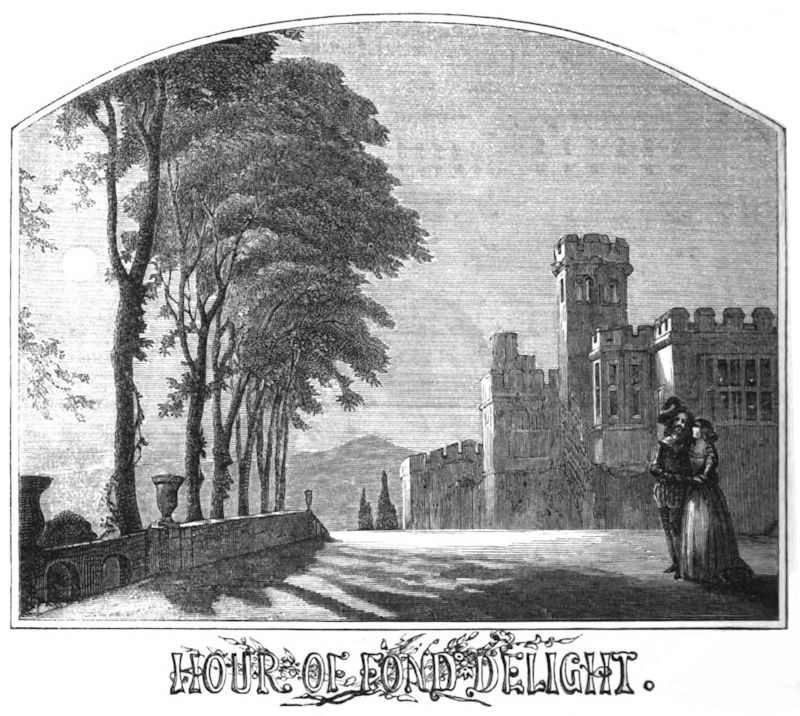
And Ariel led the maid, quick retracing their late
course, blushing, with eyelids drooping, listening
with face averted to the music of his passion, homeward
to his mother; while the garlanded beast, now
flying before their steps, now halting, showed mimic
war, and caressed its mistress, from whose eyes it
caught security and love.
———
BY E. ANNA LEWIS.
———
Here’s the tomb of my father—how mournful the thought!
That he went to the grave ere my infantile mind
One smile of parental affection had caught,
Or his lineaments dear in my heart were enshrined!
Yes, my sire! by thy dust I am kneeling in prayer,
Where in days of my childhood so oft I have wept,
Imploring thy spirit to soothe my despair,
And at evening and morning sweet vigils have kept.
Ere my young mind could grasp them, they told me thy woes;
Of the virtues that bind thee forever to me;
Of the love of thy friends, of the hate of thy foes;
That in features and mind I was like unto thee;
And with dawning of thought is thy memory wove,
The grief and the pining that prey on my breast;
The longing to soar to thy dwelling above,
And repose in thine arms in the Land of the Blest.
I have never seen parents their children caress,
Or soothe into quiet their heart-breathing
When the storm of misfortune around them did press,
But the tears of affection arose to mine eyes:
I have ne’er met a maid by the side of her sire,
Or beheld in the festal a father who kept
Watch over his daughter, and seemed to admire
His lovely and beautiful charge, but I’ve wept.
My mother lies by him—blessed saint of the skies!
Remembrance returns thee; how gentle and meek;
I behold thee when youth filled with radiance thine eyes,
And beauty and health were illuming thy cheek;
When thy delicate form was elastic as air,
When thy bosom was white as the Parian’s glow,
When thy beautiful ringlets of long, flowing hair,
In sable threads sprinkled thy forehead of snow.
How solemn, dear mother! it seems, that the clay,
Relentless and cold, now encumbers the breast,
Where, all helpless, so oft I in infancy lay,
And, soothed by thy lullaby, sobbed me to rest;
That on earth I shall never behold thee again,
Never more feel thy rosy lips pressing my brow,
Or thy fairy hand smoothing my pillow of pain—
Thy affection and love must forever forgo!
My sister sleeps next—lovely blossom of heaven!
Ah, why wast thou summoned so early away?
Why so soon was the bond of our sisterhood riven,
And I left alone on the cold earth to stay?
Why wast thou not spared to delight and to cheer
My desolate heart ’mid depression and gloom;
With thy love-breathing counsels to gladden my ear—
With thy songs and thy smiles to enliven my home?
Sleep on, ye beloved! it is better to rest
In the halls of the dead, than to linger in life,
Where the brain and the bosom with pains are oppressed
And the soul is beleaguered by sorrow and strife;
Sleep on! though no blossoms your homes are perfuming,
There are calmness and freedom from discord and care,
The lovely and beautiful daily are coming—
And in my pale vesture I soon shall be there.
———
J. HUNT, JR.
———
Religion, pure and undefiled,
Before the Father’s sight in bliss—
Who will the same in Heaven reward,
Consists in holy deeds, like this:
To heed, when cold Affliction’s shaft
Is at the helpless Orphan hurled—
The Widow visit, and to keep
Himself unspotted from the world.
Of all the truths at which we arrive through a
calm and dispassionate study of history, none appears
to me more certain than this, that, as regards the
career and course of empires, the rise and fall of
states, there neither is, nor has been, any such thing
as Fortune; that from the beginning of time, to the
events born of the present day, every minute particular,
every seemingly unimportant incident—or,
as men are fond to call it, accident—in the affairs of
nations, is part and parcel of one grand, universal,
all-pervading scheme of divine world-government,
projected before the patriarch kings led forth their
flocks to feed on pastures yet moist with the waters
of the deluge, but not to be fulfilled until time itself
shall have an end.
It can hardly, I think, fail to strike the least observant
of readers, that unless the civilized world
had been for a long period chained together under
the stagnant, and in the main, peaceful despotism of
the successors of the twelve Cæsars, it never would
have been prepared to receive that tincture of letters,
of humanity, and above all, of Christian faith, with
which it became in the end so thoroughly imbued;
that in every case, without one exception, it brought
over to its own milder cultivation, milder religion,
the fiercest and most barbarous of its heathen conquerors.
Not a province of the Western Roman empire but
was overrun, devastated, conquered, permanently
occupied by hordes of the wildest, crudest, most
violent, most ignorant of mankind—Goths, Vandals,
Huns, Vikings, and Norsemen, Jutes and Danes,
tribes whose very names to this day stand as the
types of unlettered force and unsparing outrage.
Not a province of that empire, though of its present
population not one hundredth part can trace an approximate
descent from the original Roman colonists,
so vast the influx of the Pagan invaders, but in the
lapse of time conquered its conquerors by the arts
of peace, and so became the germ of that Christian
civilization, that Christian Liberty, which—though
either, or both, may be temporarily obscured for the
moment—we see, in the main, steadily and consistently
pervading the Europe end America of the
nineteenth century.
That this state of things could have existed, by any
reasonable probability at this day, in the event of
Darius or Xerxes having overrun and occupied
Western Europe, with their oriental hordes—in the
event of Carthage having subdued Rome, and filled
Italy, Greece, Gaul, Spain, Britain, with her bloody
fiend-worship, and her base Semitic trade-spirit—in
the event of Mark Antony having won the day at
Actium, and broken up the heritage of Rome, like
that of Alexander, among a dozen jarring dynasties,
instead of leaving it to be centralized into an almost
universal empire—in the event of the Saracen having
destroyed the paladins of Charles Martel at Tours—of
the Turks having conquered the Mediterranean
at Lepanto, or Continental Europe under the walls
of Vienna—few will be found, I think, so hardy as
to assert.
Strange, therefore, as it may appear at first sight,
the first germs of existing institutions may be said to
have been sown on the banks of the Ilissus, the Eurotas,
and the Tiber; and the deity, whom the blind
superstition of the early Romans venerated as the
war-god Quirinus guarding the wave-rocked cradle
of Rome’s twin founders, was, in truth, the Lord of
Hosts, watching over the infancy of that peculiar
and appointed people which should make smooth his
way before him, and prepare the nations to receive
the faith of civil and religious freedom.
For all this wonderful accomplishment of wonderful
designs, however, we shall find that the instruments
are purely human, although the ends may
be divine—that, although the men are never wanting
to do His work, when done it must be, it is for the
most part, if not always, in blindness, in sin, in
wrath, and in the madness of ambition, that they do
that work, imagining themselves, vainly, busied
about their own miserable ends; and for the doing
it they are alone accountable. But not so of the
nations, which, having no life hereafter, no individual
identity in the world to come, meet their rewards
or punishments here, where their virtues or
their vices have required them, and thrive or perish
as they work toward the completion of His infinite
designs.
Nowhere, perhaps, in the whole course of history,
is this supervision of the Most High, which even religious
men are wont unthinkingly to call Fortune,
more clearly visible, than in the events of the Second
Punic War.
At home the republic, though undaunted and unequaled
of all times in heroism, was weeping tears
of blood at every pore, and resisting only with a
persistency savoring almost of despair, abroad it was
only by the exercise of sacrifices and self-denial
almost superhuman, that she was enabled to maintain
her foothold in her provinces of Sicily and Spain.
It seems to us, when we read how Capua, the
noblest of her allied cities, opened her gates and made
common cause with the enemy, how twelve of the
thirty colonies of the Latin name refused their contingents
of men and money; how all the north of Italy,
then Cisalpine Gaul, from the Var to the Rubicon, was
in tumultuous arms against her; how all the proud
and magnificent cities of La Puglia and Calabria were
leagued with the terrible invader; it seems, I say, as
if one superadded call on her resources must have
remained unanswered; one more war-trumpet blown
by a new enemy must have sounded her death-note.
And there was one moment when it appeared that
this contingency was close at hand. In the year of
the city 540, while all the south of Italy was in arms
with Hannibal from Capua down to the Gulf of
Taranto, and all the north was in that tumultuous
state of disorganization which with Celtic populations
is ever the herald of coming insurrection, Sardinia
suddenly broke out into armed and open rebellion.
Sicily, also, in which Hiero, the fast and faithful
friend of Rome, had lately died at a very advanced
age, rejected the Roman alliance, and a war of extermination
was raging in that beautiful island between
the partisans of the two rival powers, and the
forces which each could spare from the home conflict
to aid its faction.
At this crisis, Philip of Macedon, the descendant
of Alexander, and at that time the most powerful of
European princes, entered into an alliance, offensive
and defensive, with Hannibal, and would in the
course of that very summer have crossed the Adriatic
and invaded Italy with some five-and-twenty thousand
men, sixteen thousand of whom were the
hitherto unconquered phalanx, provided with that
arm, in the greatest possible perfection, the want of
which had robbed Hannibal of the fruits of all his
great pitched battles—I mean an efficient artillery.
In this respect the Greeks were unsurpassed; the
Greek engineers were the wonder of the world, as
was subsequently shown at the siege of Syracuse;
and how great soever the superiority of the Romans
to the Carthagenians in this arm of service, it was as
nothing to the skill of the Greek artillerists, and the
excellence of the Greek machinery.
What this combination might—I should rather say
might not—have effected, it were difficult to show;
more difficult to show how Rome could have resisted
it. For my part, having examined the question
in all its lights, I am of opinion that, had this alliance
gone into effect, and Philip acted with energy and
steadiness of purpose equal to his bravery and ambition,
Marcellus never would have taken Syracuse,
nor Scipio conquered Spain; but that from both those
countries triumphant reinforcements would have
poured in to Hannibal, over the Alps, across the
Straits of Messina, that an Italian Tama would have
sealed the doom of Rome, and a Punic ploughshare
razed the foundations of the capitol.
But such—it is well for humanity—was not to be
the issue of the war. Philip’s ambassadors, returning
with the treaty signed and ratified by Hannibal,
were taken by the Roman squadron off the Calabrian
coast, and sent to the city with their papers.
A year elapsed before the treaty could be renewed;
and, meantime, the Romans, awakened to a perception
of their danger, found means to enkindle the
Ætolians and Illyrian pirates against Philip, and in
the end to organize a Greek confederation against
Macedon, which gave its active and ambitious sovereign
plenty of work to do on his own side of the
Adriatic. At a later period he found cause to repent
that he had ever meditated intervention.
Such strokes of fortune, so historians call them, as
that capture of the ambassadors of Philip, which,
perhaps, saved Rome—as that strong gale which
blew on Christmas Eve on Bantry Bay, dispersing
Hoche’s armament to the four winds of heaven—such
strokes, I say, of fortune, I hold to be the visible
agencies and instruments of God’s providence, in the
government of nations, to the welfare of the world.
From Rome that peril was averted. The arms of
Macedon abstained, perforce, from the shores of devastated
Italy. The arms of Syracuse, of Spain, were
wrested from the hands which would have wielded
them in the behalf of Carthage. The arms even of
the unbridled Numidians were turned against the
masters whom they had served so fatally for Rome.
And out of the furnace of that scathing war, the
giant form of the chosen republic emerged, without
one hair singed, one thread of its vestments injured;
and that, like the faithful sons of Israel, by the
especial providence of the Almighty.
Years passed, and events hurried toward their
consummation. Yet still, though from this date the
tide of Hannibal’s affairs began to ebb, and that of
Rome’s to flow with a healthier, prouder current, it
was not until twelve more terrible campaigns had
been fought out in vain, that the star of the great
Carthaginian set in blood at Zama, and the name of
Carthage herself, all but one brief spasmodic sound
of fury and despair, went out and was forgotten from
among the nations.
Then rousing herself, like a galled lioness, Rome
went forth to avenge and conquer.
Hitherto she had fought at home for existence,
henceforth she fought abroad for dominion; and
abroad as at home, until her mission was accomplished
and His work done fully to the end, she was
invincible, as the fruit of her labors is eternal.
The war, which had been undertaken against
Philip by the Romans shortly after his giving them
the first offense, had languished from the beginning
on both sides, and peace had been concluded between
the contending parties some three years before the
decisive victory of Zama.
So soon, however, as peace was concluded with
Carthage, in the year of the city 552, B. C. 200, true to
the latter part at least of her famous motto,
Parcere devictis et debellare superbos,[3]
Rome sought at once a cause of war, whereby to
chastise Philip for the comfort given to her enemies
in her worst time of need. Nor sought long in vain.
A deputation from the Athenians came seeking
succor; the arms of Philip were too near their
borders.
War was declared, the Consul Sulpicius landed at
Dyrrachium with a regular army, and the campaign
commenced by a series of operations in the valley of
the river Erigon, in Dassaretia, the object of Philip
being to prevent that of the consul to secure his
junction with his Dardanian and Ætolian allies.
Several sharp skirmishes occurred, in all of which
the Macedonians were worsted with loss, and in
one instance Philip narrowly escaped being taken
prisoner; whereupon he retreated through the mountain-passes,
throwing up strong field-works in every
available position, but avoiding a general action.
His works all proved useless, being either forced
or turned without difficulty by the active and movable
legionary tactic of the Romans, against which
it became at once evident that so ponderous and unwieldy
a body as the phalanx could not manœuvre
or fight, in broken ground, with a hope of success.
In the end Philip retired at his leisure into his hereditary
kingdom, and the consul having stormed and
garrisoned the small town of Pelium, on the Macedonian
frontier, fell back to Apollonia on the Illyrian
sea-coast, without accomplishing his object.
Still his campaign had not been useless, for he had
snatched the prestige of invariable success from the
phalanx, had established the incontestible superiority
of the Roman soldiery of all arms to the Greek, and
had defeated the Macedonians on every occasion,
when they had ventured to await battle.
It is not a little remarkable, and proves clearly the
singular adaptability of the Romans to all martial
practices, that whereas, scarce twenty years before,
we find their cavalry the worst in all respects but
personal valor in the known world, and their light
troops unable to compete even with the barbarian
allies of Hannibal, we now observe them superior in
both these arms, owing, as it is distinctly stated by
all the writers, to the superior excellence of their
weapons[4] and equipment, even to the far-famed
targeteers and life-guards of Macedonia.
In the following year, Sulpicius was superseded
by the new consul, Publius Villius Tappulus, who,
taking command of Sulpicius’ legions at Apollonia,
advanced up the open valley of the Aöus, now Vioza,
with the intention of forcing the famous passes,
variously known as the Aoi Stenæ, or Fauces Antigoncuses,
and now as the defiles of the Viosa, rather
than turning them by way of Dassaretia, as had been
done previously by his predecessor. The judgment
was sound, the execution naught. For, after marching
to within five miles of the western extremity of
the defiles, he fortified his camp in the plain, probably
in the valley of the Dryno,[5] above its junction
with the Vioza, reconnoitered the position of Philip,
who was very strongly posted in an intrenched camp
at the most difficult point of the pass, à cheval on the
river, and occupying both the mountain sides, and
there lay perfectly inactive until he was himself relieved
by Titus Quinctius Flamininus, his successor
in the consular dignity.
This man, of the early Roman leaders, was in many
respects one of the most remarkable; in one particular,
with the single exception of Caius Julius
Cæsar, the great Dictator, he stands alone, in honorable
contrast to his merciless and cruel countrymen—though
quick and vehement of temper, he was a just
man, and both merciful and courteous to conquered
enemies. The one blot on his character, to which I
shall come hereafter, must be ascribed to the policy
of his country, under direct orders from which he
was unquestionably acting, not to his own wishes or
disposition, to which nothing could be more abhorrent
than the duty imposed upon him.
Plutarch informs[6] us that, in his time, “it was
easy to judge of his personal appearance,” which,
unfortunately, he has not described, “from his statue
in brass at Rome, inscribed with Greek characters,
which still stands opposite to the hippodrome, nigh
to the great Apollo from Carthage.”
As, however, the whole tenor of Plutarch’s life is
laudatory, and for that gossiping anecdote-monger singularly
correct and clear, we may take it as a fact that
the nobility of his person was not unequal to that of
his character; which I consider the finest recorded
of any Roman general or statesman.
“He is said,” continues the author,[7] I have already
quoted, “to have been of a temperament impulsive
and vehement both in his likings and dislikings, but
with this distinction, that he was quick to wrath which
quickly passed away, but prompt to kindness which
endured to the end. He was very ambitious and
very fond of glory, ever anxious to be the actor himself
in the best and greatest deeds, and rejoicing in
the acquaintance rather of those who needed benefits
themselves, than of those who could confer them
upon others, esteeming those as material for the promotion
of his own virtue, these as rivals of his own
glory.”
I will add that I can find him guilty of no act—almost
alone of his countrymen—of political dishonesty,
or of social turpitude. To his country he was
a zealous, ardent, and profitable servant; to his
friends and associates faithful and true; to his enemies
just and clement; and to the provincials, subjected
to his dominion, a governor so affable, beneficent
and equitable, that when he left their shores
they mourned as for a countryman, almost a father of
the country.
As a general, he committed no military error; and
although his command was limited to little more than
two campaigns, they were campaigns of the most
important—important not merely to his own country,
but to the science of war, in general—since they established,
beyond a peradventure, the superiority of
the tactic and armature of the legion to those of the
phalanx; in other words, of the line to the column
tactic.
I give to him this credit, unhesitatingly; for, although
Pyrrhus was at last beaten by the phalanx in
Italy, it was rather by dint of numbers and aid of circumstances
than by military skill; and further, it is
evident that the great bulk of his armies consisted of
targeteers, little different from the legionaries, and
of Samnites, Tarentines, and other Italian soldiery
precisely similar to them, in arms and array.
Again, although Sulpicius had demonstrated the
superiority of the individual Roman, to the individual
Greek, heavy footman; he had not—nor any one
else hitherto—defeated a phalanx, unless with a
phalanx.
When Greeks met Greeks then was the tug of war.
For the rest, the battles of Paullus Æmilius against
Perseus, were but the battles of Flamininus against
the father of Perseus, less ably fought, though on the
same principles at last successful.
The fact remains, that from the battle of Cynoscephalæ,
of which anon, to the end of ancient history,
it was an admitted fact that, unless on a very narrow
and perfectly level field, where both its flanks were
securely covered, the phalanx could not receive battle
from the legions with a chance of success; and
that as to delivering battle on wide, open plains,
where rapid manœuvring and counter-marching
could be resorted to, such an idea was preposterous.
Flamininus was educated to arms from his very
boyhood, and that in the terrible Italian campaigns
of Hannibal; through which he served with such
distinction that he had already attained the post of
tribune of the soldiers, equal to the modern rank of
lieutenant-colonel, under that daring and distinguished
leader Marcus Marcellus, and was on the field when
he was slain, rashly periling himself in an affair of
outposts near Venusia, in the year of Rome 546,
B. C. 208, and in the sixtieth year of his own age.
After the death of his great commander, Flamininus
was appointed governor of Tarentum,[8] in the
capacity of quæstor, on its recapture by Fabius
Maximus; and there displayed no less ability in the
administration of justice than he had previously
evinced skill and courage in warfare. Seven years
afterward—at the early age of thirty years—he was
elected consul; and, although opposed by the veto[9]
of the tribunes Fulvius and Manlius Carius on the
ground that he lacked twelve years of the legitimate
age, and that he had never filled the intermediate
grades of ædile and prætor, he was confirmed by
the senate, and received Macedonia as his province,
by lot.
The fact is, that the wars of Hannibal had by this
time taught the Romans that an overstrict adherence
to prescriptive formulæ, in times of national peril, is
disastrous; and that to meet the ablest adversaries
the ablest men must be had, whether all the theoretic
requisites to their election had been complied with
or not.
Therefore Scipio, the elder Africanus, was sent to
Spain with proconsular rank and a consular army, before
he was of the just age to fill a prætorship.
Therefore Flamininus was elected consul at thirty,
although the constitution expressly declared that no
one should hold that dignity until he should have fully
attained his forty-second year.
Such laws may be, perhaps, generally wise; but
the breach of them is always so. Nor does history
show any instances, worth remark, of youthful genius
elevated by the popular call to early station, and
subsequently found unworthy, from the days of Alexander,
Scipio, and Flamininus, to those of Pitt and
Napoleon.
Nor do I believe that the appointment of the consuls
was really, though it was ostensibly, left to the
chance of a lot, at least in times of actual war, and
national emergency; since we invariably find the
best man sent to the place where he was required,
which could not always have occurred fortuitously.
Doubtless those who superintended the balloting had
some method of determining the result, as had the
augurs and haruspices with regard to omens and sacrifices.
So Flamininus was not only elected consul at thirty,
but obtained the seat of the great war for his province,
and was empowered to pick nine thousand
men, horse and foot, out of the Spanish and African
veterans, inured to all that was known of warfare in
those days by the campaigns of Hannibal and Scipio.
A grand occasion, indeed, and a superb command
for an untried commander.
It appears that on his entering upon his office,
Flamininus was detained some time at Rome, in order
to superintend a fast and expiatory sacrifice on
account of certain alleged prodigies of evil import;
but it is certain that he had understood the consequences
of the dilatory operations of his predecessors,
and was resolute not to fall into the like error. He
sailed from Brundusium for the island of Corcyra,
now Corfu, which he occupied with eight thousand
foot, and eight hundred horse, much earlier in the
season than the preceding consuls had been wont to
take the field: and, instantly passing over to the
main, in a single line-of-battle ship, hurried onward
by forced journeys to the camp, and superseded Villius,
in the face of the enemy.
A few days afterward, his reinforcements coming
up, he called a council of war to determine whether
a direct attack, or a flank movement through Dassaretia,
was to be preferred. The council, of course, determined
any thing rather than direct action: but
Flamininus, perceiving the facilities afforded by the
geography of that broken, mountainous, forest-clad
region, intersected by deep ravines and impracticable
torrents, to the protracting of the war, resolved to
take the bolder and more prudent course of trying
conclusions, at once, with an enemy whose object it
evidently was to act purely on the defensive, and to
avoid delivering battle.
Yet, determined as he was, the difficulties of the
ground were so great, and so skillfully had Philip
availed himself of every defensible point, or coigne
of vantage, that many days elapsed before he could
decide on the mode of assault.
The river Aöus, now Vioza, an extremely large
and powerful river, augmented at every half-mile by
fierce mountain torrents, along the valley of which is
the most direct pass into Macedonia proper, at this
point breaks its way through a chain of exceedingly
abrupt and precipitous, though not very lofty mountains,
and forms a gorge of six miles in length, closely
resembling that picturesque defile of the Delaware,
with which many of my readers are doubtless familiar,
known as the Water-Gap.
Forced into a space, two-thirds less than its ordinary
breadth, the Aöus has here cut its way through
the solid rock, between the mounts Asnaus and Aëropus,
now Nemertzika and Trebusin, respectively
to the left and right of the defile, which here runs
nearly south-eastward. The right-hand mountain,
Aëropus or Trebusin, is the loftier of the two, descending
in a sheer wall of perpendicular and treeless
rock to the brink of the only road, scarped out of the
living limestone like a cornice above the torrent,
which bathes the base of the opposite hill, leaving no
level space between.
“The mountain on the opposite or left bank of the
river,” says Colonel Leake, whose topography of the
Grecian battles founded on minute personal inspection,
is no less valuable than interesting, “is the northern extremity
of the great ridge of Nemertzika, Asnaus, much
lower than that summit, but nearly equal to Trebusin
in height. At the top, it is a bare, perpendicular precipice,
but the steep lower slope, unlike that of its
opposite neighbor, is clothed with trees quite to the
river. Through the opening between them is seen a
magnificent variety of naked precipices and hanging
woods, inclosing the broad and rapid stream of the
insinuating river.”[10]
The road,[11] difficult in any event to an army, if defended,
is impracticable.
In this prodigiously strong pass Philip had taken
post, occupying the narrow road with the phalanx,
and having his main body hutted comfortably among
the loose crags of Aëropus, on a conspicuous summit
of which was pitched his own royal pavilion, with
the banner of Alexander waving over it. The slopes
of the opposite hill, Asnaus, was held by Athenagoras
his lieutenant, with the light troops, and all the flanking
crags and salient angles of the precipitous hills
were mounted with the tremendous military engines,
which, though of common use in the defense and attack
of fortresses, had never been brought into field
service until now.
Immediately in front of this stern mountain gateway
extended a small plain, midway between the
Roman camp and the Macedonian lines, and here, after
a fruitless parley and attempt at accommodation,
from which both parties retired so much exasperated
at their mutual pertinacity, that the river, which divided
them, alone prevented their personal conflict,
the light troops met in action from both armies.
It is scarce to be conceived how, with such obstacles
against them, the Romans could have escaped
destruction; but it is almost ever the case in mountain
warfare that the attacking party is successful.
The gray mists of the early summer morning were
still nestling among the crags, and brooding in the
deep glades of the hanging woods, when the long,
shrill blasts of the Roman trumpets announced the
impetuous rush of the light troops; and on they went,
headlong and invincible, carrying all before them,
and driving in the Macedonian skirmishers like the
foam of the Adriatic before the fury of the south-east
wind.
There was no dust upsurging from the rocky road
to shroud their advance, no smoke-clouds to veil
them from the shot of the enemy’s artillery, with their
bright armor flashing in the sunbeams, as they streamed
down the gaps in the mountain summits, and their
blood-red banners and tall plumes tossing in the light
morning air, on they came, dazzling and unobscured,
a fair mark for the deadly missiles, arrows shot off in
volleys, vast javelins which no human arm could launch,
and mighty stones hurled from the catapults, as if from
modern ordnance, which tore their ranks asunder,
and leveled whole files to the earth at a blow.
But their extraordinary discipline and admirable armature
enabled them to endure the storm; and they
made their way through all opposition, until they met
the phalanx, bristling with its impenetrable pikes, its
flanks impregnably protected by the rocks here, by
the river there, and its narrow front offering no point
assailable. Then they were checked; but, even then,
not beaten back, so stubborn was their Roman hardihood,
so firm their resolution to be slain, not conquered.
All day long did that deep glen quake and shudder
to the dread sounds of the mortal conflict; the thundering
crash of the huge stone-shot, shivering the
trees and shivered on the crags; the hurtling of the
terrible falaricæ; the clash and clang of steel blades
and brazen bucklers; the whirlwind of the charging
horse; the shouts and shrieks and death-groans; the
thrilling trumpets of the legions; the solemn pæans
of the phalanx.
Only when the sun set, and the full, round moon
came soaring coldly up above the tree-tops, flooding
the bloody stream of the Aöus, and the corpse-incumbered
gorge, with silver radiance, did the weary and
shattered hosts draw off to their respective camps,
from a strife so justly balanced, that none could say
which had come off the better, none judge on which
side the more or the better men had fallen.
That night, Flamininus sat in his tent alone,
anxious, uncertain how to proceed, so terrible had
been the loss of life, and so small the advantage;
when a shepherd was introduced, sent by Charops,
the prince of the Ætolians, who should conduct a detachment,
by a wild mountain foot-path, to a height
in the enemy’s rear, domineering his whole position.
Four thousand chosen veterans of infantry and
three hundred horse, under a tribune of the soldiers,
were detailed, instantly, for the service, which would
occupy three days.
They should march all night long, such were their
orders, for the summer moon was at its full, and the
nights light as day and far more pleasant, as being
soft with fragrant dews and the cool mountain air.
By day, they should halt in some deep, bosky dell
or forest glade, to rest and refresh themselves securely.
So far as the nature of the ground should
admit, the cavalry would lead the way, then halt on
the last level. The vantage ground once gained,
they should kindle a fire on the summit, but abstain
from all active demonstration, till they should perceive
the action in the defile at its height. Such were
their orders; and in high hope they parted, carrying
with them as a guide the shepherd, in chains, as a
precaution against treachery, but encouraged by great
promises, if faithful.
On the two following days, Flamininus skirmished
continually with his light troops against Philip’s outposts,
relieving his men by divisions, more to divert
the attention of the enemy from the stratagem which
was in progress, than with any design to harass him;
though in both points of view he succeeded admirably;
for the superiority of the Roman light-infantry
soldier to the Greek skirmisher was great indeed,
and the Macedonians lost many and good men.
On the third[12] morning, secure that all had gone
well so far, by the immovable attitude of the enemy,
neither elevated by any unexpected success, nor
shaken by any suspicion of his danger, the consul
drew up his legionary cohorts, in solid column of
maniples, along the rocky road, before the sun had
yet risen, and while the mountain mists still covered
the distant peaks with an impenetrable veil.
His light troops, advanced on both flanks, pressed
forward along the difficult hill-sides, dashing the
heavy dew in showers from the dripping underwood,
and threatening the camps of Philip and Athenagoras
both at once, with loud shouts and a storm of missiles.
Then were renewed the splendor, the obstinacy,
and the carnage of the first encounter. Again the
Roman voltigeurs drove in the enemy’s outposts;
and beat back the targeteers, who sallied from their
works eager for the fray, from post to post, till they
came within the range of the artillery, when in their
turn they began to suffer heavily.
But at this instant the sun arose; the mists melted
gradually away from the bare peaks, which now
stood forth glittering in the hazy sunshine. With indescribable
anxiety the eyes of Flamininus were
riveted upon the distant crag, indicated as the decisive
point. There was a vapor floating round it dull
and indistinct, and browner than the blue mist
wreaths—but was it, could it be, the smoke-signal?
For a time all was an agony of doubt and suspense.
His officers gathered about the consul; the legionaries,
seeing their commanders’ eyes all turned in
one direction, gazed that way also, anxious if ignorant.
Browner the vapor grew and browner; now it
soared upward, black as a thunder-cloud, darkening
the azure skies, a manifest smoke-signal.
Jove! what a shout arose from the now triumphant
cohorts!—what a thrilling shriek of the shrill trumpets,
answered faintly and remotely, as if from the
skies, by another Roman blast, but liker to the scream
of the mountain-vulture than to the clangor of the
pealing brass!—what a clang as of ten thousand stithies,
when the Spanish blades smote home upon the
Macedonian targes!
Yet still the men fell fast on both sides, although
the Romans won their way, in spite of artillery and
pike and sling-shot, at the sword’s point; for the
Greeks still fought stubbornly, and plied their dreadful
engines with deliberate aim at point blank range,
unconscious that they were surrounded.
Then came the Latin cheers, and the clang of
arms, out of the clouds, rolling down the mountain
side, on their flank, in their rear; the rush of charging horse!—In
an instant they broke, disbanded,
scattered, deserted their defenses—all was over.
In the first instance the panic and route of the Macedonians
were absolute; and so utterly disheartened
and terror-stricken were the men, that, had it been
possible to pursue them effectually, the whole army
must have laid down its arms or have been cut to
pieces.
The ground,[13] however, was for the most part impracticable
to cavalry, and their heavy armature
rendered the legions as inefficient in pursuit as formidable
in close combat. About two thousand only
of the Macedonians fell, more in the battle than in
the route; but the whole of the formidable defenses,
on which they had expended so much time and toil,
were carried at a blow, all their superb artillery,
their camp, their baggage, rich with the barbaric
pomp of the Macedonian royalty, all their camp followers
and slaves, remained the prizes of the victors.
Philip, after he had fled five miles from the field,
that is to say, so far as to the eastern extremity of the
defile he had fruitlessly endeavored to defend, at
length perceiving that he was unpursued, and suspecting
the reason, halted on a steep knoll covering
the entrance of the pass, and sending out parties along
the ridges and through the ravines with which they
were familiar, soon collected all his men about his
standard save those whom he had left on the field of
battle, never to rouse to the trumpet or rally to the
banner any more.
Thence he retreated rapidly down the valley of the
Aöus, or Vioza, in a south-easterly direction to a
place called the camps of Pyrrhus, supposed to be
Ostanitza, near the junction of the Voidhomati and
Vioza,[14] where he passed the night; and thence by a
prodigious forced march of nearly fifty miles reached
Mount Lingon on the following day, where he remained
some time in doubt whither to turn his steps,
and how to frame his further operations.
Mount Lingon is the eastern and loftiest extremity
of a great chain of hills; dividing Macedonia proper
from Thessaly on the east and Epirus on the west.
It forms a huge, triangular bastion, its northern base
overlooking Macedonia, and its apex facing due
southward, which is in fact the water-shed between
the three great rivers, Aöus or Vioza flowing north-westward
into the Adriatic, Penëus or Salamosia
flowing eastward into the gulf of Saloniki, and Arecthus
or Arta, which has a southerly course into the
gulf of the same name, famous in after days for the
naval catastrophe of Actium.[15] The flanks of this
ridge are steep, difficult and heavily timbered, but its
summits are green with rich, open downs, and watered
by perennial springs and fountains, an admirable
post of observation, and commanding the descent
into all the great plains of Northern Greece. After
mature deliberation, Philip retreated still south-eastward
to Tricca, now Trikkala, on the Penëus; and,
though with a sore heart, devastated his own country,
wasting the fields and burning the cities. Such
of the population as were capable of following his
marches, with their cattle and movables, he swept
along with him; all else was given up as plunder to
his soldiers, so that no region could suffer aught more
cruel from an invader than did Thessaly at the hands
of its legitimate defender. Pheræ shut her gates
against him, and since he could not spare the time to
besiege it, for the Ætolians were coming up with
him rapidly, having laid waste all the country around
the Sperchias and Macra and made themselves masters
of many strong towns, he made the best of his
way back to the frontiers of Macedonia.
In the meantime, the consul, after his victory, followed
so hard on the track of his defeated enemy, that
on the fourth or fifth day, after reorganizing his forces
and taking up the pursuit in earnest, he reached
Mount Cercetium some fifty miles in advance of
Philip’s deserted station on Lingon, where he had
given rendezvous to Amynander and his Athamanians,
whom he needed as guides for the interior of
Thessaly. Thereafter, he stormed Phaloria, received
Piera and Metropolis into surrender, and laid siege
to Atrax, a strong place not far from Larissa, on the
Penëus, about twenty miles above the celebrated
pass of Tempe, in which Philip lay strongly intrenched
watching his movements, and not more than
forty from the shores of the Ægean. This small
place, however, garrisoned by Macedonians, offered
so stubborn a resistance that Flamininus was unable
to take it, until the season was waxing so far advanced,
that, finding the devastated plains of Thessaly
utterly inadequate to the support of his army, and
having no harbors on the coast of Acamania or Ætolia
in his rear, capable of receiving transports sufficient
to supply him, he judged it best to raise the siege,
and fall back to winter-quarters in Phocis, on the
shores of the gulf of Corinth, leaving the whole of
Thessaly ruined, and its principal towns either
destroyed by Philip, or occupied by his own garrisons.
During these proceedings of the consul by land, his
brother, Lucius Quinctius, who commanded the fleet
destined to co-operate in the war, acting in conjunction
with Attalus and the Rhodian squadron, had
made himself master of Eretria, Calchis and Carystus,
the strongholds and principal towns of Eubœa,
winning enormous booty, and stationed himself at
Cenchreæ, at the head of the gulf of Eghina, whence
he was preparing to lay siege to Corinth, the most
opulent and splendid of all the Greek cities, now held
by a strong Macedonian garrison, backed by a powerful
faction within the walls, for Philip.
Marching down into Phocis without opposition,
for except the garrisons of a few scattered towns
there was no force, on this side Macedonia, adverse
to the Romans, Flamininus took Phanotea by assault,
admitted Ambrysus and Hyampolis to surrender,
scaled the walls of Anticyra, entered the gates
of Daulis pell-mell with the garrison which had sallied,
and laid regular siege to Elatia, which was too
strong to be taken by a coup-de-main. The capture
and sacking of this town was the last military operation
of the campaign.
A political event occurred, however, at the close
of it, which was even of greater influence in the end,
than all the victories of the year, the ratification
namely of a treaty of alliance between the powerful
Achæan confederacy and the Roman republic, by the
consequences of which, joined to the events of the
past campaign, all northern Greece from the Isthmus
of Corinth to the line formed by the Aöus and Penëus
rivers, and the ridges of Lingon and Cercetium, was
united under the eagles of the republic against
Philip. Within that region, however, the two splendid
cities—Corinth, the siege of which by Attalus
and Lucius Quinctius had proved unsuccessful, and
Argos—still held out for the king, and it was evident
that another campaign would be needed for the termination
of the war.
Well satisfied with his success, as he had indeed
cause to be, for few campaigns on record have more
fully and masterly accomplished their end, Flamininus
retired into winter-quarters in the island of Corfu,
while Attalus and the proprætor Lucius laid up their
fleets in the Piræus, and passed the season of inactivity
within the walls of Athens.
During the winter, after the election of the new
consuls, Caius Cornelius Cethegus, and Marcus Minutius
Rufus, but before it was known whether the
conduct of the war would be continued to Flamininus,
or one of the consuls appointed his successor, a sedition
broke out in the town of Opus, and the inhabitants
admitted the Romans. The Macedonian garrison,
however, still held out, and while Flamininus
was preparing to reduce it, a herald arrived from the
king, demanding an interview in order to treat of
peace. To this the consul, naturally desirous to conclude
the war himself, acceded, and a singular interview
followed.
A place was appointed on the shore of the gulf of
Tituni near Nicæa, and thither came the Roman
general, Amynander king of the Athamanes, Dionysodorus
envoy of Attalus, Agesimbrotus admiral of the
Rhodian fleet, Phæneas prince of the Ætolians, and
with them two Achæans, Aristænus and Xenophon.
These overland. But Philip came across from Demetrias,
now Volo, with one ship of war and five
single-banked galleys, and casting anchor as close as
might be to the shore, addressed the confederates from
the prow of his ship.
Flamininus proposed that he should land, in order
that they might converse more at their ease; and, on
the king’s refusing, inquired who it was of the company
whom he feared.
“I fear none but the immortal gods,” was the
haughty reply; “but I distrust many whom I see
around thee, and most of all the Ætolians.”
“That,” replied the Roman, “is a peril common
to all who parley with an enemy, that they can place
confidence in no one.”
“Nay, Titus Quinctius,” answered Philip, “but
Philip and Phæneas are not equal inducements to
treason; and it is one thing for the Ætolians to find
another general, and for the Macedonians to find another
king such as I am.”
To this argument there was no reply but silence.[16]
Nor, when they came to speak of conditions, could
any terms be effected among so many jarring interests;
but it was agreed at length that ambassadors
should be sent by all the contracting parties to the
Senate. A truce was proclaimed for two months,
Philip withdrawing, as a security for his good faith,
the garrisons from all the towns of Locris and Phocis;
while Flamininus, in order to give color to the
proceedings, sent with the ambassadors Amynander
king of the Athamanes, Quinctius Fabius, his wife’s
nephew, Quinctius Fulvius, and Appius Claudius,
all members of his military family.
After awhile the delegates returned. The Senate
had given no decision. The province and war of
Macedonia, when the consuls were about to cast lots,
had been continued to Flamininus as imperator, the
tribunes Oppius and Fulvius having strongly represented
the impolicy of removing general after general,
as fast as each got accustomed to the country and was
ready to follow up a first success by a final victory.
The argument prevailed, and the option of peace or
war was left to the imperator. The Senate was not
aweary of the strife, and Flamininus was athirst for
glory, not for peace.
No further parley was granted to Philip; and these
terms only dictated to him, that he must withdraw
his forces from the whole of Greece into his own proper
dominions, north of the river Aöus and the Cambunian
mountains.
This was of course tantamount to a resumption of
hostilities; and both parties, it appears, prepared
with equal alacrity and confidence for the final
conflict.
The first operation of Philip, who, on finding the
necessity of drawing all his resources to a common
centre, began to despair of maintaining Corinth,
Argos, and his Achæan cities, was to deliver them
over for safekeeping to Nabis, tyrant of Lacedæmon,
on condition that in case of his being successful
against the Romans they should be restored to himself,
otherwise they should belong to Nabis.
No sooner was that done, however, than the treacherous
tyrant, desirous only to retain his new
power, made peace with the Ætolians, furnished the
Romans with Cretan auxiliaries to act against Philip,
and even entered into illusory negotiations for the delivery
of Corinth and Argos, than which nothing was
further from his mind, until at least he should have
plundered them of all they contained most valuable,
and this, with his wife’s aid, he lost no time in doing.
These circumstances, however, were but as mere
preludes to the great strife which was about to be determined
in the broken and uneven country of north-eastern
Thessaly, not far from the ground on which
Flamininus had closed his last campaign, to the southward
of the Penëus, whither both parties were
already collecting their powers and drawing to a head.
Almost before the opening of the spring both leaders
were on the alert, and active in preparation; partly
by stratagem and the insinuation of a menace, if not
its reality, partly by persuasion, Flamininus had the
address to bring over the Bœotians, as he had already
brought over the Achæans, to the Roman alliance;
and thenceforth, every thing in his rear being secure
and friendly, he had nothing to do but to look forward
and bend up all his energies and powers to the destruction
of the enemy before him.
To this end he was well provided; for when his
command was continued to him, five thousand infantry,
three hundred horse, and three thousand mariners
of the Latin allies, were voted him as a reinforcement
to his late victorious army.
With these admirable troops, then, he broke up
from Elatia, his last conquest, about the vernal equinox,
and marching north-westerly by the great road
through Thronium and Scarphea, on the gulf of Tituni,
arrived at Thermopylæ, where by a preconcerted
plan he met the Ætolians in council, and three days
afterward, encamping at Xynias in Thessaly, received
their contingent of six hundred foot and four hundred
horse, under Phæneas their chief-magistrate. Moving
forward at once with the celerity and decision which
mark all his operations, his force was augmented by
five hundred Cretans of Gortyna, under Cydas, and
three hundred Illyrians of Apollonia, all light infantry
skilled with the bow and sling; and a few days afterward
he was joined by Amynander with twelve hundred
Athamanians, completing the muster of the
allies.
Philip meanwhile was laboring under the sore disadvantage
which is sure to afflict, and in the end
overthrow, all nations which engage in long careers
of conquest. Incessant wars, since the days of Alexander,
had worn out the manhood of Macedonia. His
own wars had consumed the flower of the adults, and
those who remained were the sons of mere youths or
of octogenarians, begotten while the men of Macedonia
were fattening foreign fields with priceless gore.
As in the last campaigns of Napoleon, Philip’s conscriptions
of this year included all the youth of sixteen
years, while they recalled to the standard all
the discharged veterans who had yet power to trail a
pike.
So certainly in all ages will the like causes produce
the like effects.
Of this material, however, he had constructed a
complete phalanx of sixteen thousand men, the flower
of his kingdom, and the last bulwark of his throne.
To these were added two thousand native targeteers,
two thousand Thracians and Illyrians, about fifteen
hundred mercenaries of all countries, and two thousand
horse. With this power he lay at Dium, now
Malathria, on the gulf of Saloniki awaiting the Romans,
by no means despondent, but rather confident
of success. For although the last campaign had gone
against him, as a whole, still the repulse of the Romans
from the walls of Atrax by hard fighting, seemed
to counterbalance the forcing of the gorges of the
Aöus, while it was undeniable that the phalanx had
fully maintained its ancient renown, and was, for all
that had yet been proved, invincible in a pitched
battle.
No less secure of victory, flushed with past
triumphs, and athirst for future glory, Quinctius pressed
on, resolved on the first occasion to deliver battle, his
forces being, as nearly as possible, equal to those of
the king, though he had a superiority of about four
hundred horse.
On hearing of the Roman advance, Philip broke up
from Dium and marched upon Larissa, intending to
deliver battle south of the Penëus, with a view probably
to the subsequent defense of the defiles of
Tempo, in case of disaster; while Flamininus having
failed in an attempt to surprise the Phiotic city of
Thebes, marched direct upon Pheræ, previously ordering
his soldiers to cut and carry with them the
palisades, of which at any moment to fortify the casual
encampment of the night.
Both leaders, thus aware of the enemy’s proximity,
yet unaware of his exact position, encamped and fortified
their camps, the Roman at about six, the Macedonian
at four miles’ distance from the town of
Pheræ.
On the following day, light parties being sent out
on both sides to take possession of the heights above
the town, which would seem to be the western slopes
of Karadagh, formerly Mount Calcodonium—described
by Leake as gentle pasture hills, interspersed with
groves of oak, but swelling, a little northward on the
way to Larissa, into steep, broken hills, topped with
bare limestone crags—they came in sight of one another
so unexpectedly, that they were mutually amazed, and
neither charged the other, but both sent back for
orders to head-quarters, and were ultimately drawn
off without fighting. On the second day, both leaders
sent out reconnoitering parties of light-armed infantry
with some horse, and these encountered on the hill
above the suburbs of Pheræ to the northward. It so
happened that Flamininus had ordered two squadrons
of Ætolian horse on this duty, wishing to avail himself
of their familiarity with the country; and these,
overboiling with courage and emulous of the Roman
renown, so soon as they discovered the enemy, dared
the Italians to the test of superior valor, and charged
the Macedonians with such metal and prowess that
they cut them up very severely; after which, having
skirmished for a considerable time with no decisive
results, they drew off, as if by mutual consent, to their
own encampments.
The ground about Pheræ, being much incumbered
with orchards, groves and gardens, and cut up by
stone walls and thorn hedges, was very unsuitable for
a general action, and both leaders, perceiving this,
moved early the next morning by different routes, the
great ridge of Karadagh intervening between their
lines of march, and intercepting all sound or sight,
upon Scotussa, a town some ten miles distant in a
westerly direction, lying at the base of the hills, and
on the verge of the plain.
The Romans marched to the southward, Philip to
the northward of the dividing ridge; and, unaware
how nearly they were intrenched, both erected their
palisades for the night almost within hearing of their
countersigns and trumpets.
The third morning, after they had decamped from
Pheræ, was exceedingly thick and foggy; but in spite
of this Philip, who had passed the night on the banks
of the Onchestus, persevered in marching upon Scotussa,
where he hoped to find ripe corn in the plain
for his troops. The darkness, however, increased,
and ere long one of those tremendous thunder-storms,
for which all the limestone countries of upper Greece
are so famous, or rather infamous, burst over his head,
with hail, and wild whirling wind-gusts, and forked
lightnings, and compelled him to halt at once and intrench
himself, at the northern base of the bare, craggy
hills, forming the summits of the Calcodonium, known
as the Cynoscephalæ or dog’s heads, though the resemblance
does not go far to justify the appellation.
So soon[17] as it cleared a little, though the mist was
still so dense that one could scarce see his own hand,
he sent out a detachment to occupy the heights of
Cynoscephalæ. At the same moment Flamininus sent
out his troops of horse and a thousand voltigeurs from
Thetidium, where he lay, to feel for the enemy.
These latter fell suddenly into the ambushed outpost
of the Macedonians, neither discovering the
others till they were at half spear’s length in the
gloom. After a momentary pause of amazement, they
fell on fiercely, and among the slippery crags, in the
dense mist and drizzling rain, the strife reeled blindly
to and fro, all striking at once, none parrying, and
friend as often injuring friend, as enemy enemy. On
both sides, rumor reached the camps, and the Romans
being hard pressed and giving way, Flamininus, who
was nearest to the scene of action, reinforced his men
with two thousand infantry under two tribunes, and
five hundred Ætolian horse of Archedamus and Eupolemus.
On the arrival of these, the skirmish was exchanged
for close combat; and the encouragement given to
the Romans, by the prompt succor, doubling their
courage, nor that only, but their physical strength,
they charged home so vehemently, that they broke
the enemy, and drove them to the steep crags; the
din of battle receding from the lines of Flamininus,
until the cries of his own men, and the shouts of the
victorious legionaries, aroused and alarmed Philip in
his camp.
He, expecting nothing on that day less than an engagement,
had sent out his men to forage in the plain;
but as he saw how things were going, and as the
mist was beginning to melt away before the sunbeams,
and the clear blue to show above, he ordered
up Heracleides the Gyrtonian, commander of the
Thessalian cavalry, find Leon, the Macedonian master
of the horse, and Athenagoras with all the mercenaries
save the Thracians, and launched them
vigorously against the enemy.
Rallying upon themselves the broken and disordered
troops who had preceded them, these in turn
laid on with so heavy a hand, and so furious an impetus
that they bore the Romans back bodily, and
drove them over the brink of the heights in consternation
and disorder toward their own intrenchments;
nor would they have failed to do fearful execution
on them, if not utterly to destroy them, but for the
devoted gallantry of the handful of Ætolian horse,
who charged them time after time; and, when repulsed,
rallied and charged again; and so gained that
invaluable time, which, as it was in this case, is often
victory.
At this moment, seeing that the defeat of his cavalry
and light troops was not only serious in itself,
but was seriously dispiriting the rest of his army,
Flamininus drew out his legions in order of battle,
harangued them briefly in words of fire, which kindled
every soldier’s heart to like passion, and led
them straightway into action.
Almost simultaneously Philip, to whom tidings
had been brought that the enemy were utterly disordered
and in flight, and who was compelled by the
urgency of his officers and the eagerness of his men
to give battle, contrary to his own better judgment,
which knew the ground to be unfavorable to the phalanx,
led the right wing of it up the northern ascent
of the heights, directing Nicanor, surnamed the elephant,
to bring up the centre and left wing close at
his heels. On reaching the summit, which had been
left vacant when the Macedonian light troops drove
back the Romans, he formed line of battle by the left,
and thus gained the ground of vantage.
But while he was yet in the act of forming his
right, the mercenaries were upon him, crushed in by
the advance of the solid cohorts; for Flamininus had
rallied his light troops in the intervals of his maniples,
and was carrying all before him with great
slaughter, himself leading his left wing, the right
and centre being a little retired, with the elephants
in front.
Philip thus labored at once under a double disadvantage,
when, believing himself the assailant of a
disordered foe, he found himself assailed—a perilous
thing in warfare—and, secondly, when he was compelled
to encounter an enemy in full array of battle,
while above one half of his own power was in
column of march, and as yet unready to deploy.
Up to this moment, the day had been one of accidents
and vicissitudes; from this moment it was one
of the finest generalship and the finest fighting, and
in the end the best fighting carried it.
Mindful of the rule never to receive a charge but
on a charge, so soon as he saw Flamininus’ eagles
face to face with him, Philip rallied the retreating
horse and mercenaries upon his targeteers, with
whom he covered his right flank, and ordered the
phalanx to double the depth of its files and prepare to
charge.
We have all seen, and all know the effect, of two
poor lines of modern infantry bringing their muskets
from the shoulder to the charge; the thrill which
the sudden clash and clatter, and the quick flashing
movement sends to the boldest heart—what then
must have been the effect on the spectator, when
sixteen serried ranks brought down their huge sarissæ,
twenty-four feet in length, from the port to the
level—the rattle of the massive truncheons sloping
simultaneously, like a whole field of bearded grain
before a sudden blast, the clang of the steel spear
heads against the brazen bucklers, and the glimmering
flash of seven points protruded in advance of
every shield in the front line.
Such was the spectacle which met the eyes of the
legionaries as they crowned the heights of Cynoscephalæ,
but no thrill did it send to those stern
hearts, but that of ardor and of emulation. Never
was such a war-cry heard as burst that day over the
rugged hills, for not only did the combatants on both
sides, as they rushed to hand and hand encounter,
shout with their hearts in their voices, but all who
saw it from a distance swelled the tremendous diapason.
The clang might have been heard at a mile’s distance,
as the pike-points of the phalanx smote full
upon the bosses of the long legionary shields, and
bore back the loose lines by sheer force, orderly still
and unbroken, while the Spanish broadswords of
the Romans hewed desperately, but in vain, into the
twilight forest of the impenetrable sarissæ.
Stubbornly the Romans fought and long; and when
at length broken, they were not beaten; when borne
backward foot by foot they still disdained to fly; but
fell where they stood, and died fighting.
But Flamininus, who had the true eye, the true
inspiration of a great general, ever the keenest and
the clearest in the most direful turmoil of the headiest
fight, had marked, like Wellington at Talavera,
a gap in the enemy’s array.
Leaving his broken right wing to its fate, he rushed,
confident at one glance of victory, to the head of his
centre, and charged, with his elephants in front, by a
rapid oblique movement, full upon the left wing of
the phalanx, as it mounted the heights in marching,
rather than in fighting, order. Here, before it could
form, almost before it could level its long pikes, it
was pierced in a hundred places at once; and, in
almost less time than is required to describe it, the
fierce Spanish broadswords of the legionaries, fleshed
in its vitals, had reduced it to a weltering mass of
inextricable confusion and almost unheard of carnage.
The Roman left, cheered by the triumph of their
comrades, rallied upon themselves and returned to
the charge; and simultaneously an unordered movement
of a tribune of the soldiers, which should have
rendered him immortal, although his name has not
survived, decided the victory, as completely as did
a like inspiration, on the part of the unrewarded Kellerman,
decide that of Marengo.
This nameless tribune—a shame that he should be
nameless—when the enemy’s left and centre fled,
wheeled with a mere handful of men round the rear
of Philip’s right, and, gaining the very summit from
which he had descended, at the moment when the
Romans rallied in its face, fell like a thunderbolt on
the unguarded rear of its yet unbroken masses.
In any event, a rear or flank attack upon the phalanx,
so ponderous a column that it could even when
unassailed with difficulty form a new face, was perilous;
here it was fatal.
The battle was ended as by a thunder-clap. Of the
Macedonians eight thousand fell in the field, five
thousand laid down their arms; their camp was
taken, but before the victors entered it, it had been
sacked by the Ætolians; their king, not tarrying to
burn his papers at Larissa, fled without drawing
bridle through Tempe into Macedonia.
Of the Romans seven hundred lay dead in their
ranks on the field; so true is Sallust’s apophthegm,
that audacity is as a rampart to the soldier, and flight
more perilous than battle.
It was not a battle only that was won, but a war
that was ended.
Yet never was a battle won which was so nearly
lost, except Marengo; which it in several points
resembles.
In the first place, like Marengo, it was in fact not
one, but two battles, in which the victors of the first
were the vanquished of the second.
In the second place, like Marengo, its last and
crowning success was due to an unordered, self-originating,
charge of a subordinate officer, with a
mere handful of men on the flank or rear of a victorious
column.
But in this, unlike Marengo, it was the eagle eye,
the prompt decision, and the lightning-like execution
of the general in chief, not the shrewd observation of
a second in command, that redeemed the half lost
battle, and changed the pæans of an exulting conqueror
into groans of anguish and despair.
With Cynoscephalæ, terminates the splendor of
Flamininus’ military career, but not the splendor of
his life.
Philip at once sued for peace, and the general,
aware that a war had broken out between Antiochus,
King of Syria, and Rome, and dreading Philip’s co-operation
with him, if driven to despair, at once
granted him terms.
He withdrew all his garrisons from Greece; delivered
all his fleet, with the exception of ten galleys;
paid an indemnification of a thousand talents, for the
expenses of the war; gave up his son Demetrius as
a hostage, for his faithful observance of the conditions;
and, to his credit be it spoken, ever continued
true in his allegiance to the Romans.
At first, apprehending trouble from Antiochus, the
Senate determined to keep Roman garrisons in the
three strongholds of Chalcis, Corinth, and Demetrius;
but so loud were the complaints of the Greeks in
general, of the Æolians in particular, and so consistent
did they appear to Flamininus, that he used
the great personal weight and influence he had gained
with the people and the Senate, not to obtain personal
honors, wealth or distinction, but to procure
the complete liberation of Greece, and the withdrawal
of every foreign soldier from her confines.
The proudest hour of his life, save one, was when
he sat in his curule chair at the Isthmian games, a
spectator of the show, and heard the Roman trumpet-blast
command attention, and the Roman herald
make proclamation—“The Senate, and the Imperator,
Titus Quinctius, having subdued King Philip
and the Macedonians, give to the Corinthians, Locrians,
Phocians, Eubæans, Achæans, Pthiotians,
Magnetians, Thessalians, and Perrhæbians, liberty,
immunity from garrisons, immunity from tribute,
and the right of self-government, according to their
own constitutions.”
At first men heard not, or hearing, believed not,
for very joy, that such happiness could be; and they
called upon the herald to repeat his proclamation.
Then such a shout arose as rang from sea to sea
across the Isthmus. The like of it was never heard
before or afterward in Greece. And what has often
been said hyperbolically, to lend grandeur to descriptions
of the human voice, was then actually seen to
happen;[18] for crows winging their way over the
amphitheatre fell into the arena, stunned by the concussion
of the air.
As one man, the whole theatre stood up. There
was no more talk of the combatants. Every one
spoke of Flamininus, every one would touch the
hand of the champion, the liberator of Greece.
I said the proudest day of his life, save one. For
he had one prouder.
Two years longer he tarried among the Greeks, as
commissioner to see the treaties carried out; and for
a short time he fell into odium with the people he
had liberated, for that, when he was warring against
Nabis, the cruel tyrant and usurper of Lacedæmon,
and might have dethroned him, he made peace, and
suffered him to retain his blood-bought dominion.
Some were so base as to attribute this to jealousy
of Philipœmen. His own statement, and our knowledge
of his character bears out that statement, asserts
that he could not destroy Nabis, without destroying
Sparta, and that in preference to destroying
Sparta, he suffered Nabis to go free.
But when he left the shores of Hellas, after interceding
twenty times, and mediating successfully
between the Greeks and his successors, the
Ætolians much desired to make him some great gift,
that should prove their great love and veneration.
But the known integrity of the man deterred them;
for it was notorious that he would receive naught
that savored of a bribe.
At last they bethought them. There were in
Greece twelve hundred Roman citizens, who had
been captives to Hannibal, and by him sold as slaves.
Their sad case had of late been sadly aggravated, as
slaves themselves and bondmen, they all saw their
countrymen, many their kinsmen, some their brethren
or their sons, free, conquerors, and hailed as
saviors of the land, to which they were enslaved.
Titus had grieved for them deeply; but he was too
poor to ransom them, too just to take them by the
strong hand from their lawful owners. So the
Ætolians ransomed them at five minæ[19] the head;
and, as he was on the point of setting sail, brought
them down to the wharf in a body, and presented
them to him, the gift of liberated Greece. “A gift
worthy,” says Plutarch, “of a great man, and a
lover of his country.”
A gift, say I, which none would have offered but to—what
is far greater than a great—a good man. A
gift which proves alike the character of the givers,
and the receiver. An honor, as few gifts are, to
both.
I care not that in Flamininus’ triumph those twelve
hundred ransomed Romans, of their own free will,
walked with shaven heads and white caps, as manumitted
slaves, and that the people of Rome had no
eyes for the hostage prince, or the barbaric gold, or
the strange Macedonian armor—had no eyes for
Flamininus himself, but only for the twelve hundred
manumitted Romans.
But I do care that the Ætolians knew, from their
knowledge of the man, that there was one invaluable
gift which it would gladden the heart of the incorruptible
of men to receive at their hands, richer than
untold gold, inestimable jewels, the priceless liberty
of freeborn Romans.
It does not belong to the military career of Flamininus,
but it does to the history of his life, that in
after days he was sent by the Senate ambassador to
Prusias, king of Bithynia, for the purpose of compelling
the surrender into their hands of the aged,
exiled, down fallen Hannibal; and that, rather than
fall into those pitiless hands, which never refrained
the scourge and axe from the noblest foeman, the old
man had recourse to the
“Cannarum vindex et tanti sanguinis ultor,
Annulus.”[20]
Nor do I choose to pass it over in silence. Since
it is to be remembered that the highest pride of a
Roman was to do his duty; and his duty was whatever
his country ordered. So that, however odious
the task imposed, and we know too much of this
man’s character not to be sure that the embassy to
Prusias was odious, a consular of Rome had no choice
but to obey Rome’s bidding.
There was, moreover, much in the pertinacity
with which Hannibal journeyed from barbarous court
to barbarous court, in the hope of kindling a fire-brand
for Rome’s conflagration, even after his own
country was prostrate beyond the chance of resurrection,
to palliate if not justify the rancor of Romans.
The inextinguishable hater has no right
to complain if the hatred against himself be inextinguishable.
The last office held by Flamininus, was the censorship—the
highest, noblest, purest dignity in the
gift of the state; and never—at least in those days—bestowed
on any but the noble and the pure. It was
the Corinthian capital to the career of the honored
and honorable Roman magistrate, and such was Titus
Quinctius Flamininus.
After this he passes from our sight, and is heard of
no more in history.
He was a great general, a great statesman; perhaps
of the greatest.
But he was something more than a general, more
than a statesman—he was every inch a man.
———
BY A REVERIST.
———
Her dream is like this book-mark red,
Which has long lain buried
Within a hallowéd tome;
If to unfold the page, soul-bid,
Mark the contrast, all unsaid,
Of the fresh deep ruby—wed
To the fastness dear of home—
And the faded outside hue
Of a token all too true
From its claspéd cell to roam.
All that the idle world hath kenned
Is like the faded, visible end
Of that lore-lettered mark;
Dim, sadly paled its pristine hues,
In streaming through earth’s chilling dews,
Obedient to imperious muse.
The folded end, still perfect, bright,
In keeping here of household faith,
Awaits Heaven’s kindly angel, Death,
To open it to truer light.
———
BY WM. ALEXANDER.
———
Hues how fantastic dost thou still assume,
Deluding man, amid life’s sweetest scene,
Spreading o’er all his way gay, gorgeous green,
With fairest flowers, which but a moment bloom—
Like evening cloud which golden Sol hath decked,
All evanescent, fading soon away;
So, Pleasure! grasped, thou hastest to decay,
Bidding each rising hope in bud be checked—
In Eden, erst, truth-like didst thou appear.
Thy right hand holding sweets surpassing fair,
Till, with her sombre train sin entered there,
To drag man thence, an exile full of fear—
Farewell, false Pleasure! and again, farewell—
Thy guests, the Wise hath told us, “are in depths of hell.”
———
BY MRS. S. C. HALL.
———
“I broke off in my last without an ending, which
I could not help; I am not a bit more mistress of my
own time than if I was a born lady, and oh, aunt
dear, but I do pity them ladies—you’d never believe
how hard they work—not with their heads or their
hands, but in a way twice as bad. You think it hard
enough to put on your things of a Sunday. Oh! if
you knew the dressing and undressing, the shopping,
the driving round and round and round in a place
they call a park—where there’s no sign of a mountain
or any thing to raise the spirits—the visiting! not
having a bit of friendly talk with those they like, but
wearing the life and liveries off their servants, posting
from house to house, and just leaving little squares of
pasteboard at the doors.”
“ ‘Has Lady Jane Vivian never inquired how I
am?’ asked my poor mistress.
“ ‘Never, Ma’am,’ I said.
“Well, she had a puzzled look on her face, and
there it ended for awhile.
“ ‘Ellen,’ she said again, a few days after, ‘Mrs.
Brett tells me, Lady Jane Vivian called every day,
and left cards.’
“Well, I was fairly bothered about the cards.
“ ‘Sure, Ma’am,’ I said, ‘what would make her
leave the cards here, we’re no gamblers;’ this was
when first I was own maid to my mistress—so she
smiled again, and said how it was I did not understand
that ladies left their names printed on pasteboard
squares; and that was the same thing as a visit.
Well! I had my own thought of what a cold, unnatural
thing it was to send a square of pasteboard up
to a poor sick lady, instead of comforting her, with
a bright smile and kind words, and all sorts of cheerful
discourse. But I supposed it was manners, and
every people have their own; and then she asked
for the cards. Now, the mistress of the house we
lodged in, scrambled up every bit of them pasteboards
with a title, and stuck them round the looking-glass,
in her little, dingy back-parlor, for a nobility show.
So I had to go and ask her to pick out all the Lady
Jane Vivians, which she did, and gave them with a
toss of her head, saying, ‘She did not want such a
scrap of an ould maid’s title for the matter of that, she
had lords and dukes! calling on her, before now.’ It
was on the tip of my tongue to say, ‘Calling on your
lodgers, you mean, ma’am,’ but I held my peace.
Well! would you believe it? My own mistress was
as proud of them five bits of pasteboard, as I’d be of
five shillings! And she bade me bring her a fine
chaney dish with a small tea-party painted on it, up
in the air and down on the earth, beside a little railway,
and little tufty houses one atop of the other,
and bells at the corners—a fine ancient dish it is, like
nothing on the earth or in the sea, which she says
shows its imagination; well, she takes every one of
the cards up in her poor, thin, trembling fingers, and
then she rubs them clean and puts them right; the
Misters and Mistresses, and the young Misses all
down below, and the Sirs and Lords and Ladies on
the top; mighty neat entirely to look at; and all the
time, the darling! she was railing at the vanity of
the lodging-house woman who wanted to show off
the fine names, and never seemed to think that she
was doing the same thing; to be sure, she had a right
to them, and right is right; but the vanity, to my
thinking, was all one. I had a deal more to tell you
about that church—but one who knows said, it was
fitter for me to hold my tongue; the reason is this,
that it’s better for us, you understand, to keep on
never heeding them, and not to put them in mind of
what they are doing, and they will all walk, as easy
as any thing, back to the fine, true, ould, ancient
church of Rome: they call it High Church now, but
if they’re let alone, one who knows says, they’ll
soon be higher, on the highest pinnacle of St. Peter’s!
so all we have to say, aunt dear, is just good luck to
every poor traveler on the right road.
“Do you mind Mary Considine, who you used to
call the blue-bell of the Shannon? She was the
beauty of the place, I have heard, when she married
her own first cousin, Ned Considine? don’t you also
mind telling me how cruel hard she was to be pleased;
and how, after she had married him, she said she
intended taking a house, but changed her mind, and
took Ned, and was greatly disappointed in taking him,
for he was very deaf?
“Well, who should I chance to find out but this
very Mr. and Mrs. Considine; and indeed it’s little
remains of beauty she has now; the country, or rather
the town life, does not agree any how with beauty,
living as they do, at the back of ‘God speed,’ in a
small court; though, as you will see by’n bye, they
have lashings[21] of money: they’ve one son and a
daughter. I met the young girl (she was born to
them, I may say, in their old age, a last rose of their
summer) at mass, and I think we knew each other
by nature: my mistress gave me leave to run over
and see her, and when she came to me took great
delight in her smiling, innocent face, and the sweet
voice I told her she had; and she sang some of the
Irish melodies like an angel, if you can think of an
angel singing any thing but holy psalms. And this
young Mary is well brought up, quite above the common;
reading and writing is nothing to her; and as
to other accomplishments she’s wonderful; and can
tell every fortune out of a book, except her own!
Now, among the many prides her mother has gathered,
the one that bothers Mary the most, is that
she does not like any body to think she is Irish; she
thinks she turns her tongue so purty on the English,
and as my poor mistress says (for she heard her at
it) with a brogue, a rale Cork brogue; not the same
as our pretty, delicate Leinster accent; but (as the
mistress says) ‘a brogue strong enough to carry St.
Paul’s to St. Peter’s,’ and so I thought, particularly
now, when it’s on the road. My mistress says it’s
quite absurd to look at her courtesey; and when you
talk to her of her country, to hear her cry out—‘Why
then, how did you know I was Irish?’ The
Irish divert my poor mistress a great deal. She encourages
me to tell all about my country, and she
has been more like a mother than a lady to Mary
Considine.
“But about poor Mary. She was overjoyed that
her father and mother took so to me, and, indeed, so
was I, for the music of home is in Mary’s sweet
voice; and it is the next best thing to being in my
own land, to hear her sing ‘The Exile of Erin;’ and
then, while the tears are wet on my cheek, she tunes
up ‘Shielan-a-guira,’ with a heart and a half; her
eyes are so beaming with light, that you wonder
where the dark place is in them, and yet it’s all the
time a light in darkness. I can’t discourse you now
her features one by one, but altogether: the poor
Irish never pass her in the street without a blessing,
or the English without a stare—still I saw that Mary
was far from happy. I have not much time to watch
or inquire, but I could not sleep for thinking of her—Mrs.
Considine’s mouth was full of the titles of the
great quality she’d see in the Park, and she traveled
about with a book she called a peerage, in her
pocket, while poor Mary would show me the bits of
flowers she’d pick out of the grass, or bring my mistress
a bunch of violets from Covent Garden Market.
As to her father, he hardly ever stirs out, except to
watch that his son, who has a situation at Blackwall,
does not spend his pence on an omnibus—he
makes a fair god of his money; how the priest gets
over it I don’t know, for he’s the greatest miser
I ever heard of—a fair neager[22]—not like his countrymen.
“Well, aunt; at last poor little Mary let me into
the very heart of her trouble. She was in love—in
love with maybe you think some delicate dandy chap
of an Englishman; for Mary is very little—a fairy of
a thing, (God bless us!) that might pass for a real
‘fairy’ in her own country—as thin as a willow-wand,
as straight as a bullrush, but small, you understand.
I wanted her to tell me who it was, and
she used to hide her face and cry, and then look up,
blushing like a rose among the dew-drops. At last,
she said she’d show him to me next evening; she
was going to confession, and he would do the same,
and meet her at the door. So away they went.
There were three or four young men at the door, one
with a sky-blue tie and a fine waistcoat. I was so
sure that was him, that I never looked at any one
else; but she passed on, tossing her head disdainfully
at the blue tie.
“ ‘He’s not here,’ she whispered; and the little
creature trembled on my arm. She soon made a
clean breast, and I waited, as I had leave to do; the
sky-blue tie waited also, but Mary was too quick for
him, she darted round the corner, while he was admiring
his own shadow, thrown by the full moon on
the wall, and I after her.
“ ‘Come on,’ she said, almost breathlessly; ‘come
on; that’s the man my father wants me to marry,
but I’ll die first!’ We walked fast, but she took,
as I thought, the wrong turning—I told her so, but
she looked up in my face, and smiled. It was a narrow
court, and at the far end, a smith’s forge. I
heard the bang of the hammer, and saw the light, all
in a glow, and a thousand sparkles like falling stars!
Mary got under the shadow of the houses—she crept
on, the hammer going, the fire glowing, the sparkles
falling all the time, and the shadow as of a giant,
forging the red bar, as if the hammer was a wand.
Well, she avoided the door, but drew me on to a slit
in the window, still keeping in the shadow—‘that’s
him,’ she whispered. Aunt, dear, the sweetheart
that mite of a little beauty had set her love on, was—just
there and then—a rale giant! He looked
strong enough to fling a thunderbolt, and active
enough to make a play-fellow of the lightning.
When he stopped, and threw back his hair, I thought
I had never seen so noble a head, but his face looked
pale in the flashing light. Mary never spoke but the
one word, she never sighed, nor signed to him in any
way, yet he wiped his brow, pulled down his sleeves,
and came to the window.
“ ‘Mary, Mary,’ he whispered, and his voice was
as soft as the coo of a wood-quest.[23] ‘Speak, Mary,
I know you are there, it’s no use hiding from me, I
know it as well as if my eyes were looking into yours,
and as if you had told me so.’
“ ‘I am here, Philip,’ she said. ‘My friend was
with me, and as you were not at the Priest’s, I thought
you had something to do particular.’
“ ‘Yes, Mary,’ he answered; ‘but that did not
keep me. Your father came here to-night; he gave
me clearly to understand, and without civility, he
did not wish me to continue to keep your company;
he said, your mind, as well as his own, turned another
way.’
“ ‘And you believed him?’
“Her voice was like the murmur of a young bird
in its nest.
“ ‘I believed my own eyes,’ he answered, folding
his great arms over his chest, his eyes glaring in his
dusky face like coals of fire. ‘I went to the Priest’s
door, and saw that clean, done-up youth, with his
blue tie round his throat, and his boyish hands, only
fit to finger a yard measure, scenting the place with
his white pocket-handkerchief. O, Mary, fancy my
hands dangling a scented handkerchief!’ and he
dashed them passionately forward. ‘When you did
change,’ he added, ‘you might have chosen a man—not
a monkey.’
“ ‘And you misdoubted me,’ she said, standing firm
and straight in her pride. ‘Well, then, Philip, I’ll
just say good-bye at once;’ and then she struggled
and struggled to untwist something from her neck,
and flung it right in through the window. The fire,
which had been flickering and flickering, flamed up,
and there, lying on the black floor, shone a little
golden locket, and a broken velvet.
“To my dying day, I shall never forget the look
that strong man cast from the locket to Mary, but I
know he could not see her face, it was in the darkness
to him, though I saw, plain enough, her quivering
lips and glowing cheeks—he stamped on the
locket, and I heard it scrunch beneath his foot.
She flew like a rapid over a rock of the Shannon,
and was away in a minute—I turned to follow her,
but the strong grasp of the smith was on my
shoulder.
“ ‘Why did she come here at all?’ he said, and his
voice was deep and husky. ‘What brought her?
why should she come to torture me? it’s all along of
the old man’s love of money, and her mother’s mad
love of fine names. She told me my name, Philip
Roche, was vulgar. O, to think of the love I bore
her, slaving by day and night to make her a home,
keeping to my pledge, and working—and well able to
do it—on water.’
“Mary, I told him, knew nothing of it, she had no
hand in it: I wanted to tell him how she took me to
the door to see him, and not finding him there, drew
me to the forge—her innocent heart full of love for
him, and for him alone; the thoughts came fast
enough into my head, but I could not speak them—I
was bewildered, the despair written in his face
haunted me—the look he gave, and the iron hand on
my shoulder, stupefied me altogether, and though we
walked on fast—fast after her—I trembled in every
limb, and lost all power of speech.
“Words he certainly spoke betimes, and they
hissed off his lips, as water hisses off a smoothing-iron.
We tramped faster and faster, past the houses,
and under the light of the lamps, and through the
people, until we came to the court where they lived—there
he stopped in sight of the door, and such a
sight it was to him!—for there, on the very step,
waiting to have it opened, stood Mary Considine, and
the blue neck-tie. I cannot tell you, aunt dear, how
it was that I felt so interested for that strange, strong
smith, Philip Roche, whom I had never, to say rightly,
seen. No wonder the people stopped and stared after
him, for he was without a hat, and his long hair tossicated
about his head: I looked up to him, and maybe
it was best that I could not see his features, I only
heard him mutter—‘Do you see, do you see? Has
she no hand in it now?’ He staggered forward, but
I caught him.
“ ‘Have patience,’ I said; ‘have patience, it will
all come right, she has no hand in it.’ He threw me
off as if I had been a child, and the last I saw of him
was his head above the people that had gathered
round the court. I walked quietly on, and when I
entered the house there stood Mary, white as a sheet,
while Mr. and Mrs. Considine were doing all manner
of civilities to the young man, who was acting the
gentleman, smiling and bowing and twisting a seal—set
the likes of him up with a seal—at the end of his
watch-chain—a seal which was big enough for the
rapper of a hall-door—and dangling a ring he had on
his starved, crooked, little finger, right in the foolish
old man’s eyes. ‘And wont you sit down, Mr. Henry
Highley,’ said one, ‘and wont you stop for tay,’ says
the other. And seeing me staring at him, Mrs. Considine
adds—
“ ‘A young lady-friend of my daughter’s, who
stops mostly with a friend of her own at the West-end.’
“Now, aunt, I didn’t care about her calling me a
lady, but I couldn’t bear being put on a level with
my mistress, a rale lady born.
“And I said, ‘my mistress lives at the West-end,
sure enough.’ Mrs. Considine frowned at me, and
Mary left the little room.
“ ‘Come back, Mary,’ called her father; ‘bring
her back,’ whispered her mother.
“It was well I followed her—she had fainted: I
laid her on the bed, and did all I could for her.
When she was coming to herself, she put up her
hand—I thought, maybe, to feel for the locket, but
that might be my fancy. It was long before I could
make her deaf father understand that she was too ill
to return, but her mother saw it at once, and after
we put her to bed, and she drank a cup of tea, and
said she thought to go to sleep, we left her—I staid
a few minutes below, though I saw the old man
wished me gone. And now, aunt, don’t be angry,
but I think I could have found it in my heart to give
that Cub-een of a fellow, a glass of poison: his face
was not only vicious, sharp, and thin, and active, like
a rat’s—but he had his eyes every where. I saw
him weigh the tea-spoon on his fore-finger in a balancing
sort of fashion, and then look at the mark to
be sure it was silver: he drew the old people on in
such a way, getting more out of Mr. Considine than
ever was got out of him before, as to his property
and means—getting him to talk of interest and bankers,
and the like: and the old man cursed the savings
banks, and said money was never so safe as in one’s
own house, and that the best of all banks for him
was his leather bag—the more I looked at Mr. Henry
Highley, the more I hated him, and sorry enough
was I to know that young Considine had gone a journey
for his employer, and was not to the fore, when
most wanted.
“I stole up for another look at Mary. She was,
or purtended to be, asleep; but it was put into my
heart to kneel down and pray for her. The words
were not many, but the Lord knew their meaning.
I dipped my finger in the holy-water cup, that hung
at the head of her bed, and signed the blessed sign
over her forehead, without touching her. She looked
so helpless, and so lonely there—her young innocent
face, still wet with tears, turned up to the heavens—the
moonlight was hindered from shining on her by
the fog that hangs about the London streets by day
and night; and maybe so best, for moonlight lays
heavy on a throbbing brow, and is not over lucky,
particularly—as you know—when it’s full moon. So
I did not go into the little room again, but hurried
home, for I had overstaid my time by more than an
hour. I was near my own street, when who came
to my side but Mr. Henry Highley: and he said, it
was dull walking my lone,[24] and he’d see me home,
and I told him I had the sight of my eyes, and could
see myself and him too. And he said I was very
witty, and I said, I was sorry I could not return the
compliment. Then he thought to fish out about my
mistress—she must be a rich lady to keep the likes
of me. And I answered riches had nothing to do
with that: I did not want to sell myself, or buy any
one, and that I should be happier to serve for love
than for money; but he stuck to the question—Had
she plate and jewels? So, turning sharp on him, I
said that any one would think he was a house-breaker,
and I laughed: this was at the door; and
there was a policeman passing, who stopped. Well,
aunt, Mr. Henry Highley, without another word—with
your leave or by your leave—whisked off.
“ ‘What do you know of that young man?’ inquired
the blue-coat.
“ ‘Nothing pleasant,’ I said.
“ ‘Where did you meet him?’
“ ‘You are neither judge or jury, to be questioning
me,’ I answered; for it isn’t the nature of an Irish
girl to put up with a policeman.
“ ‘I mark you,’ he said very stiff—but they are all
that—‘and when the time comes, young woman, I’ll
find a way to make you tell,’ and he walked off.
“Now, aunt dear, sure I had enough of walking on
and off that night! My mistress was angry; but I
did as you told me often enough—instead of making
excuses, and inventions, which come mighty pleasant
and natural, I just told the plain truth—quiet and easy—all
except the last, for I did not wish to make her
uneasy, as I was myself, having a cruel bad opinion
of Mr. Henry Highley.
“It’s mighty quare how, in this wonderful city of
business and bother, how your little, peaceful sayings,
darling aunt! and the songs you sung to the
wheel of a winter’s evening, with none but the
pusheen-cat, and myself, and a cricket or two to the
fore, come into my head, or one of Watts’ hymns,
in the very bustle of the town: I often dust the room
to ‘Aileen Mavourneen,’ and brush my lady’s hair
to ‘Eveleen’s bower,’ played on the chords of my
heart. Sometimes, when I draw back the curtain,
and shade the light of the pale night-lamp, with my
hand, for fear it might wake her—the mistress I
mean—for I never lay down until she is asleep: often,
when I watch her features, worn with pain, yet
so still, and gentle-looking, and see her pale, pink
lips, half open, and such a sweet smile on them, I
think—the sleeping face differs so from the waking
one—that angels must be whispering the joys that
will come. When the last dull sleep is ended, aunt,
I am sure I should go mad if I thought that dear innocent
woman, so tortured in this world, yet so
meek in herself, so thoughtful and generous to the
poor, so kind in her judgments, so fond to take the
sorrows of all who have sorrow into her bosom, and
turn them to blessings—I should indeed break my
heart, if I believed that, for reading the one book another
way, we should never meet in the world that’s
to come. I can’t believe it, so there’s enough about
it. As I looked at her, the song of ‘The Angels’
Whisper,’ came for a second time into my head that
night, and then I crooned over that ‘Savourneen
delish’ you are so fond of; and that brought poor
Tom and his motherless children before me! Aunt,
dear—maybe I didn’t use Tom well! I couldn’t
help it: though you often told me I should not cast out
dirty water until I could get clean—not a grate compliment
to Tom either!—yet to be obliged, after a
few words, to be a mother all out to three sharp
children; and if he was cold and weary, and didn’t
smile and talk every day the same, to have the
creeping chill steal over me like the shake,[25] that
he was thinking of his first wife, and maybe comparing
us in his own mind—that would drive me as
wild as the other thing I tould you of a while ago;
and yet, I own to you, I have thought more of poor
Tom since I left home, than ever I did while I was
there.
“The next day, and the next day, and the next
passed, and no word from Mary, and my mistress
was ill. Once I ran as far as the turn to the
lane, and looked down at the forge. The fire was
burning low, and there was no sound of the hammer
on the anvil. At last, Mrs. Considine herself called;
she was very full of prate: she had the dirty red
book, as usual, half sticking out of her black bag:
she said, that indeed Mary had demeaned herself by
taking up with nothing but a smith, a great friend of
her brother’s, and one she would not deny who had
done him more than one good turn, and would be
right well to do in the world if he had a little capital
to push him on, which neither her nor her husband
would give to a man of the name of Roche.
Roche, indeed! Roches were as plentiful as black-berries,
and as common, where she came from. Set
her Mary before the priest with a Roche? No, no;
Mr. Henry Highley was the man for their money, so
nice a gentleman; for every sovereign her husband
laid down as Mary’s fortune, he would lay down another,
or could two! And such jewelery as he had;
rings for every finger, and fine watches, one set with
precious stones—which had belonged to his grandmother—a
Talbot itself! There was all about the
family printed in the peerage, and sure it wouldn’t
be there if it wasn’t true—but indeed she couldn’t
tell what was come over Mary: she had no pride,
no spirit in her; her husband would weigh the
watches in his hand, and look at the rings all day,
and ask what they were worth over and over again,
and take them to bed with him, if he was let, he had
such delight in them. But they might be so much
pinchback, for any thing Mary cared; they would
have the wedding at once, and when it was over,
she’d know better. Mr. Highley was so fond of
her, he wouldn’t hear of delay, not even until her
brother came home! She let on that Mary, when
married, would be too grand company for the likes
of me, but that she would not be proud. I might
look in sometimes, she’d be glad to see my mistress
when they got into a new lodging, which Mr. Highley
said they must after the wedding—for his sake,
dear, sweet, well-born, well-bred young gentleman!
“Like her impudence, it was: My mistress itself!
MY MISTRESS! visit with her: och hone!
What would the cards on the fine china dish say to
it, if they could but speak? But, aunt dear, what
do you think I did, when she, and her bag, and her
book were cleared out of the house? I told my
mistress every word she had said. Now it was a
mercy that she was quite herself that morning, and
sure enough she has a head almost as clear for business
as our dear QUEEN’S! God bless it for ever,
for a right, royal, noble head!—the Queen’s, I mean—She
did not ponder long, but laying her spectacles
in her Bible, for a mark, she set it besides the china
dish.
“ ‘Ellen,’ she said, ‘have you ever seen the policeman,
who spoke to you, since that night?’
“And I said I had: that very morning he was on
our beat.
“ ‘Bring him to me, Ellen.’
“My heart was leping—leping up into my mouth.
“ ‘Bring him into the house?’ I repeated.
“ ‘Yes,’ she said, ‘into the house.’
“ ‘Have I done any thing wrong, ma’am?’
“So she smiled.
“ ‘Nothing, but very right: do as I tell you.’
“That ‘Do as I tell you,’ is the same thing as
‘Hold your tongue.’ So, aunt dear, if you please,
you must just fancy me looking for a real, living
policeman; and for a wonder, I found him when he
was wanted. He soon stood like a statute before
my mistress.
“She told him word for word what I have told
you: he noted it all down in a bit of a book, and was
mighty particular over the number of rings and the
Talbot watch; he then looked at me, and my mistress
nodded for me to leave the room. Now, wasn’t
that too bad?
“I never felt more hard set to put up with any
thing in my born days; but I went—and, only my
mistress has nerves, wouldn’t I have banged the
door? When the bell rung he was gone: she told
me I was to go over in the evening, and see Mary.
When I got there, Mrs. Considine was watching for
the postman, who was coming down the court. She
took a letter from him, which I saw was directed to
Mary: she read it hastily, and tossed it into the fire.
‘My relations,’ she said, with a toss of a different
kind, ‘hearing of the fine match Mary is going to
make, write constantly to get them situations.’ A
double story—I was so ashamed for her. Aunt dear,
God bless you for teaching me that there is no such
thing as an ‘innocent lie.’ The old miser of a man
was in a little inner room they have, divided by a
passage from the one we were in, where they sleep
themselves: the windows open into a lane, dark as
dungeon by day or night. He was fumbling at his
leather bag, and came out talking to himself, muttering
such things as these—
“ ‘At first he said it should be guinea for guinea;
but now, it’s two guineas for one—two guineas for
one! Ah! Nelly Nowlan, a fine match! The
smith had nothing but his four bones, and would
have wanted my hard-earned, little savings, and no
guinea for guinea, or one to two:’ and his eyes, so
dim and glassy, rolled within their seamed lids, and
he rubbed his skinny, bloodless hands together, as if
joy and gold were all one. ‘Money makes the man,’
he continued, ‘all England owns that: they are a
wise people, the English, they never ask what you
are, but what you have. When my pretty daughter
sits on her own car, wont every one bow to her and
I? O, if I was back in my own place, instead of poor
ould Ned Considine, wouldn’t I be Mr. Edward, sir,
with a ’squire to it! Ah, ah, I know the world, but
the world does not know me!’
“ ‘Has there been no letter?’ I heard the low,
trembling voice of Mary inquire, as she entered the
house.
“ ‘The girl’s foolish to be asking after letters.
One from Ireland, from our people, wanting places,’
was her mother’s reply.
“When Mary saw me, she burst into tears, and
hung about my neck like a child. She whispered
that she was not long for this world, that Philip had
forgotten her, that she should never be happy more.
She would obey her parents and die—my mistress
had warned me to hear all and say nothing. I comforted
poor Mary as well as I could, and was asked
to the wedding the next day—I told my mistress, and
again she saw the policeman. O, aunt, wasn’t it
cruel of the mistress not to trust me? I didn’t care
what she had to say, but I did want to be trusted.
She said she did not fear my zeal, only my discretion.
Wasn’t it hard?
“I went to the wedding—there was the Priest, a
fine, ould, ancient Clargy, of the right sort: there
was the bridegroom, looking pale and wicked, with
as much finery on him as would set up a jeweler’s
shop. There was the father and mother, all excited;
there were a couple of bridesmaids, new-fangled acquaintances,
and two or three strangers, friends of the
bridegroom’s, that Mr. and Mrs. Considine made a
great fuss over, and called by the finest of names:
there was a dinner, half-laid out in an upper room,
that no one on the banks of the Shannon ever saw
the like of: little puff things, all ornamented out by
a real confectioner, in a white apron, such a sight of
folly and nonsense. I was quite set on one side, and
looked on any thing but kindly by the whole of them,
except the old man, who kept on talking about his
money. They seemed all unnatural to me, as if they
only wanted the bride as a part of the ceremony,
while all over the world, if a woman is ever as a
queen, it’s from the morning till the evening of her
wedding day, what she is after that depends upon another.
The bridesmaids kept going in and out, and
at last, one had the manners to tell me, the bride
wanted me. I knew that long ago.
“She was standing like a spirit, all in white, in the
middle of her little room. She seemed turned into
stone, stiff and stark as a corpse in its shroud: her
mother was wringing her hands by her side, her face
like scarlet, and if ever she spoke with a brogue she
did then.
“ ‘Och Mary a lanna machree!—Sure it isn’t disgracing
us you’d be, going back of your word, Mary,
my own darlin’ child. Sure, darlin’, I hated the
very ground yer father walked on, even after I had
married him a good while. I was disappointed in
him, dear: but when I got over thinking of love,
and all that sort of nonsense, when my heart dried
up, and I was all head, I knew what a fine, savin’
man I had got, who understood the value, even of a
brass farthing: he was ould enough to be my father—let
alone yours; but what does that signify, he
helped me to grow ould before my time: and look at
the money he’s able to give you, and win you, Mary
mavourneen—what’s come to you, child? sure you
consented all out, and what ails you now?’
“I pressed her cold hands within mine: they felt
turned into bone, cold and hard and dry.
“ ‘You’re murderin’ your own child, Mrs. Considine,’
I said: ‘you are killing her as surely as if
you put a pistol to her head, or poison to her lips.’
“The wicked old man called to Mary from the bottom
of the stairs to go down, and added a curse on
her delay: the bridesmaids—one in particular, who
was as hard as the rest at first, had kept on saying—God
forgive her—that love one side was like a fire,
and would soon catch the other—now looked terrified,
and pity-struck.
“Again the call and the curse were repeated:
Mary started, as if from a dream: she drank off a
glass of water from her mother’s hand, who kept repeating—‘That’s
a jewel, there’s a darlin’, corra
machree was she,’ and such like nonsense; to which
the poor girl made no reply, but pressed her hands
on her temples, and whispered to me—‘Pray to God
for me!’ She walked straight into the room: the
bridegroom met her with ‘Sweet Love,’ and a
flourish of his pocket-handkerchief, a smile on his
lips—but such oak-sticks between his eyes. She put
him on one side with her little hand, and advancing to
the priest, knelt down reverently before him: there
was a hush in the room, nothing heard but the clink
of the gold in the leather bag the old man was shaking
out of pride.
“O, it would have melted a heart of stone to look
at that young creature! Tears overflowing her face,
so that she could not speak, and her hands wrung together.
“The bridegroom whispered something to her
mother about her being nervous, but it would soon
go off: I could have killed him! He then handed
round the ring for us to look at; aye, while SHE was
weeping and trembling at the priest’s feet. When
he held it to me, I struck it down. Aunt, I could
not help it! What a look he gave! It rolled along
the floor; but his attention was drawn to Mary’s
words.
“ ‘Father,’ she sobbed, to the priest, ‘save me—save
me from my own people; save me, a young,
helpless girl; save me from marrying him I hate.
Oh, do not let them put the sin of a false oath upon
my young head—I cannot love him. Father, you
know I owned to you in holy confession, but ten
days past, that I loved another—that I love him still.
I will never, never speak to him, or write to him, or
ask to set eyes on him again; I will quit the world,
and go into a holy house if you think me fit for it—but
oh, save me, save me from perjuring my soul—save
me,’ she repeated wildly, ‘or I shall go mad!’
To see the holy priest raise her up; to see him place
her in his own chair; to see him put his hands upon
her head, and hear his words of comfort! ‘Trust in
me, my dear child; I will never join a willing to an
unwilling hand; be calm, my child; and you,’ he said,
turning to the bridegroom, ‘and you, have you the
feelings of a man, to stand by and see this, and wish
to keep her to her promise?’
“ ‘I never promised him—I never promised him,’
sobbed Mary—‘the most I ever said, and that was in
anger and agony—was—that I would do my parents’
bidding. Father! Mother!—you cannot be so cruel
at the last.’
“Mr. Considine edged up to his reverence—‘Talk to
her, holy father,’ he muttered, ‘talk to her: he’s so
rich—rings, and watches and goolden guineas two to
one, holy father, think of that? two to one! her mother
married me for my goold, and we’ve been happy—two
to one, holy father!’
“ ‘Begone!’ said the priest sternly, in such grand
English, ‘and do not dare to stain this holy sacrament
by the money-loving spirit that crushes your soul to
destruction. If this dear child persists in her refusal,
I myself forbid the marriage.’
“Oh, aunt dear, the lep I gave, and found myself at
his holy feet as if he was the Pope of Rome! and surely
no pope could have looked more like a guardian angel
than he did at that minute.
“ ‘I must speak with you in private,’ said the
bridegroom to his intended father-in-law as meek as
a lamb, ‘just one word;’ and he laid his hand so
gently on the old man’s arm: ‘this can be arranged.’
They went out of the room together, Mrs. Considine
exclaiming, while clapping her hands so vulgarly!
‘Och-e-yah! the poor, dear young man! Ah, then!
Och Mary, my gra girl, how could you have the heart
to refuse such a match? and he, after promising you
a car—a cab, I mean, of your own. Och Mary, darlin’,
be friends with him, Mary Machree! Och yah!
poor broken-hearted crayther that I am!’
“She kept on that way for some time, until a fall,
which shook the house, and the dull, hoarse scream
of murder startled us into silence. The priest and
myself rushed to the door; but the two groomsmen
came between us, exclaiming, ‘It was in the court.’
I saw the whole thing then, like a flash of lightning,
bright and clear. Again the cry. We cleared the
way somehow; the window of their bed-room was
open, and the poor old man, blinded by the blood
which gushed from a wound in his head, was groveling
on the floor.
“We lifted him up: his fingers kept on grappling
the air, while his cries of ‘Murder!’ and ‘Help!’
were broken by such words as ‘My money! my
bag! my hard-earned money! catch him! two to one
indeed! Oh let me after him!’
“It was an awful sight—the roars of the old man
for his money, the shrieks of Mrs. Considine, the
still more terrible calmness of Mary, who, while
binding up her father’s head, said ‘This is my doing.’
“There was a scuffling at the outward door.
‘Keep a brave heart, Mary Considine,’ said the priest,
‘he’s not hurt to signify.’
“ ‘A hundred and fifty in the bag, not a farthing
less, the murdering young villain; oh, I can’t live—I
wont live.’
“ ‘Shame upon you,’ said the silver voice of the
fine old priest. ‘Give God thanks for your deliverance,
first from the man, next from your money.’
“ ‘They are both here,’ said my policeman, who
came upon us unawares; ‘it would be strange if we
were not up to Bill Soames. We caught him on the
bound, but I managed badly this time; I ought to
have saved you that tap on the head, old gentleman;
though I must say it serves you right, to want to give
that poor girl to a fellow once tried for bigamy, and
a house-breaker to boot!’
“Aunt, I tore a silk handkerchief to ribands, trying
to keep my hands off the blue tie, who stood as
if nothing had happened, between two other policemen.
“ ‘It’s but a step to the court, and the magistrate
is sitting,’ continued the superintendent; ‘half an
hour will send my old acquaintance to his quarters.’
Of course there was plenty of people outside; and in
the midst of it all the two groomsmen had cleared the
table of every spoon, and Mr. Considine’s own watch,
during the time we were with the old man. Oh,
what a deliverance for poor Mary!
“My heart flew into my mouth—I was as light as
a lark leaving the corn-field for the sky in the early
morning, and from the same cause, both thankful for
the new light!
“Oh, I was so happy!—‘He’s of a high family,
ma’am,’ said the policeman, with a knowing look at
Mrs. Considine; ‘all that I heard of, traveled at the
expense of government, while some—you understand
me?—’
“He made a sign round his throat, not pleasant to
look at, while Mrs. Considine’s grief took a new
turn, and she bemoaned the disgrace to her family,
and the loss of the family plate! It was delightful
how brisk the old man grew when he knew that his
money was found—he called the cut a scratch, and
said ‘his head would be all the better for a taste of
the ould times,’ and away they went, the whole
party—barring[26] his reverence, and Mary, Mrs. Considine
(who declared nothing should force her to
enter a police-court) and myself—were cleared out
of the house, and I had the satisfaction of seeing Mr.
Henry Highley in the grasp of two policemen; Mary
came wonderful to herself, considerin’, and went to
her room. I peeped through a crack, and saw her
on her knees before the image of the blessed Virgin.
Mrs. Considine continued sobbing, and exclaiming
all the time she wandered about the house—I was
just going to see how they were getting on in the
court, when the priest called me back.
“ ‘Nelly,’ he says; I made my courtesy—‘Nelly,’
he says again—‘it is a beautiful dinner.’
“ ‘Indeed, your reverence,’ I answered, ‘it would
be that certainly when the solid things come on the
table; there was to be a roast turkey, and a ham,
and such a lovely piece of boiled beef—poor Mrs.
Considine was bemoaning it all to me not a minute
ago.’
“ ‘A ham, a roast turkey, and a fine piece of
boiled beef,’ repeated his reverence slowly, ‘besides
all the kickshaws—and wine?’
“ ‘The finest of port, (thick round the bottles with
age) and champagne, that the villain of a bridegroom
brought,’ I answered.
“ ‘Say nothing about who brought it, Nelly, if
it’s there, and he’s not,’ said his reverence—he
paused awhile, but I knew by the twinkle of his
eyes, he was thinking of something past the common—
“ ‘It’s a mighty fine dinner, Nelly!’
“ ‘It is, your reverence.’
“ ‘Nelly, it’s a sin and a shame to have such a
dinner as that in the house, and no wedding.’
“ ‘True, for your reverence.’
“ ‘Nelly, we must have a wedding!’ and he looked
me through and through.
“ ‘Your reverence,’ I said—hardly knowing how
to answer, ‘knows best; but I don’t see how at this
present time; it’s my ignorance, your reverence.’
He shook his head and smiled.
“ ‘I know the secrets of more hearts than one, and
instead of going down to the court, just step away to
Philip Roche, and tell him what happened and how
Mary kept true to her old love, and let him dress
himself at once—we’re not tied to canonical hours
like our neighbors—and tell him from me, to come
here, and before the evening’s out, Nelly, we’ll have
a wedding, and a dinner, and a dance!’
“Oh, how I flew! There was Philip in the thick
of cold iron, reading a paper about emigration. I
never saw a man so altered: he was but the ghost of
himself, bent and bowed and broken-hearted, he
seemed, and his voice as changed as himself, he
knew me at once, and knew that it was her wedding
day.
“ ‘It’s all over by this time, I know,’ he said,
with a ghastly smile; ‘and I suppose you have
brought me the bride-cake tied with green riband.’
“ ‘Here was the place,’ he continued, going across
a little yard, ‘where I thought she might live quiet
and content; a pretty, bright room for London, and
two others inside it—she could sit in that window
at her sewing, and sing; and, if she raised her head,
see me at work at the forge—she never even answered
my letters—for I was too hasty that evening;
but it’s over now. She never can be any thing
more to me; yet this day’s post brought me a letter,
telling of an uncle’s death in New York, who has left
a good thousand English pounds, to be divided between
my brother and myself; so I’ll just sell off,
and go after it. Old Considine might have kept his
money; it was not that I wanted; but it’s all over!’
Such a wail as there was in the voice of the strong,
broken down man, like the sough of the winter’s
wind, I could keep silent no longer. I believe he
thought me wild—mad; I could hardly begin my tale
for joy—joy throbbing in my heart—joy beating in
my throat, and keeping back my words. I got it
out at last, all that passed in one little hour, on which
depended so much happiness or misery; oh, aunt, he
is such a great darlint! Not a bit of exultation over
Mr. and Mrs. Considine; only bitter reproaches to
himself for not having understood Mary better; wondering
if she could ever forgive him!—and so glad
her father was not badly hurt. Oh, how my heart
warmed to him! And when, at last, I bid him trust
all to his reverence, to see how quickly he dressed!
and maybe he didn’t look like an O’Brian, or an
O’Sullivan, or some of the great, grand O’s—so
plenty about Killarney in the ancient times. I didn’t
know my own shadow on the wall, side-beside his;
and yet he was so overcome, that at times he stopped
from downright weakness.
“The priest opened the door with his own blessed
hands: they had returned from the police-court, and
his reverence had both the old people crying. I
don’t think Mr. Considine heard all he said; but,
indeed, his heart was softened; he was ashamed of
having been imposed on by a well-known London
thief; and who can say that he was not grateful for
his deliverance? for, next to his money, he loved his
child.
“ ‘Come in, Philip Roche,’ said the priest; ‘there
has been a bit of a misunderstanding here, which we
are sorry for; but it’s well to forget and forgive.
Mrs. Considine says she never believed Mary thought
so much about you, or she would not have put between
you: if you can make friends with the little
girl up-stairs, we’ll have the wedding!—and the
dinner!—and now, Nelly Nowlan, I trust to you to
bring Mary Considine down, without telling her why.
Leave that to me.’
“Oh, then, isn’t that priest a rale minister? The
delight he took in his little innocent plot, and all to
make those young people happy! He hid away
Philip in the back-room, and Mary came with me,
easy enough, when I told her her father and mother
were crying.
“ ‘Now, Mary, my child,’ says the priest, ‘you’ll
obey me, wont you?—that’s right. I must give you
a penance, Mary: I saved you from one husband,
my darling—I have found you another!’
“The life that had come slowly back to the poor
girl seemed leaving her altogether, but Philip could
not bear it—he rushed forward, and caught her in
his arms.
“I can’t tell you what he said, aunt, or what any
one said; but in less than five minutes the priest had
opened his book.
“ ‘What will be done for a ring?’ sobbed Mrs.
Considine.
“I had picked up the one I struck from the hand
of that wicked man, and said so.
“ ‘Use his ring!’ exclaimed Philip; and he flung
it into the fire.
“ ‘Oh, the sinful waste!’ screamed old Considine;
‘it was pure gold.’
“He would have raked the fire out to find it, but
the priest commanded him to be still. Oh, but he’s
a fine man; only terrible in anger. Aunt, I’ll tell you
the truth; if I had a very heavy sin, it’s not to him
I’d go.
“ ‘The key of the door will do as well,’ he said;
‘it’s the sign of the Eternal Union we want, nothing
more.’ No one gainsaid him, and in another five
minutes they were bound together in the sight of
God and man.
“ ‘And now for her fortune, Mr. Considine,’ said
the good priest, so considerate.
“The young smith stood straighter than ever on the
floor; straight and firm. With one arm he drew his
little bride to his heart, the other he held out.
“ ‘It would all feel to me like a dream,’ he said,
‘but for this.’ He pressed her more closely to him,
bent down and kissed her.
“ ‘Keep your money, Mr. Considine; cross or coin
of yours, sir, I’ll never touch. Mary was all I ever
cared for, and only this blessed morning did I learn
that it has pleased God to give me what you think so
much of. Mary, your husband has five hundred
good pounds of his own: keep your money, Mr. Considine,
I never cared for it; but I must say—’
“ ‘No more,’ interrupted the priest. ‘Let us have
in some of our good friends and neighbors; and,
Nelly Nowlan, sure it’s a comfort that the beautiful
dinner wont be wasted.’
“And so, aunt darling, there’s an end of Mary
Considine; for in all the books I read my mistress,
there seems an end of a woman when she marries—a
wife and a mother go for nothing! And maybe, I
haven’t something to tell you about that, for sure
enough, the women (some of them) want to change
places; now who do you think with, aunt? I am
sure your simple head would never find out. Shall
I tell you next time?”
———
E. A. L.
———
Thy voice flows o’er my list’ning heart, like sound
From fairy fount, or lute in land of dreams,
And full thy loveliness upon me teems,
With thy bright presence lighting all around,
Until my pulses leap like rills unbound.
I see again thine eyes’ effulgent beams—
I walk with thee along the laughing streams—
Thro’ whispering groves—o’er flower-bespangled ground,
And feel thy glowing touch my heart-strings thrill,
As I upon thy doating arm recline,
Listing thee speak, from out thy spirit’s shrine.
Love-freighted words, whose heavenly music still
Steals softly o’er my weary, thirsting soul,
Exerting o’er it aye a calm and sweet control.
Course of the History of Modern Philosophy. By M. Victor
Cousin. Translated by O. W. Wight. New York: D.
Appleton & Co. 2 vols. 8vo.
The thinking portion of the reading public are under
great obligations to Mr. Wight for his vigorous and accurate
version of Cousin’s master work, and to the
Messrs. Appletons for the beautiful dress in which it fitly
appears. It belongs, indeed, to that rare class of works
which illustrate the intellectual history of the age in which
they are produced; and it deserves the attention of all
readers who desire to take the first step in acquiring a
taste for metaphysics. It is composed of two courses of
lectures, originally delivered in Paris to large and enthusiastic
audiences, whose admiration of the splendid
eloquence of the lecturer soon compelled them to love the
subject likewise; and when published, their influence was
felt in every country into which the French language and
literature penetrates, and caused a revival in philosophy,
which somewhat amazed its hard and dry cultivators from
its peculiarity and its extent. These lectures, indeed,
made metaphysical science popular everywhere. Men
and women read Victor Cousin as they read Scott and
Byron. His bold and dazzling generalizations, expressed
in a style of singular clearness, energy and vehemence,
stimulated the most jaded minds; and the dictatorial confidence
with which he settled all the problems of history,
philosophy and religion, and the ease with which his
solutions were comprehended, made him the universal
favorite. There was something captivating, too, in the
theory by which he reconciled all the various systems in
his eclectic and electric method. There are four systems,
sensualism, idealism, skepticism, and mysticism, each having
its root in consciousness, each containing an element
of truth, and each wrong as an exclusive system. Select
from these what is true, place the four partial truths in
their relations, and the result is the eclectic philosophy.
This is a loose, short-hand statement, in unphilosophic
language, of Cousin’s scheme.
It must be admitted that Cousin’s system did not long
hold its ground. After the first surprise was over, the
metaphysicians par eminence began to attack him with
great fury, and gave him some blows from which he has
never recovered; and the public, who had been carried
away by his eloquence, forgot him as soon as another
novelty appeared. The result has been, that of late he has
not been estimated according to his real merits. He most
certainly has not done what he pretended to do. He has
not reconciled the philosophers or the philosophies; he
has hardly formed a school; his disciples have expired, recanted,
or left the inclusive for some more satisfactory exclusive
system. But he is still a metaphysician of uncommon
power, acuteness, insight, genius; his works are full
of important truths and principles, which stimulate the mind
to independent thought; his information is immense; and
he is the most brilliant, comprehensible and readable of all
the historians of philosophy. He is to metaphysical history
what Macaulay is to civil history; and we do not see
why the present work is not as capable of holding the
pleased and breathless attention of the intelligent reader as
the “History of the Revolution of 1688.” There is in
both writers the same confident manner of settling controversies
about which centuries of disputants have
wrangled; and, on the first blush, it seems impossible to
resist the statements of either of them, as both drive
directly at the common sense of men; are clear and brilliant,
while their opponents are obscure and dull; and
never leave the impression of an undefined something outside
of the limits of their respective systems, to puzzle and
torture their readers with a latent doubt. “I wish,” said
Lord Melbourne, “that I knew any thing as well as Tom
Macaulay knows every thing.” This “I know,” and “I
am sure,” this absence of self-distrust, is as characteristic
of Cousin as Macaulay; and the mischief is that after reading
either, we are apt to be as satisfied as they are themselves,
and think we have thoroughly mastered the matter.
It would be impossible in our limited space to convey
an idea of the contents of these volumes. Beginning with
the proposition that philosophy is a special want and necessary
product of the human mind, and the last development
of thought, Cousin proceeds to show that it has
existed in every epoch of humanity, is a real element of
universal history, and contains the explanation of its
various parts. He thus explains Indian Civilization by
the Bhagavad-Gita, the age of Pericles by the philosophy
of Socrates, the sixteenth century by the philosophy of
Descartes, the eighteenth century by the philosophy of
Condillac and Helvetius. He then states the psychological
method in history, a method which is neither empirical or
speculative, but combines the two, seeking in history the
development of the human reason. After stating the fundamental
ideas of history, which are the fundamental ideas
of the human reason, namely, the Infinite, the finite, and
the relation between the two, he treats the great epochs
of history as answering to the successive development of
these ideas. The influence of geography, of nations, and of
great men, in history, is then stated with great eloquence,
force, and subtle complication of truth and paradox. Some
vigorous sketches of the historians of humanity and philosophy,
in which their merits are luminously exhibited and
their defects acutely analyzed, are followed by a view of
the philosophy of the 19th century. The eclectic tendency
of European society and philosophy is noted, and the
necessity is shown of a new general history of philosophy
to explain the new movement of thought. Next follows
a picture of the eighteenth century, with the character and
method of its philosophy. Its different systems are not
peculiar to that century; and the origin, natural development,
relative utility, and intrinsic merit of Sensualism,
Idealism, Skepticism, and Mysticism, the four classes into
which all ideas fall, are vigorously and clearly stated. The
history of these is then given, in a splendid review of the
Hindoo, Greek, Scholastic, and modern philosophies; and
the sensualism of the eighteenth century is traced to all
its sources. A criticism of Locke, running through ten
lectures, and generally considered to be the ablest of
Cousin’s productions, concludes the work.
It will be seen, even from this bold outline, that all the
questions which have puzzled human reason, and to which
it has at different periods given different answers, are
stated and discussed in Cousin’s work. The splendor
and the beauty, the unwearied energy and the rapid movement
of his style, carry the reader on to the end with
hardly a pause of distrust or fatigue; and we hope that a
translation, executed with such a lavish expenditure of
intelligence and industry as Mr. Wight’s, will meet with
its due reward in an extensive circulation. Certainly nothing
which can by courtesy be called a library can afford
to be without it.
The Works of Daniel Webster. Boston: Little & Brown,
6 vols. 8vo.
This beautiful edition of the works of one of the greatest
statesmen that the country has produced, contains all the
speeches and legal arguments in the former editions of Mr.
Webster’s writings, together with the numerous orations
and addresses he has made since the year 1841, and the
masterly state papers which he produced while Secretary
of State in the administration of General Harrison. To
these are added the celebrated letter to Chevalier Hulseman,
written while in his present station. The collection
is edited with much care and ability by the Hon.
Edward Everett. The biography of Mr. Webster by the
editor, is a clear, candid, elaborate, and somewhat frigid
view of his whole life as a statesman and lawyer, giving
an accurate statement of the various circumstances under
which the great efforts of his mind were produced, and
placing the reader in a position to appreciate their importance.
The tone of the biography is cautiously moderate,
indulging in none of the fervors of eulogy or exaggerations
of friendship, and, on the whole, not coming up to the
enthusiastic praise with which Mr. Webster’s powers are
commonly mentioned by those who have had most occasion
to dread or decry their exercise. Mr. Everett seems
to have felt too acutely the delicacy of his position, as the
biographer of a living friend; and, shrinking from the responsibility
of pouring out in glowing words his own admiration
of his subject, is content to import all such perilous
matter from the dashing and vivid pages of Mr.
March.
It seems to us, also, that Mr. Everett gives little evidence
in his biography of a sustained and vigorous conception
of Mr. Webster’s mind and character. We do not
mean that his epithets are not appropriate, that his judgments
are not accurate, that his generalities are not abstractly
just; but he evinces no power of diffusing the results
of analysis through the veins of narration, of making
the reader feel constantly that he is following the life of a
man as peculiar and individual as he is great. The Websterian
quality of the subject never flashes once out from
Mr. Everett’s elegant sentences. Take any page from the
biography and compare it with any paragraph in the
speeches, and the defect we have noticed will be apparent
to the most unapprehensive reader. There is no mental
and moral agreement between them. It would seem to be
one duty of the biographer to translate into intelligible
form the vague impression which the works of the subject
of the biography leaves on the most superficial mind; to
detect, to fix, to embody the subtle spirit which, emanating
from character, gives unity and individuality equally
to the events of a man’s life and the productions of a man’s
mind. A man of the large dimensions and massive force
of Mr. Webster, whose personality stamps itself so readily
upon the imagination, and groups fit words round its own
image by a kind of magnetism, offers few obstacles to a
right psychological treatment; and we are somewhat
astonished that a man of Mr. Everett’s various talents and
accomplishments should have failed in this important
part of the biographer’s duty.
We trust that this collection of Mr. Webster’s writings
will have an extensive circulation, were it only for the
good influence it is calculated to exert on the literature of
the country. To one party in the United States they are
invaluable as containing the best exposition they possess
of their political principles—to all parties they must be
attractive for the many electric passages of purely patriotic
eloquence with which they teem; but to the author they
are especially valuable as models of style. We use the
word models not in its usual sense, for we certainly would
not give any one the ridiculous advice to imitate the diction
even of Mr. Webster; but we would advise every
one to follow Mr. Webster’s own method of composition,
which is simply the method of common sense and common
honesty. The great literary sin of the day is pretension;
and it is refreshing to read a man who, comprehensive and
powerful as he is, modestly accepts the limitations of his
genius, never borrows a thought or an emotion, and rarely
uses a word which he has not a right to use. If we compare
him for a moment with men who gain popularity by
debauching in language, we feel at once the force of that
expression which austerely limits itself within the bounds
of character, and stamps on every sentence the authority
of personal experience.
A Journey through Tartary, Thibet and China. By M.
Huc. New York: D. Appleton & Co. 2 vols. 12mo.
These quaint and interesting volumes are the record of
the travels of a Catholic Missionary in countries of which
the reading world knows little or nothing. The sketches
of scenery, manners, customs, religion, and character, are
very graphic, and the style of composition is so direct and
simple that the words form pictures in the mind without
any effort on the part of the reader. The views of the
religion of Thibet are very clear, and add to our knowledge
of its philosophic basis. The mind of M. Huc almost
realizes the ideal of the observing faculty. He sees distinctly,
and gives us exactly what he sees, without modifying
it by his own opinions or sentiments. To read his
book, is next to walking or riding by his side, and seeing
the strange objects he describes with our own eyes. His
illustrations of Tartar life are especially graphic and
amusing. Here is a specimen. “When not on horseback,
a Tartar is generally quite idle, and passes a great
part of the day crouched in his tent, drinking tea, and
sometimes he lounges about like a Parisian dandy, though
not quite in the same way. When he has a mind to see
what is passing in the world, he mounts his horse, and
goes galloping away into the desert, without heeding in
what direction, and whenever he sees the smoke of a tent
rising, he makes a call, and has a gossip.” His description
also of the Jonathan Wilds and Dick Turpins of Tartary
is quite edifying. “The robbers,” he says, “are in
general remarkable for the politeness with which they
flavor their address. They do not put a pistol to your
head, and cry roughly, ‘Your money or your life,’ but
they say in the most courteous tone, ‘My eldest brother,
I am weary of walking on foot. Be so good as to lend me
your horse!’ or, ‘It is very cold to-day—be kind enough
to lend me your coat!’ If the eldest brother be charitable
enough to comply, he receives thanks; if not the request
is enforced by two or three blows of the cudgel, or, if that
is not sufficient, recourse is had to the sabre.” It is the
custom of these polite gentlemen, however, to rob none
the less thoroughly because they use the amenities of
genteel life. The poor traveler who falls into their hands
is not only deprived of horse, camel, money and goods,
but he is stripped of every rag of clothes, and left, with an
elegant bow and smooth farewell, to die of cold and
hunger. This is the very method of genteel society
everywhere.
The shrewd and remorseless avarice of the Chinese is
illustrated in these volumes to perfection. From the emperor
to the trader, all prey on the poor Tartars. Thus
M. Huc meets a member of a great commercial house in
Pekin, at Blue Town, and enters into a conversation with
him. The merchant claims the missionary at once as one
of his own trade, which, with Spartan brevity, he describes
to consist in eating Tartars. “Eaters of Tartars!”
exclaims good M. Huc, “what is the meaning of that?”
to which the other answers, “Our trade—yours and mine—is
to eat the Mongols—we by traffic, you by prayers.”
On the missionary’s assuring him that he paid for every
thing as he went along, and that his mission was purely
disinterested, the merchant almost choked himself with
laughing at the folly of a man who should venture into
such a country for any other purpose than to prey upon its
inhabitants; and then proceeds to describe the mysteries
and moralities of the Wall street of China. We commend
his system to our glorious army of shavers and capitalists.
You see, he says, these Tartars “are simple as children
when they come into our towns. They want to have
every thing they see—they seldom have any money, but
we come to their help. We give them goods on credit,
and then, of course, they must pay rather high. When
people take away goods without leaving the money, of
course, there must be a little interest of thirty or forty
per cent. Then, by degrees, the interest mounts up, and
you come to compound interest; but that’s only with the
Tartars. In China the laws forbid it; but we, who are
obliged to run about the Land of Grass—we may well ask
for a little extra profit. Isn’t that fair? A Tartar debit
is never paid—it goes on from generation to generation;
every year goes to get the interest, and it’s paid in
sheep, oxen, camels, horses—all that is a great deal
better than money. We get the beasts at a very low
price, and we sell them at a very good price in the
market. Oh! it’s a capital thing—a Tartar debt! It’s
a mine of gold.” This is but one specimen of a Chinese
“eater of Tartars.”
M. Huc’s volumes are full of equally piquant sketches,
and we know of few tourists who seize with such inevitable
tact on incidents and peculiarities which illustrate
the morals and the habits of whole classes of people. The
work is one of the most original and novel yet published
in “Appleton’s Popular Library of the Best Authors”—a
collection of which no lover of readable books should be
without.
The Maiden and Married Life of Mary Powell, afterward
Mistress Milton. New York: D. Appleton & Co.
1 vol. 18mo.
It appears to us that this volume is fully as felicitous as
“Lady Willoughby’s Diary.” Like that it is in the form
of a journal, written in the orthography and style of the
seventeenth century. The simplicity with which the
whole is conceived and wrought out is exquisite. The idea
of the book is taken from the well-known incident of Milton’s
first courtship and marriage; and its charm consists
in accounting for the disagreement between the couple on
grounds of nature which do not appear in the bold statement
of the fact. It is a delicious volume, full of the
essential spirit of poetry, and pure, tender, simple and
refined throughout.
The Yellowplush Papers. By William M. Thackeray.
New York: D. Appleton & Co. 1 vol. 18mo.
This is one of the earliest and best of Thackeray’s delightful
works. It is a sort of autobiography of a London
footman, Charles Yellowplush, comprising very vigorous
sketches of his various masters, and written in a style
which inimitably combines shrewdness with vulgarity.
The spelling alone is a work of genius. The portion relating
to Mr. Deuceace has passages of great power and
pathos as well as humor, and exhibits the utter lack of sentiment
and principle, the hard demoniacal selfishness of a
true London blood, with extraordinary closeness to the
fact. “Mr. Yellowplush’s Ajew” and “Epistles to the
Literati,” are also riotous with mirth. Bulwer Lytton’s
coxcombry is caricatured in these last very ludicrously.
Putnam’s Semi-Monthly Library for Travelers and the
Fireside. New York: George P. Putnam. 6 vols. 12mo.
This is one of the cheapest and best edited literary enterprises
ever started in the United States. It is published
in semi-monthly volumes, each of which is printed in large
type on fine white paper, contains some two hundred and
fifty pages, and is placed at the low price of twenty-five
cents a volume. Two volumes are given to prose and poetical
comicalities, carefully selected, humorous cuts and all,
from “Hood’s Own;” three volumes consist of capital
selections from Dickens’ Household Words, entitled
“Home and Social Philosophy,” “The World Here and
There,” and “Home Narratives;” and the last is an
original production, written by Mr. Olmstead, and called,
very aptly, “Walks and Talks of an American Farmer
in England”—an exceedingly interesting book, in which
the author gives, in a homely but expressive style, his
experiences among the farming population of England.
We trust that Mr. Putnam’s admirable plan will be fully
carried out, and that his success will be as complete as his
enterprise is commendable. The price is hardly one-third
of the usual cost of American reprints of equal elegance
of execution.
Lyra and Other Poems. By Alice Carey. New York:
Redfield. 1 vol. 12mo.
We wish that we had sufficient space this month to do
justice to the qualities of mind and character impressed on
this beautiful volume; but we shall be compelled to defer
an elaborate view of its merits. The first glance at its
pages will reveal to the reader the extreme sensitiveness
of the writer’s mind to all that is beautiful, and tender,
and sublime, and the swift felicity with which she embodies
the most evanescent shades of emotion, and the
most subtle meanings of natural objects. We regret that
so large a portion of the poems should be so sad in their
tone, as Alice Carey’s genius is by no means bounded by
the serious side of things, but can sing cheerily as well as
mournfully. The present volume, however, has more
“hearse-like airs than carols.”
Isa; A Pilgrimage. By Caroline Chesebro’. New York:
Redfield. 1 vol. 12mo.
This powerful story has a peculiar interest from its
bearing on the fashionable ethics of certain novelists, who
inculcate libertinism under the guise of liberality of thought
and nobility of sentiment. The authoress shows the depraving
influence of this philosophy on the noblest natures.
Her insight into the workings of passion is remarkably
bright and clear; and the vigorous movement of her narrative
fastens the reader’s interest to the end. The chief
fault of the book is its unrelieved intensity.
Tales and Traditions of Hungary. By Theresa Pulszky.
New York: Redfield. 1 vol. 12mo.
To those who are interested in the recent struggles of
the brave and unfortunate Hungarian people for national
independence, this volume will be heartily welcome. It
gives us glimpses into the manners of the people, and exhibits
the strong foundations on which the national character
rests. The work has been popular in England, and
its authoress, now a resident in the United States, has republished
it with additions. We hope it will meet with
a large share of popular favor.
“The Household of Sir Thomas More.”
“The Maiden and Married Life of Mary Powell.”[27]
Two of the most exquisitely finished and delightful
works that have come before our eyes in years, have lately
been reproduced from the English press by two of our
New York publishers, without any hint in regard to authorship,
or indeed to the aim and nature of the books,
whether fact or fiction. Their names stand above, and the
personages to whom they have relation will be recognized
as the great and good chancellor of Henry VIII., barbarously
and illegally put to death for his refusal to take the
oath of supremacy, and for his opposition to the unjust
divorce of Katharine and marriage of the king with Anne
Boleyn; and as the unhappy wife of that greatest of poets,
but sternest and most impracticable of husbands, John
Milton. No hint, as I have observed, is given as to authorship,
but it is I think impossible that we shall be mistaken
in ascribing both to the same pen; for, although the
wielder of that pen has chosen to maintain an absolute incognito,
his mark—though I am not altogether clear that
for his we might not better read her—is not to be confounded
with that of any other; nor do we recognize any
other in England or America at all comparable to this.
In both works we find the same delicate and delicious
freshness, like the perfume from a rich clover-field after a
summer shower; the same truthfulness to nature; the
same intimate acquaintance with the spirit of the times,
the character and circumstances of the supposed writers;
the same natural and artless pathos; the same simplicity,
and, if I may so speak of writing evidently fictitious, the
same authenticity and genuineness of style.
So perfect indeed is the skill and tact of the handling,
and so admirably is the whole character of either work
kept up, that it cannot be doubted, had they been put forth
as genuine ancient memoirs, recovered by any accident you
will, their success as forgeries would have been as complete
as that very remarkable—but to me very dull—book,
“The Amber Witch” of the Pastor Meinhold, or the supposititious
letters of Shelley and other notables of the nineteenth
century, which have recently created so much wonder
and excitement in the literary world.
What is to me, however, even more remarkable than
the excellence of these chaste and unpretending little fictions,
is the total absence of bruit or loud encomium with
which they have issued both from the English and American
presses; for in good sooth we have hardly heard them
named, while they are in every respect the cleverest and
most highly wrought, and in their own line the very best
fictitious works that we have seen in years.
Fiction they undoubtedly are, in some sense; but fiction
of some such nature—far be it from me to write profanely—as
the parables of our ever-blessed Saviour, and in their
humbler sphere and lesser degree improvable to the same
good end. There is not one line in either from which any
mental alchemy could extract one grain of evil counsel or
unholy thought; on the contrary, there is not one which
prompts not to good works, and faith, and reliance in the
mercy and justice of the Most High.
After the Holy Bible itself, we are cognizant of no reading
which may be put more fitly into the innocent hands
of a beloved daughter on a Sunday afternoon, than either
of these beautiful and touching little volumes; and to render
the effects more certain, as more salutary, so far is there
from being any effort or straining after religionism, moralizing
or lay-preaching, so apt to frustrate their own ends,
that the whole tenor of each flows so naturally and with
so much probability forward, the thinkings, doings and
speakings of the actors springing so spontaneously from
the causes, that we read on enthralled, engrossed, with a
tear often stealing to the eye, hardly able to believe that
we are not perusing the real memoirs of real authors; and
think nothing of the moral until the book is closed and the
paramount interest ended.
It is an evil sign in relation to the influence and tone of
the press-criticism of any countries, when we find the
vulgar absurdities and exaggerations of Cockton, the trivial
and overdone flippancies of Albert Smith, or even the brilliant
eccentricities of Thackeray, over-lauded to the skies,
while such gems of nature, verisimilitude and poesy, as
these little volumes, creep forward, almost unushered,
timid and unknown to fame, into the gradual favor of the
public.
In one word, I know not nor conjecture to what dead or
living author, male or female, of either hemisphere they
may be attributed; but I do know there is not one—no!
not Sir Walter himself—who would not derive fresh reputation
from their authorship; and in order to substantiate
this my opinion, I proceed to extract somewhat largely
from the former work, which—although I have hitherto
spoken of them in general terms, and in common, as cognate
compositions, and I doubt not by the same pen—is by
many degrees the abler and more perfect, as far as the
more agreeable and fascinating volume.
There is not a syllable in it which might not have been
penned in her libellus by sweet Margaret More, bravest
and best of English daughters—not one, which did not
probably, in some shape or other, pass through her living
brain—not one, to make an end of it, which, as we read,
we do not implicitly believe, for the moment, to be of her
actual penning.
There is, moreover, a fine, free humor, singularly characteristic
of the age and the characters of “The Household
of Sir Thomas More,” which is lacking, and which
would perhaps have been out of place, in the “Maiden
and Married Life of Mary Powell;” but which nevertheless
beautifully relieves the soft and tender melancholy of
the memoir.
It is, however, in truthfulness, if I may not absolutely
say truth, that Margaret’s libellus is most clearly superior;
for we are constrained, in justice, to say that the portraiture
of John Milton in his domestic relations, however
great his public glory, is most overweening flattery, and
that the happiness ascribed to the latter portion of “the
married life of Mary Powell,” is as pure a fiction as ever
emanated from the fancy of the wildest romancer.
But to return to our “A Margarettâ More, libellus,
quindecim annos nata, Chelseiæ inceptus;” here we have,
in her own words, the incident—not accident—of its inception.
“On asking Mr. Gunnel to what use I sd put this fair
libellus, he did suggest my making it a kinde of family
register, wherein to note ye more important of our domestic
passages, whether of joy or griefe—my father’s journies
and absences—the visits of learned men, theire notable
sayings, etc. ‘You art smart at the pen, Mistress
Margaret,’ he was pleased to say; ‘and I would humblie
advise your journalling in ye same fearless manner in the
which you framed that letter which soe well pleased the
Bishop of Exeter, that he sent you a Portugal piece.
’Twill be well to write it in English, which ’tis expedient
for you not altogether to negleckt, even for the more honorable
Latin.’
“Methinks I am close upon womanhood. . . . . ‘Humblie
advise,’ quotha! to me, that hath so oft humblie sued
for his pardon, and sometimes in vain.
“ ’Tis well to make trial of Gonellus his ‘humble’ advice:
albeit, our daylie course is so methodicall, that
’twill afford scant subject for ye pen—Vitam continet una
dies.”
Here, again, we are introduced to the younger members
of the household in their moments of home-merriment and
simple occupations, as usual at that unsophisticated day,
before fear or grief fell upon their happy circle—and what
was ever writ more naturally and unaffectedly?
“This morn, hinting to Bess that she was lacing herselfe
too straightlie, she brisklie replyed, ‘One wd think ’twere
as great meritt to have a thick waiste as to be one of ye
earlie Christians!’
“These humourous retorts are ever at her tongue’s end;
and, albeit, as Jacky one day angrilie remarked, when she
had beene teazing him, ‘Bess, thy witt is stupidnesse;’
yet, for one who talks soe much at random, no one can be
more keene when she chooseth. Father sayd of her, half
fondly, half apologeticallie to Erasmus. ‘Her wit has a
fine subtletie that eludes you almoste before you have time
to recognize it for what it really is.’ To which, Erasmus
readilie assented, adding, that it had ye rare meritt of
playing less on persons than things, and never on bodilie
defects.
“Hum!—I wonder if they ever sayd as much in favour
of me. I knowe, indeede, Erasmus calls me a forward
girl! Alas! that may be taken in two senses.”
“Grievous work, overnighte, with ye churning. Nought
wd persuade Gillian but that ye creame was bewitched by
Gammer Gurney, who was dissatisfyde last Friday with
her dole, and hobbled away mumping and cursing. At alle
events ye butter wd not come; but mother was resolute not
to have soe much good creame wasted; soe sent for Bess
and me, Daisy and Mercy Giggs, and insisted on our churning
in turn till ye butter came, if we sate up all nighte for’t.
’Twas a hard saying; and mighte have hampered her like
as Jephtha his rash vow: howbeit, soe soone as she had
left us, we turned it into a frolick, and sang Chevy Chase
from end to end, to beguile time; ne’erthelesse, the butter
wd not come; soe then we grew sober, and, at ye instance
of sweete Mercy, chaunted ye 119th Psalme; and, by the
time we had attayned to ‘Lucerna pedibus,’ I heard ye
buttermilk separating and splashing in righte earnest.
’Twas neare midnighte, however; and Daisy had fallen
asleep on ye dresser. Gillian will ne’er be convinced but
that our Latin brake the spell.”
A few pages farther, we are let into the secret of the
who, and the wherefore, of the aforesaid merry damsels,
“Daisy and Bess, and Mercy Giggs, and I,” who are to
be our delectable companions through many a mirthful,
many a melancholy page.
“As we rose from table, I noted Argus pearcht on ye
window-sill, eagerlie watching for his dinner, which he
looketh for as punctualie as if he cd tell the diall; and to
please the good, patient bird, till the scullion broughte him
his mess of garden-stuff, I fetched him some pulse, which
he took from mine hand, taking good heede not to hurt me
with his sharpe beak. While I was feeding him, Erasmus
came up, and asked me concerning Mercy Giggs; and I
tolde him how that she was a friendlesse orphan, to whom
deare father afforded protection and the run of ye house; and
tolde him of her gratitude, her meekness, her patience, her
docilitie, her aptitude for alle goode works and alms-deeds;
and how, in her little chamber, she improved eache spare
moment in ye way of studdy and prayer. He repeated
‘Friendlesse? she cannot be called friendlesse, who hath
More for her protector, and his children for companions;’
and then woulde heare more of her parent’s sad story.
Alsoe, would heare somewhat of Rupert Allington, and
how father gained his law-suit. Alsoe, of Daisy, whose
name he tooke to be ye true abbreviation for Margaret, but
I tolde him how that my step-sister, and Mercy, and I,
being all three of a name, and I being alwaies called Meg,
we had in sport given one the significative of her characteristic
virtue, and the other that of ye French Marguerite,
which may indeed be rendered either pearl or daisy. And
Chaucer, speaking of our English daisy, saith
‘Si douce est la Marguerite.’ ”
Next, a little further yet, we have dear Margaret’s
thoughts upon herself and her own attractiveness—
“A glance at the anteceding pages of this libellus me-sheweth
poor Will Roper at ye season his love-fitt for me
was at its height. He troubleth me with it no longer, nor
with his religious disquietations. Hard study of the law
hath filled his head with other matters, and made him infinitely
more rationall, and by consequents, more agreeable.
’Twas one of those preferences young people sometimes
manifest, themselves know neither why nor wherefore,
and are shamed, afterwards, to be reminded of. I’m
sure I shall ne’er remind him. There was nothing in me
to fix a rational or passionate regard. I have neither Bess’s
witt nor white teeth, nor Daisy’s dark eyes, nor Mercy’s
dimple. A plain-favoured girl, with changefule spiritts—that’s
all.”
And within but a brief space we find her much in error,
as to its degree, and its effect on William Roper, which
she records as thus in the libellus.
“Soe my fate is settled. Who knoweth at sunrise what
will chance before sunsett? No; the Greeks and Romans
mighte speake of chance and of fate, but we must not.
Ruth’s hap was to light on ye field of Boaz; but what she
thought casual, ye Lord had contrived.
“Firste, he gives me ye marmot. Then, the marmot
dies. Then, I, having kept ye creature soe long, and being
naturalie tender, must cry a little over it. Then Will
must come in and find me drying mine eyes. Then he
must, most unreasonablie, suppose that I cd not have loved
the poor animal for its own sake soe much as for his; and
thereupon, falle a love-making in such down righte earneste,
that I, being alreadie somewhat upset, and knowing
’twoulde please father . . . . and hating to be perverse . . . .
and thinking much better of Will since he hath studied soe
hard, and given soe largelie to ye poor, and left off broaching
his heteroclite opinions. . . . I say, I supposed it must
be soe, some time or another, soe ’twas noe use hanging
back for ever and ever, soe now there’s an end, and I pray
God give us a quiet life.
“Noe one wd suppose me reckoning on a quiet life if
they knew how I’ve cried alle this forenoon, ever since I
got quit of Will, by father’s carrying him off to Westminster.
He’ll tell father, I know, as they goe along in the
barge, or else coming back, which will be soon enow,
though I’ve ta’en no heed of the hour. I wish ’twere cold
weather, and that I had a sore throat or stiff neck, or
somewhat that might reasonablie send me a-bed, and keep
me there till to-morrow morning. But I’m quite well, and
’tis the dog-days, and cook is thumping the rolling-pin on
the dresser, and dinner is being served, and here comes
father.”
But with this extract the happy days of the household
are ended; doubts, darkness, dangers and the shadows of
the valley of death henceforth begin to close around and
above them; and if, as the old Greeks and Romans deemed,
a good man struggling nobly in the toils of necessity were
a spectacle for the eyes of gods, then were the sufferings
of Sir Thomas and his household of the grandest and most
glorious.
Now, he has thwarted the uxorious, cruel tyrant, offended
unto death the ambitious Anne Boleyn, and brought
his head into jeopardy by denying the supremacy of a layman
in affairs ecclesiastical.
And lo! how gently, and with how exquisite a harmony
of circumstances, he breaks to his favorite child his own
distinct anticipation of his coming doom.
“Ever since father’s speech to us in ye pavillion, we
have been of one heart and one soul; neither have any of
us said that aught of the things we possessed were our
own, but we have had all things in common. And we
have eaten our meat with gladness and singleness of heart.
“This afternoon, expressing to father my gratefull sense
of our present happiness. . . . . ‘Yes, Meg,’ returns he, ‘I
too am deeply thankful for this breathing space.’
“ ‘Do you look on it as no more, then?’ I sayd.
“ ‘As no more, Meg: we shall have a thunder-clap by-and-by.
Look out on the Thames. See how unwontedlie
clear it is, and how low the swallows fly. . . . . . . How
distinctlie we see the green sedges on Battersea bank, and
their reflected images in the water. We can almost discern
the features of those poor knaves digging in the cabbage
gardens, and hear ’em talk, so still is ye air. Have
you ne’er before noted these signs?’
“ ‘A storm is brewing,’ I sayd.
“ ‘Aye, we shall have a lightening-flash anon. So still,
Meg, is also our atmosphere just now. God is giving us
a breathing space, as he did to the Egyptians before the
plague of hail, that they might gather their live stock
within doors. Let us take for example them that believed
and obeyed him; and improve this holy pause.’
“Just at this moment, a few heavy drops fell agaynst
the window pane, and were seen by both. Our eyes met;
and I felt a silent pang.
“ ‘Five days before the Passover,’ resumed father, ‘all
seemed as still and quiet as we are now; but Jesus knew
his hour was at hand. E’en while he yet spake familiarly
among the people, there came a sound from heaven, and
they that stood by said it thundered; but he knew it for
the voice of his dear Father. Let us, in like manner, when
the clap cometh, recognize in it the voice of God, and not
be afraid with any amazement.’ ”
Again she visits him in the tower, by especial favor,
after the blow has descended, and his fate, all but the
doom, is fixed, and so, “ye who have tears prepare to
shed them now.”
“. . . I minded to put ye haircloth and cord under my
farthingale, and one or two of ye smaller books in my
pouch, as alsoe some sweets and suckets such as he was
used to love. Will and Bonvisi were awaiting for me,
and deare Bess, putting forthe her head from her chamber
door, cries pitiously, ‘Tell him, dear Meg, tell him . . .
’twas never soe sad to me to be sick . . . and that I hope
. . . I pray . . . the time may come . . .’ then falls back
swooning into Dancey’s arms, whom I leave crying heartilie
over her, and hasten below to receive the confused
medley of messages sent by every other member of ye
house. For mine owne part, I was in such a tremulous
succussion as to be scarce fitt to stand or goe, but time and
the tide will noe man bide, and, once having taken boat,
the cool river air allayed my fevered spiritts; onlie I coulde
not for awhile get rid of ye impression of poor Dancey crying
over Bess in her deliquium.
“I think none o’ the three opened our lips before we
reached Lambeth, save in ye Reach, Will cried to ye steersman,
‘Look you run us not a ground,’ in a sharper voyce
than I e’er heard from him. After passing ye Archbishop’s
palace, whereon I gazed full ruefullie, good Bonvisi beganne
to mention some rhymes he had founde writ with a
diamond on one of his window-panes at Crosby House,
and would know were they father’s! and was’t ye chamber
father had used to sleep in? I tolde him it was, but
knew nought of ye distich, though ’twas like enow to be
his. And thence he went on to this and that, how that father’s
cheerfulle, funny humour never forsook him, nor his
brave heart quelled, instancing his fearless passage through
the Traitor’s Gate, asking his neighbours whether his gait
was that of a traditor; and, on being sued by the porter
for his upper garment, giving him his cap, which he sayd
was uppermost. And other such quips and passages,
which I scarce noted nor smiled at, soe sorry was I of
cheer.
“At length we stayed rowing: Will lifted me out,
kissed me, heartened me up, and, indeede, I was in better
heart then, having been quietlie in prayer a good while.
After some few forms, we were led through sundrie turns
and passages, and, or ever I was aware, I found myselfe
quit of my companions, and in father’s arms.
“We both cried a little at first; I wonder I wept noe
more, but strength was given me in that hour. As soone
as I coulde, I lookt him in the face, and he lookt at me, and
I was beginning to note his hollow cheeks, when he sayd,
‘Why, Meg, you are getting freckled:’ soe that made us
both laugh. He sayd, ‘You should get some freckle-water
of the lady that sent me here; depend on it, she hath
washes and tinctures in plenty; and after all, Meg, she’ll
come to the same end at last, and be as the lady all bone
and skin, whoso ghastlie legends used to scare thee soe
when thou wert a child. Don’t tell that story to thy children;
’twill hamper ’em with unsavory images of death.
Tell them of heavenlie hosts awaiting to carry off good
men’s souls in fire-bright chariots, with horses of the sun,
to a land where they shall never more be surbated and
weary, but walk on cool, springy turf and among myrtle
trees, and eat fruits that shall heal while they delight them,
and drink the coldest of cold water, fresh from ye river of
life, and have space to stretch themselves, and bathe, and
leap, and run, and whichever way they look, meet Christ’s
eyes smiling on them. Lord, Meg, who would live that
could die? One mighte as lief be an angel shut up in a
nutshell as bide here. Fancy how gladsome the sweet
spirit would be to have the shell cracked! no matter by
whom; the king, or king’s mistress. . . Let her dainty foot
but set him free, he’d say, ‘For this release, much thanks.
. . . And how goes the court, Meg?’
“ ‘In faith, father, never better. . . . There is nothing
else there, I hear, but dancing and disporting.’
“ ‘Never better, child, sayst thou? Alas, Meg, it pitieth
me to consider what misery, poor soul, she will shortlie
come to. These dances of hers will prove such dances that
she will spurn our heads off like footballs; but ’twill not
be long ere her head will dance the like dance. Mark you,
Meg, a man that restraineth not his passions, hath always
something cruel in his nature, and if there be a woman toward,
she is sure to suffer heaviest for it, first or last. . . .
Seek Scripture precedent for’t . . . you’ll find it as I say.
Stony as death, cruel as the grave. Those Pharisees that
there, to a man, convicted of sin, yet haled a sinning woman
before the Lord, and woulde fain have seen the dogs
lick up her blood. When they lick up mine, deare Meg,
let not your heart be troubled, even though they shoulde
hale thee to London Bridge to see my head stuck on a pole.
Think, most dear’st, I shall then have more reason to weep
for thee than thou for me. But there’s noe weeping in
heaven, and bear in mind, Meg, distinctlie, that if they
send me thither, ’twill be for obeying the law of God rather
than of men. And after alle, we live not in the bloody,
barbarous old times of crucifyings and flayings, and immerseings
in cauldrons of boiling oil. One stroke, and the
affair’s done. A clumsy chirurgeon would be longer extracting
a tooth. We have oft agreed that the little birds
struck down by the kite and hawk suffer less than if they
were reserved to a naturall death. There is one sensible
difference, indeed, between us. In our cases, preparation
is a-wanting.’
“Hereon, I minded me to slip off ye haircloth and rope,
and give the same to him, along with the books and suckets,
all which he hid away privatelie, making merry at the
last.
“ ‘ ’Twoulde tell well before the council,’ quoth he,
‘that on searching the prison-cell of Sir Thomas More,
there was founde, flagitiouslie and mysteriouslie laid up
. . . a piece of barley-sugar!’
“Then we talked over sundry home matters; and anon,
having now both of us attayned unto an equable and chastened
serenite of mind, which needed not any false shows
of mirth to hide ye naturall complexion of, he sayth, ‘I
believe, Meg, they that have put me here ween they have
done me a high displeasure; but I assure thee on my faith,
mine own good daughter, that if it had not beene for my
wife, and you, my dear good children, I would faine have
been closed up, long ere this, in as straight a room, and
straighter too.’ ”
While he is yet in prison, and his sentence yet unpassed,
although certain, Margaret—for she has now been for some
time the wife of good William Roper—loses her baby; for
when do sorrows ever fall singly—can any thing than this
be more beautiful, more true?
“Midnight.
“The wild wind is abroad, and, methinketh, nothing
else. Sure, how it rages through our empty courts! In
such a season, men, beasts, and fowls cower beneath ye
shelter of their rocking walls, yet almost fear to trust
them. Lord, I know that thou canst give the tempest
double force, but do not, I beseech thee! Oh! have
mercy on the frail dwelling and the ship at sea.
“Dear little Bill hath ta’en a feverish attack. I watch
beside him while his nurse sleeps. Earlie in the night his
mind wandered, and he told me of a pretty ring-streaked
poney noe bigger than a bee that had golden housings and
barley-sugar eyes; then dozed, but ever and anon kept
starting up, crying ‘Mammy, dear!’ and softlie murmured,
‘Oh,’ when he saw I was by. At length I gave
him my fore-finger to hold, which kept him ware of my
presence without speaking, but presentlie he stares hard
toward ye foot of the bed, and says fearfullie, ‘Mother,
why hangs yon hatchet in the air, with its sharp edge
turned towards us!’ I rise, move the lamp, and say, ‘Do
you see it now?’ He sayth, ‘No? not now,’ and closes
his eyes. After a good space, during the which I hoped
he slept, he says in quite an altered tone, most like unto
soft, sweet music, ‘There’s a pretty little cherub there
now, alle head and noe body, with two little wings aneath
his chin; but, for alle he’s soe pretty, he is just like dear
Gaffer, and seems to know me . . . . . and he’ll have a
body agayn, too, I believe, by-and-by . . . . . . . Mother,
mother, tell Hobbinol there’s such a gentle lamb in
heaven!’ And soe, slept.
“He’s gone, my pretty . . . . . ! slipt through my
fingers like a bird! upfled to his own native skies, and yet
whenas I think on him, I can not choose but weepe . . . . .
Such a guileless little lamb! . . . My Billy-bird! his
mother’s owne heart. They are alle wondrous kind
to me . . . .
“How strange that a little child shoulde be permitted
to suffer soe much payn, when of such is the kingdom of
heaven! But ’tis onlie transient, whereas a mother makes
it permanent, by thinking it over and over agayn. One
lesson it taughte us betimes, that a natural death is not,
necessarilie the most easie. We must alle die. . . . . .
As poor Patteson was used to say, ‘The greatest king that
ever was made, must bed at last with shovel and spade.’
. . . . . and I’d sooner have my Billy’s baby deathbed
than King Harry’s, or Nan Boleyn’s either, however
manie years they may yet carry matters with a high hand.
Oh, you ministers of evill, whoever you be, visible or invisible,
you shall not build a wall between my God and
me . . . . . . I’ve something within me, grows stronger
and stronger, as times grow more and more evill; some
woulde call it resolution, but methinketh ’tis faith.”
And then comes the terrible catastrophe, the glorious devotion,
the patient martyrdom, the heroic womanhood.
Throughout the whole of this exquisite little volume, the
interest, the tone, the vigor, the pathos, the poetry, the
sublimity, is ever on the ascendant; and in this splendid
passage it reaches its climax. Almost as we read, we
see what passeth; altogether we feel it to our own heart’s
core; scarcely can we refrain to accept it as fact not fiction.
What writer of any day has effected much more than
this?
“And then came ye frightfulle sentence.
“Yes, yes, my soul, I know; there were saints of old
sawn asunder. Men of whom the world was not worthy.
“. . . . . . Then he spake unto ’em his mind, how that
after lifelong studdy, he could never find that a layman
mighte be head of the church. And bade his judges and
accusers farewell; hoping that like as St. Paul was present
and consenting unto St. Stephen’s death and yet both
were now holy saints in heaven, soe he and they might
speedilie meet there, joint heirs of e’erlasting salvation.
“Meantime poor Bess and Cecilie, spent with grief and
long waiting, were for once carried home by Heron, or
ever father returned to his prison. Was’t less feeling, or
more strength of body, enabled me to bide at the Tower
wharf with Dancey? God knoweth. They brought him
back by water; my poor sisters must have passed him. . . .
The first thing I saw was the ax, turned with its edge toward
him—my first note of his sentence. I forct my way
through the crowd . . . . . some one laid a cold hand on
my arm; ’twas poor Patteson, soe changed I scarce knew
him, with a rosary of gooseberries he kept running through
his fingers. He sayth, ‘Bide your time, Mistress Meg;
when he comes past, I’ll make a passage for ye’ . . . . .
‘Oh, brother, brother! what ailed thee to refuse the oath?
I’ve taken it!’ In another moment. ‘Now, mistress,
now!’ and flinging his arms right and left, made a breach
through which I darted, fearlesse of bills and halberds, and
did fling mine arms about father’s neck. He cries, ‘My
Meg!’ and hugs me to him as though our very souls
shoulde grow together. He sayth, ‘Bless thee, bless thee!
Enough, enough, my child; what mean ye, to weep and
break mine heart? Remember, though I die innocent, ’tis
not without the will of God, who could send ’s angels to
rescue me if ’twere best; therefore possess your soul in
patience. Kiss them all for me, thus and thus’ . . . . . .
soe gave me back into Dancey’s arms, the guards about
him alle weeping; but I coulde not thus lose sight of him
forever; soe, after a minute’s pause did make a second
rush, brake away from Dancey, clave to father agayn, and
agayn they had pitie on me, and made pause while I hung
upon his neck. This time there were large drops standing
on his dear brow; and the big tears were swelling into his
eyes. He whispered, ‘Meg, for Christ’s sake don’t unman
me; thou’lt not deny my last request?’ I sayd, ‘Oh!
no;’ and at once loosened mine arms. ‘God’s blessing be
with you,’ he sayth with a last kiss. I could not help
crying, ‘My father! my father!’ ‘The chariot of Israel,
and the horsemen thereof!’ he vehementlie whispers,
pointing upward with soe passionate a regard, that I look
up, almost expecting a beatific vision; and when I turn
about agayn, he’s gone, and I have no more sense, nor
life till I find myself agayn in mine own chamber, my
sisters chafing my hands.
“Alle’s over now . . . . . they’ve done theire worst,
and yet I live. There were women coulde stand aneath
ye cross. The Maccabees’ mother—. . . . . yes, my
soul, yes; I know—naught but unpardoned sin . . . . .
The chariot of Israel.
“Dr. Clement hath beene with us. Sayth he went up
as blythe as a bridegroom to be clothed upon with mortality.
“Rupert stoode it alle out. Perfect love casteth out
feare. Soe did his.
. . . . . . . “My most precious treasure is this deare
billet, writ with a coal; the last thing he sett his hand to,
wherein he sayth, ‘I never liked your manner toward me
better than when you kissed me last.’
“They have let us bury his poor mangled trunk; but,
as sure as there’s a sun in heaven, I’ll have his head!—before
another sun hath risen, too. If wise men wont
speed me, I’ll e’en content me with a fool.
“I doe think men, for ye most part, be cowards in
theire hearts . . . . moral cowards. Here and there, we
find one like father, and like Socrates, and like . . . . . .
this and that one, I mind not theire names just now; but
in ye main, me thinketh they lack the moral courage of
woman. Maybe, I’m unjust to ’em just now, being crost.
. . . . . . “I lay down, but my heart was waking.
Soon after the first cock crew, I hearde a pebble cast
agaynst my lattice, knew ye signall, rose, dressed, stole
softlie down and let myself out. I knew the touch of ye
poor fool’s fingers; his teeth were chattering, ’twixt cold
and fear, yet he laught aneath his breath as he caught my
arm and dragged me after him, whispering, ‘Fool and fayr
lady will cheat ’em yet.’ At the stairs lay a wherry with
a couple of boatmen, and one of ’em stepping up to me,
cries, ‘Alas for ruth, Mistress Meg, what is’t ye do?
Art mad to go on this errand?’ I sayed, ‘I shall be mad if
I go not, and succeed too—put me in, and push off.’
“We went down the river quietlie enow—at length
reach London Bridge stairs. Patteson, starting up, says,
‘Bide ye all as ye are,’ and springs aland and runneth up
to the bridge. Anon returns, and sayth, ‘Now, mistress,
alle’s readie . . . . . readier than ye wist . . . . . come
up quickly, for the coast’s clear.’ Hobson (for ’twas he)
helps me forth, saying, ‘God speed ye, mistress . . . . .
Gin I dared, I woulde goe with ye.’ . . . . Thought I,
there be others in that case.
Nor lookt I up, till aneath the bridge-gate, when casting
upward a fearsome look, I beheld ye dark outline of the
ghastly yet precious relic; and, falling into a tremor, did
wring my hands and exclaim, ‘Alas, alas, that head hath
lain full manie a time in my lap, woulde God, woulde
God it lay there now!’ When, o’ suddain, I saw the pole
tremble and sway toward me; and stretching forth my
apron, I did in an extasy of gladness, pity, and horror,
catch its burthen as it fell. Patteson, shuddering, yet
grinning, cries under his breath, ‘Managed I not well,
mistress? Let’s speed away with our theft, for fools and
their treasures are soon parted; but I think not they’ll
follow hard after us, neither, for there are well-wishers to
us on the bridge. I’ll put ye into the boat, and then say,
God speed ye, lady, with your burthen.’
If I have quoted very largely, it is from the assurance
that the best criticism of the author is to let him be heard
for himself; and that his own words must needs be far
more interesting, as more touching, than any criticism,
how eloquent or analytical soever; much more, than a
mere string of laudatory comments—for in this instance
criticism is limited to pure laudation—intended to illustrate,
and link together in something of connection, the
choicest passages of this choice volume.
With the last page of the book this article shall close,
and the writer rests right confident that he has proved his
position and won his case, by the evidence; that the Libellus,
a Margarettâ More, is the book of the season, and
one that must endure for all seasons, so long as the English
tongue, and the fame of one of its brightest ornaments,
endureth.
At another time, Mary Powell may furnish us with a
theme for more varied disquisition, if more limited quotation.
“Flow on, bright shining Thames. A good brave man
hath walked aforetime on your margent, himself as bright,
and useful, and delightsome as be you, sweet river. And
like you, he never murmured; like you, he upbore the
weary, and gave drink to the thirsty, and reflected heaven
in his face. I’ll not swell your full current with any more
fruitless tears. There’s a river whose streams make glad
the city of our God. He now rests beside it. Good Christian
folks, as they hereafter pass this spot, upborne on thy
gentle tide, will, maybe, point this way, and say—‘There
dwelt Sir Thomas More;’ but whether they doe or not,
vox populi is a very inconsiderable matter, for the majority
are evil, and ‘the people sayd, Let him be crucified!’
Who would live on theire breath? They hailed St. Paul
as Jupiter, and then stoned him and cast him out of the
city, supposing him to be dead. Theire favourite of to-day
may, for what they care, goe hang himself to-morrow
in his surcingle. Thus it must be while the world lasts;
and the very racks and scrues wherewith they aim to overcome
the nobler spiritt, onlie test and reveal its power of
exaltation above the heaviest gloom of circumstance.
“Interfecistis, interfecistis hominem omnium Anglorum
optimum.”
Held in his idle moments, with his Readers, Correspondents and Exchanges.
Our New Suit.—It is not our purpose to show off—to
take airs, to be proud, to refuse to speak to anybody,
simply because our new suit has come home, and we are
giving it its first holyday airing—but our new type, our
new coat which covers it, and the very superior quality of
our whole rig is rather stared at, we know—or we should
not mention the fact. Excessive modesty has been our
weakness—it is the besetting frailty of most Magazine
publishers, as is fully evinced in their prospectuses. Humility
is tenderly nursed and taken out riding, until it has
a consumptive look, and is pronounced “too good for this
world.” Yet it is the fashion. Nobody—least of all
Godey—or Sartain or Harper—presumes to say a word in
self-praise—then why should Graham set himself up and
play Captain Grand, even if he is a little stouter and haler,
and has a greater extent of territory over which he can
gaze like Selkirk,
“Monarch of all he surveys;”
and like Alexander, sigh for “more worlds to conquer.”
Why should he be proud? That question rather
startles us; but the answer is at hand—because he has the
greatest Magazine in the world—and the prettiest girls,
and the most of ’em—to read it! It is estimated that
60,000 beautiful women are in love with Graham—the
Magazine, of course—and Graham is as proud as Lucifer
about it; and Graham prides himself, too, that his subscribers
read his book, and are not satisfied with the picture
books, which in younger days had so many charms for
innocent eyes; when the whale in the spelling-book
spouted hugely, even to the top of the page, and the camel
had a hump that was a wonder—when stale love-stories
and most sickly verse, with fragments disjointed of the
veriest cold meats of literature were a marvel—when
homilies upon graces, made up of whalebones—the last
agony of fashion which it is agony to look at—were food
for dreams.
We hold you by the button, reader, merely to mention the
various excellencies which crown the feast; that our new
type and finer paper, are worthy of special mention.
Whether anybody ever had such type—or paper—or ever
will have, is not the question; for in these days of special
self-sacrifice, it will not do to be too modest, but—Our
book is Grand for June.
The Fast Press.—No allusion is made in the title of
this article to the extremely fast press which prints
Graham—nor to the press which is fast upon the International
Magazine—nor ironically to the slow teams which
drive some of our cotemporaries with their small editions
dismally along; nor yet to the American Press—which is
rather progressive—but to Hoe’s immortal invention—the
which, in compliment to the Press of the Union, we illustrate
in our present and next issues in our usual happy
manner. The entire establishment of Col. Hoe is to be set
forth in pictured beauty before the readers of Graham in the
June and July numbers.
We have paid the artists $400 for the drawings and
engravings, and merely mention the fact that those who
suppose first rate wood engravings are cheap, may take
breath and reform their calculations. No indifferent old
block, is ever put off upon our readers as a choice and rare
engraving—nor do we submit to any imposition from
engravers. Our work must be of the first order—or it is
not ours. Some that we have rejected, we see elsewhere,
and the publishers appear to be proud of their bargains—and
cry, excelsior!
“Graham for May, with twelve engravings and 112
pages of reading, is already on our table—the gem of the
season. Long live Graham. Why don’t such a clever
fellow get married? That’s what we want to know—and
so do the ladies. Then, friend Graham, you would not
be troubled so much with your batch of ‘love letters.’ ”—Gazette,
Hallowell, Me.
The fact is, we have been thinking of it, for—the last
thirteen years—but every month we have to get up a very
beautiful woman for the Magazine, and we are always
head over ears in love with a new feature. Some of
these times we shall settle down quietly and be “a love of
a husband”—see if we don’t!
“We think that Godey will have to acknowledge himself
beaten this month by Graham; but we wish to ask Graham
two questions, and hope he will answer truthfully. The
first is, if he is a married man: the second, who engraved
the ‘Jolly Good Fellows?’ ”—Southern Argus, Houston,
Miss.
Godey says his “Book” is a “peculiar Magazine in all
respects—containing matter that does not appear in other
magazines, and all other matters that do.” So you see,
friend Argus, that he dodges the question, which is what
we never did. Devereux engraved the “Jolly Good
Fellows.” As to being married—that is another question!
Our friend Duval, of “The Phœnix,” Camden, Ala.,
throws up his cap and hurras for Graham, and says we
are “ahead of all cotemporaries, and understand our business.”
It is very evident from the following from the
Phœnix, that the merchants of that place do not. “Persons
at a distance, looking over the columns of our Camden
papers might very reasonably come to the conclusion that
we have no merchants or business men in Camden. Well,
that is pretty near the truth—we have none who fully understand
their business, or they would more frequently
make use of the columns of their village papers, to inform
the country people that they want their patronage. Our
merchants seem to think that all their customers are in
town, and see the arrival of their new goods, never thinking,
perhaps, that their country customers wait to hear
the news.”
How any man, who has a desire to do business, can
overlook the manifest advantage of letting people know
he has goods to sell, is a marvel—and that large wholesale
dealers in our Atlantic cities should overlook the advantage
of advertising in the distant papers of business towns,
is to be set down as a piece of stupidity only equaled by
the tortoise, which shuts its shell that it may not be seen.
Wherever your customers are likely to come from—there
should be your advertising cards.
COMPOSED BY ALEXANDER LEE.
Presented by LEE & WALKER, 188 Chestnut Street, Philadelphia.
What an hour is this,
Joy and love o’erflowing,
Ev’ry sense of bliss,
O’er our feelings throwing;
Thy sweet image, love,
Round my heart is twining,
Brightly from above,
The silver moon is shining:
Moonlight! Moonlight!
Hour of ev’ry fond delight!
Moonlight! Moonlight!—
Hour of ev’ry fond delight!
All is silent now,
Philomel thou hearest,
From yon cypress bough,
Sounds to lovers dearest;
Daylight be for those
Who for wealth aspiring,
Give me sweet repose,
While the moon is shining.
Transcriber’s Notes:
Table of Contents has been added for reader convenience. Archaic spellings and
hyphenation have been retained. Obvious typesetting and punctuation errors have been corrected
without note. Other errors have been corrected as noted below. For
illustrations, some caption text may be missing or incomplete due to condition of
the originals available for preparation of the eBook.
In the first article NEW YORK PRINTING MACHINE, PRESS, AND SAW WORKS., the footnote
was added to clarify the meaning of a sentence which may be confusing to some modern day readers.
page 592, believed to the real.” ==> believed to be real.”
page 600, The butcher’s looked: a ==> The butchers looked: a
page 609, in livery where already ==> in livery were already
page 656, in them, and yet its all ==> in them, and yet it’s all
page 659, queen, its from the ==> queen, it’s from the
page 665, By Caroline Chesboro’. ==> By Caroline Chesebro’.
[End of Graham’s Magazine, Vol. XL, No. 6, June 1852]