Ten circles have passed; ten circles of the earth
about the sun; what are ten circles to life before the
flood! The night is just yielding to the day, and in
the farthest east streaks of gray light lie floating,
dividing the ocean from the sky. How quiet the
earth is; and seems to breathe, long and deep, in its
huge slumber, not yet awakened. The murmur of
the sea is infinite, ceaseless, and breaks, and returns,
and breaks, in regular cadence upon the shore; ever
speaking the same words—eternity and power. The
sea and silent stars, which look down, twinkling,
from heaven’s pavement, alone are watchful. How
quiet the earth is! The owl sits moping upon her
perch in some tall pine, and the wolf, whose cry,
whetted by hunger, pierced the shades of night,
gorged and reeking, has hastened to his lair. The
dew, like rain, is upon the grass and all herbage, and
hangs, globular, from every leaf. An incense rises,
the incense of the morning, and fills the air; now
known only to the wise and the poor, beloved of
God. Hour most sweet; when day salutes the
night, and night kisses day, to part and meet again.
At such an hour, Erix and Zella shook sleep from
their eyelids and came forth, ready for the chase.
Her hair no longer floated unbound, but, as became
the matron, was twisted into a knot and confined
with strings of coral, fashioned by the hand whose
soft caress she returned with joys unspeakable.
Upon her drooping shoulders, white and bare, rests
a quiver well filled; and a belt of tiny sea-shells interwoven
with fibres of the lichen, crosses transversely
her breast, now full and rounded to completion.
Sandals are upon her feet, and a tunic of
shaggy hide covers her from the waist to the knee;
all else, the morning air, invigorating, embraces.
Thus seen, the poet of an after age, changed his
story, and called her Dian, ruler of the night; and
sang her praises in verse set to the babbling of
brooks, the music of the wood, and sylvan sports.
Erix, large, erect, perfect in manly beauty, with
limbs well knit, proportional, combining activity and
strength, was less incumbered than his mate, and
carried, as his sole weapon, an ashen spear, charred
and hardened at the point by fire. His was the front
of Jove, the pagan, not yet won from mortality by
intellect, or raised above mere matter, to express the
soul’s labors and ambitions. And first, low bending,
rose the morning prayer.
“Hail Father, Creator; Thou who gavest into our
hands the earth, with its fullness; all hail! Thy
children, fashioned after thine own excellence, we
stand, rejoicing. Greater than the earth are we;
greater than the sea, that vast stream which compasses
all land, forever proclaiming thy praises;
greater than the orbs of day and night; greater than
the elements, thy ministers; for thou didst speak
unto our fathers, and didst promise to raise the seed
of Adam higher than the angels. The thunder
serves us, obedient to thy will; and the quick lightning;
and the clouds, pregnant with rain. In the air
we find thy mercies, and every tree, and every
flower speaks of thee. Accept, accept our great
gratitude; and keep us, even as thou keepest all
else.”
Again low bending, and Erix and Zella, light of
foot, passed onward to the chase.
They skirt the wood, and narrowly inspect the
dewy grass, to find new foot-prints of beast or heavy
bird, seeking, with returning light, their accustomed
food. No fairy ring, no shape of naiad or of dryad,
no gnome, no sprite, met their pure vision, to turn
them from their way; for not yet had the mind of
man built up a superstition unto itself, and peopled
the clefts of the earth, the water, and the air, giving
to nothingness forms innumerable. Truth was too
near and palpable, to be lost in imagination; to be
moulded and cast anew, so changed as not to know
itself; and poetry, the juggler and soul’s cheat, lay
hid in matter, where God placed it, to be drawn
thence for other purposes than those of error. It
was not until man forgot his origin, that he sought
out a new creator, even Beauty, the prime element
in all God’s works, and so wrought with it, as to
give strange life to all that is, and is not.
The wily hunters, skilled in their life’s trade, turn
on every side, observe the lower boughs, fresh cropped,
imitate the call of birds, the cry of deer, peer
through the thick underwood which stood here and
there in clumps, and plunged into the forest upon a
trail which promised success.
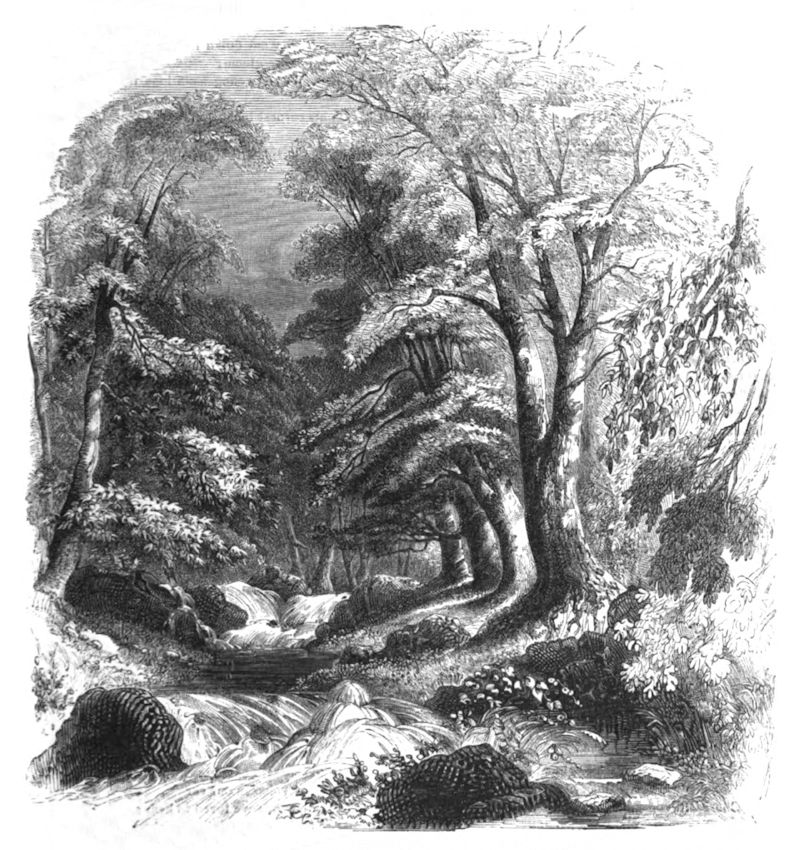
The sylva before the flood! Huge, aspiring, with
arms reaching outward many a rood, each monarch
stood; the traveler and man of science, he whose
name now fills the world, never found, in his many
rounds in search of knowledge, even in southern
climes, such offspring of earth, air, water, and the
sun; and Australia, with its wondrous herbage,
sometimes cloud-capped, stand dwarfed and small to
the life with which God, in his first joy, clothed his
work. The poet, too, and writer of the Comedies,
whose soul was bitter hell, saw not in heaven, nor
beneath, nor in the orb between, a wood so vast, so
majestic, and so beautiful. Trees, the growth of
many a revolving year, lay mouldering; not prostrated
by the tornado, nor driven from their seat by
floods of water and of rock, which leave their track
seamed, as one might plough a furrow in the field,
but fallen through age, and draped with moss of the
liveliest green, softer to the touch than a woman’s
lip. The vine crept from limb to limb, and threw
out its tendrils joyously; now hanging in mid air,
and now, a parasite, twisting about the trunk of
some gnarled oak, adding to strength its sister loveliness;
while flowers, broad and tall, with petals like
masts, and of a hue more delicate than that which
opens to the garish sun, spotted the ground as stars
spot the sky. The air pressed heavy, damp, laden
with aromatic odors, as to one standing beneath the
swelling arches of some old temple, raised in the
middle-age by hands whose labors Michelett has
transferred to historic prose, more lasting than the
stone which was to them a religion and a worship.
No voice broke the general stillness, save the sound
of distant water, floating upon the breathings of the
wood, just reaching the ear, now heard and now
lost, as a maid calling to her lover. Amid such excellence,
the excellence of a primeval age, before
man and the seasons had marred earth’s face, Erix
and Zella hunted.
The two moved on, like gods, hastening to outrun
the growing light, and to make their sport before
high noon should steal its freshness from their path.
So, long after, but less large, less strong, less fleet,
and less beautiful, did the twin creations of pure
intellect, Apollo and his mate, pursue the boar in
Tempe; while the herdsman who sat afar off, upon
some high rock, watching his wealth, veiled his face
in wonder and in fear.
Thus were three full leagues passed over, through
the windings of the wood; he, crushing the flowers
beneath his feet, she, just bending their drooping
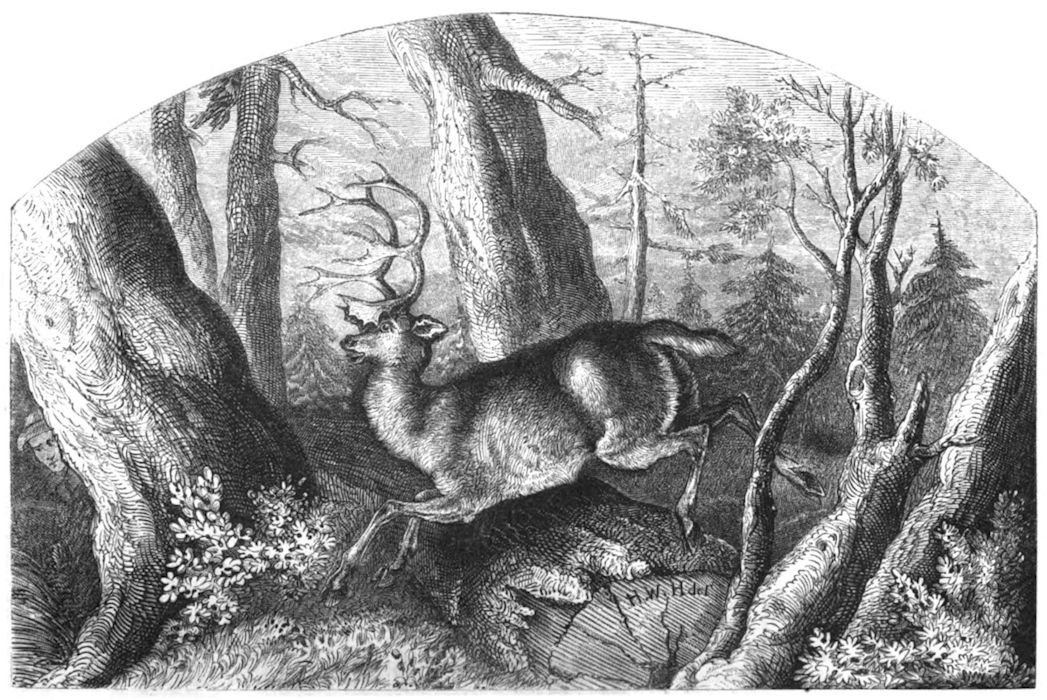
heads, when Erix descried a noble stag standing
upon the bank of a sweet pool, of narrow round,
which, embosomed in the forest, slept peaceful, and
mirrored in its face the moving foliage and the blue
sky above. With head depressed, the deer had
caught his own image in the water, and stood threatening
with mimic war his shadowy antagonist,
returning thrust for thrust. Poor beast! Now strain
the nerve and put forth thy utmost speed, for no
shadows threaten at thy back, but death, with feet
swifter than the wind. With one loud shout the
forest rang, and then, clear as the notes of bugle or
of flute, played to the listening morn, burst forth the
hunter’s song; for not yet had the gin and pit, and
stealth cowardly creeping upon its prey, debased the
chase, and dishonored with cheat and trick man’s
highest sport; but room was given and a chance for
life, to the course before the flood.
See, the east is glowing with golden-tinted light,
and the morn calls to us with the breath of youth.
See, the incense rises from every dewy leaf; and
the morn calls to us with the breath of youth.
The air floats, balmy, o’er hill, and wood, and
lake; and the morn calls to us with the breath of
youth.
The spear stands, impatient, by the wall; the bow,
unstrung, lies mourning at the door; while the morn
calls to us with the breath of youth.
Hark! The horn winds joy, and the echoes laugh,
and leap, and dance—trr, trr, trr, trr, trrwhroo,
trrwhroo—in circles of mad delight.
Awake, then, awake; for the horn winds joy, and
the echoes laugh, and leap, and dance—trr, trr, trr,
trr, trrwhroo, trrwhroo—in circles of mad delight;
and the morn calls to us with the breath of youth.
Now press the foot, and watchful be the eye, for
the spear is in the hand, and the arrow on the string,
and the horn winds joy, and the echoes laugh, and
leap, and dance—trr, trr, trr, trr, trrwhroo, trrwhroo—in
circles of mad delight.
Away, and away, in a race against the sun;
while the horn winds joy, and the echoes laugh, and
leap, and dance—trr, trr, trr, trr, trrwhroo, trrwhroo—in
circles of mad delight.
Of the strong, we are the strongest, and of the
fleet, we are the fleetest; while the horn winds joy,
and the echoes laugh, and leap, and dance—trr, trr,
trr, trr, trrwhroo, trrwhroo—in circles of mad delight.
The game flies, scudding athwart the forest path,
while the horn winds joy, and the echoes laugh, and
leap, and dance—trr, trr, trr, trr, trrwhroo, trrwhroo—in
circles of mad delight.
The wolf howls defiance, and hastens to his lair;
the deer, suspicious, scents the coming storm; the
lion’s deep growl comes rolling up the glen, while
the horn winds joy, and the echoes laugh, and leap,
and dance—trr, trr, trr, trr, trrwhroo, trrwhroo—in
circles of mad delight.
Then press the foot, and watchful be the eye; for
the spear is in the hand, and the arrow on the string;
and the horn winds joy, and the echoes laugh, and
leap, and dance—trr, trr, trr, trr, trrwhroo, trrwhroo—in
circles of mad delight; and the morn calls to us
with the breath of youth.
With one bound the stag cleared the narrow pool,
and with head erect, his branching antlers resting
upon his back, fled onward; swifter than the wind
that, in winter’s dreary reign, under the stars of cold
December, drives fierce and cutting through the
gorge which, in the farthest north, divides the granite
hills sheer to their base, while the song poured
thickening upon his rear—sounds of victory and pursuit.
Thus, with nostrils wide distended and smoking
flanks, he led his foes through many a double
and straight reach, now holding to the cover of the
wood, and with sure eye, passing beneath gnarled
oaks, and through hanging vines, and boughs interlocked
blacker than night, and now, seeking the
open plain, where the sea rolled inward to find its
limit. There the voice of his pursuers no longer
urged him on, or was lost in that greater voice to
which he had fled as to a refuge; and he rested,
trembling, upon the rim of the ocean, his fetlocks
laved by its flaky foam, and looking out upon it,
sobbing, in search of a safety which the water as
the land denied. So, in the race of life, the unfortunate,
hunted by its ills, with hope crushed out,
stand upon its utmost verge, gazing, and find no joy
beyond, till death strikes them through, to perish and
be forgotten.
Short time was given, for Erix and Zella, side by
side, keeping ever, like fate, to their fixed end, soon
issued from the wood, and with voice and gesture
urged their prey to a new flight. The game, now
driven to his last shift, stilled his coward heart,
turned and stood at bay; but Zella, unwilling thus
to close the morning’s sport, drew an arrow to its
head, and sent the weapon whirring, to glance and
fall far out at sea. Enraged with such acts, the stag
sprang forward, striking on either side; and as Erix,
yielding, strove to take him by the horns, leaped
as far as Apollo’s horses leaped, in that great story
told by the Greek whose song civilized the world.
Like a bolt, winged, he sped through the whistling
air, when Zella, quick turning, with a shaft more
fleet, smote him, mid-way, quite through his bursting
heart. Upon a scented bank, deep within the wood,
mossy, curling over the stream which there, trickling,
smooth, and quiet, hastened to kiss the sea,
the poor beast fell, and groaned his life away; and
the warm sun danced and flickered, as if in very
joy of the beauty it had made, through the tall
trees, and around the climbing vines, and across the
green leaves, and upon the silent water, mocking at
death, and laughing at the spoil which changes but
to create again.
Erix took Zella’s hand in his and drew her toward
him, nothing loth, till their lips met; then praised
her skill: then pressed again her lips—then praised—then
pressed—while Zella returned the pressure
with many a toy beside. Thus rejoicing in a mutual
love, they sought, with slow step and halting, the
mossy bank, where lay in the sunlight, as if asleep,
the game of late so fleet, and sat them down to rest,
and drink new draughts of pleasure, and count over
the endless good with which Heaven had blessed the
earth.
“List, dearest, list! how softly upon the ear, in
sweetest cadence, falls the song of the deep salt
sea!” said Erix.
“And the air which hears it, glad to be thus
freighted, floats inward, murmuring, to tell it to the
hills,” said Zella.
“And the hills repeat it, whispering.”
“And the trees catch it; and through the live-long
day, and through the night, over the whole
broad land, play with it, and toss it from bough to
bough, till it has become a language of its own,”
said Zella.
“It is the voice of this earth.”
“It is the voice of its great joy.”
“And has praised from the beginning, and will
praise unto the end, the hand which made it,” said
Erix.
“The sunlight hears it, and moves merrily to the
measure upon every quivering leaf, now leaping
upward to gild the topmost twig, and now chasing
shadows upon the ground beneath.”
“See, where it streams through the openings of the
wood, and rests upon this water, smiling! Yes, the
sunlight hears it, and grows brighter with each
draught of a music so divine.”
“The flowers open to it; and there, upon that
slope, bending gently toward our feet, proud of their
colors penciled by the light, stand thick—”
“And wonder, and drink deep of the strains which
extol their beauty and their glory, as they extol the
beauty and the glory of all else,” said Erix. “Oh the
song of the sea, of the deep, salt sea, with the air
floating inward, and the hills beyond, and the trees,
and the sunlight, and the flowers thick set upon the
slope, gently bending downward toward our feet, and
this mossy bank, and the pearly brook between—upon
such a morn as this, in such a place as this, Adam
found his Eve.”
“And upon such a morn as this, in such a place
as this, Eve gave to Adam a love new-created, unknown
to the courts trod by angels’ feet, and which
has raised her daughters above cherub and seraph, to
do and to suffer for their soul’s choice,” said Zella.
“Zella!”
“Erix!”
Now let the voice of the earth’s joy, the sun, and
herbage speaking, the mossy bank, the flowery slope,
and pearly brook between, bold revel, for a passion,
blushing like the morn, pure as the marble which
grew beneath the hands of Praxitiles, without stain
or blemish, strong as the strongest, weak as the
weakest, even love, is here present, and rules supreme.
Erix and Zella, he bearing upon his broad shoulders
a burden light—the noble game they had
hunted to its death—returned homeward along the
sounding beach, nor made deep foot-prints in the
yielding sand. Unwearied, lithe, in sheer exuberance
of life, they chased the retiring waves, then
turning, fled to be themselves pursued; till young
Ocean, pleased, shook his giant limbs, and like a
lion by a child subdued, rolled at their feet, and
roared, and beat, in his great heart, the measure to
this hymn, which they, alternating, sang.
“Almighty Lord, Maker of the Earth, in loveliness
beyond compare hast thou fashioned it.”
“Almighty Lord, the maker of our joys, in goodness
beyond compare hast thou fashioned them.”
“Thou didst build the hills, and crown them with
thy glory; and they praise forever thy holy name.”
“Thou didst fix the foundations, and form the running
streams; and they praise forever thy holy name.”
“Thou didst plant the forests, and clothe them with
thy beauty; and they praise forever thy holy name.”
“The plain is thine, with all its life, and, with voices
infinite, praises forever thy holy name.”
“The air is thine, and within its bosom bears bounties
innumerable, to praise forever thy holy name.”
“Praise in the pattering rain.”
“Praise in the gentle dew.”
“Perfume and color.”
“Form and motion.”
“All praise forever thy holy name.”
“Thine is the sea, and thou lov’st it.”
“And the sea loves thee, its Maker, in return.”
“The breezy morn.”
“The ruddy eve.”
“The strength of high noon.”
“The quietude of night.”
“All speak of thee, Almighty Lord, the furnisher of
our joys.”
“And praise forever thy holy name.”
As Erix and Zella, thus singing, drew nigh unto
the grot where first their joys commingled, to flow
on through life in no divided stream, two boys, the
offspring of their love, came forth to meet them. The
elder, from beneath whose locks, curled and dancing,
reddened with the sun, full many a wild-flower
peeped, bore grapes, ripe, fresh-plucked, and clutching,
pressed the vintage with his hands. The
younger, marching with an uncertain step, just babbling
his first words, caught the generous juice in
his tiny palms, cup-shaped, and offered to his mother,
whose lips sought his, and rested, well content to
drink only of that bliss which God has planted in a
mother’s kiss. Then Erix, casting off his load, took
the elder-born to his arms, and recounted all the
chase—the scent of the perfumed morn, the song,
the flight, the pursuit through wood and open plain,
the halt by the sounding sea, the leap, the fatal shaft,
the crowning death, till the boy shouted, and every
muscle worked in mimic struggle with the mimic
game a-foot; and the white pigeon descended, hovering
o’er the group, and lighted at Zella’s feet, and
arched its neck, and drooped its wings, and turned
round and round; chrr-oo-uh; chrr-oo-uh; chrr-oo-eh-uh;
oo-ugh; oo-ugh; chrr-oo-uh; calling to
its mate.
And now, sweet friend, who put me to this task,
who won my love, not knowing how or why, come
tread with me the inner-chambers of my house.
This, the portal, is well passed, and other scenes,
and other pictures far, wait eyes which kindle,
though the fire be false, eyes which flow even with
the current of a fictitious wo.
[To be continued.
———
BY WILLIAM H. C. HOSMER.
———
(Air—“Homes of England.”)
The hallowed wells of Learning,
No wasting may they know,
But sparkle, fed by lucid streams,
Unceasing in their flow;
And may their waters catch no stain
Of deep and Stygian dye,
Though Error for an hour hold reign
Beneath a darkened sky.
The Sacred Bowers of Learning,
Be blight afar from them;
No tree grow up with serpent folds
Entwining round the stem;
No bud of precious promise feel
The frost of cold neglect,
And heard no solemn funeral peal
For Genius early wrecked.
The Stately Halls of Learning,
Forever may they stand,
And Truth walk down the sounding aisles
With Honor, hand in hand;
The columns that uphold the roof
Be men of noble mould,
And beauteous daughters, armed in proof,
Stern war with wrong to hold.
The Holy Shrines of Learning,
May no polluting flame
Be lighted on one altar-stone
By fiends who mock at shame,
But cloudless light be shed abroad
A guilty world to cheer,
And men forget to worship God
In superstitious fear.
———
BY FREDERIKA BREMER.
———
It is two years since I first found myself in
England. When I was in England in the autumn
of 1849, the cholera was there. A dense, oppressive
atmosphere rested over its cities, as of a cloud pregnant
with lightning. Hearses rolled through the
streets. The towns were empty of people; for all
who had the means of going had fled into the
country; they who had not were compelled to remain.
I saw shadowy figures, clad in black, stealing
along the streets, more like ghosts than creatures of
flesh and blood. Never before had I seen human
wretchedness in such a form as I beheld it in Hull
and in London. Wretchedness enough may be
found, God knows, even in Stockholm, and it shows
itself openly enough there in street and market. But
it is there most frequently an undisguised, an unabashed
wretchedness. It is not ashamed to beg, to
show its rags, or its drunken countenance. It is a
child of crime; and that is perhaps the most extreme
wretchedness. But it is less painful to behold, because
it seems to be suffering only its own deserts.
One is more easily satisfied to turn one’s head aside
and pass on. One thinks, “I cannot help that!”
In England, however, misery had another appearance;
it was not so much that of degradation as of
want, pallid want. It was meagre and retiring; it
ventured not to look up, or it looked up with a glance
of hopeless beseeching—so spirit-broken! It tried to
look respectable. Those men with coats and hats
brushed till the nap was gone; those pale women in
scanty, washed-out, but yet decent clothes—it was a
sight which one could hardly bear. In a solitary
walk of ten minutes in the streets of Hull, I saw ten
times more want than I had seen in a ten months’
residence in Denmark.
The sun shone joyously as I traveled through the
manufacturing districts; saw their groups of towns
and suburbs; saw their smoking pillars and pyramids
towering up everywhere in the wide landscape—saw
glowing gorges of fire open themselves in the earth,
as if it were burning—a splendid and wonderfully picturesque
spectacle, reminding one of fire-worshipers
of ancient and modern time, and of their altars. But
I heard the mournful cry of the children from the
factories; the cry which the public voice has made
audible to the world; the cry of the children, of the
little ones who had been compelled by the lust of gain
of their parents and the manufacturers, to sacrifice
life, and joy, and health, in the workshops of machinery;
the children who lie down in those beds which
never are cold, the children who are driven and
beaten till they sink insensibly into death or fatuity—that
living death; I heard the wailing cry of the
children, which Elizabeth Barrett interpreted in her
affecting poem; and the wealthy manufacturing districts,
with their towns, their fire-columns, their
pyramids, seemed to me like an enormous temple
of Moloch, in which the mammon-worshipers of
England offered up even children to the burning
arms of their god—children, the hope of the earth,
and its most delicious and most beautiful joy!
I arrived in London. They told me there was nobody
in London. It was not the season in which
the higher classes were in London. Besides which,
the cholera was there; and all well-to-do people,
who were able, had fled from the infected city. And
that indeed might be the reason why there seemed
to me to be so many out of health—why that pale
countenance of want was so visible. Certain it is,
that it became to me as a Medusa’s head, which
stood between me and every thing beautiful and
great in that great capital, the rich life and physiognomy
of which would otherwise have enchanted
me. But as it was, the palaces, and the statues, and
the noble parks, Hampstead and Piccadilly, and Belgravia
and Westminster, and the Tower, and even
the Thames itself, with all its ever-changing life,
were no more than the decorations of a great tragedy.
And when in St. Paul’s, I heard the great
roar of the voice of London—that roar, which, as it
is said, never is silent, but merely slumbers for an
hour between three and four o’clock in the morning—when
I heard that voice in that empty church, where
there was no divine worship, and looked up into its
beautiful cupola, which was filled by no song of
praise, but only by that resounding, roaring voice, a
dark chaotic roar, then seemed I to perceive the
sound of the rivers of fate rolling onward through
time over falling kingdoms and people, and bearing
them onward down into an immeasurable grave!
It was but for a moment, but it was a horrible
dream!
One sight I beheld in London which made me look
up with rejoicing, which made me think “that old
Yggdrasil is still budding.” This was the so-called
metropolitan buildings; a structure of many homes
in one great mass of building, erected by a society
of enlightened men for the use of the poorer working
class, to provide respectable families of that class
with excellent dwellings at a reasonable rate, where
they might possess that which is of the most indispensable
importance to the rich, as well as to the
poor, if they are to enjoy health both of body and
soul—light, air, and water, pure as God created them
for the use of mankind. The sight of these homes,
and of the families that inhabited them, as well as of
the newly-erected extensive public baths and wash-houses
for the same class, together with the assurance
that these institutions already, in the second
year of their establishment, returned more than full
interest to their projectors, produced the happiest
impression which I at this time received of England.
These were to me as seed of the future, which gave
the promise of verdant shoots in the old tree.—
Nevertheless, when I left the shores of England,
and saw thick autumnal fog enveloping them, it was
with a sorrowful feeling for the Old world; and
with an inquiring glance of longing and hope, I turned
myself to the New.
Two years passed on—a sun-bright, glowing
dream, full of the vigor of life—it was again autumn,
and I was again in England. Autumn met me there
with cold, and rain, and tempest, with the most horrible
weather that can be imagined, and such as I
had never seen on the other side of the globe. But
in social life, everywhere throughout the mental atmosphere,
a different spirit prevailed. There I perceived
with astonishment and joy, there it was that
of spring.
The Crystal Palace was its full-blown, magnificent
blossom—and like swarms of rejoicing bees flew
the human throng upon the wings of steam, backward
and forward, to the great world’s blossom;
there all the nations met together, there all manufactures,
there all industry, and every kind of product,
unfolded their flowers for the observation and the joy
of all; a Cactus grandiflora, such as the world had
never till then seen.
I perceived more clearly every day of my stay in
England, that this period is one of a general awakening
to a new, fresh life. In the manufacturing districts,
in Liverpool, Manchester, Birmingham, every
where, I heard the same conversation among all
classes; prosperity was universal and still advancing.
That pale countenance of want, which had on
my first visit appeared to me so appalling, I now no
longer saw as formerly; and even where it was seen
stealing along, like a gloomy shadow near to the tables
of abundance, it appeared to me no longer as a
cloud filled with the breath of cholera, darkening the
face of heaven, but rather as one of those clouds over
which the wind and sun have power, and which are
swallowed up, which vanish in space, in the bright
ether. . . .
The low price of grain, the consequence of free-trade,
has produced this change: and it was universally
acknowledged. The only objection I heard
brought against the low price of corn was this,
“The people are become proud and careless; I
have seen great pieces of bread thrown out into the
streets!”
Yet bread alone had not really done all this; a
nobler bread is required for man in order that he may
fully derive the benefit even of the outward material
bread. Nor had free-trade alone done all this
either; there is also another power besides this
which has been operative in that general awakening,
in that wholesome spirit which I perceived in
England.
If this power were to be symbolized by art, it
would present us with a female figure—a beautiful
woman with the child at her breast, is the symbol
which art makes use of, to express human love.
And, perhaps, art is right in so doing. And perhaps
it is the female principle in human nature, which, in
the present new life in England, enables the man’s
hand to accomplish the work; because from the
most remote antiquity, has a male deity been chosen
to represent trade, and navigation and mining, and
all occupation of the earth. But, so says one of the
oldest sagas of the world—when the divine life revealed
itself on the earth, a divine pair came forth.
In a lotus-flower which ascended from the waters
of the Nile, were born at the same time Osiris and
Isis, and together they went forth to bless the
earth.
I saw the truth of this saga confirmed by what I
beheld in England. But in speaking of this, I shall
especially linger on the new proofs thereof, in the new
Institutions which promise a more beautiful future
to the human race; not upon the old and insufficient,
however good they may be, but upon the new, because
it is upon the new that my eye has been especially
directed.
Let me linger, in the first place, on works of human
love—the female figure with the child at her
breast; because these are they which lay the foundation
of all others.
In Liverpool, I visited the so-called Ragged-Schools—the
schools where are collected from the
streets, vagabond, neglected and begging children,
who are here taught to read and so on—who here
receive the first rudiments of instruction, even in
singing. These schools are, some of them evening,
others day schools, and in some of them, “the
Industrial Ragged-Schools,” children are kept there
altogether; receive food and clothing, and are taught
trades. When the schools of this class were first
established in Liverpool, the number of children who
otherwise had no chance of receiving instruction,
amounted to about twenty thousand. Right-minded,
thinking men, saw that in these children were
growing up in the streets, those “dangerous classes”
of which so much has been said of late times; these
men met together, obtained means to cover the most
necessary outlay of expense, and then, according to
the eloquent words of Lord Ashley, that “it is in
childhood that evil habits are formed and take root;
it is childhood which must be guarded from temptation
to crime;” they opened these ragged-schools
with the design of receiving the most friendless, the
most wretched of society’s young generation—properly,
“the children of rags, born in beggary, and for
beggary.”
I visited the Industrial Ragged School for boys,
intended for the lowest grade of these little children,
without parents, or abandoned by them to the influences
of crime. There, I saw the first class sitting
in their rags, upon benches in a cold room, arranging
with their little frost-bitten fingers bristles for the
brush-maker. The faces of the boys were clean:
many of them I remarked were handsome, and almost
universally they had beautiful and bright eyes. Those
little fingers moved with extraordinary rapidity, the
boys were evidently wishful to do their best; they
knew that they by that means should obtain better
clothing, and would be removed to the upper room,
and more amusing employment. I observed these
“dangerous classes”—just gathered up from the
lanes and the kennels, on their way to destruction;
and was astonished when I thought that their countenances
might have borne the stamp of crime.
Bright glances of childhood, for that were you never
designed by the Creator! “Suffer little children to
come unto me.” These words, from the lips of
heaven, are forever sounding on earth.
In the upper room a great number of boys were
busy pasting paper-bags for various trades, confectioners,
etc. who make use of such in the rapid sale
of their wares; here, also, other boys were employed
in printing upon the bags the names and residences
of the various tradesmen who had ordered them.
The work progressed rapidly, and seemed very
amusing to the children. The establishment, for their
residence and their beds, were poor; but all was
neat and clean, the air was fresh, and the children
were cheerful. The institution was, however, but
yet in its infancy, and its means were small.
Half-a-dozen women in wretched clothes sat in the
entrance-room with their boys, for whom they hoped
to gain admittance into the school, and were now,
therefore, waiting till the directors of the establishment
made their appearance.
These gentlemen kindly invited me to be present
at the examination of these mothers. The women
were brought in one at a time, and one and all were
made to tell her history and explain her circumstances.
The examination was carried on with
earnestness and precision. The result of all, however,
was, that there was not one of the women now
present who had a right to the assistance which they
desired. On one or two occasions I could not help
admiring the patience of the directors. Above all,
it seemed to me, that these mothers needed to go to
school even more than their children. When will
people come to regard in all its full extent the influence
of the mother upon the child? When will
people come to reflect on the education of mothers
in its higher sense? My conductor in Liverpool,
Mr. B——, the noble and kind Home Missionary,[1]
recognized one of these women, and related to me the
history of herself and her husband—a horrible history
of drunkenness, which had almost ended in suicide.
Later in the day I visited the evening school for
girls, also of the ragged class, and heard there a remarkably
sweet and beautiful song. Later still I
accompanied my friendly conductor to a temperance
meeting, held in the same building, and which meets
every Thursday, and where the Missionary was accustomed
to meet and converse with the poorest
brethren of his congregation. The wind blew and
the rain poured down. I was astonished, however,
to see when we entered, that the room was filled
with people who evidently had not much to defend
themselves with from the wind and rain. The
benches were filled both with men and women. It
became crowded and very hot. Mr. B—— opened
the meeting with a speech about the dangers and
consequences of drunkenness, and as he warmed in
his subject he related, yet without mentioning any
name, the history of the mother whom he had this
day seen, beseeching that public charity would take
charge of her son. The assembly, which during the
moral treatise they had just heard had evidently become
somewhat drowsy, woke up at once during
the relation of that story, and when the narrator
arrived at the catastrophe, in which the intoxicated
woman, urged on by the madness of thirst, drank up
half a bottle of oil of vitriol, a general expression of
horror might have been heard, especially from the
lips of the women.
When this relation, which was full of strong vitality,
was ended, Mr. B—— read a poem written by
a working man in praise of temperance, which had
the effect of again lulling the auditors—and myself
even—into an agreeable doze. We all woke up
again, however, when Mr. B——, in a jocular manner,
begged of Mr. J—— to stand up and tell us
something about “that Great Exhibition in London,”
which he had lately been to see. Mr. J—— did not
however, stand up, because Mr. K—— wished to
speak first. Accordingly, being encouraged to do so
by Mr. B——, a stout-built man of about sixty came
forward; he was dressed in coarse, but good clothes,
and had an open countenance, over which played a
smile of humor. He mounted the platform, and was
greeted by the assembly with evident delight. He
related his own history, simple, but full of the warmth
of life, in that strong-grained, wit-interspersed style
of popular eloquence, full of heart and humor at the
same time, which our cultivated orators would do
well to study, if they wish to make a living impression
on the people. He related how he, in his
younger years, never tasted brandy, but he became
a seaman, and began to drink, that he might look
manly among his fellows; how, by degrees, he acquired
the power of swallowing more strong liquor
than any of them all, fell into crime, misery and shame;
how he became converted and again temperate, and
how he had not now for fifteen years tasted spirits,
and had ever since remained in good health and
good circumstances.
This was the substance of his story; but how the
narrative was interspersed with merry conceits,
which excited universal amusement, and with energetic
proverbs—to which Mr. B——, beyond any one
else, gave the highest applause—how cleverly “Mr.
Halcohol” was brought in, and how contemptuously
“the long-necked gentleman, Mr. Halcohol in the
bottle,” was treated, and with how much animation
all this was done and received—must have been
heard to have been fully imagined. The speech
was concluded by recommending “total abstinence”
as the only means for insuring a perfect change of
life.
After this there entered a little throng of children
with joyful faces, the same whom I had already
heard sing in the upper room of the house; these
children were the so-called “Band of Hope”—children
who had taken the pledge to abstain from
all strong drinks themselves, and to promote the advancement
of temperance by all the means in their
power, for which they received printed cards containing
their pledge, together with symbolical devices,
proverbs, etc. That little “Band of Hope”
struck up with their clear voices, fresh as the morning,
various songs, among which one in particular,
“The Spindle and Shuttle,” was received with great
delight, all present joining in the chorus. Hymns
and patriotic songs were also sung by “The Band
of Hope,” and now and then the company joined in
with the children. Before the assembly separated
this evening, several went forward and took the
pledge. Among these was a man and his wife.
They took each other by the hand. The woman
with her other hand held her handkerchief over her
left eye; it might be seen, nevertheless, that this eye
was black, probably from the husband’s fist.
What had influenced them to this? What had
operated upon these rude natures?—induced them
to break loose from habits of drunkenness—to turn
from the pleasures of hell to those of heaven? What
was it that had operated on all here so awakeningly,
so livingly? Could it be the discourse they had
heard? could it be the poem in praise of temperance?
Nothing of the kind. I saw them go to
sleep during these. I became sleepy myself. No,
that which operated here so livingly—was the life
itself. It was that living narrative of the unhappy
woman; it was the sailor’s history of his own life,
his battles with “Mr. Halcohol;” it was the songs
of the children, the pure, dewy-fresh voices of the
little “Band of Hope.” All these it was which had
operated upon, which had awakened their minds,
had animated their brains, warmed their hearts; this
it was which had impelled the husband and wife,
hand in hand, to come forward and consecrate themselves
to a new marriage, to a better life. Individual
experience of suffering, of joy, of sin, of conversion,
of love and happiness, must be told, if the
relation is to have any power over the human heart;
life itself must be called into action if we would
awake the dead.
I could not but remark at this meeting, how cordial
and familiar an understanding seemed to exist
between the leader, Mr. B——, and the assembly,
and which arose in part from his own peculiar character,
and in part from his intimate acquaintance
with his hearers. In the same way, his continual
intercourse with those people, and his knowledge of
their every-day life, is an excellent help to him in
giving force to the sermons which he preaches
among them. I shall not forget the effect produced
by his story of the woman and the bottle of
vitriol.
A few days later I visited, with the same friendly
man, some different classes of poor people—namely,
the wicked and the idle; they who had fallen into
want through their own improvidence, but who had
now raised themselves again; and the estimable,
who had honorably combated with unavoidable poverty.
In one certain quarter of Liverpool, it is
that the first class is especially met with. Of this
class of poor in their wretched rooms, with their
low, brutalized expression, I will not speak; companion-pieces
to this misery may be met with every
where. Most of those whom I saw were Irish. It
was a Sunday noon, after divine service. The ale-houses
were already open in this part of the town,
and young girls and men might be seen talking together
before them, or sitting upon the steps.
Of the second class I call to mind, with especial
pleasure, one little household. It was a mother and
her son. Her means of support, a mangle, stood in
the little room in which she had lived since she had
raised herself up again. It was dinner-time. A
table, neatly covered for two persons, stood in the
room, and upon the iron stand before the fire was
placed a dish of mashed potatoes, nicely browned,
ready to be set on the table. The mother was waiting
for her son, and the dinner was waiting for him.
He was the organ-blower in a church during divine
service, and he returned whilst I was still there.
He was well dressed, but was a little, weakly man,
and squinted; the mother’s eyes, however, regarded
him with love. This son was her only one, and
her all. And he, to whom mother Nature had
acted as a stepmother, had a noble mother’s heart to
warm himself with, which prepared for him an excellent
home, a well-covered table, and a comfortable
bed. That poor little home was not without its
wealth.
As belonging to the third and highest class, I must
mention two families, both of them shoemakers, and
both of them inhabiting cellars. The one family
consisted of old, the other of young people. The old
shoemaker had to maintain his wife, who was lame
and sick, from a fall in the street, and a daughter.
The young one had a young wife, and five little
children to provide for; but work was scanty and
the mouths many. At this house, also, it was dinner-time,
and I saw upon the table nothing but potatoes.
The children were clean, and had remarkably
agreeable faces; but—they were pale; so was also
the father of the family. The young and pretty, but
very pale mother, said, “Since I have come into
this room I have never been well, and this I know—I
shall not live long!” Her eyes filled with tears;
and it was plain enough to see that this really delicate
constitution could not long sustain the effects of
the cold, damp room, into which no sunbeam entered.
These two families, of the same trade, and
alike poor, had become friends in need. When one
of the fathers of the family wanted work, and was
informed by the Home-Missionary who visited them
that the other had it, the intelligence seemed a consolation
to him. Gladdening sight of human sympathy,
which keeps the head erect and the heart
sound under the depressing struggle against competition!
But little gladdening to me would have been
the sight of these families in their cellar-homes, had
I not at the same time been aware of the increase of
those “Model Lodging-Houses,” which may be met
with in many parts of England, and which will
remove these inhabitants of cellars, they who sit in
darkness, into the blessing of the light of life—which
will provide worthy dwellings for worthy
people. But of this I shall speak somewhat later,
in connection with other new institutions for the advancement
of the health, both of body and soul, of—all
classes.
“For no one for himself doth live or suffer.”
For myself, I was well provided for by English
hospitality, and enjoyed an excellent home in the
house of the noble and popular preacher, J. M——.
With him, and his wife (one of these beautiful, motherly
natures, who through a peculiar geniality of
heart is able to accomplish so much, and to render
herself and every thing that is good twofold, in quite
another manner to that of the multiplication-table,
which merely makes two and two into four)—with
them and their family I spent some beautiful days
amid conversation and music. There, in the neighborhood
of their house, I saw also one of those
English parks, whose verdant, carefully-kept sward,
and groups of shrubs and flowers, give so peculiar
and so attractive a charm to the English landscape.
Add to this a river-like sheet of water; swans,
groups of beautiful children and ladies feeding them
on the banks, the song of birds every where amongst
the shrubs; scattered palaces, and handsome country-houses—and
every thing looking so finished, so
splendid, so beautiful and perfect, as if nothing out
of condition, nothing in tatters or shabby was to be
found in the world. Such was the impression produced
by the Prince’s Park, which was laid out by
a wealthy private gentleman, Mr. J——, on the birth
of the Prince of Wales, the eldest son of Queen
Victoria, and thrown open to the public with only
this single admonition exhibited, in large letters, in
various parts of the park, “it is hoped the public
will protect that which is intended for the public
enjoyment.”
But I must leave this enchanting Idyll, and hasten
into the manufacturing districts; and, first of all,
to Manchester:
In my imagination Manchester was like a colossal
woman sitting at her spinning-wheel, with her enormous
manufactories; her subject towns, suburbs,
villages, factories, lying for many miles round, spinning,
spinning, spinning clothes for all the people on
the face of the earth. And there, as she sat, the
queen of the spindle, with her masses of ugly houses
and factories, enveloped in dense rain-clouds, as if
in cobwebs, the effect she made upon me was gloomy
and depressing. Yet even here, also, I was to breathe
a more refreshing atmosphere of life; even here was
I also to see light. Free-trade had brought hither
her emancipating spirit. It was a time of remarkable
activity and prosperity. The work-people were
fully employed; wages were good, and food was
cheap. Even here also had ragged-schools been
established, together with many institutions for improving
the condition of the poor working-classes.
In one of these ragged-schools the boys had a perfectly
organized band of music, in which they played
and blew so that it was a pleasure—and sometimes
a disadvantage, to hear them. The lamenting “cry
of the children” was no longer heard from the factories.
Government had put an end to the cruelties
and oppressions formerly practiced on these little
ones by the unscrupulous lust of gain. No child
under ten years old can now be employed in the
factories, and even such, when employed, must of
necessity be allowed part of the day for school.
Every large factory has now generally its own
school, with a paid master for the children. The
boys whom I saw in the great rooms of the factories
and with whom I conversed, looked both healthy
and cheerful.
Two ideas were impressed upon my mind at this
place: how dangerous it is, even amid a high degree
of social culture, to give one class of men unrestrained
power over another; and how easily a free
people, with a powerful public spirit, and accustomed
to self-government, can raise themselves out
of humiliating circumstances. This spirit has done
much already in England, but it has yet more to do.
Upon one of those large, gloomy factories in Manchester,
I read, inscribed in iron letters, “The
Great Beehive;” and in truth, a good name for
these enormous hives of human industrial toil, in
which people have sometimes forgotten, and still
forget, that man is any thing more than a working-bee,
which lives to fill its cell in the hive, and die.
I visited several of these huge beehives. In one of
them, which employed twelve hundred work-people,
I saw, in a large room, above three hundred
women sitting in rows winding cotton on reels.
The room was clean, and so also were all the women.
It did not appear to be hard work; but the
steadfastly-fixed attention with which these women
pursued their labor seemed to me distressingly wearisome.
They did not allow themselves to look up,
still less to turn their heads or to talk. Their life
seemed to depend upon the cotton thread.
In another of these great beehives, a long, low
room, in which were six hundred power-looms, represented
an extraordinary appearance. What a
snatching to and fro, what a jingling, what an incessant
stir, and what a moist atmosphere there was
between floor and ceiling, as if the limbs of some
absurd, unheard-of beast, with a thousand arms, had
been galvanized! Around us, from three to four
hundred operatives, women and men, stood among
the rapid machinery watching and tending. The
twelve o’clock bell rung, and now the whole throng
of work-people would go forth to their various mid-day
quarters; the greatest number to their respective
dwellings in the neighborhood of the factory. I
placed myself, together with my conductor, in the
court outside the door of the room, which was on
lower ground, in order that I might have a better
view of the work-people as they came out.
Just as one sees bees coming out of a hive into
the air, two, three, or four at a time—pause, as it
were, a moment from the effects of open air and
light, and then with a low hum, dart forth into space,
each one his own way, so was it in this case. Thus
came they forth, men and women, youths and girls.
The greater number were well dressed, looked
healthy, and full of spirit. In many, however, might
be seen the expression of a rude life; they bore the
traces of depravity about them.
As labor is now organized in the factories at Manchester,
it cannot easily be otherwise. The master-manufacturer
is not acquainted with his work-people.
He hires spinners; and every spinner is master of a
room, and he it is who hires the hands. He is the
autocrat of the room, and not unfrequently is a severe
and immoral one. The operatives live in their
own houses, apart from every thing belonging to the
master-manufacturer, with the exception of the raw
material.
In the country it is otherwise; there the master-manufacturer
may be, and often is, a fatherly friend
and guardian of his people. And where he is so, it
is in general fully acknowledged. The character
which each manufacturer bears as an employer, even
in Manchester, is perfectly well known. People
mention with precision the good, the worthless, or
the wicked master. I visited factories belonging to
some of these various characters, but perceived a
more marked difference in the manners and appearance
of the masters themselves, than in the appearance
and condition of the work-people. At the
present moment the difference could not be very
perceptible, because the general demand for hands
causes the circumstances of the lower classes to be
generally good. But, as before remarked, the patriarchal
connection between master and servant, with
its good, as well as its evil consequences, no longer
exists in the manufacturing towns of England. Employer
and employed stand beside each other, or
rather opposed to each other, excepting through the
requirements of labor. The whole end and aim of
the Manchester manufacturer—when he is not subjected
to machinery, and lives merely as a screw, or
portion of it—is, to get out of Manchester. He spins
and makes use of all means, good or bad, to lay by
sufficient money to live independently, or to build
himself a house at a distance from the smoky, restless
town, away from the bustle—away from the
throng of restless, striving work-people. His object
is to arrive at quiet in the country, in a comfortable
home; and having attained this object, he looks upon
the noisy, laboring hive, out of which he has lately
come, as a something with which he has no concern,
and out of which he is glad to have escaped
with a whole skin. Such is the case with many—God
forbid that we should say, with all!
Two subjects of conversation occupied the people
of Manchester very much at this time. The one
was the question—a vital question for the whole of
England—of popular education. The people of
Manchester had begun to take the subject into serious
consideration, and had come to the conclusion
that there might at once be adopted a simple system
of education by which, as in the United States, every
one should receive in the people’s school practical
and moral instruction, and that religious instruction
should be left for the home or for the Sunday teaching.
The willingness to thus act in concert which
has been shown by the clergy of the Established
Church in Manchester, is a good omen to the various
religious sects united in this work. All things
considered, it seems to me that there is at this moment
in England the most decided movement toward
a new development, a new life as well in theoretic
as in practically popular respects; and it is more apparent
in the Established Church than in any other
religious body.
The second great subject of conversation, as well
in Manchester as in Liverpool, was Queen Victoria’s
expected visit. The Queen had announced
her intention of visiting the great towns of the manufacturing
districts, in company with Prince Albert,
in the middle of the month, and they were accordingly
expected in a few days. Several of these
towns had never before seen a crowned head within
their walls, and this, in connection with the great
popularity of the Queen, and the liking and the love
which the people have for her, had perfectly enchanted
the inhabitants of Manchester. They were
preparing to give a royal reception to their lofty
guests. Nothing could be too magnificent or too
costly in the eyes of the Manchester people which
could testify their homage. The whole of the district,
now that the Queen was expected, was said to
be “brimful of loyalty,” and the whole of England
was at this time, both in heart and soul, monarchical.
Opposition against the royal family exists no
longer in England; the former members of this opposition
had become converted. On all hands there
was but one voice of devotion and praise. Wonderful!
yes, incomprehensible, thought I, when I was
informed that the Queen had requested not long since
to have a grant from Parliament of 72,000l. for the
erection of new stables at her palace of Windsor,
and the same year 30,000l., for Prince Albert to repair
his dog-kennels, and now, again, just lately,
17,000l. for the erection of stables at a palace which
the Queen has obtained for her eldest son, and of
which he will take possession on attaining his
majority. Thus 119,000l. for stables and dog-kennels.
What? 119,000l. for stables and dog-kennels; for
the maintenance of fine horses and dogs, and that at
a time when Ireland is perishing of hunger or emigrating
in the deepest distress; when even in England
so infinitely much remains to be done for humanity,
so much untold good might be effected for
the public with this sum. Queen Elizabeth was
accustomed to say, that she considered her money
best put out when it was in the pockets of her subjects,
and she scorned to desire any great project for
her own pleasure. Queen Victoria desires, year
after year, immense grants for her stables and kennels;
desires this of her people, and yet, for all this,
is homage paid to her—is she loved and supported by
the people in this extraordinary manner! Parliament
grumbles, but consents to all that the Queen
desires, fully consents without a murmur, because it
loves her. Such projects would otherwise be dangerous
to the power of the monarch. Such projects
overturned the throne of Louis Philippe—have undermined
many thrones. But the light foot of this
Queen—a well-beloved little foot it ought to be—dances
again and again on the brink of the dangerous
abyss, and it gives not way. But how is this possible?
What is it that makes this Queen so popular,
so universally beloved by the people, spite of the desire
for stables and dog-kennels, unnecessary articles
of luxury, when hundred thousands of her subjects
are in want even of the necessaries of life; want
even the means to secure a home and daily bread?
Thus I asked, and thus they replied to me:
The English people wish that their royal family
should live with a certain degree of state. They are
fond of beautiful horses and dogs themselves, and it
flatters the national pride that the royal personages
should have such, and should have magnificent dwellings
for them. The character of the Queen, her domestic
and public virtues, and the influence of her
example, which is of such high value to the nation,
causes it to regard no sacrifice of money as too great
for the possession of such a Queen. England is
aware that under the protection of the throne, under
the shadow of the sceptre of this Queen, and the
stability which it gives to the affairs of the kingdom,
she can in freedom and peace manage her own internal
concerns, and advance forward on the path of
democratic development and self-government, with
a security which other nations do not possess.
Hence it is that the reigning family now upon the
English throne presents a spectacle extraordinary
upon this throne, or upon any throne in the world.
The Queen and her husband stand before the people
as the personation of every domestic and public virtue!
The Queen is an excellent wife and mother;
she attends to the education of her children, and
fulfills her duties as sovereign, alike conscientiously.
She is an early riser; is punctual and regular in great
as well as in small things. She pays ready money
for all that she purchases, and never is in debt to any
one. Her court is remarkable for its good and beautiful
morals. On their estates, she and Prince
Albert carry every thing out in the best manner, establish
schools and institutions for the good of the
poor; these institutions and arrangements of theirs,
serve as examples to every one. Their uprightness,
kindness, generosity, and the tact which they under
all circumstances display, win the heart of the nation.
They show a warm sympathy for the great interests
of the people, and by this very sympathy are they
promoted. Of this, the successful carrying out of
free-trade, and the Exhibition in the Crystal Palace,
projected in the first instance by Prince Albert, and
powerfully seconded by the Queen, furnish brilliant
examples. The sympathies of the Queen are those
of the heart as well as of the head. When that noble
statesman, the great promoter of free-trade, Sir
Robert Peel, died, the Queen shut herself in for
several days, and wept for him as if she had lost a
father. And whenever a warm sympathy is called
forth, either in public or in private affairs, it is
warmly and fully participated by Queen Victoria and
Prince Albert.
In confirmation of this opinion regarding Queen
Victoria and Prince Albert, which I heard every
where, and from all parties in England, a number of
anecdotes of their life and actions were related to me,
which fully bore it out.
This universal impression, universally produced
by the sovereign, who, properly speaking, can govern
nothing—because it is well known that the monarch
of England is merely a nominal executor of the
wishes of the people, a hand which subscribes that
which the minister lays before it in the name of the
people; this great power, in a Queen, is without
any political power.
Monarchs and their people no longer bear the same
relation to each other as in the time when, for example,
Charles the Ninth put forth his demands, with
the addition,—
“Do it, and be off with you!”
This injunction to do a thing, and then take themselves
off, can no longer be given to the people by
the King, but by reason. The people have arrived
at years of discretion, and the monarch is the executor
of their laws and their wishes. He is so in
England, it is said.
From Manchester I traveled to Birmingham. I
saw again the land of the fire-worshipers, their
smoking altars, in tall columns and pyramids, towering
above the green fields; saw again the burning
gulfs yawning in the earth, and, saw them now with
unmixed pleasure. I heard no longer, amid their
boiling roar, the lamenting cry of the children; I
heard and saw them now only as the organs of the
public prosperity, and rejoiced over them as proofs
of man’s power over fire and water, over all the
powers of nature; the victory of the gods over the
giants!
In Birmingham I visited a steel-pen manufactory,
and followed from room to room the whole process
of those small metal tongues which go abroad over
all the world, and do so much—evil, and so much
good; so much that is great, so much that is small;
so much that is important, so much that is trivial. I
saw four hundred young girls, sitting in large, light
rooms, each with her little pen-stamp, employed in
a dexterous and easy work, especially fitted for women.
All were well dressed, seemed healthy and
cheerful, many were pretty: upon the whole, it was
a spectacle of prosperity which surpassed even that
of the mill-girls in the celebrated factories of Lowell,
in America.
Birmingham was at this time in a most flourishing
condition, and had more orders for goods than it
could supply, nor were there any male paupers to
be found in the town; there was full employment
for all.
In Birmingham I saw a large school of design.
Not less than two hundred young female artists studied
here in a magnificent hall or rotunda, abundantly
supplied with models of all kinds, and during certain
hours in the week, exclusively opened to these female
votaries of art. A clever, respectable, old woman,
the porter of the school-house, spoke of many
of these with especial pleasure, as if she prided herself
on them in some degree.
I saw in Birmingham a beautiful park, with hot-houses,
in which were tropical plants, open to the
public; saw also a large concert-room, where twice
in the week “glees” were sung, and to which the
public were admitted at a low price: all republican
institutions, and which seem to prosper more in a
monarchical realm than in republics themselves.
I met with a surprise in Birmingham; that is to
say, I was all at once carried back fifteen centuries
into the Syrian desert of Chalsis, and there lived a
life so unlike Birmingham and Birmingham-life, that
just for the sake of contrast, it was very refreshing.
The thing was quite simple in itself, inasmuch as
one evening I accompanied an amiable family, who
resided in Birmingham, to a lecture, which was
given by a young, gifted preacher, on the old Church-father,
Saint Jerome (Hieronymus.)
The subject of the lecture, which was extempore,
and delivered with much ease and perspicuity, was
evidently not intended to recommend to his auditors,
but rather to repel them from an ascetic and contemplative
life. Saint Jerome was delineated as a
noble fool, a curiosity in human nature, and was to
be deplored as a sacrifice to perverted reason, by no
means to be imitated. The true end of humanity
was not to be attained by flying from city life, and
burying one’s self in a desert for study and self-mortification;
that end was rather to be attained in the busy
city, than in the isolated existence of the wilderness;
and so on. Such was the lecturer’s moral. But upon
me his arguments made an impression considerably
antithetical to that which he intended. I saw this
warrior of the third century devoured by a burning
thirst of light and knowledge, of purity for his whole
being; saw him wander out, seeking the wells of
life; saw him, separating from the agreeable circles
of city existence, roam on amid catacombs and the
tombs of martyrs; saw him seeing in Gaul, and on
the Rhine, and there finding—Christianity. Saw
him there, after being baptized, with his Bible under
his arm, retire into the deserts of Syria, and there,
in the burning sands of Chalsis, bury himself for a
number of years, amid exegetic studies and severe
deeds of penance. I heard him, even at the time that
he, according to his own words, “watered his couch
with his tears,” and while he was given over, and
regarded as a fool by his friends, still reproach those
friends for having chosen the worse part, that of the
life of enjoyment in the city, and break forth in transport,
“O! silent wildernesses, flower-strewn by Jesus
Christ! O! wild solitudes, full of his spirit!”
I saw him, after his conflict was accomplished, go
forth out of the desert with his Bible, enter Rome
publicly, and unsparingly chastise the crimes of the
proud city. I saw the haughty ladies of Rome first
start, then bow themselves to the severe judgment
of the teacher; saw Marulla and Paula renounce the
dissipated life of Rome, and follow the preacher;
found convents and Christian institutions in accordance
with his views; saw him grow in the combat
with the spirit of the age, till he stood as a founder
of the greatest power on earth—that of the Christian
Church. The fool, who had buried himself in the
sands of Syria, and done battle with himself during
solitary days and nights.
Ah! this fool, this glowing sun of the desert, as he
now stood forth to view, through the veil of fifteen
centuries, grew greater and greater in my eyes, till,
finally, he expanded himself over the whole of
Birmingham, with all its factories, workshops,
steel-pens, and the like, as a colossus above an
ant-hill.
Birmingham is almost entirely of the class of what
are called Chartists; that is, advocates of universal
suffrage. They are this, through good and through
evil; and the resistance which their just desire to be
more fully represented in the legislative body has
met with from that body, has brought them more and
more into collision with the power of the state, more
and more to base their demands in opposition, even
to the higher principles of justice; for they overlook
the duty of rendering themselves worthy of the
franchise by sound education. But the fault here, in
the first place, was not theirs. Growing up amid
machinery and the hum of labor, without schools,
without religious or moral worth; hardened by hard
labor, in continual fight with the difficulties of life,
they have moulded themselves into a spirit little in
harmony with life’s higher educational influences,
the blessings of which they had never experienced.
Atheism, radicalism, republicanism, socialism of all
kinds will and must flourish here in concealment
amongst the strong and daily augmenting masses of
a population, restrained only by the fear of the still
more mighty powers which may be turned against
them, and by labor for their daily needs, so long as
those powers are sufficing. And perhaps the Americans
are right where they say, in reference to this
condition of things;—“England lies at our feet—England
cannot do without our cotton. If the manufactures
of England must come to a stand, then has
she a popular convulsion at her door.” Perhaps it
may be so; for these hosts of manufacturing workmen,
neglected in the beginning by society, neglected by
church and state, look upon them merely as exacting
and despotic powers; and in strict opposition to them,
they have banded together, and established schools
for their own children, where only the elements of
practical science are admitted, and from which religious
and moral instruction are strictly excluded.
In truth, a volcanic foundation for society, and
which now, for some time past, has powerfully
arrested the attention of the most thinking men of
England.
But into the midst of this menacing chaos light has
already begun to penetrate with an organizing power;
and over the dark profound hovers a spirit which can
and will divide the darkness from the light, and prepare
a new creation.
From Birmingham I traveled, on the morning of
the 4th of October, by a railway to Leamington, and
thence alone in a little carriage to Stratford-on-Avon.
———
BY A NEW CONTRIBUTOR.
———
In wit a man, simplicity a child.
Pope.
For over half a century after Goldsmith’s death, the
world continued in a state of uncertainty concerning
his writings and himself. The greater part of the
task-work he had performed for the booksellers was
unknown, and Oliver spoken of, in a traditionary
sort of way, as the author of the Vicar of Wakefield
and the Deserted Village, and a man of laughable
eccentricities. The majority of his readers—and no
poet had more of them or enjoyed a wider English
popularity—never thought he was other than an
Englishman; and those who knew the country of
his birth differed about the place of it—some asserting
he was born at Lissoy, in Westmeath, and
others contending for other localities. Even Dr.
Johnson, who has set down his native place—Pallas,
in Longford—correctly in his epitaph, makes a mistake
of three years in his age. All this is remarkable
of the cotemporary of Johnson—one who ranked
with that literary colossus in his time and was so
closely connected with Burke, Reynolds, Percy and
the other celebrities of that period. Resembling, in
some measure, Butler, in the obscurity of his personal
history and the popularity of his works, Goldsmith
seemed to be vaguely merging into the Vicar
of Wakefield, or the Good Natured Man—just as the
poet of the Restoration had come to be confounded
with his Roundhead hero—when Prior’s life of him,
twenty years ago, first threw a fair light upon the
past; indicated the great mass of his writings (poorly
compensated, anonymous and plagiarized, in his life-time,)
and cleared away a large amount of the misconceptions
and fallacies that had been gathered
about his fame.
There has hardly been any author in modern
times, or perhaps in the ancient, whose personal
character contrasts—is made to contrast—so much
with the genuine celebrity he has achieved. He
would seem to have been laughed at a good deal,
and treated with a want of consideration and respect,
even by those who loved him and wept at his
death; and the impression generally conveyed is,
that his manners were uncouth and his conversation
ridiculous. Those who have helped to create such
a character for Oliver, think they have compounded
with their consciences when they have admitted he
was a charming writer, and a simple, honest soul,
who had no harm in him, and always meant well.
Nevertheless, but one half of their portrait can be
received. There were no such violent contrarieties
in the elements that went to compose Oliver Goldsmith.
His biographers—to make the most lenient
estimate of them—knew him imperfectly and found
it much easier to produce their effects by glaring
contrasts than by the patient and loving discrimination
due to the truth of every man’s character—especially
that of a man like Goldsmith—so marked by
peculiarities of education, and so severely tried by
circumstances.
The literary character is sure to suffer, more or
less, in contact with society. Men of letters who
spend half their time with the dead are not exactly
the people to be au fait of all the ways of the living;
and have not always the good sense of Thomas
Baker, who, for that very reason, refused, long ago,
to be introduced to the Earl of Oxford and the polished
people of his acquaintance. They generally
offend against the conventions and are not pardoned
in their biographies, which are sometimes writ by
men of the world, and which, when even written by
authors, who may be supposed capable of sympathizing
more with the literary character, still show
how the jealousies and prejudices of the craft will
stand in the way of honest criticism. A man’s
character depends very much on his historians—and
Goldsmith, a literary adventurer, a bookseller’s hack,
and an Irishman, was particularly—perhaps, necessarily—unfortunate
in his.
There have been crowds of distinguished literary
men whose peculiarities were almost as much ridiculed
as those of Goldsmith, but who have found a
more dignified appreciation, by virtue of fairer biographers.
Socrates was laughed at more than any
man in Athens. But his immortal pupil has rescued
his fame from those wits and satirists who used to
loiter about the porches, and go, of a morning, to applaud
the Clouds of Aristophanes. Socrates was an
ugly little man—in the midst of the fine-faced men
of Attica—generally threadbare and slovenly; and
even Plato has been obliged to allow that his honored
master was like an apothecary’s gallipot, painted
outside with grotesque figures, but containing balm
within. He was as much laughed at as Goldsmith;
but nobody can think Socrates a laughable old fellow.
There was the Emperor Julian. When he
sojourned at Antioch, he was ridiculed and lampooned
by the citizens for his careless dress and
beard, and his simple manners. Whereupon, instead
of treating them as Sulla did those facetious
Greeks who said “his face was a mulberry sprinkled
with meal,” the philosophic apostate wrote a book
against them, called “Misopogon,” in which he pleasantly
satirized himself for his literary peculiarities,
justified his critics, and happily admitted that he did
not, indeed, resemble in any thing those witty and
fashionable people who made merry at his expense.
If these Antiochans were Julian’s biographers, he
should cut but a silly figure in the eyes of posterity.
As it is, he has hardly fared much better in another
point of view. La Fontaine was voted intolerably
stupid in society. The gay Parisians said he
merely vegetated—and he was called the Fable
Tree—bringing forth fables! Poor Burns complained
that though, when he wished, he could make himself
“beloved,” he could not make himself “respected.”
He confessed that he wanted discretion—was
prone to a lapsus linguæ, and very apt to offend
the sense of the society he was in—in this,
somewhat like Goldsmith. We could cite a score
of instances showing that famous men have been
barely tolerated in society and very much exposed
to the ridicule of it. But their biographers have
done their better qualities justice, and they are not
remembered in any remarkable degree in connection
with the peculiarities which excited the satire of
their cotemporaries.
A great many things worked unfavorably for
Goldsmith. His face was very plain-favored in expression,
he spoke with a brogue and hesitated a
little in his utterance. In his nature he was shy, and
his manners in society had all the simplicity and unguarded
impulse of his earlier years. Such a man,
living in comparative retirement, might have passed
through the world without any disparagements.
But Goldsmith was thrown upon the great stage of
London, and into the society of the most fastidious
critics and gentlemen of the age. Here his ordeal
was a severe one—as the result showed. Boswell,
Hawkins, Cumberland, Northcote, Thrale and the
rest of those who either wrote memoirs or furnished
reminiscences of our author, have proved how
little they could sympathize with the plain, blunt
Irishman—who was only a simple child of nature
and of genius.
Among those who have most contributed to lessen
the prestige of Goldsmith’s name was James Boswell,
Dr. Johnson’s literary henchman and biographer.
In all that Boswell writes of Oliver he exhibits
his desire to disparage him. It is true he sometimes
expresses partiality for Goldsmith’s conversation.
But he, doubtless, intends this as a show of
frankness to obtain the more easy credence for his
general opinions of the poet. One great cause of
this feeling on Boswell’s part was his reverent attachment
to the fame of Dr. Johnson, and his jealousy
of any one who came or seemed to come into
rivalry with that Ursa Major of the British literary
firmament. Boswell had the little soul of a parasite,
and always felt offense at any exhibition of independence
toward Johnson—such having the effect
of rebuking his own absurd obsequiousness. Goldsmith,
though the easiest and kindliest of men, still
kept up that frank, irrespective manliness of disposition
which belongs to genius, and could not sympathize
with Boswell’s extreme notions of worship.
The poet must have felt the folly and impoliteness
of trumpeting Johnson in season and out of season—often
in presence of better men than the lexicographer—and
must have been offended with it, too. On
one occasion, indeed, he said to Boswell, with his
usual point and good sense—“Sir, you are for making
a monarchy of that which should be a republic.”
He respected Dr. Johnson, but never bowed down
to him, nor to any one else. And the son of a Scottish
lord, who venerated on all-fours, could not forgive
the poor Irish scholar for standing erect in presence
of the grim idol—as Johnson too often was, in
his austere moods. Along with all this, Boswell
probably knew very well the opinion which Goldsmith
had of himself. In conversation with some
one who called Boswell a Scotch cur, Goldsmith
remarked—“Not so—he is only a Scotch bur: Tom
Davies (the publisher) threw him at Johnson and he
sticks to him.” A saying which, of course, found
its way to the bur’s ears. All these things are sufficient
to account for the animus palpably exhibited
against Goldsmith in Boswell’s Life of Johnson.
When his book appeared, he was sharply and universally
condemned for his treatment of the dead
writer. Lord Charlemont expressed his indignant
astonishment how James Boswell could affect to
undervalue a man of such genius and popularity.
Burke said to Lady Crewe, on the subject—“What
sympathy could you expect to find, my dear madam,
between an Irish poet and a Scotch lawyer?”
Wilkes swore two such characters were moral antipodes.
Sir Joshua Reynolds, who knew Goldsmith
like a brother, and who had heard from report
how Boswell meant to depict the poet, remonstrated
earnestly with him on the subject before the biography
of Johnson came out. Bishop Percy, Mr.
Stephens, Mr. Malone and others denied that Goldsmith
was guilty of the fooleries and grimaces and
unworthy feelings attributed to him by Boswell, and
protested against the low estimate he had made of
Oliver’s genius and character. And yet with all
Boswell’s earnestness in the attempt to lessen Goldsmith,
it is remarkable how little he is really able to
injure him in the long run. He has created an unfavorable
impression of the poet’s manners it is true;
but this is wearing away; and the fact is, that, not
only the silly Boswell himself, but the austere doctor
whom he delighted to honor, and wrote every thing
to glorify, seems to be more reflected on than Goldsmith,
in most things that have been recorded to the
disparagement of the latter in connection with
Johnson.
One of Boswell’s first anecdotes of Johnson and
Goldsmith will show the paltry, parasitical spirit in
which he was in the habit of making his notes and
comments. They three had been supping at the
Mitre tavern, when Johnson got up to go home and
take tea with his blind dependent, Miss Williams.
“Dr. Goldsmith,” says Bozzy, “being a privileged
man, got up to go with him, strutting away and
calling to me, with an air of superiority, like that of
an esoteric over an exoteric disciple of a sage of antiquity,
‘I go to Miss Williams.’ ” He says he
envied this “mark of distinction,” but soon had the
same honor himself! Boswell always betrays himself.
For, without a grain of Oliver’s genius, he
shows himself to be as thoughtless and absurd as he
would have us think the poet to have been. If the
latter did really exhibit any thing like exultation on
the occasion alluded to—the canny Scot mistook it;
he could not enter into the humorous vein of the
author of the Citizen of the World, who never let
any opportunity of pleasantry of any kind escape
him, and who, doubtless, with a playful impulse,
would, slily and aside, for Boswell’s behoof, put on
a comic air of loftiness, at the idea of his own privilege.
Such little traits were very characteristic of
Oliver Goldsmith, at all periods of his life; and neither
his own dignity nor that of any one else was
much thought of, whenever his funny “Cynthias of
the minute” came across him. With all his respect
for Dr. Johnson, he had still—though Boswell does
not seem to admit it—a very strong sense of what
was odd, petulant and grandiose in the doctor’s
manners, and could sport with it, too, to the bear’s
face, with a rare and child-like temerity. For instance,
once at Jack’s Coffee-house, where the pair
were dining on rumps and kidneys, Johnson said—“These
rumps are pretty things; but a man must
eat a great number of them.” Goldsmith assented
with pleasantry, and then, under the easy, unawed
impulse of his nature, and carried away by the
thought that he was not at his dreary desk, but at
dinner with his friend, pushed on with—“But how
many of them would go to the moon?” Johnson
had, doubtless, said such small matters did not go far—a
common expression, which would have provoked
Oliver’s pun—though the story says nothing
of this.
“To the moon?” replies Johnson; “I think that
exceeds your calculation.”
“Not at all, sir,” cries Goldie—looking ludicrously
prepense, at the terrible, grave face opposite—“I
think I could tell.”
“Well, sir,” rejoined Ursa Major; whereupon
the other comes out with:
“One, if it was long enough!”
Johnson growled angrily, and said he was a fool
to provoke such an answer. Not a fool, however,
but a solemn bear, whose very grimness, contrasted
with the absurdity of the solution, was Goldsmith’s
irresistible temptation. We must, in fact, justify
Oliver’s fun—though we did not see Johnson’s face.
The thing was laughter-compelling. Goldsmith
had no undue feeling of deference in his nature at
all, though he used certainly to go on all-fours to
amuse the children. His irrespective and somewhat
careless humor often irritated Johnson, who
generally supped full of flattery.
“Doctor,” said Johnson one day, “I have not
been quite idle; I lately made a line of poetry.”
Instead of holding up his hands reverently, Goldsmith
cried out with his customary levity—“Come,
sir, let us hear it; we will try and put a bad one
to it.”
“No, sir,” replied the petted monster, drawing in;
“I have forgotten it.”
Boswell’s attempts to depreciate Goldsmith are
blunderingly made. He always admits enough to
betray his own unfair spirit. Johnson having had
in 1767, an interview with the king in the library of
St. James’s Palace, the thing was greatly talked
of. Boswell says, that once at the house of Sir
Joshua Reynolds, the doctor was, by request (the
henchman’s of course), induced to repeat the circumstances
of the meeting, and that during the recital,
Goldsmith was observed to be silent and inattentive.
He says, the latter was envious of Johnson’s
luck, but he goes on to state that at last the frankness
and simplicity of his nature prevailed, he advanced
to Johnson and told him, he acquitted himself
admirably—that he (Goldsmith), “should have
bowed and stammered through the whole of it.” No
sign of any very deadly envy in all this, surely.
Johnson himself, though he mostly made a point
of defending Goldsmith against attacks, could not
help feeling a little pique and jealousy toward the
wit, who never refrained from arguing the matter
with him, comically or keenly as he saw fit. Johnson
was truculent at times, and would speak rudely
to Goldsmith in company. One of the surly moralist’s
formulas, whenever Goldsmith would say,
“I don’t see that,” was—“Nay, my dear sir, why
can you not see what everybody else sees?” On
such occasions, Goldsmith’s independence, or want
of tact was against him. Johnson at times, used to
put him down in this way. During an argument,
Goldsmith having been several times contradicted,
“sat in restless agitation,” says the veracious Boswell,
“from a wish to get in and shine.” No easy
matter when Johnson was cloudy. “Finding himself
excluded,” he goes on—“he had taken his hat to go
away, but remained for some time with it in his
hand. Once, when beginning again to speak, he
was overpowered by the loud voice of Johnson, who
was at the opposite end of the table, and did not notice
the attempt. Thus disappointed, Goldsmith
threw down his hat in a passion, and said—‘take it’—looking
angrily at Johnson. Then Toplady was
about to speak, Oliver hearing Johnson growl something,
and thinking he was about to go on again,
begged he would let Toplady proceed, as the latter
had heard Johnson patiently for an hour. ‘Sir,’
roared Johnson, ‘I was not going to interrupt the
gentleman. Sir, you are impertinent!’ Goldy said
nothing, but continued in the company for some
time. When they all met in the evening at the club,
Johnson said aside to Boswell, ‘I’ll make Goldsmith
forgive me:’ and then aloud—‘Doctor Goldsmith,
something passed between us, where you and I
dined: I ask your pardon.’ Goldsmith answered
placidly, ‘It must be much from you, sir, that I take
ill.’ After which,” says Boswell, “Goldsmith was
himself again, and rattled away as usual.” All this
exhibits the usual animus of Boswell, the coarse tyranny
of Johnson, and the fine disposition of Oliver,
in a fair light. Goldsmith knew Johnson intimately—intus
et in cute—and used to say of him, with
that happiness of thought and fancy which his bashfulness
could, not entirely mar—“there is no arguing
with Johnson; when his pistol misses fire, he knocks
you down with the but-end of it.”
Johnson talked for victory—Goldsmith for enjoyment.
The former came armed at all points into
the argument—the latter was but too glad to fling off
all lettered restraint, remove his harness as it were,
and enjoy himself in the midst of what he loved so
cordially, the sight of happy human faces. Johnson
generally entered into conversation like an athlete or
a bull into an arena. He once said to Boswell, after
some literary reunion—“we had good talk to-night.”
“Yes, sir,” returned the admiring disciple, “you
tossed and gored several persons.” A pleasant affair,
truly, one of those conversations on philosophy
and polite literature must have been in the Johnsonian
times. Poor Goldsmith was disposed to be
light, discursive, and unaffected in genial society—or
if affected at all, it was in the desire to contrast
his own open pleasantry with the dread gravity of
Johnson, and those who stood in awe of him. Oliver
was out of his element, in fact, among the generality
of those with whom he came into contact at
the club and elsewhere. He should have lived in
the days of the loud-laughing Jerrold, and Hunt, the
old boy at all times, and the pun-elaborating Lamb;
he should have known Moore, the gayest of wits,
and Maginn, who also stammered forth “his logic
and his wisdom and his wit.” The simplicity of his
disposition, and the Irish impulses of his nature, led
him to desire a hearty enjoyment of his social hours
in the midst of his friends. He would have quips
and cranks, and a spice of that happy frivolity which
comes as easy to the finest geniuses as their more dignified
inspirations. But such he was not to have at the
Literary Club, where Jupiter-Johnson took the chair—or
rather the field, and “glowering frae him,” kept
himself perfectly ready to “toss and gore,” as usual.
“While all the clubbists trembled at his nod.”
A great deal of pedantry and paradox was mixed
up with the literature of Goldsmith’s time; men’s
minds were apt to be as stiff as their costumes, and
authors were considered to have a certain professional
dignity to support.
Oliver, as we have said, was out of his element
in the midst of such circumstances; he did not admire
the gravity which is too often a mysterious
carriage of the body to cover the defects of the mind,
but was disposed in company
“To rattle on exactly as he’d talk
To any body in a ride or walk.”
In mixed society he seemed very unequal. He very
often sat silent, and the shyness of his disposition
was thought to be an affectation of dignity. But
when the occasion grew more festive, as at after-dinner
times, and the poet’s temperament had received
the stimulus of aliment and wine, he would
overflow with pleasant paradoxes, jests and all sorts
of unguarded hilarity, believing that those about
him who were aware of the intrinsic wit and worth
of his intellect, would justify him against any thought
of ridicule or disparagement. In such moods, and
before the most fastidious wits of the day, he would
come out intrepidly with—“When I used to lodge
among the beggars in Axe Lane.” The effect of
this on his hearers (we believe it was spoken at one
of Sir Joshua Reynold’s dinners) was something
like that produced on the discomposed sovereigns
sitting round the table at Tilsit, or Erfurth—we forget
which—by Napoleon’s reminiscence, beginning—“When
I was a lieutenant in the regiment of La
Fere!” These sayings seem to show a kindred
consciousness of something beyond the conventions
of rank and name. Goldsmith was not to be laughed
at for that sally—which Socrates or Zeno would
have enjoyed very much. But the cankered and
fastidious Walpole, who was present on some such
occasion, and found the Irishman very blunt in his
mode of argument, and very unconcerned at the
rank or pretensions of Walpole himself, could not
tolerate such franknesses, and with his usual affectation
of point, called Oliver “an inspired idiot;” just
as Chesterfield had called Johnson “a respectable
Hottentot”—but indeed with greater justice; for the
moralist’s manners at table, particularly his modes
of eating, were rather savage.
Goldsmith was certainly apt to blunder. But it
was when in the simple frankness of his nature he
thought he was among friends and good fellows in
such moods and moments. He put his trust in those
whose conventionalities he would offend, and who
must have felt the inferiority of their own powers
when in contact with his. Disraeli, the elder, has
made some just remarks on the wrong to which
such men expose themselves very often in society.
He says: “One peculiar trait in the conversation of
men of genius which has often injured them when
listeners are not acquainted with the men—are certain
sports of a vacant mind; a sudden impulse to
throw out opinions and take views of things in some
humor of the moment. Extravagant paradoxes and
false opinions are caught up by the humblest prosers:
and the Philistines are thus enabled to triumph over
the strong and gifted man, because in an hour of
confidence and the abandonment of his mind, he laid
his head in their lap and taught them how he might
be shorn of his strength.” All this is extremely applicable
to the case of Oliver Goldsmith.
Almost all the stories told of him to show his absurdity
or jealousy are palpably false and must be
looked on as failures. Northcote very gravely set
down how the doctor was offended, when on his
route to Paris, accompanied by Mrs. Horneck and
her daughters, to find the young ladies receive more
notice and admiration than he himself at a French
hotel. This was a stupid misconception, to say the
least of it—as Miss Horneck afterward stated, wondering
at the same time how such could ever have
arisen from the fact. Goldsmith, who was always
ready to laugh at himself, for the pleasantry of the
thing, in any of his playful moods, seeing his companions
pleased by the admiration they excited, and
wishing to amuse them, said, with an affectation of
wounded self-love, that doubtless produced the effect
he intended—“Very well, ladies; you may find
somebody else in vogue, very shortly, as well as
yourselves.” Such sallies furnish a key to most of
those things cited to the ridicule of Goldsmith.
Another story is told by Col. O’Moore. Burke and
O’Moore going to the club to dine, saw Oliver
among others looking at some foreign women in a
balcony in Leicester Square. Arrived at the club,
Burke affected to be offended with Goldsmith and
being questioned, said he could hardly think of being
friendly with a man who could say what the doctor
had just uttered in the public street. Goldsmith
eagerly asking to know what it was, was told he
expressed surprise that the crowd should look at
these women, while he, a man of genius, was passing
by!
“Surely, I did not say so,” says Oliver.
“How should I know it then?” replies Burke.
“True,” admits Goldsmith, “I thought, indeed,
something of the kind; but I did not think I uttered
it.”
All this is merely clumsy and incredible—just the
sort of anecdote for the colonel to tell. Just as preposterous
was the story of Goldsmith asking Gibbon,
who came into his room while he was writing the
History of Greece, “What king was that who gave
Alexander so much trouble in India?” and on being
informed it was Montezuma, writing it down at
once! Then, there is Beauclerc’s funny thing—how
Goldsmith, being once conversing with Lord
Shelburne (termed “Malagrida” by some political
opponent,) told his lordship he wondered they called
him Malagrida, for Malagrida was an honest man!
Such were the false and stupid reminiscences that
went to compose the memory of poor Goldsmith—a
man of the finest perceptions and most excellent
judgment.
Exaggerated stories are also told of his love of dress
and his personal vanity in other matters. His peach-colored
coat is thought to be a good jest. It is indeed
true, that he was somewhat expensive in dress;
but a man who frequented the politest society of the
time was obliged to pay attention to his wardrobe.
And if his taste in the matter of coats and cocked-hats
was not so true as it ever was in literary matters,
it may be stated that Aristotle also underwent
the rebuke of Plato for his foppishness. A great deal
is made of the fact that Goldsmith once attempted to
leap from the bank to a little island in a pond, at
Versailles, and fell into the water. This is all natural
enough, if we refer it to his usual playfulness
and the remembrance of the active habits of his
youth. It amounts to no more than the gravest man
may have to answer for, if all his doings were
chronicled. Johnson, when quite an old man, used
to make such heavy attempts to be lively. Mrs.
Thrale (we believe) says that one day, approaching
her house, the philosopher flung himself in sport over
a gate that lay in his way, and was very much elated
by his own agility.
With all his dignity and philosophy Johnson felt a
little jealous of Goldsmith, at times, and used to express
disparaging opinions of him. He said—“His
genius is great, but his knowledge is small. As they
say of a generous man—it is a pity he is not rich;
so we may say of Goldsmith—it is a pity he is not
knowing.” He also said no one was more foolish
than Goldsmith when he had not a pen in his hand,
or wiser when he had, thus parodying the saying
applied to Charles the Second—
“Who never said a foolish thing,
And never did a wise one.”
In expressing these opinions, Dr. Johnson seems to
forget what he himself has elsewhere said, very
justly—to the effect that a great deal of the truth and
correctness of a sentiment is sacrificed to the point
of it. He also says, amusingly enough—“Goldsmith
should not be always attempting to shine in
conversation,” (certainly not—this would be a sort
of contumacy in Johnson’s presence!) “he has not
temper for it.” (Johnson’s own was of such a
meek, philosophic stamp!) Even when the dignity
of Goldsmith’s doings was more questionable than
that of his sayings or writings, the doctor could not
help entertaining some little pique. When Oliver
had chastised Evans, the publisher, for printing some
offensive observations, Johnson remarked to his fidus
Achates: “Why, sir, this is the first time he has
beaten; he may have been beaten before. This is a
new pleasure to him.” He alluded to a white-bait
dinner at Blackwall, where Goldsmith, denouncing
obscene novels and the indelicacies of Tristram
Shandy, created a warm argument among the feasters,
whence they fell into personalities; then into
an uproar, and thence to fisticuffs, in the midst of
which, it is said, Oliver got a smart share of what
was going—before they broke up this feast of reason—pretty
fairly expressed by the Irish participles,
bait, beating, beaten! The affair was very laughable,
to be sure. But Johnson should have remembered
that he himself had knocked his own publisher
down—Osborne. He should have commented more
leniently on poor Goldie. The old feuds between
authors and publishers were as lively in those times
as they were before or have been since. Goldsmith
wrote a very dignified public letter, to justify the
beating, and showed that there were certain rascalities
which called for the imposition of violent hands
upon them, and that the punishment of them was
sanctioned by the sense of society, though against
the letter of the law. But, as we were saying,
Johnson permitted himself on many occasions to
disparage Goldsmith. Still, in the main, he has
stood up strongly for the fame of his friend—thereby
showing that such opinions as the foregoing were
not very just or generous. When his conscience
got the better of his occasional feelings, as was
usually the case—for his nature was intrinsically
good (he “had nothing of the bear but the skin,” as
Goldsmith used to say,) he would do Oliver justice.
In this, to be sure, he had a consoling sense of the
superiority and patronage which belong to such a
championship; and, in maintaining the cause of his
friend, he could argue vigorously for himself—for,
their fortunes were very much alike. He could
express his own feelings of scorn for the conventions
or misconceptions of society, in defending the character
of a man of genius. Be this as it may, he has
left on record sentiments highly honorable to himself
as well as to Goldsmith; and has had some of
them graven in his epitaph on the poet, dramatist
and historian
“Who ran
Through each mode of the pen and was master of all.”
Goldsmith, in society, was not the oddity he is
represented to be by Boswell, Walpole and the
others. There is no such contradictory monster as
they would have us think him. The man who was
“inspired” with such true genius—who drew the
Vicar of Wakefield—could not have been the
“idiot” that the artificial Walpole would depict
him. Nor could any man who “wrote like an
angel” ever come to “talk like poor Poll,” as Garrick
says with such antithetical fallacy. The fact
was, Oliver’s broad Westmeath accent, his stammering
mode of speaking, and the careless impulses
of his thoroughly Irish temperament gave his manners
a strange, it may be said an intolerable originality,
in an age of forms and observances in literature
and life. It was only in a stiff, artificial age,
like that in which his lot was cast, that Goldsmith
would have been so rudely treated and ridiculed. It
is felt that it was not Julian but the polished Antiochans
which were ridiculous. We also know that
though they laughed at Socrates he was not laughed
at, as he himself expresses it. Absurdity was the
cant word of Goldsmith’s day for the good-nature,
generosity, originality and independence which he
brought with him, along with that Shibboleth of his
from the simple and honorable home of his childhood,
and which he never lost in all the mazes and
trials of the great metropolis.
His absurdities, as they termed them, did not, after
all, prevent Goldsmith from being well received in
the best society of London—a very strong proof, in
itself, that the doctor was as much a gentleman in
demeanor as he was by his birth and education, and
could mingle with the polite and the fashionable on
very easy terms and without any violence to his
habits. His sayings in company—such as have been
remembered—are full of point and pleasantry, and
show that he could command, even with his shy
utterance, much of the happy spirit of his written
style. He was once explaining to a friend, in Johnson’s
presence, that in fables where inferior creatures
are interlocutors, these should be made to speak in
character—that animals on land, for instance, should
converse differently from little fishes. This idea,
which is, after all, only that which Shakspeare has
so beautifully realized, with a difference, in his
elves of a Midsummer Night’s Dream, his Caliban
and his Ariel, set Johnson a-chuckling at its childishness,
which Goldsmith perceiving, he retorted
very happily—laughing, too—“You may laugh,
doctor, but if you had to make little fishes speak,
they would talk like whales!” A palpable hit at
the sesquipedalian moralist.
If we come to consider Goldsmith’s influence upon
the literary character of his age, we will probably
agree that it was second to that of no other author.
Indeed, it must be considered superior to that of him
who was supposed to sway most authoritatively the
world of letters. Doctor Johnson’s style, to be sure,
was very impressive, and created a host of imitators—the
most remarkable of whom was Gibbon, who
surpassed his model in a certain measured splendor
of rhetoric—which is, nevertheless, very wearisome
at times. But Goldsmith’s many modes of a very
simple and lucid style produced then, and since, a
more permanent effect. He wrote the best poem,
the best comedy, the best novel, and the best history—at
least, the best written history of the day. Johnson
preferred his historic manner to that of Hume or Robertson.
Though Goldsmith’s literature had not the
marked effect of Doctor Johnson’s grand Latin idiom;
yet being more varied, it reached the wider popularity,
such as time has confirmed and increased.
Goldsmith kept to the ancient ways of the vernacular,
trod by Addison, Swift, Hume, etc.; and contributed
not a little to neutralize the Johnsonian mode—which,
after all, was recognized to be a corrupt rhetoric, and a
weakening of the genius of the Anglo-Saxon tongue.
Goldsmith’s, “racy of the soil,” was secured against
fluctuations of taste, and the charm of it is as fresh to-day
as it was eighty years ago. His comedies abolished
the mawkish sentimentality which—derived
partly from the Richardson school—dulled the spirit
of the stage, and asserted, very happily, the old comic
claim of setting audiences in a roar. The change
was heartily welcomed; the Londoners crowded to
the comedy to be merry, and a respected household
tradition, now especially recalled for the sake
of the dear old narrator of it, has more than once informed
us how George the Third, his fresh-colored
English face, full of merriment, and the plain, little
cock-nosed Charlotte by his side, in the royal box,
both joined in the hilarity of the audience during one
of the first performances of “She Stoops to Conquer,”
at Covent Garden Theatre; but, at the story of “Old
Grouse in the Gun-room,” where everybody laughed
on the stage, his majesty fairly chimed in with Mr.
Hardcastle, and laughed as loud as any one in the
house. Thus, in the words of Mr. Colman—
“Thus, cheered, at length, by Pleasantry’s bright ray,
Nature and mirth resumed their legal sway,
And Goldsmith’s genius basked in open day.”
Goldsmith’s prose is the sweetest and most harmonious
in the language. His narrative and historical
manner is easy and expressive—more so than
Hume’s. And here, we may remark how odd it
was to see a pair of provincials—an Irishman and a
Scotchman, each with the brogue or the burr upon
his tongue, and in his manner—vindicating the native
purity of the Anglo-Saxon against the subversive genius
of two of the foremost English writers—Johnson
and Gibbon—and finally overcoming them on their
own ground. Goldsmith, in short, as Johnson said
very well, ornamented whatever he touched, and
some of the dryest disquisitions become in his hands
as interesting as a Persian tale. An honor of another
kind belongs to Goldsmith.
Among the authors of England none did more than
himself to support the dignity and independence of
British authorship, the honor of which was so sadly
smirched by the dedications of Dryden and Locke,
as well as by others before and after them. Oliver
instead of thinking of the high nobility, set a fine example
to all writers—he dedicated “She Stoops to
Conquer,” to Doctor Johnson; “The Deserted Village”
to his other friend, Reynolds; and “The Traveler”—his
first poem—to his brother, all exhibiting
the affectionate manliness of his disposition. And
with reference to his brother, we have a trait of
Goldsmith’s character which is worth the Vicar of
Wakefield. He was once invited to call on the Duke
of Northumberland, when that nobleman was going to
Ireland, as Lord Lieutenant. Sir John Hawkins,
who was leaving the duke’s presence as Oliver was
going in, tells the story with indignant reprobation
of the poet’s fatal absurdity. His grace having complimented
Goldsmith on his writings (he had just
written Edwin and Angelina to amuse the duchess),
said he was going to Ireland, and would be happy to
promote the doctor’s interests in any way, etc.
Whereupon the doctor told the duke that the publishers
were treating him pretty well just then; but
that he had a poor brother in Ireland, a curate on
forty pounds a year, with a large family, and begged
his grace to remember him, etc. “In this way,”
groans Sir John Hawkins, “did Goldsmith dispose
of his chance of patronage and fortune.”
As a poet, Goldsmith at once took the rank which
posterity has almost unanimously confirmed. The
finest critics in the language have honored the claims
of the poet of Auburn. Lord Byron says, “where
is the poetry of which one half is good? Is it Milton’s?
Is it Dryden’s; or any one’s except Pope’s
and Goldsmith’s, of which all is good?” There is
no need at this time of day, to speak of the nature,
pathos and elegance of Goldsmith’s muse. In stateliness
he sometimes approaches Dryden; as in those
noble verses which Johnson could not read without
a tremor and tears of pride:—
“Stern o’er each bosom reason holds her state,
With daring aims, irregularly great:
Pride in their port, defiance in their eye,
I see the lords of human kind pass by.”
But there is one respect in which we think his poetry
has not been appreciated as it ought.
The great change which has taken place in poetry
from the classic rhythmus and Cæsural canons of
Pope’s school, to the nature and fresher phraseology
of our modern period has been commonly dated from
the rise of Wordsworth and Coleridge—sometimes
traced to the effect of Bishop Percy’s ballads.
There is generally an incorrectness in any attempt
to fix mutations of taste and fashions of style down
to chronology. Instead of thinking the old poetic
spirit of England was revived at the close of the
eighteenth century, we believe it had not died at all;
but had lived on, in exile, while a foreign influence
bore sway—as the line of Edgar Atheling lived long
ago; destined, however, in the fullness of time to be
restored to its ancient supremacy. Bishop Percy’s
ballads were a manifestation of that spirit, not a
cause of it—though he might not have known it—a
necessary reaction of the national mind. At the time
of their appearance Goldsmith’s poetry was exhibiting
the first tokens of the coming change. The
theme of it was human nature, with its common
feelings, hopes, and sufferings; and pouring the
warmth, pathos and earnestness of his own heart into
it, he rendered it attractive and popular. His
verse had all the vernacular ease and grace of his
prose, with a polish only inferior to Pope’s. In his
original hands the heroic couplet was not “the clock-work
tintinnabulum of rhyme” beaten by the Cawthornes,
Darwins, and Hayleys of the day. In his
prose criticisms he wrote against the cumbrous use
of epithets, and discarded it in his own verse. He
amused himself occasionally among his friends, by
reciting the lines of several popular authors, with a
dissyllable omitted. He would read the opening of
Gray’s Elegy in this way:
The curfew tolls the knell of day,
The lowing herd winds o’er the lea:
The ploughman homeward plods his way
And leaves the world to gloom and me.
In this respect he must have been rather hard on Johnson,
whose poetry in many respects is “the hubbub
of words,” which Wordsworth so scornfully terms
some of it. The first couplet of the doctor’s great
satire has one superfluous line—
Let observation, with extended view,
Survey mankind from China to Peru—
The poem would have started better from “Survey.”
Johnson, indeed, used to ridicule the taste that
came up with the Percy Ballads. They had “a false
gallop of verses,” in his opinion, and he said he could
go on making such stanzas for an hour together,
thus:
As with my hat upon my head,
I walked along the Strand,
There I met another man
With his hat in his hand.
But in this, as in a great many other matters of literature,
morals, and taste, Johnson did not prove himself
an infallible doctor. Goldsmith’s taste, of a
genuine vates, led him at once to appreciate the
simple lyrics of Percy’s collection; and his charming
ballad of the Hermit shows how he felt the fresh
spirit of them. This excellent poem was written for
the Countess of Northumberland. And here we
may remark that three of the most attractive modern
English poems were composed especially for ladies
of high rank—or at their suggestion:—The Lay of
the Last Minstrel, at the wish of Lady Anna Scott,
daughter of the Duke of Buccleuch; The Sofa, for
Lady Hesketh; and Goldsmith’s Ballad for the
Countess.
Goldsmith certainly took the initiative in the
change which was followed and aided by “the
manly and idiomatic simplicity of Cowper”—before
Wordsworth and Coleridge were heard of. He
effected his share of the reform quietly; he wrote no
doctrinal prefaces, but went and did what he meant.
In teaching and practicing a new mode, he did not
make the noise of a reformer. He was rather more
favorable to the style of Dryden and Pope than to
some of the ballad enthusiasts that talked and wrote
in extremes. He reformed without any affectation
of apostleship in the matter of words and syllables—was
no literary red-republican. Thirty or forty
years later Wordsworth cried, Heureka! as if something
were then first done or found. He announced
his theories in long didactic prefaces, laid down doctrines
which the genius of Goldsmith and Cowper
had already suggested or acted on, and fell into extravagancies
which they never dreamed of—exhibiting
his muse in a very sans culotte condition;
the term (having a masculine reference) is somewhat
inapplicable—or should be in a well-regulated state
of society—though Mrs. Bloomer is of a contrary
opinion. But, Wordsworth, in his love of unadorned
Nature, used, in fact, to pull off her garments, along
with her ornaments, as if he thought, with those
other honest fanatics, the early Quakers, that a state
of nudity was a state of grace! Coleridge and
Southey were his disciples, but not such mighty prosers;
and Coleridge was a far superior spirit to the
two others, in all subtle thought and lofty expression,
though some of Wordsworth’s lines are truly fine.
As for Southey, we are disposed to justify Lord
Byron in his contempt of the man and his poetry.
He was of an overweening and splenetic nature;
there was nothing in his character to neutralize the
impression made by the “Vision of Judgment” and
“Don Juan” respecting him. With regard to Oliver
Goldsmith, Southey is convicted of a willful injustice
to the memory of a more genuine poet and
better man than himself. In his Life of Cowper,
speaking of the poets that came after Pope, he never
once alludes to the author of The Deserted Village!
He says “the school of Pope was gradually losing
its influence,” in proof of which, “almost every
poem of any considerable length which obtained any
celebrity, during the half century between Pope and
Cowper, was writ in blank verse. With the single
exception of Falconer’s Shipwreck, it would be in
vain to look for any rhymed poem of that age, and
of equal extent, which is held in equal estimation
with the works of Young, Thompson, Glover,
Somerville, Dyer, Akenside and Armstrong.” We
all know that one cause, at least, of this studied
omission of Goldsmith’s name, was Byron’s favorable
opinion of his poetry. This deliberate wrong
to the memory of a great departed poet, because of
a vehement hatred of a living one, shows Southey’s
disposition to be as ungenerous, we may say as contemptible,
as his hexameters are coldly manufactured,
and surely fated to be dry upon the popular
palate to the end of time. He affects to rank Oliver
among the followers of Pope and the imitators of his
style. But there is as little resemblance between
Pope’s terse and splendid rhetoric, and the graphic
simplicity and nature of Goldsmith’s poetry, as between
the blank verse of Wordsworth or Southey
and the noble rhythmus of Paradise Lost. Goldsmith
scorned as much to fashion his verse after the
mode of Pope as he did to detract from the great
merit of that author. He cultivated the elegance and
rhyming periods of the classic school, and so identified
these with his own original spirit, that he recommended
anew what, in themselves, are genuine
graces of English poetry. They truly belong to the
genius of it—as his fine taste must have taught him—and
must continue to do so, in spite of all the sprawling
Thalaba hexameters of Southey. The heroic
rhyming couplet is capable of as much force, flexibility,
and beauty, as any other form of English
verse, and is never monotonous in original hands—whether
of Chaucer, Dryden, Crabbe, or Keats.
Southey, in thus pretending to shut his eyes to the
claims of the author of The Traveler, must have still
felt (for he was not without a critical sense of the
genuine in the Anglo-Saxon) that the great mass of
his own poetry, so like a hortus siccus, with its
elaborated fancies and exotic imagery, must mainly
lie upon the shelves of libraries, while Goldsmith’s
is fated to be found upon all book-stalls, and to go
about to the households and hearts of the people—to
be printed in innumerable editions, ornamented with
costly engravings, and be found in all parts of the
world where the English language is spoken—read
by yet unborn generations on the banks of the Burrampooter,
the Mississippi, or the Swan River, as
freshly and as feelingly as it was, at first, and still
continues to be, on those of the Thames and the
Tweed and the Shannon. And so it is; and thus, as
the clown in Twelfth Night says, “does the whirligig
of time bring in his revenges.” Somebody, we
forget who, says the praise of the people is a finer
thing than the homage of the critics: and, in this way,
the ghost of Oliver must be satisfied to see how posterity
vindicates him against the early and the latter
detractors. He was a true English poet with an
Irish heart; and Sir Joshua Reynolds evinced the
genuine prescience of genius (though the world said
it was only friendship or flattery) when he gave the
ugly face of Oliver that classic tournure which should
best suit his destined rank in the peerage of Parnassus.
Goldsmith had left his mark upon the literature
of his age, and plainly indicated the character of that
which was to come, when he quitted his painful
desk forever, in 1774, being then about forty-five
years old. At that age Cowper was still unmentioned
in the world of letters, but was preparing to
carry out the salutary innovations which the other
had begun. Goldsmith died £2000 in debt. The
booksellers had advanced him money for works to
be written. Everybody trusted him. “Was ever
poet so trusted before?” says Dr. Johnson. Burke
wept when he heard Oliver was dead. Such tears
were as eloquent as Johnson’s epitaph. The eyes of
the latter were moistened, too; and in a sonorous
Greek tetrastich, he called on those who cared for
Nature, for the charms of song, or the deeds of ancient
days, to weep for the historian, the naturalist,
and the poet. Poor Goldie died when he had a
chance of liberating himself, in another way, from
the task-work of publishers. “Every year he lived,”
says Dr. Johnson, “he would have deserved Westminster
Abbey more and more.” But Goldsmith’s
true Westminster Abbey is the volitare per ora and
the keeping of his honest memory by the oi polloi,
at their firesides, along with the lares—when, as
Macaulay would say, a traveler from the empire of
Van Diemans Land may probably be sketching the
ruins of that British Santa Croce from a broken arch
of London Bridge:—
Nothing to them the sculptor’s art,
The funeral columns, wreaths or urns;
as Halleck so well says respecting Robert Burns, in
one of the finest of his lyrics.
———
BY MRS. MARY G. HORSFORD.
———
Leonardo de Vinci is said to have been four years employed upon the portrait of Mona Lisa, a fair Florentine,
without being able, after all, to come up to the idea of her beauty.
Artist! lay the brush aside,
Twilight gathers chill and gray;
Turn the picture to the wall—
Thou hast wrought in vain to-day.
Thrice twelve months have hastened by
Since thy canvas first grew bright
With that brow’s bewitching beauty,
And that dark eye’s melting light.
Yet the early sunbeam shineth
On thy tireless labors yet,
And the portrait stands before thee,
Till the evening sun has set.
Faultless is the robe that falleth
Round that form of matchless grace;
Faultless is the softened outline
Of the fair and oval face.
Thou hast caught the wondrous beauty
Of the round cheek’s roseate hue;
And the full red lips are smiling,
As this morn they smiled on you.
To that lady thou hast given
Immortality below,
Wherefore, then, with moody glances
Dost thou from thy labor go?
From the living face of beauty
Beams the soul’s expressive ray,
And, with all thy god-like genius,
This thou never canst portray!
Of the countless throng around me,
Each hath labors like to thine;
Each, methinks, some Mona Lisa
In his spirit’s inmost shrine.
Visions haunt us from our childhood
Of a love so pure, so true,
Seraphs unawares might envy
As their white wings fan the Blue;
Visions that elude forever,
As the silent years depart,
Some unhappy ones and weary—
Mona Lisas of the heart!
Dreams of a divine completeness
That we struggle to attain,
’Mid the doubts and toils harassing
Of our earthly life in vain;
Poet fancies we endeavor
To imprint upon the scroll,
Yet for worded utterance failing—
Mona Lisas of the soul!
———
BY WILLIAM GIBSON, U. S. NAVY.
———
Sweet little faery bird,
Gentle Canary bird,
Beats not thy tiny breast with one regret?
Is it enough for thee
Ever, as now, to be
Caged as a prisoner, kissed as a pet?
Gay is thy golden wing,
Careless thy caroling,
Thou art as happy as happy can be;
Singing so merrily,
Hast thou no memory
Of thy lost native isle o’er the sea?
Not the Hesperides,
Floating on fabled seas,
Nothing in Nature, and nothing in song,
Match with the magic smile,
Which, from thine own sweet isle,
Hushes the heaving wave all the year long.
Summer and youthful Spring,
Blooming and blossoming,
Hand-in-hand, sister-like, stray thro’ the clime;
There thou wert born, amid
Fruits colored like thee, hid
In the green groves of the orange and lime.
Then was the silver lute
Of the young maiden mute,
When, from the shade of her own cottage-eaves,
Rang first thy joyous trill,
While, with a gentle thrill,
Tho’ the breeze stirred them not, shivered the leaves.
Thou, like a spirit, come
From thy far island-home,
Seemest of spring-time and sunshine the voice.
Light-hearted is thy lay,
As, on the lemon spray,
Love, little singing bird, made thee rejoice.
For, from thy lady’s lip,
Oft is it thine to sip
Sweetness which dwells not in fruit or in flower;
And when her shaded eye
Rests on thee pensively,
Moonlight was ne’er so soft silv’ring thy bower.
Likest to thee is Love,
Never it cares to rove,
When its wild winglets feel Beauty’s control.
Would, little bird, that I
Might to thine island fly,
All, all alone with the girl of my soul!
There should’st thou sing to us,
Tender and tremulous,
Our hearts happy with love unexpressed.
Sweet little faery bird,
Gentle Canary bird,
How would’st thou be by that dear girl caressed.
———
BY G. P. R. JAMES, ESQ.
———
[Entered according to Act of Congress, in the year 1852, by George Payne Rainsford James, in the Clerk’s
Office of the District Court of the United States for the District of Massachusetts.]
(Continued from page 279.)