The daughter of the rich man was carried to her
grave upon the shoulders of the rich, followed by a
crowd of worshipers; and as the body was borne
into the Chapel of the Departed, and the procession
flowed in, and filled the aisles, the choristers chanted
the Requiem for the dead.
Dies iræ, dies illa
Solvet secium in favilla,
Teste David cum Sybilla.
“My daughter, oh! my daughter; why wouldst
thou die?”
Quantus tremor est futurus,
Quando Judex est venturus,
Cuncta stricte discussurus.
“Return, oh! return, return again to me.”
Tuba mirum spargens sonum
Per sepulchra regionum,
Coget omnes ante thronum!
“and thou shalt make me what thou willest.”
Mors stupebit, et natura,
Cum resurget creatura,
Judicanti responsura.
“The shining gold is thine, and houses, and lands,
and all the glory of life.”
Liber scriptus proferetur,
In quo totum continetur,
Unde mundus judicetur.
“My daughter, oh! my daughter, return again to
me.”
Judex ergo cum sedebit
Quidquid latet apparebit,
Nil inultum remanebit.
“Thy suitors call thee; the music, the dance, the
revelry of joy.”
Quid sum miser tunc dicturus?
Quem patronum rogaturus,
Cum vix justus sit securus?
“No voice, no word, no whisper for my ear.”
Rex tremendæ majestatis,
Qui salvandos salvas gratis,
Salva me, fons pietatis.
“Cold, cold, cold in death!”
Recordare, Jesu pie,
Quod sum causa tuæ viæ,
Ne me perdas illa die.
“Strike up—louder—louder yet.”
Quærens me sedisti lassus,
Redemisti crucem passus,
Tantus labor non sit cassus.
“She loved the noise of trumpets, of sounds harmonious,
the bustle of the earth.”
Juste Judex ultionis,
Donum fac remissionis,
Ante diem rationis.
“Louder, louder—no voice, no word, no whisper
for my ear.”
Ingemisco tamquam reus,
Culpa rubet vultus meus:
Supplicanti parce, Deus.
“Gone, gone—thus runs the world away!”
Qui Mariam absolvisti,
Et latronem exaudisti,
Mihi quoque spem dedisti.
“Poor, poor, poor Anne!”
Precos meæ non sunt dignæ,
Sed tu, bonu, fac benigne,
Ne perenni cremer igne.
“In the grave is sleep and rest.”
Inter oves locum præsta,
Et ab hœdis me sequestra,
Statuens in parte dextra.
“Cold sleep, cold rest.”
Confutatis maledictis,
Flammis acribus addictis,
Voca me cum benedictis.
“Pass on, sweet spirit, to thy waking; if waking
there may be.”
Oro supplex, et acclinis;
Cor contritum quasi cinis,
Gere curam mei finis.
“Our father, which art in heaven.”
Lacrymosa dies illa
Qua resurget ex favilla.
“Hallowed be thy name.”
Judicandus homo reus.
Huic ergo parce Deus.
We buried Anne, and upon the tablet which marks
the place where she is laid I caused to be cut her last
words—“We shall spring upward from the ground,
winged, and with a power which will bear us swiftly
to the throne which endureth forever and forever.”
———
BY MISS MATTIE GRIFFITH.
———
Why didst thou leave me thus? Had memory
No chain to bind thee to me, lone and wrecked
In spirit as I am? Was there no spell
Of power in my deep, yearning love to stir
The sleeping fountain of thy soul, and keep
My image trembling there? Is there no charm
In strong and high devotion such as mine
To win thee to my side once more? Must I
Be cast forever off for brighter forms
And gayer smiles? Alas! I love thee still.
Love will not, cannot perish in my heart—
’Twill linger there forever. Even now
In our own dear, sweet sunset time, the hour
Of passion’s unforgotten tryst, I hush
The raging tumult of my soul, and still
The fierce strife in my lonely breast where pride
Is fiercely struggling for control. Each hue
Of purple, gold and crimson that flits o’er
The western sky recalls some by-gone joy,
That we have shared together, and my soul
Is love’s and memory’s.
As here I sit
In loneliness, the thought comes o’er my heart
How side by side in moonlight eves, while soft
The rose-winged hours were flitting by, we stood
Beside that clear and gently-murmuring fount
O’erhung with wild and blooming vines, and felt
The spirit of a holy love bedew
Our hearts’ own budding blossoms. There I drank
The wild, o’ermastering tide of eloquence
That flowed from thy o’erwrought and burning soul.
There thou didst twine a wreath of sweetest flowers
To shine amid my dark brown locks, and now
Beside me lies a bud, the little bud
Thou gav’st me in the glad, bright summer-time,
Telling me ’twas the emblem of a hope
That soon would burst to glorious life within
Our spirit’s garden. The poor fragile bud
Is now all pale and withered, and the hope
Is faded in my lonely breast, and cast
Forever forth from thine.
They tell me, too,
My brow and cheek are very pale—Alas!
There is no more a spirit-fire within
To light it with the olden glow. Life’s dreams
And visions all have died within my soul,
And I am sad and lone and desolate;
And yet at times, when I behold thee near,
A something like the dear old feeling stirs
Within my breast, and wakens from the tomb
Of withered memories one pale, pale rose,
To bloom a moment there, and cast around
Its sweet and gentle fragrance, but anon
It vanishes away, as if it were
A mockery, the spectre of a flower;
I quell my struggling sighs and wear a smile;
But, ah! that smile, more eloquent than sighs
Tells of a broken heart.
’Tis said that thou
Dost ever shine the gayest ’mid the gay,
That loudest rings thy laugh in festive halls,
That in the dance, with lips all wreathed in smiles,
Thou whisperest love’s delicious flatteries;
And if my name is spoken, a light sneer
Is all thy comment. Yet, proud man, I know
Beneath thy hollow mask of recklessness
Thy conscious heart still beats as true to me
As in the happy eves long past. Ah! once,
In night’s still hour, when I went forth to weep
Beneath our favorite tree, whose giant arms
Seemed stretched out to protect the lonely girl,
I marked a figure stealing thence away,
And my poor heart beat quick; for oh! I saw,
Despite the closely-muffled cloak, ’twas thou
Then, then I knew that thou in secrecy
Had’st sought that spot, like me, to muse and weep
O’er blighted memories. Thou art, like me,
In heart a mourner. In thy solitude,
When mortal eyes behold thee not, wild sighs
Convulse thy bosom, and thy hot tears fall
Like burning rain. Oh! ’twas thy hand that dealt
The blow to both our hearts. I well could bear
My own fierce sufferings, but thus to feel
That thou, in all thy manhood’s glorious strength
Dost bear a deep and voiceless agony,
Lies on my spirit with the dull, cold weight
Of death. I see thee in my tortured dreams,
And even with a smile upon thy lip,
But a keen arrow quivering deep within
Thy throbbing, bleeding heart. Go, thou may’st wed
Another; but beside the altar dark
My mournful form will stand, and when thou see’st
The wreath of orange blossoms on her brow,
Oh! it will seem a fiery scorpion coiled
Wildly around thine own.
I’m dying now;
Life’s sands are failing fast, the silver cord
Is loosed and broken, and the golden bowl
Is shattered at the fount. My sun has set,
And dismal clouds hang o’er me; but afar
I see the glorious realm of Paradise,
And by its cooling fountains, and beneath
Its holy shades of palm, my soul will wash
Away its earthly stains, and learn to dream
Of heavenly joys. Farewell! despite thy cold
Desertion, I will leave my angel home,
Each gentle eve, at our own hour of tryst,
To hold my vigils o’er thy pilgrimage,
And with my spirit’s-pinion I will fan
Thy aching brow, and by a holy spell,
That I may learn in Heaven, will charm away
All evil thoughts and passions from thy breast,
And calm the raging tumult of thy soul.
A LEGEND OF OLD SALEM.
———
BY E. D. ELIOT.
———
(Concluded from page 195.)
Mr. Fayerweather and Madam were seated at
breakfast before a blazing fire, one very cold morning
in January. John had already finished, and had
gone to Mr. Wendell’s office, in which he was studying
his profession. Vi’let following Scipio, who had
entered with some warm toast, came up to the table
and said—
“It’s a terrible cold morning, Misser Fayerweather—I
’spect Primus han’t got no wood—he’d
only jist three sticks yesterday; he’s sick with the
rheumatis, too—mayn’t Scip carry him over some?”
This meant not wholly for the benefit of Primus,
but also as a wholesome discipline of Scip himself,
whose health Vi’let thought in danger for want of
exercise. Scip glouted at her but did not dare
speak.
“Yes, carry him over a good load Scipio, the
moment you have swallowed your breakfast. Such
a morning as this without wood.”
Madam added—“And you shall carry him some
stores to make him comfortable. That makes me
think of poor Cluff—I am afraid he is out of every
thing by this time—he must have suffered last night.
I ought to have seen to him before—poor creature!
how could I have neglected him so? I might have
known it was coming on cold, from its being so
warm yesterday.”
Mr. Fayerweather endeavored to persuade her
that Cluff could scarcely have consumed the provisions
she sent him on Christmas, but she continued
to reproach herself until he told her that he was obliged
to go out in the sleigh as soon as breakfast was
over, and that he would go down himself and see
that the old man was comfortable and was well taken
care of.
The worthy gentleman finished his meal and the
sleigh was ordered out, but the hard cough of the
old horse as the cutting air struck him on being led
out of his warm stable, reached his kind master’s
ear and found its way to his heart.
“Poor old Moses!” he said, “it would be hard to
take you out such a day as this, it might be your
death—I’ll walk. I shall be all the better for it.”
So saying, he lost no time in hurrying on his roquelaure,
and set out on a brisk pace, to avoid the expostulations
of his wife, who had gone to look out
some flannels to send Primus. As he passed by Mr.
Wendell’s, his niece having seen him from the window,
was at the door to accost him.
“Why, uncle! where are you going this bitter
morning? Do come in.”
“Don’t stop me now, child, I’m in haste; perhaps
I’ll drop in as I come back,” he said; then as
he shook his finger at little Will, who was hanging
on his mother’s apron, he gave them both a look so
brimful of kindness and affection and something beyond
both, as went to her very heart. That look
Amy never forgot.
The cold was intense, but Mr. Fayerweather proceeded
on his way. The air felt like solid ice to his
face, where it was not entirely muffled with the
roquelaure, the cape of which was soon thickly
frosted with his breath. Some shivering, blue-nosed
school-boys made their manners as they passed.
“Run quick, my boys,” he said, “or old Jack Frost
will have fast hold of you. See that you keep a
warm school-room to-day.” A pipkin of water was
thrown after them from a shop door—it was that of
Nanny Boynton’s new residence—it froze as it fell,
and rattled like pebbles on the snowy crust. When
he reached the market-place (it was not a market-day,)
one solitary load of wood was on the stand.
As Mr. Fayerweather came up, the patient beasts
which drew it, turned up their broad faces and
looked wistfully at him beneath the wreaths of snow
formed by their breath as it issued from their nostrils.
The owner was thrashing himself very energetically
with his arms, to induce a sensation of
warmth. Mr. Fayerweather bought the wood and
told the man to carry it up to his house and tell
madam he sent him, this being tantamount with telling
him to go and make himself comfortable by a
good fire, with a good luncheon for himself and his
cattle. Mr. Fayerweather then proceeded on his
way. Dr. Holly’s thermometer stood at 18 below 0.
The table was laid for dinner when he returned
home. His wife met him with as severe reproaches
as she knew how to frame, for walking out on such
a day.
“Don’t scold, my dear,” he replied, good-humoredly,
“you are growing a perfect shrew, I declare.
If you take to scolding, I shall certainly take to
drinking. I am going to take some brandy now.”
Then he went to the buffet, and taking from a liquor
chest which stood in the lower part of it, a case-bottle
of brandy, that had reposed there undisturbed,
time out of mind, and unstopping it, he continued:
“I found Cluff very comfortable, in no want of
any thing. I went to two or three other places, but
hadn’t time to call and see Judith as I intended—but
let us have dinner, for my walk has made me
so hungry I could eat a trooper, horse and all.”
Madam went into the kitchen herself to hasten in
dinner. She remained a moment, to see Vi’let dish
up the turkey, and was, with her own hands, adding
more spice to the gravy, when the sound of some
heavy body falling, hurried her back to the parlor,
followed by all four servants. She found her husband
extended on the floor. She flew to assist him,
supposing he had been tripped up accidentally by the
carpet, but he was without sense or motion. “Quick,
run for the doctor, Scip, he’s faint;” and madam
took the sal volatile from her pocket to apply to his
nostrils. Vi’let looked at him and felt his pulse,
then clasping her hands, exclaimed—
“God Almighty, mistress!” She suddenly checked
herself, and told Flora and Peter to run for Mrs.
Wendell and Madam Brinley.
Dr. Holly on his arrival found madam in strong
convulsions, requiring both her sister and niece to
hold her, while Mr. Wendell and John, assisted by
Vi’let, were endeavoring to revive Mr. Fayerweather,
who was still on the floor. On examining
him attentively, the Doctor shook his head hopelessly,
but made an immediate attempt to take blood
from the arm. It was in vain—Mr. Fayerweather
was dead. His death, Dr. Holly gave it as his
opinion, was accelerated by exposure to the cold and
the long walk, the disease being a hardening of vessels
about the heart; adding that if he could have
taken the brandy (which stood on the table in a
tumbler, apparently untasted,) it might have saved
him. The grief of the family and friends of the excellent
man may be imagined, but cannot be dwelt
upon here.
The funeral was the longest that ever had been
known in Salem, for never was any inhabitant of it
more beloved and respected. As soon as madam
was sufficiently composed, after the funeral, the
ebony cabinet was searched and a will was found,
dated the day before George’s departure. It gave
the widow the homestead, which had become very
valuable, together with the whole of the property
she had brought; after several bequests, a large one
to Mr. and Mrs. Wendell jointly, the remainder of
the property was divided between the two sons.
Mr. Wendell was named as executor. The estate
was perfectly clear and unincumbered and little time
was requisite to settle it.
A few weeks subsequent to the funeral of Mr.
Fayerweather, the inhabitants of Salem were called
together by an alarm of fire; an occurrence so very
unusual as well as alarming, that it caused a great stir
and commotion in the quiet and orderly town. The
fire broke out in the office of the Register of Deeds,
but was soon put out, doing, as was at first supposed,
but little damage. Upon examination, however, it
was discovered that several books of valuable records
were destroyed, and others much injured. Mr.
Wendell having ascertained that the one containing
the copy of the Boynton quit-claim of the Fayerweather
property was among the burnt, as well as
that of a date many years prior, thought best to lose
no time in having these important documents newly
registered. Accordingly he looked into the cabinet,
which had been put into his possession, for the originals.
Upon a thorough search with John Fayerweather,
no trace of these papers was to be found in the cabinet;
nor, to the astonishment and consternation of
both, in any desk, trunk, drawer or closet in the
premises of the deceased. The only conjecture
madam or John could form in regard to the disappearance
of these papers was, that either through
accident or mistake, they had been left in their original
place of deposit, and were now in the elder
son’s possession in the little trunk. In the first vessel
which sailed for London, therefore, intelligence
was dispatched to Mr. Haliburton of the melancholy
death of his old friend, and of the missing papers,
that he might find means to convey notice to George,
sooner than could be done from Salem.
The destruction of the records came to the knowledge
of Jemmy Boynton as soon as to that of Mr.
Wendell, and the delay of the latter to have the
deeds recorded anew, did not escape her notice.
Jemmy was ever on the alert to seize upon every
circumstance which might possibly involve the risk
or loss of property to others, in the well-grounded
hope, which he rarely failed to realize, of in some
way or other turning it to his own benefit. Accordingly
the old fox was not slow to suspect some substantial
reason for such delay or apparent neglect on
the part of so careful a man of business as Mr.
Wendell was well-known to be, and he did not stop
till he had found out the true cause. To arrive at
certainty, he thought it would be best to make a visit
of condolence to the widow, judging from her well-known
simplicity, she would give him all the information
he desired. And he was not mistaken.
He took care to make his visit at a time when he
felt pretty sure Madam Fayerweather would be
alone. It was on a fine morning in June that Jemmy
sallied forth. He had dressed himself in the best his
wardrobe afforded; a suit of fine claret-colored
broadcloth, which had been left in pawn to him
years before by a needy French prisoner on his parole,
and which had never been redeemed; a white
satin waistcoat, grown somewhat yellow with age,
and white silk hose with gold clocks, fitting tight to
his spindle legs; all belonging to the same pledge.
Possibly the finery of the jaunty Frenchman might
have inspired him with some undefined notions of
gallantry; for Jemmy was going to make a call upon
a rich widow just six months in weeds. But if any
airy visions fluttered about his heart and occasioned
the smirk upon his withered physiognomy as he bent
his way to her house, they were speedily put to flight
on entering the parlor of madam, who manifested
such unqualified discomfiture on seeing him, that the
compliment which he had been framing during his
walk, perished before its birth, and he felt called upon
to account for his visit by the phrase of condolence
he had previously conned over with much care.
“Madam, I come to condole with you on your
bereavement—’twas a sorrowful bereavement.”
The tears came into the eyes of the widowed
lady, but she felt so much relieved at finding Jemmy
was not come to demand possession of the estate,
as she at first had supposed, but was only making a
friendly call in kindness, that it was not in her nature
to take it otherwise than kindly. Her countenance
resumed its usual benevolent expression,
though much saddened of late, as she thanked him
and inquired after “Miss Nancy’s health.”
“Thank ye kindly, madam, Nanny’s but poorly
with the rheumatis; she sends her humble sarvice
to you, and hope I see you well.” Then Jemmy
proceeded in his most insinuating manner, to ask if
there was nothing that he or Nanny could do to
“sarve” her, and really appeared so friendly, that
madam was taken by surprise, and out the secret
came; for she thought it would be a fine opportunity
to ask him for a new quit-claim of the whole property,
which, from the great good-will he manifested,
she could not doubt he would readily
give.
His object so fully attained, Jemmy, in his elation
became airy, and at length quite softened to the tender.
Placing his brown forepaws upon his knees,
he looked down upon his golden clocks, which he
thought had helped him to win the day, and evading
madam’s request, he turned the subject to her husband’s
death.
“Your worthy spouse, madam, died of an arterplax,
(apoplexy?) I take it—a-a-hm—well.” The
compliment was now revived. “A fat sorrow is
better than a lean one—he’s left you well to do in
the world, and sich a parsonable woman as you will
find enough ready to supply his place.”
The smirk which had been frightened away on
his entrance, again returned to adorn his lanthern
jaws, giving Madam Fayerweather, in indignant
amazement, some reason to imagine he contemplated
offering himself as a candidate for the place he alluded
to, with small doubts of being a favored one.
She rose, and all the Borland blood mounted to her
face. The bell-rope was jerked with a violence
wholly unnecessary, for Scipio made his appearance
before the bell could sound in the kitchen; he and
Vi’let having, on Jemmy’s first entrance, stationed
themselves in the passage between the parlor and
kitchen, and had heard through the keyhole all
which had passed. The guest, however, thought
good to make a precipitate retreat without waiting
for the ceremony of being shown the door. As he
passed by the side-gate, Vi’let stood ready to salute
him with a ladleful of some liquid, taken from a
kettle on the kitchen hearth, which all the plates
and dishes, as they had come from the table, had
passed through to restore them to their native purity,
leaving behind them their impurities floating on the
top; and as the rich compound splashed over the
skirts of his coat and his silken hose, with gold
clocks, she cried after him:
“You want to take Misser Fayerweather’s place,
do ye! ye old skinflint—well, see how you like a
sup of Vi’let’s broth.”
Stung with his unceremonious dismission; his
legs smarting with the scalding liquor, Vi’let’s insult
was more than he could bear. Turning round
in a rage, he called out, doubling up his fist and
shaking it at her—
“Tell your proud jade of a mistress she wont hold
her head so high long, on other people’s ground!
And as for you! ye nigger”—he made use of an epithet
which would not appear polite here—“I’ll have
you up to the whipping-post!”
Vi’let answered him with a scornful laugh, as she
slammed the gate after him. Poor madam was overwhelmed
with mortification and chagrin at her own
folly, of which she was fully sensible as soon as she
had committed herself.
As Jemmy proceeded home, his keen sense of indignity
wore off in the exulting thought of vengeance
in full prospect. He and his precious sister, however,
had one great drawback to their satisfaction;
the necessity of opening their purse-strings sufficiently
wide to draw therefrom a fee large enough
to induce any man of the law to undertake the case
against Mr. Wendell, who was regarded throughout
the province as the head of the profession. But a
lawyer was at length found at the distance of twenty
miles, who was willing to engage in the cause for a
moderate share of the profits, if successful, and to
lose his fee if not; and the trial was prepared to
come on at the annual November court.
It occasioned a great sensation at the bar, from
the amount of property involved, and the respective
characters of the plaintiffs and defendant; the latter
being Mr. Wendell, as executor to the deceased.
He determined to plead the cause himself, assisted
by a friend as junior counsel. At the first trial, little
difficulty was found in having it postponed a year,
to give time to hear from Captain Fayerweather;
much to the disappointment of the plaintiffs.
The most intense anxiety was now felt by the
Fayerweather family, and all connected with it, to
hear from George; but as it was known he was to
embark from Europe on a voyage of discovery in
the South sea, small hopes were entertained of receiving
letters from him for many months.
To return to a more pleasing subject—Judith was
the darling of all. As her character became more
matured with her person, both increased in loveliness,
and both received a new charm from the cultivation
of her intellect, which proved of no common
order. George’s presents to her were chiefly of
books; for though his active life prevented him from
being a great reader himself, the whole atmosphere
in which he had been born and educated, the circle
of which he was the pride when at home, being intelligent,
he was anxious that deficiency in this point
should not be found in Judith. No deficiency of any
kind, however, was discovered in her by his family.
John regarded her with an affection scarcely less
than George’s; and though the idea of supplanting
his brother, or of Judith’s ever being more to him
than a sister, never crossed his mind, he formed no
other attachment.
Captain Stimpson, now grown somewhat stiff in
his limbs, gave up his lookout in the cupola to Judith,
and was at some expense to have it fitted up
for her with cushions and curtains, and a spy-glass
for her particular use. Her sleeping apartment
opened directly at the foot of the stairs which led to
it; and here with her books and her Eolian harp, she
passed all the time which she felt to be exclusively
her own. Her prospect was that of the harbor,
opening into the ocean, under every aspect a noble
one—with Baker’s island, and its light-house in the
distance, on one side, and several hamlets at different
distances on the other; the town, with its then
few streets and scattered dwellings, and the level
country beyond. The view offered little of the
beautiful, the romantic or the picturesque; but all
that was wanting its fair beholder’s imagination
could supply; and it may be questioned whether a
view of the bay of Naples even, with all its magnificence
of scenery, could give rise to conceptions of
more beauty in some minds, than were formed in
Judith’s by the ordinary one of Salem harbor.
Time went on, and it was now near the end of the
summer preceding the November, when the cause
was to come on at the Ipswich court. Letters had
twice been received from Captain Fayerweather,
but of a date prior to his leaving Europe, and arrivals
were looked for every day, which were expected
to bring answers to the information that had
been dispatched to him of all which had occurred to
his family since his departure. One fine evening,
Judith, having finished all her domestic tasks for the
day, below stairs, ascended to her observatory,
thinking she should not be missed; her father having
set out on his daily visit to the rope-walk—en amateur,
for the captain had retired from business—her
grandfather was quietly reposing in his chair, and
her mother holding sweet communion with her
dearly beloved Nanny Dennis—Mrs. Brayton.
On reaching her airy retreat, the fair maiden took
the spy-glass, and adjusting its tube, strained her
vision over the ocean, hoping to espy the mast of
some vessel coming into port. In vain—the curve
of the wide horizon was unbroken even by a speck.
A gentle sigh escaped her as she spoke; “Not yet;
well, it must come before long.” She then took
her book, and was soon luxuriating in the fairy-land
of poetry. From time to time her eyes wandered
from the page, to cast themselves over the expanse
of waters before her, glowing beneath the sky of
twilight, and scarcely dimpled by a breath of wind,
as the tide still advanced to fill the broad basin, and
broke in low ripples on its now brimming edge.
Darkness at length came on, and being no longer
able to distinguish its characters, she laid aside her
book, and turned her eyes and thoughts to the scene
without. Insensibly almost to herself, her ideas
arranged themselves in measure, and she repeated
in a low whisper:
“The winds have folded their tired wings
And sunk in their caves to rest;
The Evening falls, for Day is gone
Far down in the purple West.”
She stopped, feeling almost like a culprit detected
in some flagrant misdemeanor; but as new images
rose in her mind unbidden, and seemed to plead for
a permanent existence, she continued,
“And yonder the star of Evening gems
The brow of the pale young Moon
That journeys on in sadness and tears,
To finish her course so soon.”
Gathering courage, she proceeded:
“She’s gone—and deep the falling shades
Close over the quiet plain;
While shore and hamlet, and grove and field,
Resign them to Night’s calm reign.”
Thinking whether she should ever dare confess
her enormity to George, she went on:
“The ocean’s dark breast is dimly seen
By the stars as they glimmer near,
Where the waves dash low—while a far-off roar
From the distant beach[6] I hear.
A spark from yon low isle in the East,
Now twinkles across the bay!
And now it steadily flames, to guide
The mariner on his way.
Oh, dear to me is thy distant beam!
Lone dweller of the night waves.”—
“Judy! Judy!” roared her father’s voice, “come
down directly!—here’s letters from Captain Fayerweather.”
She sprang, and was down stairs, almost before
the last syllable had left her father’s lips. He stood
with the packet in his hand, which he told her came
by the way of Beverly. On carrying it to the light,
it was discovered to be directed to John Fayerweather.
Judith felt something a little like disappointment,
though she had no reason to expect it
would be directed to herself. “But how was she
to get her own letter to-night—if there was one
for her.” This, if not on her lips, was in her
thought.
Her father took the packet from her hand; “Here,
I’ll take it up in town myself; I should like to be the
one to give it to them, and you shall have your own
letter to-night.” Without waiting for an answer,
off he set, and his sturdy stump—stump—stump,
was heard the whole length of the street, until he
turned the corner. Judith almost quarreled with
the feeling of delicacy which had forbade her accompanying
him.
The town clock struck ten as Captain Stimpson
reached Paved street, and with a louder and quicker
stump—stump—stump, he hastened on. Just before
he reached the Fayerweather mansion, he met
Mr. and Mrs. Wendell coming from thence, and on
learning his errand, they turned back with him.
The eagerness with which John seized the packet,
and the beating of the heart which all felt as they
gathered round him while he opened it, may be
readily imagined. It contained but two letters, his
own and one to Judith. He handed the latter to
her father, who immediately departed with it.
The first opening of John’s letter proved a bitter
disappointment to all, for the date was only a week
subsequent to that of the packet, which had been
last received. In that one George had not written
to his brother, and to supply the omission, he appeared
to have seized upon another opportunity
which occurred directly after, by a different route.
This letter was a very long one, and bore marks of
the strong affection which subsisted between the
two brothers. One passage in it, however, had a
strong negative bearing upon the lost papers. It ran
thus: “My father’s little trunk, which I took with
me, to hold the letters I expected to receive from
home, is still empty; not one have I received since
I left Salem.” This, Mr. Wendell said, was prima
facie evidence that the deeds were not in their
original place of deposite.
The next morning another thorough search was
made, which proved as fruitless as the preceding
ones, leaving Mr. Wendell and John in a state of
perplexity scarcely to be imagined; the former,
however, resisting all internal misgivings as to the
final issue of the cause, and maintaining his conviction
that the papers would be found in time to be
produced on the trial. Captain Fayerweather was
not expected home until the next spring. Throughout
the whole affair his mother had discovered a
strength of mind scarcely expected from her, and
assisted in all the researches with great energy. A
spirit had been roused in her by Boynton’s insult, as
she felt it, which proved a radical cure for all disorders
on her nerves; she never had a fit of hysterics
after.
The autumn advanced, but brought no new
arrivals. November came, the court sat at Ipswich,
and the cause of Boynton versus Wendell was third
on the list. The anxiety of all concerned may be
imagined. It would scarcely be supposed that at
this time an object could exist of sufficient interest
to divert, for a moment, the thoughts of Madam and
John from the issue of this trial, which might, and
the probability was now strong that it would, drive
them from the home of their happiest days, with the
loss of an estate, half of which had been twice paid
for. Such an object was, however, found in old
Jaco. He had been declining for some time, and
all the care of the family had been directed to keeping
him alive until his master’s return. As the
weather grew colder, Vi’let had been prevailed upon
to allow him to stay in the kitchen; and much
softened in her nature by her master’s decease, she
made a bed for him behind the settle, and gave him
warm milk several times a day with her own hand,
without once debating the question of his having a
soul, and the sinfulness of making him comfortable,
if he had not, as she might have done years agone.
One afternoon, some days before the cause was to
be tried, John received a hurried note from Mr.
Wendell, who was at Ipswich on business; the note
was dated the day before, and expressed some fears,
which he had never allowed to appear before, as to
the issue of the trial. “His hopes,” the note said,
“still predominated, but he thought it would be
best for John not to allow his mother to be buoyed
up by them, but to endeavor to prepare her for the
worst.” The student, with a heavy heart, left the
office and went home to seek his mother. He felt
relieved on finding she had lain down after dinner,
and had at length fallen asleep, after having passed
several wakeful nights. He would not awaken her,
but went out to see old Jaco.
The poor brute lay panting, and was now evidently
drawing near his end. At John’s approach
he turned his head toward him, feebly wagged
his tail, and gave a low whine. After a while he
rose on his feet, and staggered to the door, which
John opening, the dog made out to reach the middle
of the yard, when he fell and lay gasping. His
master bent over him, and gently patting him, spoke
soothingly; at which Jaco opened his eyes and
made a feeble attempt to lick the kind hand which
caressed him. At this instant a light breeze swept
by; and as John felt it wave the hair on his brow
and flutter for a moment on his cheek with the feeling
of the balmy spring, it was singularly associated with
recollections of his brother, whose image it brought
to his side with all the vividness of reality. As,
like a light breath, it passed to Jaco, the dying
animal started suddenly and rose on his haunches,
snuffed eagerly in the air three times—stopped—then
gave one long-protracted howl, when he fell,
quietly stretched himself out to his full length—and
poor Jaco lay stiffening in death. John watched
him for a minute or two, when a low sob might have
been heard from him as he turned away, and took
his course through the garden and fields to the
water side.
Judith, on this afternoon, felt a weight on her
spirits, wholly unknown to her before. She could
not entirely conceal her depression from her parents,
and they were not surprised at it, in the present juncture
of affairs in the Fayerweather family. She,
however, could not have given this as the cause of
her depression, had it been inquired of her, for this
day her mind had been less occupied with the trial,
and its probable issue, than it had been for a week
previous, and she felt unable to account for the sadness
which oppressed her. Her father, at length,
went out to see if he could not pick up some news,
and Judith, after in vain attempting to rally herself,
went up to her little cupola.
She looked from her window, but the aspect of all
without seemed in accordance with her feelings.
The sky of one leaden hue, looked as if no sun had
ever enlivened it, and the sea beneath of a darker
shade, heaved and tossed as if sullenly brooding over
some storm in recollection. The wind whistled
through the bare branches of the trees before the
house, and drove a few withered leaves to and fro on
the terrace, then found its way within doors, and
moaned through the passages. Some groups of boys,
as they went from house to house, to gather a few
pence for their bonfire (it was the fifth of November),
at another time, might have seemed to add some little
liveliness to the scene; but to Judith, their voices as
they reached her ear from below, had a melancholy
tone, as they chanted their rhymes, and the tinkling
of their little bells sounded doleful.
She placed her harp in the window; for a minute
or two the strings were silent, and she repeated her
accustomed little invocation—
“Ye winds that were cradled beyond the broad sea,
Come stoop from your flight with your errand to me;
And softly the strings of my harp as ye blow,
Shall whisper your tidings of weal or of wo.”
The wind appeared to answer her summons but
fitfully at first, the strings jarring without music, as
it swept over them. The blast increasing in strength,
the tones became for a while loud, harsh, and discordant;
then, as it blew more steadily, they gradually
blended into harmony, and at length, sent to her
ear a strain of such deep melancholy, as struck despair
into her heart. Suddenly there was a crash,
succeeded by the tolling of a distant bell. So profound
was the illusion of the spell-bound hearer, that
she did not perceive the snapping of a string, which,
by the striking of its loose fragment over the others,
produced the sounds so full of wo, to her saddened
spirit. They ceased, and the harp was silent.
Again its tones were heard, faintly, and as from
afar; but gradually drawing nearer, as a gentle gale
passed over the chords to the dejected girl. It fluttered
round her, soft as the breath of a summer evening,
kissed her fair brow and delicate cheek, and
waved each golden curl which hung round her white
throat, while a solemn strain arose, and softening by
degrees to a melody of more than earthly beauty, as
it seized upon her entranced senses, dispelled every
cloud from her spirits, and poured into her soul peace
and joy. Then as the breeze which bore it appeared
to depart, and wing its way back over the ocean, the
tones seemed to syllable the word, farewell, repeated
each time with more sweetness, until the sounds
were lost in distance. When Judith descended, her
parents were rejoiced to see the dark shade dispelled
from her brow.
Mr. Wendell sat up late on the preceding night,
preparing a defense in a case, in which all the vigor
of a powerful intellect was called forth, aided by profound
legal learning. He retired to rest, weary, but
not dispirited, confident that a few hours repose
would fully restore him. But after sleeping heavily
until late the next morning, he awoke, not refreshed
with slumber, as was his wont, but feeling a languor
wholly unknown to him before. He, however,
would not succumb to the feeling, but rose, determined
to conquer it; took a walk, and used violent
exercise, which was of benefit, for when he returned
he ate his breakfast with a good appetite, and then
sat down to examine his notes. The seat of his indisposition
was now apparent, for on his first attempt
to read, he felt a pressure on his brain, and a confusion
of ideas, which rendered his mind wholly incapable
of following any train of argument, and scarcely
able to take in the sense of what he had written.
The only course now remaining to him, he adopted,
which was to leave this case in the hands of the junior
counsel, to have it, if possible, continued over
to the Spring term; after doing which, he mounted
his horse and proceeded homeward, leaving word
that he would return in time for the Fayerweather
case. For the first time in his life he felt gloomy
and depressed. The exercise of riding was grateful
to him, and he felt refreshed. After riding an hour
or two, his spirits rose to their accustomed buoyancy,
though his ideas still remained confused, when he
attempted to pursue a train of thought.
He arrived in Salem about three o’clock in the afternoon—the
same afternoon the poor dog Jaco died.
At he was proceeding through the main street, or
reaching the one which turned down to the wharves,
his horse suddenly snorted and became restive. He
patted and soothed his old servant, and then looked
round to discover the occasion of so unwonted a
freak, when he saw a powerfully built man in the
garb of a seaman, who appeared to be advancing toward
him. He stopped his horse with great difficulty,
and the stranger came within a few yards of
him. What was his surprise and joy on seeing
George Fayerweather?
His exclamation was stopped short by the horse
giving a plunge, which, if Mr. Wendell had not sat
well in his saddle would have thrown him. Captain
Fayerweather’s countenance discovered marks of
alarm and distress as he drew nearer, and while he
spoke to Mr. Wendell, the horse snorted and again
plunged fearfully, and at length reared, and stood
nearly upright; but his master sat firm as if glued to
the saddle, while he listened to George’s hurried
account of where the deed was. As Captain Fayerweather
finished, he turned away quickly, and the
animal again put his fore-feet to the ground. As Captain
Fayerweather turned the corner, Mr. Wendell
called after him, and then finding all endeavors to
make the horse follow him, vain, he dismounted and
gave the bridle into the hands of a man whom he
knew, and who at this juncture came up. He then
turned the corner too, but George was gone. His
communication, however, in spite of the restiveness
of the horse, had reached the ears of Mr. Wendell,
and now absorbed all his faculties, as he hastened
home with a rapid pace.
On this afternoon, Mrs. Wendell sat at work in her
parlor, her mind full of the event of the trial, and revolving
over many plans for her aunt, on its now probable
issue. She was thinking over her Aunt Brinley’s
proposal, that the three families should make but
one, and should occupy her house, which was sufficiently
large; when some one opened the front door,
and came immediately into the room. It was her
husband, looking excessively pale, and his whole appearance
betokening hurry and agitation. Scarcely
heeding her, he went to a large closet in the room,
where he kept books and papers, and where her uncle’s
ebony cabinet was placed.
To her questions of surprise and alarm she could
only obtain in reply—
“I cannot answer you now, my love, wait.”
He went to the cabinet, and proceeded to take out
the three small drawers of the centre, which he
placed on the floor, and then narrowly examined the
vacancy they left. Unable to restrain her curiosity,
she looked over his shoulder. As he knelt, he just
made out to discover a small projection at the back,
to which he applied two of his fingers, and the whole
partition slipped down, and discovered a narrow cavity
in the very centre of the cabinet. Two papers
appeared, tied together with red tape; one of which
was discolored as if with age. He clapped his hands
with a joy strangely contrasted with his pallid countenance,
and both exclaimed at once—she with a
scream—“Here they are! the deeds! the deeds!
found at last!”
Mr. Wendell then mentioned to his wife his meeting
with George, who he supposed had just landed;
and might have gone to see Judith before he went
home. Mrs. Wendell expressed her joy at her
cousin’s return, and then again remarked her husband’s
paleness, and anxiously inquired the cause;
but he made light of it.
“O, I am well enough,” he said, “but I sat up
late last night—and perhaps,” he said, with a faint
smile, “it was the fright my horse gave me, while
George was speaking. He nearly threw me, and
prevented my saying a word until George was gone—but
I must return immediately to Ipswich; these
papers must be produced in court to-morrow. I little
thought when I came away, of returning in such
triumph; but, good-bye, my love; I cannot stop a
moment;” and off he hurried.
Mrs. Wendell immediately flew into her aunt’s,
whom with John she found in utter ignorance of
George’s return. When informed of it, and of the
discovery of the lost papers, her joy almost overcame
her. In her impatience to see him, she thought Judith
was almost unkind to detain him so long.
“She might come with him,” she said, and John
started up, and set off to bring them both. On his
way, he met Captain Stimpson, who, he found, had
neither seen nor heard any thing of his brother,
though just returned from home. He, however, was
laden with tidings of high import, and was coming
up in town to tell his news.
A vessel had that afternoon put in at Beverly with
government dispatches; and staying only long enough
to send them on shore, had set sail for Quebec. The dispatches
were of so much importance, that an express
was immediately sent off with them to Boston, and
it was supposed they were the forerunners of peace.
The vessel was expected to return to Salem in a
month. This was the rumor which Captain Stimpson
brought, for it was but a rumor, of which every one
down in town was full; but of which, no one appeared
to know either the origin or grounds. The
name of the vessel, or of its master, could not be ascertained.
The worthy relator accompanied John
home, and the four there assembled, concluded with
one voice, and almost one feeling of deep disappointment,
that the Captain of the vessel must have been
George, and that being under orders to proceed to
Quebec, with the least possible delay, he would not
trust himself to come home, or to see Judith, for fear
of being detained too long. His not explaining himself
to Mr. Wendell was accounted for, Mrs. Wendell
said, by the restiveness of the horse, which probably
did not allow him to say more than was barely
sufficient for the finding of the papers.
The next day, the cause at Ipswich was decided
at once, by Mr. Wendell’s producing the deeds.
And heavy were the costs which fell upon the plaintiffs;
their counsel retaining no recollection—there
being no witnesses to it—of the agreement to lose
his fees, should he fail to gain the cause; he expressing
at the same time a high-minded indignation
at having been taken in to engage in a case, in which
so much knavery was concerned.
“Poor Jaco! I ’clare it makes me sithe to think
on him.” And Vi’let sighed audibly, when Peter
removed his mat from the kitchen. Poor Jaco’s remains
were respectably interred in the garden, under
his absent master’s favorite tree, with a stone to
mark the spot, setting forth his useful life and many
virtues.
Pleasantly passed the month in Paved street, in
anticipation of George’s return: the smiles returning
to his mother’s countenance, which had seldom
visited it since his father’s death. And pleasantly
glided by the hours to Judith; but how—in her eyrie,
watching the waves which were soon to bear her
lover to her, and invoking the winds to speed his
course? Not she—she taxed herself with selfishness,
in having already spent so much time, engrossed by
her own feelings, and not in administering to the
happiness of others; and she resolutely determined
not to go up into the cupola, take the spy-glass into
her hand, nor even to consult the golden fish, which
surmounted the highest peak of Captain Brayton’s
house as a weathercock—which latter she could do
by only looking out of the east-room window—until
she had made up for lost time, and finished several
pieces of work she had on hand.
Mr. Solomon Tarbox, seeing there was no hope
for him with Judith, had paid his addresses to Miss
Ruthy Philpot, the daughter of a ship-chandler in the
neighborhood, and their nuptials were near at hand.
Judith had set up a patch-work quilt in the summer,
as a bridal present.
“And it was high time it was completed,” she
said. So every afternoon, after her household cares
for the day were over, she sat herself at her patch-work
in the sitting-room, and with her lively chatter
shed the sunshine of her own happy spirits over her
parents and grandfather. At the end of three weeks
the quilt was completed.
“And a beauty it was,” Ruthy said, when Judith
surprised her with it, and taking it from the arms of
the boy who brought it, unfolded it before her admiring
eyes. “And the pattern of the quilting, too,
in shells—so much genteeler than herring-bone—it
was the handsomest present she had had yet; but
her thanks should be paid when Judith should be
in the same case; which would be before long, no
doubt.”
As Judith returned home, how beautiful every
thing appeared to her. The first snow had fallen
the night before, and spread over the ground its pure
white mantle, the hue of her own bright spirit;
and blithe as a young snow-bird she flitted along, so
lightly, that one had almost wondered to see the
print of her fairy foot. As she looked up into the
clear blue sky, how could she help the dazzling of
her eye by the golden fish, when it was directly before
her, and the sun shone full upon it; and how
was it possible for her not to see that it’s head
pointed due east? At the sight, who can tell what
sudden thought sent a brighter flush to her cheeks,
already glowing with spirits and exercise, and
quickened her footsteps homeward? On reaching
the house, before disarraying herself of her scarlet
cloak, she bounded up to her cupola, and took the
spy-glass into her hand.
The glass was adjusted to her eye, and slowly
turned to every point of the eastern horizon; but the
line marking the meeting of the bright blue heaven
and the dark blue sea remained whole and unbroken.
But no!—is not that a speck? It is—and it increases
and nears! Her start sent the glass from
her hand; when again adjusted, she could plainly
perceive three masts rising from the waves; and
now the swelling sails emerge, and now the dark
hull.
“Judy! do you see that sail?” called Captain
Stimpson from below, in the voice of a speaking-trumpet.
“I do, sir,” answered Judith from aloft. And now
the whole ship was visible, gracefully moving over
the waters, and proudly and beautifully she bore
herself. The father and daughter watched her progress
from the first speck they could discern in the
bay, until she cast anchor in the harbor, Mrs.
Stimpson having indulgently delayed tea for them,
to which they now sat down; it being so dark they
could see no longer. After tea, Judith sat down to
her work, and endeavored to be tranquil. “It was
wholly uncertain,” she said to her father, “whether
this were Captain Fayerweather’s vessel or not;”
and she really tried to persuade both him and herself,
that she thought in all probability it was not.
Her ears, however, would perversely listen to every
noise from without, which her imagination mischievously
converted into the voices of the busy
crew from the vessel, plainly distinguishing a well-known
one among them, though far out in the harbor.
Captain Stimpson was sure it was the vessel,
and that they should see George that evening; and
so thought Mrs. Stimpson. Their daughter very
undutifully said, “It was not at all probable, even
if he had come—and she felt almost sure he had not—that
he would be willing to leave his mother so
soon, even if she would let him.”
The evening wore on, and the little group were
undisturbed. Judith could not repress a gentle sigh
at thinking how rightly she had judged. Her father
at length started up, and said, “He’d make certain
whether the chap had come or not;” and accordingly
put on his galoches, and was going for his
cloak—(his daughter usually brought it for him, but
she did not do it just then)—when footsteps were
heard on the terrace. Judith disappeared from the
room. There was a loud knock at the door, and
Captain Stimpson went to it. On his opening it,
Mrs. Stimpson heard his hearty and vociferous,
“How are you, my lad?” and hastened to give her
welcome with voice, hand, and tears, to the tall,
stout man whom her husband ushered in. Her
joyful greeting was received in silence, and with
no answering marks of recognition.
“This cannot be Captain Fayerweather,” she
said, turning to her husband.
“Captain Fayerweather? No, madam, my name
is Brown,” said the stranger, gravely. He seated
himself, as invited, and there was a pause which
neither Captain nor Mrs. Stimpson felt able immediately
to break. At length the stranger said, “I
am mate of the Dolphin, Captain Richard Seaward,
master; and he desired me to tell you, he
would himself have brought the intelligence I am
to give you, but he is sick, and was obliged to take
to his bed as soon as he came ashore.” Mr. Brown
stopped and cleared his voice.
He resumed. “You took me for Captain Fayerweather;
what I have to say is concerning him.
Captain Fayerweather took passage from London
in the Dolphin; and he told Captain Seaward that
he had just arrived from the Cape of Good Hope,
where he had found letters from home, which rendered
it necessary that he should return with all
possible dispatch; and that finding a vessel at the
Cape ready to sail for London, he had left his own,
which had a consort, to the charge of the second
officer and an experienced crew, to proceed into
the Pacific, and had taken passage in the one to
London, hoping there to find some opportunity of
going to America. We set sail from London on the
third of November—”
Captain Stimpson interrupted him. “On the
third of November, did you say—and with Captain
Fayerweather on board? That can’t be true, sir—he
was here on the fifth.”
The stranger answered gravely, “Sir, the business
Captain Seaward sent me upon, is any thing
but trifling. The Dolphin certainly sailed from
London the third of November, and with Captain
Fayerweather on board; all the crew will testify to
this. But did I understand you rightly to say, he
was here on the fifth? How—at what time? Who
saw him—did you? There must have been some
mistake.”
Captain Stimpson, much surprised, replied, “I
did not see him myself, but his cousin, Squire
Wendell, did. He met him in the street between
three and four in the afternoon. There could have
been no mistake, for he told the squire something of
great importance to his family, that nobody but himself
could have known. The vessel we supposed
he came in, put in at Beverly; she staid only long
enough to deliver some dispatches for government,
and sailed directly for Quebec, intending to return
here in a month. We supposed fully that your
vessel was the one, and we were expecting Captain
Fayerweather when you came.”
While the captain spoke, Mr. Brown showed
marks of astonishment and agitation. He was
silent a few moments, though his lips moved, and
he appeared to be making some calculations. At
length he spoke, in a voice apparently from the
depths of his chest, slowly and distinctly, but turning
pale as he proceeded. “On the fifth of November,
two days sail from London, about eight
o’clock in the evening, which, allowing for difference
of longitude, corresponds to between three and
four here, in a raging storm, Captain Fayerweather
fell from the mast-head into the sea, and was lost!”
Judith’s shriek was heard from the inner-room,
but before her parents could reach it, she had fallen
senseless on the floor. Her father took her in his
arms, while her mother bathed her temples. On
reviving, she held up her clasped hands imploringly
to her mother, and asked if she had heard aright,
and if her ears had not deceived her. Poor Mrs.
Stimpson was incapable of answering her, excepting
by tears; and her father could only clasp her
more closely. “Oh! he’s gone then;—let me go,
too;” and she struggled to free herself. “But
where! where shall I go?—what shall I do? Why
did you bring me to?—it would have been better
for me to have died. I do not wish to live! Why
did you not let me die? I will die!—I will not
live!”
Her father now blubbered outright. “And would
you leave your poor old sir, and your ma’am, that
have their lives bound up in you, and that would
die, too, without you? Have you no love left for
them?”
“I do love you both,” she cried; “but now—oh,
George! I wish I was in the depths of the sea
with you.”
“Hush! sinful child,” sternly said her grandfather,
who had left his chair and now stood before her,
his trembling, withered hand held up in reproof;
“receive this dispensation of the Lord as a massy;
he has taken from you your idol, that was a robbing
him of your heart; turn to him on your bended
knees, and implore His pardon for your sin.”
As she heard him, she appeared by a strong effort
only, to suppress a scream. “Oh! spare me now,
grandfather,” she cried; and she threw herself on
the floor, where she lay with her arm over her face,
whilst sobs convulsed her whole frame.
“You are too hard upon her, grandsir,” cried her
mother, with some asperity, and smarting for her
child; “you forget she is young flesh and blood;
but you are such a saint, and you live so much for
another world, that you make no allowance for a
poor young creature’s feelings in this, when her
heart is almost torn out of her body.”
“Child,” said the old man, trembling, “you ere
cutting on me with a sharp knife! I, a saint! oh, you
don’t know nothing of the wickedness of this old
heart; that it was my own sinfulness I was a rebuking,
when I was so harsh with this dear child; for
I confess it—and it is with shame and confusion—that
I have thought more of her being among the
grand of the airth, of her riding in her chariot, dressed
in vain attire of silks and satins, and adorned with
pairls and jewels of fine goold, than of the welfare
of her immortal soul. And I verily believe,” he
continued, the tears which had long been strangers
on his usually placid face, now running down his
furrowed cheek, and his whole countenance working
with distress, “I verily believe for my sin, this
has fallen upon us all; and oh! that this old white
head had it all to bear.”
Mrs. Stimpson was entirely subdued by this
humble confession of her father-in-law, whom she
had always regarded as so near perfection, and so
much above all human weakness, that her affection
for him had been chilled by a feeling partaking of
awe. “Oh, grandsir!” she said, “how cruel I’ve
been to you; but I never knew how tender-hearted
you were before.”
“No, child, you have always been good to me,”
returned the old man; “and better than I desarve;
but let us pray that this affliction may be sanctified
to us all, and wean us from the perishing things of
this airth—myself above all, who can’t have much
longer to stay; and this dear child, that she may
feel it as a goolden thread a drawing on her easy
like to heaven.” He then knelt down, his son and
daughter-in-law by his side, and offered up an humble
and fervent prayer over Judith, who was lying before
them.
Meanwhile the paroxysms of her grief appeared
to abate by degrees, and during her grandfather’s
prayer her lips moved as if accompanying him; her
sobs became less frequent, and at length were heard
no longer; her slow and regular breathing showing
that she had fallen into a profound sleep. Her
father brought a pillow and tenderly placed it beneath
her head. She slept heavily for more than
an hour, when, it being long after midnight, her
parents, fearing she would take cold, removed her
into their own bed—this room being their sleeping
apartment in the winter season. As she moaned on
being disturbed, her mother soothed and caressed
her; and then placing herself by the side of her child,
she folded her in her arms, and lulled her to sleep,
as if again an infant, while her father placed himself
in the easy-chair, and watched until sleep overpowered
him.
The next morning, as the anxious parents were
bending over their darling, she opened her eyes, and
a beautiful smile spread itself over her features.
“Oh! I have seen him to-night,” she said, “and he
was among the blessed; he told me to live for your
sake and his mother’s, and he would watch over
me until we met in heaven.” When thoroughly
awakened from her dream, she looked fondly on her
father and mother, and clasping the hands of both,
said, “Oh! how wicked and ungrateful I was to
you last night! Can you forgive me? and henceforth
I will only live to please you, and will have no
wish but yours.”
“You, dear child, you never did any thing but
please us; you never had any other wish but ours,”
both answered with streaming eyes.
Judith then arose and dressed herself; her trembling
limbs and pale countenance sufficiently betraying
the shock her frame had received. She went
out of the room and busied herself even more than
was her wont in domestic details, and throughout
the day endeavored by redoubled attention and affection
to her grandfather, to make amends to him for
her impatience the night before.
The fine weather of the preceding day had been
succeeded in the night by a driving snow-storm,
which had increased to such violence by morning, as
to prevent any communication with the Fayerweather
family during the day. Toward evening
the wind shifted to the south, bringing a rain which
lasted till the next day, melting the great quantity
of snow which had fallen, and rendering the streets
impassable. Judith’s sense of duty, aided by active
and unremitting occupation, had so far enabled her
to struggle against any further indulgence of her
grief. Her parents were surprised at the composure
she maintained, while she sat down this afternoon,
as was frequently her wont, on a low stool by her
grandfather’s side. She had a large basket by her,
filled with new cloth of different kinds, which her
mother and she had cut out, and had already begun
to make into various articles, in preparation for her
own housekeeping. She selected a damask table-cloth
from the basket, and turning the hem, began to
sew. After taking a few stitches, her wonted smile
flitted over her countenance and raised her drooping
eyelids; her dimples began to play, and her voice
broke forth, like the first robin of the spring, in a
lively little Scotch song.
The sound of her own voice in singing restored
her to her recollection—she threw down her work
and exclaimed with a scream, “What am I doing?”
then laid her head sobbing on her grandfather’s
knee. “Oh, grandfather! I cannot help it,” she
cried.
“Don’t try to help it, dear,” said her mother, her
own eyes streaming; “you have put force enough
upon yourself.”
The old man placed his withered hands fondly upon
her head, and said—
“Yes, weep, my child, for you may; but not
without hope; He that wept at the tomb of Lazarus
sees you, and in his own good time will turn your
weeping into joy.”
The unusual sound of wheels was at this moment
heard, and the Fayerweather chariot drove up to the
terrace. Dr. Holly and Mrs. Wendell alighted, but
Judith feeling herself unable to meet them, retreated
from the room before they were ushered in. Mrs.
Wendell was so much overcome, that for a few
moments she was unable to speak, and it fell to
Dr. Holly to tell their errand. He made very particular
inquiries in regard to Judith’s health, and
how she had sustained the shock of the late afflictive
intelligence, and then proceeded to mention that
Madam Fayerweather was in a very alarming state,
having neither changed her position, eaten or slept,
since the evening before the last, and that he had
accompanied Mrs. Wendell to see if Miss Judith
could feel herself equal to returning with them, in
the hope that the sight of her might have a favorable
effect on madam, in whom if a change could not
speedily be induced, he felt himself called upon to
say, the worst might be apprehended.
Mrs. Stimpson immediately replied—“She would
answer for her daughter, that she would feel it a
solace to her own feelings to see Madam Fayerweather,
even if she could not be instrumental in
restoring her.”
Mrs. Wendell then said—“The sight of Judith
would, if any thing could.”
Mrs. Stimpson left the room, and in a few minutes
returned with her daughter. At sight of Mrs. Wendell,
who fondly kissed her, Judith’s tears burst forth,
but she made no hesitation in accompanying her
home. As the chariot drove through the street the
contrast of her present feelings with those with
which she had passed it two days before, struck her
forcibly, but she resolutely turned her thoughts from
herself to the stricken one whom she was going to see.
When they arrived at the house, John came out and
assisted them to alight; he pressed Judith’s hand but
could not speak. Dr. Holly was desirous to try his
experiment without delay; they therefore proceeded
immediately to the apartment of his patient.
On seeing Madam Fayerweather Judith’s strength
suddenly failed her and she came near falling; but
recollecting how much might depend on her retaining
in some degree her self-possession, she made a strong
effort over herself, and went forward to the easy-chair,
where sat the bereaved mother. The latter
was, in truth, not an object to be looked upon without
emotion, even by a stranger.
So rigid and motionless was her countenance, that
it appeared as if changed into stone; her eyes were
fixed; and her hair which, before this last blow, had
retained all its gloss and beauty, was turned to an
ashen hue, giving a strange and unearthly appearance
to her pallid features.
“Sister,” said Madam Brinley, who sat by her,
“here’s your dear child, Judith—will you not look
at her and speak to her?”
Judith, from a sudden impulse, threw herself on
her knees before the bereaved mother, clasped both
her hands in her own and bathed them with her
tears, but endeavored in vain to speak. Sobs were
heard from all present. Madam raised her head, and
as she did so, her eyes falling upon Judith, immediately
showed a sense of her presence; their fixed
and glassy look was changed to one of intelligence,
the muscles around her mouth then moved, and she
appeared as if endeavoring to articulate. At length
she spoke, but in a voice hollow and strange—“We’ve
had sad tidings, my child!”
Her whole countenance now appeared working;
the frozen fountain of her grief was at length softened,
and burst forth in a torrent of tears and sobs
and groans.
In the state of exhaustion succeeding this outbreak,
she was prevailed upon to take some food
which Judith brought her; after which she fell asleep
and was carried to her bed, from which she did not
rise for several weeks. She had suffered a severe
paralytic shock, which affected her limbs and speech
for many months, though she finally recovered. Judith,
in the meanwhile, divided her time between
this, her second mother, and her own family.
What were the sensations of Mr. Wendell on
hearing the appalling tidings, that at the moment
in which his senses had figured to him George
Fayerweather face to face, and whose voice he still
felt burnt as it were into his brain—at that very
moment, thousands of miles distant, the spirit of his
young friend was in the act of departing in a death
so fearful! Had such an incident been related to
Mr. Wendell, from a source however authentic, he
would either have totally disbelieved it, or have considered
it an instance of singular coincidence of an
illusion, occasioned by bodily indisposition, occurring
at the same moment with the death of another
at a great distance. But the feeling which even now
raised the hair on his head, which curdled his blood
and blanched his cheek anew at the bare recollection
of that meeting, as it recalled sensations which his
mind was too intent upon its important subject to
heed at the time, gave the lie to his reason whenever
he attempted so to argue.
Mr. Wendell, however, never spoke upon the subject
himself, and by the family it was avoided altogether;
each one feeling it of too awful and sacred
a nature to admit, not only of discussion, but even
of allusion to it in conversation. But as might be
supposed, so remarkable an occurrence occasioned
no little sensation throughout the town and its neighborhood.
It was noted down, with its date, in
many a private memorandum as the extraordinary
event of the year in which it happened, with remarks
upon it, either devout or philosophical, or
both, according to the different characters of the
minds which severally dictated them.
When all danger for the life of Madam Fayerweather
was over, and Judith ceased to have in her
an immediate object of care and anxiety, her own
health, no longer sustained by extraordinary stimulus
to exertion, at length gave tokens of the injury it
had itself received. She fell into a state of languor
and debility, which threatened to end in consumption,
had not her strength of mind, aided by a deep
sense of religion, enabled her to exert all her energies
to struggle against the foe and finally to subdue
it—her own melancholy. Her religious duties, those
which she owed to her parents and those to society,
she had always faithfully discharged, and now finding
them insufficient to engross her mind and prevent
it from preying upon itself, she had recourse to the
cultivation of her taste and the higher powers of her
fine intellect. In this she was assisted by John,
already an elegant scholar, and she became a highly
accomplished woman, as well as the most beautiful
in the province.
Time passed on, and in its course saw Mr. Wendell
presiding on the bench as chief-justice, his place
as head of the bar filled by John Fayerweather.
It is not surprising that years of devotion from the
latter, combined with all the affection of his mother
for her departed son, now resting on Judith, should
at length have prevailed upon her to be united to
them by stronger ties; after having refused many
offers, and among the first, one from Mr. Lindsey,
who had returned to America as soon as the intelligence
of George’s death reached him.
In Judith’s becoming the wife of John, there was
no infidelity in either to the memory of his brother;
it was cherished by both during life, and by each in
the heart of the other.
———
BY EFFIE FITZGERALD.
———
“To roam o’er heaving waters bright,
By heaven’s own moonbeam’s made
To find our own a path of light,
Where all beside is shade.”
Fond babes of exile we here claim thine eye,
To cheer thy sadness in this exile drear;
We raise the veil of memory with a sigh,
And seek our welcome in a silent tear.
We fain would come with sunlight on our wings,
For our sweet embassy is one of love;
We hurl no stone from out our baby-slings,
Save that commission come, too, from above.
Souls sunk in ice-holes, or in gilded shine,
May call us wild, fantastic, if they will;
We know our birth-place was another clime—
We come a different mission to fulfill.
We dare the smoke-wreath on the crater’s verge;
We look, undaunted, on the lava-flame;
From the tornado’s whirl we safe emerge;
To thee we come, in gentle childhood’s name!
Enough of tempest—earthquake—has been thine;
Enough of grief has dimmed thy sky-ward eye;
We come to pour the fragrant oil and wine;
We come to bless, and be blest, ere we die.
Die? No! We take from thee an angel-wing;
We fly—we mount—away from earth we soar;
Keep thy gaze upward from the mountain-spring,
Wrapt in white mist-robes we move on before.
Or if despair thy strong-heart will assail,
Beneath the oaks, in the old wind-flower grove,
We light to kiss thy shadow, lone and pale.
And bid thee turn thy drooping eye above.
This our pure mission—babes of memory!
Give us thy blessing ere these lives depart;
These shadowy forms, all consecrate to thee—
That faintly breathe the incense of the heart.
We heed no danger in a path like this:
A Faith that with the Good was ne’er at war;
We know Earth’s sorrows pilot Heaven’s bliss—
Keep, then, thy gaze upon the cloud and star.
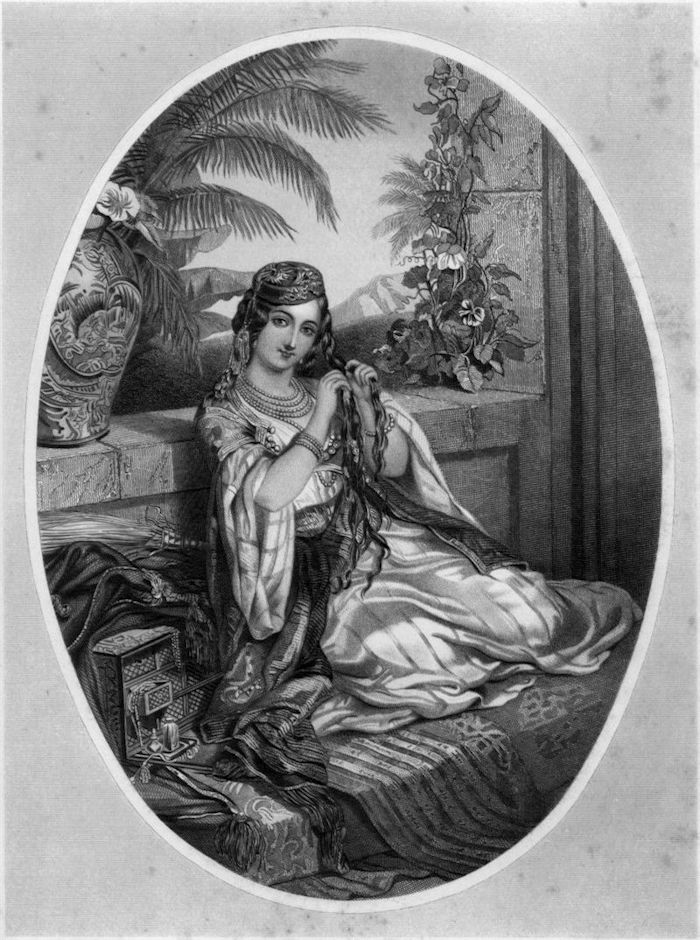
Illman & Sons
BEAUTY’S RETREAT.
Engraved expressly for Graham’s Magazine.
A LEGEND OF GRANADA.
[WITH A STEEL ENGRAVING.]
———
BY HENRY WILLIAM HERBERT.
———
It was the evening of a sultry summer’s day,
while the sun was yet hanging suspended, as it
were, in a wreath of lustrous, gauzy vapor scarce a
hand’s-breadth above the horizon. The skies were
perfectly cloudless; and, but for that rich, golden
haze which floated in the west about the sloping
day-star, there was not a speck of mist to be seen
over the whole expanse of the firmament, which,
glowing, as it was, with the warm light of that soft
southern region, resembled more a vault of exquisitely
shadowed gems than the unfathomable depths
of ether. All to the westward, the horizon was
deluged with a flood of golden glory, too soft to be
called intense, yet so vivid that the eye could
scarcely brook it; melting as it streamed upward
toward the zenith, by imperceptible degrees, into
the radiance of the living sapphire; and thence deepening,
through the azure tints of the Lapis Lazuli,
into the darkest cærulean blue to the eastward,
against which rose distinct, glittering with the last
reflected sunbeams, the distant summits of the Cordoran
mountains. Above these, soaring slowly upward,
and momently gathering fresh brilliancy as
the sun faded in the west, the full, round moon had
already risen, with the evening-star at her side, a
diamond spark beside an orient pearl.
Nor was the earth below less gracious than the
heaven above it; for the scene, over which that
cloudless sun was setting so serenely, was no other
than the lovely vegas of Granada, watered with its
sparkling rivulets, tributaries to the broad and fair
Xenil; waving with its almost tropical luxuriance
of foliage, odorous with the sweets of ten thousand
gardens—verily the paradise of earth surrounding, as
with a girdle of immortal beauty, the loveliest of
earthly cities, crowned by the wonder of wonders,
the glorious Alhambra. So much has been already
written in many tongues, both in prose and verse, of
the glories of this inimitable spot—still inimitable,
even under the indolent and careless culture of the
Spaniard, yet how unlike to what it was under its
Moorish masters—above all so eloquently has it been
described by the graceful pen of Irving, that all the
details of its scenery, nay! of its architecture and
internal decorations, are, it may be presumed, as familiar
to the mind of the reader, as many places
which he has actually seen with his own eyes. To
dwell longer, therefore, on the features of that sweet,
mountain-girdled plain on which the sunbeams lingered,
as though they loved it, would be superfluous
at least, if not impertinent. Not so, to depict one
who gazed across that plain under that lovely sunset,
soft herself as the genial clime, serenely bright
as the calm eventide—the Lady Ayesha, a princess
of the unmixed race, a visitor from the distant walls
of Mequiñez to the kindred royalty, which in the
person of the unfortunate but as yet unconquered
Boabdil, still sat sublime on the fairy towers of the
Alhambra.
She sat alone in a small octagonal apartment in
the very summit of one of the loftiest of the palace
turrets, overlooking and commanding a view so extensive,
that the eye swam dazzled or ere it
reached the hills, which bounded it on every side.
Walled, vaulted, floored with pure snow-white marble,
all wrought and pierced with that exquisite
arabesque tracery, which made the cold, hard stone
resemble the finest and most delicate lace-work;
lighted on each of its eight sides by a tall window,
headed by the peculiar horse-shoe arch of Moorish
architecture, and surrounded a little lower down the
turret by a balcony, filled as a hanging garden with
every loved and lovely plant and flower, no happier
retreat could be devised for Southern beauty; none
half so beautiful, half so luxurious, is dreamed of in
her most voluptuous musings by the most famed
fair one of our utilitarian days and country.
Notwithstanding the extreme height of the tower,
which rose full a hundred feet above the inferior
buildings of the royal residence, it yet possessed its
fountain, fed from a reservoir in the roof, itself
supplied by the aid of machinery from the sources of
those silver rivulets of the Xenil and Darro, which
might be seen glittering in the level plain almost a
thousand feet below; and the constant merry plash
of its sparkling waters, as they leaped and fell in a
shower of diamonds into their alabaster basin, together
with the waving of the broad, fan-like palm-leaves
in light coming air around the open casements,
and the rich clusters of clematis, passion-flower
and jessamine which hung their blossoms
around every traceried column, rendered it difficult
to conceive that so great a distance intervened between
that bower of beauty and the solid earth, with
all the choicest charms of which it was environed
and invested.
Half-seated, half-reclining on a broad, low step of
marble, which ran all around the apartment, covered
with rich cushions and foot-cloths of brocade, such
as would now be cheaply purchased at its weight in
gold, with her shoulders supported by the low parapet
of the window immediately behind her, gazed
the Lady Ayesha over the glimmering landscape, all
as she untwined with the rosy, henna-tinted tips of
her small, slender fingers the thick plaits of her luxuriant
raven hair. For in truth, and for once, the
epithet raven was not misapplied to those soft, silky,
glistening masses, which were not of the cold and
hueless black, but of that nameless and indescribable
hue which is never seen but in the hair of women
of Moorish or Irish blood—and in the latter probably
as originated of the former—black indeed, but
black warmed and glowing with a rich metallic purplish
lustre, unlike any thing on earth but the changeful
hues that dance on the dark plumage of several
of the feathered tribes. But though her long, languid
eyes of that perfect almond form, so much
prized by the beauty-loving Moors, fringed with
lashes so long and dark as to require no aid of that
Arabian dye to set off the liquid lustre which they
curtained, were riveted with a serene and steady
fixedness on a remote spot in the plain, it was by
no means evident that they took note of that on
which they lingered; nor did she even appear conscious
of her occupation, as wave after wave of her
soft tresses fell disentwined into her lap. For there
was too much of tranquillity, approaching even to
abstraction, in the fixedness of her eye, in the statue-like
immobility of her perfectly regular features, and
in the whole pose of her figure, to accord with any
thoughts so frivolous as those of the mere decoration
of the person, how beautiful soever it might be.
As one gazed on her—had there been any there to
gaze—it was impossible not to perceive that, within
that fair form and under those impassive features,
there was—what with Oriental women is not at all
times the case—a sentient and intellectual soul, and
that soul at this time engrossed in some deep and
powerful strain of meditative thought.
And oh! how beautiful she was. The perfect
oval of her regular face, the straight, Grecian outline
of her chisseled features, the dark clearness of
her pure, transparent complexion, through which,
though ordinarily colorless, every transient motion
of the blood mantled in crimson, the slender, yet exquisitely
rounded figure, the soft curves of her plump
and shapely arms, were all as nearly perfect as mortality
can approach to perfection.
The dress, moreover, which she wore—as far removed
as possible, by the way, from the ungraceful
and hideous monstrosity which a set of crazy notoriety-mongers
have been striving to introduce among
us as the costume of Oriental ladies—set off her
foreign-looking charms by its own foreign eccentricity,
no less than by the barbaric splendor of its
materials.
A low, flat Fezzan cap of rich crimson velvet, superbly
embroidered in gold and pearls, was set
lightly, a little on one side, upon her luxuriant black
tresses, and from it depended a long tassel, exquisitely
wrought of grains of native gold and seed-pearls,
down to her left shoulder, contrasting in strong
relief the glossy darkness of the hair, by the brilliancy
of its white and gold. Immense pendants of
pearl hung from the roseate tips of each small ear,
and a string of the same inestimable gems, not one
of them inferior in size to a large currant, formed
four distinct necklaces upon her chest, beside a fifth
and longer coil, which hung down almost to her
waist. A jellick, as it was called, or, as we should
term it now, a chemisette of the finest Indian muslin,
wrought as its name indicates at Mosul on the
Tigris, embroidered with threads of gold, alone
covered her glowing bosom; but above it she wore
an open, sleeveless Dymar of gorgeous green brocade,
with hanging filigree buttons of gold; and shrouding
all her lower limbs, to the very tips of the small,
slippered feet, as she lay half-crouched on her divan,
an under robe or tunic of blush-colored Persian silk
with broad, perpendicular stripes of dead gold, the
sleeves of which, close to the elbow, fell thence downward,
open like those of the modern gown worn by
bachelors of arts. No appearance of trowsers, no
marked cutting line, nothing tight or definite or
rigid, nothing harsh, stiff or masculine was to be discovered
on the nearest scrutiny. A superb Cashmere
shawl was wound about her waist at the junction of
the under robe and chemisette, and its loose ends
blended admirably with the floating draperies and
harmonized with the wavy ease which was the principal
characteristic of the dress, the attitude, the
pose, the woman.
To complete the picture, a Moorish Bernoose, or
mantle of scarlet woolen, almost as fine as gauze,
with borders of golden lace, lay heaped behind her;
and nestled in its folds, a filigree jewel-case with
boxes and bottles of perfumes and cosmetics, and
half-open drawers of glittering gems and ornaments
befitting her high rank; while on the parapet, beside
her head, stood a huge vase of superb porcelain filled
with the dark, glossy leaves and snow-white blossoms
of the gold-eyed lotus, the perfume of which
would have been too strong for endurance but for the
free circulation of the balmy air on every side, and
the cool freshness of the dashing water, which mingled
with its overpowering fragrance and dissipated
its intensity.
Such was the Leila Ayesha, the daughter of the
Sultan of Mequiñez, the great Muley Abderahman,
the best and bravest of his race; who in this, almost
the last extremity of his kinsman, Boabdil of Granada,
had sent an embassy with compliments and
splendid gifts, accompanying and conveying his fair
child, the best loved of all his children, on her visit
to the heroic mother of the last Moorish king of
Granada.
By many, however, of those who might be supposed
the best informed on state affairs, both of those
at Mequiñez and those at Granada, it was whispered
that, under the cover of a mere complimentary embassy
and friendly visit something of deep policy, and
that of the highest import to both sovereigns, was
intended. Indeed it was the general opinion that
the object of the Sultan of Morocco in thus sending
his fair daughter—in whom it was well-known that
wise and enlightened prince placed far more confidence
than is usually extended to the sex among the
Moors—was to bring about, should it be pleasing to
the beautiful Ayesha, a union between the two royal
houses, in which case he would himself come to the
aid of Granada with such a force of Moslem, backed
by such hordes of the wild Berbers as Ali Ibn Tarih
himself never led to conquest—such, in a word, as
should soon compel the proud and encroaching Ferdinand
to look to the safety of his own throne and
the integrity of his own dominions, rather than to
the invading of the dominions of his neighbors.
Be this as it may, it was all a new world to the
Leila Ayesha, for the Moors of Spain during their
many centuries of occupation, aggrandisement and
decline, had adopted many ideas, many customs
from their Christian neighbors, at one time their
foes, at another in long intervals of truce, their neighbors
and almost their friends.
Nor had the Spaniards failed in the same degree
to profit by the vicinity of the intellectual, polished
and industrious Moors, until the bigotry of these and
the fanaticism of those had given way to more rational
and intelligent principles, and the two nations
met, whether in war or peace, on a common ground
of mutual self-respect and decorum.
Thus the Moors had not only laid aside long since
their fanatical war-cry of “The Koran or the
Sword!” but had adopted many of the usages of
chivalry, no longer holding the Christians as dogs,
and slaughtering them without quarter given or
taken, but setting them at honorable ransom, and
even treating them while prisoners on parole as
guests on terms of equality, entertaining them at
their boards, and holding sacred to them all the rights
of hospitality.
In no respect, however, had a wider change occurred
in the habits of the nation than in the
treatment of their women, who, although not certainly
admitted to the full liberty of Christian ladies,
were by no means immured, as in their native land,
in the precincts of the Harem, “to blush unseen, and
waste their sweetness on the desert air,” but were
permitted, still under the guardianship of duennas,
and with their trains of Indian eunuchs, and further
protected by their veils from the contamination of
unholy glances, to be present at festivals, at tournaments,
nay! even at banquets, when none but the
members of the family or guests of high consideration
were expected to be present.
It is not, by the way, a little singular that almost
in exact proportion as the Moors enlarged the liberty
of their women, by the example of the Spaniards,
did the Spaniards contract that of their own bright-eyed
ladies, by the example of the Moors; and for
many years the rigor of the Spanish duenna was
scarcely inferior to that of the Raid of a Moorish
harem, or the ladies under charge of the one much
more obvious to the gaze of the profane, than the
beautiful slaves of the latter.
Did not, therefore, the beautiful Leila Ayesha
rejoice and exult in the comparative freedom which
she enjoyed among the liberal Moors of Spain, which
as fitted to enjoy as the favorite child of a wise
father, enlightened far beyond the prejudices of his
nation or his time? In his own younger days he had
been a traveler, had visited Venice and even Madrid,
in both of which cities he had been a sojourner
in the character of ambassador, and had
thus, like the wily Ulysses, “seen the cities of
many nations and learned their understandings.”
Their languages he spoke fluently: he even read
their works, and, although a sincere and faithful
Mussulman, he had learned to prize many of the
customs, to appreciate the principles, and in some
instances to adopt in his heart at least the practices
of the Christians.
Too wise openly to offend the prejudices of his
people—and nothing would have done so, more decidedly
or more dangerously than any infringement
of the sanctity of the harem—he had not dared, absolute
as he was, to grant to his daughter that full
liberty founded upon the fullness of trust which he
had learned to admire in Venice. Still he had done
all that he could do without offending prejudices or
awakening angry opposition. He had made Ayesha,
from her earliest years, the companion of his leisure
hours; he had educated her in all that he himself
knew, he had consulted her as a friend, he had confided
in her as a human soul, not treated her as the
mere pet and plaything of an hour.
And now as she grew up from an engaging child
to a fair marriageable maiden, accomplished, intellectual,
thoughtful, not an irresponsible being, but a
responsible human creature, with the beauty, the
impulsive nature, the passionate heart of the Moorish
girl, but with the reason, the intellect, the soul of
the Spanish lady—Muley Abderrahman, who was
waxing into years, began to doubt whether he had
done wisely in training up the child of Mequiñez,
the offspring of the desert, to the arts, the accomplishments,
the hopes, and the aspirations of the
free Venetian dama—began to look around him
anxiously to see where he might bestow the hand
of her whom he had learned to cherish and esteem
even above his people or his power. He saw none,
on that side of the Mediterranean, with whom she
could be other than a slave—the first and mistress of
the slaves, indeed, but still one of them—a beautiful
toy to be prized for beauty, while that beauty should
yet endure; if faded, to be cast aside into the sad
solitude of neglect for a newer plaything, perhaps to
be imprisoned—as a discrowned and discontented
queen, and therefore dangerous—in some distant and
dim seraglio on the verge of the great burning desert.
And was this a fate for the bright, the beloved, the
beautiful, the sage Ayesha?
Thence was born the idea of the embassy to Boabdil.
He knew the kings of Granada civilized and
cultivated far before those of Tetuan or Tafilet, or
even Mequiñez or Mecca—he knew that they had
adopted, in many respects, the usages of the Christian
cavaliers, and not least among these, their
chivalrous courtesy and graceful respect for the fair
sex—he knew them powerful and wealthy, and possessed
of a land the fairest on the face of the earth,
the glorious kingdom of Granada. At this time,
although the war had commenced between Ferdinand
and the Moorish princes, which was to
terminate at no very distant day in the total overthrow
of the Saracenic empire in Spain, it as yet
lagged indecisively along, with no preponderance of
this or the other force; nor could there be any doubt
that a declaration on the part of the Sultan of
Mequiñez, backed by the reinforcement of a Moorish
and Berber, and an active naval warfare along the
coasts of Spain, would not only secure Granada
from any risk of dismemberment, but even wrest a
permanent acknowledgment and durable peace from
the Christian kings of the Spanish provinces.
Boabdil was at this time formally unwedded, although,
like every other prince or magnate of his
people, he had his wives, his concubines, his slaves
innumerable. He was notoriously a leaner to the
soft side of the heart, a fervent admirer of beauty,
and was, moreover, a kind-hearted, gracious and
accomplished prince. That he would be captivated
by the charms of the incomparable Ayesha, even
apart from the advantages which her union would
bring to himself and to his people, could not be
doubted; and should such an union be accomplished
Muley Abderrahman felt well assured that he should
have obtained for the darling of his heart all that
he desired, freedom of life, a suitable partner, and
security for her enjoyment of all her cherished tastes
and respected privileges.
Still Muley Abderrahman, wiser than any Moslem
father of that age, wiser than most Christian parents
of any age, was not inclined to set down his own
idea of what should be her good, with his absolute
yea! as being her very good. He had, strange thing
for a Moor! an idea that a woman has a soul—strange
and unorthodox thing for a father! an idea
that his daughter had a heart; and that it might not be
such a bad thing after all for her ultimate happiness
that her heart should be in some degree consulted.
She went, therefore, fancy free and untrammeled
even by the knowledge of her father’s wishes, on a
visit to her kinsfolk of Granada, entirely unsuspicious
that any secret of state policy was connected
with the visit to that land of romance and
glory, of beauty and adventure, which was to her
one long holyday. Of all her train, indeed, there
was but one who was privy to the Sultan’s secret
wishes old Hadj Abdallah Ibn Ali, the eldest of the
sovereign’s councillors, like some, himself a traveler,
and like himself, imbued with notions far
more liberal than those of his time or country. To
him it was entrusted, therefore, while seemingly inattentive
to all that was passing, to observe strictly
every shadow which might indicate whence the
wind was about to blow—to take especial note of
Boabdil’s conduct and wishes, and, above all, to omit
no opportunity of discovering how the fair Ayesha
might stand affected toward her royal cousin.
Gaily and happily had passed the days, the weeks,
the months—it was still truce with the Spaniard,
and days and nights were consumed in tilts, in tournaments,
in hawking-parties on the beautiful green
meadows of the Vega, beside the bright and brimful
streams, adjuncts so necessary to that royal pastime,
that it was known of old as the “Mystery of
Rivers”—hunting-parties in the wild gorges of the
Alpuxawa mountains, banquets at high noon, and
festivals beneath the glimmering twilight, beneath
the full-orbed moon, that life was, indeed, one long
and joyous holyday. Boabdil was, in truth, of a man
a right fair and goodly specimen—tall, finely formed,
eminently handsome, graceful and affable in manners,
kindly in heart and disposition, not untinctured
with arts and letters, nor deficient in any essential
which should become a gentle cavalier—as a monarch,
when surrounded by his court, and seated in
his place of state in the Hall of Lyons, of a truth
he was a right royal king—as a warrior, in the tilt-yard
his skill, his horsemanship, his management
of all weapons, were the admiration of all beholders.
In the field his gallantry and valor were incontestable.
What, then, was wanting that Boabdil was
not a perfect man, a real cavalier, a very king?
Purpose, energy, will—will that must have its way,
and cannot be denied, much less defeated.
A prince of a quiet realm, in tranquil times he had
lived honored and happy, he had been gathered to
his fathers among the tears of his people, he had
lived in the memory of men as a good man, an admirable
king, the father of his people.
Fallen upon evil times, thrust into an eminence
for which he not only was, but felt himself to be
unfit, unequally matched against such an enemy as
Ferdinand, the one weak point outweighed all the
fine qualities and noble virtues; and he lived, alas!
to be that most miserable, most abject of all human
things, a dethroned, exiled, despised king!
And did Ayesha, from beneath the screen of girlish
levity, while seemingly steeped to the lips in the
rapturous enjoyment of the liberty, the life of the
present moment, did Ayesha see and foresee all this?
At least, when Hadj Abdallah Ibn Ali wrote to his
friend and patron the Sultan, and that but shortly
after their arrival, that Boabdil was so evidently
and obviously enamored of his mother’s lovely
guest, that he would not only too eagerly court the
alliance, backed as it was by advantages so kingly,
but that he verily believed he would woo her to
his throne, were she the merest peasant’s child. He
wrote nothing of Ayesha!
Again he wrote that he could not doubt she had
perceived her royal cousin’s love, and that her manner
toward him was so frank, so free, so unrestrainedly
joyous and confiding, that he was well
assured that all went well, and that she returned
the affection of Boabdil, and rejoiced in his love.
But Muley Abderrahman, shook his head and
knit his brow, as he read the letter, and muttered
through his thick moustache, “Ay! he is a good
man—a good man is the Hadj Abdallah, and a wise
one, but he knows nothing of a woman’s heart—how
should he?”
When he sent the next dispatches to his old friend
and counsellor, there was a brief private note attached.
“Is the Leila Ayesha,” he asked, “never
grave, never abstracted, never shy, and almost sad—does
she never flee from the gayety of the festival,
the tumult of the chase, into privacy and solitude—does
she never fail to hear when addressed, to see
when encountered—does she never weep nor sigh
when alone—in a word, is she in nowise changed
from what she was at Mequiñez?”
And the reply came, “Never. Wherefore should
she? Is she not the apple of all eyes, the idol of all
hearts? Her laugh is as the music of the soul, her
eye-glance the sunbeam that enkindles every heart.
She is the star of the Alhambra, the loadstone of the
king’s soul. Wherefore should she weep or sigh?
I have questioned her handmaids—never! Yes—the
Leila Ayesha is changed. In Mequiñez, she was as
a sunbeam thrown on still waters. Here in Granada,
she is the sunbeam thrown on the dancing
fountain, reflecting happy light on all around her.
In Mequiñez, she was as a sweet song-bird, feeding
her soul on her own harmonies in silence. Here in
Granada she is as the sweet song-bird, enrapturing all
within her sphere by the blithe outpourings of her
joyous melodies. Yes—the Leila Ayesha is changed.
My Lord Boabdil loves the Leila Ayesha; the
Leila Ayesha knows it, and is glad.”
Then Muley Abderrahman shook his head, and pondered
for a while, and muttered—
“She loves him not—She loves him not. The
Hadj Abdallah is good and wise with the wisdom of
men—but of the hearts of women, he knows nothing—how
should he? for he never saw a woman.”
And the old king, far distant, saw more of what
was passing in the fair girl’s heart than the wise
councillor who was present—but he judged it best to
tarry and abide the event—and he tarried, but not long.
Had he been present on that sultry summer’s
evening, and looked upon his lovely child as she sat
gazing out in such serenity of deep abstraction over
the sunny Vega—over the fragrant orange groves and
glowing vineyards, toward the glistening hill-tops of
the Spaniards—his question would have answered
itself, and at the first glance he would have seen
that she loved.
The child had discovered that it had a heart—the
creature had divined that it had an immortal soul—the
child had become a woman—a very woman.
With all a woman’s smiles and tears,
And fearful hopes and hopeful fears,
And doubts and prayers for future years.
Leila Ayesha loved—but whom? At least not
Boabdil! Happily, not Boabdil.
Even as she gazed, the orb of the gorgeous sun
sank behind the distant hills, and at once—clear,
shrill, and most melodious—up went the voice of
the Muezzins, from every minaret throughout the
gorgeous city, “To prayer, to prayer. There is no
God but God, and Mahomet is his prophet. Faithful,
to prayer, to prayer!”
And instant at the cry every sound ceased through
the royal residence—every sound through the splendid
city—every sound through the wide Vega.
Every turbaned head was bowed in prayer, and a
sabbath stillness seemed to consecrate the bridal of
the earth and sky.
Ayesha rose from her divan, and while her lips
murmured the words of devotion, and her fingers ran
rapidly over the beads of her Comboloic or Moorish
rosary, a strange, faltering flush ran over her fair
brow. Her orisons ended, she caught some of the
spray of the fountain in the palm of one of her fairy
hands, and scattered it thrice over her long, dark
tresses, on which it glistened in the soft moonbeams;
for the moon now alone occupied the heavens, on
the fragrant hills of the black hyacinth.
Again she resumed her attitude on the divan, but
not her occupation; for the mood of her mind was
altered, and for a while she hummed the burthen of
an old, melancholy Moorish ballad—an old Moorish
love-song, the words of which corresponded in no
small degree to our own, “Oh! willow, willow”—since
the proverb still holds good of burned Morocco
or bright Spain, as of green, merry England—
“For aught that I did ever hear—
Did ever read in tale or history,
The course of true love never did run true.”
Ere long from the city gates far distant was heard
the din of martial music—first, the deep clang of the
kettle-drums and atabals alone, and the clear flourish
of the silver trumpets which announced the presence
of the king, and these only at intervals above or between
the trampling of hoofs, the clash of armor,
and the cheering of an excited multitude. Anon
nearer and nearer came the sounds, with the clash
of cymbals and the soft symphonies of lutes, and the
clear, high notes of flutes and clarionets among the
clangor of the trumpets, and the brazen rattling of
the drums.
Nearer and nearer yet—and it is now at the Alhambra
gates.
She started to her feet, and leaned far out of the
embrasure commanding all the city, but her eye
marked one object only, the royal train filing into the
palace gates, from the royal sports on the Vega
ended—and in that train, on but one person.
It was no turbaned head or caftaned form on
which that ardent eye was fixed, now kindled into
all a Moresca’s ecstacy of passion; it was on a tall
Spanish crest and lofty plume. And, as if by a secret
instinct, as her gaze was bent downward to the
horse-shoe arch of the Alhambra gate, his glance
soared upward to the airy turret’s top, and readily
detected what would have escaped a less observant
watcher, the dark eyes of his fair Ayesha gleaming
through the palm-leaves and passion-flowers; their
passionate fire half quenched by the tears of tenderness
and hope.
His Ayesha—his—the Conde of Alarcos, proudest
grandee of Spain—the favorite child of the Spaniard’s
deadliest foe, the Sultan of Morocco.
The Hadj Abdallah Ibn Ali’s next dispatch contained
much important tidings concerning a twenty
years’ truce to be concluded between the King Boabdil,
of Granada, and the King Ferdinand, of Spain—and
much graver gossip of the noble Conde of Alarcos,
Ferdinand’s ambassador; of his high feats of
arms, and gentle feats of courtesy—of how all the
court admired him, and how the Lady Ayesha
shunned him, and how she was less frequent at the
falconry, less frequent at the chase, less frequent at
the festival, less frequent at the royal banquets—and
how her hand-maidens reported that their mistress
sighed all the time and often wept, and sat long hours
gazing upon nothing, and played no more upon her
lute, nor sung the songs of Islam—and how she was—he
feared—ill at ease, and pining for her native land.
And when Muley Abderrahman read the letter he
shook his head, and muttered—
“Ay, she loves now, but it is the wrong one—a
Nazarene, a dog,” and he tore his beard and wept.
That night a royal courier rode hard from Mequiñez
to Saleè, and the next day a fleet galley scoured the
way across the narrow seas to the fair shores of
Granada.
The embassy should return at once to Mequiñez.
Now hour of delay—too late.
The embassy had returned the preceding day, but
it was the Spanish embassy: and it had returned,
not to Mequiñez, but to Cordova. And ere his master’s
mandate had stricken terror to the soul of the
Hadj Abdallah, the Spanish bells were chiming for
the wedding of a Moorish maiden, now a Christian
bride; and the Leila Ayesha, of Mequiñez, was the
wife of the noble Conde De Alarcos: nor have I
ever heard that she rued either of the changes.
Again Muley Abderrahman tore his beard, and this
time from the very roots. But his wonted philosophy
still consoled him, and after a little while he
muttered—
“Allah, assist me, that I thought myself so wise—yet
know not the heart of a woman! How should I?”
———
BY GRENVILLE GREY.
———
Leave thou some light behind thee,
Some mark upon thine age;
Let not a false fate bind thee—
Write thou upon life’s page,
Some word of earnest meaning,
Some thought, or else some deed,
On which thy brother leaning,
Unto better may succeed.
For none may tell what beauty,
What endless good there lies,
In some little nameless duty,
Whose remembrance never dies.
Leave thou some light behind thee,
Some token of thy way;
Let not a false ease bind thee—
Thou art not wholly clay.
There is something noble in thee,
Let it speak and not be mute;
There is something that should win thee
From a kindred with the brute.
Thou art not, oh! my brother,
Wholly impotent for good;
Thou may’st win or warn another
From the wrongs thou hast withstood.
Leave thou some trace behind thee—
In life’s warfare, go, engage;
Let no more a false fate bind thee—
Write thou upon life’s page.
(FOUND UPON MY DESK.)
———
BY ESTELLE ANNA LEWIS.
———
I came upon these simple flowers
As something I revere;
They grew in Love’s enchanted bowers—
And love hath placed them here.
I kiss their cheeks of virgin bloom,
I press their dewy lips,
While my wrapt soul of their perfume,
Inebriated sips.
I look into their violet eyes,
And feel my heart grow calm,
And fancy I’m in Paradise,
Inhaling Eden’s balm.
There in ecstatic dreams I rove
Among celestial bowers,
Weaving a garland for my Love,
Of beatific flowers.
———
BY SAMUEL HENRY DICKSON, M. D.; PROFESSOR IN THE MEDICAL COLLEGE OF SOUTH CAROLINA.
———
As the word Life is employed in a double sense to
denote the actions or phenomena by which it is developed,
and the cause of these phenomena, so the
old English word Death is used familiarly to express
two or more meanings. The first of these is the
transition from the living to the lifeless or inanimate
state—the act, that is, of dying; the second, the condition
of an organized body which has ceased to live,
while organization yet remains, and symmetry still
displays itself, and the admirable structure of its parts
is not yet destroyed by decomposition, or resolved
into the original and primary elements from which it
was moulded,
“Before Decay’s effacing fingers
Have swept the lines where beauty lingers.”
We occasionally speak of “dead matter” in the
sense of inorganic; but this is merely a rhetorical or
metaphorical phrase. That which has never lived
cannot properly be said to be dead.
In the following essay, I shall use the word chiefly
in the first of the senses above indicated. It will
often be convenient to employ it in the second also;
but in doing so, I will be careful so to designate its
bearing as to avoid any confusion. The context
will always prevent any misunderstanding on this
point.
Death may be considered physiologically, pathologically,
and psychologically. We are obliged to
regard it and speak of it as the uniform correlative,
and indeed the necessary consequence, or final result
of life; the act of dying as the rounding off, or termination
of the act of living. But it ought to be
remarked that this conclusion is derived, not from
any understanding or comprehension of the relevancy
of the asserted connection, nor from any à priori
reasoning applicable to the inquiry, but merely à
posteriori as the result of universal experience. All
that has lived has died; and, therefore, all that lives
must die.
The solid rock on which we tread, and with which
we rear our palaces and temples, what is it often
when microscopically examined, but a congeries of
the fossil remains of innumerable animal tribes!
The soil from which, by tillage, we derive our vegetable
food, is scarcely any thing more than a mere
mixture of the decayed and decaying fragments of
former organic being; the shells and exuviæ, the
skeletons and fibres and exsiccated juices of extinct
life.
The earth itself, in its whole habitable surface, is
little else than the mighty sepulchre of the past;
and
“All that tread
The globe are but a handful to the tribes
That slumber in its bosom. Take the wings
Of morning, and the Barcan desert pierce,
Or lose thyself in the continuous woods
Where rolls the Oregon, and hears no sound
Save his own dashings—yet, the dead are there;
And millions in these solitudes, since first
The flight of years begun, have laid them down
In their last sleep: the dead reign there alone.”
Four millions of Egyptians cultivate the valley of
the great river on whose banks, amidst the fertilizing
dust of myriads of their progenitors, there are calculated
still to exist, in a state of preservation, not less
than from four hundred to five hundred millions of
mummies. The “City of the Tombs” is far more
populous than the neighboring streets even of
crowded Constantinople; and the cemeteries of London
and the catacombs of Paris are filled to overflowing.
The trees which gave shade to our predecessors
of a few generations back lie prostrate; and
the dog and horse, the playmate and the servant of
our childhood, are but dust. Death surrounds and
sustains us. We derive our nourishment from the
destruction of living organisms, and from this source
alone.
And who is there among us that has reached the
middle term of existence, that may not, in the touching
phrase of Carlyle, “measure the various stages
of his life-journey by the white tombs of his beloved
ones, rising in the distance like pale, mournfully receding
milestones?”
“When Wilkie was in the Escurial,” says
Southey, “looking at Titian’s famous picture of the
Last Supper in the refectory there, an old Jeronymite
monk said to him, ‘I have sat daily in sight of
that picture for now nearly threescore years; during
that time my companions have dropped off one after
another—all who were my seniors, all who were
my cotemporaries, and many or most of those who
were younger than myself; more than one generation
has passed away, and there the figures in the picture
have remained unchanged. I look at them, till I
sometimes think that they are the realities, and we
but shadows.’ ”
I have stated that there is no reason known to us
why Death should always “round the sum of life.”
Up to a certain point of their duration, varying in
each separate set of instances, and in the comparison
of extremes varying prodigiously, the vegetable and
animal organisms not only sustain themselves, but
expand and develop themselves, grow and increase,
enjoying a better and better life, advancing and progressive.
Wherefore is it that at this period all
progress is completely arrested; that thenceforward
they waste, deteriorate and fail? Why should they
thus decline and decay with unerring uniformity
upon their attaining their highest perfection, their
most intense activity? This ultimate law is equally
mysterious and inexorable. It is true the Sacred
Writings tell us of Enoch, “whom God took and he
was not;” and of Elijah, who was transported
through the upper air in a chariot of fire; and of Melchisedek,
the most extraordinary personage whose
name is recorded, “without father, without mother,
without descent: having neither beginning of days,
nor end of life.” We read the history without conceiving
the faintest hope from these exceptions to
the universal rule. Yet our fancy has always exulted
in visionary evasions of it, by forging for ourselves
creations of immortal maturity, youth and
beauty, residing in Elysian fields of unfading spring,
amidst the fruition of perpetual vigor. We would
drink, in imagination, of the sparkling fountain of
rejuvenescence; nay, boldly dare the terror of Medea’s
caldron. We echo, in every despairing heart,
the ejaculation of the expiring Wolcott, “Bring back
my youth!”
Reflection, however, cannot fail to reconcile us to
our ruthless destiny. There is another law of our
being, not less unrelenting, whose yoke is even
harsher and more intolerable, from whose pressure
Death alone can relieve us, and in comparison with
which the absolute certainty of dying becomes a
glorious blessing. Of whatever else we may remain
ignorant, each of us, for himself, comes to feel,
realize and know unequivocally that all his capacities,
both of action and enjoyment, are transient
and tend to pass away; and when our thirst is satiated,
we turn disgusted from the bitter lees of the
once fragrant and sparkling cup. I am aware of
Parnell’s offered analogy—
“The tree of deepest root is found
Unwilling most to leave the ground;”
and of Rush’s notion, who imputes to the aged such
an augmenting love of life that he is at a loss to
account for it, and suggests, quaintly enough, that it
may depend upon custom, the great moulder of our
desires and propensities; and that the infirm and decrepit
“love to live on because they have acquired
a habit of living.” His assumption is wrong in
point of fact. He loses sight of the important principle
that Old Age is a relative term, and that one
man may be more superannuated, farther advanced
in natural decay at sixty, than another at one hundred
years. Parr might well rejoice at being alive,
and exult in the prospect of continuing to live, at
one hundred and thirty, being capable, as is affirmed,
even of the enjoyment of sexual life at that age; but
he who has had his “three sufficient warnings,”
who is deaf, lame and blind; who, like the monk of
the Escurial, has lost all his cotemporaries, and is
condemned to hopeless solitude, and oppressed with
the consciousness of dependence and imbecility,
must look on Death not as a curse, but a refuge.
Of one hundred and thirty-three suicides occurring
in Geneva from 1825 to 1834, more than half were
above fifty years of age; thirty-four, from fifty to
sixty; nineteen, from sixty to seventy; nine, from
seventy to eighty; three, from eighty to ninety; in
all sixty-five. The mean term of life in that city
being about thirty-five to forty, this bears an immense
proportion to the actual population above fifty,
and exhibits forcibly an opposite condition of feeling
to that alleged by Rush, a weariness of living, a desire
to die, rather than an anxiety, or even willingness
to live.
I once knew an old man of about one hundred and
four who retained many of his faculties. He could
read ordinary print without glasses, walked firmly,
rode well, and could even leap with some agility.
When I last parted with him, I wished him twenty
years more; upon which he grasped my hand
closely, and declared he would not let me go until I
had retracted or reversed the prayer.
Strolling with my venerable and esteemed colleague,
Prof. Stephen Elliott, one afternoon, through
a field on the banks of the river Ashley, we came
upon a negro basking in the sun, the most ancient-looking
personage I have ever seen. Our attempts,
with his aid, to calculate his age, were of course
conjectural; but we were satisfied that he was far
above one hundred. Bald, toothless, nearly blind,
bent almost horizontally, and scarcely capable of
locomotion, he was absolutely alone in the world,
living by permission upon a place, from which the
generation to which his master and fellow-servants
belonged had long since disappeared. He expressed
many an earnest wish for death, and declared, emphatically,
that he “was afraid God Almighty had
forgotten him.”
We cannot wonder, then, that the ancients should
believe, “Whom the gods love, die young,” and are
ready to say with Southey, himself, subsequently,
like poor Swift, a melancholy example of the truth
of his poetical exclamation,
“They who reach
Gray hairs die piecemeal.”
Sacred history informs us that, in the infancy of
the world, the physiological tendency to death was
far less urgently and early developed than it is now.
When the change took place is not stated; if it occurred
gradually, the downward progress has been
long since arrested. All records make the journey
of life from the time of Job and the early patriarchs,
much the same as the pilgrim of to-day is destined
to travel. Threescore and ten was, when Cheops
built his pyramid, as it is now, a long life. Legends,
antique and modern, do indeed tell us of tribes that,
like Riley’s Arabs and the serfs of Middle Russia,
and the Ashantees and other Africans, live two or
three centuries, but these are travelers’ stories, unconfirmed.
The various statistical tables that have
been in modern times made up from materials more
or less authentic, and the several inquiries into the
general subject of longevity, seem to lead to the
gratifying conclusion that there is rather an increase
of the average or mean duration of civilized life.
In 1806, Duvillard fixed the average duration of life
in France at twenty-eight years; in 1846, Bousquet
estimates it at thirty-three. Mallet calculated that
the average life of the Genevese had extended ten
years in three generations. In Farr’s fifth report (for
1844), the “probable duration,” the “expectation of
life” in England, is placed above forty; a great improvement
within half a century. It is curious, if it
be true, that the extreme term seems to lessen as the
average thus increases. Mallet is led to this opinion
from the fact, among others, that in Geneva, coincident
with the generally favorable change above mentioned,
there has not been a single centenarian within
twenty-seven years; such instances of longevity
having been formerly no rarer there than elsewhere.
Birds and fishes are said to be the longest lived of
animals. For the longevity of the latter, ascertained
in fish-ponds, Bacon gives the whimsical reason
that, in the moist element which surrounds them,
they are protected from exsiccation of the vital
juices, and thus preserved. This idea corresponds
very well with the stories told of the uncalculated
ages of some of the inhabitants of the bayous of
Louisiana, and of the happy ignorance of that region,
where a traveler once found a withered and antique
corpse—so goes the tale—sitting propped in an arm-chair
among his posterity, who could not comprehend
why he slept so long and so soundly.
But the Hollanders and Burmese do not live especially
long; and the Arab, always lean and wiry,
leads a protracted life amidst his arid sands. Nor
can we thus account for the lengthened age of the
crow, the raven, and the eagle, which are affirmed
to hold out for two or three centuries.
There is the same difference among shrubs and
trees, of which some are annual, some of still more
brief existence, and some almost eternal. The venerable
oak bids defiance to the storms of a thousand
winters; and the Indian baobab is set down as a
contemporary at least of the Tower of Babel, having
probably braved, like the more transient, though
long-enduring olive, the very waters of the great
deluge.
It will be delightful to know—will Science ever
discover for us?—what constitutes the difference
thus impressed upon the long and short-lived races
of the organized creation. Why must the fragrant
shrub or gorgeous flower-plant die immediately after
performing its function of continuing the species, and
the pretty ephemeron languish into non-existence
just as it flutters through its genial hour of love, and
grace, and enjoyment; while the banyan, and the
chestnut, the tortoise, the vulture, and the carp,
formed of the same primary material elements, and
subsisting upon the very same resources of nutrition
and supply, outlast them so indefinitely?
Death from old age, from natural decay—usually
spoken of as death without disease—is most improperly
termed by writers an euthanasia. Alas! how
far otherwise is the truth! Old age itself is, with
the rarest exceptions, exceptions which I have never
had the good fortune to meet with anywhere—old
age itself is a protracted and terrible disease.
During its whole progress, Death is making gradual
encroachments upon the domain of life. Function
after function undergoes impairment, and is less
and less perfectly carried on, while organ after organ
suffers atrophy and other changes, unfitting it for the
performance of offices to which it was originally designed.
I will not go over the gloomy detail of the
observed modifications occurring in every part of the
frame, now a noble ruin, majestic even in decay.
The lungs admit and vivify less blood; the heart often
diminishes in size and always acts more slowly,
and the arteries frequently ossify; nutrition is impeded
and assimilation deteriorated; senile marasmus
follows, “and the seventh age falls into the lean
and slippered pantaloon;” and, last and worst of all,
the brain and indeed the whole nervous tissue shrink
in size and weight, undergoing at the same time
more or less change of structure and composition.
As the skull cannot contract on its contents, the
shrinking of the brain occasions a great increase of
the fluid within the subarachnoid space. Communication
with the outer world, now about to be cut
off entirely, becomes limited and less intimate. The
eyes grow dim; the ear loses its aptitude for harmony,
and soon ceases to appreciate sound; odors
yield no fragrance; flavors affect not the indifferent
palate; and even the touch appreciates only harsh
and coarse impressions. The locomotive power is
lost; the capillaries refuse to circulate the dark,
thick blood; the extremities retain no longer their
vital warmth; the breathing slow and oppressed,
more and more difficult, at last terminates forever
with a deep expiration. This tedious process is
rarely accomplished in the manner indicated without
interruption; it is usually, nay, as far as my experience
has gone, always brought to an abrupt close
by the supervention of some positive malady. In
our climate, this is, in the larger proportion, an affection
of the respiratory apparatus, bronchitis, or
pulmonitis. It will, of course, vary with the original
or constitutional predisposition of the individual,
and somewhat in relation to locality and season.
Many aged persons die of apoplexy and its kindred
cerebral maladies, not a few of diarrhœa; a winter
epidemic of influenza is apt to be fatal to them in
large numbers everywhere.
When we regard death pathologically, that is, as
the result of violence and destructive disease, it is
evident that the phenomena presented will vary relatively
to the contingencies effective in producing
it. It is obviously out of place here to recount them,
forming as they do a vast collection of instructive
facts, the basis indeed of an almost separate science,
Morbid Anatomy.
There are many of the phenomena of death, however,
that are common to all forms and modes of
death, or are rarely wanting; these are highly interesting
objects of study in themselves, and assume a
still greater importance when we consider them in
the light of signs or tokens of the extinction of life.
It seems strange that it has been found difficult to
agree upon any such signs short of molecular change
or putrefactive decomposition, that shall be pronounced
absolutely certain, and calculated entirely
to relieve us from the horrible chance of premature
interment of a body yet living. The flaccidity of the
cornea is dwelt on by some; others trust rather to
the rigor mortis, the rigid stiffness of the limbs and
trunk supervening upon the cold relaxation which
attends generally the last moments. This rigidity is
not understood or explained satisfactorily. It is possible
that, as Matteucci has proved, the changes in
all the tissues, chiefly chemical or chemico-vital, are
the source from whence is generated the “nervous
force” during life; so, after death, the similar
changes, now purely chemical, may, for a brief period,
continue to generate the same or a similar
force, which is destined to expend itself simply upon
the muscular fibres in disposing them to contract.
There is a vague analogy here with the effect of
galvanism upon bodies recently dead, which derives
some little force from the fact that the bodies least
disposed to respond to the stimulus of galvanism are
those which form the exceptions to the almost universal
exhibition of rigidity—those, namely, which
have been killed by lightning, and by blows on the
pit of the stomach. Some poisons, too, leave the
corpse quite flaccid and flexible.
The researches of Dr. Bennett Dowler, of New
Orleans, have presented us with results profoundly
impressive, startling, and instructive. He has, with
almost unequalled zeal, availed himself of opportunities
of performing autopsy at a period following
death of unprecedented promptness, that is, within a
few minutes after the last struggle, and employed
them with an intelligent curiosity and to admirable
purpose.
I have said that, in physiological death, the natural
decay of advancing age, there is a gradual encroachment
of death upon life; so here, in premature death
from violent diseases, the contrasted analogy is offered
of life maintaining its ground far amidst the
destructive changes of death. Thus, in cholera asphyxia,
the body, for an indefinite period after all
other signs of life have ceased, is agitated by horrid
spasms, and violently contorted. We learn from Dr.
Dowler that it is not only in these frightful manifestations,
and in the cold stiffness of the familiar rigor
mortis, that we are to trace this tenacious muscular
contraction as the last vital sign, but that in all, or
almost all cases we shall find it lingering, not in the
heart, anciently considered in its right ventricle the
ultimum moriens, nor in any other internal fibres,
but in the muscles of the limbs, the biceps most obstinately.
This muscle will contract, even after the
arm with the scapula has been torn from the trunk,
upon receiving a sharp blow, so as to raise the forearm
from the table, to a right angle with the upper
arm.
We also learn from him the curious fact that the
generation of animal heat, which physiologists have
chosen to point out as a function most purely vital,
does not cease upon the supervention of obvious or
apparent death. There is, he tells us, a steady development
for some time of what he terms “post-mortem
caloricity,” by which the heat is carried not
only above the natural or normal standard, but to a
height rarely equalled in the most sthenic or inflammatory
forms of disease. He has seen it reach 113°
of Fahr., higher than Hunter ever met with it, in his
experiments made for the purpose of exciting it;
higher than it has been noted even in scarlatina, 112°,
I think, being the ultimate limit observed in that
disease of pungent external heat; and far beyond the
natural heat of the central parts of the healthy body,
which is 97° or 98°. Nor is it near the centre, or at
the trunk, that the post-mortem warmth is greatest,
but, for some unknown reason, at the inner part of
the thigh, about the lower margin of its upper third.
I scarcely know any fact in nature more incomprehensible
or inexplicable than this. We were surprised
when it was first told us that, in the Asiatic
pestilence, the body of the livid victim was often
colder before than after death; but this, I think, is
easily understood. The profluvia of cholera, and its
profound capillary stagnation, concur in carrying off
all the heat generated, and in preventing or impeding
the development of animal heat. No vital actions,
no changes necessary to the production of caloric,
can proceed without the minute circulation which
has been checked by the asphyxiated condition of
the subject, while the fluids leave the body through
every outlet, and evaporation chills the whole exposed
and relaxed surface. Yet the lingering influence
of a scarcely perceptible vitality prevents the
purely chemical changes of putrefactive decomposition,
which commence instantly upon the extinction
of this feeble resistance, and caloric is evolved by
the processes of ordinary delay.
In the admirable liturgy of the churches of England
and of Rome, there is a fervent prayer for protection
against “battle, murder, and sudden death.”
From death uncontemplated, unarranged, unprepared
for, may Heaven in mercy deliver us! But if ever
ready, as we should be for the inevitable event, the
most kindly mode of infliction must surely be that
which is most prompt and brief. To die unconsciously,
as in sleep, or by apoplexy, or lightning, or
overwhelming violence, as in the catastrophe of the
Princeton, this is the true Euthanasia. “Cæsar,”
says Suetonius, “finem vitæ commodissimum, repentinum
inopinatumque pretulerat.” Montaigne,
who quotes this, renders it, “La moins préméditée
et la plus courte.” “Mortes repentinæ,” reasons
Pliny, “hoc est summa vitæ felicitas.” “Emori
nolo,” exclaims Cicero, “sed me esse mortuum
nihil estimo.”
Sufferers by various modes of execution were often,
in the good old times of our merciless ancestors,
denied as long as possible the privilege of dying, and
the Indians of our continent utter a fiendish howl of
disappointment when a victim thus prematurely escapes
from their ingenious malignity. The coup de
grace was a boon unspeakably desired by the poor
wretch broken on the wheel, or stretched upon the
accursed cross, and forced to linger on with mangled
and bleeding limbs, amidst all the cruel torments of
thirst and fever, through hours and even days that
must have seemed interminable.
The progress of civilization, and a more enlightened
humanity have put an end to all these atrocities,
and substituted the gallows, the garrote, and the
guillotine, which inflict deaths so sudden that many
have questioned whether they necessarily imply any
consciousness of physical suffering. These are,
however, by no means the most instantaneous modes
of putting an end to life and its manifestations. In
the hanged, as in the drowned, and otherwise suffocated,
there is a period of uncertainty, during which
the subject is, as we know, recoverable; we dare
not pronounce him insensible. He who has seen an
ox “pithed” in the slaughter-house, or a game-cock
in all the flush and excitement of battle “gaffed” in
the occiput or back of the neck, will contrast the immediate
stiffness and relaxation of the flaccid body
with the prolonged and convulsive struggles of the
decapitated bird, with a sort of curious anxiety to
know how long and in what degree sensibility may
linger in the head and in the trunk when severed by
the sharp axe. The history of the guillotine offers
many incidents calculated to throw a doubt on the
subject, and the inquiries of Seguret and Sue seem
to prove the existence of post-mortem passion and
emotion.
Among the promptest modes of extinguishing life
is the electric fluid. A flash of lightning will destroy
the coagulability of the blood, as well as the contractility
of the muscular fibre; the dead body remaining
flexible. A blow on the epigastrium kills
instantly with the same results. Soldiers fall sometimes
in battle without a wound; the impulse of a
cannon-ball passing near the pit of the stomach is
here supposed to be the cause of death. The effect
in these two last instances is ascribed by some to “a
shock given to the semilunar ganglion, and the communication
of the impression to the heart;” but this
is insufficient to account either for the quickness of
the occurrence, or the peculiar changes impressed
upon the solids and fluids. Others are of opinion
that the whole set of respiratory nerves is paralyzed
through the violent shock given to the phrenic,
“thus shutting up,” as one writer expresses it, “the
fountain of all the sympathetic actions of the system.”
This hypothesis is liable also to the objections
urged above; and we must acknowledge the
suddenness and character of the results described to
be as yet unexplained, and in the present state of our
knowledge inexplicable.
On the field of battle, it has been observed that the
countenances of those killed by gun-shot wounds are
usually placid, while those who perish by the sword,
bayonet, pike, or lance, offer visages distorted by
pain, or by emotions of anger or impatience. Poisons
differ much among themselves as to the amount
and kind of suffering they occasion. We know of
none which are absolutely free from the risk of inflicting
severe distress. Prussic acid gives perhaps
the briefest death which we have occasion to observe.
I have seen it, as Taylor states, kill an animal,
when applied to the tongue or the eye, almost
before the hand which offered it could be removed.
Yet in the case of Tawell, tried for the murder of
Sarah Hart, by this means, there was abundant testimony
that many, on taking it, had time to utter a
loud and peculiar scream of anguish: and in a successful
attempt at suicide made by a physician of
New York city, we have a history of appalling suffering
and violent convulsion. So I have seen in
suicide with opium, which generally gives an easy
and soporose death resembling that of apoplexy, one
or two instances in which there were very great and
long-protracted pain and sickness.
Medical writers have agreed, very generally, that
“the death-struggle,” “the agony of death,” as it
has long been termed is not what it appears, a stage
of suffering. I am not satisfied—I say it reluctantly—I
am not satisfied with these consolatory views, so
ingeniously and plausibly advocated by Wilson
Philip, and Symonds, Hufeland and Hoffman. I
would they were true! But all the symptoms look
like tokens or expressions of distress; we may hope
that they are not always such in reality: but how
can this be proved? Those who, having seemed to
die, recovered afterward and declared that they had
undergone no pain, do not convince me of the fact
any more than the somnambulist, who upon awaking,
assures me that he has not dreamed at all, after
a whole night of action, and connected thought and
effected purpose. His memory retains no traces of
the questionable past; like that of the epileptic, who
forgets the whole train of events, and is astonished
after a horrible fit to find his tongue bitten, and his
face and limbs bruised and swollen.
Nay, some have proceeded to the paradoxical extreme
of suggesting that certain modes of death are
attended with pleasurable sensations, as for instance,
hanging; and a late reviewer, who regards this sombre
topic with a most cheerful eye, gives us instances
which he considers in point. I have seen many men
hung, forty at least, a strangely large number. In
all, there were evidences of suffering, as far as could
be judged by external appearances. It once happened
that a certain set were slowly executed, owing
to a maladroit arrangement of the scaffold upon
which they stood, which gave way only at one end.
The struggles of such as were half supported were
dreadful, and those of them who could speak earnestly
begged that their agonies should be put an
end to.
In former, nay, even in recent times, we are told
that pirates and robbers have resorted to half-hanging,
to extort confession as to hidden treasure. Is it
possible that they can have so much mistaken the
means they employ as thus to use pleasurable appliances
for the purposes of torture?
The mistake of most reasoners on the subject,
Winslow and Hufeland more especially, consists in
this, that they fix their attention exclusively upon
the final moments of dissolution. But the act of
dying may be in disease, as we know it to be in
many modes of violence, impalement, for example,
or crucifixion, very variously protracted and progressive.
“Insensibly as we enter life,” says Hufeland,
“equally insensibly do we leave it. Man can
have no sensation of dying.” Here the insensibility
of death completed, that is, of the dead body, is
strangely predicated of the moribund while still living.
This transitive condition, to use the graphic
language of the Southern writer whom we have already
more than once quoted, is “a terra incognita,
where vitality, extinguished in some tissues, smouldering
in others, and disappearing gradually from
all, resembles the region of a volcano, whose eruptions
subsiding, leave the surface covered with cinders
and ashes, concealing the rents and lesions
which have on all sides scarred and disfigured the
face of nature.”
Besides this, we have no right to assume, as Hufeland
has here done, the insensibility of the child at
birth. It is subject to disease before birth; as soon
as it draws a breath, it utters loud cries and sobs.
To pronounce all its actions “mechanical, instinctive,
necessary, automatic,” in fact, is a very easy
solution of the question; but I think neither rational
nor conclusive. If you prick it or burn it, you regard
its cries as proving sensibility to pain; but on
the application of air to its delicate and hitherto protected
skin, and the distension of its hitherto quiet
lung, the same cry, you say, is mechanical and inexpressive.
So Leibnitz explained, to his own satisfaction,
the struggles and moans of the lower animals
as automatic, being embarrassed with metaphysical
and moral difficulties on the score of their intelligence
and liability to suffering. But no one now espouses
his theory, and we must accept, whether we
can explain them or not, the facts that the lower animals
are liable to pain during their entire existence,
and that the heritage of their master is, from and
during birth to the last moment of languishing vitality,
a sad legacy of wo and suffering.
Unhappily we may appeal, in this discussion, directly
to the evidence of our senses, to universal experience
and observation. Who can doubt the tortures
inflicted in tetanus? to alleviate which, indeed,
I have more than once been solicited for poison.
Does not every one know the grievous inflictions of
cancer, lasting through months and years, and continuing,
as I have myself seen, within a short hour of
the absolute extinction of life, in spite of every effort
to relieve it? The most painful of deaths apparently
is that which closes the frightful tragedy of
hydrophobia, and patients, to hurry it, often ask most
urgently for any means of prompt destruction. But
these more intense and acute pangs are not the only
form of intolerable agony. Unquenchable thirst, a
dreadfully progressive suffocation, confusion of the
senses and of thought—these are inflictions that nature
shudderingly recoils from, and these, or their
manifestations, are scarcely ever wanting on the
death-bed.
If any one should ask why I thus endeavor to
prove what it is revolting to us all to believe or admit,
I answer—first, that truth is always desirable to
be known both for its own sake and because it is
ever pregnant with ultimate benefit and utility.
More than one moribund has expressed to me his
surprise and horror—shall I say disappointment too?
at finding the dark valley of the shadow of death so
rough and gloomy and full of terrors. Is it not better
that we should be as thoroughly and adequately prepared
for the stern reality as may be, and that we
should summon up all the patience and fortitude requisite
to bear us through? When the last moment
is actually at hand, we can safely assure our friends
that they will soon reach a state of rest and unconsciousness,
and that meanwhile, as they die more
and more, they will less and less feel the pain of dying.
Secondly, by appreciating properly the nature
and amount of the pangs of death, we shall be led to
a due estimate of the demand for their relief or palliation,
and of the obligation incumbent on us to institute
every proper effort for that purpose with zeal
and assiduity. He who believes with Hufeland, that
the moribund is insensible, is likely to do little to solace
or comfort him.
There are doubtless instances of death entirely
easy. “I wish,” said Doctor Black, “I could hold
a pen; I would write how pleasant a thing it is to
die.” Dr. George Fordyce desired his youngest
daughter to read to him. When she had been reading
some time, he called to her—“Stop; go out of
the room; I am going to die.” She left him, and an
attendant, entering immediately, found him dead.
“Is it possible I am dying?” exclaimed a lady patient
of mine; “I feel as if going into a sweet sleep.”
“I am drowsy, had I better indulge myself?” asked
Capt. G. On my giving him an affirmative answer,
he turned, and sank into a slumber from which he
awoke no more. It is indeed pleasant to know that
examples occur of this unconscious and painless dissolution;
but I fear they are comparatively rare exceptions
to a natural rule; and I regard it as the duty
of the medical profession to add to the number by
the judicious employment of every means in our
power.
And this leads me to a brief consideration of the
question so often pressed upon us in one shape or
another by the friends of our patients, and sometimes
by our patients themselves: If the tendency of any
medicinal or palliative agent be to shorten life, while
it assuages pain, has the physician a right to resort to
it? Even in the latter stages of some inflammatory
affections, loss of blood, especially if carried to fainting,
will arrest the sharp pangs, but the patient will
probably die somewhat sooner: shall we bleed him?
Large doses of opium will tranquilize him, or render
him insensible; but he will probably sink somewhat
earlier into the stupor of death. Shall we administer
it, or shall we let him linger on in pain, merely
that he may linger? Chloroform, ether, and other
anæsthetics in full dose inspired render us insensible
to all forms of anguish, and make death as easy, to
use the phrase of Hufeland, as being born! Shall
we allow our agonized moribund to inhale them?
Used in less amount, a degree of relief and palliation
is procured, but at the risk of exhausting or
prostrating more promptly the failing energies of the
system. Shall we avail ourselves of their anæsthetic
influences, or are they forbidden us, either absolutely
or partially?
These are by some moralists considered very delicate
questions in ethics. Desgenettes has been
highly applauded for the reply he made to Bonaparte’s
suggestion, that it would be better for the
miserable sick left by the French army at Jaffa to
be drugged with opium: “It is my business to save
life, not to destroy it.” But, in approving the physician,
we must not harshly condemn the commanding
officer. When we reflect on the condition of the
men whom the fortune of war compelled him to
abandon, and the certainty of a horrible death to each
victim from wasting disease or Turkish cruelty, a
rational philanthropist might well desire to smooth
their passage to the grave.
During the employment of torture for the purposes
of tyranny in Church and State, a physician or surgeon
was at hand, whose whole duty it was to suspend
the process whenever it became probable that
nature would yield under its pressure, and the victim
would escape through the opening, glad gates of
death. It was then esteemed an act of mercy to
give, or permit to be given by the executioner, a
fatal blow, hence called emphatically and justly the
coup de grace. In the terrible history of the invasion
of Russia by Napoleon, we shudder to read
that, after their expulsion from Moscow, the French
soldiers, in repassing the fields of battles fought
days and even weeks previously, found many of
their comrades, there wounded and left, still dragging
out a wretched and hopeless existence, amidst
the corpses of those more fortunately slain outright,
and perishing miserably and slowly of cold and hunger,
and festering and gangrenous wounds. One
need not surely offer a single argument to prove, all
must feel and admit that the kindest office of humanity,
under the circumstances, would have been
to put an end to this indescribable mass of protracted
wretchedness by the promptest means that could be
used to extinguish so horrible a life.
A common case presents itself from time to time
to every practitioner, in which all hope is avowedly
extinct, and yet, in consonance with uniform custom,
stimulants are assiduously prescribed to prolong
existence in the midst of convulsive and delirious
throes, not to be looked on without dismay. In
some such contingencies, where the ultimate result
was palpably certain, I have seen them at last abandoned
as useless and worse, in order that nature, irritated
and excited, lashed into factitious and transitory
energy, might sink into repose; and have felt a
melancholy satisfaction in witnessing the tranquillity,
so soft and gentle, that soon ensued; the
stormy agitation subsiding into a calm and peaceful
decay.
Responsibility of the kind I am contemplating, often
indeed more obvious and definite, presses upon
the obstetrician, and is met unreservedly. In embryulcia,
one life is sacrificed in the hope and with
the reasonable prospect of saving another more valued:
this is done too sometimes where there is an
alternative presented, the Cæsarian section, which
destroys neither of absolute necessity, but subjects
the better life to very great risk.
Patients themselves frequently prefer the prompter
and more lenient motives of death which our science
refuses to inflict. In summing up the motives of
suicide in one hundred and thirty-one cases, whose
causes are supposed to be known, Prevost tells us
that thirty-four, more than one-fourth of the whole
number, committed self-murder to rid themselves of
the oppressive burden of physical disease. Winslow
gives us an analysis of thirteen hundred and thirty-three
suicides from Pinel, Esquirol, Burrows, and
others. Of these, there were but two hundred and
fifty that did not present obvious appearances of bodily
ailment; and although it is not stated how many
of them sought death voluntarily as a refuge from
physical suffering, it would be unreasonable to doubt
that this was the purpose with a very large proportion.
I am far from advocating the propriety of
yielding to this desire or gratifying the propensity;
nay, I would, on the other hand, earnestly endeavor
to remove or repress it, as is now the admitted
rule.
I hold fully, with Pascal, that, according to the
principles of Christianity, which in this entirely oppose
the false notions of paganism, a man “does not
possess power over his own life.” I acknowledge
and maintain that the obligation to perform unceasingly,
and to the last and utmost of our ability, all
the duties which appertain to our condition, renders
absolutely incompatible the right supposed by some
to belong to every one to dispose of himself at his
own will. But I would present the question for the
serious consideration of the profession, whether
there does not, now and then, though very rarely,
occur an exceptional case, in which they might,
upon full and frank consultation, be justified before
God and man in relieving, by the efficient use of
anæsthetics, at whatever risk, the ineffable and incurable
anguish of a fellow-creature laboring under
disease of organic destructiveness, or inevitably
mortal; such, for example, as we are doomed to
witness in hydrophobia, and even more clearly in
some instances of cancerous and fungoid degeneration,
and in the sphacelation of organs necessary to
life, or parts so connected as to be indispensable, yet
not allowing either of removal or restoration?
I have left myself scarcely time for a few remarks
upon death, psychologically considered. How is the
mind affected by the anticipation and actual approach
of death? The answer will obviously depend upon
and be influenced by a great diversity of contingencies,
moral and physical. The love of life is an instinct
implanted in us for wise purposes; so is the
fear of pain. Apart from this, I do not believe, as
many teach, that there is any instinctive fear of
death. Education, which instills into us, when
young, the fear of spectres; religious doctrines,
which awake in us the terror of “something after
death;” conscience, which, when instructed,
“makes cowards of us all;” associations of a revolting
character—
“The knell, the shroud, the mattock, and the grave—
The deep, damp vault, the darkness, and the worm;”
these startle and appal us.
“Man makes a death that nature never made,
Then on the point of his own fancy falls.
And feels a thousand deaths in fearing one.”
We sympathize duly with every instinct of nature;
we all feel the love of life, and accord readily
in the warmest expression of it; but we recoil from
every strong exhibition of the fear of death as unreasonable
and dastardly.
When Claudio reminds his noble sister that “death
is a fearful thing,” she replies well—“and shamed
life a hateful!” But when he rejoins—
“The weariest and most loathed worldly life
That age, ache, penury, and imprisonment
Can lay on nature, is a paradise
To what we fear of death;”
we anticipate her in bidding him “Perish! for a
faithless coward, and a beast.”
In the same contemptible and shrinking spirit,
Mæcenas, in a passage from Seneca—
“Vita, dum superest bene est
Hunc mihi vel acuta
Si sedeam cruce, sustine.”
Among hypochondriacs, we often meet with the
seemingly paradoxical combination of an intense
dread of death unassociated with any perceptible attachment
to life; a morbid and most pitiable condition,
which urges some to repeated, but ineffectual
attempts at suicide. I know not a state of mind
more utterly wretched.
Both these sentiments, whether instinctive or educational,
are, we should observe, very strikingly influenced
by circumstances. Occasionally, they seem
to be obliterated, or nearly so; not only in individuals,
but in large masses, nay, in whole communities;
as during great social convulsions; through the
reign of a devastating pestilence; under the shock of
repeated disorders of the elements; as in earthquakes,
volcanic eruptions, storms, and inundations;
in protracted sieges, and in shipwrecks. The Reign
of Terror produced this state of feeling in France,
and thousands went to the scaffold indifferently, or
with a jest. Boccacio and others have pictured the
same state of undejected despair, if such a phrase be
permitted, in which men succumb to fate, and say,
with a sort of cheerful hardihood, “Let us eat and
drink, for to-morrow we die,” losing thus all dread
even of the plague. Pliny the younger, in his flight
from Mycena, under the fatal shower of ashes from
Vesuvius, heard, amidst the darkness, the prayers
of wretches “who desired to die, that they might be
released from the expectation of death.” And Byron,
in his magnificent description of the shipwreck,
in Don Juan, tells us—
“Some leaped overboard with dreadful yell,
As eager to anticipate the grave.”
Shakspeare’s Constance, in her grief, draws well
the character of death, as—
“Misery’s love,
The hate and terror of prosperity.”
A woman who has lost her honor; a soldier convicted
of poltroonery; a patriot who sees his country
enslaved; a miser robbed; a speculator bankrupt;
a poet unappreciated, or harshly criticized, as in poor
Keats’s case—
“Strange that the soul, that very fiery particle,
Should let itself be snuffed out by an article”—
all these seem to loathe life, or, at any rate, lose
much of their fondness for it. It is curious to remark,
too, how little, as in the last-mentioned instance,
will suffice to extinguish, abruptly or gradually,
this usually tenacious instinct. A man in York
cut his throat, because, as he left in writing, “he
was tired of buttoning and unbuttoning.” The occurrence
of a loathsome but very curable disease in
a patient of mine, just when he was about to be
married, induced him to plunge among the breakers
off Sullivan’s Island, on one of the coldest days of
our coldest winter. A Pole in New York wrote
some verses just before the act of self-destruction,
implying that he was so weary of uncertainty as to
the truth of the various theories of the present and
future life, that he “had set out on a journey to the
other world to find out what he ought to believe in
this.”
We are always interested in observing the conduct
of brave men, who exhibit a strongly-marked
love of life, with little or no fear of death. Danton,
Camille Desmoulins, and Herault Sechelles, who
commenced their revolutionary career as reckless as
they seemed ferocious, having attained elevation,
acquired wealth, and married beautiful women, became
merciful and prudent. Hunted in their turn
by the bloodhounds of the time, they made the most
earnest endeavors to escape, but displayed a noble
courage in meeting their fate when inevitable.
It is a trite but true remark, that men will boldly
face one mode of death, and shrink timidly from another.
A soldier, whom discipline will lead without
flinching “up to the imminent deadly breach,” will
cower before a sea-storm. Women, even in the act
of suicide, dreading explosion and blood, prefer poison
and drowning. Men very often choose firearms
and cutting instruments, which habit has made
familiar.
If the nervous or sensorial system escape lesion
during the ravages of disease, the conduct of the last
hour will be apt to be consistent with the previous
character of the individual. Hobbes spoke gravely
of death as “a leap in the dark.” Hume talked
lightly of Charon and his ferry-boat. Voltaire made
verses with his usual levity—
“Adieu, mes amis! adieu, la compagnie!
Dans deux heures d’ici, mon âme aneantie
Sera ce que je fus deux heures avant ma vie.”
Keats murmured, poetically, “I feel the flowers
growing on my grave.” Dr. Armstrong died prescribing
for a patient; Lord Tenterden, uttering the
words “Gentlemen of the Jury, you will find;”
General Lord Hill, exclaiming “Horrid war!”
Dr. Adams, of the Edinburgh High School, “It
grows dark; the boys may dismiss!” The last
words of La Place were, “Ce que nous connaissons
est peu de chose; ce que nous ignorons, est immense!”
The history of suicide, of death in battle, and of
executions, is full of such instances of consistent
conduct and character. Madame Roland desired to
have pen and paper accorded to her, at the “Place
de la Guillotine,” that she might, as she phrased it,
“set down the thoughts that were rising in her
mind.” Sir Thomas More jested pleasantly as he
mounted the scaffold. Thistlewood, the conspirator,
a thoughtful man, remarked to one of his fellow-sufferers
that, “in five minutes more, they would be
in possession of the great secret.” When Madame
de Joulanges and her sisters were executed, they
chanted together the Veni Creator on their way from
the prison to the fatal spot. Head after head fell
under the axe, but the celestial strain was prolonged
until the very last voice was hushed in the sudden
silence of death.
The delirium of the moribund exhibits itself in diversified
and often contrasted manifestations. Symonds
looks upon it as closely analogous to the condition
of the mind in dreaming. A popular and ancient
error deserves mention, only to be corrected;
that the mind, at the near approach of dissolution,
becomes unusually clear, vigorous, and active.
“The soul’s dark cottage, battered and decayed,
Lets in new light through chinks which Time has made.”
Excitement of the uncontrolled imagination, as in
dreams, and other modes of delirium, is frequently
mistaken for general mental energy; some suggested
association arouses trains of thought that have made
deep traces in the memory; scenes familiar in early
childhood are vividly described, and incidents long
past recalled with striking minuteness. All physicians
know the difference familiarly presented in
diseases, some of which specifically occasion despondency
and dejection of spirits, while others
render indifferent or even give rise to exhilaration.
The former constitute a class unhappily numerous.
Cholera, which at a distance excites terrors almost
insane, is usually attended with a careless stolidity,
when it has laid its icy hand upon its victim. The
cheerful hopefulness of the consumptive patient is
proverbial; and in many instances of yellow fever,
we find the moribund patient confident of recovery.
These are the exceptions, however; and we cannot
too often repeat that the religious prejudice which
argues unfavorably of the previous conduct and present
character from the closing scene of an agitating
and painful illness, or from the last words, uttered
amidst bodily anguish and intellectual confusion, is
cruel and unreasonable, and ought to be loudly denounced.
We can well enough understand why an
English Elizabeth, Virgin Queen, as history labels
her, could not lie still for a moment, agitated as she
must have been by a storm of remorseful recollections,
nor restrain her shrieks of horror long enough
even to listen to a prayer. But how often does it
happen that “the wicked has no bands in his
death;” and the awful example of deep despair in
the Stainless One, who cried out in his agony that
he was forsaken of God, should serve to deter us
from the daily repeated and shocking rashness of the
decisions against which I am now appealing.
Some minds have seemed firm enough, it is true,
to maintain triumphantly this last terrible struggle,
and resist in a measure at least the depressing influence
of disease. Such instances cannot, however,
be numerous; and we should be prepared rather to
sympathize with and make all due allowance for human
weakness. I have seen such moments of yielding
as it was deeply painful to witness, at the bedside
of many of the best of men, whose whole lives had
been a course of consistent goodness and piety, when
warned of impending death, and called on to make
those preparations which custom has unfortunately
led us to look upon as gloomy landmarks at the entrance
of the dark valley.
One of these, from youth to age a most esteemed
and valued member of one of our most fervent religious
bodies, with sobs and tears, and loud wailing,
threw the pen and paper from him, exclaiming, over
and over again, “I will not—I cannot—I must not
die.” Like the eccentric Salvini, of whom Spence
tells us that he died, crying out in a great passion,
“Je ne veux pas mourir, absolument;” and Lannes,
the bravest of Bonaparte’s marshals, when mortally
wounded, struggled angrily and fearfully, shouting
with his last breath, “Save me, Napoleon!”
But I recoil from farther discussion of a topic so
full of awe and solemn interest, and conclude this
prosaic “Thanatopsis” with the Miltonian strain of
Bryant, who terminates his noble poem, thus styled,
in language worthy of the best age and brightest
laurel of our tongue:—
“So live, that, when thy summons comes to join
The innumerable caravan, that moves
To the pale realms of shade, where each shall take
His chamber in the silent halls of death,
Thou go not like the quarry slave at night,
Scourged to his dungeon; but, sustained and soothed
By an unfaltering trust, approach thy grave,
Like one who wraps the drapery of his couch
About him, and lies down to pleasant dreams.”
———
BY L——, OF EASTFORD HERMITAGE.
———
Time passes wearily with me
Since thou hast joined the spirit throng;
I miss thy laugh that rang with glee—
The music of thy voice and song;
And though each day I meet bright eyes,
That look with tenderness on mine,
And cheeks that with the coral vies,
And tones that seem almost divine,
Still they can wake no gentle chord
To vibrate deeply in the heart;
For each bright glance and gentle word,
Must fail to charm while we’re apart.
Then speed thee, Time, upon thy way.
Swift on thy fleeting pinions soar;
And hasten on that blissful day,
When we shall meet to part no more.
While other Art-Unions throughout the country are
falling into disrepute, that of Philadelphia seems to be
rising in favor.
This cannot be owing to the absence of discouragements.
Like all similar institutions, it suffered severely
from the pressure of the money-market during the last
six months of the year 1851. It found, in common with
others, that money was not forthcoming for the promotion
of art, when it commanded from one to two per
cent. a month on ’change—that men could not, or would
not buy pictures, when they were obliged to strain every
nerve to save themselves from bankruptcy.
Besides the serious loss of revenue arising from this
source, the Philadelphia Art-Union lost by fire its two
most valuable steel plates, just at the moment when it
was about to reap from them a golden harvest. These
splendid plates, “Mercy’s Dream,” and “Christiana and
her Family,” which had cost the society several thousand
dollars, and which were unquestionably among the
most attractive prints ever issued in this country, were
entirely destroyed in the conflagration of Hart’s buildings
in this city.
It is not, therefore, mere good luck, nor the absence
of discouraging circumstances, that has given the Philadelphia
Art-Union its present condition of success. This
success is based on the principles of its organization,
which differ materially from those of other kindred
associations.
In the first place, though located nominally in Philadelphia,
and having its Board of Managers here, it is
really an Art-Union for every place where it finds subscribers.
Its prize-holders may select their prizes
from any gallery in the United States, or may order a
picture from any artist of their own selection. This puts
it entirely out of the power of the Board of Managers,
even if they had the inclination, to exercise favoritism
toward any particular clique of artists, or to practice
any kind of fraud or trickery either in the purchase or
the valuation of pictures.
Secondly, and for the very reason just assigned, the
Philadelphia Art-Union enjoys in a high degree the
confidence of the artists themselves. They know by experience
that its free gallery is the means of selling a
large number of pictures, besides those which are ordered
in consequence of the annual distributions. They know
also that in order to sell their pictures, or to obtain
orders for painting, they have not to cater to the fancies
or caprices of a small clique of managers, but to appeal
to the public at large, depending solely upon the general
principles of their art. In other Art-Unions, the managers
themselves select and buy the pictures that are to
be distributed as prizes. Hence they are almost invariably
regarded with jealousy by every artist who
does not receive from them an order—that is, by at least
nine-tenths of the whole body. The artist sees, however,
that the Philadelphia Art-Union does not admit of
any favoritism of this kind. Its very plan renders
the thing impossible. If any particular artist finds that
among the prize-holders, no order or purchase has come
to his studio, he may see in it evidence perhaps that he
has not pleased the public taste, but no evidence of partiality
in the Board of Managers. So far as their operations
are concerned, they give to all competitors “a fair
field and no favor”—and this is all that the artist
asks.
That this view of the subject is the true one, and that
the artists themselves so view it, has been conclusively
shown by their action on the occasion of the losses of
the institution by the late fire. The artists of Philadelphia,
on hearing of this disaster, called a meeting, of
their own accord, and passed a series of resolutions, approving
in the most unqualified manner both the plan
and the management of the institution, and agreeing
severally to paint a picture of the value of at least fifty
dollars, and to present the same to the Art-Union.
Several other gentlemen, amateurs and patrons of art,
stimulated by this generosity, joined them in the enterprise,
and already about fifty valuable prizes have been
thus guarantied.
It is obvious that they have entered upon this matter
in a generous spirit, with that animation and hearty
good-will which spring naturally from the circumstances.
Every one at all conversant with art or artists,
knows how much the excellence of a picture, its very
life and soul—all, in fact, that distinguishes it as a work
of art, or raises it above a mere piece of mechanism—depends
upon the feeling of the artist while creating it.
The noble enthusiasm with which the artists have entered
upon the present arrangement, is the best guaranty
that the Art-Union will have from each painter one of
the happiest efforts of his genius—something done under
the direct influence of inspiration. Indeed, we happen
to know that several of our most eminent artists intend
to lay themselves out on this occasion—resolved to show
what artists are, and what they can do, for an institution
which commands their confidence.
Mr. Rothermel has signified his intention to paint a
picture worth $500; Mr. Paul Weber a landscape worth
$500; Mr. A. Woodside a picture worth $500; Mr.
Scheussele a Scriptural subject worth $250; Mr. Sully
a picture worth $100; Mr. Joshua Shaw a landscape
worth $75; and several others have promised pictures at
prices varying from $50 (the minimum) to $75, $100,
$150, etc. The names of the other artists and amateurs
who have offered original pictures of this description,
are Rembrandt Peale, James Hamilton, Isaac L. Williams,
Wm. A. K. Martin, Wm. F. Jones, Wm. E.
Winner, Leo. Elliot, F. de Bourg Richards, George C.
White, John Wiser, J. K. Trego, George W. Holmes,
Geo. W. Conarroe, John Sartain, Alex. Lawrie, Jr.,
Samuel Sartain, G. R. Bonfield, S. B. Waugh, W. T.
Richards, Aaron Stein, R. A Clarke, W. Sanford Mason,
J. R. Lambdin, G. C. Lambdin, J. Wilson, May Stevenson,
I. W. Moore, T. H. Glessing, W. H. Wilcox,
Thomas A. Andrews, George F. Meeser, James S.
Earle, Edward F. Dennison, George W. Dewey, James
L. Claghorn. Others will, no doubt, be added to the
list.
About fifty splendid original works of art, ranging in
value from $50 to $500 each, have thus been placed absolutely
at the disposal of the Board of Managers, and
have been by them specifically pledged to the subscribers
at the next distribution.
Besides this, Mr. Rothermel has just finished for the
Art-Union a great historical painting of Patrick Henry
making his celebrated revolutionary speech before the
Virginia House of Burgesses. This picture is undoubtedly
Mr. Rothermel’s master-piece. He has thrown
into it all the fire of his genius, all the ardor of his
patriotism, all the accumulations of his knowledge and
skill as one of the practiced and leading historical
painters of the day.
The historical scene which Mr. Rothermel has commemorated
in this painting is the passage of Patrick
Henry’s resolutions on the Stamp Act in the House of
Burgesses, in the year 1765. The passage of these resolutions
was the first bold note of defiance that was
uttered on this side of the Atlantic. The manner in
which they were carried through the House is thus described
by his biographer:
“It was, indeed, the measure which raised him [Mr.
Henry] to the zenith of his glory. He had never before
had a subject which entirely matched his genius, and was
capable of drawing out all the powers of his mind. It
was remarked of him, throughout his life, that his
talents never failed to rise with the occasion, and in
proportion with the resistance which he had to encounter.
The nicety of the vote, on the last resolution,
proves that this was not a time to hold in reserve any
part of his forces. It was, indeed, an Alpine passage,
under circumstances even more unpropitious than those
of Hannibal; for he had not only to fight, hand to hand,
the powerful party who were already in possession of
the heights, but at the same instant to cheer and animate
the timid band of followers, that were trembling, and
fainting, and drawing back below him. It was an occasion
that called upon him to put forth all his strength;
and he did put it forth, in such a manner as man never
did before. The cords of argument with which his
adversaries frequently flattered themselves that they had
bound him fast, became packthreads in his hands. He
burst them with as much ease as the unshorn Samson did
the bands of the Philistines. He seized the pillars of
the temple, shook them terribly, and seemed to threaten
his opponents with ruin. It was an incessant storm of
lightning and thunder, which struck them aghast. The
faint-hearted gathered courage from his countenance,
and cowards became heroes while they gazed upon his
exploits. It was in the midst of this magnificent debate,
while he was descanting on the tyranny of the obnoxious
act, that he exclaimed in a voice of thunder,
and with the look of a god, ‘Cæsar had his Brutus—Charles
the First his Cromwell—and George the
Third—’ ‘Treason!’ cried the Speaker. ‘Treason!
treason!’ echoed from every part of the house. It
was one of those trying moments which is decisive of
character. Henry faltered not for an instant; but rising
to a loftier attitude, and fixing on the Speaker an eye
of the most determined fire, he finished his sentence with
the firmest emphasis—‘may profit by their example.
If this be treason—make the most of it!’ ”
The exact moment of time which Mr. Rothermel has
seized for his painting, is when the last words which
we have quoted, (“If this be treason—make the most of
it!”) are dying away upon the ear. The impassioned
orator stands erect and self-possessed, his open hand
aloft, as though a thunder-bolt had just passed from his
fingers, and his eye were quietly awaiting the issue, in
the conscious strength of a Jupiter Tonans.
Foremost in the foregoing is Richard Henry Lee.
Lee sees, by a sort of prophetic intuition, the full import
of this inspired oratory. His very face, under the
magic of Mr. Rothermel’s genius, is a long perspective of
war, desolation, heroic deeds, and the thick-coming
glories of ultimate civic and religious liberty.
Peyton Randolph, also in the foreground, is a most
striking figure. So is Pendleton, so is Wythe, so is
Speaker Robinson. Indeed, every inch of canvas tells
its story. The spectator, who knew nothing of the
scene or of its actors, would instantly and involuntarily
become conscious that he was present at some great
world-renowned action.
But in dwelling upon this fascinating topic, we have
been unconsciously carried away from our main point.
This great painting, which was executed by Mr. Rothermel
for the Art-Union, at the price of one thousand
dollars, but which, by its extraordinary excellence, has
already acquired a market value far beyond that sum, is
to be drawn for among the other prizes at the next annual
distribution.
Every subscriber, moreover, secures for himself a
copy of the engraving of this great picture, which the
Managers have contracted for in a style of surpassing
beauty. The picture itself, and the engraving of it,
will form an era in the history of American art, as the
subject itself did in the history of American Independence.
Besides this, all the money obtained from the subscribers,
after paying for the engraving and other incidental
expenses, is to be distributed, as heretofore, in
money-prizes for the purchase of other works of art, at
the option of the prize-holders.
Of the general beneficial influence of Art-Unions, at
least of those conducted on the plan of that in Philadelphia,
we have not the shadow of a doubt. We
are happy, however, to quote a couple of passages
quite in point. The first is from the North British
Review.
“We believe that by a judicious distribution of
engravings more may be done for the culture of the
public taste than by any other means whatsoever. One
thoroughly good engraving, fairly established and domiciled
in a house, will do more for the inmates in this
respect, than a hundred visits to a hundred galleries of
pictures. It is a teacher of form, a lecturer on the
beautiful, a continually present artistic influence. Nor
do we see any reason why the same system should not
be extended to casts, which might be taken either after
the antique, or some thoroughly good modern sculptor,
such as Thorwarldsen. If such a system were carried
out, matters might soon be brought to a state in which
there should scarcely be any family which did not possess
within its own walls the means of forming a taste,
and that a genuine and a high one, both in painting and
sculpture.”
The second passage is still more to the point. It is
from our contemporary, the Saturday Courier.
“This Institution, [The Philadelphia Art-Union,] by
its Free Gallery, and by its being a centre of action for
artists and amateurs, is continually operating in a silent
but most perceptible manner upon public taste. Every
visit to the Free Gallery, every picture sold from its
walls, every picture which it is the means of calling into
existence, every print which it sends abroad into the
community, is so much done toward the promotion of a
popular taste for what is refined and elegant, and a consequent
distaste for what is coarse, illiberal, and depraved.
Every man in the community has on interest—not
merely a moral, but a pecuniary interest—in the
promotion of a popular taste for the Fine Arts. It is a
part of the moral education of society, which, like all
other good popular education, adds at once to the value
and the safety of every man’s property.”
Lectures on the History of France. By the Right Honorable
Sir James Stephen, K. C. B., LL. D.; Professor
of Modern History in the University of Cambridge.
New York: Harper & Brother. 1 vol. 8vo.
Sir James Stephen is the writer of a number of essays
in the Edinburgh Review, which, at the time they appeared,
were mistaken by some readers as the productions
of Macaulay. There were no real grounds for such
a supposition, as Stephen’s mind has hardly a single
quality in common with Macaulay’s, and the resemblance
of his style to that of the historian of the Revolution is
of a very superficial kind. Stephen, like Macaulay, is a
writer of clear, clean, short, compact sentences, and
deals largely in historical allusions, parallels and generalizations,
but his diction has none of Macaulay’s rapid
movement, and his knowledge betrays little of Macaulay’s
“joyous memory.” Stephen’s mind is large and
rich in acquired information, but it is deficient in passion,
and its ordinary movement is languid, without any of
Macaulay’s intellectual fierceness, eagerness and swift
sweep of illustration and generalization, and without
any of Macaulay’s bitterness, partizanship and scorn of
amiable emotions. Stephen, indeed, if he be a mimic,
mimics Mackintosh rather than Macaulay, and in charity,
in intellectual conscientiousness, in courtesy to opponents,
in all the benignities and amenities of scholarship,
and also in a certain faint hold upon large acquisitions,
he sometimes resembles without at all equaling
him. The reader is continually impressed with his
honesty and benevolence, with his continual clearness
and occasional reach of view, and with his graceful mastery
of the resources of expression; but to continuous
vigor and vividness of conception and language he has
no claim.
The present volume, a large octavo of some seven
hundred pages, is evidently the work of much thought,
research and time, though the author regrets that he was
compelled to prepare his lectures without adequate preparation.
They were delivered at the University of
Cambridge, Stephen occupying in that institution the
professorship of history. He succeeded, we believe,
William Smythe, a dry, hard and pedantic, though well
read professor, whose lectures on history and on the
French Revolution are the most uninteresting of useful
books. Stephen is almost his equal in historical knowledge,
and his superior in the graces of style and in the
power of making his knowledge attractive. His work,
indeed, though it can hardly give him the reputation of a
great historian, is altogether the best view of French
history in the English language, and is an invaluable
guide to all who wish to gain a thorough acquaintance
with France in her historical development. It gives
the causes of the decline and fall of the various dynasties
of her government, the character of her feudal system,
the steps by which her government became an absolute
monarchy, and the differences between the absolute monarchy
of Henry IV. and Louis XIV. The lectures on
the anti-feudal influence of the municipalities, of the
Eastern Crusades, of the Albigensian Crusades—the
masterly view of the position occupied by the Parliaments,
the Privileged Orders and the States General, in
relation to the Monarchy of France—and the expositions
of the sources and management of the revenues of the
nation, are all eminently lucid and valuable, and without
any of the ostentatious brilliancy and paradoxical generalization
which are apt to characterize the French historical
school, are really modest contributions to the
philosophy of history.
Sir James Stephen, in the course of his narration and
dissertations, furnishes us with some elaborate delineations
of character. That of Cardinal Richelieu is especially
good. After saying of him that he was not so
much minister as dictator, not so much the agent as the
depositary of the royal power, he adds that, “a king in
all things but the name, he reigned with that exemption
from hereditary and domestic influences which has so
often imparted to the Papal monarchs a kind of preterhuman
energy, and has so often taught the world to deprecate
the celibacy of the throne.” His character, as
a despotic innovator, is also finely sketched. “Richelieu
was the heir of the designs of Henry IV. and ancestor
to those of Louis XIV. But they courted, and were
sustained by, the applause and the attachment of their
subjects. He passed his life in one unintermitted struggle
with each, in turn, of the powerful bodies over
which he ruled. By a long series of well-directed blows,
he crushed forever the political and military strength of
the Huguenots. By his strong hand the sovereign courts
were confined to their judicial duties, and their claims
to participate in the government of the state were scattered
to the winds. Trampling under foot all rules of
judicial procedure and the clearest principles of justice,
he brought to the scaffold one after another of the proudest
nobles of France, by sentences dictated by himself
to extraordinary judges of his own selection; thus teaching
the doctrine of social equality by lessons too impressive
to be misinterpreted or forgotten by any later generation.
Both the privileges, in exchange for which the
greater fiefs had exchanged their independence, and the
franchises, the conquest of which the cities, in earlier
times, had successfully contended, were alike swept
away by this remorseless innovator. He exiled the mother,
oppressed the wife, degraded the brother, banished
the confessor, and put to death the kinsmen and favorites
of the king, and compelled the king himself to be the instrument
of these domestic severities. Though surrounded
by enemies and by rivals, his power ended only
with his life. Though beset by assassins, he died in the
ordinary course of nature. Though he had waded to
dominion through slaughter, cruelty and wrong, he
passed to his great account amid the applause of the
people and the benedictions of the church; and, as far as
any human eye could see, in hope, in tranquillity and in
peace. What, then, is the reason why so tumultuous a
career reached at length so serene a close? The reason
is, that amid all his conflicts Richelieu wisely and successfully
maintained three powerful alliances. He cultivated
the attachment of men of letters, the favor of the
commons, and the sympathy of all French idolaters of
the national glory.”
In some admirable lectures on the Power of the Pen
in France, Stephen gives fine portraits of Rabelais, Montaigne,
Calvin and Pascal. One remark about Calvin
struck us as especially felicitous. Speaking of him as
writing his great work in Geneva, he says—“The beautiful
lake of that city, and the mountains which encircle
it, lay before his eyes as he wrote; but they are said to
have suggested to his fancy no images, and to have drawn
from his pen not so much as one transient allusion.
With his mental vision ever directed to that melancholy
view of the state and prospects of our race which he
had discovered in the Book of Life, it would, indeed,
have been incongruous to have turned aside to depict
any of those glorious aspects of the creative benignity
which were spread around him in the Book of Nature.”
The most valuable chapters in the volume are perhaps
those which relate to the character and government of
Louis XIV. The absolute monarchy established by him
is thoroughly analyzed. Among many curious illustrations
of that tyranny and perfidy which this great
master of king-craft systematized into a science, Stephen
translates from his “Memoires Historiques” a
series of maxims, addressed to the Dauphin, for his
guidance whenever he should be called upon to wear the
crown of France. Louis’s celebrated aphorism, “I am
the state,” is in these precious morsels of absolutism
expanded into a rule of conduct. We quote a few of
them, as, to republican ears, they may have the effect of
witticisms:
“It is the will of Heaven, who has given kings to
man, that they should be revered as his vice-regents, he
having reserved to himself alone the right to scrutinize
their conduct.”
“It is the will of God that every subject should yield
to his sovereign on implicit obedience.”
“The worst calamity which can befall any one of our
rank is to be reduced to that subjection, in which the
monarch is obliged to receive the law from his people.”
“It is the essential vice of the English monarchy that
the king can make no extraordinary levies of men or
money without the consent of the Parliament, nor
convene the Parliament without impairing his own authority.”
“All property within our realm belongs to us in virtue
of the same title. The funds actually deposited in our
treasury, the funds in the hands of the revenue officers,
and the funds which we allow our people to employ in
their various occupations, are all equally subject to our
control.”
“Be assured that kings are absolute lords, who may
fitly and freely dispose of all property in the possession
either of churchmen or of laymen, though they are bound
always to employ it as faithful stewards.”
“Since the lives of his subjects belong to the prince,
he is obliged to be solicitous for the preservation of
them.”
“The first basis of all other reforms was the rendering
my own will properly absolute.”
Some of his remarks on treaties, from the same volume,
convey a fair impression of the king’s good faith
to his allies. All mankind knows that he was in conduct
a measureless liar and trickster, and that no treaty
could hold him; but it is not perhaps generally known
that he generalized perfidy into a principle, and had no
conception that in so doing he was violating any moral
or religious duty. He thus solemnly instructs the
dauphin—
“In dispensing with the exact observance of treaties,
we do not violate them; for the language of such instruments
is not to be understood literally. We must employ
in our treaties a conventional phraseology, just as
we use complimentary expressions in society. They
are indispensable in our intercourse with one another,
but they always mean much less than they say. The
more unusual, circumspect and reiterated were the
clauses by which the Spaniards excluded me from assisting
Portugal, the more evident it is that the Spaniards
did not believe that I should really withhold such assistance.”
The Podesta’s Daughter, and other Miscellaneous Poems.
By George H. Boker. Author of “Calaynos,” “Anne
Boleyn,” “The Betrothal,” etc. Philadelphia: A.
Hart.
Mr. Boker is ever a welcome visitant among the regions
of literature. The present volume is understood
to be composed of those lighter efforts of his muse which
have engaged his attention at intervals between the composition
of his larger works, “Calaynos,” “Anne Boleyn”
and “The Betrothal.” Some of these minor
poems have already seen the light, under the auspices of
our leading magazines; but by far the greater part of the
book is fresh, and all of it bears evidence of that genuine
inspiration, and that high finish, without which the author
never appears before the reading public.
“The Podesta’s Daughter” is an Italian tale or legend,
thrown into that dramatic form for which Mr. Boker has
shown such a remarkable gift. The story is very briefly
this. A lowly maiden is loved and wooed by one far
above her in life, a son of the neighboring duke. The
father and brother of the maid, believing the high-born
youth to be merely selfish and insidious in his offers of
love and marriage, seek to rescue her from what appears
to them a fatal snare, and persuade her to reject his addresses
and even pretend to be affianced to another, a
country hind in her own walk in life. The young and
uncalculating noble, stung to the quick by her apparent
preference of a rival so utterly unworthy of him and of
her, suddenly abandoned his home and castle, and engaged
during all the prime and meridian of his days in
distant foreign wars. In the evening of life he returns,
alone and almost a stranger, to the scenes of his youth.
On approaching his castle, he falls in with an old man,
the “Podesta,” by whom he is not recognized. In the
dialogue between them, the Podesta, being questioned
by the apparent stranger, tells the story of himself and
family, and especially of his “daughter,” by whose
untimely grave they are standing. She died of a broken
heart, after the abrupt departure of the young duke,
years ago. It is the old story. True love, not left to
its native instincts, but thwarted and driven devious by
the manœuvres of the suspicious. Though Italian in
manners, and dramatic in form, it is a true story of the
heart. It is told with infinite skill, and must win for its
author a bright addition to the chaplet which already
surrounds his brow.
The first scene in the “Podesta’s Daughter,” is a
good instance of the quiet ease with which Mr. Boker
makes an actor bring out the points of a story, so that
the reader is at once posted up to the very moment of
action.
SCENE—Before and within the gate of an Italian
Churchyard. Enter (as if from the wars,) Duke Odo,
Vincenzo, and a train of men-at-arms.
Duke Odo (dismounting.)
Hark you, Vincenzo; here will I dismount.
Lead on Falcone to the castle. See
He lack no provender or barley-straw
To ease his battered sides. Poor war-worn horse!
When last we galloped past this church-yard gate,
He was a colt, gamesome and hot of blood,
Bearing against the bit until my arm
Ached with his humors. Mark the old jade now—
He knows we talk about him—a mere boy
Might ride him bare-back. Give my people note
Of my approach, and tell them, for yourself,
I will not look too strictly at my house:
An absent lord trains careless servitors.
I wish no bonfires lighted on the hills,
No peaceful cannon roused to mimic wrath;
Say, I have seen cities burn, and shouting ranks
Of solid steel-clad footmen melt away
Before a hundred pieces. Say I come for rest,
Not jollity; and all I seek
Is a calm welcome in their lighted eyes,
And quiet murmurs that appear to come
More from the heart than lips.
The manner in which the intimacy began between the
young count and the Podesta’s daughter, Giulia, is described
in a passage remarkable equally for its simplicity
and its beauty. It is a good specimen also of the author’s
power of nicely discriminating character.
Count Odo—mark the contrast—so we called,
Through ancient courtesy, the old duke’s son—
Came from the Roman breed of Italy.
A hundred Cæsars poured their royal blood
Through his full veins. He was both flint and fire;
Haughty and headlong, shy, imperious,
Tender, disdainful, tearful, full of frowns—
Cold as the ice on Ætna’s wintry brow,
And hotter than its flame. All these by turns.
A mystery to his tutors and to me—
Yet some have said his father fathomed him—
A mystery to my daughter, but a charm
Deeper than magic. Him my daughter loved.
. . . . . .
My functions drew me to the castle oft,
Thither sometimes my daughter went with me;
And I have noticed how young Odo’s eyes
Would light her up the stairway, lead her on
From room to room, through hall and corridor,
Showing her wonders, which were stale to him,
With a new strangeness: for familiar things,
Beneath her eyes, grew glorified to him,
And woke a strain of boyish eloquence,
Dressed with high thoughts and fluent images,
That sometimes made him wonder at himself,
Who had been blind so long to every charm
Which her admiring fancy gave his home.
Oft I have caught them standing rapt before
Some barbarous portrait, grim with early art—
A Gorgon, to a nicely balanced eye,
That scarcely hinted at humanity;
Yet they would crown it with the port of Jove,
Make every wrinkle a heroic scar,
And light that garbage of forgotten times
With such a legendary halo, as would add
Another lustre to the Golden Book.
At first the children pleased me; many a laugh,
That reddened them, I owed their young romance.
But the time sped, and Giulia ripened too,
Yet would not deem herself the less a child:
And when I clad me for the castle, she
Would deck herself in the most childish gear,
And lay her hand in mine, and tranquilly
Look for the kindness in my eyes. She called
Odo her playfellow—“The little boy who showed
The pictures and the blazoned hooks,
The glittering armor and the oaken screen,
Grotesque with wry-faced purgatorial shapes
Twisted through all its leaves and knotted vines;
And the grand, solemn window, rich with forms
Of showy saints in holyday array
Of green, gold, red, orange and violet,
With the pale Christ who towered above them all
Dropping a ruby splendor from his side.”
She told how “Odo—silly child! would try
To catch the window’s glare upon her neck,
Or her round arms,” and how “the flatterer vowed
The gleam upon her temple seemed to pale
Beside the native color of her cheek.”
Prattle like this enticed me to her wish,
Though cooler reason shook his threatening hand,
And counseled flat denial.
But by far the finest poem in this collection is the
“Ivory Carver.” In the prologue to this poem,
Three Spirits, more than angels, met
By an Arabian well-side, set
Far in the wilderness, a place
Hallowed by legendary grace.
By this retired fountain the spirits enter into a discussion
concerning the condition and prospects of their protégé
man. Two of them are evidently croakers. To
them the world seems, as to any moral progress, stationary,
if not actually retrograding. They are almost
indignant that the Lord does not consign the planet with
its inhabitants at once to perdition. But the third spirit,
a superior intelligence,
One, chief among the spirits three,
Grander than either, more sedate,
Wore yet a look of hope elate,
With higher knowledge, larger trust
In the long future; and the rust
Of week-day toil with earthly things
Stained and yet glorified his wings.
This superior angel maintains that man, though not
capable of instantaneous acts or intuitive perceptions,
equal to those of the higher orders of beings, is yet not
the mere hopeless castaway the two other spirits would
make him. Give him but time, and with pain and toil
he will work out results worthy even of an angel’s regard.
An angel, by direct intuition, may see at once in
a shapeless lump of matter all the forms of beauty of
which it is capable. Yet man, in process of time, slowly
but surely, can bring forth those same wonderful forms.
The illustration of this point in the celestial argument
leads to the main story.
I, in thought,
Have seen the capability
Which lies within yon ivory:
This rough, black husk, charred by long age,
Unmarked by man since, in his rage,
A warring mammoth shed it: Lo!
Whiter than heaven-sifted snow
Enclosed within its ugly mask
Lies a world’s wonder: and the task
Of slow development shall be
Man’s labor and man’s glory. See!
His foot-tip touched it; the rude bone
Glowed through translucent, widely shone
A morning lustre on the palm
Which arched above it.
The angel then summons an attendant, and bids him
bear this shapeless tusk to some mortal capable of bringing
from it by slow pain and toil the glorious beauty
which had shone forth instantaneously at the angelic
touch.
Spirit, bear
This ivory to the soul that dare
Work out, through joy, and care, and pain,
The thought which lies within the grain,
Hid like a dim and clouded sun.
The prologue, which thus introduces us to the studio
of the “Ivory Carver,” may be deemed by some far-fetched
and metaphysical. To us it seems a most beautiful
preparation for what follows. It attunes the mind
to a just appreciation of that self-sacrificing devotion
with which the artist, year by year, in silence, in want,
toils away to work out of the solid ivory the divine
thought which haunts him. The moral of the prologue,
as we understand it, is to connect the inspirations of
genius with their true source. It prepares us to look at
the toiling “ivory carver,” not as he appeared to his
family and neighbors, a madman or a fool, but as he
might have appeared to some celestial visitant, who
knew the secrets of his heaven-touched soul.
Silently sat the artist alone,
Carving a Christ from the ivory bone.
Little by little, with toil and pain,
He won his way through the sightless grain,
That held and yet hid the thing he sought,
Till the work stood up, a growing thought.
And all around him, unseen yet felt,
A mystic presence forever dwelt,
A formless spirit of subtle flame,
The light of whose being went and came
As the artist paused from work, or bent
His whole heart to it with firm intent.
. . . . . .
Husband, why sit you ever alone,
Carving your Christ from the ivory bone?
O, carve, I pray you, some fairy ships,
Or rings for the weaning infant’s lips,
Or toys for yon princely boy who stands
Knee-deep in the bloom of his father’s lands.
And waits for his idle thoughts to come;
Or carve the sword hilt, or merry drum,
Or the flaring edge of a curious can,
Fit for the lips of a bearded man:
With vines and grapes in a cunning wreath,
Where the peering satyrs wink beneath,
And catch around quaintly knotted stems
At flying nymphs by their garment hems.
. . . . . .
O carve you something of solid worth—
Leave heaven to heaven, come, earth to earth.
Carve that thy hearth-stone may glimmer bright,
And thy children laugh in dancing light.
Steadily answered the carver’s lips,
As he brushed from his brow the ivory chips;
While the presence grew with the rising sound,
Spurning in grandeur the hollow ground,
As if the breath on the carver’s tongue
Were fumes from some precious censer swung,
That lifted the spirit’s winged soul
To the heights where crystal planets roll
Their choral anthems, and heaven’s wide arch
Is thrilled with the music of their march;
And the faithless shades flew backward, dim
From the wondrous light that lived in him—
Thus spake the carver—his words were few,
Simple and meek, but he felt them true—
“I labor by day, I labor by night,
The Master ordered, the work is right:
Pray that He strengthen my feeble good;
For much must be conquered, much withstood.”
The artist labored, the labor sped,
But a corpse lay in his bridal bed.
But we must have done with quotations. Indeed, our
limits warn us that we must abruptly close the volume.
We have read every poem in it with the most lively
pleasure. It has been in the belief that we could not
otherwise minister so well to the gratification of our
readers that we have quoted so freely and said so little.
We will only add in conclusion, that every fresh production
of Mr. Boker’s that we see furnishes additional
evidence of his true calling as a poet. Should he never
write another line, he has already, in the brief space of
three years, done enough to make his name classical.
Margaret: A Tale of the Real and the Ideal, Blight and
Bloom. By the author of “Philo,” etc. Boston:
Phillips, Sampson & Co. 2 vols. 12mo.
This is a revised edition of a book which attracted, at
the time it originally appeared, a great deal of attention
from an intelligent but limited class of readers. We
trust that it will have a more extended circulation now
that it is in the hands of an enterprising publishing
house, and is issued in a readable shape. It is the first
and best of Mr. Judd’s works, and though it exhibits
the ingrained defects of the author’s genius, it has freshness,
originality and raciness enough to more than compensate
for its occasional provoking defiance of taste and
obedience to whim. The sketches of character are bold,
true, powerful and life-like; the descriptions of New
England scenery eminently vivid and clear; and an exquisite
sense of moral beauty is accompanied by a sense
no less genial and subtle for the humorous in life, character
and manners. It is perhaps as thoroughly American
as any romance in our literature.
Nicaragua; Its People, Scenery, Monuments, and the
proposed Interoceanic Canal. With Numerous Original
Maps and Illustrations. By E. G. Squier, late Chargé
D’Affaires of the United States to the Republics of Central
America. New York: D. Appleton & Co. 2 vols.
8vo.
This is perhaps the most valuable book of travels
which any American has contributed to literature since
Stephens relinquished his pen; and, if we may believe
Mr. Squier, his subject-matter is of the greatest importance
to every patriot. According to him, the future
eminence of our country depends on the policy which
the United States now adopts in regard to the affairs of
Central America; and his visions of the material prosperity
which will result from the bold, firm and intelligent
action of our government in the matter, are gorgeous
as Sir Epicure Mammon’s. And it must be admitted
that he sustains his positions by facts and arguments
which every American should be familiar with, and
which cannot be obtained any where in a more compact
form than in Mr. Squier’s own work, which contains a
complete geographical and topographical account of
Nicaragua, and of the other States of Central America,
with observations on their climate, agriculture and mineral
productions and general resources; a narrative of his
own residence in Nicaragua, giving the results of his
personal explorations of its aboriginal monuments, and
his observations on its scenery and people; notes on the
aborigines of the country, with such full information
regarding “their geographical distributions and relations,
languages, institutions, customs and religion, as
shall serve to define their ethnical position in respect to
the other semi-civilized aboriginal nations of this continent;”
an outline of the political history of Central
America since it threw off the dominion of Spain, and
above all, a very elaborate view of the geography and
topography of Nicaragua, as connected with the proposed
interoceanic canal. Mr. Squier writes on all
these subjects from personal knowledge and investigation,
and with the freshness and power of a man who
has got all his information at first hand. The work is
profusely illustrated with appropriate engravings from
drawings made on the spot, and is also well supplied
with accurate maps. Bating some redundancies of style
proceeding from a mania for fine writing, these volumes
are, from their intrinsic and permanent value, worthy
of more general attention than almost any work of the
season.
Wesley and Methodism. By Isaac Taylor. New York:
Harper & Brothers. 1 vol. 12 mo.
The author of this valuable and thoughtful volume is
extensively known both in England and the United
States as a philosophic writer on the great themes and
great exponents of Christian faith. As in a former
volume he considered Jesuitism in Loyola, its founder,
so in this he views Methodism in Wesley. His penetrative
and meditative mind, equally acute and sympathetic,
readily discovers the connection between
opinions and character, principles and persons; and by
viewing sects and systems psychologically and historically
in the characters and lives of their founders, he
gives the interest of biography to the discussion of the
most metaphysical questions of theology. His present
work is eminently original and suggestive, evincing on
every page the movement of a deep and earnest nature,
and an intellect at once critical and interpretative. His
own religious nature is too profound to allow his indulgence
in any of those phrases of sarcasm, contempt, or
pity, which it used to be fashionable to speak of Methodism
and Methodists; but though he considers the religious
movement which he analyses and represents as a genuine
development of the principal elements of Christianity,
and as second only to the Reformation in importance
among the providential modes of vitalizing and diffusing
the faith, he is still calm, reasonable and austerely just
in his judgments. His criticism of the prominent Methodists
is an example. He sees clearly that they were not
great men mentally. “Let it be confessed,” he says,
“that this company does not include one mind of that
amplitude and grandeur, the contemplation of which, as
a natural object—a sample of humanity—excites a pleasurable
awe, and swells the bosom with a vague ambition,
or with a noble emulation. Not one of the founders
of Methodism can claim to stand on any such high
level; nor was one of them gifted with the philosophic
faculty—the abstractive and analytic power. More than
one was a shrewd and exact logician, but none a master
of the higher reason. Not one was erudite in more than
an ordinary degree; not one was an accomplished
scholar; yet while several were fairly learned, few
were illiterate, and none showed themselves to be imbued
with the fanaticism of ignorance.” In his sketches
of Charles Wesley, Whitfield, Fletcher, Coke, and Lady
Huntingdon, we have the truth given of those remarkable
persons, unmixed with the exaggeration either of
admiration or contempt. The volume as a whole, is
the most comprehensive and accurate work on Methodism
which we have ever seen.
Young Americans Abroad; or Vacation in Europe. Travels
in England, France, Holland, Belgium, Prussia,
and Switzerland. With Illustrations. Boston: Gould
& Lincoln. 1 vol. 16mo.
This volume is a truly original book of travels, not so
much because it describes new scenes, but because it
describes them from a different point of view. It consists
of letters written by three boys, whose respective
ages are twelve, fourteen and sixteen, traveling in Europe
under the care of their instructor, the Rev. Dr.
Choules. Quick to see and eager to enjoy, fresh in mind
and heart, these boys seem to write because they have
much to say, and because their heads are so full of enchanting
objects that a discharge of ink is absolutely
necessary to preserve them from mental apoplexy. And
we must admit that they have made a book which in
interest, raciness and in the power of communicating
their own delight to the reader, fairly excels many a
volume of more pretension. The presiding spirit of the
whole correspondence is, of course, the kindly and accomplished
editor, a person who combines in an extraordinary
degree, the joyous and elastic soul of youth
with the large knowledge and experience of manhood.
His own letters in the volume are very characteristic
epistles, and add much to its value.
Adrian; or the Clouds of the Mind. By G. P. R. James
and Mansell B. Field. New York: D. Appleton & Co.
1 vol. 12 mo.
The authors of this American romance have produced
a literary curiosity—a volume, every page of which is
the product of two minds, without any apparent jarring
of style or sentiment. In the conduct of the story, it is
true, a little uncertainty is visible, but that appears to
arise as much from the nature of the plot as from the
presence of two hands in moving it forward. It is well
written, has some capital descriptions of scenery and
some very exciting incidents, and, in idea and sentiment,
is a combination of English and American modes of
thought and feeling. The scene in the Medical College
is the most powerful in the volume.
Memoirs of the Life and Writings of Thomas Chalmers,
D. D., LL. D. By his Son-in-Law, the Rev. William
Hanna, LL. D. New York: Harper & Brothers.
Vol. 3.
The present volume does not, as was contemplated,
bring this interesting biography to a close. The Doctor
is left at the end of it, full of energy and combativeness,
instead of reposing in his coffin. The volume is full of
attractive matter, being devoted to that portion of
Chalmers’ life, between 1824 and 1835, when some of his
most important works were written, and when his
communications with men eminent in politics and letters
were most frequent. Brougham, Peel, Melbourne,
Mackintosh, Irving, Coleridge, and many other celebrities,
appear in these pages. Among the letters in the
volume, we should select those to his daughter as the
most pleasing.
Home and Social Philosophy. From Household Words.
Edited by Charles Dickens, First Series. New York:
Geo. P. Putnam. 1 vol. 16mo.
The indefatigable publisher whose name is on this title-page,
commences with this delightful collection of essays,
a new “Semi-Monthly Library, for Travelers and
the Fireside.” The present volume contains some
two hundred And fifty well printed pages, and is placed
at the low price of twenty-five cents. It is to be followed
by a series of works, combining entertainment
with usefulness, and intended in the end, to form one
of the cheapest and most elegant “libraries” that an
intelligent reading public could desire.
Essays on Life, Sleep, Pain, etc. By Samuel Henry
Dickson, M. D., Philadelphia: Blanchard & Lea.
1 vol. 12mo.
These essays, a specimen of which we furnish our
readers in the present number, are the production of a
mind singularly acute and tenacious, and are marked
as the productions of a scholar and a profound thinker.
United States Monthly Law Magazine and Examiner.
New York: John Livingston, 157 Broadway.
We have received this creditable periodical, and examined
it with great interest. We are happy to say
that it is still conducted with ability and learning. The
editor deserves high praise for his industry and liberality.
He provides the profession with well selected
cases from the English law journals and reports, as well
as from our own adjudicatories. We are well pleased
to see the manly independence with which he adopts
and advocates the reform of law and equity so urgently
called for in this country and England. The periodical
prospers—and it merits prosperity.
The Historical Society.—We have received a
copy of the address delivered before the Historical
Society of this State, at Chester, in November last, and
have barely room to say that it is marked by the fine
finish and lucid reasoning which distinguish all the
efforts of Mr. Armstrong, whether as a writer or speaker.
We shall refer to it again.
Held in his idle moments, with his Readers, Correspondents and Exchanges.
Eminent Young Men.—We purpose, occasionally,
to give to our readers, in our own off-hand way, sketches
of such of the young men of our acquaintance as have
risen to position and distinction by the force of their own
indomitable purpose and efforts. These papers will be
plain, unpretending, and without any effort at literary
display—but if such examples as have passed under our
own observation, fairly put, shall awaken even one
young man among our readers from inglorious sloth, to
energetic endeavors to accomplish something for himself
and his generation, we shall think our time has been
most profitably spent.
America has but one recognizable stamp of nobility.
No line of descent in the blood of kings, can ennoble here.
The stagnant pool which has lost its vitality for ages in
the veins of a scurvy nobility, reflects no honor—enriches
no name. That which makes Manhood Great—is
Energy—Will—nobly directed—that quality which
Kossuth proclaims to be the conqueror of impossibilities.
It is this quality, largely possessed by the Anglo-Saxon,
and the free field open for its exercise in America, that
have made her what she is—
“The day-star among the nations.”
It is the noble hopes and manly aspirations in the
breast of her sons—the far-reaching, the attainable grasp
of future fortune, the birth-right of the humblest—the
unconquerable purpose to do, to achieve, to conquer, that
exalt us to “giants in these days.” We have the highest
manifestation of manhood, in a fair field, with all the
favor that God grants to mortals to carve out their own
destinies. He who sinks here, goes down with supineness,
slothfulness, idleness, and their attendant vices
clinging to his neck with more than mill-stone weight.
With high health and a perfect use of his faculties, no
man here has a right to be ignoble. “The longer I live,”
says Goethe, “the more certain I am that the great
difference between men, the great and significant, is
energy—invincible determination—an honest purpose
once fixed and then, victory. That quality will do anything
that can by done in the world; and no talents, no
circumstances, no opportunity will make a man without
it.”
Benjamin H. Brewster, Esq., an eminent young
lawyer of Philadelphia, the author of the very excellent
paper on Milton, in this number, will be the subject of
our first sketch, in the next issue; and we shall take
the privilege of an intimate acquaintanceship, and a
friendship endured by a thousand ties, to use a free
pencil upon him, and if Mr. Brewster does not like
it, he has his action for such damages as the liberal jury
who read “Graham” may think he deserves.
Cost of Glory.—We have received from a Naval
Officer a tart assault upon Upham’s figures in relation
to the expenses of the Army and Navy of the United
States, which we shall publish and reply to. He
makes the cost “about twenty-five per cent. of the
whole revenue.” We shall see! The article is by some
very young Middy, who thinks that “navy blue” means
getting tipsy on shore, and that figures are symbolical
only of important gentlemen, buttoned up to the throat,
who walk the Quarter-Deck of Uncle Sam’s 74’s.
Reader—“Graham” makes his best bow to you in
this number, and stands, cap in hand, waiting a friendly
return to his salutation. He has prepared himself with
some care for this call, and if you do not like his rig,
don’t turn up your nose disdainfully, but suggest any
proper alteration in his costume, and when he comes
again you may like him better. The critics! Well!
who cares for the critics? Not Graham! He is a critic
himself, and can carve you a poet to a nicety—slicing off
his wings with one sweep of his steel. But Graham is
tender to poets—for they are a good-hearted race, albeit
a little irritable—apt to be dealt unjustly with, too, considering
that each one is imbued with more than a Shaksperian
genius, and people wont believe it. It is
enough to make anybody mad—and a mad poet is of
all enraged animals the most vehemently disposed to
slaughter somebody. So, having disposed in brief of
critics and poets, and of lawyers and briefs in the body
of the work, we feel heavenly-minded toward the rest
of creation—and in this mood we turn to “the gentlemen
of the press.”
If our exchanges believe all that is told them by
some of the Magazine publishers, they will soon begin
to fancy that “the moon is a green cheese,” and will
wake up some fine night finding themselves cutting
slices for an imaginary breakfast.
One chap has the audacity to set himself up as the
sole patron of American arts and letters, and has spent
unheard of amounts on artists and writers. We fear to
inquire into this business too closely, lest it should turn
out like the charity of the lady who was “collecting for a
poor woman.” It was charity—for it “began at home,”
and ended there!
Now “Graham” you may rely upon—there is a certain
don’t care for anybody air about him that you can
understand. If any fellow wishes to blow up his Magazine,
Graham asks him—nay, commands him to “blaze
away”—if he don’t like the painted fashions, which cost
$945, lo! Graham goes to the enormous expense of $2
and gives him his “own peculiar” in wood—Bloomer and
all, fresh from the newspapers, and not credited to Paris
either—if the small-talk don’t suit—Graham suggests
something else, and invites him to read some of the
other Magazines, where the editor “talks big,” and
swells in imaginary dignity until a turkey is rather cast
into the shade by overblown dignity—if he don’t like
the stories he may read the essays—if neither, the poetry
is before him—and if literature has no charms for him,
he may admire Art in the engravings: “if none of these
things move him,” let him admire Nature by looking at
himself in a mirror, and imagine his ears wonderfully
grown, and his voice a lion’s. Graham is as easily
pleased as a young girl at her first ball, and thinks the
world is moving round to the timing of music—and
though he is as poor as Job’s—ah! that reminds us of
the turkeys we sent to editors.
The Turkey Ovation.—Never, we suppose, since
the day the Romans overran the world, has there been
such terrible bloodshed and sanguinary goings on, as
was consequent upon Graham’s royal edict about Turkey.
The crimson dye was streaming about all the
editorial sanctums on Christmas Eve. Graham had
issued orders to bring up the culprits for execution, and
at about ten o’clock, at a given signal, twelve hundred
of the inhabitants of Turkeydom were marched out, and
had their throats cut without mercy. The bloody-minded
issuer of this sanguinary decree still lives and
glories in the deed; and strange to say—his men back him
up with fixed bayonets. If these things are allowed to
proceed, people will not be able to sleep quietly in their
beds, but a terror will go forth over the land, and neighbors
will have to keep watch and ward over each other—turkeys
will be, nowhere—editors will grow fat, on
the fat of the land, and will soon have the hardihood to
ask their subscribers to pay for the papers they read,
with the same promptitude with which they expect
them delivered.
This sort of thing will go on. A revolution in newspaper
presses will be the consequence, and quiet, sedate
people, who read over the paper, and complain of the
type—of the quality of the paper—of the long editorials—of
the short editorials—of the light reading—of the
heavy reading—of the political matter—of the want of
political news and facts—of the poetry—of the advertisements—of
the mails—of the carrier—of the publisher, the
editor, and the “devil”—will be shocked at having a
bill to pay. Turkey must be paid for, as well as
slaughtered. There is no community of goods in Turkey.
Every landholder expects the pay for corn that feeds
and fattens turkey—and subscribers must expect to—“PAY
UP.” Graham will get the blame—but the revolution
will go on! People who grumble—and, some of
them—swear! about their papers, must pay for the
luxury. No man has a right to be stupid—nor can expect
editors to eat turkeys and publish newspapers
on air.
“Mr. ——, do you know that your subscription is
overdue to The ——?”
“No?”
“We thought so. Well, take Graham’s advice, and
take $2, ‘pay up,’ and take a receipt at once. You have
no idea how it will clear your conscience, and your
eye-sight, too, as to the merits of the paper.”
Snow-Balling in the South.—Our Southern friends
seem to have been taken by surprise by Jack Frost, and
to have had some difficulty in acknowledging his acquaintance.
At New Orleans we see, that Sambo was
out early in the morning, and came rushing back to his
master exclaiming—“Oh, Monsieur! regardez donc! la
cour est pleine de sucre blanc!” “Oh, sir, look: the yard
is full of white sugar!” “The oldest inhabitants,” says
the Delta, “stared with amazement. It snowed all
night, and in the morning the earth was entirely invisible;
a white carpet, to the depth of eight inches, covered
its entire surface. Our population were all agog, and
snow-balls flew as thick and as fast as bullets at Buena
Vista. The hats of peaceable citizens were knocked into
corners; eyes and mouths were filled with conglomerated
masses of snow, and ears were stopped.” In
Florida, according to the News, “There was no record
nor tradition of such an event in the history of East
Florida. Some of the oldest inhabitants recollect, on
one or two occasions, having seen a slight sprinkle of
snow, but not enough to whiten the ground, and it passed
off like a dream. But on this occasion we had an opportunity
of enjoying the delightful amusement of “snow-balling;”
and ladies, as fair as the snow itself, joined
heartily in an amusement, the opportunity for which
presents itself only once in a century.” Mrs. Neal, in
her very sprightly and delightful letters from Charleston,
S. C., gives an animated picture of the scene in
Palmettodom: “Even in Philadelphia, where snow is
by no means an every day affair, you cannot credit the
excitement it gave rise to. The children, many of whom
had never seen ‘the white rain,’ clapped their hands as
the roofs and the ground were covered with the pure
mantle—and when evening came, and the strange visitor
seemed to like its Southern quarters, and resolved to
settle for the night, men and boys went forth to the novel
enjoyment of snow-balling, and some even attempted a
sleigh-ride. Grave, grown up men were startled into
an involuntary participation of the sport, and I was told,
and it is too good a story not to be true, that one gentleman
was seen indulging in the unusual pastime accompanied
by a negro carrying his ‘spare balls’—all ready
moulded in a box! Snow-balling under circumstances
of ‘elegant leisure.’
“The next morning’s sun seemed to have little effect upon
it, the cold still continuing intense; and about the middle
of the day a party, a regular duel it seemed, ascended
to the top of the Charleston hotel and the Hague street
stores, pelting each other with great vigor, the plazza
upon which we stood affording a fine view of the sport.
The children were for the first time indulged with snow-building,
and many a youthful Powers made his first effort
at sculpture on the frozen countenance of a ‘snow-man.’
It was more curious still that they considered it in the
light of a confection, and ate it with salt, as they would
a hard boiled egg, esteeming it much nicer than any
candy. ‘It was fun to them—but death to the servants’—to
borrow from the fable of the boys and the frogs.
The poor negroes, wilted and shriveled up into ‘dumb
waiters’—burning over the fire, with a deprecating
glance at the snow covered ground that was really piteous,
but every consideration was paid to them, and
as little out-door work as possible assigned.”
We cannot refrain from adding the following delicious
little bit of character-painting, from the same pen,
though not germaine to the theme: “If there is one thing
that distinguishes the Southern negro above all others,
it is deliberation. We had a fair example of this the
morning of our arrival. There was not a soul on the
wharf to take the rope of the steamer which some
thoughtful person had thrown on shore without looking
to see what was to be done with it. There were the
passengers with eager, expectant faces, grouped upon
the deck, baggage already looked over, and piled up for
the carriages—every thing ready to land, and we just so
far from the shore that a plank could not be thrown
across. Presently a negro appeared on the next wharf,
walking toward us with the utmost calmness. In vain
were the calls of the Northern gentlemen in tartan
shawls, or the impatient gestures of one of the officers of
the boat. A New York wharf lounger would have had
the rope secured in the time this venerable Ned took to
put one foot before the other. And when he finally arrived
amid the cheers of the passengers, who by this time
thought it as well to laugh as fret, one of them called out
as he bent over to the rope thrown once more—‘Uncle—I
say—hadn’t you better wipe it first?’—a finale
which could not have been more deliberate than his previous
movements.”
Small.—There is something smaller in the world than
Graham’s small-talk, and that is, a soul in a pill-box.
We know several that are just in that way imprisoned—and
they belong to fellows who are afraid
to notice a rival publication, for fear people will believe
them.
Cable, the editor of the Ohio Picayune, is a man to
hold on. Here is what he says—
“We would not do without this Magazine for treble
its price; and as we consider ourself as having some
taste in this matter, we warmly recommend Graham to
the lovers of chaste and classical literature.”
Our friend of the Picayune will be glad to know that
there are 30,000 people of his mind, who cling to Graham
always. Then, there is a “floating population” of
20,000 more, who don’t know their own minds, but shift
about to all points of the compass and come back again
to Graham, grumbling at others, when the fault is their
own for having left Graham at all. These wanderers
are coming in, in flocks, for ’52, but we don’t count on
them, any more than upon a roost of wild pigeons—they
will go to Godey—to Harper, to somebody in a year or
two, and then come back again mad at every body.
These folks are nobodies.
The very beautiful poem, “Bless the Homestead
Law,” from the pen of our correspondent, L. Virginia
Smith, adds another laurel to the wreath which clusters
already around the young brow of that child of genius.
Memphis may well be proud of her, as the Inquirer of
that city is. The editor says of this poem, which was
written for him—
“We have the satisfaction of presenting to-day one of
the most eloquent appeals in behalf of the Homestead
Exemption Law, which it has been our fortune to meet
with. It is from the pen of the gifted one our city is
proud to call its own poetess. We commend this appeal
to the hearts of the members of the Legislature, upon
whose votes hangs the fate of this most just and beneficent
measure.”
A Leap Year Love Letter.—We have received a
very delightful leap year love letter from a very beautiful
young lady living in Maine—we wont tell in what
post-town—but we know she is beautiful from the very
elegant epistle she writes, and that she is a lady of discernment
from the very handsome things she says of
“Graham”—and that she is smart from the very way
she edges in her proposal to be our second in case we
are married already.
We are happy to say that we are a Benedict, and as
Kossuth has prudently introduced no Turkish notions into
his addresses to the ladies, we have great doubts about
indulging in any dreams as to “pluralities.” But still,
we may safely say, as we do “by permission,” that the
young lady who sends “Graham” the largest club for
1852, shall receive the favor of our most distinguished
consideration.
“Graham” may now be considered in the market for
“proposals,” and if all the handsome things the press
say of him are read and pondered over—as they ought to
be—he will receive a perfect shower of adoration in the
agreeable form of attached and worshiping subscribers.
“Graham” holds the King of clubs and Knave of hearts,
now—so every young lady knows the lead.
Advertising.—Business is business and must be
pressed home. Now we have a business secret for your
ear, reader! one which we charge you nothing for; but
which comes charged with weighty and important meaning.
Do you ever advertise? No! Why there is nothing
like advertising to make a fortune! Nearly all
the men about here, who never advertised, have taken in
their signs, shut up shop, been taken in themselves and
have gone to California—the dupes of the very advertising
in the newspapers, which they scorned while fortune
was all around them. You must take hold of this
lever that moves the business world. Advertise in your
local papers—if your business is local—let your neighbors
know that you have something to sell—that you
wish to buy something—or, that you are ready to trade.
Wake up! and wake up your neighbors! We should
never be able to publish Graham with 112 pages per
month, if we did not let the world know that we are
wide awake, and ready to supply any quantity of numbers
for 1852, having stereotyped the book purposely.
Now, drowsy head! do you suppose that if you are a
storekeeper you would not sell more goods by advertising?
Or if a mechanic, that it will do you any harm
to be known far and near as an active, enterprising business
man ready for customers? Or, if a farmer, with a lot
of extra corn or potatoes to sell, that you could not make
a market? Do you suppose, that you can put your
hands into your pockets and whistle a fortune into
them, too? If you do, advertise that, and be immortal.
Our Stories.—We have adopted the plan of giving
our readers one long story complete, in each number—say
from twelve to twenty pages. In the January number
we gave “The Rich Man’s Whims,” which was
universally praised by the press and by the readers of
this Magazine. “Anna Temple,” which appeared in the
February number, we think, was a better story, and so
say many critics competent to judge. “The Democrat,”
at Ballston, N. Y., says, in noticing the last number—“Graham
now contains, and will continue to contain,
during this year, more reading matter monthly than any
similar work published in the country. The story,
“Anna Temple,” in the February number, is one of the
finest tales we have ever read, and is alone worth more
than the year’s subscription to the Magazine.” And
this is but one, of scores of such notices.
In the present number our readers will find a gem
called “The Miser and His Daughter,” written by a
gentleman of New Orleans—the author of the story
of “The Little Family,” which appeared in the November
number of “Graham”—a tale which was more
widely read and praised than any article in the last volume.
We have received the first part of an article by
this writer, which we shall give in future numbers, and
we do not hesitate to say, for the benefit of those who
worship British ability only, that no article equal to it
has appeared in Blackwood or Frazer for years. It is
called “The First Age.”
Caution.—“My goodness,” says a cautious and
gouty old gentleman, who is one of Graham’s friends,
“aint you afraid to talk at your subscribers and exchanges
the way you do?” No! not a bit of it—Graham
will tell “the truth, the whole truth, and nothing
but the truth,” to every body who reads his editorial
chit-chat. If people don’t like it, they need not read it.
In 112 pages there is room and verge enough to dodge
around sharp corners and escape the dilemma of reading
the few pages in which Graham, kicking off his boots,
goes at people with his slippers on. Every body, in
1852, will get more than a full return for what is paid
for the book, without counting “The Small-Talk”—and
if any editor don’t like it, let him let it alone. “The
whole boundless continent is not ours,” but the small-talk
is—and being monarch sole and absolute in these
dominions, we shall submit to no impertinence, but will
have our own will and way—and the way is straight and
plain. We do not expect to get a decent notice from the
Saturday Evening Post, for all this—and we don’t care
if we don’t—nor if we do.
Graham on Dreams.—Did you ever dream you were
rich? Is it not delightful!—while it lasts. A prize in
the lottery—dreaming of numbers innumerable, is one of
the tricks of Morpheus—and of people wide awake, too,
sometimes. Then the visions of defunct grand-uncles,
beyond the seas, who hearing of our great worth and deservings,
die on purpose to make us happy, and bequeath
vast estates and lots of three per cents. in the funds. It
is glorious! And then, too, ponderous mails coming
to you, in which each subscriber, who is in debt, sends
you the money—and dozens—dozens?—hats full, of letters
inclosing the long delayed $3, come like blessings in
troops—the notes all new, too, and 6’s instead of 3’s sent
by the overjoyed subscriber—not in a mistake either—for
he says “the work is worth double the money, and
being an honest man, I intend to pay the fair value.”
Ah! this is grand! We like to do business with people
who know something.
“John, John!—Call Mr. Graham, and tell him the
printer wants copy—and paper too!” Pshaw!
Look here! We hate to be deceived. Somebody
make our “dream come true.”
Fine Ink.—We take pleasure in calling the attention
of printers to the very superior quality of the ink used in
the printing of our wood-cut forms. It is from the establishment
of Messrs. Romig, Lay & Co., 51 South
Fourth street, Philadelphia. They are prepared to furnish
different qualities at various prices to the trade.
Letters addressed to them will be promptly attended to.
The Dollar Newspaper, which is edited by a
Sailor, who has been to Egypt—you see—and a long
Lane—who has denied the proverb, and done us a good
“turn,” has sent us a spanking club by Hudley, its ever
attentive and active clerk. The Dollar is a great paper—worth
any day more than its silver namesake—which goes
now at about 102½—but where it goes to, puzzles the
bankers. The Newspaper has the advantage in this, for
nobody knows where it don’t go. In all of the 17,000
post-towns in which Graham is loved and cherished, we
find our young and vigorous brother. Graham and the
lively Dollar, are the pride of good printers and pretty
girls. Intellect, and Beauty, and Dollars and Graham’s!—what
a consummation!
The truth is, Graham’s modesty is sorely tried just
now, when a shout is going up from every town and
hamlet of the country on his behalf; and were it not that
the subscriptions usually keep pace with the praise, he
would not be able to exist at all.
Saucy and True.—We shall exchange next year
with no fellow who notices “Graham” in the same line
with another work and says, he “don’t know which is
the best.” If a man has not courage enough to say that
Graham is the worst, or the best, or the equal of any
other magazine, as the fact may be, we don’t want his
company. So boys, if you like the conditions, observe
them. We ask no man to publish our prospectus—but
we do ask that “Graham” shall not be bundled in with
any body who happens to be traveling the same road at
the same time—as there are a good many shabby looking
fellows about whose room is better than their company—at
any rate their room shan’t be ours—that’s plump.
The Saturday Courier has been—or is, at this writing—publishing
a most powerful story called Marcus Warland,
from the pen of its old and valued correspondent,
Caroline Lee Hentz. The stories purchased and selected
by Mr. McMakin evince a fine taste and just discrimination,
and we often wonder where he lays his
hands upon them. The secret is partly disclosed by an
announcement in his paper that “Mrs. Hentz refused
the sum of $400 offered her by a New York bookseller,”
for the story of Marcus Warland. The new volume of
the Courier commences in March; and looking over the
storehouse of good things McMakin has, for his readers,
we say they are to be envied for ’52.
Winchester (Tenn.) Independent of the 16th January,
comes to us with its head all topsy turvy, as if the
editor had been on a batter. Wigg’s is the publisher,
and of course has a right to ship his scalp occasionally—but
we don’t believe that the name of his town is spelt as
follows:
though an independent fellow,
in this free country, may take a spell in that way, if
he likes.
The Essex Freeman is a good paper, but has in its
advertising columns some “shocking bad” wood-cuts.
The editor says “American wood-engravings are apt to
be bad,” but admits an exception in favor of Devereux’s
fine pictures in our February number. Porter
and Streeter are funny dogs, but can’t take a joke.
Wonder what ails Porter!
The Central New Yorker, came to us with a new
year’s address with the “pictur” of the editor at the
head. He is a rising man—but he had better let the
girls alone. The following appears in the address:
Bloomer Costumes rule the day,
Ladies wear the new apparel,
Corsets now are thrown away,
Hour-glass changes to a barrel.
Ladies now may street yarn spin,
As they have to take less stitches,
Now they put their fair forms in
Sack coats and big Turkey breeches.
We hope Mr. Editor Rising has no allusion, in this,
to Graham’s Christmas Turkeys—that would be a breach
of decorum.
The Knickerbocker.—Our old friend Clark, the
very prince of genial natures and royal good fellows,
disdains to talk any longer, solely, to the dull and heavy
folks of “Upper Tendom;” so, showing no quarters, he
comes down to “a quarter,” and pitches his tent in the
field of the many—throwing his banner to the gale, without
getting upon one himself. If Clark does not print
and sell 50,000 copies “the fools are not all dead,” but
maintain a very decided majority among the “peoples.”
If any body wishes “Old Knick” and young Graham
together, they can accomplish their benevolent desire
by sending us $5. “The Old Gentleman” and the
Young ’un are celebrities of “this enlightened nineteenth
century,” and cannot be had for less.
“The Old Colony Memorial,” published at Plymouth,
Mass., says Graham for February, was “the best
looking number of this popular monthly we have ever
seen. Of the literary contents we can speak highly.”
Its editor, who does not like fun of any kind, has the
following satisfactory
Conundrum.—Why is Church-membership like Charity?
Guess once all round. Answer next week.
Our friend of “the olden time,” Samuel C. Atkinson,
is making a capital paper of The Burlington N. J. Gazette,
and shows that years do not impair his energy,
nor extinguish his genial appreciation of all things beautiful
and true.
Exploded Proverb.—“Figures cannot lie,” says
the proverb. Graham says—it depends upon who makes
’em.
Plain Preaching.—We have upon our books a list
of names, the owners of which are ALL well to do, and
the most of whom go to church every Sunday and say
their prayers—as Christians ought to do—and yet these
same men will pass our office day after day, and never
think of stopping to pay up, and if called upon, think it
a hard case; haint got the change handy; aint used to
being dunned.—Plaindealer, Roslyn, N. Y.
Why, Mr. Plaindealer, the sooner you get rid of these
chaps the better—they intend to cheat you anyhow—even
if it be but out of the interest of your money, and your
peace of mind—which last is worth more than dollars.
If publishers would only form a “Mutual Protection
Society,” and placard all such fellows as a warning, we
should all do better. We have about fifty that we intend
to cut—giving them the Kentucky benediction. A
fellow, who will neither notice your letter nor your bill, is
a rogue in grain—rely upon it. It is a good rule to go by.
TIPSY MYNHEER.
“Moon, ’tis a very queer figure you cut;
One eye is staring while t’other is shut.
Tipsy, I see; and you’re greatly to blame;
Old as you are ’tis a terrible shame.”
Southern Literary Papers.—Godman writes us
that his new Southern Literary Journal, “The Family
Friend,” is “going off like hot cakes.” We are heartily
glad of this for two reasons; First, because we like
Godman for his energy of character and his splendid
genius, which blazes out in every line he writes, pure as
a vestal lamp amid the surrounding debasement of the
minds of many writers of romance. Secondly, because
the South ought to maintain one or more first rate literary
papers, and the North should help her do it with
cordial good-will. She has been liberal, to us of the
North, in her support, for years of our literary magazines
and gazettes—let us now return the compliment
with earnestness and kindliness.
Some of Godman’s best articles have enriched and
will continue to enrich our pages, and as he has started
manfully, in competition with Northern periodicals,
Graham says—to his friends—Stand by your banner,
boys!—let there be a brotherhood in letters at least, and
let us leave the quarreling to ambitious politicians. So,
Godman! Graham wishes you “God speed,” and 100,000
subscribers! Any fellow who cannot respond to the
sentiment—whether he lives north or south of the Potomac—had
better button his soul in his vest pocket carefully,
or he will not be able to find it, when it is called for.
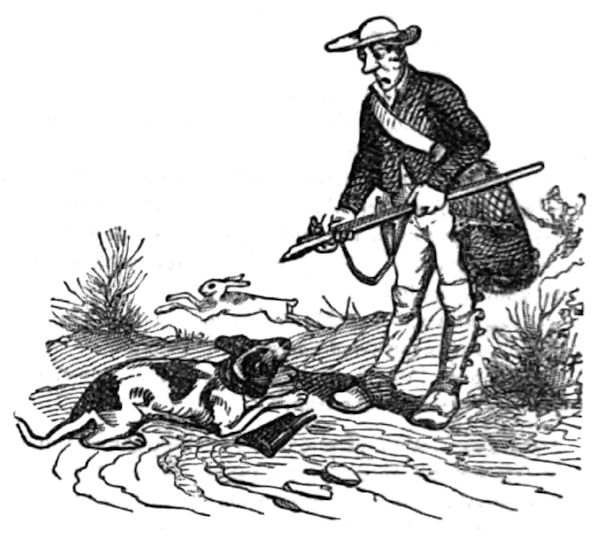
An Experienced Shot.—You’re a pretty dog!—now aint you? See what you’ve gun-un done?
Mr. Thos. Bristow, the Writing-Master, has finished
and intends to present a very fine fac simile letter
of Washington’s Farewell Address to the United States
Government. The whole design and execution is such
as to reflect the highest credit upon Mr. Bristow as a
teacher of “the Chirographic art.”
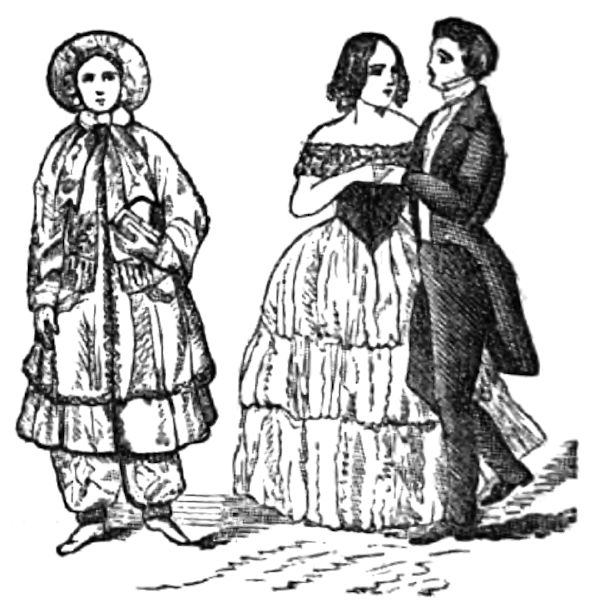
Fashions.—“Three full-length Figures.”
Determined not to be outdone in generosity, and to
meet the views of the critics fully, we present “the
latest styles” as reported by Mrs. Bloomer “expressly”
for her own paper—and give you Dodworth’s “dancing
style” as we find them reported in “The Clerk’s
Journal.”
Our Paris Fashions cost us $945 per month, for designing,
engraving, printing and coloring the edition of
Graham’s Magazine, and many sage and sapient critics
said they liked “the wood-cut style.” Well, now you
have got them—how do you like them? They cost the
almost unmentionable sum of $2, but are as good as the
biggest. It may be as well to mention, by way of description,
that the Bloomer is going to church—as soon
as she can get off from this dancing-party.
COMPOSED BY R. C. SHRIVAL.
Published by permission of F. D. BENTEEN & Co., No. 181 Baltimore Street, Baltimore.
Oh, share my cottage, gentle maid,
It only waits for thee,
To
give a sweetness to its shade,
And happiness, happiness to me,
Here from the splendid gay parade,
Of noise and folly free,
No sorrows can my peace invade,
If only blest with thee.
Then share my cottage, gentle maid,
It only waits for thee,
To give a sweetness to its shade,
And happiness, happiness to me.
The hawthorn with the woodbine ’twin’d
Presents their sweets to thee,
And every balmy breath of wind
Is filled with harmony:
A truly fond and faithful heart
Is all I offer thee,
And must I from your face depart,
A prey to misery.
Then share my cottage, gentle maid,
It only waits for thee,
To add fresh sweetness to its shade,
And happiness to me.
WORDS BY LONGFELLOW,
MUSIC BY H. KLEBER.
Published by permission of LEE & WALKER, 188 Chestnut Street, Philadelphia,
Publishers and Importers of Music and Musical Instruments.
Stars of the summer night,
Far, far in your azure
deeps;
Hide, hide your golden light,
She sleeps, my lady sleeps.
Moon of the summer night,
Far, down yon western steeps,
Sink, sink in silver light,
She sleeps, my lady sleeps, my lady sleeps.
Wind of the summer night,
Where yonder woodbine creeps,
Fold, fold thy pinions light,
She sleeps, my lady sleeps.
Dreams of the summer night,
Tell her, her lover keeps watch,
While in slumbers bright
She sleeps, my lady sleeps.
Transcriber’s Notes:
Table of Contents has been added for reader convenience. Archaic spellings and
hyphenation have been retained. Obvious typesetting and punctuation errors have been corrected
without note. Other errors have been corrected as noted below. For
illustrations, some caption text may be missing or incomplete due to condition of
the originals available for preparation of the eBook. Brief descriptions of illustrations without
caption have been provided in the plain text version of this ebook.
page 232, hearts the poets tale ==> hearts the poet’s tale
page 239, there were the mole ==> there where the mole
page 250, If your are willing to ==> If you are willing to
page 273, Valenciennes and Condè ==> Valenciennes and Condé
page 273, defection of Dumuoriez ==> defection of Dumouriez
page 273, skill of Dumuoriez ==> skill of Dumouriez
page 273, Dumuoriez’s more generous ==> Dumouriez’s more generous
page 282, wrote his Eikonoklases ==> wrote his Eikonoklastes
page 282, books, the Eikonoklases ==> books, the Eikonoklastes
page 285, his Eikonoklases, and ==> his Eikonoklastes, and
page 286, “Telemachus” of Fenelon ==> “Telemachus” of Fénelon
page 311, Arabian die to set ==> Arabian dye to set
page 312, the invading the ==> the invading of the
page 312, on that side the ==> on that side of the
page 317, the lines were beauty ==> the lines where beauty
page 332, The crimson die was ==> The crimson dye was
[End of Graham’s Magazine, Vol. XL, No. 3, March 1852]