“We lift our trusting eyes
From the hills our fathers trod;
To the sunshine of the skies.
To the sabbath of our God.”
Ten years after the events noticed in our last chapter,
a pleasant village was rapidly springing upon the
sunny lake-side, so long tenanted only by the lonely
refugees. The broad old forest had been rudely cut
away by the axe of the settler, and cottage-homes
were reared thickly side by side. The emigrant’s
hut had been transformed into an elegant mansion,
whilst the green lawn in front, sloping down to the
water, and planted with shrubbery and vines—was
the play-ground of happy children. At a little distance,
among the trees, a pretty church raised its slender
spire toward heaven, and behind it, several mounds
of fresh earth told plainly there was no retreat from
death. But who was the dark-haired pastor that had
first awakened the voice of prayer in that remote settlement?
The imagination of the reader will furnish
a ready reply.
Oliwibatuc had gone to his rest! Faithfully, had
his devoted young captive labored to sow with good
seed the hearts of his red brethren, and in some instances,
the scalping-knife and tomahawk had been
buried by the living warrior; but after the death of
the old chief, he had taken up his abode with Lord
Temple, having been married to Anna soon after the
death of Red-Bird. Long and happily did they dwell
together, wondering much that an over-ruling providence
should have watched over the divided current
of their lives, and united them so mysteriously in a
far, foreign land. Lord Temple lived until his head
was white with four-score years; but until death retained
his Quaker dress and appellation.
That village is now a beautiful and flourishing
town in the heart of the old empire State. The lone
canoe of the Indian long since disappeared from the
blue lake, but hundreds of snowy sails now whiten
its waters. Few of the busy multitude that now
throng these streets, could point the curious traveler
to the spot on which stood the humble cottage of the
first settler—many would not even remember his
name; but go to the ancient records, and there you
will find that as early as 1660, a wealthy Quaker,
calling himself John Brown, made purchase of a large
territory of the Mohawk chief, and settled upon it
with his own family—that he afterward built a church
of the Presbyterian order, and endowed it with a
fund, for its after-support, and left at his death many
rich legacies. It is also added, that much mystery
shrouded the aforesaid Brown, and by some he
was supposed to have been an associate of Oliver
Cromwell.
An elegant edifice stands now on the site of the
little church of the first settler; but the burying-yard
behind it remains unchanged, and there on a
broad slab may still be traced, a long obituary of John
Brown, the earliest settler, and by his side sleeps the
first pastor of that ancient church, of whom it is recorded,
that he labored for a number of years as a
faithful missionary among the Mohawks, by whom
he was taken captive; and, afterward, for nearly
forty years, as the minister of the first church of
Christ in the wilderness. By his side, sleeps Anna,
his wife—and children, and children’s children are
around in long ranks, with the slumber of years upon
them.
Reader! My story is brought to a close. It but
feebly illustrates the chance and change of life—but
if it serve to awaken a more earnest interest in those
who have gone before us, its author will not have
spent those few pleasant hours amid the records of
the past in vain. Life is not all with us! Those
who trod the paths we are now treading, knew as
much of its joys and sorrows—perchance even more
than ourselves, and would we search more deeply
the annals of our forefathers, our toil would often be
rewarded with histories as full of vicissitude and adventure,
as that of the illustrious Judge Temple, or
the Vaudois peasant-boy of the Alps!
(OR THE GILIA TRICOLOR.)
———
BY ERNESTINE FITZGERALD.
———
Thus have ye named this modest flower,
Bright Gilia—of colors three:
What hath God given as its dower?
In what doth it resemble me?
Tiny, it hath persistent power—
It heedeth storm nor frost, ye see.
If therefore ye have named it thus,
More fitting fond ye will not find:
“But Ernestina makes more fuss,
At wintry frost and chilling wind,
Than hosts on hosts, robust like us!”
Persistence, love, is in the mind.
The little blossoms of her soul
Come forth at every sun-ray’s will:
Glance at the seed-calls! every stroll
Of warmth from heaven doth some one fill:
Let cloud and tempest o’er her roll,
The flowret and the fruit come still.
Well has love named the humble flower,
Meek Gilia, of colors three;
Well have ye placed it in your bower,
To emblem there, Humility;
Thus may it gain a higher power
Than it may ever claim from me.
———
BY T. YARDLEY.
———
With walking wearied, sat I, at the time
When, pausing far above the world, the sun
Seems musing whether he shall higher climb
The pathway up to heaven; or the one
Retrace till eve, which was at morn begun;
Or drive his cloud-clad coursers from the shade
Where lie the lightnings when the storm is done,
And where the rainbows by the saints are made,
O’er many a western wild and island everglade.
’Twas one of those sweet noons the restless soul
Most loves to dream of. Just enough of breeze
To chase the overheated air and roll
Away in music. Silent symphonies,
Among the olden avenues of trees,
The spirit gathered, weaving into wings,
To waft it up through space-encircling seas,
Whose waves are inspiration, and where rings
The octave of the spheres, with quiv’ring echoings.
My ever eager eyes, with quenchless thirst,
Drank in the glory of the scene. Before,
Commingling mountains, indistinct at first
And far, sublimely rose: each range would o’er
The rearward, slow-ascending summits soar,
Like some vast army on the Appenines,
With all the bright artillery of war,
Banners of painted clouds, with proud designs,
Helmets and jeweled shields along the glitt’ring lines.
Below me slept a valley, with its fields
O’erflowing with the ripe and yellow corn:
And harvesters, whose distance-mellowed peals
Of laughter touched the ear, as echoes borne
At vesper hour from some far Alpine horn,
Reclined, at length, beside a narrow stream
That lingered lullingly beneath its worn,
Wild-blossomed banks awhile, and then would gleam
Away and windingly, like music in a dream.
Slow sloping shores, o’er-velveted with green—
Old oaks, which, sighing softly, seemed aware
That summer is not always, as between
Their branches breathed the wing-unweary air—
Blue skies that bent above, serenely fair—
And tinklings faint of distant bells among
The snowy sheep and herds of kine, that where
The grass was deepest browsed—gave to the young,
Reposing there, an Eden-hour, and brightly hung,
Round age’s mem’ries, as at eventide,
By lighted lamps, glow carved transparencies.
I felt the perfume-freighted zephyrs glide
On tiptoe by me from the midst of these:
And as they whispered lowly, by degrees
My brain grew dizzy with felicity;
And fancy, with the warm realities,
Mingled such floating, fairy imagery,
That all was isles of Greece and air of Italy.
There seemed low music swelling from afar.
Which, as it nearer came, grew lovelier;
And then smooth, iv’ry voices, such as are
Heard only from some heavenly messenger,
With harp-like pinions, warning ere we err
In words that die not, and through after time,
When evil tempts us, draw us nearer her.
And as in thought I saw the Past, sublime,
With many a sunny sky and calm Arcadian clime,
The cooling rippling of the stream of song
More deeply in its tone went sweeping by;
For other rills, its winding way along,
Had mingled with its waters leapingly.
And skimming swift the waves with ear and eye,
I found the fountains whence the river came—
A group of singing sylphs—and standing by
The one that looked the queen, though robed the same,
And languishingly lovely—Idleness her name.
Her dark, luxuriant hair fell loosely o’er
A neck that said a thousand things unthinking,
And soft as if ’twere only fashioned for
A pillow to support a loved head sinking
Beneath the draught, deliriously drinking,
Of her resistless beauty; and her eyes
Were open volumes, which, like planets blinking,
Seemed saying, “Read us, all around us lies
The starry Infinite—the realm of Mysteries.”
Her thoughts environed me, for with a smile
And gesture of her hand, the group arose;
And pausing as they neared me, for awhile,
Drew round, encircling, in converging rows,
Enshrouding me in incense. A repose
Crept through my senses, such as sweetly stole
Over the Lotus-eaters—such as throws
Its dreamy spells around the bounding soul,
Like silken lassos, where the waves of Lethé roll.
And I was borne aloft through azure air,
Her warm, white arms around me, and her cheek
Close pressed to mine; her cooling, curling hair
Bathing my temples, as in Easter week,
In Rome’s cathedrals, ere the Fathers speak,
They lave in holy-water. Unopposed,
My burning, lightning-learning lips would seek
With hers communion; and though undisclosed
The secrets whispered, yet our hearts full well supposed.
We floated on, with wings extended wide,
To that fair region, where the thoughts of men,
The holiest they breathe, like angels glide,
Gathering the purely beautiful, and then
Returning laden to the earth again—
Imagination’s realm—the vast Unknown,
Full of as glorious images as when
The first Thought-angel gazed within, alone,
And will be while the world has evil to atone.
I touched Futurity’s thrice veiled domain.
And felt the moments of swift coming years
Fall sparklingly around me, like the rain
From over-heavy clouds of unwept tears,
Dropping through sunlight; while my eager ears
Caught from far sounding avenues, a name
Like mine, breathed in the tones affection hears
Swelling so sweetly on the earth the same,
Though lowly laid in flowers, the lips from whence they came.
My brain reeled with repletion, and no more,
Through such celestial scenes, and thus to be
Clothed with mortality, could I explore.
Fading, still fading slowly, I could see
The rolling prairie-land of Poesy,
Blooming with stars, and eastwardly a light,
Like the full moon rising gloriously,
Which streamed o’er it from Heaven—then our flight,
Unwilled, was earthward, with the soul’s archangel, Night.
Full many a shadow o’er the sun and me,
Subduing both a time, has passed since then;
And darker, colder ones in store may be
Unopened, with the woes awaiting men:
But still, in rose-wreathed summer, sometimes, when
The hour is noontide, and the noontide fair,
Sweet Idleness bends over me again
And whispers of Elysium—while Care
Flaps her broad, vulture wings and melts away in air.
———
BY EMILY HERRMANN.
———
The grape-leaf’s edge is crisping
Beside our window-pane;
Small chirping things are shrinking
From cold October rain.
I hear the pattering of its feet
All round about our home—
Among the loosely garnered shocks,
Along the runnel’s foam.
There sings no bird among our trees—
Whose robes are waxing thin—
And yellow leaves, on withered grass,
Dim graves are sinking in.
Chilling is touch of Autumn rain,
Darkly the gray cloud lowers,
Shutting the sunlight from our paths
Among the drooping flowers.
Yet gently, as to our weary brows
Come folding wings of sleep,
It moves along the furrowed fields
Where summer dust lies deep.
Bravely ’twill nurse the infant grain
That in its cradle lies,
And nerve it to struggle with the storm
Before old Winter’s eyes.
And now how quietly all about
October sunlight falls;
Tracking, with stars, the evening rain,
Sparkling on dead leaves’ palls.
Moving, in shocks of garnered maize,
Is many a fluttering wing;
And the wheat smiles to gentle light
As if ’twere a living thing.
In showers, their crimson garments fall
From off majestic forms,
Whose hearts, in the living sap kept warm,
Are fearless of wildest storms.
Round us the forest, in mellow haze,
Shuts a still glory in;
Under its shadow the cattle graze—
Soon to it we shall win!
Shaking their nuts from laden limbs,
Sharing the squirrel’s mite,
Gaily we’ll gather on tufted moss
In the yellow Autumn light.
By freshening green on the fading grass
Life in its depth has stirred,
We are not alone among changing leaves,
For, hark! there’s a singing bird!
———
BY JAMES M’CARROLL.
———
When, in his strength, the monarch of the air
Soars proudly through the azure fields of heaven,
His pinions burning in the noontide glare,
Or flashing in the deep red dyes of even,
He sees the earth receding from his eye,
And looking round him, in his chainless glee,
Utters a loud, a long, wild, piercing cry—
And that’s the joyous shout of Liberty.
But when he leaves those vast ethereal plains,
And falls into the fowler’s hidden snare,
Beneath the icy pressure of his chains,
How soon his sounding wing hangs listless there;—
And oft, as o’er their galling links he broods,
Dreaming of the bright hours when he was free,
He looks up through those shining solitudes,
And shrieks—the bitter shriek of Slavery.
If thus ’tis, from the eagle to the dove,
Say, how can we upon our fetters smile,
Save those that, woven by the hand of Love,
Are round us flung with many a tender wile?
So pure a shrine of Freedom is the soul,
That could our chains lose all their weight and chill,
And, ’twined with light, extend from pole to pole,
We’d sigh and feel that we were captives still.
———
BY SAMUEL MARTIN.
———
When we see an insect in the fields pumping a
sweet fluid from the nectaries of flowers, and carrying
it home and storing it in convenient receptacles,
which it carefully covers so as to exclude the dust
and hinder evaporation, we are filled with devout
astonishment; and as we write hymns about the
“Little Busy Bee,” in her industry and foresight,
and curious contrivances, we recognize an all-pervading
Mind and an all-controlling Hand. And in
this we are right. But here is another animal, still
more resourceful and provident. The bee collects
the honey from such flowers as happen to contain it,
and which yield it almost ready-made; but she takes
no trouble to secure a succession of those flowers or
to increase their productiveness. This other creature
is at infinite pains to propagate and improve his
favorite mellifluent herbs. From the sweet juices
of flowers the bee can only elaborate a single fluid,
while her rival from the same syrup can obtain a
multitude of dainties; and, according to the taste of
the consumer, he offers it in the guise of nectar or
ambrosia, in crystals of topaz or in pyramids of snow.
And when the manufacture is complete, the bee
knows only one mode of stowage; this other creature
packs it, as the case may require, in bags or baskets,
in boxes or barrels, all his own workmanship, and
all cleverly made. What, then, is the reason that
when we look at a honeycomb we are apt to be
reminded of the wisdom and goodness of God; but
looking at the same thing magnified—surveying a
hundred hogsheads of sugar piled up in a West
Indian warehouse—we have no devout associations
with the ingenuity and industry which placed them
there? Why are chords of pious feeling struck by
the proceedings of an insect, and no emotion roused
by the on-goings of our fellow-men?
We examine two paper-mills. The one is situated
in a gooseberry-bush, and the owner is a wasp.
The other covers some acres of land, and belongs to
a kind-hearted and popular legislator. But after
exploring the latter with all its water-wheels and
steam-engines, and with all the beautiful expedients
for converting rags into pulp, and then weaving and
sizing, and cutting and drying, and folding and packing,
we go away admiring nothing except human
skill; whereas, the moment Madam Vespa fetches
a bundle of vegetable fibres and moistens them with
her saliva, and then spreads them out in a patch of
whitey-brown, we lift our hands in amazement, and
go home to write another “Bridgewater Treatise,”
or to add a new meditation to Sturm. That a wasp
should make paper at all is very wonderful; but if
the rude fabric which she compiles from raspings of
wood is wonderful, how much more admirable is
that texture which, as it flows from between these
flying cylinders for furlongs together, becomes a fit
repository for the story of the universe, and can receive
on its delicate and evenly expanse, not only
the musings of genius but the pictures of Prophecy
and the lessons of Inspiration!
However, it is said, the cases are quite distinct.
Man has reason to guide him; the lower animal proceeds
by instinct. In surveying human handiwork,
we admire the resources of reason; in looking at
bird architecture or insect manufactures, we are in
more direct contact with the Infinite Mind. Their
Maker is their teacher, but man is his own instructor;
and, therefore, we see the wisdom and goodness
of God in the operations of the lower animals
more clearly than in our own.
Without arguing the identity of reason and instinct,
it will be admitted that the lower animals
frequently perform actions which imply a reasoning
process. Reverting to our insect illustrations, Huber
and others have mentioned cases which make
it hard to deny judgment and reflection to the wasp;
and the reader who is himself “judicious” will not
refuse a tiny measure of his own endowments to the
bee. On a bright day, four or five summers since,
we were gazing at a clump of fuchsias planted out
on a lawn, not far from London. As every one
knows, the flower of the fuchsia is a graceful pendent,
something like a funnel or red coral suspended
with the opening downward; and in the varieties
planted on this lawn the tube of the funnel was long
and slender. In the case of every expanded flower,
we noticed that there was a small hole near the
apex, just as if some one had pierced it with a pin.
It was not long till we detected the authors of these
perforations. The border was all alive with bees,
and we soon noticed that in dealing with the fuchsias
they extracted the honey through these artificial
apertures. They had found the tube of the blossom
so long that their haustella could not reach the honey
at its farther end; and so, by this engineering stratagem,
they got at it sideways. Surely this was
sensible. When a mason releases a sweep stuck
fast in a chimney by digging a hole in the gable, or
when a chancellor of the exchequer gains a revenue
by indirect taxation, he merely carries out the principle.
And what makes the manœuvre more striking,
is the fact that the problem was new. The
fuchsias had come from Mexico and Chili not many
years ago; whereas the bees were derived from a
long line of English ancestors, and could not have
learned the art of tapping from their American congeners.
In cases such as these, and hundreds which
might be quoted, no one feels his admiration of the
all-pervading Wisdom lessen as instinct approaches
reason, or actually merges in it. In the case of the
inferior animals no one feels—The more of reason,
the less of God. And, because man is all reason
together, why should it be thought that in human inventions
and operations there is nothing divine?
How is it that in the dyke-building of that beaver,
or the nest building of that bird, so many mark the
varied evolutions of the Supreme Intelligence; but,
when they come to the operations of the artisan or
the architect, they are conscious of an abrupt transition,
and, feeling the groundless holy, they exclaim,
“God made the country, but man made the town?”
One would think that the right way to regard human
handiwork is with the feelings which an accomplished
naturalist expresses:—“A reference to
the Deity, even through works of human invention,
must lead to increased brotherly love among mankind.
When we see a mechanic working at his
trade, and observe the dexterity which he displays,
together with the ingenious adaptation of his tools
to their various uses, and then consider the original
source of all this, do we not see a being at work,
employing for his own purposes an intelligence derived
from the Almighty?—and will not such a consideration
serve to raise him in our opinion, rather
than induce us to look down slightingly upon him for
being employed in a mechanical trade? For my
own part, when I watch a mechanic at his work I
find it very agreeable, and, I believe, a very useful
kind of mental employment, to think of him as I
would of an insect building its habitation, and in both
see the workings of the Deity.”[7]
And yet it must be admitted that few have the feelings
which Mr. Drummond describes. They cannot
see as much of God in the manipulations of the
mechanic as in the operations of the bird or the
beaver; nor can a life-boat send their thoughts upward
so readily as the shell of a nautilus or the float
of a raft-building spider.
The difference is mainly moral. Man is sinful.
Many of his works are constructed with sinful motives,
and are destined for evil purposes. And the
artificer is often a wicked man. We know this, and
when we look on man’s works we cannot help remembering
this. It is a pure pleasure to watch a
hive of bees, but it is not so pleasant to survey a
sugar plantation in Brazil, there is a painful thought
in knowing how much of their produce will be manufactured
into intoxicating liquors. It is pleasant to
observe the paper-making of a hymenopterous insect;
for it does not swear nor use bad language at
its work, and, when finished, its tissues will not be
blotted by effusions of impiety and vice; but of this
you can seldom be assured in the more splendid
manufactures of us lords of the creation. But if this
element were guaranteed—if the will of God were
done among ourselves even as it is done among
the high artificers of heaven and among the humble
laborers in earth’s deep places—our feelings
should be wholly revolutionized. If of every stately
fabric we knew, as we know regarding St. Paul’s,
that no profane word had been uttered all the time
of its construction; if of every factory we could hope,
as of the mills at Lowell, that it is meant to be the
reward of good conduct and the gymnasium of intelligence
and virtue; if of every fine painting or statue
we might believe that, like Michael Angelo’s works,
it was commenced in prayer; this suffusion of the
moral over the mechanical would sanctify the Arts,
and in Devotion’s breast it would kindle the conviction,
at once joyful and true, “My Father made
them all.”
Still, however, in man’s works, we are bound to
distinguish these two things—the mechanical and
the moral. When God made man at first, he made
him both upright and intelligent; he endowed him
with both goodness and genius. In his fall he has
lost a large amount of both attributes; but whatever
measure of either he retains is still divine. Any
dim instincts of devotion, as well as every benevolent
affection which lingers in man’s nature are
relics of his first estate; and so is any portion of intellectual
power which he still possesses. Too often
they exist asunder. In our self-entailed economy
of defect and disorder, too often are the genius and
the goodness divided. Too many of our good men
want cleverness, and too many clever men are bad.
But, whether consecrated or misdirected, it must
not be forgotten that talent, genius, dexterity, are
gifts of God, and that all their products, so far as
these are innocent or useful, are results of an original
inspiration.
It is true that his Creator has not made each individual
man an instinctive constructor of railways
and palaces, as he has made each beaver a constitutional
dyke-builder and each mole a constitutional
tunnel-borer. But he has endowed the human
race with faculties and tendencies, which,
under favoring circumstances, shall eventually develop
in railways and palaces as surely as beaver
mind has all along developed in dykes, and mole
mind worked in tunnels. And just as in carrying
out His own great scheme with our species, the
Most High has conveyed great moral truths through
all sorts of messengers—through a Balaam and a
Caiaphas as well as a Daniel and a John;—so, in
carrying out His merciful plan, and gradually augmenting
our sum of material comfort, the Father
of earth’s families has conveyed His gifts through
very various channels, sometimes sending into our
world a great discovery through a scoffing philosopher,
and sometimes through a Christian sage. Be
the craftsman what he may; when once we have
separated the moral from the mechanical—the sin
which is man’s from the skill which is Jehovah’s—in
every exquisite product, and more especially in
every contribution to human comfort, we ought to
recognize as their ultimate origin the wisdom and
goodness of God. The arts themselves are His gift;
the abuse alone is human. And just as an enlightened
Christian looks forth on the landscape, and in
its fair features as well as its countless inhabitants
beholds mementoes of his Master; so, surveying a
beautiful city, its museums and its monuments, its
statues and fountains, or sauntering through a gallery
of art or useful inventions—in all the symmetry of
proportion and splendor of coloring, in every ingenious
device and every powerful engine, he may
read manifestations of that mind which is “wonderful
in counsel and excellent in working;” and,
so far as skill and adaptation and elegance are involved,
piety will hail the Great Architect himself
as the Maker of the Town.
Reason may be regarded as the Instinct of the human
race. Like instinct, commonly so called, it has
an irresistible tendency toward certain results; and
when circumstances favor, these results evolve. But
reason is a slow and experimental instinct. It is
long before it attains to any optimism. The inferior
races are only repeating masterpieces which their
ancestor produced in the year of the world One.
Man is constantly improving on his models, and
there are many inventions on which he has only hit
in this 59th century of his existence. Nevertheless,
as the oak is in the acorn, so these inventions have
from the first been in the instinct of humanity.
That is, if you say that its nest was in the mind of
the bird, or its cocoon in the mind of the silk-worm
as it came from the hand of its Maker, and if you
consequently deem it true and devout to recognize
in these humble fabrics a trace of the wisdom which
moulds the universe; so we say that the Barberini
Vase and the Britannia Bridge existed in the mind
of our species when first ushered into this earthly
abode, and now in the providential progress of events
these germs have developed in structures of beauty
or grandeur, whilst admiring the human workmanship,
it is right and it is comely to adore the original
Authorship.
His are the minerals and the metals, the timbers
and the vegetable tissues, from which our houses
and our ships, our clothing and our furniture, are
fabricated. Of these, the variety is amazing, and it
plainly indicates that, in the arrangements of this
planet, the Creator contemplated not only the necessities
but the enjoyments of his intelligent creatures.
For instance, there might have been only one or two
metals; and the eagerness with which tribes confined
to copper, or to gold and silver, grasp at an axe
or a butcher’s whittle, shows how rich are the
tribes possessing iron. But even that master-metal,
with all his capabilities, and aided by his three predecessors,
cannot answer every purpose. The
chemist requires a crucible which will stand a powerful
heat, and which, withal, does not yield to the
corroding action of air or water. Gold would answer
the latter, and iron the former purpose, well;
but every one knows how readily iron rusts and how
easily gold melts. But there is another metal—platinum—on
which air and water have not the slightest
action, and which stands unscathed in the eye of a
furnace where iron would run down like wax, and
gold would burn like paper. In the same way there
are many ends for which none of these metals are
available, but which are excellently answered by
tin, and lead, and zinc, and rhodium, and mercury.
Or will the reader bestow a passing thought on his
apparel? His forefathers found one garment sufficient,
and for mere protection from the weather a
suit of cat-skin or sheep-skin might still suffice. But,
oh reader! what a romance is your toilette! and
should all the rest of you be prose, what a poem you
become when you put on your attire! That snowy
lawn once blossomed on the banks of the Don or the
Dnieper, and before it shone in a London drawing-room,
that broad-cloth comforted its rightful owner
amidst the snows of the Cheviots. Did these boots
really speak for themselves, you would find that the
upper leathers belonged to a goat, and the soles to a
horse or a cow. And could such metamorphic retributions
happen now as in the days of Ovid, the best
way to punish the pride of an exquisite would be to
let every creature come and recover his own. A
worm would get his satin cravat, and a pearl oyster
his studs; and if no fabulous beaver laid claim to his
hat, the rats of Paris or the kittens of Worcester
would assuredly run off with his gloves. But
viewed in a graver and truer light, it is marvellous
from how many sources we derive the several ingredients
in the simplest clothing, many of them
essential to health, and most of them conducive to
our well-being; so that we need not go to the
crowded mart or the groaning wharf in order to convince
ourselves of earth’s opulent resources. Few
will read these pages who have not the evidence at
home. Open that cupboard, unlock that wardrobe,
look round the chamber where you are seated, and
think a little of all the kingdoms of Nature and all
the regions of the globe from which their contents
have been collected, and say if the Framer of this
world is not a bountiful Provider. “O Lord, how
manifold are thy works! The earth is full of thy
riches; so is this great and wide sea.”
The Supreme Governor has so ordered it, that the
progress of the arts—that is, of human comfort and
accommodation—shall be nearly in proportion to
human industry, sobriety, and peacefulness. The
last thirty years have been fraught with inventions,
chiefly because they have been years of peace. In
England, however, the reign of Charles II. was tolerably
tranquil; but, except for the accident of Newton
and the Royal Society, its peace was the parent
of few discoveries, for it was a peace which had
converted the noise of the warrior, not into the quiet
of the artisan, but into the din of the drunken debauchee.
Such honor does the Most High put upon
peaceful activity and sober perseverance, that wherever
these exist economic comfort is sure to follow.
Thus, without uncommon intellectuality, and with
a false religion, the Chinese anticipated many of the
arts of modern Europe. Whilst Christendom, so
called, was divided betwixt lazy monks and a brutal
soldiery—whilst mediæval churchmen were droning
masses, and feudal barons amused themselves in
knocking out each other’s brains—the Chinese, neither
fierce nor indolent, were spinning silk and manufacturing
porcelain, compiling almanacs, and sinking
Artesian wells. And long before any Friar Schwartz,
or Gutenberg, or Flavio di Gioia, had revealed
them to the Western World, the pacific and painstaking
Chinese were favored with prelibations of our
vaunted discoveries—gunpowder, book-printing, and
the mariner’s compass.
We have compared our world to a well-furnished
dwelling, in which, however, many of the treasures
are locked up, and it is left to patience and ingenuity
to open the several doors. Caoutchouc and gutta
percha have always been elastic and extensible; but
it is only of late that their properties have been ascertained
and turned to profitable account. The
cinchonas had grown for five thousand years in Peru
before the Jesuit missionaries discovered the tonic
influence which the bark exerts on the human system.
Steam was always capable of condensation,
so as to leave in its place a vacuum; but it is only a
century and a half since it struck the Marquis of
Worcester to employ this circumstance as a motive
power. And ever since our earthly ball was fashioned,
electricity has been able to sweep round it at
the rate of ten times each second, though it is only
within the last few years that Professor Wheatstone
thought of sending tidings on its wings. And doubtless
the cabinets still unlocked contain secrets as
wonderful and as profitable as these; whilst the language
of Providence is, “Be diligent, and be at peace
among yourselves, and the doors which have defied
the spell of the sorcerer and the battle-axe of the
warrior will open to the prayer of harmonious industry.”
So thoroughly provided with all needful commodities
is the great house of the world, that, in order
to obtain whatever we desiderate, seldom is aught
else requisite than a distinct realization of our want
and a determined effort to supply it. In working
mines, one of the difficulties with which the excavator
has to contend is the influx of water. The effort
to remedy this evil gave birth to the steam-engine;
and, with the relief afforded by the steam-pump,
many mines are easily and profitably wrought which
otherwise must have long since become mere water-holes.
But a worse enemy than water encounters
the collier, in the shape of fire-damp, or inflammable
gas. Formerly, in quarrying his subterranean gallery,
the axe of the unsuspecting pitman would pierce
a magazine of this combustible air, and unlike
water, there being nothing to bewray its presence, it
filled the galleries with its invisible serpent-coils;
and it was not till a candle approached that it revealed
itself in a shattering explosion, and a wretched
multitude lay burning and bleeding along its track—a
fearful hecatomb to this fiery dragon. What was
to be done? Were the blast furnaces of Wales and
Wolverhampton to be extinguished, and were household
fires to go out? Or, for the sake of a blazing
ingle and good cutlery, were brave men still to be
sacrificed to this Moloch of the mine? The question
was put to Science, and Science set to work to solve
it. Many good expedients were suggested, but the
most ingenious was in practice the simplest and
safest. It was ascertained that a red heat, if unaccompanied
by flame, will not ignite the fire-damp;
and it was also known, that the most powerful flame
will not pass through wire-gauze, if the openings
are sufficiently small. A lamp or a candle might,
therefore, be put into a lantern of this gauze, and
then plunged into an atmosphere of inflammable air;
and whilst the flame inside the lantern gave light
enough to guide the laborer, none of that flame
could come through to act as a match of mischief.
And now, like a diver in his pneumatic helmet, the
miner, with his “Davy,” can traverse in security,
the depths of an inflammable ocean.
So plentiful is the provision for our wants, that
little more is needed than a distinct statement in
order to secure a supply. During his long contest
with England, and when both the ocean and the
sugar-growing islands were in the power of his enemy,
Napoleon said to his savans, “Make sugar for
the French out of something which grows in
France.” And, like Archimedes with the tyrant’s
crown, they set to work on the problem. They
knew that sugar is not confined to the Indian cane.
They knew that it can be obtained from many
things—from maple, and parsnips, and rags; but the
difficulty was to obtain it in sufficient quantities, and
by an inexpensive process. However, knowing the
compartment in which the treasure was concealed,
they soon found the key; and it was not long till
beet-root sugar was manufactured in thousands of
tons, nearly as good, though not nearly so cheap, as
the produce of England’s colonies. A few years
ago the British Foreign Office had a dispute with the
Neapolitan Government. The best sulphur is found
in Sicily, and from that island Great Britain imports
for its own manufactures about 20,000 tons a year.
On the occasion referred to, the Neapolitan Government
was about to complete an arrangement which
would have enormously enhanced the price of this
important commodity. Some wished that England
should make it a casus belli, and send her ships of
war to fetch away the brimstone by force. But
the chemists of England took the quarrel into their
own hands; and, had not the King of Naples
yielded, doubtless we should now have been supplied
with sulphur from sources at command but
yet undeveloped.
A modification of the same problem is constantly
occurring to practical science, and its almost uniform
solution shows that our world has been arranged
with a benevolent eye to the growing comfort of the
greater number. Science is perpetually importuned
to cheapen commodities; and by substituting a simple
method for an intricate process, or by making a
common material fulfill the part of a rare one, it is
every year giving presents to the poor. Few substances
are more essential to our daily comfort than
soda. It is a large constituent of glass and soap, and
many other useful articles. The cleanliness of a nation
depends on the cheapness of soda; and if soda is
cheap, you can substitute plate-glass for crown in
your windows, and you can adorn your apartments
with glazed pictures and mirrors. So that from the
bleacher who spends thousands-a-year on the carbonate,
to the apprentice who in the dog-days lays out a
penny on ginger-beer or soda-water, all are interested
in the cheapness of soda. But this alkali used to be
dear. Small quantities were found native, and larger
supplies were obtained from the burning of sea-weed.
Still the cost was considerable. However, it was
well known that a vast magazine of the precious article
surrounds us on every side. The sea is water
changed to brine by a salt of soda. If only a plan
could be contrived for separating this soda from the
hydro-chloric acid, which makes it common salt,
there is at our doors a depot large enough to form a
Mont Blanc of pure soda. That plan was discovered;
and now a laundress buys a pound of soda (the carbonate)
for three half-pence, and the baker of unfermented
bread can procure the more costly bicarbonate
for sixpence.
Lately, if not still, in the shops of provincial apothecaries,
no article was in such demand as one styled
in the Pharmacopœia, muriate of magnesia. This
popular medicine was first obtained by evaporation
from certain mineral waters, and as the supply was
limited the price was high. But few ingredients
could be cheaper than the earth and the acid from
which it is combined. The earth forms whole
mountains, and the acid is that cheap one set free
when the soda is separated from common salt. Accordingly,
chemists went to work, and in their laboratories
did what the mineral spring had been doing
since the Deluge, and by a simple process they manufactured
the muriate of magnesia. A few years
ago, looking at the remarkable rocks of magnesian
limestone which defend the Durham coast, near
Shields, our companion remarked, “Many a hundred
tons of these rocks have we converted into Epsom
salts!”
“Waste not, want not.” An adage which received
a touching sanction when, after a miraculous feast,
and when He could have converted the whole region
into bread, the Saviour said, “Gather up the fragments,
that nothing be lost.” And in the progress
of discovery, God is constantly teaching us not to
waste anything, for this is a world of which nothing
need be lost. At the woollen factories of Rheims
there used to accumulate a refuse, which “it cost
something to throw away.” This was the soap-water
containing the fatty matters washed from the
woollen stuffs, along with some soda and other ingredients.
With its offensive scum this soap-water
was a nuisance, and required to be put out of the
way with all convenient speed. But now, from one
portion of it gas is manufactured, sufficient to supply
all the works, and the remainder yields a useful
soap.[8] In the same way, when Lord Kaims found
himself proprietor of an extensive peat-moss in the
neighborhood of Stirling, with characteristic energy
he commenced its improvement. On digging through
the moss, he came to a rich alluvial soil; so that to
his sanguine imagination, fifteen hundred acres, at
whose barrenness his neighbors laughed, were a
splendid estate, covered over meanwhile by a carpet
seven feet thick. To lift this carpet was the puzzle:
for every acre of it weighed some hundred tons.
But “the mother of invention” is the near kinswoman
of most Highland lairds, and “necessity” suggested
a plan to Lord Kaims: a plan which must
have approved itself to the mind of a judge, for, by a
sort of retributive process, it forced the element
which had done the damage to undo it again. By a
hydraulic contrivance, a powerful current of water
was made to traverse the moss and carry off the
loosened fragments, till they reached the river Forth,
and were finally floated into the German Ocean.
And now “a waste,” which last century was the
haunt of the curlew, is covered with heavy crops,
and yields its proprietor a revenue of two or three
thousand pounds a year. But had Lord Kaims foreseen
Mr. Reece’s researches into the composition
and capabilities of “bog-earth,” he would, perhaps,
have hesitated before he consigned such a treasure to
the deep. At this moment we are writing by the
light of a candle which last year was a peat! And,
however opinion may differ as to the probable expense
of the process, there can be no doubt that peat yields
in large quantities the ammonia which is so largely
used by farmers; the acetic and pyroligneous acids,
extensively employed by calico-printers, hatters, etc.;
and, along with naptha, a fatty substance capable of
being converted into beautiful candles; so that Mr.
Owen’s benevolent calculation will, doubtless, sooner
or later be fulfilled, and “Irish moss” become a cure
for Irish misery.[9] It is pleasant to know that on
every side we are surrounded with mines of unexamined
wealth. Some of the old workings may be
exhausted; but if we be only devout and diligent
new veins will open. Forty years ago, so much oil
was required for lighting the streets of cities as well
as for private dwellings, that fears began to be entertained
lest the great oil-flask of the Northern Ocean
might run dry, and the whale family be extirpated.
That fear was superseded when, in 1812, gas illumination
was introduced.
“The best of things is water.” So sang a very
ancient Greek; and of all the fragments preserved in
Aristotle’s “Rhetoric,” hydropathy and teetotalism
have assigned the palm to this old water-poem. Not
so our ship-owners. To them the sorest of problems
and the saddest of expenses is water. Soup can be
inspissated into osmazome, and meat can be squeezed
into pemican; but water is not compressible, and it
is rather provoking to see the space available for
stowage occupied by tanks and barrels of this cheap
element. Many expedients have been suggested,
and some have partially succeeded. But since we
began to write this paper, our attention has been
called to a beautiful contrivance which promises to
conquer every difficulty. By means of Mr. Grant’s
Distilling Galley,[10] the brine may be pumped up from
the ocean, and, after cooking the mess of the largest
ship’s company, it may be collected in the form of
the purest fresh water, to the extent of some hundred
gallons each day. Nor is it only a vast saving of
room which is effected by this beautiful expedient.
It is a saving of time. Frequently ships are compelled
to leave the straight route, and sometimes lose a
favoring wind, in quest of water. But a ship provided
with this apparatus is as independent as if she
were sailing over a fresh water lake; and, instead of
putting into port, she has only to resort to the never-failing
pump. And we may add that it is not only
space and time which are saved, but the health of the
crew and the passengers. With every precaution cistern-water
is apt to spoil, and in the Indian Seas and
other regions the water obtained on shore is apt to
occasion disease. But the produce of this engine is
always as pure as the rain which falls from the
clouds.
When Pythagoras demonstrated the geometrical
proposition, that in a rectangular triangle the sum of
the two lateral squares is equal to the square of the
hypotenuse, he is said to have offered the sacrifice
of a hundred oxen. In modern art we fear that there
are many discoveries for which the thank-offering
has not yet been rendered.
Both the reader and the writer are deeply indebted
to that gracious Providence which has cast our lot in
the most favored of all times. Chiefly through the
progress of the Arts, the average of existence has
been lengthened many years, and into these years it
is possible to concentrate an amount of literary acquisition,
and moral achievement, and intellectual enjoyment,
for which Methuselah himself had not leisure.
For lives thus lengthened let us show our gratitude
by living to good purpose; and, remembering that
railways and telegraphs and steam-printed books are
the good gifts of God, let the age which enjoys them
be also the age of holiest obedience and largest benevolence.
———
BY J. P. ADDISON.
———
Falling, falling,
The snow is falling;
Floating, falling,
To the earth tending
With motion unending;
Floating, falling.
Veiled are the mountains,
Dim is the plain;
Who looketh afar,
He looketh in vain;
Wrapped in the shower,
Dark pines tower,
Shadow-like near,
Arms outspread,
As over the dead,
Solemn and drear.
Snow-birds cheerily
Chirp as they fly;
Ravens drearily
Answer on high:
Else, in the distance,
One who listens,
Naught may hear,
Voice nor sound,
In the country round,
Far or near.
Roof of the cottage
And vine at the door,
Chimney and lattice
Are rounded o’er;
The black tree
Is fair to see
In its net of snow,
And the apple-bough
Bends nearer now
To the casement low.
The paths lie buried,
The storm covers all,
The high-road wide
And the house-path small;
Hid is the stain
Of wind and rain
On the fences nigh,
And afar, each row
With the feathery snow
Is rounded high.
Muffled and heavily
Moveth the wain,
Wearily waiteth
And moveth again;
How for his hearth-fire
Sigheth the farmer
Here in the storm;
There, the fire verily
Crackleth merrily
Thinks he, and warm.
Gained that warm hearth-side,
Glad by the fire
’Mid his dear loved ones
Sitteth the sire.
“Ah the fire verily
Crackleth merrily,
Children mine,”
In the answering gleam
Glad faces beam,
The white walls shine.
Still it is falling,
The snow is falling,
Floating, falling;
To the earth tending
With motion unending,
Floating, falling.
A LEGEND OF OLD SALEM.
———
BY E. D. ELIOT.
———
(Continued from page 29.)
One day after one of the youth’s little visits to the
terrace, Captain and Mrs. Stimpson were sitting at
the door enjoying the afternoon breeze which came
fresh from the ocean, and watching the craft in the
harbor, when Judith came skipping up to the door,
with a great red rose in her hand. Her father accosted
her:
“Judy, my gal, where have you been? Sir’s
flower! Come, light old daddy’s pipe for him, and
tell what that youngster has been talking about so
long at the gate.”
“Oh, I will, sir,” (jumping on her father’s knee, and
putting the rose in his button-hole,) “if you will please
call me Judith, and not keep calling yourself old
daddy. You are not old, I am sure. He always
says pa, or my father, and it sounds so much prettier—don’t
it, ma?”
“He! who’s he?” chuckled the delighted father,
winking to his wife.
“Why, didn’t you say George Fayerweather,
sir?” asked Judith, stroking his chin. “He often
asks me why I don’t call you two, pa and ma.
Now, wont you promise not to laugh at me if I call
you so sometimes?”
“You may call me what you please, if you don’t
call me too late to dinner,” said her father. “But
you don’t tell your old dad—father, I mean—what
you’ve been talking about.”
“Why, he says,” she replied in a tremulous voice,
her rosy lip quivering, “he’s going to sea soon, to
be gone a year; and he says”—her eyes brightening—“that
he means to bring you home the handsomest
pipe he can find up the Straits.”
“I thank the lad, I thank him,” said the captain,
with his usual sonorous h-m-gh; “that youngster’s a
smart chap.” Turning to his wife—“Mind what I
say, he’ll turn out something remarkable.”
“And he is going to bring you, mother, a beautiful
tortoise shell snuff-box.”
“And what is he going to bring you, my darling?”
said her father.
“I told him I would not have any thing.”
“And what did he say to you, dear?” asked her
mother.
“Here comes old Mary to call us to tea,” said
Judith, glad to dispose of the interrogatory in so propitious
a manner.
Could you have seen Captain Stimpson at his well-furnished
board, you would have been at no loss to
account for his rotundity. Judith presided, with her
father and mother on the side at her left hand, old
grandsir Stimpson, in his arm-chair, at her right,
and Mr. Solomon Tarbox, the foreman of the rope-walk,
on the fourth side, opposite to her. A small,
japanned tea-tray was placed before her, upon which
were ranged the tea-cups of burnt china, about the
size of egg-shells, with saucers to match, a silver
sugar-dish and cream-pitcher, but little larger than
those which would grace a child’s baby-house at the
present day, and two shining black tea-pots, each
holding about a pint, one filled with the best bohea
and the other with boiling water.
A pewter tankard, filled with small-beer of Mrs.
Stimpson’s own brewing, was placed at her husband’s
right hand; it being a beverage of which he
was fond, not being able to bring himself to like the
new-fangled wishy-washy stuff called tea. Before
grandsir was placed a small mug of peppermint-tea,
which the old gentleman thought more healthful. A
lobster in his scarlet suit occupied the centre of the
table; flanked on one side by a parallelogram of
smoked salmon, six inches by seven; on the other
by a dish of cold baked beans. A plate of white
bread and another of brown, half an oblate spheroid
of butter, and a truncated cone of Dutch cheese
found a place on the table; and to crown all, a dish
of miracles, a kind of cake much in vogue in those
days, and not differing materially from the crullers
of New York, being the same, under a different
name, with the Massachusetts dough-nuts of more
modern date, excepting that the dough was formed
into grotesque figures, displaying the fancy of the
compounder to great advantage. In this article
Judith particularly excelled, few possessing either
her taste or fancy.
The old grandsir, in his white linen cap, pushed
a little back from his furrowed brow, with clasped
hands, and in a tremulous voice, asked a blessing; to
which his son responded with an audible amen, followed
by his usual h-m-gh. Judith commenced the
operation of pouring out the tea, first ascertaining
that her grandfather’s peppermint was to his taste,
and being commended by him for having his little
slip of salt fish broiled to a nicety; for notwithstanding
the usual abundance of his son’s table, the good
man always chose to have something prepared exclusively
for himself. Judith handed the tea with a
natural grace, equaling any elegance acquired at a
modern boarding-school.
Her father, after seeing that all were well supplied
with the good things on his table, took up his pewter
tankard, and with a respectful nod to the old gentleman
said, “Father, my sarvice to you; Miss Stimpson,
my sarvice; sarvice, sarvice,” nodding to Judith
and Mr. Tarbox; then applying the vessel to his lips,
he took a long and apparently a very refreshing
draught. Judith, though a beauty and a heroine,
despised not the vulgar enjoyments of eating and
drinking, but valued them as social pleasures.
After ample justice being done to the meal by all
parties, Captain Stimpson and Mr. Tarbox went off
to the rope-walk. Grandsir, removing his chair to a
window, where the afternoon breeze blew in refreshingly,
and placing his Bible, his favorite companion,
on his knees, was soon in a gentle slumber;
his head thrown back on his comfortable chair, and
his hands folded on the pages of the sacred volume
before him, opened at his favorite last of Revelations.
Mrs. Stimpson, taking up her knitting-work, sat herself
down by the side of the table, to superintend the
clearing away of the tea-things. She followed Judith
with her fond eyes, as the little maiden tripped
lightly about in her neat, speckled apron, putting
every thing in its place in the most housewifely
manner, and directing old Mary in an affectionate
and cheerful tone of voice.
She put away the tea-things in their accustomed
places, in the little buffet with glass-doors, at the
corner of the room, in which three mandarins of
china were conspicuous, one on the middle projection
of each shelf: then seating herself down at the window,
she began to ply her needle in the embroidering
of various figures in fine cat-gut to imitate lace;
a kind of ladies’ work as much in vogue in those
days as the worsted and crochet-work has been in
our day.
Captain Stimpson soon joined them with his pipe,
but their conversation was interrupted by a gentle
rap at the tea-room door, and on the captain’s opening
it, George Fayerweather appeared, with a lame
excuse for so soon repeating his visit. He was cordially
received by the captain, who invited him to
sit down, which he immediately did, in such a manner
as to occupy the whole width of a window in
the front parlor, to which the family now all adjourned;
grandsir rousing and going with them, as
he loved to doze by the sound of his children’s
voices. The evening being fairly set in, a light was
brought by old Mary; but being placed in a little
cupboard, the door of which was nearly closed, the
rest of the room was left in obscurity.
The little party remained for some time almost in
silence; the coolness of the hour, after the heat of the
day, bringing to each a sense of tranquil enjoyment,
which none felt disposed to interrupt by conversation.
It is in such moments, that throwing off the
cares of life, and forgetting its sorrows and disappointments,
in the presence of those best loved, one
feels possessed of a treasure of happiness—though
the hoard maybe small—which wholly fills the mind
and satisfies the wishes. “The heart” does not
“distrustful ask if this be joy,” secure in the sober
certainty. These are the moments, which, in their
flight, mark their traces most deeply in the memory,
over which we brood as a miser over his gold, and
which, when past never to return, leave the heart
most desolate.
The beauty of the evening drew many from their
dwellings to enjoy it in the open air, and others whom
thrift or need forbade to suspend longer their occupations,
resumed them with fresh vigor—a murmur
of voices, mingled with other sounds of busy life,
softened and blended by distance, found its way into
the open windows of the apartment.
At intervals, a faint and distant strain of music was
heard, at first scarcely perceptible, and which each
one might have attributed to imagination as it occasioned
no remark; but on the breeze freshening the
sounds drew nearer, and at length a strange and beautiful
melody was poured forth, melancholy though
delicious, which drew an exclamation of surprise and
delight from the whole party.
“Oh, what is it!” exclaimed Judith; “what can
it be, and where does it come from?” as a sensation
almost amounting to superstition stole over her.
“It sounds,” said the father, “almost like the
music which I’ve heard many a time, when I was
before the mast, from some of the big churches in
foreign parts, as it came over the water, whilst I kept
watch on deck of a moonlight night, when the vessel
was near port.”
Here the old gentleman arousing, cried out, “I’ve
been asleep, I declare—what a beautiful dream I’ve
had. I dreamed I was in the New Jerusalem, and
was walking by the side of the river, where was the
Tree of Life, with twelve manner of fruits hanging
from its branches. I heard the angels with their
golden harps—though somehow I couldn’t see them—why,
there it is again!”
Here a swell of wild harmony filled the room,
prolonged and varied for a moment, and dying away
in a low wail. Judith felt her eyes fill with tears as
the strain ceased, and looking in the direction where
George was sitting, exclaimed, “Oh, it comes from
that window! I know it does! I thought so all
the time.”
George now spoke—“Well, come let us see if we
can find it.”
On her approach, as he sought her hand to draw
her to the window, she drew back, saying she must
get the light; on bringing which, a long, slender box
of polished wood was discovered, filling the space in
the window, which was opened just wide enough to
admit it. The sounds were now found to proceed
from strings stretched across its upper surface,
(which was carved and gilded,) and fastened at each
end by pegs of ivory and brass. The delighted girl
asked in wonder—
“What is it? Where did it come from? Whose
is it?”
The latter of which interrogatories George answered
by pointing to her name carved at full length
at one end, his own initials, in very small characters,
appearing beneath.
“It is an Eolian harp,” he said, “it is played
upon by the winds, and is a little conjuror—if you
should happen to have an acquaintance at sea”—here
he looked full in her blushing face with an expression
of much feeling, his voice slightly trembling—“and
should care to know any thing how he
fared, put the harp in the window, and the winds
will waft the intelligence across the ocean, and as
the strains are in harmony or in discord you may
judge of his welfare.”
She replied—“Oh, how much I thank you for it.
But I am sure I should not forget you without it—oh,
I am sure I should not,” she added, in a lower
tone.
He then seized her scissors, which hung at her side
by its silver chain, and looking into her face for permission,
separated a silken ringlet from her head,
and, folding it carefully, placed it in his bosom, then,
the evening being somewhat advanced, he took his
leave.
When the point of George’s going to sea was first
settled, his mother’s lamentations were loud and
deep; but at length, when the voyage was engaged,
and the time drew near for his departure, as was
usual with her when an evil was unavoidable, she
bore it as well as any one could, and busied herself
with alacrity in his equipments. She made great
complaints that he could be allowed but one sea-chest;
in which, however, she managed to find room
for two plum-puddings, half a dozen minced pies,
and a roast-turkey, that he might at least keep
Thanksgiving, which was near at hand, if not Christmas,
on board the vessel.
On the day before he was to sail, a new idea
seemed to strike her. She called Mrs. Wendell,
who was present and assisting, as usual, when any
thing extraordinary was going on in her aunt’s
family; and they both went again to the chest. It
had been packed and repacked six times already;
but with Amy’s assistance, a closely-folded pile of
sea-clothes was once more taken out, and by still
closer packing, and a different arrangement, room
was made for an oblong pasteboard box. She then
went to the high chest of drawers of black mahogany,
which stood in frowning majesty in her chamber,
and was taking out an article laid with great
care in one of the drawers, when her husband, who
had thought all was finished, entered to see what
more she had found to do.
“High! high! what are you doing with my best
cravat with the Brussels lace?” he cried.
“La, Mr. Fayerweather, my dear, you know you
never wear it only on great occasions—such as a
wedding or so; and there is nobody to be married
now, before George comes home. I am going to let
him have it, for there’s no time to send to Boston
for any; and if any thing should happen, you shall
have my best set of lace, which is handsomer
than this.”
“I don’t know that; but what upon earth can
George do with a Brussels’ laced cravat at sea?”
“Oh, my dear, when he’s in London, you know,
he may be invited to dine with the king; and I
should want to have him dressed suitably.”
“To dine with the king!” cried Mr. Fayerweather,
shouting with laughter; “what could have put such
an idea into your head?”
Madam was quite offended, and said with great
dignity, “Phillis Wheatly drank tea with the queen
and I am sure, I do not see why our son may not
be invited to dine with the king.”
“Oh, well, my dear, I ask your pardon; let
George have the cravat, by all means; and you had
better let him have my blue-satin waistcoat, laced
with silver, to wear also, when he dines with his
majesty,” said Mr. Fayerweather, turning away to
hide a good-natured smile.
“Why, I was thinking of that, but we can’t find
room for it in the chest; and I suppose he may find
one ready made in London.”
This weighty affair settled, and the chest packed
again for the seventh and last time, it was locked to
go on board the vessel.
The morning came, the wind was fair, and the
young sailor took his way to the wharf. “Good-bye,
Cousin Amie!” he cried, to Mrs. Wendell, who
was waiting at her door to shake hands with him;
“when I go up the Straits, I’ll get you the handsomest
brocade that was ever seen in Salem.”
In a few weeks after George’s departure, which
time passed gloomily away with his family, Madam
Brinley, a sister of Mrs. Fayerweather, came to
Salem, and moved into the large house, opposite the
Fayerweather mansion, which was a joyful event to
Madam. The two sisters bore a strong resemblance
to each other in features, with some shades of difference
in character. Madam Brinley was a few
years the elder; her nose might have been a little
more pointed, and, perhaps, her temper rather
sharper; then she was more worldly, and took more
state upon herself. She was a widow of about ten
years standing, with a handsome estate. Having
lost several children in infancy, she had remaining
only two daughters. Molly, the then fashionable
cognomen for Mary, was then just fifteen, and
Lizzy, two years younger. The three families residing
so near together, made the winter a more
pleasant one to the little neighborhood—George’s
absence furnishing a subject of joyful anticipation in
his return.
Early the next spring an important personage
made his appearance in Paved Street—no less than
a son to Mr. Wendell. He was, as is generally the
case with the first, the wonder of the age. Madam
Fayerweather declared, “He was the beautifullest
baby that ever was seen.” Madam Brinley said, “It
was certainly a remarkably fine infant;” while Mr.
Fayerweather declared it was the exact counterpart
of all the babies he ever saw. I am sorry to say
that Mr. Wendell did not comport himself with all
the dignity to be expected from his new character;
for he only laughed as if he would kill himself,
whenever his son was presented to him; but could
not be prevailed upon by any means, to take it into
his arms, for fear of its falling to pieces; to the great
scandal of the little wizened old woman from Marblehead,
in whose lap it usually lay, its long robes
touching the floor; she averred, “It was a sin and
a shame that its sir wouldn’t take to it more, when
it was as much like him as two peas in a pod—it
was the most knowinist and the most remarkablest
baby ever she seed in her baarn days.”
When the young gentleman was in its fourth week,
his mother, according to custom, received visitors
in her chamber. In these visits, scarcely less state
was observed than in those to the bride; but matrons
and elderly ladies were alone privileged to
make them. If any young damsel had the hardihood
to make her appearance within the sacred precincts,
though under shelter of her mother’s wing, she was
immediately pronounced as cut out for an old maid—and
the oracle seldom failed of fulfillment.
The first day on which Mrs. Wendell sat up for
company, when she was just attired in a handsome
undress, made expressly for the occasion, and was
seated in state in her easy chair, while nurse was
preparing the baby to display him to the best advantage,
Scipio thrust in his black head at the door with
a “He! ho! he! Missy Amy, Scip’ got suthen for
de picaninny.” Here Madam Fayerweather’s voice
was heard reproving him for going before her, when
the door was thrown open, and in she came with
Scipio after her, bearing a beautiful wicker cradle,
lined with white satin. Madam unfolded the cradle-quilt
with great pomp and circumstance; and now
the grand secret came out—Amy’s wondering eyes
beheld the great work—the very work! which had
employed all her aunt’s moments of leisure for upward
of three years.
It was composed of pieces of silk of every pattern
that had been worn in the family for two generations,
and cut into every form which Madam’s imagination
could devise, or her scissors shape. There
were squares, triangles, and hexagons; there were
stripes perpendicular, horizontal, and diagonal, with
stars, double and single; of brocade, watered tabby,
paduasoy, damask, satin, and velvet; in short, it
was a very grand affair. After having sufficiently
enjoyed her niece’s surprise and pleasure, the happy
and triumphant aunt took her grand-nephew from
his nurse, and laid him on his new couch, then
placed the quilt over him, turned down at the
head, to display the lining of pink sarsnet; and being
quite satisfied with the additional splendor which
the tout ensemble gave to the apartment, she took
the baby up again, (he was fortunately a very quiet
one,) and put him into the lap of his nurse, until
visitors should be heard coming, when he was to be
reinstated in all the magnificence of his luxurious
cradle. He was christened the next Sunday at
church. Mr. Fayerweather having consented to stand
as one of the godfathers, Madam, feeling some qualms
of conscience, sent to Boston privately for a very
rich lace, to replace the one which she had abstracted
for George.
The succeeding summer they received two letters
from George; both written in high spirits, and discovering
a degree of intelligence and good sense
which highly gratified his father. That same season,
John, the younger son, entered college. Being of
bright parts and fond of study, he bade fair to realize
all the expectations his father had formed for his
brother.
Dark November came again, with its naked trees
and sad-colored skies. This gloomy month, in
which the inhabitants of old England are said to
be most prone to hang themselves, the Puritan
fathers of New England, with greater wisdom, enlivened
by the only festival they ever instituted—Thanksgiving.
On this occasion, after offering up
solemn thanks in public to the bountiful Hand,
“who had crowned the year with his goodness,”
with all the scattered branches of their families
gathered under the patriarchal roof, they indulged in
Thanksgiving-dinner—the only approach they ever
made to merry-making—an abundant feast of every
good thing the seasons had afforded; imparting to
the poor a liberal portion. It is to be regretted,
that abuses, in time, crept in, in the train of this—it
might otherwise be truly called—sacred festival—that
cruel sports became connected with its celebration,
which have since continued almost to form a
part of it. It is like associating the bloody rites of
paganism with our most pure and holy worship.
On the Thanksgiving of this year, a family-party
was collected at Mr. Fayerweather’s, with the addition
of the Episcopal clergyman, Mr. McGregor,
the family physician, Dr. Holly, and one or two
other friends. In the evening, the accustomed game
of Blind Man’s Buff was called for, in which no
one was privileged to refuse joining. George’s absence
was now loudly lamented, but he was not expected
until Christmas. Much merriment and noise,
however, succeeded. The good clergyman, an Oxford
scholar, and a deep and sound divine, who
always went into company ready prepared with a
particular subject to debate upon, with all his
weapons sharpened for the contest; and who had at
length succeeded in engaging Mr. Wendell in a grave
discussion on some knotty point in divinity, was obliged
to break off, just as he had established the premises
to an important conclusion. He joined in the
“mad game” with a very bad grace, but by degrees,
warming with the sport, he enjoyed it the most of
the party, and shouted the loudest when Mr. Fayerweather,
on being caught by Lizzy Brinley, left his
wig in her hand, and escaped with his bare poll.
Dr. Holly, who loved sport better than his life, on
being caught and blindfolded, managed, by a little
cheating, to catch Madam Fayerweather, to her
unfeigned astonishment. At this juncture, Flora
tripped lightly into the room, and whispered to her
master, who immediately followed her out, when
Vi’let, in a flaming red gown, popped in her head
for a moment with a most remarkable expression of
countenance. As she closed the door softly, she gave
a significant nod to the company, to let them know
she was in possession of a great secret.
Mr. Fayerweather a moment after returned, bringing
in with him a tall stranger, and made signs to
the company to take no notice of the interruption.
All passed so silently that Madam did not perceive
either the going out or the returning, but continued
to sail round the room in her green damask, without
being able to catch any one. At length her husband
thrust the tall stranger in her way, whom she caught
amidst shouts of laughter, succeeded by deep silence,
while she was naming him. All eyes were fixed
on the stranger with different expressions, which
we will not attempt to describe.
Madam cried out, “Well, I’ve caught somebody
at last!—who upon earth is it! John, it’s you, I
know; you are standing on something to deceive
me, you saucy boy.”
Here she felt the clustering curls of the stranger’s
head—John’s hair was straight, and all the other
masculine heads in company wore peruques—when
reminiscences of earlier days seemed suddenly to
strike her, and she threw off her blinder, bringing
with it fly-cap and lappets, and exclaiming with a
shriek—“Can it be George!”
George, indeed, it was; standing six feet one
inch in his shoes. We would describe, if we could,
what is indescribable, but which may easily be
imagined—the exclamations—the shakes of the hand—the
congratulations which followed. After the
parents of the newly arrived son had sufficiently admired
him, and had expended their stock of wondering
expressions at his growth, the rest of the
party took their turn, inwardly deciding in their own
minds that he was the finest looking fellow they
had ever seen. He was, in truth, a noble specimen
of manhood; but his curling hair, the overflowing
and almost child-like good-humor—the fun, which
shone in his full blue eye, and extended his somewhat
large mouth and full lips, displaying his
brilliantly white teeth, seemed to bespeak him
still the boy, despite his giant frame, and the brown
tinge which darkened his cheek. The salutations
over, the company very considerately took their
leave, excepting George’s relatives, who lingered
a few moments after the rest to welcome him home
again, and to bid him more affectionate adieus.
During breakfast, next morning, the young mariner
related his adventures, and the wonders he had beheld
in foreign parts; from the first whale he saw,
which awoke out of a comfortable afternoon’s
nap, just after they had passed “the Banks,” and
which, lazily yawning, opened its huge jaws and
then closed them again, spouting water as high as
the top-gallant mast, to Stromboli, spouting fire for
the express entertainment of sailors on a dark night,
as they neared the coast of Sicily. Not omitting the
Tower of London, where he had held his head in the
lion’s mouth for full five minutes.
“You naughty, wicked boy!” exclaimed his mother,
almost breathless with terror; “I really believe
I should have been tempted to box your ears. Did
you ever hear any thing like it, Amy?” The latter
during the recital having quietly slipped in, and taken
her seat at the table. “Mr. Wendell being obliged
to go away by daylight, and the baby not having yet
awakened.”
George made no reply, but continued his narrative,
eating lump after lump of sugar out of the basin, and
escaping the rap over the knuckles, which he would
once have had. Then the Cross of St. Paul’s—on
the right arm of which he had stood upon one leg,
whilst Dick did the same on the left, shaking hands
together over the top.
John, who had been listening in silent wonder and
delight, at this climax clapped his brother on the
shoulder in an ecstasy.
“It is a pity you hadn’t both broken your necks,”
exclaimed Mrs. Wendell, in indignation. “What
upon earth did you play such pranks for?”
Mr. Fayerweather wore his comical look.
“Why, now, cousin—when I’ve brought you
home such a beautiful gown—a rich yellow calamanco,
the brightest there was in the shop. Dick
went with me on purpose to help me choose it.”
“Where’s the brocade you promised me, you
scapegrace?”
“Why, I’m sorry, but I forgot all about it until I
came back to London; but I thought being an old
married woman now, a nice calamanco would do as
well.”
This turn in the conversation changed the current
of his mother’s thoughts, and she wished to see the
rarities he had brought home. In her impatience,
before her husband had half-finished his second cup
of coffee, she ordered—I am wrong. The perogative
of ordering the servants in this family, Vi’let allowed
to none but herself—she desired Scipio to
bring in the ponderous sea-chest, the weight of
which was a sufficient excuse for the appearance of
the other three, each bearing a corner. Aunt Vi’let
indulgently making allowances for the curiosity of
Flora and Peter, and telling them, patronizingly, “to
bear a hand.” Madam and her niece, full of eager
expectation, seated themselves on the floor beside the
chest, both ready to dive into its deepest recesses,
the moment it should be opened.
The first thing which presented itself to view, was
a red worsted cap with a famous red tassel. This
George threw to Scipio, telling him, it was for him.
It was received with a grin from ear to ear.
“Tank you, massa, now Scip got suthen to put on
his head nex ’lection. Primus shan’t be king no
longer. Scip king heself! He! he! he!”
The others withdrew, they having too much of
the pride of the family to be willing to have it supposed
they were expecting there was any thing for
them. Scipio not being able to restrain his impatience
to try on his new finery, pulled it on as he
went into the kitchen, exclaiming—
“It fits dizackly!” and in his exultation at the favor
shown himself, losing his awe of Vi’let, appealed
to her, without her usual title of respect, “if it
wasn’t mighty becoming?”
At which, with some indignation, she told him—“He
looked like a black monkey with that red cap
on his head, and that great thing jigging up and down
behind,” betraying some of the infirmity of human
nature, at the preference shown her rival.
Mrs. Wendell now pounced upon a package of
some size, and opening it, cried—
“Oh, here’s my yellow calamanco; well, it’s
really a beauty! Nobody could tell it from a rich
satin! I’ll have it made up for Christmas—it’s full
handsome enough, aunt, isn’t it? I’m sure, I am
much obliged to you, George.”
“Stop, cousin,” said he, taking it from her, “upon
second thoughts, I cannot let you have that—I remember
now, I bought it for Aunt Vi’let.”
Aunt Vi’let was called in, the others following in
her wake, and the present unfolded before her admiring
eyes. Her usually grim features were softened
into benignity at the sight.
“That aint for me, Misser George! Well, it is a
parfec’ speck, I ’clare!”
She could say no more. Her vocabulary, rich in
epithets of vituperation only, was soon exhausted,
when drawn upon for expressions of satisfaction.
Her pleasure was shown in silence. A gay Madras
handkerchief for the head was given to Flora, who
received it with a modest curtsey, and displaying a
row of ivory, and a dimple which many a fairer belle
might have envied. On Peter’s looking rather
solemn at thinking himself forgotten, his young master
told him that his present had not come up from
the vessel yet, he had brought him a fine parrot,
which could talk nearly as well as himself; at which
Peter’s joy knew no bounds. He capered about the
room, regardless where he was, and in whose presence,
until brought to his senses by a smart rap
upon the head by Vi’let, with—
“Please to walk off into the kitchen, sir, till you
can larn to ’have yeself.” Off went Peter, Vi’let and
Flora following, each with her present tucked under
her arm.
George now brought from under a pile of other
things a large roll, carefully wrapped in several
covers. He put it into Mrs. Wendell’s hand.
“There, cousin, I’ve brought you something, but
I’m afraid you will not like it so well as the yellow
calamanco.”
Mrs. Wendell took the roll, and with her aunt’s
assistance removed wrapper after wrapper. When
the last was off, the wrong side of some fabric appeared,
presenting a brown surface, without lustre,
on which were seen rows of floss silk of various gay
colors, lying without any apparent order. The right
side drew an exclamation of admiration from both
aunt and niece, for never had eyes in Salem, beheld
a brocade so magnificent. The figure was a gigantic
crimson peony, and a bunch of cherries alternately,
each with its appropriate green leaves; on a ground
of lustrous chocolate colored satin, firm and thick as
leather.
“Oh, George!” his cousin exclaimed, “how could
you have brought such a silk for me! I had no idea
you were in earnest—how much it must have cost!
(looking at her uncle.) I really cannot take it.”
“Oh! if you do not like it, you can let Mr. Wendell
have it for a robe de chambre.”
“Take it, Amy,” interrupted his father. “I am
glad he has shown so good a taste.”
“Yes,” added her aunt, “he has only done just
what we could have wished; remember you are our
only daughter, and Mr. Wendell is like another son
to us.”
Amy did not attempt to reply, but laid the rich present
aside, carefully. A black case of dog-fish skin of
peculiar form was now brought forth. Mr. Fayerweather
seized upon this, and undoing the little hooks
which served as fastenings, opened it, and displayed
a gold watch with its chain and seals, all richly
chased, luxuriously reposing on crimson velvet.
“You gave Haliburton my letter then,” he said,
as he took the measure of old Time from its bed, and
examined the whole carefully. Then appearing to
be satisfied with the workmanship, he wound up the
watch, and fastening its large golden hook into the
binding of madam’s apron, it hung at her side, on
its chain, loaded with rich seals, and ticked away
merrily, as if wonderfully refreshed by its long nap,
and in liable to show off with its new mistress.
She, finding the costly present really for herself,
expressed her gratification, though with glistening
eyes, in the quiet way which best pleased her husband.
George then rapped his brother over the head
with a silver-mounted flute. His father finding that
all had had their presents, then asked him if he
brought nothing for him.
“I have something here, sir, which Mr. Haliburton
said, he thought would be valuable to you.”
All looked in eager expectation, when George diving
with his hand down to the very bottom of the
chest, and bringing up something, which in its egress
turned topsy turvy check-shirts, trowsers, pea-jackets,
etc., etc. It was a stout oaken staff, which he
put into his father’s hand. The latter bore quietly
the merriment which succeeded; though madam
could not forbear expressing some indignation, at
what she took almost as an insult from their old
friend to her husband, who, moving the huge baton
slowly through his fingers, appeared to be examining
closely the grain of the wood for some time in
silence.
“Haliburton judged right,” at length he said;
“there are few things I should have valued so
much. This staff came from Narley Wood, the old
family estate in Leicestershire, and was cut from an
oak planted by my great grandfather’s own hand.
(He pointed to some letters rudely cut in the wood.)
Wendell shall have my gold-headed cane. I shall
never carry any but this in future.”
Mrs. Wendell was beginning to speak, when a violent
uproar was heard from the precincts of the kitchen,
in which the yelping of a dog and the screams
of a cat predominated. It drew near, and the door
burst open suddenly, when in rushed a large black
and white dog, yelling fearfully, as if in the extremity
of pain and terror, with old tabby on his back, her
tail erect, and looking like the cylindrical brush used
in these latter days to clear stove-pipes, her talons
apparently dug deep into his skin; while Vi’let followed,
belaboring him with a broom-handle. Leaping
over the chest, he made his way to George, on
whose knees he laid his head, whining piteously.
“Why, Jaco! how did you find your way here?
I left you in the vessel—poor fellow,” said George.
The dog was released from his feline foe by Vi’let,
when she found to whom he belonged. He then
leaped upon his master, with strenuous endeavors
to lick his face, and made other extravagant demonstrations
of joy at finding him.
George then mentioned that he had bought him in
Italy, of a person who kept him to show off in the
celebrated Grotto del cane.
“I had no great curiosity to see the poor devil die
and come to life again, so I tried to beg him off.
His master only laughed, and was forcing him into
the cave by blows, when he seemed to have understood
what I said, for he made out to clear himself,
and came and fawned on me. After this, I could not
help taking him under my protection, so I persuaded
the rascal to sell him to me.”
“It would have been more like you to have
knocked the fellow down, and taken the dog away in
spite of him,” said his father. “I am glad you have
learned a little prudence. What did you call him?
Jaco.”
“That’s the name the sailors called him; it is a
corruption they made of his Italian name, Cicco,
meaning blind—he’s blind of one eye. He’s a good
fellow, though no great beauty.”
“Poor fellow!” said madam, patting him, “he
must be hungry. John, my dear—do ask Vi’let to
give him something to eat.”
John immediately disappeared, and soon returned
bringing in nearly half the contents of Vi’let’s larder,
when all gathered round to see Jaco eat; Mrs. Wendell
for the time forgetting the baby at home. Poor
Jaco, forgetting his first rough reception, thought he
was in Elysium, having doubtless heard of such a
blissful region in the classic land of his nativity, and
in his poor silly brain, not conceiving it could be
appropriated to one species only of created beings,
and that, the remorseless tyrant of all the others. He
stuffed till he could scarcely see out of his remaining
eye; then laying himself down at his master’s feet,
“the sober certainty of waking bliss” was soon lost
in a comfortable nap.
After a short time, George went out to see some of
his numerous friends. He made a call at his Aunt
Brinley’s, and laughed and jested with his cousins;
he then shaped his course to Neptune street, where
he made so long a stay that dinner had been ready to
put on the table some time before he came home.
Whom he could have gone to see it is not easy to
conjecture; not his friend Dick, for the latter had
called twice to see him during his absence. Where-ever
he might have been, he came home in high good-humor.
Seeing his brother, who was watching for him at
the gate, he stooped and took him, passive and unresisting,
on his arm, as a nurse would a child of a
year old, and carried him into the house. Peter was
bringing in dinner as he opened the door, and his mother
had already taken her seat at table. He then
went up to his father, who had not yet risen from
his seat by the fire, slipped softly behind him, and
seizing the chair on which Mr. Fayerweather was
sitting, by the two arms, he said, “By your leave,
sir,” and holding the chair out at arm’s length, he
described with it a semi-circle, himself the centre,
which brought his father directly before the smoking
sirloin. He then stood at his own place at table
while Mr. Fayerweather asked the blessing. The
remainder of the day George passed by the fireside,
making his mother laugh and scold alternately, as he
related the pranks of Dick and himself on board the
vessel, as well as on shore.
This winter George remained at home, and managed
to pass away the time in making the model of
a fine ship he had seen at Deptford; a little mathematics
with John during the college vacation, but
more skating; and occasionally a sleigh-ride with his
aunt and cousins, with whom he was a great favorite.
Molly had arrived at an age to be admitted to
the assemblies, and was the acknowledged belle of
the season; she, moreover, had made a decided impression
on Sir Harland Hartley, a young baronet
who had arrived in Boston with some dispatches
the previous year, and was visiting Salem.
The next spring young Fayerweather and his
friend Seaward again set sail. With intervals of a
month or two between, they made several succeeding
voyages together; during one of which, their
vessel was captured by a French privateer, part of
the crew taken out, and a French captain and crew,
nearly double their own remaining number, put on
board. This event gave the two young men the
glorious occasion they had long desired, for displaying
their courage and prowess, which until then
had been wasted or thrown away in feats of strength
or hardihood to excite the wonder of the bystanders.
With their little band they rose upon their captors,
and succeeded in retaking their vessel, which they
carried in triumph to its destined British port. Their
promotion followed of course, and each returned
home master of a fine merchantman.
George’s engagement with Judith Stimpson took
place soon after, naturally occasioning some dissatisfaction
to his family on account of her plebeian
origin; this, however, soon wore off, or was conquered
by the sweetness of the fair young girl, who
soon gained so entirely upon Madam Fayerweather’s
affections, that she declared, “She could not have
loved Judith better if she had been the daughter of
King George himself;” which was saying much,
for madam prided herself on her loyalty.
Sir Harland Hartley was now the declared suitor
of Molly Brinley, and great preparations were making
for the wedding. The baronet, being anxious to
return to Quebec as soon as possible, in order to
present his bride to some of his near connections,
who were soon to embark for England, could not
remain in Salem long enough for the three weeks’
sitting up for company. In this dilemma Madam
Brinley concluded, after several long and deep consultations
with her sister and niece, to make a great
wedding, to be followed by a ball and supper, and
to invite all the Salem world, with the court which
was then sitting, and the élite of Boston.
The preparations for this grand event occupied
the heads and hands of all the female part of the
three families for ten days. Aunt Vi’let being great
in the roasting line, was a very important personage,
and the whole direction of this department
was given to her, she felt her consequence accordingly.
Molly Brinley was glad to choose a bridemaid
in Judith, whose beauty would contribute to the
éclat of her wedding; feeling too secure in her own
charms and in Sir Harland’s devotion to her to fear
a rival, and Captain and Mrs. Stimpson were among
the earliest bidden. What was the trepidation of
the latter on her own account in preparing for her
first appearance in the beau monde. The captain,
determined to spare no expense for his wife and
daughter on so proud an occasion, took a journey to
Boston to make the necessary purchases; his taste,
in dress being unquestioned. The whole family
were up by daybreak to set him off; the expedition
requiring the whole of a long day at that time,
though now the distance is traversed by the rail-cars
in half an hour.
After ransacking every shop in Boston, he bought
for his wife a grass-green damask for a sack, with a
bright-pink lustring for a petticoat; these being the
colors in which she had captivated him, at the
never-to-be-forgotten ordination of Parson Slocum.
It may be well to inform the reader that the sack
was a dress, open before, discovering half the
petticoat, which was usually of the same material.
For Judith he chose better; a delicate buff-colored
satin. This was so much admired that Madam
Brinley sent for some of the same piece for Lizzy,
who was her sister’s other bridemaid. For himself,
the captain bought a full suit of mulberry color, with
a blue-satin waistcoat, magnificently flowered with
red, green and purple; and a new wig, with a bag,
lately come into fashion, he had always worn a tie.
On the day of the wedding it was thought expedient
to try on their new habiliments to see if they
fitted, and how they all looked together. Mrs.
Stimpson, after surveying herself in the glass before
and behind and on each side, pleased and slightly
agitated at the unwonted elegance of her appearance,
threw herself into a chair and heaving a deep
sigh, to throw off her embarrassment, said to her husband—
“Oh dear! Mr. Stimpson, we must think over a
little what we shall have to do. I suppose, when
we go into the room, Judith must be on your right
hand, and I on your left—no, I must be on your
right hand and Judith on your left—”
“I think, Miss Stimpson,” said the captain, consequentially,
“it will be more becoming for me to go
in first, and for you and Judith to take hold of hands
and follow me.”
“Why, no, Mr. Stimpson; that doesn’t seem to
me to be the right way—it wasn’t so at Nanny
Dennis’s wedding, if I remember me rightly.”
“But, ma,” interrupted their daughter gently, “I
do not think this will be exactly like Mrs. Brayton’s
wedding.”
“No more it wont,” replied her father, “and we
must go and take pattern by the others; I was always
a good hand at taking a hint, and I don’t doubt we
shall appear as well as any on ’em.”
Here Mrs. Stimpson broke in with—“Oh, Judith,
do think me on’t to make a courtesy when I go in;
like as not I shall forget it in my hurry. I remember
we all courtesied round at Nanny Dennis’s, we
had each of us a white rosy in our hands, and it was
the beautifullest sight! But, where’s my fan? Do
run and get it Judith.”
Judith tripped out of the room to get the fan, and
as she closed the door, grandsir, who was not as
usual dozing, but was listening to their conversation,
and in fact, taking considerable interest in it, spoke
out—
“I am sorry, my children, to see you are so much
overtaken with the pomps and vanities of this
world; more it seems to me than that young child,
that we might expect it of. You should strive to
have the ornament of a meek and quiet spirit, and
remember that pride comes before destruction, and a
haughty spirit before a fall.”
“So it does, grandsir,” answered his daughter-in-law
meekly, after a moment of silence; “and I wont
wear this elegant dress, but will put on my brown
paduasoy; that was always thought good enough
for me.” Showing that she had the requisite ornament,
and that the Scripture he quoted was not applicable
to her.
“No, no child,” he replied quickly; “that would
be disrespectful to your husband. I suppose you
will be expected to have some worthy adornments,
and I must say you become the dress.”
“That she does,” added his son, forgetting the old
gentleman’s exordium in his conclusion, “and I
don’t believe there will be a more personable woman
there than Captain Robert Stimpson’s wife.”
“Oh, Mr. Stimpson,” said his wife, with recovered
spirits, “do remember to shut up Trip; if you don’t
he’ll follow us to the wedding; and if I was to see
him in that room I do believe I should be mortified
to pieces.”
The evening at length arrived, and the company
assembled in Madam Brinley’s parlor, which was
used on this occasion for the reception-room. This
was a fine room in the fashion of the day, and so
lofty that a reasonably tall man might walk across it
with his hat on, without fear of having it knocked
off by the large beam which crossed the centre of the
ceiling. A rich Turkey carpet, betokening very
high style in those days of sanded floors, formed the
centre-piece of the room. High-backed leather-seated
chairs, thickly studded with brass nails, stood
stiffly against the walls. The fireplace, ornamented
with Dutch tiles, was furnished with andirons of polished
steel; and the shovel and tongs of the same
metal, seemed, as the merry blaze danced on their
bright surfaces, to cast significant glances at each
other across the hearth. A large mantel-glass surmounted
the fireplace, on each side of which hung in
rich black and gold frames, the respective arms of
the Brinley and Borland families, the lady of the
house belonging to the latter. A large pier-glass
hung between the two front windows, in which each
lady might survey her goodly person, and compare
it with that of her neighbor; beneath this was a slab
of gray marble, with highly ornamented iron supporters
fastened into the wall. A tall, oaken desk
and book-case stood in one corner of the room, opposite
to which, a round snap-table of black mahogany,
with claw feet, displayed its disc turned down, of so
remarkable a polish, that little Trip—who, notwithstanding
all his master’s care in shutting him up at
home, had managed to escape from his confinement,
and had followed his mistress into the room unperceived—on
seeing his image so truly reflected, ran
up to it with great glee, sniffing and wagging his
tail, delighted at having found, as he supposed, a
comrade of his own species to bear him out in his
audacity. Mrs. Stimpson turned all manner of colors,
and cast many imploring looks at her husband, who
pretended to be wholly absorbed in the contemplation
of a fire-screen which stood near. On a servant’s
attempting to drive Trip out, he set up a shrill
bark, and ran on his little bow-legs, with his feet
turned out, to his mistress for protection; jumped
into her lap—on her very pink lustring petticoat—and,
putting his black paws on her shoulders, began
whining and licking her face with great affection.
On seeing which, John Fayerweather took his little
four-footed acquaintance in his arms, and put him in
a place of safety; while Captain Stimpson electrified
the company by a more than usually sonorous
h-m-gh.
Madam Brinley in crimson velvet, and looking
finely, occupied a large arm-chair, curiously carved,
on one side the fireplace. Madam Fayerweather, in
a beautiful white-grounded brocade, and looking as
if she was wishing every body joy, was on her right.
Next to her sat Mrs. Wendell, plainly, though handsomely
dressed. She could boast of but little beauty,
excepting a pair of fine eyes, beaming with intellect
and benevolence; her wit and fine sense, however,
rendered her the centre of attraction at every party.
Mrs. Stimpson had the honor of sitting next
Madam Brinley on the left, her husband as near her
as possible, as if for mutual protection. The other
guests stationed themselves with great exactness,
according to their rank and affinity to the hostess.
The bridal party entered. The bride, a sparkling
brunette, with an exquisite figure, was arrayed in a
sack of white brocade, embroidered with large silver-flowers;
a necklace of oriental pearl encircled her
throat, and pendants of the same hung from her ears.
Her hair combed back from her beautiful forehead,
was turned over a cushion on the top of her head,
where it was confined by a diamond bodkin, falling
from the back of her head in glossy ringlets, whose
jetty hue contrasted finely with her white neck. Altogether
she was as fair a bride as one would wish
to see.
The bridegroom, a handsome man of two and
thirty, appeared to be fully sensible of his importance,
at the same time to be sufficiently enamored
of his bride, and to applaud himself on the taste he
had displayed in his choice. The fair bridemaids
“looked sweetly” in their buff-colored satins, with
aprons of Brussels’ lace, and triple ruffle cuffs of the
same. The groomsmen were Mr. Lindsey, a gay
young Englishman, and George Fayerweather. The
latter, from his stature and noble proportions, was
the most conspicuous figure in the assemblage;
towering over every other by at least three inches.
He was in a coat of light-blue, with under-garments
of white silk. His countenance was an expansion
of all the good-humor and happiness of his mother’s,
with a dash of fun and frolic, under which might be
detected traces of thought and deep feeling. John,
“a pale, intellectual-looking student,” was too reserved
and diffident to become an actor in the scene,
but sat retired, and observed every thing going on in
quiet enjoyment, admiring Judith nearly as much as
his brother.
The solemn ceremony, which was very impressively
performed by Mr. McGregor, being over and
the cake cut and distributed, arrangements were made
by the master-of-ceremonies, Mr. Wendell, for the
ball. The door being thrown open, the company
were ushered into the dancing-room, brilliantly
lighted up for the occasion. After a short pause, Mr.
Wendell called upon the governor to lead out the
bride for the opening minuet, which was danced in
a very gubernatorial and bridal manner. The bridegroom
and Madam Brinley followed, and then Judge
Wentworth of Boston and Madam Fayerweather,
who was still celebrated for her minuet. Her husband
never danced, and Mr. Wendell then called
out Captain Fayerweather and Miss Stimpson,
though scarcely expecting that Judith would be prevailed
upon to dance.
To his surprise, after a little hesitation, with a
smile and a blush, she rose, and as her partner led
her to the head of the room, an involuntary murmur
of admiration ran round the assembly—for never
had a pair appeared of more singular beauty. They
stood side by side, while the accustomed prelude
was played, the blue and white of his habit, contrasting
beautifully with the color of hers, as did
his stately figure with hers of bird-like lightness; she
extended her dress to its greatest width in her delicate
fingers; she cast a timid glance around the room,
he one of manly greeting, her little foot slid to the
right, and she made a low and graceful courtsey,
while his tall figure was bending to the floor in perfect
time to the measure, in this salute to the company.
Then rising slowly, they stood for a moment
with one foot in advance, awaiting the proper signal
from the music, when they turned, and he, with
sparkling eyes, and she, with the delicate bloom
on her cheek heightened to a rose, made a like
lowly reverence to each other. Then, as the pair
became animated with the music, and they floated
round the room, now advancing now receding,
in their magic evolutions crossing and re-crossing,
their graceful forms rising and falling in measured
waves to the time—all their attitudes, and
all their motions of elegance and delicacy combined;
they might have seemed some fair beings of another
sphere, weaving a mystic spell to drive afar all
sorrow. This was the old-fashioned minuet. How
has its place been supplied in the ball-room, by the
waltz and its varieties, the mazurka, the polka, etc.
What were Judith’s father and mother doing all
the while? Entirely forgetting the rest of the company,
and following their daughter with their eyes,
Captain Stimpson, with his lips firmly compressed,
moved his head from side to side in time to the
music, or rather with involuntary imitation of
Judith’s motions.
“Did you ever! Mr. Stimpson,” said his wife,
in an irrepressible ecstasy, as Judith slowly glided
through a peculiarly beautiful part of the figure.
“I sartainly never did,” said the captain, drawing
in a very long breath.
“But, after all,” rejoined Mrs. Stimpson, “she
has the same solemn eyes of my poor, dear mother;
and it seems to me more so than ever to-night.”
“Look like her grandmother!” said her husband,
with strong emphasis; “she looks more like a bird
of paradise, such as I’ve seen in Ingee. That yaller
satin becomes her most remarkably; she sartainly
is the comeliest person that ever I clapped my
eyes on.”
Here Madam Fayerweather joined them, and laying
her hand impressively on the arm of Mrs.
Stimpson, interrupted them as she pointed to Judith,
“She’s the prettiest, the dearest creature that ever
was seen, and as good as she is pretty;” and as the
object of her encomiums came up to them with
glowing cheeks, the minuet being finished, Madam
could not refrain from kissing her, saying, “My
dear, you did dance charmingly.”
George would willingly have made one of the
group, but was called away reluctantly by his co-adjutor,
the young Englishman, who asked him with
more freedom than George approved of, “What he
would take for his bargain?” then surveying his
noble figure with internal admiration, he added, after
a short pause, “Fayerweather, you are a lucky
dog.” Afterward, in the course of the evening, he
managed to pay Judith so much attention as to distress
the modest girl not a little, and to give some
pain to George, whose office as groomsman, did not
allow him to be exclusively devoted to her. Mr.
Lindsey manœuvered to be beforehand with every
one else in inviting her to be his partner in the
country dances, and her refusal necessarily obliging
her to sit still, he took his seat by her, and persisted
in keeping it until supper was announced, when he
took her hand, which she had no pretence for refusing,
and led her in triumph to the supper-table.
Mr. Fayerweather, who had intended to perform
this office himself, in order to do particular honor to
his son’s choice, felt no slight displeasure at such
presumption, with a strong disposition to make
known to Mr. Lindsey, that “he considered him an
impertinent coxcomb.” He refrained, however,
and advancing toward Judith’s father and mother,
he begged to have the honor of leading Madam
Stimpson to the supper-table. Madam Stimpson
bridled up and looked at her husband; the dignified
frown on whose brow was contradicted by the complacent
smile which, in spite of his endeavor, lurked
about his mouth; then making her courtsey—and a
very good one it was—she gave her hand to Mr.
Fayerweather; and the three proceeded in state to
the supper-room—the captain marching with head
erect on the other side of his wife. It was a proud
evening for Captain Bob Stimpson.
On the whole, the wedding went off with great
éclat. The happy pair set off the next day for
Boston, to embark for Quebec. On the following
week, Captain Fayerweather was to set sail on a
two years’ voyage—on his return from which he was
to claim his bride.
On the day previous to George’s departure, he
gave his father a cabinet of ebony, curiously inlaid,
and of costly and peculiar workmanship, which a
French prisoner, whose release he had been instrumental
in procuring in one of the British ports, had
prevailed upon him to accept as a token of gratitude
for the service.
“Thank you, my son,” said Mr. Fayerweather,
not a little gratified; “that will be just the thing
for my valuable papers, the little trunk I keep them
in is too crowded.”
“I wish you would let me have that, sir, to take
with me; I always took a fancy to it,” rejoined his
son.
“You shall have it, and Judith shall have a jewel-box
well filled on her wedding-day, too.” So saying,
Mr. Fayerweather ran down stairs to the counting-room
and quickly returned with the little trunk
in his hand to his own chamber, where he and his
son had been communing. He sat down panting,
and remained a minute or two without speaking,
with his hand on his side.
“What’s the matter, sir, that you are so out of
breath?” his son anxiously inquired; “why didn’t
you let me go for you? I didn’t know what you
left the room for.”
“Oh, it’s nothing but a slight palpitation of the
heart, to which I have been subject a little of late—it
will soon go off.”
It did not go off, however, and the attack continued
longer than usual; but Mr. Fayerweather
without heeding it, or suffering any indications of it
to appear before his son, proceeded to remove the
papers into their new place of deposit—and George
took the little trunk into his own possession. The
day after Mr. Fayerweather felt more unwell than he
was willing to make known, wishing to spare his
family any additional weight upon their spirits, at
the time of his son’s departure. After this his
attacks became more frequent and of longer duration,
rendering it impossible to conceal them any longer
from Madam, who, in alarm, sent immediately for
Dr. Holly. The latter, upon inquiring into the
symptoms, and examining the pulse of his patient,
looked grave. His prescriptions were successful,
however, and Mr. Fayerweather in a few weeks
appeared to be restored to his usual health.
But to return to George; his usual gay spirits deserted
him as he was taking his leave of Judith, and
a depression wholly unknown to him before seized
him, as the boat which was to bear him to the vessel
appeared merrily dancing over the waves to the
wharf, opposite the window near which they were
standing.
“Farewell, Judith!” said he, then adding playfully,
but with a voice not wholly free from a slight
tremor, “when I return, do not let me find you the
bride of some dashing Englishman.”
“Oh, George! how can you say so?” she replied,
the tears gushing into her eyes; “how can you
think I could ever be the bride of any man but you;
but if there is any truth in dreams, the one I had
last night, tells me I shall never be a bride.”
“Oh, psha upon dreams!” he said, running off to
hide the tears which, in spite of his manliness, were
now streaming down his own cheeks. She saw
him spring into the boat, which she kept in sight
until it reached the vessel. Then going up to her
own room, with a spy-glass she watched the vessel
as it gradually receded from view, until its tallest
mast sunk beneath the waves. She yielded to a
burst of anguish, which she in vain attempted to
control, and sat for some moments sobbing, then
her tears ceased to flow, and her countenance resumed
its wonted serenity; she then went below,
superintended old Mary, and prepared her grandfather’s
supper with more than usual care, her generous
nature not suffering her own private feelings to
interfere with the comfort or happiness of others.
[Conclusion in our next.
———
BY RICHARD COE.
———
“I am happy, O, how happy!”
Said a little child, one day,
At his play,
With his ball of twine and kite,
That to his supreme delight,
To the skies
Did arise,
Far from human sight.
Came a sudden gust and squall,
Gone was kite and twine and all;
Tears were in his eyes!
“I am happy, O, how happy!”
Said a maiden young and fair;
On the air,
Scarce the words had fallen, when,
Lo! her lover, down the glen,
Now she sees,
On his knees,
Like to other men,
Vowing love to fairer maid;
Words she overheard he said
That her soul did freeze!
“I am happy, O, how happy!”
Said a gay and laughing bride;
By her side
Stood the husband of her choice,
Who did in his strength rejoice:
Months have fled;
O’er the dead
Now she lifts her wailing voice!
From her lonely pillow now
Who may lift her pallid brow?
Who may raise her head?
“I am happy, O, how happy!”
Said a mother fair and mild;
On her child
Gazing with her love-lit eyes—
The sweet cherub from the skies,
That in love,
Like a dove,
Strayed from Paradise:
Lo! the angel Death, one day,
Took her darling one away,
Beckoning her above!
“I am happy, O, how happy!”
Said a Christian on his bed,
With his head
Turned toward the setting sun:
“Soon my labor will be done,
Then will I,
With a sigh,
To the mighty One,
Who is e’er the Christian’s friend
All my anxious cares commend,
And will calmly die!”
———
BY R. PENN SMITH.
———
The tears of morn that steep the rose
A zephyr soon may kiss away;
Sporting ’midst odor to unclose
The virgin bud to foliage gay.
But then at eve the fragrant flower,
Oppressed with dews, will droop—decay;
For zephyr hath no longer power
To kiss the dews of night away.
Our childhood’s tears like dew-drops flow;
A mother’s kiss soon dries the tear;
But tears the aged shed in wo,
Are only dried up on the bier.
AN EPISODE IN AMERICAN LIFE.
———
BY THOS. R. NEWBOLD.
———
The ever-changing hues of the kaleidoscope, and
the varying tints of our autumnal forests do not present
more changeful or varied scenes than are to be
found in real life in this country. The decay of one
family, the rise of another, depending as they do on
the pecuniary fortunes of their possessors, render
American society a scene of constant excitement,
and he who is at the top of the social ladder to-day,
falls to-morrow with the fall of stocks to the bottom.
The little tale which follows is but a type of what is
daily occurring around us, and is presented as a general
outline, which all may fill up at their leisure to
suit their pleasure.
Letitia, or as she was usually called in her girlhood,
Letty Rawdon, was the only daughter of old
Elias Rawdon, a thrifty and prosperous tailor in the
pleasant village of Middlebury. The old man had
married rather late in life, after he had in his own
phrase “got a little something snug about him.”
She followed the usual course of village girls, and at
the dame’s school had learned those difficult arts of
reading, writing, and ciphering. In her young days,
the road to learning was not the plank or rail-road
track on which our young people now travel so readily.
The A, B, C, required some study to ponder
out, and in 179—, the portals to learning were not
thrown so wide open as they are in the year of grace
1852. Be that as it may, Letty, however, mastered
them. From her earliest years she had been an ambitious
child, never content unless she was among
the foremost; as eager for superiority over her little
schoolmates in play as in study, as if she had been
born to rule them. She was not what would be
termed a handsome child, but her features were delicate,
and her full hazel eye looked out from its long
lashes with a glance that showed full well the determined
soul within. She was her father’s darling,
who denied her nothing, whence she soon obtained a
complete ascendancy in the dwelling of the old
tailor.
When Letty was about thirteen years of age, a
fashionable boarding-school was opened in the village,
and the old man yielded at once to her wishes
to become a day-scholar at it. Here her ambition
carried her rapidly onward, and if Letty, when she
entered it, was comparatively a raw, ignorant country-girl,
no one who saw her at the termination of
her course of studies there, could have recognized in
the graceful, intelligent, and accomplished girl before
him, the little awkward being, who, four years before
had there commenced her career. The principal
of the school, an elegant and accomplished lady,
was early attracted to her by her aptitude for learning,
and her desire to acquire it, and Letty was soon
a favorite pupil. Nor whilst cultivating her mind
did she neglect her person. The elegant manners of
her preceptress made a most decided impression on
her; gradually she found her own forming on the
model before her, and in process of time, though she
made no pretensions to great beauty, it would have
been difficult to have found a more attractive person
than Letty Rawdon, the tailor’s daughter.
The young men of the village and neighborhood
were the first to make this discovery, and at all the
general merry-makings which occurred, Letty Rawdon
was, beyond all rivalry, the village belle. We
say general merry-makings, for our village, like all
others large and small, had its aristocracy, and in the
eyes of the “upper circle,” we mean the female part
of it, of its fifteen hundred inhabitants, she was only
“that conceited, forward thing, the daughter of old
Rawdon, the tailor.” Mrs. Baxter, the wife of the
leading lawyer of the place, in an interview with
Mrs. Danforth, the wife of the physician, had settled—“that,
although they supposed in their small place
they must know the tailor’s daughter when they met
her in the street, or at church, or other public place,
still she was not to be on any account admitted into
their set.” How often has many a lovely girl been
thus tabooed, not that she would not confer honor on
them, but she might mayhap be in the way of an advantageous
settlement of some marriageable daughters,
perchance less attractive than herself.
Letty soon found that there was a determination in
the female magnates of the village to crush her rising
into any importance among them. But the spirit of
the girl rose with the occasion. In a short time it
became generally known that she was to be kept at a
distance by the village fashionables. What cared
she? Her father had accumulated a snug little competency,
and few girls in the neighborhood would be
as well dowered as Letty. On this she was allowed
to draw as she pleased. New and tasty furniture
adorned the best “sitting-room,” and Letty’s brilliant
performance on by far the best piano in the village,
caused many a hasty step to loiter on its way, as it
passed the tailor’s door. Nor were the listeners
confined to the outside of the house, for within were
frequently found all the “most desirable” young
men, who showed a decided preference for Letty’s
fine music and lively conversation, to the more dignified,
but less agreeable assemblages of the exclusives
of the place. Nor abroad did she attract less
admiration than at home, and envy itself was at
length compelled to confess that Letty Rawdon was
by far the best dressed and most stylish girl in the
village.
As a natural consequence, suitors followed. Phil
Dubbs, the only child of the wealthiest farmer in the
neighborhood; young Harry Edmonds, just called
to the bar, and for whom his friends already predicted
a brilliant career; Edward Simpson, the junior
partner of the principal mercantile firm in the
place, were prominent among these. Each wooed
in his peculiar way. Dubbs had enjoyed no advantages
of education beyond what the village grammar-school
afforded; but then he was an accomplished
graduate in all rural sports. No young man in the
country had as good a horse, or rode him as well;
he had the best pointers, and was the best shot to be
found in 20 miles round, and was in all such accomplishments
perfect. To him Letty was under obligations
for finishing completely one part of her education;
for he broke a favorite colt for her especial
use, and under his skillful tuition she became a
fearless and accomplished horse-woman. Edmonds
quoted Byron and Moore to her constantly, when
he had better have been employed over Coke and
Starkie; and spoiled as much paper in perpetrating
bad verses to her, as would have sufficed for his
pleas and declarations during a year’s practice; and
Simpson never returned from “the city,” whither he
went to make the purchases of goods for his firm,
without a selection of the choicest articles for Letty’s
especial use, accompanied with directions as to the
latest style of making them up.
Thus strengthened and fortified, Letty saw her
foes gradually yielding before her. One by one they
surrendered at discretion, until Mrs. Baxter, herself,
at last sought the acquaintance, and at twenty years
of age, Letty Rawdon, the tailor’s daughter, stood
the supreme arbitress of ton in her native village.
Although she was grateful to her allies for the assistance
they had afforded her, she was by no means
disposed to bestow herself in return on any of them.
She was not one of those whose hearts are easily
won. She was prodigal of her smiles; she was
ready to do a kind act, or say a kind word, but the
surrender of her heart and hand was another matter.
She was ambitious of social distinction. She had
achieved the highest place at home, and she panted
for triumphs yet to come on a wider and loftier stage.
Since she had left school her time had not been misspent.
She continued to cultivate, under the tuition
of her former master, her very decided musical
talents; her mind was strengthened and enlarged by
a course of judicious reading, for which Harry Edmonds
supplied her with the material; and the foreign
languages she had acquired were not forgotten.
She felt herself far superior to all her companions,
and that her genius was hidden in the comparatively
obscure place in which her lot was cast.
There are few women who do not at some period
or other, or in some form or other, meet their fate in
the shape of a man. Happy, they, who are exempt
from this general calamity of the sex; for calamity
in too many cases we believe it to be. For our
part, we plead guilty to a sneaking liking to single
women, yclept by vulgar minds, old maids. Under
this denomination, we do not, however, include that
numerous bond of “single sisters,” hovering between
the ages of 35 and 45, to whom a superannuated bachelor,
or an interesting widower, especially if he be
a parson with a half a dozen responsibilities, is a god-send.
Oh, no! we mean none of these, but one of
these dignified ladies, of nameless age and easy
fortune, of whom all of us count one or more among
our acquaintance. Where are such complete establishments
to be found as among these? Go to visit
them, and your ears are not deafened by a practicing
miss of 14, thumping an unfortunate piano, until if it
had any powers of speech it would certainly cry out
“pianissimo;” or by one of those lively squalls from
the upper regions, which resembles nothing earthly
but the serenade of an amatory cat at midnight.
From these, and such like annoyances you are exempt,
and then if you enjoy the privilege of an intimacy
which admits you to the tea-table—where else
is such superb Imperial or glorious Souchong to be
found? Piping hot, it is poured into a cup of such
clean and delicate texture, that the fragrance of the
grateful shrub is heightened thereby. The water
with which it has been compounded has certainly
boiled. Just the right quantity has been admixed.
It does not require to be ruined, by having a supply
of tepid water added to it after it has been poured in
to your cup; nor does it come on table a tasteless
slops, at which even a four-footed animal, unmentionable
to ears polite, would utter a grunt of dissent
if presented to it. No. Commend me to one of
those tea-tables. The muffins also, are so hot, so
“just done;” or the toast without being burned to a
cinder, or hardened to a board, is crisp and delightful
as the most fastidious could require. The cream,
too—please do not mention it—the same milk-man
may serve her next door neighbor, but in her mansion
no skim-milk is mixed therewith, to eke out to
a large family the amount required in the compound
used therein, and which is called by courtesy, tea.
And then the sugar, sparkling as so many diamonds
in the antique silver bowl in which it rests; no
“broken-topped” or “crushed,” but “Stewart’s” or
“Lovering’s extra loaf” is alone used here. It sometimes
happens that a “petit souper” is substituted
for the tea-table. The oysters, Morris river coves,
when they can be had, certainly: the terrapins, none
but the genuine Egg-harbors ever enter her doors,
and the inimitable John Irwin has exhausted on them
all the resources of his skill. All the appliances of
her table are in keeping, and as you admire the dignified
courtesy with which she attends to the wants
of each guest, or leads the conversation into channels
she thinks most acceptable to those around her, the
mind involuntarily recurs to the days of hoops and
hair-powder, trains and high-heeled shoes.
In those days, rail-roads were a thing which had
entered into the imagination of no man as a mode of
travel, and he who should have spoken of an iron
horse rushing on his course, and drawing hundreds
of human beings after him at a speed of 30 miles an
hour, would have been considered quite as great a
believer in the marvelous, as those now are, who
have faith in Paine’s light. Even post-coaches were
a novelty off of the great thoroughfares, and the public
conveyance usual to such small places as Middlebury,
was the old long-bodied stage, with its three
or four seats behind the driver’s, and stowing away
some ten or twelve passengers. Blessings on those
old carriages, we say. It is true, their pace rarely
got up to five miles an hour, and that at every five
miles or so they stopped “to water,” at an expense
of some fifteen minutes of time; but what of that?
Minutes seem to be more valuable to travelers now,
than hours were then. But what mixed feelings did
not these produce in our bosom, when seated in the
old stage on our route out of town for the holydays,
between impatience to arrive at our journey’s end,
and the airy fabrics we erected, of what we should
do when we reached there. There was the best and
kindest of grandmothers as impatiently waiting for
the arrival which was to enable her to spoil “the
boys” with indulgences, as we were to be spoiled.
There was the well-remembered pony, a little less
anxious we opine to be dashed around the country,
than we were to dash him. Then, there was the
mill-dam, where the many-colored sun-fish awaited
our hook and worms, and the bathing-place below
the dam, where we could venture to try our newly-acquired
skill across “the hole” without danger;
and the store, where gingerbread and candy, and
pipes for soap-suds bubbles were bought, with those
“odd quarters” which grandma so freely bestowed.
Who can ever forget these early days? And the
deeper he sinks into the sere and yellow leaf, the
brighter do they rise up. They constitute the small
portion of our lives upon which we can look back
with perfect complacency; for the light shadows
which once partially clouded them have long since
faded away and been forgotten, and nought but the
memory of the bright joyous sunshine remains.
The old stage which plied between Middlebury
and the city of Quakerdelphia, one day landed as a
passenger at the former place a young man of some
thirty years of age. Whether business or pleasure
attracted him thither is of no consequence to this
story, although from the character of the man it was
more probably the former. At the age of sixteen
John Smithson found himself an apprentice in a dry-goods
store of Quakerdelphia. He had come thither
with a sound constitution, a good, solid English education,
such as was then less frequently obtained in
country schools than now is; great industry and indomitable
perseverance. These last traits had early
attracted the attention of his acquaintance, and his
success in whatever he should undertake predicted.
He soon attracted the attention and confidence of his
employers, and the respective grades of apprentice,
clerk, and junior partner were attained by him. In
the mercantile world he had for some time been
noted for his intimate acquaintance with and complete
knowledge of business, and for the integrity,
straightforwardness and manliness of his character,
and no one was surprised when the senior member
of the firm retired a year before, that it took the title
of Jones, Smithson & Co. John Smithson had
achieved mercantile distinction. Wealth had commenced
flowing in upon him in a continuous and
unbroken stream, and a few years would in all probability
see him among the richest merchants of his
adopted city. But social distinctions were wanting
to him. In his younger days he had been too busy
to think of matrimony, or indeed, of female society
at all. He was too much engaged in achieving the position
he now occupied to care much for aught else,
and his intercourse with men had rubbed off the
awkward angles of the raw country lad. Still the
want of refined female society had necessarily left
him without that polish which can be derived from
it alone. He occupied then no social position. His
home connection was respectable, and his growing
wealth would enable him to take a place among the
magnates about him; all his future, then, depended
on his choice of a wife; for he began about this time
to be cognizant of the fact that it was high time for
him to marry.
He was fully impressed with this idea when he
first met Letty Rawdon, nor did subsequent interviews
with her serve to weaken the impression.
Indeed, he began to be fully convinced of the necessity
of the fact, and after paying some four or five
visits to Middlebury, determined to inquire of Letty
what was her opinion on the subject. On being interrogated
by him, therefore, on this point, she still
further strengthened his determination by agreeing
fully with him thereon. Here was one point gained.
Still another step, however, was to be taken. He
again had recourse to his adviser, and she, on being
interrogated whether it would be best for her to
drop the name of Rawdon and take that of Smithson,
determined it also affirmatively, to the entire satisfaction
of the querist.
Letty, clear-sighted woman that she was, saw at
an early period of her acquaintance the influence she
was gradually acquiring over John Smithson. It is
true he was not very handsome, but he had a manly,
intelligent face and a good figure. If he did not understand
all the mazes of a cotillion—waltzing was
then unknown here, and the polka would have horrified
our reputable predecessors—he had not entirely
forgotten all the figures of the country-dance or the
reel which he had learned when a boy. He rode
well, too, and often accompanied the young lady in
her gallops about the country. It is true he was more
conversant with the qualities of Yorkshire woolens
or India piece-goods, than with most of those lighter
accomplishments by which alone many conceited
addle-pates think that women are to be caught. But
he was by no means uninformed. His reading had
not been very extensive, but as far as it went it had
been good—history, biography, travels comprised
the chief of it—Shakspeare had, however, attracted
him to his magic page, and many an idle hour which
had been spent by many of his brother clerks in the
theatre, the oyster-cellar or the billiard-room, had
been passed by him in the manner above described.
He was a close observer also of men and things, and
Letty soon began to find his society much more to
her taste than that of any unmarried man with
whom she had ever associated.
She then asked herself the state of her own heart.
Ambitious though she was, she was too true and
honest a woman to give her hand without her heart;
and after a brief, but careful consultation with herself,
decided that she could in all honesty take him
“for better, for worse, for richer, for poorer.” In
a worldly point of view it was the chance of a lifetime.
The rich and rising merchant of the great
city proposing to make her, the daughter of a village
tailor, the future partner of his greatness. Letty
was not insensible to this—we will not say she was
grateful for it; she had too just an appreciation of
her own merits to be so; but she was not blind to its
advantages in a worldly point of view. Had it occurred
some two years sooner, all the aristocracy of
Middlebury would have cried out “shame;” but now
it was received as a thing of course, and Smithson
was warmly congratulated on his admirable taste.
It was decided by Letty, and confirmed by Smithson,
that in order to secure high social position, a
good start was necessary. There must be no false
step, no blunder at the outset. How many apparently
promising fortunes has this one false step
marred. He accordingly took a good house in the
most desirable part of Hazelnut street, the very
centre and focus of fashion in Quakerdelphia. To
furnish the house was in those days the business of
the wife, and Letty determined to disburse the, for
his situation, very considerable dower her father
could give her, in fitting up her new mansion, leaving
it to her future lord and master to furnish the sinews
of war for carrying on the ensuing campaigns. Accompanied
by her former preceptress, the assistance
of whose taste she had evoked, Letty proceeded on
her first visit to “the city.” We shall not stop to
describe her first sensations on entering so large a
place. Reading and descriptions had given her a
pretty correct idea of what a city was, and she did
not, like another country-girl we have heard of,
complain “that she could not see the town for the
houses.” Let not this be considered an exaggeration,
for the reverse of the case occurred in our own
presence a very few years since. We were at a
country-house a few miles from the city, when a
friend of its owner arrived there, accompanied by
one of her children, a lovely little girl of some five
years of age. From some cause or other she had
never since she could remember been in the country
before, and delighted with all she saw—the trees,
the green fields, the flowers, she hurried with a
smiling face to her mother, exclaiming—“Oh,
mamma, is this indeed the real country?”
After a day or so devoted to sight-seeing, the
serious business which brought her there was entered
upon by Letty. Cabinet-makers were visited,
upholsterers consulted, and trades-people of various
kinds looked in upon, until finally, like a genuine
woman, she stopped buying, simply because her
money was all gone. Articles of vertu were not
so common in those days as now, but yet our friend
contrived to mingle a good deal of the ornamental
with all of the useful in her purchases, and when,
some time after, a carriage whirled to the door of a
capacious Hazelnut street mansion, and a lady and
gentleman descended therefrom, few ladies of Quakerdelphia
entered a more elegant and luxurious
home than did Mrs. John Smithson when she passed
its portals.
——
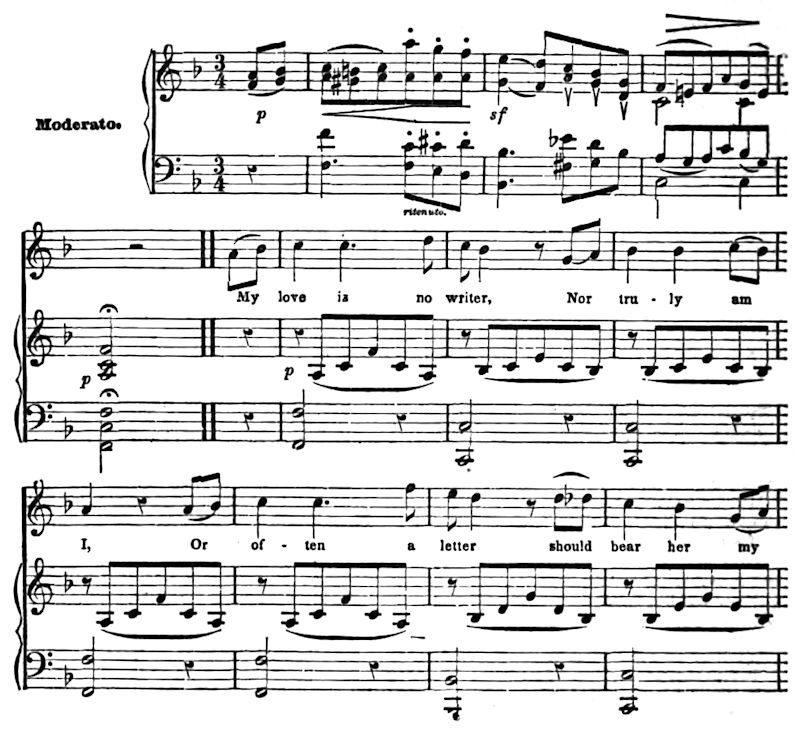
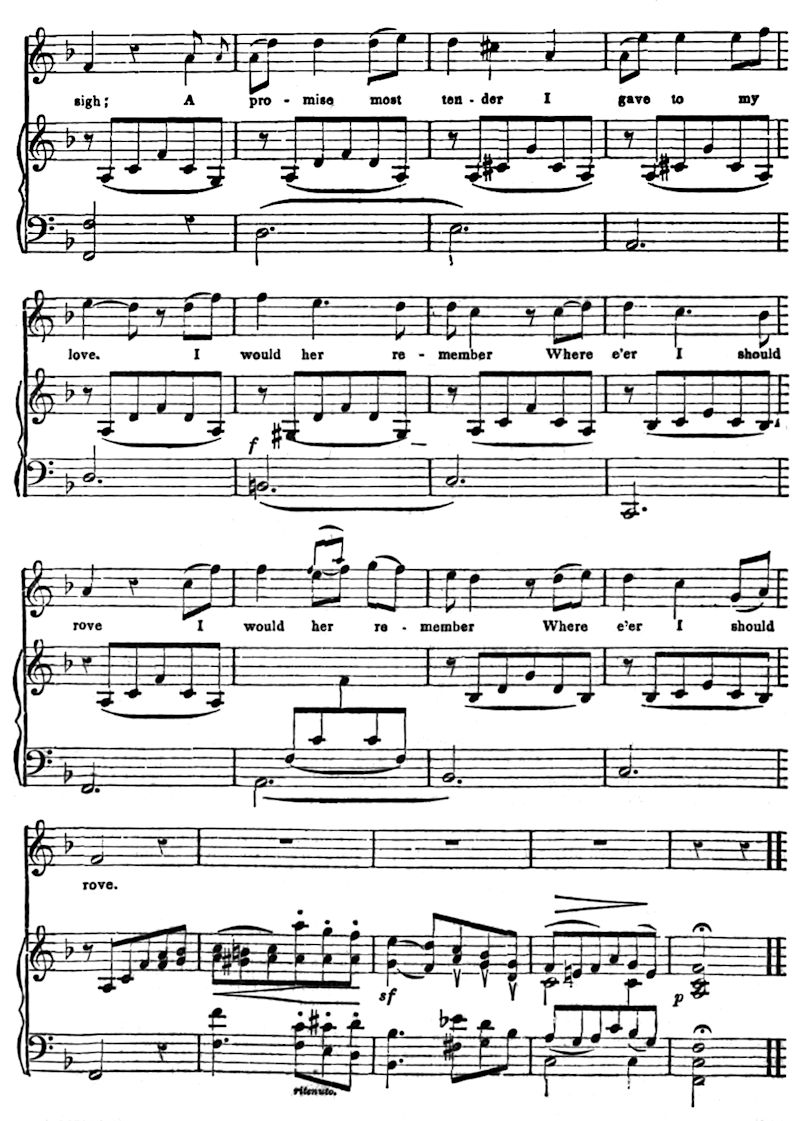
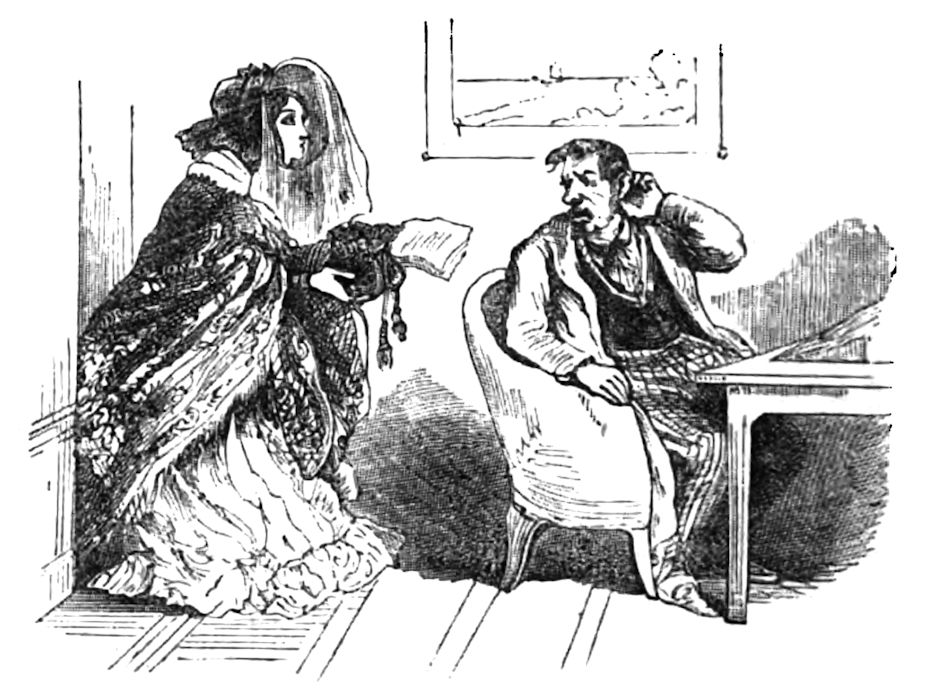
 Mail the money at once,