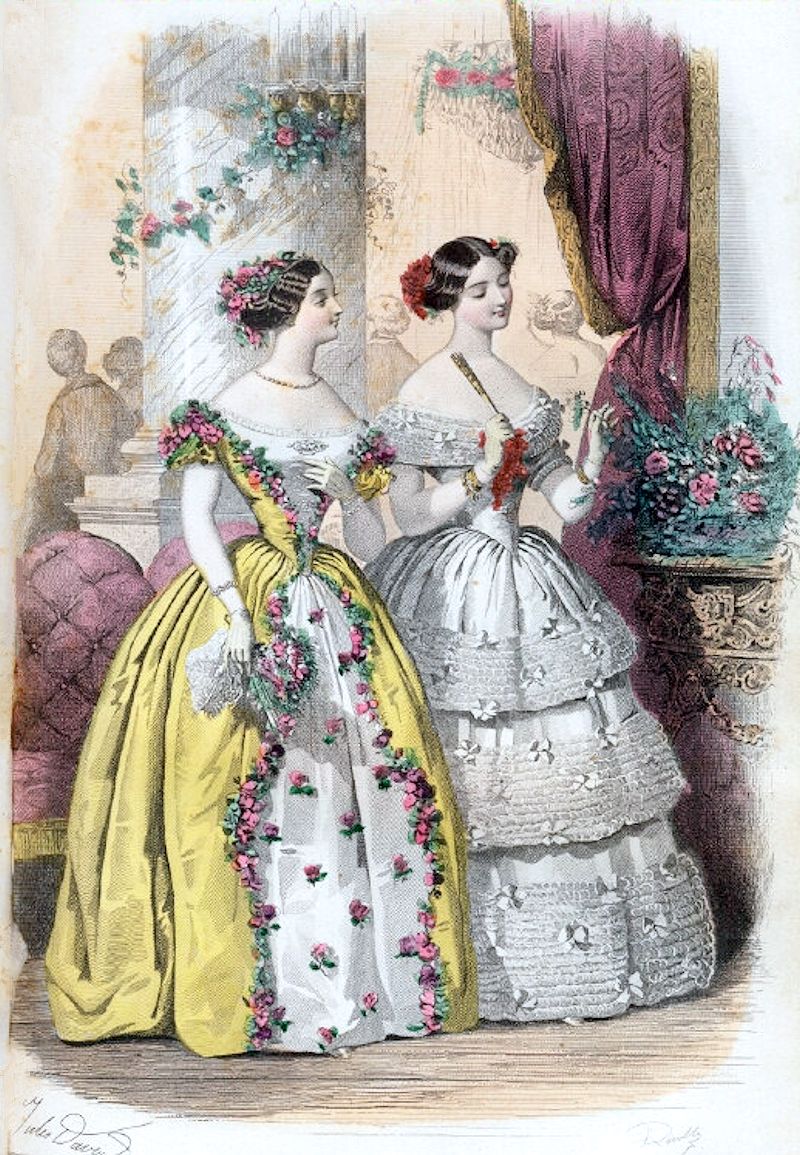
The curtain arose and a murmur of applause
greeted the beautiful scene that appeared. An open
window unclosed on a valley sleeping in the moonlight,
and the over-arching heavens glittering with
its quiet stars. Beside the window leaned the lady,
her head half-turned from the page who knelt at her
feet, and clasped her hand between his tremulous
fingers: and she—oh how divinely fair was that
girl! She represented one of a royal race, and well
did she look the character she had assumed. The
turn of the graceful head, the curve of the red lip
belonged to the royalty of beauty, and there was a
pretty air of condescension in the attitude she
assumed toward the kneeling youth; while he
looked up to her and sent forth his soul in the deep
gaze he bent upon her face. The first fond dream
of the enthusiast’s heart was realized, and his spirit
bowed in homage before the ideal of his young
imagination.
The curtain fell—the page raised her hand to his
lips and passionately kissed it. A faint flush came
up to the cheek of the girl, and a half-mocking
smile flitted across her crimson lip.
“You forget, young sir, that we are only acting.
One would suppose from your manner that you are
really in earnest.”
The tone jarred on the highly excited feelings of
the youth, and he sprang to his feet, the warm blood
mantling his fine features with its sunny glow.
“Your pardon, Miss Selwyn,—I forgot that we
were acquaintances of but a day’s standing: yet if
you could read the dreamer’s heart, you would not
wear that smile which seems to mock my enthusiasm.
You see before you a boy in years, but if
the age of man may be measured by the wild aspirations—the
burning hopes of a heart whose reveries
are as passionate realities, I am not a mere youth.
Oh beautiful,”—he continued, again kneeling before
her, “my soul bows before the incarnation of a
lovely spirit, in a form fitted to enshrine it. I feel
that it is so, for He who made you so gloriously
lovely, would not place a cold or selfish heart in so
exquisite a casket. My fancy has pictured such
forms among the angels of heaven, and my unskillful
hand has essayed to sketch them, but ever without
success. When we met, my heart at once went
forth to greet its predestined idol, and I felt that my
dreams had found a reality.”
The girl who listened to this wild rhapsody with
a little fear and more surprise, was one who had
been reared amid the artificial refinements of life,
and it was probably the first genuine burst of feeling
which had ever met her ear. The daughter of a
man of wealth, and a mother devoted to fashion, her
education had been carefully intended to model the
character of the future belle. The parents looked
on her unrivaled beauty with pride, and the vain
mother anticipated the renewal of her own triumphs
in the person of her daughter. Flattered and spoiled
from childhood, it was quite wonderful that one
natural trait should still have remained in her vain
little heart; but nature sometimes asserts her power
where art has done most to arrest and deface her
beauties. Thus it was with Julia Selwyn. Sincere
feeling even to the world-hardened ever finds an echo
in the breast, and the mocking smile died from her
lips as she felt the deep charm of the young stranger’s
singular avowal.
The two had met that morning for the first time.
Arthur Mervin was the son of one of Mr. Selwyn’s
early friends, who had that day arrived in Philadelphia,
with a letter of introduction from his father,
containing a request that Mr. Selwyn would aid the
youth in obtaining admittance into the studio of a
distinguished painter, as his pupil.
At the moment of his arrival, a party was rehearsing
the tableau which were to be presented
in the evening at a splendid entertainment, given in
honor of Miss Selwyn’s debut in the world of
fashion. The most important one;—the one in
which the beauty was to burst on the enraptured
eyes of her father’s guests in all her loveliness, was
the lady and the page—and—oh, dire disappointment!
The young cousin who was to enact the
page, had been seized with an inflammatory sore
throat, and his medical attendant positively prohibited
his leaving his room.
What was to be done? Mrs. Selwyn glanced
over the list of her young acquaintances, and could
not find one to appear in the tableau with her fair
daughter, who would not look coarse when placed
in comparison with her refined loveliness.
She wished the tableau to be perfect—to be
talked of as the most beautiful one of the season,
and, in the midst of her perplexity, when her
husband ushered in the son of his friend, one glance
at his graceful person and fine features convinced
her that she need look no farther,—the page was
found.
Her daughter was sent for, and after an animated
conversation of half-an-hour, the lady found means
to introduce her request so naturally and gracefully,
that after a moment’s hesitation, with a glance at
Julia and a bright flush of the cheek which spoke
volumes, Mervin consented to play the part of the
page.
How would that worldly mother have shrunk
from allowing him admittance within the charmed
circle of her daughter’s fascination could she have
divined the effect this casual introduction was to
have on that daughter’s future life.
The son of a farmer of moderate means who was
encumbered with a large family, it appeared too
absurd to guard against Mervin’s admiration. Julia
was born to be admired: she had been educated to
glitter in the sphere of fashion, and understood her
own position too well to allow her feelings to
become interested in a mere flirtation with an
obscure artist.
The young painter was full of genius and enthusiasm;
the walls of his studio were ornamented
with sybils, angels, and Madonnas, in each of which
might be recognized a striking resemblance to the
face of his young love, and his passionate soul
poured forth his adoration in “thoughts that breathe
and words that burn.” The homage of genius gave
an eclat to her daughter which gratified the vanity
of Mrs. Selwyn, who fancied that she had sufficiently
warned Julia against allowing her heart to become
interested, by speaking of the utter impossibility that
Mervin should for years be in a situation to ask her
to share his destiny.
“All this adulation is very pleasant my love,”
said she, “and makes you the envy of many a fair
rival, but remember it is only as incense to your
vanity that it must be regarded. Mr. Mervin is
clever, and has talent enough to make a very agreeable
addition to our soirees, but a suitor to you it is
quite impossible he should aspire to become.”
The rose faded from the cheek of Julia in an instant.
“He is gifted with extraordinary abilities, mother.
A distinguished path is before him.”
“Yes—but think of the years of toil that must intervene.
The best portion of his life must be devoted
to his exacting profession, and when the pulse is fevered
with application—the eyes dimmed, and the
hair blanched with time, he may be what is called
great; but the spirit of life, of love, and hope, will
be exhausted in the struggle. From the dim waste
of the past, the voice of fame will sound but as a
funeral dirge, wailed over the courage and enthusiasm
which bore him upward and onward in his
course.”
“Disappointment must come to all, mother; but in
the exciting occupation you describe there is much
happiness to be found. The days of all must fall
into the ‘sere and yellow leaf,’ but the man of
genius can at least look back with pleasure to his
toil, and reflect with just pride on the rewards he has
won. Ah how superior are such memories to those
hoarded by the mere butterflies of fashion, of a petty
triumph over some insignificant person whose wealth
lifts them into ephemeral notoriety.”
“Child—Child! how you are running on! Your
cheek is flushed, and your eyes sparkling.—This
will never do. I hope this young painter has not
made what romantic young ladies call ‘an impression’
on your heart, for in that case my doors must
be closed on him.”
Julia was calm in a moment. The pupil of the
fashionable Madame Lecompte had been assiduously
taught the art of controling the outward show of
emotion, and young as she was, Julia Selwyn did
not shame the lessons of her preceptress.
“My dear mother, how can you have such a
fancy! Mr. Mervin does not make love to me
without I construe his verses into declarations.
Do you fear that I shall be so unmaidenly as to give
my heart unsought? He knows that a union between
us is impossible, but that does not prevent
this frail fading beauty from being his inspiration
and his muse. A few fleeting years, and some
younger and fairer face will claim his homage,
while I shall pass down the stream of time only remembered
as the ci-devant belle. When his fame
is at its zenith, I shall be forgotten.”
“I am glad that you have so much common sense,
my dear. When we can speak calmly of being forgotten
by an admirer, it is a sure sign that the feelings
are not deeply interested in him. You were never
intended for the wife of a poor man, and there is one—but
I must not betray your father’s plans. He will
never force you to accept any one who is disagreeable
to you, but there is a person in view who is so
suited in age, fortune, and in short, every thing, that
we have set our hearts on seeing you his bride. I
will not name him, lest the knowledge of our wishes
should make you shy. I shall leave him to make
his own way, love—no questions—I am silent as
death. Good-bye—I must see the new case of millinery
opened at Madam ——’s. I will bring you a
Parisian hat of the newest style.”
Julia buried her face in her hands and remained in
deep and painful thought. She had instinctively
known all that her mother had just expressed relative
to Mervin; yet she would not reflect on it.
A year had passed since the first impassioned
declaration of the young painter. His lips had uttered
no word of love in that time, but his devotion
of manner had expressed all that the most exacting
mistress could have asked. Julia fancied that she
received his homage merely as the incense due to
her unrivaled charms—that her own heart was still
unscathed—yet why did she listen for his step, and
turn listlessly away from her usual occupations until
shared by him? Why did the faint crimson steal to
her cheeks as he sat beside her and spoke in those
low, earnest tones, so different from the persiflage
of the set in which she habitually lived? Enthusiasm
ever finds in the hearts of the young a chord
which vibrates to the touch of him who possesses
it, and before she was aware of her danger, that of
Julia Selwyn was devotedly attached to Mervin.
Nature and education were at war within her.
The consent of her parents would never be given to
her union with him she well knew—and too much
of worldliness still clung to her, to be willing to descend
from her high estate to link her fortunes with
those of her poor, though gifted lover. Yet her
heart shrank from the sacrilege of giving herself to
another. She might for years remain the idol of the
hour, until her beauty began to wane, and in those
years, perhaps Mervin might achieve a degree of
celebrity that must lead to fortune—if not—she could
then fulfill the desire of her parents in bestowing
her hand on some wealthy suitor.
The lover destined for her by her parents made his
appearance, and in spite of her mother’s determination
not to reveal his name, Julia at once detected
the anxiety of her parents that Mr. Herbert should
succeed in winning her. He was young, and rather
handsome, with quiet, gentlemanly manners; but
when compared with the young painter he appeared
very commonplace.
Herbert was already in possession of a handsome
estate, and owned a large interest in the firm of
which her father was the principal. He was just
the sort of person Julia felt safe in trifling with. He
had no romance, and was of an extremely indolent
temper—for years he would be content to creep toward
an object he had once proposed to himself to
attain. He was not jealous, and with perfect calmness
saw the girl he contemplated as his future wife,
flirt with the gayest and handsomest men of the city.
He seemed to possess some assurance in his own
mind that she must eventually yield to the fate which
decreed her to become Mrs. Herbert, and until that
time arrived, she might enjoy her liberty as best
suited her inclinations.
In the meantime Mervin pursued his career with
astonishing success. The enthusiasm of his soul
was thrown into all he attempted, and urged on by
the overpowering passion of his heart, it was no
wonder that he accomplished well whatever he undertook.
Amateurs declared his talents to be of the
highest order, and brother artists acknowledged his
success, considering his years and opportunities for
cultivation, to be unprecedented. His future greatness
was confidently predicted, and a few of the
patrons of the fine arts met together, and consulted
on a proposal to send him to Europe, that so promising
a genius should possess every facility for
perfecting his style by the study of the old masters.
A liberal fund was subscribed for that purpose, and
offered with such delicacy that Mervin felt no hesitation
in accepting it as a loan, to be repaid when his
exertions had won the means of so doing.
His preparations were soon completed, and a farewell
visit to his family made. Then came the first
bitter trial of his life—the parting from Julia Selwyn.
The inexperienced youth, ignorant of the conventional
distinctions of society, had uttered the first
promptings of his heart to the object of his suddenly
awakened passion; but a few weeks sufficed to show
one of his quick perception and nice tact, the wide
gulf that separated the daughter of a reputed millionaire
from the humble child of genius. In words his
passion had never since been expressed, yet Julia
felt that to the last throb of that impetuous heart she
would be the dearest of earthly objects.
He could not leave her thus—she had ever smiled
on him, and from her own lips he must learn his
fate. The years of toil which lay before him,
would, for her sake, be sweet, and his heart trembled
as he contemplated his future if no such bright
hope rose over its distant horizon. If it were denied,
deprived of all motive for exertion, he must
sink at once into insignificance. The pride of genius—the
consciousness of powers which raised him
above the mass of his fellows, was bowed before the
consuming passion that formed the inspiration of his
day dreams, and the theme of his sleeping visions.
With feelings alternately elevated or depressed, as
hope or fear prevailed in his mind, he repaired to
the mansion of Mr. Selwyn. He found Julia alone,
apparently awaiting the arrival of her party to attend
a ball, for her dress was in the latest style of
elegance. As he entered, she arose from the examination
of a book of engravings, and advanced to meet
him.
“She knows that I am about to leave my native
land, and yet she could array herself for a ball,”
thought Mervin, and his cheek grew paler than before.
Julia noted the emotion, and frankly extending
her hand said—
“I knew you would come, and though ready to
go to Mrs. Lacy’s party, I feigned a headache, and
staid at home to receive you. I did not know—I
did not hear that you had finally decided to leave,
until we were nearly ready to enter the carriage.”
Mervin pressed the hand she extended to him to
his lips and heart in uncontrollable emotion.
“Ah, beloved Julia! in this hour I must again
pour into your ear the passion that masters my whole
being. As you shall answer this night, will my fate
for good or evil be decided. How I dare venture to
ask you, the beautiful, the flattered, to wait for
years until a poor artist has achieved independence,
I know not, but the hope is in my heart, Julia, that
you will not deem me presumptuous. Oh, beloved,
the future with its bright promise of fame is cheerless,
without the hope is given that I may attain the
idol of my youth. Speak—let me know my doom!
I go forth sanguine in hope, and certain of success
speedily won—or I carry with me a heart so crushed—so
blighted by the disappointment of its dearest
wish, that the energy to accomplish any thing
worthy of myself will never revive.”
Tears were in Julia’s eyes. All her worldliness,
all her hesitation had vanished at the sound of his
words: she was only the loving and beloved woman,
ready to share his lot, whether that lot were gloomy
or bright.
“The hope is yours,” she whispered. “Is it not
a brighter destiny to be the artist’s love than the
bride of him whose fortune is his only claim to the
station he holds? The day will come when my
parents will be proud to give me to you. When that
time arrives, take with you the assurance that you
will find me free from other ties, with a heart glorying
in the reputation you have won by your own
exertions.”
“With such a reward in view, what toil will be
too great, what probation too tedious to be borne!
Oh, Julia, you have given me a motive which will
enable me to triumph over every obstacle. But in
the years that must elapse before I can rationally
hope to claim my bride, how will you evade the
persevering pursuit of this Herbert?”
“Do not fear him, Arthur. He is like a tortoise
in pursuit of a bird on the wing, when following me.
I can suffer him to belong to my train for years and
still be no nearer marrying him than now. Besides,
the inexplicable anxiety of my parents to see me
united to him, will prevent them from giving decided
encouragement to the addresses of any other
lover. So you see it is rather on advantage to have
so dilatory a suitor.”
“The influence of your parents will be entirely in
his favor—you will be firm, my beloved—you will
not yield. Remember, if you do, that you will be
answerable for one human destiny. Your confession
of this night has blended your fate, irrevocably with
mine. You cannot draw back without rending the
ties that bind me to reason—perhaps life.”
“I shall have no wish to draw back, Arthur.
Though vain and worldly, there is enough nature
still left in my heart to appreciate and return your
affection. When the last hope of life has departed,
I may yield and become another’s; but while your
love remains as my beacon-light to happiness, I will
continue true to my plighted troth.”
Much further conversation ensued, and just as they
parted, Mervin repeated her own words, “Remember,
love, till the last hope of life has departed, you
are mine, and mine alone.”
Julia repeated them solemnly, happily, unconscious
in how different a sense from that understood
by the lover, they would be acted on.
Two years passed by. The most favorable accounts
were received of the progress of Mervin.
He had passed the greater portion of that time in
Italy, and several beautiful specimens of his rapid
improvement had been transmitted to his friends in
his native land. The lovers contrived to keep up a
correspondence, though the letters were few and far
between, as the greatest caution was observed to
prevent the parents of the fair fiancée from suspecting
the romantic attachment of their daughter. Julia
well knew that such a discovery would be followed
by a command to trifle no longer with the pretensions
of Mr. Herbert.
Already they had manifested both impatience and
displeasure at her conduct to that gentleman. He
still continued the same placid and attentive lover;
never elated by the smiles of his mistress, nor depressed
by her frowns; he pursued the “even tenor
of his way,” seemingly assured of final success
where a more mercurial person would have despaired.
At length the crisis in the destiny of the belle approached.
One morning her father entered her room
and requested a few moment’s uninterrupted conversation
with her. Julia sent her young sister
from the apartment and prepared to listen to a remonstrance
in favor of Mr. Herbert’s pretensions.
“My daughter,” he began, “the time has arrived
when I can no longer postpone the explanation of our
position in regard to Mr. Herbert. You have trifled
with him so long, that I despair of ever seeing you
voluntarily become his wife.”
“And is there any absolute necessity that I should
unite myself to a man I can never love, father?”
“So much the worse, child. Love, at any rate, is
a mere chimera—an ignis fatuus, that misleads the
young. At all events you must make up your mind
to marry Herbert, or I am a ruined man.”
“How can that result be brought about by my
refusal to accept him?” faltered poor Julia.
“It is a story, my dear, I would not care to tell
you, if it could be avoided; but I see no hope of influencing
you by other means—so you must e’en
hear it. Sit down, and don’t look so alarmed. You
are pale as death, and trembling like a frightened
dove.”
Julia sunk back in her seat, and prepared to listen
with as much calmness as she could command.
“The father of Herbert and myself commenced life
together, and for many years our united exertions
were eminently successful. He decided to retire
from the firm, when an elegant sufficiency had been
acquired. He had but one child to provide for, and
I made no objection; but as my family was larger, I
thought it incumbent on me to continue my exertions.
The half of Herbert’s gains was withdrawn
from the firm, and invested in real estate secured to
his son. The other moiety continued in my hands.
At his death he bequeathed his claims on me to
George, with a bequest to you of half the funds in
my possession, on the condition that you shall become
the wife of his son; if not, the whole amount
is to be paid to George Herbert on the day he attains
his twenty-fifth year. In two more weeks, if you
do not accept Herbert, I shall be called on to pay a
sum amounting to more than my whole fortune. As
my son-in-law, he pledges himself to allow me to
retain the use of this money until I can advantageously
settle with him, and altogether waives
his claim to the legacy left to you. My affairs are
now in such a state that it will be ruinous to me to
attempt a settlement; so you must even make the
best of it, and give your hand to an honest man who
will render you as happy as the most of your sex.”
“And is this the only alternative?” asked the
pale girl. “Will not Mr. Herbert grant you a
longer time without demanding so great a sacrifice
on my part?”
“The truth is, Julia, you have flirted with Herbert
long enough, and he thinks you have not treated
him quite well. If I make such an appeal to him,
his cold temper will be roused, and he will be off
altogether, which would be a misfortune of no common
magnitude; for I must tell you that there is not
the least chance that I shall ever be able to pay a
fraction of this money; and only as the husband of
my daughter can I prevent him from taking such
steps as will ruin me at once. On one hand, it is a
choice of poverty to all you love, and on the other, a
good husband with plenty of money. You are too sensible
to be romantic; and besides, as you have never
yet fallen in love, you have no predilection to plead.”
At his last words arose the appalling recollection
of her clandestine attachment—and she cast herself
at the feet of her father.
“Pardon me, my father, and pity me! I have
loved—I do love, with a depth and truth that death
alone can destroy. Ask me not to wed this man, for
I am plighted heart and soul to another.”
“To whom?” was the stern question. “I know
of no one who receives the encouragement of a lover,
save Herbert.”
“One far away—seeking distinction in a foreign
land. Oh, blight not the promise of his young years
by compelling me to falsehood and desertion.”
“What! that beggarly painter, Mervin! And is
it for him you have slighted the highest in station—the
brightest in intellect! For two years you have
carried on this deception unsuspected—I have but
one atonement to demand for such duplicity. Accept
Herbert, and it shall be forgotten—refuse, and
you are no longer a child of mine.”
Vain were the pleadings of the unhappy girl—vain
her appeals to his better feelings. Glad of a pretext
to treat her with such harshness as to drive her into
his measures, Mr. Selwyn availed himself to the
utmost of the one which was offered. She was
literally left no choice between a marriage she detested,
or expulsion from the paternal roof.
It is doubtful whether the parents would have
carried their resentment so far, had she finally refused
compliance with their wishes; but there was
so much at stake, that both father and mother scrupled
not to use every endeavor to urge her into the
proposed union.
The constitution of Julia had never been robust;
and the conflict in her feelings brought on a severe
attack of illness, from which she very slowly recovered;
and there was a brightness in the large-pupiled
eyes, and a clear spot of rose upon her
cheek, which seemed to speak of early decay and
death. She went out once more, and listened with
apparent acquiescence to the wishes of her parents
in regard to her marriage.
Herbert was roused into something like interest,
and his attentions were unremitting. Julia received
them passively—she felt herself a victim to a fate
she had no power to control, and yielded to the will
of those around her. Yet she could not write to
Mervin; she could not tell him who trusted her that
she was about to wed another. No words could
convey to him the wearing persecutions of which
she had been the victim, even could a daughter bring
herself to write such things of her parents. Her
energies were destroyed, and she felt herself borne
forward on the current of events, without the power
to avert the doom they had awarded her.
As the fall advanced, a slight cough alarmed her
mother, and again the physician was summoned.
Julia earnestly desired to see him alone. He found
her in her room with a small parcel on the table before
her.
“Doctor,” she said, with a faint smile, “you are
called on to restore health to the hopeless. You
know that to be an impossible task. I wish you to
tell me honestly and truly, how long you think I can
live.”
“Pooh! Miss Julia! you are too young to talk of
dying. Many long and happy years are, I trust, before
you.”
“You would flatter me with a hope that is not
dear to me. Long life I now ask not—desire not. I
ask you as a man of honor—as a Christian—if you
think it possible for me to recover? To die is now
my only wish.”
“So the young always say when disappointment
meets them. Your pulse is quick—you are feverish;
but I think these symptoms will pass away. A
winter in a warm climate I shall recommend to Mr.
Herbert as the best thing for you; and I hope to see
you again quite restored.”
“In a warm climate? What country will you
recommend?” she asked abruptly.
“The South of France—or Italy.”
“Italy! Oh, let it be Italy! I could die contented
there; but I will not consent to go. I dare
not consent to be united to Mr. Herbert unless you
will assure me that the last hope of life is past.”
The doctor looked at her as if doubting her sanity.
“You are young to lie down in the grave with resignation.
There is some mystery here, my young
friend, which is wearing your life gradually away.
Can you not confide in me? I may be able to serve
you.”
“Only in telling me the truth, and in writing a
few lines for me to one who is far away—not dreaming
of the blow that is about to fall on him. Poor
Arthur! My grief is now more for him than for
myself. You are a friend of Mr. Mervin’s, Doctor.
Write to him, and inform him of my marriage; and
tell him that my last promise was inviolate. I was
his, so long as a hope in life remained. You may
tell him that there was no escape from this loveless
marriage, and the sacrifice of life itself will test the
truth of my affection for him. Now will you order
me to Italy? that I may die amid the bland airs and
lovely scenes which surround him. The consciousness
that I am in the same land, will gild the remnant
of my waning life.”
The physician was deeply touched. He saw that
in her face which spoke to his heart of her rapidly
approaching fate, and his voice faltered as he replied,
“You shall go to Italy—and I will fulfill your request.
Mervin shall be apprised in the gentlest
manner of all you desire. Would that I could serve
or save you, but the wound lies too deep for my skill
to reach.”
She smiled faintly. “It is a consolation to know
that by the sacrifice of the frail remnant of my existence,
I can secure to my young sister—to my parents,
the enjoyment of a competence at least. Mr. Herbert
has promised me that the wealth bequeathed
to me by his father, on the condition that I became
his bride, shall be secured to my sister, encumbered
with an annuity to my parents. You probably know
that the affairs of my father are inextricably involved,
and this will be their only dependence; but, doctor,
I have made one proviso, to screen my sweet Ellen
from the misery that has been my portion. She is
to enjoy the absolute right of choosing her partner for
life herself.”
“These,” she continued, taking the parcel from
the table, “are his letters. They are few—but very—very
precious. Take them—destroy them—I cannot
do it—and I would not have them returned to
him. It would be too bitter to have the memorials
of wasted affection thrown back on the heart from
which they emanated.”
A few more weeks rolled by, and the sacrifice had
been completed—the victim had been offered up at
the shrine of selfishness and false pride.
The arrangements of Herbert were so liberal as to
free Mr. Selwyn from all apprehensions for the
future. He was not avaricious; and in his anxiety
to please the fading bride his money had literally
purchased, he was willing to lavish his fortune with
a profuse hand. He loved Julia as much as his calm
heart was capable of loving any thing; and in the
sunny clime to which they were bound, he confidently
looked forward to her recovery from the effects of
what he called her slight cold. Her parents had never
for an instant allowed him to suspect that, on her
part, there was the least repugnance to the union;
and she had coquetted with him so long, that she
shrank from laying before his cold gaze, the history
of her secret affection for his rival.
They embarked for Europe, and Julia bade a last
farewell to the land of her birth. As its shores
faded in the distance, she felt the sad conviction that
her eyes had rested on them for the last time.
So far from renovating her exhausted frame, the
sea-voyage had a contrary effect; and when they
at last entered the bay of Naples, the young bride
was carried on deck to breathe her last sigh in sight
of the land which contained the unconscious Mervin.
The letter of the kind physician had not reached
its destination, and Mervin was still pursuing his
brilliant career with the fond hope of soon being in a
situation to claim his betrothed.
A solemn procession passed a group of artists collected
together at a corner of one of the principal
streets. The corpse of a young female was borne
past them on a flower-strewn bier, to one of the
principal hotels. A close carriage followed, containing
a single mourner. An inquiry was made as
to who the deceased was.
“A young American lady.”
An undefinable feeling of sympathy with his bereaved
countryman, induced Mervin to separate
from the group, and join the procession. As it
entered the hotel, he was about to follow and offer
his services, when he met a servant belonging to the
establishment to whom he was well known. The
man stopped and addressed him.
“The American signor who has just arrived
wishes an artist to take the likeness of his wife, before
she is buried. As you are a fellow-countryman,
I was about to seek you, signor—for your pictures
are justly renowned, and this lady is even now very
beautiful. The gentleman is too deeply afflicted to
see you himself.”
“What is his name, Guiseppe?”
“Signor Hibut, or Hobut—I cannot tell which.”
The sound of the name, in the Italian’s pronunciation,
appeared so little like the real one, that his
old rival never once occurred to Mervin—and without
further hesitation he dispatched a servant to his
studio to bring the requisite materials for his task.
He was ushered into the chamber of death; and a
cold thrill of emotion almost unnerved him as he
looked on the bier, with the sharp outline of a human
form clearly defined beneath the white coverlet
that lay above it. The withered flowers which
were strewn over it, seemed but to mock the stern
conqueror who had laid his strong grasp on the marble
form of the dead, and he removed them, though
he withheld his hand from raising the veil which
shrouded her features, until the servant who had
been sent to his studio had fulfilled his commission
and departed.
It was a bright day, and the garish sun streamed
into the room. With the eye of his profession for
effect, he lowered the crimson curtains before the
windows, that their reflection might throw the rosy
hue of life on the pallid features he was to delineate.
He paused as he stood beside the bier, with his
hand upon the linen that shrouded her features.
Some deep emotion appeared struggling in his mind,
and he withdrew his hand. Ashamed of his hesitation,
with a sudden effort he threw back the covering,
and with a cry, sunk upon the floor.
An hour passed, and with glazed eyes, and horror-struck
visage, the painter cowered beside the bier,
with his immovable gaze fixed on the still face before
him.
“His wife!” he muttered at intervals; “His
wife!—false—false to me—I that loved her so
madly—trusted her so fondly! His wife—his wife!”
At length he arose, and seizing his brush, commenced
painting with a rapidity and success that
surprised himself. The picture speedily grew under
his hands into life and beauty; but it did not represent
the dull room with its lifeless inmate. The
starry heavens, and the green vale were faithfully
delineated—a young girl, in the pride of successful
beauty, leaned against an open window—and he
livingly portrayed the peerless loveliness of the embodiment
of his young ideal.
Before her knelt a youth wearing the features of
the artist himself, but so changed—so full of the anguish
of a broken spirit, that one glance revealed
the history of his slighted love and maddened heart.
Mervin went forth from that apartment with
faltering steps, and the cold dew of agony upon his
brow. How he reached his home he knew not. He
found a letter on the table—it was the long-delayed
communication of Dr. L——; he retained self-command
enough to read and understand its contents—but
it was the last effort of his over-wrought mind.
His words to his lost love had been prophetic!
The tie that bound him to reason was rent—the
bright promise of his opening years buried in the
grave of his young idol.
Some kind friend restored him to his native land;
and he now wanders about the home of his father, a
melancholy and harmless wreck.
ILLUSTRATED BY AN INCIDENT IN THE LIFE OF SCHILLER.
———
BY MRS. K. C. KINNEY.
———
He paused upon the river’s brink, a friendless fugitive,
And in despair’s wild moment asked—“Why should I longer live?
Deep are these waters, dark and cold, but deeper is my wo,
And peace, methinks, lies underneath the river’s tranquil flow.”
’Twas but a flash of sulphurous light from the great Tempter’s mind,
On sorrow’s cloud that sudden gleamed, the poet’s soul to blind!
It passed like lightning, and he saw again a living world—
The teeming land, the river free, the snowy sail unfurled.
The glowing sunset, gilding spire, and mast, and forest-tree,
Shed light on his enshrouded mind—he felt ’twas joy to be—
To be himself—fair Nature’s child—ay, Truth’s and Freedom’s own,
Born to a boundless heritage—heir to a laurel crown!
“I will not die, but live,” he said, “while lives the truth divine—
For Nature and for Art I’ll live—no common life be mine;
This deathless spirit wounded now in struggling to be free,
Shall in its conscious strength arise and claim its destiny!
“Not that the sovereign, who pursues a rebel with his frown,
May see my coronet all green, when fades his ducal crown;
Not that the sire, whose wrath condemned his reckless son to shame,
May hail that son brought back in the triumphal car of Fame—
“But that I feel the living soul of Poesy within,
Urging the liberated thought its mission to begin;
A work eternal bids me on—I cannot, will not die,
Till the vast deep of human mind shall onto deep reply!”
The traveler to a foreign clime now reverent stands beside
The noble statue of a bard, a nation’s love and pride;
Unto whose living works both worlds in admiration turn,
Philosophy, through beauty’s form and music’s tone, to learn.
In calm, colossal grandeur towers that statue on the spot
Where once a youthful poet stood to mourn his hapless lot—
From whence he fled a fugitive, stamped with the rebel’s name,
There Schiller dead, yet living, speaks his own immortal fame.
———
BY CHARLES H. STEWART.
———
The vesper bells are softly peeling
A call to prayer;
Like angel’s songs the sounds are stealing
Far up the azure aisles of air.
A wish, truth’s offspring, now is winging
To realms untold—
Through the high heaven of thought upspringing
To the true temple of the soul.
Hope, like a weary pilgrim, kneeling,
Stoops at the shrine
And worships with a holy feeling,
Half human seeming, half divine.
Now thoughts flit through fond mem’ry’s temple
To times of old,
When worship at the heart’s high altar—
Pure as the stars—but ne’er so cold.
And ’mid the future’s sky is gleaming
Hope’s burning star,
And Fancy’s eye drinks in its beaming,
Undying brightness from afar.
The heart is like mind; her empire—
Wide as the sky—
Vast in its spirit realm, it maketh
All that we are of Deity.
Thou lovely world of heaven, thy vision,
Surpassing rare,
Shall mock my mind’s ideal Elysium
With joys that ever cycle there.
Though oft in gloom its dawn comes stealing,
And tear-drops stream,
Dimming its light, the spirit healing,
Wings its far flight pure and serene.
The incense of the soul is stealing
Beyond the sky,
From censers lit with fire of feeling,
To spirit realms of Deity.
Those evening bells, once softly peeling,
No longer ring;
But thoughts, as pure as seraphs kneeling,
Ascend to an eternal spring.
Now eventide is hushed in rest—
Day has departed,
And blithe come forth the bold and blest,
And low the sad and broken-hearted,
But as successive years may roll
Their waves away,
Those bells may break upon the soul,
Sweet to the low and sadly to the gay.
———
BY THE AUTHOR OF “FANNY AND FRANCIS.”
———
“Well, Arthur, what next!” said a grave-looking
young man of twenty-five, to his friend.
“What next; upon my word I cannot answer that
question at this moment, in fact, I am not quite released
from my last undertaking. One must be off
with the old love before they are on with the new,
you know.”
“It appears to me,” said Abram Snow, “that
you had better remain where you are till times improve
a little. I do not make enough to pay my
board, yet it is better to remain than to do worse.”
“I suppose you are right,” said Arthur; “but I
see no difference between your career and mine as
it respects money affairs, excepting that you have a
thousand dollars at interest, and I have a thousand
dollars in odds and ends. Yes, there is a difference,
Snow, for when business is brisk again you will get
a good salary, for the world considers you as a prudent,
steady fellow, and an excellent book-keeper,
while I shall think myself fortunate in being sent to
the West Indies as supercargo.”
Arthur Hazarelle was led on orphan when quite
young, and his little patrimony was just sufficient to
educate and support him till he was fourteen years
of age. From that time until his twenty-fifth year
he had changed from one occupation to another,
sometimes twice in a year, and it could not be said
that he had a particular talent for any branch of business.
He certainly was ambitious, and he exerted
himself to the utmost for every employer he was
with; but though useful and exemplary in his conduct,
yet some unforeseen event set him adrift. It
was impossible almost to count up the number of
places he filled during the ten years before our little
story commences, the last one was about as promising
as any in which he had been engaged, but in
one week from the time he had this conversation
with Abram Snow, the auctioneer with whom he
was engaged took it into his head to die, and even the
thousand dollars worth of odds and ends died with
him.
Poor Arthur! after paying his week’s board and
his washerwoman he had not more than a dollar in
his pocket, and he was honest enough to tell this to
his landlady.
Women are tender-hearted, and Mrs. May was as
weak as the rest of her sex; so she pitied Arthur,
and talked over her feelings before one of her boarders,
a surly, ugly old man, who never opened his
lips without finding fault, and who was always
watching Arthur from the corner of his eye.
“Good enough for him—better than he deserves,
Mrs. May,” said Mr. Crosbie, “a rolling stone
gathers no moss; why, the wealth of the Indies
would not stick to such a squib—here, there and
every where. To my knowledge he has changed
places twice or thrice a year ever since he was fourteen
years old.”
“That may all be true, Mr. Crosbie; but from
what I know of him it was none of his fault. I am
quite unhappy about him, for I know very well that
he will not stay one moment in my house unless he
can get money enough to pay his board.”
Mr. Crosbie made no answer but—“humph”—and
left the room. He was a man apparently well
advanced in years, ugly in face, and all over out of
joint, he meddled with no man’s business, and in
return, prevented others from interfering with his.
But of all the eyes that were ever set in mortal head
his were the most keen and piercing—he seemed to
read the bottom of your soul at a glance.
As he left the room he met Arthur Hazerelle with
a small traveling trunk in his hand, and on Mrs. May
coming out, he shook hands with her cheerfully, and
wished her a good-morning. He had often felt uneasy
before the searching expression of Mr. Crosbie’s
eye, and it made him actually shudder at this
moment. He seemed to have lost the power of
will.
“Which way are you bound?” said the old gentleman,
fixing his eye still more firmly on Arthur’s
face. “If you are going to Berrydale, back of the
granite hills, here is a letter for you.”
Arthur stared at him not only with astonishment
but dismay, for he had but the moment before decided
on going there, and had not communicated his
intention to any one.
“If you are going, say so,” growled out the man,
“for the cars start at nine, and you have no time to
lose.”
Arthur mechanically took the letter, put it in his
pocket, and raising his hat, walked out of the house,
feeling certain that Mr. Crosbie was staring at him
from the street door, Mrs. May from the green
blinds in the parlor, and the servants from the basement
window.
On his way he stopped to say good-bye to Abram
Snow, who was hard at work at his desk. He was
not at all surprised at the flitting, but there was one
excellent trait in his character, he never intruded
his advice upon any one. He wrote down his
friend’s address—Berrydale—and thrusting a cigar in
Arthur’s hand, they parted.
“The cars,” thought Arthur, “no cars for me, I
must walk the whole distance, for a dollar will not
pay the fare even.” So he stepped lightly along, no
way discouraged, for he never yet had left a place—or
rather, a place had never left him without his
having the prospect of another. He had not gone
more than two miles before he was overtaken by a
singular looking man, dressed in a brown linen
frock-coat and pantaloons, with a brown cap, a
brown umbrella and a brown carpet-bag. He wore
spectacles, had a remarkably long nose and chin,
and when he came up with Arthur begged him not
to walk so fast.
Arthur turned hastily to see who had accosted
him so unceremoniously, and the man smiled. It
was a pleasant smile certainly, but it did not accord
with the peculiar style of his face, at any rate Arthur
took no notice of him, and walked on.
“Why did not you put your trunk in the cars?”
said the man, “you would walk much more to your
satisfaction if you were not so weighed down—here,
give me one end of it, and let us trudge on together;
my carpet-bag is not heavy enough to incommode
me.”
So saying, he caught up one end of Arthur’s trunk
and on they went together; the stranger whistling
carelessly, and the young man very much surprised,
and somewhat amused at the oddness of the stranger’s
manner and appearance.
“It is very kind in you,” said Arthur, laughing
out loud, “but my little trunk is not heavy, as you
perceive; I dare say your carpet-bag is of twice the
weight.”
“Four times,” said the man, “but I am more used
to carry heavy parcels than you are. How far are
you going?”
Arthur told him, and then they fell into the common
chat of strangers, and thus they proceeded till
two o’clock, when both, weary enough, entered a
small tavern to rest and take a luncheon. They had
exchanged names on the road, and Arthur found that
his new acquaintance was called Galton Springle,
and that he was a schoolmaster on his way to a
small school now vacant near Drizzletown. As this
place lay in Arthur’s route, and the man was not
offensive in his manners, our young friend was quite
willing that they should proceed together.
Ham and eggs and an apple-pie made up their
dinner, and as this was soon provided and soon dispatched,
they still lingered on the sofa, or wooden
settle rather, when Galton Springle proposed smoking.
He had about a dozen cigars, in a box at the
bottom of his bag, and offered one to Arthur, who
refused, recollecting that his friend, Abram Snow,
had given him one at parting—he took it from his
pocket, but what was his surprise on opening the
little roll of stiff brown paper, to find instead of a
cigar, a roleau of ten cent pieces!
Galton Springle looked at the opening of this little
paper from the corner of his eye and smiled to himself,
for he saw that the contents were unknown to
the young man. He made no observation, however,
but calling for a candle, lighted his cigar and began
to smoke. As he made no further offer of one to
Arthur, the latter pocketed his roleau and leaned
back against the wall, thinking over the past and
hoping brightly for the future. There could not be
more than three dollars, he thought, in the roll, but
even this sum was a great deal for Snow to give,
and it was so delicately given that Arthur felt truly
grateful and promised thousands in return. When
the cigar was finished and the reckoning paid, they
proceeded on their journey till evening, when they
rested again, but this time it was on a bench near
the tavern door.
“If we rest awhile,” said Springle, “we shall be
fresh enough to reach Drizzletown by ten o’clock,
and you can then share my room, or have one to
yourself if you like. There is a very decent tavern
there and the charges are very moderate, so let us
remain together for the night, at least.”
In half an hour they took up their baggage and
went on, though poor Arthur began to flag, for he
was unaccustomed to such severe exercise, whereas
Springle seemed as light of foot as when they first
met. By ten, however, they reached Drizzletown,
and as the moon was at the full, Arthur saw a few
scattered houses, without any attempt at regularity
as it respected their position, and no appearance of
a street at all.
Arthur saw that Springle was as much a stranger
to the host of the little inn as he was himself, so he
presumed that this was his first visit to the place,
and yet the man knew the road so well, and spoke
of the people residing there in so particular a manner,
that he could not suppose this was his first
visit. A bowl of bread and milk constituted their
supper, and as Arthur preferred a room to himself,
they were shown to separate chambers and retired
for the night.
The young man slept soundly till eight o’clock,
and when called to breakfast saw that he was alone.
He was told that his companion had left the house
at daylight, leaving his carpet-bag and a letter. The
tavern-keeper said that in lounging about the door
he had seen an acquaintance and had gone off with
him. After breakfast the letter was brought, and to
his surprise it was directed to himself, it ran thus—
“An unforeseen circumstance has occurred which
obliges me to return to the city whence I came,
and as I have plenty of clothing there, I make you a
present of the carpet-bag and its contents. Do not
part with the bag, however, let your necessities be
ever so great, as I value it very highly, though I
part with it to you. When you are settled to your
liking leave your address in this house, and the man,
Mr. Somers, will forward it to me.
Yours,
Galton Springle.”
“Do you know this man, this Galton Springle?”
said Arthur to the landlord. “He is a stranger to
me, and yet he makes me a present of this bag and
all that it contains.”
The landlord did not know him, had never seen
him before, and thought him the ugliest hound that
ever lived—evidently envious of Arthur’s good luck,
and tormenting himself with the probability of his
possessing the bag himself had he known that the
owner was not to return.
There was still ten miles to walk before Arthur
could reach Berrydale, and what was worse, the
road wound round a mountain, so that there was an
ascent of three miles before he could reach the
railroad that ran through the village to which he was
going. Being now encumbered with more baggage,
and having money enough to indulge himself, he
hired a wagon to take him to Berrydale, where he
arrived just as the dinner was smoking on the table
of a small inn.
Mr. Green, the landlord, knew Arthur, and of
course gave him a landlord’s welcome. In a few
minutes, after washing the dust from his face and
hands, he was seated at the table with his host and
family, and two strangers.
“And what brought you here Mr. Hazerelle?”
said the landlord, good-humoredly, “I hope whatever
it is, you are to stay some time with us—I presume
you are on a shooting frolic.”
“My stay depends upon yourself and your neighbors,
Mr. Green. I see by the papers that you are in
want of a teacher, and feeling myself competent, I
intend to offer myself as a candidate.”
The landlord looked at him with astonishment.—“What!
you, you a country schoolmaster! why
times have fallen heavily upon you I fear!—But
really, if you are disposed to teach, I will answer
for it you shall have the preference.”
As he said this, his eye lighted on one of his
guests, and there was such an expression of malignity
in the man’s face, that he started. This man
had only arrived a few minutes before Arthur. He
came, with two heavy, uncouth looking trunks, and
two ugly looking dogs; ordered a bed-room for himself,
a kennel for his dogs, and then took his seat at
the table.
“I intend to offer myself as candidate too,” said
this man to Arthur, “so we start fair, young man; I
will set my acquirements and recommendations
against yours, and then wait the issue.”
“If it depend upon letters of recommendation,”
said Arthur, “you will surely succeed, for I did not
bring one, and I am but slightly known to my good
friend here.”
The landlord turned round and winked slyly at
his wife, for the idea of such a gnarled, old hickory
knot, as this man, with his spiteful eye and face,
pretending to compete with Arthur was too ridiculous.
Mr. Green was a landholder, and a justice
of the peace, he was in high request as a politician,
had money at interest, and had four children to educate.
When dinner was over, the stranger whose name
was Godfried Darg, drew near to Arthur, and in a
sort of snuffling voice, breathing hard through the
nose between his sentences, he “begged to box the
compass with him.” Arthur smiled, and said “he
had no objection; he might be questioned on any
subject which came within the reach of the advertisement,
and perhaps something further.” So the
rough man began to spout Latin. Arthur acquitted
himself very well, and to the satisfaction of the
other stranger, who had taken dinner with them,
and who now drew near also, to listen.
There are very few persons who would have indulged
this queer-looking old fellow in this whim,
but as we observed, Arthur was good-natured, and
being indifferent about the issue, he let the man
draw out the little learning he possessed. Mr. Conway,
the other stranger had been in France, and
understood the language well, and in a short time
he found that Arthur left his antagonist far behind
in that language. Darg said nothing at the
end of the French trial, but proceeded at once to the
German, he was foiled here too, and so they went
on from one branch to another, Mr. Conway deciding
in his own mind that the young man was an excellent
scholar, and would suit his own purpose
exactly.
Godfried Darg having ‘boxed the compass’ without
tripping up his rival, now descended to the minor
points.—“Can you mend pens as quickly as I can?”
said he, cutting up and making half-a-dozen pens in
a shorter time than ever pens were made before.
“There you beat me over and over,” said Arthur,
“for I never made a decent pen in my life, I use
steel pens, or rather a gold pen altogether.”
“Can you teach the children to dance?” said
Darg:—“Here,” said he, getting up, and cutting
two or three of the old fashioned pigeon wings,—“can
you do this?”
Arthur and all present laughed heartily, and the
young man acknowledged that he had the advantage
there too, “for he did not teach dancing.”
“Let him take the situation,” said Conway, as the
old man left the room to feed his dogs, “I am looking
out for a teacher, and you are just the one to
suit me. Here you will only get one hundred and
fifty dollars a year, and very plain board; whereas,
with me you shall have three hundred, and live
upon the fat of the land.”
Of course, this offer was better than the one Arthur
came to seek; and he told Mr. Conway that he
should talk the matter over with Mr. Green, and
then give him an answer. But Mr. Green shook his
head; he had no great opinion of Conway, who was
the principal of the grammar-school in Drizzletown,
and had about forty boys under his care. They
knew little of him, and for his part, he said, he did
not care to know more. He advised Arthur to rough
it with them until something better offered, and promised
to give him board for a very moderate sum.
This decided Arthur—for he longed for rest and
ease of mind; and if he remained here, he should be
with a man who felt a friendly interest in his welfare.
The next morning at ten o’clock the trustees
of the school were to meet—and there were already
nine candidates even for so humble a situation. The
good-hearted landlord told Arthur not to be cast
down, for, according to his judgment, the trustees
would decide in his favor unanimously. His only
wonder was, that such an ill-looking fellow as Darg,
though he might have a pocket-full of letters, should
presume to expect an acceptance.
One by one the candidates were examined, and one
by one they departed. Godfried Darg requested to be
questioned last—and Arthur’s turn now came. He
could not help smiling as he saw the solemn
pomposity of the committee, not one of whom were
judges of the real merits of a candidate—and he felt
that before them he had no chance. All at once he
recollected the letter given to him by Mr. Crosbie;
and stepping up to the gentleman at the head of the
table, whose name he learned was Barnes, asked if
that letter were for him.
Mr. Barnes took the letter, nodded his head gravely,
and opened it—he read it—passed it to his neighbor,
who in his turn read it—and so it went around the
table. When they had all finished it, Mr. Barnes
said, “I believe, gentlemen, I can anticipate your
sentiments—and so, with your leave, I shall beg Mr.
Hazerelle to retire.”
“What is there in that letter,” said Arthur, to Mr.
Barnes, “which refuses me a hearing? I came here
by the invitation of your advertisement; and as to
the letter which has given you, as I perceive, an unfavorable
opinion of me, the writer of it has no more
knowledge of me than I have of any gentleman here
present—not so much, in fact.”
“We are not bound to answer questions, young
gentleman,” said Mr. Barnes; “we are sorry if you
are disappointed, but you must leave us just now, as
there is another person to examine, and our time is
short.”
Arthur could not help laughing, in spite of his
chagrin; and yet his fingers tingled with a desire to
box the speaker’s ears. He made his bow, however,
and told his kind friend, Mr. Green, how cavalierly
he had been used. Mr. Green was too much
surprised to make a remark; and his wife observed,
with much anger, that old Crosbie ought to be tarred
and feathered, for taking away the character of an innocent
man. Arthur told them that he must get sight
of the letter, for until he knew what had been
alledged against him, he could not defend himself.
And while they were yet speaking, Godfried Darg
entered with his dogs, to say that he had been found
worthy, and should enter on his duties the beginning
of the week. He nodded impudently to Arthur, and
observed as he went to the kennels, that it was a
pity the young gentleman had not been accepted, as
he had too much learning to be allowed to starve
for the want of employment.
Martha Green, the landlord’s daughter, whispered
something in her father’s ear, and he shook his head.
She spoke to her mother, who listened with more
complacency, for she beckoned her husband out of the
room.
“I shall just say a few words to you, Mr. Hazerelle,”
said the landlord, as he returned, “and they
are this: there is your room, and here is your table;
and in my house you remain until you can get some
employment. I did hope that what I said to those
ninnies yonder would have been sufficient to satisfy
them; as it is, however, they can employ this rough
old fellow if they choose, but they shall have no child
of mine—and that will worry them a little. After
dinner, I shall propose something to you which I
hope will suit you better than to torment yourself
with young children.”
At dinner Godfried Darg conducted himself quietly
and respectfully—the very reverse of his conduct before
he was chosen schoolmaster, at which the little
party were surprised—for they expected he would
be a perfect nuisance. He ate in silence, and as
soon as he finished, got up, took the bones from his
own, and, in fact, from all the plates at table, and
went to the kennel to feed his dogs—Howler and
Barker, as he called them.
“Now, come here, Mr. Hazerelle,” said the landlord;
“let us sit on this bench, and enjoy our cigar,
while I tell you of a plan suggested by my daughter,
Martha. Over yonder,” pointing to a forest about
a mile distant, “hidden from our sight though, is a
fine old stone building, and in that old stone building—a
perfect castle it is—lives a fine old woman, proud
as Lucifer though, who has a fine young girl under
her care. This lady has a son, as proud as herself,
who has continued single to this day—being well-nigh
to fifty years of age—because he could not find
any one good and high enough for him. There the
family has lived for thirty years. We cannot make
Mr. Herman out exactly, for he never comes frankly
and cheerily amongst us; so we have to guess a
great deal—and perhaps we sometimes guess wrong.
At any rate, some people say that he wants to marry
his mother’s beautiful ward; and some say she is
his daughter—and so we go on and know nothing
certain, but that there they are, and there they will
remain till they die. Sometimes we see Mr. Herman”—Arthur
started—“every day for weeks together,
and then he is absent for one, two, and three
months at a time. Madam Herman, as the folks
call her, has never been seen on this side of that
forest; but that pretty creature, Grace Gordon, comes
to our village-church, and sometimes rides about the
country on horseback with Mr. Herman, or an old
groom.”
“What sort of a looking man is this Mr. Herman?”
said Arthur. “I once knew a gentleman of that
name, and he interested me exceedingly.”
“Oh! he could not have been our Mr. Herman,
for he is not an interesting man at all. His personal
appearance is well enough, but the expression of his
face is unpleasing; and he is so wrapt up in his own
conceit, that he scorns to talk. I don’t think he
ever asked me a question in his life, not even such
questions as people ask out of pure good-fellowship—as
what do you think of the weather, or how will
the crops turn out?”
“It cannot be the one I know,” said Arthur, “for
he was quite a talker, and interested himself in
every thing that was going on—but let me not interrupt
you.”
“Well, this young lady, Miss Grace, wants to
learn the German language; and they have advertised
far and near for a teacher, one who would give
two lessons a day, an hour each time, for six months.
Now my daughter hinted, that as you were disappointed
about the school, you might be more fortunate
if you applied to Madam Herman.”
“I certainly should have no objection,” said
Arthur; “but I fear that they would require better
references than I could give. You see that even my
superiority over Mr. Darg was of no use.”
“Oh, you forget the letter; it was that which decided
your fate—we must get hold of it somehow.
But what I was going to observe is this, you can
write a note to Mr. Herman, and offer yourself as a
teacher of the German. You can but try—faint
heart, the proverb says, never won fair lady; and
Grace Gordon is worth the winning. You see, my
young friend, that we have sprung over the fence to
get sight of a wedding before you have seen the
bride.”
So the kind-hearted innkeeper and his family
talked the little plot over, and dropped a few words
of assurance now and then to Arthur, and when bedtime
came he had made up his mind that he would
make the attempt, giving such references as were in
his power. He had been twice to Berrydale on shooting
excursions, and quite won the hearts of Mr.
Green’s family, the boys in particular, two of
whom accompanied him each time—they were his
sworn friends, and were loud in their praises of his
good-nature in breaking off his sport to teach them
some of the mysteries of the art. Mrs. Green knew
Mrs. May, the lady with whom Arthur had boarded
for several years, and of course she was well acquainted
with every particular of the young man’s
life.
“If he has chopped and changed about in out-door
business,” said Mrs. May, “he has been constant to
me, and when he is not to be found at my house it
is because there is not money enough in his purse
to pay his board. How he lives till I see him
again, I cannot tell, but I ask no questions, and he
asks no favors.”
Arthur looked around his peaceful, quiet little
room, and at the gentle, harmonious prospect spread
before his window, and thought how pleasant it
would be to live there forever. He was weary of
change—no fault of his, poor fellow—and thought
that no office would be beneath him, if there was a
possibility of securing a humble retreat like this.
And yet Arthur was ambitious in the true sense of
the word.
When they sat down to breakfast Mr. Darg was
not there, the hostler said he whistled to his dogs at
break of day, and walked off with them toward the
brook. The horn was sounded and search made,
but he came not, and they finished their breakfast
without him. Mrs. Green told the girl to keep the
coffee hot as he would no doubt soon come in from
his ramble, and she went up stairs to attend to her
duties. In a few minutes she returned, with a letter
directed to Arthur, it had been found under the old
man’s pillow, and she stood by while Arthur
read it.
“Well,” said he, “this is as singular an adventure
as the one at Drizzletown,” and he read out as
follows:
“Sir,—I am heartily tired of keeping school
already, though I have not yet begun, and so vacate
in your favor. If any of your pupils turn out clever
fellows, tell them how much cleverer they would
have been if I had been their master. I consulted
my dogs this morning at break of day, and I am
pretty sure they thought the confinement of a kennel
quite as irksome and unwholesome as I should
teaching thick-headed boys in a forlorn, comfortless
school-house. When you go to the city during vacation,
you can hear of my whereabouts of Mrs.
May, for an old fellow living there, by the name of
Crosbie, knows all my concerns. Meantime I ask
your acceptance of my shaving-apparatus, it is rather
too good for you, but as I heard you ask the innkeeper
for a razor, I concluded the present would
be acceptable. If you ever get a chance I wish you
would spit in the face of that solemn ass Barnes, and
call Mr. Herman a fool, for me, will you?
Yours till death,
Godfried Darg.”
They laughed very heartily at this strange epistle,
and one of the boys rushed up stairs for the shaving-box.
It was indeed a beautiful affair, and all the
articles were of the very finest quality; but what
created great surprise was the contents of a note
found on the top of a little steel-box which fitted
nicely in one of the divisions. The note ran thus:
“Within the little steel-box is the miniature of the
lady you are destined to marry, this box you are not
to open till you see my two dogs, Howler and
Barker, and then by consulting them you will find
out the way to open the box, for it has a curious
fastening, and cannot be opened but by their connivance
unless it is broken, and if broken, the miniature
will be destroyed. I think you can depend on
yourself in this particular, but be sure to spit in
Barnes’ face, and if you could add a tweak of the
nose and a kick, you would greatly oblige me.
G. D.”
Of course it was agreed on all sides that the little
box should remain quietly untouched just where it
now lay, but they made themselves very merry over
the letter and note. As to applying again for the
school not one of the family would listen to it, not
even if Mr. Barnes came in person to make the
offer.
“No!” said Davie, the youngest boy; “not if he
were to fall down on his knees and beg you to go.”
This created a laugh again, and this good-heartedness
was very soothing to poor Arthur.
Not one of the children would take the letter to
Herman Hall, and the hostler was too shabby a looking
fellow to be sent on such an errand to so grand
a place, so Martha’s lover, Garry Lovel, a young
man who worked Mr. Green’s farm on shares, undertook
to deliver it himself. There need not have
been such confabulations on the subject, for Garry
did not get farther than the porter’s lodge, an awful
gloomy looking place, Garry said, and the porter
was as awful-looking and gloomy as the lodge. He
was told that an answer would be sent in the course
of the day, and he therefore need not wait, and the
young man said he put wings to his feet and a quarter
of a mile between him and the porter before he got
to an ordinary walk.
“If I were you, Mister Arthur,” said Garry, “I
never would set foot in yon hall, for there is something
wrong there. I can’t believe that honest people
would shut themselves up in that dull, musty sort of
way, unless they had something to conceal. You
had far better turn farmer, here is a fine chance, for
neighbor Fielding wants to go West, and he would
rent his farm for a trifle.”
“Do take it,” said Mrs. Green.
“No,” said Martha, blushing; “let him take
father’s farm on shares, that will be easier, for I
want Garry to take the next farm.”
Then there was a merry shout of laughter, and
the boys declared she was right, and that Arthur
should stay with them, and they would plough and
reap for him while he tinkered about, shot birds, and
caught fish.
Toward evening the answer to his letter came, he
was requested to call at Herman Hall at ten o’clock
the next day, and then he might decide whether the
terms would suit him.
At ten o’clock he was at the porter’s lodge, where
the solemn-looking personage who had so awed
Garry stood ready to receive him. A low, garden-chaise,
with a pair of handsome ponies, was waiting
for him, into which he seated himself. The ride
was enchantment. No fairy dream could have conjured
up the beautiful scenery which opened to his
view at every turn of the road. Arthur was lost in
rapture, he forgot his humble circumstances and his
slender fortunes, for his whole soul was filled with
lofty thoughts, he seemed elevated to the companionship
of angels, and he gloried that he was a man
after God’s own image. “Angels,” thought he,
as the carriage moved slowly along, “could not feel
happier, nor have purer emotions than I enjoy this
moment. I have had the fear of God before me and
have reverenced Him always, but here I love Him—these
are His glorious works. Cities are made by
men.”
Arthur had lived in cities always, and his little
excursions, hastily made, and very limited in duration,
were for the purpose of fishing or shooting, and
always with a dull companion, like Snow, who
fished and shot in the same way that he kept books—pursuing
the one act, the one thought which he proposed
doing.
Herman Hall had been in the possession of the
family for more than a century; it was originally
selected on account of its beauty and fine prospects,
and art had assisted nature in embellishing it. Arthur
entered the mansion-house a far different man
than he was an hour before. A new sense—a new
feeling had been given to him.
His name was announced by the footman, and the
man who received it passed it to another, who
opened a parlor door, and then came forward to
request him to walk in. With his mind filled with
such a blaze of glory as that through which he had
passed, the petty formalities of a common man,
better in external gifts than himself, seemed as
nothing, so that when Mr. Herman waved his hand
to a chair, Arthur seated himself with as much ease
as if he had been worth a million.
“This is your letter I presume,” said Mr. Herman.
Arthur bowed. “You are competent to teach
the German language”—another bow,—“and what
are your terms?”
Arthur smiled, for the truth is he never thought
of terms, he concluded there was a set price, and
that there would be no difficulty on that score.
“You shall name your own terms, sir,” said he,
“I have never taught, but I understand the method
of teaching, and therefore leave the minor consideration
to you.”
“We shall say a dollar an hour, if that sum suits
you,” said Mr. Herman, and Arthur was quite satisfied.
He was to begin in the course of an hour,
and until the young lady was ready, he was requested
to walk in the library.
A library! A private library! Arthur had seen
several of them, and had been in the city, and in
circulating libraries, but he never, even in works of
history and fiction had read of any to equal the extent
and magnificence of this one. This library
occupied the whole ground floor of a wing of what
might be called a castle, and no book was beyond
the reach of the hand. The roof or ceiling was supported
by forty columns, the base of each being ten
feet square, five feet high, and filled with books.
There was just space enough between each column
for a person to pass with ease, and there were
lounges and chairs scattered about in every direction.
This curious library contained all that was
valuable and rare, and not an author of note was
omitted. One column was devoted to Shakspeare
alone, with every commentator from the earlier to
the present time, and here, as if by instinct, Arthur
seated himself. He was soon buried in the charms
of the author’s fancy, and when the servant announced
that the ladies requested to see him, he had
some difficulty to bring his thoughts down to a level
with a dollar an hour.
After walking through an interminable suite of
apartments—all to impress him with the wealth and
consequence of the owners, he was ushered into a
small room, such as ladies are fond of calling a
boudoir, here sat two ladies, the younger of whom
rose as he entered.
“Pray be seated,” said Madam Herman, waving
her hand in the same gracious manner as her son,—“Sit
here, and let me request you to listen to certain
preliminaries before you begin your duties.—If
you dislike them, we can part at once?”
“Oh, let the preliminaries suit yourself!” said
Arthur, “and I shall make no objection, provided
I may spend one hour a day, or even less, in
that glorious library, why, madam, I shall never
dream of remuneration, there is food and raiment,
and every thing that can delight the soul, at the foot
of one column alone—the one devoted to Shakspeare!”
Mrs. Herman stared at him with perfect amazement.
He heard a clear ringing laugh as if in the
next room, and on glancing his eye toward the
window, there sat the young lady, brimful of smiles
and blushes, with her head bending over a piece of
embroidery.
The young man came down from his stilts at
once. Shakspeare—the library—the glorious scenery—all
vanished, and there he sat a humble
teacher of the German language, for one dollar an
hour.
“The preliminaries, young man,” said the old
lady, stiffly, not regarding his rhapsody, or subsequent
embarrassment—“are few, but must be complied
with strictly.—Hear them out without interruption,
and then decide for yourself.”
“At ten o’clock precisely you are to be in this
room, there is your seat, and there is the lady who
is to receive instruction.” Arthur rose, and bowed
to this lady, who half rose and blushed exceedingly.
“I shall remain in the room, and give notice when
the hour expires. There is to be no conversation
excepting what relates to the language you are
teaching, and when the hour is expired you can go
to the library, or ride out, or amuse yourself on the
grounds, till the servant announces to you that it is
time to dress for dinner. You are to dine with us.”
Arthur did not like this part of the arrangement,
and sat uneasily in his chair.—“Go to your room as
soon as the dessert is removed, and be your own
master till five o’clock, when another hour of your
time will be required; I shall be in the room as before,
and give you notice when the hour is up, and
the family then sees you no more till ten the next
day, excepting that this lady will preside at the
breakfast and tea table. You are to remain with us
until the lady is sufficiently grounded in the language
to proceed in it by herself, and you are neither to
leave the place, nor see any one till that time arrives.”
The same clear laugh was heard in the next
room, and with a glance of his eye, he saw that the
young lady held a handkerchief to her face.—Arthur
rose;—
“I had no idea madam that I was to be the happy
inmate of this paradise, but as it is your pleasure, I
agree to the terms excepting, that once a week I
must have the privilege of seeing one or two of my
humble Berrydale friends. The porter’s lodge can
be our place of rendezvous, and all that they shall
ever hear from my lips is, that I am happy beyond
my hopes. I think it is the desire to remain unknown
to the people in the neighbourhood, which
gives rise to your request that I hold no communication
with them.”
Mrs. Herman made no reply—she pointed to the
table where books, paper, and pens lay, and began
to knit with dignified solemnity.
He took his seat opposite to the young lady,
(whose name had not been mentioned by Mrs. Herman,)
but drew his chair so that his face was partly
hidden, for he wanted to catch glimpses of his pupil’s
face, unseen by Mrs. Herman. He took up the
books, examined them, and selecting one, began to
read.
“The language must appear harsh to you,” said
he, “but as soon as you have acquired the pronunciation,
you will like it exceedingly.—I was acquainted
with a gentleman who had a great desire”—
“No anecdotes, if you please, Mr. Hazerelle,”
said Mrs. Herman,—“Please to recollect.” Arthur
really was “struck all in a heap,” particularly as he
again heard the laugh in the next room. The young
lady pitied his confusion, but the laugh was irresistible,
and she joined in it. What could Arthur do
better than to laugh also? Instead of ordering him
to leave the house as he expected, the old lady
begged them to proceed, as “minutes made up
hours.”
He got through the first lesson without further remark,
though the young lady could scarcely keep
her countenance, and when the hour had expired,
Mrs. Herman rang a little table bell, and the servant
who came in was requested to show Mr. Hazarelle
his chamber.
As soon as Arthur had shut his room door, he
threw himself on the sofa and laughed heartily, but
what was his amazement when he heard the same
clear ringing laugh as before.
“Upon my word,” thought he, “this is a queer
place. All solemn nonsense on one side—all puerile
formality on the other—and harlequinism in the
centre.—Truly, I am curiously hemmed in, and can
scarcely hope to steer clear among such an odd set.—Who
can that merry laugher be?—I certainly
have heard that clear bell voice before!—Where
can I have heard it?”—
“But the more he thought,” as the children say,
“the more he could not tell;” so he looked round
his chamber, and there, to his surprise, was his
trunk, his carpet-bag, and his dressing-case. Really
this is taking things for granted, thought he; why
these articles must have been sent for the moment I
entered the house; they thought I should be a fool
to refuse compliance with their terms, which, in
fact, they might safely infer had I hesitated.
Now our readers must not suppose that Arthur
was a sorry fellow, and willing to put up with insult.
On the contrary, he was high-minded and brave, and
from an equal would receive no provocation. But
he was forbearing to the weak and nervous; and in
the present case, it would be absurd to resent either
the folly of Mrs. Herman, or the impertinence of the
laugher, even could he find him out. Besides, there
was an air of mystery and enchantment around the
people and place, which was very captivating to a
young man.
The hours slipt away at the column of Shakspeare,
and a servant informed him that it was time
to dress for dinner, which business did not take him
many minutes to accomplish, as he was one of those
rare persons whose dress is never out of order.
“Dust never sticks to him,” as homely Mrs. May
used to tell her friends—a saying which Mrs. Green
was fond of repeating to her friends whenever his
name was mentioned.
Now for an extraordinary scene, thought Arthur,
as the servant bowed him down to the dining-room.
I shall see a magnificent service of plate and a royal
dinner. But he was disappointed in one respect—for
though the dinner-service was splendid, yet the
dinner itself was simple beyond all imagination.
The table was set for four persons, Mrs. Herman was
at the head, her son at the foot, and Arthur and
Grace Gordon opposite to each other. Fricasseed
chickens and boiled ham constituted the meat part of
the dinner; but there was a number of dishes of delicate
vegetables, delicately cooked, and a variety of
fine fruit for dessert.
There was neither wine nor ale, but pitchers of
ice-water in abundance—and all seemed to eat with
an appetite. Madam Herman helped liberally, but
talked sparingly. Mr. Herman uttered not a syllable,
Grace Gordon was in high spirits, and laughingly
asked a few questions in German, such as she
had learned in the morning, Arthur answered her
gravely, according to contract—and thus the first
dinner passed.
As the library was a great novelty, Arthur betook
himself to the Shakspeare column again, and there
he remained until five o’clock, when he was summoned
to the study. He found Madam Herman
seated in her rocking-chair, and Grace Gordon at the
table, with a smile on her face of dubious meaning,
and her handkerchief more than once raised to
hide it.
If the lesson was a dry matter-of-fact business, he
was fully rewarded by the quickness of the young
lady’s apprehension; she perfectly comprehended
what Arthur had taught her in the morning, and he
feared her progress would be so rapid, that he should
not remain in this enchanted castle very long. He
turned round to Madam Herman, when she rung the
little bell for the servant to bow him out, and observed
that Miss Gordon had made great progress
already. The old lady made no reply, but drew up
with quiet dignity, and there was scorn on her features.
Miss Gordon blushed and held down her
head, pitying the young man’s embarrassment, and
again, from the half-open door the same clear laugh
was heard.
Arthur stood for a moment irresolute, he had half
a mind to quit the house at once; for the disagreeable
manners of the old lady, the cold formality of
her son, and the laugh, which seemed as if in
mockery, were more than a counterpoise to the
great benefits and pleasures of his situation. But the
young lady was unexceptionable in her manners;
she was not, to be sure, familiar, or even social, as is
always the case between teacher and scholar; but
there was nothing offensive—and it was a pleasure
to look at her beautiful face. He stood irresolute,
however, and probably would have made his parting
bow, had not his eye glanced at the following words,
evidently written that moment—never take offense
where none is meant.
A grateful bow and a deep blush convinced the
young lady that she should not lose her teacher.
Arthur was bowed out of the room as before, and
jumping in the chaise which the servant said was
waiting for him, he rode down to the lodge to see
his friends, who were to meet him there at six o’clock.
The four boys, Mr. Green, and Garry, were all clustering
in the room waiting for him, and his heart
warmed with joy on receiving their honest, hearty
greeting. Garry asked if he might tell Mrs. Green
and Martha to come the next day—and the boys declared
that they would be there also. There was a
delicacy about these unsophisticated people which
prevented them from asking questions, as soon as
they heard the terms of his contract at Herman Hall.
Arthur told them, however, that he was quite happy,
and that his pupil would not want his assistance more
than a month, as she learned very quickly.
The servant presented himself at the door, and
Arthur found it was time to bid his honest friends
adieu, promising to see them once a week at that
hour—and so they reluctantly parted. On his return
to the house, he was shown to a small room adjoining
the library, and on the table was the tea equipage.
The man asked if he would like to go to his chamber
before taking tea; and Arthur, supposing this part of
the etiquette, followed him up stairs, where, as
usual, the door was opened for him, and, with a low
bow, the servant retired. After arranging his hair and
dress, he sat at the casement enjoying the beautiful
prospect, and regretting that it would, like a dream,
so soon fade away—for he was quite certain that the
lady would master the most difficult part of the language
in less than six weeks.
How strangely are we constituted, and how little
do we know of what the mind is capable. In a few
hours Arthur was a changed man. The petty anxieties
of a business life, all originating in the necessity
of providing for daily wants, were cast aside,
never to be resumed again—for new feelings, new
hopes filled his whole soul. He never before understood
the greatness, the goodness of God; he never
comprehended His power over creation, and that all
things, all that was beautiful, was the work of His
hand. It was in this magnificent solitude that his
heart opened to all this glory; and it seemed as if a
film had fallen from his sight. Men cannot know
God in cities!
New faculties have been given to me, thought he,
on descending to the tea-room. I am in communion
with a holy and chaste spirit, which will, I know,
sustain me; and the future, so dreaded, I now look
forward to with a certainty of success. My heart is
made up of love and charity—and every human being
shall have a claim upon my tenderness. Even the
weak and infirm of purpose I shall endeavor to comfort
and advise; and as to this beautiful girl, so far,
so infinitely my superior—why may I not love her
as a dear sister, love her in secret and—
He was by this time in the room, and there, at the
head of the table, sat the beautiful girl, who had just
passed through his mind in such near relationship.
Wholly unprepared for her presence—for he had forgotten
that she was to preside at the breakfast and
tea-table—he started back in the fear that the servant
had made a mistake.
Grace Gordon half rose, smiled, and bid him take
a seat. Instead of the silence and reserve of the
dinner-table, Arthur found himself in animated conversation,
and he was pouring out his feelings, when
he heard the same clear, loud laugh as before.
Relieved from restraint, for the absence of Madam
Herman left him at liberty, he arose as if to see
who it was that had thrown an air of ridicule on his
conversation. Grace Gordon put her finger to her
lip and pointed to his chair, and this, at once, subdued
the anger which was fast rising, and determined
him to wait for a more suitable opportunity
to gratify his curiosity.
“You are good-tempered I hear, Mr. Hazerelle,
and good-temper is a gift which few possess. Perhaps,
however, you have not been severely tested.
Many people pass for good-tempered who are irritable
and irascible when thwarted.”
“It depends altogether upon the person who provokes
me,” said Arthur. “A woman, for instance,
is always sure of forbearance, be she ever so disposed
to find fault, and a man walks untouched,
though he might insult me, if I consider him as an
inferior. So, you perceive, I am good-tempered
with a qualification, and it depends upon the character
of our friend in ambush whether I am to take
offense at that clear, ringing laugh. If he is in any
way connected with you, he may indulge his risible
propensities to the utmost, for I am certain that I can
submit to such gaucheries for the very short time I
am to be honored by your kindness.”
“Short time, Mr. Hazerelle! Well, if you call a
twelvemonth short, be it so,” said she. “Why, did
you suppose I could thoroughly understand the German
language in less time than that?”
“In less than a twelvemonth! Yes, in less than
three months you will be able to speak and read
fluently; there is no fear of your being a dull scholar.
It would be my interest to find you obtuse of intellect,
for to live and breathe in this atmosphere is a
happiness I never expected to enjoy—the library
itself is full compensation for more of my time than
I so freely give to you.”
Here followed another laugh, and as there was
now a perfect understanding between the young
lady and himself, he resolved to take no notice of it.
He arose, however, and shut the door, but he might
have spared himself the trouble for it was opened in
an instant.
Arthur smiled good-humoredly, and observed that
the merry gentleman was no doubt a privileged
person, one who had a control over the destinies of
the house, or such an eccentric way of amusing himself
would not be allowed.
Miss Gordon colored, and was about to make
reply, when the laugh commenced again and continued
so long that there was an end of further conversation;
the lady rose with much embarrassment,
said she hoped to meet him there at breakfast, and
then departed through the door whence the laugh
came.
Arthur found it amounted to this—he must do one
of three things—to ask no questions, enter into no
conversation with Miss Gordon or any of the family—request
to take his meals by himself—or quit the
house. It was very irksome, certainly, to sit in perfect
silence when there was one person, at least,
who had conversational powers; it was likewise
irksome to see people moving about him all day, to
know that they all had communion with one another,
and that he alone should stalk about the house and
grounds in utter silence, save the two hours when
he was engaged in teaching. He walked out to
consider of it in the open air, and after an hour’s
ramble through groves and walks, breathing delicious
perfumes, he returned with the determination to
bear with the eccentric humor of the family and
remain with them until the winter set in.
It certainly was very disheartening to meet no pleasant
voice on his entering the house, and to go to
his solitary chamber without a kind good-night from
a living soul, yet Arthur did not murmur. If he
were always thankful for “small benefits,” he had
reason to be grateful now, for here all the comforts
and luxuries of life were in abundance, and there
were two great pleasures added to all this—the
library and the beautiful face and pleasing manners
of his pupil.
He took a long walk, and returned more elevated,
more grateful and humble than ever, it was a perfect
fairy-land all around, and why should the foolish
manners of the inmates of the house disturb his tranquillity.
He strove to keep the thought uppermost
that it was to these very eccentric people he owed
his happiness, so he was shown to the breakfast-room
with feelings disposed to submit to what,
under other circumstances, would be so difficult to
bear.
Miss Gordon was already there, and to Arthur’s
surprise and confusion, she held out her hand with
a kind good-morning and a pleasant smile. The
conversation was trifling, he kept a rein over his
thoughts and let none but such as were mere commonplace
go forth to excite the merriment of the
person in the next room, for Arthur presumed he
was there, as the door was still half open. Just at
parting he made the unlucky observation, that as he
had taken sufficient exercise for the morning he
should go again to the library, for there he should
find friends—friends who had always cheered and
consoled him.
He might, to be sure, have omitted the speech,
simple as it was, yet how could one so entirely
alone avoid feeling this loneliness—it was no cause
of mirth to others, certainly, and yet the man in the
next room laughed merrily.
“What a magnificent mind it was that planned
this library,” said Arthur, pointing to it, as the lady
and he left the room.
She smiled faintly, however, and as they separated,
replied that “it was planned—as well as the
house and grounds—by the laugher in the next
room.”
“Alas!” thought Arthur, when alone in the library,
“he is undoubtedly insane; he is, perhaps,
Miss Gordon’s father, or some near relative, and
being harmless, is allowed to amuse himself in any
way he likes. I see it all now, and his laughter
shall annoy me no longer; but where have I heard
it before?”
All at once the truth flashed upon him, in Mr.
Graham’s office, where he studied law for a year,
he often saw a gentleman by the name of Herman,
who certainly resembled the one who was the
owner of this estate. He was a great talker, and a
great laugher—the very clear, bell-like, musical
laugh he had heard so frequently.
The present Mr. Herman was grave, taciturn,
frivolous and formal, with gray hair and broken
teeth; whereas the one he formerly knew was much
younger looking, with dark hair and perfect teeth.
Mr. Graham took great pleasure in his society, for
he was full of anecdote and had been a traveler;
Arthur, also, was much amused with his gay and
easy manners, and it was quite a regret to them all
when Mr. Herman left the city. Arthur had often
inquired after him, but Mr. Graham heard nothing
from or of him, and so he faded away from their
memory. It seemed, therefore, almost a certainty
that he was in some way connected with the family
of the Hermans where Arthur now was.
Day after day Arthur went through the same routine,
the young lady making great progress in German,
and he making great progress in love, for could
it be expected that he was to sit in earnest conversation
for two hours every day, and be at the same
table with her at all times, without losing his heart.
Whether Grace Gordon loved him in return, was
another matter; no one could judge if she did, for
her attentions were only those of a lady to a gentleman,
and even the haughty old lady, Madam Herman,
could find no fault.
What puzzled Arthur more than any thing else
was this, Mr. Herman was never seen excepting at
dinner, where he went or what he did was a mystery;
he certainly never was in the library, for there
Arthur went at irregular times, so that he would of
course have been seen. He never was about the
grounds, and Arthur had no stated times of walking
or riding there; he might, however, take an airing
with Madam Herman, for she went out regularly,
and he sometimes met the carriage. He never
questioned the servants, for his honor and pride prevented
that, and Grace Gordon never alluded to her
family at all. Yet it must be presumed that the
young man had curiosity, and if he had not, there
were his friends at the inn, they were dying to know
what was going on within that wide extent of high
stone wall. The old schoolmaster of Berrydale,
who had read something of China in a geography
book, called it the Celestial City, and ardently
longed to enter the gates to take a peep there, he
did make one attempt, but the porter at the lodge
knew better what his place was worth than to let a
stranger enter.
Arthur had now been there two months, and had
never left the place, his friends paid their evening
visits about once a week, for there had been a wedding
to occupy them, and Martha and Garry were
now man and wife. The winter was at hand, and
not a word was said of the period when his instructions
were to cease. Grace Gordon and he were
on the most friendly footing imaginable, and could
now converse very well in German, but though her
progress was astonishing, yet Madam Herman never
opened her lips to wonder or praise.
Deep, deeper in love did poor Arthur get every
day—a hopeless love he knew it to be, and yet he
would not have given up the tormenting pleasure
for the world; he wished, and dreamed his wishes
over and over again, that Grace Gordon was as poor
as himself, for he thought there was a possibility
then of winning her affections. For any thing he
knew to the contrary, she might be poor, but how
was he to find it out, unless the embargo on words
was taken off. At every turn he met a domestic,
but he knew them not even by name, all his wants
were supplied in the most exact and liberal manner,
but he asked no questions, and their respect for him
prevented any approach toward familiarity.
He had walked and ridden over every part of the
estate with the exception of an inclosure, which he
was given to understand, in the very beginning, was
appropriated to the use of the domestics, and into
which visitors never entered. A road from the next
market-town reached this inclosure, and every thing
wanted for the family was brought here in carts and
wagons. A dense hedge of cedar, eight feet in height,
which extended to the right and left, prevented any
one from seeing what was passing on the other side,
and Arthur thought that this was all in good taste
and good keeping with the general plan. It was impossible
to guess at the extent of this inclosure, for
the hedge, or fence made a number of circuitous
bends, and thus rendered it deceptive to the eye.
One morning he strolled out as usual, and took the
path that led to the cedar-hedge, for the ground there
was well-beaten and very pleasant to the feet. He
walked leisurely, his mind occupied with the one
object of the deepest interest to him—Grace Gordon.
Starting from his day-dream he looked at his watch,
and found it time to return, that he might prepare for
breakfast. He quickened his pace, therefore, and
endeavored to retrace his steps, but he made a mistake
in one of the turnings and went backward
instead of forward. The error was not discovered
until he reached an immense iron-bound gate, which
at that moment was slowly opened by some one on
the other side. He waited until the man who was
opening the gate, and whose voice he heard, should
make his appearance, for he really was at a loss to
know which way to proceed. What was his surprise
to find that the gate-opener was Mr. Herman
himself, and that following him closely was a troop
of young people, all in high spirits, and apparently
on the most familiar terms with him. A second
glance assured him that it was not the Mr. Herman
of yesterday, gray-headed and formal, but the Mr.
Herman he formerly knew, with the same merry,
clear, ringing laugh which he recollected so well.
The gentleman started on seeing Arthur, but appeared
not to know him, he raised his hat however,
and then turned to his young companions, who were
as much amazed as himself at the rencontre. He
could see at a glance that Grace Gordon was not
among them, but they evidently must be her friends.
They all walked briskly away, and as he turned to
look at them, saw that Mr. Herman was running at
full speed, and the whole party after him. He stood
at the open gate and for the first time saw the inside
of the hedge, and to his astonishment found that he
was in the rear of the mansion, for there, about a
quarter of a mile off, was the back-court, and several
of the domestics whom he recognized, passing
to and fro.
One of the men who stood near the gate, came
forward as Arthur was about entering, and said that
Miss Gordon was waiting breakfast for him, and
“that the chaise should be brought round in an instant.”
“This is very curious,” thought Arthur, “why
not enter the house this way? Here I shall not
have to walk more than two or three hundred
yards, whereas it will be half an hour’s ride to
reach the front.”
However, the chaise was brought to the gate, and
after riding fast for twenty or thirty minutes, Arthur
was brought to the front of the house, and as quickly
as possible he made his toilet, and was ushered to
the breakfast table.
“You are welcome back,” said Miss Gordon,
blushing deeply, “I thought you had left us never to
return. We sent scouts after you in every direction,
fearing at first you had lost your way, but
Madam Herman thought that would be impossible.”
“But it was possible,” said Arthur, “for I did
lose my way, and I hope you will pardon my
having kept breakfast waiting so long, I do not
deserve such kindness.”
“Oh, as to that,” said Grace Gordon, “there is no
one injured but yourself, for I breakfasted an hour
ago!”
Arthur was on the point of speaking of the troop
of young people that he met coming out of the gate,
but he stopped, for this was infringing on the rules—rules
which he never forgot one instant. Miss
Gordon seeing him about to speak, waited for a moment,
and then proceeded to pour out his tea.
“And you really lost your way, Mr. Hazarelle,
it is no wonder when you recollect how many
windings and turnings there are. If I were to
follow the cedar-hedge, I should undoubtedly be
puzzled, for that doubles and winds about in every
direction. Did you not meet any one in your
walk?”
“Yes, several; I blundered along till I reached a
gate,—”
“Indeed!” said Miss Gordon, “and was the gate
open?”
“No, the gate was opened when I reached it, I
saw one of the domestics, or rather he saw me,
and it was from him I learned that the breakfast
was waiting. Miss Gordon,—I never was placed
in so awkward a position in my life. I have submitted
to conditions, which, to one of my nature,
are very painful and mortifying,—for you must yourself
despise me for submitting to them.”
“You have acted honorably, Mr. Hazarelle,” said
she, with much feeling, “and an honorable man
must always be respected. You may be assured
that I deeply feel for the mortification and privations
you endure, and would lessen them if I could.
One day or other—very soon perhaps—you will learn
why you have been thus bound down to rules which
must at least appear strange, if not ridiculous. You
will find us grateful for the service you have rendered
me, and I hope to be under obligations to you
for several months to come.”
“Grateful!—Miss Gordon,—it is for me to speak
of gratitude, for there has been as much happiness
crowded in the few months of my residence here as
would spread over the whole of an ordinary life. I
shall leave my heart, and all that life is worth in this
beautiful retreat, and that I may not be utterly miserable
by incurring your hate, it is better for me to
go as soon as possible.”
“Oh! you must not talk of leaving us yet,” said
she, pretending not to understand him, “for how
shall I get on with the German? I am not so well
grounded in the language, as that I can study by
myself.”
“You can improve without assistance, I assure
you, and you will have opportunities this winter of
meeting with many who speak the language. As to
me, though I shall be near you when you are in the
city, yet the difference in our prospects will prevent
our meeting,—I shall be nothing there but a humble
clerk; or perhaps, a humble teacher.”
Tears came in the young lady’s eyes, but she
did not dare to trust her voice, and Arthur proceeded.
“There is not a more solitary being in the world
than myself, for I do not know that I have a relation,
and yet there is no one that so ardently desires the
love and sympathy of kindred. With a heart thus
alive to tender emotions, judge, therefore, dear Miss
Gordon, how impossible it is not to admire the
beauty, talent, and excellence of the lovely being
who honors me with her confidence. I have
awakened from this bright dream, and must go
while I have the power.”
Miss Gordon rose, but trembled so much that she
was compelled to sit again. Arthur approached to
bid her farewell, for he now found that it was impossible
to remain near her after making this confession,
but seeing her distress he drew back, and said
in a low voice, he would write a few lines of thanks
before he left the house. Just as he was leaving the
room, he had the glimpse of a gentleman, who appeared
to come from the library, and it occurred to
him that it must be Mr. Herman. He was too much
agitated, however, to dwell on so trifling a circumstance,
yet he could not help wondering which of
the two gentlemen it was. When in his chamber,
he wrote to Mr. Herman, thanking him for all his
kindness and attention to his pleasures and comforts,
and regretting that it was not in his power to remain
longer. He gave his respectful compliments to
Madam Herman and Miss Gordon, and said that he
should send for his effects in the course of the afternoon.
The servant took the letter to Mr. Herman, who
by note requested Arthur to meet him in the library
before he departed. After writing a few lines to
Miss Gordon, our hero left his pleasant chamber,—and
no one can imagine with what regret,—and entered
the library. Mr. Herman as usual, waved his
hand to a chair.
“You are leaving us, Mr. Hazerelle,” said he, “I
presume you think Miss Gordon is sufficiently advanced
in her studies to get on without a teacher.—Is
that your reason for going at this time?”
“Miss Gordon has made great progress,” said
Arthur, “and if she could meet with a few clever
Germans now and then, she would soon be master
of the language.”
“Do you leave us because you think she has no
further need of your assistance, or have you other
reasons; we have no wish to part with you for a
month or two, if convenient for you to remain?”
“Mr. Herman,” said Arthur, rising, his face
crimsoned all over, “have you never been young—do
you forget that I am but twenty-four, and that
my heart is as susceptible as if I were heir to all this
estate? Do you think it possible to be in the society
of so lovely a woman as Miss Gordon without becoming
attached to her? I assure you, sir, that this
was unforeseen by me. Had I been aware of her
excellencies, I should not have placed myself in a
situation which I know is to render me unhappy for
life. You ask for my reasons, I tell them to you
frankly—good-morning.”
In the midst of all the agitation which this avowal
called forth, Arthur could not avoid observing the
effect it had upon Mr. Herman. He rose slowly, his
eyes were opened to the utmost, and his hands were
outspread, but he spoke not; in fact, the boldness
and honesty of the speech took him completely by
surprise—and Arthur had walked out of the house before
he recovered his recollection.
As Arthur had not made known his intention to
the servants, for the whole was the impulse of the
moment, no carriage was in waiting; but before he
had proceeded a mile, the chaise and ponies overtook
him, and on entering it, he saw his carpet-bag,
trunk, and dressing-case in the bottom of the carriage.
As he was now released from all obligations, he
asked the coachman whether Mr. Herman had a
brother. The man said he had not. He then inquired
whether the gentleman who came through the
gate where he stood, in the morning, was any relation
of the family? The answer was, he did not
know. As it was evident that the fellow had instructions
not to be communicative, Arthur forbore
further question—and they rode on at a rapid pace.
Our hero had at that moment vague thoughts of
rising in the world, penniless though he was, having
an indistinct hope, too, that Miss Gordon would listen
to his suit, if he had an independence to offer her.
As to the old lady or her formal son, he did not
trouble himself about their approbation; in fact, he
knew that, as far as their approval went, the thing
was entirely out of the question. He had, however,
given Mr. Herman a good fright about it, and this
amused poor Arthur in the midst of his painful feelings—and
he wondered what Madam Herman would
say when told of it.
But they did not reach the porter’s lodge, and yet
they drove fast, and nearly half an hour had elapsed.
On looking round—for he had been so absorbed in
thought as not to observe the road they were going—he
saw that they were riding in an easterly direction,
and presently they entered a thick woods. He
told the coachman that he was taking him the wrong
road, and that he must turn back; but the man said
they would come out right in a few minutes; that
he thought it would be a pleasant ride this way, as
Mr. Hazerelle had never been there before.
After leaving the woods they got on a common
wagon road, and then making a circuit of half a
mile, they reached the lodge; and the porter stood
there ready to assist in taking out the luggage. As
soon as it was placed on the floor of the room, the
coachman jumped on the seat, and was out of
sight in a moment.
“Step this way,” said the porter; “please to go
down these steps, and then walk to the end of that
long passage, and you will see a white door, through
which you are to pass; you will there meet with a
friend, who will conduct you safely to Berrydale.”
“Why not go out at this door, my friend? This is
the one leading to the stage-road—I prefer going
this way.”
“So should I, too,” said the porter, “if I thought
there was any harm in going a pleasanter road.
You will not repent going to the end of the long
passage. You have only to descend six steps.”
“Often as I have been here,” said Arthur, “I
never saw that dark passage before.”
“For a very good reason,” said the porter; “the
door was always locked, and Mr. Herman had the
key. He came here this morning and opened it himself.
You perceive that this door is locked, and that
the windows are grated—so that, in truth, there is
no way of getting out but down through that narrow
passage.”
“Well, if that is the case,” said Arthur, good-humoredly,
“I must go that way. This is, however,
the oddest of all odd things; but it is of a piece with
the rest,” continued he to himself—respect for Grace
Gordon preventing him from speaking lightly of the
family. He descended and walked through the long
passage which was only lighted at the end by a small
window, or loop-hole, giving just light enough to
see the white door, a flight of seven or eight steps
leading to it. On opening it, he entered a handsomely-furnished
parlor, with a table in the centre,
on which was some fine fruit. He did not stop, however
to taste it, but went to a folding-door opposite,
and to his surprise, found himself in a lady’s boudoir—for
there, on the table, were books, needle-work,
and embroidery. What can all this mean, thought
Arthur; surely the Herman family are a little deranged.
Pride and wealth have caused them to act
thus strangely. Heaven grant that Grace Gordon has
none of their blood in her veins.
As this thought passed through his mind, he heard
the clear, gay laugh of his old acquaintance. For he
now was convinced that it was the Mr. Herman he
formerly knew, and whom he had seen that morning.
He sprang to a door, which stood partly open, and
there, to his surprise, he saw, not Mr. Herman, but
Godfried Darg, and his two dogs, Barker and
Growler.
“Ah! are you here, my good friend,” said Arthur,
shaking hands with him. “You gave us the slip in an
odd way; and I have to thank you for a very valuable
present.”
“Did you spit in old Barnes’ face, and give him a
kick, as I requested?”
“No,” said Arthur, laughing, “I had no chance;
for instead of becoming teacher to a score or two of
village children, I had the honor of—”
“Yes, yes, I know it; Herman told me all, and
told me of your fine speech this morning.”
“Why who are you, that can be so familiar with
so reserved a gentleman as Mr. Herman?”
“Who am I? Why plain Godfried Darg. But
are you not a pretty fellow, to fall in love with a lady
so entirely out of your reach. Did I not give you a
dressing-case, in which lay the miniature of the
pretty little girl that is to be your wife? Did not my
note tell you that you were not to open the box till
Barker and Growler gave you leave?”
“And have I not obeyed your directions?” said
Arthur, smiling; “if you take the trouble to go to
the porter’s lodge, you will see the case, and find
that the box is untouched. Confound all this mystery—what
does it mean? Why am I singled out
for such necromancy; and why am I here in this
singular place, when my wish is to be with my quiet,
honest friends of Berrydale?”
“And so you took me at my word, and never
opened the little box?”
“I had two very good reasons for not doing it—the
first was that you requested me not to do it until
I had consulted your dogs, if you remember; and
the second reason was, that the picture which you
said the box contained, would be broken if I attempted
it—at least so you said in your note.”
“Did you ever read the letter which old Crosbie
told you to hand to Barnes?”
“No—it was destroyed, I heard; but I shall insist
on hearing the contents the moment I see Mr.
Crosbie.”
“You need not ask him; here is the letter—I persuaded
the old ass, Barnes, to give it to me—there,
read it.”
“Upon my word,” said Arthur, laughing; “I do
not wonder at my dismissal; I am only surprised that
I was not complimented with the kick which you
requested me to bestow upon Barnes.”
“To Mr. Barnes,—Sir, The bearer of this letter
is a pert jackanapes, and is full of conceit. He
boasts that he will rule you, and all the gentlemen in
the neighborhood, with a rod of iron. He is going to
make you pull down the old school-house, and oblige
you to dress the boys in uniform. In short, he promises
himself that he will turn every thing upside
down, and leave you and your four respectable colleagues
out when it is time to elect new trustees.
He is so daring, that you must be cautious how you
act; and above all things, do not let him know the
contents of this letter—just dismiss him coolly when
he presents himself.
Yours,
P. Herman.”
Arthur read this curious epistle aloud, and started
when he saw the signature. “Surely,” said he,
“Mr. Herman, the solemn, grave, upright owner of
Herman Hall, never could have written this letter—if
he did, he is crazy!”
“He did write it, and he is not crazy; but why
do we sit talking nonsense here when so much is to
be done.”
“I do not know what your business may be, Mr.
Darg, but mine is to get away from Herman Hall as
quickly as possible; will you accompany me to
Berrydale?”
“Not I; why there is a great deal going on here;
for instance, there are a number of pretty girls in the
house, and there is to be a wedding. Ah, you start,
yet I tell you the truth, there is to be a wedding
here this very evening; instead of going to Berrydale
you had better remain here and get a peep at the
bride.”
“If it is Miss Gordon—but that is impossible.”
“And why is it impossible? she is very beautiful
and very accomplished; so that it is the most likely
thing in the world. Why, I would take her without
a cent to her portion, if she would have me.”
Arthur now determined to find his way out of this
mysterious place, and he was the more anxious as it
was barely possible that what Darg said respecting
Miss Gordon might be true, so he walked to the door
opposite and opened it, and there lay his carpet-bag,
his trunk and dressing-case—he turned to express his
surprise, but Darg had disappeared.
“I will open the case now,” said Arthur, “and
trust to luck not to break the miniature. I am the
sport of some one, and I will put an end to it.”
So saying, he opened the dressing-case, and was
just in the act of breaking open the little steel-box,
when Galton Springle stood before him.
“I have found you at last,” said the man, “why
how closely you have kept yourself. Did I not tell
you to leave your address at the inn?”
Arthur was stooping over the case when Springle
entered, and on raising up suddenly, he struck the
man in the face and crushed the spectacles; instead
of letting Arthur assist him, he rushed into the adjoining
room and shut the door.
“I do believe the fellow had a mask on his face,”
thought Arthur, “for I heard something crackle and
crush as my head struck him. What brings such a
man in a house of this kind; and if he has a mask,
why may not Darg be disguised also?—and old Crosbie,
it always struck me that his eyes were too
deeply set. If I come in contact with them again I
will soon find out.”
He had scarcely touched the dressing-case to recommence
his attempt, when in came the identical
Mr. Crosbie.
“Oh, you are there, my friend, are you!” said Arthur,
seizing him; “you gave me a letter to Mr.
Barnes, did you; I shall take the liberty of tweaking
your nose for the compliment.”
Off came the nose, and off went Mr. Crosbie, and
after him rushed Arthur; but being unacquainted
with the intricacies of the place he lost sight of him,
and on opening a door what was his surprise to find
himself in a large parlor, surrounded by a number of
persons, and Mr. Herman in the midst of them,
laughing merrily.
“Walk in, walk in, Mr. Hazerelle,” said Mr.
Herman; “what, you found out that old Crosbie
had a paper nose, were you not ashamed to expose
the poor fellow?”
But Arthur had no ear nor eye for him—in the
centre of the group stood Grace Gordon, holding in
her hand the little steel-box, which a servant had
that moment put there. By her side was Abram
Snow, looking just as quiet and grave as when in
the counting-house.
After shaking hands, Arthur turned again to Grace
Gordon, for she seemed to be the most sane among
them.
“Where are Barker and Growler?” said she,
laughing. “Godfried Darg, call your dogs.”
Mr. Herman whistled, and both dogs came racing
into the room.
“Now, Arthur,” said Mr. Herman, “here are
Barker and Growler, set down the steel-box and let
them open the case.”
“I have no desire to see the face of any other lady
than this one,” said Arthur, approaching Miss Gordon
and taking her hand. “There is some mystery
here which I cannot fathom, but with her I am safe;
whatever may be the plans and manœuvres of
others, here there is no guile.”
“There,” said Mr. Herman, “the dogs have
opened the box with one bite.”
“Or rather, you pressed a spring and opened it,”
said Grace, laughing, “for I saw you. Now let Mr.
Hazerelle see the miniature.”
“Come here, Arthur,” said Mr. Herman, “stand
behind Miss Gordon while she opens the box; now
look over her shoulder and see the lady you are to
marry.”
Arthur looked over the shoulder of Grace, and he
saw her lovely face reflected from the little mirror
in her hand—it was the most natural thing in the
world to kiss the cheek which was so near his lips,
and there was a laugh from every one in the room,
the clear, musical laugh of his old tormentor being
heard above the rest.
“Well,” said Mr. Herman, “we did not intend to
have the ceremony performed till evening, but as
Arthur has pulled off old Crosbie’s nose, and crushed
Springle’s face, the plot cannot go on, so we will
ask the clergyman to walk in—he is in the library—and
put poor Arthur out of suspense. Welcome Mr.
Green, and you, too, good lady—ah, there comes
Garry Lovel and his wife, and all the boys. Yes,
Arthur, I know how to appreciate the kindness of
your friends, and see—there is good Mrs. May, too—am
I not a good manager?”
Every thing was ready, and before Arthur could
ask for an explanation of what had occurred, he stood
up and became the happy husband of Grace Gordon.
“Now step in this room,” said Mr. Herman, after
the ceremony was over, “and let me tell you how
this has happened.”
“Oh, never mind,” said Arthur; “I care not how
it has been brought about, for the sole wish of my
heart has been gratified.”
“But Grace Gordon has no fortune, and as you
have none, what are you going to do?”
“Arthur,” said Grace, “bear with him just now,
he is jesting. Mr. Herman, did you not promise me
that all mystery should cease the moment we were
married?”
“Well, well, I submit. And now be as happy as
you both deserve—after this I must act like other
folks, I presume, but I shall never enjoy myself
thoroughly again.”
Mr. Herman became his own master and heir to
a large estate at twenty-one. He began to build
immediately, and the plan of the house and grounds
was a type of his character. He was full of plots
and contrivances, and there were, therefore, long
passages under ground and labyrinths at every turn.
Arthur Hazerelle was his intimate friend, and prevented
him from ruining himself by taking the
management of his pecuniary affairs, so that at the
end of five years the house and grounds were finished
to suit the whimsical fancy of the owner, and
his income was not diminished.
Unfortunately, Mr. Hazerelle loved the same lady
on whom his friend had placed his affections—but
this did not disturb the friendship of the young men.
Mr. Hazerelle was accepted by the young lady, and
his friend withdrew from the world, determined
never to marry. In the course of a few years, Mr.
Hazerelle and his wife both died, leaving one son to
the guardianship of Mr. Herman. Aware of his own
faults, faults which he considered as having arisen
from an early knowledge of the great wealth to
which he was heir, he determined upon bringing up
his friend’s child in ignorance of what he intended
to do for him.
He was one of the most active men in the world,
and luckily his means were excellent, so that he
could execute all the romantic schemes that he
planned. He took no one into his confidence, but
through the means of his great wealth he had the
power of accomplishing whatever he wished. Every
thing which happened to Arthur was in consequence
of his agency. He had him educated in the most
eccentric manner, giving him an insight into law,
medicine and commerce. Every change in the
young man’s prospects which appeared the result
of accident, was owing to him, and that he might
learn something of Arthur’s real character, he frequently
lived in the same house with him.
When he found that Arthur was humble and
good-tempered, and that he struggled hard against
his fate, he thought it was high time to make him
amends. He was sure that prosperity would not
undo the work of years, and that he had acted his
part as a guardian well.
One of his gardeners lost his wife, leaving a child
a few weeks old—it was a girl, and her father did
not live long after the death of his wife. Mr. Herman
took the child, and determined, if she had a
good intellect, to educate her for Arthur. She was
both intelligent and beautiful, so that he waited with
impatience for the time when Arthur should be
twenty-four, as that, according to his notion, was
the age of discretion.
Grace Gordon had been in his confidence from
the time she could comprehend it, and from dwelling
upon the plan so long had learned to like it.
Many and many a time had she seen Arthur when
in the city with Mr. Herman, but she could not
persuade him to bring Arthur to what might be considered
his own home.
Mr. Herman never left off his love of mystery
and plotting, and when little children hung round
him he would turn himself into a gypsy and tell their
fortunes, which made them laugh; or he would be
a shipwrecked sailor, and tell a melancholy story,
and make them weep; but he seldom told them
a sad tale, for he loved to hear them laugh, and he
was the greatest laugher of them all.
———
BY MRS. E. OAKES SMITH.
———
“The darkness and the light are both alike to thee.”
Oh, Christ! thou very Christ! not as a God,
One and eternal, treading with thy feet
The rounded worlds, which, with a ruby glow,
Give back the touch in music breathing roll,
Till all the azure dome bows to the light,
Flushed with exultant joy, and sings aloud
To harps of sapphire, amethyst and pearl.
Not as the leader of embannered hosts
That wait thy bidding; the glowing seraph,
Bright cherub, or the archangelic throng,
Grave in the virtue of eternal years—
Fair in the beauty of eternal truth—
Sublime and joyful in eternal youth—
Not all thy goings forth with level eyes,
And even tread, harmonious, self-involved—
Thyself Love, Beauty, Truth, and seeing these
In all, through all, from angel’s anthem tone
To feeblest pulsing in poor human heart:—
Not all thy earth-love mission, thy deep prayers
On Olivet, and all thy weary grief
Until Gethsemane beheld thee bleed
At every pore, o’er faith betrayed, and love
That wearied, though its watch was but an hour—
Thy breaking bread to hungry lips—thine eye
That pitied every shape of wo—thy tears
For Lazarus—thy more than love for her,
The loving Mary, unrebuked, though frail—
Thy scornings of hypocrisy and wrong—
Thy goings up and down for good to earth,
And writing on its forehead a new name,[2]
Even as incarnate Evil walked the earth,
And branded on its face the mark of Cain,[3]
So did thy loving hand efface the mark,
Thy footsteps leave a blessing for the curse—
For this I bless thee, and all this would take
Into my soul of souls, and walk with Thee;
Yet not for these do I so much adore;
. . . . . . . But thou didst go.
Down to the very grave—like unto ours
Thy death-pang—thy effulgent limbs did lie
“In cold obstruction.” Oh! pitying soul of Man!
For this I praise thee—worship and bow down,
Sing with the evening stars and morning light.
When the great glory of the sun walks forth,
I shout the resurrection and new life;
For thou with light didst penetrate the dark,
Thy footsteps waked “old chaos and dim night.”
Legions of melancholy shapes that wailed
Their being, mourning they should be a blot
Upon the garments of enrobed light,
Their voice a discord when the swelling hymn
In God’s majestic dome rolled through all space,
In silence saw thy foot the barrier press
Of their uncheered vault, with a strong tread,
Itself a light, till downward more and more
The inverted arch recoiled, and thou didst stand,
Amid their ghostly and distorted shapes
Serene and fair, thrice beautiful and calm.
Death and Hell—Darkness and Pain! Oh, my God!
We see their marks, we know not what they are,
But Thou, oh Christ! didst walk the dread abysm,
And from thyself a permeating light
Made darkness day. The adamantine bond
Broke from its clasp, and knew itself no more;
The jangling chord, that its own discord wailed,
Slid into music with a heavenly song,
Chaotic shapes, that slunk from light, behold
Thy beauty and upsprung to perfect grace;
The shadow was no more a shadow left—
Deformity no more could find a place—
Evil had turned itself unto the Good,
For Light and Love had breathed themselves again
Upon our earth, unto the very depths
Where Death and Darkness reigned; and God had said,
As when Creation woke, “Let there be light”—
Oh Christ! dear Christ! for this I worship Thee.
Thou didst tread through all man’s fearful pathway,
And we go down unto the grave in trust,
For we behold thy footstep there, a light,
And catch the trailing of thy robe, as on
We go in our dim way through death to Thee;
And not without a hope, thus shadowed forth,
That in God’s universe shall cease to be
The Blackness and the Sorrow and the Wrong!
In a large, pleasant garden, laid out in the old fashioned
style, two young friends were walking together
one summer evening. Sometimes they would
sit down on a grassy slope, looking at the bright
clouds in the western sky; then rising together in
the most friendly manner, they would walk beneath
the arching trees, stopping often to pluck flowers,
and many-patterned leaves, from the low hanging
boughs, but ever and anon they talked busily together,
and their conversation soon turned upon their
early recollections.
“I remember well the first time I ever saw you,
Magdalene,” commenced the younger one. “It was
a still summer day, soon after we first moved here.
Every thing at home was in confusion. Our scanty
load of furniture had been tossed into our neglected
old house, apparently to arrange itself. Our one girl,
with noisy undirected zeal, went stumbling about,
falling over chairs, and breaking crockery; while
my poor father, sick and irritable, lay upon a bed,
fuming at every thing. Unnoticed and wondering,
I sat in a corner, amused for a time by the chaos by
which I was surrounded. But at length I grew very
weary at the voices of displeasure and vexation,
that grated so harshly upon my ears. Looking up at
the window, I saw how brightly the sun was shining
upon the green waving trees in the avenue beyond;
and with a sudden longing for quiet I slipped out at
the door. Our own garden, a square of bare ground
was by no means inviting; but beyond grew a row
of tall, beautiful trees, that seemed to bound a large
flower-garden, and farther still, a little wood with a
low stile, enchanted my fancy, and promised me an
easy entrance. Oh! I cannot tell you how beautiful
it looked, to a child brought up in the close dismal
streets of a large city. I felt as if I stood in
Fairy-land. Every thing seemed to have a marvelous
light,—a mysterious shading cast over it, which
gave me a sensation, as if something strange and
wonderful were hidden behind every bush, or at
every corner around which I passed. As I went on,
my childish attention was attracted by the pretty iron
railings which bounded the garden, and looking between
them, I saw a well-kept lawn, and smooth
walks, winding around mounds of green turf. On
one of these mounds, you were sitting, reading with
a calm air, perfectly in keeping with the scene
around. I thought you much older than you really
were, for you were tall for your age. You seemed
to me so striking in your dark blue dress, with your
beautiful features, that I immediately ran over in my
mind all the heroines I had ever read of, but as I
could not find one that exactly resembled you, I
thought of a name for you, and had commenced to
connect a long story with it, when a voice from the
house called you, and to my great disappointment,
you went in. I continued for awhile to look in upon
the wide garden, but I felt as if the life of the scene,
and the heroine of my story had departed with
you.”
“Ah! yes, Franzchen,” answered her companion,
“from the first, you were romantic and fanciful.
But I remember well, with what childish superiority
I at first looked down upon you. When Aunt Katrine
told me one day, that she was going to bring
little Franzchen Deshalbens to see me,—I cried
contemptuously—What, Aunt!—That girl, with
such a little unwashed face, and such great black
eyes to see me!—I don’t like babies for play-fellows!
But before you had been with me long, I
learned to like you well enough, and think I might
possibly find pleasure in the companionship of one
younger than myself. You remember, we went into
the garden, and as we sat upon the mound, you
told me the story of ‘the fair lady and the genii.’
I soon forgot my disdain, and besought you to continue,
until the moon rose upon your endless and enchanting
recitals.”
“Yes, indeed! Magda. I too remember with
what dignity you received me. But that only
pleased me, because it corresponded with the character
I had drawn out for you, of a great princess.
But I think I should have been a little overawed, if
Aunt Katrine had not spoken so kindly to me.
Then when I commenced to speak of my favorite
stories, you seemed to think such things so far beneath
you, that I did not expect the interest with
which you afterward listened.”
“And then, Franzchen, I used to come to the
fence at the foot of the garden, to see you sitting on
the ground, building a castle with small sticks, and
you, little muddy thing, would look up with your
great dark eyes, to tell me of some new tale you
had been reading, and you would fix upon a character
in it for each of us. Sometimes you were the
hero or heroine of the piece, and would tell the
whole in the first person. What a changeful, chameleon-like
creature you made yourself out to be.
Now you were the brave knight, Sir George, and
rode fighting for Christendom; and now as the sorrowful
Griselda, you told me of your cruel, task-exacting
aunt, until the tears came into my eyes; or you
spoke of yourself as ‘the fair one with the locks
of gold,’ while all the time your curling black hair
fell over your face. Do you know, Franzchen, I
often envy you those curling dark locks? Stay now,
while I arrange these white jasmins in your hair.
Flowers never look so well in mine.”
“Dear Magda, how can you envy me, with your
beautiful, light, braided hair? Do you know, last
night, I thought you looked like an old Grecian
statue, with your fine features, and tall, fine figure;
and you spoke to every one with so much ease and
self-possession.”
“There, now! Franzchen. You are running
away again from all common sense, into the crazy
region of your imagination. Do not try to make a
heroine of me, I beseech you, or expect me to take
all your fancies for realities. But it is growing late.
I hope you are not too romantic to eat any supper.”
As they returned to the house, they were met by
Aunt Katrine. “Here, girls! come quickly,” she
cried. “I have a letter for Magdalene, from her
father’s sister, the high and mighty Baroness of Radgardin.”
Now this aunt of Magda’s,—a pretty, foolish, ambitious
woman, had married a nobleman of high
birth, and great wealth, whose sister was a margravine.
Great indeed, was the dignity of the noble
Baron of Radgardin, and great was the elation and
self-consequence of his baroness. Had not Magda
grown up uncommonly beautiful and striking in appearance,
it may well be doubted whether she
would have taken so much interest in her, as she
now seemed to. But as it was, she liked to have
her handsome niece with her, and had already many
ambitious designs connected with her. Her darling
scheme at present, was to marry her to the young
Count Hugo, the son of an old friend of the baron’s,
and she constantly remarked that Magda, a beauty,
and somewhat of an heiress, should hold up her
head, and remember, that she was the niece of the
Baroness of Radgardin, and the grand-daughter of the
Baron of Roderkamp. She had now written to invite
her to pay her a visit, as she expected to have
much noble company at her house, to whom she
was anxious to introduce her.
Among the rest, she was to be honored by the
presence of Count Hugo, and she went so far as to
hint that her family were always remarkable for
beauty, and as some of them had already done so
well in the world, Magda also, under her guidance,
might do equally so. At the close, she added, “My
dear child, you must come. I have seen your father,
and he said that the only obstacle that would prevent
your coming was, that you had a friend staying with
you, whom you had promised to accompany on a
visit. You must prevail upon your friend to delay
this visit, and come with you. My carriage shall
be at your door next Tuesday—so be sure and be
ready.”
Magda laughed heartily as she read the letter.
“But we will go, Franzchen,” she said, “for we
shall have a fine time no doubt, and besides that, I
have seen this Count Hugo, and like him very
much. So does my father. I have often heard him
speak very highly of him.”
But Franzchen looked upon the matter very seriously,
and never doubting but that Magda had only
to appear to conquer the whole world, she cried,—“But
Carl Engleford, Magda, what is to become of
poor Carl Engleford?”
“Oh, never mind Carl Engleford! I tell you,
Franzchen, I’m very ambitious, and I want to see
Count Hugo again. But we must write to your
cousin and delay our visit there.”
This cousin of Franzchen’s whom they spoke of
visiting, was a good-natured, but high-tempered
woman, who had never been able to bear with Monsieur
Deshalbens’ perverse and irritable temper; but
at his death she would gladly have taken charge of
her little cousin; Magda however would never consent
that she should be separated from her, and they
compromised the matter by going often to pay her a
long visit, but this might easily be delayed on so important
an occasion as the present.
“We shall want a good many things,” said
Magda, with a prudent and business like air, after a
few minutes consideration; “I shall go at once to
my father and get a draft for each of us. Shall I
manage every thing myself?”
“Pray do,” said Franzchen, who was still thinking
of Carl Engleford.
Magda found plenty to occupy her, and busied
herself with preparing and packing; but at length
the eventful day arrived, and with it the baroness’s
carriage.
“Is Lisette to go with us?” asked Franzchen, as
she saw the girl descending the stairs, bonnet on and
band-box and parcel in hand.
“Certainly. We must have a waiting-maid at
Radgardin castle,” answered her companion.
They set off in high spirits. After a long and
somewhat wearisome ride they approached the
castle.
It was a magnificent building, situated upon a
winding river, which swelled out into a little lake
before it. The commencement of the water was
hidden from view by deep, dark woods, terminated
by a distant range of blue mountains. Franzchen
was fairly enchanted, as the coachman, exciting the
spirited horses, whirled them at full speed along the
smooth, level road entering the extensive pleasure-grounds.
“Oh, Magda, look, look!” she cried, “what
beautiful glimpses we catch of the water as we pass
among the trees, and how finely the road winds
down to the river!”
Magda had been there before, but she now joined
heartily in her friend’s admiration. Soon they drew
up at the gate of the castle, were ushered up stairs,
and received in the vestibule by the baroness.
“Oh, my dear Magda, how delighted I am to see
you—I knew you would come. Although I am rusticating
here in the country just now, we shall not
be very dismal, I can assure you. I have a delightful
party coming to see me. The Margrave and
Margravine of Baralt, the Landgrave of Durathor,
the Dowager Countess of Hinkle, Baron Logrum,
and better than all—”
Here she was interrupted by her niece, who drew
Franzchen forward to introduce her to her aunt,
who immediately drew herself up—“was much gratified
at the honor Mademoiselle Deshalbens had
done her in accompanying her niece to her little
country-house”—“hoped she was not fatigued by
the journey,” and so on.
After the usual inquiries and compliments had
been gone through with, they were conducted to a
handsome room, opening on a balcony overlooking
a modern flower-garden behind the castle. The
baroness left them to rest and refresh themselves.
She was soon followed by a servant bearing fruits
and refreshments on a gilded waiter.
But Franzchen thought not of eating as she stood
at the window looking out upon the terrace. So
looking doubtfully at her companion, who was
busily engaged directing Lisette to unpack the
trunks, she began:
“Oh, Magda, how pleasant it would be to run
down and look at the river. We could so easily
descend these steps and pass through that gate.”
“No, indeed, Franzchen. You must lie down
immediately and go to sleep.”
“What! I go to sleep! It isn’t night yet!”
“But we have been traveling all day, and to-night
we are to be introduced to a great party. If we do
not rest now we shall be horribly weary when evening
comes, and look frightful and stupid.”
“But, Magda, I’m not sleepy at all. It will be of
no use to lie down.”
“But you must, Franzchen; you must eat and
sleep, or you will look thin and pale, and I don’t
want you to look like a scarecrow.”
“I don’t want to look like a scarecrow, either.
Do you think I shall?”
“Of course you will if you don’t lie down. Now
do, dear Franzchen.”
“Well, then, if I must,” said Franzchen, sighing
as she turned away from the window.
Magda smiled as she saw her lie down and in a
few minutes fall fast asleep, but without thinking of
following her example, she was turning again to
Lisette, when the baroness looked in.
“Do you not want to rest, my dear?”
“No, aunt; I never sleep in the day time.”
“Well, then, leave Lisette and come with me a
moment, I want to have a talk with you.” So saying,
she led the way to the balcony, and after a few
compliments on her manners and appearance, she
began. “Now, my dear child, who is this friend of
yours, this Mademoiselle Deshalbens?”
“She is an orphan,” answered Magda. “Her
father came to our neighborhood when she was very
young, and purchased a house near to ours. When
he died he left her, with a moderate fortune, to the
guardianship of my father, who had taken a great
deal of interest in her.”
“Who was her father? Were you acquainted
with him before?”
“No, they were perfect strangers, but we liked
Franzchen so much, that we would gladly have had
her with us always. Monsieur Deshalbens was
French. His health was very poor from the time
we first became acquainted with him; his wife, who
was a German, had died some time before.”
“A Frenchman! and nobody I suppose. My dear
Magda, you must be careful what acquaintances you
form. At your time of life it is very important.
Now, don’t look so indignant, my dear, I’m not
finding fault with your friend in the least, you
know, for she seems to be a harmless little creature,
and her manners are very pretty, only wanting in
style of course. But how much better it would be
if all your acquaintances were selected from high-life,
and your intimate friend should be a baroness,
or a lady something, at least.”
“If all she wants is a little mann—”
“There, now, my dear, why should you take
offense at what I have said? It was only meant to
guide your conduct in future. Do not let us speak
of it any more now. I want you to give me your
opinion about a little walk I am having made down
here. Come, let us go and see it.” So saying, she
descended from the balcony with a smiling countenance,
and Magda followed, to hear that Count
Hugo was expected every moment—was such a
handsome young man—so brave, so distingué, etc.
When Franzchen opened her eyes, it was quite
evening. The room was brightly lighted by a chandelier
from the ceiling, and Magda was standing beside
her, waiting for her to awaken. She jumped
up, wondering that she had forgotten herself for so
long a time, and asking how her companion had
slept.
“Excellently well, dear Franzchen. But it is time
you dressed. The baroness has been here. She
says that every one has come, and we must descend
to the drawing-room as soon as we can. Come, I
will arrange your hair myself, for I have set Lisette
to altering a little your white gauze dress with the
blue trimming.”
“But how will you get dressed, Magda?”
“Don’t you see that Lisette has already braided
my hair? She can finish dressing me in a minute.
Now, pray, don’t open your eyes so wide. I did
not sleep quite as long as you, that is all.”
“But my white gauze dress with the blue trimming!
Where did it come from? I never saw it
before.”
“Why, I ordered it, to be sure, and plenty more
beside. Did you think, you little ignoramus, that
we were coming without any thing to wear? But
now, let me do your hair.”
“How kind you always are, Magda! I never
thought of it.”
“I know that. You never paid a visit to the
Baroness of Radgardin before, and don’t know of
what importance such things are in her eyes.”
“But, Magda, what are you putting those pearls
in my hair for? They are the prettiest ornaments
you have. You must wear them yourself.”
“Oh, no! I’m going to wear my little tiara, my
golden crescent, that we used to call the crown. It
is more suitable, you know.”
“Suitable! To what?”
“Why, to my exalted expectations, to be sure!
You forget Count Hugo.”
“Has he come?” asked Franzchen, eagerly.
“Yes, some time ago; and I have seen and talked
with him. There! Now, pray, don’t give such another
start, for you have disarranged all the curls I
had just finished brushing. Sit still, and I will tell
you all about it. I did not feel at all inclined to
sleep, and I went down the terrace, with the baroness,
to see a new walk she is having made. We were
in full discussion concerning it, when we heard a
voice behind us and turning, saw Count Hugo, who
had left his horse with a servant at the entrance of
the park, that he might, as he told us, have the
pleasure of walking slowly through it, and enjoying
the fine views.”
“I like him for that!” cried Franzchen, who
was growing quite excited. “That is just what I
should have liked to have done! I hate those indifferent
sort of persons, who pass every thing by
without the least admiration, and would not walk a
step out of their way to see the most beautiful scene
in the world. But what next, Magda?”
“Only that we had a pleasant little conversation,
and I like him better than ever. After paying his
respects to the baroness, he hastened to claim my
acquaintance, and stayed talking to me until my
aunt, alarmed for my toilette, carried him off.”
“Oh, I am so glad! I’m sure he must like you
very much, Magda! It seems like a dream. How
stupid I was to sleep all the time.”
“Not at all,” said Magda, quietly, as she gave the
last touch to Franzchen’s hair. “There comes Lisette
with the dress.”
The toilette was at length completed, and Magdalene
announced her intention of descending immediately.
Franzchen, who always delighted in seeing her
friend handsomely dressed, could not refrain from a
little innocent admiration, but danced around her,
examining her from head to foot, and exclaiming,
“You look like some great queen, Magda, in your
white satin dress, and your little golden coronal.”
Magda smiled quietly, and thought little Franzchen
did not look at all amiss in the white gauze dress,
her dark curls fastened back by the bandeau of pearls,
and her eyes sparkling with delight.
As they were ushered into the brilliant saloon, the
baroness came forward and introduced them to one
and another, until Franzchen was almost bewildered.
First they must curtsey to this stout lady in blue,
and the noble margravine, then smile sweetly on
that good-tempered old gentleman, and gratefully on
this condescending great landgrave.
Then advanced from the crowd, a thin, elderly
gentleman, with rather a vacant countenance, and
stiff manner, accompanied by a younger one, with
bright, brown eyes, and a lively, pleasant face.
They welcomed Magda with much friendliness, and
were introduced to Mademoiselle Deshalbens as
Baron Radgardin and Count Hugo.
Franzchen’s eyes fairly danced. She felt as if
she was in an enchanted land, and although, after
the first introduction was over she was left almost
unnoticed in the crowd, she was fully occupied in
admiring the brilliancy of the lights, the gay appearance
of the lamps, and above all, in watching Magda
dancing with Count Hugo, who evidently admired
her greatly, and seized every opportunity of conversing
with her.
At length a sandy-haired young man, whose countenance
left the impression of a perfect blank upon
Franzchen’s mind, requested her to dance. She
arose to join the set, but was so busy thinking and
admiring, that she hardly knew what she was doing;
but she danced with the unconscious grace that was
natural to her.
“Mademoiselle Deshalbens moves like a zephyr,”
remarked the count, who had been watching the
new-comer with considerable satisfaction—and
Magda smiled assent.
After the dancing and supper were over, a walk
was proposed upon the terrace—and every gentleman
hastened to escort some fair lady to the promenade.
As Franzchen stood waiting, she saw the count
looking for Magda, who was already walking with
Baron Logrum. As he turned away disappointed,
he noticed her standing alone, and hastened to beg
the honor of conducting her.
She desired nothing more than the opportunity of
becoming acquainted with him; and although at first
she stood a little in awe of him, she had a natural
gift at making herself at home with every one, and
inducing them to talk. But the count was no difficult
subject. He spoke with the ease of an intelligent,
well educated man, and the wit of a young
and lively one.
He commenced at once about Magdalene, whom
he rejoiced again to have met. Then they admired
the pleasant walk, the fine view, and the bright
moonlight; and at length they wandered off into a
comparison of their favorite writers, whom they
discussed with an animation that astonished a very
prim and proper couple, who walked just behind
them, alternately answering with yes and no’s, to
questions asked at minute intervals.
By the time they returned to the saloon, Franzchen
felt almost as if they were old friends, and thought
how much better one free and earnest conversation
was than a thousand silent meetings.
“I like the count very much,” she said, as she returned
with Magda to their room, after the company
had dispersed; “and he talks so much of you.”
“You do not wonder so much now, that I could
forget Carl Engleford, while thinking of him?”
“No.” Franzchen was obliged to confess that
she was no longer surprised at it.
It may easily be imagined that the two friends
rose rather late upon the ensuing morning; but that
was the custom in that noble house—and the midday
sun was shining brightly when Lisette entered
with the coffee.
Magdalene and Franzchen sat opposite each other
in their loose morning-dresses, and entered into a
regular gossip, as they sipped their coffee, on the
events of the preceding day.
They talked over the kind though stiff baron, the
ambitious baroness, the condescending landgrave,
and last, but not least, the agreeable young count.
“I always had a high esteem for him,” said
Magda, “from what I have heard of him. And I
think he is more truly polite and polished than any
one I have ever met with.”
“I think so, too,” said Franzchen; “he is so
gentle and kind; and I like so much to see his eyes
twinkle, when he says any thing merry.”
“Yes, he really has beautiful eyes, so full of life
and intelligence.”
“And then, Magda, his manners are so simple
and unaffected. I was afraid, because he was a
count, and very rich, that he would be haughty and
self-conceited; but he is not so at all—is he?”
“Not in the least,” responded Magda; and so
they agreed that they were very well pleased to
have met him.
“Good news! good news!” cried the baroness,
when she next found Magda alone. “The count is
going to stay with us awhile, for he is quite at leisure
for some time to come. Ah! I know well enough
to whom it is owing. He was delighted with the
party last night, and expressed great pleasure at
meeting you here, expressing at the same time the
highest admiration of your appearance and manners—so
dignified and lady-like!”
Magda smiled, blushed, and said he was really too
complimentary.
“Oh, he admires you exceedingly; and he likes
your little friend, too. He says there is something
very bright and lovely in the expression of her face,
and that the contrast between you is very becoming
to you both. Was it not good-natured of him to
take so much notice of her?”
“No, he only showed a due discernment, I think,”
answered Magda.
“Oh, my dear, you are so fond of her! But to do
her justice, she really dressed herself with good taste
last night, which is a thing I like to see. And you
did also, Magda; only I did not like your head-dress
quite so well.”
“That is because nature has not bestowed upon
me such fine dark curls, ma’am.”
“Well, she has pretty hair. But, my dear, we
must make good use of the time while the count is
with us.”
“I shall certainly endeavor to,” said Magda, as
she went to join Franzchen and the count in the park.
One fine evening the two friends, accompanied by
Count Hugo, who was now their constant companion,
strolled down to the river. As they looked toward
the blue distant mountains, Franzchen wished for
wings that she might fly away to their dim summits;
but Magda thought it would be far more agreeable to
glide over the clear surface of the water.
The count seized upon the idea with alacrity.
“Yes, that is the very thing,” he cried. “And, see!
here is a little boat all ready. Will you not trust
yourselves to my guidance? I am a good boat’s-man,
I assure you.”
“Oh, delightful!” cried Franzchen. “You shall
row us in the path that the moon has marked out for
us; and we will glide down the stream like the
fairies we hear of in old stories, in their little walnut-shell
boats.”
“But what if we should tip over?” suggested the
prudent Magda.
“Then we would float along like the sea-nymphs,
with flowing locks spread out upon the water. I
think, to bathe in this beautiful river would be quite
pleasant.”
“And only think,” interposed the count, “what
a fine opportunity I should have of displaying my
gallantry in rescuing you by those flowing locks, and
swimming with you to the land.”
“Oh, my poor head! It makes me shudder to
think of it,” said Magda, clasping her hands above
her. “That might do for water-nymphs, if they
have hair of ropes, and skin like leather; but for
poor human beings, me thinks, it would be more romantic
than agreeable.”
“But there is really no danger,” replied the count;
“and I shall consider it as an imputation upon my
skill, if you do not try it.”
Franzchen jumped into the boat, Magda followed,
and Count Hugo, placing himself at the helm, soon
showed himself skillful in the use of the oar.
The moonlight shining like silver upon the still
water, the dark trees and bushes casting deep, mysterious
shadows upon the margin, the fresh evening
air, and the showers of diamonds falling from the
oars, all combined to carry Franzchen, keenly alive
to every thing picturesque, into the seventh heaven.
Unable to contain herself, she broke forth with her
clear voice into a little river song, in which she was
quickly joined by her companions. Then Count
Hugo begged for another, and another—and so they
floated on, making the echoes resound with sweet
sounds until they came to a little island, where the
count moored the boat to the shore, and springing out,
offered them his hand.
They made the circuit of the island, and then sat
down on the craggy roots of some old trees, looking
toward the dark woods on the opposite side of the
river.
“This little island reminds me of a story you were
telling me the other day, Franzchen,” said Magda.
“Oh, tell it us! tell it us again!” said the count,
seating himself opposite to them. “This is the very
time and place for it; and that alone is needed to
make the evening perfect!”
Franzchen thought it quite perfect already, but
she readily consented, on condition that they also
should relate something in their turn. She then
commenced a little anecdote concerning a prince,
who once possessed a large province, with a small
island upon the coast, to which his predecessors had
been so greatly attached, on account of its extreme
beauty, that they had built a palace upon it, and
held there their court during the fairest months of
the year. There, one by one, his ancestors had been
gathered to their rest—and tradition associated with
that spot the fate of their line. Year by year the
king grew more attached to his island heritage; and
through many sorrows and misfortunes, he clung to
it as a reminiscence of the past, and a safeguard for the
future. At length a powerful and ambitious neighbor
made war upon him, defeated him, and drove him to
take refuge upon this one small island, the last of his
possessions. As long as he could retain it he was
not without hope; but when this also was taken from
him, the unfortunate king wandered, exiled and
broken-hearted, in a foreign land, and at length returned
in disguise, old and friendless, to die upon
the ground consecrated to his race.
Franzchen always entered with her whole heart
into every thing she related, however insignificant;
and she now described with great effect the loveliness
of the island, and the despair of the exiled
monarch. Her eyes beamed, and her voice rose as
she told of the conflict, and fell again into sadness,
as she spoke of the defeat, the exile, and the sad
return.
Count Hugo moved nearer as she proceeded, and
looked at her with increasing interest and pleasure;
and Magda smiled, for she had often experienced
the living interest which Franzchen threw, like a
magic web, over all her recitals. Then she and
Count Hugo must also relate something; and though
they could not pretend to compete with Franzchen,
yet the eager interest she took in all that was said,
acted almost like inspiration; and the tales and traditions
went round, until Magda, startled by the lateness
of the hour, rose to return.
After that the count liked nothing better than to
prevail upon Franzchen to draw upon her retentive
memory for the stories and anecdotes in which she
delighted; and then they would enter into airy and
mystical conversations, and such abstract philosophical
questions, that Magda declared she was fast
taking leave of her seven senses, and running the
risk of colds, chills, and all kinds of disasters, by
sitting upon the grass, and walking through the park
at all hours of the day.
So passed the time for days and for weeks; for
Count Hugo prolonged his stay, and, indeed, he
seemed very unwilling to take his departure at all;
and the baroness, triumphant in the success of her
plans, would not hear of Magda’s leaving.
Day after day Count Hugo walked out with them,
read to them, and seemed to take increasing interest
in their society.
After leaving Magda and the count alone, Franzchen
often found them engaged in earnest conversation,
when they would appear evidently embarrassed
by her return. Then the count would jump up,
offer her his seat, and enter at once into an animated
discussion upon the first subject that entered his
head. This Franzchen looked upon as a very natural
proceeding, and a matter of course. Sometimes it
struck her, that he talked too much to her, that he
paid her more attention, and consulted her wishes
even more than Magda’s; but that was only a little
awkwardness, and Magda was not of a jealous disposition.
At length they came to the conclusion that the
visit to Franzchen’s good cousin could be postponed
no longer. So they reluctantly fixed upon the day
for their departure, and the baroness could not prevail
upon them to delay it.
On the last evening they went to take a farewell
walk in the park. Magda was silent and thoughtful,
Franzchen decidedly dismal, and Count Hugo seemed
uneasy and absent-minded. Franzchen at length,
to break the silence, doubled a large leaf into a cup,
and pretending to be very thirsty, dipped up water
from the river, and offered it to her companions,
under the pretence that it was the choicer nectar.
Count Hugo declared the river water was detestable,
begged her not to taste it, and said he would
bring her some from the spring. In vain she protested
that she would wait until she returned, that
she could not think of letting him go all the way back
to the spring. He was only too happy to be of any
service—and he darted away.
“And so we really must go to-morrow,” said
Franzchen, sadly, after standing a moment looking
after him. “What shall we do without Count
Hugo, Magda?”
“But we need not part with him. He only waits
for permission to accompany us to-morrow to your
cousin’s.”
“Does he, indeed? Oh, Magda, surely you will
grant it.”
“I have nothing to do with it, Franzchen. I shall
never exert any influence over him but that of a
friend.”
“Why, Magda, I always supposed—”
“But Carl Engleford,” interrupted Magda, archly.
“What would become of poor Carl Engleford! And
now,” she said, speaking more seriously, “let me
assure you, dearest Franzchen, that I have never
for a moment thought of the count for myself. It is
for you I have sought his society; it is for your sake
I have prolonged our stay; and it is for your sake
alone that the count has remained with us. Forgive
me a little innocent deception. The baroness manœuvered
for me, and I must needs manœuvre a little
for you. Now the count has fairly engaged me on
his side. He loves you truly; and it has long been
my most earnest wish to see you look favorably
upon him.”
“Ah, yes!” cried Count Hugo, who at that moment
appeared among the trees, bearing a pitcher of
water, which he let fall hastily as he rushed forward
to seize her hand. “Loveliest Franzchen! have
you not long seen how I delight in your society,
and how miserable I should be without you! It is,
indeed, your permission I wait for! Will you not
grant it?”
Magda quietly descended after the pitcher, which
had been rolling down the sloping ground in a most
perilous manner, while the count poured forth such
a torrent of persuasion and beseeching looks, that before
the bewildered little Franzchen well knew what
she was about, she had granted the desired permission,
and allowed him to cover her hand with kisses,
in gratitude therefor. But although she had consented
rather hastily, yet, on recovering her senses,
and considering the matter, she did not feel inclined
to retract; and her first thought on the following
morning was, “How glad I am Count Hugo is
going with us.”
Great was the triumph of the baroness, when
she heard that the count was to accompany her
guests; but immense was her astonishment and
disappointment, when she discovered that it was as
the declared suitor, not of Magdalene, but of Franzchen;
and severe would have been the upbraidings
which her niece would have had to bear, for not acquainting
her sooner with the true state of things, had
not Count Hugo, before their departure, earnestly
thanked her for the great kindness and discretion
with which she had discerned his feelings, and aided
him in seeking the society of her young friends.
Whereupon, she thought it best to conceal her dissatisfaction,
under the pretence of great penetration.
And, after all she thought, Baron Logrum
is richer than the count, and evidently admires
Magda greatly; and so—and so—
And so ended the visit to Radgardin.
———
BY RICHARD COE.
———
“Standing now before thee, Colin,
Are my coz and I;
Tell me truly, now, dear Colin,
While we’re waiting by,
Which the prettier of the twain,
My sweet coz or I?
“See my locks so bright and golden,
Braided o’er my brow;
See mine eyes so blue and heavenly,
And my pretty mou’,
And my teeth of pearly whiteness,
Fairer none I vow?
“See my cousin’s locks of raven,
On her brow so white,
And her gentle features graven
With a calm delight!
Do not fear mine anger, Colin,
But decide aright.”
Colin stood awhile uncertain,
Then he made reply—
“Fair to me thy locks so golden,
Beautiful thine eye;
Pearly teeth so white and even
Ne’er before saw I!
“Locks of raven like thy cousin’s
Lovely are, I ween,
Features all so calm and holy
Seldom e’er are seen!
To decide which is the prettier,
Two such maids between,
“Is too nice a task, sweet maiden,
For such youth as I;
One is like the morning sunrise,
One the evening sky;
Both so beautiful and lovely
That they charm the eye!”
Now with hands enclasped together,
Sweetly to behold,
Light they bounded o’er the heather
Raven locks and gold:
While beside me, spell-entrancéd,
Stood young Colin bold!
Then, afar, I heard them singing
Colin’s sweet reply—
“One is like the morning sunrise,
One the evening sky,”
Till their voices in the distance
Sounded like a sigh!
Came the evening shadows o’er us,
As we lingering stood,
Clothing landscape all before us,
Mountain, vale and wood,
With a darkness like the spirit’s
Melancholy mood!
Then unto young Colin turning,
“Colin! sir,” said I,
“I will take the morning sunrise,
Thou the evening sky,
And, within our souls, forever
Wear them till we die!”
ODES OF HORACE. BOOK I. ODE XXIII.
———
BY D. R. K.
———
Like frightened fawn, when on the mountain air
The crashing hunt comes sweeping near its lair,
Trembling it stands, uncertain which to fly,
The rustling leaves, or stag-hounds dreadful cry,
So thou, my Chloe, when thy swain appears,
Thy pallid checks disclose full well thy fears;
Thy trembling steps, thy downcast eyes, attest
The tumults that assail thy tender breast.
Wherefore this causeless fear? this false alarm?
Thou surely canst not think I’d do thee harm?
When thy fond swain with eager steps draws nigh,
With greater signs of fear, thou wouldst not fly
Gætulia’s lion, with its dreadful roar—
Helvetia’s wolf or Thracia’s savage boar.
Oh! calm thy fears and yield me up thy charms—
Forsake thy mother’s for thy lover’s arms.
———
BY H. L. JONES.
———
Death was in the house; in the room; in the
small pallet where, side by side, lay the mother and
her newly born child.
Poverty was there, too, hard-featured and repulsive
always, but now hanging her head and hiding
her face before the stern reality of the dark angel.
What mattered it how the soul took its departure?
whether in state, with many mourning eyes gazing,
and white stoled priest with lifted hands at the bedside;
or desolate and wholly forsaken of man as
was Clara Neville’s on her straw-bed in her lonely
hovel? It mattered not—and yet may our last moments
be cheered by the silent and tearful love of
friends—as we start on our dark voyage, may we
hear the cheering tones and be buoyed up by the
affectionate throbs of the beloved hearts around us!
Pestilence had come among the inmates of the
hamlet. They were not barbarians, else, to leave
the couch of death untended. But bereavement and
selfishness and mortal fear had done its work. The
few who remained were dying alone, and of this
number was Clara Neville and her young daughter.
Her husband in a distant land, her kindred estranged
or dead, she met her fast coming fate alone, but with
one all-absorbing anxiety. With that anxious will,
she had kept herself, as it were, alive—that she
might not leave her little one in the world behind
her. While the death-damps hung on her own brow,
her straining gaze yet rested on the form and face of
the pale infant, whose fluttering breath grew shorter
and shorter every instant. Still she clasped her baby
close to her poor heart, with the energy that death
itself could not subdue, and when at length the limbs
straightened in what the mother knew was the last
convulsion, Clara cast her eyes to heaven, and
closing her speechless lips, in a glad smile passed
away.
So it seemed at least. But help was nighest when
it seemed farthest away. The door of the hovel
was flung open—the serene air poured in; gentle
hands ministered at the couch, and restoratives and
cordials on lip and brow brought back the life that
seemed to have left its dwelling. The disease had
reached its crisis, and the eyes of both mother and
child once more opened on the world.
Clara, weak and half insensible still from the
deadly illness she had suffered, scarcely looked at
the pure, white linen of her bed, the little comforts
and luxuries about her, or the gentle and watchful
Sister of Charity who bent over her, with the cool
draught or the nourishing mixture. She looked
only at the sleeping cherub at her bosom, without
power to smooth, as she longed to, the brown curls
on the forehead, or to kiss the gentle eyes in their
pleasant sleep. Then she, too, sunk into such a
sleep, long and refreshing, and hour after hour the
Sister sat by the bed, till the night passed and the
morning, and the sun came against the white curtain
at the head of the silent bed. Nature was kindly
dealing with Clara and her young baby; they slept
and gathered strength to live. Stronger and deeper
came the breath of both—more rapidly ran the rosy
current over the calm faces of both, till Nature,
drawing from her deep wells of love, moistened the
thirsty lip of one, at the moment the glad throb of
the other’s heart woke them both to happy existence.
Clara nursed her child and had no words to
express her joy. The watchful Sister saw the emotion
that pervaded her frame, and placing her finger
on her lip, prepared a composing draught for the
young mother.
Many days passed of the kindest care and the most
rapid recovery. Both mother and child were so
well as no longer to need the constant aid of the
Sister. But she sat with Clara the evening before
her departure, her kind face lighted up with benevolence
and interest in those she had saved from
death.
“Holy Mary grant it may be best for both of you!”
ejaculated she, as her fingers mechanically sought
her rosary and moved rapidly over it.
“Amen!” said Clara, piously.
“You have tasted the bitterness of death once.
You can never dread it so much again. I have attended
many death-beds, I never saw any thing so
nearly like it as yours was; but for a little warmth
about the heart, I should have been quite discouraged;
and then when I tore open your vest the crucifix
lay there, and I was almost sure you were
living. Our Blessed Mother would be loth that the
pillow on which Jesus rested should be hard and
cold; and sure enough it was not half an hour before
your eyes opened.”
“Dear Sister Martha,” said Clara; “I had dreams
in that half hour which I shall never forget to the
last day of my life.”
“Tell me them if you may. The dreams of those
who have passed from death back to life, must be
foreshadowings and pictures of the life beyond. Holy
St. Ignatius had many such, when exhausted with
excessive fasts he lay in death-like swoons on the
floor of his cell. Tell me, then, I pray you, in what
form death came to you.”
“Like two vast dark wings, which grew darker
and darker, and folded closer and closer over me,
till at last they seemed to brood over me, as I have
seen birds over their young. There was nothing
strange or gloomy about them—nothing frightful.
They seemed to have a right there, and I knew
what it was; only I could not look at or attend to its
approaches, because I waited and watched first for
the soul of my darling to pass. I said it with my
thought to the dark wings, and it replied—‘You shall
pass away together.’ Then it came closer to me,
like a watching mother to the bed, and I felt it come
down on my eyes like a shadow, and then I seemed
to sleep a long, long while. Such a sleep as one is
half conscious of, and the refreshment of which he
fully enjoys.
“When I awoke, I found or felt myself in the
folds, as it were, of a cloud. It was rose-colored,
and seemed made of music—but the music was not
set harmony either, and seemed composed of all natural
soothing sounds. The whisper and rush of the
wave on the sea shore, the murmur of the brooklet,
or the sighing of the wind among the trees or over
the long grass; all sounds that are associated with
peace and loveliness filled and seemed to compose
this cloud, for there was a mingling of senses, so to
speak, or rather all that was most lovely in sound
and color and odor embathed and permeated my
being without my perceiving, far less analyzing, the
source of my pleasure. At length, as if the natural
body were changed for a spiritual one, I began to
ascend and descend on the pillowy clouds above and
about me, I moved voluntarily, and was conscious of
an independent existence. Slowly came back the
memory of life and of its relations. But though I
remembered my baby entirely, I was without that
agonizing anxiety for her with which I had died.
There were many soft female faces about me as I
lay there, and presently I felt that the Blessed Mother
herself was among them, for she leaned over
me and smiled; and then, I knew without her telling
me, that my own baby was the one she held in her
arms and gave to me. I cannot express to you the
home-feeling that this gave me. All about me grew
more soft and lovely, the forms and features of all
more and more distinct, as if they were careful not
to oppress the new-born soul with excess of
beauty.
“But when the rose-cloud floated away and the
clear blue beyond of the very heavens, sprinkled
with starry light, of which our firmament in a clear
wintry night gives you but a feeble idea, I felt then
the activity of a spirit. With the celerity of thought
we traversed, in bands or alone, the infinite space,
where we learned God in its beauty and vastness,
and learning Him, adored Him. It was but a beginning,
a moment of eternity that I had begun to taste,
yet what years I seemed to myself to live! Once
only I saw the Holy Jesus, and then He spoke so
gently the words, ‘A little while, and where I am,
you shall be also. Suffer your little one, also, to
come unto me, and forbid her not; she will remember
her first moments in heaven.’
“And then the next thing I remember was a dull,
sluggish feeling, of almost pain, and a choking sensation;
and then, your face, full of compassion, my
kind Sister, beamed on me and consoled me. It
had been a grievous change from heaven’s angels,
but that I found one of mercy on earth.”
“Very little like an angel,” said Sister Martha,
with a smile; “but tell me now, how the angels
look.”
“That is just what I cannot do,” said Clara, “no
more than I can tell how the soul looks that beams
in your eye, but is not your eye,—how the tears
well up from your tender heart, and soften but do
not suffuse. Ah! with what body do they come?
Something that without seeing, we love, and before
which, body, and feature, and form, even in this life
melt away. Even here we love what we never
saw or can see, how much more in a world, where
thought meets thought with purest eloquence, unimpeded
by words or tones, where the glance of an
eye speaks a clear reply to every question you ask,
and gentle affections lapse your soul in perpetual joy.
You love them, these angels, without knowing why,
and without the need of sight to feed the feeling.”
“You have seen very much, Clara,” said the pious
sister, “I would I might die, to learn thus, how to
live.”
“Yes, life can never seem to me as it has done. I
would that so it might have looked to my darling
child. I would that she might have the memory of
that fond embrace, and those touching words of the
Divine Saviour.”
Sister Martha never forgot this incident in her monotonous
and yet ever varied existence. In the varieties
of pain and suffering which she witnessed
and relieved, she constantly remembered the young
Clara and her eventful entrance into a life which
promised so little to innocence and poverty. From
time to time she traced her path, and administered
such consolations and assistance as were consistent
with her own duties, and when ten years after, Mrs.
Neville sunk into a sleep of death, Sister Martha
closed the eyes of the parent, and bore the weeping
child to the convent of Chaillot, where she would
have at least a shelter, and the kind care she
needed.
Since her birth, Clara, or as the Sisters of the
French Convent called her, Claire Neville, had
neither seen nor heard from her father, but her
mother, who had received no intelligence of his
death, had constantly looked forward, even to the
day of her death, to a re-union with him upon earth,
and not an hour before she died, she had told the beloved
being, for whom alone she wished to live,
that she was convinced that she should not depart,
without once more being consoled by his presence.
A few moments before her final departure, her
vivid fancy, acting on the hope that had so long
filled her whole being, produced the resemblance
for which she sighed. She raised her eyes to the
door, and a glad expression of recognition, illumined
them with more than mortal light; and while those
about her in vain sought for the object of her mental
sight, she was evidently in a state of happy conviction
that the so long-lost was found, and that her
child had, when most she needed it, found a friend
and a father. Her lips moved, but uttered no sound—she
gazed at her child, and smiled,—and, in that
smile, passed into a world, where is no more death.
Claire remained at the convent, which was within
a mile of the small town of Chaillot, on the French
coast; and, by rendering such services as her tender
age would permit—and by her unvarying sweetness
and gentleness, endeared herself to the sisters, and as
they said, amply repaid them for the slight expenses
she incurred.
But, deprived of the society of children, and having
no person about her, with whom she could precisely
sympathize, the young girl grew up with an isolation
of spirit, easy to foresee, and a prematurity of character,
consequent on her position, which strangely
contrasted with her childish face. Her eyes, which
were of a clear blue, had a sweet seriousness in
their depths, so far removed from the glad insouciance
of childhood, as to startle you as you gazed,
and for the moment to fill you with awe, as if in the
presence of a spirit—at least such was my own
feeling the first time I saw her.
I had been ordered to the south of France for my
health, and had been stopping for a week in the
town, near which the convent of Chaillot was situated.
Its white walls could be easily seen through
the trees around it, and from its windows the far-reaching
sea suggested images of lonely and solemn
grandeur, in unison with the secluded character of
the pious inmates. From this institution, of all the
passive virtues, came forth alternately bands of those
heroic spirits, the Sisters of Mercy, who relinquishing
the life of quiet inaction, which the convent induced,
went with their hearty sympathy, their
cheerful aid, and their unshrinking labor, into every
abode where poverty, sickness, or even pestilence
cried out for a helping hand.
Often a victim to this open-handed charity, this
sublime self-sacrifice would be brought home to the
convent, to breathe her last. But never was there a
gap in these heroic ranks. As fast as one brave
spirit fell, the place was filled by another, animated
by her example, and eager to take up her cross. It
was to this place, that the little Claire, taught by the
example of Sister Martha, looked forward as to the
fulfillment of her destiny. For this purpose, her
education had, at the early age of fourteen, fitted her
for a nurse; and in the convent she was called on,
in all the little cases of illness which needed a
soother. Nobody could spread a plaster so smoothly
as Claire—nobody could place a pillow so nicely
under the head as Claire—no one stepped so softly,
spoke so gently, bathed so coolly, as Claire—none
murmured so monotonously the rosary, or
sung in a low tone the Ave Maria, so as to bring
sleep on the strained eyelids, as Claire—and her
gentleness and assiduity had entirely won the hearts
of the good Sisters.
One day, it was late in the afternoon, I had gone
down on the beach to walk, as my habit was,
for some hours. The character of the shore for
miles, which was exceedingly bold and rocky contrasted
with the smooth expanse and soothing murmurs
of the sea; and debarred by my want of
strength, from scaling the rocks, as I longed to do, I
used to wander on the white, hard sand, with a free
feeling of delight, and an animating glow, that was
second only to the sense of power with which the
strong, firm step of the mountaineer springs from
one cliff to another.
On the afternoon I mention, this effervescence of
the blood, which induced a corresponding elevation
and sensitiveness to the spirit, kept me in a perpetual
state of enjoyment, which I did not attempt
to analyze, but was content to feel. The sun had set,
and the brilliant hues over the water continually
broke in little rainbows on the crested waves.
The air, balmy and fresh, was full of life. The
birds wheeled and circled in graceful joyousness
over the lapsing, and seemingly conscious ocean,
which swelled and whispered its mysterious replies.
For the first time I felt my own spirit in harmony
with nature in this aspect. Formerly, an undefinable
terror took possession of me at being left alone with
the ocean. It was the same with the sky. Many a
time I have glanced timidly at the depths of the sky,
and shrunk from it, as if it were from the presence
of the Creative Power; and always when the
whole breadth of the sea stretched out his leviathan
length before me, it awed and oppressed me to
such a degree that I did not like to walk alone on
the beach. Every wave, as it dashed up the smooth
“untrampled floor,” had come laden with sounds of
lamentation. I had continually thought, as I looked
at it, how deceitful it was, in its beauty, and how
its magnificence and pomp covered sorrowing,
and wrecks, and heart breakings. But now, for no
reason, all was different. The ocean seemed like a
great angel of God’s mercy, beautiful, vast, and conscious.
It married with the sky, and reflected all
hues of beauty and glory, and sang out songs of
praise to the Power that made them both. My
spirit rose and mingled with the simple majesty of
the scenery. I too felt myself a child of God, and
could understand and worship him. In my heart
were echoed the dim soundings of the sea; in
my thoughts sparkled the watching stars, and the
still lingering sun-beams. The transcendant beauty,
above all form, yet which reveled in creative
forms; the vastness and vague splendor of nature,
in this view, all spoke of the Infinite in my soul.
Deep called unto deep to praise Him, and I paced
hurriedly to and fro, with an excitement and elevation
of soul that rendered me insensible to the passage
of time.
The water was already dark with the reflection
of night, when a light touch startled me, as if I had
received an electric shock. I looked up and saw a
sweet, serious figure at my side.
“Madame is not aware that the evening is chill,”
said she, gently.
“Chilly is it?” I answered. “It seems very
warm.”
“You have been walking a long time—hours.
Will Madame permit me to go home with her?”
She mingled the formal politeness of a stranger
with the familiar tu that seemed induced by kindness
and anxiety. I felt the feverish glow on my
cheek, and replied, “that I had probably walked
beyond my strength.” Already the re-action of
lassitude and weakness crept over me, and I could
hardly walk, as we turned toward the village.
“It is half a mile to the village. You are very
weak. Permit me to attend you to the convent
near. It wilt be no inconvenience. Lean on me,
dear Madame.”
She spoke these words calmly and slowly, but, as
if she were to be obeyed. I followed her mechanically,
or rather tottered along by her side without
question. I felt too much exhausted to talk, and
also the need of immediate repose and care in my
wearied condition.
A few minutes walk brought us to the convent
gate. An old man, who was also the gardener,
opened it, and two of the sisters hurried to the door
to receive us. A slight gesture from my guide, produced
profound silence, and I was at once taken to a
room and a bed.
I awoke from an unconscious state, produced I
supposed by the sedative I had drank immediately
on my arrival, and looked languidly around me. I
remember my first feeling was one of surprise at
the comfortable appearance of every thing near and
about me. I had never been in a convent before,
and had supposed, with the vague notions of Protestantism
about convents, that I should be put in a
cell at least, with probably a death’s head and cross-bones
for furniture, and a hair-cloth and thongs for
entertainment. On the contrary, I felt myself lying
on a down-bed—muslin curtains gathered in delicate
folds above it—the windows shaded with the same
material—waving lightly to and fro in the summer
night air. The oaken floor so highly polished, and
the neat table holding a nurse-lamp and some phials.
Besides that, there was no look of a sick-room.
The lamp shone on the mild face of the Madonna of
Sassoferato, whose clasped hands and conventual
garb seemed to make her the tutelar genius of such
a scene; and below, was the never-failing crucifix of
ivory on a bronze stand.
Not a sound, but the sighing of the leaves against
the window, interrupted the midnight quiet of the
scene. Refreshed and composed by the judicious
treatment I had received, I lay calmly recalling the
preceding evening, and wondering what my landlady
at the village would think of my being out all
night. I might have spared any anxiety on that account,
as I afterward learned, as the good Sisters
had at once dispatched a messenger to assure her of
my safety. In that small place the arrival of a
stranger is an event. The seclusion of a convent is
favorable to curiosity, and my name, situation,
health, and person, were perfectly well-known to
all the good Sisters, though I had not chanced to meet
one of them.
A distant strain of music broke the silence around
me. I started, and raising myself in bed undrew
the curtains. A figure clothed in white approached
the bed, and I recognized at once the face of my yesterday’s
companion.
“Do not be startled. It is only the Sisters.”
She bent her sweet face over me, like an angel
watcher.
“You have been sitting by me all night, my dear,”
said I.
“Oh! that is nothing,” she answered, cheerfully.
“I like to keep awake in the night.”
“But what can you have to occupy yourself with?
Surely, you cannot be satisfied with telling your
beads over?”
“I have my netting by me, and then there are
always one’s thoughts and memories.”
“And your memories, my dear,” said I, “what
are they? What can you remember that is not
so mingled with pain and deprivations, that the
contemplation of it must be sad rather than pleasant?”
In reply, she told me in her own simple and
touching manner the story of her mother’s death,
and the almost revelation that preceded it.
“And how do you feel about it yourself?”
said I.
“I fully believe, madam, that such an impression
would not have been vouchsafed by the good God to
my mother, unless it had been true, and important
also that I should know it.”
“Then you still look for your father, my child?”
“As I look for the sunrise to-morrow,” she answered,
raising her clear eyes to heaven. “Some
day he will certainly come.”
“And meanwhile!”
“Meanwhile, I think of him continually. I imagine
always how he would like to have me conduct
myself, and in all my little troubles I look forward
to the time when I shall feel no more sorrow. You
will not think me superstitious, madam, when I tell
you that my mother’s heart is very near to mine, and
often I am conscious of heavenly thoughts that I am
sure are of her whispering to my spirit.”
I would not for the world have disturbed fancies
so sweet and holy as filled the breast of this lovely
child with any doubts of their reality, even if I had
not been more than half inclined to agree with her
in the belief of spiritual intercourse with the departed.
“But, Claire,” said I, after a long pause, “it is a
strange and terrible thought, one at which we instinctively
revolt, that close to us, by night or by day,
is a haunting spirit, even if it were our mother’s.
It seems to me I should so dread the answer,
that I could never gather courage to speak to such
a spirit, if I believed it could and would answer
me.”
“I suppose it would not answer. Ah! if it could
do so, would it not long since have responded to the
agonized cry of the bereaved! But, though it is not
to sense that it speaks, the impression is not the less
vivid or credible. It is not what you see with your
mortal eye, dear lady, that you believe most fully
and heartily. Even if we were to see the beloved
form or hear the beloved tones, a something would
whisper to us of doubt and incredulity. It would be
‘an optical illusion,’ or ‘a derangement of the auricular
organs,’ and we should very soon come to
believe ourselves entirely mistaken in the impressions
we had received. It is only the mind itself
that can take distinct cognizance of its own objects.”
“You speak like a philosopher, dear Claire.
Where have you learned to consider the subject so
deeply?”
“Of Father Angelo,” replied the young girl,
simply.
“And he is your confessor, I suppose,” said I.
“Yes, madam; and my best friend. For dear
Sister Martha, who has told me of my early life,
could not resolve my doubts and fears, and the thousand
anxieties that I should naturally feel, and I have
been both relieved and enlightened by free conversation
with Father Angelo. He must have suffered
much himself, for his heart is so tender and his manner
so soothing, and yet he always strengthens one’s
spirit so much, with his calm views of another life,
in this life of ours. Till he came to us I never knew
fully what sympathy was. The Sisters but half understood
me, and when I saw the excellence of their
lives, when I watched their hardy activity and their
daily devotion to duty, I used to feel sure that theirs
must be the true thought that led directly to right
action, and that my world of fancies and mysteries
must be a morbid and unhealthy one. Still I felt
constantly that ‘I heard a voice they could not
hear,’ and never till last summer, when Father
Angelo came to us, did I at all understand myself.”
“And now that you do understand yourself, you
are happy, my child?” I asked.
“As happy as one with unoccupied affections can
be, madam. I feel that I have much love that has
never been called into action, and I fancy that my
father when he comes will fill my heart. Meantime,
I see why it is that there are depths in my
soul that no plummet can sound, and where the
voice of God alone calls forth an answer. Sometime
or other, either in this world or a future one,
these deep voices will find musical utterance, and
the harmony of the affections, which alone is wanting
to the harmony of nature, will make my being
what God intended it to be.”
“You are happy, my dear child, to have such a
confidence; it comes sometimes after suffering and
sorrowful experiences, but seldom in the bloom of
life.”
“And I should have wandered long and unhappily
but for the guidance of Father Angelo,” said
Claire, her eyes radiant with grateful affection
whenever she spoke of this father of her best
thoughts.
I became curious to see Father Angelo.
“When will he come here again?” I inquired.
“To-morrow at furthest,” said Claire.
“Then I hope I shall see him.”
“Assuredly, if madam desires it,” said Claire,
with a pleased look. “But apparently, madam is a
Protestant?”
“Oh, I do not want to confess to him,” said I,
laughing.
“Pardon me, madam. But have you never felt
that it would be a great pleasure and privilege to
confess?”
“Assuredly not, Claire,” said I, more seriously.
“Madam has had dear friends then, to whom she
could express every thought—confess every fault—and
to whom she could apply in every difficulty?”
inquired she.
“No—not always,” answered I, hesitatingly;
“but, Claire, we believe that to God alone we should
confess.”
“God alone can absolve,” said Claire, devoutly,
“by the mouth of his minister, the repenting heart.
But there are so many things we wish to say to an
earthly friend, and to which we must receive an answer—”
“But we believe the Bible to be a sufficient guide
to all our darkness and doubts.”
“Morally I know it is, madam. And I do not
say that its precepts will not reach every variety of
intellectual difficulty. But I have found that conference
with a superior mind is a great relief and
pleasure, as well as guide, in understanding the
doubts that often weigh on the mind.”
“Unquestionably it is so, Claire; but we find
those superior minds in the circle of our acquaintances,
in our husbands, brothers, and the friends to
whom we attach ourselves. We have not the need
of confession that you feel, isolated as you are from
any guiding mind.”
“Yes, madam, that is true. I can see that in
such a case confession would not be so necessary;
but with us it is a great need.”
She drew the curtains as she spoke, and sat silently
at her netting. I lay revolving in my mind
for a long time the conversation I had been holding
with this strange girl. There was something in the
maturity of her mind and the dignity of her manner,
that contrasted greatly with the extreme youthfulness
of her figure and face. Her eyes had a quiet
serenity that seemed the result of having attained, at
a bound, the goal to which humanity generally
reaches after long and painful experiences and mental
vicissitudes that leave their unmistakable marks
on the face. But in Claire’s face, seen by the pale
light of the room, was an angelic wisdom, pure and
high. Yet she did not look satisfied; or rather, she
was satisfied only in the thought of a future different
from the calm present.
I asked myself how would this sweet flower bear
transplanting? She had no ties but those of gratitude
to the place she was in, and as a sphere of usefulness,
some one more strong and hardy could fill
it better than she did. She evidently looked and
longed for the arrival of her father, more from “the
necessity of loving” than from a filial feeling. I did
not myself believe that he was in existence, or that
if he were, he was worthy of her affection, or he
would long ere this have sought her out. Thoughts
like these kept me wakeful, and when I undrew the
curtain again to speak to Claire, I found she had
gone softly out, and her place was supplied by a stout
“Sister,” to whom I had no inclination to speak.
She told me, in answer to my query, that day was
nearly breaking, and I sunk to sleep in the hearing
of the distant music of the morning-hymn.
The sun was already high in the heavens when I
awoke. Claire was sitting by the side of my bed,
and at my first motion, spoke to me with a cheerful
smile that well corresponded with the serene brightness
of the day.
“Father Angelo has been here for some time,
madam; I have been telling him about you, for truly,
madam, I feel as if I had known you a long time,
instead of only one night. He will be glad to see
you.”
“And I shall like to see him, Claire. But as I
feel myself, thanks to your kindness, quite recovered,
I will not receive him so entirely in dishabille.”
In a few momenta I was dressed, and walking in
the small garden attached to the convent. Claire
left me for a short time, and then came out followed
or rather attended by her friend.
He was dressed in the common black robe of his
order, with the cowl thrown back so as fully to display
his head and throat. For the first time, I understood
that he was not a monk, but only a clergyman,
as we should say. A priest, and not a very
old one either. Certainly he had never numbered
more than thirty-five years. His face was entirely
pale, and his temples covered with dark hair, while
his red lips and white, even teeth had the grace of
feminine contour.
I was struck with the gravity, even to sadness, of
his manner, no less than with the beauty of his person.
He uttered in a low, quiet voice the usual
benediction, and then asked me to listen to him, as
he had much to say to me. I replied with some surprise,
that I was quite at his service, and leading me
to a rude garden-seat, over which honeysuckles and
roses made a natural bower, he said quietly to
Claire—
“You will leave us, Claire, for half an hour; and
send Sister Mary with some of her coffee and best
buns.”
This was not precisely the confessional I had anticipated;
and in spite of the little flutter of my
spirits, this picture of myself, in high colloquy with
a Catholic priest, sipping hot coffee and eating
nice buns, was so laughable, that I could hardly keep
my face in a state of suitable gravity.
Sister Mary’s white buns and fragrant coffee were
delicious indeed. While I partook of them, Father
Angelo leaned his head on his hand in profound abstraction.
His complete absorption continued for
some minutes after the nun had left us alone. At
length he raised his head, and looking steadily at me,
said abruptly,
“I suppose it is vain to attempt any thing like a
conversion of your principles to the true church.”
“Entirely so,” I answered, “as I was born and
educated I shall probably remain.”
“So I thought.”
Again there was a long silence. What it was to
end in, I could not guess; but I determined not to
break it. My companion was evidently agitated and
uncomfortable. His red lips became pale and quivering,
and his brow bent. He rose from his seat, and
paced back and forward on the graveled walk. After
some time had elapsed in this inward conflict, he
seated himself once more by my side, and taking my
hand, addressed me thus:
“Pardon me for saying that I require from you a
solemn promise of secrecy in regard to what I am
about to communicate.”
I was somewhat prepared for a communication, it
is true; but not at all disposed to bind myself to
secrecy with a stranger. He seemed to read my
thoughts, for he fixed his bright eyes on mine, and
then dropped them with an expression of embarrassment.
“I should not have asked you, madam, for this
pledge of secrecy, but that it is of much importance—and—and
I think you can receive no inconvenience—possibly—”
He stopped entirely, but again raised his eyes
with an expression so imploring, that I said at
once,
“Say on, sir. I promise you that nothing but the
most imperative necessity shall make me disclose to
any one what you may tell me.”
“Thank you,” said he, eagerly; “it is not on my
account that I desire secrecy. But there are many
reasons—the good of the church—evil tongues.
When I have told you all, these reasons will readily
suggest themselves to your own mind. You are
surprised that I should choose to make an entire
stranger my confident in a secret. But in the first
place, you are not entirely unknown to me. I have
interested myself in you somewhat; and there have
been persons enough ready to tell me of your ‘birth,
parentage, and education.’ Of your mind and heart,
Claire has told me much this morning, in a long conversation
we have had; and, in short, circumstances
make it necessary that I should confide in you.”
There was something so heartfelt in the tone in
which Father Angelo spoke, something so entirely
sincere, notwithstanding the mystery in which the
affair was enveloped, that I repeated what I had before
said:
“Whatever you wish to say to me, sir, I am ready
to hear, to keep entirely to myself, and to assist you
to the best of my power.”
He looked greatly relieved, and proceeded.
“You have divined, before this, madam, the reason
of my wish to confide in you. You are a foreigner,
a Protestant, a widow, and independent in your actions.
Claire needs all these for her friend and efficient
adviser.”
“Claire! then it is of her you wish to speak? I
supposed your secret concerned yourself. She has
told me of her own life.”
“She has told you what she knew,” said Father
Angelo, with the same abruptness as before. Indeed,
through the whole of our interview, there was an
earnestness which dispensed with the usual forms
almost of civility.
“I have been waiting, watching for such an event
as your coming, ever since last year, when I first became
fully acquainted with Claire, and saw how unsuited
she was to a conventual life. She has warm
feelings and superior intellect, and she is fretted continually
by the discrepancy between her inward and
outward life. She would be a companion to you,
and—she has some means—” he stopped, and a slight
flush passed over his pale face. “I should not wish
her to be a dependent on the bounty of any person.”
“I understand, however, from Claire herself,”
said I, “that her mother died poor, and that she has
been indebted to charity for her support. This father
of hers—if he be living—”
“You think he must be a wretch,” said Father
Angelo, calmly, “so to desert those who have every
claim on his care. Be it so. He is a wretch. And
most wretched is he, that, seeing before him the
form of his child, and listening to the outpourings of
her angelic soul, he should be barred from acknowledging
kindred with it, and forced, for the very love
he bears her, to tear her from him forever.
“If you will accede to my earnest request, take
Claire with you to America—care for her—watch
over her—be to her all that, alas! her father must
not be—and I shall feel that all, and a thousand times
more than all I deserve, and all I live for, is granted,
and shall at once enter a convent of La Trappe. I
long for it—I long for eternal silence; and have only
retained my present position, that I might find Claire,
read her character, and do what I could to unfold and
strengthen it. That mission is accomplished. Her
native strength of wing has already carried her mind
beyond what my feeble flights can follow. She soars
to regions of purity and peace, where my soul cannot
revel, unless after long years of penance and suffering.
She loves the ideal parent, who is to her the
personification of all virtue; and it is impossible, and
ought to be so, for me to sully her thoughts with the
reality which to her must always be a source of disappointment
and mortification, and to me inexpressible
shame.”
This revelation was not unexpected to me, so far
as regarded the relationship of the two parties; but
it filled me with much matter for meditation. I had no
curiosity to know the events of Father Angelo’s past
life. The lines of suffering, and the traces of strong
passions, were marked deeply on his marble brow,
and composed even to severity as his manner now
was, I could read under the habitual restraint of his
expressive face, that no slight agony had wrought on
a naturally proud and sensitive spirit, before it could
compel itself to forego its sweetest pleasures rather
than breathe on the purity of the beloved object.
After some time passed on my side in revolving
what I had heard, and what I was expected to do,
and on his, in a distressful silence that watched painfully
for my first word, I asked,
“But about Claire’s religious influences. She
will have few of the kind she has been accustomed
to; and all her indirect influences, you must be aware,
will not be very favorable to her religious constancy.”
“I think she will become a Protestant. You are
surprised that I should be willing to trust her in
such an atmosphere. But there are some minds that
are cast, so to speak, in a Protestant mould; and
hers is one. She has not a great deal of faith, and
her mind naturally tends so much to inquiry, perhaps
I should say skepticism, that I found it difficult
to lead her. I may as well say at once, that my
own reasons for adopting the profession and character
of a priest, were first to discover her, and know her
mind more intimately than I could do in any other
position; and secondly, because the Catholic faith
promises more to me than any other religion. I feel
the need of what it has to give; but to Claire, I can
see its spirit and forms are not so necessary. I am
not bigoted nor intolerant, as you see. Perhaps I
am not a good Catholic. But I wish you to understand
that I am not acting against my conscience.”
“These are strange words from a Catholic priest,”
said I, looking at him. A flush of impatience crossed
his face again.
“I need not qualify my words to you, I am sure.
What I need—a wretched, debased sinner—stripes—fasting—silence—and
digging my own grave daily—are
not the necessary aliment of Claire’s soul, fresh
from the forming hand of the All-Pure.”
“Then I understand that Claire, if I take her, is to
be like my own child; that no interference of any
kind with my authority or influence is to be allowed?”
“There is no person living authorized to interfere,”
said Father Angelo, sadly. “Her father will
be dead to her. And God will reward or punish
you as you deal by this forlorn and most angelic
child.”
“I accept the trust,” said I, with the same solemnity
that was expressed in the manner of the unhappy
father. He took my hand in his, and holding
it up, repeated a short prayer in Latin, which I took
to be an invocation, but I said nothing; and, indeed,
was so agitated and exhausted that I could not speak.
“I shall leave this place this morning,” said he,
with a more composed voice, “and shall send to you
such information as may be necessary to her future
welfare in any possible contingency.”
He rung a bell which stood on the table, and
Claire came into the garden, as if she had been in
waiting. He made a sign to her to attend to me,
and as soon as I had taken the restorative she hastened
to offer, rose to go. I shall never forget the
look of anguished affection that spread over his pale
face, as he murmured above Claire’s bright head the
customary benediction. His whole being seemed
one thrill of pain. Stooping over he pressed on her
forehead a kiss of such love! and then without another
word hurried away.
Claire looked astonished, as well she might, for
she had never seen him agitated before, though, as
she said, she conjectured he must have suffered
much.
“He feels sorrowfully at leaving you, my child,”
said I, “he tells me he is about leaving this part of
the country.”
She looked at me, as if she wondered at his communicating
such an intention to me, rather than to
herself, but was too delicate to inquire further.
The same afternoon a package came to the convent,
directed to me, and contained, among other
things, a letter from Father Angelo “to his beloved
daughter in Christ Jesus”—in which he recommended
her to accept the proposal I had made of
taking her with me to America, and containing besides
some affectionate words of advice. It was
brief, and I could easily see that many feelings had
prevented his being more prolix.
I then entered more fully into the subject with
Claire, of her leaving her native country for mine.
I found, to my great joy, that she was not only willing
but desirous to go with me, and that a night’s
free converse with me had given me much of her
affection.
“I have not dared to think, dear madam,” she
said tearfully, “how ‘doubly lone’ I should be when
you were gone.”
“And you think you shall not long for the seclusion
of Chaillot, and the hymns of the Sisters?”
“Oh, I dare say I shall long to see them. But
meanwhile I do so long to be with you, and to see
something and somebody in the world!”
“And you will be my own daughter?” I asked
her now more seriously—“do you know how much
that implies? If I give you all I shall require
much from you.”
“Not more than all my heart,” answered she
gayly, “and that you shall certainly have.”
“Till somebody else asks for it,” said I to myself.
The remainder of my stay at Chaillot was cheered
by the occasional visits of Claire, but the most of the
time she spent at the convent, and among the poor
of the village, who loved her and mourned her departure.
When at last the vessel bore us both away
from France she was deeply affected. I was glad to
see it: glad that mere curiosity and interest in
novelty had not dulled her heart to one sympathy.
Arrived at Boston, we met the kind faces of
friends, how kind and how dear, we never feel till
an ocean has separated us, and soon found ourselves
quietly established at my own residence, as if not a
week had passed since I was last there. Claire
gained in a northern climate all she needed to make
her perfect—strength of body, and consequent
strength of mind. She was never weary of the bold
natural scenery in which New England abounds,
and wandered and climbed till I used to beg her to
take care of herself for my sake.
All this time I had a plot in my head. For what
woman was ever without one? Had I not a son,
whose image was seldom absent an hour from my
memory, yet whose name I was careful not to mention
to Claire? Who could tell what might be in
the future, if I did not mar its brightness by my own
interference? So I patiently waited the result of
accidental influences. I expected Herbert home by
the next packet. He had been prevented from meeting
me in France, and accompanying us home, by
illness, and I had availed myself of the escort of some
friends who were coming to America, without waiting
for his recovery.
We had been returned for more than two months.
The autumnal tints already brightened with consumptive
red the rich verdure of summer, and the
harvest-moon shone out with a calm brilliancy that
almost mocked the daily sun. Claire was delighted
with Nature under its bold American features. As
I watched the daily development of her taste, and
delighted to see its refinement and richness, I felt
that I could not have desired more in a daughter,
than was thrown as it were by the bounty of Providence
into my lap.
We had been sitting in the old portico, with shawls
wrapt about us, and watching the moonlight on the
clumps of trees, as it silvered and sprinkled them
with heavenly glory, and neither of us had for a long
time spoken. Claire, who connected all still, solemn
beauty with the thought of her lost mother, was, I
doubted not, thinking of heaven and her; and I was
myself recalling my short and eventful acquaintance
with her father. Claire rose from her seat, and
walked down the avenue a short distance, then
turned and stood by a fountain, which played by the
side of a larch tree. It was a pretty picture. The
fountain, the tree, and the moon, that embathed the
girl, the fountain, and the tree in soft splendor.
Claire had removed her shawl from her shoulders,
and stood with it dropping off her arm, as motionless
as a statue. Her bright, waving hair lay over her
shoulders—and like the spirit of the scene she stood.
As I, too, followed down the walk, I was conscious
of a second figure, which, as I approached,
came out from the shadow of a tree. Once in the
light, I recognized Herbert, and did not scream.
Neither did I beckon to him to look at, and fall in
love with, the beautiful being before us, because I
felt very certain that if it were to be done, there could
not be a better time for him to do it without my aid.
And with a self-command, which I believe is rare
among match-makers, I beckoned to him to retire to
the house, while I went forward to Claire.
She was still motionless, absorbed in thoughts of
a not painful character, as was evident from the
placid expression of her lifted eyes.
“You will take cold, Claire,” said I, gently.
“Thank you,” she answered, in her sweet French
accent, “I am not afraid. You know I am used to
all hours and weathers.”
“But I am going in now. My son has arrived.
You have never heard me speak of him, I believe—but
I have felt considerable anxiety about him. An
anxiety which is now happily relieved by his
arrival.”
She looked a little surprised, but made no inquiry
and followed me into the house. I was curious to
see the effect of this her first acquaintance with
an accomplished and eminently attractive man.
Hitherto she had seen no person above the common
peasantry of the small town of Chaillot, except
Father Angelo.
Three weeks after this evening, Herbert came into
my room, whence Claire had just gone to take a
walk, and throwing himself into a chair, wiped the
wet from his forehead and hair in a state of unquestionable
agitation.
“Come, mother! help me—help me, or I sink!”
“What, really overcome? You, the redoubtable!
the renowned! the invincible! Can I believe my
eyes!” answered I, laughing heartily—for love-sickness,
like sea-sickness, gets no sympathy—and
I was really pleased to see Herbert, for once, undoubtedly
in earnest.
“Now, a truce to your satire, mother mine. And
a truce to your smiles even. I wont allow that there
is any occasion for grief either; but the fact is, I
cannot live, now, without Claire and her love—and
she knows it—”
“Knows it!”
“Yes!” said Herbert, impatiently; “and that’s
the devil of it! While I was endeavoring to wind
myself softly, soothingly, you see, into her tender
heart, not to break it, you know, but just to set all
its faculties and springs fluttering, like pigeons, and
to watch how she should blush, and sigh, and droop—till,
just at the right point, I meant, when she least
hoped and expected it, when she should despairingly
throw herself down, half senseless with excitement
and hopelessness—then, I meant to have stepped in.
Now, mother, don’t say, What an insufferable
puppy! for I feel it enough, I assure you. The fact
is, I didn’t know myself what I did mean till half an
hour ago.”
“Is it possible! Why, Claire has been reading to
me nearly or quite half an hour, and has just gone
out to carry some comfort to old Nurse Dobbins.
No appearance of maiden agitation about her, my
poor son, but as calm as a clock.”
The fact was, I had noticed that her cheek had a
slight pallor, and had recommended the walk myself;
but this I did not think it necessary to mention.
“Doubtless!” was the pettish reply. “I wonder
if she is not all ice—or rather, whether she has a
heart for any thing but old women!”
“She certainly has a heart, and one well worth
the winning, Herbert. But not in the fashion you
have been used to. All-conquering knight that you
are—you must lay down your tinsel and frippery, and
don the helmet of sterling gold, and break a lance for
honor bright, if you would win favor from this child
of nature.”
“Isn’t she, mother?” said Herbert, enthusiastically,
“isn’t she the noblest, and loveliest, and
sweetest creature that ever the earth presumed to
bear up? You love her, I know; teach me how to
love her, so that she may love me! for it is true what
I tell you. I cannot live without her pure and beautiful
heart!”
I had never seen Herbert thoroughly moved before.
Under an exterior of frivolity he concealed
the real fervor and enthusiasm of which I knew him
capable. But it had been long since I had seen him
at all excited about any thing. That Claire should
interest him, was only allowing him a pure natural
taste; but that Claire should not have reciprocated
the sentiment she excited, puzzled me, I allow—for
I was a parent.
“Tell me, mother,” he continued—or would have
done so, but that Claire just at that moment entered
the room, with her basket on her arm. Her pale
cheek now flushed with a rapid walk, was brilliant
with health, and her eyes met both Herbert’s and
mine with a buoyancy and serenity, as little like a
love-stricken girl as could well be imagined. I saw
Herbert’s cheek turn pale, as he suddenly rose and
springing through the window upon the lawn,
whistled to his dog, and walked rapidly away.
Claire looked after him, and then meeting my inquiring
eye, she stood with hers looking clearly into
my face.
“And so my poor Herbert has no chance?” said I.
She seated herself by me with a little embarrassment,
which became her a thousand times more than
the serene self-possession so habitual to her.
“My beloved mother—my benefactress!” she
stopped.
“Not a word of that, Claire. Hearts are to be
given, and not bought. But how comes it that you
see nothing lovable or winning about Herbert? He
seems perfectly hopeless.”
“I might have seen, indeed I did see, a thousand
charming qualities in Mr. ——,” said Claire, with
grave simplicity, “but that he seemed to be only
amusing himself with me, and not in earnest about
any thing. Least of all did I believe him in earnest
when he professed love for me. Love! which I
have always looked on as something so holy, so
sacred, so ennobling! a trust so solemn as another’s
heart, not to be taken without awe and trembling!
Believe me, dearest mother, I did not once think,
nor can I now, that Mr. —— had an earnest thought
in the whole matter. Evidently he has only been
amusing himself, and trying perhaps to amuse me
with the idea of having made a conquest. He mistook
me altogether.” She drew her head up a very
little, with an expression that spoke of wounded
pride; but instantly dismissed it, and resumed her
usual affectionate look.
“I hope you will not think any more about it, dear
Claire. These things are best dismissed from the
thoughts. Shall we go on with our reading?”
I spoke hurriedly, for, in truth, I was severely disappointed.
I did not think how much so, until I
listened to the calm, decided tone, and looked on the
quiet face of Claire. Things looked hopeless for
Herbert; and I could not help sympathizing with
him in his keen disappointment. Meantime, as I
knew affection could not be reproached into existence,
I endeavored to divert both my own mind and
hers from a painful subject.
Absence is said to be the death of love, I believe
it is sometimes the birth of it. Certainly, Herbert,
if he had tried a thousand ways to Claire’s heart,
could not have hit on a likelier road than that which
led him away from her, under the pretence of going
to Niagara Falls.
“My body will go in search of the picturesque,
mother,” said he, with a faint attempt at gayety,
“but my soul remains at home. It will haunt you—both;
and I charge you listen to its whispers that
shall be in your ears night and day!”
“Farewell, Claire!” was all he said to her; and
when he was gone, she sat for some minutes, looking
into the heart of a flower she was holding in her
hand, as if trying to solve a problem too difficult
for her.
Days passed, and weeks. We talked, and walked,
and rode, and read by turns, as we were wont to do,
before this vision of Herbert had passed over and
breathed on the mirror of her pure heart. But no
longer was her eye clear, and her brow serene. She
was disturbed and restless. An enemy had come in
to her heart to steal away its peace. When we read
poetry, a consciousness in her voice, gave meaning
and depth to every passionate tone; and when we
walked in the November woods, their melancholy
beauty woke sad feelings kindred to the scene. I
saw that her sensitive nature was touched to its
depths. She had begun to think, not that she was
loved, for her standard of that passion was too high
to leave her in such an error; but how sweet it would
be to be loved. Her heart, like a lonely harp-string,
vibrated in every breeze, and seemed asking vainly
for its completing harmony.
She did not ask me to read to her any of Herbert’s
letters. I wished she would, and once read to her
what I thought a very capital description of the
cataract. But she only said composedly that my son
had described the scenery, and not his own impressions
on seeing it.
“I don’t believe any reality on earth could equal
the descriptions we have had of Niagara. It would
need heaven and hell almost to body forth the ideas
that travelers have called up. I can only hope to be
able, if ever I see it, to forget all that I have ever
heard about it, so as to shrink before its magnificence
as I should feel bound to do.”
“Suppose we try, Claire?” said I.
“With all my heart,” answered she, evidently
glad in her restless state to be going somewhere. I
had previously told her that Herbert had gone to
Quebec.
In a week’s time Claire and myself, with a man-servant,
had reached Albany, and there took the
canal-boats to Buffalo. The wearisome journey by
stage-coach had admirably prepared us for the monotonous
ease of the boat. Fortunately there were
very few passengers, and we lay in our little clean
white berths and rested and read as quietly as if we
had been in our own rooms.
On reaching the Falls we were too thoroughly
wearied to attempt more that night, and went to our
beds.
On our way, a fellow passenger, experienced in
sight-seeing, had recommended to us to take our
first view from the American side, and from below,
instead of the usual view from Table Rock. We
therefore crossed the river a little distance below
the Falls, without giving way to the temptation of
gazing for a moment at the view before us, though
the roar was terrible in our ears. Then we walked
on the American side, closer, closer till we were
within twenty feet of the cataract. The spray dripped
over us, the rocks were slippery to our feet, the
roar of a thousand floods seemed in our bewildered
ears; and below, as it were, the reverberating yells
of damned spirits tossing, and whirling, and dashing
and howling forever. Then we looked up. The
volume of water seemed coming down from the
very heavens upon us. We uttered a faint cry of
terror—turned round and fled. That is to say, we
fled several yards. No matter. We were impressed
sufficiently with the physical grandeur of the scene.
It was oppressive, overwhelming. Afterward, when
we roamed over all these rocks and took views
from every point, and gazed at the cataract’s wondrous
beauty as well as power, we found a moral
grandeur with which our souls sympathized, and to
which they rose to enjoy and adore. These jottings
down of our impressions can give no idea to one who
has not visited the Falls, and to one who has, will
scarcely enhance his recollections. I mention them
only to illustrate a trait of Claire’s character.
A mother with her child were wandering along
among the loose stones and sharp rocks close to the
terrible whirlpool from which we had just turned.
The mother had let go the child’s hand, and he, a
lad of some four or five years old, slipped from the
stone on which he stood, and as a natural consequence
was in imminent danger of his life. But one
rock, and that slippery and sloping, intervened between
the little fellow and certain death. The mother
screamed, but was motionless from mere horror;
Claire, who at once forgot every thing about her but
what was connected with the living drama before
her, pulled at a stroke her scarf from her neck, and
giving me one end to hold, while she held the other,
slid her feet rapidly down to the very brink of the
torrent, caught the boy firmly by his foot and stood
holding him. She was as pale as death, but as firm
and strong in her attitude as if she stood on the parlor
floor. She dared not move, and I had not strength,
and was too distrustful of the strength of the scarf,
to dare to pull them up.
As we stood thus it seemed hours, though it could
scarcely be half a minute before relief was obtained
by a rope thrown by a strong arm from behind over
the form of Claire, which fully supported her in her
perilous position. Immediately after she was clasped
in the arms of a man in a cloak, whom we had seen
sitting near us in an absorbed attitude, seemingly
regardless of all about him. He had sprung from
his seat, caught up a boat-rope, which I perfectly
remembered afterward to have stepped over, thrown
it around Claire, so as to support her, and then giving
the noose to my servant, who stood close but inactively
behind, steadied himself by the other end of
the rope, slipped and sprang down by Claire, caught
up the boy with one hand and tossed him up to his
mother, and then bore the now fainting Claire carefully
up to the bank.
The boy screamed wildly with fright, and the mother
was voluble with her thanks and offers of
assistance. Claire remained still and motionless in
the arms of the stranger, and I watched the spray
dash over her marble face. Presently her eyes
opened slowly, with a deep sigh. She looked at
her preserver and a beautiful color overspread her
face. Then for the first time I also looked at him,
for to this moment no one had spoken but the woman
whose carelessness had put in jeopardy three
lives.
He had bent his head down to hers and had kissed
her forehead, rosy with returned consciousness. She
replied by pulling her arm over his neck and kissing,
not his forehead, but his very lips. The woman
and her boy had gone, the servant discreetly retired,
and there in the sound and rush of many waters, in
the turmoil of elemental war, the still, small voice
of two loving hearts, lately so near to death, was
heard and registered.
“But you wrote me, Herbert, that you were setting
off for Quebec last week. Who could have
dreamed of finding you here?”
“And so I did go to Quebec. But I used it up in
two days, and then came on here once more. In
my then state of mind it was a relief to place myself
where you found me, and listen to the roar of the
water from morning till night. Now, I don’t care
how soon we go away.”
We did journey, however, for some weeks; and
when we returned and were once more in our own
quiet parlor at home, I asked Herbert to come with
me to my room.
“I am going to read you something, Herbert.
Something about Claire.”
Then I opened the packet which Father Angelo
had given me. First there was the official announcement,
or rather a copy of it, of Father Angelo’s admission
to the Convent of la Trappe, in Piedmont,
and his consequent death to the world and every
body in it. Then a separate packet contained such
particulars of his life as he deemed necessary for me
to know, and to communicate to Claire, if I thought
proper, or to whomsoever she should hereafter
marry. There were also papers conveying a small
amount of property to her. Enough for her subsistence
should she be deprived by misfortune of my
support.
The man had been sinned against and was also a
great sinner. He had sinned against the young English
girl, Clara, whom he had seduced from her
home under the false pretence of marriage, and
whose fidelity to him and trust in him had continued
to her gentle death. Afterward to win for himself
the means of keeping up his dissipated habits he had
recourse to forgery, and had escaped in disguise,
and narrowly, with his life. After that he went to
Rome; by a run of luck in gambling he obtained the
means of making a handsome appearance in society
there, and by his cultivation, taste and fine manners,
so impressed an Italian family of some distinction
that he married one of the daughters. The marriage
was an unhappy one. His wife eloped with his
friend, and the old drama of a duel was acted over.
Finally his resources were exhausted, and either
reason or conscience suggested to him the claim
which a wife and child had on his memory. At all
events, he became an altered man, took holy orders,
obtained permission to travel, and did travel in
search of his long-forgotten wife and child. After a
long search he found Claire. He sought her society.
He became her confessor and her friend. He
learned her pure heart, and her enthusiastic devotion
to the memory of her parents. Then the iron entered
into his soul. He felt the impossibility of
presenting himself to such an innocent being as the
realization of such an ideal as hers. He now dreaded
any chance by which his relationship could become
known to her, as much as he had heretofore eagerly
sought her. All he could do for her he did, but he
constantly watched an opportunity to secure to her
an efficient friend, who could take her into the
world, and withdrawing her from the dull and confined
life she then had, put her into the way of forming
connections for herself which would in some
degree lead her to forget or cease to look for her
father. The agony of being forced to deny himself
every parental caress, lest he should be forced to
explain his relationship, and consequently the reasons
for his long and unpardonable estrangement,
made him wish a thousand times he were dead indeed,
and he said he longed every hour for the time
to arrive when he should take the vow of eternal
silence, for such only harmonized with the gloom of
his soul.
It would be wearisome to go through all the details
of such a life, of such talents abused, of such a
mournful old age.
We talked the matter over freely and fully, and
Herbert concluded with me that it was best to burn
the package, that under no possible combination of
circumstances could it fall into her hands. It should
be his happiness he said to make her forget to look
for her father.
How he found out how much she could bless
him—and when she discovered that though he was
full of faults, she loved him, faults and all, I cannot
tell; but every body’s experience will furnish
similar instances for themselves or others.
———
BY J. HUNT, JR.
———
It is not by an outward show
To judge where sorrows first begin
An old, thatched cot, for aught we know,
May have a “banquet hall” within.
How true this rule will oft apply,
To some who fill life’s lowly part;
Their very looks may Pain descry,
And Joy be seated in their heart.
The whole matter is this.
The tea-things had just been cleared away, the
baby just got fast asleep and laid in his crib, my
wife just got fixed by the round-table making a blue
velvet cap for him, and I had just got comfortably
settled in my arm-chair on the other side of the table,
when Tom returned from the post-office through the
rain and mud and dark bringing one letter. My
wife gave a pish! when I told her it was not from
her mother, but apologized immediately for her expression
when I informed her that the letter—broad,
thick and with a vast deal of ink in the superscription—was
from Charley. Giving the wick of the lard-lamp
another turn she begged me to read it aloud.
Tearing off the envelope—drawing my chair a
little nearer the fire and clearing my throat I read—
Rev. W.——
“My dear W.—Elected! Apart from all nonsense
and affectation I am heartily glad of it! of course I
received the congratulations of every body here
quietly, as if it was all a matter of course that I
should be elected Senator, but with you I have no
reserve. Know then, my very dear W., that I am
glad I am elected. For three reasons. First, because
I am elected while just barely of the requisite
age: Second, because I am elected by an overwhelming
majority—20 to 1: Third, because it
places me out in a free and higher field of usefulness
and energy. Why I feel as if I had just begun my
life. I have not attained the end—only the beginning
of my ambition. I don’t think that it ought to
be branded as ambition—this feeling of mine either.
I don’t think it is ambition. It is a purer feeling—A
wish, an eagerness, a nature to be doing, influencing,
bettering as wide a sphere as I possibly can.
I was elected without any art on my part whatever.
I told the people exactly what I was, and what I intended
to try to do if they elected me. I intend to
be just exactly what I am! If I were to try to appear
other than exactly that I would look as well as
feel mean—my arm would falter in every gesture,
my tongue stammer, my knees shake—I would become
weak—weak physically, mentally, utterly! A
pure-minded, single-intentioned, whole-souled manner
in thought, word and deed has borne me thus far
like a straight arrow from a true bow. It is the
shortest, best way to cleave the future, I know.
“There is a fourth reason why I do rejoice in my
election. It is because I know that you will rejoice
in it. It is you my friend who have made me high-thoughted
and far-thoughted. It is you who during
the last twenty years have been my good genius—in
your conversation when present with me—in your
correspondence when absent from——”
I read the rest of the letter to my wife, but it is
entirely too flattering to me to be coolly written out
here. Indeed I remarked all along, through the three
more pages which followed, to my wife, that his
encomiums were only the warm expressions of a
warm soul unusually excited, and which must be
taken with all allowance.
Charley’s letter flushed me through and through.
That my old friend should be elected Senator to
congress from his State I hoped but hardly expected.
Intimate companionship with a friend, you know,
has a tendency to dwindle him in our eyes. Don’t
misunderstand! Intimacy with such a man as
Charles Bell makes one love and prize him more
and more—but does not make one think more and
more that such a man is suited to be a grave and reserved
Senator. It is just as it is with the Swiss
peasant whose cabin is on a side of Mont Blanc—the
hoary old mountain does not appear a tithe so
sublime to him as it does to some traveler in the
distance.
I say I felt thoroughly warmed and rejoiced. I
arose, put all my wife’s spools and scraps off the
table into her lap, laid my portfolio and ink-stand
upon it, begged my wife to absorb herself in her
baby’s velvet cap, dipped my pen in the ink and now
have written thus far.
All my past intercourse with Charley rushes to
my lips now, as tears do sometimes to one’s eyes.
I want to tell just as briefly and distinctly as possible
how he has risen from nothing to what he now is.
I know much better than he—and if he reads this,
it will do him good. Any-how, I feel in the mood
of writing, and before I go to bed, if my baby don’t
wake with the colic and my wife don’t interrupt me
I will tell you exactly how Charley Bell became a
United States Senator.
The fact is, too, that I have a half-hope that some
youth may read this and may get a word which may
wake him to a higher and nobler life than he has
ever yet dreamed of. If the eye of any such a one
rests on these pages, just one word my fine fellow.
Forget for a little while that everlasting Julia whom
you fell in love with last Tuesday a week ago, and
read with all your soul of souls.
I cannot exactly say when I did not know Charley.
He is some three years older than myself—he
being about eighteen, and I about fifteen years of
age when our friendship began to be a thing to be
remembered. He looked when I saw him a year
ago exactly as he did when we used first to chat
cosily beside his fire-side, about Bulwer and Dora
Anson. He is of a medium size, handsome, earnest
face, forehead broad rather than high. There is a
peculiar gentleman-look about him, wherever he is
or whatever he is doing. He has such an enthusiastic
sympathy with every man, woman and child
he meets with that he is popular of course.
His peculiarity, however, always consisted in a
hunger after personal excellence. From our first
acquaintance we made a distinct arrangement to tell
each other of our faults as plainly as words could
convey meaning. If he did not faithfully do his
part toward me in this arrangement I am very, very
much mistaken. He thought aloud about me—told
me exactly what I was, and what I was not. I did
the same in regard to him. We have acted thus for
many years now. We have been of vast benefit to
each other—and will continue to be till we die.
I do verily believe that this arrangement had a
good deal to do in making him the man he is.
Just in this way.
When we first became intimate, and had made our
arrangement as above, I opened the war by talking
to him as follows:
“Charley, my fine fellow, you are ambitious to be
a good speaker. Now—you remember our little
arrangement about correcting the faults of each
other?”
“Yes.”
“Well, the plain fact is you have got a most miserable,
squeaking voice. Your chest is narrow, you
stoop, you don’t have that broad, strong, manly appearance
which is almost essential to a speaker.”
I saw he winced under this. He felt eloquence
deeply—he thought eloquently—and forgot that the
thought must be expressed eloquently, or it is eloquence
only to himself.
That afternoon he made a pair of dumb-bells—and
I do verily believe that he has hardly missed a day
from that to this in which he has not exercised his
chest and his voice in every possible way. No one
would ever think now that he was not always the
broad-chested, powerful-voiced orator he is.
It strikes me that even this little event had something
to do with Charley in his becoming a Senator.
You never saw a narrow-chested man who had any
voice, energy or eloquence in your life. If you
have got a stoop, my boy, you had better correct it
if you ever intend being any thing.
I received from him one day a very, very plain
exposition of one of my many faults. Never mind
what it is. He pointed it out to me as you would
point out a rattlesnake in a thicket to any companion
you chanced to be walking with. I saw it—this
vile fault of mine—and have been hunting it, and
striking savagely at it, whenever I detect it stealing
through my conduct with its accursed insidiousness
ever since. Alas! it is “only skotched not killed”
yet. But that is another matter. I only mention it
to say that his very plain remarks gave an edge to
my remarks, as I observed—
“You are right, Charley, perfectly so—and I war
against that accursed fault forever. But it reminds
me of one of yours.”
“Eh?”
“Charley, you have a vile, offensive, disgusting
habit of chewing tobacco. It is loathsome. If you
would only keep the weed in your mouth, why it
would only poison yourself—but you will be everlastingly
spitting out its juice—and it poisons me—poisons
me through sight, smell, hearing and feeling.
Don’t use it any more.”
True to his own true nature, he never took another
quid. Whether this is one cause of his blooming
health and firm nerve I will not say. I will say
that it is one cause of his astonishing popularity
with the ladies—whether they know that it is or not—and
thus one cause of this election of his as
Senator.
These faults of ours! I said they are like snakes.
So they are. Sometimes a man catches sight of one
of them lying full-length in its loathsomeness in his
own conduct or conversation. Suppose the fault is
self-conceit?—a disease of mentioning one’s self at
all times, which you have contracted. Well, you
see the same fault in some fool or other, or some
Charley Bell tells you of it. The knowledge falls
like a flash of daylight on the vice—you see it! If
it would only perish—crawl out of you, it would be
well. But the vile thing—crawls into you—like a
snake into its hole. It does not show its head while
you are watching for it. A day or two passes. You
forget about it—and it is out—drawing its filthy trail
through all your conduct again.
This is not a digression. Because I wanted to
say that Charley was a man of too strong a desire
after personal excellence not to wage eternal war
after such vermin. A shrewd observer would have
known the existence of his besetting faults only by
the unusual prominence of just the opposite virtues,
just as you recognize the former drunkard in the
man who has a special horror now of all that can
intoxicate.
There were several minor defects in Charley’s
character, which I pointed out to him, but which he
has so completely conquered that I have forgotten
what they were.
I really must say something about that Dora
Anson affair.
Dora was the brunette daughter of an established
lawyer in our inland village. I see her as distinctly
before me while I write, as if she was before me.
She was some sixteen years of age—had the usual
amount of education and mind—was unaffected—warm-hearted—black
haired and eyed—rosy-lipped—woman-rounded
form. Charley fell in love—astonishingly
in love with her. I was amazed. He
was of an intellectual, though impulsive nature; and
she had no conversational power—nothing in the
world but a lively, natural, voluptuous sort of beauty,
to recommend her to him.
Astonishingly in love. He made love to her by
flowers, and was accepted in the same way, before
he went to college. He was absent a year. The
very night of his return he went to a party at her
father’s, which happened that night. He got a seat
near her toward the close of the evening—in a low
voice made a passionate appeal to her, although surrounded
by company—went home—wrote her a still
more passionate letter. He was too impulsive—frightened
her—had his letter returned, and came to
me, and as we sat on a log in the moonlight, told me
the whole. He was about twenty years old then,
and the affection had quickened, expanded, strengthened
his heart even more than that chest-exercise
had his lungs. There was a depth, and breadth, and
force about his affection for Dora which stirred up
his whole being. It rolled through him like a sea,
deepening and washing out the sands of his heart till
that heart became deep and broad. For months that
love lived and worked in him; at last it died out like
the steam from the engine of a steamship.
When I see his hearty affection for his friends—his
warm sympathy for all among whom he mingles,
which gives him his wonderful popularity, I can trace
it all back to that development of his heart under the
hot summer of that love of his for Dora Anson. I do
believe that the genial smile, the cordial manner, the
melting persuasiveness of his tones, all owe their development,
if not their origin, to that culture of his
heart. The sun may have set which shone on his
soul, but it left that soul all ruddy and ripe from its
warm rays. If Dora had jilted him, it would have
left him a soured man. If she had married him, it
would have left him a satiated man. In either case
it would have injured him. But she did not jilt him—did
not marry him; he outgrew so sensuous a love
as that, and somehow or other they drifted apart.
I believe, however—and my wife, to whom I have
just mentioned it, agrees with me—that his connection
with Mr. Nelson had very much to do in
making him the man he is.
You see, when Charley had finished his law-studies,
his father and mother were dead. He never
had any brothers or sisters. One or two thousand
dollars was his fortune. Being a young man—now
some twenty-five—of fine appearance, and talents,
and manners, he attracted the attention of Mr.
Nelson, a keen and rich lawyer in the village, and in
a few weeks he was settled in his office as a junior
partner. For some six months Nelson seemed
wonderfully attached to Charley—continually spoke
of him with the loudest praise—over-rated him, in
fact. At the close of this period, however, he suddenly
took just as violent a set against Bell as he
had before for him. Nobody ever knew the reason
of this. I don’t think Nelson himself did. The
truth is, the elder partner was a singular man. He
always dressed neatly in black—was rather thin,
with a stooping shoulder, a retreating forehead, a
quick way of talking, and a rapid step. He was excessively
hospitable and generous, more for the sake
of being a sort of protector and superior of the guest
than any thing else. Self-will was the trait of his
character.
But I am writing about Charley, and have got no
time to paint this Nelson. Enough to say that he
took as vehement a dislike to Bell as he before had
a liking. He ridiculed and opposed and thwarted
him with an astonishing bitterness. Bell, at first, was
staggered with astonishment—then cut to the very
soul with such unkindness from the last man on
earth from whom he expected it. But it did him
great good. It corrected his blind confidence in
every man completely, and gave him a quiet watchfulness
of men in all his dealings with them, which
was of immense benefit to him. It destroyed in an
instant all his false and colored ideas of things. The
faults of his character which Nelson pointed out and
ridiculed, and made the ostensible cause of his alienation,
were forever corrected—just as a wart is burnt
off by corrosive sublimate. Nelson’s extravagant
depreciation of him after such extravagant praise of
him, gave him, in one word, an impulse to prove himself
unworthy that depreciation and more than
worthy the former praise, which did more for him
than if his senior partner had given him years of the
most careful instruction and countenance. Besides,
it threw him suddenly on himself—made an independent
man of him forever. Just what that chest-exercise
did for his lungs, that Dora affair did for
his heart, this Nelson matter did for his will—it
deepened and broadened and strengthened it to an
unusual degree—it did very much toward making
him a Senator.
My wife agrees with me that the little love affair
of his with Marie McCorcle had not much if any
effect on our friend. Failing a little in love with
her when he was some twenty-six years old, for a
remark she made in a speech when May Queen, he
proposed in a note—was rejected in a note. Mounting
his horse, he took a ride of some eleven days on
business somewhere. On his return he was over
with it, except of course the feeling of pique. The
first day of his ride he chanted, as he told me, the
words of her rejection to “Old Hundred,” all day
long, over and over and over. The next day it was
to a faster tune. He trotted his horse rapidly back,
making his hoofs keep time to the swiftest jig of his
recollection, as he rode into town with the words
of her rejection still on his lips.
The rest of my task is a pleasant one. I like to
think about Annie Rennaugh—I love even to write
her name. She was a cousin of Dora’s and resided
in the same town. I cannot say that she was
pretty—but I can say that she was beautiful. Just
in this way. She was of a small, modest, quiet appearance.
You would hardly look at her twice if
you saw her in a promiscuous company. Only become
acquainted with her, however, and an irresistible
charm is upon you. There is such a delicious
ease in all she says and does—such a deep mirth and
artless confidence in her that conquers without observation.
She was a special friend of Charley’s. He confided
to her from the very first all his affair with
Dora. I saw him one evening at a party with her.
She was seated in a chair by the door, with a saucer
of strawberries and cream in her lap. He was seated
at her feet in the doorway—enjoying the summer
air—conversing in a low, earnest tone with her as
they took alternate teaspoonsful of the fruit. They
were talking about Dora—Charley’s ideal Dora—as
earnestly as if they were talking love on their
own account.
Well, the full moon of Dora’s influence waxed into
the full orb of its influence upon her lover, and then
waned, and waned. His friendship, however, for
Annie increased slowly—slowly, but most surely.
When he was whirled away for those four weeks by
Marie McCorcle, he told her all about it, and had, as
usual, all her sympathy. Then he was off for college
and corresponded with her regularly. I was
with him in college. Many a time has he torn up—at
my advice—the long letter he had written her,
because it was entirely too warm, even though it
was directed in the most fraternal manner possible
to “My dear Sister Annie,” and signed, “Your affectionate
brother, Charles.”
You can see immediately how it all ended. A
friendship begun in mere indifference had ripened
through six years into deep, genuine affection. He
never dreamed that he loved Annie until he found
that she was essential to his existence. For the first
time he knew what true love was. He found that
it was not the sensual flush of passion, such as
warmed him under the hot beauty of Dora—that it
was not the fever of the imagination which diseased
him under the moonlight of Marie. He found that
love was not a passion but a feeling; was not a fit
but a condition; was not a hot flush of blood, but the
quick, even, everlasting flow of the heart’s tide,
giving health and life to the whole man.
I am writing nothing but actual fact, and so I
cannot say how he told Annie his love and how she
accepted him. He has talked to me—I do believe
in all it amounts to several hundred hours—about
Dora and Marie. He has quoted to me at least one
dozen dozen times every word that ever passed between
him and them, but he never told me any thing
about his love conversation with Annie. They are
married. They seem perfectly happy in the quiet
possession of each other and of the blue-eyed baby
boy that laughs in their arms.
This was the making of Charles Bell. A remark
of mine has led to the development of his noble
form, and the establishment of that full health so essential
to successful labor. His love for Dora has
expanded his heart and warmed and flushed him all
through and through with an affection and persuasion
and love, that shows itself in his every tone and
smile and clasp of the hand and word. His affair
with Marie has cultivated his imagination perhaps.
His painful experience with Mr. Nelson has corrected
all false ideas of men—has given him caution,
self-possession, self-reliance and energy. He has
learned to meet things as they come; to do his utmost,
and then, not only not murmur at whatever
happens but actually to acquiesce, to rejoice in
every event. Annie is an infinite blessing to him.
He is full of impulse, and she, by a silent, irresistable
influence, controls and directs it. He is full of
noble aspiration but inclined to be fickle—she is ever
pouring oil on the fire of his soul as with an unseen
angel hand—is silent and uncongenial when he wanders
from his better self—and thus draws him quietly
but irresistibly back.
Of course there were many circumstances in politics
and situation which conspired to elevate him to
his present position. I have only alluded to the quiet
under-current of his private life. I wrote what I
have written only because I felt like doing so. I do
not think either he or Annie will be offended at my
freedom should they read this—especially as I have
not mentioned his State or his real name. I am
heartily sick of all romance and romantic ideas and
descriptions of men and women, but I do look upon
the “Hon. Charles Bell and his amiable lady,” as
the Washington papers will call them, as two of the
finest persons in all my knowledge. Both are most
sincere Christians, and singular as it may seem to
some, I regard their companionship and mutual influence
as one which is to last not only through this
poor world, but through all eternity. I would like
exceedingly to write out my ideas on this point, but
I cannot do it now. Besides, the editor may be
married to a second wife, and in that case, would
most certainly refuse admission to this little sketch
in the pages of his magazine.
———
BY ELIHU SPENCER.
———
Speaking of Allston, I was told in Boston that his funeral was by torch-light, after nine in the evening, and one
of the most impressive and befitting ceremonies ever witnessed. New York Correspondent Nat. Intelligencer.
Not in the glare of day—
Not to the common eye:
But lay that dreamless brow away
When night is on the sky—
When darkness drops her noiseless pall,
And torches light the funeral.
Not in the glare of day—
Not in the pomp of wo:
Let nature veil the sanctity
Of tears, that none may know
Whose hushed but earnest griefs belie
The clamors of hypocrisy.
Not in the glare of day—
Not by the reeking mart:
He loved the lone and twilight way,
The night-fall of the heart—
When, passion, pride and sense subdued,
The spirit wrought in solitude.
Not in the glare of day—
Not to the common eye:
And though ye lay that brow away
When night is on the sky,
Long years shall yet remember well
The poet-painter’s burial.
———
BY MISS SUSAN A. STUART.
———
“It was not strange, for in the human breast
Two master-passions cannot co-exist.”
“What a picture of delicious comfort, dear Aunt
Mary,” said Cora Norton, as throwing herself into
the luxurious depths of a Voltaire chair, and placing
her pretty little feet on the low fender, she looked
around her Aunt Mary’s snuggery.
A cold, misty rain was falling without; but the
ample crimson curtains were drawn closely, so that
no evidence of the inclemency of the weather
was visible within to its two inmates. The cheerful,
crackling fire threw over the chamber and its occupants
“fitful gleams and red,” as drawn closely on
the opposite sides of the fire-place they chatted cosily
together.
“Yes, Aunt Mary, you have so much comfort, so
much repose, that I can enter con amore into your
feelings, as you thus sit so tranquilly in your well-lined,
little nest, and take a bird’s-eye view of the
bustling, plotting, never-resting world. But, dearest
aunty, your darling little pony has just tired me sufficiently,
so as to leave me in a state of quiescence,
in which state one of your pleasant reminiscences
of by-gone days would prove very acceptable. I hope,
my dear aunty, you know how to take a slight hint,
for I am awfully modest about asking favors.” And
she crossed her little hands demurely on her lap, settled
herself still more comfortably, and with an asking
smile on her roguish, pretty face nodded her head in
a very patronizing manner at her aunt, saying, “Commencez-donc,
s’il vous plaît, ma bonne.”
“Well! my little chatterbox, is your tongue worn
out at last, and you really wish to play the part of
listener! But, what shall I tell you? Let us see!
Florence Walton,” continued the old lady musingly,
as she rubbed her spectacles with her silk apron.
“Yes, yes, she is given to ridicule herself, and might
one day suffer from it, as my poor Florence has done.
Here, Co, count the stitches for the heel in this stocking
for me, with your young eyes, and I will try to
think over something about her.”
“You have seen Florence Walton here,” said Mrs.
Jordan, as Cora handed her knitting back to her, “but
you must forget her looks, if you wish to have before
your mind’s eye the proud, beautiful girl of my narrative.
A petted and spoiled child was Florence,
when she and I were school-mates. An only child—beautiful,
talented, and winning in her affectionate
ways—with parents, who were the happy slaves to
her slightest caprices, how could it be otherwise?”
“I remember, as though but yesterday, when she
was ushered in among us school-girls by Madame
Gaspard. As natural, we all sat silent and restrained
before the new-comer, who, unused to school-discipline,
and in all the freedom of her, but just-quitted,
home-circle, was in the habit of giving speech to the
first thoughts that presented themselves to mind, without
caring for their fitness, and too proud to show respect
for our opinions, like another school-girl among
utter strangers would have done.
“Yes! I recollect it as freshly as yesterday, and see
before me now the bright, fearless creature, as with
an impatient toss of her glossy ringlets she said half-pettishly—‘Pleasant
as my home, indeed! I wish I
was there now, at any-rate, for I feel here as a cat
must feel in a strange garret.’ And a smile parted
her saucy lips, as we broke into hearty laughter at
this compliment from the new girl.
“That quaint phrase of Florence Walton’s introduced
her at once, and frolick and fun finished the evening.
Many, and many were the scrapes that her wit and
laughter-loving propensity has brought upon her, but
through all her affairs beamed forth the evidence of
a noble, generous, bold, but quick temper, impossible
to daunt, but, like the generality of impulsive temperaments,
led child-like and trusting through the affections.
I have seen Florence in after-years, for we
were school-mates a long, long time, throw herself
in a perfect abandonment of tears on her bed, after
answering saucily and with light laughter, some
friend whom she dearly prized—and yet, after remonstrances
from me and advice for the future would reply—‘In
vain, dear Mary, all your good advice, and so
would be my promises of amendment, were I foolish
enough to make them. I know, dear friend, my besetting
sin—know it, and I assure you, I most deeply deplore
my weakness, which would prevent me from
making good any promise I might make you or myself
for the future. As well ask the bird not to fly,
or the fish not to swim, as to make me promise when
irritated, not to use my only weapon—ay! sharper,
I will admit, than a two-edged sword. Mary, it is
my misfortune more than my fault. I have felt—keenly,
bitterly felt—how wrong I am in acting thus.
In casting from me by ridicule and foolish jests, friends
whose affection I dearly prize. Oh! you cannot tell
how I have struggled—how in my own heart-communings
I have determined to be more guarded for
the future. But the future was ever as the past. My
sin is too strong, and I too weak.’
“Many such conversations have we held together
and I, Cora, was a wicked sinner myself, then, and
knew not God, nor the efficacy of prayer, therefore I
could not tell the erring, but warm-hearted girl, to
cast her burthen at the foot of the Cross; and that
from the knowledge of her weakness would come her
strength, for that He, the Mighty One, loved to help
the weak ones, who come as suppliants to his throne.
Ah! yes, we were wicked, and only thought of such
things not being respectable, instead of their sinfulness!
“Time sped on, working his changes as he ever does,
and our school-days passed like our girlhood, never to
return. Florence and I made every promise of everlasting
friendship when we parted; kept, too, I believe
as faithfully as if made in more mature years. The
first letter I received from her after we had both left
for our homes, told me of the death of her father,
which was very sudden. The newspapers announced
shortly after this, the demise of her remaining
parent, and my heart clung still more fondly to her,
poor thing, for she had no brothers or sisters to sympathize
with her in this sad bereavement. She was
now alone to struggle with the cold world, which
made no allowance for her faults of the head, but
were visited upon her as crimes of a darker die.
“Years elapsed, and nothing more reached me of
Florence. I married your uncle, dear Cora, and
spent many, many happy years with him here, in my
little nest as you term it, when death also came to
tear him from me. Then, too, with my sorrow,
came the oftener thoughts of my girl-friend, Florence
Walton. Wondering had she ever married—was she
a mother, a widow—and still above all came the wish
that I could see her once again. I had written to her
frequently, but my letters were never answered, and
so I began to imagine that time had blotted out my
name from ‘memory’s page,’ or that she had gone
forth into the world under some other cognomen,
and that my letters had failed to reach her. Somehow,
I could never think her dead, there was too
much life and liveliness in my ideal of her, to join
them together.
“Other thoughts began to have influence over me,
when one day among letters and papers, came one,
bearing my name in her own hand-writing! That
old, familiar penmanship brought back, like some
fondly remembered strain of music, thoughts of childhood’s
happy days, and my heart leaped forth in love
welcome to the writer ere I broke the envelope. How
much more were my feelings stirred within me, when
the warm, passionate nature of Florence beamed forth
in every line. She proffered a visit to me, telling me,
that she too had known sorrow, deep, lasting—and
when she thought of my happiness, she could not
bear to lay open the still tender wound; but I had
suffered, as she had very recently learned, and could
therefore without additional heart-pangs give my
sympathy to a friend, my own, old, wayward, school-friend.”
“How quickly did I respond, and urge her to
come speedily, and she came.”
“Yes, dear aunty,” said Cora, “I recollect her
now. I was a tiny one, it is true, but I remember
well a lady, who dressed in mourning, and was accustomed
to walk evening after evening up and down
the broad portico with you, while I, too, would endeavor
to keep pace with you, till tired out I have
thrown myself across the door-step and slept, unconsciously,
until you became aware of ‘my small
existence,’ and gave me to Elsie, to put in bed.”
“Yes, dear Co, I plead guilty; for the fascination
of Florence’s conversation, tinctured, too, with sadness,
was sufficient to make any one forget their own
identity. It was during that visit she narrated all
that happened to her during our separation. But, as
I am but little skilled as a raconteuse, I will, after
Elsie has given us our tea, lend you her journal to
glance over. She said, when she gave it to me,
‘This journal, my dear Mary, will bring me and my
trials sometimes before your eyes; for I cannot bear
to be utterly forgotten by the one being who has
loved me through evil as well as good report. Besides,
I think it sinful to remind myself, by looking
over these blotted pages—which, strange incongruity
as it may appear, I cannot bear the idea of destroying—as
they make me unhappy and discontented, by
recalling times past, that were better forever to lie
buried in Oblivion’s stream.’
“There, Co, is the manuscript—rather formidable
in its closely written pages; but to me, so full of
interest, that I should have read it were it six times
as long. So, read it to yourself, dear, after you have
given me my tea, and then I will attend to my little
domestic concerns; for though ’tis, indeed, but a
‘wee nest,’ yet the birds of the air do not minister
to me.”
“Thank you, dear aunty. Now, Elsie, my good
Elsie, please hurry with the tea-waiter; for I am so
famished with curiosity to read these yellow leaves,
that I will pardon any supper, if ’tis not comme il
faut, if you will only hurry!”
My readers will imagine the refreshment past—the
wick of the lamp raised—the shade adjusted—and
the fair Cora, with her head supported by one tiny
hand, hid in a shower of curls, seated at the centre-table,
in the most comfortable of all chairs, and deeply
intent upon the pages of