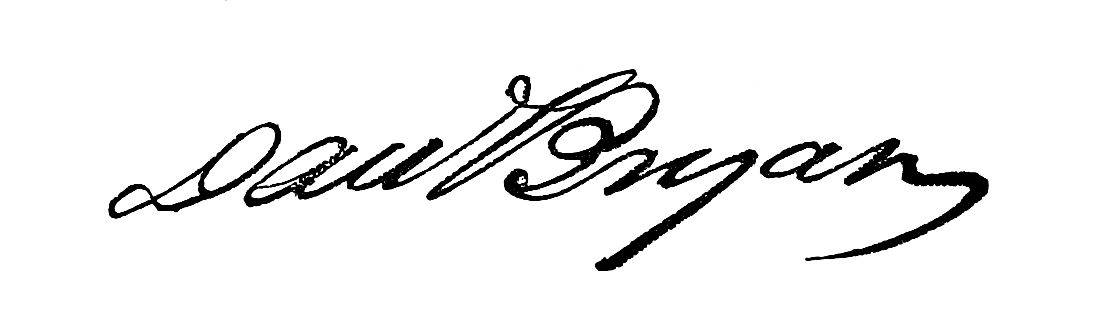
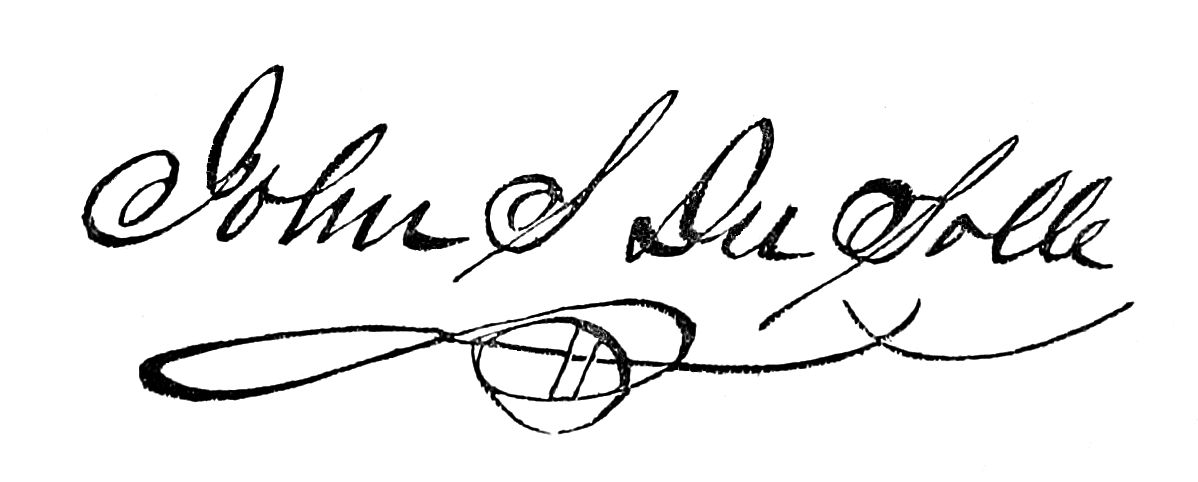
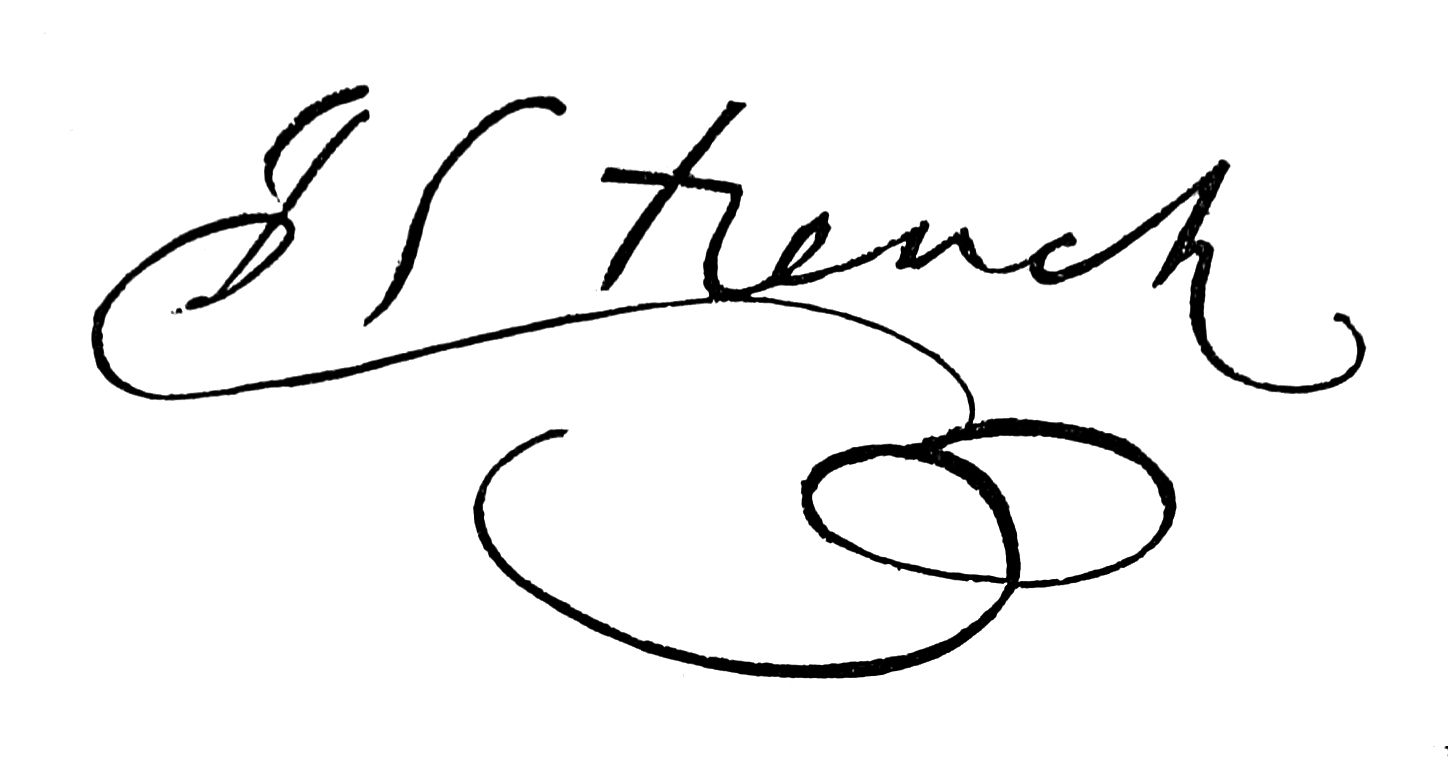
The cool breath of morning was blowing through
the open casement, when I awoke on the ensuing
day, and as the wind dallied with the curtains of my
bed and kissed my fevered brow, I felt an exhiliration
of spirits which no one can fully appreciate
who has not experienced the torture of a bed of sickness.
My dreams had been pleasant during my repose,
for they were of Beatrice. Overcome by exhaustion,
I had sank into a slumber almost immediately after
my faint attempt to address her; but I knew not how
long I slept; for, although it was now early morning,
I had no means of telling at what hour I had awoke
the day before. No one appeared to be stirring in
the room. The mild light of an October sun lay in
rich masses on the carpet, while occasionally the
brown vine leaves outside the casement, would rustle
pleasantly in the breeze. How I gazed on the patch
of blue sky discernible through that open window—how
I longed to be wandering free and uncontrolled
over the rich plains and up the glowing hill-sides that
stretched away before the vision. Oh! there is nothing
so glorious to the sick man as a sunny morning.
At this instant a bird whistled outside the casement.
How my blood danced at the lightsome tone! A succession
of dreamy, delicious feelings floated through
my soul, and I lay for some moments motionless,
but dissolved in gratitude.
I raised myself feebly up, and faintly pushing aside
the curtain, strove to obtain a survey of my apartment.
At length my thoughts reverted to my situation.
When I lost my consciousness, I was on a
deserted deck—now I was lying in a spacious apartment,
in perfect security. Who could explain this
mystery? It was a rich, even luxurious room. The
furniture was of the costliest and most tasteful pattern,
and the arrangement of the different articles
was made with an artist’s eye to the keeping—if I
may so speak—of the whole. A stand just in front
of me held a bouquet of fresh flowers, which, from
their rarity, must have come from some green house.
On the opposite wall hung a glorious picture of the
Madonna, with her golden hair and beatified countenance,
gazing down, with that smile which Raphael
has made immortal, on the infant on her knee. A
dim recollection floated through my brain that I had
seen that smile before, only the features which then
accompanied it, had been like those of Beatrice,
rather than of the picture. Suddenly that angel face
I had seen in my dream, flashed on me. I knew it
all now. It had been, while gazing on this divine
portrait in my delirium, that my fancy had imagined
it the face of Beatrice, smiling down upon me from
the clouds.
It was evident that Beatrice had some connexion
with my present situation, for I was convinced that I
had seen her the preceding day. Where was she
now?—How long had I been sick in this place?—And
in what manner was she I loved involved in
my rescue, were questions that continually forced
themselves on my mind, until my still weak brain
began to be dizzy with the mystery. Putting my
hands to my brow I strove to drive away such
thoughts; but they only returned with ten-fold force.
I would have risen to solve the mystery, but my
strength proved inefficient to the task, and I sank
back on my pillow. A half hour must thus have
passed, when I heard a light footstep on the carpet,
and in an instant my heart was throbbing, and the
blood dancing in my veins. In a moment I should
see Beatrice again. I gazed in the direction whence
the sound of the steps proceeded, and the name of
her I adored was already trembling on my lips,
when a hand gathered back the curtain, and I saw,
not Beatrice, but an elderly French woman, whose
dress bespoke her a nurse. Never did a way-worn
pilgrim, fancying he beheld the minaret of the holy
city in the distance, gaze on a mirage with more disappointment
than I did on the countenance of my visitor.
But my curiosity soon triumphed over my disappointment.
Perhaps she read my thoughts, for a
smile of equivocal meaning gradually stole into the
corners of her month as she returned my gaze. She
was the first to speak:
“Is Monsieur better?” she inquired.
“Yes,” I replied, “I am almost well—sufficiently
so, at least, to feel curiosity. In a word, how and
when did I come here? Who am I to thank as my
preserver?”
“Monsieur has more questions to ask than even a
Parisian grisette could answer,” she replied, evasively.
“Besides, his physician says he must be kept
quiet. I can only tell him for the present that he is
in France. Let him be patient and he shall soon
know all. He is at any rate among friends, and when
he gets stronger he shall hear his story from other
lips than mine.”
As this was accompanied with a meaning smile that
left no doubt on my mind to whom she alluded, and
as she seconded her words by drawing the curtains
together as if to retire, I was fain to be content.
In addition to this moreover, I felt that I had already
exerted myself sufficiently in conversation, for my
brain was dizzy with the few words I had spoken.
So I closed my eyes, and, like one wearied out with
toil, in a few minutes was asleep.
Several days elapsed, during which I saw no one
but the nurse, and now and then a servant or two in a
rich livery, who brought in the tray. To all my inquiries
I received the same answer, until at length,
unbounded as was my curiosity, I gave over the
attempt, comforting myself with the conviction that,
in a day or two more, I should hear my story from
the loved lips of Beatrice herself.
At length I was able to sit up, and when the formal
old physician appeared, he announced to me with a
meaning smile, that he would now permit me to receive
visitors. He added that my host and hostess
were anxious to pay their compliments in person, and
had only been prevented hitherto from doing so by
my extreme weakness, and his express commands.
All this had an air of mystery about it which, however,
I had not time to unravel, for the physician had
scarcely ceased speaking when the door opened and
my entertainers entered, announced by a servant in a
rich livery. I started and crimsoned to the brow,
but a hasty glance assured me that Beatrice was not
there. The wonder increased,—but the physician
left me no time for thought, for, advancing on the
instant, he introduced my visitors to me formally as
a Baron and Baroness de St. Allaire. They were both
somewhat in years, at least past their prime, but their
manners, apart from their former kindness to me,
would have attracted me to them at once. The Baron
was a stately Frenchman, of the school of le grand
monarque, very formal, very dignified, but withal
kind hearted. His lady possessed one of the most
benignant countenances I ever recollect to have seen.
Her smile was peculiarly sweet. Her years sat on
her lightly, and with all the propriety of her age she
had all the liveliness of youth. It was not long,
therefore, before I was perfectly at ease. The Baron
expressed his satisfaction at my rapid improvement
for the better, complimented himself on his good
fortune in being my host, hoped that I found the prospect
from my window pleasant, and all this, too, with
a formality, yet an affability that realized my idea of
the old French chevalier. His lady was less precise,
and consequently more winning. She conversed even
gaily, and on a variety of subjects, all, however, having
a bearing on my illness. Yet, with a tact which
I could not but admire, she avoided every allusion to
the means by which I had become her guest, reminding
me of a skilful advocate in a bad cause, always
hovering about but never approaching the issue. A
quarter of an hour was thus spent and I had determined
to relieve my eager curiosity by broaching the
subject myself at the first pause in the conversation,
but, as if anticipating my design, the Baroness suddenly
rose, and still continuing her gay remarks,
fairly complimented herself out of the room before
I had a chance to speak without violating all etiquette
by interrupting the good lady. I fancied, as she
closed the door with an “adieu, Monsieur,” that
there was malice in her provoking smile, betokening
a lurking consciousness that she had outwitted me.
At first I was half disposed to feel angry, it was so
evident that my curiosity was trifled with. My patience
nearly gave way at these continued disappointments.
Yet I had nothing at which I could rationally
get displeased. It was in vain for me to feel angry—my
discomfiture had been too adroitly managed—and
at length I fairly burst into a laugh at my own
expense.
“You are pleased to be merry,” said a silvery
voice behind me, and a low glad laugh that rung
through the chamber like fairy music, echoed my
own. I started up at once. I knew I could not be
mistaken. The next moment Beatrice was in my
arms.
The rapture of that re-union I shall not attempt to
portray. If my readers have been young, and after
having been separated for years from the one they
loved, have met her as their preserver, they can appreciate
my feelings. I draw a veil over the sacred
emotions of that interview. Nor will I repeat the
thousand questions which were asked and answered
almost in the same breath.
It was some ten minutes before Beatrice narrated
the circumstances which had transpired since I parted
with her in Charleston. Nor did she, even when she
began, give me a connected account. There were
too many questions to be asked, and too many inquiries
to be answered, all growing, it is true, out of her
story, but all sadly at variance with the course of
the narration, to permit a continuous tale. At length,
however, I learned all, or nearly all, for there were
a few things which the dear girl did not tell me until
long after,—and even then not without a blush at her
avowal.
My first inquiry was about her own fortunes, but
she would not answer me until I had told her how I
came on the wreck, and she had acquainted me with
the manner of my rescue. I will give it in her own
words.
“When you lost your consciousness you were, I
fancy, nearer to aid than you imagine, for a French
privateer that was hovering along the coast discovered
the wreck, and making for it rescued you,
almost exhausted it is true, but still retaining life.
You were insensible, and well nigh frozen to death.
But the exertions of your preservers finally restored
you to life, though not to consciousness. You fell
into a raging fever in which you raved in a constant
delirium. The captain of the privateer, having occasion
to put into port the following day, brought you
on shore, and suspecting you to be an Englishman
from your language, unfeelingly consigned you to the
common jail hospital, among the poorest and most
degraded of human beings. There you lay the whole
of the ensuing night, scarcely tended even by the
callous nurses of those establishments. No one knew
your name; your dress was not a uniform; and death
was rapidly approaching to consign you to an unknown
grave. But Providence did not will that such
should be your fate. An all-seeing eye beheld you;
an omnipotent arm interposed to save you. And the
means of your preservation were so fortuitous as to
seem almost those of chance. The confessor of the
Baroness was in the habit of visiting the prison—for
we reside but a short drive from the town—and
while giving consolation to one of those miserable
wretches—oh! I shudder to think that you were
once there—he heard a sick man in a neighboring
ward raving of a name,” and here the dear girl
covered her face in confusion, “which was familiar
to him. Need I say it was mine? He listened, and
heard enough to satisfy him that you were acquainted
with me. He made inquiries, learned how you came
there—and you can imagine the rest.”
“That I was brought here and saved from death,”
said I, looking fondly into Beatrice’s face. “But
you have not told me how you came here, or what
tie exists between you and our hostess.”
“Oh! she is my cousin. I spent some years here
in early childhood. But to tell my story I must go
back to when we last parted in Charleston.”
“Very well. I listen.”
“You know,” sweetly began Beatrice, “how much
I feared, when you were in Charleston, that my uncle
would make himself obnoxious to the colonial authorities,
and endanger perhaps his life. You knew
also, that he seemed resolved to bring about a union
betwixt his son and myself. The necessity of obtaining
my uncle’s sanction to my marriage under the
penalty of forfeiting my fortune, weighed but lightly
with me, for I knew his hostility to you to be unjust.
Yet, as the representative of my deceased parent, I
wished, if possible, to win Mr. Rochester’s sanction.
His persevering determination to unite me to his son
prevented all hope of this; and it was not long after
our parting that I saw he would never consent to my
becoming the bride of any one but his heir. Besides,
he grew every day more openly hostile to the colonies.
Unjust as I felt he was to me, I yet loved him
as my mother’s brother, and I trembled for his life.
But death suddenly interposed and calmed my fears,
only however to awaken my grief. In the grave I
buried my wrongs. I saw in him then only my
protector in a strange land—my nearest living relative—the
one with whom my sainted mother had
spent her childhood.
“My uncle’s decease at once changed my fortunes.
The only impediment to my enjoyment of my father’s
estate was now removed, and I was free to bestow
my hand on whomsoever I wished. My cousin renewed
his offer, at a decent interval after his father’s
death, but, need I say, I courteously yet firmly refused
it. My longer stay in Charleston was now a
matter of delicacy, for I had no relatives there except
the family of Mr. Rochester, and they naturally
viewed my decision with feelings more favorable to
my cousin than to myself. Under these circumstances
I availed myself of an opportunity that just
then presented to sail for this country, where my relative
the Baroness, with whom I had spent some
years in childhood, resided. She had continued in
correspondence with me ever since, and had urged
me in every letter to visit her, even if I could not
come and make my home with her. Little did I
think that I should meet you under the circumstances
in which I did.”
I have little more to add. Of the letters which I
had written to Beatrice some miscarried, some were
lost in captured ships, and a few reached her months
after they had been penned. Her answers came with
even more irregularity, for since the day we had
parted in Charleston I had received but a solitary
epistle from her. Now, however, every disappointment
was amply redressed. She sat beside me with
her hand in mine, and her soft eyes looking smilingly
up into my face.
“But why,” said I at length, “was so much mystery
preserved respecting your presence here? And
why, after I had recognized you on my first awaking
from delirium, did you order the nurse—for you only
could have done so—to avoid all mention of your
name, to conceal from me in whose house I was?”
“That was a scheme adopted as much from the
orders of the physician as from any other motive.
He feared that the least agitation would bring back
your fever, and he enjoined secresy on the nurse, as
the surest way to keep you composed.”
I would have said how much he had failed of success
had I not been too full of happiness to condemn
even a formal old physician.
The period of my convalescence is one written on
my inmost heart in characters never to be obliterated.
Oh! those were delicious hours. With Beatrice beside
me I would sit gazing out on the sunny landscape
beneath the window, or wander through the
rich garden which surrounded the chateau. Or perhaps
she would ply her needle while I would read to
her. And then she would sing some of the old songs
of her native land. And by and by the Baroness
would come in, and with her ever sunny mind join in
the conversation. Years, long eventful years, have
passed since then, and God knows too many of those
I loved are now in their graves, but the memory of
that fortnight of happiness never fails to restore gladness
to my heart even in its utmost sorrow.
But I have too long forgotten the little Fire Fly.
It will be recollected that I had left Holland with
the intention of joining my old commander at Paris,
and I now seized the earliest opportunity of communicating
my present situation to him by letter. A
reply soon arrived by which I learned that, although
the Fire Fly had been condemned, a brig had been
chartered, and that he intended returning to America
with his officers and most of his crew in her. They
had been in the greatest anxiety respecting my fate,
and had finally given me up for lost. The letter informed
me that the day of sailing had been fixed, and
that before I could return an answer the brig would
have broke ground. My old commander ended by
hoping that I might soon be able to rejoin him in the
United States—although he added a gay postscript
to say that he understood there was great probability
of my choosing another mistress than glory.
Meanwhile I slowly recovered, and as every obstacle
to my union with Beatrice was now removed,
I did not hesitate to press the dear girl to name an
early day for the realization of our nuptials. With
a thousand blushes she referred me to the Baron and
his lady, promising in the softest whisper, as if she
feared to trust herself to speak, to abide by their decision.
Need I say how speedily I availed myself of
the permission, or how warmly I petitioned for as
short a delay as possible?
At length the day was named, and though I was
condemned to wait a whole month, in the company of
Beatrice it glided away almost insensibly.
The morning at length dawned. It was a bright
sunny day in early winter, and never shall I forget
the cheery sound of the village bells ringing to announce
my approaching nuptials. The air was keen
and frosty; not a cloud was in the sky; the brown
woods fairly glowed in the sunlight; and, in a word,
had I chosen the day a more fitting one could not
have been selected. My lady readers may expect a
description of the dress of the bride, the carriage,
the feast, and a thousand other things, but as I am
no Sir Charles Grandison, I shall pass them over without
comment. I will only say that Beatrice—my
own Beatrice at last—never looked lovelier than
when she descended to the room, where we were all
awaiting her, on that marriage morn. The smile, the
blush, the look of unreserved affection as her eye was
raised timidly to my face and then dropped, I shall
never forget. The Baron gave her away, the nuptial
vow was said, and with a tumult of feelings I cannot
describe, I pressed her to my bosom, a wife. A tear
was on her cheek, but I kissed it holily away.
We remained in France for nearly a year after our
union, and even after that prolonged stay, could
hardly tear ourselves from the Baron and his lady.
But the prospect of peace daily growing stronger we
availed ourselves of the kind offer of the French
monarch, and sailed for America in one of our allies’
frigates. I never, however, served again, for the
war was in fact terminated, but thereafter I spent
my life in the bosom of my family.
As the magician after having summoned up and
marshalled before him a phantasmagoria of shadowy
figures, at length perceives them fading from his
sight, and, conscious that the spell is fast departing,
lays down his rod, so we, approaching to the end of
our task, find that the charm is beginning to lose its
power, and that the beings we have conjured up are
melting rapidly from our vision. Even now they
seem to us only as a dream. Yet there is one glimpse
more afforded to us before the magic curtain falls on
them forever. It is that of a happy fireside and a
smiling circle around it. Nor are the principals in
that domestic scene wholly unfamiliar to us, for in
the mild eyes and Madonna-like countenance of the
one, and in the well-known face and embrowned
features of the other, we recognize two of those who
have figured as the chief personages in our story.
Years have not impaired the beauty of Beatrice, for
they have fallen as light on her as blossoms. But
she is not now alone in her loveliness, for at her knee
is one, like and yet unlike her, younger but not more
beautiful, gayer but with scarcely less sweetness.
Need we say of whom the group is composed?
And now, reader, let me drop my disguise and
come before you in my own character as
Harry Danforth.
———
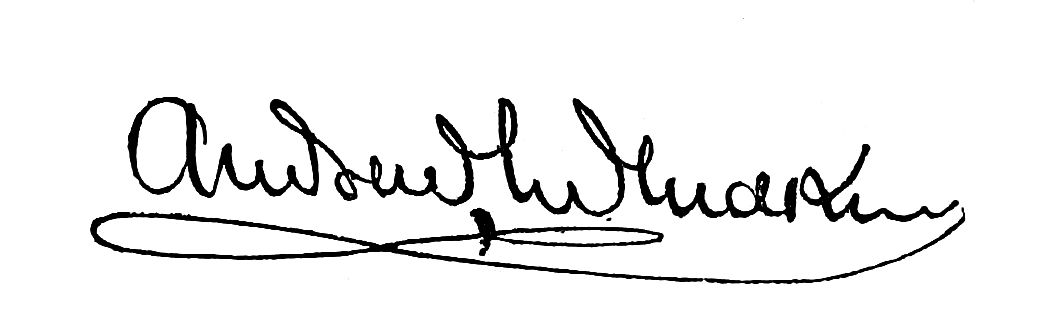
BY A. M’MAKIN.
———
He woo’d me at the fountain,
When the moon shone bright above,
And with the murmuring of the stream,
He pledged his vows of love.
I bade him to my father hie,
The pleasing tale to tell,
Then seek again the fountain sheen,
Down in the sylvan dell.
He woo’d me in the bower,
When the songsters fill’d the grove,
And with the dove’s soft tones he sigh’d
His ardent tale of love.
I bade him seek my mother’s side,
Her blessing first to win,
Then claim me for his chosen bride,
The trelliced bower within.
He woo’d me at the festal,
Where music reigned supreme,
And ’mid the revel wild and light
He breath’d his chosen theme;
Yet all unbless’d I could not yield
To man the heart’s rich mine,
Or falsely dash the holy light
From filial duty’s shrine.
At length ’twas at the altar,
’Neath the organ’s pealing sound,
He sought again my trembling hand,
While friends were smiling round;
No more I bade him others seek,
Or waved him from my side:
With blushes mantling o’er my cheek,
I knelt his happy bride.
———
BY MRS. R. S. NICHOLS.
———
“The very head and front of my offending
Hath this extent, no more.”
Othello.
It was near midnight, on one of the beautiful summer
evenings that brood over our Western Land, as
some fair spirit hovers near to Paradise—and which
can be realized only by those who have witnessed
them—that one of the numerous strangers that throng
the waters of “La Belle Rivière,” paused on its upward
course before a small town which lay upon the
banks of the aforesaid stream. When the boat had
effected a landing, a few passengers, who either blind
to the charms of Morpheus, or more allied to those
of sundry packs of cards, that strewed the tables of
the “social hall,” stepped upon shore to enjoy a
moonlight view of the village. Among the number,
was a group of three individuals, who, withdrawing
from the rest, strolled carelessly along one of the
principal streets, until they arrived at a cross, turning
down whose short but secluded walk, several
large buildings, evidently the residences of the most
wealthy portion of the inhabitants, were situated.
As they passed into this beautiful and peaceful retreat,
a slight whispering, which presently broke
forth into loud and angry words, disturbed the slumbering
echoes of the night.
“I tell you, Layton, it is impossible! I will not—cannot
do it!”
“Spoken like a fool, and a milksop, as you are;
there is a way to stop your whining scruples, and
curse me if I’ll not show it you.”
Quick as thought, the first speaker turned, and confronting
his companion, exclaimed in a voice trembling
with passion,—“Ay, there is a way to rouse the
sleeping devil, even in my coward frame; but your
threats fall regardless on my ear, while I have this
good blade to protect me,”—and a long glittering
Bowie-knife flashed beneath the soft rays of the harvest
moon.
“By Heavens! I believe you both to be mad! Put
up your knife, Bradley, and you, Layton, keep your
infernal tongue within your teeth, unless you want to
have this goodly town about our ears.” This soothing
speech was spoken by the third, and hitherto silent
companion; and while the altercation is progressing
in lower tones, you, my gentle reader, shall have a
Daguerreotype sketch of at least one of the party.
Bradley Spencer was the son of one of the most
wealthy and aristocratic planters in Louisiana, but
maternal affection he never knew, at least was not
conscious of it, his mother having been snatched
away in his childhood, by one of the fearful epidemics
peculiar to that portion of the South. His father, a
high-principled, noble-minded man, richly endowed
with the warm blood and chivalrous feelings of the
Southerner, having thus lost that which he considered
as the better part of life, gave his undivided heart to
this “sole scion of his stock,” and for his boy’s sake,
no second lady darkened his halls, or cast a shadow
over the golden sunlight of the young heir’s youthful
existence. Thus fondly nurtured and cherished, every
wish indulged to the utmost, the young Bradley grew
apace; but, with all his paternal prejudice, the elder
Spencer could not but note the wavering acts and vacillating
mind of his darling boy, betokening, even in
youth, the indecision of the man. With prophetic
sorrow, he saw the consequences entailed on one,
who, ever willing to follow, had no projects to offer,
or will of his own, to oppose those of others. To
eradicate this “crying evil,” the boy was sent, at the
age of fifteen, to college. There, at least, argued the
parent, he will learn independence of thought and
expression. But how widely was he mistaken! An
universal favorite among his class-mates, winning
“golden opinions” from all, by his pliant disposition,
and suavity of manners, and being allowed an unlimited
sum for his passing expenditures, he bore the
palm, and reigned any thing but a despot, over his
more firmly-minded companions. It is not our intention
to follow him through the mazes of college life,
and we pass in silence over the four succeeding years,
when at the age of nineteen, he was re-called, to receive
the last blessing and injunctions of a dying
father. Still true to his erroneous system of indulgence,
Mr. Spencer left his property to the undivided
control of his son, fondly imagining, that unlimited
sway would overcome the imbecile principles of
youth, and teach him that firmness of mind, and stability
of purpose, so essential to manhood.
Youth is the season of luxury and enjoyment. Joy
is evanescent; and grief, in the young bosom, is but
the sudden o’ercasting of a summer sky; the cloud
passes away, and the bow of promise is bent in the
now smiling heavens. Thus was it with Bradley’s
grief; a few short weeks in New Orleans did wonders;
they initiated him in the mysteries and delights
of the gaming table; they did more: they
introduced him to the lowest haunts of vice and
infamy, cloaked, indeed, for the decoy of this rich
windfall; but so thin and flimsy was the protecting
veil of decency and morality, that any other than
Bradley Spencer’s eyes would have pierced the wily
folds, and laid bare the monsters lurking behind
them. Thus early possessed with the fatal passion
of gaming, night after night saw the infatuated youth
wound deeper and deeper in the toils of his betrayers.
Mortgage after mortgage was given,—though
not having a shadow of legality about them, they
were accepted as eagerly by these human leeches,
as the red gold for which they had sold their souls to
perdition. The men with whom it was Spencer’s
fate to become connected, were most of them from
thirty to forty years of age; wily, unprincipled villains,
well calculated to govern the simple youth,
whom they remorselessly plundered of all at his present
command, and accepted his honor as pledge for
the rest, when he should become of age. Nor were
the months tardy in their flight. At the end of two
short years, his property was formally yielded by his
passive guardian, and the day that gave him house
and land, stock and slave, saw him resign it to the
fiends who had possessed him with a love of all that
was degrading to human nature, and taught him to
scoff at all who were truly poor and virtuous.
It is the same Bradley Spencer, kind reader,
whose brief career we have endeavored to trace, that
we left in the little village, with his knavish companions,
who, fresh from the hiding places of loathsome
vice, were intent on drawing the young man into yet
greater depths of wickedness. But they struck upon
the wrong chord—Spencer had been culpable, most
culpable, it is true, but he was to himself his worst
foe; he had not willingly injured others, but had
been the dupe, in every instance. Thus, when his
brutal comrade expressed his determination to rob
one of the habitations before them, and urged his
assistance, his nobler spirit that had slept so long,
was aroused, and he gave vent to his feelings in the
manner we have described.
Brief was their consultation, and the arguments
they held with him bade fair to be of no avail, until
the elder and more polite villain, declared that Bradley
could not now withdraw in honor, as they should
suspect he meant to betray them; that they would
not require his assistance, if he had any foolish prejudice
to the contrary; but he should accompany
them, as a mere looker-on. Without pausing for an
answer, he passed his arm in that of the young man’s,
and followed by Layton, they stepped into a small
yard, at the gable end of one of the mansions. There,
a window had been left open by the unsuspecting
inmates, for the benefit of the air. Springing lightly
in, he was followed by the others. Groping their way
by the light of a dark lantern, which Layton pulled
from the bosom of his coat—thus showing himself
perfectly au fait in such proceedings—they ascended
a staircase, and pausing in a long passage, bade
Bradley be watchful, and give a low whistle upon
the slightest alarm. The two less scrupulous ruffians
then pursued their way down the passage. What
Spencer’s reflections would have been, he had not
leisure to ascertain, for, fancying he heard a low
breathing, like one in deep slumber, he turned and
discovered, by the light of the moon, which was
streaming in a window near, a door, the which,
on applying his hand, yielded to the impulse. Impelled
by curiosity, or some more definable feeling,
he stepped softly into the room. A night-lamp was
burning dimly upon a table, near a small couch,
where, in her bright and youthful loveliness, slept a
fair girl. Scarce had the breath of sixteen summers
passed over the clear brow that lay upturned in its
marble whiteness, for
“Death’s twin-sister, sleep,”
weighed down the veined lids, the long dark lashes
of which rested on the faintly-tinged cheek beneath.
As Spencer turned from this unexpected vision, his
glance fell on a small book, that lay open on the table.
Some light pencil-mark, that pointed to an admired
passage, drew his attention. As he bent to read, his
brow crimsoned, and his frame trembled with emotion.
It was a volume of the ill-fated Shelley’s
Poems, open at “Adonais,” and as he read
“Remorse and self-contempt shall cling to thee,
Hot shame shall burn upon thy secret brow,”
a full sense of his degradation, and how he had
“fallen from his high estate,” rushed upon his
stricken heart, and feelings that had slumbered
long, were now fully awakened by the thrilling
lines of the mystical poet, and the strange scene
before him. As he turned quickly to leave where
his presence was a sacrilege, his attention was
caught by a small miniature, one glance at which
showed him the waking likeness of the sleeping
beauty before him. Involuntarily catching it, he
fled from the room, and giving the signal agreed
upon, to his companions, the next moment saw
them wending their way to the boat, which, having
discharged the freight that detained her, was soon
flying upon her onward course.
Three years had passed away, since Bradley
Spencer, leagued with common thieves, accompanied
them on their nefarious night expedition, in the little
village already mentioned. Bradley Spencer, then
the companion of gamblers and low debauchees, was
now Henry Murray, the trusted head clerk of one of
the most wealthy mercantile houses in New York.
From the ever memorable night of the robbery, the
wretched young man forsook his unworthy associates.
“Remorse and self-contempt” did indeed cling to
him, and despair and shame at first conquered his
remaining energy. But the spirit was present with
him; it only needed to be roused into action. He
had parted with his last dollar, when he arrived in
New York, and the change of name was decided on
to soothe the pride that came to his aid after so long
a time. Deprivations only rendered him stronger in
his virtuous purposes, thus proving at once the false
system of indulgence adopted by his parent.
Clement Archer, Esq., was a stern, unbending, business
man. Strictly moral in his walk before men,
he required all around him to show the same regard
for the welfare of society. With a heart filled with
benevolence, though veiled with an air of sternness,
he received Bradley in his counting-house, as Henry
Murray, knowing it to be a fictitious name, for Spencer
scorned to impose on his benefactor in this respect,
and though Bradley’s past history was a sealed
book which his employer never attempted to pry
into, he could not help fancying some misdemeanor
had driven the young man from his home and friends.
He contented himself, therefore, by placing a strict
watch upon his conduct, but after months had passed
away, indeed, years, and saw Henry the same attentive,
hard-laboring clerk he was at first, his patron
took pleasure in showing him favor, and in placing
the most unlimited confidence in him. Thus had the
three years glided by. That Henry was comparatively
happy, we admit, but many an agonizing night had
passed, ere he acquired even this slight tranquility,
and shall we confess it, kind reader? the stolen
miniature, the witness of his involuntary crime, was
cherished as a precious relic, for instead of serving to
remind him of his errors, and fill him with shame, it
was regarded as a mute angel, that had snatched him
from ignominy and vice. And who could blame him
for loving to look upon that fair countenance, with its
deep and eloquent eyes forever speaking of the intellectual
worth within? It was not so much the beautiful
form of the features, that arrested the gaze, as
the whole-soul expression that shone around them.
Long would the infatuated youth gaze on the memento
of his crime, but there was little penitence in
his looks, and not one thought of sorrow for the grief
the loss of it must have given the fair original, for enclosed
in the back was a braid of dark hair, slightly
silvered with grey, and beneath was engraved, “from
a fond mother to her daughter, on her sixteenth birthday.”
Bradley had carefully avoided every print which
he thought would be likely to contain the intelligence
of the robbery, and as no communication passed
between himself and the perpetrators on this subject,
he was consequently ignorant of the amount abstracted,
or of the names of the sufferers.
It was a cold winter morning, when Mr. Archer
suddenly entered his counting-house and ordered it to
be immediately closed. On Henry’s (for so must we
call him) looking up, he perceived his friend’s countenance
was clothed with grief, and the fresh crape
upon his hat told that death had been busy with his
house. Bidding Henry, who was domesticated in his
family, accompany him home, he informed him he
had just received letters announcing the death of an
only and well-beloved brother, and added, he was
hourly expecting the arrival of an orphan niece, now
committed to his charge. His companion asked no
questions, for fear of stirring the fountain of grief
afresh. On entering the drawing-room at night, he
was presented to Miss Archer, but what was his surprise
and consternation on lifting his eyes to her face,
to see the fair sleeper before him! The face was
paler than the miniature’s, and wore a more chastened
and somewhat older expression, for sorrow had indeed
visited her. Both parents had slept their last sleep,
since she slumbered so unconsciously in his presence.
Stammering forth some faint apologies, Bradley left
the room and the house, and who may say what wild
visions thronged his restless couch that night!
Months glided away, and Mr. Archer beheld, with
some slight misgivings, the growing intimacy between
his niece and Henry. Not but that he would willingly
have given her to his protégé, could the cloudy
mystery which hung over the young man have been
cleared to his satisfaction. But during the three
years Henry had been with him, he had never received
letter or communication, of any kind, from friend or
foe. For a young man to stand so utterly alone,
“looked strange,” to say the least of it.
Entering the room one evening, where Miss Archer
and Henry were sitting, her uncle, in a light and
laughing tone, said,
“How is this, Emily? Young Dalton has been
making serious complaints concerning the obduracy
of heart of an ungrateful niece of mine. What has
he done to provoke her displeasure? ‘and why won’t
she wed?’ ”
“Nay, dear uncle, you know my heart and hand
have long been pledged to the restorer of my miniature.”
“And so my Emily stands pledged to a nameless
robber! Would she like it to reach his ear through
the walls of a prison?”
“Most sincerely do I hope he is free, for he must
be a gentle ruffian, and having stolen naught but my
picture, I can’t find it in my heart to be very angry;
the compliment, dear uncle, only think of the compliment!”
“Ay, but the compliment paid to your father was
a little more costly, was it not?”
“With that I have nothing to do,” replied Emily,
blushing; “but I would willingly forgive the robber,
would he restore my mother’s gift,” and the
tears sprang to her eyes, at the mention of her loss.
Mr. Archer saw her emotion, and said no more. But
Bradley, how did he hear the secret? How often was
he tempted, as he heard the beautiful and enthusiastic
girl plead for him so eloquently, and regret the loss
of what was so dear to her, to throw himself on her
mercy and confess all, but happily he restrained his
emotion, and soon after left the apartment.
“Now, gentlemen, while you are discussing your
hot rolls and coffee, I will read this delightful retailer
of news and scandal,” exclaimed Miss Archer, on
seating herself at the breakfast table, the morning
succeeding the conversation already detailed. “Here
is ‘latest foreign news,’ ‘home affairs,’ ‘politics’
and ‘poetry;’ which will you have? Ah! let me
see; here is a mysterious affair:
‘The Governor of Louisiana offers five hundred
dollars reward to any person or persons, who will
intimate any knowledge of the residence of one Bradley
Spencer, or satisfactorily prove that the said
Bradley is living. He having left New Orleans about
three years since, in company with a party of gamblers,
and not having since been heard of, it is feared
by his friends that he has fallen a victim to the machinations
of the said men, as through a confession
lately made by one of the party, who was stabbed in
an affray, Spencer will be restored his property, of
which he was most nefariously deprived. Should
this meet his eye, he is earnestly requested to return
and take possession of the same.’ ”
As Emily read this paragraph in a clear, distinct
voice, Mr. Archer fastened his eye on the young man
who sat at his table. No power on earth could have
controlled Bradley’s emotions, and after the reader
paused, Mr. Archer arose, and taking his hand, said,
“Be candid, Henry; whatever faults you have
been guilty of, these last three years have expiated——”
“You know not the half of my rash acts,” passionately
interrupted the young man; “you would both
loathe and spurn me, were I to tell all; but I will
perform one just act. Miss Archer,” taking the
miniature from his bosom, “here is the deity that
has preserved me from sin, and before you stands
the—robber!”
Both Mr. Archer and Emily were mute with surprise
and amazement at this confession; but when
they eagerly questioned him, and learned what he
had to offer in extenuation, it is needless to say he
was freely forgiven.
It is sufficient to add that Bradley recovered the
major portion of his property, and as he gazes upon
the generous and forgiving girl, who is now his bride,
he invokes blessings on the being who, by the interposition
of a Divine Providence, was the means of
preserving him from the “gambler’s fate.”
“Oh! thou, that once was wedded to the sea—
Queen of the Adriatic—where are thy glories now?”
Oh Death! thy palaces are here,
Thy footsteps echo round,
And chills the heart with nameless fear
At that unearthly sound—
And Venice, at thy outer gate,
Sits widowed, bowed and desolate,
A queen, yet all discrowned,
With ashes heaped upon her head—
A mother wailing for her dead!
It was not thus in ages past
Oh! mistress of the sea,
When to the wind thy banner cast
Would rally forth the free—
It was not thus when ev’ry shore
From farthest Ind to Scylla bore
Its richest gifts for thee—
Nor thus when at Lepanti fell
The fiery hordes of Ishmaël.
Thou saw’st proconsuls on the Rhone,
The Gaul beyond the Rhine,
The Cæsar on his eastern throne,
The English Alfred’s line—
Thou saw’st the first and last crusade
And Florence in her shackles laid,
And Rome all drunk with wine,
And haughty Stamboul’s overthrow
Before the blind old Dandolo.
Thou wast when Moslems ravaged Spain,
Thou saw’st Grenada fall,—
Thou wast when France received the Dane,
When murder reigned in Gaul,—
Thou wast before the Turk was known,
When Huns were on the Roman throne,
And England yet in thrall,—
And still, as nations rose and died,
Thy Titan front the world defied!
But now thou art all desolate,
The very mock of fame,
With nothing save thy fallen state,
Thy ruins, and—a name.
And silent are thy songs of mirth,
Thy form is prostrate on the earth,
Thy brow is white with shame—
Oh God! a harlot in her woe!
Did ever grandeur fall so low?
And waving from thy palace walls
The long grass rankly grows—
Lamenting, through its dull canals,
The sluggish water flows—
And ’neath the Lion of St. Mark—
That scourge of vanished empires—hark!
The tramp of Austrian foes.
How long, Oh! Venice, o’er thy grave
Shall jeer the coward and the slave?
I stand beside the Lion’s mouth
And gaze across the sea,
The breeze is wafting from the south
No argosies to thee!
Thy hundred seers, thy fearful TEN.
Are not, and shall not be again
While God is for the free!
Yet they a deathless name shall find,
A scorn, a hissing to mankind!
Go! let her moulder where she fell—
We only weep the brave—
Her destiny befits her well,
A traitor, then a slave,—
Betraying all, herself betrayed,
And smote by parricidal blade,
She sank into her grave—
Shall nations shed a tear for her
Whose life was Freedom’s sepulchre?
———
BY THE AUTHOR OF “THE BROTHERS,” “CROMWELL,” “RINGWOOD THE ROVER,” ETC.
———
It was a day of Truce in the fair Troad!—the
festival of the great Doric and Ionian God, sacred to
either nation—it was a day of general peace, of general
rejoicing! The ninth year of the war was
far advanced toward its termination. Hector, the
mighty prop of Troy, had fallen; yet did the Grecian
host still occupy their guarded camp by the dark waters
of the Hellespont; nor had the indomitable valor
of the Goddess-born prevailed to level with the dust
the towers of Troy divine. For fresh allies had
buckled on their armor for the defence of Priam—Memnon,
son of the morning, like his great rival
half immortal, with his dark Coptic hosts, had rushed
from the far banks of the giant Nile—ill-fated prince
and hero!—rushed, but to swell the triumphs of the
invincible Thessalian, to water with his life-blood
the flowery pastures of the land he vainly hoped to
save. Penthesilea, virgin queen of the man-defying
virgins—fairest of earth’s fair daughters—had left
her boundless plains beside the cold Thermodon—had
called her quivered heroines from warring with
the mountain pard, and chasing the huge urus of the
plain, to launch the unerring shaft and ply the two-edged
axe against the sevenfold shield of Salamis,
against the Pelian spear. Alas! not her did her unrivalled
horsemanship, in which she set her trust—in
which she might have coped successfully with the
world-famed Bellerophontes—not her did her skill
with the feathered reed avail, against the speed of
him who left the winds behind in his career, whose
might was more than human. She too lay prone before
him—the dazzling charms of her voluptuous
bosom revealed to the broad sunshine, as he tore off
the jewelled cincture—tore off the scaly breastplate—the
hyacinthine tresses, soiled in the gory dust—tresses
wherewith she might have veiled her form
even to the ankles, so copious was their flow! Oh
she was beautiful in death—and avenged by her
beauty!—For the fierce conqueror wept and bore her
to his own pavilion, and hung enamored for long days
over those fatal charms; and pressed the cold form to
his fiery heart, and kissed with fervid lips the cold
and senseless eyelids, the mouth that answered not
to his unnatural rapture. The fate of Troy, as on
the bravest of her sons, had fallen on the best of her
allies—the fiat of the destinies had long ago gone
forth—the fiat which the dwellers of Olympus, the
revellers on Nectar and Ambrosia,—which Jove himself,
although he were reluctant, must obey! The
ancestral curse was on the walls of Ilium, and all
who should defend them. They fell there one by
one, valiant, sometimes victorious—Sarpedon, Cyenus
fell—Memnon, Penthesilea! Yet falling they
deferred the ruin which they might not avert—so
Troy still stood, although her mightiest were down—and
when the brazen cymbals of Cybele summoned
her sons to battle, they still rushed forth in throngs,
determined to the last and unsubdued; and with
Deiphobus to lead—worthy successor of their mightier
hero—they battled it still bravely on the plain,
between the city and the sea.
But now it was all harmony and peace!—the
spears were pitched into the yellow sand beside the
Grecian galleys, or hung, each on its owner’s wall,
within the gates of Ilium. The plain, the whole fair
plain, was crowded now—more densely crowded
than it had ever showed, when in the deadliest fight
the kindred nations mingled—for now not warriors
only, but the whole population of the camp, the country
and the town, traversed its grassy surface in gay
and gorgeous companies. Gray headed men were
there, counsellors and contemporaries of old Priam,
eager to look upon the field whereon such exploits
had been done—matrons come out to weep above
the green graves of their sons and spouses, graves
which till then they ne’er had visited, nor decked with
votive garlands, nor watered with a tear—maidens
in all the frolic mirth of their blythe careless youth,
panting to gather flowrets from the green banks of
Simois and Xanthus, Phrygian streams, to chase the
gaudy butterfly, to listen to the carol of the bird—to
drink in with enchanted ears the sylvan harmonies
from which they had so long been shut within
the crowded walls of the beleaguered city.
It was a wondrous spectacle—Yea! beautiful exceedingly!
Men in those days were indeed images
of the immortal—women, types of ideal loveliness!—many
a form was there of youthful warriors, such
as were models unto him who wrought from the inanimate
rock of Paros, that breathing, deathless god,
the slayer of the Python—many a girlish shape such
as we worship in the poet’s dream, Psyche, or Hebe,
or Europa—many a full blown figure, ripe in the
perfect luxury of womanhood, such as enchants the
eyes, intoxicates the hearts, enthrals the souls, of all
who look upon the Medicean Venus. Then the rich
oriental garbs—the half transparent robes of gauze-like
Byssus, revealing all the symmetry, and half
the delicate hues, of the rich charms they seemed to
veil—the jewelled zones and mitres, the golden
network, scarce restraining the downward sweep of
the redundant ringlets!—the priests in stoles of
purest snow, sandalled and crowned with gold!—the
sacrificers in their garbs succinct—the spotless,
flower-crowned victims!—the music—and the
odors!—and the song! The wild exulting bursts of
the mad Bacchic Dithyramb!—the statelier and more
solemn chant, warbled by hundred tongues of boys
and stainless virgins, in honor of the Pure, Immaculate
God—the silver-bowed—the light-producer—the
golden-haired, and yellow-sworded—the healer—the
averter—the avenger!—son of Latona and
of Jove—Delian and Thymbrœan King!—the blast
of the shrill trumpets, blent with the deep, deep roll
of the Corybantian drum, loud as the deafening roar
of subterranean thunder, and the sharp clashing of the
Cretan cymbal, and the shrill rattle of the systrum!
the chariots and the coursers of the god!—chariots
of polished brass, reflecting every beam of the broad
Asiatic sun till they seemed cars of living flame—coursers
of symmetry unmatched, snow-white, with
full spirit-flashing eyes, and nostrils wide distended,
trampling the flowery sod as if they were proud of
their golden trappings, and conscious of the God their
owner!
Far in a haunted grove, beneath the towering heights
of Ida, where never yet, during the whole nine years
of deadly strife, had the red hand of war intruded—far
in a haunted grove, whither no beam of the broad
day-god pierces even from his meridian height—so
densely is it set with the eternal verdure of the laurel,
high over-canopied by green immortal palm—so
closely do the amorous vines embrace both palm and
laurel weaving a vault of solid everlasting greenery—where
the perpetual chant of the nightingale is mingled
only with the faint sigh of the breeze that plays
forever among the emerald alleys, and the sweet tinkling
voice of the Thymbrœan rill, cold from its icy
cradle on the cloud-curtained hill of Jove—unvisited
by feet of profane visitor, stands the secluded
shrine of the Pure God—a circular vault of whitest
Parian marble, reared on twelve Doric shafts, their
pedestals and bases of bright virgin gold. Beneath
the centre of the dome is placed a circular altar of
the same chaste materials, wrought with the most
superb reliefs, descriptive of the birth, the exploits,
and the histories of the great Deity—and in a niche
immediately behind it—the Deity himself—the
naked limbs—all grace and youthful beauty—the
swell of the elastic muscles, the life-like, almost
breathing protrusion of the expanded chest—the swan-like
curvature of the proud neck, the scornful curl
of the almost girlish lips, the wide indignant nostril,
the corded veins of the broad forehead from which
the clustered locks stream back, waved as it were by
some spiritual breath prophetic, the lightning glance
of the triumphant eye shot from beneath the brows
half bended in a frown, proclaimed the Python killer—the
Boy-god now in the flush of his first triumph!— The
fierceness kindled by the perilous strife was not
yet faded from the eye—yet he smiles, scornfully
smiles, at the very ease with which he has prevailed
over his dragon foe!
A dim religious twilight reigned through that solemn
shrine; it would have been a solemn darkness,
but for the pencils of soft emerald-colored light,
which streamed down here and there full of bright
wandering motes, among the tangled foliage—and
for the pale transparent glow soaring up from the
marble altar, whereon fed by the richest spices and
the most generous wine, the sacred flame played to
and fro, lambent and imitative of the lights that stud
the empyrean.
Splendid, however, as was the picture offered by
the interior of the shrine, decked with all those appliances
that operate most strongly on the mind, or
at least on the imaginative portion of the mind of
man—pervading all the senses with a calm, sweet,
luxurious languor—filling the soul with strange voluptuous
fantasies—half poetry, half superstition;
yet infinitely were all the splendors, all the elegance
of the spot surpassed by the transcendant majesty
of those who stood around the altar.
On the right hand and left, next to the statue of
Apollo, ministered the chief pontiffs of that solemn
and mysterious deed; they were both old, even
beyond the usual old age of mortals, yet perfectly
erect and stately in their forms—their long locks
were indeed of perfect silvery whiteness, their wide
expanded foreheads wrinkled with many a line and
furrow, their lips pale as ashes, their whole complexion
bloodless!—yet did their eyes beam out
from the deep cavernous recesses of their sockets
with a wild and spirited brilliance that savored not a
little of the unearthly light of inspiration; and their
whole air and bearing went far to denote that their
long years had nought diminished the pervading powers
of the soul, though they had wasted not a little
the mere mortal clay; but rather had given freer
scope to the far-darting mind, in limiting the operations
of the coarser matter.
Their robes were white immaculate linen, and
they wore chaplets of the green bay tree on their
heads, and carried sceptres in their hands of gold,
enwreathed with sprays of laurels, and bound with
woollen fillets. All motionless they stood, and silent;
stirring not hand, nor foot, nor even so much as
winking an eyelid, save when they poured the fat
spiced wine from golden pateræ upon the altar, to
feed the sacred flame. Behind them were assembled
the ministers, the choristers, and sacrifices of the
temple, waking at times wild harmonies from many
a golden lyre, many a silver flute; while, to fill up
the pauses between the bursts of instrumental music,
soft symphonies arose from virgin lips invisible,
singing, “all glory to unshorn Apollo, and her, the
sister of his soul, the unstained goddess of the groves—queen
of the silver bow!”
A little way advanced by the right hand of the
altar, bowed down by many years and many sorrows,
yet still serene, and dignified, and king-like—for he
was yet a king!—aye, and in after days, when his
Troy sunk in ashes never to rise again, a king he
died, right kingly—leaning on his ivory staff stood
the great offspring of Laomedon—good, hapless Priam.
His limbs, which had been framed in the gigantic
mould of the old heroic ages, still larger than the
degenerate thews of his descendants, were all relaxed
and nerveless; and the great veins and sinews, which
stood out upon his shrivelled hands like a network of
cordage, betokened the vast strength which once must
have dwelt in that large frame, so sinewless and feeble
now—so impotent and helpless. His golden crown
was on his lofty brow, serene and venerable in its polished
baldness—a flowing mantle of rich regal purple,
lined with white lambskins, flowed down from his
shoulders and swept the marble pavement with its rich
broidered edge and bullion fringes—a tunic of white
linen, gathered about his waist by a broad belt of golden
arabesques, sandals of purple leather clasped and
embossed with gold, completed his attire—while,
ministers of regal state, the god-like heralds stood
behind him, Jalthybius, and Eurybates the sage—messengers
of high kings, interpreters of gods, clad
in their mystic garments, and bearing high, advanced
their sacred rods, the emblems of their office—close
around these were gathered the councillors and sages
of the city, Antenor, and Ucalegon, and wise Anchises—reverend
and grave seniors, who, having long laid
by the falchion, now governed by their proved experience
the realm which they had formerly protected
by their enthusiastic valor—near these a dozen
slaves—slaves of the royal palace, waited with offerings
for the altar; two snow-white lambs, two
vases of rich wine, and frankincense, and myrrh,
aloes and cassia—garments of needle-work, and garlands
of rich flowers, and crowns and sceptres of
wrought gold.
Upon the other hand, facing her aged father, was
one whom but to look upon, would have excited the
coldest, dullest heart to passionate, enamored phrenzy—the
young, the beautiful Polyxena, the destined
bride of the goddess-born—the bravest of the brave,
the noblest of the noble, victor of victors, unsurpassed
of men, magnificent Achilles. He had beheld
her first, before her gallant brother fell, by his hand,
beside the Scæan gates, while with her aged mother,
and mad Cassandra and her train, she was engaged
in mystic rites upon the plain—beheld and loved
upon the instant! A few days had elapsed—days
of fierce strife between his patriotism and his passion—and
then he had demanded of his good, gallant
enemy, pledge of conciliation and of peace, the hand
of his sweet sister. Oh! demand frantically rejected;
oh! pledge of peace madly refused, and fatally!
For fate it was, the damning fate of Troy, that steeled
the heart of Hector!
Achilles had all-honorably proposed peace; Hector
demanded treason—treason to Greece and the
confederates, as the sole price of young Polyxena!
The reply of the indignant Greek was renewed war—and
Hector fell, and Troy quailed to its base and tottered!
Then Memnon buckled on his armor for
Troy, and he too fell! Penthesilea, and she likewise!—and
now, all her chief captains down, all her allies
retired, Troy was again in her extremity, and again—peaceable
and courteous as he was fierce and valiant
in the field—Achilles offered terms, peace for Polyxena.
And now his terms were heard;—for they were
old heads now to whom he made his proffers—heard
and accepted. And here, in the Thymbrœan shrine,
they met to plight their faith upon the treaties—to
solemnize the marriage of Achilles.
She was indeed most exquisite in her young loveliness;
words cannot tell her loveliness. Scarce sixteen
years of age, yet a mature and perfect woman;
mature in the voluptuous development of her unrivalled
person; mature in the development of her
luxurious oriental nature. Tall, slender, and erect
as the graceful palm of her native plains, her figure
was yet admirably moulded; her ample sloping
shoulders; her full glowing bust, tapering downward
to a waist scarcely a span in circuit, and thence the
sweeping swell of her full lower limbs down to the
sylph-like ankle and small, delicate foot, that peered
out from beneath the golden fringes of her nuptial
robe, constituted, in fact, the very perfection of ideal
female symmetry. Her snow-white, swan-like neck
languidly drooping with a graceful curve, like a white
lily’s stalk when the sweet chalice is surcharged with
summer dew, concealed, but could not hide the beauty
of her head and features; the clean and classic outlines
of the smooth brow, from which the auburn
hair, parted in two broad, massive braids, waved off
behind the small white ears, and there was clustered
in a full bunch of ringlets, was relieved by the well
marked arches of her dark eye-brows—the eyes
themselves could not be seen, for modestly were they
cast down upon the pavement; though now and then
a stolen glance toward her lover would flash out from
beneath the long, long jetty lashes, like the gleam of
a war-sword leaping from its scabbard, or the lightning
from the gloom of the thunder cloud. Her cheeks
were pale as the snow on Ida—save when a rich
carnation flush, emblem of overmastering passion,
would suffuse brow, and cheeks, and neck, and bosom—aye,
and the moulded curves of those smooth ivory
shoulders, with a transparent transitory glow as rich,
and, oh! as evanescent as the bright hues of sunset
touching the top of some heaven-kissing hill! A
wreath of orange flowers, blended with myrtle—sacred
plant of Venus,—even then the bridal wreath—encompassed
the fair temples, and shone out resplendently
from the dark tresses of the auburn hair.
The nuptial veil—a tissue as it were, of woven air,
gemmed with bright golden stars—fell off in graceful
waves, and floated down her back till it spread
out in a long train upon the marble floor; her robe of
the like gauzy tissue, fastened on either shoulder by
a large stud of brilliants, covered, but veiled not the
beauties of her voluptuous bosom; below her bust,
plaited in massy folds, it was confined by the virgin
zone, and thence flowed down five several tunics,
each shorter than that next below it, each fringed
with golden tassels, and looped with golden cords,
down to her golden sandals. Behind her stood Cassandra,
clad in one plain, close-fitting stole of linen,
with her dark locks dishevelled, streaming in strange
disorder about her rich, majestic person; a laurel
wreath set carefully upon her head, and a large branch
of the same tree in her right hand. Her full dark
eye, that gleamed so often with the intolerable lustre
of prophetic phrenzy, was now suffused with moisture,
languid, abstracted, and even sad; but no such
wo-begone expression sat on the brows or on the
laughing lips of the attendant maidens, who clustered,
a bright bevy of girlish forms and lovely
nymph-like faces behind the beauteous bride.
Just before the altar, facing the image of the god,
scarce less sublimely beautiful than that unrivalled
marble, alone, and unadorned, and unattended, behold
the glorious bridegroom! Language may not describe
the splendor, the almost intolerable glory of
his soul-fraught, enthusiastic eye—the ardor of the
warrior; the inspiration of the host, the œstrum of
the prophet when he is fullest of his god, were all
combined in that spirit-flashing feature. You saw
that eye, and you saw all—the chiselled outlines of
the nose, the generous expansive nostril, the proud
voluptuous lip, were all unseen, all lost, all swallowed
up in the pervading glory of that immortal eye. His
form was such as must have been the form of him
who could outstrip the speed of the most fiery coursers;
bounding along all armed, in his full panoply
of gold, beside the four horse chariot; although the
mettled chargers strained every nerve to conquer—although
Eumelus drove them. His garb was simple
even to plainness; a short and narrow tunic of bright
crimson cloth, leaving his mighty limbs exposed in
their own glorious beauty, was belted round his waist
by a small cord of gold—his head was covered only
by its long silky tresses; sandals of gold were on his
feet; he wore no weapons, but a long oaken sceptre
studded with knobs of gold, supported his right
hand.
Such was the glorious group which tenanted the
shrine of the Thymbrœan god on that auspicious day—such
was the ceremonial of Achilles’ marriage!
Yet was it passing strange that not one of the Grecian
chiefs stood by the bravest of their nation, his comrade
and his friend on that sublime occasion; it was
yet stranger that not one of all her noble brethren,
not one of Priam’s fifty sons stood by their lovely
sister. Yet such had been the will of Priam; and
with the noble confidence—the proud contempt,
which were a portion of his nature—confidence in
his own dauntless and unrivalled valor, contempt
of any mortal peril, Achilles had acceded to the
terms.
And now the rites were finished—the sacrifice
complete—the bridal chorus chanted! The pontiffs
slew two lambs; one for the royal prince—one for
the princely bridegroom—and filled two cups of
wine, and they, the sire and son, touched the dead
lambs and raised the wine-cups, and grasped each
other’s hand in amity, and swore eternal peace, eternal
amity, and love! They stretched their right
hands to the god, tasted the wine, and poured the red
libations over the holy altar—praying aloud—solemn
and awful prayer—“that thus his blood should
flow upon the earth—his own life-blood, his wife’s,
his child’s, and that of all his race—who should the
first transgress that solemn vow and treaty.”
They swore, and it was ended! The hero turned
to clasp his blooming bride—— Whence—what—was
that keen twang—keen, shrill, and piercing,
which broke the hush of feeling, that followed on
that awful oath sworn between noble foes, now foes
no longer? Why does Achilles start with a convulsive
shudder! He reels, he staggers, he falls head-long—and
see the arrow—fell and accursed deed—buried
up to the very feather in the right heel of the
prostrate hero! There was a moment’s pause—one
moment’s!—and then, with the bow in his left hand,
and the broad falchion gleaming in his right, forth
from among the priests—forth from the inmost
shrine—forth leaped the traitor Paris! Deiphobus,
the warrior—Helenus, the priest, followed!—all
armed from head to foot, all with their weapons bare
and ready! There was one frantic cry—the
shriek of the heart-broken bride—and then no other
sound except the clash of the weapons, driven sheer
through the body of the hero, against the desecrated
pavement.
“Thus Hector is avenged—thus is Troy freed”—shouted
the slaughterers of the mighty Greek; but if
the shade of Hector was so appeased by a base vengeance,
yet so was Troy not freed! For not long
afterward, the flames rolled over it, that even its ruins
perished, its site was lost forever!—and if Polyxena
was then snatched from her spouse, yet, when in after
days her living form was immolated on his tomb—their
manes were united, never to part again, in the
Elysian fields—the Islands of the Blessed.
When all a woman’s eye is fire,
And ev’ry look the passions move,
The voice as sweet as Nature’s lyre—
What can a poor man do but love?
When all his light is in one eye,
And all his heaven within one breast—
Oh! blame him not, if he doth sigh
For light like this to make him blest!
Then blame him not—oh! blame him not,
For madness only is his crime,—
Oh! never will you be forgot,
While all your image is on time.
A heart like thine—an eye so bright,
Will ever all the passions move—
When gazing on those eyes of light,
What can a poor man do but love?
BY
[In this, our second “Chapter on Autography,”
we conclude the article and the year together. When
we say that so complete a collection has never been
published before, we assert only that which is obvious;
and we are pleased to see that our exertions
upon this head have been well received. As we
claim only the sorry merit of the compiler, we shall
be permitted to say that no Magazine paper has ever
excited greater interest than the one now concluded.
To all readers it has seemed to be welcome—but especially
so to those who themselves dabble in the
waters of Helicon:—to those and their innumerable
friends. The diligence required in getting together
these autographs has been a matter of no little moment,
and the expense of the whole undertaking will
be at once comprehended; but we intend the article
merely as an earnest of what we shall do next year.
Our aim shall be to furnish our friends with variety,
originality, and piquancy, without any regard to labor
or to cost.]
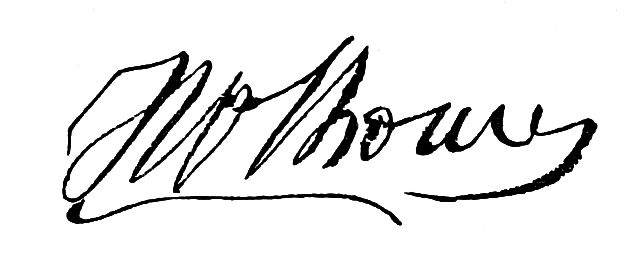
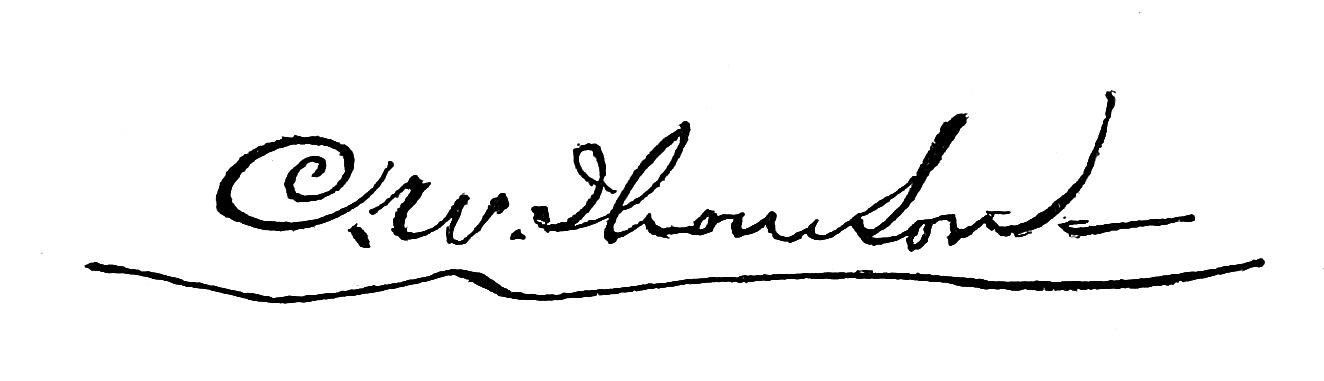
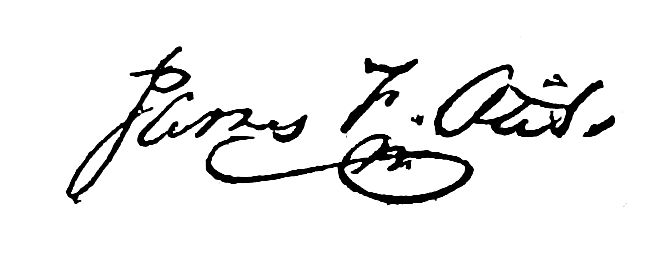
F. W. Thomas, who began his literary career, at the
early age of seventeen, by a poetical lampoon upon
certain Baltimore fops, has since more particularly
distinguished himself as a novelist. His “Clinton
Bradshawe” is perhaps better known than any of his
later fictions. It is remarkable for a frank, unscrupulous
portraiture of men and things, in high life and
low, and by unusual discrimination and observation
in respect to character. Since its publication he has
produced “East and West” and “Howard Pinckney,”
neither of which seem to have been so popular
as his first essay; although both have merit.
“East and West,” published in 1836, was an attempt
to portray the every-day events occurring to a fallen
family emigrating from the East to the West. In it,
as in “Clinton Bradshawe,” most of the characters
are drawn from life. “Howard Pinckney” was published
in 1840.
Mr. Thomas was, at one period, the editor of the
Cincinnati “Commercial Advertiser.” He is also
well known as a public lecturer on a variety of topics.
His conversational powers are very great. As a poet,
he has also distinguished himself. His “Emigrant”
will be read with pleasure by every person of taste.
His MS. is more like that of Mr. Benjamin than
that of any other literary person of our acquaintance.
It has even more than the occasional nervousness of
Mr. B.’s, and, as in the case of the editor of the
“New World,” indicates the passionate sensibility
of the man.
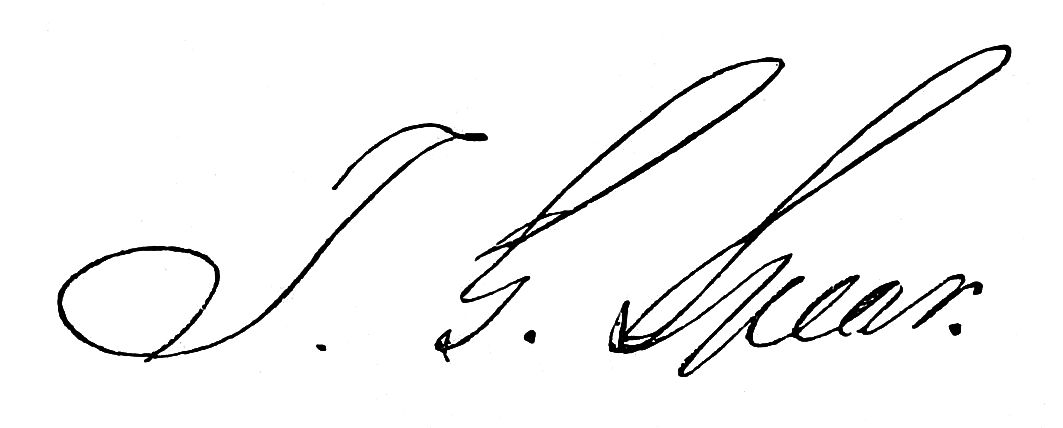
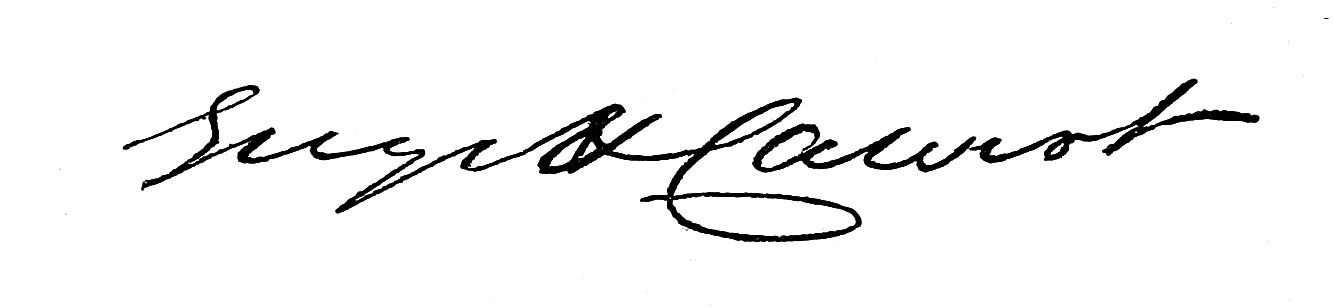
Thomas G. Spear is the author of various poetical
pieces which have appeared from time to time in our
Magazines and other periodicals. His productions
have been much admired, and are distinguished for
pathos, and grace. His MS. is well shown in the
signature. It is too clerky for our taste.
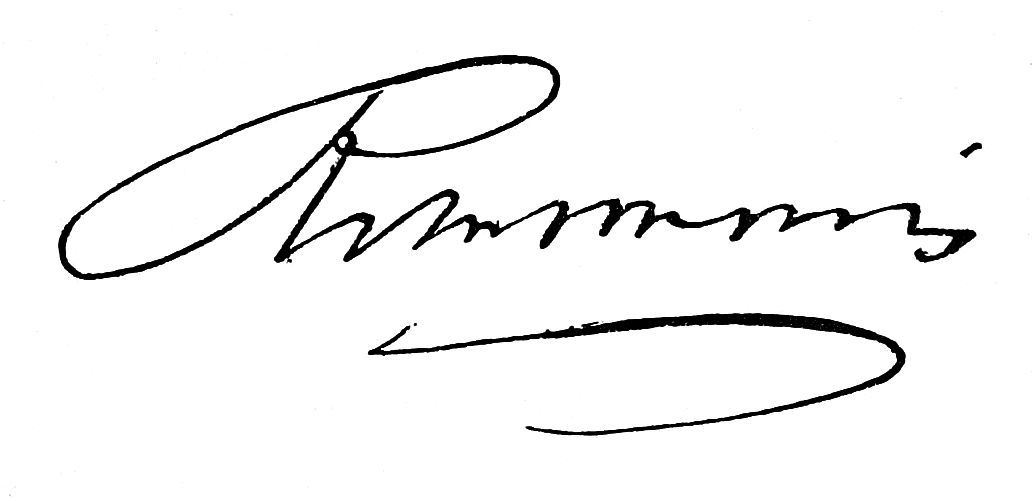
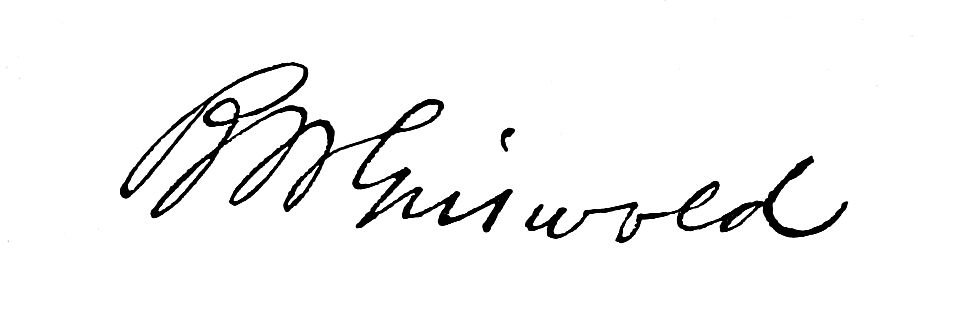
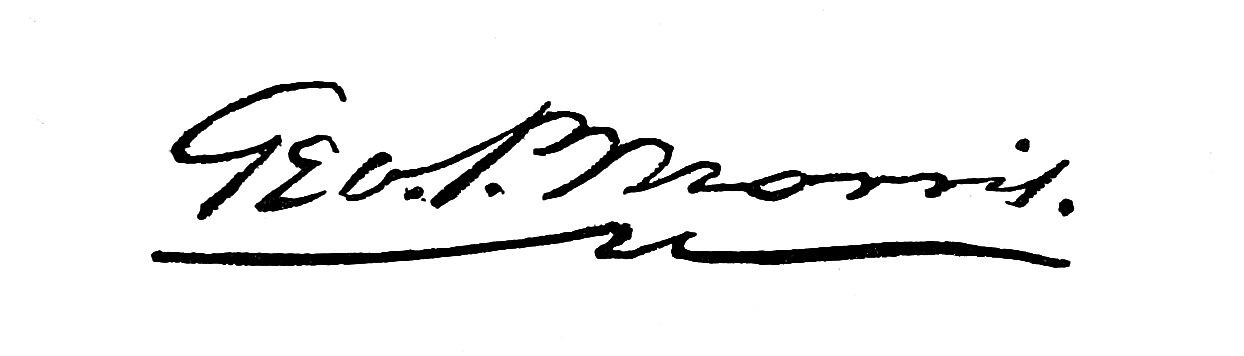
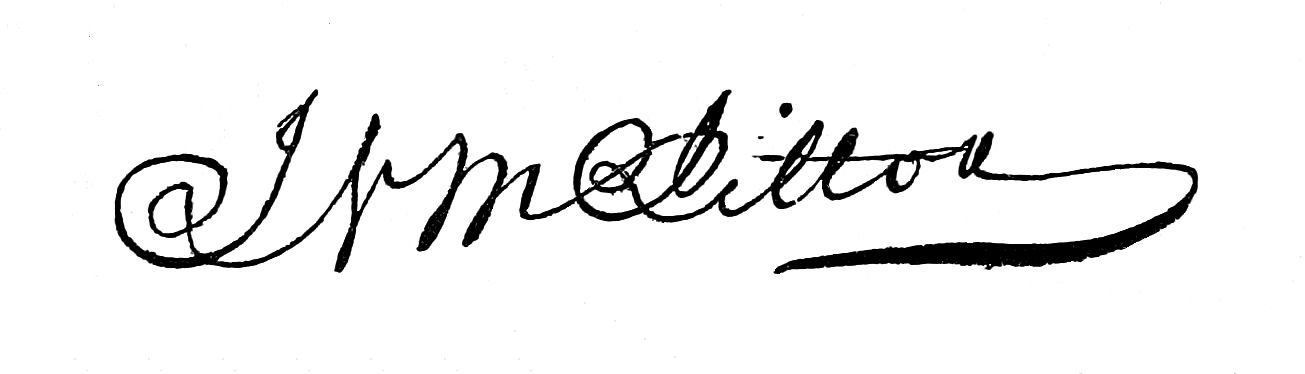
Mr. Morris ranks, we believe, as the first of our
Philadelphia poets, since the death of Willis Gaylord
Clark. His compositions, like those of his late lamented
friend, are characterised by sweetness rather
than strength of versification, and by tenderness
and delicacy rather than by vigor or originality of
thought. A late notice of him in the “Boston Notion,”
from the pen of Rufus W. Griswold, did his
high qualities no more than justice. As a prose
writer, he is chiefly known by his editorial contributions
to the Philadelphia “Inquirer,” and by occasional
essays for the Magazines.
His chirography is usually very illegible, although
at times sufficiently distinct. It has no marked characteristics,
and like that of almost every editor in
the country, has been so modified by the circumstances
of his position, as to afford no certain indication
of the mental features.
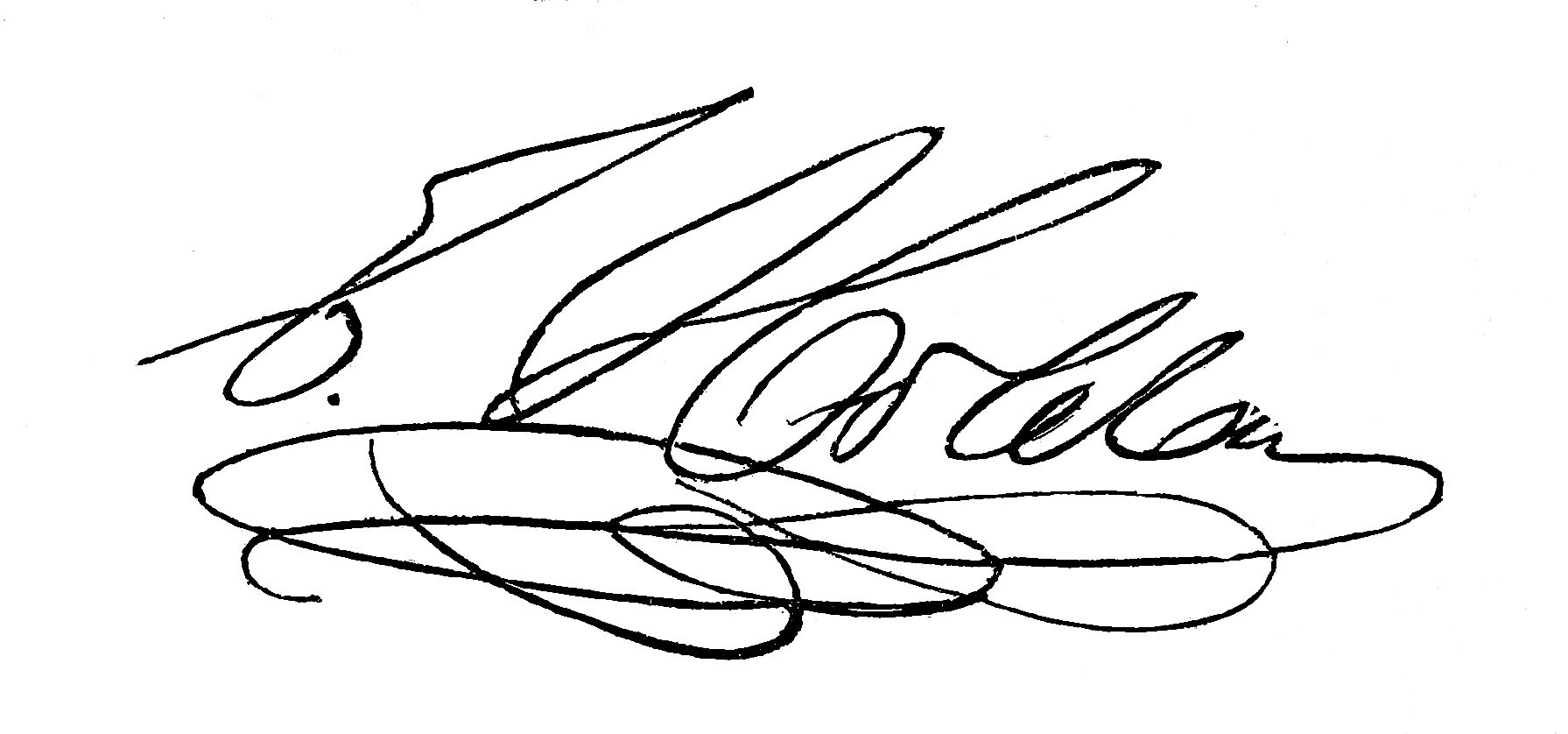
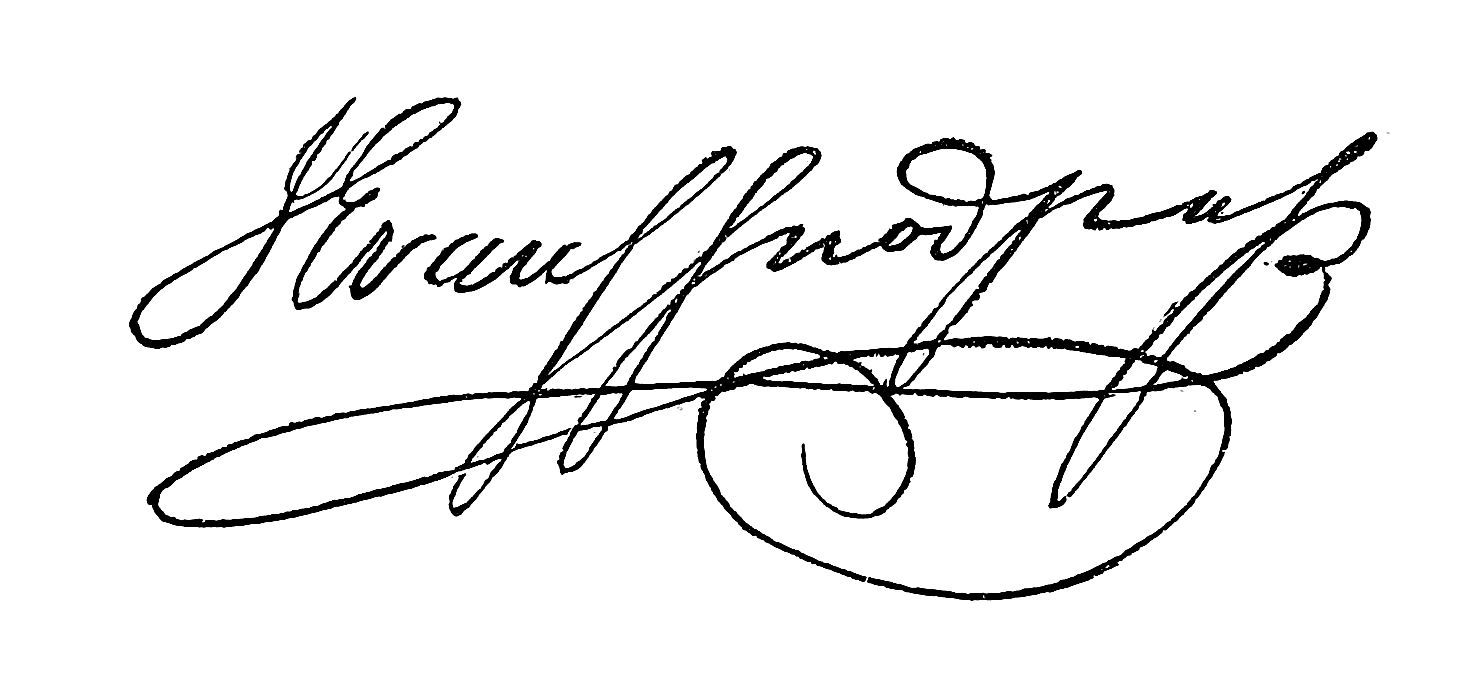
Ezra Holden has written much, not only for his
paper, “The Saturday Courier,” but for our periodicals
generally, and stands high in the public estimation,
as a sound thinker, and still more particularly
as a fearless expresser of his thoughts.
His MS. (which we are constrained to say is a
shockingly bad one, and whose general features may
be seen in his signature,) indicates the frank and naïve
manner of his literary style—a style which not unfrequently
flies off into whimsicalities.
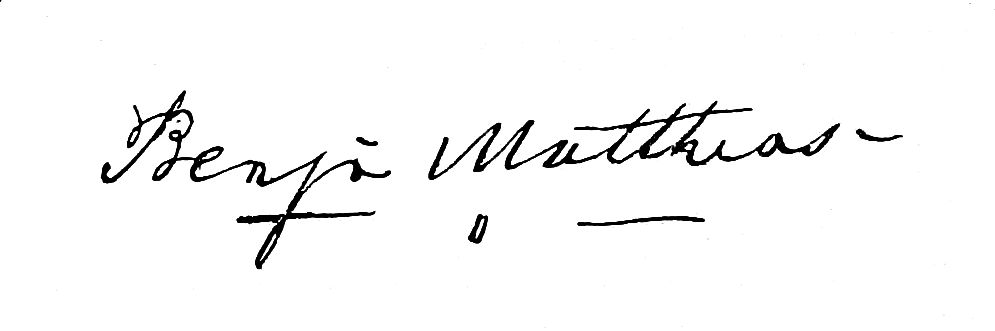
Mr. Matthias is principally known by his editorial
conduct of the “Saturday Chronicle” of Philadelphia,
to which he has furnished much entertaining
and instructive matter. His MS. would be generally
termed a fine one, but it affords little indication of
mental character.
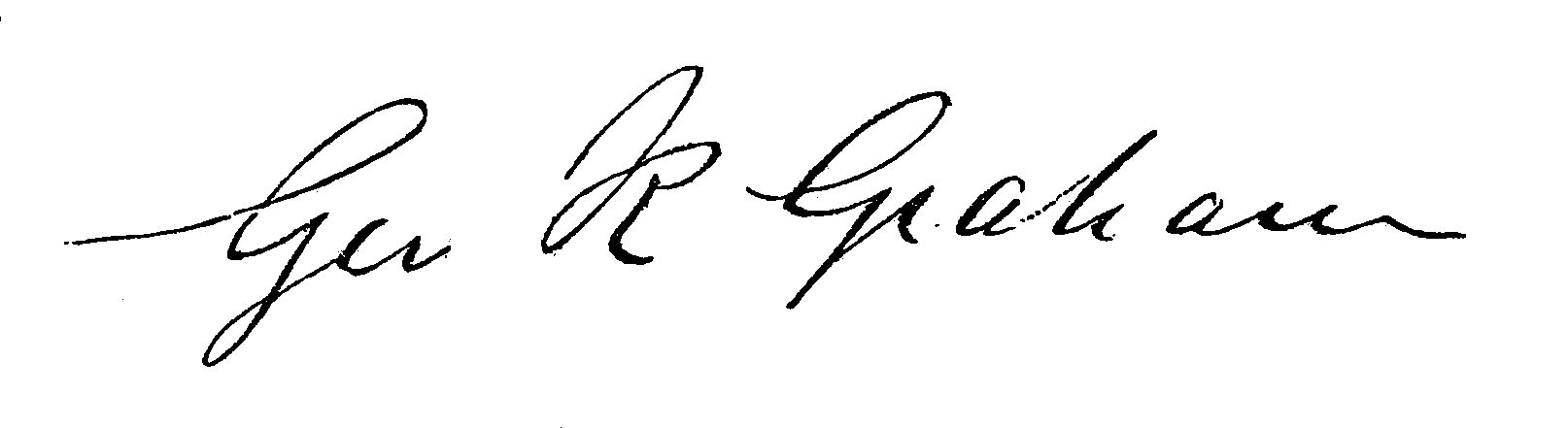
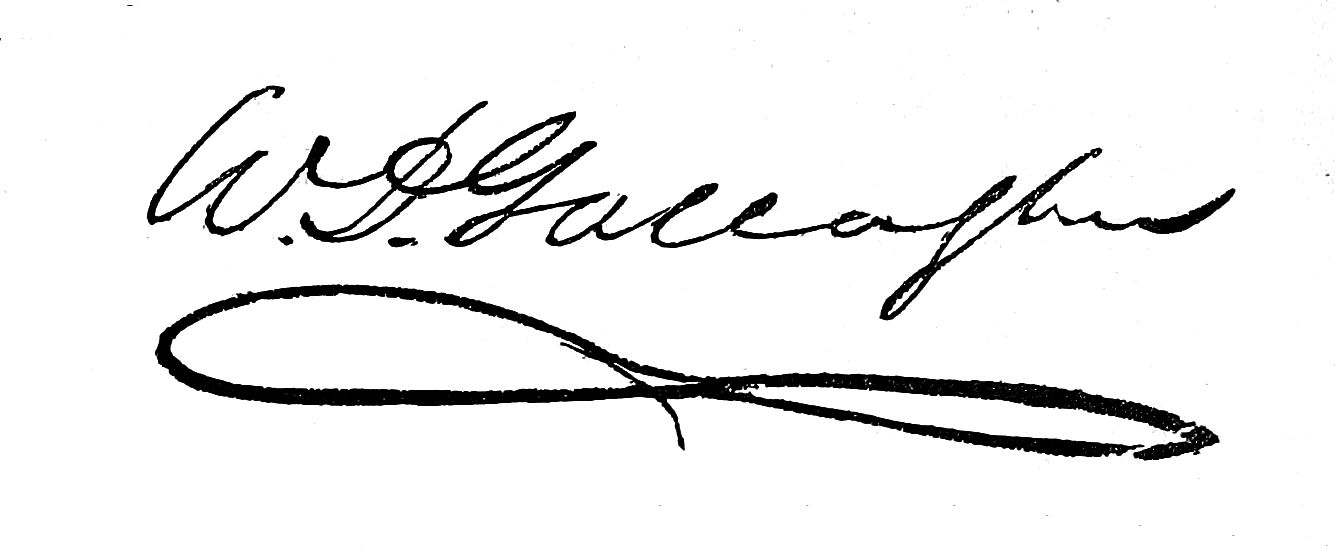
Mr. Graham is known to the literary world as the
editor and proprietor of “Graham’s Magazine,” the
most popular periodical in America, and also of the
“Saturday Evening Post,” of Philadelphia. For
both of these journals he has written much and well.
His MS. generally, is very bad, or at least very
illegible. At times it is sufficiently distinct, and has
force and picturesqueness, speaking plainly of the
energy which particularly distinguishes him as a
man. The signature above is more scratchy than usual.
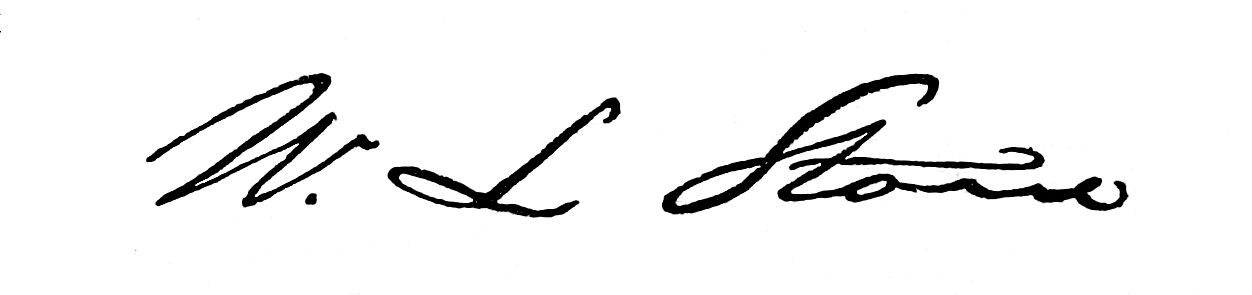
Colonel Stone, the editor of the New York “Commercial
Advertiser,” is remarkable for the great difference
which exists between the apparent public
opinion respecting his abilities, and the real estimation
in which he is privately held. Through his paper,
and a bustling activity always prone to thrust
itself forward, he has attained an unusual degree of
influence in New York, and, not only this, but what
appears to be a reputation for talent. But this talent
we do not remember ever to have heard assigned him
by any honest man’s private opinion. We place him
among our literati, because he has published certain
books. Perhaps the best of these are his “Life of
Brandt,” and “Life and Times of Red Jacket.” Of
the rest, his story called “Ups and Downs,” his defence
of Animal Magnetism, and his pamphlets concerning
Maria Monk, are scarcely the most absurd.
His MS. is heavy and sprawling, resembling his mental
character in a species of utter unmeaningness,
which lies, like the nightmare, upon his autograph.

The labors of Mr. Sparks, Professor of History at
Harvard, are well known and justly appreciated. His
MS. has an unusually odd appearance. The characters
are large, round, black, irregular, and perpendicular—the
signature, as above, being an excellent
specimen of his chirography in general. In all his
letters now before us, the lines are as close together
as possible, giving the idea of irretrievable confusion;
still none of them are illegible upon close inspection.
We can form no guess in regard to any
mental peculiarities from Mr. Sparks’ MS., which
has been no doubt modified by the hurrying and intricate
nature of his researches. We might imagine
such epistles as these to have been written in extreme
haste by a man exceedingly busy among great
piles of books and papers, huddled up around him
like the chaotic tomes of Magliabechi. The paper
used in all our epistles is uncommonly fine.
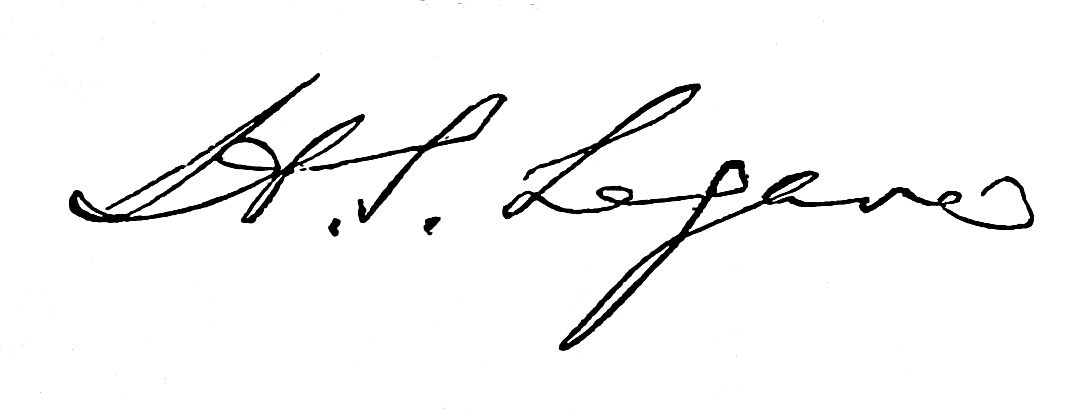
The name of H. S. Legare is written without an
accent on the final e, yet is pronounced, as if this letter
were accented,—Legray. He contributed many
articles of high merit to the “Southern Review,” and
has a wide reputation for scholarship and talent. His
MS. resembles that of Mr. Palfrey, of the North
American Review, and their mental features appear
to us nearly identical. What we have said in regard
to the chirography of Mr. Palfrey will apply with
equal force to that of the present Secretary.
Mr. Griswold has written much, but chiefly in the
editorial way, whether for the papers, or in books.
He is a gentleman of fine taste and sound judgment.
His knowledge of American literature, in all its details,
is not exceeded by that of any man among us.
He is not only a polished prose writer, but a poet of
no ordinary power; although, as yet, he has not put
himself much in the way of the public admiration.
His MS. is by no means a good one. It appears unformed,
and vacillates in a singular manner; so that
nothing can be predicated from it, except a certain
unsteadiness of purpose.
Mr. George Lunt, of Newburyport, Massachusetts,
is known as a poet of much vigor of style and
massiveness of thought. He delights in the grand,
rather than in the beautiful, and is not unfrequently
turgid, but never feeble. The traits here described,
impress themselves with remarkable distinctness
upon his chirography, of which the signature gives
a perfect idea.
Mr. Chandler’s reputation as the editor of one of
the best daily papers in the country, and as one of our
finest belles lettres scholars, is deservedly high. He
is well known through his numerous addresses, essays,
miscellaneous sketches, and prose tales. Some
of these latter evince imaginative powers of a superior
order.
His MS. is not fairly shown in his signature, the
latter being much more open and bold than his general
chirography. His hand-writing must be included
in the editorial category—it seems to have been ruined
by habitual hurry.
Count L. Fitzgerald Tasistro has distinguished
himself by many contributions to the periodical literature
of the day, and by his editorial conduct of the
“Expositor,”—a critical journal of high merit in
many respects, although somewhat given to verbiage.
His MS. is remarkable for a scratchy diminutiveness,
and is by no means legible. We are not sufficiently
cognizant of his literary character, to draw
any parallel between it and his chirography. His
signature is certainly a most remarkable one.
H. T. Tuckerman has written one or two books
consisting of “Sketches of Travel.” His “Isabel”
is, perhaps, better known than any of his productions,
but was never a popular work. He is a correct writer
so far as mere English is concerned, but an insufferably
tedious and dull one. He has contributed much
of late days to the “Southern Literary Messenger,”
with which journal, perhaps, the legibility of his MS.
has been an important, if not the principal recommendation.
His chirography is neat and distinct,
and has some grace, but no force—evincing, in a remarkable
degree, the idiosyncrasies of the writer.
Mr. Bryan has written some very excellent poetry,
and is appreciated by all admirers of “the good
old Goldsmith school.” He is, at present, postmaster
at Alexandria, and has held the office for many
years, with all the good fortune of a Vicar of Bray.
His MS. is a free, sloping, and regular one, with
more boldness than force, and not ungraceful. He is
fond of underscoring his sentences; a habit exactly
parallel with the argumentative nature of some of
his best poems.
Mr. Godey is only known to the literary world as
editor and publisher of “The Lady’s Book;” but his
celebrity in this regard entitles him to a place in
this collection. His MS. is remarkably distinct and
graceful; the signature affording an excellent idea of
it. The man who invariably writes so well as Mr.
G. invariably does, gives evidence of a fine taste,
combined with an indefatigability which will ensure
his permanent success in the world’s affairs. No man
has warmer friends or fewer enemies.
Mr. Du Solle is well known, through his connection
with the “Spirit of the Times.” His prose is
forcible, and often excellent in other respects. As a
poet, he is entitled to higher consideration. Some of
his Pindaric pieces are unusually good, and it maybe
doubted if we have a better versifier in America.
Accustomed to the daily toil of an editor, he has
contracted a habit of writing hurriedly, and his MS.
varies with the occasion. It is impossible to deduce
any inferences from it, as regards the mental character.
The signature shows rather how he can write,
than how he does.
Mr. French is the author of a “Life of David
Crockett”, and also of a novel called “Elkswatawa”,
a denunciatory review of which in the “Southern
Messenger,” some years ago, deterred him from
further literary attempts. Should he write again, he
will probably distinguish himself, for he is unquestionably
a man of talent. We need no better evidence
of this than his MS., which speaks of force,
boldness, and originality. The flourish, however, betrays
a certain floridity of taste.
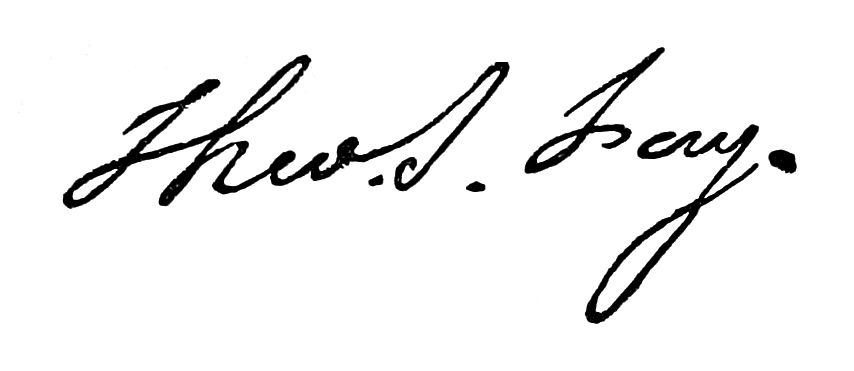
The author of “Norman Leslie” and “The Countess
Ida”, has been more successful as an essayist
about small matters, than as a novelist. “Norman
Leslie” is more familiarly remembered as “The
Great Used Up”, while “The Countess” made no
definite impression whatever. Of course we are not
to expect remarkable features in Mr. Fay’s MS. It
has a wavering, finicky, and over-delicate air, without
pretension to either grace or force; and the description
of the chirography would answer, without
alteration, for that of the literary character. Mr. F.
frequently employs an amanuensis, who writes a very
beautiful French hand. The one must not be confounded
with the other.
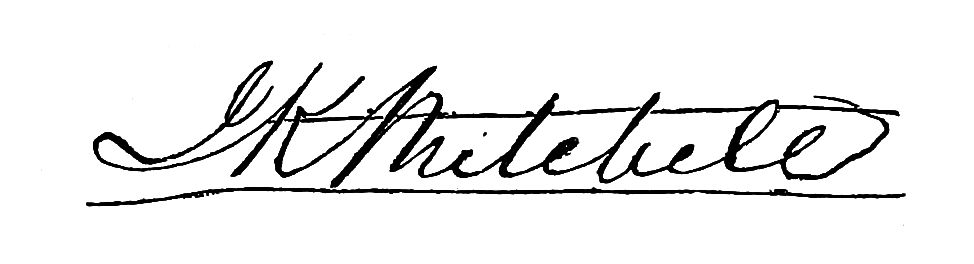
Dr. Mitchell has published several pretty songs
which have been set to music, and become popular.
He has also given to the world a volume of poems,
of which the longest was remarkable for an old-fashioned
polish and vigor of versification. His MS. is
rather graceful than picturesque or forcible—and
these words apply equally well to his poetry in general.
The signature indicates the hand.
General Morris has composed many songs which
have taken fast hold upon the popular taste, and
which are deservedly celebrated. He has caught the
true tone for these things, and hence his popularity—a
popularity which his enemies would fain make us
believe is altogether attributable to his editorial influence.
The charge is true only in a measure. The
tone of which we speak is that kind of frank, free,
hearty sentiment (rather than philosophy) which distinguishes
Béranger, and which the critics, for want
of a better term, call nationality.
His MS. is a simple unornamented hand, rather rotund
than angular, very legible, forcible, and altogether
in keeping with his style.
Mr. Calvert was at one time principal editor of
the “Baltimore American,” and wrote for that journal
some good paragraphs on the common topics of the
day. He has also published many translations from
the German, and one or two original poems—among
others an imitation of Don Juan called “Pelayo,”
which did him no credit. He is essentially a feeble and
common-place writer of poetry, although his prose
compositions have a certain degree of merit.
His chirography indicates the “common-place” upon
which we have commented. It is a very usual,
scratchy, and tapering clerk’s hand—a hand which
no man of talent ever did or could indite, unless
compelled by circumstances of more than ordinary
force. The signature is far better than the general
manuscript of his epistles.
Dr. Snodgrass was at one time the associate of
Mr. Brooks in the “Baltimore Museum”, a monthly
journal published in the City of Monuments some
years since. He wrote for that Magazine, and has
occasionally written for others, articles which possessed
the merit of precision of style, and a metaphysical
cast of thought. We like his prose much
better than his poetry.
His chirography is bad—stiff,
sprawling and illegible, with frequent corrections
and interlineations, evincing inactivity not less
than fastidiousness. The signature betrays a meretricious
love of effect.
Mr. McJilton is better known from his contributions
to the journals of the day than from any book-publications.
He has much talent, and it is not improbable
that he will hereafter distinguish himself,
although as yet he has not composed anything of
length which, as a whole, can be styled good.
His MS. is not unlike that of Dr. Snodgrass, but it is
somewhat clearer and better. We can predicate little
respecting it, beyond a love of exaggeration and
bizarrerie.
Mr. Gallagher is chiefly known as a poet. He is
the author of some of our most popular songs, and
has written many long pieces of high but unequal
merit. He has the true spirit, and will rise into a just
distinction hereafter. His manuscript tallies well
with our opinion. It is a very fine one—clear, bold,
decided and picturesque. The signature above does
not convey, in full force, the general character of his
chirography, which is more rotund, and more decidedly
placed upon the paper.
Mr. Dana ranks among our most eminent poets,
and he has been the frequent subject of comment in
our Reviews. He has high qualities, undoubtedly,
but his defects are many and great.
His MS. resembles that of Mr. Gallagher very
nearly, but is somewhat more rolling, and has less
boldness and decision. The literary traits of the two
gentlemen are very similar, although Mr. Dana is by
far the more polished writer, and has a scholarship
which Mr. Gallagher wants.
Mr. McMichael is well known to the Philadelphia
public by the number and force of his prose compositions,
but he has seldom been tempted into book publication.
As a poet, he has produced some remarkably
vigorous things. We have seldom seen a finer
composition than a certain celebrated “Monody.”
His MS., when not hurried, is graceful and flowing,
without picturesqueness. At times it is totally illegible.
His chirography is one of those which have
been so strongly modified by circumstances that it is
nearly impossible to predicate any thing with certainty
respecting them.
Mr. N. C. Brooks has acquired some reputation as
a Magazine writer. His serious prose is often very
good—is always well-worded—but in his comic attempts
he fails, without appearing to be aware of his
failure. As a poet he has succeeded far better. In
a work which he entitled “Scriptural Anthology”
among many inferior compositions of length, there
were several shorter pieces of great merit:—for example
“Shelley’s Obsequies” and “The Nicthanthes”.
Of late days we have seen little from his
pen.
His MS. has much resemblance to that of Mr. Bryant,
although altogether it is a better hand, with
much more freedom and grace. With care Mr.
Brooks can write a fine MS. just as with care he can
compose a fine poem.
The Rev. Thomas H. Stockton has written many
pieces of fine poetry, and has lately distinguished
himself as the editor of the “Christian World.”
His MS. is fairly represented by his signature, and
bears much resemblance to that of Mr. N. C. Brooks,
of Baltimore. Between these two gentlemen there
exists also, a remarkable similarity, not only of
thought, but of personal bearing and character. We
have already spoken of the peculiarities of Mr. B’s
chirography.
Mr. Thompson has written many short poems, and
some of them possess merit. They are characterized
by tenderness and grace. His MS. has some resemblance
to that of Professor Longfellow, and by many
persons would be thought a finer hand. It is clear,
legible and open—what is called a rolling hand. It
has too much tapering, and too much variation between
the weight of the hair strokes and the downward
ones, to be forcible or picturesque. In all those
qualities which we have pointed out as especially
distinctive of Professor Longfellow’s MS. it is remarkably
deficient; and, in fact, the literary character
of no two individuals could be more radically different.
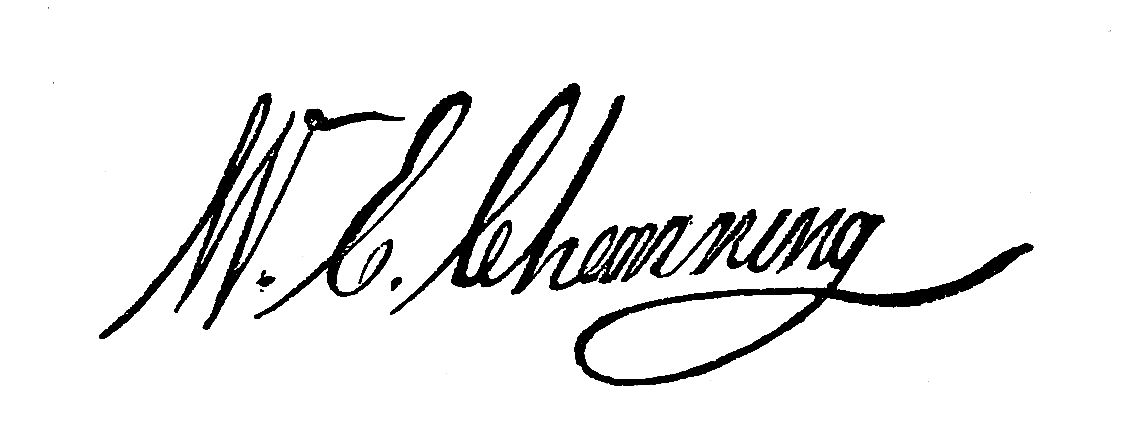
The Reverend W. E. Channing is at the head of
our moral and didactic writers. His reputation both
at home and abroad is deservedly high, and in regard
to the matters of purity, polish and modulation of
style, he may be said to have attained the dignity of
a standard and a classic. He has, it is true, been severely
criticised, even in respect to these very points,
by the Edinburg Review. The critic, however, made
out his case but lamely, and proved nothing beyond
his own incompetence. To detect occasional, or even
frequent inadvertences in the way of bad grammar,
faulty construction, or mis-usage of language, is not
to prove impurity of style—a word which happily
has a bolder signification than any dreamed of by the
Zoilus of the Review in question. Style regards,
more than anything else, the tone of a composition.
All the rest is not unimportant, to be sure, but appertains
to the minor morals of literature, and can be
learned by rote by the meanest simpletons in letters—can
be carried to its highest excellence by dolts
who, upon the whole, are despicable as stylists. Irving’s
style is inimitable in its grace and delicacy;
yet few of our practised writers are guilty of more
frequent inadvertences of language. In what may be
termed his mere English, he is surpassed by fifty
whom we could name. Mr. Tuckerman’s English on
the contrary is sufficiently pure, but a more lamentable
style than that of his “Sicily” it would be difficult
to point out.
Besides those peculiarities which we have already
mentioned as belonging to Dr. Channing’s style, we
must not fail to mention a certain calm, broad deliberateness
which constitutes force in its highest
character, and approaches to majesty. All these
traits will be found to exist plainly in his chirography,
the character of which is exemplified by the
signature, although this is somewhat larger than the
general manuscript.
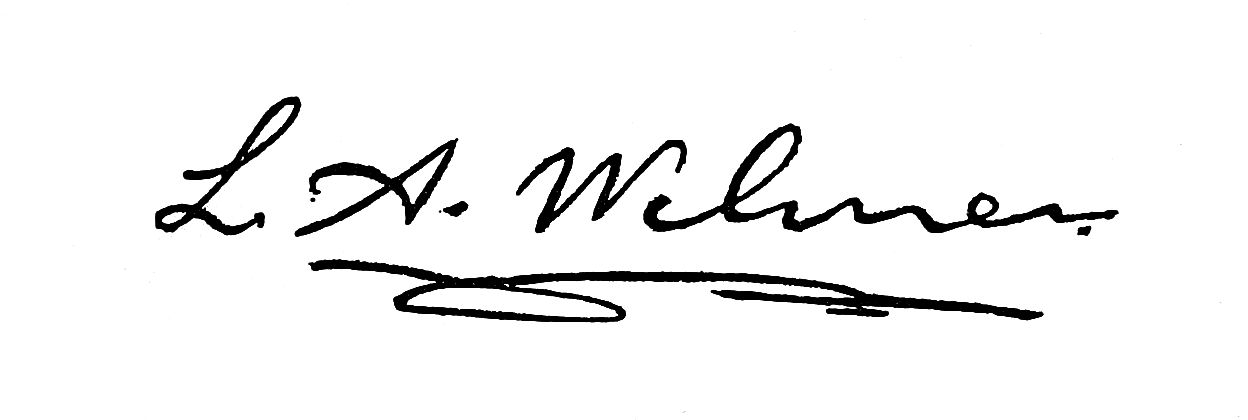
Mr. Wilmer has written and published much; but
he has reaped the usual fruits of a spirit of independence,
and has thus failed to make that impression on
the popular mind which his talents, under other circumstances,
would have effected. But better days
are in store for him, and for all who “hold to the
right way,” despising the yelpings of the small dogs
of our literature. His prose writings have all merit—always
the merit of a chastened style. But he is
more favorably known by his poetry, in which the
student of the British classics will find much for
warm admiration. We have few better versifiers
than Mr. Wilmer.
His chirography plainly indicates the cautious
polish and terseness of his style, but the signature
does not convey the print-like appearance of the MS.
Mr. Dow is distinguished as the author of many
fine sea-pieces, among which will be remembered a
series of papers called “The Log of Old Ironsides.”
His land sketches are not generally so good. He has
a fine imagination, which as yet is undisciplined, and
leads him into occasional bombast. As a poet he
has done better things than as a writer of prose.
His MS., which has been strongly modified by circumstances,
gives no indication of his true character,
literary or moral.
Mr. Weld is well known as the present working
editor of the New York “Tattler” and “Brother
Jonathan.” His attention was accidentally directed
to literature about ten years ago, after a minority, to
use his own words, “spent at sea, in a store, in a machine
shop, and in a printing office.” He is now, we
believe, about thirty-one years of age. His deficiency
of what is termed regular education would scarcely
be gleaned from his editorials, which, in general,
are unusually well written. His “Corrected Proofs”
is a work which does him high credit, and which has
been extensively circulated, although “printed at
odd times by himself, when he had nothing else to
do.”
His MS. resembles that of Mr. Joseph C. Neal in
many respects, but is less open and less legible. His
signature is altogether much better than his general
chirography.
Mr. McMakin is one of the editors of the “Philadelphia
Saturday Courier,” and has given to the
world several excellent specimens of his poetical
ability. His MS. is clear and graceful; the signature
affording a very good idea of it. The general hand,
in fact, is fully as good.
Mrs. M. St. Leon Loud is one of the finest poets
of this country; possessing, we think, more of the
true divine afflatus than any of her female contemporaries.
She has, in especial, imagination of no common
order, and unlike many of her sex whom we
could mention, is not
Content to dwell in decencies forever.
While she can, upon occasion, compose the ordinary
metrical sing-song with all the decorous proprieties
which are in fashion, she yet ventures very frequently
into a more ethereal region. We refer our readers
to a truly beautiful little poem entitled the “Dream
of the Lonely Isle,” and lately published in this
Magazine.
Mrs. Loud’s MS. is exceedingly clear, neat and
forcible, with just sufficient effeminacy and no more.
Dr. Pliny Earle, of Frankford, Pa., has not only
distinguished himself by several works of medical and
general science, but has become well known to the
literary world, of late, by a volume of very fine
poems, the longest, but by no means the best, of
which, was entitled “Marathon.” This latter is
not greatly inferior to the “Marco Bozzaris” of Halleck;
while some of the minor pieces equal any
American poems.
His chirography is peculiarly
neat and beautiful, giving indication of the elaborate
finish which characterises his compositions. The
signature conveys the general hand.
Dr. John C. McCabe, of Richmond, Virginia, has
written much and generally well, in prose and poetry,
for the periodicals of the day—for the “Southern Literary
Messenger” in especial, and other journals.
His MS. is in every respect a bad one—an ordinary
clerk’s hand, meaning nothing. It has been strongly
modified, however, by circumstances which would
scarcely have permitted it to be otherwise than it is.
John Tomlin, Esq., Postmaster at Jackson, Tennessee,
has contributed many excellent articles to the
periodicals of the day—among others to the “Gentleman’s”
and to “Graham’s” Magazine, and to
several of the Southern and Western journals.
His chirography resembles that of Mr. Paulding in
being at the same time very petite, very beautiful,
and very illegible. His MSS., in being equally well
written throughout, evince the indefatigability of
his disposition.
David Hoffman, Esq., of Baltimore, has not only
contributed much and well to monthly Magazines
and Reviews, but has given to the world several valuable
publications in book form. His style is terse,
pungent and otherwise excellent, although disfigured
by a half comic half serious pedantry.
His MS. has about it nothing strongly indicative
of character.
S. D. Langtree, has been long and favorably
known to the public as editor of the “Georgetown
Metropolitan,” and, more lately, of the “Democratic
Review,” both of which journals he has conducted
with distinguished success. As a critic he has proved
himself just, bold and acute, while his prose compositions
generally, evince the man of talent and taste.
His MS. is not remarkably good, being somewhat
too scratchy and tapering. We include him, of course,
in the editorial category.
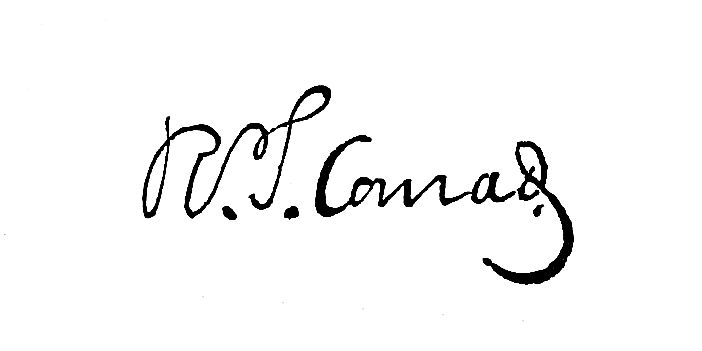
Judge Conrad occupies, perhaps, the first place
among our Philadelphia literati. He has distinguished
himself both as a prose writer and a poet—not
to speak of his high legal reputation. He has
been a frequent contributor to the periodicals of this
city, and, we believe, to one at least of the Eastern
Reviews. His first production which attracted general
notice was a tragedy entitled “Conrad, King of
Naples.” It was performed at the Arch Street Theatre,
and elicited applause from the more judicious.
This play was succeeded by “Jack Cade,” performed
at the Walnut Street Theatre, and lately
modified and reproduced under the title of “Aylmere.”
In its new dress, this drama has been one
of the most successful ever written by an American,
not only attracting crowded houses, but extorting the
good word of our best critics. In occasional poetry
Judge Conrad has also done well. His lines “On a
Blind Boy Soliciting Charity” have been highly admired,
and many of his other pieces evince ability of
a high order. His political fame is scarcely a topic
for these pages, and is, moreover, too much a matter
of common observation to need comment from us.
His MS. is neat, legible, and forcible, evincing
combined caution and spirit in a very remarkable
degree.
The chirography of Ex-President Adams (whose
poem, “The Wants of Man,” has, of late, attracted
so much attention,) is remarkable for a certain steadiness
of purpose pervading the whole, and overcoming
even the constitutional tremulousness of the
writer’s hand. Wavering in every letter, the entire
MS. has yet a firm, regular, and decisive appearance.
It is also very legible.
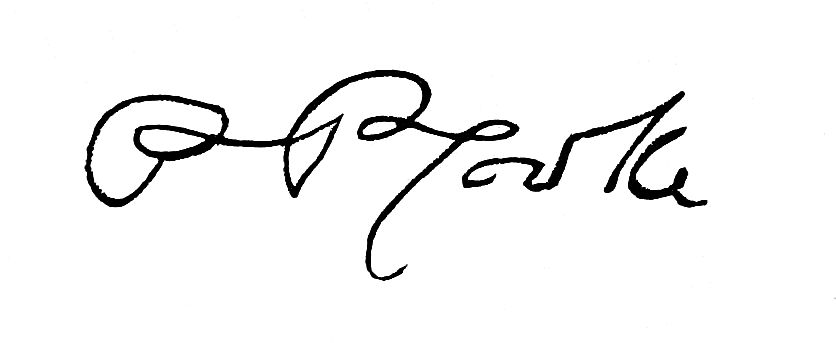
P. P. Cooke, Esq., of Winchester, Va., is well
known, especially in the South, as the author of numerous
excellent contributions to the “Southern
Literary Messenger.” He has written some of the
finest poetry of which America can boast. A little
piece of his, entitled “Florence Vane,” and contributed
to the “Gentleman’s Magazine” of this
city, during our editorship of that journal, was remarkable
for the high ideality it evinced, and for the
great delicacy and melody of its rhythm. It was
universally admired and copied, as well here as in
England. We saw it not long ago, as original, in
“Bentley’s Miscellany.” Mr. Cooke has, we believe,
nearly ready for press, a novel called “Maurice Werterbern,”
whose success we predict with confidence.
His MS. is clear, forcible, and legible, but disfigured
by some little of that affectation which is scarcely a
blemish in his literary style.
Prof. Thomas R. Dew, of William and Mary College
in Virginia, was one of the able contributors who
aided to establish the “Southern Literary Messenger”
in the days of its débût. His MS. is precisely in
keeping with his literary character. Both are heavy,
massive, unornamented and diffuse in the extreme.
His epistles seemed to have been scrawled with the
stump of a quill dipped in very thick ink, and one or
two words extend sometimes throughout a line. The
signature is more compact than the general MS.
Mr. J. Beauchamp Jones has been, we believe,
connected for many years past with the lighter literature
of Baltimore, and at present edits the “Baltimore
Saturday Visiter,” with much judgment and
general ability. He is the author of a series of papers
of high merit now in course of publication in
the “Visiter,” and entitled “Wild Western Scenes.”
His MS. is distinct, and might be termed a fine one;
but is somewhat too much in consonance with the
ordinary clerk style to be either graceful or forcible.
Mr. Charles J. Peterson has for a long time
been connected with the periodical literature of Philadelphia,
as one of the editors of “Graham’s Magazine”
and of “The Saturday Evening Post.”
His MS., when unhurried, is a very good one—clear,
weighty, and picturesque; but when carelessly written
is nearly illegible, on account of a too slight
variation of form in the short letters.
Mr. Burton is better known as a comedian than as
a literary man; but he has written many short prose
articles of merit, and his quondam editorship of the
“Gentleman’s Magazine” would, at all events, entitle
him to a place in this collection. He has, moreover,
published one or two books. An annual issued
by Carey and Hart in 1840, consisted entirely of prose
contributions from himself, with poetical ones from
Charles West Thompson, Esq. In this work many
of the tales were good.
Mr. Burton’s MS. is scratchy and petite, betokening
indecision and care or caution. The whole
chirography resembles that of Mr. Tasistro very
nearly.
Richard Henry Wilde, Esq., of Georgia, has acquired
much reputation as a poet, and especially as
the author of a little piece entitled “My Life is like
the Summer Rose,” whose claim to originality has
been made the subject of repeated and reiterated attack
and defence. Upon the whole it is hardly worth
quarrelling about. Far better verses are to be found
in every second newspaper we take up. Mr. Wilde
has also lately published, or is about to publish, a
“Life of Tasso,” for which he has been long collecting
material.
His MS. has all the peculiar sprawling and elaborate
tastelessness of Mr. Palfrey’s, to which altogether
it bears a marked resemblance. The love of
effect, however, is more perceptible in Mr. Wilde’s
than even in Mr. Palfrey’s.
G. G. Foster, Esq., has acquired much reputation,
especially in the South and West, by his poetical contributions
to the literature of the day. All his articles
breathe the true spirit. At one period he edited
a weekly paper in Alabama; more lately the “Bulletin”
at St. Louis; and, at present, he conducts the
“Pennant,” in that city, with distinguished ability.
Not long ago he issued the prospectus of a monthly
magazine. Should he succeed in getting the journal
under way, there can be no doubt of his success.
His MS. is remarkably clear and graceful; evincing
a keen sense of the beautiful. It seems, however,
to be somewhat deficient in force; and his letters
are never so well written in their conclusion as
in their commencement. We have before remarked
that this peculiarity in MSS. is a sure indication of
fatigability of temper. Few men who write thus
are free from a certain vacillation of purpose. The
signature above is rather heavier than that from
which it was copied.
Lewis Cass, the Ex-Secretary of War, has distinguished
himself as one of the finest belles lettres
scholars of America. At one period he was a very
regular contributor to the “Southern Literary Messenger,”
and, even lately, he has furnished that journal
with one or two very excellent papers.
His MS. is clear, deliberate and statesmanlike;
resembling that of Edward Everett very closely. It
is not often that we see a letter written altogether by
himself. He generally employs an amanuensis,
whose chirography does not differ materially from
his own, but is somewhat more regular.
James Brooks, Esq., enjoys rather a private than
a public literary reputation; but his talents are unquestionably
great, and his productions have been
numerous and excellent. As the author of many of
the celebrated Jack Downing letters, and as the reputed
author of the whole of them, he would at all
events be entitled to a place among our literati.
His chirography is simple, clear and legible, with
little grace and less boldness. These traits are precisely
those of his literary style.
As the authorship of the Jack Downing letters is
even still considered by many a moot point, (although
in fact there should be no question about it,)
and as we have already given the signature of Mr.
Seba Smith, and (just above) of Mr. Brooks, we now
present our readers with a fac-simile signature of
the “veritable Jack” himself, written by him individually
in our own bodily presence. Here, then, is
an opportunity of comparison.
The chirography of “the veritable Jack” is a very
good, honest, sensible hand, and not very dissimilar
to that of Ex-President Adams.
Mr. J. R. Lowell, of Massachusetts, is entitled,
in our opinion, to at least the second or third place
among the poets of America. We say this on account
of the vigor of his imagination—a faculty to
be first considered in all criticism upon poetry. In
this respect he surpasses, we think, any of our writers
(at least any of those who have put themselves prominently
forth as poets) with the exception of Longfellow,
and perhaps one other. His ear for rhythm,
nevertheless, is imperfect, and he is very far from
possessing the artistic ability of either Longfellow,
Bryant, Halleck, Sprague or Pierpont. The reader
desirous of properly estimating the powers of Mr.
Lowell will find a very beautiful little poem from his
pen in the October number of this Magazine. There
is one also (not quite so fine) in the number for last
month. He will contribute regularly.
His MS. is strongly indicative of the vigor and precision
of his poetical thought. The man who writes
thus, for example, will never be guilty of metaphorical
extravagance, and there will be found terseness as
well as strength in all that he does.
Mr. L. J. Cist, of Cincinnati, has not written much
prose, and is known especially by his poetical compositions,
many of which have been very popular,
although they are at times disfigured by false metaphor,
and by a meretricious straining after effect. This
latter foible makes itself clearly apparent in his chirography,
which abounds in ornamental flourishes,
not illy executed, to be sure, but in very bad taste.
Mr. Arthur is not without a rich talent for
description of scenes in low life, but is uneducated,
and too fond of mere vulgarities to please a refined
taste. He has published “The Subordinate”, and
“Insubordination”, two tales distinguished by the
peculiarities above mentioned. He has also written
much for our weekly papers, and the “Lady’s Book.”
His hand is a common-place clerk’s hand, such as
we might expect him to write. The signature is
much better than the general MS.
Mr. Heath is almost the only person of any literary
distinction residing in the chief city of the Old
Dominion. He edited the “Southern Literary Messenger”
in the five or six first months of its existence;
and, since the secession of the writer of this article,
has frequently aided in its editorial conduct.
He is the author of “Edge-Hill”, a well-written
novel, which, owing to the circumstances of its publication,
did not meet with the reception it deserved.
His writings are rather polished and graceful, than
forcible or original; and these peculiarities can be
traced in his chirography.

Dr. Thomas Holley Chivers, of New York, is at
the same time one of the best and one of the worst
poets in America. His productions affect one as a
wild dream—strange, incongruous, full of images of
more than arabesque monstrosity, and snatches of
sweet unsustained song. Even his worst nonsense
(and some of it is horrible) has an indefinite charm
of sentiment and melody. We can never be sure that
there is any meaning in his words—neither is there
any meaning in many of our finest musical airs—but
the effect is very similar in both. His figures of
speech are metaphor run mad, and his grammar is
often none at all. Yet there are as fine individual
passages to be found in the poems of Dr. Chivers, as
in those of any poet whatsoever.
His MS. resembles that of P. P. Cooke very nearly,
and in poetical character the two gentlemen are
closely akin. Mr. Cooke is, by much, the more correct;
while Dr. Chivers is sometimes the more poetic.
Mr. C. always sustains himself; Dr. C. never.
Judge Story, and his various literary and political
labors, are too well know to require comment.
His chirography is a noble one—bold, clear, massive,
and deliberate, betokening in the most unequivocal
manner all the characteristics of his intellect.
The plain unornamented style of his compositions is
impressed with accuracy upon his hand-writing, the
whole air of which is well conveyed in the signature.
John Frost, Esq., Professor of Belles Lettres in
the High School of Philadelphia, and at present editor
of “The Young People’s Book,” has distinguished
himself by numerous literary compositions
for the periodicals of the day, and by a great number
of published works which come under the head of
the utile rather than of the dulce—at least in the
estimation of the young. He is a gentleman of fine
taste, sound scholarship, and great general ability.
His chirography denotes his mental idiosyncrasy
with great precision. Its careful neatness, legibility
and finish, are but a part of that turn of mind which
leads him so frequently into compilation. The signature
here given is more diminutive than usual.
Mr. J. F. Otis is well known as a writer for the
Magazines; and has, at various times, been connected
with many of the leading newspapers of the day—especially
with those in New York and Washington.
His prose and poetry are equally good; but he writes
too much and too hurriedly to write invariably well.
His taste is fine, and his judgment in literary matters
is to be depended upon at all times when not interfered
with by his personal antipathies or predilections.
His chirography is exceedingly illegible and, like
his style, has every possible fault except that of the
common-place.
Mr. Reynolds occupied at one time a distinguished
position in the eye of the public, on account of his
great and laudable exertions to get up the American
South Polar expedition, from a personal participation
in which he was most shamefully excluded. He has
written much and well. Among other works, the
public are indebted to him for a graphic account of the
noted voyage of the frigate Potomac to Madagascar.
His MS. is an ordinary clerk’s hand, giving no indication
of character.
Mr. William Cutter, a young merchant of Portland,
Maine, although not very generally known as a
poet beyond his immediate neighborhood, (or at least
out of the Eastern States) has given to the world numerous
compositions which prove him to be possessed
of the true fire. He is, moreover, a fine scholar, and
a prose writer of distinguished merit.
His chirography is very similar to that of Count
Tasistro, and the two gentlemen resemble each other
very peculiarly in their literary character.
David Paul Brown, Esq., is scarcely more distinguished
in his legal capacity than by his literary
compositions. As a dramatic writer he has met with
much success. His “Sertorius” has been particularly
well received both upon the stage and in the
closet. His fugitive productions, both in prose and
verse, have also been numerous, diversified, and
excellent.
His chirography has no doubt been strongly modified
by the circumstances of his position. No one
can expect a lawyer in full practice to give in his
MS. any true indication of his intellect or character.
Mrs. E. Clementine Stedman has lately attracted
much attention by the delicacy and grace of her
poetical compositions, as well as by the piquancy
and spirit of her prose. For some months past we
have been proud to rank her among the best of the
contributors to “Graham’s Magazine.”
Her chirography differs as materially from that of
her sex in general as does her literary manner from
the usual namby-pamby of our blue-stockings. It is,
indeed, a beautiful MS., very closely resembling that
of Professor Longfellow, but somewhat more diminutive,
and far more full of grace.
J. Greenleaf Whittier, is placed by his particular
admirers in the very front rank of American poets.
We are not disposed, however, to agree with their
decision in every respect. Mr. Whittier is a fine
versifier, so far as strength is regarded independently
of modulation. His subjects, too, are usually chosen
with the view of affording scope to a certain
vivida vis of expression which seems to be his forte;
but in taste, and especially in imagination, which
Coleridge has justly styled the soul of all poetry, he
is even remarkably deficient. His themes are never
to our liking.
His chirography is an ordinary clerk’s hand, affording
little indication of character.
Mrs. Ann S. Stephens was at one period the editor
of the “Portland Magazine,” a periodical of which
we have not heard for some time, and which, we
presume, has been discontinued. More lately her
name has been placed upon the title page of “The
Lady’s Companion” of New York, as one of the conductors
of that journal—to which she has contributed
many articles of merit and popularity. She has also
written much and well, for various other periodicals,
and will, hereafter, enrich this magazine with her
compositions, and act as one of its editors.
Her MS. is a very excellent one, and differs from
that of her sex in general, by an air of more than
usual force and freedom.
———
BY LYDIA JANE PIERSON.
———
Hark, ’tis the sweet south wind!
How soft its dewy fingers touch the keys
Which thrill such melting music through the mind,
Even the green leaves of the forest trees.
There is a witchery
In the soft music, like the voice of love;
Now gushing o’er the soul deliciously,
Then sighing a rich cadence through the grove.
It seemeth to mine ear
The rustling of some holy creature’s wing,
Sent from some passionless and sinless sphere,
Unction of peace unto the soul to bring.
My temples feel its pow’r,
Cooling and soothing every throbbing vein;
My spirit lifts its weary wings once more,
And bursts the strong clasps of care’s sordid chain,
And floats all calm and free,
Blent with the music of the bending wood,
Fill’d with the light of immortality,
Even the presence of the Living God.
Nature is full of Him,
And every willing spirit feels his pow’r;
Even as this south wind fills the forest dim,
And bends with its rich weight each lowly flow’r.
Oh, may death come to me
On the soft breath of such a night as this;
To lift the thin veil of mortality,
And let me bathe at once in perfect bliss.
———
BY J. ROSS BROWNE.
———
[Continued from Page 123.[2]]