When a young man, Mr. Hopkins arrived upon the
spot where now stands the village of ——, with his
bundle upon his stick, his sole fortune. He became
what may be termed a squatter. It was then a dreary
waste of girdled trees, and patches covered with
black stumps. But his untiring perseverance and
systematic industry were rewarded in time by beholding,
from his cottage door, the fields of waving corn
and the golden wheat, where once lurked the savage
and prowled the ravenous beast.
In course of time, the place became settled; the
present village sprang into existence; Mr. Hopkins
“grew with its growth, and strengthened with its
strength;” in short, Mr. Hopkins became a rich man,
and consequently a man of consequence.
Mrs. Hopkins (poor good soul) died ere she could
enjoy the wealth that her patient labors had assisted
her husband in accumulating. She left one daughter,
christened Dinah, and two sons. Upon the death of
the “old man,” the sons moved to a strange land,
(that is, about a hundred miles from their native
vale.) Miss Dinah, or rather Diana, as she chose to
be called, after the immortal Die Vernon, remained
upon the “old place,” to uphold, as she properly said,
the dignity of the Hopkinses.
Thus years wore away. Miss Die became the
tyrant of fashion in her own village. She read
Shakspeare, doated on Byron, and was subdued by
Sir Walter Scott’s works. She languished and quoted
poetry for nearly forty years. In youth, she
scorned the rustic beaux that kneeled at her shrine;
and, as years sped onward, none “bowed nor told
their tale of love,” until, at length, Miss Die began
seriously to think of a visit to her brothers, when the
kind fates brought Mr. Micalf to the village, and
there left him to the mercy of Cupid.
The major (as he was familiarly called) was rather
short of stature, with an alderman’s corpulency,—famous
for his good-nature, intolerable indolence, and
devotion to whiskey-punch and the noxious weed.
Being asthmatic, he seldom had recourse to any exertion—a
long walk would cause him to puff and
blow at least for a minute, ere he could catch breath
to utter a word. Still Mr. Micalf found breath enough
to become a successful wooer—and Miss Die persuaded
her swain to elope with her by moonlight, as
she could never survive the stare of the plebeians by
the light of “gaudy day.”
It ever remained a doubt in the village, what was
the exact age of the major. Many were of an opinion
that sixty winters had frosted his brow. Others again
asserted that he did not number, by a score, as many
years as his bride. These latter, however, were the
ladies.
Thursday arrived—and, after a weary watching
from many a beaming eye, the sun at length disappeared
behind the distant mountains, and twilight
gently threw over the glowing sky its mantle of sombre
gray. Lights flitted to and fro through the
houses; an unusual bustle hummed through the quiet
streets; the horses, disturbed after a day of labor,
to be brought forth and harnessed to whatever vehicle
their masters could boast of possessing, hung
down their weary heads, with slow and measured
steps patiently submitting to the yoke of bondage.
The sudden glare of lights, that streamed through
the casements of the white cottage over the gravel
walks, announced that preparations had ceased, and
that visitors were momentarily expected.
There was the bride, her tall gaunt figure arrayed
in white, flitting from room to room, not knowing
where to station herself to make the best impression,
and inwardly chafing at the perfume of tobacco
that met her olfactory nerves, and the loss of her
reticule, wherein were the keys of sundry closets
and so forth, when the door opened and Mr., Mrs.,
and the four Misses Potts, with Miss Clapper, beheld
the bride upon knees and hands, looking under an immense
old-fashioned settee for her lost treasure.
Mrs. Micalf looked up, sprang to her feet, uttered
a faint scream, and for a moment hid her face—then
yielded her cheek to the salutations of the six ladies,
and with much coyness permitted Mr. Potts to touch
the tip of her ear.
“Well, I declare, I think you served us a pretty
trick, Mrs. Micalf—a lady of your years to make a
moonlight flitting—oh, fie!” cried Miss Clapper, in
a querulous voice.
“Oh, spare me, dear friends; I feel the full force
of the imprudence of the step. But be this my excuse,
‘I’ve scanned the actions of his daily life,’ and
flatter myself I have secured happiness.”
“And Mr. Micalf to steal away so—he who hates
walking so. Why, I thought it would almost have
killed him to walk so far.”
“You are right, old lady,” cried the groom, who
had entered unperceived, and slapping Miss Clapper
upon the shoulder; “I can’t believe it yet; I haven’t
drawn a long breath since—wheugh!—But Die
would not be married any other way, though I told
her we were making a couple of old fools of ourselves—wheugh—u—u—Never
mind, Die, don’t be
cast down at being called old—we all know you were
young once! ha, ha! wheugh—u! Come, Potts,
let’s go and drink good luck to midnight walks.”
“Mr. Micalf is so boisterous when he is in good
spirits, and he does so love to plague me!” cried the
bride, the quivering of her nostrils and upper lip expressing
the workings of the inward passions.
Knock succeeded knock, and the influx of visitors,
with the oft-repeated “wish you joy, wish you joy,”
soon restored harmony to the spirits of the bride,
who was in extacies at the crowd that had gathered
around her. She quoted poetry, right and left; forgot,
for the moment, that tobacco and punch existed;
and some assert that even the major was forgotten!
That was but scandal, however. Nevertheless, the
major enjoyed seven pipes and five tumblers of punch,
without once hearing the sound of Die’s voice; a
luxury which, in the warmth of his feelings he solemnly
whispered to Potts, had not been permitted
him since his moonlight trip.
The hours sped onward—the merry laugh that
rang so loud and clear from the midst of a group of
young folks who were playing “hunt the slipper,”
“my lady’s toilette,” &c. caused the heads of the
matrons to turn from each other in high displeasure
at the interruption of some tale of scandal!
The happiest moments, still the fleetest!—the
hour arrived—the guests departed, and the mistress
of the fairy scene began to wonder what had become
of her lord. Looking through the empty rooms,
peering in every corner by the aid of a feeble night-lamp,
and almost suffocated with the vapor of candle-snuff,
she was startled by the sonorous notes from
her husband’s nasal organ. “I do believe the ass
has gone to bed,” she mentally ejaculated. Rushing
into her room, she beheld the head of the major, with
his blue and white night-cap snugly resting upon her
fine linen day pillow-cases. Jerking the pillows from
under the offending head, she screamed:
“Major! why, Micalf, you are sleeping upon my
beautiful cases with real thread-lace borders!”
“Bless me, what is the matter? Is the house on
fire? O Lord, I smell smoke—fire!—fire!”
“Do be quiet now, and don’t make a fool of yourself;
it’s only the pillow I wanted.”
“Oh, Die! is that you? You have frightened the
very life out of me. Give me something to put under
my head; my neck is almost broke.”
“There, my dear, is the night pillow. Now, never
presume to go to bed again, until the cover is turned
down and the day cases removed, and—bless me,
how you have tossed the bed! Why, major, major,
are you asleep already?”
“What is it, for heaven’s sake? Am I never to
know what rest is again?”
“But, my dear—major, I say, shall I tuck you up
snugly?”
“No! the devil! I don’t want to be reminded of
my coffin every night by being tucked up,” and away
went the clothes from the foot and side. “Oh, how
I wish——” groaned the major, as Mrs. Micalf again
patiently smoothed them down. The wish died upon
his tongue, but it was embodied in his dreams:—Once
more he was the quiet possessor of the snug
little room, and no less snug little bed, at the “Full
Moon,” the atmosphere dense with tobacco-smoke
and the vapor of whiskey-punch regaling his nose—when
the shrill, sharp voice of his help-meet, at dawn
of day, dispelled the illusion, and, with the sun, he
arose with the comfortable thought that he was not
the only being that had sold peace and happiness for
gold. And, ere the honey-moon had expired, Mr.
and Mrs. Micalf began to perceive that they had
made a great mistake in their moonlight flitting.
A NEW SONG.
———
BY GEORGE P. MORRIS.
———
I never have been false to thee!
The heart I gave thee still is thine;
Though thou hast been untrue to me,
And I no more may call thee mine!
I’ve loved, as woman ever loves,
With constant soul in good or ill:—
Thou’st proved, as man too often proves,
A rover—but I love thee still!
Yet think not that my spirit stoops
To bind thee captive in my train!—
Love’s not a flower, at sunset droops,
But smiles when comes her god again!
Thy words, which fall unheeded now,
Could once my heart-strings madly thrill!
Love’s golden chain and burning vow
Are broken—but I love thee still!
Once what a heaven of bliss was ours,
When love dispelled the clouds of care,
And time went by with birds and flowers,
While song and incense filled the air!—
The past is mine—the present thine—
Should thoughts of me thy future fill,
Think what a destiny is mine,
To lose—but love thee, false one, still!
BY
Under this head, some years ago, there appeared,
in the Southern Literary Messenger, an article which
attracted very general attention, not less from the
nature of its subject than from the peculiar manner
in which it was handled. The editor introduces his
readers to a certain Mr. Joseph Miller, who, it is
hinted, is not merely a descendant of the illustrious
Joe, of Jest-Book notoriety, but that identical individual
in proper person. Upon this point, however,
an air of uncertainty is thrown by means of an equivoque,
maintained throughout the paper, in respect
to Mr. Miller’s middle name. This equivoque is put
into the mouth of Mr. M. himself. He gives his
name, in the first instance, as Joseph A. Miller; but,
in the course of conversation, shifts it to Joseph B.,
then to Joseph C., and so on through the whole alphabet,
until he concludes by desiring a copy of the
Magazine to be sent to his address as Joseph Z.
Miller, Esquire.
The object of his visit to the editor is to place
in his hands the autographs of certain distinguished
American literati. To these persons he had written
rigmarole letters on various topics, and in all cases
had been successful in eliciting a reply. The replies
only (which it is scarcely necessary to say are all
fictitious) are given in the Magazine, with a genuine
autograph fac-simile appended, and are either burlesques
of the supposed writer’s usual style, or rendered
otherwise absurd by reference to the nonsensical
questions imagined to have been propounded by
Mr. Miller. The autographs thus given are twenty-six
in all—corresponding to the twenty-six variations
in the initial letter of the hoaxer’s middle name.
With the public this article took amazingly well,
and many of our principal papers were at the expense
of re-printing it with the wood-cut autographs. Even
those whose names had been introduced, and whose
style had been burlesqued, took the joke, generally
speaking, in good part. Some of them were at a loss
what to make of the matter. Dr. W. E. Channing,
of Boston, was at some trouble, it is said, in calling
to mind whether he had or had not actually written
to some Mr. Joseph Miller the letter attributed to
him in the article. This letter was nothing more
than what follows:—
Boston, ——.
Dear Sir,
No such person as Philip Philpot has ever been in
my employ as a coachman, or otherwise. The name
is an odd one, and not likely to be forgotten. The
man must have reference to some other Doctor Channing.
It would be as well to question him closely.
Respectfully yours,
W. E. CHANNING.
To Joseph X. Miller, Esq.
The precise and brief sententiousness of the divine
is here, it will be seen, very truly adopted, or “hit off.”
In one instance only was the jeu-d’esprit taken in
serious dudgeon. Colonel Stone and the Messenger
had not been upon the best of terms. Some one of
the Colonel’s little brochures had been severely
treated by that journal, which declared that the
work would have been far more properly published
among the quack advertisements in a spare corner
of the Commercial. The colonel had retaliated by
wholesale vituperation of the Messenger. This being
the state of affairs, it was not to be wondered at
that the following epistle was not quietly received on
the part of him to whom it was attributed:—
New York, ——.
Dear Sir,
I am exceedingly and excessively sorry that it is
out of my power to comply with your rational and
reasonable request. The subject you mention is one
with which I am utterly unacquainted. Moreover it
is one about which I know very little.
Respectfully,
W. L. STONE.
Joseph V. Miller, Esq.
These tautologies and anti-climaces were too much
for the colonel, and we are ashamed to say that he
committed himself by publishing in the Commercial
an indignant denial of ever having indited such an
epistle.
The principal feature of this autograph article,
although perhaps the least interesting, was that
of the editorial comment upon the supposed MSS.,
regarding them as indicative of character. In these
comments the design was never more than semi-serious.
At times, too, the writer was evidently led
into error or injustice through the desire of being
pungent—not unfrequently sacrificing truth for the
sake of a bon-mot. In this manner qualities were
often attributed to individuals, which were not so
much indicated by their hand-writing, as suggested
by the spleen of the commentator. But that a strong
analogy does generally and naturally exist between
every man’s chirography and character, will be denied
by none but the unreflecting. It is not our purpose,
however, to enter into the philosophy of this
subject, either in this portion of the present paper,
or in the abstract. What we may have to say will
be introduced elsewhere, and in connection with particular
MSS. The practical application of the theory
will thus go hand in hand with the theory itself.
Our design is three-fold:—In the first place, seriously
to illustrate our position that the mental features
are indicated (with certain exceptions) by the
hand-writing; secondly, to indulge in a little literary
gossip; and, thirdly, to furnish our readers with a
more accurate and at the same time a more general
collection of the autographs of our literati than is to
be found elsewhere. Of the first portion of this design
we have already spoken. The second speaks
for itself. Of the third it is only necessary to say
that we are confident of its interest for all lovers of
literature. Next to the person of a distinguished
man-of-letters, we desire to see his portrait—next
to his portrait, his autograph. In the latter, especially,
there is something which seems to bring him
before us in his true idiosyncrasy—in his character
of scribe. The feeling which prompts to the collection
of autographs is a natural and rational one. But
complete, or even extensive collections, are beyond
the reach of those who themselves do not dabble in
the waters of literature. The writer of this article
has had opportunities, in this way, enjoyed by few.
The MSS. now lying before him are a motley mass
indeed. Here are letters, or other compositions, from
every individual in America who has the slightest
pretension to literary celebrity. From these we propose
to select the most eminent names—as to give
all would be a work of supererogation. Unquestionably,
among those whose claims we are forced to
postpone, are several whose high merit might justly
demand a different treatment; but the rule applicable
in a case like this seems to be that of celebrity,
rather than that of true worth. It will be understood
that, in the necessity of selection which circumstances
impose upon us, we confine ourselves to the
most noted among the living literati of the country.
The article above alluded to, embraced, as we have
already stated, only twenty-six names, and was not
occupied exclusively either with living persons, or,
properly speaking, with literary ones. In fact the
whole paper seemed to acknowledge no law beyond
that of whim. Our present essay will be found to
include one hundred autographs. We have thought
it unnecessary to preserve any particular order in
their arrangement.
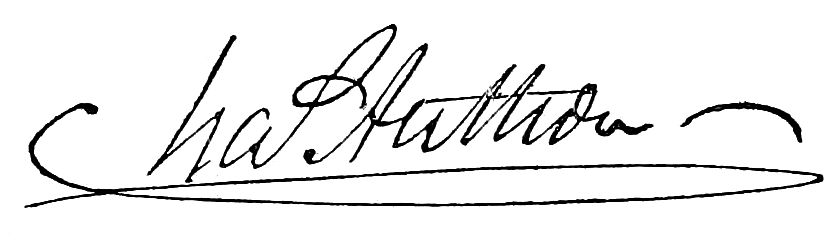
Professor Charles Anthon, of Columbia College,
New York, is well known as the most erudite of our
classical scholars; and, although still a young man,
there are few, if any, even in Europe, who surpass
him in his peculiar path of knowledge. In England
his supremacy has been tacitly acknowledged by the
immediate re-publication of his editions of Cæsar,
Sallust, and Cicero, with other works, and their adoption
as text-books at Oxford and Cambridge. His
amplification of Lemprière did him high honor, but,
of late, has been entirely superseded by a Classical
Dictionary of his own—a work most remarkable for
the extent and comprehensiveness of its details, as
well as for its historical, chronological, mythological,
and philological accuracy. It has at once completely
overshadowed every thing of its kind. It
follows, as a matter of course, that Mr. Anthon has
many little enemies, among the inditers of merely
big books. He has not been unassailed, yet has assuredly
remained uninjured in the estimation of all
those whose opinion he would be likely to value.
We do not mean to say that he is altogether without
faults, but a certain antique Johnsonism of style is
perhaps one of his worst. He was mainly instrumental
(with Professor Henry and Dr. Hawks) in
setting on foot the New York Review, a journal of
which he is the most efficient literary support, and
whose most erudite papers have always been furnished
by his pen.
The chirography of Professor Anthon is the most
regularly beautiful of any in our collection. We see
the most scrupulous precision, finish, and neatness
about every portion of it—in the formation of individual
letters, as well as in the tout-ensemble. The
perfect symmetry of the MS. gives it, to a casual
glance, the appearance of Italic print. The lines are
quite straight, and at exactly equal distances, yet
are written without black rules, or other artificial aid.
There is not the slightest superfluity, in the way of
flourish or otherwise, with the exception of the twirl
in the C of the signature. Yet the whole is rather
neat and graceful than forcible. Of four letters now
lying before us, one is written on pink, one on a faint
blue, one on green, and one on yellow paper—all of
the finest quality. The seal is of green wax, with
an impression of the head of Cæsar.
It is in the chirography of such men as Professor
Anthon that we look with certainty for indication of
character. The life of a scholar is mostly undisturbed
by those adventitious events which distort the
natural disposition of the man of the world, preventing
his real nature from manifesting itself in his MS.
The lawyer, who, pressed for time, is often forced to
embody a world of heterogeneous memoranda, on
scraps of paper, with the stumps of all varieties of
pen, will soon find the fair characters of his boyhood
degenerate into hieroglyphics which would puzzle
Doctor Wallis or Champollion; and from chirography
so disturbed it is nearly impossible to decide
any thing. In a similar manner, men who pass
through many striking vicissitudes of life, acquire in
each change of circumstance a temporary inflection
of the hand-writing; the whole resulting, after many
years, in an unformed or variable MS., scarcely to be
recognised by themselves from one day to the other.
In the case of literary men generally, we may expect
some decisive token of the mental influence upon the
MS., and in the instance of the classical devotee we
may look with especial certainty for such token. We
see, accordingly, in Professor Anthon’s autography,
each and all of the known idiosyncrasies of his taste
and intellect. We recognise at once the scrupulous
precision and finish of his scholarship and of his
style—the love of elegance which prompts him to
surround himself, in his private study, with gems of
sculptural art, and beautifully bound volumes, all
arranged with elaborate attention to form, and in the
very pedantry of neatness. We perceive, too, the
disdain of superfluous embellishment which distinguishes
his compilations, and which gives to their
exterior appearance so marked an air of Quakerism.
We must not forget to observe that the “want of
force” is a want as perceptible in the whole character
of the man, as in that of the MS.
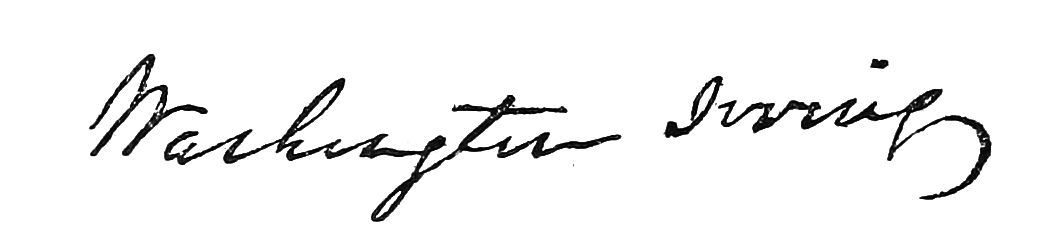
The MS. of Mr. Irving has little about it indicative
of his genius. Certainly, no one could suspect from
it any nice finish in the writer’s compositions; nor is
this nice finish to be found. The letters now before
us vary remarkably in appearance; and those of late
date are not nearly so well written as the more antique.
Mr. Irving has travelled much, has seen many
vicissitudes, and has been so thoroughly satiated with
fame as to grow slovenly in the performance of his
literary tasks. This slovenliness has affected his
hand-writing. But even from his earlier MSS. there
is little to be gleaned, except the ideas of simplicity
and precision. It must be admitted, however, that
this fact, in itself, is characteristic of the literary
manner, which, however excellent, has no prominent
or very remarkable features.
For the last six or seven years, few men have occupied
a more desirable position among us than Mr.
Benjamin. As the editor of the American Monthly
Magazine, of the New Yorker, and more lately of
the Signal, and New World, he has exerted an influence
scarcely second to that of any editor in the
country. This influence Mr. B. owes to no single
cause, but to his combined ability, activity, causticity,
fearlessness, and independence. We use the
latter term, however, with some mental reservation.
The editor of the World is independent so far as the
word implies unshaken resolution to follow the bent
of one’s own will, let the consequences be what they
may. He is no respecter of persons, and his vituperation
as often assails the powerful as the powerless—indeed
the latter fall rarely under his censure.
But we cannot call his independence, at all times,
that of principle. We can never be sure that he will
defend a cause merely because it is the cause of
truth—or even because he regards it as such. He is
too frequently biassed by personal feelings—feelings
now of friendship, and again of vindictiveness. He
is a warm friend, and a bitter, but not implacable
enemy. His judgment in literary matters should not
be questioned, but there is some difficulty in getting
at his real opinion. As a prose writer, his style is
lucid, terse, and pungent. He is often witty, often
cuttingly sarcastic, but seldom humorous. He frequently
injures the force of his fiercest attacks by an
indulgence in merely vituperative epithets. As a
poet, he is entitled to far higher consideration than
that in which he is ordinarily held. He is skilful and
passionate, as well as imaginative. His sonnets have
not been surpassed. In short, it is as a poet that his
better genius is evinced—it is in poetry that his
noble spirit breaks forth, showing what the man is,
and what, but for unhappy circumstances, he would
invariably appear.
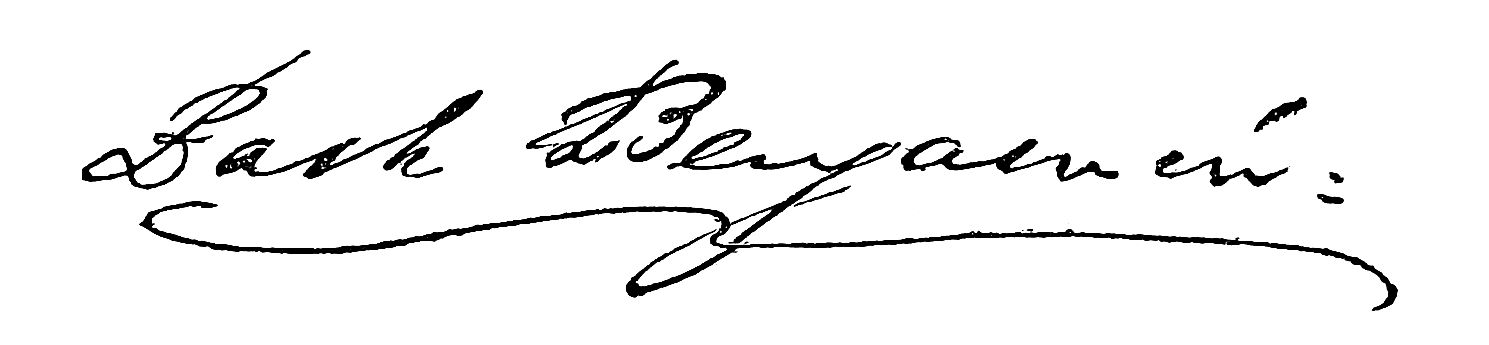
Mr. Benjamin’s MS. is not very dissimilar to
Mr. Irving’s, and, like his, it has no doubt been
greatly modified by the excitements of life, and by
the necessity of writing much and hastily; so that
we can predicate but little respecting it. It speaks
of his exquisite sensibility and passion. These betray
themselves in the nervous variation of the MS. as
the subject is diversified. When the theme is an ordinary
one, the writing is legible and has force; but
when it verges upon any thing which may be supposed
to excite, we see the characters falter as they
proceed. In the MSS. of some of his best poems
this peculiarity is very remarkable. The signature
conveys the idea of his usual chirography.
Mr. Kennedy is well known as the author of
“Swallow Barn,” “Horse-Shoe Robinson,” and “Rob
of the Bowl,” three works whose features are strongly
and decidedly marked. These features are boldness
and force of thought, (disdaining ordinary embellishment,
and depending for its effect upon masses
rather than upon details) with a predominant sense
of the picturesque pervading and giving color to the
whole. His “Swallow Barn,” in especial (and it is
by the first effort of an author that we form the truest
idea of his mental bias), is but a rich succession of
picturesque still-life pieces. Mr. Kennedy is well to
do in the world, and has always taken the world
easily. We may therefore expect to find in his chirography,
if ever in any, a full indication of the chief
feature of his literary style—especially as this chief
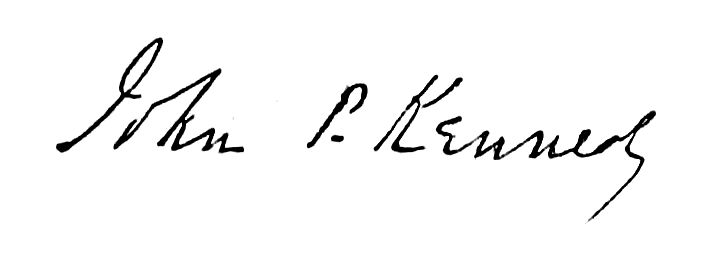
feature is so remarkably prominent. A glance at his
signature will convince any one that the indication
is to be found. A painter called upon to designate
the main peculiarity of this MS. would speak at once
of the picturesque. This character is given it by the
absence of hair-strokes, and by the abrupt termination
of every letter without tapering; also in great
measure by varying the size and slope of the letters.
Great uniformity is preserved in the whole air of the
MS., with great variety in the constituent parts.
Every character has the clearness, boldness and precision
of a wood-cut. The long letters do not rise or
fall in an undue degree above the others. Upon the
whole, this is a hand which pleases us much, although
its bizarrerie is rather too piquant for the general
taste. Should its writer devote himself more exclusively
to light letters, we predict his future eminence.
The paper on which our epistles are written is very
fine, clear, and white, with gilt edges. The seal is
neat, and just sufficient wax has been used for the
impression. All this betokens a love of the elegant
without effeminacy.
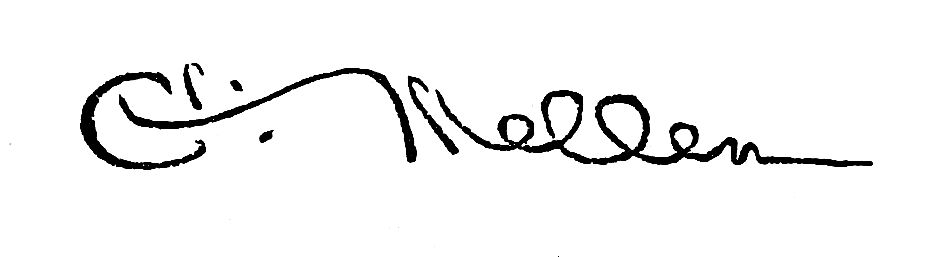
The hand-writing of Grenville Mellen is somewhat
peculiar, and partakes largely of the character of
his signature as seen above. The whole is highly indicative
of the poet’s flighty, hyper-fanciful character,
with his unsettled and often erroneous ideas of the
beautiful. His straining after effect is well paralleled
in the formation of the preposterous G in the
signature, with the two dots by its side. Mr. Mellen
has genius unquestionably, but there is something
in his temperament which obscures it.[3]
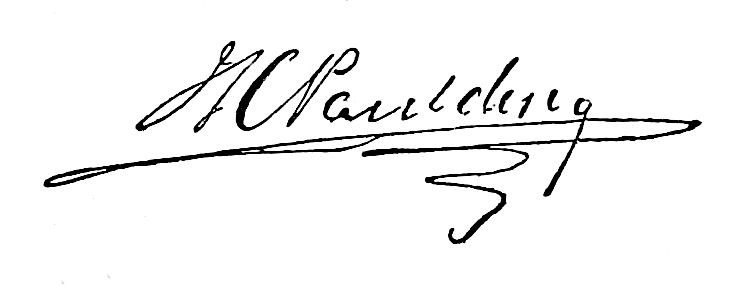
No correct notion of Mr. Paulding’s literary peculiarities
can be obtained from an inspection of his
MS., which, no doubt, has been strongly modified by
adventitious circumstances. His small as, ts, and
cs are all alike, and the style of the characters generally
is French, although the entire MS. has much
the appearance of Greek text. The paper which he
ordinarily uses is of a very fine glossy texture, and
of a blue tint, with gilt edges. His signature is a
good specimen of his general hand.
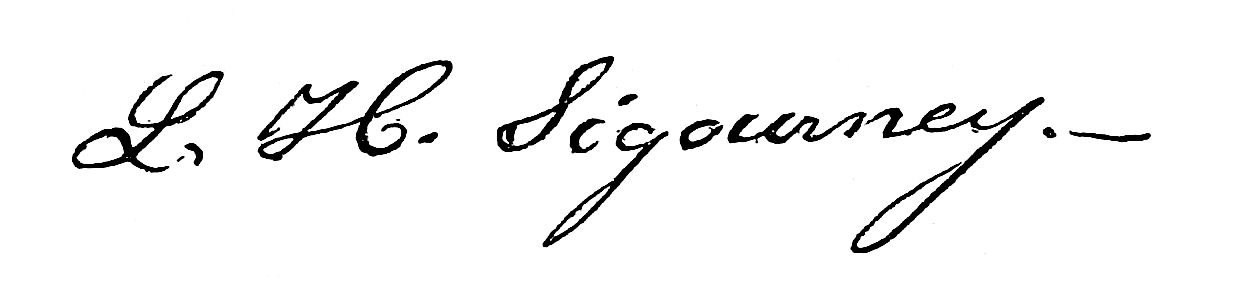
Mrs. Sigourney seems to take much pains with her
MSS. Apparently she employs black lines. Every
t is crossed, and every i dotted, with precision, while
the punctuation is faultless. Yet the whole has nothing
of effeminacy or formality. The individual
characters are large, well and freely formed, and
preserve a perfect uniformity throughout. Something
in her hand-writing puts us in mind of Mr. Paulding’s.
In both MSS. perfect regularity exists, and
in both the style is formed or decided. Both are
beautiful; yet Mrs. Sigourney’s is the most legible,
and Mr. Paulding’s nearly the most illegible in the
world. From that of Mrs. S. we might easily form
a true estimate of her compositions. Freedom, dignity,
precision, and grace, without originality, may
be properly attributed to her. She has fine taste,
without genius. Her paper is usually good—the seal
small, of green and gold wax, and without impression.
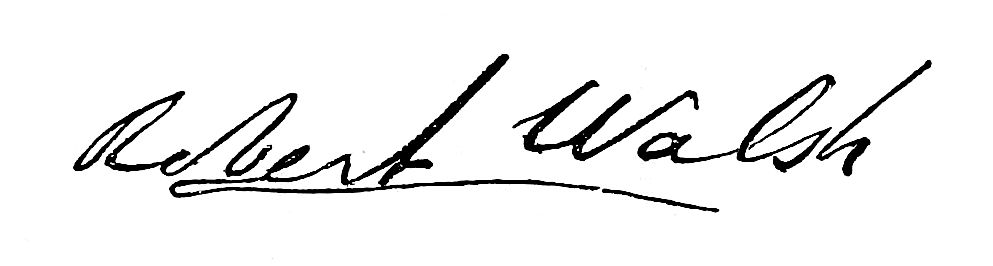
Mr. Walsh’s MS. is peculiar, from its large, sprawling
and irregular appearance—rather rotund than
angular. It always seems to have been hurriedly
written. The ts are crossed with a sweeping scratch
of the pen, which gives to his epistles a somewhat
droll appearance. A dictatorial air pervades the
whole. His paper is of ordinary quality. His seal
is commonly of brown wax mingled with gold, and
bears a Latin motto, of which only the words trans
and mortuus are legible.
Mr. Walsh cannot be denied talent; but his reputation,
which has been bolstered into being by a
clique, is not a thing to live. A blustering self-conceit
betrays itself in his chirography, which upon
the whole, is not very dissimilar to that of Mr. E.
Everett, of whom we shall speak hereafter.
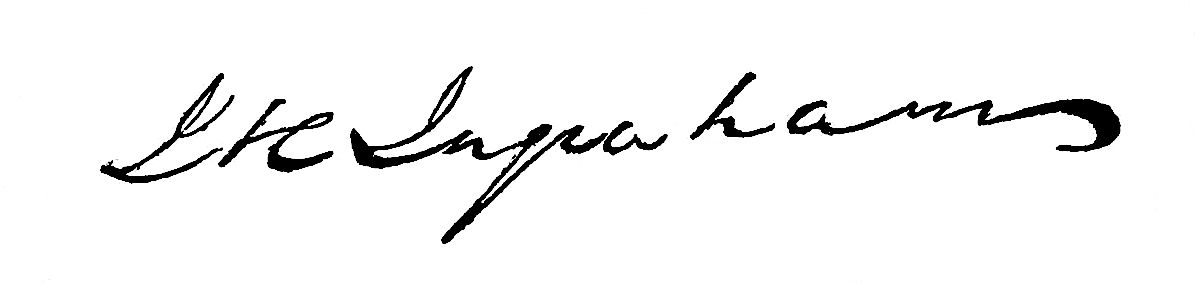
Mr. Ingraham, or Ingrahame, (for he writes his
name sometimes with, and sometimes without the e,)
is one of our most popular novelists, if not one of our
best. He appeals always to the taste of the ultra-romanticists,
(as a matter, we believe, rather of pecuniary
policy than of choice) and thus is obnoxious to
the charge of a certain cut-and-thrust, blue-fire, melodramaticism.
Still, he is capable of better things. His
chirography is very unequal; at times, sufficiently
clear and flowing, at others, shockingly scratchy and
uncouth. From it nothing whatever can be predicated,
except an uneasy vacillation of temper and of purpose.
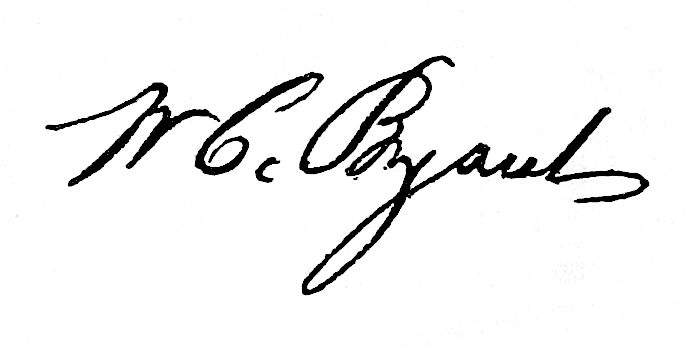
Mr. Bryant’s MS. puts us entirely at fault. It is
one of the most common-place clerk’s hands which
we ever encountered, and has no character about it
beyond that of the day-book and ledger. He writes,
in short, what mercantile men and professional pen-men
call a fair hand, but what artists would term an
abominable one. Among its regular up and down
strokes, waving lines and hair-lines, systematic taperings
and flourishes, we look in vain for the force,
polish, and decision of the poet. The picturesque,
to be sure, is equally deficient in his chirography and
in his poetical productions.
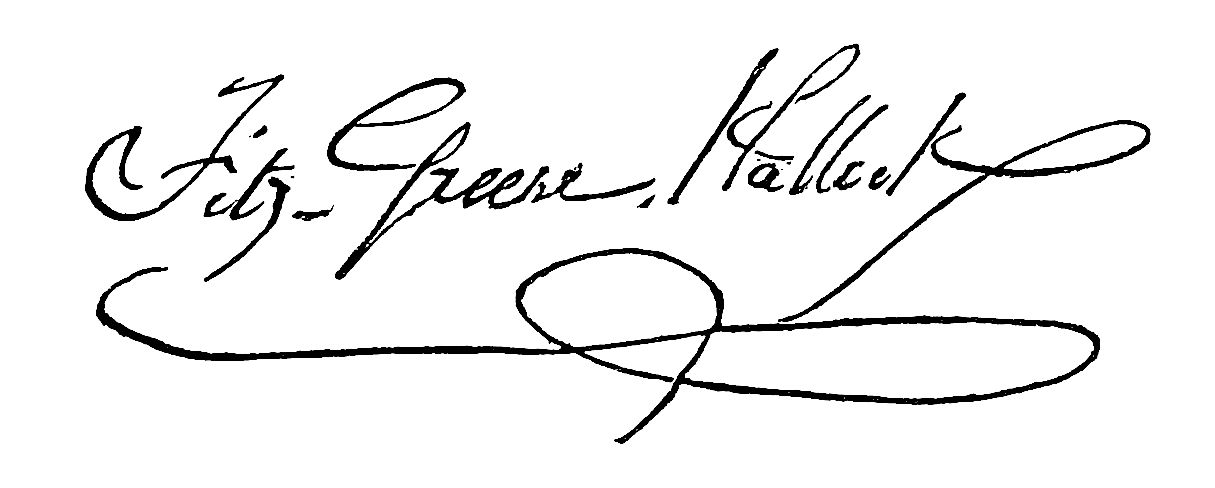
Mr. Halleck’s hand is strikingly indicative of his
genius. We see in it some force, more grace, and
little of the picturesque. There is a great deal of
freedom about it, and his MSS. seem to be written
currente calamo, but without hurry. His flourishes,
which are not many, look as if thoughtfully planned,
and deliberately, yet firmly executed. His paper is
very good, and of a blueish tint—his seal of red wax.
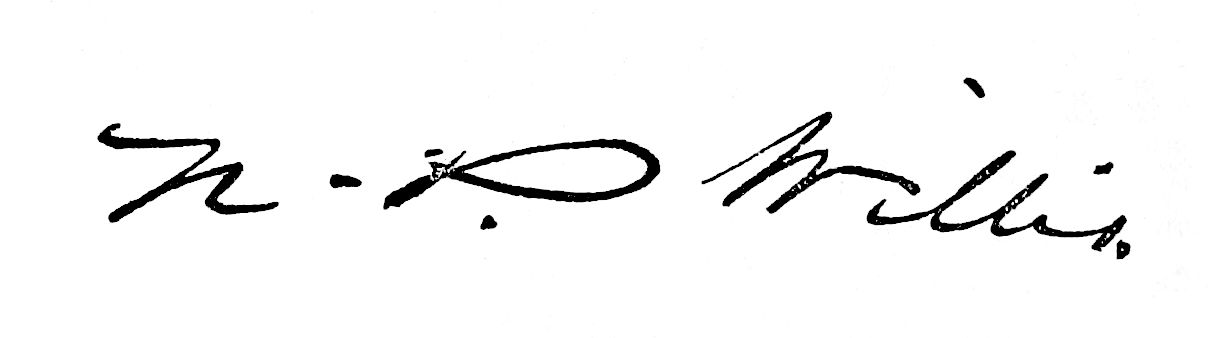
Mr. Willis, when writing carefully, would write a
hand nearly resembling that of Mr. Halleck; although
no similarity is perceptible in the signatures. His
usual chirography is dashing, free, and not ungraceful,
but is sadly deficient in force and picturesqueness.
It has been the fate of this gentleman to be alternately
condemned ad infinitum, and lauded ad nauseam—a
fact which speaks much in his praise. We
know of no American writer who has evinced greater
versatility of talent; that is to say, of high talent,
often amounting to genius; and we know of none who
has more narrowly missed placing himself at the head
of our letters.
The paper of Mr. Willis’ epistles is always fine, and
glossy. At present, he employs a somewhat large
seal, with a dove, or carrier-pigeon, at the top, the
word “Glenmary” at bottom, and the initials “N.
P. W.” in the middle.
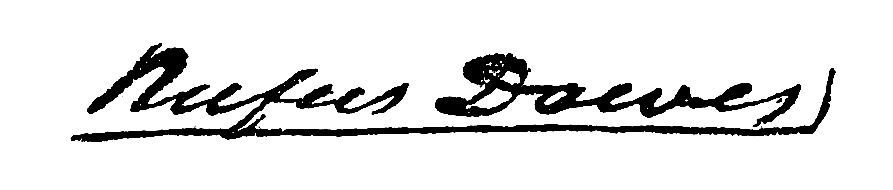
Mr. Dawes has been long known as a poet; but his
claims are scarcely yet settled—his friends giving
him rank with Bryant and Halleck, while his opponents
treat his pretensions with contempt. The truth
is, that the author of “Geraldine” and “Athenia of
Damascus” has written occasional verses very well—so
well, that some of his minor pieces may be considered
equal to any of the minor pieces of either
of the two gentlemen above-mentioned. His longer
poems, however, will not bear examination. “Athenia
of Damascus” is pompous nonsense, and “Geraldine”
a most ridiculous imitation of Don Juan, in which
the beauties of the original have been as sedulously
avoided, as the blemishes have been blunderingly
culled. In style, he is, perhaps, the most inflated,
involved, and falsely-figurative, of any of our more
noted poets. This defect, of course, is only fully
appreciable in what are termed his “sustained efforts,”
and thus his shorter pieces are often exceedingly
good. His apparent erudition is mere verbiage,
and, were it real, would be lamentably out of place
where we see it. He seems to have been infected
with a blind admiration of Coleridge—especially of
his mysticism and cant.
H. W. Longfellow, (Professor of Moral Philosophy
at Harvard,) is entitled to the first place among
the poets of America—certainly to the first place
among those who have put themselves prominently
forth as poets. His good qualities are all of the highest
order, while his sins are chiefly those of affectation
and imitation—an imitation sometimes verging
upon downright theft.
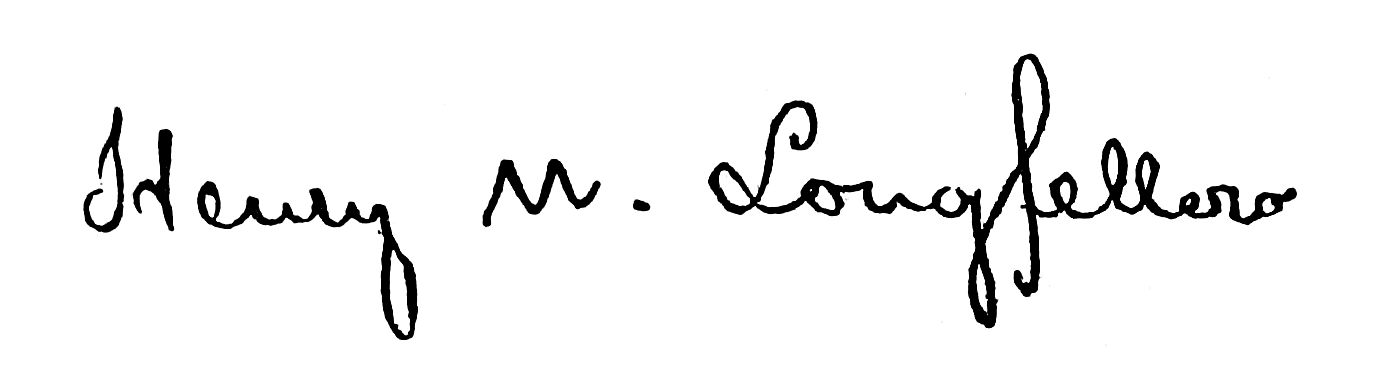
His MS. is remarkably good, and is fairly exemplified
in the signature. We see here plain indications
of the force, vigor, and glowing richness of his
literary style; the deliberate and steady finish of
his compositions. The man who writes thus may
not accomplish much, but what he does, will always
be thoroughly done. The main beauty, or at least
one great beauty of his poetry, is that of proportion;
another, is a freedom from extraneous embellishment.
He oftener runs into affectation through his endeavors
at simplicity, than through any other cause. Now
this rigid simplicity and proportion are easily perceptible
in the MS., which, altogether, is a very excellent
one.
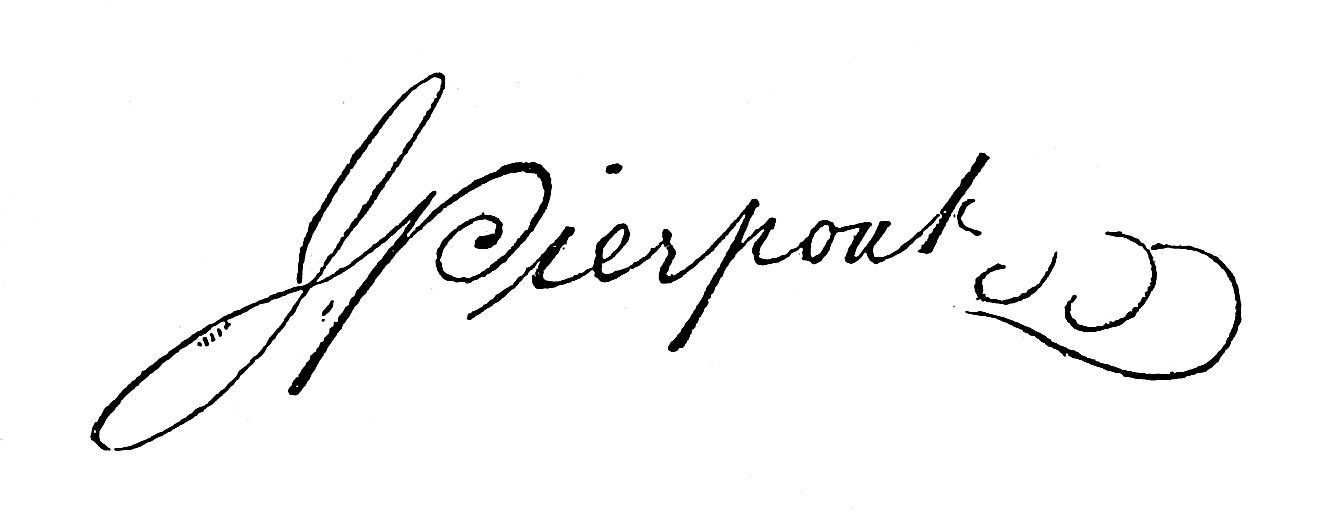
The Rev. J. Pierpont, who, of late, has attracted
so much of the public attention, is one of the most
accomplished poets in America. His “Airs of Palestine”
is distinguished by the sweetness and vigor
of its versification, and by the grace of its sentiments.
Some of his shorter pieces are exceedingly terse and
forcible, and none of our readers can have forgotten
his Lines on Napoleon. His rhythm is at least equal
in strength and modulation to that of any poet in
America. Here he resembles Milman and Croly.
His chirography, nevertheless, indicates nothing
beyond the common-place. It is an ordinary clerk’s
hand—one which is met with more frequently than
any other. It is decidedly formed; and we have no
doubt that he never writes otherwise than thus. The
MS. of his school-days has probably been persisted
in to the last. If so, the fact is in full consonance
with the steady precision of his style. The flourish
at the end of the signature is but a part of the writer’s
general enthusiasm.
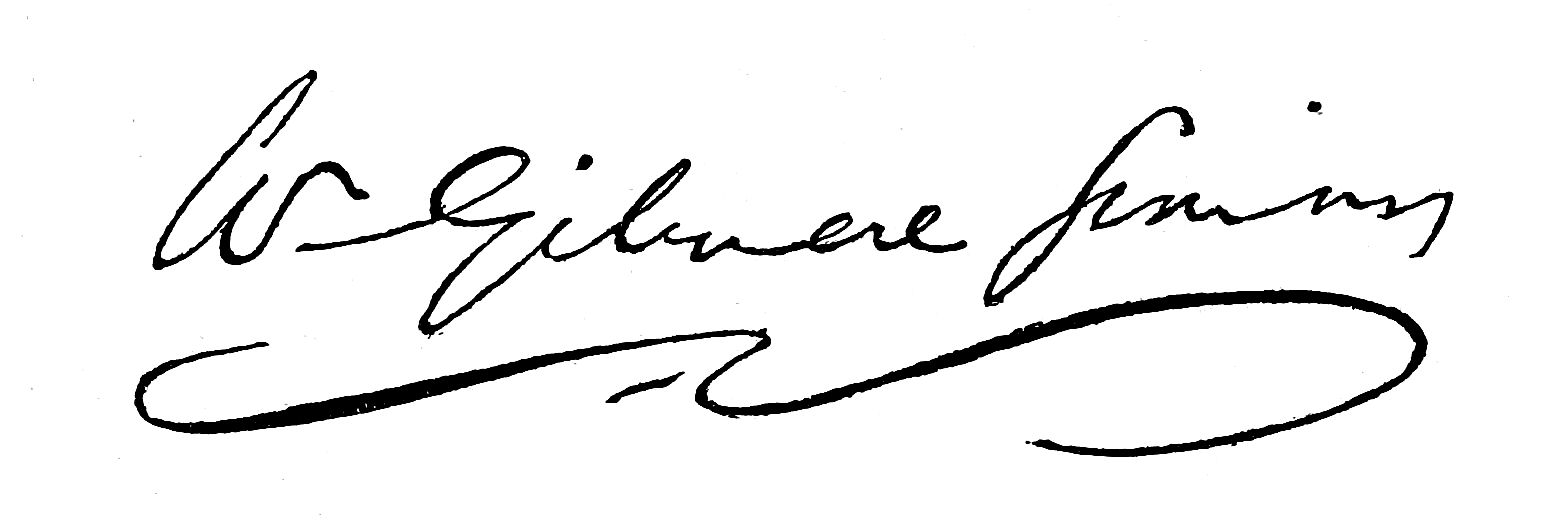
Mr. Simms is the author of “Martin Faber,” “Atalantis,”
“Guy Rivers,” “The Partisan,” “Mellichampe,”
“The Yemassee,” “The Damsel of Darien,”
“The Black Riders of the Congaree,” and one
or two other productions, among which we must not
forget to mention several fine poems. As a poet, indeed,
we like him far better than as a novelist. His
qualities in this latter respect resemble those of Mr.
Kennedy, although he equals him in no particular,
except in his appreciation of the graceful. In his
sense of beauty he is Mr. K.’s superior, but falls behind
him in force, and the other attributes of the author
of Swallow Barn. These differences and resemblances
are well shown in the MSS. That of Mr. S.
has more slope, and more uniformity in detail, with
less in the mass—while it has also less of the picturesque,
although still much. The middle name is
Gilmore; in the cut it looks like Gilmere.

The Rev. Orestes A. Brownson is chiefly known to
the literary world as the editor of the “Boston Quarterly
Review,” a work to which he contributes, each
quarter, at least two-thirds of the matter. He has
published little in book form—his principal works
being “Charles Elwood,” and “New Views.” Of
these, the former production is, in many respects,
one of the highest merit. In logical accuracy, in comprehensiveness
of thought, and in the evident frankness
and desire for truth in which it is composed, we
know of few theological treatises which can be compared
with it. Its conclusion, however, bears about
it a species of hesitation and inconsequence, which
betray the fact that the writer has not altogether succeeded
in convincing himself of those important truths
which he is so anxious to impress upon his readers.
We must bear in mind, however, that this is the fault
of Mr. Brownson’s subject, and not of Mr. Brownson.
However well a man may reason on the great topics
of God and immortality, he will be forced to admit
tacitly in the end, that God and immortality are things
to be felt, rather than demonstrated.
On subjects less indefinite, Mr. B. reasons with the
calm and convincing force of a Combe. He is, in every
respect, an extraordinary man, and with the more
extensive resources which would have been afforded
him by early education, could not have failed to bring
about important results.
His MS. indicates, in the most striking manner,
the unpretending simplicity, directness, and especially,
the indefatigability of his mental character. His
signature is more petite than his general chirography.
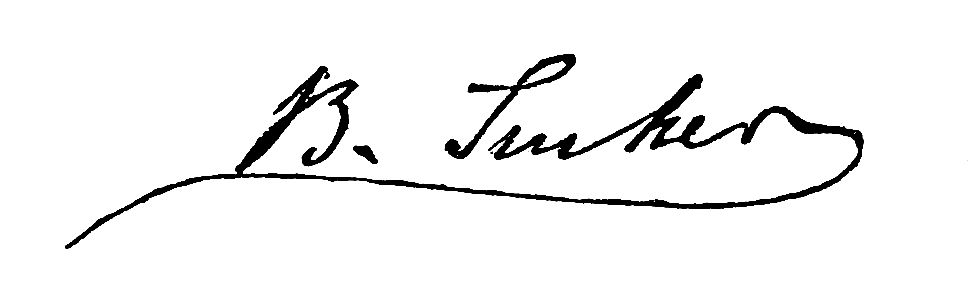
Judge Beverly Tucker, of the College of William
and Mary, Virginia, is the author of one of the
best novels ever published in America—“George
Balcombe”—although, for some reason, the book
was never a popular favorite. It was, perhaps, somewhat
too didactic for the general taste.
He has written a great deal, also, for the “Southern
Literary Messenger” at different times; and, at
one period, acted in part, if not altogether, as editor
of that Magazine, which is indebted to him for some
very racy articles, in the way of criticism especially.
He is apt, however, to be led away by personal feelings,
and is more given to vituperation for the mere
sake of point or pungency, than is altogether consonant
with his character as judge. Some five years
ago there appeared in the “Messenger,” under the
editorial head, an article on the subject of the “Pickwick
Papers” and some other productions of Mr.
Dickens. This article, which abounded in well-written
but extravagant denunciation of everything
composed by the author of “The Curiosity Shop,”
and which prophesied his immediate downfall, we
have reason to believe was from the pen of Judge
Beverly Tucker. We take this opportunity of mentioning
the subject, because the odium of the paper
in question fell altogether upon our shoulders, and it
is a burthen we are not disposed and never intended
to bear. The review appeared in March, we think,
and we had retired from the Messenger in the January
preceding. About eighteen months previously,
and when Mr. Dickens was scarcely known to the
public at all, except as the author of some brief tales
and essays, the writer of this article took occasion
to predict, in the Messenger, and in the most emphatic
manner, that high and just distinction which
the author in question has attained. Judge Tucker’s
MS. is diminutive, but neat and legible, and
has much force and precision, with little of the
picturesque. The care which he bestows upon his
literary compositions makes itself manifest also in
his chirography. The signature is more florid than
general hand.
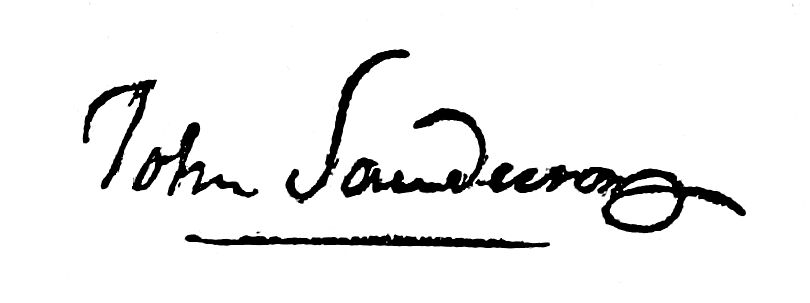
Mr. Sanderson, Professor of the Greek and Latin
languages in the High School of Philadelphia, is well
known as the author of a series of letters, entitled
“The American in Paris.” These are distinguished
by ease and vivacity of style, with occasional profundity
of observation, and, above all, by the frequency of
their illustrative anecdotes, and figures. In all these
particulars, Professor Sanderson is the precise counterpart
of Judge Beverly Tucker, author of “George
Balcombe.” The MSS. of the two gentlemen are
nearly identical. Both are neat, clear and legible.
Mr. Sanderson’s is somewhat the more crowded.
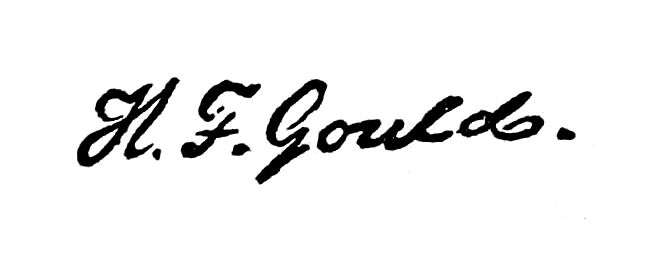
About Miss Gould’s MS. there is great neatness,
picturesqueness, and finish, without over-effeminacy.
The literary style of one who writes thus will always
be remarkable for sententiousness and epigrammatism;
and these are the leading features of Miss
Gould’s poetry.
Prof. Henry, of Bristol College, is chiefly known
by his contributions to our Quarterlies, and as one of
the originators of the New-York Review, in conjunction
with Dr. Hawks and Professor Anthon. His
chirography is now neat and picturesque, (much resembling
that of Judge Tucker,) and now excessively
scratchy, clerky, and slovenly—so that it is nearly
impossible to say anything respecting it, except
that it indicates a vacillating disposition, with unsettled
ideas of the beautiful. None of his epistles,
in regard to their chirography, end as well as they
begin. This trait denotes fatigability. His signature,
which is bold and decided, conveys not the faintest
idea of the general MS.
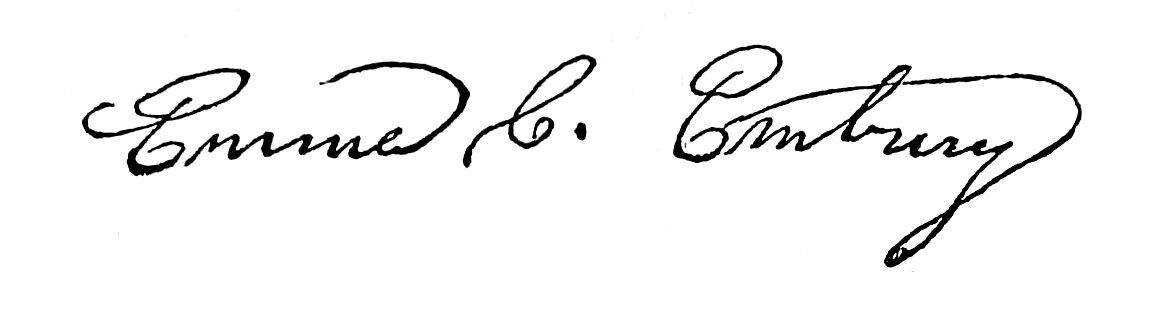
Mrs. Embury is chiefly known by her contributions
to the Periodicals of the country. She is one of the
most nervous of our female writers, and is not destitute
of originality—that rarest of all qualities in a
woman, and especially in an American woman.
Her MS. evinces a strong disposition to fly off at
a tangent from the old formulæ of the Boarding Academies.
Both in it, and in her literary style, it would
be well that she should no longer hesitate to discard
the absurdities of mere fashion.
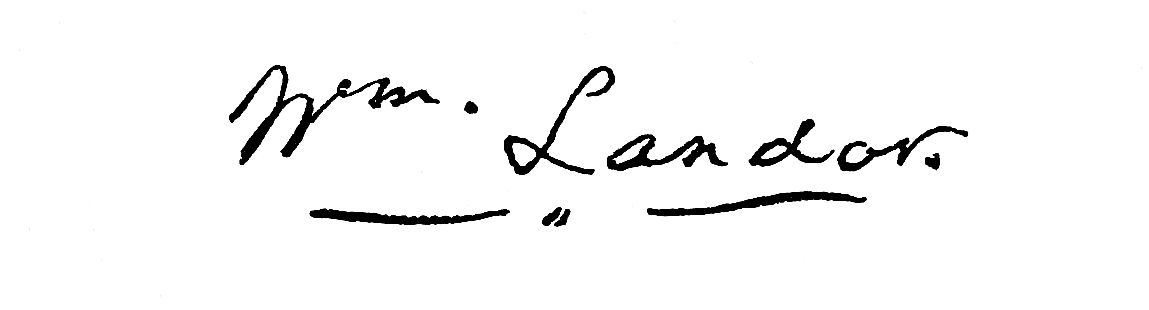
Mr. Landor acquired much reputation as the author
of “Stanley,” a work which was warmly commended
by the press throughout the country. He has also
written many excellent papers for the Magazines.
His chirography is usually petite, without hair-lines,
close, and somewhat stiff. Many words are carefully
erased. His epistles have always a rigorous formality
about them. The whole is strongly indicative of
his literary qualities. He is an elaborately careful,
stiff, and pedantic writer, with much affectation and
great talent. Should he devote himself ultimately
to letters, he cannot fail of high success.
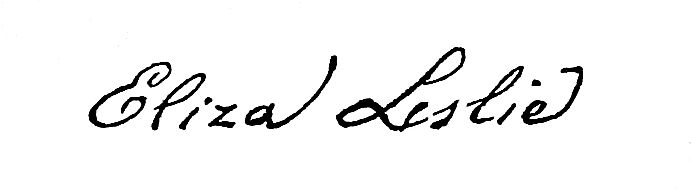
Miss Leslie is celebrated for the homely naturalness
of her stories and for the broad satire of her
comic style. She has written much for the Magazines.
Her chirography is distinguished for neatness
and finish, without over-effeminacy. It is rotund,
and somewhat diminutive; the letters being separate,
and the words always finished with an inward twirl.
She is never particular about the quality of her paper
or the other externals of epistolary correspondence.
From her MSS. in general, we might suppose
her solicitous rather about the effect of her compositions
as a whole, than about the polishing of the
constituent parts. There is much of the picturesque
both in her chirography and in her literary style.
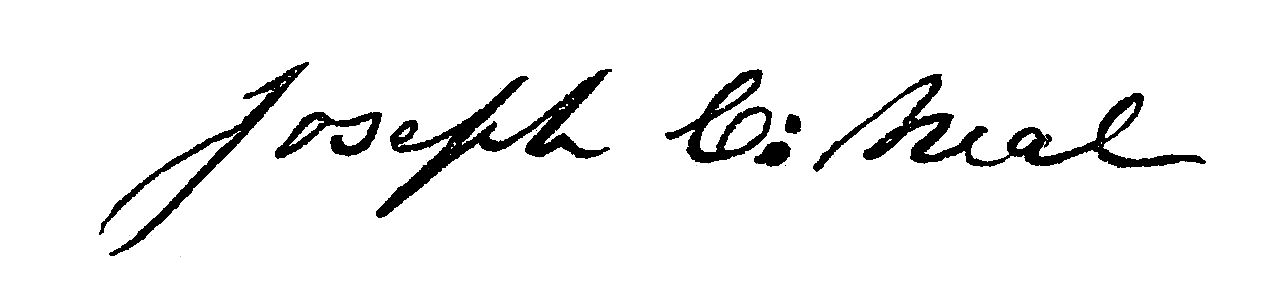
Mr. Neal has acquired a very extensive reputation
through his “Charcoal Sketches,” a series of papers
originally written for the “Saturday News,” of this
city, and afterwards published in book form, with illustrations
by Johnston. The whole design of the
“Charcoal Sketches” may be stated as the depicting
of the wharf and street loafer; but this design has
been executed altogether in caricature. The extreme
of burlesque runs throughout the work, which is, also,
chargeable with a tedious repetition of slang and
incident. The loafer always declaims the same nonsense,
in the same style, gets drunk in the same way,
and is taken to the watch-house after the same fashion.
Reading one chapter of the book, we read all.
Any single description would have been an original
idea well executed, but the dose is repeated ad nauseam,
and betrays a woful poverty of invention. The
manner in which Mr. Neal’s book was belauded by
his personal friends of the Philadelphia press, speaks
little for their independence, or less for their taste.
To dub the author of these “Charcoal Sketches”
(which are really very excellent police-reports) with
the title of “the American Boz,” is either outrageous
nonsense, or malevolent irony.
In other respects, Mr. N. has evinced talents which
cannot be questioned. He has conducted the “Pennsylvanian”
with credit, and, as a political writer, he
stands deservedly high. His MS. is simple and legible,
with much space between the words. It has force,
but little grace. Altogether, his chirography is good;
but as he belongs to the editorial corps, it would not
be just to suppose that any deductions, in respect to
character, could be gleaned from it. His signature
conveys the general MS. with accuracy.
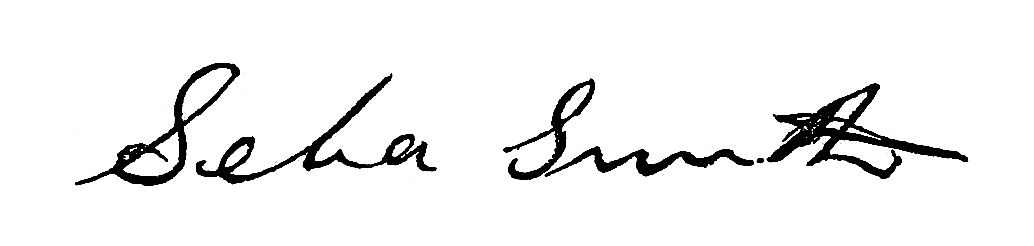
Mr. Seba Smith has become somewhat widely celebrated
as the author, in part, of the “Letters of Major
Jack Downing.” These were very clever productions;
coarse, but full of fun, wit, sarcasm and sense.
Their manner rendered them exceedingly popular,
until their success tempted into the field a host of
brainless imitators. Mr. S. is also the author of several
poems; among others, of “Powhatan, a Metrical
Romance,” which we do not very particularly
admire. His MS. is legible, and has much simplicity
about it. At times it vacillates, and appears unformed.
Upon the whole, it is much such a MS. as
David Crockett wrote, and precisely such a one as we
might imagine would be written by a veritable Jack
Downing; by Jack Downing himself, had this creature
of Mr. Smith’s fancy been endowed with a real
entity. The fact is, that “The Major” is not all
a creation; at least one half of his character actually
exists in the bosom of his originator. It was the Jack
Downing half that composed “Powhatan.”
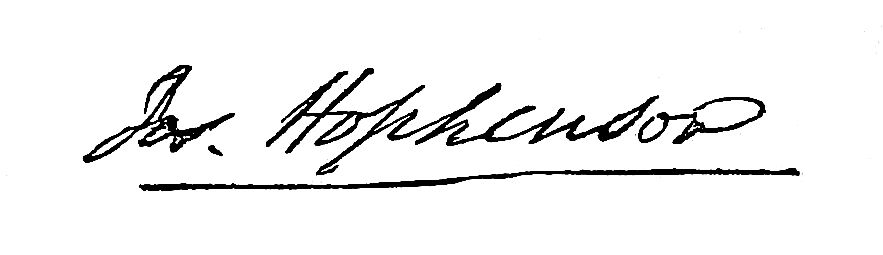
Judge Hopkinson’s hand is forcible, neat, legible,
and devoid of superfluity. The characters have
much slope, and whole words are frequently run together.
The lines are at equal distances, and a
broad margin is at the left of the page, as is the case
with the MSS. of Judge Marshall, and other jurists.
The whole is too uniform to be picturesque. The
writing is always as good at the conclusion, as at the
commencement of the epistles—a rare quality in
MSS., evincing indefatigability in the writer.
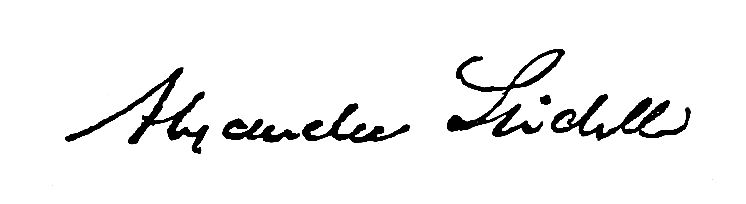
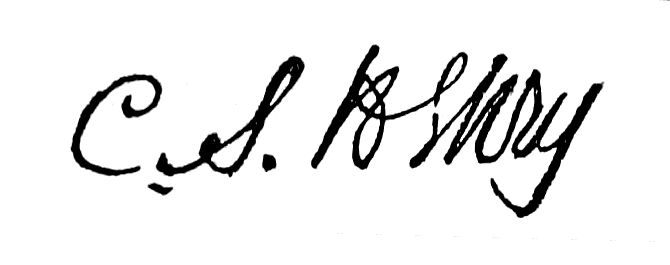
Lieutenant Slidell, some years ago, took the additional
name of Mackenzie. His reputation, at one
period, was extravagantly high—a circumstance
owing, in some measure, to the esprit de corps of the
navy, of which he is a member, and to his private
influence, through his family, with the Review-cliques.
Yet his fame was not altogether undeserved;
although it cannot be denied that his first book,
“A Year in Spain,” was in some danger of being
overlooked by his countrymen, until a benignant star
directed the attention of the London bookseller,
Murray, to its merits. Cockney octavos prevailed;
and the clever young writer who was cut dead in his
Yankee habiliments, met with bows innumerable in
the gala dress of an English imprimatur. The work
now ran through several editions, and prepared the
public for the kind reception of “The American in
England,” which exalted his reputation to its highest
pinnacle. Both these books abound in racy description;
but are chiefly remarkable for their gross deficiencies
in grammatical construction.
Lieut. Slidell’s MS. is peculiarly neat and even—quite
legible, but altogether too petite and effeminate.
Few tokens of his literary character are to be
found, beyond the petiteness, which is exactly analogous
with the minute detail of his descriptions.
Francis Lieber is Professor of History and Political
Economy in the College of South Carolina, and
has published many works distinguished by acumen
and erudition. Among these we may notice a “Journal
of a Residence in Greece,” written at the instigation
of the historian Niebuhr; “The Stranger in
America,” a piquant book abounding in various information
relative to the United States; a treatise on
“Education;” “Reminiscences of an intercourse
with Niebuhr;” and an “Essay on International
Copy-Right”—this last a valuable work.
Professor Lieber’s personal character is that of the
frankest and most unpretending bonhommie, while
his erudition is rather massive than minute. We
may therefore expect his MS. to differ widely from
that of his brother scholar, Professor Anthon; and
so in truth it does. His chirography is careless,
heavy, black, and forcible, without the slightest attempt
at ornament—very similar, upon the whole
to the well-known chirography of Chief Justice Marshall.
His letters have the peculiarity of a wide
margin left at the top of each page.
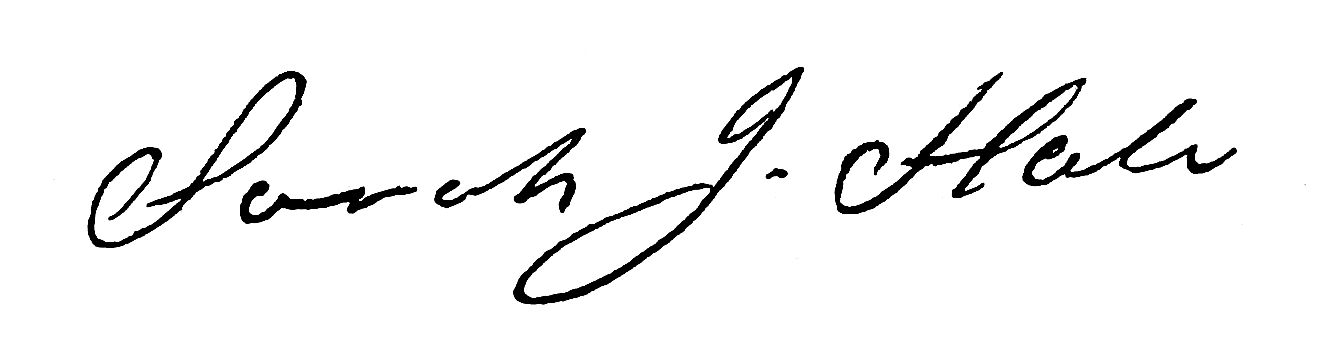
Mrs. Hale is well known for her masculine style
of thought. This is clearly expressed in her chirography,
which is far larger, heavier, and altogether
bolder than that of her sex generally. It resembles
in a great degree that of Professor Lieber, and is not
easily deciphered.
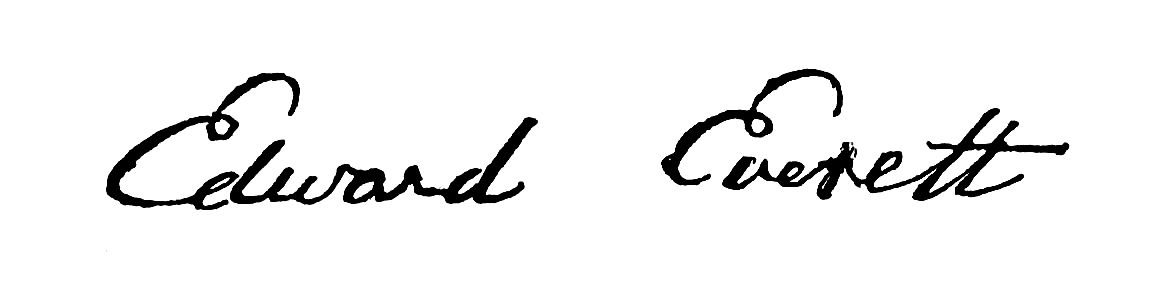
Mr. Everett’s MS. is a noble one. It has about it
an air of deliberate precision emblematic of the
statesman, and a mingled grace and solidity betokening
the scholar. Nothing can be more legible,
and nothing need be more uniform. The man who
writes thus will never grossly err in judgment, or
otherwise; but we may also venture to say that he
will never attain the loftiest pinnacle of renown.
The letters before us have a seal of red wax, with an
oval device bearing the initials E. E. and surrounded
with a scroll, inscribed with some Latin words which
are illegible.
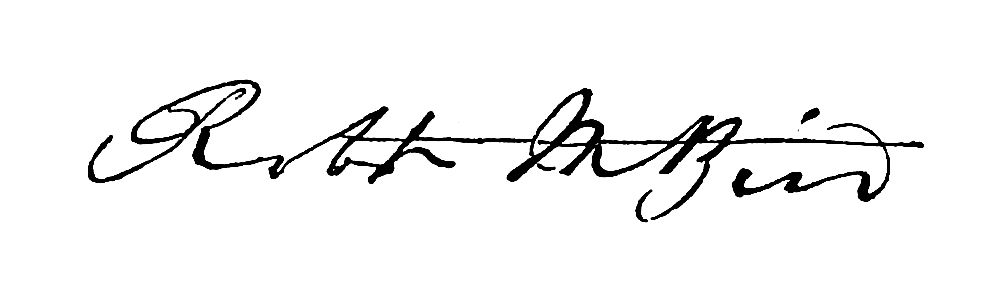
Dr. Bird is well known as the author of “The
Gladiator,” “Calavar,” “The Infidel,” “Nick of
the Woods,” and some other works—Calavar being,
we think, by far the best of them, and beyond doubt
one of the best of American novels.
His chirography resembles that of Mr. Benjamin
very closely; the chief difference being in a curl of
the final letters in Dr. B.’s. The characters, too,
have the air of not being able to keep pace with the
thought, and an uneasy want of finish seems to have
been the consequence. A vivid imagination might
easily be deduced from such a MS.
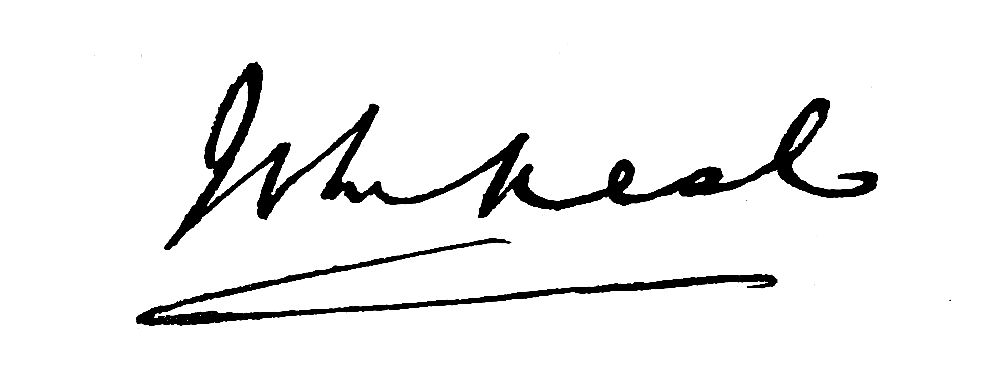
Mr. John Neal’s MS. is exceedingly illegible and
careless. Many of his epistles are perfect enigmas,
and we doubt whether he could read them himself
in half an hour after they are penned. Sometimes
four or five words are run together. Any one, from
Mr. Neal’s penmanship, might suppose his mind to
be what it really is—excessively flighty and irregular,
but active and energetic.
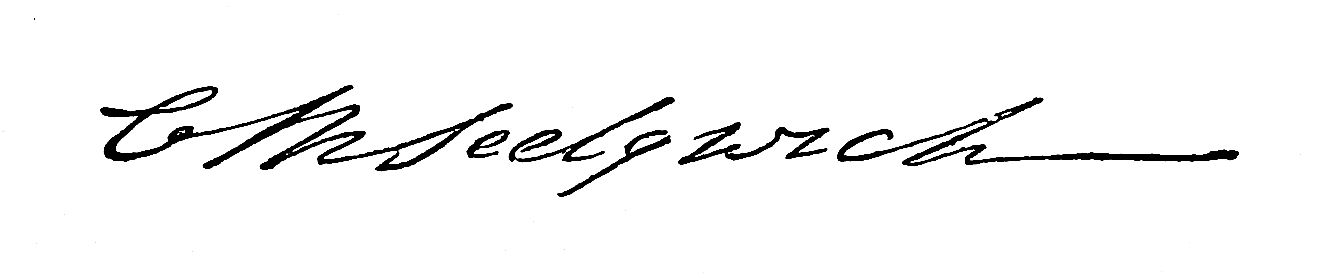
The penmanship of Miss Sedgwick is excellent.
The characters are well sized, distinct, elegantly but
not ostentatiously formed, and with perfect freedom
of manner, are still sufficiently feminine. The hair-strokes
differ little from the downward ones, and the
MSS. have thus a uniformity they might not otherwise
have. The paper she generally uses is good,
blue, and machine-ruled. Miss Sedgwick’s hand-writing
points unequivocally to the traits of her
literary style—which are strong common sense, and
a masculine disdain of mere ornament. The signature
conveys the general chirography.
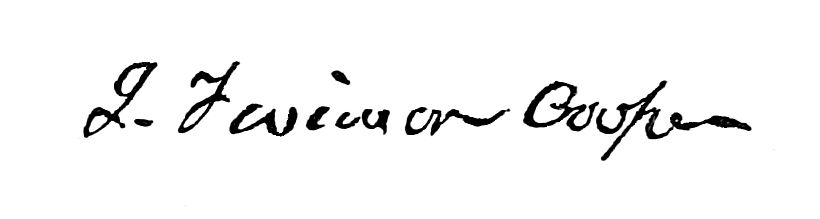
Mr. Cooper’s MS. is very bad—unformed, with
little of distinctive character about it, and varying
greatly in different epistles. In most of those before
us a steel pen has been employed, the lines are
crooked, and the whole chirography has a constrained
and school-boyish air. The paper is fine, and of a
bluish tint. A wafer is always used. Without appearing
ill-natured, we could scarcely draw any inferences
from such a MS. Mr. Cooper has seen
many vicissitudes, and it is probable that he has
not always written thus. Whatever are his faults,
his genius cannot be doubted.
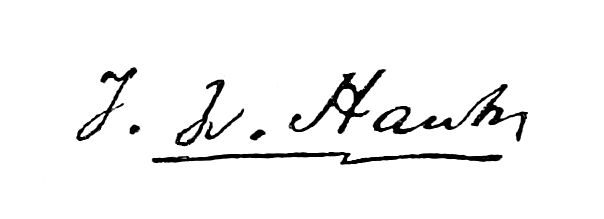
Dr. Hawks is one of the originators of the “New
York Review,” to which journal he has furnished
many articles. He is also known as the author of
the “History of the Episcopal Church of Virginia,”
and one or two minor works. He now edits the
“Church Record.” His style, both as a writer and
as a preacher, is characterized rather by a perfect
fluency than by any more lofty quality, and this trait
is strikingly indicated in his chirography, of which
the signature is a fair specimen.

This gentleman is the author of “Cromwell,” “The
Brothers,” “Ringwood the Rover,” and some other
minor productions. He at one time edited the “American
Monthly Magazine,” in connection with Mr. Hoffman.
In his compositions for the Magazines, Mr.
Herbert is in the habit of doing both them and himself
gross injustice, by neglect and hurry. His longer
works evince much ability, although he is rarely
entitled to be called original. His MS. is exceedingly
neat, clear, and forcible; the signature affording
a just idea of it. It resembles that of Mr. Kennedy
very nearly; but has more slope and uniformity,
with, of course, less spirit, and less of the picturesque.
He who writes as Mr. Herbert, will be found always
to depend chiefly upon his merits of style for a
literary reputation, and will not be unapt to fall into
a pompous grandiloquence. The author of “Cromwell”
is sometimes wofully turgid.

Mrs. Esling, formerly Miss Waterman, has attracted
much attention, of late years, by the tenderness
and melody of her short poems. She deserves nearly
all the commendation which she has received. Her
MS. would generally be considered beautiful; but
formed, like that of most of her sex, upon a regular
school-model, it is, of course, not in the slightest degree
indicative of character.
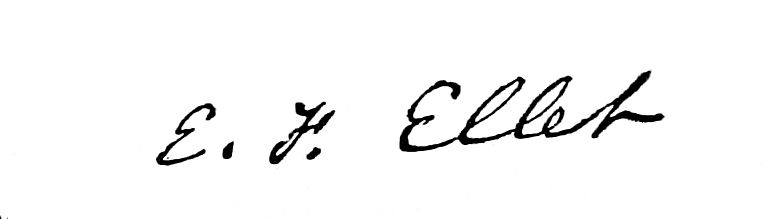
Mrs. E. F. Ellet has published one or two books,
exclusively of a volume of poems, but is chiefly known
to the literary world by her numerous contributions
to the Magazines. As a translator from the Italian,
she has acquired an enviable reputation. Her hand,
of which the signature above scarcely conveys a full
idea, is clear, neat, forcible and legible; just such a
hand as one would desire for copying MSS. of importance.
We have observed that the writers of such
epistles as those before us, are often known as translators,
but seldom evince high originality or very
eminent talent of any kind.
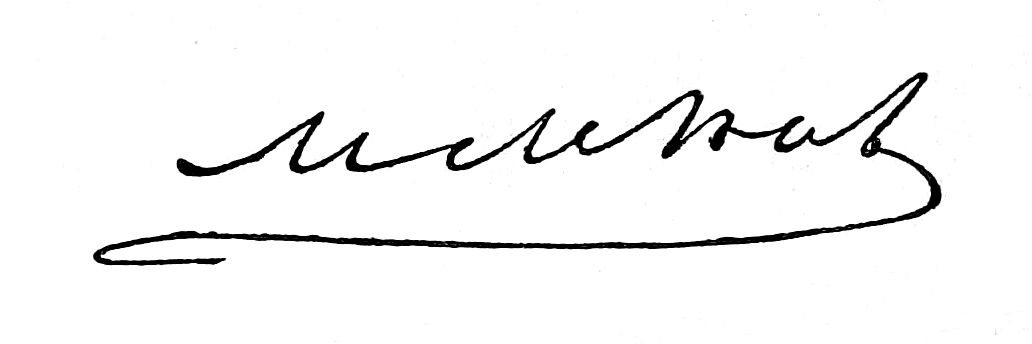
Judge Noah has written several plays which took
very well in their time, and also several essays and
other works, giving evidence of no ordinary learning
and penetration on certain topics—chiefly connected
with Israelitish history. He is better known, however,
from the wit and universal bonhommie of his
editorial paragraphs. His peculiar traits of character
may be traced in his writing, which has about it
a free, rolling, and open air. His lines are never
straight, and the letters taper too much to please the
eye of an artist, and have now and then a twirl, like
the tail of a pig, which gives to the whole MS. an
indescribably quizzical appearance, and one altogether
in consonance with the general notion respecting
the quondam Major, and present Judge, than whom
no man has more friends or fewer enemies.
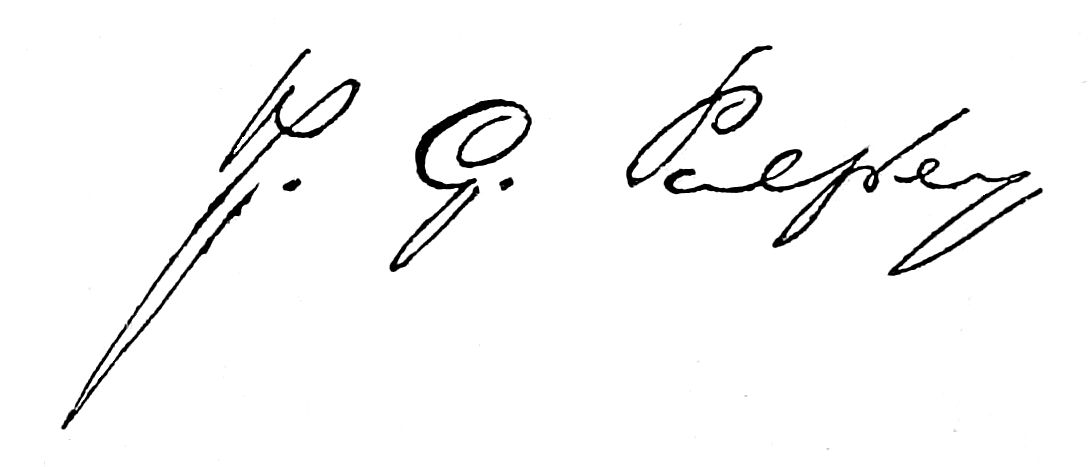
Professor Palfrey is known to the public principally
through his editorship of the “North American
Review.” He has a reputation for scholarship; and
many of the articles which are attributed to his pen
evince that this reputation is well based, so far as the
common notion of scholarship extends. For the rest,
he seems to dwell altogether within the narrow
world of his own conceptions; imprisoning them by
the very barrier which he has erected against the
conceptions of others.
His MS. shows a total deficiency in the sense of
the beautiful. It has great pretension—great straining
after effect; but is altogether one of the most
miserable MSS. in the world—forceless, graceless,
tawdry, vacillating and unpicturesque. The signature
conveys but a faint idea of its extravagance.
However much we may admire the mere knowledge
of the man who writes thus, it will not do to place
any dependence upon his wisdom or upon his taste.
This article will be concluded in our next number, and will embrace the autograph of every writer of note
in America.
———
BY J. H. DANA.
———
There is no scenery in England more beautiful than
that to be found in portions of the New Forest. Huge
gray old oaks, gnarled, and twisted, and aspiring to
heaven; deep glens, overshadowed by canopies of
leaves, through which the light but faintly struggles;
vast arcades, stretching far away in the distance, and
buried in religious gloom; wild wood roads, that
wind hither and thither among the giant trees in fanciful
contortions; and open, sunny glades, intersected
by sparkling streamlets, waving with verdant
grass, and now and then disclosing a fairy cottage
nestled in the edge of the forest, are to this day, the
characteristics of this favorite hunting ground of the
conqueror and his immediate successors. There is a
solitude about this old labyrinthine chace, which is
perfectly bewitching. You may travel for miles, in
the more secluded parts of the forest, without meeting
a human being, or seeing the smoke of a single
cottage curling among the foliage; but on every hand
you will behold trees growing in the wildest luxuriance,
and tread on a sward as soft and thick as the
richest velvet. You will, for a space, hear nothing
but the sound of a nut rattling to the ground, or the
song of some wood bird down in a brake; and then
you will rouse the deer from their retreat, a rustle
will be heard down in the under-growth, and you
will catch a sight of the noble herd, perchance, as
they go trotting away into the darker recesses of the
forest.
Such is the New Forest now, and such it was eight
centuries ago, on a bright sunny morning, towards
the end of summer. The hour was still early, for the
dew yet sparkled in the grass, or pattered down from
the foliage as the wind stirred among the forest branches.
The scene was one of the loveliest the chace afforded—a
bright glade embosomed in the most silent
depths of the forest. The whole of this open space
was carpeted with the thickest and greenest grass,
varying in hue, at every breath of the balmy wind
over the undulated surface. On one side, the glade
was bounded by a gentle elevation, covered with stately
oaks, whose giant branches, spreading out far and
wide, buried their trunks in the obscurity of a constant
twilight—and on the other three sides the
ground either extended itself in a plain, or sloped so
gently off, that the descent was nearly imperceptible.
Thousands of wild flowers spangled the surface of
the glade, some flaunting proudly on the air, and
some modestly hiding under the long grass, yet all
sending forth the most delicious perfume—while innumerable
birds, of every variety of plumage, hopped
from twig to twig, or skimmed across the glade, filling
the air with untold harmonies,—and high in the
heaven, a solitary lark, lingering there long after
his fellows had departed, poured forth his lay with
such sweet, such liquid harmony, that a stranger, unaccustomed
to his song, and unable to distinguish his
tiny form far up in the sunny ether, might well have
fancied those unrivalled notes the breathings of an
unseen cherubim.
Such was the scene on which there now gazed two
beings, both beautiful, but one surpassingly so. The
elder of the two might have been one and thirty, and
both his face and figure were moulded in the noblest
style of manly beauty. His broad brow, chiselled
features, and commanding port, bespoke him one born
to rule, although the simple and somewhat mean
garb he wore argued that he was not rich in this
world’s goods. The attire of his companion was richer,
but less gay, and she wore the veil of a novice.
Her face, however, made up in loveliness for whatever
absence of ornament there was in her dress, and
indeed she might well have challenged the world to
produce her rival. The fair delicate skin through
which the blue veins could be seen meandering, the
snowy brow that seemed made for the temple of
the loveliest and purest thoughts, the golden hair
that lay in wreathes upon the forehead, and the blue
eye whose azure depths seemed to conceal mysteries
as pure and rapturing as those of heaven, made up a
countenance of overpowering beauty, even without
that expression, so high and seraphic, which beamed
with her every word, and threw over each lineament
of her face a loveliness almost divine. Her figure
was like that of a sylph, yet full and rounded in every
limb; and beneath her dress peeped forth one of
the most delicate feet that ever trod green sward. She
was perhaps eighteen, though she might have been
younger. She sat now on a low bank, at the very
edge of the forest, while her companion reclined at
her feet, holding one of her tiny hands in his broad
palm, and gazing up into her eyes with a look of the
deepest, yet most respectful passion. Nor were the
maiden’s orbs averted from his gaze, for ever and anon
she would twine her fingers playfully yet half sadly
in his locks, and return his look with all a woman’s
tenderness.
“Yes, sweet one,” said the hunter, as if continuing
a conversation, “I have sometimes, during our
separation for the last six long months, almost desponded,
especially when I heard how urgent my
brother was that you should wed his favorite Warren,
and when I reflected that your aunt, the good abbess
Christiana, was so hostile to my suit. But I did you
injustice, dear one, and thus,” and he kissed the hands
of his companion again and again, “I sue for pardon.
God only knows,” he added in a sadder tone,
“whether I shall ever have my rights. They sneer
at me now as a landless prince, and that purse-proud
Surrey hath no better name for me than Deer’s-foot,
because I am not always able to follow the hunt with
a steed. But so long as thou art true to me, sweet
Maud, all these will be as nothing; and the time may
come when we shall yet be happy.”
“Fear not, Beauclerk,” said the princess—for it
was Matilda of Scotland who spoke, and he whom
she addressed was the younger son of the conqueror,
the penniless dependent of him whom men called the
Red King, “fear not—all, as you say, will be well.
I feel it, I know it. Do you believe in presentiments,
dear Henry?” and pushing aside her lover’s thick
locks, she held her hand on his forehead, and looked
with her sunny orbs full into his eyes, as if she would
playfully read his very soul.
“Presentiments trouble me not much, despite what
the books say thereof,” answered the frank hunter,
“I trust rather to my sword and my good right arm,
though forsooth, they availed me little when I was
cooped up in St. Michael’s Mount by my two kingly
and loving brothers. Aye! presentiments and prophesies,
and such things, trouble me but little, or I would
e’en have consolation now, in all my troubles, in calling
to mind the words of my father—the saints assoilzie
his memory!—since dying, he said, ‘that I
should be inheritor of all his honors, and should excel
both Robert and William in riches and power.’ By
St. George, the riches had best come soon, for I gave
my last mark away this morning. No, kind Maud,
I place little faith in presentiments. But you sigh.
If it pains you that I credit them not, why, then I
am the most devout believer in all England,” and
again he pressed that fair hand to his lips, “why do
you ask the question?”
“Because,” said the princess, blushing at his eagerness,
“I have had a presentiment that we should
yet be happy, and that full soon. I know not how it
is to happen; but of this I am assured, we shall live
for brighter days. The abbess threatens me with the
veil if I do not wed Surrey, and even now forces me,
in her presence, to wear a tissue of horse-hair; but
though I can as yet see no escape from the alternative,
I am not the less certain that it will never be
mine to choose. So now, despond no more, dear
Beauclerk.”
“Thanks, thanks, for your cheering homily,” said
the young prince laughing, for her sanguine words
had affected him with an unusual gaiety. “I can
hunt now with some spirit. Little does Surrey think,
while he is getting ready for the chase and perhaps
sneering at me as a laggard for not being up to set
out with the rest, that I have stolen out into the forest
to meet her for whom he would give the whole of his
broad lands.”
What answer the princess might have made to this
somewhat vain-glorious speech, we know not, but at
this instant a party appeared on the scene in the guise
of a knight, somewhat advanced in years, and as he
approached hastily, he said:
“You must forgive me, my dear lady, if I urge you
to take horse. The abbess knows your journey will
have consumed but a day, and that you should have
reached Wilton last night, and I shall have a hard
task to excuse your protracted stay without betraying
you. The men-at-arms are drawn up but a little space
off, and, though they are all my servitors, it is best
that they should know nothing to reveal. The prince
here will understand me.”
“Assuredly, Sir John; and if he they call Beauclerk
ever attains power, he will not forget those who befriended
the landless prince. I will bring up Maud
in an instant.”
The knight bowed, and retreated into the wood. A
few parting words were exchanged betwixt the lovers,
a few tears were shed by Maud, which were kissed
off by the prince, and then, with one long, last embrace,
they tore themselves asunder, and in a few
minutes the princess had rejoined her train. Prince
Henry stood looking vacantly in the direction where
she had disappeared, until the sound of her beast’s
tramp had died in the distance, when, slowly mounting
his steed, who had awaited its master in a neighboring
copse, he entered one of the forest roads, and
proceeded leisurely onwards. He had journeyed thus
about half an hour when he heard a hunting horn
sound close by him, and directly he beheld approaching
the gallant array of his brother.
“Ha! my good cousin Deer’s-foot, well met,” said
the Earl of Surrey; “we have been looking for you.
I told your friend here, who swore you were yet abed,
that we should meet you afoot in the forest before
the day was over—and thereon we have laid a wager.
I trow we have neither won. It would be but fair to
give you the bet, would it not?” said the gay Earl
with a half concealed sneer, as he glanced from his
own rich suit to the prince’s garb.
“You may both want yet, fair sirs, all you can
spare,” answered the prince; “but let us see who
will be first in at the death. You were always apt at
that, my lord,” and he turned to the royal treasurer.
“Ay, and shall maintain my reputation, your highness,”
said Breteuil, recollecting he addressed almost
a beggar; “and, if I may judge by your steed, even
against yourself.”
“We shall see—we shall see,” said the prince.
“I lay you a new steed, my lord, I distance you to-day.”
“Done,” said the treasurer, laughing; “you have
thrown away your horse. But here is the king, and
lo!” and as he spoke the horn announced that a stag
had been roused, “the game is afoot.”
At the word the eager sportsmen gave spur to their
steeds, and the cavalcade swept gaily off in the chase.
Never had a more gallant array than that which
now followed the royal stag, woke up the echoes of
the forest. Knights and squires, priests and pages,
warriors and ecclesiastics, princes of the blood royal
and high officers of state, pressed forward in the
chase, now scouring along the level plain, now dashing
away through the arcades of the forest, and now
plunging recklessly through brake and dell, as the
hounds dogged the flight of the noble animal into his
once secure retreat. Yet it was well worthy of note
how compactly the hunters kept around the king,
none venturing to outstrip him, and only a few of the
oldest maintaining an even rein with him.
Often during the chase the prince and Breteuil
passed and repassed each other, and at every recognition
Henry would gaily remind the treasurer of his
wager. At length, however, the pursuit became
more hot, the king gave rein to his steed and pressed
on, and in passing some broken ground the royal party
became separated, and those who were younger or
better mounted than the rest swept on ahead. Among
these was Prince Henry, who, though his steed was
none of the best, kept up a not ignoble pace, until at
length his arbalast caught against a tree, and he was
nearly thrown from his horse. He checked his steed
at once, and recovered his cross-bow, but the string
was broken, rendering the weapon useless.
“Ha! My gallant prince,” said the treasurer, as
he swept by; “you can scarcely hit your game now,
even if you keep on. I trow your steed is mine.”
“A malison on the string,” said the prince bitterly;
“there is nothing left for me except to sneak
back to Winchester. But, no! I bethink me now
there is a forester’s hut somewhere nigh here. Ah!
yonder is its smoke curling over the tree-tops. I
will hie me there, and get a new string. If the stag
turns at the dell below, he will head up this way, and
I may yet win my wager, for, the saints know, I can
ill afford to lose my only steed.”
With these words the prince again gave spurs to his
horse, and was soon before the forester’s hut.
“Ho! there, within,” he exclaimed; “a string
for the prince. Marry, old mistress, have they never
a keeper here better than you?”
These words were addressed to an old woman who
met him at the threshold of the hut as he dismounted,
and who appeared to be the only human being inhabiting
the cabin. And she was one who might well
occasion the prince’s exclamation of surprise. Her
skin was like that of a corpse; her eyes were sunk
deep into her head; her hair was grizzled and gray;
her long bony fingers might have been those of a
skeleton, and when she spoke, her hollow sepulchral
tones made even the courageous prince shudder. She
seemed to pay no regard to her visitor’s inquiry for
a string, but fastening her basilisk-like eyes upon
him, she said or rather chaunted, in Norman
French, a rude lay, of which the following verses
are a translation:
“Hasty news to thee I bring,
Henry, thou art now a king;
Mark the words, and heed them well,
Which to thee in sooth I tell,
And recall them in the hour
Of thy royal state and power.”
For the space of almost a minute after she had
ceased, the prince gazed speechlessly on this novel
being, awed alike by her strange demeanor, and her
sepulchral eye. Nor were the words she chaunted
without effect on her hearer. It was a superstitious
age, and though few men of his day were less influenced
by the supernatural than Henry, there was
something in the sybil’s look which chilled his heart
with a strange feeling, half fear, half awe. He had
not recovered from his surprise, when a horseman
rushed wildly up to the hut, and the prince had
scarcely recognized one of his warmest friends,
Beaumont, when that gentleman breathlessly exclaimed:
“The king is slain!—Tyrell’s arrow glanced
from a bow and struck your royal brother to his
heart!”
The words of Beaumont acted on the prince like
the charm which dissipates a spell. He started, as
if aroused from some strange dream, looked a moment
in wild surprise at his companion, and gradually
comprehending the strange and sudden transition
in his fortunes, he sprung with a bound into his
saddle, and plunging his rowels up to the heel in his
horse’s side, exclaimed:
“Then this is no place for me—follow to Winchester,
Beaumont,—and now for a crown and
Maud!”
The next instant his horse’s hoofs were thundering
across the stones, as he galloped furiously to the
capital.
History relates how he reached Winchester, with
his steed bathed in foam, and, without slackening his
pace, dashed up to the door of the royal treasury, a
few minutes in advance of Breteuil. History also
tells how the energy of the young prince broke
through the meshes of the wily traitor, and secured
for Beauclerk the crown; but it does not add that,
after the unwilling treasurer had surrendered the
keys of the regalia, his new master said, half laughingly
and half ironically, to the haughty peer who
had so often neglected him when only a prince—
“Ah, my lord! did I not say I would win the
race? I trow your steed is mine!”
The discomfited Breteuil bit his lip and was silent,
but that night his best charger was sent to the royal
stables; while the rest of the hunters, who were now
fast pouring in from the chase, with the populace
which at the first news of the Red King’s death had
begun to shout “King Henry,” gathered around their
young monarch and filled the air with their acclamations.
“Maud is right,” said the king to himself, as he
beheld the enthusiasm displayed by his people, “to
say nothing of the old sybil. Ah! what will my
sweet one think when she hears this?”
Three months later and all the chivalry of the realm
was gathered in the church at Westminster, while
the populace without thronged every avenue to that
princely cathedral. Never indeed had a prouder assemblage
met at any royal ceremonial. The church
blazed with jewels. Nobles in their robes of state;
bishops and archbishops with mitre and crozier;
countesses whose beauty out-dazzled their diamonds;
knights and squires and pages of every rank; burghers
with their chains of gold; men-at-arms encased in
steel; halberdiers and archers; yeomen with quarter
staffs, and foresters with arbalasts; men of every
situation of life, and bright ladies, whose loveliness
was beyond compare, were gathered in the gorgeously
ornamented church, amid the waving of banners,
the sound of music, the rustling of costly robes,
and the smoke of ascending incense, to gaze on the
marriage of their monarch to his fair and blushing
bride. And there she stood before the altar in all
her virgin beauty, her fair blue eyes suffused with
tears of joy; while her manly lover stood at her
side, the proudest cavalier in all that bright array.
And when the archbishop ascended the pulpit, and
demanded if any one there objected to the union, the
whole audience shouted aloud “that the matter was
rightly settled;” then again pealed forth the anthem,
and again the incense rose in clouds to the fretted
roof. The music ceased, the words were said, the
crown was placed on the brow of the princess, and
the hunter of the forest, amid the acclamations of his
people, pressed to his heart the King’s Bride.
“Do you believe in presentiments now?” said the
young queen, half laughing, to her royal husband
when they reached the palace.
“I am a convert to your faith whatever it may be,
sweet one. Nay! you shall preach no sermon over
my retraction, for thus I forbid the homily,” and the
king drew the blushing Maud towards him and fondly
kissed her.
Many an iron monarch has, since then, sat on the
English throne, and many a fair princess has been
led by her lover to the altar, but never has a happier
or more beautiful pair wore the regal crown in the
realm of our ancestors.
———
BY J. R. LOWELL.
———
Hurrah for merry England,
Queen of the land and sea,
The champion of truth and right,
The bulwark of the free!
Hurrah for merry England!
Upon thy seagirt isle
Thou sittest, clothed in righteousness,
Secure of Heaven’s smile!
When ruled the fairhaired Saxon,
Yes, thou wert merry then;
And, as they girt their bucklers on,
Thy meanest serfs were men;
And merry was the castle-hall
With jest and song and tale,
When bearded lips with mead were white
And rang the loud Washael!
And, when grim Denmark’s black-browed prows
Tore through thine Emerald sea,
And many a wild blue eye was turned
In savage lust on thee,—
When, in the greenest of thy vales,
The gusts of summer air
Blew out in long and shaggy locks
The sea-king’s yellow hair,—
Yet Alfred was in England,
And merry yet again
Thy white-armèd Saxon maidens were
When, on the drunken Dane,
The sudden thunders of thy war
With arrowy hail did pour,
And grim jaws dropt that quivered yet
With savage hymns to Thor.
Thy merry brow was fair and free,
Thine eye gleamed like a lance,
When thy good ash and yew did crush
The gilded knights of France;
When Paris shook within her walls
And trembled as she saw
Her snow-white lilies trampled down
Beneath thy lion’s paw.
Queen Bess’s days were merry days,
Renowned in song and tale,
Stout days that saw the last brown bead
Of many a tun of ale;
Queen Bess’s days were golden days
And thou full proudly then
Did’st suckle at thy healthy breasts
The best of Englishmen.
Thou hast been merry, England,
But art thou merry now,
With sweat of agonizing years
Upon thy harlot brow,
Grimed with the smoke of furnaces
That forge with damned art
The bars of darkness that shut in
The poor man’s starving heart?
Oh free and Christian England!
The Hindu wife no more
Shall burn herself in that broad realm
Saint George’s cross waves o’er;
Thou art the champion of the right,
The friend of the opprest,
And none but freemen now shall tread
Thine Indies of the West.
But thou canst ship thy poison,
Wrung from lean Hindu slaves,
To fill all China with dead souls
That rot in living graves;
And, that thy faith may not be seen
Barren of goodly works,
At Saint Jean D’Acre thou sent’st up
To Heaven three thousand Turks.
Fling high your greasy caps in air,
Slaves of the forge and loom,
If on the soil ye’re pent and starved
Yet underneath there’s room;
Fling high your caps, for, God be praised,
Your epitaph shall be,
“Who sets his foot on English soil
Thenceforward he is free!”
Shout too for merry England
Ye factory-children thin,
Upon whose little hearts the sun
Hath never once looked in;
For, when your hollow eyes shall close
The poor-house hell to balk,
(Thank God for liberty of speech)
The parliament will talk.
Thank God, lean sons of Erin,
Who reverence the Pope
In England consciences are free
And ye are free—to hope;
And if the Church of England priest
Distrain—why, what of that?
Their consciences are freer still
Who wear the shovel-hat.
The poet loves the silent past,
And, in his fruitful rhyme,
He sets the fairest flowers o’er
The grave of buried time;
But, from the graves of thy dark years,
The night-shade’s ugly blue
And spotted henbane shall grow up
To poison Heaven’s dew.
Woe to thee, fallen England,
Who hast betrayed the word,
And knelt before a Church when thou
Shouldst kneel before the Lord!
And, for that scarlet woman
Who sits in places high,
There cometh vengeance swift to quench
The lewdness in her eye.
Woe to thee, fallen England,
Who, in thy night-mare sleep,
O’er a volcano’s heart dost toss
Whence sudden wrath shall leap
Of that forgotten Titan
Who now is trodden down
That one weak Guelphic girl may wear
Her plaything of a crown!
That Titan’s heart is heaving now,
And, with its huge uprise,
On their sand basements lean and crack
The old moss-covered lies;
For freedom through long centuries
Lives in eternal youth,
And nothing can for ever part
The human soul and truth.
———
BY RUFUS DAWES.
———
The inmost region of the mind, where dwells
The essences of unborn thought,—those ends
In which Effects, through Causes, dwell in power,
Opened. ’Twas in vision, and I saw
A palace of vast size—such as the eye,
The natural eye of man, never beheld.
Its massy walls of unhewn agate towered,
Girt by a colonnade of crysolite;
And there were ninety columns of huge bulk,
Sustaining an entablature of gold,
Diamond and ruby, glittering like the sun.
The windows were each one a double plate
Of spacious crystal, sliding from the touch
Each side in golden frames. The portico
Hung o’er a flight of alabaster steps,
Extending to a lawn of delicate moss,
Where browsed a flock of innocent, white lambs,
That little children garlanded with flowers.
Around the palace, orchard-trees were seen,
Laden with fruit celestial, that hung down
Like gems among the gold and silver leaves.
Majestic vines, heavy with clustering grapes,
In large festoons swung gorgeously between
The opulent boughs that dropped with nectarines.
’Twas on a mountain’s summit, high and broad,
Commanding a magnificent expanse,
Where Art, in its essential excellence,
Glowed in potential forms, where Nature, too,
Un-ultimated in terrestrial things,
Bloomed in angelic beauty. To the east
A river, brinked luxuriantly with flowers,
Lapsed silently. The deep-enameled dome,
Whose measureless horizon knew no bounds,
Was draped with clouds that broke celestial rays,
Shining down shadowless. Turning, I saw
A pair of Consorts, whose exalted home
Was in this paradise. No forms of earth,
No mortal lineaments—no reach of thought
Poetic, when imagination wings
Homeward to Heaven, could in the least compare
With their angelic radiance;—they were
Beauty itself in form,—two, and yet one,—
One angel male and female—a true Man.
He was her Understanding, she his Will;
Thence, but one mind in heavenly marriage formed.
Her love was cradled in his thought, that loved
Her love and nursed it—as the tender drops
Clasp the warm sunbeams, while the smile of Heaven
Breaks in the rainbow. Such is genuine love.
He in his form more radiantly shone
Than that sublime achievement of fine art,
That shows the power of luminous Truth to kill
Sinuous Error;—she, than Guido’s gem
More beautiful, more human, and more true.
I saw, and lo! two dromedaries, each
Bearing a golden basket, one of bread,
The other of ripe fruit; they came and knelt.
Each took and gave the other,—he the bread,
She the ripe fruit. The dromedaries then
Rose and departed. I beheld them kneeling
Beside the river, and when they had drunk
I saw them rise again and kiss each other,
And then depart. I looked again, and lo!
The consorts had withdrawn. They were the first
Of the new birth of Marriage here on earth—
A promise for the future, when a Time,
And Times, and half a Time shall be fulfilled.
FORT POINT.
———
BY D. M. ELWOOD.
———
“His spirit wraps the misty mountain,
His memory sparkles o’er the fountain;
The meanest rill—the mightiest river—
Rolls mingling with his name forever.”
The beautiful towns and villages of Connecticut,
bordering on Long Island sound, are not surpassed in
quiet loveliness by any others in New England. The
loveliest, perhaps, of them all, is Norwalk, situated
in the western part of the State, on a river of the
same name, which flows sweetly along through the
centre of the town. The title, we confess, is neither
euphonious nor romantic: but we would not have it
changed even for the sweetest word that ever passed
human lips. It was given it by the Aborigines on
the day when the territory was first purchased from
them, and refers, if we mistake not, to its extent northward
from the sound, called by the Indians the North
walk. It is, indeed, one of the most lovely spots in
Nature. Its quiet harbor is studded with verdant
islands of every size and form, while across the green
waters Long Island is seen, its dim outline scarcely
distinguishable from the blue expanse beyond. The
sound through its whole length is spotted with sheets
of snowy canvass spread to catch the breeze, and anon
the majestic steamer, like some huge leviathan, comes
laboring on her way, proudly dashing aside the foaming
waters from her prow, and leaving far behind a
whitened, widening track. But when the Storm King
is abroad, the crested waves pursue each other in
continual chase, and the long, swelling billows break
upon the shore, sending forth their rich music in the
deep organ tones of nature.
On the eastern side of the river, and directly opposite
the present steamboat landing, is a large circular
mound, some twenty feet high, and covering a surface
of about an acre. It is perfectly level on the top, and
bordered with large, tall cedars. It is now commonly
known by the inhabitants in the vicinity as Old
Fort Point.
There is a tradition respecting the object and the
erection of this mound, which I have with difficulty
procured, and which maybe interesting to many who
have visited the place, if not to strangers. For its
truth, in all particulars, I will not vouch, but give it
substantially as it has come down to us.
About two centuries ago, there lived, on the level
country about what is now Fort Point, but what was
then called Naumkeag, one of those large tribes of
native Indians, which, at the time when this land was
first visited by Europeans, were scattered over the
country from the shores of the Atlantic to the great
valley of the west. The Indians had not then been
degraded by their intercourse with the whites. The
peculiarities of their nature had not been modified by
the influence of civilization. Their tastes had not
been pampered, nor their appetites excited by the fatal
“fire water” introduced by their destroyers, nor
their bodily strength wasted by diseases, loathsome
and deadly, and till then unknown among them.
From the feathered flocks of the forest and the finny
tribes of the sea, they derived an ample subsistence;
the shores, too, abounded in shell fish, and the forests
with game, so that want and famine were never
dreamt of by the happy and proud inhabitants of
Naumkeag.
Many years before the time of this sketch a large
colony separated from the principal tribe and moved
northward, settling themselves in the mountainous regions
of Massachusetts. This colony embraced about
a quarter of the whole tribe at Naumkeag—and being
composed mostly of young men and their wives,
they soon became nearly as powerful as the people
whom they had left.
Although many miles lay between them, these two
tribes long kept up a friendly intercourse with each
other, and forgot not that they had sprung from the
same common stock. Miles were passed over almost
as easily by those hardy foresters as they are by us at
the present day, even with the help of iron roads and
steam carriages. Great power of endurance was natural
to their constitution, and especially was the fatigue
of a long and rapid journey borne without inconvenience.
There was one of the Wannamoisetts, as those who
had removed from Naumeag now called themselves,
who was more frequent by far in his visits to the sea
shore than any other of his tribe. Every second moon
found him treading the forest with his face toward
the south. His journey usually occupied from two
to three days. Occasionally he remained at Naumkeag
for a week at a time, though for the most part,
his visits were less protracted.
Mononchee had of course some object or incentive
for being thus frequent and regular in his attendance
at the home of his ancestors. His very distant relationship
to the tribe would hardly demand such an
excess of filial affection. The truth was, there was
a magnet of attraction in the person of a young maiden
of Naumkeag, the sister-in-law of the chief, Wappaconet;
and a powerful magnet it was too,—for
there was not another in the whole village that possessed
a brighter eye or a more perfect form. Her
step almost realized the description of the poet,
“————and fell,
Trembling and soft, like moon-light on the earth.”
Noalwa was not insensible to the attentions of her
constant swain; on the contrary, his wooings were
quite successful. His bravery and his manly strength—his
tall and well formed person, and flashing eye,
were well calculated to win the admiration, and, in
due course, the affections of the gentle being upon
whom his own desires centered; and the many soft
things that he whispered in her ear, (for even an Indian
in love can utter the sweetest phrases with a
honied mouth,) found a deep lodgment in her heart.
And it was noticed that when the period of his visits
was near at hand, her step was still lighter than usual,
and her eye danced with a new, but soft fire, though
at such times she spoke less, and seemed thoughtful
but not sad.
One evening—it was in the beginning of June, that
season so favorable to young lovers—Mononchee surprised
Noalwa sitting under a large tree close upon
the shore. The hour and the place seemed as if under
the influence of enchantment. The scene was like a
fairy land. The broad sound was spread out before
her, upon whose surface the clear moon shed her softened
rays, which, as from a mirror, were reflected
back on every side, giving to all things around an
unnatural and unearthly brightness. There seemed
a spell upon the air. It stirred not—but hung over
the earth and the sea as if to heal every imperfection
on the face of nature by its bland and genial influence.
Noalwa had not been long there. An unwelcome
intruder had invaded the hour which she had set apart
for solitude and for communion in spirit and in fancy
with her absent but adored lover. The intruder had
hardly left her sight ere he was banished from her
thoughts, and as it was about a week earlier than the
customary time of Mononchee’s coming, she was
thinking how long the days would be till she saw him,
when she felt a warm kiss upon her cheek. She
screamed not—spoke not—for a deep-seated feeling
at her heart told her that those were no forbidden lips
that could kindle such raptures in her soul.
She gazed up at the face and form that was bending
over her with all the fondness of a first love, and
the young Indian placed himself by her side and gently
drew her to his bosom. Then followed a conversation
in low, deep, earnest tones, that both came
from, and reached the heart.
“The Wannamoisett is good—very good, to come
so soon and gladden the heart of Noalwa,” murmured
the girl as he pressed her to his breast.
“Who would not come early and often if Noalwa
loved him?” replied he. “Her beauty is brighter
than the sun! Her eye is clearer and softer than the
moon which leaves a broad trail of light upon the
water. She sings more sweetly than the Tichanet,[4]
and when she laughs the whole air is full of pleasant
sounds.”
“Did the Wannamoisett see any of my people as he
came hither?” asked she.
“None—for I came down by the shore. Ah! yes,
I did see one—Annawon, the Namasket.”
Noalwa hung her head.
“Where did Mononchee meet him?” said she.
“I saw him here!” vehemently replied the warrior,
“here—standing on this very spot. I saw his
hand grasp yours; nay, kneeling at your feet. I saw
his eager look whilst you poured into his ear words
which should have been kept for Mononchee!”
“Be it so then,” cried the maiden, her lips quivering
with insulted pride, and her heart torn with the
agony which the unjust but perhaps reasonable suspicion
of her lover caused, “be it so! for I told him
to go—ere he told me a tale of love—to his tent
and behold the wasted form and the sunken eye of
Tituba, his wife, once loved and cherished—now
neglected. I told him that I could never be his, and
that any one who suspected Noalwa would so dishonor
herself as to break her faith with another, could
not be worthy of her love. Mononchee suspects her,
and to him let her words be applied.”
“But why suffer the Namasket to hold your hand?
Why play with the serpent just ready to strike deep
his fangs?”
“Mononchee is a keen-eyed warrior,” said the maid
in irony, “he saw the hawk, but not the wren that
drove him from her nest. He saw Annawon at the
feet and holding the hand of Noalwa, but did not observe
with what scorn she looked upon him—did not
mark how she spurned and drove him from her.”
“I was deceived,” answered the repentant lover;
“Noalwa has a pure heart, and never again will I distrust
her. Seest thou that moon hanging yonder over
the clear water? When it is again round and full, as
it is to-night, Mononchee will come to take Noalwa
for his wife. Will she be ready to go with him then
to dwell where the hills are high and the deer are
plenty?”
“I am yours—yours only,” and her blushing face
was hid in his bosom.
After sitting for about an hour, the young man
arose. “I must return,” said he, “to my people.
Remember the full moon, Noalwa,” and he strode
rapidly away.
A few days after the above occurrence the Namaskets
were invited by the Wannamoisetts to partake
of a grand feast of deer and bears’ flesh at their village
in the mountains. Accordingly a large party of
the active men of the tribe started one morning, and
the evening of the next day found them with their
friends at Cohammock. The Wannamoisetts had
made their preparations on a grand, and, for them,
magnificent scale. Piles of plump deer and still
richer bears’ meat lay around, while kettles of dried
sweet corn and beans, of the last year’s growth, were
already simmering over the small fires, that the hard
kernels might become well softened and ready for use
on the morrow.
With the gray dawn of morning, all was bustle and
activity in the village of Cohammock. The Indian
matrons were early bestirring themselves that nothing
might be left undone to mar the festivities of the
occasion. Innumerable fires were kindled—the wooden
spit and the seething pot, the two indispensable
and almost the only culinary implements in use among
them, were put in requisition. Whilst the preparations
were going slowly on, the men of the tribe as
well as their guests were idling listlessly about, their
appetites every moment rendered sharper by the odor
of the smoking viands that were soon to form their
savory meal.
And truly the banquet was not unworthy the occasion.
Just as the sun had reached the “middle point
in the heavens,” piles upon piles of boiled and roasted
flesh were spread under the shade of the tall sycamores
that grew undisturbed in all parts of the village.
A large bowl of the finest succotash was placed
before each guest, and if the quantity eaten be
the standard of quality, never was there served up a
better dinner than was that day disposed of in the
rude village of Cohammock.
At length the repast was finished. Both guests and
entertainers, with a prudence truly commendable, ate
as if expecting a famine for a month, at least, to come,
and nothing remained but to indulge in that supreme
of Indian luxuries, tobacco. Pipes were brought,
but alas! there was not a particle of the weed to be
found. Some miscreant, a fair representative of that
variety of our race at the present day—ever ready to
engender strife, had stolen and destroyed all that was
to be found in the village.
This was a deficiency that could be supplied by no
other article. Venison or succotash or any other part
of the edible entertainment could have been dispensed
with, but the burning propensities of an Indian
must be indulged. The Wannamoisetts were as much
mortified as their guests were offended at this unfortunate
occurrence, but it was with difficulty the Namaskets
could be persuaded that it was not an intentional
insult; so jealous were the natives of their
own honor! Contrary to their previous intention,
they left their kinsmen in the early part of the same
afternoon, not caring to remain till morning with
those who had, in their view, been so parsimonious
in their hospitality.
Let us return again to the sea shore at Naumkeag.
A month after the feast of Cohammock, a party of
the Wannamoisett warriors were present at a grand
collation, prepared by Wappacowat, the Namasket
chief. Much were they gratified by this expression
of his friendship, for they had always regretted the
affair at their own village, and feared that an open
rupture would be the consequence. They dreaded
this, still cherishing some little spark of fraternal affection
for those whom they had unmeaningly offended.
During the banquet, so busily were the Wannamoisetts
engaged in despatching the shell and other fish
which their friends had made ready, that they did
not observe that Wappacowat and his followers partook
but sparingly, so that by the time they had eaten
almost to suffocation, and were illy prepared for the
least exertion, the Namaskets had taken only what
was just sufficient to stimulate them for any enterprise.
At length Wappacowat gave the signal to his followers
to bring the calumet, and as he did so, a close
observer might have discovered a gleam of gratified
animosity shoot across his iron features and glisten
in his snaky eye. Quickly moved his warriors, and
the devoted guests half stupified by the vast quantities
of food they had taken, saw the pipes well filled
with the luxurious plant, but did not discover the
tomahawk and the knife which they had concealed
under their deer skin robes. They sat not smoking
long, for suddenly the Namaskets rose and each one
buried his tomahawk into the brain of the Wannamoisett
next him. All—all were slain. So well had
the treacherous, fratricidal plan been matured, that
not a single one was left to carry to the desolate village
of Cohammock the tale of blood and guilt. Ah!
yes, there was one—Mononchee—the betrothed of
Noalwa, who having neglected the feast that he
might spend the time apart with the fair one, came
into the village just as the last reeking scalp had been
torn from the cloven skull. Looking an instant on
the appalling spectacle, he uttered a furious yell and
sprang like a deer towards the river. A dozen tomahawks
flew after him, and as many dark warriors
started in pursuit, but in vain, for with a few powerful
strokes the brave youth gained the opposite bank,
and bounding into the woods, effected his escape.
They were buried on the spot where they fell. Perhaps
no shade of remorse passed over the minds of
the murderers, but they could not leave the victims
there for their flesh to rot and their bones to whiten
in the sun. They were buried several feet below the
surface, and the gloomy shades of night fell thick
around before the last mangled body was hidden from
the sight. And as the rising wind swept through the
thick-topped pines and tall buttonwoods around, it
wailed and sighed mournfully, as if singing a melancholy
dirge over the graves of the gallant dead. And
by the midnight hour it blew in hoarse and awful
tones, and the death shouts and groans of the dead
were heard commingling with the blast; and when
the night was darkest, and all save the growling of
the wind and these unnatural noises, was still, a lurid
flame sprang up from the centre of the spot where
the feast had been, and cast a sickening light on all
things, and the earth opened around, and the bodies
of the Wannamoisett warriors, bloody and mangled
as they were, arose and danced around it, singing
their war songs in unearthly tones, together with their
wild requiem for the dead. Ghastly and horrible they
looked, and as they danced, the blood flowed from
their opening wounds, till it reached the strange fire,
which instantly shot up in one lurid column of flame
till it attained the blackened clouds, when it disappeared
as suddenly as it had burst forth; the spectral
revellers sank back again into their fresh graves, and
all was dark and silent as before.
But when the morning broke the Namaskets beheld
a spectacle scarcely less hideous than that of the
preceding night. Their victims had been buried, as
their custom was, in a sitting posture, and during the
night they had all risen, so that their heads were fully
visible above the surface of the ground. The bloody
mark of the tomahawk was still there, and every
scalp was torn off—and the eyeballs, projecting far
from the sockets, were fixed and glassy, but of a burning
red,—glowing like living fire. And from them
rays of dingy red streamed all over the village,—and
wherever one of the murderers went, those rays followed
him, and pierced him, and seemed as if they
were burning out his heart.
Reckless with fear and rage the murderers tore the
bodies up from the ground and dug the graves still
deeper and again they placed them in. But at midnight
the red flame burst forth and the tempest howled
fearfully. The phantom forms sprung up as before,
and this time their flesh, from their shoulders
downward, dropped off and was consumed by the fire,
and a dense smoke arose, and a red cloud slowly
gathered in the air, and hovered round and hung over
the spot like a minister of vengeance. And in the
morning their gory heads and glaring eyes had again
struggled up above the surface. And when the fratricides
saw them, a deadly terror crept over them
and the demon of remorse began to prey upon their
souls.
On the third night the scene was changed. The
moon did not set at her accustomed hour, but hung
just above the horizon, red as a sea of blood. And
in the midst of the fire that shot forth from the earth
at midnight, a form was seen like that of Wappacowat,
the chief. But the ghostly images were there
again, and they gathered round the form in the centre,
and with their skeleton fingers tore off its flesh
as fast as it was seared in the fire, and ground it in
their teeth with ravenous appetite. When in the
morning the dismayed villagers sought their chief
they found him not, but tied to a stake where the
midnight revel had been held was a skeleton, the
bones all picked clean except the head, which had
been cloven with a tomahawk, and from it the scalp
was also torn, and in its features, distorted as if they
had stiffened under the keenest tortures, they recognized
the countenance of their king.
Dismay sat upon every guilty face, and a sullen
gloom enshrouded every heart. The tribe finding it
useless to bury deeper the bodies of their slain kinsmen
now began to build over them—but every night
one of their number disappeared, and in the morning
his fleshless bones were found tied to the fatal stake;
and still the heads rose, but every day there was one
less than before. Then the dreadful truth flashed
upon them that one of their own number must die in
that fearful manner, for every one of the Wannamoisetts
they had slain. As the number of their dead
increased, which it did by one for every midnight
hour, so did the number of spectre heads diminish.
One murdered spirit was every night appeased, and
appeared no more.
Still they kept on building that huge pile, and the
dreadful occupation to which they clung as affording
the only ray of hope that they might be delivered
before their turn should come round, so wrought upon
the guilty ones that they soon became almost as ghostly
as the phantoms of the night which tortured them.
But they faltered not in their task. Every day the
heads were covered and every morning they were
found in sight. And on the seventieth morning that
mound was far higher than it now stands. There was
then but one head remaining, for just seventy of the
Wannamoisetts had been slain and just seventy were
the murderers. At midnight of that day the strange
revel was, for the last time, visible, for when the skeleton
of Mononton, the last and most bloody of the
fratricides was found, the last head had disappeared
forever.
The remainder of the tribe left soon after in search
of a more auspicious residence. Since the treacherous
act of their brethren, famine had weakened them
and the terrible plague laid many of their forest children
low. But wherever they wandered, the curse
of the Great Spirit followed them, and they dwindled
away until finally there was no place left for them on
the earth.
One fair evening in the next summer, two forms sat
upon the very mound which forms the principal subject
of this tale. One was a female of fairy proportions,
and she looked abroad over the landscape with
the eye of one to whom its beauties were familiar.
Her companion’s face was buried in his hands, and
his whole frame shook as if the recollection of some
terrible scene were passing over his memory. And
as the eye of Noalwa rested on him she, too, divining
his thoughts, shuddered, saying,
“Mononchee! let us go hence, never again to return!
I cannot bear to look upon these scenes where
my people lived and where yours so sadly perished.
These trees that we have planted around the mound
which covers them will bear witness that their memory
is still dear to us. Let us go, Mononchee!”
They went to dwell with those that were left of his
people. Many and bright were their days. Plenty
surrounded them. The tribe grew again and Mononchee
became their chief. The trees which he planted
around “Fort Point” sprang forth and flourished
luxuriantly, and the large junipers that still remain
are doubtless descended from that parent stock. But
scarcely any other green thing will grow there; it
seems a devoted place. Devoted let it be; sacred forever
to the shades of those who are sleeping in its
bosom.
BALLAD—SUNG BY
MR. SINCLAIR,
COMPOSED BY
GEORGE O. FARMER.
———
Philadelphia: John F. Nunns, 184 Chesnut Street.
———
Never shall my heart forget thee,
Come what may of joy or ill;
Love, the hour when first I met thee,
Lives in mem’ry still.
Beauty’s hallowed light was o’er thee!
Music’s spell was on thy tongue,
Oh, to see was to adore thee,
Maid of Avinlonge,
Oh! to see was to adore thee,
Maid of Avinlonge.
Maid, the shades of night are falling,
The blest hour of love draws nigh;
Like the voice of beauty calling,
Floats the bird-song by.
Tho’ our fond hearts fate should sever,
Darkly doomed to pine alone;
Still as first they loved, forever
Should our souls love on.
Though from dreams of hope awaking.
I can scorn Fate’s ire to me,
Smile, tho’ my own heart be breaking,
If Fate wounds not thee!
Never shall my lips deceive thee,
My devotion ne’er decline,
Dearest, until life shall leave me,
My whole heart is thine.
THE LOCK—THE PERCUSSION SYSTEM—TRIGGERS—WADDING—AMMUNITION, ETC.
The flint and steel lock, like the matchlock, has had its
day; and the one is as likely as the other to supersede the
detonator. There were some sportsmen who long retained
the flint in preference to the copper-cap. Their partiality
for the old system arose from their inability to depart from
the manner of taking aim to which they had been accustomed—they
fired too forward! It was said, too, that a
barrel fired by a detonating lock, did not throw shot so efficiently
as the other. That objection is now obviated
by making barrels perfectly cylindrical throughout the
whole length of the tube. We prefer the copper-cap
lock for its simplicity, to any other system of firing by
percussion.
A bad lock, in these march-of-improvement days, is rarely
fixed to a gun. Since the use of detonators has become general,
the quality of the lock is not of so much consequence
to the sportsman as it was previously. The quickness of
firing with the old flint and steel locks depended so much on
the workmanship of the lock, that a properly-tempered and
well-filed one was invaluable. The introduction of detonators
has by no means improved the quality of the workmanship
of the lock—it has rather deteriorated it. The fact is,
the master gunmakers, finding the lock not so much looked
at as formerly, are become indifferent to obtaining the
assistance, or unwilling to incur the expense of first-rate
workmen. The hardening and filing of a lock in an artist-like
manner, requires no common skill. The best locks
ever turned out were those made on the flint and steel principle,
at the time when detonators first came into vogue;
the smartness with which the percussion locks fired, obliged
the makers of the flint and steel locks to bestow double diligence
and labor on their work, conscious that a rival was in
the field with whom it required no ordinary pains to compete.
Flint locks, whether as applied to the fowling-piece
or the musket, will soon be forgotten, or remembered only
to give a romantic interest to some tale of other times, as the
arbalast and long-bow serve only to remind us of our Norman
and Saxon ancestors! It requires some mechanical
knowledge and some experience, to decide on the merit of a
lock. The vulgar method of trying one is this:—The operator
draws back the hammer with his thumb, not touching
the trigger with his finger, and if the works in the interior
catch and snap smartly at the half-way, and when the hammer
is drawn back, he may rely on the main-spring being
sufficiently strong and free to fire the caps: then, with his
thumb still on the hammer, he draws the trigger and lets the
hammer glide slowly down upon the pivot. With a little
practice he will be able, in some degree, to discriminate between
a good lock and a bad one. To prove the difference
in quality, he should take up a well-finished lock; that is,
one of hard material, well filed, and having springs of a
suitable and corresponding strength, and compare it with an
inferior lock; by a nice touch he will perceive the difference:
the hammer of the former slides backwards and forwards
with a smooth, even force; whilst that of the latter
runs rough and gritty, as if clogged with sand. If this somewhat
uncertain mode of trial serve no other purpose, it will
enable the shooter, when he takes up a gun that has been
used since being cleaned, to discover whether the lock is
sufficiently free from rust and dirt as to be fit for the day’s
service; for most assuredly, if the lock be clogged, when
thus worked backwards and forwards, it will not snap, or in
sporting phrase talk; and in that case it would be unsafe to
use it. A detonating lock that will bear this trial, and will
invariably fire the cap, may be pronounced quite good
enough for any sporting purpose.
The triggers should be what are technically termed box-triggers,
and should be taken from the stock and cleaned at
least once during the season, and oftener if very much exposed
to dust, rain, or a damp atmosphere. They should
be adjusted with scrupulous nicety, so as to require only a
slight touch to draw them: they should not, indeed, fire as
easily as the hair-triggers of duelling pistols, but should be
fixed so firmly as that the sportsman should not be liable to
discharge his piece, while bringing it up to his shoulder
cocked, with his finger upon one of the triggers. The triggers
may sometimes be regulated by filing, hardening, or
softening the scear spring, or filing the wedge-like part of
the scear which falls into the notches of the tumbler: and
sometimes it is necessary to file that part of the trigger
which comes in contact with the scear, but this operation
requires to be carefully performed. A valuable lock should
not be placed in the hands of an unskilful workman for the
apparently trifling purpose of regulating the triggers, nor
yet for any other purpose.
The wadding we should recommend is that made of felt,
and anointed with some chemical preparation. We are not
sure that this is the very best description of wadding, but
we know of none better. New waddings are constantly invented.
The metallic wadding, concave wadding, punched
cards, or punched hat wadding, are any of them good, as
regards shooting. The chief reason why we bestow a preference
on the anointed wadding is, because the barrel is
kept less foul, and may be fired so many times oftener without
requiring cleaning, than when any other description of
wadding with which we are acquainted is used. We are
not partial to a tight wadding, but it should fit so that when
the barrel is clean and smooth within, the charge will not
stir. There is little fear of the charge stirring after a barrel
has been fired a few times, as the place where the leading
or foulness accumulates in greatest quantity is just above
where the charge of shot lies.
Considerable improvement has been made in copper-caps
since they were first introduced. The composition in all of
them is now good; that which possesses the anti-corrosive
principle is perhaps best. There is much difference in the
copper of which they are made, but that is of little consequence
when good locks with concave or well shielded hammers
are used, otherwise those made of bad copper are said
to be dangerous. We never heard of an accident from them.
The shooter should be particular in procuring copper-caps
of a proper size; for if they do not fit the pivots, considerable
inconvenience will be experienced. When too small,
they will not explode; and when too large, the cap on the
second pivot is apt to fly off when the first barrel is fired.
The shooter will find it convenient to carry a quantity of
caps loose in his waistcoat pocket, with a reserve in a box
(a metal box water-tight is best) to have recourse to should
those in his pocket become wet. He should take care that
there be nothing in his pocket to choke the caps; and by
way of precaution, he should, before putting a cap on the
pivot, see that there be no dirt in the cap, and that it be
perfect.
The best powder does not soil the gun so much as inferior
powder. After using good powder, a redness will be observed
round the orifice of the pivot. After using coarse
powder, a white or black appearance will present itself.
The purer the powder is, the oftener may a barrel be fired
without requiring to be cleaned.
When the measure on the flask is regulated as it ought to
be, it will hold the requisite charge for a clean barrel on a
warm dry day. It behoves the shooter, then, when the atmosphere
is moist and the wind boisterous, to increase the
charge of powder in each barrel in a trifling degree. However
stormy the day may be, the shooter may prevent the
particles of powder from being blown away while he is
charging; but he cannot prevent them adhering to the damp
leaded interior of the barrels. Indeed, if the barrels be
damp, as they cannot fail to be if the air be so, and there be
no wind at all, they cannot be held quite perpendicular, so
that the whole charge of powder shall find its way to the
breech. One-fifth of the charge will sometimes adhere.
Doubtless, when tight wadding is used, the whole, or nearly
the whole, of the charge finds its way to the bottom: but in
what state? A portion of it is wet!—and the result is, that,
when the piece is discharged, only four-fifths ignite!
The fowling-piece should be put by clean, oiled, and the
barrels corked or stopped, and with the hammers upon the
pivots. It should be kept in a cloth or woolen case, in a dry
room, and, when not in constant use, occasionally rubbed
with linen dipped in olive oil. The inside of the barrel
should be frequently oiled, the oil being immediately wiped
out with a dry cloth wrapped round the cleaning rod.
Neat’s-foot oil is best for the lock, and linseed oil is recommended
for the stocks, but it is so offensive that we prefer
olive oil.
Large-grained powder is generally stronger than small-grained.
It is well to be cautious that the grain is not so
large as not to fill the nipple freely, or misfires will be the
consequence. Powder which suits one gun may not suit
another; the larger the bore of the gun, the larger should be
the grain of the powder. An instrument for trying the
strength of powder should not be trusted to: the best trial
is with the gun in which the powder is intended to be used,
and there can be no better target for trying the comparative
strength of different powders, than an unbound book fixed
firmly against something solid.
The heavier and harder the metal of which shot is made
the better.[5]
——
THE WIRE-CARTRIDGE. — REVIEW OF NEW BOOKS.
The wire-cartridge was invented, in 1828, by Mr. Jenour.
It consists of a cylindrical case or network of wire, the
meshes of which are somewhat more than an eighth of an
inch square; at the lower end the wire partially closes; the
wire case is then enveloped in fine paper, and at the upper
end a cork wadding, cut so as to fit the gauge of the gun, is
affixed, the case is then filled with shot and bone dust. The
first cartridges made, though ingenious in construction, were
defective in operation. It was a matter of no ordinary difficulty
to fabricate them in such a manner that the shot
should leave the case at the precise distance required. This
at first could not be done so that they might be trusted in
every instance; every alternate cartridge might fire well,
but the rest would fire irregularly, being liable to ball,—that
is, the shot would not leave the case until fifty or sixty
yards from the gun, and such cartridges were, of course, not
only useless but dangerous. They have been from time to
time improved, and almost every difficulty has been overcome.
The sporting cartridges now made never ball, they
act with a considerable degree of precision and certainty,
and that they may be safely trusted may be inferred from
the fact that they are often preferred by persons engaged in
pigeon matches. Various materials were used experimentally
to fill up the interstices between the pellets, but nothing
seems to answer so well as the material now used. Another
difficulty in their construction presented itself. It was requisite
to accommodate them to the various methods of
boring used by different gunmakers, and the unequal length
of barrels, the object in view being to produce a cartridge
that would suit all barrels of the same gauge, and this has
been in a great measure, if not wholly, accomplished. The
liability to ball, notwithstanding various improvements made
in them, was not effectually obviated for many years, during
which they were tried, and in many instances prematurely
condemned, either from real defects, or from the parties
not knowing how to use them. They were not brought to
perfection until the year 1837.
The wire-cartridges possess two principal advantages over
loose shot; they are propelled with greater velocity, and
thrown more evenly. A loose charge is always thrown in
patches; the shots of a cartridge, as seen on a target, are
comparatively equi-distant from each other.
Guy Fawkes; or The Gunpowder Treason. An Historical
Romance. By William Harrison Ainsworth,
Author of “The Tower of London,” “Jack Sheppard,”
&c. Philadelphia. Lea and Blanchard.
What Mr. William Harrison Ainsworth had been doing
before he wrote “Rookwood” is uncertain; but it seems to
us that he made his literary début with that work. It was
generally commended; but we found no opportunity of
perusing it. “Crichton” followed, and this we read; for
our curiosity was much excited in regard to it by certain
discrepancies of critical opinion. In one or two instances it
was unequivocally condemned as “flat, stale and unprofitable,”
although, to be sure, the critics, in these one or two
instances, were men of little note. The more prevalent idea
appeared to be that the book was a miracle of wit and wisdom,
and that Ainsworth who wrote “Crichton,” was in
fact Crichton redivivus. We have now before us a number
of a Philadelphia Magazine for the month of April,
1840, in which the learned editor thus speaks of the work
in question—“Mr. Ainsworth is a powerful writer; his
‘Crichton’ stands at the head of the long list of English
novels—unapproachable and alone. . . . This great glory is
fairly Mr. Ainsworth’s due, and in our humble opinion, the
fact is incontrovertible.” Upon a perusal of the novel so
belauded, we found it a somewhat ingenious admixture of
pedantry, bombast, and rigmarole. No man ever read
“Crichton” through twice. From beginning to end it is
one continued abortive effort at effect. The writer keeps us
in a perpetual state of preparation for something magnificent;
but the something magnificent never arrives. He is
always saying to the reader, directly or indirectly, “now, in
a very brief time, you shall see what you shall see!” The
reader turns over the page in expectation, and meets with
nothing beyond the same everlasting assurance:—another
page and the same result—another and still the same—and
so on to the end of the performance. One cannot help fancying
the novelist in some perplexing dream—one of those
frequently recurring visions, half night-mare half asphyxia,
in which the sufferer, although making the most strenuous
efforts to run, finds a walk or a crawl the ne plus ultra of
his success in locomotion.
The plot is monstrously improbable, and yet not so much
improbable as inconsequential. A German critic would say
that the whole is excessively ill-motivert. No one action
follows necessarily upon any one other. There is, at all
times, the greatest parade of measures, but measures that
have no comprehensible result. The author works busily
for a chapter or two with a view of bringing matters in train
for a certain end; and then suffers this end to be either
omitted—unaccomplished—or brought to pass by accidental
and irrelevant circumstances. The reader of taste very
soon perceives this defect in the conduct of the story, and,
ceasing to feel any interest in marches and countermarches
that promise no furtherance of any object, abandons himself
to the investigation of the page only which is immediately
before him. Despairing of all amusement from the construction
of the book, he falls back upon its immediate
descriptions. But, alas, what is there here to excite any
emotion in the bosom of a well-read man, beyond that of
contempt? If an occasional interest is aroused, he feels it
due, not to the novelist, but to the historical reminiscences
which even that novelist’s inanity cannot render altogether
insipid. The turgid pretension of the style annoys, and the
elaborately-interwoven pedantry irritates, insults, and disgusts.
He must be blind, indeed, who cannot understand
the great pains taken by Mr. Ainsworth to interlard the book
in question with second-hand hits of classical and miscellaneous
erudition; and he must be equally blind who cannot
perceive that this is the chicanery which has so impressed
the judgment, and dazzled the imagination of such critics
as he of the aforesaid Magazine. We know nothing at all
of Mr. Ainsworth’s scholarship. There are some very
equivocal blunders in “Crichton,” to be sure; but Ainsworth
is a classical name, and we must make very great
allowances for the usual errors of press. We say, however,
that, from all that appears in the novel in question, he may
be as really ignorant as a bear. True erudition—by
which term we here mean only to imply much diversified
reading—is certainly discoverable—is positively indicated
only in its ultimate and total results. We have observed
elsewhere, that the mere grouping together of fine things
from the greatest multiplicity of the rarest works, or even
the apparently natural inweaving into any composition of
the sentiments and manner of these works, is an attainment
within the reach of every moderately-informed, ingenious,
and not indolent man, having access to any ordinary collection
of good books. Of all vanities the vanity of the unlettered
pedant is the most sickening, and the most transparent.
Mr. Ainsworth having thus earned for himself the kind of
renown which “Crichton” could establish with the rabble,
made his next appearance before that rabble with “Jack
Sheppard.” Seeing what we have just seen, we should by
no means think it wonderful that this romance threw into
the greatest astonishment the little critics who so belauded
the one preceding. They could not understand it at all.
They would not believe that the same author had written
both. Thus they condemned it in loud terms. The Magazine
before alluded to, styles it, in round terms, “the most
corrupt, flat, and vulgar fabrication in the English language
. . . a disgrace to the literature of the day.” Corrupt
and vulgar it undoubtedly is, but it is by no means so flat
(if we understand the critic’s idea of the term) as the
“Crichton” to which it is considered so terribly inferior.
By “flat” we presume “uninteresting” is intended. To
us, at least, no novel was less interesting than “Crichton,”
and the only interest which it could have had for any reader
must have arisen from admiration excited by the apparently
miraculous learning of the plagiarist, and from the
air of owlish profundity which he contrives to throw
over the work. The interest, if any, must have had regard
to the author and not to his book. Viewed as a work
of art, and without reference to any supposed moral or immoral
tendencies, (things with which the critic has nothing
to do) “Jack Sheppard” is by no means the very wretched
composition which some gentlemen would have us believe.
Its condemnation has been brought about by the revulsion
consequent upon the exaggerated estimate of “Crichton.”
It is altogether a much better book than “Crichton.” Although
its incidents are improbable—(the frequent miraculous
escapes of the hero, for instance, without competent
means) still they are not, as in “Crichton,” at the same time
inconsequential. Admitting the facts, these facts hang together
sufficiently well. Nor is there any bombast of style;
this negative merit, to be sure, being no merit of the author’s,
but an enforced one resulting from the subject. The chief
defect of the work is a radical one, the nature and effect of
which we were at some pains to point out in a late notice of
Captain Marryatt’s “Poacher.” The story being, no doubt,
written to order, for Magazine purposes, and in a violent
hurry, has been scrambled through by means of incident
solely. It is totally wanting in the autorial comment. The
writer never pauses to speak, in his own person, of what is
going on. It is possible to have too much of this comment;
but it is far easier to have too little. The most tedious books,
ceteris paribus, are those which have none at all. “Sir
Charles Grandison,” “Clarissa Harlowe,” and the “Ernest
Maltravers” of Bulwer embody instances of its superabundance.
The genius of the author of “Pelham” is in nothing
more evident than in the interest which he has infused into
some of his late works in spite of their ultra-didacticism.
The “Poacher” just mentioned, and “The Arabian Nights”
are examples of deficiency in the commenting principle,
and are both intolerably tedious in spite of their rich variety
of incident. The juste milieu was never more admirably
attained than in De Foe’s “Robinson Crusoe” and in the
“Caleb Williams” of Godwin. This latter work, from the
character of its incidents, affords a fine opportunity of contrast
with “Jack Sheppard.” In both novels the hero escapes
repeatedly from prison. In the work of Ainsworth the
escapes are merely narrated. In that of Godwin they are
discussed. With the latter we become at once absorbed in
those details which so manifestly absorb his own soul. We
read with the most breathless attention. We close the book
with a real regret. The former puts us out of all patience.
His marvels have a nakedness which repels. Nothing he
relates seems either probable or possible, or of the slightest
interest, whether the one or the other. His hero impresses
us as a mere chimæra with whom we have no earthly concern,
and when he makes his final escape and comes to the
gallows, we would feel a very sensible relief, but for the
impracticability of hanging up Mr. Ainsworth in his stead.
But if “Jack Sheppard” is a miserably inartistical book,
still it is by no means so utterly contemptible and silly as
the tawdry stuff which has been pronounced “the best of
English novels, standing at the head of the long list unapproachable
and alone!”
Of “The Tower of London” we have read only some
detached passages—enough to assure us, however, that the
“work,” like Yankee razors, has been manufactured merely
“to sell.” “Guy Fawkes,” the book now lying before us,
and the last completed production of its author, is positively
beneath criticism and beneath contempt. The design of Mr.
Ainsworth has been to fill, for a certain sum of money, a
stipulated number of pages. There existed a necessity of
engaging the readers whom especially he now addresses—that
is to say the lowest order of the lettered mob—a necessity
of enticing them into the commencement of a perusal.
For this end the title “Guy Fawkes or The Gunpowder
Plot” was all sufficient, at least within the regions of Cockaigne.
As for fulfilling any reasonable expectations, derived
either from the ad captandum title, or from his own notoriety
(we dare not say reputation) as a novelist—as for exerting
himself for the permanent or continuous amusement of
the poor flies whom he had inveigled into his trap—all this,
with him, has been a consideration of no moment. He had
a task to perform, and not a duty. What were his readers
to Mr. Ainsworth?—“What Hecuba to him, or he to
Hecuba?” The result of such a state of affairs is self-evident.
With his best exertions, in his earliest efforts, with
all the goadings of a sickening vanity which stood him well
instead of nobler ambition—with all this, he could do—he
has done—but little; and without them he has now accomplished
exactly nothing at all. If ever, indeed, a novel were
less than nothing, then that novel is “Guy Fawkes.” To
say a word about it in the way of serious criticism, would
be to prove ourselves as great a blockhead as its author.
Macte virtute, my dear sir—proceed and flourish. In the
meantime we bid you a final farewell. Your next volume,
which will have some such appellation as “The Ghost of
Cock-Lane,” we shall take the liberty of throwing unopened
out of the window. Our pigs are not all of the description
called learned, but they will have more leisure for its examination
than we.
The Gift: A Christmas and New-Year’s Present for
1842. Carey and Hart: Philadelphia.
This volume of “The Gift” is superior to any yet published.
Mrs. Embury has an entertaining story, and Miss
Leslie’s account of a “Family that Didn’t take Boarders”
is also quite amusing. Mr. Simms has a well narrated tale—Mr.
Seba Smith has another—Professor Frost another—Mrs.
Ellet, also, and the author of “A New Home.” We
ourselves have one which is not ended so well as it might
be—a good subject spoiled by hurry in the handling. The
poetry, in general, is insipid. Mrs. Sigourney has not done
herself justice. Lieut. G. W. Patten, U. S. A. has three
effusions, neither of which do credit to the Annual. This
gentleman, who writes frequently, and should therefore
write well, is singularly remiss in his metaphors, and often
grievously deficient in his grammar. What does he mean, at
page 309, by
As sleep the brave so thou should sleep (?)
or, at page 165, by
The storm is on the sea—I hear its wings
In thunder fretting o’er the lifted wave (?)
This is surely a most singular instance of metaphor run
mad! Here are three conflicting images at one time in the
brain of the poet. By the word “wings” the reader is made
to understand the prosopopeia of the storm as a bird; by
“thunder” (a natural accompaniment of tempests) he is
brought back to the impersonified storm; by “fretting” he
is left in no doubt that the writer’s ideas are running upon a
horse—and all this in the compass of one line and a half!
The “Stanzas” by Park Benjamin have a rich simplicity
which of all literary qualities is the most difficult of attainment,
and of all merits the most uncertain of appreciation;
but we are sorry to say that they are the only good verses
in the volume.
The engravings are very fine. We will speak of them
briefly one by one.
The “Country Girl,” by Cheney from Sully, is a truthful
picture. The design is perfect. The only fault of the execution
lies in the undue breadth of the face; this defect would
be remedied by deepening the shade beneath the left ear.
The work of the engraver is well done.
“Vignette Head,” by Cheney from Sully—one of the
latter’s favorite heads—the face that of a pouting hoyden.
The hair is beautifully massed. The vignetting is carried
too low as regards the bosom, from which half an inch should
be taken off at bottom, or otherwise some lines of shading
introduced to relieve it of its blank appearance. The arm
is execrable—the hand worse—both are too massive and
sinewy.
“Dulcinea,” by Cheney from Leslie. No fault can be
found with this picture, which is admirable in every respect.
The right arm, in especial, is exquisitely rounded and
foreshortened.
“The Tough Story” by J. J. Pease, from W. S. Mount.
Mr. Mount’s merits are those of acute observation and fidelity.
These merits, although not of the highest order, have
the advantage of being universally appreciable. This is an
advantage which he secures—clinches—by dealing only
in homely subjects. If he has ideality (a question which as
yet we have had no means of deciding) and would employ
his peculiar talents upon loftier themes, he might attain a
very desirable eminence indeed.
Nothing could be more true to nature than the picture
before us; but the painter has sacrificed to this truth (at
some points) artistical effects of superior value. What can
be more displeasing, for example, than the unrelieved nakedness
of the wall in the back ground, or the situation of the
group precisely in the centre of the design, or, especially,
than the tall regular stove pipe, running up parallel with
the back of the standing figure, and dividing the apartment
exactly in two?
“The Gipsy,” by Cheney from Sully, is altogether out of
drawing as regards the face, which is, again, too broad to
the left. This is a very usual error in side faces. The fingers
are badly engraved, particularly those of the right hand,
which look as if covered with a net or pic-nic glove. The
foliage in this picture is not very well executed.
“The Sled” by W. E. Tucker, from Chapman, is a most
effective design, evincing the well-educated artist. The
idea of rapid motion is skilfully embodied in the countenance
of the boy, in the peculiar falling curve of the hill, and exquisitely
corroborated in the whirl of the clouds. This is
the true artistical keeping. The limbs of the boy are too
small for his head and body, and the left hand appears to
have been cut from a turnip. This latter defect is chargeable
to the engraver.
“The Raffle” by A. Lawson from Mount. This is another
of Mr. Mount’s idiosyncrasies, and is absolute perfection in
its way. The defects of the work (considered as a mere
picture) which we pointed out in the “Tough Story,” are
not observable here. The grouping of the figures and the
arrangement of the design generally, are as admirable as
the varied expression of the Yankee faces. The light, however,
is too equally disposed about the room, and, in especial,
upon the three middle personages. It is difficult, moreover,
to imagine these three persons so illumined, and the back of
the foreground figure at the same time so fully in shade.
These are petty objections—but it is right they should be
made.
“Portia,” by Forrest from Sully, is an engraving in which
the mere mechanism is excellent; and, in fact, the work is,
upon the whole, highly creditable to Mr. Forrest. The
hands, however, are badly done; the left especially. Some
knowledge of drawing is absolutely essential in one who
copies. This knowledge cannot be supplied by even Chinese
fidelity in depicting dot for dot and line for line. The
picture, altogether, we prefer to any in the book. Were we
in the habit of purchasing paintings this “Portia” by Sully
is the only one here which we would purchase.
The paper of “The Gift” for 1842 does not seem to us sufficiently
good. The binding is certainly magnificent, but
would have been vastly improved by the use of a thicker
board.
Amenities of Literature, consisting of Sketches and Characters
of English Literature. By J. D’Israeli, D.C.L.
F. S. A. 2 vols. I. & H. G. Langley: New York.
The reputation of the elder D’Israeli as scholar and philosopher
is at least as well founded as that of any man of
his age. He has given to the world a series of peculiar
books—books in which the richest variety of recherché
detail and anecdote about literary affairs, is made subservient
to the most comprehensive survey and analysis of letters
themselves, considered in respect to their important spiritual
uses. He is the only savant upon record who has
busied himself, without pedantry, among the minutiæ of
classical lore. His works will last as long as the language
in which they are written. The “Curiosities of Literature,”
the “Literary Character,” the “Miscellanies of Literature,”
the “Calamities of Authors,” and all but the present “Amenities
of Literature” are, however, but incidental labors
arising from a more extensive design—a “History of English
Literature”—of which he thus speaks. “It was my
intention not to furnish an arid narrative of books and of
authors, but, following the steps of the human mind through
the wide track of time, to trace from their beginnings the
progress and the decline of public opinions, and to illustrate,
as the objects presented themselves, the great incidents in
our national annals.” In this magnificent project the philosopher
was arrested by blindness. The “Amenities of
Literature” is a portion and in fact the beginning of the
great scheme which can now never be completed. We
need say no more to recommend it to the reader. The two
volumes before us are issued in the customary careful and
tasteful style of the Langleys.
The Critical and Miscellaneous Writings of Sir Edward
Lytton Bulwer, author of “Pelham,” &c. 2 vols.
Lea and Blanchard: Philadelphia.
We have read these volumes with the highest pleasure.
They embrace all of the known minor writings of Bulwer,
with the exception of his shorter fictions; and we recognize
in the collection several very excellent articles which had
arrested our attention and excited our curiosity while their
authorship was undivulged.
Mr. Bulwer is never lucid, and seldom profound. His
intellect seems to be rather well balanced than lofty—rather
comprehensive than penetrative. His taste is exquisite.
His style, in its involution and obscurity, partakes of the involution
of his thoughts. Apart from his mere intellect,
however,—or rather as a portion of that intellect—we recognize
in his every written word the keenest appreciation
of the right, the beautiful, and the true. Thus he is a man
worthy of all reverence, and we do not hesitate to say that
we look upon the charges of immoral tendency which have
been so pertinaciously adduced against his fictions, as absurdly
little and untenable, in the mass.
The volumes now before us are plain evidence of the noble
spirit which has constantly actuated him. The papers
here published were written at various epochs of his life.
We look through them in vain for anything false, as a whole,
or unchivalrous, or impure, or weak, or tasteless, or ignoble.
Were we addicted jurare in verba magistri, there lives no
man upon whose faith we would more confidently rely than
upon that of Bulwer—no man whose opinion upon any
point involving a question of truth, or justice, or taste, we
would be more willing to adopt unexamined.
We have been especially pleased with an article (in the
volumes now before us) entitled “Literature Considered as
a Profession,” and with another “Upon the Spirit of True
Criticism.” Some remarks in the latter paper are quite as
applicable to our own country as to Great Britain.
“ ‘To say this is good and that is bad,’ says La Bruyère,
‘is not morality.’ Very true, neither is it criticism. There
is no criticism in this country—considering that word as the
name of a science. A book comes out—it is capital, says
one—it is detestable, says another. Its characters are unnatural—its
characters are nature itself. On both sides
there is affirmation, on neither proof. In fact no science
requires such elaborate study as criticism. It is the most
analytical of our mental operations—to pause—to examine—to say
why that passage is a sin against nature, or that plot
a violation of art—to bring deep knowledge of life in all its
guises—of the heart in all its mysteries to bear upon a sentence
of approval or disapprobation—to have cultivated the
feeling of beauty until its sense of harmony has grown as
fine as the ear of a musician—equally sensitive to discord—or
alive to new combinations:—these are no light qualities,
and these are not qualities, it may be answered, to be lightly
lavished away. Every new book, it may be said, does not
deserve that we should so honor it. We need not invoke the
Past, and summon all Nature to hear us praise a butterfly,
or crush a bug. We may on slight works arrogate the censor—yes,
but we must first have been chosen the censor, by
the acumen we have testified on great ones. Now, when an
author who has risen into eminence, who begins to produce
an effect upon his age, whose faults it becomes necessary to
indicate as a warning, whose beauties we should illustrate
as an example—when such a man produces a new work,
what is the cant cry of the critics? ‘The peculiar merits
and failings of Mr. So and So are too well known for us at
this time of day to repeat them. The present work has all
the characteristics of the last—if it does not increase, it will
not diminish the well-earned reputation of the author.’
Then come the extracts, and a word or two at the end as
precise and lucid as those at the beginning, and——there’s
THE CRITICISM!
“For my part, I please myself sometimes with drawing
the ideal picture of a good critic, as Bolingbroke drew that
of a patriot king. What a crowd of accomplishments, not
easily seen by the superficial, belong to that character!
Literature and morality are so entwined that you rarely find
the real critic unless he is also the moralist. The union is
almost necessary. In Quinctilian how beautifully the deduction
closes the dogma! and even in Johnson the habit of
moralizing gives dignity to his criticisms. In both sciences
the study of mankind, of the metaphysical nature within
us, alone insures a sound judgment: in both, without a delicate
yet profound perception of the harmonious, the beautiful,
the august, no commanding excellency is obtained.
The goodness of a man and the goodness of a book are not
such different qualities as people suppose. A person, however,
may be, though he is not often, a good moralist without
being a good man: to preach and practice are faculties
not inseparable. But I doubt if a man can be a great critic
who has not, at least, the elementary qualities of a good man.
I consider that he must keep the intellectual sight clear from
envy, and malice, and personal dislikes. He must examine
the work above and remote from all the petty considerations
that attach to the man. He must be on the alert for genius,
ready to encourage even a rival to himself. Where this largeness
of mind is not visible, there is always something petty
and crippled in the mind of the professional critic. He may
make one great criticism, but he cannot criticise with greatness
habitually. Perhaps he reviews some dead author—for
the dead interfere not with the living; or he wastes a world
of generosity, like Southey, in praising some rhymester of
the pantry, who is little enough while he attracts honor to
the praiser to plunge into forgetfulness the praise. The
good critic—that rare ideal, must have in him courage to
blame boldly, magnanimity to eschew envy, benevolence to
search for obscure merit. He must have genius to appreciate,
and learning to compare: he must have an eye for
beauty, an ear for music, a heart for feeling, a mind for reason.
‘We are conscious of excellency,’ says some author,
‘in proportion to the excellence within ourselves.’ ”
We wish also to call attention to a very excellent article
on the subject of “International Copyright.” The only
paper in the collection which we could have wished omitted
is one entitled “A Letter to the Quarterly Review,”—an
attempt at vindictive retaliation upon Lockhart. We admire
this gentleman quite as little as Mr. Bulwer can possibly
do, but we grieve to see an attack which has neither
vigor nor wit, and which proves nothing beyond the writer’s
wrath and utter incapacity for satire.
The Pic Nic Papers. By various Hands. Edited by
Charles Dickens, Esq. author of “The Pickwick Papers,”
&c. 2 vols. Lea and Blanchard: Philadelphia.
The “Introduction” to this work gives us its history.
“The premature death of a young publisher (Mr. Macrone)
inspired some of those who had known him personally, or
had been connected with him in business, with an earnest
desire to render some assistance to his widow and orphans.
They produced among themselves this work.” In the English
edition there were three volumes; the third consisting
of the “Charcoal Sketches” of Mr. Joseph C. Neal, of
Philadelphia. This edition we have not seen; but have
been astonished to hear that the London publisher has been
so discourteous as to print Mr. Neal’s compositions, and the
engravings which accompanied them, without the name of
the writer, or any farther acknowledgment than a few words
speaking of the whole as “from an American source.”
Comment upon such meanness seems altogether a work of
supererogation; but, in truth, we are in the habit of setting
our brethren across the water very bad examples in matters
of a somewhat similar kind. That Mr. Dickens had any
thing to do with the wrong now perpetrated, we will not,
however, believe for a moment.
The contributors to the two volumes reprinted in Philadelphia
are among the most celebrated literati of England.
We have, for example, articles from Dickens, from Leigh
Ritchie, Allan Cunningham, Thomas Moore, W. H. Ainsworth,
G. P. R. James, Agnes Strickland and several others.
It might be supposed, of course, that the collection would be
one of high interest: but we are forced to say that it is not.
In a case like this, authors (who for the most part are unburthened
with pecuniary means) are called upon to furnish
gratuitous papers. It is not surprising that, under such
circumstances, they content themselves with bestowing
whatever MS. they may have at hand, of least value.
Scraps from memorandum-books; effusions of early years
kept only as mementos and never destined for publication;
fragments of tales or essays definitely abandoned by the
author, who has become dissatisfied with his subject or the
mode in which it was progressing—matters such as these
form invariably the staple of compilations such as this.
There is, moreover, another important consideration—one
involving a very remarkable truth. The refuse labor of a
man of genius is usually inferior, and greatly so, to that of
the man of common-place talent:—very much as the dregs
of the Côtes du Rhone are more viscid than those of Sherry
or De Grâve. It is only necessary to suggest this idea to
have it at once fully appreciated and understood. The man
of talent pursues “the even tenor of his way.” He is at all
times himself. With the all-prevalent law of action and reaction
he has nothing to do. Never excited into wild enthusiasm,
he never experiences its consequent and inevitable
depression. Never boldly soaring, he never sadly sinks.
To write well, the man of genius must write in obedience to
his impulses. When forced to disobey them—when constrained,
by the fetters of a methodical duty, to compose at
all hours—it is but a portion of his nature—it is but a condition
of his intellect—that he should occasionally grovel
in platitudes of the most pitiable description. And this fact
will go farther than any one hitherto adduced, to explain
the character of a fatality which has so constantly attended
genius as to have become a sure index of its existence:—we
mean the fatality of alternate high eulogium and virulent
invective. Few men are conversant with the whole
works of an author. Now, in the case of two critics of equal
ability, it may happen (and we know it does frequently so
happen) that the opinion of one may be based solely upon
the author’s best efforts, while that of the other is deduced
from some mere task-work labored out in hours of the most
utter inappetency and exhaustion. The dissent of the latter
(a dissent just if we regard only the means of judgment)
will, of course, be extravagant in denunciation, precisely in
the ratio of his astonishment and indignation at what he
supposes the corrupt panegyric of the former.
Therefore, it should not be a matter for surprise that these
“Pic Nic Papers” are very great trash, although written
by very clever men. Their general merit, in our opinion,
is below that of the mere make-weight of our commonest
newspapers and magazines. One or two of the articles are
not very bad:—Leigh Ritchie’s “Marcus Bell,” for example;
a tale entitled “Aunt Honor;” and “The Lamplighter’s
Story,” by Mr. Dickens. This last, however, is only tolerable
through the manner in which it is told. There is not a
single paper of real value; and more consummate nonsense
than the greater portion of the collection we never encountered
in any respectable-looking book.
We cannot conclude our notice without a protest against
the title-page. To call this paltry publication the “Pic Nic
Papers,” and affirm it to be edited by Mr. Dickens—thus
inducing ideas of the popular Pickwick, is a piece of chicanery
which not even the end in view can sanction. No body
of men are justified in making capital of the public’s gullibility
for purposes of charity, public or private—for any
purposes under the sun. We do not hesitate to state the
present case plainly. The title affixed to this work has been
designedly so affixed, that purchasers, hastily glancing at it,
may suppose it a book upon the same plan as the “Pickwick
Papers,” and written, as they were, by Mr. Dickens.
No one who reflects an instant can suppose the intention to
have been anything else. Now what is this but the worst
species of forgery?
History of the War in the Peninsula, and in the South
of France, from the year 1807 to the year 1814. By W.
F. Napier, C. B., Colonel, &c. From the Fourth Edition.
Complete in Four Volumes. With Numerous
Engravings. Carey and Hart: Philadelphia.
Colonel Napier’s “History of the Peninsula War” is a
work whose general features are sufficiently well understood.
In the thoroughness of its survey and in the minute and exact
particularity of its details, if not in more important and comprehensive
regards, it is equalled certainly by no other book
on the subject discussed, and perhaps by few histories of
any kind. The author’s extensive political acquaintance
with the events agitating all Europe at the period investigated,
and especially the part he bore in some of these events,
with his obvious enthusiasm for military affairs, rendered
him as fitting for the task which he has undertaken as any
individual of his age. It may be said, indeed, and not altogether
paradoxically, that he was somewhat too well qualified
for this task. The agitating incidents quorum pars
magna fuit have so forcibly impressed his imagination as
to mislead his understanding in respect to the relative importance
of these incidents. He discourses of the “Peninsular
Campaign” (pretty much, by the way, as all Englishmen
discourse of it) as if it alone were the proper subject
of all human deliberation. No one will be willing to deny
the interest which appertains to it, nor the magnitude of the
results to which it led. We mean to say, however, that,
except to Colonel Napier and the Duke of Wellington, it is
not the only important topic in the universe.
Hitherto the American reader of history has been able to
procure this work only from our public libraries, and the
enterprize of Messieurs Carey and Hart in placing it within
reach, is worthy of all commendation. They must have
been at unusual expense in this undertaking. The volumes
are thick octavos, and are illustrated by no less than fifty-five
lithographed plans, (which, by the way, are not very well
executed.) At the same time these publishers can scarcely
expect remuneration from a very extensive sale. By public
institutions and military men the work will be valued
and purchased. But beyond these, with few exceptions,
the public will content itself with the means already in its
power of referring to the history in our libraries. The gentlemen
in question are, of course, the best judges of their
own affairs; but it does seem to us that they have erred in
permitting the foreign value and reputation of the work to
influence them in making an American reprint.
Ten Thousand a Year. By the Author of The Diary of
a London Physician. Carey and Hart: Philadelphia.
There are several circumstances connected with this book
which render it an important topic for the critic. We mean
its unusual length—the previous reputation of its author—the
peculiarity of its subject—the apparent under-current
of design which has been attributed to it—the wide difference
of opinion existing in regard to its merit—and, especially,
the fact of its being, if not precisely the first, yet
certainly the chief of the class of periodical novels—the
peculiar advantages and disadvantages of which it will afford
a good opportunity for discussing. We much regret,
therefore, that we have left ourselves no room, in the present
number of the Magazine, for an extended analysis of
the work. This we may possibly undertake in December;
contenting ourselves, in the meantime, with a few observations
at random.
It appears to us that a main source of the interest which
this book possesses for the mass, is to be referred to the
pecuniary nature of its theme. From beginning to end it
is an affair of pounds, shillings, and pence—a topic which
comes home at least as immediately to the bosoms and business
of mankind, as any which could be selected. The same
character in the choice of subject was displayed by Doctor
Warren in his “Passages from the Diary of a London Physician.”
The bodily health is a point of absolutely universal
interest, and was made the basis of all the excitement in
that very popular but shamefully ill-written publication.
“Ten Thousand a Year” is also “shamefully ill-written.”
Its mere English is disgraceful to an L.L.D.—would be
disgraceful to the simplest tyro in rhetoric. At every page
we meet with sentences thus involved—“In order, however,
to do this effectually I must go back to an earlier period in
history than has yet been called to his attention. If it
[what?—attention?—history?] shall have been unfortunate
enough to attract the hasty eye of the superficial and
impatient novel-reader, I make no doubt that by such a one
certain portions of what has gone before, and which [which
what?] could not fail of attracting the attention of long-headed
people as being not thrown in for nothing (and therefore
to be borne in mind with a view to subsequent explanation)
have been entirely overlooked or forgotten.” The
book is full too of the grossest misusages of language—the
most offensive vulgarities of speech and violations of grammar.
The whole tone is in the last degree mawkish and inflated.
What can be more ridiculous that the frequent apostrophising
after this fashion—“My glorious Kate, how my
heart goes forth towards you! And thou, her brother! who
art of kindred spirit, who art supported by philosophy and
exalted by religion, so that thy constancy cannot be shaken
or overthrown by the black and ominous swell of trouble
which is increasing around thee—I know that thou wilt
outlive the storm—and yet it rocks thee! What indeed is
to become of you all? Whither will you go? And your suffering
mother, should she survive so long, is her precious
form to be borne away from Yatton?” &c. &c.
There is no attempt at plot—but some of the incidents
are wofully ill adapted and improbable. The moralising,
throughout, is tedious in the extreme. Two-thirds of the
whole novel might have been omitted with advantage. The
character of Aubrey is a ridiculous piece of overdone sentimentality—and
in character generally the writer fails.
One of the worst features of the whole is the transparent
puerile attempt to throw ridicule upon the ministerial party
by dubbing them with silly names, supposed to be indicative
of peculiarities of person or character. While the oppositionists,
for example, rejoice in the euphonious appellations
of Aubrey, Delamere, and the like, their foes are called
Quirk, Gammon, Snap, Bloodsuck, Rotgut, Silly-Punctilio,
and other more stupid and beastly indecencies.
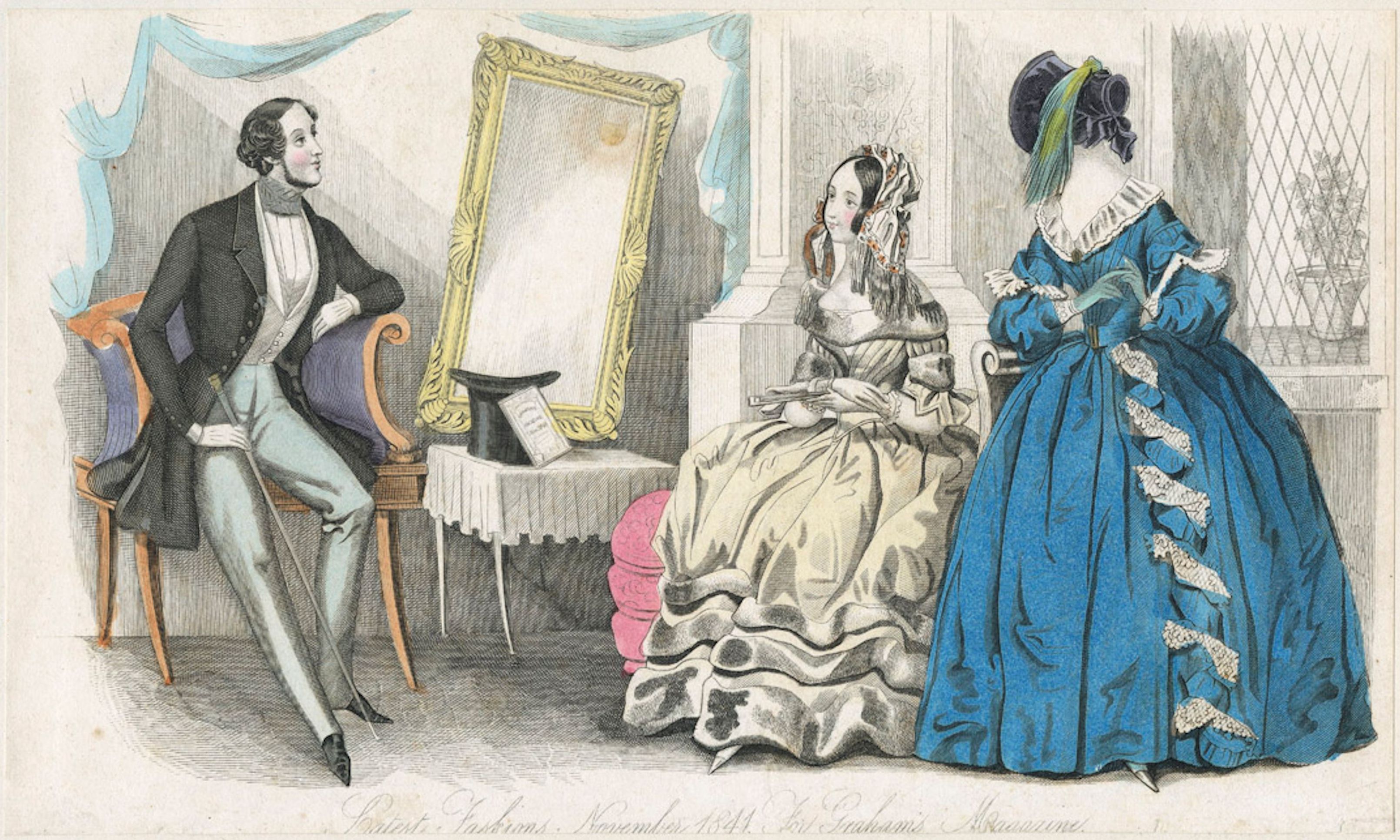
Latest Fashions, November 1841. For Graham’s Magazine.
Transcriber’s Notes:
Table of Contents has been added for reader convenience.
Archaic spellings and hyphenation have been retained. Obvious
punctuation and typesetting errors have been corrected
without note.
[End of Graham’s Magazine, Vol. XIX, No. 5, November 1841, George R. Graham, Editor]