“Love knows no rank—beauty
Is aristocracy—birth, lineage and blood.”
“Love ne’er broke a heart, love ne’er could mend.”
It was on a cold, bleak evening in autumn, that
Leslie Pierpoint, as described in Part First of our
tale, sat in his arm-chair in his comfortable library,
with his feet buried in a thick rug of Angola fleece;
a cheerful fire glowing in the grate; a round stand
with the tea-tray at his left elbow; and a large table
covered with magazines, papers, books, &c. &c., on
his right hand. He was alone. The rich, crimson
curtains drawn closely across the deep windows with
the comfortable air of the whole room, gave indication
that the occupant loved his ease, and was that
evening disposed to enjoy it.
Twenty years had passed since Leslie’s affaire du
cœur with Clara Clayton. With her treachery expired
his confidence in the sex. In vain had the
lovely, gay and fashionable women thrown their
gilded nets. In every one of the fair fishers he but
saw a cousin german to Clara, and warily shunned
the danger. Thus had he reached forty-one years of
age with the full consent of all his friends, male and
female, that he should remain a bachelor for life.
And to all appearances such seemed to be the settled
destiny of Leslie Pierpoint. He himself had no more
thoughts of committing matrimony than suicide. He
never spake to any woman save his washerwoman
and linen sempstress. His mother had been several
years dead, and he lived alone—a bachelor! the
victim of a heartless woman’s treachery.
He now sat gazing into the fire with a cup of tea
in his hand, and which he seemed to have forgotten
that he held. The state house clock tolled seven
and he started, laid down his cup and saucer, and
rang the bell. It was immediately answered by a
very gentlemanly African servant in grey clothes
with bright steel buttons, red cravat, and shoes with
old fashioned paste buckles in them.
“Cato.”
“Sar, massa?”
“Have my new linens come home yet?”
“No, massa, not yit.”
“They were to be here at six. Go and see that
they are sent in time to pack into my trunks to-night,
for we must start for New York early.”
“Yes, massa,” said Cato, with a graceful bow,
and was in the act of leaving the room to obey his
master’s orders, when a ringing at the street door
bell arrested him.
“I guess dem is de sharts now, massa.”
“Go and see, and show the woman up.”
Cato left the room, while Leslie took up the evening
paper. Directly the servant reappeared, ushering
in a very modest young girl, coarse in her dress,
but of extraordinary beauty. She was scarcely
seventeen, yet the womanly outline and youthful
roundness of her sylph-like figure were perfect. Her
complexion was very brilliant; her cheeks blushed
with diffidence and beauty; her eyes were large,
blue, and melting in their own cerulean heaven; her
lips ripe and full, and her chin voluptuously rounded,
yet most exquisitely turned. Native grace was in
every movement she made. Her dress was of very
plain calico, and she wore a common straw hat with
a long green veil. In her hands she carried two
bundles, very neatly done up in white paper.
“De sharts come,” said Cato, making a low bow
to Leslie’s back. “Here de young woman wid ’em.”
“Very well, Cato; remove the tea-tray. I will
ring for you to show the woman out soon as I have
settled with her.”
“Yes, massa;” and the black, taking the tray in
his hands, cast a glance, first at the beautiful face of
the young girl, then over his shoulder at his master,
and, gravely shaking his grey pate, left the library.
Leslie completed the paragraph he was reading, and
then, lifting his face and looking into the fire, but
without turning round, said in the low, pleasant tone
natural to him:
“So, my good woman, you have brought the shirts.
They have come an hour later than you promised
them, but I suppose you are very much hurried with
work. They are in plenty time, however. Be so
kind as to undo the package and let me see one of
them.”
For a few moments there was no sound in the
room but the snapping of strings, as they were untied
by the busy fingers of the linen-draper’s maid, and
the rattling of the strong paper covering the linens.
At length a shirt, white as the drifted snow and
beautifully done up, was hesitatingly advanced over
his shoulder, so as to intercept his vision.
He took it, and after carefully examining it (old
bachelors are very particular in this matter) with an
appearance of satisfaction, admiring the stitching of
the wristbands, the French style of the sleeves, and
the neatness of the bosom folds, he laid it down beside
him where the tea tray had stood.
“Well, my good woman, I am very much pleased
with them. They are very neatly made. Please let
me see your bill.” And he turned his head slightly
back to receive it.
The young girl, embarrassed by his mode of addressing
her, and abashed at his presence, timidly
stretched forth her hand containing the bill.
“Nearer, woman, nearer. I cannot reach it.”
Agitated by his voice, she thrust her arm forward
so quickly that he received in his grasp her hand as
well as her bill. The sight and touch of the soft,
white member, thrilled through him. He started,
blushed, rose from his chair, and to his surprise discovered
that he had been all the while talking to one
of the loveliest girls of seventeen he had ever seen,
instead of an old woman, whom he supposed was the
bearer of his linens.
“Pardon me, miss—I beg pardon,” said the Major
embarrassed, “I thought you were your mother.”
“I have no mother, sir,” answered the pretty
maiden, with a drooping eyelid.
“I beg pardon! Sit down! No, you may stand!
Upon my word you are very beautiful.” The Major
hardly knew what he said.
“Sir, the bill if you please,” said the maiden confused,
her bright intelligent face suffused with crimson.
“Oh, ah! sit down if you please! no—stand up;
no, no, no! sit down!” Poor Major Pierpoint!
“No, I thank you, sir.”
“What a sweet voice,” soliloquized the Major to
himself. “No mother?”
“No, sir,” with a musical sadness in her voice,
touching as it was natural.
“No father?” asked the Major with as much delicacy
as he could put the question.
“No, sir.”
“No brothers, neither, I dare say.”
“No, sir.”
“Nor sisters, either?”
“No, sir.”
“Ho! hah, hem!”
And the Major, having finished catechising her,
put his hands behind his back and looked steadily in
the grate for full a minute, his lips compressed, his
brow set and thoughtful.
“If you please, sir, the bill is waiting.”
The Major started at the sound of the sweet voice
as if he had been clapped on the shoulder.
“Oh, ah! I beg your pardon. Let me see—six
linen shirts—five dollars each—thirty dollars—all
right.” And the Major looked up from the bill into
her face. He felt a delight he could not account for
in gazing upon its sweet beauty. She was confused
by his ardent look, and became still more beautiful
from her sweet confusion. With instinctive delicacy
he withdrew his gaze, and a sigh, the first he had
felt for twenty years, escaped him. A gentle sadness
at the same time overspread his fine features.
Again he looked into her face, but with an expression
that she did not shrink from, and said kindly, touchingly,
“So then, sweet child, you are an orphan.”
“Yes, sir.”
“Your name?”
“Mary Lee.”
“A pretty name.”
“Sir, I have another errand to go—if you will
please pay the bill for my mistress.”
“Oh, ah! yes, the bill. Thirty dollars. Here is
a check for the amount.”
“I thank you, sir,” said Mary, curtseying with a
grace that charmed him, and turning to leave.
“Stay, Mary—that is, Miss Lee,” said Leslie,
following her a step and speaking with amusing hesitation.
The linen-draper maiden had, however,
reached the door and placed her hand upon the lock.
She was evidently alarmed and surprised, and seemed
uncertain whether to take the gentleman’s manner
as rudeness or as an uncommon degree of civility.
She appeared to be a sensible, good natured girl,
however, with all her charms, and probably with
woman’s ready tact divined the true cause of his
singular conduct. Yet with all a woman’s tact she
pretended to be blind to the impression her beauty
had made upon him. She could not help thinking
that he was a very handsome man, if he was an old
bachelor, and she felt pleased rather than offended
at this evidence of the triumph of beauty. For Mary
Lee well knew she had beauty, and what pretty miss
of seventeen is ignorant of this possession?
“Stay, if you please, one moment, Miss Lee,”
said Leslie.
“Indeed, sir, it is late.”
“But one moment. Are you an apprentice with
Miss Phelps, the linen-draper?”
“Yes, sir;” and Mary turned the lock of the
door.
The Major laid his hand lightly upon her wrist.
“Excuse me, Miss Lee! One more question!”
But the maiden, with a pleasant laugh, threw off his
hand and bounded through the open door into the
hall. Cato was in waiting.
“Ah, Cato,” said the Major, with as much coolness
as he could summon at this crisis, “you save
me the trouble of ringing. Show this young woman
out.”
“Yes, sar,” said Cato.
Major Pierpoint lingered an instant in his door to
follow with his eye the receding form of the maiden,
as with a light, graceful trip she followed the dignified
Cato to the street door. He then re-entered his
library, and after pacing his room two or three times
as if his thoughts were in a tumult, he suddenly
stopped before his mirror and looked at himself.
After a brief and satisfied survey of his fine face and
person he walked to the fire, folded his hands behind
his back, and stood and looked into the grate with a
very thoughtful brow.
“Well, Leslie Pierpoint, after remaining bachelor
twenty years, thou art made captive by a linen-draper’s
’prentice! ’Tis true, and pity ’tis, ’tis true!
Leslie Pierpoint, thou art false to thyself! But what
a soft, sweet hand! How could I help taking it if she
would thrust it into mine? But, poor child, I suppose
I had frightened her by calling her an old woman,
and she scarcely knew what she was about! Old
woman? A youthful divinity! What heavenly blue
eyes! What a sweet round bust! What an exquisite
waist, the charms of which even her coarse dress
could not conceal! And her foot, so petite and delicately
turned! How rich were the tones of her
voice! How enchanting her smile! Ah, Leslie Pierpoint,
thou art in love with a ’prentice maiden! At
forty years thou art become a fool! Yes, I am a
fool! What have I to do with the sex? Have I not
a lasting feud with it? Ah, let me not forget Clara
Clayton! Remember her, and so forget this pretty
maiden, for she belongs to the same false hearted
sex!”
Thus soliloquized Major Pierpoint, and, turning
from the fire, he walked his room some time with a
thoughtful brow. All at once he stopped and pulled
his bell with an emphasis. Cato made his instant
appearance.
“Sar, massa.”
“Bring me my boots.”
“What massa say?”
“Bring me my boots,” repeated Leslie, more decidedly.
The black left the room with an inquiring look, as
much as to ask what could take his master out in
such an evening.
“Yes, I will do it. I will learn all about her!
Such beautiful teeth! Such a bright, intelligent,
sensible face! Such innate high breeding!”
Cato brought the boots, and in a few minutes afterwards
the Major had exchanged his evening home
costume for boots, overcoat and hat.
“My stick, Cato.”
“Yes, sar,” answered the black with dilating
eyes, as he handed the gold headed Indian cane.
“I shall return in an hour, Cato,” he said, as his
wondering servant showed him out of the street door.
“Yes, sar,” and Cato closed the door on his master.
“Now, if massa Peerpount hant a loss his sebenteen
senses, den heabenly marcy nebber gave Cato
any. De firs’ time I ebber know him go out after
him once take his boot off! Someting ’ticklar be
goin’ to happ’n for sartain! No disordinary circumcasion
take massa Peerpoun’ out dis col’ ebening. I
mus’ feel werry pertickler distress if as how any ting
surreptitious occur.”
Thus commented honest Cato upon this unusual
step of his master’s, whose general habits were so
regular that each day he went through the same routine
of eating, sleeping, smoking, reading, and walking
or riding. He had never gone out in an evening
before. Cato had cause, therefore, for marvel; and
leaving him to his conjectures on the motive for this
strange movement on the part of his master, we will
follow him on his expedition. The evening was clear
but cold and windy, and he wrapped his coat closer
about his person as he entered Chesnut street from
Sixth, and took his way past the hotel and theatre
which were brilliant with lamps, and gay and lively
with the moving things about their doors. Heedless
of these, he kept on until he came to Third street,
which he followed north for a few doors, where he
stopped beneath a lamp and turned back the cape of
his surtout, arranged his slightly awry cravat, and
made such other little toilet reparations as young
gentlemen are accustomed to do before going into a
house to pay a visit to ladies. Having fixed himself
to his satisfaction, though without a mirror, (men of
taste are a glass to themselves!) he walked more
deliberately onward and entered a door over which
hung a sign reading “Mrs. Phelps’ Gentlemen’s
Linen Store.”
A very pleasant looking widow-like person presided
in the brilliantly lighted shop behind the counter,
while there were glimpses of two or three girls at
their work in the rear room, and a little old woman
in spectacles tying up bundles—doubtless the identical
“old woman” whom the Major had imagined
he was talking to as the bearer of his package.
“Good evening, Mrs. Phelps,” said the Major
politely.
“Ah, Major Pierpoint, good evening, sir,” said
Mrs. Phelps with very great respect, for the Major
was a monied customer and never disputed bills!
“Lord me! I hope you haven’t come after the
shirts!” she said with apologetic volubility; “they
have been gone this half hour! I was so hurried,
Major, I couldn’t get them done at the precise hour
you ordered them, though I know you are so very
particular. But soon as they came into the shop,
lest you should get impatient, as your black man
said you were going out of town early in the morning,
I despatched one of my apprentices right off with
’em, knowing she would go quicker than aunt Dolly
here, who is always mighty slow in cold weather.
If you come right from home you ought to had ’em
there! If Mary has taken that bundle of hemmed
handkerchiefs to Miss Clayton’s first, I shall give
her a good scolding; for I told her, Major, pertickerlaly,
to go and leave your package first.”
“Never mind all this, my good woman,” exclaimed
the Major as soon as he could find an opening in
her speech; “I have received the shirts, and am
very well satisfied with them! They do you credit.”
“Oh, I am glad to hear it. I thought the child
wouldn’t disobey me, for she is always so correct!
Here she comes in now! Ah, Mary,” said Mrs.
Phelps with a good natured smile, “you like to have
had a scolding. So you took Major Pierpoint’s
linens home safe?”
“Yes, aunt,” answered Mary, blushing and stammering
at seeing Major Pierpoint in the shop, while
the Major himself, taken by surprise at her sudden
appearance, colored like a school-boy; and scarce
conscious of what he did, respectfully lifted his hat,
as with downcast eyes she tripped past him to the
rear of the shop. She had let her bonnet fall carelessly
back from her head as she entered the shop,
and the bright light of the gas-burners flashing upon
her forehead, revealed more clearly the radiant
beauty of her complexion, and the exquisite loveliness
of her features. Her hair, which was the richest
shade of dark brown, was parted upon her smooth
forehead and lay on either cheek, after the fashion
of young maidens of her age; behind, it was gathered
by her tasteful fingers into a neat braid, the number
of whose silken folds showed the opulence and
great length of this glorious ornament of woman.
She bent her head and blushed between pleasure
and shame at this distinguished notice from Major
Pierpoint, while Mrs. Phelps looked from one to the
other, with a face on which wonder, curiosity and
suspicion were as plainly written as they ever were
on the face of woman. Leslie saw instantly the
position in which he had placed himself, and with
great presence of mind said, as if to excuse himself,
while he pursued at the same time the main object
he had in view—
“She is, I am told, an orphan, Mrs. Phelps. I feel
deep sympathy for orphans, particularly for young
unprotected females.”
Mrs. Phelps’ face immediately parted with its
combined expression, which was replaced by that
peculiar one which talkative women always put on
when they have an opportunity of indulging their
propensity. “Ah, yes,” she sighed, “ah, dear yes,
Major Pierpoint, she is indeed an orphan. She is a
good child, and has a face that will be either the
making or the breaking of her. I feel towards her
just as if she was my own flesh and blood; though,
between you and I, Major, I am neither kith nor kin
to her or hers, though I lets her call me aunt for
affection-like.”
“Who were her parents?” asked Major Pierpoint,
becoming deeply interested.
“Ah, me, it is a sad story! I never tell it but it
makes me cry like a child;” and here Mrs. Phelps,
in anticipation, applied the corner of her apron to her
dry eyes.
“Be so kind as to relate it, madam, if you please.
I shall listen to it with great interest.”
“Well, you must know when I was younger than
I am now, and before dear Fritz, my husband, died,
we were living in Boston, in quite respectable society,
Fritz keeping a thriving store, and I living a lady, as
it were, at home. But times is changed since then;
ah, me! Major Pierpoint. Well, don’t you think, as
I was waiting tea one winter’s night for Fritz, the
bell rung, and, instead of my husband, a man left a
basket of champaigne, as he said, telling the girl it
was a present for our wedding day, which was to be
on Saturday of the next week, sure enough, Major;
we having then been married seven years. Well, I
told her to set the champaigne basket down in the tea
room, and soon afterwards Fritz came in. He was
delighted when I showed him the present, and we
both puzzled our heads to guess what friend it came
from; but we sat down to the table intending to open
it after we had finished tea. Mr. Phelps was taking
his second cup when we both thought we heard a
child cry right in the room. We started, and both
asked ‘what is that?’ ‘It must be the cat,’ said
Fritz, and so we sat down again. We had not taken
two bites of toast before we were startled by the loud
shrill scream of an infant. ‘The champaigne basket,’
exclaimed Fritz: ‘it is in the champaigne basket,’ I
cried. ‘It is a baby in the champaigne basket,’
yelled the girl, letting fall the tea-kettle.
“Fritz sprung to the basket and cut the cord with
the table-knife, and sure enough, Major Pierpoint,
there lay in the bottom the beautifullest little female
baby eyes ever looked upon—the very same Mary
Lee you just now took off your hat to! Well, to cut
the story short, Fritz and I concluded, after making
all inquiries, and advertising it in vain, to adopt it,
seeing as how Providence had never blessed us with
any children, neither before nor since. So we took
the dear infant as our own, and to this day I have
been as its own mother to it, and she has been as an
own child to me. Ah me! the cruel parents that could
desert such a sweet cherub. I have never been sorry
to this hour we took the dear child. Oh, she has been
a blessing to me!”
“She would be a blessing to any body,” said the
Major warmly, his heart overrunning with emotion at
her narration; and his eyes unconsciously wandered
to the rear of the shop, where Mary sat quietly sewing.
He sighed, and then turning to Mrs. Phelps,
thanked her for her trouble in narrating Mary’s story.
“Not the least, Major, not the least! I could tell
it fifty times a day if I had such a listener as
you.”
“You may send me half a dozen pairs of gloves,
handkerchiefs, and—and—” Leslie hesitated, and
then hastily added, “any thing else in your shop you
think I would like.”
“Oh, you are such a good customer, Major Pierpoint,”
said the pleased landlady; “I have just got
in some new style India cravats which I think will
suit you. Shall I send them to-night?”
“No, to-morrow at twelve.”
“But you leave town to-morrow.”
“Oh, true—true, I had forgotten. But never mind,
madam, send them up, I think I shall be at home—yes,
I am sure, quite sure I shall be at home! I have
postponed my departure till the next day.”
“I will certainly send them.”
The Major lingered an instant over the glass case,
and then buttoning up his overcoat, prepared to go.
“Good evening, Mrs. Phelps.”
“Good evening, sir.”
“You will be sure and send them?”
“You shall not be disappointed, Major.”
“Very well.”
Major Pierpoint took three decided steps towards
the door and then turned.
“Twelve o’clock, Mrs. Phelps.”
“Yes sir, they shall be there precisely.”
The Major still did not move. There was evidently
something he wished to say more, but was at a loss
how to say it. All at once he turned back to the
counter.
“By-the-bye, Mrs. Phelps, you may, if you please,
let the same young person bring them that took the
linens. That old woman, the last time she came,
like to have broke her neck by catching her foot in
the brass stair band. Besides, she is deaf as a post.”
“I will send Mary, then,” said Mrs. Phelps, smiling.
“You are very obliging, my dear madam. Good
evening.” And Major Pierpoint walked out of the
shop with a free, light step, and a bland smile illumining
his handsome features.
Mrs. Phelps followed him with her eyes, and then
put on a very thoughtful look, and for a few moments
seemed to be communing with her own mind. Suddenly
she laid one fore-finger down upon the other
with emphasis.
“Yes, ’tis clear as that gas-light! I can see as
deep as some folks can. He is not above forty, rich,
respectable, and kind and pleasant-hearted as a child,
and Mary’s beauty has evidently made an impression
upon him. He is a bachelor, and old bachelors often
fall in love with young girls! I do believe, now I
think it all over, he is in love with her. But then,
he is so rich and respectable! But Mary isn’t my
daughter; how does he or any body know but she is
respectable as he is himself? Plainly, there is something
at the bottom of all this. Major Pierpoint is
too honorable and moral for me to apprehend any
evil coming out of it. Mary shall go up to-morrow,
looking her best. Who knows what may happen?
The poor child is not mine, but then I wish her to do
as well as she can. I wonder what he said to her
this evening. Mary, dear, come here child.”
Mary came forward with a half finished linen collar
in her hands.
“Well, dear, what did Miss Clayton say to the
handkerchiefs you took to her?”
“She said they were very neatly done, but that the
price was too high—and told me she could not pay
the bill unless you took off the ‘nineteen cents!’ ”
“How close some people are, especially rich old
maids that have once been beauties! They have no
children or husband to pick or peck at, and so they
must pick and peck on those that have to do work for
um. She don’t care about the nineteen cents—its
only to have something to find fault with. To-morrow,
at half past eleven, you call there for the seventeen
dollars, and let her have the nineteen cents, if it
will do her temper any good. Did Major Pierpoint
appear displeased because I didn’t get the shirts there
by six o’clock?”
Mary blushed, she knew not why, at this common-place
question, and looking up and seeing her ‘aunt’s’
eyes fixed inquiringly upon her face, she became too
confused to speak in reply—and, after one or two
attempts to answer, dropped her head over the collar
in her hand, as if sewing it.
“What is the matter with the child? What did
Major Pierpoint say to you?”
“Nothing.”
“Nothing?”
“Yes, m’m, here is the check he gave me.” Mrs.
Phelps glanced at it.
“It’s all right! Prompt pay—no nineteen cents
to be cut off. But didn’t he say any thing to you?”
Mary appeared still more confused. Her adopted
mother looked at her steadily though without displeasure
for a few seconds, then shook her head affirmatively,
with a slight smile of self-satisfaction.
“Humph,” she said to herself, “I see how it is! It
has gone further than I thought. He came here to-night
for nothing else in the world! Well, Mary,
to-morrow, at twelve precisely, you must be at Major
Pierpoint’s with them gloves, and handkerchiefs, and
silk stockings. You must start at half past eleven,
so as to call on the way on Miss Clayton for the
money for her bill. Why do you blush so—are you
afraid of Miss Clayton?”
“No, aunt.”
“Are you afraid of Major Pierpoint?”
“No, aunt.”
“Very well, child, go to your sewing.”
Mary bounded away lightly, and Mrs. Phelps
looked after her with a prideful glance; “yes, if
she is not foolish she has her fortune made. I will
say nothing to her of my suspicions, but let her have
her own way. To talk to young girls on such a subject
and try to guide and advise them, only makes
puppets of them, and destroys the natural character.
Leave Mary to her own native good sense and unbiassed
feelings and she will be more likely to please
such a man as Major Pierpoint than if she practised
the most consummate artifices.”
With these sensible reflections, Mrs. Phelps dropped
the subject for that night.
At a few minutes before half past eleven, Mary
Lee made her appearance in the shop from her little
chamber over it, arrayed in a neat black silk dress,
with a pretty straw cottage, trimmed with delicate
blue ribbon, and her beautiful brown hair arranged
with elegant simplicity. It had not been ten minutes
since she left the shop to make this change in her
appearance. Yet it was as complete as if five hours
had been wasted before her little mirror. Can any
female reader tell me why Mary paid such attention
to her appearance? Mrs. Phelps on seeing her,
lifted up both hands, and an exclamation of surprise
and displeasure was on the tip of her tongue! But
some sudden reflection checked it on the verge of
utterance, and dropping her hands, she said quietly
and as if not noticing it—
“So, Mary, you are ready. Take the bundle and
stop on the way at Miss Clayton’s. Be sure you
are at Major Pierpoint’s when the clock strikes
twelve.”
“Yes, aunt,” said Mary, hastening from the shop
on her two-fold errand. As she passed up Chesnut
street with her little bundle, the sparkling beauty of
her face, her buoyant step and graceful motion, drew
after her many admiring eyes. It so chanced that
Leslie was returning from the Exchange reading-room,
whither he walked every morning, and was
standing on the corner of Sixth and Chesnut, conversing
with several bachelor gentlemen, when Mary
passed. She looked up, and seeing him, coloured and
dropped her head. Leslie did the same.
“A lovely creature,” said one of the gentlemen;
“I seldom have seen a sweeter face or figure. You
know her, Major, by your mutual blushes,” added he,
smiling.
“I, gentlemen? oh, no,” said the Major, confused.
“She is certainly extremely beautiful. See how
free and light her step is!”
“Some pretty milliner, I dare say,” said the
Major, laughing. “Good morning, gentlemen;” and
Leslie took his way home more than ever enchanted,
deeper than ever in love! The quick, bright, eloquent,
yet unintended glance he had received from
her as she passed, kindled an imperishable flame in
his bosom. He hastened homeward with anticipations
of the delightful visit he was to receive at
twelve o’clock.
Was Leslie Pierpoint really in love? did he resolve
to pay his addresses to this beautiful girl? did
he intend to ask her hand in marriage? did she fill
the place in his heart which Clara Clayton had left
void?
Yes.
Mary soon reached Miss Clayton’s door in the
upper part of Chesnut street, near Ninth. It was
one of the most imposing mansions in the street.
Miss Clayton lived there with her old father—the
two alone! For several years after freeing herself
from Leslie, she lived in hopes of marriage, but in
vain. The men were afraid of her. Her mortification
when she found Leslie restored to perfect health,
knew no bounds. She had a secret hope that he
would yet re-address her; but from that period she
never received more than a cold and civil bow from
him. She could have poisoned herself with vexation.
But as years passed away, and she saw that he still
remained unmarried, she consoled herself with the
idea that she was the cause—and that he could
never love any one as he had loved her. This devoted
bachelorism was Clara’s only and greatest
consolation. It was a healing balm to her wounded
spirit. So he married not, she felt she could forgive
herself for her folly in not marrying him. It is true,
she watched his course to forty with some anxiety,
lest he might yet marry; but when he had passed
that climax, she gave herself no farther uneasiness,
and rested in the conscious assurance of his eternal
celibacy. This idea was the rainbow that spanned
her darkened skies—the sweet in her bitter cup of
life. But, alas! she was soon to see the rainbow
disappear, and her horizon become dark with storms!
Alas! she was to drink the remainder of the cup
with additional bitterness mingled with its dregs.
She was seated in her usual sitting room when
Mary arrived. Her hair was drawn back above her
ears and tied untidily with a dirty yellow ribbon;
she wore a loose wrapper, and her stocking feet
were thrust into red slippers. Her fingers were
loaded with rings, and ear drops hung from her ears.
Her complexion was something coarser for the wear
and tear of time, and had very plain traces of being
now indebted to white paint and rouge, for whatever
pretensions it claimed. Her forehead was crossed
by horizontal impatient wrinkles, and a deep frown
was cut between her eyebrows. She was thin about
the breast and shoulders, and very slender in the
waist, more so than in her youthful prime. The
general expression of her face was querulous and
sour—precisely such an expression as she might
have been expected to wear. As Mary was shown
in she looked up with a sharp, impatient gesture.
“So, Miss, you have come for the amount of your
bill!”
“Yes, m’m, if you please.”
“Don’t mem me as if I was fifty, Miss.”
“No, m’m.”
“Did I not forbid your saying marm to me—what
is the amount of the bill?”
“You have it, m’—— I mean Miss.”
“That is better. Ah, yes, here it is, $17 19,
What did your mistress say about the 19 cents?”
“That she would take it off.”
“Very well; here is seventeen dollars. Receipt
it.” Mary took a pen from an inkstand on the table
and acknowledged the payment.
“Humph, you write too pretty a hand for an
apprentice girl,” said Miss Clayton, glancing contemptuously
at Mary’s beautiful chirography. “I
dare say you can dance too?”
“Yes, Miss,” said Mary slightly smiling.
“And sing and play,” more contemptuously still.
“Yes, Miss.”
“Humph. Read Byron, Moore, Scott, doubtless,
and perhaps the French poets?” she continued with
a contemptuous smile of incredulity.
“Yes, Miss.”
“Yes, Miss. I suppose if I should ask you if
you read French and sung Italian, you would reply
with your parrot phrase, ‘yes, Miss.’ ”
“Yes, Miss.”
“Upon my word! Ha, ha, ha! here’s a linen-draper’s
apprentice for you! I suppose you look to
marry some nobleman at the least, with all them
accomplishments, if you can! What package is
that beneath your arm, my pretty minx,” for Miss
Clayton had conceived a sudden and unaccountable
(save that her youth and beauty were the cause,)
dislike for Mary. And without waiting for a reply
she snatched it from her.
“For Major Leslie Pierpoint,
No. 27, South Sixth St.”
“You are sent with this to Major Pierpoint’s, are
you?” she asked sharply and with a suspicious look
at the young and guileless girl.
“Yes m’m,” answered Mary quietly.
Miss Clayton let her eyes rest on the superscription
for a few moments, and then lifted them steadily
to the face of the maiden.
“You had best return directly to your shop with
the amount of your mistress’ bill, lest you lose it on
the way. I will dispatch my footman with this
package to his lodgings.”
“I thank you, but I am ordered to take it there
myself,” said Mary firmly.
“Indeed; but it would not be prudent for so young
a person as you to go to a bachelor’s rooms alone. I
will send it for you. Do you know Major Pierpoint?”
“No, m’m,” answered Mary with embarrassment.
“Have you never seen him?”
“He was in the shop last evening,” answered Mary
evasively.
“Did he speak to you?”
“If you please I will take the package and go,”
said Mary, half angry at this singular inquisition
upon her affairs.
“Take it, trollop,” said Miss Clayton, flinging it
towards her, “and tell your mistress when she has
occasion to send any one to me again, she will
oblige me by sending some civil person.”
Mary stared with surprise, at a loss to account for
the lady’s humor, and gladly took her departure.
The heavy tocsin of the State House had struck
the last stroke of twelve, as Mary timidly pulled the
bell at Major Pierpoint’s handsome residence. It
was opened by Cato.
“Massa says de young woman will please walk
up and wait,” said Cato, as Mary offered to leave
the bundle in his hand. Mary hesitated an instant,
and then, trembling, (she could not tell why,) she
followed him to the library. The door was opened,
and Cato ushered her in with one of his best bows.
Leslie pretended to be very busily engaged in a book
as she entered, though he had been walking his room,
or watching through the blinds with ill-concealed
impatience till he heard the street door bell. He
permitted Cato to leave the room, and Mary to advance
half way to the table, before he gave signs of
her presence. He then suddenly rose up and turned
round.
“Ah, Miss Lee,” he said, with tender respect,
“you have brought the gloves.”
“Yes, sir,” said Mary, without lifting her eyes.
“Sit down, if you please, while I examine the
package.”
Mary quietly took a seat, and Major Pierpoint
began to look over the parcels. But evidently his
thoughts were not with this pursuit. His fingers
trembled—he shockingly rent several pairs of
gloves; put six of the handkerchiefs, one after another,
into his pocket; blew his nose on a pair of
silk hose, and at length sprung from the table in the
most admirable confusion of mind in which a bachelor,
at such a moment, could well be. After thrice
striding the room to gather courage, he approached
the surprised, embarrassed, yet not unexpecting
Mary. No woman of any sense, or feeling, or mind,
could be blind at such a time. He approached and
seated himself beside her.
“Miss Lee——”
Mary trembled and remained silent. The Major
gazed upon her tell-tale face, and then furtively sought
her hand. She withdrew it instinctively, and half
rose.
“Nay, my dear Miss Lee! pardon me! I meant
no injury to your delicacy. Pray be seated!” and
he took her hand and gently drew her to the chair
which she had left. “I beg you to listen to me one
moment. I have conceived for you a deep and respectful
passion. Your beauty, grace and intelligence
have made an impression upon my heart no time can
ever efface. It is true you are young and full of life
and beauty—I have passed half the allotted life of
man. But the disparity is in years only. My heart
is as young as your own, my feelings as buoyant, my
hopes as bright. I have sought to meet you to-day
to make a confession of the sentiments with which
you have inspired me, to tell you how intimately my
happiness is involved in your existence, to throw
myself upon your generosity. You are an orphan,
alas! and a cold, unpitying world is before you!
Your loveliness and helplessness claim protection.
Permit me to fill that delightful position near you
while life lasts. I offer you my heart, my hand, my
fortune, and promise to devote my life to the promotion
of your happiness.”
The Major, after ending his eloquent appeal, gazed
upon her downcast face several moments in silence.
She made no reply! He still continued to hold her
hand. Slowly he lifted it to his lips. There was no
resistance. He again sought her eyes. Tears were
silently gushing from them, and rolling in sparkling
globules down her lovely cheeks.
“Good God, Miss Lee, have I offended you?”
“No, sir,” said Mary, lifting her eyes, the lashes
dewy with tears, and sweetly smiling.
“Why these tears, then?”
“I do not know, indeed, unless it be that they
flow from gratitude,” she answered, looking into his
face with a radiant smile, like sunshine in an April
shower.
The Major’s eyes filled also, and the next moment
he pressed the happy girl to his heart.
Yes, Mary Lee became Major Leslie’s wife through
gratitude. They were married, for he well knew
gratitude would grow to love, and a brief time proved
that he judged rightly. One month from the day on
which he confessed his passion he led to the altar
his charming bride. They were married publicly in
church.
“Ah, Major, so you—don’t know her—some milliner’s
apprentice, eh?” laughingly said a gentleman
present, after the ceremony was over.
Clara Clayton, hearing that Leslie Pierpoint was
to be married, went to the church, disguised in a
strange bonnet and long green veil—but Leslie recognised
her by her taper waist, and felt that his
triumph and (if such a feeling really existed in his
breast) his revenge were complete. Yes, Clara Clayton
witnessed the ceremony, and when she saw it
and recognised the bride’s face as she turned from
the altar, she could scarcely suppress a shriek of
mingled anger and disappointed malice. She went
home and died the same year, the victim of her own
selfishness.
Leslie Pierpoint and his beautiful lady are now
travelling in Europe. Mary makes him an excellent
wife, proving to be as good as she is beautiful.
———
BY ROBERT MORRIS.
———
How brief our earthly span! Youth, Manhood, Age—
We creep—we walk—we totter off life’s stage,
A thin, weak voice—a fuller, stronger tone,
A peevish, child-like cry, and then a groan!
How quick yon star shoots down the illumined sky—
’Tis gone! And yet we see not where on high,
Its bright lamp shone! ’Tis thus with feeble man—
He twinkles here a moment, and, is gone!
On rolls the world! Each evanescent year
Bears on its current to some distant sphere,
Myriads of mortal forms—vain things of time,
Youth in its hour of hope—and Manhood’s prime—
Beauty, and all its fading hues of clay,
The tints that are not, but were yesterday!
The eyes whose light enkindled many a flame—
The lips that breathed in love some cherished name—
The fair slight hand—the cheek so like the rose,
The form where Grace herself had sought repose—
The music voice—the shadowy locks and all
That touched the heart—or glittered in the ball;
These all have been—but Death has claimed them now—
The look of scorn—the proud and lofty brow—
Vice, with its heartless sneer, and Wealth and Pride,
Lifeless and still, now slumber side by side!
And is there then no grace to mortals given,—
No hope to brighten here and lead to Heaven?
No faith to lift the soul from worldly ties,
And point the way to Joy and Paradise!
Look to thy heart, vain mortal, question there,
Of life and death—of glory and despair—
Ask, if within a spirit may not dwell—
A viewless tenant of thy bosom’s cell—
Whose thin small voice, in accents soft and sweet,
May oft be heard to warn thy erring feet—
“Beware—avoid—beyond is Heaven’s high road,
Where knees are bent, and souls commune with God—
There, where the meek of heart, the pure and mild,
Walk hand in hand with Virtue’s dove-eyed child—
There, where the widow gives her liberal mite,
And points the orphan in the way aright—
There, where soft Feeling sheds the heart-wrung tear,
And bends in sorrow o’er the sinner’s bier—
Where patient Grief leans on her thin white hand,
And smiling, dreams of the unshadowed land—
Look—mortal look—the pathway is not bright—
But mark, it closes in a world of light—
The clouds that hang above its troubled way,
Melt in the distance into perfect day!
Such is the Christian’s Future! There are seen
Eternal sunshine—vales of softest green,
Grottos, savannahs, deep and flowery glades,
Clear sparkling streams and rainbow-lit cascades,
Thick shadowy woods, where many a voice of song
Gladdens the hours, as fast they flit along;
No care to mar their brightness, and no gloom
To whisper “onward, onward to the tomb”—
Bright Youth and Hope, by Grace and Beauty’s side,
No look of scorn—no air of worm-like pride,
No voice of woe, to pain the spirit ear—
No orphan’s cry—no widow’s heart-wrung tear—
No secret fear, to chill the hour of bliss,
No hollow heart—no false or Judas kiss—
No wan Disease, to steal the rose away!
And write at Beauty’s door, “Decay, Decay”—
Oh! no—the Future, Virtue’s happy clime—
The land beyond the grave, untouched by time,
Where the worn soul throws off its mortal clay—
And, god-like, springs to Heaven’s eternal day—
The realm of bliss—where, with a joy half wild,
The mother clasps and cherishes her child—
The widow claims her long lost son—the maid
Her plighted lover, years to her a shade—
Where friends embrace, and souls again unite,
Fond faces greet, and gladden on the sight—
The buried sire once more his idol boy
Clasps to his breast with more than human joy—
And well remembered voices—looks of love—
Kind words that sweeten every lip above;
Where, as we downward gaze, and distant far,
The world appears a faint and feeble star,
Where Life and Bliss their arms together twine,
And Nature’s charms are added, Heaven, to thine—
Where “moth nor rust,” nor chance nor change may come,
Forever wandering and forever home;
Joys brightening in our footsteps as we pass,
And Hope before us with his magic glass—
Each sound and song, each object, every thought,
With some new pleasure, some fresh feeling fraught—
Where one pure Spirit animates the whole,
One thrill excites the universal soul!
’Tis these, and joys like these, the Future brings,
When ’midst her depths we soar on Virtue’s wings—
When from the Past the light of hope we borrow,
And throw its brightness o’er the coming morrow,—
When, as we wander through life’s devious way,
The realm beyond this mere domain of clay
Shall, like some beacon on a rocky strand,
Win the strained gaze and nerve the feeble hand—
Shall point where danger lies, and where at last
Our bark may ride in safety from the blast!
Such is the Christian’s dream of time to come,
The land of light and love—the happy home—
Where the worn spirit, freed from earthly ties,
Above the things of dust and time shall rise,
And mount on angel pinions to the skies!
O’DONNELL’S PRIZE.
“To be plain with you,” said the barber, shaking his head, “I can scarce believe what you say.” Gil Blas.
When I was in the dragoons, we were quartered,
for a while, not far from Rowseville, and it was my
lot to receive a general invitation to the dinners of
the club. A jollier set of fellows never drew cork or
emptied a decanter—heaven be merciful to them for
their sins! They always had the best a-going;
could tell north from south side Madeira,—and
tossed off their bumpers, hour in and hour out, as
easily as an old spinster drinks her tea. As for their
president, Captain Humphreys, he was a paragon of
a good fellow. Short, square, deep chested, and
muscular as Hercules, he was just the man to keep a
set of such spirits in order; and, I verily believe, if
any of the youngsters had ventured to dispute his
will, he would have tossed them over the marquee as
easily as I could hurl a racket ball. He had spent
most of his life at sea, having seen service in every
latitude. He could tell a good story, and danced a
jig to perfection. He was, moreover, something of a
gourmand; always presided over our culinary rites;
and made the best chowder of any man in the States,
or, for that matter, as the old cook said, “in the
’varsal world.”
There is nothing like fishing, and a table on the
green sward, to give one an appetite; and it would
have done your heart good to have seen us on the day
I first dined with the club—but especially to have
beheld Humphrey’s jovial face, when he announced
the opening toast. And then such a time as followed.
Sherry, Port, Madeira, Jamaica and Cogniac!—why
they chased each other from the table faster than the
witches did old Tam O’Shanter, in the road by Ayr.
Some of the youngsters soon began to grow noisy;
and even one or two of their seniors winked a good
deal unnecessarily; but Humphreys, and a set of the
older stagers at the head of the table, kept it up,
without drawing a rein, until I began to think they
could fag down even Bacchus himself. And all this
time their jests would have made a hermit die
with laughter! Yet Humphreys never suffered his
youngsters to indulge beyond a certain point, and he
had a story to account for this circumspection which
made my ribs sore for a week after hearing it.
“Silence, you addle-heads,” he thundered, as soon
as he saw they were getting beyond their depths—“can’t
one of you sing at a time, without keeping up
such an infernal clatter of Dutch, French, English and
Congo songs? You remind me of a set of chaps I
had the honor to dine with in Boston—no, not the
honor, for they all drank to excess—and a man in
that state” (and here the worthy speaker, by way
of corollary, tossed off a bumper) “is a shock to my
moral feelings. Keep in soundings if you can’t sail
safely out of them; but, for heaven’s sake, don’t disgrace
our table with a set of indecent inebriates.
“But, to come back to my story—you must know
that the Governor’s Guards, in Boston, are a gay set
of youngsters, and, at their annual dinner at the State
House, they make the corks fly as I’ve seen only
grape shot showering from a battery. Well—no disrespect
to the cloth—their dinner is always opened
and closed by a parson; and a good rule it is; for
when the governor sees that his youngsters are getting
heady, he has but to give a nod—the benediction
is pronounced, and they are forced to break up.
When I was there, however, his excellency postponed
the dismissal rather too long, so that when he gave
the signal to the parson, there wasn’t a chap, at the
lower end of the table, who could carry his wine
to his mouth without spilling half of the liquid. A
blessed sight it was to see them then—as proper a
set of youngsters, in general, as you’d wish to look
upon—shouting, laughing, singing, standing in
chairs, waving their glasses on high, and altogether
cutting a figure not the most pleasant for a moral
man like me to behold. They saw the parson get up
and they heard him begin to speak, but they were too
far gone to distinguish either his person or his words.
“ ‘Hilloo, Bill,’ said one to his neighbor, ‘is that
a new toast? What does he say?’
“ ‘Can’t—make—it out,’ hiccuped Bill, with
drunken gravity, ‘but I guess—it’s—it’s—something
con—found—ed fine. Let’s give the old cock three
cheers,’ and the whole set sprang to their feet and
huzzaed ’til the very roof above us seemed to tremble
with the din. The poor parson hesitated, stopped,
and looked in bewilderment at his excellency—who
could only keep himself from laughing, so inexpressibly
ludicrous was the whole scene, by hanging his
head down and cramming his handkerchief into his
mouth. As for the rest of us, there was no resisting
it—we laid back in our chairs and laughed until
the tears ran out of our eyes,—while the ladies in
the gallery, the dear creatures, almost burst their
boddice strings.
“His excellency explained all to the parson the
next day, and made a thousand apologies—but the
good man never could be got again to ask a benediction
over the Governor’s Guards.”
“I suppose you tell that for the morals of your
table, eh!” said one of the party.
“Exactly,” answered the president, laughing, “and
I never saw one yet whom it didn’t cure of excess at
table, except a fellow who used to say it was hereditary
in him, by the mother’s side, to have the cholic,
and that brandy was the only cure. That chap was
a character: I’ve a story I’ll tell you about him some
of these days.”
“Why not now?” asked a dozen in a breath.
“Well, I suppose if I must I must,—but first pass
us the bottle, and let us drink to his memory—he
died, poor fellow, in Florida, where many a brave
man has laid his bones. Here’s to Tim O’Donnell.”
A silence of a few moments having elapsed, during
which all eyes were turned on the president, that personage,
after hemming twice, thus began.
“Never was a handsomer fellow than Tim O’Donnell,
lieutenant in the ——. Tall, well shaped, with
the eye of a young eagle, and a pair of jet black
whiskers, that were worth, to a fortune-hunter, fifty
thousand dollars, Tim was the perfect picture of a
soldier—and, to use his own phrase, ‘a divil of a
chap among the girls.’ He made more conquests in
a week than I would in a year; and, as you may see,”
and here he stroked his chin complacently, “there
are few fellows as good looking as I am. But Tim
was after money, and used to flirt with the dear creatures
only to keep his hand in for an heiress, when
one should present. At length he was introduced to
a lovely creature at a ball,—blue eyes, auburn hair,
the shape of a goddess, and lips that would make
your mouth water, even if you were as dry as old
mahogany—and, for a while, he scarcely knew
whether he was standing on his head or on his feet.
He even paid court, so much was he smitten, to a
long, scraggy, hatchet-shouldered spinster of an aunt,
who attended his charmer as a sort of chaperon. The
next day he was somewhat cooled down—at least he
determined to check his raptures until he inquired
after the fortunes of Miss Wheeler, for so his charmer
was called. He left me for this purpose about noon,
and in an hour rushed into my room perfectly insane
with joy.
“ ‘Och—give me your hand—shower the blessings
on my head,’ he exclaimed, dancing round the room,
‘sure and I’m in heaven the day—ouch, ullabaloo,
was there iver such luck?—ten thousand acres, the
dear sowl, and a rint roll as long as a rigiment’s line:
I’m a made man—hurrah!’ and throwing his cap up
he caught it again, and then capered around the room,
even carrying his antics so far as to leap over sundry
chairs. I was nearly dying with laughter—and as
yet I was totally ignorant of the cause of this joy.
“ ‘What do you mean?’ said I, ‘you haven’t told
me what all this congratulation is to be about.’
“Never did I see a fellow look more astonished
than Tim. He stopped still, stared at me incredulously,
and then gave vent to his wonder.
“ ‘Blood and ages, and is the man drunk? Don’t
ye know it’s all about Miss Araminta Wheeler, and
the immense fortune she’s to bring me? The only
living child—all the rest dead of scarlet fever, praise
to the saints! and her owld father expected to kick
the bucket everyday. Ouch, ullaloo-o-o, ain’t I the
happy man? It’s marry the girl I will, this blessed
week.’
“ ‘But will the ‘owld father’ consent—eh!
Tim?’
“ ‘Divil a bit do I care whether he consents or not,
if the daughter says ‘yes’—oh! such a jewel of a
woman,—and what an iligant pattern the young
O’Donnells will be!’
“ ‘Suppose the father guards her too well to permit
an elopement? That dragon of an aunt looks as if
she was kept to play the duenna.’
“ ‘Arrah, my lad,’ said Tim, with a knowing wink,
‘I’ll soon fix that, or my name isn’t Timothy O’Donnell,
of Ballywhangle, of the county of Clare, standing
six feet two in my stockings. Can’t I pretend to
make love to the owld hag when the niece isn’t
by? Oh! trust me for brushing the dew into her
eyes.’
“I saw no more of Tim for nearly a week, except
occasional glimpses caught of him at balls and concerts,
where he was in attendance on his charmer
and a spectral looking spinster, whom I recognised
as the aunt. As I wanted to give him a fair field—keep
the bottle lively—I did not approach them;
so I had no opportunity of judging his success, until
one morning he burst into my room vociferating that
he had got a note from his charmer, in answer to one
he had sent the day before, in which she consented to
elope with him that very night. He called on me to
ask me to get a post-chaise; for, in order to avoid the
publication of banns, they would have to be united in
another state. Tim was in such raptures that he
couldn’t attend to any matter-o’-fact business, so I
promised all he asked, and he left me, singing as he
went, ‘Come, haste to the wedding,’ and cutting all
sorts of extravagant antics.
“Midnight was the hour fixed on for the affaire,
and, punctual to the minute, Tim’s post-chaise drew
up a few rods from his charmer’s door, while the
gallant lieutenant himself, springing out, made all
haste to the rendezvous. The night was black as
pitch—you could have cut the darkness out in
slices—and a wild wind blew over the fields, roaring
away down in the woods, like a gale in the rigging of
a line-of-battle ship. Tim could scarcely pick his
way along through the garden, but at length, after
sundry tacks, he gained the front of the house,—yet
not a sign of a living being could he see. He began
to fear that his charmer’s heart had failed her, but at
that instant he perceived a dark moving object just
ahead of him, and hurrying forward, he soon recognised
his future bride, muffled and cloaked for the
journey.
“ ‘Shure, and ye’re as welcome as the birds in
spring,’ said Tim, catching her in his arms, ‘and it’s
mighty proud I am to see ye, my darlin.’
“The trembling bride clung closer to Tim as he
spoke, and murmured something in reply, but what
it was, the whistle of the wind prevented him from
hearing distinctly. Tim knew there was no time
to lose, however, so, without waiting for a repetition
of the words, he bore his prize off, and never
stopped till he had placed her in the chaise, stowed
her maid opposite, and was himself seated by her
side.
“ ‘And now,’ said he, as the post-boy put up the
steps, ‘don’t spare the horse-flesh—do ye hear, ye
blackguard?’
“The boy nodded, and, the next instant, they were
thrashing along as fast as four posters could carry
them.
“If Tim had been in raptures before, he was now
fairly mad with his success. Up to the last moment,
he had been tormented with a fear lest something
should occur by which this rich prize should slip
through his fingers; but now his charmer was actually
beside him, and they were being whirled over the
ground at a rate which would soon defy pursuit.
‘Was ever fellow in such good luck?’ thought Tim.
Thousands of acres, an only daughter, and she as
clean in her run as a Baltimore clipper. How he
cursed the presence of the maid, which prevented
him from being as tender as he thought the occasion
demanded. However, he could take his charmer’s
hand, without shocking her modesty, and he went
through pretty quick, all the variations of which
squeezing is liable. He would have stolen his arm
around the bride’s waist, but the envious cloak prevented
this. Tim could scarcely endure the probation.
On they rattled, all this while, with the tempest
roaring at their heels, and, as the night without
grew stormier, the agitation of the bride increased,
she almost sobbed, and clung closer and closer every
minute to Tim. It made his heart, as he said, ‘leap
into his mouth intirely,’ to feel her arms around his
neck in the extremity of her fright.
“ ‘Whist, darlin,’ he said, ‘don’t be alarmed—it’s
only a little bit of a storm, to keep our bloody pursuers
from hearing us. Before mornin we’ll be in
York, and then the praist will make you my own.
Speak, and tell me, ye’re not frightened? Shure,
and ain’t I by your side, mavourneen?’
“The answer of the bride was delivered in such a
low and tremulous voice, and interrupted by so many
sobbings, that Tim, though he listened his best,
couldn’t for the life of him make out more than a
word here and there. However, he thought he distinguished
enough to fill him with more rapture than
ever, and, forgetting all about the maid, he drew his
bride still closer to his bosom, and, nestling her head
on his shoulder, poured forth his vows in torrents of
eloquence. The Lord only knows what he said—Irishmen
are proverbial for hyperbole.
“ ‘And is it that I wont love ye intirely, my princess?’
said Tim, by way of a grand wind up. ‘Shure,
and I’ll worship ye as the heathens do the sun, and
so will my five brothers, and the tenantry on my estate—though
it’s more than I know,’ muttered Tim
to himself, ‘where to find them—and won’t I be
proud to shew ye off to my friends as the handsomest
and sweetest woman in the rigiment? There, now,
be aisy, my jewel—your father won’t catch us. Oh!
isn’t it iligantly I’ve outwitted him, and that owld
hag of an aunt, your namesake?’
“ ‘Old hag of an aunt,’ screamed the bride, starting
back from Tim’s shoulder as if an adder had stung
her, ‘why—who—do you take me for?’
“ ‘For Miss Araminta Wheeler, and divil a one
else—shure, and I have not offended ye, my darlin,
by that same thrifle of a remark?’ and he drew his
bride again toward him.
“ ‘Murder—off—help—oh! you vile, deceiving,
wicked monster,’ shrieked the bride, pushing away
Tim with both her hands, ‘you’ve ruined me forever.
And to call me a hag—oh! oh!’ and she went off
almost into hysterics.
“ ‘Blood and ages—who have we here indeed?’
thundered Tim, all at once recognizing the now shrill
tones of his companion, and kicking open the coach
door, he saw, for the first time, by the faint light of
the chaise-lamps, the face of the speaker, ‘it’s the
aunt herself—the owld serpent take her! A pretty
mess I’m in, running off with ye, ye apology for a
skeleton, instead of with the niece. Pray, madam,’
and he bowed sarcastically, ‘was it ye I honored with
my proposal?’
“ ‘Didn’t you send me a note—a—asking me to
elope?’ hysterically sobbed the aunt. ‘Oh! you vile
wretch.’
“ ‘Ou—u—h! I see it all,’ whistled Tim. ‘The
dumb baste of a messenger gave it to ye instead of to
the other.’
“ ‘You said before, too,’ sobbed the aunt, ‘that you
a—a—dored me.’
“ ‘The Lord forgive my sins,’ muttered Tim betwixt
his teeth. ‘But may-be,’ he said coaxingly, as
a new thought struck him, ‘ye’re the heiress after
all.’
“Tim got no answer but a new burst of hysteric
tears, mingled with ejaculations, among which he
could distinguish a whole dictionary of reproaches.
“ ‘I’m thinking,’ said Tim, after awhile, ‘ye’d
better be getting home as soon as convanient. This
is a bit of a mistake,’ and then, in an under tone he
groaned, ‘oh! but it’s ruined I am with the chaise
hire intirely.’
“The horses’ heads were soon turned, and just as
morning dawned, the runaways drove up to the lane
leading to Mr. Wheeler’s residence, where the bride
expectant alighted, and Tim, cursing his blunder,
kept on to his quarters. What became of the aunt,
I never cared to inquire. As for Tim, he had sense
enough to know that the game was up for him in that
quarter. Though he strove to keep his elopement a
secret, the joke soon leaked out, and he was the banter
of the whole regiment. An order to repair to
Florida was hailed as a God-send, as it saved him
from the quizzing of his mess, which to this day has
for a standing toast, O’Donnell’s Prize.”
Many a burst of laughter interrupted the President
during the recital of this story, which loses half of its
effect when deprived of his inimitable mimicry of
the conversations.
We adjourned, at a late hour, for the stars were
already twinkling in the sky when we turned our
horses’ heads homewards. The cool evening breeze,
and the exhilaration of a rapid pace, kept up the flow
of our spirits until we parted for the night—though
we did not separate until we had drunk a parting cup
at the house of that most hospitable of hosts, Deacon
Green.
The next meeting of the club found me again
amongst them. But the incidents of the second dinner
must be reserved for another paper.
H. P.
———
BY MRS. R. S. NICHOLS.
———
I wandered out in summer time,
One pleasant afternoon,
Amid the green and cooling woods—
The leafy woods of June;
As through its temple’s shadowy aisles
In mournfulness I walked,
I listened to the breezy trees
As friend with friend they talked!
And gazing upwards in my face,
Each meek wood-flower drew back,
Nor did a single blade of grass
Impede my onward track;
And ever on my listening ear
There came a lulling sound,
As of a multitude in prayer—
Methought ’twas holy ground!
I rested on a mossy bank,
And cast my eyes above;
The lithe green branches arch’d o’erhead,
And twined their arms in love;
And nought was seen of the blue sky
Save islets here and there,
Which seemed like some fair summer lakes
That smiled in upper air!
A twilight, rich and tender light,
Came stealing from the skies,
And, oh! ’twas like the light that rests
In a young mother’s eyes!
I saw the gentle flowrets wave
Their urns, still filled with dew,
And by my side the dark-fringed fir—
The “tree of Heaven,” grew!
Oh! all was fair and beautiful,
In these bright forest bowers,
A region of perpetual green—
A paradise of flowers!
Though all was very beautiful,
So free from woe and sin,
I turned from the bright world without,
To darker worlds within:
I closed my eyes, and pressed my hand
Upon my burning brow,
And many were the busy thoughts
That crowded round me now!
For, oh! the memories of years,
With all their clouds o’ercast,
Rose up from that vast charnel-house,
The dim, sepulchral past!
And like a train of spectres wan
They passed in my review,
And each faint shadow as it came,
Still pale and paler grew!
On, onward yet, they came—a throng
Of white and ghastly things,
As if stern Memory had stirred
Oblivion’s darkest springs!
And still the tears fell thick and fast,
For nought could then control
The passion and the agony
That swept across my soul!
Oh! many light and careless words
Were ringing on the air,
And thoughtless things I said or did—
All seemed embodied there!
And mingling with accusing sins,
Faint-shadowed forms swept by,
And glanced upon me as they passed,
With mild, yet grieving eye!
At length a sweet, reproachful face
Looked in upon my dream,
It spake—and, oh! the tones were those
Of some sweet, mournful stream!
And words came flowing from its lips,
That bade me cease to weep,
So that the dead within their graves
In peacefulness might sleep!
I started from this heavy trance,
The breeze came sweeping by,
It had no knowledge of my grief,
Yet gave me sigh for sigh;
And there where I had madly wept,
Unheeding sky and earth,
With all their light and loveliness—
Their gladness and their mirth,
I knelt me down and humbly asked
My sins might be forgiven,
And that the incense of my heart
Might float with peace to heaven!
I turned me from that forest scene,
And Hope her radiance shed
About a heart that ceased to mourn
The pale, rejoicing dead!
A LEGEND OF THE QUONNECTICUT.
———
BY D. M. ELWOOD.
———
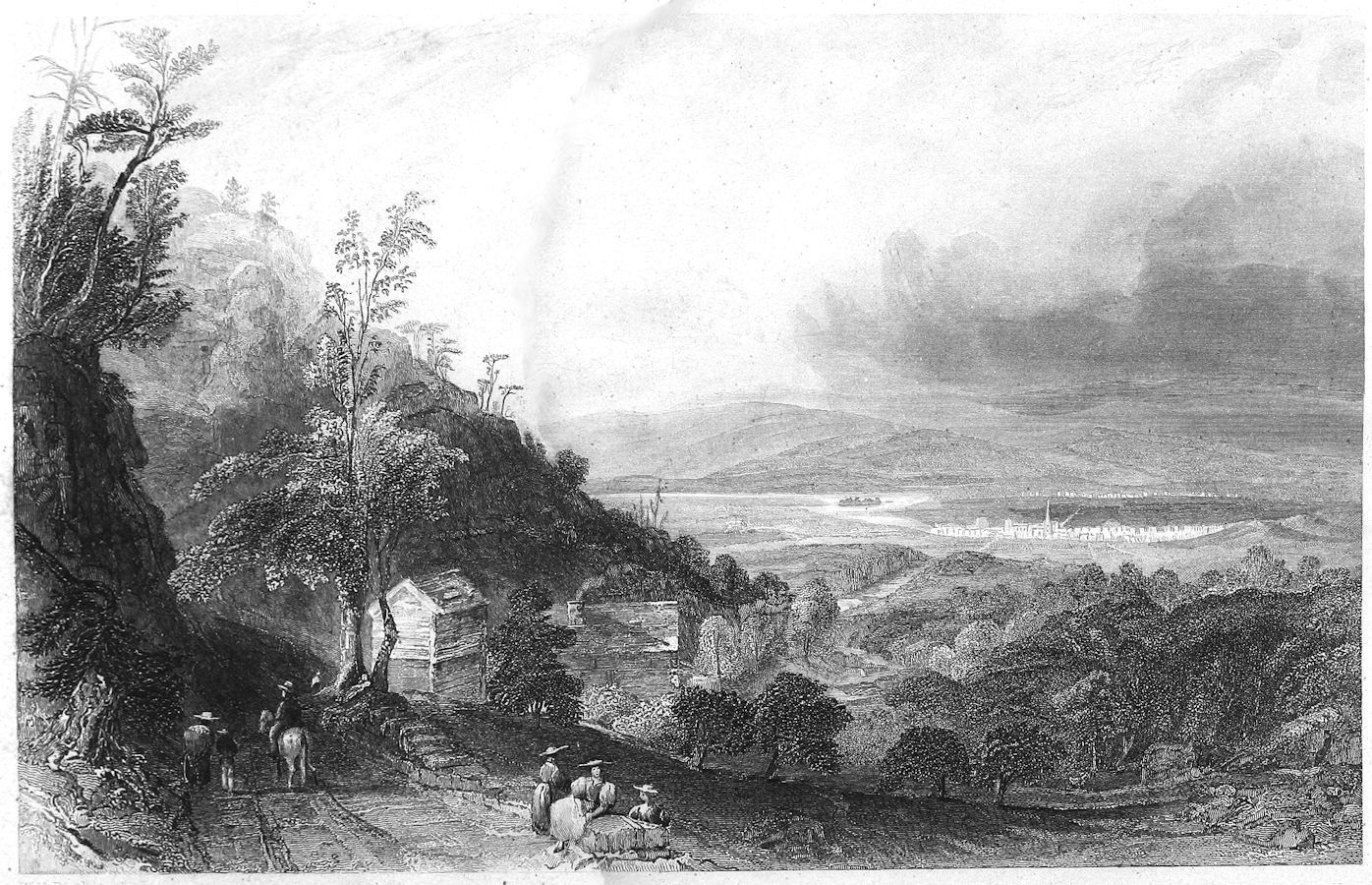
Whoever has once stood upon the summit of
Mount Holyoke, will never forget the rich scene
spread out before him. For miles—as far as the
eye can reach on every side—may be seen Nature
in her most imposing forms. Vales clad in their rich
vesture of green, watered by the limpid streams,
cool, pure, and refreshing; gently sloping hills,
crowned with fields of waving grain, and spotted
here and there with the fleecy herds; and yet farther
on, rising peak upon peak, and summit upon summit,
the “huge pillars” which “prop the heavens” rear
their craggy heads on high, bidding defiance to storm
and tempest, and scarcely trembling even at the peals
of “living thunder” which “leap” from crag to
crag. Occasionally, peering above the tall trees that
surround them, the spires of numerous churches
point out the villages, and form agreeable pictures
on which the delighted eye may rest. Sweeping the
very base of Holyoke the broad Connecticut rolls its
calm tide along, and winding away into the distance
far to the south, may be traced on a clear day, circling
its way through the verdant meadows almost
to its very mouth. Directly across the river from
Holyoke, Mount Tom rises in sullen majesty, as if
disdaining to hold fellowship with the humble yet
beautiful objects around. Northampton—with its
snow-white dwellings, its spires and turrets, its hill—the
sides of which are occupied with delightful
mansions—and its top surmounted with a lovely
grove, forms a panorama, the beauty of which must
be seen to be realized. Between it and the river is a
broad valley, chequered with fields of various colors,
spotted with trees, and giving rich promise of the
harvest. Nearly at the foot of the mountain—a
little to the northward, rising not far above the surface
of the river—is a small and fertile island, of a
diamond form, like an emerald set in silver. This
island we will call Hockanum, a name given to it
years and years ago. Still further north, on a broad
peninsula formed by a bend of the river, stands the
town of Hadley, with the history of which is associated
many a thrilling tradition. One of these it
will be our object now to present to the reader.
The town of Hadley was settled in the year 1659,
by emigrants from the Colony of Connecticut, who
removed on account of differences in religious opinions.
The principal man of these emigrants was
Mr. John Webster, accompanied by the Rev. John
Russell, formerly minister of Wethersfield. Although
Whites and Indians were mingled in close contact
here, it is believed that there was no disturbance of
any kind until after the breaking out of King Philip’s
war in 1675. A perfectly amicable disposition was
manifested on either side, and danger and fear of the
aborigines were scarcely entertained.
At the southern extremity of the beautiful street
on which the town is principally built, close upon
the bank of the majestic Connecticut, or as it was
formerly, and perhaps more properly called, the
Quonnecticut, stood, at the period of our tale, the
residence of the Rev. John Russell—mentioned
above as one of the first settlers of the town. A few
rods lower down, and on the opposite side of the
street, lived Mr. Webster, his friend and companion
in emigration. William, the oldest son of Mr. Russell,
was a young man about twenty-three years of
age, of a bold and fearless disposition, with a heart
generally open and confiding. Yet there was enough
of cautiousness in his disposition, to render him capable
of keeping secret his designs, and of acting
silently yet effectually. He was finely formed, and
remarkably well gifted by nature. There was, indeed,
but one trait that marred the general harmony
of his natural constitution, and that was, at times, a
slight want of amiability, a haughtiness of spirit that
could not brook restraint or opposition. As it was,
he was the pride of his father’s family, and the
object of admiration to the blooming maidens round.
But there was one whom he esteemed far above all
others—the daughter of his father’s friend. Eliza
Webster was one of those beings whom one would
love without exactly knowing why. Not really
beautiful—indeed, rather ordinary looking than
otherwise—it was impossible for any sensible young
man to enjoy her society for any length of time,
without finding himself fast yielding to the impression
which he could not prevent her from making on
his heart. Always lively and cheerful, with a rich
fund of humor, and a shrewd and penetrating mind,
she determined to enjoy, and to make the most of life,
and to render all about her as happy as herself. She
was the simple and unaffected, the true child of
nature, and yet nature’s adorer. Never was she
happier than when rambling along the course of the
river on whose banks she had always lived, or climbing
the craggy heights which towered at a short distance
below.
On the little island of Hockanum lived an old man
who had formerly been a chief at Nonotuck, now
Northampton. His name was Shaomet. He subsisted
on the fish he drew from the clear waters, and
the deer and other game which he found in the fastnesses
of Holyoke. The solace of his declining years
was his daughter, Tahattawa, a sprightly lass of
eighteen summers. Her step was light as that of the
young fawn, and her merry laugh rang out upon the
clear air, and danced like music over the broad
bosom of the river.
With this girl, Eliza Webster had formed an intimate
attachment. Often had Tahattawa paddled her
across in her light canoe to the little island on which
was her home. For hours had they sat under the
shade of its green trees, and laughed and conversed
together, instructing each other the while in many
of the little arts with which each was familiar.
Now, Tahattawa had a lover—a young warrior
belonging to the fort which the whites had allowed
the natives to build within a few rods of the most
populous street of Nonotuck. Eliza had often met
him at the tent of Shaomet, and frequently accompanied
him and Tahattawa in his fishing excursions
down the river. The thought of danger to herself
never entered her mind; she reposed perfect confidence
in the integrity of her friends—even though
their skins were tawny; and the youth appeared to
be almost as fond of the society of his pale-faced
friend as he was of that of Tahattawa herself.
One fine morning in the month of May, 1676, a deer
was seen swimming swiftly down the Quonnecticut.
William Russell snatched his rifle, and, springing
into a light canoe, started in pursuit. At length, as
they neared the little island of Hockanum, the huntsman
had gained so far on his game that he was just
raising his gun to his shoulder to fire upon him, when
suddenly the deer sprang more than a foot clear of
the water—and the sharp crack of a rifle came
ringing on the ear.
A canoe immediately shot out from a small cove
on the shore of the island, and a young Indian, paddling
up to the deer, seized him by the horns and
lifted him into the boat. By this time William had
come up. Whether the Indian had seen him in chase
of the deer before he fired or not, he certainly laid
claim to it as his own. The other was no less strenuous
in asserting his own right to the game; and,
drawing up his canoe along side of the Indian, was
about to place it in his own boat. The other also
seized it, and declared he would not surrender it but
with life.
The fiery spirit of young Russell now began to
chafe, and the flash of his eyes told plainly that he
would not tamely brook such a wrong. The blood
rose to his face, and his heart beat quick and violently
with anger. He stood for a moment hesitating
what course to pursue. Give up the deer he would
not—yet he shuddered at what might be the consequences
of an open rupture, at a time when Philip
was in arms, and the name of that mighty chieftain
was inspiring many of the Indians with courage, and
striking terror to the hearts of the whites.
Wawhillowa—for it was he, the lover of Tahattawa—with
an air which seemed to challenge his antagonist
to its removal, placed his foot on the game,
and rising to his full height regarded the other with
a look of calm defiance. Not a muscle moved, but
his teeth were firmly clenched, and the heavy frown
that slowly settled on his brow, told of the storm that
was gathering within his breast.
We know not what might have been the result of
this controversy—for there was equal resolution and
courage, and perhaps strength on both sides—had it
not been for a third person. At the instant that William
grasped his rifle, and the other his tomahawk,
Shaomet, the old man of the island, sprang between
them and called on both to desist from their useless
strife. He had watched the whole proceeding from
the door of his tent, and, fearful of a dispute, had
launched his canoe and approached them without
their perceiving him, so absorbed were both the
young men in the feelings of the moment. They
seemed at first somewhat angry at his interference;
but when Wawhillowa remembered that Shaomet was
the father of his intended bride; and William, that
he had often manifested his friendship for Eliza,
their resentment towards the old man instantly
began to cool.
Their animosity towards each other, however, was
not at all diminished. They stood over the game
like two young lions; and each of them, perhaps,
exercising about as much reason. The old man quietly
proceeded to skin the deer, and to cut it into
equal parts. This was quickly done. He then tried
to induce them to accept each a part. It would have
been, perhaps, a difficult matter to decide which was
the rightful owner of the game—but each of the
two opponents was resolved to have it all or none—William
threw into the river the half which Shaomet
had placed in his canoe, while the young Indian
dropped his tomahawk and hastily paddled towards
the island. The old chief having secured the game
in his own boat, slowly followed him, and the
Englishman sullenly worked his way up the current,
muttering revenge.
It was the morning of the 12th of June, 1676. Day
had hardly dawned. The bright star of morning had
not yet melted away; but the dark clouds that had
obscured the sky broke in pieces, and rolled away
in huge masses far into the distance, disclosing the
bright full moon—her radiance not yet dimmed by
the presence of the king of brightness. Under cover
of the night a powerful body of Indians had advanced
near to the town of Hadley, and at the southern extremity
of the street on which it was—and still is—principally
built, had proceeded to dispose among
the thick trees and underwood, a strong band of
faithful warriors as an ambuscade. There they lay,
still and motionless as the trees that concealed them.
There was many a stout heart beating eagerly for
the fray that would soon cease to beat for ever.
Many a strong arm firmly grasped the rifle or the
tomahawk, soon itself to be in the grasp of an all-powerful
foe. Many a fiery eye rolled round in its
socket which was soon to be covered with the film
of death.
How calmly and soundly slept the inhabitants of
that village, even whilst the chafed savage was
prowling for his prey. All, unsuspecting, their
slumbers were deep and unbroken, while the hungry
lions about them were awaiting, impatiently, the
moment of attack. How often while we sleep are
our destinies decided for us! Wealth—fame—happiness—the
rewards of toil—the requiters of
virtue—good and evil—little circumstances and
great—are all hovering above and about us, while
we are unconscious of their presence. Life and
death may hang upon a single hair, while we cannot
raise a hand or bend a thought to avert or secure
either.
The eastern sky had just begun to be tinged with
red, and a few straggling rays of the sun, still far
below the horizon, were dancing in fairy shapes
towards the zenith, when the work of death and
of cruelty began. Stealthily and silently the savages
crept on. Yet let us not call them savages: they
were but redressing their wrongs—but avenging
the life blood of their race; and though blood was
that morning poured out like water; and though the
tomahawk and scalping knife were the instruments
of death, and the sleeping and the helpless were the
victims;—yet their destroyers were but doing with
their enemies as they did with each other: they
were not doing violence to their own natures: they
were even exercising far more humanity than those
who, with the Gospel of Peace in their hand, and
the light of civilization around them, had sapped
the very foundations of the Red Man’s race. Swiftly
the work went on. A stifled groan—a scream of
anguish occasionally broke the stillness of the hour.
Save that, all was wrapped in deep, dread, ominous
silence. At length, by accident, a rifle was discharged.
On that little circumstance hung the life
of hundreds. The sound echoes through the long
street—a window is raised—a door is opened—the
alarm is given—and armed men pour forth, and prepare
to resist the foe.
All was confusion and dismay. Rifles were fired—loaded,
and discharged again. Tomahawks gleamed—swords
flashed—occasionally a small piece of
ordnance rolled its infant thunder over the plain, and
the smoke and din of the contest rose up together to
the heavens. Men ran hither and thither. Some
commanded, and none obeyed.
Suddenly, “a man of venerable aspect” appeared
among the scattered and nearly discomfited inhabitants.
He collected them in a body, and, assuming
the command, arrayed them in the best manner for
defence. He seemed experienced and skilful in the
art of war. And now the tide was changed; the
Indians in their turn were routed and fled in confusion.
In vain the chiefs attempted to rally them. A
sudden panic seized the savages; and they, precipitately,
fled. After the danger was over, all eyes
were looking for the man who had so wonderfully
assisted them, but in vain—he had gone, none knew
whither. Many conjectures were formed as to who
the stranger could be; some supposed it was the
guardian angel of the town—but no; it was Goffe,
the Regicide!
His seemingly miraculous appearance at that time
may be easily accounted for. Goffe and Whalley,
two of the Judges of Charles the First, were then
both secreted in the house of the Rev. Mr. Russell.
Seeing the inhabitants in danger, Goffe determined
to hazard his life for those who had so generously
afforded him refuge at the risk of their own.
Amongst those of the Indians who had lain in ambush,
the most eager of all was Wawhillowa, the
young chief of Nonotuck. With a disposition naturally
fierce, his intercourse with the whites had done
little to soften it, or to influence him in their favor;
and since the dispute with William Russell, over the
carcass of the deer, he had been burning with indignation
and resentment. He had joined the expedition
against Hadley with his warriors, partly in the hope
of meeting Russell in the fray, and thus gratifying
his revenge; and partly because his spirit could not
bear to be inactive, whilst the name of Philip was
spreading terror through New England. Emulous of
the rising fame and fortunes of the Narragansett
King, he hoped, ere long, to raise for himself a name
among the tribes that should eclipse the reputation of
all before him. The English, he thought, were fit
objects on which to exercise his ambition; and, having
lately conceived a strong aversion to the whole
race, he had determined to embrace the present opportunity
of signalizing himself, and venting on his
enemies his hearty dislike.
The ambuscade laid for the purpose of cutting off
the expected retreat of the English, of course, utterly
failed of its object; and when those who formed it
saw the ill success of their coadjutors, they began to
seek safety—each for himself as best he might.
Wawhillowa disdained to leave the field without
some trophy of his valor; and, while his associates
were fleeing in every direction, he was bent on executing
a plan which would at once satisfy his animosity,
and establish his celebrity among the warriors
of his tribe.
Just back of the house in which Mr. Webster
resided was a small eminence, from the top of which
could be obtained a fine view of the whole plain of
Hadley. The sides of this little hill were thickly
covered with bushes, through which a narrow foot
path led from the house to its summit. To this hill
had Eliza Webster repaired to witness the contest
that was raging on the plain. Wawhillowa having
cautiously approached the house, at length caught
the flutter of Eliza’s white garments through the
bushes, and hastily but silently approached her.
Suddenly she was grasped by a strong and unseen
hand, and her handkerchief being pressed into her
mouth effectually prevented her screaming. The
strength of the young chief was that of a giant, and
scarcely hindered by the slender form of the fair girl
he bore, he bounded like a tiger after his comrades.
Swiftly they fled, nor paused till the sun was within
an hour or two of high noon. And still Wawhillowa
pressed on, bearing his fair charge, not left far behind
even by his unencumbered associates. When he
considered that there was no longer danger of pursuit,
he set the poor girl on her feet, and, removing
the handkerchief from her mouth, ordered her to
walk on before him. In vain she asked him why
he treated her thus—why he had torn her from her
friends and was bringing her to a cruel death—or to
a captivity worse than death. In vain she pleaded
her friendship with Tahattawa—her former intimacy
even with himself; he walked on in stern
silence, and now and then by an impatient gesture,
gave her to understand that he wished her to be as
taciturn as himself. With the eye of one accustomed
to the forest, the chief bent his course directly towards
the place of their encampment. Bushes and
thorns often obstructed their way; and although
Eliza was wearied and sadly torn by the briars, she
even dared to threaten her foe. Not aware of the
difficulty that existed between them, and which had
been the cause of her own seizure, she warned Wawhillowa
to beware of the vengeance of her lover.
At the mention of the name of his deadly foe, the
fiery savage sprang to the side of his victim and was
about to plunge his knife to her heart, but calming
the transport of his passion he spared her for a more
perfect revenge. His eye glared fiercely on her, and
triumph shone in every lineament of his features as
he replied,
“I hate him! I will have his blood; his scalp
shall hang up and dry in the smoke of Wawhillowa’s
wigwam. The fair Flower that loves him shall never
again see his face except it be in death. She shall
never be his wife; she shall be the Red Man’s slave—aye,
a captive to the Red Man’s bride.
In the mean time, all was consternation at the
house of Mr. Webster. No one had seen Eliza when
she left the house, and her absence could be accounted
for only by the supposition that she had been
slain, or carried away captive by the Indians. The
alarm spread from house to house. The whole village
was ready to pursue the enemy, and to recover the
lost one, or to revenge her death. Ah! revenge! as
if the lives of ten or of fifty of the foe could bring
back one spirit that had gone!
A small but ardent band was soon organized, and
ready for pursuit, with Young Russell at its head.
They struck at once upon the trail of the Indians,
and kept it without difficulty till they came to the
bank of the river at the foot of Mount Holyoke.
Here all traces of their course vanished. They had
evidently entered the river; but whether they had
crossed it, or only proceeded along its margin and
left it again on the same side at a distance below
could not be determined. The company here separated,
and one party crossed the river to search for
the trail on the other side, while the remaining party
scoured the eastern shores, but all in vain—no traces
of the enemy could be discovered. It was finally
conjectured that they had concealed their canoes in
the bushes and trees on the side and at the foot of
the mountain—and that after their defeat they had
hastened thither and embarked on the river, and
were by this time at such a distance as to defy pursuit
or discovery. Hour after hour did that little
band search the country round. Some climbed to the
summit of the mountain—some went far down the
broad river—here—there—and everywhere the
closest search was made—but still without success.
William now began to despair of the safety or rescue
of his betrothed. His heart grew sick—his cheek
paled—and he felt that it would be a boon to sit
down and die, if he could but be buried by the side of
his lost bride. And then, as he remembered the dispute
with Wawhillowa, and the truth flashed upon
him, his face flushed with anger, his teeth became
firmly set, and his breathing hard and laborious.
Again he started on—retraced the steps he had
taken, and hurried towards the island on which stood
Shaomet’s tent. When he arrived opposite the spot,
not seeing a canoe at hand, he threw himself into
the river, and soon found himself, breathless and exhausted,
at the door of the old man’s wigwam. He
entered abruptly—Shaomet sat alone, quietly smoking
his pipe.
“Your daughter—where is she? Where is Tahattawa?”
cried William.
“I know not,” answered the old chief; “when I
awoke this morning, roused by the firing on the
plain, she had already left the wigwam, and I have
not seen her since.”
“Where is Wawhillowa, the Nonotuck prince?”
“I have not seen him these many days; and yet I
think he has been about here, for Tahattawa has
seen him and had a long talk with him not longer
ago than yesterday.”
“Have you heard that the Fair Flower, who used
so often to visit your tent, is lost?” asked William.
“Yes—some of your people came here to search
for her,” replied the Chief, shrugging his shoulders,
“but they might have known better than that. Shaomet
is old now—his hair has turned white—his
step is no longer light and swift, or he would help
you to find your poor lost one. She was a beautiful
Flower, and she and Tahattawa were the delight of
Shaomet’s old heart; but she is stolen now, and love
has proved stronger too in Tahattawa’s heart, than
her affection for her poor old father. She has left
me, I fear, to follow the young chief. But he is a
brave warrior, and worthy of her love. Many of his
enemies shall fall before his eye. He has a strong
arm and a steady hand, and—but here is Tahattawa!
She has not forsaken me”—and a flash of joy for a
moment kindled his sunken eye, as the light form of
his daughter bounded into the tent.
She stood for a moment panting from the effect of
recent and violent exercise. Oh! she was beautiful!
The rich, red blood could clearly be seen through the
dark skin,—her eye beamed, and her swelling breast
heaved with the excitement.
“Have you seen Eliza?” eagerly asked Russell.
“Ay, she is a captive to the Nonotuck chief. I
saw him seize her, and bear her away in his arms.
How bravely it was done! But she was my sister.
I would not have her die. I followed them—my
step was light—he saw me not—heard me not; I
followed them to the encampment, and now I am
come to tell you where you may find her.”
“But why did you not give the alarm when you
saw him seize her?” impatiently demanded William.
The girl turned her rich dark eye full upon the
speaker, as she said,
“Wawhillowa is the betrothed of Tahattawa, and
should she betray the life of her lover? No! my
sister shall be safe, but the brave chief must not die!
And now promise me that you will not seek his life,
and I will lead you to your bride.”
“I promise you,” said William.
“Nay, but the promise of a pale-face is easily
broken; you must swear it!”
William did as he was required, and the two immediately
started to recover the captive.
Let us return to Wawhillowa and his companions.
Some six or eight miles down the river from Hockanum
island, on the east side of the range of hills
abruptly terminated by Mount Tom, and renewed
again on the other side of the Quonnecticut by Holyoke
and the peaks with which it is connected, is a
sort of natural amphitheatre, enclosed on three sides
by steep and precipitous hills, and on the other, towards
the river, closely shut in by a belt of dense
forest. This was the spot selected by the Indians as
a place of retreat should retreat be necessary; and
thither they had fled after the defeat at Hadley. The
spot was admirably calculated for the purpose of
concealment and security. The huge grey rocks
lifting their shaggy crests far above the little plain
at their base, seemed to bid defiance to all the world
around. The only way of access to the Indian encampment
was by striking through the forest that
separated it from the river.
The sun had already gone down behind those rough
peaks, and the twinkling stars, one by one appearing
in the blue vault above, told that the night had come.
The pale moon was not looking on—yet it was a
bright and lovely night; too bright—oh! far too
beautiful for the many scenes of wickedness and
crime that were, all over the earth, about to be transacted
under its shades!
In the amphitheatre which we have described sat
the chiefs, who had that day been in the action, in
grave and solemn council. The causes of their defeat
were discussed, and it was determined that a
conciliatory offering must be made to the Great
Spirit, and that the captive maid must be the sacrifice.
Wawhillowa arose, and long, and earnestly,
and even eloquently pleaded for her life. He claimed
her as his own; he wished not for her death, but
chose to keep her for his slave. His suit was unsuccessful;
and when he sat down, a murmur of disapprobation
was all that he heard. The voice was
unanimous against him, and he was at last obliged
to acquiesce.
New fagots were thrown upon the council fire. The
dance began with slow and measured tread. The
fires blazed, and glared on the painted and hideous
countenances of the revellers, giving them an unearthly
and demon-like appearance. The march
quickened, and the wild song rose up in deep and
deadly tones, and was echoed back from those high
rocky hills. The stake was driven, and Wawhillowa
ordered the guard to bring forth the victim. The
man stirred not—answered not; and the chief himself
flew to the spot, burning with rage. He soon
came back with inflamed countenance, and muttering
curses deep and loud. The prisoner had fled—the
savage that had been left to guard her lay weltering
in his own gore! A wild, unearthly shout of fury
rent the air as the maddened savages learned their
disappointment.
We left William Russell and the Indian maid, Tahattawa,
just leaving the wigwam of her father for
the rescue of Eliza Webster. They entered a light
canoe and glided swiftly down with the current of the
river. As they approached the place where the Indians
were encamped, the two travellers kept close
under the western bank, to be more secure against
the observation of any one who might have been stationed
as a look-out. By six o’clock they were
within a mile of the encampment, and here, by the
advice of the girl, Russell moored the canoe, and
they struck into the woods. Tahattawa, taking the
lead, glided through the dense bushes with surprising
facility—so swiftly indeed, that her companion
found some difficulty in keeping her in sight, although
his heart was continually prompting him to put forth
every effort. At length, just as the shades of night
began to appear, they caught a glimpse of the council
fire. They now proceeded with the utmost caution
till they came in sight of the wigwam in which the
prisoner was bound. Fortunately, it was placed on
that side of the opening which was nearest them, just
in the edge of the forest. Tahattawa crept along—keeping
the tent between herself and the Indians, till
she could look through a small hole in the rear. She
now motioned Russell to approach. He did so, and
looking through the opening, he saw, sitting, his lost
bride, her face buried in her hands. At the door of
the tent sat a brawny Indian, who, confident of the
security of his prisoner, was gazing towards the fire
and quietly smoking his pipe.
Tahattawa quickly drew William’s knife from his
belt, and, without the least noise, cut a large piece
from the thin bark-covering of the hut; then placing
the knife in Russell’s hand, she directed him by
signs, to enter, and despatch the savage. As he was
passing Eliza, she raised her head, and would have
screamed, had not Tahattawa been already at her
side, and covered her mouth with her hand. At that
moment the Indian turned his head; he grasped his
tomahawk, but before he could give a blow the hot
blood spurted from his heart, and he fell back and
died without a groan.
The fugitives now began, as rapidly as possible, to
retrace their steps towards the canoe, which had
been left concealed about a mile up the river. Their
progress, however, was slow, and the underwood
was very thick, and all three of the party were already
wearied with the toils of the day. Still they
struggled on, and, at length, succeeded in reaching
the spot where the canoe had been left, before the
hideous yell that came sweeping up the river warned
them but too surely that the escape of the prisoner,
and the death of the Indian in the wigwam, had been
discovered.
Notwithstanding the fatigue of its occupants, the
light bark swiftly stemmed the broad current, its
sharp prow gracefully cutting the tiny waves as it
darted on, curling the water from its path as if it
disdained to touch them. And well might it be! for
that light craft held a bold heart and a strong arm—and
one too, that, had it not already been worn out by
exercise, would have laughed at pursuit. About one
half the distance between Hockanum Island, and the
place from which they started, had been gained,
when they heard anew the shouts of the Indians, and
looking round they saw two canoes about a quarter
of a mile below them in active pursuit. This was
but an incentive to fresh effort, for they well knew
that if they should be overtaken, instant death or
cruel tortures would be the fate awaiting two at least,
perhaps all three of the party. The Indian girl seized
a paddle and applied her strength in assisting the
young man, whose own was well nigh exhausted.
This aid was not inconsiderable, for though the girl
was not near as muscular as her companion, yet her
skill in managing the canoe was but little inferior to
his. They were now enabled to keep on without
losing ground, though safety was far from certain, as
several miles yet remained to be passed over, before
they could hope to find assistance.
Directly in the gorge between Mount Holyoke and
Mount Tom is a short bend in the river, forming a
peninsula, now familiarly called “The Bellows,”
from its supposed resemblance to that article. The
distance around this peninsula is perhaps two or three
miles, while the direct course of the river is only
about fifty rods. The isthmus, connecting the bellows
with the main land, does not now exist as it did
then; for, a year or two since, the ice collecting in
the river just below, the water swept over the narrow
barrier, and washing away the earth, formed for
itself a new channel many feet in depth. When the
fugitives reached this isthmus they turned the canoe
towards the shore, and William, springing out, directed
the two girls to walk across the narrow strip
of land, while he should drag the light boat over to
the other bank. This was but an easy task, compared
with that of impelling it against the current,
for two or three miles—while the whole distance
was as effectually gained as if they had kept the
river. Fortunate was it for them that they adopted
this stratagem, and fortunate, too, that there was no
moon, and that the bushes from the foot of Holyoke
here swept to the very shore; for they had hardly
crossed half way over the isthmus before their pursuers
were opposite to them, close under the western
shore. As it was they were not discovered, and the
canoes in chase went sweeping round the whole
length of the stream.
Again the little party embarked, and hope began
to beat strong in their breasts. They pushed on with
renewed energy, and at length their eyes rested on
the little island of Hockanum. It is always a sweet
spot to look upon, but never did it appear so beautiful
to any eye as it did to them on that night when they
could just discern its dim outline.
“You are safe, Eliza, you are safe!” cried William.
But the savages below, growing fearful of being
baffled in their pursuit, were pressing on with all
their strength; and the furious Wawhillowa, in the
foremost canoe, was continually urging on his men,
while he stood in the prow with his eyes eagerly
strained into the dim distance beyond.
“We are safe!” cried William; but at the moment
a bullet whistled close by his head and gave the
lie to his exclamation.
As soon as the canoe touched the southern extremity
of the island, William sprang on shore, and
hurrying out the females, all three hastened to the
tent of Shaomet. The old man had been in waiting
for them, and, as soon as they entered, pointed to a
corner of the wigwam, where lay a heap of fagots
and a number of skins which he had prepared as a
means of concealment should concealment become
necessary. William quickly led Eliza to the spot,
and placing her behind the fagots threw the skins
over the top. While he was doing this, the yells of
the Indians grew louder and more terrific, for they
had now gained the island, and were certain of their
prey. William had scarcely turned away from the
corner where Eliza was concealed, when the door
was thrown violently open, and the savage features
of the Nonotuck chief glared full upon his face.
Quick as thought the rifle of Shaomet was in Russell’s
hand and levelled full at the Indian’s breast.
“Hold, hold!” cried Tahattawa, “your promise—your
oath!” and she snatched at the rifle. It was
too late. William had already fired, and the tall
form of Wawhillowa fell heavily to the ground.
The poor girl turned mournfully away, and, covering
her face with her hands, burst into a flood of tears.
By this time the other canoe had come up, and six
or eight stout Indians were surrounding the wigwam.
They immediately drew away the body of their
chief; and, as it fell outwards, those within were uncertain
whether or not the wound was mortal. A
council was now held by the besiegers as to what
mode of action should be adopted. Some proposed
to fire through the sides of the hut; others to burn
it; but both of these plans were rejected, as it would
endanger the lives of Shaomet and his daughter,
which was far from being their object; for Shaomet
had been a bold and renowned chief, and still possessed
much influence among the neighboring tribes;
while the beauty of the girl obtained for her an influence
and celebrity, but little less extensive than
her father’s, though of an entirely different kind. At
last it was decided to burst into the wigwam, and secure
the fugitives, doing no harm to the old man or
his daughter, even though they had endeavored to
give protection to their enemy.
Whilst they were hesitating what course to pursue,
William reloaded the rifle, together with an old
musket which he found hanging in the tent. As soon
as the door opened, and an Indian appeared, he fired.
The shot was effectual, but still the odds were fearful.
Another and another savage entered, and the
foremost had already levelled his rifle at William’s
heart. The musket was in Shaomet’s hand; with
the quickness of his youth he brought the piece to
his shoulder. It missed fire. In another instant William
Russell lay a bleeding corpse.
They immediately advanced to secure his scalp,
but the old man would not permit them.
“You have killed my friend,” said he, “in my
own wigwam, and now I will protect his body while
I live. Shaomet is old now—he will soon be buried
with his fathers; you may shoot me if you will, but
never shall you take his scalp.”
All this time Tahattawa sat upon the bundle of
fagots in the corner of the tent. She spoke not—moved
not. For the sake of her friend—her sister
as she familiarly called her—she had perilled her
own life; nay, what was far more, the life of her
betrothed. She had seen her “sister’s” lover shot
down—she had seen her own young chief fall, and
of course supposed him dead. Poor girl! A victim
to her own benevolence and to the evil passions of
others!
The savages, casting a glance round the apartment,
and perceiving no other inmate besides Shaomet and
his daughter, immediately left the wigwam, and,
taking their canoes, went silently down the river.
On the afternoon following the events above related,
the little island of Hockanum looked as bright
and as beautiful as ever. It was as lovely as if it
had not witnessed the tragic scenes of the preceding
night. The bright sun shone gaily upon it; the birds
warbled their sweet notes; the soft breeze played
among the bright green leaves; and the whole spot
looked like a little paradise;—a sad contrast to two
hearts that were even then in its bosom.
The friends of William Russell had already assembled
to perform the last sad duties to his remains.
He was to be interred here, in accordance with the
request of her who was to have been his bride.
“Here,” said she, “here on this little island he
was slain, and here let him be buried. Here I will
spend many of my hours; I will plant flowers around
his grave. Here I can come and weep, away from
all eyes but the eye of Him who has seen fit to afflict
me thus.”
The ceremony had just been performed and they
were just turning away from the grave, when all eyes
were directed to a canoe which was slowly moving
up the river. It had two occupants. One sat motionless
in the stern—the other was gently using the
paddle. As it approached the island, Tahattawa regarded
it with a fixed and earnest gaze. As she did
so her heart beat quick and her eyes darted with joy.
“It is—it is he,” cried she, “Wawhillowa;” and
away she bounded to the shore. As the canoe
touched the bank, the Indian, who sat in the stern,
stepped on shore. The next instant his companion
pushed off, turned down the stream, and quickly disappeared
from view.
Wawhillowa—for it was he—advanced with a
few staggering, uncertain steps towards the girl, but
before they met, he fell headlong on the ground.
Those who had been standing around the grave now
approached. The girl sat holding his head, and
chafing his temples with her hands. He had fainted.
The blood was slowly oozing from a wound by a rifle
ball in the right breast. It appeared to have bled
considerably, for it had run down even to his ankle,
and the right leggin was deeply stained. Tahattawa
looked the very image of despair. Hope had been
kindled in her breast only to be destroyed, and her
poor heart could hardly contain its grief.
Shaomet ran to his tent, and brought a calabash
full of water from the river, and some being sprinkled
on the face of the young warrior, he slowly revived.
Turning a melancholy glance on those around them,
his eye brightened for a moment, and the sternness
of his features relaxed as his look rested on the face
of his betrothed.
“Tahattawa,” said he, in a feeble voice, “I am
dying. Bury me—here—on the island. I am
going—to the—happy—hunting grounds. See!—the
spirit—of my father—calls me.—Ha! It
grows dark—Tahattawa!”
The poor girl bent over him till her face rested on
his bosom. When she again raised her eyes, the
spirit of the Nonotuck chief had departed, and she
looked on the cold, fixed features of the dead.
Another grave was dug close by the side of the one
which had just been filled. Some of the friends of
the “pale-face” objected to the burial of an Indian
so near the body of their own kindred, but the sisters
wished it, and their feelings were regarded. He was
buried, after the manner of his people—his face towards
the rising sun. His hunting weapons were
buried with him. There they lay—two fierce and
haughty spirits. They would not hold fellowship in
life, but in death they sleep side by side.
From that hour the hearts of the two survivors
were as one. Theirs had been a sad and mournful
fate. Their destinies were similar. They lived—lived
long—and as happily as two could live whose
first dream of bliss had been thus cruelly broken.
They lived to atone for the faults of those whom
they had loved. They were never separated during
their lives, and nearly at the same time the summons
came to both to go and meet their Judge. They
have long since passed away. Their clay has “returned
to earth as it was, and their spirits have gone
to the God who gave them.”
———
BY THEODORE S. FAY, AUTHOR OF “NORMAN LESLIE,” “THE COUNTESS IDA,” ETC.
———