No excuse is necessary for giving my autobiography
to the public. It is true I am but a timid gentleman—a
quiet, inoffensive sort of person, too diffident
of my own powers to be celebrated, and too
much averse to the bustle of the world to figure as a
politician or public character of any sort; yet I cannot
help thinking there are some passages in my life
which will be read with profit.
I attained my eighteenth year without more reverses
of fortune than usually attend a youth of romantic
aspirations and of a poetic and visionary turn
of mind. I was a curious mixture of boldness and
timidity. My parents formerly lived in a very
mountainous part of the country; and while most of
my days were spent in daring exploits amidst crags
and precipices, at night I trembled to meet, in the
social circle of neighbors, a bright eye or a dimpled
cheek. The extreme bashfulness with which I approached
the other sex of my own age subjected me
to a good deal of ridicule, and finally caused me, in
self-defence, to ascribe my repugnance to their society
to what was anything but the true cause—an
intuitive hatred of womankind. And truly my conduct
supported the assertion. Never was there a
greater mope or a more decided book-worm. I pretended
society had no charms for me. I affected to
look with indifference on the most fascinating beauty.
I shunned all intercourse with the daughters of the
neighboring gentry. All this arose, in fact, from my
excessive timidity. I never could look upon a young
female, however common-place her attractions, without
the utmost agitation. When I attempted to
speak, I invariably blushed, and my heart beat violently.
Thus unfortunately organized, I reached, as
I observed before, my eighteenth year. Until this
time I had kept almost entirely aloof from female
society, and, as a matter of course, my heart was
still my own.
For several years past I had lived in town. City
life had no charms for me, but circumstances compelled
me to make a virtue of necessity; and in studiously
avoiding contact with the beautiful and accomplished
beings who beset me on all sides, I found
my leisure hours very well occupied. My parents
urged upon me the necessity of mingling more in
society. They assured me my awkwardness would
soon give way to ease and grace if I did so, and
spared no pains to show me how much depended on
polished manners and a graceful demeanor. I had
two sisters, accomplished and elegant. Every opportunity
afforded by their extensive acquaintance and
flattering popularity was at my disposal; but I
could not overcome that diffidence which nature had
implanted in me, and in spite of the solicitations of
my family, I remained what I had always been—a
timid, visionary youth.
Before the summer of my eighteenth year had
passed away, I accidentally acquired the friendship
of a middle aged gentleman, who had passed most of
his life in the boudoir and drawing-room. Mr. Desmond
was a warm-hearted, agreeable sort of person,
deeply versed in books, but too good-natured to be
pedantic, and too diffident to pique himself on the
extent of his knowledge, which, in reality, was what
prompted me to cultivate his acquaintance. At first
our conversation was purely literary. I was charmed
with the wonderful taste he displayed in criticising
the literature of the day; but I soon found that his
discrimination was not confined to topics of this nature.
He discoursed fluently on scientific subjects,
while with equal ease he could touch upon the tritest
gossip afloat. Insensibly I found myself, a few
evenings after our first meeting, listening with great
delight to an exordium on the sex. I had never
found any one whose sentiments respecting matters
of this kind were so judicious and so happy. I felt
the full force of every word he advanced in favor of
cultivating the society of the amiable—the beautiful.
My feelings, naturally ardent, were wrought to
the highest pitch of excitement, and I fervently
hoped my unfortunate temperament would not forever
exclude me from the charms he so eloquently
eulogised. Mr. Desmond, unlike the generality of
my acquaintances, did not ridicule me. Indeed he
kindly remarked, instead of regarding my excessive
bashfulness as anything to my discredit, that he
looked upon it as an evidence of a good heart and an
amiable disposition, and trusted I would never stifle
the best traits which nature had given me—a modest
mien and a feeling mind. I felt exceedingly grateful
for the interest he seemed to take in my welfare, and
for the charitable opinion he expressed of my failings.
At the same time he earnestly advised me to
avoid as much as possible being too sensitive, and assured
me that by pondering less, and mingling more
in society, I would be not only happier, but better
adapted to meet the cares of the world. Deeply impressed
with the truth of this remark, I resolved to
follow his advice, whatever might be the sacrifice on
my part. An opportunity soon occurred. Like an
unskilled skater beginning his career, I conceived it
extremely fortunate that my début was to be gradual.
I was invited by Mr. Desmond to spend an evening
with a few of his female acquaintances. I had
heard him speak of the two Miss Melvilles as very
amiable girls—angelic beings—modest, witty and
intelligent; but I confess these exordiums, however
warm and sincere from the mouth of Mr. Desmond,
did not prepossess me in favor of the young ladies so
enthusiastically described. There was something,
however, in one of the names that struck my fancy.
Virginia—a soft, pretty name, full of love and
euphony—Virginia Melville! I really thought it
extremely beautiful. And Emily, too—an exquisite
name, but not so charming as Virginia. Virginia
Melville, I fancied, could not but be pretty—interesting,
at least. With a fluttering heart, I followed
my friend into the drawing-room of Mrs. Melville’s
residence, where I was introduced to the young sisters.
My bashfulness was entirely overcome by the
admiration which their charms and conversation excited.
My most extravagant anticipations relative
to the beauty of Virginia Melville were fully realized.
I had never seen, had never conceived, a being so
perfect—so angelic. She had not reached her sixteenth
year, and nothing save her intelligent mind
and fine intellectual eye bespoke a more matured
age. Her figure was slight—almost ethereal—yet
sufficiently developed to convey the idea of a budding
rose. It left an impression on the mind of the
beholder, that, while nothing could then add to its
captivating gracefulness—nothing make it more
perfect—time, by its mellowing influence, would increase
the softness of the contour, and render that
which seemed unrivalled still more exquisitely,
transcendently beautiful. Timidly I raised my eyes
to a countenance which I shall never forget. It was
characterized by all the graces of physical and intellectual
beauty combined; yet ineffable as the former
were, they were truly eclipsed by the superior
brilliancy of the latter. I had never dreamed of features
so faultless, eyes so expressive, lips so sweet,
and complexion so fair and ethereal. A high, pale
forehead, a beautifully formed head, long silken hair
of a dark brown, falling gracefully over a damask
cheek and a swan-like neck, and finely pencilled eyebrows,
under which were lashes and eyes of equal
brilliancy, gave the whole countenance that intellectual
cast so supremely, irresistibly fascinating, when
combined
“with all youth’s sweet desires,
Mingling the meek and vestal fires
Of other worlds with all the bliss,
The fond, weak tenderness of this!”
I felt, deeply, passionately, the full influence of
those charms I have so feebly attempted to describe.
I felt, too—and oh! if ever that fair enchantress to
whose power I have bowed—if ever she read these
lines, I trust she will pardon my vanity—I felt that
the being before me was formed for my happiness;
that my fate depended on her; that my future career
would be presided over by her image! Of all my
fantasies, this may prove the most visionary; but
before I moralize on future events, I must not omit
a description of Emily Melville, the sister of my
charmer.
Though both were extremely beautiful, no just
comparison can be made between the attractions of
Emily and Virginia Melville. Emily was nearly two
years older than her sister, and doubtless that short
space of time contributed to effect the difference
which, while the family likeness was preserved, was
so obvious in their style of beauty. Her figure was
taller and fuller than her sister’s, and her features
were characterized by an expression of serenity and
loveliness truly bewitching. A superficial observer
would pronounce her cold, but what appeared coldness
was really mildness; and mildness was her
ruling trait. There was a languid softness in her
eye that contrasted beautifully with the bright,
laughing eye of her sister. Hers was the eye of a
Dudu—Virginia’s that of a Haidee; the one a
fawn’s—the other a gazelle’s. I was not sorry to
see that my friend seemed deeply interested in Miss
Emily Melville. It is certainly not strange, if there
is love at first sight, that there is also jealousy. I
felt quite happy when I learned that, though surrounded
by admirers, Virginia’s heart was untouched;
and on this frail foundation I was foolish enough to
build a castle. I imagined a thousand extravagant
things, fully as romantic as impracticable. I fancied
how happy I would be if I lived near a lonely little
glen, in a charming little cottage, covered with nice
little woodbines; how I would marry this lovely little
maiden, and how she would be all my own, and
how I would love her and be with her forever, and
never say an ill-natured word to her; how we would
spend our long summer evenings in rambling about a
picturesque little park, which I intended to adorn
with shrubs and deer; and, in short, how very, very
happy we would be! how exceedingly pleasant
would be our journey down the hill of life, and how
we would both die together from sheer joy and old
age! Oh, youth! child of fantasy, why lead’st thou
into error?—why buoy us with visions which cannot
be realized?
The evening passed away, and I am not quite sure
that I was sorry when the hour of departure had arrived.
The strange and overwhelming passion which
had taken possession of my soul filled me with embarrassment,
and aware that I acted ridiculously, it
afforded much relief to escape. With Desmond I
was abrupt, or silent and moody. I could not define
my sensations, and chose rather to keep them to myself
than to subject myself to any experimental advice,
even from my bosom friend. Taking the
earliest opportunity to get rid of him, I hurried to
my room; but I could not sleep; I could not lie
down. I sprang from my bed, and paced the chamber
in a kind of ecstacy, absorbing but indescribable.
I rushed to the window, bathed my brow in the cold
moon-beams, and gazed rapturously on the spangled
canopy above me. Everything looked beautiful. My
breast expanded. I inhaled with delight the lucid
night air, and fancied there never was a being so
foolish and so happy. What an hour—what a theme
for poetry! I had never written anything in verse,
but what with moonshine and love, I could not fail
to succeed. I opened my desk, carefully locked the
door, and examined the room to be certain that none
should witness my indiscretion. I then drew forth
the writing instruments, and prepared to lose not a
passing thought. After much difficulty I indited a
line; but not another could I wrest from my distracted
brain. I threw down my pen in despair, pushed
my desk away, and heartily bemoaning my poetic
barrenness, retired somewhat calmed to my bed. A
gradual dormancy, entrancing, delightful, stole over
my senses. I thought of Virginia Melville. I recalled
every feature of her beautiful countenance;
not a smile, not a word that had charmed me, were
lost. I saw all, heard all again. Then the whole
became confused. I roamed in a garden, where the
hyacinth bloomed and the honeysuckle and woodbine
gracefully twined round the oak, and the rose unfolded
its young buds. The place was lonely—far
from the haunts of man; yet the song of the linnet
and the thrush enlivened its solitude, and I felt that
I was not alone. And while I roamed in this
Elysian garden, I espied a beautiful rose, a fairy-like
rose, young and tender and blooming. And I approached
it and gazed upon it, and methought it
moved. I paused in wonder. I knelt me down on
the green sward, and my eyes were fixed upon the
rose. And I fancied it expanded to my view, and
wore a beauteous form. In rapture I feasted on this
fairy vision. I was silent. I felt the inadequacy of
language to express my admiration; and I gazed,
and my heart was full. The fairy-rose, with down-cast
looks, smiled upon me. That smile betrayed it;
I recognised in the disguise the features of her I
loved. I was wild—enchanted. I snatched a leaf
from a weeping willow, and inscribed thereon a
verse. I flung it on the breeze, and it was borne to
the hand of the beauteous vision. And whilst she
read I trembled. A mystic veil now obscured my
sight. Full of doubt, I rushed wildly from the spot.
I bitterly deprecated my boldness. I imagined my
love was offended. I strove to banish thought. I
was unhappy. I could think of naught but the vision.
Overcome with emotion, I returned to the garden. I
sought the white rose. Again I gazed upon it, and
again it assumed its magic form. The celestial
countenance of the beauty was placid and pensive.
I passionately implored forgiveness. A smile, a bewitching
smile, played upon her lips, and her sparkling
eyes beamed with tenderness. I rushed forward
to clasp her to my bosom. The vision was no more—I
held but a rose! I looked upon it and sighed. I
bore it away, and cherished it as an emblem of my
love. A long time seemed to elapse. I wore the
rose next my heart, and thought of her I adored.
“Oh!” I exclaimed, “why must this be?” I yearn
to look once more upon the object of my thoughts.
I can think of naught but her as I roam through life’s
weary desert. Forever I think of her—forever my
memory clings to the past:—
“I strive to call the vision back;
I strive in vain, but still
The bosom chords so sweetly touched
In plaintive tumult thrill.”
And I ask myself what is this? and my heart tells
me it is love—yea! the voices of a thousand angels
proclaim, It is Love!
My dream ended. With the imaginary words still
ringing in my ears, I awoke. I scarcely knew
whether to think myself the most happy or most
miserable creature on earth. Full of conflicting
emotions, I rushed out into the clear morning air. It
was now early spring. The weather was cool,
bracing, delightful. A delicious fragrance was wafted
from the neighboring woods and fields, and I
breathed freely, and felt all the vigor—the majesty
of manhood. My heart was full to overflowing. I
fancied the heavens, the rising sunbeams, the bustling
pedestrians, all smiled upon me; and I was enchanted
with the beauty of nature, the benevolence
and affection of mankind. I wondered if ever such
a thing as a misanthrope really existed, and my joyous
heart and buoyant mind answered, no! Oh,
heaven-born flame!—lit by angels, fanned into existence
by the Divine hand—what art thou—
“Most sacred fyre, that burliest mightily
In living brests, ykindled first above,
Emongst th’ eternall spheres and lamping sky,
And thence poured into men, which men call Love?”
In a state of the most delightful beatitude, I rambled
about during the day, my countenance irradiated
with smiles, my heart bursting with the kindest feelings
of humanity. Unconsciously I wandered near
the dwelling of her I loved. I watched with eagerness
for a glimpse of the fairy form, the bright
vision of my dreams. A graceful figure glided from
the door. That undulating, musical walk, those
fairy-like feet, those sparkling eyes, shining like
diamonds beneath a sweeping veil—oh! it could be
no other—it was Virginia Melville! With intense,
rapturous interest, I gazed upon her till she vanished
in the distant throng. Then, indeed, I felt the bitterness
of my lot. Days, mayhap weeks, were to
pass before I could again feast my eyes on her
charms. If the interim were to be a blank in my
existence, I could bear it; but I felt that it was to
be a desert. And, indeed, a most sterile one it
proved. When, after a lapse of months, I look back
upon the time, how slowly, painfully it wore away,
I cannot conceive how I endured all the misery I
suffered.
Once more I found myself in her presence. Was
it a dream? Did I really behold her again? How
very, very beautiful she looked! Her sparkling eyes
were full of mirth and intelligence, her lips were
wreathed in the most fascinating smiles; she seemed
the beau-ideal of all that is graceful, elegant and
spiritual, and I felt—I keenly felt—how utterly
unworthy I was of one so purely angelic.
After the usual compliments of the evening, Mr.
Desmond prevailed on Virginia to try her skill on
the piano. With the kindest smile imaginable, she
acceded to the request; and gliding gracefully into
the seat, she swept her fairy fingers over notes which
had never been touched by any more fair or delicate.
A light, pretty air was the subject of her muse. I
listened with rapture to the flowing sounds, persuaded
that if I had heard more brilliant musicians
perform, I had never so thoroughly enjoyed the power
of music. There was a soul, combined with a precision
of time and facility of execution, in Miss Melville’s
playing, that thrilled upon the finest chords of
my heart, like the evening zephyr on the strings of
an Æolian harp.
That night I wended my way home, so completely
enchanted as to act like one in a delirium. I was
overwhelmed with the most delightful sensations.
For hours I could not sleep, and when, at length, an
ecstatic trance stole over my senses, I had dreams
so heavenly, so joyous, so full of love and hope and
happiness, that I fancied Paradise had no joys to
equal them—no angels so bright and beautiful as
Virginia. To describe my varied sensations for the
next week would require volumes—volumes which,
when written, would breathe nothing but passion,
wild, fervent and confused.
Accompanied by my friend Desmond, I continued
constantly to visit the Miss Melvilles. In the presence
of Virginia I now became silent. I could not
speak. My heart was too full. Words appeared
weak and inexpressive; and, with my eyes forever
riveted on those charms that thrilled my soul, the
hours flew past—hours the most delightful that I
had ever spent—hours which will ever remain a
bright, sunny spot in my past career.
Nothing had yet transpired illustrative of the title
I have chosen for my autobiography. All went on
to my satisfaction—though I had not the slightest
cause to imagine that my passion was reciprocated—and
I flattered myself with the belief that for once the
course of true love ran smooth. Vanity of vanities!
When has the philosophy of the Bard been in error?
If the reader will be kind enough to suppose that
a few months have elapsed since my introduction to
the Miss Melvilles, I shall introduce him to a social
group, assembled at Mrs. Melville’s residence one
fine evening in the early part of summer.
First in order, both by reason of their beauty and
accomplishments, were the fair members of the circle,
the two Miss Melvilles, Mrs. Annah, their amiable
and elegant sister, and Miss Azile, an intimate
friend. As a connection existed between the latter
young lady and the Miss Melvilles, which I may
find it necessary to revert to on some future occasion,
I shall briefly sketch her portraiture.
Miss Azile was one of those persons who, once
seen, are never forgotten. Seldom did there exist a
being more highly gifted in mind and person. In
her form and features there was symmetry, delicacy,
elegance and expression; in her mind, acuteness,
power and refinement. Her eye was one through
which the rays of a lofty soul brilliantly beamed;
her teeth were chiselled Parian, enshrined in ruby;
and her dimpled cheek and glowing complexion
were bowers for grace and love. She had a mind
characterized by unusual vigor. Her wit was genuine,
and when she indulged in satire, all felt the
keenness of a weapon which, though mercifully
wielded, was, in her hands, sanguinary, irresistible.
The ungentle portion of the company comprised
Mr. Martagon, Mr. Pratt, Mr. Desmond and myself.
As the two former have not been mentioned before,
I shall expend a few lines in their illustration.
Mr. Martagon was a gentleman who, having, during
his days of juvenile indiscretion, suffered his
heart to be torn and pierced by various cruel young
ladies, was somewhat afflicted with the cacöethes
scribendi—a disease inseparable, I believe, from
blighted affection. In person he was large, rawboned—perhaps
a little unwieldy; but these characteristics
were made up for by a countenance unusually
prepossessing. Mr. Martagon was withal a wag
among the ladies, and his wit was really quite pungent
and original.
Mr. Pratt was of a different cast. Being closely
related to the Miss Melvilles, there was an obvious
resemblance, in features and mind, between him and
those young ladies. A handsome person, a countenance
mild but decisive, and a highly intelligent
mind, stored with much useful knowledge, formed
some of those recommendations which endeared him
to the one sex and caused him to be admired and esteemed
by the other.
Having now, assisted by the courtesy of the reader,
delineated imperfectly the chief objects of my
little scene, I shall take a short respite, leaving behind
me the assurance that, in my second book,
much rare and amusing matter may be expected.
———
BY EDGAR A. POE.
———
Helen, thy beauty is to me
Like those Nicéan barks of yore
That gently, o’er a perfumed sea,
The weary, wayworn wanderer bore
To his own native shore.
On desperate seas long wont to roam,
Thy hyacinth hair, thy classic face,
Thy Naiad airs, have brought me home
To the glory that was Greece—
To the grandeur that was Rome.
Lo! in that shadowy window-niche
How statue-like I see thee stand,
The folded scroll within thy hand—
Ah! Psyche, from the regions which
Are Holy-Land!
A MORAL TALE.
———
BY EDGAR A. POE.
———
“Con tal que las costumbres de un autor,” says
Don Tomas De Las Torres, in the Preface to his Amatory
Poems, “sean puras y castas, importo muy
poco que no sean igualmente severas sus obras”—meaning,
in plain English, that, provided the morals
of an author are pure, personally, it signifies nothing
what are the morals of his books. We presume that
Don Torres is now in Purgatory for so heterodox an
assertion. It would be a clever thing, too, in the
way of poetical justice, to keep him there until his
“Amatory Poems” get out of print, or are laid definitively
upon the shelf through lack of readers.
Every fiction should have its moral; and, what is
more to the purpose, our modern critics have discovered
that every fiction has. These ingenious fellows
demonstrate a hidden meaning in the “Antediluvians,”
a parable in “Powhatan,” new views in
“Cock Robin,” and transcendentalism in “Hop O’
My Thumb.” It has been proved that no man can
sit down to write without a very profound design.
Thus to authors in general much trouble is spared.
A novelist, for example, need have no care of his
moral. It is there—that is to say it is somewhere—and
the moral and the critics can take care of themselves.
When the proper time arrives, all that the
gentleman intended, and all that he did not intend,
will be brought to light, in the “Dial,” or the
“Down-Easter,” together with all that he ought to
have intended, and the rest that he clearly meant to
intend:—so that it will all come very straight in
the end.
There is no just ground, therefore, for the charge
brought against me by certain ignoramuses—that I
have never written a moral tale, or, in more precise
words, a tale with a moral. They are not the critics
predestined to bring me out, and develop my morals:—that
is the secret. By and bye the “North
American Quarterly Humdrum” will make them
ashamed of their stupidity. In the meantime, by
way of staying execution, by way of mitigating the
accusations against me, I offer the sad history appended—a
history about whose obvious moral there
can be no question whatever, since he who runs may
read it in the large capitals which form the title of
the tale. I should have credit for this arrangement—a
far wiser one than that of La Fontaine and others,
who reserve the impression to be conveyed until the
last moment, and thus sneak it in at the fag end of
their fables.
De mortuis nil nisi bonum is an excellent injunction—even
if the dead in question be nothing but
dead small beer. It is not my design, therefore, to
vituperate my deceased friend, Toby Dammit. He
was a sad dog, it is true, and a dog’s death it was
that he died; but he himself was not to blame for
his vices. They grew out of a personal defect in his
mother. She did her best in the way of flogging him
while an infant—for duties to her well-regulated
mind were always pleasures, and babies, like tough
steaks, are invariably the better for beating—but,
poor woman! she had the misfortune to be left-handed,
and a child flogged left-handedly had better
be left unflogged. The world revolves from right to
left. It will not do to whip a baby from left to
right. If each blow in the proper direction drives an
evil propensity out, it follows that every thump in
an opposite one knocks its quota of wickedness in. I
was often present at Toby’s chastisements, and, even
by the way in which he kicked, I could perceive he
was getting worse and worse every day. At last I
saw, through the tears in my eyes, that there was no
hope of the villain at all, and one day when he had
been cuffed until he grew so black in the face that
one might have mistaken him for a little African,
and no effect had been produced beyond that of
making him wriggle himself into a fit, I could stand
it no longer, but went down upon my knees forthwith,
and, uplifting my voice, made prophecy of his ruin.
The fact is that his precocity in vice was awful.
At five months of age he used to get into such passions
that he was unable to articulate. At six I
caught him gnawing a pack of cards. At seven he
was in the constant habit of catching and kissing the
female babies. At eight he peremptorily refused to
put his signature to the Temperance pledge. Thus
he went on increasing in iniquity, month after month,
until, at the close of his first year, he not only insisted
upon wearing Melnotte frocks, but had contracted
a propensity for cursing and swearing, and for backing
his assertions by bets.
Through this latter most ungentlemanly practice,
the ruin which I had predicted to Toby Dammit
overtook him at last. The fashion had “grown with
his growth and strengthened with his strength,” so
that when he came to be a man he could scarcely utter
a sentence without interlarding it with a proposition
to gamble. Not that he actually laid wagers—no.
I will do my friend the justice to say that he
would as soon have laid eggs. With him the thing
was a mere formula—nothing more. His expressions
on this head had no meaning attached to them
whatever. They were simple, if not altogether innocent
expletives—imaginative phrases wherewith to
round off a sentence. When he said “I’ll bet you
so and so,” nobody ever thought of taking him up;
but still I could not help thinking it my duty to put
him down. The habit was an immoral one, and so
I told him. It was a vulgar one—this I begged him
to believe. It was discountenanced by society—here
I said nothing but the truth. It was forbidden
by act of Congress—here I had not the slightest intention
of telling a lie. I remonstrated—but to no
purpose. I demonstrated—but in vain. I entreated—he
smiled. I implored—he laughed. I
preached—he sneered. I threatened—he swore.
I kicked him, and he called for the police. I pulled
his nose, and he bet me that I dared not do it again.
Poverty was another vice which the peculiar physical
deficiency of Dammit’s mother had entailed
upon her son. He was detestably poor; and this
was the reason, no doubt, that his expletive expressions
about betting seldom took a pecuniary turn. I
will not be bound to say that I ever heard him make
use of such figures of speech as “I’ll bet you a dollar.”
It was usually “I’ll bet you what you please,”
or “I’ll bet you what you dare,” or “I’ll bet you a
trifle,” or else, more significantly still, “I’ll bet you
my head.”
This latter form seemed to please him the best:—perhaps
because it involved less risk; for Dammit
had become excessively parsimonious. Had any one
taken him up, his head was small, and thus his loss
would be small too. But these are my own reflections,
and I am by no means sure that I am right in
attributing them to him. At all events, the phrase
in question grew daily in favor, notwithstanding the
gross impropriety of a man’s betting his brains like
bank-notes:—but this was a point which my friend’s
perversity of disposition would not permit him to
comprehend. In the end, he abandoned all other
forms of wager, and gave himself up to “I’ll bet you
my head,” with a pertinacity and exclusiveness of
devotion that displeased not less than it surprised
me. I am always displeased by circumstances for
which I cannot account. Mysteries force a man to
think, and so injure his health. The truth is, there
was something in the air with which Mr. Dammit
was wont to give utterance to his offensive expression—something
in his manner of enunciation—which
at first interested, and afterwards made me
very uneasy—something which, for want of a more
definite term at present, I must be permitted to call
queer; but which Mr. Coleridge would have called
mystical, Mr. Kant pantheistical, Mr. Carlisle twistical,
and Mr. Emerson hyper-fizzitistical. I began
not to like it at all. Mr. Dammit’s soul was in a
perilous state. I resolved to bring all my eloquence
into play to save it. I vowed to serve him as Saint
Patrick, in the Irish chronicle, is said to have served
the snakes and toads when he “awakened them to a
sense of their situation.” I addressed myself to the
task forthwith. Once more I betook myself to remonstrance.
Again I collected my energies for a
final attempt at expostulation.
When I had made an end of my lecture Mr. Dammit
indulged himself in some very equivocal behavior.
For some moments he remained silent, merely
looking me inquisitively in the face. But presently
he threw his head to one side, and elevated his
eyebrows to great extent. Then he spread out the
palms of his hands and shrugged up his shoulders.
Then he winked with the right eye. Then he repeated
the operation with his left. Then he shut them
both up very tight, as if he was trying to crack nuts
between the lids. Then he opened them both so very
wide that I became seriously alarmed for the consequences.
Then, applying his thumb to his nose, he
thought proper to make an indescribable movement
with the rest of his fingers. Finally, setting his
arms a-kimbo, he condescended to reply.
I can call to mind only the heads of his discourse.
He would be obliged to me if I would keep my
opinions within my own bosom. He wished none of
my advice. He despised all my insinuations. He
was old enough to take care of himself. Did I mean
to say anything against his character? Did I intend
to insult him? Did I take him for an idiot? Did I
still think him baby Dammit? Was I a fool?—or
was I not? Was I mad?—or was I drunk? Was
my maternal parent aware, in a word, of my absence
from the domiciliary residence? He would put this
latter question to me as to a man of veracity, and he
would bind himself to abide by my reply. Once
more he would demand explicitly if my mother
knew that I was out. My confusion, he said, betrayed
me, and he would be willing to bet his head
that she did not.
Mr. Dammit did not pause for my rejoinder.
Turning upon his heel, he left my presence with undignified
precipitation. It was well for him that he
did so. My feelings had been wounded. Even my
anger had been aroused. For once I would have
taken him up upon his insulting wager. I would
have won his little head. My maternal parent was
very well aware of my temporary absence from home.
Khoda shefa midêhed—Heaven gives relief—as the
Musselmen say when you tread upon their toes. It
was in pursuance of my duty that I had been insulted,
and I bore the insult like a man. It now seemed to
me, however, that I had done all that could be required
of me, in the case of this miserable individual,
and I resolved to trouble him no longer with my
counsel, but to leave him to his conscience and to
himself. But although I forbore to intrude with my
advice, I could not bring myself to give up his society
altogether. I even went so far as to humor some of
his less reprehensible propensities, and there were
times when I found myself lauding his wicked jokes,
as epicures do mustard, with tears in my eyes:—so
profoundly did it grieve me to hear his evil talk.
One fine day, having strolled out together arm in
arm, our route led us in the direction of a river. There
was a bridge, and we resolved to cross it. It was
roofed over, by way of protection from the weather,
and the arch-way, having but few windows, was
thus very uncomfortably dark. As we entered the
passage, the contrast between the external glare, and
the interior gloom, struck heavily upon my spirits.
Not so upon those of the unhappy Dammit, who offered
to bet me his head that I was hipped. He
seemed to be in an extravagantly good humor. He
was excessively lively—so much so that I entertained
I know not what of uneasy suspicion. It is not
impossible that he was affected with the transcendentals.
I am not well enough versed, however, in
the diagnosis of this disease to speak with decision
upon the point; and unhappily there were none of
my friends of “The Dial” present. I suggest the
idea, nevertheless, because of a certain austere species
of Merry-Andrewism which seemed to beset my
poor friend, and caused him to make quite a Tom-Fool
of himself. Nothing would serve him but wriggling
and skipping about under and over everything
that came in his way, now shouting out, and now
lisping out, all manner of odd little and big words,
yet preserving the gravest face in the world all the
time. I really could not make up my mind whether
to kick or to pity him. At length, having passed
nearly across the bridge, we approached the termination
of the foot-way, when our progress was impeded
by a turnstile of some height. Through this I
made my way quietly, pushing it around as is usual.
But this turn would not serve the turn of Mr. Dammit.
He insisted upon leaping the stile, and said he
could cut a pigeon-wing over it while in the air.
Now this, conscientiously speaking, I did not think
he could do. The best pigeon-winger over all kinds
of style, was my friend Mr. Carlyle, and as I knew
he could not do it, I would not believe it could be
done by Toby Dammit. I therefore told him, in so
many words, that he was a braggadocio, and could
not do what he said. For this I had reason to be
sorry afterwards—for he straightway bet me his
head that he could.
I was about to reply, notwithstanding my previous
resolutions, with some remonstrance against
his impiety, when I heard, close at my elbow, a
slight cough, which sounded very much like the
ejaculation “ahem!” I started, and looked about me
in surprise. My glance at length fell into a nook of
the frame-work of the bridge, and upon the figure of
a little lame old gentleman of venerable aspect.
Nothing could be more reverend than his whole appearance;
for, he not only had on a full suit of black,
but his shirt was perfectly clean and the collar turned
neatly down over a white cravat, while his hair was
parted in front like a girl’s, his hands were clasped
pensively together over his stomach, and his two
eyes carefully rolled up into the top of his head.
Upon observing him more closely, I perceived that
he wore a black silk apron over his small-clothes;
and this was a thing which I thought very odd. Before
I had time to make any remark, however, upon
so singular a circumstance, he interrupted me with a
second “ahem!”
To this observation of his I was not immediately
prepared to reply. The fact is, remarks of this nature
are nearly unanswerable. I have known a profound
Quarterly Review stumped by the word
“Fudge!” I am not ashamed to say that I turned
to Mr. Dammit for assistance.
“Dammit,” said I, “what are you about! don’t
you hear?—the gentleman says ‘ahem!’ ” I looked
sternly at my friend while I thus addressed him; for,
to say the truth, I felt particularly puzzled, and
when a man is puzzled, he must knit his brows and
look savage, or else he is pretty sure to look like a fool.
“Dammit,” observed I—although this sounded
very much like an oath, than which nothing was farther
from my thoughts—“Dammit,” I suggested—“the
gentleman says ‘ahem!’ ” I do not attempt to
defend my remark on the score of profundity; I did
not think it profound myself; but I have noticed
that the effect of our speeches is not always proportionate
with their importance in our own eyes;
and if I had shot Mr. D. through and through
with a Paixhan bomb, or knocked him in the head
with one of Doctor McHenry’s epics, he could hardly
have been more discomfited than when I addressed
him with those simple words—“Dammit, what are
you about?—don’t you hear?—the gentleman says
‘ahem!’ ”
“You don’t say so?” gasped he at length, after
turning more colors than a pirate runs up one after the
other when chased by a man-of-war. “Are you quite
sure that he said that? Well, at all events I am in
for it now, and may as well put a bold face upon the
matter. Here goes, then—ahem!”
At this the little old gentleman seemed pleased—God
only knows why. He left his station in the
nook of the bridge, limped forward with a gracious
air, took Dammit by the hand and shook it cordially,
looking all the while straight up in his face with a
countenance of the most unadulterated benignity
which it is possible for the mind of man to imagine.
“I am quite sure you’ll win it, Dammit,” said he
with the frankest of all smiles, “but we are obliged
to have a trial, you know, for the sake of mere form.”
“Ahem!” replied my friend, taking off his coat
with a deep sigh, tying a pocket-handkerchief around
his waist, and producing an unaccountable alteration
in his countenance by twisting up his eyes, and bringing
down the corners of his mouth—“ahem!” And
“ahem,” said he again, after a pause; and devil the
word more than “ahem!” did I ever know him to
say after that. “Aha!” thought I, without expressing
myself aloud—“This is quite a remarkable
silence on the part of my friend, Toby Dammit, and
is no doubt a consequence of his great verbosity
upon a previous occasion. One extreme induces
another. I wonder if he has forgotten the many unanswerable
questions which he propounded to me so
fluently on the day when I gave him my last lecture?
At all events he is cured of the transcendentals.”
“Ahem!” here replied Toby, just as if he had
been reading my thoughts, and looking like a very
old sheep in a reverie.
The old gentleman now took him by the arm, and
led him more into the shade of the bridge—a few
paces back from the turnstile. “My good fellow,”
said he, “I make it a point of conscience to allow
you this much run. Wait here till I take my place
by the stile, so that I may see whether you go over
it handsomely, and transcendentally, and don’t omit
any flourishes of the pigeon-wing. A mere form,
you know. I will say ‘one, two, three, and away.’
Mind you start at the word ‘away.’ ” Here he took
his position by the stile, paused a moment as if in
profound reflection, then looked down, then looked
up, and, I thought, smiled very slightly, then tightened
the strings of his apron, then took a long look
at Dammit, then put his fore-finger to the side of his
nose, and finally gave the word as agreed upon—
Punctually, at the word “away,” my poor friend
set off in a strong gallop. The style was not very
high, like Mr. Pue’s—nor yet to say very low like that
of Mr. Pue’s reviewers, but upon the whole I made sure
that he would clear it. And then what if he did not?—ah,
that was the question—what if he did not?
“What right,” said I, “had the old gentleman to
make any other gentleman jump? The little old
dot-and-carry-one! who is he? If he asks me to
jump, I won’t do it, that’s flat, and I don’t care who
the devil he is.” The bridge, as I say, was arched
and covered in, in a very ridiculous manner, and there
was a most uncomfortable echo about it at all times—an
echo which I never before so particularly observed
as when I uttered the four last words of my remark.
But what I said, or what I thought, or what I
heard, occupied only an instant of time. In less than
five seconds from his starting my poor Toby had
taken the leap. I saw him run nimbly, and spring
grandly from the floor of the bridge, cutting the most
awful flourishes with his legs as he went up. I saw
him high in the air, pigeon-winging it to admiration
just over the top of the stile; and of course I thought
it an unusually singular thing that he did not continue
to go over. But the whole leap was the affair of a
moment, as they always say in the crack historical
novels, and before I had a chance to make any profound
reflections, down came Mr. Dammit on the
flat of his back on the same side of the stile from
which he had started. In the same instant I saw the
old gentleman limping off at the top of his speed,
having caught and wrapped up in his apron something
that fell heavily into it from the darkness of
the arch just over the turnstile. At all this I was
much astonished; but I had no leisure to think, for
Mr. Dammit lay particularly still, and I concluded
that his feelings had been hurt, and that he stood in
need of my assistance. I hurried up to him and
found that he had received what might be termed a
serious injury. The truth is, he had been deprived
of his head, which after a close search I could not find
anywhere—so I determined to take him home, and
send for the homœopathics. In the meantime a
thought struck me, and I threw open an adjacent
window of the bridge, when the sad truth flashed
upon me at once. About five feet just above the top
of the turnstile, and crossing the arch of the foot-path
so as to constitute a brace, there extended a flat and
sharp iron bar, lying with its breadth horizontally,
and forming one of a series that served to strengthen
the structure throughout its extent. With the edge of
this brace it appeared evident that the neck of my
unfortunate friend had come precisely in contact.
He did not long survive his terrible loss. The
homœopathics did not give him little enough
physic, and what little they did give him he hesitated
to take. So in the end he grew worse, and
at length died, a lesson to all riotous livers. I bedewed
his grave with my tears, worked a bar sinister
on his family escutcheon, and for the general expenses
of his funeral, sent in my very moderate bill
to the transcendentalists. The scoundrels refused to
pay it, so I had Mr. Dammit dug up at once, and sold
him for dog’s meat.
———
BY G. A. RAYBOLD.
———
The first kiss of love, when the favor is won,
Fills the heart with pure bliss, if ’tis modestly done,
For ’tis like a brief glance from the sun’s clouded eye
Which just touches the earth and flies back to the sky.
Ah! the bliss of that moment; ’twill ever remain,
While my heart in its depths can feel pleasure or pain;
For that kiss, to my heart was like rain to the flower,
Just ready to die, till refresh’d by a shower.
The soft touch of her hand, the bright glance of her eye;
The whisper’d word spoken, the half suppress’d sigh,
May be proofs of true love, but the kiss is the token,
And pledge of a faith which may never be broken.
How fondly does memory dwell on it yet!
The scene and the hour, who can ever forget,
When reclin’d on your bosom, sustained in your arms,
You breathed out the heart long subdued by her charms?
Her kiss was the answer; so slight yet so sweet,
’Twas enough; and that moment your bliss was complete;
From the lips to each heart went a holier thrill,
Delighting and binding those hearts closer still.
That first kiss of love, when no mortal was near,
Was a sign that dispersed the last vestige of fear;
She is mine, she is mine; mine now and forever;
By those holiest ties that death only can sever.
A TALE, IN TWO PARTS.
———
BY PROFESSOR J. H. INGRAHAM, AUTHOR OF “LAFITTE,” “KYD,” “THE QUADROONE,” ETC.
———
“Is health returnless? Never more may I
Throw by the staff on which, alas! I lean?
Is the woof woven of my destiny?
Shall I be ne’er again what I have been?
And must the bodily anguish be combined
With the intenseness of the anxious mind?”
F. W. Thomas.
If the reader will take the trouble to look in the
revised edition of the Philadelphia Directory for the
year 1838, he will find recorded the name of
“Leslie Pierpoint, Gent. House No. 2-7 South Sixth St.”
At the period of which we write this was the residence
of this distinguished party to our story, and
still would have been but for the simple incident that
has led us to write it.
It was on a cold, bleak evening, late in the autumn
of that year, that Major Pierpoint (for he had once
borne a commission in the National Guards—so he
loved proudly to designate the militia) was seated
before his cheerful grate, with the crimson curtains
warmly drawn over the closed shutters. The room
was partly library and partly sitting room. Rich
cases filled with costly volumes adorned two of its
sides, while lounges and one or two luxurious patent
easy-chairs occupied the other. The floor was
covered with a thick Wilton carpet that returned no
sound to the foot-fall, and a hearth rug of Turkish
fabric lay before the fire in the rich fleece of which
the slippered feet of Mr. Leslie Pierpoint were half
buried. The whole apartment wore an air of comfort
and elegant ease, combined with that cheerful warmth
and inviting repose which are so delightful of a wintery
night. There was a large round table near the
centre of the room, strewed with books, magazines,
pamphlets, opened letters, &c., &c. In the midst of
it stood a tall bronzed lamp that shed a soft, clear
light over all. The table turned upon a pivot so that
Mr. Pierpoint, without moving from the comfortable
arm-chair in which he was reposing, wrapped in his
brilliant Chinese robe de chambre (a present from his
particular friend, Mr. Dunn), could revolve it by the
slightest touch and bring within his reach any book
or paper lying on the side opposite to his chair. Mr.
Pierpoint was a wealthy bachelor, and, therefore, was
an epicure in luxuries of this description. Bachelors,
having nothing else to do but to make themselves
comfortable, can carry these little personal conveniences
to their perfection. Having said that Mr.
Leslie Pierpoint was a bachelor, it becomes us to
explain how he came to be a bachelor. He possessed
a handsome person and an ample fortune—was not
only well born, but a gentleman by education and
cultivated tastes—and even at this period of his life,
when forty-one years had passed over his head, a
child might have numbered the gray hairs mingled
with the fine brown locks that shaded his noble forehead.
Why, then, was Leslie Pierpoint a bachelor?
Let us go back twenty-years, and inquire of by-gone
days.
It is the year 1808. One of the most stately mansions
in Third street, then one of the most aristocratic
portions of Philadelphia, is brilliantly lighted.
Its gorgeous rooms are thronged by the beauty and
chivalry of the city. We mingle with them also,
dazzled by the flash of jewelled brows, bewildered
by the beauty of the wearers, confounded by the
music and moving forms, entranced, intoxicated by
the whole scene of enchantment! Let us retire a
little to the silence and shade of this verandah,
where the moon finds its way to the marble floor
through trellised vines, and where the music and
the sound of dancers’ feet reach but faintly the ear.
There are others here besides us who have quitted
the gay scene to seek refreshment of spirits in the
quiet night breeze and in the calm light of the moon.
Hither approach us, leaning on each other, arm
fondly linked in arm, a noble pair. How stately his
carriage, yet how tenderly he bends till his lips
breathe upon the cheek of the fair creature he whispers
to! They pause in the shadow of the thick
vines! Her eyes meet his upturned and swimming
with tenderness,—his arm glides around her waist—she
is pressed to his manly breast, and their lips
meet! It is but for an instant—a footstep is heard!
and they move on again arm in arm. His lips bend
over her willing ear as they slowly promenade the
verandah. She suddenly starts, and with her face
receding a little from his, says, in an earnest manner:
“Indeed, Leslie, you wrong me. Nothing could
change my love for you!”
“But, yet, there are circumstances which might
transpire, and which might lead you to withdraw
your affection, dear Clara.”
“No, no! nothing on earth. I feel I shall love you
while I have a heart to love. Dear, dearest Leslie,
how can you doubt me?”
“I do not doubt you, dear Clara,” he said laughing
and lifting her hand to his lips. “God knows,”
he earnestly added, “I should be miserable to doubt
where all my hopes of happiness are centered.”
“Indeed, you should not—you ought not! What
should I gain, Leslie, by transferring my love to
another? Certainly not a nobler person, a finer face,
a better fortune (if I may name this), a kindlier
heart, or better temper. Believe me, dear Leslie,
when I say you are the handsomest man I ever beheld,
so that no higher degree of personal beauty
could lead me from you!”
“You are a silly flatterer, child, and I half believe,
fell in love with me because you thought me the
‘handsomest man you ever beheld!’ ”
“Now you are mocking me, Leslie. But I will
confess that the first time I saw you promenading
the ball rooms at the —— Assemblies with Miss
P—— on your arm, I was struck with your stately
and elegant walk. I had not seen your face, but followed
you with my eye till you turned and, and—”
“Met your gaze full fixed upon mine! That was
not the first time you had attracted my attention that
evening, Clara. I had observed you on my first entrance,
and my heart from that instant became
yours.”
Leslie Pierpoint pressed her to his heart as he
spoke.
“It shall ever be yours, dearest Leslie,” was the
softly whispered response of the blushing girl;
“nothing would turn my love from you.”
“Thank you for the pledge, dearest—I believe
you. Come let us return into the rooms—our absence
will be remarked.”
After Leslie had plucked a “Forget me not” and
placed it in her hair, the lovers slowly returned from
the verandah.
A few weeks passed, and Leslie Pierpoint had prevailed
on the blushing Clara to name the day when
she would redeem her pledge given in the verandah,
and become wholly and irrevocably his own. It was
now at hand, and Leslie counted the hours which envious
Time thrust between him and his anticipated
bliss. Leslie loved the chosen bride of his bosom
with the most impassioned ardor. His whole heart
was involved in his affection, and he had so given
himself up to his passion that any revulsion promised
to make him miserable. The beautiful Clara Clayton,
on her part, was deeply enamored of Leslie, but
it was rather with his handsome person than with
his mind; for of his fortune she thought little, being
equally wealthy. She was a gay, haughty, spoiled
beauty, with not half heart enough to measure Leslie’s
broad love, nor half mind enough to penetrate
the superior powers of his intellect. But if they
married, they were both likely to be happy so long
as one retained her loveliness and the bewitching
smile and flashing dark eyes that had captured Leslie,
and the other the elegant form, air and gait
which had first inspired Clara with an interest in him.
The week preceding his wedding day Leslie was
commissioned a Major of Militia, and the following
day he turned out for review with the battalion to
which his regiment was attached. He had purchased
a high spirited horse for this occasion, and had but
twice mounted him previous to his appearance on
parade; and though the animal evinced an indomitable
spirit, and had once proven nearly unmanageable,
yet these traits were regarded by the youthful
officer rather as recommendations for the military
service for which he destined him than as serious
objections. He was, moreover, a finished horseman
and well knew he could so control the fiery animal’s
impatient action as to render it subservient to a more
masterly display of his own horsemanship.
On the day of parade, therefore, Leslie Pierpoint
made his appearance on the field, the best mounted
officer in the battalion. His steed, as he pranced
along, seemed to beat the air rather than the earth,
so lightly he moved over the ground, so daintily he
bent his slight yielding fetlocks to his rider’s weight.
“Ah, Major, a beautiful creature you have there,”
said General ——, whose aide-de-camp Leslie was
that day; “you outshine us all. What an eye! Will
he stand fire?”
“I have not tried him, General. But a horse of
his blood has no fear in him. He can never be taken
by surprise.”
“Do not trust him! See!” and the General suddenly
flashed his sword before his eyes.
The animal moved not from the statue-like attitude
in which Leslie had reined him up beside the
General.
“Very well. He may do; but I advise you, Major
Leslie, to be upon your guard during the day, I don’t
much like the beast’s eye. It looks devilish.”
“I have no fears, General; let him do his worst,”
answered Leslie laughing, and in a moment afterwards
he galloped along the line to execute an order.
During the parade the beautiful steed behaved admirably,
and elicited, by the grace and swiftness of
his movements, the universal admiration of every
eye. At length the firing by platoon commenced.
At the first discharge, he leaped bodily into the air
with his rider and lit upon the ground twenty feet
distant; and Leslie’s superior horsemanship only
saved him from being thrown to the earth. He now
sat more firmly and watched him with hand and eye.
But the successive discharges of musketry, even by
companies, had no further effect upon the animal,
save that there was a wider dilation of the pupil of
the eye and a quick erect movement of his delicately
shaped ears. This favorable change not only put
Leslie off his guard but made him so self confident
that he resolved to ride up to a park of artillery
about to be discharged, gaily betting with General
——, as he triumphantly rode past this officer,
that he would not flinch even at that.
“Nous verrons, Leslie,” said the General smiling.
“Do not be too confident.”
With the reckless impetuosity of youth, and desirous
of defending the character of his favorite horse
from his military friend’s aspersions, Leslie spurred
onward to the point. He drew up in the rear, within
a few paces of the ordnance, and awaited the signal
for their discharge. There were eight pieces of
cannon and they were to be fired in rapid succession.
At the first loud, sharp report, the animal sprung, with
a mad leap, directly among the echoing artillery.
Maddened by the reiterated peals, he dashed, with
the most terrific bounds, across the line of fire and
within a few feet of the muzzles of the pieces. At
the discharge of the last piece he became so terrified
that he threw himself headlong upon the earth and
bit and pawed the ground with fury. Major Leslie,
who had maintained his seat with perfect skill and
coolness, fell beneath him and received his whole
weight upon one of his legs and his left side. Instantly
the animal ceased his struggles, and when
those who hastened to Major Leslie’s assistance arrived
on the spot, they discovered that the horse had
broken a blood vessel and was fast bleeding to death.
Leslie himself, though silent, was pale from suffering.
On extricating him, it was painfully apparent that
his leg was not only broken but that his knee was
crushed. He was immediately removed to his mother’s
residence and the most distinguished surgical
skill called in to his relief. But for many days he
lay upon a bed of anguish during which, Clara, joyfully
embracing the sweet privileges of a betrothed
bride, watched over him like some angelic messenger
of health and peace. At length he was able to
change his recumbent posture for an easy-chair; but
it was many weeks before he left it to attempt to
walk about the chamber. The first time he did so
it was with Dr. M—— on one side and Clara on
the other. It was a painful effort, but two or three
turns about the room were accomplished with less
difficulty than had been apprehended. He walked
very, very lame it is true, but that was to be expected.
“He will soon get to his feet again as well as ever,
won’t he, Doctor?” asked Clara, partly to assure her
own anxiety and partly to relieve the foreboding of
poor Leslie, who, by the expression of his face, she
saw, believed he should be lame for life.
Dr. M—— looked at Leslie, shook his head sadly
and said,
“He will no doubt walk well enough in a few
weeks, Miss Clayton. But then that won’t make
much difference,” he added, smiling, “since he has
no more conquests to make. If you should be lame,
Major, you must regard it a fortunate thing to have
secured so fair a bride while possessing all your
natural attractions of person.”
“My God, Doctor! you talk as if you thought
there was some possibility that I might be lame for
life. Do tell me if this lameness I now have proceeds
from physical weakness or from imperfection
in the limb?”
“It is cruel to deceive you, my dear Major, though
painful to tell the truth,” answered Dr. M——, after
a pause that did honor to his heart; “your leg was
broken in several places, producing an exceedingly
difficult compound fracture. It is improbable though
not impossible that the parts should ever perfectly
re-unite. I fear, therefore, you must bring both religion
and philosophy to your aid, and try to endure it
cheerfully. This fair being who has so assiduously
nursed by your pillow will help you to bear it.”
Leslie did not look up in the Doctor’s face while
he spoke. His head had fallen upon the arm of his
chair, and there, with his face buried in his hands, he
lay still several minutes after he had ceased to speak.
His chest heaved with suppressed emotion, some
deep o’er-mastering feeling. At length he groaned
heavily and looked up with a faint attempt to smile.
“This is a hard lot, Doctor, but I must attempt to
bear it as well as I can. I am not unprepared for
this announcement. I have apprehended it myself
from the severe character of the injury I received.”
“You will not find it difficult, Major Leslie,” said
the physician, with sympathy in his tone, “to endure
even lameness. Your mind, by several weeks’ previous
illness, is prepared to submit to still greater
suffering if necessary. In illness we bear things, and
take things we could not do in health. Nature prepares
the body and Heaven the mind for all it meets
with on earth. Even death is met quietly and calmly
by the invalid exhausted by a lingering illness. The
idea of lameness if presented to you in full health
would have shocked you. I dare say you would
have unhesitatingly said you preferred death to it.”
“I should have said so and thought so,” answered
Leslie, earnestly.
“But you do not now. On the contrary, you have
just expressed a cheerful submission to your fate.
The same spirit will enable you to endure it with
equanimity. Good morning! I will call in and see
you once a day till you can ride out.”
The kind medical adviser then took his leave, and
for a few moments after his departure the lovers remained
silent. At length Leslie looked up to seek
Clara’s face with a smile as if to tell her that he had
schooled his spirit to submission, with a smile as if
to assure her that so long as he was blessed with her
love he cared not for any misfortune that Providence
should see fit, in its infinite wisdom, to send. But
Clara saw not the smile nor the beautiful submission
expressed on his pale features. Her face was buried
in her hands and turned away from him, while the
heaving of her form and the sobs that broke from her
surcharged heart told how deeply Leslie’s misfortune
sunk into it. He was touched by her violent
grief, and would have risen to approach her, but was
unable to move.
“Clara,” he said, in a low, soothing tone. She
made no reply but continued to be wholly absorbed
in her affliction.
“Dearest Clara,” he again repeated still more tenderly,
“come hither, and do not give way to grief
in this manner. I care not for it; so, if these tears
are shed for me, dry them and come sit by me. I
assure you, that I would prefer lameness with your
love to fulness and perfection of limb without it.
Come and sit by me and let us converse calmly upon
this subject. It will tranquilize both our minds and
give us strength and patience to bear, as we should
do, an ill seemingly so grievous. In the end it may
prove a blessing. You ought not to mourn, for it
will ensure to you, as my wife, all my society. I
can name two or three brides,” he added, playfully,
“that would thank Heaven for any accident that
would break their husbands’ legs so that it would
confine them at home with them. Come, Clara,
cheer up!”
To this address from Leslie the lady made no reply
save by increased weeping; and his mother entering
the chamber at the moment, she embraced the opportunity
to excuse herself and hurried from the
room without taking her kerchief from her face, or
even giving her lover look or reply.
“Poor Clara,” he sighed looking after her, “she
feels this affliction most deeply. For myself I could
endure it. Books, friends, and, above all, Clara’s dear
society will make the time pass cheerfully. She will
yet be resigned to it. How strong must be that love
which shows itself by such profound and unextinguishable
sorrow! Ah, mother! have you seen the
Doctor?”
“Yes, dear Leslie,” she answered with emotion.
“And he has told you I shall be lame for life?”
“Alas, my dear child, alas! may Heaven give you
strength and patience to bear this affliction!”
“It has, dear mother. I am perfectly resigned,”
he answered calmly.
“God bless you—God be blessed!” and the mother
wept in gratitude upon her son’s neck.
There was a few moments’ silence which the invalid
at length broke.
“I could bear this affliction, dearest mother, without
a murmur if I stood alone. But, dear Clara!
She weeps as if her heart was breaking. I fear it
will be the death of her—she feels so much for me.
I wish you could convince her that I care nothing
about it if she will not.”
Mrs. Pierpoint did not reply but shook her head
gravely and sighed very heavily.
“What means that sigh, mother?” asked Leslie
with surprise and a misgiving of he knew not what.
“Nothing, son. But I fear Clara’s tears are devoted
rather to the shrine of her own vanity than
shed upon the altar of her love.”
“How mean you, mother?” demanded Leslie, with
heightened color.
“Clara Clayton, dear boy, loves herself more than
she loves any body else. I have known Clara from
a child. I should never have chosen her as your
wife; but you loved her and there was no alternative
but acquiescence. Though I approved not, I spoke
not, knowing how vain a parent’s words are with
children in affairs of the heart. Clara is proud that
she has captivated the handsomest young man in the
town whom all the young ladies were sighing for;
but she loves you not, Leslie, as a true woman should
love.”
“My dear mother, how you wrong the angelic
girl! Has she not watched over my sick bed like a
sister, yea, like a beloved and loving wife? Has she
not sympathized in all my afflictions? Did she not
just now quit the chamber overcome by the intensity
of her grief? You wrong her, dear mother, indeed
you wrong her!”
“I hope I do. Time will determine, my son.”
“But why this suspicion? What has Clara done?”
“Nothing. I judge from my knowledge of her
character.”
“Then you do not know her, and have built your
judgment upon a false foundation. Clara is every
thing I wish her to be. Send for her, mother; I
would see her. I will convince you that you are in
error respecting her. But should you be right, I love
her and after we are married, as I mean to be in a
few weeks, we shall live very happy together, and in
time I shall teach her to love me better than she
loves herself.”
Mrs. Pierpoint made no answer and left the room
to seek the fair subject of their conversation. In a
few seconds she returned with a grave look and said
that, leaving word with the footman to say to Mr.
Leslie that she did not feel well, Miss Clayton had
ordered the carriage and driven home.
“Poor Clara,” said Leslie with sympathy; “she
is herself sick and needs quiet and repose. The
painful announcement of this morning has shocked
her nerves. Mother, why do you look so grave and
sad—so incredulous?”
“I hope Miss Clayton had no other motive in so
suddenly departing than indisposition. But, my dear
Leslie, I hope she will prove herself all you hope and
desire.”
“Of that I am sure, dear mother,” he answered
warmly. “I only grieve that you should have conceived
a prejudice against one who is so soon to become
my wife and your daughter.”
“Let us speak no more upon this subject now,
Leslie. You need repose.”
Mrs. Pierpoint then drew the curtains and darkened
the room. The invalid threw himself back in his
easy-chair and soon, yielding to the soothing influence
of the soft twilight in his chamber, sunk into a
refreshing sleep.
Clara Clayton sprung from the carriage as it drew
up at her own door, and, without entering the parlor,
hurriedly ascended to her own chamber. Closing the
door, she turned the key in the lock, and then with a
hand each firmly holding a string of her unloosed
hair, and her mantle awry, she paced the room several
minutes with a quick, nervous tread. Her brow
was set and her face much flushed, and the expression
it wore was grief mingled with mortified pride.
Yes, Clara Clayton’s pride was humbled. She had
loved Leslie Pierpoint for his personal beauty—the
elegance of his figure, his high-bred air and carriage,
his manly tread and distinguished appearance in the
street. These first captivated her fancy, and when
at length chance threw them together, his admiration
of her, combined with the excellent qualities of
his head and heart, inspired her with love—love
such as so selfish a person was capable of feeling.
She also felt flattered in the attentions of the handsomest
man of the day; and it was with the triumphant
reflection of how envious some score of her
female rivals would feel that she surrendered her
heart (as much as she had, at least,) to the blinded
Leslie. So their ill-fared love went on, he loving
her with the devotion of idolatry, she loving herself
with no whit less self-adoration. The handsome Leslie
administered to her vanity! It might all have
gone on very well, however, even to matrimony, as
thousands of other similar attachments have done,
similar save that the cases are more frequently reversed,
and the lover is, instead, the one whose
vanity is administered to by the beauty of the lady!
But the untoward accident that befel Leslie removed
the veil! and often has he blessed his stars for it.
A broken leg is, doubtless, a much less affair than a
broken manly heart!
Clara Clayton continued to pace her room in vexed
and troubled thought. From what has been said
above, the reader will readily divine its complexion!
Suddenly she stopped and clenched her
jewelled fingers together and wrung them with a
look of pitiable and painful despair.
“Oh, God! lame for life! A cripple! Miserable!
miserable that I am! How can I love him now?
How can I marry a cripple? Walk Chesnut Street
leaning on a lame husband’s arm—or, no—worse
still, perhaps, he leaning on mine! Think of this
morning as he walked the room! I never saw any
body go lamer! It is absolutely shocking! Then
how can I dance as he cannot! He will never give
nor go to parties! A lame husband! The idea is
absolutely horrid!”
With this praiseworthy and very sensible utterance
of her peculiar feelings on the subject, Miss
Clara Clayton threw her bonnet upon the bed, her
shawl upon the floor and herself into a chair. For
a few seconds she remained silent; at length her
thoughts found their proper language.
“Yes, it must be! I will address him a note this
very morning, stating plainly my reasons why I wish
to withdraw from my engagement with him! He is
too generous to refuse me! He will see at once how
it would break a high-spirited woman full of youth
and beauty to be tied down for life to a sofa and arm-chair—a
mere machine to hand him his crutches
and night-cap! He is too generous to wish it! I
do wish he had not met with this awkward accident.
I don’t think I could have found a better husband
than poor Leslie! But then it is no use to dwell on
this now. I cannot think of marrying him after
what has happened, and he can’t expect—no one can
expect it. I am decided. I will write to him frankly
and request him to release me from my engagement.”
With this determination, this sweet young lady sat
herself down to her escritoire to write poor Leslie’s
sentence of death—death to confidence in woman!
She bent her graceful head over the gilt-edged note
paper, and nibbled her pen several seconds. At length
she began to write:—
“Thursday morning, 11 o’clock.
“No. 2— Chesnut Street.
“To Major Leslie Pierpoint:—
“Sir:——”
Here she paused and blushed with something like
shame.
“No, this is too cold. I will not offend him.”
And she then took a fair sheet and wrote as follows:
“To Leslie Pierpoint, Esq.:—
“Dear Sir:——”
This address did not suit her. After a few moments’
deliberation she laid a fresh sheet before her
and thus commenced, in a free, decided way, as if
she had fully determined on the mode in which she
should communicate her resolutions to him:—
“Dear Leslie:
“You must have been surprised, doubtless, at
my sudden departure this morning without seeing
you. To speak frankly and deal truly with you, Dr.
M——’s shocking communication, being so wholly
unexpected and unprepared for, nearly deprived me
of my senses. You are a witness how I was overwhelmed
at the horrid announcement! Unable to
endure the shock, I hastened home without again
seeing you. Since I have been in my own chamber
I have been reflecting upon this fearful destiny in
store for you. Believe me, Leslie, that I would willingly
share it with you if you wished it; but I feel
that you are too generous, too noble to desire to involve
in your own misery the happiness of any
one over whose fate previous circumstances may
have given you the right to exercise a certain kind
of control! Your own knowledge of the world, of
society, will teach you that your recent unhappy
misfortune has placed our relation to each other in
a new light. My happiness now hangs upon your
decision. If you are really desirous of urging the
ultimate issue of our betrothal, and are willing for
your own selfish ends to wreck the happiness of one
so young as I am, I must submit; but if, as I feel
you will be, you are, on the other hand, influenced
by those high and generous feelings that distinguish
you above all men, and will freely release me from a
union which it will henceforward be a species of
bondage for me to endure, you will relieve my mind
from a painful weight of anxiety and suspense and
forever secure the friendship of
Yours, sincerely,
Clara Clayton.”
The young lady read the letter over carefully
once, sealed, directed, and despatched it without
giving herself time for thought. The street door
closed upon the footman who bore it.
“It is gone! Leslie! alas, poor Leslie! alas, that
Fortune should have driven me to this step! But
there was no alternative. No time for delay. If I
had still visited him I should have been a hypocrite,
and my prolonged absence would have required an
explanation. It was necessary that I should write as
I have. How will Leslie receive it?”
While she is fancying how the invalid received it,
let us, dear reader, really know how he received it.
He had slept not quite an hour when his sleep was
disturbed by the ringing of the street-door bell.
Opening his eyes he looked round the chamber and
called in a faint gentle voice—
“Clara!”
There was no reply and after waiting an instant
he roused himself: “Ah, yes, I had forgotten! She
has returned home. Poor girl! I sympathise with
her in her overwhelming sympathy for me. So I
am to be lame for life! ’Tis a sad, a heavy misfortune!
Ah, mother, I am glad you have come in.
Please draw aside the curtains and let in the light.
It is so gloomy. I have slept well and feel refreshed.
Have you heard from Clara?”
“Her footman has just left this note for you, Leslie,”
said Mrs. Pierpoint, putting aside the curtains.
“Give it me, mother.”
Leslie hastily broke the seal, opened it, and ere he
began to read pressed his lips to her name at the
close. Have the kindness to turn back and re-read
the letter, dear reader, with him, that you may enter
into Leslie’s feelings as he perused it. He read to
its close without betraying the least emotion in his
expressive face. But when he had come to the end
he slowly crushed the letter up in his left hand till
the nails of the fingers met through it into the flesh.
His teeth became set and his whole face stern and as
rigid as marble. His alarmed mother caught the
fearful expression of his fixed eyes and flew to him.
He waived her away with a quiet movement of the
hand.
“No, no, do not touch me, mother! I am well,
very well;” he said hoarsely.
“No, dearest child, you are very ill. I will ring
for assistance.”
“No—give me a pen—ink—paper too! I
would write.”
“The Doctors have forbidden it.”
“But one—one line, dear mother!”
Mrs. Pierpoint looked at him a moment with hesitation
and then silently obeyed. Not a muscle of
Leslie’s face moved, but it was pale, very pale, as
he took the pen in his fingers. His hand was steady
while he wrote the following brief reply:—
“Mr. Leslie Pierpoint’s compliments to Miss
Clayton—he assures her it is far, far from his
wish, to place an obstacle in the way of her happiness.
“Thursday morning,
“No. 27— South Sixth St.”
He directed and despatched it without a word or
look of emotion; and when the servant had left the
room he calmly turned to his surprised mother,
whose looks were fixed upon him full of anxious inquiry,
smiled faintly upon her and said, at the same
time offering her Clara’s crushed letter,
“Dearest mother, you would ask me what this
means? Read this—it will explain—it is eloquent!
Read it and be so good as never to mention the subject
of it to me again.”
Mrs. Pierpoint perused it in silence and with tears
of sorrow and sympathy for him whose manly heart
Clara Clayton had crushed as he had crushed the
letter. The mother and the son exchanged glances
and the letter was folded up and laid aside. From
that hour Leslie Pierpoint never breathed the name
of Clara, never looked upon a woman but with secret
dislike and contempt.
From that day also he began to mend. On a temper
such as his, treachery, like Clara Clayton’s, must
either be fatally effectual or perfectly harmless.
His haughty and contemptuous spirit did the service
of coat armor in the protection of his heart. It
broke not! It remained whole and manly as ever—but
it strengthened itself in its strength against all
future approaches of love.
Whether the soundness of Leslie’s heart extended
itself to his limb or the energy of his proud spirit
exerted a commanding influence over the physical
body cannot be ascertained; but the fact is clear
that he began rapidly to convalesce from the day he
so cavalierly gave Clara her freedom. At the end of
three months thereafter, after having gone through
the regular course of, first, two crutches, then a
crutch and a cane, and then a single crutch alone, he
made his appearance with Dr. M—— on one side
and his only support on the other an ordinary walking
stick! Every where he received the congratulations
of his friends and rejoiced in them; for he
had all along felt a triumphant pride in getting well—a
sort of cherished spirit of revenge, though he
confessed it not to himself, upon Clara—false, heartless
Clara. It is true he walked lame with his cane
and the doctor, but every day he grew better, and at
length his physicians, contrary to their previous decision,
pronounced that the bones of the leg were
properly reunited and that strength in the limb was
only necessary to restore it to its original sound
condition. Tenderly and most gingerly did Leslie
nurse his leg and humor its kindly temper towards
health. Time at length rewarded his care, and at
the end of fourteen months from the time he received
Clara’s letter he walked Chesnut street sound
in limb and with “the lofty carriage, distinguished
air and noble step” that had captivated the fancy
and won the shallow heart of Clara Clayton.
Leslie, however, never again looked kindly upon
woman. He believed the sex to be instinctively false-hearted
and selfish; he acknowledged no love in her
but love of herself, and religiously believed that she
married only for self-interest and that she looked
upon men only as instruments for the gratification of
her vanity. No, he never trusted woman from that
time up to the period we have introduced him to the
reader seated in his arm-chair in his library with the
gentle snows of forty-one winters upon his head.
But time aided by circumstances achieves apparent
impossibilities. Leslie Pierpoint possessed a heart
that would be a treasure to any woman; and because
one had proved traitorous to its noble confidence,
Love had resolved that it should not always be
locked in the ice of winter—that its summer should
come to it again, its seed time and harvest should
return, and fruits and flowers once more bear witness
to the moisture and richness of the long barren soil.
But this change, its progress and extraordinary results,
will form the theme of a Second Tale.
THE STEP-MOTHER.
When I first knew the family of the Wentworths,
it was composed of a husband in the prime of life, a
beautiful being his bride, and a sweet little babe
whom they doted on, not only for its beauty, but as
the heir of his father’s large estates. The family
was noble, or rather its ancestors had been so in
England, and the estates, now in its possession, had
come down from father to son for several generations,
increasing in value with the prosperity of the
country, until they now afforded almost the revenue
of a prince. With the pride of birth, something of
its injustice had attached to the family, for, to maintain
the importance of the name, it had been the
custom, ever since the abolition of primogeniture, to
keep the estate entailed on the eldest son, providing,
however, respectable portions for the other children.
The Wentworth lands had thus descended from the
present proprietor’s father, and were intended to go
down in the same manner to his eldest son. I knew
little of Mr. Wentworth himself, for he was a proud,
reserved man—but his meek wife had early won on
my heart, and from the hour when I was first called
on, as a professional adviser, to give my opinion
respecting some property which she held to her sole
and separate use, under her marriage settlements, up
to the latest moment of her life, my feelings for this
singularly amiable woman, were like those of a parent
to a daughter.
Wentworth Hall, where the family resided, was a
large, antique, imposing structure, situated in the
centre of an extensive park, and approached by a
long avenue, terminating at one end in the hall door,
and at the other, at the distance of almost a mile, in
a massy gateway, guarded by a porter’s lodge. The
house, when I first knew it, was as lordly a mansion
as one would wish to see. I passed it the other day,
and it was in ruins. No human being has slept within
its walls since the development of the dreadful
tragedy I am about to relate. God knows I shudder
at the task!
I never saw a sweeter child than the young heir of
Wentworth: I think now I see his little hands, his
silken hair, or his soft blue eyes, so like those of his
mother. All loved him. How could they help it?
for in everything he resembled her who gave him
birth, and she was one who insensibly won every
heart, and deserved to win them too. But in nothing
was this similarity so striking as in the dispositions
of the mother and child. I do not believe
either would knowingly have hurt a fly. Certainly
no traces of the proud irascible temper of the father
could be discovered in the son.
Well has it been said that the good die young.
They are exhaled, as it were, like dew, back to their
native sky, just at the very time when we begin fully
to appreciate their worth. The young heir was
scarcely three years old when his mother died.
There was grief, and, I believe, heart-felt grief, up
at the old hall for a while,—and then came the intelligence
that Mr. Wentworth had determined to
travel, and that, meanwhile, the young heir was to
be left at home with a nurse, and suitable attendants.
Two years passed away. At length rumors reached
the servants that their master would soon return, accompanied
by a new bride. Before long these reports
were confirmed, and then, after a few days’ delay,
the newly wedded pair dashed up to the hall door
behind a chariot and four, decorated with bride
favors.
The new comer was certainly a magnificent woman,
but oh! what a contrast to the sweet angel who
had formerly filled her place. The first wife was
rather petite, with soft blue eyes, and an expression
of countenance almost seraphic; her successor was
a tall, splendid looking woman, with dark flashing
orbs, and a face whose haughty beauty was the very
impersonation of a Juno. I know not why, but
with all her majesty, I never liked the second Mrs.
Wentworth.
In due time a son was the fruit of this marriage.
The babe, like the mother, was beautiful, and it
seemed to me—it may have been only fancy—that,
in the rejoicings at its birth, the elder son, and undoubted
heir, was totally forgotten.
It soon became evident that the new wife was
paramount in her influence over her husband; but,
in one thing she was foiled; she could not alienate
his affections from his elder son. She dared not
openly speak against the young heir, but it was evident
that she hated him, because he would exclude
her own child from the estate; and though the fortune
of a younger son of the Wentworths would
have been an independence to any one else, yet this
grasping woman coveted all for her own darling. On
this point, however, she knew that her husband
would prove inflexible, and that his family pride
would be too strong even for his wife’s persuasions.
She did not, therefore, make the attempt. But in
every possible way, especially when her husband
was absent, she contrived to make the life of her
step-son irksome and intolerable. A thousand petty
vexations, such as are easier felt than described, and
which no one knows so well how to inflict as a
second wife, soured the early life of the young heir,
and, despite his amiable disposition, made him the
most unhappy of beings. The sum of his misery
was filled up, when, his father having been chosen a
member of Congress, left the family at Wentworth
Hall, while he proceeded to Washington. From that
hour, whether at his estate or at the capitol of the
nation, Mr. Wentworth was so occupied by ambition
that he found no time to unravel the domestic transactions
of his household; so that, deprived of the
check heretofore existing on her conduct in the presence
of her husband, the new wife commenced a
more open and oppressive series of petty persecutions
on the young heir, which effectually broke the
spirits of one so delicately constituted. I never saw
a greater change in any one than took place in Herbert
Wentworth between his fifth and eleventh years.
From being used to constant exercise in the open air,
he was restricted to the school-room, the library,
and the garden. In a short time his health gave way,
and he became pale, weakly, and melancholy. And
this was the once gay and happy boy, with a heart
as light as the carol of a bird! Oh! could his
sainted mother have foreseen, on her death-bed, the
destiny that was to overtake her child, how bitter
would have been her parting hour.
Meanwhile the younger son—the darling of the
mother—was indulged in every thing. His slightest
wish was anticipated. He was taught every manly
accomplishment of the day, and, at twelve, was already
nearly as large as his delicate brother. He
was a skilful horseman, and the best sportsman on
the estates. But he was wilful, passionate and imperious.
So matters went on, until the young heir was
nearly eighteen years of age, when his father took
him to Washington with him during the session of
Congress. For the first time emancipated from the
thraldom of his step-mother, Herbert began to be
aware of the importance of his situation, and to become
more than ever averse to the tyranny of his
home. He returned to Wentworth Hall an altered
being. When his father, about this time, received
an appointment to an embassy to one of the South
American States, he solicited to accompany his
parent, but the request could not be granted, and the
young heir was left at home with Mrs. Wentworth
and her son.
The change in the character of Herbert soon became
evident to the step-mother. But, in nothing
was it more perceptible than in the resistance the
young heir made to the restraints attempted to be
imposed on him, but from which his brother was exempt.
Privileges which Herbert felt were his,
equally with his brother, or to which he, if either,
had the better right, were no longer surrendered
without expostulation, or in some cases without a
struggle. One of the great causes of difference arose
from the determination, expressed by the young heir,
to shoot on the estate—a privilege no rational being
would have dreamed he was not entitled to—but
which, his pampered brother, habituated to seeing
himself indulged, and Herbert restrained, in everything,
took on himself one day, in a fit of passion, to
dispute. Had Mrs. Wentworth been present, even
she would have seen the folly of her son and would
have checked him; but, unaccustomed to be opposed,
the wilful boy, when he saw his brother with a resolution
as unusual as it was irritating, determined to
insist on the right, flew into a rage, and, in a moment
of phrenzy, presented his gun at Herbert. A scuffle
ensued, in which the piece went off, whether accidentally
or not was never known, and the young heir
fell to the ground weltering in his blood. His life,
for some time, was despaired of, during which time
the brother maintained a sullen silence—but at
length Herbert was declared out of danger, and, in
a few weeks more, was completely restored. During
this time the mother did not hesitate to give that
version of the story which would, by throwing all
the blame on Herbert, exculpate her darling, so that,
when the young heir left his sick chamber, he found
that, except among a few who knew his disposition
better, he was received as an arrogant, and quarrelsome
young man.
This incident, however, had exercised a powerful
influence on Mrs. Wentworth. The very fact that
Herbert, whom she and her son had so long ruled
with a rod of iron, should attempt to break loose
from the thraldom, inflamed her almost to madness.
From envying, she began to hate the young heir, and
that too with a deadliness of which one would have
thought her incapable. And every day, as Herbert
broke some new mesh of the net in which she had
involved him, she learned to hate him more passionately
than before. Indeed, to a woman of her disposition,
nothing could be more galling than to see one,
over whom she had been used to tyrannize at her
pleasure, asserting his rights, even, in some cases,
in direct contradiction to her commands, as, for instance,
when Herbert refused, as heir to the estate,
to allow some wood to be cut down which she had
ordered to be felled and sold. I solemnly believe
that the haughty step-mother never forgave this act—that
the remembrance of it haunted her night and
day—and that it filled up the cup of hatred, which
before was well nigh full, and led to the dreadful catastrophe
which ensued.
I have said the young heir recovered from his
wound, but he remained in an exceedingly delicate
state of health, so that the least exposure of his person
was sure to bring on a cold, attended with pains
in his side, at the seat of the wound. However, by
clothing carefully according to the weather, he succeeded,
in the course of some six months, in firmly,
as he thought, re-establishing his health, though, it
is my firm conviction, that, from the hour of his
wound, his constitution was effectually undermined.
Certain it is, that when Herbert, thinking himself
perfectly restored, ventured one day on a little more
exposure than usual, he was seized with a violent
cold, which soon resulted in a fever of the most desperate
character. So fatal were the ravages of the
disease that his life was soon despaired of, and for
several days we hourly expected to hear of his death.
During this crisis, what were the feelings of the
haughty step-mother? She could not be expected to
wish for the recovery of the being whom she hated
with such intensity, and, although she was forced to
appear concerned for him, and the best medical attendance
was, by her orders, procured, yet I have
not the least doubt that the one burning wish of her
heart, during all that terrible time, was that the
young heir might never recover. His death, indeed,
would be the consummation of all her hopes. It
would, at once, place her darling son in possession of
the vast estates of his father—a position at which
she could not look without a momentary bewilderment.
As day after day elapsed, and the young heir
grew weaker and weaker, her hopes rose in proportion,
and the prize on which, at first, she had scarcely
ventured to look, she now regarded as almost in the
possession of her child. How her heart leaped—we
will not attempt to disguise it—at the prospect
before her. She would be removed from all fear of
the interference of Herbert—she would be saved
from the shame of being thwarted as she had been—she
would no longer have a right to remain at the
Hall only as long as her husband lived; and though,
under other circumstances, she felt she might have
continued in it to her dying day, yet she knew that
Herbert, after what had passed, would, on his
father’s death, cut off all communication with her.
Besides her pride revolted from accepting a favor at
the hands of the young heir. Her own child too!
brought up as he had been, with habits of such lavish
expenditure, how would he ever be able to live on
the fortune, handsome though it was, reserved for the
younger son of the house of Wentworth. He had
been used to every indulgence; he had been taught
to regard everybody and everything as subservient to
his wishes; in short, he had been educated as the
heir rather than as the younger son of the family—and
now, when the vast estates of his father were
almost within his grasp, when only the life of a
sickly boy was in his way, could his mother be expected
to look on the death of the real heir with any
thing but complacency? But she dissembled her
feelings: the world gave her credit for the most
poignant anguish of mind during the vacillations of
the disease.
“And how is the patient to-night, doctor,” said
she, following the physician out of the sick chamber,
and affecting to place her handkerchief to her eyes;
“do you not think he is a little, a very little improved?”
“I do not wish, unnecessarily, to alarm you,”
was the answer; “indeed, you must have seen the
ravages of the disease; but so far from thinking
your son”—oh! how the word grated on her feelings—“any
better, I fear he cannot survive until
morning. He is not naturally of a strong constitution,
and this fever would have brought the stoutest
man to the grave. I wonder how young Mr. Wentworth
has withstood it so long.”
“Then you cannot give us any hope. Oh! cannot
you let us have some, even the slightest, expectation
of his recovery? Do, dear Doctor, only say a word
like it.”
The physician shook his head sadly, for he had
become attached to his patient, and knew nothing of
the secret of his companion’s heart—and departed.
The unnatural woman turned to her chamber, and,
with a joy we will not attempt to picture, paced up
and down the room. At length, she thought her
wishes were about to be fulfilled; her boy, her darling
boy, would inherit the broad lands she saw from
her casement; and she!—she paused, and muttered—“ah!
there will be a vast difference betwixt the
mere widow of the proprietor of Wentworth Hall,
and the mother of that personage.”
In a short time she calmed her transports, and, returning
to the bed-side of the now insensible sufferer,
watched there until late at night, when she retired,
with apparent reluctance, leaving orders, however,
to be called should any change be perceptible in the
patient.
She had fallen into an uneasy sleep, in which a
thousand wild dreams flitted through her mind, and
the clock had just struck the second hour after her
retirement, when a maid-servant knocked at her
chamber door, and saying, that her young master
had suddenly awoke sane, and had conversed rationally
with the nurse, departed.
“He is going, then,” muttered the unnatural woman,
in a delirium of joy; “they always are so just
before death;” and hastily throwing on a loose dress,
she hurried to the room of the sufferer.
The curtains were closed when she entered, and
the nurse held up her finger, whispering—
“He has just fallen asleep. Praise to God, the
crisis is past, and the dear youth will recover! His
fever has left him—his skin is no longer hot—he is
free from delirium.”
The words of the faithful old creature almost took
away Mrs. Wentworth’s breath; she felt herself
turning pale, and her brain swam around. Happily,
the room was imperfectly lighted, so that the nurse
could not detect the changes in the countenance of
her mistress.
“And is there any fear of a relapse?” said Mrs.
Wentworth, forcing herself to assume feelings, outwardly,
far different from those really raging in her
bosom. “Is the dear boy safe?”
“The chances are infinitely in his favor; yet there
is a possibility of a relapse. I pray God no such
evil may overtake Master Herbert.”
Her mistress nodded, and feeling that she could not
much longer maintain her composure, she said that
she would return to her room for a moment to procure
her slippers, when she would aid her in watching
by the sick bed, as she was too overjoyed to
sleep.
What pen can paint her feelings when she reached
her chamber? Here were all her bright visions dissipated.
The prospect before her was darker than
ever. What would become of herself after her husband’s
death?—what, indeed, would that husband
say when he returned and heard Herbert’s version of
his brother’s and her conduct? What would become
of her darling son, subject, perhaps, to his father’s
displeasure, and, at most, left with nothing but a
younger son’s fortune, with which to support his expensive
habits? She paused in the centre of her
room. A thousand furies seemed agitating her countenance.
Pride, fear, hate, all chased each other, by
turns, through her bosom. Suddenly her face assumed
a look of comparative calmness. She walked
to a neighboring closet, took from its wall a small
phial, and then, gazing a moment at her face in the
glass, she placed her slippers on her feet, and sought
the room of the invalid. Motioning to the nurse to
keep her seat, this fearful woman crossed to the other
side of the bed, and sat down by the little table on
which stood the medicine for the sufferer. The cup
already contained the dose which was to be given
him at the expiration of the hour. She looked at the
watch—but a few minutes remained to the time.
She looked around the room—no one was in it but
the nurse, who was concealed by the curtains of the
bed. She hastily uncorked the phial, and, with a
trembling hand, let fall a few drops of the liquid it
contained into the cup. The phial was then secreted,
and, with a face as ashy as the dead, she heard, the
next instant, the clock strike the hour. The patient
awoke at the noise, and, almost on the instant, the
nurse came around and took the cup in her hand.
My pen trembles so I can scarcely proceed—but I
must. Suffice it to say the cup was drained, and the
invalid, as if exhausted, sank back on his pillow.
When next the attendant drew aside the curtain, she
gazed on the face of the dead.
Let me escape from this terrible tragedy. The
young heir was buried in lordly state, and no suspicion
ever arose that he died otherwise than by a
sudden relapse. But was Mrs. Wentworth happy?
She saw her son the acknowledged heir of the estate,
and for this she had labored her whole life—but was
she happy? I will answer, in the words of Scripture,
when speaking of the wicked—“Terrors take
hold on him as waters; the tempest swalloweth him
up in the night. . . . For God shall cast upon him and
not spare.”
Time passed. Even Mrs. Wentworth began to
find, in the lapse of years, and in gazing on her son,
now near eighteen, some alleviation for her tortured
mind. But God, whose inscrutable Providence had
hitherto seemed to forget the unholy deed we have
just narrated, was now preparing for its author a
fearful retribution.
It was just five years from the day of Herbert’s
death, when the doating mother was standing in the
door of her house, surrounded by a party of visitors
of her own age, waiting for the approach of a gay
cavalcade of young people, coming up the avenue.
The sky was gloomy and threatened a storm, and
the riders were evidently returning in haste. But
the tempest was quicker than even their fleet steeds,
and the group, with young Wentworth at its head,
was yet some distance from the door, when the storm
burst on the riders. Each put spurs to his horse, and
the young heir, as wilful as ever, instead of awaiting
his companions, dashed forward as fast as his steed—the
fleetest of them all—could carry him. He was
already several rods in advance of his companions,
when the wind, suddenly bursting out into a hurricane,
swept across the avenue, taking in its course a
huge, but somewhat decayed tree, whose trunk, after
swaying forwards a moment, was seen to yield to the
gale just as young Wentworth came underneath it.
“Look out!” shouted those who saw the danger.
“Save him!—oh! save him!” shrieked the mother.
It was too late. Down, with a crash like thunder,
came the gigantic tree, the trunk striking the unhappy
youth right on the head, and bearing him to the
earth as if he was a mere twig. There was a wild
cry, and all that remained of the victim was one
quivering hand, extended, as if in supplication, beyond
the trunk of the tree.
The spectators stood aghast, transfixed with
speechless horror, at the fearful sight. A deathlike
stillness of a moment, and only of a moment, followed.
It was broken by a long, wild, harrowing
shriek of anguish, at the remembrance of which,
even now, my blood runs cold. They all turned instinctively
in the same direction—towards the mother
of the victim—for that shriek could have come
from no one else. They saw her fall like marble to
the earth. They sprang to her side. Her eyes were
wide open, glaring fearfully on vacancy—the foam
had gathered, thick and white, on her bloodless lips—her
whole frame was quivering in an agony such as—thank
God!—mortal man has rarely seen. There
she lay, struck by the hand of God, writhing in convulsions.
Tell me not there is no retribution! Oh!
fearfully was that murdered boy avenged.
They took her up, bore her into her stately chamber,
and despatched messengers on every hand for
medical aid. All that the skill of the profession
could do to restore her was exerted, but for a long
time unsuccessfully. At length, however, Mrs.
Wentworth showed signs of recovery. Slowly, consciousness
appeared to return to her; but just when
her attendants were beginning to hope that the danger
had passed, she sprang up in her bed, and, placing
her hands before her eyes, shrieked, “save him—save
him—oh, God! have mercy—I am the murderer—he
is innocent,” and with other ejaculations,
equally as terrific, she sank down on the couch, in a
paroxysm of madness. She was a maniac. It was
not many days before nature gave way beneath the
struggle, but, during the ravings of her phrenzy, she
recapitulated the whole of the dreadful tragedy, and
in words too that made her listeners tremble to hear.
It has often occurred to me, that, if the death-bed
revelations of but one year could be made public, they
would make us avoid our fellow-men as beings of a
darker world.
One word and this melancholy leaf is ended. Mr.
Wentworth never returned from his mission, but fell
a victim to the climate of South America. His
estate having been entailed to the issue of his own
body, of course, failing such issue, passed in the
regular course of succession; and descending to
nearly a score of collateral heirs, who divided the
property betwixt them, was soon broken into fragments.
The old Hall was shunned with superstitious
fear, and is now in ruins. So pass away the things
of this world.
D.
A SCOTTISH BALLAD.
SUNG BY
MR. DEMPSTER.
———
Philadelphia: John F. Nunns, 184 Chesnut Street.
———
I sing the bonnie E’e of her,
My bonnie, bonnie Lassie O!
I
sing the praise of ane I luve,
My bonnie, bonnie Lassie, O!
I sing of monie a time and aft,
We’ve gane thegither cheerly, O!
And bless the E’e that welcomes me,
My bonnie blue-eyed Lassie, O!
Her face sae fair, her winning air,
Sure nane is like my lassie, O!
When e’r we meet, she smiles so sweet,
My bonnie blue-eyed lassie, O!
And monie a time at fair or green,
We’ve prattled aft and dearly, O!
I press’d my suit, she pleaded youth,
My bonnie blue-eyed lassie, O!
Yes, woo I still, yes, woo I will,
My bonnie, bonnie lassie, O!
The world can ne’er ha’e charms for me,
Without my blue-eyed lassie, O!
When last we met, I saw her e’e
Half turn’d aside so winning, O!
I named the kirk, she gied consent,
My ain dear blue-eyed lassie, O!
———
BY JEREMY SHORT, ESQ.
———
“Early had they learned
To reverence the volume that displays
The mystery, the life which cannot die.”
Wordsworth.
There is no piety like that in our cottages. Go
through the land from one end to the other,—enter,
if you will, at every door you pass,—seek out the
dying in lordly hall, and lowly dwelling,—and you
will find that the humble tenants of the humblest
roof, are often the most acceptable in the eyes of
their Maker, and that in the words of Holy Writ,
“not many wise, not many noble are called,” but
“God hath chosen the weak things of this world to
confound the mighty.” And there is a philosophy in
this. The rich have wherewithal to enjoy themselves
in this life, and what care they for the one to come?
but the poor find no peace from toil on earth, and
gladly hail the message which bids them to a better
and a brighter world, where “the weary are at rest.”
Then, too, the Sabbath of the cottager! They who
live in cities, or dwell in stately palaces in the country,
have no idea of the soothing calm, of this day,
to the poor man. All through the weary week, in
summer or in winter, amid cold and rain and heat, he
is compelled to toil for the scanty pittance which
barely keeps his wife and little ones alive—and
when the Sabbath morning comes, and he sees all so
tidy about him, while the sun smiles pleasantly
through the casement, and there is an eloquent stillness
on all without, a feeling of freedom and of untold
peace, comes stealing over his soul, such as
those who have never shared his toils cannot imagine.
If he has a heart it is melted into gratitude. If he is
a godly man—and do not these very things purify
his heart insensibly?—he will call his little ones
around him, and, together, they will lift up their
thanksgivings for the blessings of another week. Oh!
how often—in some old country house, far, far away
from the crimes and cares of the town—have we
listened to the morning hymn, sweetly rising on the
air, and seeming to go up to heaven all the sweeter
for the songs of birds and the murmurs of the stream,
with which it mingled. Yes! we love
“The sound of hymns
On some bright Sabbath morning, on the moor
Where all is still save praise; and where hard by
The ripe grain shakes its bright beard in the sun;
The fresh green grass, the sun, and sunny brook—
All look as if they knew the day, the hour,
And felt with man the need of joy and thanks.”
Yonder is a cottage, down in the glen. If you will
come and stand with us beside the casement, you can
just see the white walls of that humble home, smiling
through the embowering foliage. There live a
daughter and her parents, and if you would see piety,
go into that cottage. Shall I tell you how their Sunday
is spent? It will be a lesson to us all.
When breakfast is over, the little family, attired
in their best, set forth to church, the daughter walking
betwixt her aged parents, and kindly supporting
their steps, while every thing around them soothes
their hearts for the duties of the day. It is a September
morning, and all Nature is filled with harmony.
Not a leaf that rustles on the air, nor a brook
that babbles by, nor a bird that whistles in the wood,
nor the voice of a child singing from the overflowing
gladness of its heart, but is sweeter to their ear, and
more soothing to their souls, than the music of a
Garcia. And when they reach the old church how
every one will make room for them! And so, after
service, will they return home.
And in the afternoon, they will gather around the
little table, beneath the open casement, through
which float gently the hum of bees and the fragrance
of flowers, and there they will sit, listening to the
word of God, as their daughter reads it aloud. There
is such a quiet, a soft dreamy quiet around, that it
soothes them insensibly to a holy calm. The very
clock seems to tick less audibly; the cat sits purring
in her lowest tone; the bird, from his cage, looks
silently down; the sunbeams fall hushed on the
clean, bright floor; and the rose-leaves by the window,
that now and then float to the ground, strike
with a faint low sound on the earth, like the foot-fall
of a fairy at moonlight.
Every word of that sacred volume the listeners
drink in eagerly, for are they not “athirst for the
waters of life?” Aye! they drink it in the more
eagerly because read by her, whose voice, to them,
is softer than that of a cherub.
And such is Cottage Piety. The proud may sneer
at it—the rich may regard it as a fiction—the
dwellers in town may look on it as an enthusiast’s
picture; but the great God who made us all, and
who notes every deed, beholds thousands of such
scenes, every Sabbath of the year.
Before making choice of a gun, the sportsman should determine
what weight he can conveniently carry. The heaviest
gun, as regards shooting, will be most effective; but
he should recollect, that unless he be a very robust person,
a light gun will on the whole bring him more game, as a few
pounds in the weight makes a deal of difference in the distance
the person can carry it with ease, and few persons can
shoot well when fatigued.
The most approved guns under the system which prescribes
a heavy charge of powder and a light one of shot,
are double-barrels, bearing the following relative proportions
of length to calibre:[1]—fourteen gauge, thirty-four
inches long; seventeen gauge, thirty-two inches long;
twenty gauge, thirty inches long. For the shooter who
never uses shot larger than No. 6 or 7, these are proper proportions;
and did the guns weigh nine or ten pounds each,
they would shoot No. 6 or 7 shot well. But when under
seven pounds and a half, which is the heaviest gun we
should think of using in hot weather, or for a long day’s
woodcock shooting, they do not throw small shot as effectively
as a short gun throws large shot.
Barrels twenty-eight inches long, and fourteen, sixteen, or
eighteen gauge, are of convenient size for a gun not exceeding
seven pounds and a half. Those of eighteen gauge shoot
shot well; but those of fourteen throw a cartridge more
satisfactorily. Sixteen is a desirable medium. These barrels
are as efficient as long ones for short distances, viz.
under thirty yards; and nine tenths of game brought to the
bag is killed within that distance. And for making long
shots, the wire cartridge has obviated the necessity of using
long guns. A short gun, of the same weight as a long one,
is much less tiresome to carry. A pound additional weight
at the breech is not so fatiguing to the arm as half that
weight added to the end of the barrel; it is the top-heavy
gun that distresses the shooter.
Taking the season throughout, we are convinced that the
most effective gun is a short light one, for which our standard
charge is 1-5/8 drachm, or the tenth part of an ounce of
powder, and 2 oz. of No. 2 shot, containing 220 pellets.[2] But
when game is wild, we would charge the reserve barrel, and
on some occasions both barrels, with nearly double the above
quantity of powder, and a No. 5 cartridge for winter partridge
shooting in an open country, or with a No. 4 or 5 cartridge
for grouse shooting. No. 7 is best for snipe shooting.
Small shot may be used for partridge shooting in September,
though we do not see any reason for not adhering to No. 2,
except that birds very near the gun are liable to be more disfigured
by it.
All guns of the same weight require nearly the same
weight and proportions of powder and shot. Unless they
are bored with an unusual degree of relief or friction, a difference
in size of the bore, or in the length of the barrel,
renders less variation in charging necessary than is generally
supposed.
The different proportions of powder and shot must be
regulated chiefly by the weight of the gun and the size of the
shot used. The following may be about the proper proportions
for the generality of guns not exceeding seven pounds
and a half.[3]
| Size | | Weight | | Weight | |
| of | | of | | of | |
| Shot. | | Shot. | | Powder. | |
| No. | | Ounces | | Drachms. | |
| 2 | | 2 | | 1-5/8 | |
| 3 | | 1¾ | | 1¾ | |
| 4 | | 1½ | | 2 | |
| 5 | | 1-3/8 | | 2¼ | |
| 6 | | 1¼ | | 2½ | |
| 7 | | 1-1/8 | | 2¾[4] | |
These proportions cannot be materially deviated from
without destroying the effect. If the powder is decreased,
the discharge is weakened; if the powder is increased, the
shot spreads; if the weight of the charge of shot is decreased,
there will not be a sufficient number of pellets for effective
shooting; if the weight of the charge of shot is increased,
the discharge is weakened.
The usual objection to large shot is, that after it has travelled
thirty yards it becomes dispersed; but let the powder
be reduced to 1½ drachm, and that objection fails. If it is
not overcharged with powder, a light gun will shoot No. 2
shot close enough to bring down game with more certainty,
at thirty or forty yards’ distance, than if charged with small
shot and two or three drachms of powder.
As few sportsmen ever tried so small a charge of powder
as 1½ drachm with so heavy a charge of shot as 2 oz., or as
large size as No. 2, we invite a trial of the experiment we
are about to suggest, with any gun that may happen to be in
their possession, not weighing more than 7½ lb. With the
above proportions of powder and shot—the shot being
oiled—let the shooter fire at forty yards, with good elevation,
because large shot droops more than small, at an unbound
book nailed to a wall, with an open newspaper
(double sheet) spread in front of it. And afterwards let him
charge the same gun with No. 6 or 7 shot, and any variation
of the relative proportions of powder and shot that his fancy
may suggest, and fire at a similar target. The newspaper
will prove that the large shot is carried with sufficient closeness;
and the book will show which broadside would have
told the best on a grouse. On opening the book, the large
shot will be found to have penetrated farther, and the leaves
will be bulged in beyond it.
Joseph Rushbrook, or the Poacher. By Captain Marryatt,
Author of Peter Simple, Jacob Faithful, etc. etc.
Two Volumes. Philadelphia: Carey and Hart.
It has been well said that “the success of certain works
may be traced to sympathy between the author’s mediocrity
of ideas, and mediocrity of ideas on the part of the public.”
In commenting on this passage, Mrs. Gore, herself a shrewd
philosopher, observes that, whether as regards men or
books, there exists an excellence too excellent for general
favor. To “make a hit”—to captivate the public eye,
ear, or understanding without a certain degree of merit—is
impossible; but the “hardest hit” is seldom made, indeed
we may say never made, by the highest merit. When
we wrote the word seldom we were thinking of Dickens and
the “Curiosity Shop,” a work unquestionably of “the highest
merit,” and which at a first glance appears to have made
the most unequivocal of “hits”—but we suddenly remembered
that the compositions called “Harry Lorrequer” and
“Charles O’Malley” had borne the palm from “The Curiosity
Shop” in point of what is properly termed popularity.
There can be no question, we think, that the philosophy
of all this is to be found in the apothegm with which we
began. Marryatt is a singular instance of its truth. He has
always been a very popular writer in the most rigorous
sense of the word. His books are essentially “mediocre.”
His ideas are the common property of the mob, and have
been their common property time out of mind. We look
throughout his writings in vain for the slightest indication
of originality—for the faintest incentive to thought. His
plots, his language, his opinions are neither adapted nor intended
for scrutiny. We must be contented with them as
sentiments, rather than as ideas; and properly to estimate
them, even in this view, we must bring ourselves into a
sort of identification with the sentiment of the mass. Works
composed in this spirit are sometimes purposely so composed
by men of superior intelligence, and here we call to
mind the Chansons of Béranger. But usually they are the
natural exponent of the vulgar thought in the person of a
vulgar thinker. In either case they claim for themselves
that which, for want of a more definite expression, has been
called by critics nationality. Whether this nationality in
letters is a fit object for high-minded ambition, we cannot
here pause to inquire. If it is, then Captain Marryatt occupies
a more desirable position than, in our heart, we are
willing to award him.
“Joseph Rushbrook” is not a book with which the critic
should occupy many paragraphs. It is not very dissimilar
to “Poor Jack,” which latter is, perhaps, the best specimen
of its author’s cast of thought, and national manner, although
inferior in interest to “Peter Simple.”
The plot can only please those who swallow the probabilities
of “Sinbad the Sailor,” or “Jack and the Bean-Stalk”—or
we should have said, more strictly, the incidents;
for of plot, properly speaking, there is none at all.
Joseph Rushbrook is an English soldier who, having long
served his country and received a wound in the head, is
pensioned and discharged. He becomes a poacher, and
educates his son (the hero of the tale and also named Joseph)
to the same profession. A pedler, called Byres, is about to
betray the father, who avenges himself by shooting him.
The son takes the burden of the crime upon himself, and
flees the country. A reward is offered for his apprehension—a
reward which one Furness, a schoolmaster, is very
anxious to obtain. This Furness dogs the footsteps of our
hero, much as Fagin, the Jew, dogs those of Oliver Twist,
forcing him to quit place after place, just as he begins to
get comfortably settled. In thus roaming about, little Joseph
meets with all kinds of outrageously improbable adventures;
and not only this, but the reader is bored to death with the
outrageously improbable adventures of every one with
whom little Joseph comes in contact. Good fortune absolutely
besets him. Money falls at his feet wherever he
goes, and he has only to stoop and pick it up. At length he
arrives at the height of prosperity, and thinks he is entirely
rid of Furness, when Furness re-appears. That Joseph
should, in the end, be brought to trial for the pedler’s murder
is so clearly the author’s design, that he who runs may
read it, and we naturally suppose that his persecutor, Furness,
is to be the instrument of this evil. We suppose also,
of course, that in bringing this misfortune upon our hero,
the schoolmaster will involve himself in ruin, in accordance
with the common ideas of poetical justice. But no;—Furness,
being found in the way, is killed off, accidentally,
having lived and plotted to no ostensible purpose, through
the better half of the book. Circumstances that have
nothing to do with the story involve Joseph in his trial. He
refuses to divulge the real secret of the murder, and is sentenced
to transportation. The elder Rushbrook, in the
meantime, has avoided suspicion and fallen heir to a great
property. Just as his son is about to be sent across the
water, some of Joe’s friends discover the true state of
affairs, and obtain from the father, who is now conveniently
upon his death-bed, a confession of his guilt. Thus all ends
well—if the word well can be applied in any sense to trash
so ineffable—the father dies, the son is released, inherits
the estate, marries his lady-love, and prospers in every
possible and impossible way.
We have mentioned the imitation of Fagin. A second
plagiarism is feebly attempted in the character of one
Nancy, a trull, who is based upon the Nancy of Oliver
Twist—for Marryatt is not often at the trouble of diversifying
his thefts. This Nancy changes her name three or four
times, and so in fact do each and all of the dramatis personæ.
This changing of name is one of the bright ideas
with which the author of “Peter Simple” is most pertinaciously
afflicted. We would not be bound to say how many
aliases are borne by the hero in this instance—some dozen
perhaps.
The novels of Marryatt—his later ones at least—are
evidently written to order, for certain considerations, and
have to be delivered within certain periods. He thus finds
it his interest to push on. Now, for this mode of progress,
incident is the sole thing which answers. One incident
begets another, and so on ad infinitum. There is never the
slightest necessity for pausing; especially where no plot is
to be cared for. Comment, in the author’s own person, upon
what is transacting, is left entirely out of question. There
is thus none of that binding power perceptible, which often
gives a species of unity (the unity of the writer’s individual
thought) to the most random narrations. All works composed
as we have stated Marryatt’s to be composed, will be
run on, incidentally, in the manner described; and, notwithstanding
that it would seem at first sight to be otherwise,
yet it is true that no works are so insufferably tedious.
These are the novels which we read with a hurry exactly
consonant and proportionate with that in which they were
indited. We seldom leave them unfinished, yet we labor
through to the end, and reach it with unalloyed pleasure.
The commenting force can never be safely disregarded. It
is far better to have a dearth of incident, with skilful observations
upon it, than the utmost variety of event, without.
In some previous review we have observed (and our observation
is borne out by analysis), that it was the deep sense
of the want of this binding and commenting power, in the
old Greek drama, which gave rise to the chorus. The
chorus came at length to supply, in some measure, a deficiency
which is inseparable from dramatic action, and
represented the expression of the public interest or sympathy
in the matters transacted. The successful novelist
must, in the same manner, be careful to bring into view his
private interest, sympathy, and opinion, in regard to his
own creations.
We have spoken of “The Poacher” at greater length
than we intended; for it deserves little more than an announcement.
It has the merit of a homely and not unnatural
simplicity of style, and is not destitute of pathos: but this is
all. Its English is excessively slovenly. Its events are
monstrously improbable. There is no adaptation of parts
about it. The truth is, it is a pitiable production. There
are twenty young men of our acquaintance who make no
pretension to literary ability, yet who could produce a
better book in a week.
Life of Petrarch. By Thomas Campbell, Esq., Author
of The Pleasures of Hope, etc. etc. Complete in one
volume. Philadelphia: Carey and Hart.
We are not among those who regard the genius of Petrarch
as a subject for enthusiastic admiration. The characteristics
of his poetry are not traits of the highest, or even
of a high order; and in accounting for his fame, the discriminating
critic will look rather to the circumstances which
surrounded the man, than to the literary merits of the pertinacious
sonnetteer. Grace and tenderness we grant him—but
these qualities are surely insufficient to establish his
poetical apotheosis.
In other respects he is entitled to high consideration. As
a patriot, notwithstanding some accusations which have
been rather urged than established, we can only regard him
with approval. In his republican principles; in his support
of Rienzi at the risk of the displeasure of the Colonna
family; in his whole political conduct, in short, he seems to
have been nobly and disinterestedly zealous for the welfare
of his country. But Petrarch is most important when we
look upon him as the bridge by which, over the dark gulf
of the middle ages, the knowledge of the old world made its
passage into the new. His influence on what is termed the
revival of letters was, perhaps, greater than that of any man
who ever lived; certainly far greater than that of any of his
immediate contemporaries. His ardent zeal in recovering
and transcribing the lost treasures of antique lore cannot be
too highly appreciated. But for him, many of our most
valued classics might have been numbered with Pindar’s
hymns and dithyrambics. He devoted days and nights to this
labor of love; snatching numerous precious books from the
very brink of oblivion. His judgment in these things was
strikingly correct, while his erudition, for the age in which
he lived, and for the opportunities he enjoyed, has always
been a subject of surprise.
Upon the whole, therefore, it is not so very wonderful that
Petrarch has had many biographers. Much, to be sure, of
the excessive comment upon his character may be traced to
the generating influence of biography in itself. One life as
surely begets another as a sum at compound interest doubles
itself in a certain space of time. Each personal friend of
the hero is anxious to prove a stricter intimacy with him
than that enjoyed by the personal friend who wrote before.
Contemporary contradictions thus arise, which it is left for
posterity to reconcile. In the private library of the French
King, at the Louvre, there exists a Petrarchian Library,
consisting of nine hundred volumes illustrative of the life of
the poet. It was collected by Professor Marsand of Padua,
and a quarto catalogue of it was, not many years ago, published
at Milan. The best biography of Petrarch, after the
one which now lies before us, is no doubt that of the Abbé
de Sade. This prelate, proud of a descent from Laura, consumed
the greater part of his life in toilsome journeys, seeking
material for a life of her lover. He was unquestionably
the most accomplished foreigner who wrote on the affairs of
Italy in the fourteenth century. His account of Petrarch
has been made the chief basis of Mr. Campbell’s present
work. We are sorry to see, moreover, that the author of
“The Pleasures of Hope” has followed his authority even
in the matter of wholesale vituperation of all previous writers
upon the subject. De Sade abuses the whole Italian nation,
accusing it, en masse, of gross ignorance in respect to our
poet. Mr. Campbell abuses the whole Italian nation and De
Sade. Not only this, but he is at great pains to be bitter
upon Archdeacon Coxe, who had bequeathed to the Library
of the British Museum a MS. Life of Petrarch. Of this MS.
Mr. Colburn, it seems, caused a copy to be taken, and, intending
it for publication, requested Mr. Campbell to act as
editor. Mr. C. consented, “surrounded himself with as
many books connected with the subject as he could obtain,
and applied assiduously to the study of Italian literature,
which he had neglected for many years.”
Having done all this, our editor sat down to his task of arrangement
and revision. But the Coxe-Petrarchan MSS.
appear to have defied his powers. “If any one” says he,
“suspects me of dealing unfairly with the Archdeacon, let
him go to the Library of the British Museum and peruse the
work in question—his skepticism will find its reward. He
will agree with me that the Coxeian MS. is placed in a
wrong part of the Museum. It should not be in the library,
but among the bottled abortions of anatomy, or the wooden
visages of the South Sea idols.” Mr. Campbell’s kind offer
of permitting any skeptic to satisfy himself by going to the
Museum and “perusing” a huge book which he has just
declared to be unfit for perusal, puts us much in mind of
the candor of the Munchausens and Ferdinand Mendez
Pintos, who, telling incredible tales of lands at the South
Pole or mountains in the moon, confound all doubters with
a request to proceed and satisfy themselves by personal inspection.
One thing is certainly very strange:—that Mr. Campbell
did not think of looking at “the Coxe-Petrarchan MS.” in
the first place—in the beginning of things—before “surrounding
himself with as many books as he could obtain,”
and especially before “applying himself assiduously to the
study of Italian literature, which he had neglected for many
years.” He would have saved himself much trouble, and
the Archdeacon might have been spared some abuse.
What particularly surprises us in this volume—a large
and handsomely printed octavo—is its slovenliness of
style. Such a charge as this has never before been urged
against the author of “Hohenlinden.” In general he is scrupulously
correct. The Archdeacon seems to have bewildered
his brains in unsettling his temper. What are we to
make of such phraseology as this, occurring in the very
second sentence of the work?—“It was known that the
Rev. Archdeacon Coxe had bequeathed to the Library of the
British Museum a MS. Life of the Poet which he had written.”
Here “he” implies the Poet, but is intended to imply
the Archdeacon. Such misconstructions are abundant.
We observe, also, far more serious defects—defects of tone.
These sentences, for instance, are in shockingly bad taste—“The
most skilful physicians stood aghast at this disease,
(the plague.) The charlatan rejoiced at it, unless it attacked
himself, because it put quackery on a par with skill;
and compassionate women assisted both physicians and
quacks in doing no good to their patients ... This was a
dance of the king of terrors over the earth, and a very
rapid one.” Attempts at humor on such subjects are always
exceedingly low.
Nor can the general handling of the theme of the book be
said to be well done. The biographer has swallowed the
philosopher. While we are sometimes interested in personal
details, we more frequently regret the want of a comprehensive
analysis of the poet’s character, and of the age
in which he lived. The book has no doubt filled, in a certain
unsatisfactory manner, a blank in our biographical literature—since
the authorities referred to can scarcely be
termed accessible—but, upon the whole, it is unworthy
Thomas Campbell—still less is it worthy Petrarch. We
cannot say with Crébillon—
—————un dessein si funeste,
S’il n’est digne d’Atrée, est digne de Thyeste.
The Idler in France. By the Countess of Blessington.
Two Volumes. Philadelphia: Carey and Hart.
The Countess of Blessington has never risen in any of
her literary attempts above the merit of an amusing gossiper;
and “The Idler in France” is an excellent gossiping
book, and no more. Still, this is saying a good deal for it as
times go.
The work is made up of adventures, reminiscences,
trumpery philosophy, criticism in a small way, scandal, and
heterogeneous chit-chat—the whole interwoven, in the
most random manner conceivable, into an account of a tour
in France made many years ago by her ladyship. “Patch
Work” is a title which would have exactly suited the
volumes, and it is a pity that Captain Hall has anticipated it.
The anecdotes, et cetera, are by no means confined to
France, but often relate to things in general, happening in
no particular place. Throughout, there is much vivacity
and no little amusement. Some of the scandal, if not nice,
is exceedingly piquant, and many of the humorous points
are really good.
The Countess tells an old story of the Princesse de Talleyrand,
which will better bear repetition than some of the
novelties of the work. Denon was to dine at Talleyrand’s
at a time when the Baron’s work on Egypt was the common
topic in Paris. The Prince wished the Princess to read a
few pages of the book, that she might be able to say some
words of compliment to the author. He consequently ordered
his librarian to send the work to her apartment on the
morning of the day of the dinner; but unfortunately also
commanded that a copy of Robinson Crusoe should be sent
to a young protégée of hers who resided in the hotel. Denon’s
work, by mistake, was given to Mademoiselle, and
Crusoe to the Princess, who, at dinner, expressed graciously
to the Baron the delight she had received from his
publication, and propounded many anxious inquiries after
the fate of his poor man, Friday!
Upon such subjects as are embraced in the following passages,
the Countess is particularly at home:—
“I observe a difference in the usages de mœurs at Paris,
and in those of London, of which an ignorance might lead
to give offence. In England, a lady is expected to bow to a
gentleman before he presumes to do so to her, thus leaving
her the choice of acknowledging his acquaintance, or not;
but in France it is otherwise, for a man takes off his hat to
every woman whom he has ever met in society, although
he does not address her, unless she encourages him to do so.
“In Paris, if two men are walking or riding together, and
one of them bows to a lady of his acquaintance, the other
also takes off his hat, as a mark of respect to the lady known
to his friend, although he is not acquainted with her. The
mode of salutation is also much more deferential towards
women in France than in England. The hat is held a second
longer off the head, the bow is lower, and the smile of recognition
is more aimable, by which I mean, that it is meant
to display the pleasure experienced by the meeting.
“It is true that the really well bred Englishmen are not
to be surpassed in good manners by those of any other
country; but all are not such; and I have seen instances of
men in London acknowledging the presence of ladies, by
merely touching, instead of taking off, their hats when bowing
to them; and though I accounted for this solecism in
good breeding by the belief that it proceeded from the persons
practising it wearing wigs, I discovered that there was
not even so good an excuse as the fear of deranging them,
and that their incivility proceeded from ignorance or nonchalance,
while the glum countenance of him who bowed
betrayed rather a regret for the necessity of touching his
beaver, than a pleasure at meeting her for whom the salute
was intended.”
The French phrases with which the book is interspersed
have not been read, in proof, with sufficient care, and many
awkward blunders occur. At page 100, vol. I, for example,
we have “Le jeu né vaut pas la chandelle,” and at page
234, of the same volume, “Que voulezvous, sire-chacun a
son vingt Mars?”
The World in a Pocket-Book, or Universal Popular Statistics,
Embracing the Commerce, Agriculture, Revenue,
Government, Manufactures, Population, Army,
Navy, Religions, Press, Geography, History, Remarkable
Features and Events, Navigation, Inventions,
Discoveries and Genius of every Nation on the Globe,
etc. etc. By W. H. Crump. J. Dobson: Philadelphia.
Mr. Crump, the author of this little work, is sufficiently
well known to the reading public; and we need scarcely
say that the “World in a Pocket-Book” is all that it professes
to be. Several years have been occupied in its compilation.
It will be found an exceedingly convenient
manual—embracing a wonderful variety of useful and entertaining
matter—the utile, nevertheless, prevailing very
much, as is right, over the dulce. The title well explains
the character of the book. We have never seen so much
really useful information compressed into the same limits.
The public is indebted to Mr. Crump for this little volume,
and we hope he may be repaid for the patient research and
labor bestowed upon it.
Lives of Eminent Literary and Scientific Men of Italy.
By Mrs. Shelley, Sir D. Brewster, James Montgomery,
and others. Two volumes: Philadelphia:
Lea and Blanchard.
The lives embraced in these volumes are those of Dante,
Petrarch, Boccaccio, Lorenzo de Medici, Bojardo, Berni,
Ariosto, Machiavelli, Galileo, Guicciardini, Vittoria Colonna,
Guarini, Tasso, Chiabrera, Tassoni, Marini, Filicaja,
Metastasio, Goldoni, Alfieri, Monti, and Ugo Foscolo. We
have no clue to the names of the respective writers—but
the biographies are, without exception, well written—although
at times their brevity is annoying. As a whole, the
work is not only interesting, but of value.
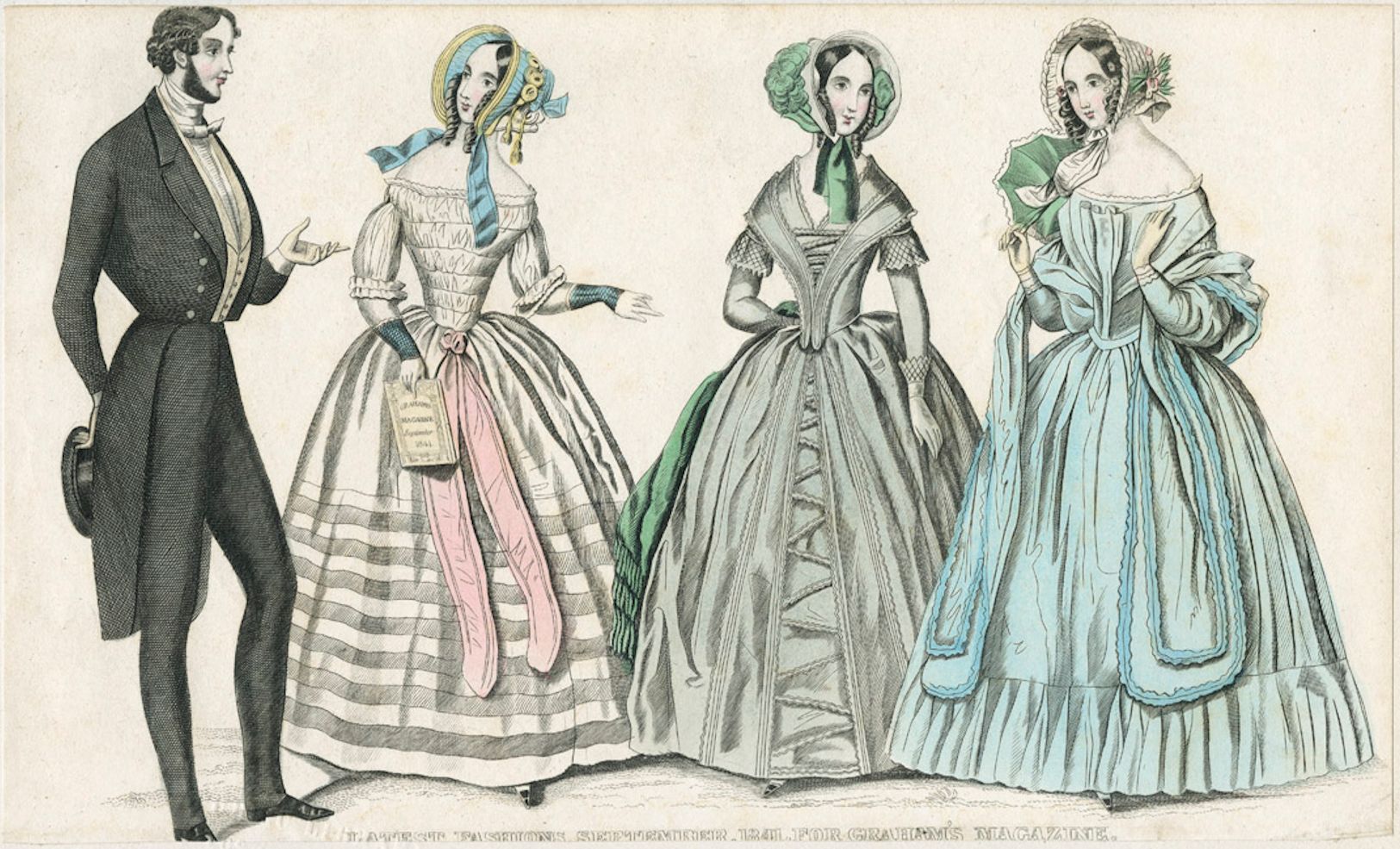
LATEST FASHIONS, SEPTEMBER, 1841. FOR GRAHAM’S MAGAZINE
Transcriber’s Notes:
Table of Contents has been added for reader convenience. Archaic spellings and hyphenation have been retained.
Obvious punctuation and typesetting errors have been corrected
without note.
[End of Graham’s Magazine, Vol. XIX, No. 3, September 1841, George R. Graham, Editor]