It was quite dark before Captain Dunbar reached
the cottage of Frederick Sabb, and he did so in no
good humor. Disappointed of his prey, he now suspected
the simple ruse by which he had been deluded,
and his first salutation of Frederica Sabb, as he entered
the cottage was in no friendly humor.
“There are certain birds,” said he, “Miss Sabb,
who fly far from their young ones at the approach of
the hunter, yet make such a fuss and outcry, as if the
nest were close at hand, and in danger. I see you
have learned to practice after their lessons.”
The girl involuntarily replied, “But, indeed, Captain
Dunbar, I heard the horse go below.”
“I see you understand me,” was the answer. “I
feel assured that you told me only the truth, but you
had first put me in the humor not to believe it. Another
time I shall know how to understand you.”
Frederica smiled, but did not seek to excuse herself,
proceeding all the while to the preparations for
supper. This had been got in readiness especially
for the arrival of Dunbar and his party. He, with
Clymes, his first officer, had become inmates of the
dwelling; but his troopers had encamped without,
under instructions of particular vigilance. Meanwhile,
supper proceeded, Sabb and his vrow being
very heedful of all the expressed or conjectured wants
of their arbitrary guests. It was while the repast
was in progress that Dunbar fancied that he beheld
a considerable degree of uneasiness in the manner
and countenance of Frederica. She ate nothing, and
her mind and eyes seemed equally to wander. He
suddenly addressed her, and she started as from a
dream, at the sound of her own name, and answered
confusedly.
“Something’s going wrong,” said Dunbar, in a
whisper to Clymes; “we can put all right, however,
if we try.”
A significant look accompanied the whisper, and
made the second officer observant. When supper
was concluded, the captain of the loyalists showed
signs of great weariness. He yawned and stretched
himself amazingly, and without much regard to propriety.
A like weariness soon after exhibited itself
in the second officer. At length Dunbar said to Old
Sabb, using a style of address to which the old man
was familiar, “Well, Uncle Fred, whenever my
bed’s ready, say the word. I’m monstrous like
sleep. I’ve ridden a matter of fifty miles to-day.
In the saddle since four o’clock—and a hard saddle at
that. I’m for sleep after supper.”
The old man, anxious to please his guest, whom
he now began rather to fear than favor, gave him
soon the intimation which he desired, and he was
conducted to the small chamber, in a shed-room adjoining
the main hall, which had been assigned him
on all previous occasions. Old Sabb himself attended
his guest, while Lieutenant Clymes remained, for a
while longer, the companion of the old lady and her
daughter. Dunbar soon released his host from further
attendance by closing the door upon him, after bowing
him out with thanks. He had scarcely done so,
before he approached one of the two windows in
the chamber. He knew the secrets of the room, and
his plan of operations had been already determined
upon. Concealing his light, so that his shadow
might not appear against the window, he quietly unclosed
the shutter so as to fix no attention by the
sound. A great fig-tree grew near it, the branches
in some degree preventing the shutter from going
quite back against the wall. This afforded him
additional cover to his proceedings, and he cautiously
passed through the opening, and lightly descended to
the ground. The height was inconsiderable, and he
was enabled, with a small stick, to close the window
after him. In another moment he passed under the
house, which stood on logs four or five feet high,
after the manner of the country, and took a crouching
attitude immediately behind the steps in the rear
of the building. From these steps to the kitchen
was an interval of fifteen or eighteen yards, while
the barn and other outhouses lay at convenient distances
beyond. Shade trees were scattered about,
and fruit trees, chiefly peach, rendering the space
between something like a covered way. We need not
inquire how long our captain of loyalists continued
his watch in this unpleasant position. Patience,
however, is quite as natural as necessary a quality to
a temper at once passionate and vindictive. While
he waited here, his lieutenant had left the house,
scattered his men privily about the grounds, and had
himself stolen to a perch which enabled him to command
the front entrance to the cottage. The only
two means of egress were thus effectually guarded.
In a little time the household was completely quiet.
Dunbar had heard the mutterings, from above, of the
family prayers, in which it was no part of his profession
to partake; and had heard the footsteps of the
old couple as they passed through the passage-way
to the chamber opposite the dining hall. A chamber
adjoining theirs was occupied by Frederica Sabb;
but he listened in vain for her footsteps in that quarter.
His watch was one calculated to try his patience,
but it was finally rewarded. He heard the movement
of a light foot over head, and soon the door opened
in the rear of the dwelling, and he distinguished
Frederica as she descended, step by step, to the
ground. She paused, looked up and around her, and
then, darting from tree to tree, she made her way to
the kitchen, which opened at her touch. Here, in a
whisper, she summoned to her side a negro, an old
African, whom we may, at the same time, mention,
had been her frequent emissary before, on missions
such as she now designed. Brough, as he was
called, was a faithful Ebo, who loved his young
mistress, and had shown himself particularly friendly
to her affaires de cœur. She put a paper into his
hands, and her directions employed few words.
“Brough, you must set off for Massa Richard, and
give him this. You must creep close, or the soldiers
will catch you. I don’t know where they’ve gone,
but no doubt they’re scattered in the woods. I have
told him, in this paper, not to come, as he promised;
but should you lose the paper—”
“I no guine loss ’em,” said Brough, seemingly
rather displeased at the doubt, tacitly conveyed, of
his carefulness.
“Such a thing might happen, Brough; nay, if you
were to see any of the tories, you ought to destroy
it. Hide it, tear it up, or swallow it, so that they
won’t be able to read it.”
“I yerry, misses.”
“Very good! And now, when you see Massa
Richard, tell him not to come. Tell him better go
farther off, across the fork, and across the other
river; for that Mat Dunbar means to push after him
to-morrow, and has sworn to hunt him up before he
stops. Tell him, I beg him, for my sake, though he
may not be afraid of that bad man, to keep out of his
way, at least until he gathers men enough to meet
him on his own ground.”
The startling voice of Dunbar himself broke in
upon the whispered conference. “Mat Dunbar is
exceedingly obliged to you, Miss Sabb.”
“Ah!” shrieked the damsel—“Brough—fly, fly,
Brough.” But Brough had no chance for flight.
“His wings are not sufficiently grown,” cried the
loyalist, with a brutal yell, as he grappled the old
negro by the throat, and hurled him to the ground.
In the next moment he possessed himself of the
paper, which he read with evident disappointment.
By this time the sound of his bugle had
summoned his lieutenant, with half a dozen of his
followers, and the kitchen was completely surrounded.
“Miss Sabb, you had best retire to the dwelling. I
owe you no favors, and will remember your avowed
opinion, this night, for Mat Dunbar. You have spoken.
It will be for me yet to speak. Lieutenant Clymes,
see the young lady home.”
“But, sir, you will not maltreat the negro?”
“Oh! no! I mean only that he shall obey your
commands. He shall carry this note to your favorite,
just as you designed, with this difference only, that I
shall furnish him with an escort.”
“Ah!”
Poor Frederica could say no more. Clymes was
about to hurry her away, when a sense of her lover’s
danger gave her strength.
“Brough;” she cried to the negro; “you won’t
show where Massa Richard keeps?”
“Never show the tories not’ing, missis.”
The close gripe of Dunbar’s finger upon the throat
of the negro, stifled his further speech. But Frederica
was permitted to see no more. The hand of
Clymes was laid upon her arm, and she went forward
promptly to save herself from indignity. She
little knew the scene that was to follow.
[To be continued.
AND THE SPIRIT BRIDAL.
———
BY MISS L. VIRGINIA SMITH.
———
The twilight deepened—and its dusky shades
Crept through the crimson of the sunset clouds,
To nestle darkly where some shining star
Looped up the gorgeous foldings, as they hung
Like Eden-banners, waving far around
The purple arches of a southern sky.
From the deep forest aisles came up the wind,
Low singing in its wand’ring, with the voice
Of softly chanting waves, and whisp’ring leaves.
The silver moon came floating from the east,
Like a young angel sleeping on the wing,
Whose dream-smile glittered o’er the dewy earth,
And trembling through an open casement, kissed
A brow of maiden beauty slumbering there.
The velvet drapery of her couch was tossed
In crimson waves around her, and above
Fell snowy veilings, bending like a wreath
Of silvery vapor o’er a rosy sea;
Carelessly graceful in her sweet repose,
She rested like a lily on the stream,
When drooping gently ’neath its own perfume.
The dew of early youth was gleaming yet
Upon her pure heart-blossoms, and the first
Faint blush of love within her spirit, wrought
Rich blazonry upon their mystic leaves.
In slumber, through her softly rounded limbs
A radiant soul in bright expression stole,
Like glimpses of the evening star amid
The pure white veiling of a pearly cloud.
She watched the sunlight fade upon the hills,
And star-flames kindle in the dusky sky—
But now she rested in the land of dreams,
To wait the coming of her Spirit-Love.
He came—a vision whose bewildering eyes
Seemed light ineffable in midnight skies—
While plumes of waving frost-work, dashed with flakes
Of golden sunbeams, glittered ’mid the folds
Of woven radiance floating round his form,
Snow-flake and fire-drop wreathing into life,
His gorgeous pinion shadowed o’er his Bride,
His breath upon her cheek—his lightning glance
Stole through the visions of her dreaming soul,
As when the passion of the dying sun
Glows o’er the bosom of a sleeping cloud,
Till love’s wild worship wakes returning flame,
And each in burning blushes dies away!
As a fair volume, and a golden lyre,
Wreathed by the tendrils of an opening rose,
Her Mind, and Soul, and fresh expanding Heart,
Lay bright before his spirit-searching ken,
As one by one he softly laid aside
The crimson petals of that folded heart,
To drink the honied fragrance of its love,
The rose-bud thrilled and trembled into bloom,
Its breeze his sigh—its sun his burning glance—
Its dew-drop life his kisses wild and warm.
He lingered o’er the pure, unsullied leaves
Of Mind’s mysterious volume, and there came,
Where’er he breathed upon the virgin page,
Bright gems of glowing fancy, and deep thought,
As magic characters come stealing forth
In loveliness before the breath of flame!
His being brightened with a God-like smile,
As, closely blended with each pictured thought,
His image, flashing into glorious life,
Smiled back upon him from the glowing page
So truthfully—then with the soft excess
Of dreamy rapture ’wildered, fainting bowed,
And blessed the sweet love-mirror, silently.
Her soul in beauty, an Æolian lyre,
Gleamed forth before him, where the voice of Song
Slept like its spirit in a singing shell.
His light caressing pinion swept its chords,
And Joy’s bird-carol—Hope’s aerial tone—
Pride’s sounding anthem—and the pæan wild
Of young Ambition rolled in glory forth.
He breathed upon it—and anon there swelled
(As tears will gush from rapture-laden hearts)
Her pure religion’s diapason deep;—
Sweet under-tones of dreamy melancholy—
And chords of feeling that erewhile had slept
In voiceless music, and o’er all the theme
An ever-changing, ever-sounding tone,
Was deep, immaculate, immortal Love!
THE SPIRIT-BRIDAL.
The Night had closed her eye of softest blue,
And, like a wearied infant, sank to rest
On Nature’s gentle bosom—Silence, pale,
With a white finger on her marble lip,
From which no lightest whisper ever came,
Was bending o’er the dim and murmured death
Of every sound—and even Echo dreamed,
As though a spirit’s wand had charmed her there
To slumber deep as that Creation held
When Night was in the heavens!
Still as the moonlight quivered through the vines
That overhung the casement, it revealed
The rosy couch, beneath its silvery veil,
As by its side the maiden knelt to pray.
Oh! if there be on earth one blessing left—
One leaf from out our faded Paradise—
One ray of glory from the heaven we lost—
It is, that we may pray for those we love!
Without it man may live—his nature knows
No soft dependence—panoplied in self,
His haughty heart may burn to dash aside
The hand that formed it—and he may defy
The love that made him what he is—a god!
But woman never—for her ivy soul
Must have an oak to cling to; proud and high
Its crest may be, or ruined, lightning-scathed,
It matters not—and for it she must pray!
Prayer is her nature’s pure necessity,
To calm the sorrow that with lava streams,
Pours its bewildering torrent o’er the soul,
And when she feels it crushing darkly through
A bosom all too soft to stem its tide
Of bitter, burning waters—then, for power
To “suffer and be still,” that bosom prays.
And oh! when human love has taught her heart
To dream of one and Heaven, how pants her soul
To pour that gushing feeling freely forth,
In all its truth and deep intensity, before
The “God of love” who gave it!
’Twas for this
The gentle maiden meekly knelt to God
Till each pure love-beam from her violet eye
Seemed melting into passion’s orison.
Warm feeling folded up its starry plumes
To bow before the altar-shrine of faith,
And holy hopes looked from the golden shades
That lay upon her soul, as angels bend
O’er the bright foldings of the summer clouds,
To woo us to the sky, from whence they come.
Her eye grew dreamy, and her bosom heaved,
As though within its cell some pleasant thought
Were singing, and it rose and fell upon
The waves of that delicious melody.
Her loosened hair swept o’er the sacred page,
And, as her soul went forth in whispers low,
It stirred the shadows with the breath of prayer.
She oped the holy book, and as her lip
Trembled upon the words, they sank within
Her woman’s nature as the snow-flake falls
And melts away into the earth’s warm bosom.
Time, as he wandered by, had sighed the hour
Of “twelve,” and for a moment midnight’s hush
Grew tremulous, and echo as it fell,
Swept o’er the tension of her listening ear
Softly and thrillingly, and like to Love’s
First breathings o’er an unawakened heart.
Her voice grew fainter, as a music-vow
Stole sweetly in the cadence of her own—
She felt the glory of an angel-wing
Around her waving, and she knew the hour—
Her Spirit-Lover claimed his Spirit-Bride!
With pinions intertwining, arms enwreathed
And fervid glances bathed in passion’s dream,
They swept along the cloud-land pathway, where
The constellations, from their silver urns,
Poured incense light far down the “Milky-Way,”
And o’er its misty pavement Cynthia flung
A thousand rainbows, like the wreathed bloom
Of bridal blossoms. Still they floated on,
Far through the starry armaments that sweep
In endless circle round the battlements
Of Paradise—an everlasting guard
High flaming round the Infinite;—at length,
Within the presence-chamber of the Blest,
They knelt before the Great Unchangeable,
Whose love and mercy whispered audibly,
“Forever be ye one—as God is One!”
NO. 1.—MASSINGER’S GREAT DUKE OF FLORENCE.
———
BY ENNA DUVAL.
———
“I cannot pretend in these succinct narrations to have rivaled Charles Lamb and his excellent sister in the art of turning
drama into narrative. The “Shakspeare Tales” is an unique book, the beauty of which all can perceive who are
worth pleasing; but few who have not tried the like, can appreciate the difficulty, the matchless skill of its execution.”
Hartley Coleridge.
Cozimo, duke of Florence, a noble and virtuous
prince had the misfortune to lose, by death, his
duchess, Clarinda, a lady of such rare and matchless
virtues, that, as he said, the whole world could not
produce one worthy to be her second. In her grave
he buried all thoughts of woman.
His courtiers, and ministers of state, repeatedly
urged him to a second marriage, for they feared that
after his death, he being childless, distraction might
breed in the state, and cause the downfall of his
noble house. Residing at the court was a beautiful
and wealthy orphan, Fiorinda, duchess of Urbin, the
ward of Cozimo, and she was the one that his counsellors
desired him to wed. Kindly, but sadly, he
always waived aside their counsel, telling them, that
the lovely Fiorinda should have a more fitting mate,
and that as regarded the welfare of the state, his
princely care would provide one worthy to succeed
him.
This “worthy successor,” was his nephew Giovanni,
his sister’s son, an orphan, dependent on his
bounty. This youth he loved for his dear sister’s
sake, and he spared no pains or trouble to render
him worthy of his future high position. The more
to further this, Cozimo placed Giovanni under the
sole charge of a noble, and highly educated Florentine
gentleman, Carolo Charomonte by name, who
lived retired on an estate five hours distance from
Florence. This gentleman discharged, to the utmost
of his power, the duty the duke committed to him,
and by means of his rare experience, using great
care, he trained the young Giovanni up in all those
arts, peculiar and proper to future greatness; therefore
it was no wonder, but rather a necessity, that
when this young prince had grown to be a man, he
should make good the princely education he had derived
from his accomplished tutor.
His uncle had studiously kept him away from court,
during the perilous season of youth; but as the young
Giovanni approached manhood, he gave such great
promise of ability, that Cozimo could no longer withstand
his tender desire for his company. Report
filled the duke’s ears with stories of his nephew,
which, if true, would have made him a miracle—a
wonder in arts and arms; and in order to test the
verity of this fine account, he sent his secretary,
Contarino, to summon Giovanni to his presence.
This secretary came to Charamonte’s house, bearing
compliments, and courtly thanks, and promises
of munificent reward, from the duke. These the
noble Charamonte received with dignified, courteous
gratefulness; and although it was a sweet thought
to him, that nature had so well aided him in his
great duty as to enable him to return to his royal
master a phœnix of grace and goodness, in the person
of his nephew, this very yielding up of his
charge, filled his breast with sadness. The young
Giovanni had a disposition so gentle and sweet by
nature, that it won on all appointed to attend him,
insomuch that it made them rivals, even in the
coarsest office, to get precedency to do him service;
no wonder then, that his guardian, who had
always found him obedient, loving, and reverential
as a son, should have unconsciously permitted his
affections to twine around him with a parent’s fondness.
Nor did Giovanni receive his uncle’s summons
with pleasure; as he read the duke’s letter the frequent
changes of his countenance, manifested how
strongly his unwillingness contended with his duty.
He loved his guardian, regarded him with as much
respect and service as would have been due to the
one who gave him life; but still more fondly did he
love the good Charamonte’s incomparable daughter—the
fair Lidia. She had been his companion
from childhood; the partner of his studies and his
pleasures. The commands of his uncle revealed to
him in an instant the nature of his regard for her;
but, at the same time, he felt the misery and hopelessness
of such a love. His high station he felt
would be a barrier to honorable love, and this thought
deepened tenfold his anguish. In sweet, tender words
he bewailed his sad fate, when he bade farewell to
her, describing, in touching language, their future
lot had he been born in a more humble state.
“Ah! Lidia,” he exclaimed, “then I might have
seen and liked with mine own eyes, and not as now,
with others. I might still continue my delights with
you, that are alone, in my esteem, the abstract of
society. We might walk in solitary groves, or in
choice gardens, and in the variety of curious flowers,
contemplate nature’s workmanship and wonders;
then for change, near to the murmur of some bubbling
fountain, I might hear you sing, and from the
well tuned accents of your tongue, in my imagination,
conceive the melody of Heaven’s harmony;
then with chaste discourse we would return imp
feathers to the broken wing of time. But all this I
must part from—I might after continued innocence
of love and service have been your husband—”
Here Lidia checked him, and reminded him that
she was, and ever would be his servant; that it was
far from her, even in a thought, to cherish such
saucy hopes as these. Had she been heir to all the
globes and sceptres, that mankind bows to, then, at
her best, she might have deserved him; but now, in
her humble state, she could only wish that he might
find a partner—a princess equal to him, who would
make it the study of her life, with all the obedience of
a wife, to please him. For her own part, she would
be content to live and be their humblest handmaid.
So humble and childlike doth love show itself in a
pure, gentle nature.
In this sweet sorrowful manner they parted from
each other, and Giovanni hastened to do his uncle’s
bidding; but first he embraced his good old guardian,
saying, farewell, and assured him that should he ever
reach his high destination their fortunes should be
shared—then joining the secretary, he repaired to
the Florentine court.
Duke Cozimo had a favorite, Lodovico Sanazarro
by name, and he loved him so dearly that he used to
say Sanazarro’s merits were so great that should he
divide his dukedom with him, he would still continue
his debtor. Princes’ favorites are apt to be undeserving
men, notwithstanding they may be set off
with all the trim of greatness, state, and power; for
princes are men, not gods, and though they can give
wealth and titles, they cannot give virtues, that is
out of their power. But Duke Cozimo had proved
the correctness of his judgment in the choice of his
friend. Sanazarro’s nature was like pure, tried gold,
and any stamp of grace the duke was pleased to give
him, to make him current to the world, did but add
honor to the royal bestower. Even the courtiers felt
no envy against him, for he was no lazy drone, but
an industrious bee. He fought the enemies of the
state, and displayed great valor; then, after returning
crowned with conquest, he labored in the service
of his royal master, sharing in the cares and burthen
of the government.
Duke Cozimo’s secret design was to wed this favorite
with his wealthy ward, Fiorinda. This noble
princess was not averse to this plan, for Lodovico
being a handsome and brave gentleman, had quite
won her heart and she loved to dwell on his exploits
in the field, and abilities displayed in the council.
Sanazarro, however, was very modest, and
never dared to lift his thoughts so high as to woo so
rich and noble a dame as the Princess Fiorinda.
Encouraged by her guardian, Fiorinda endeavored
by courteous, but delicate advances, to remove this
diffidence. She always received him with distinction,
and took occasion repeatedly to send him gifts,
which he received with the reverent gratefulness of
a subject; expressing more ceremony in his humble
thanks, than feeling of the favor—appearing almost
willfully ignorant, and blind to the tender feeling
which prompted these courteous condescensions.
But true love is patient, and forbearing, and as Sanazarro
displayed no love for any other lady, she used
to comfort herself with the thought, that it was the
light of her high estate that made him blind, and
taxed her woman’s wit for means to lessen the difference
between them. The frequent dangers that
he was exposed to, however, in the service of the
state, made her unhappy, and after the young Prince
Giovanni came to court, she took occasion to interest
him in Sanazarro’s favor, begging that he would be
suitor to the duke not to expose this brave, noble
gentleman to so much peril, but rather to command
him, after his great labors, to take rest.
Prince Giovanni received this request with delight,
for he also had a boon to ask of the duchess.
So great was his love for the fair Lidia Charomonte,
that he could no longer bear the separation from her,
and after describing her with a lover’s colors to the
princess, he begged she would take occasion to ask
permission of the duke, to add this matchless virgin
to her train of ladies. She promised to effect his desire,
right quickly; and they parted from each other
with bright hopes.
Soon after Giovanni’s return to court, the secretary
who had brought him, while reporting to the duke
an account of his journey, gave an enthusiastic description
of Charomonte’s daughter, and in doing
this, implied that the prince loved her. Straightway,
but quietly, the kind duke conceived the design of
securing also his dearly loved nephew’s happiness,
but fearing that this object of his love might not be
worthy of so high a fortune, he resolved to send his
trusty favorite, Sanazarro, to Charomonte’s house, to
see this paragon of beauty and virtue.
This he did without acquainting Sanazarro with
his reasons, and the favorite fulfilled his master’s
orders, thinking the duke wished to contract a marriage
with this humble maid. But after seeing the
fair Lidia he was so struck with her beauty, modesty,
and wit, that he forgot his duty to his master
and his honor. The recollection of past favors from
the duke, even the beautiful, kind, forbearing Duchess
Fiorinda, seemed as nothing to him, under the influence
of this wild infatuation. He returned to court,
resolved to find some means of blinding the duke,
and turning him aside from pursuit of the fair Lidia.
The secretary he knew he could silence, and the
Prince Giovanni, the only one who could disclose
his falsehood, he hoped to quiet, by telling him of
the duke’s purpose of marriage, which would of
course endanger his prospect of succeeding to the
dukedom.
How weak and wicked are the best of men when
exposed to some trials. Here was this loyal, noble,
honorable gentleman, who had withstood the weakening
effects of princes’ favor, yielding truth and allegiance
at a moment when he should have been
most strong—at a moment when he felt most confidence.
He forgot the honors and glories by Cozimo’s
grace conferred upon him; he deceived his trust and
made shipwreck of his loyalty. Did he not deserve
ruin?
Prince Giovanni received the news of his uncle’s
projected marriage with indifference, answering most
nobly, that he had no right, because he had received
benefits from his uncle’s hands, to prescribe laws for
his pleasure. But when he heard who his uncle purposed
to wed, then his own love raised the standard
of rebellion in his heart, and he willingly united with
the false Sanazarro in decrying the charms of his
loved mistress. Both singly and together they spoke
disparagingly of this beautiful lady, and Cozimo believed
them, although it caused him some surprise,
but, as he said, he had never found them false.
But falsehood in weaving its net, always forgets
to leave a loop-hole for its own escape. Too late
Giovanni remembered the favor he had asked of the
Duchess Fiorinda, and he hastened to request her to
be silent in the matter. But while he was seeking
her fruitlessly, she was already with the duke moving
him, with all a woman’s eloquence, to command
the presence of Charomonte’s fair daughter at the
court, saying, that his nephew had given her such
an abstract of perfection in his description of this
maiden, that she did not wish to employ her as a
servant, but to be by her instructed, and use her as a
dear companion.
Duke Cozimo listened with amazement, and then,
almost doubting his senses, made the princess repeat
all that Giovanni had told her. This she did,
using his very words: that she possessed all that
could be wished for in a virgin. That she had rare
beauty, her discourse was ravishing, she had quickness
of apprehension, with choice manners and learning
too, not usual with women.
This account was so unlike the report given by
Giovanni and Sanazarro to him, that the duke saw
with anger he had been deceived. This wounded
him deeply, for he could not bear the thought of insincerity
and falsehood in his nephew and bosom
friend. He felt that he had been trifled with, and
resolved to examine into the matter himself, then, if
he found they had played him false, he would punish
them with rigor. But he smothered his wrath, meaning
to act quietly without their knowledge. He told
the duchess her suit was granted; that the fair Lidia
should come to her; but in return he would ask her
to go with him the following morning on a short
journey to the country. As he made this request,
Giovanni and Sanazarro entered just in time to hear
it. The duke greeted them coldly and left them.
Joyfully the duchess hastened to communicate to
Prince Giovanni her success. He dissembled his
confusion awkwardly, and essayed to thank her for
her kindness. She courteously received his thanks,
and then with sweet condescension greeted Sanazarro,
begging him to accept of a diamond from her,
and wear it for her sake. Saying this, she bade
them both adieu, and hastened to be in readiness for
the duke’s journey.
The young prince and Sanazarro gazed at each
other in consternation. Something must be done,
however, and that right quickly, for they both felt
certain that it was the duke’s intention to see Lidia
with his own eyes, and that the journey of the following
day was to Charomonte’s house. Hastily
Giovanni decided upon sending his serving man that
night with a letter to Lidia. In this letter he told
her that the duke, his uncle, had heard of her, and
her beauty, and was about to seek her he feared,
with unlawful love. “If he see you, as you are,
fair Lidia,” he concluded, “my hoped-for happiness
will be changed into an everlasting night. Let your
goodness find some means to prevent my uncle seeing
you, and thus you will save two lives, your own
and the honorer of your virtues, Giovanni.”
Giovanni’s messenger found the young Lidia in
the midst of her father’s household, who with the
kind, old Charomonte, were devising all manner of
merry-makings, in order to divert the sadness which
had hung over her since the departure of the young
prince. She received the letter with joy, and retired
to read it in secret, that no one might witness her
emotion. So soon as she read his request, the very
means of accomplishing it flashed quickly into her
mind. As the duke had never seen her, she resolved
upon presenting to him another in her place. Her
maid, Petronilla, was the person decided upon. This
girl was ill-favored, coarse and rude. The only difficulty
she had to surmount, would be her father’s
opposition, but she thought she would contrive with
the servants’ aid, to have Petronilla presented to the
duke when her father was not present. This difficulty
the duke unconsciously relieved her from, for
he came to Charomonte’s mansion in anger; and so
soon as he arrived he dismissed his train, desiring to
see Charomonte alone. Then he upbraided him with
treason—for he suspected the old man of dishonor.
He feared that Giovanni had become entangled with
this Lidia, and not knowing Sanazarro’s suspicions,
he attributed Giovanni’s double dealings, to a dishonorable
illicit connection with this girl, connived
at by her father.
Poor old Charomonte listened to his royal master’s
reproaches with angry amazement. So soon as the
duke had ended, he replied with words that proved
how his loyalty and outraged feelings contended for
mastery. In speaking of his daughter, the light of
his eyes, the comfort of his feeble age, he described
her so lovingly and tenderly that the duke commanded
she should be shown to him.
“But,” said he, “you shall not prepare her to answer
these charges. We will see her immediately,
and to prevent all intercourse, we do confine thee
close prisoner to thy chamber, till all doubts are
cleared.”
Lidia was summoned, and in her place came Petronilla,
escorted by Giovanni and Sanazarro, followed
by the servants, bearing a sumptuous banquet.
At the sight of her coarse appearance the duke felt
that the manners of her mind must be transcendent
to defend so rough an outside. She received him
boisterously, and at the banquet, behaved rudely and
indelicately, and drank so freely of the wine, that
she had to be carried away from the duke’s presence.
The imposture, however, was so gross, that
the duke began to suspect some cunning deceit or
trick had been played upon him; but he dissembled
this suspicion, and sent out Giovanni and Sanazarro
with his train, saying he would soon join them;
that he wished first to see the Signor Charomonte in
private, that he might, with a few kind words of
comfort, take leave of the poor old man.
It appeared to him unlikely that both Charomonte
and Contarino, his old secretary, could be so blinded.
“It may be,” he said to himself, “that the daughter,
for some ends unknown, has personated this rude behaviour,
which seems so ridiculous and impossible.
Whatever be the riddle, however, I will resolve it,
if possible.”
Charomonte, on being summoned, came to him;
but when he heard the duke’s pitying description of
the pretended Lidia, he instantly went to his daughter’s
chamber, where she was feigning illness, and
forced her into the presence of Cozimo. The beautiful
Lidia trembling, and in tears, knelt before him
and besought his mercy.
“Ah,” exclaimed the duke, “this is the peerless
form I expected to see;” then turning to Charomonte,
he commanded that Sanazarro and his nephew, Giovanni,
should straightway be imprisoned in separate
chambers, guarded, until he should pronounce sentence
against them as traitors.
In tender, touching language, Lidia pleaded for
the prince, and asked that whatever punishment he
deserved, to inflict it on her, as she was the sad cause
of his offence.
“I know,” she said, “that the prince is so far
above me that my wishes even cannot reach him,
and to restore him to your wonted grace and favor,
I’ll abjure his sight forever, and betake myself to a
religious life, where, in my prayers, I may remember
him, but no man will I ever see but my ghostly
father. Be not, O sire, like the eagle that in her angry
mood destroys her hopeful young for suffering a
wren to perch too near them.”
Cozimo listened with admiration, and raising her
tenderly put her suit off with courteous compliments,
telling her that if she would cheer her drooping
spirits, bring back the bloom of health to her pale
cheek, and let him see the diamond of her beauty in
its perfect lustre, there could be no crime that he
would not look with eyes of mercy upon if she advocated
it.
Already in his mind had he thought of a fitting
punishment for his nephew. He resolved to make
them all believe that he intended himself to wed the
fair Lidia, and acted accordingly.
Poor Sanazarro, in the solitude of his prison, awakened
too late to a sense of his wicked, disloyal
treachery. He remembered the duke’s kindness and
love, in making him almost his second self. The
influence of Lidia’s charms faded away, and he recalled
the loving favors he had received so carelessly
from the beautiful Duchess Fiorinda. Now, he
stood without friends, and no one dared or even cared
to make intercession to the duke for him. As he
thought of the Duchess Fiorinda’s love and past kindness,
he resolved to appeal to her, and sent a message
to her, begging her mediation in his favor,
although he acknowledged himself most unworthy.
But true love forgetteth and forgiveth all injuries,
and so soon as the lovely Fiorinda heard his sad
plight, she repaired to the duke and entreated of him
to be merciful and gracious to his poor servant, Sanazarro.
Cozimo reminded her of his infidelity to him,
his kind master; and then, to move her still more to
anger, he recalled how coldly Sanazarro had always
received her courtesies, and how easily he had yielded
to the charms of another, and that other beneath her
in rank.
The poor lady for a moment struggled with her
pride, which whispered to her that, to endure a rival,
and one also who was an inferior, betokened poverty
of spirit, but her noble heart obtained the mastery,
and she replied,
“True love must not know degrees or distances.
Lidia may be as far above me in her form as she is
in her birth beneath me; and what I liked in Sanazarro
he may have loved in her. Vouchsafe to hear
his defense.”
The duke consented, and said that both Sanazarro
and the young prince should have a speedy trial, in
which he would not only be judge, but accuser; and
then expressed himself in such courteous, gallant
words about the fair Lidia, that Charomonte and the
courtiers stared in amazement. They could scarcely
credit what he wished to make them believe—that
he, the faithful, mourning widower, who had remained
constant so many years, purposed a second
marriage with this young maiden, so unfit for him in
station and age.
The trial commenced, and the prisoners, almost
hopeless of mercy, presented themselves, with their
lovely advocates, the duchess and Lidia, before the
duke. Cozimo, at the sight of Lidia, professed to
forget every thing in the rapture her beauty caused
him; and after exhausting love’s sweet language in
describing her charms, he turned, with looks of rage,
to the prince and Sanazarro, and told them they knelt
too late for mercy. But Lidia and the duchess reminded
him he had promised a gracious hearing to
his prisoners, before passing sentence.
Duke Cozimo descended from the chair of state,
and placing the two ladies in his seat, told them they
should be his deputies; but they must listen to his accusation
which would justify the sentence he was
about to pronounce on these traitorous heads. First,
he reminded Sanazarro of his cold indifference to
Fiorinda’s condescending love, and his unfaithfulness
to her; but the duchess interrupted him, and told
him that charge was naught; she had already heard
the count’s confession, and had freely pardoned
him.
The duke courteously bowed, but continued and
upbraided Sanazarro with his treachery to him, his
indulgent master. Then he turned to Giovanni and
reminded him of how careful of his interests he had
always been; how he had remained unwedded, to
secure to a thankless nephew a throne. “We made
you both,” continued the duke, “the keys that opened
our heart’s secrets, and what you spoke we believed
as oracles. But you, in recompense of this, to us,
who gave you all, to whom you owed your being,
with treacherous lies endeavored to conceal this
peerless jewel from our knowledge. Look on her,”
he said, pointing to the blushing Lidia, “is that a
beauty fit for any subject? Can any tire become that
forehead but a diadem? Even should we grant pardon
for your falsehood to us, your treachery to her,
in seeking to deprive her of that greatness she was
born to, can ne’er find pardon.”
As the duke finished, the ladies quickly descended
from the chair of state, and kneeling, with the prince
and Count Sanazarro before him, besought his mercy,
which Charomonte reminded him, was more becoming
in a prince than wreaths of conquest. The
courtiers and old councillors united their entreaties,
but the duke remained inflexible. Turning to Charomonte,
he said,
“You, Carolo, remember with what impatiency of
grief we bore our Duchess Clarinda’s death, and how
we vowed—not hoping to see her equal—never to
make a second choice. We did not know that nature
had framed one that did almost excel her, and
with oaths, mixed with tears, we swore our eyes
should never again be tempted. Charomonte, thou
heardest us sware—are those vows, thinkest thou,
registered against us in heaven?”
Charomonte told him that if he were to wed a
woman who possessed all woman’s beauties and
virtues united, he had already sworn so deeply, that
the weight of his perjury would sink him.
“This is strong truth, Carolo,” replied the duke,
“but yet it does not free them from treason.”
“But,” answered the good old Charomonte, who
began to suspect the duke’s design, “the prince, your
nephew, was so earnest to have you keep your vows
to heaven, that he vouchsafed to love my daughter.”
The duke turned to Lidia, as if for assurance of
this, who blushingly replied, “He told me so, indeed,
sire.”
“And the count has averred as much to me,” said
the Duchess Fiorinda, with a playful air and a merry
laugh, for she saw by the duke’s manner that he had
only been feigning this stern severity as a punishment
to the young men.
“Ah,” said Duke Cozimo, smiling, “you all conspire
to force our mercy from us.”
Then he placed the gentle, lovely Lidia’s hand in
Giovanni’s, and as he pronounced the pardon of the
prince and count, he told them they must merit their
forgiveness by service and love to their mistresses,
the duchess and the beautiful Lidia.
Thus ends this story, courteous reader, and
“May the passage prove,
Of what’s presented, worthy of your love
And favor, as was aimed, and we have all
That can in compass of our wishes fall.”
WRITTEN AT NIGHT IN CAVE HILL CEMETERY.
———
BY GEO. D. PRENTICE.
———
One evening, dear Virginia, in thy life,
When thou and I were straying side by side
Beneath the holy moonlight, and our thoughts
Seemed taking a deep hue of mournfulness
From the sweet, solemn hour, I said if thou,
Whose young years scarcely numbered half my own,
Should’st pass before me to the spirit-land,
I would, on some mild eve beneath the moon,
Shining in heaven as it was shining then,
Go forth alone to lay me by thy grave,
And render to thy cherished memory
The last sad tribute of a stricken heart.
Thine answer was a sigh, a tear, a sob,
A gentle pressure of the hand, and thus
My earnest vow was hallowed. A thin cloud,
Like a pole winding-sheet, that moment passed
Across the moon, and as its shadow fell,
Like a mysterious omen of the tomb,
Upon our kindred spirits, thou didst turn
Thine eye to that wan spectre of the skies,
And, gazing on the solemn portent, weep
As if thy head were waters.
Weary years
Since then have planted furrows on my brow,
And sorrows in my heart, and the pale moon,
That shone around us on that lovely eve,
Is shining now upon thy swarded grave,
And I have come, a pilgrim of the night,
To bow at memory’s holy shrine and keep
My unforgotten vow.
Dear, parted one,
Friend of my better years, dark months have passed
With all their awful shadows o’er the earth,
Since this green turf was laid above thy rest,
’Mid sighs and streaming tears and stifled groans,
But oh! thy gentle memory is not dim
In the deep hearts that loved thee. We have set
This sweet young rose-tree o’er thy hallowed grave,
And may the skies shed their serenest dews
Around it, may the summer clouds distil
Their gentlest rains upon it, may the fresh
Warm zephyrs fan it with their softest breath,
And daily may the bright and holy beams
Of morning greet it with their sweetest smile,
That it may wave its roses o’er thy dust,
Dear emblems of the flowers that thou so oft
In life didst fling upon our happy hearts
From thy own spirit’s Eden. Yet we know
’Tis but an humble offering to thee,
Who dwellest where the fadeless roses bloom,
In heaven’s eternal sunshine.
To our eyes
Thy beauty has not faded from the earth;
We see it in the flowers that lift their lids
To greet the early spring-time—in the bow
The magic pencil of the sunshine paints
Upon the flying rain-clouds—in the stars
That glitter from the blue abyss of night—
And in the strange mysterious loveliness
Of every holy sunset. To our ears
The music of thy loved tones is not lost;
We hear it in the low, sweet cadences
Of wave and stream and fountain, in the notes
Of birds that from the sky and forest hail
The sunrise with their songs, and in the wild
And soul-like breathings of the evening wind
O’er all the thousand sweet Eolian lyres
Of grove and forest. Yet no sight or sound
In all the world of nature is as sweet,
Dear, lost Virginia, as when thou wast here
To gaze and listen with us. The young flowers
And the pure stars seem pale and cold and dim,
As if they looked through blinding tears—alas!
The tears are in our eyes. The melodies
Of wave and stream and bird and forest-harp,
Borne on the soft wings of the evening gale,
Seem blended with a deep wail for the dead—
Alas! the wail is in our hearts.
Lost one!
We miss thee in our sadness and our joy!
When at the solemn eventide we stray,
’Mid the still gathering of the twilight shades,
To muse upon the dear and hallowed past
With its deep, mournful memories, a voice
Comes from the still recesses of our hearts
“She is not here!” In the gay, festive hour,
When music peals upon the perfumed air,
And wit and mirth are ringing in our ears,
And light forms floating round us in the dance,
And jewels flashing through luxuriant curls,
And deep tones breathing vows of tenderness
And truth to listening beauty, even then,
Amid the wild enchantments of the hour,
To many a heart the past comes back again,
And, as the fountain of its tears is stirred,
A voice comes sounding from its holiest depths,
“Alas! she is not here!” The spring-time now
Is forth upon the fresh green earth, the vales
Are one bright wilderness of blooms, the woods,
With all their wealth of rainbow tints, repose,
Like fairy clouds upon the vernal sky,
And every gale is burdened with the gush
Of music, free, wild music, yet, lost one,
Through all these wildering melodies, that voice
As from the very heart of nature comes,
“Alas! she is not here!” But list! oh, list!
From the eternal depths of yonder sky,
From where the flash of sun and star is dim
In uncreated light, an angel strain,
As sweet as that in which the morning stars
Together sang o’er the creation’s birth,
Comes floating downward through the ravished air,
“Joy! joy! she’s here! she’s here!”
’Tis midnight deep,
And a pale cloud, like that whose shadow fell
Upon our souls on that remembered eve,
Is passing o’er the moon, but now the shade
Falls on one heart alone. I am alone,
My dear and long-lost friend. Oh! wheresoe’er
In the vast universe of God thou art,
I pray thee stoop at this mysterious hour
To the dark earth from thy all radiant home,
And hold communion with thy weeping friend
As in the hours departed.
Ah, I feel,
Sweet spirit, thou hast heard and blessed my prayer!
I hear the rustling of thy angel-plumes
About me and around—the very air
Is glowing with a thousand seraph thoughts,
Bright as the sparkles of a shooting star—
A hand from which the electric fire of heaven
Seems flashing through my frame is clasped in mine—
Thy blessed voice, with its remembered tones
Softened to more than mortal melody,
Is thrilling through my heart, as ’twere the voice
Of the lost Pleiad calling from its place
In the eternal void—and our two souls
Blend once again as erst they used to blend—
The heavenly with the earthly!
Fare thee well!
Sweet spirit, fare thee well! the blessed words
That thou, this night, hast whispered to me here,
Above the mound that hides thy mortal form,
Will purify my soul, and strengthen me
To bear the ills and agonies of life,
And point me to an immortality
With thee in God’s own holy Paradise.
———
BY WILLIAM P. MULCHINOCK.
———
Air—“Some love to roam o’er the dark sea-foam.”
Fill high to-night, in our halls of light,
The toast on our lips shall be
“The sinewy hand, the glittering brand,
Our homes and our altars free.”
Ho! ho! ho! etc.
Though the coward pale, like a girl may wail,
And sleep in his chains for years,
The sound of our mirth shall pass over earth
With balm for a nation’s tears.
Ho! ho! ho! etc.
A curse for the cold, a cup for the bold,
A smile for the girls we love;
And for him who’d bleed, in his country’s need,
A home in the skies above.
Ho! ho! ho! etc.
We have asked the page of a nobler age
For a hope secure and bright,
And the spell it gave to the stricken slave
Was in one strong word—“Unite.”
Ho! ho! ho! etc.
Though the wind howl free o’er a single tree
Till it bends beneath its frown—
For many a day it will howl away
Ere a forest be stricken down.
Ho! ho! ho! etc.
By the martyred dead, who for Freedom bled,
By all that man deems divine,
Our patriot band, for our own dear land,
Like brothers shall all combine.
Ho! ho! ho! etc.
Then fill to-night, in our halls of light,
The toast on our lips shall be—
“The sinewy hand, the glittering brand,
Our homes and our altars free.”
Ho! ho! ho! etc.
———
BY MRS. CAROLINE H. BUTLER.
———
I have been induced to a brief series of heart-histories
by a remark of Longfellow, in Kavanagh. In
speaking of the ever sanguine yet irresolute schoolmaster,
who was “forced to teach grammar when
he would fain have written poems,” he says, “Mr.
Churchill never knew that while he was exploring
the Past for records of obscure and unknown martyrs,
in his own village, ——, the romance he was
longing to find and record, had really occurred in his
neighborhood, among his own friends.” Again, Emerson
says, “Every roof is agreeable to the eye until it
is lifted, and then we find tragedy, and moaning women,
and hard-eyed husbands, and deluges of lethe.”
There is truth in this. Beneath every roof-tree
some romance is at work—some heart-history compiling.
The evening lights twinkle from cottages
sleeping peacefully upon the hill-sides and valleys—music
and mirth break on the air from brilliantly
illuminated dwellings—then the night wears on—the
cottage-lights no longer gleam—silence wraps the
abode of wealth—and from out the majesty of the
heavens encircling all, the gentle moon and bright,
flashing stars look down alike on sheltered cot or
marble dome. Yet, “lift the roof,” lay bare the
heart which pulsates in every bosom, and we shall
find each has its own tale of romance woven from
life’s mingled threads of grief, of love, of happiness—perhaps
of shame.
Let me, then, from out the “simple annals” of a
quiet country town, sketch, with a faithful pen,
these heart-histories—these romances from real life.
The little village to which they may be traced, I
must forbear to name. That it does not exist merely
in the imagination, let it suffice the incredulous
reader. There are bright, dancing rills spangling its
broad meadows—the “sweet south wind” plays over
innumerable fields of billowy grain, and the tinkle of
the cow-bell is heard within the sweet-scented pine
forests which crown the summit of each rising hill.
The roots, some of which I am about to “lift,” cover
no costly edifices. They are for the most part
humble and unpretending, yet so embosomed among
fruit and forest-trees as to render each cottage of
itself a coup d’œil of beauty. There are, to be sure,
two or three exceptions; the large, three-story brick
house of Judge Porter, for instance, with its long,
winding avenues, and, as Mrs. Malaprop would say,
its “statutes” placed in awful frigidity about the
grounds, frightening the children of the neighborhood
as so many sheeted ghosts. The beautiful villa, too,
of Dr. Bartine, (these names are, of course, fictitious,)
which stands on a gentle eminence somewhat remote
from the village. It was built by a gentleman
of wealth and cultivated taste, who lived only to see
it completed. It was then knocked down under the
hammer of Tom Pepper, the village auctioneer, to
the highest bidder, a worthy farmer, with as many
children as barn-door fowl. For six months, droning
spinning-wheels, and rattling looms, made music in
the classic rooms—squashes and red-peppers hung
on the frescoed walls, while the conservatory, with
its marble fount, served admirably for the dairy of
the notable Mrs. Grimes—pots of butter, and round,
yellow cheeses, taking the place of rhododendrons
and fragrant jessamines. Fortunately for the preservation
of this tasteful dwelling, at the end of six
months, it was purchased by young Doctor Bartine,
who, after putting it in complete repair, and removing
the unseemly pig-stye and other excrescences from
the face of the beautiful lawn, brought hither his
pretty young bride. There is the parsonage sequestered
from the street by elms a century old; and the
venerable church, from whose well-worn portals
a narrow foot-path conducts to that peaceful spot
where, “when life’s fitful fever ended,” the villagers
come one by one and lie down to their dreamless
rest. There all is hushed. The wind, as it softly
sweeps the pliant willow, seems to whisper a requiem
for the peaceful dead; a few birds flit noiselessly
about, but no song of gladness trills from their
little throats, their notes are low and plaintive, as if
they mourned for the hand which once fed them, but
will never feed them more.
Such are the prominent local features of the little
village, into whose quiet precincts I have wandered.
And there are many such primitive towns nestling
among our hills and valleys, some even less pretending;
and there are lone cottages scattered by the road-side,
and huts of squalid poverty, and the thrifty
homestead of the farmer, all of which have their
heart-histories.
Love’s autocrasy must form the theme of my first
romance from the real; and, indeed, if the truth was
known, there are but few heart-histories in whose
compilation that troublesome little sprite has not
more or less interfered.
Lucy Leyton, with that bright, roguish eye of hers,
and her sunny smile shall attest the truth of my
words.
The proprietor of the great Leyton farm which
covers more than a hundred acres of the richest land
in New England, is a true specimen of her stalwort
sons, her independent, industrious farmers—a noble
race, uniting integrity, sound sense, and a high
standard of moral worth, under manners the most
plain and unpretending—keenly sensitive for the
public weal, hospitable, kind, and thrifty—not over
generous, not over prodigal of their means, yet far
removed from that selfish avarice which would refuse
a helping hand to those who would rise in the
world if they had the means to start with, (and how
many such there are,) or close their doors upon the
weary wayfarer, vagrant though he might be. Of
this class is Andrew Leyton.
A few words upon the domestic economy of Leyton
farm. Mr. Leyton is a widower, and my little
heroine, Lucy, his only child. People wondered, as
people always will, why such a young-looking, hale,
hearty man as Andrew Leyton, did not take a second
wife; but when asked about it, he always had two
answers ready—first, he was too much hurried about
his farm-work to spend time in courting and marrying;
second, old Dinah, who had lived with his father
before him, though she was old, was a first-rate
manager; and Heaven forbid he should unloose her
tongue by talking about bringing a second Mrs. Leyton
into the house. And so year after year old Dinah
stood her ground, holding undisputed sway in kitchen
and hall, doing pretty much as she pleased with her
master, looking, in fact, upon the strong, athletic,
six-foot Andrew Leyton as a mere child, “the boy,”
as she termed him, when speaking to her cronies;
and as for Lucy, she would have held her in leading-strings
to this day probably, if Mr. Leyton had not
sent her from home to acquire more advantages of
education than the village-school could offer.
Lucy was a bright, darling little child, saying and
doing a thousand witty things; and Mr. Leyton made
up his mind that she was a perfect prodigy even at
four years old—parents are pretty apt to imagine
just such things—so he determined, from the time
she could first lisp her letters, that she should have
the very best education his means would afford; and
when in process of time she came to know more than
the schoolmaster, (in farmer Leyton’s opinion,) he
resolved to part with his darling for a little while,
that she might have the benefit of a fashionable
boarding-school. In selecting the establishment of
Mrs. Tracy, situated some thirty miles from Leyton
farm, he proved himself more fortunate than many
who send forth their children to gather “apples of
wisdom,” but who return with thistles.
At the end of two years Lucy was pronounced
“finished,” and returned home. If Mr. Leyton had
thought her a prodigy at four years old, what must
he have considered her at seventeen, for she had
contrived to store away a goodly amount of knowledge
in her little head, even if she was at times a
little flighty. Yes, and notwithstanding she must
have been so hurried at Mrs. Tracy’s with her algebra,
and her French, and her philosophy, and her
history, she had somehow managed to commence a
little heart-history of her own; but then she did not
let any one read it, not she. Farmer Leyton himself
never knew a word about this unbargained for accomplishment.
One day when Lucy had been at home about a
week, Mr. Leyton had occasion to go down into the
village with a load of his renowned potatoes for
Judge Porter.
“Dear father, will you please see if there is not a
letter in the post-office for me?” cried Lucy, running
out to the gate.
“Ha! ha!—a letter for you! that’s a new idea!
Yes, but come and kiss me.”
And poising one little foot upon the hub of the
cart-wheel, Lucy sprang lightly to the side of her
father, gave him a hearty smack upon each sunburned
cheek, and then alighted again like a bird
upon the soft, green turf.
Now the farmer was no great scribe. Unless to
announce a marriage or a death, it was a rare thing
for him either to indite or receive a letter. The
post-office revenue of Uncle Sam was but little benefitted
by Andrew Leyton. He was somewhat pleased,
therefore, that his Lu should expect a letter; so,
after unloading, he brought his team to a stand-still
in front of the tavern, which, beside offering entertainment
for man and beast, served also for the post-office.
Sure enough, there was a letter—a very
thick one too—for “Miss Lucy Leyton,” directed in
an elegant flowing hand—a gentleman’s hand.
“Hum!—What does this mean!” thought Farmer
Leyton, turning the letter over and over, and looking
at the seal,—“L’Amour,” “Fidelité.”
Lucy was watching for his return; and as soon as
she saw the well-known team rise the hill, she flew
swiftly along the road to meet it. Her father held
up the letter. Ah! what a bright, happy face was
hers, as she caught it from his hand; and seating
herself under a shady tree by the road-side, she
eagerly tore off the envelope, and pressed the insensible
chirography to her lips.
“Hum!—what does this mean!” again thought
the farmer, eyeing Lucy keenly. “Gee-haw, Darby—Gee-up,
Dick!” he cried, sweeping his cart-whip
above the sleek hides of his oxen, yet all the time
noting uneasily the bright blush, the happy smile of
Lucy, all absorbed as she was in the contents of her
letter.
In less than a week there came another.
“Hum!” said Mr. Leyton, putting it in his pocket,
“I must see what this means.”
He went home, foddered the cattle, and then
walked into the house.
“Come here Lu, sit down by me.”
Lucy laid aside her work, and drawing a low foot-stool
to the side of her father, folded her dimpled
hands upon his knees, and looked up smiling into his
face.
“Well, Lu, you had a nice time, didn’t you, at
Mrs. Tracy’s?” said Mr. Leyton, smoothing back
the long, golden curls from her white upturned
brow.
“Indeed I did, my dear father. I am sure, although
I was so anxious to see you, I was sorry to come
away.”
“Hum! Mrs. Tracy used to keep you pretty
strict, I suppose—never let you go out, did she?”
“O yes, we walked every day—an hour in the
morning, and an hour after school at night; it was
very pleasant, sometimes Mrs. Tracy would go with
us, and sometimes—O, it was so pleasant!” and
Lucy heaved a sigh as she concluded.
“I take it for granted you never saw any boys
there, Lu, did you?”
Lucy blushed, and wondered what in the world
possessed her father to talk so; at last she answered,
very demurely:
“Why, father, it was a school for girls you know;
it would have been very strange, I am sure, to have
seen a set of rude boys in our pleasant school-room.”
“That is not what I mean, you little puss you—did
any young men ever visit at Mrs. Tracy’s?”
“Mercy, no, Mrs. Tracy would not even let Edward
invite—”
“Edward—who is Edward?”
“Mrs. Tracy’s nephew, father,” replied Lucy,
stooping to tie her little slipper, which just at that
particular moment it seemed necessary for her to
attend to.
“Hum—and I suppose Edward walked with you,
didn’t he?” said Mr. Leyton.
“Yes, father, when Mrs. Tracy could not go.”
“I thought so. Who is he? What is he? What
is his name—this Edward?”
Poor Lucy, how she tried not to blush, and yet
what a glow instantly suffused the tell-tale countenance
she averted from the scrutinizing glance of
her father.
“His name is Bartine—Edward Bartine—he is a
very fine young man, father—every body loves him.”
“Hum!”
“All the girls loved him, just like a brother.”
“And you loved him just like a brother, I suppose.”
“Sir.”
“Hum—well go on—what was this very fine young
man doing at a young ladies’ boarding-school?”
“He only came up from New Haven to pass a few
months with Mrs. Tracy, and to pursue his studies
with Dr. Heber—he is going back to college very
soon, I suppose.”
“Going back to college! Ah, I understand, I understand—some
wild scapegoat, I’ll be bound, suspended
for misdemeanor—never will be worth a
straw—never will be good for any thing, not he—wasting
the money which his father has toiled hard
to earn, I’ll warrant you!”
“No, indeed, father, Edward Bartine is no such
person, indeed he is not!” eagerly interposed
Lucy.
“How do you know? I tell you he is. See here
Lu—who is this from?” and putting his hand in his
ample coat-pocket Mr. Leyton drew forth the letter,
holding it up, however, at arm’s length.
“O, dear, dear father, please give it to me, please
do—that’s a dear father!” cried Lucy, springing up,
her face radiant with joy, and extending her hand
for the precious missive.
“Not so fast, little Miss Lucy Leyton—sit down
again—there is your letter—now open it and read it
to me,” said Mr. Leyton, passing his arm around
her waist to prevent her flight.
“O, father, please let me go—indeed I cannot read
it to you!” urged Lucy, the tears trembling like
dew-drops on her long fringed eye-lids.
“Well, then, I’ll read it myself—it must be very
fine; I should like to read a letter from such a nice
young man,” said Mr. Leyton, attempting to take it.
“Father, please don’t, it is only about—about—”
“Never mind, I will see what it is about. Lucy,
you must either give me the letter or read me the
contents—I must know them!” and this time Mr.
Leyton spoke sternly.
The poor girl dared not disobey. With a trembling
hand she broke the seal, and, in a voice scarcely
audible, read:
“My dearest, sweet Lucy.”
“Hum—puppy! go on.”
“My dearest, sweet Lucy—To-morrow—to-morrow
I leave for—for—” Lucy could proceed no further,
but covered with blushes hid her face in her
father’s bosom.
“Well, well Lu, don’t cry; I don’t want to hear
any more of such silly stuff. There give me the letter,
it will serve nicely to light my pipe,” said Mr.
Leyton, twisting it in his fingers.
“Father, wont you let me have the letter—wont
you, father?” pleaded Lucy.
“No, Lucy. Now go and get pen, ink, and paper;
this must be answered.”
Quite pale and frightened, Lucy brought her little
desk and placed it on the table.
“Are you ready?” said Mr. Leyton, “well then,
begin, Mr. Edward—what’s his name—Bartine—”
“Yes, sir.”
“You are a base designing young man—”
“Must I say so, father? indeed, he is no such
thing!” interrupted Lucy, looking up all in tears.
“I say he is—go on—‘you are a base designing
young man, so, although I am but a farmer’s daughter,
never presume to address another letter to me.’
Have you wrote that—very well, now add, ‘My father
desires his compliments, and would like to try the
strength of his new raw-hide upon your shoulders.’”
Lucy sobbed aloud.
“Now, say, ‘Respectfully, very, Lucy Leyton.’”
Mr. Leyton took up the blotted page, read it, sealed
and directed it, and put it in his pocket. Then taking
Lucy in his arms and kissing her, he said:
“My darling, I would not grieve you for the
world; what I am doing is for your good, my child,
though I know you think me very cruel, but you
will thank me one of these days. There—now go
to your chamber and lie down awhile; kiss me, dear
Lu.”
Lucy pressed her lips to his with a loud sob, and
then hastening to her little chamber, she bolted the
door, and throwing herself upon the bed, gave way
to her affliction—for the first time a tear had blotted
her heart-history!
“What the mischief ails the girl I wonder? she
don’t eat—she don’t sleep, and half the time there are
tears in her pretty eyes; her rosy cheeks are all gone,
and every now and then she sighs enough to break
one’s heart! Hang me if I can stand it! she thinks I
don’t see it—when I am by she tries to smile and sing
as she used to—she thinks I haven’t any eyes—but I
have. Confound that fellow—I wish I had kept her
at home—well, well, poor Lu—something must be
done, or else she’ll die!”
Thus soliloquized Andrew Leyton, a few weeks
after the scene just related. Now, Mr. Leyton was
neither a severe nor an obstinate man—there was
never a more tender father, nor a kinder master.
He was little connusant of the great world, it is true,
but enough so to render him keenly apprehensive
for his daughter. He knew there were unprincipled
young men enough, who solely from vanity, and for
self-gratulation would not scruple to win the affections
of a young, artless girl like Lucy, and his jealous
fears imputed the same unworthy motive to the
professions of young Edward Bartine. Thus it was
his love for his only child, amounting almost to
idolatry, which had caused him to take the perhaps
somewhat hasty step he had done—he was a father,
and who can blame him? Yet it cut him to the
heart when he saw how deeply poor Lucy suffered
from his well meant kindness.
“Something must be done!” again exclaimed
Mr. Leyton, slowly pacing to and fro the little
porch, and watching, with a sad, perplexed countenance,
the slight figure of Lucy strolling pensively
through the garden, and at length the “something”
took upon itself a shape which mightily pleased his
fancy.
Mr. Leyton had one sister who, in his boyhood,
had emigrated, together with almost every member
of the Leyton family, to the far west. She had
married there, but had been early left a widow,
with one son. Andrew had several times offered
her a home in his house; but the distance was
great—new friends and associations had been formed
to supplant earlier ties, and the widow, though grateful
for her brother’s kindness, preferred the banks of
the Ohio to the fertile vale of the Connecticut. Now,
Mr. Leyton had no son, and a vague idea had now
and then seized him to unite Lucy to his sister’s
child. Thus the great Leyton farm would be continued
in the family, when he was dead and gone.
True, he had never seen him—but what of that—he
was certain he must be a fine fellow, a good honest
lad, for all the Leytons were so from the beginning.
“Yes, I will write this very night!” said Mr.
Leyton, stopping suddenly in his walk, as this bright
thought suggested itself. “I’ll just invite Reuben
to come on and see the old homestead, where his
grandfather, and his great grandfather lived and
died, and then if he only takes a fancy to Lu, which
of course he cannot fail of doing, I shall be happy as
a lord—he will soon drive this college scape-grace
from her mind!”
“Lu, how do you like your Cousin Reuben?”
said Mr. Leyton, knocking the ashes from his third
evening pipe.
Lucy looked up from her work and smiled faintly,
as she replied:
“My dear father, you know I have never seen
him.”
“True, true, neither have I, but I tell you what,
Lu, I am going to write out to Reuben to come on
and make us a visit, and bring his mother too, if she
will; how should you like it?”
“Very much, indeed, I shall be delighted to see
Aunt Richards, whom you have so often talked to
me about.”
“And Cousin Reuben too?”
“Yes, of course I should.”
“Well, Lu, I hope you will like Reuben, for do
you know I have quite set my heart upon having
him for a son-in-law—what say you?” said Mr.
Leyton, abruptly.
Lucy at once burst into tears, and went on to protest,
in the most earnest manner, that she should
never marry—she would not marry for the world,
she could never love anybody—she wished her father
would not talk so—she was very happy as she
was—O, very happy, indeed!
However, Mr. Leyton wrote the letter, and it
took him three good hours to do so. Then in the
morning, as he was very busy, for it was haying
time, he told Lucy he wished she would walk down
into the village and put it in the post-office.
What could have put it into Lucy’s little head to
do as she did, I am sure I don’t know. I will not
pretend to exculpate such a piece of mischief, not I,
I will only state facts.
“Dear Mr. Edward Bartine,—I have thought
of you a great many times since I wrote those few
lines to you, which you must have considered very
strange. My father made me write them, for he
does not know you, or I am sure he would never
have done so. You will forgive him, wont you? If
you would like to come here during the vacation, as
you said you should, I shall be very happy to see
you, and I dare say my dear father will like you
very much; I don’t see how he can help it. If you
have a wish to come, please take a hint from the
enclosed letter to my Cousin Reuben Richards.
“Lucy Leyton.”
“P. S. If you have no use for the enclosed, please
forward it to the address.”
Just think, now, of Lucy Leyton writing such a
letter—but she did! And then she neatly folded it,
and enclosing the one designed for Mr. Reuben
Richards, with a glowing cheek, and palpitating bosom,
she directed it to Mr. Edward Bartine, Yale
College, New Haven, and putting on her bonnet and
shawl, tripped fleetly to the office and deposited it.
“Ah, she’ll come round—all right yet!” said Mr.
Leyton, a few days after, as he overheard Lucy caroling
one of her lively songs.
In due time, allowing for the speed of steam-boats,
rail-cars, and stages all the way from the Ohio, a
young man, with a ponderous leather trunk, alighted
at Mr. Leyton’s gate. It was after dinner, and the
farmer was enjoying his afternoon pipe, while Lucy,
sitting very quietly by his side, was reading the
village news. But all of a sudden, as she saw the
young man approaching, she sprung up in the
strangest confusion and ran into the house. Mr.
Leyton rose up, put down his pipe, and hastily advanced
to meet the youth.
“This must be my dear nephew, Reuben!” he
said, extending his hand; “I know the true Leyton
look. I am glad to see you, my lad!”
“Thank you, Uncle Leyton, how are you—how is
Lucy?” replied the stranger, warmly shaking hands.
“She is well, Reuben, and will be very glad to
see you; come into the house—you must be weary
after such a long journey. Lucy! Lucy! why where
has she flown to? Lucy! O, here she comes. Well
Lu, we have got him at last—this is your Cousin
Reuben—give her a kiss—that’s right.”
Lucy turned very pale when she first cast her
eyes upon her cousin, who, with very red hair and
a somewhat limping gait, advanced to salute her,
then a rosy blush, and an arch smile, but half suppressed,
stole over her pretty face. But she blushed
still deeper, and drew back timidly from the tender
embrace her young relative would fain have bestowed
upon her.
“My own, dear Lucy!” was softly whispered in
her ear.
“So your mother wouldn’t venture with you,”
said Mr. Leyton, “well, I am sorry, for it is many
a long year since we met; I hope she is strong and
healthy, Reuben.”
“Not very, she is greatly troubled with the rheumatism.”
“That’s bad. And how are all the rest of the
folks—how is Uncle Bill, and Deacon Gracie?”
“Dead.”
“Bless me, dead! you don’t say your poor Uncle
Bill is dead!” exclaimed Mr. Leyton, aghast at such
news of an only brother.
“N—not exactly dead—half killed with the rheumatism,
I mean, and the deacon, O, the deacon has
gone to California.”
“What! Deacon Gracie gone to California—well
that beats all! I’ll warrant old Mr. Stubbs is living!”
“Dead, a year ago.”
“Dead, is he? what killed him? I should like to
know, for I thought him good for a hundred years.”
“Rheumatism, uncle.”
“Rheumatism again! what in the world do you
live in such a climate for? Well, Reuben, how do
you like your Cousin Lucy’s looks? I think she is
some like your mother, who resembled the Darlings
more than the Leytons.”
“I think Lucy is a decided Darling!” replied
Cousin Reuben, with a mischievous glance at the
fair object in question.
“But you look more like the Leytons, all but your
hair; none of the Leytons ever had red hair!” continued
the farmer, “and, excuse me, but I must say
I could never abide it; however, I guess you will
reconcile me to it. What makes you limp so, nephew,
nothing serious I hope.”
“O, no, nothing but rheumatism, Uncle Andrew.”
“Good gracious, rheumatism again! Now make
yourself at home, will you, for I must go and look
after my men. Lucy take good care of your cousin,
I will soon be back.”
“Don’t hurry, uncle, I am quite at home!” and
as Mr. Leyton closed the door, Cousin Reuben
sprung to the side of Lucy, and stealing his arm
around her waist, imprinted a kiss upon her blushing
cheek.
“I say, nephew, we must bathe your rheumatics
in beef-brine,” said Mr. Leyton, re-opening the door.
Then hastily closing it again, he snapped his fingers,
exclaiming, “Ah, it will do! it will do! he is a fine
young fellow, I see, only that confounded red hair—he
got that from the Richards.”
A week and more passed on. Lucy and her cousin
agreed wonderfully, and Mr. Leyton was in perfect
ecstasy at the recovered bloom and spirits of
his daughter.
“Ah, Lu,” said he one day, slyly pinching her
cheek, “what do you think of Cousin Reuben now;
a’nt he worth a dozen of your college fellows?”
and Lucy protested she really liked Reuben just as
well as she had ever done Mrs. Tracy’s nephew.
Cousin Reuben, who was now perfectly domesticated,
made himself not only very agreeable, but
useful to his Uncle Leyton in various ways, and the
farmer regretted more and more every day that he
had not known him before. Reuben was a geologist,
and he explained to Mr. Leyton how some portions
of his farm, which he had thought the most unproductive,
might be made to yield good crops; he
was an architect, and he drew the plan of the new
house which Mr. Leyton designed to erect in the
spring. He was a botanist, a geometrician, an astromer,
“And Latin was no more difficile,
Than for a blackbird ’tis to whistle.”
“Why, how in the world did you pick up so much
learning out West? I should think you had been to
college by the way you talk!” said Mr. Leyton, one
evening, addressing his nephew, who had just been
expounding some knotty point.
“Yes, uncle, and I have just taken my degree,”
replied Reuben, looking at Lucy.
“You, the deuce you have. Why where did your
mother raise the money to send you to college?”
“My education was provided for by my grandfather’s
will.”
“It was, eh! well, I am glad of it, and so the
Richards family were a good stock after all. I am
sure I never dreamed you had been to college, though
I thought from the first you knew considerable for
your years.”
“Thank you, Uncle Andrew.”
“And what are you going to do now?”
“My dear uncle, I shall soon receive my diploma
for the practice of medicine; then, if you will give
me dear Lucy for a wife, I will buy that pretty
cottage at the foot of the hill, and commence business.”
“You buy it! No, no, I am able to buy it myself,
and give it to Lucy on her wedding-day. I am sorry
you don’t like the farm better, for I had set my
heart upon seeing you settled upon the old family
estate, but no matter. Come here Lu, will you
marry your Cousin Reuben? Ah, I see you will;
here take her nephew she is yours—God bless
you!”
Lucy burst into tears, and for a moment her lover
also appeared much agitated. He then took Mr.
Leyton’s hand:
“Then you really like me, uncle?”
“First rate, lad.”
“And you don’t know of any one else whom you
would prefer for a son-in-law!”
“Always had my eye upon you, Reuben.”
“But suppose you have been imposed upon; suppose
that I am not your nephew after all!”
“Ho, ho! imposed upon—not my nephew! don’t
talk to me—imposed upon, pooh, don’t I know the
Leyton look—all but the red hair—I wonder where
you got that from!”
“I bought it of Frizeur and Frizette, French barbers,
Broadway, New York, it is a capital wig,
don’t you think so?” replied the young man, coolly
taking it off, and handing it for the inspection of Mr.
Leyton.
“Hey! why, what’s all this—who are you—what
does this mean?” exclaimed Mr. Leyton, starting
up in astonishment, wig in hand, and staring at the
fine looking youth with dark-brown locks, who was
now bending so tenderly over Lucy.
“Mr. Leyton, why should I hesitate to confess
who I am,” was the answer, “since you have already
assured me of your affection, and of your
willingness to bestow upon me this dear hand. My
name is Edward Bartine.”
“Bartine—Bartine—why, that is the same fellow—”
“That you was going to try your new raw-hide
upon, my dear sir!”
“Hum, and if I had it here I would try it now!”
“O, no, you wouldn’t, father!” interposed Lucy.
“Grant me your patience a moment, Mr. Leyton,”
resumed Edward, “with your prejudice against me,
I was very certain you would never allow me to visit
Lucy. You must believe me, when I assure you that
the imposition I have practiced upon you has been
most repugnant to me, and nothing but the hope of
gaining your favor, under the guise of your nephew,
could have tempted me to act the part I have.”
“My nephew! but how did you know any thing
about my nephew? Lucy, did you—”
“Yes, sir.”
“Say, Mr. Leyton, will you forgive me, will you
still confer upon me your dear Lucy, may I, as Edward
Bartine, again receive the priceless gift you
but now bestowed upon ‘Cousin Reuben?’”
“You have deceived me, young man,” replied
Mr. Leyton, “although I acknowledge I was wrong
to harbor such prejudice against a stranger. Would
there was not so much depravity in the world as to
warrant my suspicions—but so it is, and upright,
noble-minded young men must sometimes suffer for
the unprincipled libertinisms of those who best serve
the devil by beguiling the purest and fairest of God’s
creatures! But I forgive the deception. You were
no less a stranger to me as Edward Bartine than as
Reuben Richards, and I have learned to love you.
Yes, you shall have Lucy, and the pretty white cottage
to boot. Once more I give her to you, and
again I say, God bless you and make you both
happy, my dear children!”
In a few moments Lucy raised her head from her
father’s shoulder, and looking archly in his face,
said:
“Dear father, here is that letter for Cousin Reuben,
shall we send it?”
“Ah, you little jade, now I understand! send it,
yes, and we will have them all here to the wedding;
if—the rheumatism will permit! ha, ha, what
a lame concern you made of them, eh!”
“Yes, my dear sir, but the plot has not proved a
lame one!” replied Edward, laughing.
Dr. Bartine and the charming Lucy, reside in the
beautiful villa noticed in the commencement of this
sketch, which, however, Edward insisted upon purchasing
himself.
Mrs. Richards, and her son Reuben, accepted
the invitation of Andrew Leyton, and now reside
altogether at the farm. Reuben is a great favorite
with his uncle, who, however, acknowledges that
Edward pleases him best for a son-in-law. It is
said Reuben will soon be married to a pretty girl in
the neighbourhood, and will, without doubt, succeed
to the Leyton farm.
ON SEEING HER PORTRAIT FOR GRAHAM’S MAGAZINE.
———
BY J. R. FRY.
———
World-worshiped Jenny! if this counterfeit
Of woman be not only Art’s ideal;
If when in ecstasy we gaze on it
We know that all its loveliness is real—
That in this face, by guileless rapture lit,
We see the reflex of thy living features;
And if thy voice this seraph-face befit,
No marvel ’tis that over genial natures
Thy power is felt as more than of the earth—
A gift, among the myriads of God’s creatures,
To prove how much may spring from human birth
Of attributes, which faith or fancy blendeth
With visions only of celestial worth!
Not impiously then the warm heart bendeth
In homage at the altar of thy fame,
Where Virtue jealous of thy smile attendeth,
To watch the burning of its vestal flame
And share with Art the honors of thy name!
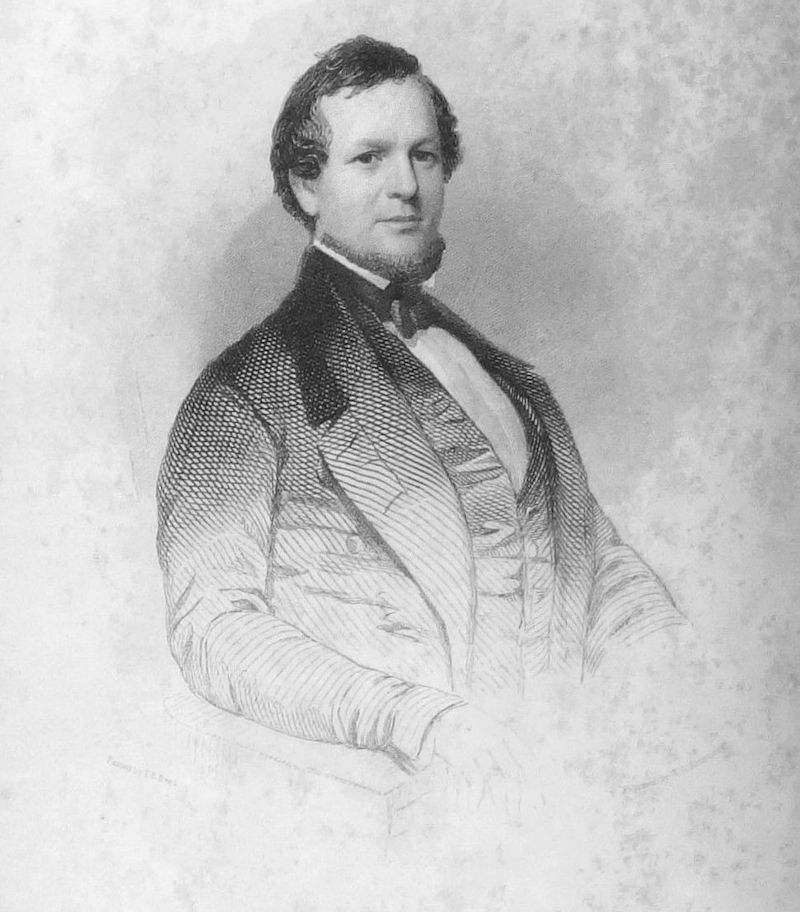
EDITOR OF GRAHAM’S MAGAZINE
Geo. R. Graham
Engraved by W.G. Armstrong from a painting by T.B. Read
[WITH A PORTRAIT.]
———
BY CHARLES J. PETERSON.
———
When a man, left a friendless orphan in boyhood,
overcomes every obstacle of fortune, and rises to
wealth and station, we justly conclude that he is
possessed of no common abilities. But when the
same individual, beggared by unforeseen events, retains
still the confidence of his fellow men, and
finally conquers fate a second time, and resumes his
lost position, we do not exaggerate if we call him an
extraordinary man. Yet such, unless the partiality
of friendship deceives us, is George R. Graham.
The father of Mr. Graham was a gentleman of
education and fortune, resident in Philadelphia,
where he was known, about thirty years ago, as an
enterprising shipping merchant. At one period he
was a partner of the late Robert Fleming, then carrying
on an active trade between Charleston and Ireland.
Subsequently he entered largely into commerce on
his own account, but disastrous times approaching,
he shared in the general ruin, and ultimately, not
only his fortune, but his life sunk under the blow.
He left two children, of whom the eldest, the subject
of our memoir, was born on the 18th of January,
1813. The early death of the father materially
affected the interests of the son. Mr. Graham had
been designed for the bar, and all his studies were directed
to that end; the preliminary arrangements had
even been made for him in the office of the Hon.
Charles Jared Ingersoll; but the reverses and death of
the parent frustrated the scheme, and the young orphan,
who had been born apparently to a life of comparative
ease, was left penniless and almost friendless,
to carve his way to distinction alone.
But, even at this early age, he did not despair.
Of a sanguine temperament and determined will, he
resolved to re-construct the shattered fortunes of his
family. He had been placed, on his father’s death,
and when only fifteen years of age, with his maternal
uncle, Mr. George Rex, an opulent farmer of
Montgomery County, Pennsylvania, after whom he
had been named; and with this gentleman, and in
the country he remained until he was nineteen.
The time, however, was not lost. On the contrary,
it was to this period of his life he is indebted for
that robust constitution which afterward enabled him
to endure the severe application to which he addressed
himself. During these four years he omitted
no opportunity to improve his mind. He read every
thing that came in his way. But books, fortunately,
were not so abundant then as now, so that what he
read he digested, and thus acquired habits of correct
thought, so rare among the hasty students of the day.
In 1832, Mr. Graham returned to the city, and commenced
to learn the trade of a cabinet-maker. But he
had already resolved that he would yet be a lawyer,
as his father had intended; and accordingly, to effect
this object, he now addressed himself with that untiring
energy which has ever characterised him.
His first object was to discipline his mind, to improve
his tastes, and to enlarge his stores of knowledge.
For this purpose he began a course of literary
study, and, for three years, prosecuted it with undiminished
ardor, exhibiting, during the entire period,
a perseverance amid difficulties which entitles him
to a high place among self-taught men. His trade
requiring his attention for ten or twelve hours daily,
he had but a short interval to spare for recreation and
sleep, but having resolved to devote six hours out of
the twenty-four to literary pursuits, he rigidly adhered
to his plan, gaining the time, when necessary,
by rising before dawn.
At the age of twenty-two he made the acquaintance
of a son of the late Judge Armstrong, of Philadelphia,
and by him was introduced to the judge,
who at once arranged to receive him as a student.
For the three years, during which he studied law,
he continued laboring at the bench, devoting the
early morning hours and the evening to Coke and
Blackstone. By the regulations of the Pennsylvania
courts, the last year of a student’s course has to be
spent in the office of some practicing attorney; and
this he was enabled to effect by rising at four o’clock
in the morning, laboring until nine, then visiting the
office, and often returning to the bench in the evening.
The writer of this happened to be a student with the
same preceptor at this period, and writes of facts to
which he was an admiring eye-witness.
The natural bent of the mind, in all well-balanced
natures, triumphs in the end over the plans of parents
and the exigencies of circumstances alike.
Under the influence of a commendable pride, Mr.
Graham had resolved notwithstanding his early misfortunes,
to fulfill his father’s wish, and become a
member of the bar; but now, he discovered that his
tastes led him toward a literary life. He accordingly
began to contribute a series of papers to the Philadelphia
press, which, at once attracted attention by
the vigor of their thought, not less than the freshness
of their style. He persisted, however, in his intention
of entering the bar, and, in 1839, was admitted
to practice.
His inclination for literature continuing instead of
diminishing, he resolved to abandon the active pursuits
of his profession, and embark in avocations
more suitable to his tastes. Accordingly, in the
same year he became editor of the Saturday Evening
Post, a well-known weekly journal, at that time
published by Samuel C. Atkinson. In the following
year, he became joint proprietor as well as editor.
He continued, in connection with his partners, to
publish this journal for several years, but finally, in
1846, parted with his entire interest in it.
It is as a magazine editor and publisher, however,
that Mr. Graham has made himself especially famous.
In 1839, at the time he became editor of the
Post, he purchased of Mr. Atkinson the Casket, a
monthly magazine of respectable ability and circulation.
This periodical he continued to publish, under
its old name, until December, 1840, when he bought
the list of the Gentleman’s Magazine, and united the
two monthlies as Graham’s Magazine, issuing the
first number in January, 1841. The success of this
new enterprise was unprecedented. Having spared
no expense to procure able writers and elegant embellishments,
the result was that he produced a periodical
of unexampled merit and beauty; and, at
once, thousands were added to his list. A new spirit
was infused into magazines. Before this period, the
monthlies had been filled with second-hand English
stories, or indifferently written original tales; while
their poetry, except what was taken from well-known
authors, was such as “both gods and men
abhor.” The illustrations were few and indifferent.
The freshness, beauty, and ability of Graham’s
Magazine at once placed it before all others in the
popular favor, and though its rivals hastened to imitate
the example it had set, it continued to maintain,
and maintains to this day, the supremacy.
The success of Mr. Graham’s Magazine was such,
that, by January, 1842, it had attained a circulation
of more than thirty thousand. Meantime no expense
was spared to increase its excellence, both literary
and pictorial. Mr. Sartain, the celebrated engraver,
was kept busily employed in furnishing mezzotints
for it: and some of the engravings then executed by
that artist, and by Smillie, Rawdon and Tucker,
have certainly never been since surpassed. The
most eminent authors in the United States were, at
the same time, sought for its pages. At first, these
writers were incredulous that any American magazine
could afford them adequate remuneration; but
the success which had already attended Mr. Graham’s
improvements convinced him that the public
would sustain him in his effort to raise the character
of our periodical literature, and accordingly he
persevered in his design. No sooner were Longfellow,
Bryant, Cooper, and others of our leading
authors, discovered to be permanent contributors to
Graham’s Magazine, than thousands, who had heretofore
looked with contempt on an American monthly,
hastened with their subscriptions, to encourage
the enterprising publisher. The benefit thus done to
popular literature cannot be calculated. But it was
such that it will be long, perhaps, before any one
man will have it in his power to do again as much.
The demand of a large business, and the watchfulness
necessary to keep the lead, left Mr. Graham
but little time for literary composition. He had,
however, increased his own reputation as a writer, of
occasional articles contributed to his newspaper and
magazine, but principally to the latter. Thoroughly
read in Bolingbroke, Addison, Burke, and others of
the classic authors of the language, his style was
distinguished by a finish, yet an idiomatic force
such as is rarely found among the careless writers
of the day. A clear, sound thinker; with a fervid
imagination; possessing a keen sense of the ridiculous;
and having a great command over the resources
of language, he always wrote to the point,
in a racy, nervous style, mingling eloquence and
satire by turns, and never, as hackneyed writers so
often do, drowning the idea with “excess of words.”
His choice of terms was singularly felicitous. He
wrote the language as the translators of the Bible
wrote it, with a large mixture of Saxon derivations,
yet with purity. In invective, as in sarcasm, he
was especially powerful. A series of editorial articles
contributed to the newspaper under his management,
and still remembered, are instances of
the former: his letters to Jeremy Short, are examples
of the latter. In a word, as a terse, and even eloquent
writer, Mr. Graham holds a high rank. As a critic
his judgment is always generous, but just.
In 1846, Mr. Graham purchased the North American,
a daily newspaper of standing and influence in
Philadelphia. He had no sooner embarked in this
new enterprise than it exhibited proofs of his energy
and tact: and, in a very short while, the ability
with which the journal was conducted made it a
name throughout the entire Union. In 1847, he still
further extended the influence and reputation of his
newspaper, by purchasing, in connection with his
partners, the United States Gazette, and consolidating
it with the North American. But he had now
attained, at least for awhile, the summit of his successes.
Having been induced to engage in certain
stock speculations, he entered into them with all the
ardor of his character, and though for a time successful,
eventually impaired his fortune to such a
degree that he was forced to part temporarily with
the Magazine and North American. This misfortune
happened in July, 1848. A man of his energy,
however, could not be kept down: fortune might
depart, but failed to overcome him. He continued
to edit his Magazine, even after parting with the
proprietorship of it, until March, 1850, when circumstances
having induced the retirement of Samuel
D. Patterson, he succeeded in regaining his interest
in his favorite periodical; and from that period has
added the duties of publisher to those of editor. This
restoration to his old position is the result of indomitable
energy, which he possesses in a degree that
is as rare as it is praiseworthy. With men of his
stamp nothing is impossible.
As a man Mr. Graham inspires general affection.
The warmth of his heart, and the frankness of his
manners make for him friends wherever he goes.
Generous to a fault, forgetful of injuries, conciliating
in his deportment, he is one to be alike popular with
the many and loved by the few. His faults, where
he has them, are those of a noble nature. His sense
of honor is keen. He could do no man wrong intentionally.
In all his actions, even to the most trivial,
the energy of his character, and the kindness of his
heart are equally discernible.
———
BY HENRY GILES.
———
In a cottage on the banks of Doon, near the town
of Ayr, in Scotland, in 1759, Robert Burns, one of
the world’s sweetest poets, first saw the light of
life. The peasant-child soon learned to know existence
in toil and sorrow; torn at an early age from
study to labor, grief went hand in hand with glory
through his remaining years. We find him amidst
the wild eccentricities of an irregular youth, without
any settled aim, as he himself declares, but with
some stirrings of ambition, that were only as the
blind gropings of Homer’s Cyclops around the walls
of his cave. With characteristic ardor, and with
more zeal than wisdom, he mingled in the theological
and political squabbles of the times, and by
the destructive boldness of his satire, and the shafted
power of his ridicule, he created many enemies
whom it was easier to provoke than to propitiate.
Nor must we hold him blameless. In the prodigality
of wit, and the wildness of laughter; in the madness
of merriment, and the pride of genius, he treated
opinions and persons with an unsparing levity which
a more thoughtful experience would have taught
him to regard with reverence or forbearance.
That his genius went too frequently in company
with his passions, and that the glory of the one was
sometimes wrecked in the delirium of the other, it
is not allowed us to deny; but these follies had their
penalties; and if it were possible, they were better
now forgotten in the ashes of his early grave. Burns
was a man that sinned, and one that suffered; but
he was not a man that sinned callously, or that suffered
meanly; and it is not for the living to write in
marble errors which the departed repented in tears.
Incidents of romance and anguish checker the
opening of his poetic fame with sadness as well as
sunshine. His “Highland Mary,” the love of his
youth, and the dream of his life is wrenched from
his heart by death. Then comes the melancholy
episode of his attachment to Jean Armor, with its
heavy retribution of wretchedness. His name has
begun to gather honor among his native hills; the
small provincial edition of his poems is hailed with
proud enthusiasm; but yet, with poverty and a bleeding
spirit, he looks across the ocean to foreign exile.
Suddenly his purpose is turned aside, and we behold
him in Edinburgh among the exclusives and magnates
of the land. There, as at the plough, we find
him still the true and sturdy man. In the throng of
Highland chieftains and border barons, in the full
blaze of pride and beauty, he felt within him a humanity
beyond the claim of titles; genius had given
him a superscription more impressive than device of
heraldry; the patent of nobility was written with fire
in his heart, and the proud ones of earth became poor
before the aristocrat of heaven. In that day of
classic propriety, a poet from the plough, full of passionate
earnestness, must have been in Edinburgh a
startling phenomenon. But nature made herself
heard in the very citadel of art; cavil was silent, and
admiration offered willing homage. The wealthy
marveled at the inspired peasant; and wherever
the eloquent ploughman appeared, there were the
nobles collected together. Dukes gave him their
silken hands; duchesses received him with sweetest
smiles; earls pledged him in the wine-cup; and for
the moment, the haughty and the high-born recognized
the presence of a greatness superior to their
own. But Burns was not a man to hold popularity
long in circles such as these. He was too stoutly
individual for the apathy of elegant mediocrity, and
he was too sternly independent for the sensibility of
patronizing grandees: he saw nothing to venerate in
a title when it was but the nickname of a fool; and
he was undazzled by a star when it glittered on the
breast of a ruffian or a dunce. But though Burns
escaped the danger of aristocratic delusion, he did
not escape the danger of aristocratic feasts. These
were the times of night-long carousals, and pottle-deep
potations. Burns had neither the firmness to
resist such dissipation, nor the constitution to endure
it; and he carried from it impaired health and impaired
habits—an irritable discontent with his condition,
and an instability of purpose fatal to a life of
labor. Having placed a tomb over the neglected remains
of poor Ferguson, the poet, he retired to the
country, shared his success with his brother Gilbert,
met his mother steeped in tears of honest joy, married
his Jean, and gave peace to a wounded spirit.
From this era of light in his course; from this day,
bright with fame and conscious virtue, we trace him
along a path devious and clouded. We follow him
through the toil of a profitless farm, to the struggles
of a country gauger, and from these to a destitute
death-bed. In all his follies and his sufferings, we
behold him true to a manly nature, loyal to noble
principles; and however seamed and deformed may
have been the surface of his life, virtue remained
unshaken in the centre of his soul. With a large
family, and only seventy pounds a year, he had an
open hand for the poor, and a hospitable roof for
stranger and for friend; and although he died owing
no man any thing, yet he has been stigmatized as a
prodigal and a spendthrift. He gave the world his
immortal songs without money and without price;
and with the generosity of benignant genius, he sympathized
with every effort of the humble men around
him for a nobler life, he ministered to their intellectual
wants, and he aided their intellectual struggles.
Accordingly, we observe him at a time when
he was harassed with cares and overcome with toil
on a barren farm, establishing a book club in his
neighborhood, forming its rules, and directing its
operations. To estimate this in the true spirit, we
must remember that it was sixty years ago, when as
yet there had been no “Mechanics’ Institutions” in
the land, and when Lyceums were not; when cheap
editions of standard works had not arisen even on a
printer’s dream, and “Societies for the Diffusion of
Useful Knowledge” were enfolded, as the poets say,
in the mighty womb of futurity. Dr. Currie, of
Liverpool, a genial and eloquent (though patronizing)
biographer of Burns, in narrating this portion of his
life, questions the utility of literary studies for the
great masses of the people. Strange questioning
this, in a life of Burns—the cottage-boy, whom the
little knowledge of a rustic school awakened for
eternity; raised from the clods of the valley to a
place among the stars, a burning and imperishable
light; and who, but for that little knowledge, might
have been as nameless clay as any that nurtures the
grass of a village church-yard.
The ideas of Currie have almost vanished with
his times; still even yet we occasionally hear some
small-souled cynic, some snail-shell philosopher, who
thinks himself of those sages with whom wisdom is
to perish, sneer scornfully at popular knowledge.
Popular knowledge, it is true, is not the wisdom of
Solomon; it has not the depth of Bacon, or the sublimity
of Newton; still, so far as it goes, it is a good,
and though the pedant may deride, the philanthropist
will rejoice. And what, after all, is the ground of
Mr. Pedant Wiseacre’s pride? Perhaps some learned
investigation on the contraction of the Greek kai, or
the tail of the Greek gamma. Seriously, the critic
and the scholar, when true to their noble office, deserve
our admiration and our gratitude; but those
who grub merely for withered roots, which never
produce either fruits or flowers; and, then, with insect
vanity, give themselves airs of scorn, are themselves
saved from contempt, only because all creatures
have their uses. It is well for society that
there should always be men of great and solid learning;
and evil would be the day when slight acquirement
should be a substitute for laborious thought;
but it is also desirable that these accumulated treasures
should be widely and bountifully distributed.
It is good to have deep fountains in our munitions
of rocks, but it is not good that these fountains
should waste themselves in darkness; it is not good
that they should merely feed the gorgeous river, and
the mighty cataract, they should also steal along in
the sunny streamlet, and give beauty to the secluded
nook. Let there be rich men, and let them rejoice
in their riches; let there be great men, and let them
exult in their greatness; let there be men of strong
intellect, but let them in their strength be merciful;
it is not, however, the great, the noble, or the strong,
that are ever of destructive nature; it was the lean
kine of Egypt that became the devourers—and yet
were as skinny as before; so there are poor, lean,
hungry animals of the critic species—unproductive
as they are voracious, that are naturally the most
unsparing and the most ferocious.
When Burns went first to Edinburgh he was the
rage, and homage to him became the cant of certain
circles. But it is seldom that such homage survives
a season. Poor Burns lived not long; but he lived
long enough to understand in bitterness the hollowness
of drawing-room applause. On a second visit
to the Scottish metropolis, the enthusiasts of the first
had disappeared. It is ridiculous enough now to us
to think of any lord or lady of bedizened mediocrity
supposing they could do honor by their notice to such
a man as Robert Burns; but ridicule deepens to contempt,
when we read of paltry provincials in Dumfries
looking ascant at their mighty townsman, our
indignation chokes our laughter at the record of
treatment which small fashionables could offer to a
great poet. Mr. Lockhart gives an anecdote from
a gentleman who told him that he was seldom
more grieved than when riding into Dumfries, one
fine summer’s evening, to attend a country ball,
he saw Burns walking alone on the shady side of the
principal street of the town, while the opposite side
was gay with successive groups of gentlemen and
ladies, all drawn together for the festivities of the
night—not one of whom appeared willing to recognize
him. The horseman dismounted and joined
Burns, who, on his proposing to him to cross the
street, said, “Nay, nay, my young friend, that’s all
over now,” and quoted, after a pause, some verses
of Lady Grizzle Baillie’s pathetic ballad.
Burns, amidst poverty and sorrow, when needful
comforts had almost failed him in his sickness, and his
children nearly wanted bread, in the thirty-eighth year
of his age, quitted a world that was not soon to look
upon his like again. Burns, the gladdener of so many
hearts, was at last outwrestled, and the mighty fell—Burns,
who had so deeply felt the rapture of genius,
and the misery of life.
The retribution with which the errors of Burns
chastised him, holds out impressive warning to all
who are capable of drawing wisdom from example.
If happiness could have found a resting-place in one
of the most honest hearts that ever struck against a
manly bosom; if happiness had been with noble
poetry, with an eloquence that never failed, with an
imagination rich as the breast of nature, and bright
as the stars in heaven; if happiness could have been
brought down from the sky by lofty and aspiring
sentiments, or fixed upon earth by generous and
gentle affections; then happiness would have been
the lot of Burns. But Burns had contracted habits
to which peace soon becomes a stranger; and he
who has such habits, be he bard, or be he beggar,
has already entered on the evil day; he may say in
all the bitterness of his soul, “Farewell the tranquil
mind.” It would seem as if Burns pictured by anticipation
his own sad fate when he wrote the Bard’s
Epitaph. “Whom did the poet intend?” asks
Wordsworth, as quoted by Allan Cunningham, “who
but himself—himself anticipating the too probable
termination of his own course. Here is a sincere
and solemn avowal—a public declaration from his
own will—a confession at once devout, poetical and
human—a history in the shape of a prophesy!” What
more was required of the biographer than to have
put his seal to the writing, testifying that the foreboding
had been realized, and the record was
authentic.
Is there a whim-inspired fool,
Owre fast for thought, or hot to rule,
Owre blate to seek, owre proud to snool,
Let him draw near;
And owre this grassy heap sing dool,
And drap a tear.
Is there a bard of rustic song,
Who, noteless, steals, the crowds among,
That weekly this area throng,
O, pass not by,
But with a frater-feeling strong,
Here heave a sigh.
Is there a man whose judgment clear,
Can others teach the course to steer,
Yet runs himself life’s mad career,
Wild as the wave;
Here pause, and through the starting tear,
Survey this grave.
The poor inhabitant below
Was quick to learn, and wise to know,
And keenly felt the friendly glow,
And softer flame,
But thoughtless follies laid him low,
And stained his name.
Reader, attend, whether thy soul
Soars fancy’s flights beyond the pole,
Or darkly grubs this earthly hole,
In low pursuit,
Know prudent, cautious, self-control
Is wisdom’s root.
Thus much I thought I might venture on our poet’s
life; I shall now proceed to offer some remarks
upon his genius.
Burns was a true child of nature; thence his
growing power, and thence the promise of his lasting
fame. But though the child of nature, he was not
the offspring of mere rude or uncultivated nature.
The Scottish peasantry were a class of men among
whom such a mind as that of Burns could perhaps
receive its most fitting development. Without the
refinement which tends to repress spontaneous expression,
they had sufficient of moral and intellectual
education to give that expression variety and strength.
Their country, their history, and their religion, were
all such as to train a serious and reflective imagination.
Therefore it is that no peasantry have furnished
so much to national literature as the Scottish,
and especially to national poetry. Within a period
by no means extensive in their annals, they have
given to the world such writers as Ferguson, simple
and full of music; Allan Ramsay, in his “Gentle
Shepherd,” the very genius of pastoral poetry; Tannahill,
a lowly spirit of melody and pathos, a sweet
voice of truth and tenderness; Hogg, the glorious
wizard of the mountains, coming down from his
shepherd’s wilderness, his memory peopled with all
olden legends, and his fancy teeming with all fairy
dreams. Burns, then, though mightiest, is but one
of an honorable family; though greatest and grandest
among them, they are his kindred; of some he is the
heir, of others, he is the progenitor.
Burns is a poet true, as I have said, to nature, and
therefore true to art. Burns is not mechanically
artificial, but he is patiently artistical. He had none
of that indolent vanity which shrinks from careful
preparation, which trusts all to sudden excitement,
and undigested emotions. He looked, as every man
of genius does, to the ideal; he knew it was not to
be comprehended in a passing glance, or reached in
a rapid bound, or embodied in a single effort; and
he knew that in the endeavor to unfold it, no execution
could be too thoughtful, and no labor too great.
It is not the consciousness of power, but the conceit
of vanity, which relies presumptuously upon momentary
impulse, which mistakes the contortions of
a delirious imbecility for the movements of celestial
agitation. The very creation of God, which required
but the will and word of Omnipotence for instant
and perfect existence, has been gradually constructed—the
earth on which we stand, so fair to look
upon, so robed with beauty, so radiant with life and
light, has been evolved from chaos through innumerable
formations and even the thunder so astounding
in its crash, and the lightning so sudden in its
stroke, have long been generating in the womb of
heaven. The man of genius, the man of creative
power, is at once inspired and industrious; at once
a man of passion and a man of patience; at once a
constructor and analyser, a man of enthusiasm, but
also a man of wisdom. Genius is not intoxication,
and it is even more than rapture; it is capacity subject
to the law of truth and beauty; the intense action
of the soul, exalted, harmonious, and illuminated.
The dash of noble thoughts may come suddenly on
the brain; the torrent of enkindled feeling may rush
upon the heart, but the spirit of order and of art must
move over the face of this brilliant chaos, ere it is
shaped into that perfection which the world does
not willingly let die. All mighty souls know this;
the rustic Burns knew it, not less than the godlike
Milton.
The genius of Burns is now, by that instinctive
appreciation which forms the supreme tribunal,
placed in the highest order. Whence is this? All
he has written may be contained in a moderately
sized volume. If quantity of production therefore
were needed to exalt a writer, which it is not, Burns
should remain in the region of mediocrity. Neither
has he composed as critics would seem to require, a
work of elaborate and faultless excellence; for he
has not even attempted a tragedy or an epic poem.
But critics cannot decide this point, and that common
heart which decides for all has decided for
Burns. The depth and extent of his humanity has
gained him his distinction, and it is that humanity
which gains distinction for any who outlive their
age. It is this spirit of love and sympathy which
evinces the kindred that all men recognize; it is
this spirit that reaches the truth of nature below all
changes, custom and convention; below all colors
which climates paint upon the skin; it is this which
outlives all facts and fashions, and abides forever in
the immortal heart. Whoever has this spirit must
live; whoever has it not must die; whoever has
this spirit must live, defiled though he may be with
many evils; whoever has it not must die, no matter
how excellent he may be besides; no matter what
his brilliancy, his sagacity, his talent, the generations
will outlast them all; will give them to as deep oblivion
as they do the tongues of Babel. The world
cherishes Boccacio, notwithstanding the offences of
his tales; so it likewise preserves Chaucer; Rabelais
and old Montaigne continue in literature despite
of their impurities; and to think of Shakspeare
dying would be to conceive the extinction of letters
or our race. All these men are deathless brothers,
and Burns is amongst them. His poetry is thoroughly
human; a poetry which reproduces as we read it
all the feelings of our wayward nature; which shows
how man was made to be merry, and how he was
made to mourn; which enters the soul on its sunny
or its gloomy side, expands the heart with laughter
or chastens it with melancholy.
In knowledge of man, Burns strikes us with wonder
unspeakable, when we consider the narrow
circle in which he lived, and the early age at which
he died. A single song is like a compressed drama;
and within the circle of these songs we have impulses
from every stage of life, from the perturbations
of youth to the chill of age. To every shade
of sentiment and affection; to every change and turn
of inward experience, to every oddity and comicality
of feeling, he has given a voice of musical and energetic
utterance.
Man, and man directly—man in the play of all his
passions, is, with Burns, the great object of interest.
The descriptive and the picturesque for their own
sake have therefore no place in his writings. A picture
with him is never more than the drapery of a
passion. The chivalric past has none of his veneration;
and the past, in any form, only kindles him
when he associates it with the movements of humanity
or the struggles of liberty. The conflicts of
feudalism, the rivalry of dynasties, the gorgeous
falsehoods of departed ages, had no enchantment to
warm his fancy or to rule his pen. In this respect,
the writings of Scott and those of Burns are as opposite
as are their characters. The brilliancy of descriptive
narrative glows over the poems of Scott—the
strong life of passion throbs in those of Burns.
Even in the record of a tour this contrast is observable.
Scott has the eye of an antiquarian and a map-maker
united. Burns glances along as if space were
a tiresome obstruction to his fiery nature: Scott surveys
every baronial castle, and notes all its chronicles.
Burns raves with inspired fury on the field
where the invader was struck down, where “tyrants
fell in every blow.” Scott imagined that genius
owed homage to rank; Burns gave the obligation
another version, and conceived that rank should do
reverence to genius. Peasant-born, he was too
proud in his humanity to covet titles: almost morbidly
jealous of individual independence, hereditary
aristocracy was not to him poetically impressive;
its outward glare provoked his scorn, and its deeper
abuses sickened his imagination.
Two most human qualities in all poets are pre-eminent
in Burns—I mean pathos and humor.
His pathos is profound but kindly. No writer is
less gloomy than Burns, and yet none for the extent
of his compositions has more pathos. No writer
within the same compass has grander thoughts or
deeper beauty; and, by some magic of the heart,
grand thoughts and deep beauty are always allied to
melancholy. The canopy of the blue heavens, when
not a cloud swims in its brightness, makes our rapture
sad: so it does when the stars stud it with ten
thousand lights: the mountain’s majesty and the
ocean’s vastness subdue our souls to thought, and in
this world of ours thought has ever something of the
hue of grief. It would seem as if a mysterious connection
existed between great objects and pensive
feelings, between lofty sentiments and deep regrets,
a kind of struggle in our higher nature against the
limits of its condition: a disappointment at the long
interval that separates our aspirations from the ideal,
tinges with sorrow all our sensations of the beautiful.
Pathos such as this imbues all the graver
poetry of Burns. Scarcely is there a wo which
wrings the bosom between the cradle and the grave
which has not an expression in the solemn music of
his verse, from the gentlest whisper of feeling to the
frenzies of every pain and the agonies of every passion.
But though deep, his melancholy is not morbid.
It is the melancholy of great capacities and of
real suffering; of error reacting on itself a just infliction;
or glorious desires yearning for their congenial
objects. The muse of Burns was a rustic
maiden; a maiden healthful and hardy. Fits of
vapors she might occasionally have, but the heather
of her native mountains soon restored the elasticity
of her step, and the breeze of her pleasant valleys
quickly recalled the bloom to her cheek and the
lustre to her eye. At times she sought the solitudes;
but she returned ere long to human homes, and sang
her wild and simple songs to the friendly circle.
She loved, it is true, to meditate under the green
shadow of the forest, and to look up in raptured
spirit to the lurid and darkened heavens; but she
loved no less the blessed sunshine on the harvest
hill, and the cottage smoke that floated in the evening
sky. If occasionally she wept amidst the graves
of her heroes, she came from the places of the dead,
more boldly to proclaim liberty in the places of the
living.
This pathos is neither maudlin nor misanthropic.
It does not make the head giddy with paradox; nor
whirl the heart upon a wild and chaotic tempest of
doubt and selfishness; it does not dissect out the
evils of human nature, and gloat over them with a
diseased voluptuousness; it does not lead you to sit
at the feast of despair, with the spectres and skeletons
around you of unsocial horrors. It is no mawkish
pretence of sentiment. Burns is true to what he
feels; and, right or wrong, he speaks it as it is. He
maintains this course in his good and his evil. It
saved him from groveling and bombast; it saved
him from intellectual cant, and from literary quackery.
No language is so eloquent as honest language.
Truth goes direct to its purpose, while affectation is
crawling around its petty circumlocutions; and, as
the straight line is the shortest, the most sincere
words are the most resistless. As the poet had honesty
in himself, he had faith in others. His appeal
was weakened by no skepticism in the capacity of
humble men to appreciate the noble and the beautiful.
He spoke to them as beings whose hearts were
of the same substance as his own; he spoke confident
of the result, and he was not disappointed. The
first auditors of his verses were the obscure dwellers
among Scottish hills and hamlets, and to his words
he received as true a response as poetic enthusiasm
could have desired. The sons and daughters of toil
proved to him, that he had not trusted them in vain.
He gave them his faith, and they paid back the trust
with a priceless love.
I have said that the pathos of Burns is not morbid—and
I have said truly. In its lowest depths, it is
not dark—in the uttermost sadness, it is not despairing.
He grieves, but he never whines; and when
he utters forth tones the most plaintive, they are yet
so vigorous and so full, that, by the strong sound of
them, you feel that they come out from the stalwort
struggle of a manly bosom. He has pathos, too, of
every variety. He has the pathos of sympathy—and
this sympathy is often so intense, as to amount to a
passionate indignation. As thus, in the poem—“Man
was made to Mourn:”—
Many and sharp, the numerous ills—
Interwoven with our frame!
More pointed still we make ourselves,
Regret, remorse, and shame.
And Man, whose heaven-created face,
The smiles of love adorn,
Man’s inhumanity to man
Makes countless thousands mourn.
This is a large and noble eloquence, condensed
into a soul-fraught poetry; yet is it but one out of the
many stanzas of which the whole consists, of equal
power. So, likewise, he has the pathos of pity, of
tenderness, in their finest modulations. The chords
of his own heart were most delicately attuned to
“the soft, sad music of humanity;” and the breathings
of its sorrow were of that genuine humanity, to
which other hearts cannot but respond. How much
of such pitiful gentleness have we constantly in his
poetry, often coming near to gusts of anger—like the
song of a mourner in a stormy midnight—or, the
moan of the tempest after its rush. But sometimes
we have low and melancholy plaints, without one
tone of harshness, in such exquisite verses, as those
on “The Mouse,” and “The Mountain Daisy”—in
“Poor Mailie’s Elegy”—and “The Farmer’s Address
to the Old Mare on New Year’s Day.” Illustrations
of this point are in all his writings, prose as
well as poetry; but I will only mention one other—his
“Lines on a Wounded Hare.” Burns has, in an
eminent degree, the pathos which springs from contemplation
of our mortal life; and not less, that
which comes from those solemn questionings of the
spirit, to which experience and the Past, give only
accusing answers. A man of genius may do wrong;
he may lose himself in the mazes of the passions; he
may forget himself in the excitement and turbulence
of the senses—but all this is at a deadlier cost than
it is to any other man. Let no puny-copyist of
genius only in its errors and its wanderings, doubly
deceive himself—first, by supposing that he has
genius, and then, more fatally, deceive himself by
inferring that genius has impunity. True, it is, that
genius, like charity, covereth a multitude of sins—and
for the delight and the beauty which a great soul
showers upon the world, the world does abundantly
forgive. But, genius does not forgive itself. A strong
moral sensibility—though, it may be, not strong moral
principle—is mostly a concomitant—if not an essential
element—in the nature of a man of genius, and,
therefore, when such a man does violence to his
higher sentiments, his very genius becomes his punishment.
The grandeur of his ideal—the innate love
that he must have to the good and to the beautiful—the
extent of his moral associations—the tenacity of
his moral memories—the vitality of his imagination,
calling back again, and back again, the thoughts
which had only disappeared, but were not dead—all
conspire to chastise him, and to chastise him by
the faculties which enchant and move the world.
The depth and the compass of his sympathies afflict
him; and, as the fountains of thought and feeling are
full within him, so much the greater are the agitations
that shake him. These remarks concern mainly
those men of genius whose nature is that of a comprehensive
humanity. Men there have been, and
are, that might be adduced to contradict the position
I have ventured here to take: for they were capable
of much that was unworthy—and yet they did not
suffer or repent. Some were deniers, and some were
sensualists—the deniers had fine art, and the sensualists
had fine sentiments—and all were men of
genius. I have no reply to make, except that, in
such men, their genius, as their humanity, was of
partial, though intense development; and that such
was a class to which Burns did not belong. He was
neither a denier nor a sentimentalist. He was a man—take
him for all in all—and he was a poet in the
whole compass of the man. The man spoke through
the poet, not in gladness only, but, also, in every
note of sorrow and compunction. What sombre
power in his Ode to Despondency.
Oppressed with grief, oppressed with care,
A burden more than I can bear,
I sit me down and sigh:
O life! thou art a galling load,
Along a rough, a weary road,
To wretches such as I!
Dim, backward, as I cast my view,
What sick’ning scenes appear!—
What sorrows yet may pierce me through,
Too justly, I may fear!
Still caring, despairing,
Must be my bitter doom;
My woes here, shall close ne’er,
But with the closing tomb.
See this again, in the affection with which he loved
the sombre phases of external nature, and the force
with which he painted them. Thus he meditates in
Winter:
The sweeping blast—the sky o’ercast—
The joyless winter-day,
Let others fear, to me more dear
Than all the pride of May:
The tempest’s howl, it soothes my soul,
My griefs it seems to join;
The leafless trees my fancy please—
Their fate resembles mine.
Then passing from this low-breathing despondency,
we have lyric tragedy shouting down despair
in a kind of reckless ecstacy. Bold and brave is
this “Song of Death:”
Farewell, thou fair day, thou green earth, and ye skies,
Now gay with the bright setting sun;
Farewell, loves and friendships, ye dear tender ties,
Our race of existence is run.
Thou grim King of Terrors—thou life’s gloomy foe—
Go, frighten the coward and slave;
Go, teach them to tremble, fell tyrant! but know,
No terrors hast thou to the brave!
In the pathos of love Burns has no superior. What
poet in ancient or modern times, short of Shakspeare,
has sung with more varied inspiration than
Burns, the agitations with which love convulses the
heart of man, and breaks the heart of woman? In a
few compressed, but simple-meaning lines, he reveals
the passion in all its regrets and agony. And
here also, we can see the force, the simplicity—the
vehement sincerity of his poetry: and we can see
exactly the same characteristics in his life. Allan
Cunningham, in his biography of Burns, tells a very
affecting anecdote, which I may here fairly adduce
in illustration. Jean Armor was lying ill in the
house of her parents. Burns had arranged to quit
the country for ever, but wanted, once before he
left, to see his Jean. Burns attempted to go into the
house, but her father stood in the door to exclude
him. Burns, maddened by his grief, pushed the old
man aside, rushed up to his daughter’s chamber,
and throwing himself across the bed, wept as if his
heart would burst. And, with regard to his verses
to “Mary in Heaven,” if any thing could be more
pathetic, than the verses themselves, it was the circumstances
in which he composed them. It is now
familiar to all who read the least of literary history,
that this sublimely pathetic ode, was composed on
the anniversary of the maiden’s death, while the
poet lay abroad in the field during a bright harvest
night, recalling the images of past affections, and
out from this dream of the wakeful and troubled
heart came that dirge of music which the noblest
humanity inspired, and which the rudest humanity
must love. It is so familiar to every one, that I
will not dare to profane it, by repetition. But here
are a few lines of a song, lyrical with all the melody
of sadness.
Ae fond kiss and then we sever!
Ae farewell—alas, forever!
Deep in heart-wrung tears I’ll pledge thee—
Wailing sighs and groans I’ll wage thee—
Who shall say that fortune grieves him—
While the star of hope she leaves him?
Me, nae cheerful twinkle lights me;
Dark despair around benights me.
. . . . .
Had we never loved sae kindly,
Had we never lovéd blindly,
Never met—or never parted,
We had ne’er been broken-hearted.
The humor of Burns, too, is full of humanity. It
is affluent with all the rich and laughing juices of
the heart, and has only just so much of acid as adds
pungency to sweetness. Burns has the humor most
characteristic of his country; but beyond that, he
has a humor belonging to himself—a humor which,
while it distinguishes the individual, endears him to
his kind. In common with his countrymen, he has
the cautious innuendo—the sly allusion—the insinuated
sarcasm—the shrewd but mocking suggestion—the
implied irony—the dextrously concealed and
quiet fun—the sober joke—but he goes beyond all
this—and has a humor—which can make men of
every nation shake their sides—a humor that often
unites the broadness of Rabelais with the sentiment
of Sterne. Such a humor demands not only extraordinary
wealth of imagination, but also, extraordinary
force of intellect—a very uncommon fancy and
a very strong common sense. And, it was the union
of these in Burns which so well enabled him to be
at once comic and satirical—which enabled him so
happily to combine the sarcastic and the ludicrous—and
he does this in such a way, that while his victims
writhe before us, we discern no malignity in
their torturer. But, it is in jocund, queer, joyous
humor—humor reckless in its gladness, that Burns
the most excels. In this species of humor he has
scarcely an equal. Few of the greatest masters in
humor come near him; and in what we may call
the comic-lyric, he stands almost alone. The humor
that makes richest melody in the heart; that sings
for very joy; that by every note in which laughter
can sing out its ecstacy—swells the choruses of
mirth and merriment—the humor that is a jubilee in
the bosom, that gives widest liberty to fancy—a
saturnalia, in which no thought of care or labor,
dares intrude—a carnival, in which all kindly oddities
of conception play their parts—a humor that
combines imagination and feeling into numberless
bright varieties, to exhilarate our life—of this humor,
Burns in his laughing moods is the potent
wizard—of this enlivening magic his gayer songs
are the resistless spells.
This humor, too, is generously and jovially human,
and although Burns’ ridicule is often coarse, it
is rarely cruel. He strikes, but it is with the arm
of a man, and not with the blasting of a fiend. Gall
he does sometimes mingle with the cup of satire, but
never the deadly night-shade; the barb he sharpens
keenly, but he does not steep it in poison. He
painted, it is true, with a breadth and richness of
coloring that made men hold their sides and set the
table in a roar, the fooleries and absurdities of individuals;
the pretensions of sects, and the bitterness
of factions; the vanities of professions; the motley
trivialities of presumptuous and stolid nonsense; but
in the very storm of his sarcasm, he spares our common
nature. There is a ridicule which properly
may be called diabolical; which desecrates every
thing endeared and noble; which laughs not in festivity
of spirit, but in bitterness of heart; which
like the witches in Macbeth, around the midnight
cauldron, shrieks in the irony of satanic mirth over
the degradation of humanity. This temper is realized
in the writings of Swift, and affected in those of
Byron; but we discover no trace of it in the compositions
of Burns. Burns would give even to Satan
himself the grace of repentance, and a chance of
heaven. Burns, like Byron, can pass rapidly from
the grave to the grotesque, but altogether in a different
spirit. In the one it is the prodigality of fun;
in the other it is willfulness of scorn; in the one, it
is sport; in the other it is derision; the one as friend
to friend mocks humanity pleasantly; the other
makes it a Sancho Panza, tosses it in a blanket,
and laughs the louder, the more it is humiliated. I
believe the spirit of Byron was naturally a fine one;
but it was spoiled, if not utterly ruined, as to all its
higher capacities and sympathies. I say not that
his moral humanity was extinguished, because that
would be uncandid; but I do say, that he became
fantastic and capricious to such a degree as to fail
in the charities which not only soften life, but dignify
literature.
Attributing humor to Burns, I do not estimate it
as the slight matter which many seem to think it.
If we trust some persons, we should conceive that
length of face was length of wisdom, gravity of
look, the veil of oracles; thickness of skull the safeguard
of knowledge; and rigidity of muscle, the solemn
surface of an unfathomable philosophy. But
humor in its higher form is the quality, not only of a
liberal, but of a cultivated spirit. It requires that
the mental powers be vigorous as well as genial.
It requires imagination and intellect, as well as a
heart in the right place, and the juices of the body
in a good condition. Humor as well as pathos is
the result of sympathy—of sympathy that embraces
man in the most brotherly cordiality—weeps with
those who weep, and rejoices with those who do rejoice.
This is the humor of Shakspeare; it is the
humor of Hogarth; it is the humor of Burns. And
many a noble use has this honest faculty—often is it
more effective than sermons, to make life lambent,
to clear the sky, that was becoming too heavy around
us, to warm social intercourse, to nurture our socialities,
to dissipate evil passions, and by its pleasant
mockeries, to shame us out of nonsensical miseries.
Time would now fail me to refer to the poetry of
Burns with any special detail; but for pages so well
known, a few brief reminiscences will be sufficient.
How full of beauty is “The Vision,” the poem in
which, with a self-conscious greatness, almost Miltonic,
he celebrates his own consecration to the
glory of his country; we read it in delight, in wonder,
and with sorrow, and with joy; we verily admit,
that, “the light which led astray was light
from heaven.” With what solemn pleasure we
recall the “Cottar’s Saturday Night.” No other
poem in the language shows how much the eye of
a poet can see, how much the heart of a poet can
feel, where another heart is dull, and another eye is
blind. To the prosaic nothing familiar is exciting,
but to the inspired all existence is full of glory. Here
upon a cottage floor we have placed before us, the
most pure, and the most noble virtues; the piety
that looks to heaven; the patriotism that dignifies
earth; here we have the father returned from his
toil, with his “wee things” circling his knees, his
clean hearth stone; his “thrifty wifie’s” smile; his
soul made glad with Sabbath hopes and with holy
thoughts; here are brothers and sisters gathered
from the work-day world around the parents that
shielded, and that blessed their infancy; here are
the pleasant face, and the heart’s own smile; here
the homely feast with a joy which luxury refuses,
and a gratitude which no luxury inspires; here is
first love with maiden blushes, shames and fears;
here are all the sublimities of the affections, all in
the shades of unnoticed life. How noble is that
father and that peasant-priest, as he bares his “haffit
locks,” and “let us worship God he says with solemn
air;”
Then kneeling down to Heaven’s eternal King—
The saint, the father, and the husband prays—
Hope “springs exultant on triumphant wings,”
That thus they all shall meet in future days:
Thus ever bask in uncreated rays—,
No more to sigh, or shed the bitter tear,
Together hymning their Creator’s praise,
In such society, yet still more dear;
While circling time moves round in on eternal sphere.
Compared with this, how poor! religion’s pride
In all the pomp of method and of art,
When men display to congregations wide,
Devotion’s every grace, except the heart!
The Power incensed, the pageant will desert,
The pompous strain, the sacerdotal stole;
But haply, in some Cottage, far apart,
May hear well pleased the language of the soul,
And in his Book of life the inmates poor enroll!
And how exalted that love of country which utters
this fine supplication:
O Scotia, my dear, my native soil,
For whom my warmest wish to heaven is sent,
Long may thy hardy sons of rustic toil
Be blest with health, and pence, and sweet content.
And O, may heaven their simple lives prevent
From luxury’s contagion weak and vile,
Then, howe’er crowns end coronets be rent,
A virtuous populace will rise the while,
And stand a wall of fire round their much loved isle.
The spirit of hilarity has never been so admirably
blended with the gloomy and the tender, as in the
tale of “Tam O’Shanter.” Heroic and immortal
Tam will stand his ground while the name of witch
or warlock has a place in language. This marvelous
mixture of fun and fancy; this chronicle of midnight
revelry; this record of wit and waggery, of good
fellowship and ghosts, has now a lodgment in every
mind that relishes drollery and genius. Here we
have the sublime with the ludicrous; images most
delicate with images most homely; subtle analogies
with grotesque incongruities; touches of sorrow
with strokes of glee; all coming in such rapid succession,
that, while the broad grin is on the lip, the
tear is starting to the eye. “The Jolly Beggars”
gives us the very saturnalia of low life; jovial
poverty frolics away in the full abandonment of
extravagance, dashed over, however, here and there,
with those shadings of regret which obtrude the sadness
of life, when men try to forget it most. The
“Halloween,” pictures the poor man’s carnival,
such as it used to be in Scotland, with all its superstitions
and its sports. “The twa Dogs,” is a genial
exposition of the poor man’s philosophy. The dog
of wealth, laying aside his master’s pride in his
master’s absence, meets the peasant dog with very
kindly courtesy; and both sitting tranquilly on their
haunches, with nose to nose, and most sagacious
phizzes, discuss the comparative merits of riches
and poverty, pity the folly of their two-legged
fellow creatures, congratulate each other on their
canine superiority, and bless their stars for being
dogs instead of men. Cæsar, the dog of high life,
with an air of peculiar respectability and most complacent
compassion, wonders how poor folks can
live at all. Luath, his humble friend, knows that
poor folks not only live, but live with very many
pleasures; and this Luath was a dog of sympathy;
he shared the cottage sorrow; he shared also the
cottage joy; he rattled away among the dancers;
wagged his tail in the highest glee of his honest
heart, and gave his chorus to the merry sound.
When adversity was on the hearth, his face grew
long; when better times returned, it was broad again.
My heart hae been sae fain to see them
That I for joy hae barkit wi them.
The whole of this poem is fraught with the noblest
and the most endearing humanity—a humanity
most varied and most musical in its tones—running
quickly along all the chords of sadness and of merriment,
throwing forth a harmony of charity and
heart-breathing kindness, in which grave sounds
and gay mingle together, but not one vibration ungenial
or discordant. That Burns should give to
dogs sentiments thus characteristic of a sweet and
generous temper, corresponds entirely to the feelings
with which he regarded that animal, as illustrated
in a passage which I have lately found, taken
from a newspaper.
The following original anecdote of Burns is in a
work entitled the “Philosophy of the Seasons,” by
Rev. Henry Duncan:
“I well remember with what delight I listened to
an interesting conversation which, while yet a
school-boy, I enjoyed an opportunity of hearing in
my father’s manse, between the poet Burns and another
poet, my near relation, the amiable Blacklock.
The subject was the fidelity of the dog. Burns took
up the question with all the ardor and kindly feeling
with which the conversation of that extraordinary
man was so remarkably embued. It was a subject
well suited to call forth his powers, and when handled,
by such a man, not less suited to interest the
youthful fancy. The anecdotes by which it was
illustrated have long escaped my memory; but there
was one sentiment expressed by Burns with his characteristic
enthusiasm which, as it threw a light
into my mind, I shall never forget. “Man,” said
he, “is the God of the dog. He knows no other;
he can understand no other; and see how he worships
him! With what reverence he couches at his
feet; with what love he fawns upon him, with what
dependence he looks up to him, and with what cheerful
alacrity he obeys him. His whole soul is wrapped
up in his God; and the powers and faculties of his
nature are devoted to his service; and these powers
and faculties are exalted by the intercourse. It ought
just to be so with the Christian: but the dogs put the
Christians to shame.”
It is thus, that the spirit of human love, the truest
element of poetic beauty, can ennoble and consecrate
all it touches; it is thus that Burns elevates the
most lowly objects; the farmer’s mare, proud in her
age and services; the little cowering mouse, houseless
and frightened; the dying ewe; the wounded
hare; the simple daisy; rustic sweethearts and rustic
beggars; all were endeared to his generous imagination,
and over them, while words have meaning,
there will be laughing eyes, and serious faces.
Burns has been great in whatever poetry he attempted,
but in lyric poetry, he is greatest of all.
The songs of Burns, in every point of view, are truly
wonderful compositions. We are at a loss which
most to admire, their number and variety, or their
individual perfection. The lyre of Burns incessantly
changes its tone, and in every change it throws
forth a flood of new inspiration. Great indeed is the
task to give poetic and condensed expression to those
thousand impulses that ever heave within us, and
are evanescent as the ocean wave; to furnish fitting
words for the ideal and fervid longings which millions
feel, but cannot utter for themselves; to embody
in lasting form, innumerable and undefined desires;
to touch chord after chord of memory and
emotion, and to awaken the divine music that slumbers
in the soul; in a word, to give melody and
speech to the complicated heart of man: great is
the task, but Burns has accomplished it.
Burns—great in sadness and great in humor; so
human in his melancholy, so loving in his laughter.
When we hear the pleasant peal of his hearty mirth,
our bosoms dilate, until we could embrace our species
in affection. When, changing his tone, we feel
the breath of his indignation or listen to his cry
against oppression, our pulse beats quicker and our
blood flows faster. Burns, bard of the brave and
fervent soul, destined to move humanity as long as
language shall endure; as long as the love of liberty,
of independence, of fearless honesty, or patriotic
courage, shall have a refuge in our world.
Burns is a nobleman of nature;—a man for the
toilsmen of earth to look upon and hope. In humble,
rustic life, under the thatched roof, which gave the
peasant his shelter; in the field where the heir of
labor in the sweat of his brow fulfilled the original
destiny of man, Burns fed inspired thoughts, and
laid the foundation of a deathless fame. True, his
life was short in years; but how passing long was
it in emotions, in capacious and crowded fancies.
His spirit was goaded, no doubt, with the vulgar
cares of poverty, and the worse results of passion;
but it was glorified also with conscious genius; he
could retreat from the vexations of the world to the
sanctuary of his enriched imagination, and there,
amidst all the evils of his outward condition, he
could find in poetry its own exceeding great reward.
Through all the sorrows that overspread his short
but rapid course; amidst all the clouds that hung
heavily over his path, glimpses of joy were ever
and anon bursting on his enraptured eye, which it is
given only to the favored ones to behold. And who
would not, if he could, have a soul so adorned with
the beautiful, rather than without it, be overburdened
with the load of external fortune? Had Burns been
merely a man of title, he had been forgotten as all
titled dust since the days of Nimrod; as unknown
as the dukes of Edom; a pompous funeral and a
lying epitaph would have given him to oblivion.
As it is, the recollection of him is garnered in the
choicest corners of the heart, and his name is linked
forever to the music of sweetest sounds.
I am now at the close of my task. I have gone
through it lovingly, and with reverence; sensible
along the way of much goodness in my subject, and
not forgetful, either, of some evil also. That many
faults are in the compositions of Burns, I apprehend
most clearly; and that sad irregularities were in his
life, it requires small trial of candor to confess; but to
have spread them out in ostentatious commentary
would have served no purpose of this article, and
gratified no desire of the reader. I am not blind to
those errors; I propose no excuse; I deprecate no
just condemnation, and I have been forbearing from
no moral indifference, no moral insensibility. But
dealing with the memory of genius, I reflected that
the man was before his God, and the poet had met
the sentence of the world. For wisdom, or for
warning, the events of his life are sufficiently familiar—he
that runs may read, their moral meaning
let him read and ponder—let him learn, and let him
be better. But I have no sympathy with that vampire-like
spirit which disentombs the faults of the
illustrious dead to feed the nauseous appetites of
itself or others; I tread upon the grave with caution
and compassion; and while I do not regard genius
as repealing the law of virtue, neither do I regard it
as beyond the law of mercy. We need, all of us,
great tenderness from those who surround us; we
need much, too, from those who survive us. If we
require charity from men, who give them nothing,
let us grant it to those who have enriched us, and
enriched the ages. In the noble and eloquent verses
of Halleck, we, too, say of Burns:
His is the language of the heart,
In which the answering heart would speak;
Thought, word, that bids the warm tear start,
Or the smile light the cheek.
And his, the music, to whose tone
The common pulse of man keeps time,
In cot or castle’s mirth or moan,
In cold or sunny clime.
. . . . . .
Praise to the bard, his words are driven,
Like flower seed by the far wind sown,
Where’er beneath the sky of heaven
The birds of fame have flown.
Praise to the man! a nation stood
Beside his coffin with wet eyes,
Her brave, her beautiful, her good,
As when a loved one dies.
And still, as on his funeral day,
Men stand his cold earth-couch around,
With the mute homage that we pay
To consecrated ground.
And consecrated ground it is
The last, the hallowed home of one,
Who lives upon all memories,
Though with the buried gone.
Such graves as his, are pilgrim shrines,
Shrines to no creed or sect confined,
The Delphian vales, the Palestines,
The Meccas of the mind.
———
BY HENRY C. MOORHEAD.
———
If the reader has ever passed along the banks of
the Susquehanna, or floated down its waters, he has
not failed to admire the beautiful coves which are
here and there formed by the bending hills on either
side. With a mountain border sweeping round in
the shape of a half moon, and the river flowing in a
straight line in front, these terrestrial crescents form
a series of most charming landscapes. In one of the
most charming of them all lived an old gentleman
whom we shall call Richard Parkett.
Many years before the period of the following incidents,
the wife of Mr. Parkett had died, committing
to his care with her dying words, an infant daughter.
They called her, after her mother, Lucy; she grew
up like a wild flower in her sequestered home, and,
at the time we speak of, was just budding into womanhood.
And surely no opening rose could be
more lovely. The bloom of health was on her
cheek; her step was free and elastic as that of the
fawn on the neighboring mountain, and her spirits
as bounding and joyous as those of the birds which
“warbled their native wood-notes wild” around her
dwelling.
“My child,” said Mr. Parkett, to her one day,
“there is to be an arbitration in the neighborhood
to-morrow, to settle some matters in dispute between
myself and a neighbor, and we will need you
for a witness.”
“For a witness—what does that mean?”
“Why they will make you swear a terrible oath
to tell the truth,” said the old gentleman, smiling
affectionately; “and then two or three lawyers will
endeavor to puzzle you so as to prevent your
doing it.”
“And who are these puzzling lawyers?”
“One of them, whose particular business it will
be to puzzle you if he can, is a young man named
Burton.”
“Burton?—Sidney Burton? He is the young gentleman
who called here last winter to see you on
business, is he not?”
“Really, you seem to have an excellent memory
for young gentlemen’s names.”
Lucy blushed slightly, but made no answer. However,
she was much more sober and thoughtful than
usual all that day.
The arbitration came on, and Lucy was sworn as
a witness. Her story was short and simple, and referred
merely to a conversation which she had heard,
and about which the parties could not now agree.
As Burton was counsel on the other side, he then
proceeded to cross-examine her. It was of great
importance to his cause that he should shake her
confidence in what she had said; and he therefore
proceeded (with great delicacy, however) to ply her
with an infinite variety of perplexing questions.
But, although she was artless as a child, her quick
apprehension, and her clear, ready answers filled
him with admiration; which was not at all diminished
by an occasional volley of mischievous satire
which raised a smile at his expense. He even continued
the examination for some time after he saw
that it was useless, for the pleasure it afforded him.
At length, all parties being satisfied, the dispute was
amicably settled, and Mr. Parkett invited the company
to his house.
Nothing could have pleased Burton better than
such an invitation; he wished to see more of this
charming witness, and to present himself before
her under more favorable circumstances than in a
cross-examination. Lucy, on her part, was equally
pleased with this arrangement, for Burton’s image
had never ceased to haunt her imagination since the
day she had first casually seen him at her father’s
house some months before. She could not explain
the mystery to herself, but she felt an indefinable
interest in every thing that concerned him, and her
heart beat warm and quick at the sound of his voice.
On the following morning Burton was urged to
stay a day longer, and join a fishing excursion which
had been projected. He readily consented; the
necessary “tacklings” were soon collected; the party
embarked in two canoes, and Burton found himself
in one of these small and crazy vessels with Lucy,
a young gentleman, her cousin, being in one end to
direct its course. Some distance above was one of
those “falls” which in so many places obstruct the
navigation of that beautiful river, but which furnish
among their rocks the most excellent of fishing
grounds. Hugging the shore until they had passed
above the rapids, they proceeded to drop their boats
down upon those rocks which were known to furnish
the finest eddies. The current was rapid, and
the young man who was steering the boat in which
we are chiefly interested, in attempting suddenly to
change its course, lost his balance, and fell headlong
into the water. The boat swung rapidly round,
and, being borne sideways among the breakers, soon
capsized. Lucy and Burton both disappeared beneath
the foaming torrent; but our hero quickly rose,
and, being an expert swimmer, watched eagerly for
the appearance of Lucy; then grasping her dress, he
buffeted the waves with a strong arm, and succeeded
in landing her safely on a rock which projected
above the water. To his inexpressible alarm, she
seemed to be entirely helpless and inanimate. He
commenced chafing her forehead, when in a few
minutes she opened her eyes, and the crimson tide
of life bounded into her face, neck, and bosom. She
stood up and looked anxiously round for her father.
In a few minutes the other canoe approached, (having
first picked up the young man who had occasioned
the accident,) and the whole party immediately
returned home.
What more could be wanting to bring these two
young hearts together. This romantic little incident
sealed their fate; and although their tongues were
yet silent, their eyes spoke eloquently of love. On
the following morning Burton departed, but he soon
returned; and at length the good people of the
neighborhood began to wonder whether it was arbitrations
that brought the young lawyer so often
amongst them.
In a village some miles from Mr. Parkett’s residence,
lived a young man of great wealth and little
principle, named Lander, who had been fascinated
by Lucy’s beauty, and exasperated on finding that
her affections were bestowed upon another; Mr.
Parkett had been much in the habit of visiting this
village of late, for the purpose of indulging an unfortunate
passion for gambling, which had almost
ruined him in his youth, but which for many years
he had entirely restrained. This passion, however,
had been lulled, not extinguished; a slight indulgence
was sufficient to rekindle it, and it soon raged more
fiercely than ever; and he became an easy prey to
a brace of gamblers who were the intimate associates
of Lander.
“How now,” said Lander, to one of these gamblers,
one morning, “what success had you last
night.”
“Better than ever. The old man is completely
infatuated, and grows more desperate every day.
If his daughter is as easily won as her father’s
money, your siege will be a short one—she will
soon surrender.”
“She will not surrender while she can help it,”
said Lander; “but go on as you have begun, and I
will have her yet. I will have her, or I will crush
the whole family to the earth; they shall learn that
the hand of Charles Lander is not to be spurned with
impunity. But how do his accounts stand now?”
“We have won all the money he could raise, and
he has commenced giving us his notes.”
“Good! bring me the notes and I will cash them
for you. But have you followed my instructions,
and let him win occasionally, to keep up his courage?
Remember, you have no claim on me until you have
brought him to the brink of ruin.”
“We have taken care of that, and he has the most
unbounded confidence in his own skill. He attributes
all his losses to ill-luck, when the silly old
fool could not win a dollar if we chose to prevent
him.”
Thus was this unfortunate man led on from one
stage of ruin to another, by the constant hope of retrieving
his past losses until his obligations to pay
were no longer worth receiving. Lander, in the
meantime, had been lifting these notes, and so disposing
of them that he could use them for the accomplishment
of his purposes. Without appearing
as a party himself, he caused Mr. Parkett to be
urgently pressed for payment. Harassed and threatened
with exposure, the old man endeavored to
borrow money to pay off the most urgent of these
claimants; but rumors had got abroad of secret embarrassments
and doubtful titles, which made it impossible
for him to obtain a loan on any terms.
During all this time Lander had been assiduous in
his attentions to Lucy, and employed every artifice
to make a favorable impression upon her and upon
her father. But Mr. Parkett was far from admiring
his character, and above all he knew that Lucy’s
heart was wholly devoted to Burton. Having brought
affairs to this crisis, Lander one day said to Mr.
Parkett, in a tone of great delicacy,
“I understand, sir, that you have been endeavoring
to negotiate a loan; and I have been sorry to learn
that you were not successful. Now, sir, I have
means under my control which are entirely at your
disposal.”
“You are very kind, sir,” said Mr. Parkett; “but
you must excuse me for saying that it would not be
proper for me to accept of such a favor at your
hands.”
“I hope, sir,” said Lander, biting his lip, “that
you do not consider me unworthy of the privilege of
doing you a kindness.”
“It is painful for me to explain,” replied Mr.
Parkett, “but after what has passed between you
and my daughter, although we shall both always
take pleasure in treating you as a friend, common
delicacy forbids that we allow you to place us under
any obligation.”
“But there is now a weight of obligation on the
other side; and you must allow me to make some
return for the many acts of kindness I have received
under your roof. You have heretofore treated me as
a friend; treat me so still, and allow me to serve
you.”
Mr. Parkett felt that in honor he could not accept
this offer; but ruin stared him full in the face, and
he saw no other means of escaping the exposure
which he dreaded—for when his bankruptcy became
known, the cause could not be long concealed.
He therefore no longer absolutely refused, but took
time to consider. This Lander felt confident would
lead to acceptance; and he returned home triumphing
in the successful progress of his plot, and sanguine
of final success. But Burton came again to mar his
prospects. He, too, had heard of Mr. Parkett’s
difficulties, and tendered his services. It was finally
agreed that he should raise several thousand dollars,
to be secured by mortgage; and that in the following
autumn, when he and Lucy were to be married, the
establishment should be delivered over to them.
Burton, by turning his means (which were not great)
into cash, and borrowing on the credit of his future
prospects, succeeded in raising the necessary sum,
and placed it in Mr. Parkett’s hands. Lander’s
offer was, of course, declined.
With this money in his possession the old gentleman
went to the village to make arrangements for
the payment of the most importunate of his creditors.
As he walked along the street, he came in front of
the house which had been the scene of his ruinous
losses. An irresistible temptation seized him to
make one more effort to retrieve his fortunes. He
would try his luck; if fortune smiled, all would yet
be well; if she frowned, after losing a small sum, he
would abandon the gambling-table forever. With
this resolution, he entered, and was soon wholly absorbed
in the chances of the game. Fortune did
smile, and, with unwonted success, he became bold
and desperate. The stakes grew heavy, and he fearlessly
increased them. His wily competitor marked
his time, and made them still higher; Parkett again
increased them. His competitor doubled them. Parkett,
now mad with excitement, threw down all that
he had brought, and all that he had won. There
was a breathless pause. The result was announced—and
he had lost! For several minutes he stared
vacantly around him, then, pulling his hat over his
brows, he rushed from the house.
His ruin was now complete; but what explanation
could he give to Burton? and, what would become
of his darling child? He returned home, and
going directly to his private room, sent for Burton,
who, observing his extraordinary emotion, remained
a wondering and anxious listener.
“You asked me for my daughter’s hand,” said he,
“and I gave it to you, because I thought you worthy
of her. You then supposed me to be an honest man,
and the owner of valuable possessions. It is my
duty now to inform you, that I am a villain and a
beggar.”
“I beg you will compose yourself,” said Burton,
believing that his mind had become disordered;
“you allow your pecuniary difficulties to affect you
too deeply. However they may result, they cannot
affect either your honor, or my affection for your
daughter. She has given me her heart, and I ask
nothing from you but her hand.”
“My honor, it is true, is beyond the reach of circumstances,”
said Parkett, bitterly. “You this
morning loaned me five thousand dollars, to pay the
most pressing claims against my property. That
money is gone—no matter how—and the claims are
not staid. I have not only brought ruin upon myself,
but upon you also. My property will be sacrificed,
and your money lost; What say you now? Am I
not a villain?”
“I must again entreat you to compose yourself,”
replied Burton; “and, I repeat, that I love your
daughter for herself alone; and, if all that you have
said were true, I would not the less claim her for
my wife.”
“Young man,” said Parkett, seizing Burton eagerly
by the hand, “she is yours; and may God Almighty
bless your union. The dread of bringing
sorrow and wretchedness upon my innocent lamb
wrung my heart most of all. You have relieved me
from that care, and the grave will soon hide my
shame.”
To prevent the property from being sacrificed, it
was thought best to advertise it for private sale.
Lander came forward and became the purchaser, at
a price which, after paying off the prior claims, left
a very small balance to reimburse Burton; who,
however, soon became rich in the possession of
Lucy. Mr. Parkett lived to see his daughter married,
and soon after went down to a peaceful but
melancholy grave.
“This is an humble dwelling, Lucy,” said Burton,
when they had moved into their new home, “but,
it is said, that happiness is oftener found in the cottage
than in the palace. So philosophers teach, but I believe
women generally think differently.”
“You shall represent the philosopher, and I the
woman,” said Lucy, “and we’ll see.”
“In spite of philosophy,” continued Burton, “I
confess that I would prefer a somewhat larger house,
and furniture of a better quality than this.”
“And I confess,” said Lucy, “that in spite of your
opinion of women, I shall be happier as it is.”
“Alas! my sweet wife,” said Burton, “you have
never known what care or trouble was; you have
lived all your life amongst happy friends, and been
the gayest of them all; every wish of your heart has
been gratified as soon as formed. Heaven grant it
may be as you now think!”
“But you doubt it. Really, for a philosopher, you
know but little of woman’s heart. To have all her
frivolous wishes gratified, to live in the midst of
gayety and idleness, and be free from care, and, I
suppose, from all reflection, seems to be your opinion
of her highest state. But you do her injustice; her
heart throbs with ambition as well as man’s, though
its object may be different.”
“Ambition is not formed of such habitations as this,”
said Burton, sadly.
“Woman’s ambition may be,” said Lucy. “Suppose
she were able to make this humble cottage a
more delightful dwelling than the most luxurious
mansion, to smooth her husband’s brow, and cause
him to forget poverty and toil? Would not this be an
object worthy of ambition?”
“It is,” said Burton, kissing her affectionately,
“and you have gained that object already. When I
spoke of women, I should not have included all
women, and you shall prove that there are exceptions.”
At this moment there was a knock at the door,
one of the sheriff’s officers entered and handed Burton
a paper. The latter read it, then calmly folded
it, and put it in his pocket. But his wife’s eye had
been on him, and when the officer had withdrawn,
she said:
“This is some new calamity; do not conceal it
from me, Sydney; your cheek grew pale as you read
that paper—let them take all we have, for whilst
you are spared I shall be happy.”
“My matchless wife,” said Burton, “you have
borne our past trials so bravely, that I am not afraid
of your sinking under this new misfortune: but summon
up all your fortitude, for you will need it. Our
persecutor, Lander, has not exhausted his arts yet,
but is determined to humble us still more. He has
power over us now, and employs it to gratify his
cowardly malice. But let him beware! That power
may one day change hands, and then, so help me
Heaven! I will bruise his serpent head beneath this
heel;” and he stamped his foot fiercely on the floor.
“Now you distress me, indeed,” said Lucy; “but,
oh, Sydney! you will not forget your promise, that
there shall be no violence between you and that
wicked man.”
“Forgive me,” said Burton, “I forgot myself; that
promise is sacred, and never will I grieve your gentle
heart by breaking it. But see what this villain
has done! He has managed, by some artifice, to get
possession of claims against me, which I never
dreamed would be pressed, until I should be able to
pay them without inconvenience. He has brought
suit, and we must prepare to surrender up even the
poor remnants that are left us.”
“I understand it all,” said Lucy. “Oh, my poor
father!”
“Let him rest in peace,” said Burton; “if he acted
unwisely he paid the penalty of a broken heart: let
us not disturb his ashes.”
Lucy threw her arms around her husband’s neck,
and wept like a child.
“You forgive him then,” she said, “for the sake
of his daughter’s love and duty. Oh, Heaven will
bless you for your generosity.”
“Heaven has blessed me,” said he, fondly embracing
her; “and I would not give one throb of
this loving heart for all the gold Lander ever owned.”
But the sad reality at length came, and their relentless
creditor advertised the poor furniture of their cottage
for sale. Burton found, as is usual under such circumstances,
that his friends had grown remarkably
polite and formal; but they kept at a distance, and
no one offered him assistance; nor could he ask it,
as the claims were much greater than he could possibly
pay, and his income from his profession little
more than afforded him a subsistence. He was,
therefore, “sold out,” all but the scanty articles
which the law allows the poor.
But although the world had grown cold, his own
fire-side was still as bright as ever; and when he
thought of Lucy, as he had first seen her—a gay,
mischievous girl, raised in the lap of luxury, and then
looked upon her as his wife—serene and cheerful in
the midst of poverty and worldly disgrace, he admired
and reverenced the depths of woman’s affection.
And this deep, pure fountain of love flowed
only for him! Well might he prize it above rivers of
gold!
Some time after, Burton was one day searching
among the old records in one of the public offices,
when his eye fell upon a time-worn, mutilated will,
which bore the name of Thomas Parkett inscribed
on the back. Knowing that Lucy’s grandfather had
borne that name, his curiosity led him to open the
paper, and examine its contents. After reading on
for some time, deciphering the words with great difficulty,
he suddenly started back, as if he had seen
the ghost of his wife’s ancestor. Then returning to
the paper, he eagerly read it over again, pausing and
reflecting long upon each sentence. Then carefully
making a copy of it, he returned the papers to their
place, and went directly home with a rapid step and
a beating heart.
Whilst Burton was reading the paper which produced
so strange an effect on him, there sat near
him one of those wretched men who disgrace an
honorable profession by hanging upon its outskirts,
gaining an infamous livelihood by stirring up litigation,
and practising schemes of fraud and villany.
Dissipated and unprincipled, Witherman was equally
reckless in his means of getting money, and prodigal
in spending it. He was consequently at times reduced
almost to starvation, and ready for any desperate
enterprise. Happening to look up at the moment,
he observed Burton’s emotion, and watched his subsequent
movements until he left the room. Then
taking down the same bundle of papers, he began to
look through them to see if he could find what had
so much interested Burton. The name of Parkett
soon attracted his attention, for he knew that that
had been the name of Burton’s father-in-law. Opening
the will, therefore, he read on until he came to
the part which had startled Burton:
“Aha!” he exclaimed to himself, “I see the game
now, and I’ll find some means to have a hand in it.
So much for reading men’s looks and motives; I
shall make a good day’s work of this.”
“Lucy, my dear,” said Burton, after he reached
home, “how would you like to become mistress
again of the old homestead?”
“Ah, Sydney, why do you ask me such a question?
you know that I am reconciled to living here,
but then I don’t like to think of my old home.”
“It is certainly a delightful place, especially at
this season of the year, with its green fields and
blooming orchards. Suppose we go and spend the
summer there?”
“I have no wish ever to see it again.”
“Suppose you could call it your own, would it
have none of its former attraction?”
“As that can never be, it is hardly worth while to
answer your question. But what is the matter with
you? You seem to be strangely excited; tell me what
it is, I can bear it.”
“Prepare yourself then, for startling news; you are
the mistress and owner of the old homestead.”
“Oh, why do you mock me with such a tale,”
said Lucy, tears starting into her eyes; “do let me
forget that ever I lived there.”
“I should be sorry to trifle with you on so tender a
subject,” said Burton, “but I mean what I say. You
have borne adversity like a heroine; let us now see
what effect prosperity will have. Here is copy of
your grandfather’s will, which I have just seen for
the first time. By it his property is entailed, as
lawyers call it; that is, it is settled upon your father
and his immediate descendants, to pass from one
generation to another, according to the English rule
of primogeniture. Your father could not sell it in
the way he did, (of which he was no doubt ignorant,)
and you, being his only child, have a full and perfect
right to it under the will.”
“But if it was sold and paid for, would it be right
for me to claim it from the purchaser?”
“It will be right, at all events, to defend yourself
from persecution. The property is yours by the law
of the land, and if Lander obtained it, as we have
good reason to believe he did, he ought not to be allowed
to keep it. I will advise you to nothing that
is not becoming in a dutiful child. Better this poverty
than the consciousness of having acted unjustly: but
we will consult with some discreet friend, and then
do what we may conclude to be right.”
Lucy was grave and thoughtful; she had long
been accustomed to suppress her feelings of vanity
and pride, and had become entirely reconciled to
her humble fortunes; but her heart fluttered at the
thought of being the owner of ample possessions, and
of those scenes, too, from which she had never been
able entirely to wean her affections. But then came
other reflections. Was it possible that her father had
practiced a fraud for her benefit? And, if so, would
it be right for her to take advantage of it? The law
might give her the property, but would truth and justice
allow her to take it?
After careful inquiry, it was deemed proper that
suit should be brought; and Burton, remembering
the maxim that “the lawyer who pleads his own
cause has a fool for his client,” employed counsel to
conduct it for him.
No sooner had this suit been brought, than Witherman
hastened to Lander:
“I see, sir,” said he, “that Burton has brought
suit in the name of his wife for the recovery of the
property you purchased from her father.”
“He has; and what can it mean? The claims
which I had against him were notes given at the
gambling table, but they had been put in circulation,
and I understood you, that he couldn’t dispute them
in my hands. Or has he discovered that I knew for
what they were given?”
“He has made a worse discovery than that.”
“What! do you really think he has the means of
supporting his claim?”
“I am sure of it, unless you choose to employ my
skill to baffle him. If you had entrusted the investigation
of the title and the papers to me, I might have
saved you from this difficulty; but you preferred a
bungler, who gave you a title that expired with Parkett
himself. For this want of confidence you must
now either lose the property or pay me my own price
for saving it.”
“You know that I never scrupled to pay you well
when an emergency required your services; but
what is the defect in this title?”
“By the will of Parkett’s father, which Burton has
recently discovered among the old papers in the office—for
it has never been recorded—and which I have
seen, it appears that Parkett himself merely held the
property as tenant in tail. A particular kind of deed
was therefore necessary, under our laws, to convey
a complete title. Your deed is in the common form,
and conveyed only a life interest; and the instant
Parkett died the property became vested in his
daughter.”
“In his daughter! Oh, miserable blunderers! then
all my schemes of vengeance recoil on my own head.
But stay; you say that your skill can provide a remedy;
if you can save me from the humiliation of
this defeat, you shall have your own price. What
is your plan?”
“Among the modes of barring an entail is a deed
of warranty with assets; that is, if Parkett gave
you a deed warranting the title for himself and his
heirs, and on his death left to his daughter other property
equal in value to that which he sold you, then
her claim cannot be sustained, but your title is
good.”
“This is excellent consolation! He gave me a
deed of warranty, it is true, but you know that he
left his daughter and her husband only the privilege
of paying some thousands of dollars which Burton
had borrowed for him a few months before.”
“I know all that; and if he had left them the necessary
property you would not need my services to
enable you to baffle them.” Then taking up a pen,
and writing a few lines, Witherman continued:
“There, sign that, and I pledge myself to make your
title good.”
“When I promised that you should have your own
price,” said Lander, “I did not expect such a demand
as this; but I will stand to what I have said,
and see that you keep your pledge;” and he signed
a note for an exorbitant sum.
The day of trial at length came; and Burton repaired
to the Court with the confidence of a man who
knows that his cause is good, and his evidence conclusive.
The law was well settled, and the fact, a
matter of record. His cause was, therefore, quickly
and triumphantly made out, by simply reading the
will in evidence. Nothing could be more satisfactory:
the court, the jury, the by-standers, all saw at
a glance that the question was settled; and nothing
was now wanting but the formality of a verdict.
“Gentlemen,” said the judge to Lander’s counsel,
“I suppose it is hardly necessary to pursue this matter
any further.”
“I beg your honor’s pardon,” said one of the leading
members of the bar, whose services Witherman
had secured, and who acted under his instructions,
and in perfect good faith; “our defense shall be brief,
but I hope decisive.”
He then proceeded, to Burton’s utter amazement,
to declare that he was prepared to prove, that Mr.
Parkett, on his daughter’s marriage, had settled property
on her far exceeding in value that which was
now in controversy. That the settlement had been
drawn by a member of the bar, now dead, and was
recently found among his papers, duly signed, sealed
and witnessed; that Mr. Parkett had been reputed a
man of wealth, and yet, to the surprise of every
body, died poor. Here, then, was the explanation of
this great wonder. He and the present plaintiff alone
knew that the property now in controversy was entailed.
He might, therefore, sell it for its full value,
and yet, on his death, it would pass by descent to his
daughter. It was necessary, however, that he should
leave no property behind him; for if his daughter
should receive other property of equal value from
him, it would bar her claim to this. His other property
was, therefore, clandestinely conveyed to her,
and he died apparently without possessing any.
Fully believing this statement, as he did, the learned
counsel followed it up with a stream of burning invective.
Turning upon Burton, he scourged him with
a whip of scorpions. He represented him as the contriver
and adviser of the infamous project, and the
recipient of all the benefits, if it should be successfully
accomplished. Being perfectly honest and sincere,
he believed that in covering Burton with infamy,
he was only vindicating the honor of his profession.
The evidence which Witherman had put into
his hands was then produced. The hand-writings of
Parkett and of the subscribing witness, were satisfactorily
proved by several unexceptionable witnesses,
who, as is usual in such cases, were as positive
as if they had seen the names written. The
manner in which the paper had been found, and
many other circumstances, so strongly corroborated
this view of the subject, that the opinions of all present
were soon reversed; and Burton, whom they
had lately considered a wronged and persecuted man,
now stood before them a sordid villain, baffled and
unmasked. The judge indulged in some sharp reflections
on the iniquity of the plaintiff’s claim, and
the jury promptly and indignantly rejected it. Witherman
had kept his promise, and Lander was again
triumphant.
Burton was almost stupefied by this new and unexpected
blow, and sat for some time gazing vacantly
at the clerk who announced the verdict; then, quietly
leaving the court house, and avoiding all observation,
with a heavy heart and a gloomy brow he hastened
homewards. His wife had been impatiently awaiting
his arrival, and hastened to receive him and congratulate
him on his victory—for she never had
dreamed of any other result. But a single glance of
his eye was enough to fill her heart with dismay, and
cause her to turn from him in tears. She read there
the emotions of a soul in torture, and knew that his
strong mind and regulated passions could not be thus
moved by any thing else than what he deemed a
signal calamity. Burton silently threw himself into
a chair, and struggled hard to recover his usual serenity
of mind and countenance. But all in vain.
The anguish of his spirit was insupportable. At
length he groaned out,
“Lucy, I am a ruined man.”
“Alas! Sydney, why do you speak thus? Why
do you look thus? If your hopes of wealth are defeated,
surely there are other sources of happiness
left to us, far more precious than this. Have we not
been happy in this little cottage? and if we lose it,
we shall be happy in one that is humbler still. If
they have robbed us of our property, they cannot at
least deprive us of our good name. Whilst you continue
to be loved and respected by the whole community
you are more than rich. Your talents and
known integrity will soon bring you riches and honors.
Oh,” continued she, unconscious that her words
went like poisoned arrows to his heart, “if you could
have heard the language of praise that has so often
made my heart beat high with pride, you would feel
that a reputation for truth, honor, and a high and
noble spirit, does not need the ornament of wealth to
make it honorable.”
Burton covered his face with his hands, as Lucy
continued her loving but torturing exhortation:
“Suppose,” said she, “that instead of a paltry
loss of money, your reputation had been stained,
your character blackened, your name dishonored;
how trifling would then have seemed such a loss as
that you have now suffered? Think, then, of what
you still possess, rather than of what you have lost
or failed to gain; and let us be grateful to a kind
Providence for having spared you at least an unsullied
reputation.”
“Ay,” said he, mechanically pursuing her train of
reflection, “you are right. Reputation, reputation,
reputation! all the rest is dross compared with that.
I would not have exchanged the good opinion of one
honest man for all the property I have been contending
for; I would not have forfeited the esteem of the
community in which I live, for millions of acres.
Disappointment has been my portion from childhood;
I have often groaned and wept in sorrow; to-day,
for the first time, I have blushed and hung my
head in shame. Reputation! it has been the balm
of my wounded spirit; the light of my life, the star
of my hope. This morning it was mine by the
agreement of all the world; but where is it now?”
At this moment an officer of the court entered and
handed him a slip of paper. He glanced at it for a
moment, and then handed it to his wife, repeating,
“Ay, where is my reputation now?” It was an order
of court, directing him to appear and show cause
why his name should not be stricken from the roll of
attorneys for dishonorable and fraudulent conduct.
Lucy had no sooner read it, than, with a sharp cry,
she sunk insensible on the floor. Burton flew to her
assistance, reproaching himself with want of consideration
in subjecting her to so sudden a shock, and
feeling a new sense of desolation come over him at
the prospect of losing his dearest, best, only remaining
friend. He began to fear, too, that his conduct
had caused even her to conceive suspicions of
his integrity; and this reflection was the bitterest
drop in all the cup. She presently revived, and he
hastened to assure her of his innocence. He explained
to her all that had happened. The signature
which had been produced in court as her father’s,
was so much like it that, under other circumstances,
he would himself have sworn to it without hesitation.
He could not tell how it was, but he was entangled
in a net from which he saw no hope of escape.
Every thing was against him; the testimony of respectable
witnesses, all appearances, and all opinions.
“Sydney,” said Lucy, at length smiling through
her tears, “there are two great subjects on which I
have often heard you discourse with more enthusiasm
than on any other—the one was faith, and the
other moral courage. In such moments I sometimes
thought that your eye pierced through the mists of
time, and realized the glories of eternal truth and
justice; and I believed, (for such was your language,)
that your heart would never quail before the presence
of men, so long as you possessed an approving
conscience. Have you forgotten these principles, or
were they mere flights of imagination?”
“They were great truths; but, alas! the clouds of
adversity have darkened even my moral perceptions.”
“Oh, Sydney,” she continued, “I have heard you
maintain, that adversity was the chief agent in developing
the human soul; that virtue was not worthy
of the name, until it had been tried in the furnace
of affliction; and how often have I heard you say,
that the highest and truest courage, was that which
calmly and firmly sustains itself against the current
of popular opinion.”
“Very true! very true!” said Burton, his countenance
almost relaxing into a smile.
“Why,” continued Lucy, “there have been times
when I almost wished to see you under such circumstances,
that I might apply your glorious pictures to
yourself; that I might behold in you the hero, the
philosopher, the man whose faith never wavered,
though friends betrayed; whose heart never failed,
though all the world opposed him. I dreamed that
you were all these; and, oh! how my heart swelled
with love and admiration. Nay, it was not a dream;
you were, you are all these, my own brave and true-hearted
Sydney.”
Burton’s eye recovered its wonted fire, and, as he
paced the room with a firm and energetic step, he
felt his spirit return unto him.
“Sweet monitor,” he said, “you have recalled me
to myself. Alas! that I should have forgotten my
philosophy, the moment an opportunity occurred for
putting it in practice. This is my first practical lesson.
It is a stern one; but, (thanks to your cheering
voice,) I am now prepared to receive it and to profit
by it. Whilst all continues right here, (laying his
hand upon his heart,) I am prepared for any extremity
of fortune. When the sky is curtained with clouds,
men say that the stars have gone out, because they
can no longer see them; but, in truth, they shine on
with the same calm, steady light, whether seen or
unseen by mortal eyes. And so it is with virtue;
though calumny may render it invisible from without,
it never ceases to warm and illuminate the heart in
which it dwells.”
When the time came for Burton to appear before
the court and answer the charge of fraudulent and
dishonorable conduct, he found himself wholly unable
to combat the array of arguments that were
brought against him. It was manifest, too, that
every body looked on him as a fallen and ruined
man. His former friends saluted him with cold
civility; as he passed along the way closed before
him; wherever he went he found himself alone. He
had nothing to oppose to the charge but his own solemn
declaration; and that, of course, in a case so
clear, could avail him nothing. The forms proper to
the occasion were gone through with as an appointed
ceremony; and the judge proceeded to pronounce
the sentence, which he had written out beforehand.
After dwelling on the importance of the legal profession;
on the necessity of unsullied integrity in those
who practice it; on the infamous character of Burton’s
offence, and the indisputable certainty of his
guilt, he was about to pronounce sentence of expulsion
from the Bar, when he was interrupted by the
confusion created by some one forcing his way in
great haste through the crowd. It proved to be the
venerable clergyman of the village, who begged that
the judge, before proceeding further, would allow
him to say a few words.
“I come,” said he, “from the death-bed of a member
of this bar, Mr. Witherman, and I bring to your
honor a message of grave importance. Though fearfully
tortured with the pangs of a guilty conscience,
I believe that he was perfectly sane; and with his
dying voice he implored me to hasten hither and assure
your honor, on the word of a dying penitent,
that the charge you are this morning trying against
Sydney Burton is wholly false; that being skillful in
the imitation of hand-writing, he had himself forged
the papers which bore the name of Richard Parkett,
and contrived all the other circumstances which
seemed so conclusive of Burton’s guilt. He then bade
me hand your honor this paper, which he said would
enable you to unravel the whole conspiracy; and
these were his last words. I have thus discharged
my mission; and I hope its urgency will excuse my
unceremonious interruption of your proceedings.”
The cause was immediately adjourned for further
consideration.
“I have just been thinking of it, Lucy,” said Burton,
one bright spring morning, as they walked together
in the garden at the old homestead, “to-morrow
is the anniversary of our first fishing excursion.
It is an epoch in our lives worth commemorating.
Let us, therefore, get up another, as much like it as
possible; except, indeed, the upsetting of the canoe—which
answered a very good purpose, then, but
there would be no occasion for it now. With a little
stretch of imagination we can easily go back some
years and fancy it to be the same day and the same
occasion. You are again the mistress of this beautiful
home; troops of friends will again come at our
bidding; nature is clad in the same green mantle; the
birds sing the same songs; and the waters murmur
the same tunes. A kind Providence has also turned
our darkness into light. One short hour ago, and
yonder mountain was robed in mist to its very base;
see, now, how it sparkles in the sunshine! But,
Lucy, why are you plucking all those beautiful flowers?”
Lucy pointed in silence to a distant enclosure,
which contained her father’s grave. A feeling of
sadness passed like a shadow over their hearts, reminding
them that life is a checkered scene of joy
and sorrow. And here we shall leave them, to the
indulgence of those contending emotions of regret,
gratitude, and bright anticipation.
———
BY HELEN IRVING.
———
I hear the sea-waves dashing
And roaring on the shore
But a voice is in their chorus
That I never heard before;
A voice whose sound hath power to fill
My listening soul with dread—
A voice that moans unceasingly,
A wail above my dead.
Moans of a summer midnight
Beneath a foreign sky,
When in the hush of murmuring winds,
Was heard a last, low sigh—
And a noble soul—a soul I loved,
Took flight for the starlit heaven,
And a noble form—a form I loved,
To the starlit deep was given.
Cold is the sea, but colder yet
Is the brow that its waters lave,
And the tide is still in the breast that heaves
To the rock of the restless wave:
The bloom is gone from his glowing cheek
And the love from his pleasant eye,
And none there heed on his pallid lips
The smile that could never die.
Oh, I pine, beloved, to hear once more
Thy cheerful loving tone,
And I pine to feel thy living heart
Throb once against mine own!
I pine for all thy brother-love,
The noble, fond and true—
And my soul is weary for the rest
That in thy heart it knew.
Ah! “nevermore and nevermore”
I hear the sea-waves moan,
And evermore, oh, evermore,
My heart repeats the tone—
And sorrow’s surges rise and fall,
And ebb to flow again,
And each returning billow sounds
Anew the wild refrain.
Oh, Thou, who wept at Bethany,
And in that anguished hour,
Drew near to heal the broken heart
With thy celestial power;
Above the moaning waves of wo
Let me not list in vain,
To hear Thy voice of love divine,
Say “He shall rise again!”
———
BY FRANK FORESTER.
———
The American Woodcock, Scolopax minor, or, as it has
been subdistinguished by some naturalists, from the peculiar
form of its short, rounded wing, the fourth and fifth
quills of which are the longest, Microptera Americana, is,
as the latter title indicates, exclusively confined to this
hemisphere and continent. It is much smaller than its
European namesake, being very rarely killed exceeding
eight or nine ounces in weight, and sixteen inches in extent
from tip to tip of the expanded wings; whereas the
European cock averages full twelve ounces, being often
found up to fifteen, and measures twenty-five or twenty-six
inches.
In general appearance and color they bear a considerable
affinity each to the other; the upper plumage of both
being beautifully variegated, like the finest tortoise-shell,
with wavy black lines on a rich brown ground, mottled in
places with bright fawn color and ash-gray; but the breast
and belly of the American bird are of a deep fulvous yellow,
darkest on upper part and fading to a yellowish white at
the vent, while its European congener has all the lower
parts of a dull cream color, barred with faint dusky
waved lines, like the breast feathers of some of the
falcons.
It has generally been believed that the large cock of the
Eastern continent is never found in America; and all
analogy would go to strengthen that belief, for neither of
the birds range on their respective continents very far to
the northward, whereas it is those species only which extend
into the Arctic regions, and by no means all of them,
that are common to the two hemispheres. Some circumstances
have, however, come recently to my knowledge
which lead me to doubt whether the large woodcock of
the Eastern hemisphere does not occasionally find its way
to this continent, although it is difficult to conceive how
it should do so, since it must necessarily wing its way
across the whole width of the Atlantic, from the shores of
Ireland or the Azores, which are, so far as is ascertained,
its extreme western limit.
A very good English sportsman resident in Philadelphia,
who is perfectly familiar with both the species and their
distinctions, assures me that during the past winter a
friend brought for his inspection an undoubted English
woodcock, which he had purchased in the market; it
weighed twelve ounces, measured twenty-five inches
from wing to wing, and had the cream-colored barred
breast which I have described. The keeper of the stall
at which this bird was purchased did not know where it
had been killed, but averred that several birds had previously
been in his possession, precisely similar to this in
every respect. It is not a little remarkable that the same
gentleman who saw this bird, and unhesitatingly pronounced
it an European cock, was informed by a sporting
friend that he had seen in Susquehanna county a cock,
which he was satisfied must have measured twenty-five
inches in extent, but which he unfortunately missed.
There is likewise, at this time, in the city a skull and bill
of a woodcock of very unusual dimensions, of which I
am promised a sight, and which, from the description, I
am well nigh convinced is of the European species.
It is possible that these birds may have been brought
over and kept in confinement, and subsequently escaped,
and so become naturalized in America; and yet it is difficult
to conceive that persons should have taken the trouble
of preserving so stupid and uninteresting a bird as the
woodcock in a cage, unless for the purpose of transporting
them from one country to another in order to the introduction
of new species.
This might be done very easily with regard to some species,
and with undoubted success; and it has greatly surprised
me that it has never been attempted with regard to
our American woodcock, which might unquestionably be
naturalized in England with the greatest facility; where
it would, I have no doubt, multiply extraordinarily, and
become one of the most numerous and valuable species of
game, as the mildness of the winters in ordinary seasons
would permit the bird to remain perennially in the island,
without resorting to migration in order to obtain food.
The woodcock and snipe can both be very readily domesticated,
and can be easily induced to feed on bread and
milk reduced to the consistency of pulp, of which they
ultimately become extremely fond. This is done at first
by throwing a few small red worms into the bread and
milk, for which the birds bore and bill, as if it were in
their natural muddy soil.
In all countries in which any species of the woodcock
is found, it is a bird essentially of moderate climates, abhorring
and shunning all extremes of temperature, whether
of heat or of cold.
With us, it winters in the Southern States from Virginia,
in parts of which, I believe, it is found at all seasons
of the year, through the Carolinas, Georgia and Florida
to Louisiana and Mississippi, in the almost impenetrable
cane-brakes and deep morasses of which it finds a
secure retreat and abundance of its favorite food, during
the inclement season, which binds up every stream and
boggy swamp of the Middle and New England States in
icy fetters.
So soon, however, as the first indications of spring commence,
in those regions of almost tropical heat, the woodcock
wings its way with the unerring certainty of instinct
which guides him back, as surely as the magnet points to
the pole, to the very wood and the very brake of the wood
in which he was hatched, and commences the duties of
nidification.
I am inclined to believe that the woodcock are already
paired when they come on to the northward; if not, they
do so without the slightest delay, for they unquestionably
begin to lay within a week or two after their arrival,
sometimes even before the snow has melted from the upland.
Sometimes they have been known to lay so early
as February, but March and the beginning of April are
their more general season. Their nest is very inartificially
made of dry leaves and stalks of grass. The female lays
from four to five eggs, about an inch and a half long, by
an inch in diameter, of a dull clay color, marked with a
few blotches of dark brown interspersed with splashes of
faint purple. It is a little doubtful whether the woodcock
does or does not rear a second brood of young, unless
the first hatching is destroyed, as is very frequently
the case, by spring floods, which are very fatal to them.
In this case, they do unquestionably breed a second time,
for I have myself found the young birds, skulking about
like young mice in the long grass, unable to fly, and
covered with short blackish down, the most uncouth and
comical-looking little wretches imaginable, during early
July shooting; but it is on the whole my opinion that, at
least on early seasons, they generally raise two broods;
and this, among others, is one cause of my very strong desire
to see summer woodcock shooting entirely abolished.
Unless this is done, I am convinced beyond doubt, that
before twenty years have elapsed the woodcock will be
as rare an animal as a wolf between the great lakes and
the Atlantic sea-board, so ruthlessly are they persecuted
and hunted down by pot-hunters and poachers, for the
benefit of restaurateurs and of the lazy, greedy cockneys
who support them. There is, however, I fear little hope
of any legislative enactment toward this highly desirable
end; for too many even of those who call themselves, and
who ought to be, true sportsmen, are selfish and obstinate
on this point, and the name of the pot-hunters is veritably
legion. Moreover, it is to be doubted whether, even if
such a statute were added to our game-laws, it could be
enforced; so vehemently opposed do all the rural classes,
who ought to be the best friends of the game, show themselves
on all occasions to any attempt toward preserving
them, partly from a mistaken idea that game-laws are of
feudal origin and of aristocratic tendency; and so averse
are they to enforce the penalties of the law on offenders,
from a servile apprehension of giving offense to their
neighbors.
At present, in almost all the States of which the woodcock
is a summer visitant, either by law or by prescription
July is the month appropriated to the commencement
of their slaughter; in New York the first is the day, in
New Jersey the fifth, and in all the Middle States, with
the single exception of Delaware, where it is deferred
until August, some day of the same month is fixed as the
termination of close time. Even in Delaware the exception
is rendered nugatory, by a provision permitting every
person to shoot on his own grounds, whether in or out
of season, in consequence of which the birds are all killed
off early in June.
It may now be set down almost as a rule, that in all the
Atlantic seaboard counties, and, indeed, every where in
the vicinity of the large cities and great thoroughfares, the
whole of the summer hatching is killed off before the end
of July, with the exception of a few scattered stragglers,
which have escaped pursuit in some impenetrable brake or
oozy quagmire which defies the foot of the sportsman;
that few survive to moult, and that the diminished numbers,
which we now find on our autumn shooting-grounds,
are supplied exclusively by the northern and Canadian
broods, which keep successively flying before the advancing
cold of winter, and sojourning among us for a longer
or a shorter period, ere they wing their way to the rice-fields
of the Savannah, or the cane-brakes of the Mississippi.
If my method could be generally adopted, of letting the
fifteenth day of September, after the moulting season is
passed, and when the birds are beginning again to congregate
on their favorite feeding-grounds, be the commencement
of every sort of upland shooting, without any exception,
the sport would be enormous; the birds at that season
are in full vigor, in complete plumage, in the perfection of
condition for the table, and are so strong on the wing, so
active and so swift, that no one could for a moment imagine
them to be the same with the miserable, puny, half-fledged
younglings, which any bungling boy can butcher
as he pleases, with the most miserable apparatus, and
without almost as well as with a dog, during the dog-days
of July.
The weather is, moreover, cool and pleasant, and in
every way well-suited to the sport at this season; dogs
have a chance to do their work handsomely and well, and
the sportsman can do his work, too, as he ought to do it,
like a man, walking at his proper rate, unmolested by mosquitoes,
and without feeling the salt perspiration streaming
into his eyes, until he can hardly brook the pain.
But no such hope existing as that state legislatures, dependent,
not on rational but on brute opinion, should condescend
to hear or listen to common sense, on matters such
as game laws, are we, or are we not, to abandon our plan,
to sacrifice our knowledge and enlightened views on this
subject to obstinate ignorance; or shall we not take the
better part, and decide, according to Minerva’s lesson in
Tennyson’s magnificent Ænone,
. . . For that right is right to follow right
Where wisdom is the scorn of consequence.
We shall resist and persist; at least I shall—I, Frank
Forester, who never in my life have killed a bird out of
season intentionally, and who never will—who am compelled
by sham sportsmen, cockney and pot-gunners to shoot
woodcock in July; who have been invited, times out and
over again, to shoot cock on men’s own ground, and therefore
within the letter of the law, in New Jersey, Pennsylvania,
Delaware, and Maryland, before the season;
who have ever refused to take the advantages, which
every one takes over me; and who still intend to persist,
though not to hope, that there may be sense enough, if not
integrity, among the legislatures of the free states, to
prevent the destruction of all game within their several
jurisdictions.
As the thing stands—and by the thing I mean the law—woodcock
are to be shot on or about the first day of July;
and if, dear reader, you try to shoot any where within fifty
miles of New York, or twenty-five of Philadelphia, much
later than the tenth of June, I am inclined to think that you
will find wonderfully little sport; before the season, do
not fire a shot, if you will take my advice, if poachers will
violate the law, and the law will not enforce itself against
poachers, abstain from becoming a poacher yourself, and
do not shoot before the season fairly commences.
At this period of the year woodcock are almost invariably
found in the lowlands; sometimes, as, for instance,
at Salem, in New Jersey, and many other similar localities
along the low and level shores of the Delaware, in the
wide, open meadows, where there is not a bush or brake
to be seen for miles; but more generally in low, swampy
woods, particularly in maple woods, which have an undergrowth
of alder; along the margin of oozy streamlets,
creeping through moist meadows, among willow thickets;
and in wet pastures trampled by cattle, and set here and
there with little brakes, which afford them shade and
shelter during the heat of the day.
Of the latter description is the ground, once so famous
for its summer cock-shooting, known as “the drowned
lands,” in Orange County, New York, extending for
miles and miles along the margins of the Wallkill and its
tributaries, the Black Creek, the Quaker Creek, and the
beautiful Wawayanda. Many a day of glorious sport
have I had on those sweet level meadows, enjoyed with
friends long since dispersed and scattered, some dead, untimely,
some in far distant lands, some false, and some
forgetful, and thou, true-hearted, honest, merry, brave,
Tom Draw; thou whilom king of hosts and emperor of
sportsmen, thou, saddest fate of all, smitten, or ere thy
prime was passed away, by the most fearful visitation that
awaits mankind—the awful doom of blindness! never
again shall I draw trigger on those once loved levels—the
rail-road now thunders and whistles close beside
them, and every man and boy and fool, now sports his
fowling-piece; and not a woodcock on the meadows but,
after running the gauntlet of a hundred shots, a hundred
volleys, is consigned to the care of some conductor, by
him to be delivered to Delmonico or Florence, for the
benefit of fat, greasy merchant-princes; and if it were not
so, if birds, swarmed as of yore in every reedy slank, by
every alder-brake, in every willow tuft, the ground is
haunted by too many recollections, rife with too many
thick-succeeding memories to render it a fitting place, to
me at least, for pleasurable or gay pursuits.
But, as I have said before, summer cock-shooting on the
Drowned Lands of Orange County, is among the things
that have been—one of the stars that has set, never to be
relumed, in the nineteenth century; and the glory of “the
Warwick Woodlands” has departed.
In Connecticut, in some parts, there is very good summer
cock-shooting yet; and also in many places in the
neighborhood of Philadelphia, in the rich alluvial levels
around the Delaware, the Schuylkill, and their tributary
rivers; but the sportsman, who really thirsts for fine shooting—shooting
such as it does the heart good to hear of—must
mount the iron-horse, whose breath is the hissing
steam, and away, fleeter even than the wings of the morning,
for Michigan and Illinois and Indiana, for the willow-brakes
of Alganac, and the rice-marshes of Lake St. Clair;
and there he may shoot cock till his gun-barrels are red-hot,
and his heart is satiate of bird-slaughter.
It is usual at this season to shoot cock over pointers
or setters, according to individual preference of this or
that race of dogs; for myself, of the two, I prefer the
setter, as in cock-shooting there is always abundance of
water to be had, and this rough-coated, high-strung dog
can face brakes and penetrate coverts, which play the
mischief with the smooth satiny skin of the high-blooded
pointer.
In truth, however, neither of these, but the short-legged,
bony, red and white cocking-spaniel, is the true dog over
which to shoot summer woodcock; and no one, I will answer
for it, who has ever hunted a good cry of these, will
ever again resort either to setter or pointer for this, to them,
inappropriate service.
The true place for these dogs is the open plain, the
golden stubble, the wide-stretching prairie, the highland
moor, where they can find full scope for their heady
courage, their wonderful fleetness, their unwearied industry,
and display their miracles of staunchness, steadiness,
and nose.
In order to hunt these dogs on cock, you must unteach
them some of their noblest faculties, you must tame down
their spirits, shackle their fiery speed, reduce them, in
fact, to the functions of the spaniel, which is much what
it would be to train a battle-charger to bear a pack-saddle,
or manage an Eclipse into a lady’s ambling palfrey.
The cocking-spaniel, on the contrary, is here in his
very vocation. Ever industrious, ever busy, never ranging
above twenty paces from his master, bustling round
every stump, prying into every fern-bush, worming his
long, stout body, propped on its short, bony legs, into the
densest and most matted cover, no cock can escape him.
See! one of them has struck a trail; how he flourishes
his stump of a tail. Now he snuffs the tainted ground;
what a rapture fills his dark, expressive eye. Now he is
certain; he pauses for a moment, looks back to see if his
master is at hand; “Yaff! yaff!” the brakes ring with his
merry clamor, his comrade rushes to his aid like lightning,
yet pauses ever, obedient to the whistle, nor presses the
game too rashly, so that it rise out of distance. Up steps
the master, with his thumb upon the dexter hammer, and
his fore-finger on the trigger-guard. Now they are close
upon the quarry; “yaff! yaff! yaff! yaff!” Flip flap! up
springs the cock, with a shrill whistle, on a soaring wing.
Flip flap! again—there are a couple. Deliberately prompt,
up goes the fatal tube—even as the butt presses the
shoulder, trigger is drawn after trigger. Bang! bang!
the eye of faith and the finger of instinct have done their
work, duly, truly. The thud of one bird, as he strikes
the moist soil, tells that he has fallen; the long stream of
feathers floating in the still air through yonder open glade,
announces the fate of the second; and, before the butt of
the gun, dropped to load, has touched the ground, without
a word or question, down charged at the report, the busy
little babblers are couched silent in the soft, succulent
young grass. Loaded once more, “Hie! fetch!” and
what a race of emulation—mouthing their birds gently, yet
rapturously, to inhale best the delicate aroma, not biting
them, each cocker has brought in his bird, and they and
you, gentle reader, if you be the happy sportsman who
possesses such a brace of beauties, are rewarded adequately
and enough.
For the rest, a short, wide-bored, double-barrel, an
ounce of No. 8 shot, and an equal measure of Brough’s
diamond-grain, will do the business of friend microptera,
as effectually, at this season, as a huge, long, old fashioned
nine-pounder, with its two ounce charge; and it will give
you this advantage, that it shall weigh less by three pounds,
and enable you to dispense with a superfluous weight of
shot, which, on a hot July day, especially if you be at all
inclined to what our friend Willis calls pinguitude, will of
a necessity produce much exudation, and some lassitude.
By the time these lucubrations shall be in thy hands,
kind and gentle sportsman, the dog-days will be, and July
cock-shooting; and that, where thou shootest soever, thou
mayest find the woodcock lying as thick and as lazy as
in the cut above, is the worst wish in thy behalf, of thy
friend and servant at command,
Frank Forester.
A NEW PAGE OF NATURAL HISTORY.
———
BY L. A. WILMER.
———
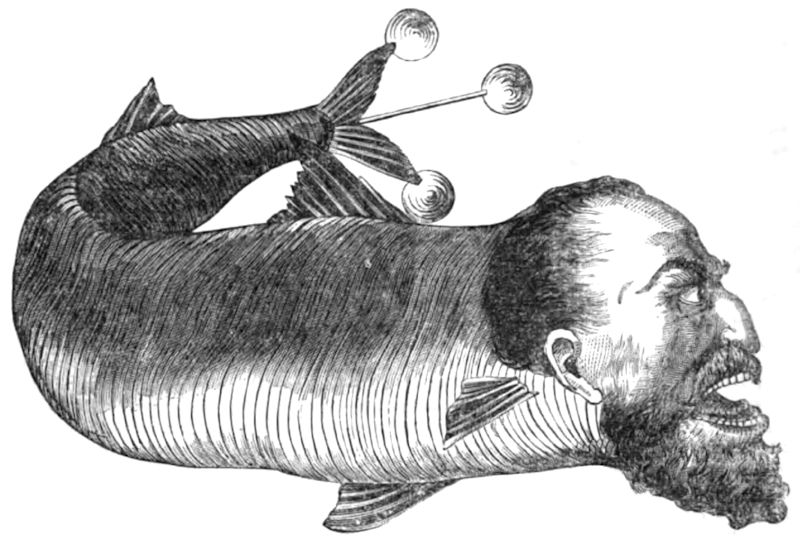
Of all marine animals (except midshipmen and second-lieutenants
in the navy) the shark is, perhaps, one of the
most unpopular. In general, it is difficult to give reason
for the unpopularity or popularity of any thing, but with
reference to the shark, there is much reason to suppose
that he has, by cruel misrepresentation, been exposed to
unmerited dislike. Had he been altogether bad, it is
most likely that he would have found a zealous advocate
long ago; whereas, we are the first, we believe, who ever
undertook to say a word in his defense. As a shark is
thought to have many counterparts among the human
species, we must be extremely careful how we launch
our invectives at him, lest by direct implication we should
abuse some of our most respectable fellow-citizens. But,
without affectation, we have always felt a high degree of
respect for this inhabitant of the deep, to whom we may
justly ascribe some very estimable and admirable qualities.
In the first place, he is the great controversialist of the
watery world. “If he cannot always convince,” as some
one said of a renowned American orator, “he never failed
to silence his opponent;” and this, in the tactics of disputation,
is almost as grand an achievement as convincing
itself. We read that Tycho Brahe had his nose bitten off
in a controversy with another distinguished mathematician.
But, although the shark—provided as he is with a jaw as
effective as a broad-axe—is well qualified to “chop
logic,” we doubt if he would be satisfied with such a
paltry exploit as that which has been accredited to Tycho’s
snappish adversary; and, indeed, we see no use in mincing
the matter when it becomes necessary to “use up” an
opponent. The best advice we can give in such a case is
to “go the whole hog” at once. But it is not with the
controversial abilities of the shark that we have to deal at
present. It was the chief design of this sketch to speak
chiefly of his business habits—on which we intend to
found a certain comparison that we have in our eye—and
so (as Bottom, the weaver, says) “to grow to a
conclusion.”
The shark is a great speculator in his way. He follows
in the wake of the ship for days and weeks together, looking
out for “a good chance.” His industry and perseverance
are rewarded at last, if a poor Jack Tar happen
to fall overboard; but if disappointed in his expectations
of such an auspicious event, he is obliged to console himself
with Jacob Faithful’s excellent maxim, “better luck
next time.” If, in pursuit of his object, instead of catching
a jolly fat sailor, he should be hooked or harpooned
himself, he philosophically considers it as a fair business
transaction; for, in every speculation, somebody must
suffer—the great object of all speculating skill being to decide
who is to be victimized. Speculation, therefore, is
pretty much the same thing in substance, whether it be
terrene or aquatic.
Shakspeare, with his customary acuteness of observation,
declares that there are “both land-rats and water-rats.”
Some other immortal genius has made the startling
discovery that there are both water-sharks and land-sharks;
and we find that in each of these generic divisions
there is more specific arrangement than we have leisure
or inclination to discuss. The engraver has supplied us
with a specimen of one variety of the land-shark, which
may be distinguished at a glance by the globular symbols
at the end of the tail—the use or meaning of which
has never been clearly explained, though the world has
been favored with many ingenious hypotheses in relation
to the subject. The common opinion is that the
three balls are significative of the fact, that should the
animal get possession of any of your property, it is two to
one that you will never recover it. Others say that as
balls have a remarkable facility in going down hill, they
significantly point out the route you are likely to take
should you venture to have any dealings with this formidable
creature.
The least observation of the picture will convince you
that there is speculation in the eye of this land-shark.
Mark the eager expression! so much like that you may
have observed in the glance of his maritime brother, as he
ogled you from his billowy alcove. See the open mouth,
and teeth displayed, as if prepared for a “bite.” Judging
from the “valence” (as Hamlet calls it,) at the bottom of
the visage, we opine that this animal does not shave
himself—though he is said to shave his victims rather
closely. The beard, by the way, is regarded as a hereditary
characteristic of this devouring race—the origin of
which is traced to Lombardy. The ancient inhabitants
of that country were called Longobardi, which name some
etymologists derive from Latin words, signifying long-beards.
Among these unshaven gentry, it appears, pawn-broking,
the most remorseless kind of shaving, was first
established. From this seminary of shavers, the whole
world was supplied with professors—fellows remarkable
for great latitude of conscience as well as longitude of
beard; benevolent fellows, too, always ready to accommodate
the needy with a loan, “on the most agreeable
terms”—as some of them promise to do, per advertisement,
at the present day; the phrase, “most agreeable terms,”
being understood to signify one hundred and fifty per cent.
per annum! This moderate rate of interest is continued
down to our own times, showing that the pawn-broker is
piously attached to the usages of his ancestors, while
others, in the race for improvement, are constantly trampling,
with profane feet, on the ashes of the venerable
dead.
“My Uncle,” as the pawn-broker is affectionately
called by his customers, honors the assumed relationship
by loaning out his dollars to every applicant who can
comply with his stipulations. In this particular, some
gay, frolicksome nephew would propose him as a model
for uncles in general; especially because he never requires
an exact account of how the cash loaned is to be
expended, nor does he seem to take it for granted that
you are on the direct road to ruin because you happen to
stand in need of pecuniary assistance. On the contrary,
he speaks of money-borrowing as one of the finest strokes
of policy, and professes his willingness to lend any imaginable
sum—if you are prepared to deposit some “collateral”
worth about four times the amount. This being
done, your generous creditor never harasses you for repayment,
you may abscond, if you choose, and proceed to
California, or any other remote region celebrated for gold,
or brimstone—assuring yourself that your kind “uncle”
will not interfere with your departure or inquire after
you when you are gone.
With all this liberality and generous forbearance, the
pawn-broker is regarded as one of the most voracious
of predatory animals; but be it understood that there are
land-sharks compared with which he is a mere minnow,
inasmuch as his operations are all on a small scale, and
the figure he makes among the speculating leviathans of
the day is comparatively insignificant.
The Life and Correspondence of Robert Southey. Edited
by his Son, Rev. Charles Cuthbert Southey, M. A. To
be completed in Six Parts. New York. Harper & Brothers.
The Harpers are printing this entertaining work as fast
as the volumes are received from England. The English
price is about three dollars and a half a volume; the American
twenty-five cents. As a record of Southey’s life,
character, and opinions, and as conducting us into the
workshop of the greatest of book-makers, the work has
great value, apart from its attractive qualities of literary
and personal gossip. The impression it leaves of Southey
is, on the whole, a favorable one. It makes him appear
as an honest, just, active, persistent, independent man,—one
who can “toil terribly,”—a staunch friend, a direct
and open opponent,—with a good deal of bigotry but no
deviltry,—and altogether a person with few of the vices
which most commonly beset writers by profession. His
letters are admirable, both in themselves and as true specimens
of epistolary composition. They show Southey
just as he was, quick in forming opinions, confident in
expressing them, thoroughly convinced that he had no intellectual
superior in England, freed from envy by self-esteem,
and ready to settle every question that is started,
by a few dogmatic sentences, which sparkle “like salt in
fire.” The singular perfection of his character, considered
in respect to its capacity for active intellectual labor, came
from his almost miraculous confidence in his faculties and
content with himself. He has so high an opinion of Robert
Southey as to be unconcerned about any thing which
lies beyond the grasp of his powers, and, accordingly,
however much we may find reason to doubt or deny many
of his statements, they ever have a joyous raciness which
tingles pleasantly on our perceptions.
The present work commences with a delightful autobiography,
which Southey carried down to the age of fifteen.
His son then takes up the narrative. This, however,
is little more than arranging the correspondence,
and explaining allusions in it. The great charm of
Southey’s style is its stimulating simplicity; and this is
felt throughout the present “Life.” We have marked, in
reading the work, a number of passages, which seem to
us especially characteristic, and cannot refrain from
quoting a few of them. He tells us, in his autobiography,
that his elder brother was very beautiful; “so much so,
that, when I made my appearance on the 12th of August,
1774, I was sadly disparaged by comparison with him.
My mother, asking if it was a boy, was answered by her
nurse, in a tone as little favorable to me as it was flattering,
‘Ay, a great ugly boy!’ and she added, when she
told me this, ‘God forgive me! when I saw what a great
red creature it was, covered with rolls of fat, I thought I
should never be able to love him.’” This is the most
perfectly dramatic statement of the most important event
which can happen to a person, ever given in a biography;
and it conciliates the reader at once.
The record of his early life is given with much amusing
details. His parents were rather illiterate, and he depended
on chance to gratify his thirst for books, with nobody
to select what were proper to his age. He read
Beaumont and Fletcher through before he was eight years
old,—a most curious book for a child, when we consider
the obscenity, licentiousness, and slang which mingle
with the romantic beauty of those dramatists. He says
they did him no harm, for the reason that he was so young.
In Mrs. Rowe’s Letters he read her version of the stories
of Olendo and Sophronia, and the Enchanted Forest, from
Tasso, and despaired at the time of ever reading more of
the poem until he was man, “from a whimsical notion
that, as the subject related to Jerusalem, the original must
be in Hebrew;” and there was not learning enough in his
father’s house to set him right on the point.
Perhaps the most interesting peculiarity of books like the
present, is their expression of the private opinions which
their subjects entertained of contemporary men and events.
This certainly is the raciest element in the Correspondence
of Southey, and his letters are next in attractiveness to a
cosy chat with himself. Of Bentham, he remarks—“It
has pleased the metaphysico-critico-politico-patriotico-phoolo-philosopher
Jeremy Bentham, to designate me, in
one of his opaque works, by the appellation of St. Southey,
for which I humbly thank his Jeremy Benthamship, and
have in part requited him.” His hatred of Jeffrey, and
contempt of Reviews, provoke many a sardonic remark,
replete with his peculiar humor. “Turner,” he writes to
Rickman, “complained heavily of Scotch criticism, which
he seems to feel too much. Such things only provoke me
to interject Fool! and Booby! seasoned with the participle
damnatory; but as for being vexed at a review—I should
as soon be fevered by a flea-bite! . . . I look upon the
invention of reviews to be the worst injury which literature
has received since its revival.” Of Coleridge he
says—“His mind is in a perfect St. Vitus’s dance—eternal
activity without action.” Jeffrey, according to Southey,
is a bad politician, a worse moralist, and a critic, in matters
of taste, equally incompetent and unjust. It is unfortunate
that his criticism on himself and on others, in
these letters, is not of a kind to entitle him to condemn the
editor of the Edinburgh Review. “Cowper,” he asserts,
“owed his popularity to his piety, not to his poetry, and
that piety was craziness.” His opinion was altered, of
course, when he afterward edited an edition of Cowper’s
works. Of Walter Savage Lander’s poem of Gebir, he
says—“I look upon Gebir, as I do upon Dante’s long poem
in the Italian, not as a good poem, but as containing the
finest poetry in the language.” His power of appreciating
Wordsworth may be estimated by his remark, in a letter
to Scott, on the “Ode on the Intimations of Immortality
from the Recollections of Childhood.” “The Ode on
Pre-existence,” he says, “is a dark subject darkly handled.
Coleridge is the only man who could make such a
subject luminous. The Leech Gatherer is one of my
favorites.” We might quote many other critical judgments,
“equally incompetent and unjust,” but if the last
does not satisfy the reader, it is impossible to quote any
thing that will.
The following passage, from a letter written in 1812,
gives so vivid an impression of Shelley in his enthusiastic
youth, that we cannot refrain from extracting it. The
style is very characteristic of Southey’s manner throughout
the letters.
“Here is a man in Keswick, who acts upon me as my
own ghost would do. He is just what I was in 1794. His
name is Shelley, son to the member for Shoreham, with
£6000 a year entailed upon him, and as much more in his
father’s power to cut off. Beginning with romances of
ghosts and murder, and with poetry at Eton, he passed,
at Oxford, into metaphysics; printed half-a-dozen pages,
which he entitled “The Necessity of Atheism;” sent one
anonymously to Coplestone, in expectation, I suppose, of
converting him; was expelled in consequence; married a
girl of seventeen, after being turned out of doors by his
father; and here they both are, in lodgings, living upon
£200 a year, which her father allows them. He is come
to the fittest physician in the world. At present he has
got to the Pantheistic stage of philosophy, and, in the
course of a week, I expect he will be a Berkleyan, for I
have put him upon a course of Berkley. It has surprised
him a good deal to meet, for the first time in his life, a
man who perfectly understands him, and does him full
justice. I tell him that all the difference between us is
that he is nineteen and I am thirty-seven; and I dare say
it will not be very long before I shall succeed in convincing
him that he may be a true philosopher, and do a great
deal of good with £6000 a year; the thought of which
troubles him a great deal more at present than ever the
want of sixpence (for I have known such a want) did me.
God help us! the world wants mending, though he did
not set about it exactly in the right way.”
This Life of Southey promises to be an important addition
to the biographical treasures of English literature, and
we look with great expectation for the remaining volumes,
which will record his quarrels with Byron, his coldness to
Coleridge, and the publication of his most important
works.
Historic View of the Languages and Literature of the
Slavic Nations: with a Sketch of their Popular Poetry.
By Taloi. With a Preface by Edward Robinson, D. D.,
LL.D. 1 vol. 12mo.
This work is a real addition to English literature, containing
a succinct view of a subject which has heretofore
been treated by those English scholars, who have treated
of it at all, in a fragmentary and unsatisfactory manner.
The Slavic nations contain a population of seventy millions,
and it is strange that a work like the present has
not been produced before, the subject being rich in matter
both to interest and instruct the better class of readers.
“Taloi,” as we presume is well known, is the name assumed
by Mrs. Robinson, the learned wife of the learned
gentleman who prefaces the present history. Few living
women can be said to excel her in the rare combination of
erudition with heartiness. This volume owes much of
its attractiveness to the feminine qualities which sometimes
guide and sometimes relieve her erudite researches.
Her selection of anecdotes, illustrative of national character,
is very happy. In speaking of the submission with
which the Slavic Nations received Christianity, the people
readily following their superiors, she remarks, that “Vladimir
the Great, to whom the Gospel and the Koran were
offered at the same time, was long undecided which to
choose; and was at last induced to embrace the former,
because ‘his Russians could not live without the pleasure
of drinking.’”
There are many poetical translations in the volume of
much excellence, some of them having such a marked peculiarity
that, without knowing the originals, a critic
might pronounce them to be true versions. Two or three
poems, relating to the desolate condition of motherless
orphans, are introduced by a reference to a Danish ballad,
which we trust that Longfellow will search after and
translate. “The Danes,” says Taloi, “have a beautiful
ballad, in which the ghost of a mother is roused by the
wailings and sufferings of her deserted offspring, to break
with supernatural power the gravestone, and to re-enter,
in the stillness of the night, the neglected nursery, in order
to cheer, to nurse, to comb and wash the dear little ones
whom God once entrusted to her care.” The following
translation of a ballad, written in the Upper Lusatian language,
we extract:
THE ORPHAN’S LAMENT.
Far more unhappy in the world am I,
Than on the meadow the bird that doth fly.
Little bird merrily flits to and fro,
Sings its sweet carol upon the green bough.
I, alas, wander wherever I will,
Everywhere I am desolate still!
No one befriends me wherever I go,
But my own heart full of sorrow and wo!
Cease thy grief, oh my heart, full of grief,
Soon will a time come that giveth thee relief.
Never misfortune has struck me so hard,
But I, ere long, again better have fared.
God of all else in the world has enough;
Why not then widows and orphans enough?
The naïveté of this is similar to a little quotation which
the author gives from a Servian elegy. A poor girl sings:
“Our Lord has of every thing his fill; but of poor people
he seems to have greater plenty than of anything else!”
The following description, from a Servian lyric, we
commend to contributors to Albums. It will keep them
in comparisons for a life-time:
Never since the world had a beginning,
Never did a lovelier flow’ret blossom,
Than the flow’ret in our own days blooming;
Haikuna, the lovely maiden flower.
She was lovely, nothing e’er was lovelier!
She was tall and slender as the pine-tree;
White her cheeks, but tinged with rosy blushes,
As if morning’s beam had shone upon them,
Till that beam had reached its high meridian.
And her eyes, they were two precious jewels,
And her eyebrows, leeches from the ocean,
And her eyelids, they were wings of swallows;
And her flaxen braids were silken tassels;
And her sweet mouth was a sugar casket,
And her teeth were pearls arrayed in order;
White her bosom, like two snowy dovelets,
And her voice was like the dovelet’s cooing;
And her smiles were like the glowing sunshine;
And her fame, the story of her beauty,
Spread through Bosnia, and through Herz’govina.
The simplicity of the ballads which Mrs. Robinson has
so copiously translated, will win many readers who take
but little interest in intellectual history. But it is as a
history of literature that the book is deserving of most
attention, and as a historian the author displays great
learning, gracefully managed. The criticism is conducted
on enlarged principles of taste, and the diction is uniformly
clear, condensed, and elegant. The publisher has done
his part towards making the volume attractive, by printing
it in large type on good paper.
Indiana. By George Sand. Translated by one of the
Best French Scholars in this Country, a member of the
Philadelphia Bar. Philadelphia. T. B. Peterson. 1
vol. 12mo.
We cannot divine the publisher’s object in engaging the
services of “one of the best French Scholars in this
Country,” and moreover “a member of the Philadelphia
Bar,” to translate this miserable trash into bad English.
Some of the later works of George Sand, undoubtedly
evince genius, but the novel under consideration, one of
the first products of her unregulated passions and speculative
profligacy, has nothing in plot, character, incident,
or style, to give piquancy to its coarseness. It is licentious,
but then it is so stupid, that its perusal would be a
penance to a roué. Its immorality and falsehood might
have a charm to some minds, but the raciness of these
qualities is spoiled by the detestable and yawn-provoking
sentimentality by which they are pervaded. The publication
of such books is an offence equally to taste and
morals, and tends to corrupt the intellect as well as the
conscience of such readers as are foolish enough to buy
them, and bad enough to read them. One of the worst
signs of the times is the systematic degradation of literature
into a mere handmaid of profligacy, as exhibited in
the numberless manufactories of cheap damnation spread
all over the land—manufactories which send out an incessant
stream of ugly looking pamphlet novels, whose leading
claim to notice is their brazen brainlessness and stupid
indecency. We have been informed that these things are
read, but on what principles of human nature the assertion
is made is a mystery to us. They are so absolutely unreadable,
according to the worse view ever taken of the
human mind by misanthrope or metaphysician, that we
must be allowed to doubt the fact, and to congratulate the
philanthropist that the devil, in this case, has underrated
the taste even of our blackguards and flats. We do hope
for the credit of the species, that if the popular heart and
conscience are doomed to be corrupted by a cheap literature,
it will not be done by such wretched stuff as forms
the staple of George Sand’s “Indiana.”
Women in America: her Work and her Reward. By
Maria J. McIntosh. Author of “To Seem and To
be,” etc. New York: D. Appleton & Co. 1 vol. 12mo.
The author of this volume has already distinguished
herself as the writer of two popular novels, in which a
distinct moral purpose is connected with well drawn characters
and interesting events. In the present work she
makes woman the reformer of social evils, and views her
as she appears at the North, the South, and the West.
There are many opinions expressed for which Miss McIntosh
can only give what logicians call “the lady’s
reason,” but, as a whole, the book is calculated to do
good, and can be safely commended to the attention of
“Women in America.”
COMPOSED BY
N. STEENCKEN,
AND RESPECTFULLY DEDICATED TO
MRS. A. WATSON.
Presented by Lee & Walker, 162 Chestnut Street.
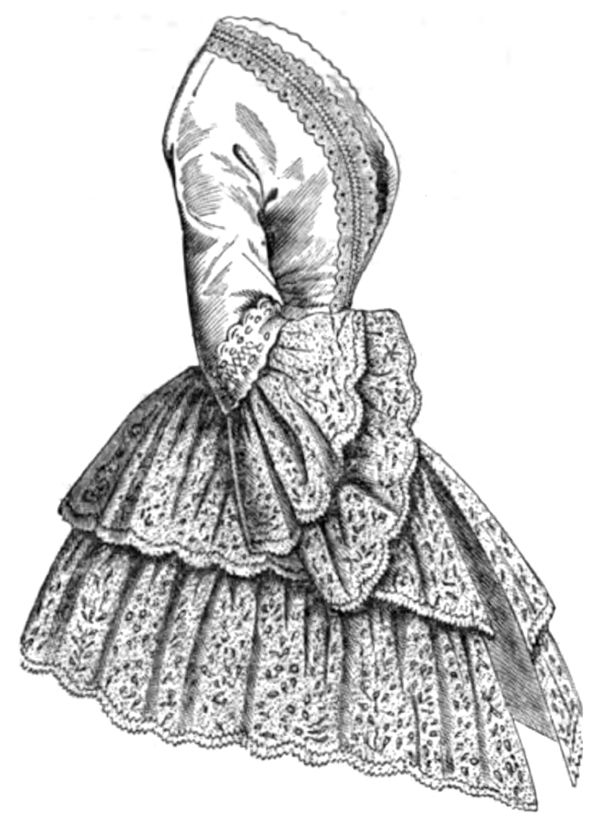
NO. 1.—ESMERALDA.
[6]Pardessus of silk fitting closely to the shape, open before,
trimmed with lace, which is held by a trimming of
the sleeve and skirt.
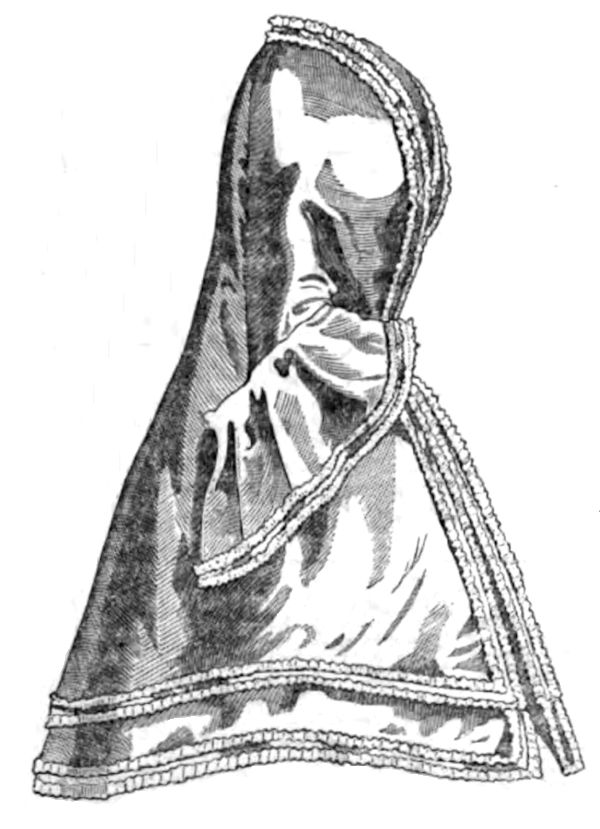
NO. 2.—RIMINI.
Little Spring Cloak of taffetas trimmed with a double
ruche of the same.
NO 3.—FORNARINA.
Tight fitting pardessus, bordered with gimp, and trimmed
with a thin, loose fringe, twisted at the end. The
sleeve is formed by the stuff folded on itself; but it is not
separate from the body.
NO. 4.—FALIERO.
Spring Cloak, half open, trimmed with galloon and
twisted fringe.
NO. 5.—OPHELIA.
Mantelet of taffetas, with ruches of quilled ribbon separated
in the middle by a little puffing. Trimmed with
white blonde.
NO. 6.—HERMIONE.
Shawl-shaped Mantelet of taffetas with fringe.
NO. 7.—MIRANDELLA.
Mantelet of taffetas, trimmed with black lace and figured
ribbon.
NO. 8.—STELLA.
Pardessus for the house, of taffetas trimmed with ruches
and pinked or scalloped trimmings.
Anaïs Toudouze
LE FOLLET
Paris, Boulevart St. Martin, 69.
Coiffures de Ferdinand Hamelin—Robes Camille—Lingeries Schreiber
Style of Goods at Stewart's New York and L.J. Levy & Co. Philadelphia
Graham’s Magazine
134 Chestnut Street
Cruising in the Last War. By Charles J. Peterson,
Author of the Reefer of ’76, etc. Philadelphia: T. B.
Peterson.
Many thousands of the readers of Graham’s Magazine,
will be glad to welcome in this form this admirable sea
novel, which was published in this Magazine in 1840. It
was one of the most popular articles that ever appeared in
this country, and now that the author avows himself, he
will justly be placed among the foremost writers of the
age for directness and energy of style, graphic force of
description and skillful delineation of character. Cooper,
in his palmiest days, never excelled the splendor of some
of the descriptive passages of this writer. Many of the
incidents we learn, for the first time, are taken from
events that occurred during the war, and the whole story
is drawn from the original log-book of a privateer of 1812,
now in the possession of the author.
It is refreshing to turn to the natural, patriotic tone of
this work, after wading through the sea of indifferent
books, which now-a-days make up the marketable cheap
literature; and we thank Mr. Peterson, on this account,
for allowing the Cruisings to appear. It will find a welcome
and a response in the hearts of all pure men; and purchasers
wherever a spark of patriotism lingers. It is sold
at the cheap rate of twenty-five cents, and by the hundred
at a still lower price.
Philadelphia Academy of Fine Arts.—We had
hoped to be able to notice the Spring Exhibition of this
Society, but cannot do justice to the splendid array of
home and foreign talent on the walls of its Galleries, in
the present number; our comments must, therefore, be
delayed until next month. A large number of paintings
have been received from Europe, in competition for the
prizes offered by the Academy. Among these, we may
enumerate the following: “Ahasuerus, King of the Medea
and Persians, exalting Mordecai,” by P. Van Schendel, of
Brussels; “Wrecking and Succour,” and “The Schelde
in a fresh gale,” by P. T. Schotel, of Mendembled, Holland;
“The Auspicious Moment,” and “The Recovery,”
by Carl Hubner, of Dusseldorf; “An Auction Scene,” by
A. W. Wedeking, of Bremen; two “Views in the High
Alps,” by G. F. Diday, of Bremen; “Amphitrite and
Diana,” after Moreto’s Spanish comedy, “El desden con
el desden,” by J. Schoppe, of Berlin; “Ruins of Castle
Teck on the Suabian Alps,” by H. Herdtle, of Stuttgard;
“Judith and Holofernes,” by E. Jacobs, of Gotha; “The
Marseillaise first song by Rouget de Lisle,” by Godefri
Gaffens, of Antwerp; “A Lake Scene,” by Ildephonse
Stoequart, of Antwerp; “Abraham receiving the Divine
Promise,” by J. A. Kruseman; “Joseph and Potiphar’s
Wife,” by François Vinck, of Anvers, Belgium; “Tobias
Receiving his Wife,” and an “Italian Peasant Girl,” by
Edward Ihlee, of Cassel; “The Judgment of Solomon,”
by Jh. Van Severdonck, of Brussels; three panels, “Adam
and Eve finding the dead body of Abel,” “Abel carried to
Heaven by an Angel,” and “Cain in the power of Satan,”
by Edward du Jardin, of Antwerp; “The Penny of
Cæsar,” by Joseph Belleman, of Antwerp; “A Roman
Aqueduct at Alcala-la-Real in Spain, with a Caravan of
Muleteers,” by F. Bossuet, of Brussels; and several
others. The productions of our own artists are numerous,
and will challenge a favorable comparison with these.
Rothermel’s latest work will add greatly to his reputation.
Chromo Xylography.—The very beautiful title-page,
for the July volume, which we furnish our readers in this
number, is the work of Mr. Devereux, an accomplished
artist of this city. This style of art is known as “Chromo
Xylography,” and Mr. Devereux has certainly, thus far
excelled all other artists in the beauty and delicacy of his
pictures. The Lake of Como—the central design of our
picture—is printed in eight different tints; and the blending
of colors has all the purity of painting. When it is
considered that this effect is produced by printing from
eight different blocks, we may consider this picture an
achievement, and highly creditable to its designer.
True Paris Fashions.—We resume with this number,
our Paris Fashions, which our subscribers will at once
see are far superior in beauty of design and coloring to
any that have appeared in Graham for a long time. The
order for this plate we sent to Paris the moment we ascertained
that we should again become the exclusive conductor
of “Graham,” and our agent is instructed to forward
one each month, from the best houses there, to
appear simultaneously with the same designs in Paris.
We thus furnish our colored plate—one month in advance
of even wood-cut fashion plates—and at least two months
earlier than those which are re-engraved and colored in
this country. This single feature of “Graham” renders
it superior to any work in this country, in regard to embellishments.
OURSELF.
If blushes were transferable, our face in the magazine
for this month, should, we suppose, be like a maiden’s
before the ardor of her first lover—but steel is as unsusceptible
as brass, we find; so, with a very unconscious air,
we shall brave the battery of bright eyes, impervious to a
frown.
As to our Memoir, by Mr. Peterson—the veritable
Jeremy Short—it is done in his most amiable vein; and
though not exactly the history of the Wandering Jew—being
rather that of Barnaby Rudge’s Raven, crying continually,
“Never say die”—our readers may take it with
the grains of allowance which should be given to a vigorous
writer with a fine imagination, who is determined to
make a hero.
We had written a long article, commemorative of other
days, but have since thought it better to let by-gones be
by-gones. That we feel proud of our reinstation in this
Magazine—the child of our happier days—we shall not
deny. The gold that bought it for us—if estimated by
the happiness it has diffused—must have dropped from
heaven, baptized for good. The dark shadows—the regrets
and heart-burnings of the past are over. A bright
future is before us, high hopes and determined resolves
are ours now—light leaps over the mountain-tops, and
the “good time” so long a coming, rushes joyfully to
meet us—is here.
“Graham.”
 Our thanks are due to our brethren of the quill
throughout the entire Union, for the very general, and
very generous welcome we have received on coming back
to the profession. While we shall never forget their
kindness, and have small hopes of ever being able to repay
a tythe of it, we shall endeavor so to act as not to
dishonor their endorsement, or to forfeit their good
opinion.
Transcriber’s Notes:
Archaic spellings and hyphenation have been retained as well as some spellings
peculiar to Graham’s. Punctuation has been corrected
without note. Other errors have been corrected as noted below. For
illustrations, some caption text may be missing or incomplete due to condition of
the originals used for preparation of the ebook.
page iii, Strength. Hy Mrs. ==> Strength. By Mrs.
page 4, as the real savan ==> as the real savant
page 5, mere experimentors, surprised ==> mere experimenters, surprised
page 8, up. You hav n’t ==> up. You haven’t
page 8, of the the lads did ==> of the lads did
page 13, weather-side of the bark ==> weather-side of the barque
page 17, singers was diposed ==> singers was disposed
page 19, symphonies of Beethooven ==> symphonies of Beethoven
page 24, same instincts leads her ==> same instincts lead her
page 27, services, Captain Dundas ==> services, Captain Dunbar
page 33, these succint narrations ==> these succinct narrations
page 38, whisper a requium ==> whisper a requiem
page 45, a country guager ==> a country gauger
page 45, was harrassed with cares ==> was harassed with cares
page 46, no more deficile, ==> no more difficile,
Page 50, the cautious inuendo ==> the cautious innuendo
page 52, the amiable Blocklock ==> the amiable Blacklock
page 55, payment. Harrassed and ==> payment. Harassed and
page 56, to smoothe her ==> to smooth her
page 58, an exhorbitant sum ==> an exorbitant sum
page 65, ready to accomodate ==> ready to accommodate
page 67, The naïvete of ==> The naïveté of
page 67, Than the flowret ==> Than the flow’ret
page 67, degradation of literarature ==> degradation of literature
page 72, Herdtle, of Suttgard ==> Herdtle, of Stuttgard