The sun was just setting on the last day of August,
when the ponderous eilwagen, in which I had journeyed
from Frankfort, rounded the foot of the Holy
Mountain into the Valley of the Neckar, and Heidelberg—the
brave, romantic, beautiful old electoral
city—was stretched out before me on the opposite
side of the river. Far above it rose the wooded
Kaiserstuhl, midway down whose side hung the
granite bastions, terraces and roofless halls of the
famed Castle. Heavy masses of ivy hung from its
arches, and overran the quaint sculpture of its walls,
while the foliage of its gardens was visible behind,
deep in the shadow of the mountain. A faint yellow
glow trembled over the pines and birches on the top
of the Kaiserstuhl, and kept the clear blue on the
distant hills up the Neckar. Down the steep paths
of the Holy Mountain, on my left, came the peasant-girls,
with baskets on their heads, laden with the
purple clusters of the Muscatel, and talking to each
other gayly over garden-walls, and under arbors,
which made a “green twilight” even at noon.
Careless students, pipe in hand, sauntered along the
river bank, listening to the sweet evening chimes,
rung first in the towers of the Hauptkirche, and
taken up like an echo, from village to village, among
the hills.
Looking forward to Heidelberg as a place for rest
and quiet study, there was something peculiarly
grateful and tranquilizing in the scene. To my eyes
the scenery presented a mingling of the wild with
the cultivated—of the pastoral with the grand—a
combination so inspiring that I found it difficult to
keep my enthusiasm within reasonable bounds.
From the river bank, above the bridge, cannon began
firing a closing salute for the Grand Duke’s
birth-day, and my heart never kept more bounding
time to the minute-guns on a Fourth of July at
home. The German passengers in the eilwagen
were highly gratified by my delight, for all Germans
are proud of Heidelberg.
By a piece of good fortune the friends who had
left me at Mayence and arrived the day before, happened
to be passing up the main street when the
vehicle stopped, and I was spared the risk of searching
for them, which, to one ignorant of the language,
was no slight task.
In a day or two, by the help of a valet de place, who
spoke half a dozen words of English, we obtained
rooms in a large house overhanging the Neckar.
From one side we looked upon the Heiligenberg, so
near that we could hear the girls singing among the
vines every morning, and all day long the rapid river
below us was noisy with raftsmen, guiding the pines
they had felled among the Suabian hills down to the
Rhine. On the other side the Kaiserstuhl stood between
us and the eastern sky, and we always saw
the sunrise first on the opposite mountains. In the
cool, cloudless autumn mornings, the air was full of
church-chimes and merry voices, which came echoed
back from the hills, so that our first waking sensation
was one of pleasure, and every day brought us some
new form of enjoyment.
The valley of the Neckar is narrow, and only the
little slopes which here and there lie between the
feet of its wooded mountains are capable of cultivation.
Higher up, there are glens and meadows of
luxuriant grass, to which the peasants drive their
cattle, further still, it is barren and rocky, and upon
the summits dwells a solitude as complete as upon
the unsettled prairies of the far West. An hour’s
walk takes one from the busy streets of the little city
to this beautiful and lonely region, and the stranger
may explore the paths he finds leading far away
among the hills, for weeks together, without exhausting
their store of new scenes and influences. The
calm impressiveness of these mountain landscapes
disposes the mind to quiet thought, and one who has
felt them till their spirit grew familiar, is at no loss
to comprehend the inspiration from which Schiller,
Uhland and Hauff have sung.
It is a favorite habit with the Heidelbergers, and
one into which the traveler willingly falls, to spend
the last hour or two of daylight in a walk by the
Neckar, in the gardens of the castle, or off in the
forests. At spots of especial beauty rustic inns have
been erected, where, at tables in the shade, the visiter
is furnished with beer, cool from its underground
vaults, and thick curds, to which a relish is given by
sugar and powdered cinnamon. The most noted of
these places is the Wolfsbrunnen, about a mile and
a half from the city, in a lonely glen, high up on the
mountain. A large stone basin, two centuries old,
stands there, pouring out a stream of the coldest and
purest water, dammed up below to form a small
pool, in which hundreds of trout breed and grow fat
from the benevolence of visiters. A wooden inn,
two stories high, with balconies on all sides, is
nestled among the trees, and farther down the stream
a little mill does its steady work from year to year.
A party was once formed by our German friends,
and we spent a whole Saturday afternoon in this delicious
retreat. Frau Dr. S——, who was always
ready for any piece of social merriment, had the
management of the excursion, and directed us with
the skill of a general. Fräulein Marie, her niece, a
blooming maiden of eighteen, and Madame Louise ——,
a sprightly little widow from Mannheim, with
Dr. S——, one or two students, and we Americans,
were her subjects. Every thing was arranged with
precision before we started. The books, the cards,
the music (including a most patient guitar) were distributed
among those best able to carry them, and
we finally started, without any particular order of
march. German etiquette forbids a lady to take the
arm of a male friend, unless she is betrothed to him;
talking is allowed, fortunately.
As we climbed to the terraces of the castle, we
could see the thread of the Rhine, in the distance,
sparkling through the haze. The light air which
came down the Neckar was fragrant with pine and
the first falling leaves of summer trees. The vineyards
below us were beginning to look crisp and
brown, but hanging from stake to stake the vines
were bent down by blue clusters, with the bloom
still upon them. Troops of light-hearted students,
children, blue-eyed and blond-haired, and contented
citizens, were taking the same path, and like them,
we forgot every thing but the sense of present happiness.
We had a table spread upon the upper balcony of
the inn, after our scattered forces returned from
many a long ramble up the glen and out on the
meadows. Frau Dr. S—— ordered a repast, and the
“landlady’s daughter”—not the sweet maid of Uhland’s
song, but a stout-armed and stout-waisted
damsel—brought us a jar of curds, dripping with the
cool water in which it had stood. A loaf of brown
bread next made its appearance, followed by a stone
jug of foaming beer, and two or three dishes of those
prune-tarts peculiar to Germany, completed the fare.
On the porch below us, two or three musicians played
waltzes, and the tables around the fountain were
filled with students, laughing, clinking their beer-glasses,
or trolling some burschen chorus. Our own
table did not lack the heartiest spirit of mirth; this
could not be otherwise so long as Frau Dr. S——
sat at the head of it. The students were gay and full
of life, and even Dr. S——, the most earnest and
studious of the party, was so far influenced by the
spirit of the time, that he sang the “King of Thule”
with more warmth than I had thought possible.
The afternoon sped away like a thought, and
Heidelberg was forgotten until the faint sound of its
evening chimes came up the valley. We returned
in time to see a glowing sky fade over the mountains
of Alsatia, and then first, as the twilight gathered,
came the remembrance of home—a remembrance
which did not chide the happiness of the day.
One of these excursions was accompanied by a
different and less agreeable finale. A small party
had been arranged to visit the ruins of St. Michael’s
Chapel, on the summit of the Holy Mountain. I had
ascended it previously, after an hour’s climbing, directly
up the side, but as ladies were to accompany
us, it was necessary to take a winding road, two or
three miles in length, to reach the chapel. We
mounted, by flights of steps through the terraced
vineyards, to the Philosopher’s Walk, followed it to
a retired glen called the Angels’ Meadow, and then
entered a forest-road. The wind roared loudly
among the trees, and the sky grew darker as we
ascended, but we took little heed of these signs.
Finally, however, on reaching a rocky point whence
we could look down on the Rhine-plain, we were
somewhat alarmed to see a heavy rain-cloud approaching
from the west. The chapel was still half
a mile distant, and its open walls and dismantled
towers could afford us no protection, so there was
nothing left but to turn about and descend with all
speed.
The rain had just crossed the Rhine, and would
probably be half an hour in reaching us, and as we
could trace its misty advance on the sheet of landscape
below us, we hoped to time our rate of walking
so as to reach some shelter before it struck the
mountain. Vain hope!—before we reached the
Angels’ Meadow the wind fairly howled among the
trees, and swept over us, laden with dust and
showers of leaves. The rain followed, and as our
path led over the exposed ridge of the mountain, the
arrows of the storm smote pitilessly in our faces.
The ladies shrieked, the men groaned, and, like Norval’s
barbarians, we “rushed like a torrent,”—and
with a torrent—“upon the vale.” When we arrived
at the village of Neuenheim the shower was nearly
over, but it might have continued all day, without
more effect upon us.
The village of Ziegelhausen, up the Neckar, with
its grim old convent, gardens and cascades, and the
delightful arbors of vine, reaching down to the very
brink of the river, is another favorite place of resort.
The pastor of its church, who was familiar with our
German friends, would frequently join us in an afternoon
walk, followed by a cup of tea in the garden of
the inn, and frequently by a share in the games of
the village children. The pastor was a most jovial,
genial character; he sang very finely—indeed, he
was brother to the primo tenore in the Opera at
Brunswick—and his wit was inexhaustible. His religion
was as genuine as his cheerfulness; it was no
gloomy ascetism, which looked on mirth as sin, but
a joyous, affectionate and abounding spirit, bright as
God’s sunshine and as unconscious of its blessing.
How happily passed those September afternoons,
warmed by such true social feeling, and refreshed by
all the kindly influences of nature! If a return like
this to the simple joys of the child’s heart be but obtained
by the mature age of a nation, I could almost
wish this country might grow old speedily. The
restless energy of Youth is still upon us. The nation
overflows with active impulses, which fear nothing,
and yield to nothing. We have not yet felt the need
of Rest.
I have said nothing of my struggles with the perverse
German language—my daily sieges, advancing
from trench to trench, till the strong fortress was
stormed and all its priceless stores in my possession.
I have not spoken of my blunders arising from ignorance
and inexperience, nor the novelty of customs
and life so different from ours. These would be
tedious, nor are they necessary to give some impression
of Heidelberg in its most delightful season. The
most romantic and picturesque of all German cities,
and therefore most thronged by romance-hunting
tourists, its good old social character is still happily
preserved. The last Revolution has fortunately
spared it, and in spite of railroads beside its mountains,
and steamboats on the Neckar, it will be for
many years to come one of the pleasantest spots in
Europe.
———
BY CAROLINE MAY.
———
The grass of the field shall be now my theme,
For when winter is past, and the snow
Has melted away from the earth like a dream,
No flowers that in loveliness grow
More dear, or more beautiful ever can be
Than the simple grass of the field to me.
It springs up so quick, when showers call aloud
For every thing glad to come forth;
And when the sun bursts from his rainbow-cloud,
As the rain passes off to the north—
It shines in his glory, and laughs in his light,
The green grass of the field, so glistening and bright.
Happy children love in the grass to play,
Thick and soft for their dancing feet;
And there the wild bees gather honey all day
From the clover so blushing and sweet,
And find no stores that the garden can yield
Are richer than those from the grass of the field.
The lark makes his nest in the twining grass,
And methinks when he soars to the skies,
And sings the clear notes that all others surpass,
His gladness must surely arise
From the lowly content of that innocent breast,
Which finds in the grass of the field a safe nest.
There are few who notice the delicate flower
That blooms in the grass at their feet,
Yet the proudest plant in the greenhouse or bower
Is not fairer, or more complete;
And to those who observe—it is clearly revealed
That God clothes with beauty the grass of the field.
The mower comes out so busy and blythe,
At the dawn of a summer’s day,
And the tall waving grass at the stroke of his scythe
Is cut down and withers away:
But the fragrance it sends over valley and hill
Makes the grass of the field loved and lovely still.
And while on the perishing grass we look,
A soft voice in the summer wind
Will whisper the words of the Holy Book
To the humble and thoughtful mind.
“All flesh is as grass,” it will seem to say—
“Like the flower of the grass ye shall pass away.”
But oh! we will hope with a faith secure—
Through the years of this mortal strife—
On the words of the Lord, which forever endure,
For in them is eternal life:
Thus lessons of truth all our pleasures will yield,
And wisdom we’ll learn from the grass of the field.
———
BY MRS. MARY G. HORSFORD.
———
Thy natal morn hath dawned again
With pure and cloudless ray;
May Peace and Hope attend thy steps,
Sweet sister, on this day.
It is the first that ever found
Me severed from thy side,
And tears will mingle with my prayer
At morn and eventide.
For I have yearned to lay my hand
In blessing on thy brow,
And speak the earnest words of love
That stir my spirit now;
Have longed, but longed in vain, to meet
The dark and sunny eye,
That has from childhood been to me
A star in every sky.
Have sought amid a stranger band
The smile I loved so well,
And lived in spirit o’er again
A sorrowful farewell!
And thou hast missed a warm caress,
And wept its loss, I know,
For we were joined as flowers that spring
From the same root below;
The early sunbeam as it stole
Across our quiet room,
Seemed to thy tearful eyes to wear
An all unwonted gloom.
And low winds seemed with mournful wail
The forest leaves to thrill,
As memory whispered that thou hadst
A vacant place to fill.
But we have loved as few can love,
For years, through storm and shine,
And though our paths lie separate now,
Thy heart still clings to mine.
By childhood’s smiles and youth’s gay dreams,
By memories of the dead,
By the stern discipline of grief,
My soul to thine is wed:
Links as eternal as the prayer
We used to breathe at even,
As ever-during as the vow
That binds us unto Heaven.
Then blessings on thee, dearest one,
My heart leaps o’er the sea;
I feel thy breath upon my cheek,
May God watch over thee.
———
BY MISS AUGUSTA C. TWIGGS.
———
This seems a little word, while we repeat it less
than one second of time is consumed, yet in its signification
it is a great word—a word of vast and unmeasured
import:
By it we understand a just appreciation of the
good, the beautiful, the pleasant, the worthy and the
useful:
Still it is not alike to all: Tastes differ with characters,
and characters with men. By an all wise
Creator was this so ordained, and in every thing we
see the wisdom and the beauty of His system.
Suppose, for instance, we pass in fancy around
this vast globe, as we progress onward, countries,
climates, men and characters undergo every conceivable
grade of change. Gradually we pass from
regions inhabited by enlightened men—men of learning
and deep research, men to whom Science seems
to have lent her very self, until we come to a race
of beings between whom and the brute creation
there is scarcely a demarcation: Yet each and every
one of these thousands upon thousands of countless
beings has his own peculiar sphere of action, and his
own especial tastes, adapted to his position and circumstances.
Taste may, however, be improved or debased,
elevated to the highest appreciations, the noblest conceptions,
or lowered to the most sordid views, the
most groveling level, and this is left to man himself—to
rise or fall, to sink or soar, is left to his own
choice, and is within his own power.
Of course this remark is not unqualified, it is not
intended that the natives of Central Africa, or of the
inhabited regions around the Poles, can improve
their moral condition, and rise to the same high
standard as may the enlightened nations of Europe
or of our own loved country. To assert such a
thing would be preposterous, to expect it ridiculous.
Our resources are not their resources, our advantages
not theirs, but there is implanted in the breast of
every man a frame-work and basis, with which, and
upon which, he may build something that shall make
him better than he now is. And the greater his advantages,
the vaster the amount of material furnished
him wherewith to work, the more will be expected
of him, and higher and higher will the eyes of men
rise, seeking for the pinnacles of that temple of the
mind which they of a right expect him to rear.
To ensure without fail the meeting of their views,
(perchance to surpass them,) it is not sufficient to
seize indiscriminately and pile block upon block,
and stone upon stone. It is not sufficient to heap up
a vast mountain of brick and mortar, jumbled together
without taste or elegance, and then write upon
it—This is Parian marble—these are classic proportions.
This will not do, the cheat will be found out,
and Ridicule will mingle her laughter with the shouts
and jeers of the multitude as they mock and scan the
shallow attempt at imposition.
What then is to be done?
This—let us seek Taste, let us acquaint ourselves
with her, coax her, court her, make her our own,
and we are safe. But we must be sure it is no impostor,
no false being who assumes the name, for
there are such, and they are to be shunned. We
must “be sure we are right, then” onward, right
onward.
True taste will teach us to select the choice blocks,
the finely grained and unflawed marble, she will bid
us to reject the huge, coarse, glittering rocks with
which some will strive to dazzle our eyes and mislead
our judgment, and cause us to turn aside from
those brittle and perishing kinds which will scarce
bear handling.
Having chosen our materials, now let us build.
Up go the blocks one after another, and high the
temple grows. Day by day it increases in height,
but why is it men stand and gaze with mortified and
disappointed looks upon the structure? Why do no
sounds of encouragement, no acclamations and
shouts of admiration reach the ear? Hear the reason—we
sought Taste—we courted her, we bid her
aid us seek our materials, and teach us how to judge
of them. She did so—that done we scorned her aid,
we forgot her, and trusting in ourselves we reared a
vast work of folly.
But “nil desperandum,” there is yet time. Tear
down the monument of heedlessness and call Taste
to teach us once again. Faithful she returns at our
bidding. Now hark to the sound of the mallet and
chisel as they ring against the stone, chip by chip
of superfluous material is worked away, piece by
piece which is unneeded is broken off and thrown
aside until some other work shall call them into
use.
Now seems to become exhumed, as from a grave
of stone and rubbish, the massive pedestal, the firm
base, the graceful column, the sculptured capital and
the rich cornice. Day by day, and hour by hour,
these multiply in true and classic beauty, and higher
and higher skyward soars the now elegant structure,
until, amid the shouts and admiration of the world,
the voice of Reason proclaims that Taste has
fashioned it.
This, then, is an edifice, a work worthy of the
mind, formed from materials the choicest within
man’s reach, wrought out and builded by the hand of
Taste; it is worthy to be gazed upon, to be admired
and copied by all.
Age after age will go by, but still it will stand firm,
and beautiful, and admired as when the artist gave
the last stroke, and proclaimed it to the world as
finished.
Are proofs required, among the names of the ancients
may be found those time-honored and long
worshiped ones of Lysippus, Polycletus, Praxiteles,
Timanthes, Appelles, Zeuxis, Parrhasius, Plato,
Aristotle, Pliny, Ovid, Pollio, Catullus, Demosthenes,
Thucydides, Xenophon, Aristophanes, Orpheus,
Archilocus and Timotheus, together with
many, many of their cotemporaries, for whose
names I have no space, but whose memories are
still, and still are to be, revered.
Following in the path which these have hewn
through the thickets of prejudice and ignorance
comes a long bright train. Amidst the stars of this
latter day firmament gleam conspicuous the names
of Banks, Young, Cole, West, White, Vandyck,
Tasso, Titian, Rittenhouse, Mozart, Milton, Crabbe,
Gallileo and Godfry, and ever and anon new and
brilliant planets flash forth and shed their glad effulgence
around.
Could this be without Taste?
It could not. Glorious and rich and varied as are
the works of those whose efforts and the productions
of whose minds have tended to elevate and improve
our condition, they never could have been without
Taste to suggest—Taste to aid, and Taste to accomplish
the mighty, the stupendous, the gigantic works
they have wrought.
What was it, let us inquire, that induced the
ancient Egyptians to build the city of Thebes in
such glorious magnificence that even its ruins produced
effects upon historians to cause them to be
immortalized? Homer tells of her hundred gates,
from each of which two hundred chariots and ten
thousand warriors could issue at a time. To her
palaces painting and sculpture had lent all their art,
combining to render this city one of the glories of the
world. Was not this Taste?
What, too, induced them to erect those monuments
of the strength of man and tyranny of kings—the
Obelisks and Pyramids, to erect them in such huge
size and vast strength that still they stand, as through
long ages they have stood, firm and immovable as
the “everlasting hills?”
Taste.
Need we ask Astronomy, that grand and elevating
science, the contemplation of which forces upon us
our own insignificance, and raises us from “Nature
up to Nature’s God”—that science which teaches us
to admire and wonder, to gaze and fear, to glorify
and adore the Great Being who formed “Arcturus,
Orion and the Pleiades.” Need we ask to what considerations
upon the part of man we are indebted for
the important and immense researches which all
lie open to us, which teach us to trace out the constellations,
and “call the stars by their names”—which
drew Phytheas from his home and caused
him to wander unsatisfied with the observations he
was able to make in his own country, from the Pillars
of Hercules to the mouth of the Tanais—which
made Egypt, Rome, Spain, France, Germany and
Denmark the cradles of the then infant science?
Is it necessary to reply it is Taste?
Turn we then to Philosophy, and in the deep researches
of Thales, the moral reasoning of Socrates,
the eloquence of Plato, and the disinterestedness of
Zenocrates read of Taste.
Chemistry, with all its brilliant discoveries, and
Rhetoric, in its elegance, speak of it.
Music, Oratory, History, Geography, Grammar
and Physic are each and all of them proofs of Taste
in its truth and purity; and Poetry shouts forth with
glad and eager pride Eureka! we have found it.
The beauty, delicacy and usefulness of Botany,
the rich and varied hue of the flowers, those “gems
of earth,” whisper softly to us of Taste; and the
importance of Anatomy proves it.
Metaphysics and Geometry demonstrate its truth;
while the wild bird’s carol hymns forth its notes of
praise and gladness to the Creator of it and of that
element of man’s happiness, Taste.
It is here, it is there, it is everywhere, one grand,
pervading principle, one first element, one chief ingredient
of all things.
It was implanted in the mind by Him who formed
us, and it is as much the duty of man to cultivate and
improve his taste, as it is his duty to improve and
cultivate any other talent lent him to keep; and he
will be considered no more excusable for wrapping
this precious deposit in a napkin and hiding it away
than was the servant of old, who buried the talent
until the coming of his lord. Let us then cultivate
Taste, each according to the kind and portion
given us.
It has been said that “every man is born to excel
in something, and the only reason so many fail is
they mistake their calling.” Be this as it may, it
sounds marvelously like sense, and it would be well
for every one to examine strictly, that he may discover
wherein it is intended he shall excel, and what
the peculiar Taste or Tastes may be which, to himself,
to society at large, and to a higher power than
either, it is his duty to cultivate.
Yet although Taste has been given us, and we are
required to improve and use it to the best advantage,
it is not intended there are no other gifts bestowed
on man which can equal it. That would be to
assume for it more than could well be proven. It is
intended that Taste shall act as a means of enjoyment
and happiness, as a means whereby we can investigate
causes, and admire and apply effects—a
means whereby we can dive into the very depths of
science and open the sealed treasure-house of knowledge—a
means of searching out the beauties and
glories of creation, and comprehending, as far as the
mind of man is capable of comprehending, the wonderful
omnipotence of the Deity.
———
BY T. S. ARTHUR.
———
At nineteen, Silas Loring left college and went
into a store to be educated for a merchant. At the
same time, a school-companion, named Alfred Benedict,
with whom he had been intimate, was placed
by his parents in the counting-room of a large shipper.
The two young men had enjoyed equal advantages,
so far as education was concerned; but they had improved
these advantages differently. The father of
Loring early impressed upon his mind the idea that
wealth gave a man all power and influence in the
world; that it was the greatest good that could be
sought; while the father of Benedict urged his son
to gain knowledge as the highest and best possession.
The two young men had been influenced, as well by
their natural tastes and feelings as by the opinions
and advice of their parents. On leaving college,
Loring left behind him all affection for literature or
scientific pursuits, and took with him only an ardent
desire to become wealthy, accompanied by a confident
assurance that he possessed the ability required
to attain the summit of his wishes. Benedict, on the
contrary, entered the world with his love of knowledge
as active as ever, and his desire for its attainment
more ardent than when he passed at first over
the threshold of Wisdom’s temple.
Equal as to external advantages, the two young
men started in the world. Neither of their parents
were rich, though both were able to give their children
a good education, that surest guaranty of success.
But difference of purpose in a few years made
a great difference in their relative positions. When
Loring was twenty-five years of age he was a partner
in the house where he had served his apprenticeship,
and the most active and really intelligent business
man in the firm; while Benedict was merely a book-keeper,
receiving a salary of twelve hundred dollars
a year. All the energies of the active mind of Loring,
inspired by his love of money, were given to business;
while the no less active mind of Benedict was
as deeply absorbed in literary pursuits and scientific
investigations. As a book-keeper, the latter was
faithful, attentive and accurate, and valued by his
employers; but beyond his journal and ledger his
thoughts never penetrated the arcana of trade. He
had no affection for it. His mind loved rather to
explore the arcana of knowledge, and gather in from
fields that were ever opening before him, rich harvests
of intelligence.
In the manners and appearance of the two young
men there was also a noticeable change. Loring had
an air of self-importance, and an off-hand, dashing
sort of manner, that bespoke a mind well satisfied
with itself, and conscious of having done something.
But Benedict had become more quiet and unobtrusive.
He looked like a man who did not entertain a very
high opinion of himself, as being of consequence in
the community.
As men appear in society, so are they usually
estimated by the mass. Loring was bowed to across
the street a dozen times in every square; was met in
company by a hearty shake of the hand, and treated
wherever he went as an individual of some importance.
And such he really felt himself to be. Benedict,
on the contrary, might walk a dozen squares
without receiving a nod, or mingle in society and be
almost unnoticed and alone. But he did not feel this.
In fact he was hardly conscious of it; for he rarely,
if ever, thought any thing about the estimation in
which others held him. His mind was in a higher
and purer region.
The intimate friendship that had existed between
Loring and Benedict, did not continue very long
after they left college, although they remained friends
and acquaintances, and were interested in each other
for some years. But, after Loring had changed from
a clerk to a merchant, he began to feel that he was
no longer on a level with a mere book-keeper, who
was likely to remain a book-keeper for life. Merchants
were now his associates. Men who used to
bow to him with distant formality, now took him cordially
by the hand, and were as familiar with him as
he had been with mere clerks before. He likewise
received invitations to the houses of these merchants,
and was introduced into a new and higher circle.
In this circle he never met his old friend Benedict.
Is it any wonder that he looked down upon him as
an inferior? None. We see by means of the atmosphere
by which we are surrounded, whether naturally
or spiritually. The atmosphere in which the
mind of Loring breathed and saw, was so different
from the one that gave life and vision to the mind of
Benedict, that he was unable to see by it the true
quality and character of his friend. He could see in
his own atmosphere, but that which surrounded the
humble book-keeper was darkness to his eyes.
Thus the years went by, Loring accumulating gold,
and Benedict treasures of knowledge, that neither
moth nor rust could corrupt, nor thieves break through
and steal. As these treasures increased, he began to
feel a desire to impart something of what he possessed
to others. This desire prompted him to write
out his reflections, experiences, and the new views
that were constantly pressing in upon his mind, and
send them to the various literary and scientific journals
for publication. It was not long before this brought
him into honorable notice, and made his name familiar
to men of intelligence throughout the country, with
many of whom he gradually came into correspondence.
“What has become of Benedict?” asked Mr.
Loring, one day of the merchant whose book-keeper
he had been for many years. “I have missed him
from your store for some time.”
“He left me several months ago,” was the reply.
“How came that? But I suppose his mind got so
lost in his literary pursuits that he was no longer
good for any thing as a clerk.”
“He was faithful and correct to the last,” promptly
answered the individual to whom this remark was
made. “I never had and never expect to have a
more valuable clerk than Benedict. But he has obtained
a better place, and one more suited to his
tastes and abilities.”
“Ah, where has he gone?”
“To Bowdoin College. The Professorship of —— was
offered to him, and he accepted it.”
“I didn’t know that he had any friends away off
there. Isn’t it rather singular that he should be appointed
to such a chair? Do you think him capable
of filling it?”
“I presume those who appointed him knew his
ability.”
“Did he apply for it?”
“No. He knew nothing of the vacancy until he
was notified of his appointment.”
“That is a little singular,” remarked Loring, wondering
for the moment how a man of so little importance,
and no very distinguished ability, should
be voluntarily tendered a high professorship in
Bowdoin College. But the wonder did not occupy
his mind very long. It passed away with the thought
of his old school-friend.
Great activity and energy in a business already
firmly established, in which was ample capital, made
Loring the possessor, in a few years, of quite a handsome
property. Ambitious of a more rapid increase
of fortune, and believing that he ought to have the
entire benefit of his activity, energy, and capacity
for trade, he withdrew from the house in which he
was a partner, and commenced business alone. He
did not err in his calculations. The results was as
favorable as he had expected. Money came in more
rapidly, and with its accumulation rose his ideas of
his own importance, until he looked down upon
every man whose coffers were not quite as full as
his own, at the same time that he felt himself to be
as good as any millionaire in the land.
It is a little singular how the mere possession of
money raises a man’s ideas of his own importance,
and causes him to think meanly of all who are not
favored with any considerable portion of this world’s
goods. Upon what a slender basis of real worth do
men sometimes build a towering structure of self-conceit!
Wealth is very rarely the correspondent
of solid virtue and sterling merit in those who
possess it; not that men of wealth are less virtuous
or meritorious as a class, but wealth, upon which
most persons value themselves, is not the true
standard for estimating the man. It never gives
quality to the heart, principles to the mind, nor to the
understanding rational intelligence.
As Mr. Loring continued to grow richer, his ideas
of his own importance continued to rise, until he felt
himself quite an “exclusive” in society. At the age
of forty, he determined to take a trip across the
Atlantic, and see the world abroad. He must spend
some time in London, Paris and Italy. In order to
be prepared for this journey, he brushed up his French,
and spent his leisure time in reading about the places
he proposed to visit. So far as his knowledge of
matters and things in his own country, out of the
mercantile sphere, was concerned, it was very
limited. Even in politics he was not very well
posted up. As to what was doing in literature and
science, he was altogether ignorant. He was a
successful merchant, and that was about all that could
be said of him.
All things ready, Mr. Loring took passage in a
steamer for Liverpool. The ship had cast off her
moorings, and was gliding swiftly along the smooth
waters of the bay, when the merchant, in turning
his eyes from the diminishing city to the nearer and
more palpable objects on board the vessel that was
bearing him on to the ocean, noticed a familiar face.
At first he was at a loss where to place its owner.
But soon his memory was clear upon that subject.
His old friend, Benedict, was a fellow-passenger!
The eyes of the latter were upon him, and his countenance
about expressing a pleasurable recognition,
when Loring turned away and glanced back again
upon the dim and distant city. He did not wish to
renew the acquaintance. When he next looked
around upon his companions for the voyage, Benedict
was not to be seen.
There were one hundred passengers on board, and
among them several men of high reputation in the
United States. A former Governor of Massachusetts,
whose name and fame were familiar to every one,
was among the number; also two men from the
South, who had distinguished themselves during
many years in the national legislature. One of them
had held the office of Secretary of State. Besides
these, there were many men of standing and character
both from the mercantile class and the learned professions.
In looking over the list of passengers,
Mr. Loring was well satisfied to find himself in such
good company. The only drawback was the presence
of so obscure an individual as Mr. Benedict,
with whom he had once been acquainted, but toward
whom he must now, in justice to his own
character and position, conduct himself as a stranger.
Such were the reflections of Mr. Loring, as he
turned from the vessel’s side and went below, late
in the afternoon of the day on which they had sailed.
On entering the cabin, the first objects that met his
eyes were the ex-governor of Massachusetts and
Mr. Benedict engaged in conversation. This surprised
him at first, but on reflection, he explained the
circumstance by supposing that Benedict had intruded
himself upon the individual with whom he was conversing,
and that the latter submitted to the intrusion
from mere politeness. He sat down at some distance
from them, expecting to see their interview
quickly terminated. But he was disappointed in
this, for the parties grew more and more interested.
Whenever Benedict spoke, he observed that the
other listened with deep attention, and that his
manner toward him was always respectful, and sometimes
even deferential. The conversation was prolonged
until tea-time, and then the two men separated.
There was something in this that the man of
wealth could not understand.
On the next day Mr. Loring sought an opportunity
to make the formal acquaintance of Mr. ——, from
the Bay State, through the introduction of a friend
on board, who presented him as “one of our first
merchants,” going out to visit Europe. Mr. —— was
very polite, and made some commonplace remarks
to the merchant, who replied with a self-importance
in his manner that did not make the impression
he designed. The ex-governor knew just
how much money was worth as a standard by which
to estimate the man. The words, “one of our first
merchants,” made no impression upon him whatever.
In fact, he scarcely noticed it. After talking
a short time with Mr. Loring, with a polite bow he
moved away and joined Mr. Benedict, who was
standing on the opposite side of the vessel. He was
soon again in close conversation with this obscure
individual.
Loring was not only surprised at this, but chafed.
It puzzled as well as annoyed him. He could not
but remark that Mr. Benedict was perfectly at his
ease with the distinguished individual who had just
left him, and that there was nothing in the manner of
Mr. —— approaching to condescension. Not many
minutes elapsed before they were joined by a third
person, to whom Mr. —— presented Loring’s old
friend in a formal introduction. This individual was
from the South. He had formerly held the office of
Secretary of State at Washington. At the mention
of Mr. Benedict’s name he shook him warmly by the
hand, and treated him with marked attention. The
three men then went below, where Loring saw them,
about an hour afterward, in the centre of a group of
five or six, all men of standing and character in the
United States. Benedict was speaking, and all were
listening to him with deep attention.
“Can it be possible that his fortunes have changed—that
he has become wealthy?” the merchant said to
himself; and a feeling of respect for his old acquaintance
arose in his mind.
Day after day went by, and still Mr. Benedict continued
to be on terms of intimacy with these men,
while they treated Mr. Loring, who was introduced
to them by a friend, with reserved and distant politeness.
“Who is that man?” asked the merchant, affecting
not to know Benedict. The question was put to a
fellow-passenger.
“That’s Professor Benedict,” replied the person
addressed, manifesting surprise at the question.
“Are you not acquainted with him?”
Loring shook his head.
“You have heard of him, of course?”
“I can’t say that I have.”
“Not heard of Professor Benedict!” The passenger
looked into the face of Loring with a broad
stare. “Why he is known from one end of our
country to the other as a distinguished scholar and
man of science. His articles in the Quarterly Review,
and his essays on Political and Social Economy,
‘Wealth and Labor,’ ‘The Times,’ etc., have
won for him an enviable reputation. There are few
abler men in our country than Professor Benedict.”
Mr. Loring asked no further questions. He felt
rebuked and mortified. Rich as he was, and highly
as he valued himself, he felt that the man of intellect
was ranked higher than the man of money. In
the small compass of that steam-vessel were clustered
together men of wealth, eminence, and political
distinction. There were few on board whom even
Mr. Loring would think beneath him; and yet he was
treated by them with no particular deference. When
he spoke, he was listened to with the politeness that
always accompanies good-breeding; but that was all.
None gathered around him; none sought his company;
none treated him as a man distinguished from
the rest. Wealth! that was a common possession;
but strong intellect was the god-like gift of the few;
and men bowed before it and yielded freely their
homage.
The proud man was deeply humbled during the
brief period occupied in sweeping across the broad
Atlantic, and he felt relieved and breathed more
freely the moment he set his foot on shore at Liverpool.
Shame had kept him from renewing his acquaintance
with Benedict, who continued to be an
object of interest to almost every one during the
voyage.
In the great world of London, Mr. Loring quickly
recovered his balance of mind. He took letters of
introduction to eminent merchants and bankers there,
by whom he was received and treated with the
greatest attention. He was again conscious of the
fact, that wealth was power, and that the possessor
of wealth ranked highest of any.
In Paris he did not feel quite so much at ease.
He brought letters to the American Minister, the
Hon. Mr. ——, who had represented our country at
the palace of St. Cloud for some five years with
honor to himself and the nation; and was received
with the courtesy and attention which always marked
that gentleman’s conduct toward his countrymen.
Mr. Loring had only been in Paris a couple of days
when the American Minister said to him,
“A distinguished countryman of ours is now
in Paris. He is to dine with me day after tomorrow,
in company with about fifty of the most
celebrated scientific and literary men in the city.
Your arrival is quite opportune, Mr. Loring, I shall,
of course, have the pleasure of your company.”
Mr. Loring bowed in acquiescence, and then inquired
who the distinguished American was.
“Professor Benedict,” replied the minister. “He
is an honor to our country, and I feel proud of the
opportunity I shall have of presenting him to men of
a like spirit with himself, to whom his name has
long been familiar.”
Mr. Loring was confounded.
“He has been for some years a member of the
Philosophical Society here,” continued the minister,
“and his communications, published in their annual
report of proceedings, are among the finest papers
that emanate from that body. They cause honorable
notice of our countryman to be made in all the
scientific journals of Europe. I need not ask you in
what estimation he is held at home, as I see by
Silliman’s Journal, the North American Review, and
the transactions of the various learned societies there,
that his worth is fully known and appreciated.
Have you ever had the pleasure of meeting him?”
“Oh, yes,” was the reply. “He is an old college-mate
of mine.”
“Indeed!”
“Yes. We were quite intimate as young men; but
our pursuits in life were so different that, in the very
nature of things, this intimate acquaintance could not
continue. But I had the pleasure of meeting him
again in crossing the Atlantic. We came over in
the same steamer.”
“Did you? That must have been a very pleasant
voyage. Fair weather the whole time, and the company
of so many men eminent for their talents. Mr.
Benedict says that the two weeks he spent upon the
ocean he shall number as the most agreeable of his
whole life.”
Mr. Loring now felt himself to be in a very awkward
position indeed. How to act he did not know.
He had accepted the American Minister’s invitation
to dine with him, and at his table he would meet the
man whom he had for years considered beneath him,
and whose very acquaintance he had dropped as
discreditable to one in his position. And this man
was to be the honored guest! Mr. Loring retired to
his hotel with his mind bewildered and his feelings
at a lower range in the thermometer of his self-esteem
than they had been for a very long time. If it
had not happened that Benedict came over in the same
steamer with him, and that he had cut his acquaintance
before he knew that he had become an individual
of some note, the way would have been plain
enough before him. He could have gone to the
dinner and renewed his old friendship, and felt
honored in being his countryman. But this he felt
to be out of the question now. Benedict might refuse
to know him, or might treat him in such a
manner as to wound and mortify him severely, and
expose him to the just contempt of men whose good
opinion he was the very man to value.
The exceeding smallness of the foundation upon
which he had built a towering structure of self-importance,
was brought, by the circumstances in
which he was placed, with painful clearness to his
mind. He saw and felt, almost for the first time in
his life, that money was not every thing, and that
it would not make a man worshiped every where,
and by all classes of men.
For a long time the mind of Mr. Loring was in
debate as to the best course to be pursued. At one
time he resolved to send a note to the American
Minister, on the day the dinner was to take place,
regretting his inability to make one of his guests, on
account of indisposition. But this intention was
after a while abandoned, and he determined to leave
Paris for Italy on the next day. Like the first resolution,
this was also given up, and his mind was all
in confusion again. At length he decided, though
with much reluctance, that he would call upon Mr.
Benedict, and formally renew his acquaintance.
There was something, he felt, humiliating in this;
but it was a step greatly to be preferred to any that
he had yet thought of taking. He did not wish to
lie direct to the American Minister, by saying that
he was indisposed; nor did he wish to leave Paris
for at least a month.
By little and by little, since the day the steamer
left New York, the man of money had felt increasing
respect for the man of mind. He saw that he was
honored by those who were themselves honorable;
that he was known and highly esteemed by distinguished
men in Paris and throughout Europe,
while his name had scarcely been heard of beyond
his own city. There was no mistake about this. It
was all plain as daylight. The humble book-keeper
was a greater man than the purse-proud merchant.
The severest conflict between pride and necessity
that ever took place in Mr. Loring’s mind, was that
which ended in a determination to call upon Mr.
Benedict. What his reception would be he knew
not, nor could he fix upon any mode of address, on
meeting him, that was satisfactory.
At length, after hours of hesitation and debate, and
a re-consideration of the whole matter, the merchant
left his hotel and proceeded to that of the old
friend whom he had cast off years before as beneath
him in social rank and real worth. Gradually his
respect for him had been rising, until now he rather
looked up than down upon him, as the possessor of
something far more intrinsically excellent than any
thing of which he could boast. Known throughout
all Europe! The honored guest of the American
Minister! Courted by men of learning and distinction
in Paris! His very name a passport into the
first circles, and an introduction to the most eminent
men of the day! What had he been thinking about?
Where were his eyes, that he had not before seen
this rising star, now suddenly revealed to him, shining
in beauty and splendor? Respect was easily changed
into a feeling of deference. As distinctly as he could,
Mr. Loring endeavored to recall to his mind the appearance
and manner of Mr. Benedict, during the
voyage across the Atlantic. This he could not do
very distinctly, as he had kept out of his way as
much as possible. Still he could recollect that there
was ease, self-possession, dignity of manner, and the
consciousness of power. These were the visible
marks of a great man about him—not so much perceived
at the time at recognized, now that they
were remembered.
This was the state of mind, and such were the
thoughts that oppressed Mr. Loring, as he started
on his humiliating errand. He, of course, expected
to be received with coldness and dignity, if received
at all. It might be that Mr. Benedict would decline
renewing the acquaintance that he had almost rudely
dropped, which, under the circumstances, would be
mortifying in the extreme, and compel him to decline
the invitation to dine with the American
Minister.
His card sent up, the merchant awaited the return
of the porter with serious misgivings at heart.
When that functionary returned, and signified that
Mr. Benedict would be happy to receive him, he
proceeded toward his apartments in a state of mind
such as he had never before experienced, and certainly
never wished to experience again. A door
was thrown open by the porter, and a man, in the
prime of life, stood near the centre of the room.
His quiet, thoughtful face, and calm, steady eye, so
well remembered, and so little changed by time, was
lit up instantly by a warm, frank smile, so natural
and familiar, that it seemed the smile of years before,
when they met as intimate friends. He stepped forward
quickly, and grasped Mr. Loring’s extended
hand.
The merchant was subdued and humbled. He
could hardly utter the words that rose to his tongue.
He stood in the presence of one who was superior to
himself, and who yet assumed no consequence.
The beauty and true nobility of this he clearly saw,
because it affected himself. He felt that Benedict
possessed a generous, manly spirit and a true heart,
of the real worth of which he had never before had
any conception.
In the interview that followed this meeting, no
allusion was made to the voyage across the Atlantic
by either party. The conversation mostly referred
to former years and events.
When they separated, Mr. Loring was in some
doubt as to the real greatness of his old friend. He
saw nothing in him that he had not seen before. Not
a brilliant sentence was uttered; nothing out of the
common order was apparent in his conversation.
He even permitted the query to arise in his mind
whether or no he had not been overrated? Whether
distance had not lent enchantment to the view? This
was his state of mind when he met him again at the
American Minister’s, surrounded by some of the
most celebrated men of learning in Paris; but it
changed after Benedict had been toasted, and he replied
in an address of great beauty, force, and originality,
that enchained the attention of every one.
Loring was lost in astonishment and admiration;
nor was he less surprised at the apparent unconsciousness
of being more than an ordinary man manifested
by his every act and word during the five
hours that he observed him in the midst of these
eminent men, with the best of whom he could not
but acknowledge him, from what he then saw, to be
equal.
The man of money did not again come in contact
with the man of mind during his tour in Europe; nor
has he met him since his return home. But now,
and he cannot but wonder why it was not so before,
he hears the name of Professor Benedict frequently
mentioned, and often meets with it in the public
journals. Whenever he does so, the feeling of purse-proud
superiority that has grown with his growth, and
strengthened with his strength, has a leaf withered,
a flower blighted, or a branch riven from the stem.
But the roots of that feeling are vigorous, and strike
deeply into a rich soil. Although its very luxuriant
growth is at times checked, yet we cannot hope to
see the plant destroyed. It is too well matured, and
its aliment too abundant.
———
BY S. D. ANDERSON.
———
Hurrah! for sweet May, it is here with its brightness,
The songs of the birds, and the breath of the flowers,
The sighs of the zephyrs, that woo with their lightness,
And hasten the steps of the Summer’s glad hours;
The earth is all gladness—the sky is all beaming
With rose-tinted shadows of beauty and light,
As rich as those insects whose golden wings gleaming
Are twined in the hair of the maidens at night.
The soft balmy air through the casement is singing
In tones of delight to the bud and the bee—
Like the laughter of girlhood in ecstasy ringing,
When the first star of evening has bidden them free—
In the depths of the forest the wild vine is creeping
Around the huge oak with its blossoms of gold—
And, curtained with leafiness, flowerets are sleeping,
Surrounded with perfume and beauty untold.
Come out with the sunrise!—all Nature is glowing—
Each hill-top is bathed in the morn’s early beams;
In the valley the fragrance of spring-time is blowing,
To scatter the mists from the flower-margined streams;
On the greensward the footsteps of children are straying,
As free as the gambols of Summer’s pure air,
As, ladened with health, from the mountain ’tis playing,
And tossing each ringlet of gold-colored hair.
With an echo of music the river is laving
Its white pebbled shore, as it dances along;
Now sunshine, now shade o’er its clear bosom waving,
Like the world’s beaten pathway, half sorrow, half song,
Far, far in the distance, the ocean is lying,
As calm and as tideless as infancy’s breast;
While the last lingering rays of the purple light dying
Is shed on its face ere it sinks into rest.
And then comes the eve with its moonlight and dreaming,
When melody floats on each whisper and sigh.
When eyes are as bright as the stars that are gleaming,
And hearts are as free as the breeze passing by.
In the wildwood the song of the night-bird is blending
With the light tread of dancers, and shoutings of mirth,
Whilst all round are the rosy boy’s arrows descending,
And love, like our joys, has a star-lighted birth.
The Summer’s young Ganymede’s cup is o’erflowing
With dew-drops, distilled from the Spring’s early morn,
As pure as the breath of the west wind that’s blowing,
Or wishes deep down in a maiden’s heart born;
Then a health for sweet May! what heart is not swelling
As the mild air of Summer comes soft o’er the brow,
And a thousand bright tokens all round us are telling
That the May-day of Youth and Affection is now.
———
BY EDGAR A. POE.
———
1.
It is observable that, while among all nations the
omni-color, white, has been received as an emblem
of the Pure, the no-color, black, has by no means
been generally admitted as sufficiently typical of
Impurity. There are blue devils as well as black;
and when we think very ill of a woman, and wish to
blacken her character, we merely call her “a blue-stocking”
and advise her to read, in Rabelais’ “Gargantua,”
the chapter “de ce qui est signifié par les
couleurs blanc et bleu.” There is far more difference
between these “couleurs,” in fact, than that which
exists between simple black and white. Your “blue,”
when we come to talk of stockings, is black in issimo—“nigrum
nigrius nigro”—like the matter from
which Raymond Lully first manufactured his alcohol.
2.
Mr. ——, I perceive, has been appointed Librarian
to the new —— Athenæum. To him, the appointment
is advantageous in many respects. Especially:—“Mon
cousin, voici une belle occasion pour apprendre
à lire!”
3.
As far as I can understand the “loving our
enemies,” it implies the hating our friends.
4.
In commencing our dinners with gravy soup, no
doubt we have taken a hint from Horace.
—— Da, he says, si grave non est,
Quæ prima iratum ventrem placaverit isca.
5.
Of much of our cottage architecture we may safely
say, I think, (admitting the good intention,) that it
would have been Gothic if it had not felt it its duty
to be Dutch.
6.
James’s multitudinous novels seem to be written
upon the plan of “the songs of the Bard of Schiraz,”
in which, we are assured by Fadladeen, “the same
beautiful thought occurs again and again in every
possible variety of phrase.”
7.
Some of our foreign lions resemble the human
brain in one very striking particular. They are
without any sense themselves and yet are the centres
of sensation.
8.
Mirabeau, I fancy, acquired his wonderful tact at
foreseeing and meeting contingencies, during his
residence in the stronghold of If.
9.
Cottle’s “Reminiscences of Coleridge” is just
such a book as damns its perpetrator forever in the
opinion of every gentleman who reads it. More and
more every day do we moderns pavoneggiarsi about
our Christianity; yet, so far as the spirit of Christianity
is concerned, we are immeasurably behind
the ancients. Mottoes and proverbs are the indices
of national character; and the Anglo-Saxons are
disgraced in having no proverbial equivalent to the
“De mortuis nil nisi bonum.” Moreover—where,
in all statutory Christendom, shall we find a law so
Christian as the “Defuncti injuriâ ne afficiantur”
of the Twelve Tables?
The simple negative injunction of the Latin law
and proverb—the injunction not to do ill to the dead—seems
at a first glance, scarcely susceptible of improvement
in the delicate respect of its terms. I
cannot help thinking, however, that the sentiment, if
not the idea intended, is more forcibly conveyed in
an apophthegm by one of the old English moralists,
James Puckle. By an ingenious figure of speech he
contrives to imbue the negation of the Roman command
with a spirit of active and positive beneficence.
“When speaking of the dead,” he says, in his
“Grey Cap for a Green Head,” “so fold up your
discourse that their virtues may be outwardly shown,
while their vices are wrapped up in silence.”
10.
I have no doubt that the Fourierites honestly fancy
“a nasty poet fit for nothing” to be the true translation
of “poeta nascitur non fit.”
11.
There surely cannot be “more things in Heaven
and Earth than are dreamt of” (oh, Andrew Jackson
Davis!) “in your philosophy.”
12.
“It is only as the Bird of Paradise quits us in
taking wing,” observes, or should observe, some
poet, “that we obtain a full view of the beauty of
its plumage;” and it is only as the politician is about
being “turned out” that—like the snake of the Irish
Chronicle when touched by St. Patrick—he “awakens
to a sense of his situation.”
13.
Newspaper editors seem to have constitutions
closely similar to those of the Deities in “Walhalla,”
who cut each other to pieces every day, and yet got
up perfectly sound and fresh every morning.
14.
As far as I can comprehend the modern cant in
favor of “unadulterated Saxon,” it is fast leading us
to the language of that region where, as Addison has
it, “they sell the best fish and speak the plainest
English.”
15.
The frightfully long money-pouches—“like the
Cucumber called the Gigantic”—which have come
in vogue among our belles—are not of Parisian
origin, as many suppose, but are strictly indigenous
here. The fact is, such a fashion would be quite out
of place in Paris, where it is money only that women
keep in a purse. The purse of an American lady,
however, must be large enough to carry both her
money and the soul of its owner.
16.
I can see no objection to gentlemen “standing for
Congress”—provided they stand on one side—nor to
their “running for Congress”—if they are in a very
great hurry to get there—but it would be a blessing
if some of them could be persuaded into sitting still,
for Congress, after they arrive.
17.
If Envy, as Cyprian has it, be “the moth of the
soul,” whether shall we regard Content as its Scotch
snuff or its camphor?
18.
M——, having been “used up” in the —— Review,
goes about town lauding his critic—as an
epicure lauds the best London mustard—with the
tears in his eyes.
19.
“Con tal que las costumbres de un autor sean
puras y castas,” says the Catholic Don Tomas de
las Torres, in the Preface to his “Amatory Poems,”
“importo muy poco qui no sean igualmente severas
sus obras:” meaning, in plain English, that, provided
the personal morals of an author are pure, it
matters little what those of his books are.
For so unprincipled an idea, Don Tomas, no doubt,
is still having a hard time of it in Purgatory; and,
by way of most pointedly manifesting their disgust
at his philosophy on the topic in question, many
modern theologians and divines are now busily
squaring their conduct by his proposition exactly
conversed.
20.
Children are never too tender to be whipped:—like
tough beefsteaks, the more you beat them the
more tender they become.
21.
Lucian, in describing the statue “with its surface
of Parian marble and its interior filled with rags,”
must have been looking with a prophetic eye at
some of our great “moneyed institutions.”
22.
That poets (using the word comprehensively, as
including artists in general) are a genus irritabile, is
well understood; but the why, seems not to be commonly
seen. An artist is an artist only by dint of his
exquisite sense of Beauty—a sense affording him
rapturous enjoyment, but at the same time implying,
or involving, an equally exquisite sense of Deformity
of disproportion. Thus a wrong—an injustice—done
a poet who is really a poet, excites him to a degree
which, to ordinary apprehension, appears disproportionate
with the wrong. Poets see injustice—never
where it does not exist—but very often where the
unpoetical see no injustice whatever. Thus the
poetical irritability has no reference to “temper” in
the vulgar sense, but merely to a more than usual clear-sightedness
in respect to Wrong:—this clear-sightedness
being nothing more than a corollary from the
vivid perception of Right—of justice—of proportion—in
a word, of το καλου. But one thing is clear—that
the man who is not “irritable,” (to the ordinary
apprehension,) is no poet.
23.
Let a man succeed ever so evidently—ever so
demonstrably—in many different displays of genius,
the envy of criticism will agree with the popular
voice in denying him more than talent in any. Thus
a poet who has achieved a great (by which I mean
an effective) poem, should be cautious not to distinguish
himself in any other walk of Letters. In
especial—let him make no effort in Science—unless
anonymously, or with the view of waiting patiently
the judgment of posterity. Because universal or
even versatile geniuses have rarely or never been
known, therefore, thinks the world, none such can
ever be. A “therefore” of this kind is, with the
world, conclusive. But what is the fact, as taught
us by analysis of mental power? Simply, that the
highest genius—that the genius which all men instantaneously
acknowledge as such—which acts
upon individuals, as well as upon the mass, by a
species of magnetism incomprehensible but irresistible
and never resisted—that this genius which
demonstrates itself in the simplest gesture—or even
by the absence of all—this genius which speaks
without a voice and flashes from the unopened eye—is
but the result of generally large mental power
existing in a state of absolute proportion—so that no
one faculty has undue predominance. That factitious
“genius”—that “genius” in the popular sense—which
is but the manifestation of the abnormal
predominance of some one faculty over all the others—and,
of course, at the expense and to the detriment,
of all the others—is a result of mental disease or
rather, of organic malformation of mind:—it is this
and nothing more. Not only will such “genius”
fail, if turned aside from the path indicated by its
predominant faculty; but, even when pursuing this
path—when producing those works in which, certainly,
it is best calculated to succeed—will give unmistakeable
indications of unsoundness, in respect
to general intellect. Hence, indeed, arises the just
idea that
“Great wit to madness nearly is allied.”
I say “just idea;” for by “great wit,” in this case,
the poet intends precisely the pseudo-genius to which
I refer. The true genius, on the other hand, is
necessarily, if not universal in its manifestations, at
least capable of universality; and if, attempting all
things, it succeeds in one rather better than in another,
this is merely on account of a certain bias by
which Taste leads it with more earnestness in the
one direction than in the other. With equal zeal, it
would succeed equally in all.
To sum up our results in respect to this very
simple, but much vexata questio:—
What the world calls “genius” is the state of
mental disease arising from the undue predominance
of some one of the faculties. The works of such
genius are never sound in themselves and, in especial,
always betray the general mental insanity.
The proportion of the mental faculties, in a case
where the general mental power is not inordinate,
gives that result which we distinguish as talent:—and
the talent is greater or less, first, as the general
mental power is greater or less; and, secondly, as
the proportion of the faculties is more or less absolute.
The proportion of the faculties, in a case where
the mental power is inordinately great, gives that
result which is the true genius (but which, on account
of the proportion and seeming simplicity of its works,
is seldom acknowledged to be so;) and the genius is
greater or less, first, as the general mental power is
more or less inordinately great; and, secondly, as
the proportion of the faculties is more or less absolute.
An objection will be made:—that the greatest
excess of mental power, however proportionate, does
not seem to satisfy our idea of genius, unless we
have, in addition, sensibility, passion, energy. The
reply is, that the “absolute proportion” spoken of,
when applied to inordinate mental power, gives, as a
result, the appreciation of Beauty and horror of Deformity
which we call sensibility, together with that
intense vitality, which is implied when we speak of
“Energy” or “Passion.”
24.
“And Beauty draws us by a single hair.”—Capillary
attraction, of course.
25.
It is by no means clear, as regards the present revolutionary
spirit of Europe, that it is a spirit which
“moveth altogether if it move at all.” In Great
Britain it may be kept quiet for half a century yet, by
placing at the head of affairs an experienced medical
man. He should keep his forefinger constantly on
the pulse of the patient, and exhibit panem in gentle
doses, with as much circenses as the stomach can be
made to retain.
[Conclusion in our next.
DURING THE EIGHTEENTH AND THE BEGINNING OF THE NINETEENTH CENTURY.
———
BY FAYETTE ROBINSON.
———
(Concluded from page 266.)
When Parisian society had passed the dread ordeal
which bears the name of the Reign of Terror, through
continual scenes of blood and tears, it seemed by a
strange and almost unaccountable impulse to be impelled
to mirth and festivity. On the day after the disappearance
of the guillotine French frivolity resumed
its sway with a thousand whims and vagaries, to
which the stern muse of history would pay no attention,
but to which, in this sketch of the follies of
humanity, we may aptly attend. One of the whimsicalities
peculiar to the day is that in memory of
the sad toilette of the guillotine, when the hair was
cropped by the shears of the executioner, a similar
coiffure was the mode. Women laid aside their
luxuriant locks for a coiffure à la victime, and
wore a band of blood-red velvet around the neck, as
if in derision of the fall of the axe. This fashion,
emanating in France, where recklessness had been
produced by the constant presence of danger, went
the round of the world, and the coiffure à la victime
was worn by both sexes in quiet neighborhoods,
which had learned only by report of the fearful atrocities
committed in the capital of civilization. Balls
à la victime also became the vogue, and none were
at first admitted to them except those who had lost
relations on the scaffold. To some of these balls it
was requisite not to have lost collaterals only, but
a parent, or brother, sister, husband or wife. There
were exclusives even there, and a new nobility of
the scaffold was created. This was the era of corsets
à la justice and bonnets à la humanité.
Away with care! Bring in the violin and minstrels!
was the cry. A mania for the dance pervaded
all society. High and low, aristocrats and
people, antiques and moderns all danced. The
chapel of the old Carmelite convent became a ballroom,
and the Jesuits’ college a place of festivity, as
did also the convents of Saint-Sulpice of the Filles
de Saint-Marie. In the guinguettes and in the
most elegant society all danced. “If the traces of
crime and degradation were seen every where else,”
says a writer of that age, “a man of taste had at
least the consolation to find in these brilliant assemblages
society not unlike that which made Paris once
the wonder of the world. The winter-balls are the
asylum of good taste, elegance and propriety. In
them a young man may purify himself by the spectacle
of triumphant Virtue.” Yet the only requisite
to admission to these balls was a subscription of 96
francs, (about $19.20.) A cotemporary thus describes
one of the most celebrated of these reunions,
that at the Hotel Richelieu, in a manner to make us
skeptical about the virtue. “It is,” says he, “an
arch of transparent robes of lace, head-dresses of
gold and diamonds. A subscription is required, and
the visiter is ushered into the society of perfumed
goddesses, crowned with flowers, who float about in
Athenian robes, and receive the lisping flattery of
the incroyables, who prate of their parole d’honneur.”
It need not be said this is a mere phase of
Parisian society, fortunately not reflected by the rest
of the world.
The ball of the Opera was revived, and to it we
must look for the most striking specimens of costume.
The plain black domino exclusively worn at
such places during the monarchy had disappeared,
and was replaced by a similar garment of the most
striking colors. Turks, Chinese and the old traditional
characters were exiled to the places of popular
amusement, and the great room of the Opera was
filled with Caius Marius, Dentatus, Cicero, Mutius
Scævola, Pericles, Lycurgus, Cymon and Herodotus.
The charm, however, was gone; the new society
had no traditions; the people composing it were
almost ignorant of each other, and the playful badinage
of which the old balls had been the scene was
lost forever. The Jeunesse Dorée, as the courtiers
of the Directory and Consulate were called, frequented
these balls most faithfully, but the old prestige
was destroyed, and families were not seen as
they had been in the days of old.
It is strange with what rapidity from the epoch of
the Directory a taste for luxury and pleasure sprung
up in the minds of the people. Music again resumed
its sway, and a hundred places of public amusement
were opened. One of the most significant evidences
that the late or present French Revolution is not yet
over, is the fact that as yet public amusements do
not thrive, and that the people look elsewhere for
excitement than to the stage and concert. The most
curious of all spectacles is the stormy deliberation of
the Assembly, and the artistes of the Executive
power the most attractive of all performers.
Gradually a disposition to make a figure inoculated
society. As the Revolution became distant
luxury increased. Yet it was not the faste of old
monarchy, but a new splendor, which the persons
left on the surface of society by the bouleversement
of all orders threw around them. The women in the
lowness of the bosoms of their dresses descended
below even the modesty required by the Regency,
and the incroyables became more fantastic than the
marquis. The following was the costume they
adopted, and a more tasteless one can scarcely be
conceived:
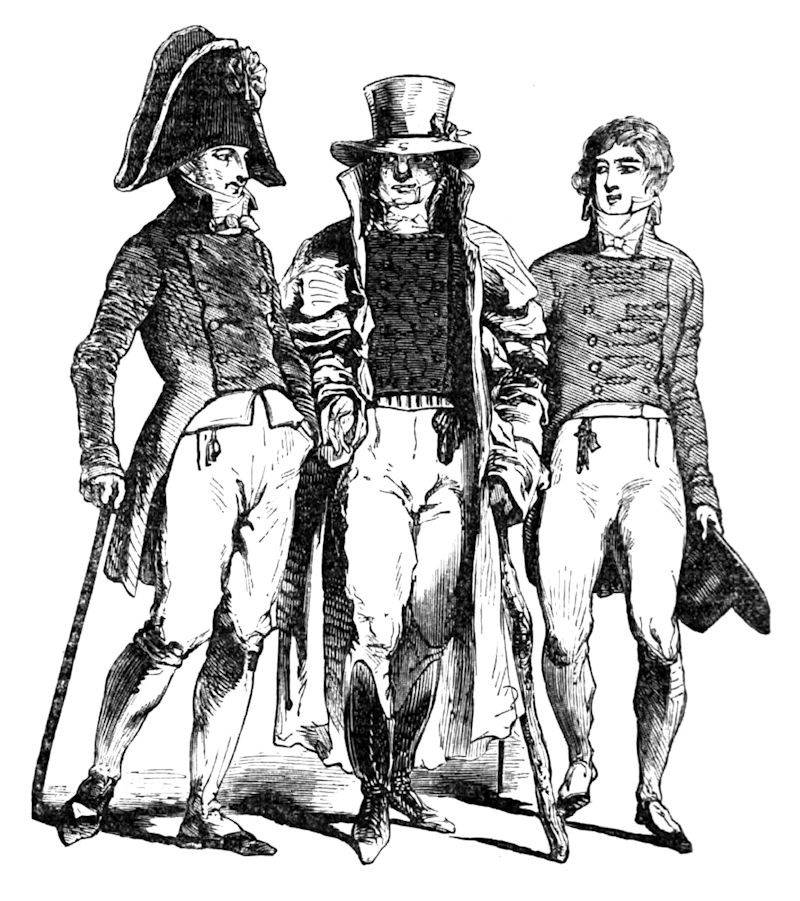
They were not so richly dressed as their predecessors,
nor were they so elegant and graceful, but
their manners were quite as affected. Then came
again the taste for gallant acrostics and love songs,
which caused the poetry of the Cheniers to be forgotten
for fantasies addressed to the popular actresses.
This prodigality was the more criminal because
it had a contrast in alarming want. The Revolution
did not make France more rich, nor did the
hecatombs slain in defence of the liberty of the country
make the cornfields and vineyards more fruitful.
French prodigality was imitated everywhere, and to
this recklessness may we attribute the fact of the
great increase of the expense of dress in every grade
of society over all the civilized world.
The mode of wearing the hair for men had long
become fixed; it was cropped and au naturel, and
has thus remained to our own day. The male costume
became every day more and more inelegant.
Frocks were worn short, loose and broad; pantaloons
loose as a sailor’s lasted to a late day of the empire.
This costume had but one merit, simplicity,
a quality inspection of the following engraving will
show it to have possessed in a great degree.
All embroidery was abandoned. In 1803 the coat
had taken its definite form, where there is every
prospect that it will remain permanent. It had an
immense collar and was very short before, but it
was yet a coat. Pantaloons were by no means what
they are now, yet still the garment is unchanged.
The hat had become round, and the cravat was
stationary.
This brings us to the end of our subject. From the
doublet of Louis XIV. costume has been traced to
our time, and an impartial observer will be satisfied
we have lost nothing by the change; for none who
compare the garments of the schneiders of our own
era with those of the Latours or Justins of old, will
think good taste has retrograded, or dream of comparing
the bucket-like things which once were worn
on the head, with the tasteful and artistic hats of
Oakford. Thus ends this disquisition on dress,
which, believe me, is no trifle; and the evidence of
it is, that nothing more ridiculous can be conceived,
than would be a President, a Senate, or a Supreme
Court in puris naturalibus.
———
BY PROFESSOR FROST.
———