By Nathaniel Hawthorne
1. When Jason, the son of the dethroned king
of Iolchos, was a little boy, he was sent away from
his parents and placed under the queerest schoolmaster
that ever you heard of. This learned person
was one of the people or quadrupeds called
Centaurs. He lived in a cavern, and had the body
and legs of a white horse, with the head and shoulders
of a man. His name was Chiron; and, in spite
of his odd appearance, he was a very excellent
teacher.
2. The good Chiron taught his pupils how to play
upon the harp, and how to cure diseases, and how
to use the sword and shield, together with various
other branches of education in which the lads of
those days used to be instructed, instead of writing
and arithmetic.
3. So Jason dwelt in the cave, with his four-footed
Chiron, from the time that he was an infant
only a few months old until he had grown to the
full height of a man.
4. At length, being now a tall and athletic youth,
Jason resolved to seek his fortune in the world.
He had heard that he himself was a prince royal,
and that his father, King Æson, had been deprived
of the kingdom of Iolchos by a certain Pelias, who
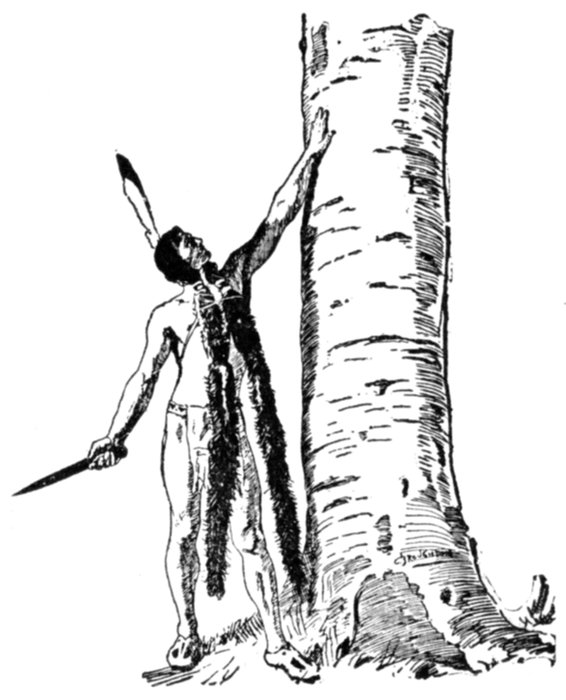
would also have killed Jason had he not been
hidden in the Centaur's cave. And being come to
the strength of a man, Jason determined to set all
this business to rights, and to punish the wicked
Pelias for wronging his dear father, and to cast him
down from the throne and seat himself there instead.
5. With this intention he took a spear in each
hand, and threw a leopard's skin over his shoulders
to keep off the rain, and set forth on his travels,
with his long, yellow ringlets waving in the wind.
The part of his dress on which he most prided himself
was a pair of sandals that had been his father's.
They were handsomely embroidered, and were tied
upon his feet with strings of gold.
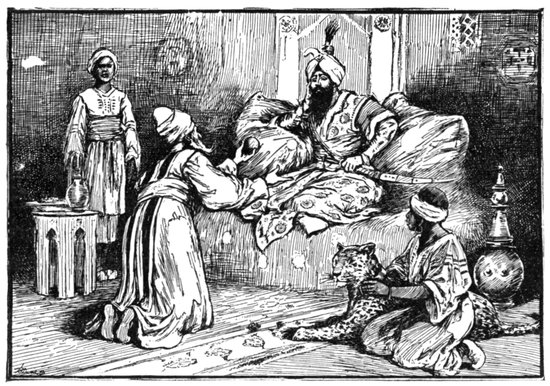
6. I know not how far Jason had traveled when
he came to a turbulent river, which rushed right
across his pathway, with specks of white foam
among its black eddies, hurrying onward, and roaring
angrily as it went. He stepped boldly into the
raging and foamy current and began to stagger away
from the shore.
7. Jason's two spears, one in each hand, kept him
from stumbling and enabled him to feel his way
among the hidden rocks. When he was half way
across, his foot was caught in a crevice between two
rocks, and stuck there so fast that, in the effort to
get free, he lost one of his golden-stringed sandals.
8. After traveling a pretty long distance, he came
to a town situated at the foot of a mountain, and
not a great way from the shore of the sea. On the
outside of the town there was an immense crowd of
people. Jason inquired of one of the multitude why
so many persons were here assembled.
9. "This is the kingdom of Iolchos," answered
the man, "and we are the subjects of King Pelias.
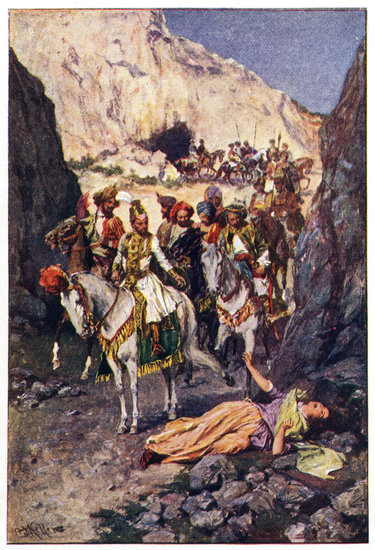
Our monarch has summoned us together that we
may see him sacrifice a black bull to Neptune. Yonder
is the king, where you see the smoke going up
from the altar."
10. While the man spoke, he eyed Jason with
great curiosity, for his garb was quite unlike that
of the Iolchians, and it looked very odd to see a
youth with a leopard's skin over his shoulders and
each hand grasping a spear. Jason perceived, too,
that the man stared particularly at his feet, one of
which, you remember, was bare, while the other
was decorated with his father's golden-stringed
sandal.
11. "Look at him! only look at him!" said the
man to his next neighbor. "Do you see? He wears
but one sandal."
Upon this, first one person and then another began
to stare at Jason, and everybody seemed to be
greatly struck with something in his aspect; though
they turned their eyes much oftener towards his
feet than to any other part of his figure. Besides,
he could hear them whispering to one another.
12. Poor Jason was greatly abashed, and made up
his mind that the people of Iolchos were exceedingly
ill bred to take such public notice of an accidental
deficiency in his dress. Meanwhile, whether
it was that they hustled him forward, or that Jason
of his own accord thrust a passage through the
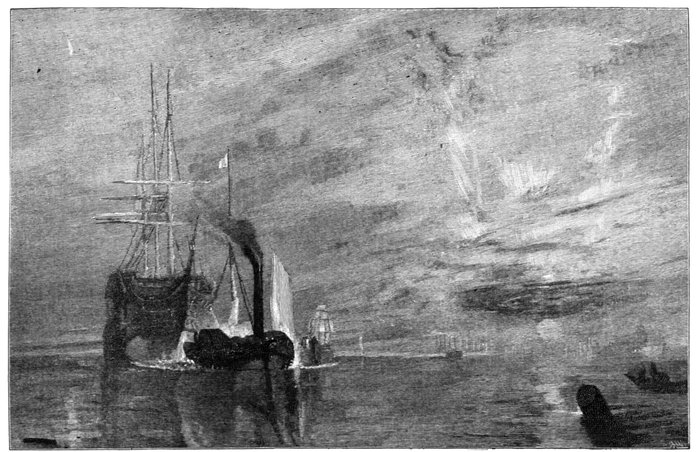
crowd, it so happened that he soon found himself
close to the smoking altar where King Pelias was
sacrificing the black bull.
13. The murmur and hum of the multitude, in
their surprise at the spectacle of Jason with his one
bare foot, grew so loud that it disturbed the ceremonies;
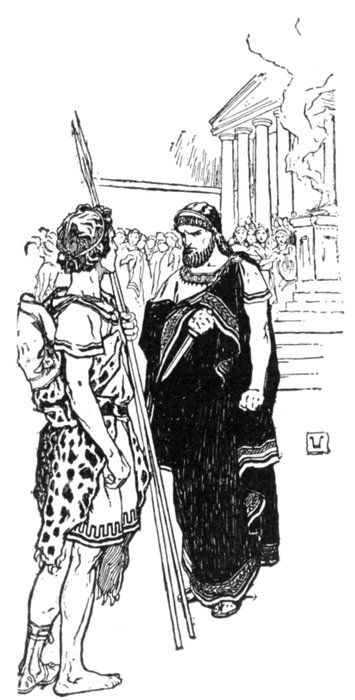
and the king, holding the great knife
with which he was just going to cut the bull's
throat, turned angrily about and fixed his eyes on
Jason.
"Ha!" muttered he, "here is the one-sandaled
fellow, sure enough. What can I do with him?"
14. And he clutched more closely the great knife
in his hand, as if he were half a mind to slay Jason
instead of the black bull. The people round about
caught up the king's words, indistinctly as they
were uttered; and first there was a murmur among
them, and then a loud shout.
"The one-sandaled man has come! The prophecy
must be fulfilled!"
15. For you are to know that, many years before,
King Pelias had been told that a man with one
sandal should cast him down from his throne. On
this account he had given strict orders that nobody
should ever come into his presence unless both
sandals were securely tied upon his feet.
16. In the whole course of the king's reign, he
had never been thrown into such a fright as by the
spectacle of poor Jason's bare foot. But, as he was
naturally a bold and hard-hearted man, he soon took
courage and began to consider in what way he might
rid himself of this terrible one-sandaled stranger.
17. "My good young man," said King Pelias, taking
the softest tone imaginable in order to throw
Jason off his guard, "you are very welcome to my
kingdom. Judging by your dress, you must have
traveled a long distance; for it is not the fashion to
wear leopard skins in this part of the world. Pray,
what may I call your name? and where did you
receive your education?"
18. "My name is Jason," answered the young
stranger. "Ever since my infancy I have dwelt in
the cave of Chiron the Centaur. He was my instructor
and taught me music and horsemanship,
and how to cure wounds, and likewise how to inflict
wounds with my weapons."
19. "I have heard of Chiron the schoolmaster,"
replied King Pelias. "It gives me great delight to
see one of his scholars at my court. But, to test
how much you have profited
under so excellent a teacher, will
you allow me to ask you a
single question?"
"I do not pretend to be very
wise," said Jason. "But ask me
what you please, and I will
answer to the best of my ability."
20. Now King Pelias meant
cunningly to entrap the young
man and to make him say something
that should be the cause of
mischief and destruction to himself.
So, with an evil smile upon
his face, he spoke as follows:
"What would you do, brave
Jason," asked he, "if there were a man in the world by
whom, as you had reason to believe, you were doomed
to be ruined and slain—what would you do, I say,,
if that man stood before you and in your power?"
21. When Jason saw the malice and wickedness
which King Pelias could not prevent from gleaming
out of his eyes, he probably guessed that the king
had discovered what he came for, and that he intended
to turn his own words against himself.
22. Still he scorned to tell a falsehood. Like an
upright and honorable prince, as he was, he determined
to speak out the real truth. Since the king
had chosen to ask him the question, and since Jason
had promised him an answer, there was no right
way save to tell him precisely what would be the
most prudent thing to do if he had his worst enemy
in his power.
23. Therefore, after a moment's consideration, he
spoke up with a firm and manly voice.
"I would send such a man," said he, "in quest of
the Golden Fleece."
24. This enterprise, you will understand, was of all
others the most difficult and dangerous in the world.
In the first place, it would be necessary to make a
long voyage through unknown seas. There was
hardly a hope or a possibility that any young man
who should undertake this voyage would either succeed
in obtaining the Golden Fleece or would survive
to return home and tell of the perils he had
run. The eyes of King Pelias sparkled with joy,
therefore, when he heard Jason's reply.
25. "Well said, wise man with the one sandal!"
cried he. "Go, then, and at the peril of your life
bring me back the Golden Fleece."
"I go," answered Jason. "If I fail, you need not
fear that I will ever come back to trouble you again.
But if I return to Iolchos with the prize, then,
King Pelias, you must hasten down from your
throne and give me your crown and scepter."
"That I will," said the king, with a sneer.
"Meantime, I will keep them very safely for you."
26. The first thing that Jason thought of doing
after he left the king's presence was to go to
Dodona and inquire of the Talking Oak what course
it was best to pursue. This wonderful tree stood in
the center of an ancient wood. Its stately trunk rose
up a hundred feet into the air and threw a broad
and dense shadow over more than an acre of ground.
27. Standing beneath it, Jason looked up among
the knotted branches and green leaves and into the
mysterious heart of the old tree, and spoke aloud,
as if he were addressing some person who was hidden
in the depths of the foliage.
"What shall I do," said he, "in order to win the
Golden Fleece?"
28. At first there was a deep silence, not only
within the shadow of the Talking Oak, but all
through the solitary wood. In a moment or two,
however, the leaves of the oak began to stir and
rustle as if a gentle breeze were wandering amongst
them, although the other trees of the wood were
perfectly still. The sound grew louder and became
like the roar of a high wind.
29. By and by Jason imagined that he could distinguish
words, but very confusedly, because each
separate leaf of the tree seemed to be a tongue, and
the whole myriad of tongues were babbling at once.
But the noise waxed broader and deeper, until it
resembled a tornado sweeping through the oak and
making one great utterance out of the thousand and
thousand of little murmurs which each leafy tongue
had caused by its rustling. And now, though it
still had the tone of mighty wind roaring among the
branches, it was also like a deep bass voice speakings
as distinctly as a tree could be expected to speak,
the following words:
"Go to Argus the shipbuilder, and bid him
build a galley with fifty oars."
30. Then the voice melted again into the indistinct
murmur of the rustling leaves and died gradually
away.
On inquiry among the people of Iolchos, he found
that there was really a man in the city, by the name
of Argus, who was a very skillful builder of vessels.
At Jason's request, Argus readily consented to build
him a galley so big that it should require fifty
strong men to row it; although no vessel of such a
size and burden had heretofore been seen in the
world.
The new ship, which was called the Argo, was
soon made quite ready for sea. Jason visited the
Talking Oak again, and, standing beside its huge,
rough trunk, inquired what he should do next.
31. This time there was no such quivering of the
leaves throughout the whole tree as there had been
before. But after a while Jason observed that the
foliage of a great branch which stretched above his
head had begun to rustle, as if the wind were stirring
that old bough, while all the other boughs of
the oak were at rest.
"Cut me off," said the branch, as soon as it
could speak distinctly; "cut me off, cut me off,
and carve me into a figure-head for your galley."
32. Accordingly, Jason took the branch at its
word, and lopped it off the tree. A carver in
the neighborhood engaged to make the figure-head.
When the work was finished, it turned out
to be the figure of a beautiful woman with a helmet
on her head, from beneath which the long ringlets
fell down upon her shoulders. On the left arm
was a shield, and the right arm was extended as if
pointing onward.
33. Jason was delighted with the oaken image,
and gave the carver no rest until it was completed
and set up where a figure-head has always stood
from that time to this, in the vessel's prow.
"And now," cried he, as he stood gazing at the
calm, majestic face of the statue, "I must go to the
Talking Oak and inquire what next to do."
34. "There is no need of that, Jason," said a
voice which, though it was far lower, reminded
him of the mighty tones of the great oak. "When
you desire good advice, you can seek it of me."
Jason had been looking straight into the face of
the image when these words were spoken. But he
could hardly believe either his ears or his eyes.
The truth was, however, that the oaken lips had
moved, and, to all appearance, the voice had proceeded
from the statue's mouth.
35. Recovering a little from his surprise, Jason
bethought himself that the image had been carved
out of the wood of the Talking Oak, and that,
therefore, it was really no great wonder, but, on the
contrary, the most natural thing in the world that
it should possess the faculty of speech.
36. "Tell me, wondrous image," exclaimed Jason—"since
you inherit the wisdom of the Speaking
Oak of Dodona, whose daughter you are—tell me
where shall I find fifty bold youths who will
take each of them an oar of my galley? They must
have sturdy arms to row, and brave hearts to
encounter perils, or we shall never win the Golden
Fleece."
"Go," replied the oaken image, "go, summon all
the heroes of Greece."
37. And, in fact, considering what a great deed
was to be done, could any advice be wiser than this
which Jason received from the figure-head of his
vessel? He lost no time in sending messengers to all
the cities and making known to the whole people
of Greece that Prince Jason, the son of King Æson,
was going in quest of the Fleece of Gold, and that
he desired the help of forty-nine of the bravest and
strongest young men alive to row his vessel and
share his dangers. And Jason himself would be
the fiftieth.
38. At this news the adventurous youths all over
the country began to bestir themselves. They came
thronging to Iolchos and clambered on board the
new galley. Shaking hands with Jason, they assured
him that they did not care a pin for their lives, but
would help row the vessel to the remotest edge of
the world, and as much farther as they might think
it best to go.
39. If I were to tell you all the adventures of the
Argonauts, it would take me till nightfall, and perhaps
a great deal longer. There was no lack of
wonderful events, any one of which would make a
story by itself. After many adventures, they at last
reached Colchis.
40. When the king of the country, whose name
was Æetes, heard of their arrival, he instantly summoned
Jason to court. The king was stern and cruel
looking; and, though he put on as polite and hospitable
an expression as he could, Jason did not like
his face a whit better than that of the wicked King
Pelias, who dethroned his father.
41. "You are welcome, brave Jason," said King
Æetes. "Pray, are you on a pleasure voyage?—or
do you meditate the discovery of unknown islands?—or
what other cause has procured me the happiness
of seeing you at my court?"
42. "Great sir," replied Jason, "I have come hither
with a purpose which I now beg your majesty's permission
to execute. King Pelias, who sits on my
father's throne (to which he has no more right than
to the one on which your excellent majesty is now
seated), has engaged to come down from it and to
give me his crown and scepter provided I bring him
the Golden Fleece. This, as your majesty is aware,
is now hanging on a tree here at Colchis, and I
humbly solicit your gracious leave to take it away."
43. In spite of himself, the king's face twisted itself
into an angry frown; for, above all things else
in the world, he prized the Golden Fleece, and was
even suspected of having done a very wicked act in
order to get it into his own possession. It put him
into the worst possible humor, therefore, to hear that
the gallant Prince Jason and forty-nine of the bravest
young warriors of Greece had come to Colchis with
the sole purpose of taking away his chief treasure.
44. "Do you know," asked King Æetes, eying
Jason very sternly, "what are the conditions which
you must fulfill before getting possession of the
Golden Fleece?"
"I have heard," rejoined the youth, "that a dragon
lies beneath the tree on which the prize hangs, and
that whoever approaches him runs the risk of being
devoured at a mouthful."
45. "True," said the king, with a smile that did
not look particularly good-natured. "Very true,
young man; but there are other things as hard, or
perhaps a little harder, to be done before you can
even have the privilege of being devoured by the
dragon. For example, you must first tame my two
brazen-footed and brazen-lunged bulls which Vulcan,
the wonderful blacksmith, made for me.
46. "There is a furnace in each of their stomachs,
and they breathe such hot fire out of their mouths
and nostrils that nobody has hitherto gone nigh them
without being instantly burned to a small, black
cinder. What do you think of this, my brave Jason?"
"I must encounter the peril," answered Jason,
"since it stands in the way of my purpose."
47. "After taming the fiery bulls," continued
King Æetes, who was determined to scare Jason if
possible, "you must yoke them to a plow, and must
plow the sacred earth in the Grove of Mars, and sow
some of the dragon's teeth from which Cadmus
raised a crop of armed men. You and your nine
and forty Argonauts, my bold Jason, are hardly
strong enough to fight with such a host as will
spring up."
48. "My master, Chiron," replied Jason, "taught
me long ago the story of Cadmus. Perhaps I can
manage the quarrelsome sons of the dragon's teeth
as well as Cadmus did."
"I wish the dragon had him," muttered King
Æetes to himself. "We'll see what my fire-breathing
bulls will do for him. Well, Prince Jason," he
continued aloud and as complaisantly as he could,
"make yourself comfortable for to-day, and to-morrow
morning, since you insist upon it, you shall
try your skill at the plow."
49. While the king talked with Jason a beautiful
young woman was standing behind the throne.
She fixed her eyes earnestly upon the youthful
stranger, and listened attentively to every word
that was spoken; and when Jason withdrew from
the king's presence, this young woman followed
him out of the room.
50. "I am the king's daughter," she said to him,
"and my name is Medea. I know a great deal of
which other young princesses are ignorant, and can
do many things which they would be afraid so
much as to dream of. If you will trust to me, I
can instruct you how to tame the fiery bulls, and
sow the dragon's teeth, and get the Golden Fleece."
51. "Indeed, beautiful princess," answered Jason,
"if you will do me this service, I promise to be
grateful to you my whole life long. But how can
you help me to do the things of which you speak I
Are you an enchantress?"
52. "Yes, Prince Jason," answered Medea, with a
smile, "you have hit upon the truth. I am an
enchantress. Circe, my father's sister, taught me to
be one. It is well for you that I am favorably
inclined; for, otherwise, you would hardly escape
being snapped up by the dragon."
"I should not so much care for the dragon,"
replied Jason, "if I only knew how to manage the
brazen-footed and fiery-lunged bulls."
53. "If you are as brave as I think you, and as
you have need to be," said Medea, "your own bold
heart will teach you that there is but one way of
dealing with a mad bull. What it is I leave you
to find out in the moment of peril. As for the
fiery breath of these animals, I have a charmed
ointment here which will prevent you from being
burned up, and cure you if you chance to be a little
scorched."
54. So she put a golden box into his hand and
directed him how to apply the ointment which it
contained, and where to meet her at midnight.
"Only be brave," added she, "and before daybreak
the brazen bulls shall be tamed."
55. The young man assured her that his heart
would not fail him. He then rejoined his comrades,
and told them what had passed between the
princess and himself, and warned them to be in
readiness in case there might be need of their help.
56. At the appointed hour he met the beautiful
Medea on the marble steps of the king's palace.
She gave him a basket in which were the dragon's
teeth, just as they had been pulled out of the monster's
jaws by Cadmus long ago. Medea then led
Jason down the palace steps, and through the silent
streets of the city, and into the royal pasture ground,
where the two brazen-footed bulls were kept. It
was a starry night, with a bright gleam along the
eastern edge of the sky, where the moon was soon
going to show herself.
57. At some distance before him he perceived four
streams of fiery vapor, regularly appearing and
again vanishing, after dimly lighting up the surrounding
obscurity. These, you will understand,
were caused by the breath of the brazen bulls, which
was quietly stealing out of their four nostrils as
they lay chewing their cuds.
58. At the first two or three steps which Jason
made, the four fiery streams appeared to gush out
somewhat more plentifully; for the two brazen bulls
had heard his foot tramp and were lifting up their
hot noses to snuff the air. He went a little farther,
and by the way in which the red vapor now spouted
forth he judged that the creatures had got upon
their feet. Now he could see glowing sparks and
vivid jets of flame.
59. Suddenly as a streak of lightning, on came the
fiery animals, roaring like thunder and sending out
sheets of white flame. Most distinctly Jason saw
the two horrible creatures galloping right down
upon him, their brazen hoofs rattling and ringing
over the ground, and their tails sticking up stiffly
into the air, as has always been the fashion with
angry bulls.
60. Their breath scorched the herbage before them.
But as for Jason himself, thanks to Medea's enchanted
ointment, the white flame curled around his
body without injuring him a jot.
61. Greatly encouraged at finding himself not yet
turned into a cinder, the young man awaited the
attack of the bulls. Just as the brazen brutes fancied
themselves sure of tossing him into the air, he
caught one of them by the horn and the other by
his screwed-up tail, and held them in a grip like that
of an iron vise, one with his right hand, and the
other with his left. Well, he must have been wonderfully
strong in his arms, to be sure.
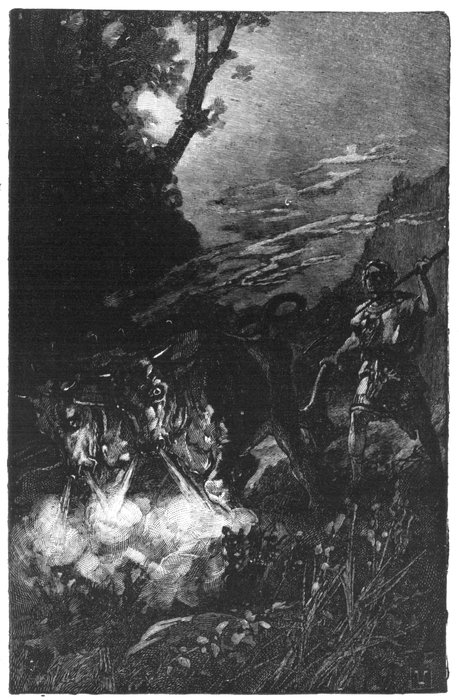
From the painting by George Varian Engraved by E. Heinemann
Jason and the Brazen Bulls
62. But the secret of the matter was that the brazen
bulls were enchanted creatures, and that Jason had
broken the spell of their fiery fierceness by his bold
way of handling them.
63. It was now easy to yoke the bulls and to harness
them to the plow, and by the time that the
moon was a quarter of her journey up the sky the
plowed field lay before him, a large tract of black
earth, ready to be sown with the dragon's teeth. So
Jason scattered them broadcast.
The moon was now high aloft in the heavens and
threw its bright beams over the plowed field, where
as yet there was nothing to be seen.
64. But by and by all over the field there was
something that glistened in the moonbeams like
sparkling drops of dew. These bright objects
sprouted higher, and proved to be the steel heads of
spears. Then there was a dazzling gleam from a
vast number of polished brass helmets, beneath
which, as they grew farther out of the soil, appeared
the dark and bearded visages of warriors
struggling to free themselves from the imprisoning
earth.
65. The first look that they gave at the upper
world was a glare of wrath and defiance. Next
were seen their bright breastplates; in every right
hand there was a sword or a spear, and on each left
arm a shield; and when this strange crop of warriors
had but half grown out of the earth, they
struggled—such was their impatience of restraint—and,
as it were, tore themselves up by the roots.
66. Wherever a dragon's tooth had fallen, there
stood a man armed for battle. They made a clangor
with their swords against their shields, and eyed
one another fiercely; for they had come into this
beautiful world, and into the peaceful moonlight,
full of rage and stormy passions, and ready to take
the life of every human brother, in recompense of
the boon of their own existence.
67. For a while the warriors stood flourishing
their weapons, clashing their swords against their
shields, and boiling over with the red-hot thirst
for battle. At last the front rank caught sight of
Jason, who, beholding the flash of so many weapons
in the moonlight, had thought it best to draw his
sword.
68. In a moment all the sons of the dragon's teeth
appeared to take Jason for an enemy; and crying
with one voice, "Guard the Golden Fleece!" they
ran at him with uplifted swords and protruded
spears. Jason knew that it would be impossible to
withstand this bloodthirsty battalion with his single
arm, but determined, since there was nothing better
to be done, to die as valiantly as if he himself had
sprung from a dragon's tooth.
69. Medea, however, bade him snatch up a stone
from the ground.
"Throw it among them quickly!" cried she. "It
is the only way to save yourself."
The armed men were now so nigh that Jason
could discern the fire flashing out of their enraged
eyes, when he let fly the stone, and saw it strike the
helmet of a tall warrior who was rushing upon him
with his blade aloft.
70. The stone glanced from this man's helmet to
the shield of his nearest comrade, and thence flew
right into the angry face of another, hitting him
smartly between the eyes.
Each of the three who had been struck by the
stone took it for granted that his next neighbor
had given him a blow; and instead of running any
farther towards Jason, they began a fight among
themselves.
71. The confusion spread through the host,
so that it seemed scarcely a moment before they
were all hacking, hewing, and stabbing at one
another.
In an incredibly short space of time—almost as
short, indeed, as it had taken them to grow up—all
of the heroes of the dragon's teeth were stretched
lifeless on the field.
And there was the end of the army that had
sprouted from the dragon's teeth. That fierce and
feverish fight was the only enjoyment which they
had tasted on this beautiful earth.
72. Agreeably to Medea's advice, Jason went in
the morning to the palace of King Æetes. Entering
the presence chamber, he stood at the foot of the
throne and made a low obeisance.
"Your eyes look heavy, Prince Jason," observed
the king; "you appear to have spent a sleepless
night. I hope you have been considering the matter
a little more wisely, and have concluded not to get
yourself scorched to a cinder in attempting to tame
my brazen-lunged bulls."
73. "That is already accomplished, may it please
your majesty," replied Jason. "The bulls have
been tamed and yoked; the field has been plowed;
the dragon's teeth have been sown broadcast and
harrowed into the soil; the crop of armed warriors
have sprung up, and they have slain one another to
the last man. And now I solicit your majesty's
permission to encounter the dragon, that I may take
down the Golden Fleece from the tree and depart
with my nine and forty comrades."
74. King Æetes scowled and looked very angry
and greatly disturbed; for he knew that, in accordance
with his kingly promise, he ought now to
permit Jason to win the Fleece if his courage and
skill should enable him to do so.
75. "You never would have succeeded in this
business, young man," said he, "if my undutiful
daughter Medea had not helped you with her
enchantments. Had you acted fairly, you would
have been at this instant a black cinder or a
handful of white ashes. I forbid you, on pain of
death, to make any more attempts to get the
Golden Fleece. To speak my mind plainly, you
shall never set eyes on so much as one of its
glistening locks."
76. Jason left the king's presence in great sorrow
and anger. But, as he was hastening down
the palace steps, the Princess Medea called after
him and beckoned him to return.
"What says King Æetes, my royal and upright
father?" inquired Medea, slightly smiling. "Will
he give you the Golden Fleece without any further
risk or trouble?"
77. "On the contrary," answered Jason, "he is
very angry with me for taming the brazen bulls
and sowing the dragon's teeth. And he forbids
me to make any more attempts, and positively
refuses to give up the Golden Fleece whether I
slay the dragon or no."
78. "Yes, Jason," said the princess, "and I can
tell you more. Unless you set sail from Colchis
before to-morrow's sunrise, the king means to
burn your fifty-oared galley and put yourself and
your forty-nine brave comrades to the sword. But
be of good courage. The Golden Fleece you
shall have, if it lies within the power of my enchantments
to get it for you. Wait for me here
an hour before midnight."
79. At the appointed hour you might again have
seen Prince Jason and the Princess Medea, side
by side, stealing through the streets of Colchis, on
their way to the sacred grove, in the center of
which the Golden Fleece was suspended to a tree.
80. Jason followed Medea's guidance into the
Grove of Mars, where the great oak trees that
had been growing for centuries threw so thick a
shade that the moonbeams struggled vainly to
find their way through it. Only here and there
a glimmer fell upon the leaf-strewn earth, or now
and then a breeze stirred the boughs aside and
gave Jason a glimpse of the sky, lest, in that deep
obscurity, he might forget that there was one
overhead.
81. At length, when they had gone farther and
farther into the heart of the duskiness, Medea
squeezed Jason's hand.
"Look yonder," she whispered. "Do you see it?"
Gleaming among the venerable oaks there was a
radiance, not like the moonbeams, but rather resembling
the golden glory of the setting sun. It
proceeded from an object which appeared to be suspended
at about a man's height from the ground, a
little farther within the wood.
82. "What is it?" asked Jason.
"Have you come so far to seek it," exclaimed
Medea, "and do you not recognize the meed of all
your toils and perils when it glitters before your
eyes? It is the Golden Fleece."
83. Jason went onward a few steps farther, and
then stopped to gaze. Oh, how beautiful it looked,
shining with a marvelous light of its own, that
prize which so many heroes had longed to behold,
but had perished in the quest of it either by the
perils of their voyage or by the fiery breath of the
brazen-lunged bulls!
84. "How gloriously it shines!" cried Jason, in a
rapture. "It has surely been dipped in the richest
gold of sunset. Let me hasten onward and take it
to my bosom."
"Stay," said Medea, holding him back. "Have
you forgotten what guards it?"
85. To say the truth, in the joy of beholding the
object of his desires, the terrible dragon had quite
slipped out of Jason's memory. Soon, however,
something came to pass that reminded him what
perils were still to be encountered.
86. An antelope, that probably mistook the yellow
radiance for sunrise, came bounding fleetly through
the grove. He was rushing straight towards the
Golden Fleece, when suddenly there was a frightful
hiss, and the immense head and half the scaly body
of the dragon were thrust forth—for he was twisted
round the trunk of the tree on which the Fleece
hung—and seizing the poor antelope, swallowed
him with one snap of his jaws.
87. The dragon had probably heard the voices;
for, swift as lightning, his black head and forked
tongue came hissing among the trees again, darting
full forty feet at a stretch. As it approached,
Medea tossed a magic potion right down the monster's
wide-open throat. Immediately, with an outrageous
hiss and a tremendous wriggle, flinging
his tail up to the tiptop of the tallest tree and shattering
all its branches as it crashed heavily down
again, the dragon fell at full length upon the
ground and lay quite motionless.
88. "It is only a sleeping potion," said the enchantress
to Prince Jason. "Quick! Snatch the prize and
let us begone. You have won the Golden Fleece."
Jason caught the Fleece from the tree and hurried
through the grove, the deep shadows of which were
illuminated, as he passed, by the golden glory of the
precious object that he bore along.
89. Jason found the heroes seated on the benches
of the galley, with their oars held perpendicularly,
ready to let fall into the water.
As he drew near, he heard the Talking Image
calling to him with more than ordinary eagerness
in its grave, sweet voice:
"Make haste, Prince Jason! For your life, make
haste!"
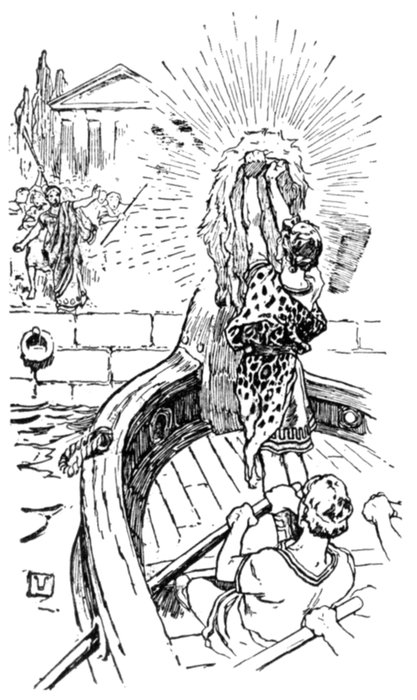
The galley flew over the water.
90. With one bound, he leaped aboard. At sight
of the glorious radiance of the
Golden Fleece, the nine and forty
heroes gave a mighty shout, and
Orpheus, striking his harp, sang
a song of triumph, to the cadence
of which the galley flew over the
water, homeward bound, as if
careering along with wings.
I. Jā´sȯn. Ĭ ŏl´c̵hŏs. Çĕn´ta̤urs̝. C̵hī´rŏn.
Ǣ´sȯn. Pē´lĭ ăs. Săn´dals̝: shoes
consisting of soles strapped to the feet.
Tûr´bū̍ lent: disturbed; roused to great
commotion. Nĕp´tū̍ne. Gärb: dress.
II. Măl´ĭçe: ill will. Quĕst: search.
Scĕp´tẽr: a staff carried by a king as a sign of his authority.
III. Dō dō´nȧ. Är´gus. Găl´ley̆: a vessel with oars, used
by ancient people. Prow: the forepart of a vessel. Stûr´dy̆:
strong. Ĕn coun´tẽr: meet.
IV. Cŏl´c̶hĭs. Ǣ ē´tēs̝. Mĕd´ĭ tāte: intend; think seriously.
Sō̍ lĭ´çĭt: ask earnestly. Vŭl´can. Căd´mus. Är´gō̍ na̤uts.
Cŏm´plā̍i sănt ly̆: politely. Mē dē´ȧ.
V. Ŏb scū´rĭ ty̆: darkness. Clăṉ´gor: a sharp, harsh, ringing
sound. Prō̍ trūd´ĕd: thrust out. Bat tal´ion: body of troops.
VI. Ō̍ bēi´sançe: bow. Sŭs pĕnd´ĕd: hung. Mēed: reward.
Po´tion: drink; dose; usually of liquid medicine. Ĭl lū´mĭ nāt ĕd:
lighted up; brightened. Or´pheus. Cā´dençe: the
close or fall of a strain of music.
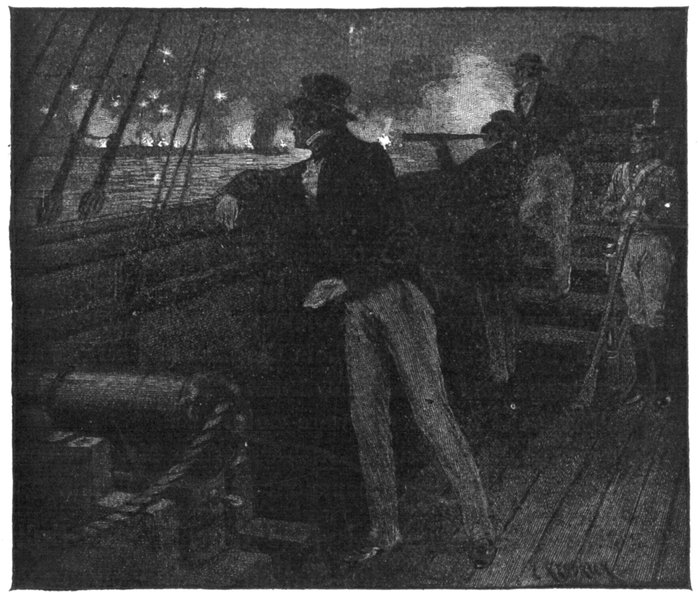
Key composing "The Star-Spangled Banner"
Hunting the Grizzly [1] — I — II
By Theodore Roosevelt
Theodore Roosevelt (1858 ——): The twenty-sixth President
of the United States. He was made Assistant Secretary
of the Navy in 1897, and the next year resigned to organize
with Dr. Leonard Wood the First U. S. Cavalry Volunteers,
popularly called Roosevelt's Rough Riders. The regiment
distinguished itself in action in Cuba, and Roosevelt was
made colonel for gallantry in the battle of La Quasina. In
1898 he was elected Governor of New York, and in 1900 Vice-President.
On the death of President McKinley, September
14, 1901, he became President. He has done much big game
shooting in the West, and is the author of a number of books,
among which are "The Winning of the West" and "The Life
of Gouverneur Morris."
1. That evening we almost had a visit from one
of the animals we were after. Several times we
had heard at night the musical calling of the bull
elk—a sound to which no writer has
as yet done justice.
2. This particular night, when
we were in bed and the fire was
smoldering, we were roused by a
ruder noise—a kind of grunting
or roaring whine, answered
by the frightened
snorts of the ponies. It was a bear which had
evidently not seen the fire, as it came from behind
the bank, and had probably been attracted by the
smell of the horses.
3. After it made out what we were, it stayed
round a short while, again uttered its peculiar roaring
grunt and went off. We had seized our rifles and
had run out into the woods, but in the darkness
could see nothing; indeed, it was rather lucky we
did not stumble across the bear, as he could have
made short work of us when we were at such a
disadvantage.
4. Next day we went off on a long tramp through
the woods and along the sides of the canyons. There
were plenty of berry bushes growing in clusters,
and all around these there were fresh tracks of bear.
But the grizzly is also a flesh-eater, and has a great
liking for carrion.
5. On visiting the place where Merrifield had
killed the black bear, we found that the grizzlies
had been there before us, and had utterly devoured
the carcass, with cannibal relish. Hardly a scrap
was left, and we turned our steps toward where lay
the bull elk I had killed.
6. It was quite late in the afternoon when we
reached the place. A grizzly had evidently been at
the carcass during the preceding night, for his great
footprints were in the ground all around it, and the
carcass itself was gnawed and torn and partially
covered with earth and leaves; for the grizzly has
a curious habit of burying all of his prey that he
does not at the moment need.
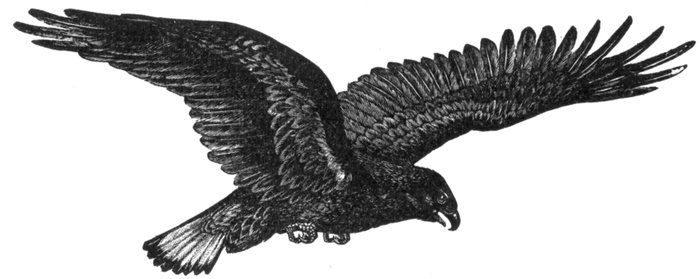
7. A great many ravens had been
feeding on the body, and they wheeled
about over the tree tops above us, uttering
their barking croaks.
8. The forest was composed mainly of what are
called ridge-pole pines, which grow close together,
and do not branch out until the stems are thirty or
forty feet from the ground. Beneath these trees
we walked over a carpet of pine needles, upon
which our moccasined feet made no sound. The
woods seemed vast and lonely, and their silence was
broken now and then by the strange noises always
to be heard in the great forests, and which seem to
mark the sad and everlasting unrest of the wilderness.
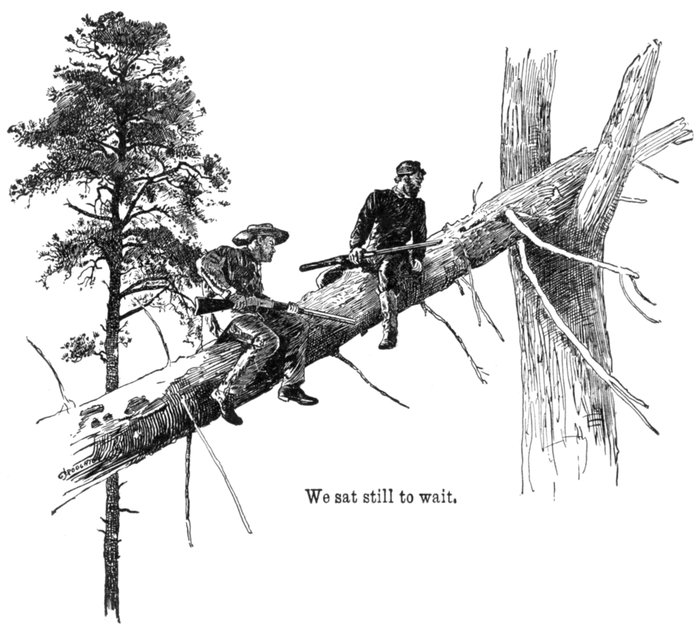
9. We climbed up along the trunk of a dead tree
which had toppled over until its upper branches
stuck in the limb crotch of another, that thus supported
it at an angle half-way in its fall. When above
the ground far enough to prevent the bear's smelling
us, we sat still to wait for his approach until, in
the gathering gloom, we could no longer see the
sights of our rifles, and could but dimly make out
the carcass of the great elk.
10. It was useless to wait longer, and we clambered
down, and stole out to the edge of the woods.
The forest here covered one side of a steep, almost
canyon-like ravine, whose other side was bare, except
of rock and sage brush. Once out from under the
trees there was still plenty of light, although the
sun had set, and we crossed over some fifty yards
to the opposite hillside and crouched down under a
bush to see if perchance some animal might not also
leave the cover.
11. To our right the ravine sloped downward
toward the valley of the Bighorn River, and far on
its other side we could catch a glimpse of the great
main chain of the Rockies, their snow peaks glinting
crimson in the light of the set sun.
12. Again we waited quietly in the growing dusk,
until the pine trees in our front blended into one
dark, frowning mass. We saw nothing; but the
wild creatures of the forest had begun to stir abroad.
The owls hooted dismally from the tops of the tall
trees, and two or three times a harsh, wailing cry,
probably the voice of some lynx or wolverine, arose
from the depths of the woods.
13. At last, as we were rising to leave, we heard
the sound of the breaking of a dead stick from the
spot where we knew the carcass lay. It was a
sharp, sudden noise, perfectly distinct from the
natural creaking and snapping of the branches; just
such a sound as would be made by the tread of
some heavy creature. "Old Ephraim" had come
back to the carcass.
14. A minute afterward, listening with strained
ears, we heard him brush by some dry twigs. It
was entirely too dark to go in after him; but we
made up our minds that on the morrow he should
be ours.
15. Early the next morning we were over at the
elk carcass, and, as we expected, found that the
bear had eaten his fill at it during the night. His
tracks showed him to be an immense fellow, and
were so fresh that we doubted if he had left long
before we arrived; and we made up our minds to
follow him up and try to find his lair.
16. My companion was a skillful tracker, and we
took up the trail at once. For some distance it led
over the soft, yielding carpet of moss and pine
needles, and the footprints were quite easily made
out, although we could follow them but slowly; for
we had, of course, to keep a sharp lookout ahead
and around us as we walked noiselessly on in the
somber half light always prevailing under the great
pine trees.
17. We made no sound ourselves, and every little
sudden noise sent a thrill through me as I peered
about, with each sense on the alert. Two or three
of the ravens that we had scared from the carcass
flew overhead, croaking hoarsely; and the pine tops
moaned and sighed in the slight breeze—for pine
trees seem to be ever in motion, no matter how light
the wind.
18. After going a few hundred yards the tracks
turned off on a well-beaten path made by the elk;
the woods were in many places cut up by these
game trails, which had often become as distinct as
ordinary footpaths. The beast's footprints were
perfectly plain in the dust, and he had lumbered
along up the path until near the middle of the hillside,
where the ground broke away and there were
hollows and bowlders.
19. Here there had been a windfall, and the dead
trees lay among the living, piled across one another
in all directions; while between and around them
sprouted up a thick growth of young spruces and
other evergreens. The trail turned off into the
tangled thicket, within which it was almost certain
we would find our quarry.
20. We could still follow the tracks, by the slight
scrapes of the claws on the bark, or by the bent and
broken twigs; and we advanced with noiseless caution,
slowly climbing over the dead tree trunks and
upturned stumps, and not letting a branch rustle or
catch on our clothes. When in the middle of the
thicket, we crossed what was almost a breastwork of
fallen logs, and Merrifield, who was leading, passed
by the upright stem of a great pine.
21. As soon as he was by it he sank suddenly on
one knee, turning half round, his face fairly aflame
with excitement; and as I strode past him, with
my rifle at the ready, there, not ten steps off, was
the great bear, slowly rising from his bed among
the young spruces. He had heard us, but apparently
hardly knew exactly where or what we were,
for he reared up on his haunches, sideways to us.
22. Then he saw us and dropped down again on
all fours, the shaggy hair on his neck and shoulders
seeming to bristle as he turned toward us.
As he sank down on his fore feet I had raised the
rifle; his head was bent slightly down, and when I
saw the top of the white bead fairly between his
small, glittering, evil eyes, I pulled the trigger.
23. Half rising up, the huge beast fell over on his
side in the death throes, the ball having gone into
his brain, striking as fairly between the eyes as
if the distance had been measured by a carpenter's
rule.
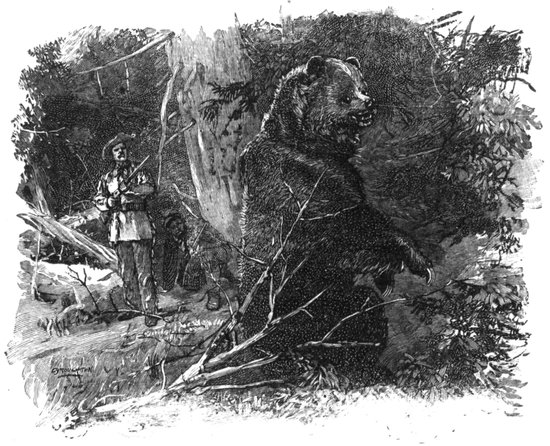
He reared up on his haunches.
24. The whole thing was over in twenty seconds
from the time I caught sight of the game; indeed,
it was over so quickly that the grizzly did not have
time to show fight at all, or come a step toward
us. It was the first I had ever seen, and I felt not
a little proud as I stood over the great brindled
bulk which lay stretched out at length in the cool
shade of the evergreens.
25. He was a monstrous fellow, much larger than
any I have seen since, whether alive or brought in
dead by the hunters. As near as we could estimate—for
of course we had nothing with which to
weigh more than very small portions—he must
have weighed about twelve hundred pounds; and
though this is not so large as some of his kind are
said to grow in California, it is yet a very unusual
size for a bear. He was a good deal heavier than
any of our horses; and it was with the greatest
difficulty that we were able to skin him.
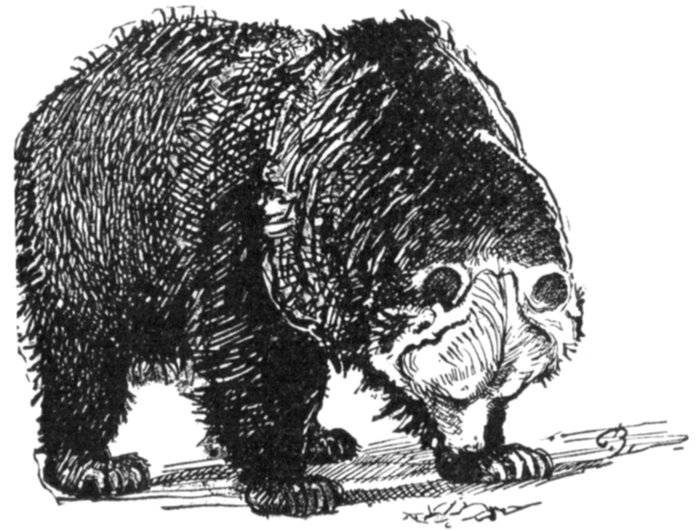
26. He must have been very old, his teeth and
claws being all worn down and blunted; but
nevertheless he had been living in plenty, for he
was as fat as a prize hog, the layers of his back
being a finger's length in thickness.
27. He was still in the summer coat, his hair
being short, and in color a curious brindled brown,
somewhat like that of certain bulldogs; while all
the bears we shot afterward had the long, thick
winter fur, cinnamon or yellowish brown.
28. By the way, the name of this bear has reference
to its character and not to its color, and should,
I suppose, be properly spelled "grisly"—in the sense
of horrible, exactly as we speak of a "grisly
specter"—and not "grizzly;" but perhaps the latter
way of spelling it is too well established to be now
changed.
I. Smōl´dẽr ĭng: burning and smoking without flame.
Căn´yȯns̝: deep gorges or hollows between steep banks, worn
by water courses. Căr´rĭ ȯn: dead bodies of animals, unfit
for food. Căn´nĭ bal: an animal that devours its own kind.
Sāġe brŭsh: a low shrub which grows in great quantities on
the plains of the Western United States. "Old Ephraim":
a hunter's name for the grizzly bear.
II. Lâir: the bed of a wild beast. On the alert: on the
lookout against danger. Bōwl´dẽrs̝: large stones worn
smooth by the action of water; rocks, rounded or not, carried
by natural agencies far from their native bed. Wĭnd´fa̤ll:
portion of a forest blown down in a wind storm. Quạr´ry̆:
the animal hunted for. Spĕc´tẽr: ghost.
The spring is pleasant. The air is warm. Flowers are in
blossom. The days and nights are equal.
Summer also will be pleasant. The air will be hot. Many
flowers will be in blossom. The days will be long.
Winter was not so pleasant. The air was cold. The flowers
were not in blossom. The days were short.
Which sentences tell (1) how things are now; (2) how
they were; (3) how they will be?
Write these sentences as if (1) winter were here; (2) as
if it were still to come.