Francisco José Goya was born at Fuendetodos, in the province of
Aragon, on the 13th of March, 1746. His father, José Goya, and his
mother, Gracia Lucientes, were humble peasants and lived upon the
product of the sluggish fields that surrounded their modest home.
What the childhood of José was, we do not know, for his biographers
are silent upon this point. They content themselves with saying that
he aided his parents in the daily round of tasks upon the farm. As to
his education, it was certainly that of all the young peasant boys of
the Spanish farming districts. The child must have acquired the first
rudiments from the village priest, or perhaps from the monks of the
nearest convent. Reading, writing, and a little arithmetic made up the
whole equipment that young José possessed at the age of fifteen. How
his taste for drawing was first born, what occurrence or what object
awakened his artistic instinct, we do not know. Perhaps, like so many
others, he became suddenly conscious of his vocation at the sight of
some of those cruel and violent pictures representing scenes of the
Passion, such as abound in Spanish churches, and it is not unlikely
that his youthful soul received a profound and lasting impression.
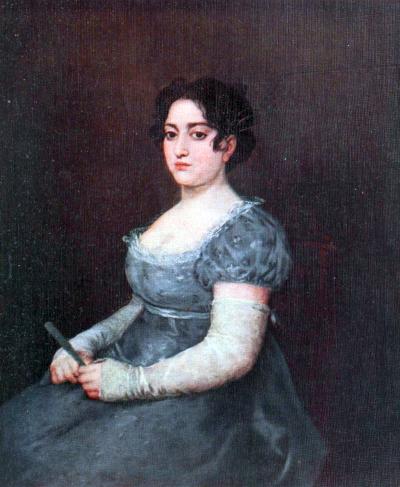
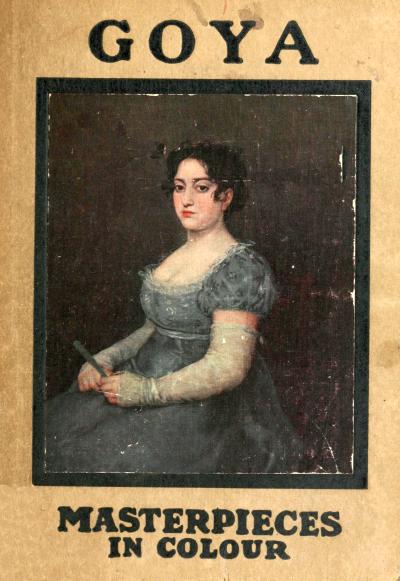
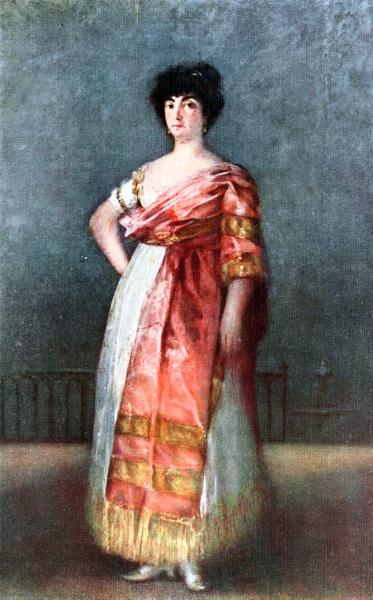
PLATE III.—THE WOMAN WITH THE FAN
(Museum of the Louvre)
The Louvre is not rich in works by Goya; it possesses only four. But
the portrait of a woman, which is here reproduced, belongs to the
period of the painter’s second manner, in which a most precise realism
went hand in hand with a vaporous lightness and a pervading grayness
of tone that recalls the most delicate creations of Prudhon. But the
execution is vigorous, and in the expression of the face and in the
employment of the colours there are a sureness and an intensity that
are remarkable.
However this may be, at the age of fifteen Goya could handle his
pencil with sufficient assurance to astonish the worthy monk of
Saragossa, who was a judge of such matters. The latter conducted his
young protégé to the city, and a few days later entered him as a pupil
in the studio of Don José Lujan Martinez.
This Lujan was a Saragossan by birth, but he had studied painting in
Naples under the guidance of Mastréolo. Possessing considerable
talent, he enjoyed a great reputation in his native city. Upon his
return from Italy, he had founded a free school of design, a sort of
academy which was maintained wholly by his own contributions, both of
money and of time.
Among the artists who were trained in this studio, there were some who
left names highly esteemed in Spain: Beraton, Vallespin, Antonio
Martinez the goldsmith, and Francisco Bayeu de Subias. With the last
named of this group Goya formed a particular attachment,
notwithstanding that Bayeu was twelve years the elder.
Goya remained in Lujan’s studio for between four and five years. His
fiery and impulsive temperament had already begun to declare itself,
and his master did not always succeed in moderating his exuberance. He
manifested an extraordinary diligence in his work, he was enamoured of
his art, and showed exceptional aptitude for it. From the first months
he became the most interesting feature in the studio; his imagination,
his enthusiasm, his assurance often surprised his master and stupefied
his comrades, who were accustomed to a calmer and less violent manner
of painting. At this epoch his character was already beginning to
form; one could foresee in him the man that he was destined to be
throughout his life. He was no less ardent in his pleasures than in
his work. He was the true type of the hot-headed Aragonais, and at the
age of nineteen revealed himself, headstrong, turbulent, a born
fighter. He threw himself, heart and soul, into the battles that
occurred so frequently at that time throughout Aragon between the
young men of the different parishes. Uniting in rival gangs, fiercely
jealous of one another, they were always ready on holiday evenings to
settle some question of superiority, and any excuse for an encounter
was welcomed by them. More than once, for the greater honour of San
Luis or of Nuestra Señora del Pilar, the club and knife scattered
blood over the streets and suburbs of Saragossa.
Goya took part in all these battles, flung himself into them, body and
soul, tumultuously aiding and abetting this hazardous and adventurous
mode of life, which had the flavour of romantic fiction. In the course
of one of these collisions, three young men belonging to the rival
faction were left stiff and stark on the battle-ground. Goya, who was
one of those most directly implicated in the affair, was warned that
the Inquisition intended to arrest him. Although it no longer
possessed the terrible power of earlier times, the Inquisition was
even then by no means light-handed, and there was still serious danger
in bringing oneself under its notice. Goya was well aware of this, and
he did not wait for the arrival of the alguazils. That same night he
left the city and wended his way to Madrid, which, as it happened, it
had long been his dream to visit.
In Madrid he once more ran across his friend Bayeu, who had been
living there for the past two years. Bayeu was drawing a pension from
the academy of San Fernando, and he also had the good luck of being
favoured by Mengs, the all powerful Superintendent of Fine-Arts, who
had asked him to collaborate in his great task of decorating the royal
palace.
Bayeu welcomed his young comrade with open arms and invited him to
have a share in his present work. But we must infer that Mengs’s
technique and method of teaching were already displeasing to Goya, for
he courteously declined the offer. In any case, he had not come to
Madrid in search of employment, but for the purpose of continuing his
education. All day long he visited the artistic marvels of the
capital, made the rounds of churches and convents, studied the old
masters, executed copies, and even penetrated into the royal dwellings
in order to admire the works of art which they contained, observing
extensively, reflecting, comparing, and, in a word, equipping his
profound intelligence with precious material for the future. But in
Madrid, just as in Saragossa, work was not allowed to interfere with
his pleasures. He was always to be found in quest of adventure; he
roamed the streets, sword under cape and guitar in hand, serenading
the sparkling black eyes that looked down laughingly at him from the
ambush of their window-blinds, and stirring husbands to a jealous
fury; or again, breaking the peace with a crowd of boisterous
companions; or still again, scaling the balcony of his latest
conquest, “and thus playing the prelude to that reputation of an
audacious, swash-buckling Don Juan, which later was destined to earn
him, even among the lower classes, an incredible notoriety.”
At this period Goya was a young man of haughty presence, somewhat
below the average stature, but exceedingly well proportioned. Although
his features lacked regularity, his face was attractive. It had a
pleasant air of joviality and frankness; there was a sparkle to his
eye and a lurking spirit of mischief around his lips. He had,
furthermore, an affable manner, an unabashed assurance, a mad bravado,
and the impudence of a lackey. Thanks to the friends whom he had
gained, he was favourably received by a goodly number of distinguished
families, where the charm of his personality played havoc with the
hearts of the women.
This agreeable pastime could not fail to entail its own dangers, as
Goya was not long in learning by experience. On a certain fine
evening, when he had doubtless been lurking beneath some balcony, he
was picked up in an obscure side street, where he lay stretched at
full length, with a gaping poignard thrust in his back. It was
necessary to keep him hidden for a time, in order to protect him from
the unwelcome curiosity of the police; and later, when the affair had
become noised abroad, he was forced to quit Madrid, just as he had
quitted Saragossa, clandestinely, without even waiting for his wound
to be completely healed.
In order to give his escapade a chance to be forgotten, Goya, who for
some time past had desired to visit Italy, set sail, with Rome for his
destination.
From the moment of his arrival he came fully under the spell of the
marvels accumulated in the Eternal City. He passed entire days in the
presence of the masterpieces of the great artists. He admired them
with all his heart, yet without surrendering his right to independent
criticism. He recognized instinctively that there was nothing in all
these illustrious compositions which corresponded to his own personal
temperament, and that his fiery soul could ill adapt itself to the
calculated and almost geometric composition of the great frescoes in
the Vatican. But he possessed too deep a reverence for art to disdain
the admirable science of those great forerunners. There, beyond
question, was the ideal opportunity for study; and in the presence of
those celebrated canvases he absolutely forgot himself; he analyzed
their intimate beauties, compared the styles and colour schemes of the
different schools, scrutinized their methods, and forced himself to
penetrate and understand them. He did not attempt to copy a single one
of them; he felt that he would gain nothing by doing so, but that on
the contrary he might lose. This singular method of abstract study,
which may be called the method of intuition, explains perhaps how so
frank an individuality as that of Goya, far from being enfeebled by
contact with the past, became on the contrary stronger and more
genuinely alive. As a matter of fact, his talent owes nothing, or
practically nothing, to the art of Italy.
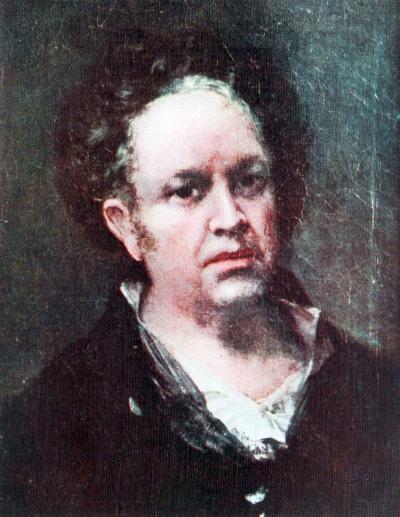
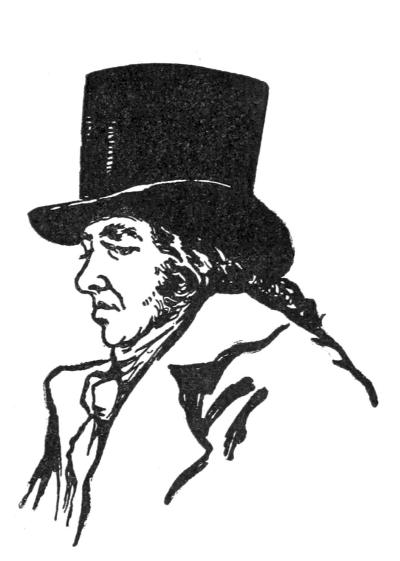
PLATE IV.—PORTRAIT OF GOYA
(Museum of the Prado, Madrid)
In this portrait the artist is already old, but his physiognomy has
preserved that vivacity of movement, that expression of penetration
and irony, which made him such a brilliant figure at the Court of
Spain. This work, like every other which bears his signature, is
distinguished by the vigour of its execution and beauty of
colouring.
During his sojourn in Rome, Goya came in contact with David. Curious
phenomenon; these two natures who were so different in character and
temperament, and whose artistic tastes were almost antagonistic, felt
themselves invincibly attracted towards each other. It is true that
they both shared to an equal degree the philosophic ideas of the
period, and that they had the same ideal; namely, the liberation of
the people. They were destined later, each in his own country, to be
caught in the full whirlwind of the Revolution; and these mutual ties,
divined rather than expressed, created between David and Goya an
undying friendship. Because they liked each other, they appreciated
each other’s work, in spite of the divergence between their talents;
and Goya, even in extreme old age, always spoke with emotion of the
“great David.”
In Rome, as in Madrid, Goya was not long in distinguishing himself by
perilous escapades. Señor Carderera relates that at one time “He
carved his name with his knife on the lantern of Michelangelo’s
cupola, on a corner of a certain stone which not one of the artists,
German, English, or French, who had preceded him in the mad ascent,
had succeeded in reaching; and on another day he made the circuit of
the tomb of Cecilia Metella, barely supporting himself upon the narrow
projection of the cornice.”
But these were merely childish pranks; before long he had involved
himself in a far more dangerous adventure, especially in the city of
the Popes. He had become infatuated with a young girl in the higher
circles of Roman society, and formed the project of eloping with her.
Being warned in time, the parents placed their daughter beyond his
reach, within the austere shelter of a convent. This setback, however,
was not sufficient to discourage the gallant artist, it only spurred
him on to bolder ventures. He resolved to snatch his fair lady from
the very hands of her jailors, and one night he attempted to invade
the convent itself. But he was captured and handed over to justice.
In order to extricate himself from this awkward dilemma, far more
awkward at Rome than it would have been anywhere else, he was forced
to appeal to the Spanish ambassador, who intervened and demanded his
surrender by the Holy See. Goya was restored to liberty, but on
condition that he should take immediate leave of Rome.
He now returned to Saragossa, for the sake of his aged parents, with
whom he spent the closing months of the year 1774, after which he once
more set forth for Madrid. There he again fell in with his faithful
friend, Bayeu, discovered himself to be in love with the latter’s
sister, Josefa Bayeu, and married her a few months later.
His brother-in-law again offered to introduce him to Mengs, and this
time, weary no doubt of adventures, he accepted the offer. The
Superintendent of Fine-Arts gave him a most cordial reception. We have
already had occasion to refer to the almost despotic authority which
Mengs at this period exerted over Spanish art and the singular
direction in which he had guided it. In the decorative works which he
was conducting in the palaces at Madrid and Aranjuez, there was, in
the words of M. Charles Yriarte, “nothing but an agglomeration of
struggles of Titans, apotheoses, triumphs of Hercules, and
glorifications of Ceres; but Goya soon came to scale Olympus, and turn
Venus into a manola, and substitute his frightful Saturn devouring
his Children, in his Quinta [Goya’s country house], for the figure
of Father Time, with his traditional stooping shoulders, partaking of
his progeny with prudence and circumspection.”
Up to this moment Goya had been far more intent upon observing and
learning than upon painting; he had as yet produced nothing, and no
one even suspected the powerful faculties that were dormant in him.
More as a favour to Bayeu than from any personal confidence, Mengs
entrusted him with the composition of some cartoons for the royal
manufactory of Santa Barbara. Goya set to work, and from the start
broke squarely away from the superannuated tradition of the
Superintendent. Throwing aside the entire paraphernalia of mythology,
he confined his cartoons wholly to subjects borrowed from national
life. In this work he gave free rein to the full spontaneity of his
talent and to his riotous imagination, and in the course of it he
revealed the full wealth of his imagination and his marvellous
instinct for decorative art. The result was a revelation: a genuine
ovation greeted these modern compositions, so full of life and
movement and colour. Mengs himself, who was not lacking either in
intelligence or in taste, was frankly delighted and warmly
congratulated the young artist. At Court and in the city nothing was
talked of but Goya and his cartoons; from this moment he entered upon
his true role as national painter.
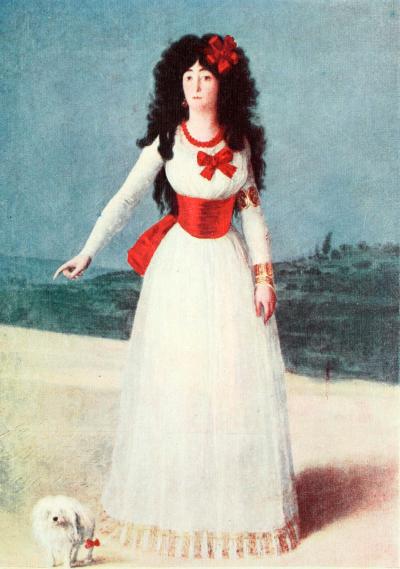
PLATE V.—THE DUCHESS OF ALBA
(Collection of the Duke of Alba, Madrid)
This superb portrait, the privilege of reproducing which we owe to his
Excellence, the Duke of Alba, was painted by Goya with all the
confidence of genius, guided by gratitude and friendship. The ties of
mutual esteem which united the artist and the duchess are well known,
and this portrait in a certain sense constitutes an acknowledgment of
it.
This first attempt had the result of enlightening Goya as to his own
powers. Not that he had previously mistrusted them, but he had feared
that he was not yet sufficiently equipped to venture upon a public
appearance. But on the strength of the success of his cartoons he took
stock of himself as follows: “He was thirty years of age and he
realized now that he had only to take his brush in hand in order to
become a great painter.”
Henceforth, throughout a period of more than fifty years, he was
destined to produce unweariedly, trying his hand at the most diverse
types, alternating between painting and engraving; and in his
life-work, which, taken as a whole, is one of the vastest and most
varied that ever came from any artist, he has given us the measure of
his prodigious fecundity.
He made his debut in genre painting, and he drew his inspiration
straight from the life of the people. Spain, for that matter,
furnished an exceptional nutriment for his order of talent; land that
it was of vivid light, ardent colour, picturesque manners and curious
costumes, it was well designed to fire that vigorous and impulsive
nature to the highest pitch of enthusiasm. And hence, while Madrid
looked on and marvelled, there came in swift succession from his brush
a whole series of pictures saturated with local colour: bull fights,
attacks of bandits, clandestine meetings, processions, masquerades,
all the life of the Spanish city and the Spanish highway, reproduced
in piquant, accurate, brightly coloured scenes, of charming naïveté
and exquisite naturalness, replete with vivacity and riotous fancy.
On closer inspection it would be easy to find a certain amount of
incorrectness in the drawing. Some of his bulls, especially, are
endowed with anatomical proportions that at best only approximate the
truth. But they have such spirit, such vigour, such nimbleness, such
furious agility, that we feel ourselves snatched up and borne along by
this living whirlwind, this intensity of movement, almost as though we
were bodily present in the arena where the blood-stained drama is in
the course of enactment. As to the colouring, it is very light and
very luminous and silvery.
Almost at the same period Goya published a collection of etchings in
which he had reproduced the most celebrated masterpieces of Velazquez.
It was a daring venture, but it had no terrors for the young artist.
Goya did no injustice to Velazquez; he succeeded most felicitously in
reproducing in these etchings not only the design, but the colour
values and characteristic spirit of his model. This magnificent
series, executed during the year 1778, comprises sixteen pieces, which
to-day are of inestimable value.
That same year the Franciscans went to great expense to decorate their
church; they appealed to the most renowned artists which Madrid at
that period possessed. Goya was entrusted with the decoration of a
chapel which required two paintings. The subjects specified were a
Christ on the Cross and a St. Francis Preaching. The Christ on
the Cross is distinguished by a very fine religious spirit, enhanced
by its admirable drawing and by a dignity quite its own. The fine and
delicate modelling suggests comparison with the most perfect works of
Italy; and the whole painting is overspread with an infinitely light
surface coat of colour, very luminous and very pale.
This canvas is the best of all Goya’s religious works. On the
contrary, his St. Francis Preaching in no way deserved the vogue
which it enjoyed at the time, both at Court and in the city circles.
Its heavy composition, pretentious and ill balanced, did no credit to
any of Goya’s qualities, save that of colourist, in which respect he
was always interesting.
Goya was now the idol of the whole population of Madrid, who revelled
in his fantasies and regarded him as their national painter. Already
celebrated through his scenes of the life of the people, he had now
acquired a new prestige through the fame of his religious paintings;
and there was good reason for astonishment that he had not yet been
rewarded by any official honour. His rival painters had scant love for
him, or, to put it more frankly, they hated the powerful originality
of his talent so far removed from the slow product of their
uninspired toil. In order to belittle him, they censured the
incorrectness of his drawing and the violent character of his
subjects. But public opinion triumphed over this dead weight of
malevolence. However reluctantly, the Academy of Saint-Marc welcomed
him among its members on the seventh of May, 1780, hailing him as
“academician by merit.”
A few months later the Chapter of Nuestra Señora del Pilar at
Saragossa decided to have its sanctuary decorated and instituted a
competition among the leading artists of Spain, under the direction of
Goya’s brother-in-law, Francisco Bayeu. Goya decided to compete, and
one of the vaults, with its adjacent panels, was assigned to him. The
sketches which he submitted were only half satisfactory, and the
Chapter requested him to modify them. Goya took the criticisms in ill
part, imputing them, whether rightly or wrongly, to his
brother-in-law’s jealousy, and refused in any way to modify his
designs. A bitter quarrel might have resulted, if mutual friends had
not intervened to reconcile the two artists. Finally, Goya agreed to
make certain concessions; the vault was entrusted to him, and he
forthwith commenced the execution of his frescoes.
The subject chosen represented The Virgin and the Martyred Saints in
their Glory. This immense work required no less than three years of
the artist’s time, and he expended upon it all his science and all his
exceptional qualities as a colourist. It is an attractive work,
cleverly composed, possessing a fine decorative effect, brilliant and
warm, and in no way inferior to the most resplendent frescoes of
Tiepolo. Only one thing was lacking, the religious spirit, of which
Goya was wholly destitute. In works of this order, dexterity is not
sufficient; the breath of the inner zeal is necessary; cleverness,
dexterity, the gift of colour, cannot make up for the absence of
faith. As often as Goya attempted religious painting, the result
showed the same general order of deficiencies, because he always
treated his subjects solely as a painter, and not, after the manner of
Raphael and Correggio, as a devout believer.
Furthermore, the ideal was not in his line; the dominant note of his
talent, before all else, was naturalism. Genre painter by temperament,
he sought by preference for the picturesque aspect of his subjects.
Owing to these conditions, his frescoes at Saragossa and in general
all his large religious compositions are in reality nothing else than
vast genre paintings.