Among the number of chimpanzees that I have
seen are some whose actions are worthy of record;
but as many of them were the repetition of similar
acts of other specimens which are elsewhere described,
we shall omit them, and relate only such
other acts as may tend to widen the circle of our
knowledge, and more fully illustrate the mental range
of this interesting tribe of apes.
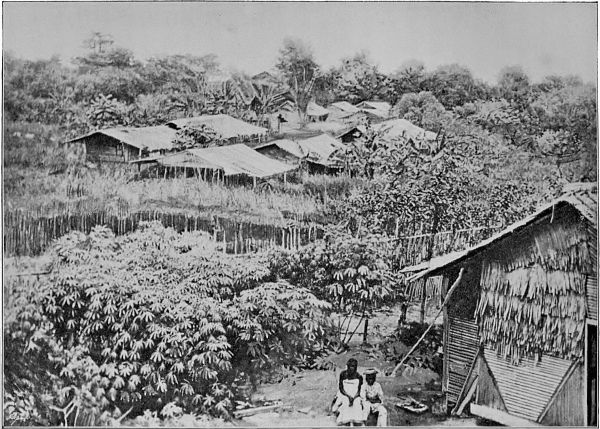
In passing through the country of the Esyira tribe,
I came to a small village where I halted for a rest.
On entering the open space between two rows of
bamboo huts, I saw a group of native children at
the opposite end of the space, and among them a
fine big chimpanzee, who was sharing with them in
their play.
When they discovered the presence of a white
man in the town, they left their sport and came to
inspect me. The ape also came, and he showed as
much interest in the matter as any one else did. I
was seated in a native chair in front of the king's
hut, and the people, as usual, stood around me at a
respectful distance, looking on as if I had been some
wild beast captured in the jungle. The ape was
aware that I was not a familiar kind of thing, and
he appeared in doubt as to how he should act towards
me. He sat down on the ground among the
people, and stared at me in surprise, from time to
time glancing at those around him as if to ascertain
what they thought of me. As they became satisfied
with looking, they retired one by one from the
scene, until most of them had gone, but the ape
remained. He changed his place a few times, but
only to get a better view. The people were amused
at his manner, but no one molested him.
At length I spoke to him in his own language,
using the sound which they use for calling one
another. He looked as if he knew what it meant
but made no reply. I repeated the sound, when he
rose up and stood on his feet as if he intended to
come to me. Again I uttered it, and he came a few
feet closer, but shied to one side as if to flank my
position and get behind me. He stopped again to
look, and I repeated the word, in response to which
he came up near my right side, and began to examine
my clothing. He plucked at my coat-sleeve a few
times, then at the leg of my trousers and at the top
of my boot. He was getting rather familiar for a
stranger, but I felt myself to blame for having given
him the license to do so. For a while he continued
his investigations, then deliberately put his left hand
on my right shoulder, his right foot on my knee, and
climbed into my lap. He now began to examine
my helmet, ears, nose, chin and mouth. He became
a little rough, and I tried to get him down out of my
lap, but he was not disposed to go. Finally, I told
my boy, who acted as interpreter, to tell the native
lads to come and take him away. This amused
them very much, for they saw that I was bigger than
the ape, and thought I ought therefore to manage
him myself. They complied, however, but his
apeship declined to go until one of the men of the
town interfered and compelled him to do so.
As he got down from my lap, one of the boys
bantered him to play. He accepted the challenge,
and ran after the lad until they reached the end of
the open space between the houses, when the boy
fell upon the ground and the ape fell on him. They
rolled and wallowed on the ground for a time, when
the ape released himself and ran away to the other
end of the opening, the boy pursuing him. When
they reached the end of the street, they again fell
upon each other and another scuffle ensued. It was
plain to be seen that the boy could run much faster
than the ape, but he did not try to elude him.
The other children crowded around them or
followed them, looking on, laughing and shouting in
the greatest glee. First one boy and then another
took his turn in the play, but the ape did not lose
interest in me. He stopped from time to time to
take another survey, but did not try again to get
upon my lap.
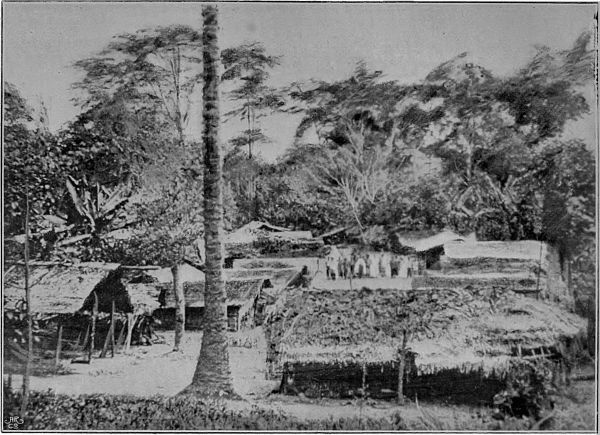
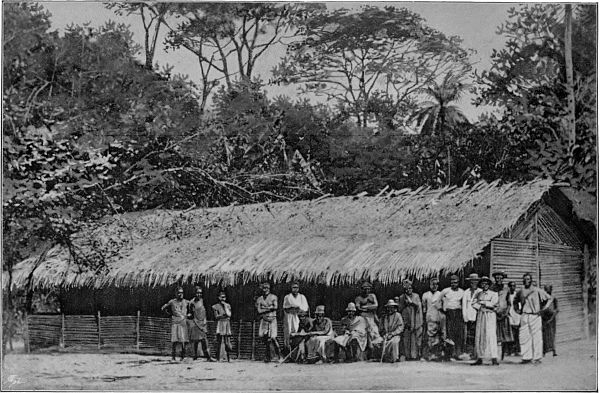
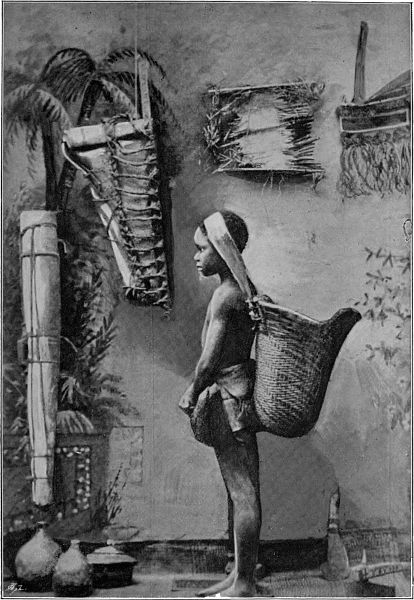
NATIVE VILLAGE AT MOILE—INTERIOR OF NYANZA
After a long time at this sport, the ape quit
playing and sat down by the wall of a house, with
his back against it; the children tried in vain to
induce him to resume, but he firmly declined, and
sat there like a tired athlete, picking his teeth with
a bamboo splinter, which he had pulled off the side
of the house.
His conduct was so much like that of the children
with whom he was playing, that one could not have
distinguished him from them except by his physique.
He enjoyed the game as much as they did, and
showed that he knew how to gain or use an
advantage over his adversary. In a scuffle he was
stronger and more active than the boys, but in the
race they were the more fleet. He screamed and
yelled with delight, and in every way appeared to
enter into the spirit of the fun.
He was about five years old, and his history, as it
was given to me, was that he had been captured when
quite young in the forest near that place and ever
since that time had lived in the village. He had
been the constant playmate of the children, ate with
them, and slept in the same houses with them. He
was perfectly tame and harmless; he knew every one
in the village by name, and knew his own name.
The king's son, to whom he belonged, assured me
that the ape could talk, and that he himself could
understand what he said; but he declined to gratify
my request to hear it. However, he called the ape
by name, and told him to come to him, which he
obeyed. He then gave him a long-necked gourd,
and told him to go to the spring and bring some
water. The animal hesitated, but on repeating the
command two or three times, he reluctantly obeyed.
After a few minutes he returned with the gourd
about half filled with water. In carrying the vessel
he held it by the neck, but this deprived him of the
use of one hand. He waddled along on his feet,
using the other hand, but now and then would set
the gourd on the ground, still holding to it, and
using it something after the manner of a short stick.
On delivering the gourd of water to his master, he
gave evidence of knowing that he had done a clever
thing. I expressed a desire to see him fill the gourd
at the spring. The water was then emptied out,
and the gourd again given to him. On this occasion
we followed him to the place where he got the water.
On arriving, he leaned over the spring and pressed
the gourd into the water, but the mouth of it was
turned down so that the water could not flow into it.
As he lifted the gourd out, it turned to one side and
a small quantity flowed into it. He repeated the act
a number of times, and seemed to know how it
ought to be done, although he was very awkward in
doing it. Whenever the water in the mouth of the
gourd would bubble, he would dip it back again and
was evidently aware that it was not filled. Finally,
raising the vessel, he turned and offered it to his
master, who declined to relieve him of it. We
turned to go back into the town, and the ape followed
us with the gourd, but all the way along continued
to mutter a sound of complaint.
He next sent him into the edge of the forest to
bring firewood. He was only gone a few minutes
when he returned with a small branch of dead wood
which he had picked up on the ground. He again
sent him, together with three or four children.
When he returned on this occasion he had three
sticks in his hand. The man explained to me that,
when the ape went alone he would never bring but
one twig at a time, and this was sometimes not
bigger than a lead-pencil; but if the children went
with him and brought wood, he would bring as
much as he could grasp in one hand. He also told
me that the animal would sit down on the ground
and lay the sticks across one arm in the same
manner as the children did, but invariably dropped
them when he would rise up. Then he would seize
what he could in one hand, and bring it along. He
also said, that in carrying a single stick the ape
always used the hand in which he held it; but if he
had three or four pieces that he always curved his
arm inwards, holding the wood against his side,
and hobbled along with his feet and the other
hand.
The next thing with which he entertained me was
sending the ape to call some one in the village. He
first sent him to bring a certain one of the man's
wives. She was several doors away from where we
sat. The ape went to one house, sat down at the
door for a moment, looking inside, and then moved
slowly along to the next, which he entered. Within
a minute he appeared at the door holding the cloth
that the woman wore tied around her, and in
this manner led her to his master. He next sent
him to bring a certain boy, which he did in a
similar manner, except that the boy had on no clothing
of any kind, and the ape held him by the leg.
During all these feats the man talked to him, as
far as I could tell, in the native language only,
though he declared to me that some of the words
that he had used were those of the ape's own speech.
However, he said that many words that the ape
knew were of the native speech, and that the ape
had no such words in his language. One thing that
especially impressed me was a sound which I have
elsewhere described as meaning "good" or "satisfaction,"
which this man said was the word which
these apes use to mean "mother." My own servant
had told me the same thing before, but I am still of
the opinion that they are mistaken in the meaning
of the sound, although it is almost exactly the same
as the word for mother in the native speech. The
difference being in the vowel element only, and it is
possible, I grant, that the word may have both
meanings. A little later one of the women came to
the door of a house and said, in the native language,
that something was ready to eat, whereupon the
children and the ape at once started. In the meantime
she set an earthen pot, containing boiled
plantains, in front of the house, from which all the
children and the ape alike helped themselves. In
brief, the ape was a part of the family, and was so
regarded by all in the town.
I do not know to what extent they may have played
upon my credulity, but, so far as I could discern, their
statements concerning the animal were verified.
I proposed to buy the ape, but the price asked
was nearly twice that of a slave, and I could have
bought any child in the town at a smaller cost. I
have never seen any other chimpanzee that I so
much coveted. When standing in an upright position,
he was quite four feet in height, strongly built,
and well-proportioned. He was in a fine, healthy
condition, and in the very prime of his life. He
was not handsome in the face, but his coat of hair
was of good colour and texture. He was of the
common variety, but a fine specimen.
Mr. Otto Handmann, formerly the German consul
at Gaboon, had a very fair specimen of this same
species of chimpanzee. He was a rough, burly
creature, but was well-disposed and had in his face a
look of wisdom that was almost comical. He had
been for some months a captive in a native town,
during which time he had become quite tame and
docile. By nature he was not humorous, but appeared
to acquire a sense of fun as he grew older
and became more familiar with the manners of
men.
On my return from the interior, I was invited by
the consul to take breakfast with himself and a few
friends; but owing to a prior engagement I was not
able to be present. It was proposed by some one
of the guests present that my vacant seat at the
table should be filled by the chimpanzee. He was
brought into the room and permitted to occupy the
seat. He behaved himself with becoming gravity,
and was not abashed in the presence of so many
guests. He was served with such things as were
best suited to his liking, and his demeanour was
such as to amuse all present. On proposing a toast,
all the guests beat with their hands upon the table,
and in this the chimpanzee joined with apparent
pleasure. After a few rounds of this kind, one of
the guests, occupying the seat next to him, failed to
respond with the usual beating; the chimpanzee
observed the fact, turned upon the guest, and
began to claw, scream, and pound him on the
back and arm until the gentleman proceeded to
beat, whereupon the ape resumed his place and
joined in the applause. On this occasion he
acquitted himself with credit, but an hour later he
had fallen into disgrace by drinking beer until he
was actually drunk, when he awkwardly climbed off
the chair, crawled under the table, and went to
sleep.
One of the clerks in the employ of the consul also
had a fair specimen of this same species. It was
a female, perhaps two years younger than the one
just described, but equally addicted to the habit of
drinking beer. It is the custom among people on
the coast to offer to a guest something to drink, and
on these occasions this young lady ape always expected
to partake with others. If she was overlooked
in pouring out beer for others, she always set
up a complaint until she got her glass. If it was
not given to her, she would go from one to another,
holding out her hand and begging for a drink. If
she failed to secure it, she would watch her opportunity,
and while the guest was not looking, would
stealthily reach up, take his glass off the table, drink
the contents, and return the glass to its place. She
would do this with each one in turn, until she had
taken the last glass; but if a glass was given to her
at the same time that the others were served, she
was content with it and made no attempt to steal
that of another.
In this act she evinced a skill and caution worthy
of a confirmed thief; she would secrete herself
under the table or behind a chair, and watch her
chance. She made no attempt to steal the glass
while it was being watched, but the instant she
discovered that she was not observed, or thought
she was not, the theft was committed.
Her master frequently gave her a glass and bottle
of beer to help herself. She could pour the beer out
with dexterity. She often spilt a portion of it, and
sometimes filled the glass too full, but always set the
bottle right end up, lifted the glass with both hands,
drained it, and refilled it as long as there was any in
the bottle. She could also drink from the bottle,
and would resort to this if no glass was given her.
She knew an empty bottle from one that contained
beer.
This ape was very much attached to her master,
would follow him, and cry after him like a child.
She was affectionate to him, but had been so much
annoyed by strangers that her temper was spoiled
and she was irritable.
I may remark here, that I have known at least
five or six chimpanzees that were fond of beer, and
would drink it until they were drunk whenever they
could get it. I have never seen one, that I am aware
of, that would drink spirits.
Arriving on the south side of Lake Izanga, I
found a young chimpanzee at the house of a white
trader. It was tied to a post in the yard, where it
was annoyed by the natives who came to the place
to trade. On approaching it for the first time, I
spoke to it in its own language, using the word for
food. It recognised the sound at once and responded
to it. As I came nearer, it advanced as far
towards me as the string with which it was tied
would allow. Standing erect and holding out its
hands, it repeated the sound two or three times. I
gave it some dried fish which it ate with relish, and
we at once became friends. Its master permitted
me to release it on the condition that I should not
allow it to escape. I did so, and took the little captive
in my arms. It put its arms around my neck
as if I had been the only friend it had on earth. It
clung to me, and would not consent for me to leave
it. I could but pity the poor, neglected creature.
There it was, tied in the hot sun, hungry, lonely, and
exposed to the tortures of every heartless native that
chose to tease it. When it was not in my arms, it
followed me around and would not leave me for a
moment. Its master cared but little for it, and left
it to the charge of his boy, who, like all other natives,
had no thought or concern for the comfort of any
creature but himself. I tried to purchase it, but the
price was too much, and after two days our friendship
was broken for ever. But I was glad to learn,
soon after this, that another trader secretly released
it, and let it escape into the forest. The man who
did this told me himself that he did it as an act of
mercy. I often recall this little prisoner to mind,
and always feel a sense of gladness at knowing that
he was set at liberty by a humane friend. Whatever
may have been his fate in the forest, it could
have been no worse than to be confined, starved, and
tormented as he was, while in captivity.
Another small specimen, which I saw at Gaboon,
was not of much value except from one fact, and
that was, it was broken out with an eruptive disease
prevalent among the natives. It is called crawcraw
or kra-kra. It is said to originate from the water,
either by external or internal use of it. This animal
was infected in the same way and on the same parts
of the body as men are affected by the same disease,
and is another instance of their being subject to the
same maladies as those of man. The specimen itself
also exemplified the difference in intellect among
these animals, for this one had in its face the look of
mental weakness, and every act confirmed the fact.
It was silent, inactive and obtuse.
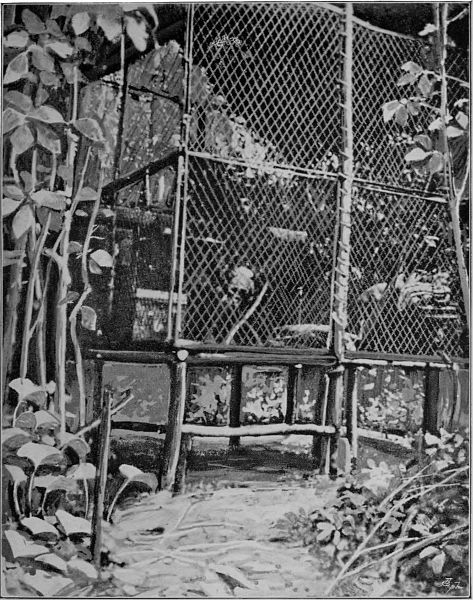
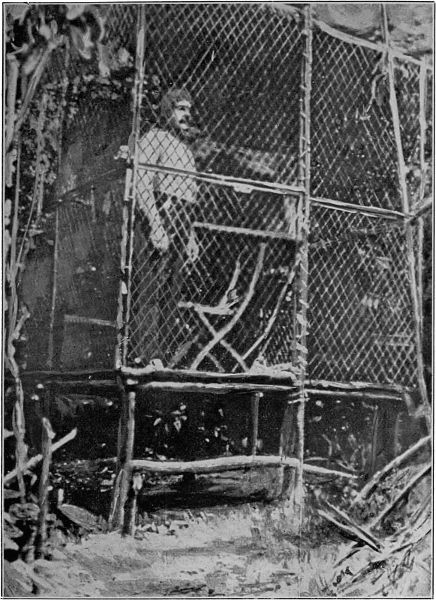
During my residence in the cage I did not see so
many chimpanzees as I saw of gorillas, but from
those I did see it was an easy matter to determine
that they were much less shy and timid than the
gorilla.
On one occasion I heard one in the bush not far
away from the cage. I called him with the usual
sound and he answered, but did not come to the
cage. It is probable that he could see it, and was
afraid of it. I tried to induce Moses to call him, and
he did once utter the sound, but he appeared to
regret having made the attempt. I called again and
he answered, and from the manner in which Moses
behaved it was evident that he understood it. He
would not attempt the call again, but clung to my
neck with his face buried under my chin. It was
probably jealousy that caused him to refuse, because
he did not want the other to share my attentions.
I gave the food sound, but I could not induce the
visitor to come nearer. I failed to get a view of him
so as to tell how large he was, but from his voice he
must have been about grown. Whether he was
quite alone or not I was not able to tell, but only the
one voice could be heard.
Another time, while sitting quite alone, a young
chimpanzee, perhaps five or six years old, appeared
at the edge of a small opening of the bush. He
plucked a bud or leaf from a small plant. He
raised it to his nose and smelt it. He picked three
or four buds of different kinds, one or two of which
he put in his mouth. He turned aside the dead
leaves that were lying on the ground as if he expected
to find something under them. I spoke to him,
using the call sound; he instantly turned his eyes
towards me, but made no reply. I uttered the food
sound and he replied, but stood where he was. He
betrayed no sign of fear, and little of surprise. He
surveyed the cage and myself, and I repeated the
sound two or three times. He refused to approach
any nearer. He turned his head from side to side
for a moment as if in doubt which way to go; then
turned aside and disappeared in the bush. He did
not run or start away as if in great fear, but by the
sound of the shaking bushes it could be told that he
increased his speed after he once disappeared from
view.
One day I had been for a stroll with Moses and
the boy. As we returned to the cage we saw a
chimpanzee about half-grown; he was crossing the
rugged little path about thirty yards away from us.
He paused for a moment to look at us, and we stopped.
I tried to induce Moses to call out to him, but he declined
to do so. As the stranger turned aside I called
to him myself, but he neither stopped nor answered.
This one appeared to be quite brown, but the boy
assured me his hair was jet black, but his skin being
light gave him this colour. To satisfy myself, I had
Moses placed in the same place and position, and
looking at him from the same distance I was convinced
that the boy was right.
One morning, as I started with Moses for a walk,
I had only gone some forty yards away from the
cage when he made a sound of warning. I instantly
looked up, when I saw a large chimpanzee standing
in the bush not more than twenty yards away. I
paused to look at him. He stood for a moment,
looking straight at us. I spoke to him, but he made
no reply; he moved off almost parallel to the little
path which we were in, and I returned towards the
cage. He did not come any nearer to us, but kept
his course almost parallel with ours. He turned his
head from time to time to look, but gave no sign of
attack. I called to him several times, but he made
no answer. When I reached a place in front of the
cage I called again, and after the lapse of a few
seconds he stopped. By this time he was concealed
from view. He only halted for a moment, changed
his course and resumed his journey. This was the
largest one I saw in the forest.
At another time, while sitting in the cage, I heard
the sound of something making its way through the
bush not more than twenty yards away; presently it
passed in view. As it crossed the path near by, I
called three or four times, but it neither stopped nor
answered. As well as I could tell, it appeared to be
a female and quite grown.
I may take occasion to remark that while the
chimpanzee is mostly found in large family groups,
as I have reason to believe from native accounts of
them, and from what has been told me by white men,
I have never been able to see a family of them
together, but each of these that I have mentioned, so
far as I could tell, was quite alone. Whether the
others were scattered through the forest in like
manner, hunting for food, and all came together after
this or not, I can only say that every chimpanzee
that I saw was alone at the time.
Another thing worthy of mention is the fact that
both these apes live in the same forest, and twice on
the same day I have seen both kinds. This is contrary
to the common idea that they do not inhabit
the same jungle. It appears that where there is a
great number of the one there are but few of the
other. The natives say that in combat between the
chimpanzee and gorilla, the former is always victor,
on which account the latter is afraid of him. I
believe this to be true, because the chimpanzee,
although not so strong, is more active and more
intelligent than the gorilla.
The chimpanzee will not approach or attack man
if he can avoid it, but he does not shrink from him
as the gorilla does. One instance that will illustrate
this phase of his character I shall relate. On one
occasion recently, while I was on the coast, a native
boy started across a small plain near the trading
station. Along with him was a dog that belonged
to the white trader at the place. The dog was in
advance of the boy, and as the latter emerged from
a small clump of the bush he heard the dog bark in a
playful manner, and discovered him not more than
thirty yards away, prancing, jumping, and barking in
a jolly way with a chimpanzee which appeared to be
five or six years old. The ape was standing in the
path along which the boy was proceeding. He was
slapping at the dog with his hands, and did not
seem to relish the sport, yet he was not resenting it
in anger. The dog thought the ape was playing
with him, and he was taking the whole thing in fun.
The boy looked at them for a few moments and
retreated. As soon as he disappeared the dog
desisted and followed him to the house. The boy
was afraid of the ape, and made no attempt to capture
him. The latter was taken by surprise by the
dog and boy, and thus had no time to escape. He
did not strike to harm the dog, but only to ward him
off. The dog made no attempt to bite him, but
when he would jump up against him he would
knock the ape out of balance, and this annoyed
him. He didn't seem to understand just what the
dog meant.
I shall not describe those so well known in captivity,
only to mention some of them. The largest
specimen of the chimpanzee that I have ever seen
was Chico, who belonged to Mr. James A. Bailey, of
New York. He was as large perhaps as these apes
ever become, although he was less than ten years
old when he died.
Perhaps the most valuable specimen for scientific
use that has ever been in captivity is Johanna, who
belongs to the same gentleman. The history that
is given of her, however, is hardly to be taken in
full faith. Her age cannot be determined with
certainty, but it is said that she is about thirteen
years old. I have reason to doubt that, although I
cannot positively deny it. Whatever may be her
exact age, it is certain that she has now reached a
complete adult state. She has grown to be quite as
large as Chico was at the time of his death. She is
not of amiable temper, but is much less vicious than
he was. She has some of the marks of a kulu
kamba.
In order to justify my doubts upon the subject of
her age, I may state that Chico was only ten years
of age when he died, but had reached the adult
period; and as males do not reach that state sooner
than the females of any genus of the primates, it is
not probable that he was mature at ten, while she
was not so until twelve. In the next place, her
captors claim to have seen her within a few hours
after her birth, and that they watched her and her
mother from time to time until she was one year old,
when they killed the mother and captured the babe.
The claim is absurd. These apes are nomadic in
habit, and are rarely ever seen in the same place.
They claim that she was born on January 19, but from
what I know of these apes that is not their season of
bearing, and I doubt if any of them were ever born
during that month. Again, it is claimed that she
was captured by Portuguese explorers in the Congo,
but the Portuguese do not possess any territory
along that river in which these apes are ever found.
They claim the territory around Kabenda, which
would indicate that she came from the Loango
Valley instead of the Congo, but the cupidity of the
average Portuguese would never allow anything to
go at liberty for a year if it could be sold before that
time.
Johanna is accredited with a great deal of intelligence;
but I do not regard her as being above the
average of her race. Since the death of her companion,
Chico, she has received the sole attention of
her keeper, and since that time has been taught a
few things which are neither marvellous nor difficult.
In point of intellect she cannot be regarded as an
extraordinary specimen of her tribe. I do not mean
to detract from her reputation, but I have failed to
discover in her any high order of mental qualities.
The reason why Johanna may be regarded as the
most valuable specimen for study is the fact that she
is the only female of her race that has ever reached
the state of puberty. She has done so, and this
fact enables us to determine certain things which
have never heretofore been known. This affords
the Zoologists an opportunity for the study of her
sexual development which may not again present
itself in many years to come. From this important
point of view she presents the student with many
new problems in that branch of science.
I have elsewhere stated as my opinion that the
female chimpanzee reaches the age of puberty at
seven to nine years, and I have many reasons which
I will not here recount, that cause me to adhere to
that belief. But the uncertainty of the age of this
ape does not destroy her value as a subject of scientific
study.
The most sagacious specimen of the race that I
have been brought in contact with is Consul II.,
who is now an inmate of the Bellvue Garden of
Manchester, England. He has not been educated
to perform mere tricks to gratify the visitor in the
way that animals are usually trained, but most of
the feats that he performs are prompted by his own
desire and for his own pleasure.
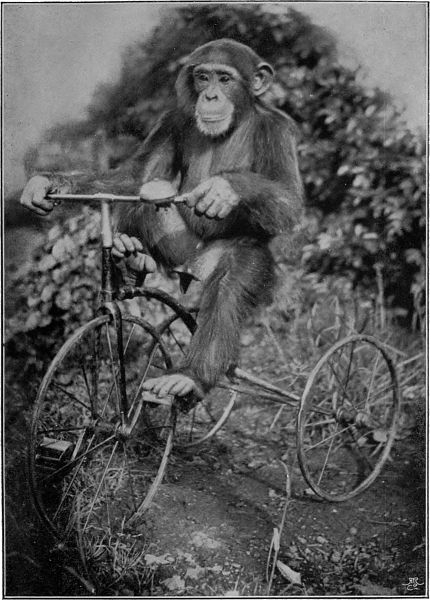
CONSUL II. RIDING A TRICYCLE
There is a vast difference in the motives that
prompt animals in the execution of these feats. I
have elsewhere mentioned the fact that animals that
are caused to act from fear do so mechanically, and it
is not a true index to their intellect. While Consul
and a few other apes that I have seen do many
things by imitation they do not do so from coercion.
They seem to understand the purpose and foresee
the results, and these impel them to act.
Some of the feats performed by this ape I have
never seen attempted by any other. One accomplishment
is riding a tricycle. He knows the
machine by the name of "bike," although it is not
really a bicycle. He can adjust it and mount it with
the skill of an acrobat. The ease and grace with
which he rides are sufficient to provoke the envy of
any boy in England. He propels it with great skill
and steers it with the accuracy of an expert. He
guides it around angles and obstacles in the way
with absolute precision.
Consul is allowed to go at liberty a great deal of
his time, which is the proper way to treat these apes
in captivity. He rides the wheel for his own diversion.
He does not do it to gratify strangers or to
"show off."
Another accomplishment which he has, is that of
smoking a pipe, cigar, or cigarette. It may not be
commended from a moral standpoint, but the act
appears to afford him quite as much pleasure as it
does the average boy when he first acquires it, and
he has also formed the habit of spitting as he smokes,
but he has the good manners not to spit on the
floor. When Consul has his pipe lighted he usually
sits on the floor to enjoy it, and he spreads a sheet
of paper down before him to spit on. When he has
finished smoking he rolls up the paper and throws it
into some corner out of the way. When playing
about the grounds he often finds a cigar stub. He
knows what it is, picks it up, puts it into his mouth
and at once goes to his keeper for a light. He will
not attempt to light his pipe or cigar, because he is
afraid of burning his fingers; but he will light a
match and hand it to his keeper to hold while lighting
the pipe. He sometimes takes a piece of paper,
lights it in the fire and hands it to some one else to
light his pipe for him. He is afraid of the fire, and
will not hold the paper while it is burning. If any
one hesitates to take it from him, he throws it at
them and gets out of the way. He is not so fond of
cigarettes, because he gets the tobacco in his mouth,
and he does not like the taste of it.
When Consul is furnished with a piece of chalk,
he begins to draw some huge figure on the wall or
floor. He never attempts to make a small design
with chalk, but if given a pencil and paper he
executes some peculiar figure of smaller design.
Those made with the chalk or pencil are usually
round or oval in shape, but if given a pen and ink he
at once begins to make a series of small figures containing
many acute angles. Whether these results
are from design or accident I cannot say, but he
appears to have a well-defined idea as to the use of
the instrument, but whether he can distinguish
between writing and drawing I am unable to say.
The only abstract thing that his keeper has tried
to teach him is to select the letters of the alphabet.
He has learned to distinguish the first three. These
are made upon the faces of cubical blocks of wood:
each block contains one letter on each of its faces.
He selects the letter asked for with very few mistakes,
and this appears to be from indifference more
than from ignorance.
Consul is very fond of play, and makes friends
with some strangers on sight, but to others he takes
an aversion without any apparent cause, and while
he is not disposed to be vicious when not annoyed,
he resents with anger the approaches of certain
persons. He is the only one I have seen that can
use a knife and fork with very much skill, but he
cuts up his food with almost as much ease as a boy
of the same age would do, and uses his fork in
eating. He has been taught to do this until he
rarely uses his fingers in the act. He is fond of
coffee and beer, but does not care for spirits.
There is nothing that so much delights Consul as
to get into the large cage of monkeys and baboons
kept in the garden. Most of them are afraid of him.
But one large Guinea baboon is not, and on every
occasion he shows his dislike for the ape. The
latter, however, takes many chances in teasing him,
but always manages to evade his attack. He displays
much skill and a great degree of caution in
playing these pranks upon the baboon when at close
range. Upon the approach of the ape the other
animals in the cage all seek some refuge, and he
finds great diversion in stealing up to their place of
concealment to frighten them. Consul is very strong,
and can lift objects of surprising weight. It is
awkward for him to stand in an upright position, but
he does so with more ease than any other chimpanzee
that I have ever seen. If any one will take hold of
his hand he will stroll with him for a long time without
apparent fatigue.
Owing to the sudden changes of temperature in
that part of England, he is provided with a coat,
which he is often required to wear when going out
of doors. He does not like to be hampered with
such garments, and if for a moment he is not
watched, he removes it, and sometimes hides it to
keep from wearing it. He is also provided with
trousers, which he dislikes more if possible than his
coat; but above all other articles of wearing apparel
he dislikes shoes. His keeper often puts them on
him, but whenever he gets out of sight he unties
and removes them. He cannot tie the laces, but
can untie them in an instant.
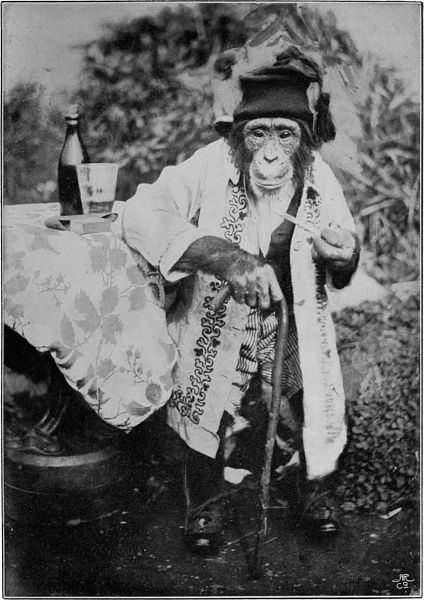
CONSUL II. IN FULL DRESS
He does not evince so much aversion to a hat or
cap, and will sometimes put one on without being
told; but he has a perfect mania for a silk hat, and
if allowed to do so he would demolish that of every
stranger who comes to the garden. He has a decided
vein of humour and a love of approbation.
When he does anything that is funny or clever, he
is perfectly aware of the fact; and when by any act
he evokes a laugh from any one he is happy, and
recognises the approval by a broad chimpanzee grin.
In the corner of the monkey-house is a room set
apart for the keeper, and in this room supplies of
food for the inmates are kept. In a small cupboard
in one corner is kept a supply of bananas and other
fruits. Consul knows this and has tried many times
to burglarise it. On one occasion he secured a large
screw-driver and attempted to prise open the door.
He found the resistance to be greatest at the place
where the door locked, and at this point he forced
the instrument in the crevice and broke off a piece
of the wood about an inch wide from the edge of the
door. At this juncture he was discovered and
reproved for his conduct, but he never fails to stick
his fingers in this crack and try to open the door.
He has not been able to unlock it when the key is
given him, although he knows the use of it, and has
often tried, but his keeper has never imparted the
secret to him, and his method of using the key has
been to prise with it, or pull it instead of turning it
after putting it in the keyhole.
The young keeper, Mr. Webb, deserves great
credit for his untiring attention to this valuable
young ape, and the results of his zeal are worthy of
the recognition of every man who is interested in
the study of animals.
Another specimen that may be regarded as an
intermediate type was recently kept in Belle Vue
Gardens at Manchester. He was playful and full
of mischief. He had been taught to use a stick or
broom to fight with, and with such a weapon in his
hand would run all over the building, hunting some
one to fight. He did not appear to be serious in
his assault, but treated it as fun. It was a bad thing
to teach an ape, because they grow pugnacious as
they grow older, and all animals kept closely confined
acquire a bad temper.
In an adjoining cage was kept a young orang,
and the two ate at the same table. The chimpanzee
appeared to entertain a species of contempt for the
orang. The keeper had taught him to pass the
bread to his neighbour, and he obeyed this with
such reluctance that his manner betrayed more disgust
than kindness. A few small pieces of bread
were placed on a tin plate, and the kulu was required
to lift the plate in his hand, and offer it to
the orang before he himself was allowed to eat.
He would lift the plate a few inches above the table,
and hold it before the orang's face; when the latter
had taken a piece of the bread, the chimpanzee withdrew
the plate, held it for a moment, and dropped
it. Meanwhile he kept his eyes fixed on the orang.
The manner in which he dropped the plate looked
as if he did so in contempt. When the meal was
finished, the kulu would drink his milk from a cup,
wipe his mouth with the serviette, and then get
down from the table. The orang would slowly
climb down, and go back to his cage. We shall
not describe the details of their home-life, but they
were two jolly young bachelors, one of which was
as stupid as the other was bright.
The specimens that were kept in the Gardens in
New York were very fine. One of them was
mentally equal to any other specimen hitherto in
captivity. There were two kept in the Cincinnati
Gardens which were also very fine. There have
never been but nine of these apes brought to
America so far as I am aware, but six of these lived
longer and four of them grew to be larger than any
other specimens of this race have ever done in captivity.
For some reason they never survive long in
England, or other parts of Europe. This is probably
due to some condition of the atmosphere. It
cannot be from a difference of treatment.
I have seen a large number of chimpanzees, but
most of them were in captivity, yet I have seen
enough of them in a wild state to gain some idea of
their habits and manner, but those described will
be sufficient to show the mental character of the
genus.