The time came when we had to forsake our village
at Like-a-fish-hook Bend, for the government
wanted the Indians to become farmers. “You
should take allotments,” our agent would say. “The
big game is being killed off, and you must plant bigger
fields or starve. The government will give you plows
and cattle.”
All knew that the agent’s words were true, and little
by little our village was broken up. In the summer
of my sixteenth year nearly a third of my tribe left to
take up allotments.
We had plenty of land; our reservation was twice the
size of Rhode Island, and our united tribes, with the
Rees who joined us, were less than thirteen hundred
souls. Most of the Indians chose allotments along
the Missouri, where the soil was good and drinking water
easy to get. Unallotted lands were to be sold and the
money given to the three tribes.
Forty miles above our village, the Missouri makes
a wide bend around a point called Independence Hill,
and here my father and several of his relatives chose
their allotments. The bend enclosed a wide strip of
meadow land, offering hay for our horses. The soil
along the river was rich and in the bottom stood a thick
growth of timber.
My father left the village, with my mother and me,
in June. He had a wagon, given him by the agent;
this he unbolted and took over the river piece by piece,
in a bull boat; our horses swam.
We camped at Independence in a tepee, while we
busied ourselves building a cabin. My father cut the
logs; they were notched at the ends, to lock into one
another at the comers. A heavier log, a foot in thickness,
made the ridge pole. The roof was of willows
and grass, covered with sods.
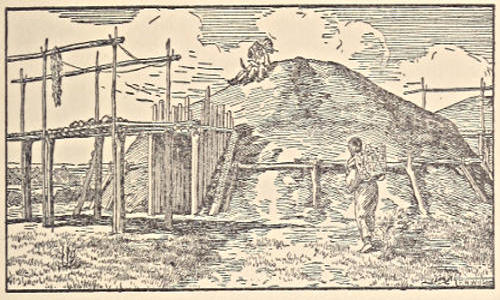
Cracks between the logs were plastered with clay,
mixed with short grass. The floor was of earth, but we
had a stove.
We were a month putting up our cabin.
Though my father’s coming to Independence was a
step toward civilization, it had one ill effect: it removed
me from the good influences of the mission school, so
that for a time I fell back into Indian ways. Winter,
also, was not far off; the season was too late for us to
plant corn, and the rations issued to us every two weeks
rarely lasted more than two or three days. To keep
our family in meat, I turned hunter.
There were no buffaloes on the reservation, but blacktailed
deer were plentiful, and in the hills were a good
many antelopes. I had a Winchester rifle, a 40.60
caliber, and I was a good shot.
To hunt deer, I arose before daylight and went to
the woods along the Missouri. Deer feed much at
night, and as evening came on, they would leave the
thick underbrush by the river and go into the hills
to browse on the rich prairie grasses. I would creep
along the edge of the woods, rifle in hand, ready to
shoot any that I saw coming in from the feeding grounds.
I was careful to keep on the leeward side of the game;
a deer running up wind will scent an Indian as quickly
as a buffalo.
I loved to hunt, and although a mere boy, I was one
of the quickest shots in my tribe. I remember that
one morning I was coming around a clump of bushes
when I saw a doe and buck ahead, just entering the
thicket. I fired, hardly glancing at the sights; I saw
the buck fall, but when I ran up I found the doe lying
beside him, killed by the same bullet.
Independence was a wild spot. The hill from which
the place took its name had been a favorite fasting place
for young men who sought visions; at its foot, under
a steep bank, swept the Missouri, full of dangerous
whirlpools. Such spots, lonely and wild, we Indians
thought were haunts of the spirits.
Once, when I was a small boy, my father took me to
see the Sun dance. A man named Turtle-no-head
was suspended from a post in a booth, and dancing
around it. Turtle-no-head’s hands were behind him,
and he strained at the rope as he danced. Women
were crying, “A-la-la-la-la-la!” Old men were calling
out, “Good; Turtle-no-head is a man. One should be
willing to suffer to find his god; then he will strike many
enemies and win honors!”
I was much stirred by what I saw, and by the old
men’s words.
“Father,” I said, “when I get big, I am going to
suffer and seek a vision, like Turtle-no-head!”
“Good!” said my father, laughing.
At Independence, I thought of this vow made years
before. One day, I said to my father, “I want you to
suspend me from the high bank, over the Missouri.”
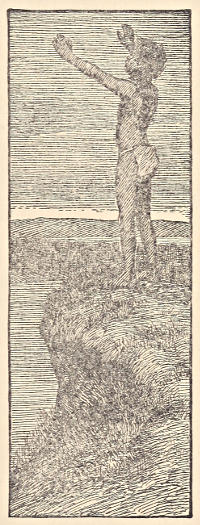
When evening came, my father stripped me to my
clout and moccasins, and helped me paint my body
with white clay. He called a man named Crow, and
they took me to the bank, over the Missouri. My
father fastened me to the rope, and I swung myself
over the bank, hanging with my weight upon the rope.
“Suffer as long as you can!” called my father, and
left me.
I did not feel much pain, but I became greatly
wearied from the strain upon my back and thighs.
Toward morning I could stand it no longer. I drew
myself up on the bank, and went home and to bed; and
I slept so soundly that no dream came from the spirits.
A year later, I again sought a vision. This time
my father took me to a high hill, a mile or two from the
river. He drove a post into the ground, fastened me
to it, as before, and left me, just at nightfall.
I threw myself back upon the rope and danced around
the post, hoping to fall into a swoon and see a vision.
It was autumn, and a light snow was falling; the cold
flakes on my bare shoulders made me shiver till my
teeth chattered. The night was black as pitch. A
coyote howled. I was so lonely that I wished a ghost
would sit on the post and talk with me, though I was
dreadfully afraid of ghosts, especially at night. I grew
so cold that my knees knocked together.
About two o’clock in the morning, I untied the rope
and went home. For an hour I felt sick, but I soon
fell into a sleep, again dreamless.
I was eating my breakfast when my father came in.
“I have seen no vision, father,” I told him; he said
nothing.
The next year the government forbade the Indians
to torture themselves when they fasted. My father
was quite vexed. “The government does wrong to
forbid us to suffer for our gods!” he said. But I was
rather glad. “The Indian’s way is hard,” I thought.
“The white man’s road is easier!” And I thought
again of the mission school.
Other things drew my thoughts to civilized ways.
Our agent issued to every Indian family having an allotment,
a plow, and wheat, flax, and oats, for seeding.
My father and I broke land near our cabin, and in the
spring seeded it down.
We had a fair harvest in the fall. Threshing was
done on the agency machine, and, having sacked our
grain, my father and I hauled it, in four trips, to Hebron,
eighty miles away. Our flax we sold for seventy-five
cents, our wheat for sixty cents, and our oats for twenty-five
cents a bushel. Our four loads brought us about
eighty dollars.
I became greatly interested in farming. There was
good soil on our allotment along the river, although
our fields sometimes suffered from drought; away from
the river, much of our land was stony, fit only for grazing.
My parents had been at Independence eight years,
when one day the agent sent for me. I went to his
office.
“I hear you have become a good farmer,” he said,
as I came in. “I want to appoint you assistant to our
agency farmer. Your district will include all allotments
west of the Missouri between the little Missouri and
Independence. I will pay you three hundred dollars
a year. Will you accept?“
“I will try what I can do,” I answered.
“Good,” said the Major. “Now for your orders!
You are to measure off for every able-bodied Indian,
ten acres of ground to be plowed and seeded. If an
Indian is lazy and will not attend to his plowing, report
him to me and I will send a policeman. In the fall,
you are to see that every family puts up two tons of
hay for each horse or steer owned by it.”
I did not know what an acre was. “It is a piece of
ground,” the agent explained, “ten rods wide and
sixteen rods long.” From this I was able to compute
pretty well how much ten acres should be; but I am
not sure that all the plots I measured were of the same
size.
I began my new duties at once, and at every cabin
in my district, I measured off a ten-acre plot and
explained the agent’s orders. Not a few of the Indians
had done some plowing at Like-a-fish-hook village,
and all were willing to learn. Once a month, I took
a blacksmith around to inspect the Indians’ plows.
Rains were abundant that summer, and the Indians
had a good crop. Some families harvested a hundred
bushels of wheat from a ten-acre field; others, seventy-five
bushels; and some had also planted oats.
The government began to issue cattle in payment of
lands sold for us. The first issue was one cow to each
family, and the agent ordered me to see that every
family built a barn.
These barns were put up without planks or nails.
A description of my own will show what they were like;
it rested on a frame of four forked posts, with stringers
laid in the forks; puncheons, or split logs, were leaned
against the stringers for walls; rough-cut rafters supported
a roofing of willows and dry grass, earthed over
with sods.
More cattle were issued to us until we had a considerable
herd at Independence. The cattle were let run
at large, but each steer or cow was branded by its
owner. Calves ran with their mothers until fall; the
herd was then corralled and each calf was branded
with its mother’s brand. My own brand was the
letters SU on the right shoulder.
Herders guarded our cattle during the calving season;
we paid them ten cents for every head of stock herded
through the summer months.
I had been assistant farmer six years and our herd
had grown to about four hundred head, when Bird
Bear and Skunk, our two herders, reported that some
of our cattle had strayed. ”We have searched the
coulees and thickets, but cannot find them,” they said.
Branding time came; we corralled the herd and found
about fifty head missing.
We now suspected that our cattle had been stolen.
Cattle thieves, we knew, were in the country; they had
broken into a corral one night, on a ranch not far from
Independence and killed a cowboy named Long John.
Winter had passed, when the agent called me one day
into his office. “Goodbird,” he said, “I want you to
take out a party of our agency police and find those
thieves who stole your cattle. Start at once!”
I got my party together, eight in all; Hollis Montclair,
my boyhood chum; Frank White Calf, Crow Bull,
Sam Jones, White Owl, Little Wolf, No Bear, and
myself. Only Hollis and I spoke English.
We started toward the Little Missouri, where we suspected
the thieves might be found. I drove a wagon with
our provisions and tent; my men were mounted. We
reached the Little Missouri before nightfall, and camped.
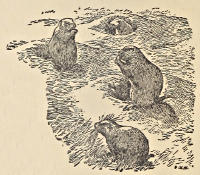
Prairie Dogs.
The next morning, we
turned westward; before
noon, we crossed a prairie
dog village, and shot
three or four prairie dogs
for dinner. The hair was
singed off the carcasses, and
they were drawn, and spitted
on sticks over the fire. Prairie
dogs are not bad eating, especially
in the open air, by a good wood fire;
I have never become so civilized
that I would not rather eat out of doors.
Toward evening we met a cowboy. “How!” I
called, as I drew in my team. “Have you seen any
stray cattle, with Indian brands, ID, 7 bar, 7, or the
like?“ And I told him of our missing cattle.
“I know where they are,” said the cowboy. “You
will find them on a ranch near Stroud’s post-office;
but don’t tell who told you!”
“Have no fear,” I answered.
Stroud’s post-office was farther west, near the Montana
border; we reached it the third or fourth day
out.
We made camp, and after supper, I went in and
told Mr. Stroud our errand.
“Yes,” he said, “your cattle are three miles from
here, on a ranch owned by Frank Powers; he hired two
cowboys to steal them for him.”
The next morning my men and I mounted, and leaving
our wagon at Stroud’s, started for Powers’ ranch.
I was unarmed; the others of my party had their rifles.
We stopped at the cabin of a man named Crockin,
to inquire our way. A white man came in; after he
had gone out again, I asked Crockin, “Who is that man?”
“He is Frank Powers,” said Crockin.
I turned to my men and said in their own language,
“That is the man who stole our cattle.”
Little Wolf drew his cleaning rod. “I am going to
give that bad white man a beating,” he cried angrily.
“You will not,” I answered. “We will go into
Powers’ pasture and round up his cattle; and I will cut
out all that I think are ours. If that bad white man
comes out and says evil words against me, do nothing.
If he shoots at me, kill him quick; but do not you shoot
first!“
My men loaded their rifles, and about two o’clock
I led them into the pasture. Powers’ cattle were all
bunched in a big herd; we drove them to a grassy flat,
and I began cutting out those that were ours.
Powers saw us and came out, revolver in hand, and
two or three white men joined him. He was so angry
that he acted like a mad man; he grew red in the face,
talked loud, and swore big oaths; but he did not shoot,
for he knew my men would kill him.
I cut about twenty-five head out of the herd, all
that I found with altered brands on the right shoulder
or thigh. Maybe I took some of Powers’ cattle by
mistake, but I did not care much.
Powers left us after a while. My men rounded up
our cattle, and we drove them back to Stroud’s and
camped.
After supper, I asked Mr. Stroud to write a letter
to our agent, telling him what I had done. “To-morrow,”
I told my men, “we will set out for home.
You drive our cattle back to the reservation in short
stages, so that they will not sicken with the heat. I
will go ahead with Mr. Stroud’s letter.”
I set out before sunrise; at four o’clock I reached
Independence, eighty miles away; and at sunset, I
was at Elbowoods.
It was Decoration day, and the Indians were having
a dance. The agent was sitting in his office with the
inspector, from Washington.
“I have found our cattle,” I said; and I gave him
Mr. Stroud’s letter.
He read it and handed it to the inspector.
“Report this matter to the United States marshal,”
the inspector said to him. “Tell him to have Powers
arrested.“
The Chapel at Independence.
VIII THE WHITE MAN’S WAY
My thirty-fifth winter—as we Indians count
years—found me still assistant farmer; but
time had brought many changes to our reservation.
Antelope and blacktailed deer had gone the
way of the buffalo. A few earth lodges yet stood,
dwellings of stern old warriors who lived in the past;
but the Indian police saw that every child was in school
learning the white man’s way. A good dinner at the
noon hour made most of the children rather willing
scholars.
The white man’s peace had stopped our wars with the
Sioux; and the young folks of either tribe visited,
and made presents to one another. I had visited the
Standing Rock Sioux and had learned to rather like
them. Indeed, I liked one Sioux girl so well that I
married her. We had a comfortable cabin; my wife
was a good cook, and my children were in school.
Living so far from the mission, it was not possible
for me to attend church services at the mission house;
but Mr. Hall came to Independence and preached to
us. Until a school house was built, he often held his
meetings in my cabin.
I usually interpreted for him. He would speak in
English and I would translate into Hidatsa, which the
Mandans also understand. Indians are good linguists;
not a few young men of my tribe speak as many as four
or five languages.
I drew no salary as interpreter; but I felt myself
well repaid by what I learned of the Bible. Interpreting
Mr. Hall’s sermons made them sink into my heart,
so that I would think of them as I went about my work.
As time went on, there grew up quite a company of
Christians at Independence. One of their active leaders
was Frank White Calf; and he and Sitting Crow called
a kind of praying council at Two Chiefs’ cabin. All
the Independence Christians came; and I was invited
to meet them.
Some of the Indians prayed; and Frank White Calf
asked me, “Goodbird, why do you not join us in this
Christian way? Tell us your mind!”
I arose and spoke: “My friends, I learned of this
Christian way at the mission school. It is a good way.
You ask me my thoughts. I answer, I have tried to
live like a Christian and I love to read my Bible, but I
have not received baptism; I am now ready to be
baptized.”
A few days after this, Frank White Calf said to me,
“Mr. Hall wants you to come to the mission house and
be baptized.”
I went the next Sunday with my family, and was
received into the church. My sons Charles and Alfred
were baptized at the same time.
In part, I was influenced to become a church member
by the thought that it was the white man’s way. Our
Indian beliefs, I felt sure, were doomed; for white
men’s customs were becoming stronger with us each
year. “I am traveling the new way, now!” I thought,
when I was baptized. “I can never go back to Indian
ways again.”
But for some years, even after I became a church
member, I was not a very firm Christian; and I did
not keep God’s commandments very well, because I
did not believe all that the missionaries taught me.
I was unwilling to trust any white man’s words, until
I had proved that they were true. I did not want to
take anything on faith.
Mr. Hall made Independence a preaching station,
and put an assistant in charge; I interpreted for her.
Sometimes Mr. Hall, or his son, preached to us.
The missionary teacher let me know each week what
was to be the next Sunday’s lesson, and she gave me
books to read. Knowing something of her subject, I
was better able to interpret for her. In this way, also,
I learned more of Christ’s teachings; and I learned how
to study my Bible.
This study of the Bible influenced me a great deal;
and my having to interpret made me fall into the habit
of going to church regularly. My interest in church
work grew.
In 1903, the government abolished the position of
assistant farmer. In October of the following year,
Mr. Hall’s son said to me, “We need an assistant
missionary at Independence, and my father and I want
to appoint you. Come and talk with my father about
it.”
I went to Elbowoods and saw Mr. Hall. “Edward,”
he asked, “are you willing to be our assistant missionary?”
“Yes,” I answered.
I knew some one must preach to the Independence
Indians; and I thought I could do this, because I could
speak their language as well as read English. I felt
also that I was closer to God than I had been when I
was baptized.
So I became Mr. Hall’s assistant, and have been in
charge of the Independence station ever since. Every
Sunday I preach to the Indians in the Hidatsa language.
My text is the Sunday-school lesson of the week, for
we Indians do not care for sermons, such as white men
hear. Our older men cannot read English, and we do
not have the Bible in our own tongue; we like best
to hear the Sunday-school lesson because it explains
the stories of the Bible, which my people cannot read
for themselves.
Things do not always go smoothly in an Indian congregation.
Frictions and misunderstandings arise, as I
have heard they do in white churches; and Indians
sometimes seek to become church members from unworthy
motives. Our former life makes us Indians
clannish; members of the same clan feel bound to help
one another, and many Indians seem to look upon the
church as a kind of clan. Sometimes a young man will
say, “I will be baptized and join your church. Then
all the Christians will work to make me agency policeman!”
Others, again, will say, “I want to join the church
because I am sick; perhaps God will make me well!”
Some, with clearer faith, say, ”I want to become a
Christian because I believe Jesus will save me to be a
spirit with Him.” They mean that they hope Jesus
will take them to live with Him when they die.
My uncle, Wolf Chief, says of the Christian way:
“I traveled faithfully the way of the Indian gods,
but they never helped me. When I was sick, I prayed
to them, but they did not make me well. I prayed to
them when my children died; but they did not answer
me. I have but two children left, and I am going to
trust God to keep these that they do not die like the
others. I talk to God every day, as I would talk to
my father; and I ask Him for everything I want. I
try to do all that He bids me do. I hope that He will
take my spirit to travel in that new heaven about
which I have learned. I cannot change now. I can
never go back to the old gods!”
Wolf Chief has been a strong Christian for more than
eight years. He has given much to our mission work;
and he is never absent from Sunday services.
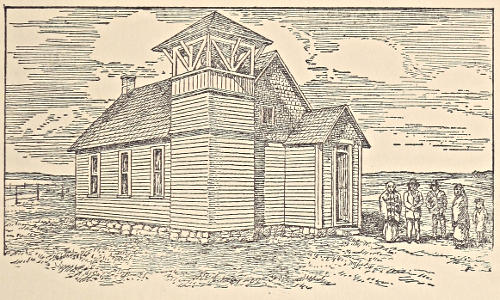
Six years ago, we Christians at Independence became
dissatisfied with our log meeting house, and began to
talk of building a chapel, or church-house, as we call
it. A council was called in Wolf Chief’s cabin.
It was an evening in December; all the leading
Christians of Independence came with their wives—Wolf
Chief, Tom Smith, Frank White Calf, Mike Basset,
Hollis Montclair, Sam Jones, Louis Baker, and myself.
Each woman brought something for a feast, and we ate
together. We had fried bread, tea, pie, tomato soup, and
other good things.
When our feasting was over, Wolf Chief made a speech.
“We Christian Indians,” he said, “should have a chapel.
We should raise the money to build a house to God,
where we can go and worship!“
Tom Smith and others spoke, and we called for
subscriptions. Frank White Calf’s wife gave five
dollars. Wolf Chief’s brother, Charging Enemy, although
not a Christian, gave a pony. Others promised, some
ten, some fifteen, and some twenty-five dollars.
I was appointed treasurer to make collections, and
get more subscriptions. I wrote a letter to Water
Chief’s dancing society and asked them to give something.
The dancing Indians are pagans; but they gave
us a subscription.
Mr. Hall gave us fifty dollars; Mr. Shultis, our
school-teacher, gave us ten dollars; and other white
friends gave us subscriptions; but most of the money
was given by the Indians.
When we had collected three hundred and fifty dollars,
we began buying lumber.
Wolf Chief wanted to give us the land for our chapel;
but the Indian commissioner wrote, “No, you may sell
your land, but you must not give it away.” So we
bought the land for a dollar an acre; but Wolf Chief
gave the money back to us, outwitting the commissioner
after all!
We bought ten acres. “When white men build a
house,” said Wolf Chief, “they leave land around it
for a yard. We should be ashamed not to have some
land around God’s house!“ Our ten-acre plot makes
a fine big church yard; at one end is our Indian cemetery.
Wolf Chief also gave us a colt, and much money, and
bought paint and nails.
We Indians think Wolf Chief wealthy. He owns
five hundred acres of land, thirty head of cattle, eight
horses, and pigs and chickens; he has a potato field
and a corn field, and owns a trading store.
More than fifty were present when we dedicated our
chapel. A minister from Minneapolis preached the
sermon, and I interpreted for him. A young white
lady sang, and played the organ, and my cousin played
a clarionet. Our school teacher had lent us his phonograph,
and it sang “There are ninety and nine,” just
like a choir in a city church. I asked for subscriptions
to clear off our debt, and we raised eighty-three dollars
in money, and Wolf Chief gave us another colt. The
minister prayed God to bless our chapel, and we went
home, all very happy.
Older Indians, who came from Like-a-fish-hook
village, find their life on allotments rather lonesome.
Cabins are often two or three miles apart and the old
men cannot amuse themselves with books, for they
cannot read. In old times, Indians often met in big
dances; but pagan ceremonies are used in these dances,
and Mr. Hall does not like the Christian Indians to
go to them.
That our Christian Indians may meet socially now
and then, we now observe many white men’s holidays;
and at such times, we make our chapel the meeting place.
In August, we hold a Young Men’s Christian Convention,
when families come from miles around, to
camp in tents around the chapel. At Christmas, we
have feasting and giving of presents; and our chapel
is so crowded that many have to stand without, and
look through the windows. Of late years, we have
also observed Decoration Day at Independence.
Our camp last Decoration Day was ten or more tents,
with two or three families in a tent. We made a booth,
after old custom, of leafy branches and small trees. In
this we gathered at about ten o’clock.
Our school teacher began our exercises with a speech
telling us what Decoration Day should mean to us.
We sang “America,” and other hymns, and had speeches
by Indians. A committee had been appointed to choose
the speakers.
Rabbit Head spoke, “I do not know anything about
your way, but I encourage you! Go on, do more. I
have nothing against your going the Christian way!”
Rabbit Head is a chief in the Grass dance society, and a
pagan.
Wounded Face spoke, “I do not belong to this
church, I am a Catholic; but I thus show that I like
white men’s ways!”
After dinner we made ready to decorate our graves.
Every family having a son buried in our graveyard,
hired a clan father to clean the grave of weeds and
stones; if a daughter, a clan aunt was asked. An Indian
calls the members of his mother’s clan, his brothers and
sisters; members of his father’s clan, he calls his clan
fathers and aunts.
At two o’clock we formed a procession and marched
to the cemetery. Two aged scouts led, High Eagle and
Black Chest; High Eagle bore a large American flag.
We marched by two’s in a long line, the men first, then
the women and children. Having marched around the
graveyard, we stood and sang some hymns, and I made
a speech:
“All you relatives and friends of these dead, I want
to make a speech to you!
“It seems sad to our hearts to come here, and yet we
are glad, because we come to remember our loved ones
at their graves; so both gladness and sorrow are in our
hearts.
“These warrior men, that you see here, fought against
our enemies. They fought to save us, so that to-day
we are not captive, but free. Some of the brave men
who fought to save us, died in battle. Also, some of
your loved ones have died and are buried in this graveyard.
Many of these loved ones did not die fighting
against enemies, yet they were brave warriors against
evil and temptation. Now they are gone from us.
They are in a new world, the ghost land; they are
with God. I am sure they are in a safe, happy
place.
“Now come forward, all who want to put flowers on
the graves.”
We had had a cold, dry spring, and the prairie flowers
had not come into bloom, but we had sent to Plaza
and bought artificial silk flowers. The clan fathers
and aunts placed these flowers on the graves, while
many of the women wept.
We Hidatsas know that our Indian ways will soon
perish; but we feel no anger. The government has
given us a good reservation, and we think the new way
better for our children.
I think God made all peoples to help one another.
We Indians have helped you white people. All over
this country are corn fields; we Indians gave you the
seeds for your corn, and we, gave you squashes and
beans. On the lakes in your parks are canoes; Indians
taught you to make those canoes.
We Indians think you are but paying us back, when
you give us schools and books, and teach us the new
way.
For myself, my family and I own four thousand acres
of land; and we have money coming to us from the
government. I own cattle and horses. I can read
English, and my children are in school.
I have good friends among the white people, Mr.
Hall and others, and best of all, I think each year I
know God a little better.
I am not afraid.
Printed in the United States of America.