This book was published in 1841, and is a reprint of the original book
by Edward Winslow published in 1624, with many footnotes added by the
1841 editor. The editor has occasionally inserted in brackets [] a
word missing from the 1624 text, for example [which] on page 9.
The footnote anchors are denoted by [number], and the footnotes remain
at the end of the main text, as they were in the original (1841) book.
They have been renumbered from 1 to 127. Some references to a ‘note’
have therefore been renumbered accordingly, for example the reference
to ‘note 2 on page 77’ has been changed to ‘note [35] on page 77’.
Some other minor changes to the text are noted at the end of the book.
The cover image was created by the transcriber
and is placed in the public domain.
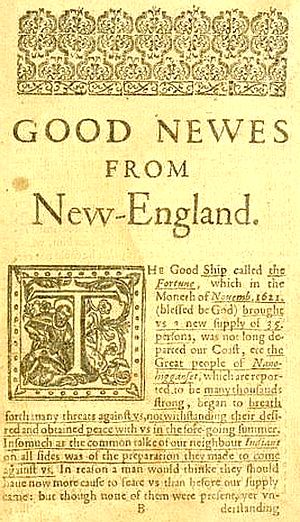
A sample page from the original 1624 edition is displayed below.
Good Newes from New England
“Good Newes from New England: or a true Relation of
things very remarkable at the Plantation of Plimoth in New-England.
Shewing the wondrous providence and goodness of God, in their
preservation and continuance, being delivered from many
apparent deaths and dangers.
Together with a Relation of such religious and civill Lawes and
Customes, as are in practise amongst the Indians, adjoyning to
them at this day. As also what Commodities are there to be
raysed for the maintenance of that and other Plantations
in the said Country.
Written by E. W. who hath borne a part in the forenamed
troubles, and there lived since their first Arrivall.
Whereunto is added by him a briefe Relation of a credible
intelligence of the present Estate of Virginia.
London. Printed by I. D. for William Bladen
and
John Bellamie,
and are to be sold at their Shops, at the Bible in Paul’s Churchyard,
and at the three Golden Lyons in Corn-hill, neere the
Royall Exchange. 1624.” pp. 66, sm. 4to.
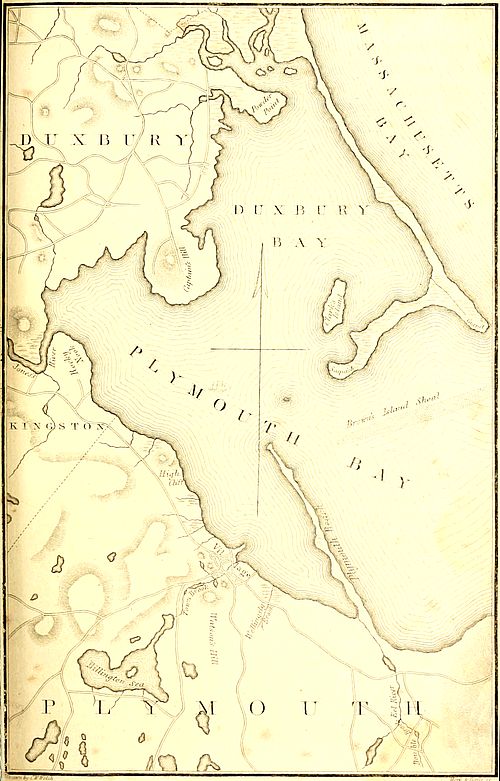
Map of Plymouth from Young’s Chronicles
DEDICATION
To all well-willers and furtherers of Plantations in New England,
especially to such as ever have or desire to assist the people of Plymouth
in their just proceedings, grace and peace be multiplied.
Right Honorable and Worshipful
Gentlemen, or whatsoever,
Since it hath pleased God to stir you up to be instruments of
his glory in so honorable an enterprise as the enlarging of his
Majesty’s dominions by planting his loyal subjects in so
healthful and hopeful a country as New-England is, where the
church of God being seated in sincerity, there is no less hope of
convincing the heathen of their evil ways, and converting them to
the true knowledge and worship of the living God, and so consequently
the salvation of their souls by the merits of Jesus Christ,
than elsewhere, though it be much talked on and lightly or lamely
prosecuted,—I therefore think it but my duty to offer the view of
our proceedings to your worthy considerations, having to that end
composed them together thus briefly, as you see; wherein, to your
great encouragement, you may behold the good providence of
God working with you in our preservation from so many dangerous
plots and treacheries as have been intended against us, as also
in giving his blessing so powerfully upon the weak means we had,
enabling us with health and ability beyond expectation in our
greatest scarcities, and possessing the hearts of the salvages with
astonishment and fear of us; whereas if God had let them loose,
they might easily have swallowed us up, scarce being a handful in
comparison of those forces they might have gathered together
against us; which now, by God’s blessing, will be more hard and
difficult, in regard our number of men is increased, our town better
fortified, and our store better victualled. Blessed therefore be
his name, that hath done so great things for us and hath wrought
so great a change amongst us.
Accept, I pray you, my weak endeavours, pardon my unskilfulness,
and bear with my plainness in the things I have handled. Be
not discouraged by our former necessities, but rather encouraged
with us, hoping that God hath wrought with us in our beginning of
this worthy work, undertaken in his name and fear, so he will by us
accomplish the same to his glory and our comfort, if we neglect not
the means. I confess it hath not been much less chargeable to some
of you[1] than hard and difficult to us, that have endured the brunt of
the battle, and yet small profits returned. Only, by God’s mercy, we
are safely seated, housed, and fortified, by which means a great step
is made unto gain, and a more direct course taken for the same, than
if at first we had rashly and covetously fallen upon it.
Indeed three things are the overthrow and bane, as I may term it,
of plantations.
1. The vain expectation of present profit, which too commonly
taketh a principal seat in the heart and affection, though God’s
glory, &c. is preferred before it in the mouth with protestation.
2. Ambition in their governors and commanders, seeking only to
make themselves great, and slaves of all that are under them, to
maintain a transitory base honor in themselves, which God oft punisheth
with contempt.
3. The carelessness of those that send over supplies of men unto
them, not caring how they be qualified; so that ofttimes they are
rather the image of men endued with bestial, yea, diabolical affections,
than the image of God, endued with reason, understanding,
and holiness. I praise God I speak not these things experimentally,
by way of complaint of our own condition, but having great cause on
the contrary part to be thankful to God for his mercies towards us;
but rather, if there be any too desirous of gain, to entreat them to
moderate their affections, and consider that no man expecteth fruit
before the tree be grown; advising all men, that as they tender their
own welfare, so to make choice of such to manage and govern their
affairs, as are approved not to be seekers of themselves, but the common
good of all for whom they are employed; and beseeching such
as have the care of transporting men for the supply and furnishing of
plantations, to be truly careful in sending such as may further and
not hinder so good an action. There is no godly, honest man but will
be helpful in his kind, and adorn his profession with an upright life
and conversation; which doctrine of manners[2] ought first to be
preached by giving good example to the poor savage heathens
amongst whom they live. On the contrary part, what great offence
hath been given by many profane men, who being but seeming
Christians, have made Christ and Christianity stink in the nostrils
of the poor infidels, and so laid a stumbling-block before them. But
woe be to them by whom such offences come.
These things I offer to your Christian considerations, beseeching
you to make a good construction of my simple meaning, and take in
good part this ensuing Relation, dedicating myself and it evermore
unto your service; beseeching God to crown our Christian and faithful
endeavours with his blessings temporal and eternal.
When I first penned this Discourse, I intended it chiefly for the
satisfaction of my private friends; but since that time have been
persuaded to publish the same. And the rather, because of a disorderly
colony[4] that are dispersed, and most of them returned, to the
great prejudice and damage of him[5] that set them forth; who, as
they were a stain to Old England that bred them, in respect of their
lives and manners amongst the Indians, so, it is to be feared, will be
no less to New England, in their vile and clamorous reports,
because she would not foster them in their desired idle courses. I
would not be understood to think there were no well deserving persons
amongst them; for of mine knowledge it was a grief to some
that they were so yoked; whose deserts, as they were then suitable
to their honest protestations, so I desire still may be in respect of
their just and true Relations.
Peradventure thou wilt rather marvel that I deal so plainly, than
any way doubt of the truth of this my Relation; yea, it may be, tax
me therewith, as seeming rather to discourage men than any way to
further so noble an action. If any honest mind be discouraged, I am
sorry. Sure I am I have given no just cause; and am so far from being
discouraged myself, as I purpose to return forthwith.[6] And for other
light and vain persons, if they stumble hereat, I have my desire,
accounting it better for them and us that they keep where they are,
as being unfit and unable to perform so great a task.
Some faults have escaped because I could not attend on the
press,[7] which I pray thee correct, as thou findest, and I shall account
it as a favor unto me.
Thine,
E. W.
Chapter 1 A BRIEF RELATION OF A CREDIBLE INTELLIGENCE OF THE PRESENT ESTATE OF VIRGINIA.
At the earnest entreaty of some of my much respected friends,
I have added to the former Discourse a Relation of such
things as were credibly reported at Plymouth, in New
England, in September last past, concerning the present estate of
Virginia. And because men may doubt how we should have intelligence
of their affairs, being we are so far distant, I will therefore
satisfy the doubtful therein. Captain Francis West[8] being in New
England about the latter end of May past, sailed from thence to
Virginia, and returned in August. In September the same ship and
company being discharged by him at Damarin’s Cove,[9] came to
New Plymouth, where, upon our earnest inquiry after the state of
Virginia since that bloody slaughter committed by the Indians
upon our friends and countrymen,[10] the whole ship’s company
agreed in this, viz. that upon all occasions they chased the Indians
to and fro, insomuch as they sued daily unto the English for peace,
who for the present would not admit of any; that Sir George Early,
&c. was at that present employed upon service against them; that
amongst many other, Opachancano,[11] the chief emperor, was supposed
to be slain; his son also was killed at the same time. And
though, by reason of these forenamed broils in the fore part of the
year, the English had undergone great want of food, yet, through
God’s mercy, there never was more show of plenty, having as much
and as good corn on the ground as ever they had. Neither was the
hopes of their tobacco crop inferior to that of their corn; so that the
planters were never more full of encouragement; which I pray God
long to continue, and so to direct both them and us, as his glory
may be the principal aim and end of all our actions, and that for his
mercy’s sake. Amen.
Chapter 2 OF THEIR BEING MENACED BY THE NARRAGANSETTS, AND THEIR SECOND VOYAGE TO THE MASSACHUSETTS.
——
1622
——
The good ship called the Fortune, which, in the
month of November, 1621, (blessed be God,)
brought us a new supply of thirty-five persons, was
not long departed our coast, ere the great people of
Nanohigganset,[12] which are reported to be many thousands strong,
began to breathe forth many threats against us, notwithstanding
their desired and obtained peace with us in the foregoing summer;
insomuch as the common talk of our neighbour Indians on all sides
was of the preparation they made to come against us. In reason a
man would think they should have now more cause to fear us than
before our supply came. But though none of them were present, yet
understanding by others that they neither brought arms, nor other
provisions with them, but wholly relied on us, it occasioned them
to slight and brave us with so many threats as they did.[13] At length
came one of them to us, who was sent by Conanacus,[14] their chief
sachim or king, accompanied with one Tokamahamon, a friendly
Indian. This messenger inquired for Tisquantum, our interpreter,
who not being at home, seemed rather to be glad than sorry, and
leaving for him a bundle of new arrows, lapped in a rattlesnake’s
skin, desired to depart with all expedition. But our governors
not knowing what to make of this strange carriage, and comparing it
with that we had formerly heard, committed him to the custody of
Captain Standish, hoping now to know some certainty of that we
so often heard, either by his own relation to us, or to Tisquantum,
at his return, desiring myself, having special familiarity with the
other forenamed Indian, to see if I could learn any thing from him;
whose answer was sparingly to this effect, that he could not certainly
tell us, but thought they were enemies to us.
Jan.
1622
That night Captain Standish gave me and another[15]
charge of him, and gave us order to use him kindly, and
that he should not want any thing he desired, and to take
all occasions to talk and inquire of the reasons of those reports we
heard, and withal to signify that upon his true relation he should
be sure of his own freedom. At first, fear so possessed him that he
could scarce say any thing; but in the end became more familiar,
and told us that the messenger which his master sent in summer to
treat of peace, at his return persuaded him rather to war; and to the
end he might provoke him thereunto, (as appeared to him by our
reports,) detained many of the things [which] were sent him by or
Governor, scorning the meanness of them both in respect of what
himself had formerly sent, and also of the greatness of his own person;
so that he much blamed the former messenger, saying, that
upon the knowledge of this his false carriage, it would cost him his
life, but assured us that upon his relation of our speech then with
him to his master, he would be friends with us. Of this we informed
the Governor and his Assistant[16] and Captain Standish, who, after
consultation, considered him howsoever but in the state of a messenger;
and it being as well against the law of arms amongst them
as us in Europe to lay violent hands on any such, set him at liberty;
the Governor giving him order to certify his master that he had
heard of his large and many threatenings, at which he was much
offended; daring him in those respects to the utmost, if he would
not be reconciled to live peaceably, as other his neighbours; manifesting
withal (as ever) his desire of peace, but his fearless resolution,
if he could not so live amongst them. After which he caused
meat to be offered him; but he refused to eat, making all speed to
return, and giving many thanks for his liberty, but requesting the
other Indian again to return. The weather being violent, he used
many words to persuade him to stay longer, but could not.
Whereupon he left him, and said he was with his friends, and
would not take a journey in such extremity.
After this, when Tisquantum returned, and the arrows were
delivered, and the manner of the messenger’s carriage related, he signified
to the Governor that to send the rattlesnake’s skin in that
manner imported enmity, and that it was no better than a challenge.[17]
Hereupon, after some deliberation, the Governor stuffed the
skin with powder and shot, and sent it back, returning no less defiance
to Conanacus, assuring him if he had shipping now present,
thereby to send his men to Nanohigganset, (the place of his abode,)
they should not need to come so far by land to us; yet withal showing
that they should never come unwelcome or unlooked for. This
message was sent by an Indian, and delivered in such sort, as it was
no small terror to this savage king; insomuch as he would not once
touch the powder and shot, or suffer it to stay in his house or country.
Whereupon the messenger refusing it, another took it up; and
having been posted from place to place a long time, at length came
whole back again.
Feb.
1622
In the mean time, knowing our own weakness, notwithstanding
our high words and lofty looks towards them, and
still lying open to all casualty, having as yet (under God) no
other defence than our arms, we thought it most needful to impale
our town; which with all expedition we accomplished in the month
of February, and some few days, taking in the top of the hill under
which our town is seated; making four bulwarks or jetties without the
ordinary circuit of the pale, from whence we could defend the whole
town; in three whereof are gates,[18] and the fourth in time to be. This
being done, Captain Standish divided our strength into four
squadrons or companies, appointing whom he thought most fit to
have command of each; and, at a general muster of training,[19] appointed
each his place, gave each his company, giving them charge, upon
every alarm, to resort to their leaders to their appointed place, and, in
his absence, to be commanded and directed by them. That done
according to his order, each drew his company to his appointed place
for defence, and there together discharged their muskets. After which
they brought their new commanders to their houses, where again
they graced them with their shot, and so departed.
Fearing, also, lest the enemy at any time should take any advantage
by firing our houses, Captain Standish appointed a certain
company, that whensoever they saw or heard fire to be cried in the
town, should only betake themselves to their arms, and should
enclose the house or place so endangered, and stand aloof on their
guard, with their backs towards the fire, to prevent treachery, if any
were in that kind intended. If the fire were in any of the houses of
this guard, they were then freed from it; but not otherwise, without
special command.
Mar.
1622
Long before this time we promised the people of
Massachusets, in the beginning of March to come unto
them, and trade for their furs; which being then come, we
began to make preparation for that voyage. In the mean time, an
Indian, called Hobbamock, who still lived in the town, told us that
he feared the Massachusets or Massachuseucks (for so they called
the people of that place,) were joined in confederacy with the
Nanohigganeucks, or people of Nanohigganset, and that they therefore
would take this opportunity to cut off Captain Standish and his
company abroad; but, howsoever, in the mean time, it was to be
feared that the Nanohigganeucks would assault the town at home;
giving many reasons for his jealousy, as also that Tisquantum was in
the confederacy, who, we should find, would use many persuasions
to draw us from our shallops to the Indians’ houses, for their better
advantage. To confirm this his jealousy, he told us of many secret
passages that passed between him and others, having their meetings
ordinarily abroad, in the woods; but if at home, howsoever, he was
excluded from their secrecy; saying it was the manner of the Indians,
when they meant plainly, to deal openly; but in this his practice
there was no show of honesty.
Hereupon the Governor, together with his Assistant and
Captain Standish, called together such as by them were thought
most meet for advice in so weighty a business; who, after consideration
hereof, came to this resolution; that as hitherto, upon all
occasions between them and us, we had ever manifested undaunted
courage and resolution, so it would not now stand with our safety
to mew up ourselves in our new-enclosed town; partly because
our store was almost empty, and therefore must seek out for our
daily food, without which we could not long subsist; but especially
for that thereby they would see us dismayed, and be encouraged
to prosecute their malicious purposes with more eagerness than
ever they intended. Whereas, on the contrary, by the blessing of
God, our fearless carriage might be a means to discourage and
weaken their proceedings. And therefore thought best to proceed
in our trading voyage, making this use of that we heard, to go the
better provided, and use the more carefulness both at home and
abroad, leaving the event to the disposing of the Almighty; whose
providence, as it had hitherto been over us for good, so we had
now no cause (save our sins) to despair of his mercy in our preservation
and continuance, where we desired rather to be instruments
of good to the heathens about us than to give them the least
measure of just offence.
April.
1622
All things being now in readiness, the forenamed Captain,
with ten men, accompanied with Tisquantum and
Hobbamock, set forwards for the Massachusets. But we[20]
had no sooner turned the point of the harbour, called the Gurnet’s
Nose,[21] (where, being becalmed, we let fall our grapnel to set things
to right and prepare to row,) but there came an Indian of
Tisquantum’s family running to certain of our people that were
from home with all eagerness, having his face wounded, and the
blood still fresh on the same, calling to them to repair home, oft
looking behind him, as if some others had him in chase; saying that
at Namaschet (a town some fifteen miles from us,) there were many
of the Nanohiggansets, Massassowat[22] our supposed friend, and
Conbatant,[23] our feared enemy, with many others, with a resolution
to take advantage on the present opportunity to assault
the town in the Captain’s absence; affirming that he
received the wound in his face for speaking in our behalf,
and by sleight escaped; looking oft backward, as if he suspected
them to be at hand. This he affirmed again to the Governor; whereupon
he gave command that three pieces of ordnance should be
made ready and discharged, to the end that if we were not out of
hearing, we might return thereat; which we no sooner heard, but
we repaired homeward with all convenient speed, arming ourselves,
and making all in readiness to fight. When we entered the
harbour, we saw the town likewise on their guard, whither we hasted
with all convenient speed. The news being made known unto
us, Hobbamock said flatly that it was false, assuring us of
Massassowat’s faithfulness. Howsoever, he presumed he would
never have undertaken any such act without his privity, himself
being a pinse,[24] that is, one of his chiefest champions or men of
valor; it being the manner amongst them
not to undertake such
enterprises without the advice and furtherance of men of that rank.
To this the Governor answered, he should be sorry that any just and
necessary occasions of war should arise between him and any [of]
the savages, but especially Massassowat; not that he feared him
more than the rest, but because his love more exceeded towards
him than any. Whereunto Hobbamock replied, there was no cause
wherefore he should distrust him, and therefore should do well to
continue his affections.
But to the end things might be made more manifest, the
Governor caused Hobbamock to send his wife with all privacy to
Puckanokick, the chief place of Massassowat’s residence, (pretending
other occasions,) there to inform herself, and so us, of
the right state of things. When she came thither, and saw all
things quiet, and that no such matter was or had been intended,
[she] told Massassowat what had happened at Plymouth, (by
them called Patuxet;) which, when he understood, he was much
offended at the carriage of Tisquantum, returning many
thanks to the Governor for his good thoughts of him,
and assuring him that, according to their first Articles of
Peace, he would send word and give warning when any such
business was towards.
Thus by degrees we began to discover Tisquantum, whose ends
were only to make himself great in the eyes of his countrymen, by
means of his nearness and favor with us; not caring who fell, so he
stood. In the general, his course was to persuade them he could lead
us to peace or war at his pleasure, and would oft threaten the
Indians, sending them word in a private manner we were intended
shortly to kill them, that thereby he might get gifts to himself, to
work their peace; insomuch as they had him in greater esteem than
many of their sachims; yea, they themselves sought to him, who
promised them peace in respect of us, yea, and protection also, so as
they would resort to him; so that whereas divers were wont to rely
on Massassowat for protection, and resort to this abode, now they
began to leave him and seek after Tisquantum. Now, though he
could not make good these his large promises, especially because of
the continued peace between Massassowat and us, he therefore
raised this false alarm; hoping, whilst things were hot in the heat of
blood, to provoke us to march into his country against him, whereby
he hoped to kindle such a flame as would not easily be quenched;
and hoping if that block were once removed, there were not other
between him and honor, which he loved as his life, and preferred
before his peace. For these and the like abuses the Governor sharply
reproved him; yet was he so necessary and profitable an instrument,
as at that time we could not miss him. But when we understood his
dealings, we certified all the Indians of our ignorance and innocency
therein; assuring them, till they begun with us, they should have
no cause to fear; and if any hereafter should raise any such reports,
they should punish them as liars and seekers of their and our disturbance;
which gave the Indians good satisfaction on all sides.
May.
1622
After this we proceeded in our voyage to the Massachusets;
where we had good store of trade,[25] and (blessed be God)
returned in safety, though driven from before our town in
great danger and extremity of weather.
At our return we found Massassowat at the Plantation; who
made his seeming just apology for all former matters of accusation,
being much offended and enraged against Tisquantum; whom the
Governor pacified as much as he could for the present. But not long
after his departure, he sent a messenger to the Governor, entreating
him to give way to the death of Tisquantum, who had so much
abused him. But the Governor answered, although he had deserved
to die, both in respect of him and us, yet for our sakes he desired he
would spare him; and the rather, because without him he knew not
well how to understand himself or any other the Indians. With this
answer the messenger returned, but came again not long after,
accompanied with divers others, demanding him from[26]
Massassowat, their master, as being one of his subjects, whom, by
our first Articles of Peace, we could not retain. Yet because he
would not willingly do it without the Governor’s approbation,
offered him many beavers’ skins for his consent thereto, saying that,
according to their manner, their sachim had sent his own knife, and
them therewith, to cut off his head and hands, and bring them to
him. To which the Governor answered, It was not the manner of
the English to sell men’s lives at a price, but when they had deserved
justly to die, to give them their reward; and therefore refused their
beavers as a gift; but sent for Tisquantum, who, though he knew
their intent, yet offered not to fly, but came and accused
Hobbamock as the author and worker of his overthrow, yielding
himself to the Governor to be sent or not according as he thought
meet. But at the instant when our Governor was ready to deliver
him into the hands of his executioners, a boat was seen at sea to
cross before our town, and fall behind a headland[27] not far off.
Whereupon, having heard many rumors of the French, and not
knowing whether there were any combination between
the savages and them, the Governor told the Indians he
would first know what boat that was ere he would deliver
them into their custody. But being mad with rage, and impatient at
delay, they departed in great heat.
Here let me not omit one notable, though wicked practice of this
Tisquantum; who, to the end he might possess his countrymen with
the greater fear of us, and so consequently of himself, told them we
had the plague buried in our store-house; which, at our pleasure, we
could send forth to what place or people we would, and destroy
them therewith, though we stirred not from home. Being, upon the
forenamed brabbles,[28] sent for by the Governor to this place, where
Hobbamock was and some other of us, the ground being broke in
the midst of the house, whereunder certain barrels of powder were
buried, though unknown to him, Hobbamock asked him what it
meant. To whom he readily answered, That was the place wherein
the plague was buried, whereof he formerly told him and others.
After this Hobbamock asked one of our people, whether such a
thing were, and whether we had such command of it; who answered,
No; but the God of the English had it in store, and could send it at
his pleasure to the destruction of his and our enemies.
This was, as I take it, about the end of May, 1622; at which time
our store of victuals was wholly spent, having lived long before
with a bare and short allowance. The reason was, that supply of
men, before mentioned,[29] which came so unprovided, not landing
so much as a barrel of bread or meal for their whole company, but
contrariwise received from us for their ship’s store homeward.
Neither were the setters forth thereof altogether to be blamed
therein, but rather certain amongst ourselves, who were too prodigal
in their writing and reporting of that plenty we enjoyed.[30] But
that I may return.
June.
1622
This boat proved to be a shallop, that belonged to a fishing ship,
called the Sparrow, set forth by Master Thomas Weston, late merchant
and citizen of London, which brought six or seven
passengers at his charge, that should before have been
landed at our Plantation;[31] who also brought no more provision
for the present than served the boat’s gang for their return to
the ship; which made her voyage at a place called Damarin’s Cove,[32]
near Munhiggen, some forty leagues from us northeastward; about
which place there fished about thirty sail of ships, and whither
myself was employed by our Governor, with orders to take up such
victuals as the ships could spare; where I found kind entertainment
and good respect, with a willingness to supply our wants. But being
not able to spare that quantity I required, by reason of the necessity
of some amongst themselves, whom they supplied before my coming,
would not take any bills for the same, but did what they could
freely, wishing their store had been such as they might in greater
measure have expressed their own love, and supplied our necessities,
for which they sorrowed, provoking one another to the utmost of
their abilities; which, although it were not much amongst so many
people as were at the Plantation, yet through the provident and discreet
care of the governors, recovered and preserved strength till our
own crop on the ground was ready.
Having dispatched there, I returned home with all speed convenient,
where I found the state of the Colony much weaker than
when I left it; for till now we were never without some bread, the
want whereof much abated the strength and flesh of some, and
swelled others. But here it may be said, if the country abound with
fish and fowl in such measure as is reported, how could men undergo
such measure of hardness, except through their own negligence?
I answer, every thing must be expected in its proper season. No man,
as one saith, will go into an orchard in the winter to gather cherries;
so he that looks for fowl there in the summer, will be deceived in his
expectation. The time they continue in plenty with us, is from the
beginning of October to the end of March; but these extremities
befell us in May and June. I confess, that as the fowl decrease, so fish
increase. And indeed their exceeding abundance was a
great cause of increasing our wants. For though our bay and
creeks were full of bass and other fish, yet for want of fit and
strong seines and other netting, they for the most part brake
through, and carried all away before them. And though the sea were
full of cod, yet we had neither tackling nor hawsers for our shallops.
And indeed had we not been in a place, where divers sort of shellfish
are, that may be taken with the hand, we must have perished,
unless God had raised some unknown or extraordinary means for
our preservation.
In the time of these straits, indeed before my going to Munhiggen,
the Indians began again to cast forth many insulting speeches, glorying
in our weakness, and giving out how easy it would be ere long to
cut us off. Now also Massassowat seemed to frown on us, and neither
came or sent to us as formerly. These things occasioned further
thoughts of fortification. And whereas we have a hill called the
Mount,[33] enclosed within our pale, under which our town is seated, we
resolved to erect a fort thereon; from whence a few might easily secure
the town from any assault the Indians can make, whilst the rest might
be employed as occasion served. This work was begun with great
eagerness, and with the approbation of all men, hoping that this being
once finished, and a continual guard there kept, it would utterly discourage
the savages from having any hopes or thoughts of rising
against us. And though it took the greatest part of our strength from
dressing our corn, yet, life being continued, we hoped God would raise
some means in stead thereof for our further preservation.
Chapter 3 OF THE PLANTING OF MASTER WESTON’S COLONY AT WESSAGUSSET, AND OF SUNDRY EXCURSIONS AFTER CORN.
July.
1622
In the end June or beginning of July, came into our
harbour two ships of Master Weston’s aforesaid; the one
called the Charity,[34] the other the Swan; having in them
some fifty or sixty men, sent over at his own charge to plant for him.[35]
These we received into our town, affording them whatsoever courtesy
our mean condition could afford. There the Charity, being the
bigger ship, left them, having many passengers which she was to
land in Virginia. In the mean time the body of them refreshed themselves
at Plymouth, whilst some most fit sought out a place for them.
That little store of corn we had was exceedingly wasted by the
unjust and dishonest walking of these strangers; who, though they
would sometimes seem to help us in our labor about our corn, yet
spared not day and night to steal the same, it being then eatable and
pleasant to taste, though green and unprofitable; and though they
received much kindness, set light both by it and us, not sparing to
requite the love we showed them, with secret backbitings, revilings,
&c., the chief of them being forestalled and made against us before
then came, as after appeared. Nevertheless, for their master’s sake,
who formerly had deserved well from us, we continued to do them
whatsoever good or furtherance we could, attributing these things to
the want of conscience and discretion, expecting each day when
God in his providence would disburden us of them, sorrowing that
their overseers were not of more ability and fitness for their places,
and much fearing what would be the issue of such raw and unconscionable
beginnings.
At length their coasters returned, having found in their judgment
a place fit for plantation, within the bay of the Massachusets[36] at a
place called by the Indians Wichaguscusset.[37] To which place the
body of them went with all convenient speed, leaving still with us
such as were sick and lame, by the Governor’s permission, though on
their parts undeserved; whom our surgeon,[38] by the help of God,
recovered gratis for them, and they fetched home, as occasion served.
They had not been long from us, ere the Indians filled our ears
with clamors against them, for stealing their corn, and other abuses
conceived by them. At which we grieved the more, because the
same men,[39] in mine own hearing, had been earnest in persuading
Captain Standish, before their coming, to solicit our Governor to
send some of his men to plant by them, alleging many reasons how
it might be commodious for us. Be we knew no means to redress
those abuses, save reproof, and advising them to better walking, as
occasion served.
Aug.
1622
In the end of August, came other two ships into our harbour.
The one, as I take it, was called the Discovery,
Captain Jones[40] having the command thereof; the other
was that ship of Mr. Weston’s, called the Sparrow, which had now
made her voyage of fish, and was consorted with the other, being
both bound for Virginia.[41] Of Captain Jones we furnished ourselves of
such provisions as we most needed, and he could best spare; who, as
he used us kindly, so made us pay largely for the things we had. And
had not the Almighty, in his all-ordering providence, directed him
to us, it would have gone worse with us than ever it had been, or
after was; for as we had now but small store of corn for the year following,
so, for want of supply, we were worn out of all manner of
trucking-stuff, not having any means left to help ourselves by trade;
but, through God’s good mercy towards us, he had wherewith, and
did supply our wants on that kind competently.[42]
Oct.
1622
In the end of September, or beginning of October, Mr.
Weston’s biggest ship, called the Charity, returned for
England, and left their colony sufficiently victualled, as
some of most credit amongst them reported. The lesser, called the
Swan, remained with his colony, for their further help. At which
time they desired to join in partnership with us, to trade for corn; to
which our Governor and his Assistant[43] agreed, upon such equal
conditions, as were drawn and confirmed between them and us. The
chief places aimed at were to the southward of Cape Cod; and the
more, because Tisquantum, whose peace before this time was
wrought with Massassowat, undertook to discover unto us that supposed,
and still hoped, passage within the shoals.
Nov.
1622
Both colonies being thus agreed, and their companies fitted
and joined together, we resolved to set forward, but were oft
crossed in our purposes. As first Master Richard Greene, brother-in-law
to master Weston, who from him had a charge in the oversight
and government of his colony, died suddenly at our
Plantation, to whom we gave burial befitting his place, in the best
manner we could. Afterward, having further order to proceed by
letter from their other Governor at the Massachusets, twice
Captain Standish set forth with them, but were driven in again by
cross and violent winds; himself the second time being sick of a
violent fever. By reason whereof (our own wants being like to be
now greater than formerly, partly because we were enforced to
neglect our corn and spend much time in fortification, but especially
because such havock was made of that little we had, through
the unjust and dishonest carriage of those people, before mentioned,
at our first entertainment of them,) our Governor in his
own person supplied the Captain’s place; and, in the
month of November, again set forth, having Tisquantum
for his interpreter and pilot; who affirmed he had twice
passed within the shoals of Cape Cod, both with English and
French. Nevertheless they went so far with him, as the master of
the ship saw no hope of passage; but being, as he thought, in danger,
bare up, and according to Tisquantum’s directions, made for a
harbour not far from them, at a place called Manamoycke; which
they found, and sounding it with their shallop, found the channel,
though but narrow and crooked; where at length they harboured
the ship. Here they perceived that the tide set in and out
with more violence at some other place more southerly,[44]
which they had not seen nor could discover, by reason of
the violence of the season all the time of their abode there. Some
judged the entrance thereof might be beyond the shoals; but there
is no certainty thereof as yet known.
That night the Governor, accompanied with others, having
Tisquantum for his interpreter, went ashore. At first, the inhabitants
played least in sight, because none of our people had ever
been there before; but understanding the ends of their coming, at
length came to them, welcoming our Governor according to their
savage manner; refreshing them very well with store of venison and
other victuals, which they brought them in great abundance;
promising to trade with them, with a seeming gladness of the occasion.
Yet their joy was mixed with much jealousy, as appeared by
their after practices; for at first they were loth their dwellings
should be known; but when they saw our Governor’s resolution to
stay on the shore all night, they brought him to their houses, having
first conveyed all their stuff to a remote place, not far from the
same; which one of our men, walking forth occasionally, espied.
Whereupon, on the sudden, neither it nor they could be found; and
so many times after, upon conceived occasions, they would be all
gone, bag and baggage. But being afterwards, by Tisquantum’s
means better persuaded, they left their jealousy, and traded with
them; where they got eight hogsheads of corn and beans, though
the people were but few. This gave our Governor and the company
good encouragement; Tisquantum being still confident in the passage,
and the inhabitants affirming they had seen ships of good burthen
pass within the shoals aforesaid.
But here, though they had determined to make a second essay,
yet God had otherways disposed; who struck Tisquantum with sickness,
insomuch as he there died;[45] which crossed their southward
trading, and the more, because the master’s sufficiency was much
doubted, and the season very tempestuous, and not fit to go upon
discovery, having no guide to direct them.
From thence they departed; and the wind being fair for the
Massachusets, went thither, and the rather, because the savages,
upon our motion, had planted much corn for us, which they
promised not long before that time. When they came thither,
they found a great sickness to be amongst the Indians, not unlike
the plague, if not the same. They renewed their complaints to our
Governor, against the other plantation seated by them, for their
injurious walking. But indeed the trade both for furs and corn was
overthrown in that place, they giving as much for a quart of corn
as we used to do for a beaver’s skin; so that little good could be
there done.
From thence they returned into the bottom of the bay of Cape
Cod, to a place called Nauset; where the sachim[46] used the
Governor very kindly, and where they bought eight or ten
hogsheads of corn and beans; also at a place called Mattachiest,[47]
where they had like kind entertainment and corn also. During the
time of their trade in these places, there were so great and violent
storms, as the ship was much endangered, and our shallop cast away;
so that they had now no means to carry the corn aboard that they
had bought, the ship riding by their report well near two leagues
from the same, her own boat being small, and so leaky, (having no
carpenter with them,) as they durst scarce fetch wood or water in
her. Hereupon the Governor caused the corn to be made in a round
stack, and bought mats, and cut sedge, to cover it; and gave charge
to the Indians not to meddle with it, promising him that dwelt next
to it a reward, if he would keep vermin also from it; which he undertook,
and the sachim promised to make good. In the mean time,
according to the Governor’s request, the sachim sent men to seek
the shallop; which they found buried almost in sand at a high water
mark, having many things remaining in her, but unserviceable for
the present; whereof the Governor gave the sachim special charge,
that it should not be further broken, promising ere long to
fetch both it and the corn; assuring them, if neither were
diminished, he would take it as a sign of their honest and
true friendship, which they so much made show of; but if they were,
they should certainly smart for their unjust and dishonest dealing,
and further make good whatsoever they had so taken. So he did likewise
at Mattachiest, and took leave of them, being resolved to leave
the ship and take his journey home by land with our own company,
sending word to the ship that they should take their first opportunity
to go for Plymouth, where he determined, by the permission of
God, to meet them. And having procured a guide, it being no less
than fifty miles to our Plantation,[48] set forward, receiving all respect
that could be from the Indians in his journey; and came safely home,
though weary and surbated;[49] whither some three days after the
ship[50] also came.
The corn being divided, which they had got, Master Weston’s
company went to their own plantation; it being further agreed, that
they should return with all convenient speed, and bring their carpenter,
that they might fetch the rest of the corn, and save the shallop.
Jan.
1623
At their return, Captain Standish, being recovered and in
health, took another shallop, and went with them to the
corn, which they found in safety as they left it. Also they
mended the other shallop, and got all their corn aboard the ship.
This was in January, as I take it, it being very cold and stormy; insomuch
as, (the harbour being none of the best,) they were constrained
to cut both the shallops from the ship’s stern; and so lost
them both a second time. But the storm being over, and seeking out,
they found them both, not having received any great hurt.
Whilst they were at Nauset, having occasion to lie on the shore,
laying their shallop in a creek[51] not far from them, an Indian came
into the same, and stole certain beads, scissors, and other trifles, out
of the same; which, when the Captain missed, he took certain of
his company with him and went to the sachim, telling him what
had happened, and requiring the same again, or the party
that stole them, (who was known to certain of the
Indians,) or else he would revenge it on them before his
departure; and so took leave for that night, being late, refusing
whatsoever kindness they offered. On the morrow the sachim came
to their rendezvous, accompanied with many men, in a stately
manner, who saluted[52] the Captain in this wise. He thrust out his
tongue, that one might see the root thereof, and therewith licked
his hand from the wrist to the finger’s end, withal bowing the knee,
striving to imitate the English gesture, being instructed therein
formerly by Tisquantum. His men did the like, but in so rude and
savage a manner, as our men could scarce forbear to break out in
open laughter. After salutation, he delivered the beads and other
things to the Captain, saying he had much beaten the party for
doing it; causing the women to make bread, and bring them,
according to their desire; seeming to be very sorry for the fact, but
glad to be reconciled. So they departed and came home in safety;
where the corn was equally divided, as before.
After this the Governor went to two other inland towns, with
another company, and bought corn likewise of them. The one is
called Namasket, the other Manomet.[53] That from Namasket was
brought home partly by Indian women;[54] but a great sickness arising
amongst them, our own men were enforced to fetch home the rest.
That at Manomet the Governor left in the sachim’s custody.
This town lieth from us south, well near twenty miles, and stands
upon a fresh river, which runneth into the bay of Nanohigganset,[55]
and cannot be less than sixty miles from thence. It will
bear a boat of eight or ten tons to this place. Hither the Dutch or
French, or both, use to come. It is from hence to the bay of Cape
Cod, about eight miles;[56] out of which bay it floweth into a creek
some six miles, almost direct towards the town. The heads of the
river and this creek are not far distant. This river yieldeth, thus high,
oysters,[57] muscles, clams,[58] and other shellfish; one in shape like a
bean,[59] another like a clam; both good meat, and great
1623 abundance at all times; besides it aboundeth with divers
sorts of fresh fish in their seasons.[60]
The Governor, or sachim, of this place was called Canacum;[61]
who had formerly, as well as many others, yea all with whom as yet
we had to do, acknowledged themselves the subjects of our sovereign
lord, the King. This sachim used the Governor very kindly; and
it seemed was of good respect and authority amongst the Indians.
For whilst the Governor was there, within night, in bitter weather,
came two men from Manamoick, before spoken of; and having set
aside their bows and quivers, according to their manner, sat down by
the fire, and took a pipe of tobacco, not using any words in that
time, nor any other to them, but all remained silent, expecting
when they would speak. At length they looked toward Canacum;
and one of them made a short speech, and delivered a present to him
from his sachim, which was a basket of tobacco and many beads,
which the other received thankfully. After which he made a long
speech to him; the contents hereof was related to us by Hobbamock
(who then accompanied the Governor for his guide,) to be as followeth.
It happened that two of their men fell out, as they were in
game, (for they use gaming as much as any where, and will play away
all, even their skin from their backs,[62] yea their wives’ skins also,
though it may be they are many miles distant from them, as myself
have seen,) and growing to great heat, the one killed the other. The
actor of this fact was a powah,[63] one of special note amongst them,
and such an one as they could not well miss; yet another people
greater than themselves threatened them with war, if they would
not put him to death. The party offending was in hold; neither
would their sachim do one way or other till their return, resting
upon him for advice and furtherance in so weighty a matter. After
this there was silence a short time. At length, men gave their judgment
what they thought best. Amongst others, he asked
Hobbamock what he thought; who answered, He was but a stranger
to them; but thought it was better that one should die than many,
since he had deserved it, and the rest were innocent. Whereupon he
passed the sentence of death upon him.
Feb.
1623
Not long after, having no great quantity of corn left,
Captain Standish went again with a shallop to
Mattachiest, meeting also with the like extremity of
weather, both of wind, snow, and frost; insomuch as they were
frozen in the harbour, the first night they entered the same. Here
they pretended their wonted love, and spared them a good quantity
of corn to confirm the same. Strangers also came to this place,
pretending only to see him and his company, whom they never saw
before that time, but intending to join with the rest to kill them, as
after appeared. But being forced through extremity to lodge in their
houses, which they much pressed, God possessed the heart of the
Captain with just jealousy, giving strait command, that as one part
of his company slept, the rest should wake, declaring some things to
them which he understood, whereof he could make no good construction.
Some of the Indians, spying a fit opportunity, stole some beads
also from him; which he no sooner perceived, having not above six
men with him, drew them all from the boat, and set them on their
guard about the sachim’s house, where the most of the people were;
threatening to fall upon them without further delay, if they would
not forthwith restore them; signifying to the sachim especially, and
so to them all, that as he would not offer the least injury, so he would
not receive any at their hands, which should escape without punishment
or due satisfaction. Hereupon the sachim bestirred him to
find out the party; which, when he had done, caused him to return
them again to the shallop, and came to the Captain, desiring him to
search whether they were not about the boat; who, suspecting their
knavery, sent one, who found them lying openly upon the boat’s
cuddy. Yet to appease his anger, they brought corn afresh to trade;
insomuch as he laded his shallop, and so departed. This accident so
daunted their courage, as they durst not attempt any thing against
him. So that, through the good mercy and providence of God, they
returned in safety. At this place the Indians get abundance of bass
both summer and winter; for it being now February, they abounded
with them.
Mar.
1623
In the beginning of March, having refreshed himself, he
took a shallop, and went to Manomet, to fetch home that
which the Governor had formerly bought,[64] hoping also to
get more from them; but was deceived in his expectation, not finding
that entertainment he found elsewhere, and the Governor had
there received. The reason whereof, and of the treachery intended
in the place before spoken of, was not then known unto us, but afterwards;
wherein may be observed the abundant mercies of God,
working with his providence for our good. Captain Standish being
now far from the boat, and not above two or three of our men with
him, and as many with the shallop, was not long at Canacum, the
sachim’s house, but in came two of the Massachuset men. The chief
of them was called Wituwamat, a notable insulting villain, one who
had formerly imbrued his hands in the blood of English and French,
and had oft boasted of his own valour, and derided their weakness,
especially because, as he said, they died crying, making sour faces,
more like children than men.
This villain took a dagger from about his neck, which he had
gotten of Master Weston’s people, and presented it to the sachim;
and after made a long speech in an audacious manner, framing it in
such sort, as the Captain, though he be the best linguist amongst
us,[65] could not gather any thing from it. The end of it was afterwards
discovered to be as followeth. The Massacheuseuks had formerly
concluded to ruinate Master Weston’s colony; and thought themselves,
being about thirty or forty men, strong enough to execute the
same. Yet they durst not attempt it, till such time as they had gathered
more strength to themselves, to make their party good against
us at Plymouth; concluding, that if we remained, though they had
no other arguments to use against us, yet we would never
leave the death of our countrymen unrevenged; and therefore
their safety could not be without the overthrow of
both plantations. To this end they had formerly solicited this
sachim, as also the other, called Ianough,[66] at Mattachiest, and many
others, to assist them, and now again came to prosecute the same;
and since there was so fair an opportunity offered by the Captain’s
presence, they thought best to make sure [of] him and his company.
After this his message was delivered, his entertainment much
exceeded the Captain’s; insomuch as he scorned at their behaviour,
and told them of it. After which they would have persuaded him,
because the weather was cold, to have sent to the boat for the rest of
his company; but he would not, desiring, according to promise, that
the corn might be carried down, and he would content the women[67]
for their labor; which they did. At the same time there was a lusty
Indian of Paomet,[68] or Cape Cod, then present, who had ever
demeaned himself well toward us, being in his general carriage very
affable, courteous, and loving, especially towards the Captain. This
savage was now entered into confederacy with the rest; yet, to avoid
suspicion, made many signs of his continued affections, and would
needs bestow a kettle of some six or seven gallons on him, and
would not accept of any thing in lieu thereof, saying he was rich and
could afford to bestow such favors on his friends whom he loved.
Also he would freely help to carry some of the corn, affirming he had
never done the like in his life before; and the wind being bad, would
needs lodge with him at their rendezvous, having indeed undertaken
to kill him before they parted; which done, they intended to fall
upon the rest.
The night proved exceeding cold; insomuch as the Captain
could not take any rest, but either walked, or turned himself to and
fro at the fire. This the other observed, and asked wherefore he did
not sleep as at other times; who answered, He knew not well, but
had no desire at all to rest. So that he then missed his opportunity.
The wind serving on the next day, they returned home,
accompanied with the other Indian; who used many arguments
to persuade them to go to Paomet, where himself
had much corn, and many other, the most whereof he would procure
for us, seeming to sorrow for our wants. Once the Captain put
forth with him, and was forced back by contrary wind; which wind
serving for the Massachuset, was fitted to go thither. But on a sudden
it altered again.
Chapter 4 WINSLOW’S SECOND JOURNEY TO PACKANOKICK, TO VISIT MASSASOIT IN HIS SICKNESS.
Mar.
1623
During the time that the Captain was at
Manomet, news came to Plymouth that
Massassowat was like to die, and that at the same
time there was a Dutch ship driven so high on the shore by stress
of weather, right before his dwelling, that till the tides increased,
she could not be got off. Now it being a commendable manner of
the Indians, when any, especially of note, are dangerously sick, for
all that profess friendship to them to visit them in their extremity,[69]
either in their persons, or else to send some acceptable persons to
them; therefore it was thought meet, being a good and warrantable
action, that as we had ever professed friendship, so we should now
maintain the same, by observing this their laudable custom; and
the rather, because we desired to have some conference with the
Dutch, not knowing when we should have so fit an opportunity. To
that end, myself having formerly been there, and understanding in
some measure the Dutch tongue, the Governor again laid this
service upon myself, and fitted me with some cordials to administer
to him; having one Master John Hamden,[70] a gentleman of
London, who then wintered with us, and desired much to see the
country, for my consort, and Hobbamock for our guide. So we set
forward, and lodged the first night at Namasket, where we had
friendly entertainment.
The next day, about one of the clock, we came to a ferry[71] in
Conbatant’s country, where, upon discharge of my piece, divers
Indians came to us from a house not far off. There they told us that
Massassowat was dead, and that day buried; and that the Dutch
would be gone before we could get thither, having hove off their
ship already. This news struck us blank, but especially Hobbamock,
who desired we might return with all speed. I told him I
would first think of it. Considering now, that he being
dead, Conbatant[72] was the most like to succeed him, and
that we were not above three miles from Mattapuyst,[73] his dwelling-place,
although he were but a hollow-hearted friend toward us, I
thought no time so fit as this to enter into more friendly terms with
him, and the rest of the sachims thereabout; hoping, through the
blessing of God, it would be a means, in that unsettled state, to settle
their affections towards us; and though it were somewhat dangerous,
in respect of our personal safety, because myself and
Hobbamock had been employed upon a service against him, which
he might now fitly revenge; yet esteeming it the best means, leaving
the event to God in his mercy, I resolved to put it in practice, if
Master Hamden and Hobbamock durst attempt it with me; whom I
found willing to that or any other course might tend to the general
good. So we went towards Mattapuyst.
In the way, Hobbamock, manifesting a troubled spirit, brake
forth into these speeches: Neen womasu sagimus, neen womasu sagimus,
&c. “My loving sachim, my loving sachim! Many have I
known, but never any like thee.” And turning him to me, said,
whilst I lived, I should never see his like amongst the Indians; saying,
he was no liar, he was not bloody and cruel, like other Indians;
in anger and passion he was soon reclaimed; easy to be reconciled
towards such as had offended him; ruled by reason in such measure
as he would not scorn the advice of mean men; and that he governed
his men better with few strokes, than others did with many;
truly loving where he loved; yea, he feared we had not a faithful
friend left among the Indians; showing, how he ofttimes restrained
their malice, &c., continuing a long speech, with such signs of
lamentation and unfeigned sorrow, as it would have made the hardest
heart relent.
At length we came to Mattapuyst, and went to the sachimo comaco,[74]
for so they call the sachim’s place, though they call an ordinary
house witeo;[75] but Conbatant, the sachim, was not at home,
but at Puckanokick, which was some five or six miles off.
The squasachim, for so they call the sachim’s wife, gave us
friendly entertainment. Here we inquired again concerning
Massassowat; they thought him dead, but knew no certainty.
Whereupon I hired one to go with all expedition to Puckanokick,
that we might know the certainty thereof, and withal to acquaint
Conbatant with our there being. About half an hour before sunsetting
the messenger returned, and told us that he was not yet dead,
though there was no hope we should find him living. Upon this we
were much revived, and set forward with all speed, though it was
late within night ere we got thither. About two from the clock that
afternoon, the Dutchmen departed; so that in that respect our journey
was frustrate.
When we came thither, we found the house so full of men, as we
could scarce get in, though they used their best diligence to make
way for us. There were they in the midst of their charms for him,
making such a hellish noise, as it distempered us that were well, and
therefore unlike to ease him that was sick.[76] About him were six or
eight women, who chafed his arms, legs, and thighs, to keep heat in
him. When they had made an end of their charming, one told him
that his friends, the English, were come to see him. Having understanding
left, but his sight was wholly gone, he asked, Who was
come? They told him Winsnow, for they cannot pronounce the letter
l, but ordinarily n in place thereof.[77] He desired to speak with me.
When I came to him, and they told him of it, he put forth his hand
to me, which I took. Then he said twice, though very inwardly, Keen
Winsnow? which is to say, “Art thou Winslow?” I answered, Ahhe,
that is, Yes. Then he doubled these words; Matta neen wonckanet
namen, Winsnow! that is to say, “O Winslow, I shall never see thee
again.”
Then I called Hobbamock, and desired him to tell Massassowat,
that the Governor, hearing of his sickness, was sorry for the same; and
though, by reason of many businesses, he could not come
himself, yet he sent me with such things for him as he
thought most likely to do him good in this his extremity;[78]
and whereof if he pleased to take, I would presently give him; which
he desired; and having a confection of many comfortable conserves,
&c., on the point of my knife I gave him some, which I could scarce
get through his teeth. When it was dissolved in his mouth, he swallowed
the juice of it, whereat those that were about him much
rejoiced, saying he had not swallowed any thing in two days before.
Then I desired to see his mouth, which was exceedingly furred, and
his tongue swelled in such a manner, as it was not possible for him to
eat such meat as they had, his passage being stopped up. Then I
washed his mouth, and scraped his tongue, and got abundance of corruption
out of the same. After which I gave him more of the confection,
which he swallowed with more readiness. Then he desiring to
drink, I dissolved some of it in water, and gave him thereof. Within
half an hour this wrought a great alteration in him, in the eyes of all
that beheld him. Presently after his sight began to come to him,
which gave him and us good encouragement. In the mean time I
inquired how he slept, and when he went to stool. They said he slept
not in two days before, and had not had a stool in five. Then I gave
him more, and told him of a mishap we had by the way, in breaking a
bottle of drink, which the Governor also sent him, saying if he would
send any of his men to Patuxet, I would send for more of the same;
also for chickens to make him broth, and for other things, which I
knew were good for him; and would stay the return of his messenger,
if he desired. This he took marvellous kindly, and appointed some,
who were ready to go by two of the clock in the morning; against
which time I made ready a letter, declaring therein our good success,
the state of his body, &c., desiring to send me such things as I sent for,
and such physic as the surgeon durst administer to him.
He requested me, that the day following, I would take my piece,
and kill him some fowl, and make him some English pottage, such
as he had eaten at Plymouth; which I promised. After, his
stomach coming to him, I must needs make him some
without fowl, before I went abroad, which somewhat troubled
me, being unaccustomed and unacquainted in such businesses,
especially having nothing to make it comfortable, my consort being
as ignorant as myself; but being we must do somewhat, I caused a
woman to bruise some corn, and take the flour from it, and set over
the grit, or broken corn, in a pipkin, for they have earthen pots of all
sizes. When the day broke, we went out, it being now March, to seek
herbs, but could not find any but strawberry leaves, of which I gathered
a handful, and put into the same; and because I had nothing to
relish it, I went forth again, and pulled up a sassafras root, and sliced
a piece thereof, and boiled it, till it had a good relish, and then took
it out again. The broth being boiled, I strained it through my handkerchief,
and gave him at least a pint, which he drank, and liked it
very well. After this his sight mended more and more; also he had
three moderate stools, and took some rest; insomuch as we with
admiration blessed God for giving his blessing to such raw and ignorant
means, making no doubt of his recovery, himself and all of them
acknowledging us the instruments of his preservation.
That morning he caused me to spend in going from one to
another amongst those that were sick in the town, requesting me to
wash their mouths also, and give to each of them some of the same
I gave him, saying they were good folk. This pains I took with willingness,
though it were much offensive to me, not being accustomed
with such poisonous savours. After dinner he desired me to
get him a goose or duck, and make him some pottage therewith,
with as much speed as I could. So I took a man with me, and made
a shot at a couple of ducks, some six score paces off, and killed one,
at which he wondered. So we returned forthwith and dressed it,
making more broth therewith, which he much desired. Never did I
see a man so low brought, recover in that measure in so short a
time. The fowl being extraordinary fat, I told Hobbamock I must
take off the top thereof, saying it would make him very
sick again if he did eat it. This he acquainted Massassowat
therewith, who would not be persuaded to it, though I
pressed it very much, showing the strength thereof, and the weakness
of his stomach, which could not possibly bear it.
Notwithstanding, he made a gross meal of it, and ate as much as
would well have satisfied a man in health. About an hour after he
began to be very sick, and straining very much, cast up the broth
again; and in overstraining himself, began to bleed at the nose, and
so continued the space of four hours. Then they all wished he had
been ruled, concluding now he would die, which we much feared
also. They asked me what I thought of him. I answered, his case was
desperate, yet it might be it would save his life; for if it ceased in
time, he would forthwith sleep and take rest, which was the principal
thing he wanted. Not long after his blood stayed, and he slept
at least six or eight hours. When he awaked, I washed his face, and
bathed and suppled his beard and nose with a linen cloth. But on a
sudden he chopped his nose in the water, and drew up some therein,
and sent it forth again with such violence, as he began to bleed
afresh. Then they thought there was no hope; but we perceived it
was but the tenderness of his nostril, and therefore told them I
thought it would stay presently, as indeed it did.
The messengers were now returned; but finding his stomach
come to him, he would not have the chickens killed, but kept them
for breed. Neither durst we give him any physic, which was then
sent, because his body was so much altered since our instructions;
neither saw we any need, not doubting now of his recovery, if he
were careful. Many, whilst we were there, came to see him; some, by
their report, from a place not less than an hundred miles. To all that
came one of his chief men related the manner of his sickness, how
near he was spent, how amongst others his friends the English came
to see him, and how suddenly they recovered him to this strength
they saw, he being now able to sit upright of himself.
The day before our coming, another sachim being there,
told him that now he might see how hollow-hearted the
English were, saying if we had been such friends in deed, as
we were in show, we would have visited him in this his sickness,
using many arguments to withdraw his affections, and to persuade
him to give way to some things against us, which were motioned to
him not long before. But upon his recovery, he brake forth into
these speeches: Now I see the English are my friends and love me;
and whilst I live, I will never forget this kindness they have showed
me. Whilst we were there, our entertainment exceeded all other
strangers’. Divers other things were worthy the noting; but I fear I
have been too tedious.
At our coming away, he called Hobbamock to him, and privately
(none hearing, save two or three other of his pnieses,[79] who
are of his council) revealed the plot of the Massacheuseucks, before
spoken of, against Master Weston’s colony, and so against us; saying
that the people of Nauset, Paomet, Succonet,[80] Mattachiest,
Manomet, Agowaywam,[81] and the isle of Capawack,[82] were joined
with them; himself also in his sickness was earnestly solicited, but
he would neither join therein, nor give way to any of his.
Therefore, as we respected the lives of our countrymen, and our
own after safety, he advised us to kill the men of Massachuset, who
were the authors of this intended mischief. And whereas we were
wont to say, we would not strike a stroke till they first began; if, said
he, upon this intelligence, they make that answer, tell them, when
their countrymen at Wichaguscusset are killed, they being not able
to defend themselves, that then it will be too late to recover their
lives; nay, through the multitude of adversaries, they shall with
great difficulty preserve their own; and therefore he counselled
without delay to take away the principals, and then the plot would
cease. With this he charged him thoroughly to acquaint me by the
way, that I might inform the Governor thereof, at my first coming
home. Being fitted for our return, we took our leave of him; who
returned many thanks to our Governor, and also to ourselves
for our labor and love; the like did all that were
about him. So we departed.
That night, through the earnest request of Conbatant, who till
now remained at Sawaams, or Puckanokick, we lodged with him at
Mattapuyst. By the way I had much conference with him, so likewise
at his house, he being a notable politician, yet full of merry jests
and squibs, and never better pleased than when the like are returned
again upon him. Amongst other things he asked me, if in case he
were thus dangerously sick, as Massassowat had been, and should
send word thereof to Patuxet for maskiet,[83] that is, physic, whether
then Mr. Governor would send it; and if he would, whether I would
come therewith to him. To both which I answered, Yea; whereat he
gave me many joyful thanks. After that, being at his house, he
demanded further, how we durst, being but two, come so far into the
country. I answered, where was true love, there was no fear; and my
heart was so upright towards them, that for mine own part I was fearless
to come amongst them. But, said he, if your love be such, and it
bring forth such fruits, how cometh it to pass, that when we come to
Patuxet, you stand upon your guard, with the mouths of your pieces
presented towards us? Whereupon I answered, it was the most honorable
and respective entertainment we could give them; it being an
order amongst us so to receive our best respected friends; and as it
was used on the land, so the ships observed it also at sea, which
Hobbamock knew and had seen observed. But shaking the head, he
answered, that he liked not such salutations.
Further, observing us to crave a blessing on our meat before we
did eat, and after to give thanks for the same, he asked us, what was
the meaning of that ordinary custom. Hereupon I took occasion to
tell them of God’s works of creation and preservation, of his laws
and ordinances, especially of the ten commandments; all which
they hearkened unto with great attention, and like well of; only the
seventh commandment they excepted against, thinking there were
many inconveniences in it, that a man should be tied to
one woman; about which we reasoned a good time. Also I
told them, that whatsoever good things we had, we
received from God, as the author and giver thereof; and therefore
craved his blessing upon that we had, and were about to eat, that it
might nourish and strengthen our bodies; and having eaten sufficient,
being satisfied therewith, we again returned thanks to the
same our God, for that our refreshing, &c. This all of them concluded
to be very well; and said, they believed almost all the same
things, and that the same power that we called God, they called
Kiehtan.[84] Much profitable conference was occasioned hereby, which
would be too tedious to relate, yet was no less delightful to them,
than comfortable to us. Here we remained only that night, but
never had better entertainment amongst any of them.
The day following, in our journey, Hobbamock told me of the
private conference he had with Massassowat, and how he charged
him perfectly to acquaint me therewith, as I showed before; which
having done, he used many arguments himself to move us thereunto.
That night we lodged at Namasket; and the day following, about
the mid-way between it and home, we met two Indians, who told us,
that Captain Standish was that day gone to the Massachusets. But
contrary winds again drove him back; so that we found him at
home; where the Indian of Paomet still was, being very importunate
that the Captain should take the first opportunity of a fair wind to
go with him. But their secret and villainous purposes being, through
God’s mercy, now made known, the Governor caused Captain
Standish to send him away, without any distaste or manifestation of
anger, that we might the better effect and bring to pass that which
should be thought most necessary.
Chapter 5 OF STANDISH’S EXPEDITION AGAINST THE INDIANS OF WESSAGUSSET, AND THE BREAKING UP OF WESTON’S COLONY AT THAT PLACE.
Feb.
1623
Before this journey we heard many complaints,
both by the Indians, and some others of best desert
amongst Master Weston’s colony, how exceedingly
their company abased themselves by indirect means, to get victuals
from the Indians, who dwelt not far from them, fetching them
wood and water, &c. and all for a meal’s meat; whereas, in the mean
time, they might with diligence have gotten enough to have served
them three or four times. Other by night brake the earth, and
robbed the Indians’ store; for which they had been publicly stocked
and whipped, and yet was there small amendment. This was about
the end of February; at which time they had spent all their bread
and corn, not leaving any for seed, neither would the Indians lend
or sell them any more upon any terms. Hereupon they had
thoughts to take it by violence; and to that spiked up every
entrance into their town, being well impaled, save one, with a full
resolution to proceed. But some more honestly minded advised
John Sanders, their overseer, first to write to Plymouth; and if the
Governor advised him thereunto, he might the better do it. This
course was well liked, and an Indian was sent with all speed with a
letter to our Governor, the contents whereof were to this effect;
that being in great want, and their people daily falling down, he
intended to go to Munhiggen, where was a plantation of Sir
Ferdinando Gorges, to buy bread from the ships that came thither
a fishing, with the first opportunity of wind; but knew not how the
colony would be preserved till his return. He had used all means
both to buy and borrow of Indians, whom he knew to be stored, and
he thought maliciously withheld it, and therefore was resolved to
take it by violence, and only waited the return of the messenger,
which he desired should be hastened, craving his
advice therein, promising also to make restitution afterward.
The Governor, upon the receipt hereof, asked the messenger
what store of corn they had, as if he had intended to buy of them;
who answered, very little more than that they reserved for seed,
having already spared all they could.
Mar.
1623
Forthwith the Governor and his Assistant sent for many of us to
advise with them herein; who, after serious consideration, no way
approving of this intended course, the Governor answered his letter,
and caused many of us to set our hands thereto; the contents whereof
were to this purpose. We altogether disliked their intendment, as
being against the law of God and nature, showing how it would cross
the worthy ends and proceedings of the King’s Majesty, and his honorable
Council for this place, both in respect of the peaceable
enlarging of his Majesty’s dominions, and also of the propagation of
the knowledge and law of God, and the glad tidings of salvation,
which we and they were bound to seek, and were not to use such
means as would breed a distaste in the savages against our persons
and professions, assuring them their master would incur much blame
hereby, neither could they answer the same. For our own parts, our
case was almost the same with theirs, having but a small quantity of
corn left, and were enforced to live on ground-nuts, clams, muscles,
and such other things as naturally the country afforded, and which
did and would maintain strength, and were easy to be gotten; all
which things they had in great abundance, yea, oysters[85] also, which
we wanted; and therefore necessity could not be said to constrain
them thereunto. Moreover, that they should consider, if they proceeded
therein, all they could so get would maintain them but a
small time, and then they must perforce seek their food abroad;
which, having made the Indians their enemies, would be very difficult
for them, and therefore much better to begin a little the sooner,
and so continue their peace; upon which course they might with
good conscience desire and expect the blessing of God;
whereas on the contrary they could not.
Also that they should consider their own weakness, being
most swelled, and diseased in their bodies, and therefore the more
unlikely to make their party good against them, and that they
should not expect help from us in that or any the like unlawful
actions. Lastly, that howsoever some of them might escape, yet the
principal agents should expect no better than the gallows, whensoever
any special officer should be sent over by his Majesty, or his
Council for New England, which we expected, and who would
undoubtedly call them to account for the same. These were the
contents of our answer, which was directed to their whole colony.
Another particular letter our Governor sent to John Sanders,
showing how dangerous it would be for him above all others, being
he was their leader and commander; and therefore in friendly manner
advised him to desist.
With these letters we dispatched the messenger; upon the receipt
whereof they altered their determination, resolving to shift as they
could, till the return of John Sanders from Munhiggen; who first
coming to Plymouth, notwithstanding our own necessities, the
Governor spared him some corn, to carry them to Munhiggen. But
not having sufficient for the ship’s store, he took a shallop, and
leaving others with instructions to oversee things till his return, set
forward about the end of February; so that he knew not of this conspiracy
of the Indians before his going. Neither was it known to any
of us till our return from Sawaams, or Puckanokick; at which time
also another sachim, called Wassapinewat, brother to Obtakiest, the
sachim of the Massachusets, who had formerly smarted for partaking
with Conbatant, and fearing the like again, to purge himself,
revealed the same thing.
The three and twentieth of March being now come, which is a
yearly court day, the Governor, having a double testimony, and
many circumstances agreeing with the truth thereof, not being[86] to
undertake war without the consent of the body of the company,
made known the same in public court, offering it to
the consideration of the company, it being high time to
come to resolution, how sudden soever it seemed to them, fearing it
would be put in execution before we could give any intelligence
thereof. This business was no less troublesome than grievous, and
the more, because it is so ordinary in these times for men to measure
things by the events thereof; but especially for that we knew no
means to deliver our countrymen and preserve ourselves, than by
returning their malicious and cruel purposes upon their own heads,
and causing them to fall into the same pit they had digged for others;
though it much grieved us to shed the blood of those whose
good we ever intended and aimed at, as a principal in all our proceedings.
But in the end we came to this public conclusion, that
because it was a matter of such weight as every man was not of sufficiency
to judge, nor fitness to know, because of many other
Indians, which daily, as occasion serveth, converse with us; therefore
the Governor, his Assistant, and the Captain, should take such
to themselves as they thought most meet, and conclude thereof.
Which done, we came to this conclusion, that Captain Standish
should take so many men, as he thought sufficient to make his party
good against all the Indians in the Massachuset bay; and because,
(as all men know that have to do with them in that kind,) it is
impossible to deal with them upon open defiance, but to take them
in such traps as they lay for others, therefore he should pretend
trade, as at other times; but first go to the English, and acquaint
them with the plot, and the end of his own coming; that comparing
it with their carriages towards them, he might the better judge of
the certainty of it, and more fitly take opportunity to revenge the
same; but should forbear, if it were possible, till such time as he
could make sure [of] Wituwamat, that bloody and bold villain
before spoken of; whose head he had order to bring with him, that
he might be a warning and terror to all of that disposition.
24
Mar.
1623
Upon this Captain Standish made choice of eight men,
and would not take more, because he would prevent jealousy,
knowing their guilty consciences would soon be provoked
thereunto. But on the next day, before he could go, came
one[87] of Mr. Weston’s company by land unto us, with his pack at his
back, who made a pitiful narration of their lamentable and weak
estate, and of the Indians’ carriages, whose boldness increased
abundantly; insomuch as the victuals they got, they would take it
out of their pots, and eat before their faces; yea, if in any thing they
gainsaid them, they were ready to hold a knife at their breasts; that
to give them content, since John Sanders went to Munhiggen,
they had hanged[88] one of them that stole their corn, and yet they
regarded it not; that another of their company was turned salvage;
that their people had most forsaken the town, and made their rendezvous
where they got their victuals, because they would not take
pains to bring it home; that they had sold their clothes for corn, and
were ready to starve both with cold and hunger also, because they
could not endure to get victuals by reason of their nakedness; and
that they were dispersed into three companies, scarce having any
powder and shot left. What would be the event of these things he
said he much feared; and therefore not daring to stay any longer
among them, though he knew not the way, yet adventured to come
to us; partly to make known their weak and dangerous estate, as he
conceived, and partly to desire he might there remain till things
were better settled at the other plantation. As this relation was
grievous to us, so it gave us good encouragement to proceed in our
intendments, for which Captain Standish was now fitted; and the
wind coming fair, the next day set forth for the Massachusets.
25
Mar.
1623
The Indians at the Massachusets missed this man; and suspecting
his coming to us, as we conceive, sent one after him, and gave
out there that he would never come to Patuxet, but that some
wolves or bears would eat him. But we know, both by our own experience,
and the reports of others, that though they find a man
sleeping, yet so soon as there is life discerned, they fear and
shun him. This Indian missed him but very little; and
missing him, passed by the town and went to Manomet;
whom we hoped to take at his return, as afterward we did. Now was
our fort made fit for service, and some ordnance mounted; and
though it may seem long work, it being ten months since it begun,
yet we must note, that where so great a work is begun with such
small means, a little time cannot bring [it] to perfection. Beside,
those works which tend to the preservation of man, the enemy of
mankind will hinder, what in him lieth, sometimes blinding the
judgment, and causing reasonable men to reason against their own
safety; as amongst us divers seeing the work prove tedious, would
have dissuaded from proceeding, flattering themselves with peace
and security, and accounting it rather a work of superfluity and
vainglory, than simple necessity. But God, whose providence hath
waked, and, as I may say, watched for us whilst we slept, having
determined to preserve us from these intended treacheries,
undoubtedly ordained this as a special means to advantage us and
discourage our adversaries, and therefore so stirred up the hearts of
the governors and other forward instruments, as the work was just
made serviceable against this needful and dangerous time, though
we ignorant of the same.
Mar.
1623
But that I may proceed, the Indian last mentioned, in his return
from Manomet, came through the town, pretending still friendship
and in love to see us; but as formerly others, so his end was to see
whether we continued still in health and strength, or fell into
weakness, like their neighbours; which they hoped and looked for,
(though God in mercy provided better for us,) and he knew would
be glad tidings to his countrymen. But here the Governor stayed
him; and sending for him to the fort, there gave the guard charge of
him as their prisoner; where he told him he must be contented to
remain till the return of Captain Standish from the Massachusets.
So he was locked in a chain to a staple in the court of guard, and
there kept. Thus was our fort hanselled,[89] this being the
first day, as I take it, that ever any watch was there kept.
The Captain, being now come to the Massachusets, went
first to the ship; but found neither man, or so much as a dog therein.
Upon the discharge of a musket, the master and some others of
the plantation showed themselves, who were on the shore gathering
ground-nuts, and getting other food. After salutation,
Captain Standish asked them how they durst so leave the ship,
and live in such security; who answered, like men senseless of
their own misery, they feared not the Indians, but lived and suffered
them to lodge with them, not having sword or gun, or needing
the same. To which the Captain answered, if there were no
cause, he was the gladder. But, upon further inquiry, understanding
that those in whom John Sanders had reposed most special
confidence, and left in his stead to govern the rest, were at the
plantation, thither he went; and, to be brief, made known the
Indians’ purpose, and the end of his own coming, as also, (which
formerly I omitted,) that if afterward they durst not there stay, it
was the intendment of the governors and people of Plymouth
there to receive them, till they could be better provided; but if
they conceived of any other course, that might be more likely for
their good, that himself should further them therein to the uttermost
of his power. These men, comparing other circumstances
with that they now heard, answered, they could expect no better;
and it was God’s mercy that they were not killed before his coming;
desiring therefore that he would neglect no opportunity to
proceed. Hereupon he advised them to secrecy, yet withal to send
special command to one third of their company, that were farthest
off, to come home, and there enjoin them on pain of death to
keep the town, himself allowing them a pint of Indian corn to a
man for a day, though that store he had was spared out of our seed.
The weather proving very wet and stormy, it was the longer before
he could do any thing.
In the mean time an Indian came to him, and brought
some furs, but rather to gather what he could from the
Captain, than coming then for trade; and though the
Captain carried things as smoothly as possibly he could, yet at his
return he reported he saw by his eyes that he was angry in his heart;
and therefore began to suspect themselves discovered. This caused
one Pecksuot, who was a pniese,[90] being a man of a notable spirit, to
come to Hobbamock, who was then with them, and told him, he
understood that the Captain was come to kill himself and the rest of
the salvages there. “Tell him,” said he, “we know it, but fear him not,
neither will we shun him; but let him begin when he dare, he shall
not take us at unawares.” Many times after, divers of them severally,
or few together, came to the plantation to him; where they would
whet and sharpen the points of their knives before his face, and use
many other insulting gestures and speeches. Amongst the rest
Wituwamat bragged of the excellency of his knife. On the end of the
handle there was pictured a woman’s face; “but,” said he, “I have
another at home, wherewith I have killed both French and English,
and that hath a man’s face on it; and by and by these two must
marry.” Further he said of that knife he there had, Hinnaim namen,
hinnaim michen, matta cuts; that is to say, By and by it should see, and
by and by it should eat, but not speak. Also Pecksuot, being a man
of greater stature than the Captain,[91] told him, though he were a
great captain, yet he was but a little man; and, said he, though I be
no sachim, yet I am a man of great strength and courage. These
things the Captain observed, yet bare with patience for the present.
On the next day, seeing he could not get many of them together
at once, and this Pecksuot and Wituwamat both together, with
another man, and a youth of some eighteen years of age, which was
brother to Wituwamat, and, villain-like, trod in his steps, daily
putting many tricks upon the weaker sort of men, and having about
as many of his own company in a room with them, gave the word to
his men, and the door being fast shut, began himself with Pecksuot,
and snatching his own knife from his neck, though with
much struggling, killed him therewith, the point whereof
he had made as sharp as a needle, and ground the back also
to an edge. Wituwamat and the other man the rest killed, and took
the youth, whom the Captain caused to be hanged. But it is incredible
how many wounds these two pineses received before they died,
not making any fearful noise, but catching at their weapons and
striving to the last. Hobbamock stood by all this time as a spectator,
and meddled not, observing how our men demeaned themselves in
this action. All being here ended, smiling, he brake forth into these
speeches to the Captain: “Yesterday Pecksuot, bragging of his own
strength and stature, said, though you were a great captain, yet you
were but a little man; but to-day I see you are big enough to lay him
on the ground.” But to proceed; there being some women at the
same time, Captain Standish left them in the custody of Mr.
Weston’s people at the town, and sent word to another company,
that had intelligence of things, to kill those Indian men that were
amongst them. These killed two more. Himself also with some of his
own men went to another place, where they killed another; and
through the negligence of one man, an Indian escaped, who discovered
and crossed their proceedings.[92]
Not long before this execution, three of Mr. Weston’s men,
which more regarded their bellies than any command or commander,
having formerly fared well with the Indians for making them
canoes, went again to the sachim to offer their service, and had
entertainment. The first night they came thither, within night, late
came a messenger with all speed, and delivered a sad and short message.
Whereupon all the men gathered together, put on their boots
and breeches, trussed up themselves, and took their bows and arrows
and went forth, telling them they went a hunting, and that at their
return they should have venison enough. Being now gone, one
being more ancient and wise than the rest, calling former things to
mind, especially the Captain’s presence, and the strait charge that
on pain of death none should go a musket shot from the
plantation, and comparing this sudden departure of theirs
therewith, began to dislike and wish himself at home again,
which was further off than divers other dwelt. Hereupon he moved
his fellows to return, but could not persuade them. So there being
none but women left, and the other that was turned salvage, about
midnight came away, forsaking the paths, lest he should be pursued;
and by this means saved his life.
Captain Standish took the one half of his men, and one or two
of Mr. Weston’s, and Hobbamock, still seeking to make spoil of
them and theirs. At length they espied a file of Indians, which
made towards them amain; and there being a small advantage in
the ground, by reason of a hill near them, both companies strove for
it. Captain Standish got it; whereupon they retreated, and took
each man his tree, letting fly their arrows amain, especially at himself
and Hobbamock. Whereupon Hobbamock cast off his coat,
and being a known pinese, (theirs being now killed,) chased them
so fast, as our people were not able to hold way with him; insomuch
as our men could have but one certain mark, and then but the arm
and half face of a notable villain, as he drew[93] at Captain Standish;
who together with another both discharged at once at him, and
brake his arm; whereupon they fled into a swamp. When they were
in the thicket, they parleyed, but to small purpose, getting nothing
but foul language. So our Captain dared the sachim to come out and
fight like a man, showing how base and woman-like he was in
tonguing it as he did; but he refused, and fled. So the Captain
returned to the plantation; where he released the women, and
would not take their beaver coats from them, nor suffer the least discourtesy
to be offered them.
Now were Mr. Weston’s people resolved to leave their plantation,
and go for Munhiggen, hoping to get passage and return[94]
with the fishing ships. The Captain told them, that for his own
part he durst there live with fewer men than they were; yet since
they were otherways minded, according to his order from
the governors and people of Plymouth, he would help
them with corn competent for their provision by the way;
which he did, scarce leaving himself more than brought them
home. Some of them disliked the choice of the body to go to
Munhiggen, and therefore desiring to go with him to Plymouth, he
took them into the shallop; and seeing them set sail, and clear of
the Massachuset bay,[95] he took leave and returned to Plymouth;
whither he came in safety, blessed be God! and brought the head
of Wituwamat with him.
Among the rest, there was an Indian youth, that was ever of a
courteous and loving disposition towards us. He, notwithstanding
the death of his countrymen, came to the Captain without fear, saying,
his good conscience and love towards us imboldened him so to
do. This youth confessed, that the Indians intended to kill Mr.
Weston’s people, and not to delay any longer than till they had two
more canoes or boats, which Mr. Weston’s men would have finished
by this time, having made them three already, had not the Captain
prevented them; and the end of stay for those boats was to take their
ship therewith.
Now was the Captain returned and received with joy, the head
being brought to the fort, and there set up.[96] The governors and captains
with divers others went up the same further, to examine the
prisoner, who looked piteously on the head. Being asked whether he
knew it, he answered, Yea. Then he confessed the plot, and that all
the people provoked Obtakiest, their sachim, thereunto, being
drawn to it by their importunity. Five there were, he said, that prosecuted
it with more eagerness than the rest. The two principal were
killed, being Pecksuot and Wituwamat, whose head was there; the
other three were powahs, being yet living, and known unto us,
though one of them was wounded, as aforesaid. For himself, he
would not acknowledge that he had any hand therein, begging
earnestly for his life, saying he was not a Massachuset man, but as a
stranger lived with them. Hobbamock also gave a good
report of him, and besought for him; but was bribed so to
do. Nevertheless, that we might show mercy as well as
extremity, the Governor released him, and the rather, because we
desired he might carry a message to Obtakiest, his master. No sooner
were the irons from his legs, but he would have been gone; but the
Governor bid him stay, and fear not, for he should receive no hurt;
and by Hobbamock commanded him to deliver this message to his
master: That for our parts it never entered into our hearts to take
such a course with them, till their own treachery enforced us thereunto,
and therefore they might thank themselves for their own
overthrow; yet since he had begun, if again by any the like courses
he did provoke him, his country should not hold him; for he would
never suffer him or his to rest in peace, till he had utterly consumed
them; and therefore should take this as a warning; further, that he
should send to Patuxet the three Englishmen he had, and not kill
them; also that he should not spoil the pale and houses at
Wichaguscusset; and that this messenger should either bring the
English, or an answer, or both; promising his safe return.
This message was delivered, and the party would have returned
with [an] answer, but was at first dissuaded by them, whom afterwards
they would, but could not persuade to come to us. At length,
though long, a woman came and told us that Obtakiest was sorry
that the English were killed, before he heard from the Governor;
otherwise he would have sent them. Also she said, he would fain
make his peace again with us, but none of his men durst come to
treat about it, having forsaken his dwelling, and daily removed
from place to place, expecting when we would take further
vengeance on him.
Concerning those other people, that intended to join the
Massacheuseuks against us, though we never went against any of
them; yet this sudden and unexpected execution, together with the
just judgment of God upon their guilty consciences, hath so terrified
and amazed them, as in like manner they forsook their
houses, running to and fro like men distracted, living in
swamps and other desert places, and so brought manifold
diseases amongst themselves, whereof very many are dead; as
Canacum, the sachim of Manomet, Aspinet, the sachim of Nauset,
and Ianough, sachim of Mattachiest. This sachim in his life, in the
midst of these distractions, said the God of the English was offended
with them, and would destroy them in his anger; and certainly it is
strange to hear how many of late have, and still daily die amongst
them. Neither is there any likelihood it will easily cease; because
through fear they set little or no corn, which is the staff of life, and
without which they cannot long preserve health and strength. From
one of these places a boat was sent with presents to the Governor,
hoping thereby to work their peace; but the boat was cast away, and
three of the persons drowned, not far from our Plantation. Only one
escaped, who durst not come to us, but returned; so as none of them
dare come amongst us.
I fear I have been too tedious both in this and other things. Yet
when I considered how necessary a thing it is that the truth and
grounds of this action especially should be made known, and the
several dispositions of that dissolved colony, whose reports undoubtedly
will be as various, I could not but enlarge myself where I
thought to be most brief. Neither durst I be too brief, lest I should
eclipse and rob God of that honor, glory, and praise, which
belongeth to him for preserving us from falling when we were at the
pit’s brim, and yet feared nor knew not that we were in danger.
Chapter 6 OF THE FIRST ALLOTMENT OF LANDS, AND THE DISTRESSED STATE OF THE COLONY.
April.
1623
The month of April being now come, on all hands
we began to prepare for corn. And because there
was no corn left before this time, save that was preserved
for seed, being also hopeless of relief by supply, we thought
best to leave off all other works, and prosecute that as most necessary.
And because there was no[97] small hope of doing good, in that
common course of labor that formerly we were in; for that the governors,
that followed men to their labors, had nothing to give men
for their necessities, and therefore could not so well exercise that
command over them therein, as formerly they had done; especially
considering that self-love wherewith every man, in a measure
more or less, loveth and preferreth his own good before his neighbour’s,
and also the base disposition of some drones, that, as at
other times, so now especially would be most burdenous to the rest;
it was therefore thought best that every man should use the best
diligence he could for his own preservation, both in respect of the
time present, and to prepare his own corn for the year following;
and bring in a competent portion for the maintenance of public
officers, fishermen, &c., which could not be freed from their calling
without greater inconveniences. This course was to continue
till harvest, and then the governors to gather in the appointed portion,
for the maintenance of themselves and such others as necessity
constrained to exempt from this condition. Only if occasion
served, upon any special service they might employ such as they
thought most fit to execute the same, during this appointed time,
and at the end thereof all men to be employed by them in such service
as they thought most necessary for the general good. And
because there is great difference in the ground, that therefore a set
quantity should be set down for a person, and each man to
have his fall by lot,[98] as being most just and equal, and
against which no man could except.
At a general meeting of the company, many courses were propounded,
but this approved and followed, as being the most likely
for the present and future good of the company; and therefore before
this month began to prepare our ground against seed-time.
July.
1623
In the midst of April we began to set, the weather being then
seasonable, which much encouraged us, giving us good hopes of
after plenty. The setting season is good till the latter end of May. But
it pleased God, for our further chastisement, to send a great drought,
insomuch as in six weeks after the latter setting there scarce fell any
rain; so that the stalk of that was first set began to send
forth the ear, before it came to half growth, and that which
was later not like to yield any at all, both blade and stalk
hanging the head, and changing the color in such manner, as we
judged it utterly dead. Our beans also ran not up according to their
wonted manner, but stood at a stay, many being parched away, as
though they had been scorched before the fire. Now were our hopes
overthrown, and we discouraged, our joy being turned into mourning.[99]
To add also to this sorrowful estate in which we were, we heard of
a supply that was sent unto us many months since, which having two
repulses before, was a third time in company of another ship three
hundred leagues at sea, and now in three months time heard no further
of her; only the signs of a wreck were seen on the coast, which
could not be judged to be any other than the same.[100] So that at once
God seemed to deprive us of all future hopes. The most courageous
were now discouraged, because God, which hitherto had been our
only shield and supporter, now seemed in his anger to arm himself
against us. And who can withstand the fierceness of his wrath?
These and the like considerations moved not only every good
man privately to enter into examination with his own estate
between God and his conscience, and so to humiliation
before him, but also more solemnly to humble ourselves
together before the Lord by fasting and prayer. To that end
a day was appointed by public authority, and set apart from all other
employments; hoping that the same God, which had stirred us up
hereunto, would be moved hereby in mercy to look down upon us,
and grant the request of our dejected souls, if our continuance there
might any way stand with his glory and our good. But Oh the mercy
of our God! who was as ready to hear, as we to ask; for though in the
morning, when we assembled together, the heavens were as clear,
and the drought as like to continue as ever it was, yet, (our exercise
continuing some eight or nine hours,) before our departure, the
weather was overcast, the clouds gathered together on all sides, and
on the next morning distilled such soft, sweet, and moderate showers
of rain, continuing some fourteen days, and mixed with such seasonable
weather, as it was hard to say whether our withered corn or
drooping affections were most quickened or revived; such was the
bounty and goodness of our God. Of this the Indians, by means of
Hobbamock,[101] took notice; who being then in the town, and this
exercise in the midst of the week, said, It was but three days since
Sunday; and therefore demanded of a boy, what was the reason
thereof. Which when he knew, and saw what effects followed thereupon,
he and all of them admired the goodness of our God towards
us, that wrought so great a change in so short a time; showing the
difference between their conjuration, and our invocation on the
name of God for rain; theirs being mixed with such storms and tempests,
as sometimes, instead of doing them good, it layeth the corn
flat on the ground, to their prejudice; but ours in so gentle and seasonable
a manner, as they never observed the like.
At the same time Captain Standish, being formerly employed by
the Governor to buy provisions for the refreshing of the Colony,
returned with the same, accompanied with one Mr. David Tomson,[102]
a Scotchman, who also that spring began a plantation twenty-five
leagues northeast from us, near Smith’s isles,[103] at a place
called Pascatoquack, where he liketh well. Now also heard
we of the third repulse that our supply had,[104] of their safe,
though dangerous, return into England, and of their preparation to
come to us. So that having these many signs of God’s favor and
acceptation, we thought it would be great ingratitude, if secretly we
should smother up the same, or content ourselves with private
thanksgiving for that, which by private prayer could not be
obtained. And therefore another solemn day was set apart and
appointed for that end; wherein we returned glory, honor, and
praise, with all thankfulness, to our good God, which dealt so graciously
with us; whose name for these and all other his mercies
towards his church, and chosen ones, by them be blessed and
praised, now and evermore. Amen.
In the latter end of July, and the beginning of August, came two
ships with supply unto us; who brought all their passengers,[105] except
one, in health, who recovered in short time; who, also, notwithstanding
all our wants and hardship, blessed be God! found not any
one sick person amongst us at the Plantation. The bigger ship, called
the Anne,[106] was hired, and there again freighted back;[107] from
whence we set sail the 10th of September. The lesser, called the
Little James,[108] was built for the company at their charge.[109] She was
now also fitted for trade and discovery to the southward of Cape
Cod, and almost ready to set sail; whom I pray God to bless in her
good and lawful proceedings.
Chapter 7 OF THE MANNERS, CUSTOMS, RELIGIOUS OPINIONS AND CEREMONIES OF THE INDIANS.
——
1623
——
Thus have I made a true and full narration of the
state of our Plantation, and such things as were
most remarkable therein since December, 1621. If I
have omitted any thing, it is either through weakness of memory, or
because I judged it not material. I confess my style rude, and unskilfulness
in the task I undertook; being urged thereunto by opportunity,
which I knew to be wanting in others, and but for which I
would not have undertaken the same. Yet as it is rude, so it is plain,
and therefore the easier to be understood; wherein others may see
that which we are bound to acknowledge, viz. that if ever any people
in these later ages were upheld by the providence of God after a
more special manner than others, then we; and therefore are the
more bound to celebrate the memory of His goodness with everlasting
thankfulness. For in these forenamed straits, such was our state,
as in the morning we had often our food to seek for the day, and yet
performed the duties of our callings, I mean other daily labors, to
provide for after time; and though at some times in some seasons at
noon I have seen men stagger by reason of faintness for want of food,
yet ere night, by the good providence and blessing of God, we have
enjoyed such plenty as though the windows of heaven had been
opened unto us. How few, weak, and raw were we at our first beginning,
and there settling, and in the midst of barbarous enemies! Yet
God wrought our peace for us. How often have we been at the pit’s
brim, and in danger to be swallowed up, yea, not knowing till afterward
that we were in peril! And yet God preserved us; yea, and from
how many that we yet know not of, He that knoweth all things can
best tell. So that when I seriously consider of things, I cannot but
think that God hath a purpose to give that land as an inheritance to
our nation, and great pity it were that it should long lie in so desolate
a state, considering it agreeth so well with the constitution
of our bodies, being both fertile, and so temperate
for heat and cold, as in that respect one can scarce distinguish
New England from Old.
A few things I thought meet to add hereunto, which I have
observed amongst the Indians, both touching their religion and
sundry other customs amongst them. And first, whereas myself and
others, in former letters, (which came to the press against my will
and knowledge,) wrote that the Indians about us are a people without
any religion, or knowledge of any God, therein I erred, though
we could then gather no better; for as they conceive of many divine
powers, so of one, whom they call Kiehtan,[110] to be the principal and
maker of all the rest, and to be made by none. He, they say, created
the heavens, earth, sea and all creatures contained therein; also
that he made one man and one woman, of whom they and we and
all mankind came;[111] but how they became so far dispersed, that
know they not. At first, they say, there was no sachim or king, but
Kiehtan, who dwelleth above in the heavens, whither all good
men go when they die, to see their friends, and have their fill of all
things. This his habitation lieth far westward in the heavens, they
say; thither the bad men go also, and knock at his door, but he bids
them quatchet, that is to say, walk abroad, for there is no place for
such; so that they wander in restless want and penury.[112] Never man
saw this Kiehtan; only old men tell of him, and bid them tell their
children, yea to charge them to teach their posterities the same,
and lay the like charge upon them. This power they acknowledge
to be good; and when they would obtain any great matter, meet
together and cry unto him; and so likewise for plenty, victory, &c.
sing, dance, feast, give thanks, and hang up garlands and other
things in memory of the same.
Another power they worship, whom they call Hobbamock, and
to the northward of us, Hobbamoqui;[113] this, as far as we can conceive,
is the devil. Him they call upon to cure their wounds and diseases.
When they are curable, he persuades them he sends the
same for some conceived anger against them; but upon
their calling upon him, can and doth help them; but when
they are mortal and not curable in nature, then he persuades them
Kiehtan is angry, and sends them, whom none can cure; insomuch
as in that respect only they somewhat doubt whether he be simply
good, and therefore in sickness never call upon him. This
Hobbamock appears in sundry forms unto them, as in the shape of a
man, a deer, a fawn, an eagle, &c. but most ordinarily a snake. He
appears not to all, but the chiefest and most judicious amongst
them; though all of them strive to attain to that hellish height of
honor. He appeareth most ordinary and is most conversant with
three sorts of people. One, I confess I neither know by name nor
office directly; of these they have few, but esteem highly of them,
and think that no weapon can kill them; another they call by the
name of powah; and the third pniese.
The office and duty of the powah is to be exercised principally in
calling upon the devil, and curing diseases of the sick or wounded.
The common people join with him in the exercise of invocation,
but do but only assent, or as we term it, say Amen to that he saith;
yet sometime break out into a short musical note with him. The
powah is eager and free in speech, fierce in countenance, and
joineth many antic and laborious gestures with the same, over the
party diseased.[114] If the party be wounded, he will also seem to suck
the wound; but if they be curable, (as they say,) he toucheth it not,
but askooke, that is, the snake, or wobsacuck, that is, the eagle, sitteth
on his shoulder, and licks the same. This none see but the powah,
who tells them he doth it himself. If the party be otherwise diseased,
it is accounted sufficient if in any shape he but come into the house,
taking it for an undoubted sign of recovery.
And as in former ages Apollo had his temple at Delphos, and
Diana at Ephesus, so have I heard them call upon some as if they had
their residence in some certain places, or because they appeared in
those forms in the same. In the powah’s speech, he
promiseth to sacrifice many skins of beasts, kettles, hatchets,
beads, knives, and other the best things they have to
the fiend, if he will come to help the party diseased; but whether
they perform it, I know not. The other practices I have seen, being
necessarily called sometimes to be with their sick, and have used the
best arguments I could to make them understand against the same.
They have told me I should see the devil at those times come to the
party; but I assured myself and them of the contrary, which so
proved; yea, themselves have confessed they never saw him when
any of us were present. In desperate and extraordinary hard travail
in child-birth, when the party cannot be delivered by the ordinary
means, they send for this powah; though ordinarily their travail is
not so extreme as in our parts of the world, they being of a more
hardy nature; for on the third day after child-birth, I have seen the
mother with the infant, upon a small occasion, in cold weather, in a
boat upon the sea.
Many sacrifices the Indians use, and in some cases kill children.
It seemeth they are various in their religious worship in a little distance,
and grow more and more cold in their worship to Kiehtan;
saying, in their memory he was much more called upon. The
Nanohiggansets exceed in their blind devotion, and have a great
spacious house, wherein only some few (that are, as we may term
them, priests) come. Thither, at certain known times, resort all their
people, and offer almost all the riches they have to their gods, as kettles,
skins, hatchets, beads, knives, &c., all which are cast by the
priests into a great fire that they make in the midst of the house, and
there consumed to ashes. To this offering every man bringeth freely;
and the more he is known to bring, hath the better esteem of all
men. This the other Indians about us approve of as good, and wish
their sachims would appoint the like; and because the plague hath
not reigned at Nanohigganset as at other places about them, they
attribute to this custom there used.
The pnieses are men of great courage and wisdom, and to
those also the devil appeareth more familiarly than to others,
and as we conceive, maketh covenant with them to
preserve them from death by wounds with arrows, knives, hatchets,
&c. or at least both themselves and especially the people think
themselves to be freed from the same. And though, against their
battles, all of them by painting disfigure themselves, yet they are
known by their courage and boldness, by reason whereof one of
them will chase almost an hundred men; for they account it death
for whomsoever stand in their way. These are highly esteemed of all
sorts of people, and are of the sachim’s council, without whom they
will not war, or undertake any weighty business.[115] In war their
sachims, for their more safety, go in the midst of them. They are
commonly men of the greatest stature and strength, and such as will
endure most hardness, and yet are more discreet, courteous and
humane in their carriages than any amongst them, scorning theft,
lying, and the like base dealings, and stand as much upon their reputation
as any men. And to the end they may have store of these,
they train up the most forward and likeliest boys, from their childhood,
in great hardness, and make them abstain from dainty meat,
observing divers orders prescribed, to the end that when they are of
age, the devil may appear to them; causing to drink the juice of sentry[116]
and other bitter herbs, till they cast, which they must disgorge
into the platter, and drink again and again, till at length through
extraordinary oppressing of nature, it will seem to be all blood; and
this the boys will do with eagerness at the first, and so continue till
by reason of faintness, they can scarce stand on their legs, and then
must go forth into the cold. Also they beat their shins with sticks,
and cause them to run through bushes, stumps and brambles, to
make them hardy and acceptable to the devil, that in time he may
appear unto them.
Their sachims cannot be all called kings, but only some few of
them, to whom the rest resort for protection, and pay homage unto
them;[117] neither may they war without their knowledge and
approbation; yet to be commanded by the greater, as occasion
serveth. Of this sort is Massassowat, our friend, and
Conanacus, of Nanohigganset, our supposed enemy. Every sachim
taketh care for the widow and fatherless, also for such as are aged
and any way maimed, if their friends be dead, or not able to provide
for them. A sachim will not take any to wife, but such an one as is
equal to him in birth; otherwise, they say, their seed would in time
become ignoble; and though they have many other wives, yet are
they no other than concubines or servants, and yield a kind of obedience
to the principal, who ordereth the family and them in it. The
like their men observe also, and will adhere to the first during their
lives; but put away the other at their pleasure. This government is
successive, and not by choice. If the father die before the son or
daughter be of age, then the child is committed to the protection
and tuition of some one amongst them, who ruleth in his stead till
he be of age; but when that is, I know not.
Every sachim knoweth how far the bounds and limits of his own
country extendeth; and that is his own proper inheritance. Out of
that, if any of his men desire land to set their corn, he giveth them
as much as they can use, and sets them their bounds. In this circuit
whosoever hunteth, if they kill any venison, bring him his fee;
which is the fore parts of the same, if it be killed on the land, but if
in the water, then the skin thereof. The great sachims or kings
know their own bounds or limits of land, as well as the rest. All
travellers or strangers for the most part lodge at the sachim’s. When
they come, they tell them how long they will stay, and to what
place they go; during which time they receive entertainment,
according to their persons, but want not. Once a year the pnieses
use to provoke the people to bestow much corn on the sachim. To
that end, they appoint a certain time and place, near the sachim’s
dwelling, where the people bring many baskets of corn, and make
a great stack thereof. There the pnieses stand ready to give thanks
to the people, on the sachim’s behalf; and after acquaint
the sachim therewith, who fetcheth the same, and is no
less thankful, bestowing many gifts on them.
When any are visited with sickness, their friends resort unto
them for their comfort, and continue with them ofttimes till their
death or recovery.[118] If they die, they stay a certain time to mourn for
them. Night and morning they perform this duty, many days after
the burial, in a most doleful manner, insomuch as though it be
ordinary and the note musical, which they take one from another
and all together, yet it will draw tears from their eyes, and almost
from ours also.[119] But if they recover, then because their sickness
was chargeable, they send corn and other gifts unto them, at a certain
appointed time, whereat they feast and dance, which they call
commoco. When they bury the dead, they sow up the corpse in a
mat, and so put it in the earth. If the party be a sachim, they cover
him with many curious mats, and bury all his riches with him, and
enclose the grave with a pale. If it be a child, the father will also
put his own most special jewels and ornaments in the earth with it;
also will cut his hair, and disfigure himself very much, in token of
sorrow. If it be the man or woman of the house, they will pull down
the mats, and leave the frame standing, and bury them in or near
the same, and either remove their dwelling or give over housekeeping.
The men employ themselves wholly in hunting, and other
exercises of the bow, except at some times they take some pains in
fishing. The women live a most slavish life; they carry all their burdens,[120]
set and dress their corn, gather it in, seek out for much of
their food, beat and make ready the corn to eat, and have all
household care lying upon them.
The younger sort reverence the elder, and do all mean offices,
whilst they are together, although they be strangers. Boys and girls
may not wear their hair like men and women, but are distinguished
thereby.
A man is not accounted a man till he do some notable act,
or show forth such courage and resolution as becometh his
place. The men take much tobacco; but for boys so to do,
they account it odious.
All their names are significant and variable; for when they come
to the state of men and women, they alter them according to their
deeds or dispositions.
When a maid is taken in marriage, she first cutteth her hair,
and after weareth a covering on her head, till her hair be grown
out. Their women are diversely disposed; some as modest, as they
will scarce talk one with another in the company of men, being
very chaste also; yet other some light, lascivious and wanton. If a
woman have a bad husband, or cannot affect him, and there be
war or opposition between that and any other people, she will run
away from him to the contrary party, and there live; where they
never come unwelcome, for where are most women, there is greatest
plenty.
When a woman hath her monthly terms, she separateth herself
from all other company, and liveth certain days in a house alone;
after which, she washeth herself, and all that she hath touched or
used, and is again received to her husband’s bed or family. For adultery,
the husband will beat his wife and put her away, if he please.
Some common strumpets there are, as well as in other places; but
they are such as either never married, or widows, or put away for
adultery; for no man will keep such an one to wife.
In matters of unjust and dishonest dealing, the sachim examineth
and punisheth the same. In case of thefts, for the first
offence, he is disgracefully rebuked; for the second, beaten by the
sachim with a cudgel on the naked back; for the third, he is beaten
with many strokes, and hath his nose slit upwards, that thereby
all men may both know and shun him. If any man kill another, he
must likewise die for the same. The sachim not only passes the
sentence upon malefactors,[121] but executeth the same with his own
hands, if the party be then present; if not, sendeth his
own knife, in case of death, in the hands of others to perform
the same.[122] But if the offender be to receive other
punishment, he will not receive the same but from the sachim
himself; before whom, being naked, he kneeleth, and will not offer
to run away, though he beat him never so much, it being a greater
disparagement
for a man to cry during the time of his correction,
than is his offence and punishment.
As for their apparel, they wear breeches and stockings in one,
like some Irish, which is made of deer skins, and have shoes of the
same leather. They wear also a deer’s skin loose about them, like a
cloak, which they will turn to the weather side. In this habit they
travel; but when they are at home, or come to their journey’s end,
presently they pull off their breeches, stockings and shoes, wring out
the water, if they be wet, and dry them, and rub or chafe the same.
Though these be off, yet have they another small garment that covereth
their secrets. The men wear also, when they go abroad in cold
weather, an otter or fox skin on their right arm, but only their bracer
on the left. Women, and all of that sex, wear strings about their
legs, which the men never do.
The people are very ingenious and observative; they keep
account of time by the moon, and winters or summers; they know
divers of the stars by name; in particular they know the north star,
and call it maske, which is to say, the bear;[123] also they have many
names for the winds. They will guess very well at the wind and
weather beforehand, by observations in the heavens. They report
also, that some of them can cause the wind to blow in what part
they list—can raise storms and tempests,[124] which they usually do
when they intend the death or destruction of other people, that by
reason of the unseasonable weather, they may take advantage of
their enemies in their houses. At such times they perform their
greatest exploits, and in such seasons, when they are at enmity with
any, they keep more careful watch than at other times.
As for the language, it is very copious, large, and difficult.
As yet we cannot attain to any great measure thereof; but
can understand them, and explain ourselves to their
understanding, by the help of those that daily converse with us.
And though there be difference in a hundred miles’ distance of
place, both in language and manners, yet not so much but that
they very well understand each other.[125] And thus much of their
lives and manners.
Instead of records and chronicles, they take this course. Where
any remarkable act is done, in memory of it, either in the place, or
by some pathway near adjoining, they make a round hole in the
ground, about a foot deep, and as much over; which when others
passing by behold, they inquire the cause and occasion of the same,
which being once known, they are careful to acquaint all men, as
occasion serveth, therewith; and lest such holes should be filled or
grown up by any accident, as men pass by, they will oft renew the
same; by which means many things of great antiquity are fresh in
memory. So that as a man travelleth, if he can understand his guide,
his journey will be the less tedious, by reason of the many historical
discourses [which] will be related unto him.
Chapter 8 OF THE SITUATION, CLIMATE, SOIL, AND PRODUCTIONS OF NEW ENGLAND.
——
1623
——
In all this, it may be said, I have neither praised nor dispraised
the country; and since I lived so long therein,
my judgment thereof will give no less satisfaction to
them that know me, than the relation of our proceedings. To which
I answer, that as in one, so of the other, I will speak as sparingly as I
can, yet will make known what I conceive thereof.
And first for that continent, on which we are, called New
England, although it hath ever been conceived by the English to be
a part of the main land adjoining the Virginia, yet by relation of the
Indians it should appear to be otherwise; for they affirm confidently
that it is an island, and that either the Dutch or French pass
through from sea to sea between us and Virginia, and drive a great
trade in the same. The name of the inlet of the sea they call
Mohegon, which I take to be the same which we call Hudson’s
river, up which Master Hudson went many leagues, and for want of
means (as I hear) left it undiscovered.[126] For confirmation of this their
opinion, is thus much; though Virginia be not above a hundred and
fifty leagues from us, yet they never heard of Powhatan, or knew that
any English were planted in his country, save only by us and
Tisquantum, who went in an English ship thither; and therefore it is
the more probable, because the water is not passable for them, who
are very adventurous in their boats.
Then for the temperature of the air, in almost three years’ experience
I can scarce distinguish New England from Old England, in
respect of heat and cold, frost, snow, rain, winds, &c. Some object,
because our Plantation lieth in the latitude of 42°, it must needs be
much hotter. I confess I cannot give the reason of the contrary; only
experience teacheth us, that if it do exceed England, it is so little as
must require better judgments to discern it. And for the winter, I
rather think (if there be difference) it is both sharper and
longer in New England than Old; and yet the want of those
comforts in the one, which I have enjoyed in the other,
may deceive my judgment also. But in my best observation, comparing
our own condition with the Relations of other parts of
America, I cannot conceive of any to agree better with the constitution
of the English, not being oppressed with extremity of heat,
nor nipped by biting cold; by which means, blessed be God, we
enjoy our health, notwithstanding those difficulties we have undergone,
in such a measure as would have been admired if we had lived
in England with the like means. The day is two hours longer than
here, when it is at the shortest, and as much shorter there, when it
is at the longest.
The soil is variable, in some places mould, in some clay, others, a
mixed sand, &c. The chiefest grain is the Indian mays, or Guinea
wheat. The seed time beginneth in [the] midst of April, and continueth
good till the midst of May. Our harvest beginneth with
September. This corn increaseth in great measure, but is inferior in
quantity to the same in Virginia; the reason I conceive is because
Virginia is far hotter than it is with us, it requiring great heat to ripen.
But whereas it is objected against New England, that corn will not
grow there except the ground be manured with fish, I answer, that
where men set with fish, (as with us,) it is more easy so to do than to
clear ground, and set without some five or six years, and so begin
anew, as in Virginia and elsewhere. Not but that in some places,
where they cannot be taken with ease in such abundance, the
Indians set four years together without, and have as good corn or better
than we have that set with them; though indeed I think if we had
cattle to till the ground, it would be more profitable and better agreeable
to the soil to sow wheat, rye, barley, pease and oats, than to set
mays, which our Indians call ewachim; for we have had experience
that they like and thrive well; and the other will not be procured
without good labor and diligence, especially at seed-time, when it
must also be watched by night, to keep the wolves from the
fish, till it be rotten, which will be in fourteen days. Yet men
agreeing together, and taking their turns, it is not much.
Much might be spoken of the benefit that may come to such as
shall here plant, by trade with the Indians for furs, if men take a right
course for obtaining the same; for I dare presume, upon that small
experience I have had, to affirm that the English, Dutch and French
return yearly many thousand pounds profit by trade only from that
island on which we are seated.
Tobacco may be there planted, but not with that profit as in
some other places; neither were it profitable there to follow it,
though the increase were equal, because fish is a better and richer
commodity, and more necessary, which may be and are there had in
as great abundance as in any other part of the world; witness the
west-country merchants of England, which return incredible gains
yearly from thence. And if they can so do, which here buy their salt
at a great charge, and transport more company to make their voyage
than will sail their ships, what may the planters expect when once
they are seated, and make the most of their salt there, and employ
themselves at least eight months in fishing; whereas the other fish
but four, and have their ship lie dead in the harbour all the time,
whereas such shipping as belong to plantations may take freight of
passengers or cattle thither, and have their lading provided against
they come? I confess we have come so far short of the means to raise
such returns, as with great difficulty we have preserved our lives;
insomuch as when I look back upon our condition, and weak means
to preserve the same, I rather admire at God’s mercy and providence
in our preservation, than that no greater things have been effected
by us. But though our beginning have been thus raw, small and difficult,
as thou hast seen, yet the same God that hath hitherto led us
through the former, I hope will raise means to accomplish the latter.
Not that we altogether, or principally, propound profit to be the
main end of that we have undertaken, but the glory of God, and the
honor of our country, in the enlarging of his Majesty’s
dominions. Yet wanting outward means to set things in
that forwardness we desire, and to further the latter by the
former, I thought meet to offer both to consideration, hoping that
where religion and profit jump together (which is rare) in so honorable
an action, it will encourage every honest man, either in person
or purse, to set forward the same, or at leastwise to commend the
welfare thereof in his daily prayers to the blessing of the blessed God.
I will not again speak of the abundance of fowl, store of venison,
and variety of fish, in their seasons, which might encourage many to
go in their persons. Only I advise all such beforehand to consider,
that as they hear of countries that abound with the good creatures
of God, so means must be used for the taking of every one in his
kind, and therefore not only to content themselves that there is sufficient,
but to foresee how they shall be able to obtain the same.
Otherwise, as he that walketh London streets, though he be in the
midst of plenty, yet if he want means, is not the better, but hath
rather his sorrow increased by the sight of that he wanteth, and cannot
enjoy it, so also there, if thou want art and other necessaries
thereunto belonging, thou mayest see that thou wantest and thy
heart desireth, and yet be never the better for the same. Therefore,
if thou see thine own insufficiency of thyself, then join to some others,
where thou mayest in some measure enjoy the same; otherwise,
assure thyself thou art better where thou art. Some there be that
thinking altogether of their present wants they enjoy here, and not
dreaming of any there, through indiscretion plunge themselves into
a deeper sea of misery. As for example, it may be here, rent and firing
are so chargeable, as without great difficulty a man cannot
accomplish the same; never considering, that as he shall have no
rent to pay, so he must build his house before he have it, and peradventure
may with more ease pay for his fuel here, than cut and fetch
it home, if he have not cattle to draw it there; though there is no
scarcity, but rather too great plenty.
I write not these things to dissuade any that shall seriously,
upon due examination, set themselves to further the glory
of God, and the honor of our country, in so worthy an
enterprise, but rather to discourage such as with too great lightness
undertake such courses; who peradventure strain themselves and
their friends for their passage thither, and are no sooner there, than
seeing their foolish imagination made void, are at their wits’ end,
and would give ten times so much for their return, if they could procure
it; and out of such discontented passions and humors, spare not
to lay that imputation upon the country, and others, which themselves
deserve.
As, for example, I have heard some complain of others for their
large reports of New England, and yet because they must drink water
and want many delicates they here enjoyed, could presently return
with their mouths full of clamors. And can any be so simple as to
conceive that the fountains should stream forth wine or beer, or the
woods and rivers be like butchers’ shops, or fishmongers’ stalls,
where they might have things taken to their hands? If thou canst
not live without such things, and hast no means to procure the one,
and wilt not take pains for the other, nor hast ability to employ others
for thee, rest where thou art; for as a proud heart, a dainty tooth,
a beggar’s purse, and an idle hand, be here intolerable, so that person
that hath these qualities there, is much more abominable. If
therefore God hath given thee a heart to undertake such courses,
upon such grounds as bear thee out in all difficulties, viz. his glory as
a principal, and all other outward good things but as accessaries,
which peradventure thou shalt enjoy, and it may be not, then thou
wilt with true comfort and thankfulness receive the least of his mercies;
whereas on the contrary, men deprive themselves of much happiness,
being senseless of greater blessings, and through prejudice
smother up the love and bounty of God; whose name be ever glorified
in us, and by us, now and evermore. Amen.
A POSTSCRIPT.
If any man desire a more ample relation of the state of this country,
before such time as this present Relation taketh place, I refer
them to the two former printed books; the one published by the
President and Council for New England, and the other gathered by
the inhabitants of this present Plantation at Plymouth in New
England.[127]
[2] This sentiment shows how little
obnoxious the first settlers of New
England were to the charge of fanaticism,
which has often been alleged
against them by persons alike ignorant
of their spirit and their history.
[3]Edward Winslow was, according
to Hutchinson, “of a very reputable
family and of a very active
genius”—“a gentleman of the best
family of any of the Plymouth
planters, his father, Edward Winslow,
Esq., being a person of some figure at
Droitwich, in Worcestershire,” a town
seven miles from Worcester, celebrated
for its salt springs. Edward was the
eldest of eight children, and was born
at Droitwich Oct. 19, 1595, as appears
from the following extract from the
records of St. Peter’s church in that
place: “1595, Oct. 20, baptized
Edward, son of Edward Winslow, born
the previous Friday,” which was the
19th. His mother’s name was
Magdalen; her surname is unknown;
she was married Nov. 3, 1594. He was
not one of the original band of
Pilgrims who escaped to Holland in
1608, but being on his travels, fell in
with them at Leyden, in 1617, as we
learn from his Brief Narration, where
he speaks of “living three years under
Mr. Robinson’s ministry before we
began the work of plantation in New
England.” His name stands the third
among the signers of the Compact on
board the Mayflower; and his family
consisted at that time of his wife,
Elizabeth, George Soule, and two others,
perhaps his children, Edward and
John, who died young. As has already
been seen, and will hereafter appear,
he was one of the most energetic and
trusted men in the Colony. He went
to England in 1623, 1624, 1635 and
1646, as agent of the Plymouth or
Massachusetts colonies; and in 1633
he was chosen governor, to which
office he was reëlected in 1636 and
1644. He did not return to New
England after 1646. In 1655 he was
sent by Cromwell as one of three commissioners
to superintend the expedition
against the Spanish possessions in
the West Indies, and died at sea, near
Hispaniola, on the 8th of May of that
year, in his 60th year. An interesting
letter, written by him at Barbadoes,
March 16, and addressed to Secretary
Thurloe, is preserved in Thurloe’s
State Papers, iii. 250. Three letters of
his to Gov. Winthrop, one to the
Commissioners of the United
Colonies, and another to Thurloe
from Barbadoes, March 30, are contained
in Hutchinson’s Collection of
Papers, pp. 60, 110, 153, 228, 268.
In 1637 he obtained a grant of a
valuable tract of land at Green’s harbour,
now Marshfield, to which he
gave the name of Careswell. This
estate continued in the family till a few
years since, when it came into possession
of Daniel Webster, the late
Secretary of State.
Edward Winslow’s son, (2)
Josiah, born at Plymouth in 1628, was
governor of the Colony, from 1673 to
his death in 1680, and commanded the
New-England forces in Philip’s war.
(3) Isaac, his only surviving son, sustained
the chief civil and military
offices in the county of Plymouth after
its incorporation with Massachusetts,
and was President of the Provincial
Council. He died in 1738, aged 68. (4)
John, his son, was a captain in the
expedition against Cuba in 1740, a
colonel at Louisburgh in 1744, and
afterwards a major-general in the
British service. He died in 1774, aged
71. His son, (5) Isaac, was a physician
in Marshfield, and died in 1819, aged
80. His only son, (6) John, was an
attorney, and died in 1822, aged 48.
His only surviving son, (7) Isaac, and
the last surviving male descendant of
Gov. Edward, of the name of Winslow,
born in 1813, resides in Boston, and
possesses original portraits of these his
illustrious ancestors. See Mass. Hist.
Coll. xxvii. 286.
Edward Winslow had four brothers,
all of whom came over to New
England. Their names were, John,
born in April, 1597; Kenelm, born,
April 29, 1599; Gilbert, born in Oct.
1600; and Josiah, born in Feb. 1605.—John
came in the Fortune in 1621,
married Mary Chilton, who came in
the Mayflower, and removed to
Boston, in 1655, where he died in
1674, aged 77. He left a numerous posterity,
one of whom is Isaac Winslow,
Esq., of Roxbury, formerly a merchant
in Boston.—Gilbert came in the
Mayflower, and soon left the Colony,
and it is thought went to Portsmouth,
N. H. and died before 1660.—Kenelm
and Josiah arrived at Plymouth before
1632, and both settled at Marshfield.
The former died whilst on a visit at
Salem in 1672, aged 73, and the latter
in 1674, aged 69.—Edward Winslow’s
sisters were Eleanor, born in April,
1598, Elizabeth, born in March, 1601,
and Magdalen, born Dec. 26, 1604.
Elizabeth died in Jan. 1604, and neither
of the other two ever came to
New England.
For the copy of the record of St.
Peter’s Church, Droitwich, containing
the births and baptisms of Edward
Winslow and his sisters and brothers,
excepting Josiah, I am indebted to
Isaac Winslow, Esq., of Roxbury,
whose son, Isaac, of New York, visited
that place for this purpose in Aug.
1839. I am also indebted to Mr. Isaac
Winslow, of Boston, for the loan of
the family bible of the Winslows, containing
on one of its covers an ancient
register, corresponding nearly with
the Droitwich records, with the addition
of the birth and baptism of
Josiah, the youngest child. See
Hutchinson’s Mass. i. 187, ii. 457-460;
Belknap’s Am. Biog. ii. 281-309;
Mitchell’s Bridgewater, p. 387-390;
Deane’s Scituate, p. 388-390;
Thatcher’s Plymouth, p. 90-103; 139-144;
Morton’s Memorial, pp. 178,
235, 259-261, 382, 415; Hazard’s
Hist. Coll. i. 326.
[6] Winslow returned in the ship
Charity, in March, 1624. He had been
absent six months, having sailed from
Plymouth in the Anne, on the 10th of
Sept. previous. See Bradford, in
Prince, p. 221, 225.
[7] This serves to confirm the statement
of numerous typographical errors
in the previous Narrative.
[8] West had a commission as admiral
of New England, to restrain such
ships as came to fish and trade without
license from the New England
Council; but finding the fishermen
stubborn fellows, and too strong for
him, he sails for Virginia; and their
owners complaining to Parliament,
procured an order that fishing should
be free. Bradford, in Prince, p. 218,
and in Morton, p. 97.
[9] The Damariscove islands, five or
six in number, lying west by north from
Monhegan, were early resorted to and
occupied as fishing-stages. See
Williamson’s Maine, i. 56.
[10] On the 22d of March, 1622, at
mid-day, the Indians, by a preconcerted
plan, fell upon the English settlements
in Virginia, and massacred 347
persons. A war of extermination
immediately ensued. See Smith’s
Virginia, ii. 64-79, and Stith, p. 208-213.
[11] Opechancanough, as the name
is commonly spelt.
[12] The Narragansetts were a
numerous and powerful tribe that
occupied nearly the whole of the present
territory of the State of Rhode
Island, including the islands in
Narragansett Bay. They had escaped
the pestilence which had depopulated
other parts of New England, and their
population at this time was estimated
at thirty thousand, of whom five thousand
were warriors. Roger Williams
says they were so populous that a traveller
would meet with a dozen Indian
towns in twenty miles. They were a
martial and formidable race, and were
frequently at war with the Pokanokets
on the east, the Pequots on the west,
and the Massachusetts on the north.
See Gookin in Mass. Hist. Coll. i. 147;
Callender in R. I. Hist. Coll. iv. 123;
Potter’s Early History of Narragansett,
ibid. iii. 1, and Hutchinson’s Mass. i.
457.
[13] “Since the death of so many
Indians, they thought to lord it over
the rest, conceive we are a bar in their
way, and see Massasoit already take
shelter under our wings.” Bradford’s
Hist. quoted by Prince, p. 200.
[14] Canonicus, the great sachem of
the Narragansetts, though hostile to
the Plymouth colonists, probably on
account of their league with his
enemy, Massasoit, showed himself
friendly to the first settlers of Rhode
Island, who planted themselves within
his territory. Roger Williams says that
“when the hearts of my countrymen
and friends failed me, the Most High
stirred up the barbarous heart of
Connonicus to love me as his son to
the last gasp. Were it not for the favor
that God gave me with him, none of
these parts, no, not Rhode Island had
been purchased or obtained; for I
never gat any thing of Connonicus but
by gift.” In 1636 the Massachusetts
Colony sent to him “a solemn embassage,”
who “observed in the sachem
much state, great command over his
men, and marvellous wisdom in his
answers.” Edward Johnson, who probably
accompanied the ambassadors,
has given in his “Wonderworking
Providence,” b. ii. ch. vi. a very minute
account of their reception and entertainment.
He says that “Canonicus
was very discreet in his answers.” He
died June 4th, 1647, according to
Winthrop, “a very old man.” See his
Life in Thatcher’s Indian Biography, i.
177-209, and in Drake’s Book of the
Indians, b. ii. 54-57.
[17] “There is a remarkable coincidence
in the form of this challenge
with that of the challenge given by the
Scythian prince to Darius. Five arrows
made a part of the present sent by his
herald to the Persian king. The manner
of declaring war by the Aracaunian
Indians of South America, was by
sending from town to town an arrow
clenched in a dead man’s hand.”
Holmes, Annals, i. 177. See Rollin,
Anc. Hist. b. vi. s. 4; and Mass. Hist.
Coll. xv. 69.
[18] Bradford adds, “Which are
locked every night; a watch and ward
kept in the day.” Prince, p. 200.
[19] This was the first general muster
in New England, and the embryo of
our present militia system.
[20] This indicates that the writer
himself, Winslow, was one of the party.
[21] So early was the name of
Gurnet given to this remarkable feature
of Plymouth harbour. It is a
peninsula or promontory, connected
with Marshfield by a beach about six
miles long, called Salthouse beach. It
contains about twenty-seven acres of
excellent soil. On its southern
extremity, or nose, are two light-houses.
It probably received its name from
some headland known to the Pilgrims
in the mother country. The late
Samuel Davis, of Plymouth, the accurate
topographer, and faithful chronicler
of the Old Colony, says, “Gurnet
is the name of several places on the
coast of England; in the Channel we
believe there are at least two.”
Connected with the Gurnet by a narrow
neck, and contiguous to Clark’s
island, is another headland, called
Saquish, containing ten or fourteen
acres. See note 2 on page 164, Mass.
Hist. Coll. xiii. 182, 204, and
Thatcher’s Plymouth, p. 330.
[27] This headland is Hither
Manomet Point, forming the southern
boundary of Plymouth bay. Manomet
is the most prominent landmark in
Barnstable bay, being visible from all
points of its circling shore, from
Sandwich to Provincetown.
[30] Winslow himself had sent home
too flattering an account of their condition.
[31] “She brings a letter to Mr.
Carver from Mr. Weston, of Jan. 17.
By his letter we find he has quite
deserted us, and is going to settle a
plantation of his own. The boat
brings us a kind letter from Mr. John
Huddleston, a captain of a ship fishing
at the eastward, whose name we
never heard before, to inform us of a
massacre of 400 English by the
Indians in Virginia, whence he came.
By this boat the Governor returns a
grateful answer, and with them sends
Mr. Winslow in a boat of ours to get
provisions of the fishing ships; whom
Captain Huddleston receives kindly,
and not only spares what he can, but
writes to others to do the like; by
which means he gets as much bread
as amounts to a quarter of a pound a
person per day till harvest; the
Governor causing their portion to be
daily given them, or some had
starved. And by this voyage we not
only got a present supply, but also
learn the way to those parts for our
future benefit.” Bradford, in Prince, p.
202. Huddleston’s letter, (or
Hudston’s, as Morton calls him,) may
be found in New England’s Memorial,
p. 80. See note [10] on page 7.
[33] The burying-hill. The intelligence
of the massacre in Virginia
reached Plymouth in May, and was the
immediate incitement to the erection
of this fort. See page 7.
“Some traces of the fort are still
visible on the eminence called the
burying-hill, directly above the meeting-house
of the first church in
Plymouth. After the fort was used as a
place of worship, it is probable they
began to bury their dead around it.
Before that time the burial-place was
on the bank, above the rock on which
the landing was made.” Judge Davis’s
note in Morton’s Memorial, p. 82.
[34] “By Mr. Weston’s ship comes a
letter from Mr. John Pierce, in whose
name the Plymouth patent is taken,
signifying that whom the governor
admits into the association, he will
approve.” Bradford, in Prince, p. 204.
[35] They came upon no religious
design, as did the planters of Plymouth;
so they were far from being Puritans.
Mr. Weston in a letter owns that many
of them are rude and profane fellows.
Mr. Cushman in another writes, “They
are no men for us, and I fear they will
hardly deal so well with the savages as
they should. I pray you therefore signify
to Squanto that they are a distinct
body from us, and we have nothing to
do with them, nor must be blamed for
their faults, much less can warrant
their fidelity.” And Mr. John Pierce in
another writes, “As for Mr. Weston’s
company they are so base in condition
for the most part, as in all appearance
not fit for an honest man’s company. I
wish they prove otherwise.” Bradford,
in Prince, p. 203.
[40] This is supposed to be the same
Jones who was captain of the
Mayflower.
[41] Prince says, p. 205, that “Mr.
Winslow seems to mistake in thinking
Captain Jones was now bound for
Virginia;” and Bradford states that “she
was on her way from Virginia homeward,
being sent out by some merchants
to discover the shoals about
Cape Cod, and harbours between this
and Virginia.”
[42] “Of her we buy knives and beads,
which is now good trade, though at
cent. per cent. or more, and yet pay
away coat beaver at 3s. a pound,
(which a few years after yields 20s.); by
which means we are fitted to trade
both for corn and beaver.” Bradford, in
Prince, p. 205, and in Morton’s
Memorial, p. 83.
[45] His disorder was a fever, accompanied
with “a bleeding at the nose,
which the Indians reckon a fatal symptom.”
Before his death “he desired the
Governor (Bradford) to pray that he
might go to the Englishman’s God in
heaven, bequeathing divers of his
things to sundry of his English friends,
as remembrances of his love; of whom
we had great loss.” Bradford, in Prince,
p. 206, and in Morton, p. 85. Judge
Davis adds in his note, that “Governor
Bradford’s pen was worthily employed
in the tender notice taken of the death
of this child of nature. With some aberrations,
his conduct was generally irreproachable,
and his useful services to
the infant settlement entitle him to
grateful remembrance.”
[51] Nauset, or Eastham, abounds
with creeks. See Mass. Hist. Coll. viii.
155, 188.
[52] In the original, saluting; probably
a typographical error.
[53] The part of Sandwich, which
lies on Manomet river.
[54] “It is almost incredible”, says
Roger Williams, “what burthens the
poor women carry of corn, of fish, of
beans, of mats, and a child besides.”
Gookin says, “In their removals from
place to place, for their fishing and
hunting, the women carry the greatest
burthen.” And Wood says, “In the
summer they trudge home two or three
miles with a hundred weight of lobsters
at their backs; in winter they are their
husbands’ porters to lug home their
venison.” See Mass. Hist. Coll. i. 149,
iii. 212, and Wood’s New England’s
Prospect, part ii. ch. 20.
[55] This is called Manomet or
Buzzard’s bay, though Winslow seems
to mistake it for Narragansett bay,
which is near twenty leagues to the
westward. Prince, p. 208.
[56] “This creek runs out easterly into
Cape Cod bay at Scussett harbour; and
this river runs out westerly into
Manomet bay. The distance overland
from bay to bay is but six miles. The
creek and river nearly meet in a low
ground; and this is the place, through
which there has been a talk of making a
canal, this forty years; which would be a
vast advantage to all these countries, by
saving the long and dangerous navigation
round the Cape, and through the
shoals adjoining.” Prince, p. 208, (A.D.
1736.) Mass. Hist. Coll. viii. 122.
[57] Oysters are still found in great
excellence and plenty in Sandwich, on
the shores of Buzzard’s bay. See Mass.
Hist. Coll. viii. 122.
[58] The common clam, (mya arenaria,)
or perhaps the quahaug,
(venus mercenaria). The English call the former
the sand-gaper, the word clam not
being in use among them, and not to
be found in their dictionaries. And yet
it is mentioned by Captain Smith, in
his Description of New England, printed
in 1616. Johnson, whose
Wonderworking Providence was published
in 1654, speaks of “clambanks, a
fish as big as horse-muscles.” Morton
too, in his New English Canaan,
(1637) mentions them, and Josselyn,
(1672) in his Rarities, p. 96, speaks of
“clam, or clamp, a kind of shell-fish, a
white muscle.” Wood says, ch. ix.
“clams or clamps is a shellfish not
much unlike a cockle; it lieth under
the sand. These fishes be in great plenty.
In some places of the country there
be clams as big as a penny white-loaf.”
See Mass. Hist. Col. iii. 224, viii. 193,
xiii. 125, xxvi. 121, and Dr. Gould’s
Report on the Mollusca of Mass. pp.
40-42, and 85,86.
[59] The razor-shell, (solen,) which
very much resembles a bean pod, or the
haft of a razor, both in size and shape.
See Mass. Hist. Coll. viii. 192. Josselyn
calls them “sheath fish, which are very
plentiful, a delicate fish, as good as a
prawn, covered with a thin shell like
the sheath of a knife, and of the color
of a muscle.” And Morton says, “razor
fishes there are.”
“The animal is cylindrical, and is
often used as an article of food under
the name of long-clam, razor-fish,
knife-handle, &c.” See Dr. Gould’s
Report on the Mollusca of
Massachusetts, p. 29.
[60] In Manomet river, as well as in
Buzzard’s and Buttermilk bays, are
found fish of various kinds, such as
bass, sheep’s head, tautaug, scuppaug,
&c. See Mass. Hist. Coll. viii. 122.
[62] “In their gamings,” says Roger
Williams, “they will sometimes stake
and lose their money, clothes, house,
corn, and themselves, if single persons.”
Gookin says, “They are addicted
to gaming, and will, in that vein,
play away all they have.” And Wood
adds, “They are so bewitched with
these two games, that they will lose
sometimes all they have, beaver,
moose skins, kettles, wampompeage,
mowhackies, hatchets, knives, all is
confiscate by these two games.” See
Mass. Hist. Coll. i. 153, iii. 234, and
Wood’s New England’s Prospect, part
ii. ch. 14.
[69] “All their refreshing in their
sickness is the visit of friends and
neighbours, a poor empty visit and
presence; and yet indeed this is very
solemn, unless it be in infectious diseases,
and then all forsake them and
fly.” Roger Williams, in Mass. Hist.
Coll. iii. 236.
[70] It was conjectured by Belknap,
Am. Biog. ii. 229, and has since been
repeatedly asserted as a fact by other
writers, that this person was the celebrated
English patriot of the same
name. But this is highly improbable.
Hampden, who was born in 1594, and
married in 1619, was a member of the
parliament which assembled in
January, 1621, and was dissolved by
James in 1622, under circumstances
and in a juncture of affairs which rendered
it certain that a new parliament
must soon be called. It is not at all likely
that a person in Hampden’s circumstances,
a man of family, wealth and
consideration, would, merely for the
sake of gratifying his curiosity, have
left England at this critical period, on
a long voyage to another hemisphere,
and run the risk of not being at home
at the issuing of the writs for a new parliament.
For the passage to America
was at that time precarious; the vessels
were few, and the voyage a long one;
so that a person who undertook it
could not reasonably calculate upon
getting back in much less than a year.
Winslow’s companion, whoever he
was, must have come in the Charity,
which brought Weston’s colony,
unless we adopt the improbable supposition
that this “gentleman of
London” embarked in one of the fishing
vessels that visited the Grand
Bank, and took his chance of getting
to Plymouth as he could. Now the
Charity left London the last of April,
1622, and arrived at Plymouth the last
of June. The
visit to Massasoit took
place in March, 1623, and after this no
vessel sailed for England till the Anne,
September 10, in which Winslow
went home. Of course this “gentleman
of London,” must have been absent at
least eighteen months, which it is
altogether improbable that Hampden
would have done, running the risk of
not being at home to stand for the
next parliament, to which he
undoubtedly expected to be returned,
as we know he actually was.
Besides, had this companion of
Winslow been the great English patriot,
the silence of the early Plymouth
writers on the point is unaccountable.
On publishing his “Good News from
New England” immediately on his
arrival in London, in 1624, one object
of which was to recommend the new
colony, how gladly would Winslow
have appealed for the correctness of his
statements to this member of parliament
who had passed more than a year
in their Plantation. How natural too
would it have been for him to have
mentioned the fact in his “Brief
Narration,” published in 1646, only
three years after the death of the illustrious
patriot. Bradford, also, whose
sympathies were all with the popular
party in England, in writing an elaborate
history of the Colony, would not
have failed to record the long residence
among them of one who, at the
time he wrote, had become so distinguished
as the leader of that party in
the House of Commons. That his lost
history contained no such passage we
may be certain; for had it been there, it
must have been quoted either by
Prince or Morton, who make so free
use of it, both of whom too mention
this visit to Massasoit, and who would
not have omitted a circumstance so
honorable to the Colony.
Again, Winslow’s companion
was “a gentleman of London.” Now
although John Hampden happened to
be born in London, when his father
was in parliament in 1594, he was
properly of Buckinghamshire.
Winslow, who was himself of
Worcestershire, if he knew who
Hampden was, would not have called
him “a gentleman of London;” and we
cannot suppose that this English gentleman
would have spent so many
months in the Colony without making
himself known to its two leading men,
Winslow and Bradford.
Equally unfounded is the statement
that has gained so wide a currency
and become incorporated with the
history of those times, and is repeated
in Lord Nugent’s Life of Hampden,
that John Hampden, in company with
Cromwell, Pym, and Hazelrig, had
actually embarked for America on
board a fleet in the Thames, in 1638,
but were detained by an order from the
Privy Council. Miss Aikin, in her
Memoirs of Charles I., ch. xiii., was the
first to detect and expose this error of
the historians.—For some of the views
in this note I am indebted to the MS.
suggestions of the learned editor of
Governor Winthrop’s History of New
England.
[71] Probably the same which is now
called Slade’s Ferry, in Swanzey.
Belknap’s Am. Biog. ii. 292.
[72] Conbatant or Corbitant, was the
sachem of Pocasset, and was subject to
Massasoit. See Baylies’ Plymouth, ii.
232.
[73] A neck of land in the township
of Swanzey, commonly pronounced
Mattapoiset, now Gardner’s neck, situated
between the Shawomet and
Toweset necks. See Belknap’s Am.
Biog. ii. 292, and Baylies’ Plymouth, ii.
232, 234.
[74] “Sachimmaacommock, a prince’s
house, which, according to their condition,
is far different from the other
house, both in capacity or receipt, and
also the fineness and quality of their
mats.” Roger Williams’s Key, ch. xxii.
[75]Wetu, or wigwam. See Gallatin’s
Indian Vocabularies, in Am. Antiq.
Soc. Coll. ii. 322.
[76] “There are among them certain
men and women, whom they call
powows. These are partly wizards and
witches, holding familiarity with
Satan, that evil one; and partly are
physicians, and make use, at least in
show, of herbs and roots for curing the
sick and diseased. These are sent for by
the sick and wounded; and by their
diabolical spells, mutterings, exorcisms,
they seem to do wonders. They
use extraordinary strange motions of
their bodies, insomuch that they will
sweat until they foam; and thus continue
for some hours together, stroking
and hovering over the sick.” Gookin,
in Mass. Hist. Coll. i. 154.
“Powaws, priests. These do begin
and order their service and invocation
of their gods, and all the people follow,
and join interchangeably in a laborious
bodily service, unto sweating, especially
of the priest, who spends himself in
strange antic gestures and actions,
even unto fainting. In sickness the
priest comes close to the sick person,
and performs many strange actions
about him, and threatens and conjures
out the sickness. The poor people commonly
die under their hands; for, alas,
they administer nothing, but howl and
roar and hollow over them, and begin
the song to the rest of the people, who
all join like a choir in prayer to their
gods for them.” Roger Williams, in
Mass. Hist. Coll. iii. 227, 237.
“The manner of their action in
their conjuration is thus. The parties
that are sick are brought before them;
the powow sitting down, the rest of the
Indians give attentive audience to his
imprecations and invocations, and
after the violent expression of many a
hideous bellowing and groaning, he
makes a stop, and then all the auditors
with one voice utter a short canto.
Which done, the powow still proceeds
in his invocations, sometimes roaring
like a bear, other times groaning like a
dying horse, foaming at the mouth like
a chafed boar, smiting on his naked
breast and thighs with such violence as
if he were mad. Thus will he continue
sometimes half a day.” Wood’s New
England’s Prospect, part ii. ch. 12. See
also Hutchinson’s Mass. i. 474.
[77] Wood says, ch. 18, “They pronounce
l and r in our English tongue,
with much difficulty, calling a lobster a
nobstan.” Yet Roger Williams states,
that “although some pronounce not l
or r, yet it is the most proper dialect of
other places, contrary to many
reports;” and Eliot, in his Indian
Grammar, says, “These consonants, l,
n, r, have such a natural coincidence,
that it is an eminent variation of their
dialects. We Massachusetts pronounce
the n; the Nipmuk Indians pronounce
l; and the Northern Indians pronounce
r. As instance:
We say Anum}
Nipmuck, Alum} A Dog.”
Northern, Arum}
See Mass. Hist. Coll. iii. 223, xix. 248.
[78] “When they are sick, their misery
appears, that they have not, but
what sometimes they get from the
English, a raisin or currant, or any
physic, fruit, or spice, or any comfort
more than their corn and water, &c. In
which bleeding case, wanting all
means of recovery or present refreshing,
I have been constrained, to and
beyond my power, to refresh them, and
to save many of them from death, who
I am confident perish many millions of
them, in that mighty continent, for
want of means.” Roger Williams, in
Mass. Hist. Coll. iii. 236.
[83] “Maskit, give me some physic.”
Roger Williams’s Key, in R. I. Hist.
Coll. i. 159.
[84] “Ketan is their good God, to
whom they sacrifice after their garners
be full with a good crop. Upon this
God likewise they invocate for fair
weather, for rain in time of drought,
and for the recovery of their sick.”
Wood’s New England’s Prospect, part
ii. ch. 12.
[85] Morton says, in his New English
Canaan, ch. vii. “There are great store
of oysters in the entrance of all rivers.
They are not round, as those of
England, but excellent fat and all
good. I have seen an oyster bank a
mile in length. Muscles there are infinite
store. I have often gone to
Wessaguseus, where were excellent
muscles to eat, (for variety,) the fish is
so fat and large.”
[86] The word inclined or disposed
seems to have been accidentally omitted.
[87] Morton says, “this man’s name
was Phinehas Prat, who has penned
the particulars of his perilous journey,
and some other things relating to this
tragedy.” Hubbard states that he was
living in 1677, at the time he was writing
his History of New England. In
1662 the General Court of
Massachusetts, in answer to a petition
of Phinehas Prat, then of Charlestown,
which was accompanied “with a narrative
of the straits and hardships that
the first planters of this Colony underwent
in their endeavours to plant
themselves at Plymouth, and since,
whereof he was one, the Court judgeth
it meet to grant him 300 acres of land,
where it is to be had, not hindering a
plantation.” At the Court held May 3,
1665, it was ordered that land be laid
out for Prat, “in the wilderness on the
east of the Merrimack river, near the
upper end of Nacook [Pennacook?]
brook, on the southeast of it.” Prat
married in 1630, at Plymouth, a
daughter of Cuthbert Cuthbertson.
His heirs had grants of land in
Abington subsequent to 1672. Drake
says that after long search he has not
been able to discover Prat’s narrative.
It was probably never printed. See
Morton’s Memorial, p. 90; Drake’s
Book of the Indians, b. ii. 35; Mass.
Hist. Coll. xv. 78, xvii. 122.
[88] The notorious Thomas
Morton, of Merry Mount, in his New
English Canaan, b. iii. ch. 4, which
was published in 1637, is the first
writer who mentions a ludicrous fable
connected with this execution,
which has been made the occasion of
some reproach on the first planters of
New England. After relating the settlement
of Weston’s colony at
Weymouth, he mentions that one of
them stole the corn of an Indian, and
upon his complaint was brought
before “a parliament of all the people”
to consult what punishment should
be inflicted on him. It was decided
that this offence, which might have
been settled by the gift of a knife or a
string of beads, “was felony, and by
the laws of England, punished with
death; and this must be put in execution,
for an example, and likewise to
appease the salvage. When straightways
one arose, moved as it were with
some compassion, and said he could
not well gainsay the former sentence,
yet he had conceived within the compass
of his brain an embryon, that was
of special consequence to be delivered
and cherished. He said that it
would most aptly serve to pacify the
salvage’s complaint, and save the life
of one that might, if need should be,
stand them in good stead, being
young and strong, fit for resistance
against an enemy, which might come
unexpected, for any thing they knew.
The oration made was like of every
one, and he entreated to proceed to
show the means how this may be performed.
Says he, ‘You all agree that
one must die; and one shall die. This
young man’s clothes we will take off,
and put upon one that is old and
impotent, a sickly person that cannot
escape death; such is the disease on
him confirmed, that die he must. Put
the young man’s clothes on this man,
and let the sick person be hanged in
the other’s stead.’ ‘Amen,’ says one,
and so say many more. And this had
liked to have proved their final sentence;
but that one, with a ravenous
voice, begun to croak and bellow for
revenge, and put by that conclusive
motion, alleging such deceits might
be a means hereafter to exasperate
the minds of the complaining salvages,
and that by his death the salvages
should see their zeal to justice;
and therefore he should die. This was
concluded;” and they “hanged him up
hard by.”
This story of the unscrupulous
Morton furnished Butler with the
materials out of which he constructed
the following fable in his Hudibras,
part. ii. canto ii. line 409.
“Our brethren of New England use
Choice malefactors to excuse,
And hang the guiltless in their stead,
Of whom the churches have less need;
As lately happened. In a town,
There lived a cobbler and but one,
That out of doctrine could cut use,
And mend men’s lives as well as shoes.
This precious brother having slain,
In times of peace, an Indian,
(Not out of malice, but mere zeal,
Because he was an infidel,)
The mighty Tottipotymoy
Sent to our elders an envoy,
Complaining sorely of the breach
Of league, held forth, by brother Patch,
Against the articles in force
Between both churches, his and ours;
For which he craved the saints to render
Into his hands, or hang the offender.
But they, maturely having weighed,
They had no more but him of the trade,
A man that served them in a double
Capacity, to teach and cobble,
Resolved to spare him; yet to do
The Indian Hoghgan Moghgan, too,
Impartial justice, in his stead did
Hang an old weaver, that was bed-rid.”
It will be observed that Morton
mentions this substitution merely as
the suggestion of an individual, which
was rejected by the company. Even had
it been adopted by them, and carried
into execution, it would not have
implicated the Plymouth people at all,
nor cast the least slur on their characters
or principles. For Weston’s colony
was entirely distinct from theirs, and
composed of a very different set of
men. Their character, as portrayed by
Weston himself, and by Cushman and
Pierce, before they came over, may be
seen in note [35] on page 77, to which the
reader is particularly requested to refer.
Morton himself calls “many of them
lazy persons, that would use no
endeavour to take the benefit of the
country.” As Belknap says, “they were
a set of needy adventurers, intent only
on gaining a subsistence.” They did
not come over from any religious scruples,
or with any religious purpose.
There is no evidence that they had any
church at all; they certainly were not
Puritans. Neal says, in his Hist. of New
England, i. 102, that Weston obtained
a patent under pretence of propagating
the discipline of the Church of
England in America.
Grahame, i. 198, falls into an
error in attributing this execution to
Gorges’s colony, which settled at the
same place in the autumn of the same
year; and Drake, b. ii. 34, errs in saying
that Morton was one of Weston’s company.
Morton did not come over till
March, 1625, in company with
Wollaston, and settled with him not at
Weymouth, but in Quincy. See Prince,
pp. 221, 231. The accurate
Hutchinson, i. 6, should not have
made a fact out of the careless
Hubbard’s supposition, which the latter
mentions as barely “possible.” See
Mass. Hist. Coll. xv. 77.
[91] Standish is said to have been a
man of short stature. See Mass. Hist.
Coll. xv. 111, and xviii, 121.
[92] When the news of the first
Indians being killed by Standish at
Weymouth reached Mr. Robinson,
their pastor, at Leyden, he wrote to the
church at Plymouth, December 19,
1623, “to consider the disposition of
their Captain, who was of a warm temper.
He hoped the Lord had sent him
among them for good, if they used him
right; but he doubted where there was
not wanting that tenderness of the life
of man, made after God’s image,
which was meet;” and he concludes
with saying, “O how happy a thing
had it been that you had converted
some before you killed any!” Prince
adds, “It is to be hoped that Squanto
was converted.” It seems Standish was
not of their church at first, and
Hubbard says he had more of his education
in the school of Mars than in
the school of Christ. Judge Davis
remarks, “These sentiments are honorable
to Mr. Robinson; they indicate
a generous philanthropy, which must
always gain our affection, and should
ever be cherished. Still the transactions
of which the strictures relate, are
defensible. As to Standish, Belknap
places his defence on the rules of duty
imposed by his character, as the military
servant of the Colony. The government,
it is presumed, will be considered
as acting under severe necessity,
and will require no apology if the
reality of the conspiracy be admitted,
of which there can be little doubt. It is
certain that they were fully persuaded
of its existence, and with the terrible
example of the Virginia massacre in
fresh remembrance, they had solemn
duties to discharge. The existence of
the whole settlement was at hazard.”
See Prince, p. 226; Hutchinson’s
Mass. ii. 461; Belknap’s Am. Biog. ii.
330; Morton’s Memorial, p. 91.
[95] “Thus this plantation is broken
up in a year; and this is the end of those
who being all able men, had boasted of
their strength and what they would
bring to pass, in comparison of the people
at Plymouth, who had many
women, children, and weak ones with
them; and said at their first arrival,
when they saw the wants at Plymouth,
that they would take another course,
and not fall into such a condition as
this simple people were come to.”
Bradford, in Prince, p. 214, and in
Morton, p. 92.
“Shortly after Mr. Weston’s people
went to the eastward, he comes
there himself with some of the fishermen,
under another name and disguise
of a blacksmith; where he hears
the ruin of his plantation; and getting
a shallop with a man or two comes on
to see how things are; but in a storm is
cast away in the bottom of the bay
between Pascataquak and Merrimak
river, and hardly escapes with his life.
Afterwards he falls into the hands of
the Indians, who pillage him of all he
saved from the sea, and strip him of all
his clothes to his shirt. At length he
gets to Pascataquak, borrows a suit of
clothes, finds means to come to
Plymouth, and desires to borrow some
beaver of us. Notwithstanding our
straits, yet in consideration of his
necessity, we let him have one hundred
and seventy odd pounds of
beaver, with which he goes to the eastward,
stays his small ship and some of
his men, buys provisions and fits himself,
which is the foundation of his
future courses; and yet never repaid us
any thing save reproaches, and
becomes our enemy on all occasions.”
Bradford, in Prince, p. 216.
[96] “This may excite in some minds
an objection to the humanity of our
forefathers. The reason assigned for it
was that it might prove a terror to others.
In matters of war and public justice,
they observed the customs and
laws of the English nation. As late as
the year 1747, the heads of the lords
who were concerned in the Scots
rebellion were set up over Temple Bar,
the most frequented passage between
London and Westminster.” Belknap’s
Am. Biog. ii. 326.
[97] The word no appears to be an
error of the press.
[98] This allotment was only for one
year. In the spring of the next year,
1624, “the people requesting the
Governor to have some land for continuance,
and not by yearly lot, as
before, he gives every person an acre of
land.” Bradford, in Prince, pp. 215 and
226. See this latter allotment in
Hazard, i. 100, and in Morton, p. 376.
[99] “But by the time our corn is
planted, our victuals are spent, not
knowing at night where to have a bit
in the morning, and have neither
bread nor corn for
three or four months together, yet bear our wants
with cheerfulness and rest on
Providence. Having but one boat left,
we divide the men into several companies,
six or seven in each; who take
their turns to go out with a net and fish,
and return not till they get some,
though they be five or six days out;
knowing there is nothing at home, and
to return empty would be a great discouragement.
When they stay long or
get but little, the rest go a digging shellfish;
and thus we live the summer; only
sending one or two to range the woods
for deer, they now and then get one,
which we divide among the company;
and in the winter are helped with fowl
and ground-nuts.” Bradford, in Prince,
p. 216.
[100] “At length we receive letters
from the adventurers in England of
December 22 and April 9 last, wherein
they say, ‘It rejoiceth us much to hear
those good reports that divers have
brought home of you;’ and give an
account, that last fall, a ship, the
Paragon, sailed from London with passengers,
for New Plymouth; being fitted
out by Mr. John Pierce, in whose
name our first patent was taken, his
name being only used in trust; but
when he saw we were here hopefully
seated, and by the success God gave us,
had obtained favor with the Council
for New England, he gets another
patent of a larger extent, meaning to
keep it to himself, allow us only what
he pleased, hold us as his tenants and
sue to his courts as chief lord. But
meeting with tempestuous storms in
the Downs, the ship is so bruised and
leaky that in fourteen days she
returned to London, was forced to be
put into the dock, £100 laid out to
mend her, and lay six or seven weeks to
December 22, before she sailed a second
time; but being half way over, met
with extreme tempestuous weather
about the middle of February which
held fourteen days, beat off the round
house with all her upper works, obliged
them to cut her mast and return to
Portsmouth, having 109 souls aboard,
with Mr. Pierce himself. Upon which
great and repeated loss and disappointment,
he is prevailed upon for £500 to
resign his patent to the Company,
which cost him but £50; and the goods
with charge of passengers in this ship
cost the Company £640, for which
they were forced to hire another ship,
namely, the Anne, of 140 tons, to
transport them, namely 60 passengers
with 60 tons of goods, hoping to sail by
the end of April.” Bradford, in Prince,
pp. 217, 218.
[101] This is the last time that
Hobbamock’s name occurs in the history
of the Colony. His services to the
infant settlement had been very
important, and in the allotment of the
land in 1624, mention is made of
“Hobbamock’s ground.” In New
England’s First Fruits, published in
London in 1643, he is described as follows:
“As he increased in knowledge,
so in affection, and also in his practice,
reforming and conforming himself
accordingly; and though he was much
tempted by enticements, scoffs, and
scorns from the Indians, yet could he
never be gotten from the English, nor
from seeking after their God, but died
amongst them, leaving some good
hopes in their hearts that his soul went
to rest.”
[102] David Thomson was sent over
by Gorges and Mason in the spring of
1623, and commenced a settlement at
a place called Little Harbour, on the
west side of Piscataqua river, near its
mouth. Christopher Levett says he
stayed a month at Thomsons plantation
in 1623. Afterwards, in 1626, or
later, out of dislike of the place or his
employers, Thomson removed to
Boston harbour, and took possession of
“a fruitful island and very desirable
neck of land,” which were afterwards
confirmed to him or his heirs by the
government of Massachusetts. This
neck of land was Squantum, in
Quincy, and the island which is very
near it, has ever since been called by
his name. It is now the seat of the Farm
School. Compare Savage’s Winthrop,
i. 44, with Hubbard, in Mass. Hist.
Coll. xv. 105; and see Adams’s Annals
of Portsmouth, p. 10, and Levett’s voyage
into New-England, in Mass. Hist.
Coll. xxviii. 164.
[103] So called after himself, by
Captain John Smith, who discovered
them in 1614. He thus describes them:
“Smyth’s Isles are a heap together,
none near them, against Accominticus.”
They are eight in number, and
are now called the Isles of Shoals. See a
description and historical account of
them in Mass. Hist. Coll. vii. 242-262;
xxvi. 120.
[104] “Governor Bradford gives no
hint of this third repulse.” Prince, p.
219.
[105] The following is an alphabetical
list of those who came over in the
Anne and Little James.
Anthony Annable,
Edward Bangs,
Robert Bartlett,
Fear Brewster,
Patience Brewster,
Mary Bucket,
Edward Butcher,
Thomas Clark,
Christopher Conant,
Cuthbert Cuthbertson,
Anthony Dix,
John Faunce,
Manasseh Faunce,
Goodwife Flavell,
Edmund Flood,
Bridget Fuller,
Timothy Hatherly,
William Heard,
Margaret Hickes, and her children,
William Hilton’s wife and two children,
Edward Holman,
John Jenny,
Robert Long,
Experience Mitchell,
George Morton,
Thomas Morton, jr.
Ellen Newton,
John Oldham,
Frances Palmer,
Christian Penn,
Mr. Perce’s two servants,
Joshua Pratt,
James Rand,
Robert Rattliffe,
Nicholas Snow,
Alice Southworth,
Francis Sprague,
Barbara Standish,
Thomas Tilden,
Stephen Tracy,
Ralph Wallen.
This list, as well as that of the
passengers in the Fortune, is obtained
from the record of the allotment of
lands, in 1624, which may be found in
Hazard’s State Papers, i. 101-103,
and in the Appendix to Morton’s
Memorial, pp. 377-380. In that list,
however, Francis Cooke’s and Richard
Warren’s names are repeated,
although they came in the Mayflower;
probably because their wives and children
came in the Anne, and therefore
an additional grant of land was made
to them. Many others brought their
families in this ship; and Bradford says
that “some were the wives and children
of such who came before.”
Fear and Patience Brewster were
daughters of Elder Brewster. John
Faunce married Patience, daughter of
George Morton, and was father of the
venerable Elder Faunce. Thomas
Clark’s gravestone is one of the oldest
on the Burial hill in Plymouth.
Francis Cooke’s wife, Hester, was a
Walloon, and Cuthbert Cuthbertson
was a Dutchman, as we learn from
Winslow’s Brief Narration. Anthony
Dix is mentioned in Winthrop, i.
287. Goodwife Flavell was probably
the wife of Thomas, who came in the
Fortune, and Bridget Fuller was the
wife of Samuel, the physician.
Timothy Hatherly went to England
the next winter, and did not return
till 1632; he settled in Scituate.
Margaret Hicks, was the wife of
Robert, who came in the Fortune.
William Hilton had sent for his wife
and children. George Morton
brought his son, Nathaniel, the secretary,
and four other children. Thomas
Morton, jr. was probably the son of
Thomas, who came in the Fortune.
John Oldham afterwards became
notorious in the history of the
Colony. Frances Palmer was the wife
of William, who came in the Fortune.
Phinehas Pratt had a lot of land
assigned him among those who came
in the Anne; but he was undoubtedly
one of Weston’s colony, as appears
from page 44. Barbara Standish was
the Captain’s second wife, whom he
married after the arrival of the Anne.
Her maiden name is unknown.
Annable afterwards settled in
Scituate, Mitchell in Duxbury and
Bridgewater, Bangs and Snow in
Eastham, and Sprague in Duxbury.
John Jenny was a brewer, and in 1636
had “liberty to erect a mill for grinding
and beating of corn upon the brook of
Plymouth.”
Those who came in the first
three ships, the Mayflower, the
Fortune, and the Anne, are distinctively
called the old comers, or the forefathers.
For further particulars concerning
them, see Farmer’s
Genealogical Register, Mitchell’s
Bridgewater, and Deane’s Scituate.
[106] “Of 140 tons, Mr. William
Pierce, master.” Bradford, in Prince,
pp. 218 and 220.
[107] “Being laden with clapboards,
and all the beaver and other furs we
have; with whom we send Mr.
Winslow, to inform how things are
and procure what we want.” Bradford,
in Prince, p. 221.
[108] “A fine new vessel of 44 tons
Mr. Bridges, master.” Bradford, in
Prince, p. 220.
[109] “They bring about 60 persons,
some being very useful and become
good members of the body; of whom
the principal are Mr. Timothy
Hatherly and Mr. George Morton,
who came in the Anne, and Mr. John
Jenny, who came in the James. Some
were the wives and children of such
who came before; and some others are
so bad we are forced to be at the
charge to send them home next year.
“By this ship R. C. [i.e. doubtless
Mr. Cushman, their agent,] writes,
‘Some few of your old friends are come;
they come dropping to you, and by
degrees I hope ere long you shall enjoy
them all, &c.’
“From the general, [that is, the
joint concern, the company] subscribed
by thirteen, we have also a letter
wherein they say, ‘Let it not be
grievous to you, that you have been
instruments to break the ice for others
who come after with less difficulty;
the honor shall be yours to the world’s
end. We bear you always in our
breasts, and our hearty affection is
towards you all, as are the hearts of
hundreds more which never saw your
faces, who doubtless pray your safety
as their own.’
“When these passengers see our
poor and low condition ashore, they
are much dismayed and full of sadness;
only our old friends rejoice to see us,
and that it is no worse, and now hope
we shall enjoy better days together.
The best dish we could present them
with, is a lobster, or piece of fish, without
bread, or any thing else but a cup
of fair spring water; and the long continuance
of this diet, with our labors
abroad, has somewhat abated the
freshness of our complexion; but God
gives us health, &c.
“August 11. The fourth marriage
is of Governor Bradford to Mrs. Alice
Southworth, widow.” Bradford, in
Prince, pp. 220, 221. Her maiden
name was Carpenter, as appears from
the following entry in the records of
the Plymouth Church: “1667. Mary
Carpenter, (sister of Mrs. Alice
Bradford, the wife of Governor
Bradford,) a member of the church at
Duxbury, died in Plymouth, March
19-20, being newly entered into the
91st year of her age. She was a godly
old maid, never married.”
[110] The meaning of the word
Kiehtan, I think, hath reference to
antiquity; for Chise is an old man, and
Kichchise a man that exceedeth in age.—Winslow’s
Note.
[111] “They relate how they have it
from their fathers, that Kautantowwit
made one man and woman of a stone,
which disliking he broke them in
pieces, and made another man and
woman of a tree, which were the fountains
of all mankind.” Roger
Williams’s Key, ch. xxi.
[112] “Kautantowwit, the great southwest
God, to whose house all souls go,
and from whom came their corn and
beans, as they say. They believe that
the souls of men and women go to the
southwest; their great and good men
and women to Kautantowwit’s house,
where they have hopes, as the Turks
have, of carnal joys; murtherers,
thieves and liars, their souls, say they,
wander restless abroad.” Williams’s
Key, ch. xxi.
[113] Wood, in his New England’s
Prospect, ch. xix. spells this word
Abamacho.
[116] Or centaury—probably the sabbatia
chloroides, a plant conspicuous for
its beauty, which is found in great
abundance on the margin of the
ponds in Plymouth. It belongs to the
natural order of Gentians, one characteristic
of which is an intense bitterness,
residing both in the stems and
roots. The gentiana crinita, or fringed
gentian, also grows in this region. See
Bigelows Plants of Boston, pp. 79 and
111.
“The greater centaury is that
famous herb wherewith Chiron the
centaur (as the report goeth) was
cured at what time as having entertained
Hercules in his cabin, he would
needs be handling and tampering
with the weapons of his said guest so
long until one of the arrows light upon
his foot and wounded him dangerously.”
Hollands Pliny, b. xxv. ch. 6.
[117] “Their government is generally
monarchical, their chief sagamore or
sachem’s will being their law; but yet
the sachem hath some chief men that
he consults with as his special counsellors.
Among some of the Indians
their government is mixed, partly
monarchical and partly aristocratical;
their sagamore doing not any weighty
matter without the consent of his
great men or petty sagamores. Their
sachems have not their men in such
subjection but that very frequently
their men will leave them upon distaste
or harsh dealing, and go and live
under other sachems that can protect
them; so that their princes endeavour
to carry it obligingly and lovingly
unto their people, lest they should
desert them, and thereby their
strength, power and tribute would be
diminished.” Gookin in Mass. Hist.
Coll. i. 154.
[119] “Upon the death of the sick,
the father, or husband, and all his
neighbours wear black faces, and lay
on soot very thick, which I have often
seen clotted with their tears. This
blacking and lamenting they observe
in most doleful manner divers weeks
and months, yea a year, if the person
be great and public.—When they
come to the grave, they lay the dead
by the grave’s mouth, and then all sit
down, and lament, that I have seen
tears run down the cheeks of stoutest
captains in abundance; and after the
dead is laid in the grave, they have
then a second lamentation.” Roger
Williams’s Key, ch. xxxii.
[122] “The most usual custom
amongst them in executing punishments,
is for the sachim either to beat
or whip or put to death with his own
hand, to which the common sort most
quietly submit; though sometimes the
sachim sends a secret executioner, one
of his chiefest warriors, to fetch off a
head by some sudden, unexpected
blow of a hatchet, when they have
feared mutiny by public execution.”
Roger Williamss Key, ch. xxii. See
also page 15 previous.
[123] “Mosk or paukunawaw, the
Great Bear, or Charles’s Wain; which
words mosk or paukunawaw signifies a
bear; which is so much the more
observable, because in most languages
that sign or constellation is called the
Bear.” Roger Williams’s Key, ch. xii.
[124] “Their powows, by their exorcisms,
and necromantic charms, bring
to pass strange things, if we may
believe the Indians; who report of one
Passaconaway, a great sagamore upon
Merrimack river, and the most celebrated
powow in the country, that he
can make the water burn, the rocks
move, the trees dance, and metamorphize
himself into a flaming man. In
winter, when there are no green
leaves to be got, he will burn an old
one to ashes, and putting these into
the water, produce a new green leaf,
which you shall not only see, but substantially
handle and carry away; and
make a dead snake’s skin a living
snake, both to be seen, felt, and
heard.” Wood’s New England’s
Prospect, part ii. ch. 12; Hutchinson’s
Mass. i. 474; Morton’s New English
Canaan, book i. ch. 9.
[125] “There is a mixture of this language
north and south, from the place
of my abode, about 600 miles; yet
within the 200 miles aforementioned,
their dialects do exceedingly differ;
yet not so but, within that compass, a
man may converse with thousands of
natives all over the country.” Roger
Williams’s Key, Pref.
“The Indians of the parts of New
England, especially upon the sea-coasts,
use the same sort of speech and
language, only with some difference
in the expressions, as they differ in
several counties in England, yet so as
they can well understand one another.”
Gookin, in Mass. Hist. Coll. i.
149.
[126] In September 1609, Hudson
ascended the “great river of the
mountains,” now called by his name,
in a small vessel called the Half-Moon,
above the city of Hudson, and
sent up a boat beyond Albany.
Josselyn says, that Hudson “discovered
Mohegan river, in New England.”
See Robert Juet’s Journal of Hudson’s
third voyage, in Purchas, iii. 593, and
in N. Y. Hist. Coll. i. 139, 140, and 2d
series, i. 317-332; Moulton’s Hist. of
New York, 213, 244-249; Mass. Hist.
Coll. xxiii. 372; Belknap’s Am. Biog.
i. 400.
[127] The former of the works here
referred to is reprinted in the Mass.
Hist. Coll. xix. 1-25; the latter has
been reprinted by Applewood Books
as Mourt’s Relation: A Journal of the
Pilgrims at Plymouth.
TRANSCRIBER’S NOTE
The term ‘salvage’ is used many times, almost as often as ‘savage’;
this archaic spelling has been left unchanged.
Obvious typographical errors and punctuation errors have been
corrected after careful comparison with other occurrences within
the text and consultation of external sources.
Except for those changes noted below, all misspellings in the text,
and inconsistent or archaic usage, have been retained.
Frontmatter: Iohn Bellamie’ replaced by ‘John Bellamie’. Pg 8: ‘not kowing what’ replaced by ‘not knowing what’. Pg 13: ‘no to undertake’ replaced by ‘not to undertake’. Pg 65: ‘for a many to cry’ replaced by ‘for a man to cry’.
Footnotes Pg 76 Fn [21]: ‘Thacher’s Plymouth’ replaced by ‘Thatcher’s Plymouth’. Pg 80 Fn [70]: ‘visit to Massassoit’ replaced by ‘visit to Massasoit’. Pg 86 Fn [99]: ‘three our four’ replaced by ‘three or four’.
Read Good Newes from New England by Edward Winslow — Full Text Online Free | Open Old Books