The musicians were not missed, and it is safe to
say that, for some time, their melody was unheard;
not even the lovers on the verandah lent ear
to it, for Mabel was gathering her forces for an attack
upon all the conventions of maidenly reserve, while
Howard was seeking through the shallows of his diplomacy
for some acceptable method of writing “finis”
across their romance. Each felt the secret strain and
battle within the other. They became silent, each
waiting and guarding against the other’s first move.
At the card table, as usual, the first rounds were
played in silence. The players were, as the saying is,
“feeling one another out.” Judge Giffen was not distracted,
therefore, from the opening columns which
the Digest had allotted to an “exclusive” bit of
information supplied by the young gentleman who
acted as its special correspondent on the Balkan
peninsula. There was a page and a half of it. The
Judge took off his glasses—rubbed, and was replacing
them, when Mrs. Lee addressed him.
“I do hope you will find some charming item to
regale us with, Judge Giffen. I saw you tear off the
wrapper so I know it is a new Digest.”
“Ah, yes—ah—just come, you know. A remarkable
paper, the Digest. Gives one the—ah—news
of the world every week without a superfluous word—ah—journalism
in these days has become—ah—debauched.
The simplest events are distorted for
sensationalism—ah—to wring tears from the sentimentalists.”
“I’ve heard others say the same thing. What a
pity, is it not?”
Mrs. Lee, finding that she could not turn a corner
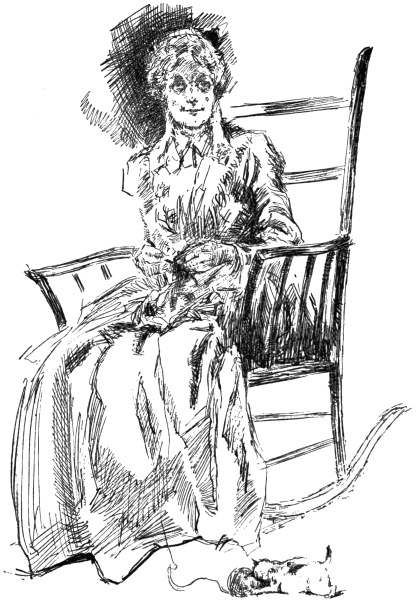
successfully, took the kerchief out of the frame and
drew the point of lace taut over her thumb. Her
motion attracted the judge’s attention and he
watched her deft fingers as he continued his strictures
on journalism.
“A pity? A scandal! Does a celebrity die?
We are intruded into the most intimate details of
his family history; what—ah—shaving soap he
used and whether he—ah—preferred to kiss his lady
love on the—ah—nose or behind the ear; and—ah—who
cried, and how many, when he—ah—in vulgar
phrase—ah—‘kicked the bucket.’ And, mind you,
not a word of truth in the whole story! Whereas
the Digest merely states with terseness and accuracy:
‘the—ah—Emperor of China died on Sunday, of—ah—an
overdose of—ah—bird’s-nest soup.’ It leaves
you to infer that, in the case of the death of a celebrated
personage who met thousands of people in
his public life, there were some who cried and some
who—ah—did not. Any fool knows that, so why
waste print on it?”
“My husband used to tell his students that, in
literary composition, sincerity was more important
than rhetoric and that only a fine feeling could dictate
the making of a truly fine phrase. He said that pure
English had come with the spiritual development of
the race; and that a forceful and intimate use of it
must come about through the individual writer’s
spiritual evolution. Otherwise he claimed no man
could write with real power.”
“Ah. Um, very true. But all wasted on the—ah—young
cubs, I dare say.” The Judge wisely
made no attempt to follow Professor Lee’s analyses.
Metaphysics was several points beyond him. He
found the movements of Mrs. Lee’s tiny needle,
with its almost imperceptible gossamer thread, more
interesting.
“Ah. I have become quite absorbed in your work.
It seems to be so—ah—marvellously intricate.
May I ask what, precisely, you are doing?”
“I am mending a rare old cobweb of lace,” she
answered—spreading the white fragment across her
palm for him to look at—“and, at the same time,
transferring it from its worn-out cambric to a new
piece of linen. A very delicate operation, judge;
and a labour of love.”
“Ah! indeed?”
“Yes. It is for my granddaughter’s trousseau.
She marries in December, and—we feel confident—very
happily. Yes, her intended seems a thoroughly
settled young man. She met him in Scotland.”
“It is a labour requiring both patience and skill,
I should say.”
“I think that patience and skill are the two qualities
required most in any labour of love,” she answered,
with gentle pleasure in the subject. He
peered at the dainty fabric as she cleverly set it into
the frame again.
“Now do find us some delicious item,” she urged.
“Ah. To be sure. Here’s something on the
first page. I’ve just begun—and it—ah—promises
to be exciting, too, which is—ah—rather unusual
for the Digest.”
He had just found the place, preparatory to reading,
when hubbub burst about the card-table.
“Now, Mamma!” Corinne’s vigorous young voice
broke in. “You simply cannot lead every time I
take a trick. It’s—it’s ridiculous. This is my
play.”
“If the Witherbys are going to have a set to,
there’ll be no use in my reading aloud till they’ve
fought it out,” the Judge said to himself, and lost
himself as promptly as possible in the “exclusive.”
“Corinne! You are speaking to your mother!”
Mrs. Witherby so informed her daughter, when she
could get her breath. Dr. Wells hastened to intervene.
“I think,” he said, “that on the whole it might
be as well to play in turn. Of course, I make no
rule”—a deprecating gesture toward his bristling
partner forbade her to think he would presume to
make rules for her—“but it is generally done, I
believe.” He rose, beamed benignly. “Your card.”
He passed it to her.
Corinne tossed her head at her mother and led
the round.
When her turn came, Mrs. Witherby threw down
the knave of hearts and gathered up the cards.
“Trumps! Our trick, doctor,” she cried victoriously.
Her success was greeted with a profound
silence, broken at last by Dr. Wells; he coughed.
Andrews, seeing that Corinne was about to express
herself with her customary frankness, flung himself
into the breach.
“Er—you overlooked—oh, quite by accident, of
course—er—you have the three of clubs in your
hand.”
“I refuse to play with any one—any one—who is
capable of looking at my hand.”
The sensitive Mr. Andrews turned the peony-red
which is specially inflicted upon sandy, blond men.
“I did not look at your hand,” he protested, with
mild heat. “You played the three of clubs when you
led off, just now, in your daughter’s place—oh,
by mistake, of course. It is still in your hand.”
“Your card,” the doctor murmured, politely
handing it to her. Corinne gathered up the trick.
“Another round finishes the game. Come on,
Mrs. Witherby. You must put your best foot forward
and cast these young people into the shade,”
Dr. Wells urged in his cheeriest tones, obviously
endeavouring to banish the sour gloom that had
settled on his partner’s spirit. A darting, knifelike
glance of her eyes told that he had failed.
“My foot is not of such dimensions as to cast a
shade over two persons,” sourly. “I don’t understand
your allusion.”
Again the peace-loving Andrews flew like the dove
upon the storm.
“Of course, Mrs. Witherby, you will be one of
Mrs. Lee’s breakfast party to-morrow?” he said,
and thus gave Mrs. Lee the opportunity she needed.
She had begun to wonder how she was to introduce
her topic sympathetically in the discordant atmosphere
of one of Mrs. Witherby’s “card-game humours.”
“Did I hear my name?” she asked, turning to them.
“I mentioned your breakfast party,” Andrews
replied quickly. “It is to be at eleven o’clock, is it
not?”
“Yes. But everyone is to be there by a quarter
to eleven, so that we can be prompt in beginning.”
“To be sure. Ah. The breakfast party.” The
Judge looked over his paper.
“Do tell us about it,” Mrs. Witherby interjected.
“I am simply bored with these cards.”
“Mr. Falcon will arrive at Trenton Waters on the
morning train, and I am sure he will prefer to ramble
across the fields to Roseborough. I suppose I am a
little old-fashioned, but I wished him to feel that all
the town was welcoming him home—not only the
widow of his old professor.” She sighed and smiled.
“Dear Mrs. Lee,” Mrs. Witherby exclaimed, effusively.
“That is so like you.”
Encouraged by this responsiveness, Mrs. Lee continued
more hopefully:
“You see, there was a good deal of comment when
Jack left college so abruptly. There had just come
the opportunity, through Professor Lee, to teach
languages—for which Jack had a rare gift—and
certain classes in literature also. That was quite
an honour for a young man of twenty-one. And to
think he threw it all away just to go out into the
world and see what was to be seen!”
“Well, well,” Mr. Andrews said, as she paused;
“I’d never have done that. But, then, it isn’t my
nature.”
“Roseborough was inclined to be indignant,”
Mrs. Lee admitted. “But my husband felt—and
said openly—that there might be wisdom in his wandering.
Indeed he was the only one who stood the
boy’s friend in the matter. Sixteen years ago. Ah,
me!” She bent over her lace, because her eyes were
wet.
The Judge looked over the edge of his paper again.
“I can’t place him. Falcon, do you say?”
“Yes, Jack Falcon.”
He shook his head.
“I don’t think I ever knew him.”
Dr. Wells had just dealt for a new game, but he
lingered in picking up his cards to say:
“Doubtless I treated him for measles, in his turn—along
with every other child in the district—but
I have not a clear remembrance of him as a young
man. Was he on any of the athletic teams, do you
remember?”
“Oh, he was past the measles stage when he came
to Roseborough! He would trudge for miles through
the woods; but I remember that he hated sports.”
“That accounts for my very hazy recollection of
him. I was never called from my Thanksgiving
turkey to set his collarbone.”
He laughed cosily at his own repartee, and played,
since Mrs. Witherby had opened the game and his
turn had come. His ruddy brow was rolled up in
furrows, though, because it was difficult to follow
his partner’s play at any time—more than difficult
while conversing upon an alien subject.
“The boy wasn’t one to—to ‘mix,’ as they say.
He was devoted to my dear husband. Professor
Lee had a wonderful understanding of all growing
things—he loved them. Ah, well,” she sighed
tenderly. “Jack was much with us. He had his
room here—the music room it is now—for of course
he knew us in our palmy days when we lived here,
before Mr. Mearely’s time. We loved him dearly
and he never forgot us. He always wrote to my
husband at least twice a year, and—afterward—to
me. When I decided to publish the professor’s
manuscripts, the boy wrote—he was in the Balkans
then—offering his services as editor, out of gratitude
and love for him who is gone. So you see why my
heart is very tender toward him, and why I am asking
you all, dear friends, to join me to-morrow in
his welcome home.”
“Oh, Mrs. Lee,” Corinne cried, clapping her
hands, “I think it’s lovely!”
“Such a sweet notion!” her mother opined, and
to show that her interest was genuine, asked, with
point: “Has he made any money?”
“Ah, I fancy he has,” Mrs. Lee said. “A little;
though for years his was a hand-to-mouth existence.
Recently, I know, he was handsomely paid
by a wealthy gentleman of title....”
“Title?” Mrs. Witherby interrupted excitably.
“Yes, indeed—if my failing memory serves me—I
believe he was almost if not quite a royal personage.”
“Royal?”
“But that reminds me of something that will stir
your pride, I know, as it stirred mine. There was a
little prose poem of Professor Lee’s, about Roseborough.”
She beamed at them all.
“Quite a good subject for a poem, I dare say,”
the Judge remarked. “Personally, I never read a
poem—though even the Digest prints them, to fill
in.”
“I sent it to Jack,” Mrs. Lee hastened on—to
forestall any discussion, pro and con poetry—“hoping
that it might revivify his memories and lead him
home from his wanderings. He showed it to this
titled gentleman, who was so charmed with it that
he begged for a copy and asked many question, about
our dear old town.”
There were pleased and reverent murmurs from
every one, and Howard, who had also been listening,
said:
“Very flattering.”
Miss Crewe kept her shoulder turned, and refused
to let her thoughts leave their main purpose to
sympathize with her natal hamlet’s pride.
“It begins so beautifully,” Mrs. Lee continued.
“Listen: ‘Here where all hearts are tender and
sincere.’”
“‘Here where all hearts are tender and sincere,’” Mrs.
Witherby echoed, rolling her eyes. “How lovely!
One would know at once that meant Roseborough.”
The phrase had caught Andrews’s ear. In playing,
he parroted vacantly:
“‘Here where all hearts are tender and sincere!’
Very nice. Trumps.”
Mrs. Witherby returned to the item of greatest
interest to her.
“But, dear Mrs. Lee, you spoke just now of his
being handsomely paid for something. What was
he paid for, and how much was it?”
“Oh, yes. For designing a great pleasure garden
for the peasants of that place. But I don’t know
the amount.”
“Oh, he is a landscape gardener now?” Andrews
asked. He was an amateur horticulturist, in a very
small way, himself, and enjoyed gardening details.
The judge, whose interest in Mr. Falcon was exhausted,
had returned to his paper. Mrs. Lee
laughed.
“No. Not a gardener. He is a writer. But one
who can write on the earth, if pencil and pad fail him.
A practical poet—if you can call ‘practical’ a man
who roams the world in search of beauty, or
of conditions which will allow him to make them
beautiful. The professor delighted in saying—oh,
figuratively, of course—that one could easily recognize
the true artist, because his fingers are always
knuckle-deep in earth-dust; whereas the dilettante’s
fingers are chiefly remarkable for nail-polish.”
“And, there, I entirely agree with him! As I am
constantly telling Corinne, I consider the way people
polish their nails, nowadays, is positively vulgar.”
Mrs. Witherby spoke emphatically and played her
card with a righteous flourish.
“Mamma! It’s my lead.” There was more than
a suggestion of anger in Corinne’s voice.
Bowing, Dr. Wells handed his partner her card,
saying politely:
“Your card.”
“Corinne, you watch me like a hawk; as if you
thought your own mother would cheat you if you
weren’t looking.”
“Ah! but I always am looking,” that young lady
cried gayly.
There was a lull at the table after this family tilt,
and the Judge seized the occasion to share the “exclusive,”
which had proved too thrilling to be kept
to himself.
“Ah—give me your attention a moment. I have
just read in my Digest, here, such a peculiar tale. A
reigning prince of some little European state has
run off.”
“Dear, dear,” Mrs. Lee said. “Was it a love-affair?”
“Ah—not precisely: though a princess had been
arranged for him.”
Even Miss Crewe felt a degree of interest in a
run-away prince, or perhaps she felt that she had
challenged her aunt’s wrath long enough. She rose,
as her cousin called to her:
“Oh, Mabel, come and hear about the prince.
Do tell us more, Judge Giffen.”
The Judge consulted his paper.
“Um—ah—here it is. Um—ah—odd chap. Very
chivalrous and—ah—romantic; eccentric; fond of
wandering about, incognito, and entering humble
people’s houses and—ah—making friends with them.
Artistic. No love-affair suspected, but—ah—it seems
he has never enjoyed ruling. Too sensitive. Been
missing for months. The Court tried to—ah—hide
the fact, but it is out now, and the whole world is
aware that His Highness—wait a minute till I find
the place, for it’s a fearful name. Ah—here it is.
His Highness, Prince Adam Lapid, reigning Duke
of Woodseweedsetisky”—he stumbled over it
badly.
“Good gracious!” Mabel said.
“Ah—His Highness has abdicated and run away
in disguise, leaving a letter. Ah—this is the letter.
Listen”:
Dear Subjects, Councillors, and neighbouring Princes,
including Her Highness Princess Olga of Damala-Binootshia,
to whom processes of state have affianced me although
I have never seen her. I herewith and hereby abdicate
and renounce my hereditary right to the throne of Woodseweedsetisky.
I am too sensitive to endure the criticisms
aimed at royalty by heartless radicals. Recently I
have received harsh words from a visiting, untitled
stranger, whom I had employed in executing a beneficent
and beautiful plan for my ungrateful subjects. It was
not my fault that it was, later, found to be impossible to
bring the water to the top of the mountain, where I had
insisted that the fountain—a memorial to my father—be
erected. Criticism of me on that account was unjust
and cruel. It was not I who failed, but the water. I
abdicate. I go to a place where there is no criticism.
Farewell.
Adam Lapid.
“Well! What a....”
The Judge silenced the interrupting chorus. “A
postscript.”
P. S. People who criticise me are ignorant. If they
knew as much as I do they would act as I do. As for
the visiting stranger—a person of no antecedents—who
criticised me because of the fountain, I have put him in
prison. Let him see whether his pointed criticisms are sharp
enough to pick my prison locks. The top of the mountain
was the proper place for the memorial fountain to my honoured
father. It was not my fault that the water did not
arrive there to spout. But when this stranger of humble
birth said to me, “I told you water will not run uphill,
even to oblige a prince,” I put him in the prison. Farewell.
“Now, that’s a remarkable tale, eh?”
“He’s quite mad, of course,” Howard said. Dr.
Wells wanted to know what became of the man who
designed the fountain where the water would not
arrive to spout.
“Oh—ah—he escaped.”
“So his criticisms were sharp enough to pick locks,”
the doctor chuckled, as joyfully as if the original jest
had been his.
“Ah. Quite so. The Councillors suspected at
first that the prince’s disappearance and—ah—the
whole thing was an anarchistic plot. But they are
satisfied now that he really ran off of his own accord.”
“Oh, isn’t it thrilling?” Corinne clapped her hands
again. Her large, round eyes had been growing
larger and larger, throughout the recital, till it was
impossible for them to stretch any more.
“I hope he’ll keep his freedom, poor dear, and let
the kingdom rage,” Mabel said. There was a bitterness
in her intonation, which always drew her aunt’s
anger, for Mrs. Witherby held that Mabel should
feel humbled under the weight of gratitude.
“No doubt you feel so, Mabel,” she said, acidly.
“But most of us recognize duty and the importance
of the world’s opinion. Ah! there is our sweet
hostess.”
“Did we disturb you with our melodic outcries?”
Rosamond asked, blithely. Her cheeks were flushed
and her eyes shining.
“We heard you, of course,” Andrews remarked—meaning
to be polite. He was leading a new round.
“You made criticisms?” the violinist asked,
darkly.
“Oh, my dear Dr. Frei, we were charmed—utterly
charmed.”
Frei acknowledged Mrs. Witherby’s impressive
compliment with a low bow. He was very grave.
“Dr. Frei plays so beautifully.” Rosamond
thought she saw his sad mood coming upon him,
and was eager to ward it off with sympathetic
eulogies. Mrs. Lee, unawares, abetted her.
“Dear Dr. Frei, how much you have added to the
natural charm of our dear old town by bringing your
violin, and opening your little studio among us.”
Frei bent and kissed her hand.
“You have a kind heart,” he said, gratefully.
“You criticise no one.”
“Oh, I hope not,” she replied. “The Judge has
just been telling us about a poor dear man out in the
great world—ah, well! Life must be very different
in the vast cities, where people are strangers instead
of neighbours. Think of that! Strangers instead
of neighbours! How fortunate I am to live in Roseborough,
where everybody is so interested in everybody
else. Dear Mrs. Witherby, in particular,
takes such an interest.” She patted that lady’s arm.
Mrs. Witherby, having lost the last round, had left
the table. “Ah, well, that is the spirit of Roseborough.”
“Some might call it a meddlesome spirit,” Miss
Crewe suggested.
“Oh, my dear child,” Mrs. Lee reproved her,
affectionately.
“I think we will not allow Mabel to interpret the
spirit of Roseborough.” Mrs. Witherby was smilingly
spiteful.
“Where did you learn to play?” Judge Giffen
drew Frei aside.
“In Warsaw.”
“Ah! Indeed? I know Warsaw.” He began to
relate to Dr. Frei whatever incidents remained in
his mind of his visit to the Polish capital, twenty-five
years before.
Mrs. Witherby was assisting Mrs. Lee in gathering
up her fancywork, scissors, spools and so forth, and
was receiving in return that lady’s ardent thanks for
her help in notifying guests without telephones of
Mr. Falcon’s home-coming breakfast. Mabel lifted
the old lady’s white wool shawl and wrapped it about
her.
“Oh, do come here, Mrs. Mearely!” cried Corinne,
who was now alone at the card table. She caught
Rosamond’s hand and began excitedly, “Oh, Mrs.
Mearely, Judge Giffen has just read such a thrilling
thing in the Digest. Just think! a real prince has run
away from his throne, and taken a different name,
but they don’t know what it is and—and—he’s gone
looking for a real romance—and they think he has
hidden himself in some little town. Oh! think; if
he’d only come to Roseborough! Oh, Mrs. Mearely,”
she panted, “all my life I’ve wanted something
wonderful to happen in Roseborough!”
Rosamond laughed, noting Corinne’s breathless excitement
rather than her news.
“My dear Corinne, nothing will ever happen in
Roseborough.”
Corinne almost wailed her protest at this hard
saying.
“Oh, it might happen! Think if the prince came
here. Oh, he might, Mrs. Mearely,” she pleaded.
“He might.”
Rosamond, smiling, shook her head. Seeing that
Mrs. Lee was ready to leave, she threw her own wrap
around her.
“Now, I must be off to bed. I have overstayed.”
Mrs. Lee was rejecting Mrs. Witherby’s efforts to
keep her “just another half hour.” “One must go to
sleep when the twilight ends, if one would really enjoy
early rising. I think I may almost say I have
not missed a sunrise for twenty years.”
“Sunrise?” Howard repeated, “I often wonder
how you do it! I find half-past eight almost too
early.”
“Dr. Frei and I will go with you,” Rosamond said.
Frei, hearing his name, turned. The Judge followed
him for the purpose of concluding his arguments.
“As I was saying,” he insisted, “I have only one
criticism to make of Beethoven’s sonatas....”
Frei wheeled upon him, and silenced him with a
commanding gesture.
“Do not make it!” he said, frowning fiercely as at
the most hated of enemies. “Beethoven is not here
to defend himself. Ach! I detest criticism. It is
the speech of those who do not understand.”
The judge, feeling aggrieved at this public snubbing,
walked off, muttering under his breath:
“Touchy fiddler!” Frei gave his arm to Mrs. Lee.
“Good-bye, for the present.” Rosamond waited
an instant to offer cheer to her remaining guests, before
joining Mrs. Lee and Frei on the verandah. “Some
of you will have time for another game before we
return. The chess board is just as you and Wilton
left it, Judge. When cards and chess pall, you will
find sandwiches and salad, with perhaps a jelly or
two and some of Amanda’s parsnip wine on the dining-room
table. I know we can’t persuade Mrs. Lee.”
“No, dear, not in the evening. Good-night, dear
friends. I shall see you all at breakfast, to-morrow.
A quarter to eleven. Don’t fail me.”
“We won’t!” Corinne called to her, above the
calmer promises of the older folk.
“Oh, joy! A new man is coming to Roseborough!
Though I suppose he’s pretty old,” she added, after
Mrs. Lee and her two escorts had disappeared.
“Mrs. Lee calls men of fifty ‘dear boys,’ if they ever
went to Charleroy.”
Mrs. Witherby, Wells, and Andrews seated themselves
at the card table. For the moment, Mrs.
Witherby’s mind was occupied with something more
important than cards. Assuring herself that her
niece could not hear her, she said:
“Mrs. Barton is not coming from Poplars Vale till
next week, so I shall try to persuade Mrs. Mearely
to let me leave our Thomas to sleep in the house here,
to-night. With her sister absent, she is quite alone.
You know, I consider it suspicious that her two maids
should have been called to their sick mother’s bedside
the same day that her coachman was obliged to
take the gray mare out to the farm. It leaves Mrs.
Mearely quite alone. I consider it very suspicious.
I think Mrs. Barton should have been sent for. I
think it peculiar that Mrs. Mearely herself did not
tell me about it.”
Wells, who was dealing, replied humorously:
“But—the maids being sisters—naturally, if Jemima’s
mother is ill, so is Amanda’s mother, te-he-he.”
He was rewarded with a frosty glance.
“It pleases you to be facetious. Corinne, come—we
are having another game.”
Corinne came, none too willingly. The Judge,
who had had enough of the Digest for that evening,
nodded to Wilton.
“Er—shall we try the chessmen to-night, Howard?
Perhaps Miss Crewe will sit by and inspire us.”
Howard, anxious to avoid another tête-à-tête with
Mabel, answered with alacrity, “By all means.”
Mabel, yawning, sank among the cushions of the
settee. She was not interested in chess, but she
could watch her lover’s profile from this position.
“Oh, I wish there were something young to do,”
Corinne protested. “Cards aren’t young.”
“I don’t consider it safe for Mrs. Mearely to remain
alone to-night,” Mrs. Witherby resumed. “A
most villainous-appearing man with a multitude of
black whiskers has been seen lurking about. Johnson,
the butcher’s boy, told my maid, Hannah Ann,
about it. He saw him!”
“I don’t think Mrs. Mearely is timid,” Andrews
said.
“In my day, Mr. Andrews, it was not considered
well-bred for women to make an exhibition of courage.
They had it, but they suppressed it under a
mask of timidity and sensitiveness. And the girls
married easily at eighteen. And the widows were
wives again before they had reached the lavender
stage of their mourning. I shall try to insist on Mrs.
Mearely’s keeping our Thomas to-night, and I do
think it rash of her to don such a rich and conspicuous
gown when she is entirely alone....”
“Oh, my trick again! Oh, goody!” Corinne broke
in enthusiastically.
“Congratulations, fair partner.” Andrews thought
he had done very well with that speech. So did
Corinne.
“Oh, you say such lovely things, Mr. Andrews!”
“Losing as usual, aunt?” Mabel’s tone was delicately
unpleasant. It angered her aunt.
“Not at all! I doubt if there is a woman in Roseborough
who plays a better hand.”
In turning to make her speech more impressive
and to give Miss Crewe a broadside, as it were, of her
displeasure, she had a full view of the verandah, and
was in the nick of time to see a swarthy, black-whiskered
face, topped by a soft, black felt hat, slowly
raised over the verandah rail. She panted twice
from terror’s cold shock; then screamed with all her
might. The apparition disappeared.
“Eh? What?” Dr. Wells looked up, jerkily, from
his cards. Howard had half risen, from habit, at
the feminine cry of distress. The Judge, peering over
his pince-nez, offered a practical explanation.
“A beetle? The summer bugs do bite.”
“Mamma! I wish you wouldn’t shriek when
there’s no need.”
Mrs. Witherby was angry now as well as frightened.
She gestured frantically and gasped.
“There—there! I saw him! Oh! the terrible
man! Oh, quick—catch him—a man!”
She continued to point and wave and gasp at such
a rate, that Judge Giffen and Wilton Howard, concealing
their mirth as best they could, went to the
verandah and made a perfunctory investigation.
The movement of their shoulders suggested that
they were not looking over the verandah rail so much
as laughing over it. Miss Crewe gave herself up to
an almost hysterical hilarity.
“You have so much imagination, Aunt Emma.”
Dr. Wells cackled with delight, “Te-he-he!
The cry of the eternal feminine—‘Catch him!
Catch the man!’ Te-he-he.”
“You must have seen him!” Mrs. Witherby’s face
was crimson with fury. She would have liked to tear
out all the mocking eyes now regarding her.
“Not even a tiger,” Howard informed her cheerfully.
“Nary cannibal,” the Judge added, with facetious
looks and stepping about on tiptoe as if in mortal
fear of bogies.
“I saw him! I saw....” Words failed her.
She played her card blindly, and took the trick.
This was the last straw, as far as Corinne was concerned.
“Mamma! It’s my trick!” She snatched it
away from her mother with trembling hands. Her
nerves were taut from the scare she had received, for
the wild shriek had been sent almost into her ear.
It proved the last straw for Mrs. Witherby also.
“Corinne!” she thundered. “This is too much!
Do you suppose your mother is going to sit here the
whole evening and not take a single trick? How
dare you assert yourself so?”
Corinne threw down her cards and burst into explosive
sobs.
“I don’t—I didn’t—I never did. It was my
trick.” Wells patted her shoulder affectionately.
“There, there, dear child. Don’t cry.”
“What’s this?” the Judge asked. “Our merry
Corinne in tears?”
“No one thinks of me, the mother!” Mrs. Witherby
whimpered.
“She—she—is always like that when she plays
cards. What has—a—mother to do with trumps—and
things?”
“Oh, you heartless child! And after the terrible
fright I’ve had! Judge Giffen, your arm. I am not
well.”
“Eh, what?” The Judge resented nothing so
much as being asked to leave his chess. “Oh—yes—with
pleasure. Let us seek the—ah—sympathetic
seclusion of the dining room, eh? Mrs. Mearely
spoke of sandwiches. Yes—ah—a sustaining sandwich.”
“I couldn’t eat a mouthful. I’m so upset. Corinne’s
behaviour—and—oh, Judge—that dreadful
face! Oh, if you’d seen the villainous whiskers!”
“Yes—yes—a little—ah—salad. A glass of
Amanda’s parsnip wine.” He guided her into the
dining room.
“Shall we also refresh the inner soul, Miss Corinne?”
Mr. Albert Andrews asked, with gallantry.
“Now I am quite sure that Mrs. Mearely has provided
creams and a fine array of iridescent jellies
to delight the youthful palate. Go with Andrews,
dear child.”
Corinne threw her arms around Dr. Wells’s neck.
“I think you are just too dear for anything, Dr.
Wells. I wish I could have you for a father.”
“Heaven forbid!” he answered absently. “Er—that
is—thank you, my dear. You are a very sweet
girl, Corinne. Yes—considering the circumstances—a
remarkably sweet girl,” he added as the dining-room
door closed behind the couple. He rose, taking
his pipe from his pocket.
“Do you find Aunt Emma wearing, doctor?”
Mabel inquired flippantly. “Some do.”
“Oh, no, no! What a sad idea. I shall go out
now and have a pipe in the moonlight, and all the
little cares will blow away with the smoke.”
“Don’t let Mrs. Witherby’s wild man get you,”
Howard urged, laughing.
“Te-he-he! the good lady is so excitable; but
she means well. I leave you to the pleasant task of
dispelling pessimistic ideas from Miss Crewe’s lovely
head.” He went out on tiptoe, with extravagant
antics of mock caution.